Cambridge A Level Psychology (from 2018) 9990 — 2023 May/June Paper 2 · Variant 3
9990/23/M/J/23 · 10 questions · 60 marks · ≈68 min
The question paper and its mark scheme, free to read here and free to download. This is Cambridge’s own paper, exactly as it was sat.
Question paper12 pages



Mark scheme14 pages
Answers below. Sit the paper first if you are practising.

Questions as text
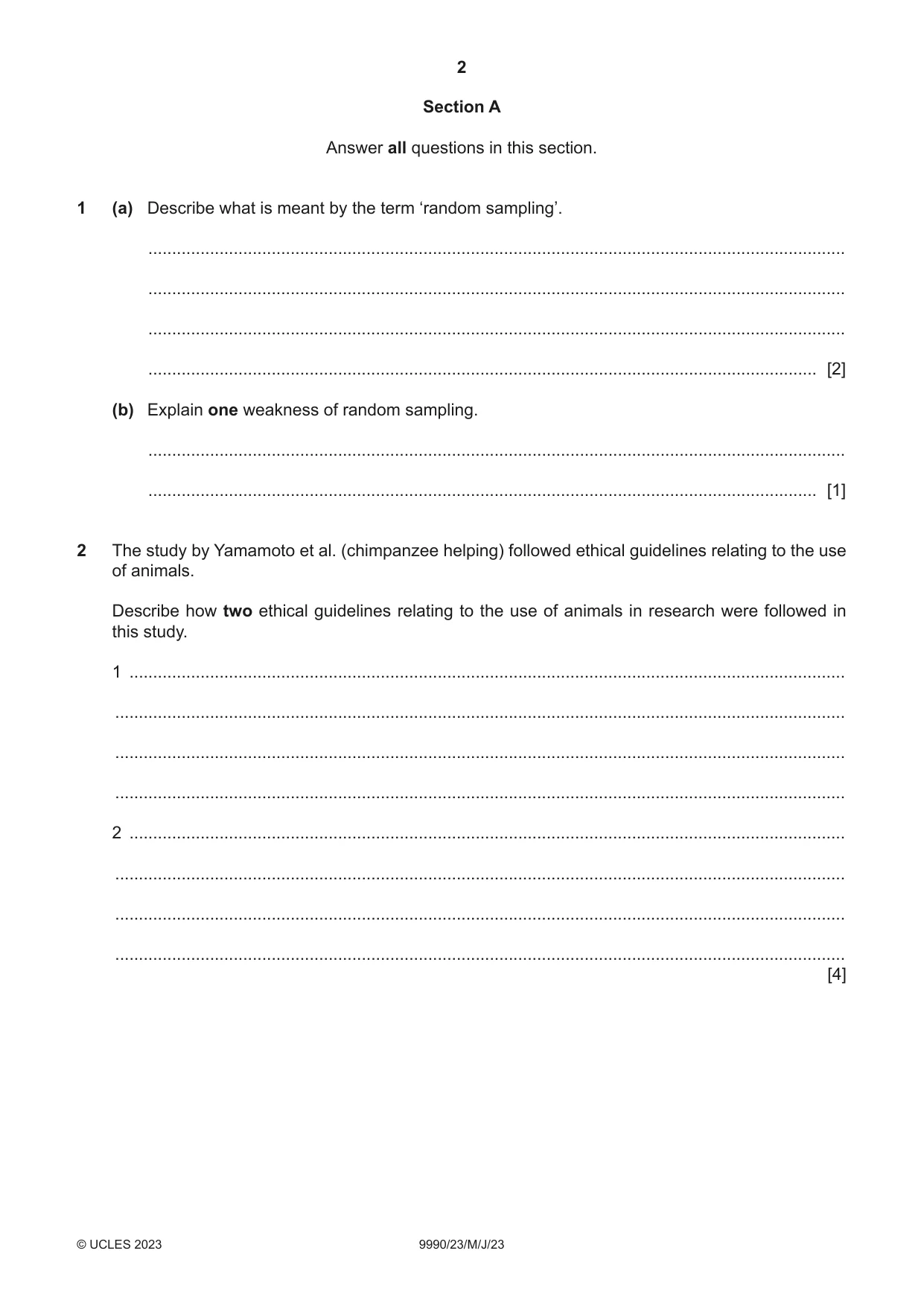
Q1 · Describe what is meant by the term ‘random sampling’
1 (a) Describe what is meant by the term ‘random sampling’. ................................................................................................................................................... ................................................................................................................................................... ................................................................................................................................................... ............................................................................................................................................. [2] (b) Explain one weakness of random sampling. ................................................................................................................................................... ............................................................................................................................................. [1]
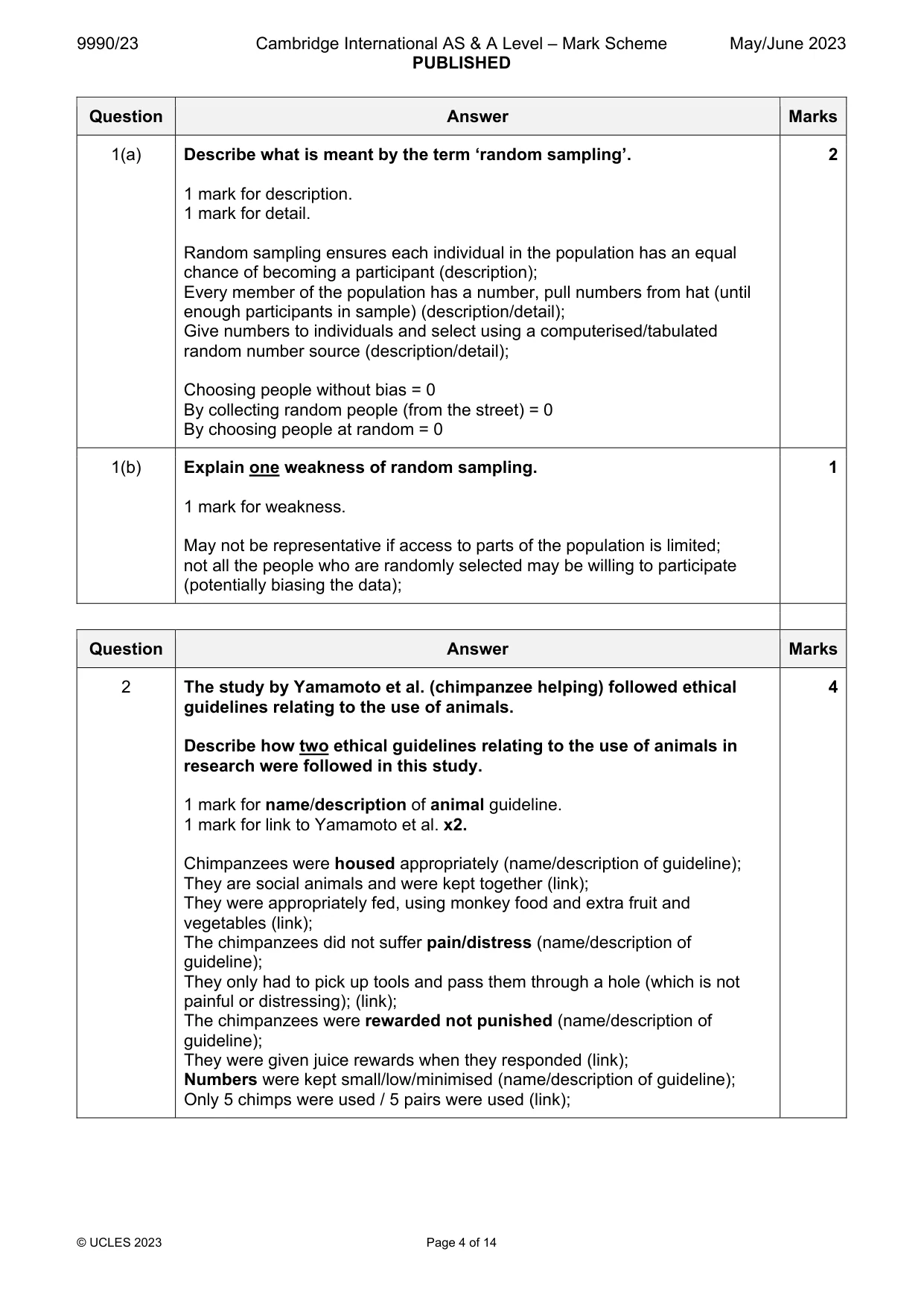
Mark scheme: Question Answer Marks 1(a) Describe what is meant by the term ‘random sampling’. 2 1 mark for description. 1 mark for detail. Random sampling ensures each individual in the population has an equal chance of becoming a participant (description); Every member of the population has a number, pull numbers from hat (until enough participants in sample) (description/detail); Give numbers to individuals and select using a computerised/tabulated random number source (description/detail); Choosing people without bias = 0 By collecting random people (from the street) = 0 By choosing people at random = 0 1(b) Explain one weakness of random sampling. 1 1 mark for weakness. May not be representative if access to parts of the population is limited; not all the people who are randomly selected may be willing to participate (potentially biasing the data);
Q2 · The study by Yamamoto et al
2 The study by Yamamoto et al. (chimpanzee helping) followed ethical guidelines relating to the use of animals. Describe how two ethical guidelines relating to the use of animals in research were followed in this study. 1 ....................................................................................................................................................... .......................................................................................................................................................... .......................................................................................................................................................... .......................................................................................................................................................... 2 ....................................................................................................................................................... .......................................................................................................................................................... .......................................................................................................................................................... .......................................................................................................................................................... [4]
Mark scheme: 2 The study by Yamamoto et al. (chimpanzee helping) followed ethical 4 guidelines relating to the use of animals. Describe how two ethical guidelines relating to the use of animals in research were followed in this study. 1 mark for name/description of animal guideline. 1 mark for link to Yamamoto et al. x2. Chimpanzees were housed appropriately (name/description of guideline); They are social animals and were kept together (link); They were appropriately fed, using monkey food and extra fruit and vegetables (link); The chimpanzees did not suffer pain/distress (name/description of guideline); They only had to pick up tools and pass them through a hole (which is not painful or distressing); (link); The chimpanzees were rewarded not punished (name/description of guideline); They were given juice rewards when they responded (link); Numbers were kept small/low/minimised (name/description of guideline); Only 5 chimps were used / 5 pairs were used (link);
Q3 · In the study by Laney et al
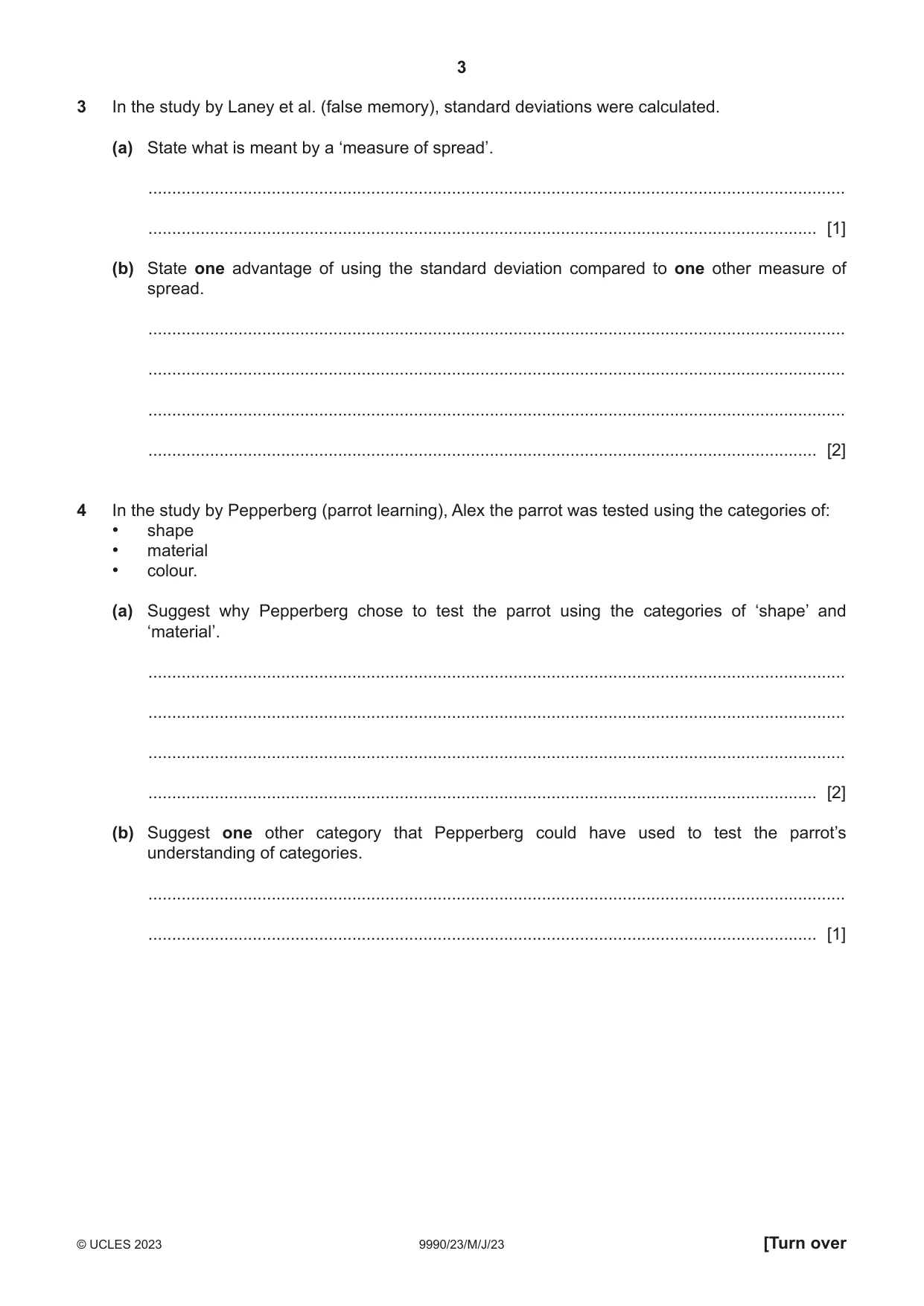
3 In the study by Laney et al. (false memory), standard deviations were calculated. (a) State what is meant by a ‘measure of spread’. ................................................................................................................................................... ............................................................................................................................................. [1] (b) State one advantage of using the standard deviation compared to one other measure of spread. ................................................................................................................................................... ................................................................................................................................................... ................................................................................................................................................... ............................................................................................................................................. [2]
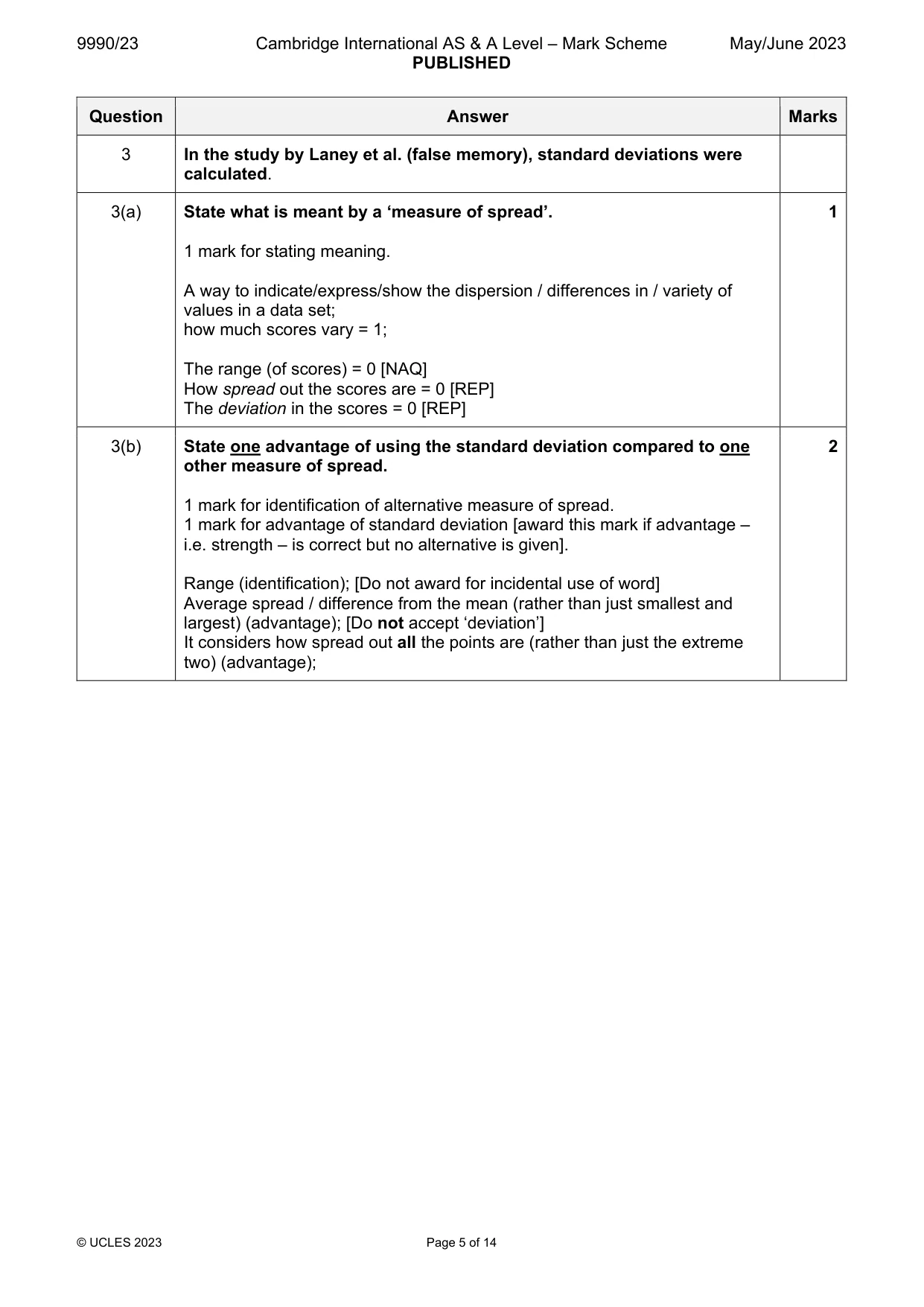
Mark scheme: 3 In the study by Laney et al. (false memory), standard deviations were calculated. 3(a) State what is meant by a ‘measure of spread’. 1 1 mark for stating meaning. A way to indicate/express/show the dispersion / differences in / variety of values in a data set; how much scores vary = 1; The range (of scores) = 0 [NAQ] How spread out the scores are = 0 [REP] The deviation in the scores = 0 [REP] 3(b) State one advantage of using the standard deviation compared to one 2 other measure of spread. 1 mark for identification of alternative measure of spread. 1 mark for advantage of standard deviation [award this mark if advantage – i.e. strength – is correct but no alternative is given]. Range (identification); [Do not award for incidental use of word] Average spread / difference from the mean (rather than just smallest and largest) (advantage); [Do not accept ‘deviation’] It considers how spread out all the points are (rather than just the extreme two) (advantage);
Q4 · In the study by Pepperberg (parrot learning), Alex the parrot was tested using the…
4 In the study by Pepperberg (parrot learning), Alex the parrot was tested using the categories of: • shape • material • colour. (a) Suggest why Pepperberg chose to test the parrot using the categories of ‘shape’ and ‘material’. ................................................................................................................................................... ................................................................................................................................................... ................................................................................................................................................... ............................................................................................................................................. [2] (b) Suggest one other category that Pepperberg could have used to test the parrot’s understanding of categories. ................................................................................................................................................... ............................................................................................................................................. [1]
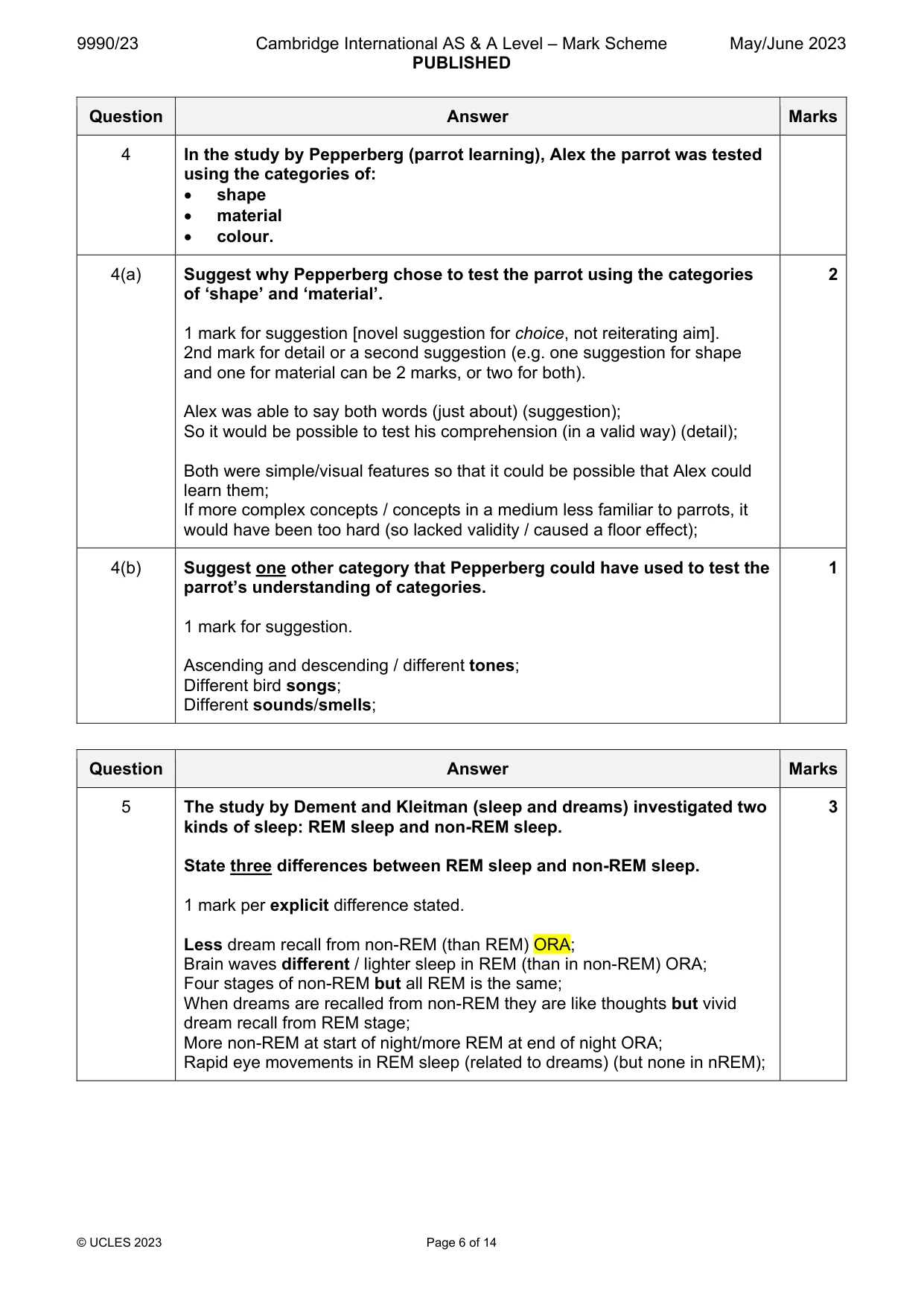
Mark scheme: 4 In the study by Pepperberg (parrot learning), Alex the parrot was tested using the categories of: shape material colour. 4(a) Suggest why Pepperberg chose to test the parrot using the categories 2 of ‘shape’ and ‘material’. 1 mark for suggestion [novel suggestion for choice, not reiterating aim]. 2nd mark for detail or a second suggestion (e.g. one suggestion for shape and one for material can be 2 marks, or two for both). Alex was able to say both words (just about) (suggestion); So it would be possible to test his comprehension (in a valid way) (detail); Both were simple/visual features so that it could be possible that Alex could learn them; If more complex concepts / concepts in a medium less familiar to parrots, it would have been too hard (so lacked validity / caused a floor effect); 4(b) Suggest one other category that Pepperberg could have used to test the 1 parrot’s understanding of categories. 1 mark for suggestion. Ascending and descending / different tones; Different bird songs; Different sounds/smells;
Q5 · The study by Dement and Kleitman (sleep and dreams) investigated two kinds of sleep: REM…
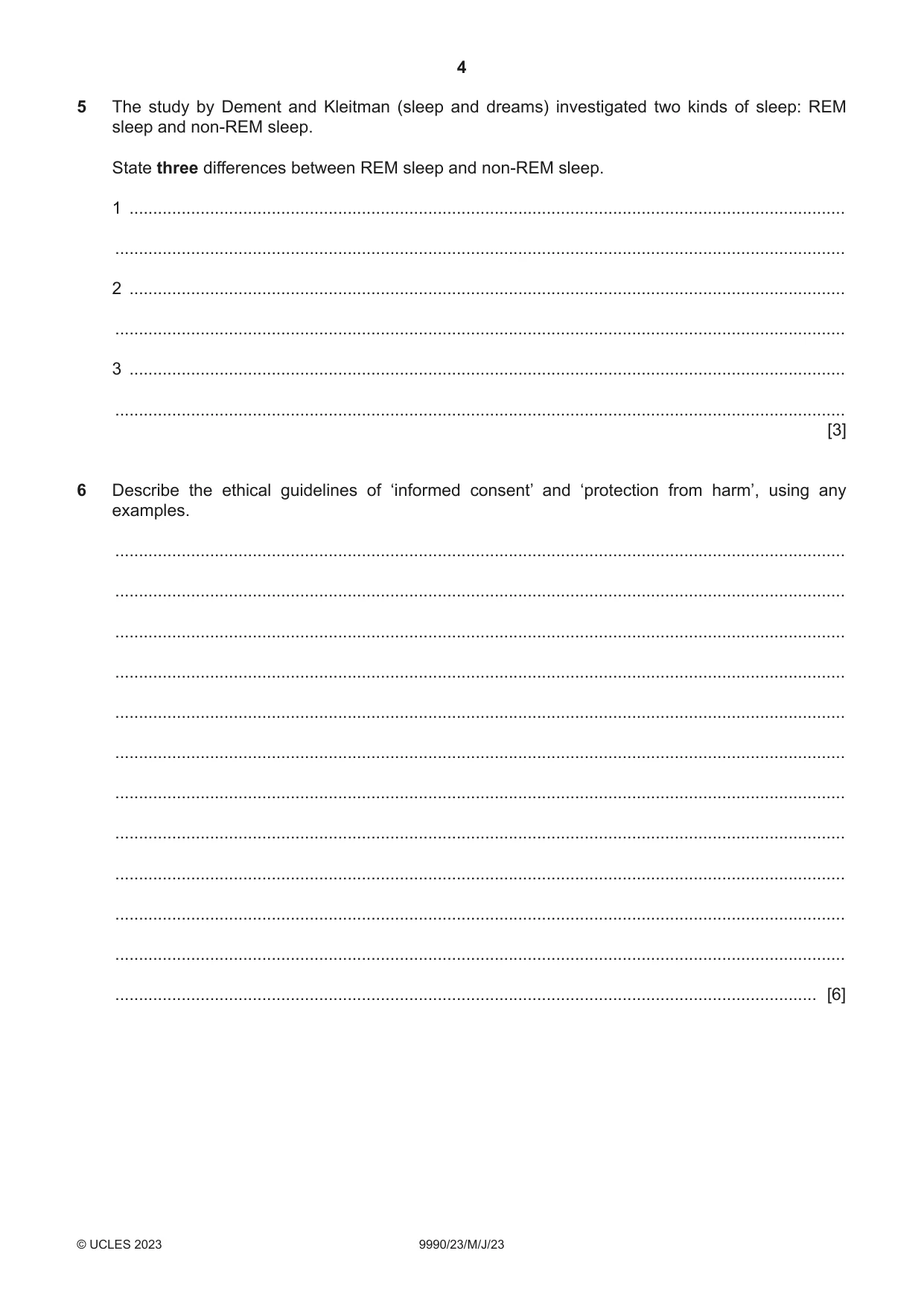
5 The study by Dement and Kleitman (sleep and dreams) investigated two kinds of sleep: REM sleep and non-REM sleep. State three differences between REM sleep and non-REM sleep. 1 ....................................................................................................................................................... .......................................................................................................................................................... 2 ....................................................................................................................................................... .......................................................................................................................................................... 3 ....................................................................................................................................................... .......................................................................................................................................................... [3]
Mark scheme: 5 The study by Dement and Kleitman (sleep and dreams) investigated two 3 kinds of sleep: REM sleep and non-REM sleep. State three differences between REM sleep and non-REM sleep. 1 mark per explicit difference stated. Less dream recall from non-REM (than REM) ORA; Brain waves different / lighter sleep in REM (than in non-REM) ORA; Four stages of non-REM but all REM is the same; When dreams are recalled from non-REM they are like thoughts but vivid dream recall from REM stage; More non-REM at start of night/more REM at end of night ORA; Rapid eye movements in REM sleep (related to dreams) (but none in nREM);
Q6 · Describe the ethical guidelines of ‘informed consent’ and ‘protection from harm’, using…
6 Describe the ethical guidelines of ‘informed consent’ and ‘protection from harm’, using any examples. .......................................................................................................................................................... .......................................................................................................................................................... .......................................................................................................................................................... .......................................................................................................................................................... .......................................................................................................................................................... .......................................................................................................................................................... .......................................................................................................................................................... .......................................................................................................................................................... .......................................................................................................................................................... .......................................................................................................................................................... .......................................................................................................................................................... .................................................................................................................................................... [6]
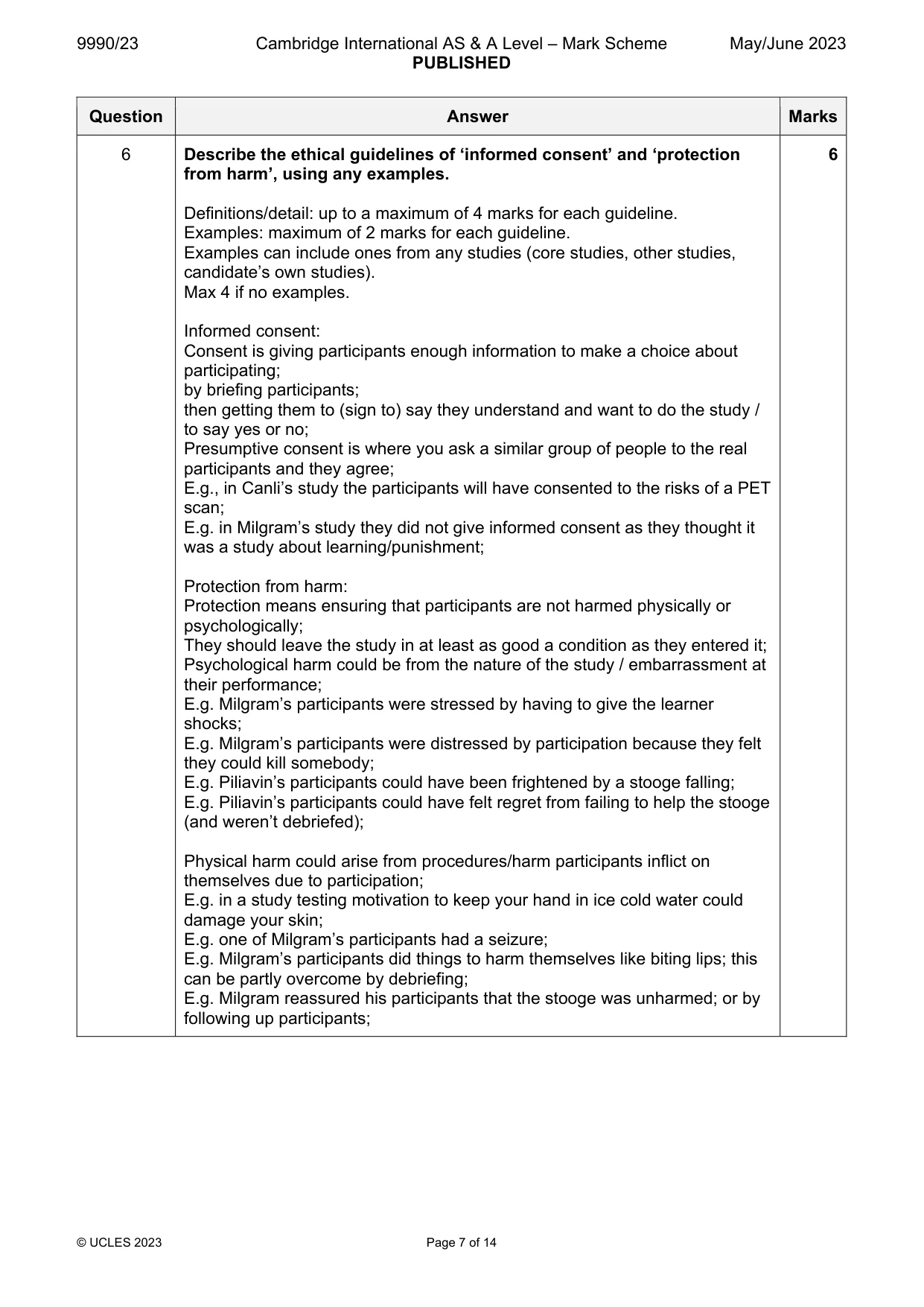
Mark scheme: 6 Describe the ethical guidelines of ‘informed consent’ and ‘protection 6 from harm’, using any examples. Definitions/detail: up to a maximum of 4 marks for each guideline. Examples: maximum of 2 marks for each guideline. Examples can include ones from any studies (core studies, other studies, candidate’s own studies). Max 4 if no examples. Informed consent: Consent is giving participants enough information to make a choice about participating; by briefing participants; then getting them to (sign to) say they understand and want to do the study / to say yes or no; Presumptive consent is where you ask a similar group of people to the real participants and they agree; E.g., in Canli’s study the participants will have consented to the risks of a PET scan; E.g. in Milgram’s study they did not give informed consent as they thought it was a study about learning/punishment; Protection from harm: Protection means ensuring that participants are not harmed physically or psychologically; They should leave the study in at least as good a condition as they entered it; Psychological harm could be from the nature of the study / embarrassment at their performance; E.g. Milgram’s participants were stressed by having to give the learner shocks; E.g. Milgram’s participants were distressed by participation because they felt they could kill somebody; E.g. Piliavin’s participants could have been frightened by a stooge falling; E.g. Piliavin’s participants could have felt regret from failing to help the stooge (and weren’t debriefed); Physical harm could arise from procedures/harm participants inflict on themselves due to participation; E.g. in a study testing motivation to keep your hand in ice cold water could damage your skin; E.g. one of Milgram’s participants had a seizure; E.g. Milgram’s participants did things to harm themselves like biting lips; this can be partly overcome by debriefing; E.g. Milgram reassured his participants that the stooge was unharmed; or by following up participants;
Q7 · Nigel has conducted a laboratory experiment to compare children’s choice of sweets…
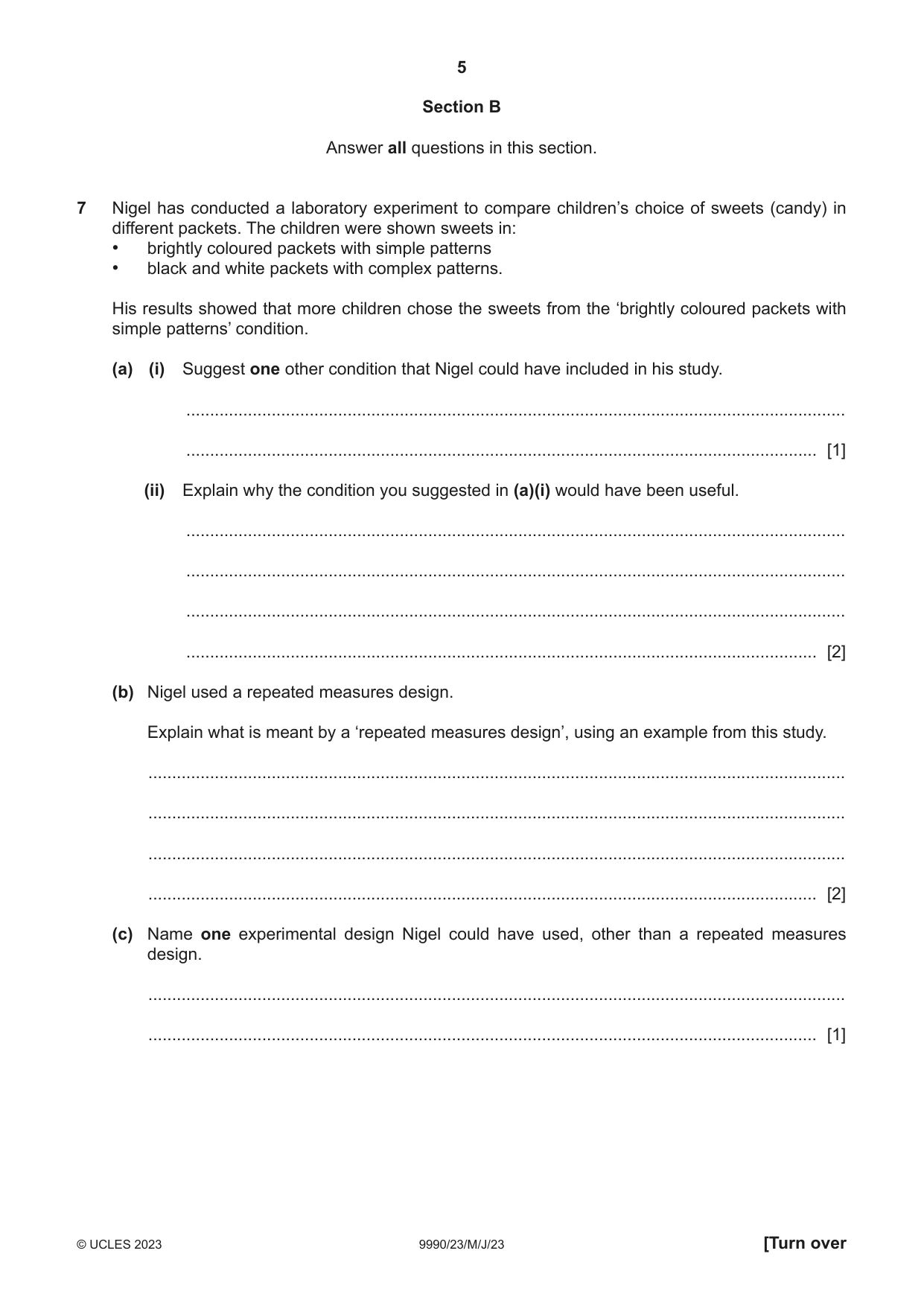
7 Nigel has conducted a laboratory experiment to compare children’s choice of sweets (candy) in different packets. The children were shown sweets in: • brightly coloured packets with simple patterns • black and white packets with complex patterns. His results showed that more children chose the sweets from the ‘brightly coloured packets with simple patterns’ condition. (a) (i) Suggest one other condition that Nigel could have included in his study. ........................................................................................................................................... ..................................................................................................................................... [1] (ii) Explain why the condition you suggested in (a)(i) would have been useful. ........................................................................................................................................... ........................................................................................................................................... ........................................................................................................................................... ..................................................................................................................................... [2] (b) Nigel used a repeated measures design. Explain what is meant by a ‘repeated measures design’, using an example from this study. ................................................................................................................................................... ................................................................................................................................................... ................................................................................................................................................... ............................................................................................................................................. [2] (c) Name one experimental design Nigel could have used, other than a repeated measures design. ................................................................................................................................................... ............................................................................................................................................. [1]
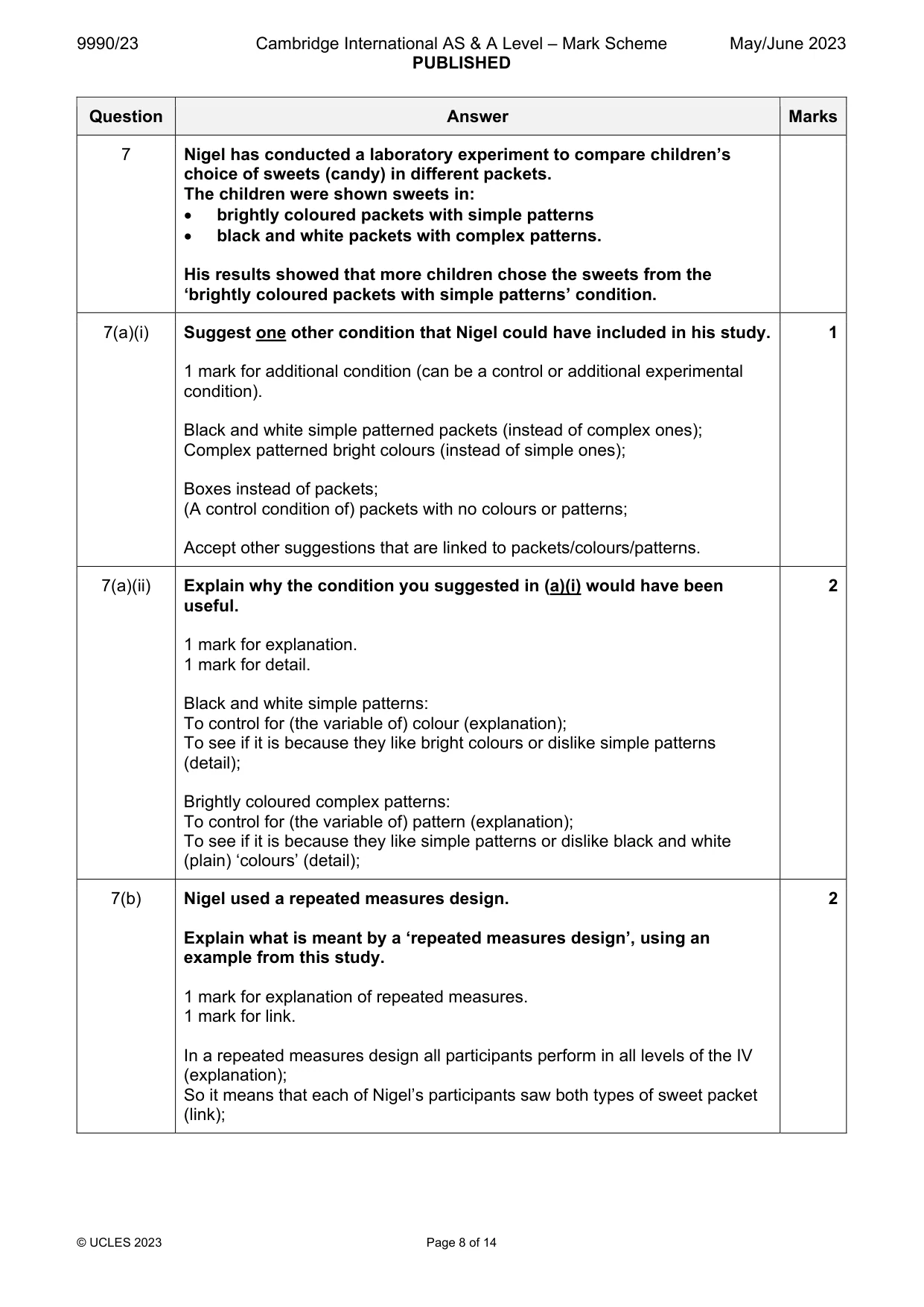
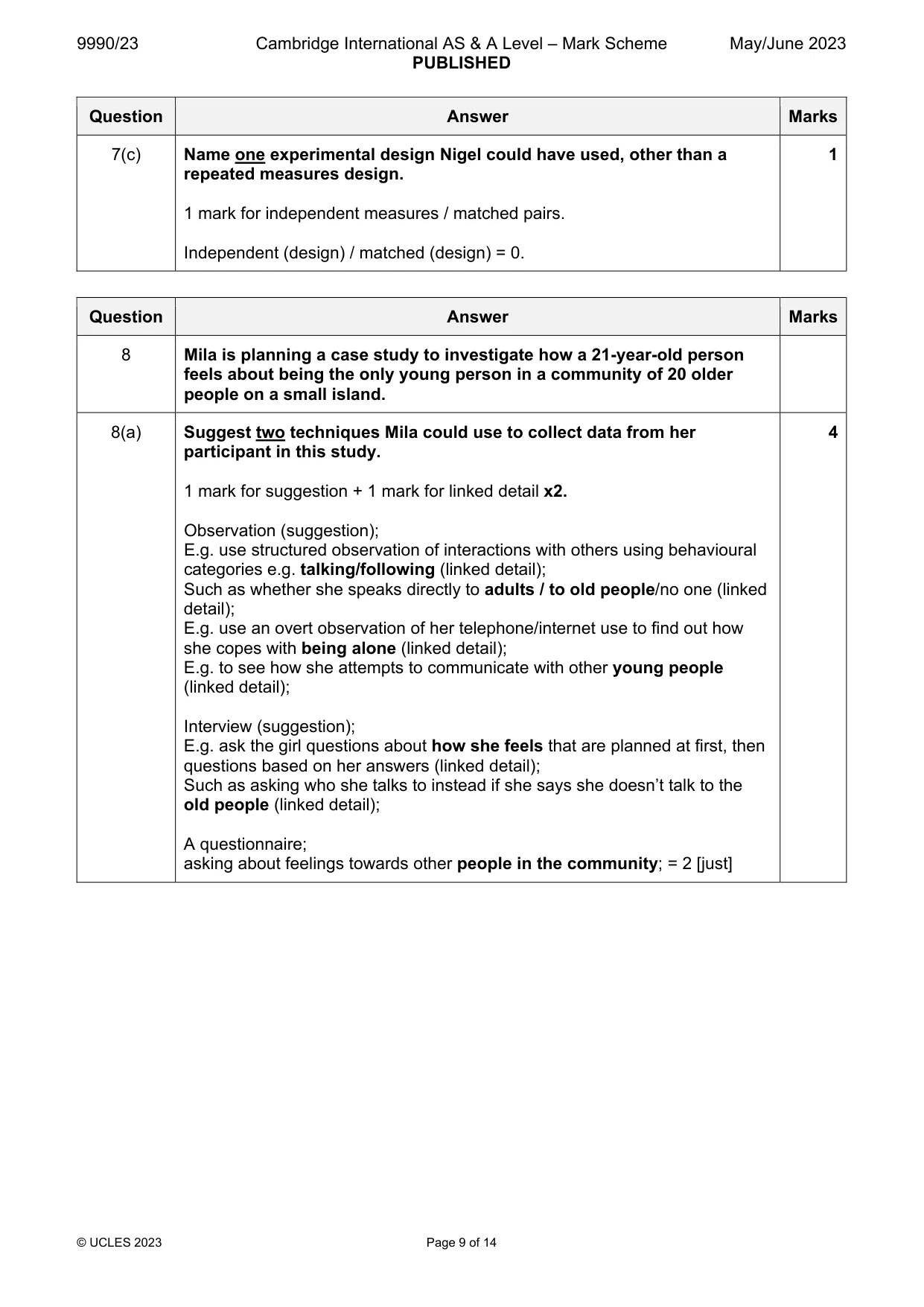
Mark scheme: 7 Nigel has conducted a laboratory experiment to compare children’s choice of sweets (candy) in different packets. The children were shown sweets in: brightly coloured packets with simple patterns black and white packets with complex patterns. His results showed that more children chose the sweets from the ‘brightly coloured packets with simple patterns’ condition. 7(a)(i) Suggest one other condition that Nigel could have included in his study. 1 1 mark for additional condition (can be a control or additional experimental condition). Black and white simple patterned packets (instead of complex ones); Complex patterned bright colours (instead of simple ones); Boxes instead of packets; (A control condition of) packets with no colours or patterns; Accept other suggestions that are linked to packets/colours/patterns. 7(a)(ii) Explain why the condition you suggested in (a)(i) would have been 2 useful. 1 mark for explanation. 1 mark for detail. Black and white simple patterns: To control for (the variable of) colour (explanation); To see if it is because they like bright colours or dislike simple patterns (detail); Brightly coloured complex patterns: To control for (the variable of) pattern (explanation); To see if it is because they like simple patterns or dislike black and white (plain) ‘colours’ (detail); 7(b) Nigel used a repeated measures design. 2 Explain what is meant by a ‘repeated measures design’, using an example from this study. 1 mark for explanation of repeated measures. 1 mark for link. In a repeated measures design all participants perform in all levels of the IV (explanation); So it means that each of Nigel’s participants saw both types of sweet packet (link); 7(c) Name one experimental design Nigel could have used, other than a 1 repeated measures design. 1 mark for independent measures / matched pairs. Independent (design) / matched (design) = 0.
Q8 · Mila is planning a case study to investigate how a 21-year-old person feels about being…
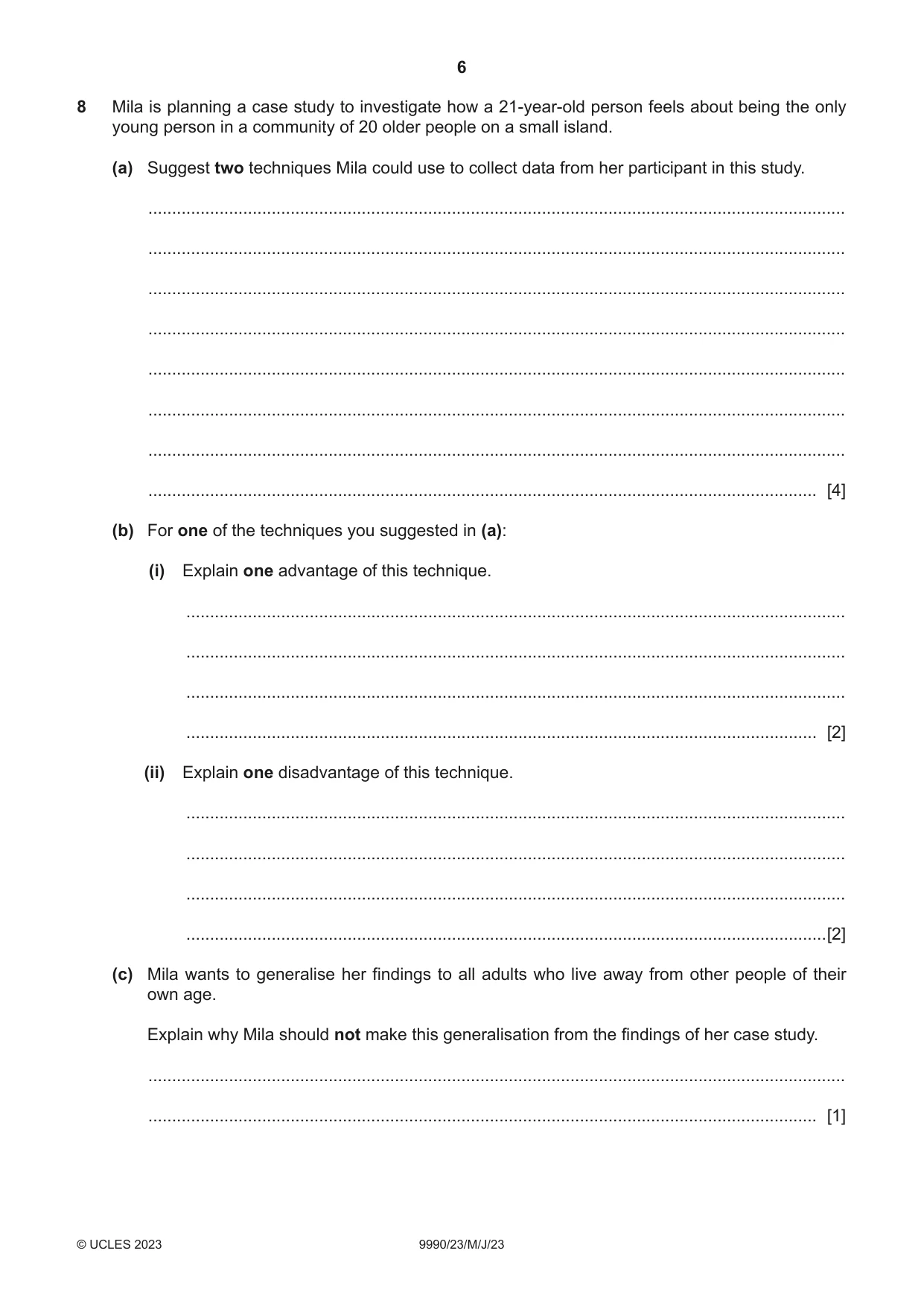
8 Mila is planning a case study to investigate how a 21-year-old person feels about being the only young person in a community of 20 older people on a small island. (a) Suggest two techniques Mila could use to collect data from her participant in this study. ................................................................................................................................................... ................................................................................................................................................... ................................................................................................................................................... ................................................................................................................................................... ................................................................................................................................................... ................................................................................................................................................... ................................................................................................................................................... ............................................................................................................................................. [4] (b) For one of the techniques you suggested in (a): (i) Explain one advantage of this technique. ........................................................................................................................................... ........................................................................................................................................... ........................................................................................................................................... ..................................................................................................................................... [2] (ii) Explain one disadvantage of this technique. ........................................................................................................................................... ........................................................................................................................................... ........................................................................................................................................... .......................................................................................................................................[2] (c) Mila wants to generalise her findings to all adults who live away from other people of their own age. Explain why Mila should not make this generalisation from the findings of her case study. ................................................................................................................................................... ............................................................................................................................................. [1]
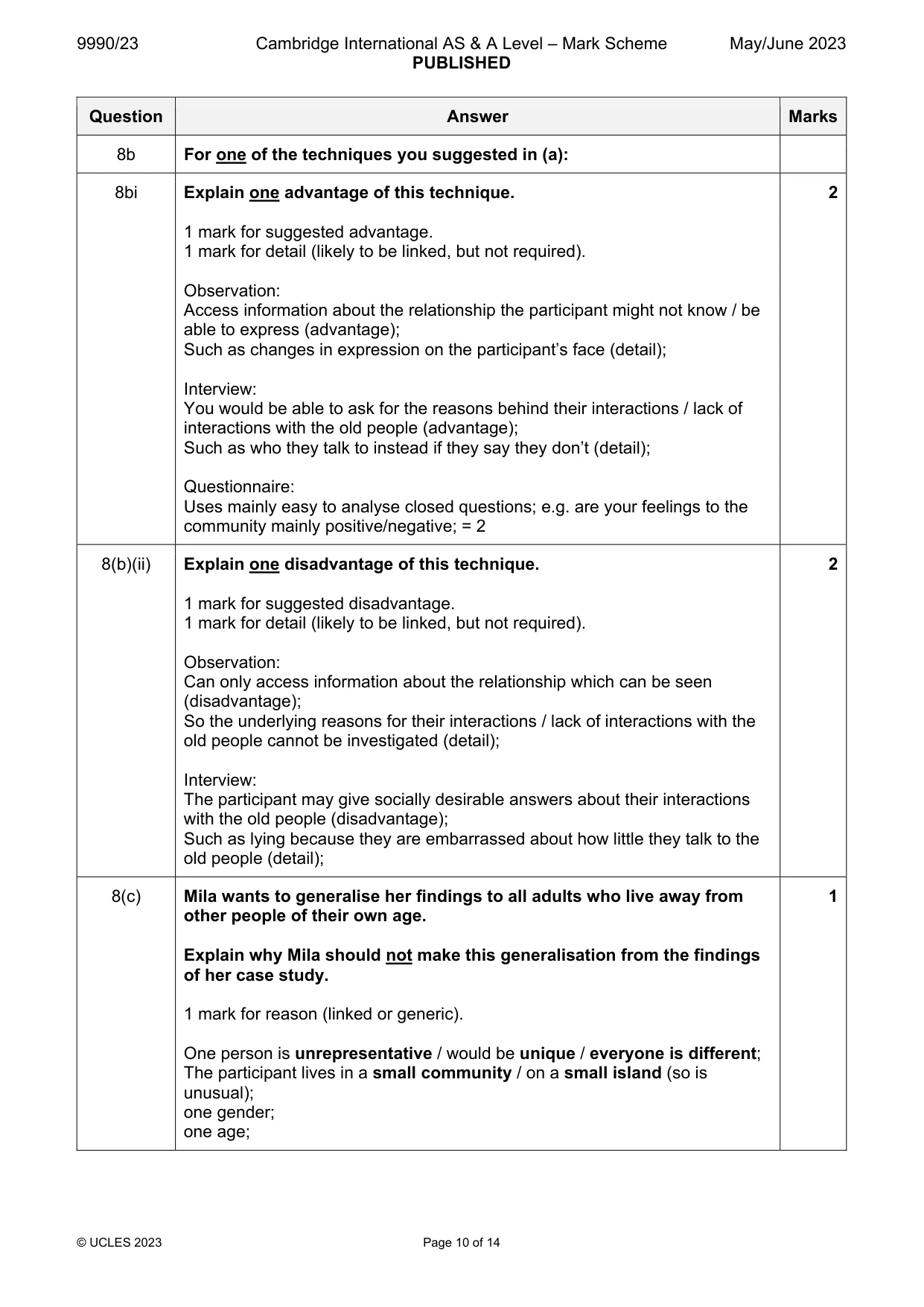
Mark scheme: 8 Mila is planning a case study to investigate how a 21-year-old person feels about being the only young person in a community of 20 older people on a small island. 8(a) Suggest two techniques Mila could use to collect data from her 4 participant in this study. 1 mark for suggestion + 1 mark for linked detail x2. Observation (suggestion); E.g. use structured observation of interactions with others using behavioural categories e.g. talking/following (linked detail); Such as whether she speaks directly to adults / to old people/no one (linked detail); E.g. use an overt observation of her telephone/internet use to find out how she copes with being alone (linked detail); E.g. to see how she attempts to communicate with other young people (linked detail); Interview (suggestion); E.g. ask the girl questions about how she feels that are planned at first, then questions based on her answers (linked detail); Such as asking who she talks to instead if she says she doesn’t talk to the old people (linked detail); A questionnaire; asking about feelings towards other people in the community; = 2 [just] 8b For one of the techniques you suggested in (a): 8bi Explain one advantage of this technique. 2 1 mark for suggested advantage. 1 mark for detail (likely to be linked, but not required). Observation: Access information about the relationship the participant might not know / be able to express (advantage); Such as changes in expression on the participant’s face (detail); Interview: You would be able to ask for the reasons behind their interactions / lack of interactions with the old people (advantage); Such as who they talk to instead if they say they don’t (detail); Questionnaire: Uses mainly easy to analyse closed questions; e.g. are your feelings to the community mainly positive/negative; = 2 8(b)(ii) Explain one disadvantage of this technique. 2 1 mark for suggested disadvantage. 1 mark for detail (likely to be linked, but not required). Observation: Can only access information about the relationship which can be seen (disadvantage); So the underlying reasons for their interactions / lack of interactions with the old people cannot be investigated (detail); Interview: The participant may give socially desirable answers about their interactions with the old people (disadvantage); Such as lying because they are embarrassed about how little they talk to the old people (detail); 8(c) Mila wants to generalise her findings to all adults who live away from 1 other people of their own age. Explain why Mila should not make this generalisation from the findings of her case study. 1 mark for reason (linked or generic). One person is unrepresentative / would be unique / everyone is different; The participant lives in a small community / on a small island (so is unusual); one gender; one age;
Q9 · Alan and Jocelyn are writing a questionnaire to ask about the level of euphoria created…
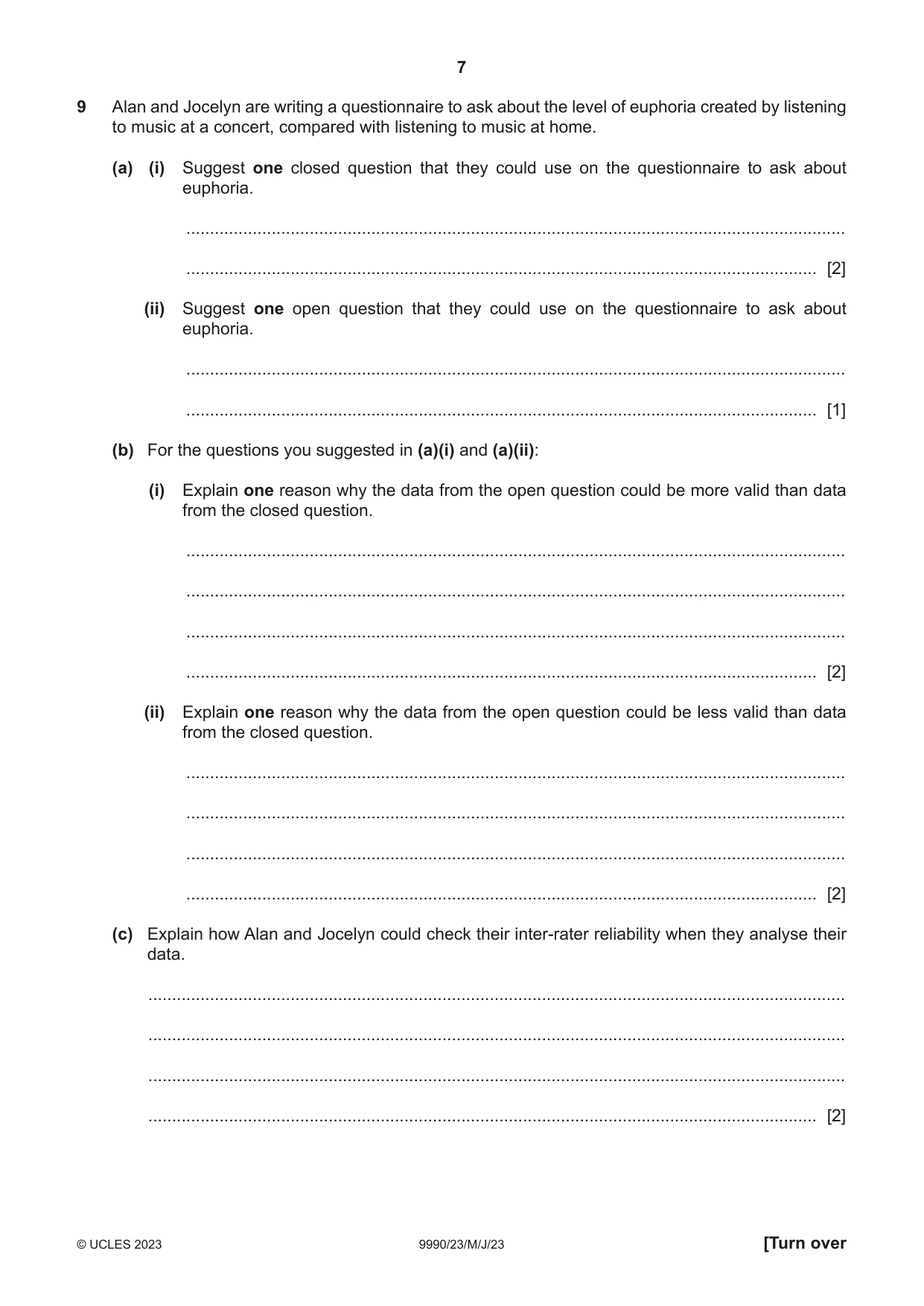
9 Alan and Jocelyn are writing a questionnaire to ask about the level of euphoria created by listening to music at a concert, compared with listening to music at home. (a) (i) Suggest one closed question that they could use on the questionnaire to ask about euphoria. ........................................................................................................................................... ..................................................................................................................................... [2] (ii) Suggest one open question that they could use on the questionnaire to ask about euphoria. ........................................................................................................................................... ..................................................................................................................................... [1] (b) For the questions you suggested in (a)(i) and (a)(ii): (i) Explain one reason why the data from the open question could be more valid than data from the closed question. ........................................................................................................................................... ........................................................................................................................................... ........................................................................................................................................... ..................................................................................................................................... [2] (ii) Explain one reason why the data from the open question could be less valid than data from the closed question. ........................................................................................................................................... ........................................................................................................................................... ........................................................................................................................................... ..................................................................................................................................... [2] (c) Explain how Alan and Jocelyn could check their inter-rater reliability when they analyse their data. ................................................................................................................................................... ................................................................................................................................................... ................................................................................................................................................... ............................................................................................................................................. [2] Section C Answer all questions in this section.
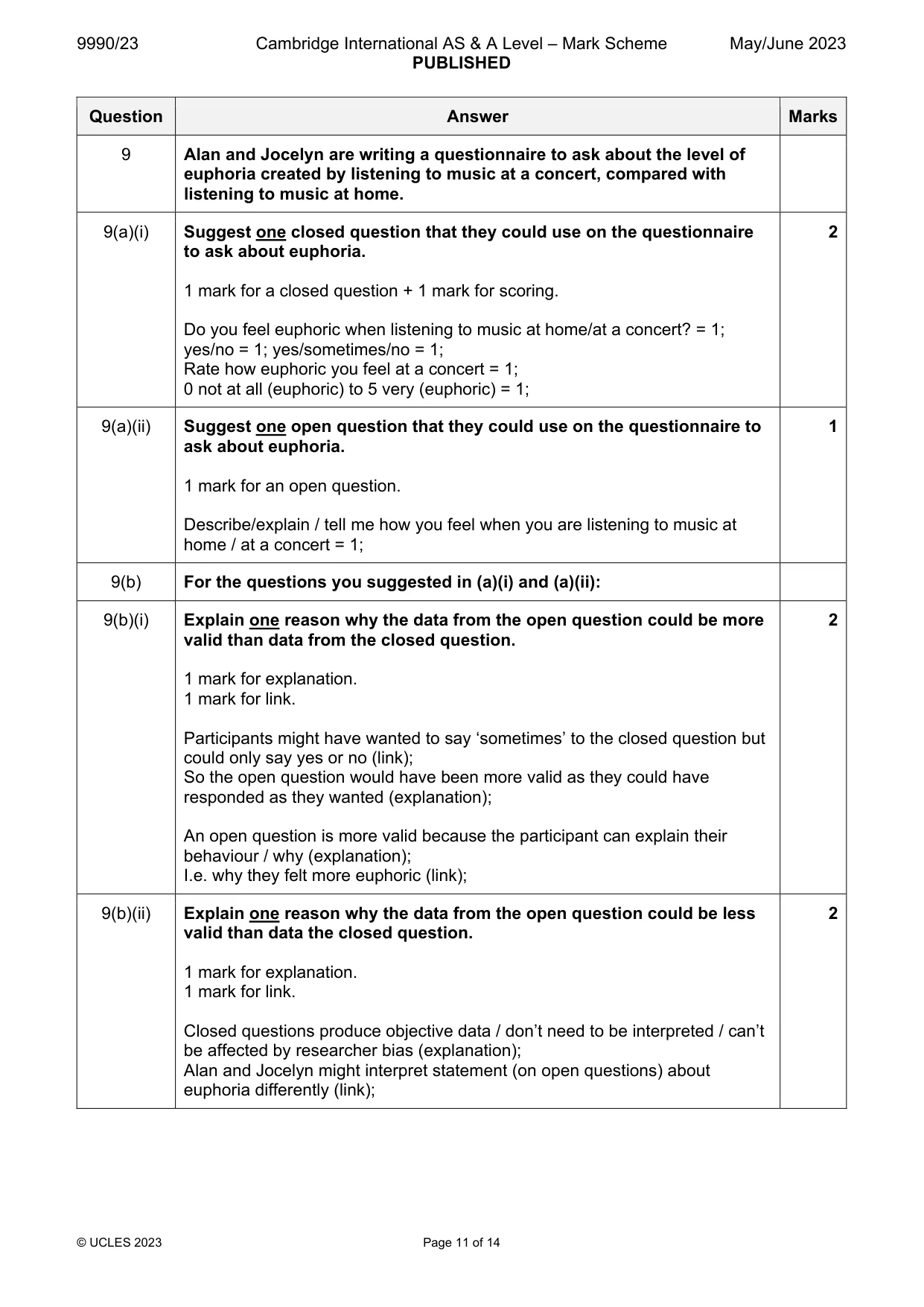
Mark scheme: 9 Alan and Jocelyn are writing a questionnaire to ask about the level of euphoria created by listening to music at a concert, compared with listening to music at home. 9(a)(i) Suggest one closed question that they could use on the questionnaire 2 to ask about euphoria. 1 mark for a closed question + 1 mark for scoring. Do you feel euphoric when listening to music at home/at a concert? = 1; yes/no = 1; yes/sometimes/no = 1; Rate how euphoric you feel at a concert = 1; 0 not at all (euphoric) to 5 very (euphoric) = 1; 9(a)(ii) Suggest one open question that they could use on the questionnaire to 1 ask about euphoria. 1 mark for an open question. Describe/explain / tell me how you feel when you are listening to music at home / at a concert = 1; 9(b) For the questions you suggested in (a)(i) and (a)(ii): 9(b)(i) Explain one reason why the data from the open question could be more 2 valid than data from the closed question. 1 mark for explanation. 1 mark for link. Participants might have wanted to say ‘sometimes’ to the closed question but could only say yes or no (link); So the open question would have been more valid as they could have responded as they wanted (explanation); An open question is more valid because the participant can explain their behaviour / why (explanation); I.e. why they felt more euphoric (link); 9(b)(ii) Explain one reason why the data from the open question could be less 2 valid than data the closed question. 1 mark for explanation. 1 mark for link. Closed questions produce objective data / don’t need to be interpreted / can’t be affected by researcher bias (explanation); Alan and Jocelyn might interpret statement (on open questions) about euphoria differently (link); 9(c) Explain how Alan and Jocelyn could check their inter-rater reliability 2 when they analyse their data. 1 mark for explanation. 1 mark for detail. Alan and Jocelyn should take the (open question) responses from the same participants and analyse them (explanation); Correlate their scores for the same questions / see if their scores are the same (if so, inter-coder reliability is high) (detail);
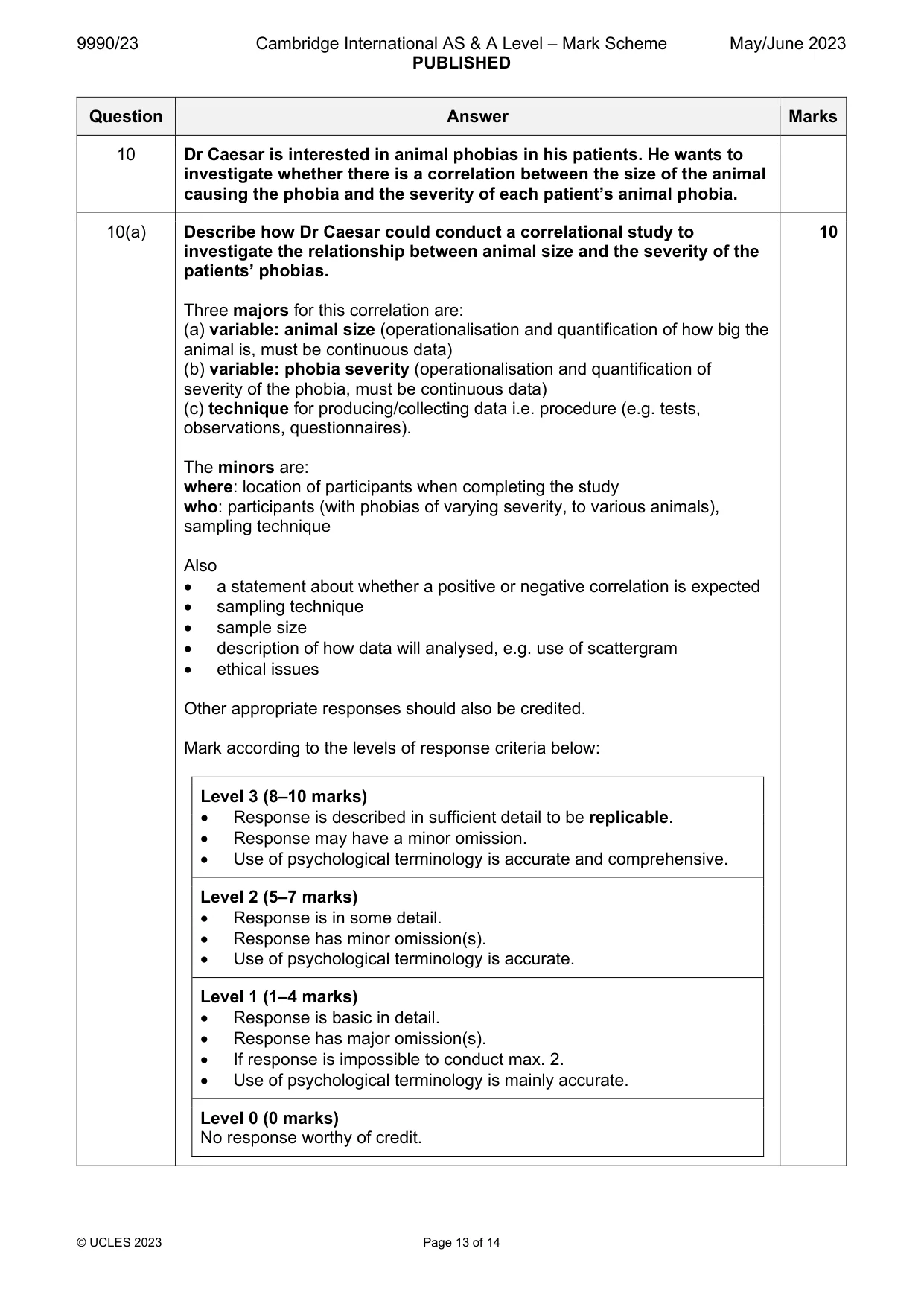
Q10 · Dr Caesar is interested in animal phobias in his patients
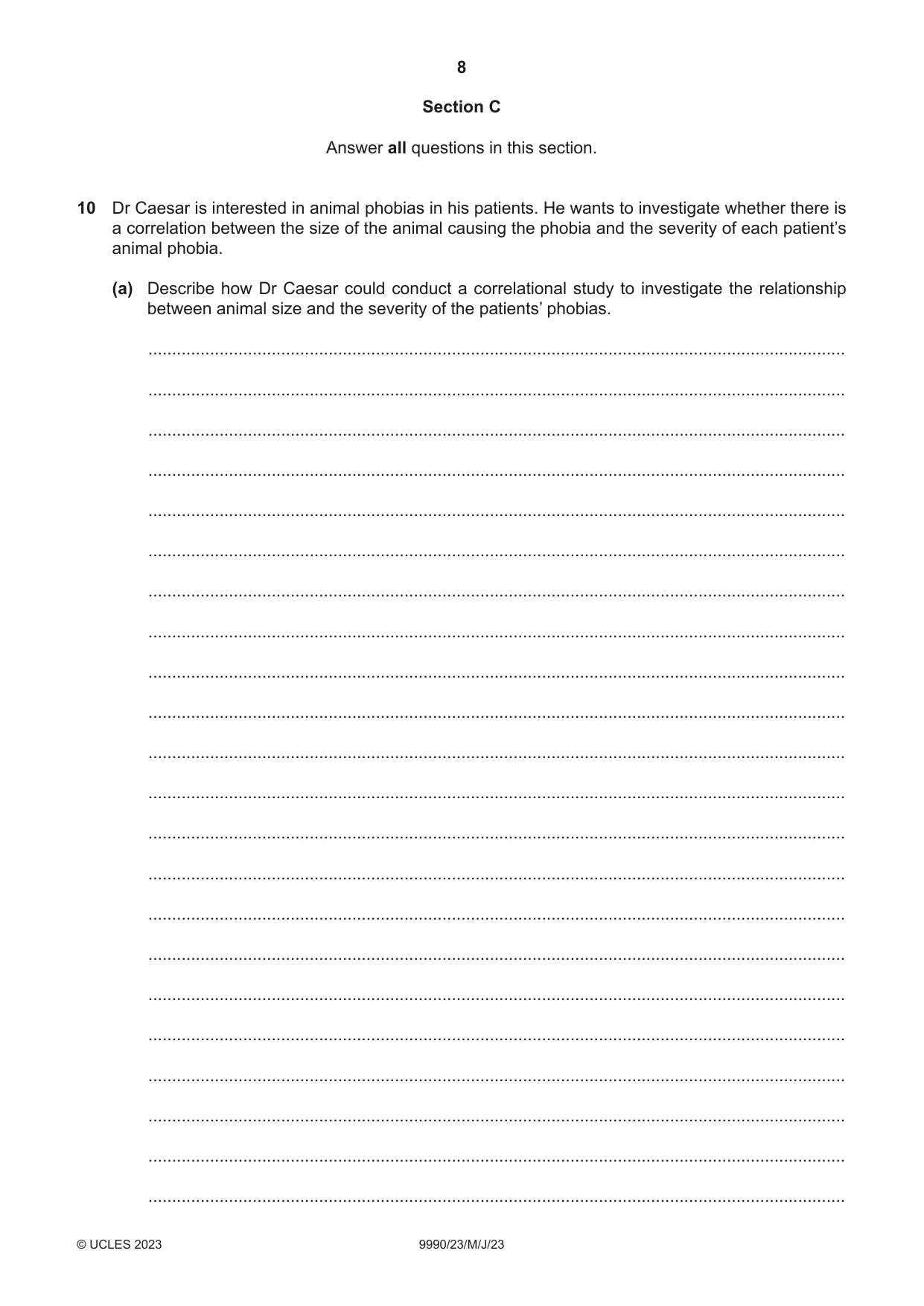
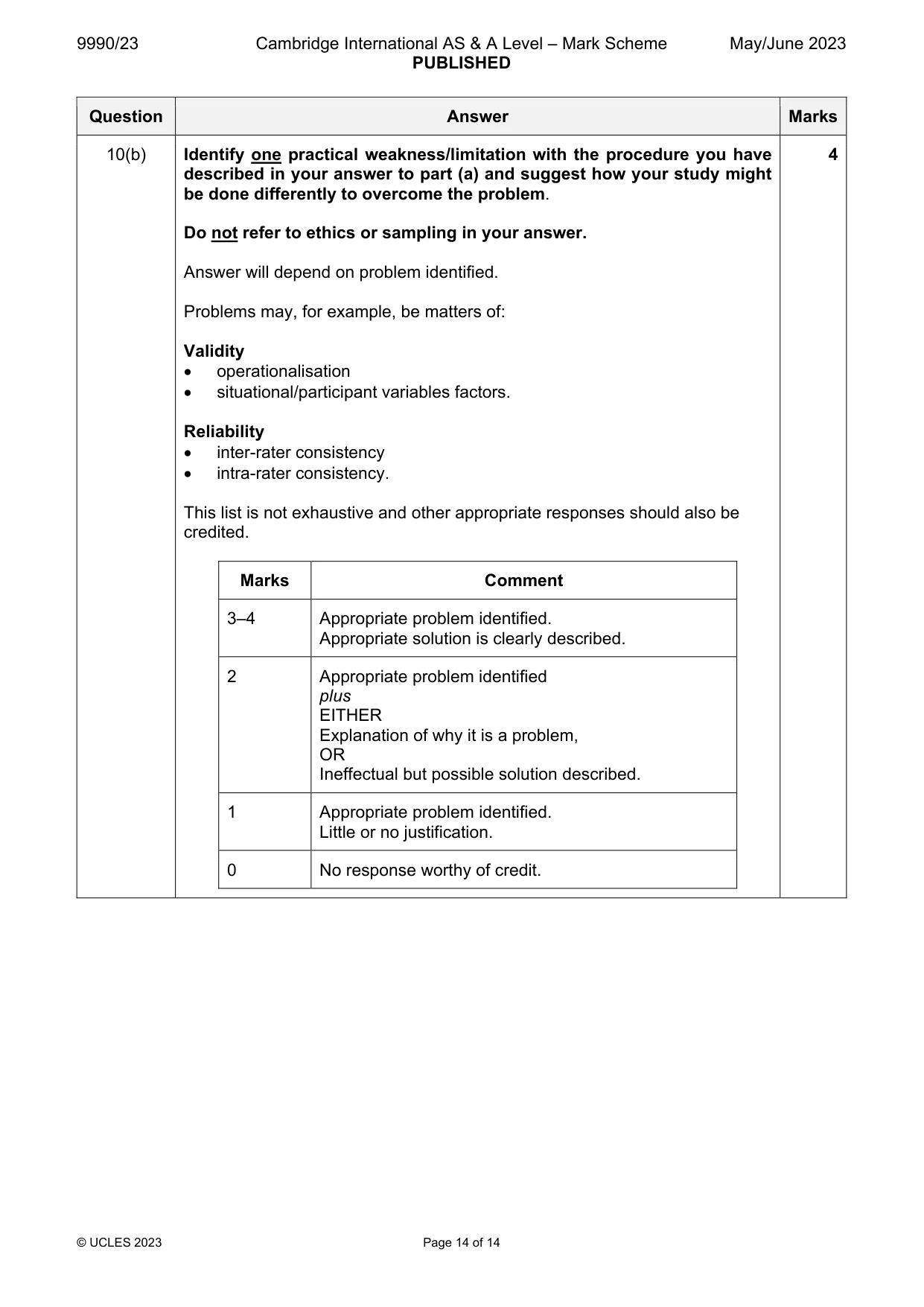
10 Dr Caesar is interested in animal phobias in his patients. He wants to investigate whether there is a correlation between the size of the animal causing the phobia and the severity of each patient’s animal phobia. (a) Describe how Dr Caesar could conduct a correlational study to investigate the relationship between animal size and the severity of the patients’ phobias. ................................................................................................................................................... ................................................................................................................................................... ................................................................................................................................................... ................................................................................................................................................... ................................................................................................................................................... ................................................................................................................................................... ................................................................................................................................................... ................................................................................................................................................... ................................................................................................................................................... ................................................................................................................................................... ................................................................................................................................................... ................................................................................................................................................... ................................................................................................................................................... ................................................................................................................................................... ................................................................................................................................................... ................................................................................................................................................... ................................................................................................................................................... ................................................................................................................................................... ................................................................................................................................................... ................................................................................................................................................... ................................................................................................................................................... ................................................................................................................................................... ................................................................................................................................................... ................................................................................................................................................... ................................................................................................................................................... ................................................................................................................................................... ................................................................................................................................................... ................................................................................................................................................... ................................................................................................................................................... ................................................................................................................................................... ................................................................................................................................................... ................................................................................................................................................... ................................................................................................................................................... ........................................................................................................................................... [10] (b) Identify one practical weakness/limitation with the procedure you have described in your answer to part (a) and suggest how your study might be done differently to overcome the problem. Do not refer to ethics or sampling in your answer. ................................................................................................................................................... ................................................................................................................................................... ................................................................................................................................................... ................................................................................................................................................... ................................................................................................................................................... ................................................................................................................................................... ................................................................................................................................................... ............................................................................................................................................. [4]
Mark scheme: 10 Dr Caesar is interested in animal phobias in his patients. He wants to investigate whether there is a correlation between the size of the animal causing the phobia and the severity of each patient’s animal phobia. 10(a) Describe how Dr Caesar could conduct a correlational study to 10 investigate the relationship between animal size and the severity of the patients’ phobias. Three majors for this correlation are: (a) variable: animal size (operationalisation and quantification of how big the animal is, must be continuous data) (b) variable: phobia severity (operationalisation and quantification of severity of the phobia, must be continuous data) (c) technique for producing/collecting data i.e. procedure (e.g. tests, observations, questionnaires). The minors are: where: location of participants when completing the study who: participants (with phobias of varying severity, to various animals), sampling technique Also a statement about whether a positive or negative correlation is expected sampling technique sample size description of how data will analysed, e.g. use of scattergram ethical issues Other appropriate responses should also be credited. Mark according to the levels of response criteria below: Level 3 (8–10 marks) Response is described in sufficient detail to be replicable. Response may have a minor omission. Use of psychological terminology is accurate and comprehensive. Level 2 (5–7 marks) Response is in some detail. Response has minor omission(s). Use of psychological terminology is accurate. Level 1 (1–4 marks) Response is basic in detail. Response has major omission(s). If response is impossible to conduct max. 2. Use of psychological terminology is mainly accurate. Level 0 (0 marks) No response worthy of credit. 10(b) Identify one practical weakness/limitation with the procedure you have 4 described in your answer to part (a) and suggest how your study might be done differently to overcome the problem. Do not refer to ethics or sampling in your answer. Answer will depend on problem identified. Problems may, for example, be matters of: Validity operationalisation situational/participant variables factors. Reliability inter-rater consistency intra-rater consistency. This list is not exhaustive and other appropriate responses should also be credited. Marks Comment 3–4 Appropriate problem identified. Appropriate solution is clearly described. 2 Appropriate problem identified plus EITHER Explanation of why it is a problem, OR Ineffectual but possible solution described. 1 Appropriate problem identified. Little or no justification. 0 No response worthy of credit.
More questions on Anxiety disorders and fear-related disorders
What was in this paper
The subtopics covered by these 10 questions, and how many questions each got. Open one in a new tab to see every Cambridge question on it.
What you needed in this session
Cambridge’s own grade thresholds for 2023 May/June, Paper 2 · Variant 3. A higher threshold means an easier paper — the bar moves with how the cohort did.