Cambridge A Level Psychology (from 2018) 9990 — 2020 Oct/Nov Paper 2 · Variant 1
9990/21/O/N/20 · 10 questions · 60 marks · ≈68 min
The question paper and its mark scheme, free to read here and free to download. This is Cambridge’s own paper, exactly as it was sat.
Question paper12 pages



Mark scheme14 pages
Answers below. Sit the paper first if you are practising.
Questions as text
Q1 · In the study by Yamamoto et al
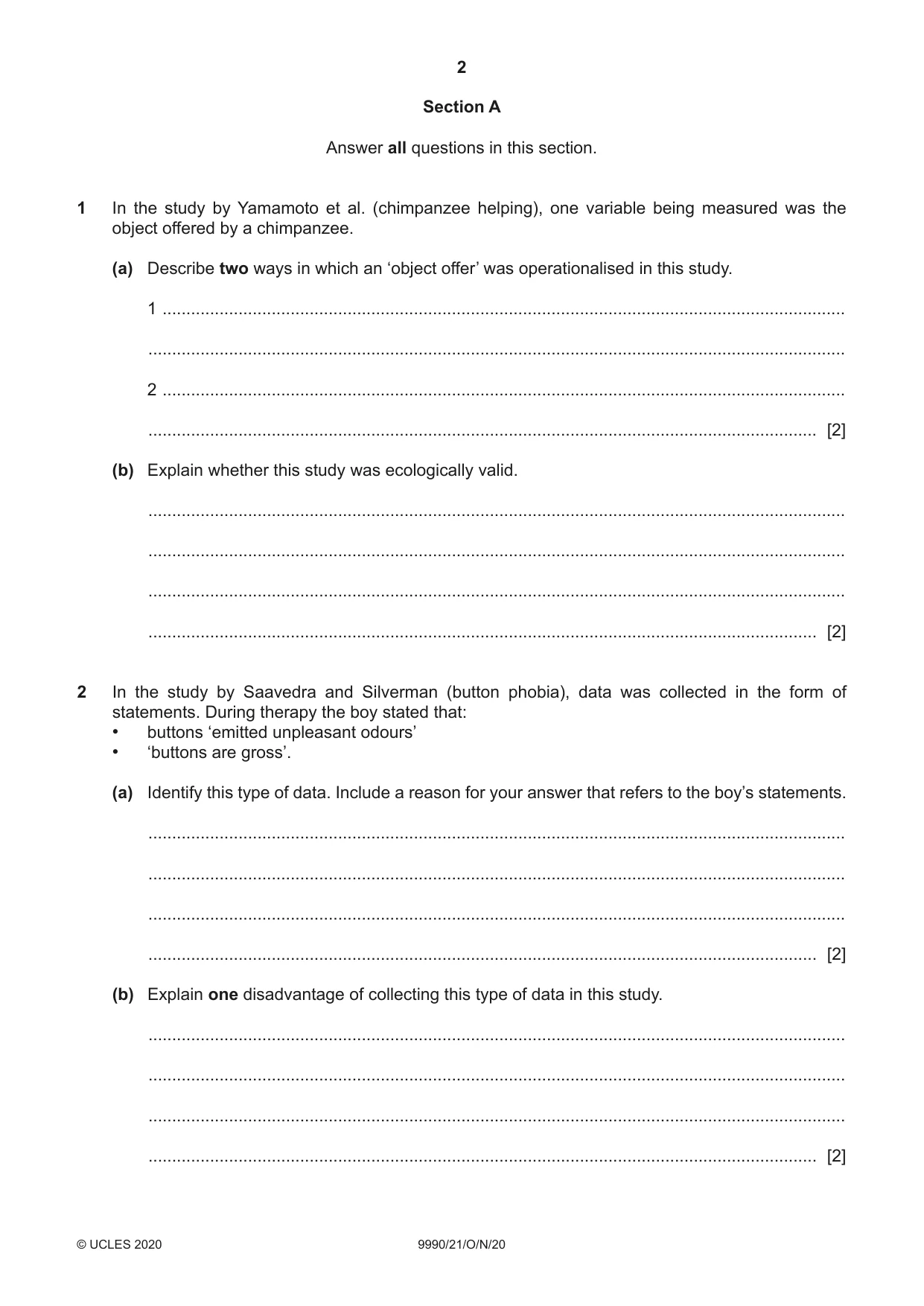
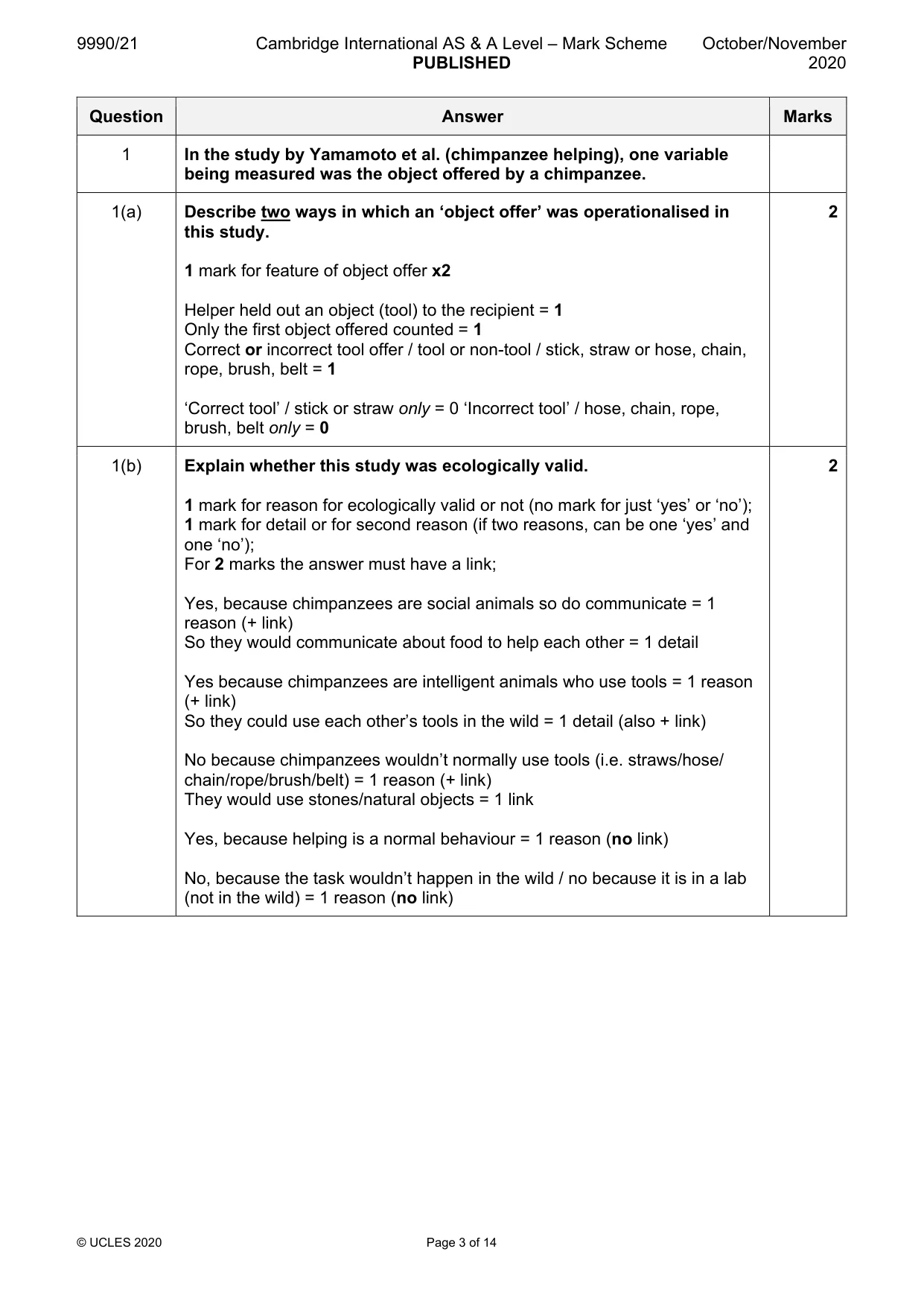
1 In the study by Yamamoto et al. (chimpanzee helping), one variable being measured was the object offered by a chimpanzee. (a) Describe two ways in which an ‘object offer’ was operationalised in this study. 1 ................................................................................................................................................ ................................................................................................................................................... 2 ................................................................................................................................................ ............................................................................................................................................. [2] (b) Explain whether this study was ecologically valid. ................................................................................................................................................... ................................................................................................................................................... ................................................................................................................................................... ............................................................................................................................................. [2]
Mark scheme: Question Answer Marks 1 In the study by Yamamoto et al. (chimpanzee helping), one variable being measured was the object offered by a chimpanzee. 1(a) Describe two ways in which an ‘object offer’ was operationalised in 2 this study. 1 mark for feature of object offer x2 Helper held out an object (tool) to the recipient = 1 Only the first object offered counted = 1 Correct or incorrect tool offer / tool or non-tool / stick, straw or hose, chain, rope, brush, belt = 1 ‘Correct tool’ / stick or straw only = 0 ‘Incorrect tool’ / hose, chain, rope, brush, belt only = 0 1(b) Explain whether this study was ecologically valid. 2 1 mark for reason for ecologically valid or not (no mark for just ‘yes’ or ‘no’); 1 mark for detail or for second reason (if two reasons, can be one ‘yes’ and one ‘no’); For 2 marks the answer must have a link; Yes, because chimpanzees are social animals so do communicate = 1 reason (+ link) So they would communicate about food to help each other = 1 detail Yes because chimpanzees are intelligent animals who use tools = 1 reason (+ link) So they could use each other’s tools in the wild = 1 detail (also + link) No because chimpanzees wouldn’t normally use tools (i.e. straws/hose/ chain/rope/brush/belt) = 1 reason (+ link) They would use stones/natural objects = 1 link Yes, because helping is a normal behaviour = 1 reason (no link) No, because the task wouldn’t happen in the wild / no because it is in a lab (not in the wild) = 1 reason (no link)
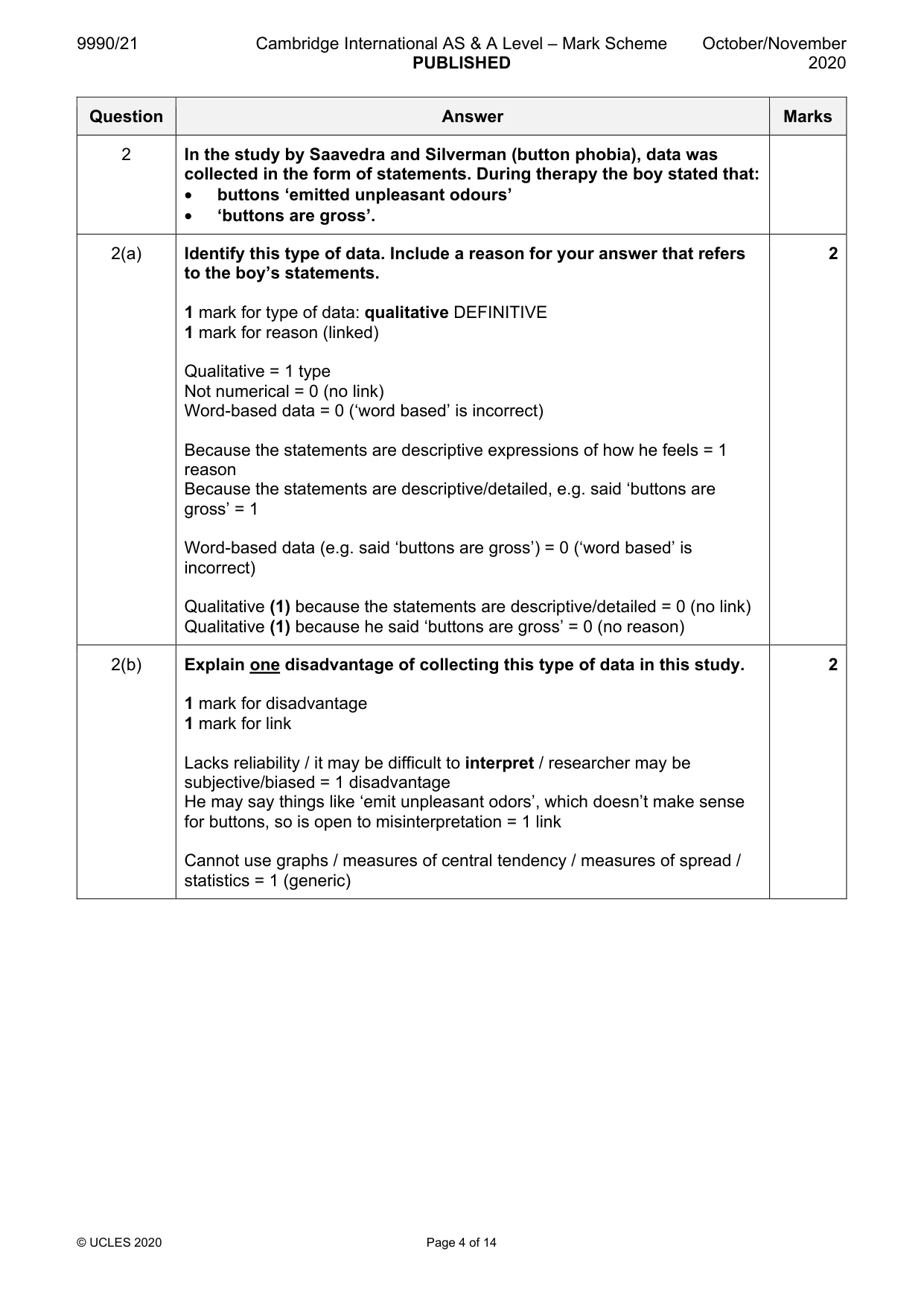
Q2 · In the study by Saavedra and Silverman (button phobia), data was collected in the form of…
2 In the study by Saavedra and Silverman (button phobia), data was collected in the form of statements. During therapy the boy stated that: • buttons ‘emitted unpleasant odours’ • ‘buttons are gross’. (a) Identify this type of data. Include a reason for your answer that refers to the boy’s statements. ................................................................................................................................................... ................................................................................................................................................... ................................................................................................................................................... ............................................................................................................................................. [2] (b) Explain one disadvantage of collecting this type of data in this study. ................................................................................................................................................... ................................................................................................................................................... ................................................................................................................................................... ............................................................................................................................................. [2]
Mark scheme: 2 In the study by Saavedra and Silverman (button phobia), data was collected in the form of statements. During therapy the boy stated that: • buttons ‘emitted unpleasant odours’ • ‘buttons are gross’. 2(a) Identify this type of data. Include a reason for your answer that refers 2 to the boy’s statements. 1 mark for type of data: qualitative DEFINITIVE 1 mark for reason (linked) Qualitative = 1 type Not numerical = 0 (no link) Word-based data = 0 (‘word based’ is incorrect) Because the statements are descriptive expressions of how he feels = 1 reason Because the statements are descriptive/detailed, e.g. said ‘buttons are gross’ = 1 Word-based data (e.g. said ‘buttons are gross’) = 0 (‘word based’ is incorrect) Qualitative (1) because the statements are descriptive/detailed = 0 (no link) Qualitative (1) because he said ‘buttons are gross’ = 0 (no reason) 2(b) Explain one disadvantage of collecting this type of data in this study. 2 1 mark for disadvantage 1 mark for link Lacks reliability / it may be difficult to interpret / researcher may be subjective/biased = 1 disadvantage He may say things like ‘emit unpleasant odors’, which doesn’t make sense for buttons, so is open to misinterpretation = 1 link Cannot use graphs / measures of central tendency / measures of spread / statistics = 1 (generic)
More questions on Anxiety disorders and fear-related disorders
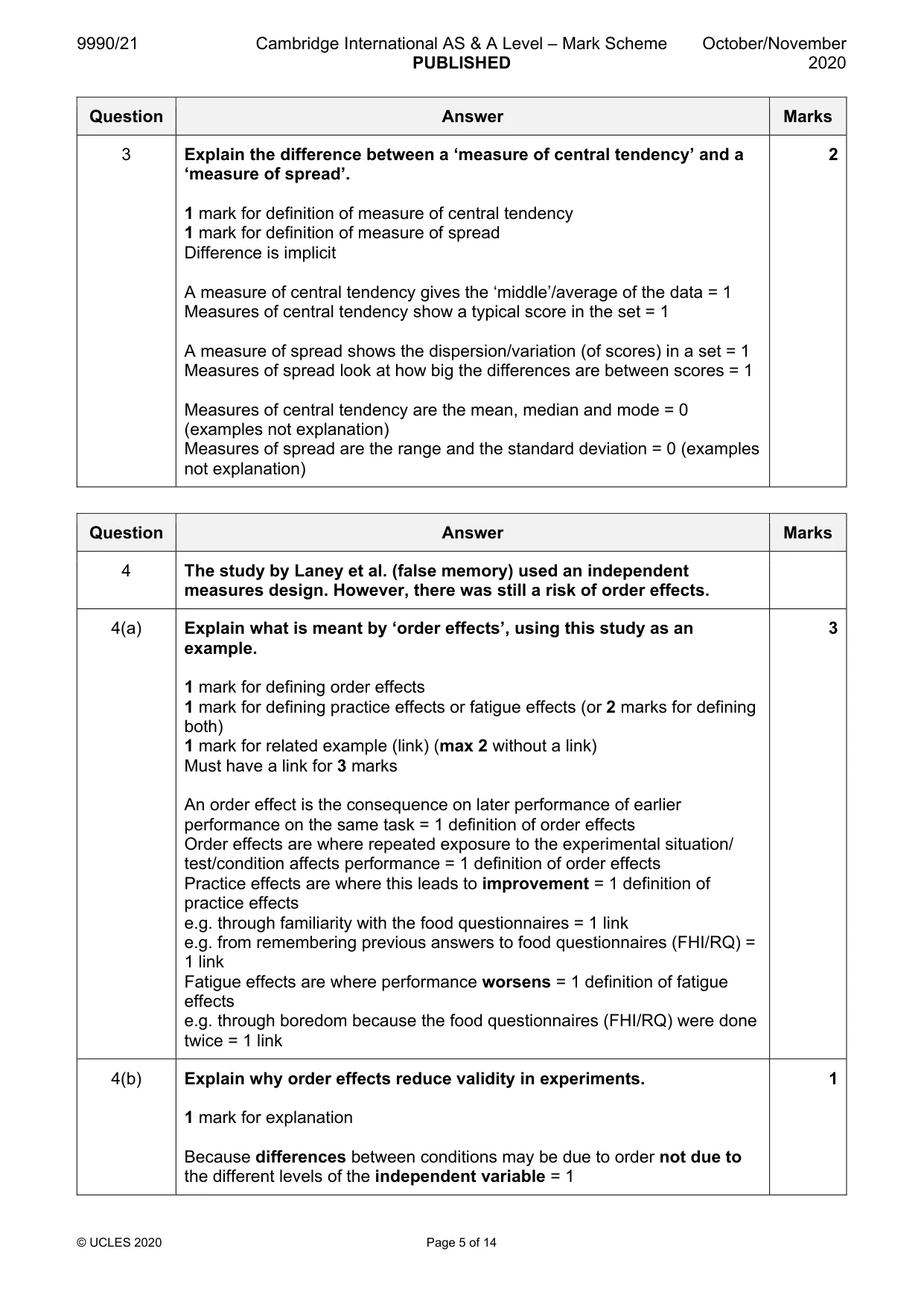
Q3 · Explain the difference between a ‘measure of central tendency’ and a ‘measure of spread’
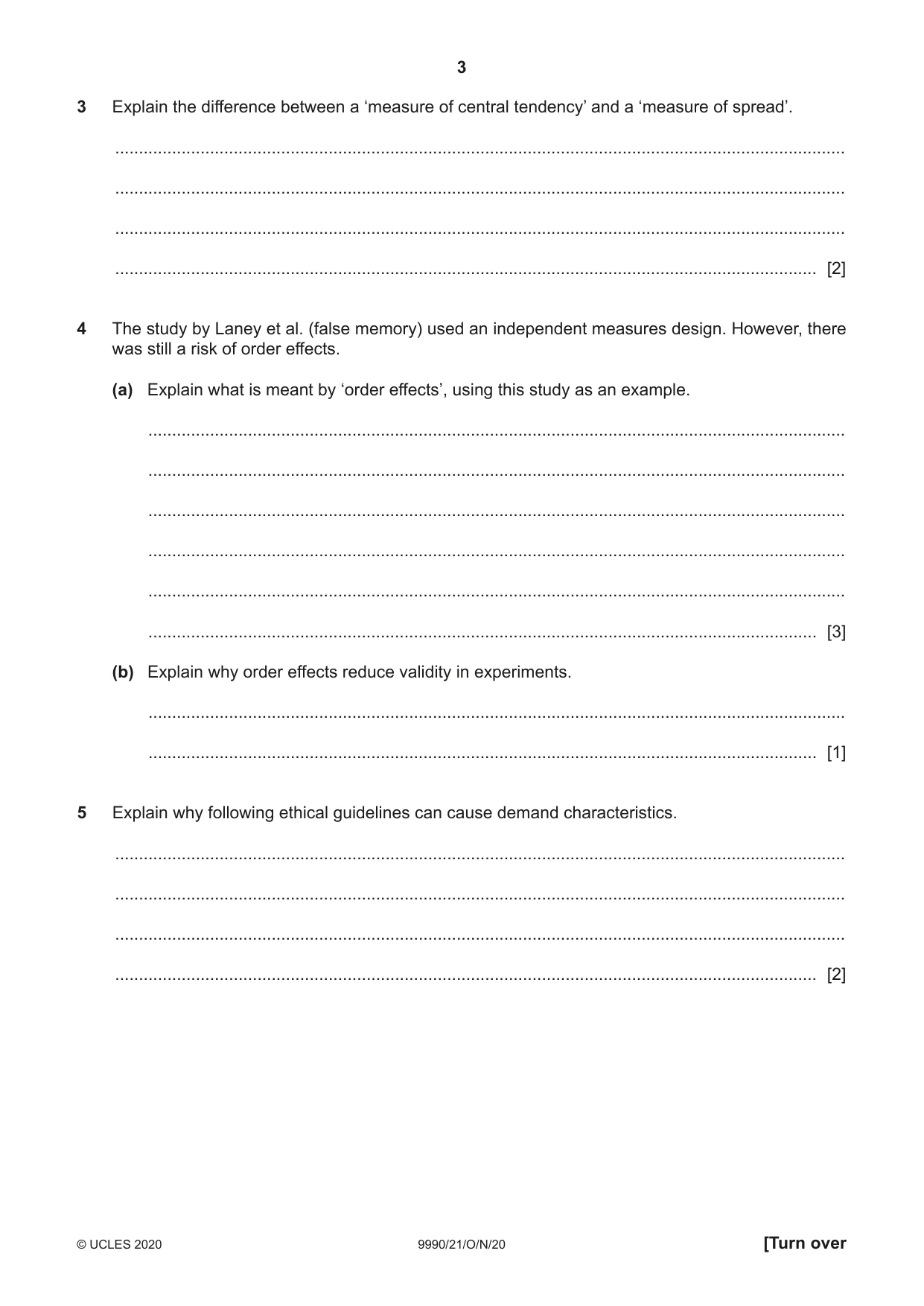
3 Explain the difference between a ‘measure of central tendency’ and a ‘measure of spread’. .......................................................................................................................................................... .......................................................................................................................................................... .......................................................................................................................................................... .................................................................................................................................................... [2]
Mark scheme: 3 Explain the difference between a ‘measure of central tendency’ and a 2 ‘measure of spread’. 1 mark for definition of measure of central tendency 1 mark for definition of measure of spread Difference is implicit A measure of central tendency gives the ‘middle’/average of the data = 1 Measures of central tendency show a typical score in the set = 1 A measure of spread shows the dispersion/variation (of scores) in a set = 1 Measures of spread look at how big the differences are between scores = 1 Measures of central tendency are the mean, median and mode = 0 (examples not explanation) Measures of spread are the range and the standard deviation = 0 (examples not explanation)
Q4 · The study by Laney et al
4 The study by Laney et al. (false memory) used an independent measures design. However, there was still a risk of order effects. (a) Explain what is meant by ‘order effects’, using this study as an example. ................................................................................................................................................... ................................................................................................................................................... ................................................................................................................................................... ................................................................................................................................................... ................................................................................................................................................... ............................................................................................................................................. [3] (b) Explain why order effects reduce validity in experiments. ................................................................................................................................................... ............................................................................................................................................. [1]
Mark scheme: 4 The study by Laney et al. (false memory) used an independent measures design. However, there was still a risk of order effects. 4(a) Explain what is meant by ‘order effects’, using this study as an 3 example. 1 mark for defining order effects 1 mark for defining practice effects or fatigue effects (or 2 marks for defining both) 1 mark for related example (link) (max 2 without a link) Must have a link for 3 marks An order effect is the consequence on later performance of earlier performance on the same task = 1 definition of order effects Order effects are where repeated exposure to the experimental situation/ test/condition affects performance = 1 definition of order effects Practice effects are where this leads to improvement = 1 definition of practice effects e.g. through familiarity with the food questionnaires = 1 link e.g. from remembering previous answers to food questionnaires (FHI/RQ) = 1 link Fatigue effects are where performance worsens = 1 definition of fatigue effects e.g. through boredom because the food questionnaires (FHI/RQ) were done twice = 1 link 4(b) Explain why order effects reduce validity in experiments. 1 1 mark for explanation Because differences between conditions may be due to order not due to the different levels of the independent variable = 1
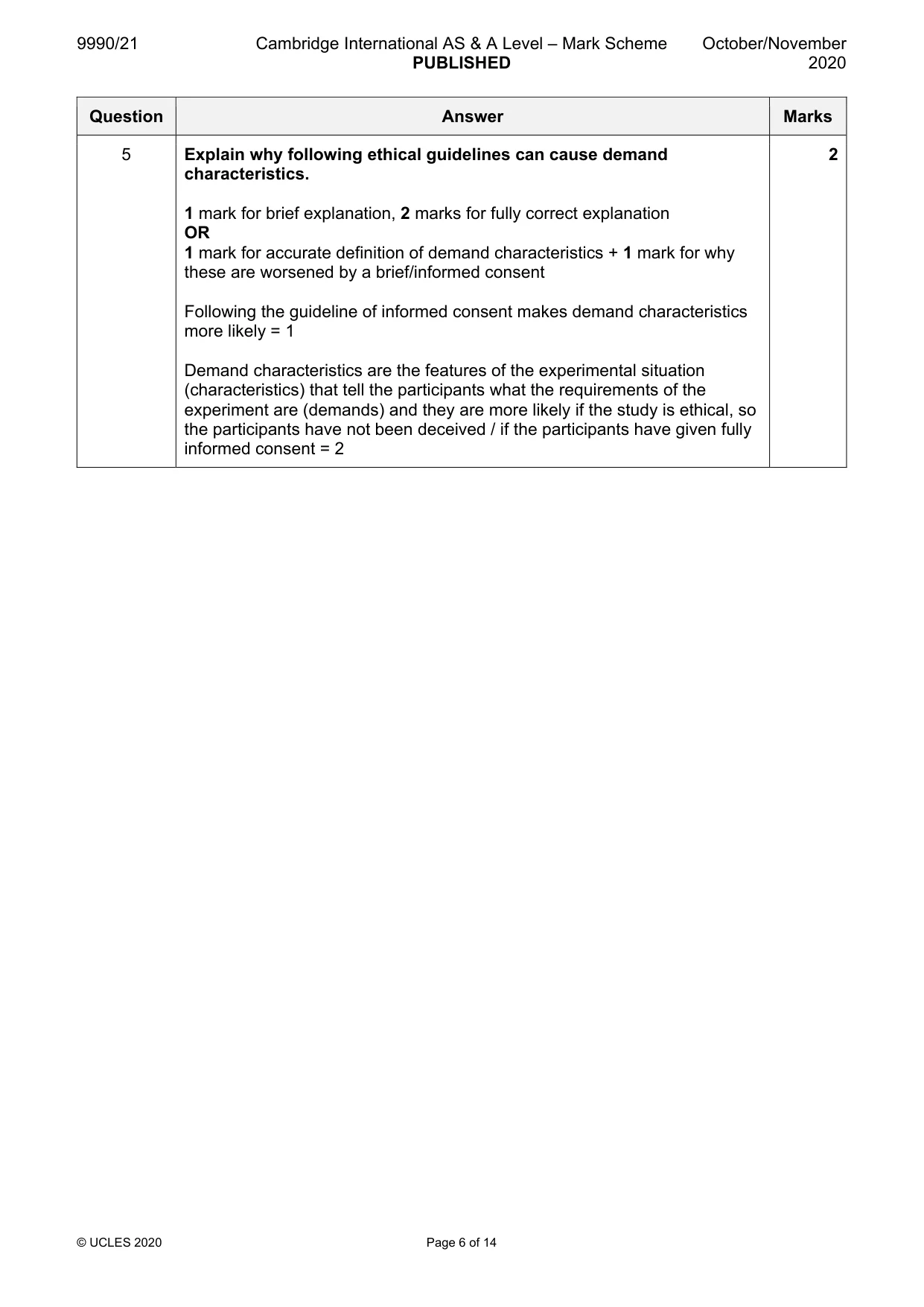
Q5 · Explain why following ethical guidelines can cause demand characteristics
5 Explain why following ethical guidelines can cause demand characteristics. .......................................................................................................................................................... .......................................................................................................................................................... .......................................................................................................................................................... .................................................................................................................................................... [2]
Mark scheme: 5 Explain why following ethical guidelines can cause demand 2 characteristics. 1 mark for brief explanation, 2 marks for fully correct explanation OR 1 mark for accurate definition of demand characteristics + 1 mark for why these are worsened by a brief/informed consent Following the guideline of informed consent makes demand characteristics more likely = 1 Demand characteristics are the features of the experimental situation (characteristics) that tell the participants what the requirements of the experiment are (demands) and they are more likely if the study is ethical, so the participants have not been deceived / if the participants have given fully informed consent = 2
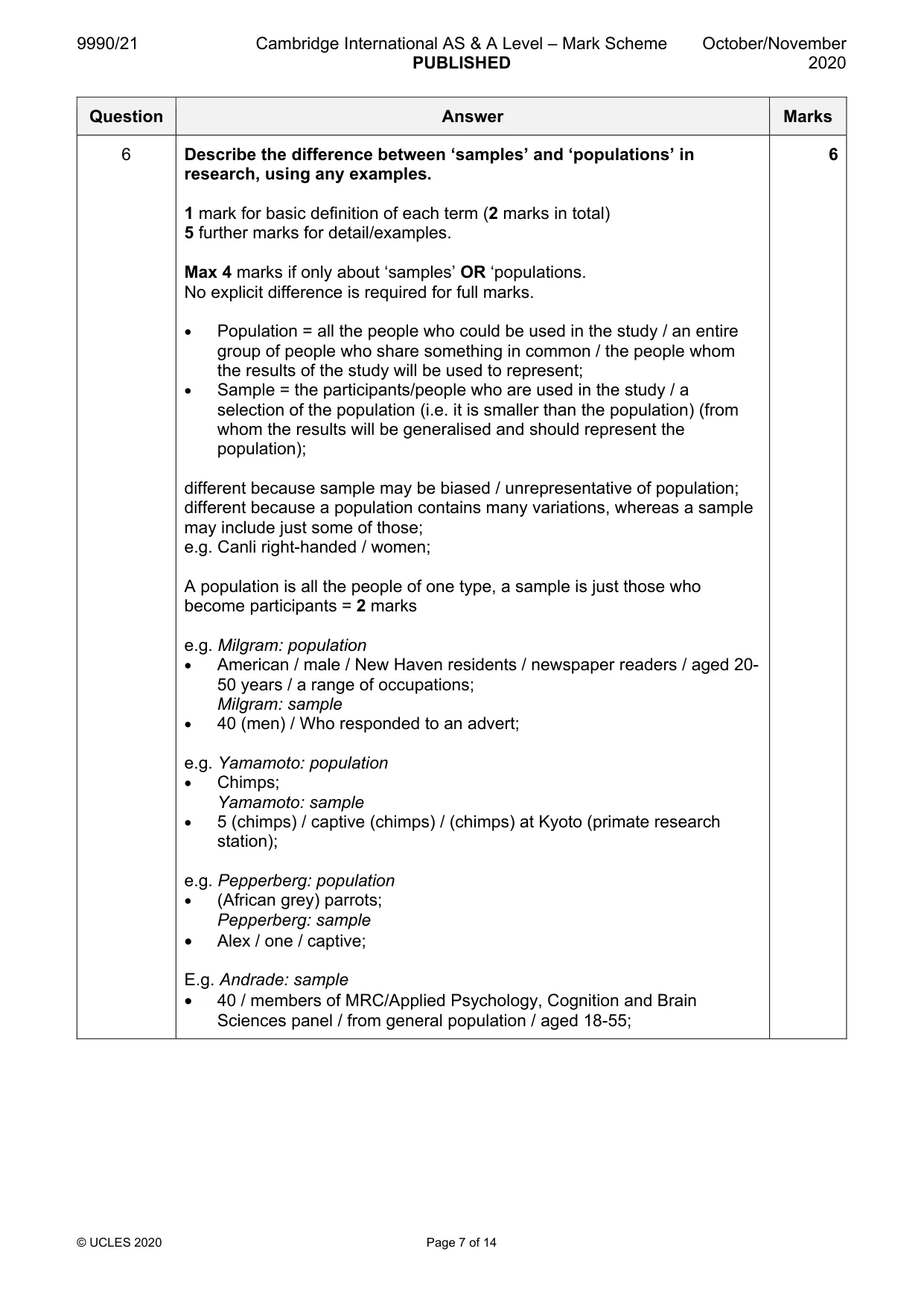
Q6 · Describe the difference between ‘samples’ and ‘populations’ in research, using any…
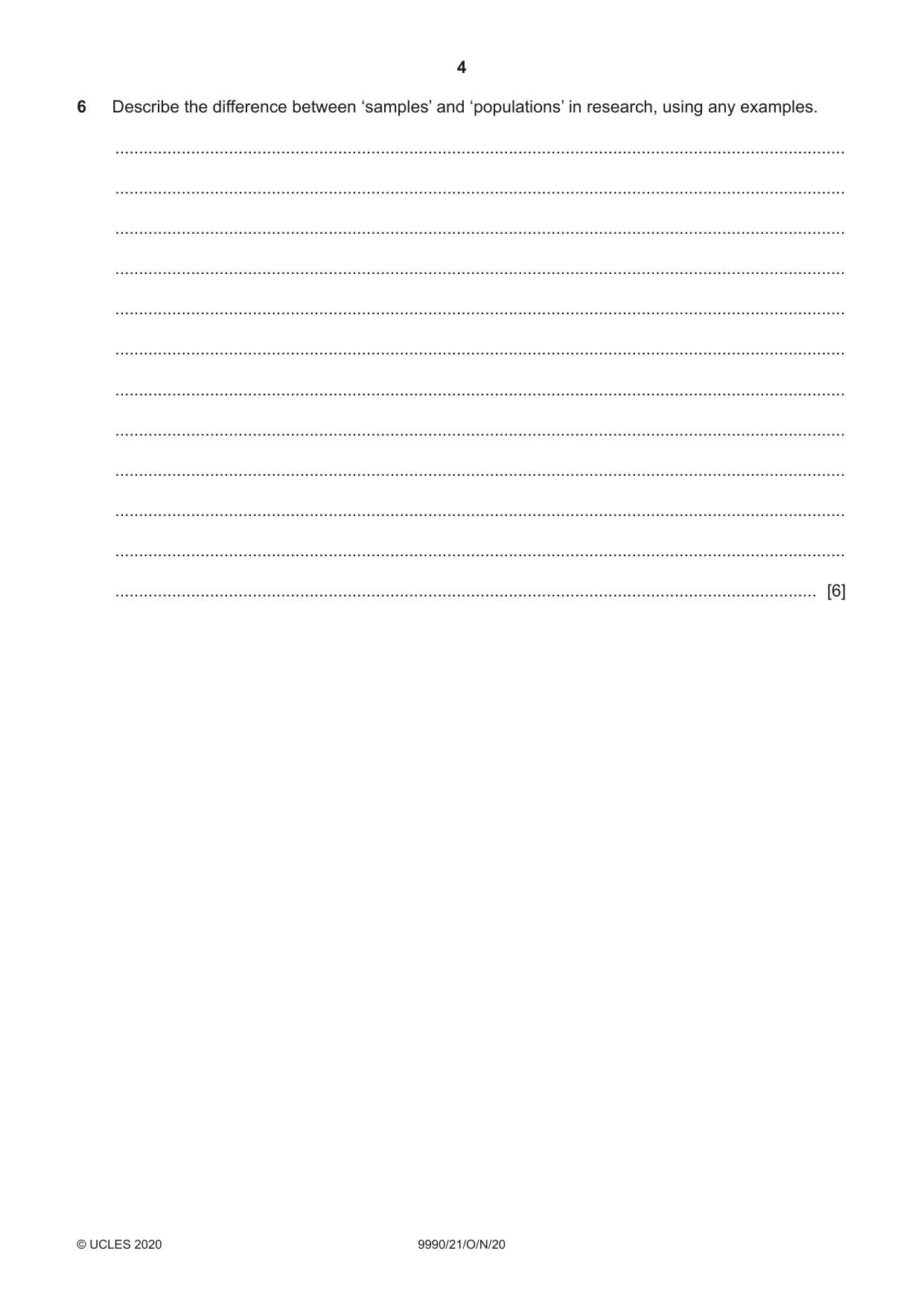
6 Describe the difference between ‘samples’ and ‘populations’ in research, using any examples. .......................................................................................................................................................... .......................................................................................................................................................... .......................................................................................................................................................... .......................................................................................................................................................... .......................................................................................................................................................... .......................................................................................................................................................... .......................................................................................................................................................... .......................................................................................................................................................... .......................................................................................................................................................... .......................................................................................................................................................... .......................................................................................................................................................... .................................................................................................................................................... [6]
Mark scheme: 6 Describe the difference between ‘samples’ and ‘populations’ in 6 research, using any examples. 1 mark for basic definition of each term (2 marks in total) 5 further marks for detail/examples. Max 4 marks if only about ‘samples’ OR ‘populations. No explicit difference is required for full marks. • Population = all the people who could be used in the study / an entire group of people who share something in common / the people whom the results of the study will be used to represent; • Sample = the participants/people who are used in the study / a selection of the population (i.e. it is smaller than the population) (from whom the results will be generalised and should represent the population); different because sample may be biased / unrepresentative of population; different because a population contains many variations, whereas a sample may include just some of those; e.g. Canli right-handed / women; A population is all the people of one type, a sample is just those who become participants = 2 marks e.g. Milgram: population • American / male / New Haven residents / newspaper readers / aged 20- 50 years / a range of occupations; Milgram: sample • 40 (men) / Who responded to an advert; e.g. Yamamoto: population • Chimps; Yamamoto: sample • 5 (chimps) / captive (chimps) / (chimps) at Kyoto (primate research station); e.g. Pepperberg: population • (African grey) parrots; Pepperberg: sample • Alex / one / captive; E.g. Andrade: sample • 40 / members of MRC/Applied Psychology, Cognition and Brain Sciences panel / from general population / aged 18-55;
Q7 · Aileen is planning an interview-based study to investigate what old people often forget
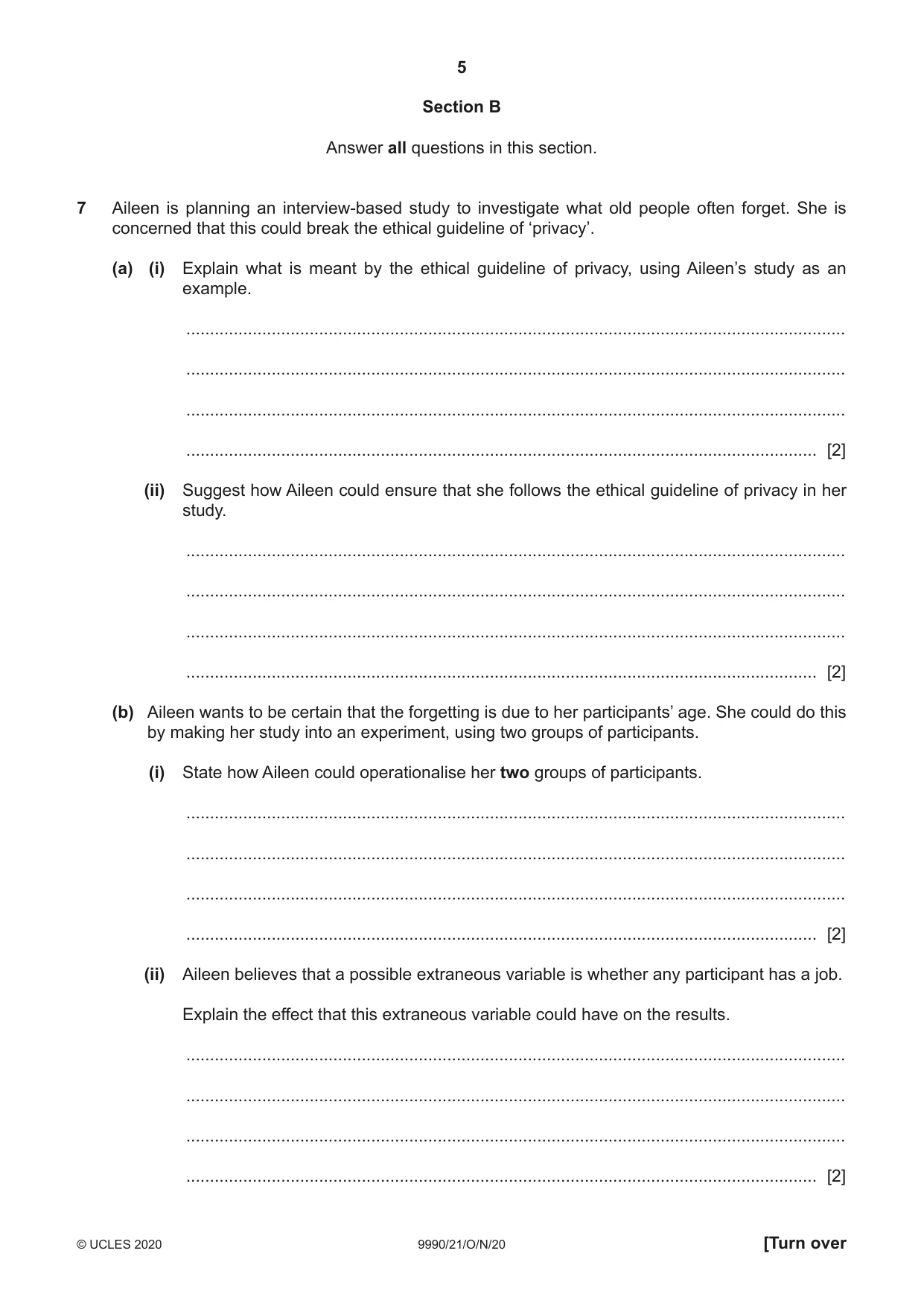
7 Aileen is planning an interview-based study to investigate what old people often forget. She is concerned that this could break the ethical guideline of ‘privacy’. (a) (i) Explain what is meant by the ethical guideline of privacy, using Aileen’s study as an example. ........................................................................................................................................... ........................................................................................................................................... ........................................................................................................................................... ..................................................................................................................................... [2] (ii) Suggest how Aileen could ensure that she follows the ethical guideline of privacy in her study. ........................................................................................................................................... ........................................................................................................................................... ........................................................................................................................................... ..................................................................................................................................... [2] (b) Aileen wants to be certain that the forgetting is due to her participants’ age. She could do this by making her study into an experiment, using two groups of participants. (i) State how Aileen could operationalise her two groups of participants. ........................................................................................................................................... ........................................................................................................................................... ........................................................................................................................................... ..................................................................................................................................... [2] (ii) Aileen believes that a possible extraneous variable is whether any participant has a job. Explain the effect that this extraneous variable could have on the results. ........................................................................................................................................... ........................................................................................................................................... ........................................................................................................................................... ..................................................................................................................................... [2]
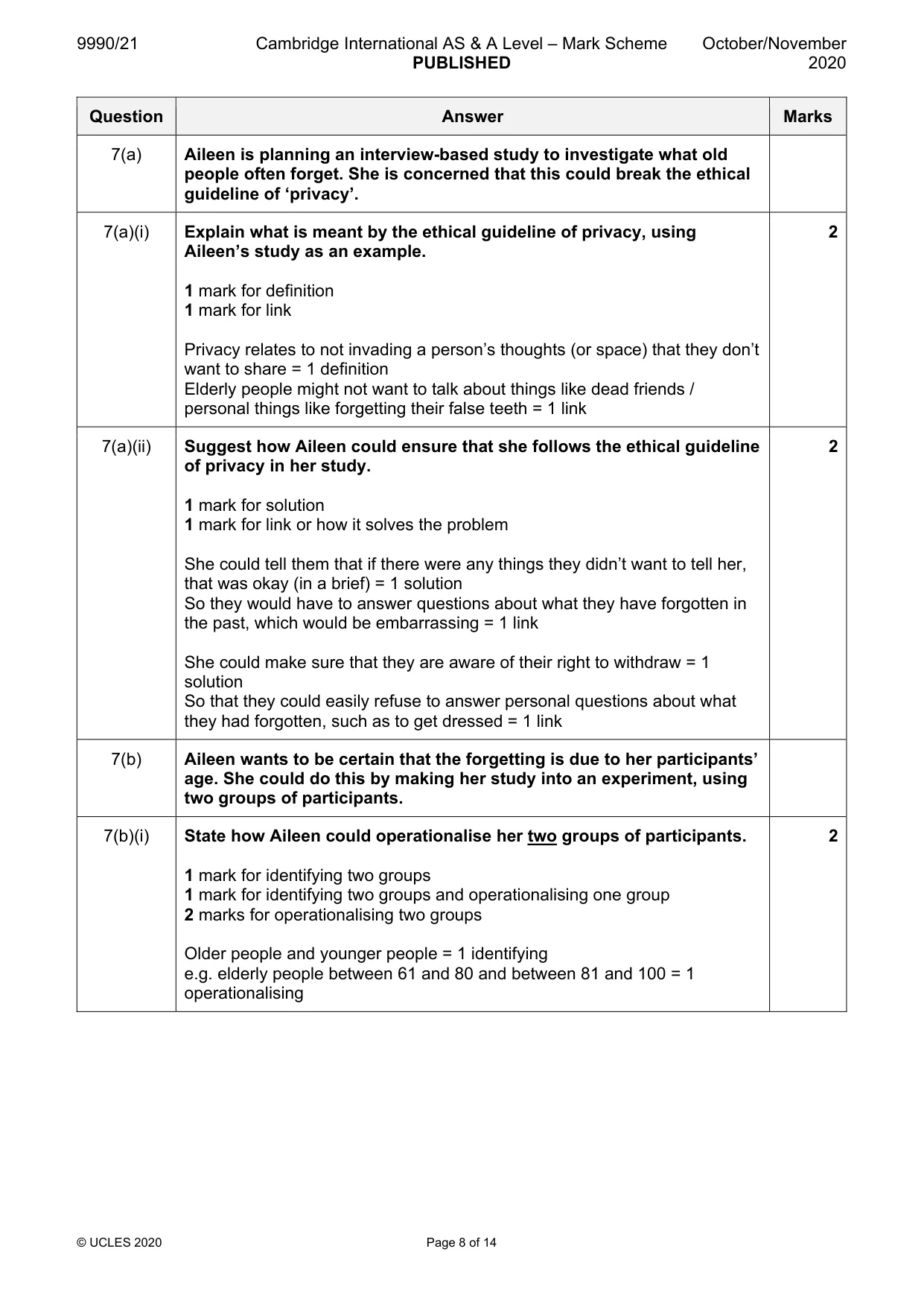
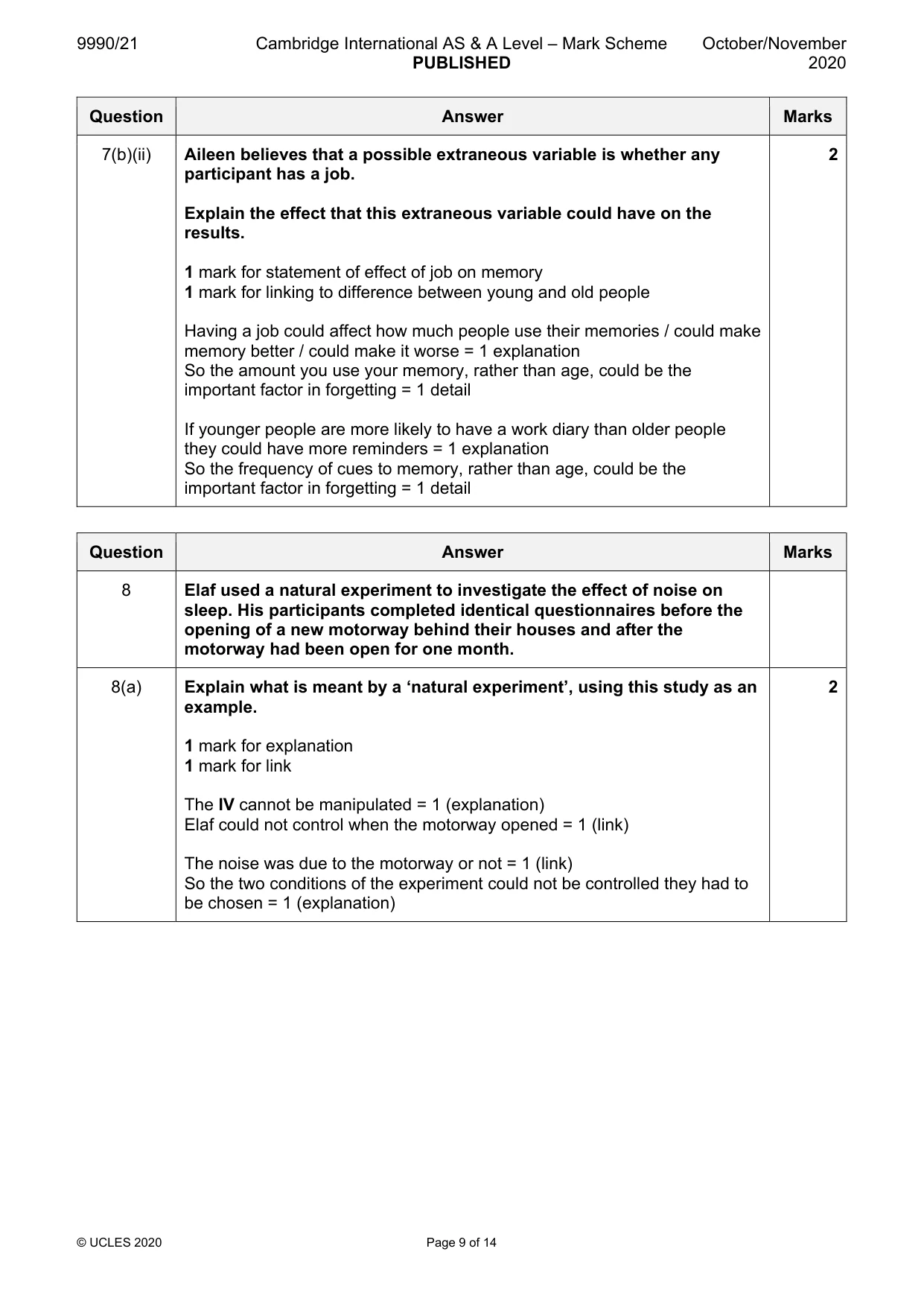
Mark scheme: 7(a) Aileen is planning an interview-based study to investigate what old people often forget. She is concerned that this could break the ethical guideline of ‘privacy’. 7(a)(i) Explain what is meant by the ethical guideline of privacy, using 2 Aileen’s study as an example. 1 mark for definition 1 mark for link Privacy relates to not invading a person’s thoughts (or space) that they don’t want to share = 1 definition Elderly people might not want to talk about things like dead friends / personal things like forgetting their false teeth = 1 link 7(a)(ii) Suggest how Aileen could ensure that she follows the ethical guideline 2 of privacy in her study. 1 mark for solution 1 mark for link or how it solves the problem She could tell them that if there were any things they didn’t want to tell her, that was okay (in a brief) = 1 solution So they would have to answer questions about what they have forgotten in the past, which would be embarrassing = 1 link She could make sure that they are aware of their right to withdraw = 1 solution So that they could easily refuse to answer personal questions about what they had forgotten, such as to get dressed = 1 link 7(b) Aileen wants to be certain that the forgetting is due to her participants’ age. She could do this by making her study into an experiment, using two groups of participants. 7(b)(i) State how Aileen could operationalise her two groups of participants. 2 1 mark for identifying two groups 1 mark for identifying two groups and operationalising one group 2 marks for operationalising two groups Older people and younger people = 1 identifying e.g. elderly people between 61 and 80 and between 81 and 100 = 1 operationalising 7(b)(ii) Aileen believes that a possible extraneous variable is whether any 2 participant has a job. Explain the effect that this extraneous variable could have on the results. 1 mark for statement of effect of job on memory 1 mark for linking to difference between young and old people Having a job could affect how much people use their memories / could make memory better / could make it worse = 1 explanation So the amount you use your memory, rather than age, could be the important factor in forgetting = 1 detail If younger people are more likely to have a work diary than older people they could have more reminders = 1 explanation So the frequency of cues to memory, rather than age, could be the important factor in forgetting = 1 detail
Q8 · Elaf used a natural experiment to investigate the effect of noise on sleep
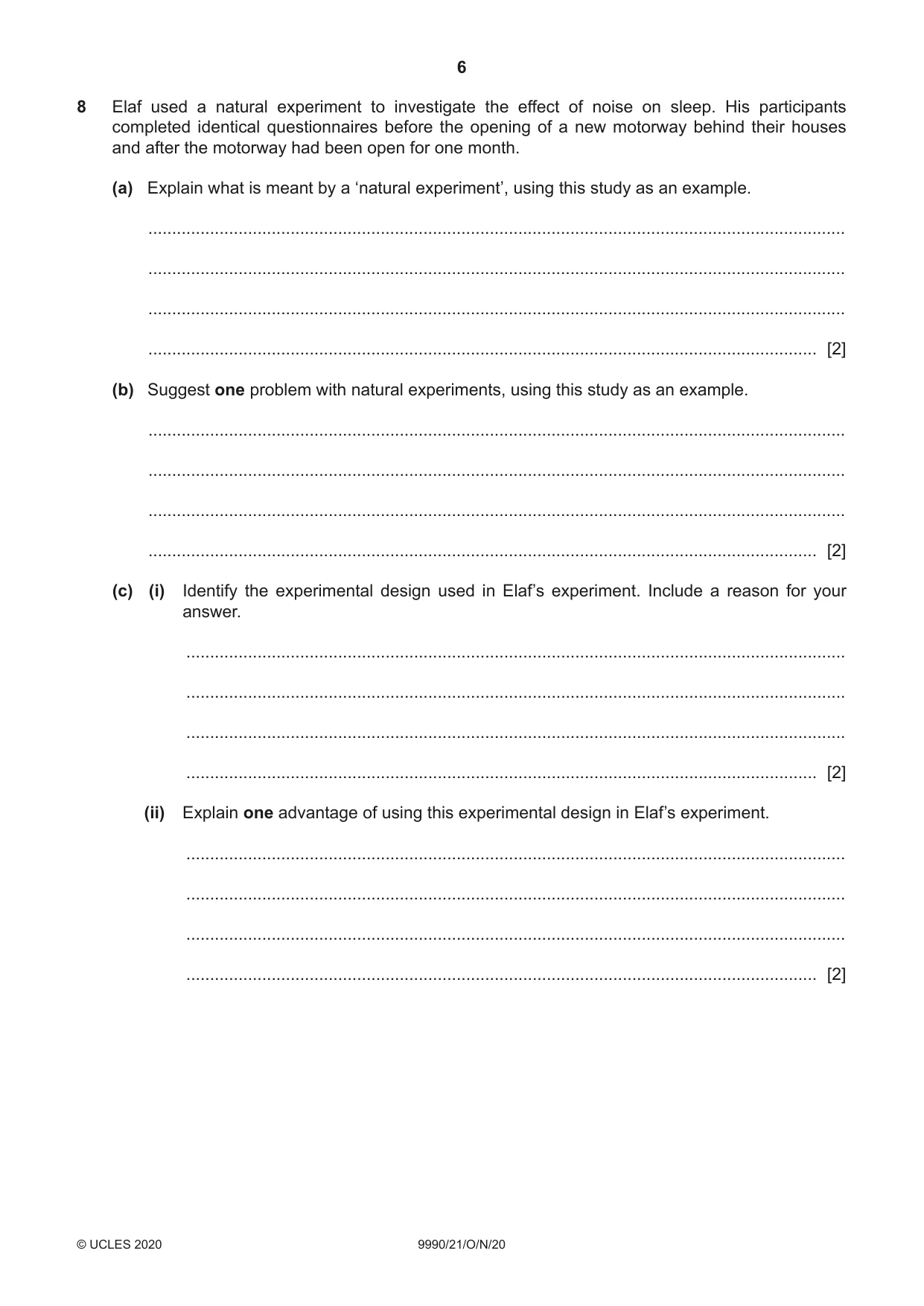
8 Elaf used a natural experiment to investigate the effect of noise on sleep. His participants completed identical questionnaires before the opening of a new motorway behind their houses and after the motorway had been open for one month. (a) Explain what is meant by a ‘natural experiment’, using this study as an example. ................................................................................................................................................... ................................................................................................................................................... ................................................................................................................................................... ............................................................................................................................................. [2] (b) Suggest one problem with natural experiments, using this study as an example. ................................................................................................................................................... ................................................................................................................................................... ................................................................................................................................................... ............................................................................................................................................. [2] (c) (i) Identify the experimental design used in Elaf’s experiment. Include a reason for your answer. ........................................................................................................................................... ........................................................................................................................................... ........................................................................................................................................... ..................................................................................................................................... [2] (ii) Explain one advantage of using this experimental design in Elaf’s experiment. ........................................................................................................................................... ........................................................................................................................................... ........................................................................................................................................... ..................................................................................................................................... [2]
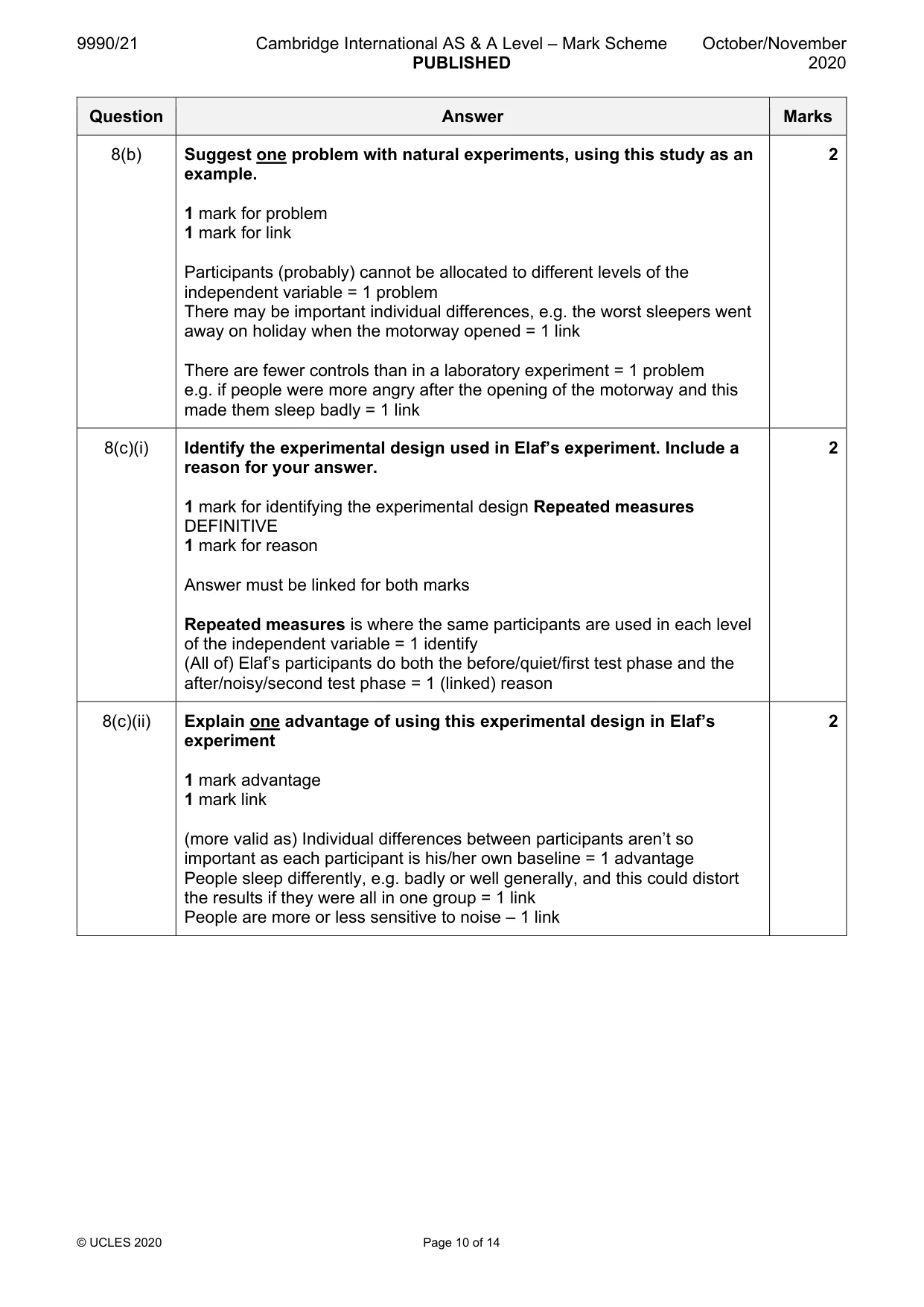
Mark scheme: 8 Elaf used a natural experiment to investigate the effect of noise on sleep. His participants completed identical questionnaires before the opening of a new motorway behind their houses and after the motorway had been open for one month. 8(a) Explain what is meant by a ‘natural experiment’, using this study as an 2 example. 1 mark for explanation 1 mark for link The IV cannot be manipulated = 1 (explanation) Elaf could not control when the motorway opened = 1 (link) The noise was due to the motorway or not = 1 (link) So the two conditions of the experiment could not be controlled they had to be chosen = 1 (explanation) 8(b) Suggest one problem with natural experiments, using this study as an 2 example. 1 mark for problem 1 mark for link Participants (probably) cannot be allocated to different levels of the independent variable = 1 problem There may be important individual differences, e.g. the worst sleepers went away on holiday when the motorway opened = 1 link There are fewer controls than in a laboratory experiment = 1 problem e.g. if people were more angry after the opening of the motorway and this made them sleep badly = 1 link 8(c)(i) Identify the experimental design used in Elaf’s experiment. Include a 2 reason for your answer. 1 mark for identifying the experimental design Repeated measures DEFINITIVE 1 mark for reason Answer must be linked for both marks Repeated measures is where the same participants are used in each level of the independent variable = 1 identify (All of) Elaf’s participants do both the before/quiet/first test phase and the after/noisy/second test phase = 1 (linked) reason 8(c)(ii) Explain one advantage of using this experimental design in Elaf’s 2 experiment 1 mark advantage 1 mark link (more valid as) Individual differences between participants aren’t so important as each participant is his/her own baseline = 1 advantage People sleep differently, e.g. badly or well generally, and this could distort the results if they were all in one group = 1 link People are more or less sensitive to noise – 1 link
Q9 · Jasmin conducted an overt observation of friendship behaviours on customers in a café for…
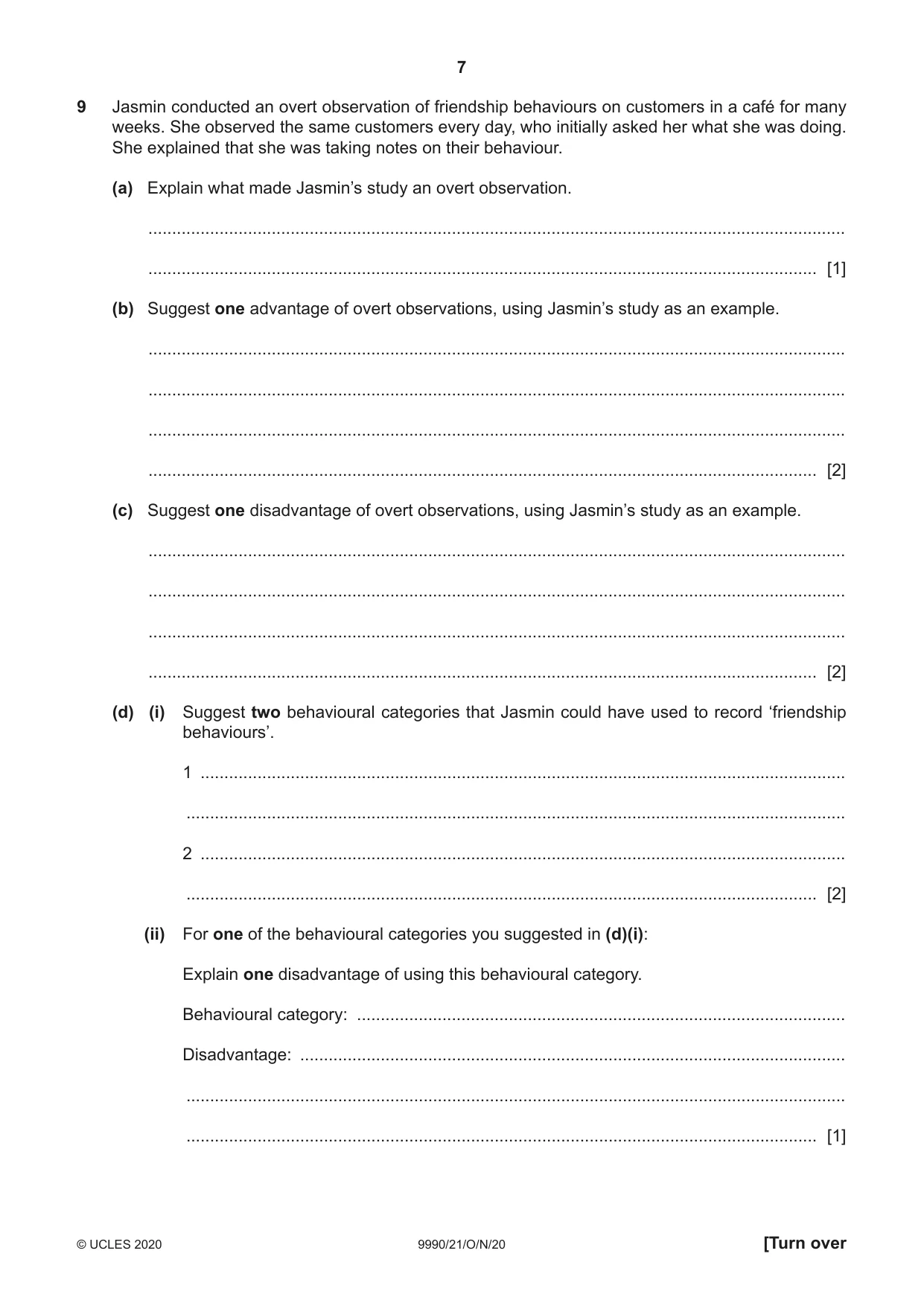
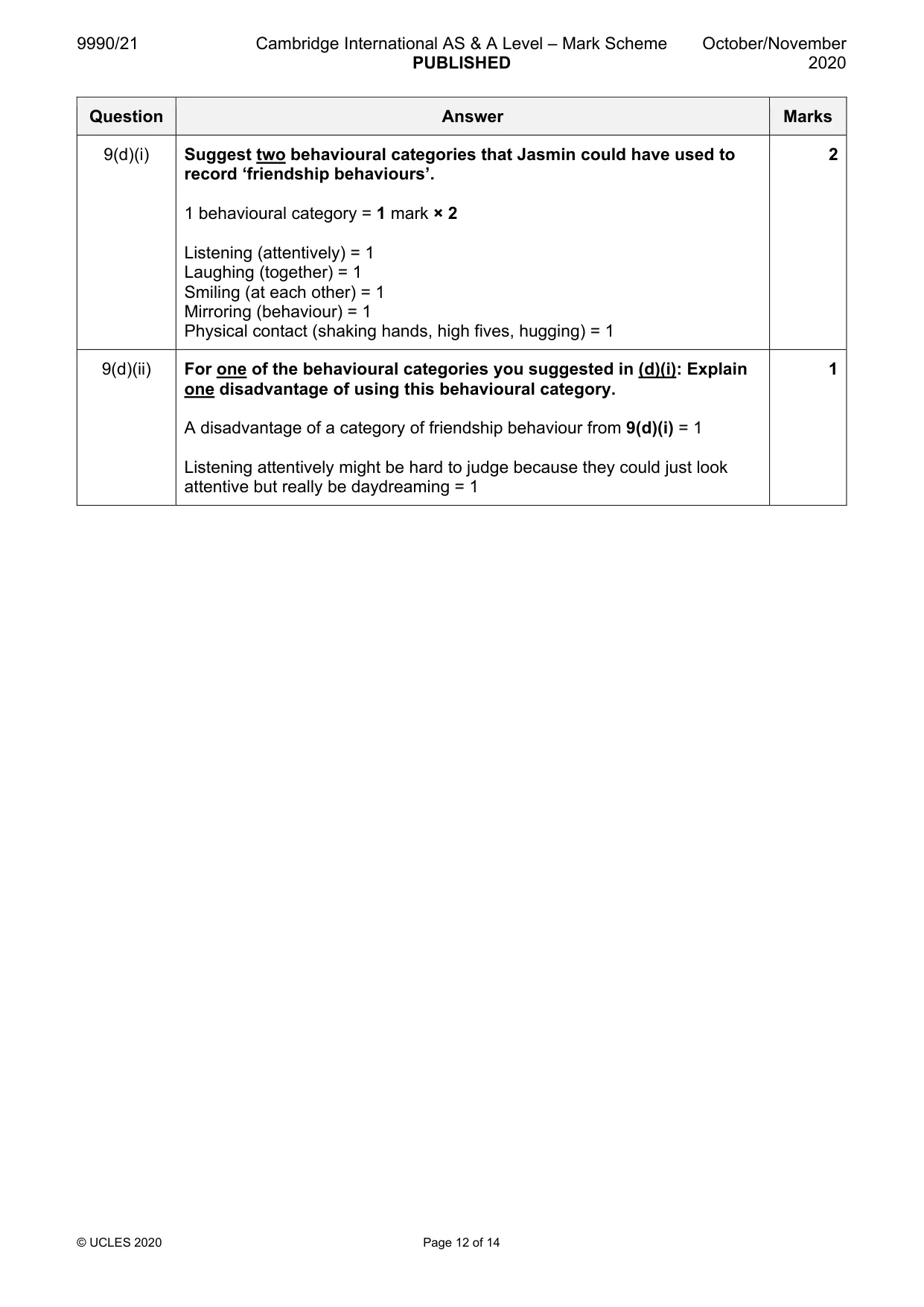
9 Jasmin conducted an overt observation of friendship behaviours on customers in a café for many weeks. She observed the same customers every day, who initially asked her what she was doing. She explained that she was taking notes on their behaviour. (a) Explain what made Jasmin’s study an overt observation. ................................................................................................................................................... ............................................................................................................................................. [1] (b) Suggest one advantage of overt observations, using Jasmin’s study as an example. ................................................................................................................................................... ................................................................................................................................................... ................................................................................................................................................... ............................................................................................................................................. [2] (c) Suggest one disadvantage of overt observations, using Jasmin’s study as an example. ................................................................................................................................................... ................................................................................................................................................... ................................................................................................................................................... ............................................................................................................................................. [2] (d) (i) Suggest two behavioural categories that Jasmin could have used to record ‘friendship behaviours’. 1 ........................................................................................................................................ ........................................................................................................................................... 2 ........................................................................................................................................ ..................................................................................................................................... [2] (ii) For one of the behavioural categories you suggested in (d)(i): Explain one disadvantage of using this behavioural category. Behavioural category: ....................................................................................................... Disadvantage: ................................................................................................................... ........................................................................................................................................... ..................................................................................................................................... [1] Section C Answer all questions in this section.
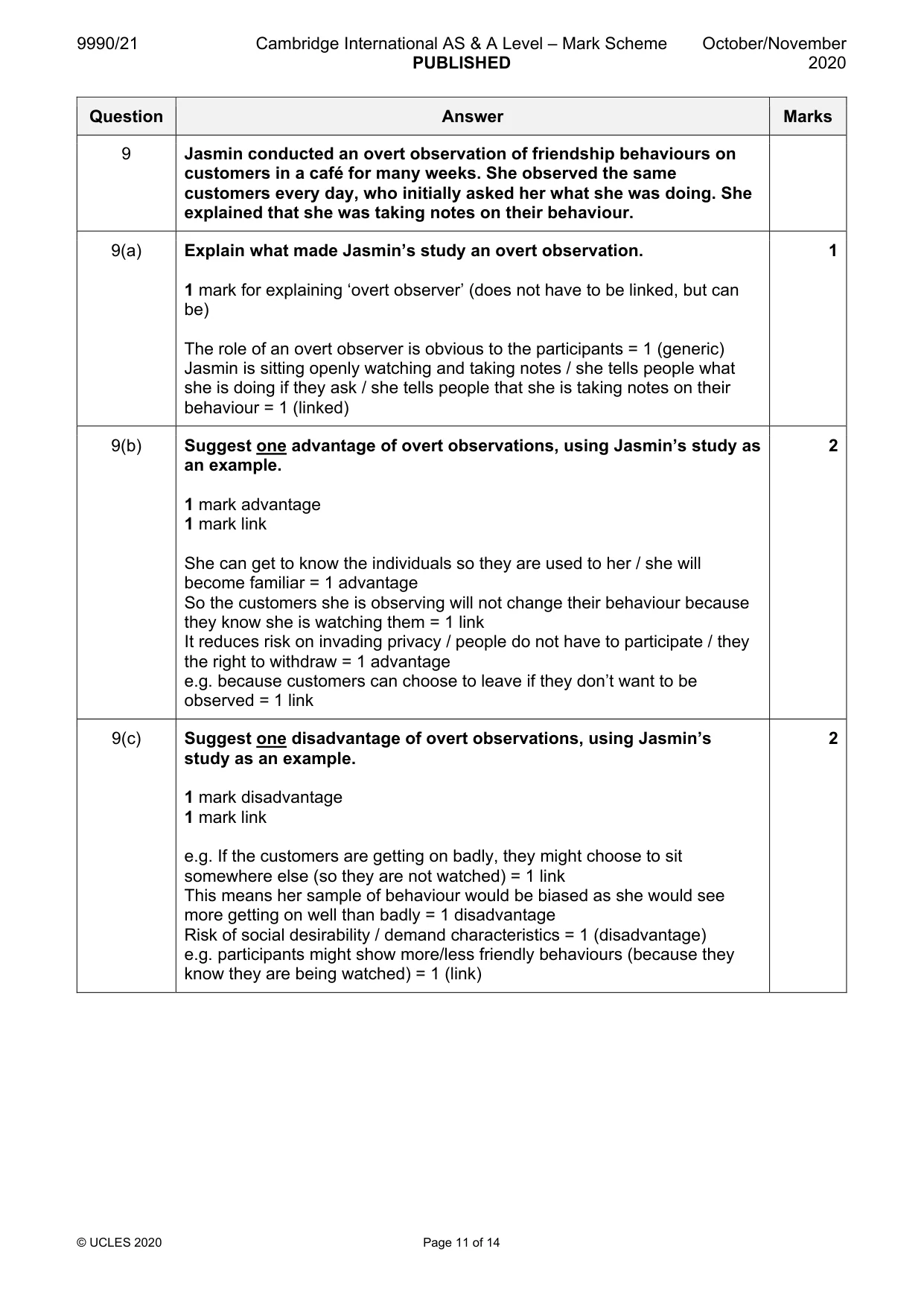
Mark scheme: 9 Jasmin conducted an overt observation of friendship behaviours on customers in a café for many weeks. She observed the same customers every day, who initially asked her what she was doing. She explained that she was taking notes on their behaviour. 9(a) Explain what made Jasmin’s study an overt observation. 1 1 mark for explaining ‘overt observer’ (does not have to be linked, but can be) The role of an overt observer is obvious to the participants = 1 (generic) Jasmin is sitting openly watching and taking notes / she tells people what she is doing if they ask / she tells people that she is taking notes on their behaviour = 1 (linked) 9(b) Suggest one advantage of overt observations, using Jasmin’s study as 2 an example. 1 mark advantage 1 mark link She can get to know the individuals so they are used to her / she will become familiar = 1 advantage So the customers she is observing will not change their behaviour because they know she is watching them = 1 link It reduces risk on invading privacy / people do not have to participate / they the right to withdraw = 1 advantage e.g. because customers can choose to leave if they don’t want to be observed = 1 link 9(c) Suggest one disadvantage of overt observations, using Jasmin’s 2 study as an example. 1 mark disadvantage 1 mark link e.g. If the customers are getting on badly, they might choose to sit somewhere else (so they are not watched) = 1 link This means her sample of behaviour would be biased as she would see more getting on well than badly = 1 disadvantage Risk of social desirability / demand characteristics = 1 (disadvantage) e.g. participants might show more/less friendly behaviours (because they know they are being watched) = 1 (link) 9(d)(i) Suggest two behavioural categories that Jasmin could have used to 2 record ‘friendship behaviours’. 1 behavioural category = 1 mark × 2 Listening (attentively) = 1 Laughing (together) = 1 Smiling (at each other) = 1 Mirroring (behaviour) = 1 Physical contact (shaking hands, high fives, hugging) = 1 9(d)(ii) For one of the behavioural categories you suggested in (d)(i): Explain 1 one disadvantage of using this behavioural category. A disadvantage of a category of friendship behaviour from 9(d)(i) = 1 Listening attentively might be hard to judge because they could just look attentive but really be daydreaming = 1
Q10 · Valerie is a teacher
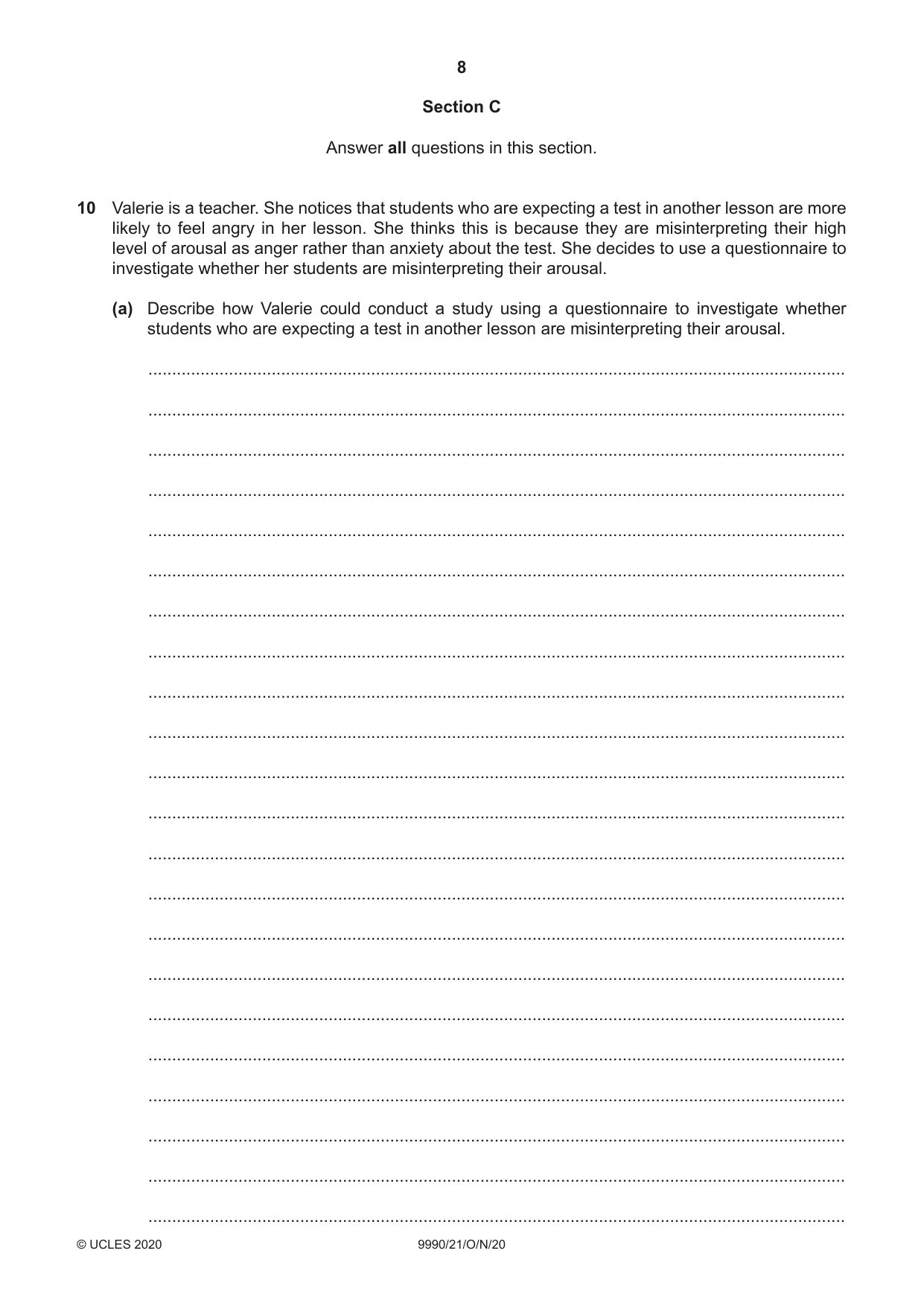
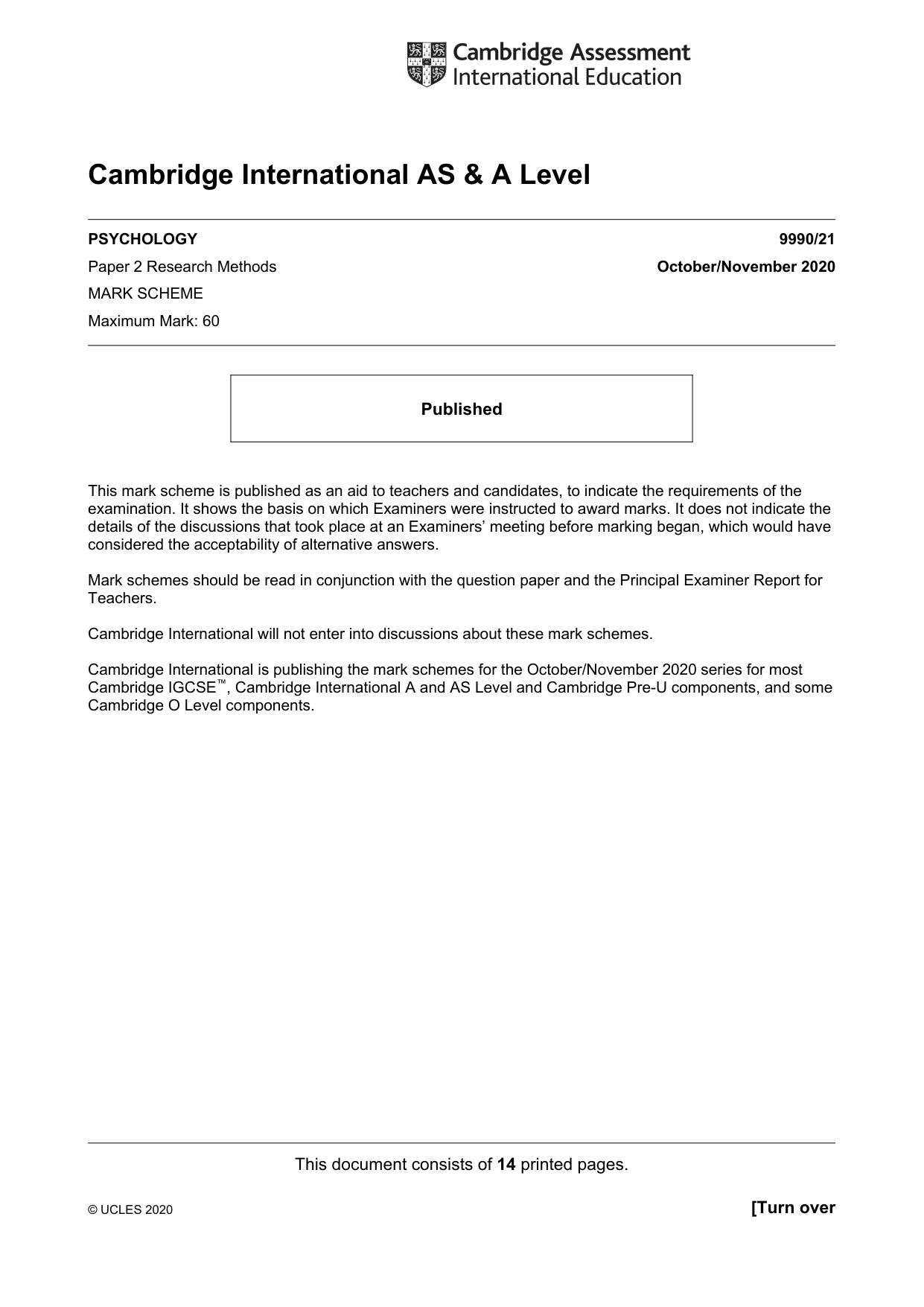
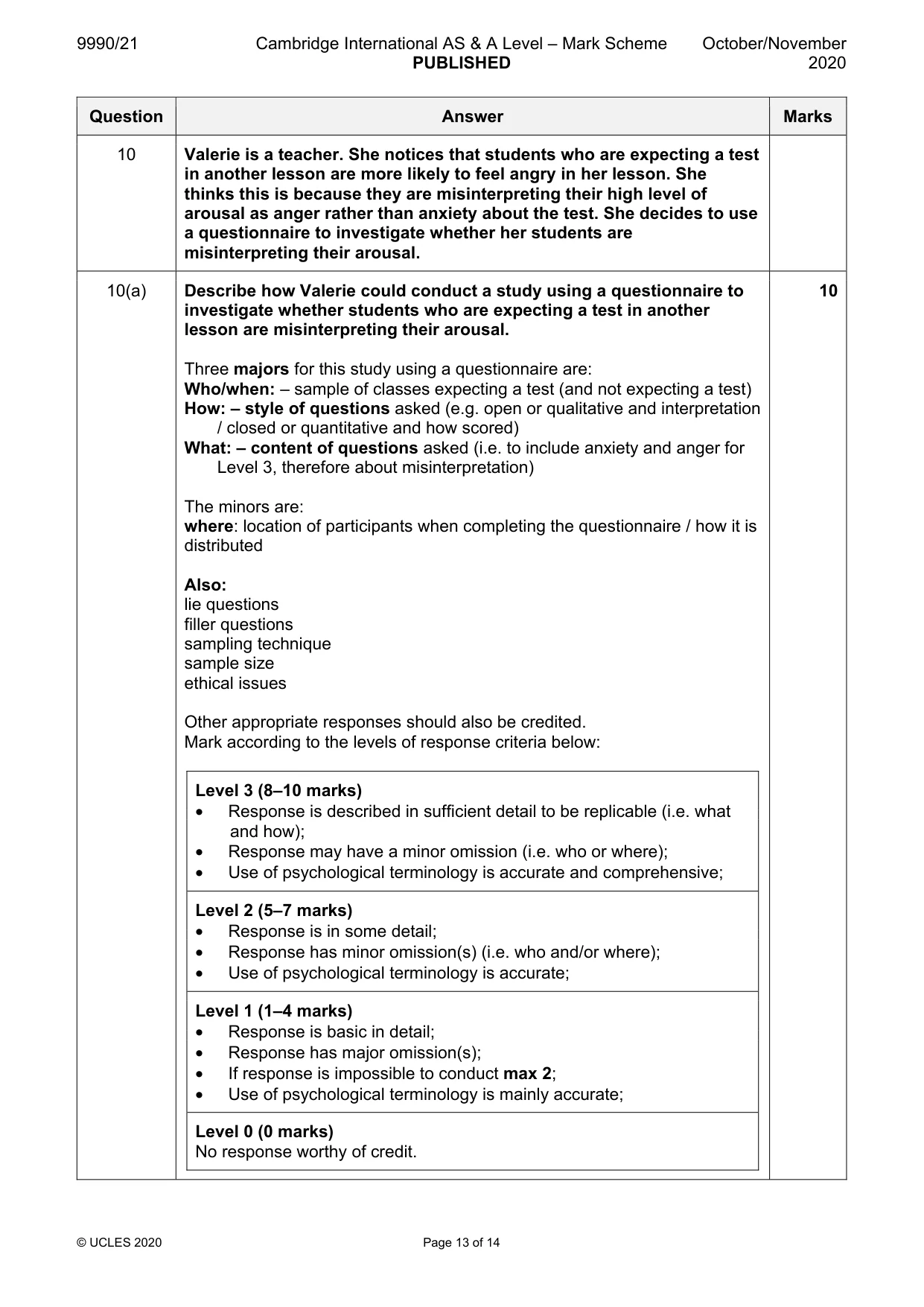
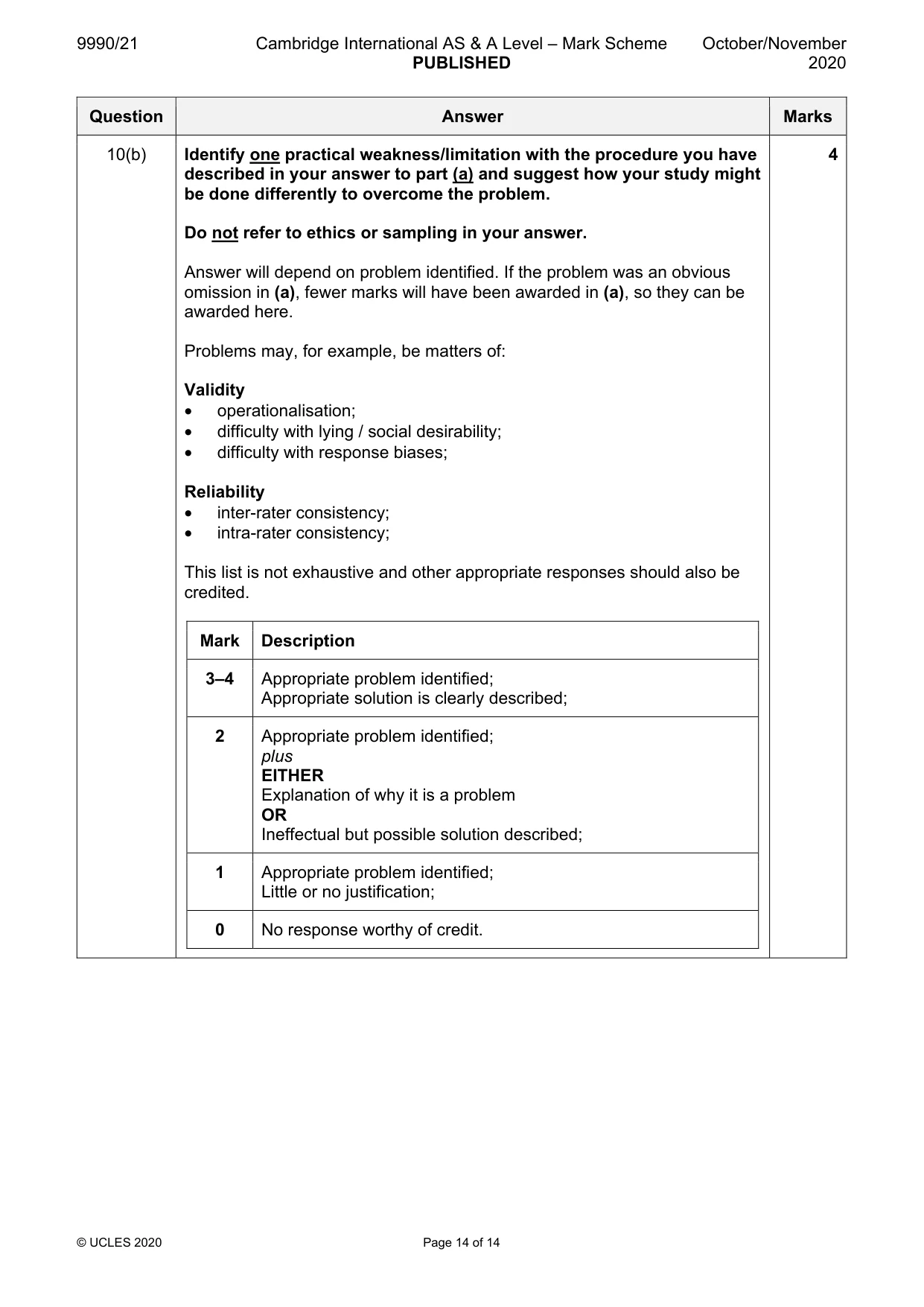
10 Valerie is a teacher. She notices that students who are expecting a test in another lesson are more likely to feel angry in her lesson. She thinks this is because they are misinterpreting their high level of arousal as anger rather than anxiety about the test. She decides to use a questionnaire to investigate whether her students are misinterpreting their arousal. (a) Describe how Valerie could conduct a study using a questionnaire to investigate whether students who are expecting a test in another lesson are misinterpreting their arousal. ................................................................................................................................................... ................................................................................................................................................... ................................................................................................................................................... ................................................................................................................................................... ................................................................................................................................................... ................................................................................................................................................... ................................................................................................................................................... ................................................................................................................................................... ................................................................................................................................................... ................................................................................................................................................... ................................................................................................................................................... ................................................................................................................................................... ................................................................................................................................................... ................................................................................................................................................... ................................................................................................................................................... ................................................................................................................................................... ................................................................................................................................................... ................................................................................................................................................... ................................................................................................................................................... ................................................................................................................................................... ................................................................................................................................................... ................................................................................................................................................... ................................................................................................................................................... ................................................................................................................................................... ................................................................................................................................................... ................................................................................................................................................... ................................................................................................................................................... ........................................................................................................................................... [10] (b) Identify one practical weakness/limitation with the procedure you have described in your answer to part (a) and suggest how your study might be done differently to overcome the problem. Do not refer to ethics or sampling in your answer. ................................................................................................................................................... ................................................................................................................................................... ................................................................................................................................................... ................................................................................................................................................... ................................................................................................................................................... ................................................................................................................................................... ................................................................................................................................................... ............................................................................................................................................. [4]
Mark scheme: 10 Valerie is a teacher. She notices that students who are expecting a test in another lesson are more likely to feel angry in her lesson. She thinks this is because they are misinterpreting their high level of arousal as anger rather than anxiety about the test. She decides to use a questionnaire to investigate whether her students are misinterpreting their arousal. 10(a) Describe how Valerie could conduct a study using a questionnaire to 10 investigate whether students who are expecting a test in another lesson are misinterpreting their arousal. Three majors for this study using a questionnaire are: Who/when: – sample of classes expecting a test (and not expecting a test) How: – style of questions asked (e.g. open or qualitative and interpretation / closed or quantitative and how scored) What: – content of questions asked (i.e. to include anxiety and anger for Level 3, therefore about misinterpretation) The minors are: where: location of participants when completing the questionnaire / how it is distributed Also: lie questions filler questions sampling technique sample size ethical issues Other appropriate responses should also be credited. Mark according to the levels of response criteria below: Level 3 (8–10 marks) • Response is described in sufficient detail to be replicable (i.e. what and how); • Response may have a minor omission (i.e. who or where); • Use of psychological terminology is accurate and comprehensive; Level 2 (5–7 marks) • Response is in some detail; • Response has minor omission(s) (i.e. who and/or where); • Use of psychological terminology is accurate; Level 1 (1–4 marks) • Response is basic in detail; • Response has major omission(s); • If response is impossible to conduct max 2; • Use of psychological terminology is mainly accurate; Level 0 (0 marks) No response worthy of credit. 10(b) Identify one practical weakness/limitation with the procedure you have 4 described in your answer to part (a) and suggest how your study might be done differently to overcome the problem. Do not refer to ethics or sampling in your answer. Answer will depend on problem identified. If the problem was an obvious omission in (a), fewer marks will have been awarded in (a), so they can be awarded here. Problems may, for example, be matters of: Validity • operationalisation; • difficulty with lying / social desirability; • difficulty with response biases; Reliability • inter-rater consistency; • intra-rater consistency; This list is not exhaustive and other appropriate responses should also be credited. Mark Description 3–4 Appropriate problem identified; Appropriate solution is clearly described; 2 Appropriate problem identified; plus EITHER Explanation of why it is a problem OR Ineffectual but possible solution described; 1 Appropriate problem identified; Little or no justification; 0 No response worthy of credit.
What was in this paper
The subtopics covered by these 10 questions, and how many questions each got. Open one in a new tab to see every Cambridge question on it.
What you needed in this session
Cambridge’s own grade thresholds for 2020 Oct/Nov, Paper 2 · Variant 1. A higher threshold means an easier paper — the bar moves with how the cohort did.