Questions as text
Q1 · Polarisation is a phenomenon associated with a certain type of wave 9702/11 Oct/Nov 2005
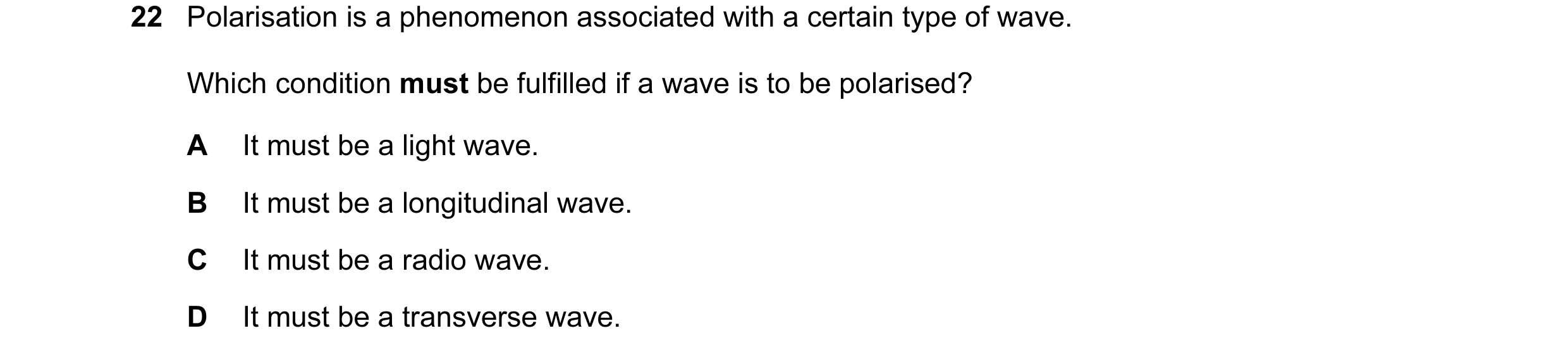
22 Polarisation is a phenomenon associated with a certain type of wave. Which condition must be fulfilled if a wave is to be polarised? A It must be a light wave. B It must be a longitudinal wave. C It must be a radio wave. D It must be a transverse wave.
1 marks
Answer: D
This question in 9702/11 Oct/Nov 2005
Q2 · Which phenomenon is associated with transverse waves but not longitudinal waves? 9702/11 May/June 2006
23 Which phenomenon is associated with transverse waves but not longitudinal waves? A polarisation B reflection C refraction D superposition
1 marks
Answer: A
This question in 9702/11 May/June 2006
Q3 · Which of the following types of wave can be polarised? 9702/11 May/June 2007
21 Which of the following types of wave can be polarised? A a longitudinal progressive wave B a longitudinal stationary wave C a transverse stationary wave D a transverse sound wave
1 marks
Answer: C
This question in 9702/11 May/June 2007
Q4 · Light can exhibit all of the properties listed 9702/11 Oct/Nov 2008
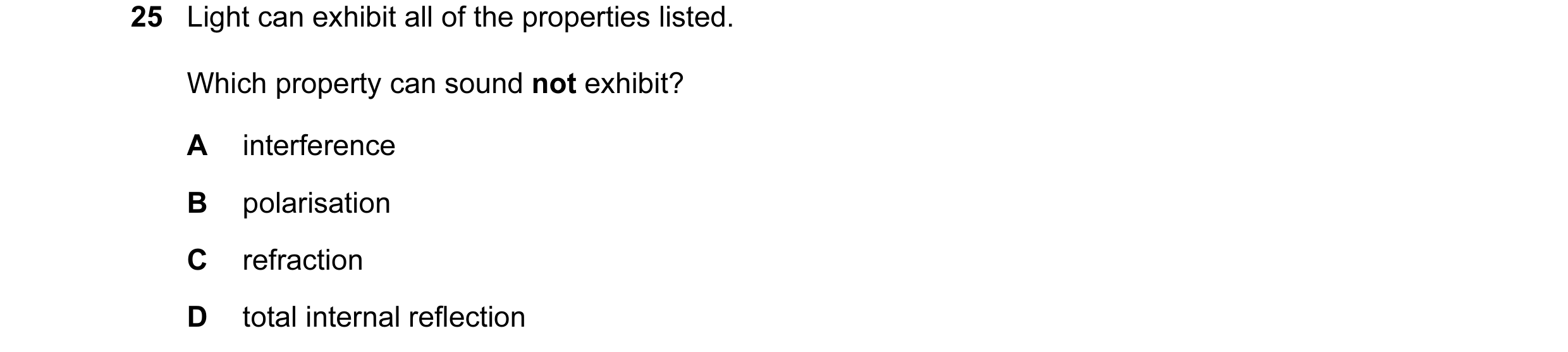
25 Light can exhibit all of the properties listed. Which property can sound not exhibit? A interference B polarisation C refraction D total internal reflection
1 marks
Answer: B
This question in 9702/11 Oct/Nov 2008
Q5 · When plane-polarised light of amplitude a is passed through a polarising filter as shown… 9702/13 Oct/Nov 2010
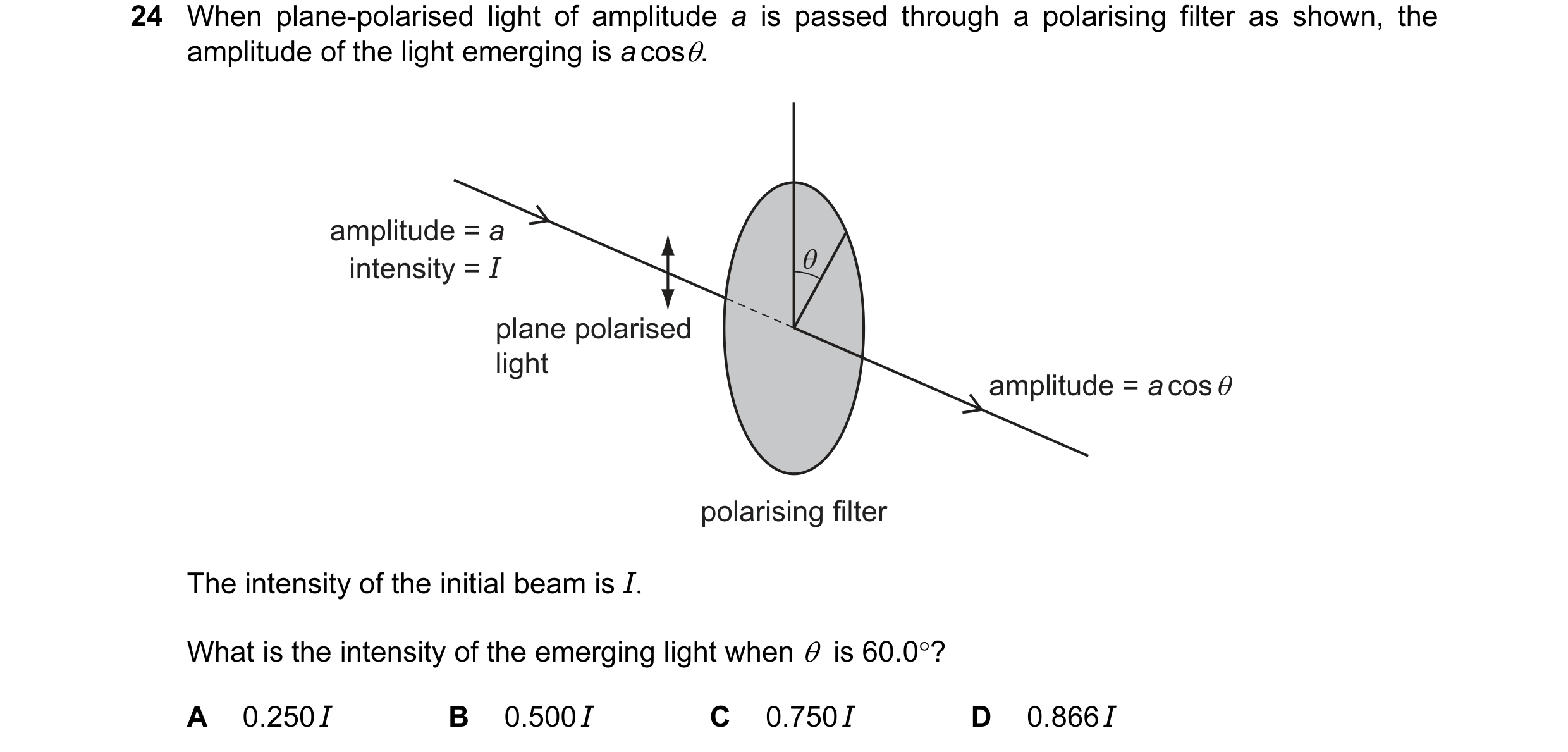
24 When plane-polarised light of amplitude a is passed through a polarising filter as shown, the amplitude of the light emerging is a cosθ. amplitude = a intensity = I θ plane polarised light amplitude = a cos θ polarising filter The intensity of the initial beam is I. What is the intensity of the emerging light when θ is 60.0°? A 0.250 I B 0.500 I C 0.750 I D 0.866 I
1 marks
Answer: A
This question in 9702/13 Oct/Nov 2010
Q6 · If a wave can be polarised, it must be A a longitudinal wave 9702/12 May/June 2011
27 If a wave can be polarised, it must be A a longitudinal wave. B an electromagnetic wave. C a sound wave. D a transverse wave. Space for working
1 marks
Answer: D
This question in 9702/12 May/June 2011
Q7 · A wave that can be polarised must be A longitudinal 9702/12 Oct/Nov 2011
24 A wave that can be polarised must be A longitudinal. B progressive. C stationary. D transverse.
1 marks
Answer: D
This question in 9702/12 Oct/Nov 2011
Q8 · What is correct for all transverse waves? 9702/12 May/June 2013
26 What is correct for all transverse waves? A They are all electromagnetic. B They can all be polarised. C They can all travel through a vacuum. D They all involve the oscillation of atoms. Space for working
1 marks
Answer: B
This question in 9702/12 May/June 2013
Q9 · When the liquid crystal display of a calculator is observed through a polarising film… 9702/13 May/June 2013
25 When the liquid crystal display of a calculator is observed through a polarising film, the display changes as the film is rotated. Which property describes the radiation from the calculator display? A unpolarised B a longitudinal wave C a transverse wave D a wave with a 3 cm wavelength Space for working
1 marks
Answer: C
This question in 9702/13 May/June 2013
Q10 · When plane-polarised light of amplitude A is passed through a polarising filter as shown… 9702/11 Oct/Nov 2013
30 When plane-polarised light of amplitude A is passed through a polarising filter as shown, the amplitude of the light emerging is A cosθ. amplitude A intensity I θ plane-polarised light amplitude A cos θ polarising filter The intensity of the initial beam is I. What is the intensity of the emerging light when θ is 60.0°? A 0.250 I B 0.500 I C 0.750 I D 0.866 I Space for working
1 marks
Answer: A
This question in 9702/11 Oct/Nov 2013
Q11 · Which statement about a light wave and a sound wave is correct? 9702/12 Oct/Nov 2013
26 Which statement about a light wave and a sound wave is correct? A Both can be polarised. B Both can travel through free space. C Both have a frequency inversely proportional to their wavelength. D Both have an intensity proportional to their amplitude. Space for working
1 marks
Answer: C
This question in 9702/12 Oct/Nov 2013
Q12 · When plane-polarised light of amplitude A is passed through a polarising filter as shown… 9702/12 Oct/Nov 2013
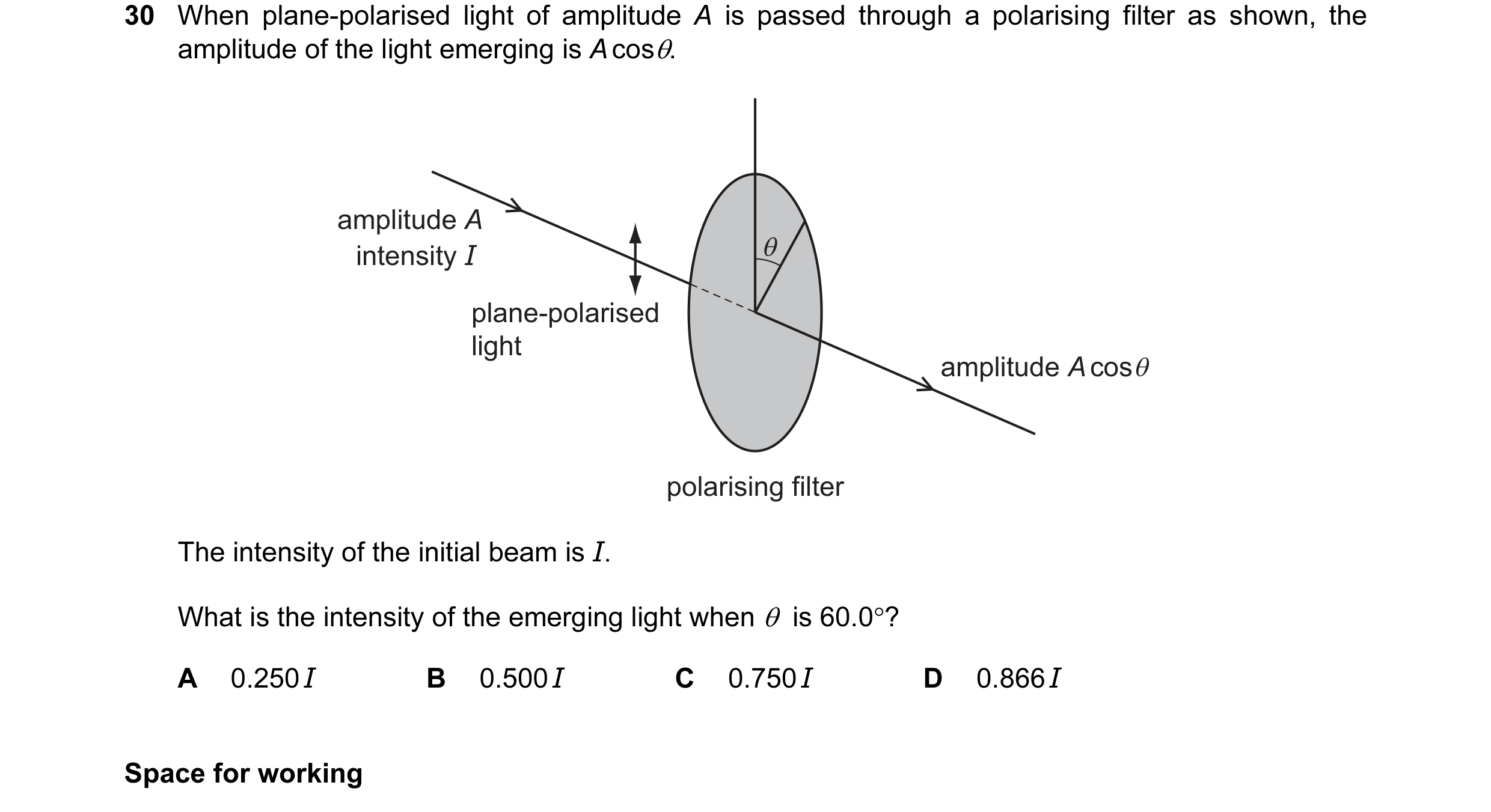
30 When plane-polarised light of amplitude A is passed through a polarising filter as shown, the amplitude of the light emerging is A cosθ. amplitude A intensity I θ plane-polarised light amplitude A cos θ polarising filter The intensity of the initial beam is I. What is the intensity of the emerging light when θ is 60.0°? A 0.250 I B 0.500 I C 0.750 I D 0.866 I Space for working
1 marks
Answer: A
This question in 9702/12 Oct/Nov 2013
Q13 · Which statement about longitudinal waves is correct? 9702/11 May/June 2014
22 Which statement about longitudinal waves is correct? A Longitudinal waves include radio waves travelling through air. B Particles in a longitudinal wave vibrate at right-angles to the direction of transfer of wave energy. C Some types of longitudinal wave can be polarised. D Stationary waves can be produced by the superposition of longitudinal waves.
1 marks
Answer: D
This question in 9702/11 May/June 2014
Q14 · Which statement describes a situation when polarisation could not occur? 9702/11 Oct/Nov 2014
24 Which statement describes a situation when polarisation could not occur? A Light waves are reflected. B Light waves are scattered. C Microwaves pass through a metal grid. D Sound waves pass through a metal grid.
1 marks
Answer: D
This question in 9702/11 Oct/Nov 2014
Q15 · Which statement describes a situation when polarisation could not occur? 9702/12 Oct/Nov 2014
24 Which statement describes a situation when polarisation could not occur? A Light waves are reflected. B Light waves are scattered. C Microwaves pass through a metal grid. D Sound waves pass through a metal grid.
1 marks
Answer: D
This question in 9702/12 Oct/Nov 2014
Q16 · Which of the following wave motions may be used to demonstrate the phenomenon of… 9702/12 Oct/Nov 2015
25 Which of the following wave motions may be used to demonstrate the phenomenon of polarisation? A a sound wave from a thunderclap B a surface wave in a water ripple tank C a stationary wave in an organ pipe D a stationary wave on a stretched wire
1 marks
Answer: D
This question in 9702/12 Oct/Nov 2015
Q17 · Polarisation is a phenomenon associated with a certain type of wave 9702/13 Oct/Nov 2015
24 Polarisation is a phenomenon associated with a certain type of wave. Which condition must be fulfilled if a wave is to be polarised? A It must be a light wave. B It must be a longitudinal wave. C It must be a radio wave. D It must be a transverse wave.
1 marks
Answer: D
This question in 9702/13 Oct/Nov 2015
Q18 · Which statement about a light wave and a sound wave is correct? 9702/12 Oct/Nov 2019
26 Which statement about a light wave and a sound wave is correct? A Both can travel through free space. B Both have a frequency inversely proportional to their wavelength. C Both have an intensity proportional to their amplitude. D Both have oscillations perpendicular to the direction of energy transfer.
1 marks
Answer: B
This question in 9702/12 Oct/Nov 2019
Q19 · Which statement about electromagnetic waves is correct? 9702/11 May/June 2022
25 Which statement about electromagnetic waves is correct? A A wave of wavelength 5.0 10–6 m is invisible to the human eye. B They can all travel at different speeds in free space. C They cannot be polarised. D They consist of vibrating atoms.
1 marks
Answer: A
This question in 9702/11 May/June 2022
Q20 · Two polarising filters are placed next to each other so that their planes are parallel 9702/12 May/June 2022
26 Two polarising filters are placed next to each other so that their planes are parallel. The first polarising filter has its transmission axis at an angle of 50 to the vertical. The second polarising filter has its transmission axis at an angle of 20 to the vertical. The angle between the transmission axes of the two polarising filters is 30 A beam of vertically polarised light of intensity 8.0 W m–2 is incident normally on the first polarising filter. What is the intensity of the light that is transmitted from the second polarising filter? A zero B 2.5 W m–2 C 2.9 W m–2 D 6.0 W m–2
1 marks
Answer: B
This question in 9702/12 May/June 2022
Q21 · Which statement about progressive transverse and longitudinal waves is correct? 9702/12 Oct/Nov 2022
23 Which statement about progressive transverse and longitudinal waves is correct? A Particles in a transverse wave have fixed equilibrium positions but those in longitudinal waves do not. B Transverse waves can be polarised but longitudinal waves cannot. C Transverse waves transfer energy but longitudinal waves do not. D Two-source interference can be demonstrated with transverse waves but not with longitudinal waves.
1 marks
Answer: B
This question in 9702/12 Oct/Nov 2022
Q22 · Which statement about longitudinal waves and transverse waves is not correct? 9702/12 Feb/March 2023
21 Which statement about longitudinal waves and transverse waves is not correct? A Both waves can be polarised. B Both waves can form stationary waves. C Both waves can transfer energy as progressive waves. D Both waves obey the equation v = fλ.
1 marks
Answer: A
This question in 9702/12 Feb/March 2023
Q23 · A beam of vertically polarised light is incident normally on a polarising filter 9702/12 Feb/March 2023
24 A beam of vertically polarised light is incident normally on a polarising filter. The filter can be rotated so that it is always in a plane perpendicular to the beam. The transmission axis of the filter is initially vertical. beam of vertically polarised light waves transmission axis of polarising filter transmitted light polarising filter The filter is first rotated clockwise by an angle of 30° so that the transmitted light waves have intensity I30.The filter is then rotated clockwise by a further angle of 30°. What is the new intensity of the transmitted light waves? A 0.25 I30 B 0.33 I30 C 0.75 I30 D 0.87 I30
1 marks
Answer: B
This question in 9702/12 Feb/March 2023
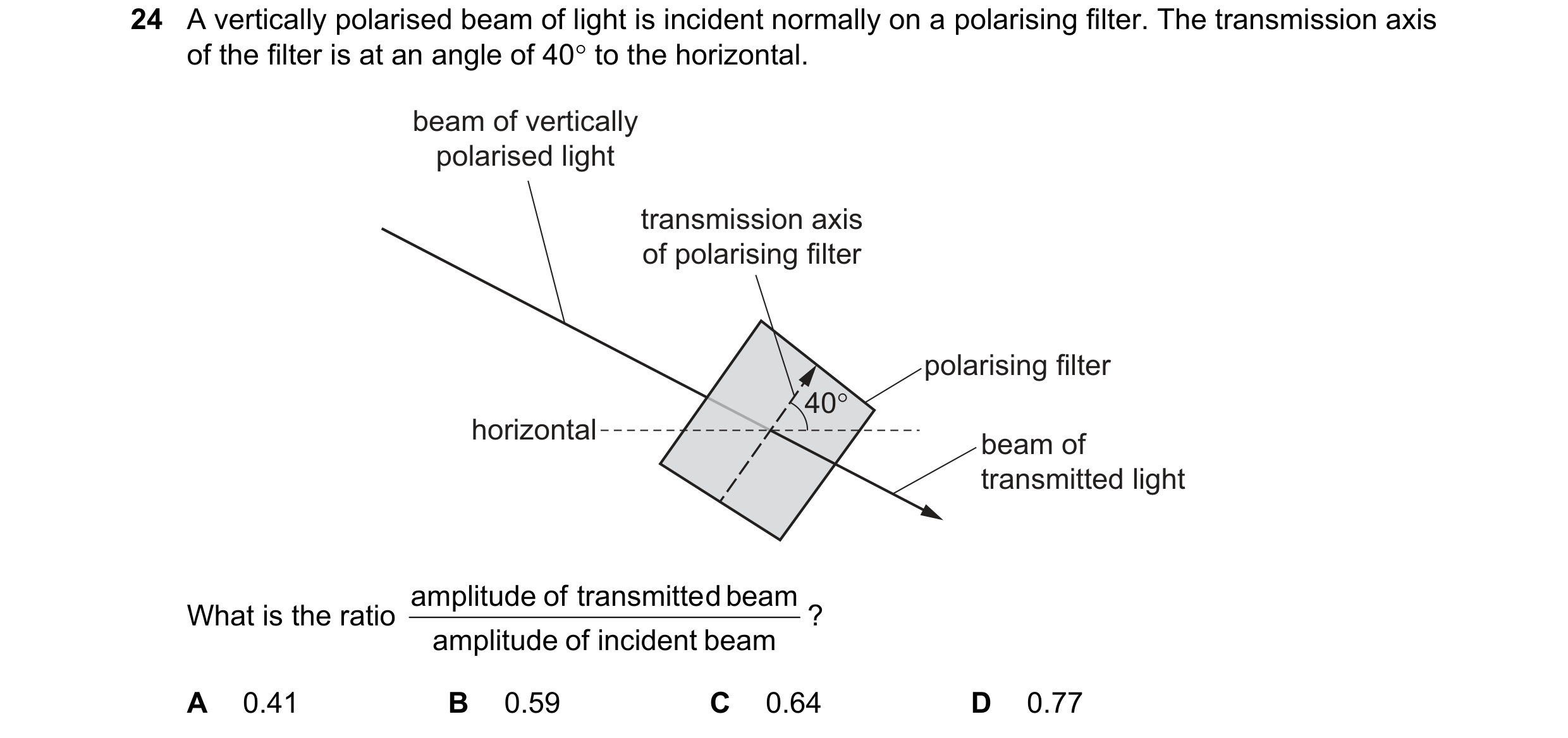
Q24 · Avertically polarised beam of light is incident normally on a polarising filter 9702/11 May/June 2023
24 Avertically polarised beam of light is incident normally on a polarising filter. The transmission axis
of the filter is at an angle of 40° to the horizontal.
beam of vertically
polarised light
transmission axis
of polarising filter
polarising filter
horizontal beam of
transmitted light
What is the ratio amplitude of transmitted beam 5
amplitude of incident beam
A 041 B 0.59 C 0.64 D 0.77
1 marks
Answer: C
This question in 9702/11 May/June 2023
Q25 · A vertically polarised beam of light of intensity J, is incident normally on a polarising… 9702/12 May/June 2023
24 A vertically polarised beam of light of intensity J, is incident normally on a polarising filter.
The transmission axis of the filter is at 45° to the vertical. The beam of light transmitted by this
filter is then incident normally on a second filter. The transmission axis of the second filter is
horizontal.
transmission axis
vertically of second filter
polarised
light
transmission axis
of first filter
What is the intensity of the beam of light after transmission through the second filter?
A 0 B tly c th D Io
1 marks
Answer: B
This question in 9702/12 May/June 2023
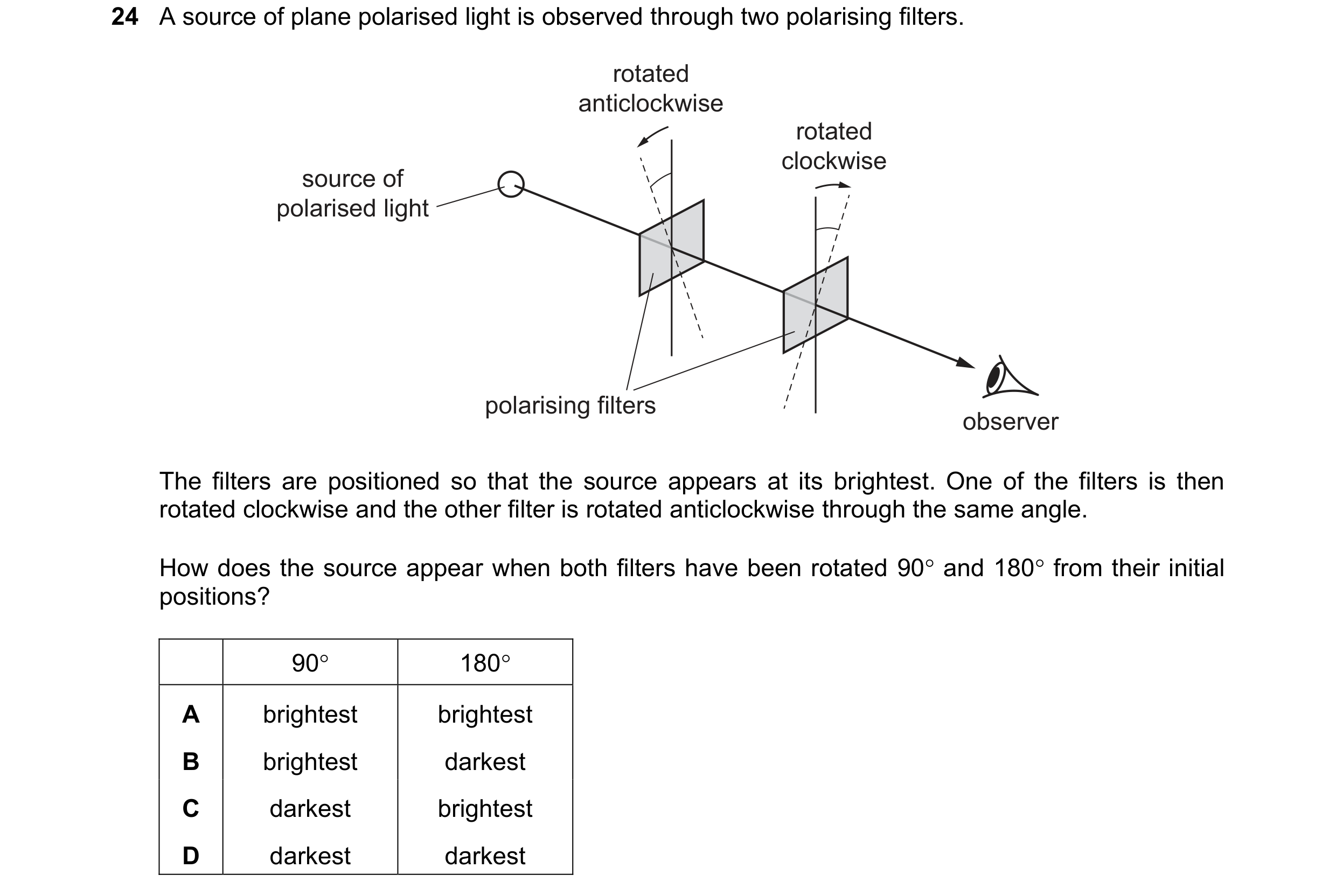
Q26 · A source of plane polarised light is observed through two polarising filters 9702/13 May/June 2023
24 A source of plane polarised light is observed through two polarising filters. rotated anticlockwise rotated clockwise source of polarised light polarising filters observer The filters are positioned so that the source appears at its brightest. One of the filters is then rotated clockwise and the other filter is rotated anticlockwise through the same angle. How does the source appear when both filters have been rotated 90 and 180 from their initial positions? 90 180 A brightest brightest B brightest darkest C darkest brightest D darkest darkest
1 marks
Answer: C
This question in 9702/13 May/June 2023
Q27 · A plane polarised light wave of intensity J is incident normally on a polarising filter 9702/12 Oct/Nov 2023
24 A plane polarised light wave of intensity J is incident normally on a polarising filter. The initial
intensity of the transmitted wave is 0.
A second polarising filter is then inserted between the source and the first filter. Its transmission
axis is at 45° to the transmission axis of the first filter, as shown.
transmission axis
of second filter at 45°
to transmission axis
source of polarised light, of first filter
intensity J,
transmission axis
of first filter
direction of travel
of light wave
What is the intensity of the transmitted wave from the filter combination?
Ip ob > be
8 4 2
A 0 B
1 marks
Answer: C
This question in 9702/12 Oct/Nov 2023
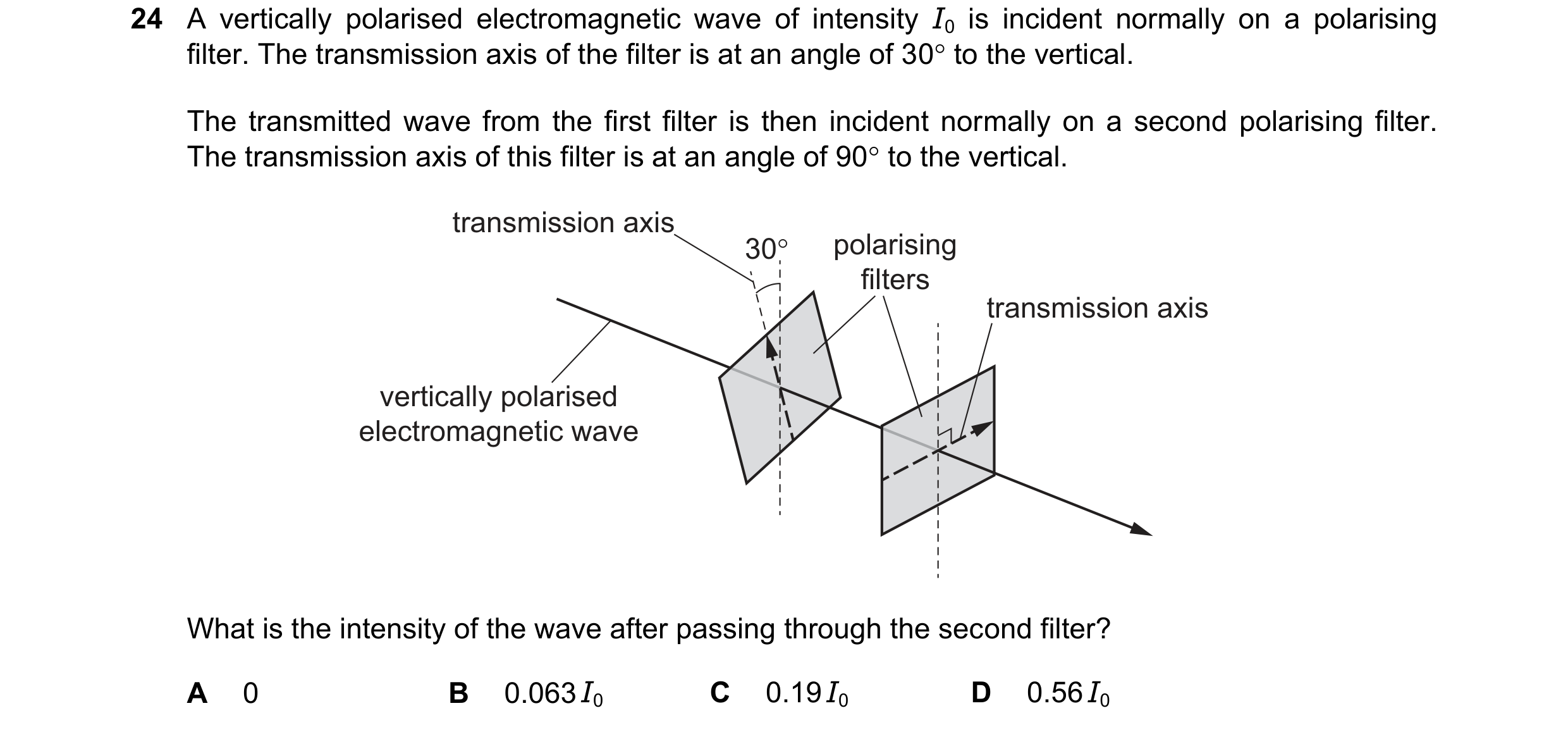
Q28 · A vertically polarised electromagnetic wave of intensity Jp is incident normally on a… 9702/13 Oct/Nov 2023
24 A vertically polarised electromagnetic wave of intensity Jp is incident normally on a polarising
filter. The transmission axis of the filter is at an angle of 30° to the vertical.
The transmitted wave from the first filter is then incident normally on a second polarising filter.
The transmission axis of this filter is at an angle of 90° to the vertical.
transmission axis
30° __— polarising
VA filters
transmission axis
vertically polarised
electromagnetic wave
What is the intensity of the wave after passing through the second filter?
A 0 B 0.063 Ip C 0.19Ip D 0.561
1 marks
Answer: C
This question in 9702/13 Oct/Nov 2023
Q29 · Which type of waves cannot be polarised? 9702/12 Feb/March 2024
27 Which type of waves cannot be polarised? A radio waves B sound waves C ultraviolet waves D X-rays
1 marks
Answer: B
This question in 9702/12 Feb/March 2024
Q30 · A plane polarised wave has amplitude A 9702/11 May/June 2024
24 A plane polarised wave has amplitude A. The wave is incident normally on a polarising filter. The transmission axis of the filter is at angle to the plane of polarisation of the incident wave. What is the amplitude of the wave that emerges from the filter? A A cos B A cos2 C A2 cos D A2 cos2
1 marks
Answer: A
This question in 9702/11 May/June 2024
Q31 · Which wave cannot be a longitudinal wave? 9702/11 May/June 2024
29 Which wave cannot be a longitudinal wave? A a diffracted wave B a polarised wave C a reflected wave D a stationary wave
1 marks
Answer: B
This question in 9702/11 May/June 2024
Q32 · Polarisation is associated with certain waves 9702/12 May/June 2024
24 Polarisation is associated with certain waves. Which waves cannot be polarised? A radio waves from a transmitter B sound waves from a moving source C ultraviolet rays from the Sun D X-rays from an X-ray emitter
1 marks
Answer: B
This question in 9702/12 May/June 2024
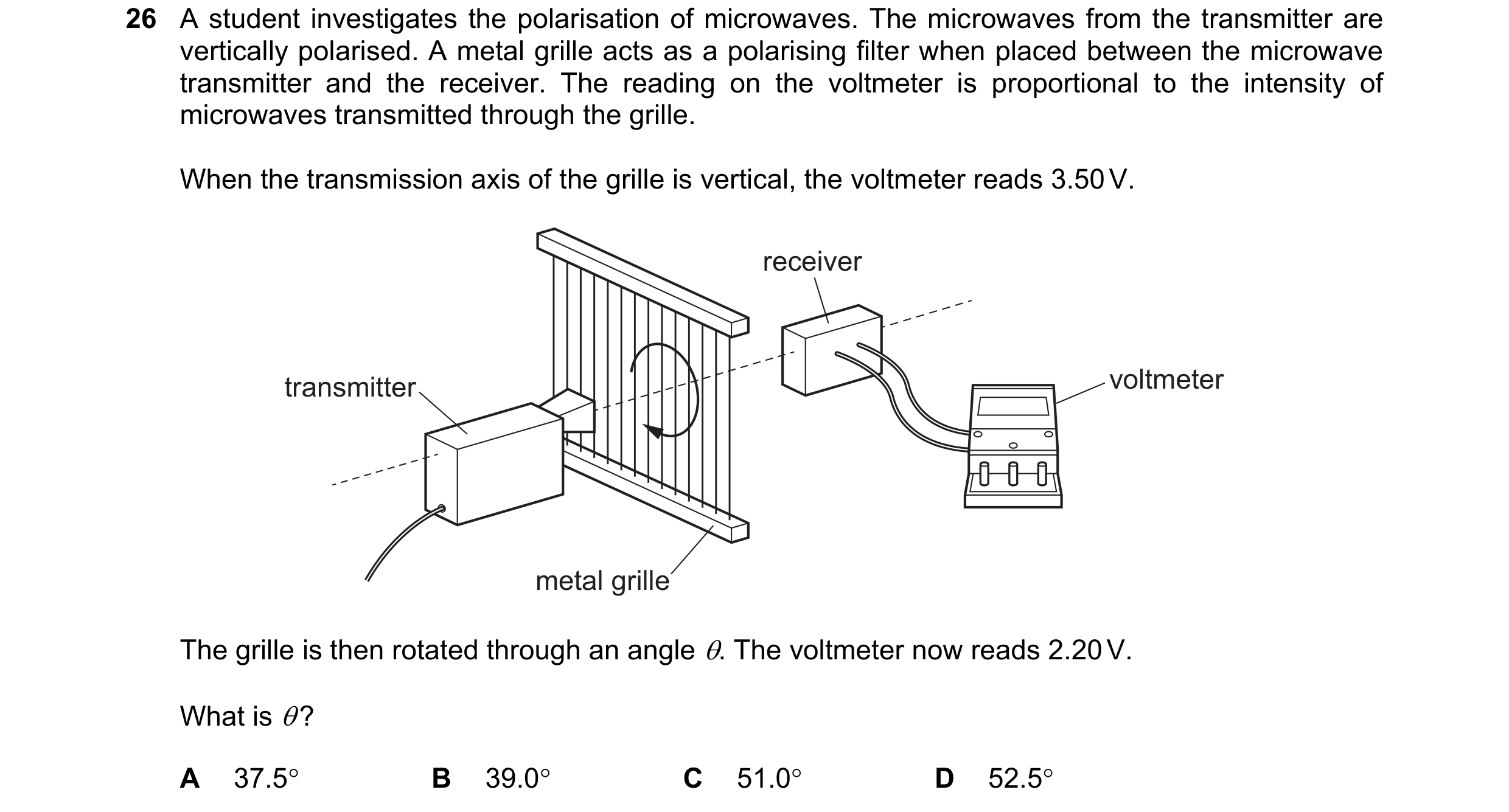
Q33 · A student investigates the polarisation of microwaves 9702/13 May/June 2024
26 A student investigates the polarisation of microwaves. The microwaves from the transmitter are vertically polarised. A metal grille acts as a polarising filter when placed between the microwave transmitter and the receiver. The reading on the voltmeter is proportional to the intensity of microwaves transmitted through the grille. When the transmission axis of the grille is vertical, the voltmeter reads 3.50 V. receiver transmitter voltmeter metal grille The grille is then rotated through an angle . The voltmeter now reads 2.20 V. What is ? A 37.5 B 39.0 C 51.0 D 52.5
1 marks
Answer: A
This question in 9702/13 May/June 2024
Q34 · Radio waves can be polarised, but sound waves cannot be polarised 9702/11 Oct/Nov 2024
29 Radio waves can be polarised, but sound waves cannot be polarised. Which statement gives the reason for this? A Radio waves are generally of a higher frequency than sound waves. B Radio waves are transverse waves, but sound waves are longitudinal waves. C Radio waves can travel through a vacuum, but sound waves cannot travel through a vacuum. D Radio waves travel at a much higher speed than sound waves.
1 marks
Answer: B
This question in 9702/11 Oct/Nov 2024
Q35 · A horizontal beam of vertically polarised light of amplitude A is incident normally on a… 9702/12 Oct/Nov 2024
23 A horizontal beam of vertically polarised light of amplitude A is incident normally on a polarising filter. The transmission axis of the filter is at an angle of 50 to the vertical. What is the amplitude of the light in the beam after it has passed through the filter? A 0.17A B 0.41A C 0.64A D 0.80A
1 marks
Answer: C
This question in 9702/12 Oct/Nov 2024
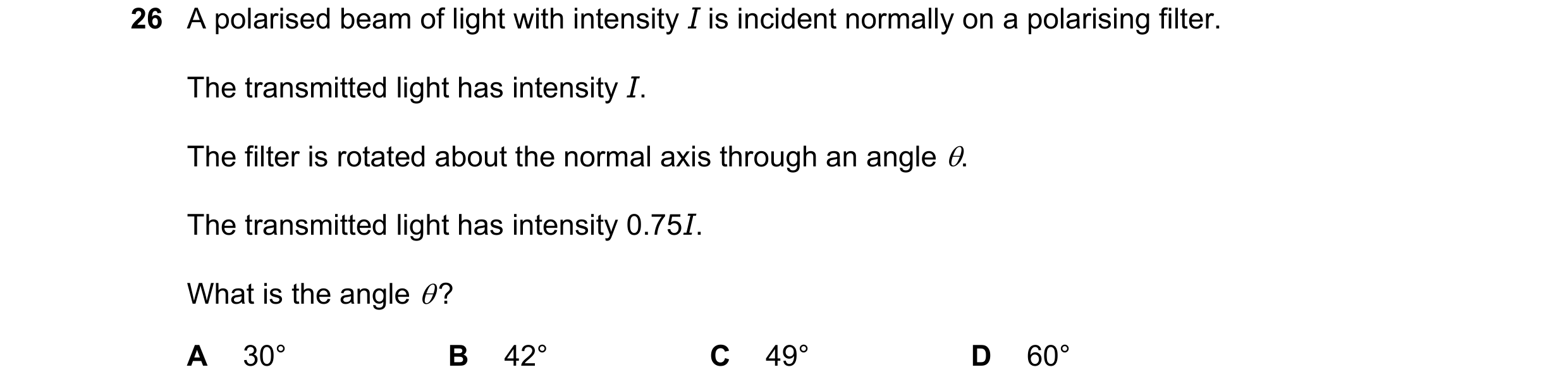
Q36 · A polarised beam of light with intensity I is incident normally on a polarising filter 9702/12 Feb/March 2025
26 A polarised beam of light with intensity I is incident normally on a polarising filter. The transmitted light has intensity I. The filter is rotated about the normal axis through an angle . The transmitted light has intensity 0.75I. What is the angle ? A 30° B 42° C 49° D 60°
1 marks
Answer: A
This question in 9702/12 Feb/March 2025
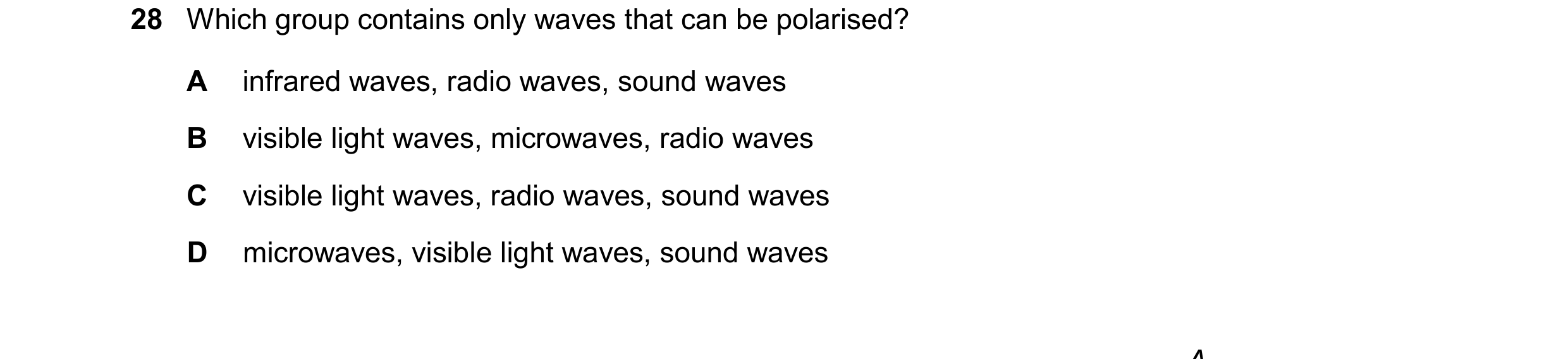
Q37 · Which group contains only waves that can be polarised? 9702/11 May/June 2025
28 Which group contains only waves that can be polarised? A infrared waves, radio waves, sound waves B visible light waves, microwaves, radio waves C visible light waves, radio waves, sound waves D microwaves, visible light waves, sound waves A The waves are
1 marks
Answer: B
This question in 9702/11 May/June 2025
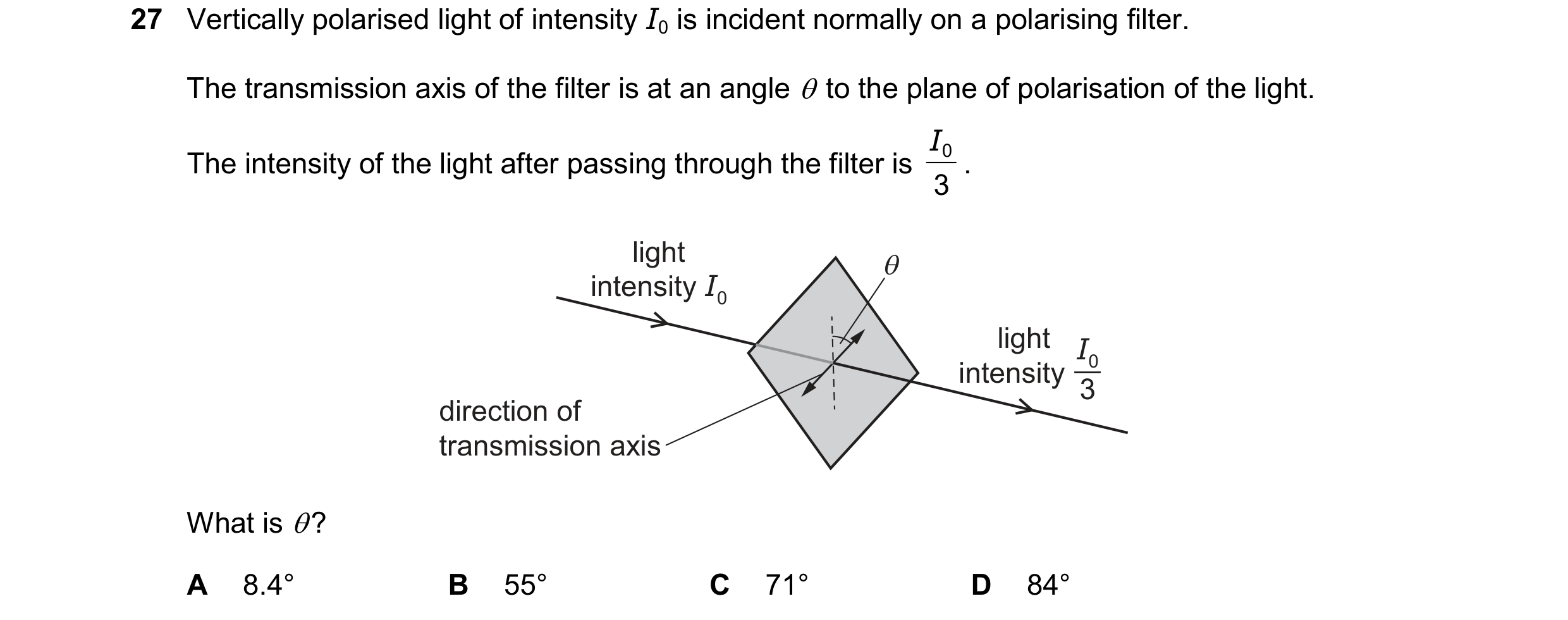
Q38 · Vertically polarised light of intensity Jp is incident normally on a polarising filter 9702/12 May/June 2025
27 Vertically polarised light of intensity Jp is incident normally on a polarising filter.
The transmission axis of the filter is at an angle @ to the plane of polarisation of the light.
I
The intensity of the light after passing through the filter is 3 .
light
intensity J,
light
intensity 3
direction of
transmission axis
What is 0?
A 84° B 55° C 71° D 84°
1 marks
Answer: B
This question in 9702/12 May/June 2025
Q39 · Which statement compares the behaviour of transverse and longitudinal waves? 9702/12 May/June 2025
28 Which statement compares the behaviour of transverse and longitudinal waves? A Only longitudinal waves can be diffracted. B Only longitudinal waves can travel in free space. C Only transverse waves can be coherent. D Only transverse waves can be polarised.
1 marks
Answer: D
This question in 9702/12 May/June 2025
Q40 · Which phenomenon is only associated with transverse waves? 9702/13 May/June 2025
25 Which phenomenon is only associated with transverse waves? A diffraction B interference C polarisation D reflection
1 marks
Answer: C
This question in 9702/13 May/June 2025
Q41 · A horizontal beam of light is incident normally on a polarising filter 9702/14 May/June 2025
24 A horizontal beam of light is incident normally on a polarising filter. The incident light is vertically polarised and has an intensity of 24 W m–2. The direction of the transmission axis of the filter is at an angle of 30 to the vertical. What is the intensity of the light in the transmitted beam? A 18 W m–2 B 21 W m–2 C 28 W m–2 D 32 W m–2
1 marks
Answer: A
This question in 9702/14 May/June 2025
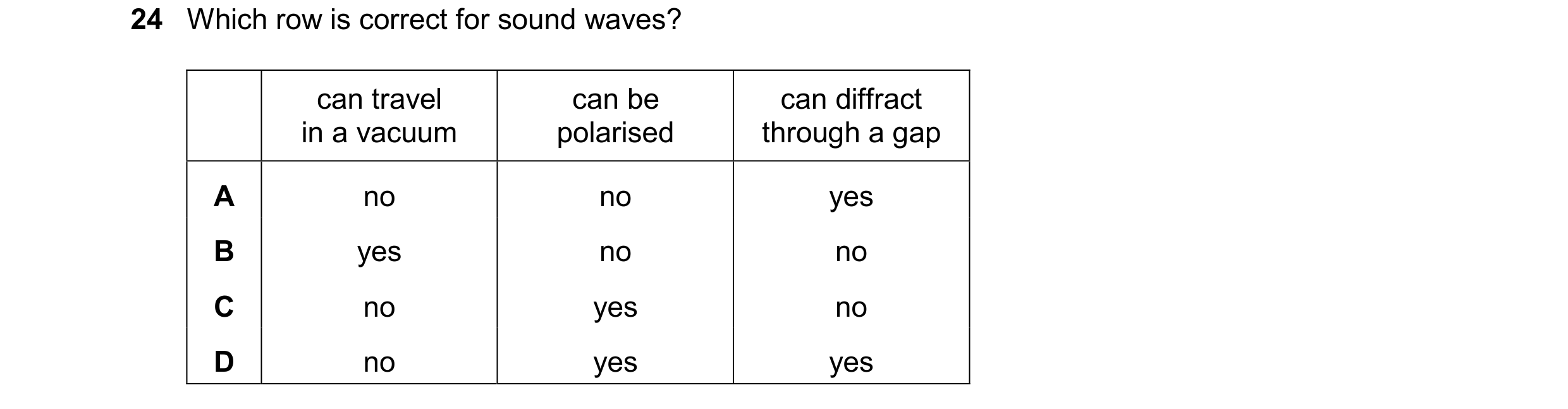
Q42 · Which row is correct for sound waves? 9702/11 Oct/Nov 2025
24 Which row is correct for sound waves? can travel can be can diffract in a vacuum polarised through a gap A no no yes B yes no no C no yes no D no yes yes
1 marks
Answer: A
This question in 9702/11 Oct/Nov 2025
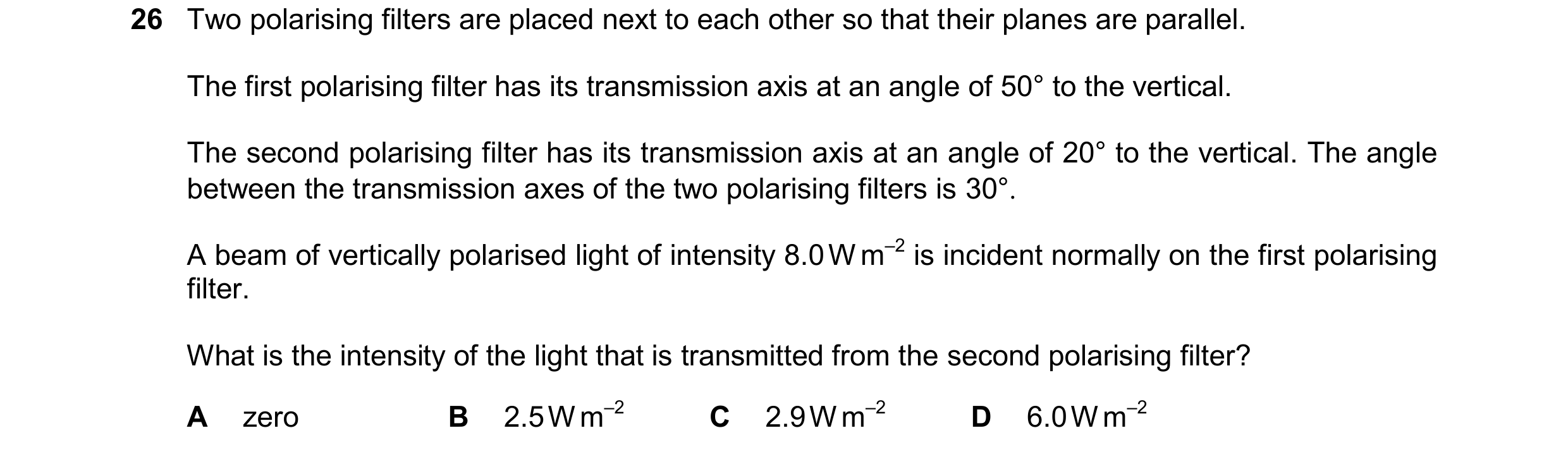
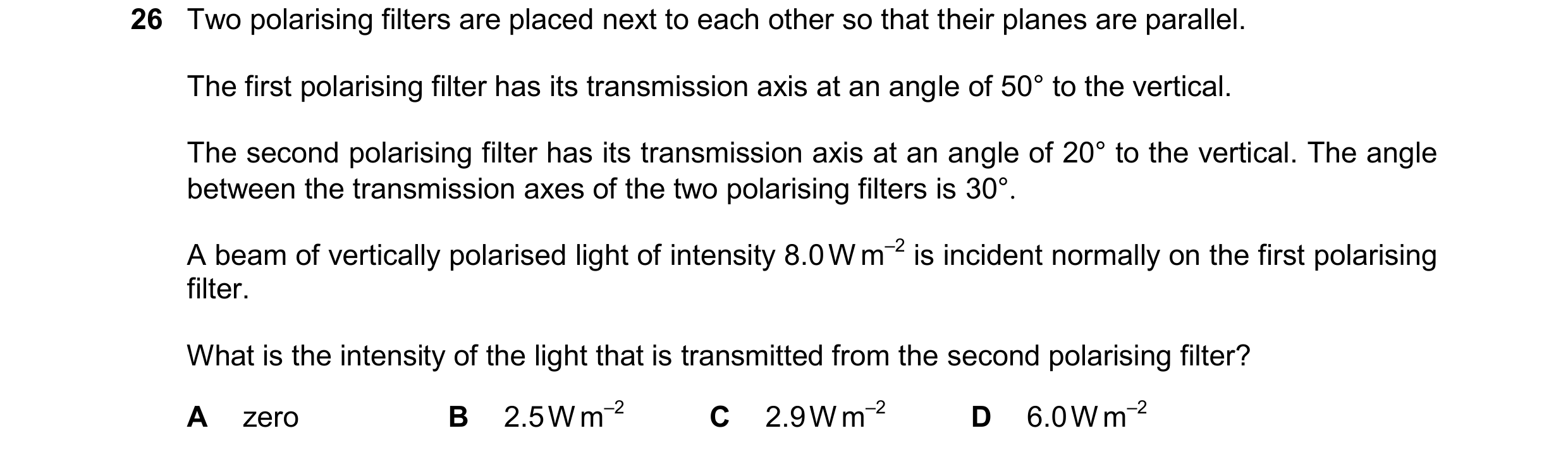
Q43 · Two polarising filters are placed next to each other so that their planes are parallel 9702/11 Oct/Nov 2025
26 Two polarising filters are placed next to each other so that their planes are parallel. The first polarising filter has its transmission axis at an angle of 50° to the vertical. The second polarising filter has its transmission axis at an angle of 20° to the vertical. The angle between the transmission axes of the two polarising filters is 30° A beam of vertically polarised light of intensity 8.0 W m–2 is incident normally on the first polarising filter. What is the intensity of the light that is transmitted from the second polarising filter? A zero B 2.5 W m–2 C 2.9 W m–2 D 6.0 W m–2
1 marks
Answer: B
This question in 9702/11 Oct/Nov 2025
Q44 · Which row is correct for sound waves? 9702/13 Oct/Nov 2025
24 Which row is correct for sound waves? can travel can be can diffract in a vacuum polarised through a gap A no no yes B yes no no C no yes no D no yes yes
1 marks
Answer: A
This question in 9702/13 Oct/Nov 2025
Q45 · Two polarising filters are placed next to each other so that their planes are parallel 9702/13 Oct/Nov 2025
26 Two polarising filters are placed next to each other so that their planes are parallel. The first polarising filter has its transmission axis at an angle of 50° to the vertical. The second polarising filter has its transmission axis at an angle of 20° to the vertical. The angle between the transmission axes of the two polarising filters is 30° A beam of vertically polarised light of intensity 8.0 W m–2 is incident normally on the first polarising filter. What is the intensity of the light that is transmitted from the second polarising filter? A zero B 2.5 W m–2 C 2.9 W m–2 D 6.0 W m–2
1 marks
Answer: B
This question in 9702/13 Oct/Nov 2025
Q46 · Which statement about electromagnetic waves is correct? 9702/14 Oct/Nov 2025
25 Which statement about electromagnetic waves is correct? A A wave of wavelength 5.0 10–6 m is invisible to the human eye. B They can all travel at different speeds in free space. C They cannot be polarised. D They consist of vibrating atoms.
1 marks
Answer: A
This question in 9702/14 Oct/Nov 2025
Q47 · What may be observed with light waves but not with sound waves? 9702/14 Oct/Nov 2025
28 What may be observed with light waves but not with sound waves? A diffraction B interference C polarisation D reflection
1 marks
Answer: C
This question in 9702/14 Oct/Nov 2025


 1 / 12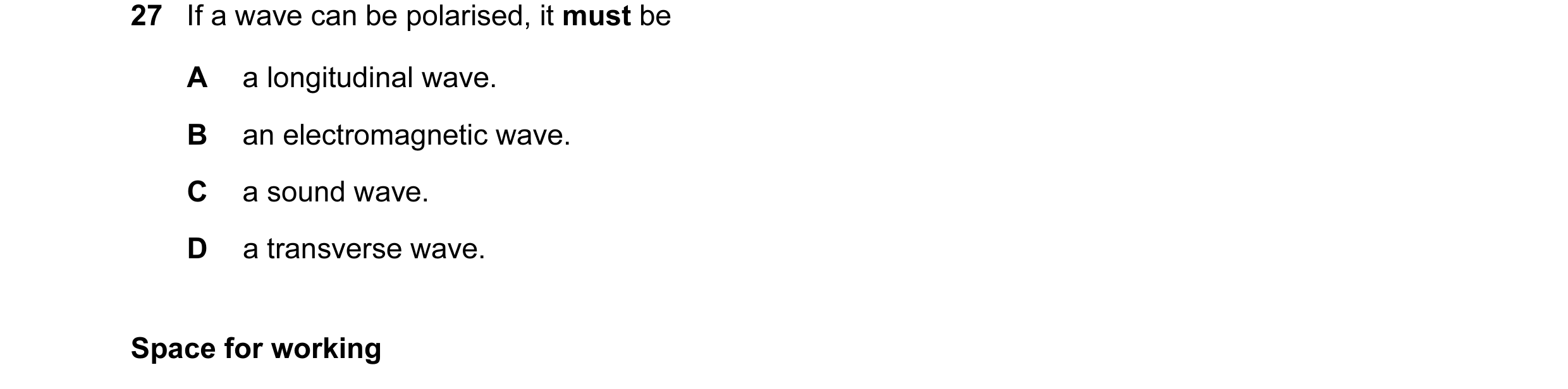


 2 / 12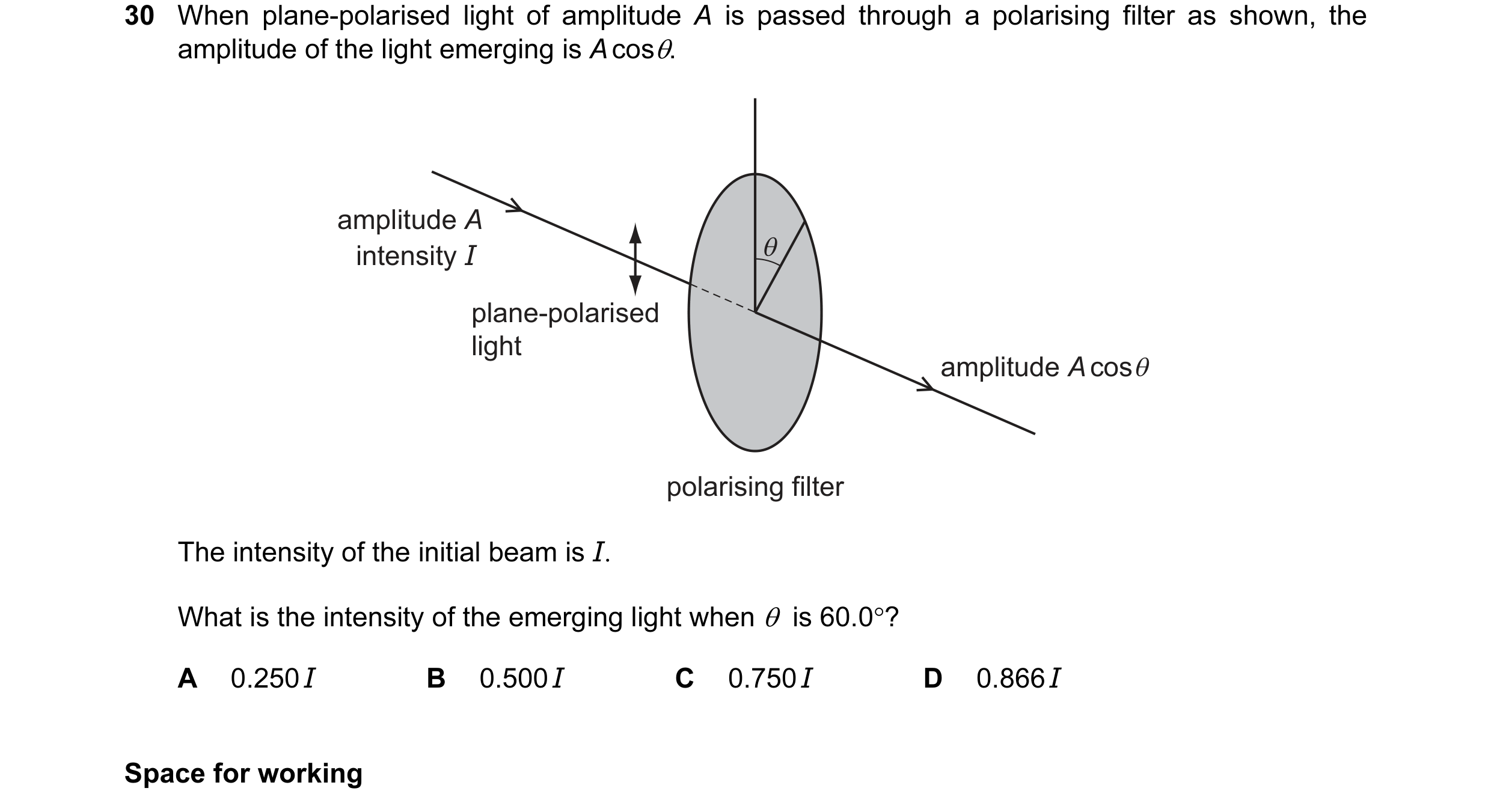

 3 / 12


 4 / 12
 5 / 12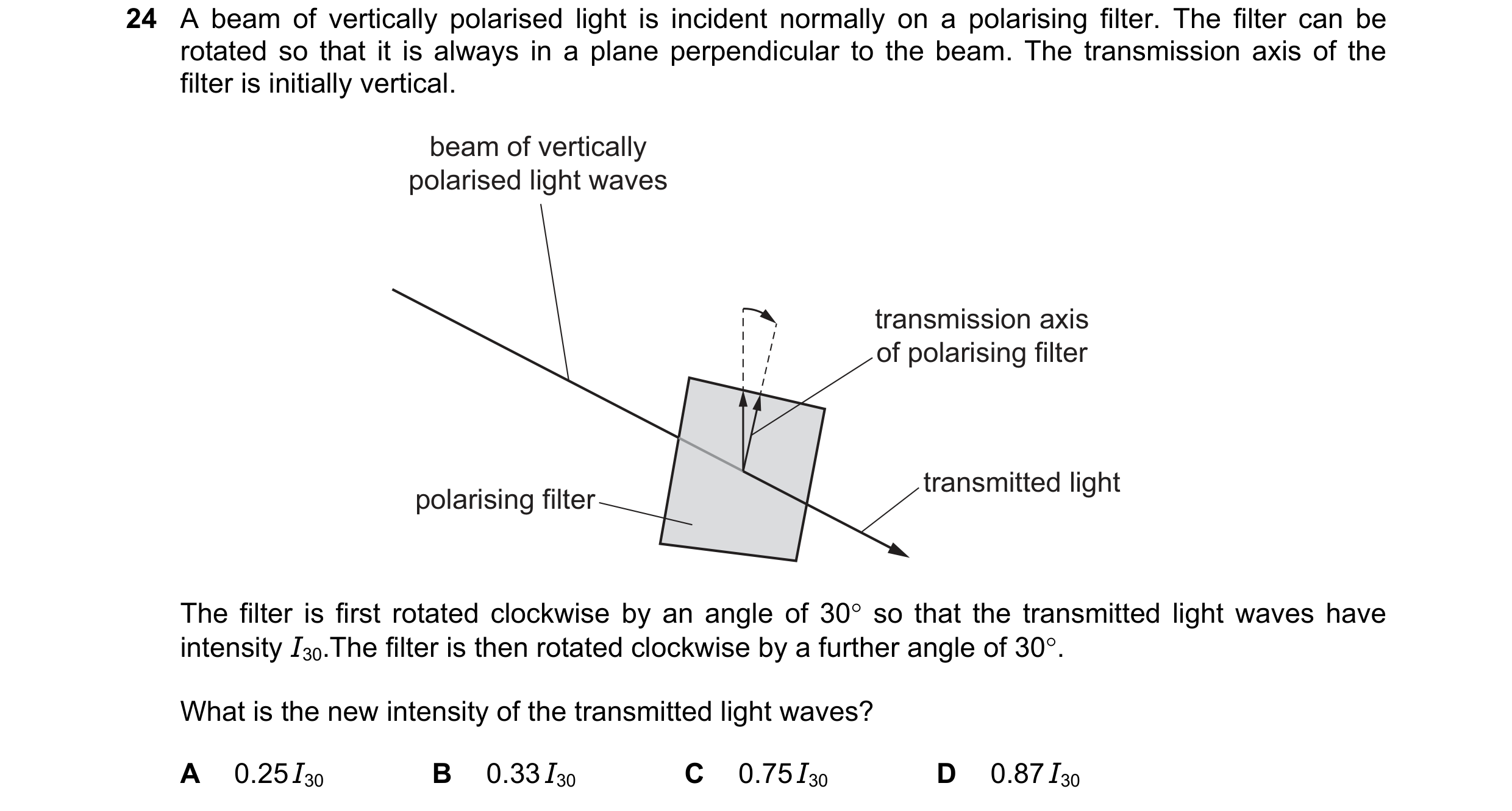
 6 / 12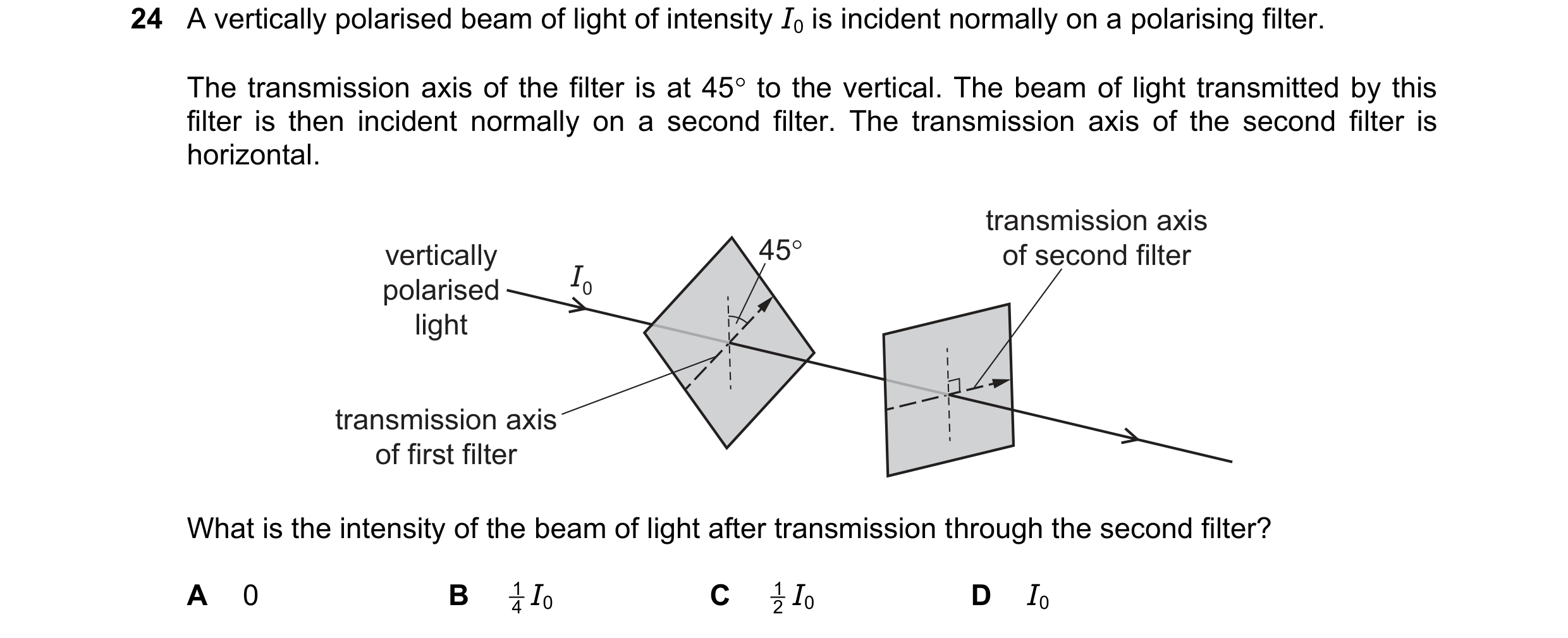
 7 / 12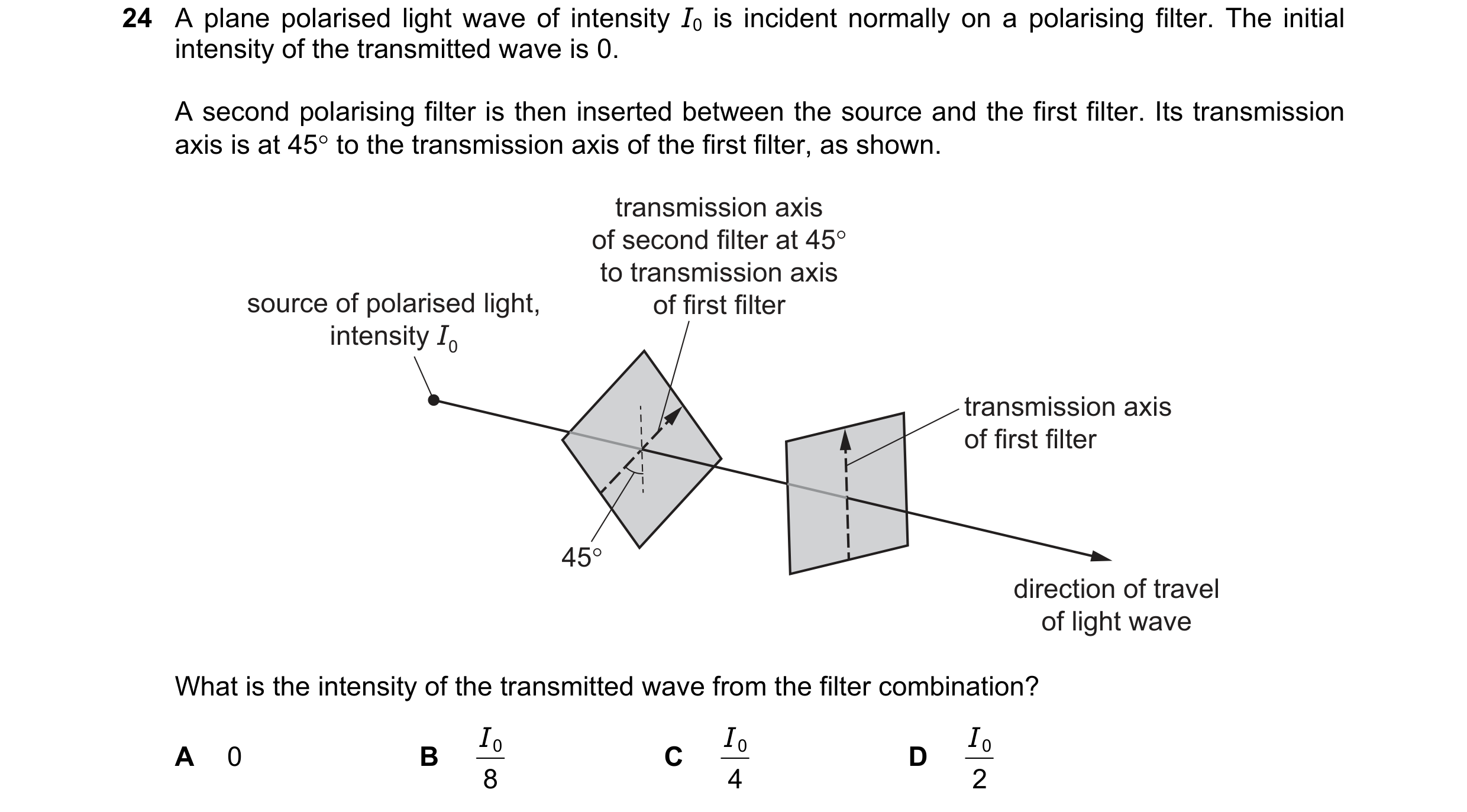
 8 / 12

 9 / 12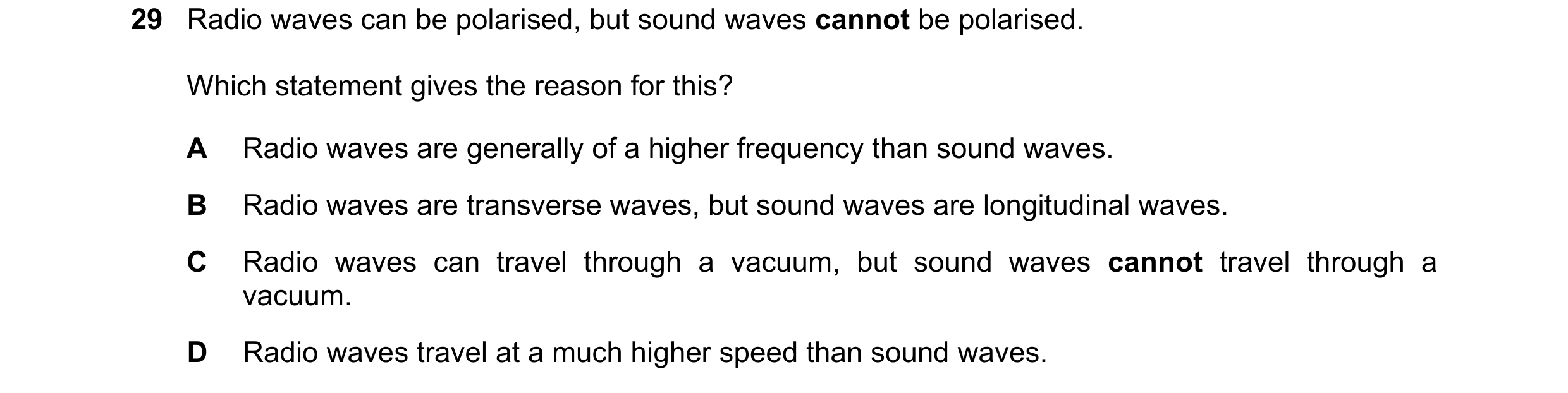

 10 / 12


 11 / 12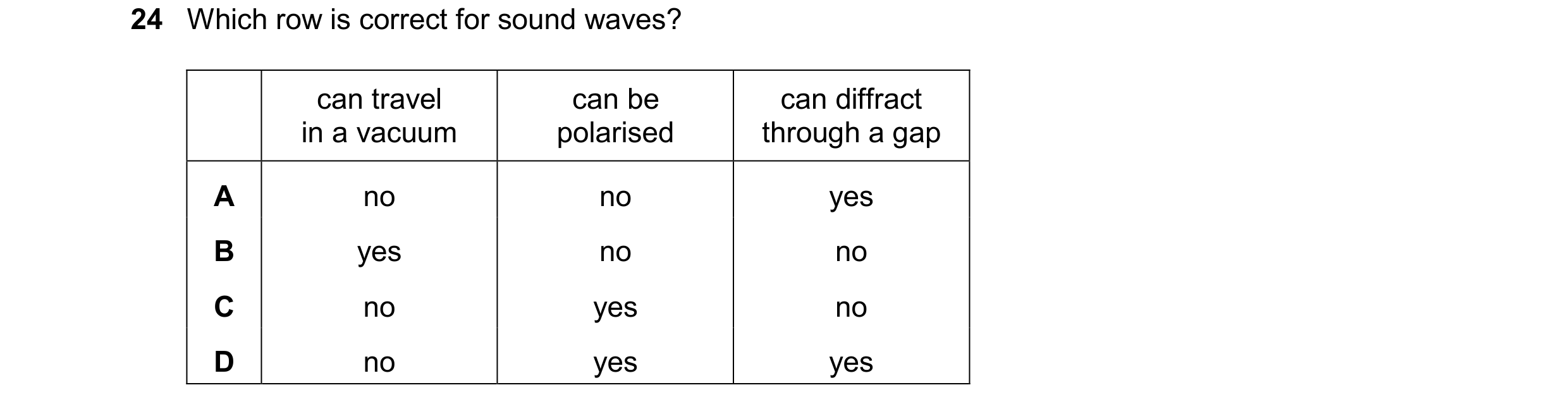

 12 / 12