Questions as text
Q1 · One nuclear reaction that can take place in a nuclear reactor may be represented, in… 9702/42 May/June 2017
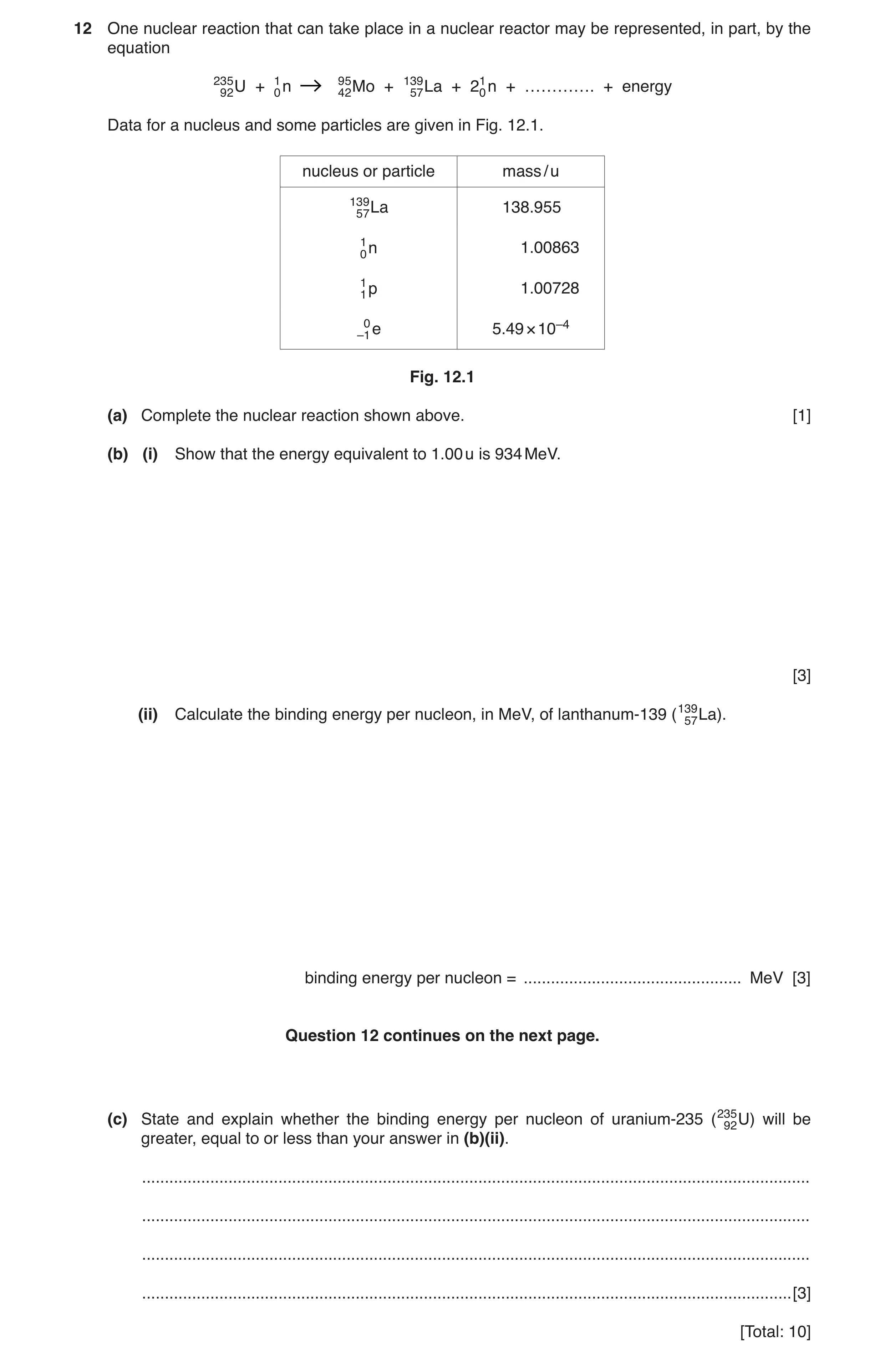
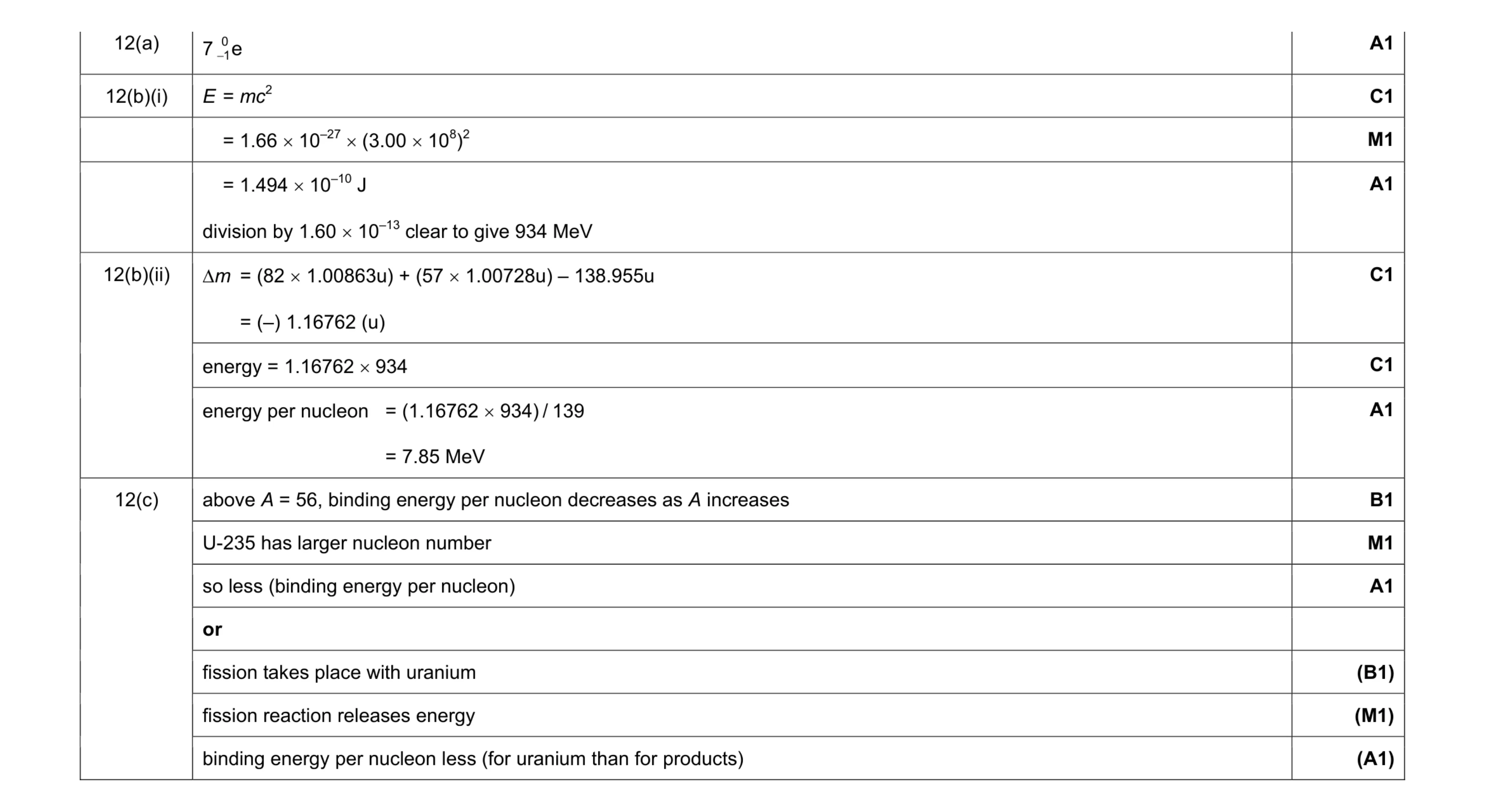
12 One nuclear reaction that can take place in a nuclear reactor may be represented, in part, by the equation 23592 U + 10 n 9542 Mo + 13957 La + 210 n + …………. + energy Data for a nucleus and some particles are given in Fig. 12.1. nucleus or particle mass / u 13957 La 138.955 10 n 1.00863 11 p 1.00728 –1 e0 5.49 × 10⁻⁴ Fig. 12.1 (a) Complete the nuclear reaction shown above. [1] (b) (i) Show that the energy equivalent to 1.00 u is 934 MeV. [3] (ii) Calculate the binding energy per nucleon, in MeV, of lanthanum-139 (13957 La). binding energy per nucleon = … MeV [3] Question 12 continues on the next page. (c) State and explain whether the binding energy per nucleon of uranium-235 (23592 U) will be greater, equal to or less than your answer in (b)(ii). … … … … [3] [Total: 10]
10 marks
Mark scheme: 12(a) 7 e 0 1 − A1 12(b)(i) E = mc2 C1 = 1.66 × 10–27 × (3.00 × 108)2 M1 = 1.494 × 10⁻¹⁰ J division by 1.60 × 10⁻¹³ clear to give 934 MeV A1 12(b)(ii) ∆m = (82 × 1.00863u) + (57 × 1.00728u) – 138.955u = (–) 1.16762 (u) C1 energy = 1.16762 × 934 C1 energy per nucleon = (1.16762 × 934) / 139 = 7.85 MeV A1 12(c) above A = 56, binding energy per nucleon decreases as A increases B1 U-235 has larger nucleon number M1 so less (binding energy per nucleon) A1 or fission takes place with uranium (B1) fission reaction releases energy (M1) binding energy per nucleon less (for uranium than for products) (A1)
This question in 9702/42 May/June 2017
Q2 · A radiation detector is placed close to a radioactive source 9702/41 Oct/Nov 2017
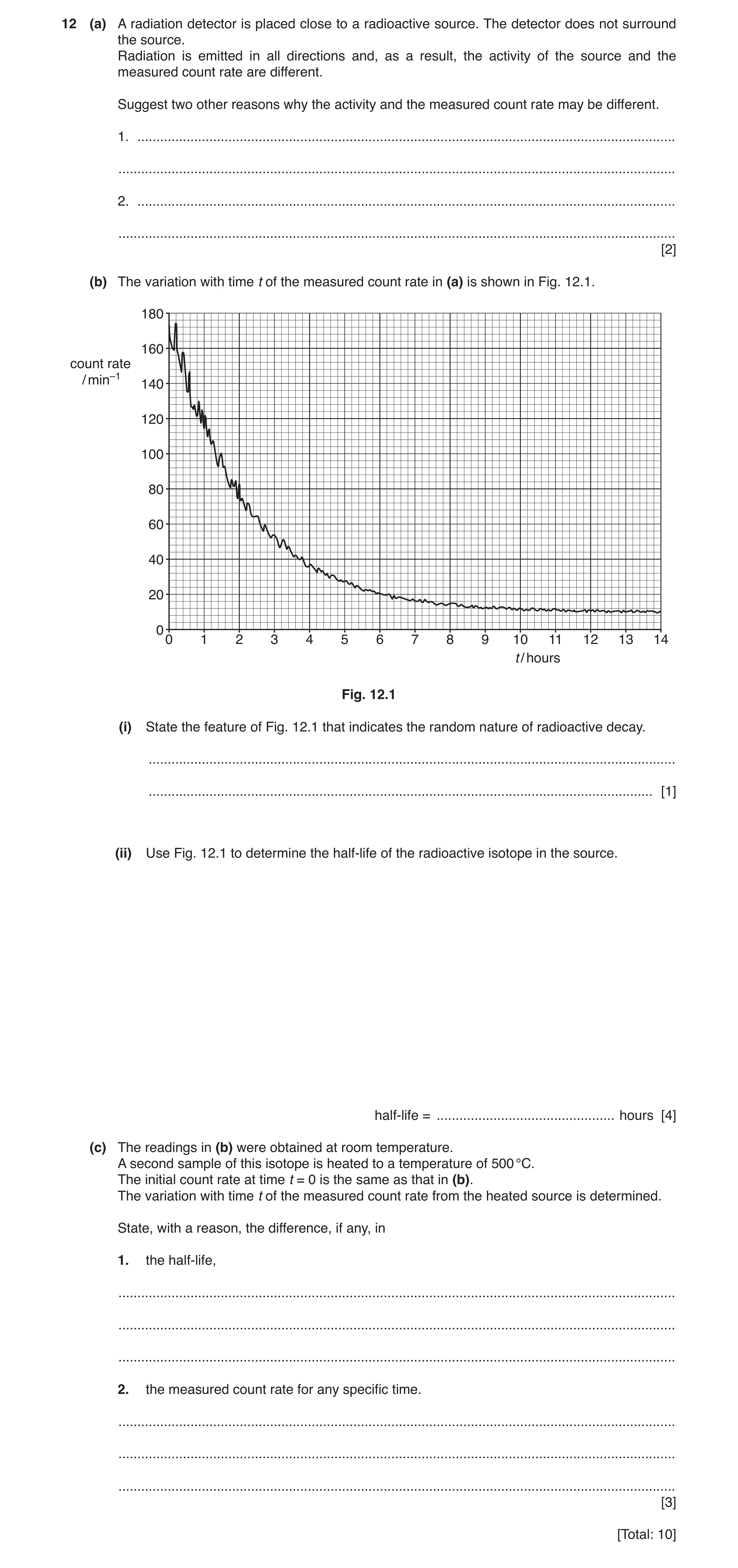
12 (a) A radiation detector is placed close to a radioactive source. The detector does not surround the source. Radiation is emitted in all directions and, as a result, the activity of the source and the measured count rate are different. Suggest two other reasons why the activity and the measured count rate may be different. 1. … … 2. … … [2] (b) The variation with time t of the measured count rate in (a) is shown in Fig. 12.1. 180 160 count rate / min–1 140 120 100 80 60 40 20 0 0 1 2 3 4 5 6 7 8 9 10 11 12 13 14 t / hours Fig. 12.1 (i) State the feature of Fig. 12.1 that indicates the random nature of radioactive decay. … … [1] (ii) Use Fig. 12.1 to determine the half-life of the radioactive isotope in the source. half-life = … hours [4] (c) The readings in (b) were obtained at room temperature. A second sample of this isotope is heated to a temperature of 500 °C. The initial count rate at time t = 0 is the same as that in (b). The variation with time t of the measured count rate from the heated source is determined. State, with a reason, the difference, if any, in 1. the half-life, … … … 2. the measured count rate for any specific time. … … … [3] [Total: 10]
10 marks
Mark scheme: 12(a) emission from radioactive daughter products • self-absorption in source • absorption in air before reaching detector • detector not sensitive to all radiations • window of detector may absorb some radiation • dead-time of counter • background radiation Any two points. B2 12(b)(i) curve is not smooth or curve fluctuates/curve is jagged B1 12(b)(ii) clear evidence of allowance for background B1 half-life determined at least twice B1 half-life = 1.5 hours (1 mark if in range 1.7–2.0; 2 marks if in range 1.4–1.6) A2 12(c) 1. half-life: no change M1 because decay is spontaneous/independent of environment A1 2. count rate (likely to be or could be) different/is random/cannot be predicted B1
This question in 9702/41 Oct/Nov 2017
Q3 · The isotope iodine-131 (13153I) is radioactive with a decay constant of 8.6 × 10⁻² day–1 9702/42 Oct/Nov 2017
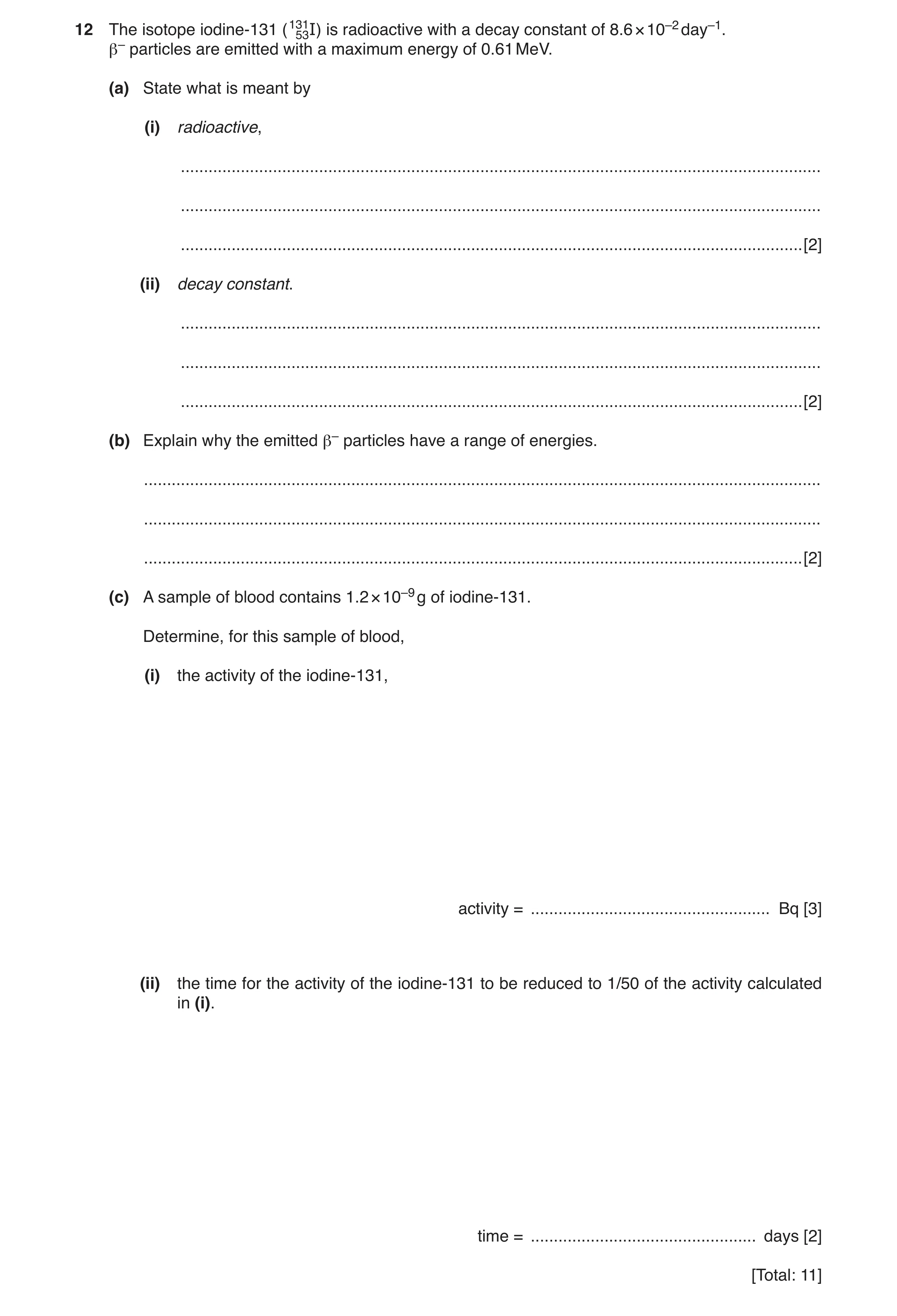
12 The isotope iodine-131 (13153I) is radioactive with a decay constant of 8.6 × 10⁻² day–1. β– particles are emitted with a maximum energy of 0.61 MeV. (a) State what is meant by (i) radioactive, … … … [2] (ii) decay constant. … … … [2] (b) Explain why the emitted β– particles have a range of energies. … … … [2] (c) A sample of blood contains 1.2 × 10⁻⁹ g of iodine-131. Determine, for this sample of blood, (i) the activity of the iodine-131, activity = … Bq [3] (ii) the time for the activity of the iodine-131 to be reduced to 1/50 of the activity calculated in (i). time = … days [2] [Total: 11]
11 marks
Mark scheme: 12(a)(i) nucleus emits particles/EM radiation/ionising radiation B1 emission/release from unstable nucleus or emission from nucleus is random and/or spontaneous B1 12(a)(ii) probability of decay (of a nucleus) or fraction of (number of undecayed) nuclei that will decay M1 per unit time A1 12(b) energy is shared with another particle B1 mention of antineutrino B1 12(c)(i) number = [(1.2 × 10⁻⁹) / 131] × 6.02 × 1023 or number = (1.2 × 10–3 × 10–9) / (131 × 1.66 × 10–27) ( = 5.51 × 10¹²) C1 A = λN C1 = [0.086 / (24 × 3600)] × 5.51 × 1012 = 5.5 × 10⁶ Bq A1 12(c)(ii) 1 / 50 = exp(–0.086t) or 1 / 50 = 0.5n C1 t = 45 days A1
This question in 9702/42 Oct/Nov 2017
Q4 · A radiation detector is placed close to a radioactive source 9702/43 Oct/Nov 2017
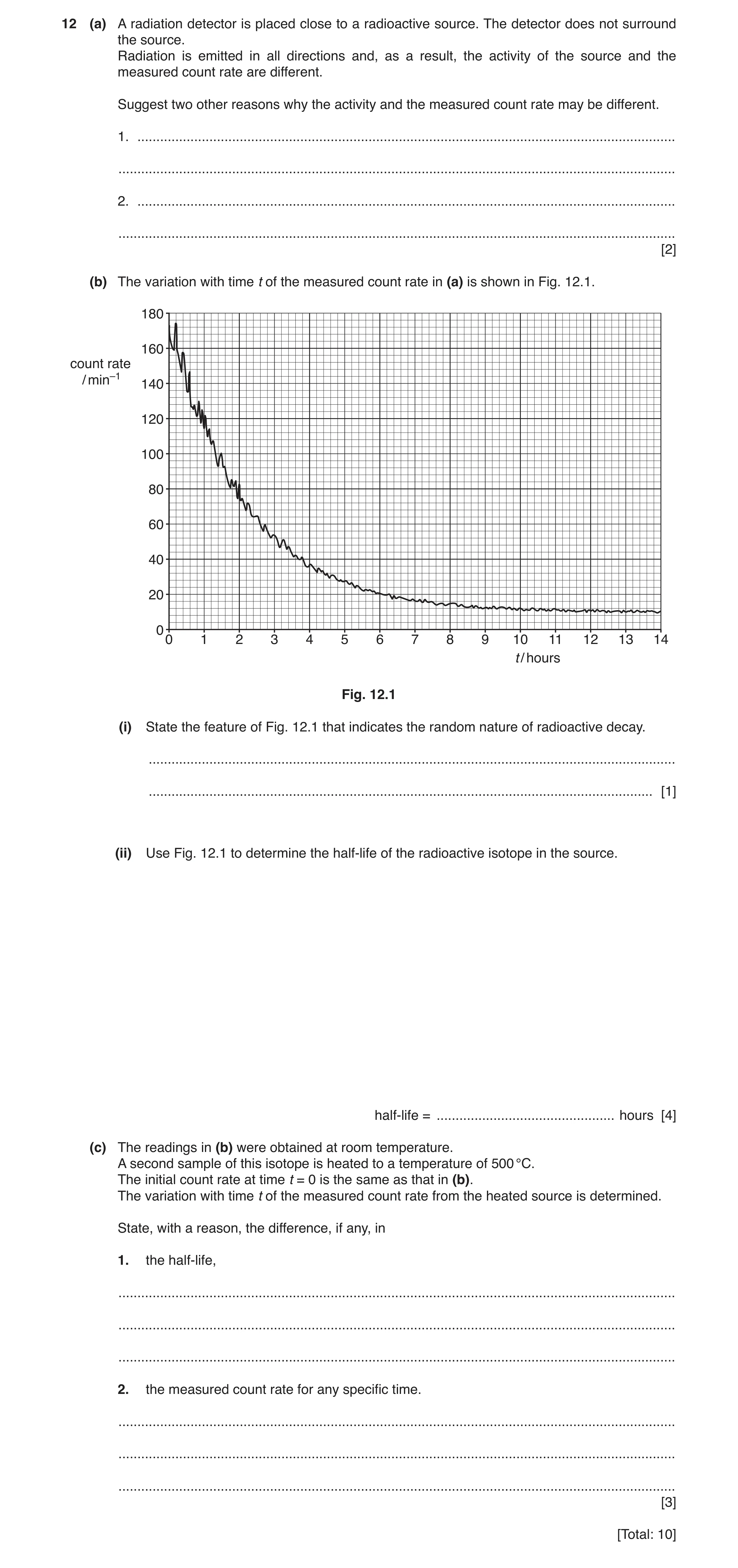
12 (a) A radiation detector is placed close to a radioactive source. The detector does not surround the source. Radiation is emitted in all directions and, as a result, the activity of the source and the measured count rate are different. Suggest two other reasons why the activity and the measured count rate may be different. 1. … … 2. … … [2] (b) The variation with time t of the measured count rate in (a) is shown in Fig. 12.1. 180 160 count rate / min–1 140 120 100 80 60 40 20 0 0 1 2 3 4 5 6 7 8 9 10 11 12 13 14 t / hours Fig. 12.1 (i) State the feature of Fig. 12.1 that indicates the random nature of radioactive decay. … … [1] (ii) Use Fig. 12.1 to determine the half-life of the radioactive isotope in the source. half-life = … hours [4] (c) The readings in (b) were obtained at room temperature. A second sample of this isotope is heated to a temperature of 500 °C. The initial count rate at time t = 0 is the same as that in (b). The variation with time t of the measured count rate from the heated source is determined. State, with a reason, the difference, if any, in 1. the half-life, … … … 2. the measured count rate for any specific time. … … … [3] [Total: 10]
10 marks
Mark scheme: 12(a) emission from radioactive daughter products • self-absorption in source • absorption in air before reaching detector • detector not sensitive to all radiations • window of detector may absorb some radiation • dead-time of counter • background radiation Any two points. B2 12(b)(i) curve is not smooth or curve fluctuates/curve is jagged B1 12(b)(ii) clear evidence of allowance for background B1 half-life determined at least twice B1 half-life = 1.5 hours (1 mark if in range 1.7–2.0; 2 marks if in range 1.4–1.6) A2 12(c) 1. half-life: no change M1 because decay is spontaneous/independent of environment A1 2. count rate (likely to be or could be) different/is random/cannot be predicted B1
This question in 9702/43 Oct/Nov 2017
Q5 · Define radioactive decay constant 9702/42 Feb/March 2018
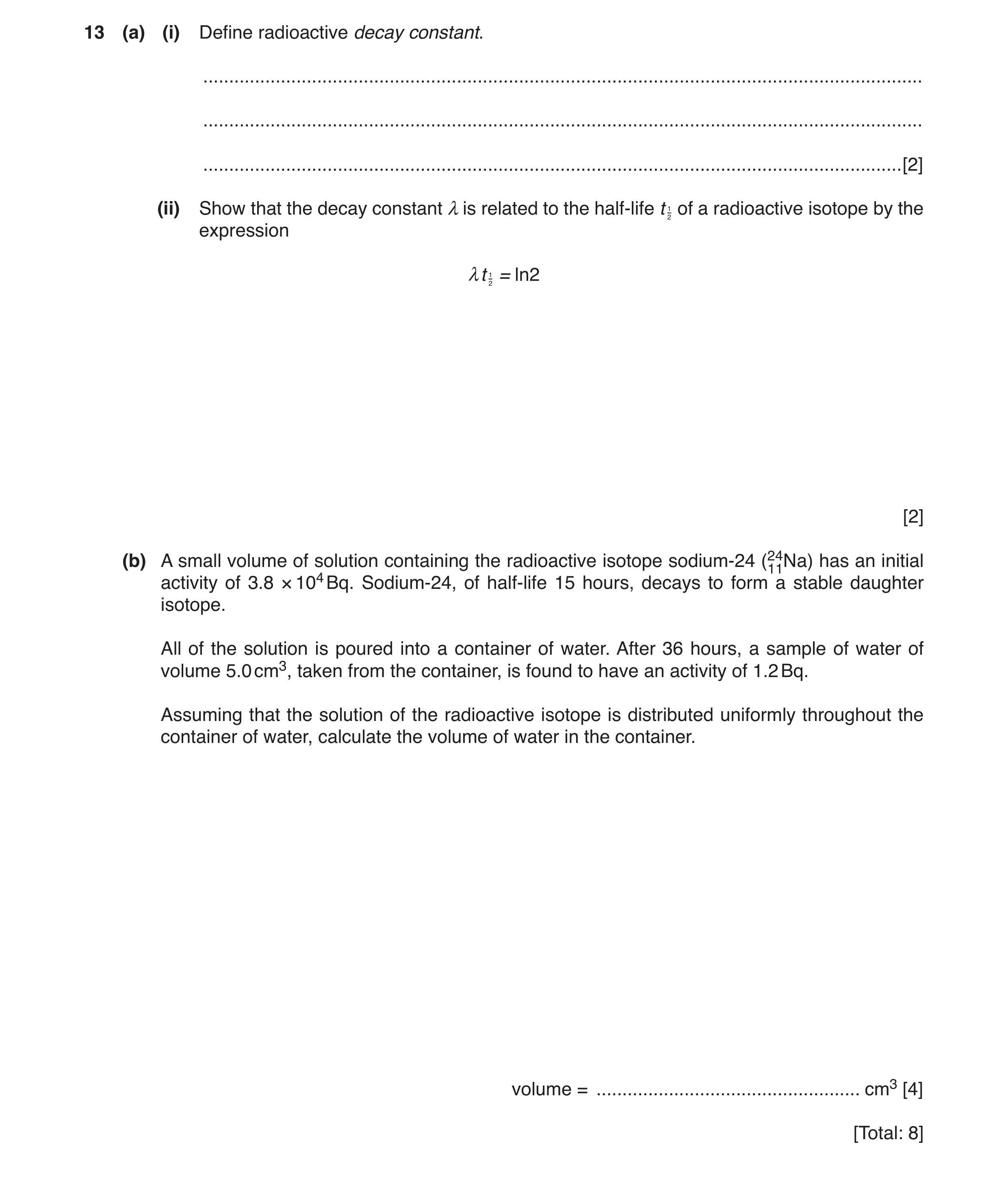
13 (a) (i) Define radioactive decay constant. … … … [2] 1 (ii) Show that the decay constant λis related to the half-life t 2 of a radioactive isotope by the expression 1 λt 2 = ln2 [2] (b) A small volume of solution containing the radioactive isotope sodium-24 (2141Na) has an initial activity of 3.8 × 10⁴ Bq. Sodium-24, of half-life 15 hours, decays to form a stable daughter isotope. All of the solution is poured into a container of water. After 36 hours, a sample of water of volume 5.0 cm3, taken from the container, is found to have an activity of 1.2 Bq. Assuming that the solution of the radioactive isotope is distributed uniformly throughout the container of water, calculate the volume of water in the container. volume = … cm3 [4] [Total: 8]
8 marks
Mark scheme: 13(a)(i) probability of decay (of a nucleus) M1 per unit time A1 13(a)(ii) A = A0 e–λt after one half-life, ½A0 = A0 e–λt1/2 M1 ½ = exp(–λt½) and hence taking logs, ln2 = λt½ A1 13(b) activity = 3.8 × 10⁴ exp(–ln2 × 36 / 15) C1 = 7200 Bq C1 or activity = 3.8 × 10⁴ / 22.4 (C1) = 7200 Bq (C1) volume = (7200 / 1.2) × 5.0 C1 = 3.0 × 104 cm3 A1 OR activity of 5.0 cm3 = 1.2 × 22.4 (C1) = 6.3336 Bq (C1) volume = (3.8 × 10⁴ / 6.3336) × 5.0 (C1) = 3.0 × 104 cm3 (A1)
This question in 9702/42 Feb/March 2018
Q6 · State what is meant by radioactive decay 9702/41 May/June 2018
13 (a) State what is meant by radioactive decay. … … … … [2] (b) The variation with time t of the number N of technetium-101 nuclei in a sample of radioactive material is shown in Fig. 13.1. 10.0 8.0 N / 107 6.0 4.0 2.0 0 0 10 20 30 40 t / min Fig. 13.1 (i) Use Fig. 13.1 to determine the activity, in Bq, of the sample of technetium-101 at time t = 14.0 minutes. Show your working. activity = … Bq [4] (ii) Without calculating the half-life of technetium-101, use your answer in (i) to determine the decay constant λ of technetium-101. λ = … s–1 [2] [Total: 8]
8 marks
Mark scheme: 13(a) emission of particles/radiation by unstable nucleus B1 spontaneous emission B1 13(b)(i) use of graph to determine half-life = 14 minutes B1 hence λ = ln 2 / (14 × 60) (s–1) C1 N at 14 minutes = 4.4 × 10⁷ and A = λN C1 activity = 4.4 × 10⁷ × ln 2 / (14 × 60) = 3.6 × 10⁴ Bq A1 or correct tangent drawn at time t = 14 minutes (B1) magnitude of gradient of tangent identified as activity (C1) correct working for gradient leading to activity (C1) activity = 3.6 × 10⁴ Bq (A1) 13(b)(ii) 3.6 × 104 = λ × 4.4 × 10⁷ or λ = ln 2 / (14.0 × 60) C1 λ = 8.2 × 10⁻⁴ s–1 A1
This question in 9702/41 May/June 2018
Q7 · State what is meant by radioactive decay 9702/42 May/June 2018
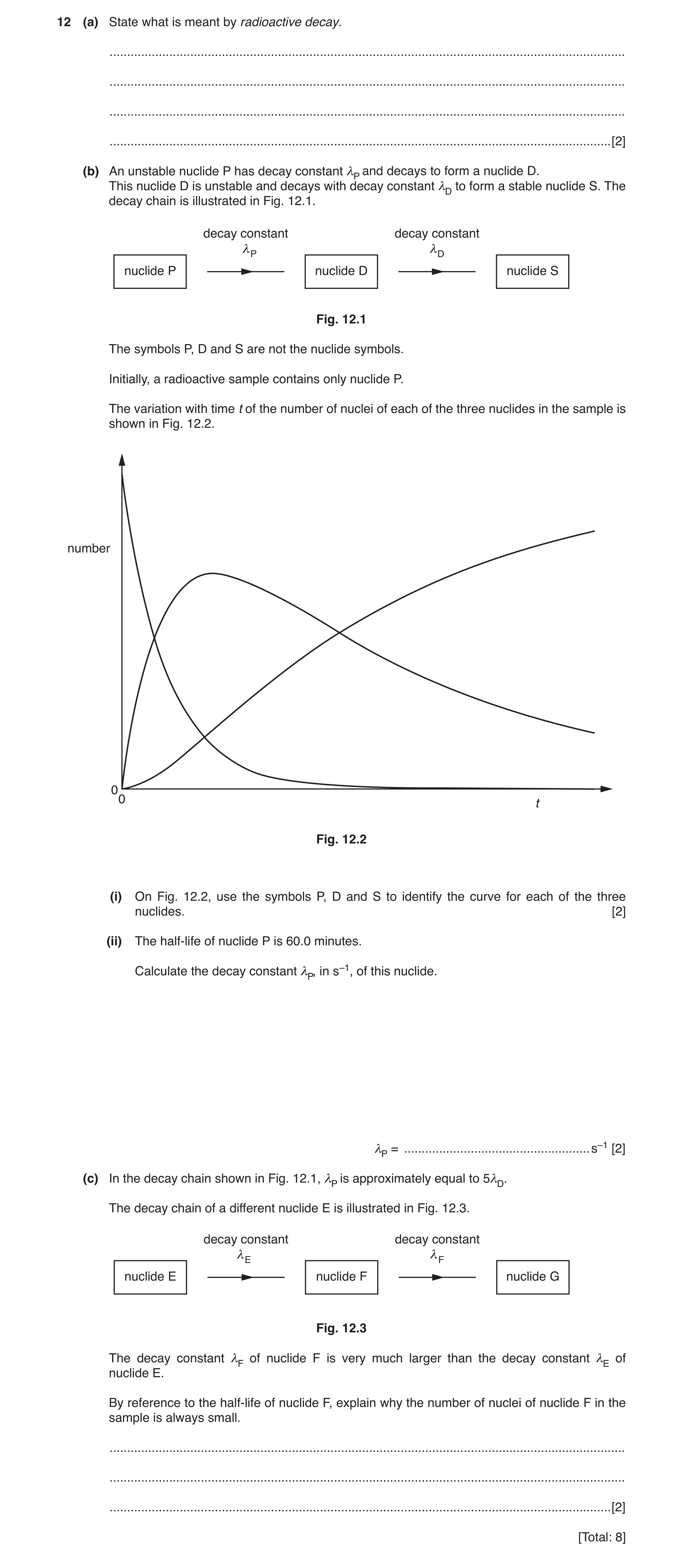
12 (a) State what is meant by radioactive decay. … … … … [2] (b) An unstable nuclide P has decay constant λP and decays to form a nuclide D. This nuclide D is unstable and decays with decay constant λD to form a stable nuclide S. The decay chain is illustrated in Fig. 12.1. decay constant decay constant λP λD nuclide P nuclide D nuclide S Fig. 12.1 The symbols P, D and S are not the nuclide symbols. Initially, a radioactive sample contains only nuclide P. The variation with time t of the number of nuclei of each of the three nuclides in the sample is shown in Fig. 12.2. number 00 t Fig. 12.2 (i) On Fig. 12.2, use the symbols P, D and S to identify the curve for each of the three nuclides. [2] (ii) The half-life of nuclide P is 60.0 minutes. Calculate the decay constant λP, in s–1, of this nuclide. λP = … s–1 [2] (c) In the decay chain shown in Fig. 12.1, λP is approximately equal to 5λD. The decay chain of a different nuclide E is illustrated in Fig. 12.3. decay constant decay constant λE λF nuclide E nuclide F nuclide G Fig. 12.3 The decay constant λF of nuclide F is very much larger than the decay constant λE of nuclide E. By reference to the half-life of nuclide F, explain why the number of nuclei of nuclide F in the sample is always small. … … … [2] [Total: 8]
8 marks
Mark scheme: 12(a) emission of particles/radiation by unstable nucleus B1 spontaneous emission B1 12(b)(i) P – the curve that starts with a high number D – the curve with the peak S – the curve that increases from zero throughout (one correct 1 mark, all three correct 2 marks) B2 12(b)(ii) λt½ = 0.693 λ = 0.693 / (60.0 × 60) C1 = 1.93 × 10⁻⁴ s–1 A1 12(c) half-life of F is much shorter than half-life of E B1 nuclei of F decay (almost) as soon as they are produced B1
This question in 9702/42 May/June 2018
Q8 · State what is meant by radioactive decay 9702/43 May/June 2018
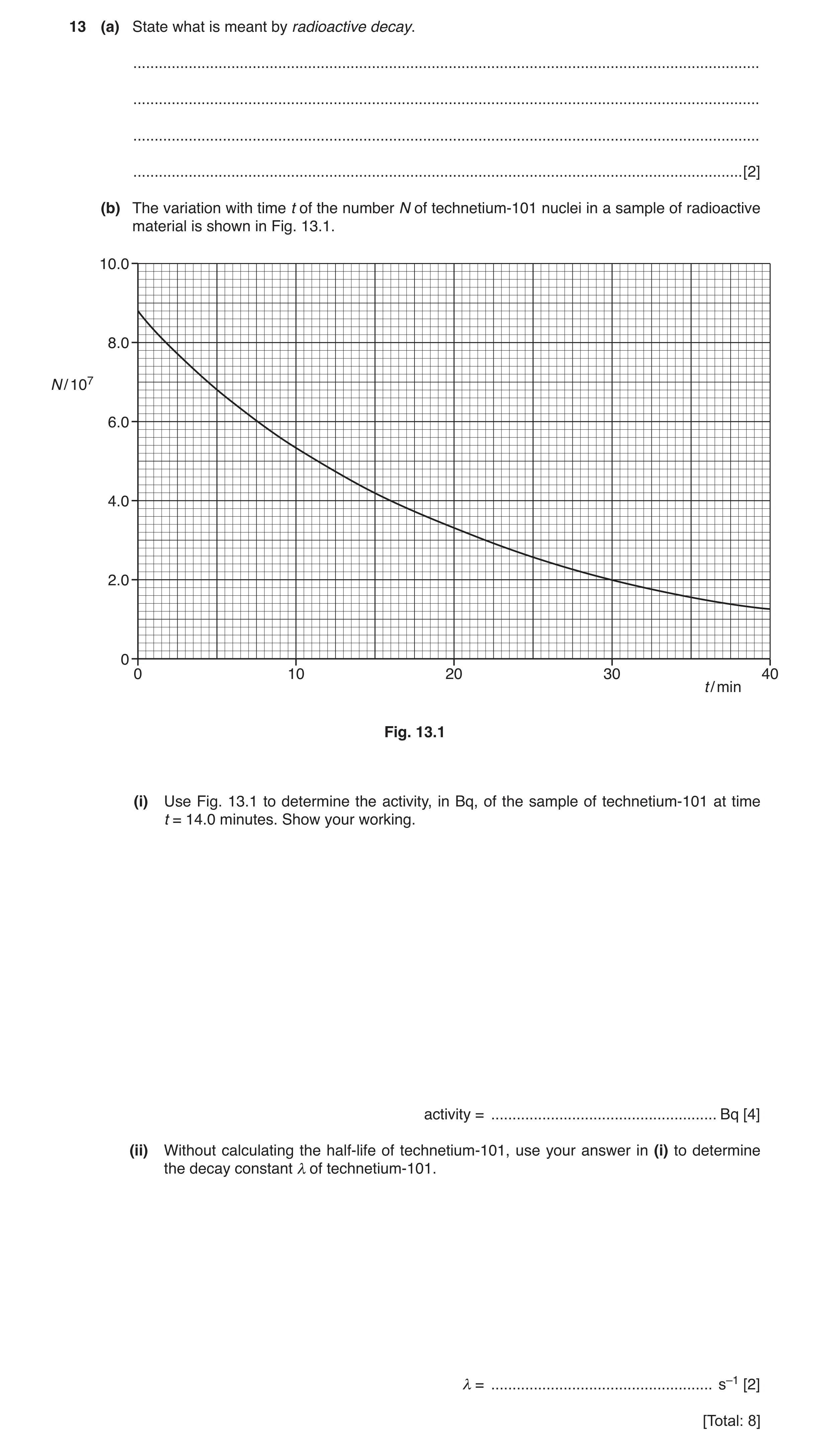
13 (a) State what is meant by radioactive decay. … … … … [2] (b) The variation with time t of the number N of technetium-101 nuclei in a sample of radioactive material is shown in Fig. 13.1. 10.0 8.0 N / 107 6.0 4.0 2.0 0 0 10 20 30 40 t / min Fig. 13.1 (i) Use Fig. 13.1 to determine the activity, in Bq, of the sample of technetium-101 at time t = 14.0 minutes. Show your working. activity = … Bq [4] (ii) Without calculating the half-life of technetium-101, use your answer in (i) to determine the decay constant λ of technetium-101. λ = … s–1 [2] [Total: 8]
8 marks
Mark scheme: 13(a) emission of particles/radiation by unstable nucleus B1 spontaneous emission B1 13(b)(i) use of graph to determine half-life = 14 minutes B1 hence λ = ln 2 / (14 × 60) (s–1) C1 N at 14 minutes = 4.4 × 10⁷ and A = λN C1 activity = 4.4 × 10⁷ × ln 2 / (14 × 60) = 3.6 × 10⁴ Bq A1 or correct tangent drawn at time t = 14 minutes (B1) magnitude of gradient of tangent identified as activity (C1) correct working for gradient leading to activity (C1) activity = 3.6 × 10⁴ Bq (A1) 13(b)(ii) 3.6 × 104 = λ × 4.4 × 10⁷ or λ = ln 2 / (14.0 × 60) C1 λ = 8.2 × 10⁻⁴ s–1 A1
This question in 9702/43 May/June 2018
Q9 · State what is meant by radioactive decay 9702/41 Oct/Nov 2018
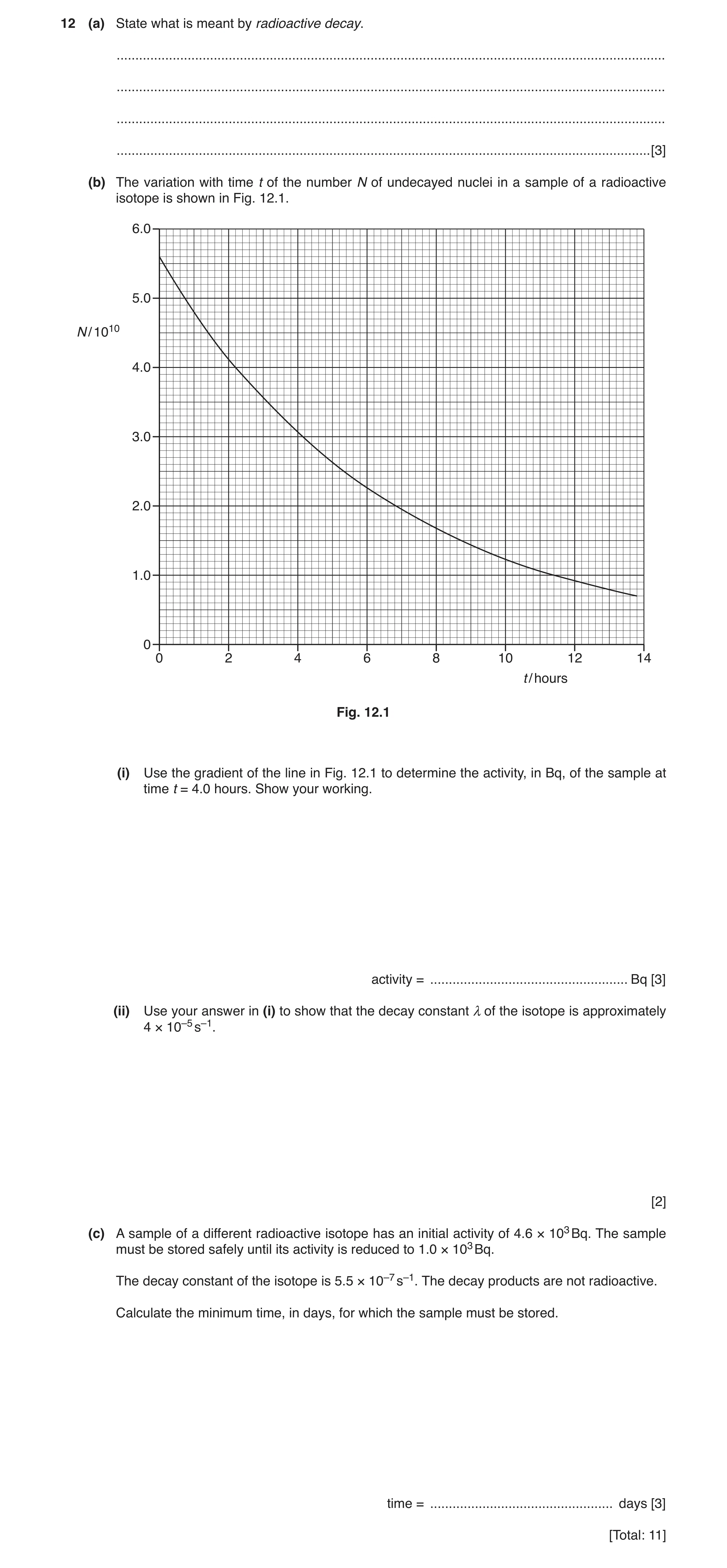
12 (a) State what is meant by radioactive decay. … … … … [3] (b) The variation with time t of the number N of undecayed nuclei in a sample of a radioactive isotope is shown in Fig. 12.1. 6.0 5.0 N / 1010 4.0 3.0 2.0 1.0 0 0 2 4 6 8 10 12 14 t / hours Fig. 12.1 (i) Use the gradient of the line in Fig. 12.1 to determine the activity, in Bq, of the sample at time t = 4.0 hours. Show your working. activity = … Bq [3] (ii) Use your answer in (i) to show that the decay constant λ of the isotope is approximately 4 × 10⁻⁵ s–1. [2] (c) A sample of a different radioactive isotope has an initial activity of 4.6 × 10³ Bq. The sample must be stored safely until its activity is reduced to 1.0 × 10³ Bq. The decay constant of the isotope is 5.5 × 10⁻⁷ s–1. The decay products are not radioactive. Calculate the minimum time, in days, for which the sample must be stored. time = … days [3] [Total: 11]
11 marks
Mark scheme: 12(a) unstable nucleus B1 emission of particles/photons B1 emission is spontaneous or (particles/radiation) are ionising B1 12(b)(i) tangent drawn and gradient calculation attempted B1 activity = 1.3 × 10⁶ Bq (1 mark for answer within ±0.2 × 10⁶ Bq, 2 marks for answer within ±0.1 × 10⁶ Bq) A2 12(b)(ii) A = λN C1 λ = (1.3 × 10⁶) / (3.05 × 10¹⁰) = 4.3 × 10⁻⁵ s–1 (≈ 4 × 10⁻⁵ s–1) A1 12(c) A = A0e–λt 1.0 × 103 = 4.6 × 10³ exp(–5.5 × 10⁻⁷ × t) C1 ln (4.6) = 5.5 × 10⁻⁷ × t C1 t = 2.78 × 10⁶ s = 32 days A1
This question in 9702/41 Oct/Nov 2018
Q10 · State what is meant by radioactive decay 9702/43 Oct/Nov 2018
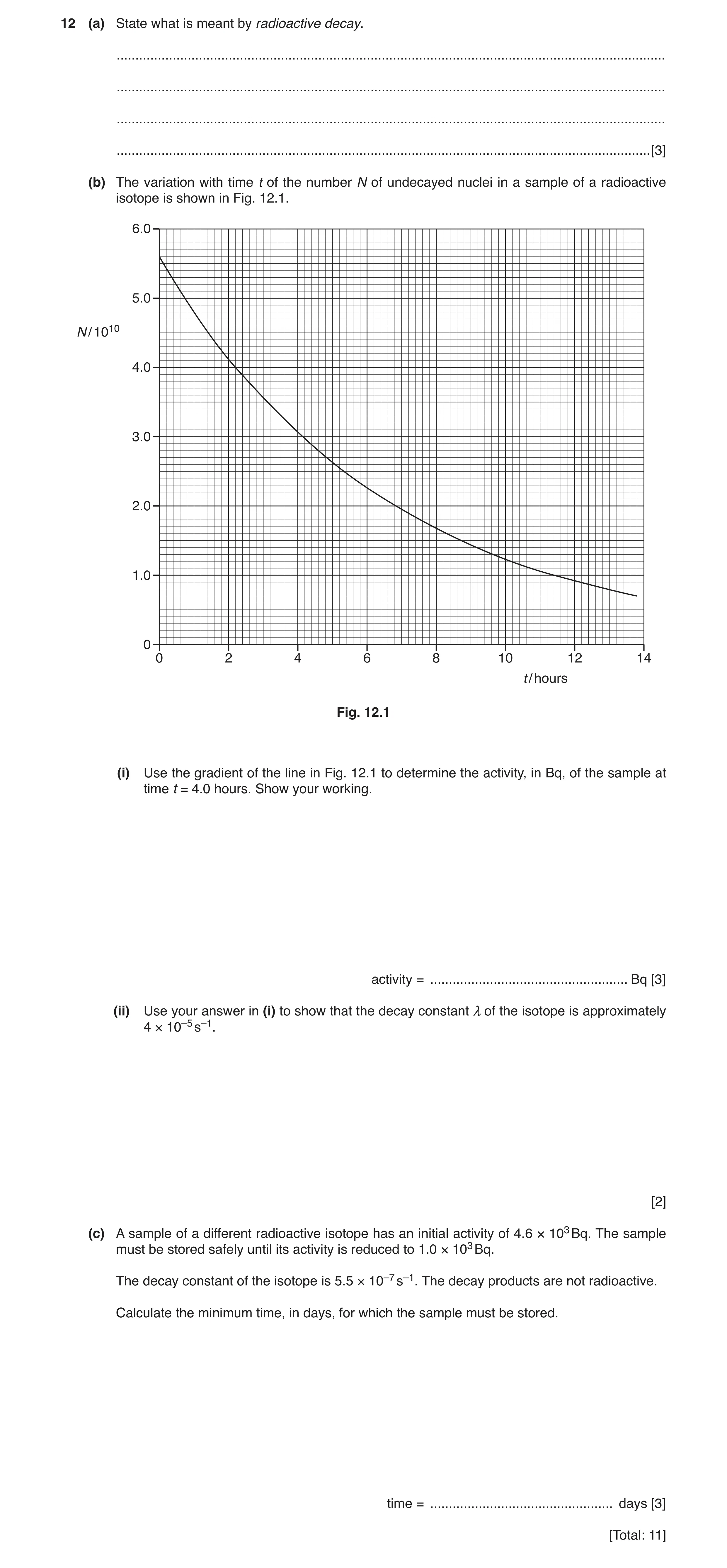
12 (a) State what is meant by radioactive decay. … … … … [3] (b) The variation with time t of the number N of undecayed nuclei in a sample of a radioactive isotope is shown in Fig. 12.1. 6.0 5.0 N / 1010 4.0 3.0 2.0 1.0 0 0 2 4 6 8 10 12 14 t / hours Fig. 12.1 (i) Use the gradient of the line in Fig. 12.1 to determine the activity, in Bq, of the sample at time t = 4.0 hours. Show your working. activity = … Bq [3] (ii) Use your answer in (i) to show that the decay constant λ of the isotope is approximately 4 × 10⁻⁵ s–1. [2] (c) A sample of a different radioactive isotope has an initial activity of 4.6 × 10³ Bq. The sample must be stored safely until its activity is reduced to 1.0 × 10³ Bq. The decay constant of the isotope is 5.5 × 10⁻⁷ s–1. The decay products are not radioactive. Calculate the minimum time, in days, for which the sample must be stored. time = … days [3] [Total: 11]
11 marks
Mark scheme: 12(a) unstable nucleus B1 emission of particles/photons B1 emission is spontaneous or (particles/radiation) are ionising B1 12(b)(i) tangent drawn and gradient calculation attempted B1 activity = 1.3 × 10⁶ Bq (1 mark for answer within ±0.2 × 10⁶ Bq, 2 marks for answer within ±0.1 × 10⁶ Bq) A2 12(b)(ii) A = λN C1 λ = (1.3 × 10⁶) / (3.05 × 10¹⁰) = 4.3 × 10⁻⁵ s–1 (≈ 4 × 10⁻⁵ s–1) A1 12(c) A = A0e–λt 1.0 × 103 = 4.6 × 10³ exp(–5.5 × 10⁻⁷ × t) C1 ln (4.6) = 5.5 × 10⁻⁷ × t C1 t = 2.78 × 10⁶ s = 32 days A1
This question in 9702/43 Oct/Nov 2018
Q11 · A sample of a radioactive isotope contains N nuclei of the isotope at time T 9702/41 May/June 2019
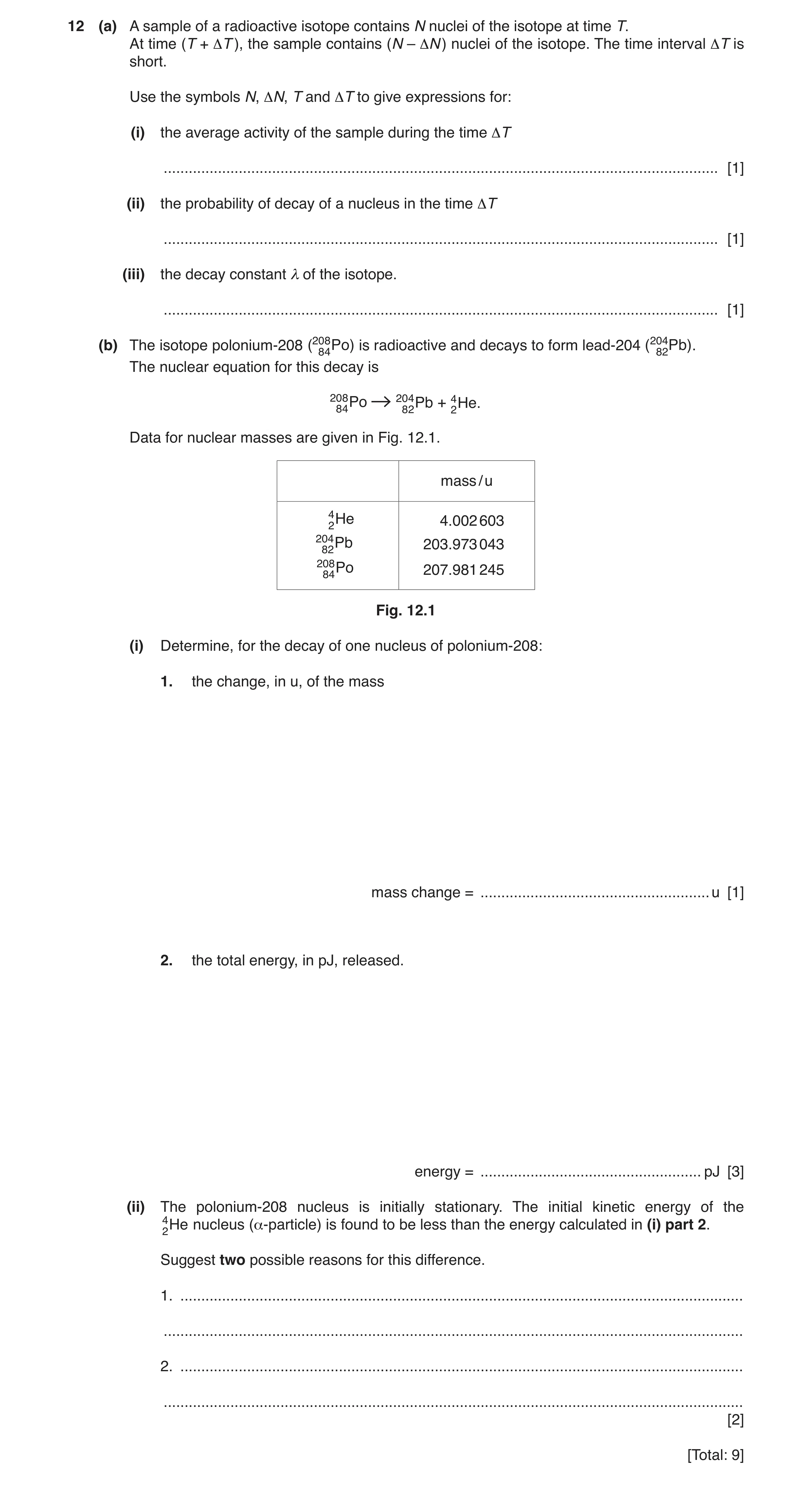
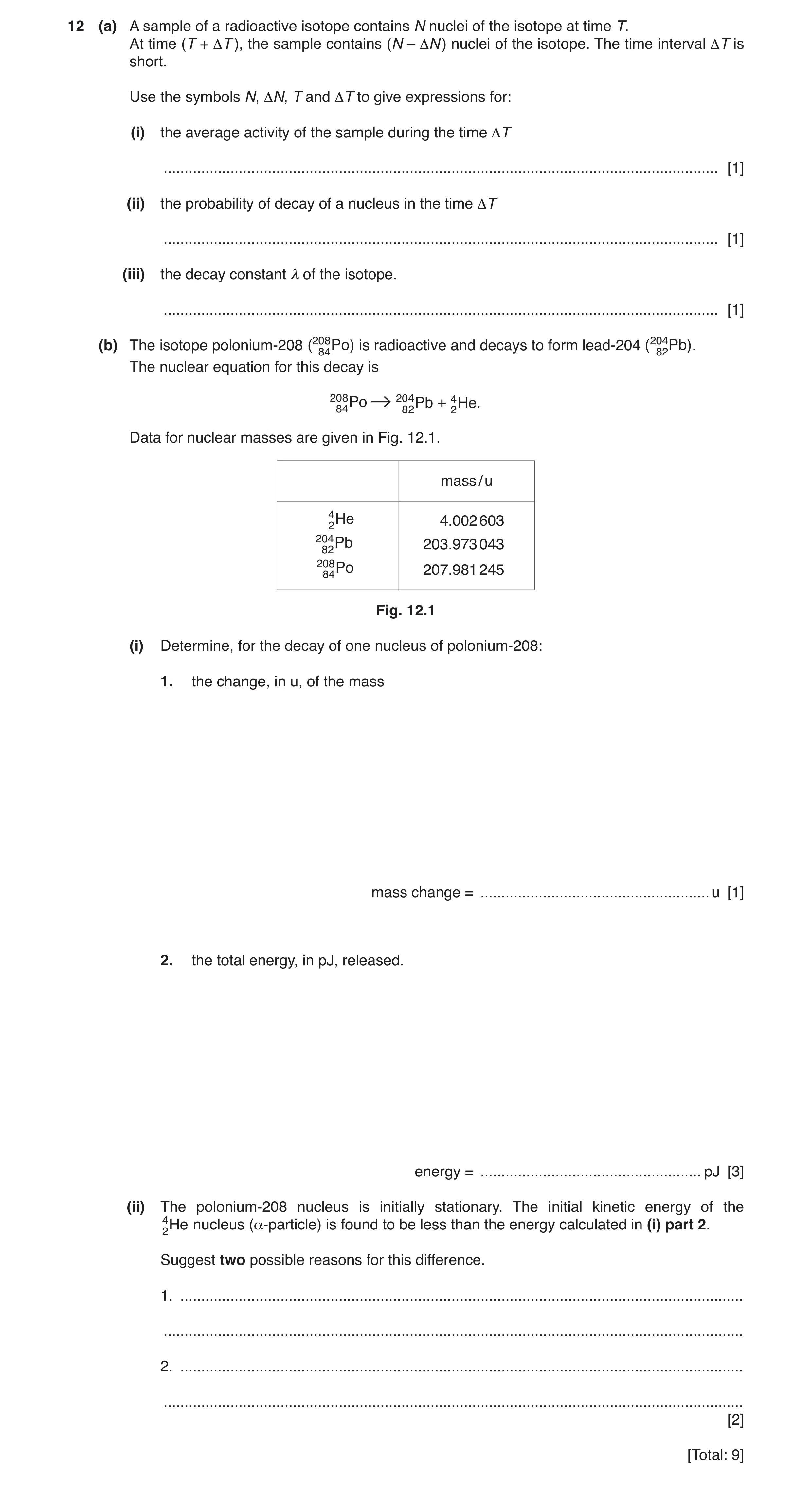
12 (a) A sample of a radioactive isotope contains N nuclei of the isotope at time T. At time (T + ΔT ), the sample contains (N – ΔN ) nuclei of the isotope. The time interval ΔT is short. Use the symbols N, ΔN, T and ΔT to give expressions for: (i) the average activity of the sample during the time ΔT … [1] (ii) the probability of decay of a nucleus in the time ΔT … [1] (iii) the decay constant λ of the isotope. … [1] (b) The isotope polonium-208 (20884 Po) is radioactive and decays to form lead-204 ( 20482 Pb). The nuclear equation for this decay is 208 84 Po 20482 Pb + 42 He. Data for nuclear masses are given in Fig. 12.1. mass / u 4 2 He 4.002 603 204 82 Pb 203.973 043 208 84 Po 207.981 245 Fig. 12.1 (i) Determine, for the decay of one nucleus of polonium-208: 1. the change, in u, of the mass mass change = … u [1] 2. the total energy, in pJ, released. energy = … pJ [3] (ii) The polonium-208 nucleus is initially stationary. The initial kinetic energy of the 4 2 He nucleus (α-particle) is found to be less than the energy calculated in (i) part 2. Suggest two possible reasons for this difference. 1. … … 2. … … [2] [Total: 9]
9 marks
Mark scheme: 12(a)(i) B1 12(a)(ii) ∆N / N B1 12(a)(iii) ∆N / (N ∆T) B1 12(b)(i) 1. mass change = 5.60 × 10⁻³ u A1 2. energy = (∆)mc2 C1 = 5.6 × 10–3 × 1.66 × 10–27 × (3.0 × 108)2 ( = 8.36 × 10⁻¹³ J) C1 = 0.84 pJ A1 12(b)(ii) kinetic energy (of recoil) of lead (nucleus) B1 energy of γ-ray photon B1
This question in 9702/41 May/June 2019
Q12 · State what is meant by the binding energy of a nucleus 9702/42 May/June 2019
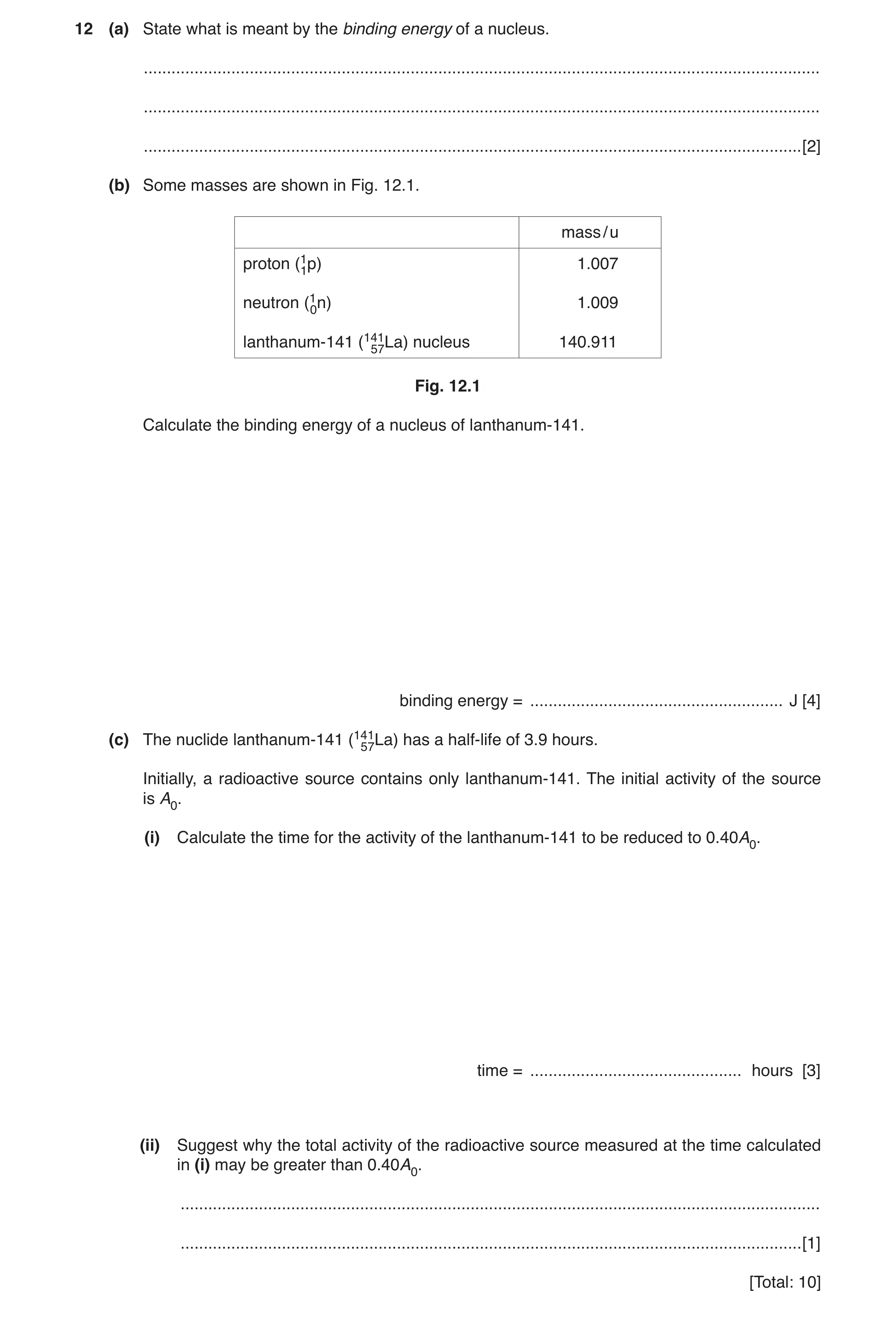
12 (a) State what is meant by the binding energy of a nucleus. … … … [2] (b) Some masses are shown in Fig. 12.1. mass / u proton (11p) 1.007 neutron (10n) 1.009 lanthanum-141 (14157La) nucleus 140.911 Fig. 12.1 Calculate the binding energy of a nucleus of lanthanum-141. binding energy = … J [4] (c) The nuclide lanthanum-141 (14157La) has a half-life of 3.9 hours. Initially, a radioactive source contains only lanthanum-141. The initial activity of the source is A0. (i) Calculate the time for the activity of the lanthanum-141 to be reduced to 0.40A0. time = … hours [3] (ii) Suggest why the total activity of the radioactive source measured at the time calculated in (i) may be greater than 0.40A0. … … [1] [Total: 10]
10 marks
Mark scheme: 12(a) energy required to separate the nucleons (in a nucleus) M1 to infinity A1 or energy released when nucleons come together (to form nucleus) (M1) from infinity (A1) 12(b) mass defect = 140.911 – (57 × 1.007) – (84 × 1.009) C1 = 140.911 – 142.155 = (–)1.244 (u) C1 energy = c2(∆)m C1 = (3.00 × 10⁸)2 × 1.244 × 1.66 × 10–27 = 1.9 × 10⁻¹⁰ J A1 12(c)(i) A = A0e–λt and ln 2 = λt½ C1 0.40 = exp(–ln 2 × t / 3.9) C1 or (0.5)n = 0.40 (C1) n = 1.32 and t = 1.32 × 3.9 (C1) t = 5.2 hours A1 12(c)(ii) daughter product may be radioactive or random nature of decay B1
This question in 9702/42 May/June 2019
Q13 · A sample of a radioactive isotope contains N nuclei of the isotope at time T 9702/43 May/June 2019
12 (a) A sample of a radioactive isotope contains N nuclei of the isotope at time T. At time (T + ΔT ), the sample contains (N – ΔN ) nuclei of the isotope. The time interval ΔT is short. Use the symbols N, ΔN, T and ΔT to give expressions for: (i) the average activity of the sample during the time ΔT … [1] (ii) the probability of decay of a nucleus in the time ΔT … [1] (iii) the decay constant λ of the isotope. … [1] (b) The isotope polonium-208 (20884 Po) is radioactive and decays to form lead-204 ( 20482 Pb). The nuclear equation for this decay is 208 84 Po 20482 Pb + 42 He. Data for nuclear masses are given in Fig. 12.1. mass / u 4 2 He 4.002 603 204 82 Pb 203.973 043 208 84 Po 207.981 245 Fig. 12.1 (i) Determine, for the decay of one nucleus of polonium-208: 1. the change, in u, of the mass mass change = … u [1] 2. the total energy, in pJ, released. energy = … pJ [3] (ii) The polonium-208 nucleus is initially stationary. The initial kinetic energy of the 4 2 He nucleus (α-particle) is found to be less than the energy calculated in (i) part 2. Suggest two possible reasons for this difference. 1. … … 2. … … [2] [Total: 9]
9 marks
Mark scheme: 12(a)(i) B1 12(a)(ii) ∆N / N B1 12(a)(iii) ∆N / (N ∆T) B1 12(b)(i) 1. mass change = 5.60 × 10⁻³ u A1 2. energy = (∆)mc2 C1 = 5.6 × 10–3 × 1.66 × 10–27 × (3.0 × 108)2 ( = 8.36 × 10⁻¹³ J) C1 = 0.84 pJ A1 12(b)(ii) kinetic energy (of recoil) of lead (nucleus) B1 energy of γ-ray photon B1
This question in 9702/43 May/June 2019
Q14 · Radon-222 (22286 Ra) is a radioactive gas that decays randomly with a decay constant of… 9702/42 Oct/Nov 2019
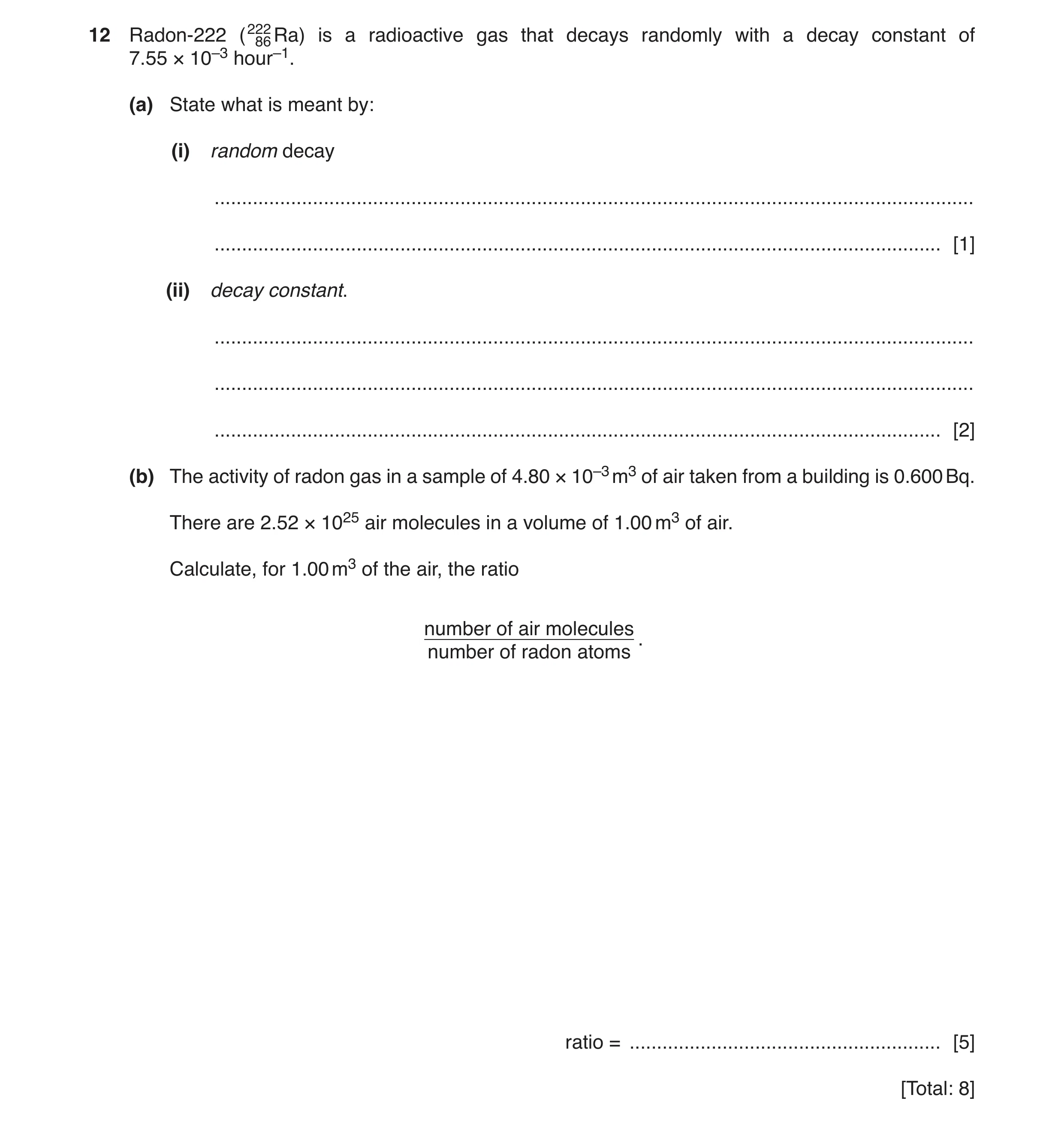
12 Radon-222 (22286 Ra) is a radioactive gas that decays randomly with a decay constant of 7.55 × 10⁻³ hour–1. (a) State what is meant by: (i) random decay … … [1] (ii) decay constant. … … … [2] (b) The activity of radon gas in a sample of 4.80 × 10⁻³ m3 of air taken from a building is 0.600 Bq. There are 2.52 × 1025 air molecules in a volume of 1.00 m3 of air. Calculate, for 1.00 m3 of the air, the ratio number of air molecules . number of radon atoms ratio = … [5] [Total: 8]
8 marks
Mark scheme: 12(a)(i) (decay is) unpredictable/cannot be predicted B1 12(a)(ii) probability of decay (of a nucleus) M1 per unit time A1 12(b) A = λN C1 (for 1.00 m3) A = 0.600 / 4.80 × 10⁻³ (= 125 Bq) C1 N = 125 / ([7.55 × 10⁻³] / 3600) (= 5.96 × 10⁷) C1 so ratio = (2.52 × 1025) / (5.96 × 10⁷) C1 or (for 4.80 × 10⁻³ m3) N for air = 2.52 × 1025 × 4.80 × 10–3 (= 1.21 × 10²³) (C1) N for radon = 0.600 / ([7.55 × 10⁻³] / 3600) (= 2.86 × 10⁵) (C1) so ratio = (1.21 × 10²³) / (2.86 × 10⁵) (C1) ratio = 4.2 × 10¹⁷ A1
This question in 9702/42 Oct/Nov 2019
Q15 · Explain what is meant by the binding energy of a nucleus 9702/42 Feb/March 2020
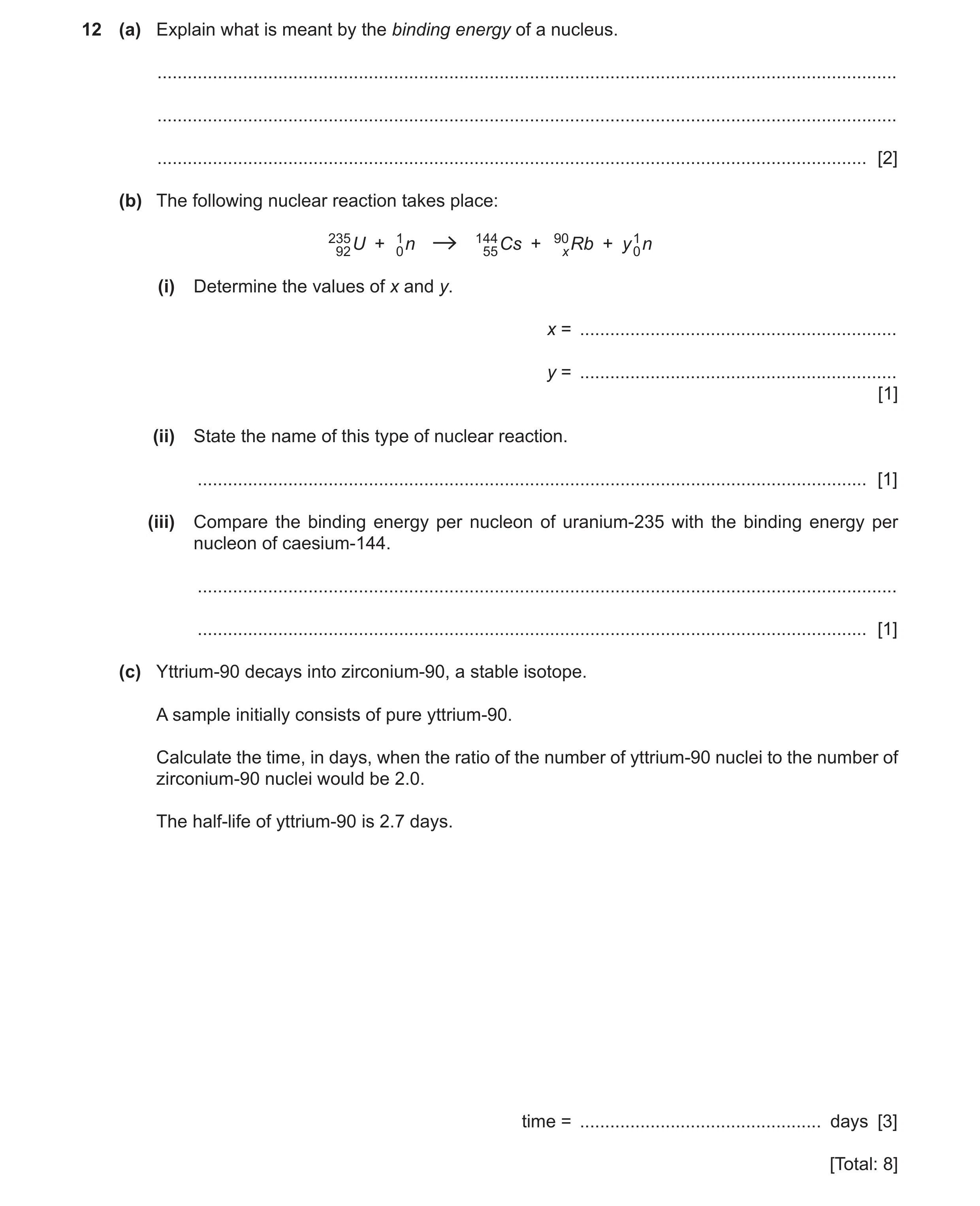
12 (a) Explain what is meant by the binding energy of a nucleus. … … … [2] (b) The following nuclear reaction takes place: 23592 U + 10 n 14455 Cs + 90x Rb + y10 n (i) Determine the values of x and y. x = … y = … [1] (ii) State the name of this type of nuclear reaction. … [1] (iii) Compare the binding energy per nucleon of uranium-235 with the binding energy per nucleon of caesium-144. … … [1] (c) Yttrium-90 decays into zirconium-90, a stable isotope. A sample initially consists of pure yttrium-90. Calculate the time, in days, when the ratio of the number of yttrium-90 nuclei to the number of zirconium-90 nuclei would be 2.0. The half-life of yttrium-90 is 2.7 days. time = … days [3] [Total: 8]
8 marks
Mark scheme: 12(a) (minimum) energy required to separate the nucleons M1 to infinity A1 12(b)(i) 37 2 B1 12(b)(ii) fission B1 12(b)(iii) binding energy per nucleon smaller for U than for Cs B1 12(c) Current ratio 2 Y to 1 Zr, so initially 3 Y 2 = 3 e–λt λ = 0.693 / 2.7 C1 ln(2 / 3) = – (ln 2 / 2.7)t C1 t = 1.6 days A1 or (½)n = 2 / 3 (C1) n = 0.585 (C1) time = 0.585 × 2.7 = 1.6 days (A1)
This question in 9702/42 Feb/March 2020
Q16 · The decay of a sample of a radioactive isotope is said to be random and spontaneous 9702/41 May/June 2020
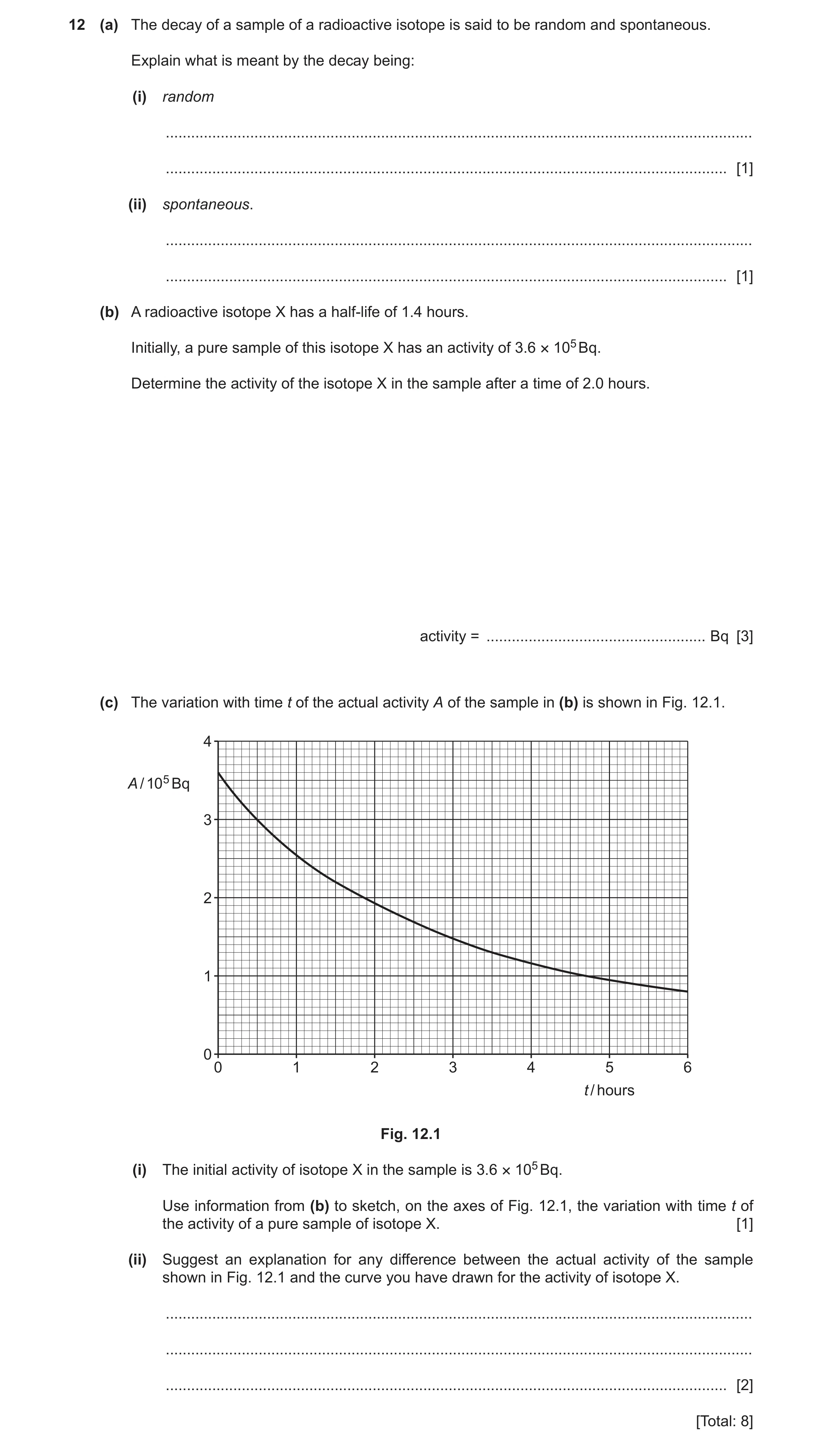
12 (a) The decay of a sample of a radioactive isotope is said to be random and spontaneous. Explain what is meant by the decay being: (i) random … … [1] (ii) spontaneous. … … [1] (b) A radioactive isotope X has a half-life of 1.4 hours. Initially, a pure sample of this isotope X has an activity of 3.6 × 10⁵ Bq. Determine the activity of the isotope X in the sample after a time of 2.0 hours. activity = … Bq [3] (c) The variation with time t of the actual activity A of the sample in (b) is shown in Fig. 12.1. 4 A / 105 Bq 3 2 1 0 0 1 2 3 4 5 6 t / hours Fig. 12.1 (i) The initial activity of isotope X in the sample is 3.6 × 10⁵ Bq. Use information from (b) to sketch, on the axes of Fig. 12.1, the variation with time t of the activity of a pure sample of isotope X. [1] (ii) Suggest an explanation for any difference between the actual activity of the sample shown in Fig. 12.1 and the curve you have drawn for the activity of isotope X. … … … [2] [Total: 8]
8 marks
Mark scheme: 12(a)(i) time at which a nucleus will decay cannot be predicted or constant probability of decay of a nucleus B1 12(a)(ii) decay (of a nucleus) not affected by environmental factors B1 12(b) A = A0e–λt and λ = ln 2 / t½ C1 = 3.6 × 10⁵ × exp [–(2 × ln 2) / 1.4] C1 or A = A0 × 0.5N (C1) = 3.6 × 105 × 0.5N where N = 2 / 1.4 (C1) A = 1.3 × 10⁵ Bq A1 12(c)(i) smooth curve, starting at (0, 3.6 × 10⁵) and passing through (1.4, 1.8 × 10⁵) and (2.0, 1.3 × 10⁵) B1 12(c)(ii) (activity of sample is greater than activity of X so) there must be an additional source of activity C1 the decay product (of isotope X) is radioactive A1
This question in 9702/41 May/June 2020
Q17 · The decay of a sample of a radioactive isotope is said to be random and spontaneous 9702/43 May/June 2020
12 (a) The decay of a sample of a radioactive isotope is said to be random and spontaneous. Explain what is meant by the decay being: (i) random … … [1] (ii) spontaneous. … … [1] (b) A radioactive isotope X has a half-life of 1.4 hours. Initially, a pure sample of this isotope X has an activity of 3.6 × 10⁵ Bq. Determine the activity of the isotope X in the sample after a time of 2.0 hours. activity = … Bq [3] (c) The variation with time t of the actual activity A of the sample in (b) is shown in Fig. 12.1. 4 A / 105 Bq 3 2 1 0 0 1 2 3 4 5 6 t / hours Fig. 12.1 (i) The initial activity of isotope X in the sample is 3.6 × 10⁵ Bq. Use information from (b) to sketch, on the axes of Fig. 12.1, the variation with time t of the activity of a pure sample of isotope X. [1] (ii) Suggest an explanation for any difference between the actual activity of the sample shown in Fig. 12.1 and the curve you have drawn for the activity of isotope X. … … … [2] [Total: 8]
8 marks
Mark scheme: 12(a)(i) time at which a nucleus will decay cannot be predicted or constant probability of decay of a nucleus B1 12(a)(ii) decay (of a nucleus) not affected by environmental factors B1 12(b) A = A0e–λt and λ = ln 2 / t½ C1 = 3.6 × 10⁵ × exp [–(2 × ln 2) / 1.4] C1 or A = A0 × 0.5N (C1) = 3.6 × 105 × 0.5N where N = 2 / 1.4 (C1) A = 1.3 × 10⁵ Bq A1 12(c)(i) smooth curve, starting at (0, 3.6 × 10⁵) and passing through (1.4, 1.8 × 10⁵) and (2.0, 1.3 × 10⁵) B1 12(c)(ii) (activity of sample is greater than activity of X so) there must be an additional source of activity C1 the decay product (of isotope X) is radioactive A1
This question in 9702/43 May/June 2020
Q18 · Iodine-131 (13153 I) is a radioactive isotope with a decay constant of 9.9 × 10⁻⁷ s–1 9702/41 Oct/Nov 2020
12 Iodine-131 (13153 I) is a radioactive isotope with a decay constant of 9.9 × 10⁻⁷ s–1. (a) State what is meant by: (i) radioactive … … … [2] (ii) decay constant. … … … [2] (b) Some water becomes contaminated with iodine-131. The activity of the iodine-131 in 1.0 kg of water is 560 Bq. Determine the number of iodine-131 atoms in 1.0 kg of water. number = … [2] (c) Regulations require that the activity of iodine-131 in 1.0 kg of water is to be less than 170 Bq. Calculate the time, in days, for the activity of the contaminated water in (b) to be reduced to 170 Bq. time = … days [3] [Total: 9]
9 marks
Mark scheme: 12(a)(i) unstable nucleus B1 emits ionising radiation or decays spontaneously B1 12(a)(ii) probability of decay (of a nucleus) M1 per unit time A1 12(b) A = λN C1 560 = 9.9 × 10⁻⁷ × N N = 5.7 × 10⁸ A1 12(c) A = A0 e–λt 170 = 560 exp(–9.9 × 10⁻⁷ × t) C1 t = 1.2 × 10⁶ s C1 = 14 days A1
This question in 9702/41 Oct/Nov 2020
Q19 · Iodine-131 (13153 I) is a radioactive isotope with a decay constant of 9.9 × 10⁻⁷ s–1 9702/43 Oct/Nov 2020
12 Iodine-131 (13153 I) is a radioactive isotope with a decay constant of 9.9 × 10⁻⁷ s–1. (a) State what is meant by: (i) radioactive … … … [2] (ii) decay constant. … … … [2] (b) Some water becomes contaminated with iodine-131. The activity of the iodine-131 in 1.0 kg of water is 560 Bq. Determine the number of iodine-131 atoms in 1.0 kg of water. number = … [2] (c) Regulations require that the activity of iodine-131 in 1.0 kg of water is to be less than 170 Bq. Calculate the time, in days, for the activity of the contaminated water in (b) to be reduced to 170 Bq. time = … days [3] [Total: 9]
9 marks
Mark scheme: 12(a)(i) unstable nucleus B1 emits ionising radiation or decays spontaneously B1 12(a)(ii) probability of decay (of a nucleus) M1 per unit time A1 12(b) A = λN C1 560 = 9.9 × 10⁻⁷ × N N = 5.7 × 10⁸ A1 12(c) A = A0 e–λt 170 = 560 exp(–9.9 × 10⁻⁷ × t) C1 t = 1.2 × 10⁶ s C1 = 14 days A1
This question in 9702/43 Oct/Nov 2020
Q20 · Radioactive decay is both spontaneous and random 9702/42 Feb/March 2021
12 (a) Radioactive decay is both spontaneous and random. State what is meant by: 1. spontaneous decay … … 2. random decay. … … [2] (b) Strontium-90 (9038 Sr) is an unstable nuclide. The activity of a sample of 1.0 × 10⁻⁹ kg of strontium-90 is 5.2 MBq. (i) Determine the decay constant λ of strontium-90. λ = … s–1 [3] (ii) The activity of the sample after a time of 1.0 half lives is found to be greater than the expected 2.6 MBq. Suggest a possible reason for this. … … [1] [Total: 6]
6 marks
Mark scheme: 12(a) 1 not affected by external factors B1 2 cannot predict when a (particular) nucleus will decay or cannot predict which nucleus will decay (next) B1 12(b)(i) Number of atoms = 9 27 1.0 10 90 1.66 10 − − × × × or 9 23 3 1.0 10 6.02 10 90 10 − − × × × × 15 6.693 10 = × C1 A N λ = λ = 6 15 5.2 10 6.693 10 × × C1 10 7.8 10 λ − = × s–1 A1 12(b)(ii) daughter nucleus is unstable B1
This question in 9702/42 Feb/March 2021
Q21 · An isolated metal sphere of radius r is charged so that the electric field strength at… 9702/41 May/June 2021
6 (a) An isolated metal sphere of radius r is charged so that the electric field strength at its surface is E0. On Fig. 6.1, sketch the variation of the electric field strength E with distance x from the centre of the sphere. Your sketch should extend from x = 0 to x = 3r. E0 field strength E 0 0 r 2r 3r distance x Fig. 6.1 [3] (b) The de Broglie wavelength of a particle is λ 0 when its momentum is p0. On Fig. 6.2, sketch the variation with momentum p of the de Broglie wavelength λ of the p0 particle for values of momentum from to p0. 2 2λ0 wavelength λ λ 0 0 0 p0 p0 2 momentum p Fig. 6.2 [2] (c) A radioactive isotope decays with a half-life of 15 s to form a stable product. A fresh sample of the radioactive isotope at time t = 0 contains N0 nuclei and no nuclei of the stable product. On Fig. 6.3, sketch the variation with t of the number n of nuclei of the stable product for time t = 0 to time t = 45 s. N0 number n 0.5 N0 0 0 15 30 45 time t / s Fig. 6.3 [3] [Total: 8]
8 marks
Mark scheme: 6(a) from x = 0 to x = r: E = 0 B1 from x = r to x = 3r: curve with negative gradient of decreasing magnitude passing through (r, E0) B1 line passing through (2r, E0 / 4) and (3r, E0 / 9) B1 6(b) from p = p0 / 2 to p = p0: curve with negative gradient of decreasing magnitude passing through (p0, λ0) B1 line passing through (½p0, 2λ0) B1 6(c) from t = 0 to t = 45 s: curve with positive gradient of decreasing magnitude starting at (0, 0) B1 line passing through (15, ½N0) B1 line passing through (30, 0.75N0) and (45, 0.88N0) B1
This question in 9702/41 May/June 2021
Q22 · An isolated metal sphere of radius r is charged so that the electric potential at its… 9702/42 May/June 2021
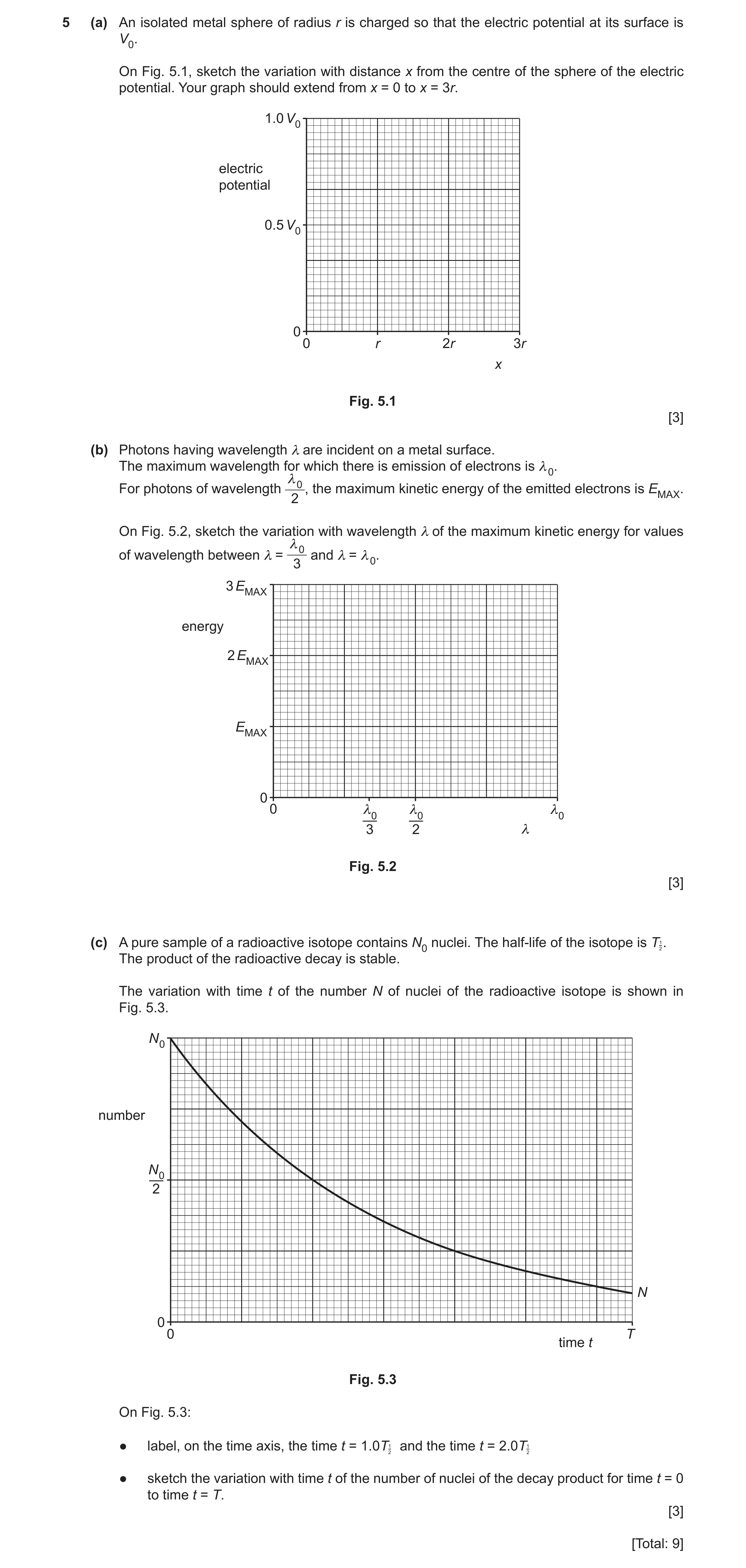
5 (a) An isolated metal sphere of radius r is charged so that the electric potential at its surface is V0. On Fig. 5.1, sketch the variation with distance x from the centre of the sphere of the electric potential. Your graph should extend from x = 0 to x = 3r. 1.0 V0 electric potential 0.5 V0 0 0 r 2r 3r x Fig. 5.1 [3] (b) Photons having wavelength λ are incident on a metal surface. The maximum wavelength for which there is emission of electrons is λ 0. λ 0 For photons of wavelength , the maximum kinetic energy of the emitted electrons is EMAX. 2 On Fig. 5.2, sketch the variation with wavelength λ of the maximum kinetic energy for values λ 0 of wavelength between λ = and λ = λ 0. 3 3 EMAX energy 2 EMAX EMAX 0 0 λ λ λ 0 0 0 3 2 λ Fig. 5.2 [3] (c) A pure sample of a radioactive isotope contains N0 nuclei. The half-life of the isotope is T12. The product of the radioactive decay is stable. The variation with time t of the number N of nuclei of the radioactive isotope is shown in Fig. 5.3. N0 number N0 2 N 0 0 T time t Fig. 5.3 On Fig. 5.3: ● label, on the time axis, the time t = 1.0T12 and the time t = 2.0T12 ● sketch the variation with time t of the number of nuclei of the decay product for time t = 0 to time t = T. [3] [Total: 9]
9 marks
Mark scheme: 5(a) from x = 0 to x = r: horizontal line at V = 1.0V0 B1 from x = r to x = 3r: curve with negative gradient of decreasing magnitude starting at (r, 1.0V0) B1 line passing through (2r, ½V0) and (3r, ⅓V0) B1 5(b) line with negative gradient from λ = ⅓λ0 to λ = λ0 B1 line passing through (λ0, 0) B1 curve with negative gradient of decreasing magnitude passing through (½λ0, EMAX) and (⅓λ0, 2EMAX) B1 5(c) 1.0T½ shown at ½N0 and 2.0T½ shown at ¼N0 B1 line starting at (0, 0) and reaching (T, N0–N) B1 line starting at (0, 0) and reaching original curve at (1.0T½, ½N0) B1
This question in 9702/42 May/June 2021
Q23 · An isolated metal sphere of radius r is charged so that the electric field strength at… 9702/43 May/June 2021
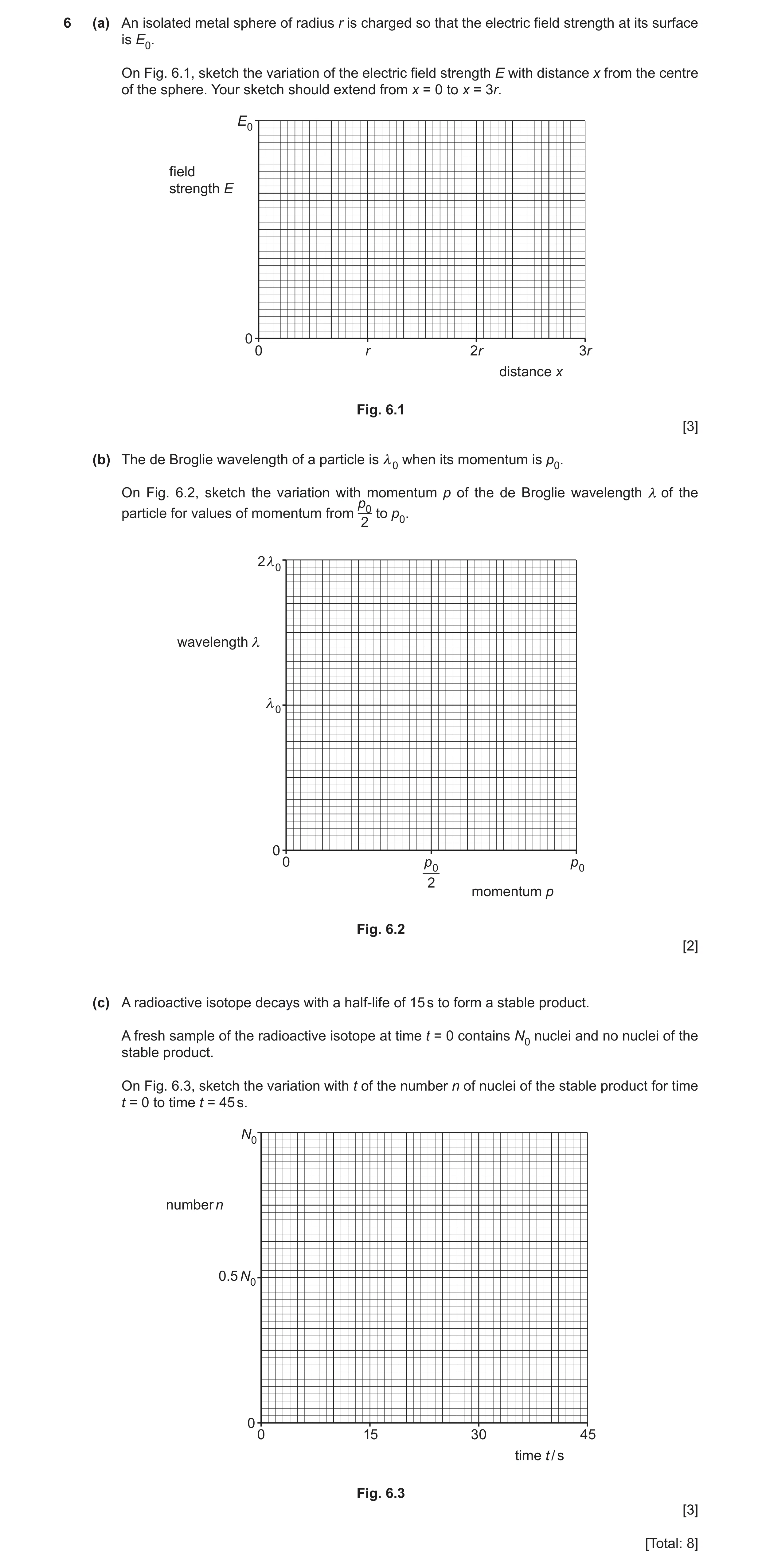
6 (a) An isolated metal sphere of radius r is charged so that the electric field strength at its surface is E0. On Fig. 6.1, sketch the variation of the electric field strength E with distance x from the centre of the sphere. Your sketch should extend from x = 0 to x = 3r. E0 field strength E 0 0 r 2r 3r distance x Fig. 6.1 [3] (b) The de Broglie wavelength of a particle is λ 0 when its momentum is p0. On Fig. 6.2, sketch the variation with momentum p of the de Broglie wavelength λ of the p0 particle for values of momentum from to p0. 2 2λ0 wavelength λ λ 0 0 0 p0 p0 2 momentum p Fig. 6.2 [2] (c) A radioactive isotope decays with a half-life of 15 s to form a stable product. A fresh sample of the radioactive isotope at time t = 0 contains N0 nuclei and no nuclei of the stable product. On Fig. 6.3, sketch the variation with t of the number n of nuclei of the stable product for time t = 0 to time t = 45 s. N0 number n 0.5 N0 0 0 15 30 45 time t / s Fig. 6.3 [3] [Total: 8]
8 marks
Mark scheme: 6(a) from x = 0 to x = r: E = 0 B1 from x = r to x = 3r: curve with negative gradient of decreasing magnitude passing through (r, E0) B1 line passing through (2r, E0 / 4) and (3r, E0 / 9) B1 6(b) from p = p0 / 2 to p = p0: curve with negative gradient of decreasing magnitude passing through (p0, λ0) B1 line passing through (½p0, 2λ0) B1 6(c) from t = 0 to t = 45 s: curve with positive gradient of decreasing magnitude starting at (0, 0) B1 line passing through (15, ½N0) B1 line passing through (30, 0.75N0) and (45, 0.88N0) B1
This question in 9702/43 May/June 2021
Q24 · Define radioactive decay constant 9702/41 Oct/Nov 2021
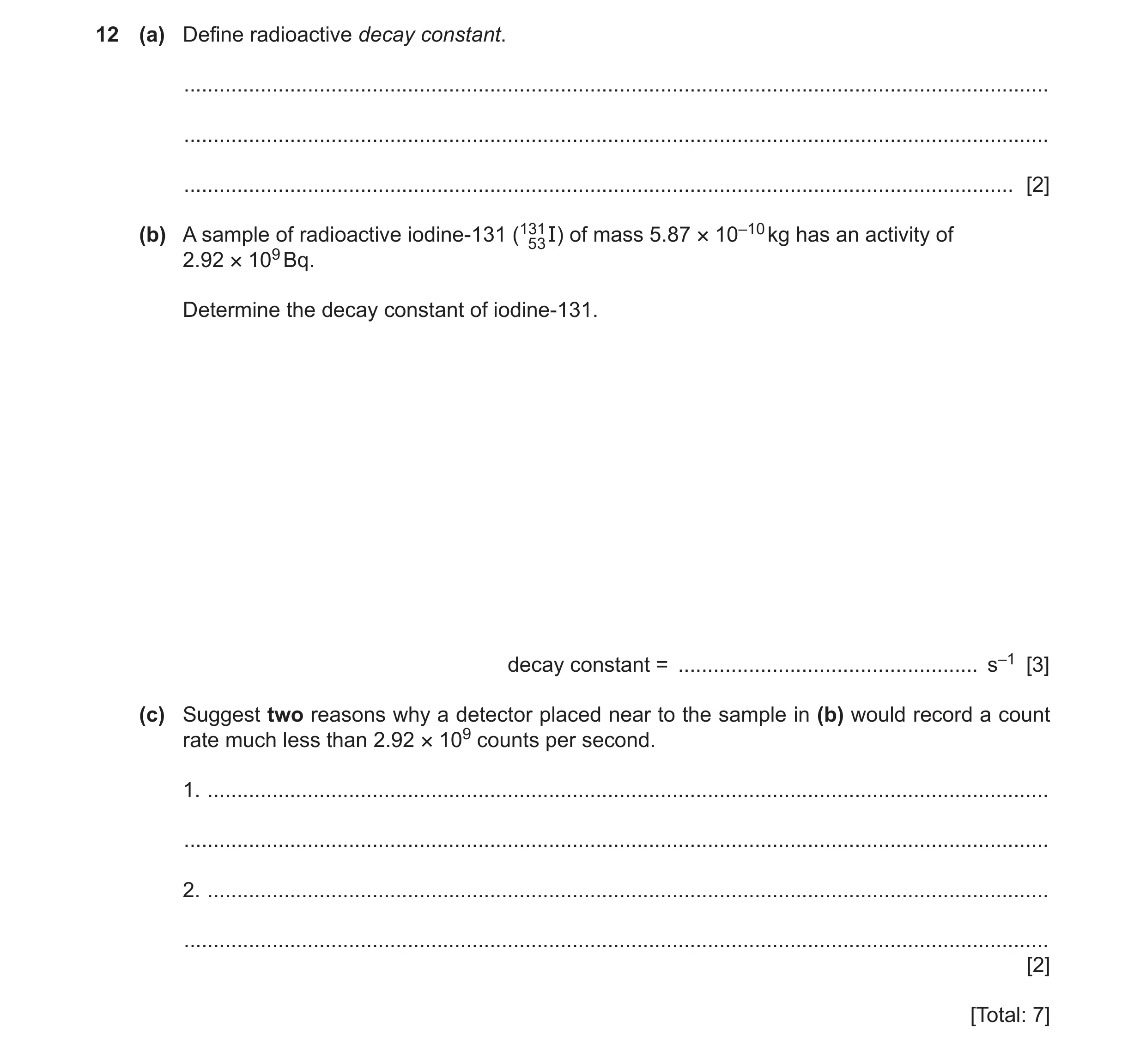
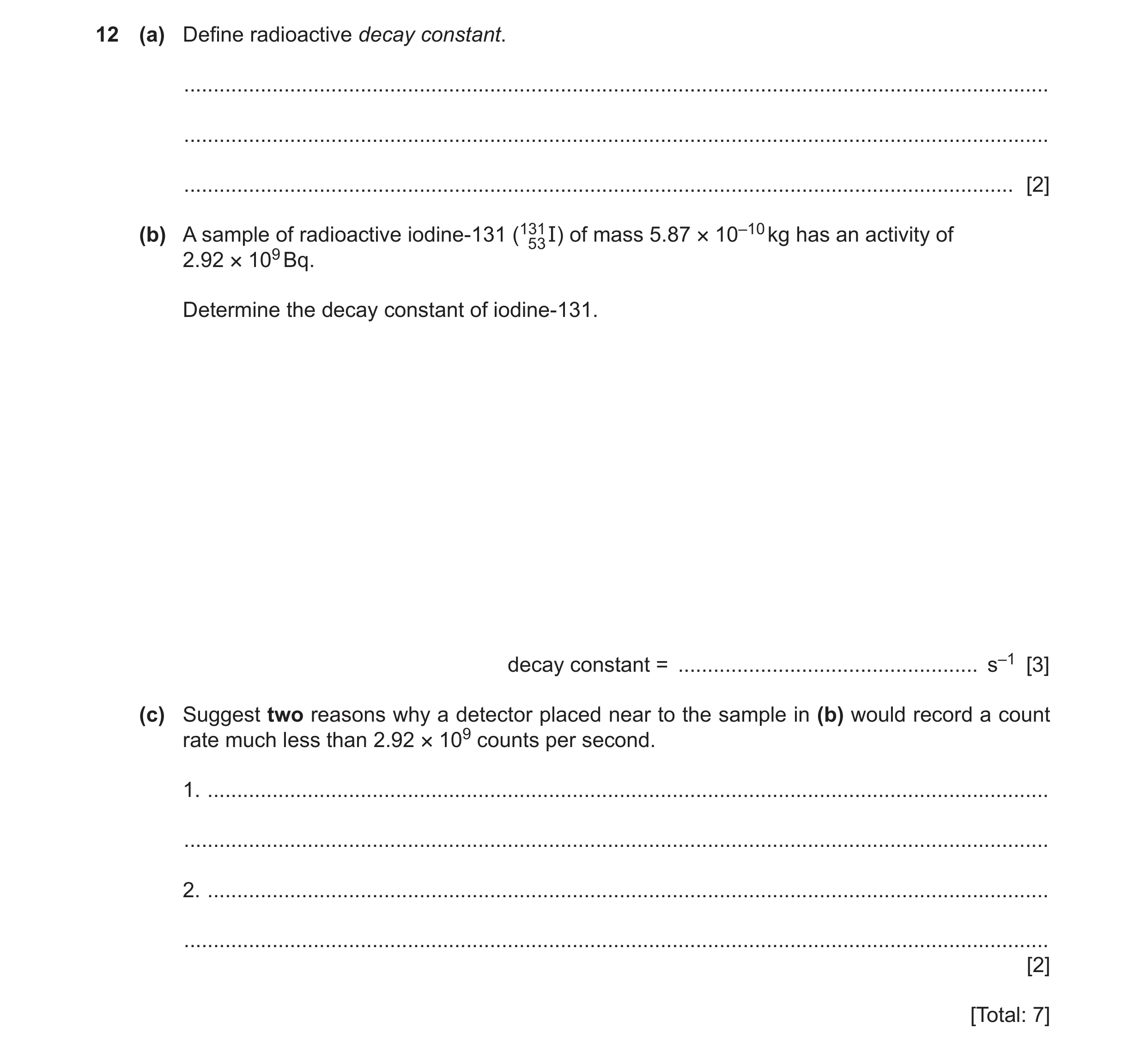
12 (a) Define radioactive decay constant. … … … [2] (b) A sample of radioactive iodine-131 (13153 I) of mass 5.87 × 10⁻¹⁰ kg has an activity of 2.92 × 10⁹ Bq. Determine the decay constant of iodine-131. decay constant = … s–1 [3] (c) Suggest two reasons why a detector placed near to the sample in (b) would record a count rate much less than 2.92 × 10⁹ counts per second. 1. … … 2. … … [2] [Total: 7]
7 marks
Mark scheme: 12(a) probability of decay (of a nucleus) M1 per unit time A1 12(b) A = λN C1 N = mass / (nucleon number × u) C1 2.92 × 109 = (λ × 5.87 × 10⁻¹⁰) / (131 × 1.66 × 10–27) λ = 1.08 × 10⁻⁶ s–1 A1 12(c) • sample emits radiation in all directions • some radiation is absorbed by air/detector window • self-absorption within the source • dead time/inefficiency of detector Any two points, 1 mark each B2
This question in 9702/41 Oct/Nov 2021
Q25 · Radioactive decay is both random and spontaneous 9702/42 Oct/Nov 2021
12 (a) Radioactive decay is both random and spontaneous. State what is meant by: (i) random … … [1] (ii) spontaneous. … … [1] (b) A sample of radioactive material contains atoms of an unstable nuclide X. The activity of the sample due to the atoms of X is A. The variation with time t of ln A is shown in Fig. 12.1. 36.6 In (A / Bq) 36.2 35.8 35.4 35.00 5 10 15 20 25 t / min Fig. 12.1 (i) Use Fig. 12.1 to determine the half-life, in minutes, of nuclide X. half-life = … min [3] (ii) At time t = 0, the mass of the atoms of X in the sample is 5.66 × 10⁻⁷ kg. Determine the nucleon number of X. nucleon number = … [3] [Total: 8]
8 marks
Mark scheme: 12(a)(i) cannot predict when a particular nucleus will decay or cannot predict which nucleus will decay next B1 12(a)(ii) (decay is) not affected by external (environmental) factors B1 12(b)(i) A = A0 exp (–λt) and so ln A = ln A0 – λt gradient of line = (–)λ C1 λ = (36.4 – 35.0) / (20 – 0) ( = 0.07(0) min–1) C1 half-life = ln 2 / λ = ln 2 / 0.070 = 10 min A1 or A0 = exp (–36.4) = 6.43 × 10¹⁵ (Bq) (C1) A0 / 2 = 3.21 × 10¹⁵ (Bq), so ln (A0 / 2) = 35.7 (C1) read off half-life = 10 min (A1) or (at one half-life,) ln A = 36.4 – ln 2 (C1) = 35.7 (C1) read off half-life = 10 min (A1) Question Answer Marks 12(b)(ii) A = λN C1 N = mass / (nucleon number × u) or N = (mass / nucleon number) × NA C1 exp(36.4) = (1.17 × 10–3 × 5.66 × 10–7) / (nucleon number × 1.66 × 10⁻²⁷) or exp(36.4) = (1.17 × 10–3 × 5.66 × 10–4 × 6.02 × 1023) / nucleon number nucleon number = 62 A1
This question in 9702/42 Oct/Nov 2021
Q26 · Define radioactive decay constant 9702/43 Oct/Nov 2021
12 (a) Define radioactive decay constant. … … … [2] (b) A sample of radioactive iodine-131 (13153 I) of mass 5.87 × 10⁻¹⁰ kg has an activity of 2.92 × 10⁹ Bq. Determine the decay constant of iodine-131. decay constant = … s–1 [3] (c) Suggest two reasons why a detector placed near to the sample in (b) would record a count rate much less than 2.92 × 10⁹ counts per second. 1. … … 2. … … [2] [Total: 7]
7 marks
Mark scheme: 12(a) probability of decay (of a nucleus) M1 per unit time A1 12(b) A = λN C1 N = mass / (nucleon number × u) C1 2.92 × 109 = (λ × 5.87 × 10⁻¹⁰) / (131 × 1.66 × 10–27) λ = 1.08 × 10⁻⁶ s–1 A1 12(c) • sample emits radiation in all directions • some radiation is absorbed by air/detector window • self-absorption within the source • dead time/inefficiency of detector Any two points, 1 mark each B2
This question in 9702/43 Oct/Nov 2021
Q27 · Polonium-211 (21184Po) decays by alpha emission to form a stable isotope of lead (Pb) 9702/42 Feb/March 2022
9 Polonium-211 (21184Po) decays by alpha emission to form a stable isotope of lead (Pb). (a) Complete the equation for this decay. … … 21184Po … Pb + … α [2] (b) The variation with time t of the number of unstable nuclei N in a sample of polonium-211 is shown in Fig. 9.1. 24 22 20 N / 1012 18 16 14 12 10 8 6 4 2 0 0 0.2 0.4 0.6 0.8 1.0 1.2 t / s Fig. 9.1 At time t = 0, the sample contains only polonium-211. (i) Use Fig. 9.1 to determine the decay constant λ of polonium-211. Give a unit with your answer. λ = … unit … [2] (ii) Use your answer in (b)(i) to calculate the activity at time t = 0 of the sample of polonium-211. activity = … Bq [1] (iii) On Fig. 9.1, sketch a line to show the variation with t of the number of lead nuclei in the sample. [2] (c) Each decay releases an alpha particle with energy 6900 keV. (i) Calculate, in J, the total amount of energy given to alpha particles that are emitted between time t = 0.30 s and time t = 0.90 s. energy = … J [3] (ii) Suggest why the total amount of energy released by the decay process between time t = 0.30 s and time t = 0.90 s is greater than your answer in (c)(i). … … … [1] [Total: 11]
11 marks
Mark scheme: 9(a) 207, 82 for lead B1 4, 2 for alpha B1 9(b)(i) (half-life found as) 0.52 s or correctly read points substituted into 0 t N N e λ − = 12 0.693 = t λ 0.693 0.52 λ = C1 λ = 1.3 s–1 A1 9(b)(ii) A= N λ 12 = 1.3 24 10 × × 13 = 3.1 10 × Bq A1 9(b)(iii) upwards curve of decreasing gradient starting from (0,0) B1 passes through (0.52, 12) and (1.2, 18.8) B1 9(c)(i) 16 × 1012 and 7.2 × 10¹² C1 6900 × 103 × 1.6 × 10-19 (16 × 1012 – 7.2 × 1012) × 6900 × 103 × 1.6 × 10-19 C1 = 9.7 J A1 Question Answer Marks 9(c)(ii) lead nuclei have kinetic energy or gamma photons are also emitted B1
This question in 9702/42 Feb/March 2022
Q28 · State what is meant by radioactive decay 9702/42 May/June 2022
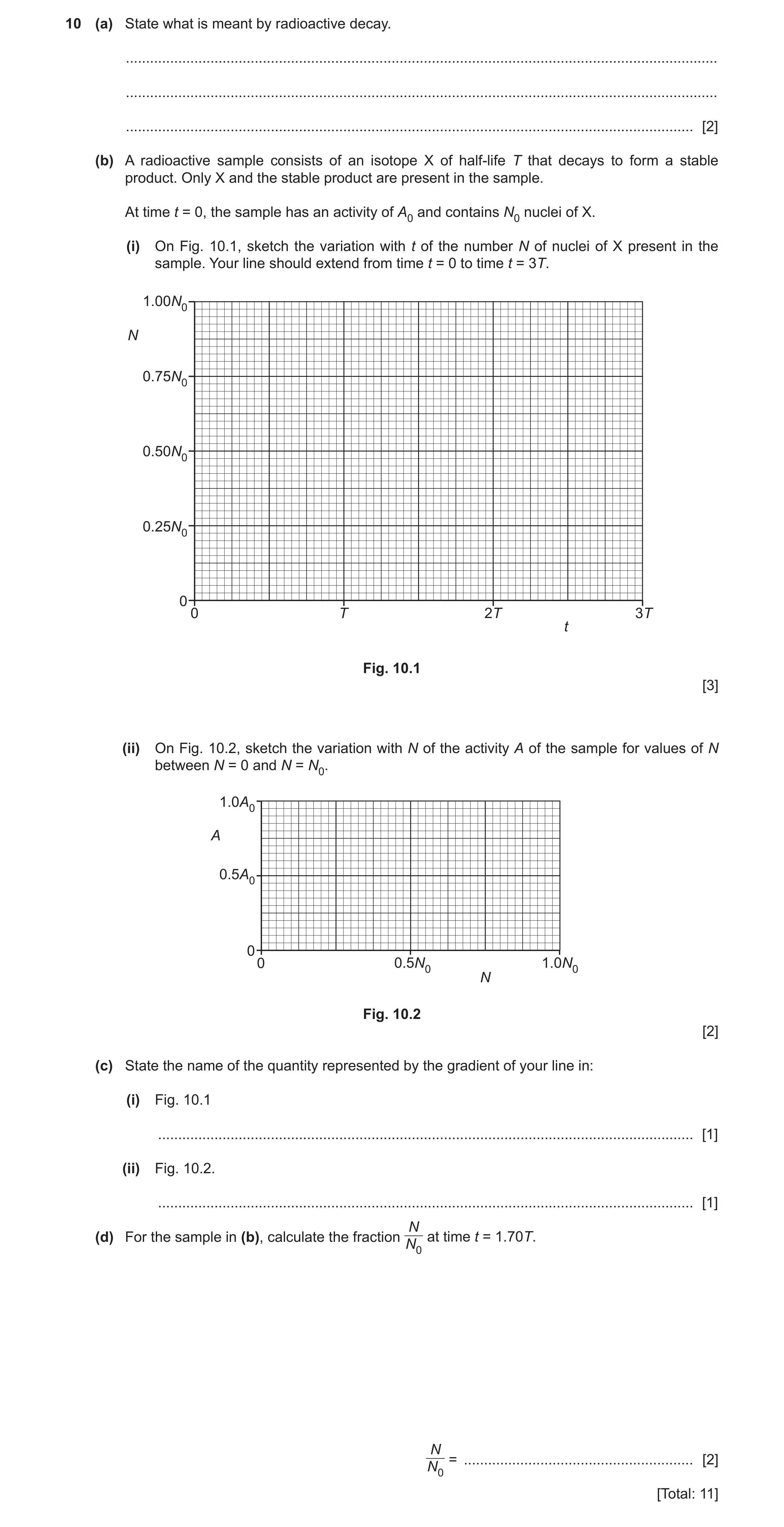
10 (a) State what is meant by radioactive decay. … … … [2] (b) A radioactive sample consists of an isotope X of half-life T that decays to form a stable product. Only X and the stable product are present in the sample. At time t = 0, the sample has an activity of A0 and contains N0 nuclei of X. (i) On Fig. 10.1, sketch the variation with t of the number N of nuclei of X present in the sample. Your line should extend from time t = 0 to time t = 3T. 1.00N0 N 0.75N0 0.50N0 0.25N0 0 0 T 2T 3T t Fig. 10.1 [3] (ii) On Fig. 10.2, sketch the variation with N of the activity A of the sample for values of N between N = 0 and N = N0. 1.0A0 A 0.5A0 0 0 0.5N0 1.0N0 N Fig. 10.2 [2] (c) State the name of the quantity represented by the gradient of your line in: (i) Fig. 10.1 … [1] (ii) Fig. 10.2. … [1] N (d) For the sample in (b), calculate the fraction at time t = 1.70T. N0 N = … [2] N0 [Total: 11]
11 marks
Mark scheme: 10(a) spontaneous emission of (ionising) radiation B1 emission from unstable nucleus B1 10(b)(i) curve with decreasing negative gradient passing through (0, N0) B1 curve passing through (T, 0.5N0) B1 curve passing through (2T, 0.25N0) and (3T, 0.125N0) B1 10(b)(ii) line through origin with positive gradient B1 straight line passing through (N0, A0) B1 10(c)(i) activity B1 10(c)(ii) decay constant B1 10(d) N = N0 exp (– ln 2 1.70T / T) C1 N / N0 = 0.31 A1
This question in 9702/42 May/June 2022
Q29 · Carbon-15 (156 C) is an isotope of carbon that undergoes radioactive decay to nitrogen-15… 9702/41 Oct/Nov 2022
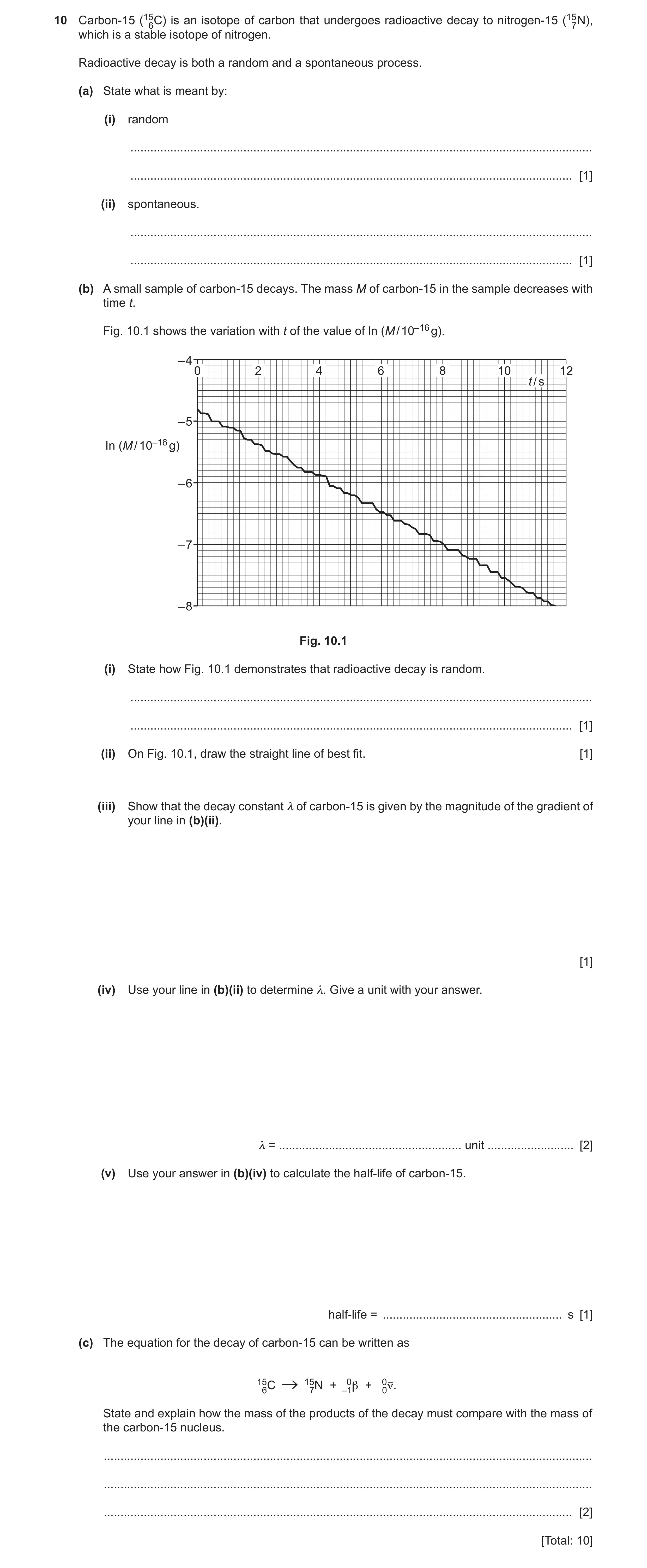
10 Carbon-15 (156 C) is an isotope of carbon that undergoes radioactive decay to nitrogen-15 (157 N), which is a stable isotope of nitrogen. Radioactive decay is both a random and a spontaneous process. (a) State what is meant by: (i) random … … [1] (ii) spontaneous. … … [1] (b) A small sample of carbon-15 decays. The mass M of carbon-15 in the sample decreases with time t. Fig. 10.1 shows the variation with t of the value of ln (M / 10–16 g). – 4 0 2 4 6 8 10 12 t / s – 5 In (M / 10–16 g) – 6 – 7 – 8 Fig. 10.1 (i) State how Fig. 10.1 demonstrates that radioactive decay is random. … … [1] (ii) On Fig. 10.1, draw the straight line of best fit. [1] (iii) Show that the decay constant λ of carbon-15 is given by the magnitude of the gradient of your line in (b)(ii). [1] (iv) Use your line in (b)(ii) to determine λ. Give a unit with your answer. λ = … unit … [2] (v) Use your answer in (b)(iv) to calculate the half-life of carbon-15. half-life = … s [1] (c) The equation for the decay of carbon-15 can be written as 156C 157N + –1β0 + 00ν. State and explain how the mass of the products of the decay must compare with the mass of the carbon-15 nucleus. … … … [2] [Total: 10]
10 marks
Mark scheme: 10(a)(i) cannot predict when a (particular) nucleus will decay B1 or cannot predict which nucleus will decay next 10(a)(ii) not affected by external / environmental factors B1 10(b)(i) line fluctuates B1 or trend is a straight line 10(b)(ii) straight line of best fit drawn on Fig. 10.1 B1 10(b)(iii) M = M0 exp (–t) B1 so ln M = ln M0 – t so gradient = –(and magnitude of gradient = ) 10(b)(iv) gradient = (–) (8.0 – 4.8) / (11.6 – 0) (allow any correct pair of values from Fig. 10.1) C1 = 0.28 s–1 A1 10(b)(v) half-life = 0.693 / A1 = 0.693 / 0.28 = 2.5 s 10(c) (for reaction to occur,) energy is released B1 energy release comes from fall in mass so total mass of products must be less (than mass of carbon-15) B1
This question in 9702/41 Oct/Nov 2022
Q30 · Carbon-15 (156 C) is an isotope of carbon that undergoes radioactive decay to nitrogen-15… 9702/43 Oct/Nov 2022
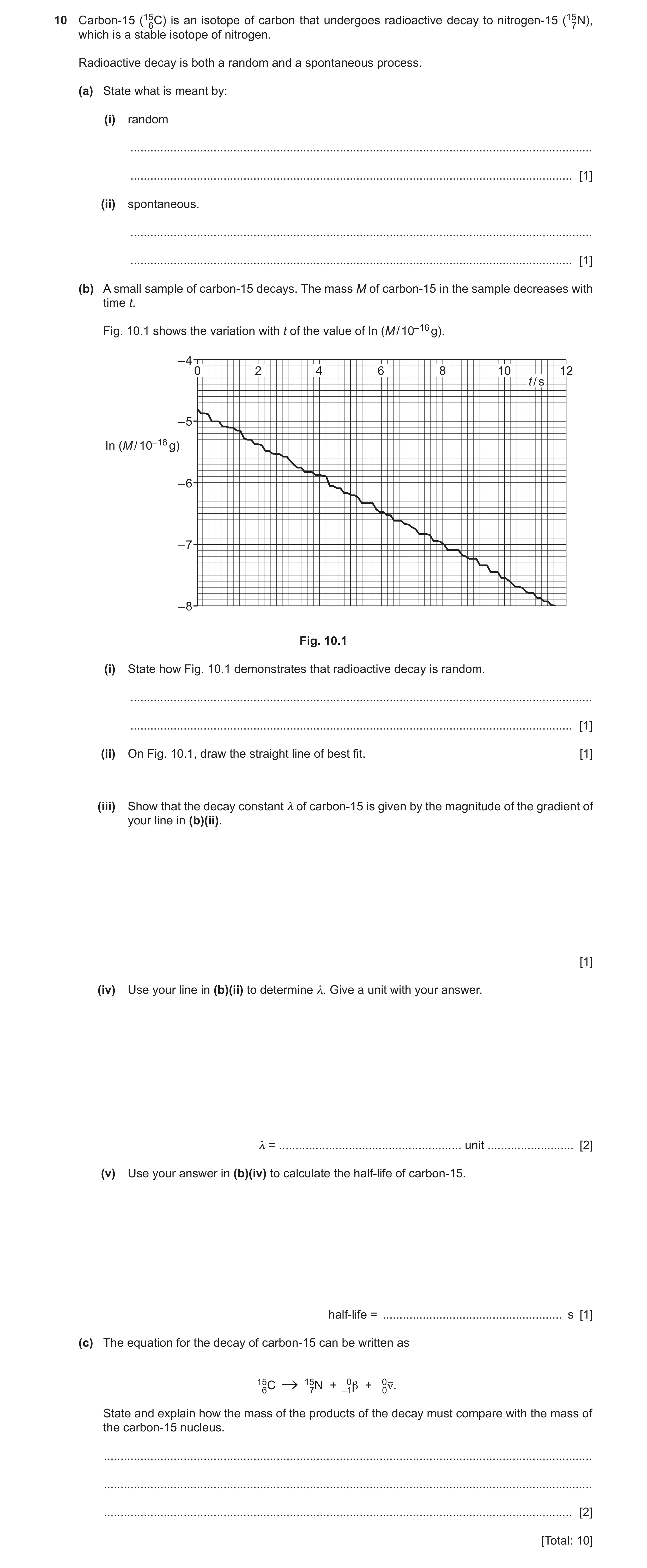
10 Carbon-15 (156 C) is an isotope of carbon that undergoes radioactive decay to nitrogen-15 (157 N), which is a stable isotope of nitrogen. Radioactive decay is both a random and a spontaneous process. (a) State what is meant by: (i) random … … [1] (ii) spontaneous. … … [1] (b) A small sample of carbon-15 decays. The mass M of carbon-15 in the sample decreases with time t. Fig. 10.1 shows the variation with t of the value of ln (M / 10–16 g). – 4 0 2 4 6 8 10 12 t / s – 5 In (M / 10–16 g) – 6 – 7 – 8 Fig. 10.1 (i) State how Fig. 10.1 demonstrates that radioactive decay is random. … … [1] (ii) On Fig. 10.1, draw the straight line of best fit. [1] (iii) Show that the decay constant λ of carbon-15 is given by the magnitude of the gradient of your line in (b)(ii). [1] (iv) Use your line in (b)(ii) to determine λ. Give a unit with your answer. λ = … unit … [2] (v) Use your answer in (b)(iv) to calculate the half-life of carbon-15. half-life = … s [1] (c) The equation for the decay of carbon-15 can be written as 156C 157N + –1β0 + 00ν. State and explain how the mass of the products of the decay must compare with the mass of the carbon-15 nucleus. … … … [2] [Total: 10]
10 marks
Mark scheme: 10(a)(i) cannot predict when a (particular) nucleus will decay B1 or cannot predict which nucleus will decay next 10(a)(ii) not affected by external / environmental factors B1 10(b)(i) line fluctuates B1 or trend is a straight line 10(b)(ii) straight line of best fit drawn on Fig. 10.1 B1 10(b)(iii) M = M0 exp (–t) B1 so ln M = ln M0 – t so gradient = –(and magnitude of gradient = ) 10(b)(iv) gradient = (–) (8.0 – 4.8) / (11.6 – 0) (allow any correct pair of values from Fig. 10.1) C1 = 0.28 s–1 A1 10(b)(v) half-life = 0.693 / A1 = 0.693 / 0.28 = 2.5 s 10(c) (for reaction to occur,) energy is released B1 energy release comes from fall in mass so total mass of products must be less (than mass of carbon-15) B1
This question in 9702/43 Oct/Nov 2022
Q31 · Plutonium-238 (23894Pu) is unstable and undergoes alpha decay 9702/42 Feb/March 2023
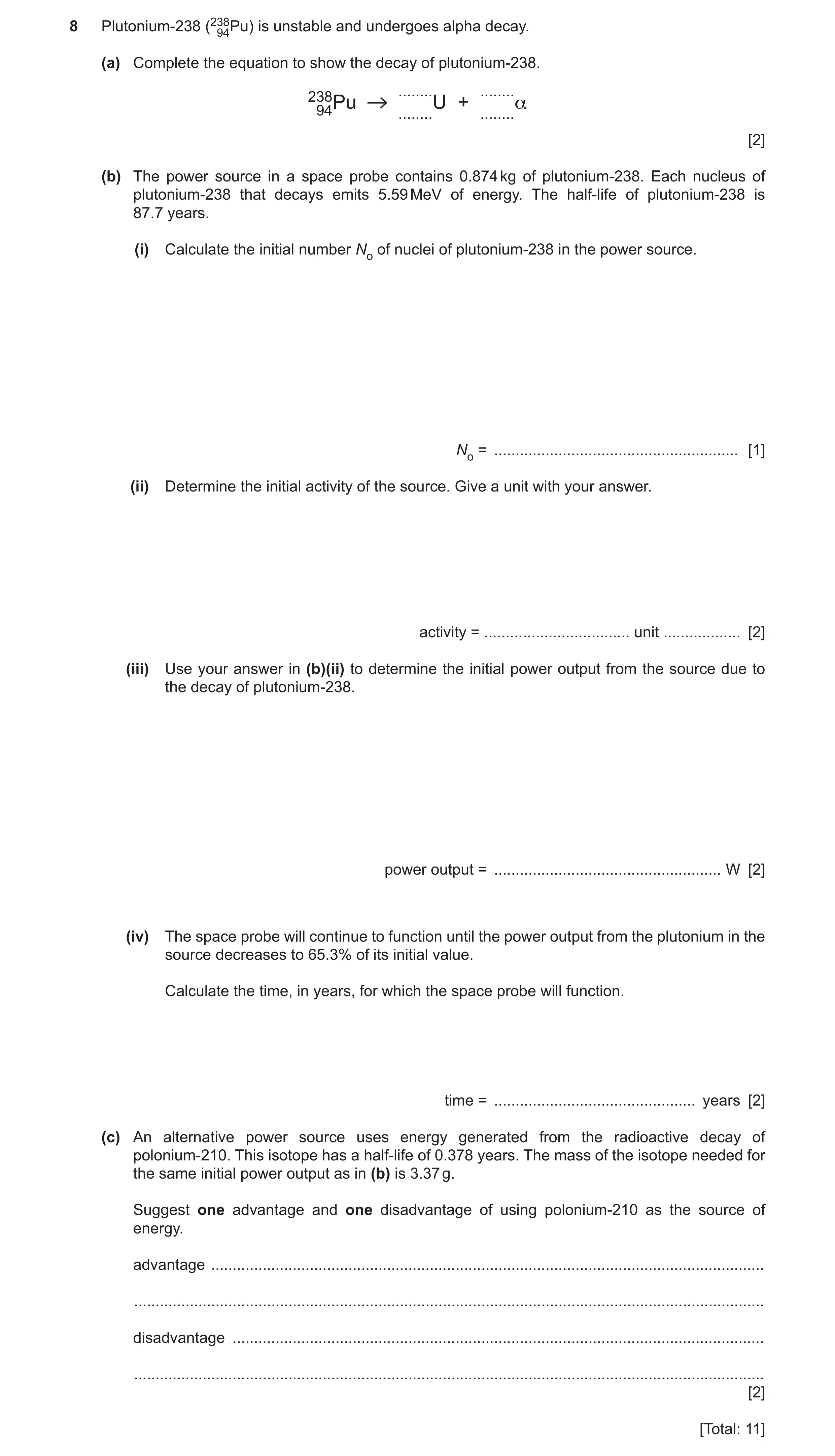
8 Plutonium-238 (23894Pu) is unstable and undergoes alpha decay. (a) Complete the equation to show the decay of plutonium-238. … … 23894Pu … U + … α [2] (b) The power source in a space probe contains 0.874 kg of plutonium-238. Each nucleus of plutonium-238 that decays emits 5.59 MeV of energy. The half-life of plutonium-238 is 87.7 years. (i) Calculate the initial number No of nuclei of plutonium-238 in the power source. No = … [1] (ii) Determine the initial activity of the source. Give a unit with your answer. activity = … unit … [2] (iii) Use your answer in (b)(ii) to determine the initial power output from the source due to the decay of plutonium-238. power output = … W [2] (iv) The space probe will continue to function until the power output from the plutonium in the source decreases to 65.3% of its initial value. Calculate the time, in years, for which the space probe will function. time = … years [2] (c) An alternative power source uses energy generated from the radioactive decay of polonium-210. This isotope has a half-life of 0.378 years. The mass of the isotope needed for the same initial power output as in (b) is 3.37 g. Suggest one advantage and one disadvantage of using polonium-210 as the source of energy. advantage … … disadvantage … … [2] [Total: 11]
11 marks
Mark scheme: 8(a) 234, 92 for the uranium nucleus B1 4, 2 for the alpha particle B1 8(b)(i) N0 = 0.874 / (238 1.66 10–27) A1 = 2.21 1024 8(b)(ii) A = N C1 ln2 24 A1 = 2.21 10 87.7 365 24 3600 = 5.54 1014 Bq 8(b)(iii) power = 5.54 1014 5.59 106 1.60 10–19 C1 = 496 W A1 8(b)(iv) − ln2 t C1 65.3 = 100e 87.7 ln 0.653 = – (ln 2 / 87.7) t A1 t = 53.9 years 8(c) advantage: less mass so less energy needed to launch probe B1 disadvantage: half-life shorter so will not provide power for as long B1
This question in 9702/42 Feb/March 2023
Q32 · Carbon-11 is radioactive and decays by β+ emission to form boron-11 9702/41 May/June 2023
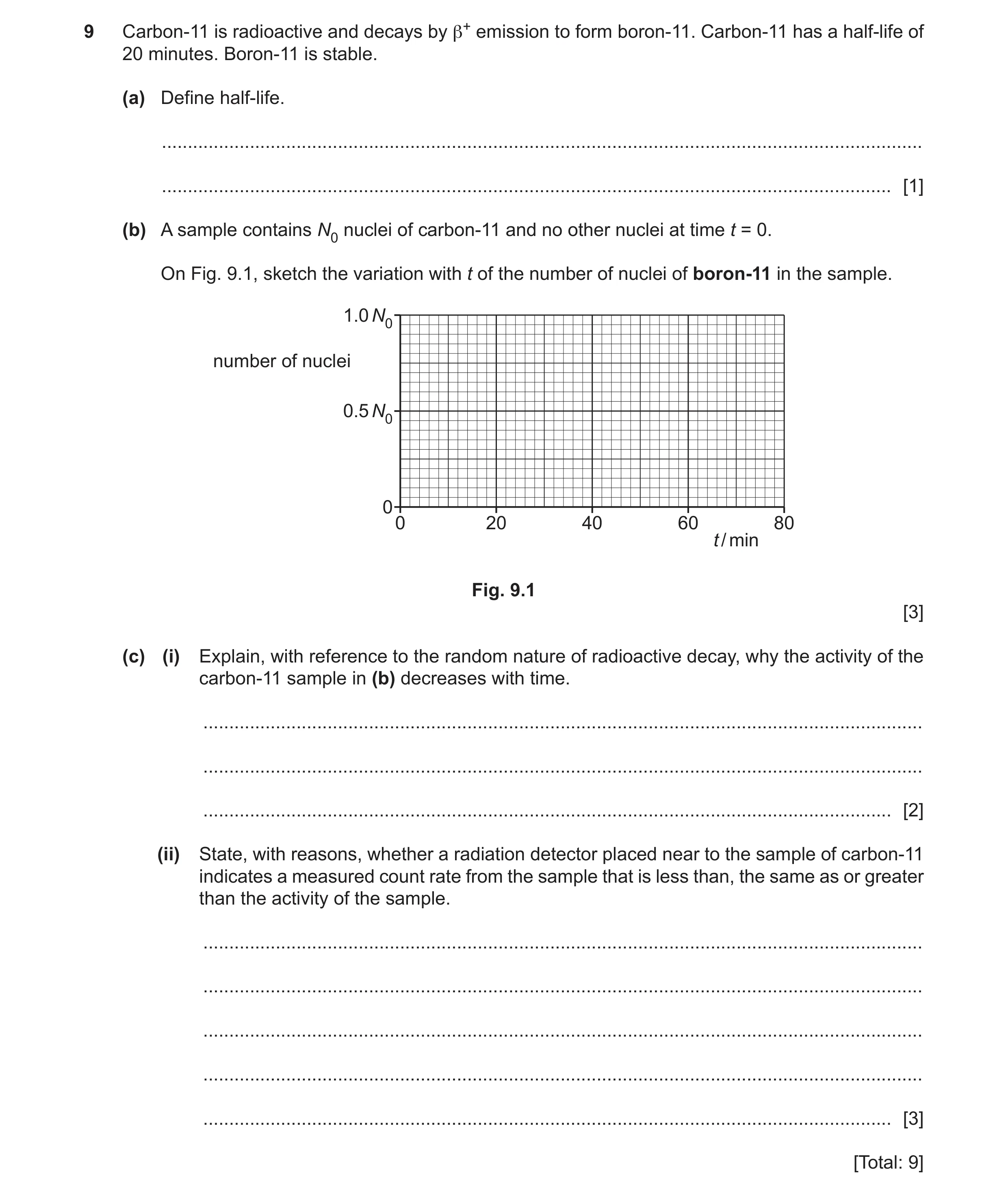
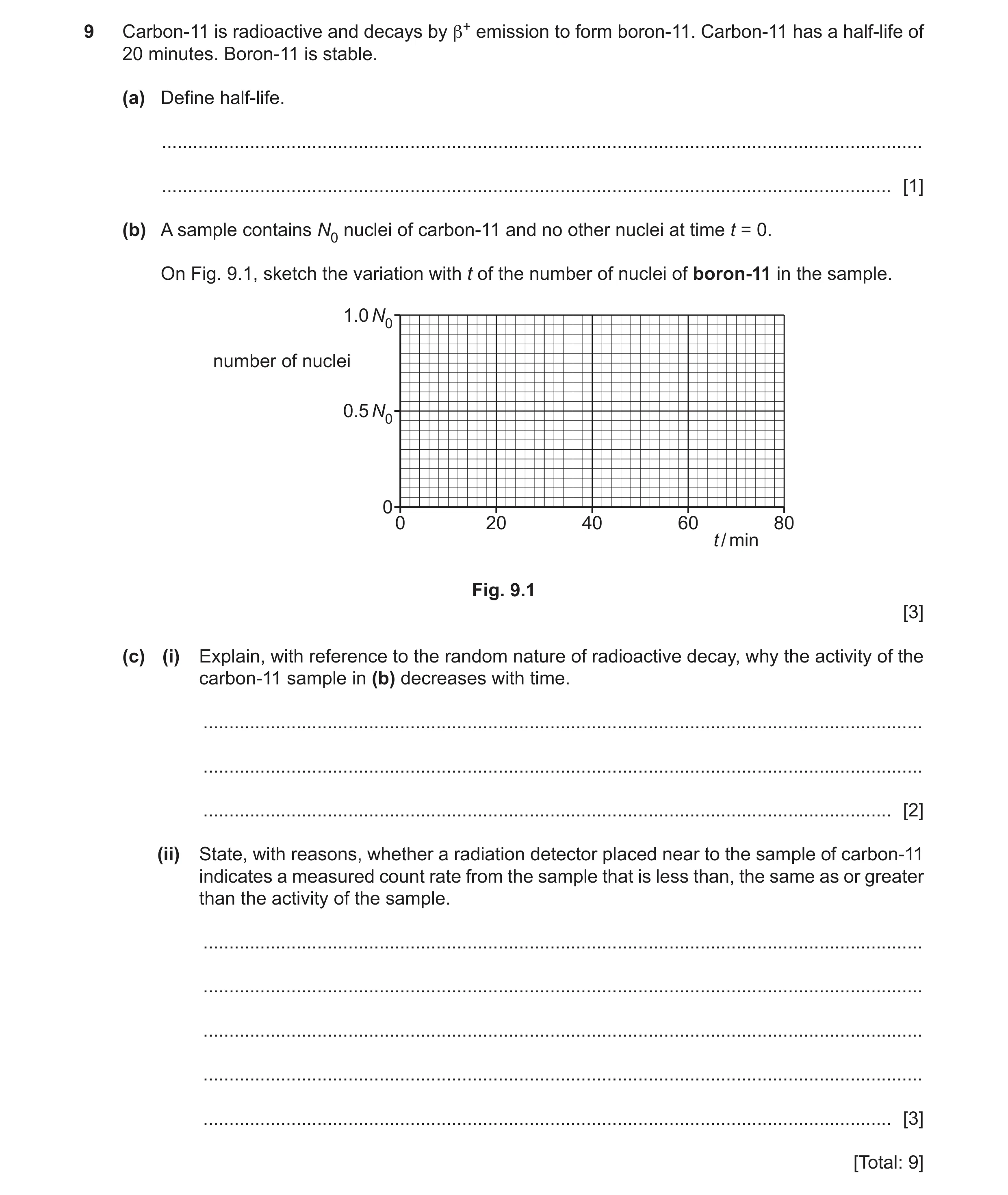
9 Carbon-11 is radioactive and decays by β+ emission to form boron-11. Carbon-11 has a half-life of 20 minutes. Boron-11 is stable. (a) Define half-life. … … [1] (b) A sample contains N0 nuclei of carbon-11 and no other nuclei at time t = 0. On Fig. 9.1, sketch the variation with t of the number of nuclei of boron-11 in the sample. 1.0 N0 number of nuclei 0.5 N0 0 0 20 40 60 80 t / min Fig. 9.1 [3] (c) (i) Explain, with reference to the random nature of radioactive decay, why the activity of the carbon-11 sample in (b) decreases with time. … … … [2] (ii) State, with reasons, whether a radiation detector placed near to the sample of carbon-11 indicates a measured count rate from the sample that is less than, the same as or greater than the activity of the sample. … … … … … [3] [Total: 9]
9 marks
Mark scheme: 9(a) time for activity (of sample) to halve B1 9(b) sketch: line with positive gradient starting at (0,0) and extending to t = 80 min B1 exponential curve, extending from t = 0 to t = 80 min, with gradient of steadily decreasing magnitude B1 line passing through (0,0), (20, 0.5N0) and (40, 0.75 N0) B1 9(c)(i) every (undecayed) nucleus has the same probability of decay M1 fewer (undecayed) nuclei remaining (with time), so fewer will decay (in a given time interval) A1 9(c)(ii) sample emits in all directions but detector only captures emissions in one direction some emissions are absorbed before reaching detector some emissions are scattered within the sample simultaneous arrival of multiple particles only registers once some particles may reach detector but not cause ionisation Any two points, 1 mark each B2 measured count rate is less than the activity B1
This question in 9702/41 May/June 2023
Q33 · Carbon-11 is radioactive and decays by β+ emission to form boron-11 9702/43 May/June 2023
9 Carbon-11 is radioactive and decays by β+ emission to form boron-11. Carbon-11 has a half-life of 20 minutes. Boron-11 is stable. (a) Define half-life. … … [1] (b) A sample contains N0 nuclei of carbon-11 and no other nuclei at time t = 0. On Fig. 9.1, sketch the variation with t of the number of nuclei of boron-11 in the sample. 1.0 N0 number of nuclei 0.5 N0 0 0 20 40 60 80 t / min Fig. 9.1 [3] (c) (i) Explain, with reference to the random nature of radioactive decay, why the activity of the carbon-11 sample in (b) decreases with time. … … … [2] (ii) State, with reasons, whether a radiation detector placed near to the sample of carbon-11 indicates a measured count rate from the sample that is less than, the same as or greater than the activity of the sample. … … … … … [3] [Total: 9]
9 marks
Mark scheme: 9(a) time for activity (of sample) to halve B1 9(b) sketch: line with positive gradient starting at (0,0) and extending to t = 80 min B1 exponential curve, extending from t = 0 to t = 80 min, with gradient of steadily decreasing magnitude B1 line passing through (0,0), (20, 0.5N0) and (40, 0.75 N0) B1 9(c)(i) every (undecayed) nucleus has the same probability of decay M1 fewer (undecayed) nuclei remaining (with time), so fewer will decay (in a given time interval) A1 9(c)(ii) sample emits in all directions but detector only captures emissions in one direction some emissions are absorbed before reaching detector some emissions are scattered within the sample simultaneous arrival of multiple particles only registers once some particles may reach detector but not cause ionisation Any two points, 1 mark each B2 measured count rate is less than the activity B1
This question in 9702/43 May/June 2023
Q34 · Define half-life of a radioactive isotope 9702/41 May/June 2024
9 (a) Define half-life of a radioactive isotope. … … … [1] (b) Radioactive isotope X decays to isotope Y. A sample contains only nuclei of X at time t = 0. Fig. 9.1 shows the variation with t of the numbers of nuclei of X and of Y as the sample decays. 4 Y number of nuclei / 1022 3 2 1 X 0 0 10 20 30 40 50 60 t / s Fig. 9.1 (i) State the name of the quantity represented by the magnitude of the gradient of line X in Fig. 9.1. … [1] (ii) State three conclusions about X or Y that may be drawn from Fig. 9.1. The conclusions may be qualitative or quantitative. Use the space below for any working that you need. 1 … … 2 … … 3 … … [3] (c) The mass of radioactive isotope X in the sample in (b) is 7.3 × 10⁻⁴ kg at time t = 0. Determine the nucleon number of isotope X. nucleon number = … [3] [Total: 8]
8 marks
Mark scheme: 9(a) time for activity (of sample) to halve B1 9(b)(i) activity (of X at time t) B1 9(b)(ii) Y is a stable isotope total number of nuclei is constant half-life (of X) is 13.6 s decay constant (of X) is 0.051 s–1 amount (of X) at t = 0 is 0.066 mol activity (of X) at t = 0 is 2.0 1021 Bq Any three points, 1 mark each B3 9(c) mass of 1 nucleus = (7.3 10–4) / (4.0 1022) C1 nucleon number = mass of nucleus / (1.66 10–27) C1 = (7.3 10–4) / (4.0 × 10²² 1.66 × 10⁻²⁷) = 11 and given as an integer A1
This question in 9702/41 May/June 2024
Q35 · Define half-life of a radioactive isotope 9702/43 May/June 2024
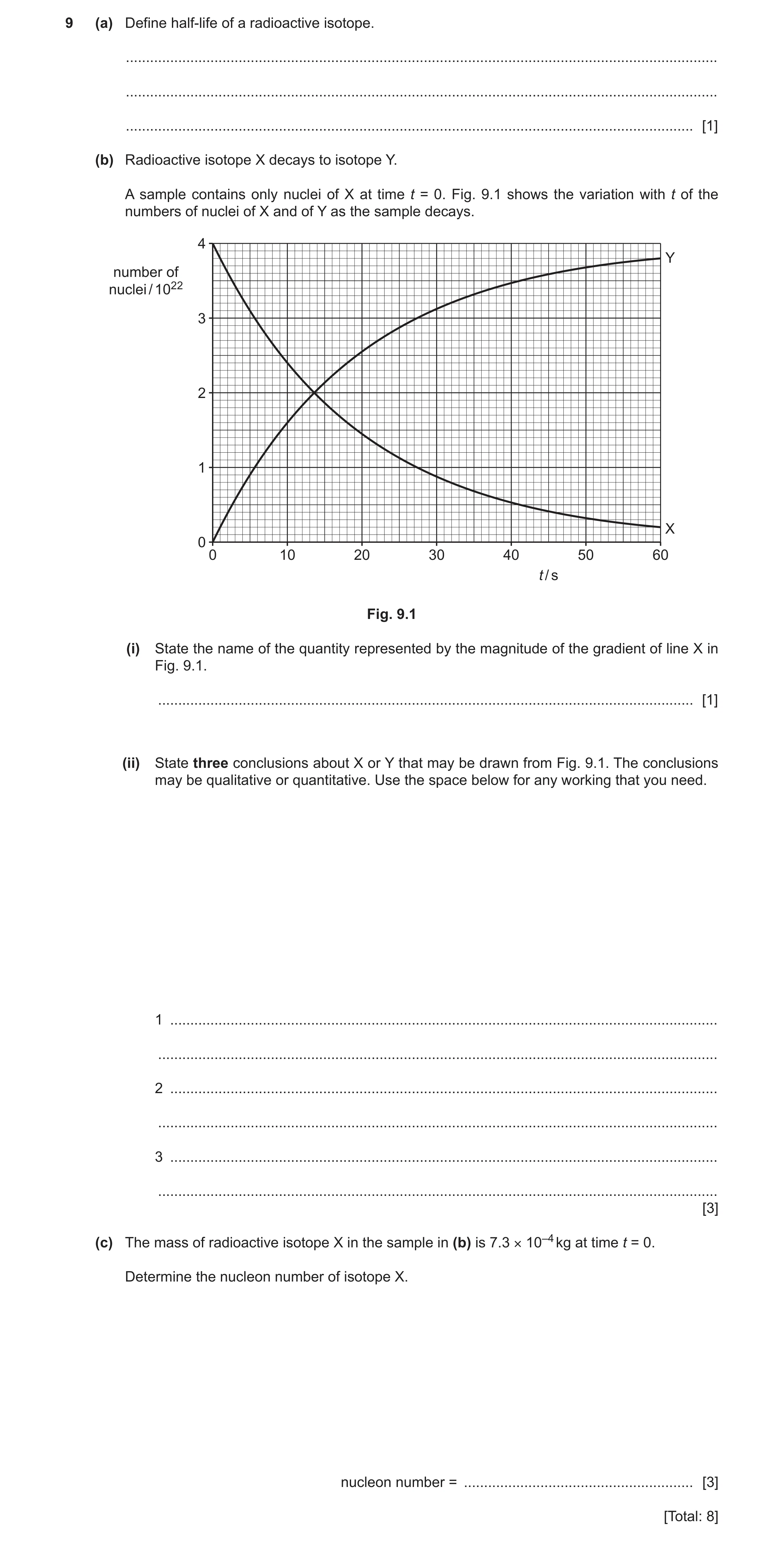
9 (a) Define half-life of a radioactive isotope. … … … [1] (b) Radioactive isotope X decays to isotope Y. A sample contains only nuclei of X at time t = 0. Fig. 9.1 shows the variation with t of the numbers of nuclei of X and of Y as the sample decays. 4 Y number of nuclei / 1022 3 2 1 X 0 0 10 20 30 40 50 60 t / s Fig. 9.1 (i) State the name of the quantity represented by the magnitude of the gradient of line X in Fig. 9.1. … [1] (ii) State three conclusions about X or Y that may be drawn from Fig. 9.1. The conclusions may be qualitative or quantitative. Use the space below for any working that you need. 1 … … 2 … … 3 … … [3] (c) The mass of radioactive isotope X in the sample in (b) is 7.3 × 10⁻⁴ kg at time t = 0. Determine the nucleon number of isotope X. nucleon number = … [3] [Total: 8]
8 marks
Mark scheme: 9(a) time for activity (of sample) to halve B1 9(b)(i) activity (of X at time t) B1 9(b)(ii) Y is a stable isotope total number of nuclei is constant half-life (of X) is 13.6 s decay constant (of X) is 0.051 s–1 amount (of X) at t = 0 is 0.066 mol activity (of X) at t = 0 is 2.0 1021 Bq Any three points, 1 mark each B3 9(c) mass of 1 nucleus = (7.3 10–4) / (4.0 1022) C1 nucleon number = mass of nucleus / (1.66 10–27) C1 = (7.3 10–4) / (4.0 × 10²² 1.66 × 10⁻²⁷) = 11 and given as an integer A1
This question in 9702/43 May/June 2024
Q36 · Fluorine-18 ( 9F) decays by beta-plus (β+) emission with a half-life of 110 minutes 9702/41 Oct/Nov 2024
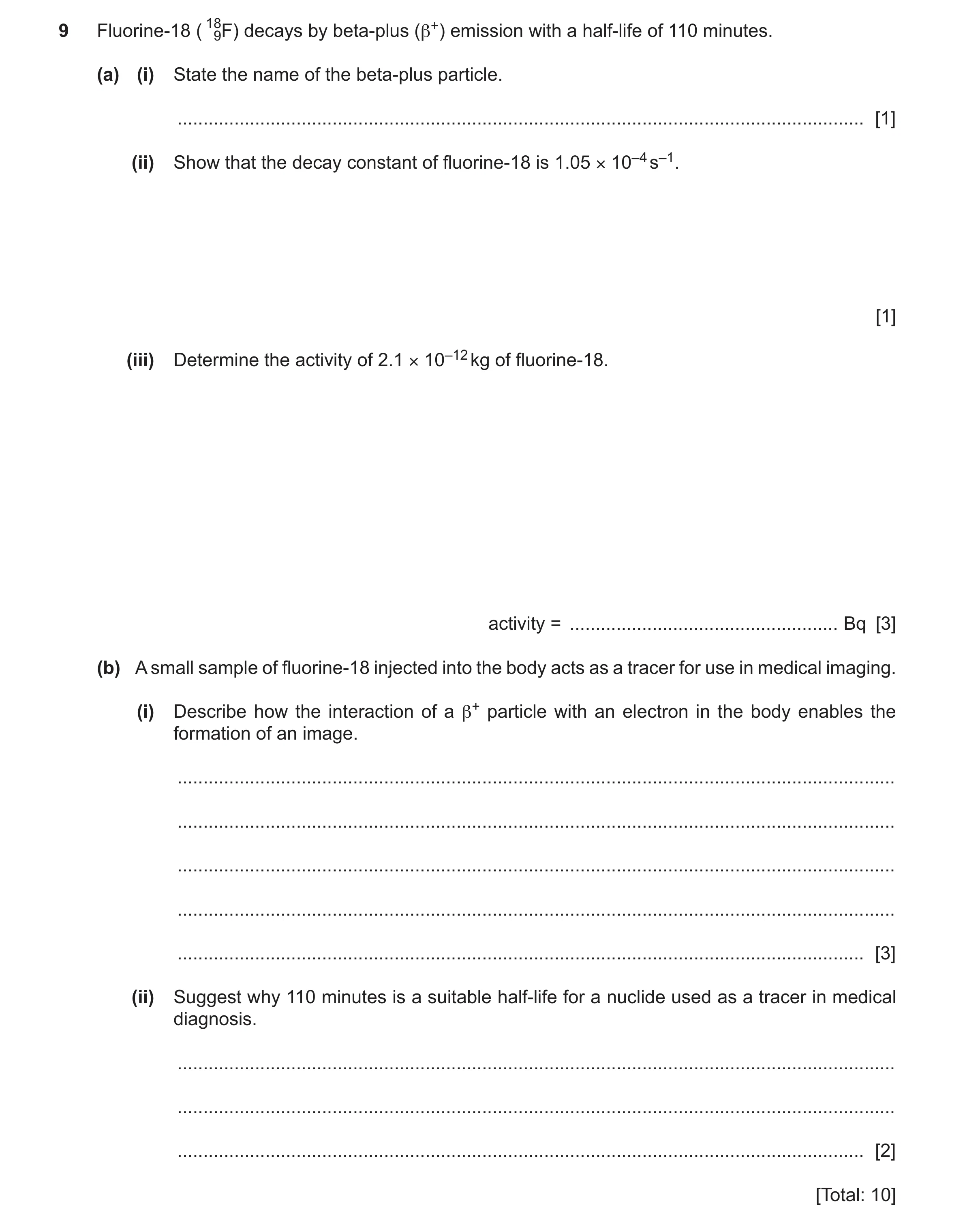
9 Fluorine-18 ( 9F) decays by beta-plus (β+) emission with a half-life of 110 minutes. (a) (i) State the name of the beta-plus particle. … [1] (ii) Show that the decay constant of fluorine-18 is 1.05 × 10⁻⁴ s–1. [1] (iii) Determine the activity of 2.1 × 10⁻¹² kg of fluorine-18. activity = … Bq [3] (b) A small sample of fluorine-18 injected into the body acts as a tracer for use in medical imaging. (i) Describe how the interaction of a β+ particle with an electron in the body enables the formation of an image. … … … … … [3] (ii) Suggest why 110 minutes is a suitable half-life for a nuclide used as a tracer in medical diagnosis. … … … [2] [Total: 10]
10 marks
Mark scheme: 9(a)(i) positron B1 9(a)(ii) = ln 2 / (110 60) = 1.05 10–4 s–1 A1 9(a)(iii) N = M / (18 u) or (M in grams NA / 18) C1 N = (2.1 10–12) / (18 1.66 10–27) or (2.1 10–9 6.02 1023) / 18 ( = 7.0 1013) A = N C1 = 1.05 10–4 7.0 1013 A1 = 7.4 109 Bq 9(b)(i) • (pair) annihilation occurs B3 • the mass of the two particles is converted into energy • two gamma photons are formed and travel in opposite directions or two gamma photons are formed and leave the body • difference in arrival times of photons (at detector) is processed Any three points, 1 mark each 9(b)(ii) with a shorter half-life: sample would (almost) fully decay before the test is complete B1 a longer half-life: exposes patient to harmful/ionising radiation unnecessarily B1 or with a longer half-life: a larger dose (of tracer) needed to produce detectable activity
This question in 9702/41 Oct/Nov 2024
Q37 · Radioactive decay is both random and spontaneous 9702/42 Oct/Nov 2024
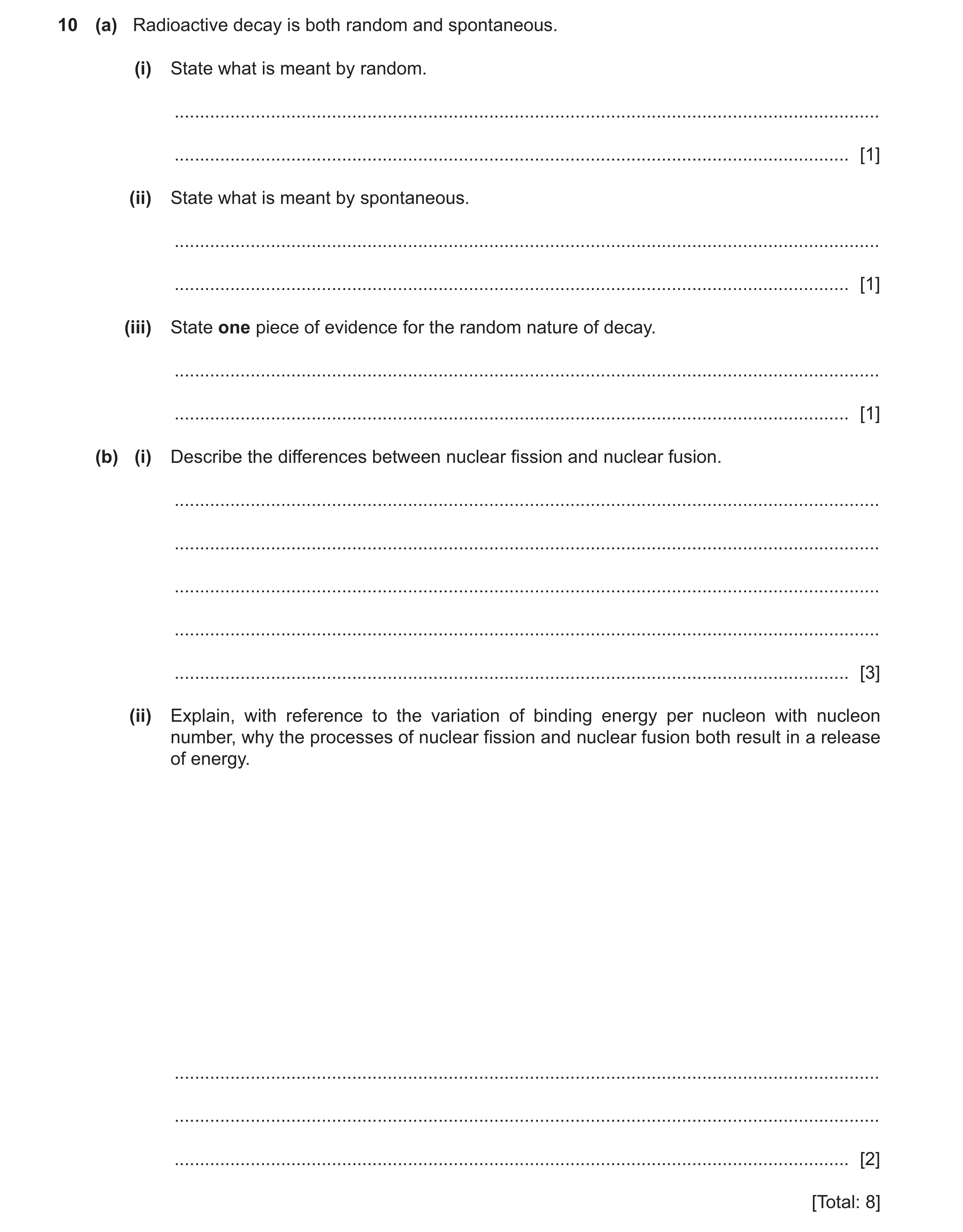
10 (a) Radioactive decay is both random and spontaneous. (i) State what is meant by random. … … [1] (ii) State what is meant by spontaneous. … … [1] (iii) State one piece of evidence for the random nature of decay. … … [1] (b) (i) Describe the differences between nuclear fission and nuclear fusion. … … … … … [3] (ii) Explain, with reference to the variation of binding energy per nucleon with nucleon number, why the processes of nuclear fission and nuclear fusion both result in a release of energy. … … … [2] [Total: 8]
8 marks
Mark scheme: 10(a)(i) cannot predict when a particular nucleus will decay B1 or cannot predict which nucleus will decay next 10(a)(ii) (decay is) not affected by external (environmental) factors B1 10(a)(iii) fluctuations in (measured) count rate B1 10(b)(i) • large nuclei undergo fission whereas small nuclei undergo fusion B3 • fission involves one nucleus splitting into two (or more) (smaller) nuclei • fusion involves two nuclei joining together to form one (larger) nucleus • fission is (usually) initiated by neutron bombardment • fusion is (usually) initiated by (very) high temperatures Any three points, 1 mark each 10(b)(ii) binding energy per nucleon is greatest for intermediate nucleon numbers B1 (may be shown on sketch graph with axes labelled ‘binding energy per nucleon’ and ‘nucleon number’) both fusion and fission involve an increase in binding energy (per nucleon) B1
This question in 9702/42 Oct/Nov 2024
Q38 · Fluorine-18 ( 9F) decays by beta-plus (β+) emission with a half-life of 110 minutes 9702/43 Oct/Nov 2024
9 Fluorine-18 ( 9F) decays by beta-plus (β+) emission with a half-life of 110 minutes. (a) (i) State the name of the beta-plus particle. … [1] (ii) Show that the decay constant of fluorine-18 is 1.05 × 10⁻⁴ s–1. [1] (iii) Determine the activity of 2.1 × 10⁻¹² kg of fluorine-18. activity = … Bq [3] (b) A small sample of fluorine-18 injected into the body acts as a tracer for use in medical imaging. (i) Describe how the interaction of a β+ particle with an electron in the body enables the formation of an image. … … … … … [3] (ii) Suggest why 110 minutes is a suitable half-life for a nuclide used as a tracer in medical diagnosis. … … … [2] [Total: 10]
10 marks
Mark scheme: 9(a)(i) positron B1 9(a)(ii) = ln 2 / (110 60) = 1.05 10–4 s–1 A1 9(a)(iii) N = M / (18 u) or (M in grams NA / 18) C1 N = (2.1 10–12) / (18 1.66 10–27) or (2.1 10–9 6.02 1023) / 18 ( = 7.0 1013) A = N C1 = 1.05 10–4 7.0 1013 A1 = 7.4 109 Bq 9(b)(i) • (pair) annihilation occurs B3 • the mass of the two particles is converted into energy • two gamma photons are formed and travel in opposite directions or two gamma photons are formed and leave the body • difference in arrival times of photons (at detector) is processed Any three points, 1 mark each 9(b)(ii) with a shorter half-life: sample would (almost) fully decay before the test is complete B1 a longer half-life: exposes patient to harmful/ionising radiation unnecessarily B1 or with a longer half-life: a larger dose (of tracer) needed to produce detectable activity
This question in 9702/43 Oct/Nov 2024
Q39 · Polonium‑193 (19384Po) is an unstable nuclide 9702/42 Feb/March 2025
9 Polonium‑193 (19384Po) is an unstable nuclide. A nucleus of polonium‑193 decays to a nucleus of lead‑189 (18982Pb) by emitting an alpha‑particle. (a) Radioactive decay is both random and spontaneous. State what is meant by: (i) random … … [1] (ii) spontaneous. … … [1] (b) Define half‑life. … … … [1] (c) Data for the binding energy per nucleon of the particles involved in the decay of a nucleus of polonium‑193 are given in Table 9.1. Table 9.1 particle binding energy per nucleon / eV 19384Po 7.774 18982Pb 7.826 4α 7.074 2 Determine the energy, in eV, released when a nucleus of polonium‑193 decays into a nucleus of lead‑189. energy = … eV [2] (d) A pure sample of polonium‑193 contains N0 nuclei. After a time t the sample contains N nuclei of polonium‑193. The variation of ln (N / N0) with t is shown in Fig. 9.1. t / ms 0 0.2 0.4 0.6 0.8 1.0 0 –0.2 –0.4 –0.6 In (N / N0) –0.8 –1.0 –1.2 –1.4 Fig. 9.1 (i) State the name of the quantity that is represented by the magnitude of the gradient of the line in Fig. 9.1. … [1] (ii) Use Fig. 9.1 to determine the half‑life, in ms, of polonium‑193. half‑life = … ms [2] (e) Positron emission tomography (PET scanning) uses a radioactive tracer. (i) State what happens to the positrons emitted by the tracer. … … [1] (ii) Explain why a tracer with a half‑life of approximately 2 hours is a suitable tracer to use. … … [1] [Total: 10]
10 marks
Mark scheme: 9(a)(i) either: cannot predict when a (particular) nucleus will decay B1 or: cannot predict which nucleus will decay next 9(a)(ii) not affected by external / environmental factors B1 9(b) time for activity to halve B1 9(c) energy = (189 7.826) + (4 7.074) – (193 7.774) C1 = 7.03 eV A1 9(d)(i) decay constant A1 9(d)(ii) decay constant / magnitude of gradient = 1.4 / 0.84 C1 half-life = ln2 / (1.4 / 0.84) A1 = 0.42 ms 9(e)(i) positrons collide with electrons and annihilate B1 9(e)(ii) long enough to have time to conduct investigation, not so long as to cause patient unnecessary exposure to radiation B1
This question in 9702/42 Feb/March 2025
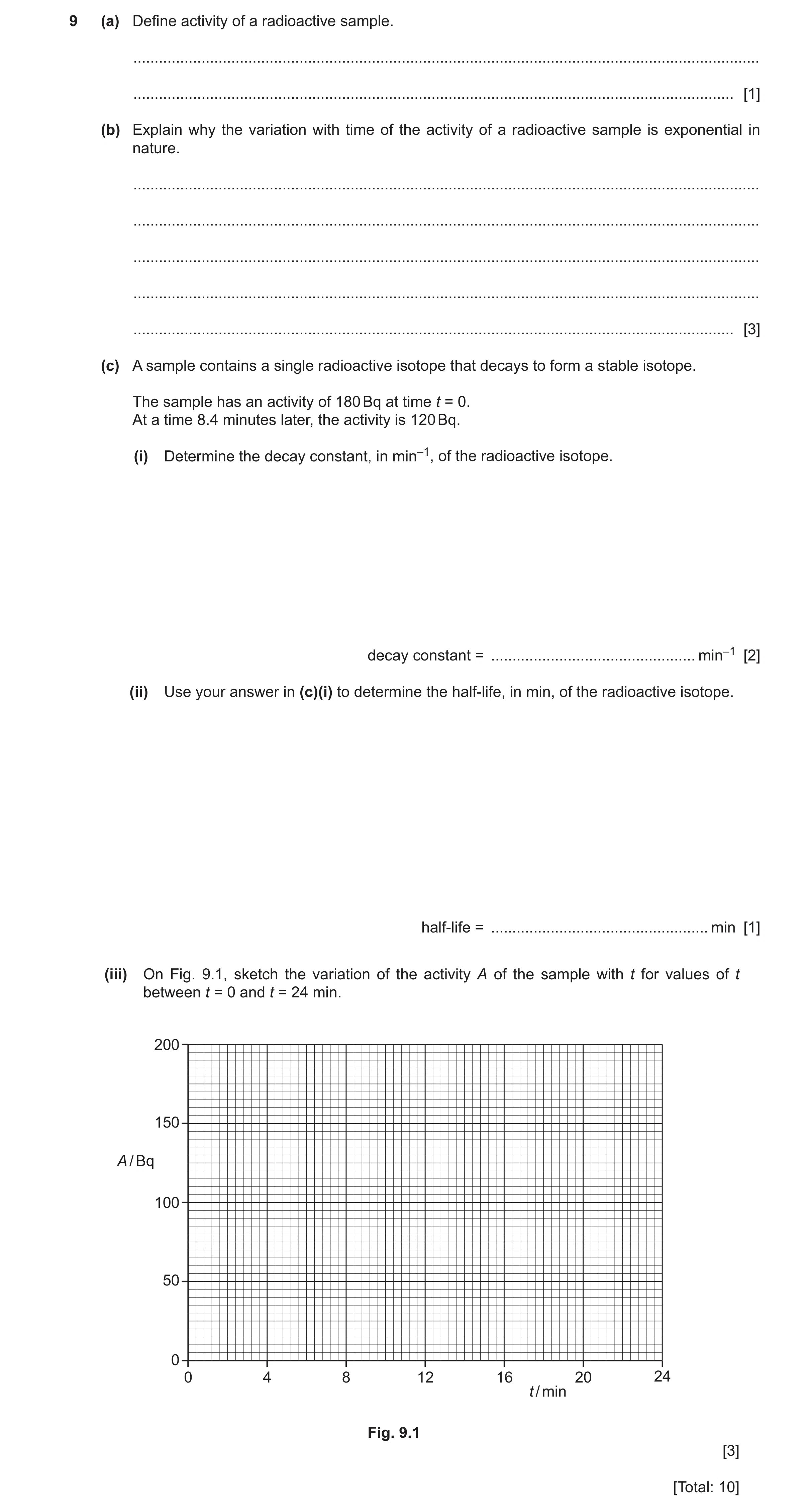
Q40 · Define activity of a radioactive sample 9702/41 May/June 2025
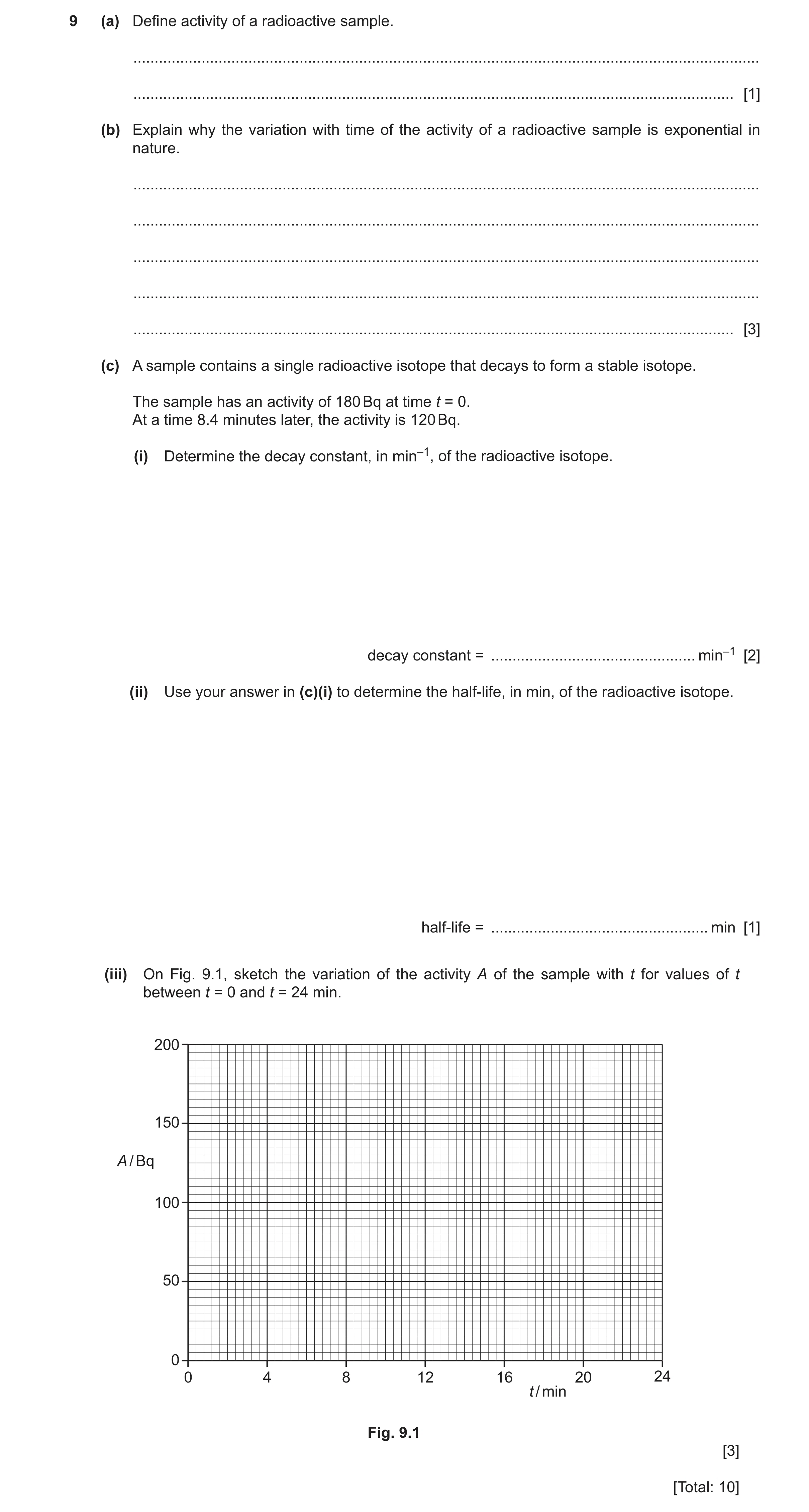
9 (a) Define activity of a radioactive sample. … … [1] (b) Explain why the variation with time of the activity of a radioactive sample is exponential in nature. … … … … … [3] (c) A sample contains a single radioactive isotope that decays to form a stable isotope. The sample has an activity of 180 Bq at time t = 0. At a time 8.4 minutes later, the activity is 120 Bq. (i) Determine the decay constant, in min–1, of the radioactive isotope. decay constant = … min–1 [2] (ii) Use your answer in (c)(i) to determine the half-life, in min, of the radioactive isotope. half-life = … min [1] (iii) On Fig. 9.1, sketch the variation of the activity A of the sample with t for values of t between t = 0 and t = 24 min. 200 150 A / Bq 100 50 0 0 4 8 12 16 20 24 t / min Fig. 9.1 [3] [Total: 10]
10 marks
Mark scheme: 9(a) number of nuclear disintegrations per unit time B1 9(b) activity is proportional to the number of undecayed nuclei B1 activity = (–) rate of change of number of undecayed nuclei B1 N is proportional to the rate of change of N (so exponential variation) B1 9(c)(i) 120 = 180 exp (– × 8.4) C1 = 0.048 min–1 A1 9(c)(ii) half-life = ln 2 / 0.048 A1 = 14 min 9(c)(iii) line with negative gradient throughout, starting at (0, 180) B1 curve with negative gradient passing through (8.4, 120) B1 curve with decreasing negative gradient, from t = 0 to t = 24 min, passing through (14, 90) B1
This question in 9702/41 May/June 2025
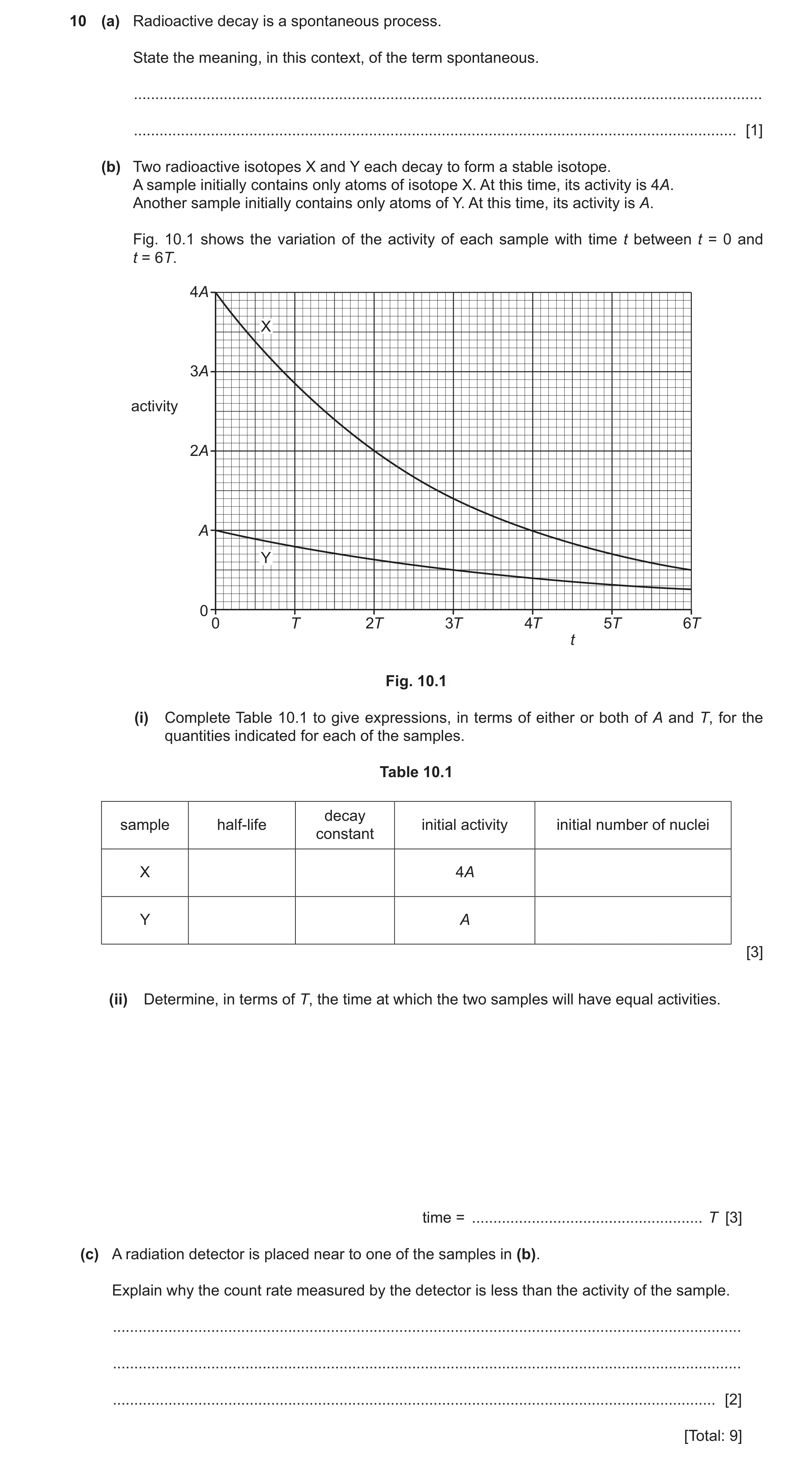
Q41 · Radioactive decay is a spontaneous process 9702/42 May/June 2025
10 (a) Radioactive decay is a spontaneous process. State the meaning, in this context, of the term spontaneous. … … [1] (b) Two radioactive isotopes X and Y each decay to form a stable isotope. A sample initially contains only atoms of isotope X. At this time, its activity is 4A. Another sample initially contains only atoms of Y. At this time, its activity is A. Fig. 10.1 shows the variation of the activity of each sample with time t between t = 0 and t = 6T. 4A X 3A activity 2A A Y 0 0 T 2T 3T 4T 5T 6T t Fig. 10.1 (i) Complete Table 10.1 to give expressions, in terms of either or both of A and T, for the quantities indicated for each of the samples. Table 10.1 decay sample half-life initial activity initial number of nuclei constant X 4A Y A [3] (ii) Determine, in terms of T, the time at which the two samples will have equal activities. time = … T [3] (c) A radiation detector is placed near to one of the samples in (b). Explain why the count rate measured by the detector is less than the activity of the sample. … … … [2] [Total: 9]
9 marks
Mark scheme: 10(a) (decay is) not affected by external / environmental factors B1 10(b)(i) half-life of X = 2T and half-life of Y = 3T B1 both samples show decay constant, in terms of 1 / T, equal to ln 2 / half-life B1 (decay constant of X = ln 2 / 2T and decay constant of Y = ln 2 / 3T if both half-lives correct) both samples show N0, in terms of AT, equal to initial activity / decay constant B1 (N0 for X = 8AT / ln 2 and N0 for Y = 3AT / ln 2 if both decay constants correct) (Fully correct table: half-life decay constant A0 N0 X 2T ln 2 / 2T 4A 8AT / ln 2 Y 3T ln 2 / 3T A 3AT / ln 2 ) 10(b)(ii) correct substitution of A0 and into A0 exp (–t) for sample X or sample Y C1 4A exp (–t ln 2 / 2T) = A exp (–t ln 2 / 3T) C1 t = 12T A1 10(c) Any two points from: B2 • (radiation) emitted in all directions, not just in direction of detector • some radiation absorbed by air / sample / window of detector • some radiation may not register even though it reaches detector
This question in 9702/42 May/June 2025
Q42 · Define activity of a radioactive sample 9702/43 May/June 2025
9 (a) Define activity of a radioactive sample. … … [1] (b) Explain why the variation with time of the activity of a radioactive sample is exponential in nature. … … … … … [3] (c) A sample contains a single radioactive isotope that decays to form a stable isotope. The sample has an activity of 180 Bq at time t = 0. At a time 8.4 minutes later, the activity is 120 Bq. (i) Determine the decay constant, in min–1, of the radioactive isotope. decay constant = … min–1 [2] (ii) Use your answer in (c)(i) to determine the half-life, in min, of the radioactive isotope. half-life = … min [1] (iii) On Fig. 9.1, sketch the variation of the activity A of the sample with t for values of t between t = 0 and t = 24 min. 200 150 A / Bq 100 50 0 0 4 8 12 16 20 24 t / min Fig. 9.1 [3] [Total: 10]
10 marks
Mark scheme: 9(a) number of nuclear disintegrations per unit time B1 9(b) activity is proportional to the number of undecayed nuclei B1 activity = (–) rate of change of number of undecayed nuclei B1 N is proportional to the rate of change of N (so exponential variation) B1 9(c)(i) 120 = 180 exp (– × 8.4) C1 = 0.048 min–1 A1 9(c)(ii) half-life = ln 2 / 0.048 A1 = 14 min 9(c)(iii) line with negative gradient throughout, starting at (0, 180) B1 curve with negative gradient passing through (8.4, 120) B1 curve with decreasing negative gradient, from t = 0 to t = 24 min, passing through (14, 90) B1
This question in 9702/43 May/June 2025
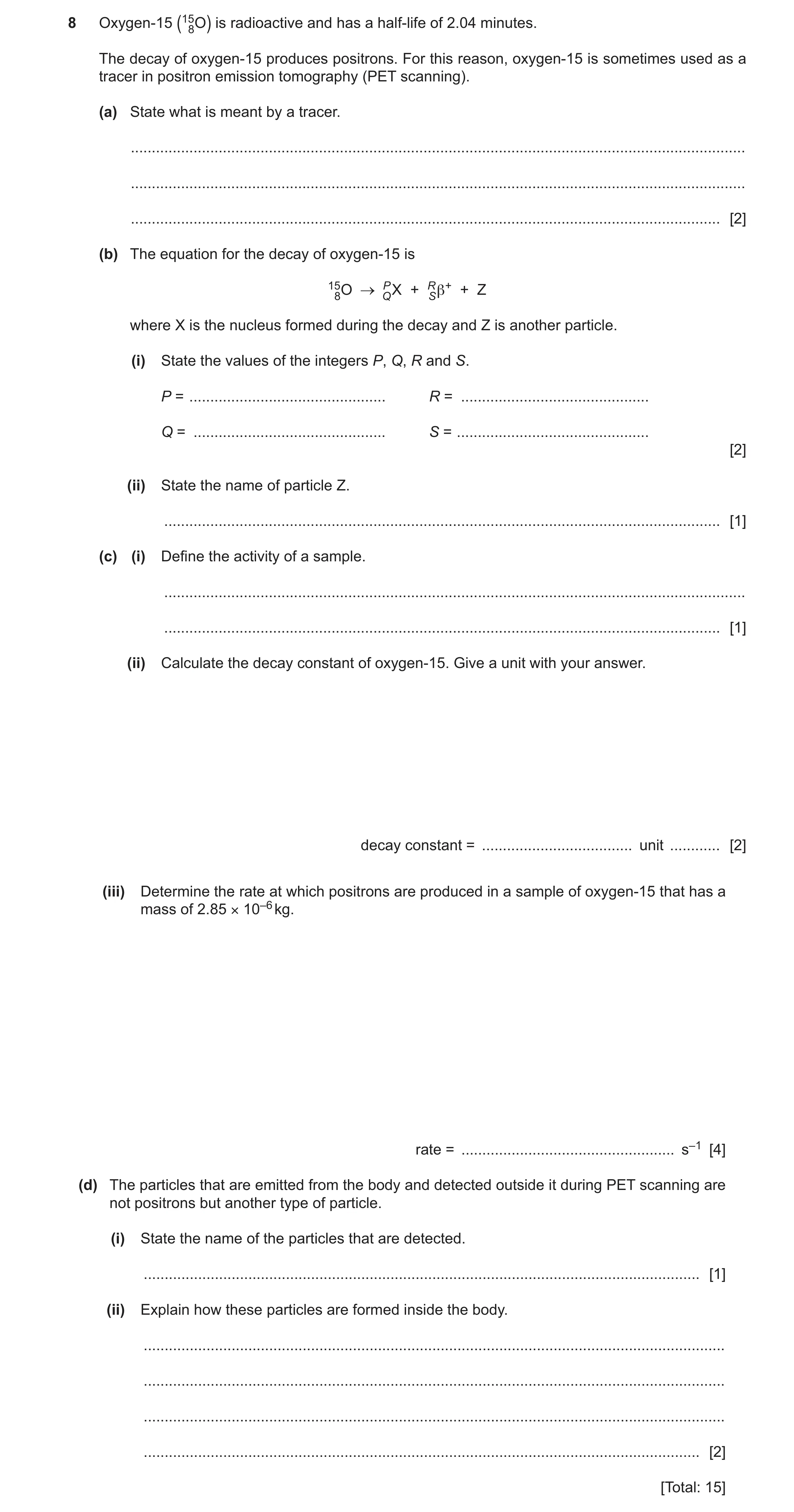
Q43 · Oxygen-15 (158O) is radioactive and has a half-life of 2.04 minutes 9702/44 Oct/Nov 2025
8 Oxygen-15 (158O) is radioactive and has a half-life of 2.04 minutes. The decay of oxygen-15 produces positrons. For this reason, oxygen-15 is sometimes used as a tracer in positron emission tomography (PET scanning). (a) State what is meant by a tracer. … … … [2] (b) The equation for the decay of oxygen-15 is 158O Q XP + RS β+ + Z where X is the nucleus formed during the decay and Z is another particle. (i) State the values of the integers P, Q, R and S. P = … R = … Q = … S = … [2] (ii) State the name of particle Z. … [1] (c) (i) Define the activity of a sample. … … [1] (ii) Calculate the decay constant of oxygen-15. Give a unit with your answer. decay constant = … unit … [2] (iii) Determine the rate at which positrons are produced in a sample of oxygen-15 that has a mass of 2.85 × 10⁻⁶ kg. rate = … s–1 [4] (d) The particles that are emitted from the body and detected outside it during PET scanning are not positrons but another type of particle. (i) State the name of the particles that are detected. … [1] (ii) Explain how these particles are formed inside the body. … … … … [2] [Total: 15]
15 marks
Mark scheme: 8(a) (radioactive) substance introduced into the body B1 substance absorbed by the tissues being studied B1 8(b)(i) P = 15 and R = 0 A1 Q = 7 and S = (+)1 A1 8(b)(ii) (electron) neutrino B1 8(c)(i) number of nuclear disintegrations per unit time B1 8(c)(ii) decay constant = ln 2 / (2.04 60) C1 = 5.66 10–3 s–1 A1 8(c)(iii) N = (2.85 10–6) / (15 1.66 10–27) C1 A = N C1 rate = (5.66 10–3) (2.85 10–6) / (15 1.66 10–27) C1 = 6.48 1017 s–1 A1 8(d)(i) gamma photons B1 8(d)(ii) positron collides with electron (in body) B1 annihilation results in their masses becoming photon energy B1
This question in 9702/44 Oct/Nov 2025
 7 / 60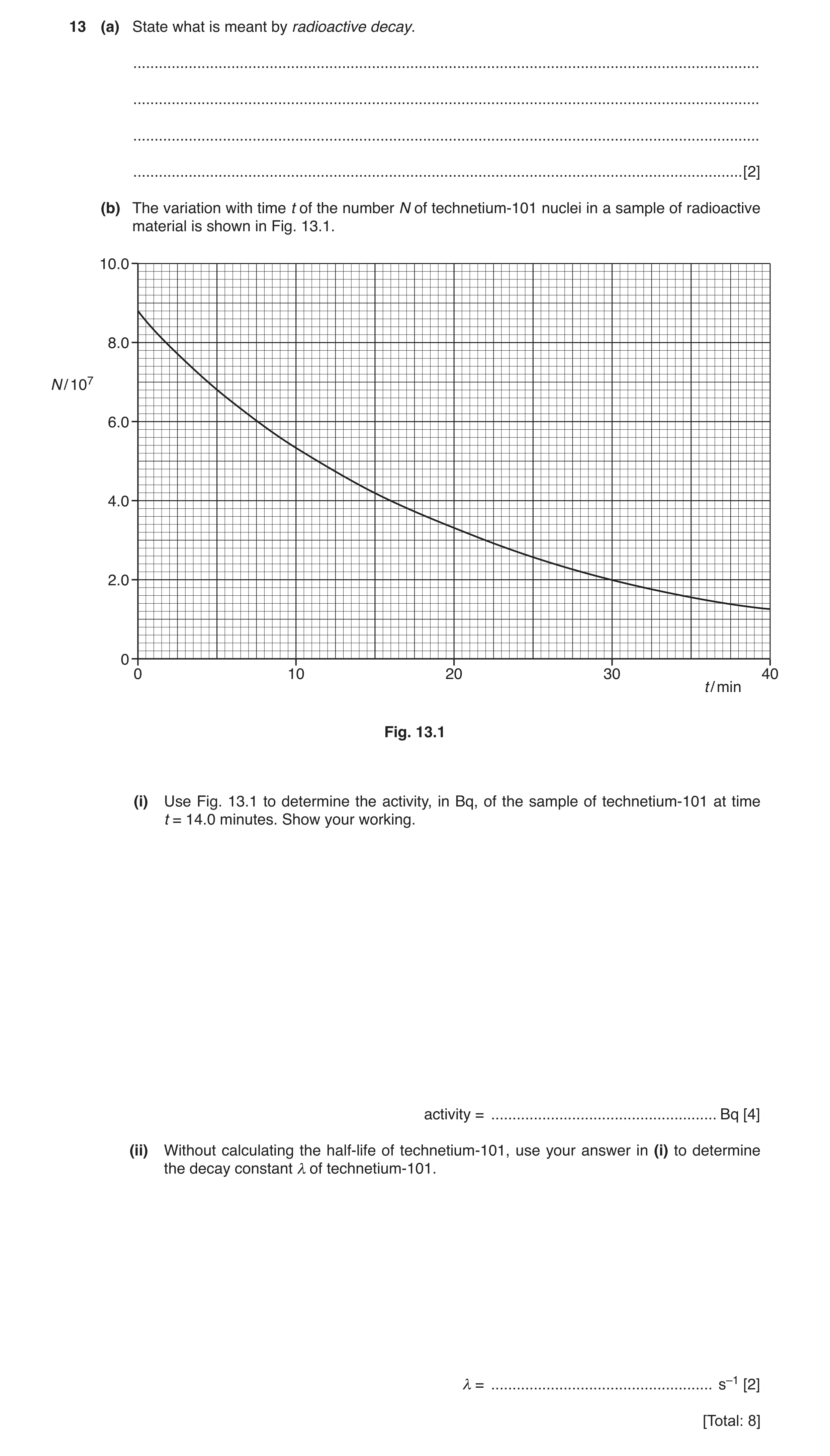
 20 / 60
 21 / 60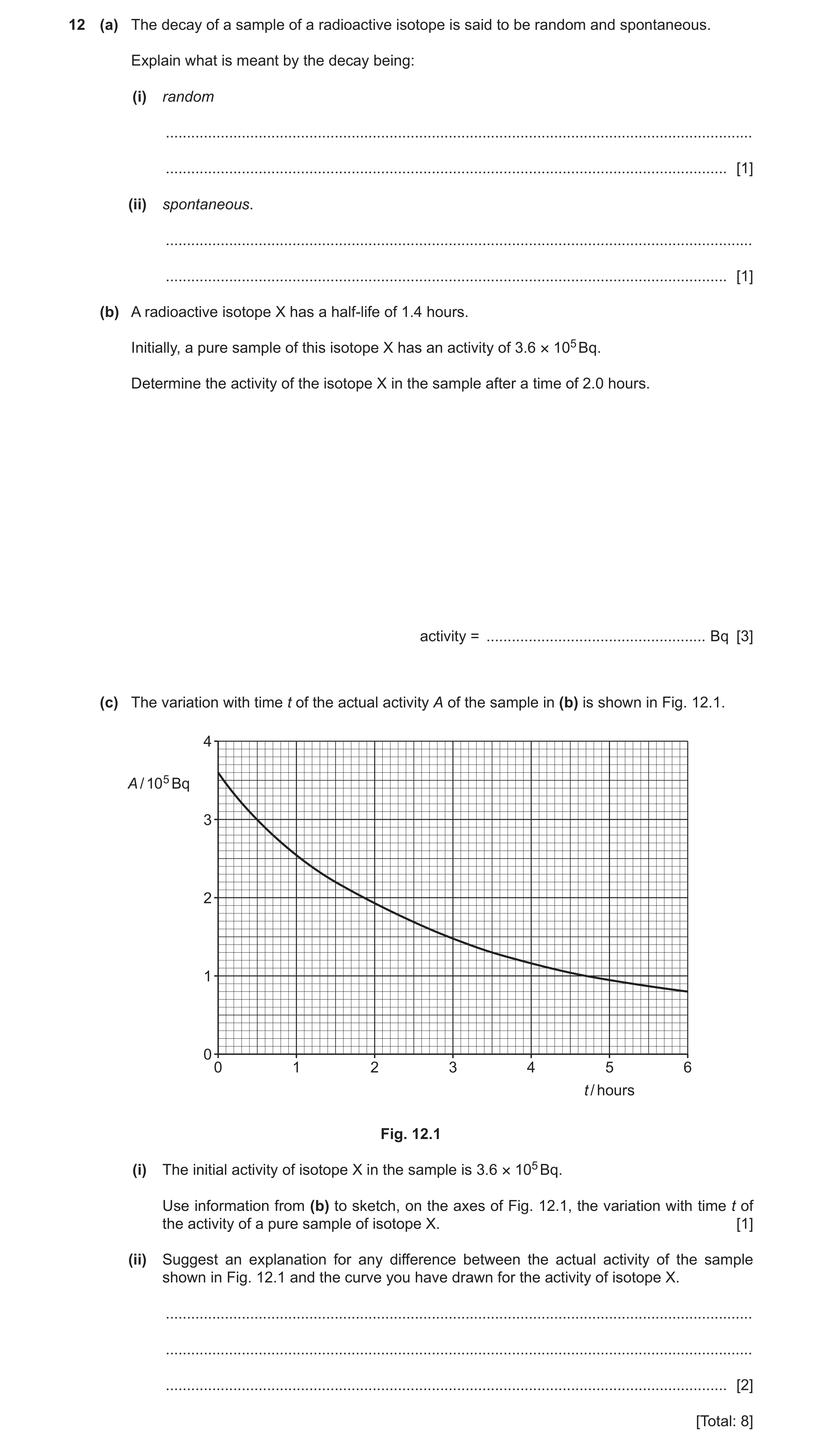
 25 / 60
 26 / 60
 27 / 60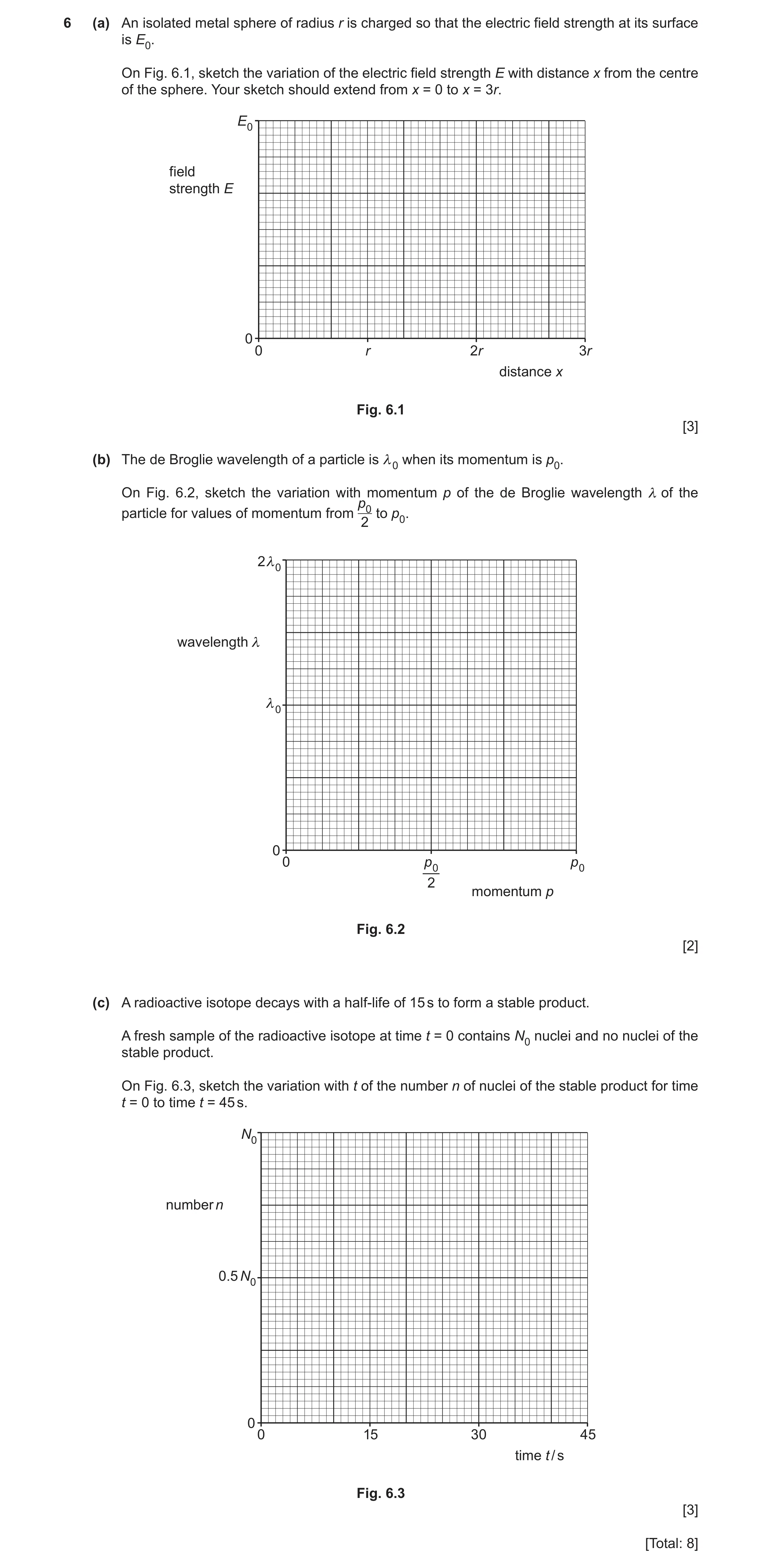
 33 / 60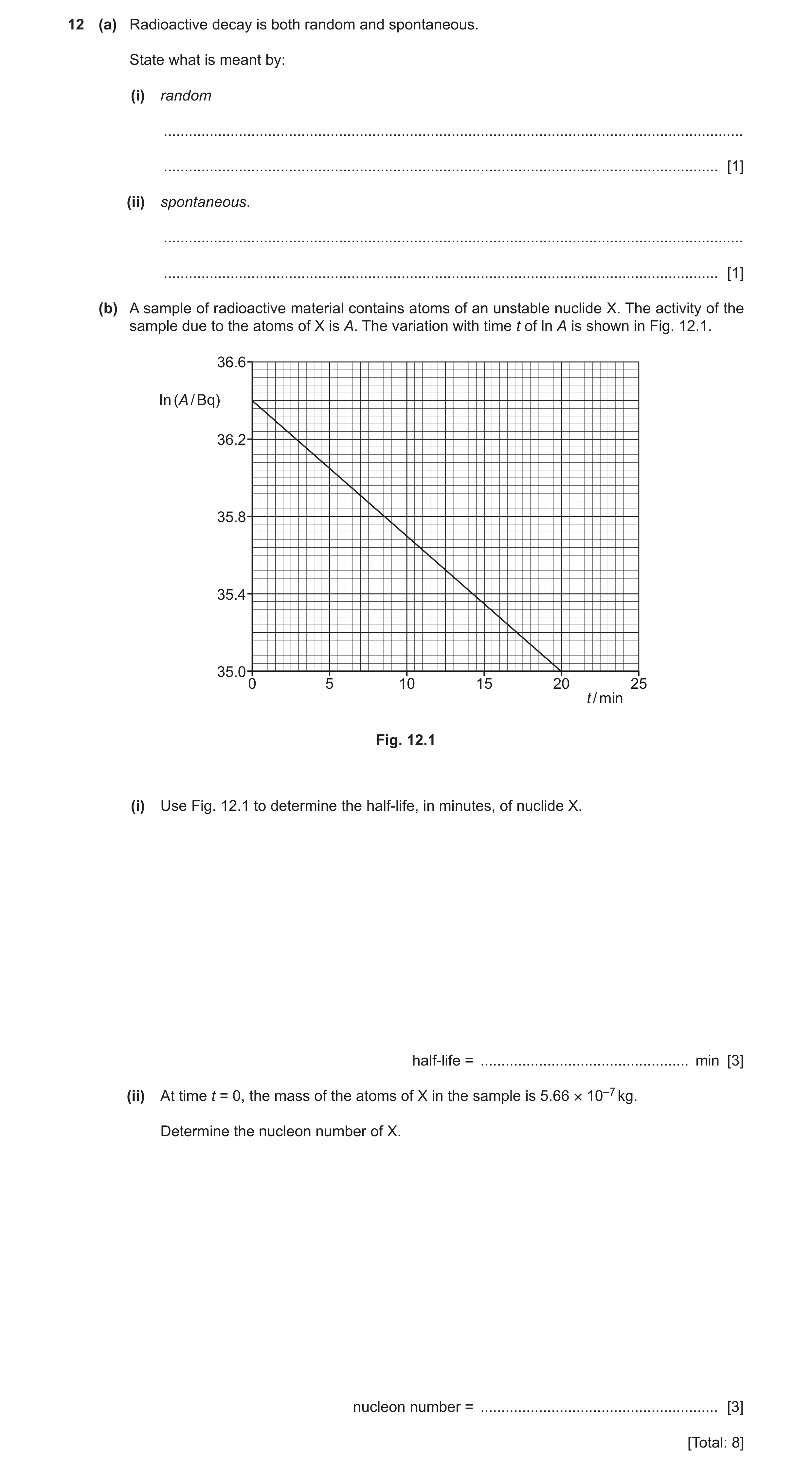
 35 / 60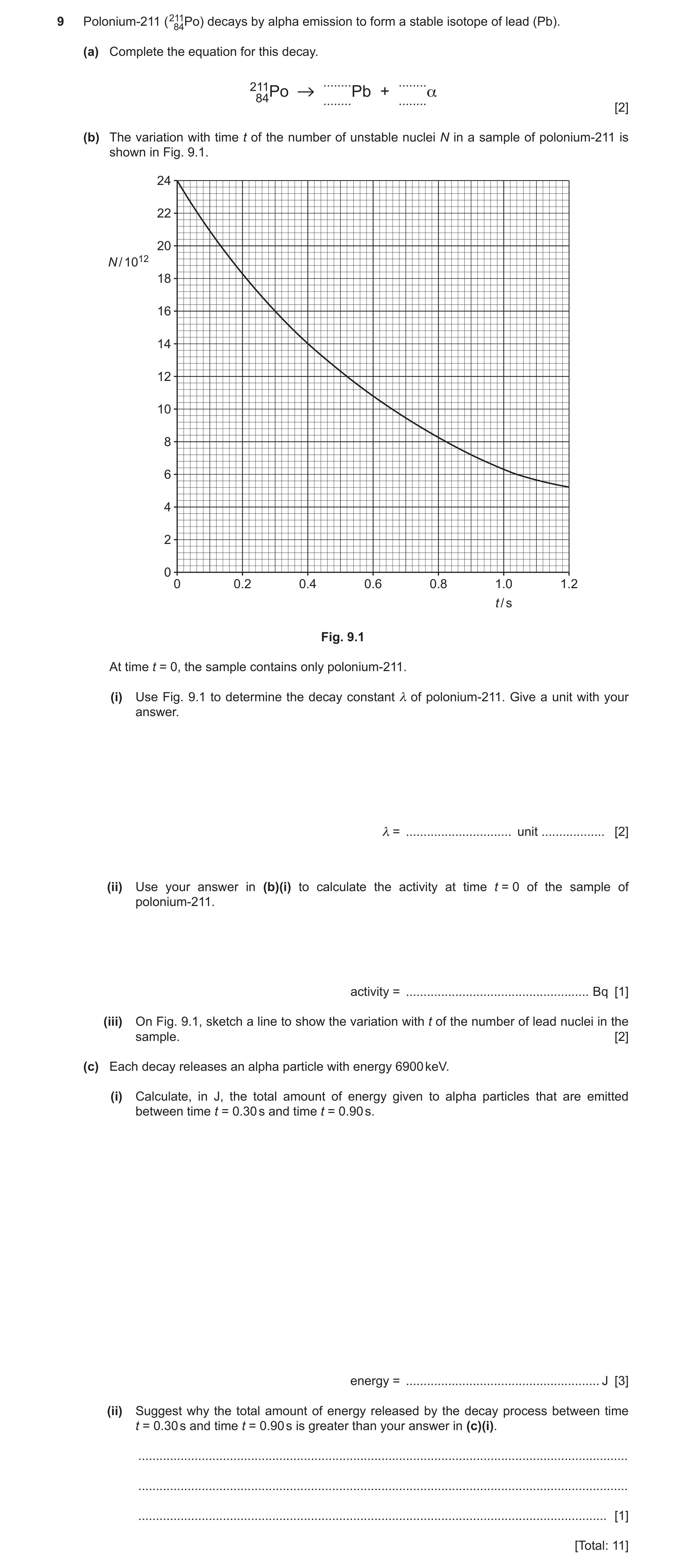
 45 / 60
 46 / 60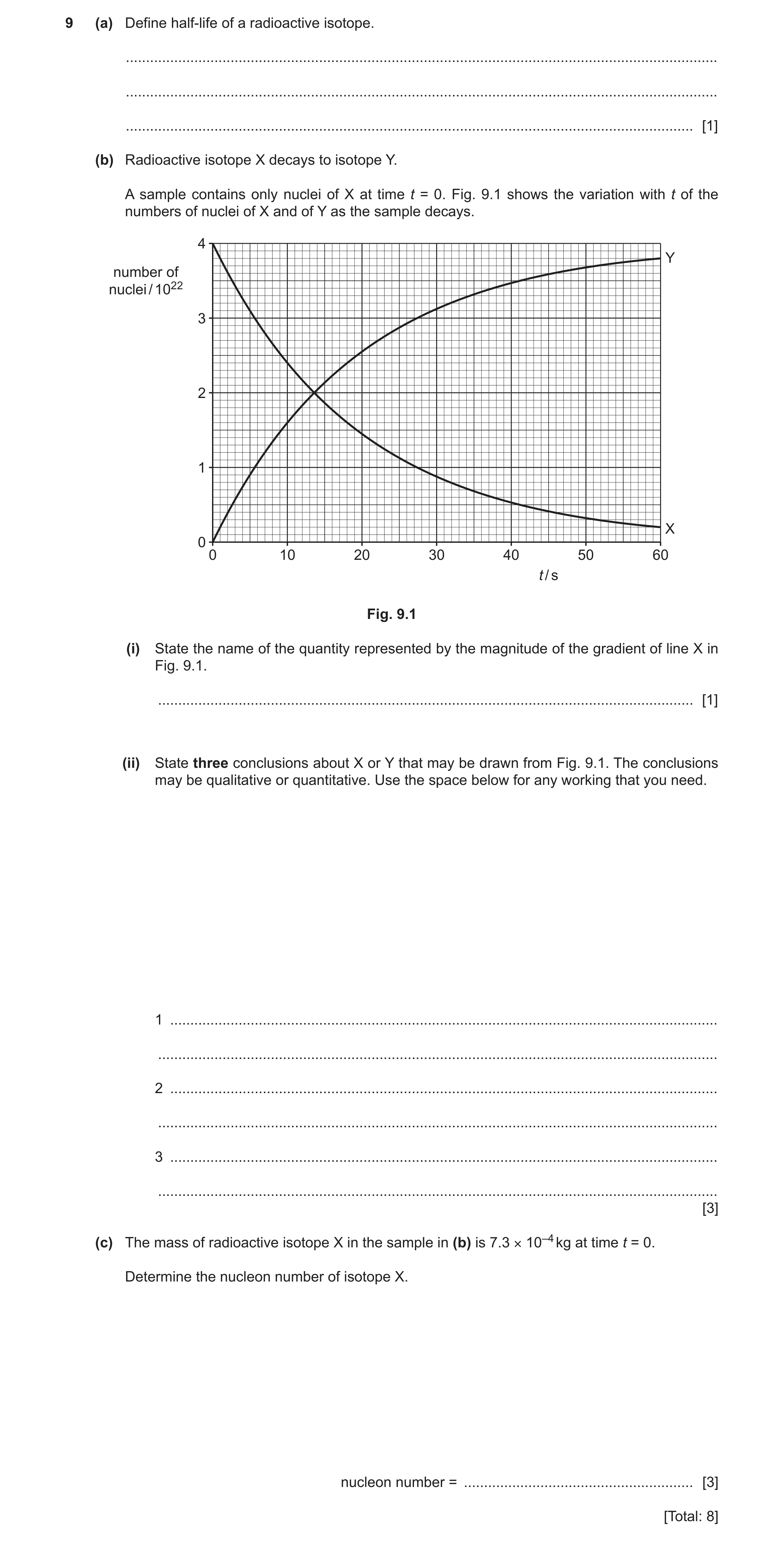
 50 / 60
 51 / 60
 52 / 60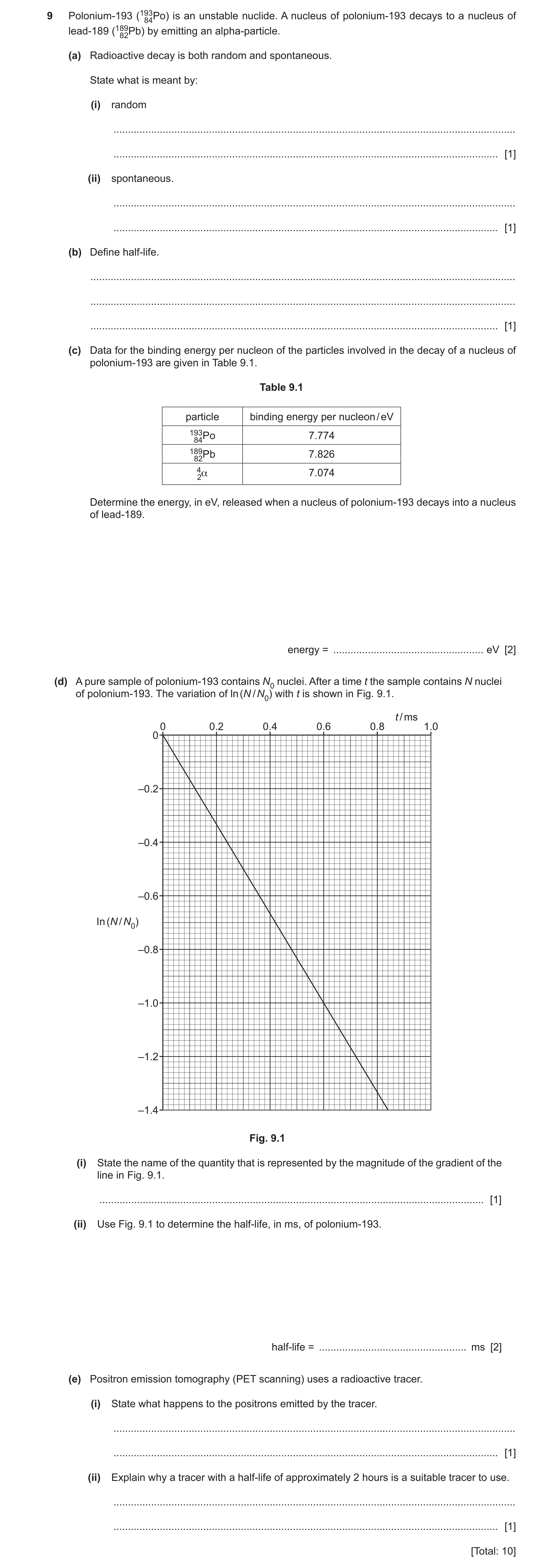
 10
10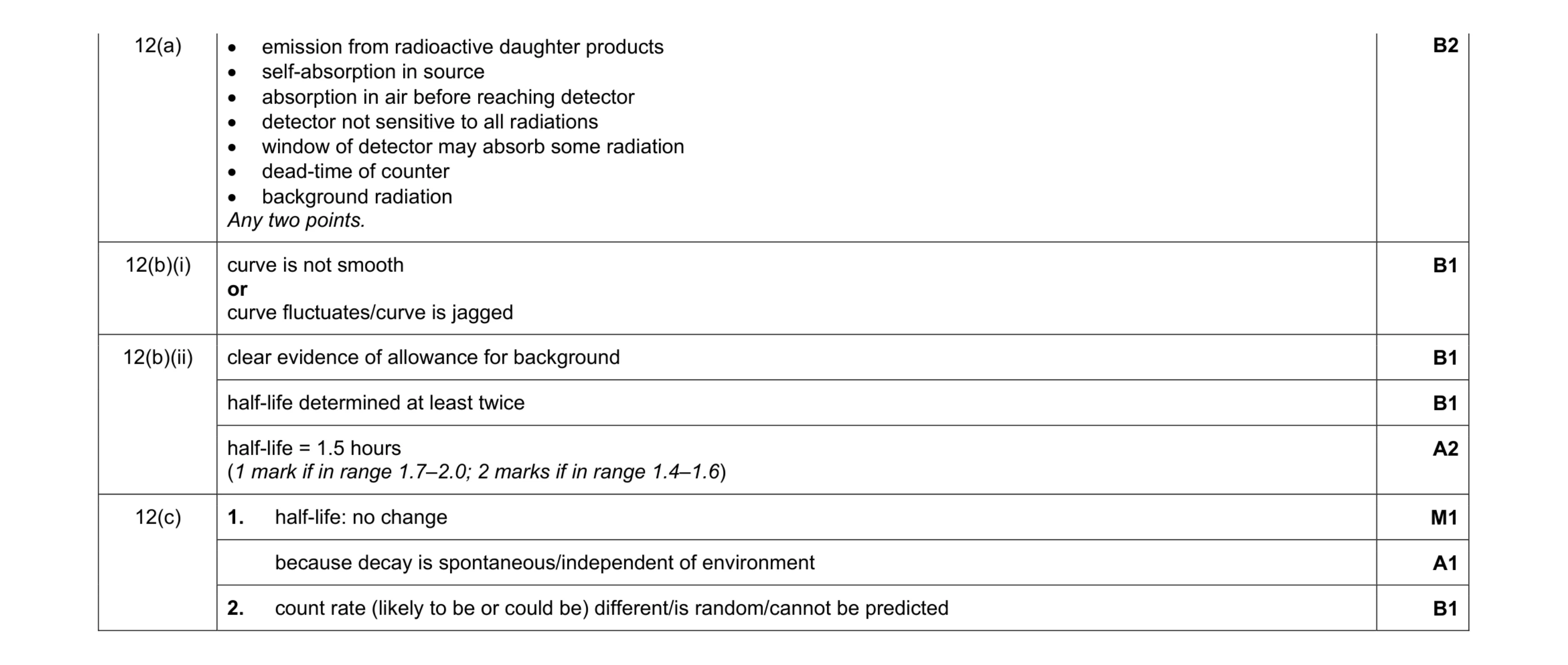 10
10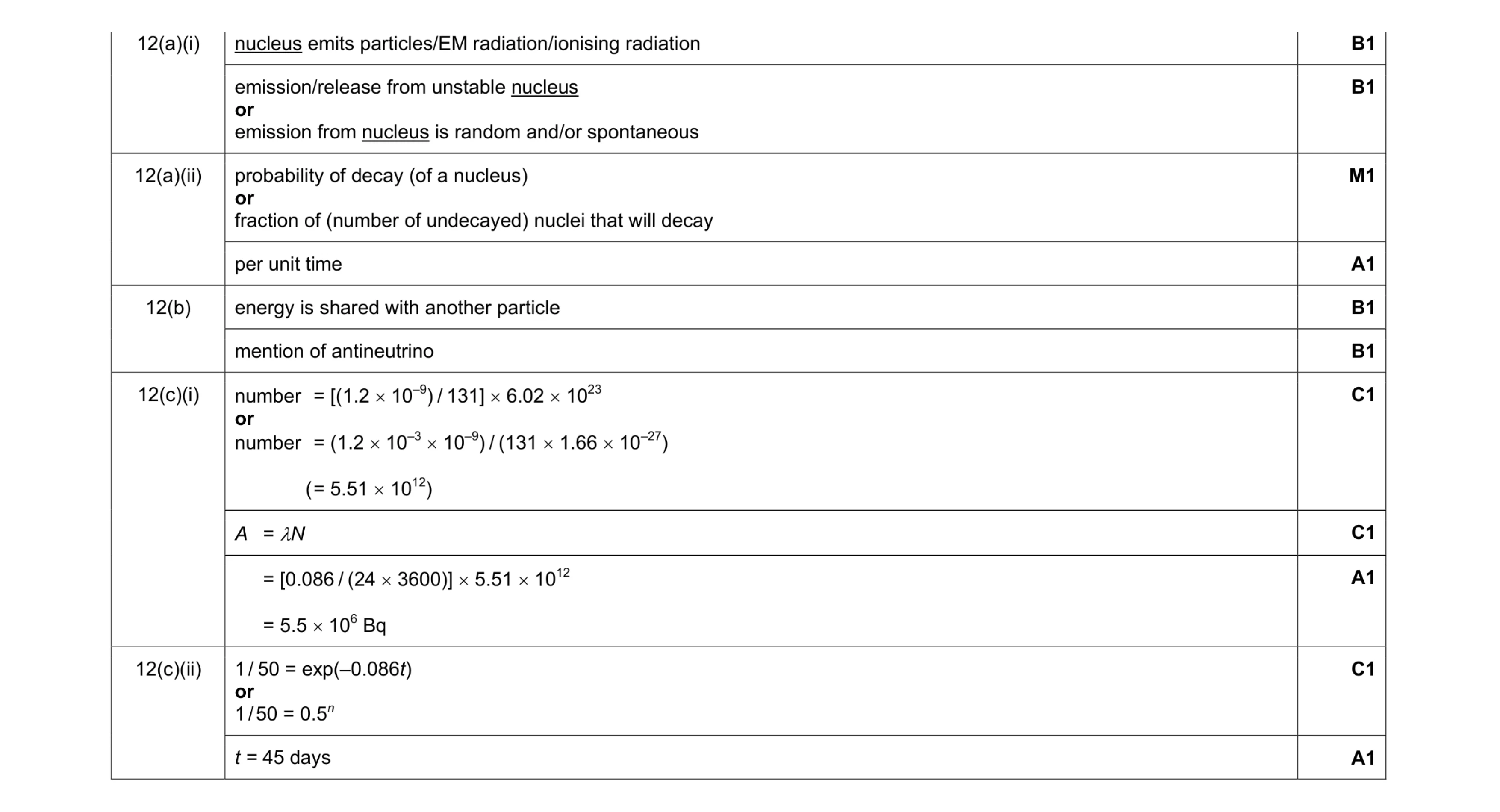 11
11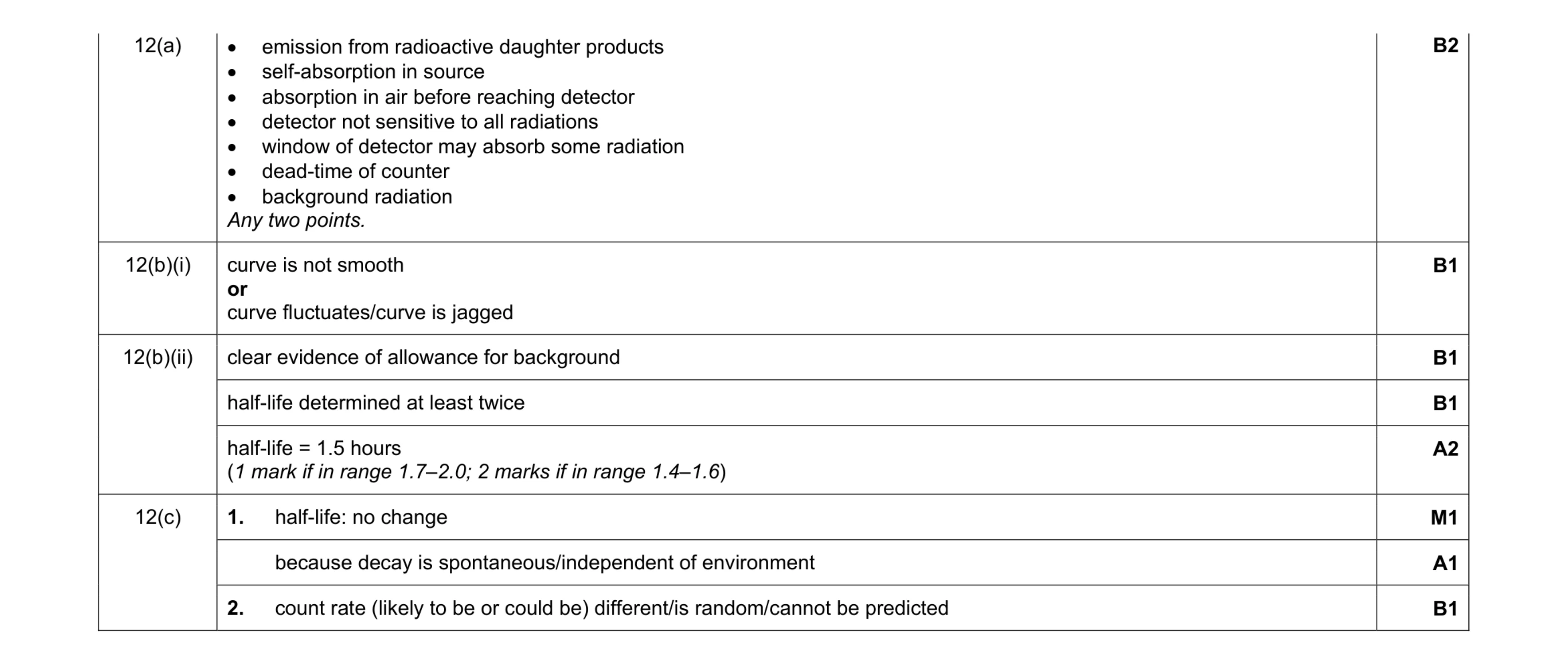 10
10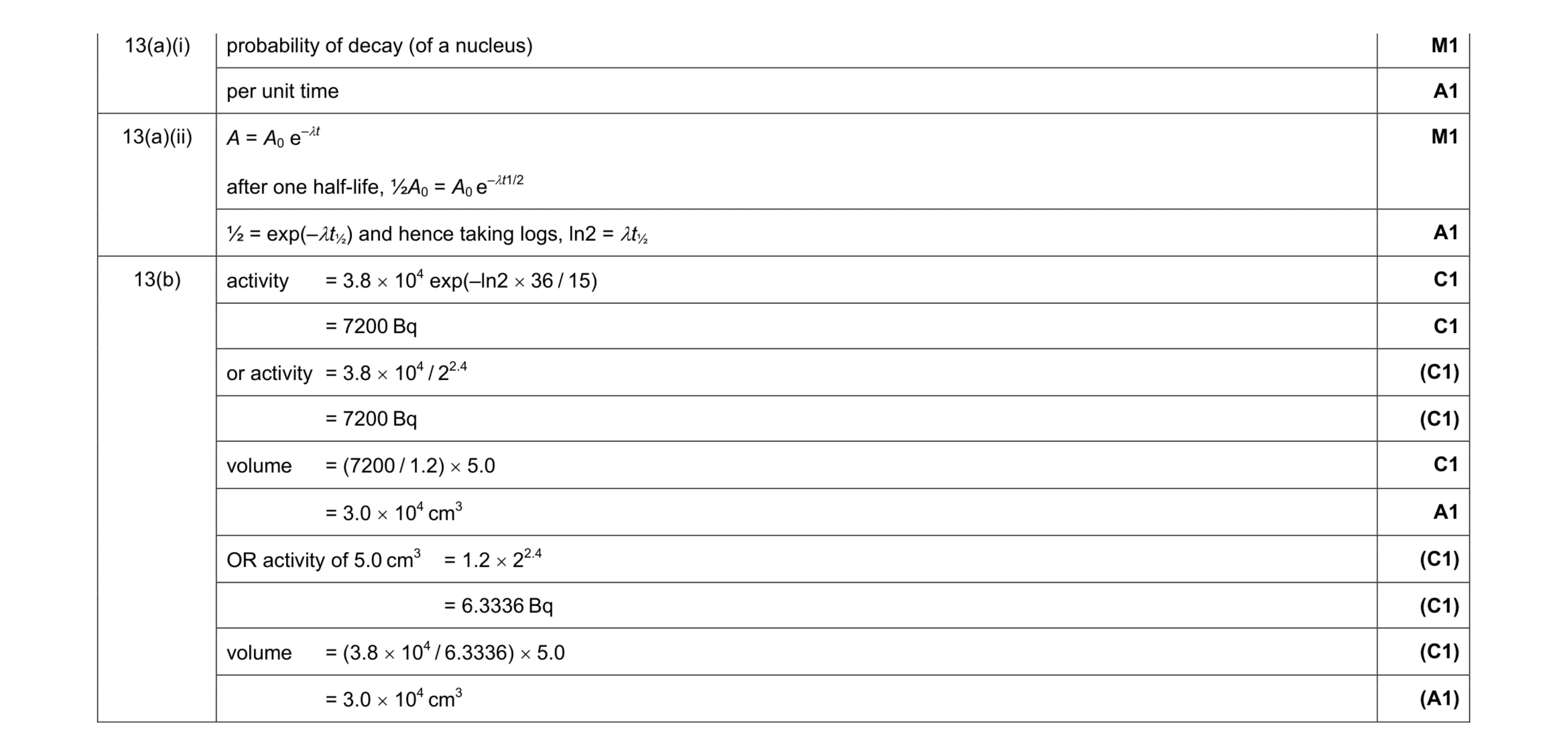 8
8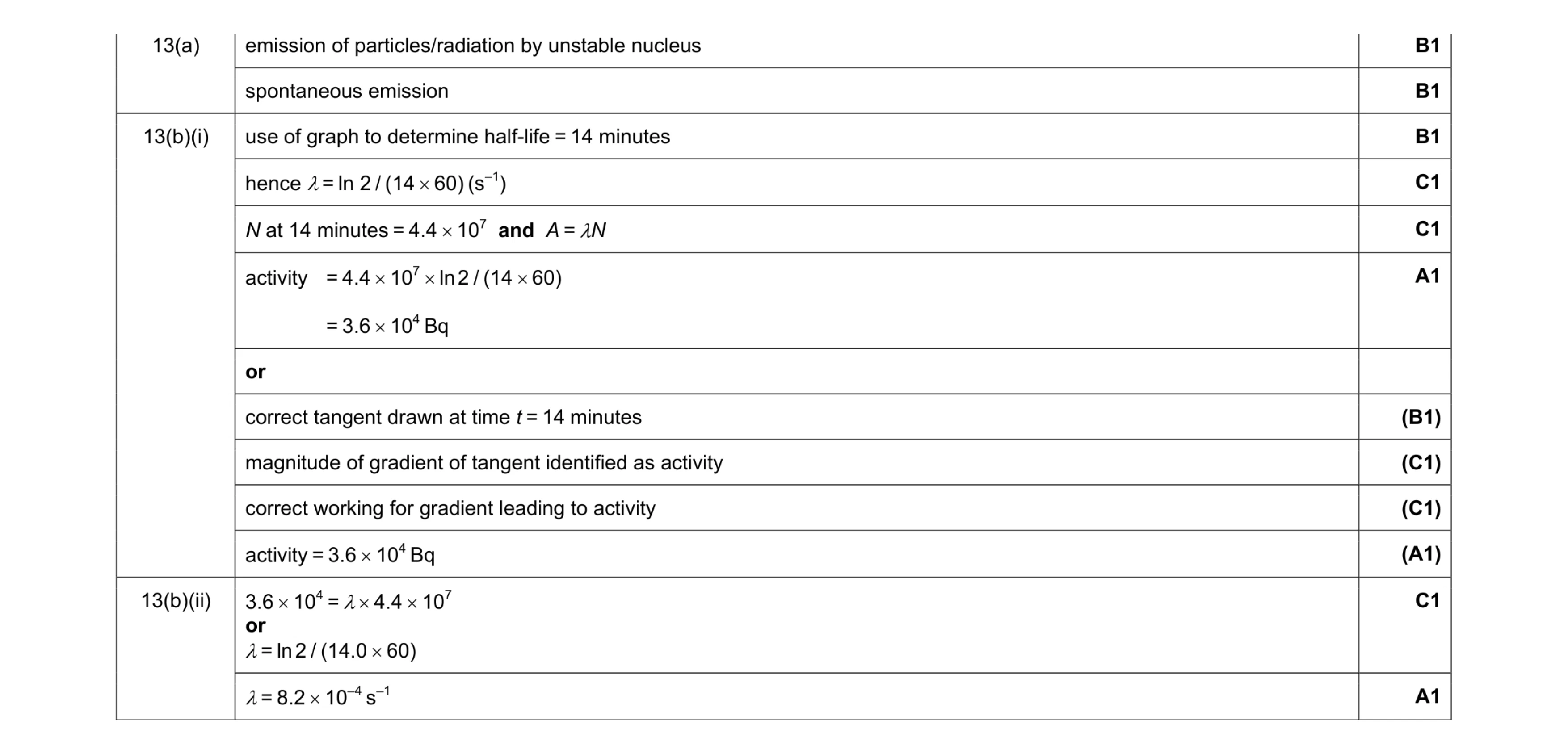 8
8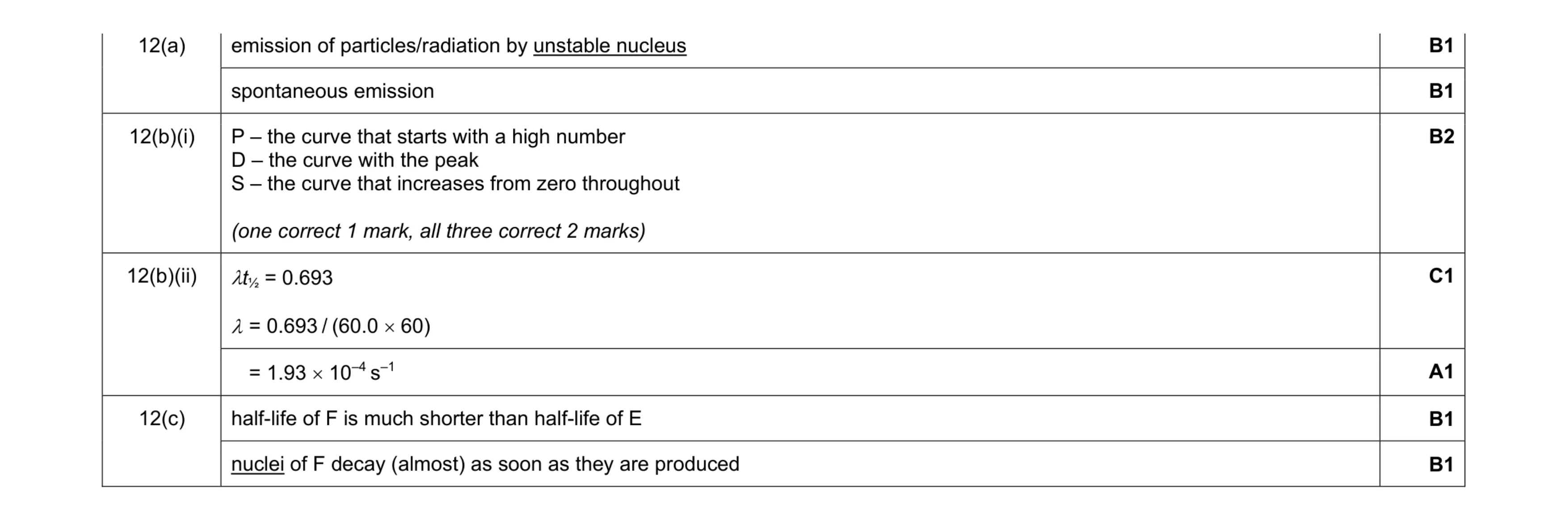 8
8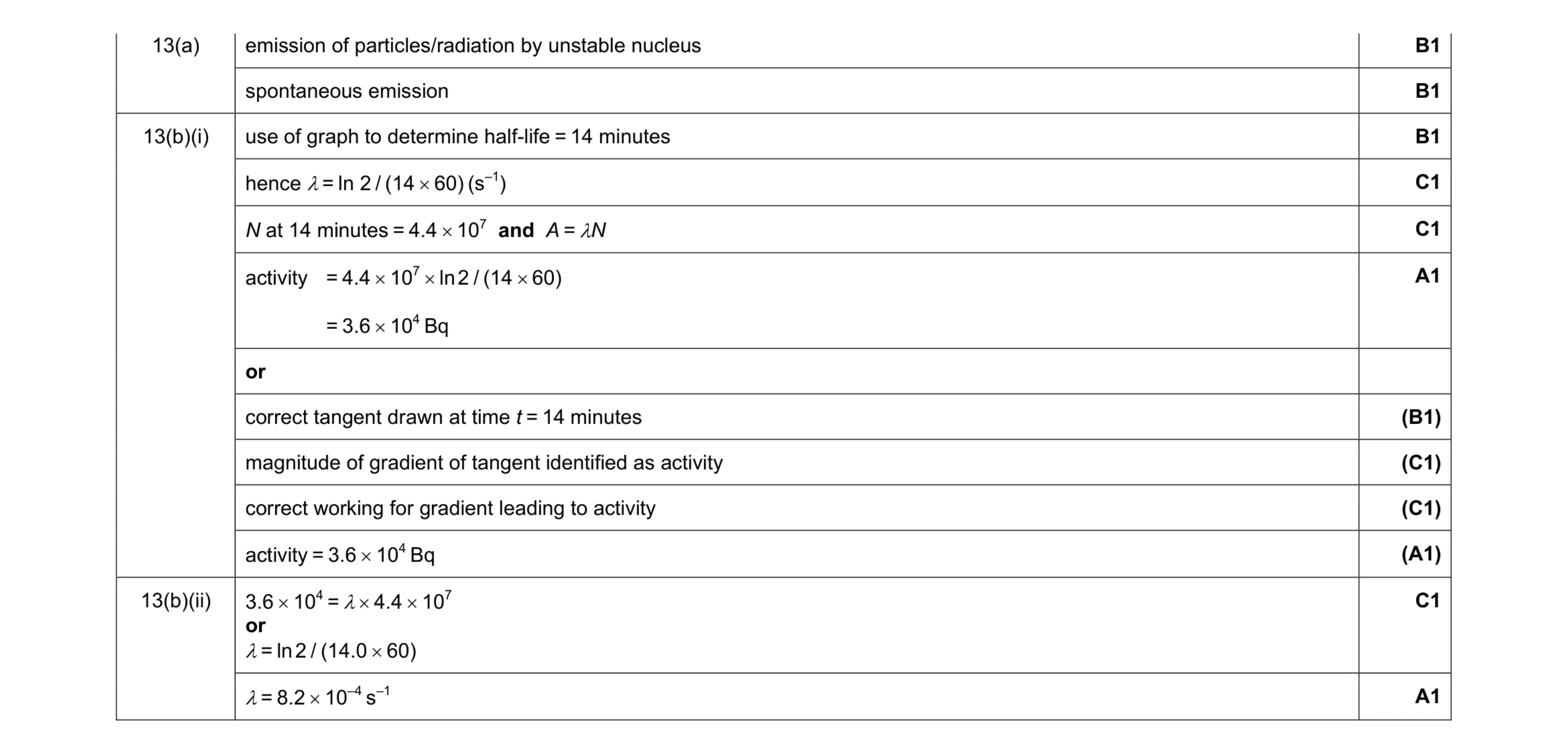 8
8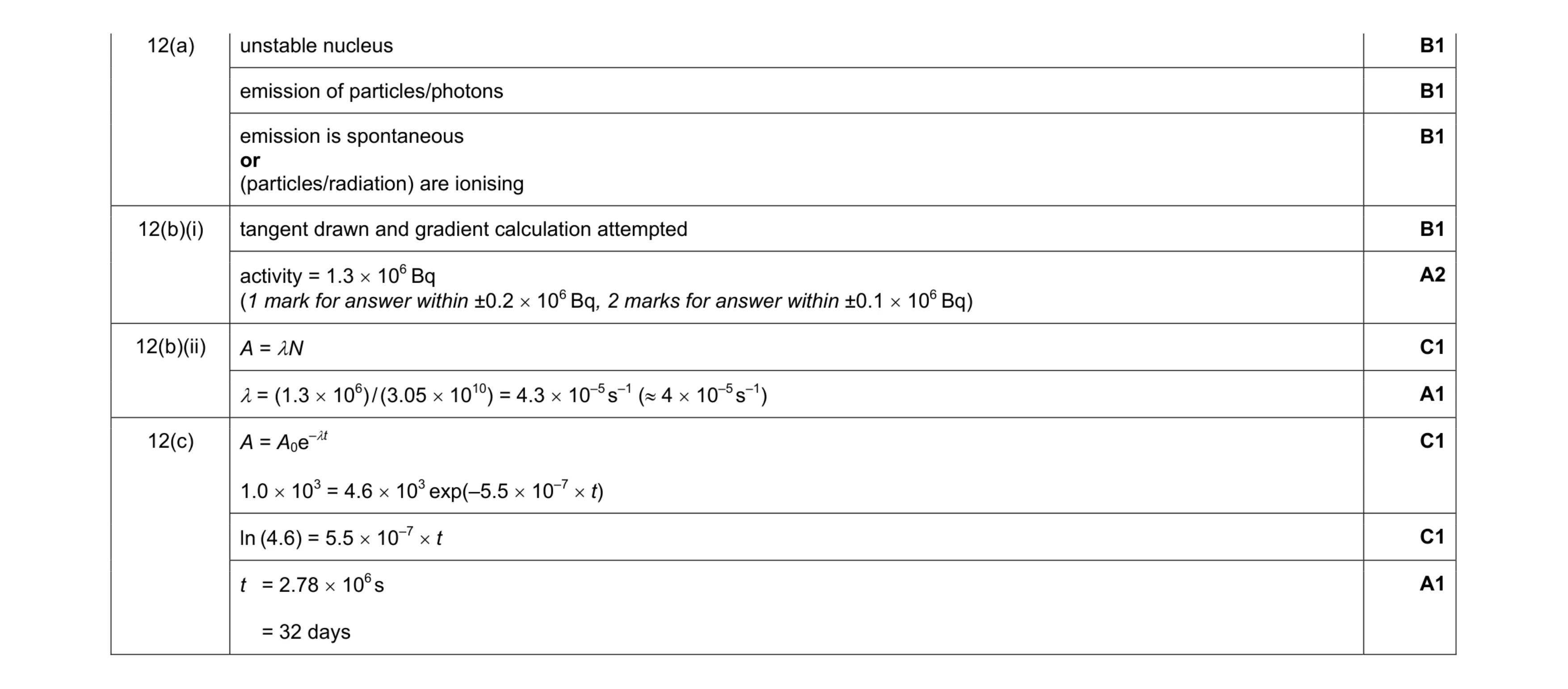 11
11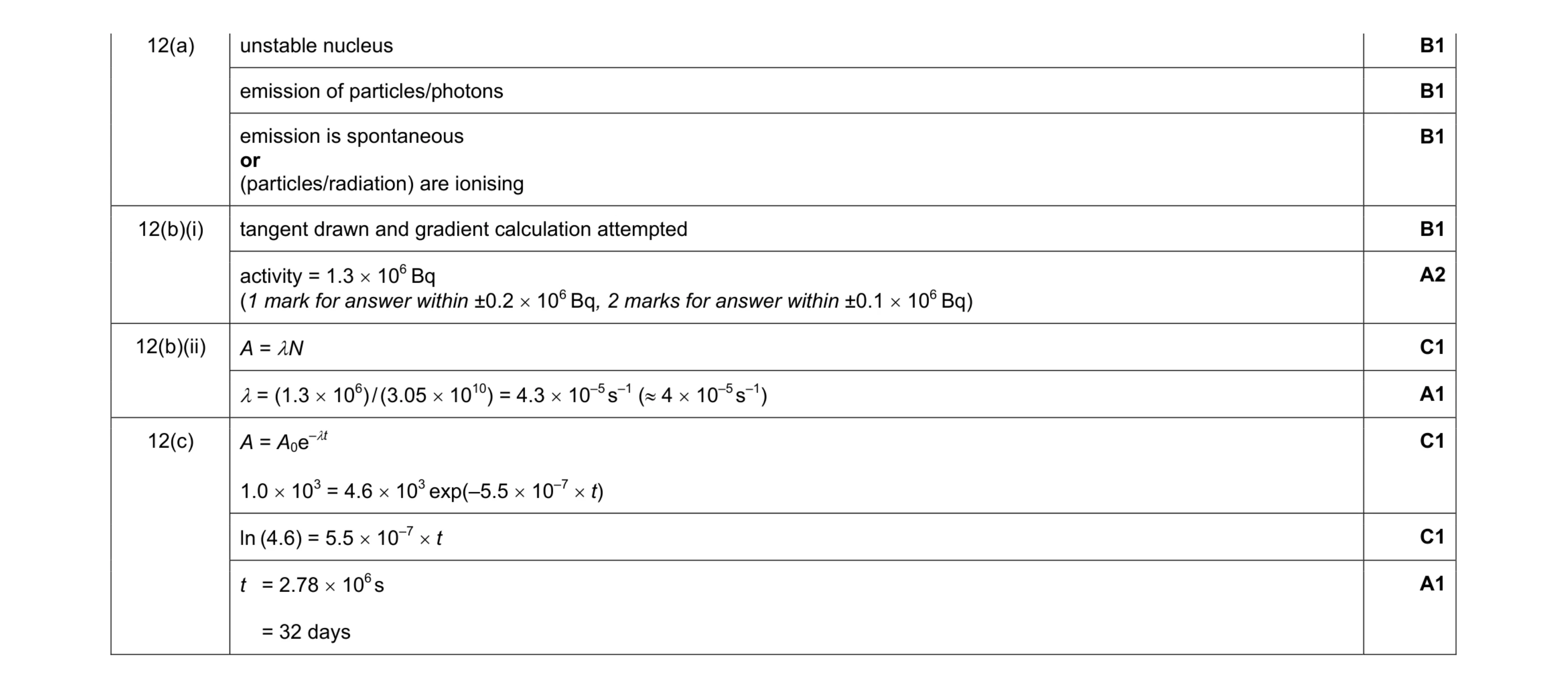 11
11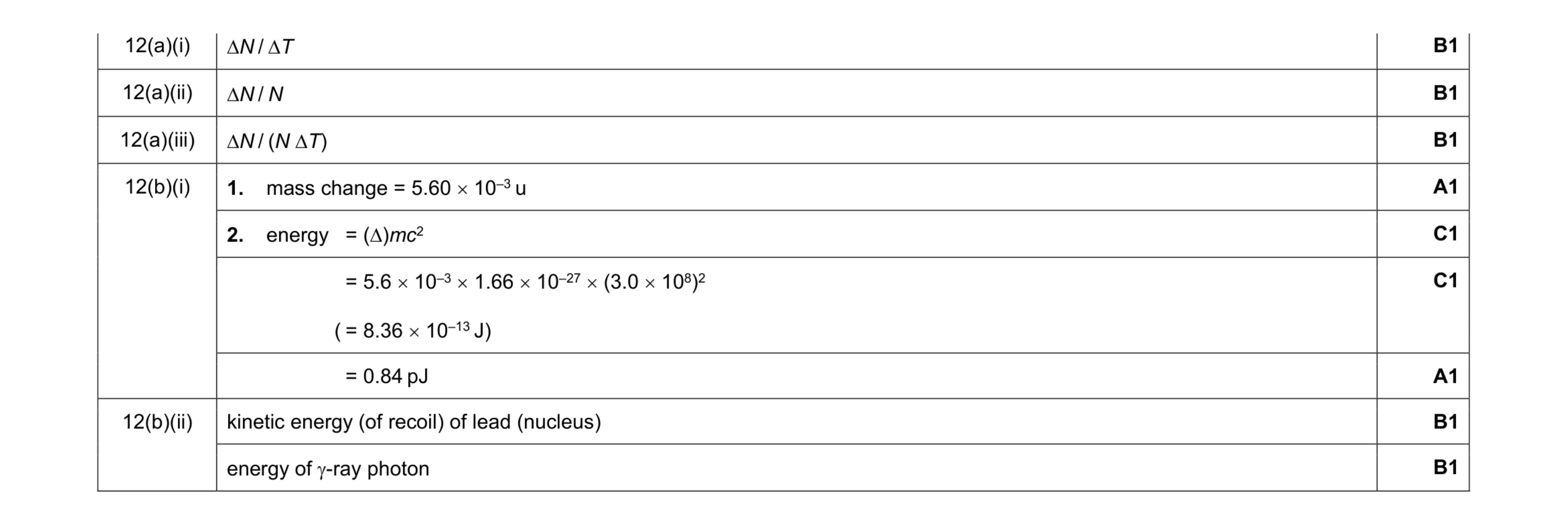 9
9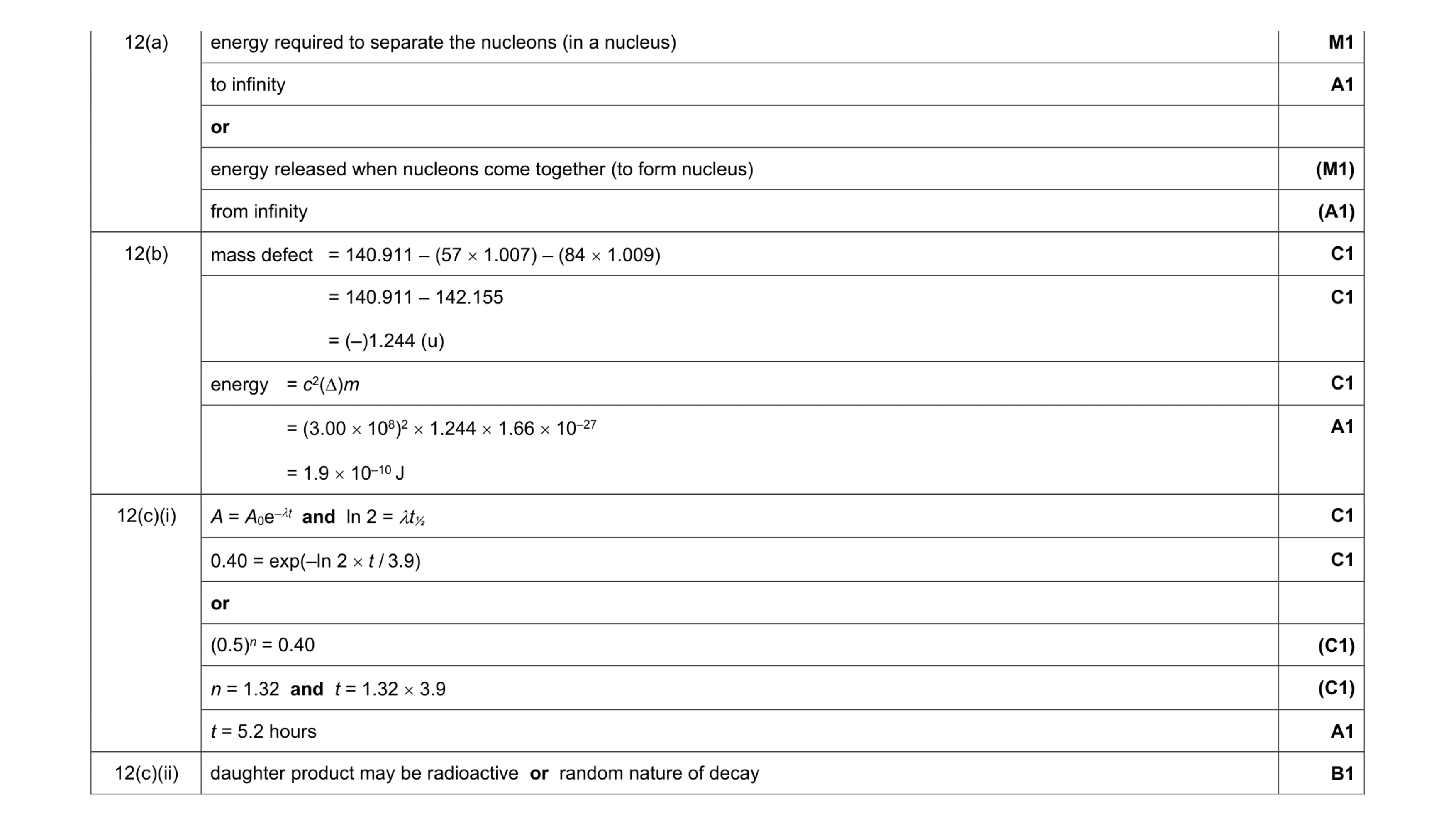 10
10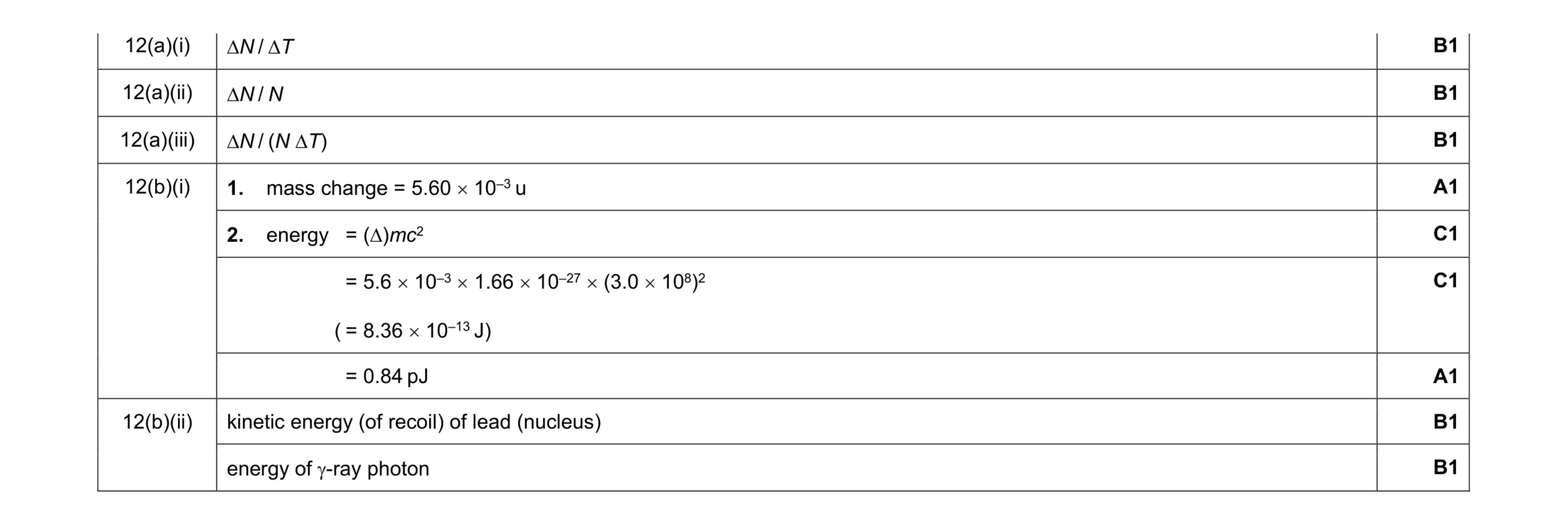 9
9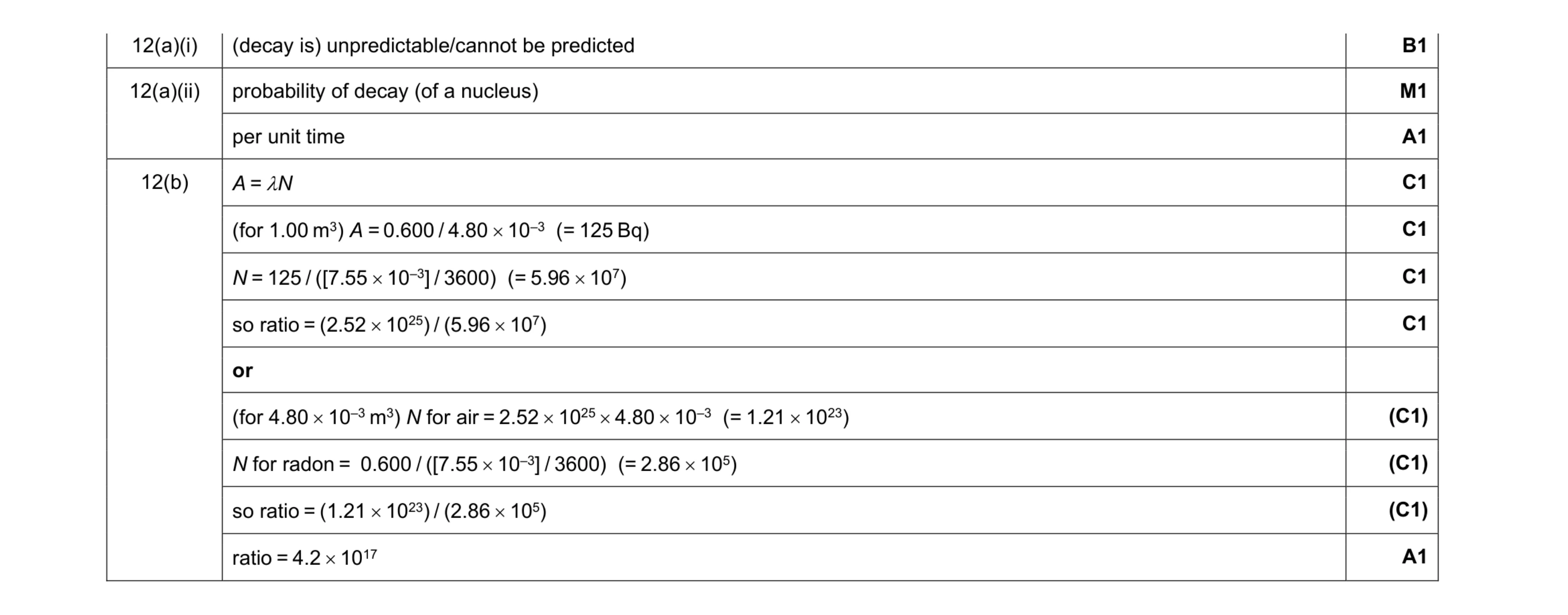 8
8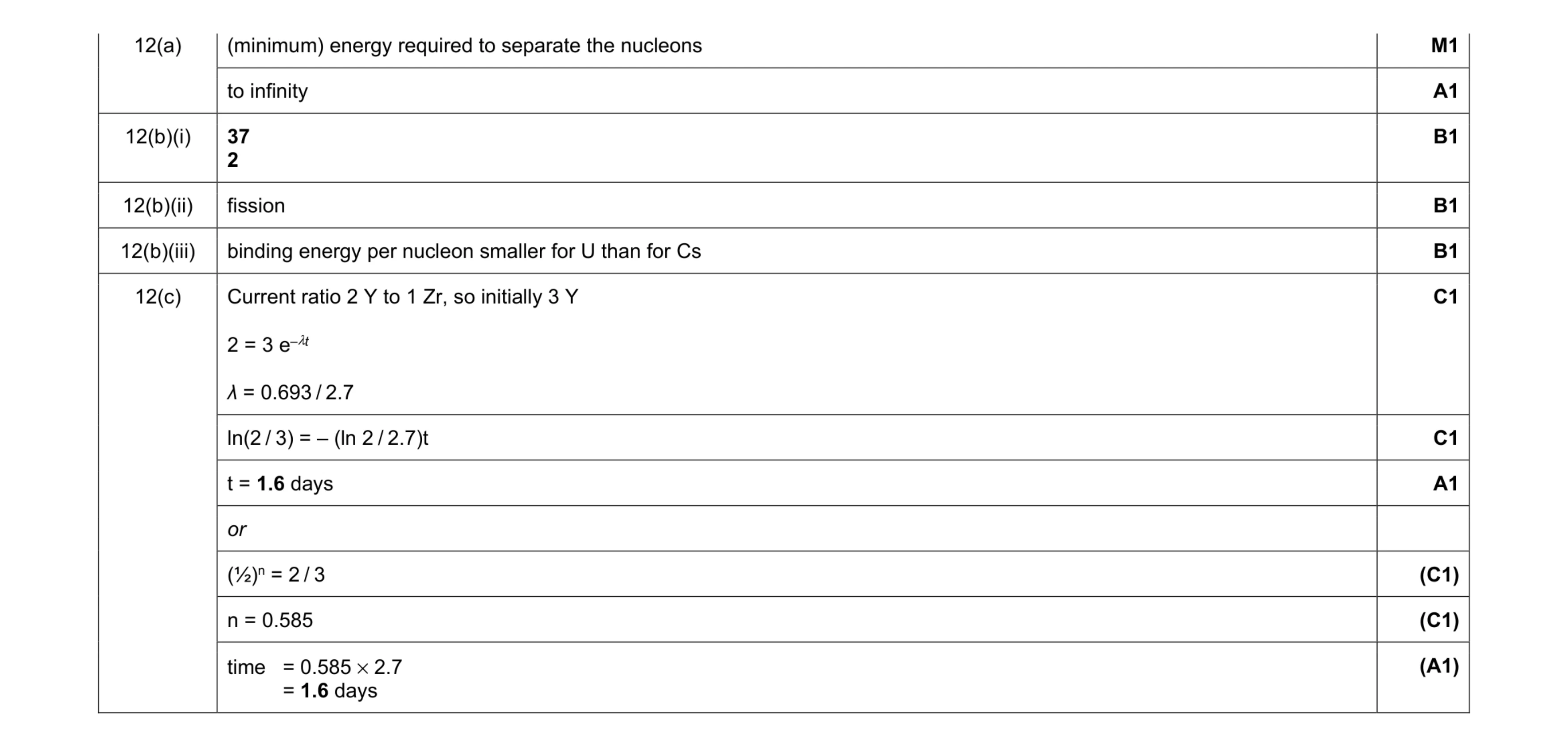 8
8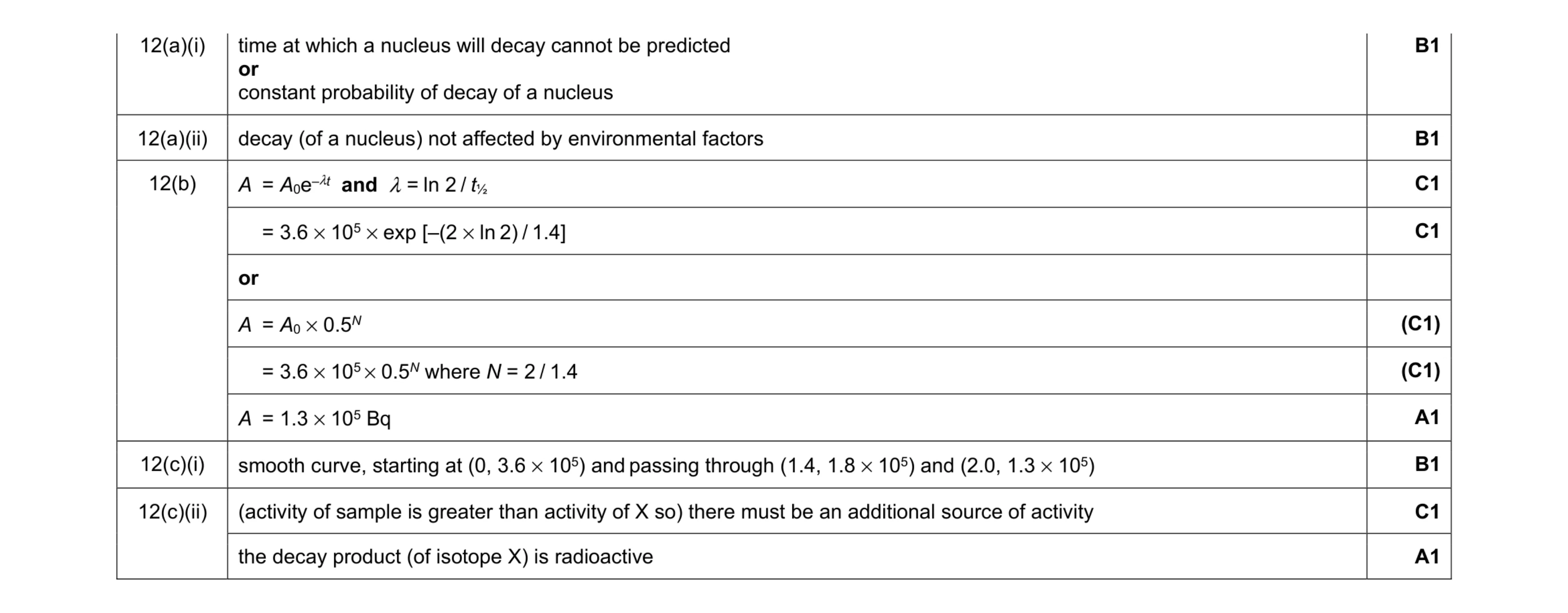 8
8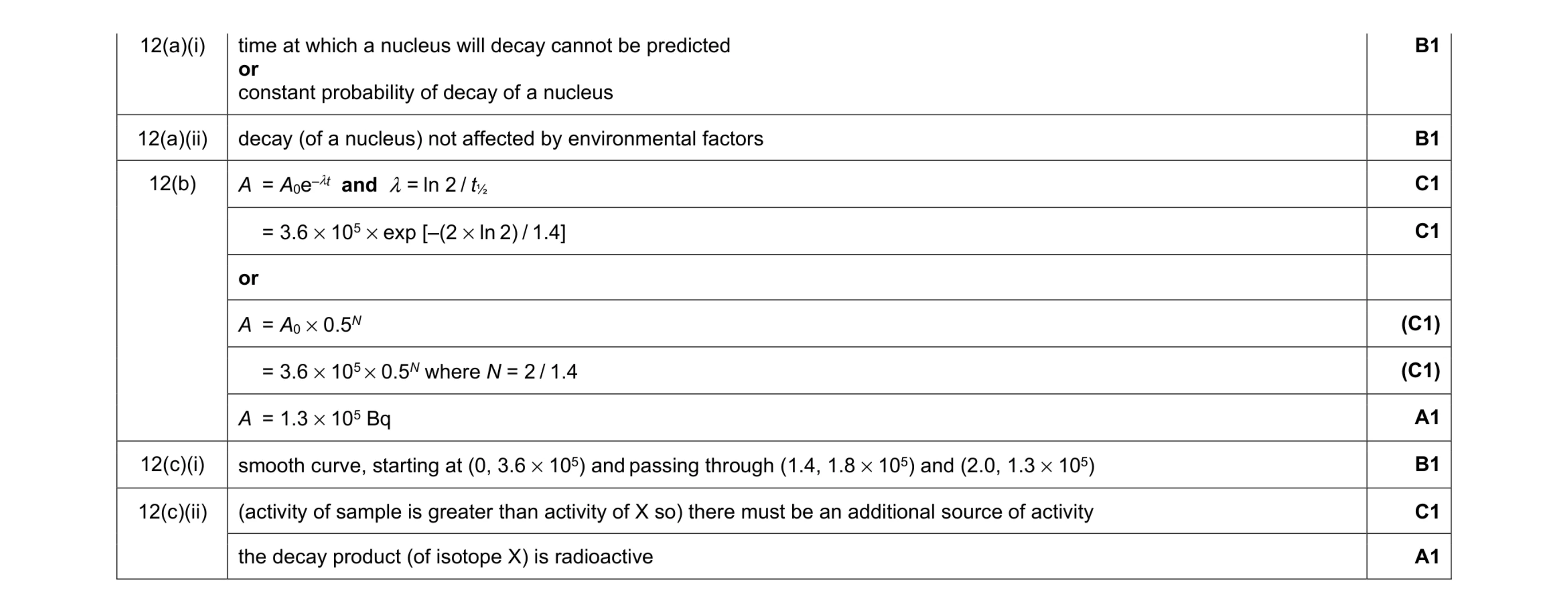 8
8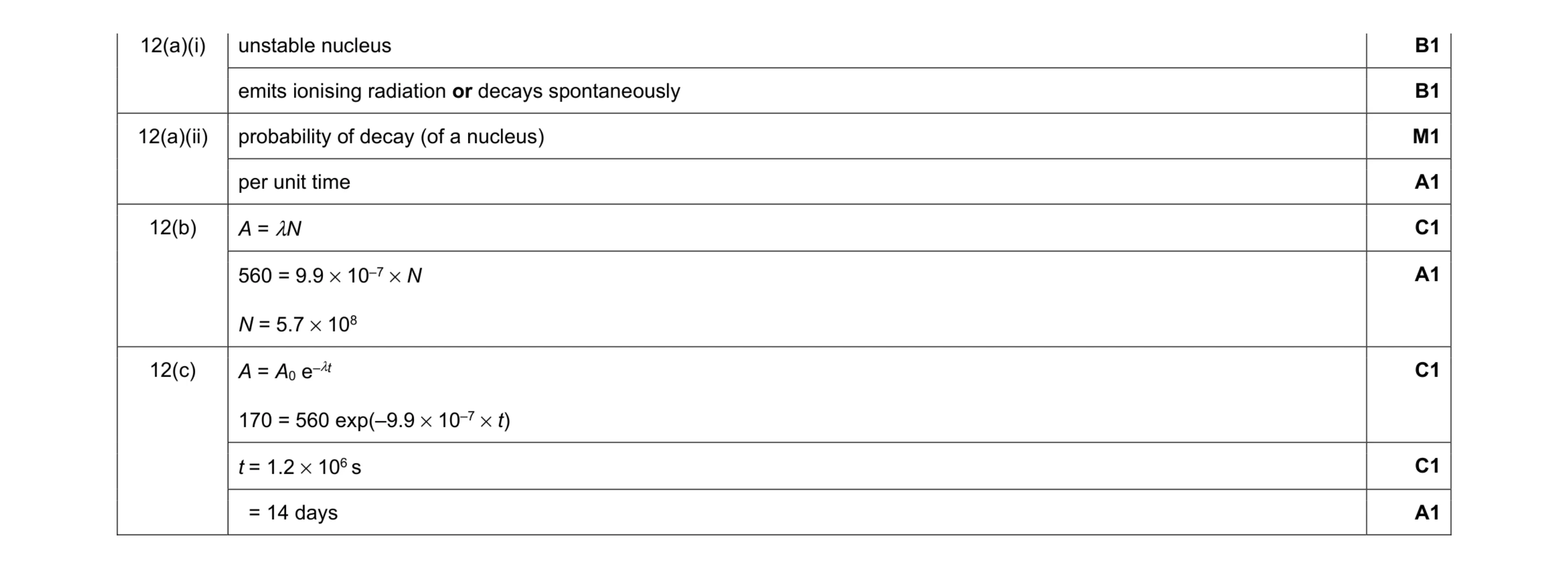 9
9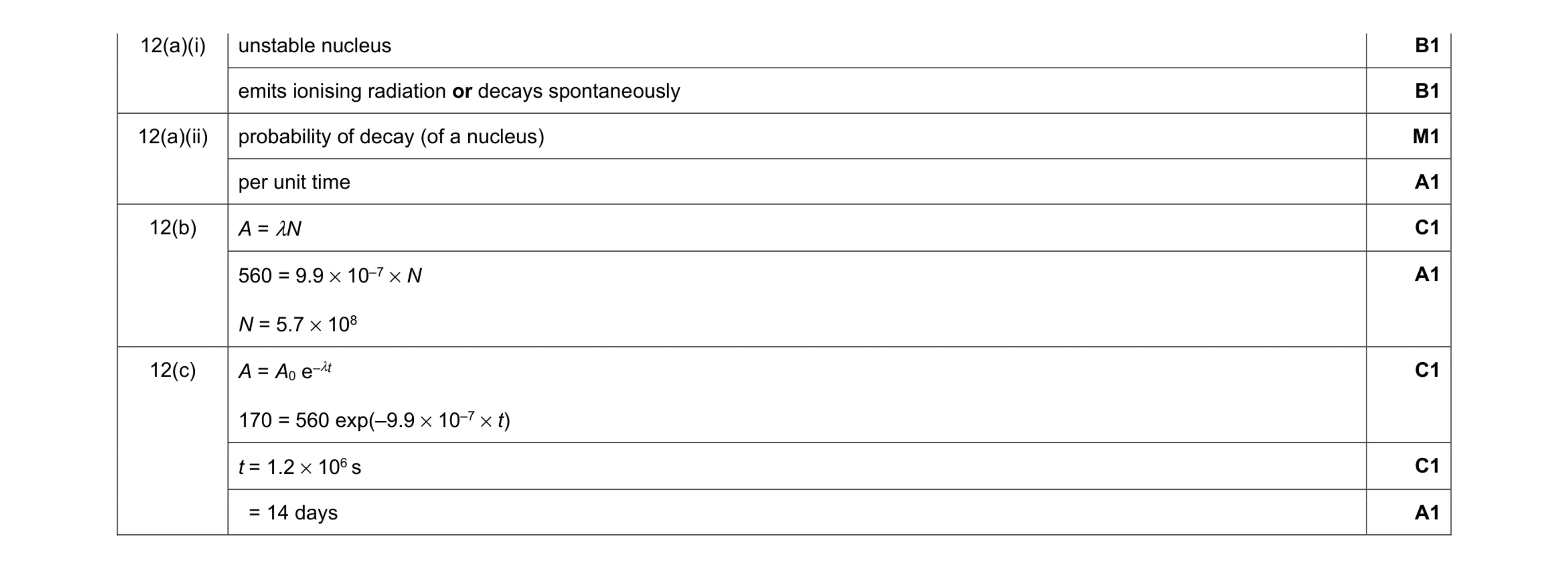 9
9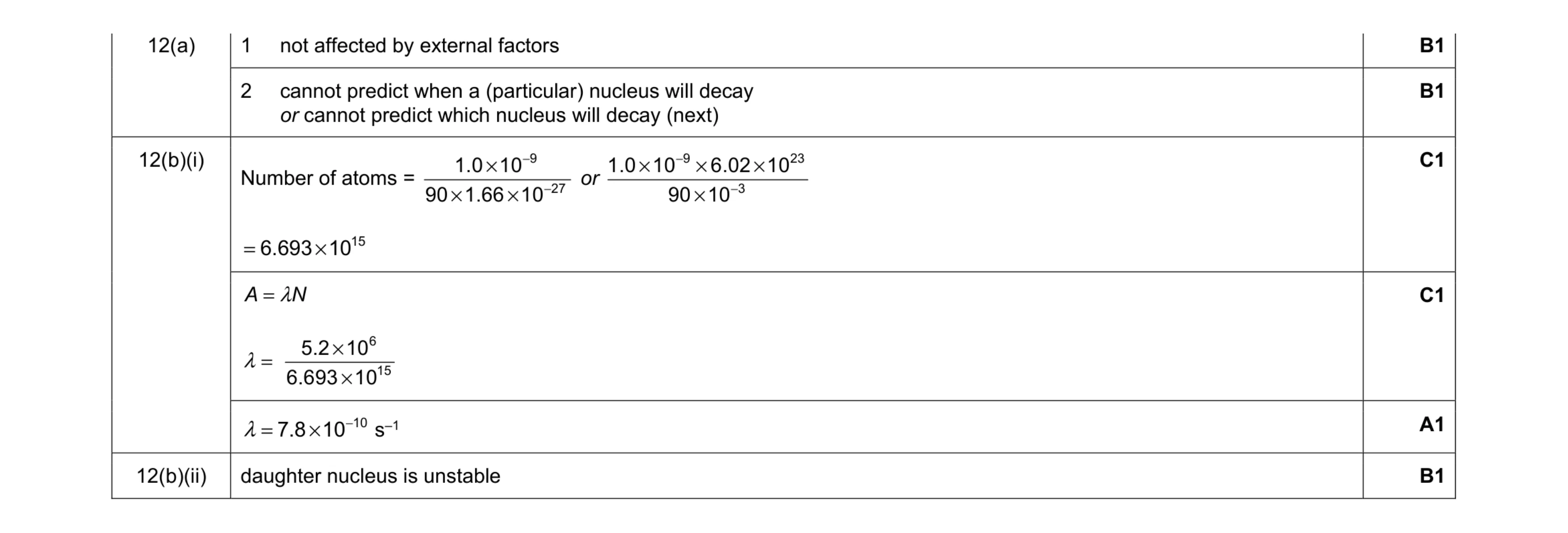 6
6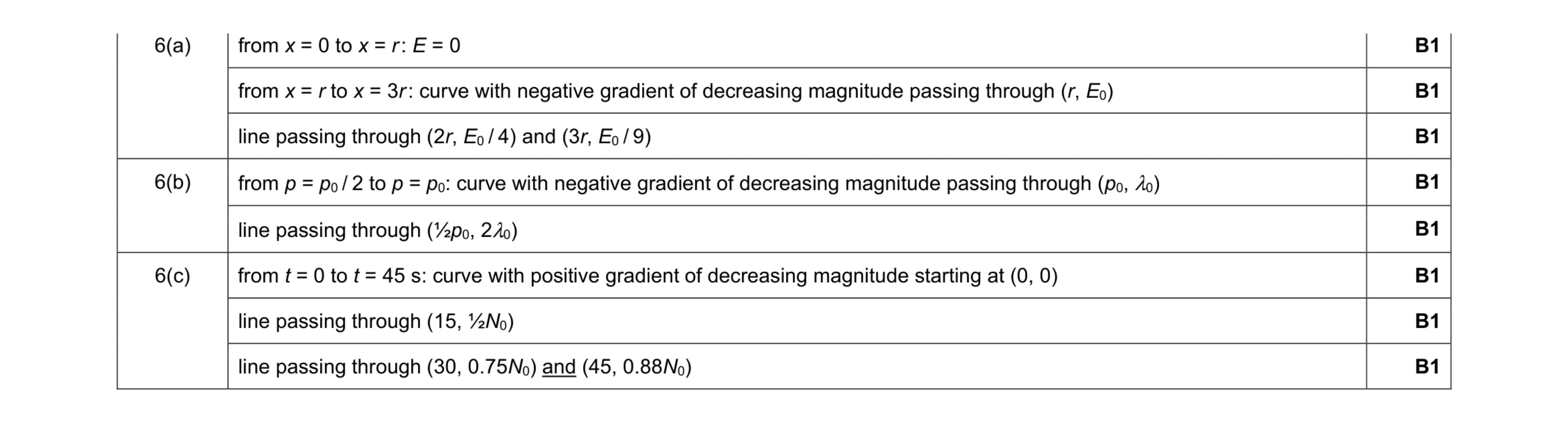 8
8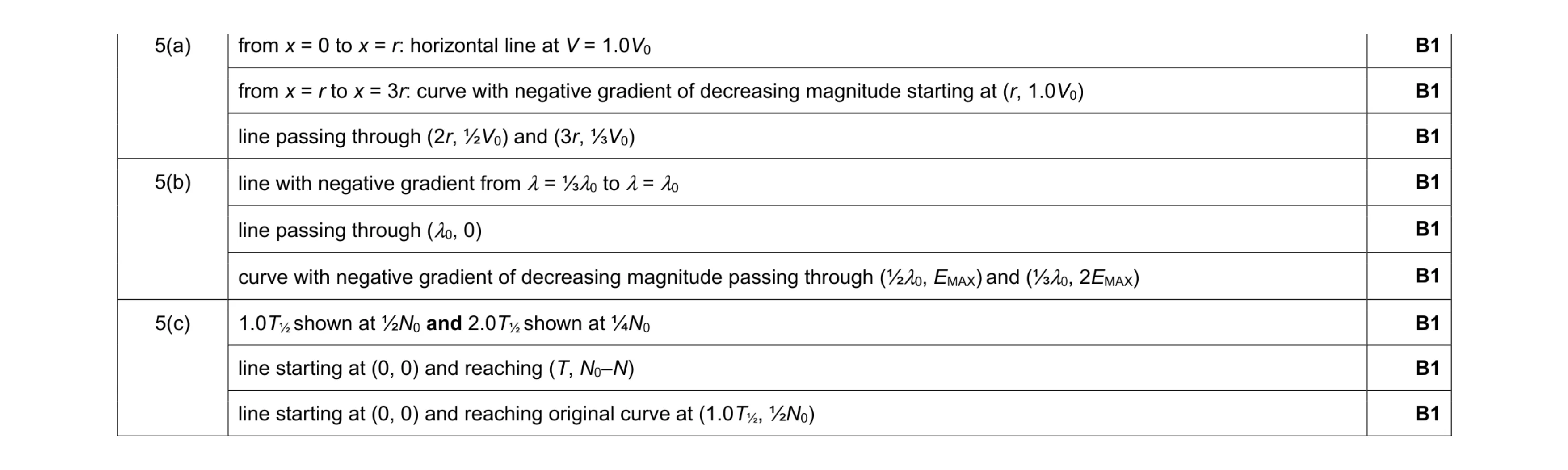 9
9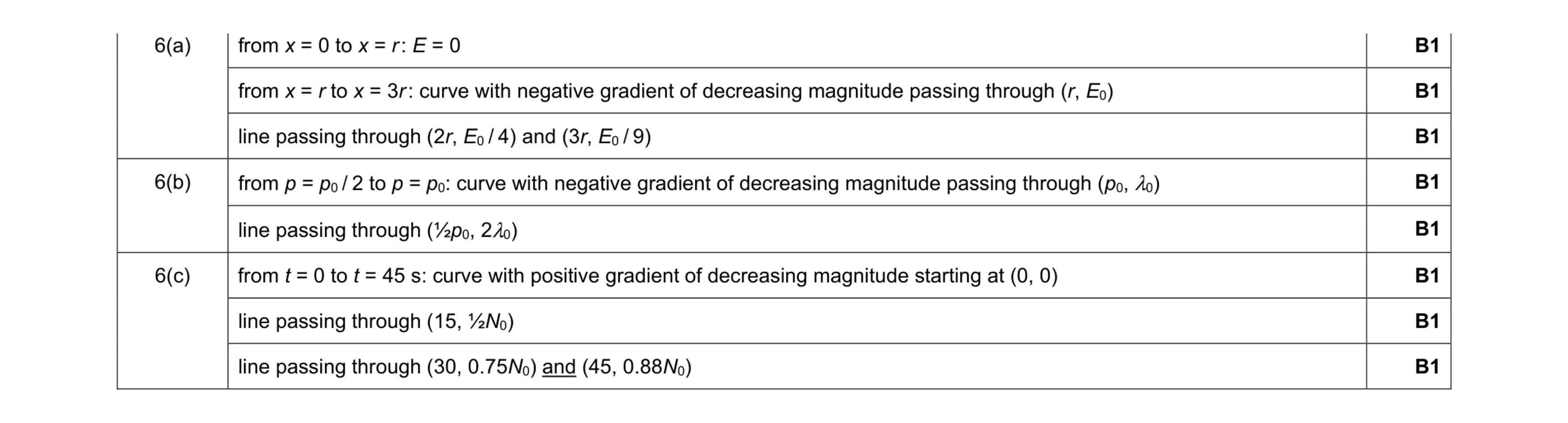 8
8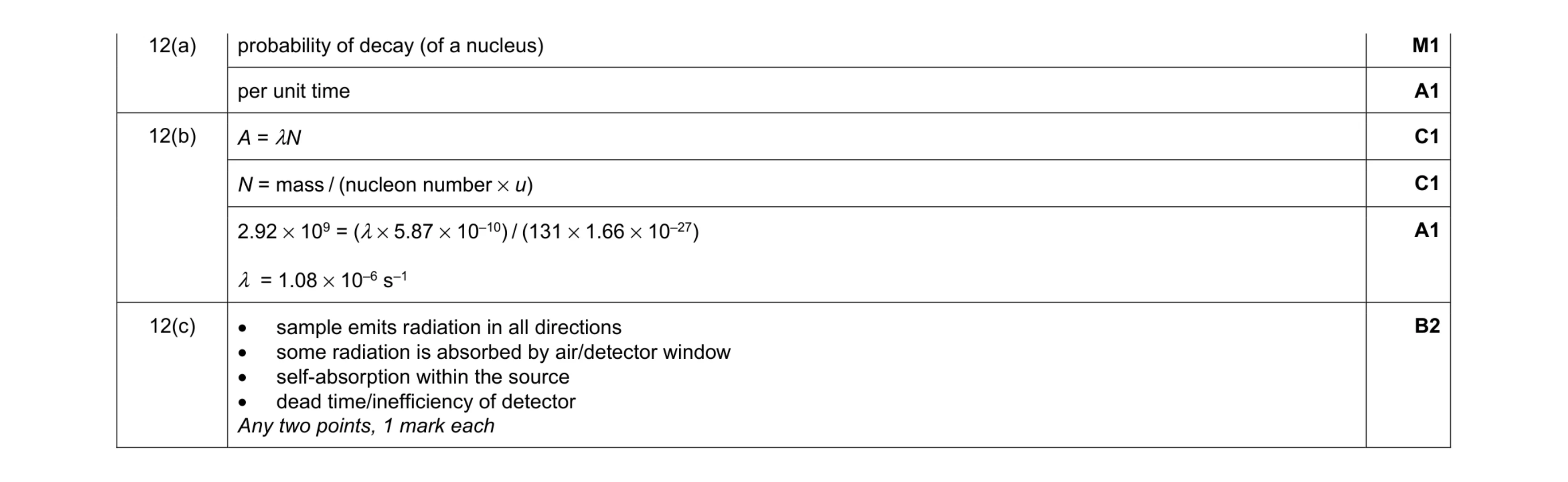 7
7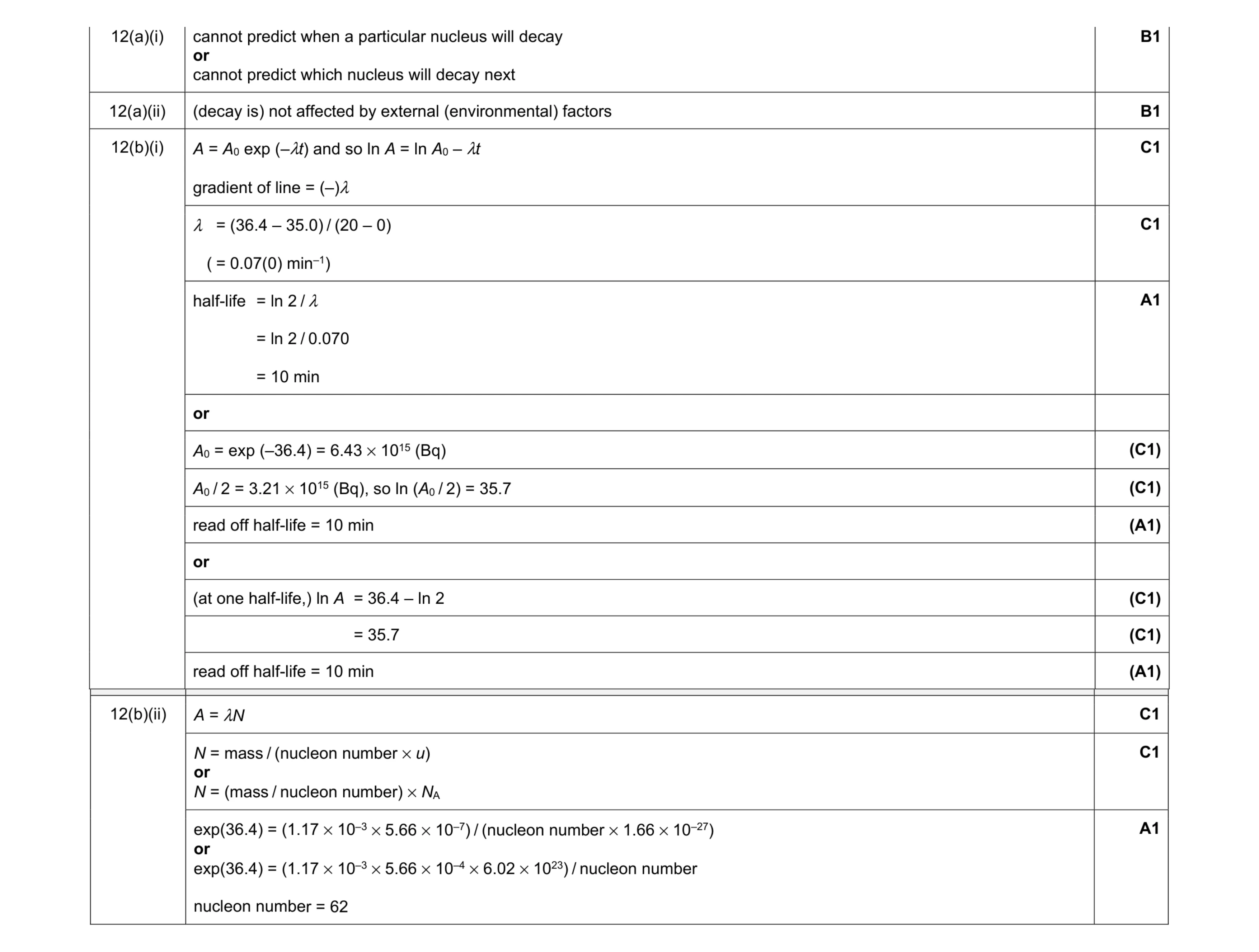 8
8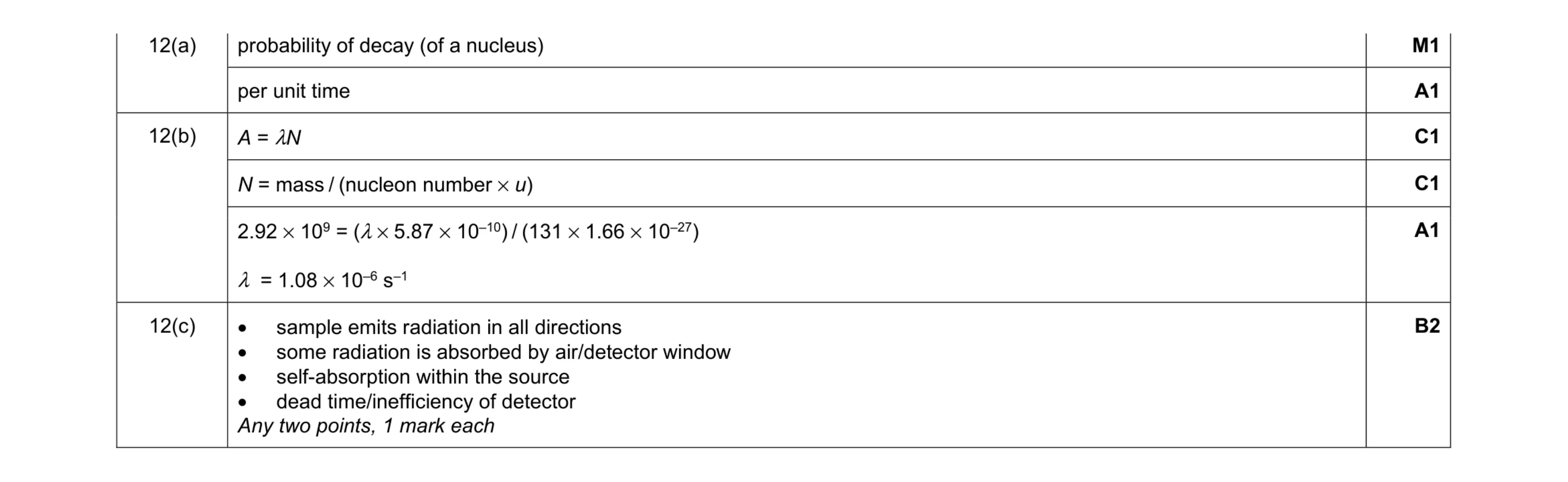 7
7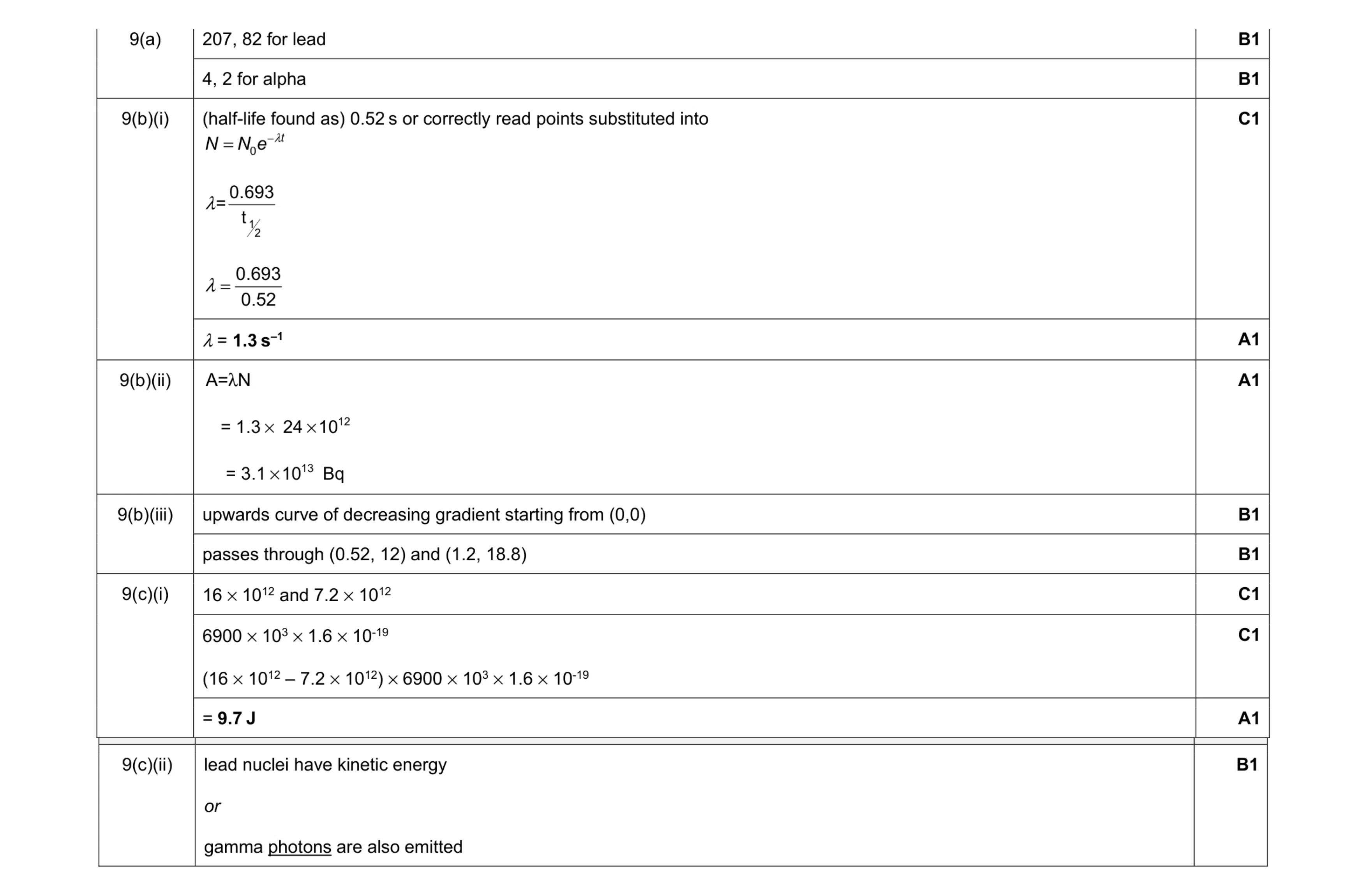 11
11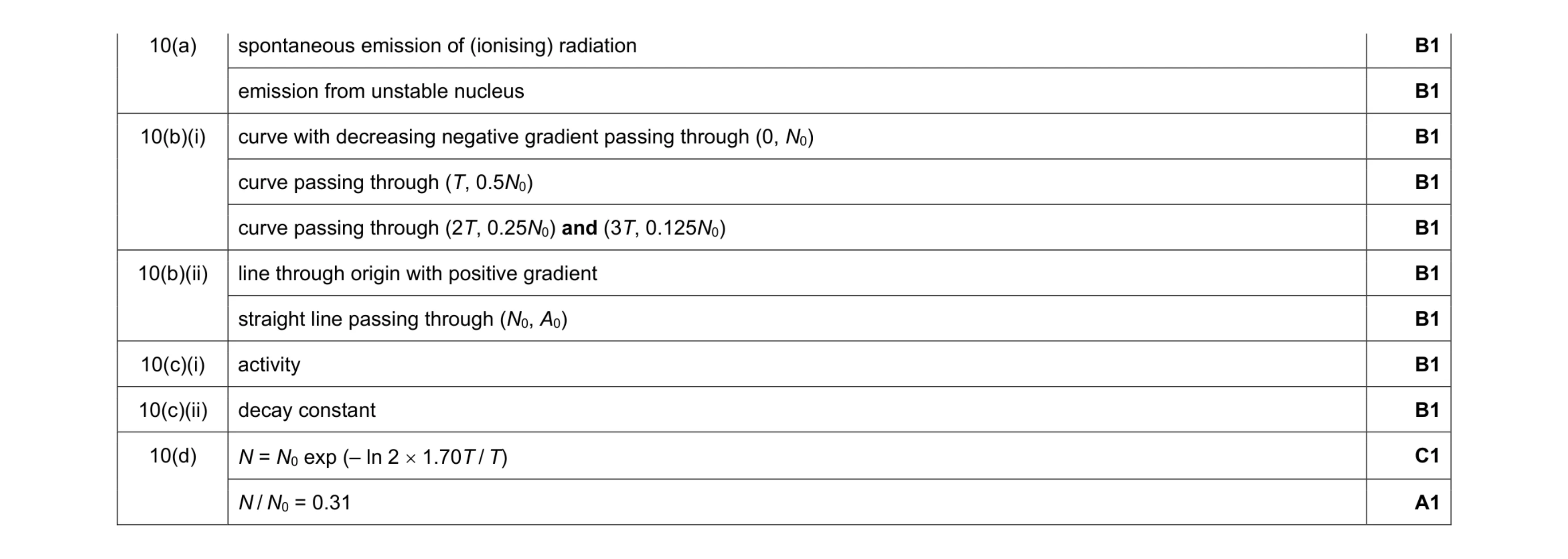 11
11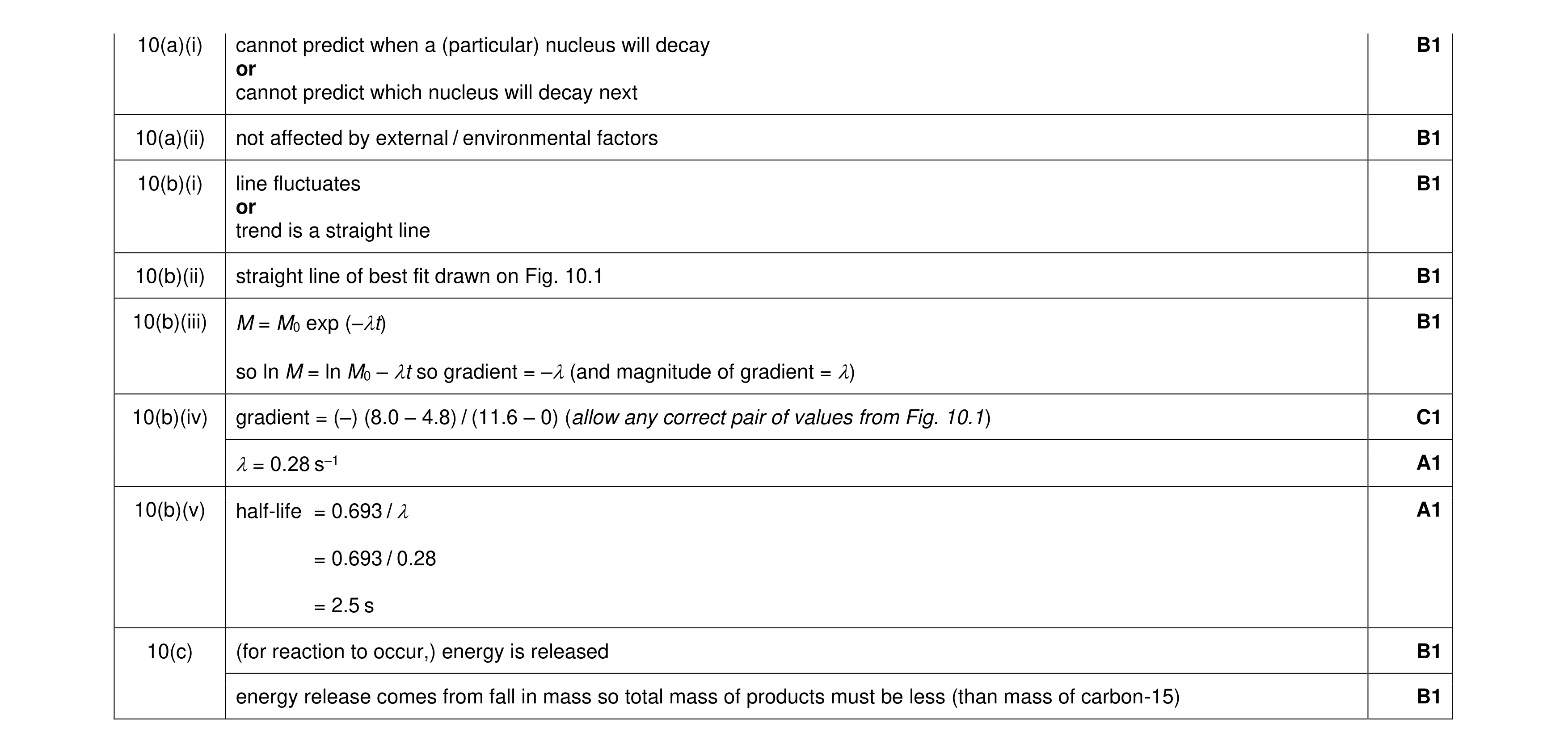 10
10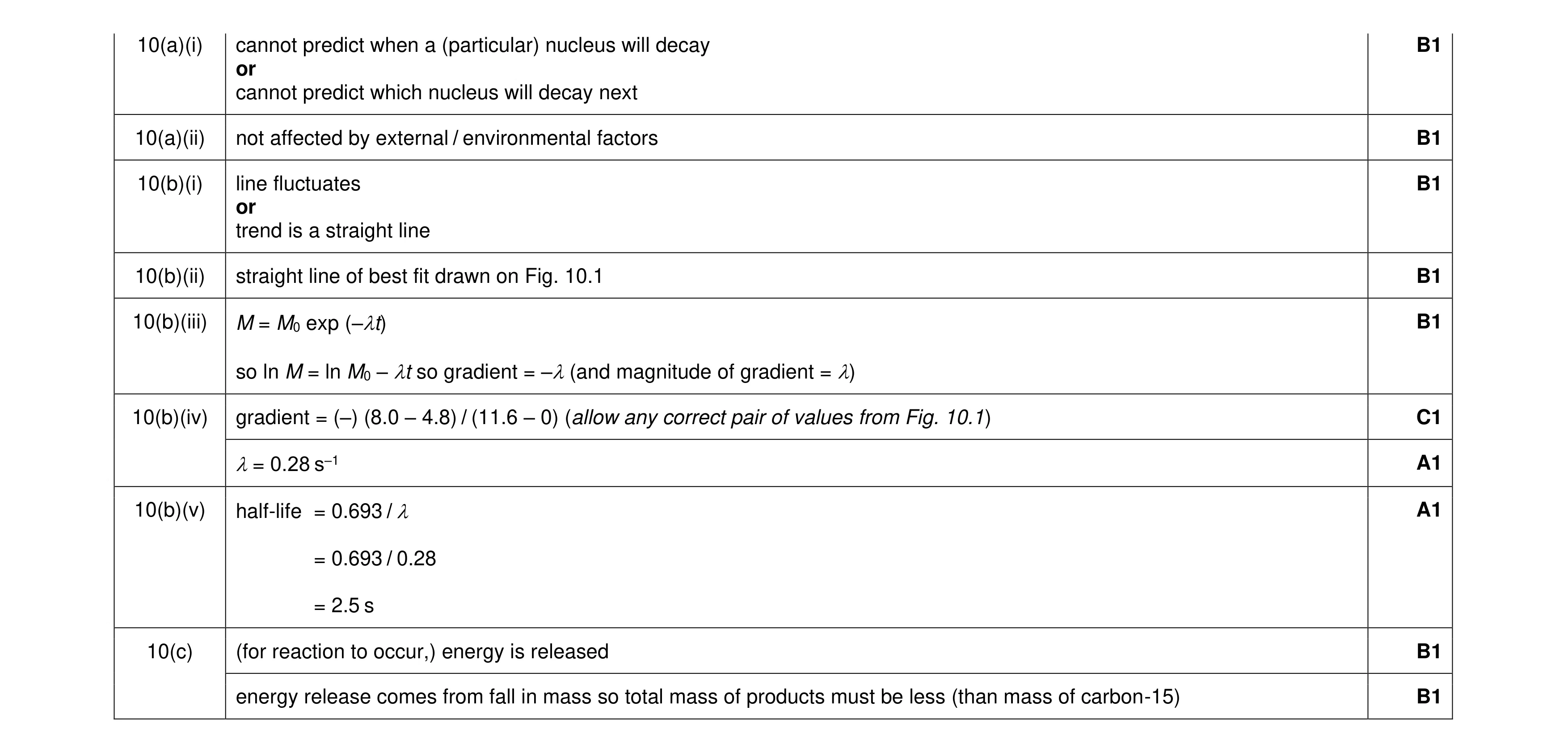 10
10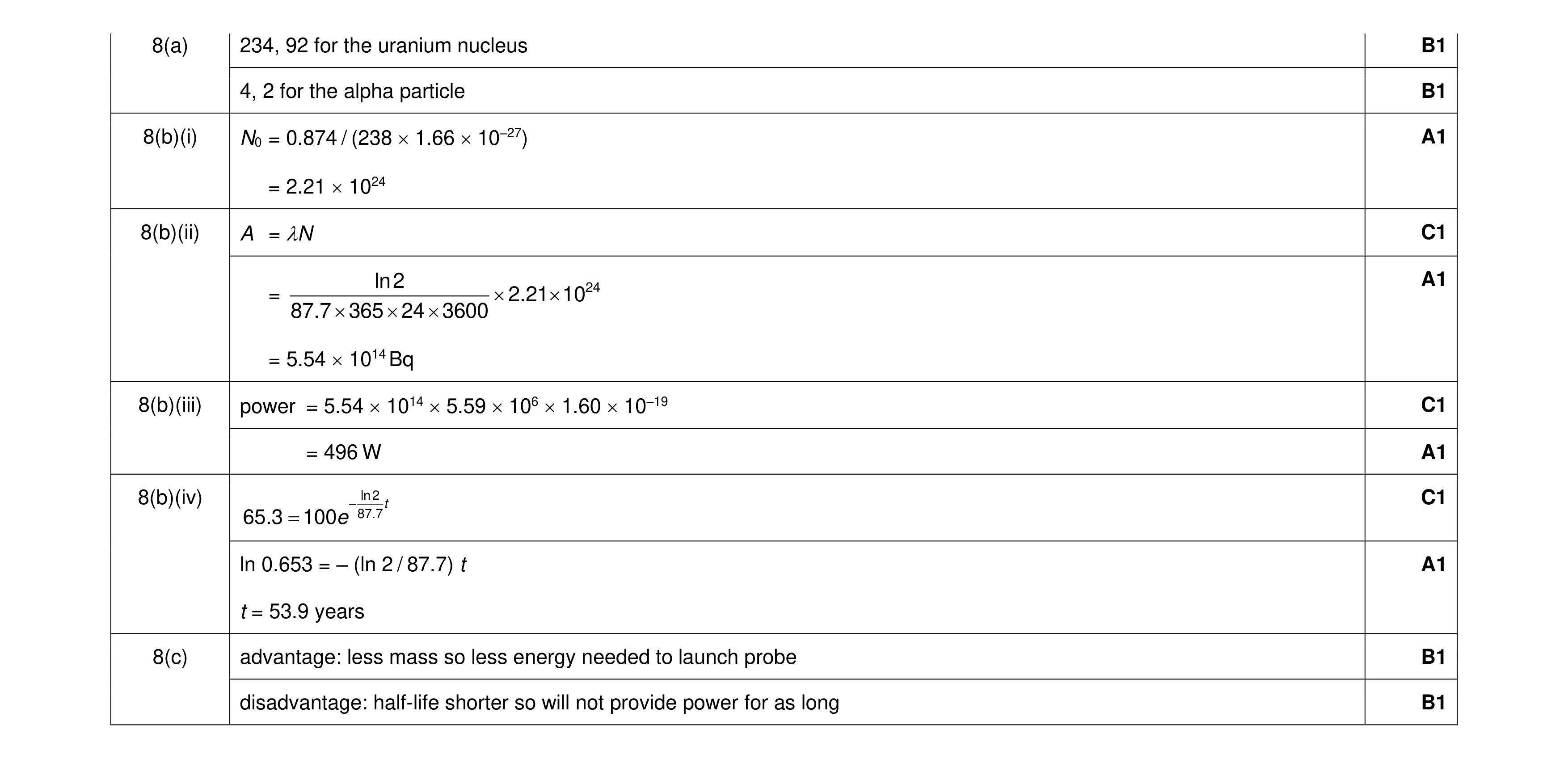 11
11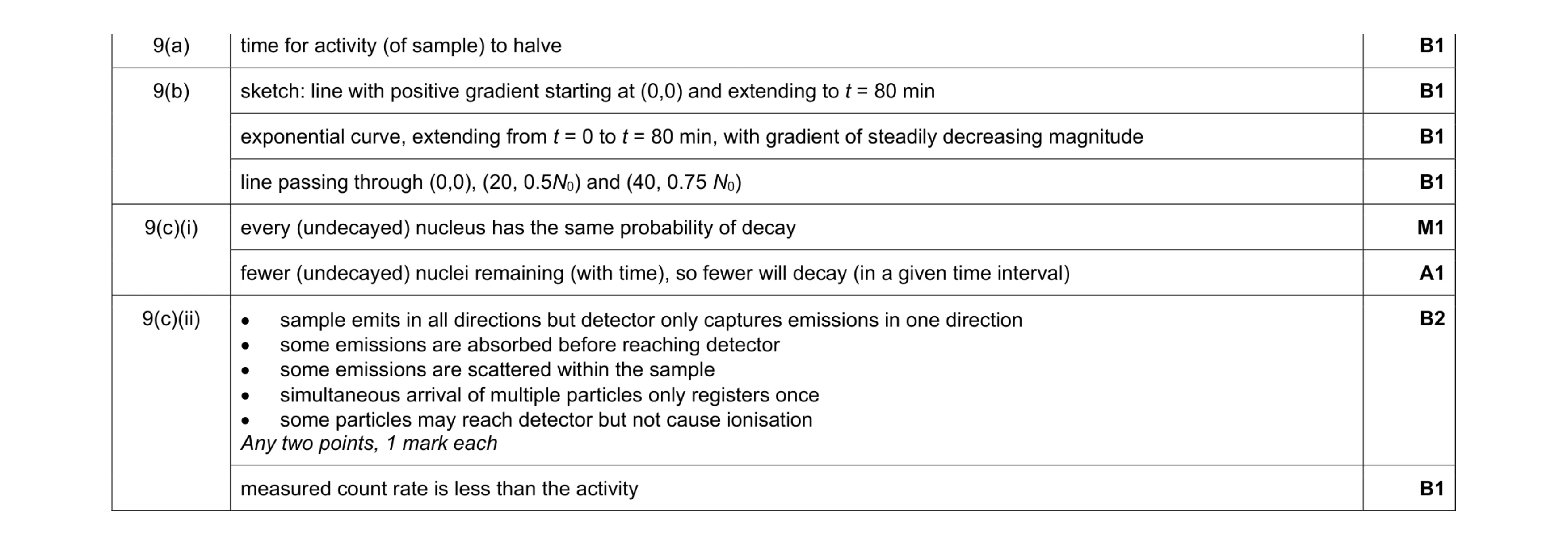 9
9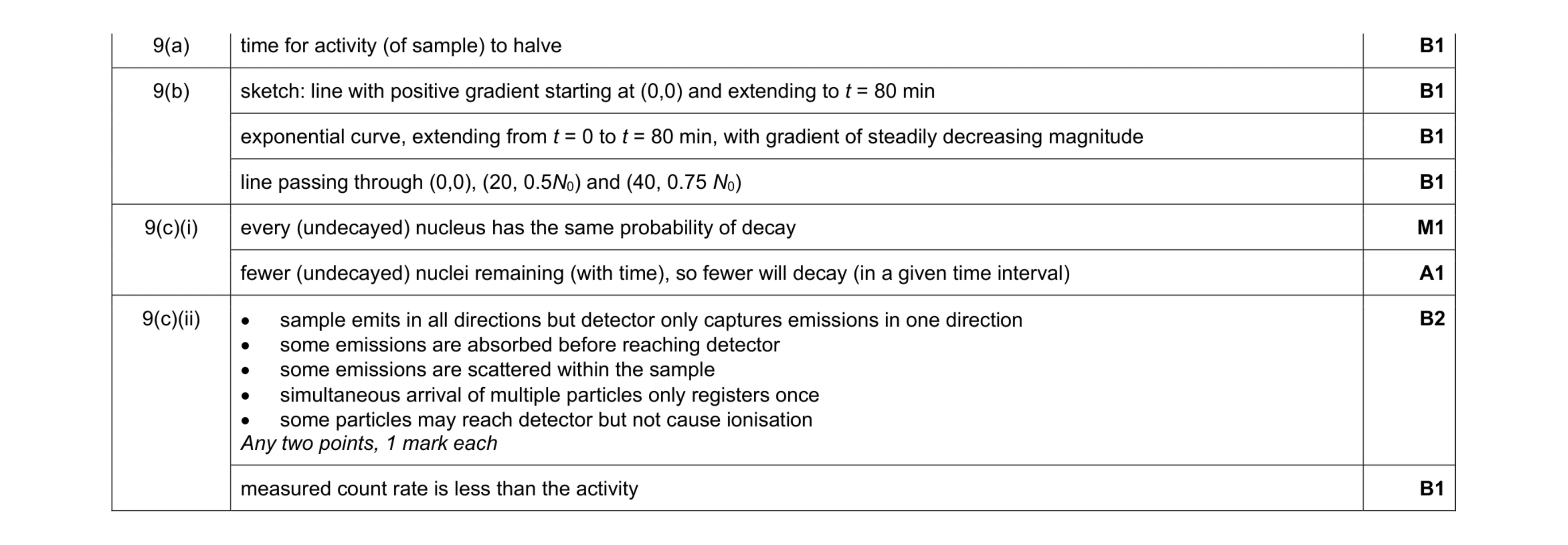 9
9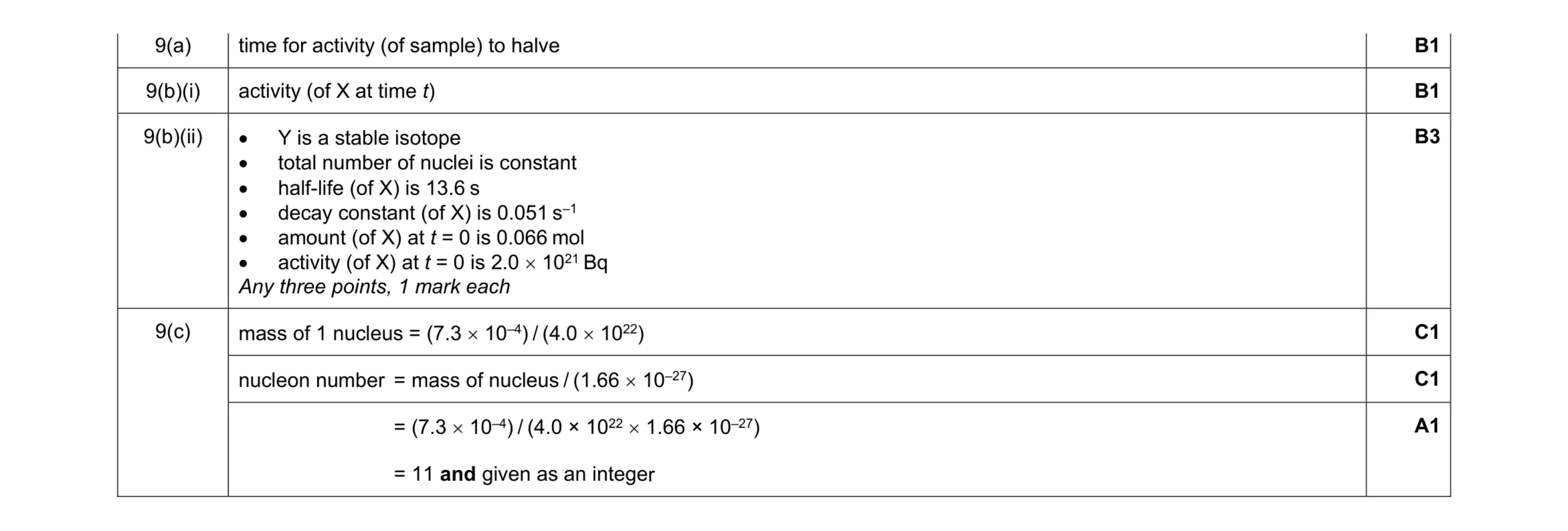 8
8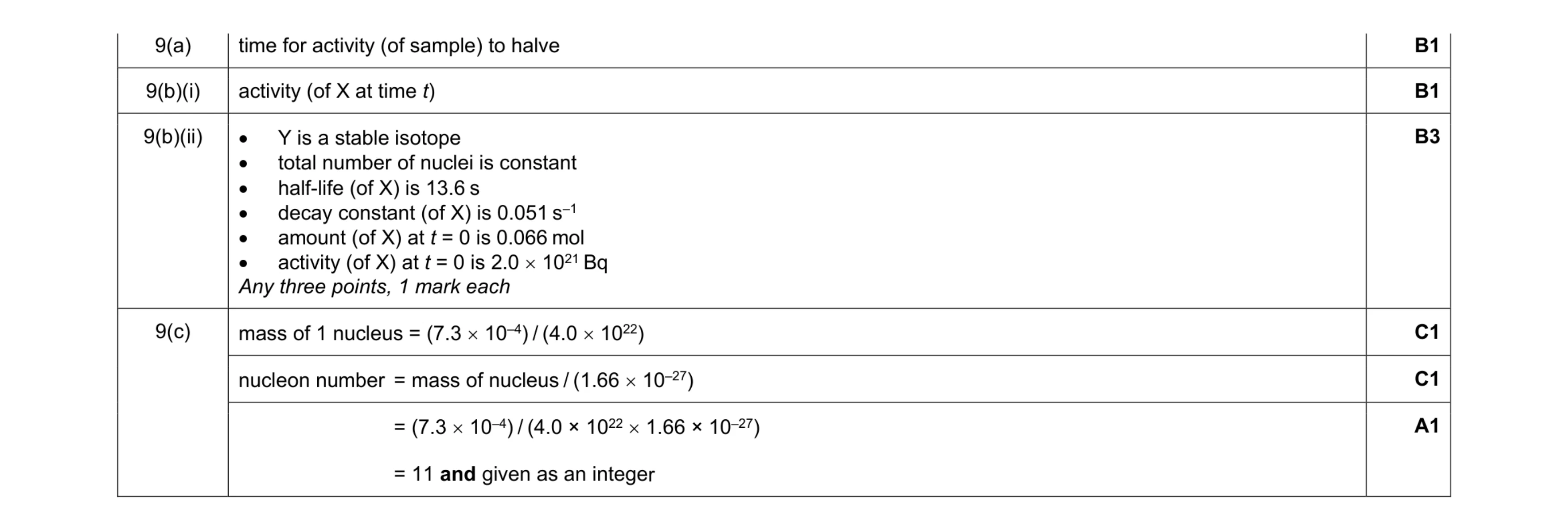 8
8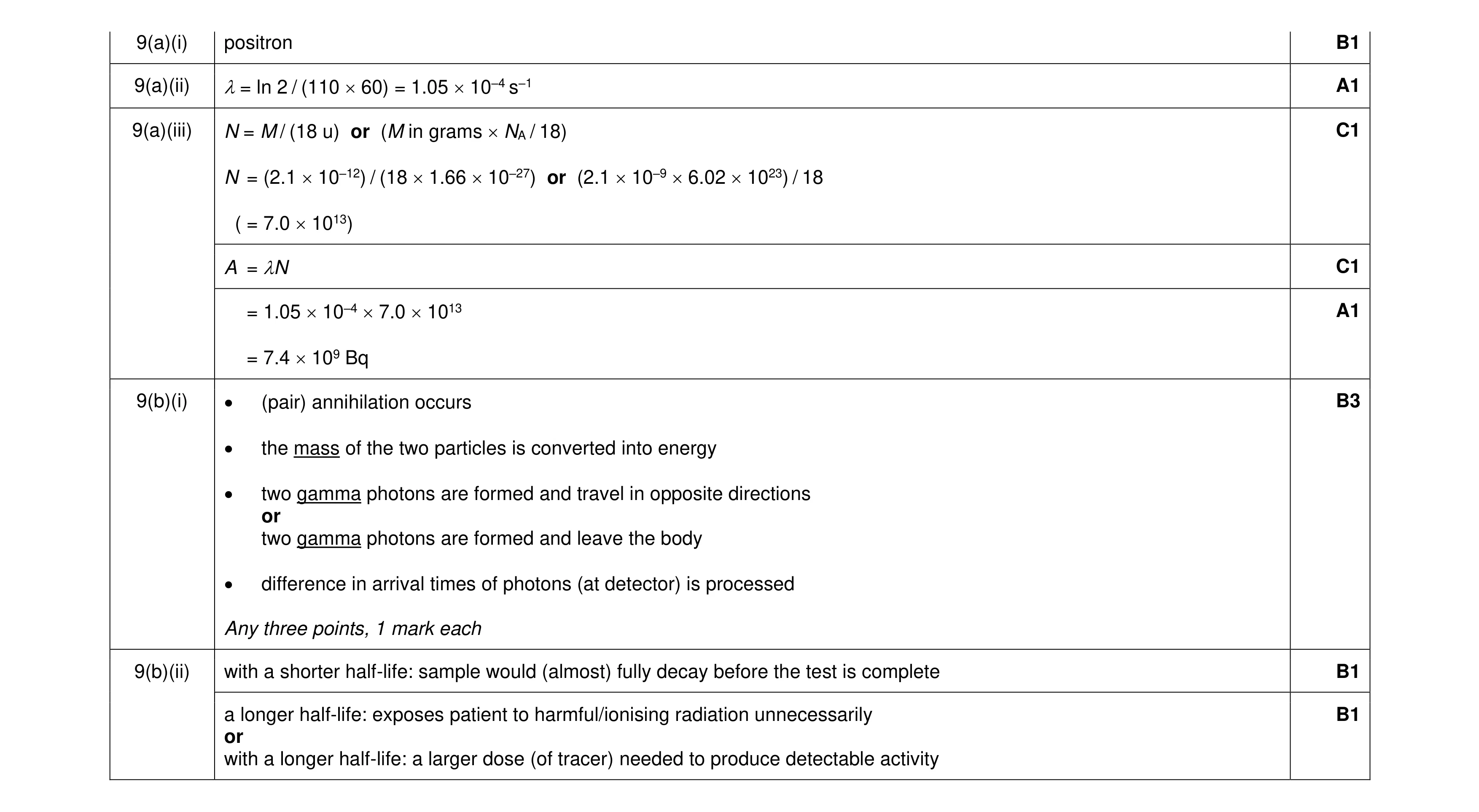 10
10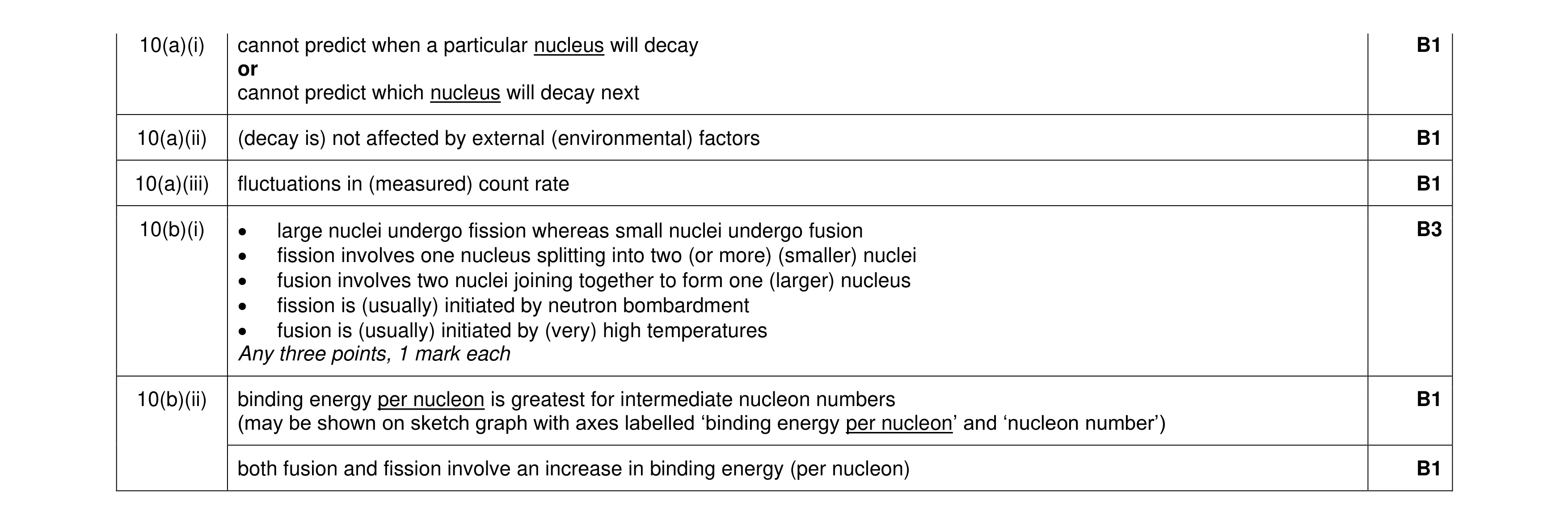 8
8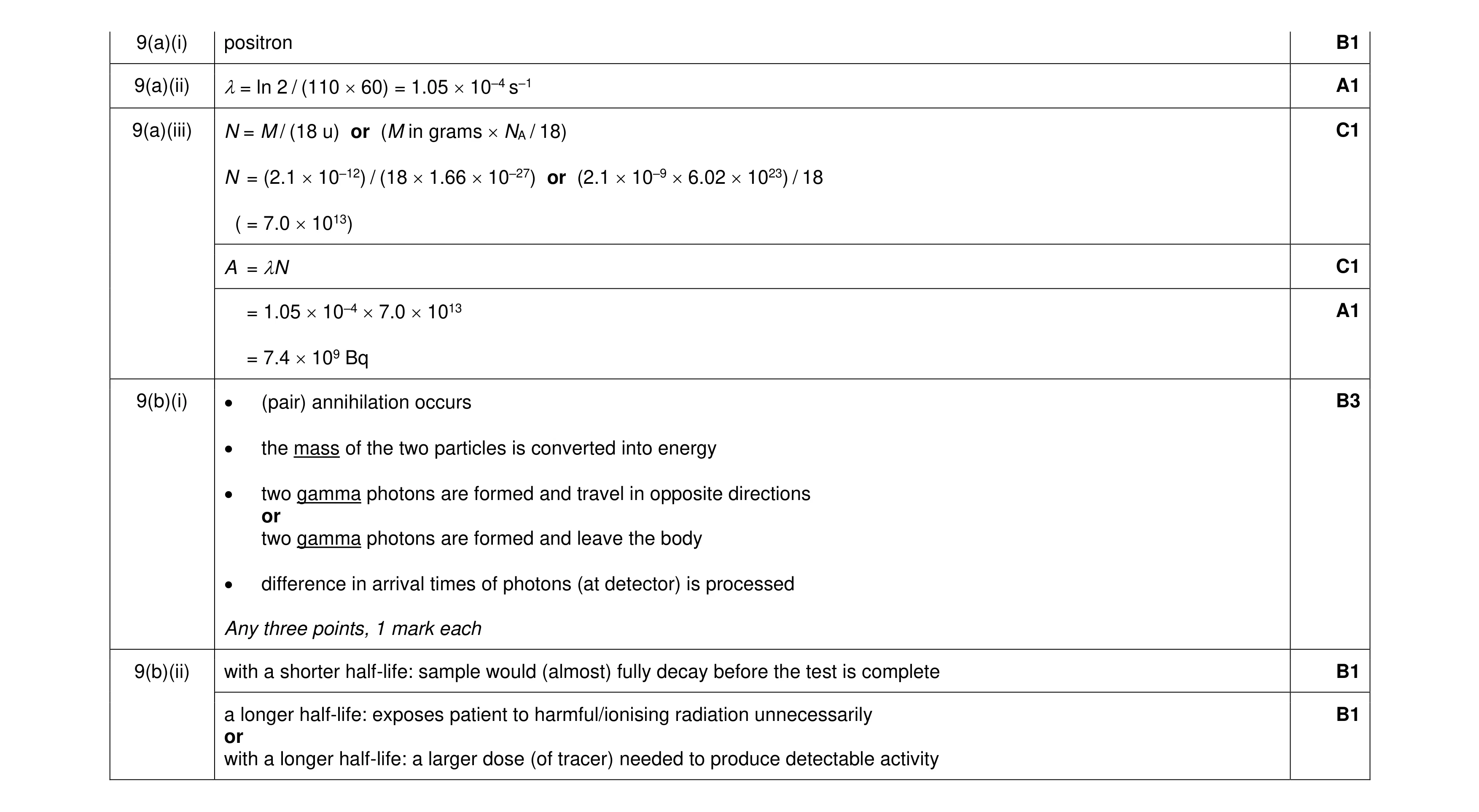 10
10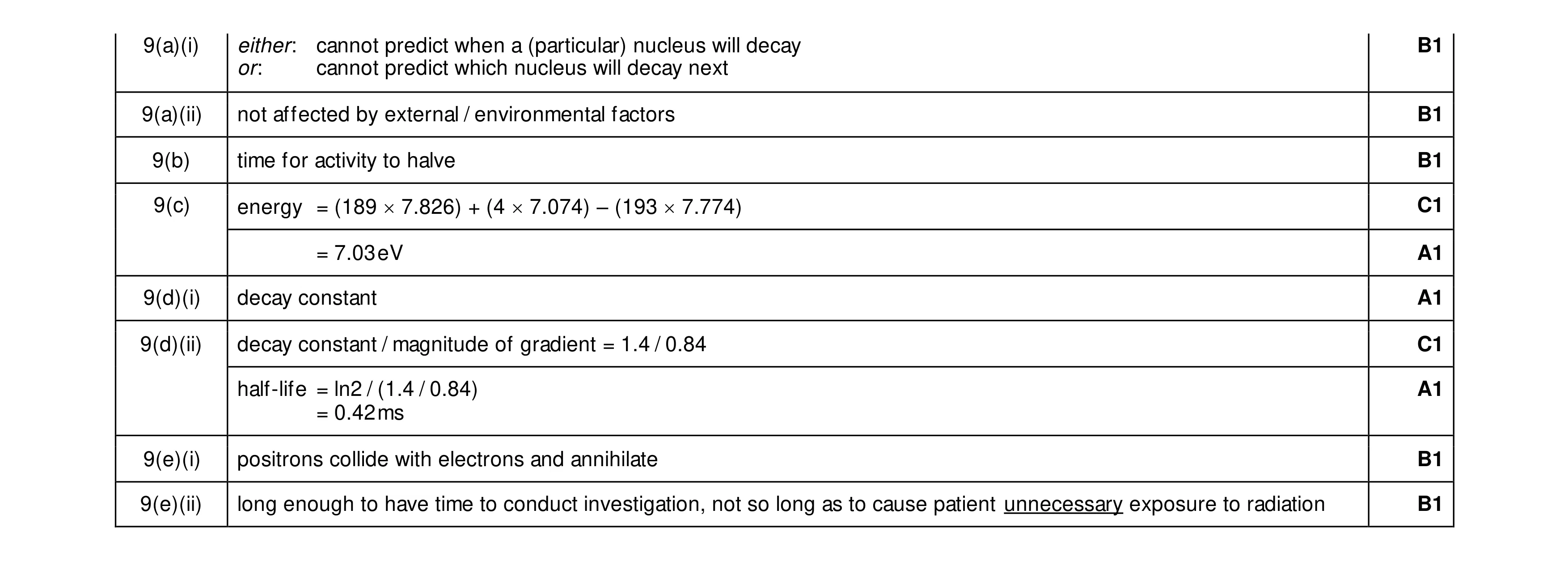 10
10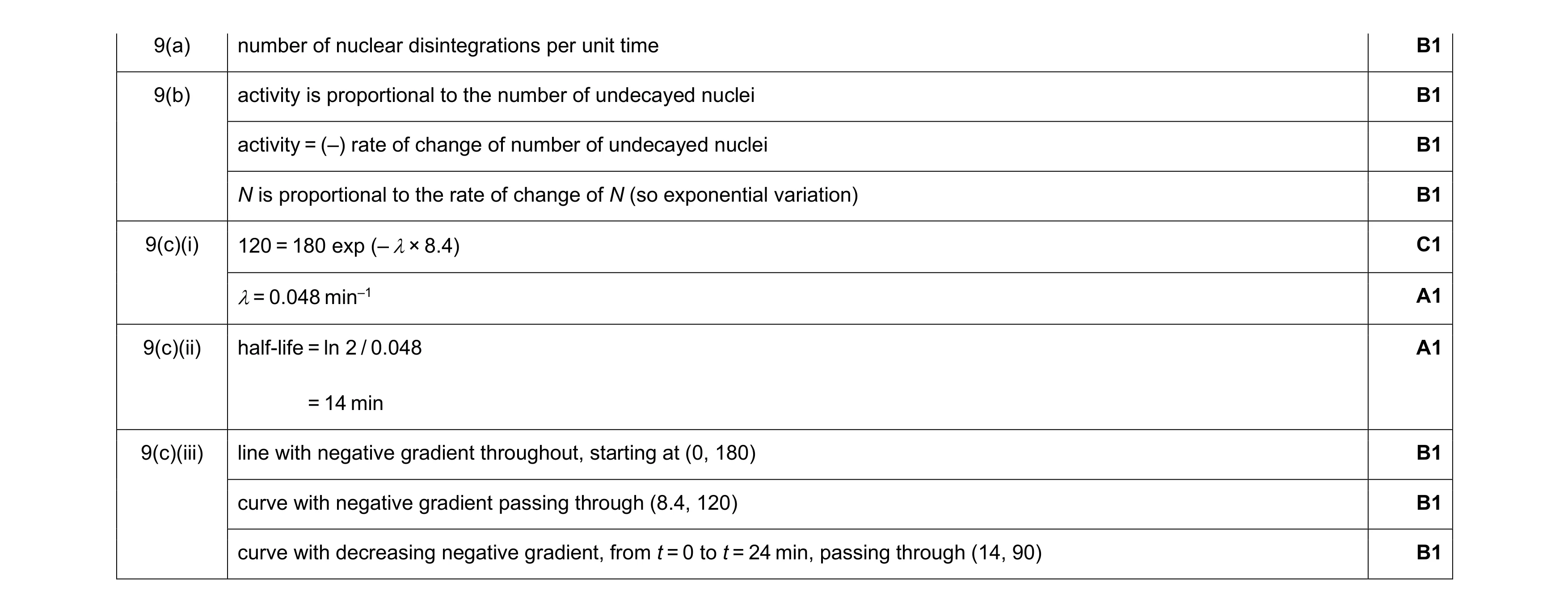 10
10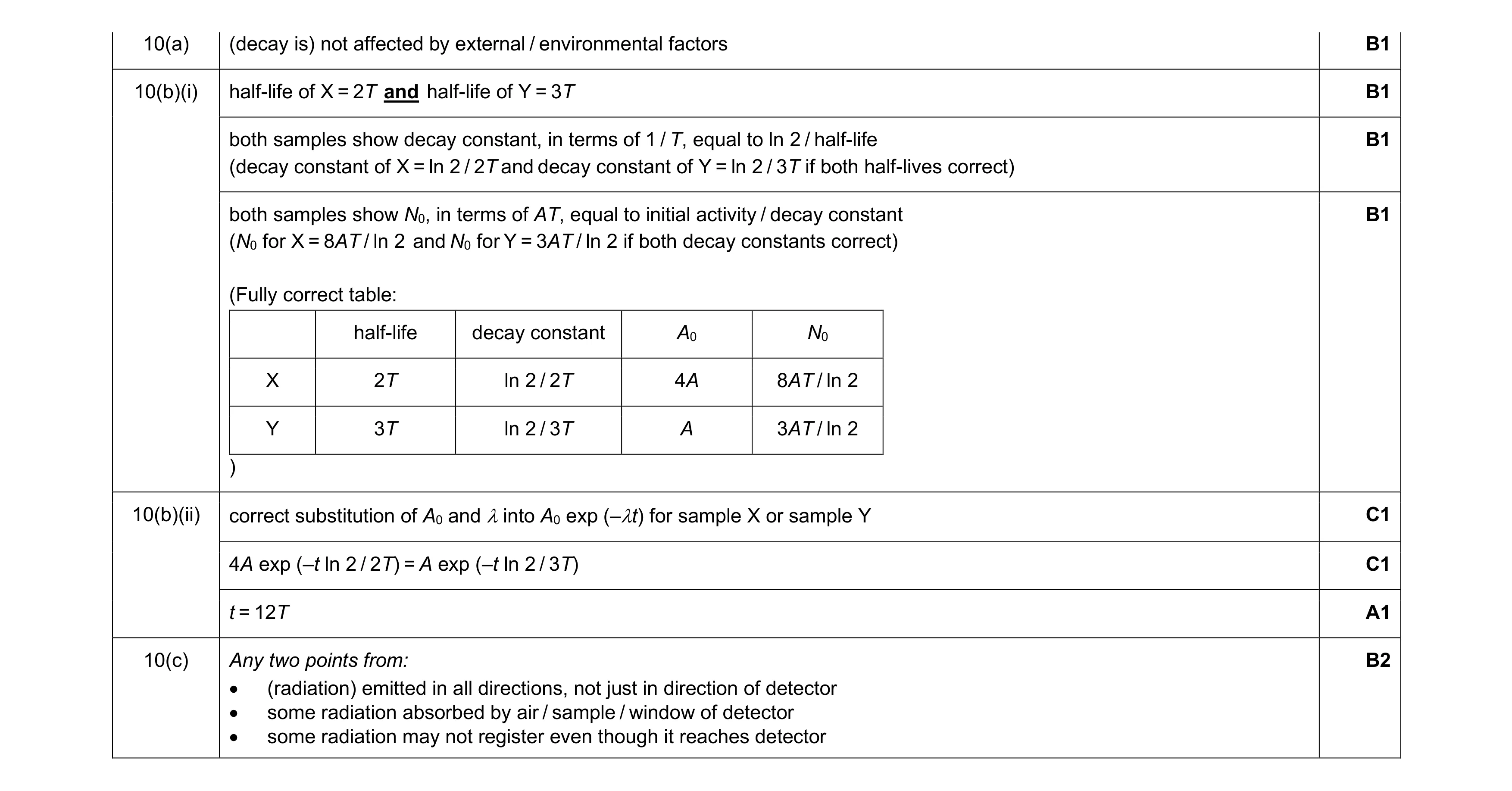 9
9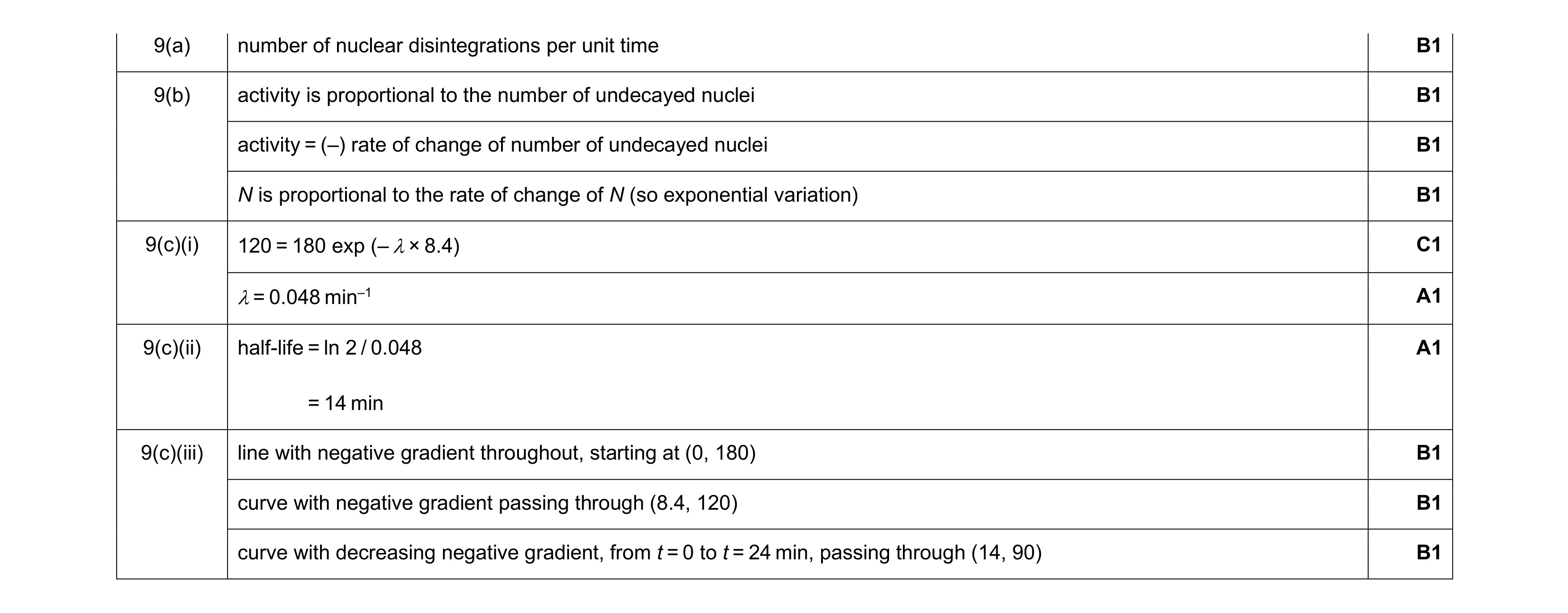 10
10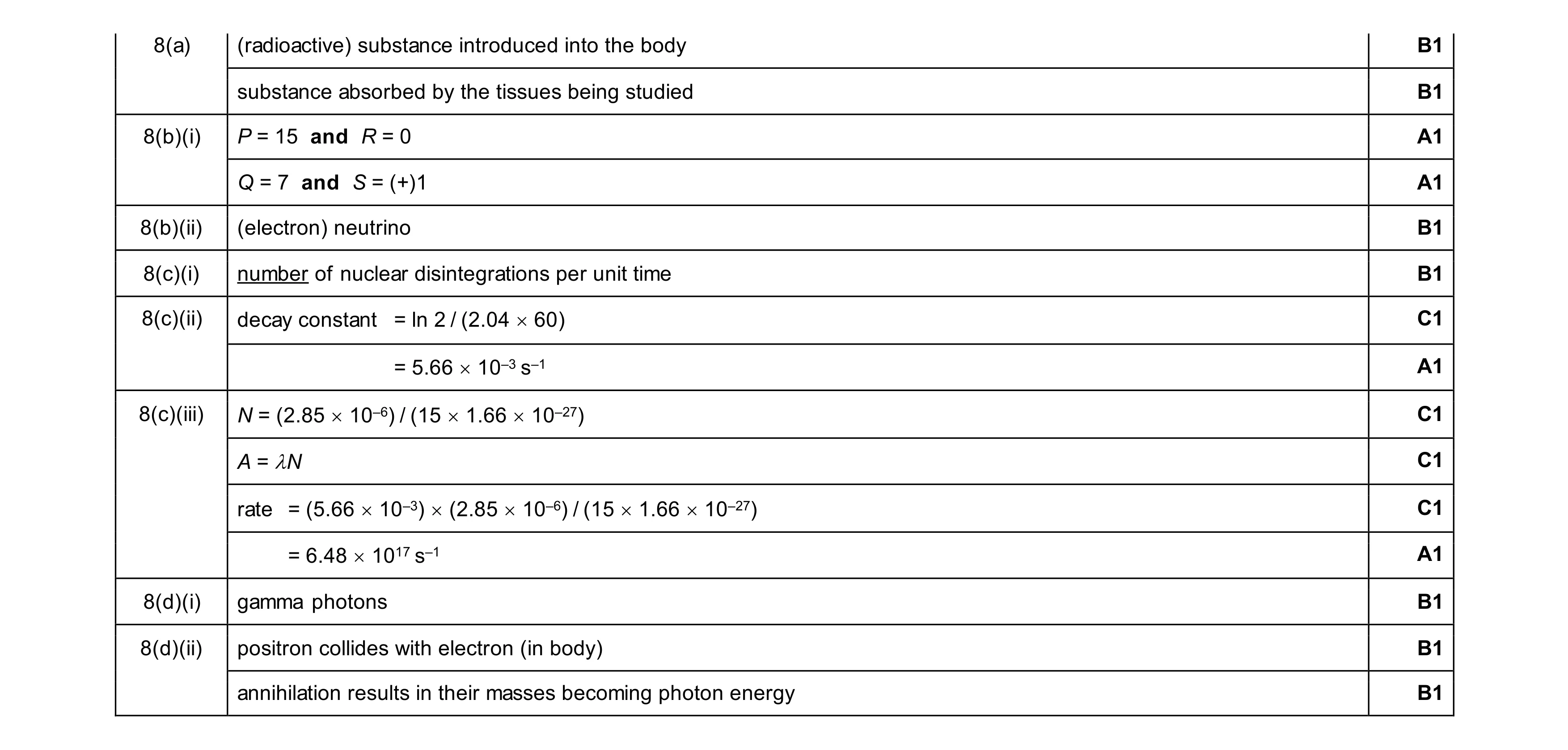 15
15