Questions as text
Q1 · The following particles are used to describe the structure of an atom 9702/23 May/June 2017
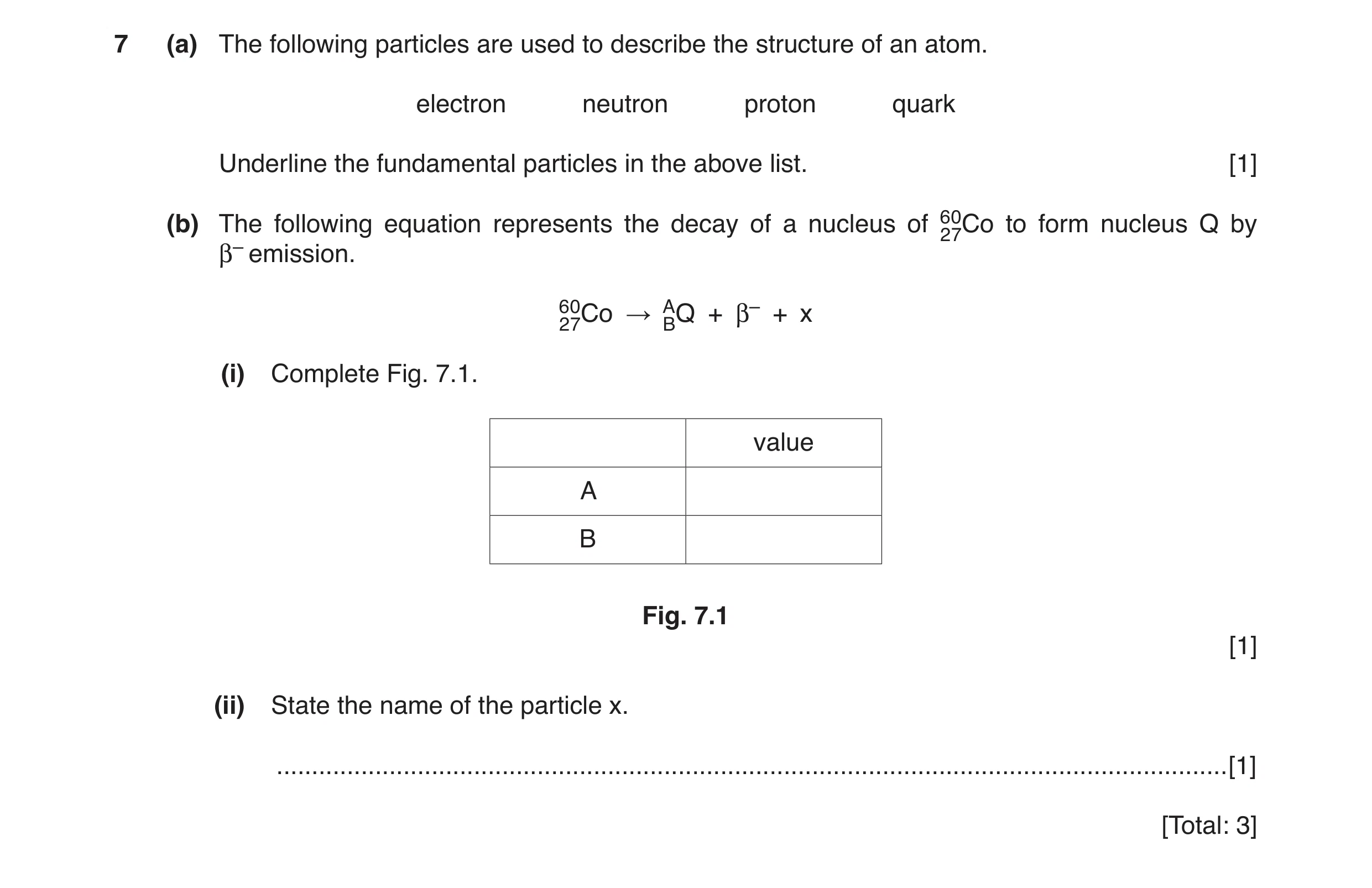
7 (a) The following particles are used to describe the structure of an atom. electron neutron proton quark Underline the fundamental particles in the above list. [1] (b) The following equation represents the decay of a nucleus of 6207Co to form nucleus Q by β– emission. 6 2 07Co → ABQ + β– + x (i) Complete Fig. 7.1. value A B Fig. 7.1 [1] (ii) State the name of the particle x. … [1] [Total: 3]
3 marks
Mark scheme: 7(a) electron and quark both underlined/clearly indicated and no others B1 7(b)(i) value A 60 B 28 both correct B1 7(b)(ii) (electron) antineutrino B1
This question in 9702/23 May/June 2017
Q2 · A stationary nucleus X decays by emitting a β+ particle to form a nucleus of carbon-13 (… 9702/22 Oct/Nov 2017
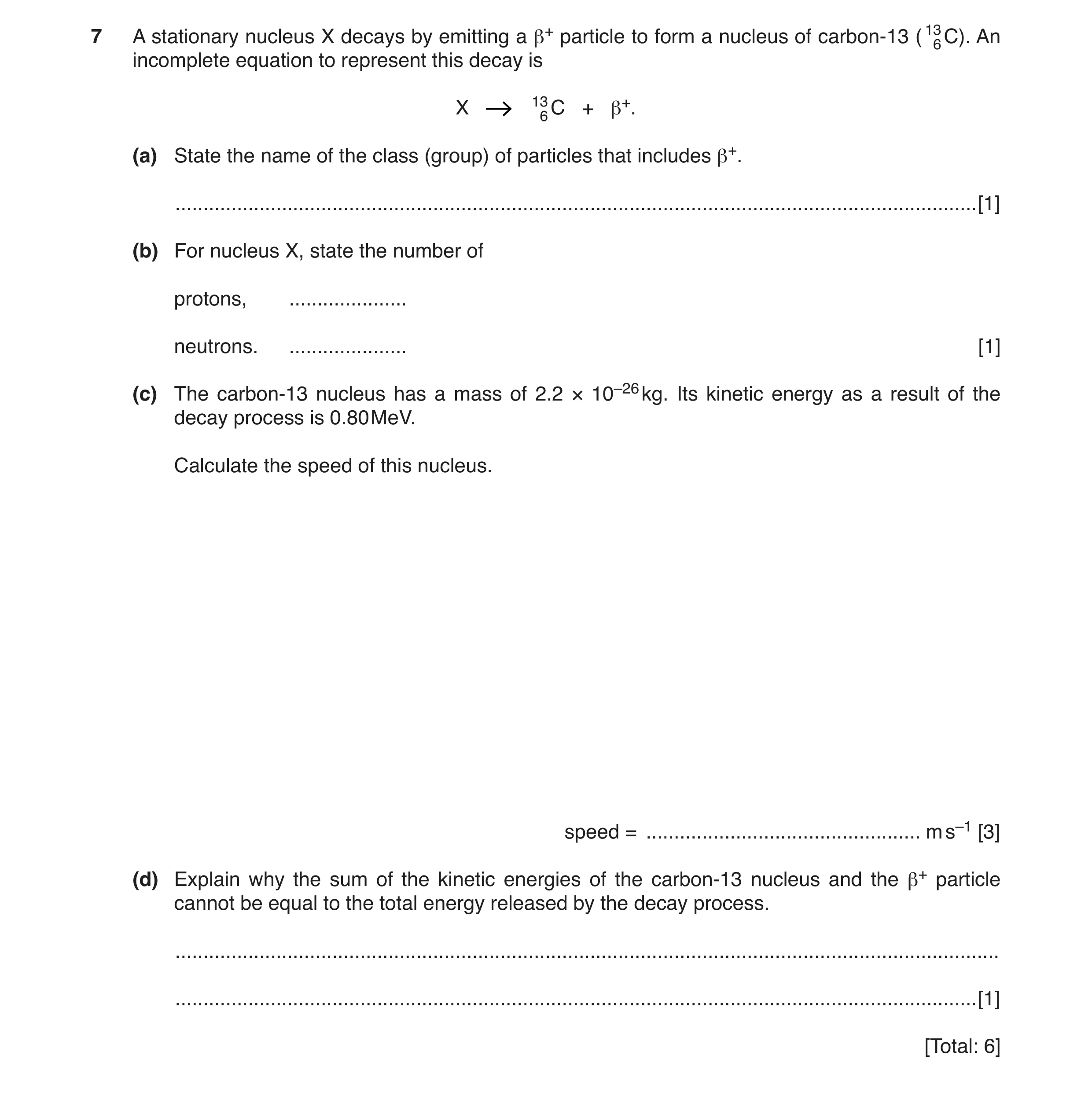
7 A stationary nucleus X decays by emitting a β+ particle to form a nucleus of carbon-13 ( 136 C). An incomplete equation to represent this decay is X 136 C + β+. (a) State the name of the class (group) of particles that includes β+. … [1] (b) For nucleus X, state the number of protons, … neutrons. … [1] (c) The carbon-13 nucleus has a mass of 2.2 × 10⁻²⁶ kg. Its kinetic energy as a result of the decay process is 0.80 MeV. Calculate the speed of this nucleus. speed = … m s–1 [3] (d) Explain why the sum of the kinetic energies of the carbon-13 nucleus and the β+ particle cannot be equal to the total energy released by the decay process. … … [1] [Total: 6]
6 marks
Mark scheme: 7(a) lepton(s) B1 7(b) protons: 7 and neutrons: 6 A1 7(c) E = ½mv2 C1 = 0.80 × 106 × 1.60 × 10–19 C1 = 1.28 × 10⁻¹³ (J) v2 = 2 × 1.28 × 10–13 / 2.2 × 10⁻²⁶ v = 3.4 × 10⁶ m s–1 A1 7(d) an (electron) neutrino/ν(e) is also produced (and this has energy) B1
This question in 9702/22 Oct/Nov 2017
Q3 · A sample of a radioactive isotope emits a beam of β– radiation 9702/22 Feb/March 2018
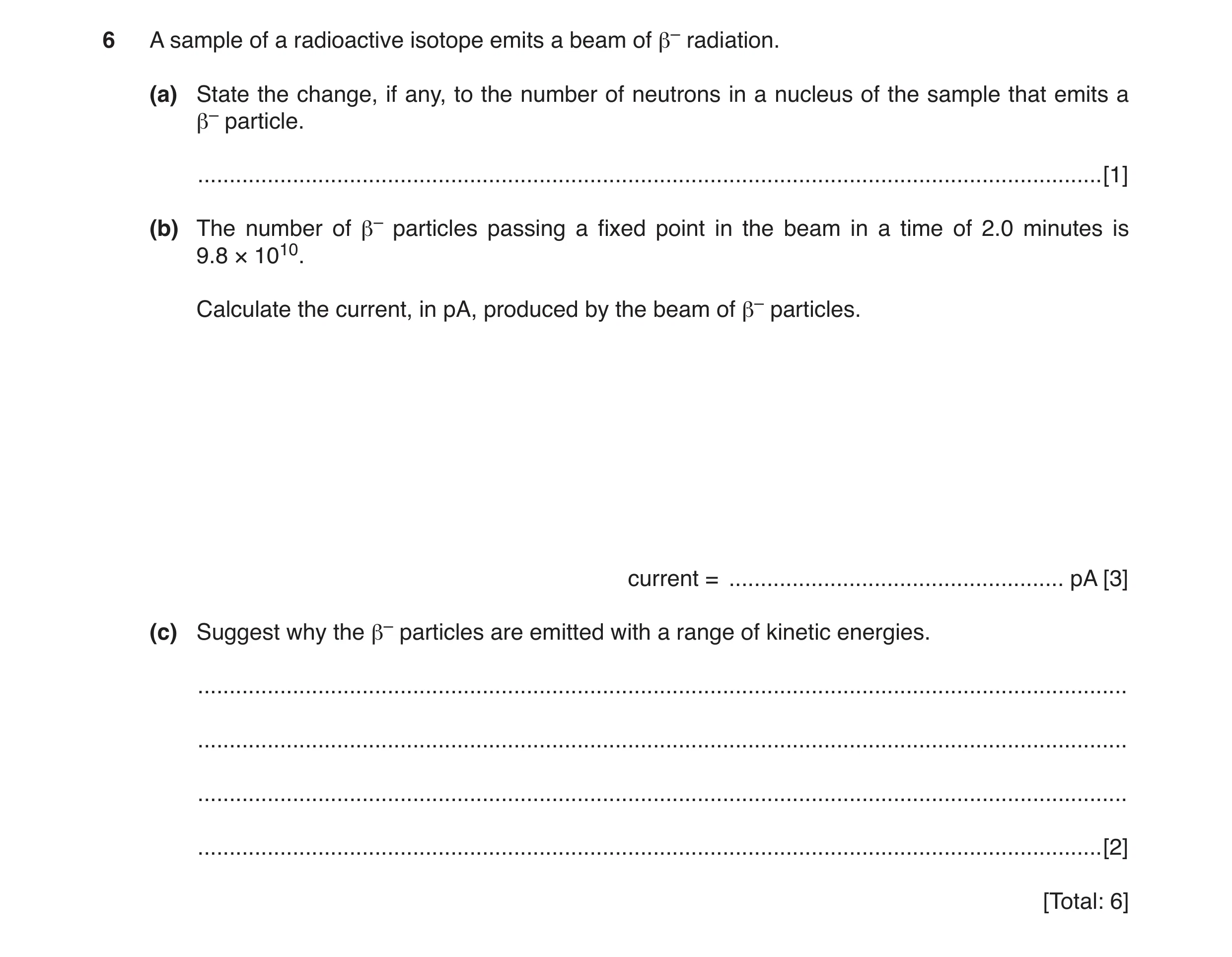
6 A sample of a radioactive isotope emits a beam of β– radiation. (a) State the change, if any, to the number of neutrons in a nucleus of the sample that emits a β– particle. … [1] (b) The number of β– particles passing a fixed point in the beam in a time of 2.0 minutes is 9.8 × 10¹⁰. Calculate the current, in pA, produced by the beam of β– particles. current = … pA [3] (c) Suggest why the β– particles are emitted with a range of kinetic energies. … … … … [2] [Total: 6]
6 marks
Mark scheme: 6(a) –1 / decreases by 1 A1 6(b) I = Q / t or Ne / t C1 = (9.8×1010 × 1.6×10–19) / (2.0 × 60) = 1.3 × 10⁻¹⁰ (A) C1 = 130 pA A1 6(c) antineutrino(s) (emitted) / other particle(s) (emitted) C1 energy / momentum shared with antineutrino(s) A1
This question in 9702/22 Feb/March 2018
Q4 · A graph of nucleon number A against proton number Z is shown in Fig 9702/23 May/June 2018
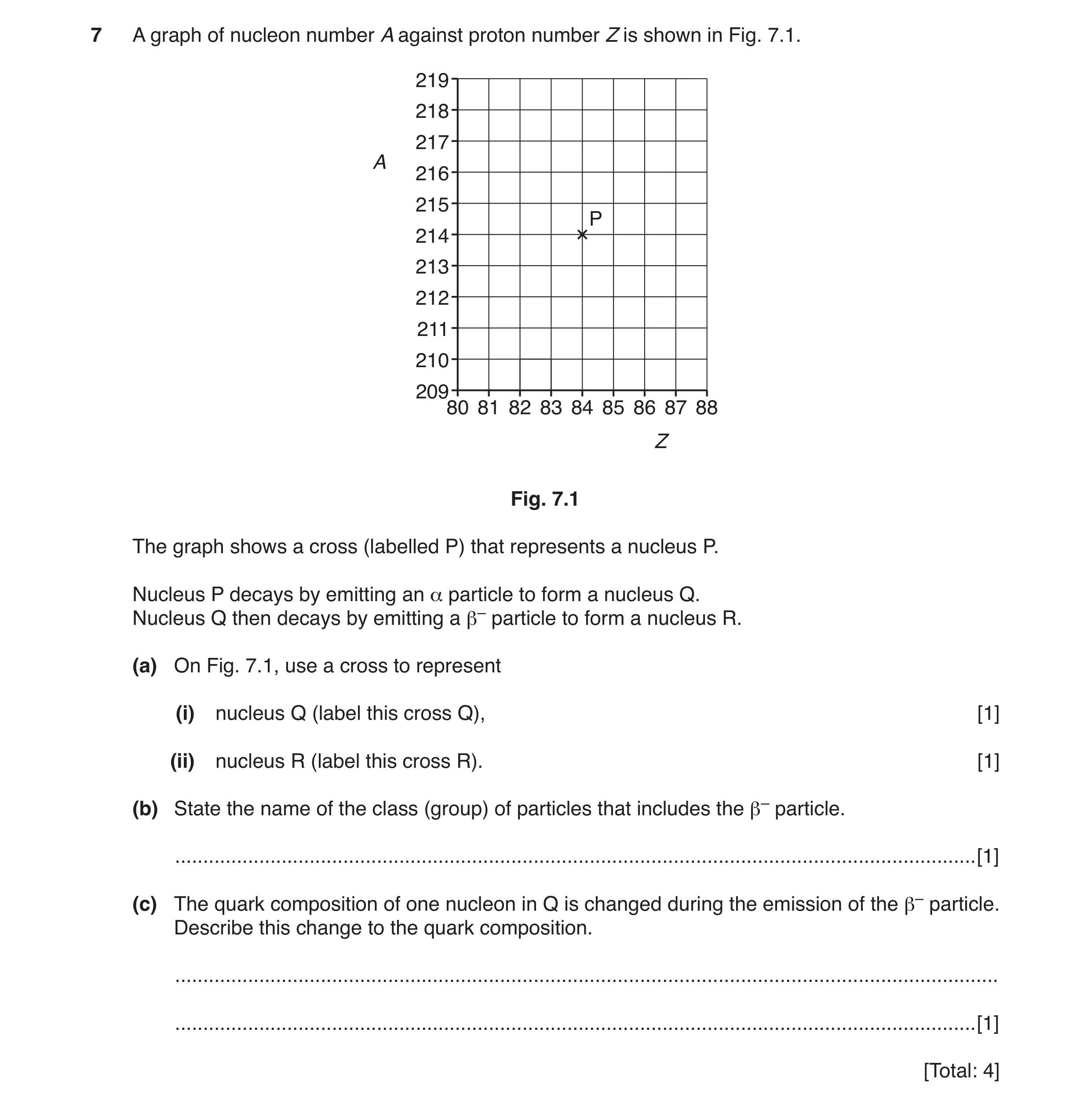
7 A graph of nucleon number A against proton number Z is shown in Fig. 7.1. 219 218 217 A 216 215 P 214 213 212 211 210 20980 81 82 83 84 85 86 87 88 Z Fig. 7.1 The graph shows a cross (labelled P) that represents a nucleus P. Nucleus P decays by emitting an α particle to form a nucleus Q. Nucleus Q then decays by emitting a β– particle to form a nucleus R. (a) On Fig. 7.1, use a cross to represent (i) nucleus Q (label this cross Q), [1] (ii) nucleus R (label this cross R). [1] (b) State the name of the class (group) of particles that includes the β– particle. … [1] (c) The quark composition of one nucleon in Q is changed during the emission of the β– particle. Describe this change to the quark composition. … … [1] [Total: 4]
4 marks
Mark scheme: 7(a)(i) Q plotted at (82, 210) A1 7(a)(ii) R plotted at (83, 210) A1 7(b) lepton(s) B1 7(c) up down down changes to up up down or udd → uud or down changes to up or d → u B1
This question in 9702/23 May/June 2018
Q5 · In the following list, underline all particles that are leptons 9702/22 Oct/Nov 2018
8 (a) In the following list, underline all particles that are leptons. antineutrino positron proton quark [1] γ radiation. (b) A stationary nucleus of magnesium-27, 2712Mg, decays by emitting a β– particle and An incomplete equation to represent this decay is 2712Mg X + β– + γ. (i) State the nucleon number and the proton number of nucleus X. nucleon number = … proton number = … [2] (ii) State the name of the interaction that gives rise to this decay. … [1] (iii) State two possible reasons why the sum of the kinetic energy of the β– particle and the energy of the γ radiation is less than the total energy released during the decay of the magnesium nucleus. 1. … … 2. … … [2] [Total: 6]
6 marks
Mark scheme: 8(a) antineutrino and positron both underlined (and no other particles) B1 8(b)(i) nucleon number = 27 A1 proton number = 13 A1 8(b)(ii) weak (nuclear force/interaction) B1 8(b)(iii) an (electron) antineutrino / ( ) e ν is produced (and this has energy) B1 X has kinetic energy B1
This question in 9702/22 Oct/Nov 2018
Q6 · The decay of a nucleus 1835Ar by β+ emission is represented by 1835Ar X + β+ + Y 9702/21 Oct/Nov 2019
7 (a) The decay of a nucleus 1835Ar by β+ emission is represented by 1835Ar X + β+ + Y. A nucleus X and two particles, β+ and Y, are produced by the decay. State: (i) the proton number and the nucleon number of nucleus X proton number = … nucleon number = … [1] (ii) the name of the particle represented by the symbol Y. … [1] (b) A hadron consists of two down quarks and one strange quark. Determine, in terms of the elementary charge e, the charge of this hadron. charge = … [2] [Total: 4]
4 marks
Mark scheme: 7(a)(i) proton number = 17 and nucleon number = 35 A1 7(a)(ii) (electron) neutrino B1 7(b) d/down (quark charge) is –⅓(e) or two d/down (quark charges) is –⅔(e) or s/strange (quark charge) is –⅓(e) C1 charge = –⅓(e) –⅓(e) –⅓(e) = –1(e) A1
This question in 9702/21 Oct/Nov 2019
Q7 · A nucleus of plutonium-238 (23894Pu) decays by emitting an α-particle to produce a new… 9702/22 Oct/Nov 2019
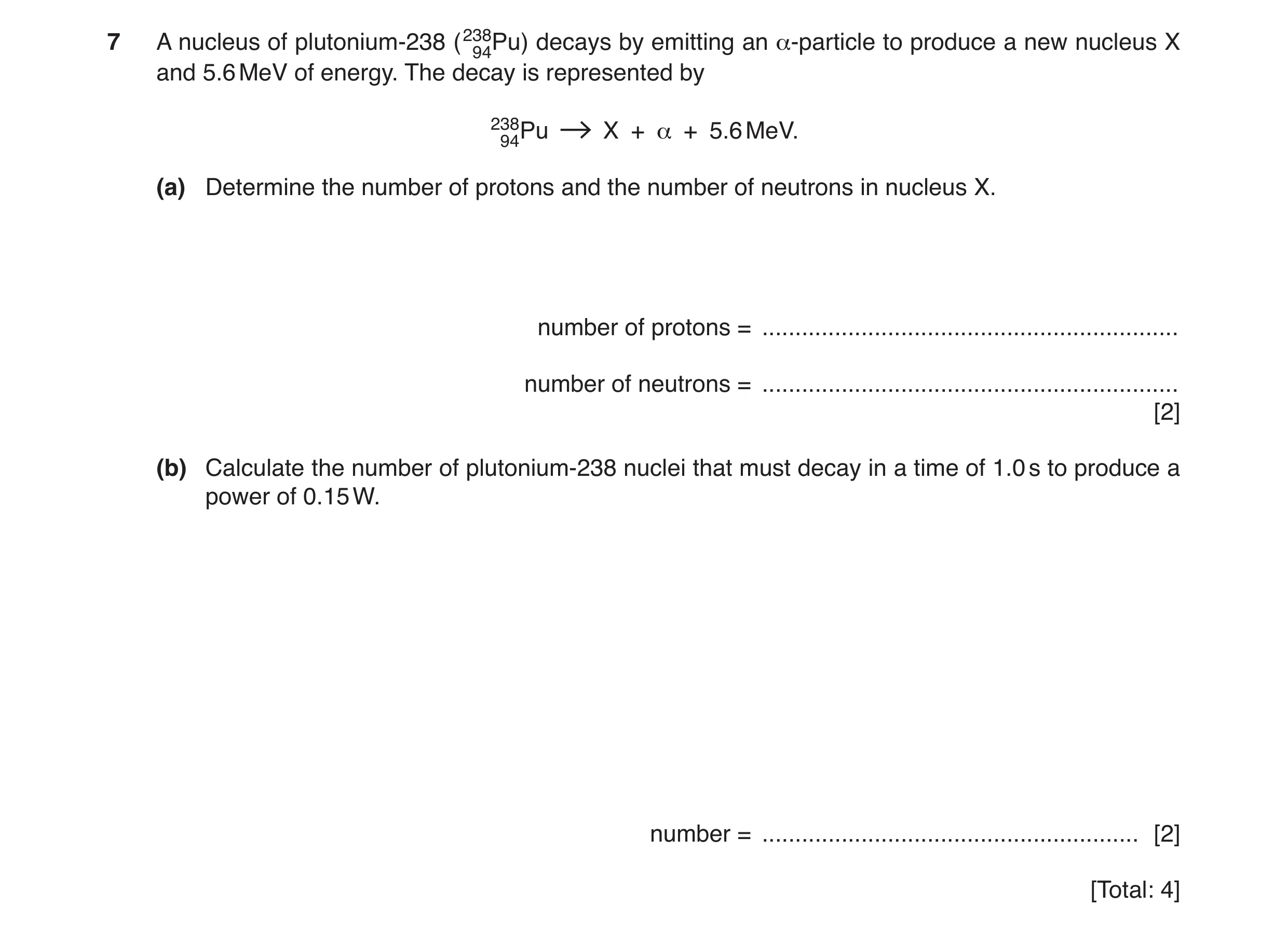
7 A nucleus of plutonium-238 (23894Pu) decays by emitting an α-particle to produce a new nucleus X and 5.6 MeV of energy. The decay is represented by α + 5.6 MeV. 23894Pu X + (a) Determine the number of protons and the number of neutrons in nucleus X. number of protons = … number of neutrons = … [2] (b) Calculate the number of plutonium-238 nuclei that must decay in a time of 1.0 s to produce a power of 0.15 W. number = … [2] [Total: 4]
4 marks
Mark scheme: 7(a) number of protons = 92 A1 number of neutrons = 142 A1 7(b) 5.6 MeV = 5.6 × 1.60 × 10–19 × 106 (= 8.96 × 10⁻¹³ J) C1 number = 0.15 / (5.6 × 1.60 × 10–13) number = 1.7 × 10¹¹ A1 or 0.15 W = 0.15 / (1.60 × 10–19 × 106) (= 9.38 × 10¹¹ MeV s–1) (C1) number = 9.38 × 10¹¹ / 5.6 number = 1.7 × 10¹¹ (A1)
This question in 9702/22 Oct/Nov 2019
Q8 · A potential difference is applied between two horizontal metal plates that are a distance… 9702/23 May/June 2020
7 A potential difference is applied between two horizontal metal plates that are a distance of 6.0 mm apart in a vacuum, as shown in Fig. 7.1. horizontal – 450 V plate 6.0 mm path of β– particle horizontal radioactive 0 V plate source Fig. 7.1 The top plate has a potential of –450 V and the bottom plate is earthed. Assume that there is a uniform electric field produced between the plates. A radioactive source emits a β– particle that travels through a hole in the bottom plate and along a vertical path until it reaches the top plate. (a) (i) Determine the magnitude and the direction of the electric force acting on the β– particle as it moves between the plates. magnitude of force = … N direction of force … [4] (ii) Calculate the work done by the electric field on the β– particle for its movement from the bottom plate to the top plate. work done = … J [2] (b) The β– particle is emitted from the source with a kinetic energy of 3.4 × 10⁻¹⁶ J. Calculate the speed at which the β– particle is emitted. speed = … m s–1 [2] (c) The β– particle is produced by the decay of a neutron. (i) Complete the equation below to represent the decay of the neutron. 10n –1β–0 + … + … … … [2] (ii) State the name of the group (class) of particles that includes: 1. neutrons … 2. β– particles. … [2] [Total: 12]
12 marks
Mark scheme: 7(a)(i) E = V / d or E = F / Q C1 F = (450 × 1.60 × 10–19) / 6.0 × 10⁻³ C1 = 1.2 × 10⁻¹⁴ N A1 direction: vertically downwards B1 Question Answer Marks 7(a)(ii) work done = Fs or Fd or EQd C1 = (–)1.2 × 10–14 × 6.0 × 10–3 = (–)7.2 × 10⁻¹⁷ J A1 or work done = VQ (C1) = (–)450 × 1.60 × 10–19 = (–)7.2 × 10⁻¹⁷ J (A1) 7(b) E = ½mv2 C1 3.4 × 10–16 = ½ × 9.11 × 10⁻³¹ × v2 v = 2.7 × 10⁷ m s–1 A1 7(c)(i) 1 1p A1 0 0 (e) ν A1 7(c)(ii) 1. hadrons B1 2. leptons B1
This question in 9702/23 May/June 2020
Q9 · Two vertical metal plates are separated by a distance d in a vacuum, as shown in Fig 9702/23 Oct/Nov 2020
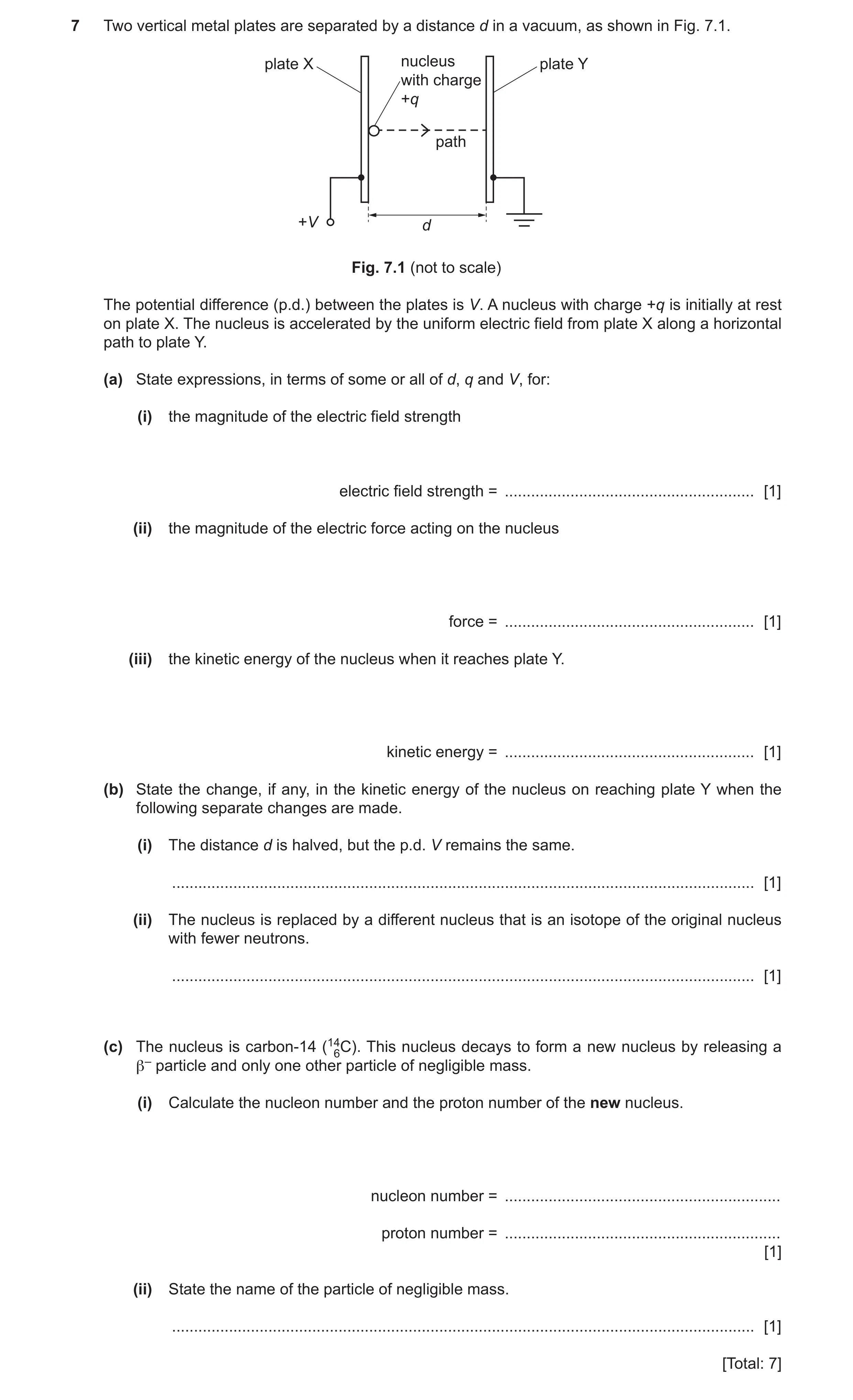
7 Two vertical metal plates are separated by a distance d in a vacuum, as shown in Fig. 7.1. plate X nucleus plate Y with charge +q path +V d Fig. 7.1 (not to scale) The potential difference (p.d.) between the plates is V. A nucleus with charge +q is initially at rest on plate X. The nucleus is accelerated by the uniform electric field from plate X along a horizontal path to plate Y. (a) State expressions, in terms of some or all of d, q and V, for: (i) the magnitude of the electric field strength electric field strength = … [1] (ii) the magnitude of the electric force acting on the nucleus force = … [1] (iii) the kinetic energy of the nucleus when it reaches plate Y. kinetic energy = … [1] (b) State the change, if any, in the kinetic energy of the nucleus on reaching plate Y when the following separate changes are made. (i) The distance d is halved, but the p.d. V remains the same. … [1] (ii) The nucleus is replaced by a different nucleus that is an isotope of the original nucleus with fewer neutrons. … [1] (c) The nucleus is carbon-14 (146C). This nucleus decays to form a new nucleus by releasing a β– particle and only one other particle of negligible mass. (i) Calculate the nucleon number and the proton number of the new nucleus. nucleon number = … proton number = … [1] (ii) State the name of the particle of negligible mass. … [1] [Total: 7]
7 marks
Mark scheme: 7(a)(i) electric field strength = V / d B1 7(a)(ii) force = Vq / d B1 7(a)(iii) kinetic energy = Vq B1 7(b)(i) no change B1 7(b)(ii) no change B1 7(c)(i) nucleon number = 14 and proton number = 7 A1 7(c)(ii) (electron) antineutrino B1
This question in 9702/23 Oct/Nov 2020
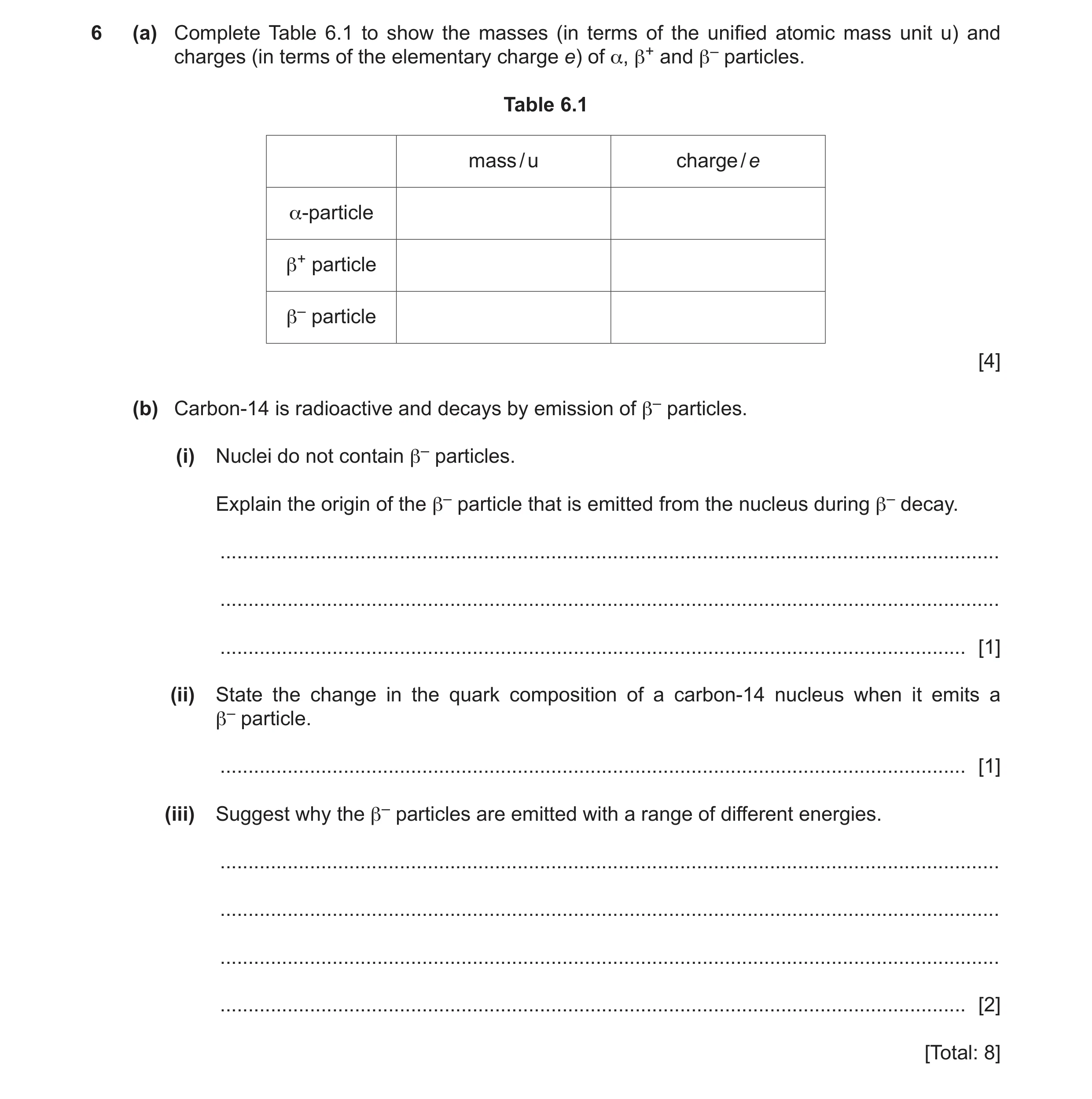
Q10 · Complete Table 6.1 to show the masses (in terms of the unified atomic mass unit u) and… 9702/21 Oct/Nov 2021
6 (a) Complete Table 6.1 to show the masses (in terms of the unified atomic mass unit u) and charges (in terms of the elementary charge e) of α, β+ and β– particles. Table 6.1 mass / u charge / e α-particle β+ particle β– particle [4] (b) Carbon-14 is radioactive and decays by emission of β– particles. (i) Nuclei do not contain β– particles. Explain the origin of the β– particle that is emitted from the nucleus during β– decay. … … … [1] (ii) State the change in the quark composition of a carbon-14 nucleus when it emits a β– particle. … [1] (iii) Suggest why the β– particles are emitted with a range of different energies. … … … … [2] [Total: 8]
8 marks
Mark scheme: 6(a) α-particle mass given as 4u B1 α-particle charge given as (+)2e B1 both β-particles mass given as 0.0005 u B1 β+ charge given as (+)e and β– charge given as –e (Completed table: mass / u charge / e α 4 (+)2 β+ 0.0005 (+)1 β– 0.0005 –1 ) B1 6(b)(i) neutron decays into proton and an electron / β– particle B1 6(b)(ii) down to up B1 6(b)(iii) (electron) antineutrino(s) emitted B1 energy (released in decay)/momentum shared between antineutrino and β– particle B1
This question in 9702/21 Oct/Nov 2021
Q11 · A stationary nucleus P of mass 243 u decays by emitting an α-particle of mass 4 u to form… 9702/22 Oct/Nov 2021
7 A stationary nucleus P of mass 243 u decays by emitting an α-particle of mass 4 u to form a different nucleus Q, as illustrated in Fig. 7.1. v 1.6 × 10⁷ m s–1 nucleus P nucleus Q α-particle mass 243 u mass 4 u BEFORE DECAY AFTER DECAY Fig. 7.1 The initial speed of the α-particle is 1.6 × 10⁷ m s–1. (a) Use the principle of conservation of momentum to explain why the initial velocities of nucleus Q and the α-particle must be in opposite directions. … … … … [2] (b) Determine the initial speed v of nucleus Q. v = … m s–1 [2] (c) Calculate the initial kinetic energy, in MeV, of the α-particle. kinetic energy = … MeV [3] (d) A graph of number of neutrons N against proton number Z is shown in Fig. 7.2. 151 150 149 number of P 148 neutrons N 147 146 14592 93 94 95 96 97 98 proton number Z Fig. 7.2 The graph shows a cross that represents nucleus P. A nucleus R has a nucleon number of 242 and is an isotope of nucleus P. Nucleus R decays by emitting a β– particle to form a different nucleus S. (i) On Fig. 7.2, draw a cross to represent: 1. nucleus R (label this cross R) 2. nucleus S (label this cross S). [2] (ii) State the name of the other lepton, in addition to the β– particle, that is emitted during the decay of nucleus R. … [1] [Total: 10]
10 marks
Mark scheme: 7(a) (total) momentum before (decay) is zero or P has zero momentum B1 (total momentum after decay must be zero so) α-particle and Q have momenta in opposite directions (and therefore velocities are in opposite directions) B1 7(b) p = 239 (u) × v or 4 (u) × 1.6 × 10⁷ C1 239 (u) × v = 4 (u) × 1.6 × 10⁷ v = 2.7 × 10⁵ m s–1 A1 7(c) E(K) = ½mv2 C1 = ½ × 4 × 1.66 × 10–27 × (1.6 × 107)2 C1 = 8.5 × 10⁻¹³ (J) = 8.5 × 10⁻¹³ / 1.60 × 10⁻¹³ (MeV) = 5.3 MeV A1 7(d)(i) 1. R plotted at (95,147) B1 2. S plotted at (96,146) B1 7(d)(ii) (electron) antineutrino B1
This question in 9702/22 Oct/Nov 2021
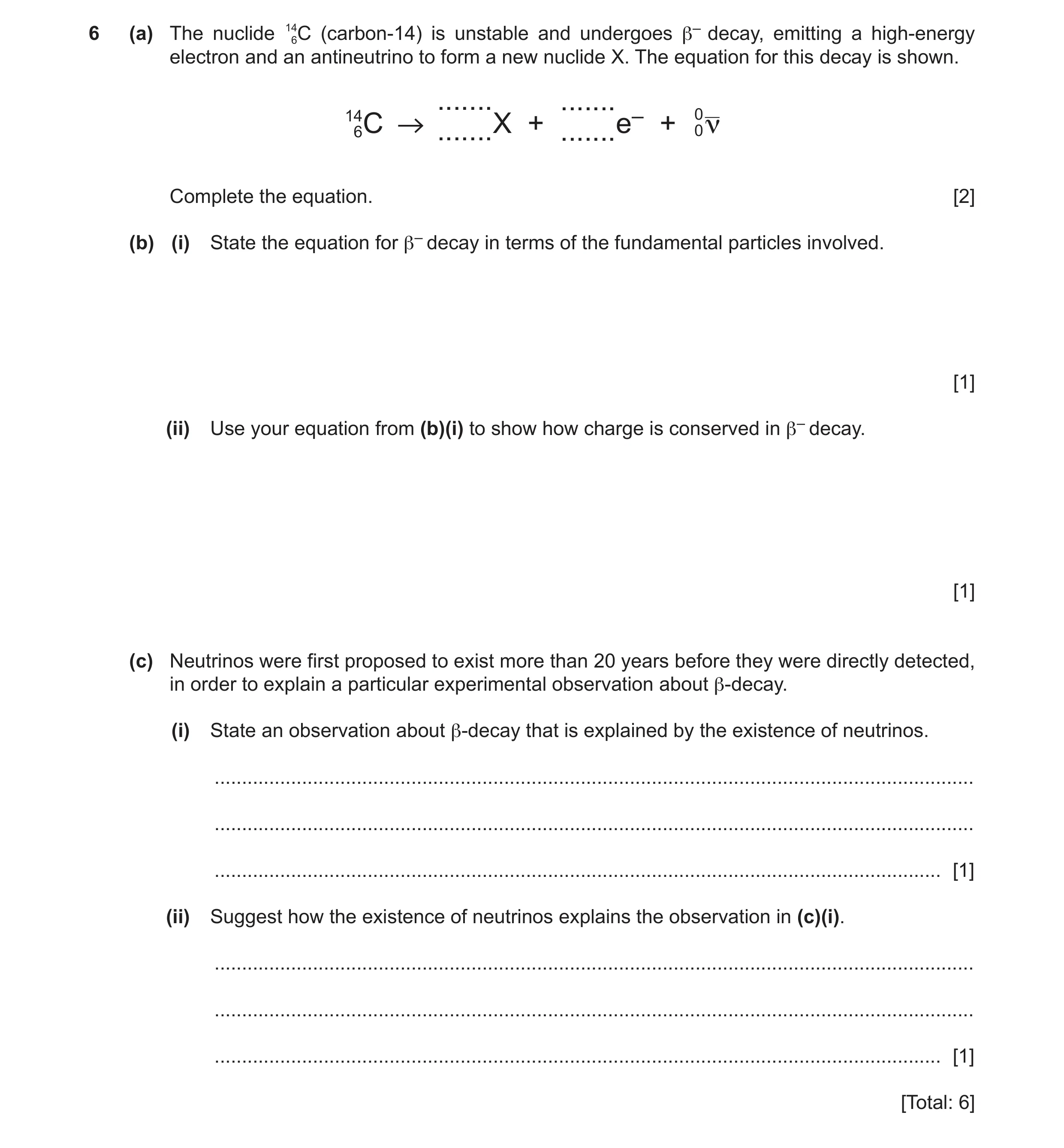
Q12 · The nuclide 146C (carbon-14) is unstable and undergoes β– decay, emitting a high-energy… 9702/23 Oct/Nov 2022
6 (a) The nuclide 146C (carbon-14) is unstable and undergoes β– decay, emitting a high-energy electron and an antineutrino to form a new nuclide X. The equation for this decay is shown. … … 0 14 0ν 6C … X + … e– + Complete the equation. [2] (b) (i) State the equation for β– decay in terms of the fundamental particles involved. [1] (ii) Use your equation from (b)(i) to show how charge is conserved in β– decay. [1] (c) Neutrinos were first proposed to exist more than 20 years before they were directly detected, in order to explain a particular experimental observation about β-decay. (i) State an observation about β-decay that is explained by the existence of neutrinos. … … … [1] (ii) Suggest how the existence of neutrinos explains the observation in (c)(i). … … … [1] [Total: 6]
6 marks
Mark scheme: 6(a) 14 7 X B1 -1e0 – B1 6(b)(i) d → u + e– + ν or udd → uud + e– + ν B1 6(b)(ii) –1 / 3 (e) = + 2 / 3 (e) – 1(e) (+ 0) B1 or 2 / 3 (e) – 1 / 3 (e) – 1 / 3 (e) = 2 / 3 (e) + 2 / 3 (e) – 1 / 3 (e) – 1 (e) (+ 0) 6(c)(i) electrons / -particles (emitted from the nucleus) have a (continuous) range of / different (kinetic) energies B1 6(c)(ii) the (emitted) neutrinos take varying amounts of the (same total) energy (released in the decay) B1
This question in 9702/23 Oct/Nov 2022
Q13 · A nucleus P undergoes α-decay to form nucleus Q 9702/22 Feb/March 2024
4 A nucleus P undergoes α-decay to form nucleus Q. (a) Complete the equation for this decay. ___ ___ 215 [2] ___ Q + ___ α 84 P (b) (i) State the principle of conservation of momentum. … … … [2] (ii) Before the decay, nucleus P has a speed of 3.2 × 10⁵ m s–1. After the decay, nucleus Q is stationary. Calculate the speed of the alpha particle after the decay. speed = … m s–1 [2] [Total: 6]
6 marks
Mark scheme: 4(a) 4 B1 2α 21182Q B1 4(b)(i) sum / total momentum (of a system of bodies) is constant M1 or sum / total momentum before = sum / total momentum after for an isolated system / no (resultant) external force A1 4(b)(ii) pα = pP – pQ C1 4(u)v = 215(u) 3.2 105 (– 0) v = 215(u) 3.2 105/ 4(u) v = 1.7 107 m s–1 A1
This question in 9702/22 Feb/March 2024
Q14 · State the name of the class (group) of fundamental particles that contains a neutrino 9702/22 Feb/March 2024
8 (a) State the name of the class (group) of fundamental particles that contains a neutrino. … [1] (b) A hadron P has a charge of +1e, where e is the elementary charge. The hadron P is composed of a down antiquark and only one other quark. (i) Identify a possible flavour for this other quark. … [1] (ii) State what type of hadron is P. … [1] (c) Nucleus Q undergoes radioactive decay to form nucleus R, emitting an antineutrino and another particle X, as shown in the decay equation. Q R + X + ν (i) State what particle is represented by X. … [1] (ii) Compare the nucleon numbers of Q and R. … [1] (iii) Compare the charges of Q and R. … [1] [Total: 6]
6 marks
Mark scheme: 8(a) lepton(s) B1 8(b)(i) up or top or charm B1 8(b)(ii) meson(s) B1 8(c)(i) – (particle) or electron B1 8(c)(ii) equal B1 8(c)(iii) (the charge of) R is greater (than Q) B1
This question in 9702/22 Feb/March 2024
Q15 · Nuclei of an isotope of copper (Cu) each have 29 protons and 37 neutrons 9702/21 May/June 2024
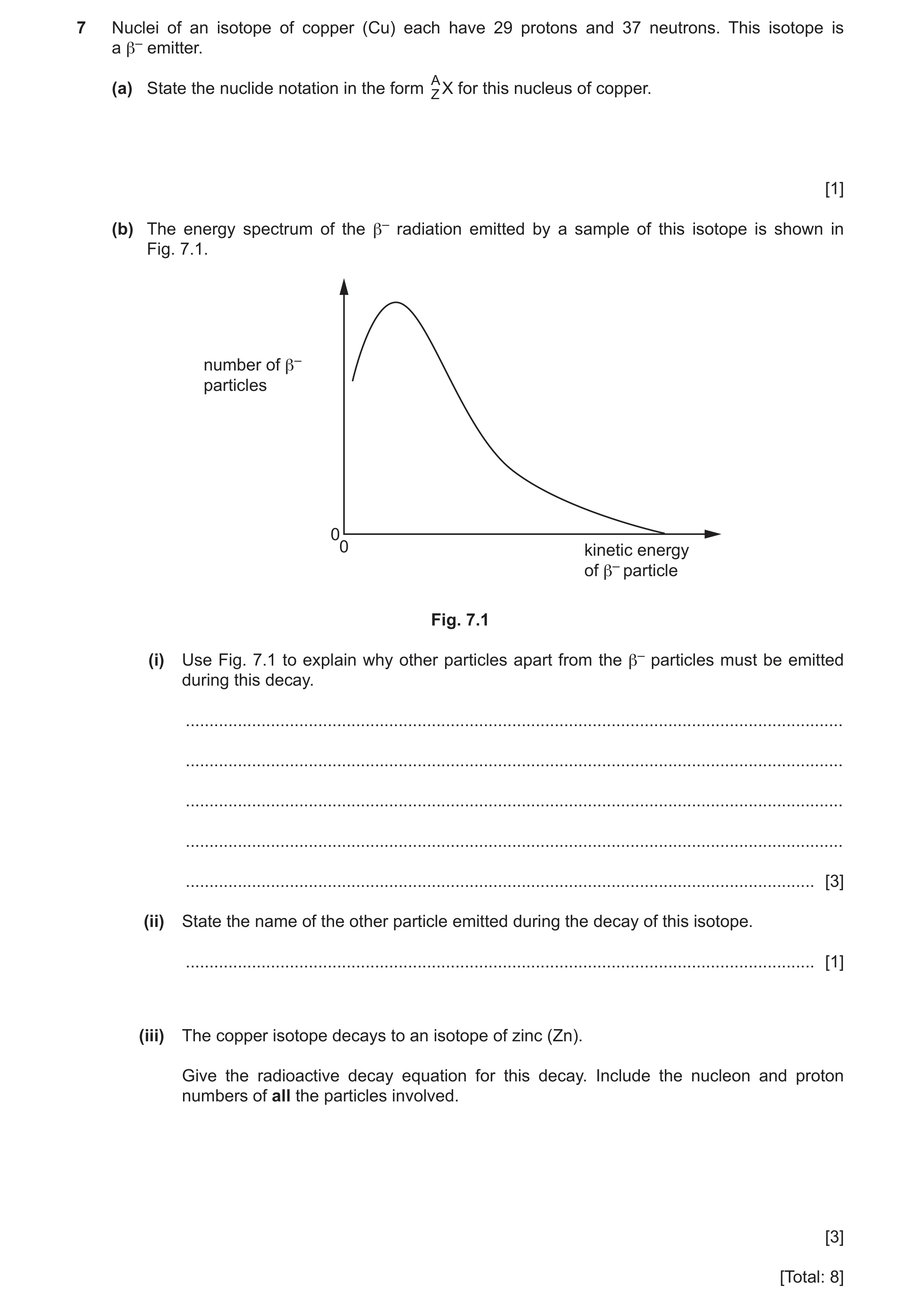
7 Nuclei of an isotope of copper (Cu) each have 29 protons and 37 neutrons. This isotope is a β– emitter. A (a) State the nuclide notation in the form ZX for this nucleus of copper. [1] (b) The energy spectrum of the β– radiation emitted by a sample of this isotope is shown in Fig. 7.1. number of β– particles 0 0 kinetic energy of β– particle Fig. 7.1 (i) Use Fig. 7.1 to explain why other particles apart from the β– particles must be emitted during this decay. … … … … … [3] (ii) State the name of the other particle emitted during the decay of this isotope. … [1] (iii) The copper isotope decays to an isotope of zinc (Zn). Give the radioactive decay equation for this decay. Include the nucleon and proton numbers of all the particles involved. [3] [Total: 8]
8 marks
Mark scheme: 7(a) 66 29Cu B1 7(b)(i) the energy of the decay is fixed / constant B1 the energies of the beta particles have a (continuous) range of values / varies / not constant B1 another particle / an (anti)neutrino must possess the extra / remaining energy (difference between energy of the decay and the kinetic energy) B1 7(b)(ii) (electron) antineutrino B1 7(b)(iii) 0 66 66 0 29 30 1 e 0 Cu Zn values for Cu and Zn correct with no other extra particles on either side of the equation B1 second term correct ( 0 1 ) B1 third term correct ( 0 e 0 ) B1
This question in 9702/21 May/June 2024
Q16 · Nuclei of an isotope of samarium (Sm) each contain 62 protons and 85 neutrons 9702/23 May/June 2024
6 Nuclei of an isotope of samarium (Sm) each contain 62 protons and 85 neutrons. (a) State the nuclide notation in the form AZX for this isotope of samarium. [1] (b) This isotope of samarium is radioactive and decays by emitting particles. Gamma-radiation is not emitted. The energy spectrum of the emitted particles is shown in Fig. 6.1. number of particles 0 0 kinetic energy of particle Fig. 6.1 (i) Explain how Fig. 6.1 shows that this isotope of samarium emits α-particles and does not emit β-particles. … … … … [2] (ii) This isotope of samarium decays to an isotope of neodymium (Nd). Give the radioactive decay equation for this decay. Include the nucleon and proton numbers of all the particles involved. [2] (c) A baryon is composed of three quarks which all have different flavours. The baryon has a charge of 0. Two of the quarks in the baryon are an up quark and a bottom quark. (i) Determine, in terms of the elementary charge e, the charge on the third quark in the baryon. charge = … e [2] (ii) State a possible flavour for the third quark in the baryon. … [1] [Total: 8]
8 marks
Mark scheme: 6(a) 147 62Sm 6(b)(i) the (kinetic) energy of the particles is discrete / has only one value (so must be alpha) B1 and beta particles have a (continuous) range of (kinetic) energies (so can’t be beta) B1 6(b)(ii) 147 143 4 62 60 2 Sm Nd values for Sm and Nd correct with no other extra particles on either side of the equation A1 4 2 correct A1 6(c)(i) up quark charge is +(2 / 3) (e) or bottom quark charge is –(1 / 3) (e) C1 0 = +(2 / 3) (e) – (1 / 3) (e) + q (so) charge (on third quark must be) –(1 / 3) (e) A1 6(c)(ii) down or strange A1
This question in 9702/23 May/June 2024
Q17 · Complete Table 7.1 to show the charges, in terms of the elementary charge e, on each of… 9702/23 Oct/Nov 2024
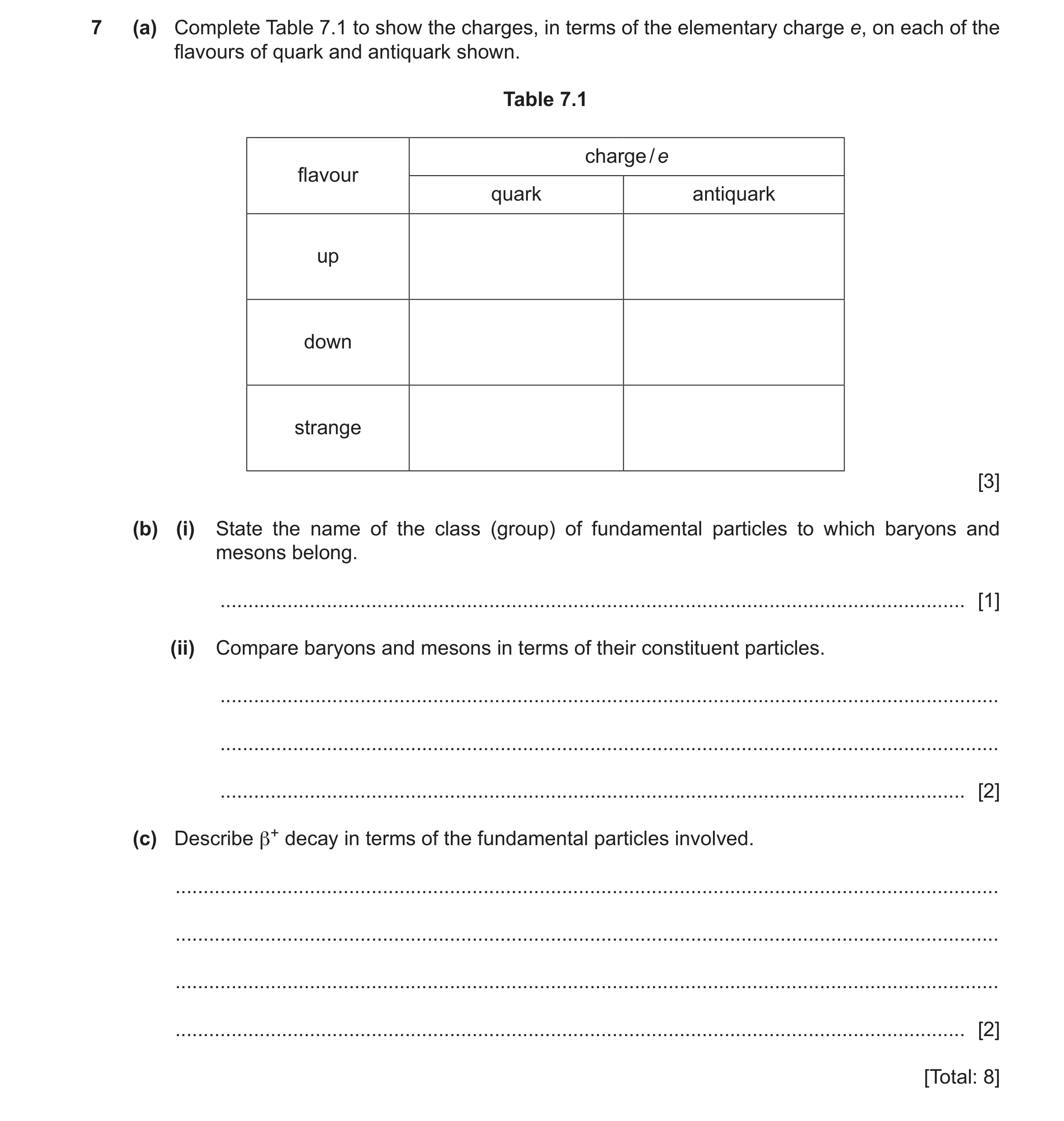
7 (a) Complete Table 7.1 to show the charges, in terms of the elementary charge e, on each of the flavours of quark and antiquark shown. Table 7.1 charge / e flavour quark antiquark up down strange [3] (b) (i) State the name of the class (group) of fundamental particles to which baryons and mesons belong. … [1] (ii) Compare baryons and mesons in terms of their constituent particles. … … … [2] (c) Describe β+ decay in terms of the fundamental particles involved. … … … … [2] [Total: 8]
8 marks
Mark scheme: 7(a) up quark charge = (+) 2 / 3 and down quark charge = −1 / 3 B1 strange quark charge = −1 / 3 B1 up antiquark charge = –2 / 3 B1 and down antiquark charge = (+) 1 / 3 and strange antiquark charge = (+) 1 / 3 7(b)(i) hadron(s) B1 7(b)(ii) baryons composed of three quarks B1 or baryons composed of three antiquarks mesons composed of one quark and one antiquark B1 7(c) up quark changes to a down quark B1 positron and (electron) neutrino (emitted) B1
This question in 9702/23 Oct/Nov 2024
Q18 · An isolated stationary nucleus Q decays into nucleus R and an α-particle 9702/22 Feb/March 2025
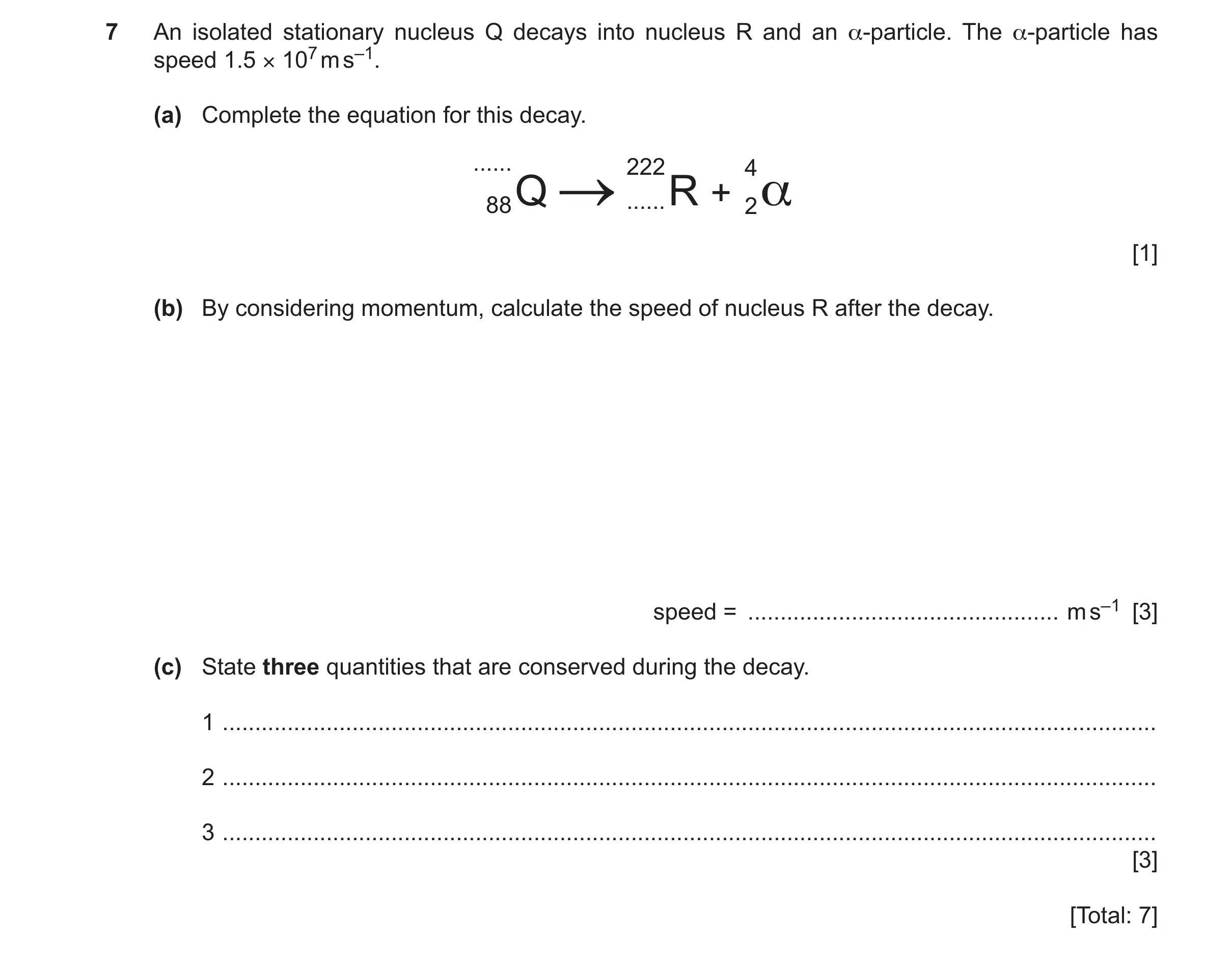
7 An isolated stationary nucleus Q decays into nucleus R and an α-particle. The α-particle has speed 1.5 × 10⁷ m s–1. (a) Complete the equation for this decay. … 222 4 88 Q … R + 2 α [1] (b) By considering momentum, calculate the speed of nucleus R after the decay. speed = … m s–1 [3] (c) State three quantities that are conserved during the decay. 1 … 2 … 3 … [3] [Total: 7]
7 marks
Mark scheme: 7(a) nucleon number of Q = 226 and proton number of R = 86 B1 7(b) 4(u) 1.5 107 or 222(u) v C1 v = 4(u) 1.5 107 / 222(u) C1 = 2.7 105 m s–1 A1 7(c) Any three from: B3 • momentum • charge • nucleon number • neutron number • proton number
This question in 9702/22 Feb/March 2025
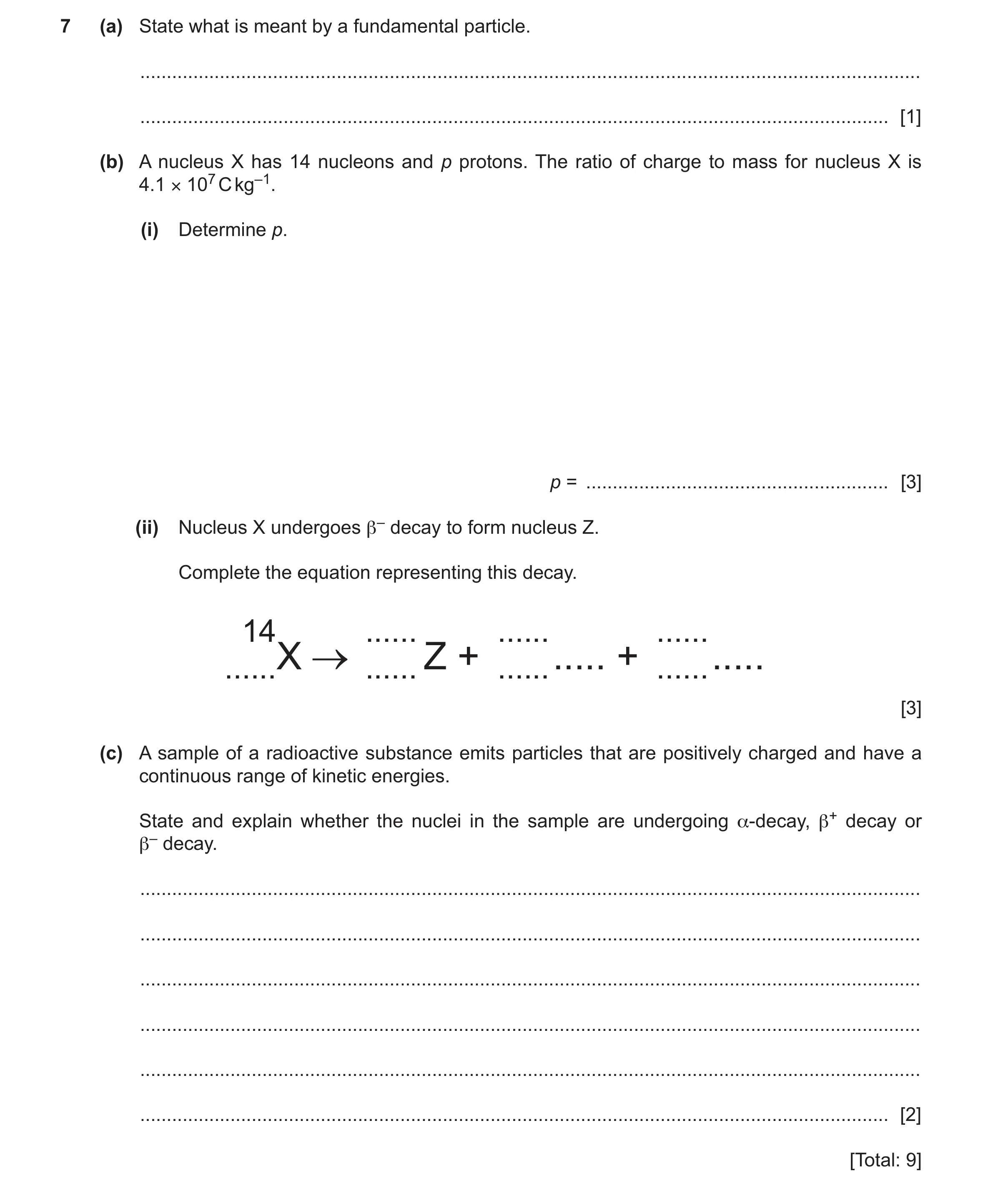
Q19 · State what is meant by a fundamental particle 9702/22 May/June 2025
7 (a) State what is meant by a fundamental particle. … … [1] (b) A nucleus X has 14 nucleons and p protons. The ratio of charge to mass for nucleus X is 4.1 × 10⁷ C kg–1. (i) Determine p. p = … [3] (ii) Nucleus X undergoes β– decay to form nucleus Z. Complete the equation representing this decay. 14 … … … … X … Z + … … + … … [3] (c) A sample of a radioactive substance emits particles that are positively charged and have a continuous range of kinetic energies. State and explain whether the nuclei in the sample are undergoing α-decay, β+ decay or β– decay. … … … … … … [2] [Total: 9]
9 marks
Mark scheme: 7(a) (a particle that) cannot be divided/subdivided (into smaller particles) B1 7(b)(i) (p e) / (14u) = 4.1 107 C1 p = (4.1 107 14 1.66 10–27) / (1.60 10–19) C1 p = 6 (answer should be an integer) A1 7(b)(ii) 14 6 X → 147 Z B1 0 ( − ) 0 ( − ) B1 − 1e or −1 00v ( e ) B1 7(c) (the nuclei are undergoing) + decay B1 A correct explanation in terms of charge and a correct explanation in terms of energy B1 Explanations in terms of charge: • (particles / decay) positively charged so cannot be – • (particles / decay) positively charged so could be / is + • – (particles / decay) are negatively charged • + (particles / decay) are positively charged Explanations in terms of energy: • range of energies so not (particles / decay) • range of energies so is (particles / decay) • (particles / decay) have a range of energies • (particles / decay) have discrete energies / not range of energies
This question in 9702/22 May/June 2025
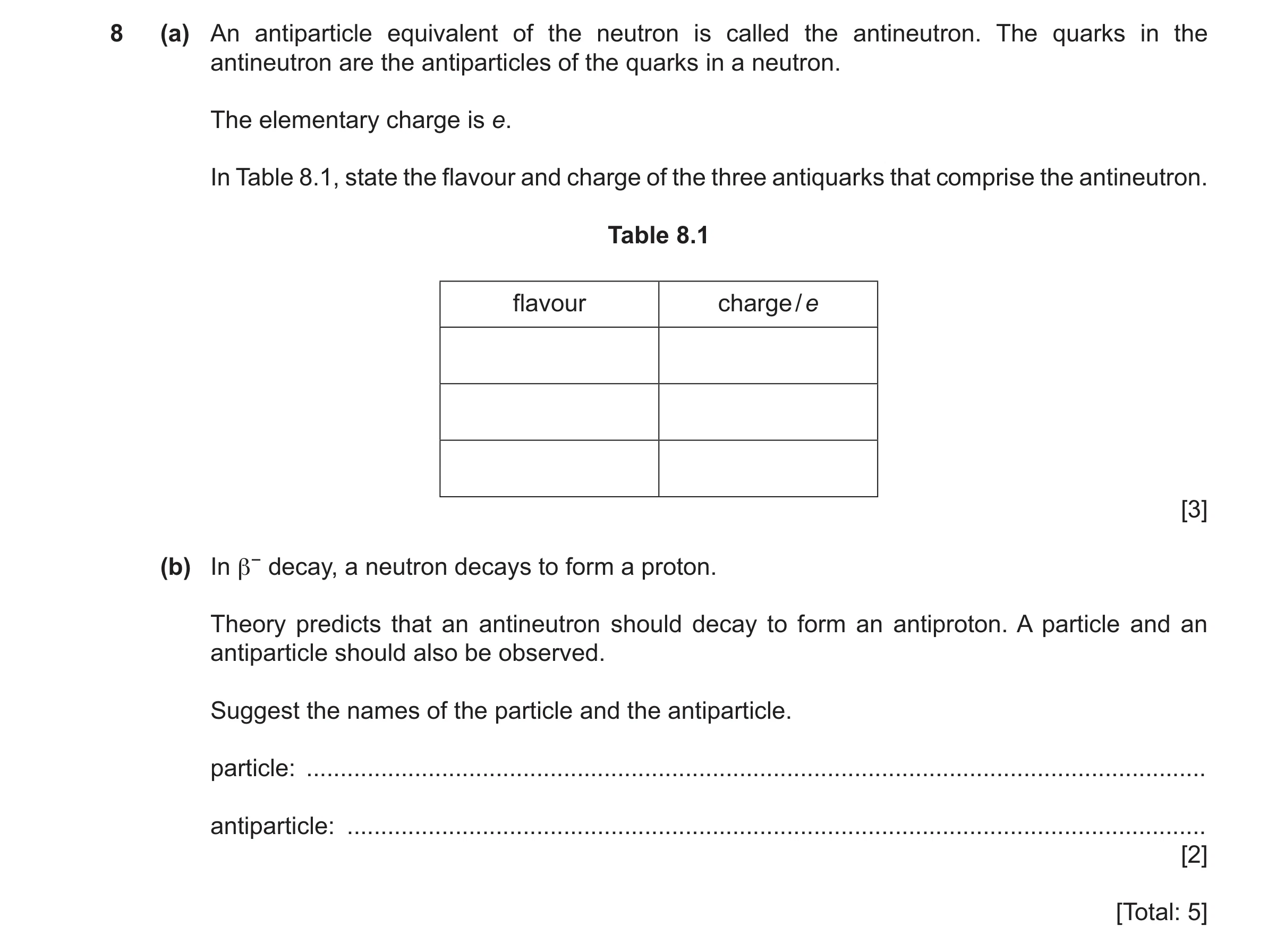
Q20 · An antiparticle equivalent of the neutron is called the antineutron 9702/23 May/June 2025
8 (a) An antiparticle equivalent of the neutron is called the antineutron. The quarks in the antineutron are the antiparticles of the quarks in a neutron. The elementary charge is e. In Table 8.1, state the flavour and charge of the three antiquarks that comprise the antineutron. Table 8.1 flavour charge / e [3] (b) In β− decay, a neutron decays to form a proton. Theory predicts that an antineutron should decay to form an antiproton. A particle and an antiparticle should also be observed. Suggest the names of the particle and the antiparticle. particle: … antiparticle: … [2] [Total: 5]
5 marks
Mark scheme: 8(a) flavour charge / e up / u 2 − 3 down / d 1 ( + ) 3 down / d 1 ( + ) 3 3 correct quark flavours B1 Charge on anti-up quark –⅔(e) B1 Charge on anti-down quark (+)⅓(e) B1 8(b) particle: (electron) neutrino B1 antiparticle: positron B1
This question in 9702/23 May/June 2025
Q21 · The nuclide 1H is an isotope of hydrogen that is called tritium 9702/23 Oct/Nov 2025
6 The nuclide 1H is an isotope of hydrogen that is called tritium. (a) (i) Determine the numbers of protons, neutrons and electrons in a neutral atom of tritium. number of protons = … number of neutrons = … number of electrons = … [2] (ii) Draw a labelled diagram to represent a simple model of the arrangement of the protons, neutrons and electrons in a tritium atom. [2] (b) Tritium is radioactive and undergoes β– decay to form an isotope of helium (He). Gamma radiation is not emitted during this decay. (i) Complete the equation to represent the radioactive decay of tritium. 3 … … 0 1H … He + … β + 0X [2] (ii) State the name of particle X. … [1] (c) Determine the quark composition of a tritium nucleus. … … [2] [Total: 9]
9 marks
Mark scheme: 6(a)(i) numbers of protons and electrons both = 1 A1 number of neutrons = 2 A1 6(a)(ii) diagram shows 2 neutrons and 1 proton labelled and forming a nucleus B1 diagram shows 1 electron labelled and separated from the nucleus (not touching the proton and neutrons) B1 6(b)(i) helium nucleus: top line = 3 and bottom line = 2 A1 beta particle: top line = 0 and bottom line = –1 A1 6(b)(ii) (electron) antineutrino B1 6(c) proton: up up down C1 or neutron: up down down (tritium:) 4 up, 5 down A1
This question in 9702/23 Oct/Nov 2025
 1 / 23
 2 / 23
 3 / 23
 4 / 23
![Question 5: (a) In the following list, underline all particles that are leptons. antineutrino positron proton quark [1] γ radiation. (b) A stationary n…](https://img.pastlit.com/crops/df1ce26c-921f-4dd6-985a-f2e585807553/q8.webp) 5 / 23
5 / 23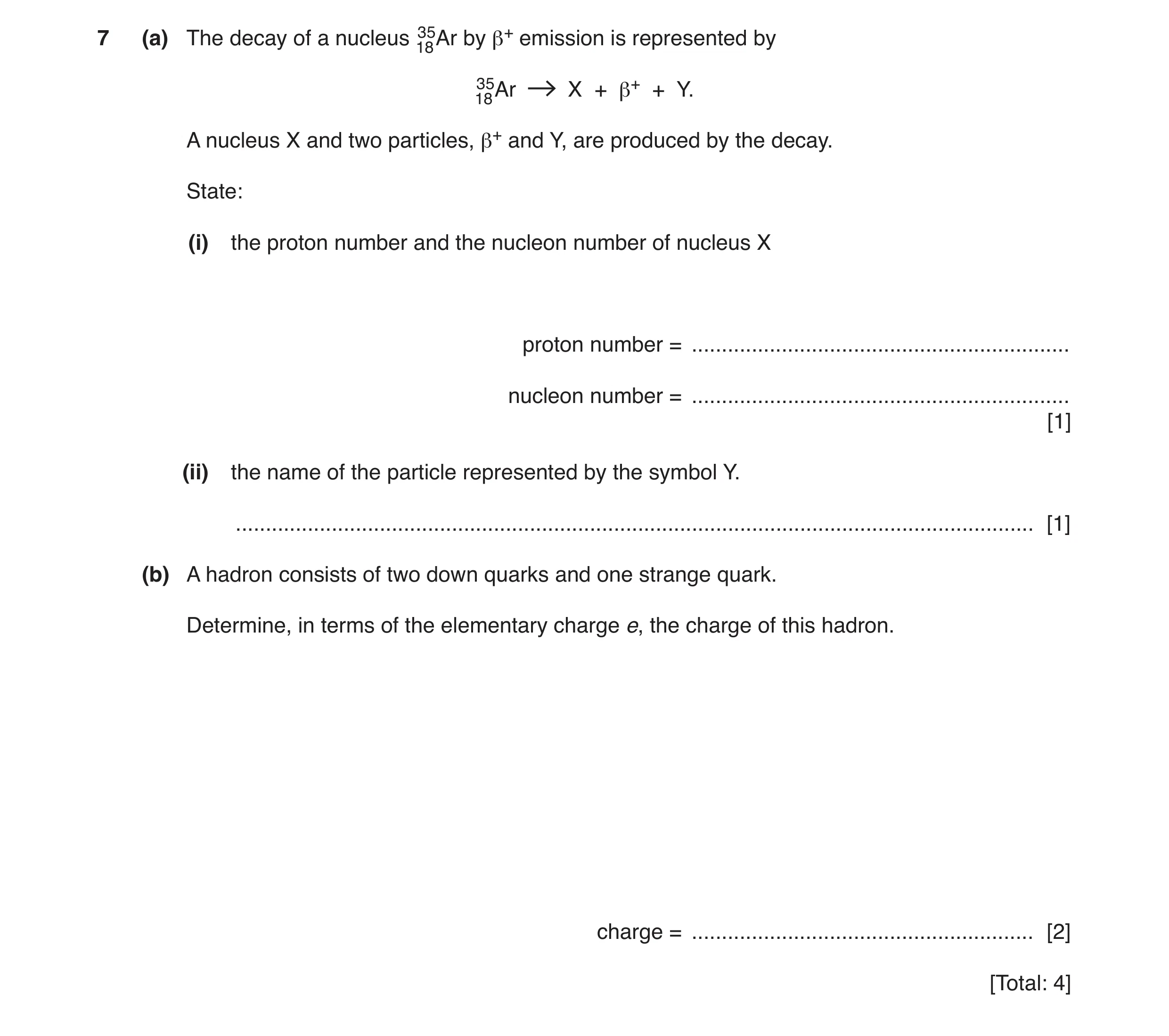 6 / 23
 7 / 23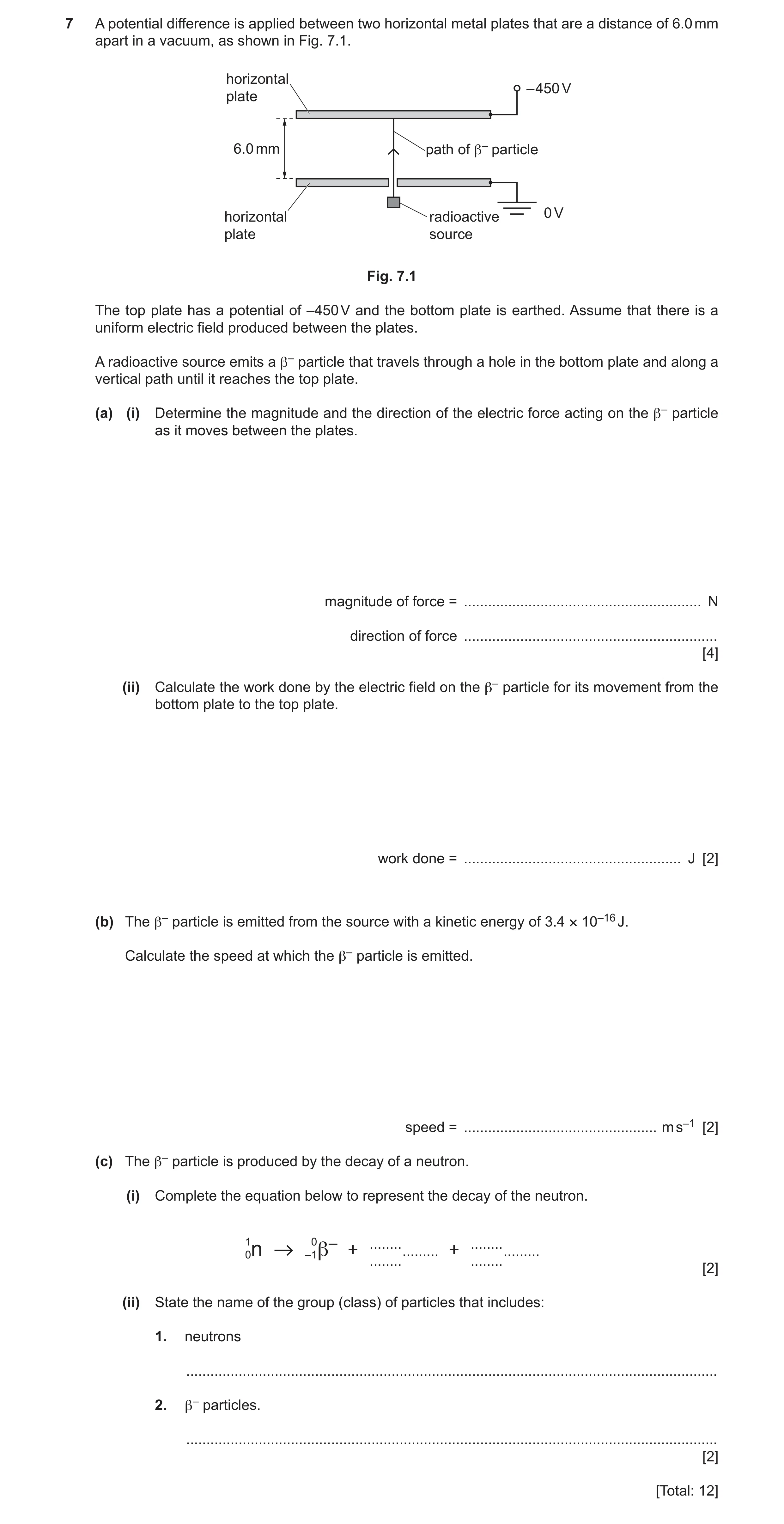
 10 / 23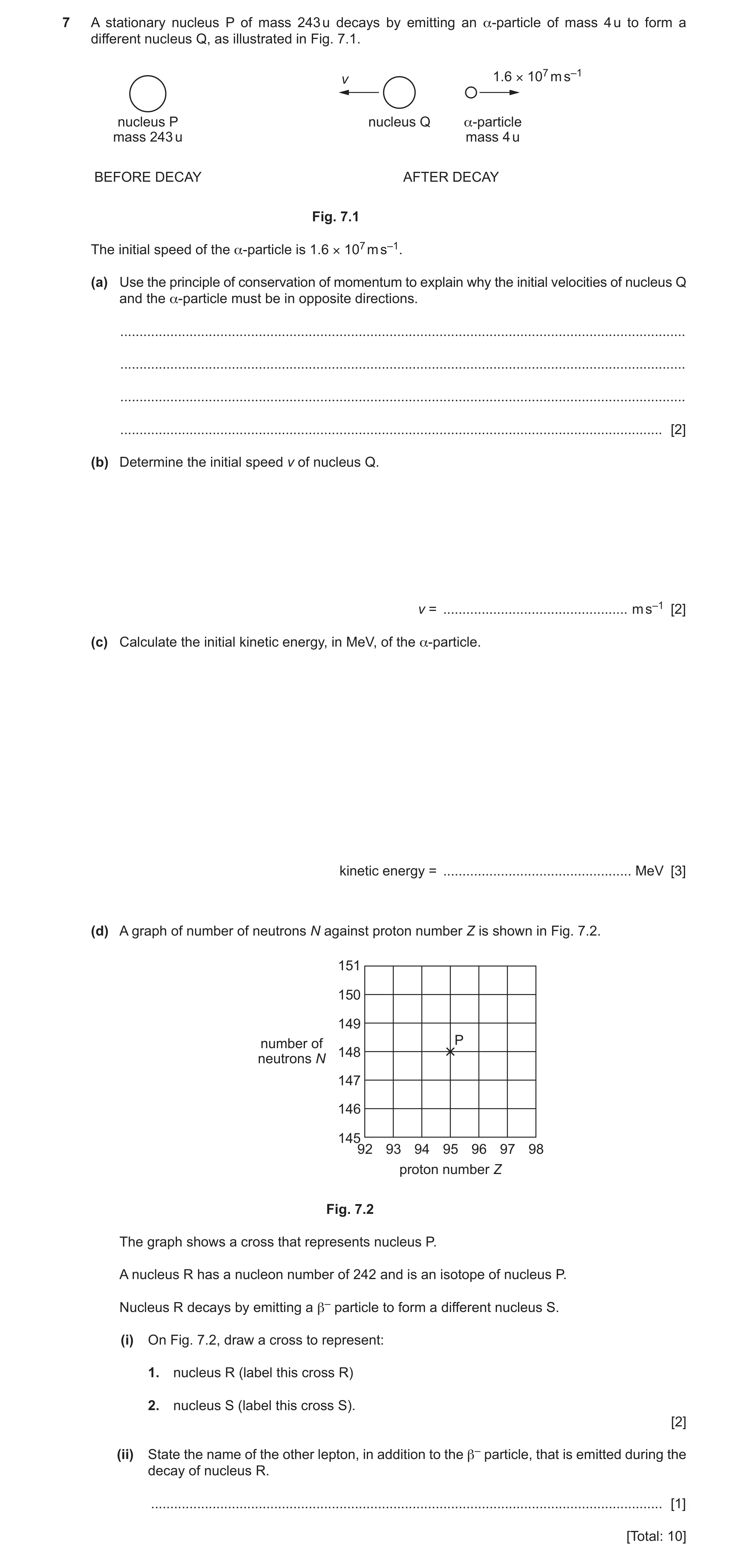
 13 / 23
![Question 13: A nucleus P undergoes α-decay to form nucleus Q. (a) Complete the equation for this decay. ___ ___ 215 [2] ___ Q + ___ α 84 P (b) (i) State…](https://img.pastlit.com/crops/6d756b06-004a-4f34-9d1f-a422e647b00c/q4.webp) 14 / 23
14 / 23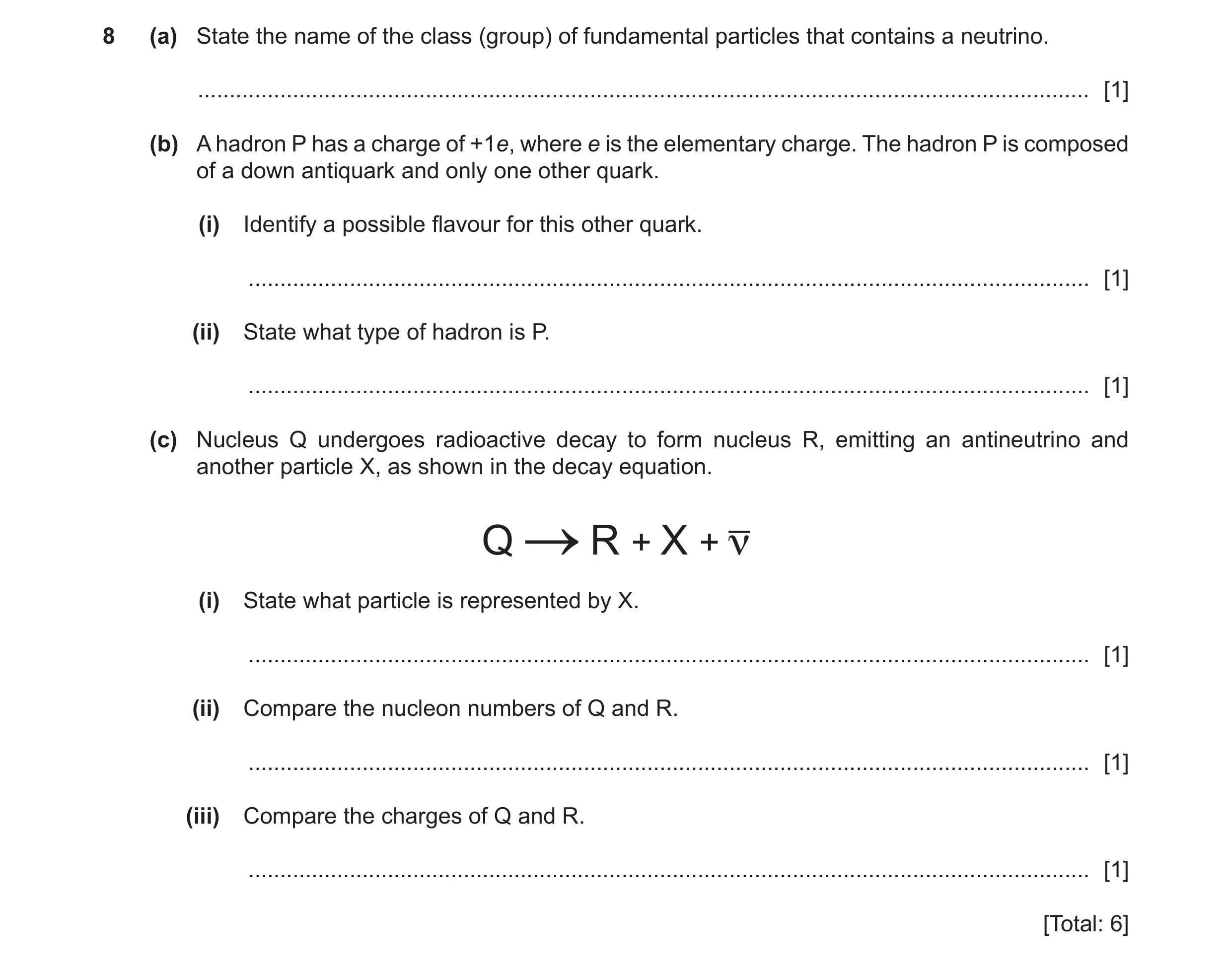 15 / 23
 16 / 23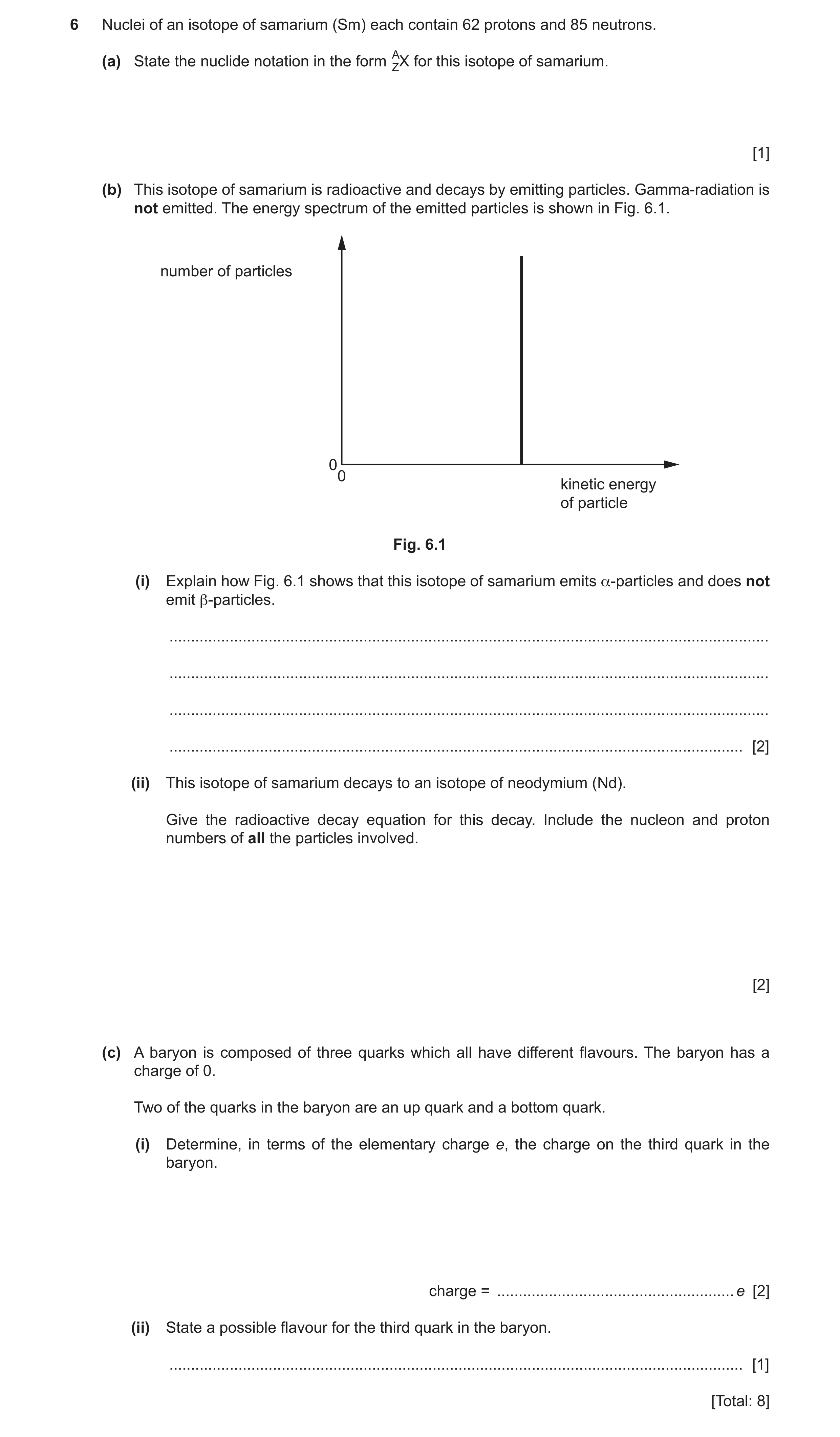
 19 / 23
 20 / 23
 21 / 23
 22 / 23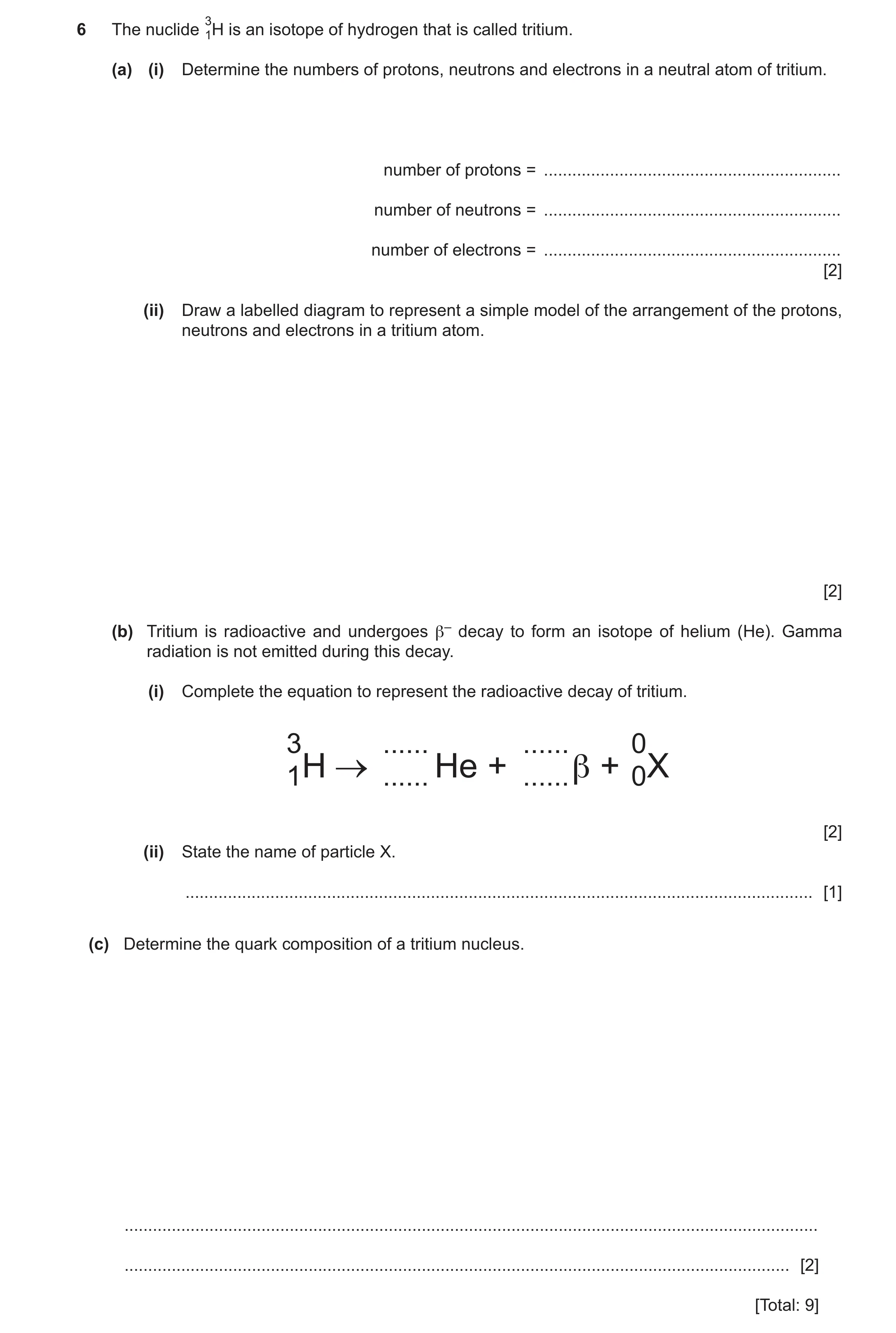
 3
3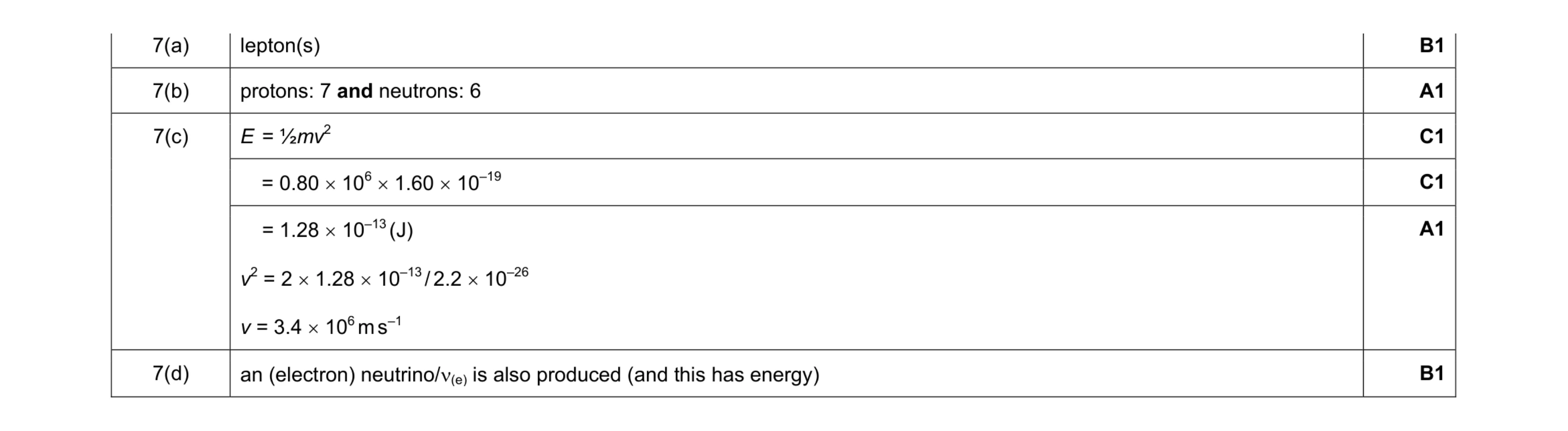 6
6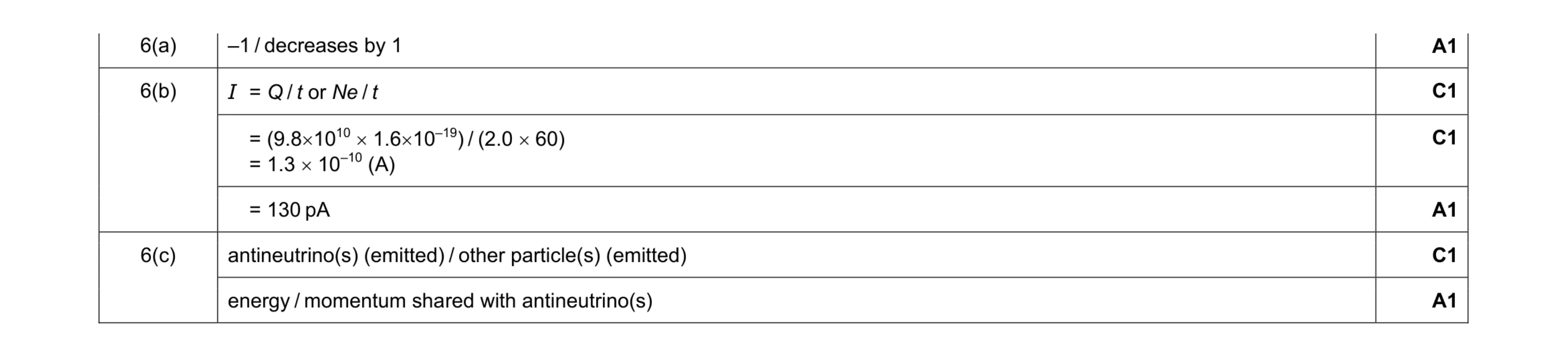 6
6 4
4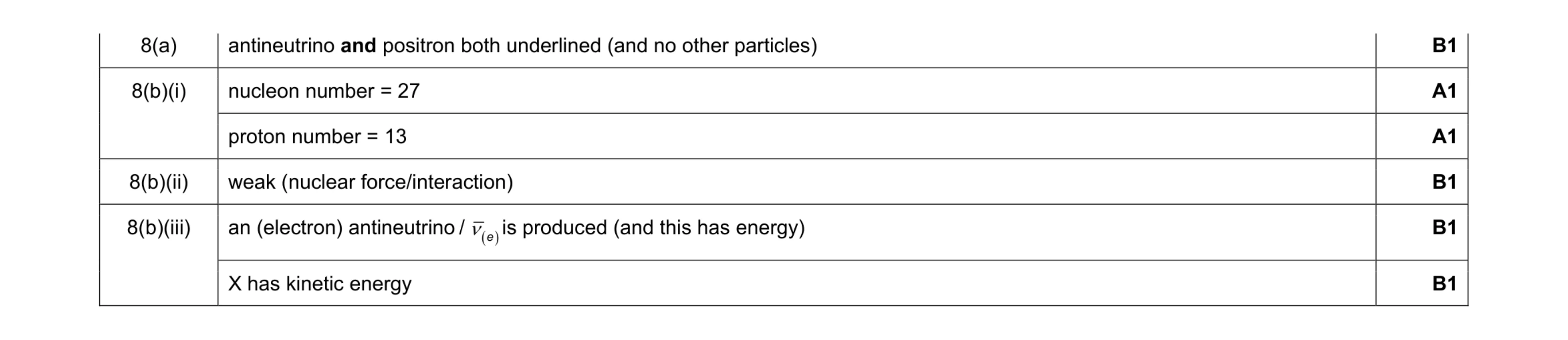 6
6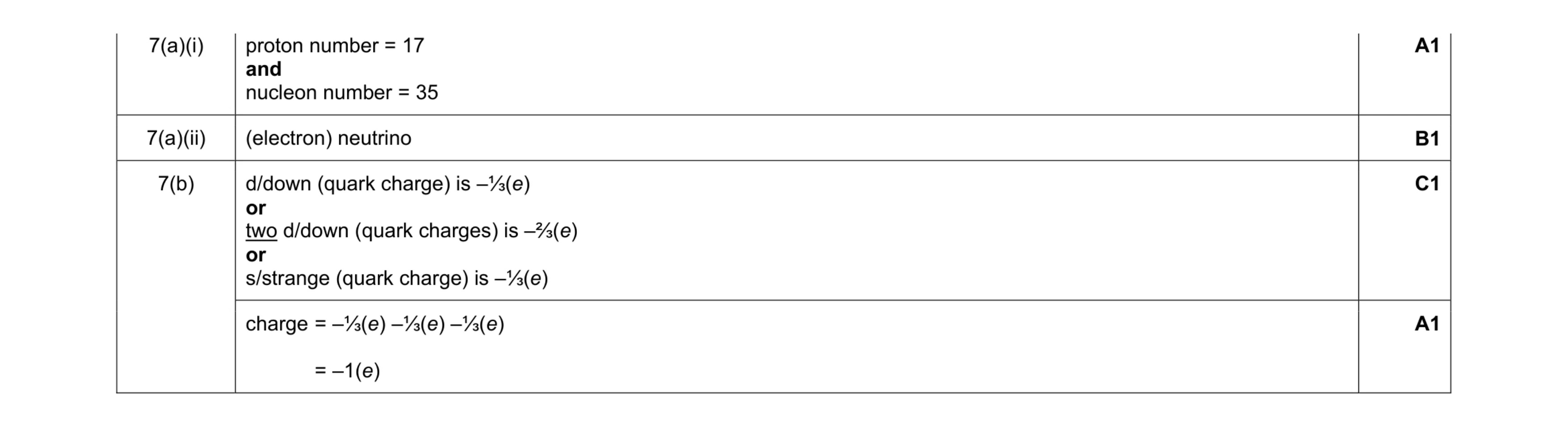 4
4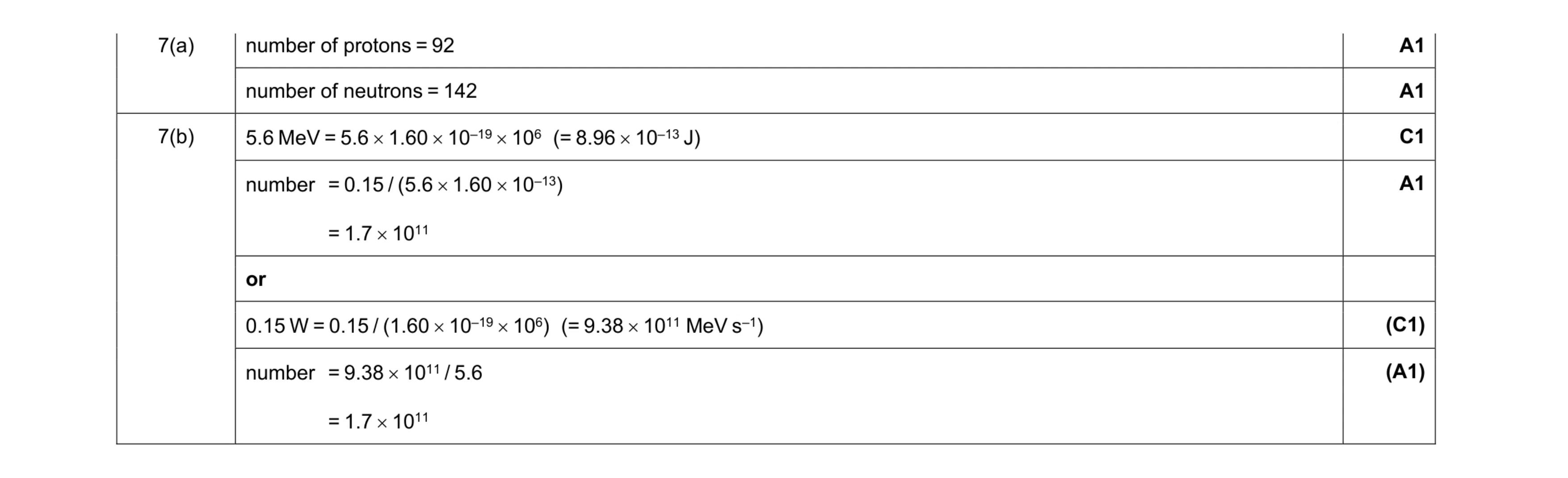 4
4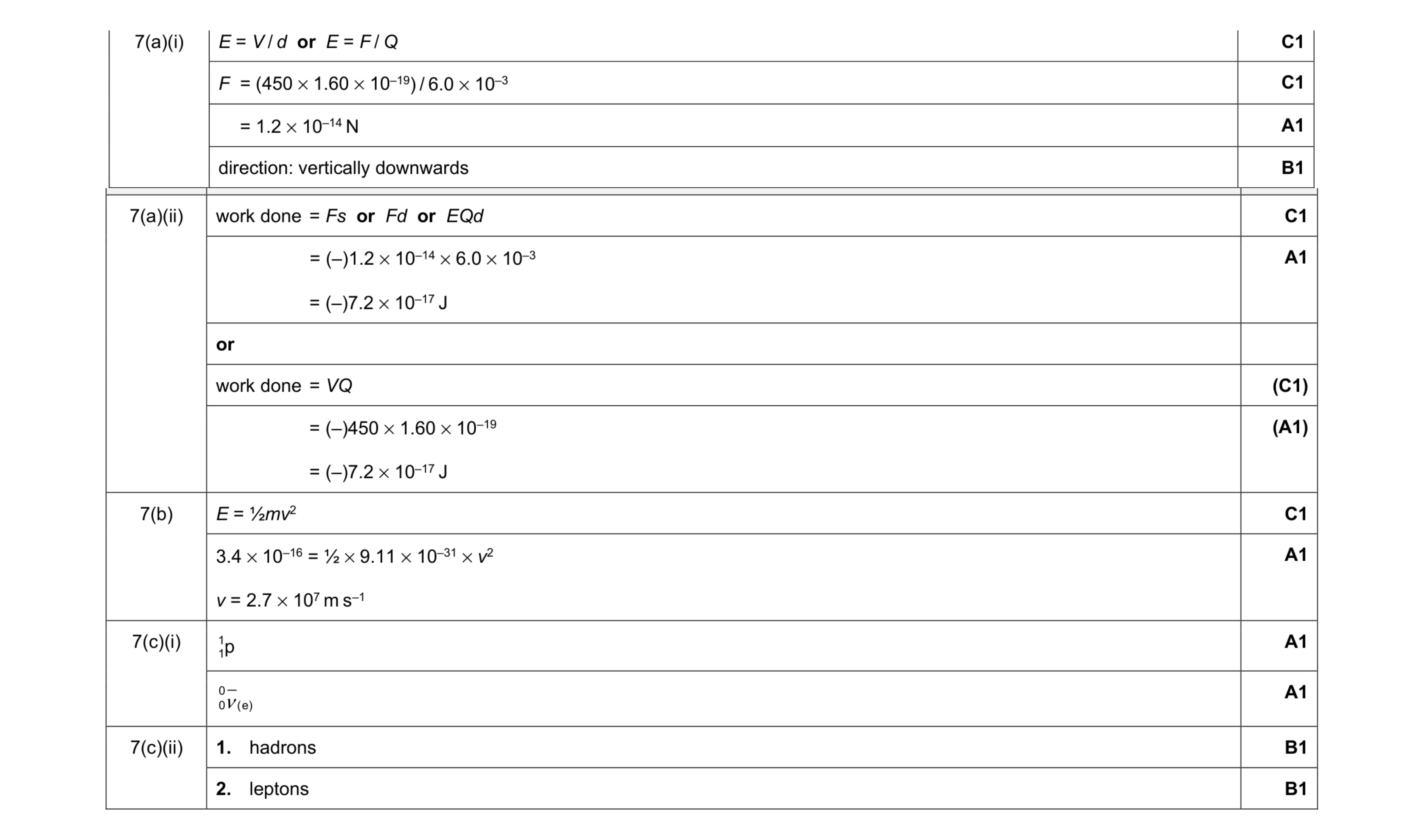 12
12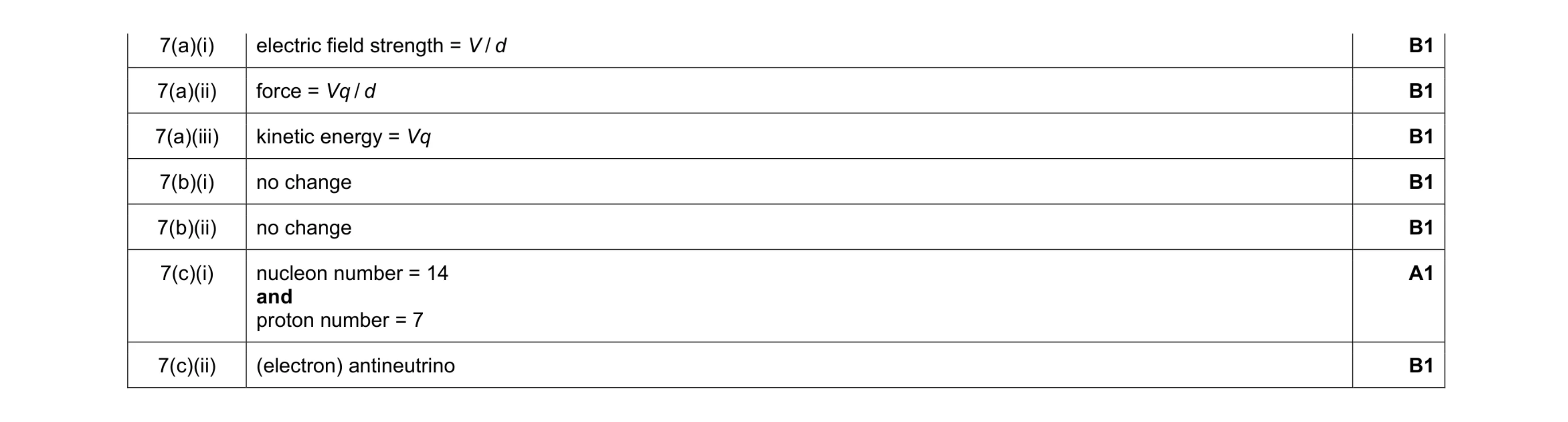 7
7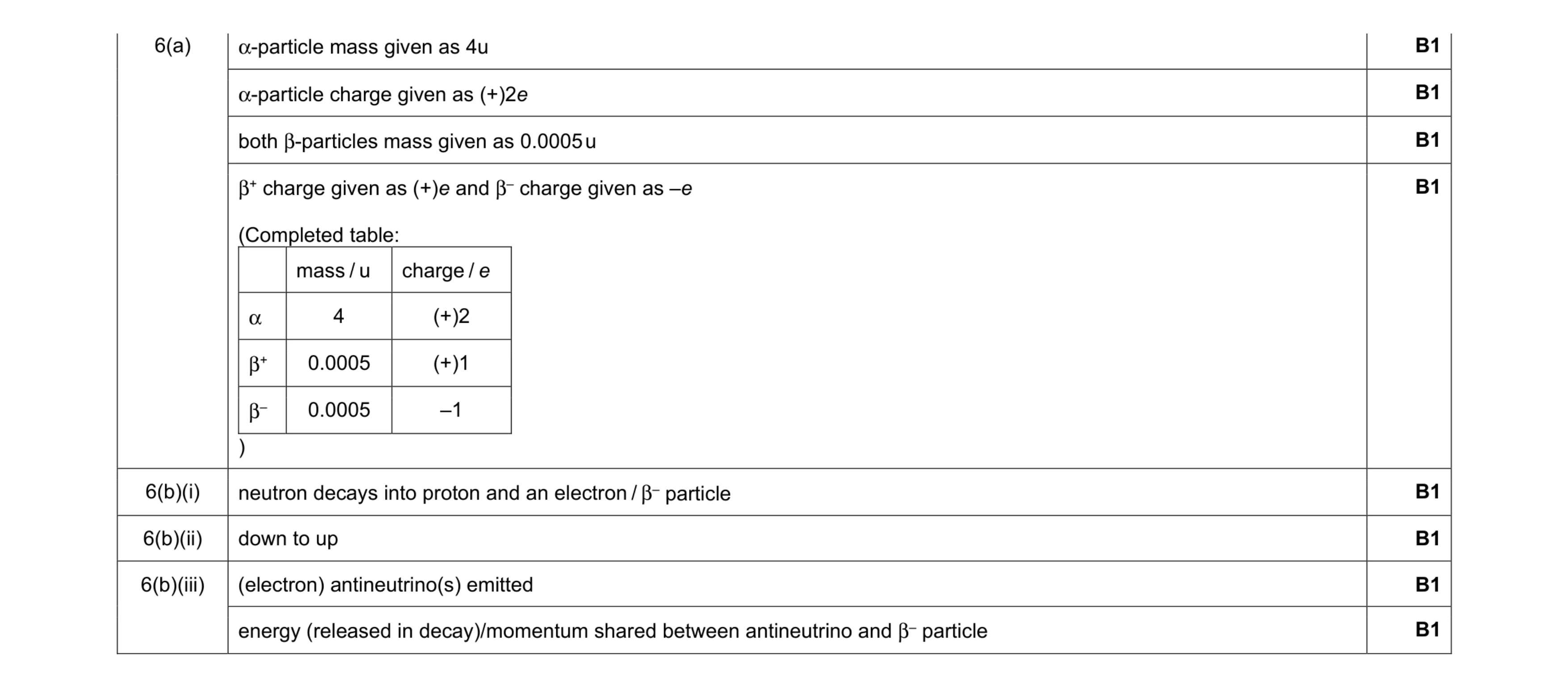 8
8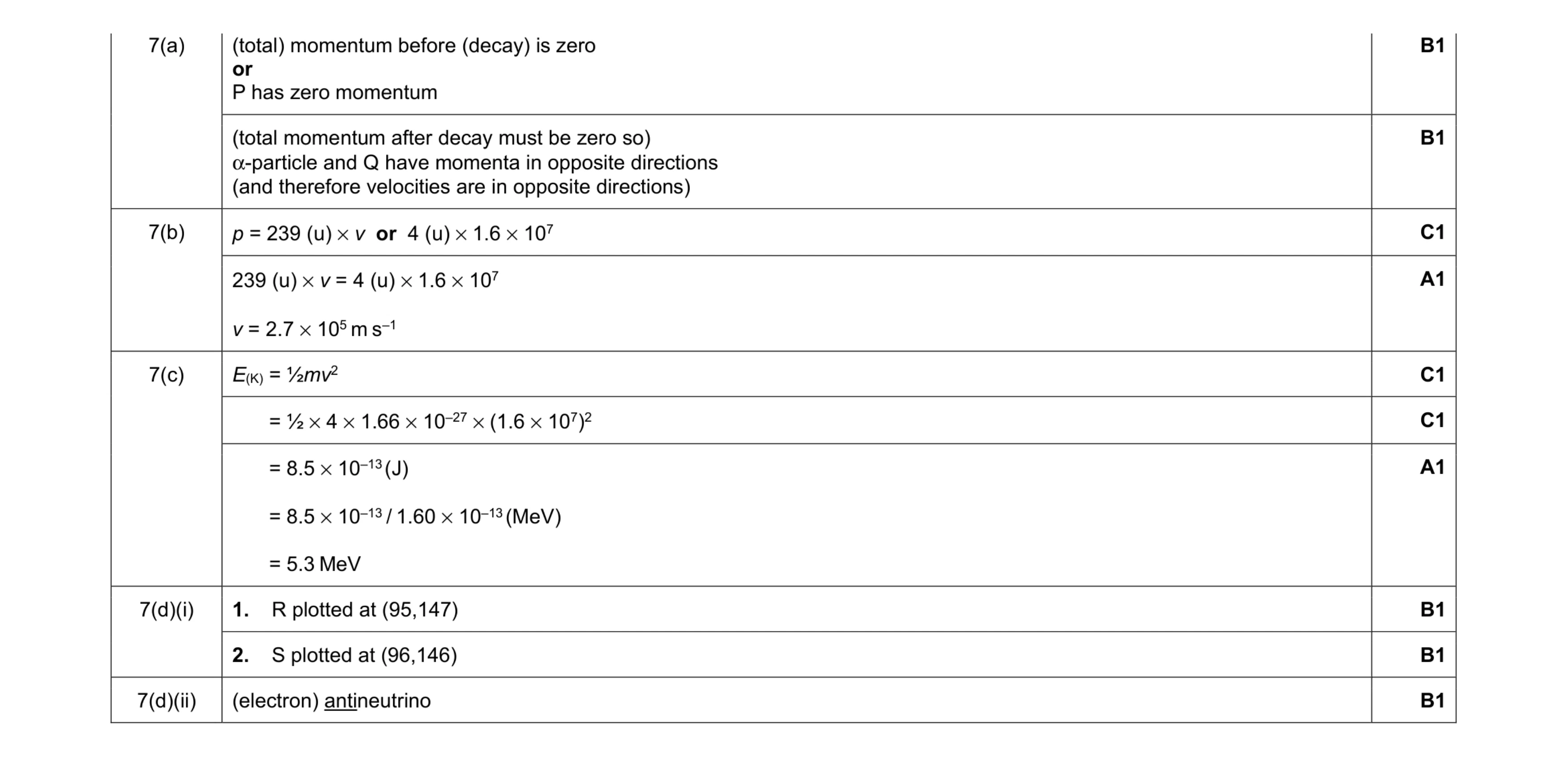 10
10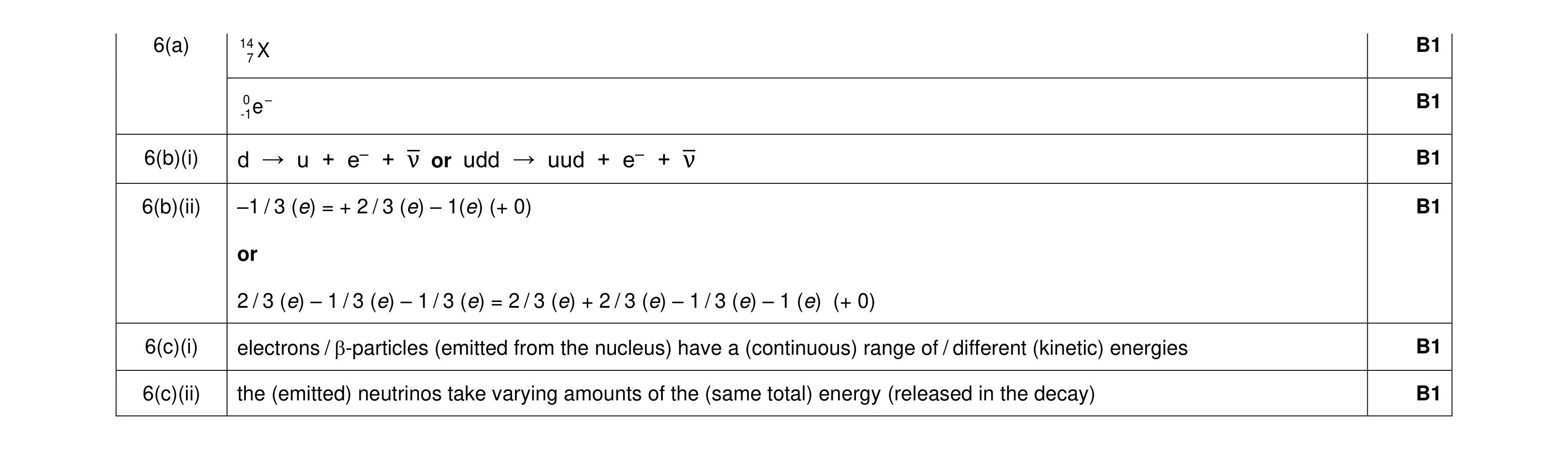 6
6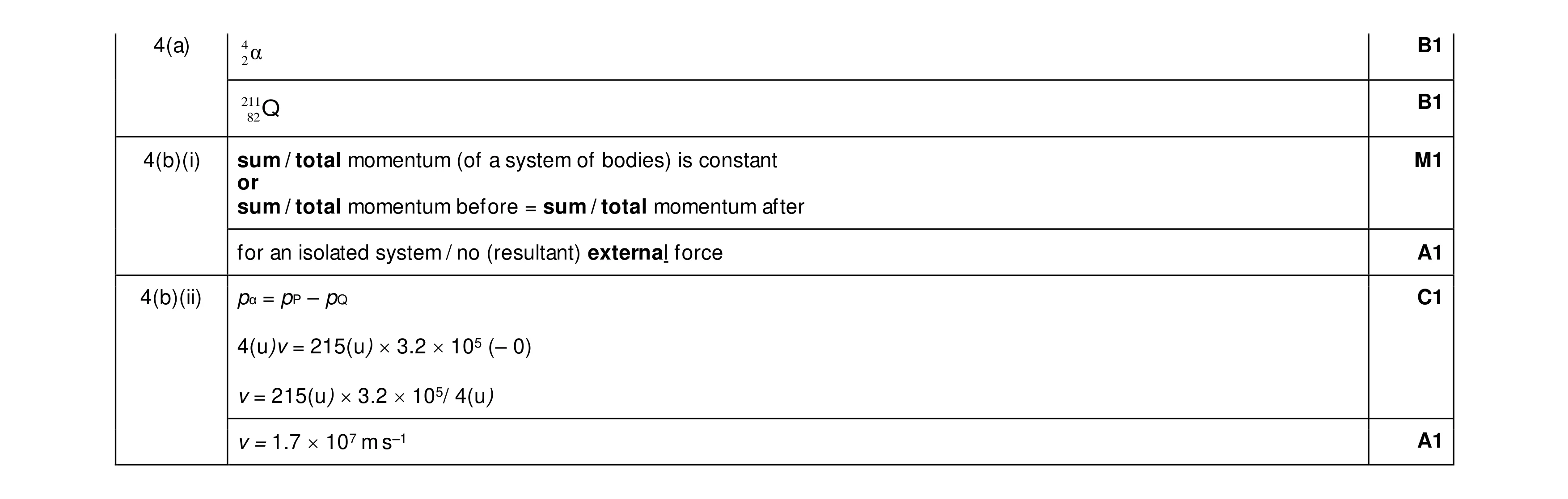 6
6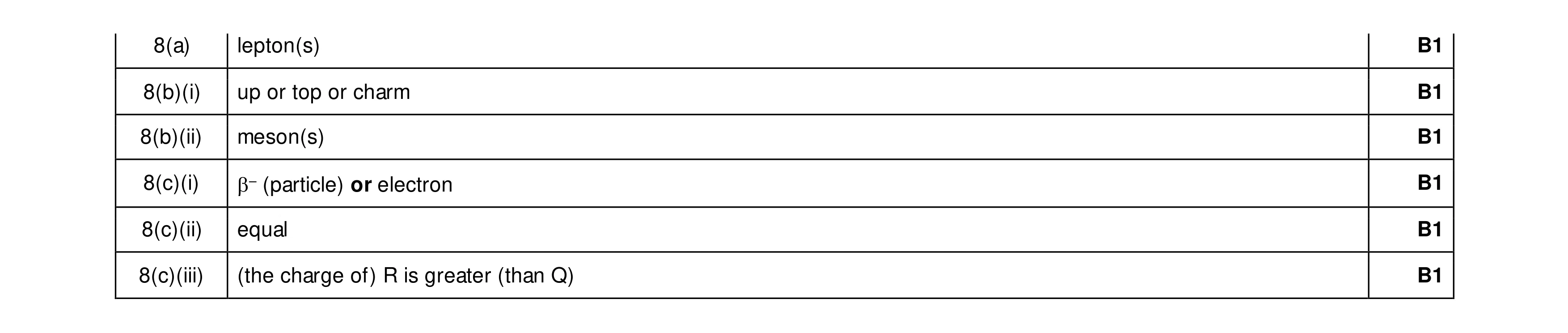 6
6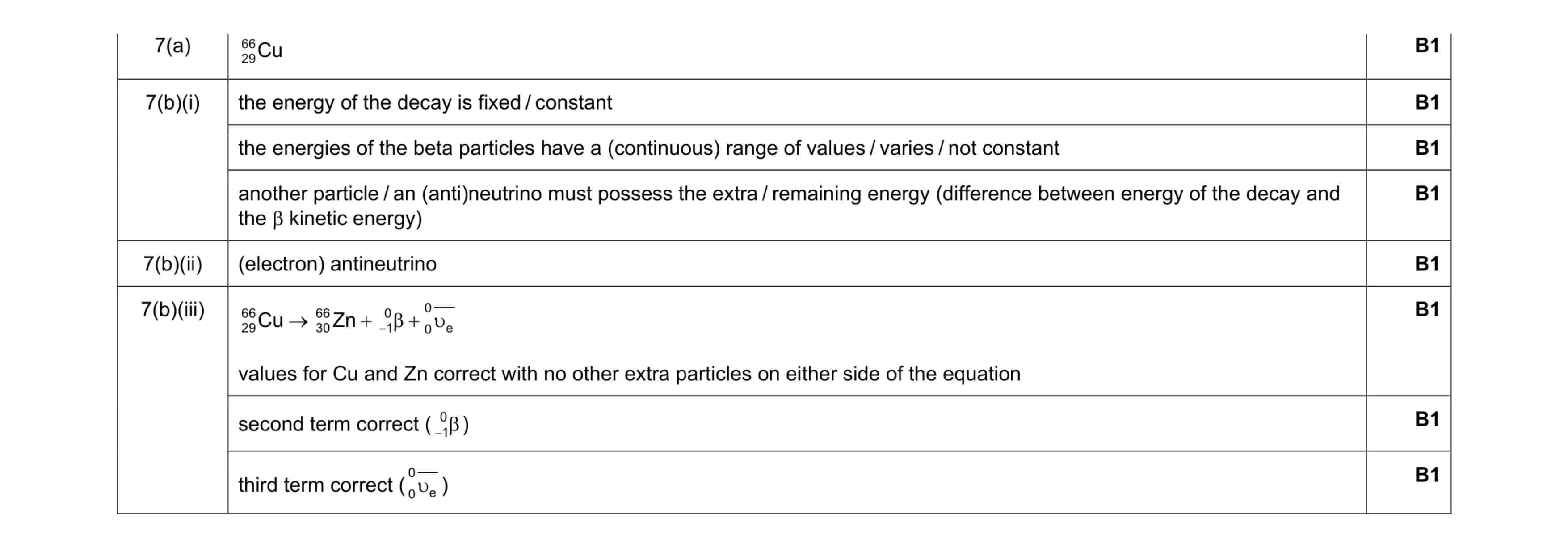 8
8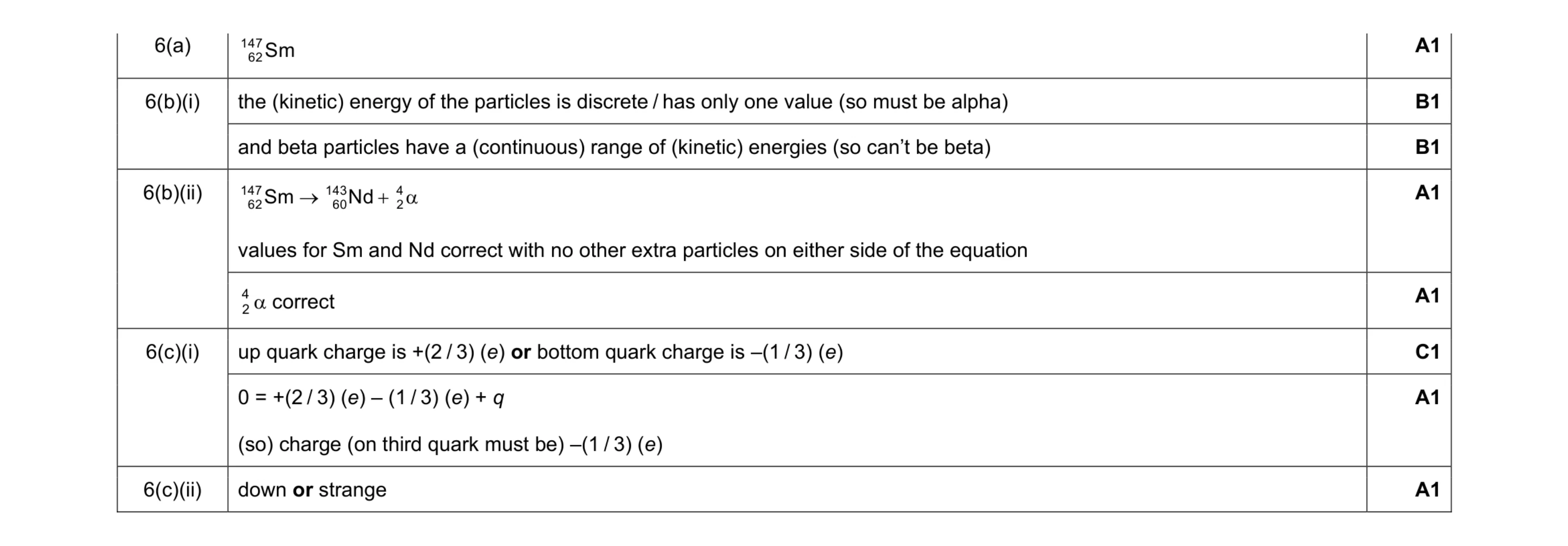 8
8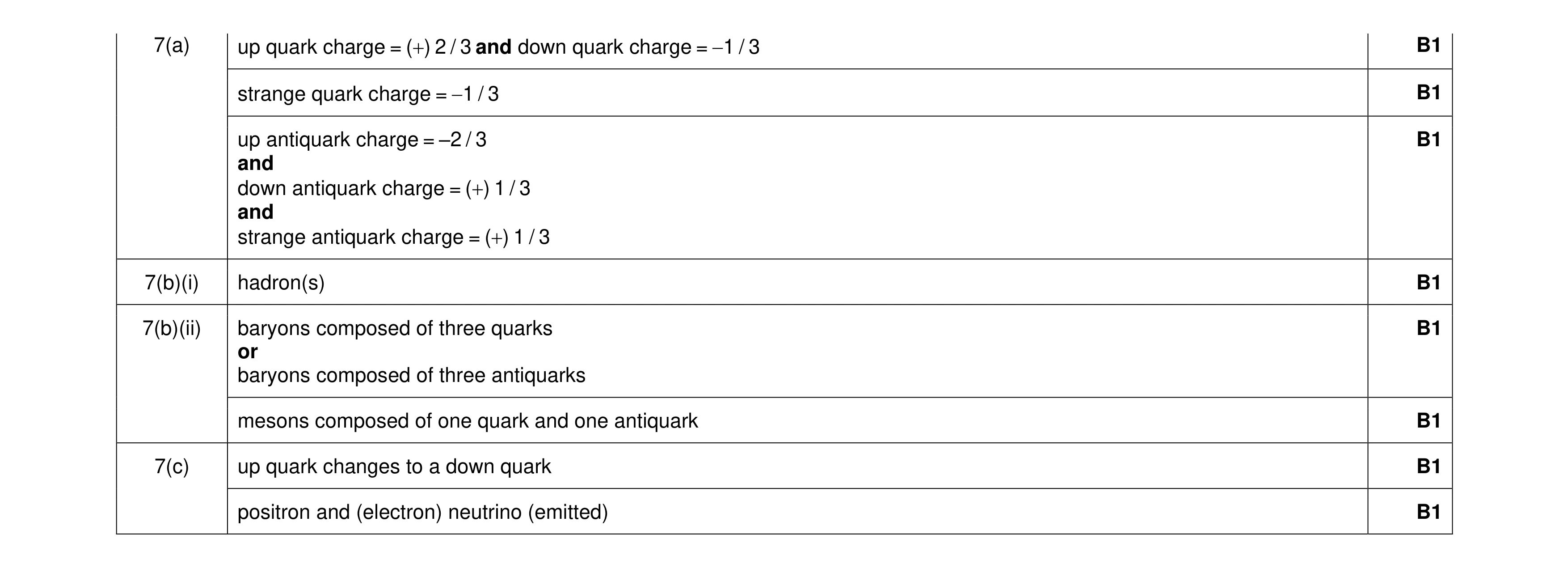 8
8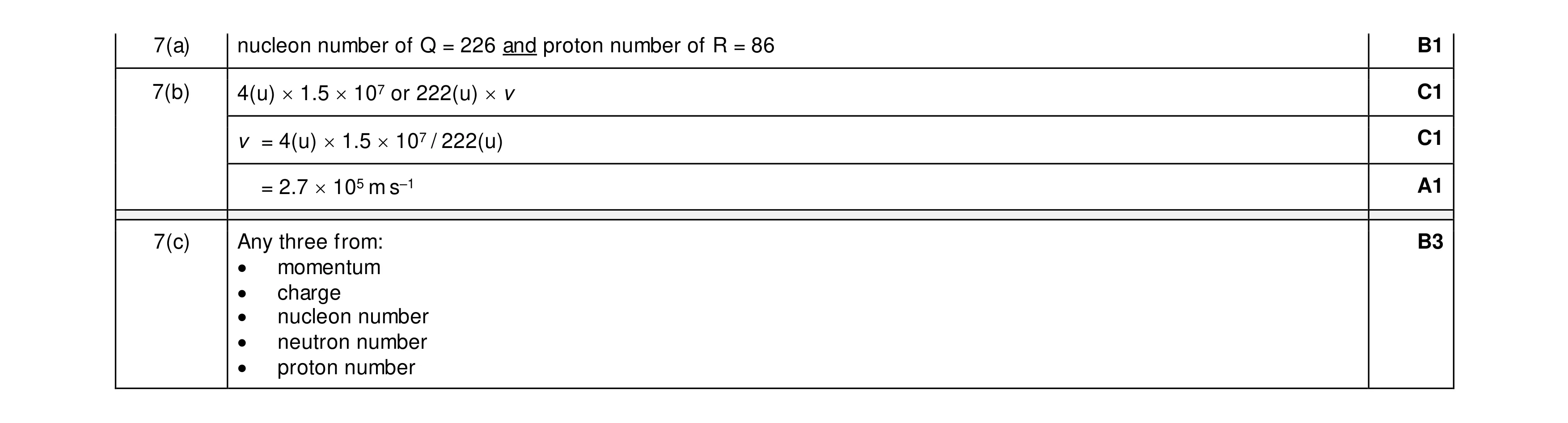 7
7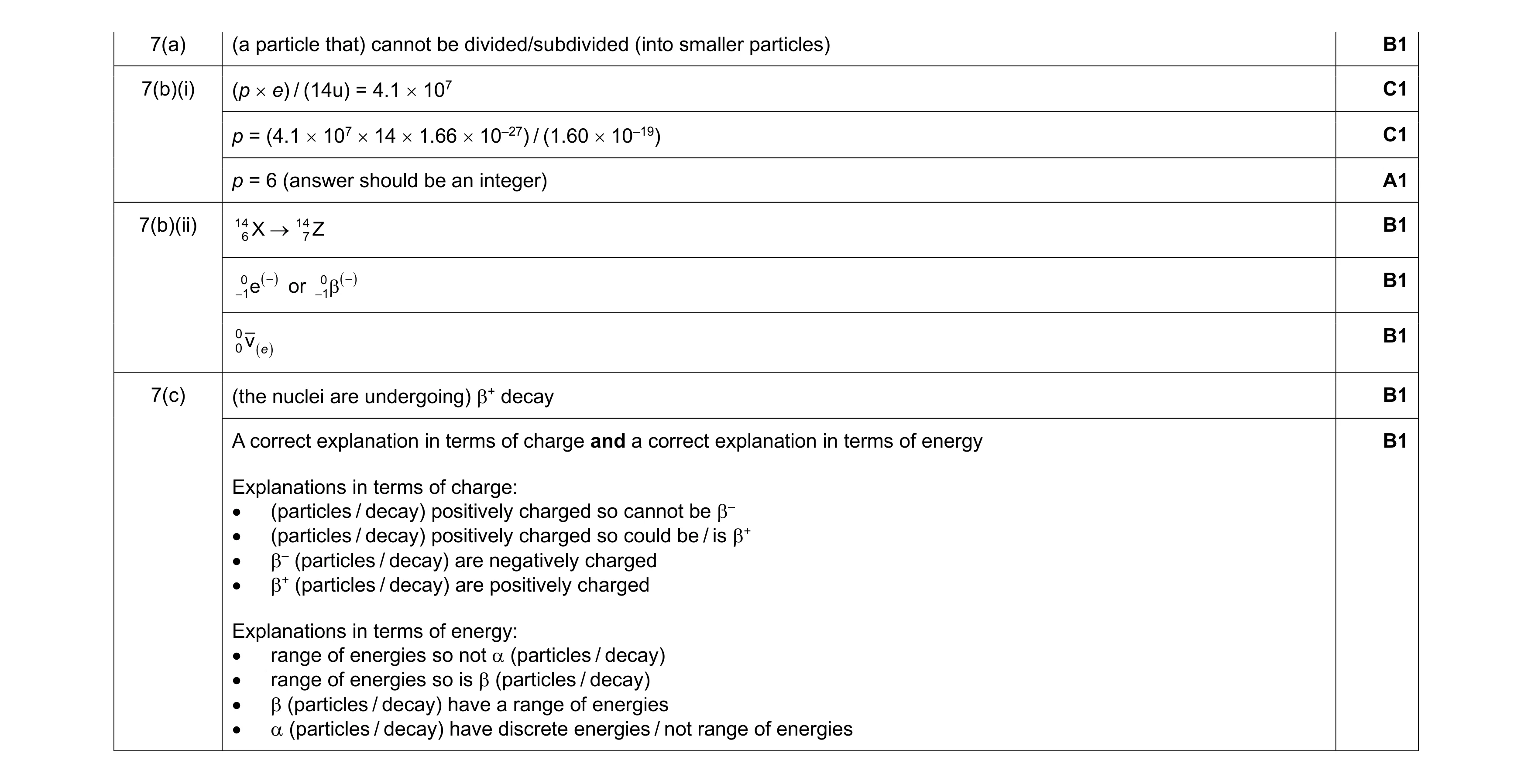 9
9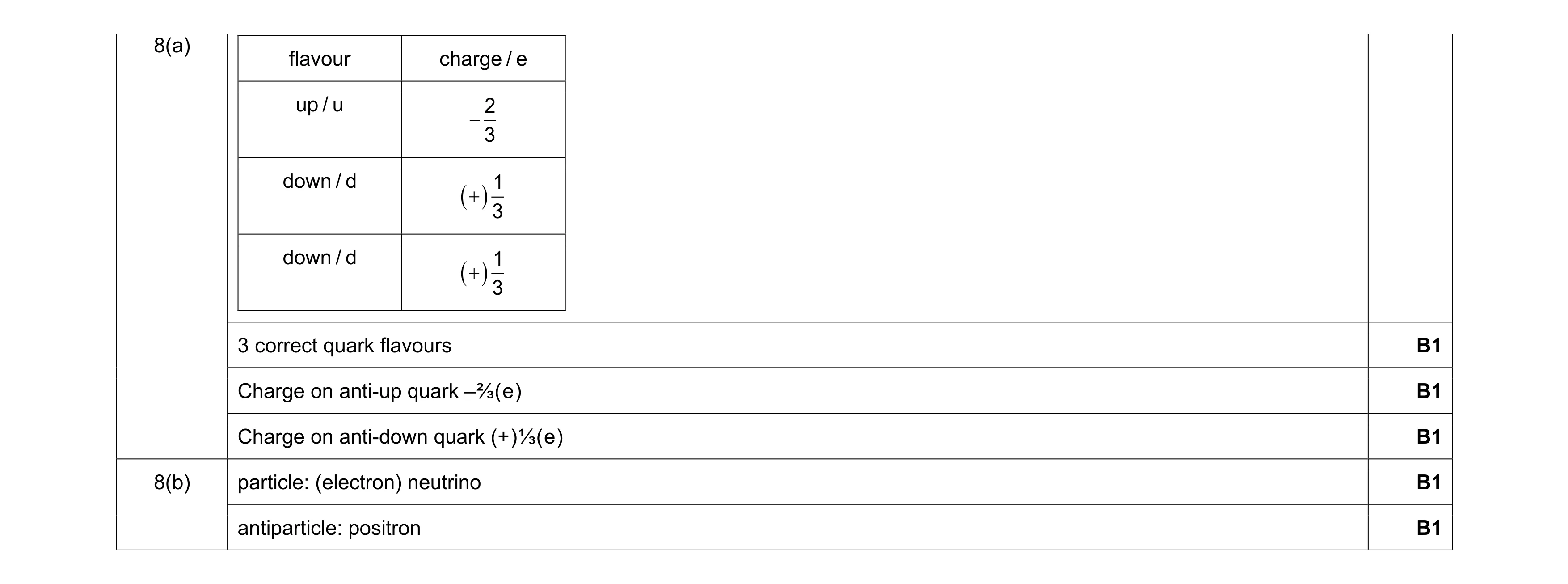 5
5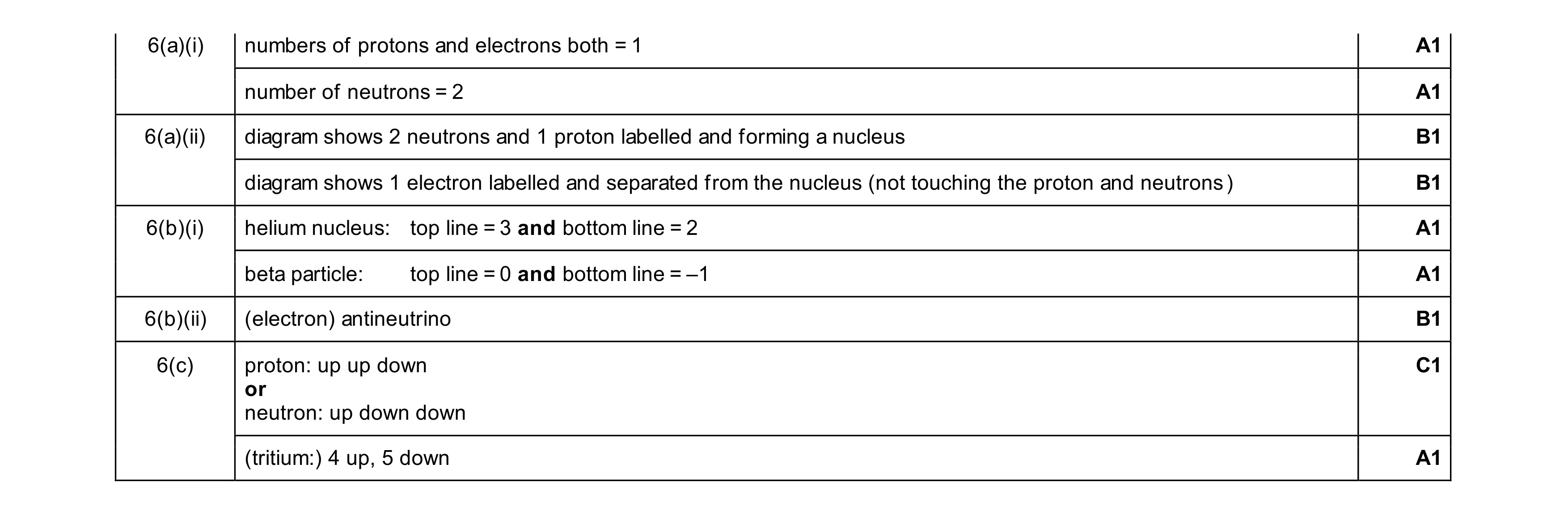 9
9