Cambridge A Level Physics 9702 — 2023 Feb/March Paper 4 · Variant 2
9702/42/F/M/23 · 10 questions · 100 marks · ≈113 min
The question paper and its mark scheme, free to read here and free to download. This is Cambridge’s own paper, exactly as it was sat.
Question paper32 pages








Mark scheme18 pages
Answers below. Sit the paper first if you are practising.
Questions as text
Q1 · Define gravitational potential at a point
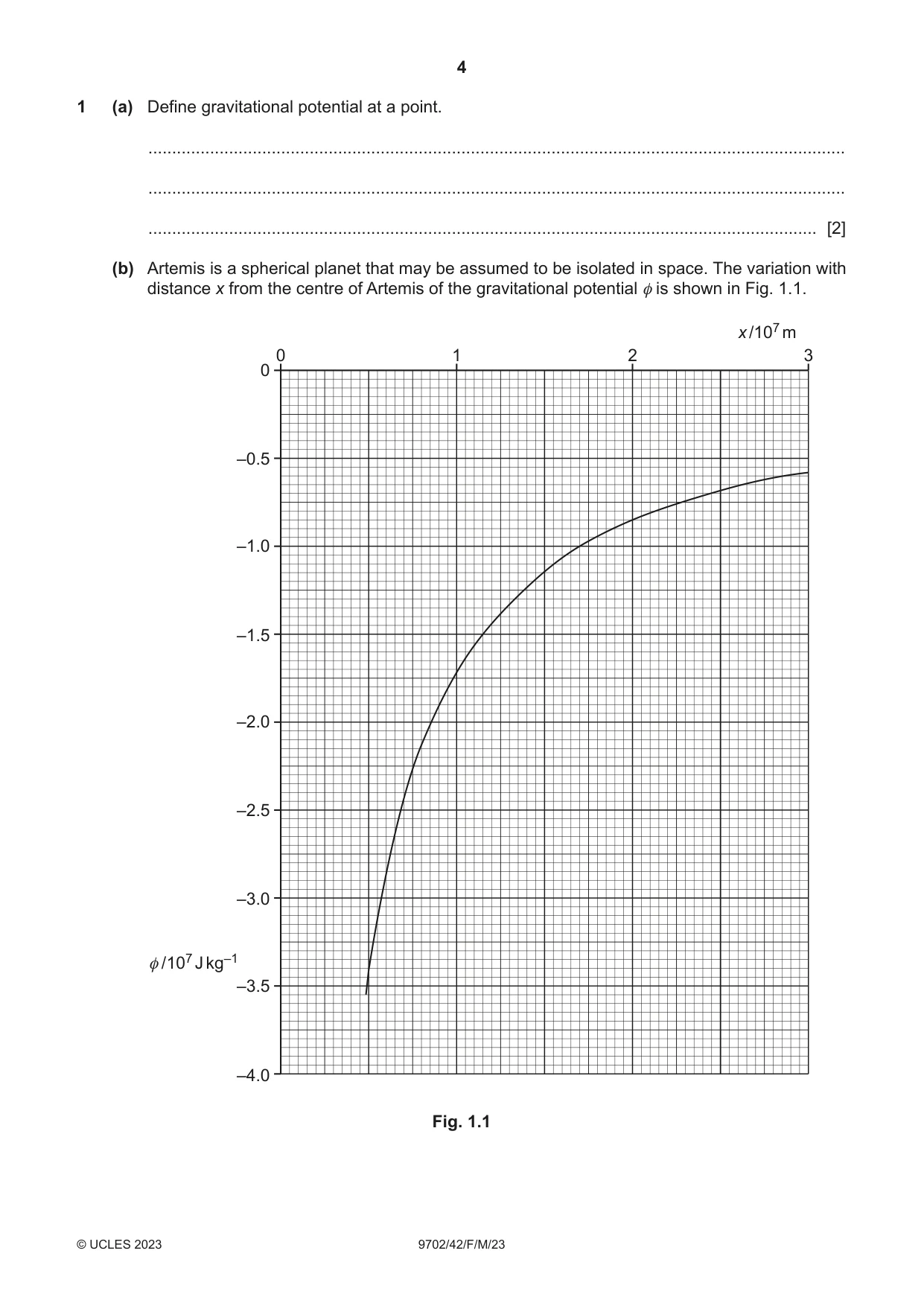
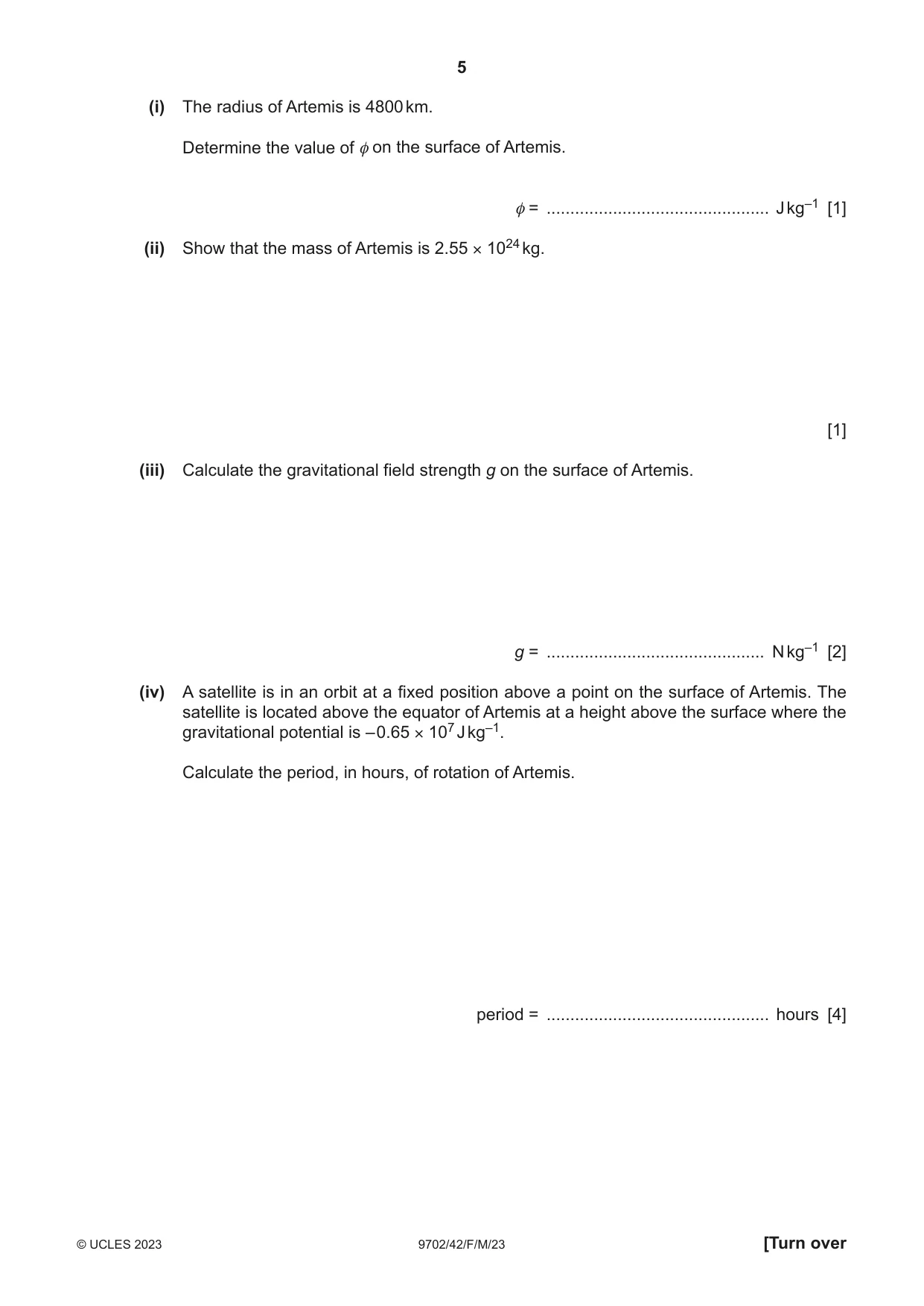
1 (a) Define gravitational potential at a point. ................................................................................................................................................... ................................................................................................................................................... ............................................................................................................................................. [2] (b) Artemis is a spherical planet that may be assumed to be isolated in space. The variation with distance x from the centre of Artemis of the gravitational potential φ is shown in Fig. 1.1. x /107 m 0 1 2 3 0 –0.5 –1.0 –1.5 –2.0 –2.5 –3.0 φ / 107 J kg–1 –3.5 –4.0 Fig. 1.1 (i) The radius of Artemis is 4800 km. Determine the value of φ on the surface of Artemis. φ = ............................................... J kg–1 [1] (ii) Show that the mass of Artemis is 2.55 × 1024 kg. [1] (iii) Calculate the gravitational field strength g on the surface of Artemis. g = .............................................. N kg–1 [2] (iv) A satellite is in an orbit at a fixed position above a point on the surface of Artemis. The satellite is located above the equator of Artemis at a height above the surface where the gravitational potential is – 0.65 × 10⁷ J kg–1. Calculate the period, in hours, of rotation of Artemis. period = ............................................... hours [4] (c) State one similarity and one difference between gravitational potential due to a point mass and electric potential due to a point charge. similarity .................................................................................................................................... ................................................................................................................................................... difference .................................................................................................................................. ................................................................................................................................................... [2] [Total: 12]
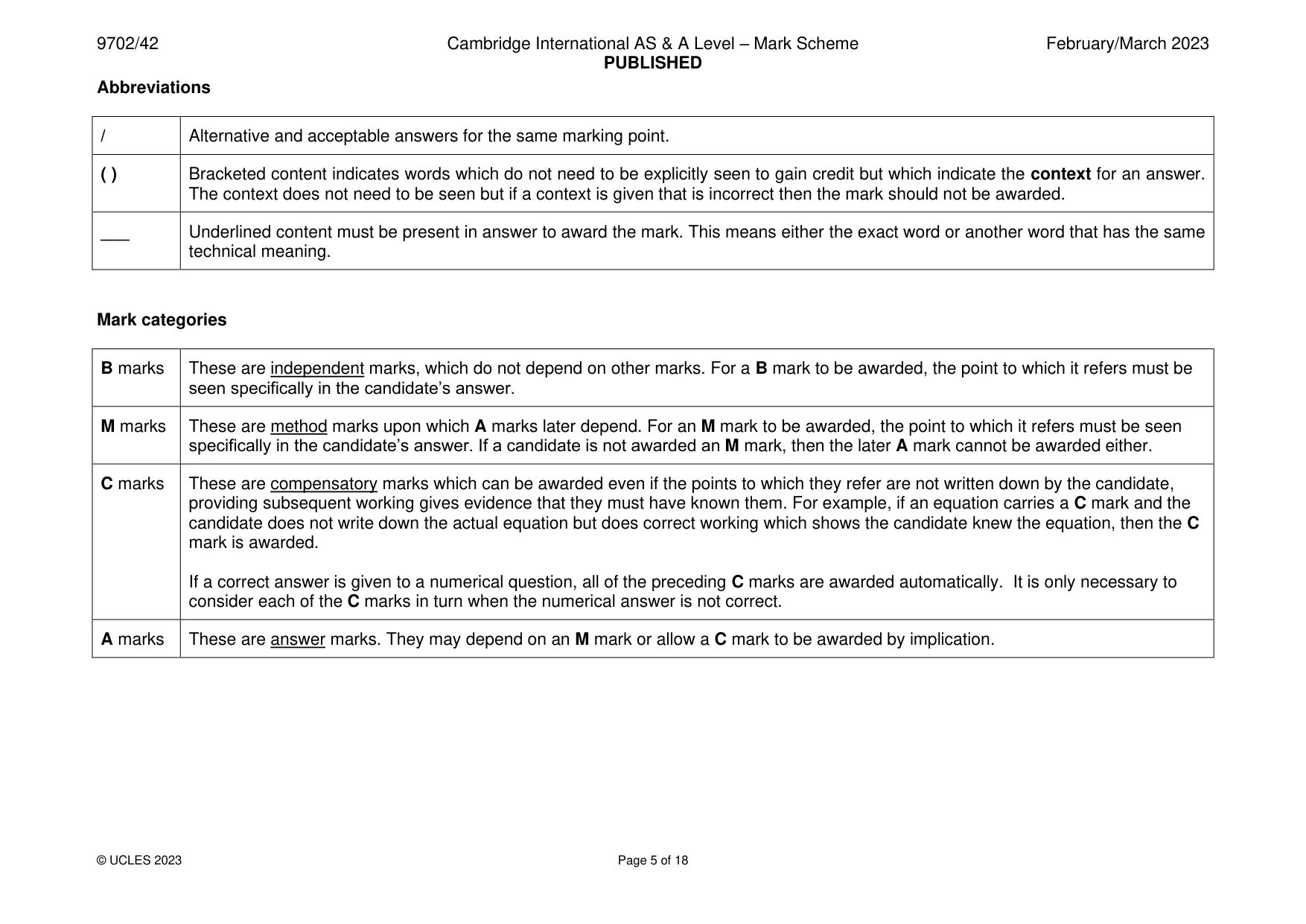
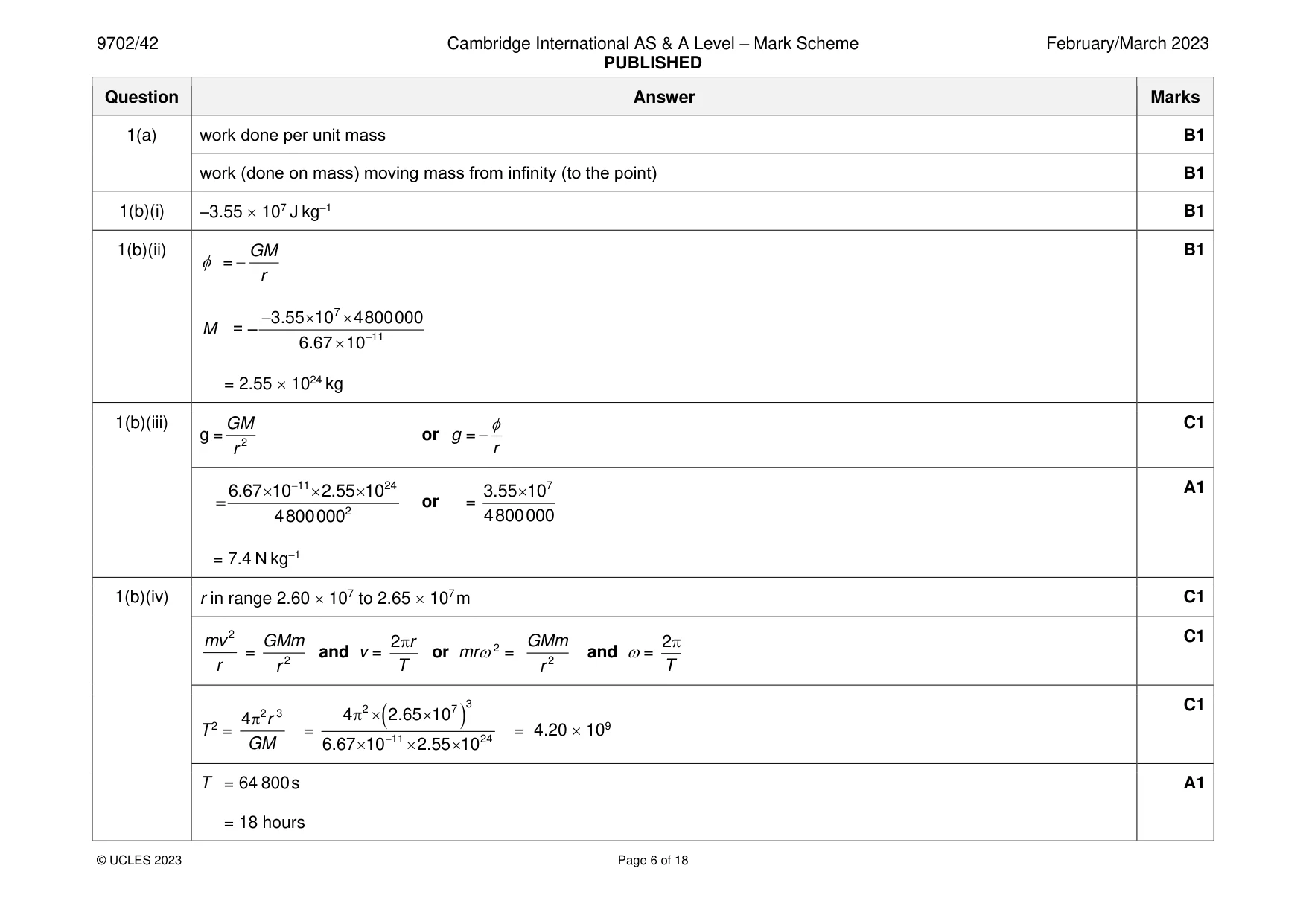
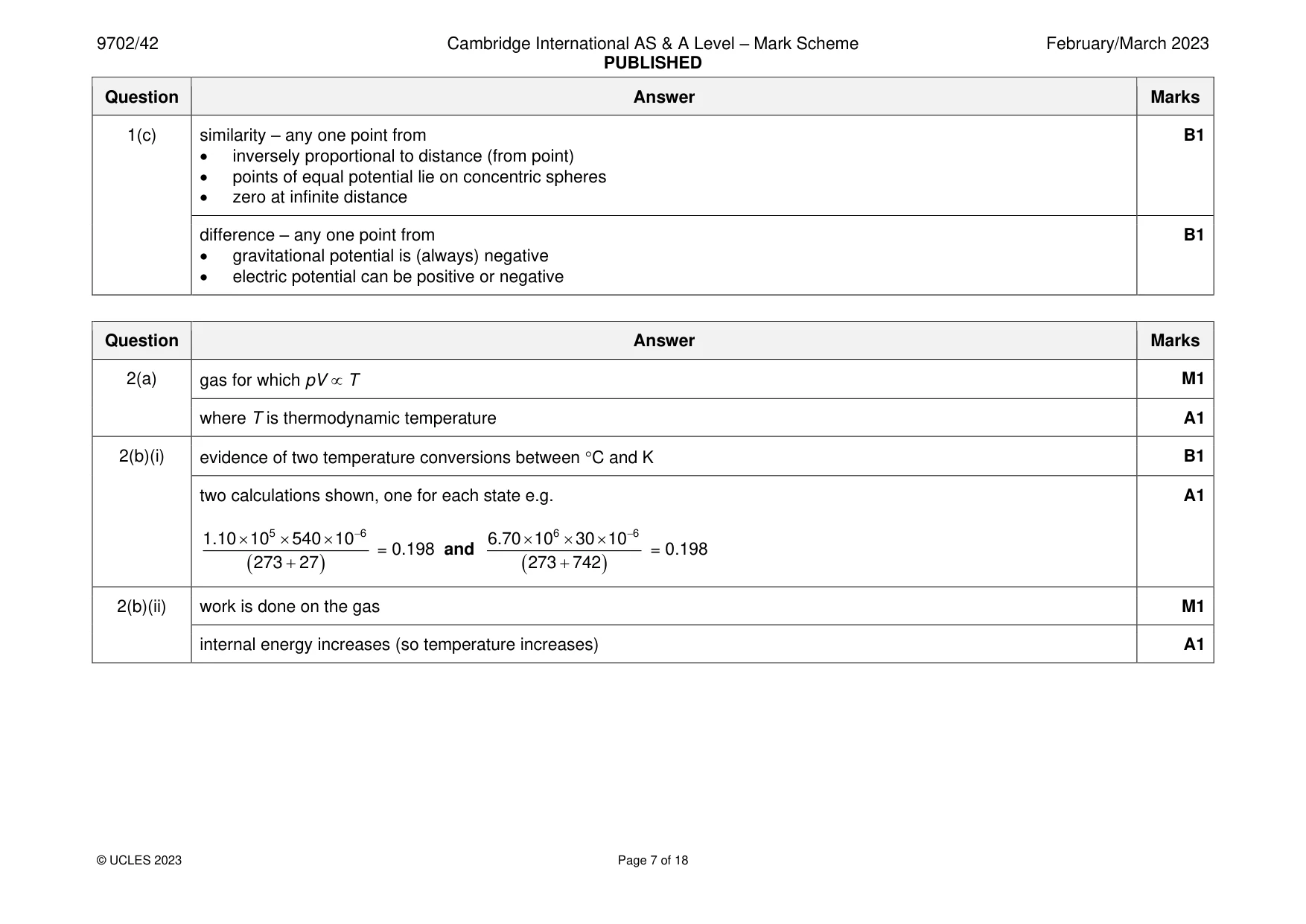
Mark scheme: Question Answer Marks 1(a) work done per unit mass B1 work (done on mass) moving mass from infinity (to the point) B1 1(b)(i) –3.55 107 J kg–1 B1 1(b)(ii) GM B1 = − r −3.55 10 7 4 800 000 M = – 6.67 10 −11 = 2.55 1024 kg 1(b)(iii) GM C1 g = or g = − r 2 r 6.67 10 −11 2.55 10 24 3.55 107 A1 = or = 48000002 4800000 = 7.4 N kg–1 1(b)(iv) r in range 2.60 107 to 2.65 107 m C1 mv 2 GMm 2 r GMm 2 C1 = and v = or mr 2 = and = r r 2 T r 2 T 2.65 10 7 )3 C1 2 4 2 r 3 4 2 ( T = = = 4.20 109 GM 6.67 10 −11 2.55 10 24 T = 64 800 s A1 = 18 hours 1(c) similarity – any one point from B1 • inversely proportional to distance (from point) • points of equal potential lie on concentric spheres • zero at infinite distance difference – any one point from B1 • gravitational potential is (always) negative • electric potential can be positive or negative
Q2 · State what is meant by an ideal gas
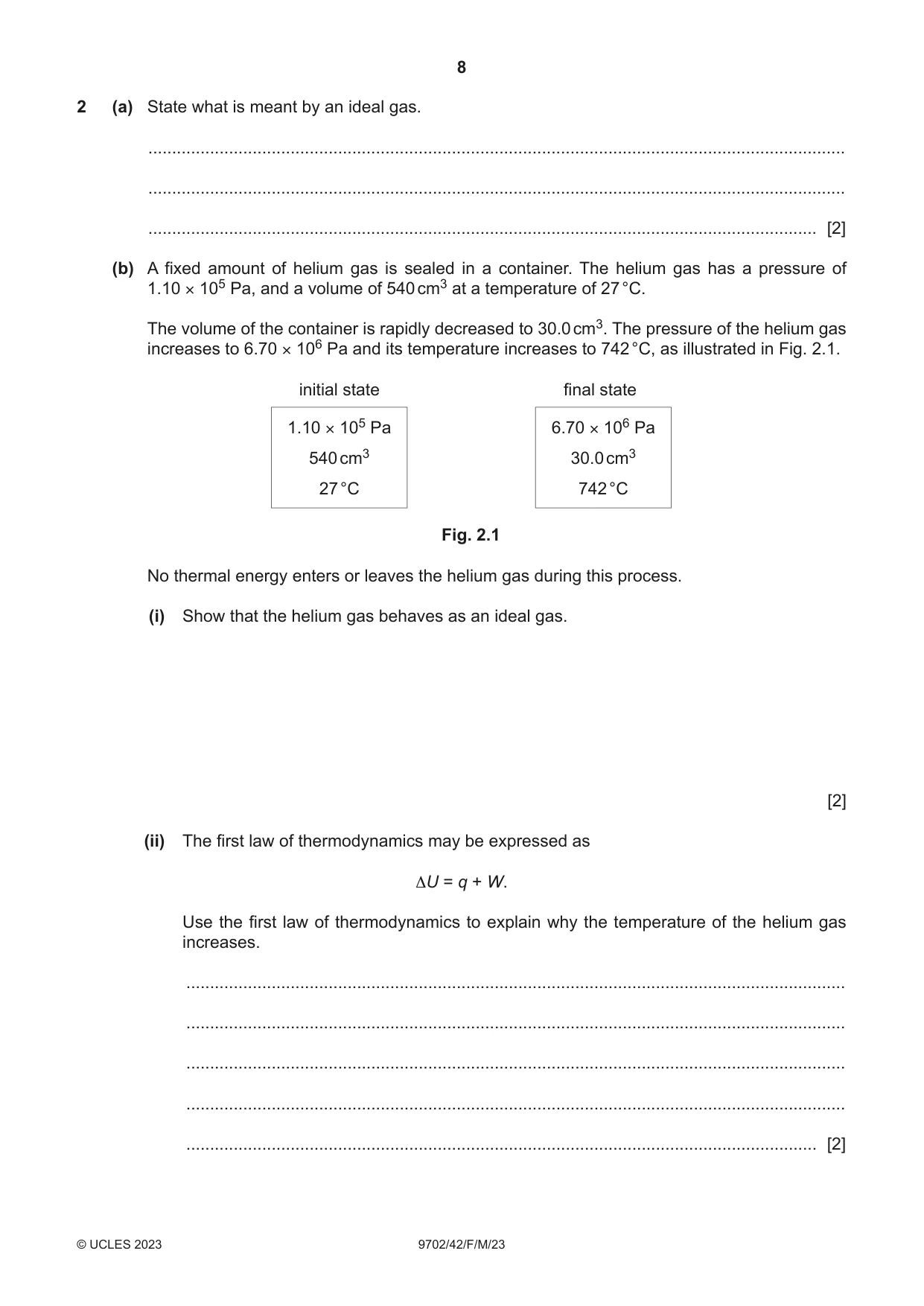
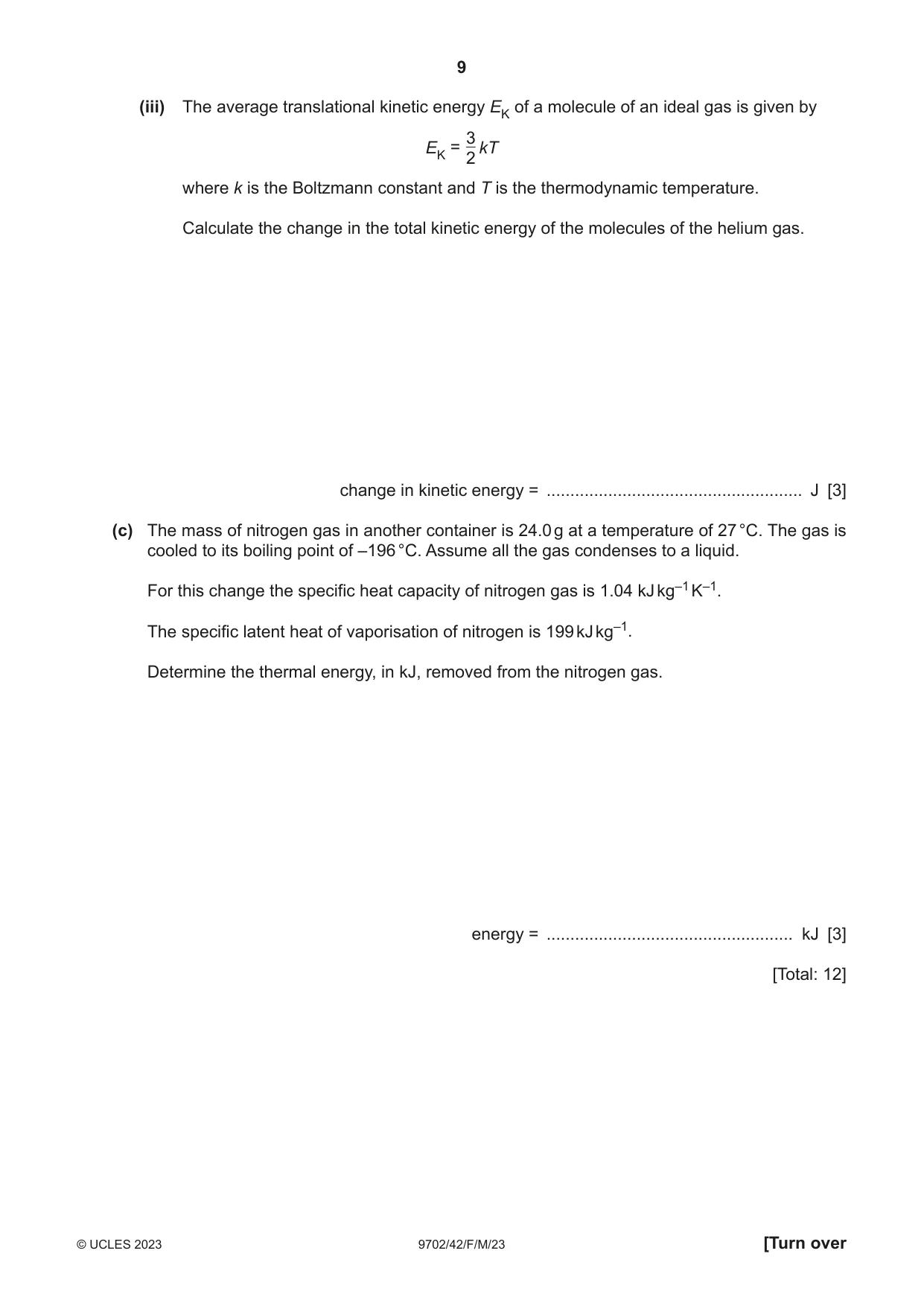
2 (a) State what is meant by an ideal gas. ................................................................................................................................................... ................................................................................................................................................... ............................................................................................................................................. [2] (b) A fixed amount of helium gas is sealed in a container. The helium gas has a pressure of 1.10 × 10⁵ Pa, and a volume of 540 cm3 at a temperature of 27 °C. The volume of the container is rapidly decreased to 30.0 cm3. The pressure of the helium gas increases to 6.70 × 10⁶ Pa and its temperature increases to 742 °C, as illustrated in Fig. 2.1. initial state final state 1.10 × 10⁵ Pa 6.70 × 10⁶ Pa 540 cm3 30.0 cm3 27 °C 742 °C Fig. 2.1 No thermal energy enters or leaves the helium gas during this process. (i) Show that the helium gas behaves as an ideal gas. [2] (ii) The first law of thermodynamics may be expressed as ΔU = q + W. Use the first law of thermodynamics to explain why the temperature of the helium gas increases. ........................................................................................................................................... ........................................................................................................................................... ........................................................................................................................................... ........................................................................................................................................... ..................................................................................................................................... [2] (iii) The average translational kinetic energy EK of a molecule of an ideal gas is given by 3 EK = kT 2 where k is the Boltzmann constant and T is the thermodynamic temperature. Calculate the change in the total kinetic energy of the molecules of the helium gas. change in kinetic energy = ...................................................... J [3] (c) The mass of nitrogen gas in another container is 24.0 g at a temperature of 27 °C. The gas is cooled to its boiling point of –196 °C. Assume all the gas condenses to a liquid. For this change the specific heat capacity of nitrogen gas is 1.04 kJ kg–1 K–1. The specific latent heat of vaporisation of nitrogen is 199 kJ kg–1. Determine the thermal energy, in kJ, removed from the nitrogen gas. energy = .................................................... kJ [3] [Total: 12]
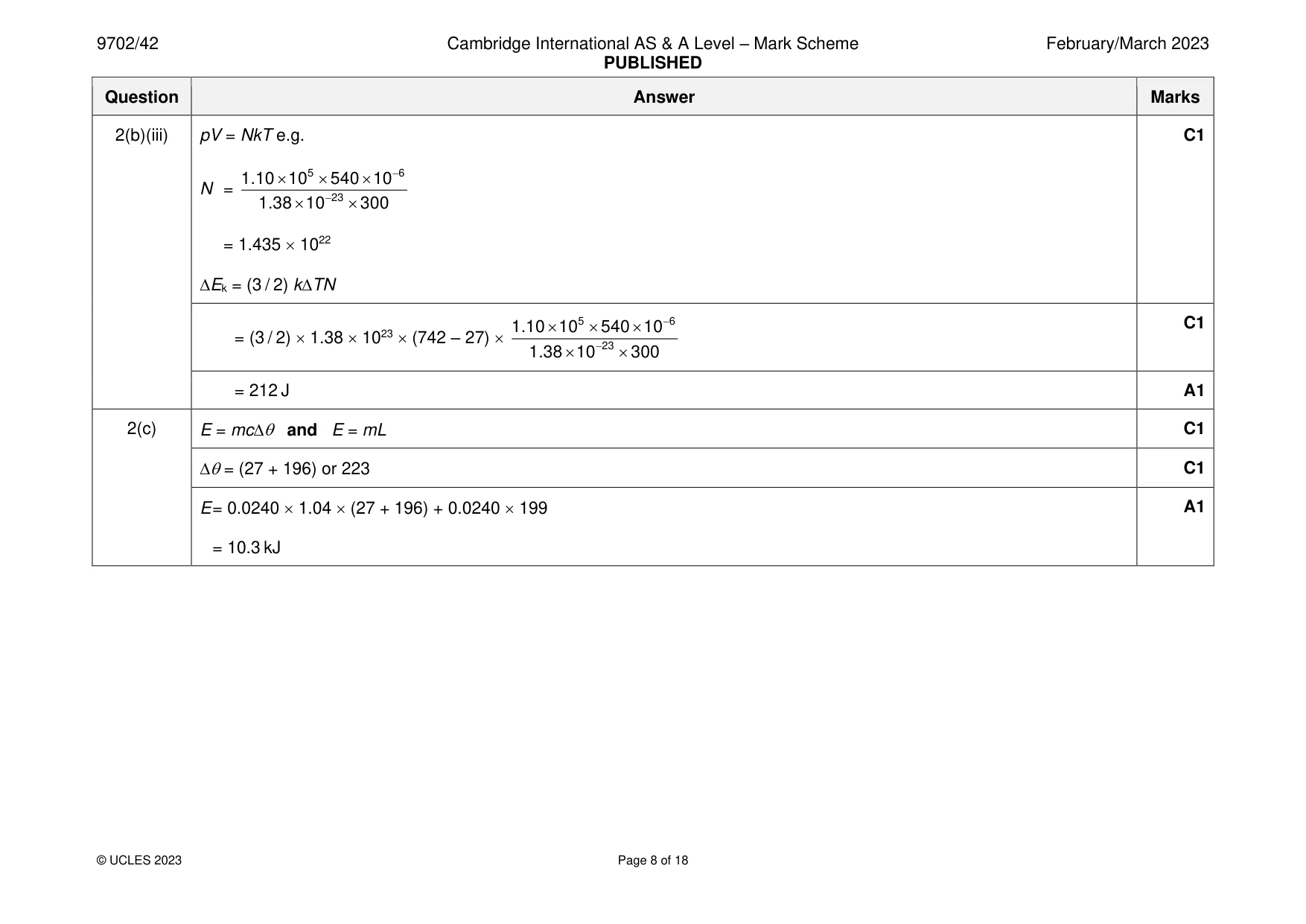
Mark scheme: 2(a) gas for which pV T M1 where T is thermodynamic temperature A1 2(b)(i) evidence of two temperature conversions between C and K B1 two calculations shown, one for each state e.g. A1 1.10 105 540 10 −6 6.70 10 6 30 10 −6 = 0.198 and = 0.198 ( 273 + 27 ) ( 273 + 742 ) 2(b)(ii) work is done on the gas M1 internal energy increases (so temperature increases) A1 2(b)(iii) pV = NkT e.g. C1 1.10 10 5 540 10 −6 N = 1.38 10 −23 300 = 1.435 1022 Ek = (3 / 2) kTN 1.10 10 5 540 10 −6 C1 = (3 / 2) 1.38 1023 (742 – 27) 1.38 10 −23 300 = 212 J A1 2(c) E = mc and E = mL C1 = (27 + 196) or 223 C1 E = 0.0240 1.04 (27 + 196) + 0.0240 199 A1 = 10.3 kJ
Q3 · An object is suspended from a vertical spring as shown in Fig
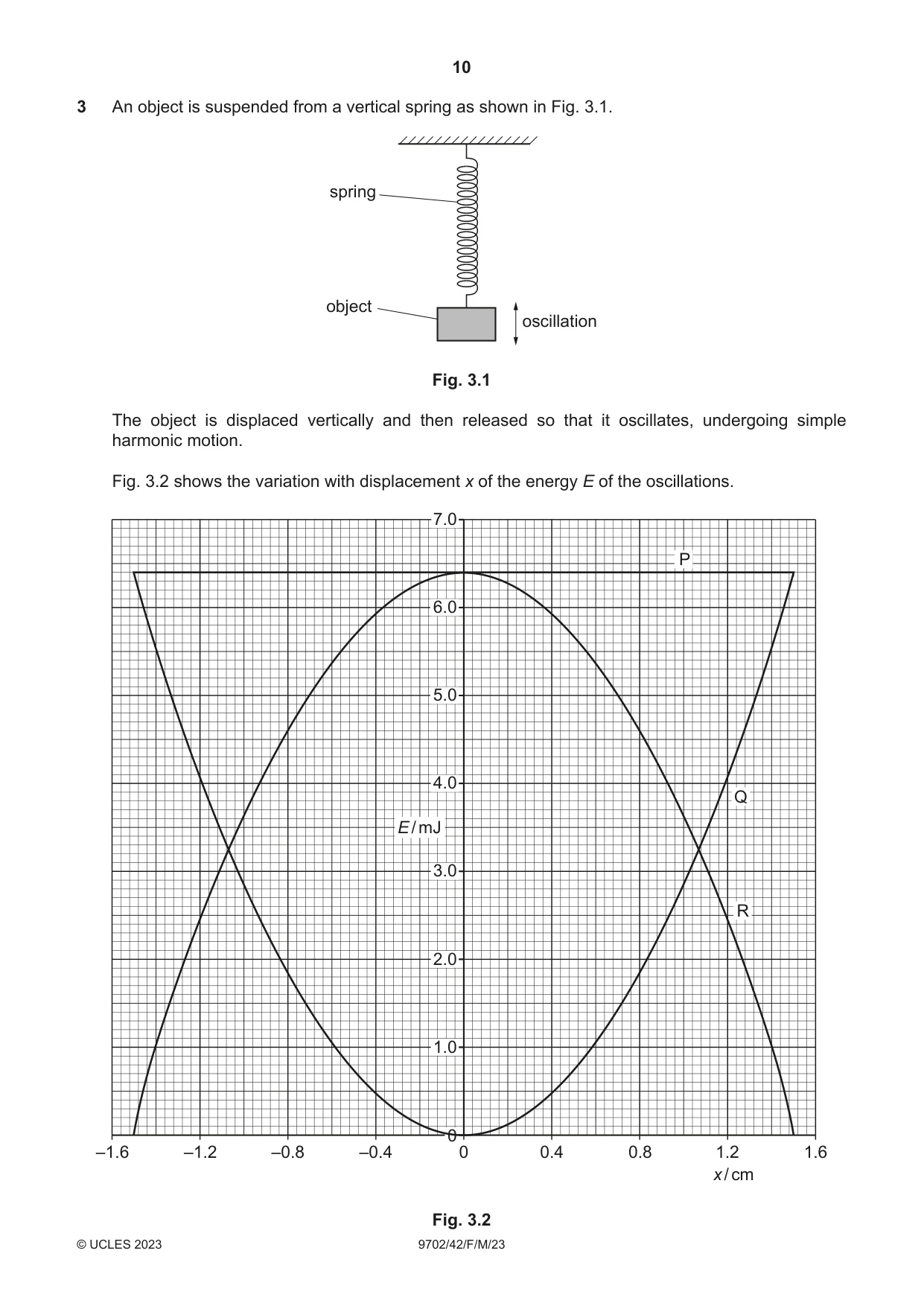
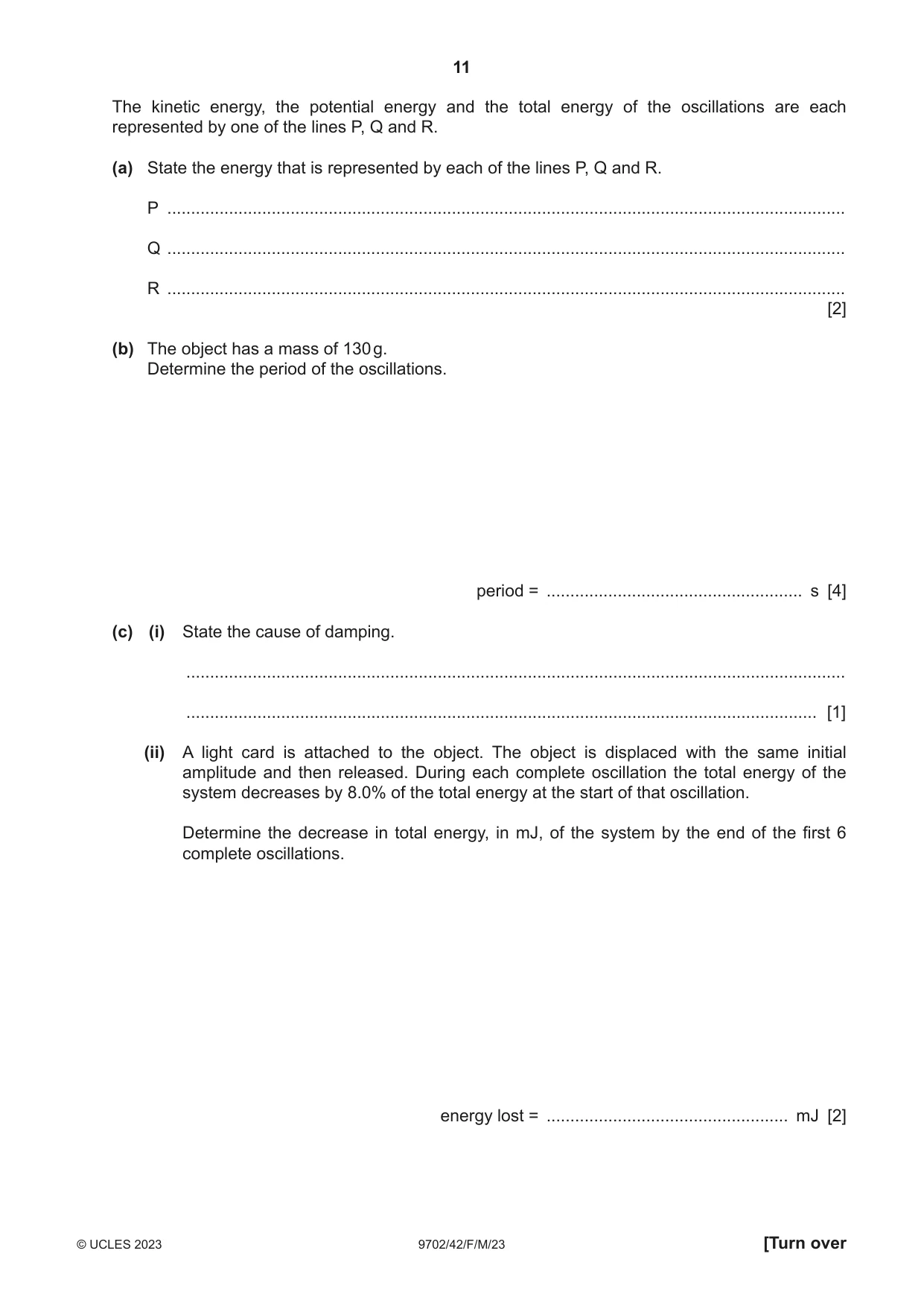
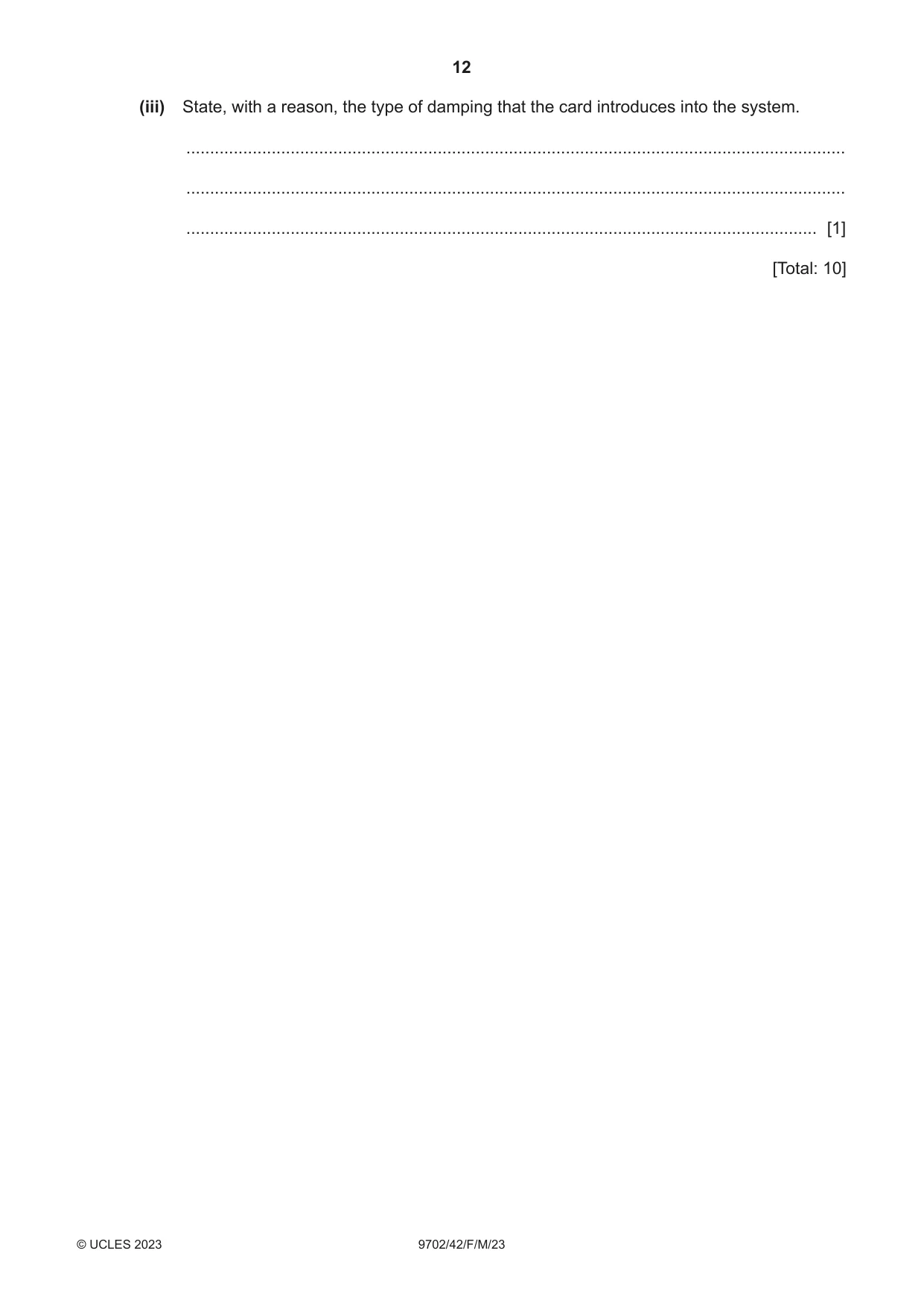
3 An object is suspended from a vertical spring as shown in Fig. 3.1. spring object oscillation Fig. 3.1 The object is displaced vertically and then released so that it oscillates, undergoing simple harmonic motion. Fig. 3.2 shows the variation with displacement x of the energy E of the oscillations. 7.0 P 6.0 5.0 4.0 Q E / mJ 3.0 R 2.0 1.0 0 –1.6 –1.2 –0.8 –0.4 0 0.4 0.8 1.2 1.6 x / cm Fig. 3.2 The kinetic energy, the potential energy and the total energy of the oscillations are each represented by one of the lines P, Q and R. (a) State the energy that is represented by each of the lines P, Q and R. P ............................................................................................................................................... Q ............................................................................................................................................... R ............................................................................................................................................... [2] (b) The object has a mass of 130 g. Determine the period of the oscillations. period = ...................................................... s [4] (c) (i) State the cause of damping. ........................................................................................................................................... ..................................................................................................................................... [1] (ii) A light card is attached to the object. The object is displaced with the same initial amplitude and then released. During each complete oscillation the total energy of the system decreases by 8.0% of the total energy at the start of that oscillation. Determine the decrease in total energy, in mJ, of the system by the end of the first 6 complete oscillations. energy lost = ................................................... mJ [2] (iii) State, with a reason, the type of damping that the card introduces into the system. ........................................................................................................................................... ........................................................................................................................................... ..................................................................................................................................... [1] [Total: 10]
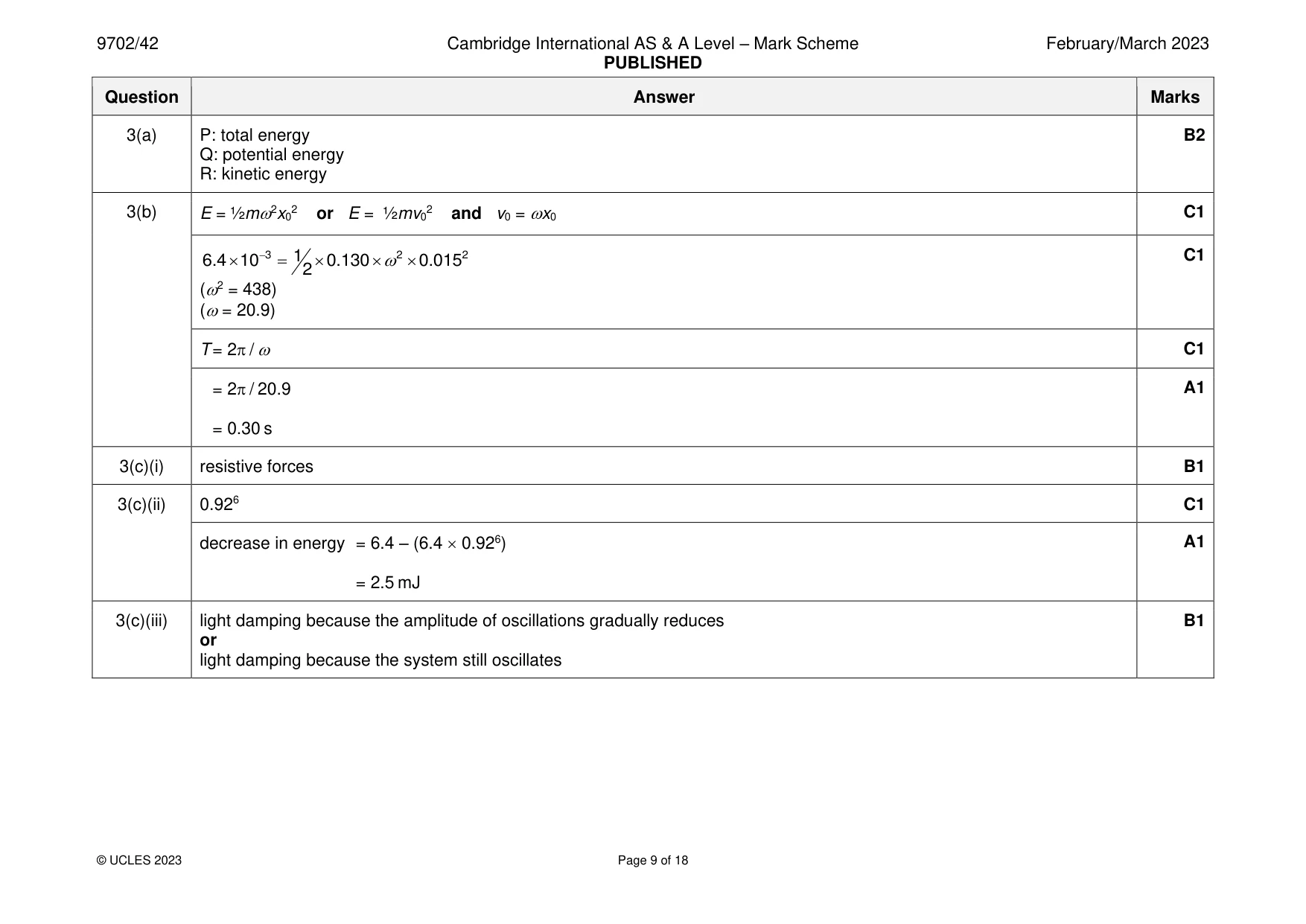
Mark scheme: 3(a) P: total energy B2 Q: potential energy R: kinetic energy 3(b) E = ½m2x02 or E = ½mv02 and v0 = x0 C1 6.4 10 −3 = 1 0.130 2 0.0152 C1 2 (2 = 438) (= 20.9) T = 2 / C1 = 2 / 20.9 A1 = 0.30 s 3(c)(i) resistive forces B1 3(c)(ii) 0.926 C1 decrease in energy = 6.4 – (6.4 0.926) A1 = 2.5 mJ 3(c)(iii) light damping because the amplitude of oscillations gradually reduces B1 or light damping because the system still oscillates
Question 4
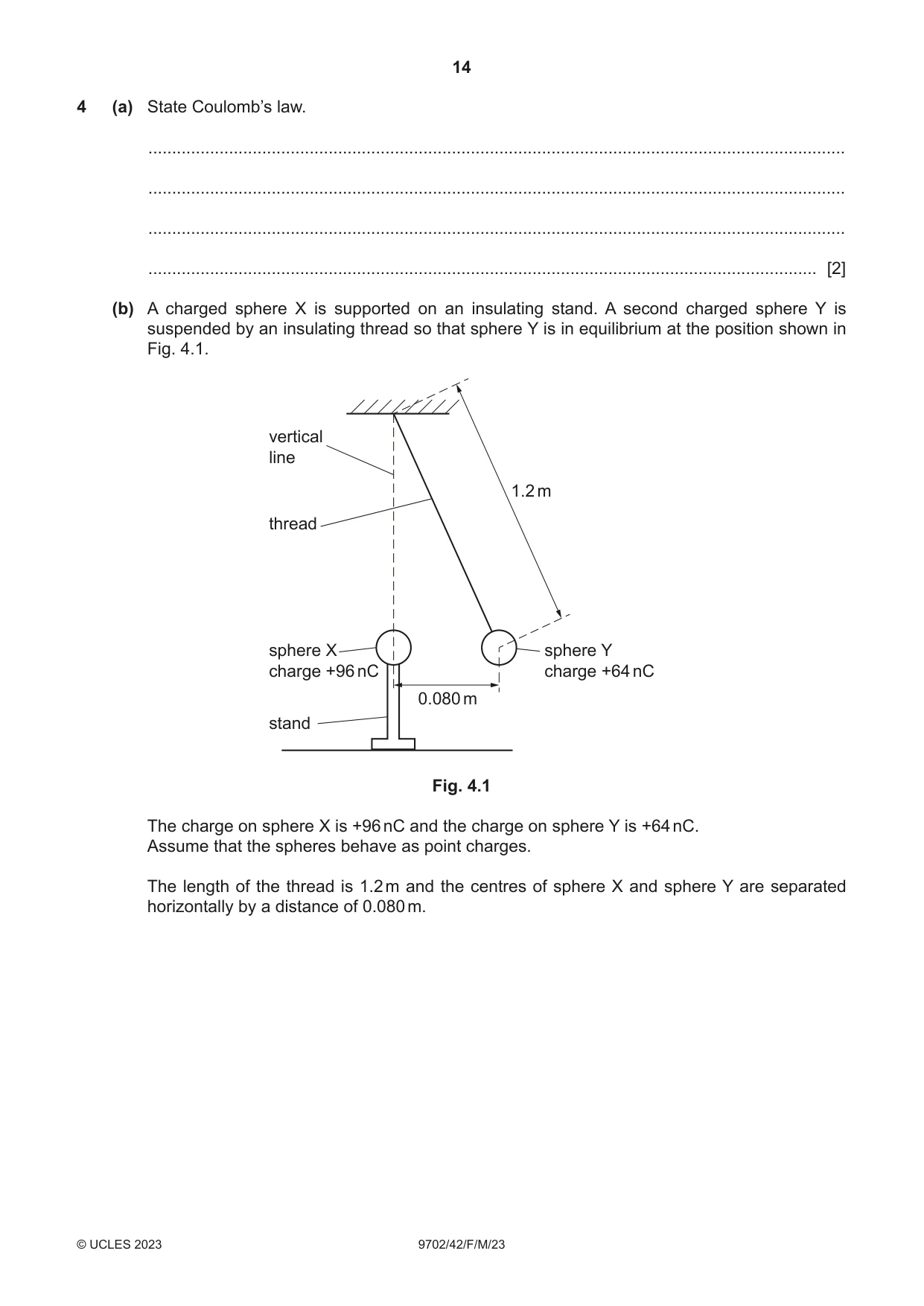
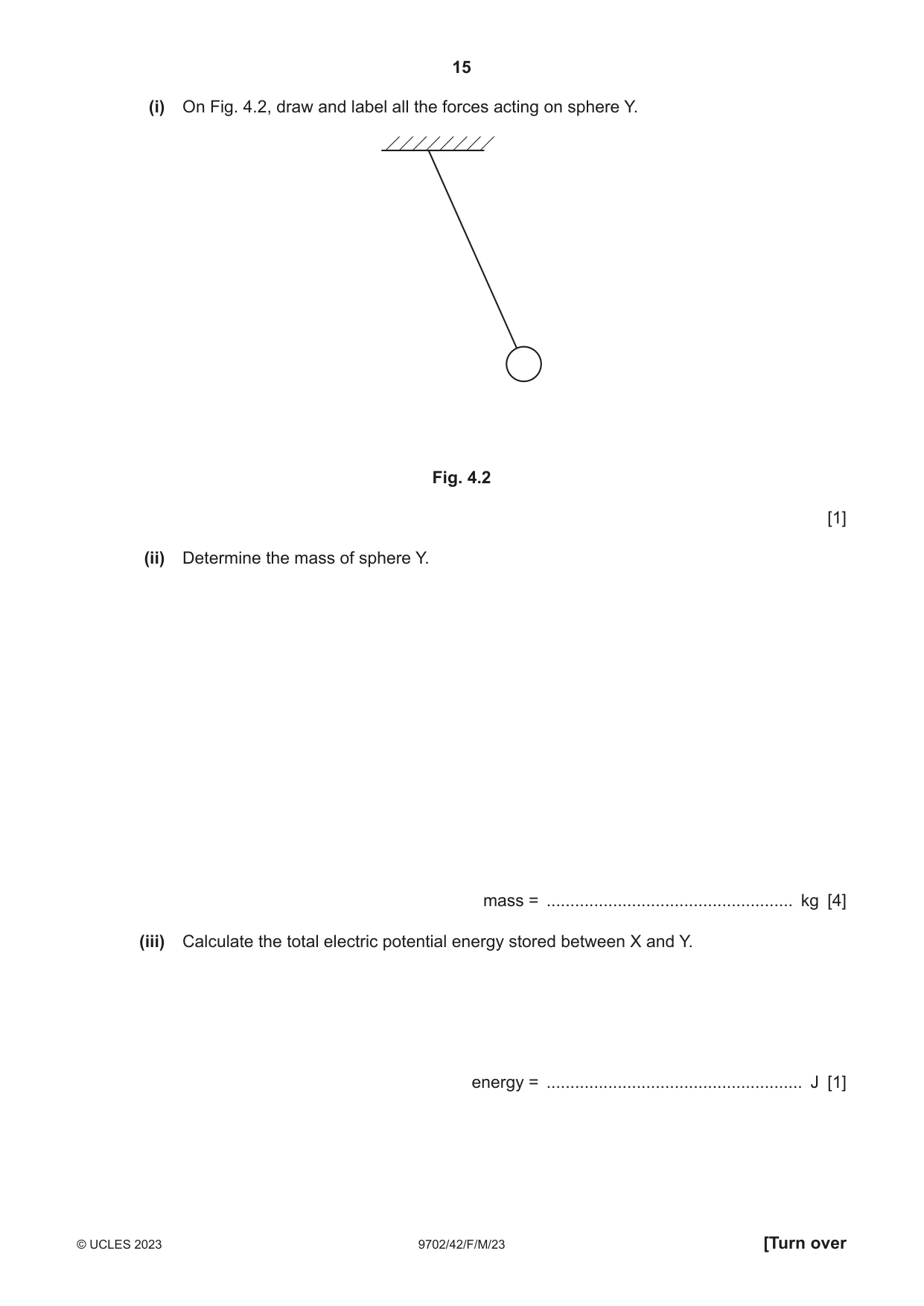
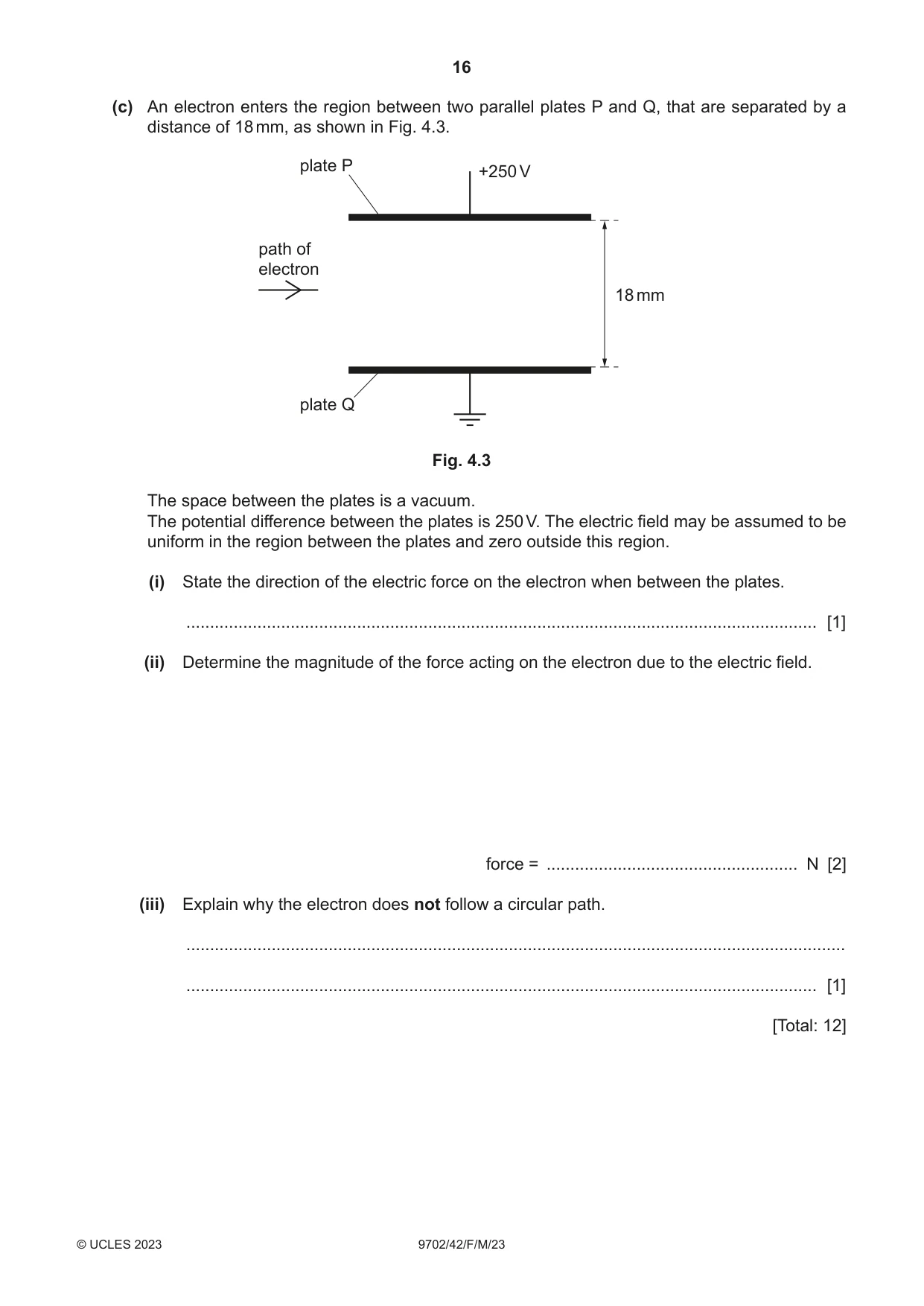
4 (a) State Coulomb’s law. ................................................................................................................................................... ................................................................................................................................................... ................................................................................................................................................... ............................................................................................................................................. [2] (b) A charged sphere X is supported on an insulating stand. A second charged sphere Y is suspended by an insulating thread so that sphere Y is in equilibrium at the position shown in Fig. 4.1. vertical line 1.2 m thread sphere X sphere Y charge +96 nC charge +64 nC 0.080 m stand Fig. 4.1 The charge on sphere X is +96 nC and the charge on sphere Y is +64 nC. Assume that the spheres behave as point charges. The length of the thread is 1.2 m and the centres of sphere X and sphere Y are separated horizontally by a distance of 0.080 m. (i) On Fig. 4.2, draw and label all the forces acting on sphere Y. Fig. 4.2 [1] (ii) Determine the mass of sphere Y. mass = .................................................... kg [4] (iii) Calculate the total electric potential energy stored between X and Y. energy = ...................................................... J [1] (c) An electron enters the region between two parallel plates P and Q, that are separated by a distance of 18 mm, as shown in Fig. 4.3. plate P +250 V path of electron 18 mm plate Q Fig. 4.3 The space between the plates is a vacuum. The potential difference between the plates is 250 V. The electric field may be assumed to be uniform in the region between the plates and zero outside this region. (i) State the direction of the electric force on the electron when between the plates. ..................................................................................................................................... [1] (ii) Determine the magnitude of the force acting on the electron due to the electric field. force = ..................................................... N [2] (iii) Explain why the electron does not follow a circular path. ........................................................................................................................................... ..................................................................................................................................... [1] [Total: 12]
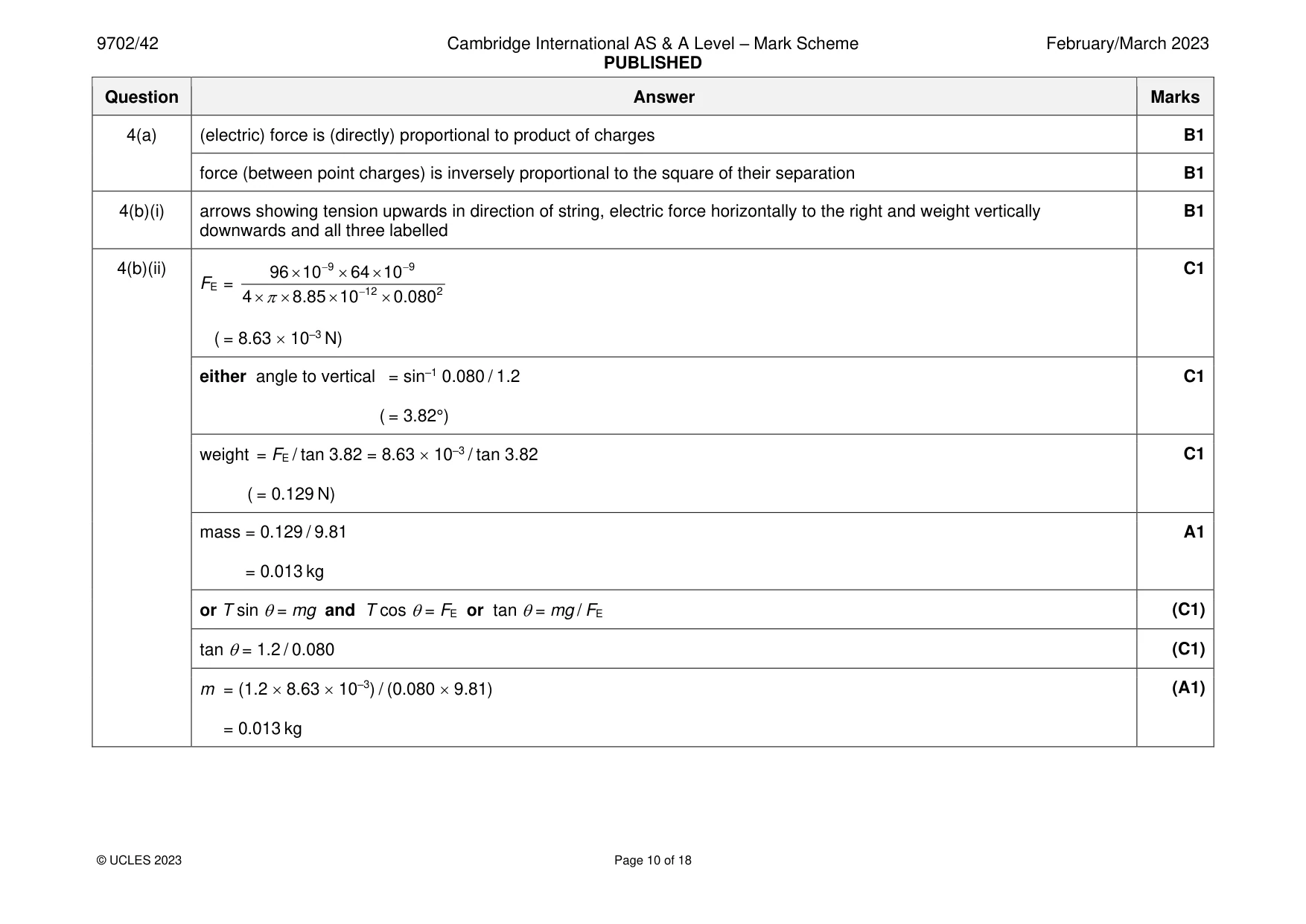
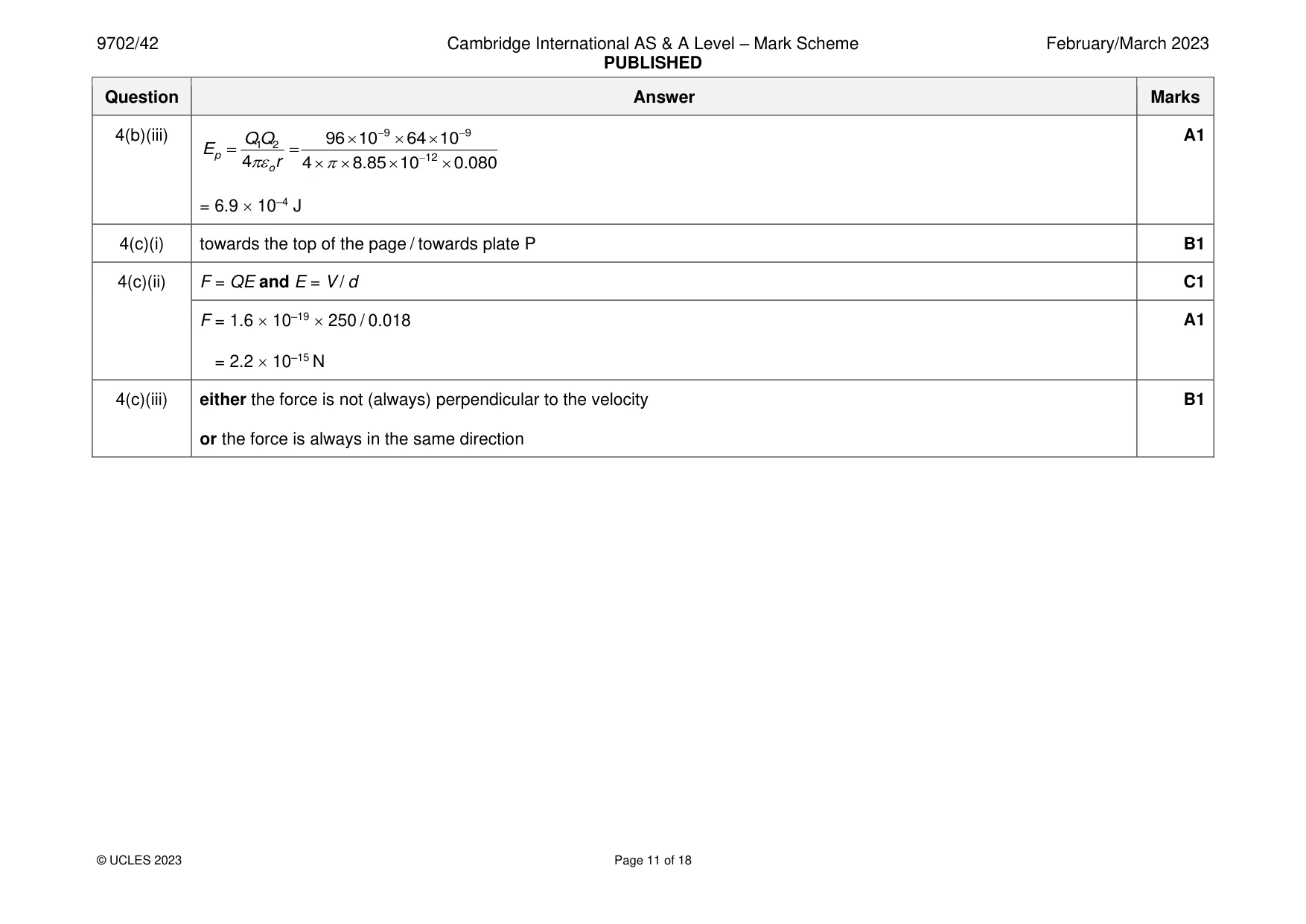
Mark scheme: 4(a) (electric) force is (directly) proportional to product of charges B1 force (between point charges) is inversely proportional to the square of their separation B1 4(b)(i) arrows showing tension upwards in direction of string, electric force horizontally to the right and weight vertically B1 downwards and all three labelled 4(b)(ii) 96 10 −9 64 10 −9 C1 FE = 4 8.85 10 −12 0.080 2 ( = 8.63 10–3 N) either angle to vertical = sin–1 0.080 / 1.2 C1 ( = 3.82°) weight = FE / tan 3.82 = 8.63 10–3 / tan 3.82 C1 ( = 0.129 N) mass = 0.129 / 9.81 A1 = 0.013 kg or T sin = mg and T cos = FE or tan = mg / FE (C1) tan = 1.2 / 0.080 (C1) m = (1.2 8.63 10–3) / (0.080 9.81) (A1) = 0.013 kg 4(b)(iii) QQ1 2 96 10 −9 64 10 −9 A1 E p = = −12 4o r 4 8.85 10 0.080 = 6.9 10–4 J 4(c)(i) towards the top of the page / towards plate P B1 4(c)(ii) F = QE and E = V / d C1 F = 1.6 10–19 250 / 0.018 A1 = 2.2 10–15 N 4(c)(iii) either the force is not (always) perpendicular to the velocity B1 or the force is always in the same direction
Q5 · A capacitor, a battery of electromotive force (e.m.f.) 12 V, a resistor R and a two-way…
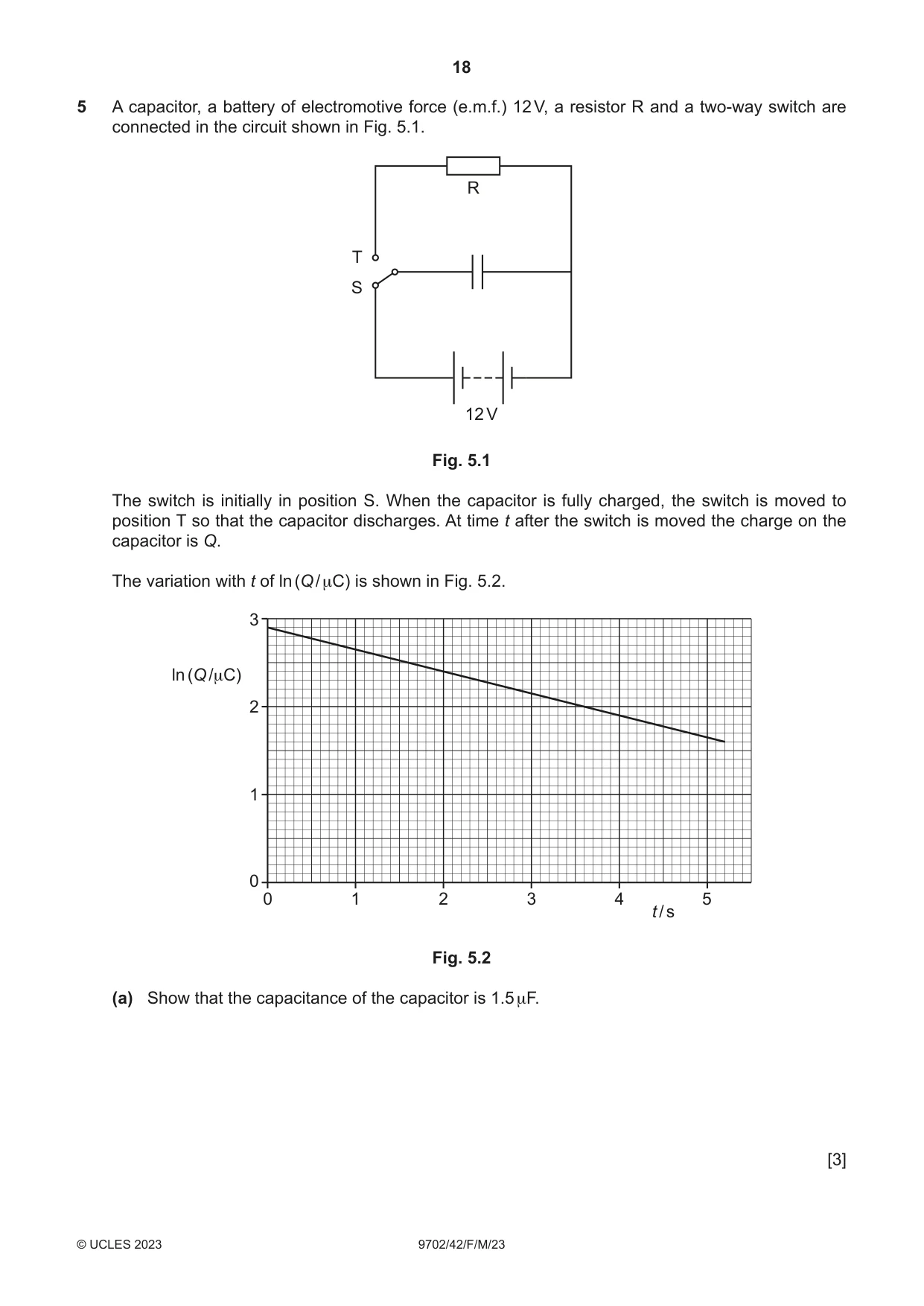
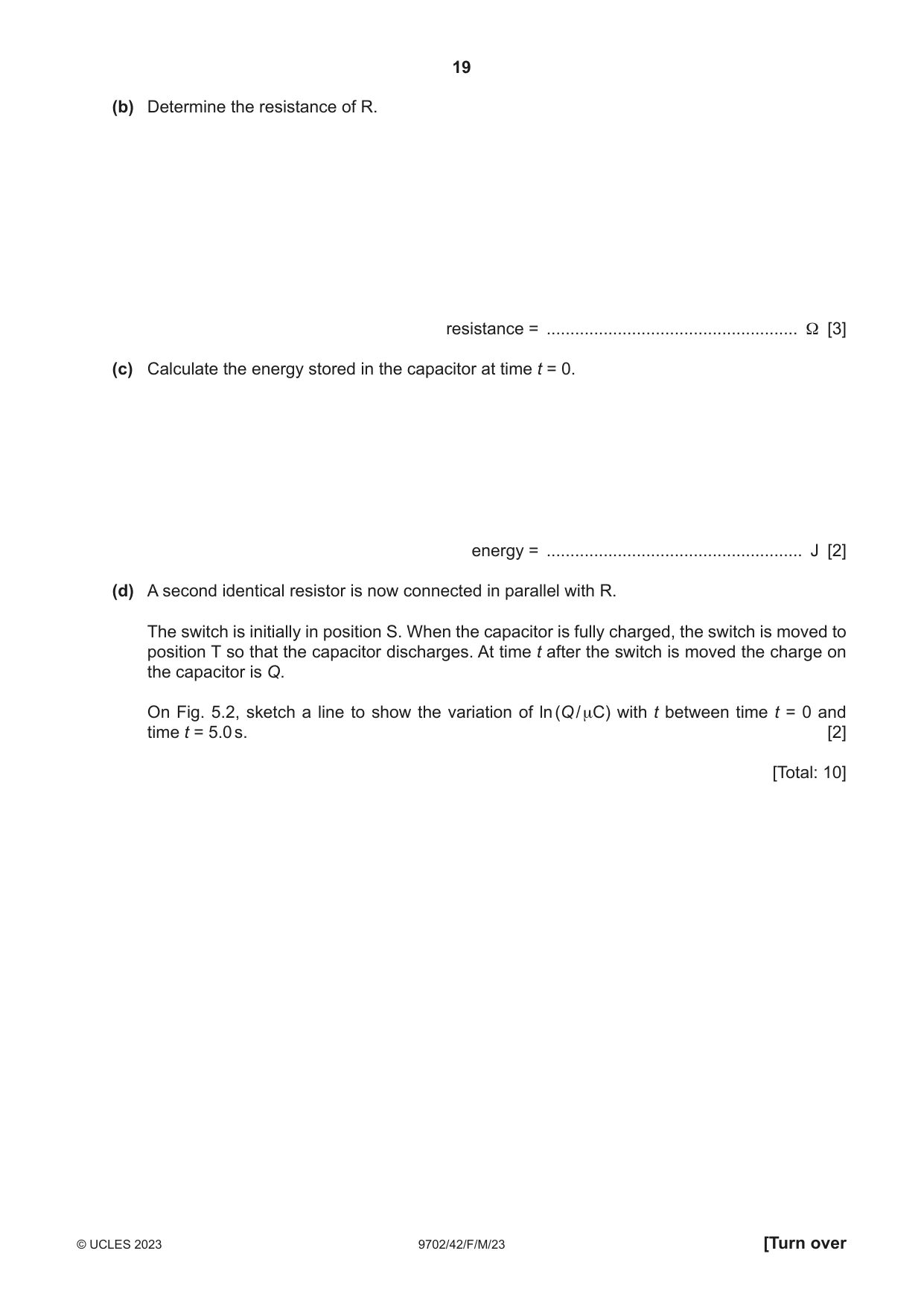
5 A capacitor, a battery of electromotive force (e.m.f.) 12 V, a resistor R and a two-way switch are connected in the circuit shown in Fig. 5.1. R T S 12 V Fig. 5.1 The switch is initially in position S. When the capacitor is fully charged, the switch is moved to position T so that the capacitor discharges. At time t after the switch is moved the charge on the capacitor is Q. The variation with t of ln (Q / μC) is shown in Fig. 5.2. 3 ln (Q /μC) 2 1 0 0 1 2 3 4 5 t / s Fig. 5.2 (a) Show that the capacitance of the capacitor is 1.5 μF. [3] (b) Determine the resistance of R. resistance = ..................................................... Ω [3] (c) Calculate the energy stored in the capacitor at time t = 0. energy = ...................................................... J [2] (d) A second identical resistor is now connected in parallel with R. The switch is initially in position S. When the capacitor is fully charged, the switch is moved to position T so that the capacitor discharges. At time t after the switch is moved the charge on the capacitor is Q. On Fig. 5.2, sketch a line to show the variation of ln (Q / μC) with t between time t = 0 and time t = 5.0 s. [2] [Total: 10]
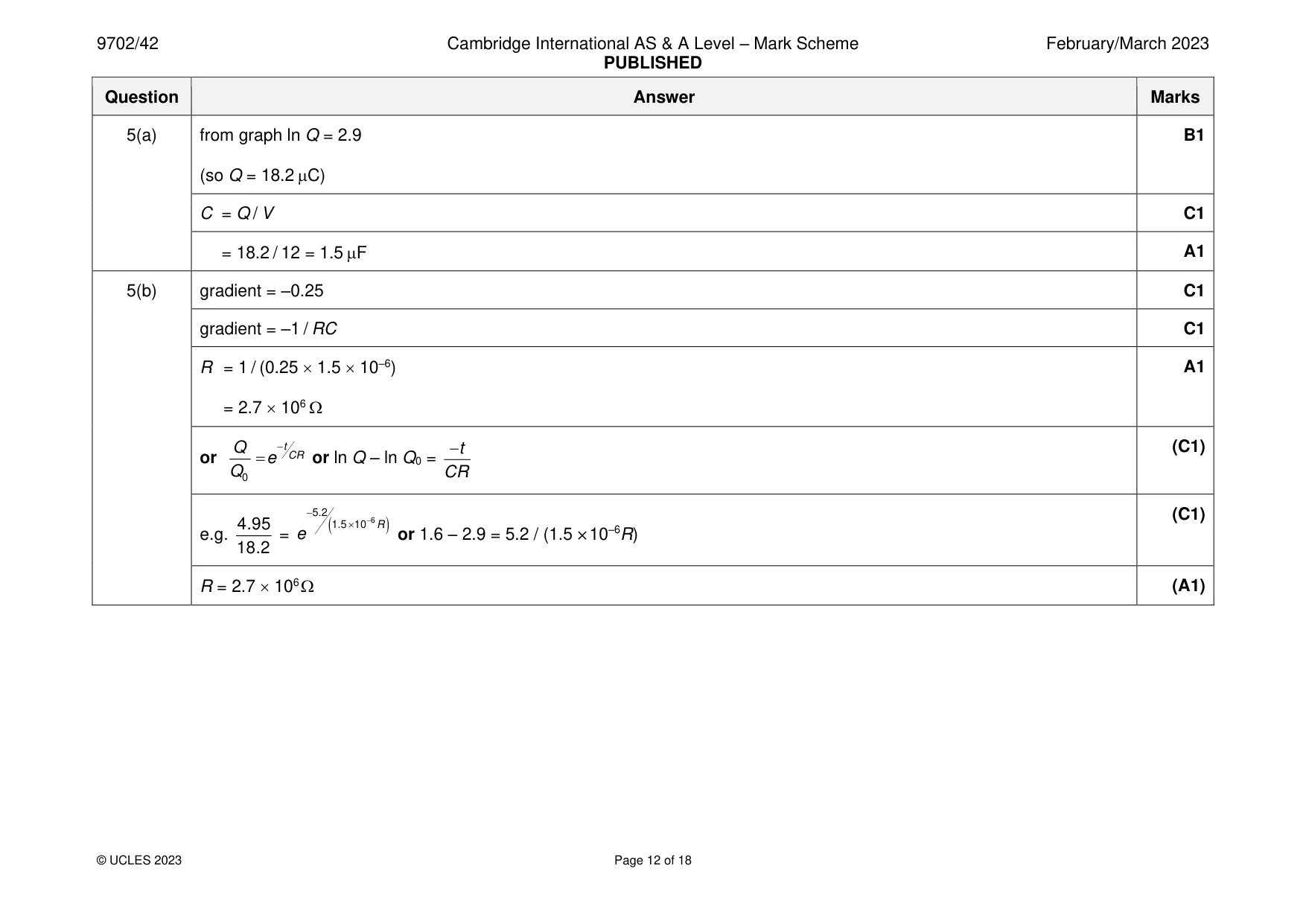
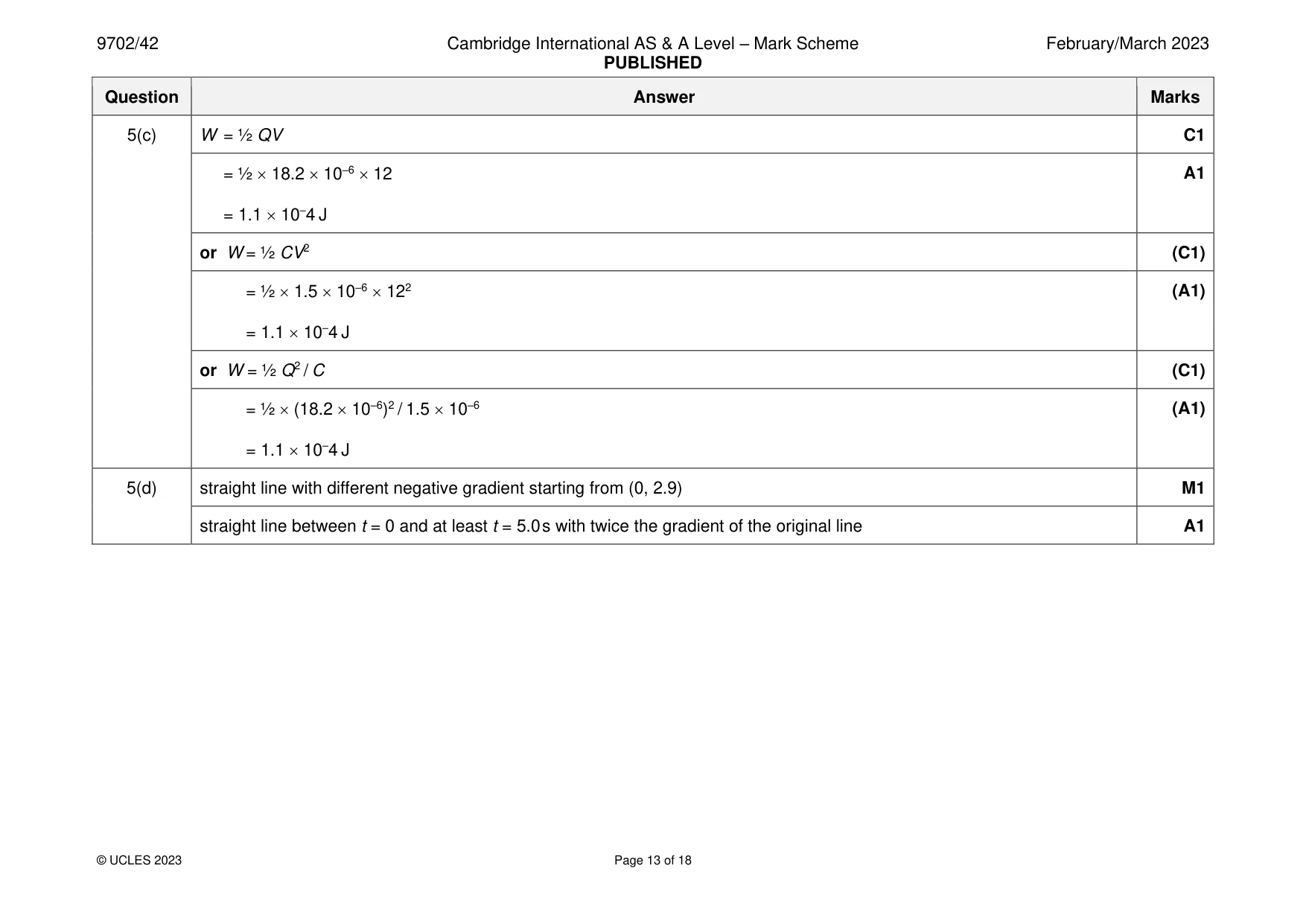
Mark scheme: 5(a) from graph ln Q = 2.9 B1 (so Q = 18.2 C) C = Q / V C1 = 18.2 / 12 = 1.5 F A1 5(b) gradient = –0.25 C1 gradient = –1 / RC C1 R = 1 / (0.25 1.5 10–6) A1 = 2.7 106 Q − tCR − t (C1) or = e or ln Q – ln Q0 = Q0 CR −5.2 −6 (C1) 4.95 (1.5 10 R ) e.g. = e or 1.6 – 2.9 = 5.2 / (1.5 × 10⁻⁶R) 18.2 R = 2.7 106 (A1) 5(c) W = ½ QV C1 = ½ 18.2 10–6 12 A1 = 1.1 10–4 J or W = ½ CV2 (C1) = ½ 1.5 10–6 122 (A1) = 1.1 10–4 J or W = ½ Q2 / C (C1) = ½ (18.2 10–6)2 / 1.5 10–6 (A1) = 1.1 10–4 J 5(d) straight line with different negative gradient starting from (0, 2.9) M1 straight line between t = 0 and at least t = 5.0 s with twice the gradient of the original line A1
Q6 · A Hall probe is placed in a magnetic field
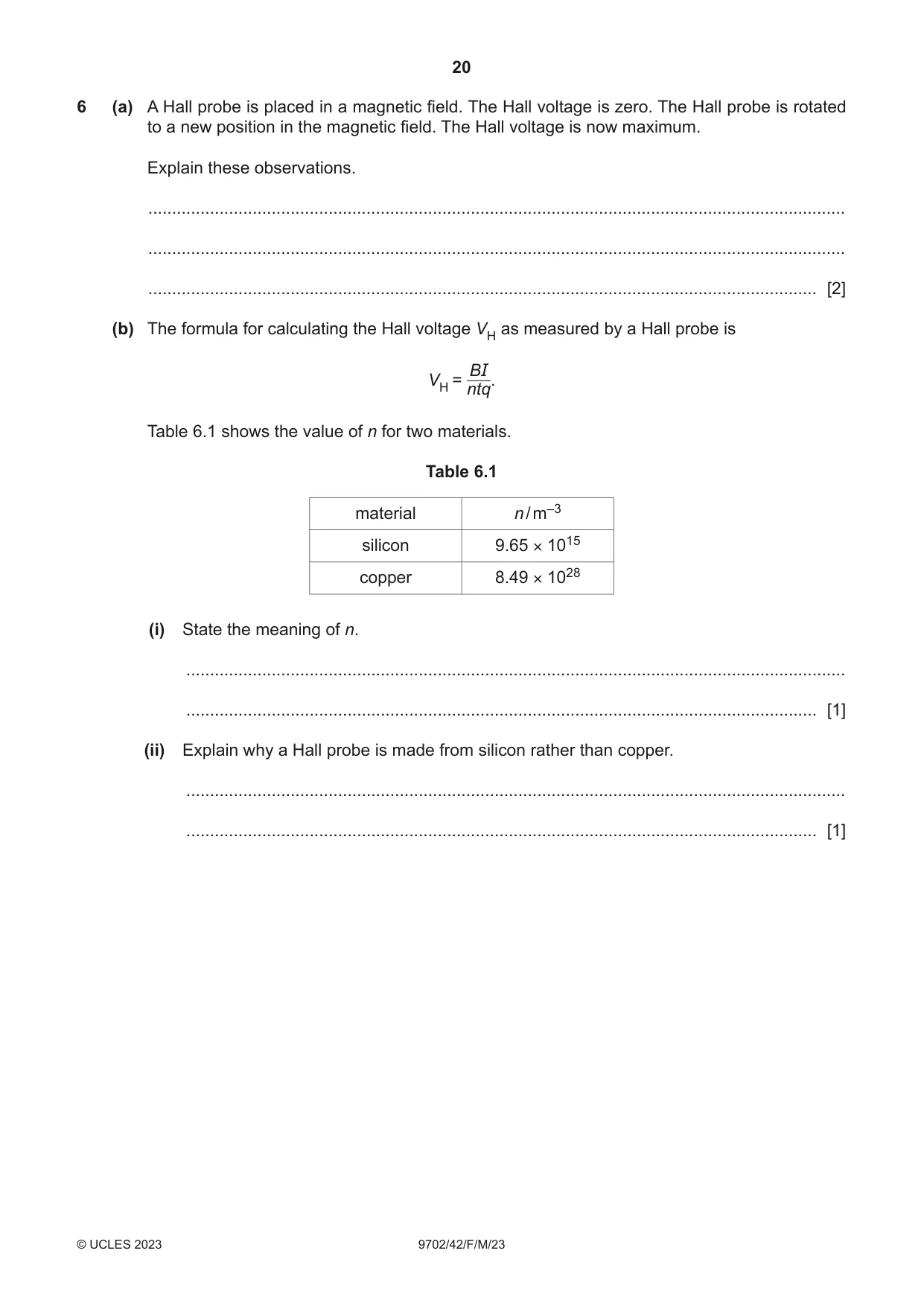
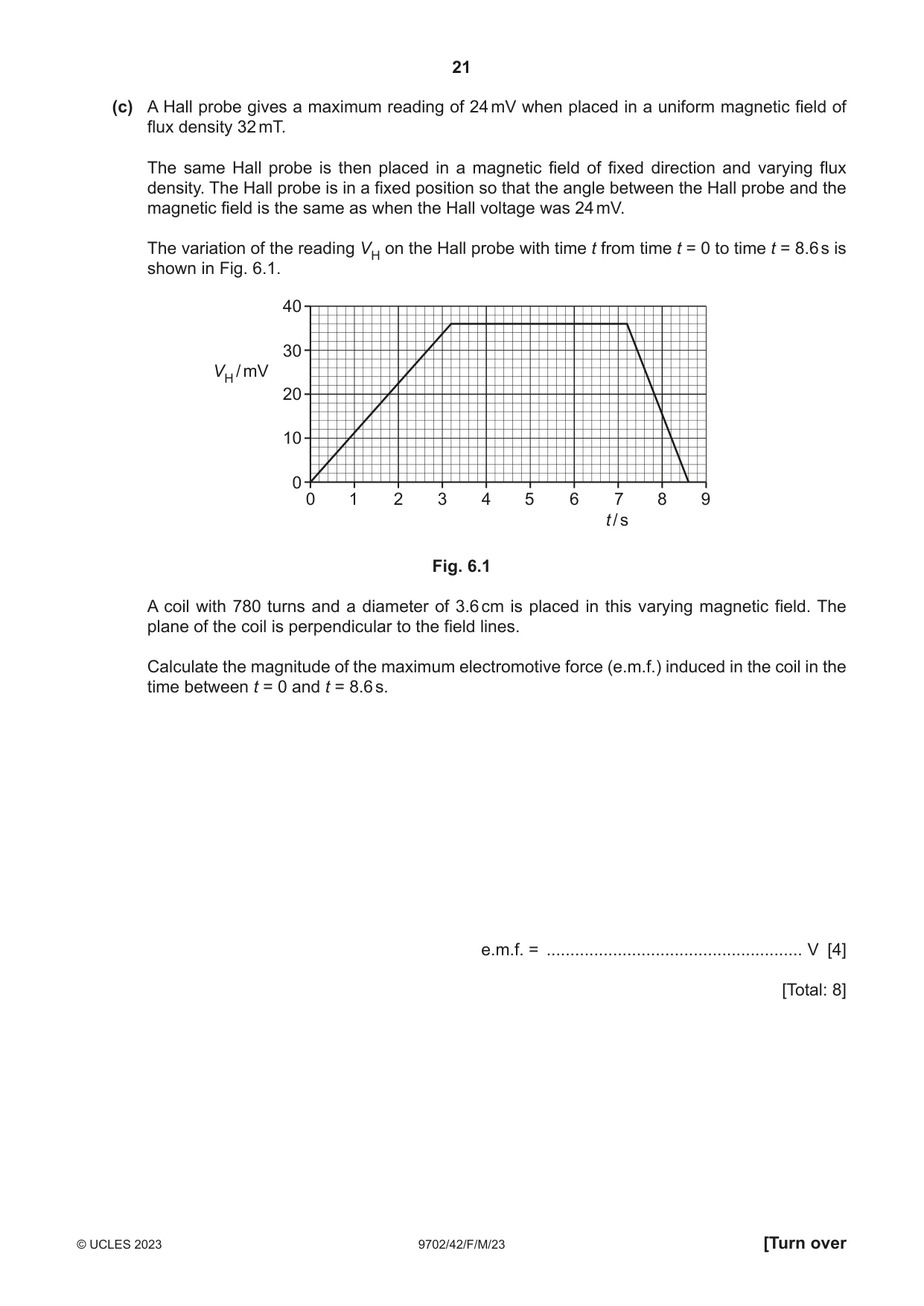
6 (a) A Hall probe is placed in a magnetic field. The Hall voltage is zero. The Hall probe is rotated to a new position in the magnetic field. The Hall voltage is now maximum. Explain these observations. ................................................................................................................................................... ................................................................................................................................................... ............................................................................................................................................. [2] (b) The formula for calculating the Hall voltage VH as measured by a Hall probe is BI VH = ntq. Table 6.1 shows the value of n for two materials. Table 6.1 material n / m–3 silicon 9.65 × 10¹⁵ copper 8.49 × 1028 (i) State the meaning of n. ........................................................................................................................................... ..................................................................................................................................... [1] (ii) Explain why a Hall probe is made from silicon rather than copper. ........................................................................................................................................... ..................................................................................................................................... [1] (c) A Hall probe gives a maximum reading of 24 mV when placed in a uniform magnetic field of flux density 32 mT. The same Hall probe is then placed in a magnetic field of fixed direction and varying flux density. The Hall probe is in a fixed position so that the angle between the Hall probe and the magnetic field is the same as when the Hall voltage was 24 mV. The variation of the reading VH on the Hall probe with time t from time t = 0 to time t = 8.6 s is shown in Fig. 6.1. 40 30 VH / mV 20 10 0 0 1 2 3 4 5 6 7 8 9 t / s Fig. 6.1 A coil with 780 turns and a diameter of 3.6 cm is placed in this varying magnetic field. The plane of the coil is perpendicular to the field lines. Calculate the magnitude of the maximum electromotive force (e.m.f.) induced in the coil in the time between t = 0 and t = 8.6 s. e.m.f. = ...................................................... V [4] [Total: 8]
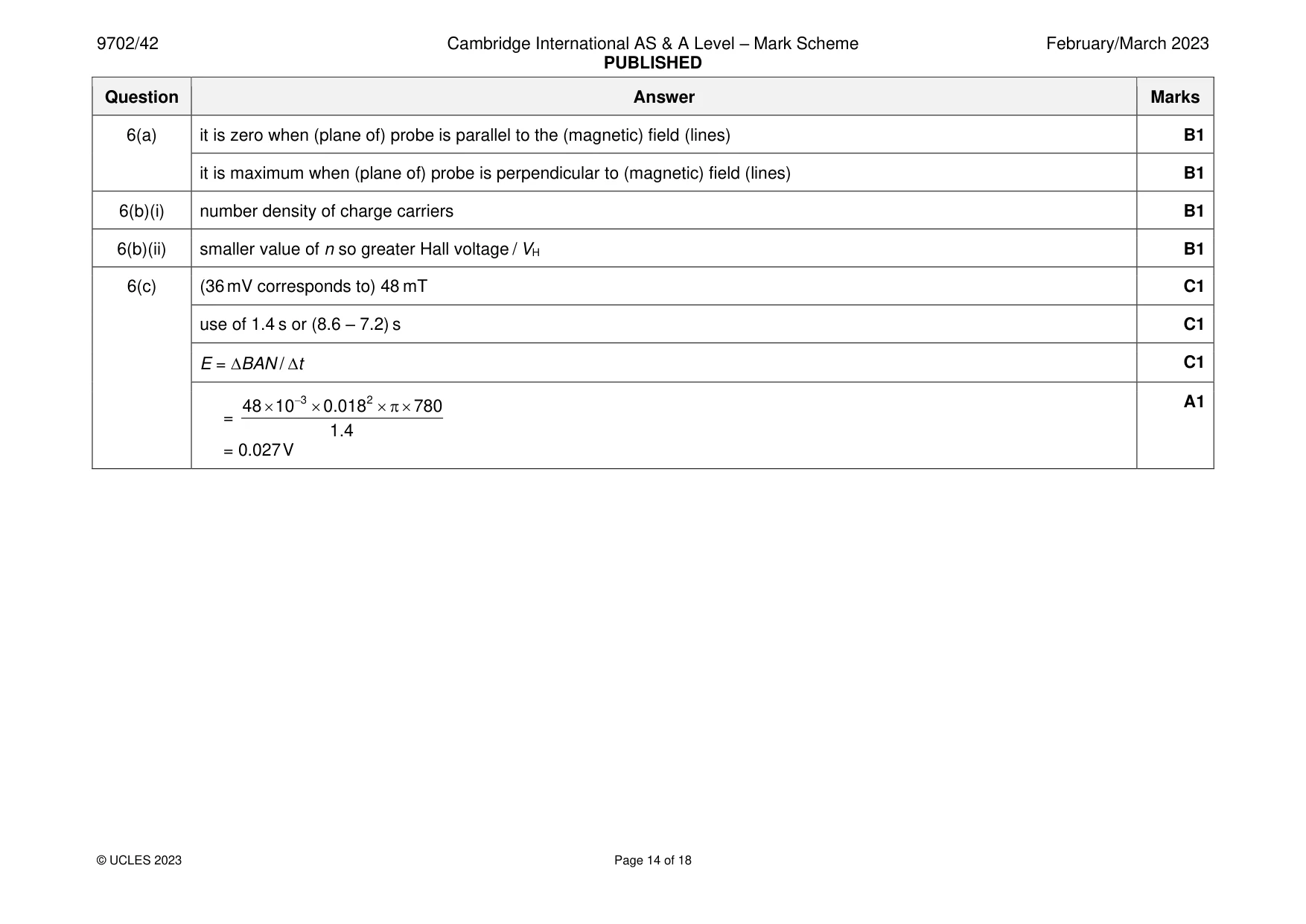
Mark scheme: 6(a) it is zero when (plane of) probe is parallel to the (magnetic) field (lines) B1 it is maximum when (plane of) probe is perpendicular to (magnetic) field (lines) B1 6(b)(i) number density of charge carriers B1 6(b)(ii) smaller value of n so greater Hall voltage / VH B1 6(c) (36 mV corresponds to) 48 mT C1 use of 1.4 s or (8.6 – 7.2) s C1 E = BAN / t C1 48 10 −3 0.018 2 780 A1 = 1.4 = 0.027 V
Q7 · A beam of white light passes through a cloud of cool gas
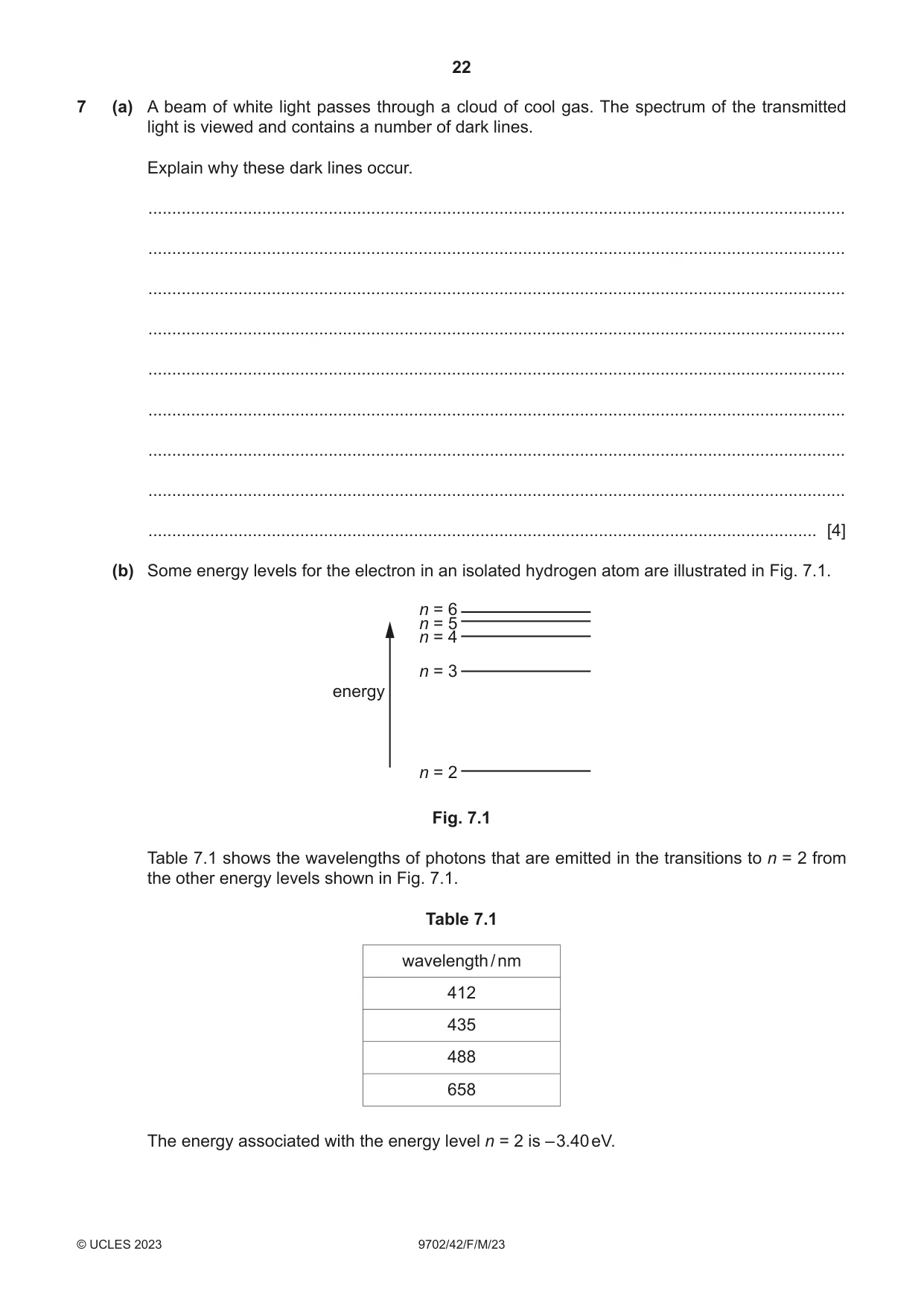
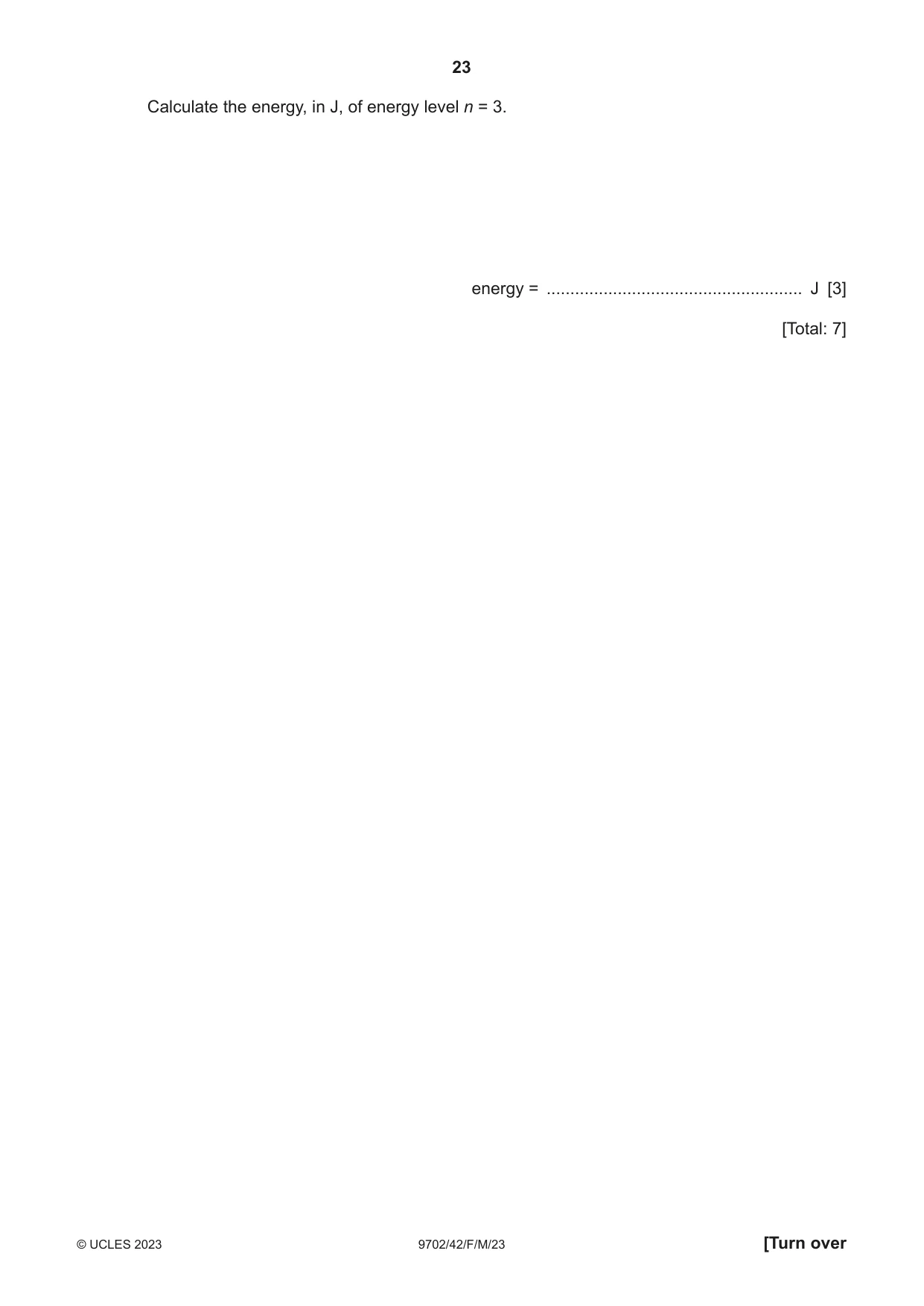
7 (a) A beam of white light passes through a cloud of cool gas. The spectrum of the transmitted light is viewed and contains a number of dark lines. Explain why these dark lines occur. ................................................................................................................................................... ................................................................................................................................................... ................................................................................................................................................... ................................................................................................................................................... ................................................................................................................................................... ................................................................................................................................................... ................................................................................................................................................... ................................................................................................................................................... ............................................................................................................................................. [4] (b) Some energy levels for the electron in an isolated hydrogen atom are illustrated in Fig. 7.1. n = 6 n = 5 n = 4 n = 3 energy n = 2 Fig. 7.1 Table 7.1 shows the wavelengths of photons that are emitted in the transitions to n = 2 from the other energy levels shown in Fig. 7.1. Table 7.1 wavelength / nm 412 435 488 658 The energy associated with the energy level n = 2 is – 3.40 eV. Calculate the energy, in J, of energy level n = 3. energy = ...................................................... J [3] [Total: 7]
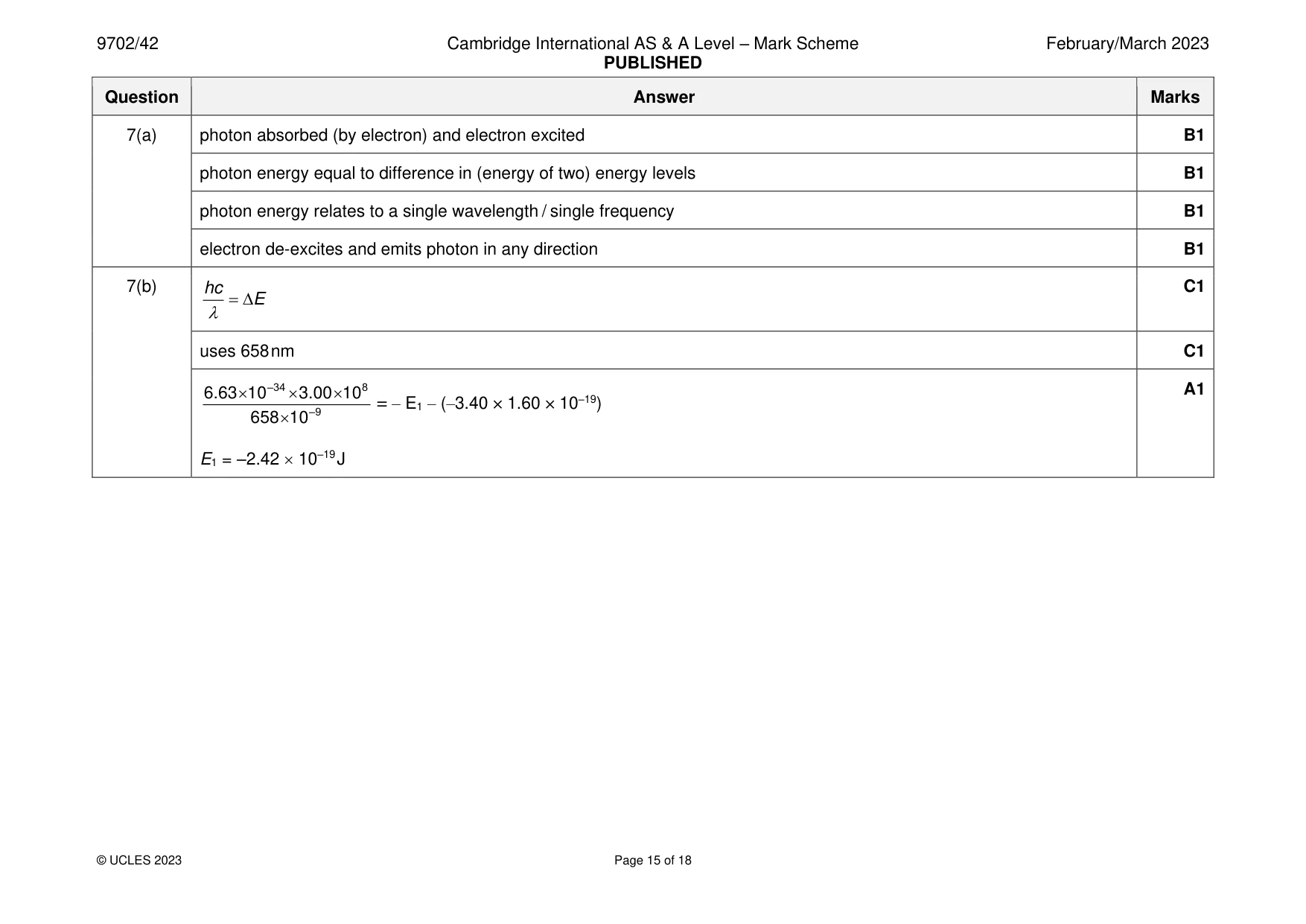
Mark scheme: 7(a) photon absorbed (by electron) and electron excited B1 photon energy equal to difference in (energy of two) energy levels B1 photon energy relates to a single wavelength / single frequency B1 electron de-excites and emits photon in any direction B1 7(b) hc C1 = E uses 658 nm C1 6.63 1 0 –34 3.00 1 0 8 A1 –9 = – E1 – (–3.40 × 1.60 × 10–19) 658 1 0 E1 = –2.42 10–19 J
Q8 · Plutonium-238 (23894Pu) is unstable and undergoes alpha decay
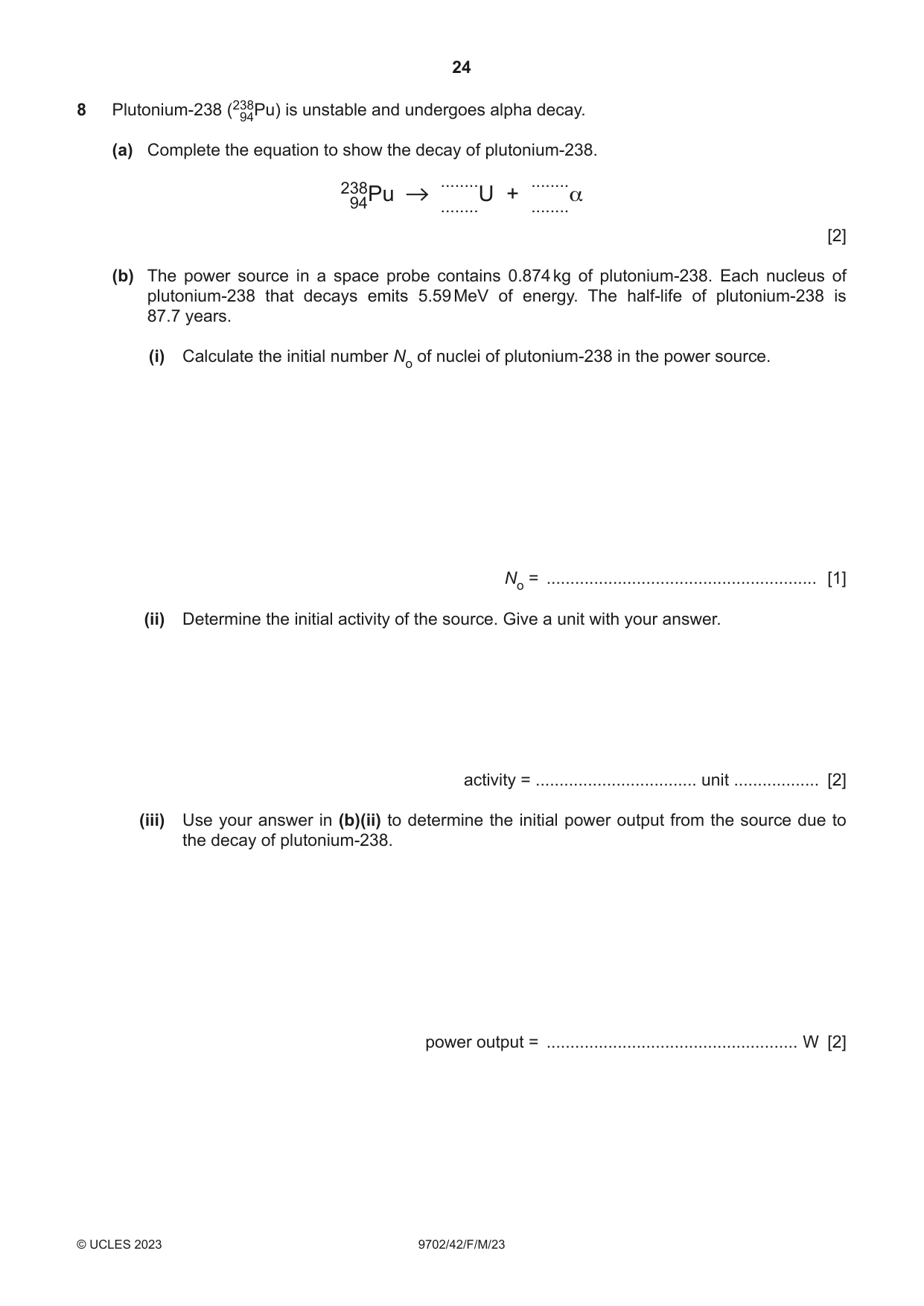
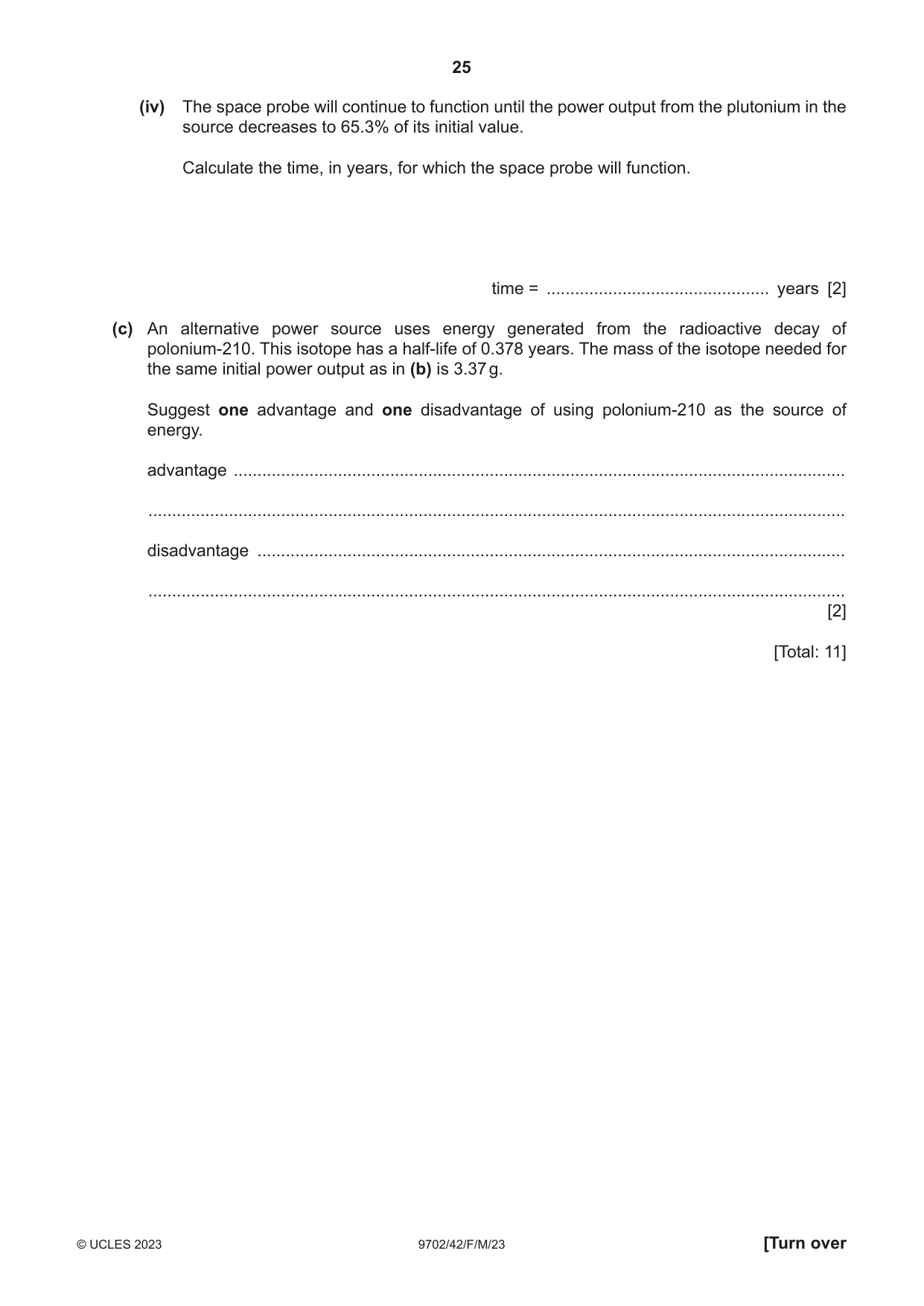
8 Plutonium-238 (23894Pu) is unstable and undergoes alpha decay. (a) Complete the equation to show the decay of plutonium-238. ........ ........ 23894Pu ........U + ........α [2] (b) The power source in a space probe contains 0.874 kg of plutonium-238. Each nucleus of plutonium-238 that decays emits 5.59 MeV of energy. The half-life of plutonium-238 is 87.7 years. (i) Calculate the initial number No of nuclei of plutonium-238 in the power source. No = ......................................................... [1] (ii) Determine the initial activity of the source. Give a unit with your answer. activity = .................................. unit .................. [2] (iii) Use your answer in (b)(ii) to determine the initial power output from the source due to the decay of plutonium-238. power output = ..................................................... W [2] (iv) The space probe will continue to function until the power output from the plutonium in the source decreases to 65.3% of its initial value. Calculate the time, in years, for which the space probe will function. time = ............................................... years [2] (c) An alternative power source uses energy generated from the radioactive decay of polonium-210. This isotope has a half-life of 0.378 years. The mass of the isotope needed for the same initial power output as in (b) is 3.37 g. Suggest one advantage and one disadvantage of using polonium-210 as the source of energy. advantage ................................................................................................................................. ................................................................................................................................................... disadvantage ............................................................................................................................ ................................................................................................................................................... [2] [Total: 11]
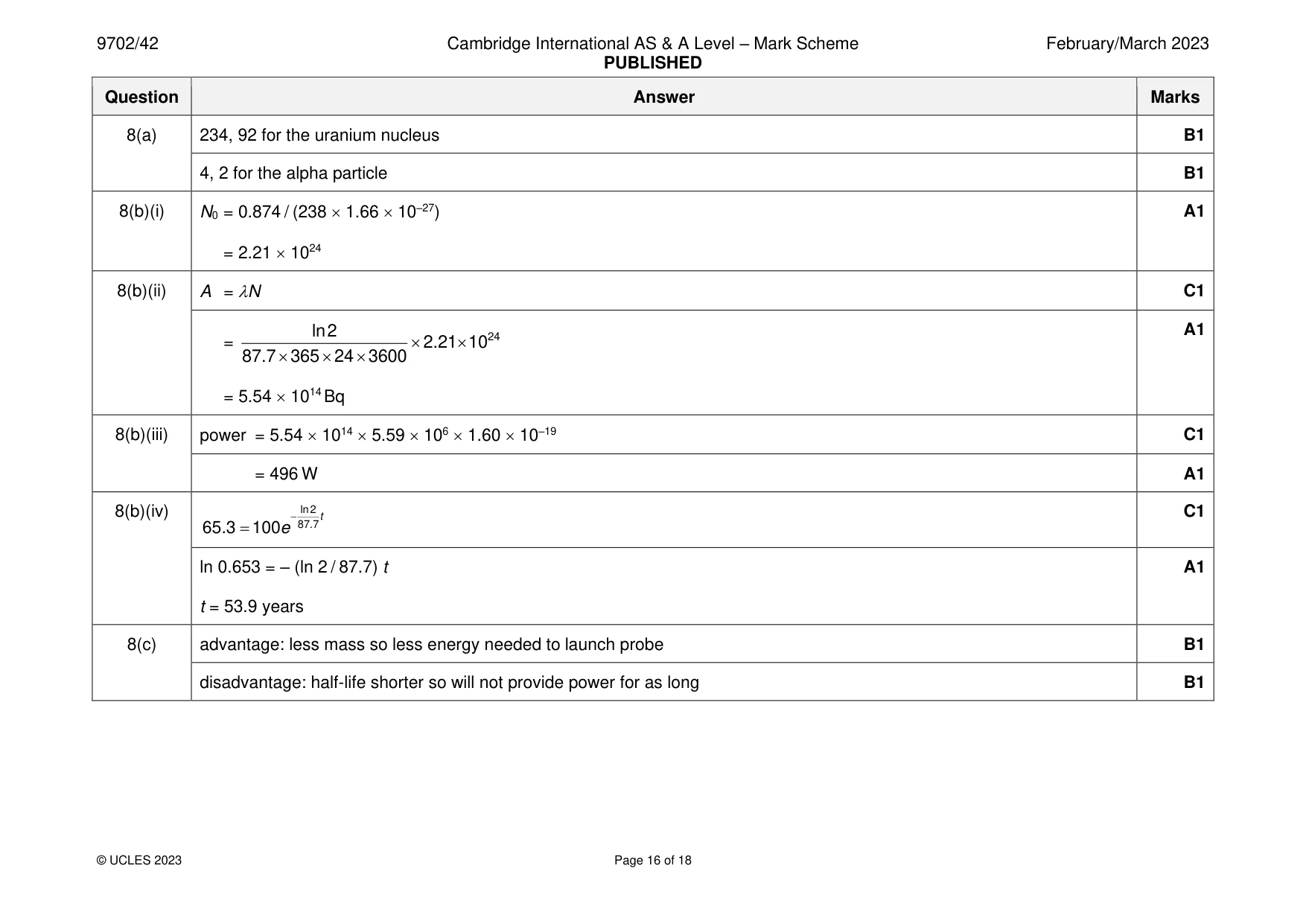
Mark scheme: 8(a) 234, 92 for the uranium nucleus B1 4, 2 for the alpha particle B1 8(b)(i) N0 = 0.874 / (238 1.66 10–27) A1 = 2.21 1024 8(b)(ii) A = N C1 ln2 24 A1 = 2.21 10 87.7 365 24 3600 = 5.54 1014 Bq 8(b)(iii) power = 5.54 1014 5.59 106 1.60 10–19 C1 = 496 W A1 8(b)(iv) − ln2 t C1 65.3 = 100e 87.7 ln 0.653 = – (ln 2 / 87.7) t A1 t = 53.9 years 8(c) advantage: less mass so less energy needed to launch probe B1 disadvantage: half-life shorter so will not provide power for as long B1
Q9 · Ultrasound is used to produce diagnostic information about internal body structures
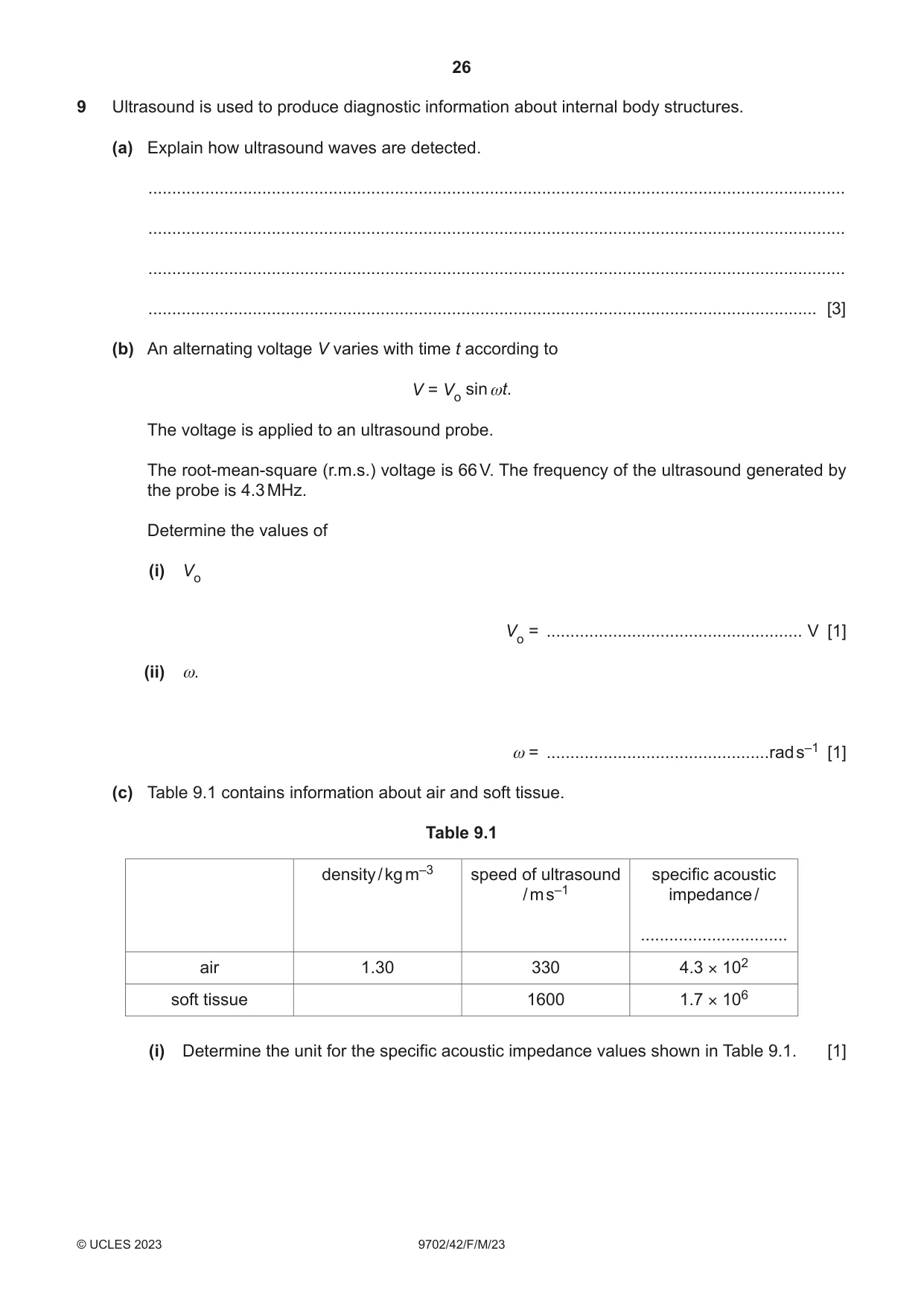
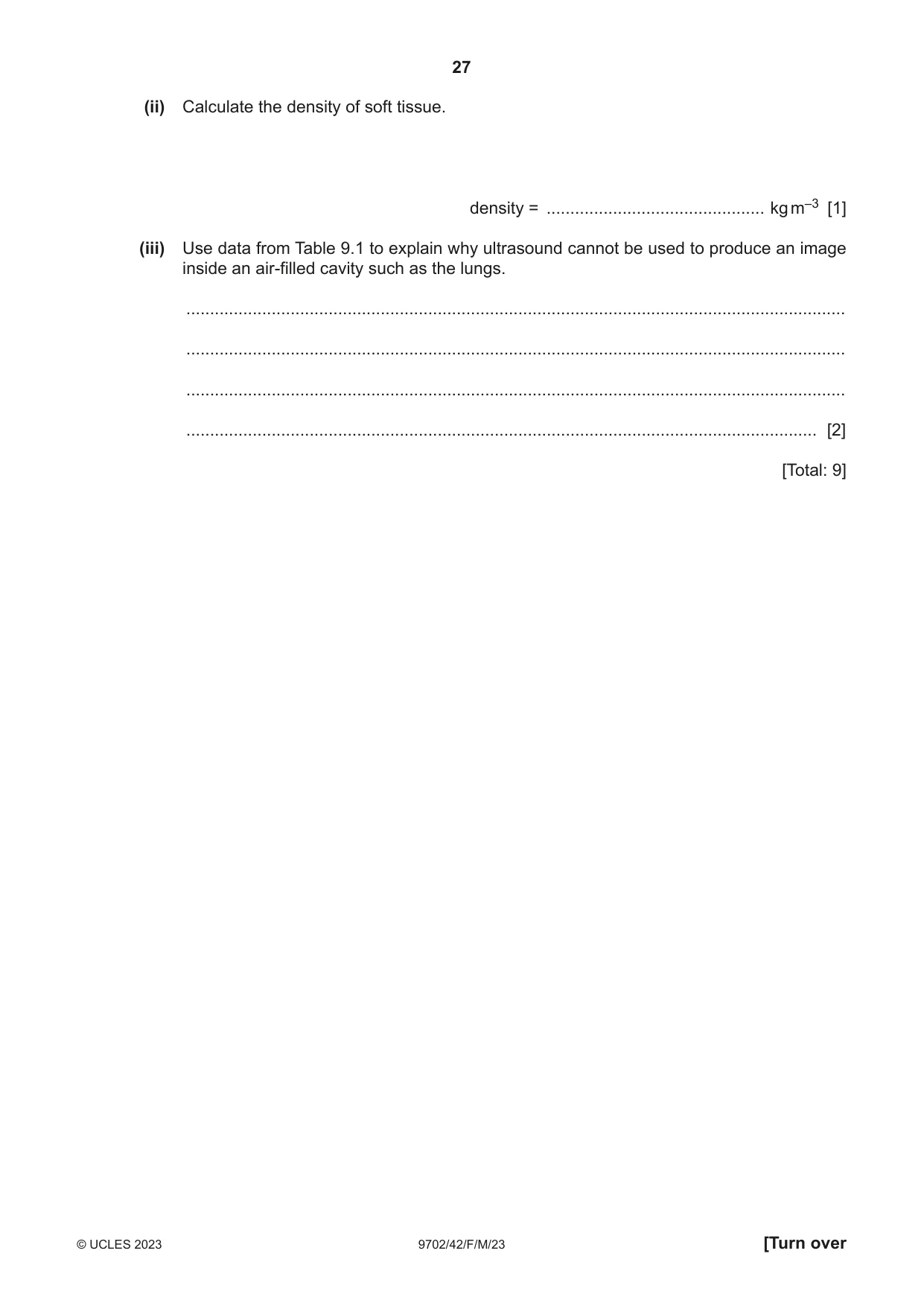
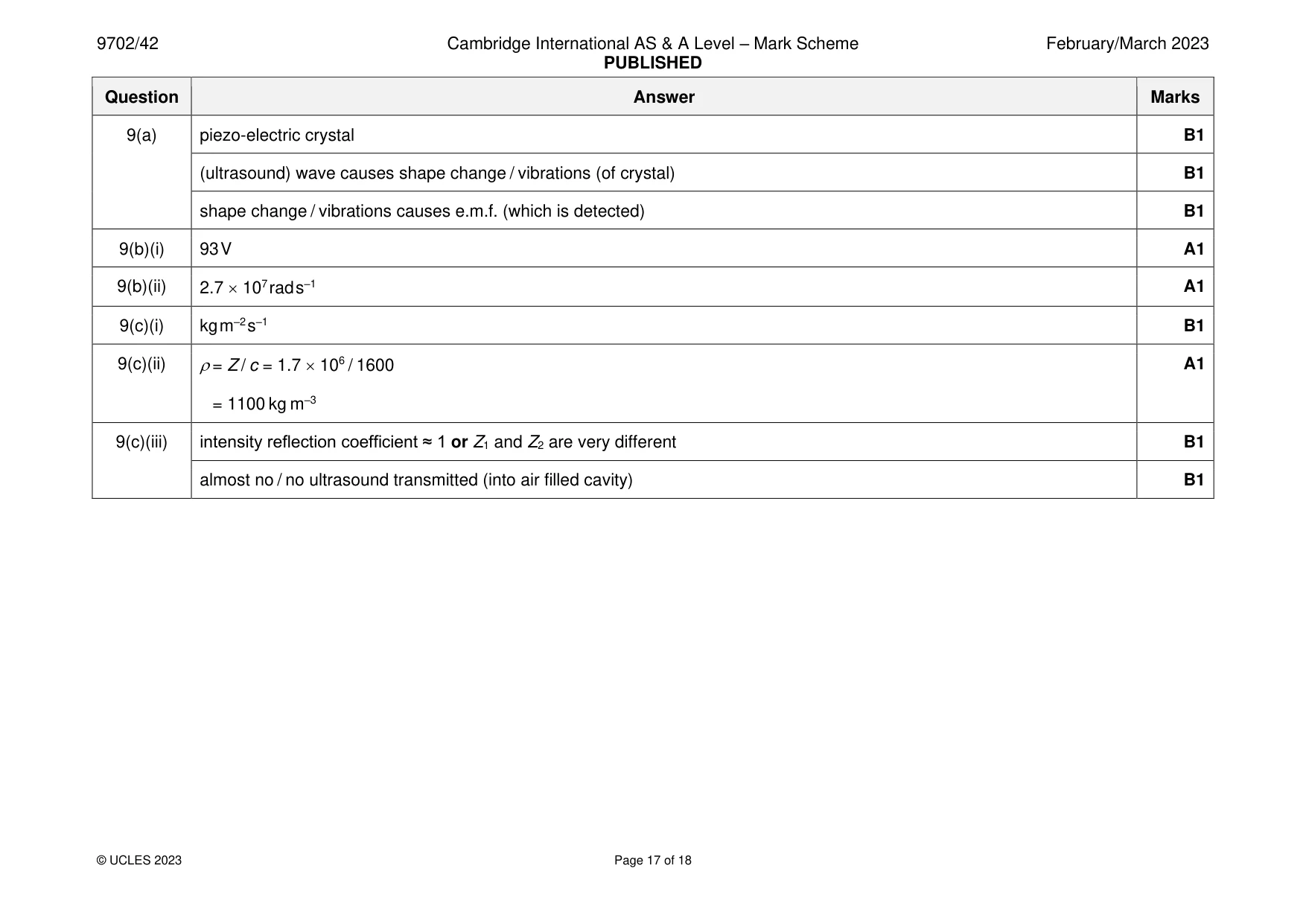
9 Ultrasound is used to produce diagnostic information about internal body structures. (a) Explain how ultrasound waves are detected. ................................................................................................................................................... ................................................................................................................................................... ................................................................................................................................................... ............................................................................................................................................. [3] (b) An alternating voltage V varies with time t according to V = Vo sin ωt. The voltage is applied to an ultrasound probe. The root-mean-square (r.m.s.) voltage is 66 V. The frequency of the ultrasound generated by the probe is 4.3 MHz. Determine the values of (i) Vo Vo = ...................................................... V [1] (ii) ω. ω = ...............................................rad s–1 [1] (c) Table 9.1 contains information about air and soft tissue. Table 9.1 density / kg m–3 speed of ultrasound specific acoustic / m s–1 impedance / ............................... air 1.30 330 4.3 × 10² soft tissue 1600 1.7 × 10⁶ (i) Determine the unit for the specific acoustic impedance values shown in Table 9.1. [1] (ii) Calculate the density of soft tissue. density = .............................................. kg m–3 [1] (iii) Use data from Table 9.1 to explain why ultrasound cannot be used to produce an image inside an air-filled cavity such as the lungs. ........................................................................................................................................... ........................................................................................................................................... ........................................................................................................................................... ..................................................................................................................................... [2] [Total: 9]
Mark scheme: 9(a) piezo-electric crystal B1 (ultrasound) wave causes shape change / vibrations (of crystal) B1 shape change / vibrations causes e.m.f. (which is detected) B1 9(b)(i) 93 V A1 9(b)(ii) 2.7 107 rad s–1 A1 9(c)(i) kg m–2 s–1 B1 9(c)(ii) = Z / c = 1.7 106 / 1600 A1 = 1100 kg m–3 9(c)(iii) intensity reflection coefficient ≈ 1 or Z1 and Z2 are very different B1 almost no / no ultrasound transmitted (into air filled cavity) B1
Q10 · A student observes different stars from the Earth
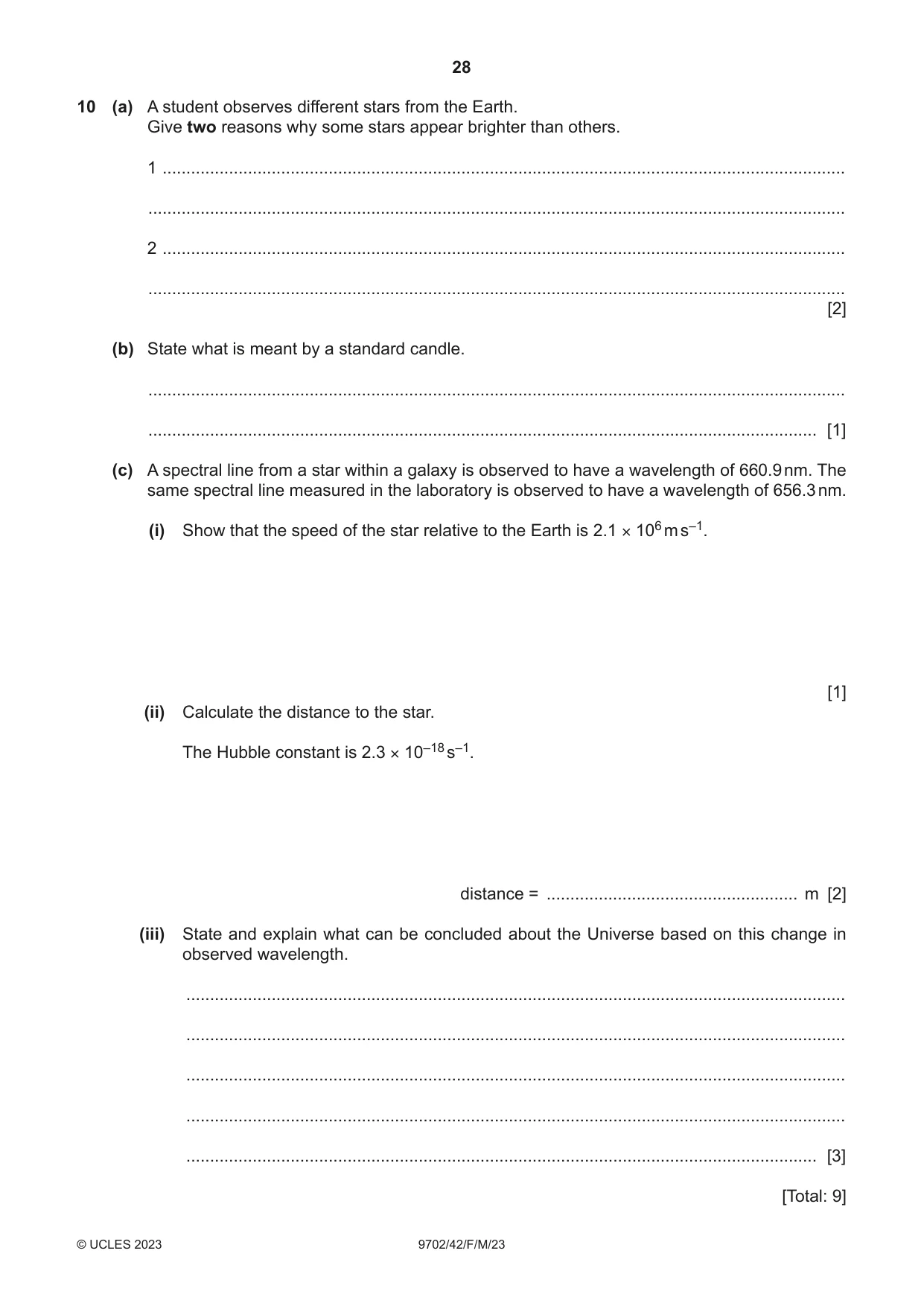
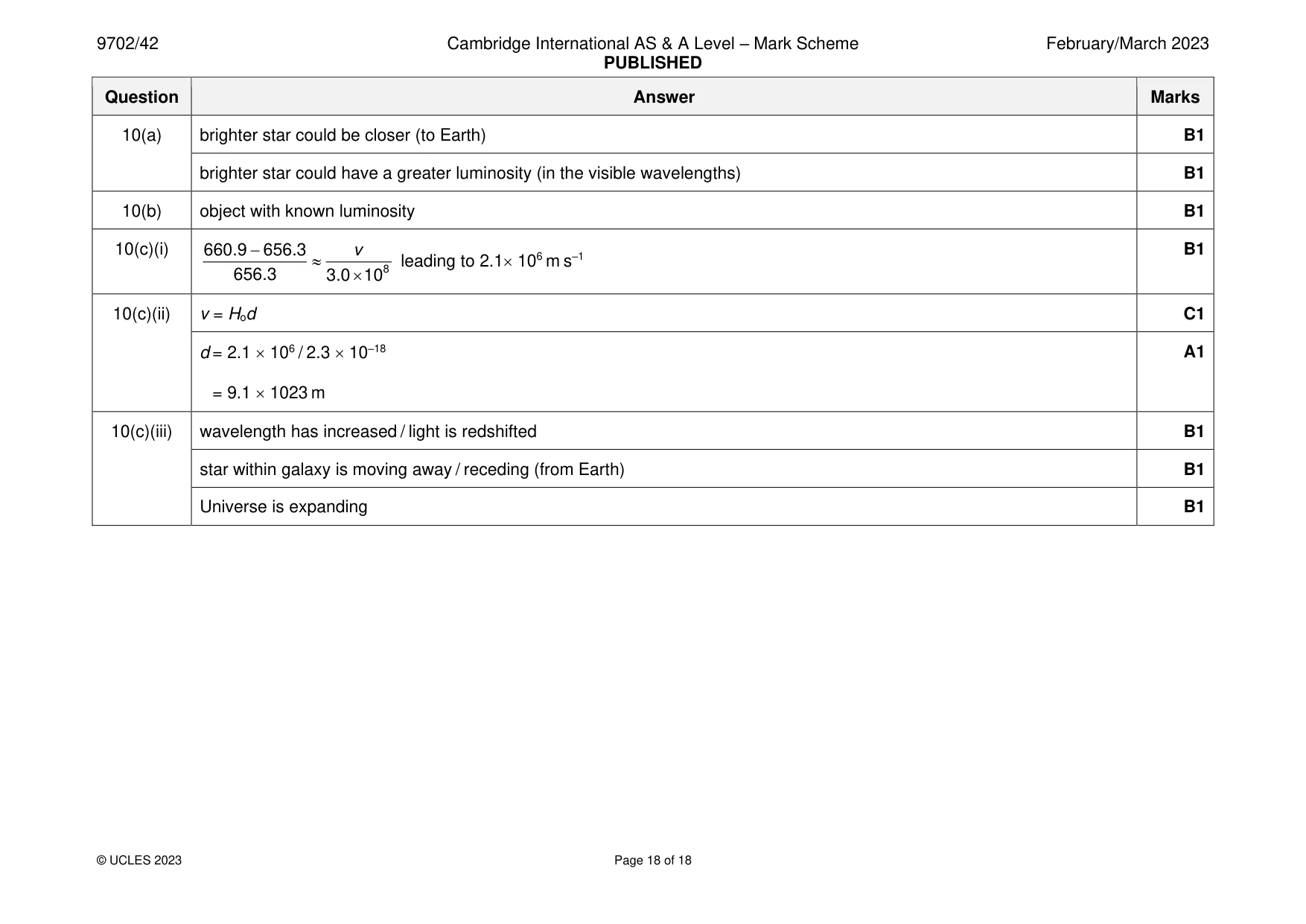
10 (a) A student observes different stars from the Earth. Give two reasons why some stars appear brighter than others. 1 ................................................................................................................................................ ................................................................................................................................................... 2 ................................................................................................................................................ ................................................................................................................................................... [2] (b) State what is meant by a standard candle. ................................................................................................................................................... ............................................................................................................................................. [1] (c) A spectral line from a star within a galaxy is observed to have a wavelength of 660.9 nm. The same spectral line measured in the laboratory is observed to have a wavelength of 656.3 nm. (i) Show that the speed of the star relative to the Earth is 2.1 × 10⁶ m s–1. [1] (ii) Calculate the distance to the star. The Hubble constant is 2.3 × 10⁻¹⁸ s–1. distance = ..................................................... m [2] (iii) State and explain what can be concluded about the Universe based on this change in observed wavelength. ........................................................................................................................................... ........................................................................................................................................... ........................................................................................................................................... ........................................................................................................................................... ..................................................................................................................................... [3] [Total: 9]
Mark scheme: 10(a) brighter star could be closer (to Earth) B1 brighter star could have a greater luminosity (in the visible wavelengths) B1 10(b) object with known luminosity B1 10(c)(i) 660.9 − 656.3 v B1 leading to 2.1 106 m s–1 656.3 3.0 108 10(c)(ii) v = Hod C1 d = 2.1 106 / 2.3 10–18 A1 = 9.1 1023 m 10(c)(iii) wavelength has increased / light is redshifted B1 star within galaxy is moving away / receding (from Earth) B1 Universe is expanding B1
What was in this paper
The subtopics covered by these 10 questions, and how many questions each got. Open one in a new tab to see every Cambridge question on it.
What you needed in this session
Cambridge’s own grade thresholds for 2023 Feb/March, Paper 4 · Variant 2. A higher threshold means an easier paper — the bar moves with how the cohort did.