Cambridge A Level Physics 9702 — 2022 Feb/March Paper 4 · Variant 2
9702/42/F/M/22 · 12 questions · 100 marks · ≈113 min
The question paper and its mark scheme, free to read here and free to download. This is Cambridge’s own paper, exactly as it was sat.
Question paper32 pages



Mark scheme17 pages
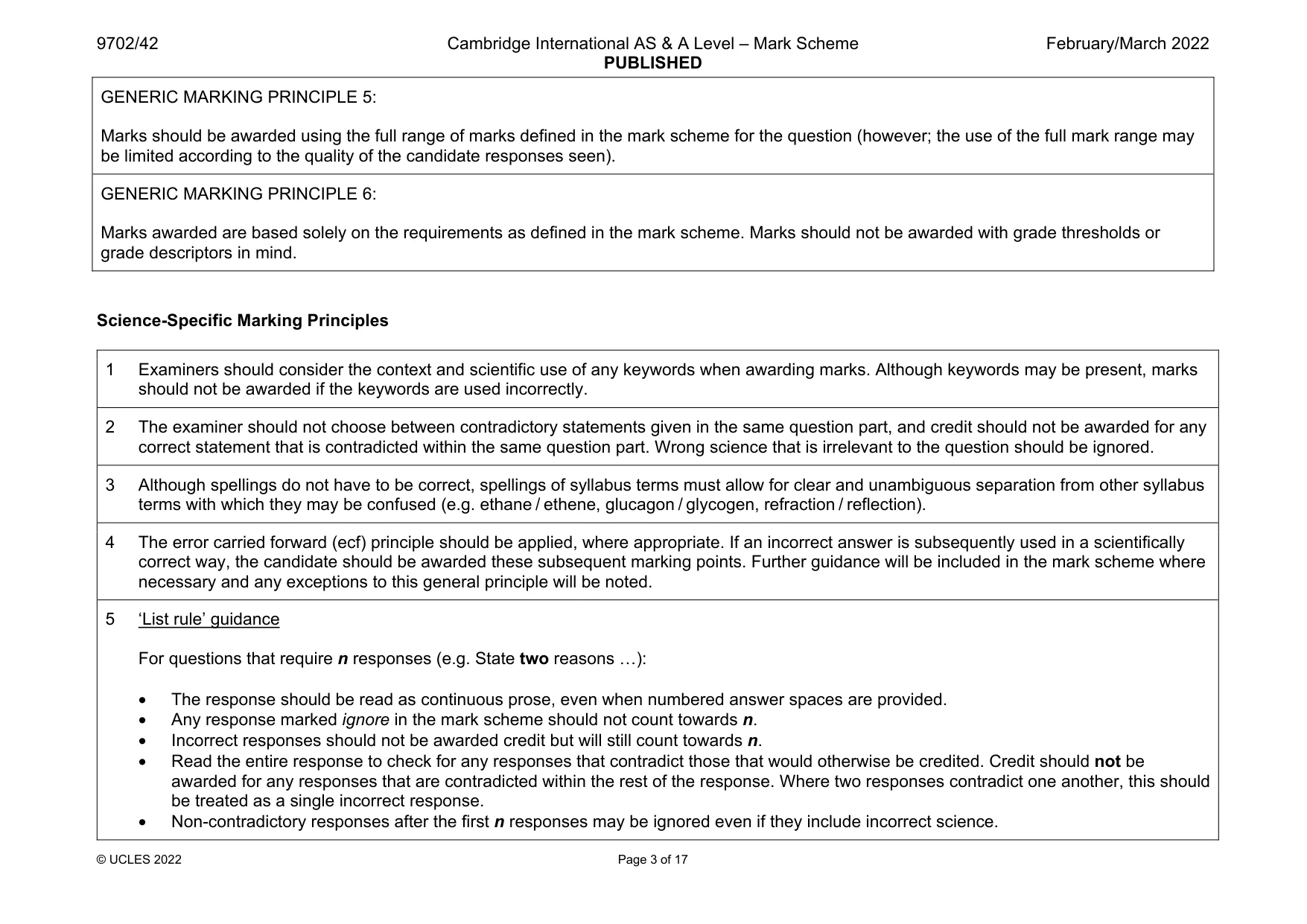
Answers below. Sit the paper first if you are practising.
Questions as text
Q1 · The point P in Fig
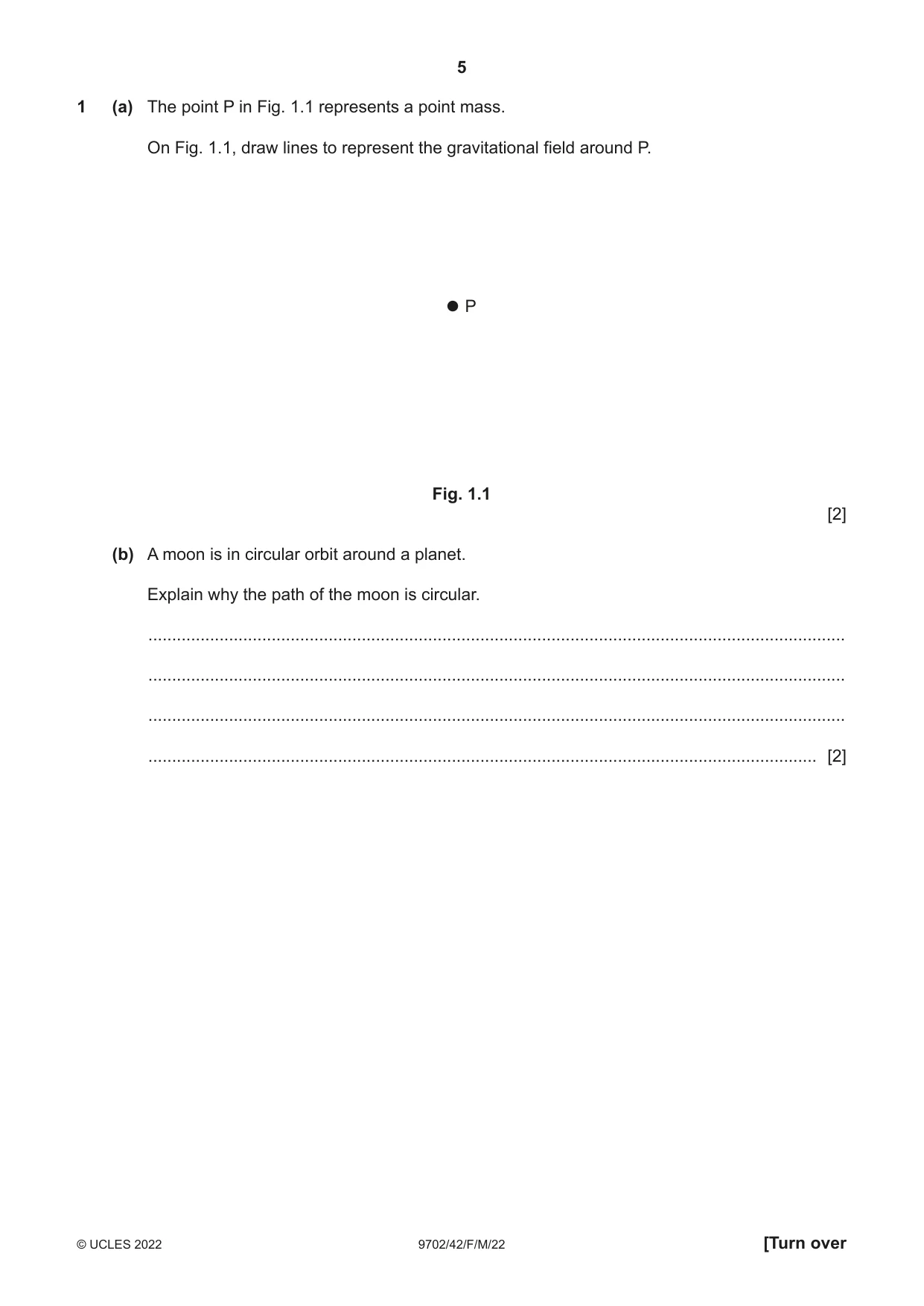
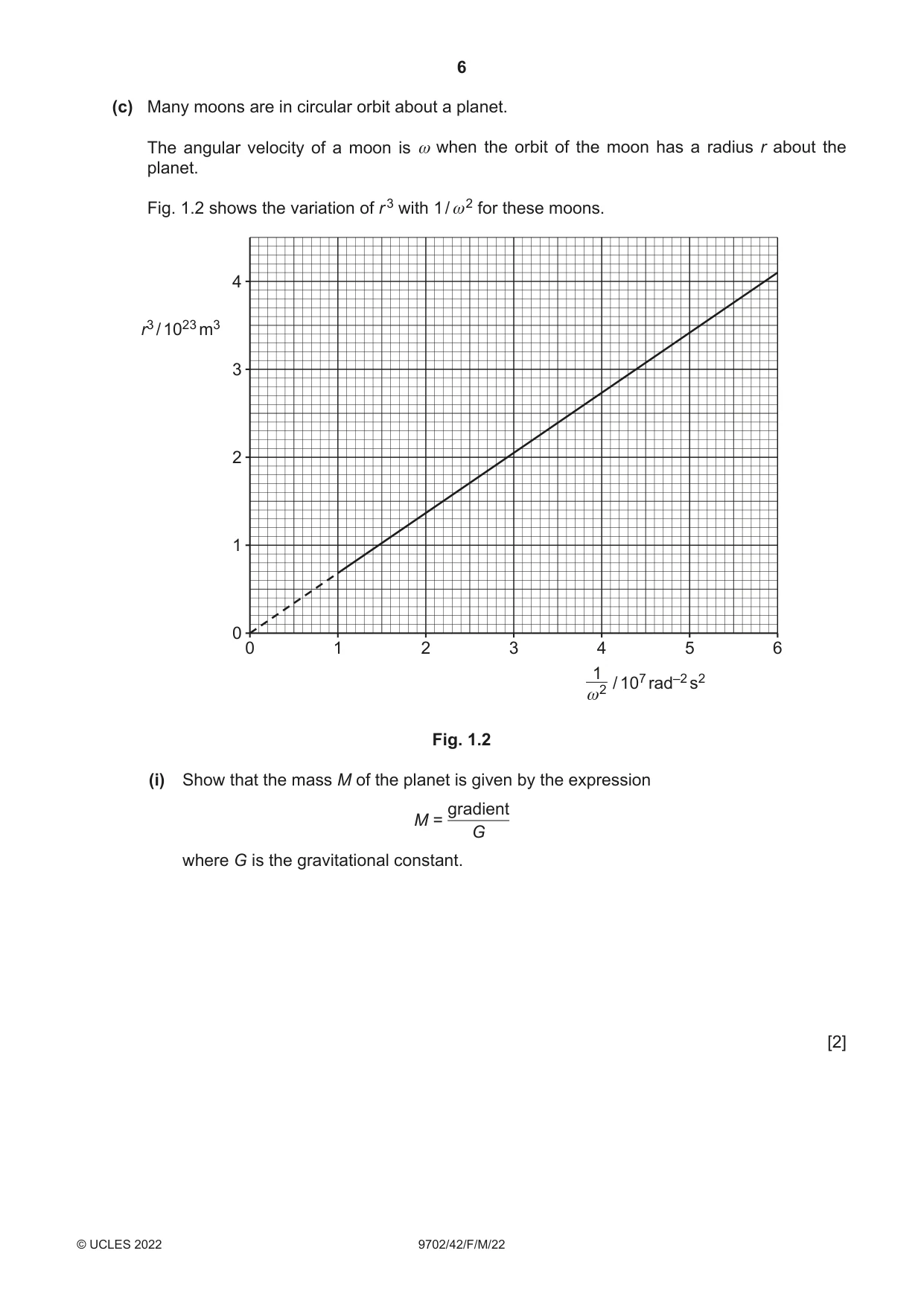
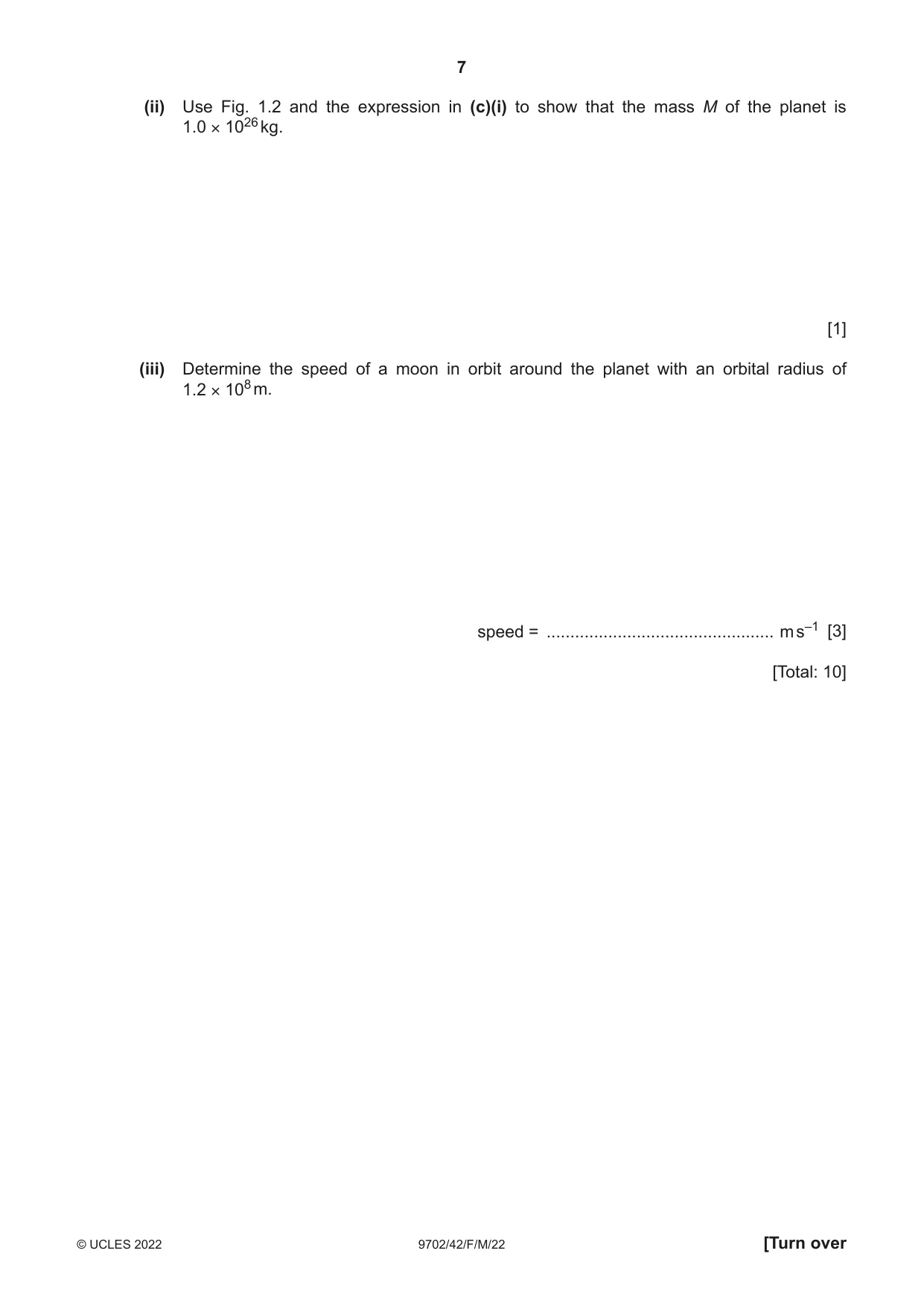
1 (a) The point P in Fig. 1.1 represents a point mass. On Fig. 1.1, draw lines to represent the gravitational field around P. P Fig. 1.1 [2] (b) A moon is in circular orbit around a planet. Explain why the path of the moon is circular. ................................................................................................................................................... ................................................................................................................................................... ................................................................................................................................................... ............................................................................................................................................. [2] (c) Many moons are in circular orbit about a planet. The angular velocity of a moon is ω when the orbit of the moon has a radius r about the planet. Fig. 1.2 shows the variation of r 3 with 1 / ω2 for these moons. 4 r3 / 1023 m3 3 2 1 0 0 1 2 3 4 5 6 1 2 / 107 rad–2 s2 ω Fig. 1.2 (i) Show that the mass M of the planet is given by the expression gradient M = G where G is the gravitational constant. [2] (ii) Use Fig. 1.2 and the expression in (c)(i) to show that the mass M of the planet is 1.0 × 1026 kg. [1] (iii) Determine the speed of a moon in orbit around the planet with an orbital radius of 1.2 × 10⁸ m. speed = ................................................ m s–1 [3] [Total: 10]
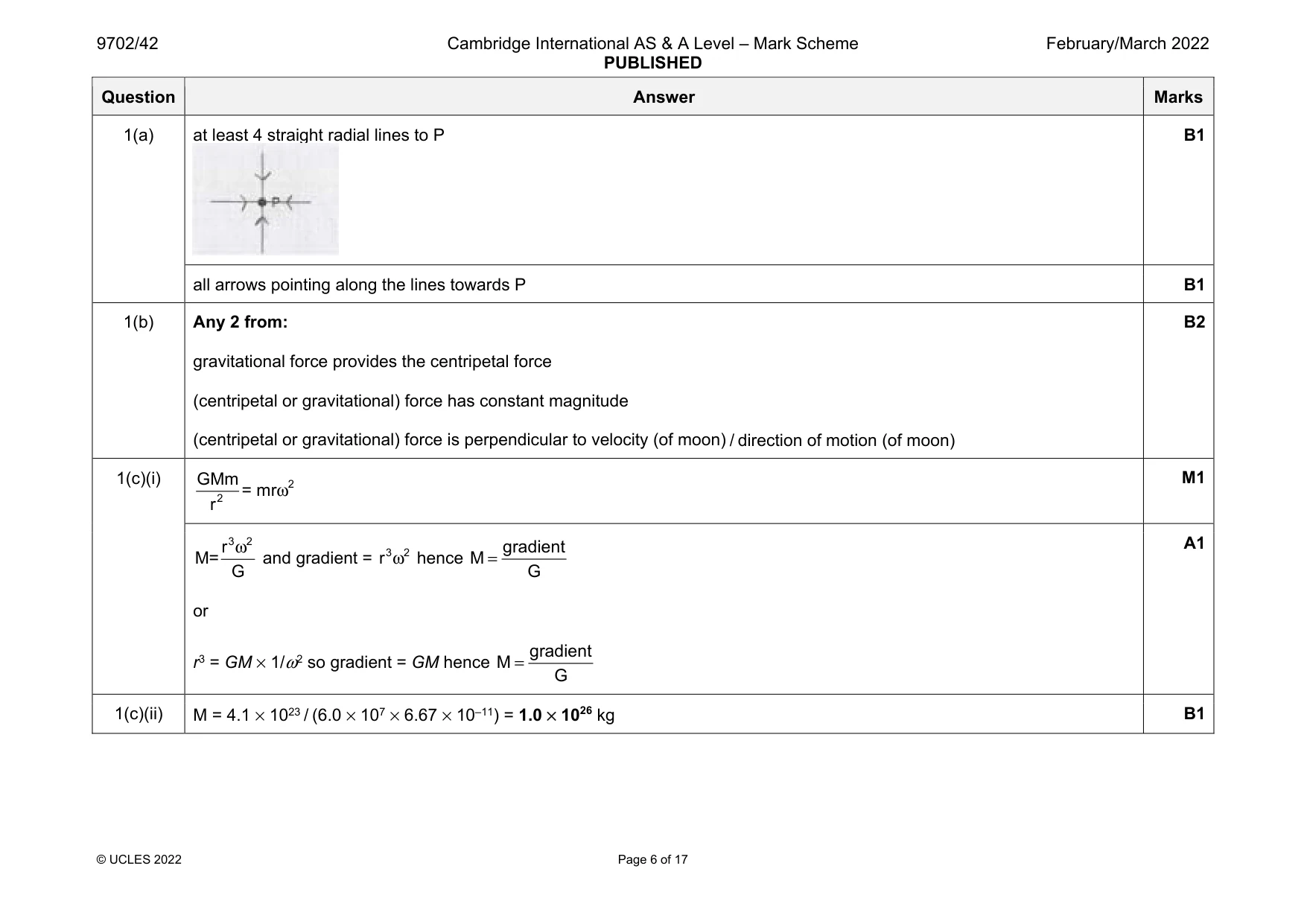
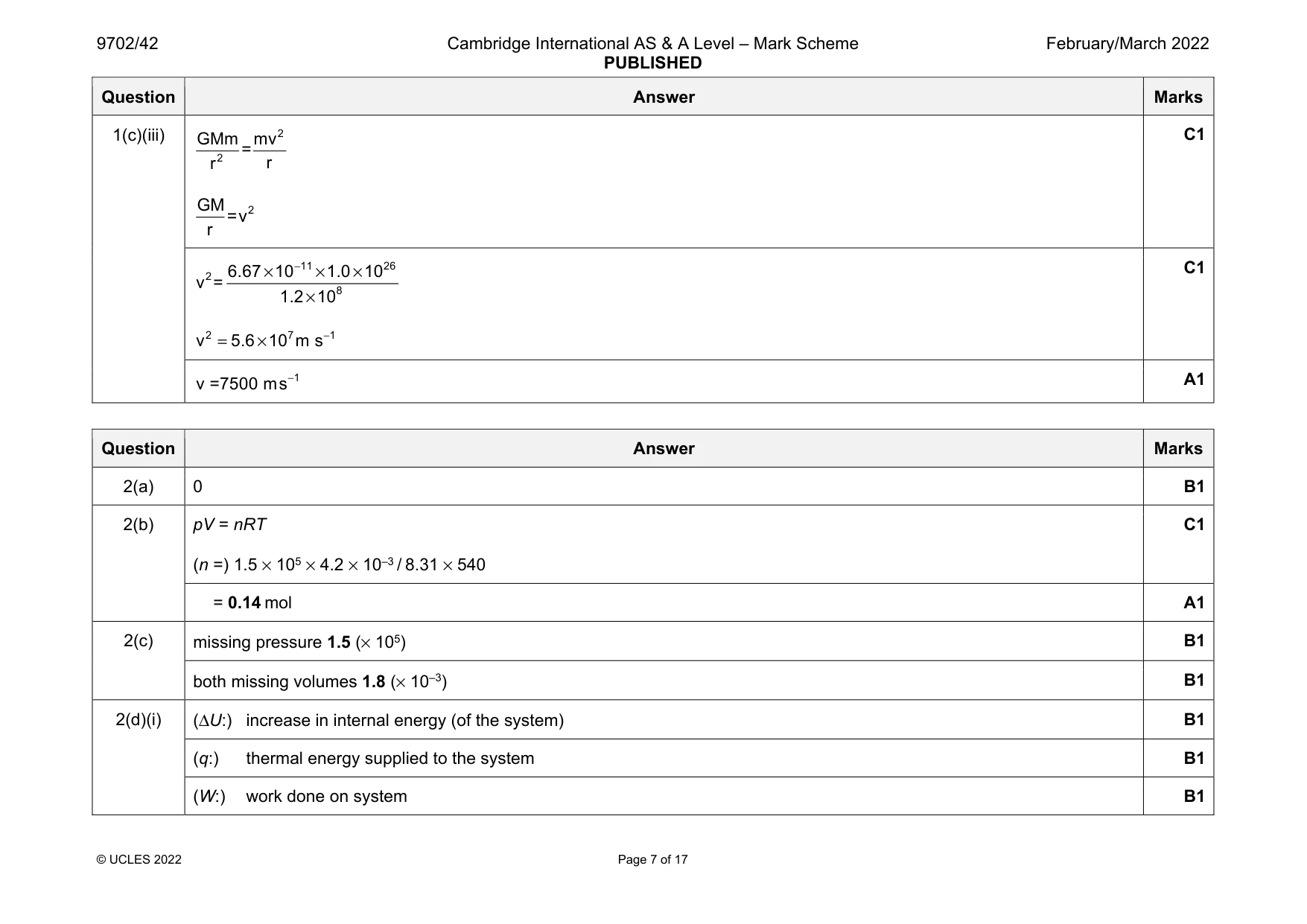
Mark scheme: 1(a) at least 4 straight radial lines to P B1 all arrows pointing along the lines towards P B1 1(b) Any 2 from: gravitational force provides the centripetal force (centripetal or gravitational) force has constant magnitude (centripetal or gravitational) force is perpendicular to velocity (of moon) / direction of motion (of moon) B2 1(c)(i) 2 2 GMm = mr r ω M1 3 2 r M= G ω and gradient = 3 2 r ω hence gradient M G = or r3 = GM × 1/ω2 so gradient = GM hence gradient M G = A1 1(c)(ii) M = 4.1 × 10²³ / (6.0 × 107 × 6.67 × 10–11) = 1.0 × 1026 kg B1 Question Answer Marks 1(c)(iii) 2 2 GMm mv = r r 2 GM= v r C1 11 26 2 8 6.67 10 1.0 10 v = 1.2 10 − × × × × 2 7 1 v 5.6 10 m s− = × C1 1 v =7500 m s− A1
Q2 · A fixed mass of an ideal gas has a volume V and a pressure p
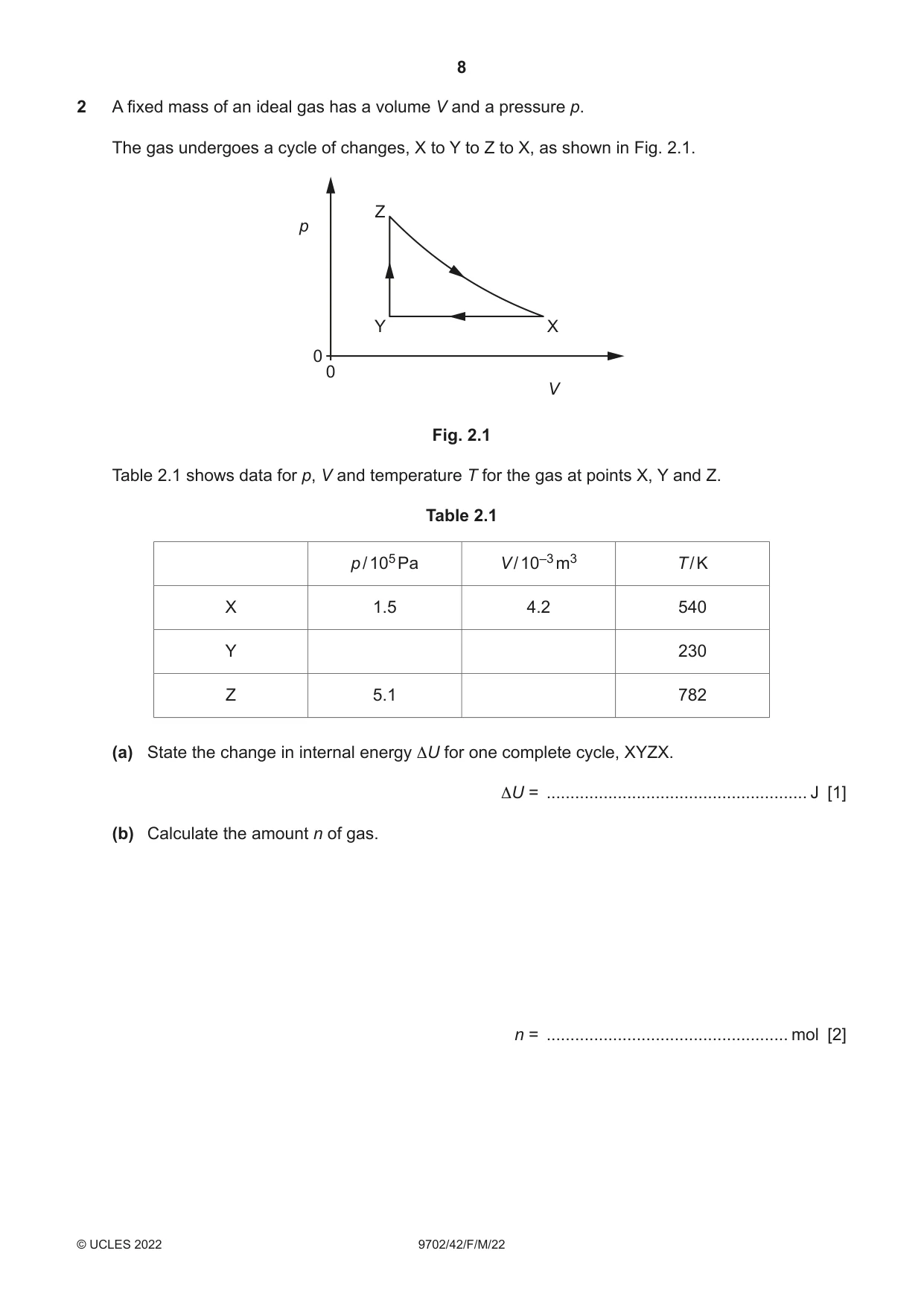
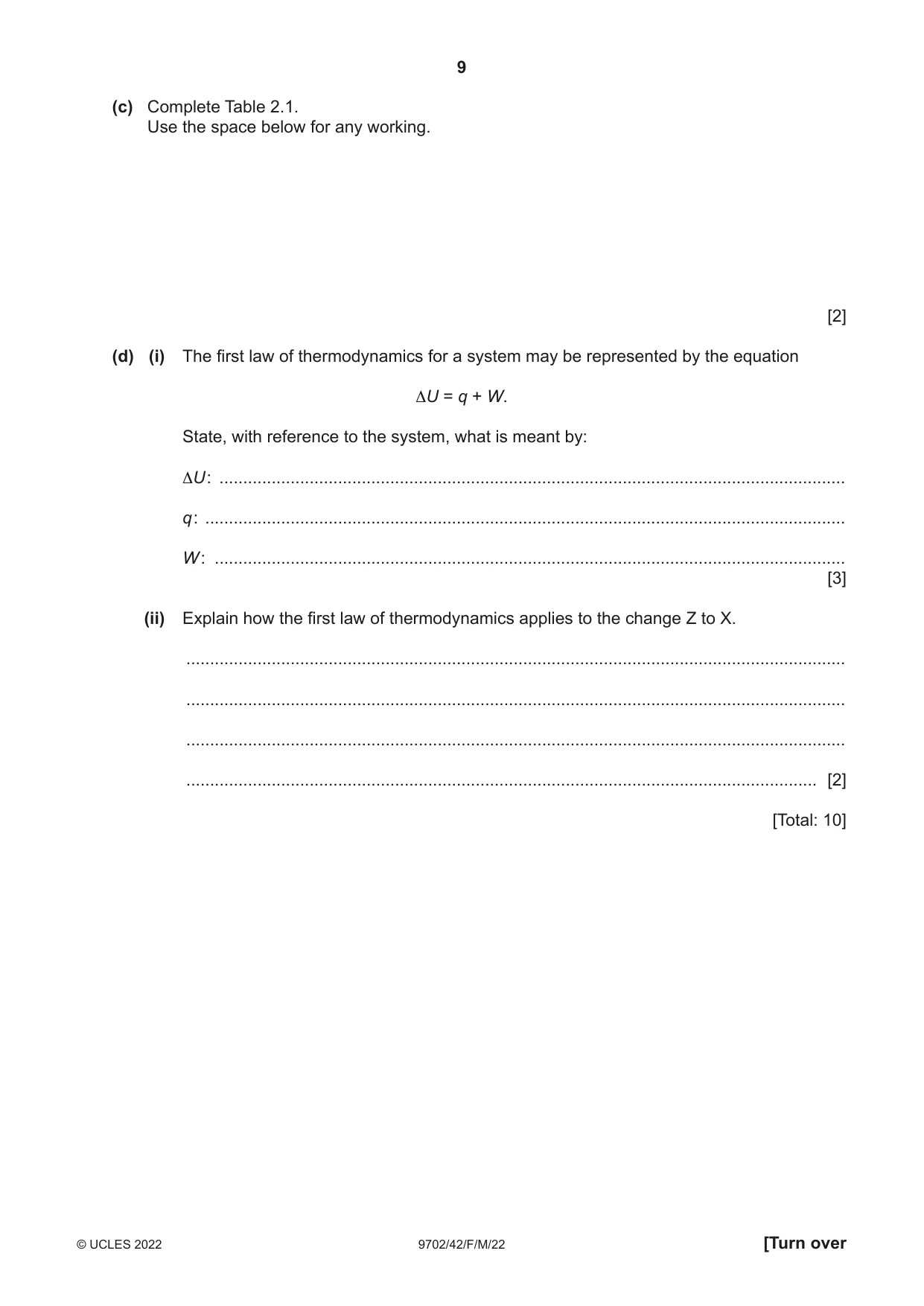
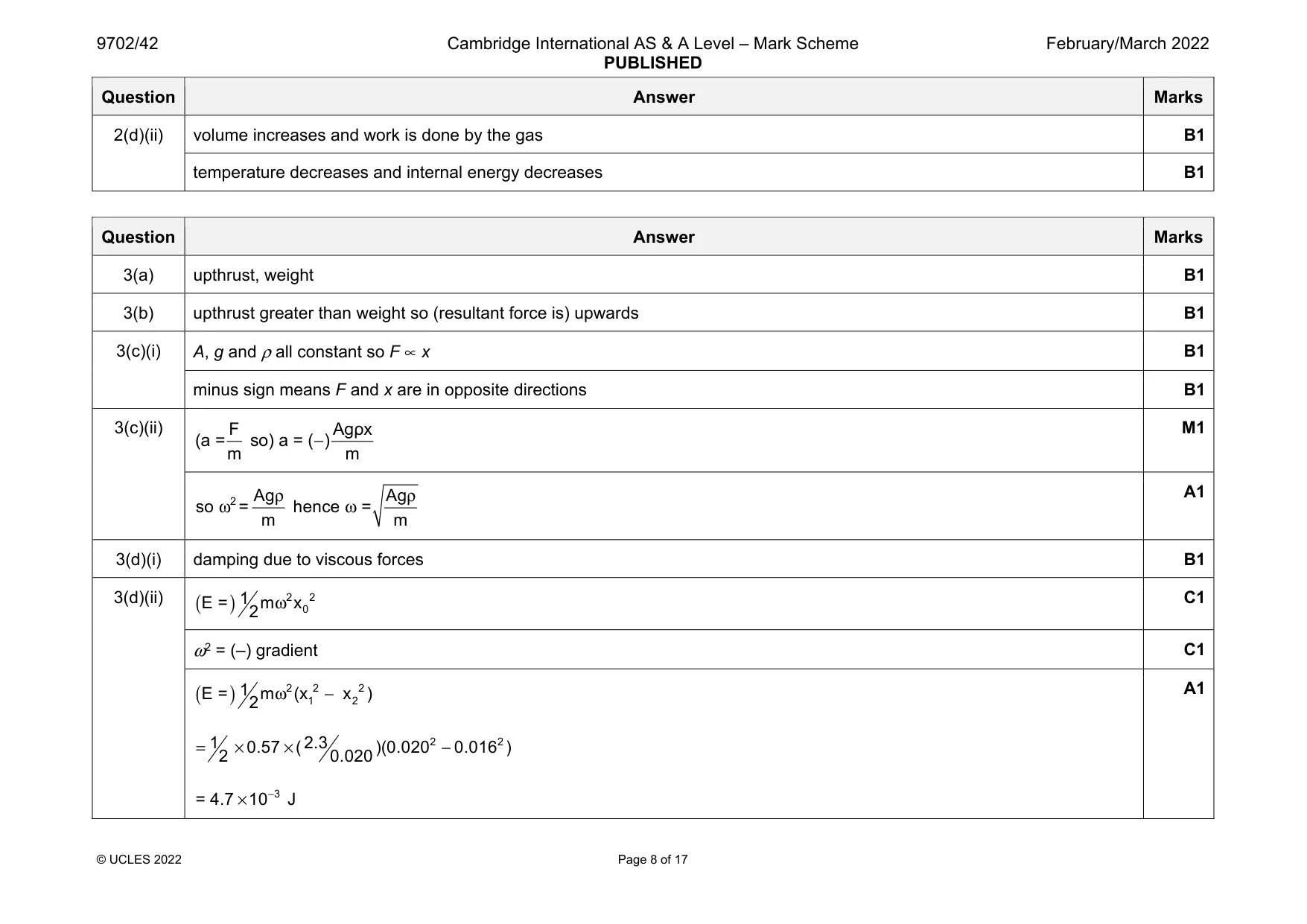
2 A fixed mass of an ideal gas has a volume V and a pressure p. The gas undergoes a cycle of changes, X to Y to Z to X, as shown in Fig. 2.1. Z p Y X 0 0 V Fig. 2.1 Table 2.1 shows data for p, V and temperature T for the gas at points X, Y and Z. Table 2.1 p / 105 Pa V / 10–3 m3 T / K X 1.5 4.2 540 Y 230 Z 5.1 782 (a) State the change in internal energy ΔU for one complete cycle, XYZX. ΔU = ....................................................... J [1] (b) Calculate the amount n of gas. n = ................................................... mol [2] (c) Complete Table 2.1. Use the space below for any working. [2] (d) (i) The first law of thermodynamics for a system may be represented by the equation ΔU = q + W. State, with reference to the system, what is meant by: ΔU : .................................................................................................................................... q : ....................................................................................................................................... W : ..................................................................................................................................... [3] (ii) Explain how the first law of thermodynamics applies to the change Z to X. ........................................................................................................................................... ........................................................................................................................................... ........................................................................................................................................... ..................................................................................................................................... [2] [Total: 10]
Mark scheme: 2(a) 0 B1 2(b) pV = nRT (n =) 1.5 × 105 × 4.2 × 10–3 / 8.31 × 540 C1 = 0.14 mol A1 2(c) missing pressure 1.5 (× 105) B1 both missing volumes 1.8 (× 10–3) B1 2(d)(i) (ΔU:) increase in internal energy (of the system) B1 (q:) thermal energy supplied to the system B1 (W:) work done on system B1 Question Answer Marks 2(d)(ii) volume increases and work is done by the gas B1 temperature decreases and internal energy decreases B1
Q3 · A small wooden block (cuboid) of mass m floats in water, as shown in Fig
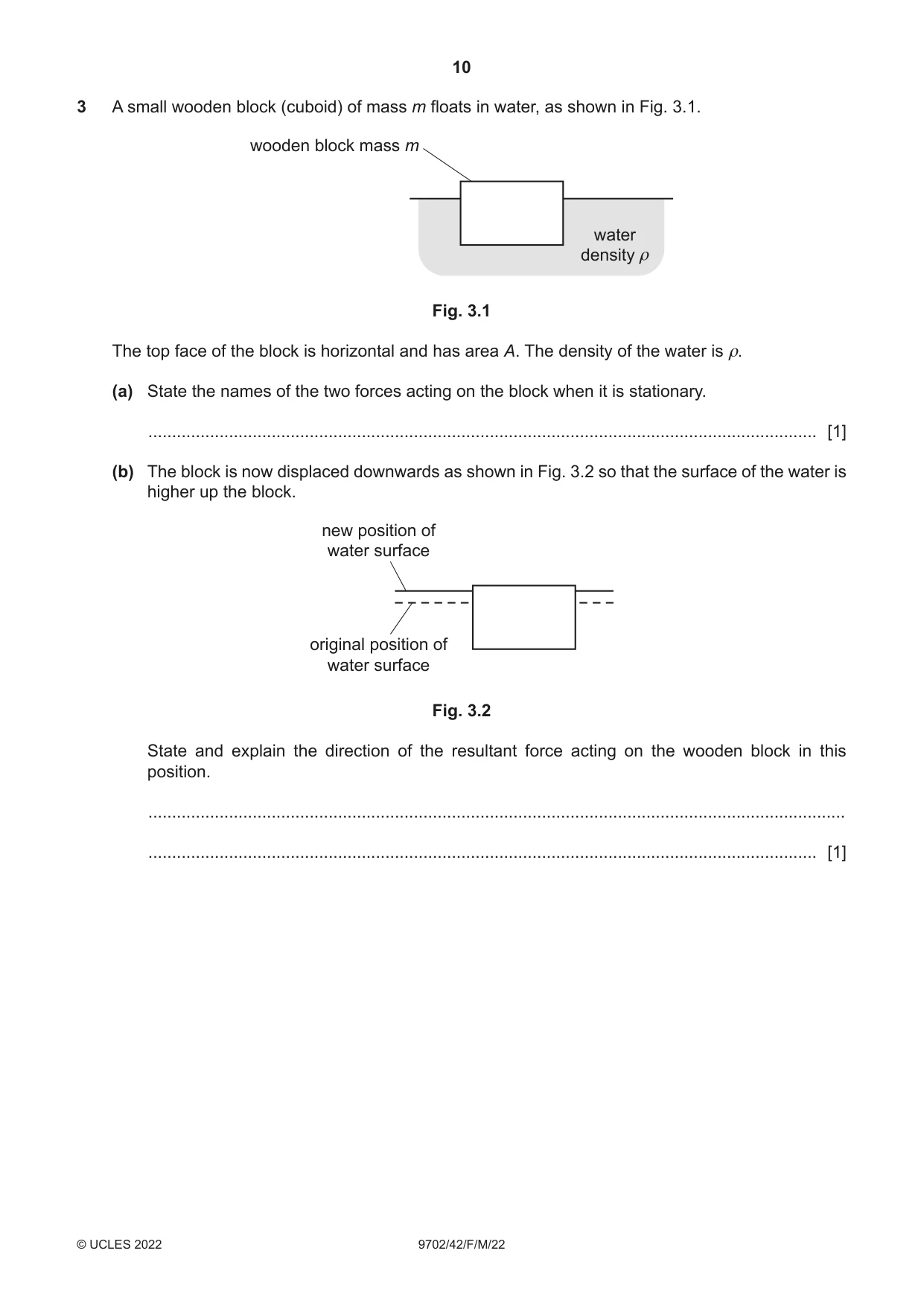
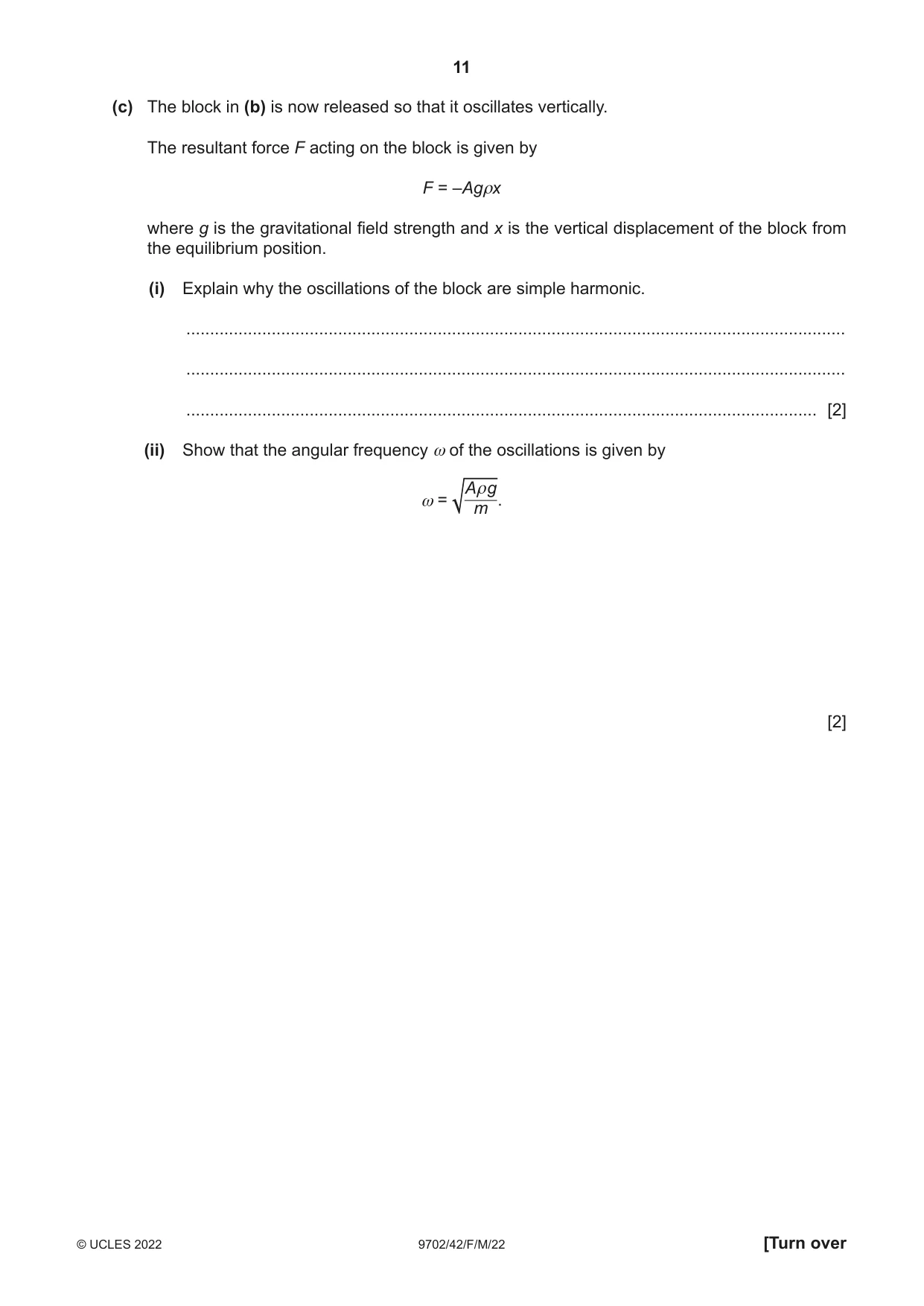
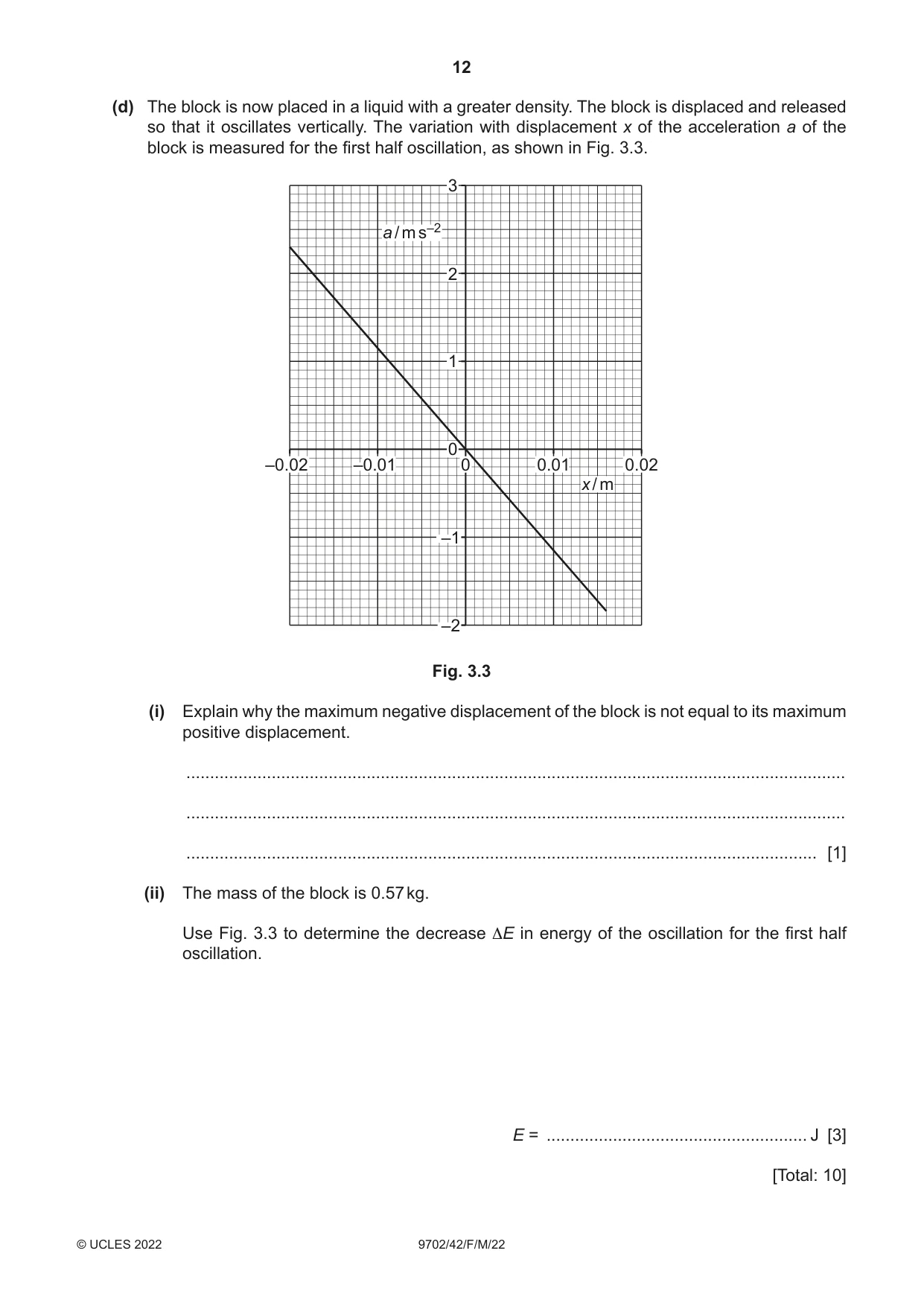
3 A small wooden block (cuboid) of mass m floats in water, as shown in Fig. 3.1. wooden block mass m water density ρ Fig. 3.1 The top face of the block is horizontal and has area A. The density of the water is ρ. (a) State the names of the two forces acting on the block when it is stationary. ............................................................................................................................................. [1] (b) The block is now displaced downwards as shown in Fig. 3.2 so that the surface of the water is higher up the block. new position of water surface original position of water surface Fig. 3.2 State and explain the direction of the resultant force acting on the wooden block in this position. ................................................................................................................................................... ............................................................................................................................................. [1] (c) The block in (b) is now released so that it oscillates vertically. The resultant force F acting on the block is given by F = –Agρx where g is the gravitational field strength and x is the vertical displacement of the block from the equilibrium position. (i) Explain why the oscillations of the block are simple harmonic. ........................................................................................................................................... ........................................................................................................................................... ..................................................................................................................................... [2] (ii) Show that the angular frequency ω of the oscillations is given by Aρ g ω = . m [2] (d) The block is now placed in a liquid with a greater density. The block is displaced and released so that it oscillates vertically. The variation with displacement x of the acceleration a of the block is measured for the first half oscillation, as shown in Fig. 3.3. 3 a / m s–2 2 1 0 –0.02 –0.01 0 0.01 0.02 x / m –1 –2 Fig. 3.3 (i) Explain why the maximum negative displacement of the block is not equal to its maximum positive displacement. ........................................................................................................................................... ........................................................................................................................................... ..................................................................................................................................... [1] (ii) The mass of the block is 0.57 kg. Use Fig. 3.3 to determine the decrease ΔE in energy of the oscillation for the first half oscillation. E = ....................................................... J [3] [Total: 10]
Mark scheme: 3(a) upthrust, weight B1 3(b) upthrust greater than weight so (resultant force is) upwards B1 3(c)(i) A, g and ρ all constant so F ∝ x B1 minus sign means F and x are in opposite directions B1 3(c)(ii) F Agρx (a = so) a = ( ) m m − M1 2 Ag Ag so = hence = m m ρ ρ ω ω A1 3(d)(i) damping due to viscous forces B1 3(d)(ii) ( ) 2 2 0 1 E = m x 2 ω C1 ω2 = (–) gradient C1 ( ) 2 2 2 1 2 1 E = m (x x ) 2 ω − 2 2 2.3 1 0.57 ( )(0.020 0.016 ) 2 0.020 = × × − 3 = 4.7 10 J − × A1
Q4 · State what is represented by an electric field line
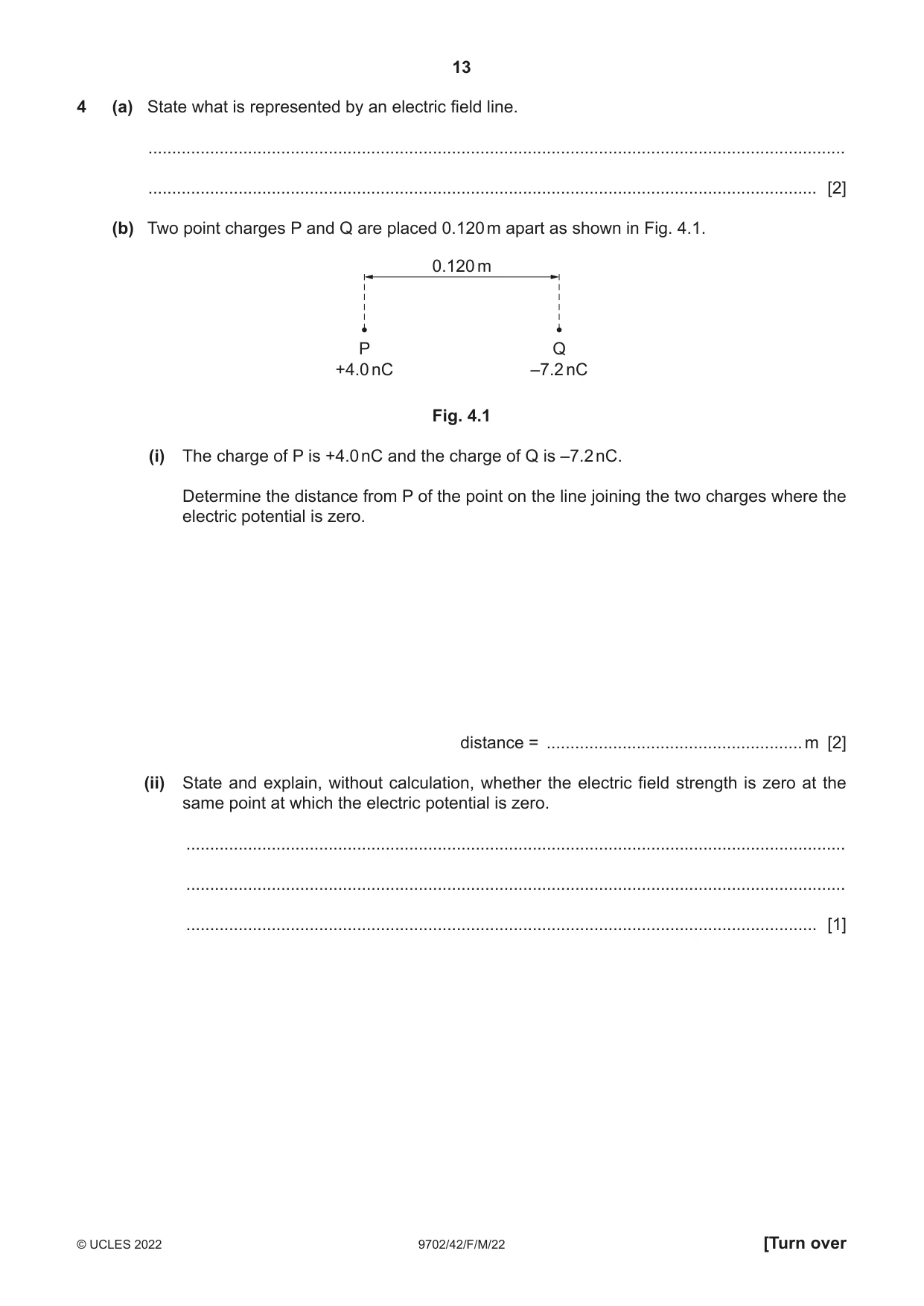
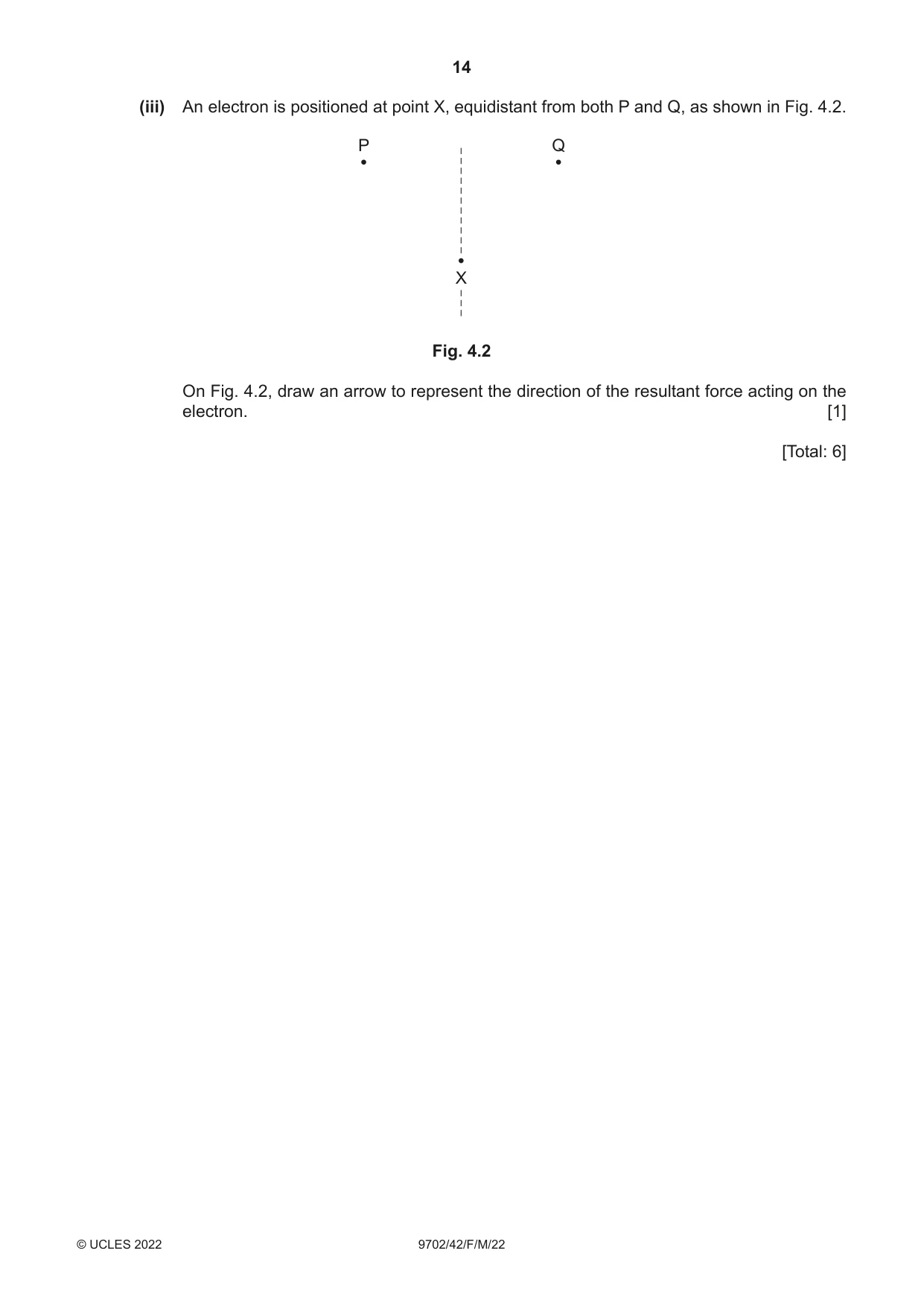
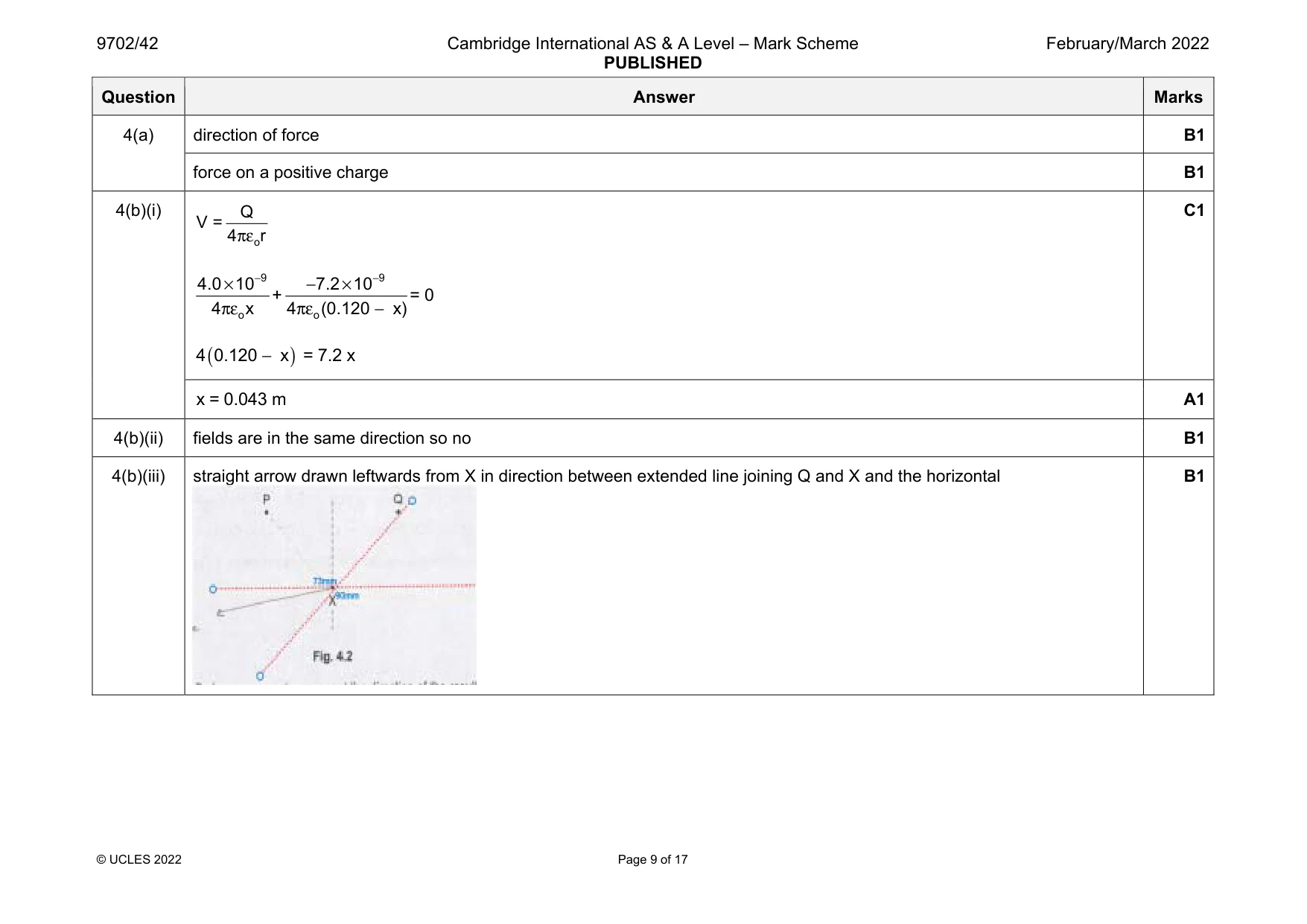
4 (a) State what is represented by an electric field line. ................................................................................................................................................... ............................................................................................................................................. [2] (b) Two point charges P and Q are placed 0.120 m apart as shown in Fig. 4.1. 0.120 m P Q +4.0 nC –7.2 nC Fig. 4.1 (i) The charge of P is +4.0 nC and the charge of Q is –7.2 nC. Determine the distance from P of the point on the line joining the two charges where the electric potential is zero. distance = ...................................................... m [2] (ii) State and explain, without calculation, whether the electric field strength is zero at the same point at which the electric potential is zero. ........................................................................................................................................... ........................................................................................................................................... ..................................................................................................................................... [1] (iii) An electron is positioned at point X, equidistant from both P and Q, as shown in Fig. 4.2. P Q X Fig. 4.2 On Fig. 4.2, draw an arrow to represent the direction of the resultant force acting on the electron. [1] [Total: 6]
Mark scheme: 4(a) direction of force B1 force on a positive charge B1 4(b)(i) o Q V = 4 r πε 9 9 o o 4.0 10 7.2 10 + = 0 4 x 4 (0.120 x) − − × − × πε πε − ( ) 4 0.120 x = 7.2 x − C1 x = 0.043 m A1 4(b)(ii) fields are in the same direction so no B1 4(b)(iii) straight arrow drawn leftwards from X in direction between extended line joining Q and X and the horizontal B1
Q5 · The variation with potential difference V of the charge Q on one of the plates of a…
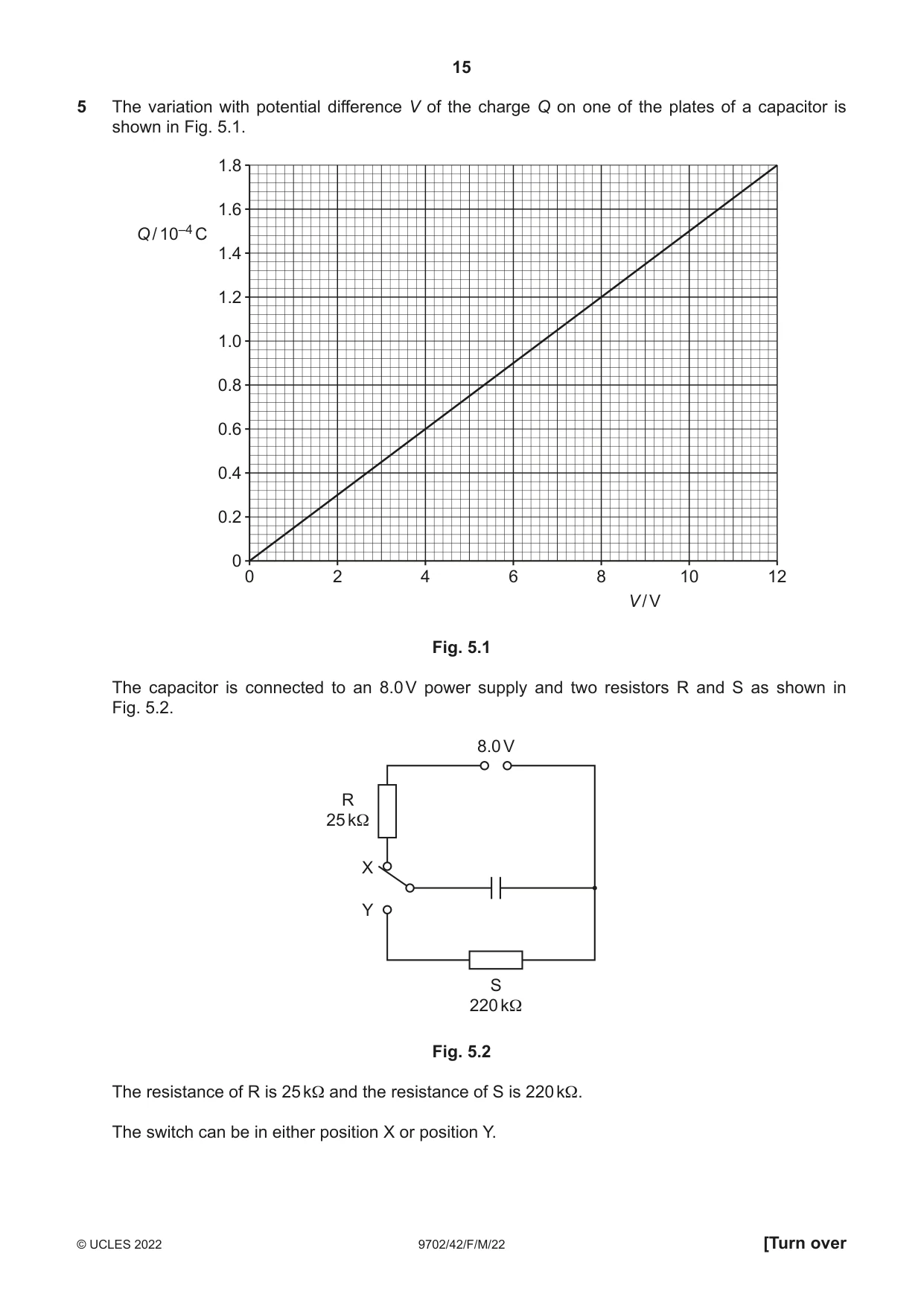
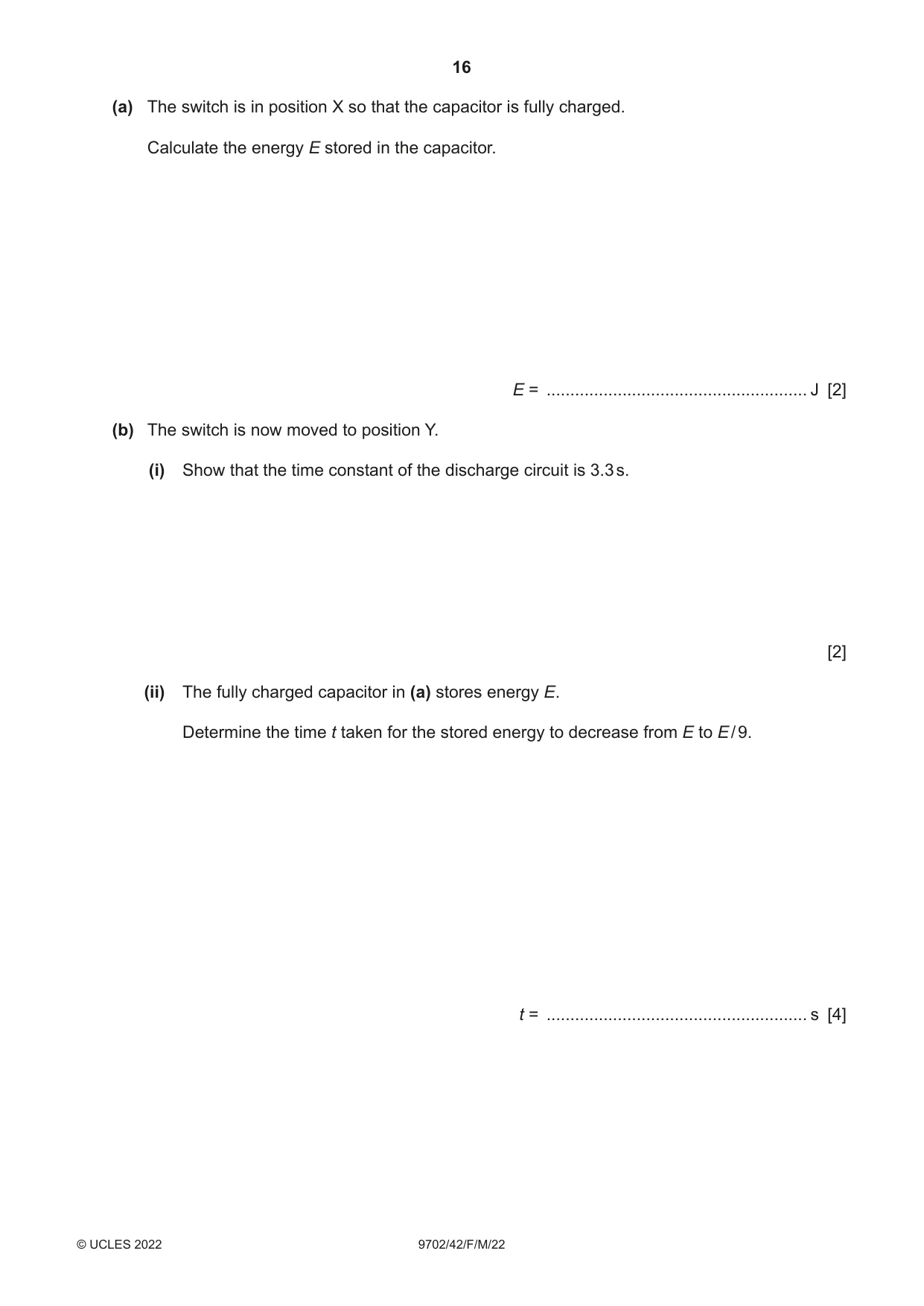
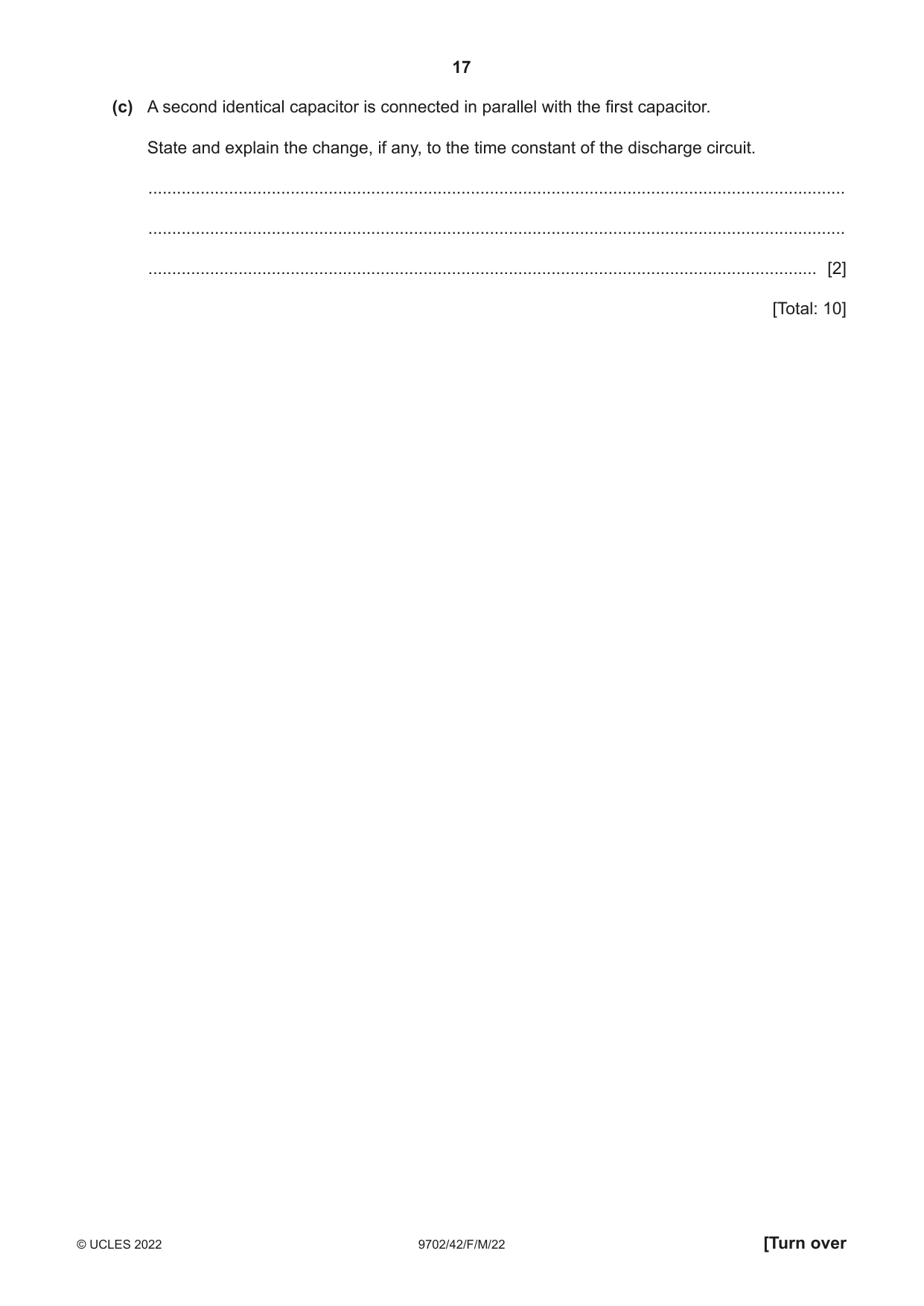
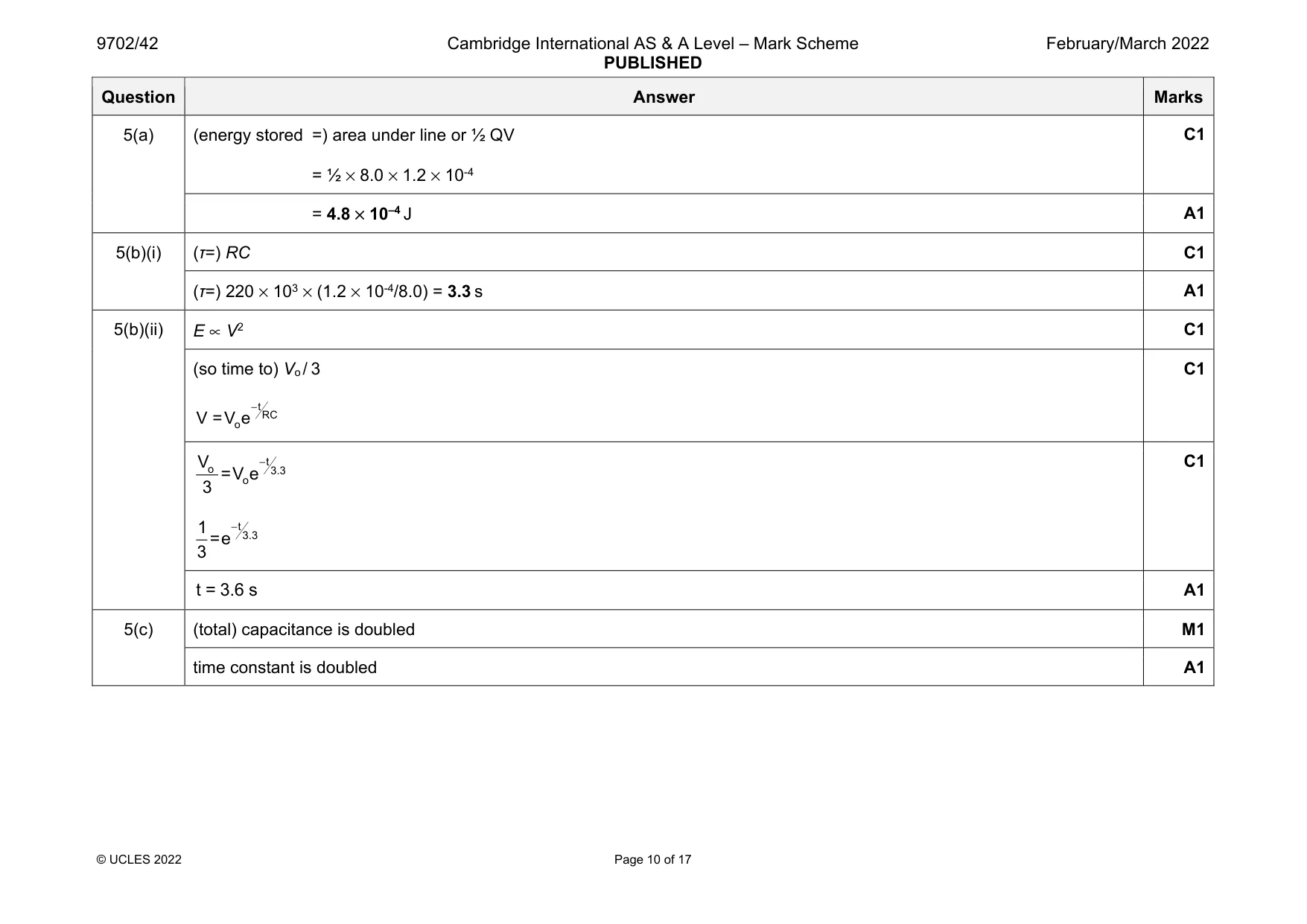
5 The variation with potential difference V of the charge Q on one of the plates of a capacitor is shown in Fig. 5.1. 1.8 1.6 Q / 10–4 C 1.4 1.2 1.0 0.8 0.6 0.4 0.2 0 0 2 4 6 8 10 12 V / V Fig. 5.1 The capacitor is connected to an 8.0 V power supply and two resistors R and S as shown in Fig. 5.2. 8.0 V R 25 kΩ X Y S 220 kΩ Fig. 5.2 The resistance of R is 25 kΩ and the resistance of S is 220 kΩ. The switch can be in either position X or position Y. (a) The switch is in position X so that the capacitor is fully charged. Calculate the energy E stored in the capacitor. E = ....................................................... J [2] (b) The switch is now moved to position Y. (i) Show that the time constant of the discharge circuit is 3.3 s. [2] (ii) The fully charged capacitor in (a) stores energy E. Determine the time t taken for the stored energy to decrease from E to E / 9. t = ....................................................... s [4] (c) A second identical capacitor is connected in parallel with the first capacitor. State and explain the change, if any, to the time constant of the discharge circuit. ................................................................................................................................................... ................................................................................................................................................... ............................................................................................................................................. [2] [Total: 10]
Mark scheme: 5(a) (energy stored =) area under line or ½ QV = ½ × 8.0 × 1.2 × 10-4 = 4.8 × 10⁻⁴ J A1 5(b)(i) (τ=) RC C1 (τ=) 220 × 103 × (1.2 × 10-4/8.0) = 3.3 s A1 5(b)(ii) E ∝ V2 C1 (so time to) Vo / 3 tRC o V = V e − C1 t o 3.3 o V = V e 3 − t3.3 1 = e 3 − C1 t = 3.6 s A1 5(c) (total) capacitance is doubled M1 time constant is doubled A1
Q6 · A small solenoid of area of cross section 1.6 × 10⁻³ m2 is placed inside a larger…
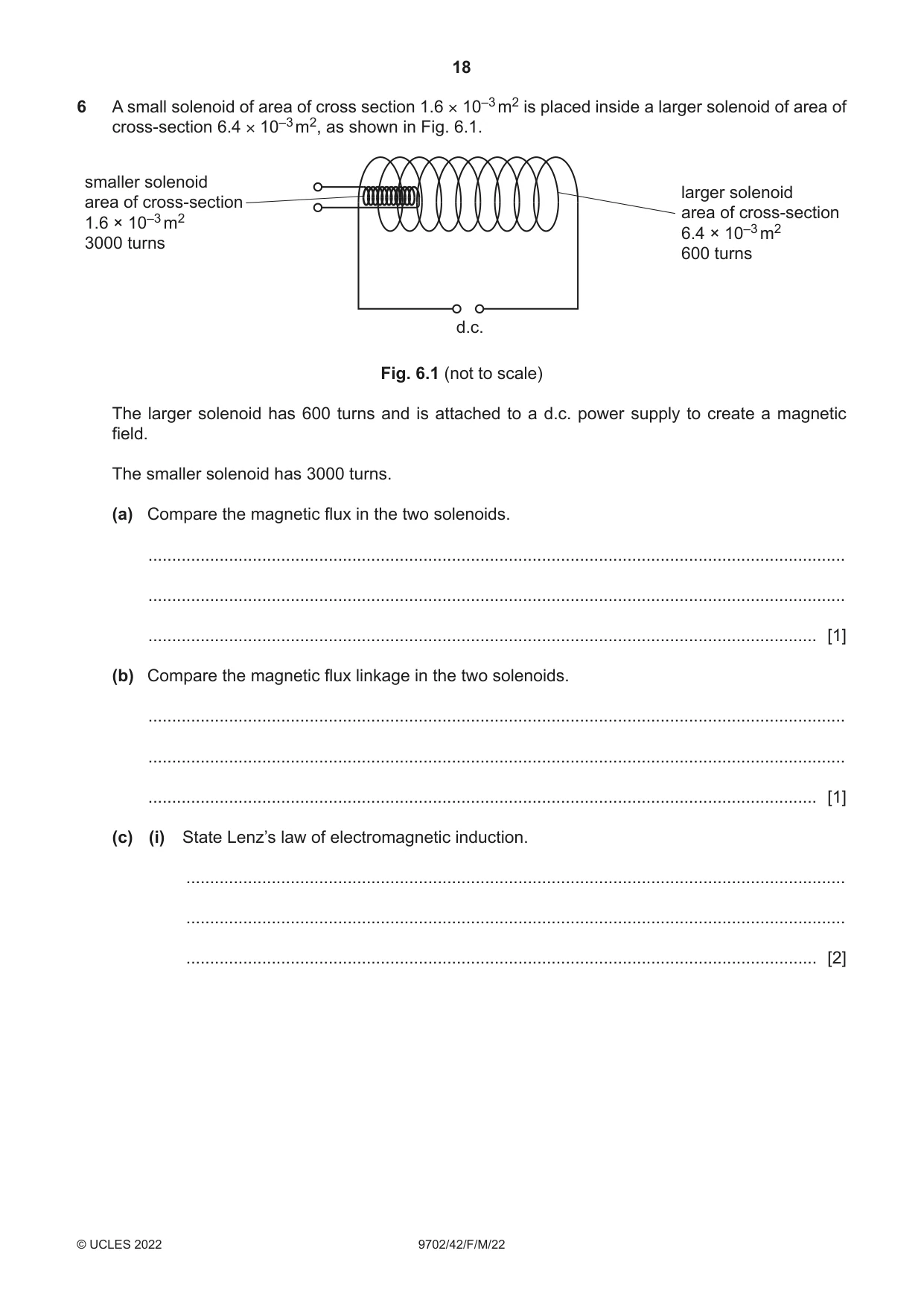
6 A small solenoid of area of cross section 1.6 × 10⁻³ m2 is placed inside a larger solenoid of area of cross-section 6.4 × 10⁻³ m2, as shown in Fig. 6.1. smaller solenoid larger solenoid area of cross-section area of cross-section 1.6 × 10⁻³ m2 6.4 × 10⁻³ m2 3000 turns 600 turns d.c. Fig. 6.1 (not to scale) The larger solenoid has 600 turns and is attached to a d.c. power supply to create a magnetic field. The smaller solenoid has 3000 turns. (a) Compare the magnetic flux in the two solenoids. ................................................................................................................................................... ................................................................................................................................................... ............................................................................................................................................. [1] (b) Compare the magnetic flux linkage in the two solenoids. ................................................................................................................................................... ................................................................................................................................................... ............................................................................................................................................. [1] (c) (i) State Lenz’s law of electromagnetic induction. ........................................................................................................................................... ........................................................................................................................................... ..................................................................................................................................... [2] (ii) The terminals of the smaller solenoid are connected together. The smaller solenoid is then removed from inside the larger solenoid. With reference to magnetic fields, explain why a force is needed to remove the smaller solenoid. ........................................................................................................................................... ........................................................................................................................................... ........................................................................................................................................... ........................................................................................................................................... ........................................................................................................................................... ..................................................................................................................................... [3] [Total: 7]
Mark scheme: 6(a) less in smaller solenoid B1 6(b) greater in smaller solenoid B1 6(c)(i) direction of (induced) e.m.f. M1 such as to (produce effects that) oppose the change that caused it A1 6(c)(ii) change of flux (linkage) in smaller solenoid induces e.m.f. in smaller solenoid B1 (induced) current in smaller solenoid causes field around it B1 the two fields (interact to) create an attractive force B1
Q7 · Alternating current (a.c.) is converted into direct current (d.c.) using a full-wave…
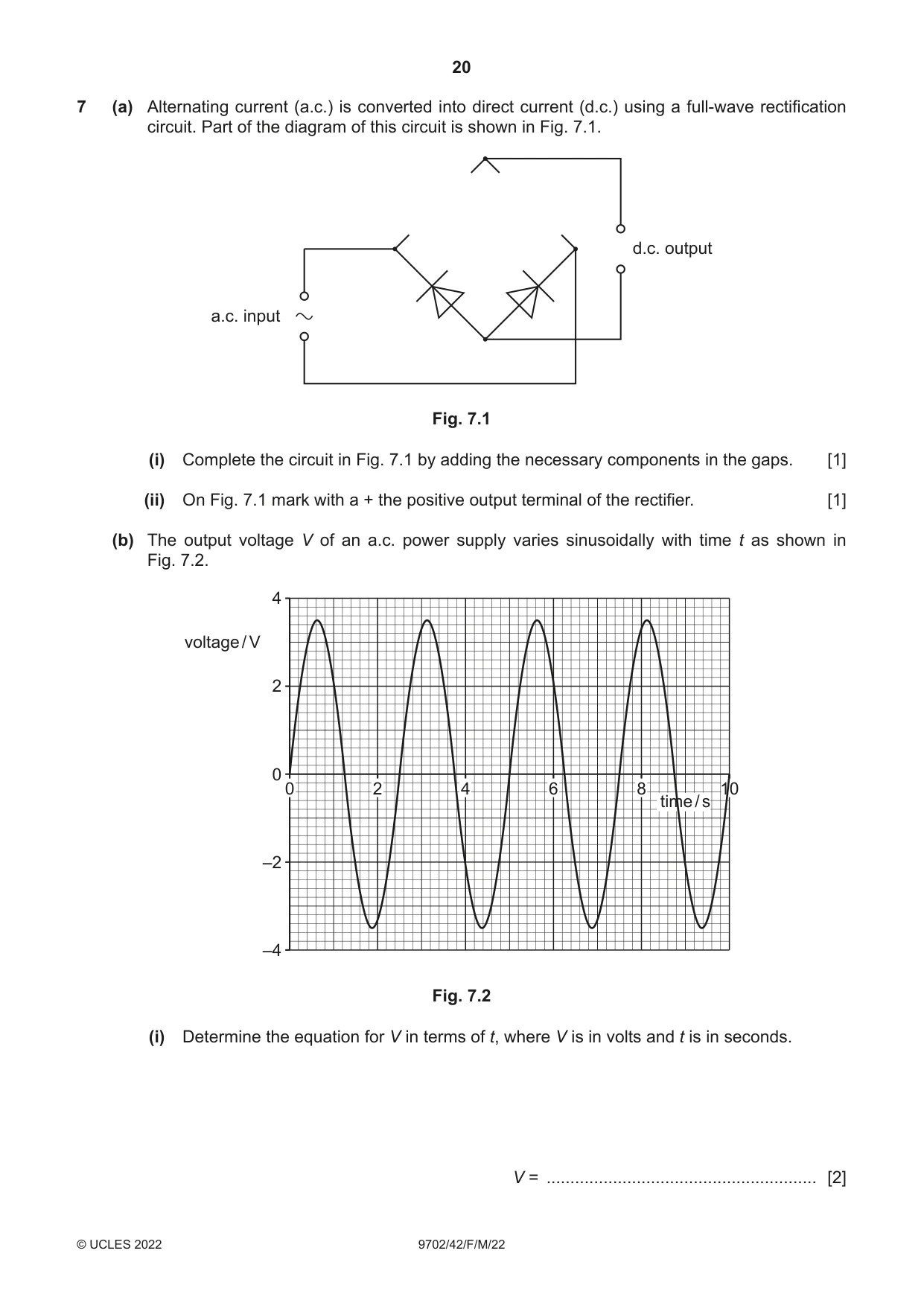
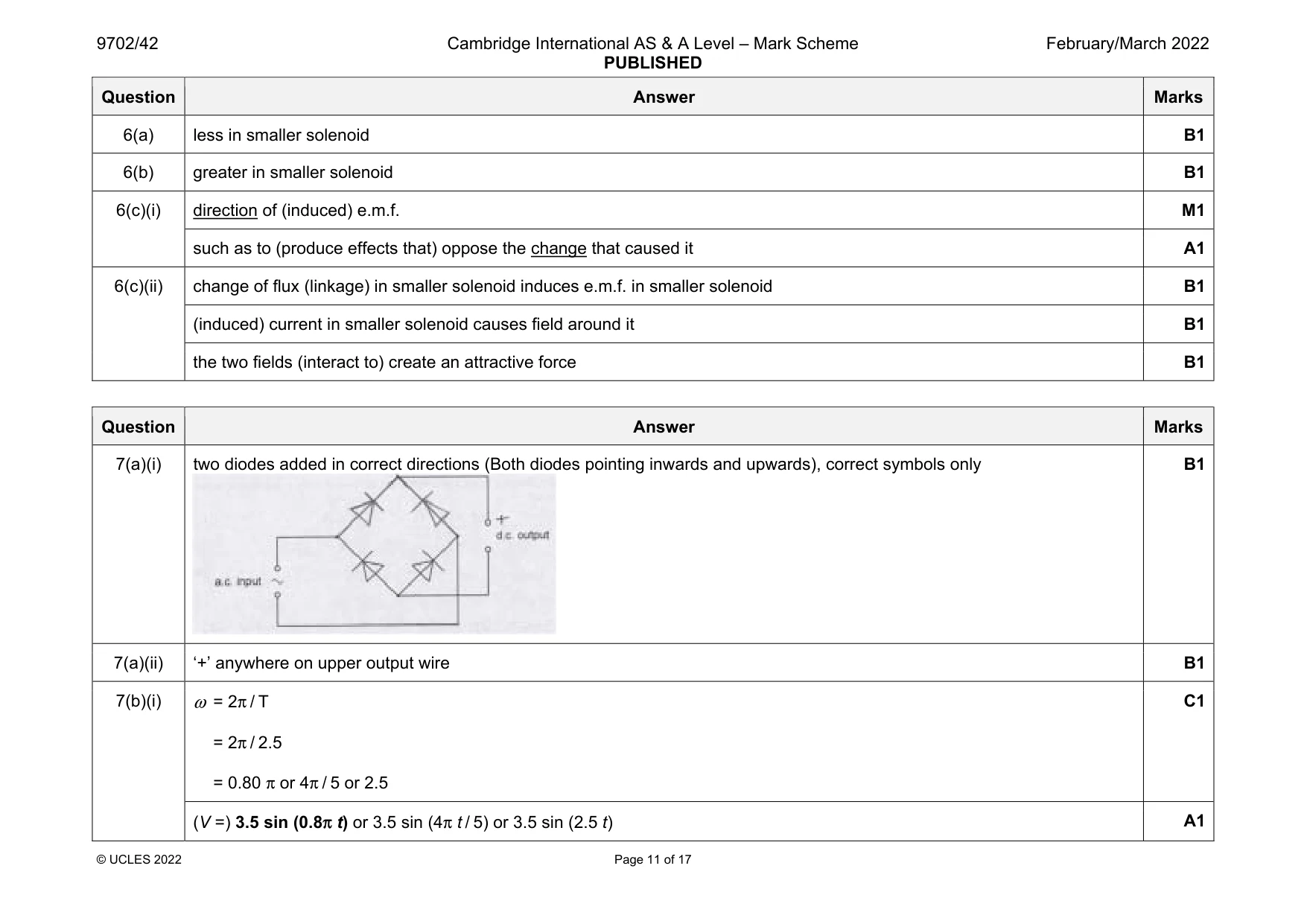
7 (a) Alternating current (a.c.) is converted into direct current (d.c.) using a full-wave rectification circuit. Part of the diagram of this circuit is shown in Fig. 7.1. d.c. output a.c. input Fig. 7.1 (i) Complete the circuit in Fig. 7.1 by adding the necessary components in the gaps. [1] (ii) On Fig. 7.1 mark with a + the positive output terminal of the rectifier. [1] (b) The output voltage V of an a.c. power supply varies sinusoidally with time t as shown in Fig. 7.2. 4 voltage / V 2 0 0 2 4 6 8 10 time / s –2 –4 Fig. 7.2 (i) Determine the equation for V in terms of t, where V is in volts and t is in seconds. V = ......................................................... [2] (ii) The supply is connected to a 12 Ω resistor. Calculate the mean power dissipated in the resistor. mean power = ..................................................... W [2] [Total: 6]
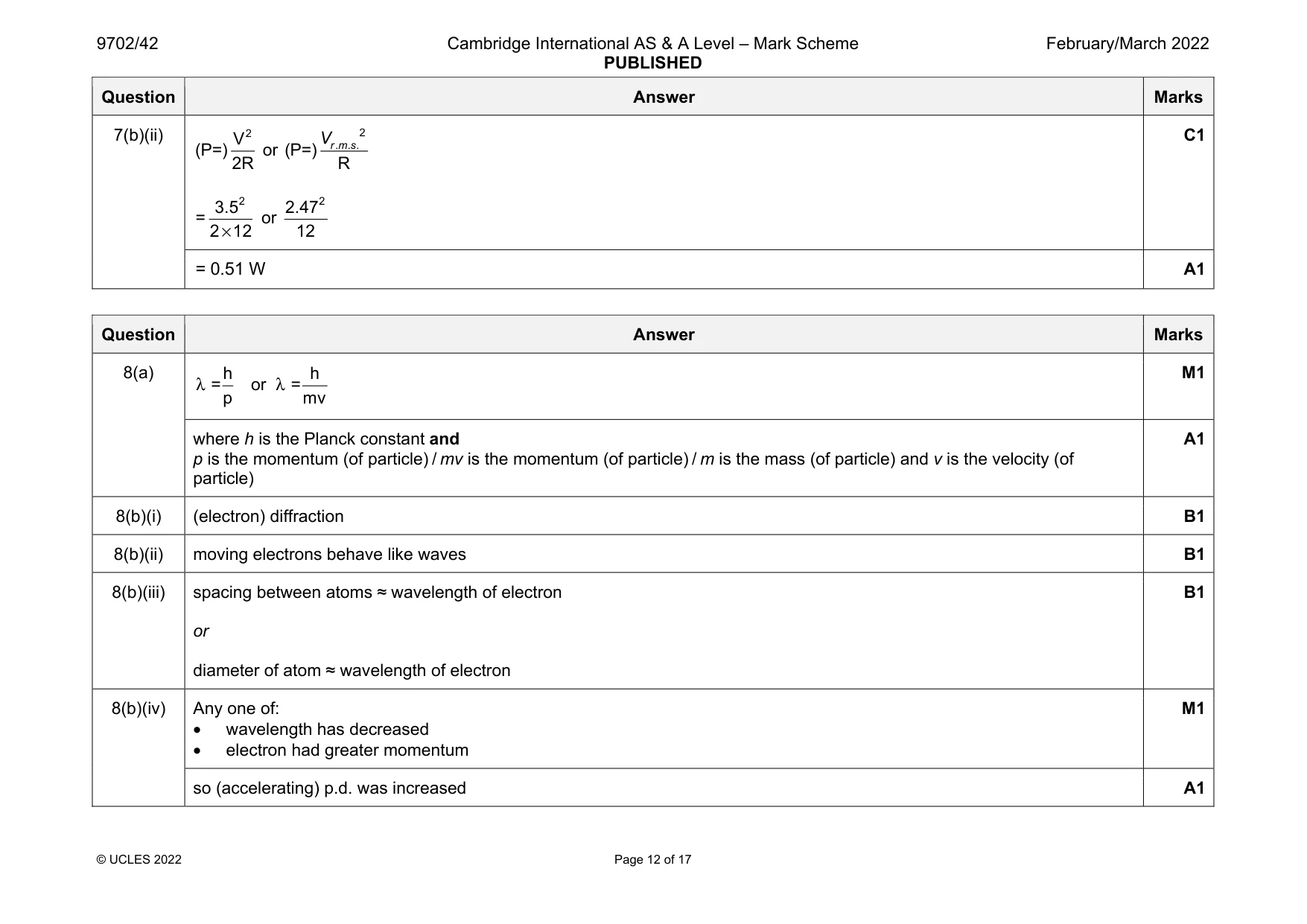
Mark scheme: 7(a)(i) two diodes added in correct directions (Both diodes pointing inwards and upwards), correct symbols only B1 7(a)(ii) ‘+’ anywhere on upper output wire B1 7(b)(i) ω = 2π / T = 2π / 2.5 = 0.80 π or 4π / 5 or 2.5 C1 (V =) 3.5 sin (0.8π t) or 3.5 sin (4π t / 5) or 3.5 sin (2.5 t) A1 Question Answer Marks 7(b)(ii) 2 V (P=) 2R or 2 . . . (P=) R r m s V 2 3.5 = 2 12 × or 2 2.47 12 C1 = 0.51 W A1
Q8 · State the formula for the de Broglie wavelength λ of a moving particle
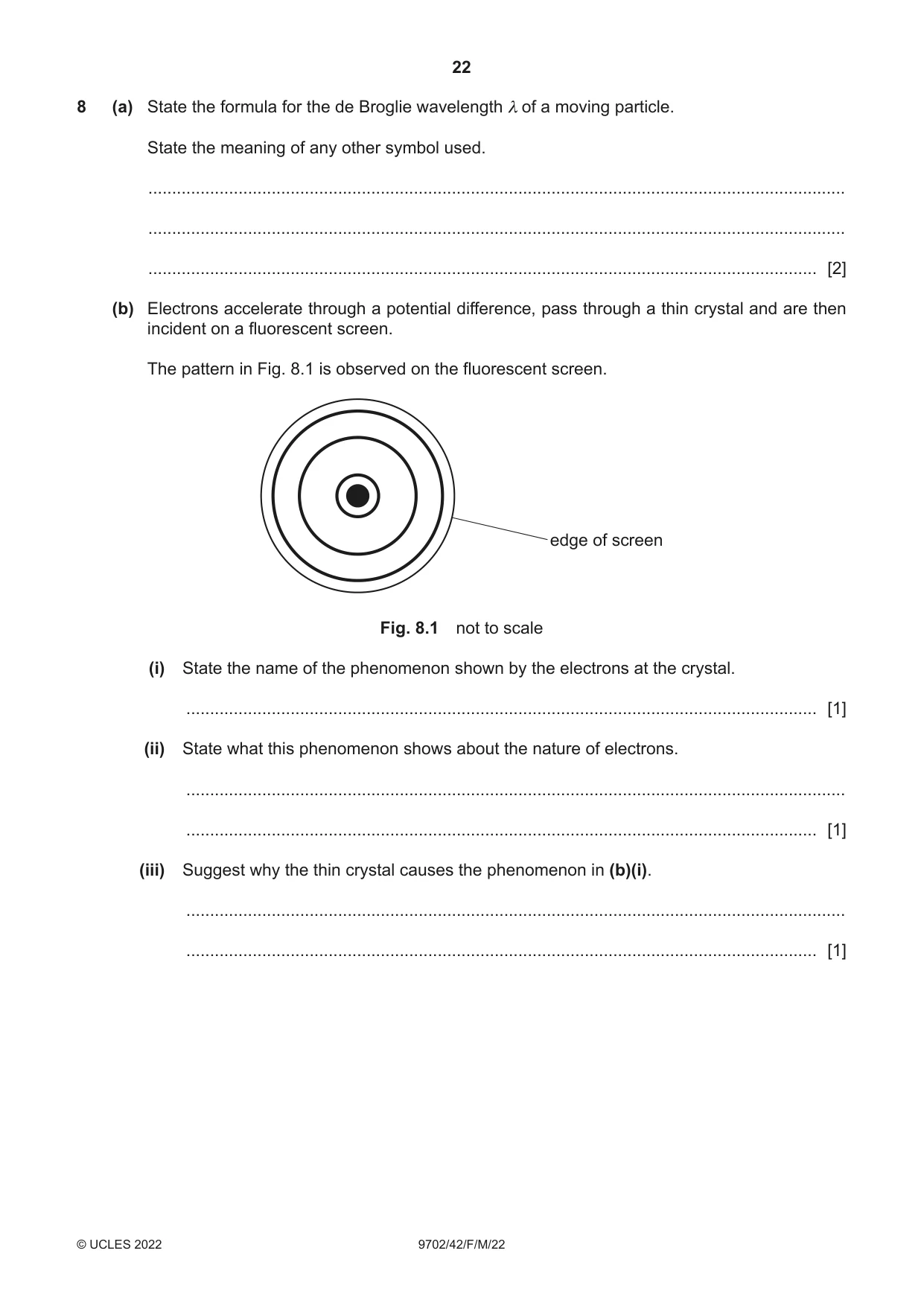
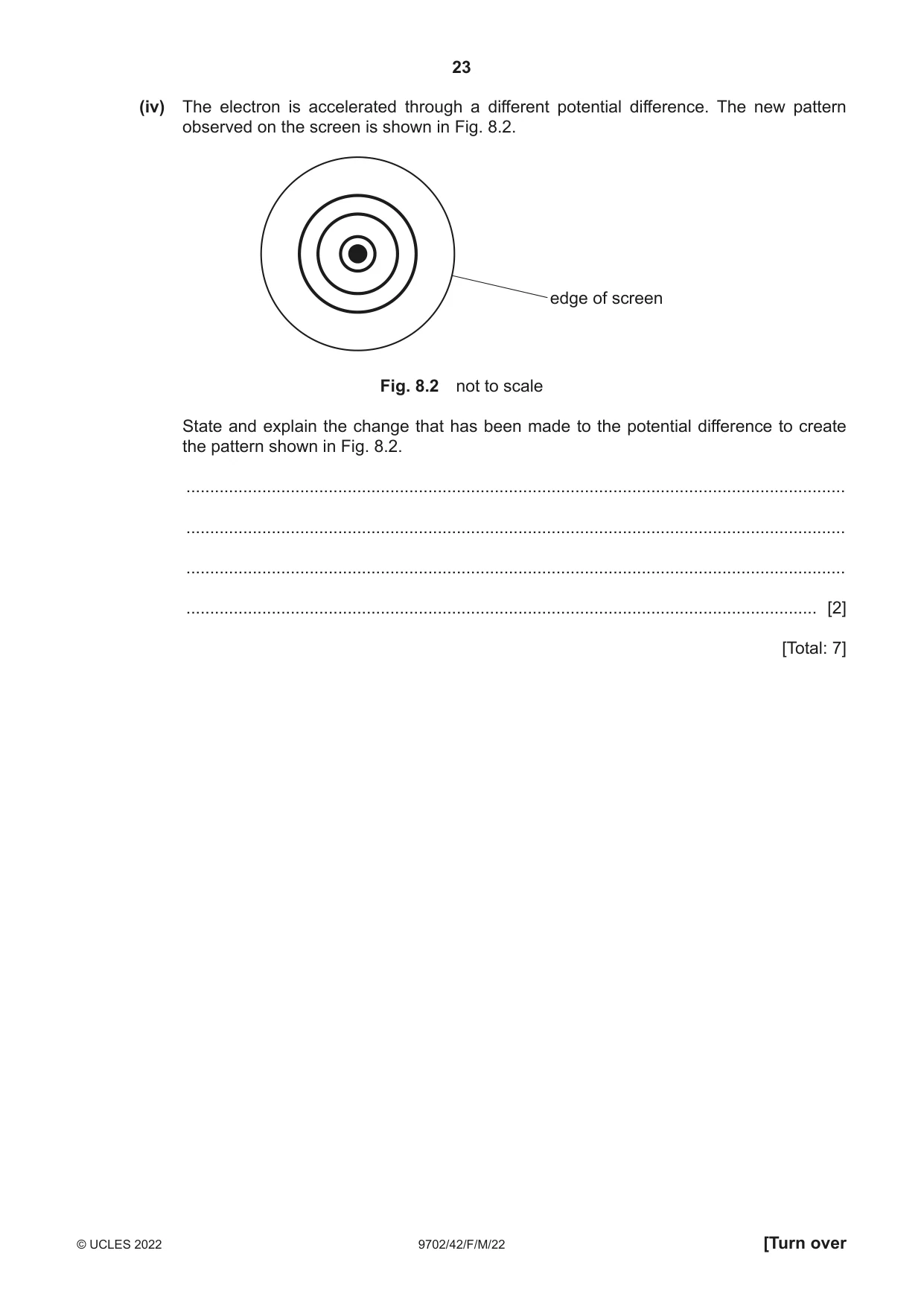
8 (a) State the formula for the de Broglie wavelength λ of a moving particle. State the meaning of any other symbol used. ................................................................................................................................................... ................................................................................................................................................... ............................................................................................................................................. [2] (b) Electrons accelerate through a potential difference, pass through a thin crystal and are then incident on a fluorescent screen. The pattern in Fig. 8.1 is observed on the fluorescent screen. edge of screen Fig. 8.1 not to scale (i) State the name of the phenomenon shown by the electrons at the crystal. ..................................................................................................................................... [1] (ii) State what this phenomenon shows about the nature of electrons. ........................................................................................................................................... ..................................................................................................................................... [1] (iii) Suggest why the thin crystal causes the phenomenon in (b)(i). ........................................................................................................................................... ..................................................................................................................................... [1] (iv) The electron is accelerated through a different potential difference. The new pattern observed on the screen is shown in Fig. 8.2. edge of screen Fig. 8.2 not to scale State and explain the change that has been made to the potential difference to create the pattern shown in Fig. 8.2. ........................................................................................................................................... ........................................................................................................................................... ........................................................................................................................................... ..................................................................................................................................... [2] [Total: 7]
Mark scheme: 8(a) h h = or = p mv λ λ M1 where h is the Planck constant and p is the momentum (of particle) / mv is the momentum (of particle) / m is the mass (of particle) and v is the velocity (of particle) A1 8(b)(i) (electron) diffraction B1 8(b)(ii) moving electrons behave like waves B1 8(b)(iii) spacing between atoms ≈ wavelength of electron or diameter of atom ≈ wavelength of electron B1 8(b)(iv) Any one of: • wavelength has decreased • electron had greater momentum M1 so (accelerating) p.d. was increased A1
Q9 · Polonium-211 (21184Po) decays by alpha emission to form a stable isotope of lead (Pb)
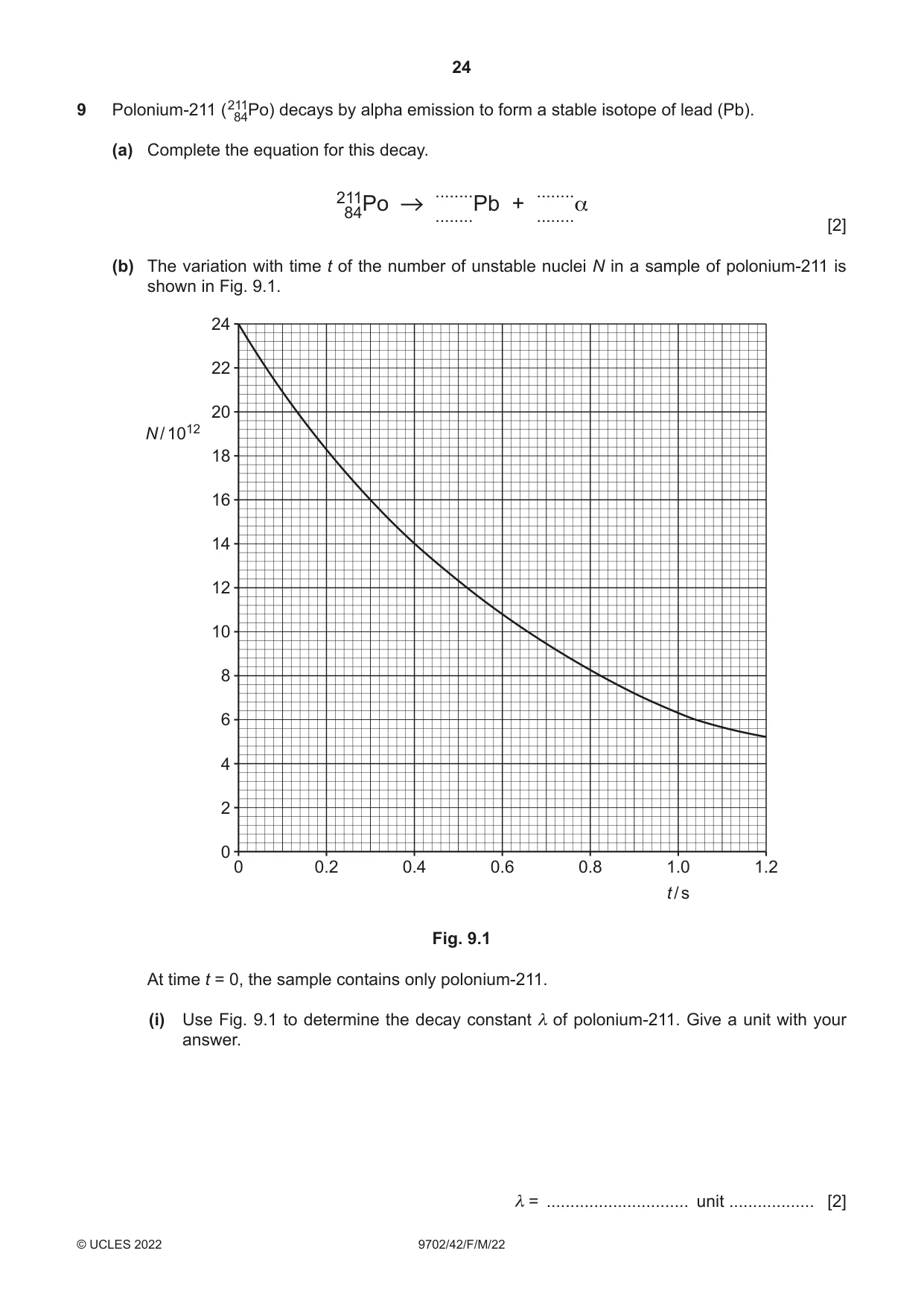
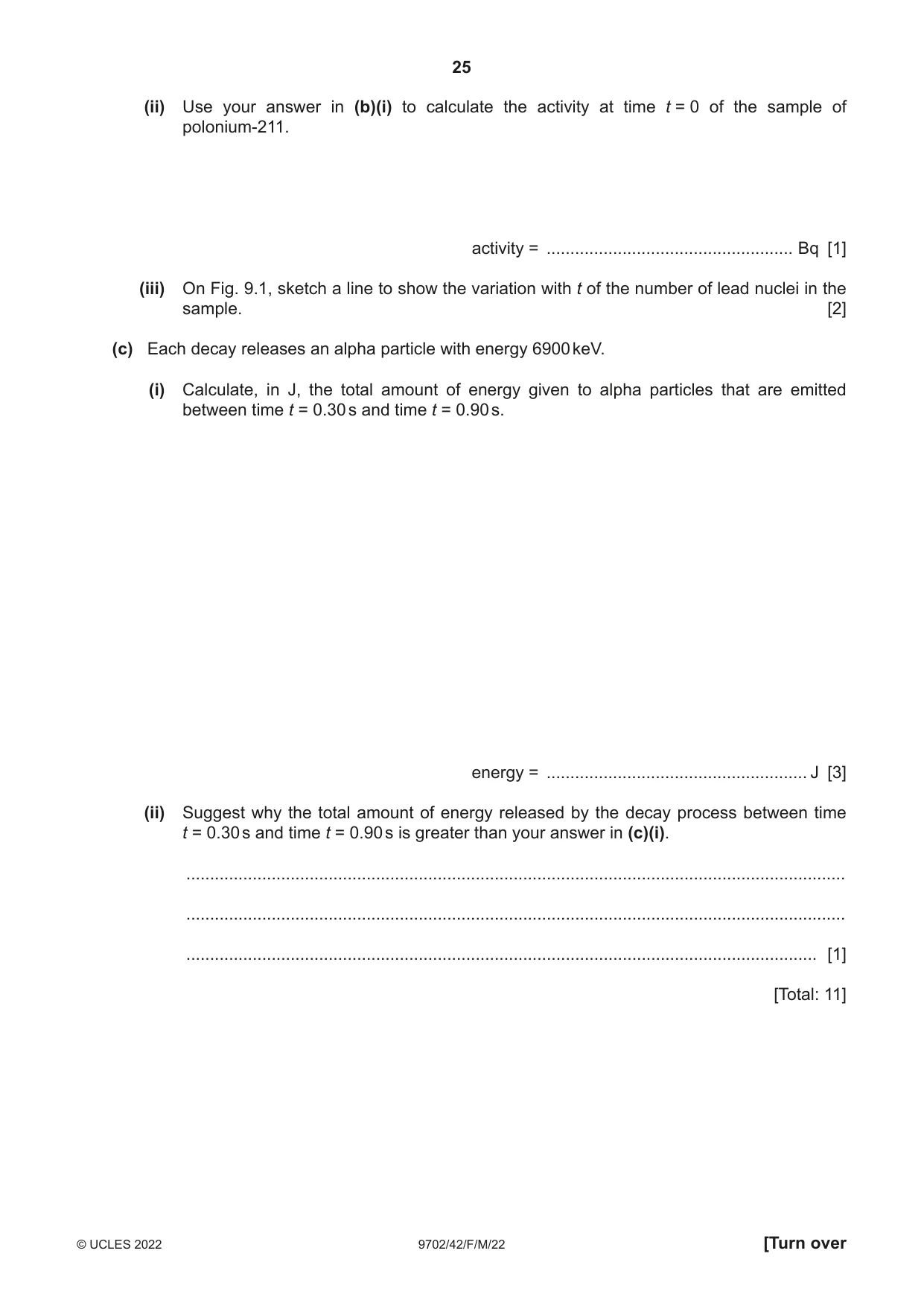
9 Polonium-211 (21184Po) decays by alpha emission to form a stable isotope of lead (Pb). (a) Complete the equation for this decay. ........ ........ 21184Po ........Pb + ........α [2] (b) The variation with time t of the number of unstable nuclei N in a sample of polonium-211 is shown in Fig. 9.1. 24 22 20 N / 1012 18 16 14 12 10 8 6 4 2 0 0 0.2 0.4 0.6 0.8 1.0 1.2 t / s Fig. 9.1 At time t = 0, the sample contains only polonium-211. (i) Use Fig. 9.1 to determine the decay constant λ of polonium-211. Give a unit with your answer. λ = .............................. unit .................. [2] (ii) Use your answer in (b)(i) to calculate the activity at time t = 0 of the sample of polonium-211. activity = .................................................... Bq [1] (iii) On Fig. 9.1, sketch a line to show the variation with t of the number of lead nuclei in the sample. [2] (c) Each decay releases an alpha particle with energy 6900 keV. (i) Calculate, in J, the total amount of energy given to alpha particles that are emitted between time t = 0.30 s and time t = 0.90 s. energy = ....................................................... J [3] (ii) Suggest why the total amount of energy released by the decay process between time t = 0.30 s and time t = 0.90 s is greater than your answer in (c)(i). ........................................................................................................................................... ........................................................................................................................................... ..................................................................................................................................... [1] [Total: 11]
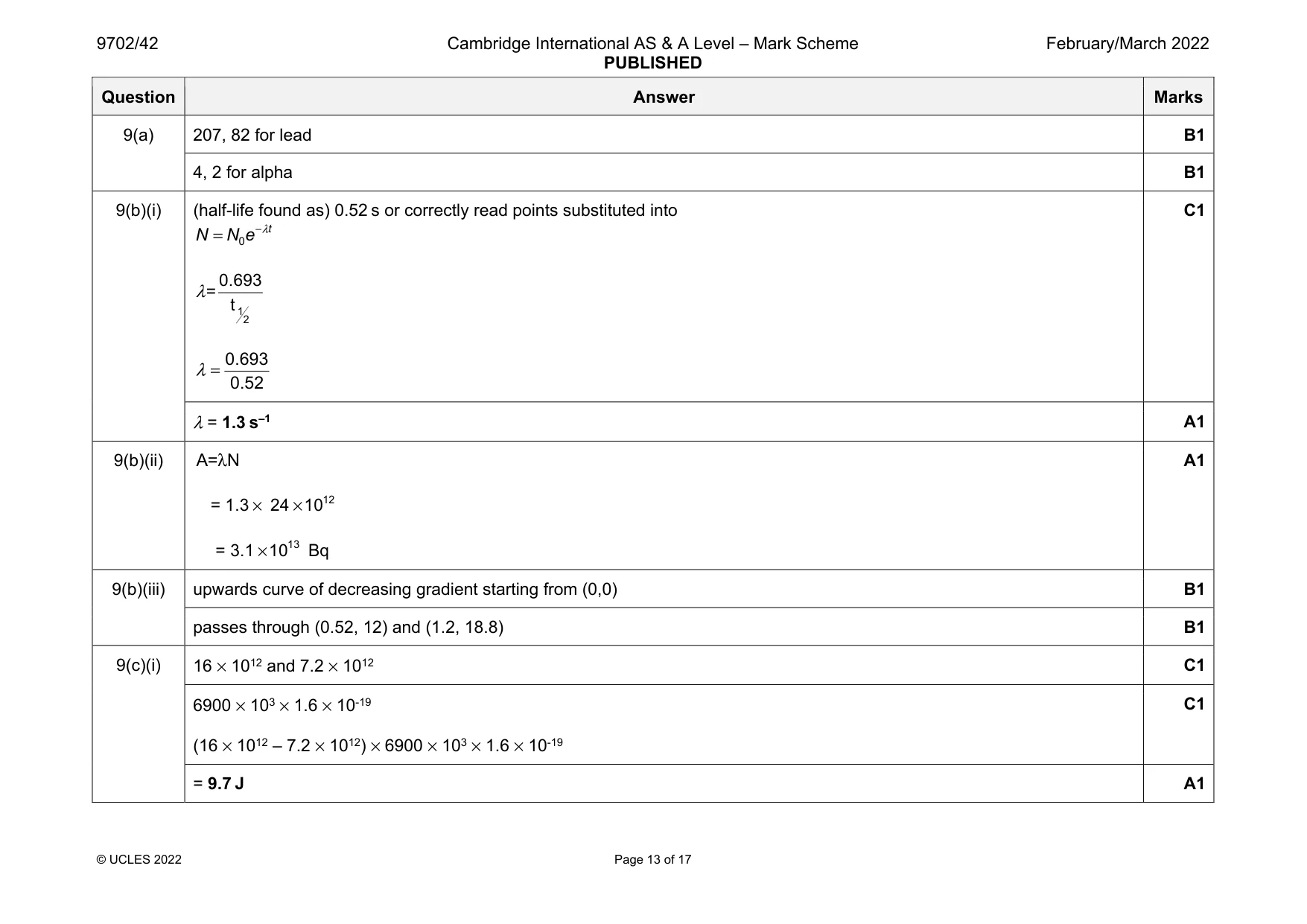
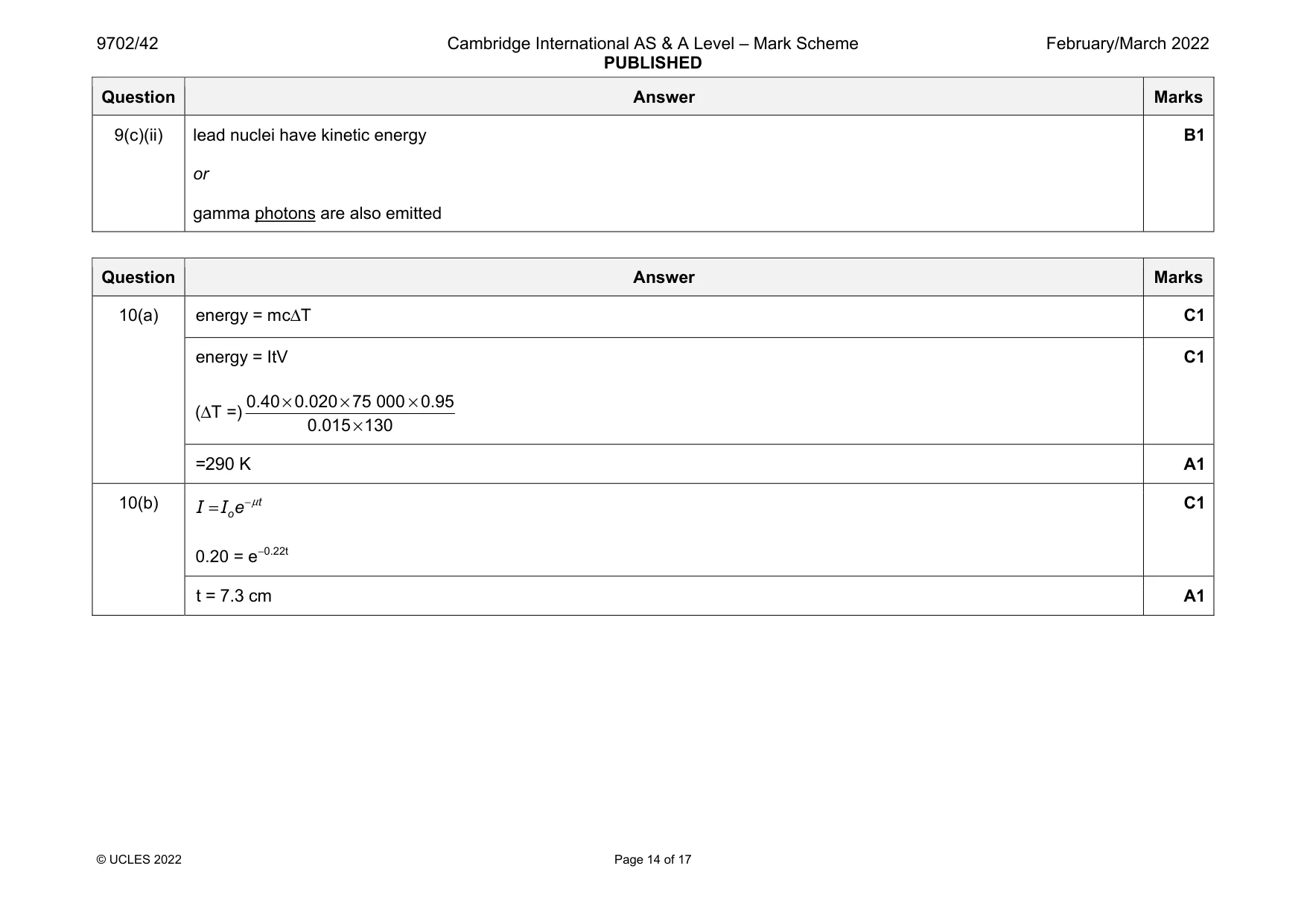
Mark scheme: 9(a) 207, 82 for lead B1 4, 2 for alpha B1 9(b)(i) (half-life found as) 0.52 s or correctly read points substituted into 0 t N N e λ − = 12 0.693 = t λ 0.693 0.52 λ = C1 λ = 1.3 s–1 A1 9(b)(ii) A= N λ 12 = 1.3 24 10 × × 13 = 3.1 10 × Bq A1 9(b)(iii) upwards curve of decreasing gradient starting from (0,0) B1 passes through (0.52, 12) and (1.2, 18.8) B1 9(c)(i) 16 × 1012 and 7.2 × 10¹² C1 6900 × 103 × 1.6 × 10-19 (16 × 1012 – 7.2 × 1012) × 6900 × 103 × 1.6 × 10-19 C1 = 9.7 J A1 Question Answer Marks 9(c)(ii) lead nuclei have kinetic energy or gamma photons are also emitted B1
Q10 · In an X-ray tube, electrons are accelerated through a potential difference of 75 kV
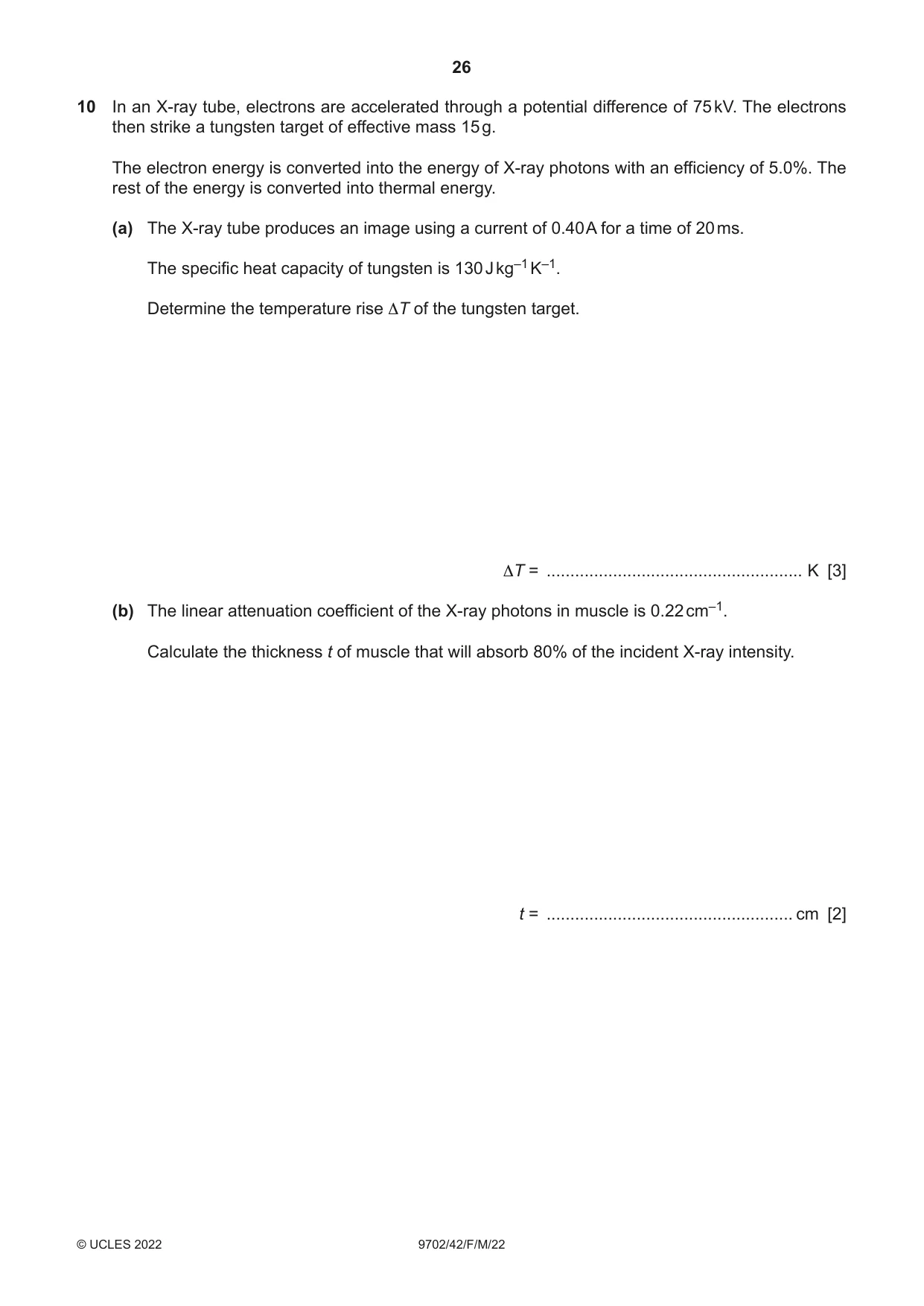
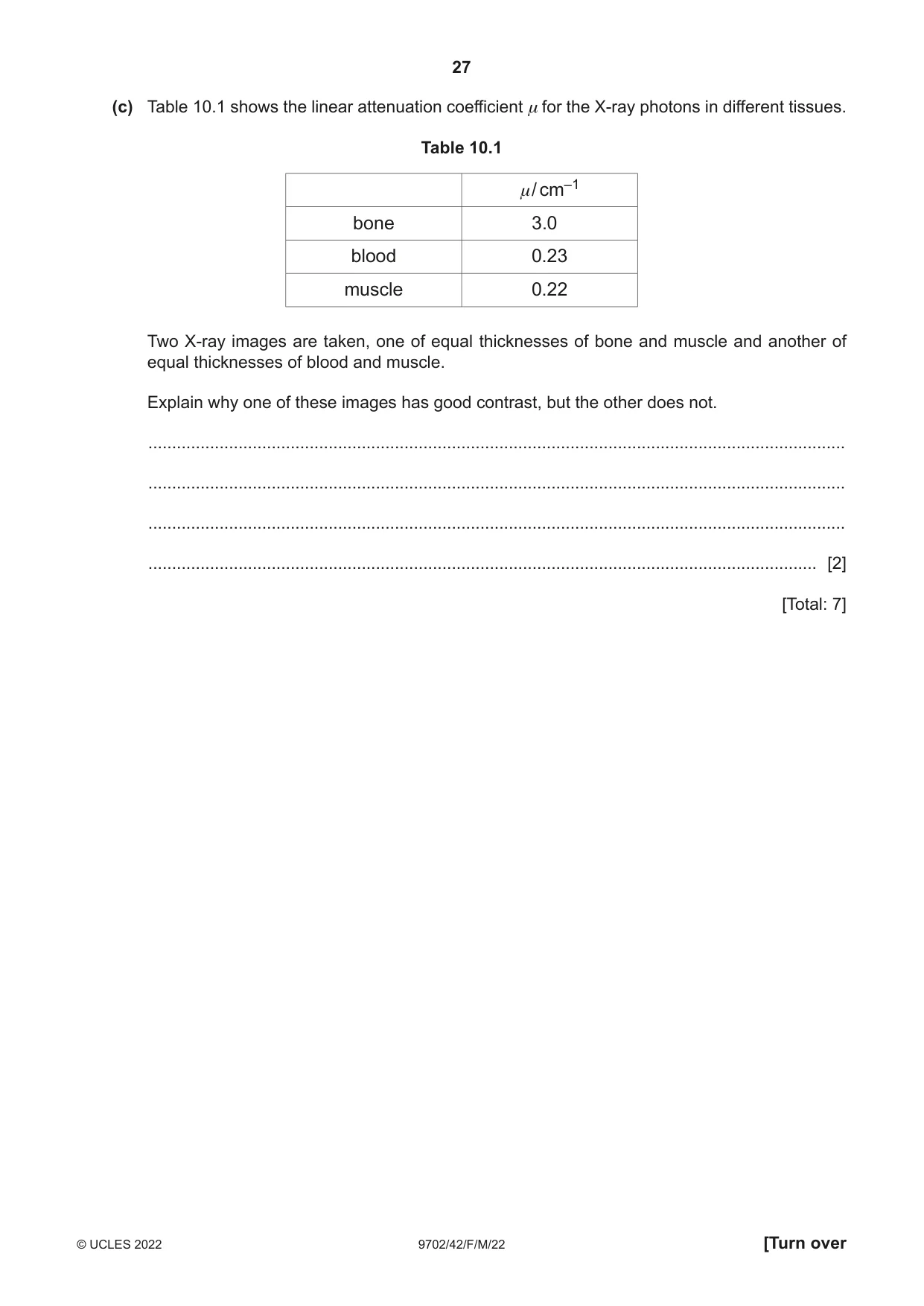
10 In an X-ray tube, electrons are accelerated through a potential difference of 75 kV. The electrons then strike a tungsten target of effective mass 15 g. The electron energy is converted into the energy of X-ray photons with an efficiency of 5.0%. The rest of the energy is converted into thermal energy. (a) The X-ray tube produces an image using a current of 0.40 A for a time of 20 ms. The specific heat capacity of tungsten is 130 J kg–1 K–1. Determine the temperature rise ΔT of the tungsten target. ΔT = ...................................................... K [3] (b) The linear attenuation coefficient of the X-ray photons in muscle is 0.22 cm–1. Calculate the thickness t of muscle that will absorb 80% of the incident X-ray intensity. t = .................................................... cm [2] (c) Table 10.1 shows the linear attenuation coefficient μ for the X-ray photons in different tissues. Table 10.1 μ/ cm–1 bone 3.0 blood 0.23 muscle 0.22 Two X-ray images are taken, one of equal thicknesses of bone and muscle and another of equal thicknesses of blood and muscle. Explain why one of these images has good contrast, but the other does not. ................................................................................................................................................... ................................................................................................................................................... ................................................................................................................................................... ............................................................................................................................................. [2] [Total: 7]
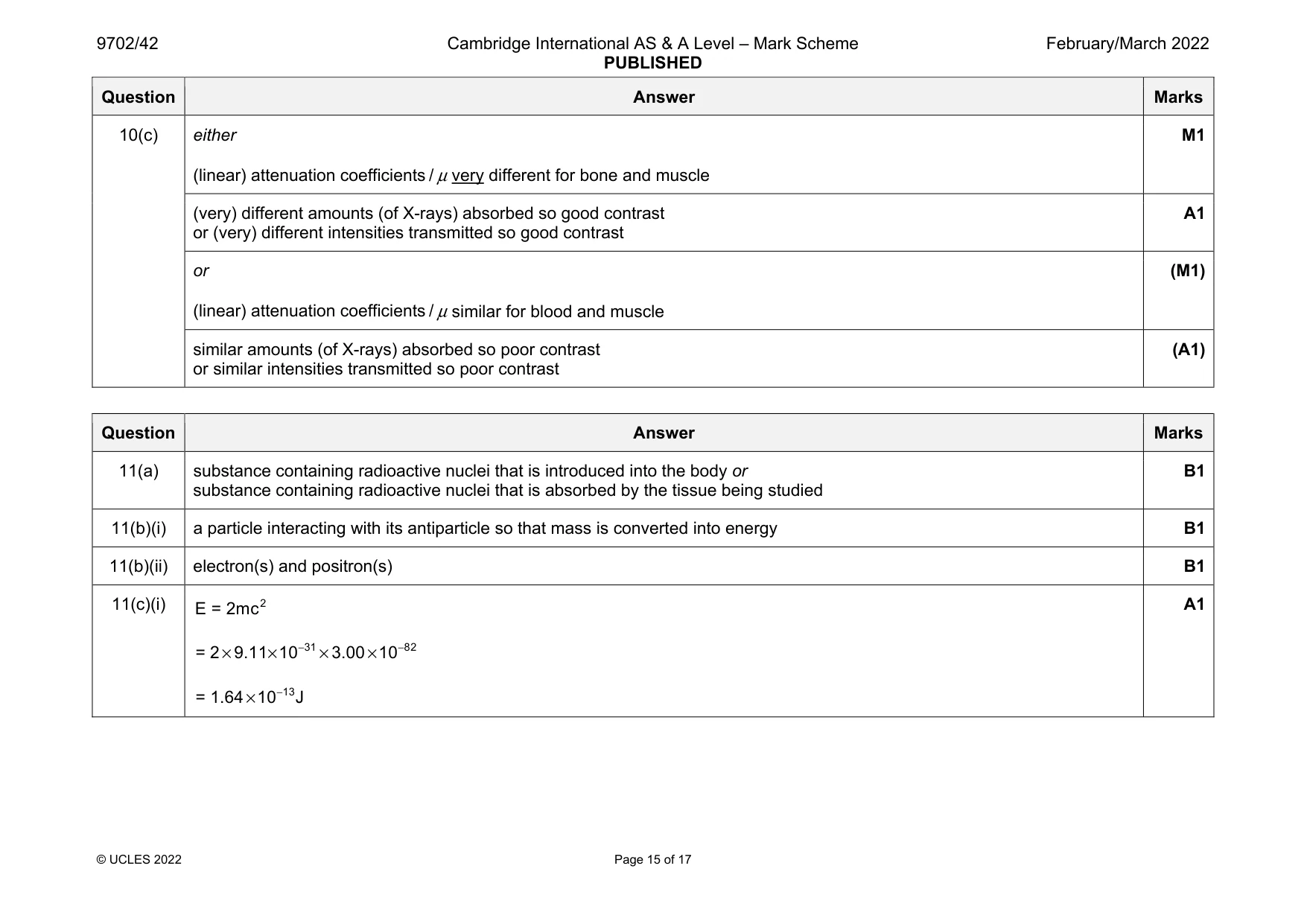
Mark scheme: 10(a) C1 energy = ItV 0.40 0.020 75 000 0.95 ( T =) 0.015 130 × × × Δ × C1 =290 K A1 10(b) t oe μ − = I I 0.22t 0.20 = e− C1 t = 7.3 cm A1 Question Answer Marks 10(c) either (linear) attenuation coefficients / μ very different for bone and muscle M1 (very) different amounts (of X-rays) absorbed so good contrast or (very) different intensities transmitted so good contrast A1 or (linear) attenuation coefficients / μ similar for blood and muscle (M1) similar amounts (of X-rays) absorbed so poor contrast or similar intensities transmitted so poor contrast (A1)
Q11 · Positron emission tomography (PET scanning) obtains diagnostic information from a person
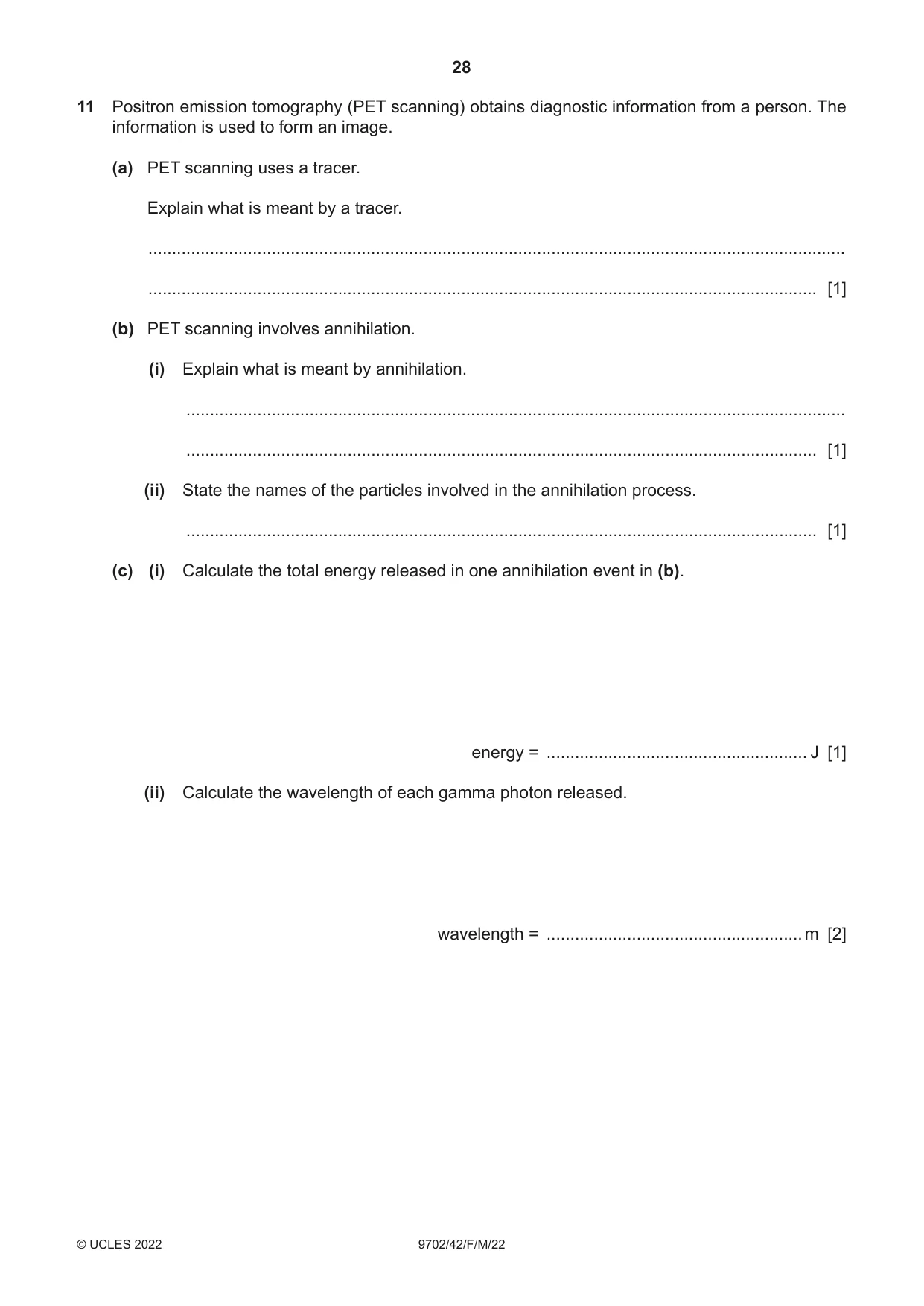
11 Positron emission tomography (PET scanning) obtains diagnostic information from a person. The information is used to form an image. (a) PET scanning uses a tracer. Explain what is meant by a tracer. ................................................................................................................................................... ............................................................................................................................................. [1] (b) PET scanning involves annihilation. (i) Explain what is meant by annihilation. ........................................................................................................................................... ..................................................................................................................................... [1] (ii) State the names of the particles involved in the annihilation process. ..................................................................................................................................... [1] (c) (i) Calculate the total energy released in one annihilation event in (b). energy = ....................................................... J [1] (ii) Calculate the wavelength of each gamma photon released. wavelength = ...................................................... m [2] (d) Explain how the gamma photons are used to produce an image. ................................................................................................................................................... ................................................................................................................................................... ................................................................................................................................................... ................................................................................................................................................... ................................................................................................................................................... ............................................................................................................................................. [3] [Total: 9]
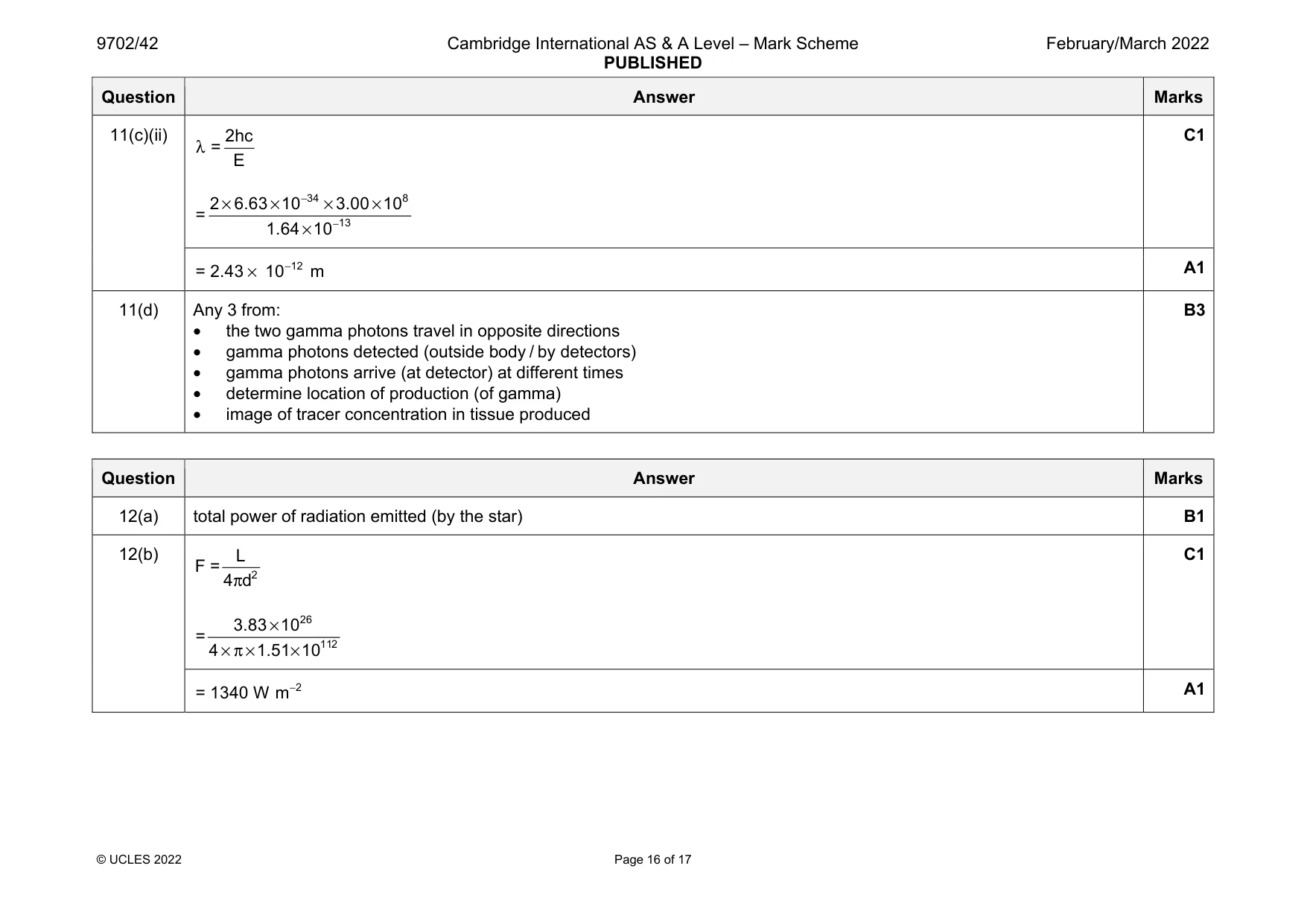
Mark scheme: 11(a) substance containing radioactive nuclei that is absorbed by the tissue being studied B1 11(b)(i) a particle interacting with its antiparticle so that mass is converted into energy B1 11(b)(ii) electron(s) and positron(s) B1 11(c)(i) 2 E = 2mc 31 82 = 2 9.11 10 3.00 10 − − × × × × 13 = 1.64 10 J − × A1 Question Answer Marks 11(c)(ii) 2hc = E λ 34 8 13 2 6.63 10 3.00 10 = 1.64 10 − − × × × × × C1 12 = 2.43 10 m − × A1 11(d) Any 3 from: • the two gamma photons travel in opposite directions • gamma photons detected (outside body / by detectors) • gamma photons arrive (at detector) at different times • determine location of production (of gamma) • image of tracer concentration in tissue produced B3
Q12 · State what is meant by luminosity of a star
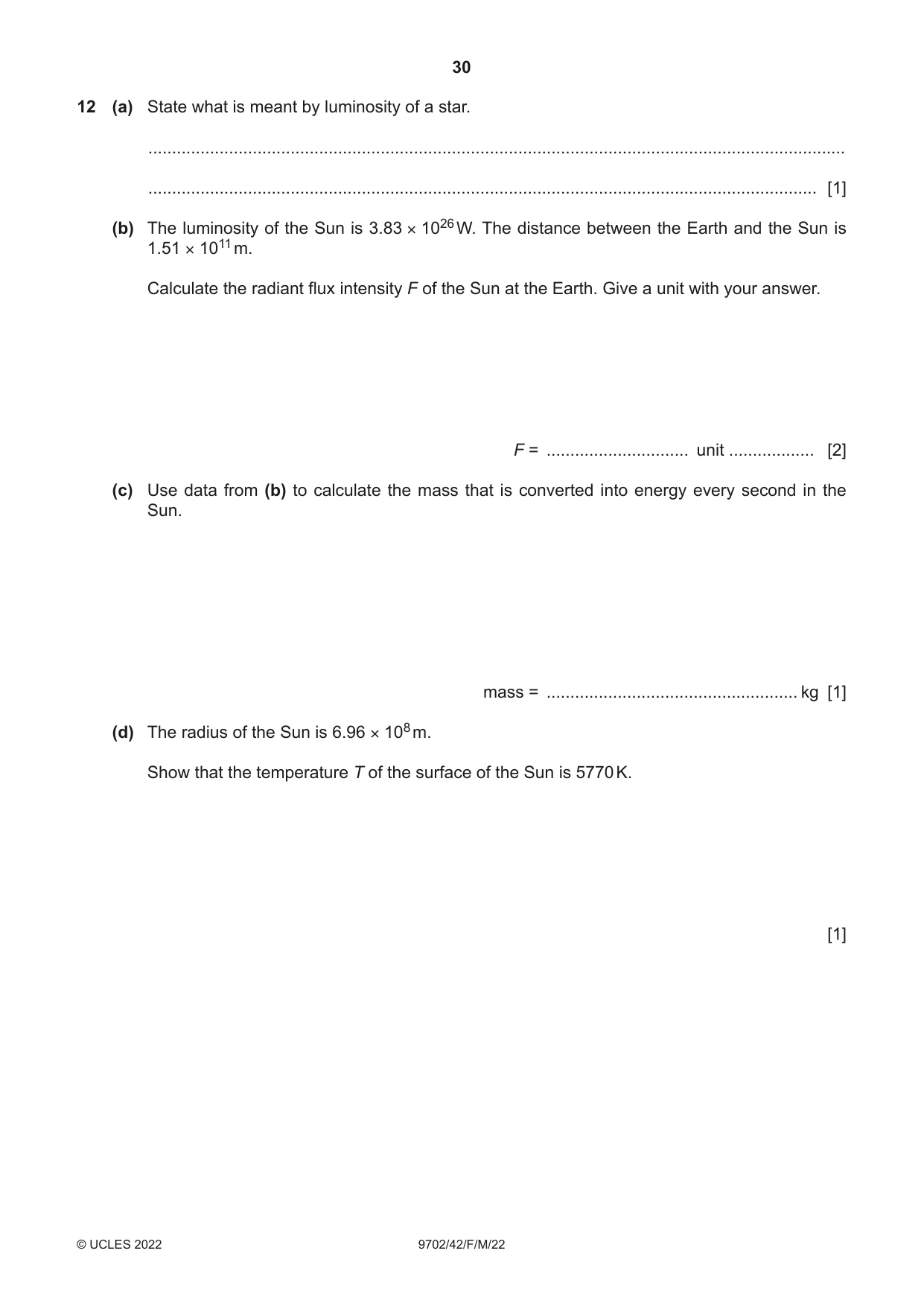
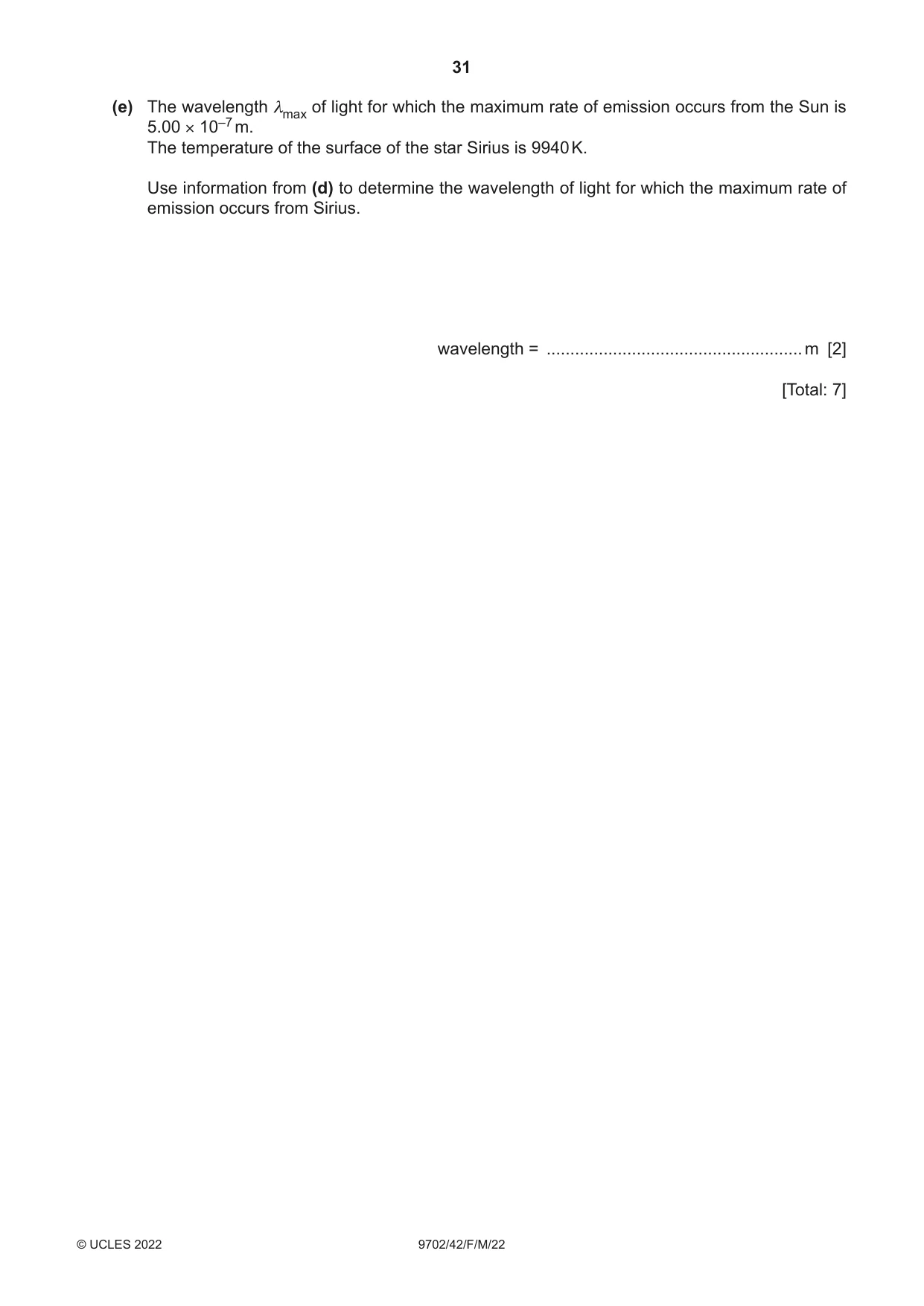
12 (a) State what is meant by luminosity of a star. ................................................................................................................................................... ............................................................................................................................................. [1] (b) The luminosity of the Sun is 3.83 × 1026 W. The distance between the Earth and the Sun is 1.51 × 10¹¹ m. Calculate the radiant flux intensity F of the Sun at the Earth. Give a unit with your answer. F = .............................. unit .................. [2] (c) Use data from (b) to calculate the mass that is converted into energy every second in the Sun. mass = ..................................................... kg [1] (d) The radius of the Sun is 6.96 × 10⁸ m. Show that the temperature T of the surface of the Sun is 5770 K. [1] (e) The wavelength λmax of light for which the maximum rate of emission occurs from the Sun is 5.00 × 10⁻⁷ m. The temperature of the surface of the star Sirius is 9940 K. Use information from (d) to determine the wavelength of light for which the maximum rate of emission occurs from Sirius. wavelength = ...................................................... m [2] [Total: 7]
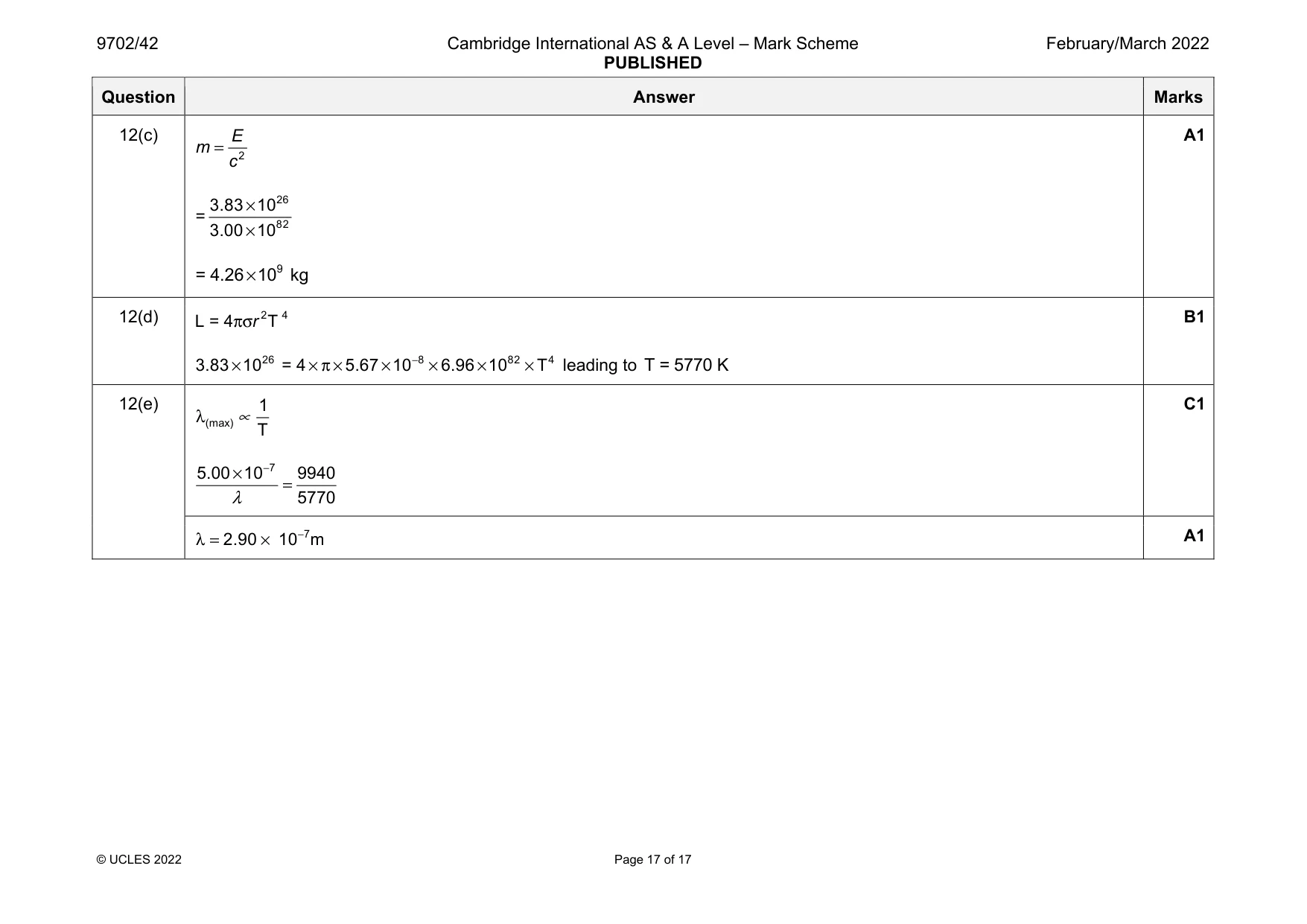
Mark scheme: 12(a) total power of radiation emitted (by the star) B1 12(b) 2 L F = 4 d π 26 112 3.83 10 = 4 1.51 10 × × π × × C1 2 = 1340 W m− A1 Question Answer Marks 12(c) 2 E m c = 26 82 3.83 10 = 3.00 10 × × 9 = 4.26 10 kg × A1 12(d) 2 4 L = 4 T r πσ 26 8 82 4 3.83 10 = 4 5.67 10 6.96 10 T − × × π× × × × × leading to T = 5770 K B1 12(e) (max) 1 T ∝ λ 7 5.00 10 9940 5770 λ − × = C1 7 2.90 10 m − λ = × A1
What was in this paper
The subtopics covered by these 12 questions, and how many questions each got. Open one in a new tab to see every Cambridge question on it.
1Discharging a capacitor1Electric potential1Electromagnetic induction1Kinematics of uniform circular motion1PET scanning1Production and use of X-rays1Radioactive decay1Simple harmonic oscillations1Standard candles1The first law of thermodynamics1Wave-particle duality1What you needed in this session
Cambridge’s own grade thresholds for 2022 Feb/March, Paper 4 · Variant 2. A higher threshold means an easier paper — the bar moves with how the cohort did.