Cambridge A Level Physics 9702 — 2018 Oct/Nov Paper 4 · Variant 1
9702/41/O/N/18 · 12 questions · 100 marks · ≈113 min
The question paper and its mark scheme, free to read here and free to download. This is Cambridge’s own paper, exactly as it was sat.
Question paper28 pages
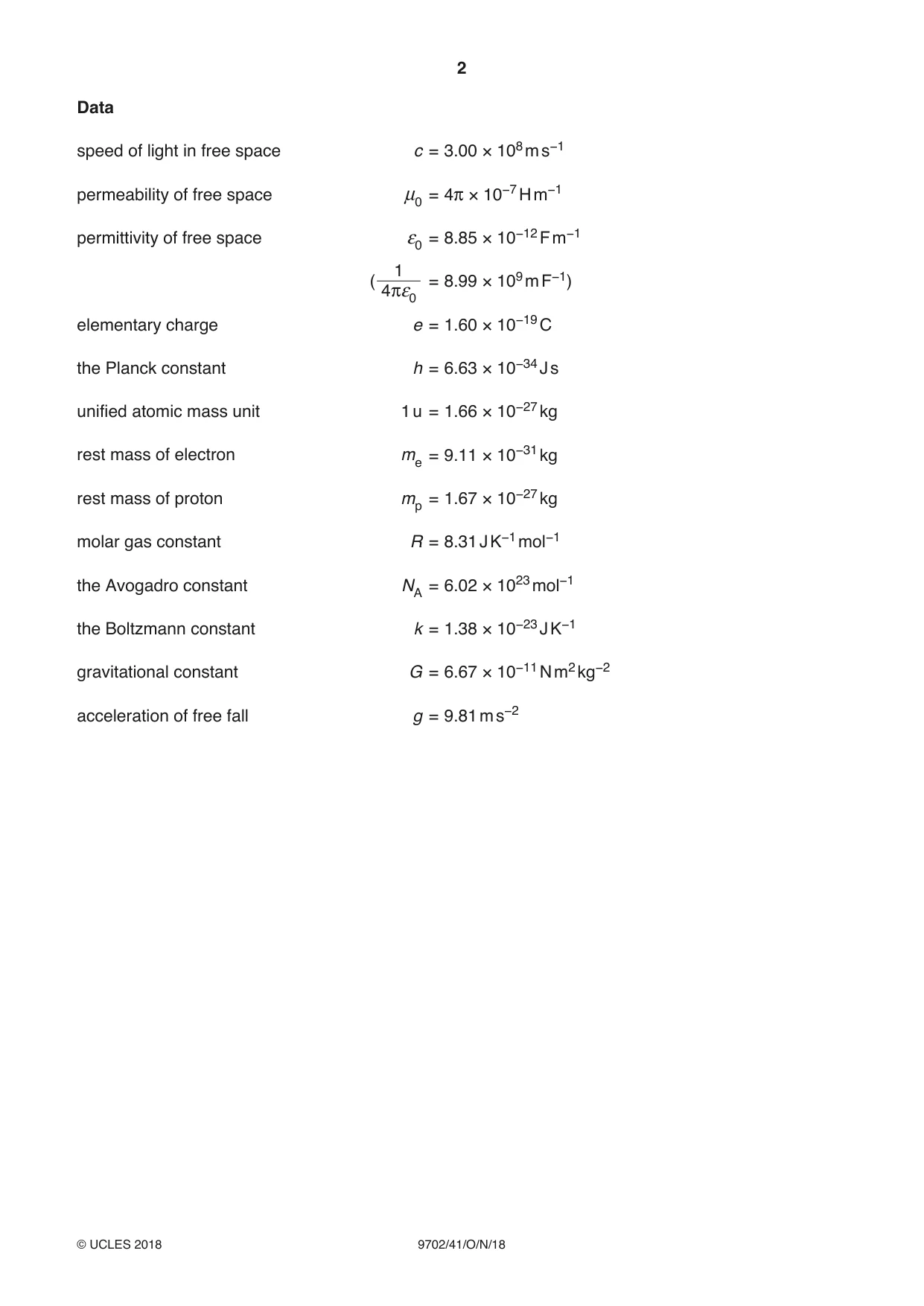
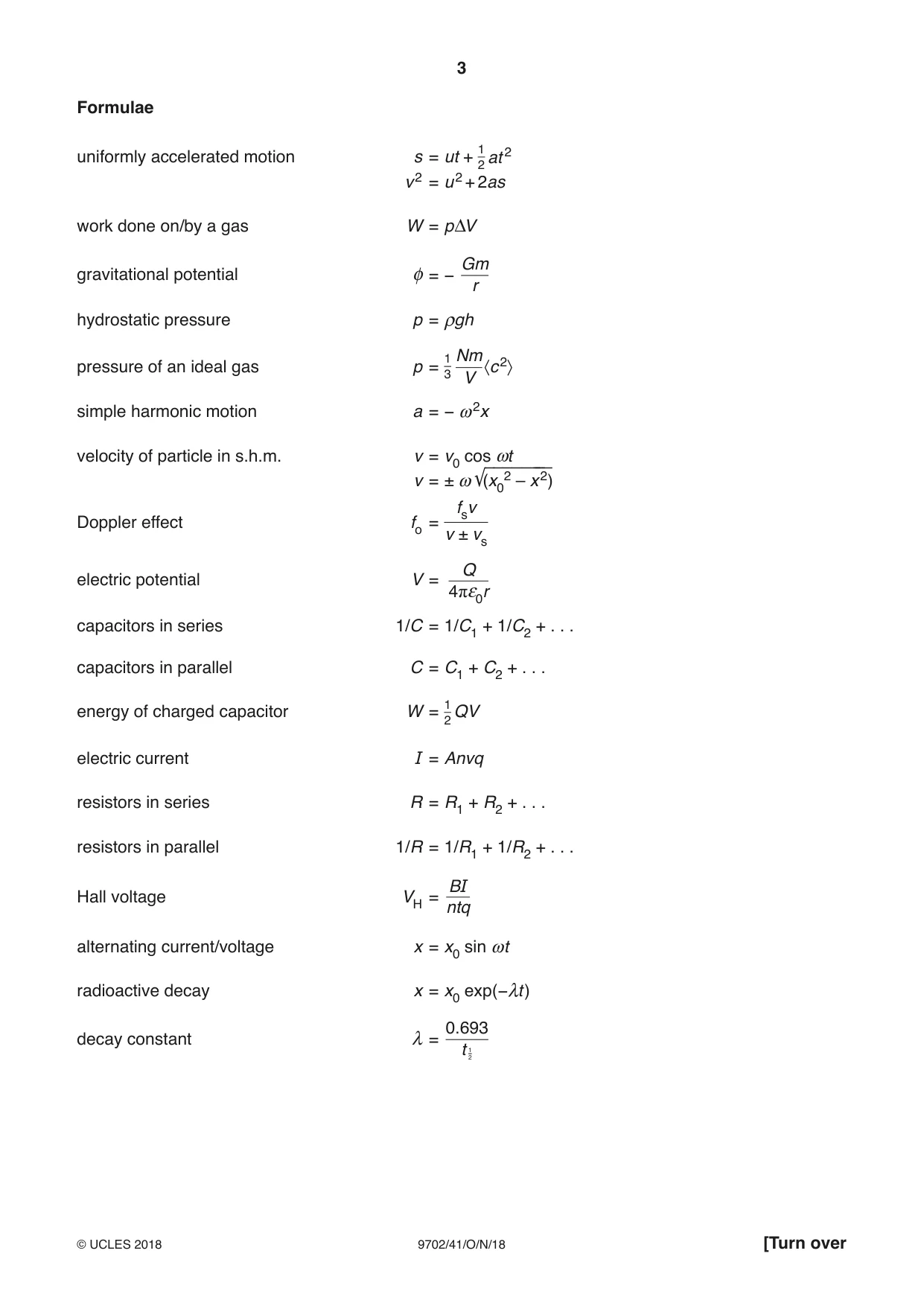



Mark scheme12 pages
Answers below. Sit the paper first if you are practising.
Questions as text
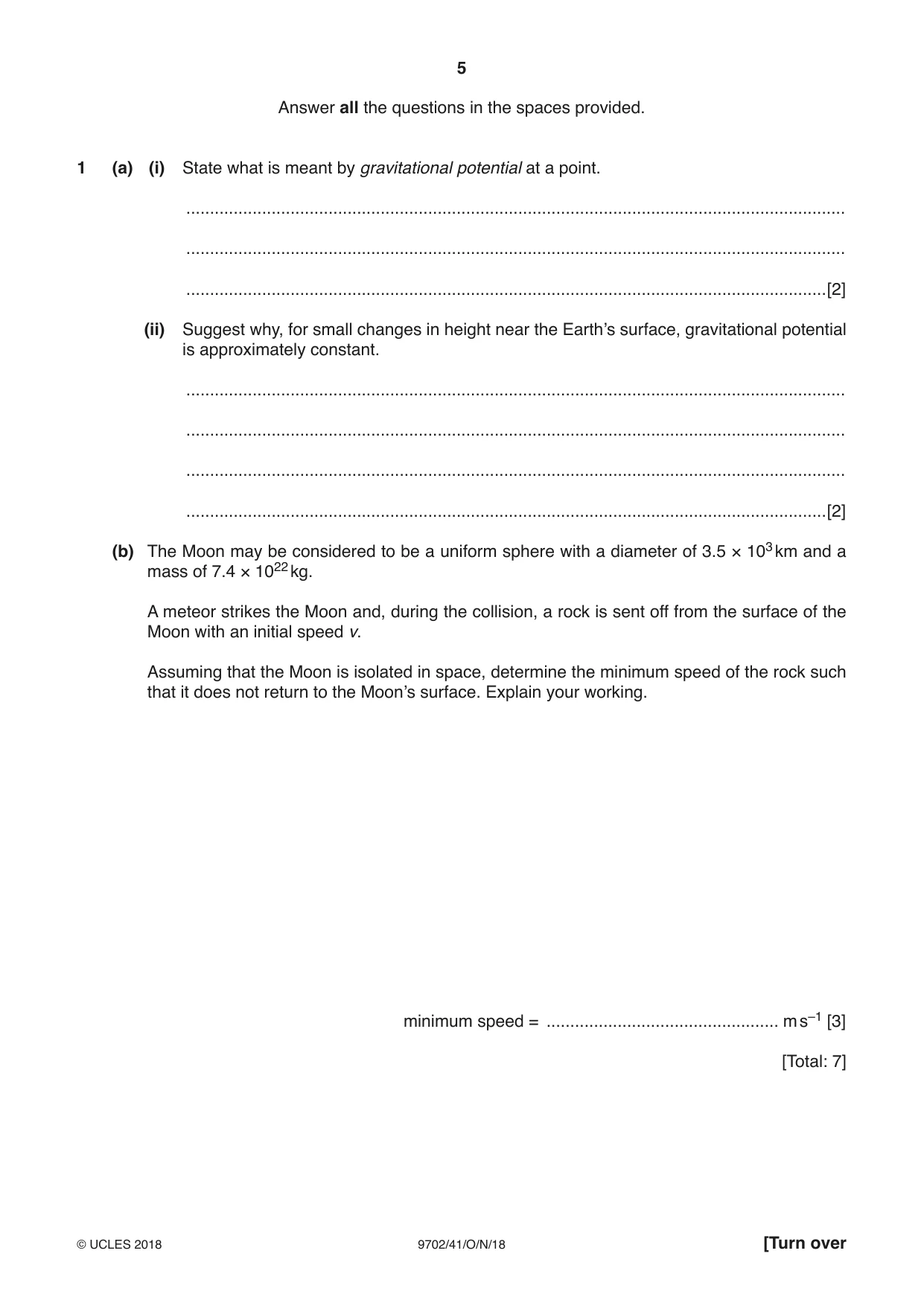
Q1 · State what is meant by gravitational potential at a point
1 (a) (i) State what is meant by gravitational potential at a point. ........................................................................................................................................... ........................................................................................................................................... .......................................................................................................................................[2] (ii) Suggest why, for small changes in height near the Earth’s surface, gravitational potential is approximately constant. ........................................................................................................................................... ........................................................................................................................................... ........................................................................................................................................... .......................................................................................................................................[2] (b) The Moon may be considered to be a uniform sphere with a diameter of 3.5 × 10³ km and a mass of 7.4 × 10²² kg. A meteor strikes the Moon and, during the collision, a rock is sent off from the surface of the Moon with an initial speed v. Assuming that the Moon is isolated in space, determine the minimum speed of the rock such that it does not return to the Moon’s surface. Explain your working. minimum speed = ................................................. m s–1 [3] [Total: 7]
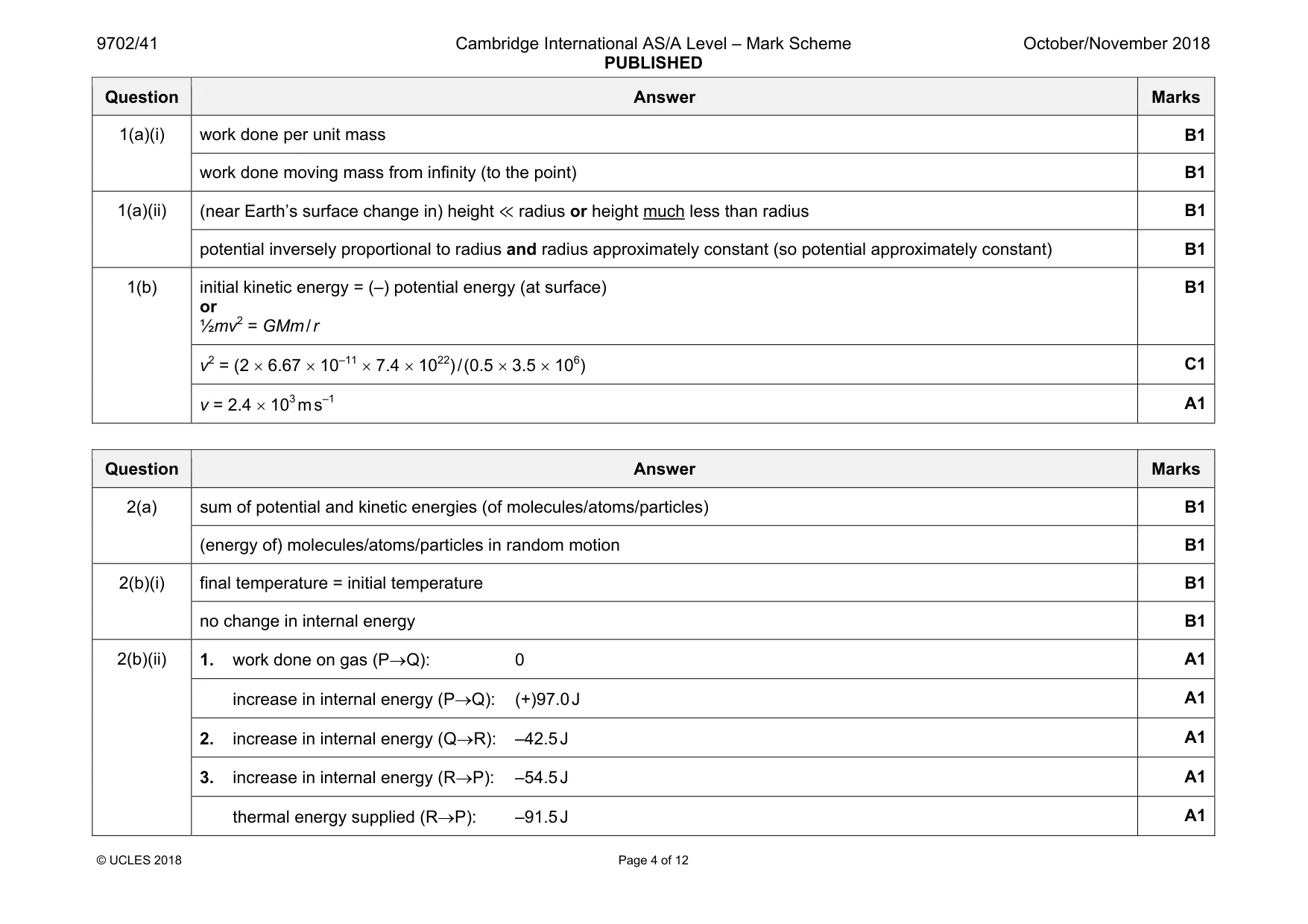
Mark scheme: 1(a)(i) work done per unit mass B1 work done moving mass from infinity (to the point) B1 1(a)(ii) (near Earth’s surface change in) height ≪ radius or height much less than radius B1 potential inversely proportional to radius and radius approximately constant (so potential approximately constant) B1 1(b) initial kinetic energy = (–) potential energy (at surface) or ½mv2 = GMm / r B1 v2 = (2 × 6.67 × 10–11 × 7.4 × 1022) / (0.5 × 3.5 × 106) C1 v = 2.4 × 10³ m s–1 A1
Q2 · State what is meant by the internal energy of a system
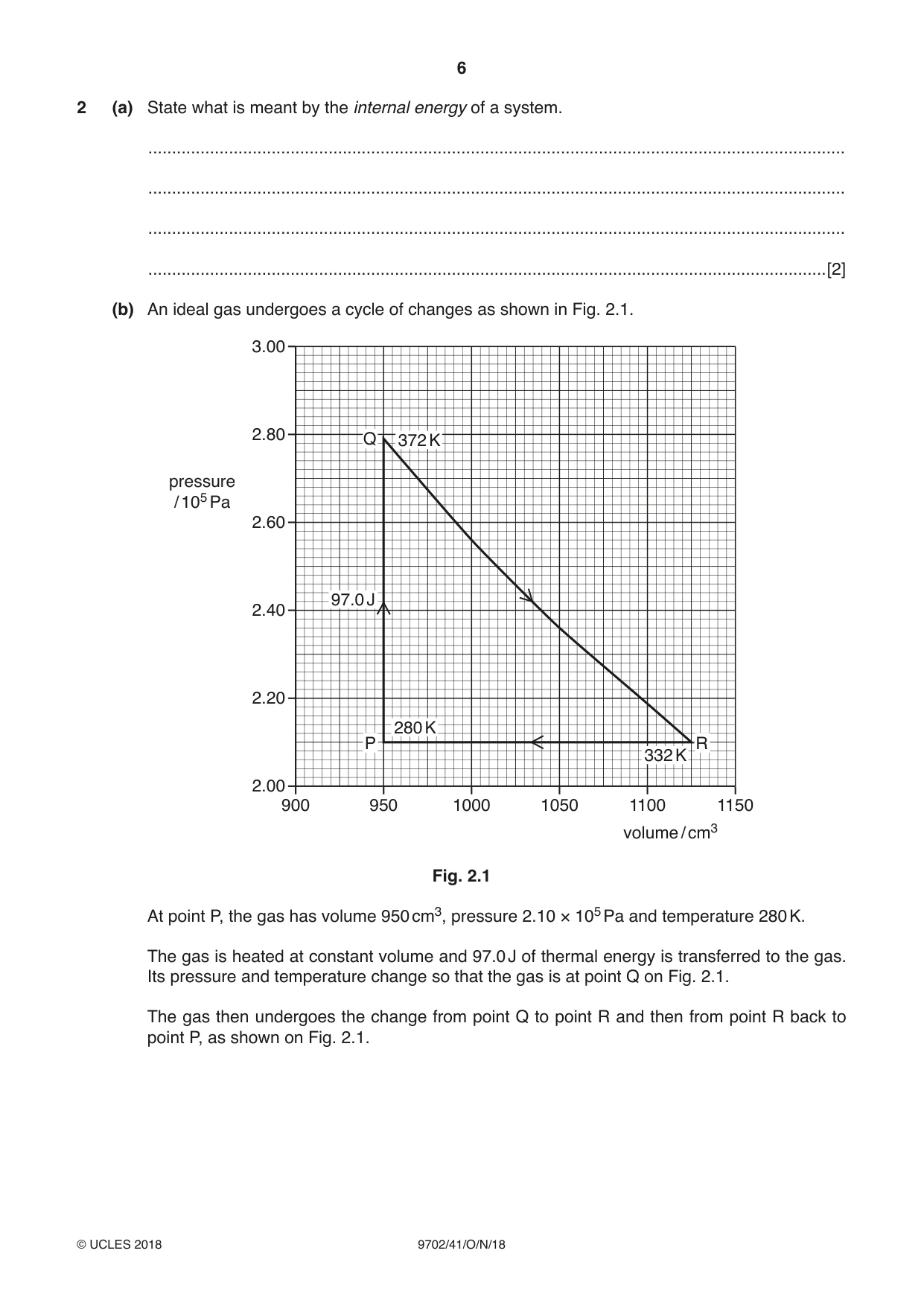
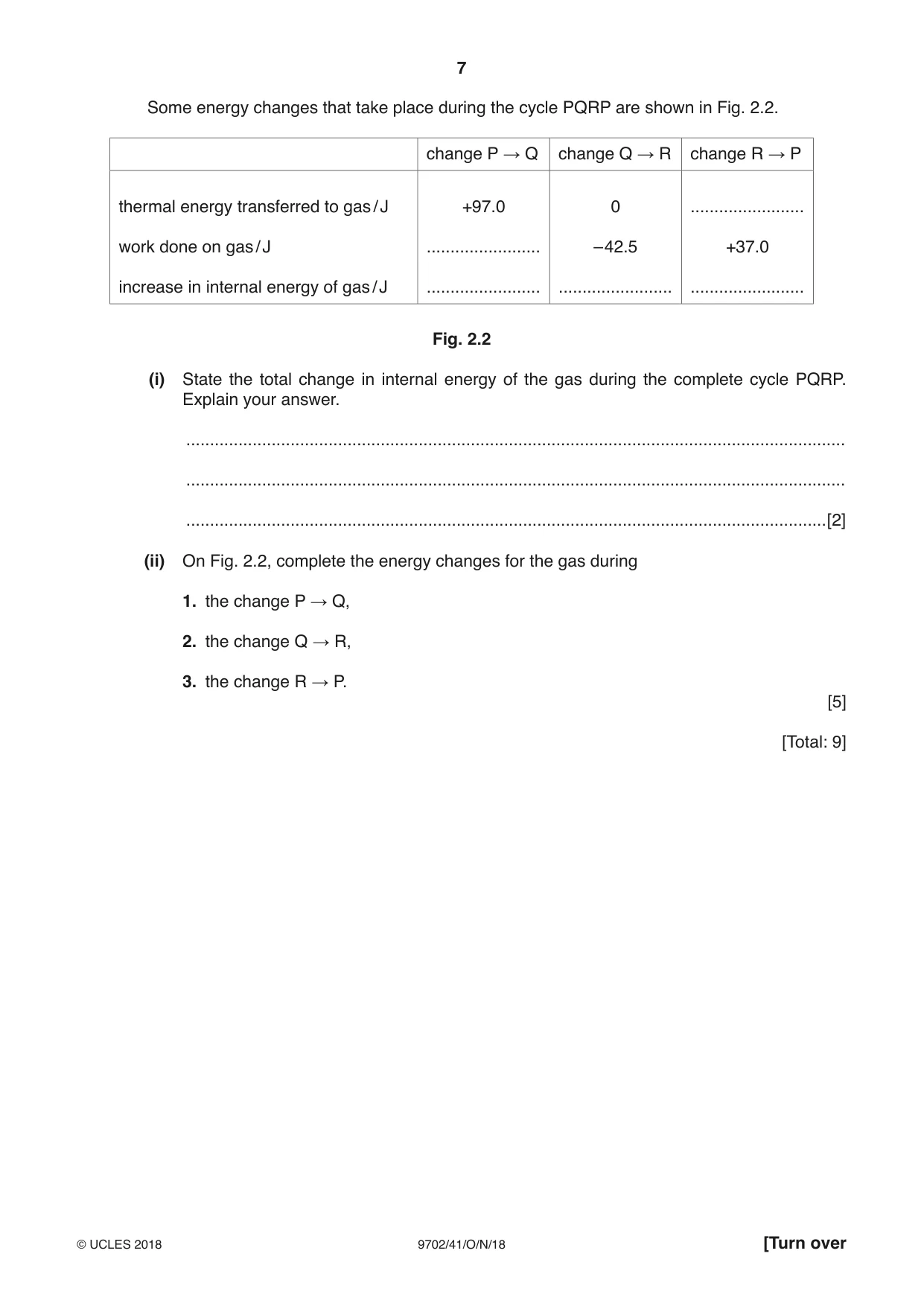
2 (a) State what is meant by the internal energy of a system. ................................................................................................................................................... ................................................................................................................................................... ................................................................................................................................................... ...............................................................................................................................................[2] (b) An ideal gas undergoes a cycle of changes as shown in Fig. 2.1. 3.00 2.80 Q 372 K pressure / 105 Pa 2.60 97.0 J 2.40 2.20 280 K P R 332 K 2.00 900 950 1000 1050 1100 1150 volume / cm3 Fig. 2.1 At point P, the gas has volume 950 cm3, pressure 2.10 × 10⁵ Pa and temperature 280 K. The gas is heated at constant volume and 97.0 J of thermal energy is transferred to the gas. Its pressure and temperature change so that the gas is at point Q on Fig. 2.1. The gas then undergoes the change from point Q to point R and then from point R back to point P, as shown on Fig. 2.1. Some energy changes that take place during the cycle PQRP are shown in Fig. 2.2. change P → Q change Q → R change R → P thermal energy transferred to gas / J +97.0 0 ........................ work done on gas / J ........................ –42.5 +37.0 increase in internal energy of gas / J ........................ ........................ ........................ Fig. 2.2 (i) State the total change in internal energy of the gas during the complete cycle PQRP. Explain your answer. ........................................................................................................................................... ........................................................................................................................................... .......................................................................................................................................[2] (ii) On Fig. 2.2, complete the energy changes for the gas during 1. the change P → Q, 2. the change Q → R, 3. the change R → P. [5] [Total: 9]
Mark scheme: 2(a) sum of potential and kinetic energies (of molecules/atoms/particles) B1 (energy of) molecules/atoms/particles in random motion B1 2(b)(i) final temperature = initial temperature B1 no change in internal energy B1 2(b)(ii) 1. work done on gas (P→Q): 0 A1 increase in internal energy (P→Q): (+)97.0 J A1 2. increase in internal energy (Q→R): –42.5 J A1 3. increase in internal energy (R→P): –54.5 J A1 thermal energy supplied (R→P): –91.5 J A1
Q3 · A U-tube contains liquid, as shown in Fig
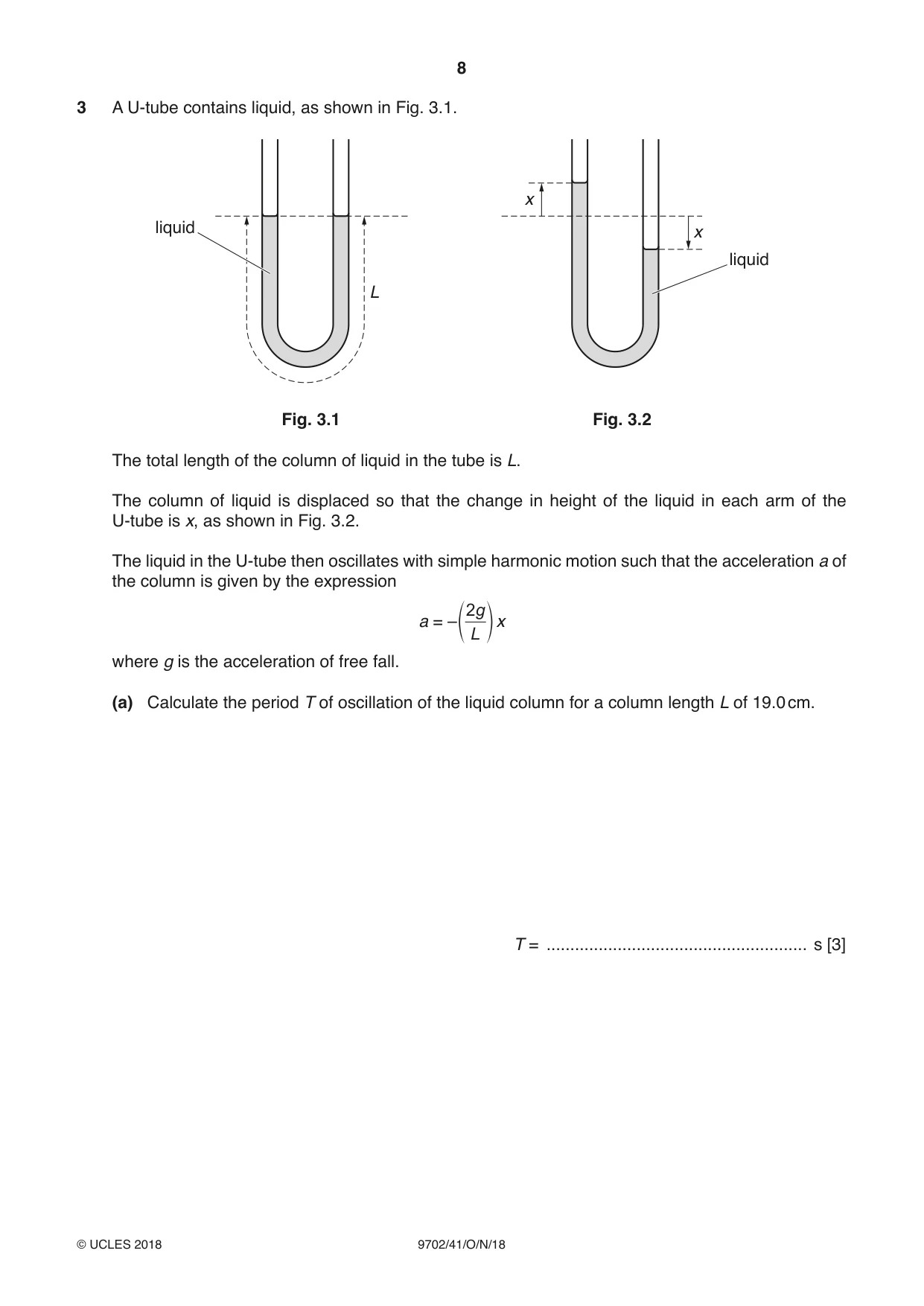
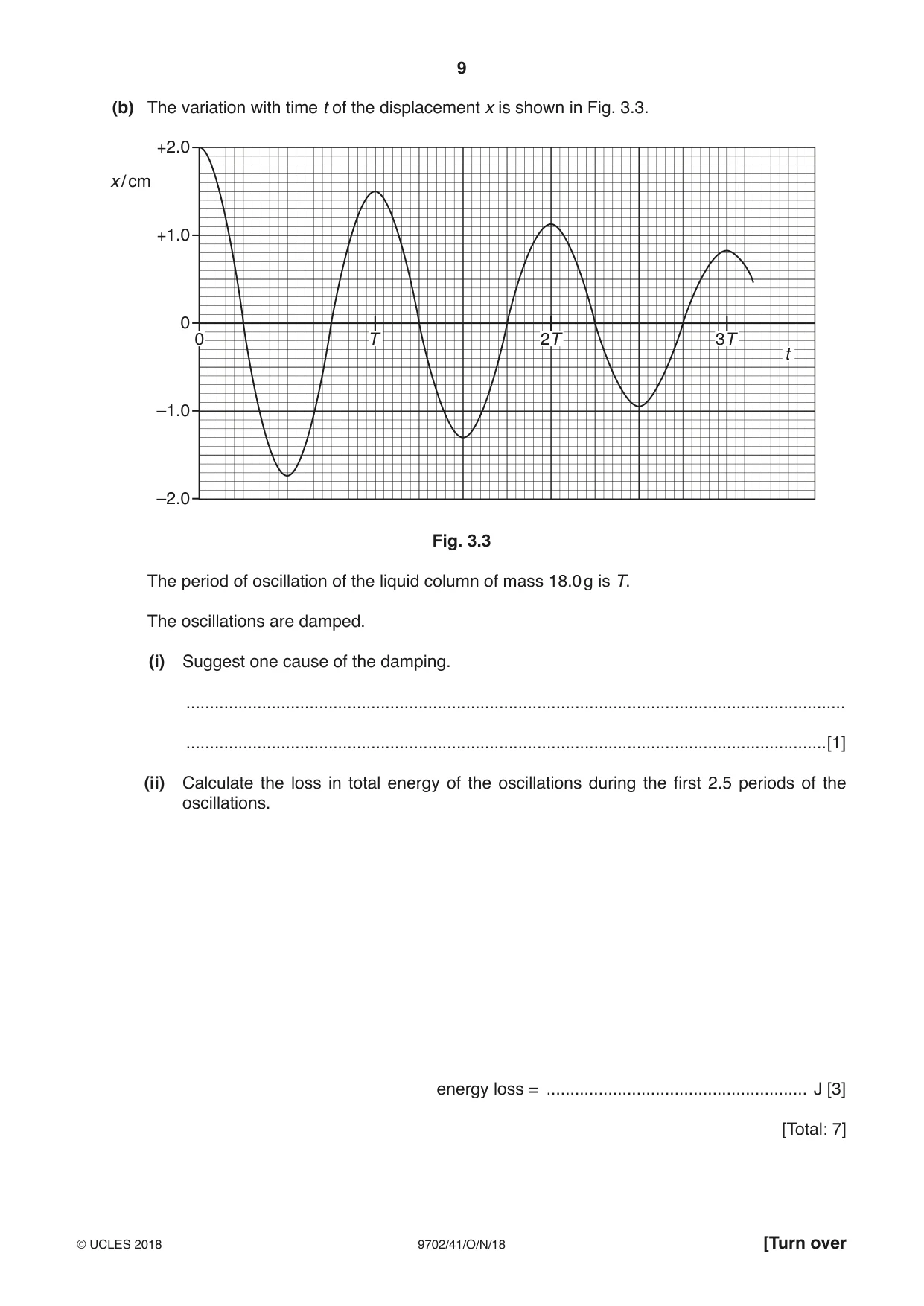
3 A U-tube contains liquid, as shown in Fig. 3.1. x liquid x liquid L Fig. 3.1 Fig. 3.2 The total length of the column of liquid in the tube is L. The column of liquid is displaced so that the change in height of the liquid in each arm of the U-tube is x, as shown in Fig. 3.2. The liquid in the U-tube then oscillates with simple harmonic motion such that the acceleration a of the column is given by the expression 2 g a = – x e L o where g is the acceleration of free fall. (a) Calculate the period T of oscillation of the liquid column for a column length L of 19.0 cm. T = ....................................................... s [3] (b) The variation with time t of the displacement x is shown in Fig. 3.3. +2.0 x / cm +1.0 0 0 T 2T 3T t –1.0 –2.0 Fig. 3.3 The period of oscillation of the liquid column of mass 18.0 g is T. The oscillations are damped. (i) Suggest one cause of the damping. ........................................................................................................................................... .......................................................................................................................................[1] (ii) Calculate the loss in total energy of the oscillations during the first 2.5 periods of the oscillations. energy loss = ....................................................... J [3] [Total: 7]
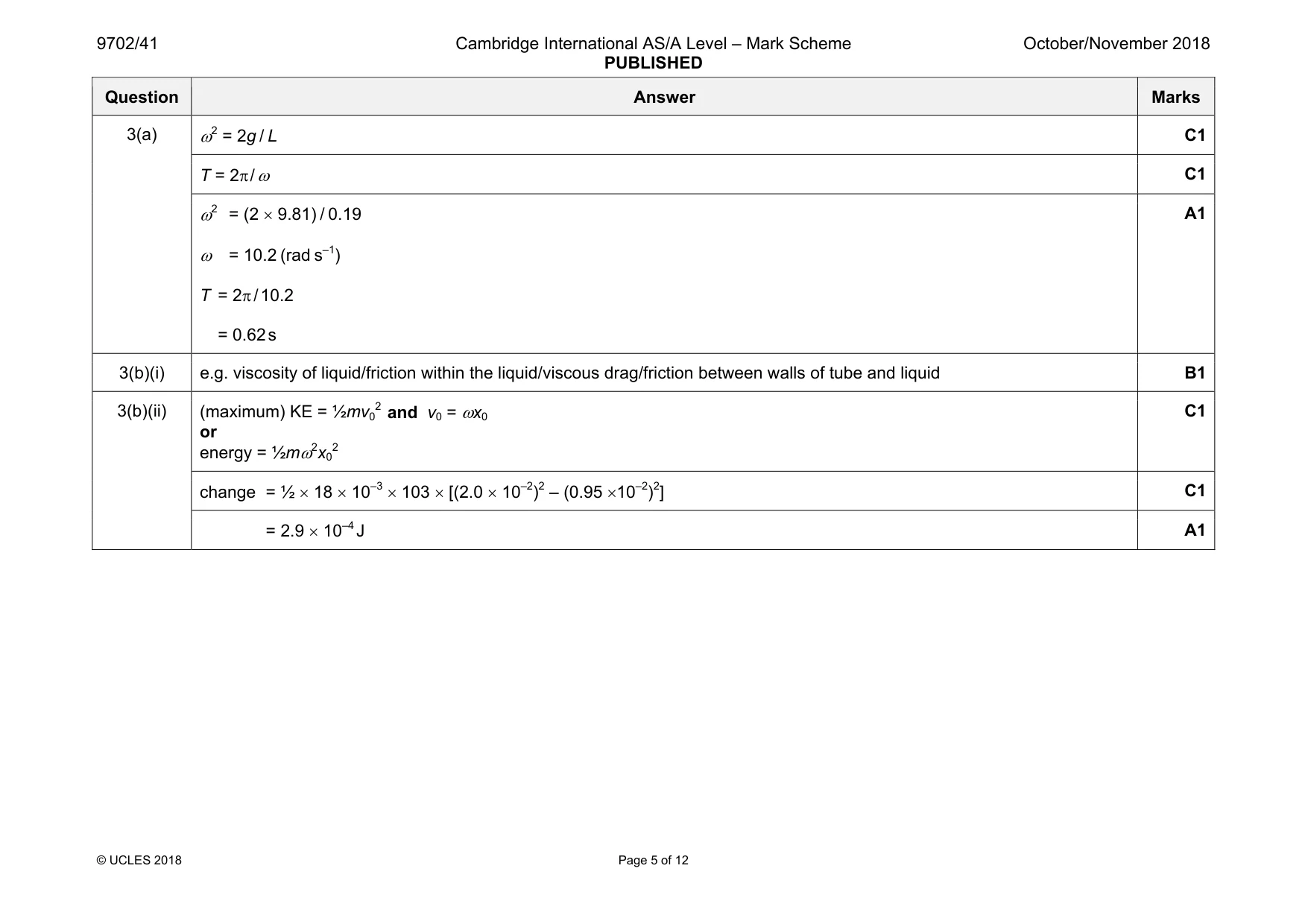
Mark scheme: 3(a) C1 T = 2π / ω C1 ω2 = (2 × 9.81) / 0.19 ω = 10.2 (rad s–1) T = 2π / 10.2 = 0.62 s A1 3(b)(i) e.g. viscosity of liquid/friction within the liquid/viscous drag/friction between walls of tube and liquid B1 3(b)(ii) (maximum) KE = ½mv0 2 and v0 = ωx0 or energy = ½mω2x0 2 C1 change = ½ × 18 × 10–3 × 103 × [(2.0 × 10⁻²)2 – (0.95 ×10⁻²)2] C1 = 2.9 × 10⁻⁴ J A1
Q4 · Explain the main principles behind the use of ultrasound to obtain diagnostic information…
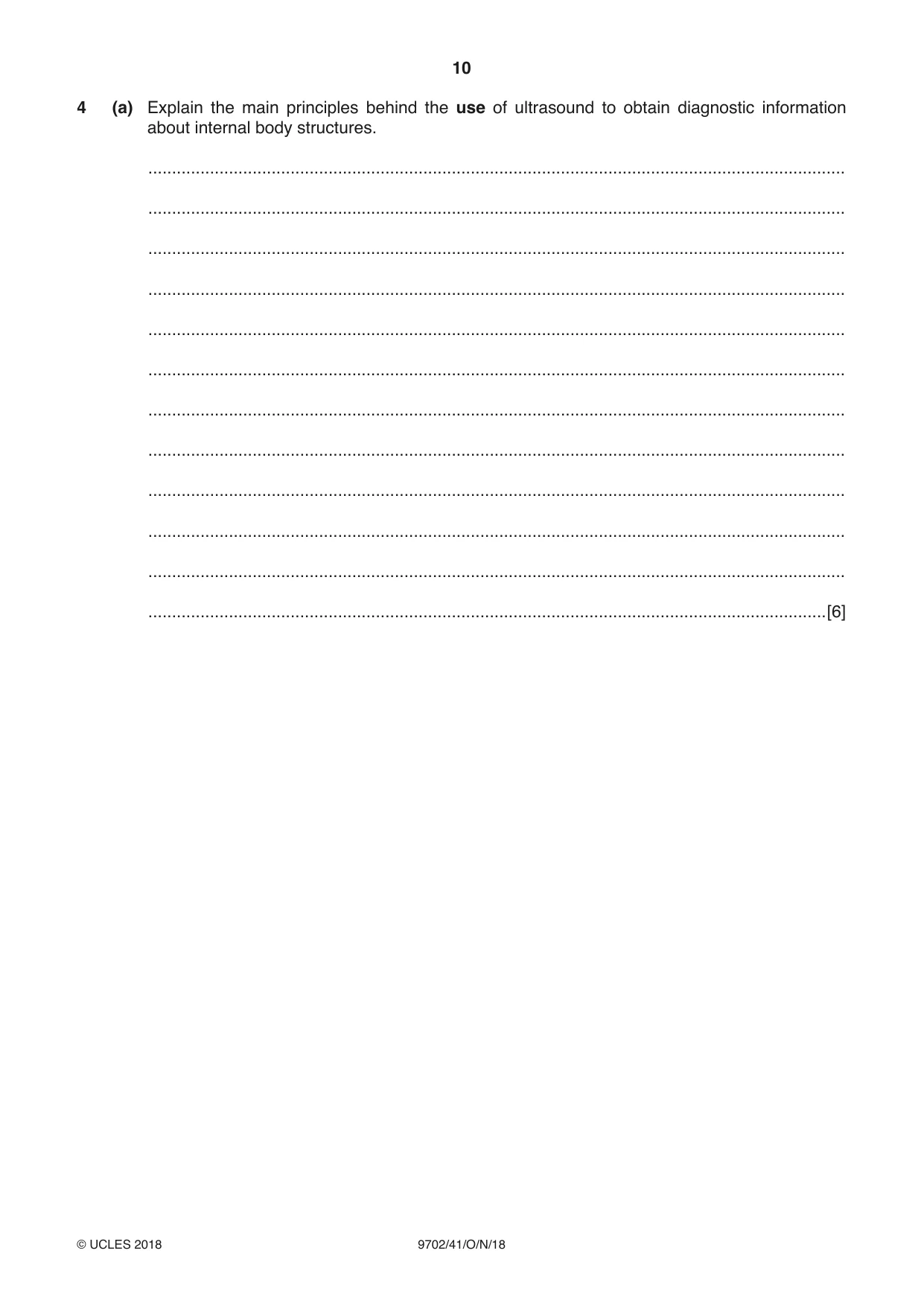
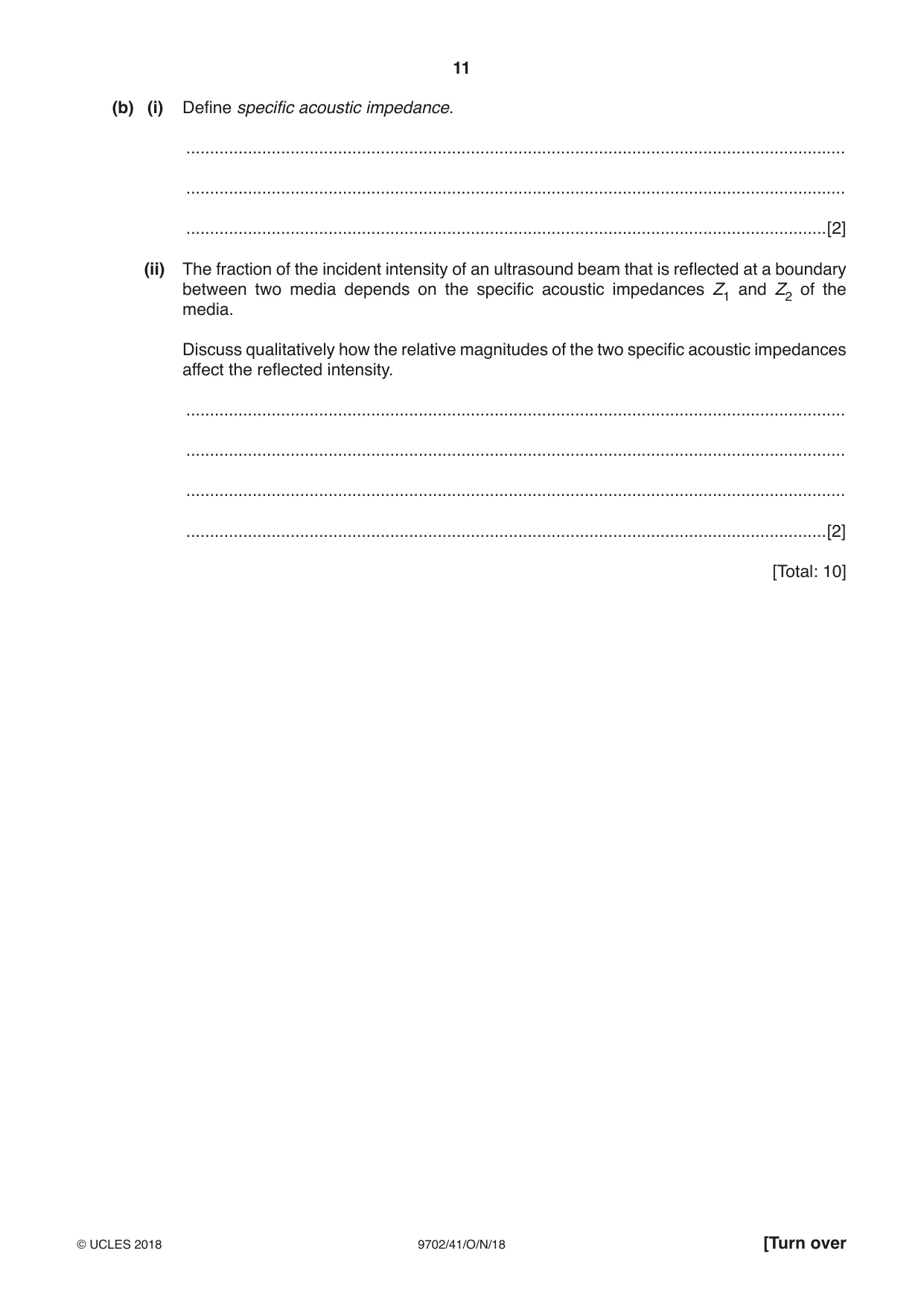
4 (a) Explain the main principles behind the use of ultrasound to obtain diagnostic information about internal body structures. ................................................................................................................................................... ................................................................................................................................................... ................................................................................................................................................... ................................................................................................................................................... ................................................................................................................................................... ................................................................................................................................................... ................................................................................................................................................... ................................................................................................................................................... ................................................................................................................................................... ................................................................................................................................................... ................................................................................................................................................... ...............................................................................................................................................[6] (b) (i) Define specific acoustic impedance. ........................................................................................................................................... ........................................................................................................................................... .......................................................................................................................................[2] (ii) The fraction of the incident intensity of an ultrasound beam that is reflected at a boundary between two media depends on the specific acoustic impedances Z1 and Z2 of the media. Discuss qualitatively how the relative magnitudes of the two specific acoustic impedances affect the reflected intensity. ........................................................................................................................................... ........................................................................................................................................... ........................................................................................................................................... .......................................................................................................................................[2] [Total: 10]
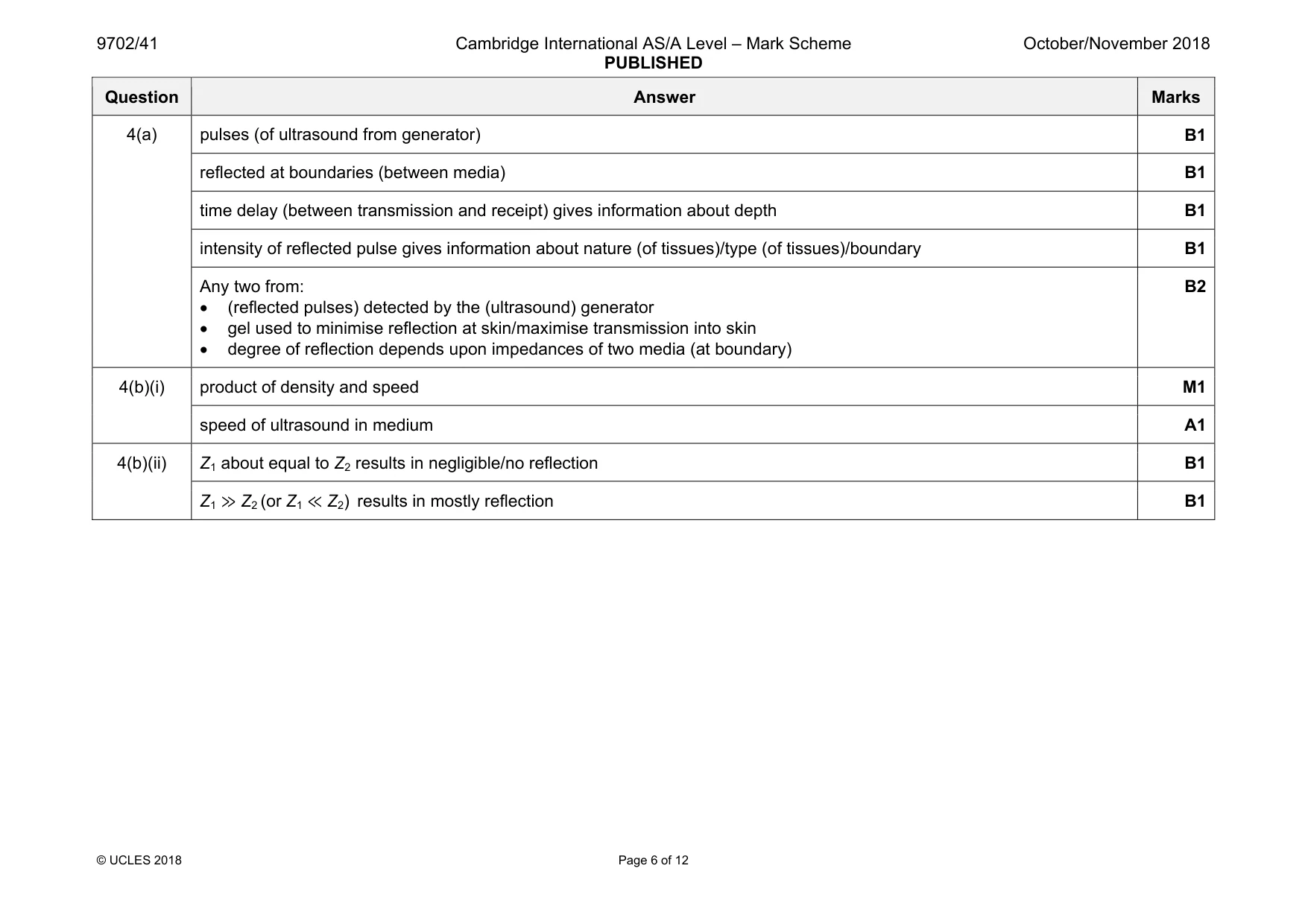
Mark scheme: 4(a) pulses (of ultrasound from generator) B1 reflected at boundaries (between media) B1 time delay (between transmission and receipt) gives information about depth B1 intensity of reflected pulse gives information about nature (of tissues)/type (of tissues)/boundary B1 Any two from: • (reflected pulses) detected by the (ultrasound) generator • gel used to minimise reflection at skin/maximise transmission into skin • degree of reflection depends upon impedances of two media (at boundary) B2 4(b)(i) product of density and speed M1 speed of ultrasound in medium A1 4(b)(ii) Z1 about equal to Z2 results in negligible/no reflection B1 Z1 ≫ Z2 (or Z1 ≪ Z2) results in mostly reflection B1
Q5 · State two advantages of the transmission of data in digital form, compared with the…
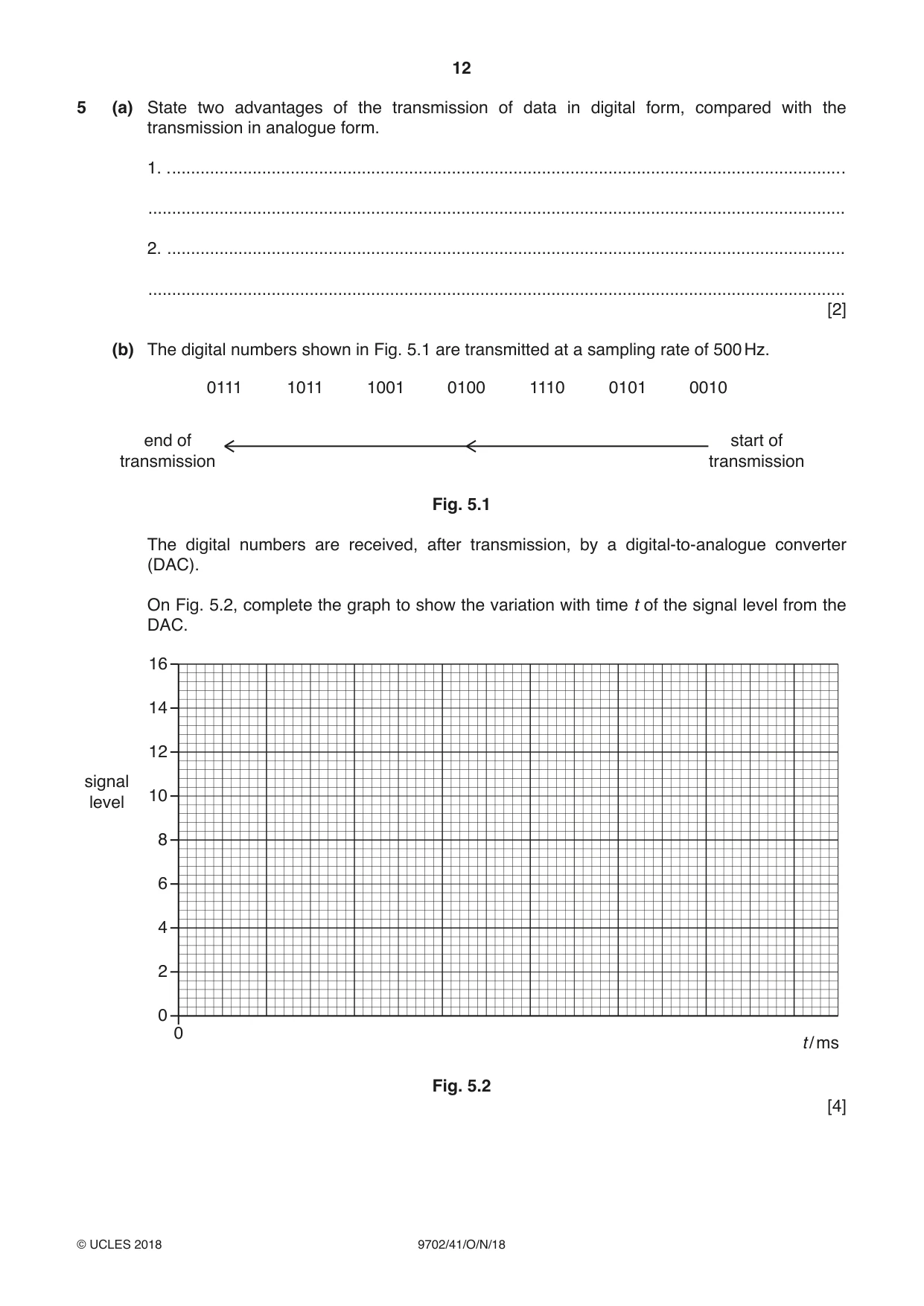
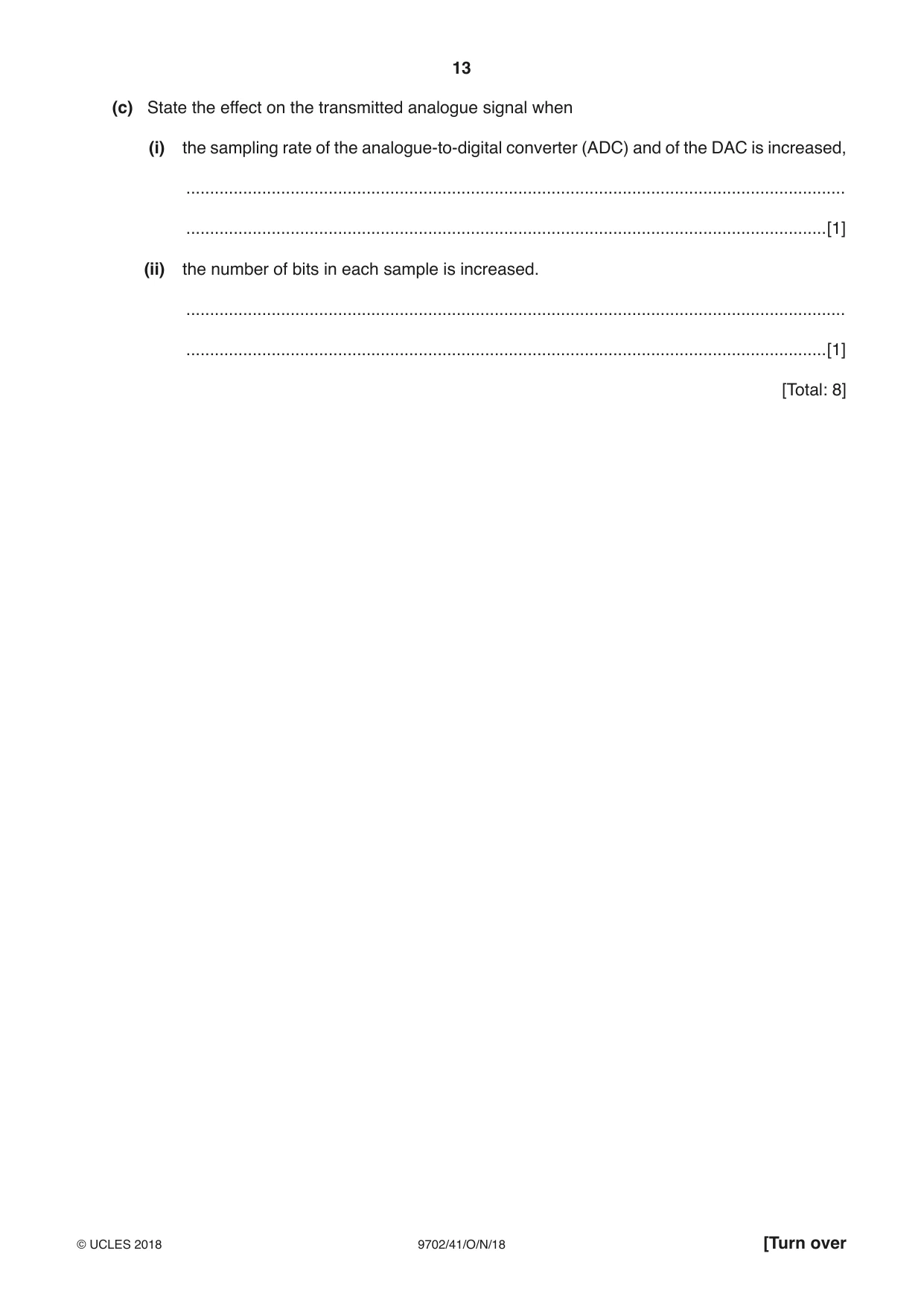
5 (a) State two advantages of the transmission of data in digital form, compared with the transmission in analogue form. 1. . .............................................................................................................................................. ................................................................................................................................................... 2. ............................................................................................................................................... ................................................................................................................................................... [2] (b) The digital numbers shown in Fig. 5.1 are transmitted at a sampling rate of 500 Hz. 0111 1011 1001 0100 1110 0101 0010 end of start of transmission transmission Fig. 5.1 The digital numbers are received, after transmission, by a digital-to-analogue converter (DAC). On Fig. 5.2, complete the graph to show the variation with time t of the signal level from the DAC. 16 14 12 signal 10 level 8 6 4 2 0 0 t / ms Fig. 5.2 [4] (c) State the effect on the transmitted analogue signal when (i) the sampling rate of the analogue-to-digital converter (ADC) and of the DAC is increased, ........................................................................................................................................... .......................................................................................................................................[1] (ii) the number of bits in each sample is increased. ........................................................................................................................................... .......................................................................................................................................[1] [Total: 8]
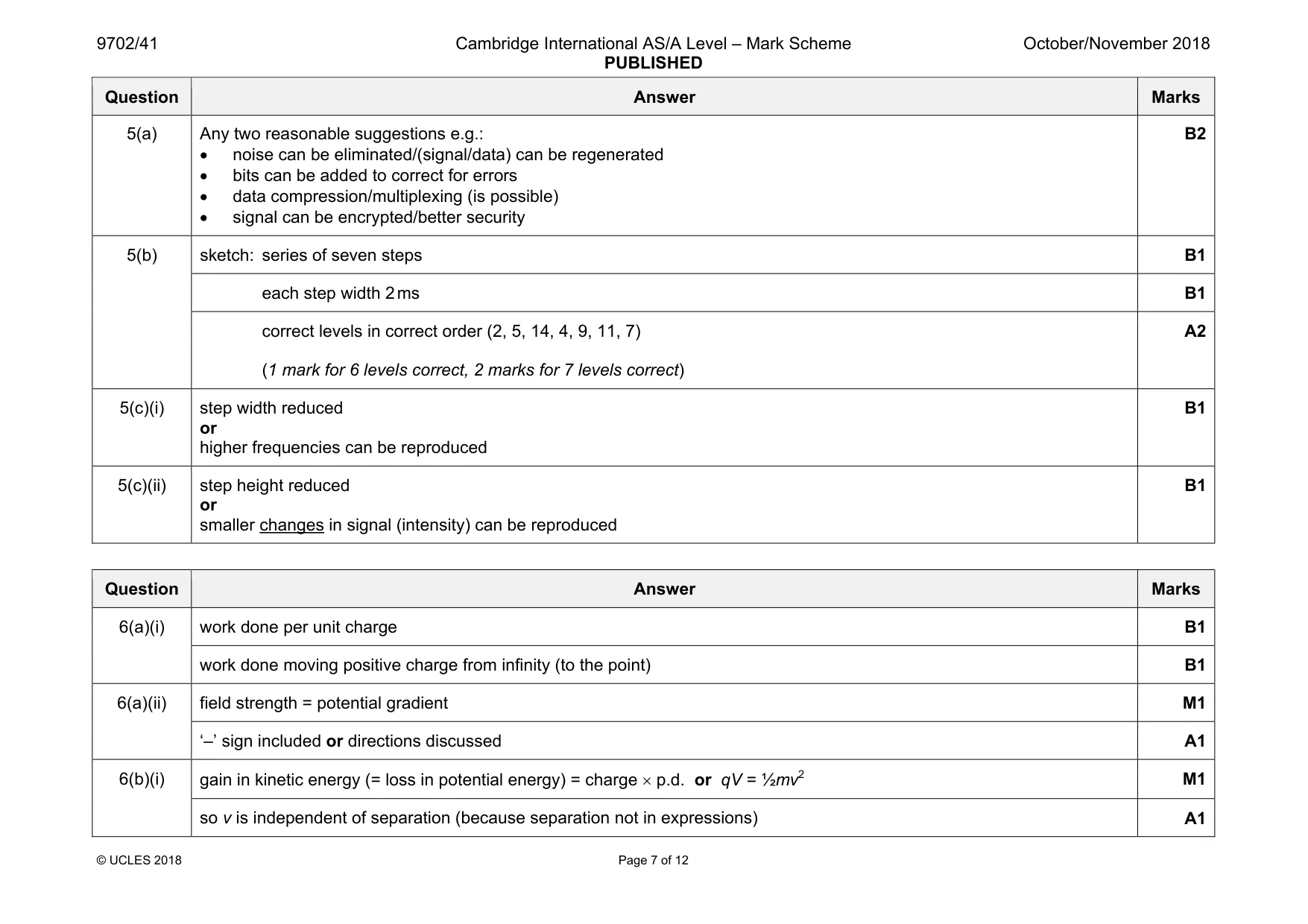
Mark scheme: 5(a) Any two reasonable suggestions e.g.: • noise can be eliminated/(signal/data) can be regenerated • bits can be added to correct for errors • data compression/multiplexing (is possible) • signal can be encrypted/better security B2 5(b) sketch: series of seven steps B1 each step width 2 ms B1 correct levels in correct order (2, 5, 14, 4, 9, 11, 7) (1 mark for 6 levels correct, 2 marks for 7 levels correct) A2 5(c)(i) step width reduced or higher frequencies can be reproduced B1 5(c)(ii) step height reduced or smaller changes in signal (intensity) can be reproduced B1
Q6 · Define electric potential at a point
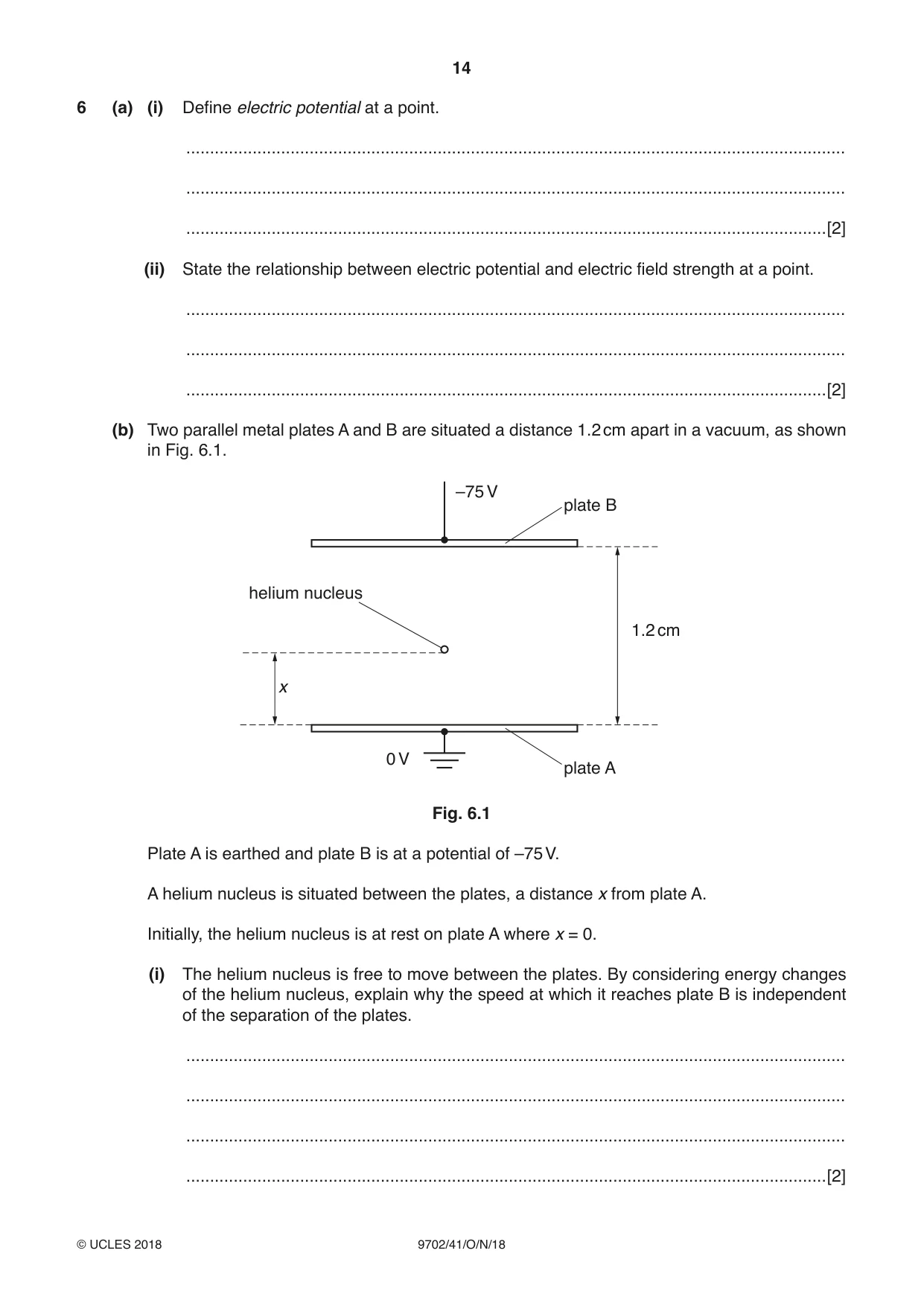
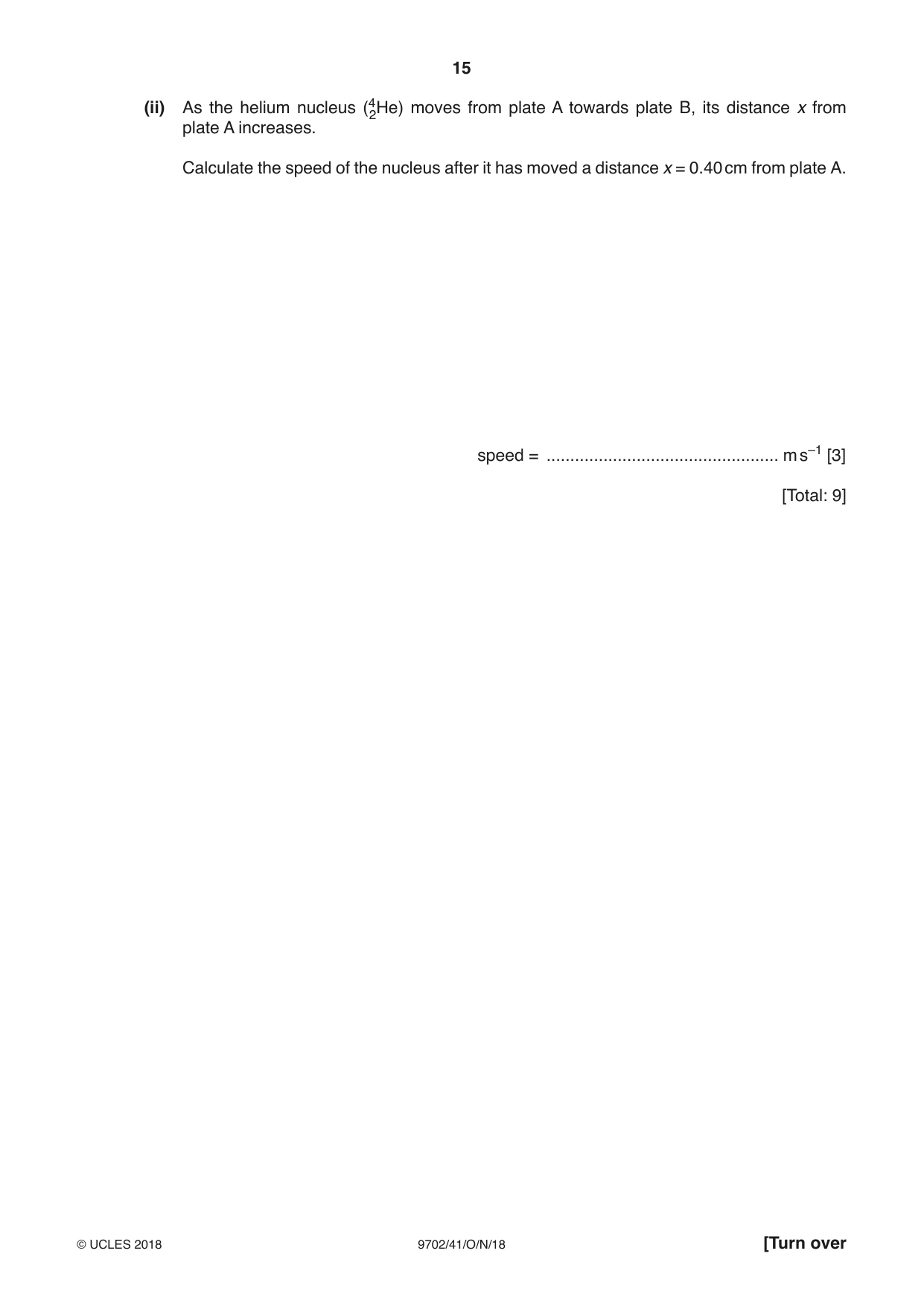
6 (a) (i) Define electric potential at a point. ........................................................................................................................................... ........................................................................................................................................... .......................................................................................................................................[2] (ii) State the relationship between electric potential and electric field strength at a point. ........................................................................................................................................... ........................................................................................................................................... .......................................................................................................................................[2] (b) Two parallel metal plates A and B are situated a distance 1.2 cm apart in a vacuum, as shown in Fig. 6.1. –75 V plate B helium nucleus 1.2 cm x 0 V plate A Fig. 6.1 Plate A is earthed and plate B is at a potential of –75 V. A helium nucleus is situated between the plates, a distance x from plate A. Initially, the helium nucleus is at rest on plate A where x = 0. (i) The helium nucleus is free to move between the plates. By considering energy changes of the helium nucleus, explain why the speed at which it reaches plate B is independent of the separation of the plates. ........................................................................................................................................... ........................................................................................................................................... ........................................................................................................................................... .......................................................................................................................................[2] (ii) As the helium nucleus (42He) moves from plate A towards plate B, its distance x from plate A increases. Calculate the speed of the nucleus after it has moved a distance x = 0.40 cm from plate A. speed = ................................................. m s–1 [3] [Total: 9]
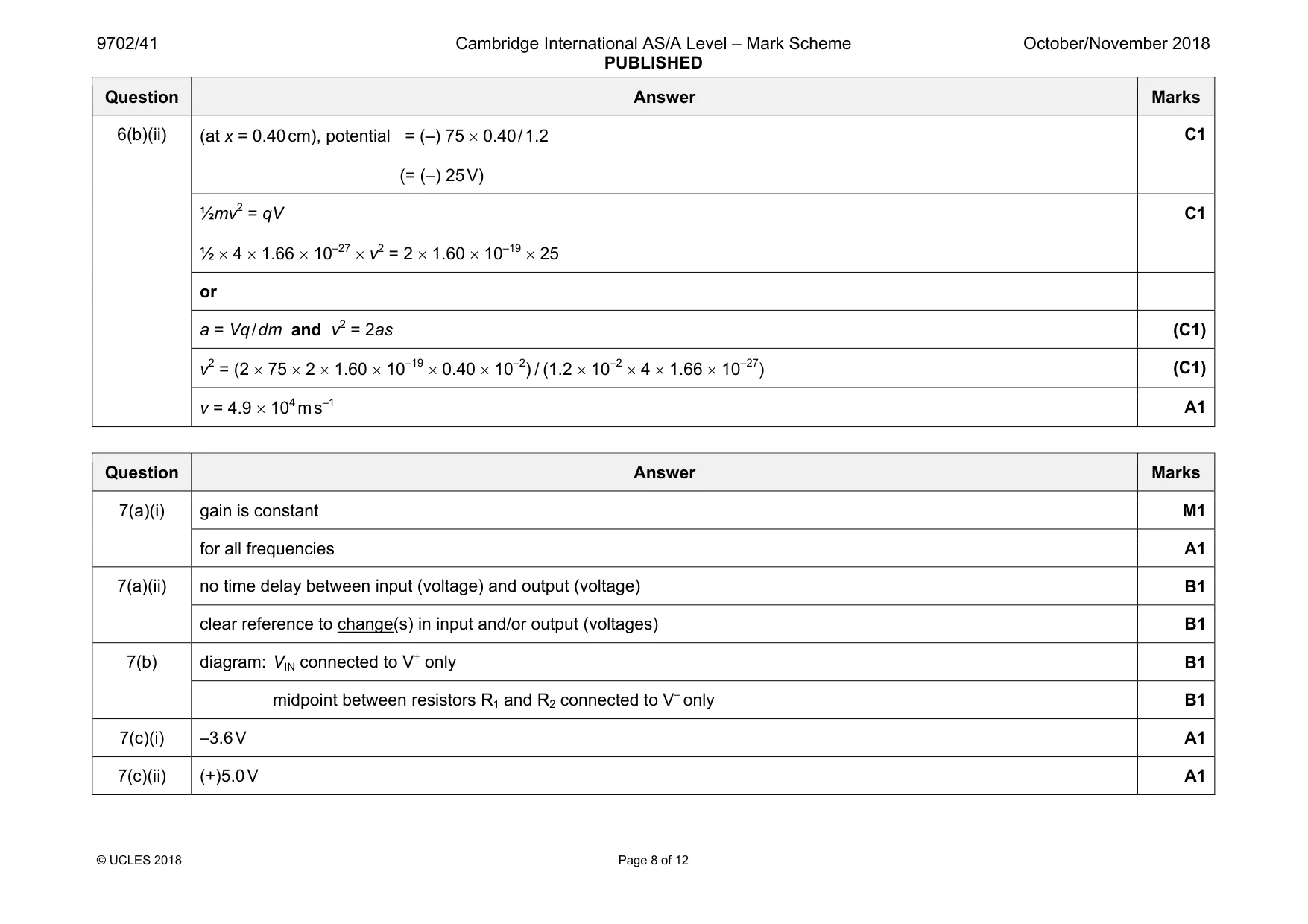
Mark scheme: 6(a)(i) work done per unit charge B1 work done moving positive charge from infinity (to the point) B1 6(a)(ii) field strength = potential gradient M1 ‘–’ sign included or directions discussed A1 6(b)(i) gain in kinetic energy (= loss in potential energy) = charge × p.d. or qV = ½mv2 M1 so v is independent of separation (because separation not in expressions) A1 Question Answer Marks 6(b)(ii) (at x = 0.40 cm), potential = (–) 75 × 0.40 / 1.2 (= (–) 25 V) C1 ½mv2 = qV ½ × 4 × 1.66 × 10–27 × v2 = 2 × 1.60 × 10–19 × 25 C1 or a = Vq / dm and v2 = 2as (C1) v2 = (2 × 75 × 2 × 1.60 × 10–19 × 0.40 × 10–2) / (1.2 × 10–2 × 4 × 1.66 × 10–27) (C1) v = 4.9 × 10⁴ m s–1 A1
Q7 · An ideal operational amplifier (op-amp) has infinite bandwidth and infinite slew rate
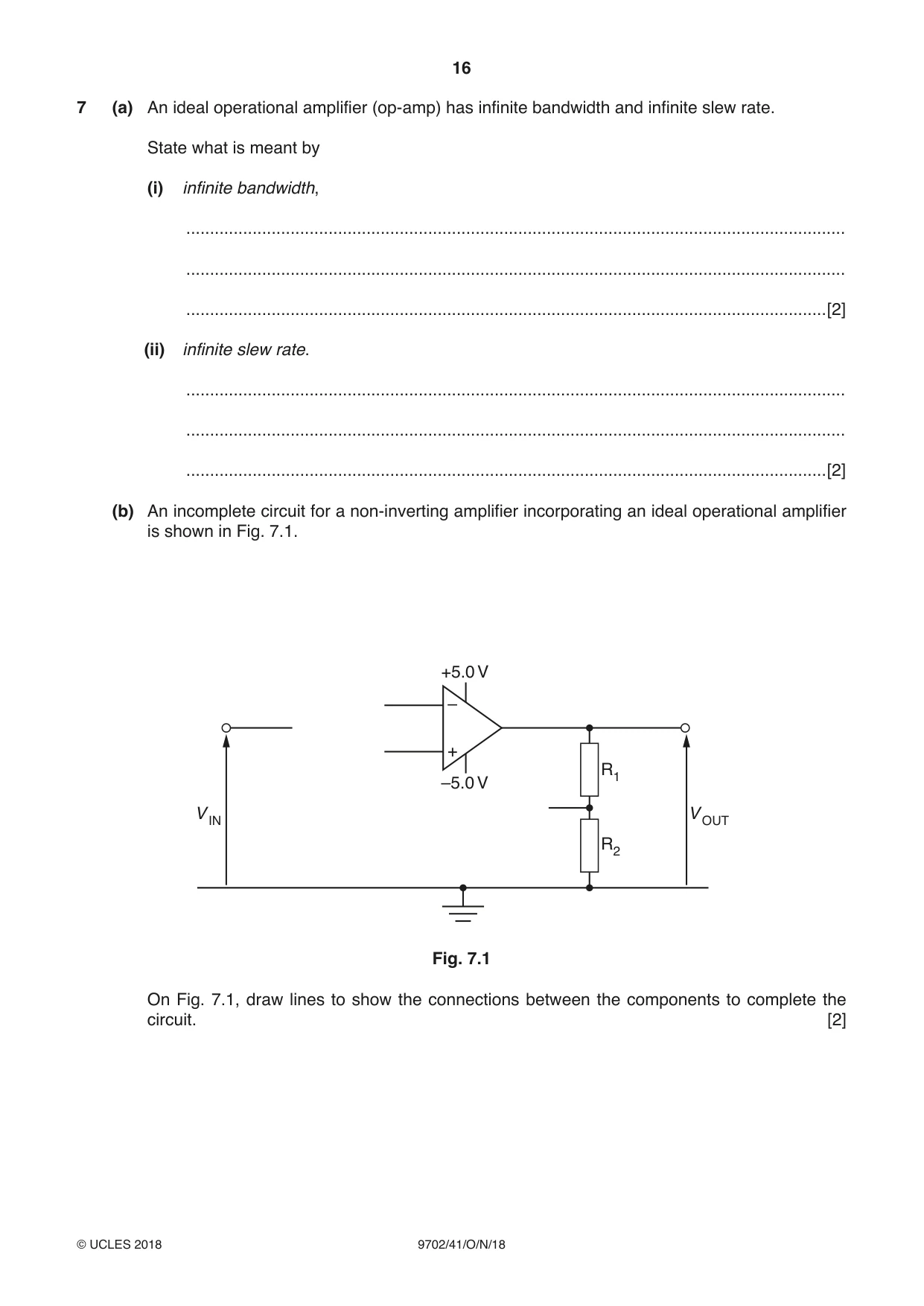
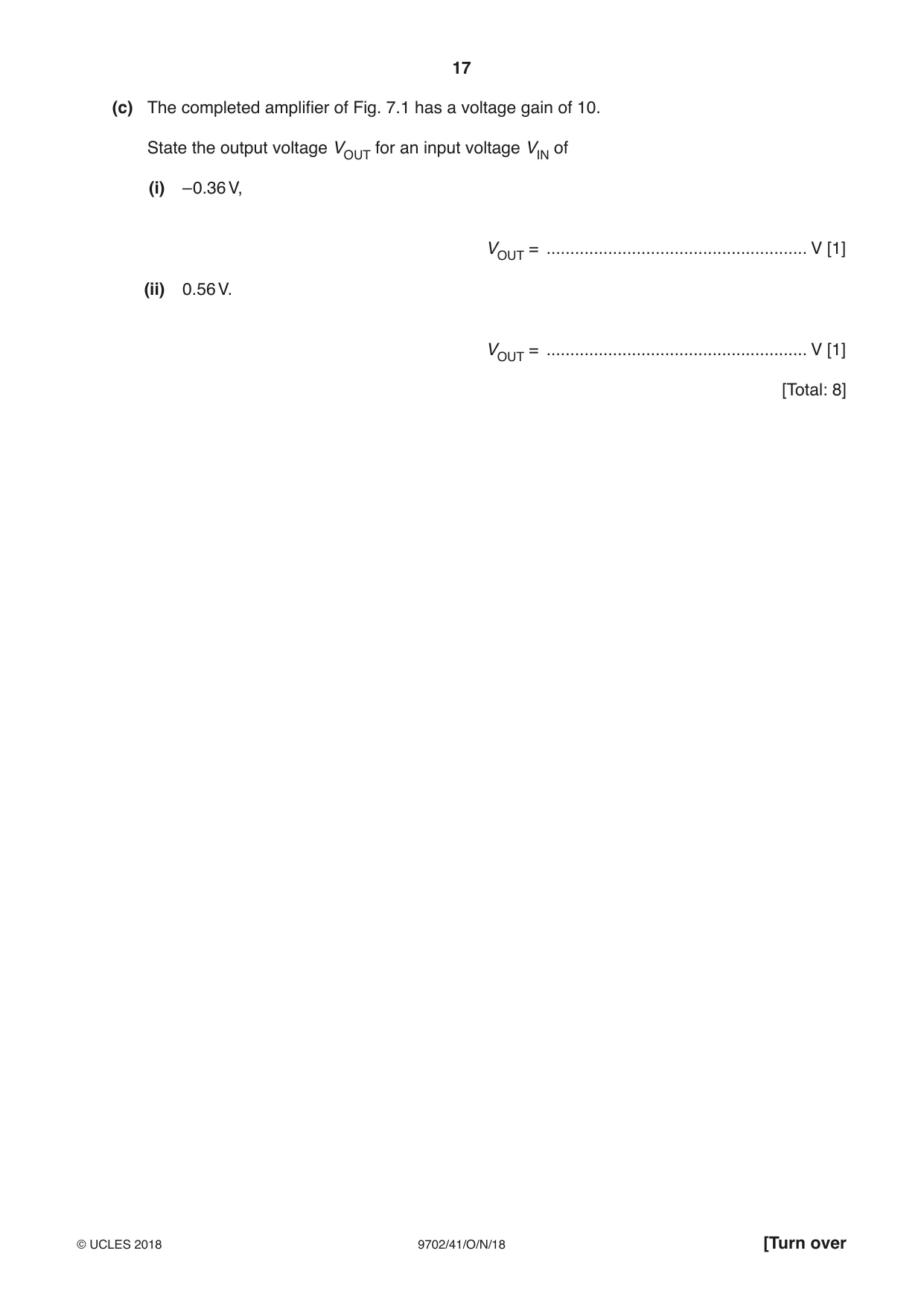
7 (a) An ideal operational amplifier (op-amp) has infinite bandwidth and infinite slew rate. State what is meant by (i) infinite bandwidth, ........................................................................................................................................... ........................................................................................................................................... .......................................................................................................................................[2] (ii) infinite slew rate. ........................................................................................................................................... ........................................................................................................................................... .......................................................................................................................................[2] (b) An incomplete circuit for a non-inverting amplifier incorporating an ideal operational amplifier is shown in Fig. 7.1. +5.0 V – + R1 –5.0 V V IN V OUT R2 Fig. 7.1 On Fig. 7.1, draw lines to show the connections between the components to complete the circuit. [2] (c) The completed amplifier of Fig. 7.1 has a voltage gain of 10. State the output voltage VOUT for an input voltage VIN of (i) –0.36 V, VOUT = ....................................................... V [1] (ii) 0.56 V. VOUT = ....................................................... V [1] [Total: 8]
Mark scheme: 7(a)(i) gain is constant M1 for all frequencies A1 7(a)(ii) no time delay between input (voltage) and output (voltage) B1 clear reference to change(s) in input and/or output (voltages) B1 7(b) diagram: VIN connected to V+ only B1 midpoint between resistors R1 and R2 connected to V– only B1 7(c)(i) –3.6 V A1 7(c)(ii) (+)5.0 V A1
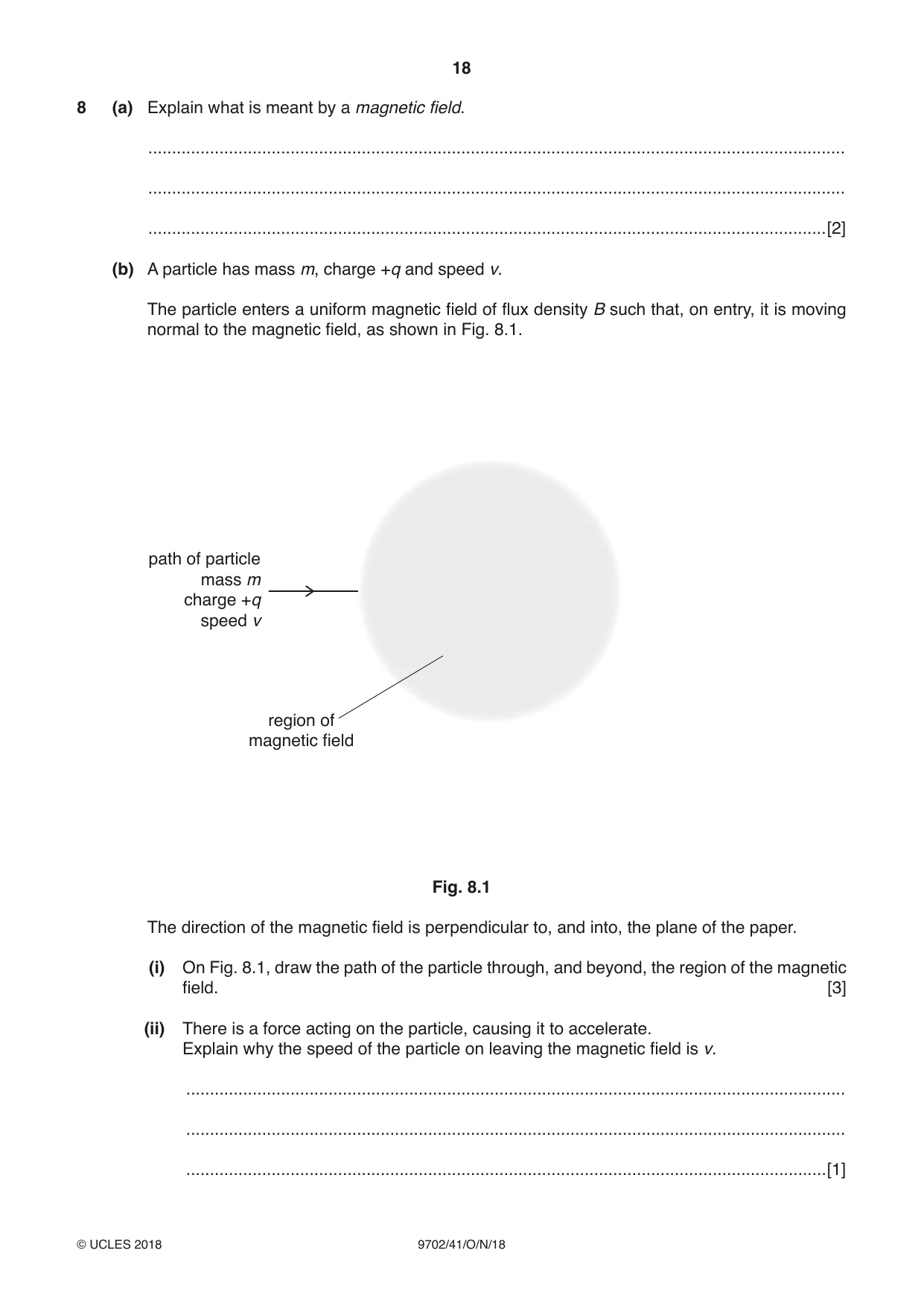
Q8 · Explain what is meant by a magnetic field
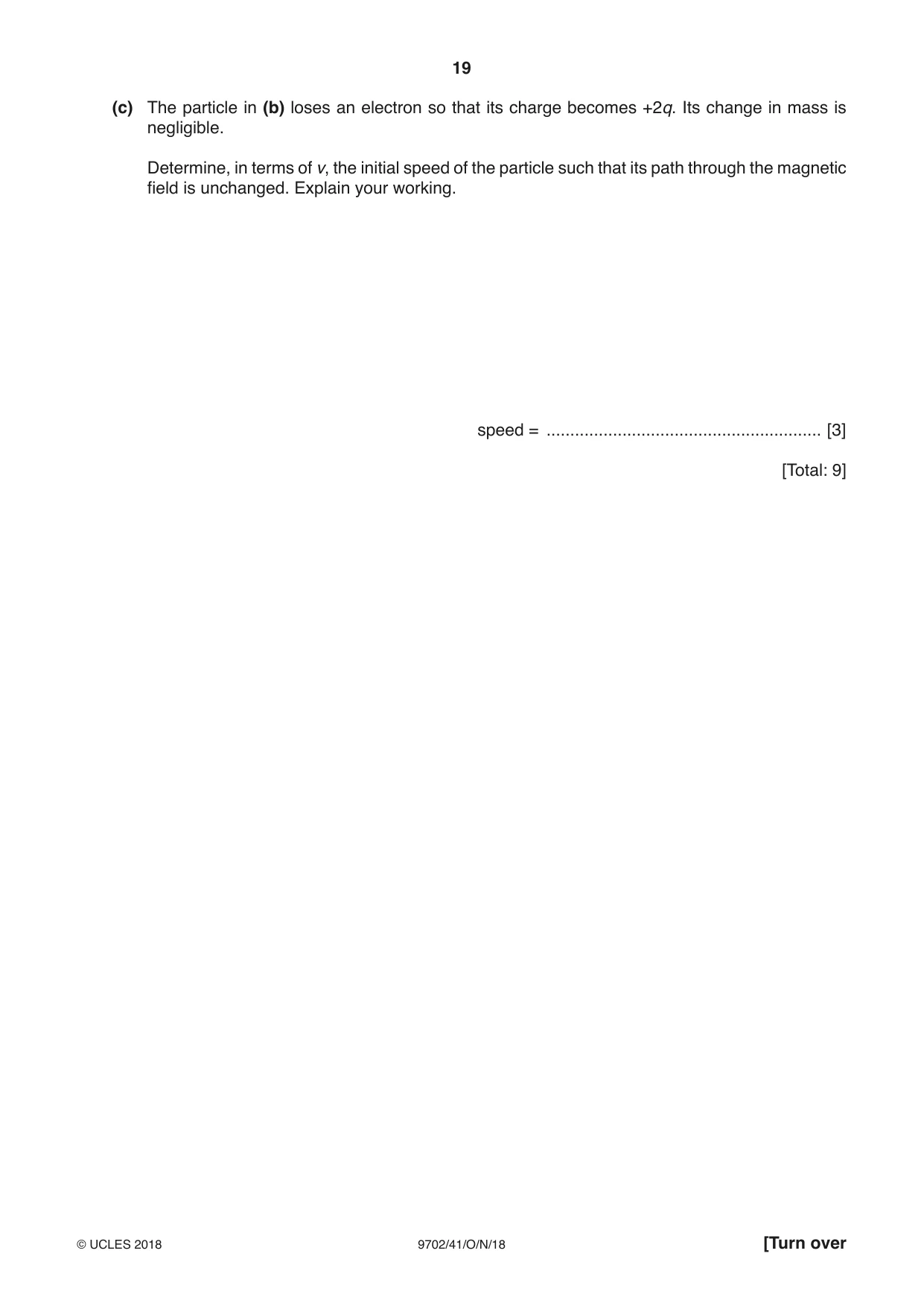
8 (a) Explain what is meant by a magnetic field. ................................................................................................................................................... ................................................................................................................................................... ...............................................................................................................................................[2] (b) A particle has mass m, charge +q and speed v. The particle enters a uniform magnetic field of flux density B such that, on entry, it is moving normal to the magnetic field, as shown in Fig. 8.1. path of particle mass m charge +q speed v region of magnetic field Fig. 8.1 The direction of the magnetic field is perpendicular to, and into, the plane of the paper. (i) On Fig. 8.1, draw the path of the particle through, and beyond, the region of the magnetic field. [3] (ii) There is a force acting on the particle, causing it to accelerate. Explain why the speed of the particle on leaving the magnetic field is v. ........................................................................................................................................... ........................................................................................................................................... .......................................................................................................................................[1] (c) The particle in (b) loses an electron so that its charge becomes +2q. Its change in mass is negligible. Determine, in terms of v, the initial speed of the particle such that its path through the magnetic field is unchanged. Explain your working. speed = .......................................................... [3] [Total: 9]
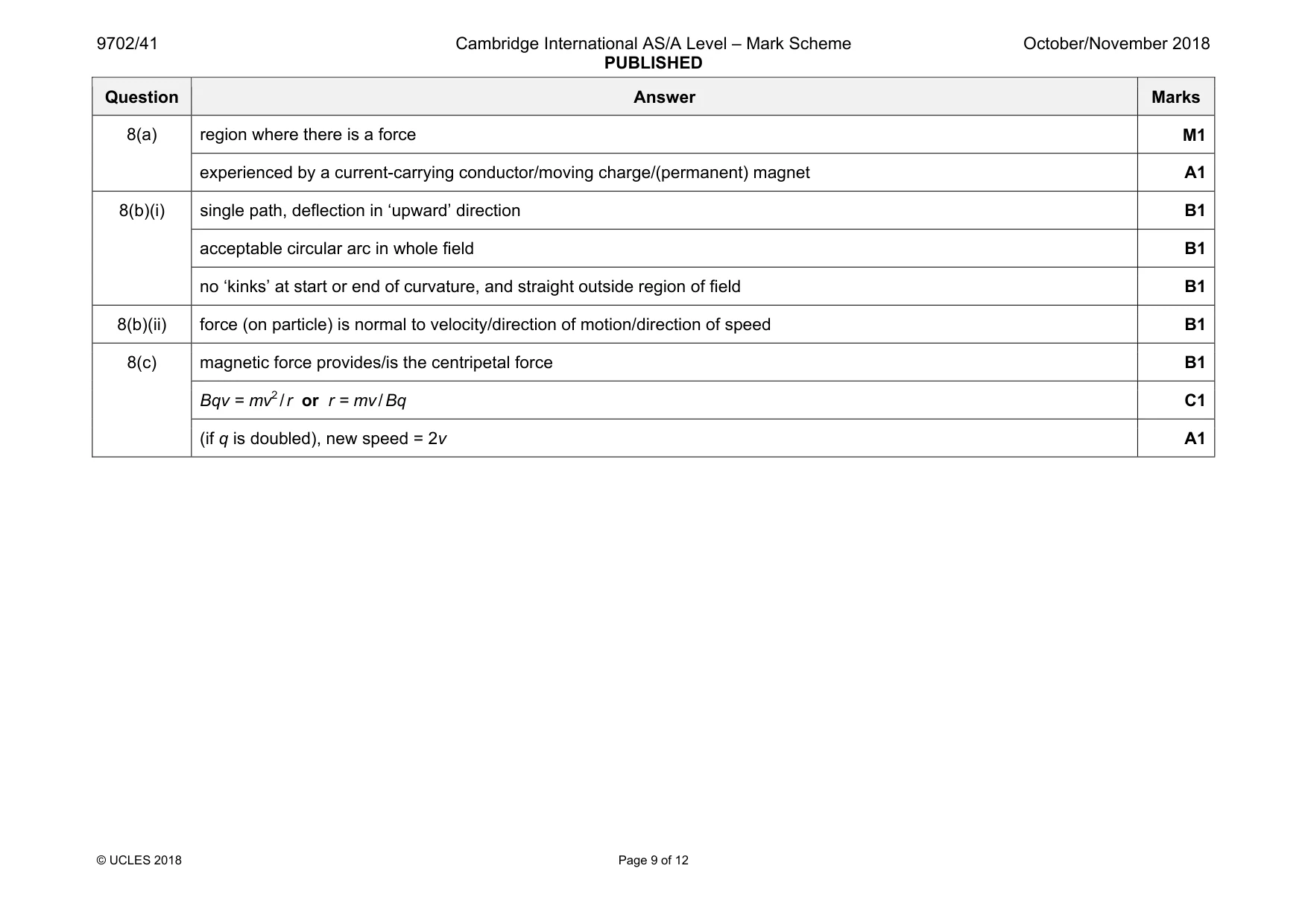
Mark scheme: 8(a) region where there is a force M1 experienced by a current-carrying conductor/moving charge/(permanent) magnet A1 8(b)(i) single path, deflection in ‘upward’ direction B1 acceptable circular arc in whole field B1 no ‘kinks’ at start or end of curvature, and straight outside region of field B1 8(b)(ii) force (on particle) is normal to velocity/direction of motion/direction of speed B1 8(c) magnetic force provides/is the centripetal force B1 Bqv = mv2 / r or r = mv / Bq C1 (if q is doubled), new speed = 2v A1
Q9 · State Faraday’s law of electromagnetic induction
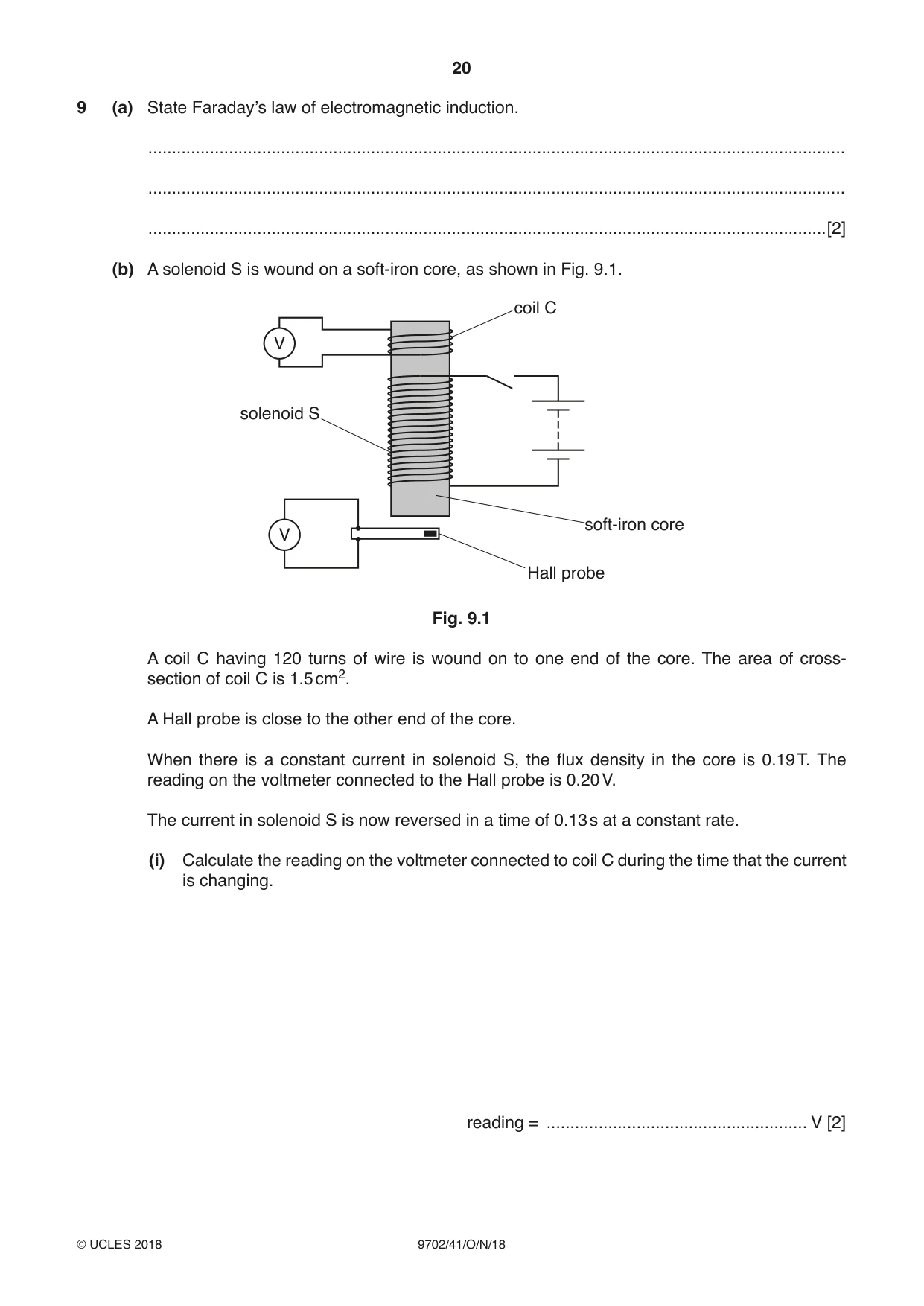
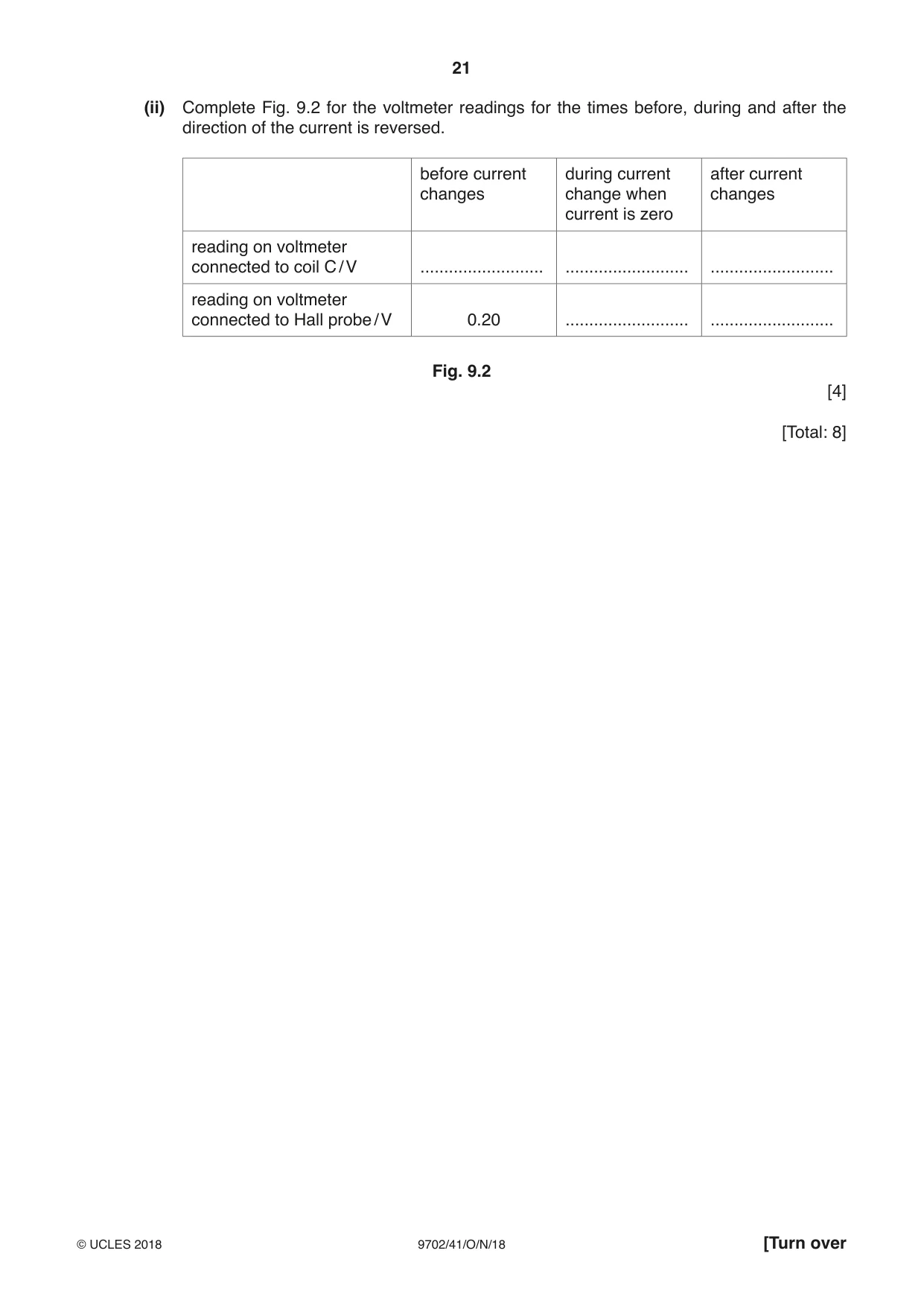
9 (a) State Faraday’s law of electromagnetic induction. ................................................................................................................................................... ................................................................................................................................................... ...............................................................................................................................................[2] (b) A solenoid S is wound on a soft-iron core, as shown in Fig. 9.1. coil C V solenoid S soft-iron core V Hall probe Fig. 9.1 A coil C having 120 turns of wire is wound on to one end of the core. The area of cross- section of coil C is 1.5 cm2. A Hall probe is close to the other end of the core. When there is a constant current in solenoid S, the flux density in the core is 0.19 T. The reading on the voltmeter connected to the Hall probe is 0.20 V. The current in solenoid S is now reversed in a time of 0.13 s at a constant rate. (i) Calculate the reading on the voltmeter connected to coil C during the time that the current is changing. reading = ....................................................... V [2] (ii) Complete Fig. 9.2 for the voltmeter readings for the times before, during and after the direction of the current is reversed. before current during current after current changes change when changes current is zero reading on voltmeter connected to coil C / V .......................... .......................... .......................... reading on voltmeter connected to Hall probe / V 0.20 .......................... .......................... Fig. 9.2 [4] [Total: 8]
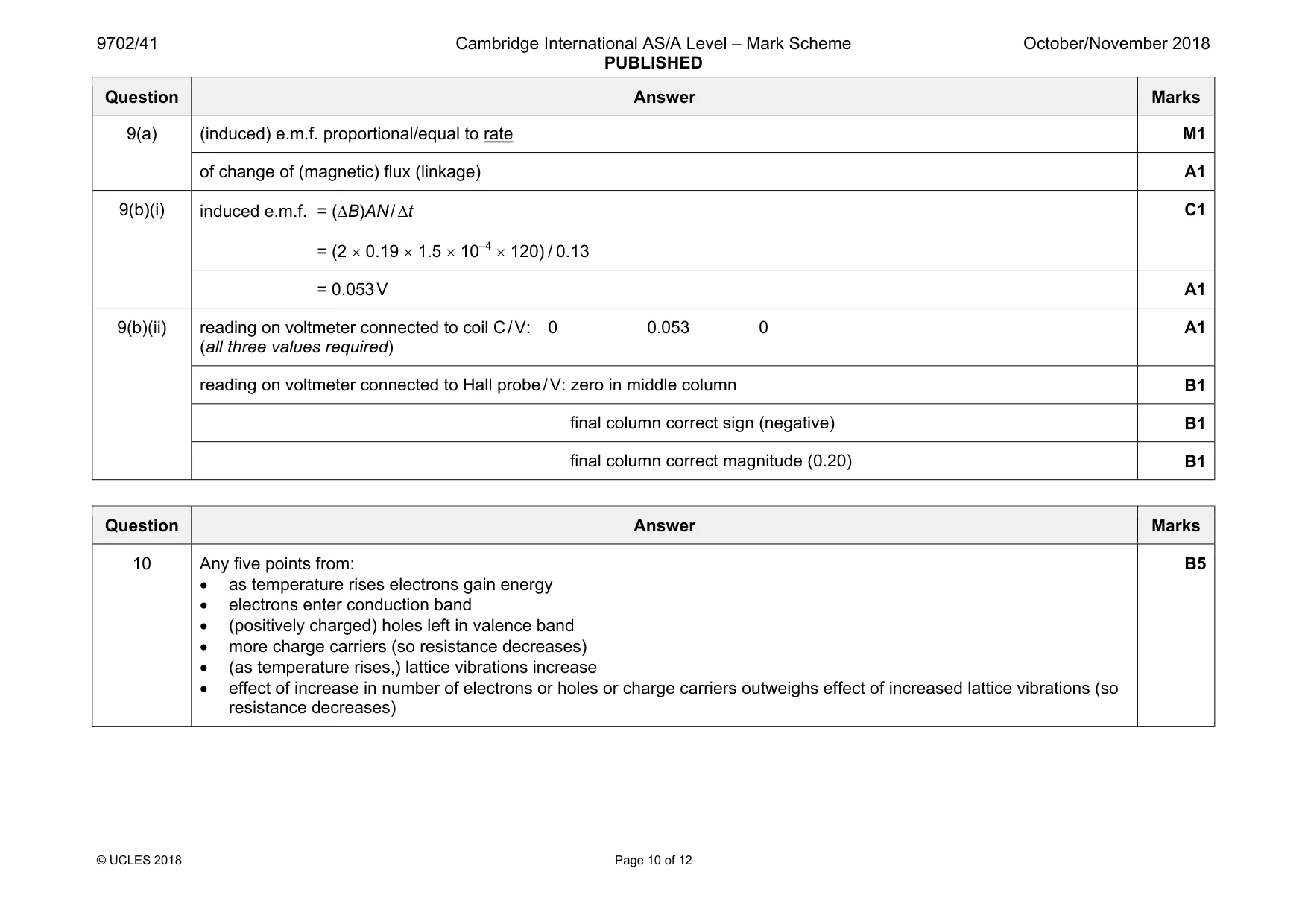
Mark scheme: 9(a) (induced) e.m.f. proportional/equal to rate M1 of change of (magnetic) flux (linkage) A1 9(b)(i) induced e.m.f. = (∆B)AN / ∆t = (2 × 0.19 × 1.5 × 10–4 × 120) / 0.13 C1 = 0.053 V A1 9(b)(ii) reading on voltmeter connected to coil C / V: 0 0.053 0 (all three values required) A1 reading on voltmeter connected to Hall probe / V: zero in middle column B1 final column correct sign (negative) B1 final column correct magnitude (0.20) B1
Q10 · Some of the electron energy bands in a semiconductor material at the absolute zero of…
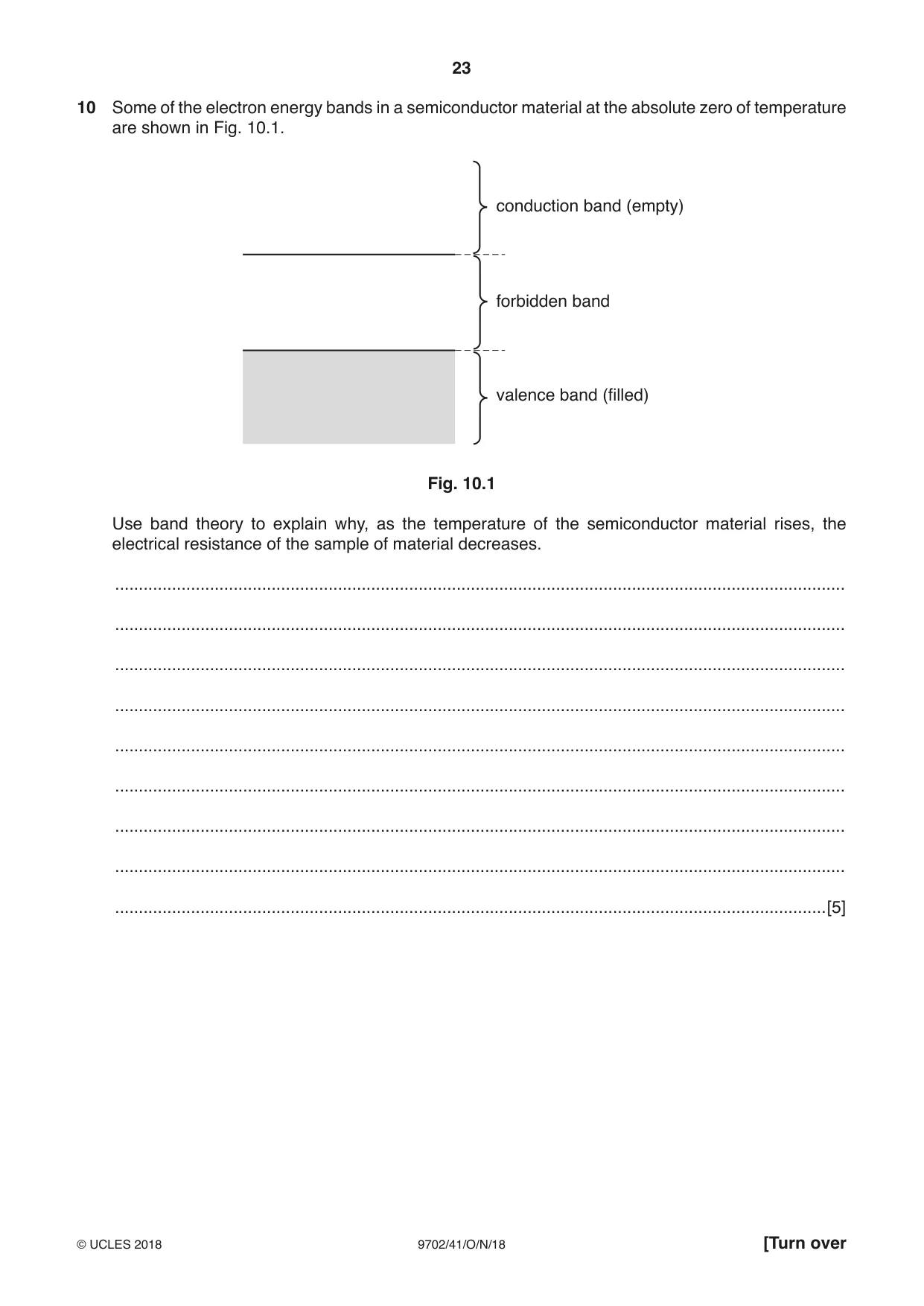
10 Some of the electron energy bands in a semiconductor material at the absolute zero of temperature are shown in Fig. 10.1. conduction band (empty) forbidden band valence band (filled) Fig. 10.1 Use band theory to explain why, as the temperature of the semiconductor material rises, the electrical resistance of the sample of material decreases. .......................................................................................................................................................... .......................................................................................................................................................... .......................................................................................................................................................... .......................................................................................................................................................... .......................................................................................................................................................... .......................................................................................................................................................... .......................................................................................................................................................... .......................................................................................................................................................... ......................................................................................................................................................[5]
Mark scheme: 10 Any five points from: • as temperature rises electrons gain energy • electrons enter conduction band • (positively charged) holes left in valence band • more charge carriers (so resistance decreases) • (as temperature rises,) lattice vibrations increase • effect of increase in number of electrons or holes or charge carriers outweighs effect of increased lattice vibrations (so resistance decreases) B5
Q11 · A stationary isolated nucleus emits a γ-ray photon of energy 0.51MeV
11 A stationary isolated nucleus emits a γ-ray photon of energy 0.51MeV. (a) State what is meant by a photon. ................................................................................................................................................... ................................................................................................................................................... ...............................................................................................................................................[2] (b) For the γ-ray photon, calculate (i) its wavelength, wavelength = ...................................................... m [2] (ii) its momentum. momentum = .....................................................N s [2] (c) (i) For this nucleus, determine the change in mass Δm during the decay that gives rise to the energy of the γ-ray photon. Δm = ..................................................... kg [2] (ii) Explain why, after the decay, the nucleus is no longer stationary. ........................................................................................................................................... ........................................................................................................................................... .......................................................................................................................................[1] [Total: 9]
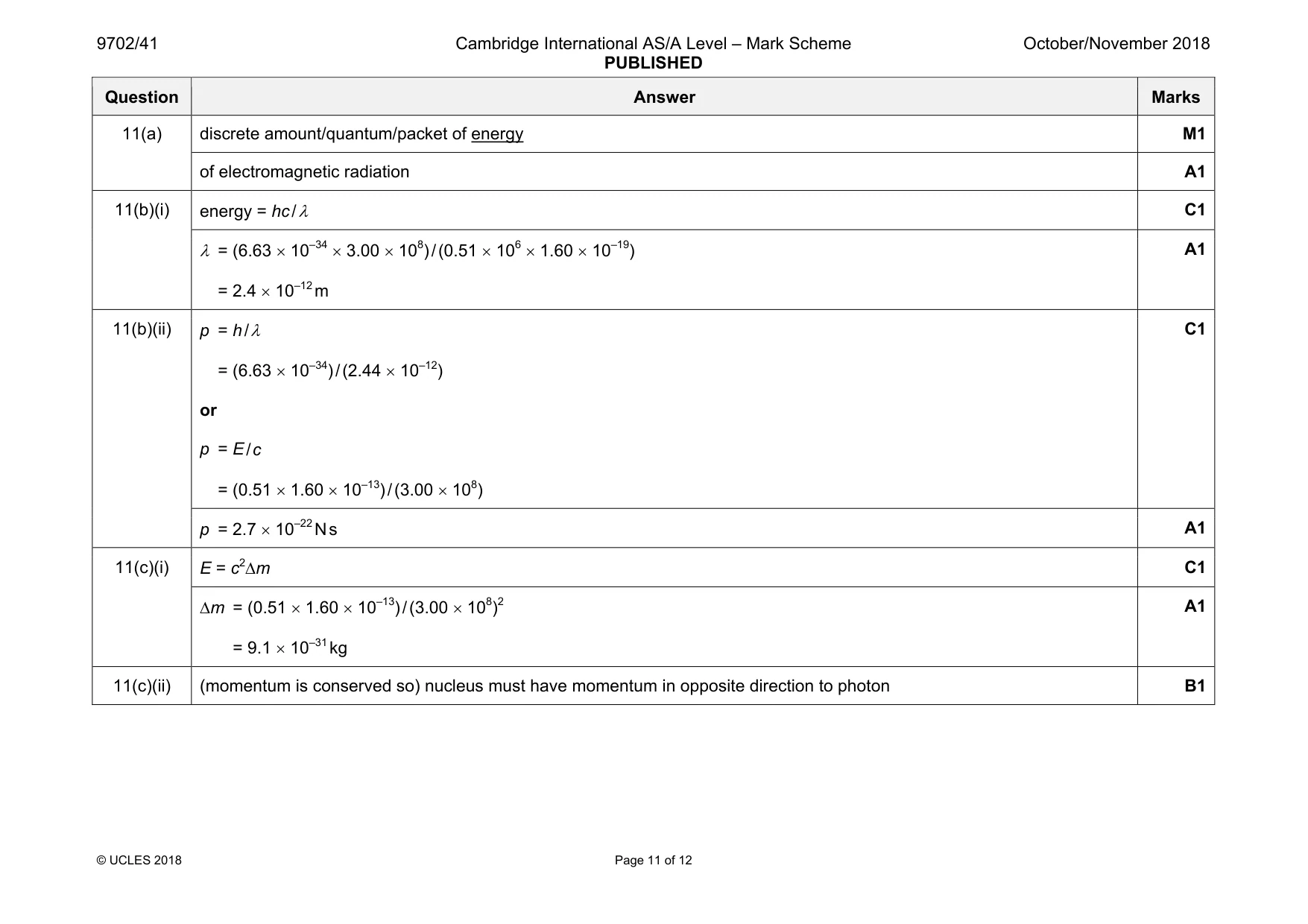
Mark scheme: 11(a) discrete amount/quantum/packet of energy M1 of electromagnetic radiation A1 11(b)(i) energy = hc / λ C1 λ = (6.63 × 10–34 × 3.00 × 108) / (0.51 × 106 × 1.60 × 10–19) = 2.4 × 10⁻¹² m A1 11(b)(ii) p = h / λ = (6.63 × 10⁻³⁴) / (2.44 × 10⁻¹²) or p = E / c = (0.51 × 1.60 × 10–13) / (3.00 × 10⁸) C1 p = 2.7 × 10⁻²² N s A1 11(c)(i) E = c2∆m C1 ∆m = (0.51 × 1.60 × 10–13) / (3.00 × 10⁸)2 = 9.1 × 10⁻³¹ kg A1 11(c)(ii) (momentum is conserved so) nucleus must have momentum in opposite direction to photon B1
Q12 · State what is meant by radioactive decay
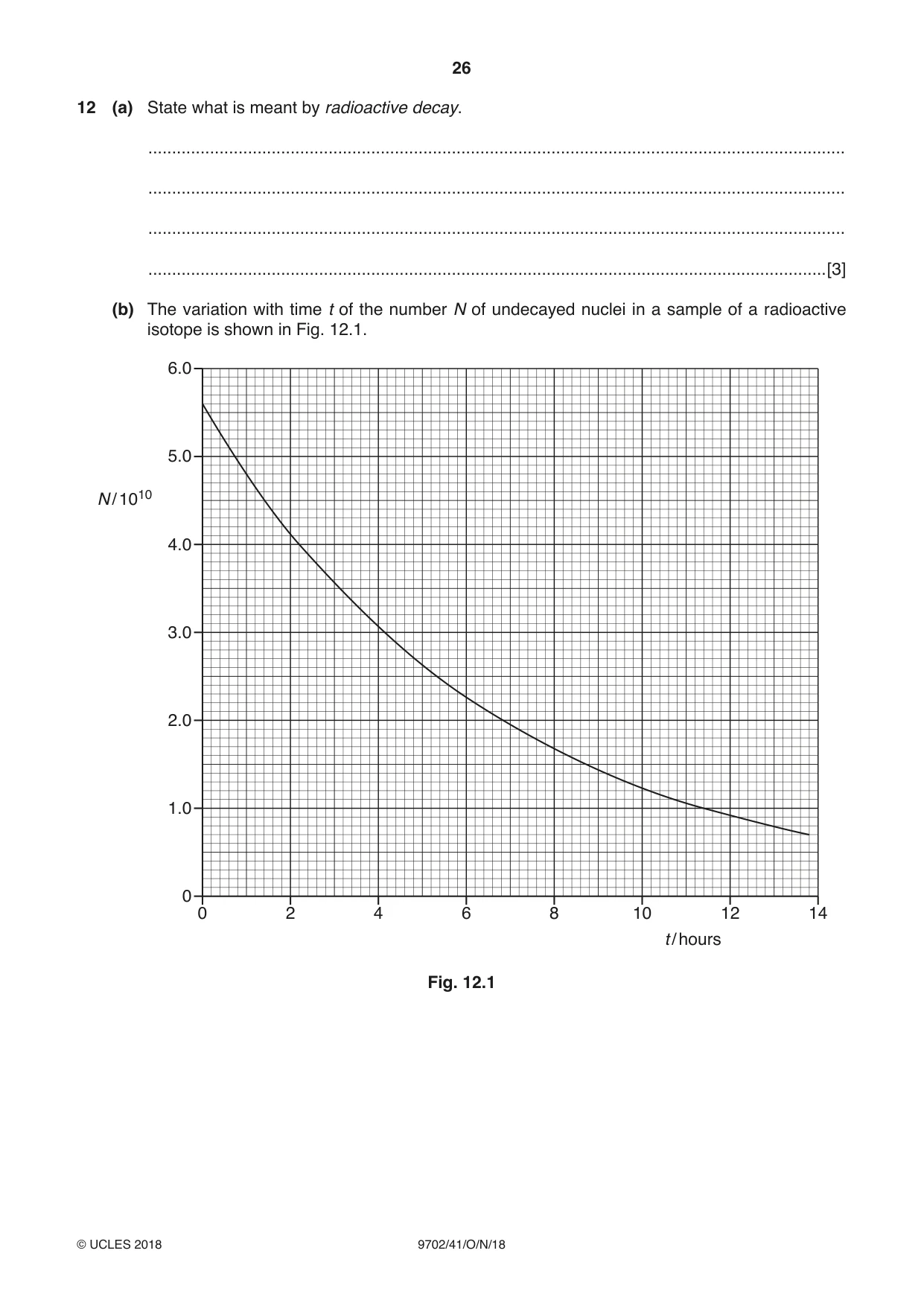
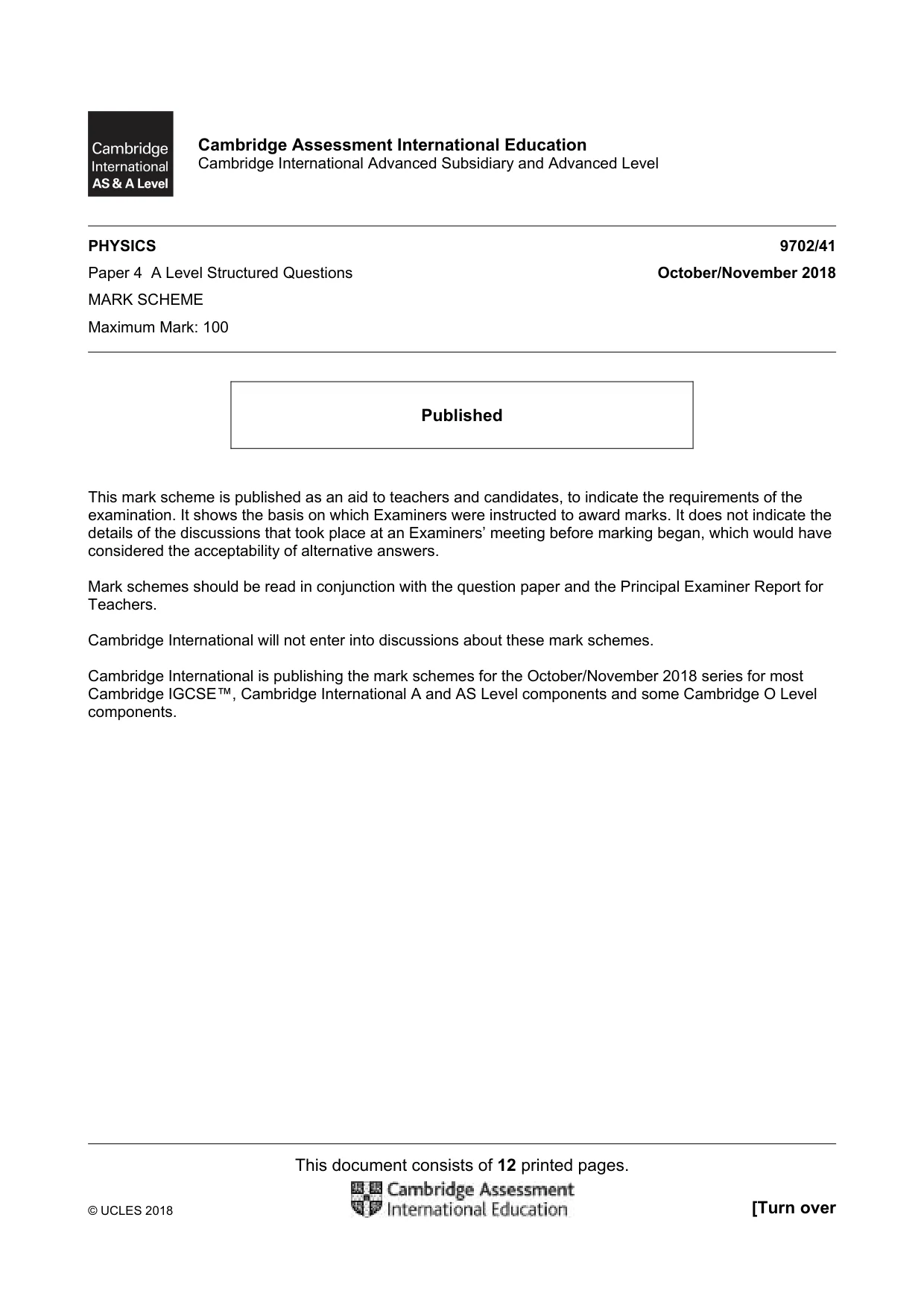
12 (a) State what is meant by radioactive decay. ................................................................................................................................................... ................................................................................................................................................... ................................................................................................................................................... ...............................................................................................................................................[3] (b) The variation with time t of the number N of undecayed nuclei in a sample of a radioactive isotope is shown in Fig. 12.1. 6.0 5.0 N / 1010 4.0 3.0 2.0 1.0 0 0 2 4 6 8 10 12 14 t / hours Fig. 12.1 (i) Use the gradient of the line in Fig. 12.1 to determine the activity, in Bq, of the sample at time t = 4.0 hours. Show your working. activity = ..................................................... Bq [3] (ii) Use your answer in (i) to show that the decay constant λ of the isotope is approximately 4 × 10⁻⁵ s–1. [2] (c) A sample of a different radioactive isotope has an initial activity of 4.6 × 10³ Bq. The sample must be stored safely until its activity is reduced to 1.0 × 10³ Bq. The decay constant of the isotope is 5.5 × 10⁻⁷ s–1. The decay products are not radioactive. Calculate the minimum time, in days, for which the sample must be stored. time = ................................................. days [3] [Total: 11]
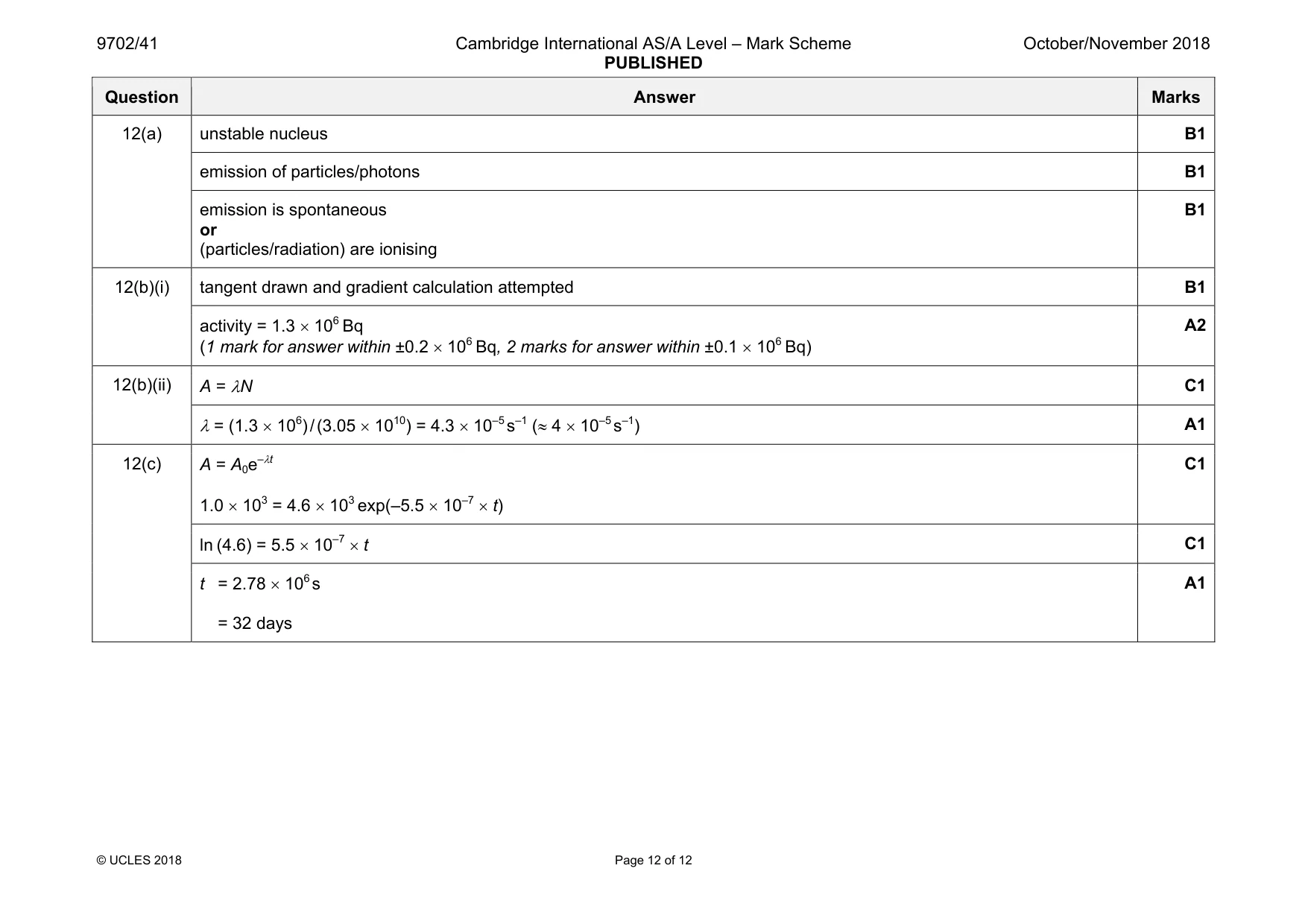
Mark scheme: 12(a) unstable nucleus B1 emission of particles/photons B1 emission is spontaneous or (particles/radiation) are ionising B1 12(b)(i) tangent drawn and gradient calculation attempted B1 activity = 1.3 × 10⁶ Bq (1 mark for answer within ±0.2 × 10⁶ Bq, 2 marks for answer within ±0.1 × 10⁶ Bq) A2 12(b)(ii) A = λN C1 λ = (1.3 × 10⁶) / (3.05 × 10¹⁰) = 4.3 × 10⁻⁵ s–1 (≈ 4 × 10⁻⁵ s–1) A1 12(c) A = A0e–λt 1.0 × 103 = 4.6 × 10³ exp(–5.5 × 10⁻⁷ × t) C1 ln (4.6) = 5.5 × 10⁻⁷ × t C1 t = 2.78 × 10⁶ s = 32 days A1
What was in this paper
The subtopics covered by these 12 questions, and how many questions each got. Open one in a new tab to see every Cambridge question on it.
1Damped and forced oscillations, resonance1Electric potential1Electromagnetic induction1Energy and momentum of a photon1Energy levels in atoms and line spectra1Force on a moving charge1Gravitational potential1Practical circuits1Production and use of ultrasound1Radioactive decay1The first law of thermodynamics1What you needed in this session
Cambridge’s own grade thresholds for 2018 Oct/Nov, Paper 4 · Variant 1. A higher threshold means an easier paper — the bar moves with how the cohort did.