Cambridge A Level Mathematics 9709 — 2010 May/June Paper 5 · Variant 2
9709/52/M/J/10 · 7 questions · 50 marks · ≈56 min
The question paper and its mark scheme, free to read here and free to download. This is Cambridge’s own paper, exactly as it was sat.
Question paper4 pages
Mark scheme5 pages
Answers below. Sit the paper first if you are practising.
Questions as text
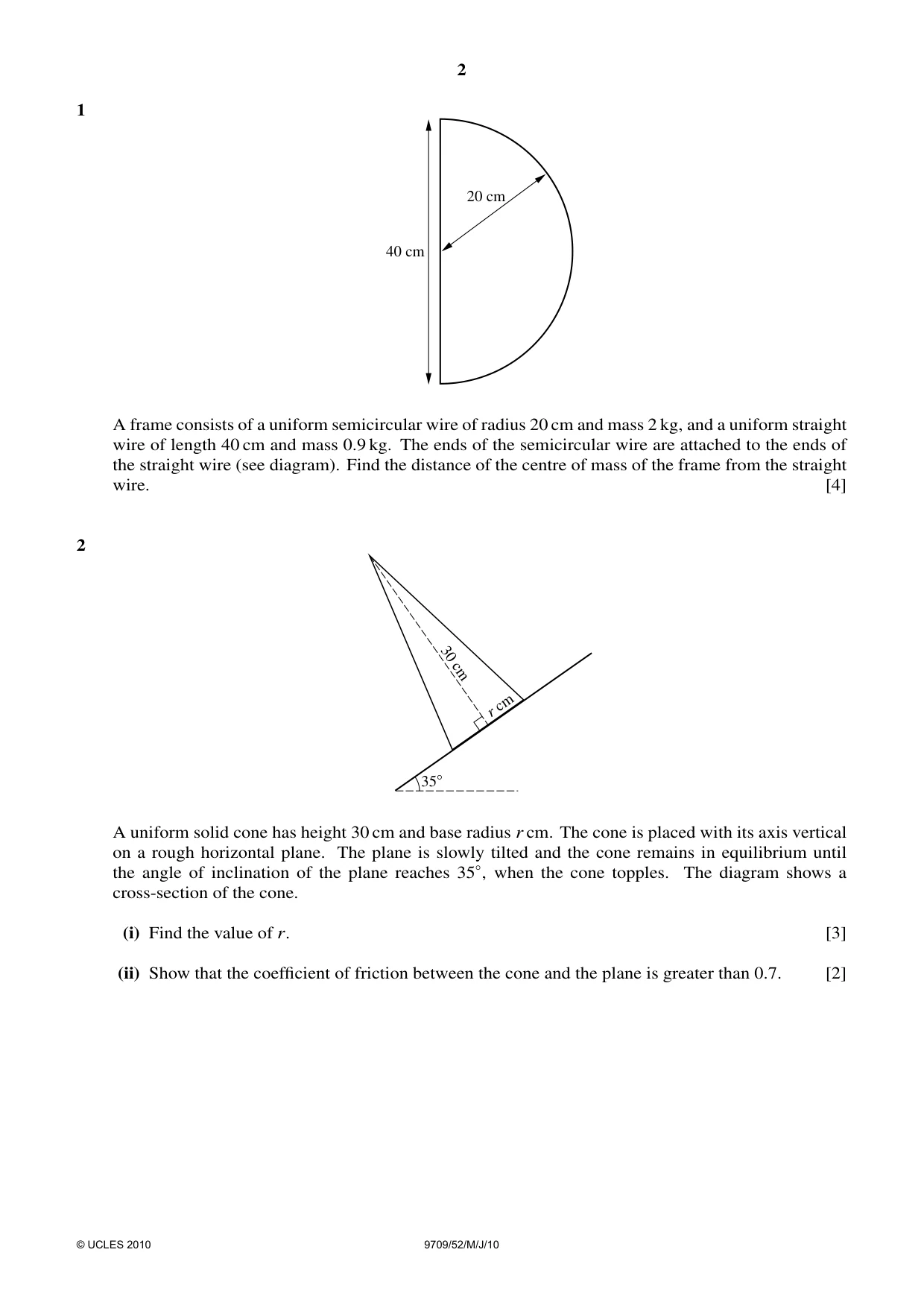
Q1 · 20 cm 40 cm A frame consists of a uniform semicircular wire of radius 20 cm and mass 2…
1 20 cm 40 cm A frame consists of a uniform semicircular wire of radius 20 cm and mass 2 kg, and a uniform straight wire of length 40 cm and mass 0.9 kg. The ends of the semicircular wire are attached to the ends of the straight wire (see diagram). Find the distance of the centre of mass of the frame from the straight wire. [4]
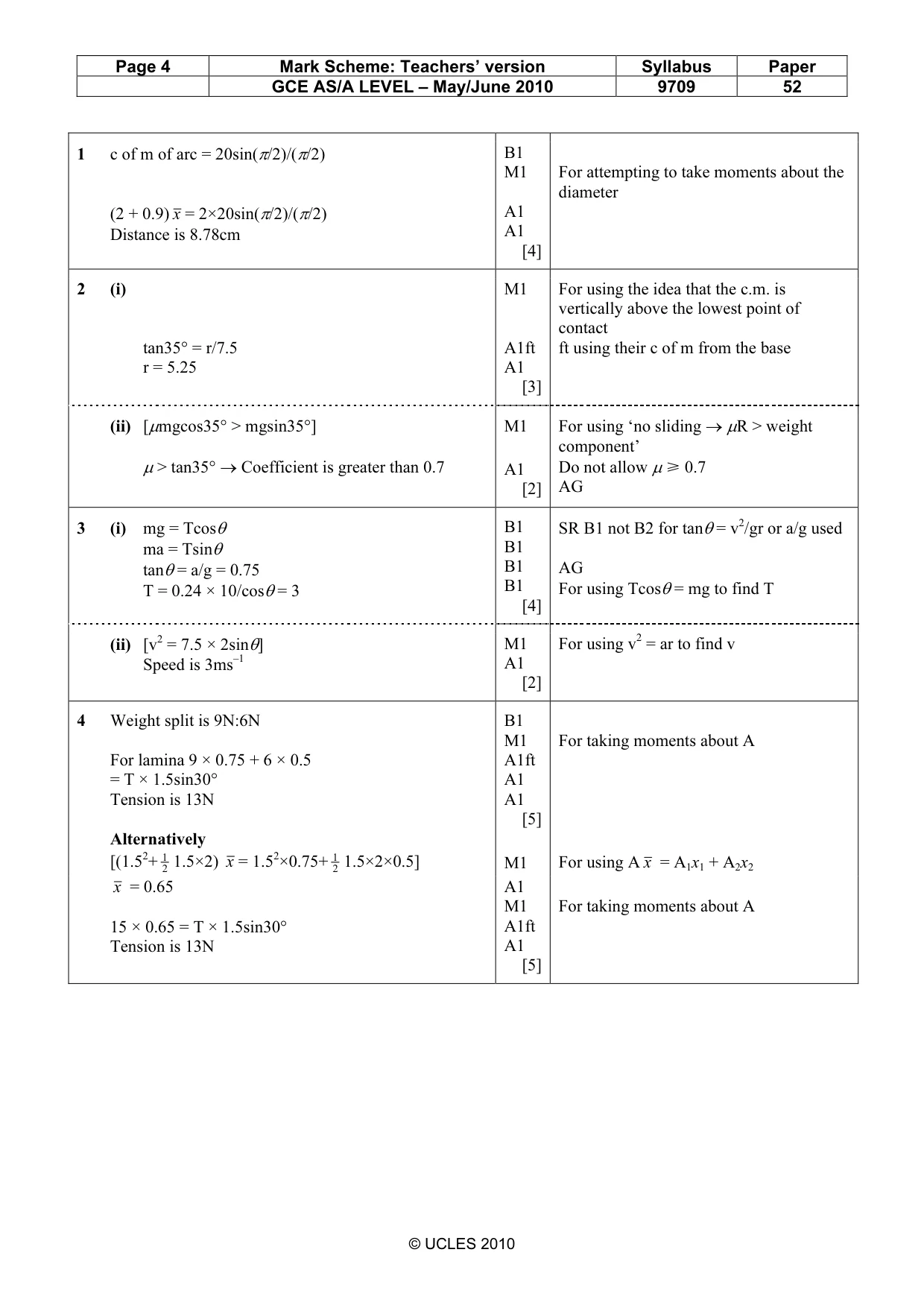
Mark scheme: 1 c of m of arc = 20sin(π/2)/(π/2) B1 M1 For attempting to take moments about the diameter (2 + 0.9) x = 2×20sin(π/2)/(π/2) A1 Distance is 8.78cm A1 [4]
Q2 · 30 cm cm r 35° A uniform solid cone has height 30 cm and base radius r cm
2 30 cm cm r 35° A uniform solid cone has height 30 cm and base radius r cm. The cone is placed with its axis vertical on a rough horizontal plane. The plane is slowly tilted and the cone remains in equilibrium until the angle of inclination of the plane reaches 35◦, when the cone topples. The diagram shows a cross-section of the cone. (i) Find the value of r. [3] (ii) Show that the coefficient of friction between the cone and the plane is greater than 0.7. [2]
Mark scheme: 2 (i) M1 For using the idea that the c.m. is vertically above the lowest point of contact tan35° = r/7.5 A1ft ft using their c of m from the base r = 5.25 A1 [3] (ii) [µmgcos35° > mgsin35°] M1 For using ‘no sliding → µR > weight component’ µ > tan35° → Coefficient is greater than 0.7 A1 Do not allow µ [ 0.7 [2] AG 2
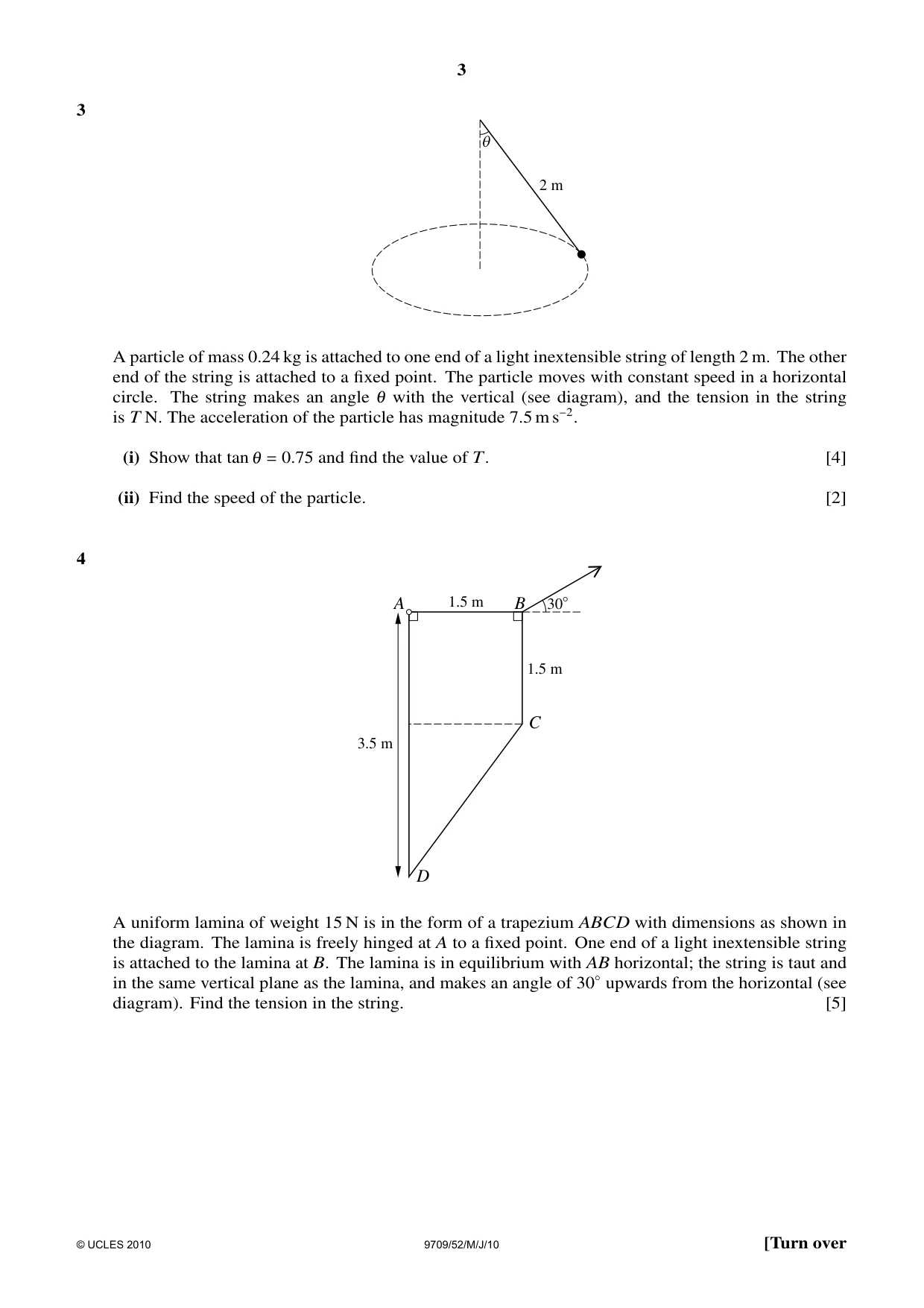
Q3 · Q 2 m A particle of mass 0.24 kg is attached to one end of a light inextensible string of…
3 q 2 m A particle of mass 0.24 kg is attached to one end of a light inextensible string of length 2 m. The other end of the string is attached to a fixed point. The particle moves with constant speed in a horizontal circle. The string makes an angle θ with the vertical (see diagram), and the tension in the string is T N. The acceleration of the particle has magnitude 7.5 m s−2. (i) Show that tan θ = 0.75 and find the value of T. [4] (ii) Find the speed of the particle. [2]
Mark scheme: 3 (i) mg = Tcosθ B1 SR B1 not B2 for tanθ = v2/gr or a/g used ma = Tsinθ B1 tanθ = a/g = 0.75 B1 AG T = 0.24 × 10/cosθ = 3 B1 For using Tcosθ = mg to find T [4] (ii) [v2 = 7.5 × 2sinθ] M1 For using v2 = ar to find v Speed is 3ms–1 A1 [2]
Q4 · A 1.5 m B 30° 1.5 m C 3.5 m D A uniform lamina of weight 15 N is in the form of a…
4 A 1.5 m B 30° 1.5 m C 3.5 m D A uniform lamina of weight 15 N is in the form of a trapezium ABCD with dimensions as shown in the diagram. The lamina is freely hinged at A to a fixed point. One end of a light inextensible string is attached to the lamina at B. The lamina is in equilibrium with AB horizontal; the string is taut and in the same vertical plane as the lamina, and makes an angle of 30◦upwards from the horizontal (see diagram). Find the tension in the string. [5]
Mark scheme: 4 Weight split is 9N:6N B1 M1 For taking moments about A For lamina 9 × 0.75 + 6 × 0.5 A1ft = T × 1.5sin30° A1 Tension is 13N A1 [5] Alternatively [(1.52+ 12 1.5×2) x = 1.52×0.75+ 12 1.5×2×0.5] M1 For using A x = A1x1 + A2x2 x = 0.65 A1 M1 For taking moments about A 15 × 0.65 = T × 1.5sin30° A1ft Tension is 13N A1 [5] GCE AS/A LEVEL – May/June 2010 9709 52 2 2 2
Q5 · A particle is projected from a point O on horizontal ground
5 A particle is projected from a point O on horizontal ground. The velocity of projection has magnitude 20 m s−1 and direction upwards at an angle θ to the horizontal. The particle passes through the point which is 7 m above the ground and 16 m horizontally from O, and hits the ground at the point A. (i) Using the equation of the particle’s trajectory and the identity sec2θ = 1 + tan2θ, show that the possible values of tan θ are 34 and 174 . [4] (ii) Find the distance OA for each of the two possible values of tan θ. [3] (iii) Sketch in the same diagram the two possible trajectories. [2]
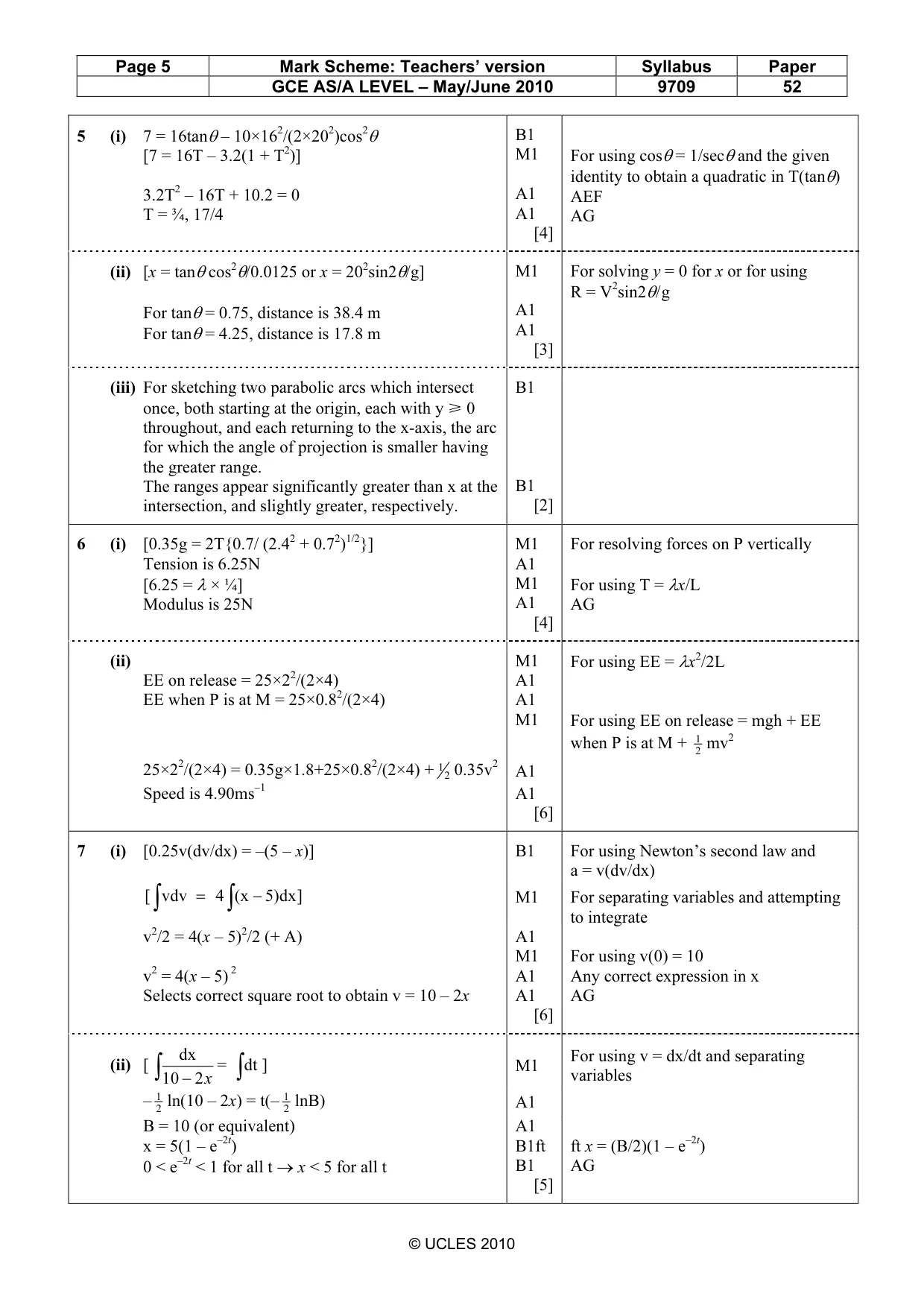
Mark scheme: 5 (i) 7 = 16tanθ – 10×162/(2×202)cos2θ B1 [7 = 16T – 3.2(1 + T2)] M1 For using cosθ = 1/secθ and the given identity to obtain a quadratic in T(tanθ) 3.2T2 – 16T + 10.2 = 0 A1 AEF T = ¾, 17/4 A1 AG [4] (ii) [x = tanθ cos2θ/0.0125 or x = 202sin2θ/g] M1 For solving y = 0 for x or for using R = V2sin2θ/g For tanθ = 0.75, distance is 38.4 m A1 For tanθ = 4.25, distance is 17.8 m A1 [3] (iii) For sketching two parabolic arcs which intersect B1 once, both starting at the origin, each with y [ 0 throughout, and each returning to the x-axis, the arc for which the angle of projection is smaller having the greater range. The ranges appear significantly greater than x at the B1 intersection, and slightly greater, respectively. [2] 2 2 1/2
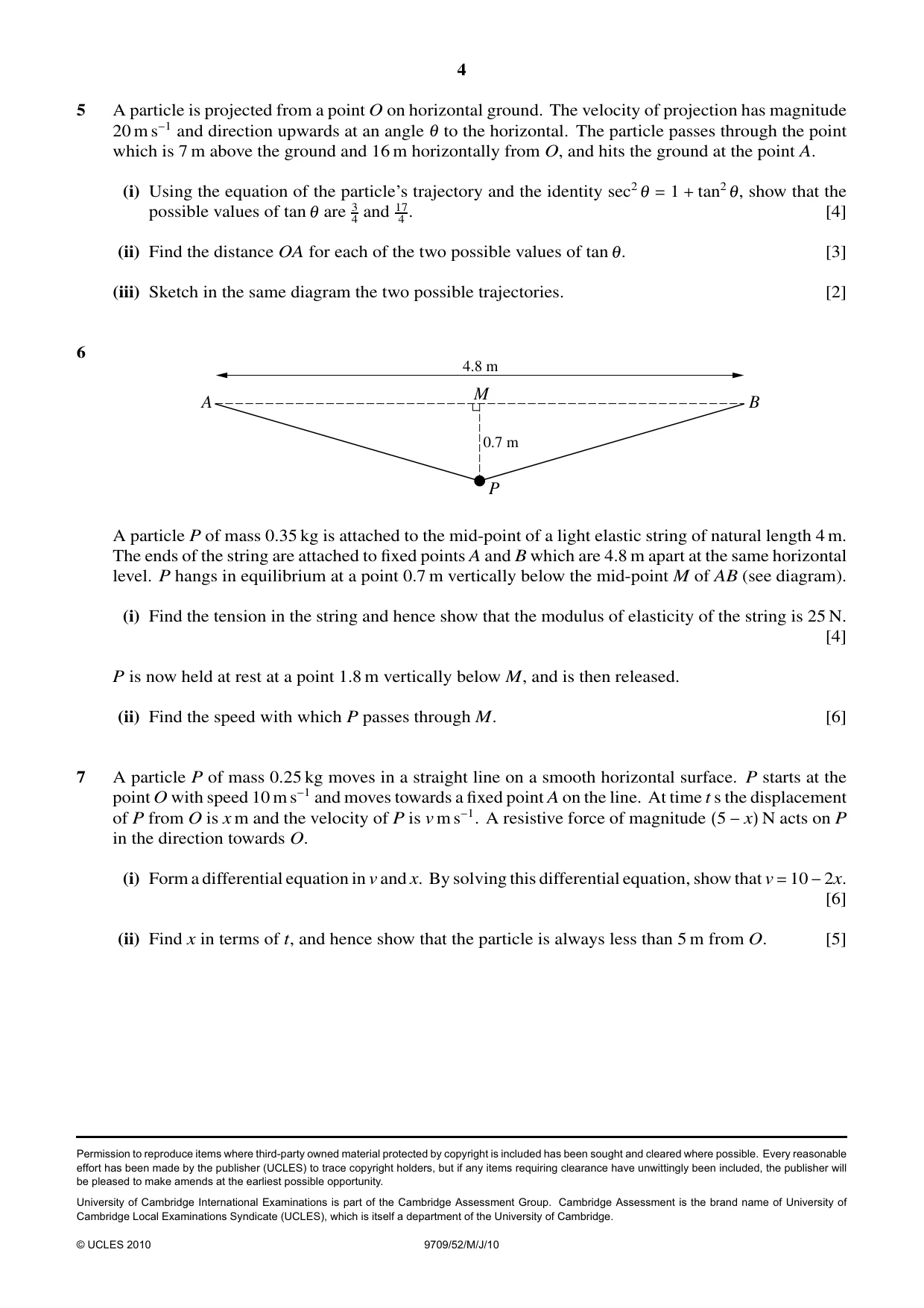
Q6 · 4.8 m M A B 0.7 m P A particle P of mass 0.35 kg is attached to the mid-point of a light…
6 4.8 m M A B 0.7 m P A particle P of mass 0.35 kg is attached to the mid-point of a light elastic string of natural length 4 m. The ends of the string are attached to fixed points A and B which are 4.8 m apart at the same horizontal level. P hangs in equilibrium at a point 0.7 m vertically below the mid-point M of AB (see diagram). (i) Find the tension in the string and hence show that the modulus of elasticity of the string is 25 N. [4] P is now held at rest at a point 1.8 m vertically below M, and is then released. (ii) Find the speed with which P passes through M. [6]
Mark scheme: 6 (i) [0.35g = 2T{0.7/ (2.42 + 0.72)1/2}] M1 For resolving forces on P vertically Tension is 6.25N A1 [6.25 = λ × ¼] M1 For using T = λx/L Modulus is 25N A1 AG [4] (ii) M1 For using EE = λx2/2L EE on release = 25×22/(2×4) A1 EE when P is at M = 25×0.82/(2×4) A1 M1 For using EE on release = mgh + EE when P is at M + 12 mv2 25×22/(2×4) = 0.35g×1.8+25×0.82/(2×4) + 1 2 0.35v2 A1 Speed is 4.90ms–1 A1 [6]
Q7 · A particle P of mass 0.25 kg moves in a straight line on a smooth horizontal surface
7 A particle P of mass 0.25 kg moves in a straight line on a smooth horizontal surface. P starts at the point O with speed 10 m s−1 and moves towards a fixed point A on the line. At time t s the displacement of P from O is x m and the velocity of P is v m s−1. A resistive force of magnitude (5 −x) N acts on P in the direction towards O. (i) Form a differential equation in v and x. By solving this differential equation, show that v = 10 −2x. [6] (ii) Find x in terms of t, and hence show that the particle is always less than 5 m from O. [5]
Mark scheme: 7 (i) [0.25v(dv/dx) = –(5 – x)] B1 For using Newton’s second law and a = v(dv/dx) M1 For separating variables and attempting [∫ vdv = 4 ∫ (x − 5)dx ] to integrate v2/2 = 4(x – 5)2/2 (+ A) A1 M1 For using v(0) = 10 v2 = 4(x – 5) 2 A1 Any correct expression in x Selects correct square root to obtain v = 10 – 2x A1 AG [6] dx For using v = dx/dt and separating (ii) [∫ 10 −x2 = ∫dt ] M1 variables – 12 ln(10 – 2x) = t(– 12 lnB) A1 B = 10 (or equivalent) A1 x = 5(1 – e–2t) B1ft ft x = (B/2)(1 – e–2t) 0 < e–2t < 1 for all t → x < 5 for all t B1 AG [5]
What was in this paper
The subtopics covered by these 7 questions, and how many questions each got. Open one in a new tab to see every Cambridge question on it.
What you needed in this session
Cambridge’s own grade thresholds for 2010 May/June, Paper 5 · Variant 2. A higher threshold means an easier paper — the bar moves with how the cohort did.