Cambridge A Level Mathematics 9709 — 2013 May/June Paper 5 · Variant 1
9709/51/M/J/13 · 6 questions · 50 marks · ≈56 min
The question paper and its mark scheme, free to read here and free to download. This is Cambridge’s own paper, exactly as it was sat.
Question paper4 pages
Mark scheme6 pages
Answers below. Sit the paper first if you are practising.
Questions as text
Q1 · A small ball is projected with speed 20 m s−1 at an angle of 45Å above the horizontal…
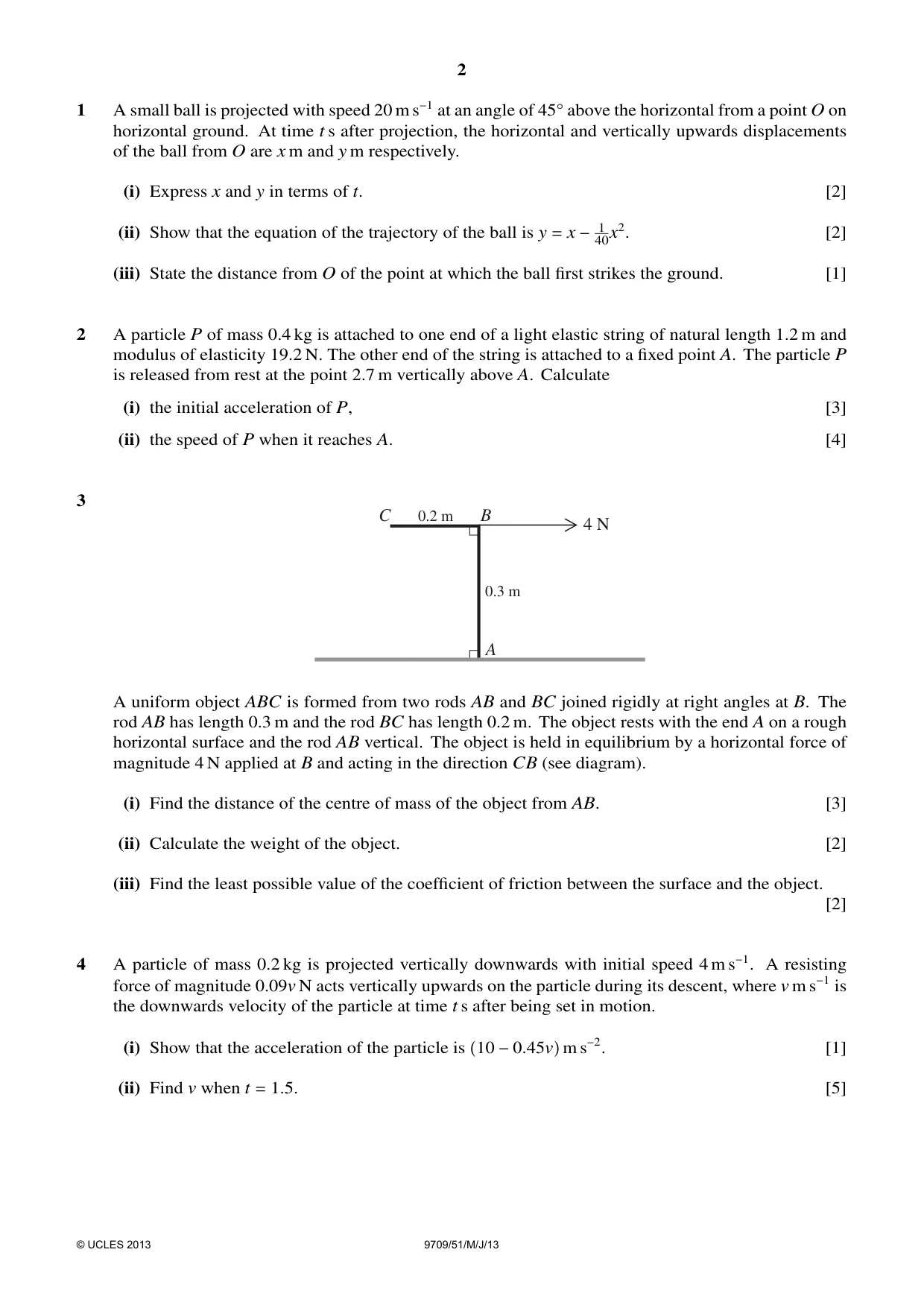
1 A small ball is projected with speed 20 m s−1 at an angle of 45Å above the horizontal from a point O on horizontal ground. At time t s after projection, the horizontal and vertically upwards displacements of the ball from O are x m and y m respectively. (i) Express x and y in terms of t. [2] (ii) Show that the equation of the trajectory of the ball is y = x −140x2. [2] (iii) State the distance from O of the point at which the ball first strikes the ground. [1]
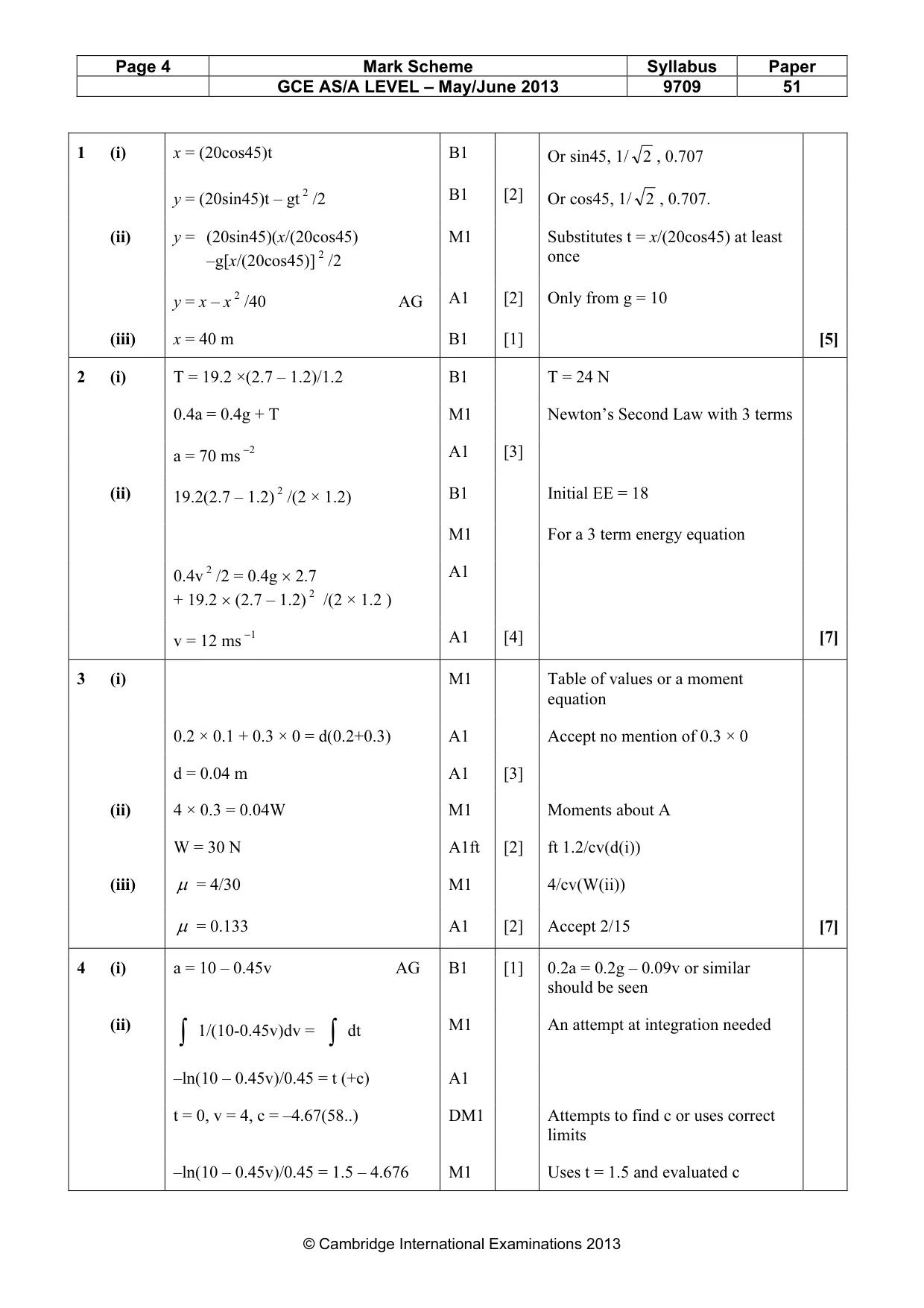
Mark scheme: 1 (i) x = (20cos45)t B1 Or sin45, 1/ 2 , 0.707 y = (20sin45)t – gt 2 /2 B1 [2] Or cos45, 1/ 2 , 0.707. (ii) y = (20sin45)(x/(20cos45) M1 Substitutes t = x/(20cos45) at least –g[x/(20cos45)] 2 /2 once y = x – x 2 /40 AG A1 [2] Only from g = 10 (iii) x = 40 m B1 [1] [5]
Q2 · A particle P of mass 0.4 kg is attached to one end of a light elastic string of natural…
2 A particle P of mass 0.4 kg is attached to one end of a light elastic string of natural length 1.2 m and modulus of elasticity 19.2 N. The other end of the string is attached to a fixed point A. The particle P is released from rest at the point 2.7 m vertically above A. Calculate (i) the initial acceleration of P, [3] (ii) the speed of P when it reaches A. [4]
Mark scheme: 2 (i) T = 19.2 ×(2.7 – 1.2)/1.2 B1 T = 24 N 0.4a = 0.4g + T M1 Newton’s Second Law with 3 terms a = 70 ms − 2 A1 [3] (ii) 19.2(2.7 – 1.2) 2 /(2 × 1.2) B1 Initial EE = 18 M1 For a 3 term energy equation 0.4v 2 /2 = 0.4g × 2.7 A1 + 19.2 × (2.7 – 1.2) 2 /(2 × 1.2 ) v = 12 ms − 1 A1 [4] [7]
Q3 · C 0.2 m B 4 N 0.3 m A A uniform object ABC is formed from two rods AB and BC joined…
3 C 0.2 m B 4 N 0.3 m A A uniform object ABC is formed from two rods AB and BC joined rigidly at right angles at B. The rod AB has length 0.3 m and the rod BC has length 0.2 m. The object rests with the end A on a rough horizontal surface and the rod AB vertical. The object is held in equilibrium by a horizontal force of magnitude 4 N applied at B and acting in the direction CB (see diagram). (i) Find the distance of the centre of mass of the object from AB. [3] (ii) Calculate the weight of the object. [2] (iii) Find the least possible value of the coefficient of friction between the surface and the object. [2]
Mark scheme: 3 (i) M1 Table of values or a moment equation 0.2 × 0.1 + 0.3 × 0 = d(0.2+0.3) A1 Accept no mention of 0.3 × 0 d = 0.04 m A1 [3] (ii) 4 × 0.3 = 0.04W M1 Moments about A W = 30 N A1ft [2] ft 1.2/cv(d(i)) (iii) µ = 4/30 M1 4/cv(W(ii)) µ = 0.133 A1 [2] Accept 2/15 [7]
Q5 · A particle P is projected with speed 50 m s−1 at an angle of 40Å above the horizontal…
5 A particle P is projected with speed 50 m s−1 at an angle of 40Å above the horizontal from a point O. For the instant 2.5 s after projection, calculate (i) the speed of P, [3] (ii) the angle between OP and the horizontal. [4]
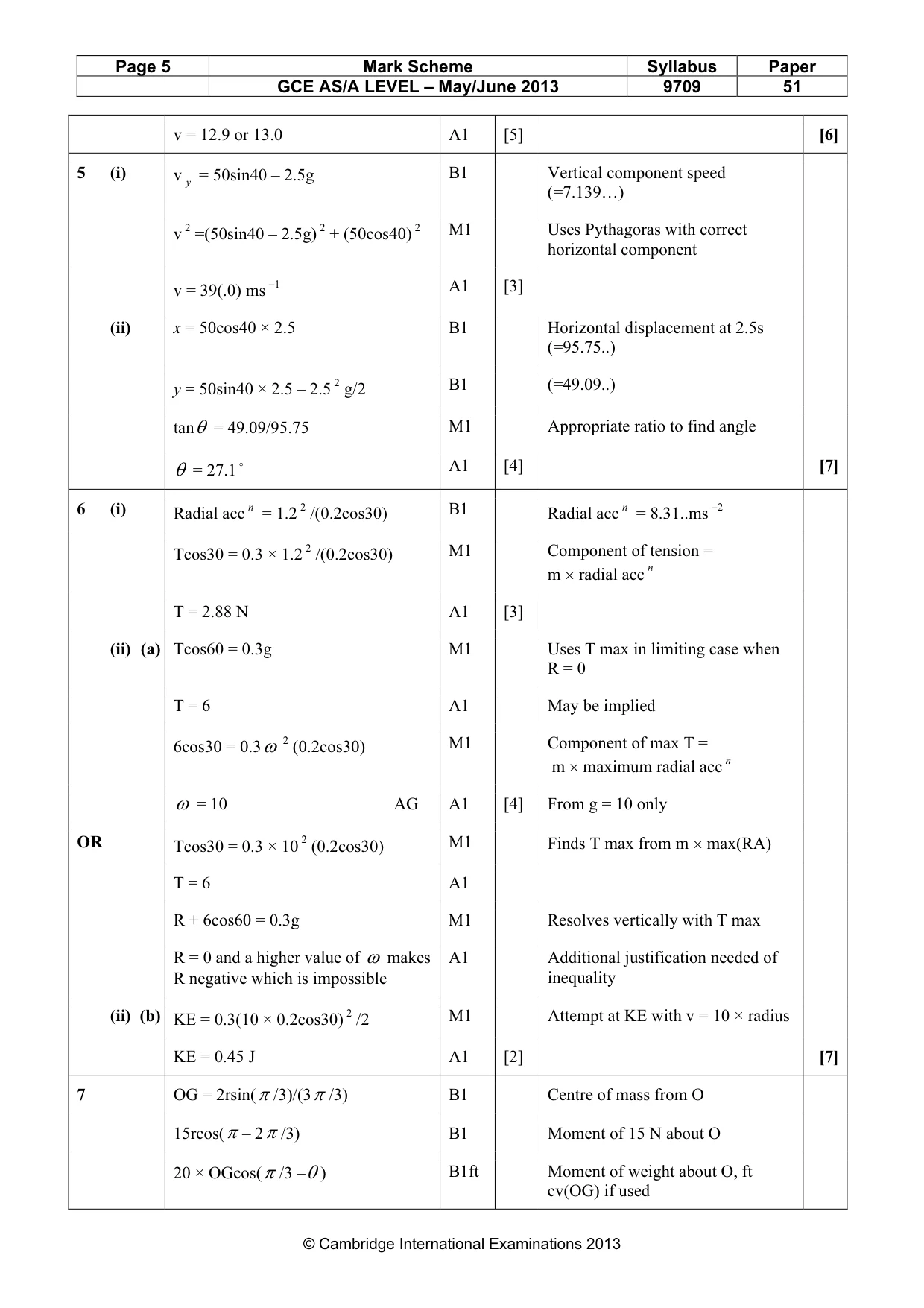
Mark scheme: 5 (i) v y = 50sin40 – 2.5g B1 Vertical component speed (=7.139…) v 2 =(50sin40 – 2.5g) 2 + (50cos40) 2 M1 Uses Pythagoras with correct horizontal component v = 39(.0) ms − 1 A1 [3] (ii) x = 50cos40 × 2.5 B1 Horizontal displacement at 2.5s (=95.75..) y = 50sin40 × 2.5 – 2.5 2 g/2 B1 (=49.09..) tanθ = 49.09/95.75 M1 Appropriate ratio to find angle θ = 27.1 A1 [4] [7]
Q6 · A 60° 0.2 m P One end of a light inextensible string of length 0.2 m is attached to a…
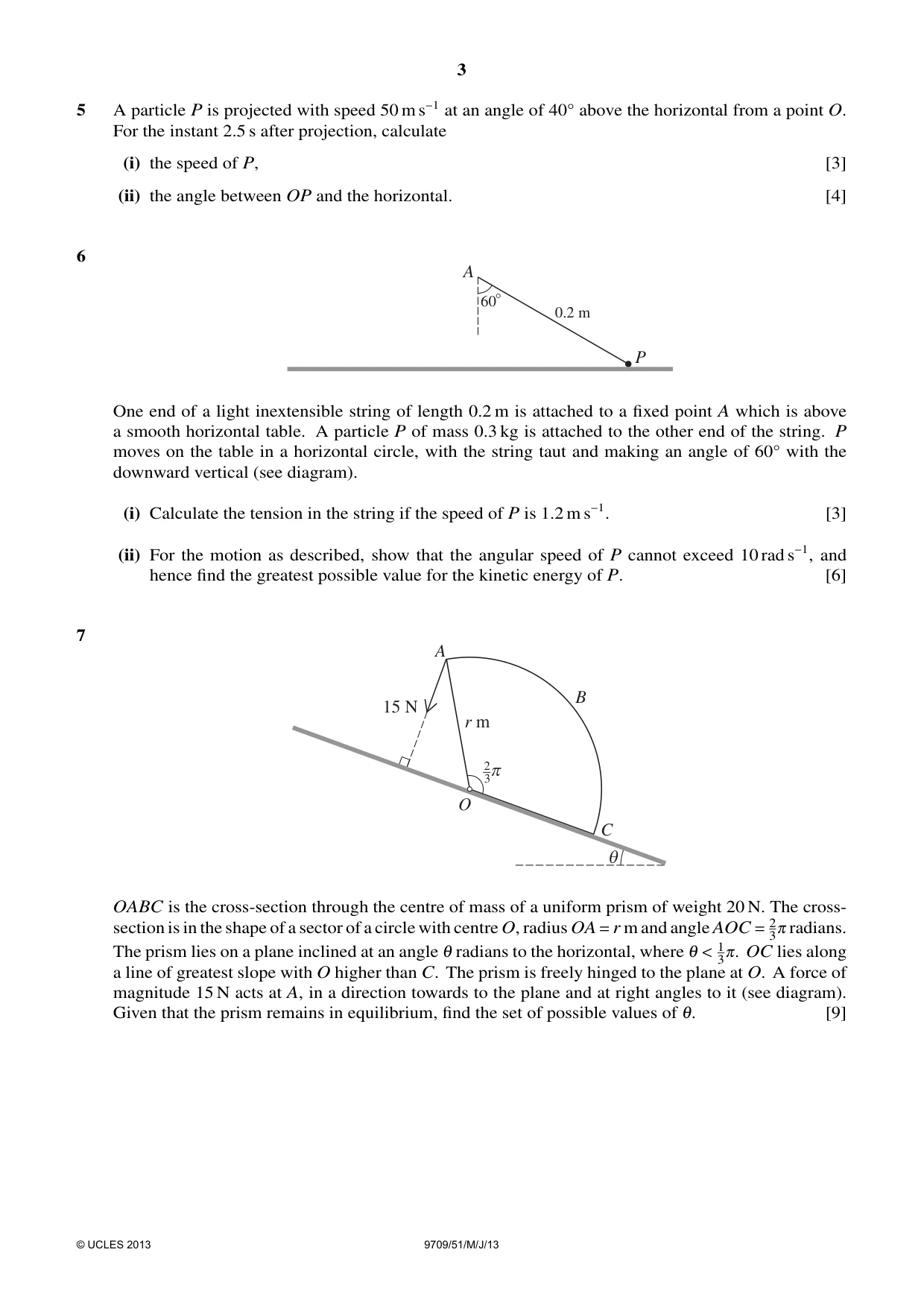
6 A 60° 0.2 m P One end of a light inextensible string of length 0.2 m is attached to a fixed point A which is above a smooth horizontal table. A particle P of mass 0.3 kg is attached to the other end of the string. P moves on the table in a horizontal circle, with the string taut and making an angle of 60Å with the downward vertical (see diagram). (i) Calculate the tension in the string if the speed of P is 1.2 m s−1. [3] (ii) For the motion as described, show that the angular speed of P cannot exceed 10 rad s−1, and hence find the greatest possible value for the kinetic energy of P. [6]
Mark scheme: 6 (i) Radial acc n = 1.2 2 /(0.2cos30) B1 Radial acc n = 8.31..ms − 2 Tcos30 = 0.3 × 1.2 2 /(0.2cos30) M1 Component of tension = m × radial acc n T = 2.88 N A1 [3] (ii) (a) Tcos60 = 0.3g M1 Uses T max in limiting case when R = 0 T = 6 A1 May be implied 6cos30 = 0.3ω 2 (0.2cos30) M1 Component of max T = m × maximum radial acc n ω = 10 AG A1 [4] From g = 10 only OR Tcos30 = 0.3 × 10 2 (0.2cos30) M1 Finds T max from m × max(RA) T = 6 A1 R + 6cos60 = 0.3g M1 Resolves vertically with T max R = 0 and a higher value of ω makes A1 Additional justification needed of R negative which is impossible inequality (ii) (b) KE = 0.3(10 × 0.2cos30) 2 /2 M1 Attempt at KE with v = 10 × radius KE = 0.45 J A1 [2] [7]
Q7 · A B 15 N r m 23p O C q OABC is the cross-section through the centre of mass of a uniform…
7 A B 15 N r m 23p O C q OABC is the cross-section through the centre of mass of a uniform prism of weight 20 N. The cross- section is in the shape of a sector of a circle with centre O, radius OA = r m and angle AOC = 230 radians. The prism lies on a plane inclined at an angle 1 radians to the horizontal, where 1 < 130. OC lies along a line of greatest slope with O higher than C. The prism is freely hinged to the plane at O. A force of magnitude 15 N acts at A, in a direction towards to the plane and at right angles to it (see diagram). Given that the prism remains in equilibrium, find the set of possible values of 1. [9]
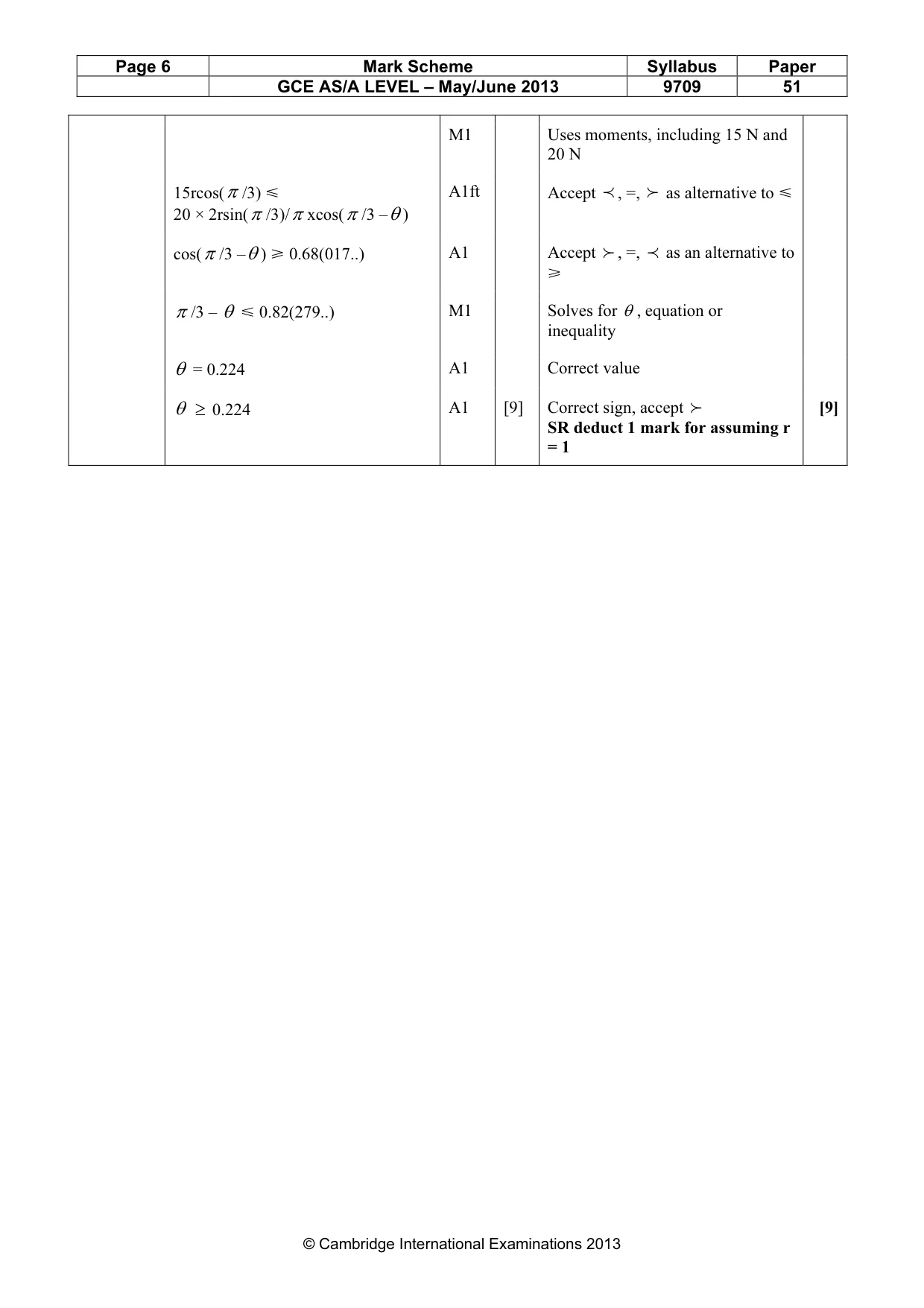
Mark scheme: 7 OG = 2rsin(π /3)/(3π /3) B1 Centre of mass from O 15rcos(π – 2π /3) B1 Moment of 15 N about O 20 × OGcos(π /3 –θ ) B1ft Moment of weight about O, ft cv(OG) if used GCE AS/A LEVEL – May/June 2013 9709 51 M1 Uses moments, including 15 N and 20 N 15rcos(π /3) Y A1ft Accept ≺, =, ≻ as alternative to Y 20 × 2rsin(π /3)/π xcos(π /3 –θ ) cos(π /3 –θ ) [ 0.68(017..) A1 Accept ≻, =, ≺ as an alternative to [ π /3 – θ Y 0.82(279..) M1 Solves for θ , equation or inequality θ = 0.224 A1 Correct value θ ≥ 0.224 A1 [9] Correct sign, accept ≻ [9] SR deduct 1 mark for assuming r = 1
What was in this paper
The subtopics covered by these 6 questions, and how many questions each got. Open one in a new tab to see every Cambridge question on it.
What you needed in this session
Cambridge’s own grade thresholds for 2013 May/June, Paper 5 · Variant 1. A higher threshold means an easier paper — the bar moves with how the cohort did.