Cambridge A Level Mathematics 9709 — 2012 Oct/Nov Paper 5 · Variant 2
9709/52/O/N/12 · 7 questions · 50 marks · ≈56 min
The question paper and its mark scheme, free to read here and free to download. This is Cambridge’s own paper, exactly as it was sat.
Question paper4 pages
Mark scheme6 pages
Answers below. Sit the paper first if you are practising.
Questions as text
Q1 · ABC is a uniform semicircular arc with diameter AC = 0.5 m
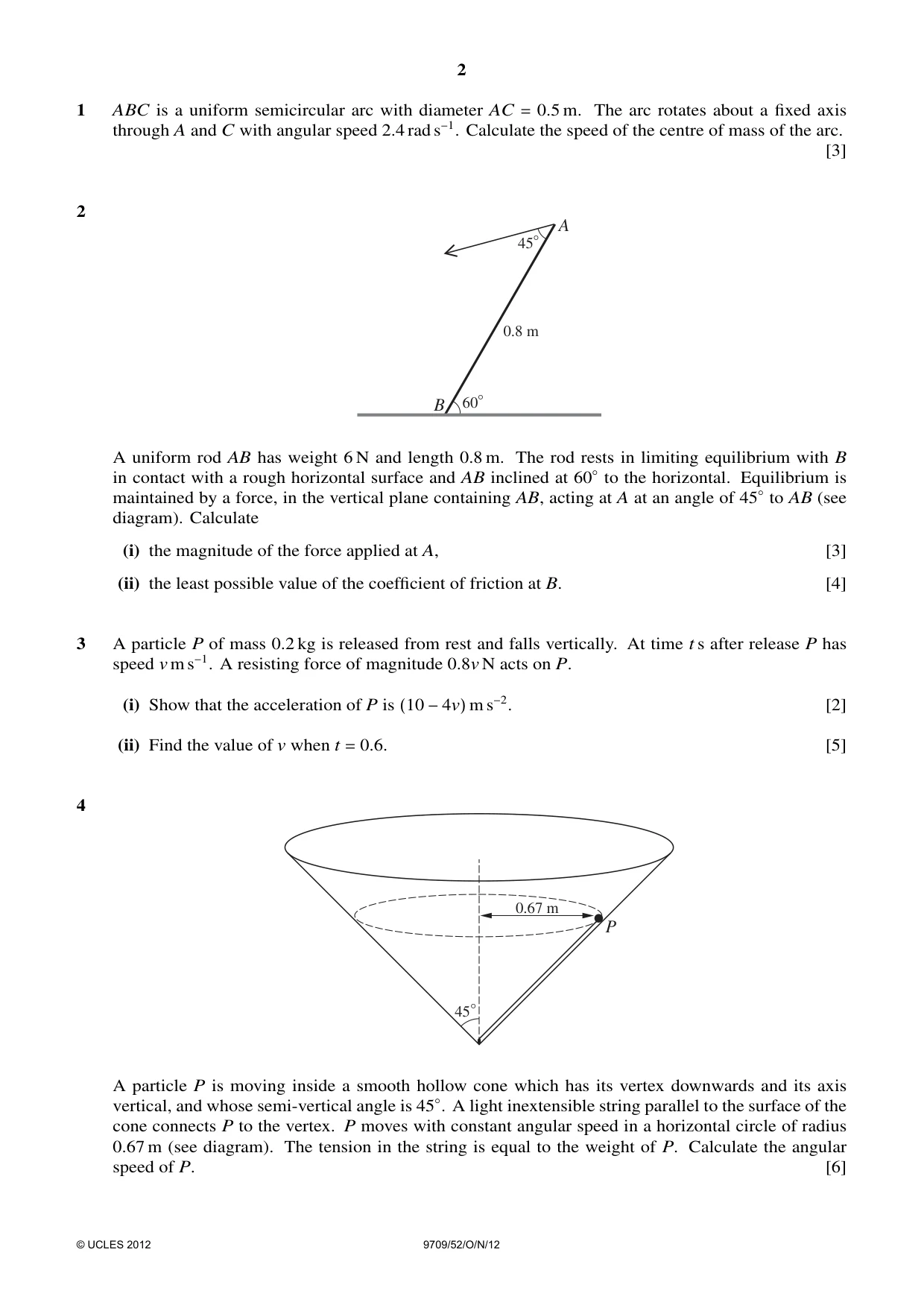
1 ABC is a uniform semicircular arc with diameter AC = 0.5 m. The arc rotates about a fixed axis through A and C with angular speed 2.4 rad s−1. Calculate the speed of the centre of mass of the arc. [3]
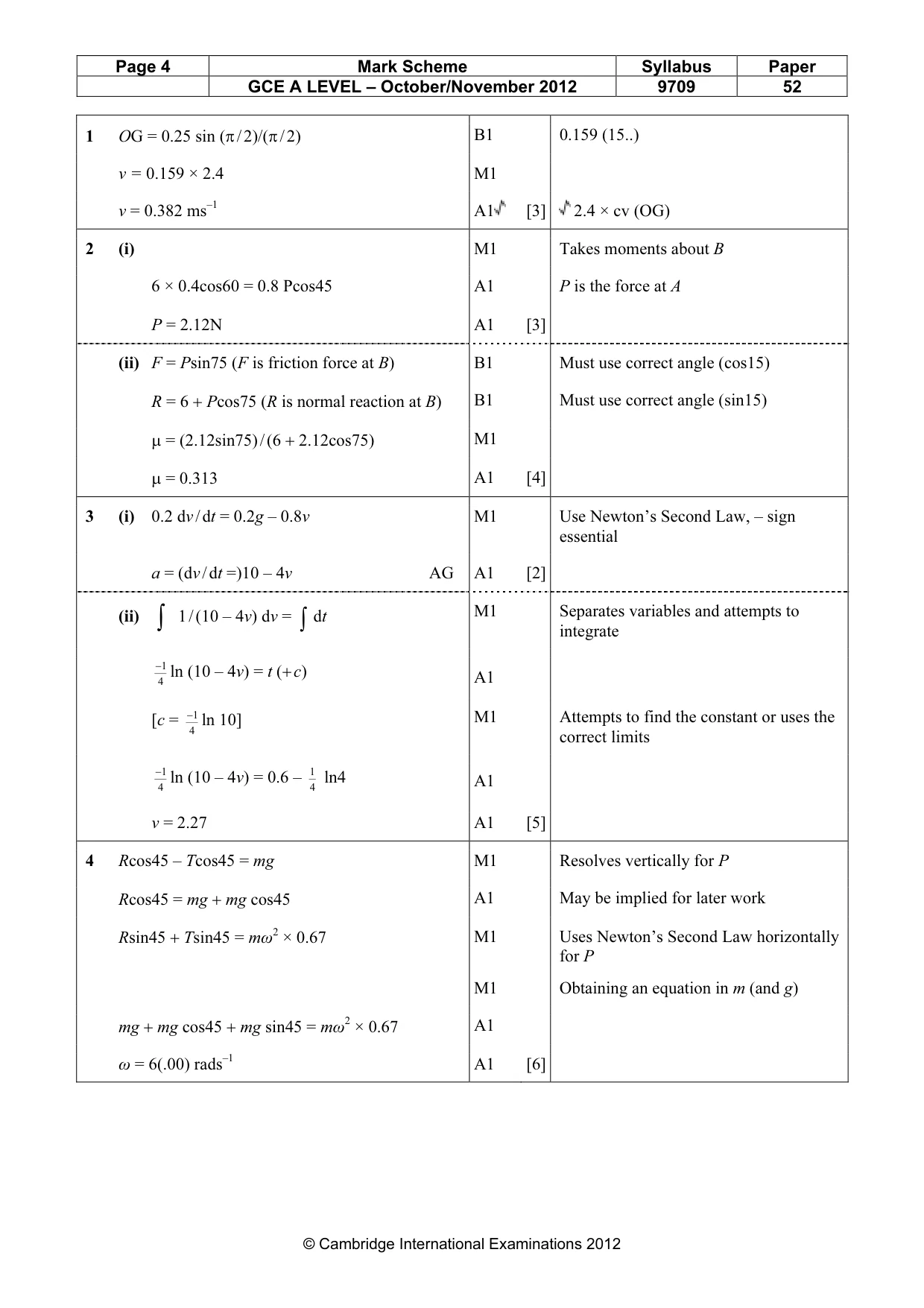
Mark scheme: 1 OG = 0.25 sin (π / 2)/(π / 2) B1 0.159 (15..) v = 0.159 × 2.4 M1 v = 0.382 ms–1 A1 [3] 2.4 × cv (OG)
Q2 · A 45° 0.8 m B 60° A uniform rod AB has weight 6 N and length 0.8 m
2 A 45° 0.8 m B 60° A uniform rod AB has weight 6 N and length 0.8 m. The rod rests in limiting equilibrium with B in contact with a rough horizontal surface and AB inclined at 60◦to the horizontal. Equilibrium is maintained by a force, in the vertical plane containing AB, acting at A at an angle of 45◦to AB (see diagram). Calculate (i) the magnitude of the force applied at A, [3] (ii) the least possible value of the coefficient of friction at B. [4]
Mark scheme: 2 (i) M1 Takes moments about B 6 × 0.4cos60 = 0.8 Pcos45 A1 P is the force at A P = 2.12N A1 [3] (ii) F = Psin75 (F is friction force at B) B1 Must use correct angle (cos15) R = 6 + Pcos75 (R is normal reaction at B) B1 Must use correct angle (sin15) µ = (2.12sin75) / (6 + 2.12cos75) M1 µ = 0.313 A1 [4]
Q3 · A particle P of mass 0.2 kg is released from rest and falls vertically
3 A particle P of mass 0.2 kg is released from rest and falls vertically. At time t s after release P has speed v m s−1. A resisting force of magnitude 0.8v N acts on P. (i) Show that the acceleration of P is (10 −4v) m s−2. [2] (ii) Find the value of v when t = 0.6. [5]
Mark scheme: 3 (i) 0.2 dv / dt = 0.2g – 0.8v M1 Use Newton’s Second Law, – sign essential a = (dv / dt =)10 – 4v AG A1 [2] (ii) ∫ 1 / (10 – 4v) dv = ∫dt M1 Separates variables and attempts to integrate −ln1 (10 – 4v) = t (+ c) 4 A1 [c = −ln1 10] M1 Attempts to find the constant or uses the 4 correct limits −ln 1 (10 – 4v) = 0.6 – 1 ln4 A1 4 4 v = 2.27 A1 [5]
Q4 · 0.67 m P 45° A particle P is moving inside a smooth hollow cone which has its vertex…
4 0.67 m P 45° A particle P is moving inside a smooth hollow cone which has its vertex downwards and its axis vertical, and whose semi-vertical angle is 45◦. A light inextensible string parallel to the surface of the cone connects P to the vertex. P moves with constant angular speed in a horizontal circle of radius 0.67 m (see diagram). The tension in the string is equal to the weight of P. Calculate the angular speed of P. [6]
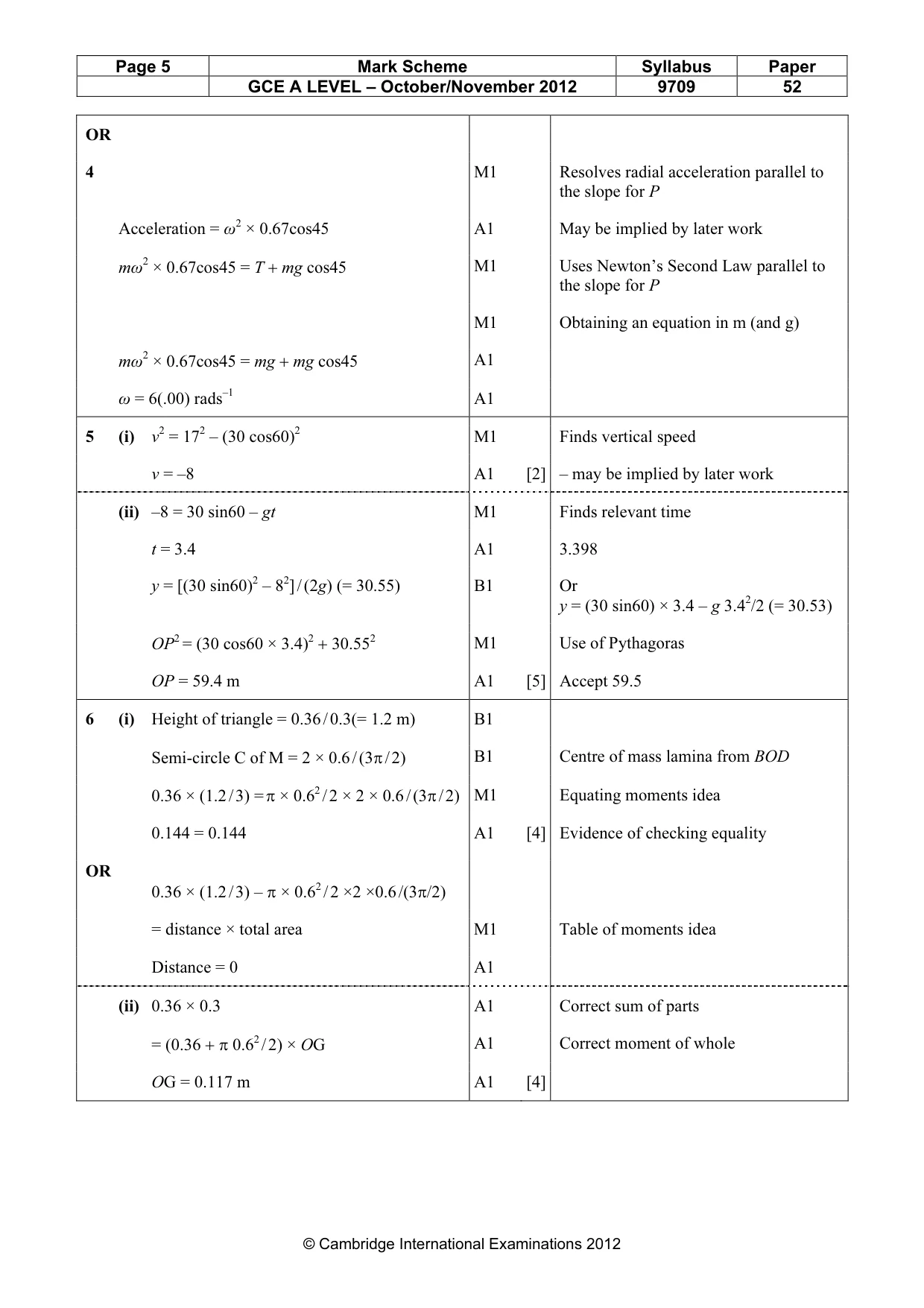
Mark scheme: 4 Rcos45 – Tcos45 = mg M1 Resolves vertically for P Rcos45 = mg + mg cos45 A1 May be implied for later work Rsin45 + Tsin45 = mω2 × 0.67 M1 Uses Newton’s Second Law horizontally for P M1 Obtaining an equation in m (and g) mg + mg cos45 + mg sin45 = mω2 × 0.67 A1 ω = 6(.00) rads–1 A1 [6] GCE A LEVEL – October/November 2012 9709 52 OR 4 M1 Resolves radial acceleration parallel to the slope for P Acceleration = ω2 × 0.67cos45 A1 May be implied by later work mω2 × 0.67cos45 = T + mg cos45 M1 Uses Newton’s Second Law parallel to the slope for P M1 Obtaining an equation in m (and g) mω2 × 0.67cos45 = mg + mg cos45 A1 ω = 6(.00) rads–1 A1 2 2 2
Q5 · A particle P is projected with speed 30 m s−1 at an angle of 60◦above the horizontal from…
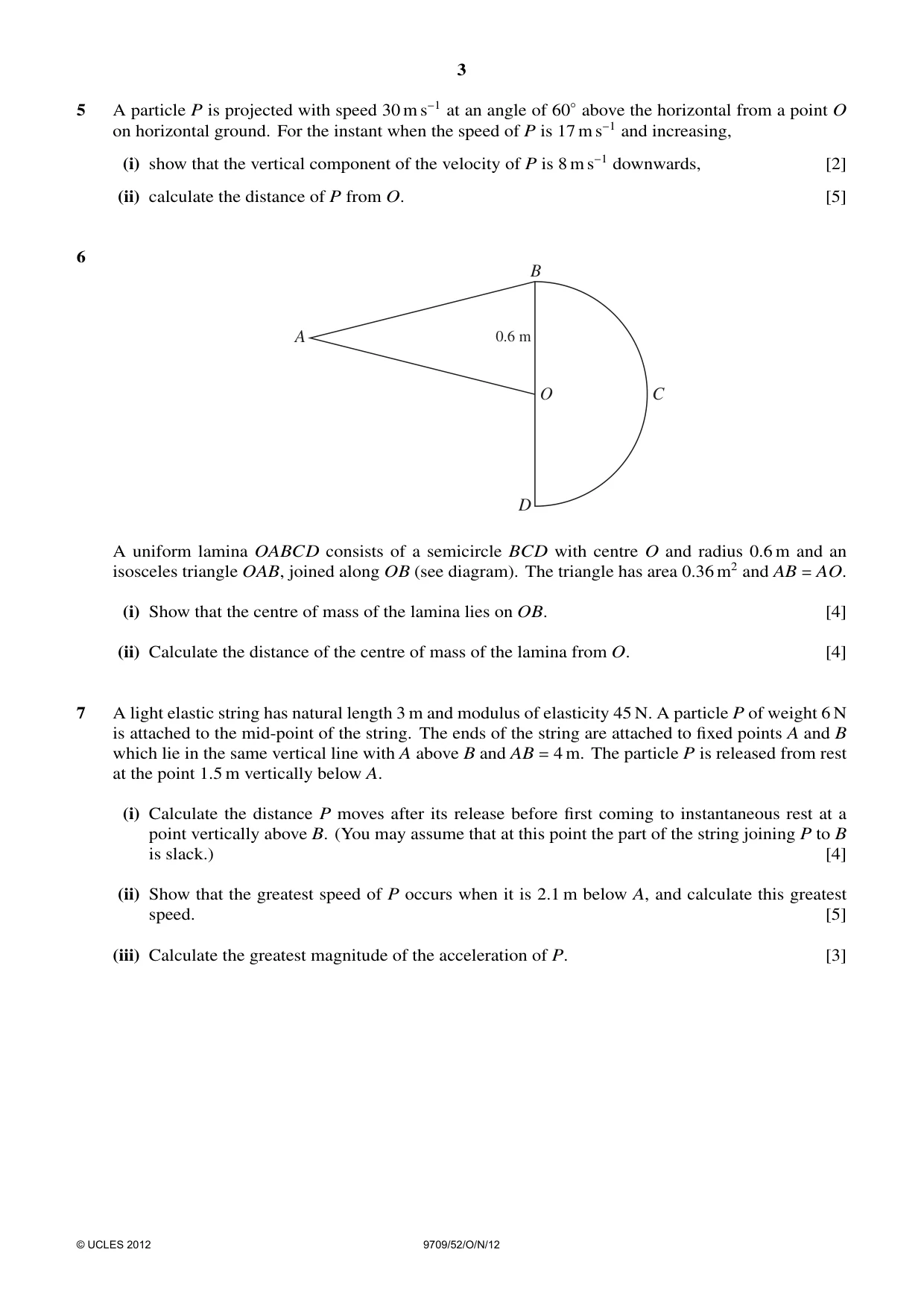
5 A particle P is projected with speed 30 m s−1 at an angle of 60◦above the horizontal from a point O on horizontal ground. For the instant when the speed of P is 17 m s−1 and increasing, (i) show that the vertical component of the velocity of P is 8 m s−1 downwards, [2] (ii) calculate the distance of P from O. [5]
Mark scheme: 5 (i) v2 = 172 – (30 cos60)2 M1 Finds vertical speed v = –8 A1 [2] – may be implied by later work (ii) –8 = 30 sin60 – gt M1 Finds relevant time t = 3.4 A1 3.398 y = [(30 sin60)2 – 82] / (2g) (= 30.55) B1 Or y = (30 sin60) × 3.4 – g 3.42/2 (= 30.53) OP2 = (30 cos60 × 3.4)2 + 30.552 M1 Use of Pythagoras OP = 59.4 m A1 [5] Accept 59.5
Q6 · B A 0.6 m O C D A uniform lamina OABCD consists of a semicircle BCD with centre O and…
6 B A 0.6 m O C D A uniform lamina OABCD consists of a semicircle BCD with centre O and radius 0.6 m and an isosceles triangle OAB, joined along OB (see diagram). The triangle has area 0.36 m2 and AB = AO. (i) Show that the centre of mass of the lamina lies on OB. [4] (ii) Calculate the distance of the centre of mass of the lamina from O. [4]
Mark scheme: 6 (i) Height of triangle = 0.36 / 0.3(= 1.2 m) B1 Semi-circle C of M = 2 × 0.6 / (3π / 2) B1 Centre of mass lamina from BOD 0.36 × (1.2 / 3) = π × 0.62 / 2 × 2 × 0.6 / (3π / 2) M1 Equating moments idea 0.144 = 0.144 A1 [4] Evidence of checking equality OR 0.36 × (1.2 / 3) – π × 0.62 / 2 ×2 ×0.6 /(3π/2) = distance × total area M1 Table of moments idea Distance = 0 A1 (ii) 0.36 × 0.3 A1 Correct sum of parts = (0.36 + π 0.62 / 2) × OG A1 Correct moment of whole OG = 0.117 m A1 [4] GCE A LEVEL – October/November 2012 9709 52
Q7 · A light elastic string has natural length 3 m and modulus of elasticity 45 N
7 A light elastic string has natural length 3 m and modulus of elasticity 45 N. A particle P of weight 6 N is attached to the mid-point of the string. The ends of the string are attached to fixed points A and B which lie in the same vertical line with A above B and AB = 4 m. The particle P is released from rest at the point 1.5 m vertically below A. (i) Calculate the distance P moves after its release before first coming to instantaneous rest at a point vertically above B. (You may assume that at this point the part of the string joining P to B is slack.) [4] (ii) Show that the greatest speed of P occurs when it is 2.1 m below A, and calculate this greatest speed. [5] (iii) Calculate the greatest magnitude of the acceleration of P. [3]
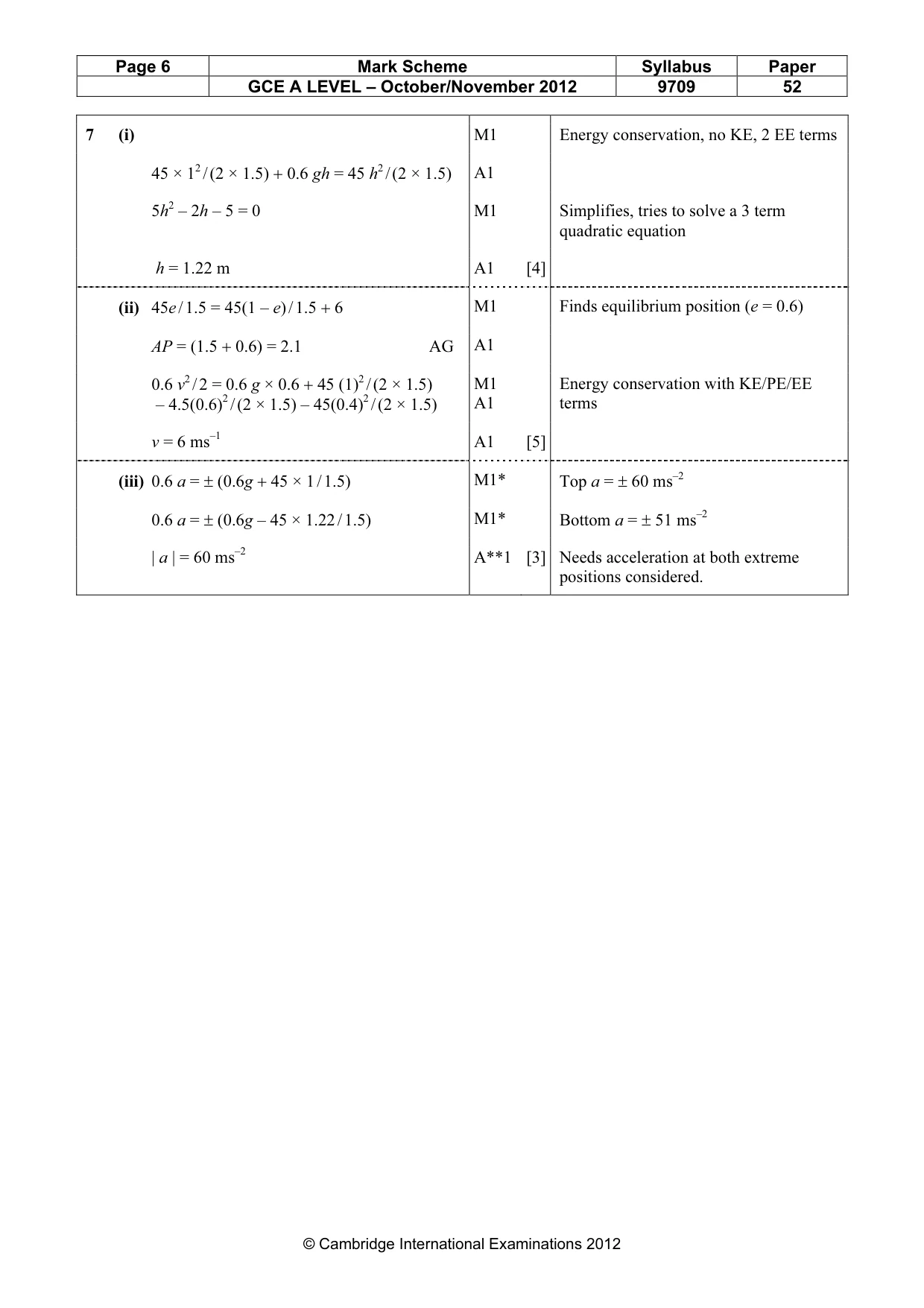
Mark scheme: 7 (i) M1 Energy conservation, no KE, 2 EE terms 45 × 12 / (2 × 1.5) + 0.6 gh = 45 h2 / (2 × 1.5) A1 5h2 – 2h – 5 = 0 M1 Simplifies, tries to solve a 3 term quadratic equation h = 1.22 m A1 [4] (ii) 45e / 1.5 = 45(1 – e) / 1.5 + 6 M1 Finds equilibrium position (e = 0.6) AP = (1.5 + 0.6) = 2.1 AG A1 0.6 v2 / 2 = 0.6 g × 0.6 + 45 (1)2 / (2 × 1.5) M1 Energy conservation with KE/PE/EE – 4.5(0.6)2 / (2 × 1.5) – 45(0.4)2 / (2 × 1.5) A1 terms v = 6 ms–1 A1 [5] (iii) 0.6 a = ± (0.6g + 45 × 1 / 1.5) M1* Top a = ± 60 ms–2 0.6 a = ± (0.6g – 45 × 1.22 / 1.5) M1* Bottom a = ± 51 ms–2 | a | = 60 ms–2 A**1 [3] Needs acceleration at both extreme positions considered.
What was in this paper
The subtopics covered by these 7 questions, and how many questions each got. Open one in a new tab to see every Cambridge question on it.
What you needed in this session
Cambridge’s own grade thresholds for 2012 Oct/Nov, Paper 5 · Variant 2. A higher threshold means an easier paper — the bar moves with how the cohort did.