Cambridge A Level Mathematics 9709 — 2015 Oct/Nov Paper 5 · Variant 3
9709/53/O/N/15 · 7 questions · 50 marks · ≈56 min
The question paper and its mark scheme, free to read here and free to download. This is Cambridge’s own paper, exactly as it was sat.
Question paper4 pages
Mark scheme6 pages
Answers below. Sit the paper first if you are practising.
Questions as text
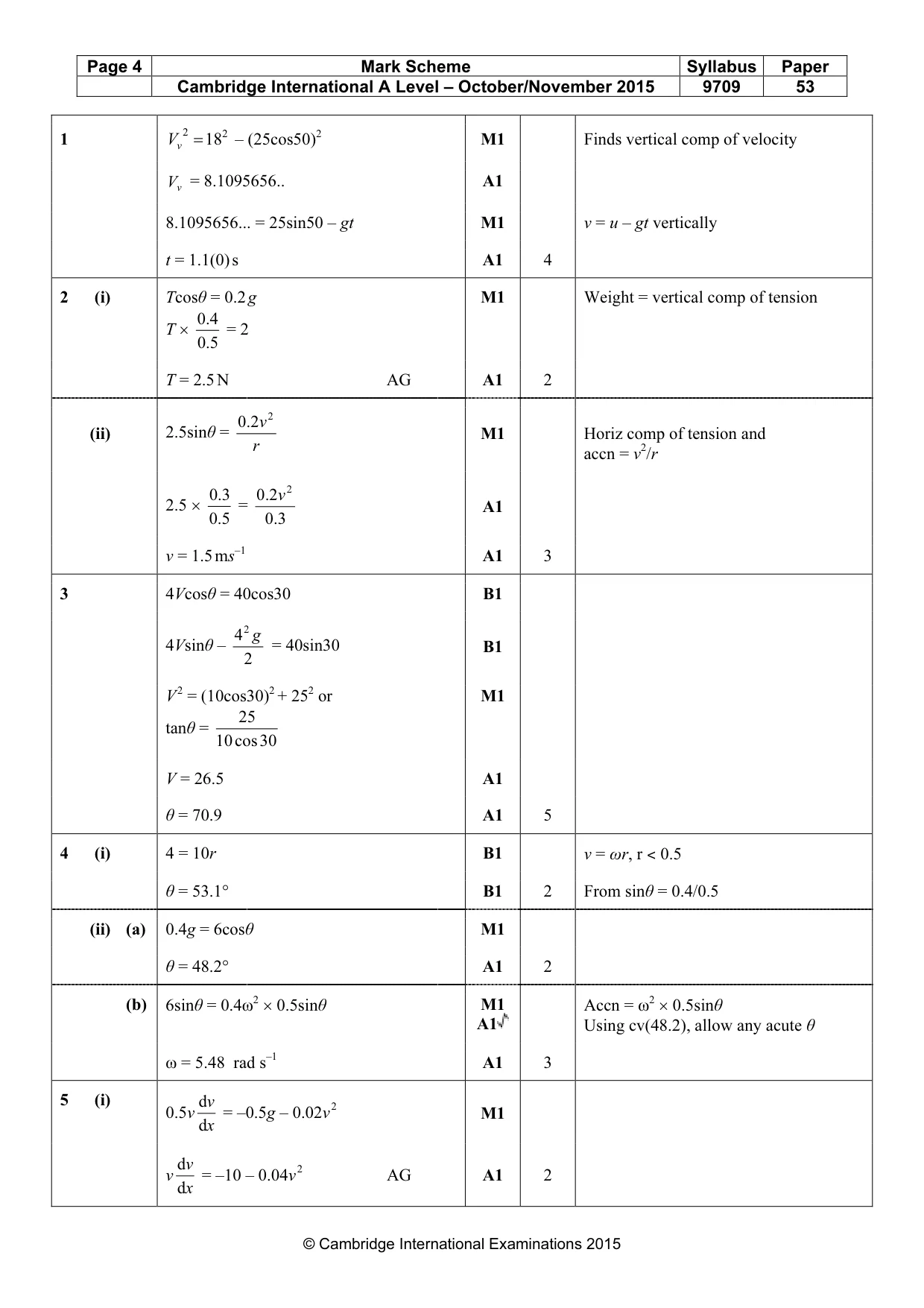
Q1 · A particle is projected with speed 25 m s−1 at an angle of 50Å above the horizontal
1 A particle is projected with speed 25 m s−1 at an angle of 50Å above the horizontal. Calculate the time after projection when the particle has speed 18 m s−1 and is rising. [4]
Mark scheme: 1 Vv 2 = 18 2 – (25cos50)2 M1 Finds vertical comp of velocity Vv = 8.1095656.. A1 8.1095656... = 25sin50 – gt M1 v = u – gt vertically t = 1.1(0) s A1 4
Q2 · One end of a light inextensible string of length 0.5 m is attached to a fixed point A
2 One end of a light inextensible string of length 0.5 m is attached to a fixed point A. A particle P of mass 0.2 kg is attached to the other end of the string. P moves with constant speed in a horizontal circle with centre O which is 0.4 m vertically below A. (i) Show that the tension in the string is 2.5 N. [2] (ii) Find the speed of P. [3]
Mark scheme: 2 (i) Tcosθ = 0.2 g M1 Weight = vertical comp of tension 4.0 T × = 2 5.0 T = 2.5 N AG A1 2 2.0 v2 (ii) 2.5sinθ = M1 Horiz comp of tension and r accn = v2/r 3.0 2.0 v 2 2.5 × = A1 5.0 3.0 v = 1.5 ms–1 A1 3
Q3 · A particle P is projected with speed V m s−1 at an angle of 1Å above the horizontal from…
3 A particle P is projected with speed V m s−1 at an angle of 1Å above the horizontal from a point O on horizontal ground. At the instant 4 s after projection the particle passes through the point A, where OA = 40 m and the line OA makes an angle of 30Å with the horizontal. Calculate V and 1. [5]
Mark scheme: 3 4Vcosθ = 40cos30 B1 42 g 4Vsinθ – = 40sin30 B1 2 V 2 = (10cos30)2 + 252 or M1 25 tanθ = 10 cos 30 V = 26.5 A1 θ = 70.9 A1 5
Q4 · 0.5 m O P A particle P of mass 0.4 kg moves with constant speed in a horizontal circle on…
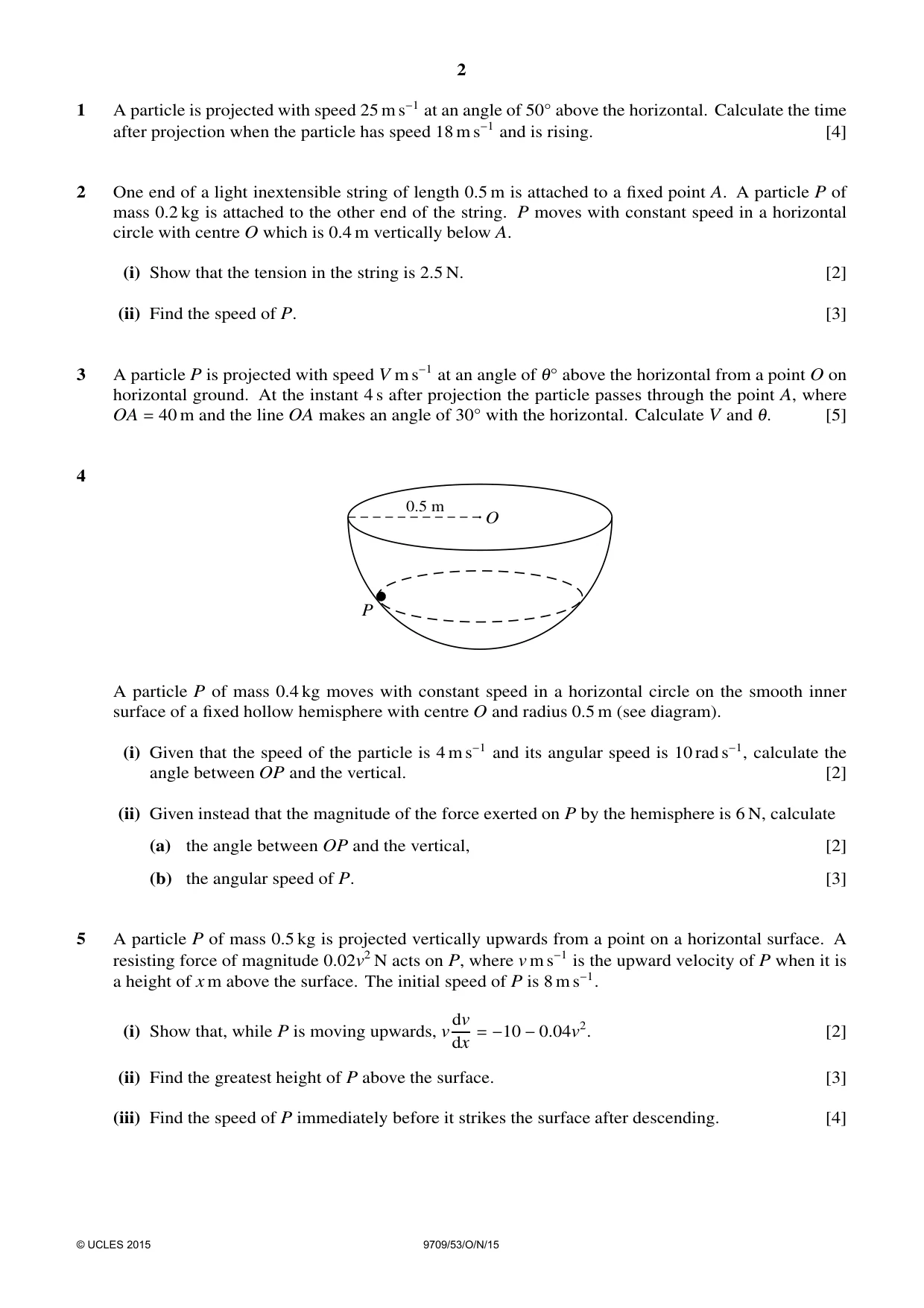
4 0.5 m O P A particle P of mass 0.4 kg moves with constant speed in a horizontal circle on the smooth inner surface of a fixed hollow hemisphere with centre O and radius 0.5 m (see diagram). (i) Given that the speed of the particle is 4 m s−1 and its angular speed is 10 rad s−1, calculate the angle between OP and the vertical. [2] (ii) Given instead that the magnitude of the force exerted on P by the hemisphere is 6 N, calculate (a) the angle between OP and the vertical, [2] (b) the angular speed of P. [3]
Mark scheme: 4 (i) 4 = 10r B1 v = ωr, r ˂ 0.5 θ = 53.1° B1 2 From sinθ = 0.4/0.5 (ii) (a) 0.4g = 6cosθ M1 θ = 48.2° A1 2 (b) 6sinθ = 0.4ω2 × 0.5sinθ M1 Accn = ω2 × 0.5sinθ A1 Using cv(48.2), allow any acute θ ω = 5.48 rad s–1 A1 3
Q5 · A particle P of mass 0.5 kg is projected vertically upwards from a point on a horizontal…
5 A particle P of mass 0.5 kg is projected vertically upwards from a point on a horizontal surface. A resisting force of magnitude 0.02v2 N acts on P, where v m s−1 is the upward velocity of P when it is a height of x m above the surface. The initial speed of P is 8 m s−1. (i) Show that, while P is moving upwards, vdv = −10 −0.04v2. [2] dx (ii) Find the greatest height of P above the surface. [3] (iii) Find the speed of P immediately before it strikes the surface after descending. [4]
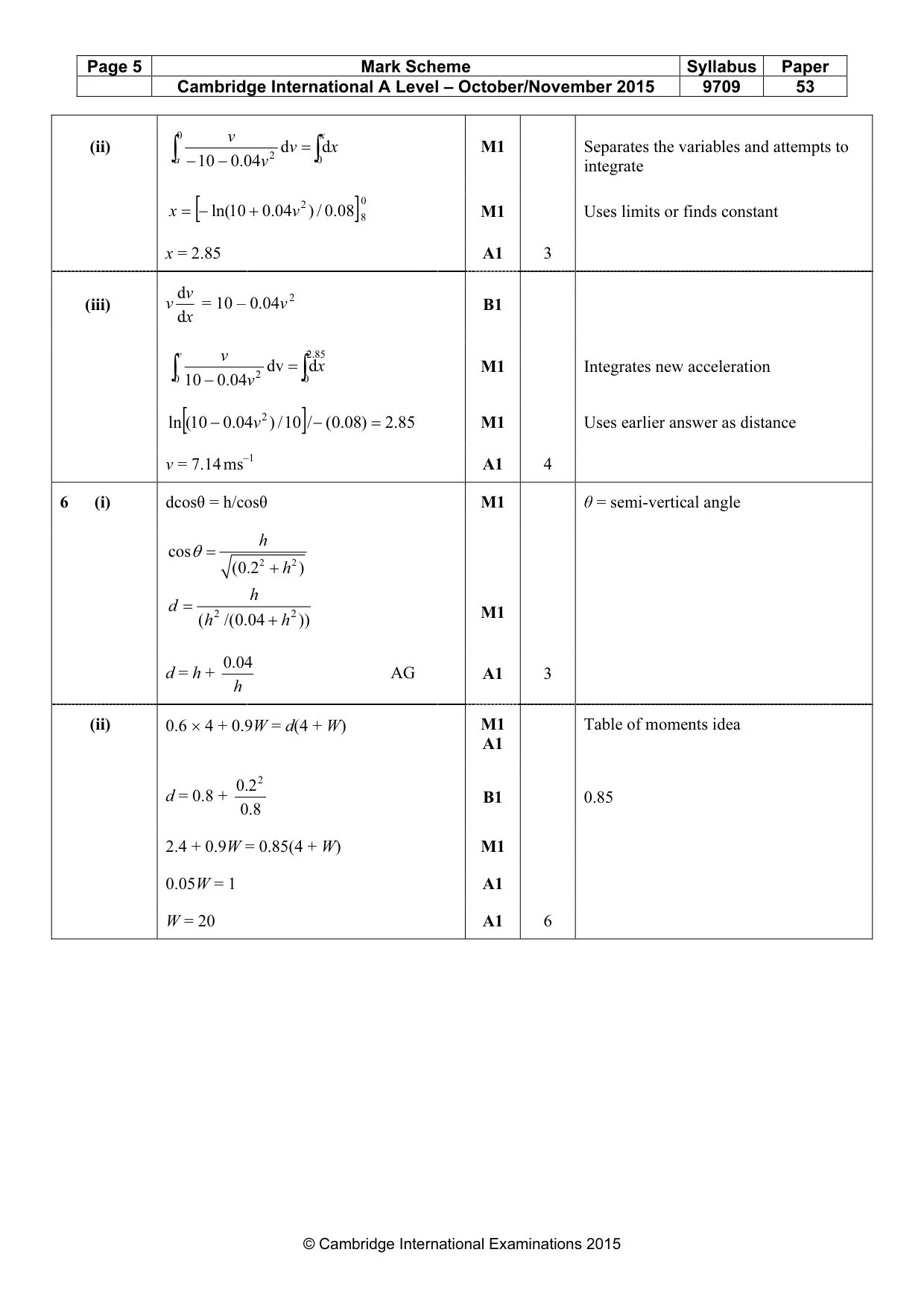
Mark scheme: 5 (i) dv 2 0.5v = –0.5g – 0.02v M1 dx dv 2 v = –10 – 0.04v AG A1 2 dx 0 v x 2 ∫0 (ii) ∫a − 10 − .0 04v dv = dx M1 Separates the variables and attempts to integrate 2 0 x = [− ln(10 + .0 04 v /) .0 08 ] 8 M1 Uses limits or finds constant x = 2.85 A1 3 dv 2 (iii) v = 10 – 0.04v B1 dx v v .2 85 2 dv = ∫0dx M1 Integrates new acceleration ∫0 10 − .0 04v ln [(10 − .004v 2 /) 10 ] / − ( .008) = .285 M1 Uses earlier answer as distance v = 7.14 ms–1 A1 4
Q6 · D m 0.2 m G h m An object is formed by joining a hemispherical shell of radius 0.2 m and…
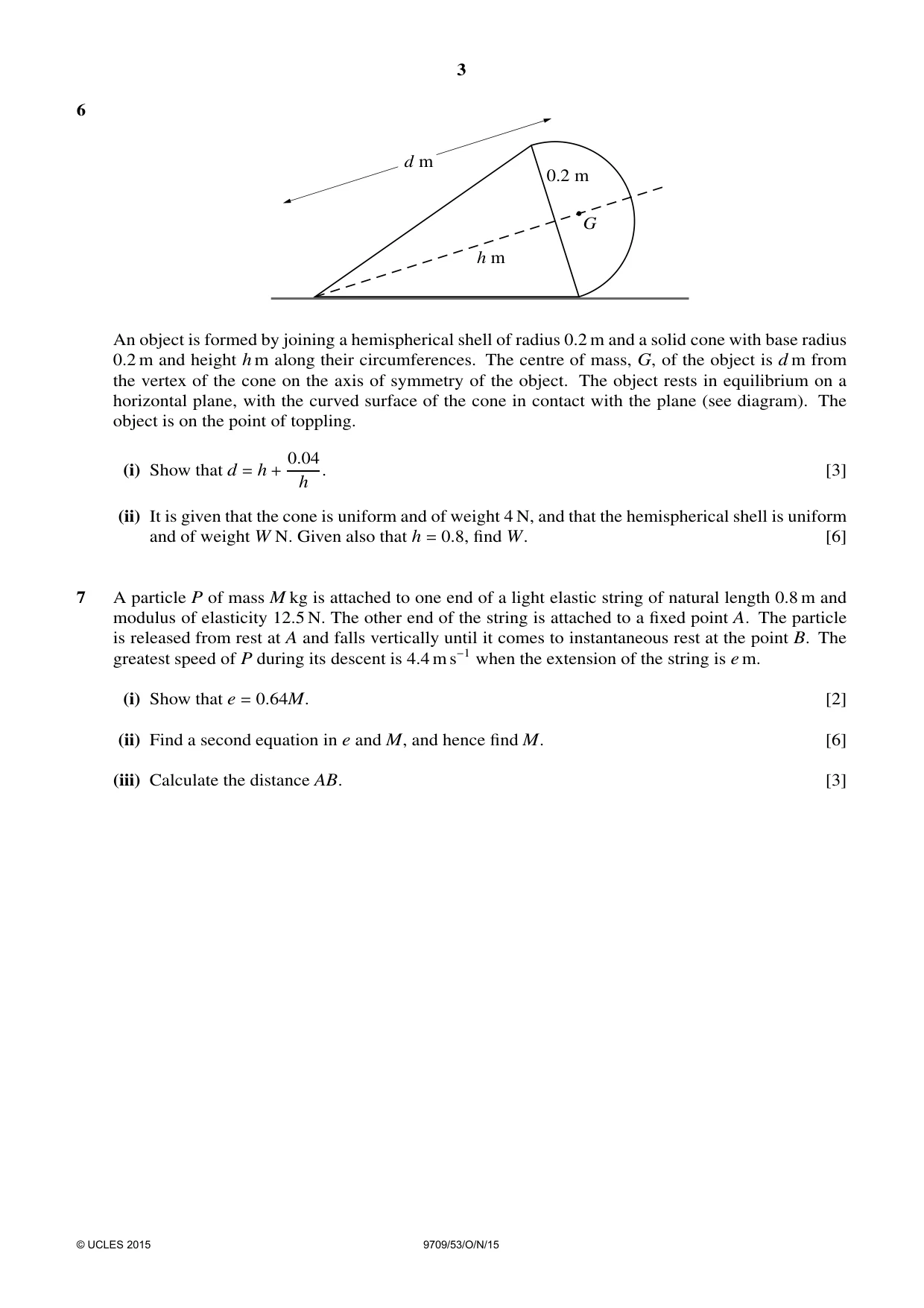
6 d m 0.2 m G h m An object is formed by joining a hemispherical shell of radius 0.2 m and a solid cone with base radius 0.2 m and height h m along their circumferences. The centre of mass, G, of the object is d m from the vertex of the cone on the axis of symmetry of the object. The object rests in equilibrium on a horizontal plane, with the curved surface of the cone in contact with the plane (see diagram). The object is on the point of toppling. 0.04 (i) Show that d = h + . [3] h (ii) It is given that the cone is uniform and of weight 4 N, and that the hemispherical shell is uniform and of weight W N. Given also that h = 0.8, find W. [6]
Mark scheme: 6 (i) dcosθ = h/cosθ M1 θ = semi-vertical angle h cos θ = (0.2 2 + h 2 ) h d = ( h 2 /( .004 + h 2 )) M1 .004 d = h + AG A1 3 h (ii) 0.6 × 4 + 0.9W = d(4 + W) M1 Table of moments idea A1 2.0 2 d = 0.8 + B1 0.85 8.0 2.4 + 0.9W = 0.85(4 + W) M1 0.05W = 1 A1 W = 20 A1 6 12 5e
Q7 · A particle P of mass M kg is attached to one end of a light elastic string of natural…
7 A particle P of mass M kg is attached to one end of a light elastic string of natural length 0.8 m and modulus of elasticity 12.5 N. The other end of the string is attached to a fixed point A. The particle is released from rest at A and falls vertically until it comes to instantaneous rest at the point B. The greatest speed of P during its descent is 4.4 m s−1 when the extension of the string is e m. (i) Show that e = 0.64M. [2] (ii) Find a second equation in e and M, and hence find M. [6] (iii) Calculate the distance AB. [3]
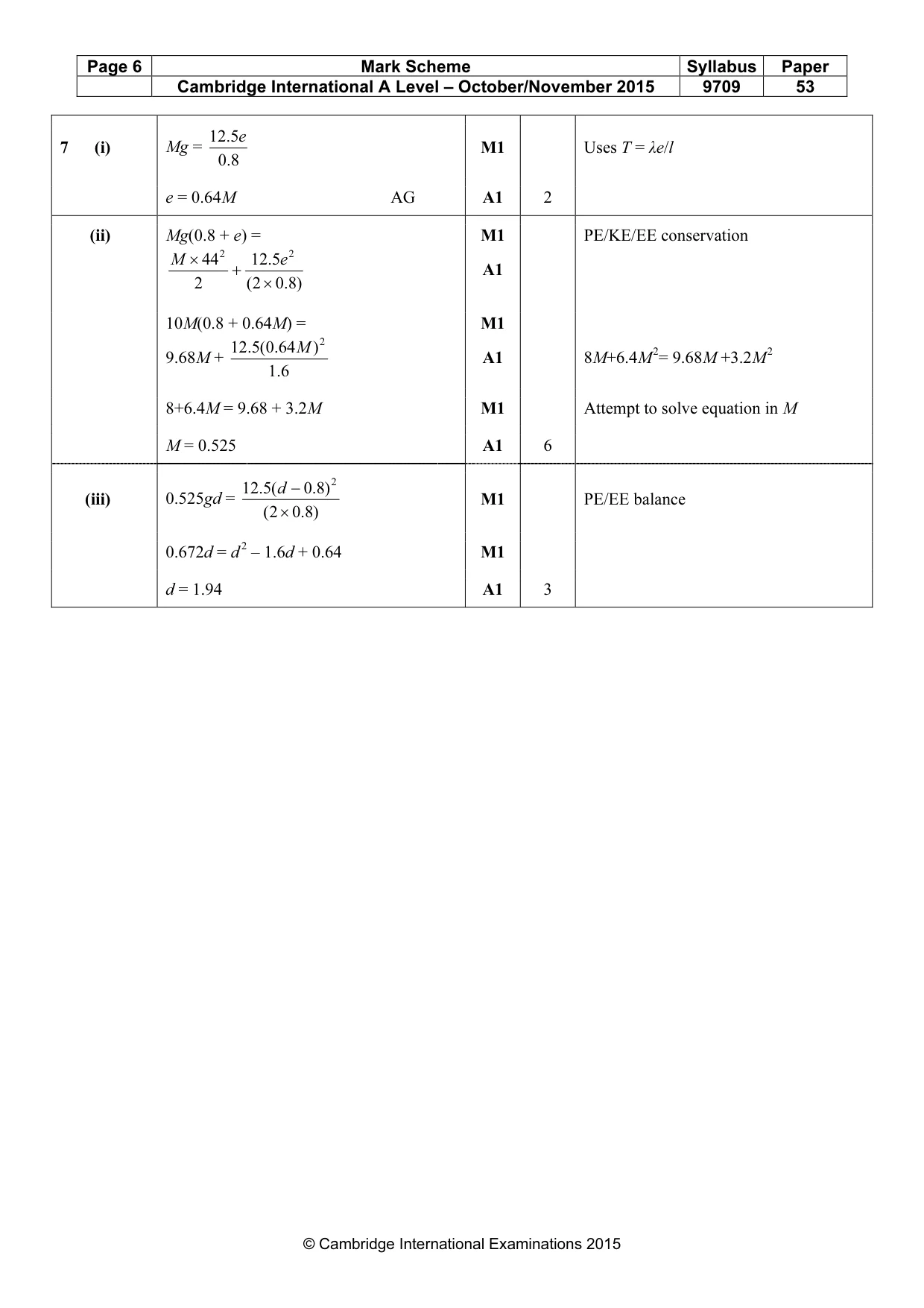
Mark scheme: 125.e 7 (i) Mg = M1 Uses T = λe/l 8.0 e = 0.64M AG A1 2 (ii) Mg(0.8 + e) = M1 PE/KE/EE conservation M × 44 2 12 5.e 2 + A1 2 ( 2 × 8.0) 10M(0.8 + 0.64M) = M1 12 5.( .064 M ) 2 2 9.68M + A1 8M+6.4M 2= 9.68M +3.2M 6.1 8+6.4M = 9.68 + 3.2M M1 Attempt to solve equation in M M = 0.525 A1 6 12 5.( d − 8.0) 2 (iii) 0.525gd = M1 PE/EE balance ( 2 × 8.0) 0.672d = d 2 – 1.6d + 0.64 M1 d = 1.94 A1 3
What was in this paper
The subtopics covered by these 7 questions, and how many questions each got. Open one in a new tab to see every Cambridge question on it.
What you needed in this session
Cambridge’s own grade thresholds for 2015 Oct/Nov, Paper 5 · Variant 3. A higher threshold means an easier paper — the bar moves with how the cohort did.