Cambridge A Level Mathematics 9709 — 2011 Oct/Nov Paper 5 · Variant 2
9709/52/O/N/11 · 5 questions · 50 marks · ≈56 min
The question paper and its mark scheme, free to read here and free to download. This is Cambridge’s own paper, exactly as it was sat.
Question paper4 pages
Mark scheme6 pages
Answers below. Sit the paper first if you are practising.
Questions as text
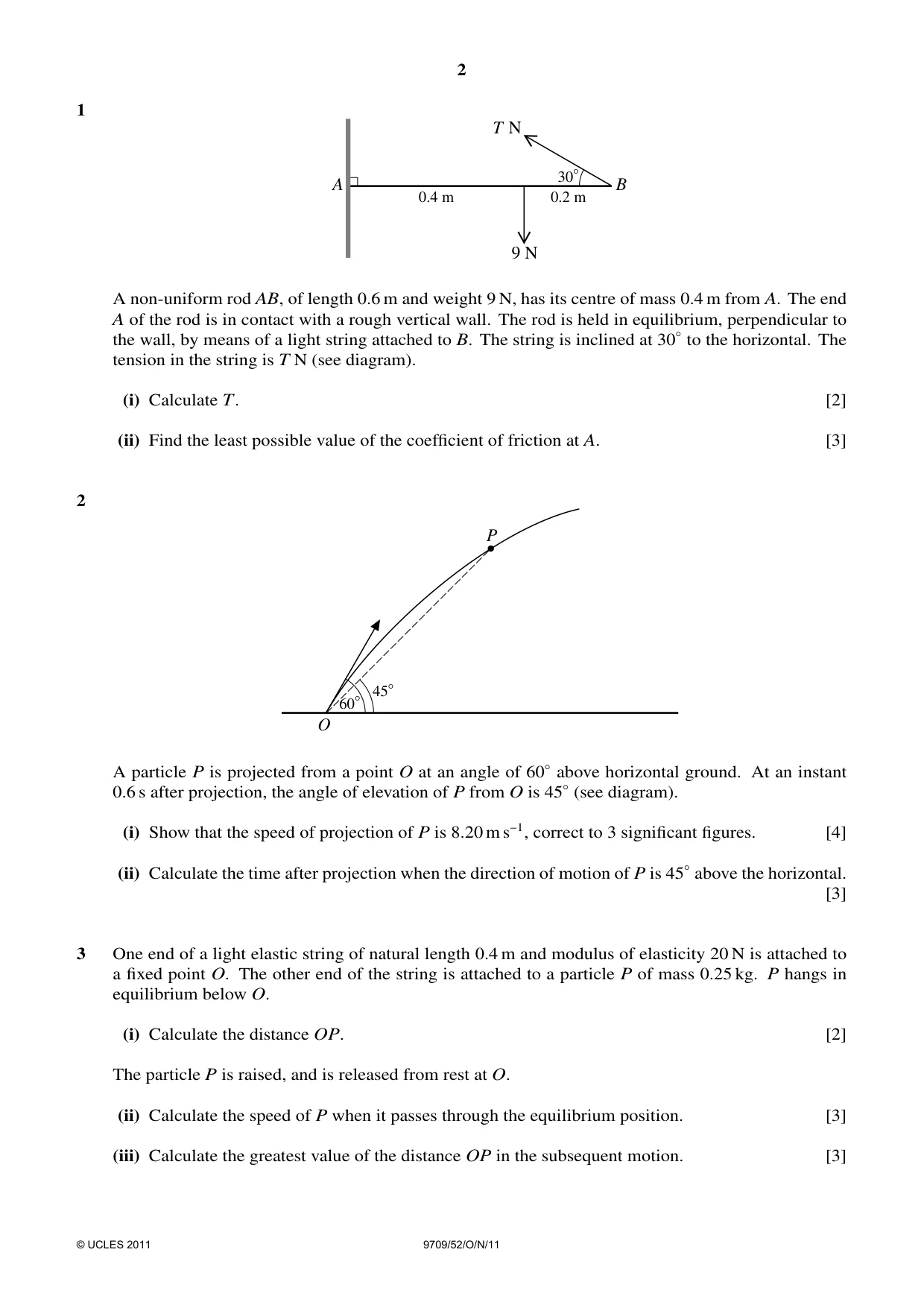
Q1 · T N 30° A B 0.4 m 0.2 m 9 N A non-uniform rod AB, of length 0.6 m and weight 9 N, has its…
1 T N 30° A B 0.4 m 0.2 m 9 N A non-uniform rod AB, of length 0.6 m and weight 9 N, has its centre of mass 0.4 m from A. The end A of the rod is in contact with a rough vertical wall. The rod is held in equilibrium, perpendicular to the wall, by means of a light string attached to B. The string is inclined at 30◦to the horizontal. The tension in the string is T N (see diagram). (i) Calculate T. [2] (ii) Find the least possible value of the coefficient of friction at A. [3]
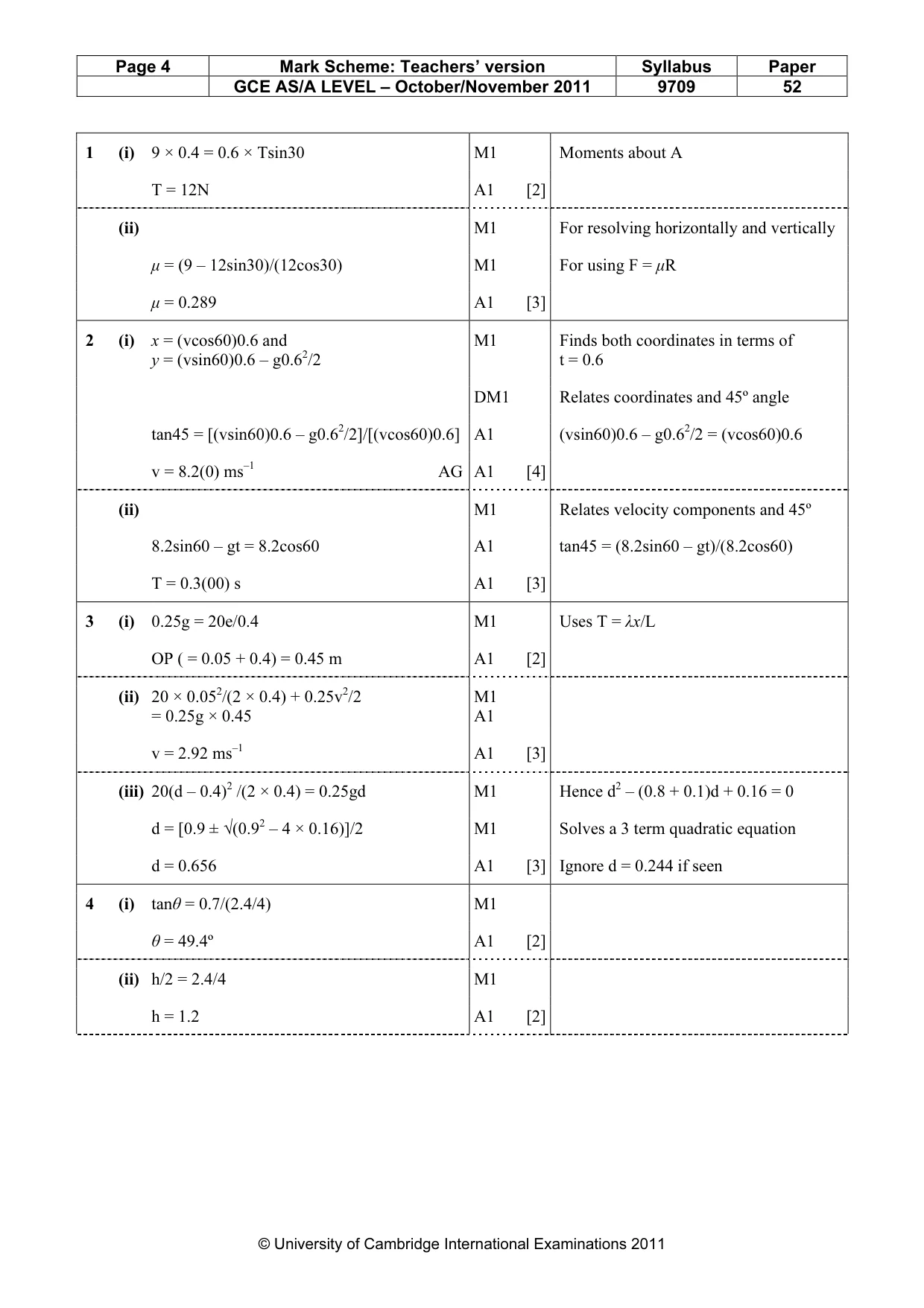
Mark scheme: 1 (i) 9 × 0.4 = 0.6 × Tsin30 M1 Moments about A T = 12N A1 [2] (ii) M1 For resolving horizontally and vertically µ = (9 – 12sin30)/(12cos30) M1 For using F = µR µ = 0.289 A1 [3]
Q2 · P 45° 60° O A particle P is projected from a point O at an angle of 60◦above horizontal…
2 P 45° 60° O A particle P is projected from a point O at an angle of 60◦above horizontal ground. At an instant 0.6 s after projection, the angle of elevation of P from O is 45◦(see diagram). (i) Show that the speed of projection of P is 8.20 m s−1, correct to 3 significant figures. [4] (ii) Calculate the time after projection when the direction of motion of P is 45◦above the horizontal. [3]
Mark scheme: 2 (i) x = (vcos60)0.6 and M1 Finds both coordinates in terms of y = (vsin60)0.6 – g0.62/2 t = 0.6 DM1 Relates coordinates and 45º angle tan45 = [(vsin60)0.6 – g0.62/2]/[(vcos60)0.6] A1 (vsin60)0.6 – g0.62/2 = (vcos60)0.6 v = 8.2(0) ms–1 AG A1 [4] (ii) M1 Relates velocity components and 45º 8.2sin60 – gt = 8.2cos60 A1 tan45 = (8.2sin60 – gt)/(8.2cos60) T = 0.3(00) s A1 [3]
Q3 · One end of a light elastic string of natural length 0.4 m and modulus of elasticity 20 N…
3 One end of a light elastic string of natural length 0.4 m and modulus of elasticity 20 N is attached to a fixed point O. The other end of the string is attached to a particle P of mass 0.25 kg. P hangs in equilibrium below O. (i) Calculate the distance OP. [2] The particle P is raised, and is released from rest at O. (ii) Calculate the speed of P when it passes through the equilibrium position. [3] (iii) Calculate the greatest value of the distance OP in the subsequent motion. [3]
Mark scheme: 3 (i) 0.25g = 20e/0.4 M1 Uses T = λx/L OP ( = 0.05 + 0.4) = 0.45 m A1 [2] (ii) 20 × 0.052/(2 × 0.4) + 0.25v2/2 M1 = 0.25g × 0.45 A1 v = 2.92 ms–1 A1 [3] (iii) 20(d – 0.4)2 /(2 × 0.4) = 0.25gd M1 Hence d2 – (0.8 + 0.1)d + 0.16 = 0 d = [0.9 ± √(0.92 – 4 × 0.16)]/2 M1 Solves a 3 term quadratic equation d = 0.656 A1 [3] Ignore d = 0.244 if seen
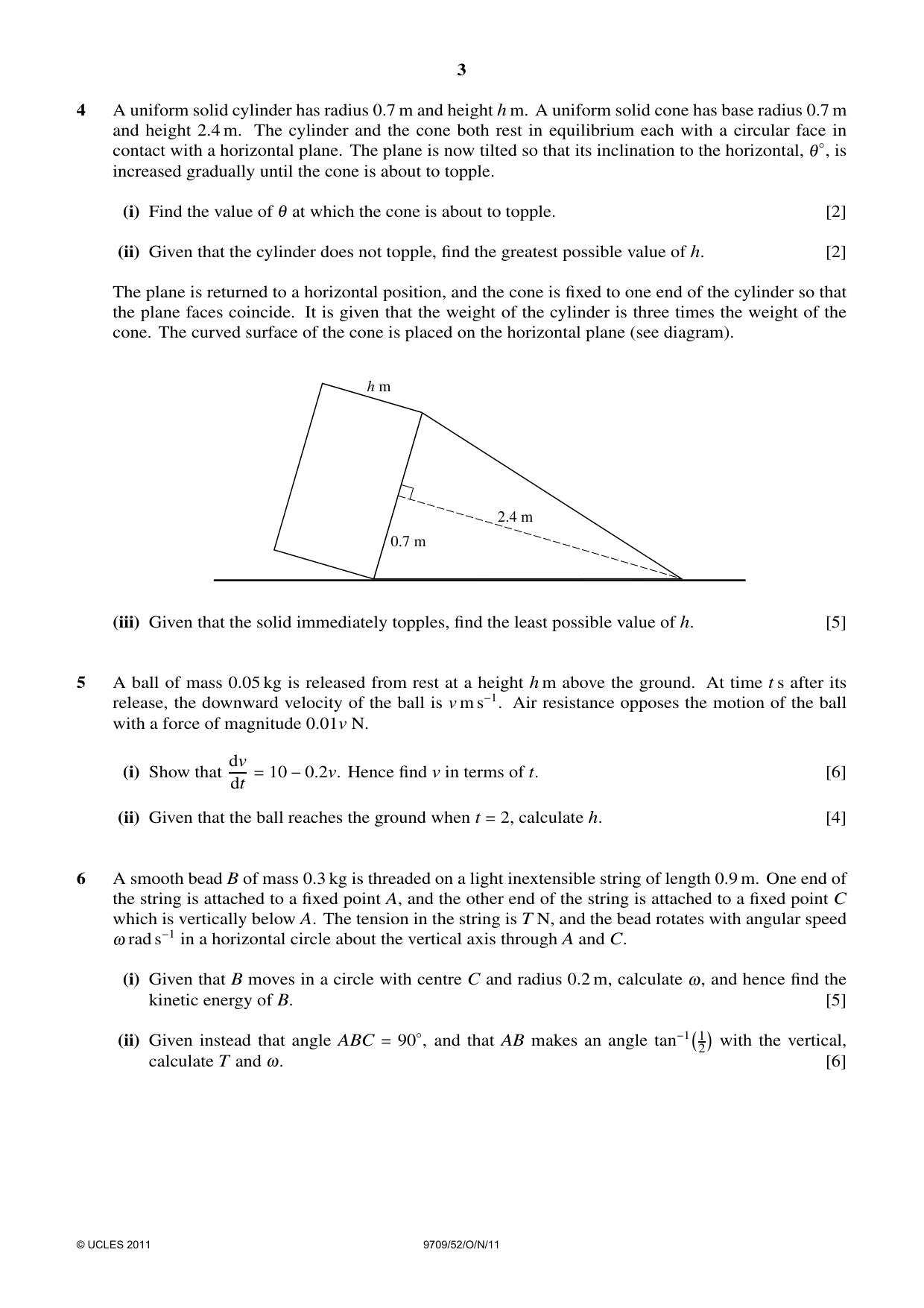
Q4 · A uniform solid cylinder has radius 0.7 m and height h m
4 A uniform solid cylinder has radius 0.7 m and height h m. A uniform solid cone has base radius 0.7 m and height 2.4 m. The cylinder and the cone both rest in equilibrium each with a circular face in contact with a horizontal plane. The plane is now tilted so that its inclination to the horizontal, θ◦, is increased gradually until the cone is about to topple. (i) Find the value of θ at which the cone is about to topple. [2] (ii) Given that the cylinder does not topple, find the greatest possible value of h. [2] The plane is returned to a horizontal position, and the cone is fixed to one end of the cylinder so that the plane faces coincide. It is given that the weight of the cylinder is three times the weight of the cone. The curved surface of the cone is placed on the horizontal plane (see diagram). h m 2.4 m 0.7 m (iii) Given that the solid immediately topples, find the least possible value of h. [5]
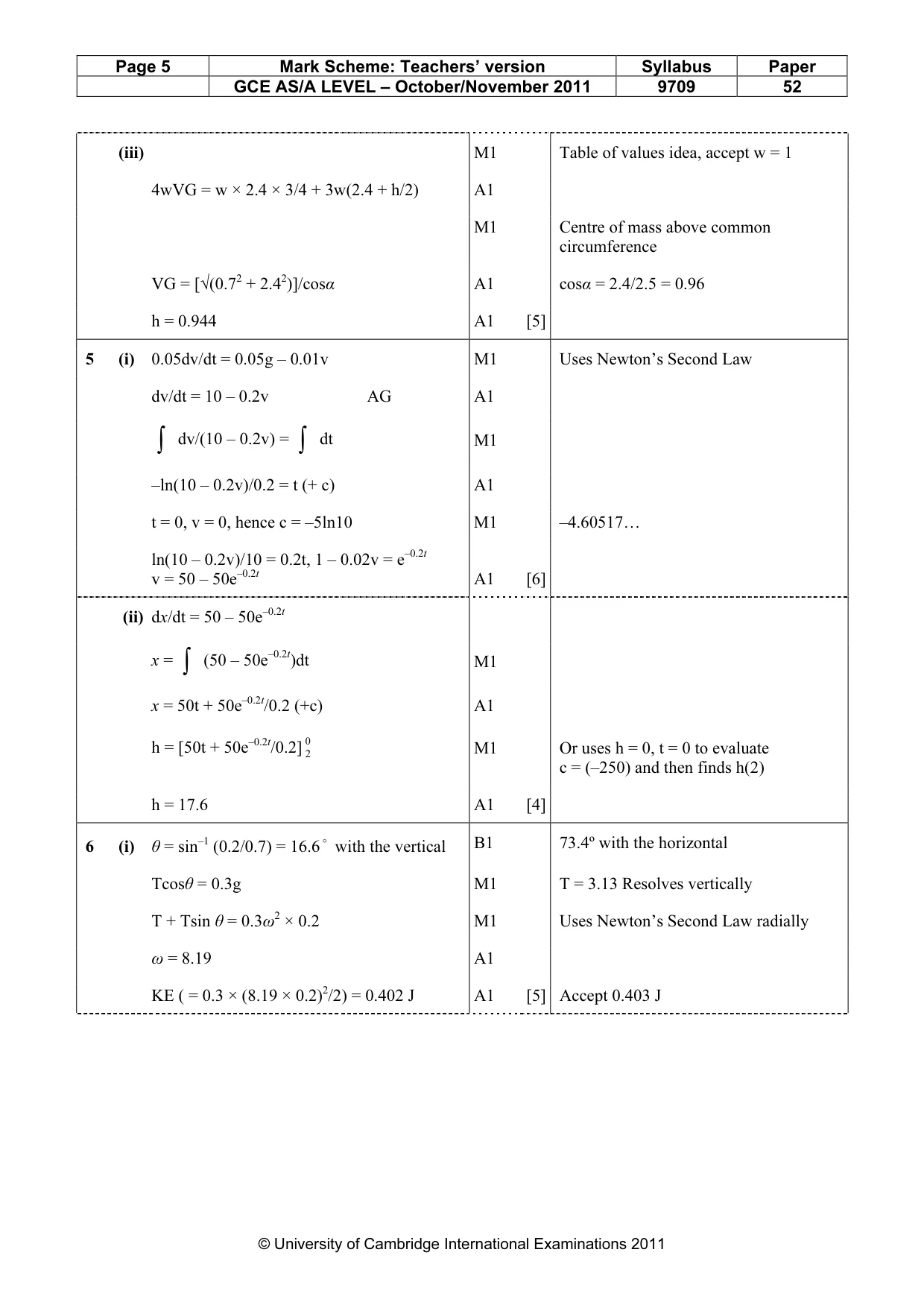
Mark scheme: 4 (i) tanθ = 0.7/(2.4/4) M1 θ = 49.4º A1 [2] (ii) h/2 = 2.4/4 M1 h = 1.2 A1 [2] GCE AS/A LEVEL – October/November 2011 9709 52 (iii) M1 Table of values idea, accept w = 1 4wVG = w × 2.4 × 3/4 + 3w(2.4 + h/2) A1 M1 Centre of mass above common circumference VG = [√(0.72 + 2.42)]/cosα A1 cosα = 2.4/2.5 = 0.96 h = 0.944 A1 [5]
Q5 · A ball of mass 0.05 kg is released from rest at a height h m above the ground
5 A ball of mass 0.05 kg is released from rest at a height h m above the ground. At time t s after its release, the downward velocity of the ball is v m s−1. Air resistance opposes the motion of the ball with a force of magnitude 0.01v N. dv (i) Show that = 10 −0.2v. Hence find v in terms of t. [6] dt (ii) Given that the ball reaches the ground when t = 2, calculate h. [4]
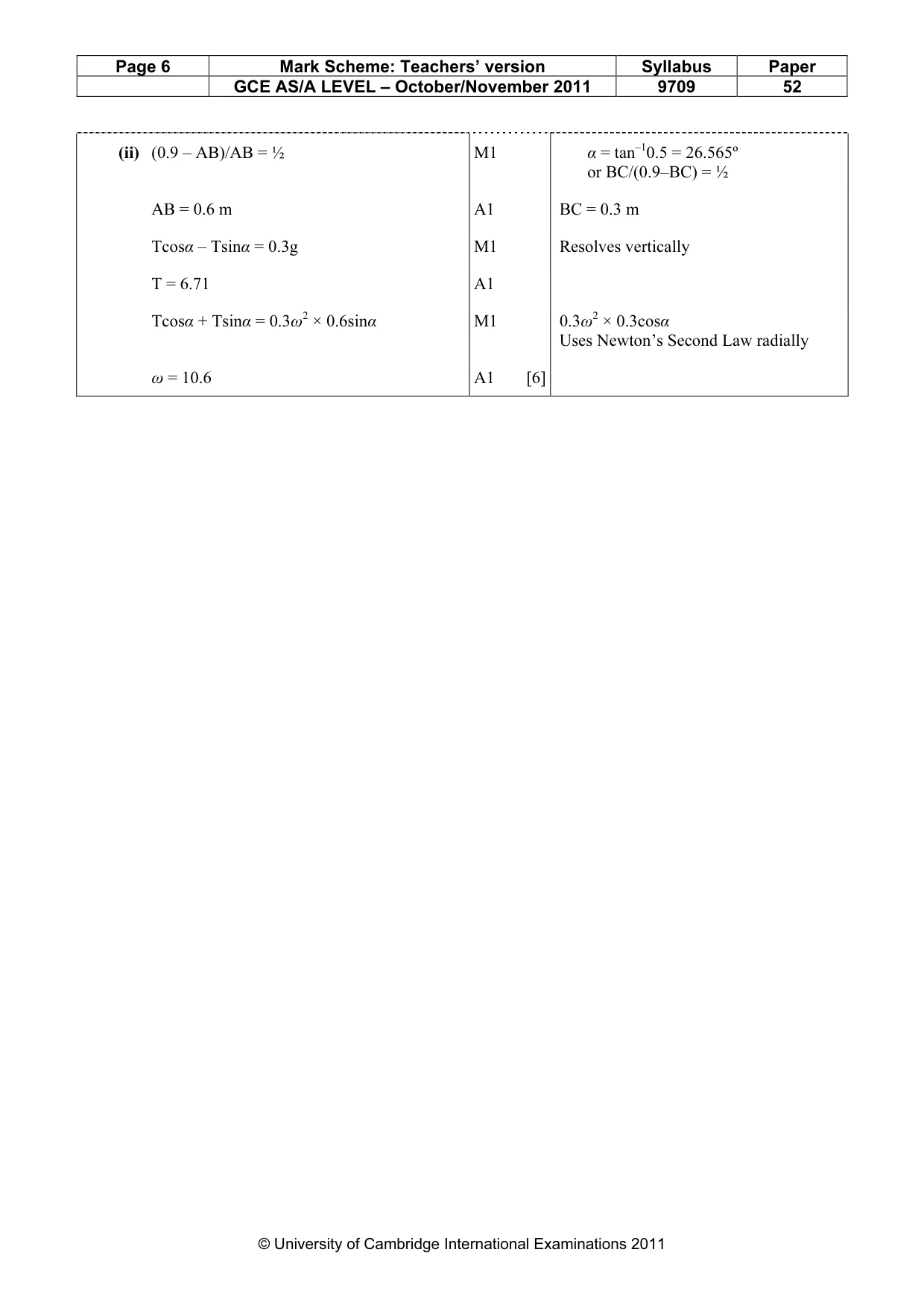
Mark scheme: 5 (i) 0.05dv/dt = 0.05g – 0.01v M1 Uses Newton’s Second Law dv/dt = 10 – 0.2v AG A1 ∫ dv/(10 – 0.2v) = ∫ dt M1 –ln(10 – 0.2v)/0.2 = t (+ c) A1 t = 0, v = 0, hence c = –5ln10 M1 –4.60517… ln(10 – 0.2v)/10 = 0.2t, 1 – 0.02v = e–0.2t v = 50 – 50e–0.2t A1 [6] (ii) dx/dt = 50 – 50e–0.2t M1 x = ∫ (50 – 50e–0.2t)dt x = 50t + 50e–0.2t/0.2 (+c) A1 h = [50t + 50e–0.2t/0.2] 02 M1 Or uses h = 0, t = 0 to evaluate c = (–250) and then finds h(2) h = 17.6 A1 [4] 1 B1 73 4º ith th h i t l
What was in this paper
The subtopics covered by these 5 questions, and how many questions each got. Open one in a new tab to see every Cambridge question on it.
What you needed in this session
Cambridge’s own grade thresholds for 2011 Oct/Nov, Paper 5 · Variant 2. A higher threshold means an easier paper — the bar moves with how the cohort did.