Cambridge A Level Mathematics 9709 — 2013 Oct/Nov Paper 5 · Variant 2
9709/52/O/N/13 · 7 questions · 50 marks · ≈56 min
The question paper and its mark scheme, free to read here and free to download. This is Cambridge’s own paper, exactly as it was sat.
Question paper4 pages
Mark scheme6 pages
Answers below. Sit the paper first if you are practising.
Questions as text
Q1 · A particle P of mass 0.3 kg is attached to one end of a light inextensible string of…
1 A particle P of mass 0.3 kg is attached to one end of a light inextensible string of length 0.6 m. The other end of the string is attached to a fixed point O of a smooth horizontal plane. P moves on the plane at constant speed 5 m s−1 in a circle with centre O. Calculate the tension in the string. [2]
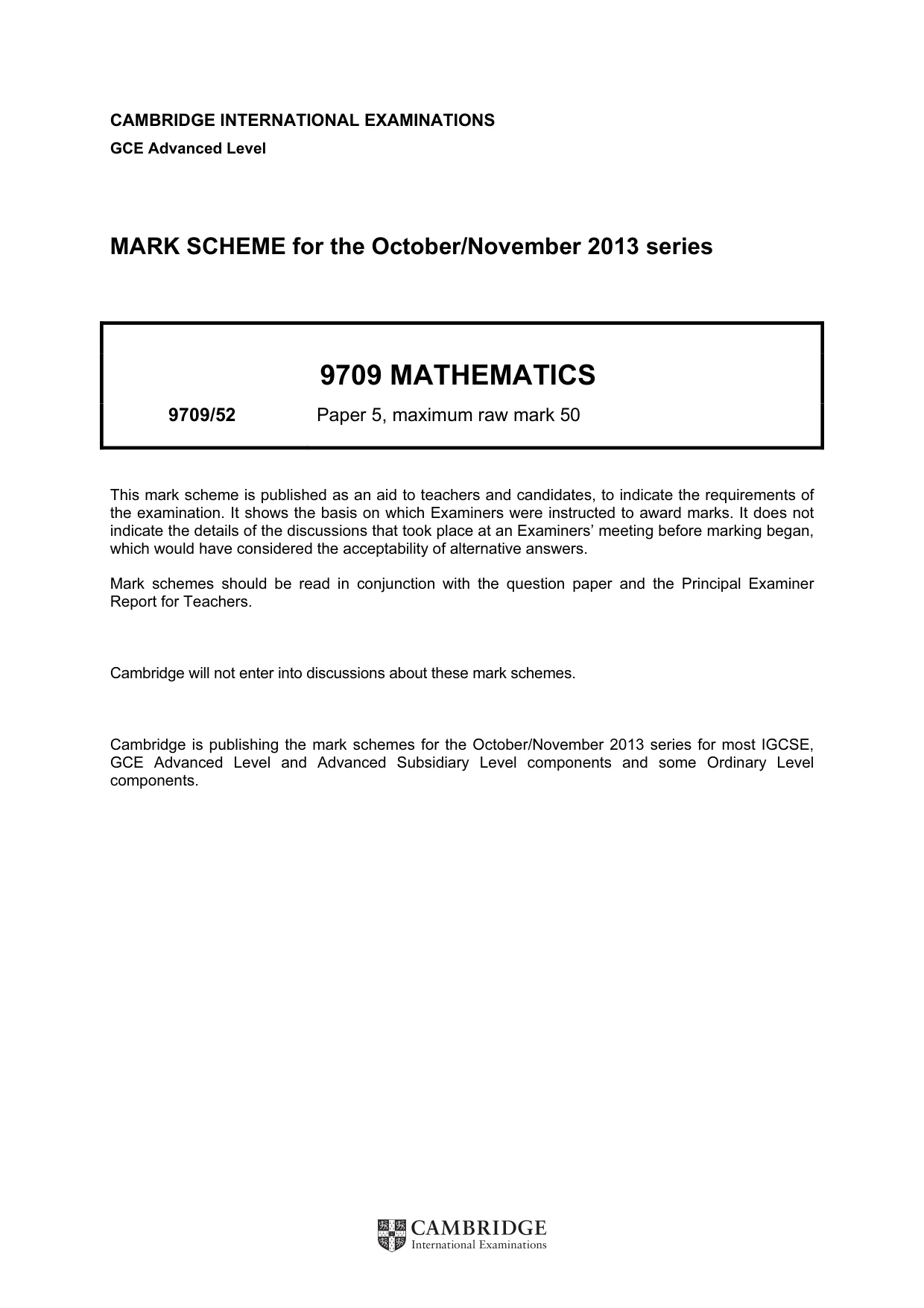
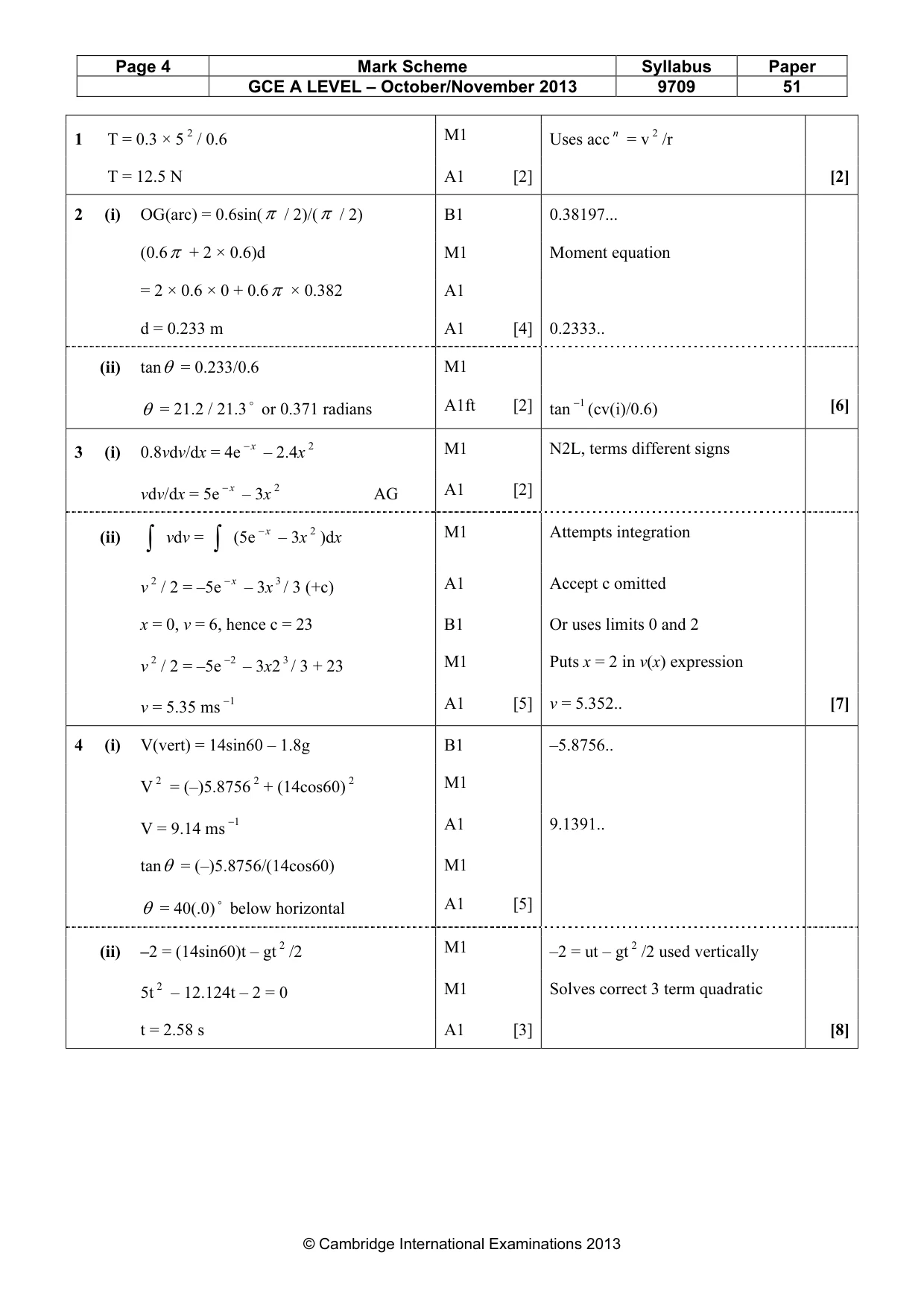
Mark scheme: 1 T = 0.3 × 5 2 / 0.6 M1 Uses acc n = v 2 /r T = 12.5 N A1 [2] [2]
Q2 · B A C O 0.6 m A uniform frame consists of a semicircular arc ABC of radius 0.6 m together…
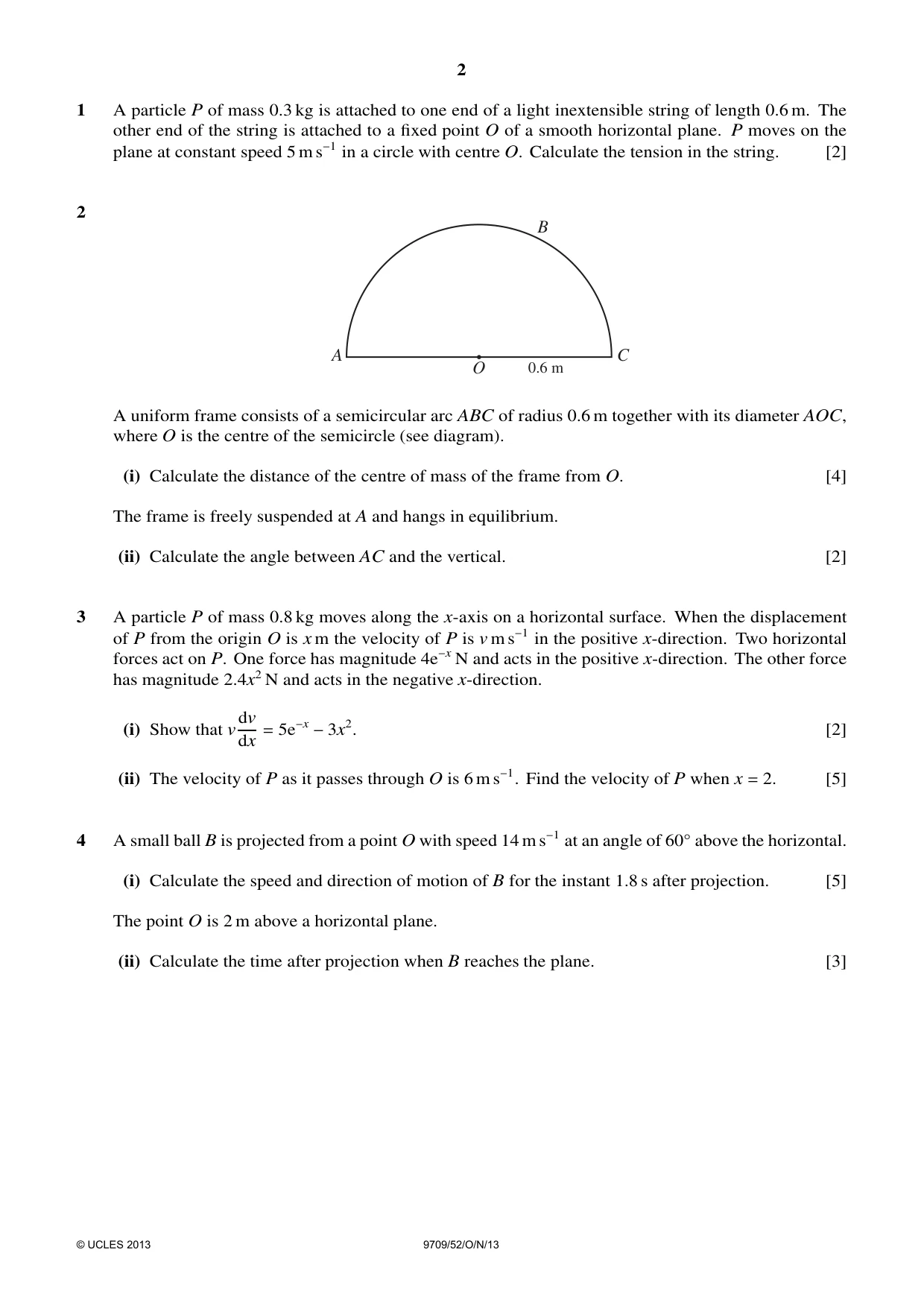
2 B A C O 0.6 m A uniform frame consists of a semicircular arc ABC of radius 0.6 m together with its diameter AOC, where O is the centre of the semicircle (see diagram). (i) Calculate the distance of the centre of mass of the frame from O. [4] The frame is freely suspended at A and hangs in equilibrium. (ii) Calculate the angle between AC and the vertical. [2]
Mark scheme: 2 (i) OG(arc) = 0.6sin(π / 2)/(π / 2) B1 0.38197... (0.6π + 2 × 0.6)d M1 Moment equation = 2 × 0.6 × 0 + 0.6π × 0.382 A1 d = 0.233 m A1 [4] 0.2333.. (ii) tanθ = 0.233/0.6 M1 θ = 21.2 / 21.3 o or 0.371 radians A1ft [2] tan −(cv(i)/0.6)1 [6] 2 M1 N2L t diff t i
Q3 · A particle P of mass 0.8 kg moves along the x-axis on a horizontal surface
3 A particle P of mass 0.8 kg moves along the x-axis on a horizontal surface. When the displacement of P from the origin O is x m the velocity of P is v m s−1 in the positive x-direction. Two horizontal forces act on P. One force has magnitude 4e−x N and acts in the positive x-direction. The other force has magnitude 2.4x2 N and acts in the negative x-direction. (i) Show that vdv = 5e−x −3x2. [2] dx (ii) The velocity of P as it passes through O is 6 m s−1. Find the velocity of P when x = 2. [5]
Mark scheme: 3 (i) 0.8vdv/dx = 4e − x – 2.4x 2 M1 N2L, terms different signs vdv/dx = 5e − x – 3x 2 AG A1 [2] − x 2 M1 Attempts integration (ii) ∫ vdv = ∫ (5e – 3x )dx v 2 / 2 = –5e − x – 3x 3/ 3 (+c) A1 Accept c omitted x = 0, v = 6, hence c = 23 B1 Or uses limits 0 and 2 v 2 / 2 = –5e − 2 – 3x2 3/ 3 + 23 M1 Puts x = 2 in v(x) expression v = 5.35 ms − 1 A1 [5] v = 5.352.. [7]
Q4 · A small ball B is projected from a point O with speed 14 m s−1 at an angle of 60 above…
4 A small ball B is projected from a point O with speed 14 m s−1 at an angle of 60 above the horizontal. (i) Calculate the speed and direction of motion of B for the instant 1.8 s after projection. [5] The point O is 2 m above a horizontal plane. (ii) Calculate the time after projection when B reaches the plane. [3]
Mark scheme: 4 (i) V(vert) = 14sin60 – 1.8g B1 –5.8756.. V 2 = (–)5.8756 2 + (14cos60) 2 M1 V = 9.14 ms − 1 A1 9.1391.. tanθ = (–)5.8756/(14cos60) M1 θ = 40(.0) o below horizontal A1 [5] (ii) –2 = (14sin60)t – gt 2 /2 M1 –2 = ut – gt 2 /2 used vertically 5t 2 – 12.124t – 2 = 0 M1 Solves correct 3 term quadratic t = 2.58 s A1 [3] [8] GCE A LEVEL – October/November 2013 9709 51
Q5 · A 0.4 m P 0.3 m B A particle P of mass 0.2 kg is attached to a fixed point A by a light…
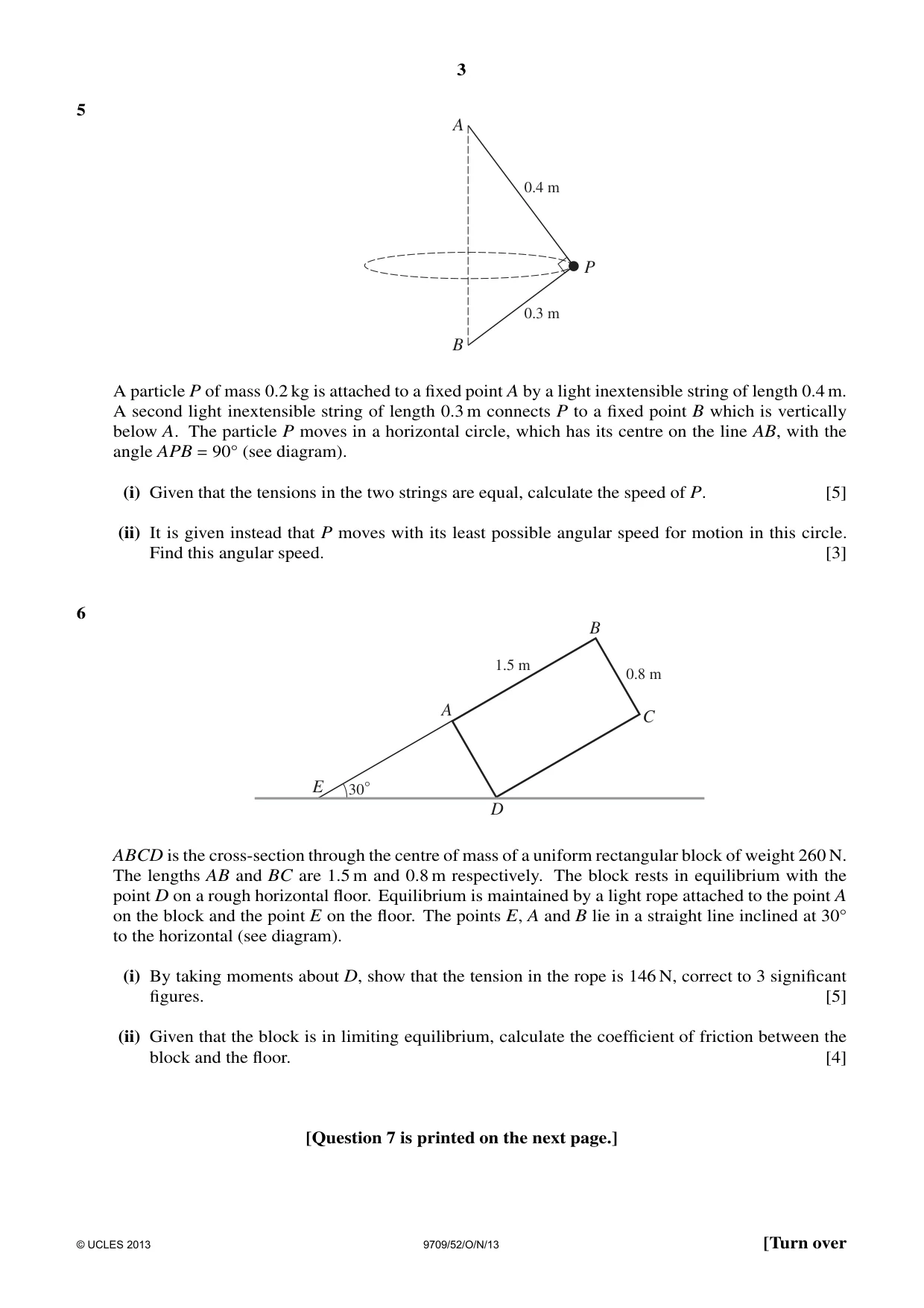
5 A 0.4 m P 0.3 m B A particle P of mass 0.2 kg is attached to a fixed point A by a light inextensible string of length 0.4 m. A second light inextensible string of length 0.3 m connects P to a fixed point B which is vertically below A. The particle P moves in a horizontal circle, which has its centre on the line AB, with the angle APB = 90 (see diagram). (i) Given that the tensions in the two strings are equal, calculate the speed of P. [5] (ii) It is given instead that P moves with its least possible angular speed for motion in this circle. Find this angular speed. [3]
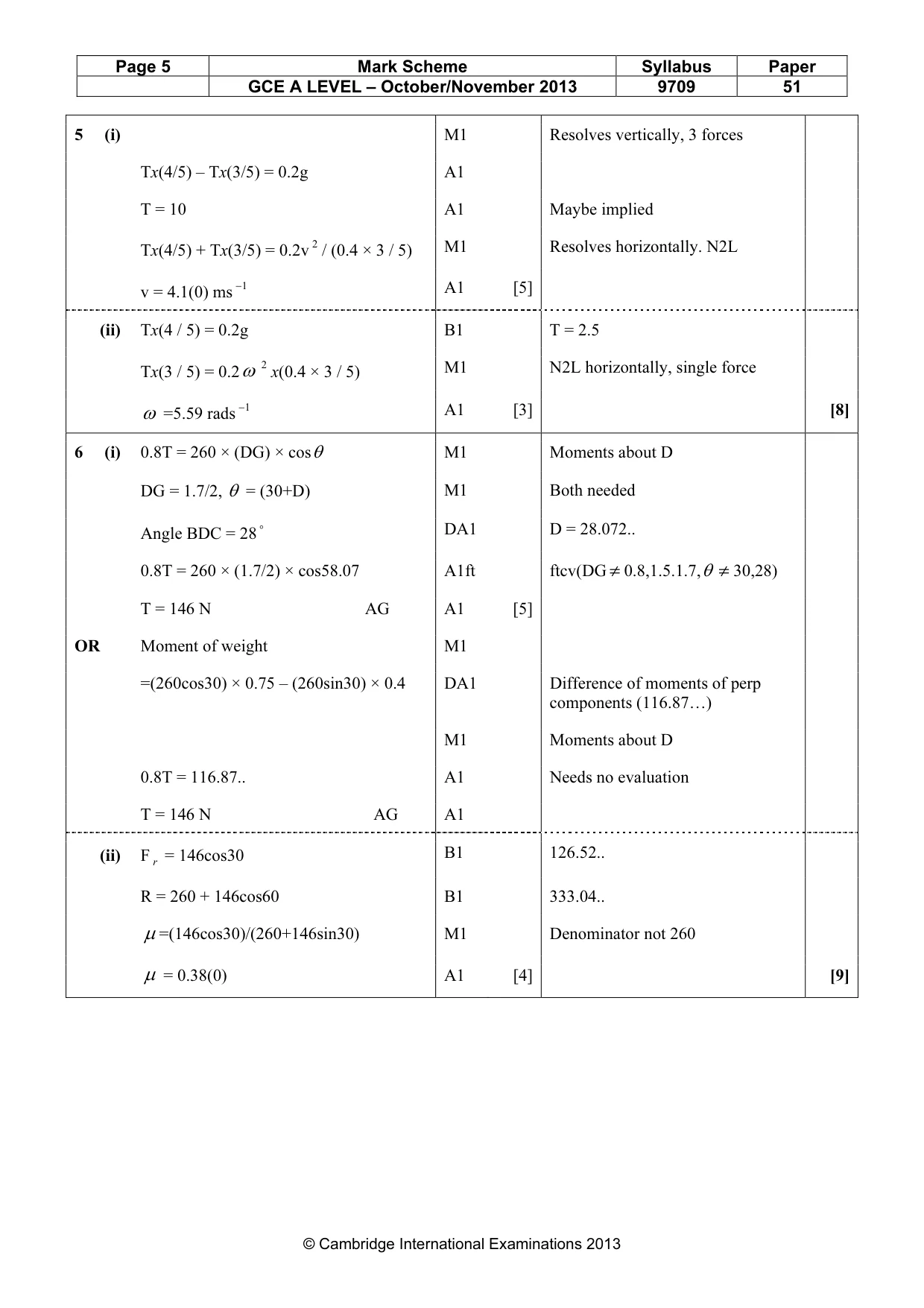
Mark scheme: 5 (i) M1 Resolves vertically, 3 forces Tx(4/5) – Tx(3/5) = 0.2g A1 T = 10 A1 Maybe implied Tx(4/5) + Tx(3/5) = 0.2v 2 / (0.4 × 3 / 5) M1 Resolves horizontally. N2L v = 4.1(0) ms − 1 A1 [5] (ii) Tx(4 / 5) = 0.2g B1 T = 2.5 Tx(3 / 5) = 0.2ω 2 x(0.4 × 3 / 5) M1 N2L horizontally, single force ω =5.59 rads − 1 A1 [3] [8]
Q6 · B 1.5 m 0.8 m A C E 30° D ABCD is the cross-section through the centre of mass of a…
6 B 1.5 m 0.8 m A C E 30° D ABCD is the cross-section through the centre of mass of a uniform rectangular block of weight 260 N. The lengths AB and BC are 1.5 m and 0.8 m respectively. The block rests in equilibrium with the point D on a rough horizontal floor. Equilibrium is maintained by a light rope attached to the point A on the block and the point E on the floor. The points E, A and B lie in a straight line inclined at 30 to the horizontal (see diagram). (i) By taking moments about D, show that the tension in the rope is 146 N, correct to 3 significant figures. [5] (ii) Given that the block is in limiting equilibrium, calculate the coefficient of friction between the block and the floor. [4] [Question 7 is printed on the next page.]
Mark scheme: 6 (i) 0.8T = 260 × (DG) × cosθ M1 Moments about D DG = 1.7/2, θ = (30+D) M1 Both needed Angle BDC = 28 o DA1 D = 28.072.. 0.8T = 260 × (1.7/2) × cos58.07 A1ft ftcv(DG≠0.8,1.5.1.7,θ ≠30,28) T = 146 N AG A1 [5] OR Moment of weight M1 =(260cos30) × 0.75 – (260sin30) × 0.4 DA1 Difference of moments of perp components (116.87…) M1 Moments about D 0.8T = 116.87.. A1 Needs no evaluation T = 146 N AG A1 (ii) F r = 146cos30 B1 126.52.. R = 260 + 146cos60 B1 333.04.. µ =(146cos30)/(260+146sin30) M1 Denominator not 260 µ = 0.38(0) A1 [4] [9] GCE A LEVEL – October/November 2013 9709 51
Q7 · A particle P of mass 0.4 kg is attached to one end of a light elastic string of natural…
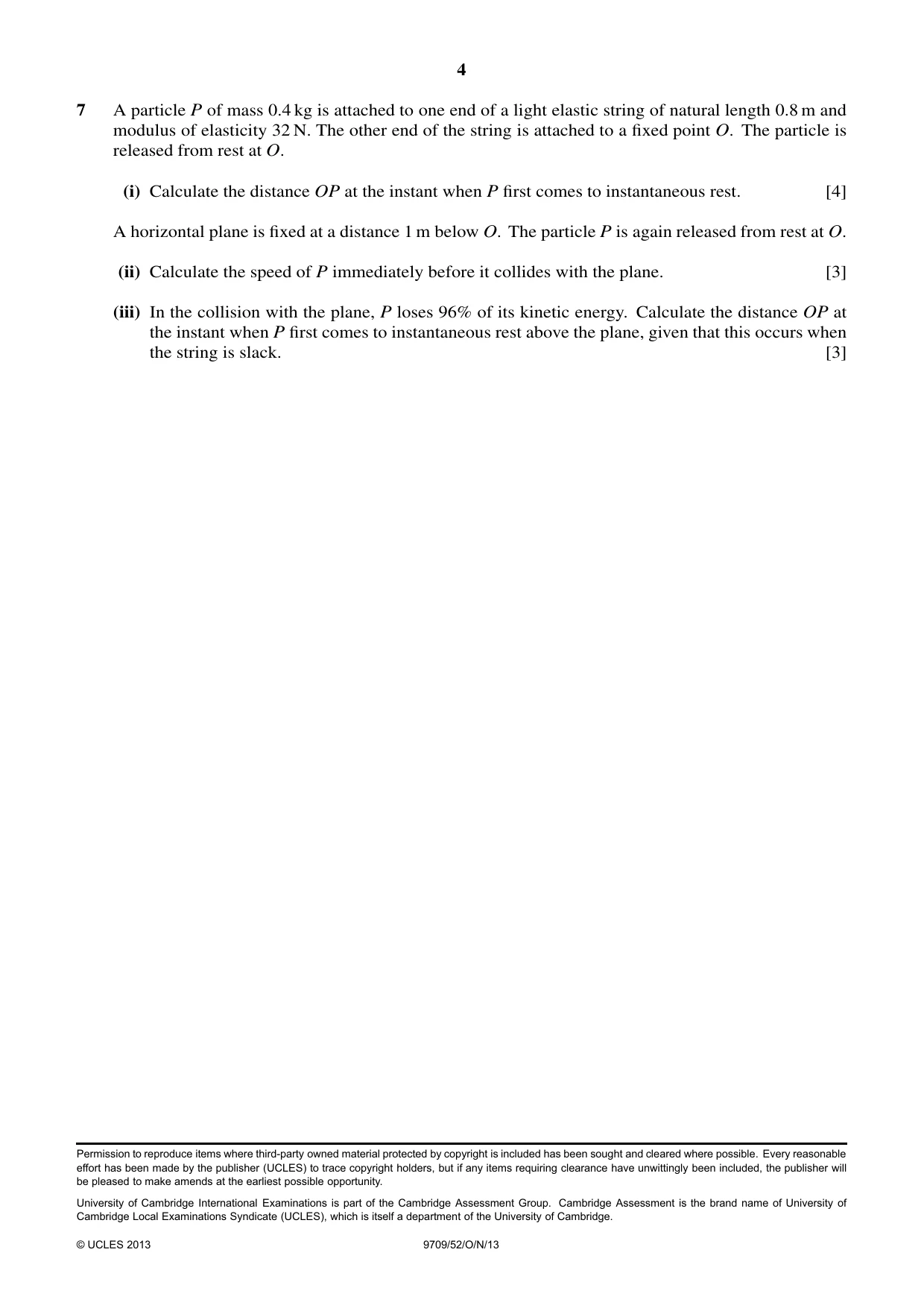
7 A particle P of mass 0.4 kg is attached to one end of a light elastic string of natural length 0.8 m and modulus of elasticity 32 N. The other end of the string is attached to a fixed point O. The particle is released from rest at O. (i) Calculate the distance OP at the instant when P first comes to instantaneous rest. [4] A horizontal plane is fixed at a distance 1 m below O. The particle P is again released from rest at O. (ii) Calculate the speed of P immediately before it collides with the plane. [3] (iii) In the collision with the plane, P loses 96% of its kinetic energy. Calculate the distance OP at the instant when P first comes to instantaneous rest above the plane, given that this occurs when the string is slack. [3]
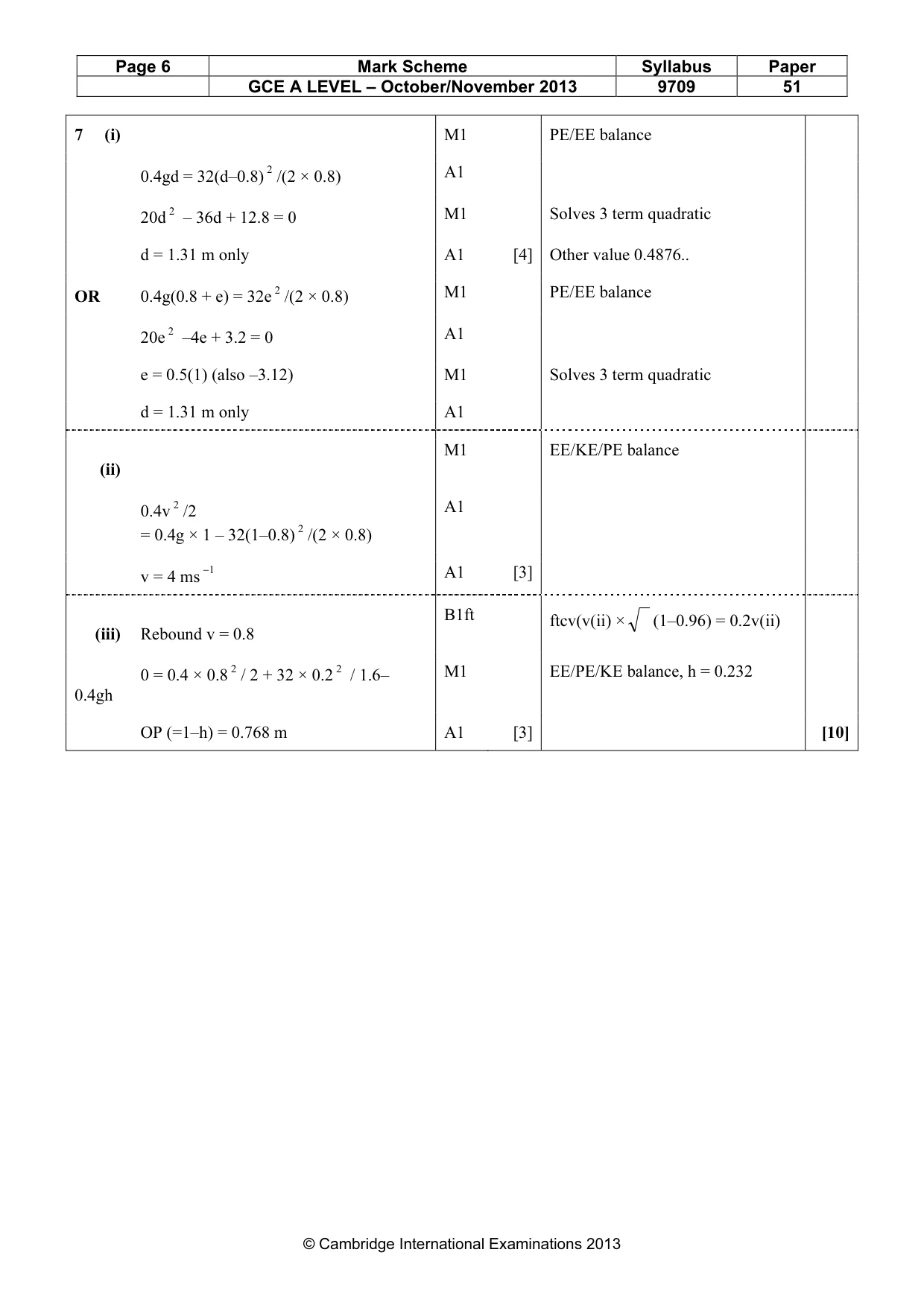
Mark scheme: 7 (i) M1 PE/EE balance 0.4gd = 32(d–0.8) 2 /(2 × 0.8) A1 20d 2 – 36d + 12.8 = 0 M1 Solves 3 term quadratic d = 1.31 m only A1 [4] Other value 0.4876.. OR 0.4g(0.8 + e) = 32e 2 /(2 × 0.8) M1 PE/EE balance 20e 2 –4e + 3.2 = 0 A1 e = 0.5(1) (also –3.12) M1 Solves 3 term quadratic d = 1.31 m only A1 M1 EE/KE/PE balance (ii) 0.4v 2 /2 A1 = 0.4g × 1 – 32(1–0.8) 2 /(2 × 0.8) v = 4 ms − 1 A1 [3] B1ft ftcv(v(ii) × (1–0.96) = 0.2v(ii) (iii) Rebound v = 0.8 0 = 0.4 × 0.8 2 / 2 + 32 × 0.2 2 / 1.6– M1 EE/PE/KE balance, h = 0.232 0.4gh OP (=1–h) = 0.768 m A1 [3] [10]
What was in this paper
The subtopics covered by these 7 questions, and how many questions each got. Open one in a new tab to see every Cambridge question on it.
What you needed in this session
Cambridge’s own grade thresholds for 2013 Oct/Nov, Paper 5 · Variant 2. A higher threshold means an easier paper — the bar moves with how the cohort did.