Cambridge A Level Mathematics 9709 — 2007 Oct/Nov Paper 5 · Variant 1
9709/51/O/N/07 · 7 questions · 50 marks · ≈56 min
The question paper and its mark scheme, free to read here and free to download. This is Cambridge’s own paper, exactly as it was sat.
Question paper8 pages
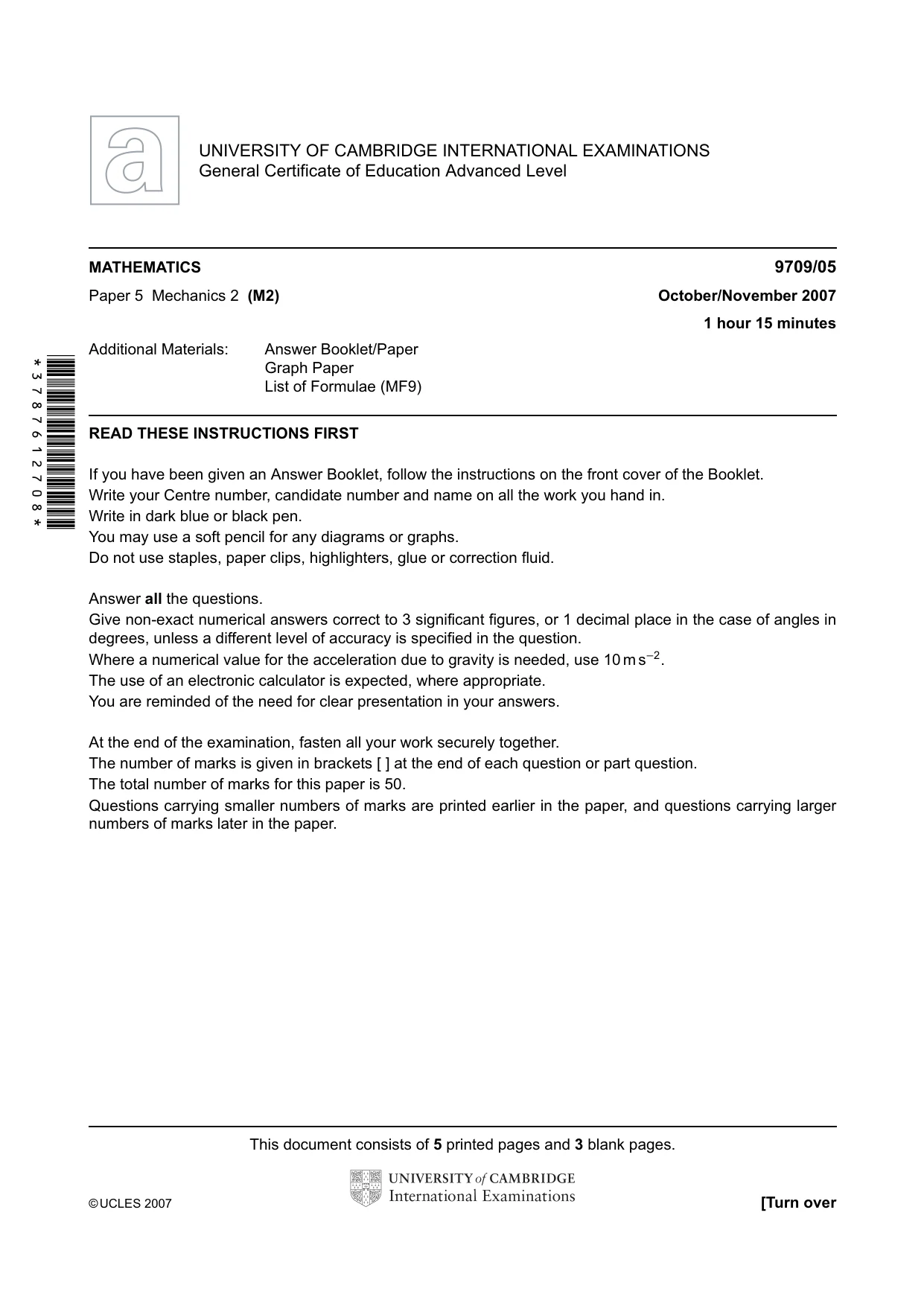


Mark scheme6 pages
Answers below. Sit the paper first if you are practising.
Questions as text
Q1 · Each of two identical light elastic strings has natural length 0.25 m and modulus of…
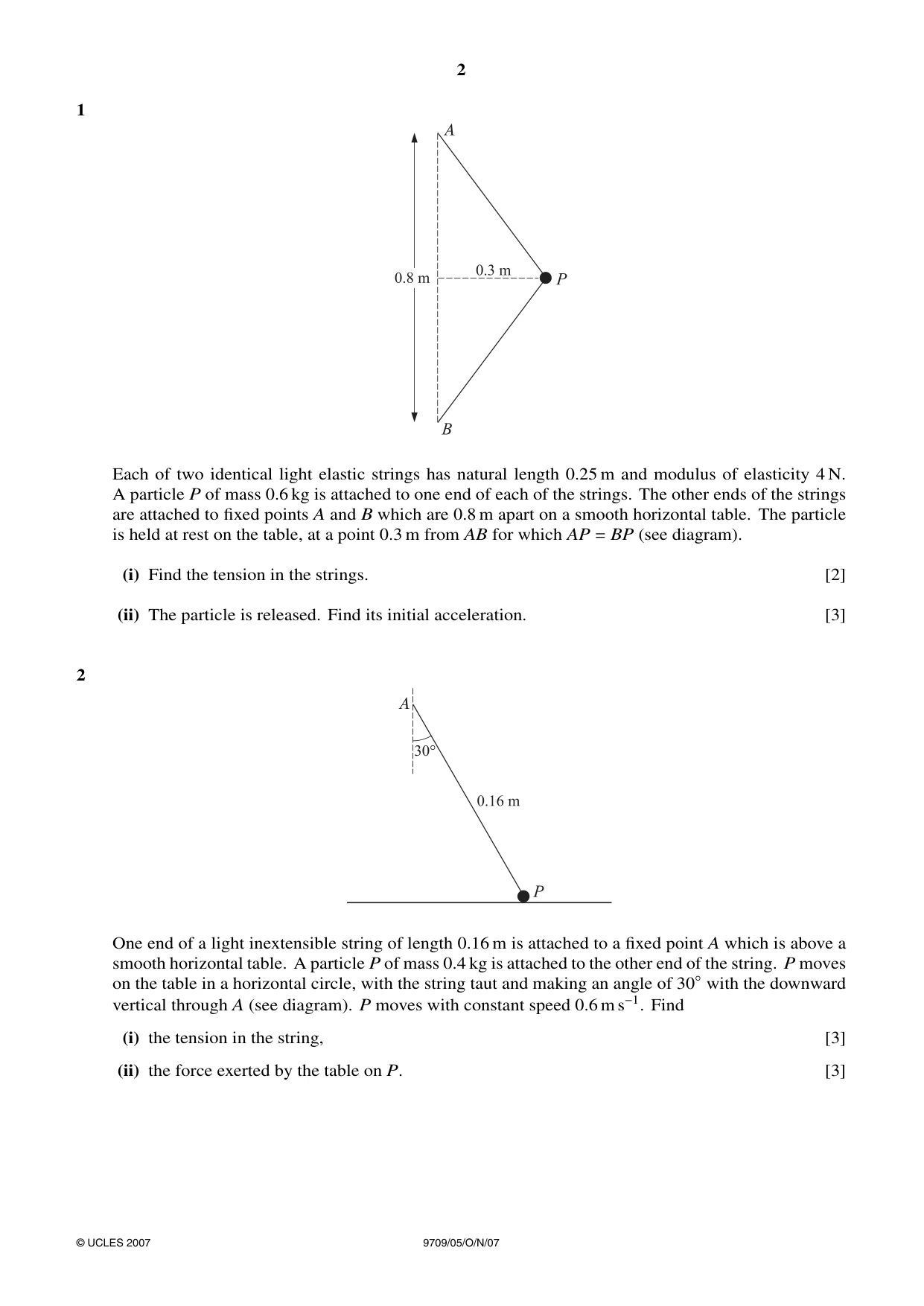
1 Each of two identical light elastic strings has natural length 0.25 m and modulus of elasticity 4 N. A particle P of mass 0.6 kg is attached to one end of each of the strings. The other ends of the strings are attached to fixed points A and B which are 0.8 m apart on a smooth horizontal table. The particle is held at rest on the table, at a point 0.3 m from AB for which AP = BP (see diagram). (i) Find the tension in the strings. [2] (ii) The particle is released. Find its initial acceleration. [3]
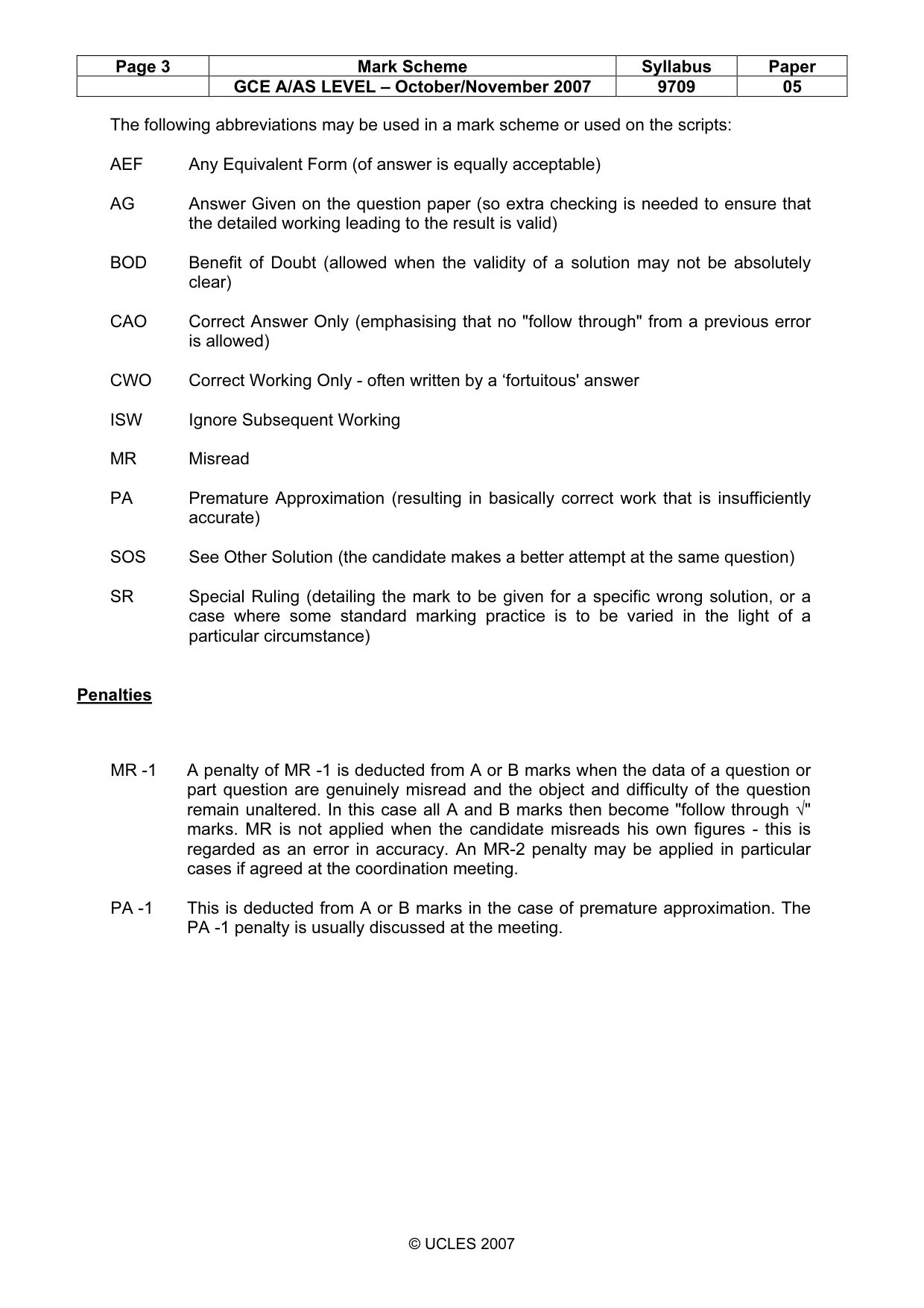
Mark scheme: 1 (i) T = 4x0.25/0.25 or 4x0.5/0.5 M1 For using T = λ x/L Tension is 4N A1 2 (ii) M1 For using Newton’s second law 2 x 4 x 0.6 = 0.6a A1ft Acceleration is 8ms −2 A1 3 5
Q2 · One end of a light inextensible string of length 0.16 m is attached to a fixed point A…
2 One end of a light inextensible string of length 0.16 m is attached to a fixed point A which is above a smooth horizontal table. A particle P of mass 0.4 kg is attached to the other end of the string. P moves on the table in a horizontal circle, with the string taut and making an angle of 30◦with the downward vertical through A (see diagram). P moves with constant speed 0.6 m s−1. Find (i) the tension in the string, [3] (ii) the force exerted by the table on P. [3]
Mark scheme: 2 (i) M1 For using a = v²/r and Newton’s second law horizontally Tsin30º = 0.4 x 0.6²/0.08 A1 Tension is 3.6N A1 3 (ii) M1 For resolving forces vertically (3 terms) R + Tcos30 ° = 0.4g A1 Force is 0.882N A1ft 3 ft [4 − candidate ' sTx cos 30 ° ] (must be +ve) or T = 2.96 from consistent sin/cos mix 6
Q3 · A uniform beam AB has length 2 m and mass 10 kg
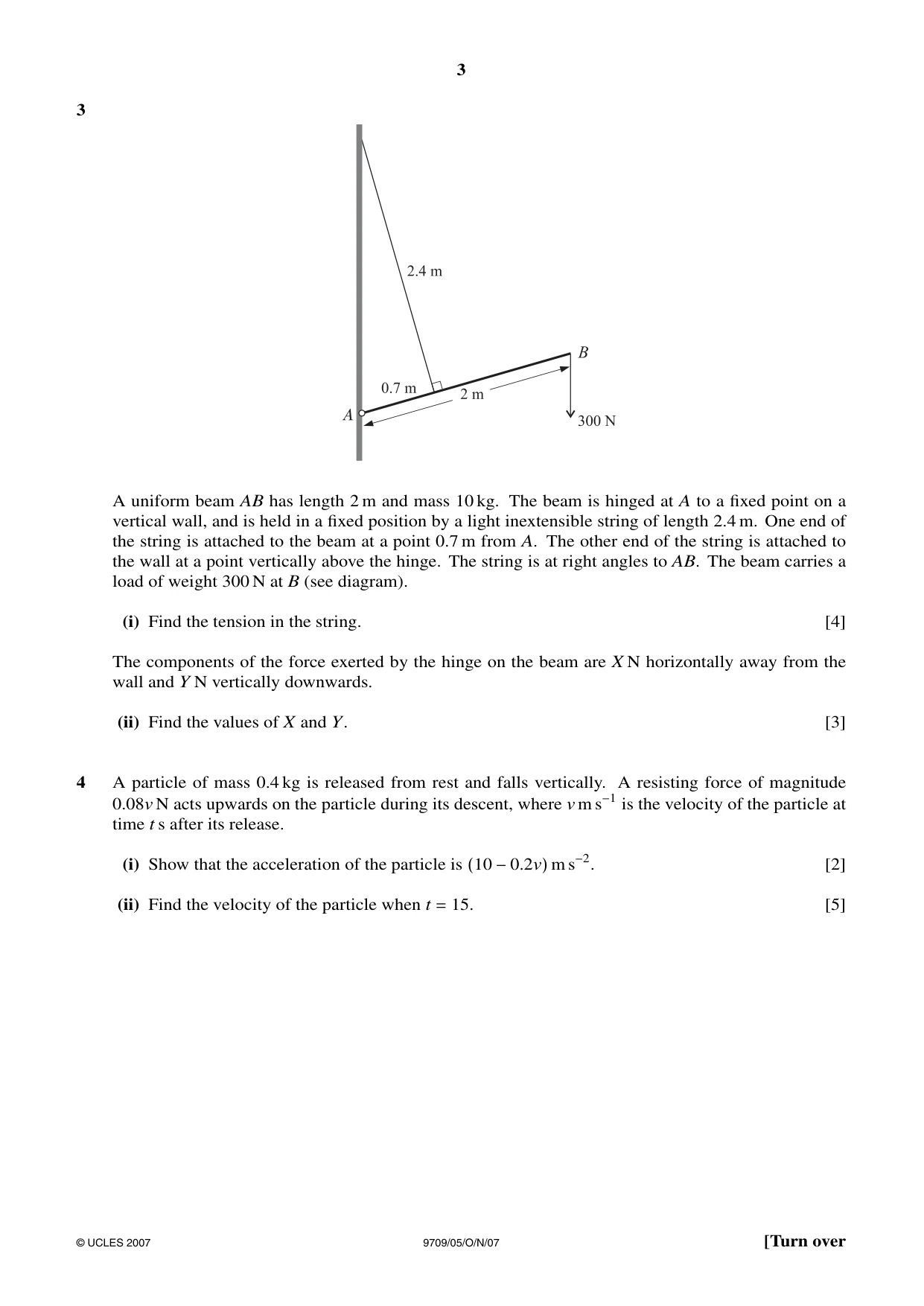
3 A uniform beam AB has length 2 m and mass 10 kg. The beam is hinged at A to a fixed point on a vertical wall, and is held in a fixed position by a light inextensible string of length 2.4 m. One end of the string is attached to the beam at a point 0.7 m from A. The other end of the string is attached to the wall at a point vertically above the hinge. The string is at right angles to AB. The beam carries a load of weight 300 N at B (see diagram). (i) Find the tension in the string. [4] The components of the force exerted by the hinge on the beam are X N horizontally away from the wall and Y N vertically downwards. (ii) Find the values of X and Y. [3]
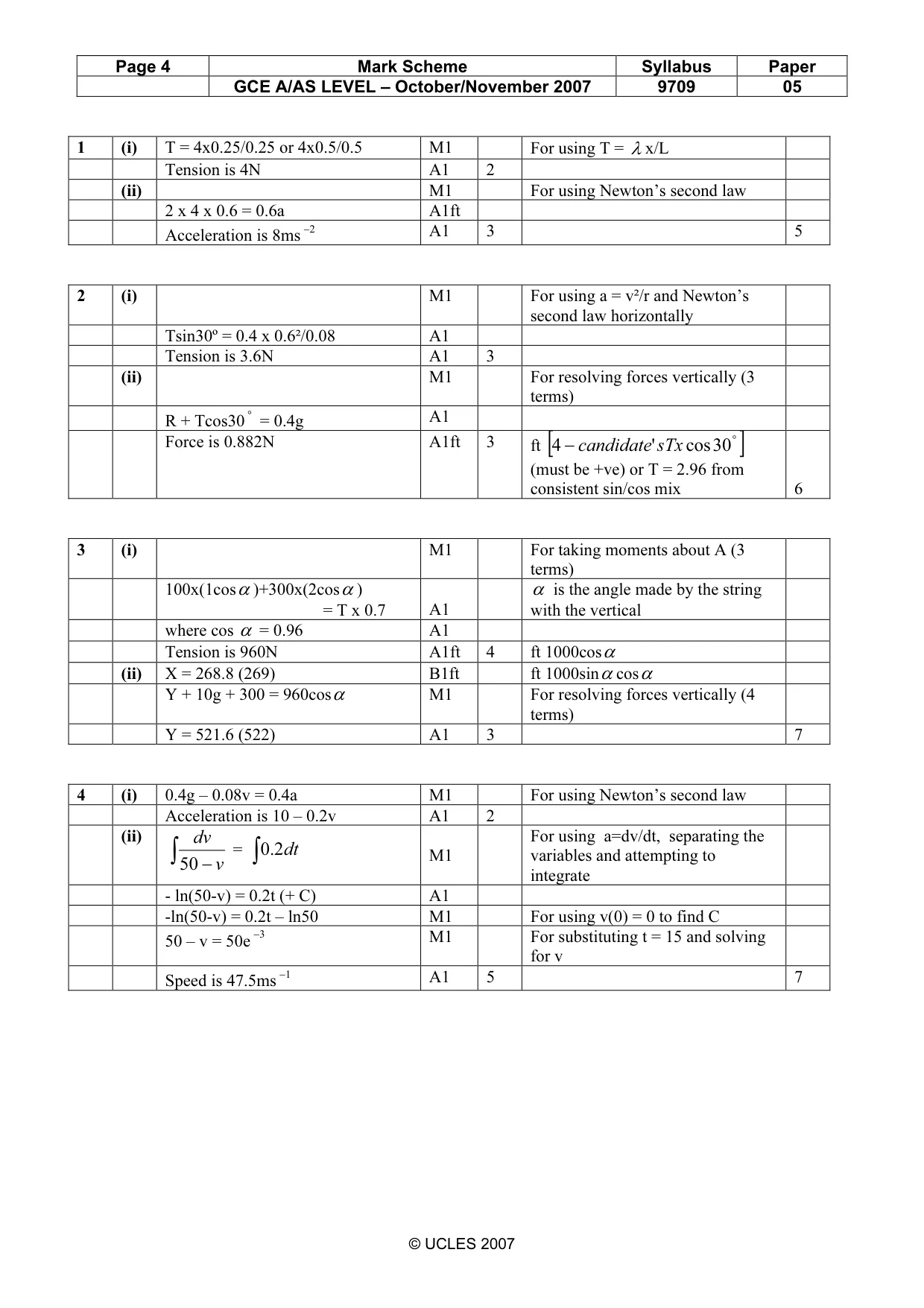
Mark scheme: 3 (i) M1 For taking moments about A (3 terms) 100x(1cosα )+300x(2cosα ) α is the angle made by the string = T x 0.7 A1 with the vertical where cos α = 0.96 A1 Tension is 960N A1ft 4 ft 1000cosα (ii) X = 268.8 (269) B1ft ft 1000sinα cosα Y + 10g + 300 = 960cosα M1 For resolving forces vertically (4 terms) Y = 521.6 (522) A1 3 7
Q4 · A particle of mass 0.4 kg is released from rest and falls vertically
4 A particle of mass 0.4 kg is released from rest and falls vertically. A resisting force of magnitude 0.08v N acts upwards on the particle during its descent, where v m s−1 is the velocity of the particle at time t s after its release. (i) Show that the acceleration of the particle is (10 −0.2v) m s−2. [2] (ii) Find the velocity of the particle when t = 15. [5]
Mark scheme: 4 (i) 0.4g – 0.08v = 0.4a M1 For using Newton’s second law Acceleration is 10 – 0.2v A1 2 (ii) dv For using a=dv/dt, separating the ∫ = ∫ 2.0 dt M1 variables and attempting to 50 −v integrate - ln(50-v) = 0.2t (+ C) A1 -ln(50-v) = 0.2t – ln50 M1 For using v(0) = 0 to find C 50 – v = 50e −3 M1 For substituting t = 15 and solving for v Speed is 47.5ms −1 A1 5 7 GCE A/AS LEVEL – October/November 2007 9709 05
Q5 · Each of two light elastic strings, S1 and S2, has modulus of elasticity 16 N
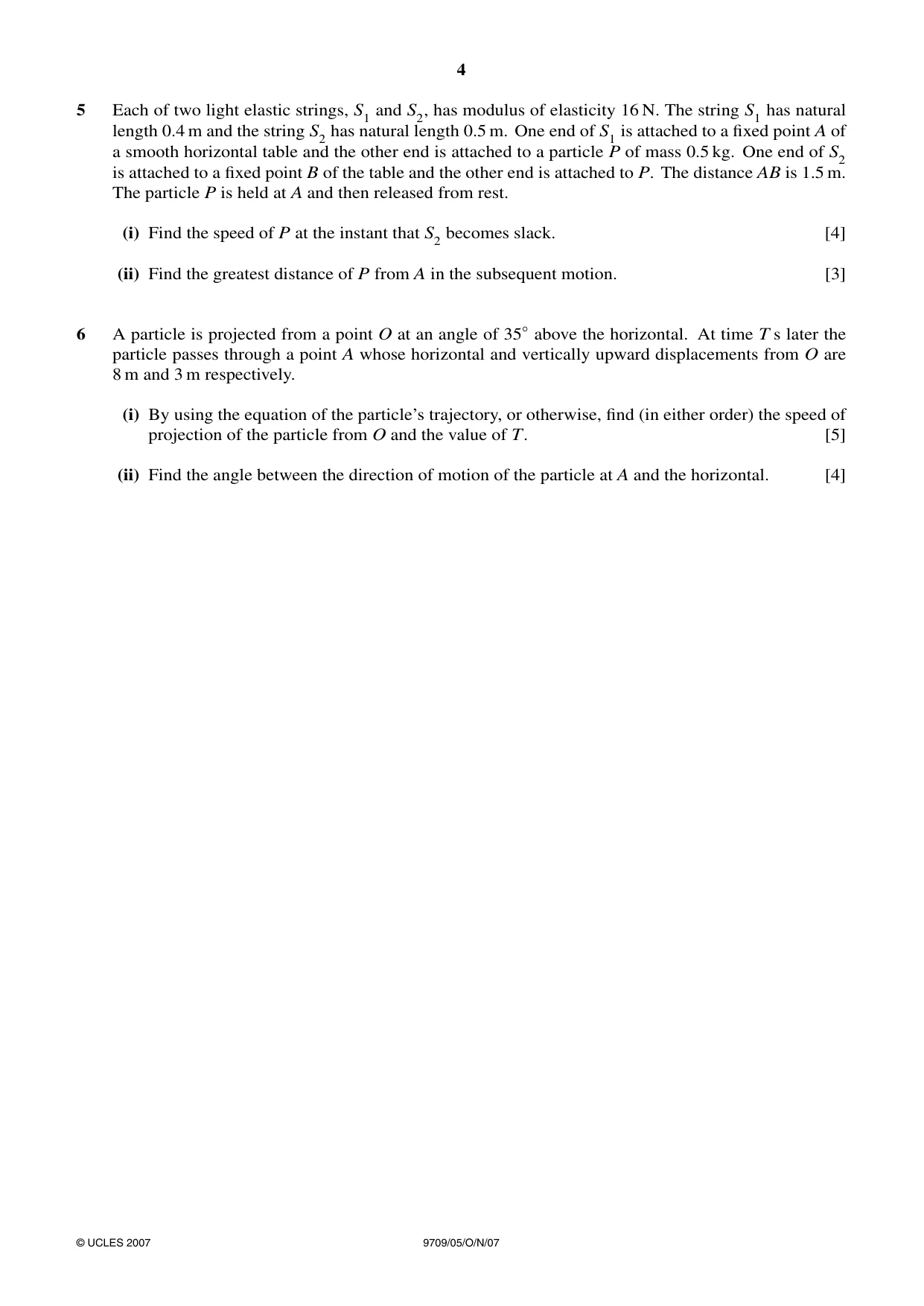
5 Each of two light elastic strings, S1 and S2, has modulus of elasticity 16 N. The string S1 has natural length 0.4 m and the string S2 has natural length 0.5 m. One end of S1 is attached to a fixed point A of a smooth horizontal table and the other end is attached to a particle P of mass 0.5 kg. One end of S2 is attached to a fixed point B of the table and the other end is attached to P. The distance AB is 1.5 m. The particle P is held at A and then released from rest. (i) Find the speed of P at the instant that S2 becomes slack. [4] (ii) Find the greatest distance of P from A in the subsequent motion. [3]
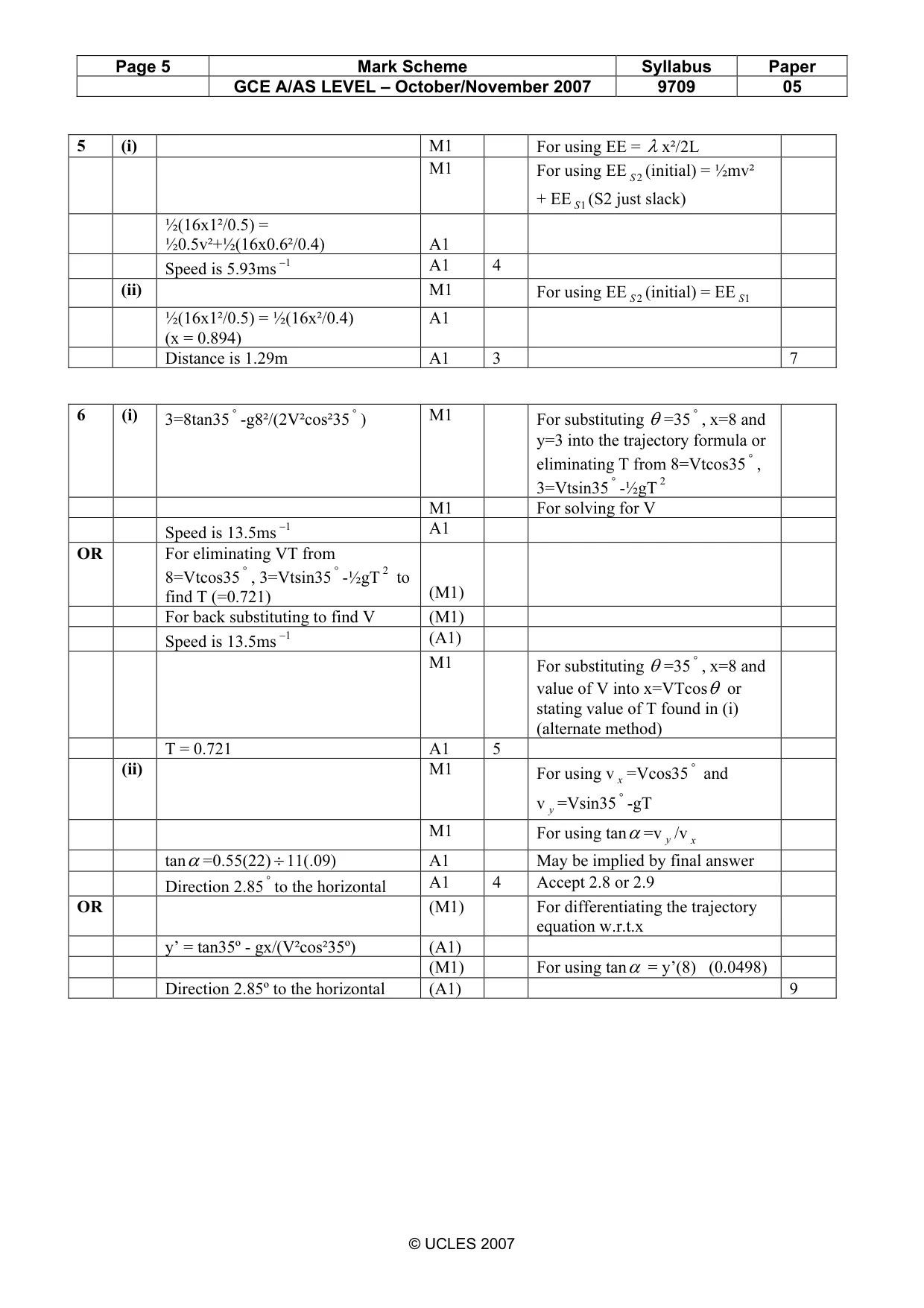
Mark scheme: 5 (i) M1 For using EE = λ x²/2L M1 For using EE S 2 (initial) = ½mv² + EE S 1 (S2 just slack) ½(16x1²/0.5) = ½0.5v²+½(16x0.6²/0.4) A1 Speed is 5.93ms −1 A1 4 (ii) M1 For using EE S 2 (initial) = EE S 1 ½(16x1²/0.5) = ½(16x²/0.4) A1 (x = 0.894) Distance is 1.29m A1 3 7
Q6 · A particle is projected from a point O at an angle of 35◦above the horizontal
6 A particle is projected from a point O at an angle of 35◦above the horizontal. At time T s later the particle passes through a point A whose horizontal and vertically upward displacements from O are 8 m and 3 m respectively. (i) By using the equation of the particle’s trajectory, or otherwise, find (in either order) the speed of projection of the particle from O and the value of T. [5] (ii) Find the angle between the direction of motion of the particle at A and the horizontal. [4]
Mark scheme: 6 (i) 3=8tan35 ° -g8²/(2V²cos²35 ° ) M1 For substituting θ =35 ° , x=8 and y=3 into the trajectory formula or eliminating T from 8=Vtcos35 ° , 3=Vtsin35 ° -½gT 2 M1 For solving for V Speed is 13.5ms −1 A1 OR For eliminating VT from 8=Vtcos35 ° , 3=Vtsin35 ° -½gT 2 to find T (=0.721) (M1) For back substituting to find V (M1) Speed is 13.5ms −1 (A1) M1 For substituting θ =35 ° , x=8 and value of V into x=VTcosθ or stating value of T found in (i) (alternate method) T = 0.721 A1 5 (ii) M1 For using v x =Vcos35 ° and v y =Vsin35 ° -gT M1 For using tanα =v y /v x tanα =0.55(22) ÷11(.09) A1 May be implied by final answer Direction 2.85 ° to the horizontal A1 4 Accept 2.8 or 2.9 OR (M1) For differentiating the trajectory equation w.r.t.x y’ = tan35º - gx/(V²cos²35º) (A1) (M1) For using tanα = y’(8) (0.0498) Direction 2.85º to the horizontal (A1) 9 GCE A/AS LEVEL – October/November 2007 9709 05
Q7 · The cross-section of a uniform solid
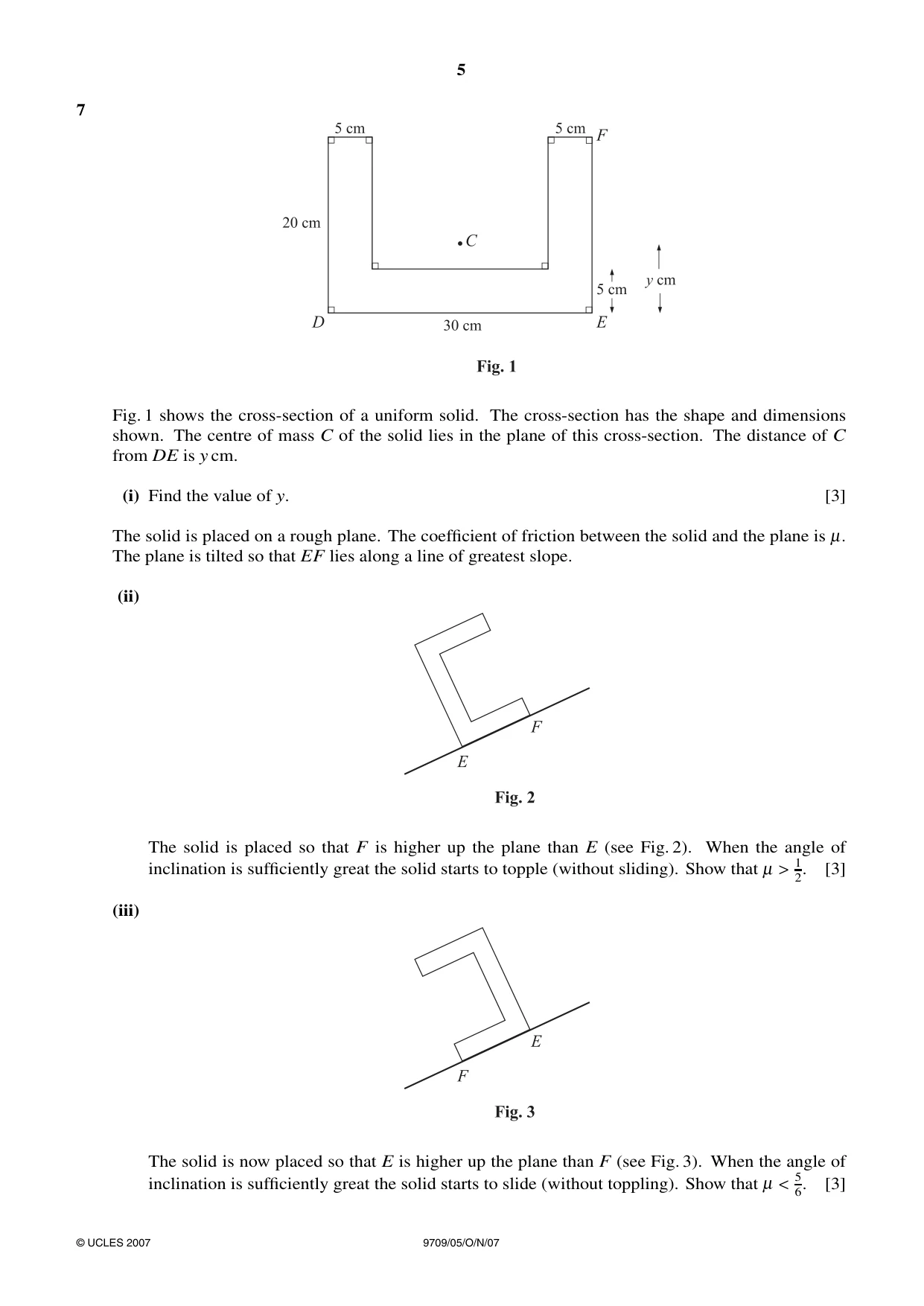
7 Fig. 1 shows the cross-section of a uniform solid. The cross-section has the shape and dimensions shown. The centre of mass C of the solid lies in the plane of this cross-section. The distance of C from DE is y cm. (i) Find the value of y. [3] The solid is placed on a rough plane. The coefficient of friction between the solid and the plane is µ. The plane is tilted so that EF lies along a line of greatest slope. (ii) The solid is placed so that F is higher up the plane than E (see Fig. 2). When the angle of inclination is sufficiently great the solid starts to topple (without sliding). Show that µ > 12. [3] (iii) The solid is now placed so that E is higher up the plane than F (see Fig. 3). When the angle of inclination is sufficiently great the solid starts to slide (without toppling). Show that µ < 56. [3]
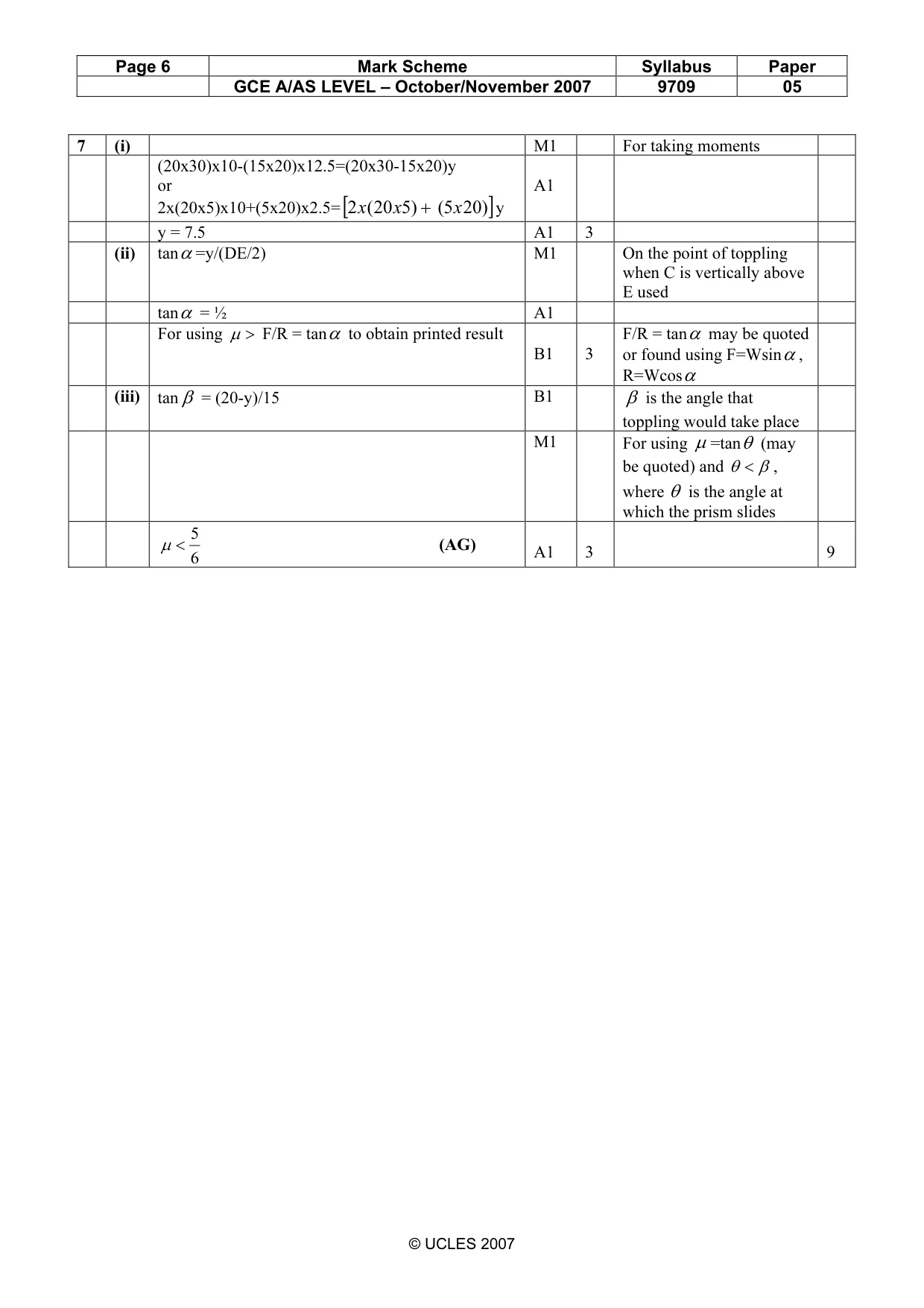
Mark scheme: 7 (i) M1 For taking moments (20x30)x10-(15x20)x12.5=(20x30-15x20)y or A1 2x(20x5)x10+(5x20)x2.5=[2 x ( 20 x 5) + (5 x 20]) y y = 7.5 A1 3 (ii) tanα =y/(DE/2) M1 On the point of toppling when C is vertically above E used tanα = ½ A1 For using µ > F/R = tanα to obtain printed result F/R = tanα may be quoted B1 3 or found using F=Wsinα , R=Wcosα (iii) tan β = (20-y)/15 B1 β is the angle that toppling would take place M1 For using µ =tanθ (may be quoted) and θ < β , where θ is the angle at which the prism slides 5 µ < (AG) A1 3 9 6
What was in this paper
The subtopics covered by these 7 questions, and how many questions each got. Open one in a new tab to see every Cambridge question on it.
What you needed in this session
Cambridge’s own grade thresholds for 2007 Oct/Nov, Paper 5 · Variant 1. A higher threshold means an easier paper — the bar moves with how the cohort did.