Cambridge A Level Mathematics 9709 — 2015 Oct/Nov Paper 5 · Variant 1
9709/51/O/N/15 · 7 questions · 50 marks · ≈56 min
The question paper and its mark scheme, free to read here and free to download. This is Cambridge’s own paper, exactly as it was sat.
Question paper4 pages
Mark scheme6 pages
Answers below. Sit the paper first if you are practising.
Questions as text
Q1 · A particle P moves in a straight line and passes through a point O of the line with…
1 A particle P moves in a straight line and passes through a point O of the line with velocity 2 m s−1. At time t s after passing through O, the velocity of P is v m s−1 and the acceleration of P is given by e−0.5v m s−2. Calculate the velocity of P when t = 1.2. [4]
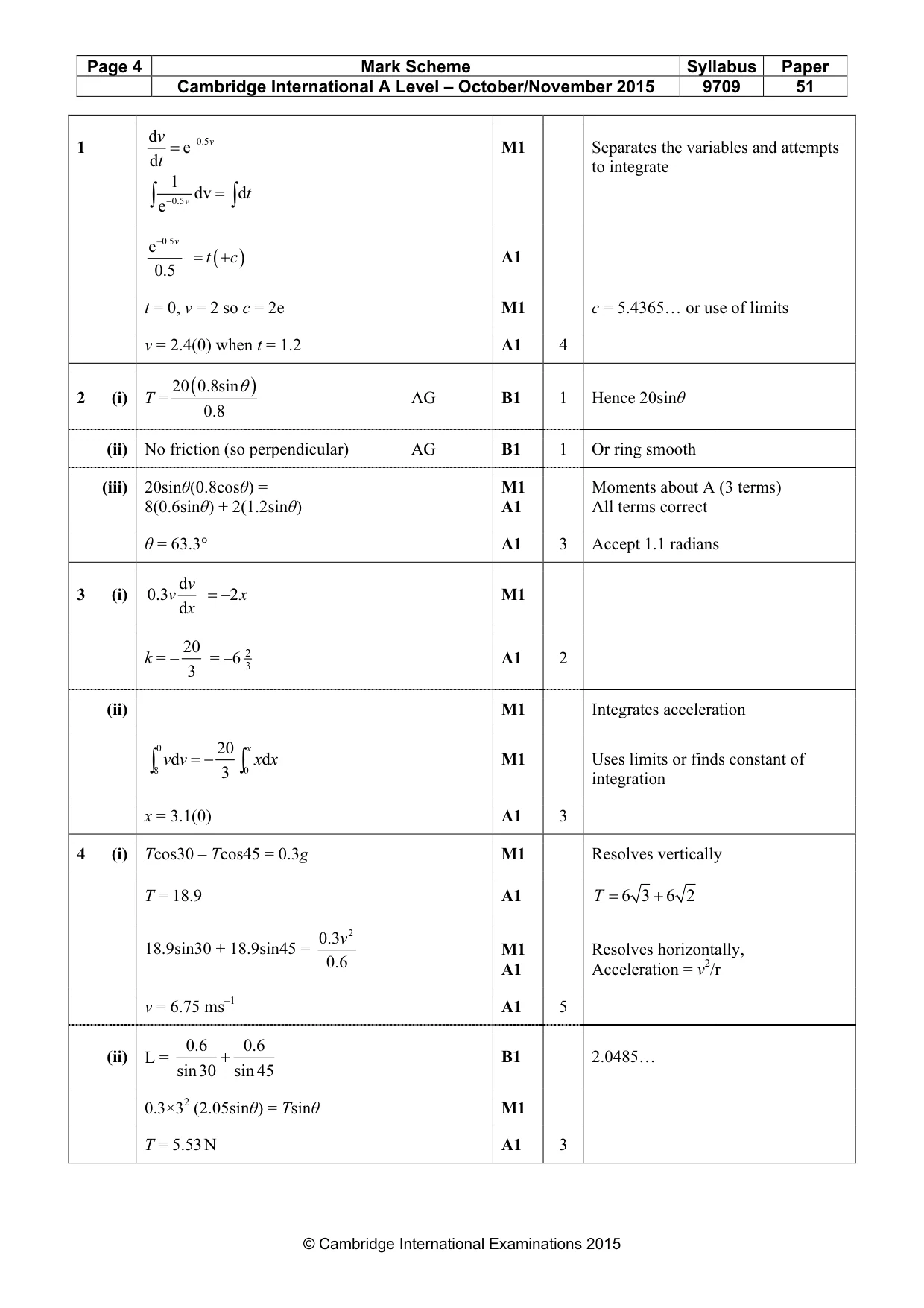
Mark scheme: dv −0.5 v1 = e M1 Separates the variables and attempts dt to integrate 1 −0.5 v dv = ∫ dt ∫ e e –0.5 v = t ( + c ) A1 0.5 t = 0, v = 2 so c = 2e M1 c = 5.4365… or use of limits v = 2.4(0) when t = 1.2 A1 4 20 ( 0.8sinθ )
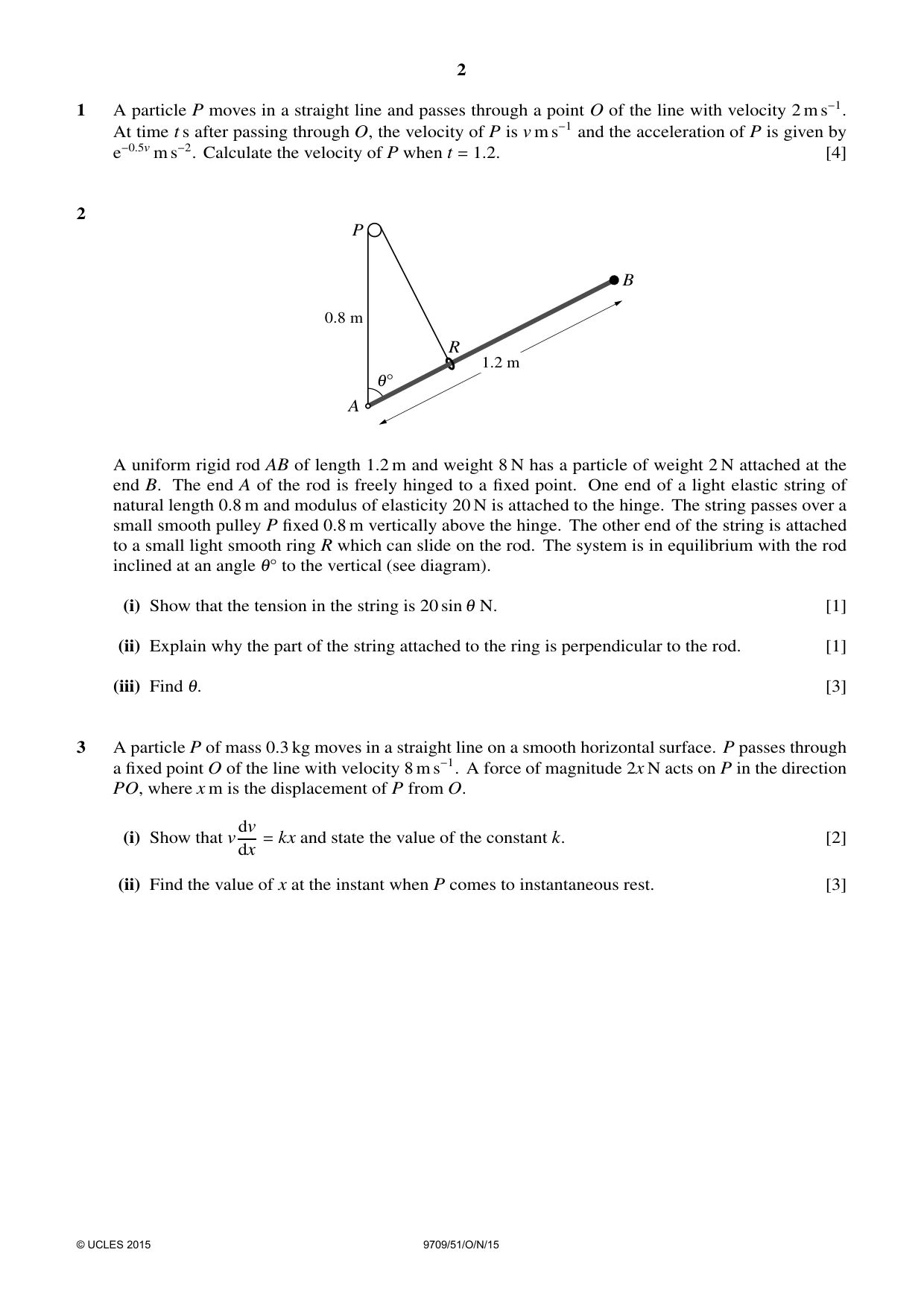
Q2 · P B 0.8 m R 1.2 m 1Å A A uniform rigid rod AB of length 1.2 m and weight 8 N has a…
2 P B 0.8 m R 1.2 m 1Å A A uniform rigid rod AB of length 1.2 m and weight 8 N has a particle of weight 2 N attached at the end B. The end A of the rod is freely hinged to a fixed point. One end of a light elastic string of natural length 0.8 m and modulus of elasticity 20 N is attached to the hinge. The string passes over a small smooth pulley P fixed 0.8 m vertically above the hinge. The other end of the string is attached to a small light smooth ring R which can slide on the rod. The system is in equilibrium with the rod inclined at an angle 1Å to the vertical (see diagram). (i) Show that the tension in the string is 20 sin 1 N. [1] (ii) Explain why the part of the string attached to the ring is perpendicular to the rod. [1] (iii) Find 1. [3]
Mark scheme: 20 ( 0.8sin θ ) 2 (i) T = AG B1 1 Hence 20sinθ 0.8 (ii) No friction (so perpendicular) AG B1 1 Or ring smooth (iii) 20sinθ(0.8cosθ) = M1 Moments about A (3 terms) 8(0.6sinθ) + 2(1.2sinθ) A1 All terms correct θ = 63.3° A1 3 Accept 1.1 radians dv
Q3 · A particle P of mass 0.3 kg moves in a straight line on a smooth horizontal surface
3 A particle P of mass 0.3 kg moves in a straight line on a smooth horizontal surface. P passes through a fixed point O of the line with velocity 8 m s−1. A force of magnitude 2x N acts on P in the direction PO, where x m is the displacement of P from O. (i) Show that vdv = kx and state the value of the constant k. [2] dx (ii) Find the value of x at the instant when P comes to instantaneous rest. [3]
Mark scheme: dv 3 (i) 0.3v = –2 x M1 dx 20 2 k = – = –6 3 A1 2 3 (ii) M1 Integrates acceleration 0 20 x ∫8 vdv = − 3 ∫0 xdx M1 Uses limits or finds constant of integration x = 3.1(0) A1 3
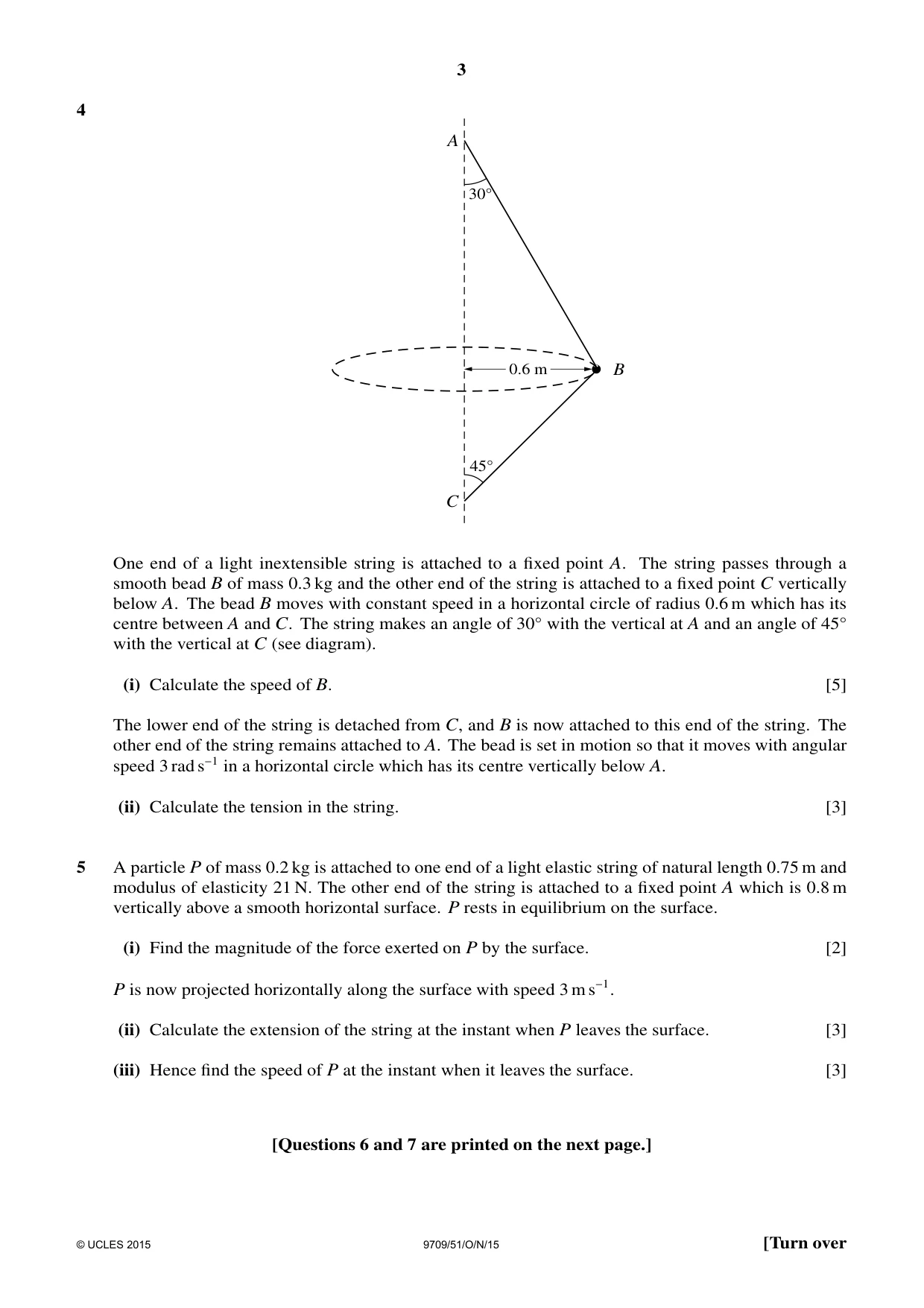
Q4 · A 30Å 0.6 m B 45Å C One end of a light inextensible string is attached to a fixed point A
4 A 30Å 0.6 m B 45Å C One end of a light inextensible string is attached to a fixed point A. The string passes through a smooth bead B of mass 0.3 kg and the other end of the string is attached to a fixed point C vertically below A. The bead B moves with constant speed in a horizontal circle of radius 0.6 m which has its centre between A and C. The string makes an angle of 30Å with the vertical at A and an angle of 45Å with the vertical at C (see diagram). (i) Calculate the speed of B. [5] The lower end of the string is detached from C, and B is now attached to this end of the string. The other end of the string remains attached to A. The bead is set in motion so that it moves with angular speed 3 rad s−1 in a horizontal circle which has its centre vertically below A. (ii) Calculate the tension in the string. [3]
Mark scheme: 4 (i) Tcos30 – Tcos45 = 0.3g M1 Resolves vertically T = 18.9 A1 T = 6 3 + 6 2 0.3v 2 18.9sin30 + 18.9sin45 = M1 Resolves horizontally, 0.6 A1 Acceleration = v2/r v = 6.75 ms–1 A1 5 0.6 0.6 (ii) L = + B1 2.0485… sin30 sin45 0.3×32 (2.05sinθ) = Tsinθ M1 T = 5.53 N A1 3 0 05
Q5 · A particle P of mass 0.2 kg is attached to one end of a light elastic string of natural…
5 A particle P of mass 0.2 kg is attached to one end of a light elastic string of natural length 0.75 m and modulus of elasticity 21 N. The other end of the string is attached to a fixed point A which is 0.8 m vertically above a smooth horizontal surface. P rests in equilibrium on the surface. (i) Find the magnitude of the force exerted on P by the surface. [2] P is now projected horizontally along the surface with speed 3 m s−1. (ii) Calculate the extension of the string at the instant when P leaves the surface. [3] (iii) Hence find the speed of P at the instant when it leaves the surface. [3] [Questions 6 and 7 are printed on the next page.]
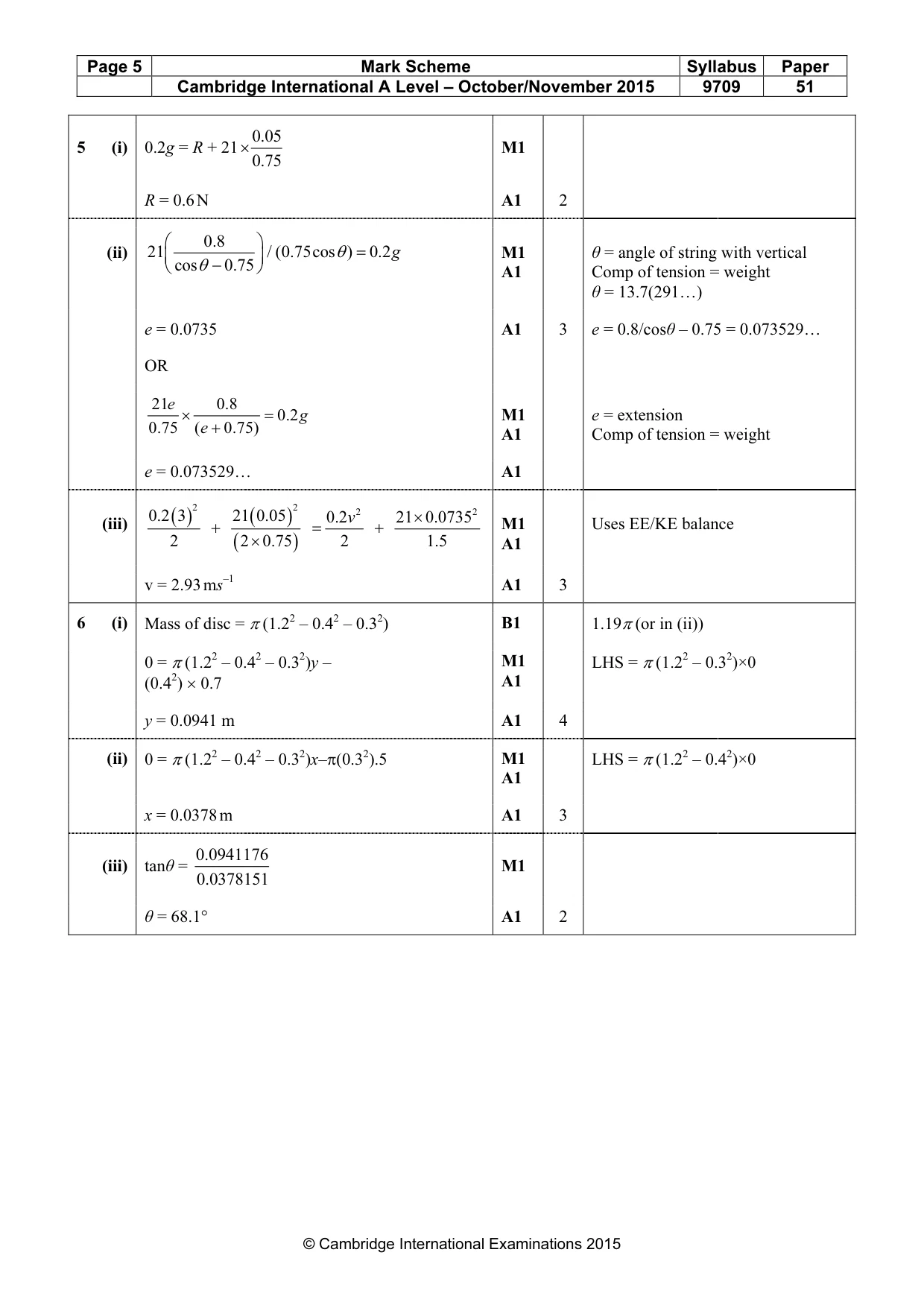
Mark scheme: 0.05 5 (i) 0.2g = R + 21 × M1 0.75 R = 0.6 N A1 2 0.8 (ii) 21 / (0.75cos θ ) = 0.2 g M1 θ = angle of string with vertical cos θ − 0.75 A1 Comp of tension = weight θ = 13.7(291…) e = 0.0735 A1 3 e = 0.8/cosθ – 0.75 = 0.073529… OR 21e 0.8 × = 0.2 g M1 e = extension 0.75 ( e + 0.75) A1 Comp of tension = weight e = 0.073529… A1 0.2 ( 3 ) 2 21 ( 0.05 ) 2 0.2 v 2 21 × 0.0735 2 (iii) + = + M1 Uses EE/KE balance 2 ( 2 × 0.75 ) 2 1.5 A1 v = 2.93 ms–1 A1 3 2 2 2
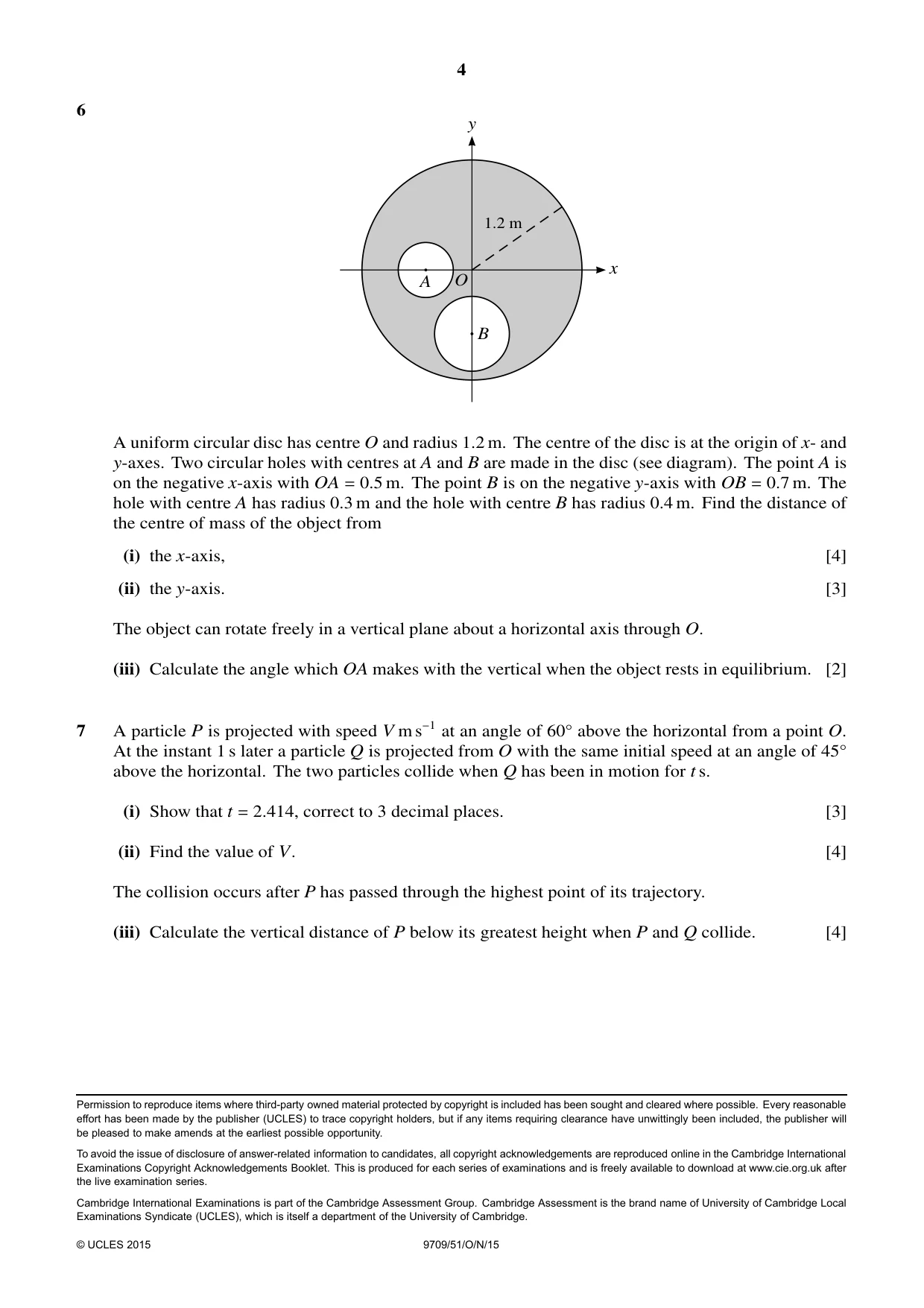
Q6 · Y 1.2 m x A O B A uniform circular disc has centre O and radius 1.2 m
6 y 1.2 m x A O B A uniform circular disc has centre O and radius 1.2 m. The centre of the disc is at the origin of x- and y-axes. Two circular holes with centres at A and B are made in the disc (see diagram). The point A is on the negative x-axis with OA = 0.5 m. The point B is on the negative y-axis with OB = 0.7 m. The hole with centre A has radius 0.3 m and the hole with centre B has radius 0.4 m. Find the distance of the centre of mass of the object from (i) the x-axis, [4] (ii) the y-axis. [3] The object can rotate freely in a vertical plane about a horizontal axis through O. (iii) Calculate the angle which OA makes with the vertical when the object rests in equilibrium. [2]
Mark scheme: 6 (i) Mass of disc = π (1.22 – 0.42 – 0.32) B1 1.19π (or in (ii)) 0 = π (1.22 – 0.42 – 0.32)y – M1 LHS = π (1.22 – 0.32)×0 (0.42) × 0.7 A1 y = 0.0941 m A1 4 (ii) 0 = π (1.22 – 0.42 – 0.32)x–π(0.32).5 M1 LHS = π (1.22 – 0.42)×0 A1 x = 0.0378 m A1 3 0.0941176 (iii) tanθ = M1 0.0378151 θ = 68.1° A1 2
Q7 · A particle P is projected with speed V m s−1 at an angle of 60Å above the horizontal from…
7 A particle P is projected with speed V m s−1 at an angle of 60Å above the horizontal from a point O. At the instant 1 s later a particle Q is projected from O with the same initial speed at an angle of 45Å above the horizontal. The two particles collide when Q has been in motion for t s. (i) Show that t = 2.414, correct to 3 decimal places. [3] (ii) Find the value of V. [4] The collision occurs after P has passed through the highest point of its trajectory. (iii) Calculate the vertical distance of P below its greatest height when P and Q collide. [4]
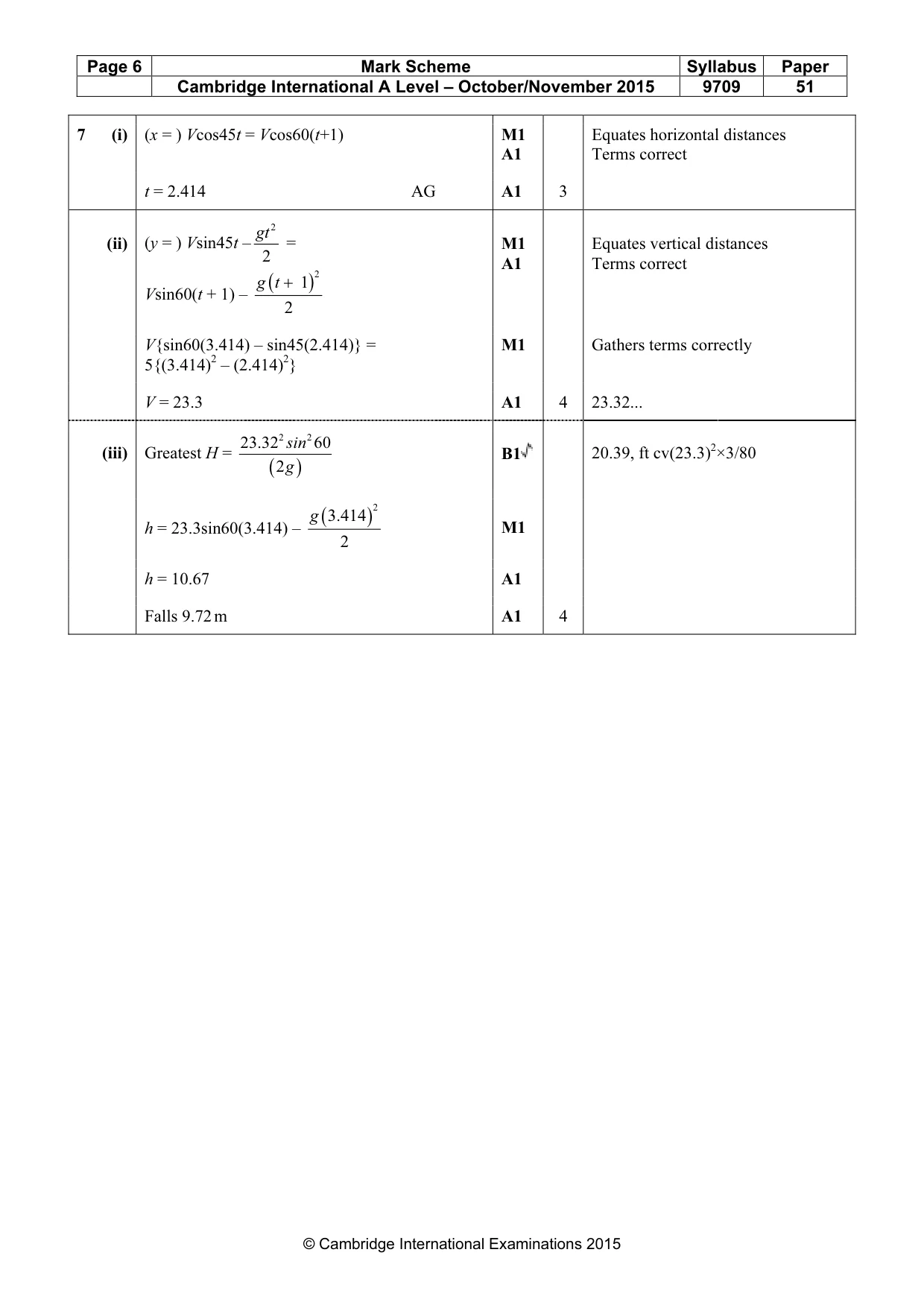
Mark scheme: 7 (i) (x = ) Vcos45t = Vcos60(t+1) M1 Equates horizontal distances A1 Terms correct t = 2.414 AG A1 3 gt 2 (ii) (y = ) Vsin45t – = M1 Equates vertical distances 2 A1 Terms correct g ( t + 1) 2 Vsin60(t + 1) – 2 V{sin60(3.414) – sin45(2.414)} = M1 Gathers terms correctly 5{(3.414)2 – (2.414)2} V = 23.3 A1 4 23.32... 23.32 2 sin 2 60 (iii) Greatest H = B1 20.39, ft cv(23.3)2×3/80 ( 2 g ) g ( 3.414 ) 2 h = 23.3sin60(3.414) – M1 2 h = 10.67 A1 Falls 9.72 m A1 4
What was in this paper
The subtopics covered by these 7 questions, and how many questions each got. Open one in a new tab to see every Cambridge question on it.
What you needed in this session
Cambridge’s own grade thresholds for 2015 Oct/Nov, Paper 5 · Variant 1. A higher threshold means an easier paper — the bar moves with how the cohort did.