Cambridge A Level Mathematics 9709 — 2009 Oct/Nov Paper 5 · Variant 1
9709/51/O/N/09 · 7 questions · 50 marks · ≈56 min
The question paper and its mark scheme, free to read here and free to download. This is Cambridge’s own paper, exactly as it was sat.
Question paper4 pages
Mark scheme5 pages
Answers below. Sit the paper first if you are practising.
Questions as text
Q1 · 20 N 20 N A light elastic spring of natural length 0.25 m and modulus of elasticity 100 N…
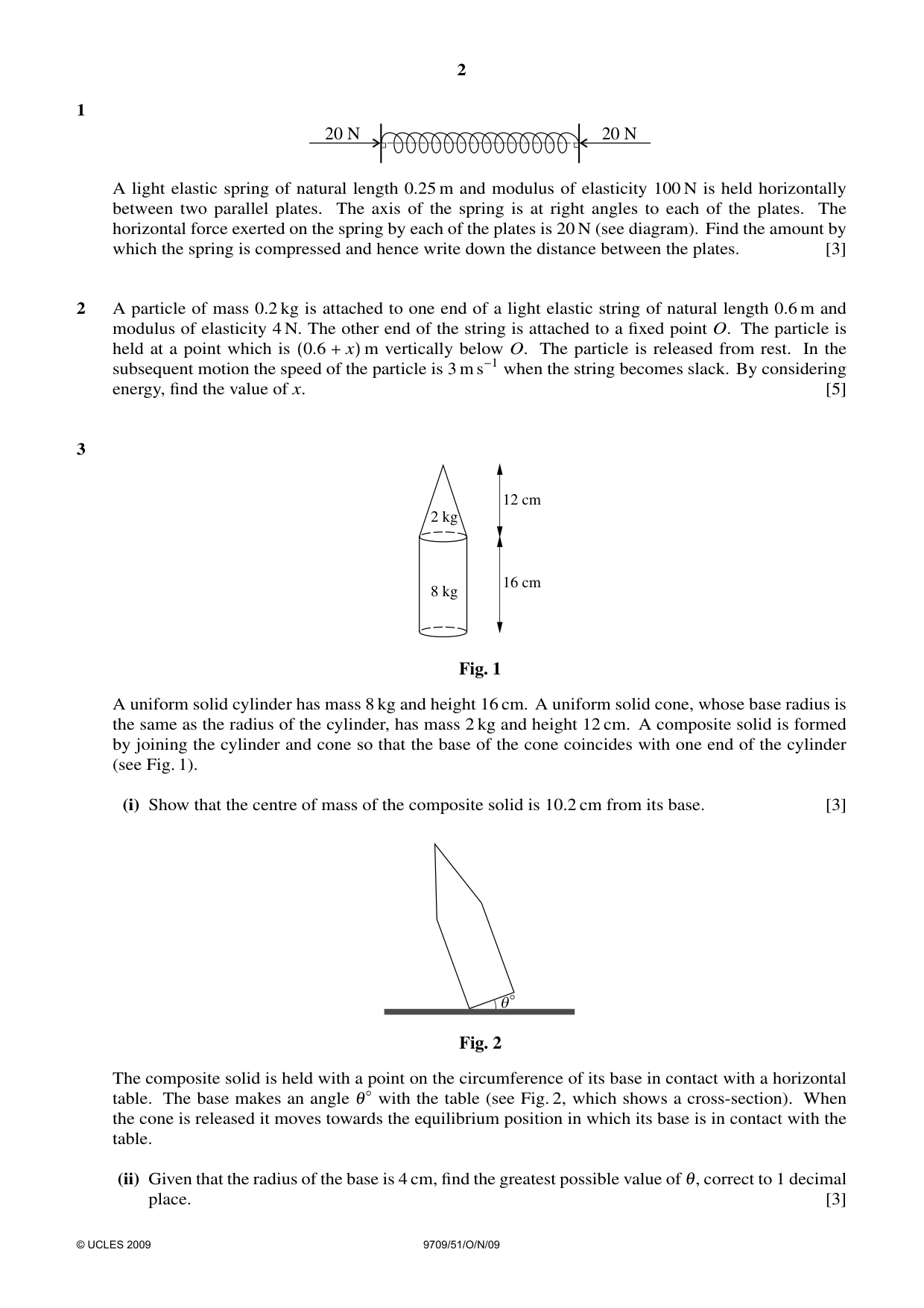
1 20 N 20 N A light elastic spring of natural length 0.25 m and modulus of elasticity 100 N is held horizontally between two parallel plates. The axis of the spring is at right angles to each of the plates. The horizontal force exerted on the spring by each of the plates is 20 N (see diagram). Find the amount by which the spring is compressed and hence write down the distance between the plates. [3]
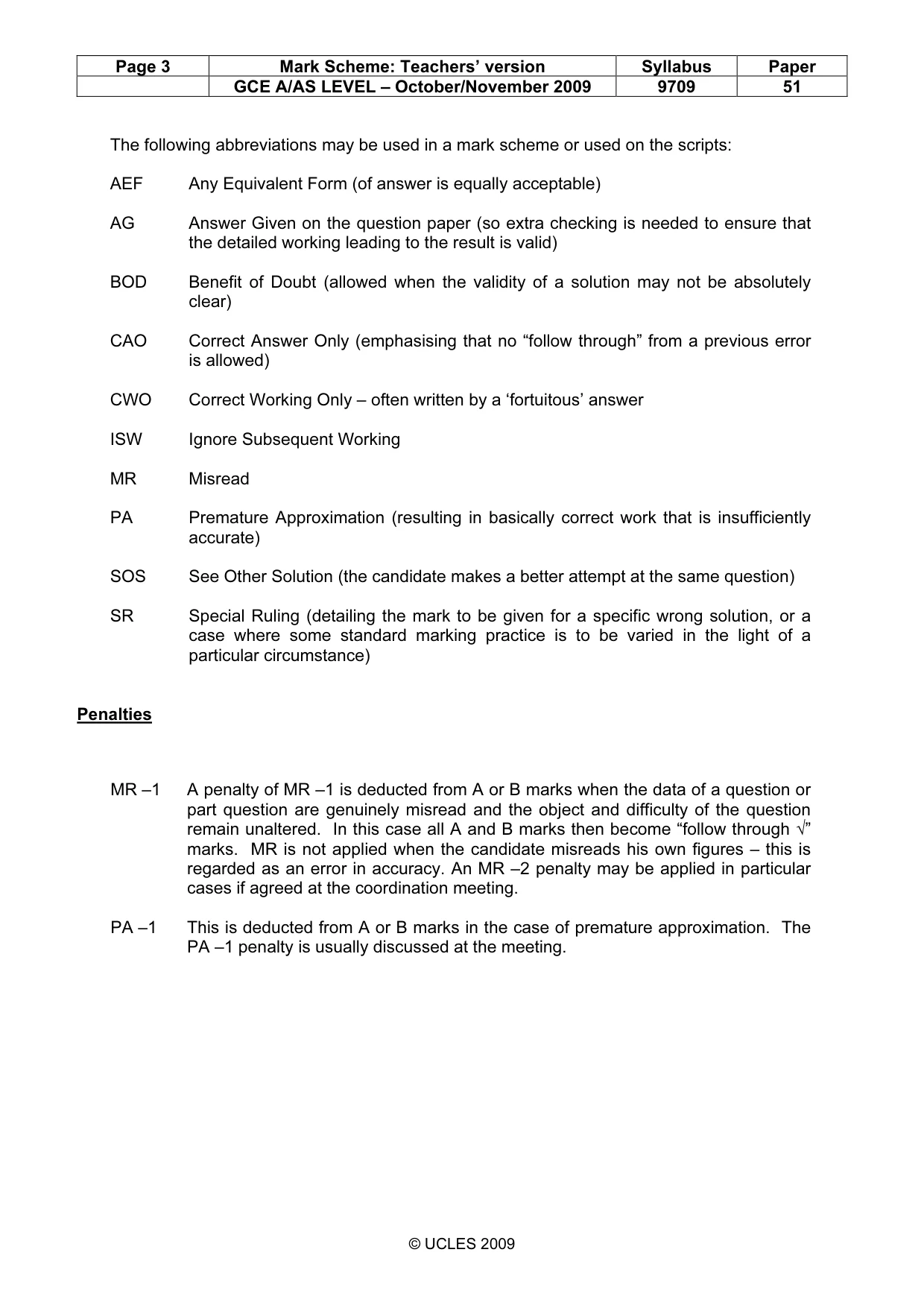
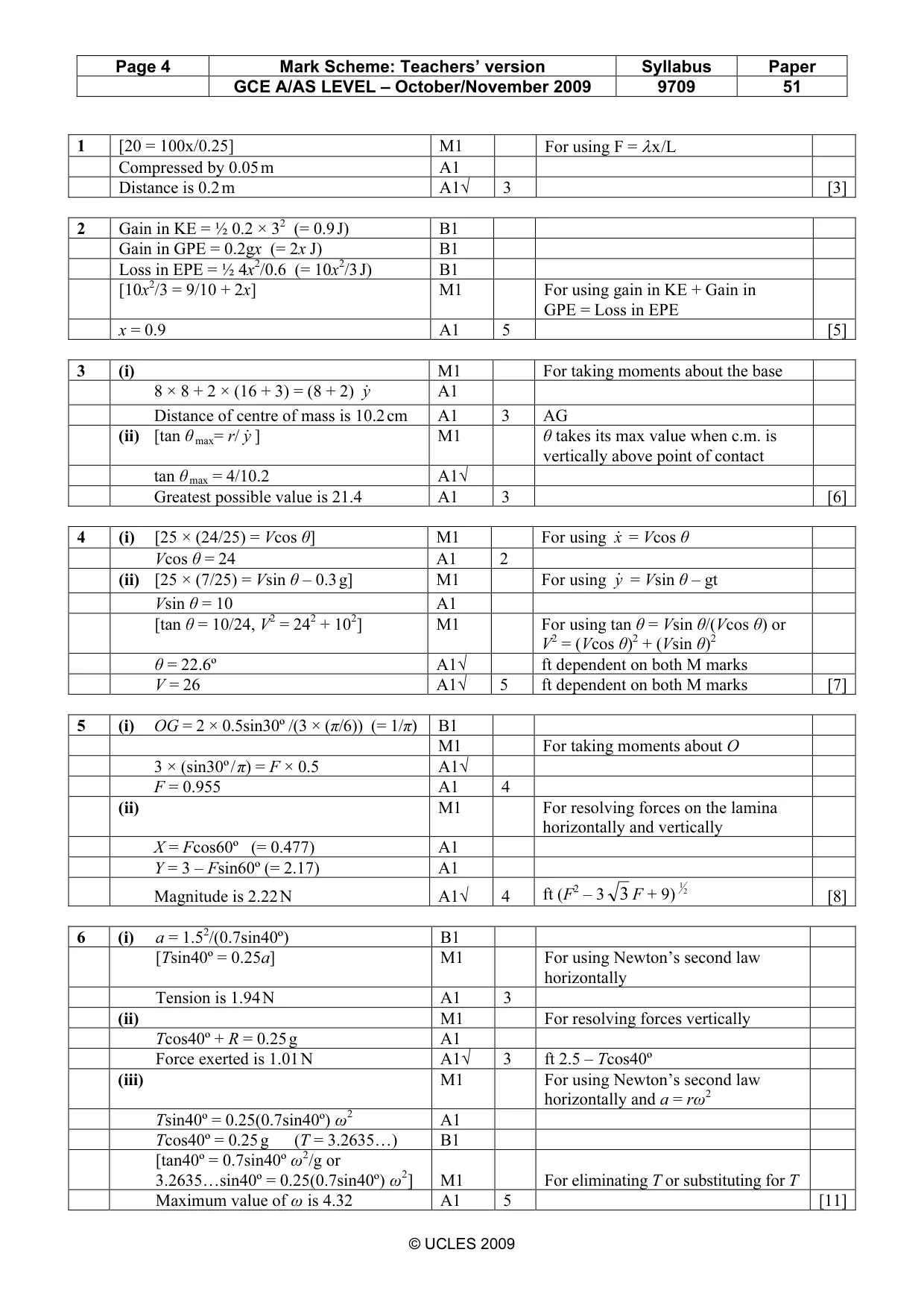
Mark scheme: 1 [20 = 100x/0.25] M1 For using F = λx/L Compressed by 0.05 m A1 Distance is 0.2 m A1√ 3 [3] 2
Q2 · A particle of mass 0.2 kg is attached to one end of a light elastic string of natural…
2 A particle of mass 0.2 kg is attached to one end of a light elastic string of natural length 0.6 m and modulus of elasticity 4 N. The other end of the string is attached to a fixed point O. The particle is held at a point which is (0.6 + x) m vertically below O. The particle is released from rest. In the subsequent motion the speed of the particle is 3 m s−1 when the string becomes slack. By considering energy, find the value of x. [5]
Mark scheme: 2 Gain in KE = ½ 0.2 × 32 (= 0.9 J) B1 Gain in GPE = 0.2gx (= 2x J) B1 Loss in EPE = ½ 4x2/0.6 (= 10x2/3 J) B1 [10x2/3 = 9/10 + 2x] M1 For using gain in KE + Gain in GPE = Loss in EPE x = 0.9 A1 5 [5]
Q3 · 12 cm 2 kg 16 cm 8 kg Fig
3 12 cm 2 kg 16 cm 8 kg Fig. 1 A uniform solid cylinder has mass 8 kg and height 16 cm. A uniform solid cone, whose base radius is the same as the radius of the cylinder, has mass 2 kg and height 12 cm. A composite solid is formed by joining the cylinder and cone so that the base of the cone coincides with one end of the cylinder (see Fig. 1). (i) Show that the centre of mass of the composite solid is 10.2 cm from its base. [3] q° Fig. 2 The composite solid is held with a point on the circumference of its base in contact with a horizontal table. The base makes an angle θ◦with the table (see Fig. 2, which shows a cross-section). When the cone is released it moves towards the equilibrium position in which its base is in contact with the table. (ii) Given that the radius of the base is 4 cm, find the greatest possible value of θ, correct to 1 decimal place. [3]
Mark scheme: 3 (i) M1 For taking moments about the base 8 × 8 + 2 × (16 + 3) = (8 + 2) y& A1 Distance of centre of mass is 10.2 cm A1 3 AG (ii) [tan θ max= r/ y& ] M1 θ takes its max value when c.m. is vertically above point of contact tan θ max = 4/10.2 A1√ Greatest possible value is 21.4 A1 3 [6]
Q4 · A particle is projected from a point O with speed V m s−1 at an angle θ above the…
4 A particle is projected from a point O with speed V m s−1 at an angle θ above the horizontal. After 0.3 s the particle is moving with speed 25 m s−1 at an angle tan−1 7 above the horizontal. 24 (i) Show that V cos θ = 24. [2] (ii) Find the value of V sin θ, and hence find V and θ. [5]
Mark scheme: 4 (i) [25 × (24/25) = Vcos θ] M1 For using x& = Vcos θ Vcos θ = 24 A1 2 (ii) [25 × (7/25) = Vsin θ – 0.3 g] M1 For using y& = Vsin θ – gt Vsin θ = 10 A1 [tan θ = 10/24, V2 = 242 + 102] M1 For using tan θ = Vsin θ/(Vcos θ) or V2 = (Vcos θ)2 + (Vsin θ)2 θ = 22.6º A1√ ft dependent on both M marks V = 26 A1√ 5 ft dependent on both M marks [7]
Q5 · O F N 1 p rad 0.5 m 3 B A A uniform lamina AOB is in the shape of a sector of a circle…
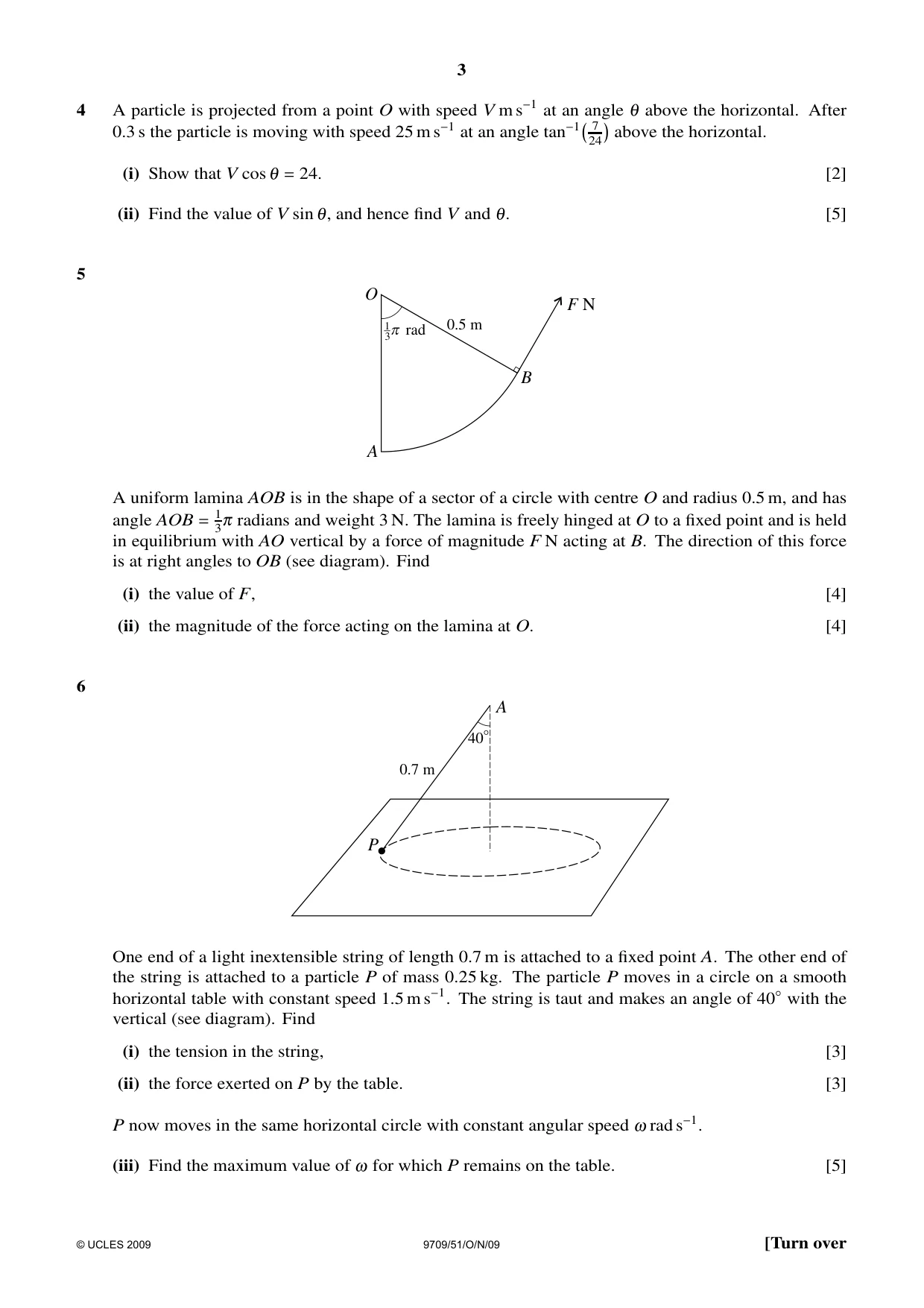
5 O F N 1 p rad 0.5 m 3 B A A uniform lamina AOB is in the shape of a sector of a circle with centre O and radius 0.5 m, and has angle AOB = 13π radians and weight 3 N. The lamina is freely hinged at O to a fixed point and is held in equilibrium with AO vertical by a force of magnitude F N acting at B. The direction of this force is at right angles to OB (see diagram). Find (i) the value of F, [4] (ii) the magnitude of the force acting on the lamina at O. [4]
Mark scheme: 5 (i) OG = 2 × 0.5sin30º /(3 × (π/6)) (= 1/π) B1 M1 For taking moments about O 3 × (sin30º / π) = F × 0.5 A1√ F = 0.955 A1 4 (ii) M1 For resolving forces on the lamina horizontally and vertically X = Fcos60º (= 0.477) A1 Y = 3 – Fsin60º (= 2.17) A1 1 Magnitude is 2.22 N A1√ 4 ft (F2 – 3 3 F + 9) 2 [8] 2
Q6 · A 40° 0.7 m P One end of a light inextensible string of length 0.7 m is attached to a…
6 A 40° 0.7 m P One end of a light inextensible string of length 0.7 m is attached to a fixed point A. The other end of the string is attached to a particle P of mass 0.25 kg. The particle P moves in a circle on a smooth horizontal table with constant speed 1.5 m s−1. The string is taut and makes an angle of 40◦with the vertical (see diagram). Find (i) the tension in the string, [3] (ii) the force exerted on P by the table. [3] P now moves in the same horizontal circle with constant angular speed ω rad s−1. (iii) Find the maximum value of ω for which P remains on the table. [5]
Mark scheme: 6 (i) a = 1.52/(0.7sin40º) B1 [Tsin40º = 0.25a] M1 For using Newton’s second law horizontally Tension is 1.94 N A1 3 (ii) M1 For resolving forces vertically Tcos40º + R = 0.25 g A1 Force exerted is 1.01 N A1√ 3 ft 2.5 – Tcos40º (iii) M1 For using Newton’s second law horizontally and a = rω2 Tsin40º = 0.25(0.7sin40º) ω2 A1 Tcos40º = 0.25 g (T = 3.2635…) B1 [tan40º = 0.7sin40º ω2/g or 3.2635…sin40º = 0.25(0.7sin40º) ω2] M1 For eliminating T or substituting for T Maximum value of ω is 4.32 A1 5 [11] GCE A/AS LEVEL – October/November 2009 9709 51
Q7 · A particle P of mass 0.1 kg is projected vertically upwards from a point O with speed 20…
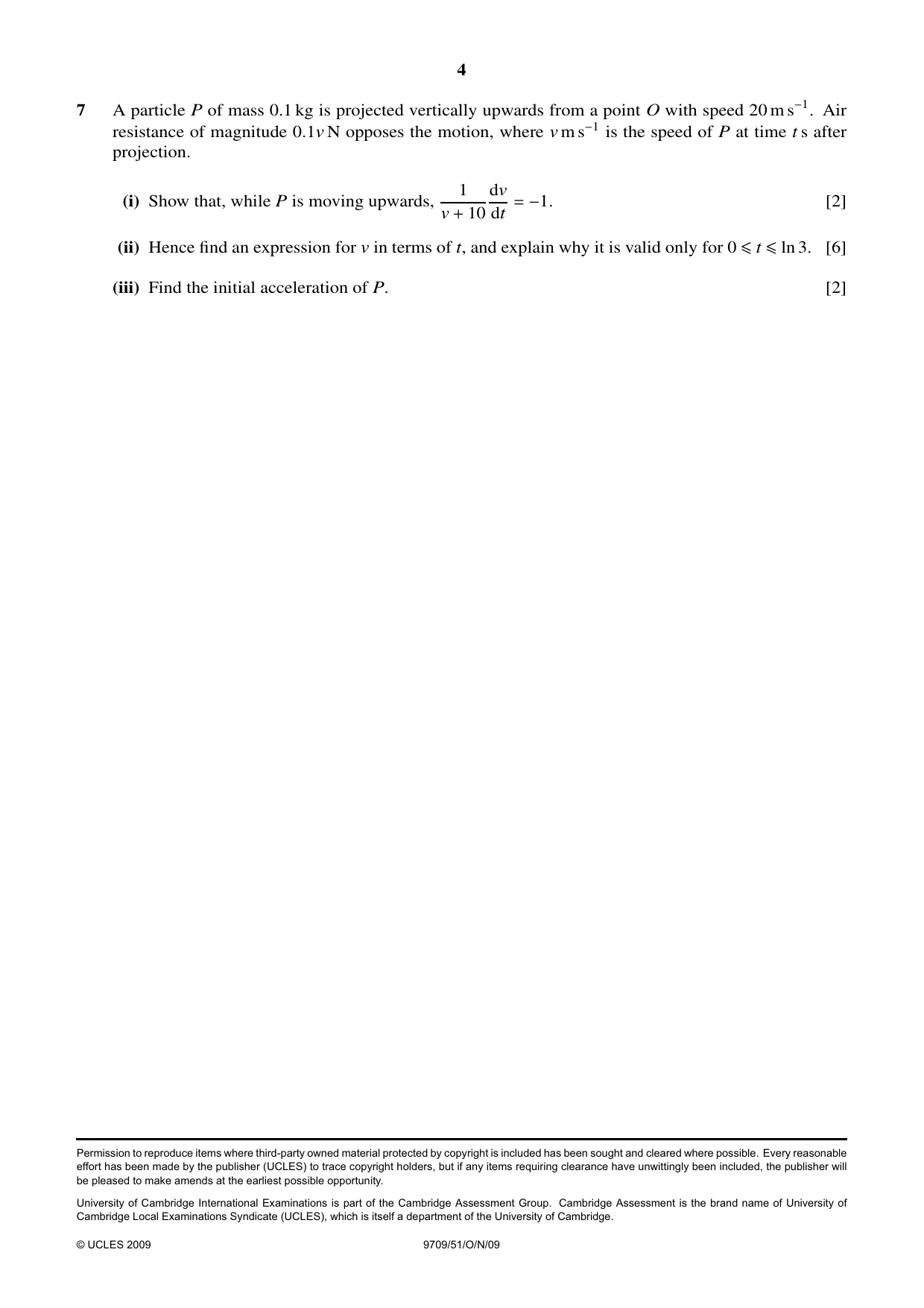
7 A particle P of mass 0.1 kg is projected vertically upwards from a point O with speed 20 m s−1. Air resistance of magnitude 0.1v N opposes the motion, where v m s−1 is the speed of P at time t s after projection. 1 dv (i) Show that, while P is moving upwards, = −1. [2] v + 10 dt (ii) Hence find an expression for v in terms of t, and explain why it is valid only for 0 ≤t ≤ln 3. [6] (iii) Find the initial acceleration of P. [2]
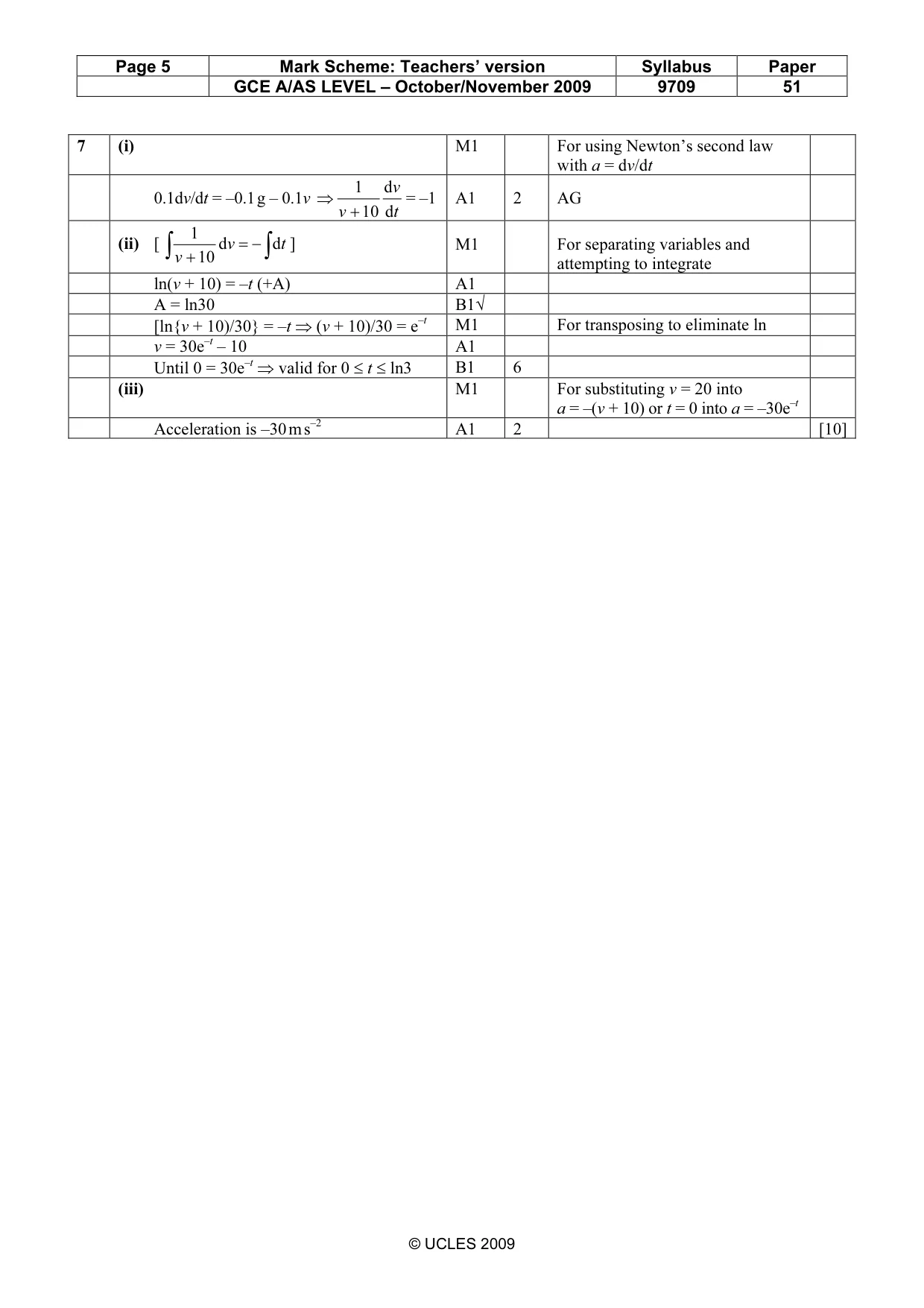
Mark scheme: 7 (i) M1 For using Newton’s second law with a = dv/dt 1 dv 0.1dv/dt = –0.1 g – 0.1v ⇒ = –1 A1 2 AG v + 10 dt 1 (ii) [∫ v + 10 dv = − ∫ dt ] M1 For separating variables and attempting to integrate ln(v + 10) = –t (+A) A1 A = ln30 B1√ [ln{v + 10)/30} = –t ⇒ (v + 10)/30 = e–t M1 For transposing to eliminate ln v = 30e–t – 10 A1 Until 0 = 30e–t ⇒ valid for 0 ≤ t ≤ ln3 B1 6 (iii) M1 For substituting v = 20 into a = –(v + 10) or t = 0 into a = –30e–t Acceleration is –30 m s–2 A1 2 [10]
What was in this paper
The subtopics covered by these 7 questions, and how many questions each got. Open one in a new tab to see every Cambridge question on it.
What you needed in this session
Cambridge’s own grade thresholds for 2009 Oct/Nov, Paper 5 · Variant 1. A higher threshold means an easier paper — the bar moves with how the cohort did.