Cambridge A Level Mathematics 9709 — 2015 May/June Paper 5 · Variant 1
9709/51/M/J/15 · 7 questions · 50 marks · ≈56 min
The question paper and its mark scheme, free to read here and free to download. This is Cambridge’s own paper, exactly as it was sat.
Question paper4 pages
Mark scheme6 pages
Answers below. Sit the paper first if you are practising.
Questions as text
Q1 · One end of a light elastic string of natural length 0.7 m is attached to a fixed point A…
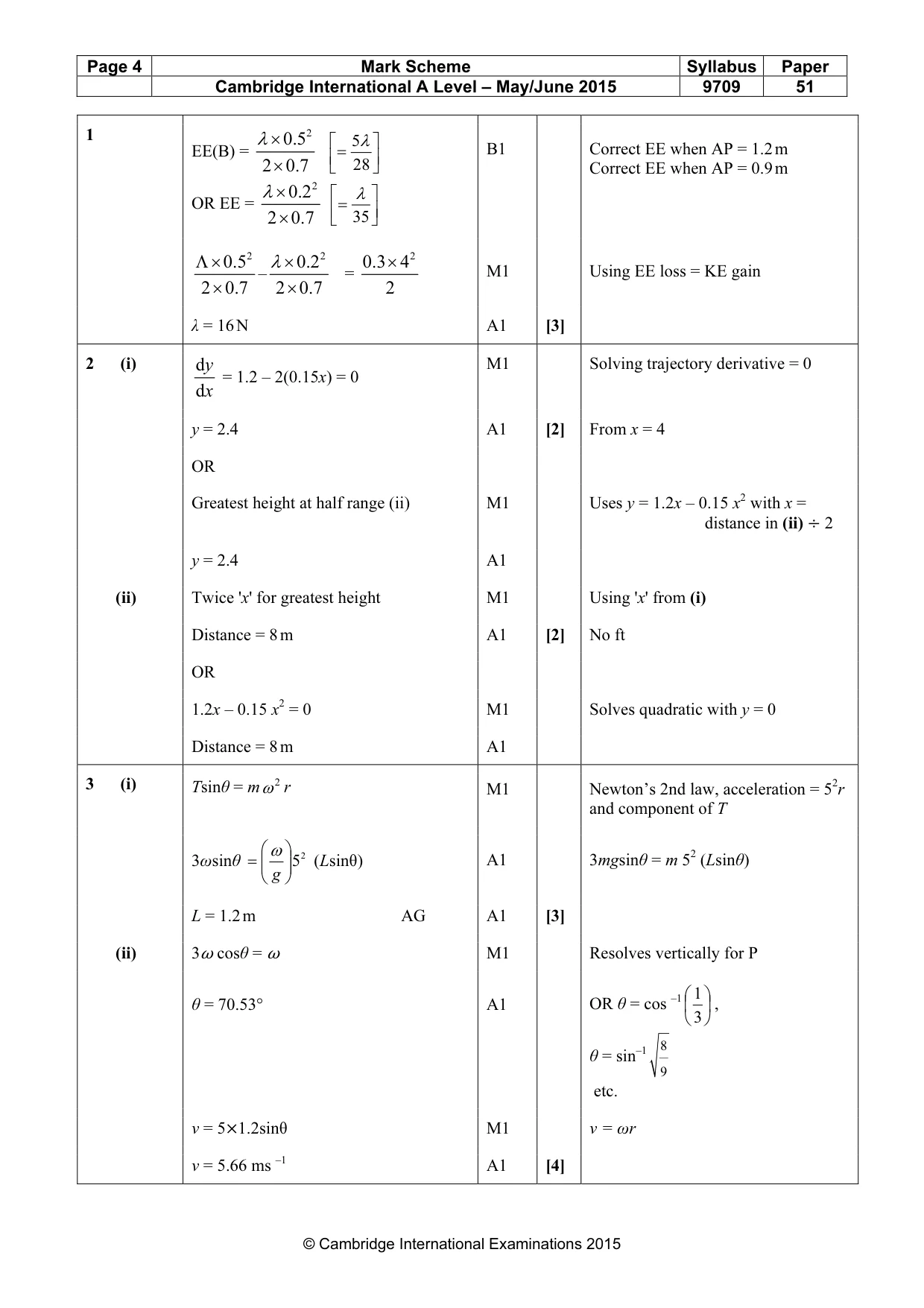
1 One end of a light elastic string of natural length 0.7 m is attached to a fixed point A on a smooth horizontal surface. The other end of the string is attached to a particle P of mass 0.3 kg which is held at a point B on the horizontal surface, where AB = 1.2 m. It is given that P is released from rest at B and that when AP = 0.9 m, the particle has speed 4 m s−1. Calculate the modulus of elasticity of the string. [3]
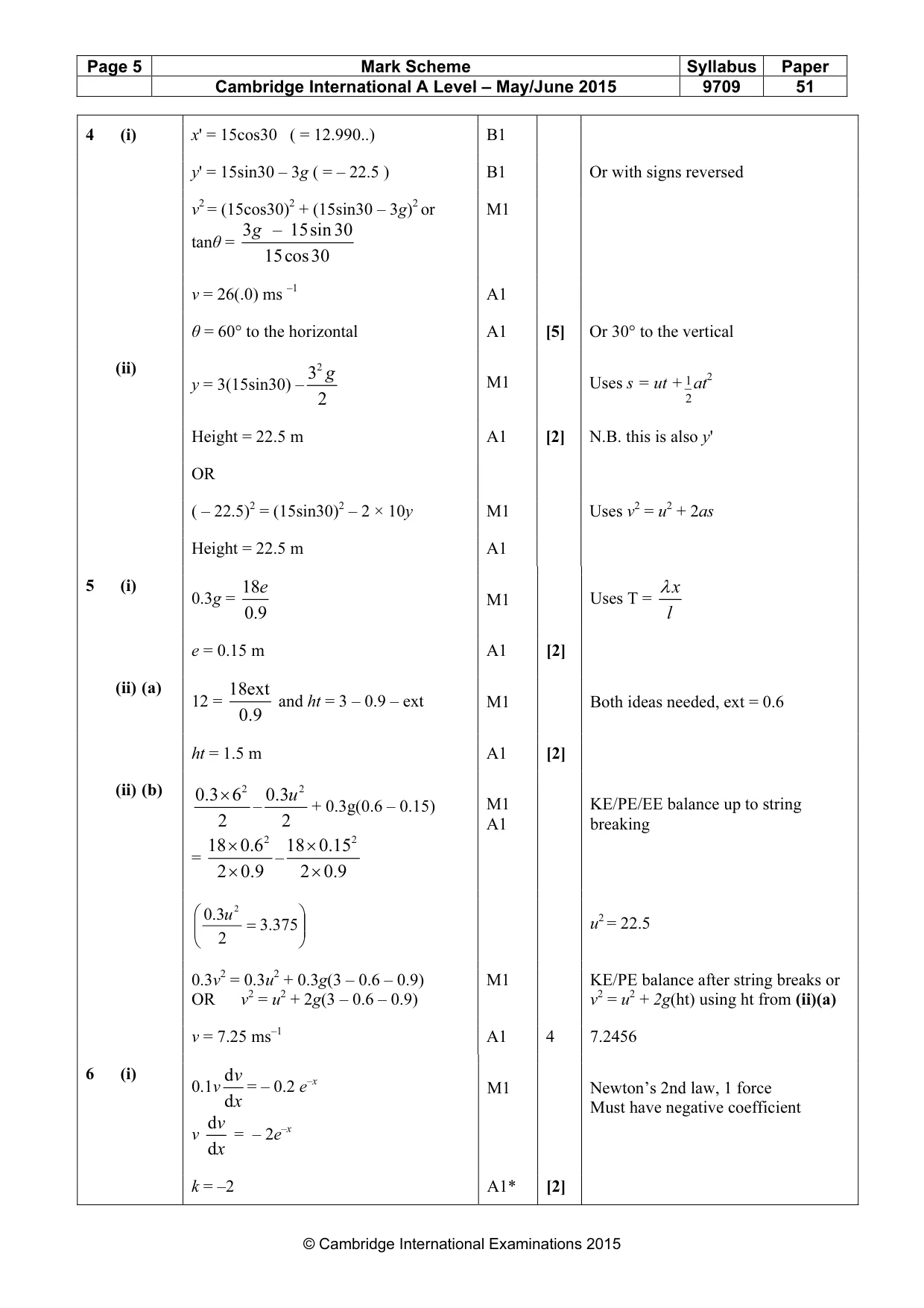
Mark scheme: 1 λ × 0.5 2 5λ EE(B) = = B1 Correct EE when AP = 1.2 m 2 × 0.7 28 Correct EE when AP = 0.9 m λ × 0.2 2 λ OR EE = = 2 × 0.7 35 Λ× 0.5 2 λ × 0.2 2 0.3 × 4 2 – = M1 Using EE loss = KE gain 2 × 0.7 2 × 0.7 2 λ = 16 N A1 [3]
Q2 · A stone is projected from a point O on horizontal ground
2 A stone is projected from a point O on horizontal ground. The equation of the trajectory of the stone is y = 1.2x −0.15x2, where x m and y m are respectively the horizontal and vertically upwards displacements of the stone from O. Find (i) the greatest height of the stone, [2] (ii) the distance from O of the point where the stone strikes the ground. [2]
Mark scheme: 2 (i) d y M1 Solving trajectory derivative = 0 = 1.2 – 2(0.15x) = 0 d x y = 2.4 A1 [2] From x = 4 OR Greatest height at half range (ii) M1 Uses y = 1.2x – 0.15 x2 with x = distance in (ii) ÷ 2 y = 2.4 A1 (ii) Twice 'x' for greatest height M1 Using 'x' from (i) Distance = 8 m A1 [2] No ft OR 1.2x – 0.15 x2 = 0 M1 Solves quadratic with y = 0 Distance = 8 m A1
Q3 · A 1 5 rad s−1 O P One end of a light inextensible string is attached to a fixed point A…
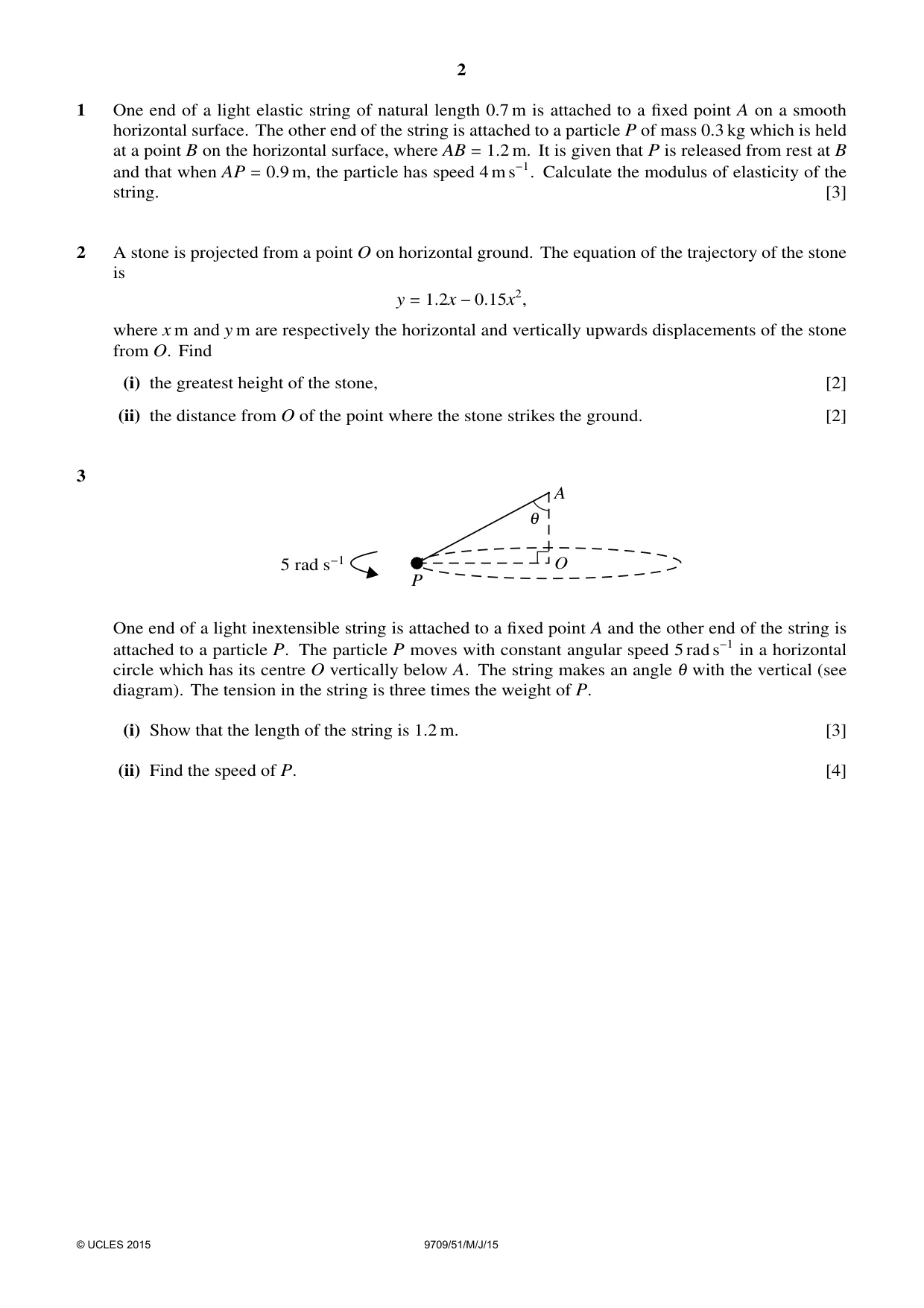
3 A 1 5 rad s−1 O P One end of a light inextensible string is attached to a fixed point A and the other end of the string is attached to a particle P. The particle P moves with constant angular speed 5 rad s−1 in a horizontal circle which has its centre O vertically below A. The string makes an angle 1 with the vertical (see diagram). The tension in the string is three times the weight of P. (i) Show that the length of the string is 1.2 m. [3] (ii) Find the speed of P. [4]
Mark scheme: 3 (i) Tsinθ = m ω 2 r M1 Newton’s 2nd law, acceleration = 52r and component of T ω 2 3ωsinθ = 5 (Lsinθ) A1 3mgsinθ = m 52 (Lsinθ) g L = 1.2 m AG A1 [3] (ii) 3ω cosθ = ω M1 Resolves vertically for P –1 1 θ = 70.53° A1 OR θ = cos , 3 8 θ = sin–1 9 etc. v = 5×1.2sinθ M1 v = ωr v = 5.66 ms –1 A1 [4]
Q4 · 15 m s−1 O 30Å B A small ball B is projected from a point O above horizontal ground, with…
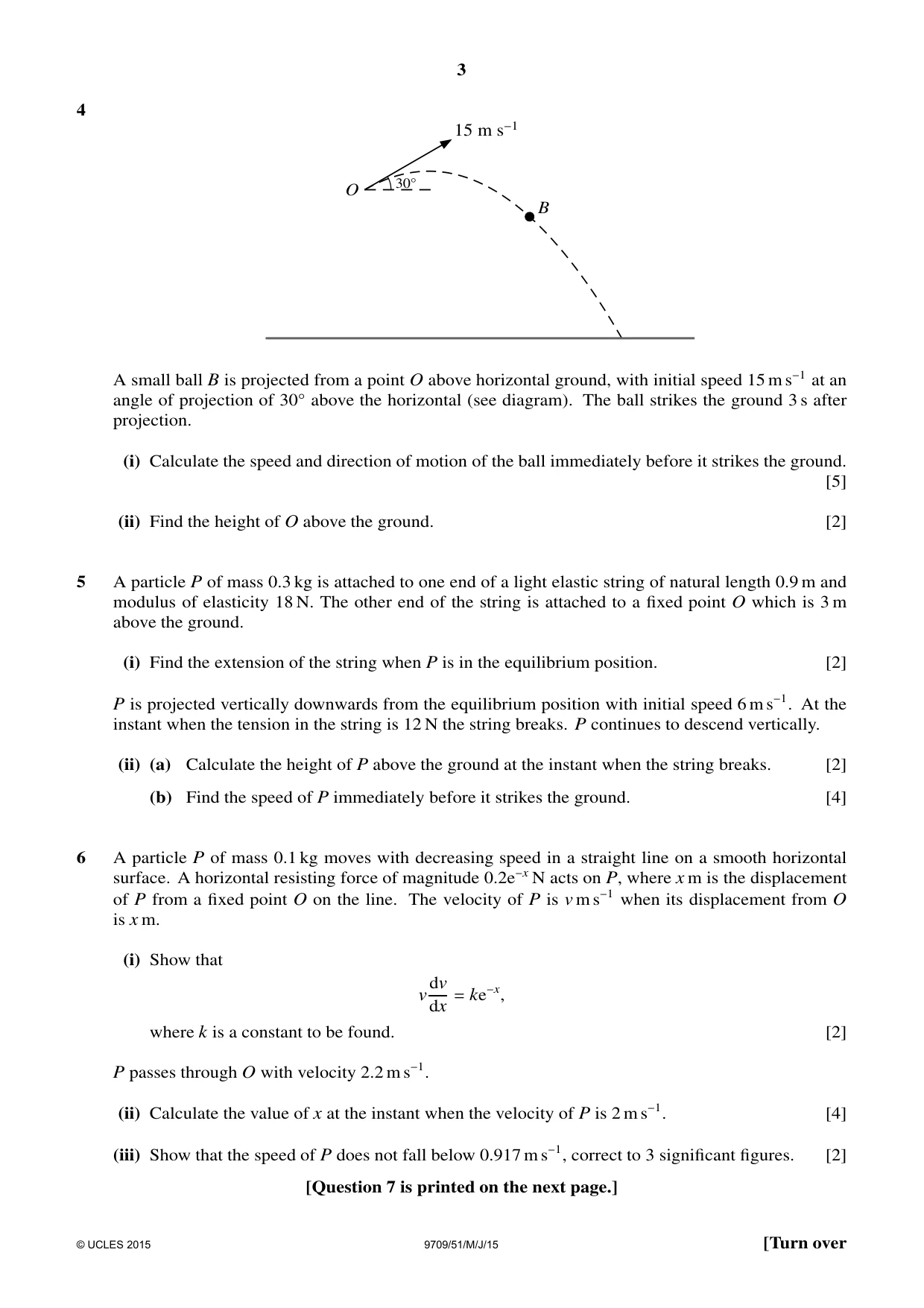
4 15 m s−1 O 30Å B A small ball B is projected from a point O above horizontal ground, with initial speed 15 m s−1 at an angle of projection of 30Å above the horizontal (see diagram). The ball strikes the ground 3 s after projection. (i) Calculate the speed and direction of motion of the ball immediately before it strikes the ground. [5] (ii) Find the height of O above the ground. [2]
Mark scheme: 4 (i) x' = 15cos30 ( = 12.990..) B1 y' = 15sin30 – 3g ( = – 22.5 ) B1 Or with signs reversed v2 = (15cos30)2 + (15sin30 – 3g)2 or M1 3 g – 15sin30 tanθ = 15cos30 v = 26(.0) ms –1 A1 θ = 60° to the horizontal A1 [5] Or 30° to the vertical (ii) 23 g y = 3(15sin30) – M1 Uses s = ut + 1at2 2 2 Height = 22.5 m A1 [2] N.B. this is also y' OR ( – 22.5)2 = (15sin30)2 – 2 × 10y M1 Uses v2 = u2 + 2as Height = 22.5 m A1
Q5 · A particle P of mass 0.3 kg is attached to one end of a light elastic string of natural…
5 A particle P of mass 0.3 kg is attached to one end of a light elastic string of natural length 0.9 m and modulus of elasticity 18 N. The other end of the string is attached to a fixed point O which is 3 m above the ground. (i) Find the extension of the string when P is in the equilibrium position. [2] P is projected vertically downwards from the equilibrium position with initial speed 6 m s−1. At the instant when the tension in the string is 12 N the string breaks. P continues to descend vertically. (ii) (a) Calculate the height of P above the ground at the instant when the string breaks. [2] (b) Find the speed of P immediately before it strikes the ground. [4]
Mark scheme: 5 (i) 18e λ x 0.3g = M1 Uses T = 0.9 l e = 0.15 m A1 [2] (ii) (a) 18ext 12 = and ht = 3 – 0.9 – ext M1 Both ideas needed, ext = 0.6 0.9 ht = 1.5 m A1 [2] (ii) (b) 0.3 × 6 2 0.3u 2 – + 0.3g(0.6 – 0.15) M1 KE/PE/EE balance up to string 2 2 A1 breaking 18 × 0.6 2 18 × 0.15 2 = – 2 × 0.9 2 × 0.9 3.0u 2 = .3 375 u2 = 22.5 2 0.3v2 = 0.3u2 + 0.3g(3 – 0.6 – 0.9) M1 KE/PE balance after string breaks or OR v2 = u2 + 2g(3 – 0.6 – 0.9) v2 = u2 + 2g(ht) using ht from (ii)(a) v = 7.25 ms–1 A1 4 7.2456
Q6 · A particle P of mass 0.1 kg moves with decreasing speed in a straight line on a smooth…
6 A particle P of mass 0.1 kg moves with decreasing speed in a straight line on a smooth horizontal surface. A horizontal resisting force of magnitude 0.2e−x N acts on P, where x m is the displacement of P from a fixed point O on the line. The velocity of P is v m s−1 when its displacement from O is x m. (i) Show that vdv = ke−x, dx where k is a constant to be found. [2] P passes through O with velocity 2.2 m s−1. (ii) Calculate the value of x at the instant when the velocity of P is 2 m s−1. [4] (iii) Show that the speed of P does not fall below 0.917 m s−1, correct to 3 significant figures. [2] [Question 7 is printed on the next page.]
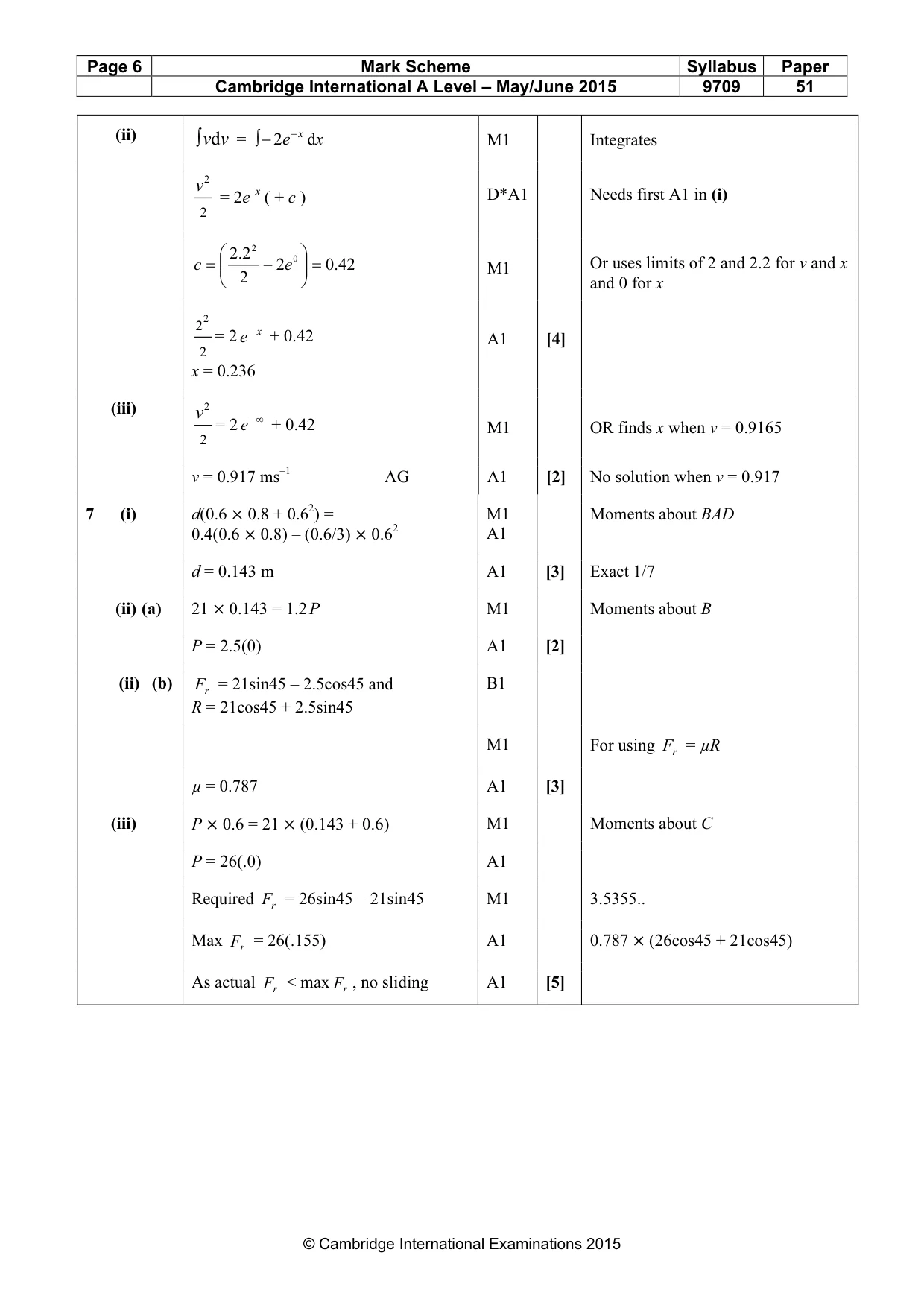
Mark scheme: 6 (i) d v 0.1v = – 0.2 e–x M1 Newton’s 2nd law, 1 force d x Must have negative coefficient d v v = – 2e–x d x k = –2 A1* [2] (ii) ∫ vd v = ∫ − 2 e− x dx M1 Integrates v 2 = 2e–x ( + c ) D*A1 Needs first A1 in (i) 2 2.2 2 0 c = − 2 e = .0 42 M1 Or uses limits of 2 and 2.2 for v and x 2 and 0 for x 2 2 − x = 2 e + 0.42 A1 [4] 2 x = 0.236 (iii) v 2 − ∞ = 2 e + 0.42 M1 OR finds x when v = 0.9165 2 v = 0.917 ms–1 AG A1 [2] No solution when v = 0.917 2
Q7 · D 0.8 m E 0.6 m C A O B 45Å The diagram shows the cross-section OABCDE through the centre…
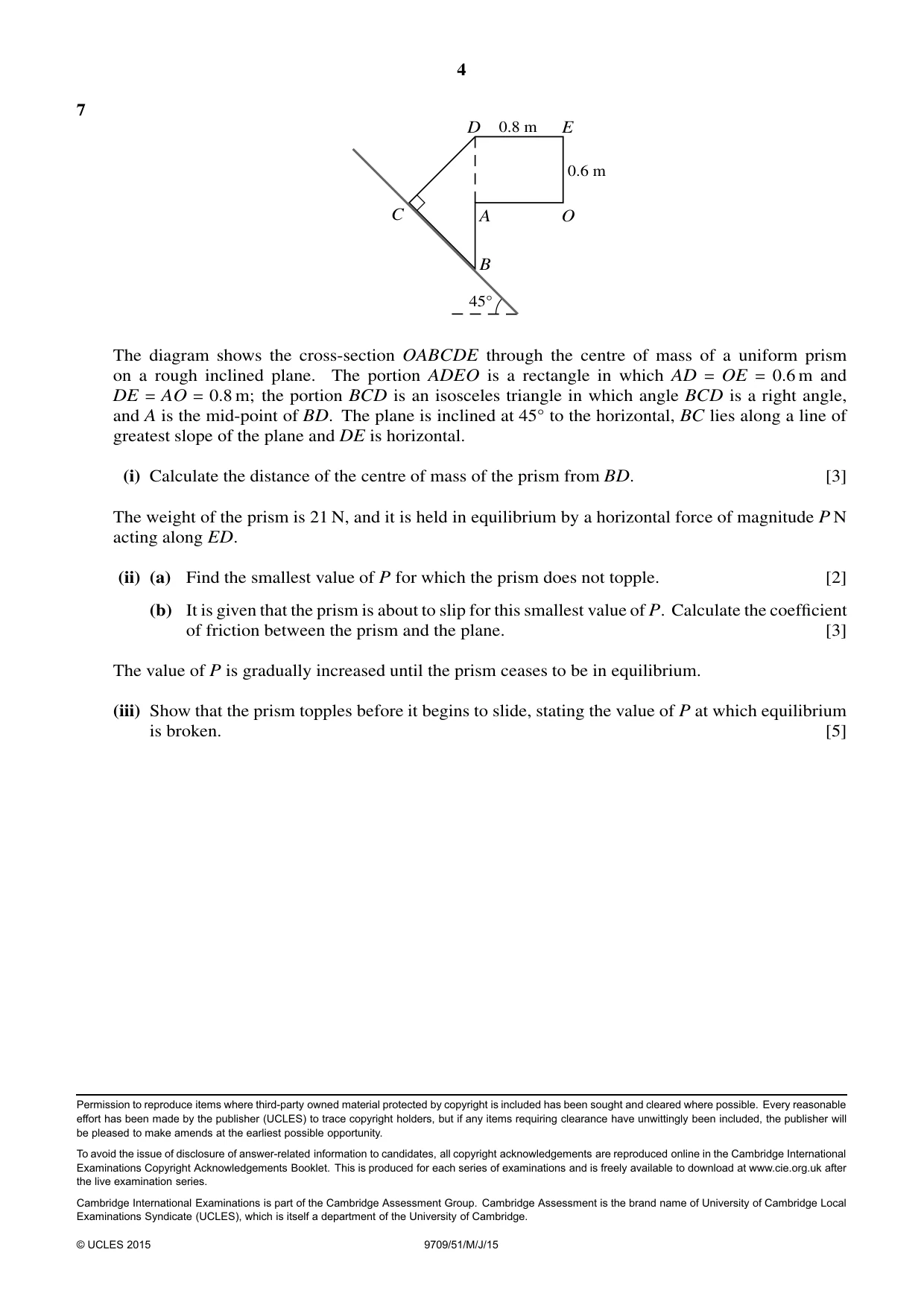
7 D 0.8 m E 0.6 m C A O B 45Å The diagram shows the cross-section OABCDE through the centre of mass of a uniform prism on a rough inclined plane. The portion ADEO is a rectangle in which AD = OE = 0.6 m and DE = AO = 0.8 m; the portion BCD is an isosceles triangle in which angle BCD is a right angle, and A is the mid-point of BD. The plane is inclined at 45Å to the horizontal, BC lies along a line of greatest slope of the plane and DE is horizontal. (i) Calculate the distance of the centre of mass of the prism from BD. [3] The weight of the prism is 21 N, and it is held in equilibrium by a horizontal force of magnitude P N acting along ED. (ii) (a) Find the smallest value of P for which the prism does not topple. [2] (b) It is given that the prism is about to slip for this smallest value of P. Calculate the coefficient of friction between the prism and the plane. [3] The value of P is gradually increased until the prism ceases to be in equilibrium. (iii) Show that the prism topples before it begins to slide, stating the value of P at which equilibrium is broken. [5]
Mark scheme: 7 (i) d(0.6 × 0.8 + 0.62) = M1 Moments about BAD 0.4(0.6 × 0.8) – (0.6/3) × 0.62 A1 d = 0.143 m A1 [3] Exact 1/7 (ii) (a) 21 × 0.143 = 1.2 P M1 Moments about B P = 2.5(0) A1 [2] (ii) (b) Fr = 21sin45 – 2.5cos45 and B1 R = 21cos45 + 2.5sin45 M1 For using Fr = µR µ = 0.787 A1 [3] (iii) P × 0.6 = 21 × (0.143 + 0.6) M1 Moments about C P = 26(.0) A1 Required Fr = 26sin45 – 21sin45 M1 3.5355.. Max Fr = 26(.155) A1 0.787 × (26cos45 + 21cos45) As actual Fr < max Fr , no sliding A1 [5]
What was in this paper
The subtopics covered by these 7 questions, and how many questions each got. Open one in a new tab to see every Cambridge question on it.
What you needed in this session
Cambridge’s own grade thresholds for 2015 May/June, Paper 5 · Variant 1. A higher threshold means an easier paper — the bar moves with how the cohort did.