Cambridge A Level Mathematics 9709 — 2013 May/June Paper 5 · Variant 3
9709/53/M/J/13 · 7 questions · 50 marks · ≈56 min
The question paper and its mark scheme, free to read here and free to download. This is Cambridge’s own paper, exactly as it was sat.
Question paper4 pages
Mark scheme5 pages
Answers below. Sit the paper first if you are practising.
Questions as text
Q1 · A particle P is projected with speed 15 m s−1 at an angle of 60 above the horizontal
1 A particle P is projected with speed 15 m s−1 at an angle of 60 above the horizontal. Find the direction of motion of P at the instant 0.9 s after projection. [4]
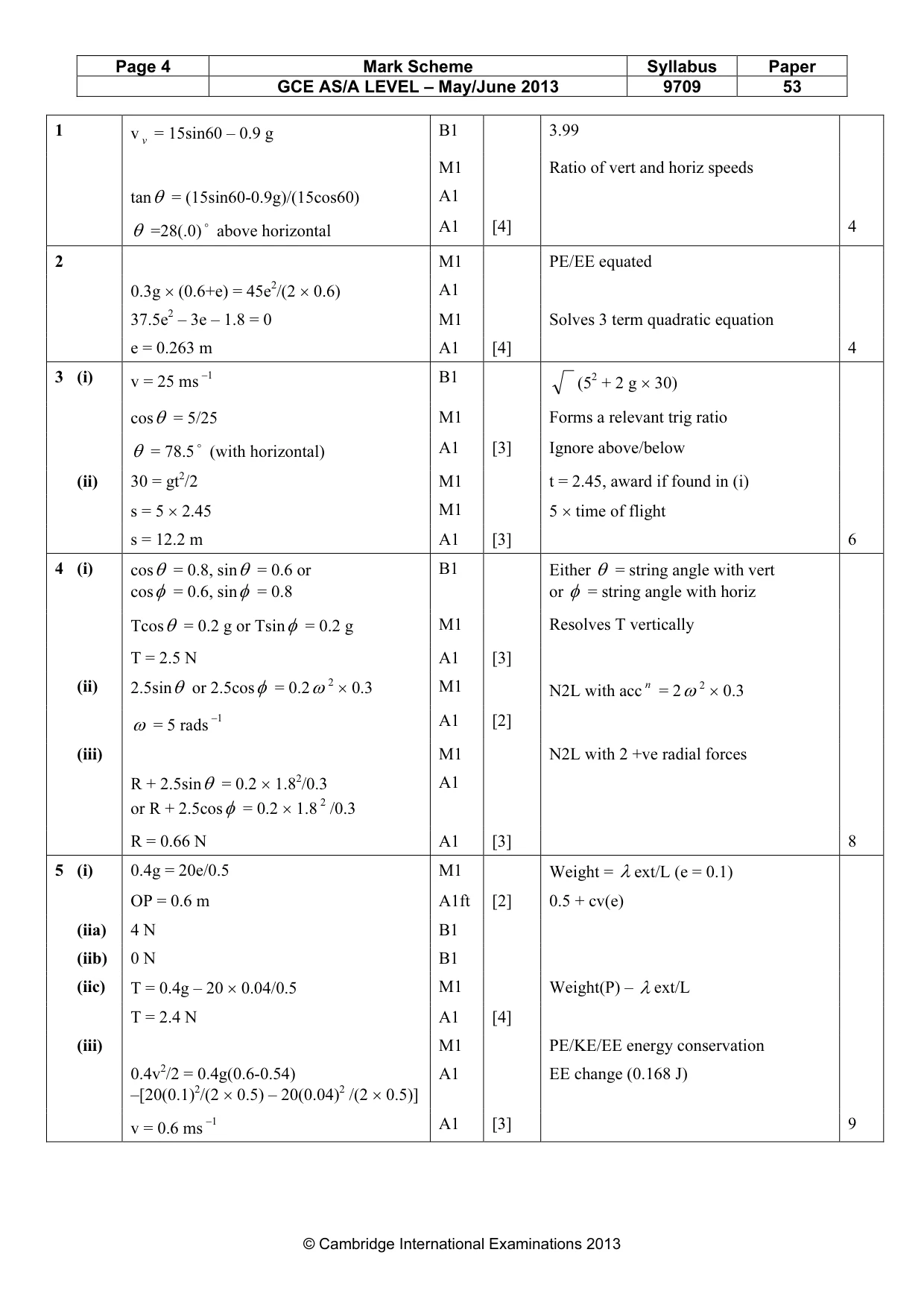
Mark scheme: 1 v v = 15sin60 – 0.9 g B1 3.99 M1 Ratio of vert and horiz speeds tanθ = (15sin60-0.9g)/(15cos60) A1 θ =28(.0) o above horizontal A1 [4] 4
Q2 · A particle P of mass 0.3 kg is attached to one end of a light elastic string of natural…
2 A particle P of mass 0.3 kg is attached to one end of a light elastic string of natural length 0.6 m and modulus of elasticity 45 N. The other end of the string is attached to a fixed point O. The particle P is released from rest at O and falls vertically. Find the extension of the string when P is at its lowest position. [4]
Mark scheme: 2 M1 PE/EE equated 0.3g × (0.6+e) = 45e2/(2 × 0.6) A1 37.5e2 – 3e – 1.8 = 0 M1 Solves 3 term quadratic equation e = 0.263 m A1 [4] 4
Q3 · A ball is projected horizontally with speed 5 m s−1 from the top of a tower which is 30 m…
3 A ball is projected horizontally with speed 5 m s−1 from the top of a tower which is 30 m high. The tower stands on horizontal ground. (i) Find the speed and direction of motion of the ball when it reaches the ground. [3] (ii) Calculate the distance from the foot of the tower to the point where the ball reaches the ground. [3]
Mark scheme: 3 (i) v = 25 ms −1 B1 (52 + 2 g × 30) cosθ = 5/25 M1 Forms a relevant trig ratio θ = 78.5 o (with horizontal) A1 [3] Ignore above/below (ii) 30 = gt2/2 M1 t = 2.45, award if found in (i) s = 5 × 2.45 M1 5 × time of flight s = 12.2 m A1 [3] 6
Q4 · A 0.5 m P 0.3 m A smooth hollow cylinder of internal radius 0.3 m is fixed with its axis…
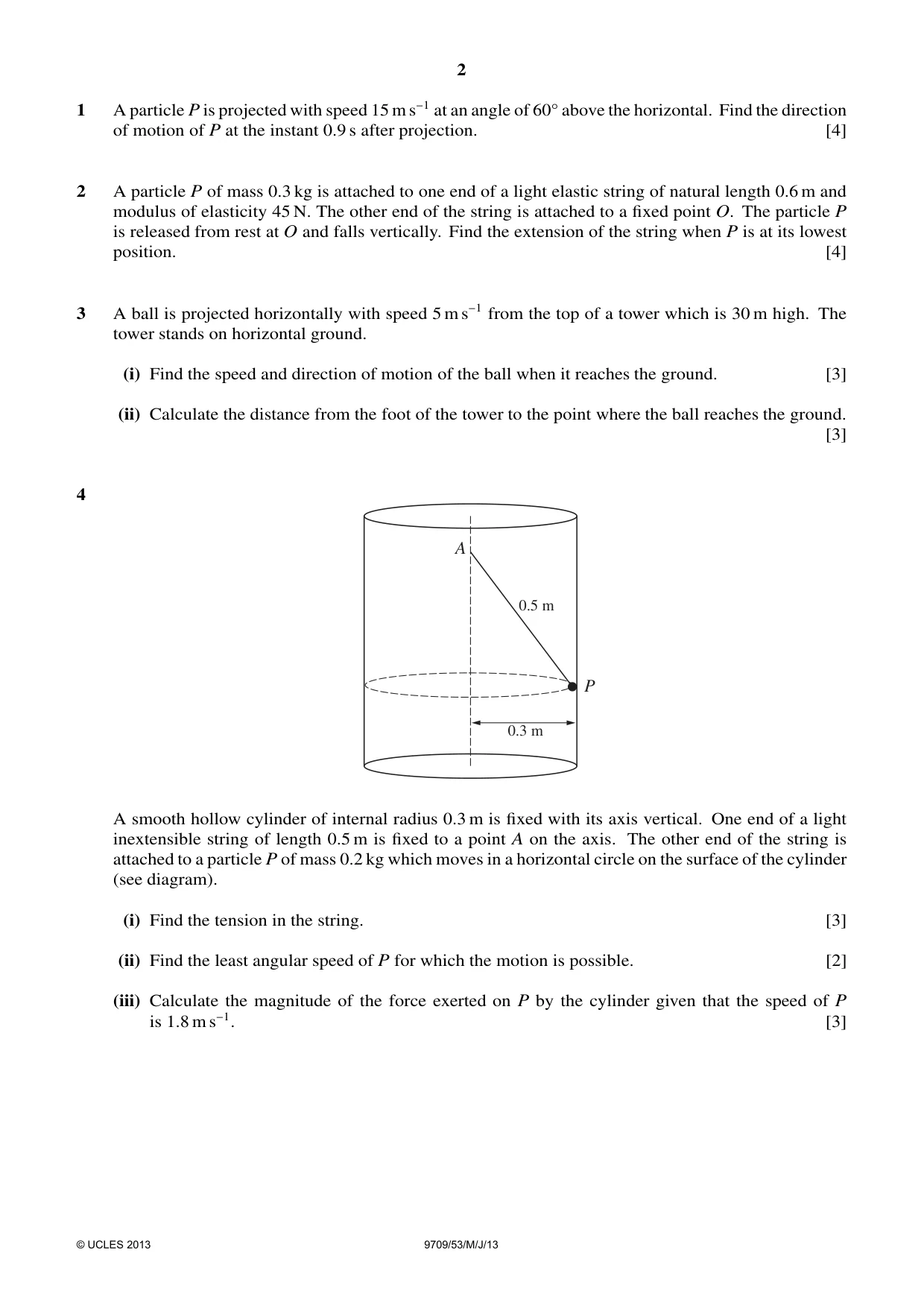
4 A 0.5 m P 0.3 m A smooth hollow cylinder of internal radius 0.3 m is fixed with its axis vertical. One end of a light inextensible string of length 0.5 m is fixed to a point A on the axis. The other end of the string is attached to a particle P of mass 0.2 kg which moves in a horizontal circle on the surface of the cylinder (see diagram). (i) Find the tension in the string. [3] (ii) Find the least angular speed of P for which the motion is possible. [2] (iii) Calculate the magnitude of the force exerted on P by the cylinder given that the speed of P is 1.8 m s−1. [3]
Mark scheme: 4 (i) cosθ = 0.8, sinθ = 0.6 or B1 Either θ = string angle with vert cosφ = 0.6, sinφ = 0.8 or φ = string angle with horiz Tcosθ = 0.2 g or Tsinφ = 0.2 g M1 Resolves T vertically T = 2.5 N A1 [3] (ii) 2.5sinθ or 2.5cosφ = 0.2ω 2 × 0.3 M1 N2L with acc n = 2ω 2 × 0.3 ω = 5 rads −1 A1 [2] (iii) M1 N2L with 2 +ve radial forces R + 2.5sinθ = 0.2 × 1.82/0.3 A1 or R + 2.5cosφ = 0.2 × 1.8 2 /0.3 R = 0.66 N A1 [3] 8
Q5 · One end of a light elastic string S1 of modulus of elasticity 20 N and natural length 0.5…
5 One end of a light elastic string S1 of modulus of elasticity 20 N and natural length 0.5 m is attached to a fixed point O. The other end of S1 is attached to a particle P of mass 0.4 kg. P hangs in equilibrium vertically below O. (i) Find the distance OP. [2] The opposite ends of a light inextensible string S2 of length l m are now attached to O and P respectively. The elastic string S1 remains attached to O and P. The particle P hangs in equilibrium vertically below O. (ii) Find the tension in the inextensible string S2 for each of the following cases: (a) l < 0.5; (b) l > 0.6; (c) l = 0.54. [4] In the case l = 0.54, the inextensible string S2 suddenly breaks and P begins to descend vertically. (iii) Calculate the greatest speed of P in the subsequent motion. [3]
Mark scheme: 5 (i) 0.4g = 20e/0.5 M1 Weight = λ ext/L (e = 0.1) OP = 0.6 m A1ft [2] 0.5 + cv(e) (iia) 4 N B1 (iib) 0 N B1 (iic) T = 0.4g – 20 × 0.04/0.5 M1 Weight(P) – λ ext/L T = 2.4 N A1 [4] (iii) M1 PE/KE/EE energy conservation 0.4v2/2 = 0.4g(0.6-0.54) A1 EE change (0.168 J) –[20(0.1)2/(2 × 0.5) – 20(0.04)2 /(2 × 0.5)] v = 0.6 ms −1 A1 [3] 9 GCE AS/A LEVEL – May/June 2013 9709 53
Q6 · ° C 1.2 m L 0.4 m A uniform solid cone of height 1.2 m and semi-vertical angle is divided…
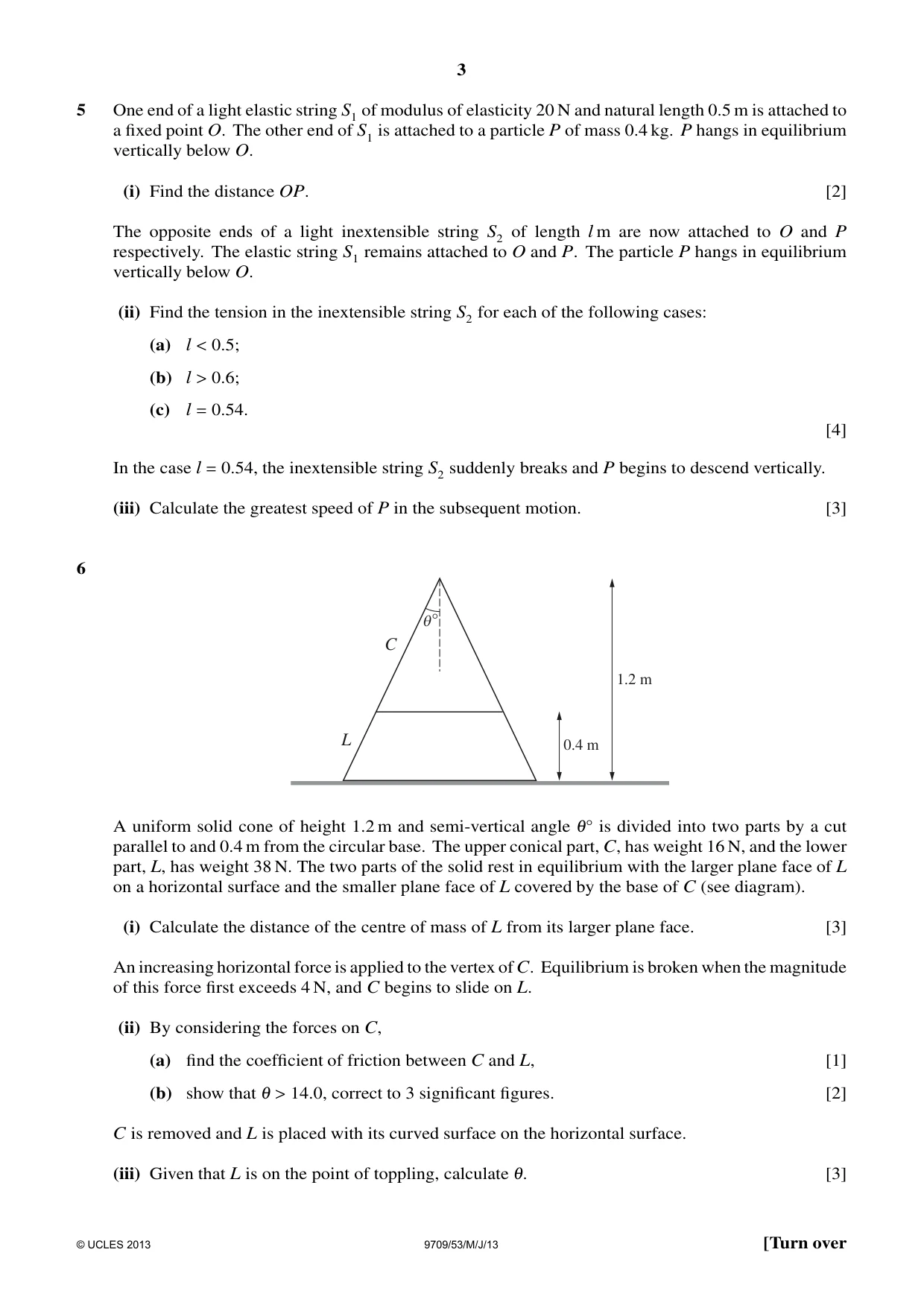
6 ° C 1.2 m L 0.4 m A uniform solid cone of height 1.2 m and semi-vertical angle is divided into two parts by a cut parallel to and 0.4 m from the circular base. The upper conical part, C, has weight 16 N, and the lower part, L, has weight 38 N. The two parts of the solid rest in equilibrium with the larger plane face of L on a horizontal surface and the smaller plane face of L covered by the base of C (see diagram). (i) Calculate the distance of the centre of mass of L from its larger plane face. [3] An increasing horizontal force is applied to the vertex of C. Equilibrium is broken when the magnitude of this force first exceeds 4 N, and C begins to slide on L. (ii) By considering the forces on C, (a) find the coefficient of friction between C and L, [1] (b) show that > 14.0, correct to 3 significant figures. [2] C is removed and L is placed with its curved surface on the horizontal surface. (iii) Given that L is on the point of toppling, calculate . [3]
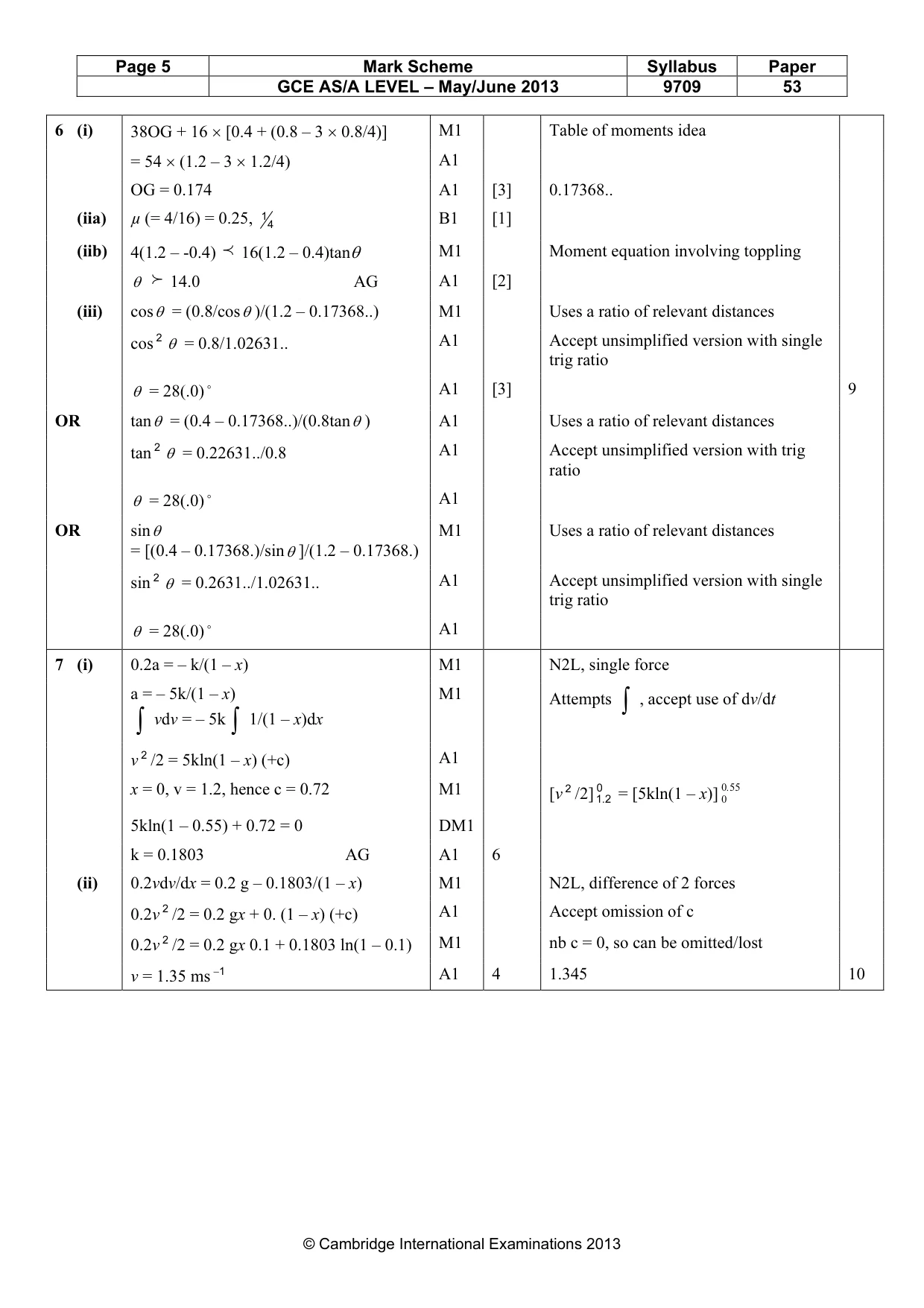
Mark scheme: 6 (i) 38OG + 16 × [0.4 + (0.8 – 3 × 0.8/4)] M1 Table of moments idea = 54 × (1.2 – 3 × 1.2/4) A1 OG = 0.174 A1 [3] 0.17368.. (iia) µ (= 4/16) = 0.25, 1 4 B1 [1] (iib) 4(1.2 – -0.4) p 16(1.2 – 0.4)tanθ M1 Moment equation involving toppling θ f 14.0 AG A1 [2] (iii) cosθ = (0.8/cosθ )/(1.2 – 0.17368..) M1 Uses a ratio of relevant distances cos 2 θ = 0.8/1.02631.. A1 Accept unsimplified version with single trig ratio θ = 28(.0) o A1 [3] 9 OR tanθ = (0.4 – 0.17368..)/(0.8tanθ ) A1 Uses a ratio of relevant distances tan 2 θ = 0.22631../0.8 A1 Accept unsimplified version with trig ratio θ = 28(.0) o A1 OR sinθ M1 Uses a ratio of relevant distances = [(0.4 – 0.17368.)/sinθ ]/(1.2 – 0.17368.) sin 2 θ = 0.2631../1.02631.. A1 Accept unsimplified version with single trig ratio θ = 28(.0) o A1
Q7 · A small ball B of mass 0.2 kg moves in a narrow fixed smooth cylindrical tube OA of length…
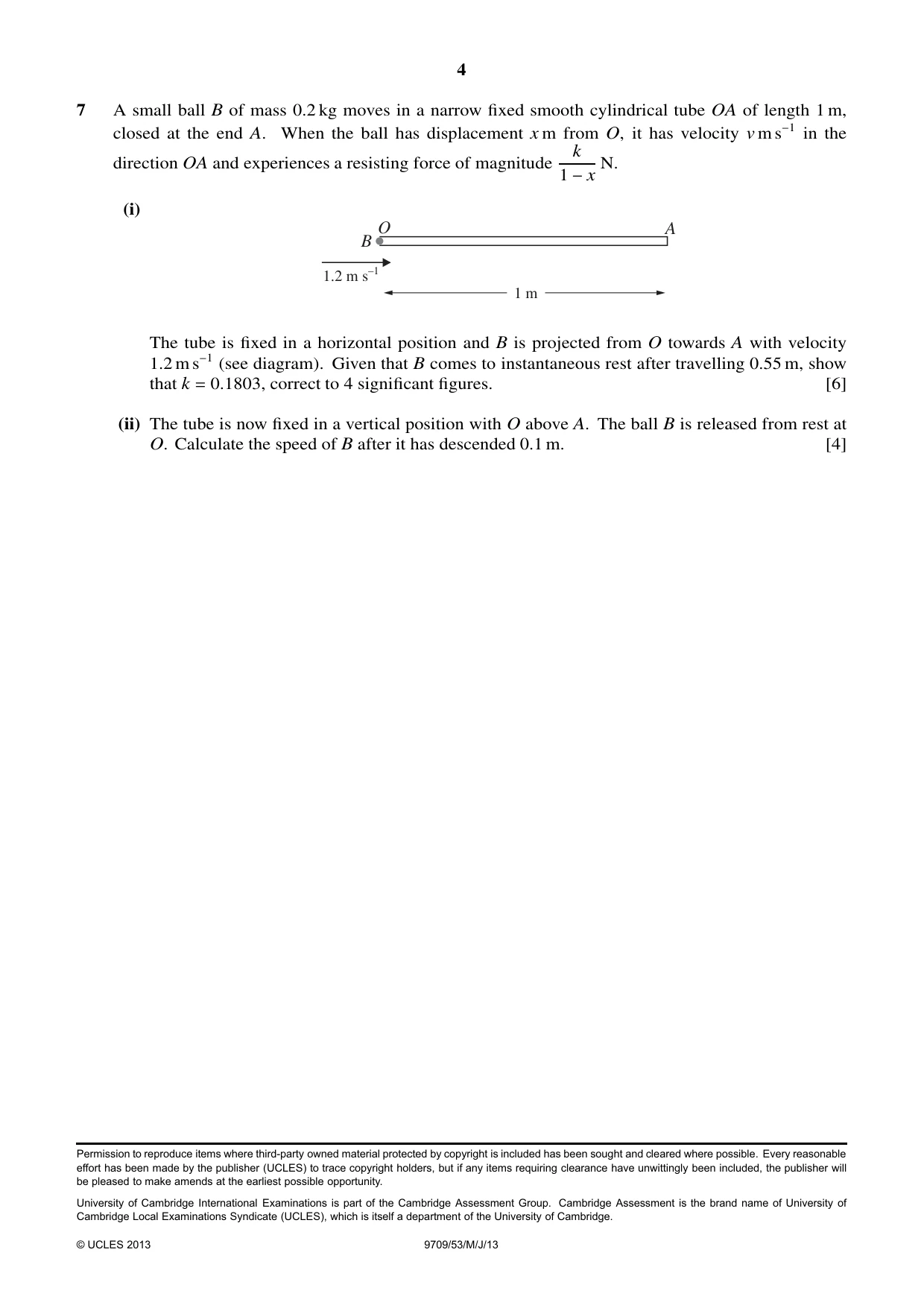
7 A small ball B of mass 0.2 kg moves in a narrow fixed smooth cylindrical tube OA of length 1 m, closed at the end A. When the ball has displacement x m from O, it has velocity v m s−1 in the k direction OA and experiences a resisting force of magnitude N. 1 −x (i) O A B 1.2 m s–1 1 m The tube is fixed in a horizontal position and B is projected from O towards A with velocity 1.2 m s−1 (see diagram). Given that B comes to instantaneous rest after travelling 0.55 m, show that k = 0.1803, correct to 4 significant figures. [6] (ii) The tube is now fixed in a vertical position with O above A. The ball B is released from rest at O. Calculate the speed of B after it has descended 0.1 m. [4]
Mark scheme: 7 (i) 0.2a = – k/(1 – x) M1 N2L, single force a = – 5k/(1 – x) M1 Attempts ∫, accept use of dv/dt ∫vdv = – 5k∫1/(1 – x)dx v 2 /2 = 5kln(1 – x) (+c) A1 x = 0, v = 1.2, hence c = 0.72 M1 2 0 0 .55 [v /2] 1. 2 = [5kln(1 – x)] 0 5kln(1 – 0.55) + 0.72 = 0 DM1 k = 0.1803 AG A1 6 (ii) 0.2vdv/dx = 0.2 g – 0.1803/(1 – x) M1 N2L, difference of 2 forces 0.2v 2 /2 = 0.2 gx + 0. (1 – x) (+c) A1 Accept omission of c 0.2v 2 /2 = 0.2 gx 0.1 + 0.1803 ln(1 – 0.1) M1 nb c = 0, so can be omitted/lost v = 1.35 ms −1 A1 4 1.345 10
What was in this paper
The subtopics covered by these 7 questions, and how many questions each got. Open one in a new tab to see every Cambridge question on it.
What you needed in this session
Cambridge’s own grade thresholds for 2013 May/June, Paper 5 · Variant 3. A higher threshold means an easier paper — the bar moves with how the cohort did.