Cambridge A Level Mathematics 9709 — 2008 May/June Paper 5 · Variant 1
9709/51/M/J/08 · 7 questions · 50 marks · ≈56 min
The question paper and its mark scheme, free to read here and free to download. This is Cambridge’s own paper, exactly as it was sat.
Question paper4 pages
Mark scheme6 pages
Answers below. Sit the paper first if you are practising.
Questions as text
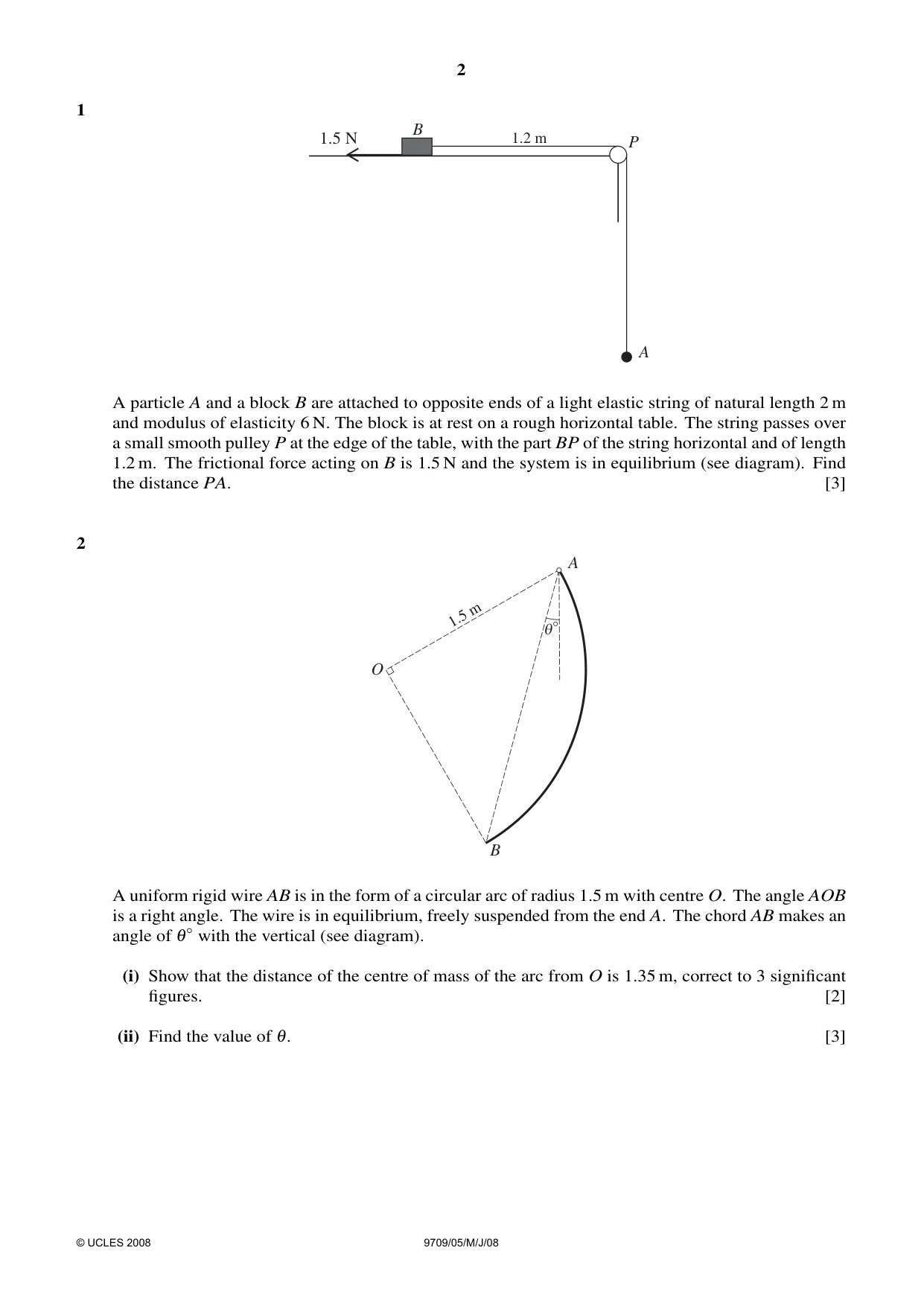
Q1 · B 1.5 N 1.2 m P A A particle A and a block B are attached to opposite ends of a light…
1 B 1.5 N 1.2 m P A A particle A and a block B are attached to opposite ends of a light elastic string of natural length 2 m and modulus of elasticity 6 N. The block is at rest on a rough horizontal table. The string passes over a small smooth pulley P at the edge of the table, with the part BP of the string horizontal and of length 1.2 m. The frictional force acting on B is 1.5 N and the system is in equilibrium (see diagram). Find the distance PA. [3]
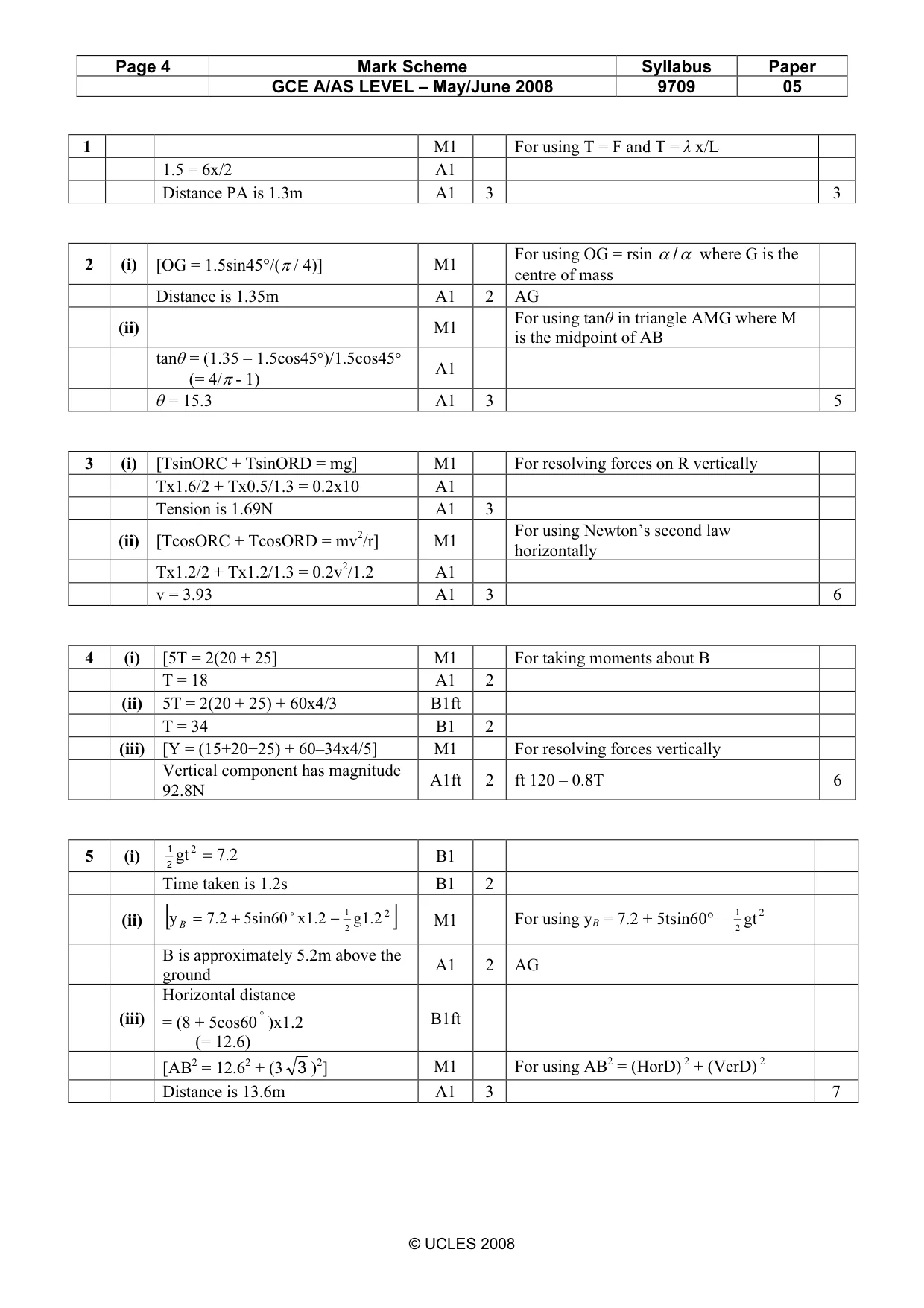
Mark scheme: 1 M1 For using T = F and T = λ x/L 1.5 = 6x/2 A1 Distance PA is 1.3m A1 3 3 For using OG = rsin α / α where G is the
Q2 · A m 1.5 ° O B A uniform rigid wire AB is in the form of a circular arc of radius 1.5 m…
2 A m 1.5 ° O B A uniform rigid wire AB is in the form of a circular arc of radius 1.5 m with centre O. The angle AOB is a right angle. The wire is in equilibrium, freely suspended from the end A. The chord AB makes an angle of θ◦with the vertical (see diagram). (i) Show that the distance of the centre of mass of the arc from O is 1.35 m, correct to 3 significant figures. [2] (ii) Find the value of θ. [3]
Mark scheme: For using OG rsin α / α where G is the 2 (i) [OG = 1.5sin45°/(π / 4)] M1 centre of mass Distance is 1.35m A1 2 AG For using tanθ in triangle AMG where M (ii) M1 is the midpoint of AB tanθ = (1.35 – 1.5cos45°)/1.5cos45° A1 (= 4/π - 1) θ = 15.3 A1 3 5
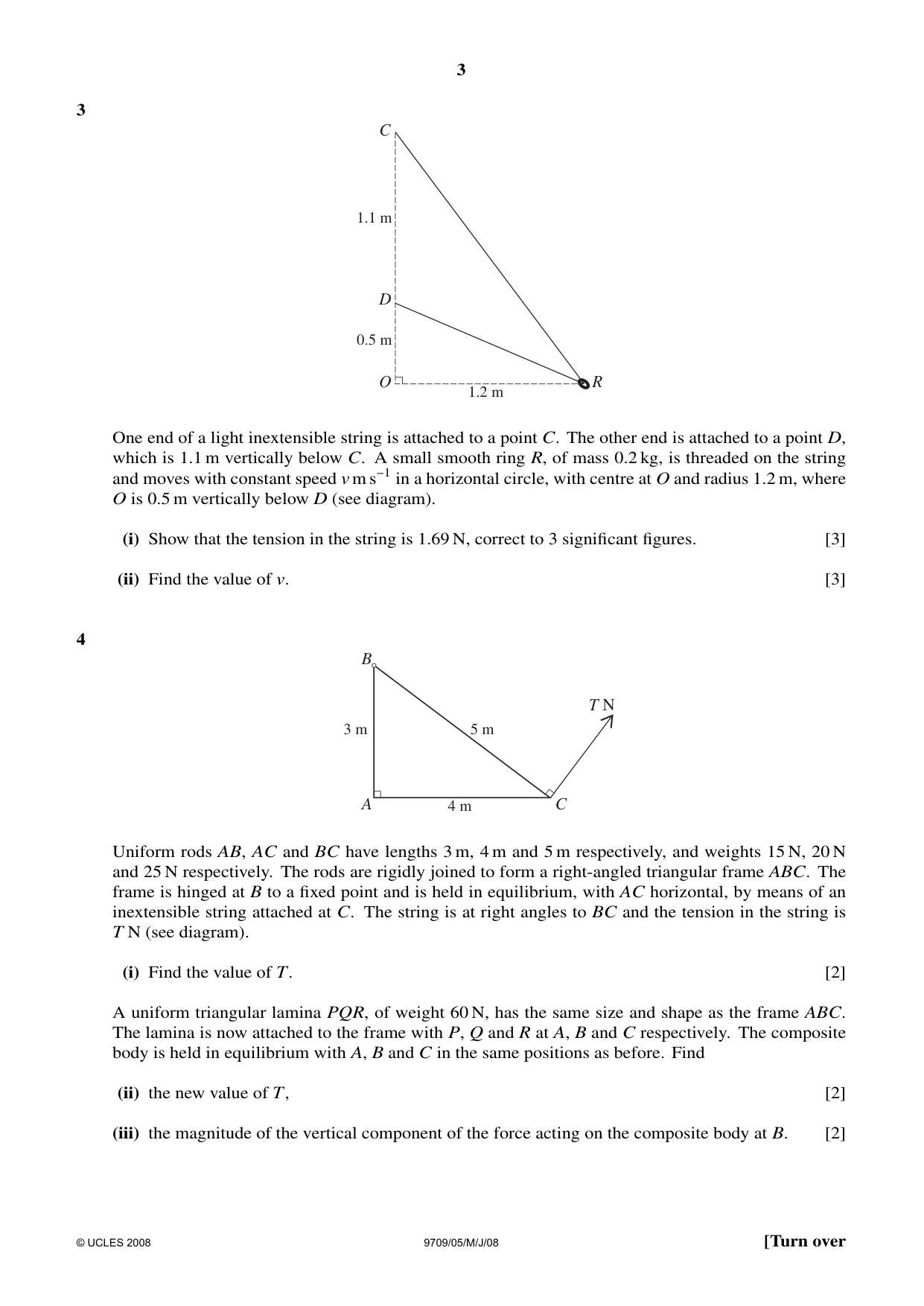
Q3 · C 1.1 m D 0.5 m O R 1.2 m One end of a light inextensible string is attached to a point C
3 C 1.1 m D 0.5 m O R 1.2 m One end of a light inextensible string is attached to a point C. The other end is attached to a point D, which is 1.1 m vertically below C. A small smooth ring R, of mass 0.2 kg, is threaded on the string and moves with constant speed v m s−1 in a horizontal circle, with centre at O and radius 1.2 m, where O is 0.5 m vertically below D (see diagram). (i) Show that the tension in the string is 1.69 N, correct to 3 significant figures. [3] (ii) Find the value of v. [3]
Mark scheme: 3 (i) [TsinORC + TsinORD = mg] M1 For resolving forces on R vertically Tx1.6/2 + Tx0.5/1.3 = 0.2x10 A1 Tension is 1.69N A1 3 For using Newton’s second law (ii) [TcosORC + TcosORD = mv2/r] M1 horizontally Tx1.2/2 + Tx1.2/1.3 = 0.2v2/1.2 A1 v = 3.93 A1 3 6
Q4 · B T N 3 m 5 m A 4 m C Uniform rods AB, AC and BC have lengths 3 m, 4 m and 5 m…
4 B T N 3 m 5 m A 4 m C Uniform rods AB, AC and BC have lengths 3 m, 4 m and 5 m respectively, and weights 15 N, 20 N and 25 N respectively. The rods are rigidly joined to form a right-angled triangular frame ABC. The frame is hinged at B to a fixed point and is held in equilibrium, with AC horizontal, by means of an inextensible string attached at C. The string is at right angles to BC and the tension in the string is T N (see diagram). (i) Find the value of T. [2] A uniform triangular lamina PQR, of weight 60 N, has the same size and shape as the frame ABC. The lamina is now attached to the frame with P, Q and R at A, B and C respectively. The composite body is held in equilibrium with A, B and C in the same positions as before. Find (ii) the new value of T, [2] (iii) the magnitude of the vertical component of the force acting on the composite body at B. [2]
Mark scheme: 4 (i) [5T = 2(20 + 25] M1 For taking moments about B T = 18 A1 2 (ii) 5T = 2(20 + 25) + 60x4/3 B1ft T = 34 B1 2 (iii) [Y = (15+20+25) + 60–34x4/5] M1 For resolving forces vertically Vertical component has magnitude A1ft 2 ft 120 – 0.8T 6 92.8N 1 2
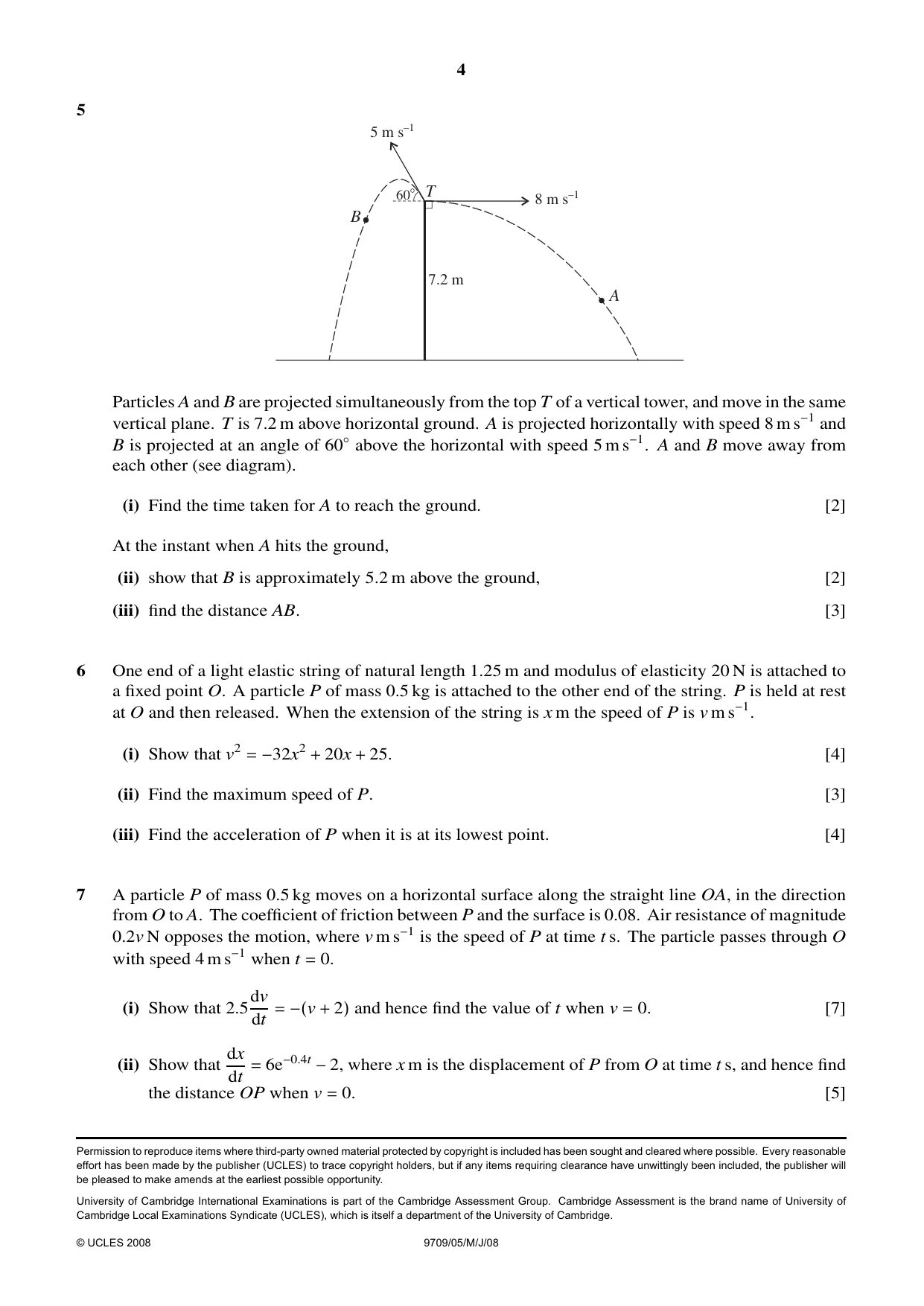
Q5 · 5 m s–1 60° T 8 m s–1 B 7.2 m A Particles A and B are projected simultaneously from the…
5 5 m s–1 60° T 8 m s–1 B 7.2 m A Particles A and B are projected simultaneously from the top T of a vertical tower, and move in the same vertical plane. T is 7.2 m above horizontal ground. A is projected horizontally with speed 8 m s−1 and B is projected at an angle of 60◦above the horizontal with speed 5 m s−1. A and B move away from each other (see diagram). (i) Find the time taken for A to reach the ground. [2] At the instant when A hits the ground, (ii) show that B is approximately 5.2 m above the ground, [2] (iii) find the distance AB. [3]
Mark scheme: 5 (i) 21 gt 2 = 7.2 B1 Time taken is 1.2s B1 2 1 o x1.2 − 1 gt 2 (ii) [y B = 7.2 + 5sin60 g1.2 2 ] M1 For using yB = 7.2 + 5tsin60° – 2 2 B is approximately 5.2m above the A1 2 AG ground Horizontal distance (iii) = (8 + 5cos60 o )x1.2 B1ft (= 12.6) [AB2 = 12.62 + (3 3 )2] M1 For using AB2 = (HorD) 2 + (VerD) 2 Distance is 13.6m A1 3 7 GCE A/AS LEVEL – May/June 2008 9709 05 2
Q6 · One end of a light elastic string of natural length 1.25 m and modulus of elasticity 20 N…
6 One end of a light elastic string of natural length 1.25 m and modulus of elasticity 20 N is attached to a fixed point O. A particle P of mass 0.5 kg is attached to the other end of the string. P is held at rest at O and then released. When the extension of the string is x m the speed of P is v m s−1. (i) Show that v2 = −32x2 + 20x + 25. [4] (ii) Find the maximum speed of P. [3] (iii) Find the acceleration of P when it is at its lowest point. [4]
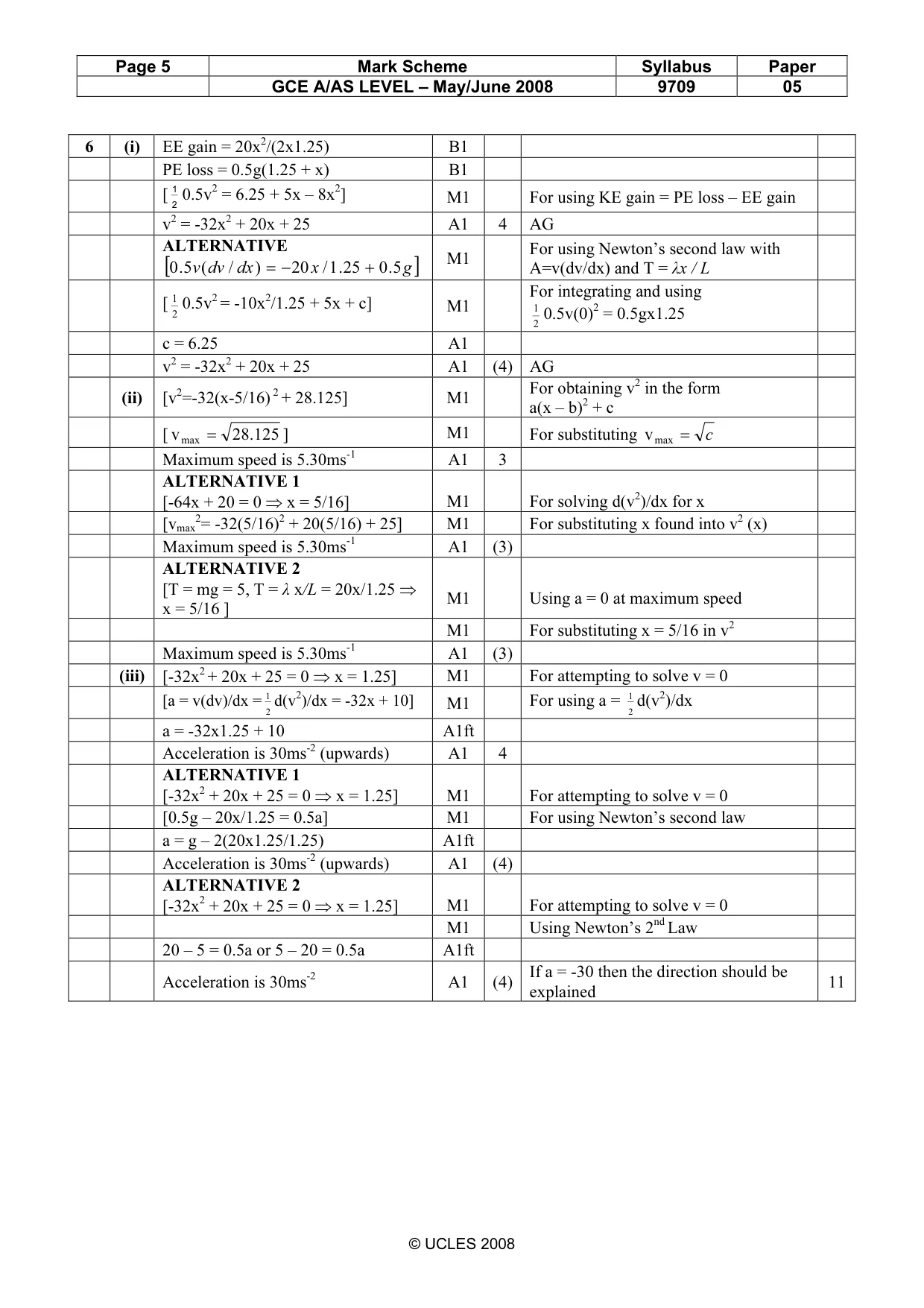
Mark scheme: 6 (i) EE gain = 20x2/(2x1.25) B1 PE loss = 0.5g(1.25 + x) B1 [ 1 0.5v2 = 6.25 + 5x – 8x2] M1 For using KE gain = PE loss – EE gain 2 v2 = -32x2 + 20x + 25 A1 4 AG ALTERNATIVE For using Newton’s second law with [5.0 v ( dv / dx ) = − 20 x / .1 25 + 5.0 g ] M1 A=v(dv/dx) and T = λx / L 1 For integrating and using [ 0.5v2 = -10x2/1.25 + 5x + c] M1 1 2 0.5v(0)2 = 0.5gx1.25 2 c = 6.25 A1 v2 = -32x2 + 20x + 25 A1 (4) AG 2 For obtaining v2 in the form (ii) [v2=-32(x-5/16) + 28.125] M1 a(x – b)2 + c [ vmax = 28.125 ] M1 For substituting v max = c Maximum speed is 5.30ms-1 A1 3 ALTERNATIVE 1 [-64x + 20 = 0 ⇒ x = 5/16] M1 For solving d(v2)/dx for x [vmax 2= -32(5/16)2 + 20(5/16) + 25] M1 For substituting x found into v2 (x) Maximum speed is 5.30ms-1 A1 (3) ALTERNATIVE 2 [T = mg = 5, T = λ x/L = 20x/1.25 ⇒ M1 Using a = 0 at maximum speed x = 5/16 ] M1 For substituting x = 5/16 in v2 Maximum speed is 5.30ms-1 A1 (3) (iii) [-32x2 + 20x + 25 = 0 ⇒ x = 1.25] M1 For attempting to solve v = 0 [a = v(dv)/dx = 1 d(v2)/dx = -32x + 10] 2 M1 For using a = 12 d(v2)/dx a = -32x1.25 + 10 A1ft Acceleration is 30ms-2 (upwards) A1 4 ALTERNATIVE 1 [-32x2 + 20x + 25 = 0 ⇒ x = 1.25] M1 For attempting to solve v = 0 [0.5g – 20x/1.25 = 0.5a] M1 For using Newton’s second law a = g – 2(20x1.25/1.25) A1ft Acceleration is 30ms-2 (upwards) A1 (4) ALTERNATIVE 2 [-32x2 + 20x + 25 = 0 ⇒ x = 1.25] M1 For attempting to solve v = 0 M1 Using Newton’s 2nd Law 20 – 5 = 0.5a or 5 – 20 = 0.5a A1ft If a = -30 then the direction should be Acceleration is 30ms-2 A1 (4) 11 explained GCE A/AS LEVEL – May/June 2008 9709 05 For using Newton’s second law and
Q7 · A particle P of mass 0.5 kg moves on a horizontal surface along the straight line OA, in…
7 A particle P of mass 0.5 kg moves on a horizontal surface along the straight line OA, in the direction from O to A. The coefficient of friction between P and the surface is 0.08. Air resistance of magnitude 0.2v N opposes the motion, where v m s−1 is the speed of P at time t s. The particle passes through O with speed 4 m s−1 when t = 0. (i) Show that 2.5dv = −(v + 2) and hence find the value of t when v = 0. [7] dt dx (ii) Show that = 6e−0.4t −2, where x m is the displacement of P from O at time t s, and hence find dt the distance OP when v = 0. [5]
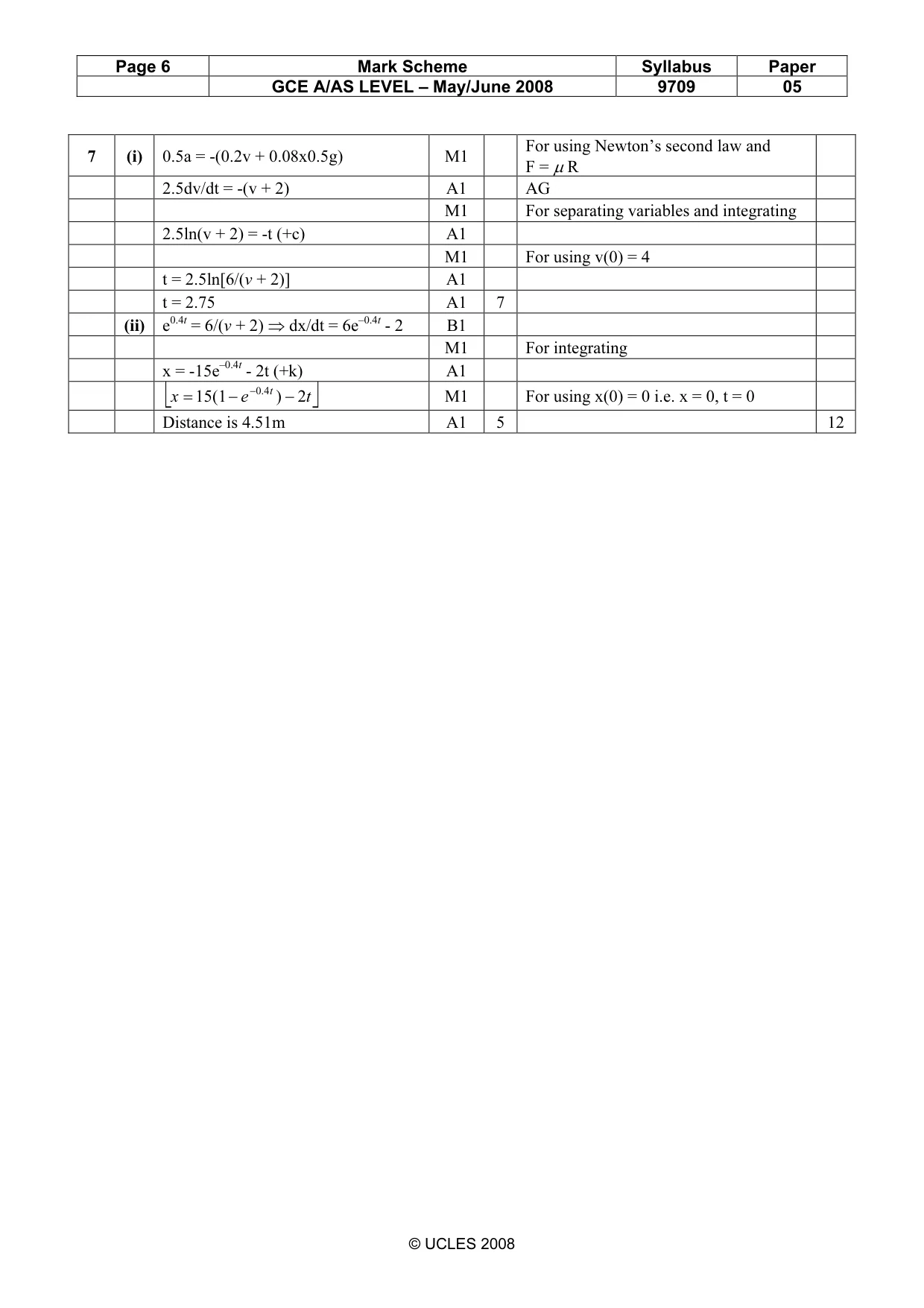
Mark scheme: For using Newton s second law and 7 (i) 0.5a = -(0.2v + 0.08x0.5g) M1 F = µ R 2.5dv/dt = -(v + 2) A1 AG M1 For separating variables and integrating 2.5ln(v + 2) = -t (+c) A1 M1 For using v(0) = 4 t = 2.5ln[6/(v + 2)] A1 t = 2.75 A1 7 (ii) e0.4t = 6/(v + 2) ⇒ dx/dt = 6e–0.4t - 2 B1 M1 For integrating x = -15e–0.4t - 2t (+k) A1 x = 15(1 − e −0.4 t ) − 2t M1 For using x(0) = 0 i.e. x = 0, t = 0 Distance is 4.51m A1 5 12
What was in this paper
The subtopics covered by these 7 questions, and how many questions each got. Open one in a new tab to see every Cambridge question on it.
What you needed in this session
Cambridge’s own grade thresholds for 2008 May/June, Paper 5 · Variant 1. A higher threshold means an easier paper — the bar moves with how the cohort did.