Questions as text
Q1 · Giovanni is shopping in a supermarket 9084/21 May/June 2017
2 (a) Giovanni is shopping in a supermarket. At the till he hands over a £20 note. The cashier is busy talking to her friend and gives Giovanni change for a £50 note. Giovanni sees what has happened but he puts the money in his pocket and leaves the supermarket. After a few minutes Giovanni thinks about going back to the supermarket but he decides it was the cashier’s fault and spends the money. Explain how the Theft Act 1968 will apply to Giovanni. [10] (b) Camilla goes to a restaurant for lunch on a rainy day and leaves her coat in the cloakroom. When Camilla leaves it is sunny and she forgets about her coat, leaving it in the cloakroom. Two months later Camilla goes for dinner at the same restaurant. When she is leaving it is raining heavily so she goes to the cloakroom and takes a coat. By coincidence, the coat Camilla takes is the same one she left there two months ago. Explain how the Theft Act 1968 will apply to Camilla. [10] (c) Maria gives £50 to her son, Rodrigo, to do some grocery shopping. She also gives him a list of items to buy. Maria tells Rodrigo that if there is any money left he can spend it on himself. On the way to do the shopping, Rodrigo sees a shirt in a shop window. He tries the shirt on and buys it for £30. Rodrigo does not have enough money left to buy all of the items on the list. Explain how the Theft Act 1968 will apply to Rodrigo. [10] (d) Critically evaluate the use of precedent to develop the law. [20] Source material for Question 2 Theft Act 1968 Section 5 “Belonging to another” (1) Property shall be regarded as belonging to any person having possession or control of it, or having in it any proprietary right or interest (not being an equitable interest arising only from an agreement to transfer or grant an interest). … (3) Where a person receives property from or on account of another, and is under an obligation to the other to retain and deal with that property or its proceeds in a particular way, the property or proceeds shall be regarded (as against him) as belonging to the other. (4) Where a person gets property by another’s mistake, and is under an obligation to make restoration (in whole or in part) of the property or its proceeds or of the value thereof, then to the extent of that obligation the property or proceeds shall be regarded (as against him) as belonging to the person entitled to restoration, and an intention not to make restoration shall be regarded accordingly as an intention to deprive that person of the property or proceeds. R v Turner (No 2) [1971] Turner had taken his car to a garage to be repaired. The job was finished and the car was parked outside overnight awaiting collection. Turner used his spare set of keys to remove the car without paying. Held: The jury found Turner guilty of stealing his own car. The reason was that the garage proprietor had temporary possession and control of Turner’s car until the bill had been settled. Davidge v Bunnett [1984] B received cheques from her flat mates which were to pay for the communal gas bill. B spent the money on Christmas presents and left the flat without paying the gas bill. Held: B was liable for theft as under s.5(3) Theft Act 1968 the cheques had been given with a clear obligation to apply the money for payment of the gas bill. A-G Ref (No 1 of 1983) [1985] The defendant, a police-woman, received an overpayment in her wages by mistake. She had noticed that she had received more than she was entitled to but did not say anything to her employer. She did not withdraw any of the money from her bank account. The trial judge directed the jury to acquit. The Attorney General referred a question to the Court of Appeal. Held: It was possible for a theft conviction to arise where the defendant had not withdrawn the money. There was a legal obligation to return the money received by mistake.
50 marks
Mark scheme: 2(a) Explain how the Theft Act 1968 will apply to Giovanni. 10 Band 1 [0 marks] Irrelevant answer. Band 2 – 3 [1–5 marks] A candidate needs to be selective in choosing the correct part of the source material. • Principle without section – understanding that Giovanni is covered by s5 Theft Act 1968. and/or • Reference to s5 Theft Act 1968 and/or A-G Ref (No 1 of 1983)(1985) with little or no development. Band 4 [6–7 marks] Reference to some of s5 Theft Act 1968 and/or A-G Ref (No 1 of 1983)(1985) with some development and some application. Band 5 [8–10 marks] Full development of the relevant sections. Conclusion: Giovanni comes within s5. Under s5(1) he does have possession and control of the extra change but not a proprietary right. This is because under s5(4) he has been given the money by mistake and he realises so he has a legal obligation to return it. Apply AG Ref as in that case the police-woman had received the money by mistake but did not say anything when she realised this was the case. 2(b) Explain how the Theft Act 1968 will apply to Camilla. 10 Band 1 [0 marks] Irrelevant answer. Band 2 – 3 [1–5 marks] A candidate needs to be selective in choosing the correct part of the source material. • Principle without section – understanding that Camilla is covered by s5 Theft Act 1968. and/or • Reference to s5 Theft Act 1968 and/or R v Turner (1971) with little or no development. Band 4 [6–7 marks] Reference to some of s5 Theft Act 1968 and/or R v Turner (1971) with some development some application. Band 5 [8–10 marks] Full development of the relevant sections. Conclusion: Camilla is covered by s5. Under s5(1) the restaurant is in possession and control of the rain coat. Camilla may argue she has a proprietary interest as it is in fact her own raincoat. Apply law as developed by R v Turner to the effect that Camilla can steal her own coat and so be covered by s5 as the restaurant were in possession and control of it. 2(c) Explain how the Theft Act 1968 will apply to Rodrigo. 10 Band 1 [0 marks] Irrelevant answer. Band 2 – 3 [1–5 marks] A candidate needs to be selective in choosing the correct part of the source material. • Principle without section – understanding that Rodrigo is covered by s5 Theft Act 1968. and/or • Reference to s5 Theft Act 1968 and/or Davidge v Bunnett (1984) with little or no development. Band 4 [6–7 marks] Reference to s5 Theft Act 1968 and/or Davidge v Bunnett (1984) with some development and some application. Band 5 [8–10 marks] Full development of the relevant sections. Conclusion: Rodrigo is covered by s5. Under s5(1) he does have possession and control of the money. Credit argument that he may have a proprietary interest as it is money between a mother and son. Under s5(3) he has been given money for shopping his mother wants, not to buy a shirt first. Apply Davidge v Bunnett as money has been given for a specific purpose. Credit discussion that the case can be distinguished as being between a mother and son rather than flat mates. 2(d) Critically evaluate the use of precedent to develop the law. 20 Band 1 [0 marks] Irrelevant answer. Band 2 [1–6 marks] Describes and/or discusses precedent in very general terms. Band 3 [7–13 marks] More detailed references to precedent and some discussion of its developmental role but with a largely factual basis. Band 4/5 [14–20 marks] Very good detail on the way in which precedent develops the law and good discussion on its effectiveness. To reach higher marks need to engage with both the role and effectiveness of precedent showing good critical awareness.
This question in 9084/21 May/June 2017
Q2 · Jamal passed his driving test on June 1 2015 9084/22 May/June 2017
2 (a) Jamal passed his driving test on June 1 2015. On December 30 2015, Jamal is stopped by a police officer as he is driving down a city street at 60 mph. The speed limit is 30 mph. Jamal is tried in the Magistrates’ Court for speeding, which is an offence involving obligatory endorsement and he is given nine penalty points. Explain how the Road Traffic (New Drivers) Act 1995 will apply to Jamal. [10] (b) Melissa is convicted of a driving offence when she crashes into an empty bus 10 months after passing her test. For this offence Melissa receives nine penalty points and so her licence is revoked for six months. She feels that the punishment given by the Magistrates’ Court is excessive. Melissa appeals and her punishment is reduced to three penalty points on her licence. Explain how the Road Traffic (New Drivers) Act 1995 will apply to Melissa. [10] (c) Anton passes his driving test on September 20 2016. The same evening he drives to a party. Anton drinks alcohol at the party and as he is driving home he hits Myra, breaking her leg. Anton is over the drink-drive legal limit, which is an offence involving obligatory endorsement. When the police arrive Anton has no licence to show them but has a document from the test centre to show that he has passed. Anton is tried in the Magistrates’ Court and given 10 penalty points. Explain how the Road Traffic (New Drivers) Act 1995 will apply to Anton. [10] (d) Describe and evaluate the intrinsic and extrinsic aids judges use to interpret statutes. [20] Source material for Question 2 Road Traffic (New Drivers) Act 1995 Section 1 Probationary period for newly qualified drivers (1) For the purposes of this Act, a person’s probationary period is, subject to section 7, the period of two years beginning with the day on which he becomes a qualified driver. (2) For the purposes of this Act, a person becomes a qualified driver on the first occasion on which he passes─ (a) any test of competence to drive mentioned in paragraph (a) or (c) of section 89(1) of the M1Road Traffic Act 1988. Section 2 Surrender of licences (1) Subsection (2) applies where─ (a) a person is the holder of a licence; (b) he is convicted of an offence involving obligatory endorsement; (c) the penalty points to be taken into account under section 29 of the M1Road Traffic Offenders Act 1988 on that occasion number six or more; … (e) the person’s licence shows the date on which he became a qualified driver, or that date has been shown by other evidence in the proceedings; and (f) it appears to the court, in the light of the order and the date so shown, that the offence was committed during the person’s probationary period. (2) Where this subsection applies, the court must send to the Secretary of State─ (a) a notice containing the particulars required to be endorsed on the counterpart of the person’s licence in accordance with the order referred to in subsection (1)(d); and (b) on their production to the court, the person’s licence and its counterpart. Section 3 Revocation of licences (1) Where the Secretary of State receives─ (a) a notice sent to him under section 2(2)(a) of particulars required to be endorsed on the counterpart of a person’s licence, or (b) a person’s licence and its counterpart sent to him in accordance with section 2(2)(b) … the Secretary of State must by notice served on that person revoke the licence. Section 5 Restoration of licence without re-testing in certain cases … (4) If, in the case of a person whose licence has been revoked under section 3(1), the Secretary of State receives notice that a court─ (a) has quashed a conviction which was the basis or formed part of the basis for the revocation of the licence, or … (c) has made an order which has the effect of reducing the penalty points taken into account for the purposes of section 2 to a number smaller than six, then, …, the Secretary of State must grant that person free of charge a full licence for a period expiring on the date on which the revoked licence would have expired if it had not been revoked.
50 marks
This question in 9084/22 May/June 2017
Q3 · It is five years since the last election on 7 May 2015 9084/23 May/June 2017
1 (a) It is five years since the last election on 7 May 2015. The Prime Minister believes that 20 June 2020, a Wednesday, is a lucky day for him and will give him the best chance of winning the next election. A Statutory Instrument is laid before Parliament for the proposed election date and is awaiting approval. The Prime Minister does not give a reason for his choice of date. Explain how the Fixed-term Parliaments Act 2011 will apply in this situation. [10] (b) A government was elected on 7 May 2015 and the Prime Minister intends to hold the next election on the first Thursday in May 2020. The Prime Minister has some new laws she still wants to pass and so she plans to keep Parliament working until 14 days before the election. This would mean that they pass the last law on a Friday evening and Parliament would be dissolved the next day. Explain how the Fixed-term Parliaments Act 2011 will apply in this situation. [10] (c) After an election on 7 May 2015 there is a government made up of several parties. Four years later the government is unable to function any more and the 650 members of the House of Commons pass a motion for debate, ‘This house believes we need a new government’. One third of the members vote in favour of the motion. Explain how the Fixed-term Parliaments Act 2011 will apply in this situation. [10] (d) Describe the different types of delegated legislation and critically evaluate the effectiveness of control methods on this type of law making. [20] Source material for Question 1 Fixed-term Parliaments Act 2011 Section 1 Polling days for parliamentary general elections … (2) The polling day for the next parliamentary general election after the passing of this Act is to be 7 May 2015. (3) The polling day for each subsequent parliamentary general election is to be the first Thursday in May in the fifth calendar year following that in which the polling day for the previous parliamentary general election fell. … (5) The Prime Minister may by order made by Statutory Instrument provide that the polling day for a parliamentary general election in a specified calendar year is to be later than the day determined under subsection (2) or (3), but not more than two months later. (6) A Statutory Instrument containing an order under subsection (5) may not be made unless a draft has been laid before and approved by a resolution of each House of Parliament. (7) The draft laid before Parliament must be accompanied by a statement setting out the Prime Minister’s reasons for proposing the change in the polling day. Section 2 Early parliamentary general elections (1) An early parliamentary general election is to take place if─ (a) the House of Commons passes a motion in the form set out in subsection (2), and (b) if the motion is passed on a division, the number of members who vote in favour of the motion is a number equal to or greater than two thirds of the number of seats in the House (including vacant seats). (2) The form of motion for the purposes of subsection (1)(a) is─ “That there shall be an early parliamentary general election.” Section 3 Dissolution of Parliament (1) The Parliament then in existence dissolves at the beginning of the 25th working day before the polling day for the next parliamentary general election as determined under section 1 … (2) Parliament cannot otherwise be dissolved. … (5) In this section “working day” means any day other than─ (a) a Saturday or Sunday; … (c) a day which is a bank holiday under the Banking and Financial Dealings Act 1971 in any part of the United Kingdom; (d) a day appointed for public thanksgiving or mourning.
50 marks
Mark scheme: Question Answer Marks 1(a) Explain how the Fixed-term Parliaments Act 2011 will apply in this 10 situation. Band 1 [0 marks] Irrelevant answer. Band 2 – 3 [1–5 marks] A candidate needs to be selective in choosing the correct part of the source material. • Principle without section – understanding that the election will not be valid. and/or • Reference to s1 Fixed-term Parliaments Act 2011 with little or no development. Band 4 [6–7 marks] Some development of s1 and some application. Band 5 [8–10 marks] Full development of the relevant sections. Conclusion: the election will not be valid. The date is not that given under s1(3) but change in date is valid under s1(5) as it is within 2 months of the date in the Act and the Prime Minister has used a Statutory Instrument. The procedure in s1(6) has been followed as the Statutory Instrument has been laid before Parliament but it is awaiting approval. However it is not valid under s1(7) as the Prime Minister did not give a reason. 1(b) Explain how the Fixed-term Parliaments Act 2011 will apply in this 10 situation. Band 1 [0 marks] Irrelevant answer. Band 2 – 3 [1–5 marks] A candidate needs to be selective in choosing the correct part of the source material. • Principle without section – understanding that the election will not be valid. and/or • Reference to s1 and/or s3 Fixed-term Parliaments Act 2011 with little or no development. Band 4 [6–7 marks] Some development of s1 and/or s3 and some application. Band 5 [8–10 marks] Full development of the relevant sections. Conclusion: the election will not be valid. The date for the election is valid under s1(3) but the date for dissolution of Parliament is invalid under s3(1) and s3(2) as 14 days is less than 25 days before the election. Also under s3(5)(a) Parliament cannot be dissolved on a Saturday so the election will be invalid. 1(c) Explain how the Fixed-term Parliaments Act 2011 will apply in this 10 situation. Band 1 [0 marks] Irrelevant answer. Band 2 – 3 [1–5 marks] A candidate needs to be selective in choosing the correct part of the source material. • Principle without section – understanding that the election will be invalid. and/or • Reference to s2 Fixed-term Parliaments Act 2011 with little or no development. Band 4 [6–7 marks] Some development of s1 and/or s2 and some application. Band 5 [8–10 marks] Full development of the relevant sections. Conclusion: the election will not be valid. There can be an early election under s2(1). However, the motion is invalid under s2(1)(a) as although the House of Commons passes the motion according to s2(2) as the wrong wording is used. The vote is invalid under s2(1)(b) as the majority is not big enough. 1(d) Describe the different types of delegated legislation and critically 20 evaluate the effectiveness of control methods on this type of law making. Band 1 [0 marks] Irrelevant answer. Band 2 [1–6 marks] Describes and/or discusses delegated legislation in very general terms. Band 3 [7–13 marks] Some more detailed references to types of delegated legislation and controls, perhaps focused on factual aspects and some general discussion. Band 4/5 [14–20 marks] Very good detail on types of delegated legislation and control methods alongside goo discussion of their effectiveness with relevant examples. To reach higher marks both parts of the question need to be dealt with in detail showing good critical awareness.
This question in 9084/23 May/June 2017
Q4 · Jethro runs a magazine that often prints cartoons critical of public figures 9084/22 Oct/Nov 2017
1 (a) Jethro runs a magazine that often prints cartoons critical of public figures. A friend informs Jethro that a senior judge, Lord Walker-Teal, is making legal decisions that benefit his personal business interests. Jethro publishes a cartoon of Lord Walker-Teal laughing in his court and holding a large amount of money. Lord Walker-Teal wants the magazine banned but Jethro says the story is in the public interest. Jethro has proof that the story is true. Explain how the source material will apply to Jethro. [10] (b) Zainab works in a government department checking military information collected from around the world. A clause in her contract prevents her revealing information about her work. Zainab has evidence that the government has been supplying guns to another country. She hears a TV interview in which a government minister says no guns are being supplied to other countries. Zainab puts her evidence in an article on a social media site and over one million people read it. The government brings a legal action against Zainab. Explain how the source material will apply to Zainab. [10] (c) Claude is writing a book about a senior police officer. He believes that the officer authorised changes to witness statements in a case. As a result, a man was wrongly convicted of murder. Claude emails the officer to ask him to confirm or deny the claim. The officer replies to say he can prove the claim is untrue and that he intends to bring a legal action to stop Claude’s book being published. Explain how the source material will apply to Claude. [10] (d) Discuss whether the Human Rights Act 1998 adequately protects the rights of the individual. [20] Source material for Question 1 Articles of the European Convention on Human Rights 1950 Article 10 – Freedom of expression (1) Everyone has the right to freedom of expression. This right shall include freedom to hold opinions and to receive and impart information and ideas without interference by public authority and regardless of frontiers. This Article shall not prevent States from requiring the licensing of broadcasting, television or cinema enterprises. (2) The exercise of these freedoms, since it carries with it duties and responsibilities, may be subject to such formalities, conditions, restrictions or penalties as are prescribed by law and are necessary in a democratic society, in the interests of national security, territorial integrity or public safety, for the prevention of disorder or crime, for the protection of health or morals, for the protection of the reputation or rights of others, for preventing the disclosure of information received in confidence, or for maintaining the authority and impartiality of the judiciary. Human Rights Act 1998 Section 12 Freedom of expression (1) This section applies if a court is considering whether to grant any relief which, if granted, might affect the exercise of the Convention right to freedom of expression. … (3) No such relief is to be granted so as to restrain publication before trial unless the court is satisfied that the applicant is likely to establish that publication should not be allowed. (4) The court must have particular regard to the importance of the Convention right to freedom of expression and, where the proceedings relate to material which the respondent claims, or which appears to the court, to be journalistic, literary or artistic material (or to conduct connected with such material), to— (a) the extent to which— (i) the material has, or is about to, become available to the public; or (ii) it is, or would be, in the public interest for the material to be published. … (5) In this section— “relief” includes any remedy or order (other than in criminal proceedings). Official Secrets Act 1989 Section 7 Authorised disclosures (1) For the purposes of this Act a disclosure by— (a) a Crown servant; or (b) a person, not being a Crown servant or government contractor, in whose case a notification for the purposes of section 1(1) above is in force, is made with lawful authority if, and only if, it is made in accordance with his official duty.
50 marks
Mark scheme: Question Answer Marks 1(a) Explain how the source material will apply to Jethro. 10 Band 1 [0 marks] Irrelevant answer. Band 2–3 [1–5 marks] A candidate needs to be selective in choosing the correct part of the source material. • Principle without section – understanding Jethro will be protected against any claim that the magazine should be banned. and/or • Reference to ECHR Art 10 and/or s12 HRA 1998 with little or no development. Band 4 [6–7 marks] Reference to some of Art 10 and s12 with some development and some application. Band 5 [8–10 marks] Full development of the relevant sections. Conclusion: Jethro will be protected by the HRA 1998. There is a general right to freedom of expression under Art 10(1) subject to the point in Art 10(2) about protecting the judiciary. Since the story is true s12(3) will not apply, under s12(4) the cartoon could be journalistic or artistic and under (a)(ii) it is likely that publication is in the public interest. 1(b) Explain how the source material will apply to Zainab. 10 Band 1 [0 marks] Irrelevant answer. Band 2–3 [1–5 marks] A candidate needs to be selective in choosing the correct part of the source material. • Principle without section – understanding that Zainab has committed an offence. and/or • Reference to Art 10 ECHR and/or s12 HRA 1998 and/or s7 OSA 1989 with little or no development. Band 4 [6–7 marks] Reference to some of Art 10 and s12 and/or s7 OSA 1989 with some development and some application. Band 5 [8–10 marks] Full development of the relevant sections. Conclusion: Zainab has committed an offence as her general right to freedom of expression under Art 10(1) is restricted by national security concerns as referenced in (2). Zainab has broken the terms of her contract and breached s7(1)(a) OSA 1989. Credit an argument that Zainab may have a defence based on public interest as in s12(4)(a)(ii). Credit an argument that Zainab may be covered by s12(4)(a)(i) as publishing her article on social media means it has already been seen by a lot of people but this does not give her a defence. 1(c) Explain how the source material will apply to Claude. 10 Band 1 [0 marks] Irrelevant answer. Band 2–3 [1–5 marks] A candidate needs to be selective in choosing the correct part of the source material. • Principle without section – understanding that Claude will not be able to publish his book. and/or • Reference to ECHR Art 10 and/or s12 HRA 1998 with little or no development. Band 4 [6–7 marks] Reference to ECHR Art 10 and/or s12 HRA 1998 with some development and some application. Band 5 [8–10 marks] Full development of the relevant sections. Conclusion Claude will not be able to publish his book. He may argue he has a right to publish under Art 10(1) but there may be a restriction under Art 10(2) relating to the protection of reputation. Claude is likely to be caught by s12(3) as the officer can prove the claims are untrue and so he cannot publish the book. Credit an argument based on the book being literary material and that publication is in the public interest using s12(4)(a)(ii). 1(d) Discuss whether the Human Rights Act 1998 adequately protects the 20 rights of the individual. Band 1 [0 marks] Irrelevant answer. Band 2 [1–6 marks] Describes and/or discusses the HRA 1998 in very general terms. Band 3 [7–13 marks] Some more detailed references to the HRA 1998 but with a largely factual basis. Some general discussion of whether it protects individuals adequately. Band 4/5 [14–20 marks] Very good detail on the HRA 1998 with relevant examples and good discussion of the adequacy of the protection it provides to individuals. To reach higher marks both aspects of the question need to be dealt with in some detail with good critical awareness.
This question in 9084/22 Oct/Nov 2017
Q5 · Maria, aged 25, lives next door to Elsie, aged 80 9084/22 Oct/Nov 2017
2 (a) Maria, aged 25, lives next door to Elsie, aged 80. Maria throws stones at Elsie’s cat every time she sees it in her garden. Whenever Maria sees Elsie in the street she shouts abuse at her. Elsie is frightened and calls the police. An anti-social behaviour injunction is issued by the County Court. It requires Maria to not approach Elsie or interfere with her property for three months. Explain whether Maria’s injunction under the Anti-social Behaviour, Crime and Policing Act 2014 is lawful. [10] (b) Euan, aged 11, spends his evenings knocking on the doors and banging on the windows of nearby houses before running away. A neighbour takes photographs of Euan doing this and tells the police. An anti-social behaviour injunction is issued by the Youth Court. It requires Euan to be indoors every day from 17:00 to 07:00 for six months. Explain whether Euan’s injunction under the Anti-social Behaviour, Crime and Policing Act 2014 is lawful. [10] (c) Kelvin, aged 19, is upset because he was dismissed from his job at a restaurant. He now works from 11:00 to 21:00 at a supermarket. Kelvin has started going to the restaurant at 21:30 to shout at the manager as he finishes work. The manager tells the police. An anti-social behaviour injunction is issued by the Youth Court. It requires Kelvin to be home by 20:00 and not to go within 200 metres of the restaurant for a year. Explain whether Kelvin’s injunction under the Anti-social Behaviour, Crime and Policing Act 2014 is lawful. [10] (d) Injunctions are remedies which have their roots in Equity. Describe the role of Equity in the modern English legal system and critically analyse its effectiveness. [20] Source material for Question 2 Anti-social Behaviour, Crime and Policing Act 2014 Section 1 Power to grant injunctions (1) A court may grant an injunction under this section against a person aged 10 or over. … (4) An injunction under this section may for the purpose of preventing the respondent from engaging in anti-social behaviour— (a) prohibit the respondent from doing anything described in the injunction; (b) require the respondent to do anything described in the injunction. (5) Prohibitions and requirements in an injunction under this section must, so far as practicable, be such as to avoid— (a) any interference with the times, if any, at which the respondent normally works or attends school or any other educational establishment. (6) An injunction under this section must— (a) specify the period for which it has effect, or (b) state that it has effect until further order. In the case of an injunction granted before the respondent has reached the age of 18, a period must be specified and it must be no more than 12 months. … (8) An application for an injunction under this section must be made to— (a) a Youth Court, in the case of a respondent aged under 18; (b) the High Court or the County Court, in any other case. Section 2 Meaning of “anti-social behaviour” (1) “Anti-social behaviour” means— (a) conduct that has caused, or is likely to cause, harassment, alarm or distress to any person, (b) conduct capable of causing nuisance or annoyance to a person in relation to that person’s occupation of residential premises.
50 marks
Mark scheme: 2(a) Explain whether Maria’s injunction under the Anti-social Behaviour, 10 Crime and Policing Act 2014 is lawful. Band 1 [0 marks] Irrelevant answer. Band 2–3 [1–5 marks] A candidate needs to be selective in choosing the correct part of the source material. • Principle without section – understanding that Maria’s injunction is lawful. and/or • Reference to s1 and/or s2 Anti-social Behaviour, Crime and Policing Act 2014 with little or no development. Band 4 [6–7 marks] Reference to some of s1 and/or s2 with some development and some application. Band 5 [8–10 marks] Full development of the relevant sections. Conclusion: Maria’s injunction is lawful. It is covered by s1(1) as Maria is over 10. It specifies a period of three months which is valid under s1(6)(a) and it is granted by the correct court under s1(8)(b). Maria’s conduct meets s2(1)(a) as Elsie is frightened and the injunction comes within s1(4)(a) as Maria is required to stay away from Elsie and her property. 2(b) Explain whether Euan’s injunction under the Anti-social Behaviour, 10 Crime and Policing Act 2014 is lawful. Band 1 [0 marks] Irrelevant answer. Band 2–3 [1–5 marks] A candidate needs to be selective in choosing the correct part of the source material. • Principle without section – understanding that Euan’s injunction is lawful. and/or • Reference to s1 and/or s2 Anti-social Behaviour, Crime and Policing Act 2014 with little or no development. Band 4 [6–7 marks] Reference to some of s1 and/or s2 with some development and some application. Band 5 [8–10 marks] Full development of the relevant sections. Conclusion: Euan’s injunction is lawful. He is covered by s1(1) as he is over 10. The requirement for Euan to do something meets s1(4)(b), the time he has to be indoors complies with s1(5)(a) and the injunction is valid under s1(6)(b) as it is for 6 months. It has been made by the correct court under s1(8)(a) and his behaviour meets either S2(1)(a) or (b). 2(c) Explain whether Kelvin’s injunction under the Anti-social Behaviour, 10 Crime and Policing Act 2014 is lawful. Band 1 [0 marks] Irrelevant answer. Band 2–3 [1–5 marks] A candidate needs to be selective in choosing the correct part of the source material. • Principle without section – understanding that Kelvin’s injunction is not lawful. and/or • Reference to s1 and/or s2 Anti-social Behaviour, Crime and Policing Act 2014 with little or no development. Band 4 [6–7 marks] Reference to some of s1 and/or s2 with some development and some application. Band 5 [8–10 marks] Full development of the relevant sections. Conclusion: Kelvin’s injunction is not lawful. He is covered by s1(1) as he is over 10 and he meets both S1(4)(a) and (b) as he is prohibited from going near the restaurant and required to be at home by a certain time. He does come within s2(1)(a) as the restaurant manager is being targeted but the injunction is unlawful under s1(5)(a) as it means he will not be able to go to work and under s1(8)(a) because the wrong court has been applied to since Kelvin is 18. 2(d) Injunctions are remedies which have their roots in Equity. Describe the 20 role of Equity in the modern English legal system and critically analyse its effectiveness. Band 1 [0 marks] Irrelevant answer. Band 2 [1–6 marks] Discusses Equity in very general terms. Band 3 [7–13 marks] Some more detailed references to the role of Equity today and its effectiveness but there may be an over-reliance on factual material and a lack of detail or range. Band 4/5 [14–20 marks] Very good detail on the modern role of Equity and good discussion of its effectiveness. To reach higher marks all aspects of the question need to be dealt with in some detail with good critical awareness.
This question in 9084/22 Oct/Nov 2017
Q6 · Bitmal is very ill and wants to make his will (a legal document to transfer ownership of… 9084/21 May/June 2018
1 (a) Bitmal is very ill and wants to make his will (a legal document to transfer ownership of property to another after death). He cannot hold a pen so he dictates his will to his daughter, Priya, who writes it down. Bitmal reads the will, tells Priya he is happy with what she has written and asks her to sign the will for him. She does so in the presence of Tim and Ann, who live next door. Tim is also the executor of Bitmal’s will. Explain whether Bitmal’s will is valid. [10] (b) Chloe wants to leave all her money to charity when she dies. Chloe’s son, Ben, tries to change her mind but she refuses. Chloe also has a ring worth £10 000 which she wants to leave to her friend, Nicola. Chloe writes her will and she asks Ben and Nicola to be witnesses. Chloe shows her will to Nicola, who signs it at once. When Chloe shows the will to Ben the next day he says he is busy and will sign it later. Ben never signs the will. Explain whether Chloe’s will is valid. [10] (c) When Juan marries Carla he makes a will leaving her everything. Two years later, Juan finds out that when he married Carla she was already married. Juan and Carla’s marriage is annulled. Juan signs the will and this is witnessed by his solicitor, who is also an executor, and by a family friend. A month later, Juan dies and Carla claims she is entitled to Juan’s estate. Explain whether Carla can make a valid claim under Juan’s will. [10] (d) Describe the modern role of Equity and assess its effectiveness. [20] Source material for Question 1 Wills Act 1837 Section 15 Gifts to an attesting witness to be void. If any person shall attest the execution of any will to whom or to whose wife or husband any estate, interest or gift, of or affecting any real or personal estate, shall be thereby given or made, such estate, interest or gift shall, so far only as concerns such person attesting the execution of such will, or the wife or husband of such person, or any person claiming under such person or wife or husband, be utterly null and void, and such person so attesting shall be admitted as a witness to prove the execution of such will, or to prove the validity or invalidity thereof. Section 17 Executor* shall be admitted a witness. No person shall, on account of his being an executor of a will, be incompetent to be admitted a witness to prove the execution of such will, or a witness to prove the validity or invalidity thereof. *Executor – a person with the legal duty of giving effect to a will. Administration of Justice Act 1982 Section 17 Relaxation of formal requirements for making wills. No will shall be valid unless— (a) it is in writing, and signed by the testator*, or by some other person in his presence and by his direction; and (b) it appears that the testator intended by his signature to give effect to the will; and (c) the signature is made or acknowledged by the testator in the presence of two or more witnesses present at the same time; and (d) each witness either— (i) attests and signs the will; or (ii) acknowledges his signature, in the presence of the testator (but not necessarily in the presence of any other witness), but no form of attestation shall be necessary. *Testator – a person who makes a will. Section 18A Effect of dissolution or annulment of marriage on wills. (1) Where, after a testator has made a will, a decree of court dissolves or annuls his marriage or declares it void — … (b) any bequest to the former spouse shall lapse, except in so far as a contrary intention appears by the will.
50 marks
Mark scheme: Question Answer Marks 1(a) Explain whether Bitmal’s will is valid. 10 Band 1 [0 marks] Irrelevant answer. Band 2–3 [1–5 marks] A candidate needs to be selective in choosing the correct part of the source material. • Principle without section – understanding that Bitmal’s will is valid and/or • Reference to s17 Wills Act 1837 and/or s17 Administration of Justice Act 1982 with little or no development Band 4 [6–7 marks] Some development of any of s17 of 1837 and/or 1982 Acts and some application Band 5 [8–10 marks] Full development of the relevant sections. Conclusion: Bitmal’s will is valid as Tim can be both a witness and an executor under s17 of the 1837 Act. Under s17(a) 1982 Act Priya has been told what to write and Bitmal is happy with this under (b), the will is signed in the presence of Ann and Tim as witnesses under (c) and this is probably sufficient for acknowledgement under (d)(ii). Credit an alternative argument that Bitmal’s will is not valid as the mere presence of Tim and Ann is insufficient as long as there is logical reasoning. 1(b) Explain whether Chloe’s will is valid. 10 Band 1 [0 marks] Irrelevant answer. Band 2–3 [1–5 marks] A candidate needs to be selective in choosing the correct part of the source material. • Principle without section – understanding that Chloe’s will is not valid. and/or • Reference to s15 Wills Act 1837 and s17 Administration of Justice Act 1982 with little or no development. Band 4 [6–7 marks] Some development of any of s15 of 1837 and/or s17 1982 Acts and some application. Band 5 [8–10 marks] Full development of the relevant sections. Conclusion: Chloe’s will is not valid under s15 1837 Act as Nicola is both a witness and a beneficiary. Although Nicola appears to meet the requirements of s17 AJA 1982 and Chloe meets (a) and (b) of the 1982 Act Ben does not meet (c) as he does not see the will until the next day and he does not meet (d) as he never signs the will. 1(c) Explain whether Carla can make a valid claim under Juan’s will. 10 Band 1 [0 marks] Irrelevant answer. Band 2–3 [1–5 marks] A candidate needs to be selective in choosing the correct part of the source material. • Principle without section – understanding that Carla will not be able to make a claim. and/or • Reference to s17 Wills Act 1837 and/or s18A Administration of Justice Act 1982 with little or no development Band 4 [6–7 marks] Some development of some of s17 1837 Act and/or s17 and/or s18A 1982 Act and some application. Band 5 [8–10 marks] Full development of the relevant sections. Conclusion: Carla will not be able to claim as under s18A 1982 Act s1(b) once the marriage is annulled she has no claim. This is reinforced by the fact that Juan’s new will appears to be valid under both the 1837 and 1982 Acts. 1(d) Describe the modern role of Equity and assess its effectiveness. 20 Band 1 [0 marks] Irrelevant answer. Band 2 [1–6 marks] Describes and/or discusses modern Equity in very general terms. Band 3 [7–13 marks] Some more detailed references to the modern role of Equity, perhaps with a factual approach and/or some critical analysis of its effectiveness. Band 4/5 [14–20 marks] Very good discussion of both the modern role of Equity with relevant examples and case citation and critical analysis of the contribution Equity still makes to the law, if any. To reach higher marks candidates need to deal with both parts of the question, showing a good level of detail and good critical awareness linked to the question.
This question in 9084/21 May/June 2018
Q7 · Mumtaz, a solicitor, wants to appeal to the Supreme Court on behalf of her client, Peter… 9084/22 May/June 2018
2 (a) Mumtaz, a solicitor, wants to appeal to the Supreme Court on behalf of her client, Peter, who has been convicted of murder. While in prison, Peter prepares a 30-page handwritten document explaining his case, which is hard to read. Peter tells Mumtaz it must be included with the appeal application. Mumtaz signs and sends the application, which states that the judge in the previous court went against the Human Rights Act 1998. She includes Peter’s document, but forgets to include the fee for the appeal. Explain how the Supreme Court Practice Direction will apply to Mumtaz’s application. [10] (b) Robert is a solicitor taking his first appeal to the Supreme Court. He sends a draft application to the Registrar, who sends it back suggesting some changes. Robert improves his application and sends both versions, signed by his client. He includes the citation of the Court of Appeal decision he is appealing against, as well as the lower court references and the subject matter catchwords, plus the prescribed fee. The application covers six sides of A4 paper and is bound on the left-hand side. He takes the original application and three copies, as well as a copy of the order appealed against, to the Registry. Explain how the Supreme Court Practice Direction will apply to Robert’s application. [10] (c) Ellen is a solicitor appealing to the Supreme Court for a reference to the Court of Justice of the European Union. Her client, ABC Fisheries, believes the law on what fish they can catch needs clarifying. The application is 10 pages of A4 paper in which ABC Fisheries writes about what they think is wrong with the European Union. Ellen signs the application and includes the prescribed fee and all the necessary copies. The application is considered by two Justices. Explain how the Supreme Court Practice Direction will apply to this application. [10] (d) Describe the role of the Supreme Court in developing precedent and assess its effectiveness in doing so. [20] Source material for Question 2 The Supreme Court of the United Kingdom Practice Direction 3 – Applications for Permission to Appeal 3.1.1 Applications for permission to appeal are considered by an Appeal Panel, consisting of at least three Justices. Applications are generally decided on paper, without a hearing, and it is essential that the application is in the correct form. 3.1.2 An application for permission to appeal must be produced in Form 1 on A4 paper, securely bound on the left, using both sides of the paper. The application should set out briefly the facts and points of law and include a brief summary of the reasons why permission should be granted. The grounds of appeal should not normally exceed 10 pages of A4 size, bearing in mind that the judgments of the courts below will be available to the Justices. The Registrar will reject any application where the grounds appear without adequate explanation from counsel to be excessive in length or where the application fails to identify the relevant issues. Applications which are not legible or which are not produced in the required form will not be accepted. Parties may consult the Registry at any stage of preparation of the application, and may submit applications in draft for approval. Amendments to applications are allowed where the Registrar is satisfied that this will assist the Appeal Panel and will not unfairly prejudice the respondents or cause undue delay. Any amendments must be served on the respondents. 3.1.3 If an application for permission to appeal a. asks the Supreme Court to depart from one of its own decisions or from one made by the House of Lords; b. seeks a declaration of incompatibility under the Human Rights Act 1998; or c. seeks a reference to the Court of Justice of the European Union this should be stated clearly in the application and full details must be given. 3.1.4 An application for permission to appeal must be signed by the appellant or his agent. 3.1.5 The application for permission to appeal should include the neutral citation of the judgment appealed against, the references of any law report in the courts below, and subject matter catchwords for indexing (whether or not the case has been reported). … 3.1.7 … the original application together with 3 copies must be filed at the Registry together with the prescribed fee, a copy of the order appealed against and, if separate, a copy of the order of the court below refusing permission to appeal …
50 marks
Mark scheme: 2(a) Explain how the Supreme Court Practice Direction will apply to 10 Mumtaz’s application Band 1 [0 marks] Irrelevant answer. Band 2–3 [1–5 marks] A candidate needs to be selective in choosing the correct part of the source material. • Principle without section – understanding that Mumtaz’s application will not be successful. and/or • Reference to Supreme Court Practice Direction 3 with little or no development. Band 4 [6–7 marks] Some development of 3.1.2 and/or 3.1.3 and/or 3.1.4 and/or 3.1.7 and some application. Band 5 [8–10 marks] Full development of the relevant sections. Conclusion: Mumtaz’s application will not succeed. Peter’s document is too long and hard to read under 3.1.2. Although the grounds are valid under 3.1.3(b) and Mumtaz can act as Peter’s agent under 3.1.4 the application will also fail as she does not include the fee required under 3.1.7. 2(b) Explain how the Supreme Court Practice Direction will apply to Robert’s 10 application. Band 1 [0 marks] Irrelevant answer. Band 2–3 [1–5 marks] A candidate needs to be selective in choosing the correct part of the source material. • Principle without section – understanding that Robert’s application will be successful. and/or • Reference to Supreme Court Practice Direction 3 with little or no development. Band 4 [6–7 marks] Some development of 3.1.2 and/or 3.1.4 and/or 3.1.5 and/or 3.1.7 and some application. Band 5 [8–10 marks] Full development of the relevant sections. Conclusion: Robert’s application will be successful. He has taken advice on his draft and submitted everything in the correct format under 3.1.2. His application is valid because it is signed as required under 3.1.4. He fulfills 3.1.5 as he has cited the previous appeal and he meets the requirements for submission at the Registry under 3.1.7. 2(c) Explain how the Supreme Court Practice Direction will apply to this 10 application. Band 1 [0 marks] Irrelevant answer. Band 2–3 [1–5 marks] A candidate needs to be selective in choosing the correct part of the source material. • Principle without section – understanding that Ellen’s application will not be successful. and/or • Reference to Supreme Court Practice Direction 3 with little or no development. Band 4 [6–7 marks] Some development of 3.1.1 and/or 3.1.2 and/or 3.1.3 and/or 3.1.4 and/or 3.1.7 and some application. Band 5 [8–10 marks] Full development of the relevant sections. Conclusion: Ellen’s application will not be successful under 3.1.2 as although it is the correct length ABC Fisheries have not set out the reasons for their appeal. The application would be valid under 3.1.3(c), it meets 3.1.4 as Ellen signs it and it fulfills 3.1.7 as she includes the fee and the necessary paperwork. The application will fail under 3.1.1 as the required minimum of three Justices are not available. 2(d) Describe the role of the Supreme Court in developing precedent and 20 assess its effectiveness in doing so. Band 1 [0 marks] Irrelevant answer. Band 2 [1–6 marks] Describes the role of the Supreme Court in precedent or makes very basic comments. Band 3 [7–13 marks] Some more detailed references to the role of the Supreme Court, perhaps with a factual basis, and some general discussion of its effectiveness. Band 4/5 [14–20 marks] Very good detail on the role of the Supreme Court in developing precedent and very good discussion of its effectiveness in doing so. To reach higher marks all aspects of the question need to be dealt with showing good critical awareness.
This question in 9084/22 May/June 2018
Q8 · Frank has been a Member of Parliament (MP) for 20 years 9084/21 Oct/Nov 2018
1 (a) Frank has been a Member of Parliament (MP) for 20 years. He has been reported to the Committee on Standards for sending inappropriate emails to a female colleague. The Committee suspends Frank from sitting as an MP for a month. The Speaker gives notice of what has happened to the petition officer, who organises a recall petition. Frank is a very popular MP and out of 100 000 registered voters, less than 5 per cent sign the petition. Explain how the Recall of MPs Act 2015 will apply to Frank. [10] (b) Anya has been an MP for 10 years when she is convicted of theft. She appeals against her conviction but before the appeal hearing the Speaker tells the petition officer in Anya’s constituency of her conviction. The petition officer is interviewed on local radio and says he will set up a recall petition at his office the next day. Fifty per cent of registered voters sign the petition. Anya’s appeal is successful and her conviction is overturned. Explain how the Recall of MPs Act 2015 will apply to Anya. [10] (c) Carl is an MP who is convicted of making false claims for his travelling expenses. He appeals but his conviction is upheld six months later. The next day, the Speaker informs the petition officer. In an interview on local television on 1 June, the petition officer says that copies of the petition are available in nine shops across the town and that there is a month in which to sign. On 1 July, 80 per cent of registered voters have signed the petition. Explain how the Recall of MPs Act 2015 will apply to Carl. [10] (d) Explain the sources of ideas for legislation and the process by which they become Acts of Parliament. Assess the effectiveness of these processes. [20] Source material for Question 1 Recall of MPs Act 2015 Section 1 How an MP becomes subject to a recall petition process (1) An MP becomes subject to a recall petition process if— (a) the first, second or third recall condition has been met in relation to the MP, and (b) the Speaker gives notice of that fact under section 5. (2) In this Act “recall petition” means a petition calling— (a) for an MP to lose his or her seat in the House of Commons, and (b) for a by-election to be held to decide who should be the MP for the constituency in question. (3) The first recall condition is that— (a) the MP has, after becoming an MP, been convicted in the United Kingdom of an offence and sentenced or ordered to be imprisoned or detained, and (b) the appeal period expires without the conviction, sentence or order having being overturned on appeal. (4) The second recall condition is that, following on from a report from the Committee on Standards in relation to the MP, the House of Commons orders the suspension of the MP from the service of the House for a specified period of the requisite length. (5) A specified period is “of the requisite length” for the purposes of subsection (4) if— (a) where the period is expressed as a number of sitting days, the period specified is of at least 10 sitting days, or (b) in any other case, the period specified (however expressed) is a period of at least 14 days. (6) … (9) The third recall condition is that— (a) the MP has, after becoming an MP, been convicted of an offence under section 10 of the Parliamentary Standards Act 2009 (offence of providing false or misleading information for allowances claims), and (b) the appeal period expires without the conviction having been overturned on appeal. Section 5 Speaker’s notice that first, second or third recall condition has been met (1) As soon as reasonably practicable after becoming aware that the first, second or third recall condition has been met in relation to an MP, the Speaker must give notice of that fact to the petition officer for the MP’s constituency. Section 7 Where and from when the recall petition may be signed (1) Where the petition officer for a constituency receives a Speaker’s notice, the officer must, as soon as reasonably practicable, designate— (a) a place, or places, at which a recall petition is to be made available for signing, and (b) a day from which the petition is to be made available for signing. (2) A maximum of 10 places may be designated under subsection (1)(a). Section 14 Determination of whether recall petition successful (3) For the purposes of this Act, a recall petition is successful if the number of persons who validly sign the petition is at least 10% of the number of eligible registered electors.
50 marks
Mark scheme: Question Answer Marks 1(a) Explain how the Recall of MPs Act 2015 will apply to Frank. 10 Band 1 [0 marks] Irrelevant answer. Band 2–3 [1–5 marks] A candidate needs to be selective in choosing the correct part of the source material. • Principle without section – understanding that Frank will continue as an MP and/or • Reference to s1 and/or s14 Recall of MPs Act 2015 with little or no development Band 4 [6–7 marks] Some development of any of s1 and/or s14 and some application Band 5 [8–10 marks] Full development of the relevant sections. Conclusion: Frank will be able to remain as an MP. He does meet the requirements of s1 as he has been suspended under s1(4) and the sanction is valid under s1(5)(b). However, even though the recall petition is lawful under s1(1) less than 10% of voters support it and so under s14(3) it will not be successful. 1(b) Explain how the Recall of MPs Act 2015 will apply to Anya. 10 Band 1 [0 marks] Irrelevant answer. Band 2–3 [1–5 marks] A candidate needs to be selective in choosing the correct part of the source material. • Principle without section – understanding that Anya can continue as an MP. and/or • Reference to s1 and/or s5 and/or s7 and/or s14 Recall of MPs Act 2015 with little or no development. Band 4 [6–7 marks] Some development of any of s1 and/or s5 and/or s7 and/or s14 and some application. Band 5 [8–10 marks] Full development of the relevant sections. Conclusion: Anya will be able to remain as an MP. She has the potential to be covered by s1(3) but this does not apply under (b) as her appeal is successful. There is a breach of s5 as the Speaker acted before the appeal was heard. Although the petition is set up lawfully under s7 and a valid number of voters sign it under s14 the result will not stand as Anya’s conviction is overturned. 1(c) Explain how the Recall of MPs Act 2015 will apply to Carl. 10 Band 1 [0 marks] Irrelevant answer. Band 2–3 [1–5 marks] A candidate needs to be selective in choosing the correct part of the source material. • Principle without section – understanding that Carl will have to face a by-election. and/or • Reference to s1 and/or s5 and/or s7 and/or s14 Recall of MPs Act 2015 with little or no development Band 4 [6–7 marks] Some development of some of s1 and/or s5 and/or s7 and/or s14 and some application. Band 5 [8–10 marks] Full development of the relevant sections. Conclusion: Carl will have to face a by-election after a successful recall petition. He has been convicted under s1(9)(a) and this conviction stands under (b). The Speaker has acted legitimately under s5 by telling the petition officer the next day. The recall petition is valid under s7 in terms of time and number of places where it can be signed and the result is enough for recall under s14(3). 1(d) Explain the sources of ideas for legislation and the process by which 20 they become Acts of Parliament. Assess the effectiveness of these processes. Band 1 [0 marks] Irrelevant answer. Band 2 [1–6 marks] Discusses sources of legislation and/or the legislative process in very general terms. Band 3 [7–13 marks] Some more detailed references to sources of legislation or the legislative process but with a largely factual basis. Some general mention of critical effectiveness but lacking in detail or range Band 4–5 [14–20 marks] Very good discussion of the sources of legislation and the legislative process supported by the use of relevant examples. Good discussion on the effectiveness of such processes. To reach higher marks all aspects of the question need to be dealt with in some detail with good critical awareness.
This question in 9084/21 Oct/Nov 2018
Q9 · Shane is a writer who listens to a radio programme which includes a reading from a book… 9084/22 Oct/Nov 2018
2 (a) Shane is a writer who listens to a radio programme which includes a reading from a book called ‘Mister Smith and his dogs’. Shane finds a copy of the book in his local library. It was published 65 years ago but there is no other information about the writer or when the book was written. Shane updates the book and publishes it under his own name. Explain how the Duration of Copyright and Rights in Performances Regulations 1995 will apply to Shane. [10] (b) Lillian is researching materials for a museum display in her town and is given a box of photographs showing town life 100 years ago. Some photographs have the initials WM on the back. In the same box is a poster advertising an exhibition of the photographs in 1985. A month before the display opens Lillian finds out that WM stands for William Marshall and that he died 80 years ago. Lillian puts the photographs and the poster in her display. Explain how the Duration of Copyright and Rights in Performances Regulations 1995 will apply to Lillian. [10] (c) Craig is asked to write a new version of a play based on a text found in 2001 and credited to Dick and Bob. Craig does not know who they are but he finds an excerpt of the play in a 2002 television programme which names Dick as Richard Moore. Craig discovers that Richard Moore died in a plane crash in 2010 with his friend Bob Jones. Craig writes a new version of the play and publishes it in 2016. Explain how the Duration of Copyright and Rights in Performances Regulations 1995 will apply to Craig. [10] (d) Explain the various controls over delegated legislation and assess their effectiveness. [20] Source material for Question 2 The Duration of Copyright and Rights in Performances Regulations 1995 amending Copyright, Designs and Patents Act 1988 Regulation 5 Duration of copyright in literary, dramatic, musical or artistic works … (2) Copyright expires at the end of the period of 70 years from the end of the calendar year in which the author dies, subject as follows. (3) If the work is of unknown authorship, copyright expires— (a) at the end of the period of 70 years from the end of the calendar year in which the work was made, or (b) if during that period the work is made available to the public, at the end of the period of 70 years from the end of the calendar year in which it is first so made available, subject as follows. (4) Subsection (2) applies if the identity of the author becomes known before the end of the period specified in paragraph (a) or (b) of subsection (3). (5) For the purposes of subsection (3) making available to the public includes— (a) in the case of a literary, dramatic or musical work— (i) performance in public, or (ii) being broadcast or included in a cable programme service; (b) in the case of an artistic work— (i) exhibition in public, (ii) a film including the work being shown in public, or (iii) being included in a broadcast or cable programme service; but in determining generally for the purposes of that subsection whether a work has been made available to the public no account shall be taken of any unauthorised act. … (8) The provisions of this section are adapted as follows in relation to a work of joint authorship— (a) the reference in subsection (2) to the death of the author shall be construed— (i) if the identity of all the authors is known, as a reference to the death of the last of them to die, and (ii) if the identity of one or more of the authors is known and the identity of one or more others is not, as a reference to the death of the last whose identity is known; (b) the reference in subsection (4) to the identity of the author becoming known shall be construed as a reference to the identity of any of the authors becoming known.
50 marks
Mark scheme: 2(a) Explain how the Duration of Copyright and Rights in Performance 10 Regulations 1995 will apply to Shane. Band 1 [0 marks] Irrelevant answer. Band 2–3 [1–5 marks] A candidate needs to be selective in choosing the correct part of the source material. • Principle without section – understanding that Shane has breached the Copyright Regulations. and/or • Reference to 5(2) and/or (3) and/or (5) Duration of Copyright and Rights in Performances Regulations 1995 with little or no development. Band 4 [6–7 marks] Some development of 5(2) and/or (3) and/or (5) and some application. Band 5 [8–10 marks] Full development of the relevant sections. Conclusion: Shane is covered by the Regulations as under (2) the full 70 years has not passed because the book was published 65 years ago and there is no other record as to when it was written. He also comes within (3)(b) as the identity of Mr Smith is not known and within (5)(a)(ii) as the book has been published and been heard on the radio. Candidates can be credited for a focus on (2) with clear reasoning as to why this is the case. 2(b) Explain how the Duration of Copyright and Rights in Performance 10 Regulations 1995 will apply to Lillian. Band 1 [0 marks] Irrelevant answer. Band 2–3 [1–5 marks] A candidate needs to be selective in choosing the correct part of the source material. • Principle without section – understanding that Lillian has not breached the Copyright Regulations. and/or • Reference to 5(2) and/or (3) and/or (4) and/or (5) Duration of Copyright and Rights in Performances Regulations 1995 with little or no development. Band 4 [6–7 marks] Some development of 5(2) and/or (3) and/or (4) and/or (5) and some application. Band 5 [8–10 marks] Full development of the relevant sections. Conclusion: Lillian is not covered by the Regulations. She is not covered by (2) as William Marshall died 80 years ago. Also under (3) Lillian did not initially know the identity of William Marshall but when she finds out she comes under (4); candidates who apply 3(a) can reach maximum marks without a reference to (5). Also under (5)(b)(i) there has been a public exhibition of his artistic work. Candidates can be credited for a focus on (2) with clear reasoning as to why this is the case. Candidates can be credited for drawing a distinction between the photographs and the poster; the latter may be construed as a breach of 3(b) it relates to 1985, which is less than 70 years ago. Although (8) can be credited it is not required. 2(c) Explain how the Duration of Copyright and Rights in Performance 10 Regulations 1995 will apply to Craig. Band 1 [0 marks] Irrelevant answer. Band 2–3 [1–5 marks] A candidate needs to be selective in choosing the correct part of the source material. • Principle without section – understanding that Craig has breached the Copyright Regulations. and/or • Reference to 5(2) and/or (4) and/or (5) and/or (8) Duration of Copyright and Rights in Performances Regulations 1995 with little or no development. Band 4 [6–7 marks] Some development of 5(2) and/or (4) and/or (5) and/or (8) and some application. Band 5 [8–10 marks] Full development of the relevant sections. Conclusion: Craig has breached the Regulations. Under (2) and (4) the time period is 70 years and the play was broadcast in 2002 which means it is covered by 5(a)(ii). Also under 8(a)(ii) the identity of one of the authors is known and the second is discovered which would come under (b). Candidates can be credited for a focus on (2) with clear reasoning as to why this is the case. 2(d) Explain the various controls over delegated legislation and assess 20 their effectiveness. Band 1 [0 marks] Irrelevant answer. Band 2 [1–6 marks] Describes and/or assesses the controls over delegated legislation in very general terms. Band 3 [7–13 marks] More detailed references to the controls on delegated legislation and some assessment of the effectiveness of the controls but with a largely factual basis. Band 4/5 [14–20 marks] Very good detail on the way in which delegated legislation is controlled and good assessment of the effectiveness of those controls. Factual material includes Parliamentary controls such as consultation, resolution procedures and the role of committees and controls used by the courts such as the different types of ultra vires. To reach higher marks candidates need to engage with both aspects of the question showing good critical awareness.
This question in 9084/22 Oct/Nov 2018
Q10 · Frank has been a Member of Parliament (MP) for 20 years 9084/23 Oct/Nov 2018
1 (a) Frank has been a Member of Parliament (MP) for 20 years. He has been reported to the Committee on Standards for sending inappropriate emails to a female colleague. The Committee suspends Frank from sitting as an MP for a month. The Speaker gives notice of what has happened to the petition officer, who organises a recall petition. Frank is a very popular MP and out of 100 000 registered voters, less than 5 per cent sign the petition. Explain how the Recall of MPs Act 2015 will apply to Frank. [10] (b) Anya has been an MP for 10 years when she is convicted of theft. She appeals against her conviction but before the appeal hearing the Speaker tells the petition officer in Anya’s constituency of her conviction. The petition officer is interviewed on local radio and says he will set up a recall petition at his office the next day. Fifty per cent of registered voters sign the petition. Anya’s appeal is successful and her conviction is overturned. Explain how the Recall of MPs Act 2015 will apply to Anya. [10] (c) Carl is an MP who is convicted of making false claims for his travelling expenses. He appeals but his conviction is upheld six months later. The next day, the Speaker informs the petition officer. In an interview on local television on 1 June, the petition officer says that copies of the petition are available in nine shops across the town and that there is a month in which to sign. On 1 July, 80 per cent of registered voters have signed the petition. Explain how the Recall of MPs Act 2015 will apply to Carl. [10] (d) Explain the sources of ideas for legislation and the process by which they become Acts of Parliament. Assess the effectiveness of these processes. [20] Source material for Question 1 Recall of MPs Act 2015 Section 1 How an MP becomes subject to a recall petition process (1) An MP becomes subject to a recall petition process if— (a) the first, second or third recall condition has been met in relation to the MP, and (b) the Speaker gives notice of that fact under section 5. (2) In this Act “recall petition” means a petition calling— (a) for an MP to lose his or her seat in the House of Commons, and (b) for a by-election to be held to decide who should be the MP for the constituency in question. (3) The first recall condition is that— (a) the MP has, after becoming an MP, been convicted in the United Kingdom of an offence and sentenced or ordered to be imprisoned or detained, and (b) the appeal period expires without the conviction, sentence or order having being overturned on appeal. (4) The second recall condition is that, following on from a report from the Committee on Standards in relation to the MP, the House of Commons orders the suspension of the MP from the service of the House for a specified period of the requisite length. (5) A specified period is “of the requisite length” for the purposes of subsection (4) if— (a) where the period is expressed as a number of sitting days, the period specified is of at least 10 sitting days, or (b) in any other case, the period specified (however expressed) is a period of at least 14 days. (6) … (9) The third recall condition is that— (a) the MP has, after becoming an MP, been convicted of an offence under section 10 of the Parliamentary Standards Act 2009 (offence of providing false or misleading information for allowances claims), and (b) the appeal period expires without the conviction having been overturned on appeal. Section 5 Speaker’s notice that first, second or third recall condition has been met (1) As soon as reasonably practicable after becoming aware that the first, second or third recall condition has been met in relation to an MP, the Speaker must give notice of that fact to the petition officer for the MP’s constituency. Section 7 Where and from when the recall petition may be signed (1) Where the petition officer for a constituency receives a Speaker’s notice, the officer must, as soon as reasonably practicable, designate— (a) a place, or places, at which a recall petition is to be made available for signing, and (b) a day from which the petition is to be made available for signing. (2) A maximum of 10 places may be designated under subsection (1)(a). Section 14 Determination of whether recall petition successful (3) For the purposes of this Act, a recall petition is successful if the number of persons who validly sign the petition is at least 10% of the number of eligible registered electors.
50 marks
Mark scheme: Question Answer Marks 1(a) Explain how the Recall of MPs Act 2015 will apply to Frank. 10 Band 1 [0 marks] Irrelevant answer. Band 2–3 [1–5 marks] A candidate needs to be selective in choosing the correct part of the source material. • Principle without section – understanding that Frank will continue as an MP and/or • Reference to s1 and/or s14 Recall of MPs Act 2015 with little or no development Band 4 [6–7 marks] Some development of any of s1 and/or s14 and some application Band 5 [8–10 marks] Full development of the relevant sections. Conclusion: Frank will be able to remain as an MP. He does meet the requirements of s1 as he has been suspended under s1(4) and the sanction is valid under s1(5)(b). However, even though the recall petition is lawful under s1(1) less than 10% of voters support it and so under s14(3) it will not be successful. 1(b) Explain how the Recall of MPs Act 2015 will apply to Anya. 10 Band 1 [0 marks] Irrelevant answer. Band 2–3 [1–5 marks] A candidate needs to be selective in choosing the correct part of the source material. • Principle without section – understanding that Anya can continue as an MP. and/or • Reference to s1 and/or s5 and/or s7 and/or s14 Recall of MPs Act 2015 with little or no development. Band 4 [6–7 marks] Some development of any of s1 and/or s5 and/or s7 and/or s14 and some application. Band 5 [8–10 marks] Full development of the relevant sections. Conclusion: Anya will be able to remain as an MP. She has the potential to be covered by s1(3) but this does not apply under (b) as her appeal is successful. There is a breach of s5 as the Speaker acted before the appeal was heard. Although the petition is set up lawfully under s7 and a valid number of voters sign it under s14 the result will not stand as Anya’s conviction is overturned. 1(c) Explain how the Recall of MPs Act 2015 will apply to Carl. 10 Band 1 [0 marks] Irrelevant answer. Band 2–3 [1–5 marks] A candidate needs to be selective in choosing the correct part of the source material. • Principle without section – understanding that Carl will have to face a by-election. and/or • Reference to s1 and/or s5 and/or s7 and/or s14 Recall of MPs Act 2015 with little or no development Band 4 [6–7 marks] Some development of some of s1 and/or s5 and/or s7 and/or s14 and some application. Band 5 [8–10 marks] Full development of the relevant sections. Conclusion: Carl will have to face a by-election after a successful recall petition. He has been convicted under s1(9)(a) and this conviction stands under (b). The Speaker has acted legitimately under s5 by telling the petition officer the next day. The recall petition is valid under s7 in terms of time and number of places where it can be signed and the result is enough for recall under s14(3). 1(d) Explain the sources of ideas for legislation and the process by which 20 they become Acts of Parliament. Assess the effectiveness of these processes. Band 1 [0 marks] Irrelevant answer. Band 2 [1–6 marks] Discusses sources of legislation and/or the legislative process in very general terms. Band 3 [7–13 marks] Some more detailed references to sources of legislation or the legislative process but with a largely factual basis. Some general mention of critical effectiveness but lacking in detail or range Band 4–5 [14–20 marks] Very good discussion of the sources of legislation and the legislative process supported by the use of relevant examples. Good discussion on the effectiveness of such processes. To reach higher marks all aspects of the question need to be dealt with in some detail with good critical awareness.
This question in 9084/23 Oct/Nov 2018
Q11 · Rufus is granted a pet shop licence on 1 January 2017 9084/21 May/June 2019
2 (a) Rufus is granted a pet shop licence on 1 January 2017. On 3 June 2017 Trevor buys a puppy as a present for his wife at Rufus’ shop. He notices there is no food or water for the puppies and that bags of dog food are stacked in front of the emergency exit. Trevor rings the local authority. They write to a local vet, Claire, and ask her to visit Rufus’ shop. Claire goes to the shop at 10:00 on a Friday morning but Rufus will not let her in. Explain whether Rufus has committed an offence under the Pet Animals Act 1951. [10] (b) Alison buys an old pet shop and 60 kittens, splitting them between 10 cages. She applies for a pet shop licence but on 1 February 2017 the local authority inspector refuses her application because the cages are small and overcrowded. Alison takes 20 kittens to a local market and sells them. The inspector returns to Alison’s shop on 10 February 2017 and grants her a licence for that year on condition that she keeps a maximum of four kittens in a cage. On 2 January 2018 Alison sells a kitten which is one of six in the same cage. Explain whether Alison has committed an offence under the Pet Animals Act 1951. [10] (c) Amit wants to sell imported Indian snakes. He buys tanks with controlled light and heat which are easy to clean. He imports special food and each snake has its own tank. Amit is granted a pet shop licence on 1 January 2017. On 31 December 2017 Ben comes to Amit’s shop to buy a snake. Ben is 11 years old but looks older. Amit asks Ben his age and Ben says he is 14. Amit sells Ben the snake. Ben’s parents complain to the local authority. Explain whether Amit has committed an offence under the Pet Animals Act 1951. [10] (d) Describe and evaluate the rules of statutory interpretation used by judges. [20] Source material for Question 2 Pet Animals Act 1951 Section 1 Licensing of pet shops. (1) No person shall keep a pet shop except under the authority of a licence granted in accordance with the provisions of this Act. (2) … (3) In determining whether to grant a licence for the keeping of a pet shop by any person at any premises, a local authority shall in particular (but without prejudice to their discretion to withhold a licence on other grounds) have regard to the need for securing— (a) that animals will at all times be kept in accommodation suitable as respects size, temperature, lighting, ventilation and cleanliness; (b) that animals will be adequately supplied with suitable food and drink and (so far as necessary) visited at suitable intervals; (c) … (d) … (e) that appropriate steps will be taken in case of fire or other emergency; and shall specify such conditions in the licence, if granted by them, as appear to the local authority necessary or expedient in the particular case for securing all or any of the objects specified in paragraphs (a) to (e) of this subsection. (4) … (5) Any such licence shall (according to the applicants’ requirements) relate to the year in which it is granted or to the next following year. (6) Subject to the provisions hereinafter contained with respect to cancellation, any such licence shall remain in force until the end of the year to which it related and shall then expire. (7) Any person who contravenes the provisions of subsection (1) of this section shall be guilty of an offence; and if any condition subject to which a licence is granted in accordance with the provisions of this Act is contravened or not complied with the person to whom the licence was granted shall be guilty of an offence. Section 2 Pets not to be sold in streets. If any person carries on a business of selling animals as pets in any part of a street, road or public place, or at a stall or barrow in a market, he shall be guilty of an offence. Section 3 Pets not to be sold to children under twelve years of age. If any person sells an animal as a pet to a person whom he has reasonable cause to believe to be under the age of twelve years, the seller shall be guilty of an offence. Section 4 overleaf. Section 4 Inspection of pet shops. (1) A local authority may authorise in writing any of its officers or any veterinary surgeon or veterinary practitioner to inspect (subject to compliance with such precautions as the authority may specify to prevent the spread among animals of infectious diseases) any premises in their area as respects which a licence granted in accordance with the provisions of this Act is for the time being in force, and any person authorised under this section may, on producing his authority if so required, enter any such premises at all reasonable times and inspect them and any animals found thereon or anything therein, for the purpose of ascertaining whether an offence has been or is being committed against this Act. (2) Any person who wilfully obstructs or delays any person in the exercise of his powers of entry or inspection under this section shall be guilty of an offence.
50 marks
Mark scheme: 2(a) Explain whether Rufus has committed an offence under the Pet 10 Animals Act 1951. Band 1 [0 marks] Irrelevant answer. Band 2–3 [1–5 marks] A candidate needs to be selective in choosing the correct part of the source material. • Principle without section – understanding that Rufus has committed an offence and/or • Reference to s1 and/or s4 Pet Animals Act 1951 with little or no development. Band 4 [6–7 marks] Some development of any of s1 and/or s4 and some application. Band 5 [8–10 marks] Full development of the relevant sections. Conclusion: Rufus has committed an offence under s1(7). Under s1(1) he does have a licence when he sells Trevor the puppy but he has breached the conditions under (3)(b) as there is no food or water in the cages and under (3)(e) as the emergency exit is blocked. Rufus also commits an offence under s4 as Claire is lawfully authorised by the local authority to visit Rufus’ shop under (1) and as 10:00 is a reasonable time he breaches (2) when he will not let Claire in. 2(b) Explain whether Alison has committed an offence under the Pet 10 Animals Act 1951. Band 1 [0 marks] Irrelevant answer. Band 2–3 [1–5 marks] A candidate needs to be selective in choosing the correct part of the source material. • Principle without section – understanding that Alison has committed an offence and/or • Reference to s1 and/or s2 Pet Animals Act 1951 with little or no development. Band 4 [6–7 marks] Some development of any of s1 and/or s2 and some application. Band 5 [8–10 marks] Full development of the relevant sections. Conclusion: Alison has committed an offence under s1(7). She has committed an offence under s1(6) as her licence has expired when she sold the kittens on 2 January 2018 and she has contravened s1(3)(a) because the cages were overcrowded and so she was in breach of a condition imposed by the local authority. She has also committed an offence under s2 as she sold 20 kittens at a market. 2(c) Explain whether Amit has committed an offence under the Pet Animals 10 Act 1951. Band 1 [0 marks] Irrelevant answer. Band 2–3 [1–5 marks] A candidate needs to be selective in choosing the correct part of the source material. • Principle without section – understanding that Amit has probably committed an offence and/or • Reference to s1 and/or s3 Pet Animals Act 1951 with little or no development. Band 4 [6–7 marks] Some development of any of s1 and/or s3 and some application. Band 5 8–10 marks] Full development of the relevant sections. Conclusion: Amit has probably committed an offence. His licence is valid under s1(1) as he has complied with the conditions under s1(3)(a) and (b). It is also valid on the day he sells the snake under s1(5) or s1(6). Amit has probably committed an offence under s3 as he simply asked Ben his age but candidates may argue in the alternative based on what is ‘reasonable’ in the circumstances as long as their answer is well-supported. 2(d) Describe and evaluate the rules of statutory interpretation used by 20 judges. Band 1 [0 marks] Irrelevant answer. Band 2 [1–6 marks] Describes the rules of statutory interpretation and/or evaluates their use by judges in very general terms. Band 3 [7–13 marks] Some more detailed references to the rules of statutory interpretation including relevant citation, perhaps focused on factual aspects and/or some general evaluation of their use by judges. Band 4–5 [14–20 marks] Very good detail on the rules of statutory interpretation and good evaluation of their use. To reach higher marks all parts of the question need to be dealt with in detail showing good critical awareness.
This question in 9084/21 May/June 2019
Q12 · Jakob, a barrister, is making an application for an appeal to the Supreme Court 9084/23 May/June 2019
1 (a) Jakob, a barrister, is making an application for an appeal to the Supreme Court. Five days after filing the facts and issues he applies for a three day hearing to be heard in private but does not explain why and does not communicate this to the other party. After the appeal Jakob is sent the judgment. There is an error but because Jakob is busy, he does not send a correction to the Judicial Support section until the night before the judgment is made public. Explain how the Supreme Court Practice Direction will apply to Jakob. [10] (b) Maria, a barrister, suggests to all the other counsel that they should not wear court dress at a Supreme Court appeal. All except one agree. Maria requests that the appeal be heard on a Friday and that three barristers should speak for each party in the case. Two weeks before the hearing she requests that a transcript be made and the losing party pay for this. The hearing is moved to a Thursday and Maria does not appear in court dress. Explain how the Supreme Court Practice Direction will apply to Maria. [10] (c) Andreas, a barrister, makes an application for an appeal in the Supreme Court. He asks for a two day hearing and names the barristers who will speak a week before the hearing. He also indicates that all parties are free one week either side of the date applied for. At the hearing he addresses the female judge as ‘My Lady’. Andreas wins the appeal and he is told that he will receive the judgment on the next Thursday before it is made public on the following Wednesday. Explain how the Supreme Court Practice Direction will apply to Andreas. [10] (d) Explain the role of the Supreme Court and the Court of Appeal (Civil Division) in developing precedent. Assess the effectiveness of these two courts in developing precedent. [20] Source material for Question 1 Adapted from the Supreme Court of the United Kingdom Practice Direction 6 - The Appeal Hearing Fixing the hearing date 6.2.1 Within 7 days after the filing of the statement of facts and issues, the parties must notify the Registrar that the appeal is ready to list and specify the number of hours that their respective counsel estimate to be necessary for their oral submissions. 6.2.2 Subject to any directions by the Court before or at the hearing, counsel are expected to confine their submissions to the time indicated in their estimates. The Registrar must be informed at once of any alteration to the original estimate. Not more than two days are normally allowed for the hearing of an appeal and appeals are listed for hearing on this basis. Estimates of more than two days must be fully explained in writing to the Registrar and may be referred to the presiding Justice. Counsel should agree an order of speeches and timetable for the hearing and submit it to the Registry at least 3 working days before the hearing. 6.2.3 The Registrar will subsequently inform the parties of the date fixed for the hearing. The hearing 6.6.1 The Registrar lists appeals taking into account the convenience of all the parties. Provisional dates are agreed with the parties well in advance of the hearing and every effort is made to keep to these dates. Counsel, solicitors and parties are, however, advised to hold themselves in readiness during the week before and the week following the provisional date given. 6.6.2 Parties should inform the Registry as early as possible of the names of counsel they have briefed. 6.6.3 The Court usually hears appeals on Mondays from 11.00am to 1pm and from 2pm to 4pm and on Tuesdays to Thursdays from 10.30am to 1pm and from 2pm to 4pm. 6.6.4 Only in wholly exceptional circumstances will the Court consider sitting in private. Any request for the Court to sit in private should be addressed to the Registrar and should be copied to the other parties. The request should set out fully the reasons why it is made and the request together with any objections filed by the other parties will normally be referred to the presiding Justice. 6.6.5 No more than two counsel will be heard on behalf of a party. 6.6.6 If a party wishes to obtain a full transcript of the hearing, he must notify the Registrar not less than 7 days before the hearing and costs must be borne by the party making such a request. 6.6.7 The Registrar will on request inform the parties of the intended constitution of the Court for the hearing of a forthcoming appeal; this will be subject to possible alteration. Counsel should assume that the Court will have read the printed cases and the judgment under appeal but not all the papers which have been filed. The Justices should be addressed as ‘My Lord’ or ‘My Lady’ as the case may be. 6.6.8 Provided that all Counsel in the case agree, they may communicate to the Registrar their wish to dispense with part or all of court dress. Place and time of judgment 6.8.1 Judgments are given on a day notified in advance. One week's notice is normally given. If judgment is to be handed down on a Wednesday, copies will be released on the previous Thursday. Conditions under which judgments are released in advance 6.8.4 It is the duty of counsel to check the judgment for typographical errors and minor inaccuracies. In the case of apparent error or ambiguity in the judgment, counsel are requested to inform the Judicial Support section no later than two working days before the date judgment is to be given.
50 marks
Mark scheme: Question Answer Marks 1(a) Explain how the Supreme Court Practice Direction will apply to Jakob. 10 Band 1 [0 marks] Irrelevant answer. Band 2–3 [1–5 marks] A candidate needs to be selective in choosing the correct part of the source material. • Principle without section – understanding that Jakob has breached several aspects of Practice Direction 6 and his application will fail and/or • Reference to Practice Direction 6 with little or no development. Band 4 [6–7 marks] Some development of Practice Direction 6 and some application. Band 5 [8–10 marks] Full development of the relevant sections. Conclusion: Jakob has breached several aspects of Practice Direction 6 and so his application will fail. He has met the requirements of 6.2.1 but he has breached 6.2.2 as he has requested a three day hearing and not given reasons. He has also breached 6.6.4 by asking for a private hearing without telling the other party or giving reasons. He breaches 6.8.4 as he does not send corrections to the Judicial Support section until the night before the judgment is made public. 1(b) Explain how the Supreme Court Practice Direction will apply to Maria. 10 Band 1 [0 marks] Irrelevant answer. Band 2–3 [1–5 marks] A candidate needs to be selective in choosing the correct part of the source material. • Principle without section – understanding that Maria has breached several aspects of Practice Direction 6 and her application will fail and/or • Reference to Practice Direction 6 with little or no development. Band 4 [6–7 marks] Some development of Practice Direction 6 and some application. Band 5 [8–10 marks] Full development of the relevant sections. Conclusion: understanding that Maria has breached several aspects of Practice Direction 6 and so her application will fail. Maria has breached 6.6.8 by not appearing in court dress as all counsel did not agree and the Registrar has not been notified. She also breaches 6.6.3 by asking for the hearing to be on a Friday. She breaches 6.6.5 by asking for three barristers to be heard and 6.6.6 because, although she makes her application for the appeal to be recorded in good time, she asks the losing party to pay. 1(c) Explain how the Supreme Court Practice Direction will apply to 10 Andreas. Band 1 [0 marks] Irrelevant answer. Band 2–3 [1–5 marks] A candidate needs to be selective in choosing the correct part of the source material. • Principle without section – understanding that Andreas meets all the requirements of Practice Direction 6 and his application will succeed and/or • Reference to Practice Direction 6 with little or no development. Band 4 [6–7 marks] Some development of Practice Direction 6 and some application. Band 5 [8–10 marks] Full development of the relevant sections. Conclusion: understanding that Andreas meets all requirements of Practice Direction 6 and so his application will succeed. Andreas has met 6.2.2 as he has asked for a hearing for the correct length and 6.6.2 as he has given the details required. He also meets 6.6.1 by keeping time free either side of the projected date. He meets 6.6.7 by referring to the female judge by the correct title and the terms of the release of the judgment meet 6.8.1. 1(d) Explain the role of the Supreme Court and the Court of Appeal (Civil 20 Division) in developing precedent. Assess the effectiveness of these two courts in developing precedent. Band 1 [0 marks] Irrelevant answer. Band 2 [1–6 marks] Describes the role of the Supreme Court and the Court of Appeal (Civil Division) in developing precedent and/or assesses their effectiveness in doing so in very general terms. Band 3 [7–13 marks] Some more detailed references to the role of the Supreme Court and the Court of Appeal (Civil Division) in developing precedent, perhaps focused on factual aspects, and some general assessment of their effectiveness. Band 4–5 [14–20 marks] Very good detail on the role of the Supreme Court and the Court of Appeal (Civil Division) in developing precedent alongside good assessment of their effectiveness with relevant examples. To reach higher marks both parts of the question need to be dealt with in detail showing good critical awareness and with a clear focus on the courts specified.
This question in 9084/23 May/June 2019
Q13 · Richard works for the UK government security services 9084/21 Oct/Nov 2019
1 (a) Richard works for the UK government security services. Sue is a suspected terrorist. Richard’s boss instructs him to find out Sue’s plans. Richard contacts the private telecommunications operator with whom Sue has a mobile (cell) phone contract. He gets permission to get Sue’s calls and messages diverted so he can hear them. As a result, Sue is arrested in London in relation to serious terrorism offences. Explain how the Investigatory Powers Act 2016 will apply to Richard. [10] (b) Amanda, a UK police officer, pretends to belong to a local criminal gang. Her senior officer gets permission from the public telecommunications operator to fit a tracking device to a mobile phone. He authorises Amanda to give a gang member, Phil, the mobile phone. A month later, Amanda is moved to another department but she continues to track Phil’s phone. Amanda tells the police about a robbery she hears Phil planning on his phone. Explain how the Investigatory Powers Act 2016 will apply to Amanda. [10] (c) Frank works for the UK government customs authority. He believes that Charlie, an Australian businessman based in London, is importing animals illegally. Frank’s boss gets permission to access Charlie’s mobile phone, which uses a private telecommunications operator. Frank monitors Charlie’s phone for several weeks. He hears a phone call between Charlie and another man when they are both in Australia, about importing animals. When the animals arrive on a plane from Australia they are seized by Frank. Explain how the Investigatory Powers Act 2016 will apply to Frank. [10] (d) Describe the appeal system used in criminal cases. Assess the effectiveness of this system. [20] Source material for Question 1 Investigatory Powers Act 2016 Section 3 Offence of unlawful interception (1) A person commits an offence if— (a) the person intentionally intercepts a communication in the course of its transmission by means of— (i) a public telecommunication system or (ii) a private telecommunication system (b) the interception is carried out in the United Kingdom, and (c) the person does not have lawful authority to carry out the interception. (2) But it is not an offence under subsection (1) for a person to intercept a communication in the course of its transmission by means of a private telecommunication system if the person— (a) is a person with a right to control the operation or use of the system, or (b) has the express or implied consent of such a person to carry out the interception. Section 4 Definition of “interception” etc. (1) For the purposes of this Act, a person intercepts a communication in the course of its transmission by means of a telecommunication system if, and only if— (a) the person does a relevant act in relation to the system, and (b) the effect of the relevant act is to make any content of the communication available, at a relevant time, to a person who is not the sender or intended recipient of the communication. (2) In this section “relevant act”, in relation to a telecommunication system, means— (a) modifying, or interfering with, the system or its operation; (b) monitoring transmissions made by means of the system; (c) monitoring transmissions to or from apparatus that is part of the system. (3) For the purposes of this section references to modifying a telecommunication system include references to attaching any apparatus to, or otherwise modifying or interfering with— (a) any part of the system, or (b) any apparatus used for making transmissions to or from apparatus that is part of the system. (4) (5) (6) (7) … (8) For the purposes of this Act the interception of a communication is carried out in the United Kingdom if, and only if— (a) the relevant act is carried out by conduct within the United Kingdom, and (b) the communication is intercepted— (i) in the course of its transmission by means of a public telecommunication system, or (ii) in the course of its transmission by means of a private telecommunication system in a case where the sender or intended recipient of the communication is in the United Kingdom.
50 marks
Mark scheme: Question Answer Marks 1(a) Explain how the Investigatory Powers Act 2016 will apply to Richard. 10 Band 1 [0 marks] Irrelevant answer. Band 2–3 [1–5 marks] A candidate needs to be selective in choosing the correct part of the source material. • Principle without section – understanding that Richard has not committed an offence. and/or • Reference to s3 and/or s4 Investigatory Powers Act 2016 with little or no development Band 4 [6–7 marks] Some development of any of s3 and/or s4 and some application Band 5 [8–10 marks] Full development of the relevant sections. Conclusion: Richard has not committed an offence. He falls under s3(1)(a)(ii) as he intentionally intercepts Sue’s phone which uses a private telecommunications system and under (b) this is done in the UK but Richard does have lawful authority under (c) as he has been instructed to find out Sue’s plans. This means it is likely he has consent under s3(2)(b) to track Sue’s calls and messages. Richard falls under s4(1) and (2)(b) or (c) as he diverts and listens to Sue’s calls and messages. 1(b) Explain how the Investigatory Powers Act 2016 will apply to Amanda. 10 Band 1 [0 marks] Irrelevant answer. Band 2–3 [1–5 marks] A candidate needs to be selective in choosing the correct part of the source material. • Principle without section – understanding that Amanda may or may not have committed an offence. and/or • Reference to s3 and/or s4 Investigatory Powers Act 2016 with little or no development. Band 4 [6–7 marks] Some development of any of s3 and/or s4 and some application. Band 5 [8–10 marks] Full development of the relevant sections. Conclusion: Amanda may or may not have committed an offence. She is covered by s3(1)(a) as she intentionally tracks Phil using a phone which comes under (i) as it is a public telecommunications system and by (b) as this happens in the UK. Under (c) she has been moved to another job but Amanda may have implied permission as she is still a serving police officer. She meets s4(1) as there has been an act under (2)(c) and a modification to Phil’s phone under (3)(b), all of which happened in the UK and is within s4(8). Any conclusion must be supported by relevant evidence. 1(c) Explain how the Investigatory Powers Act 2016 will apply to Frank. 10 Band 1 [0 marks] Irrelevant answer. Band 2–3 [1–5 marks] A candidate needs to be selective in choosing the correct part of the source material. • Principle without section – understanding that Frank has committed an offence. and/or • Reference to s3 and/or s4 Investigatory Powers Act 2016 with little or no development Band 4 [6–7 marks] Some development of some of s3 and/or s4 and some application. Band 5 [8–10 marks] Full development of the relevant sections. Conclusion: Frank has committed an offence. He meets the requirements of s3(1)(a)(ii) as a private telecommunications system, (b) as he intercepts Charlie’s calls from the UK and he may meet (c) as it is his boss who has lawful authority. However, Frank may be covered by s3(2)(b) as he has implied permission via his boss. He also meets s4(1) and (2)(b) or (c) but is caught by s4(8)(b)(ii) because both Charlie and the man he calls about the animals are in Australia and not the UK. 1(d) Describe the appeal system used in criminal cases. Assess the 20 effectiveness of this system. Band 1 [0 marks] Irrelevant answer. Band 2 [1–6 marks] Describes the criminal appeal system and/or assesses its effectiveness in very general terms. Band 3 [7–13 marks] Some more detailed description of the criminal appeal process, perhaps dealing with the different courts or the rights of both prosecution and defence but with a largely factual basis. Some general assessment of the effectiveness of the appeal process, perhaps in relation to miscarriages of justice, but lacking in detail or range. Band 4–5 [14–20 marks] Very good discussion of all aspects of the criminal appeal system alongside good assessment of the effectiveness of the system. To reach higher marks all aspects of the question need to be dealt with in some detail with good critical awareness.
This question in 9084/21 Oct/Nov 2019
Q14 · Graham has just bought himself a new sports car 9084/21 Oct/Nov 2019
2 (a) Graham has just bought himself a new sports car. The salesman tells him the car is very powerful and that Graham should take extra care until he gets used to the car. On his way home from the garage, Graham decides to see how fast the car will go. He is exceeding the speed limit and overtakes a tractor on a bend. Graham loses control of the car which crashes into a field, killing Dorothy who is out for a walk. Explain how the Road Traffic Act 1991 will apply to Graham. [10] (b) Carly lives in a house located on a bend in a road. The highway authority place a temporary traffic light outside her house and a warning sign on the footpath, so it is hard for her to get her car onto the road. Late one night, Carly moves the traffic light 100m so it is not outside her house. She puts the warning sign face down on the footpath as she thinks it is now in the wrong place. The following day, there is a crash when the traffic light Carly moved does not work and there is no warning sign. Explain how the Road Traffic Act 1991 will apply to Carly. [10] (c) Nick is having an open day at his farm. He puts a big sign above the farm gate which sticks out into the road by a few metres. A bus bringing visitors to the open day hits the sign and a child is injured. Nick wants to move some sheep from a field further down a busy road to his farm but his truck is not big enough. He ties an extra trailer onto the back of his truck with rope and starts to drive along the road. Explain how the Road Traffic Act 1991 will apply to Nick. [10] (d) Describe where ideas for law reform come from. Assess the effectiveness of the law reform system. [20] Source material for Question 2 Road Traffic Act 1991 Section 1 Causing death by dangerous driving A person who causes the death of another person by driving a mechanically propelled vehicle dangerously on a road or other public place is guilty of an offence. Section 2 Dangerous driving A person who drives a mechanically propelled vehicle dangerously on a road or other public place is guilty of an offence. (1) For the purposes of sections 1 and 2 above a person is to be regarded as driving dangerously if (and, subject to subsection (2) below, only if)— (a) the way he drives falls far below what would be expected of a competent and careful driver, and (b) it would be obvious to a competent and careful driver that driving in that way would be dangerous. (2) A person is also to be regarded as driving dangerously for the purposes of sections 1 and 2 above if it would be obvious to a competent and careful driver that driving the vehicle in its current state would be dangerous. (3) In subsections (1) and (2) above “dangerous” refers to danger either of injury to any person or of serious damage to property; and in determining for the purposes of those subsections what would be expected of, or obvious to, a competent and careful driver in a particular case, regard shall be had not only to the circumstances of which he could be expected to be aware but also to any circumstances shown to have been within the knowledge of the accused. (4) In determining for the purposes of subsection (2) above the state of a vehicle, regard may be had to anything attached to or carried on or in it and to the manner in which it is attached or carried. Section 22A Causing danger to road-users (1) A person is guilty of an offence if he intentionally and without lawful authority or reasonable cause— (a) causes anything to be on or over a road, or (b) interferes with a motor vehicle, trailer or cycle, or (c) interferes (directly or indirectly) with traffic equipment, in such circumstances that it would be obvious to a reasonable person that to do so would be dangerous. (2) In subsection (1) above “dangerous” refers to danger either of injury to any person while on or near a road, or of serious damage to property on or near a road; and in determining for the purposes of that subsection what would be obvious to a reasonable person in a particular case, regard shall be had not only to the circumstances of which he could be expected to be aware but also to any circumstances shown to have been within the knowledge of the accused. (3) In subsection (1) above “traffic equipment” means— (a) anything lawfully placed on or near a road by a highway authority; (b) a traffic sign lawfully placed on or near a road by a person other than a highway authority; (c) any fence, barrier or light lawfully placed on or near a road— (i) for guarding, lighting and signing in streets where works are undertaken, or (ii) by a constable or a person acting under the instructions (whether general or specific) of a chief officer of police. (4) For the purposes of subsection (3) above anything placed on or near a road shall unless the contrary is proved be deemed to have been lawfully placed there. (5) In this section “road” does not include a footpath or bridleway.
50 marks
Mark scheme: 2(a) Explain how the Road Traffic Act 1991 will apply to Graham. 10 Band 1 [0 marks] Irrelevant answer. Band 2–3 [1–5 marks] A candidate needs to be selective in choosing the correct part of the source material. • Principle without section – understanding that Graham has committed an offence. and/or • Reference to s1 and/or s2 Road Traffic Act 1991 with little or no development. Band 4 [6–7 marks] Some development of s1 and/or s2 and some application. Band 5 [8–10 marks] Full development of the relevant sections. Conclusion: Graham has committed an offence under s1 as Dorothy has died. He is also covered by s2(1)(a) and (b) as he is exceeding the speed limit and has been told to be careful by the salesman, which means he fulfils the requirements of (3). Credit an argument that Dorothy’s death might not have been foreseeable. 2(b) Explain how the Road Traffic Act 1991 will apply to Carly. 10 Band 1 [0 marks] Irrelevant answer. Band 2–3 [1–5 marks] A candidate needs to be selective in choosing the correct part of the source material. • Principle without section – understanding that Carly has committed an offence and/or • Reference to s22A Road Traffic Act 1991 with little or no development. Band 4 [6–7 marks] Some development of s22A and some application. Band 5 [8–10 marks] Full development of the relevant sections. Conclusion: Carly has committed an offence. She has moved the traffic light under s22A(1)(c) and because of the bend this is likely to be seen as dangerous by the reasonable person. In addition she is caught by (2) as she intentionally moved the light and the warning sign, which creates a risk of damage to a person or to property. The traffic light and sign come under (3)(a). She may escape liability for the warning sign as under (5) the sign is on a footpath. 2(c) Explain how the Road Traffic Act 1991 will apply to Nick. 10 Band 1 [0 marks] Irrelevant answer. Band 2–3 [1–5 marks] A candidate needs to be selective in choosing the correct part of the source material. • Principle without section – understanding that Nick has committed at least one offence. and/or • Reference to s2 and/or s22A Road Traffic Act 1991 with little or no development. Band 4 [6–7 marks] Some development of s2 and/or s22A and some application. Band 5 [8–10 marks] Full development of the relevant sections. Conclusion: Nick has committed an offence in relation to the truck and the sign. There is an offence under s2(2) as tying the extra trailer on with rope is a dangerous way to drive on a busy road. He is also liable under (3) as he knows the road is busy and under (4) as he knows he should not tie on the extra trailer. In relation to the sign he commits an offence under s22A(1)(a) as it sticks out into the road, which is unlikely to be reasonable, and under (2) it creates an obvious danger of injury to a person or serious damage to property. An argument based on s22A(1)(b) in that Nick interferes with the trailer by tying on an extra trailer with rope can be credited. 2(d) Describe where ideas for law reform come from. Assess the 20 effectiveness of the law reform system. Band 1 [0 marks] Irrelevant answer. Band 2 [1–6 marks] Describes the source of law reform ideas or makes some basic assessment of effectiveness in general terms. Band 3 [7–13 marks] Some more detailed references about the sources of law reform ideas, including examples such as pressure groups, MPs, the media and the Law Commission, but perhaps with a factual focus and some general assessment as to the effectiveness of the systembut lacking in detail or range. Band 4–5 [14–20 marks] Very good explanation of the sources of ideas for law reform as well as detailed assessment of their effectiveness. To reach higher marks all aspects of the question need to be dealt with in some detail with good critical awareness.
This question in 9084/21 Oct/Nov 2019
Q15 · Khalid, aged 21, applies to join the police force after university 9084/22 Oct/Nov 2019
2 (a) Khalid, aged 21, applies to join the police force after university. He came to the UK 10 years ago with his family and is allowed to remain indefinitely. He passes the physical and written tests with high marks, although he only just passes the numeracy test, and has two good references from his university tutors. Khalid does not put a caution for theft three years ago on his application form. Several months later Khalid receives a short letter telling him his application was successful. Explain how the Police Regulations 2003 will apply to Khalid. [10] (b) Stephanie Walker, aged 30 and a British citizen, is appointed as a police officer in London. She has just completed two years in the armed forces, where she was awarded a certificate of good conduct. She meets all the other qualifications for employment. The chief officer for London has set a probationary period of one year for anyone who joins the force and Police Constable (PC) Walker is a popular and committed officer. On the last day of her probationary period, PC Walker is arresting a suspect who produces a knife and she has a severe anxiety attack. Explain how the Police Regulations 2003 will apply to PC Walker. [10] (c) Troy, aged 19, applies to be a police officer. He buys extra strong contact lenses so he can pass the eyesight test and when asked he says he does not wear contact lenses. Troy has one good reference but his other referee notes that Troy has been involved in several fights. Within a month of starting the six month probationary period set by the Secretary of State Troy fails to identify a suspect’s car because he is not wearing his contact lenses and cannot read the number plate. No other officer will work with him as he is very aggressive when under pressure. Explain how the Police Regulations 2003 will apply to Troy. [10] (d) Describe the parliamentary and judicial controls of delegated legislation. Assess the effectiveness of delegated legislation as a method of law making. [20] Source material for Question 2 The Police Regulations 2003 Regulation 10: Qualifications for appointment to a police force (1) A candidate for appointment to a police force— (a) must, if not a national of a State which is a Contracting Party to the Agreement on the European Economic Area, have leave to enter or remain in the United Kingdom for an indefinite period; (b) must produce satisfactory references as to character, and, if he has served in any police force, in the armed forces, in the civil service or as a seaman, produce satisfactory proof of his good conduct while so serving; (c) must have attained the age of 18 years 6 months; (d) must be certified by a registered medical practitioner approved by the police authority to be in good health, of sound constitution and fitted both physically and mentally to perform the duties on which he will be employed after appointment; (e) must meet the standard of eyesight determined by the Secretary of State; (f) must, if a candidate for appointment in the rank of constable, satisfy the chief officer that he is sufficiently competent in written and spoken English, and sufficiently numerate, by passing such assessments in written and spoken English, and numeracy, as may be approved by the Secretary of State; (g) … (h) must give such information as may be required as to his previous history or employment or any other matter relating to his appointment to the police force. (2) A candidate for appointment to a police force shall be given a notice in terms approved by the Secretary of State drawing attention to the terms and conditions of service which shall be contained therein. (3) … Regulation 12: Probationary service in the rank of constable (1) A member of a police force appointed in the rank of constable, other than such a member who transferred to the force from another police force having completed the required period of probation therein, shall be on probation for such period as the Secretary of State shall determine in respect of such appointments. (2) The Secretary of State may confer on the chief officer discretion to determine the required period of probation in a particular case. (3) … Regulation 13: Discharge of probationer (1) Subject to the provisions of this regulation, during his period of probation in the force the services of a constable may be dispensed with at any time if the chief officer considers that he is not fitted, physically or mentally, to perform the duties of his office, or that he is not likely to become an efficient or well conducted constable. (2) A constable whose services are dispensed with under this regulation shall be entitled to receive a month’s notice or a month’s pay in lieu thereof. (3) …
50 marks
Mark scheme: 2(a) Explain how the Police Regulations 2003 will apply to Khalid. 10 Band 1 [0 marks] Irrelevant answer. Band 2–3 [1–5 marks] A candidate needs to be selective in choosing the correct part of the source material. • Principle without section – understanding that Khalid is unlikely to go on to become a police officer. and/or • Reference to Regulation 10 of the Police Regulations 2003 with little or no development. Band 4 [6–7 marks] Some development of Regulation 10 and some application. Band 5 [8–10 marks] Full development of the relevant sections. Conclusion: Khalid is unlikely to go on to be a police officer. He meets the residence condition under 1(a), he has two good references which meets (b), he is 21 and so meets the age criteria in (c), he has passed the physical tests to meet (d) and he has passed the literacy and numeracy tests to meet (f). However, his failure to declare his caution for theft means he does not meet (h). 2(b) Explain how the Police Regulations 2003 will apply to PC Walker. 10 Band 1 [0 marks] Irrelevant answer. Band 2–3 [1–5 marks] A candidate needs to be selective in choosing the correct part of the source material. • Principle without section – understanding that PC Walker may be allowed to work as a police officer. and/or • Reference to Regulations 10 and/or 12 and/or 13 of the Police Regulations 2003 with little or no development. Band 4 [6–7 marks] Some development of Regulations 10 and/or 12 and/or 13 and some application. Band 5 [8–10 marks] Full development of the relevant sections. Conclusion: PC Walker may be allowed to serve as a police officer. Under Regulation 12(1) there is a valid probationary period and this can be set by the chief officer under (2). Her timed in the armed services brings her within Regulation 10(1)(b), she meets (c) as she is 30 years old and she meets all the other requirements. PC Walker’s anxiety attack on the last day of her probationary period means she may fail her probation under 13(1) but this may not prevent her working as an officer given her previous record. Credit an argument based on the fact that under s13(1) an anxiety attack may make PC Walker unfit to be a police officer as long as it is supported by sufficient reasoning 2(c) Explain how the Police Regulations 2003 will apply to Troy. 10 Band 1 [0 marks] Irrelevant answer. Band 2–3 [1–5 marks] A candidate needs to be selective in choosing the correct part of the source material. • Principle without section – understanding that Troy will not be able to continue as a police officer. and/or • Reference to Regulation 10 and/or 12 and/or 13 of the Police Regulations 2003 with little or no development. Band 4 [6–7 marks] Some development of Regulation 10 and/or 12 and/or 13 and some application. Band 5 [8–10 marks] Full development of the relevant sections. Conclusion: Troy will not be able to continue as a police officer. Under Regulation 10(1) Troy, who is 19 years old, meets the age requirement in (c) but he does not meet (b) as one reference refers to his fighting and (e) as he does not tell the truth about his eyesight. There is an appropriate probationary period under 12(1) as the six months has been set by the Secretary of State. Under 13(1) the chief officer may dispense with Troy’s services due to his physical competence with regard to his eyesight or his efficiency due to his aggression. Under (2) he will receive a month’s pay or notice. 2(d) Describe the parliamentary and judicial controls of delegated 20 legislation. Assess the effectiveness of delegated legislation as a method of law making. Band 1 [0 marks] Irrelevant answer. Band 2 [1–6 marks] Describes the controls over delegated legislation and/or assesses the effectiveness of this type of law making in very general terms. Band 3 [7–13 marks] More detailed references to the parliamentary and/or judicial controls on delegated legislation, such as resolution procedures and the use of committees in Parliament and/or judicial review in the courts and some assessment of the effectiveness of delegated legislation as a form of law making but with a largely factual basis. Band 4–5 [14–20 marks] Very good detail on the way in which delegated legislation is controlled by both parliamentary and judicial methods and good assessment of the effectiveness of delegated legislation as a form of law making. To reach higher marks candidates need to engage with both aspects of the question showing good critical awareness.
This question in 9084/22 Oct/Nov 2019
Q16 · Richard works for the UK government security services 9084/23 Oct/Nov 2019
1 (a) Richard works for the UK government security services. Sue is a suspected terrorist. Richard’s boss instructs him to find out Sue’s plans. Richard contacts the private telecommunications operator with whom Sue has a mobile (cell) phone contract. He gets permission to get Sue’s calls and messages diverted so he can hear them. As a result, Sue is arrested in London in relation to serious terrorism offences. Explain how the Investigatory Powers Act 2016 will apply to Richard. [10] (b) Amanda, a UK police officer, pretends to belong to a local criminal gang. Her senior officer gets permission from the public telecommunications operator to fit a tracking device to a mobile phone. He authorises Amanda to give a gang member, Phil, the mobile phone. A month later, Amanda is moved to another department but she continues to track Phil’s phone. Amanda tells the police about a robbery she hears Phil planning on his phone. Explain how the Investigatory Powers Act 2016 will apply to Amanda. [10] (c) Frank works for the UK government customs authority. He believes that Charlie, an Australian businessman based in London, is importing animals illegally. Frank’s boss gets permission to access Charlie’s mobile phone, which uses a private telecommunications operator. Frank monitors Charlie’s phone for several weeks. He hears a phone call between Charlie and another man when they are both in Australia, about importing animals. When the animals arrive on a plane from Australia they are seized by Frank. Explain how the Investigatory Powers Act 2016 will apply to Frank. [10] (d) Describe the appeal system used in criminal cases. Assess the effectiveness of this system. [20] Source material for Question 1 Investigatory Powers Act 2016 Section 3 Offence of unlawful interception (1) A person commits an offence if— (a) the person intentionally intercepts a communication in the course of its transmission by means of— (i) a public telecommunication system or (ii) a private telecommunication system (b) the interception is carried out in the United Kingdom, and (c) the person does not have lawful authority to carry out the interception. (2) But it is not an offence under subsection (1) for a person to intercept a communication in the course of its transmission by means of a private telecommunication system if the person— (a) is a person with a right to control the operation or use of the system, or (b) has the express or implied consent of such a person to carry out the interception. Section 4 Definition of “interception” etc. (1) For the purposes of this Act, a person intercepts a communication in the course of its transmission by means of a telecommunication system if, and only if— (a) the person does a relevant act in relation to the system, and (b) the effect of the relevant act is to make any content of the communication available, at a relevant time, to a person who is not the sender or intended recipient of the communication. (2) In this section “relevant act”, in relation to a telecommunication system, means— (a) modifying, or interfering with, the system or its operation; (b) monitoring transmissions made by means of the system; (c) monitoring transmissions to or from apparatus that is part of the system. (3) For the purposes of this section references to modifying a telecommunication system include references to attaching any apparatus to, or otherwise modifying or interfering with— (a) any part of the system, or (b) any apparatus used for making transmissions to or from apparatus that is part of the system. (4) (5) (6) (7) … (8) For the purposes of this Act the interception of a communication is carried out in the United Kingdom if, and only if— (a) the relevant act is carried out by conduct within the United Kingdom, and (b) the communication is intercepted— (i) in the course of its transmission by means of a public telecommunication system, or (ii) in the course of its transmission by means of a private telecommunication system in a case where the sender or intended recipient of the communication is in the United Kingdom.
50 marks
Mark scheme: Question Answer Marks 1(a) Explain how the Investigatory Powers Act 2016 will apply to Richard. 10 Band 1 [0 marks] Irrelevant answer. Band 2–3 [1–5 marks] A candidate needs to be selective in choosing the correct part of the source material. • Principle without section – understanding that Richard has not committed an offence. and/or • Reference to s3 and/or s4 Investigatory Powers Act 2016 with little or no development Band 4 [6–7 marks] Some development of any of s3 and/or s4 and some application Band 5 [8–10 marks] Full development of the relevant sections. Conclusion: Richard has not committed an offence. He falls under s3(1)(a)(ii) as he intentionally intercepts Sue’s phone which uses a private telecommunications system and under (b) this is done in the UK but Richard does have lawful authority under (c) as he has been instructed to find out Sue’s plans. This means it is likely he has consent under s3(2)(b) to track Sue’s calls and messages. Richard falls under s4(1) and (2)(b) or (c) as he diverts and listens to Sue’s calls and messages. 1(b) Explain how the Investigatory Powers Act 2016 will apply to Amanda. 10 Band 1 [0 marks] Irrelevant answer. Band 2–3 [1–5 marks] A candidate needs to be selective in choosing the correct part of the source material. • Principle without section – understanding that Amanda may or may not have committed an offence. and/or • Reference to s3 and/or s4 Investigatory Powers Act 2016 with little or no development. Band 4 [6–7 marks] Some development of any of s3 and/or s4 and some application. Band 5 [8–10 marks] Full development of the relevant sections. Conclusion: Amanda may or may not have committed an offence. She is covered by s3(1)(a) as she intentionally tracks Phil using a phone which comes under (i) as it is a public telecommunications system and by (b) as this happens in the UK. Under (c) she has been moved to another job but Amanda may have implied permission as she is still a serving police officer. She meets s4(1) as there has been an act under (2)(c) and a modification to Phil’s phone under (3)(b), all of which happened in the UK and is within s4(8). Any conclusion must be supported by relevant evidence. 1(c) Explain how the Investigatory Powers Act 2016 will apply to Frank. 10 Band 1 [0 marks] Irrelevant answer. Band 2–3 [1–5 marks] A candidate needs to be selective in choosing the correct part of the source material. • Principle without section – understanding that Frank has committed an offence. and/or • Reference to s3 and/or s4 Investigatory Powers Act 2016 with little or no development Band 4 [6–7 marks] Some development of some of s3 and/or s4 and some application. Band 5 [8–10 marks] Full development of the relevant sections. Conclusion: Frank has committed an offence. He meets the requirements of s3(1)(a)(ii) as a private telecommunications system, (b) as he intercepts Charlie’s calls from the UK and he may meet (c) as it is his boss who has lawful authority. However, Frank may be covered by s3(2)(b) as he has implied permission via his boss. He also meets s4(1) and (2)(b) or (c) but is caught by s4(8)(b)(ii) because both Charlie and the man he calls about the animals are in Australia and not the UK. 1(d) Describe the appeal system used in criminal cases. Assess the 20 effectiveness of this system. Band 1 [0 marks] Irrelevant answer. Band 2 [1–6 marks] Describes the criminal appeal system and/or assesses its effectiveness in very general terms. Band 3 [7–13 marks] Some more detailed description of the criminal appeal process, perhaps dealing with the different courts or the rights of both prosecution and defence but with a largely factual basis. Some general assessment of the effectiveness of the appeal process, perhaps in relation to miscarriages of justice, but lacking in detail or range. Band 4–5 [14–20 marks] Very good discussion of all aspects of the criminal appeal system alongside good assessment of the effectiveness of the system. To reach higher marks all aspects of the question need to be dealt with in some detail with good critical awareness.
This question in 9084/23 Oct/Nov 2019
Q17 · Graham has just bought himself a new sports car 9084/23 Oct/Nov 2019
2 (a) Graham has just bought himself a new sports car. The salesman tells him the car is very powerful and that Graham should take extra care until he gets used to the car. On his way home from the garage, Graham decides to see how fast the car will go. He is exceeding the speed limit and overtakes a tractor on a bend. Graham loses control of the car which crashes into a field, killing Dorothy who is out for a walk. Explain how the Road Traffic Act 1991 will apply to Graham. [10] (b) Carly lives in a house located on a bend in a road. The highway authority place a temporary traffic light outside her house and a warning sign on the footpath, so it is hard for her to get her car onto the road. Late one night, Carly moves the traffic light 100m so it is not outside her house. She puts the warning sign face down on the footpath as she thinks it is now in the wrong place. The following day, there is a crash when the traffic light Carly moved does not work and there is no warning sign. Explain how the Road Traffic Act 1991 will apply to Carly. [10] (c) Nick is having an open day at his farm. He puts a big sign above the farm gate which sticks out into the road by a few metres. A bus bringing visitors to the open day hits the sign and a child is injured. Nick wants to move some sheep from a field further down a busy road to his farm but his truck is not big enough. He ties an extra trailer onto the back of his truck with rope and starts to drive along the road. Explain how the Road Traffic Act 1991 will apply to Nick. [10] (d) Describe where ideas for law reform come from. Assess the effectiveness of the law reform system. [20] Source material for Question 2 Road Traffic Act 1991 Section 1 Causing death by dangerous driving A person who causes the death of another person by driving a mechanically propelled vehicle dangerously on a road or other public place is guilty of an offence. Section 2 Dangerous driving A person who drives a mechanically propelled vehicle dangerously on a road or other public place is guilty of an offence. (1) For the purposes of sections 1 and 2 above a person is to be regarded as driving dangerously if (and, subject to subsection (2) below, only if)— (a) the way he drives falls far below what would be expected of a competent and careful driver, and (b) it would be obvious to a competent and careful driver that driving in that way would be dangerous. (2) A person is also to be regarded as driving dangerously for the purposes of sections 1 and 2 above if it would be obvious to a competent and careful driver that driving the vehicle in its current state would be dangerous. (3) In subsections (1) and (2) above “dangerous” refers to danger either of injury to any person or of serious damage to property; and in determining for the purposes of those subsections what would be expected of, or obvious to, a competent and careful driver in a particular case, regard shall be had not only to the circumstances of which he could be expected to be aware but also to any circumstances shown to have been within the knowledge of the accused. (4) In determining for the purposes of subsection (2) above the state of a vehicle, regard may be had to anything attached to or carried on or in it and to the manner in which it is attached or carried. Section 22A Causing danger to road-users (1) A person is guilty of an offence if he intentionally and without lawful authority or reasonable cause— (a) causes anything to be on or over a road, or (b) interferes with a motor vehicle, trailer or cycle, or (c) interferes (directly or indirectly) with traffic equipment, in such circumstances that it would be obvious to a reasonable person that to do so would be dangerous. (2) In subsection (1) above “dangerous” refers to danger either of injury to any person while on or near a road, or of serious damage to property on or near a road; and in determining for the purposes of that subsection what would be obvious to a reasonable person in a particular case, regard shall be had not only to the circumstances of which he could be expected to be aware but also to any circumstances shown to have been within the knowledge of the accused. (3) In subsection (1) above “traffic equipment” means— (a) anything lawfully placed on or near a road by a highway authority; (b) a traffic sign lawfully placed on or near a road by a person other than a highway authority; (c) any fence, barrier or light lawfully placed on or near a road— (i) for guarding, lighting and signing in streets where works are undertaken, or (ii) by a constable or a person acting under the instructions (whether general or specific) of a chief officer of police. (4) For the purposes of subsection (3) above anything placed on or near a road shall unless the contrary is proved be deemed to have been lawfully placed there. (5) In this section “road” does not include a footpath or bridleway.
50 marks
Mark scheme: 2(a) Explain how the Road Traffic Act 1991 will apply to Graham. 10 Band 1 [0 marks] Irrelevant answer. Band 2–3 [1–5 marks] A candidate needs to be selective in choosing the correct part of the source material. • Principle without section – understanding that Graham has committed an offence. and/or • Reference to s1 and/or s2 Road Traffic Act 1991 with little or no development. Band 4 [6–7 marks] Some development of s1 and/or s2 and some application. Band 5 [8–10 marks] Full development of the relevant sections. Conclusion: Graham has committed an offence under s1 as Dorothy has died. He is also covered by s2(1)(a) and (b) as he is exceeding the speed limit and has been told to be careful by the salesman, which means he fulfils the requirements of (3). Credit an argument that Dorothy’s death might not have been foreseeable. 2(b) Explain how the Road Traffic Act 1991 will apply to Carly. 10 Band 1 [0 marks] Irrelevant answer. Band 2–3 [1–5 marks] A candidate needs to be selective in choosing the correct part of the source material. • Principle without section – understanding that Carly has committed an offence and/or • Reference to s22A Road Traffic Act 1991 with little or no development. Band 4 [6–7 marks] Some development of s22A and some application. Band 5 [8–10 marks] Full development of the relevant sections. Conclusion: Carly has committed an offence. She has moved the traffic light under s22A(1)(c) and because of the bend this is likely to be seen as dangerous by the reasonable person. In addition she is caught by (2) as she intentionally moved the light and the warning sign, which creates a risk of damage to a person or to property. The traffic light and sign come under (3)(a). She may escape liability for the warning sign as under (5) the sign is on a footpath. 2(c) Explain how the Road Traffic Act 1991 will apply to Nick. 10 Band 1 [0 marks] Irrelevant answer. Band 2–3 [1–5 marks] A candidate needs to be selective in choosing the correct part of the source material. • Principle without section – understanding that Nick has committed at least one offence. and/or • Reference to s2 and/or s22A Road Traffic Act 1991 with little or no development. Band 4 [6–7 marks] Some development of s2 and/or s22A and some application. Band 5 [8–10 marks] Full development of the relevant sections. Conclusion: Nick has committed an offence in relation to the truck and the sign. There is an offence under s2(2) as tying the extra trailer on with rope is a dangerous way to drive on a busy road. He is also liable under (3) as he knows the road is busy and under (4) as he knows he should not tie on the extra trailer. In relation to the sign he commits an offence under s22A(1)(a) as it sticks out into the road, which is unlikely to be reasonable, and under (2) it creates an obvious danger of injury to a person or serious damage to property. An argument based on s22A(1)(b) in that Nick interferes with the trailer by tying on an extra trailer with rope can be credited. 2(d) Describe where ideas for law reform come from. Assess the 20 effectiveness of the law reform system. Band 1 [0 marks] Irrelevant answer. Band 2 [1–6 marks] Describes the source of law reform ideas or makes some basic assessment of effectiveness in general terms. Band 3 [7–13 marks] Some more detailed references about the sources of law reform ideas, including examples such as pressure groups, MPs, the media and the Law Commission, but perhaps with a factual focus and some general assessment as to the effectiveness of the systembut lacking in detail or range. Band 4–5 [14–20 marks] Very good explanation of the sources of ideas for law reform as well as detailed assessment of their effectiveness. To reach higher marks all aspects of the question need to be dealt with in some detail with good critical awareness.
This question in 9084/23 Oct/Nov 2019
Q18 · Anna decides to start a business importing live salmon 9084/23 May/June 2020
1 (a) Anna decides to start a business importing live salmon. She applies for a licence to import 1000 salmon from Canada as they are bigger than English salmon. The Minister consults the Nature Conservancy Council and the Salmon Breeders’ Association. Neither organisation objects so the Minister grants Anna a licence, subject to a charge of £500. Anna thinks that is too much money so she starts importing live Canadian salmon without paying the licence charge. Explain how the Import of Live Fish (England and Wales) Act 1980 will apply in this situation. [10] (b) Guido applies for a licence to import live eggs of Australian freshwater fish. The Minister consults the Nature Conservancy Council, which says it does not know if the live eggs will turn into a type of fish that will destroy the habitat of English freshwater fish. The Minister grants Guido a licence and authorises research on the live eggs being imported. Six months later, the Minister authorises a vet to inspect Guido’s fish. The vet arrives very early in the morning and Guido will not let him in as he says it will frighten the fish. Explain how the Import of Live Fish (England and Wales) Act 1980 will apply in this situation. [10] (c) Arnie successfully applies for a licence to import live American shellfish on condition that they are kept separate from English shellfish. Arnie cannot afford to build separate areas on his land for the shellfish so he mixes them together. A month later an inspector authorised by the Minister visits Arnie. The inspector sees that the shellfish are mixed and he tells Arnie they will be seized. Arnie will not let the inspector into his house where he has an additional small tank containing live eggs of only American shellfish. Explain how the Import of Live Fish (England and Wales) Act 1980 will apply in this situation. [10] (d) Describe the legislative process used when making an Act of Parliament. Assess the extent to which this leads to the making of effective laws. [20] Source material for Question 1 Import of Live Fish (England and Wales) Act 1980 Section 1 (1) Subject to subsection (2) below, the Minister may by order forbid either absolutely or except under this section, the import into, or the keeping or the release, in any part of England and Wales of live fish, or live eggs of fish, of a species which is not native to England and Wales and which in the opinion of the Minister might compete with, displace, prey on or harm the habitat of any freshwater fish, shellfish or salmon in England and Wales. (2) Before determining whether or not to make an order under this section, the Minister shall consult the Nature Conservancy Council and any other person with whom the Minister considers that consultation is appropriate. (3) The Minister may, subject to such conditions as he thinks fit, grant a licence to any person to import or keep live fish, or the live eggs of fish, of a species specified in an order under this section and the Minister may revoke or vary any such licence. (4) An order under this section may authorise the making of a charge for a licence under this section and shall specify a maximum charge. Section 2 (1) While an order under section 1 of this Act is in force any officer commissioned by the Commissioners of Customs and Excise, a police constable or a person duly authorised by the Minister may at all reasonable times, on production of his authority if so required, enter and inspect any land occupied by a person holding a licence granted under that section and any other land upon which he has reason to believe that live fish, or the live eggs of fish, of the species specified in the order are being kept or may be found. (2) In this section “land” includes land covered with water but does not include a dwelling-house. Section 3 (1) Subject to subsection (2) below, any person who— (a) imports or attempts to import into, or keeps or releases, in any part of England and Wales any live fish, or the live eggs of fish, of a species specified in an order under section 1 of this Act (i) in a case where the order forbids absolutely such import, keeping or release; (ii) without having a valid licence granted under the said section 1 authorising such import or keeping, in a case where the order forbids the import or keeping except under such a licence; (b) being the holder of a licence granted to him under the said section 1, acts in contravention of or fails to comply with any term of the licence; (c) obstructs any person from entering or inspecting any land in pursuance of section 2 of this Act; shall be guilty of an offence under this Act. (2) A person shall not be guilty of an offence under this Act in respect of any act if he does the act for some scientific or research purpose authorised by the Minister. (3) …. (4) Any person who is empowered to enter land under section 2 of this Act may seize any fish or eggs with respect to which he has reason to believe that an offence under paragraph (a) or (b) of subsection (1) above has been committed, and may detain them pending the determination of any proceedings to be instituted under the said paragraph (a) or (b), or until the Minister is satisfied
50 marks
Mark scheme: Question Answer Marks 1(a) Explain how the Import of Live Fish (England and Wales) Act 1980 will 10 apply in this situation. Band 1 [0 marks] Irrelevant answer. Band 2/3 [1–5 marks] A candidate needs to be selective in choosing the correct part of the source material. • Principle without section – understanding that there is no valid licence. and/or • Reference to s1 and/or s3 Import of Live Fish (England and Wales) Act 1980 with little or no development. Band 4 [6–7 marks] Some development of any of s1 and/or s3 and some application Band 5 [8–10 marks] Full development of the relevant sections. Conclusion: there is no valid licence. Canadian salmon may come under s1(1) as they breed larger fish and could displace English salmon. However, the licence is valid under (2) as the Minister and the charge of £500 is laid under (4). Anna commits an offence under s3(1)(b) when she imports the Canadian salmon without paying the licence charge. 1(b) Explain how the Import of Live Fish (England and Wales) Act 1980 will 10 apply in this situation. Band 1 [0 marks] Irrelevant answer. Band 2/3 [1–5 marks] A candidate needs to be selective in choosing the correct part of the source material. • Principle without section – understanding that no offence has been committed. and/or • Reference to s1 and/or s2 and/or s3 Import of Live Fish (England and Wales) Act 1980 with little or no development. Band 4 [6–7 marks] Some development of any of s1 and/or s2 and/or s3 and some application. Band 5 [8–10 marks] Full development of the relevant sections. Conclusion: no offence has been committed. The live fish eggs come under s1(1) as they could destroy the habitat of the native species. The Minister has consulted under (2) and the condition imposed makes the licence valid under (3). It seems likely that the vet breaches s2(1) by arriving very early in the morning. Although Guido may breach s3(1)(c) as he will not let the vet in he will have a valid defence under s3(2). 1(c) Explain how the Import of Live Fish (England and Wales) Act 1980 will 10 apply in this situation. Band 1 [0 marks] Irrelevant answer. Band 2/3 [1–5 marks] A candidate needs to be selective in choosing the correct part of the source material. • Principle without section – understanding that an offence has been committed. and/or • Reference to s1 and/or s2 and/or s3 Live Fish (England and Wales) Act 1980 with little or no development Band 4 [6–7 marks] Some development of any of s1 and/or s2 and/or s3 and some application. Band 5 [8–10 marks] Full development of the relevant sections. Conclusion: an offence has been committed. There appears to be a valid licence under s1(1) but with a specific condition as allowed by (3) and Arnie breaches this by mixing the shellfish. Arnie would appear to commit an offence under s3(1)(b) as he has not met the condition of his licence. The inspector appears to fulfil the terms of s3(4) but under s2(2) the inspector cannot go into Arnie’s house and seize the live eggs. 1(d) Describe the legislative process used when making an Act of 20 Parliament. Assess the extent to which this leads to the making of effective laws. Band 1 [0 marks] Irrelevant answer. Band 2 [1–6 marks] Describes the legislative process used by Parliament and/or assesses its effectiveness in very general terms. Band 3 [7–13 marks] Some more detailed description of the legislative process used by Parliament, by reference to the role of the House of Commons, the House of Lords and the monarch, perhaps with a factual approach and/or some assessment of the effectiveness of these processes in law making. Band 4/5 [14–20 marks] Very good discussion of a wide range of the processes used by Parliament when making laws and good assessment as to the extent to which this results in effective laws, perhaps looking at wider issues such as parliamentary time and expertise, the extent to which Parliament is constrained by government and the inadequacies of the drafting process. To reach higher marks, candidates need to deal with both parts of the question, showing a good level of detail and good critical awareness linked to the question.
This question in 9084/23 May/June 2020
Q19 · Francis owns and runs a factory which makes chutney 9084/22 Oct/Nov 2020
2 (a) Francis owns and runs a factory which makes chutney. He installs a new machine for mixing chutney and trains his employees how to use it. The manufacturer has sent a warning that safety glasses must be worn in case hot chutney splashes up. Francis does not attach the warning to the machine. Francis tells Anna, an employee, to mix chutney using the new machine. Anna missed the training because she was sick. She is injured when hot chutney splashes into her eye and she is not wearing safety glasses. Explain how the Health and Safety at Work Act 1974 will apply in this situation. [10] (b) Juanita owns and runs a factory in which dangerous acid is used. The acid should be stored in a locked cupboard. Pavel, an employee, goes to put some acid in the cupboard and finds the lock is broken. Pavel tells Juanita but a week later the lock is not fixed. Pavel reports Juanita to the local enforcing authority. An inspector visits the factory, takes photographs of the broken lock and tells Juanita he will issue a prohibition notice in 24 hours because of the risk of serious injury to an employee. Explain how the Health and Safety at Work Act 1974 will apply in this situation. [10] (c) Clement runs a building site. He has been reported to the local enforcing authority for making his employees use unsafe tools. George, an inspector, arranges to visit Clement’s building site at 11:00 on a Monday morning. He finds an electrical saw fixed to a bench without a safety guard being used and he is told an employee was badly injured using the saw two days earlier. George issues an immediate prohibition notice which says the saw must be dismantled because it is dangerous and it cannot be used until a safety guard is fitted. Explain how the Health and Safety at Work Act 1974 will apply in this situation. [10] (d) Many laws, such as the Health and Safety at Work Act 1974 have to be reformed so that they continue to work effectively. Describe the different bodies that can make proposals for law reform. Assess the effectiveness of these bodies. [20] Source material for Question 2 Health and Safety at Work Act 1974 (as amended by the Consumer Protection Act 1987 and the Deregulation Act 2015) 2 General duties of employers to their employees. (1) It shall be the duty of every employer to ensure, so far as is reasonably practicable, the health, safety and welfare at work of all his employees. (2) Without prejudice to the generality of an employer’s duty under the preceding subsection, the matters to which that duty extends include in particular— (a) the provision and maintenance of plant and systems of work that are, so far as is reasonably practicable, safe and without risks to health; (b) arrangements for ensuring, so far as is reasonably practicable, safety and absence of risks to health in connection with the use, handling, storage and transport of articles and substances; (c) the provision of such information, instruction, training and supervision as is necessary to ensure, so far as is reasonably practicable, the health and safety at work of his employees. 7 General duties of employees at work. It shall be the duty of every employee while at work— (a) to take reasonable care for the health and safety of himself and of other persons who may be affected by his acts or omissions at work; and (b) as regards any duty or requirement imposed on his employer or any other person by or under any of the relevant statutory provisions, to co-operate with him so far as is necessary to enable that duty or requirement to be performed or complied with. 20 Powers of inspectors. … (2) The powers of an inspector referred to in the preceding subsection are the following, namely— (a) at any reasonable time (or, in a situation which in his opinion is or may be dangerous, at any time) to enter any premises which he has reason to believe it is necessary for him to enter; … (f) to take such measurements and photographs and make such recordings as he considers necessary for the purpose of any examination or investigation; … (h) in the case of any article found in any premises which he has power to enter, being an article which appears to him to have caused or to be likely to cause danger to health or safety, to cause it to be dismantled; 22 Prohibition notices. … (2) If an inspector is of the opinion that, as carried on, the activities involve a risk of serious personal injury, the inspector may serve a prohibition notice. (3) A prohibition notice shall— (a) state that the inspector is of the said opinion; (b) specify the matters which in his opinion give or, as the case may be, will give rise to the said risk; … (d) direct that the activities to which the notice relates shall not be carried on by the person on whom the notice is served unless the matters specified in the notice in pursuance of paragraph (b) above have been remedied. (4) A direction contained in a prohibition notice in pursuance of subsection (3)(d) above shall take effect— (a) at the end of the period specified in the notice; or (b) if the notice so declares, immediately.
50 marks
Mark scheme: 2(a) Explain how the Health and Safety at Work Act 1974 will apply in this 10 situation. Band 1 [0 marks] Irrelevant answer. Band 2–3 [1–5 marks] A candidate needs to be selective in choosing the correct part of the source material. • Principle without section – understanding that Francis will be responsible for Anna’s injury and/or • Reference to s2 and/or s7 Health and Safety at Work Act 1974 with little or no development. Band 4 [6–7 marks] Some development of s2 and/or s7 and some application. Band 5 [8–10 marks] Full development of the relevant sections. Conclusion: it seems likely that Francis will be responsible for Anna’s injury. He meets s2(2)(c) as he does organise training, but he is in breach of the same provision because he does not attach the warning to the machine. Francis also appears to fail under 2(1) as he has not done all that is practicable since he does not attach the manufacturer’s warning; this would seem to be covered by s2(2)(a) as well although the latter is not required for full marks. Although under s7(a) Anna must take reasonable care of her own health and safety, Francis is in breach when she does not wear the safety glasses as there is no requirement for her to find out about training she missed; however credit can be given for an alternative argument that under s7(a) Anna is in breach as she should have found out what was said at the training she missed because she was sick. 2(b) Explain how the Health and Safety at Work Act 1974 will apply in this 10 situation. Band 1 [0 marks] Irrelevant answer. Band 2–3 [1–5 marks] A candidate needs to be selective in choosing the correct part of the source material. • Principle without section – understanding that Juanita has breached the 1974 Act and the prohibition notice is valid and/or • Reference to s2 and/or s7 and/or s20 and/or s22 Health and Safety at Work Act 1974 with little or no development. Band 4 [6–7 marks] Some development of s2 and/or s7 and/or s20 and/or s22 and some application. Band 5 [8–10 marks] Full development of the relevant sections. Conclusion: Juanita has breached s2(2)(b) as the broken lock means the acid cannot be stored safely and she does not act when Pavel reports this to her. Pavel is covered by s7(a) as he acts on behalf of himself and other workers and under (b) as he tells Juanita what she needs to do. The inspector is able to enter the factory under s20(2)(a) because of the presence of dangerous acid and take photographs under (f). The inspector will be able to issue a prohibition notice under s22(2). 2(c) Explain how the Health and Safety at Work Act 1974 will apply in this 10 situation. Band 1 [0 marks] Irrelevant answer. Band 2 – 3 [1–5 marks] A candidate needs to be selective in choosing the correct part of the source material. • Principle without section – understanding that Clement has breached the Act and the immediate prohibition order issued by George is valid and/or • Reference to s2 and/or s20 and/or s22 Health and Safety at Work Act 1974 with little or no development. Band 4 [6–7 marks] Some development of s2 and/or s20 and/or s22 and some application. Band 5 [8–10 marks] Full development of the relevant sections. Conclusion: Clement is in breach of the 1974 Act and the notice issued by George is valid. Clement has breached s2(1), although this is not needed for full marks, as unsafe equipment comes under s2(2)(a) or the saw can be classed as an article under s2(2)(b). George’s visit is at a reasonable time under s20(2)(a). George is entitled to order the saw be dismantled under s20(2)(h) and the immediate prohibition notice is valid under s22(4)(b) as it meets s22(3)(b) as he identifies the saw as the source of the risk, although this is not needed for full marks, and s23(3)(d) as the saw cannot be used until the safety guard has been fitted. 2(d) Describe the different bodies that can make proposals for law reform. 20 Assess the effectiveness of these bodies. Band 1 [0 marks] Irrelevant answer. Band 2 [1–6 marks] Describes the different bodies who can make proposals for law reform and/or assesses their effectiveness in very general terms. Band 3 [7–13 marks] Some more detailed references on the bodies who can make proposals for law reform, perhaps focused on a factual approach in relation to any or all of the judges, parliament, public opinion, pressure groups and the Law Commission and/or some general assessment of their effectiveness, perhaps considering areas such as a lack of parliamentary will or time, political difficulties or resulting bad laws. Band 4/5 [14–20 marks] Very good detail on the different bodies who make proposals for law reform and good assessment of their effectiveness. To reach higher marks, all parts of the question need to be dealt with in detail showing good critical awareness.
This question in 9084/22 Oct/Nov 2020
Q20 · Khalid buys a second hand car 9084/21 May/June 2021
2 (a) Khalid buys a second hand car. He fits four red lights to the front and a flashing amber light to the rear. He is questioned by police at 03:00 when he is sitting in his parked car on a road with all the lights on. They notice that his rear registration plate light is broken. Explain how the Road Vehicles Lighting Regulations 1989 will apply to Khalid. [10] (b) Francesca runs a business transporting children to and from school by bus. In July 2019 she buys and starts to use a brand new bus. On the front of the bus is a red and white chequered domed lamp which flashes when the bus is stationary to warn drivers that children are nearby. The bus has a rear light which indicates the route it is taking. Francesca attaches an advertising sign for her business to the rear of the bus. She is stopped by the police when she is driving to collect children at 15:00 on a very foggy day as the advertising sign has slipped and is covering her rear registration plate light. Explain how the Road Vehicles Lighting Regulations 1989 will apply to Francesca. [10] (c) Police Constable (PC) Smith is working undercover and she is on duty in her unmarked emergency police car. The car has flashing headlamps and a blue warning beacon fitted to the roof. The car also has front and rear flashing signs which say ‘Police’. PC Smith is chasing a suspect at speed at 23:00 with all the lights on her car clearly lit. She is stopped by another police car as the officers do not know PC Smith is working undercover. Explain how the Road Vehicles Lighting Regulations 1989 will apply to PC Smith. [10] (d) Describe the types of delegated legislation, using examples of each type in your answer. Assess the effectiveness of these types of delegated legislation. [20] Source material for Question 2 The Road Vehicles Lighting Regulations 1989 Regulation 11 – Colour of light shown by lamps and reflectors (1) No vehicle shall be fitted with a lamp which is capable of showing a red light to the front, except– (a) a red and white chequered domed lamp, or a red and white segmented mast‑mounted warning beacon, fitted to a fire service control vehicle and intended for use at the scene of an emergency; or (b) a side marker lamp or a side retro reflector. … (2) No vehicle shall be fitted with a lamp which is capable of showing any light to the rear, other than a red light, except– (a) amber light from a direction indicator or side marker lamp; (b) white light from a reversing lamp; … (e) light from an illuminated rear registration plate; … (g) in the case of a bus, light for the purposes of illuminating a route indicator; … (i) white light from a red and white chequered domed lamp, or a red and white segmented mast‑mounted warning beacon, fitted to a fire service control vehicle and intended for use at the scene of an emergency; … (k) blue light from a warning beacon or rear special warning lamp fitted to an emergency vehicle, or from any device fitted to a vehicle used for police purposes; (l) amber light from a warning beacon fitted to– (i) a road clearance vehicle; (ii) a vehicle constructed or adapted for the purpose of collecting refuse; (iii) a breakdown vehicle; … Regulation 13 – Lamps to show a steady light (1) Save as provided in paragraph (2), no vehicle shall be fitted with a lamp which automatically emits a flashing light. (2) Paragraph (1) does not apply in respect of– (a) a direction indicator; (b) a headlamp fitted to an emergency vehicle; … (d) a lamp or illuminated sign fitted to a vehicle used for police purposes. … Regulation 16 – Restrictions on fitting blue warning beacons, special warning lamps and similar devices No vehicle, other than an emergency vehicle, shall be fitted with– (a) a blue warning beacon or special warning lamp, or (b) a device which resembles a blue warning beacon or a special warning lamp, whether the same is in working order or not. Regulation 24 – Requirements about the use of front and rear position lamps, rear registration plate lamps, side marker lamps and end‑outline marker lamps (1) No person shall– (a) use, or cause or permit to be used, on a road any vehicle which is in motion– (i) between sunset and sunrise, or (ii) in seriously reduced visibility between sunrise and sunset; or (b) allow to remain at rest, or cause or permit to be allowed to remain at rest, on a road any vehicle between sunset and sunrise unless every front position lamp, rear position lamp, rear registration plate lamp, side marker lamp and end‑outline marker lamp with which the vehicle is required by these Regulations to be fitted is kept lit and unobscured. …
50 marks
Mark scheme: 2(a) Explain how the Road Vehicles Lighting Regulations 1989 will apply to 10 Khalid. Band 1 [0 marks] Irrelevant answer. Band 2–3 [1–5 marks] A candidate needs to be selective in choosing the correct part of the source material. • Principle without section – understanding that Khalid has breached several of the Regulations and/or • Reference to Regulations 11 and/or 13 and/or 24 of the Road Vehicles Lighting Regulations 1989 with little or no development. Band 4 [6–7 marks] Some development of Regulations 11 and/or 13 and/or 24 and some application. Band 5 [8–10 marks] Full development of the relevant sections. Conclusion: Khalid has breached several of the Regulations. He has breached 11(1)(a) as he has fitted red lights to the front of his car. He has also breached 11(2)(a) as he has an amber light on the back of his car. This breaches Regulation 13 as it flashes. Khalid also breaches Regulation 24(1)(b) as his rear registration plate light is broken when he is stopped by the police. 2(b) Explain how the Road Vehicles Lighting Regulations 1989 will apply to 10 Francesca. Band 1 [0 marks] Irrelevant answer. Band 2–3 [1–5 marks] A candidate needs to be selective in choosing the correct part of the source material. • Principle without section – understanding that Francesca has breached several of the Regulations and/or • Reference to Regulations 11 and/or 13 and/or 24 of the Road Vehicles Lighting Regulations 1989 with little or no development. Band 4 [6–7 marks] Some development of any of Regulations 11 and/or 13 and/or 24 and some application. Band 5 [8–10 marks] Full development of the relevant sections. Conclusion: Francesca has breached several Regulations. She breaches 11(1)(a) as the light on the front of the bus can only be used on fire control vehicles. She does meet 11(2)(g) as she is permitted to have a route indicator light at the rear of the bus. Francesca breaches 13(1) as the red light flashes. She also breaches 24(1)(a)(ii) as she is driving on a road during the day when visibility is severely reduced and one of the rear lights cannot be seen. 2(c) Explain how the Road Vehicles Lighting Regulations 1989 will apply to 10 PC Smith. Band 1 [0 marks] Irrelevant answer. Band 2–3 [1–5 marks] A candidate needs to be selective in choosing the correct part of the source material. • Principle without section – understanding that PC Smith complies with all of the Regulations and/or • Reference to Regulations 13 and/or 15 and/or 16 and/or 24 of the Road Vehicles Lighting Regulations 1989 with little or no development. Band 4 [6–7 marks] Some development of Regulations 13 and/or 16 and/or 24 and some application. Band 5 [8–10 marks] Full development of the relevant sections. Conclusion: PC Smith has complied with all of the Regulations. She meets 13(2)(b) as the headlamps are allowed to flash on an emergency vehicle and she meets 13(2)(d) as the flashing front and rear signs are on a police car. PC Smith also complies with 11(2)(k) for the front and rear flashing signs which say ‘Police’. Under 16(a) it is permissible to have a blue warning beacon on the roof of the car. Lastly, PC Smith complies with 24(1)(a)(i) as all her lights are properly lit when the car is stopped by the other police officers. 2(d) Describe the types of delegated legislation, using examples of each 20 type in your answer. Assess the effectiveness of these types of law making. Band 1 [0 marks] Irrelevant answer. Band 2 [1–6 marks] Describes the types of delegated legislation, with or without any reference to examples and/or assessment of their effectiveness in very general terms. Band 3 [7–13 marks] Some more detailed references to the types of delegated legislation, perhaps with a factual approach and some use of examples although not necessarily for each type and/or some general assessment of the effectiveness of these types of law making. Band 4/5 [14–20 marks] Very good detail on all types of delegated legislation, accompanied by wide ranging use of relevant examples and good assessment of the effectiveness of these types of law making.
This question in 9084/21 May/June 2021
Q21 · Richard, a farmer in England, is digging up a field which belongs to him but that he has… 9084/23 May/June 2021
2 (a) Richard, a farmer in England, is digging up a field which belongs to him but that he has not used for some years. Suddenly, he sees something in the soil reflecting the sunlight. He finds 20 coins which appear to be made of gold, showing the head of a king. That night Richard uses the internet and discovers that the king on the coins lived over 400 years ago. The next day Richard notifies the local district coroner of his find. Explain how the Treasure Act 1996 will apply in this situation. [10] (b) Sonia is walking along a beach in Wales at low tide when she sees a wooden structure which has been exposed by the sea. She takes a photograph and, using the internet, discovers that what she has seen is part of a boat which was common over 1000 years ago. Sonia sends her picture to a local museum. The boat is of a class designated by the Secretary of State as of outstanding historical importance. The beach on which it was found belongs to the Crown. The boat is to be transferred to the National Museum of Wales. It is worth £500 000 and Sonia is offered a reward of £50. Explain how the Treasure Act 1996 will apply in this situation. [10] (c) Arthur finds a solid silver sword in a field in England when he is walking his dog. Nine days later Arthur notifies the local district coroner, who says there must be an inquest and he notifies the British Museum. At the inquest the local district coroner rules that the sword, which is worth at least £200 000, belongs to the Crown as there is no record of who owns the land. The sword is transferred to the British Museum and the Secretary of State pays Arthur a reward of £175 000. Explain how the Treasure Act 1996 will apply in this situation. [10] (d) The literal, golden and mischief rules of statutory interpretation are not the whole story. Describe the methods by which judges interpret statutes, other than the application of these three rules. Assess the effectiveness of these methods in ensuring fairness. [20] Source material for Question 2 Treasure Act 1996 Section 1 Meaning of “treasure”. (1) Treasure is— (a) any object at least 300 years old when found which— (i) is not a coin but has metallic content of which at least 10 per cent by weight is precious metal; (ii) when found, is one of at least two coins in the same find which are at least 300 years old at that time and have that percentage of precious metal; or (iii) when found, is one of at least ten coins in the same find which are at least 300 years old at that time; (b) any object at least 200 years old when found which belongs to a class designated under section 2(1); Section 2 Power to alter meaning. (1) The Secretary of State may by order, for the purposes of section 1(1)(b), designate any class of object which he considers to be of outstanding historical, archaeological or cultural importance. Section 3 Supplementary. (1) This section supplements section 1. (2) “Coin” includes any metal token which was, or can reasonably be assumed to have been, used or intended for use as or instead of money. (3) “Precious metal” means gold or silver. Section 4 Ownership of treasure which is found. (1) When treasure is found, it vests, …— (a) in the landowner; (b) otherwise, in the Crown. Section 8 Duty of finder to notify coroner. (1) A person who finds an object which he believes or has reasonable grounds for believing is treasure must notify the coroner for the district in which the object was found before the end of the notice period. (2) The notice period is fourteen days beginning with— (a) the day after the find; or (b) if later, the day on which the finder first believes or has reason to believe the object is treasure. Section 9 Procedure for inquests. … (2) A coroner proposing to conduct an inquest must notify— (a) the British Museum, if his district is in England; or (b) the National Museum of Wales, if it is in Wales. Section 10 Rewards. (1) This section applies if treasure— (a) has vested in the Crown under section 4; and (b) is to be transferred to a museum. … (3) If the Secretary of State determines that a reward is to be paid, he must also determine, in whatever way he thinks fit— (a) the treasure’s market value; (b) the amount of the reward; (c) to whom the reward is to be payable; and (d) if it is to be payable to more than one person, how much each is to receive.
50 marks
Mark scheme: 2(a) Explain how the Treasure Act 1996 will apply in this situation. 10 Band 1 [0 marks] Irrelevant answer. Band 2–3 [1–5 marks] A candidate needs to be selective in choosing the correct part of the source material. • Principle without section – understanding that all the correct procedures have been followed by Richard and his find will be classed as treasure and/or • Reference to s1 and/or s3 and/or s4 and/or s8 Treasure Act 1996 with little or no development. Band 4 [6–7 marks] Some development of any of s1 and/or s3 and/or s4 and/or s8 and some application. Band 5 [8–10 marks] Full development of the relevant sections. Conclusion: all the correct procedures have been followed and Richard’s find will be classed as treasure. The finding of 20 coins together which are over 300 years old is covered by s1(a)(iii). His find appears to meet the definition of coin provided in s3(2) and is likely to meet s3(3) as they appear to be gold. Under s4(1)(a) the treasure will belong to Richard as he is the landowner. Richard also meets the procedural requirements as he notifies his local coroner under s8(1) and he meets (2) as he does so the day after he finds the coins. As the coins ‘appear’ to be gold it is possible to obtain maximum marks without a consideration of s3(3). 2(b) Explain how the Treasure Act 1996 will apply in this situation. 10 Band 1 [0 marks] Irrelevant answer. Band 2–3 [1–5 marks] A candidate needs to be selective in choosing the correct part of the source material. • Principle without section – understanding that Sonia is entitled to a reward but that the sum paid may be inadequate and/or • Reference to s1 and/or s2 and/or s4 and/or s10 Treasure Act 1996 with little or no development. Band 4 [6–7 marks] Some development of any of s1 and/or s2 and/or s4 and/or s10 and some application. Band 5 [8–10 marks] Full development of the relevant sections. Conclusion: Sonia is entitled to a reward but the sum paid may be too low. What she has discovered is covered by s2(1) and thus it is treasure under s1(1)(b). The treasure is covered by s4(1)(b) as the beach on which it is found belongs to the Crown. Sonia is entitled to a reward under s10(1)(a) as the treasure is vested in the Crown as the landowner and under (b) as it is to go to the National Museum of Wales. The reward paid to Sonia as finder does meet the criteria for s10(4) and for most of s10(3) although it could be argued under (b) that the amount of the reward is not in line with the market value of the boat which is a consideration under s10(3)(a). 2(c) Explain how the Treasure Act 1996 will apply in this situation. 10 Band 1 [0 marks] Irrelevant answer. Band 2–3 [1–5 marks] A candidate needs to be selective in choosing the correct part of the source material. • Principle without section – understanding that all the correct procedures have been followed and that the reward Arthur receives is fair. and/or • Reference to s1 and/or s3 and/or s4 and/or s8 and/or s9 and/or s10 Treasure Act 1996 with little or no development. Band 4 [6–7 marks] Some development of any of s1 and/or s3 and/or s4 and/or s8 and/or s9 and/or s10 and some application. Band 5 [8–10 marks] Full development of the relevant sections. Conclusion: all the correct procedures have been followed and the reward Arthur receives is fair. The sword meets s1(1)(a) as it is clearly over 300 years old. It also meets s3(3) as silver is a precious metal. Under s4(1)(b) the treasure will vest in the Crown as the landowner is unknown. Arthur is within the time limit for notifying the coroner under s8(1) and (2)(a). The correct procedures are followed at the inquest under s9(2)(a) and the amount of reward paid to Arthur meets s10(4) as it does not exceed the sword’s market value. 2(d) ‘The literal, golden and mischief rules of statutory interpretation are 20 not the whole story.’ Describe the methods by which judges interpret statutes, other than the application of these three rules. Assess the effectiveness of these methods in ensuring fairness. Band 1 [0 marks] Irrelevant answer. Band 2 [1–6 marks] Describes the other methods judges can use and/or evaluates their effectiveness in very general terms. Band 3 [7–13 marks] Some more detailed description of the other methods used by judges, perhaps with a factual approach and some case examples, and/or some assessment of their effectiveness, perhaps including the flexibility they allow judges in interpretation and lead to fairness. Band 4/5 [14–20 marks] Very good description of both the methods judges can use, for example internal and external aids as well as rules of language and presumptions, and good assessment of their effectiveness, which may include wider policy issues such as the extent of a judge’s role in interpretation and the problems this has caused for fairness. To reach higher marks, candidates need to deal with both parts of the question, showing a good level of detail and good critical awareness linked to the question. Reference to the purposive approach can be credited but not in the context of the three rules.
This question in 9084/23 May/June 2021
Q22 · Joe makes and sells pies 9084/21 Oct/Nov 2021
1 (a) Joe makes and sells pies. He is a finalist in a ‘best pie’ competition but loses when the judge, Michael, says he does not like Joe’s pies. Joe is angry and invites Michael to his shop to taste his pies again. Joe adds a small amount of rat poison to the next pies he makes. Many people buy and eat the pies and several, including Winnie, are ill afterwards. Winnie calls the local food authority to complain. An authorised officer comes to Joe’s shop at 16:00 and seizes all the pies. Explain how the Food Safety Act 1990 will apply in this situation. [10] (b) Maggie makes cheese from soya milk supplied by Charles. She sells the cheese in packs which are labelled ‘soya cheese’ on her market stall. One day Maggie is making cheese with milk Charles has supplied but it is a slightly different colour than usual. Maggie telephones Charles and he says he has supplied soya milk. Maggie sells the cheese with her usual label. In fact Charles sent goat’s milk to Maggie, thinking it would make no difference. Explain how the Food Safety Act 1990 will apply in this situation. [10] (c) Stephen makes and sells meat curry which he usually cooks for three hours. One day he is very busy and to save time he cooks his meat curry for just 30 minutes. Stephen tells his friend, Paula, what he has done. She is worried that the shorter cooking time could result in food poisoning and telephones the local food authority at 09:00 the next day. An authorised officer goes straight to Stephen’s shop, issuing an order that he cannot sell the meat curry and must store it in a separate refrigerator. Explain how the Food Safety Act 1990 will apply in this situation. [10] (d) Describe the process in Parliament by which a Bill becomes an Act. Assess the advantages and disadvantages of this process. [20] Source material for Question 1 Food Safety Act 1990 (amended) Section 1 Meaning of “food”. (1) In this Act “food” means any substance or product, whether processed, partially processed or unprocessed, intended to be, or reasonably expected to be ingested by humans. Section 3 Presumptions that food intended for human consumption. (1) The following provisions shall apply for the purposes of this Act. (2) Any food commonly used for human consumption shall, if sold or offered, exposed or kept for sale, be presumed, until the contrary is proved, to have been sold or, as the case may be, to have been or to be intended for sale for human consumption. Section 7 Rendering food injurious to health. (1) Any person who renders any food injurious to health by means of any of the following operations, namely— (a) adding any article or substance to the food; (b) using any article or substance as an ingredient in the preparation of the food; (c) abstracting any constituent from the food; and (d) subjecting the food to any other process or treatment, with intent that it shall be sold for human consumption, shall be guilty of an offence. Section 9 Inspection and seizure of suspected food. (1) An authorised officer of a food authority may at all reasonable times inspect any food intended for human consumption which— (a) has been sold or is offered or exposed for sale; (2) The following provisions shall also apply where, otherwise than on such an inspection, it appears to an authorised officer of a food authority that any food is likely to cause food poisoning or any disease communicable to human beings. (3) The authorised officer may either— (a) give notice to the person in charge of the food that, until the notice is withdrawn, the food or any specified portion of it— (i) is not to be used for human consumption; and (ii) either is not to be removed or is not to be removed except to some place specified in the notice; or (b) seize the food and remove it in order to have it dealt with by a justice of the peace; and any person who knowingly contravenes the requirements of a notice under paragraph (a) above shall be guilty of an offence. Section 14 Selling food not of the nature or substance or quality demanded. (1) Any person who sells to the purchaser’s prejudice any food which is not of the nature or substance or quality demanded by the purchaser shall be guilty of an offence. Section 15 Falsely describing or presenting food. (1) Any person who gives with any food sold by him, or displays with any food offered or exposed by him for sale or in his possession for the purpose of sale, a label, whether or not attached to or printed on the wrapper or container, which— (a) falsely describes the food; or (b) is likely to mislead as to the nature or substance or quality of the food, shall be guilty of an offence. Section 20 Offences due to fault of another person. Where the commission by any person of an offence under any of the preceding provisions of this Part is due to an act or default of some other person, that other person shall be guilty of the offence; and a person may be charged with and convicted of the offence by virtue of this section whether or not proceedings are taken against the first-mentioned person.
50 marks
Mark scheme: Question Answer Marks 1(a) Explain how the Food Safety Act 1990 will apply in this situation. 10 Band 1 [0 marks] Irrelevant answer. Band 2–3 [1–5 marks] A candidate needs to be selective in choosing the correct part of the source material. • Principle without section – understanding that both Joe commits an offence and/or • Reference to s1 and/or s3 and/or s7 and/or s9 Food Safety Act 1990 with little or no development Band 4 [6–7 marks] Some development of any of s1 and/or s3 and/or s7 and/or s9 and some application. Band 5 [8–10 marks] Full development of the relevant sections. Conclusion: Joe commits an offence. The meat pies are classed as food under s1(1) and under s3(2) they would be presumed to be for human consumption. He commits an offence under s7(1)(a) when he adds rat poison to the pies. The authorised officer is entitled to inspect the pies under s9(1)(a) as he comes during normal opening hours and taking the pies away is covered by s9(3)(b). Candidates can be credited for the fact that Joe also commits an offence under s14 because he intends to sell the pies which contain rat poison but this is not essential for Band 5 or full marks. 1(b) Explain how the Food Safety Act 1990 will apply in this situation. 10 Band 1 [0 marks] Irrelevant answer. Band 2–3 [1–5 marks] A candidate needs to be selective in choosing the correct part of the source material. • Principle without section – understanding that both Charles and Maggie have committed an offence and/or • Reference to s1 and/or s3 and/or s14 and/or s15 and/or s20 Food Safety Act 1990 with little or no development. Band 4 [6–7 marks] Some development of any of s1 and/or s3 and/or s14 and/or s15 and/or s20 and some application. Band 5 [8–10 marks] Full development of the relevant sections. Conclusion: both Charles and Maggie have committed an offence. The cheese is food under s1(1) and is presumed to be fit for human consumption under s3(2) as it is being sold on Maggie’s market stall. Maggie commits an offence under s14 as the cheese is not of the nature expected; under s15(1)(a) the wrapper falsely describes the cheese or under (b) the labelling is likely to mislead as to the type of cheese. Charles commits the offence under s20 as he supplies the wrong kind of milk. Candidates can also be credited for the fact that Charles commits an offence under s14 for supplying the wrong milk but this is not essential for Band 5 or full marks. 1(c) Explain how the Food Safety Act 1990 will apply in this situation. 10 Band 1 [0 marks] Irrelevant answer. Band 2–3 [1–5 marks] A candidate needs to be selective in choosing the correct part of the source material. • Principle without section – understanding that Stephen has committed an offence and the inspector has acted lawfully and/or • Reference to s1 and/or s3 and/or s7 and/or s9 Food Safety Act 1990 with little or no development Band 4 [6–7 marks] Some development of any of s1 and/or s3 and/or s7 and/or s9 and some application. Band 5 [8–10 marks] Full development of the relevant sections. Conclusion: Stephen has committed an offence and the authorised officer has acted lawfully. The meat curry is food under s1(1) and is covered by s3(2) as it is kept for sale. Stephen commits an offence under s7(1)(d) as he does not cook the meat curry correctly and he is going to sell it. The authorised officer acts lawfully under s9(2) after the phone call by Paula as well as under s9(3)(a)(i) by issuing an order that Stephen cannot sell the curry and under (ii) by stating where it is to be stored. 1(d) Describe the process in Parliament by which a Bill becomes an Act. 20 Assess the advantages and disadvantages of this process. Band 1 [0 marks] Irrelevant answer. Band 2 [1–6 marks] Describes the process in Parliamentary process and/or assesses its advantages and disadvantages in very general terms. Band 3 [7–13 marks] Some more detailed references to the process in Parliament, perhaps with a factual approach based on the steps in the process and the work done by the House of Commons and the House of Lords with limited use of examples, and/or some assessment of the advantages and disadvantages of this process such as democracy in action and transparency as against lack of time and specialist skill to make laws. Band 4/5 [14–20 marks] Very good description of all steps of the process in Parliament in both Houses, including the use of relevant examples, and good assessment of the advantages and disadvantages of this process including wider policy issues such as political need and the extent to which the process is really democratic as well as whether this process makes for the ‘best’ law-making. To reach higher marks, candidates need to deal with both parts of the question, showing a good level of detail and good critical awareness linked to the question.
This question in 9084/21 Oct/Nov 2021
Q23 · An Act about the licensing of bicycles received Royal Assent on 5 June 2019 and came into… 9084/22 Oct/Nov 2021
2 (a) An Act about the licensing of bicycles received Royal Assent on 5 June 2019 and came into effect two months later. Under the Act the local council can impose a fine up to £50 on anyone riding a bicycle without a licence. Bob is riding his bicycle on 4 July 2019 when he is stopped by a local council official, who asks to see his licence. Bob does not have a licence and he is fined £100. Three months later Bob brings a legal case against the council. Explain how the Human Rights Act 1998 will apply in this situation. [10] (b) Ronaldo, a factory worker, starts a trade union to protect employees against dangerous working conditions. Ronaldo’s boss dismisses him for starting the trade union, referring to a recent Act of Parliament which says that trade unions can be banned on the grounds of national security. Ronaldo believes this is illegal and his case reaches the Court of Appeal. It holds that the recent Act of Parliament is a breach of Convention rights as there is no evidence that trade union activity threatens national security. Explain how the Human Rights Act 1998 will apply in this situation. [10] (c) Misha, a female doctor, discovers she is being paid less than male doctors doing the same job. Misha sues the hospital where she works. The hospital relies on a piece of subordinate legislation made by the Minister of Health under an Act which allows it to pay male doctors more. The Supreme Court holds that this subordinate legislation is incompatible with Misha’s human rights and the Minister of Health subsequently changes the law. Explain how the Human Rights Act 1998 will apply in this situation. [10] (d) Describe the role of the European Court of Human Rights. Assess the effectiveness of the Human Rights Act 1998 in protecting human rights. [20] Source material for Question 2 Human Rights Act 1998 Article 7 No punishment without law (1) No one shall be held guilty of any criminal offence on account of any act or omission which did not constitute a criminal offence under national or international law at the time when it was committed. Nor shall a heavier penalty be imposed than the one that was applicable at the time the criminal offence was committed. Article 11 Freedom of assembly and association (1) Everyone has the right to freedom of peaceful assembly and to freedom of association with others, including the right to form and to join trade unions for the protection of his interests. (2) No restrictions shall be placed on the exercise of these rights other than such as are prescribed by law and are necessary in a democratic society in the interests of national security or public safety, for the prevention of disorder or crime, for the protection of health or morals or for the protection of the rights and freedoms of others. Article 14 Prohibition of discrimination The enjoyment of the rights and freedoms set forth in this Convention shall be secured without discrimination on any ground such as sex, race, colour, language, religion, political or other opinion, national or social origin, association with a national minority, property, birth or other status. Section 4 Declaration of incompatibility. … (2) If the court is satisfied that the provision is incompatible with a Convention right, it may make a declaration of that incompatibility. (3) Subsection (4) applies in any proceedings in which a court determines whether a provision of subordinate legislation, made in the exercise of a power conferred by primary legislation, is compatible with a Convention right. (4) If the court is satisfied— (a) that the provision is incompatible with a Convention right, and (b) that (disregarding any possibility of revocation) the primary legislation concerned prevents removal of the incompatibility, it may make a declaration of that incompatibility. (5) In this section “court” means— (a) the Supreme Court; (b) the Judicial Committee of the Privy Council; … (e) in England and Wales or Northern Ireland, the High Court or the Court of Appeal. Section 6 Acts of public authorities. (1) It is unlawful for a public authority to act in a way which is incompatible with a Convention right. (2) … (3) In this section “public authority” includes— (a) a court or tribunal, and (b) any person certain of whose functions are functions of a public nature. Section 7 and Section 10 appear on page 6. Section 7 Proceedings. (1) A person who claims that a public authority has acted (or proposes to act) in a way which is made unlawful by section 6(1) may— (a) bring proceedings against the authority under this Act in the appropriate court or tribunal, or (b) rely on the Convention right or rights concerned in any legal proceedings, but only if he is (or would be) a victim of the unlawful act. (2) (3) (4) … (5) Proceedings under subsection (1)(a) must be brought before the end of one year beginning with the date on which the act complained of took place. Section 10 Power to take remedial action. (1) (2) … (3) If, in the case of subordinate legislation, a Minister of the Crown considers— (a) that it is necessary to amend the primary legislation under which the subordinate legislation in question was made, in order to enable the incompatibility to be removed, and (b) that there are compelling reasons for proceeding under this section, he may by order make such amendments to the primary legislation as he considers necessary.
50 marks
Mark scheme: 2(a) Explain how the Human Rights Act 1998 will apply in this situation. 10 Band 1 [0 marks] Irrelevant answer. Band 2–3 [1–5 marks] A candidate needs to be selective in choosing the correct part of the source material. • Principle without section – understanding that Bob will be able to bring a case against his local council and/or • Reference to Article 7 and/or s6 and/or s7 Human Rights Act 1998 with little or no development. Band 4 [6–7 marks] Some development of any of Article 7 and/or s6 and/or s7 and some application. Band 5 [8–10 marks] Full development of the relevant sections. Conclusion: Bob will be able to bring a case against his local council. He has been affected under Article 7 as he is fined before the Act has come into effect and so his behaviour is not a crime. In addition the fine is double the amount allowed. Under s6(1) the council has acted in a way which is incompatible with Bob’s convention rights and the local council official would be a person with public functions as under s6(3)(b). Bob can bring an action under either s7(1)(a) or (b) so he can bring a case against the council and he is a victim of their unlawful act. Lastly, under s7(5) his case is lawful as he begins it within the 12-month limit. 2(b) Explain how the Human Rights Act 1998 will apply in this situation. 10 Band 1 [0 marks] Irrelevant answer. Band 2–3 [1–5 marks] A candidate needs to be selective in choosing the correct part of the source material. • Principle without section – understanding that Ronaldo will succeed as the Act will be declared incompatible and/or • Reference to Article 11 and/or s4 Human Rights Act 1998 with little or no development. Band 4 [6–7 marks] Some development of any of Article 11 and/or s4 and some application. Band 5 [8–10 marks] Full development of the relevant sections. Conclusion: the Act of Parliament Ronaldo has complained about will be declared incompatible. This case is covered by Article 11 which guarantees a right to freedom of assembly and association and there is nothing to suggest the restriction in (2) is needed. Under s4(2) a declaration of incompatibility can be made as under (4)(a) there is a fundamental incompatibility with a Convention right and under (b) the Act prevents the removal of that incompatibility. Under s4(5)(e) the Court of Appeal can make such a declaration. 2(c) Explain how the Human Rights Act 1998 will apply in this situation. 10 Band 1 [0 marks] Irrelevant answer. Band 2–3 [1–5 marks] A candidate needs to be selective in choosing the correct part of the source material. • Principle without section – understanding that Misha’s case will lead to a change in the law and/or • Reference to Article 14 and/or s4 and/or s10 Human Rights Act 1998 with little or no development. Band 4 [6–7 marks] Some development of Article 14 and/or s4 and/or s10 and some application. Band 5 [8–10 marks] Full development of the relevant sections. Conclusion: the change to the law following Misha’s case is valid. The case comes under Article 14 as there is discrimination on the grounds of sex. There will be a declaration of incompatibility under s4(2) based on s4(3)( and (4) as the law concerned is subordinate legislation and a declaration can be made by the Supreme Court under s4(5)(a). The changes made by the Minister of Health are valid using s10(3) as the law is changed under (a) to remove the incompatibility and there is a compelling reason to do so under (b) based on a lack of equality and therefore discrimination based on sex. An alternative approach can be credited based on s6 and/or s7 if the hospital and/or the minister of Health are identified as a public authority. 2(d) Describe the role of the European Court of Human Rights. Assess the 20 effectiveness of the Human Rights Act 1998 in protecting human rights. Band 1 [0 marks] Irrelevant answer. Band 2 [1–6 marks] Describes the role of the ECHR, with or without any reference to examples and/or some assessment of the effectiveness of the HRA in very general terms. Band 3 [7–13 marks] Some more detailed references to the role of the ECHR, perhaps with a factual approach and some use of examples and/or some general assessment of the effectiveness of the HRA in terms of the impact it has had on English law and the use of the national courts to decide cases. Band 4/5 [14–20 marks] Very good detail on all aspects of the role of the ECHR, accompanied by wide ranging use of relevant examples and good assessment of the effectiveness of the HRA in terms of impact and b considering wider issues such as policy for law making, training of judges and a change in the way law is interpreted.
This question in 9084/22 Oct/Nov 2021
Q24 · Joe makes and sells pies 9084/23 Oct/Nov 2021
1 (a) Joe makes and sells pies. He is a finalist in a ‘best pie’ competition but loses when the judge, Michael, says he does not like Joe’s pies. Joe is angry and invites Michael to his shop to taste his pies again. Joe adds a small amount of rat poison to the next pies he makes. Many people buy and eat the pies and several, including Winnie, are ill afterwards. Winnie calls the local food authority to complain. An authorised officer comes to Joe’s shop at 16:00 and seizes all the pies. Explain how the Food Safety Act 1990 will apply in this situation. [10] (b) Maggie makes cheese from soya milk supplied by Charles. She sells the cheese in packs which are labelled ‘soya cheese’ on her market stall. One day Maggie is making cheese with milk Charles has supplied but it is a slightly different colour than usual. Maggie telephones Charles and he says he has supplied soya milk. Maggie sells the cheese with her usual label. In fact Charles sent goat’s milk to Maggie, thinking it would make no difference. Explain how the Food Safety Act 1990 will apply in this situation. [10] (c) Stephen makes and sells meat curry which he usually cooks for three hours. One day he is very busy and to save time he cooks his meat curry for just 30 minutes. Stephen tells his friend, Paula, what he has done. She is worried that the shorter cooking time could result in food poisoning and telephones the local food authority at 09:00 the next day. An authorised officer goes straight to Stephen’s shop, issuing an order that he cannot sell the meat curry and must store it in a separate refrigerator. Explain how the Food Safety Act 1990 will apply in this situation. [10] (d) Describe the process in Parliament by which a Bill becomes an Act. Assess the advantages and disadvantages of this process. [20] Source material for Question 1 Food Safety Act 1990 (amended) Section 1 Meaning of “food”. (1) In this Act “food” means any substance or product, whether processed, partially processed or unprocessed, intended to be, or reasonably expected to be ingested by humans. Section 3 Presumptions that food intended for human consumption. (1) The following provisions shall apply for the purposes of this Act. (2) Any food commonly used for human consumption shall, if sold or offered, exposed or kept for sale, be presumed, until the contrary is proved, to have been sold or, as the case may be, to have been or to be intended for sale for human consumption. Section 7 Rendering food injurious to health. (1) Any person who renders any food injurious to health by means of any of the following operations, namely— (a) adding any article or substance to the food; (b) using any article or substance as an ingredient in the preparation of the food; (c) abstracting any constituent from the food; and (d) subjecting the food to any other process or treatment, with intent that it shall be sold for human consumption, shall be guilty of an offence. Section 9 Inspection and seizure of suspected food. (1) An authorised officer of a food authority may at all reasonable times inspect any food intended for human consumption which— (a) has been sold or is offered or exposed for sale; (2) The following provisions shall also apply where, otherwise than on such an inspection, it appears to an authorised officer of a food authority that any food is likely to cause food poisoning or any disease communicable to human beings. (3) The authorised officer may either— (a) give notice to the person in charge of the food that, until the notice is withdrawn, the food or any specified portion of it— (i) is not to be used for human consumption; and (ii) either is not to be removed or is not to be removed except to some place specified in the notice; or (b) seize the food and remove it in order to have it dealt with by a justice of the peace; and any person who knowingly contravenes the requirements of a notice under paragraph (a) above shall be guilty of an offence. Section 14 Selling food not of the nature or substance or quality demanded. (1) Any person who sells to the purchaser’s prejudice any food which is not of the nature or substance or quality demanded by the purchaser shall be guilty of an offence. Section 15 Falsely describing or presenting food. (1) Any person who gives with any food sold by him, or displays with any food offered or exposed by him for sale or in his possession for the purpose of sale, a label, whether or not attached to or printed on the wrapper or container, which— (a) falsely describes the food; or (b) is likely to mislead as to the nature or substance or quality of the food, shall be guilty of an offence. Section 20 Offences due to fault of another person. Where the commission by any person of an offence under any of the preceding provisions of this Part is due to an act or default of some other person, that other person shall be guilty of the offence; and a person may be charged with and convicted of the offence by virtue of this section whether or not proceedings are taken against the first-mentioned person.
50 marks
Mark scheme: Question Answer Marks 1(a) Explain how the Food Safety Act 1990 will apply in this situation. 10 Band 1 [0 marks] Irrelevant answer. Band 2–3 [1–5 marks] A candidate needs to be selective in choosing the correct part of the source material. • Principle without section – understanding that both Joe commits an offence and/or • Reference to s1 and/or s3 and/or s7 and/or s9 Food Safety Act 1990 with little or no development Band 4 [6–7 marks] Some development of any of s1 and/or s3 and/or s7 and/or s9 and some application. Band 5 [8–10 marks] Full development of the relevant sections. Conclusion: Joe commits an offence. The meat pies are classed as food under s1(1) and under s3(2) they would be presumed to be for human consumption. He commits an offence under s7(1)(a) when he adds rat poison to the pies. The authorised officer is entitled to inspect the pies under s9(1)(a) as he comes during normal opening hours and taking the pies away is covered by s9(3)(b). Candidates can be credited for the fact that Joe also commits an offence under s14 because he intends to sell the pies which contain rat poison but this is not essential for Band 5 or full marks. 1(b) Explain how the Food Safety Act 1990 will apply in this situation. 10 Band 1 [0 marks] Irrelevant answer. Band 2–3 [1–5 marks] A candidate needs to be selective in choosing the correct part of the source material. • Principle without section – understanding that both Charles and Maggie have committed an offence and/or • Reference to s1 and/or s3 and/or s14 and/or s15 and/or s20 Food Safety Act 1990 with little or no development. Band 4 [6–7 marks] Some development of any of s1 and/or s3 and/or s14 and/or s15 and/or s20 and some application. Band 5 [8–10 marks] Full development of the relevant sections. Conclusion: both Charles and Maggie have committed an offence. The cheese is food under s1(1) and is presumed to be fit for human consumption under s3(2) as it is being sold on Maggie’s market stall. Maggie commits an offence under s14 as the cheese is not of the nature expected; under s15(1)(a) the wrapper falsely describes the cheese or under (b) the labelling is likely to mislead as to the type of cheese. Charles commits the offence under s20 as he supplies the wrong kind of milk. Candidates can also be credited for the fact that Charles commits an offence under s14 for supplying the wrong milk but this is not essential for Band 5 or full marks. 1(c) Explain how the Food Safety Act 1990 will apply in this situation. 10 Band 1 [0 marks] Irrelevant answer. Band 2–3 [1–5 marks] A candidate needs to be selective in choosing the correct part of the source material. • Principle without section – understanding that Stephen has committed an offence and the inspector has acted lawfully and/or • Reference to s1 and/or s3 and/or s7 and/or s9 Food Safety Act 1990 with little or no development Band 4 [6–7 marks] Some development of any of s1 and/or s3 and/or s7 and/or s9 and some application. Band 5 [8–10 marks] Full development of the relevant sections. Conclusion: Stephen has committed an offence and the authorised officer has acted lawfully. The meat curry is food under s1(1) and is covered by s3(2) as it is kept for sale. Stephen commits an offence under s7(1)(d) as he does not cook the meat curry correctly and he is going to sell it. The authorised officer acts lawfully under s9(2) after the phone call by Paula as well as under s9(3)(a)(i) by issuing an order that Stephen cannot sell the curry and under (ii) by stating where it is to be stored. 1(d) Describe the process in Parliament by which a Bill becomes an Act. 20 Assess the advantages and disadvantages of this process. Band 1 [0 marks] Irrelevant answer. Band 2 [1–6 marks] Describes the process in Parliamentary process and/or assesses its advantages and disadvantages in very general terms. Band 3 [7–13 marks] Some more detailed references to the process in Parliament, perhaps with a factual approach based on the steps in the process and the work done by the House of Commons and the House of Lords with limited use of examples, and/or some assessment of the advantages and disadvantages of this process such as democracy in action and transparency as against lack of time and specialist skill to make laws. Band 4/5 [14–20 marks] Very good description of all steps of the process in Parliament in both Houses, including the use of relevant examples, and good assessment of the advantages and disadvantages of this process including wider policy issues such as political need and the extent to which the process is really democratic as well as whether this process makes for the ‘best’ law-making. To reach higher marks, candidates need to deal with both parts of the question, showing a good level of detail and good critical awareness linked to the question.
This question in 9084/23 Oct/Nov 2021
Q25 · Donald is a solicitor 9084/22 May/June 2022
1 (a) Donald is a solicitor. His client has instructed him to appeal to the Court of Appeal against a decision made in the High Court. Donald files an appellant’s notice by completing a Form N161 and he sends this with the appropriate fee to the Civil Appeals Office Registry in London. He includes three copies of the appellant’s notice along with one copy of each of the sealed order of the decision of the High Court, a skeleton argument on behalf of his client and an approved transcript of the High Court judgment. Donald also includes a copy of the appellant’s notice to be sent back to him so that he can serve it on the respondent. Explain how Practice Direction 52C 2017 will apply in this situation. [10] (b) Glenda, a solicitor, is representing Miranda in making an appeal to the Court of Appeal. Miranda is in dispute with her business associate, Calvin. Glenda correctly files the appeal with the Civil Appeals Office Registry. She submits all the relevant paperwork, saying that the decision of the lower court against Miranda is unjust. In her skeleton argument Glenda says that the correct procedures were not followed in the previous hearing. The paperwork is returned to Glenda and she serves the notice to appeal and the skeleton argument in respect of the application on Calvin personally at his office. Three days later Glenda realises she did not serve the evidence in support of the appeal. She takes it to Calvin’s office but he is not there. Explain how Practice Direction 52C 2017 will apply in this situation. [10] (c) Mustapha and Dipak are in a dispute. Dipak lost in the lower court and now the case is due to go to the Court of Appeal. Dipak instructs his solicitor, Jessica, to complete all the relevant paperwork and serve the correct documents on Mustapha. When the documents are served on Mustapha he files a respondent’s notice. This is because Mustapha believes that the lower court’s decision should be upheld for reasons other than those given by that court. The permission for appeal application is considered by a judge, who decides an oral hearing should be held 10 days later. As the case is complex the judge directs that Mustapha should attend and so Jessica sends him a copy of her skeleton argument. At the hearing Jessica refers to additional documents that Mustapha has not seen before. Explain how Practice Direction 52C 2017 will apply in this situation. [10] (d) Describe binding, persuasive and original precedent, using cases to illustrate your answer. Assess the effectiveness of the Court of Appeal in developing precedent. [20] Source material for Question 1 Practice Direction 52C 2017 – appeals to the Court of Appeal (amended) 3 Filing the appellant’s notice and accompanying documents (1) An appellant’s notice (Form N161) must be filed and served in all cases. The appellant’s notice must be accompanied by the appropriate fee or, if appropriate, a fee remission certificate. (2) The appellant’s notice and accompanying documents must be filed in the Civil Appeals Office Registry, Room E307, Royal Courts of Justice, Strand, London, WC2A 2LL. (3) At the same time as filing an appellant’s notice, the appellant must provide for the use of the court three copies of the appellant’s notice and one copy of each of the following – (a) the sealed order or tribunal determination being appealed; (b) (c) (d) (e) (f) … (g) the appellant’s skeleton argument in support of the appeal; (h) the approved transcript of the judgment. (4) The appellant must also provide to the court one copy of the appellant’s notice for each respondent for sealing by the court and return to the appellant for service. 5 Grounds of appeal (1) The grounds of appeal must identify as concisely as possible the respects in which the judgment of the court below is – (a) wrong; or (b) unjust because of a serious procedural or other irregularity. (2) The reasons why the decision under appeal is wrong or unjust must not be included in the grounds of appeal and must be confined to the skeleton argument. 7 Service on the respondent 7.1 The Civil Appeals Office will not serve documents. Where service is required by the Rules or this Practice Direction, it must be effected by the parties. 7.1A The appellant’s skeleton argument in respect of an application for permission to appeal must be served on each respondent at the same time as service of the appellant’s notice. 7.2 The evidence in support of any application made in an appellant’s notice must be filed and served with the appellant’s notice. 8 Respondent’s notice (1) A respondent who seeks to appeal against any part of the order made by the court below must file an appeal notice. (2) A respondent who seeks a variation of the order of the lower court must file an appeal notice and must obtain permission to appeal. (3) A respondent who seeks to contend that the order of the court below should be upheld for reasons other than those given by that court must file a respondent’s notice. 15 Determination of applications for permission to appeal (1) Applications for permission to appeal will be determined by the court without a hearing unless the judge considering the application directs that the application be determined at an oral hearing. (2) If a judge directs that an oral hearing should take place, the hearing will be listed before the same judge no later than 14 days after the direction was given, unless the court directs otherwise. 16 Permission hearing (1) The court will notify the respondent of any oral hearing but the respondent is not expected to attend unless the court so directs. (2) If the court directs the respondent to attend the permission hearing, the appellant must supply the respondent with a copy of the skeleton argument and any documents to which the appellant intends to refer.
50 marks
Mark scheme: Question Answer Marks 1(a) Explain how Practice Direction 52C 2017 will apply in this situation. 10 Band 1 [0 marks] Irrelevant answer. Band 23 [15 marks] A candidate needs to be selective in choosing the correct part of the source material. Principle without section – understanding that Donald has completed all the correct steps for his application to be heard and/or Reference to 3 Practice Direction 52C 2017 with little or no development Band 4 [67 marks] Some development of 3 Practice Direction 52C 2017 and some application Band 5 [810 marks] Full development of the relevant sections. Conclusion: Donald has done all he should in pursuit of his client’s application. He has met 3(1) as he has completed the correct form and he has included the appropriate fee. It would also appear that he has sent the form to the address detailed in 3(2). He has complied with 3(3) as he has filed the appellant’s notice and supplied three copies of the notice as well as meeting 3(3)(a) as he has included the sealed order from the High Court, 3(3)(g) as he has included a skeleton argument and 3(3)(h) as he has included the judgment’s approved transcript. He has also met 3(4) as he has included the notice to be returned to him to serve on the respondent. 1(b) Explain how Practice Direction 52C 2017 will apply in this situation. 10 Band 1 [0 marks] Irrelevant answer. Band 23 [15 marks] A candidate needs to be selective in choosing the correct part of the source material. Principle without section – understanding that most but not all of the procedural steps have been followed correctly and so Miranda’s application for an appeal may not succeed and/or Reference to 3 and/or 5 and/or7 Practice Direction 52C 2017 with little or no development. Band 4 [67 marks] Some development of 3 and/or 5 and/or7 Practice Direction 52C 2017 and some application. Band 5 [810 marks] Full development of the relevant sections. Conclusion: the application for an appeal Glenda makes on behalf of Miranda may not succeed. Glenda has followed 3 as she has filed her appeal successfully. She meets 5(1)(b) as she has set out why the lower court’s decision is unjust and she meets (2) as this is in her skeleton argument. She meets 7.1 as she serves most of the paperwork on Calvin ‘personally’. She meets 7.1A as she serves the appellant’s notice and the skeleton argument at the same time. However, the application may fail under 7.2 as the evidence is only served three days later, when it should have been served at the same time as the rest of the paperwork, and he is not there in person. 1(c) Explain how Practice Direction 52C 2017 will apply in this situation. 10 Band 1 [0 marks] Irrelevant answer. Band 23 [15 marks] A candidate needs to be selective in choosing the correct part of the source material. Principle without section – understanding that not all the necessary steps have been followed and so Jessica’s application will fail at the hearing and/or Reference to 8 and/or 15 and/or 16 Practice Direction 52C 2017 with little or no development Band 4 [67 marks] Some development of 8 and/or 15 and/or 16 Practice Direction 52C 2017 and some application. Band 5 [810 marks] Full development of the relevant sections. Conclusion: Jessica’s appeal may fail at the hearing as she has not followed all the correct steps. Mustapha meets 8(1) when he files an appeal notice and 8(3) when he contests the court’s decision. The judge meets 15(1) by deciding that an oral hearing will take place and 15(2) as it is within the 14 day time limit. The direction for Mustapha to appear is permitted under 16(1) but there is a problem under 16(2) as Jessica introduces new documents and this means the application will fail. 1(d) Describe binding, persuasive and original precedent, using cases to 20 illustrate your answer. Assess the effectiveness of the Court of Appeal in developing precedent. Band 1 [0 marks] Irrelevant answer. Band 2 [16 marks] Describes at least one of the different types of precedent in general terms and/or evaluates the effectiveness of the Court of Appeal in very general terms. Band 3 [713 marks] Some more detailed description of the different types of precedent, perhaps with limited case illustration and not all types covered, and/or some more detailed assessment of the effectiveness of one division of the Court of Appeal or more general assessment of both divisions but there may be no or only a passing reference to its relationship with the Supreme Court. Band 4/5 [1420 marks] Very good description of all the different types of precedent and full and clear illustration using cases for each type and good assessment of the effectiveness of both divisions of the Court of Appeal and in the context of its relationship with the Supreme Court. To reach higher marks candidates need to deal with both parts of the question, showing a good level of detail and good critical awareness linked to the question.
This question in 9084/22 May/June 2022
Q26 · Guido owns and runs a circus which travels around England 9084/22 May/June 2022
2 (a) Guido owns and runs a circus which travels around England. The tigers are the main attraction. The tigers are brought into a special cage towards the end of the circus show and they walk about whilst Guido explains why tigers are at risk in some parts of the world. Explain how the Wild Animals in Circuses Act 2019 will apply in this situation. [10] (b) Shona is an inspector whose job is to check on animal welfare. A member of the public sends her a photograph of two lions performing in a travelling circus which has just arrived in the local town in England. Next day, Shona goes to the circus at 09.00 with a video camera, provided as part of her job, in her bag. She meets Casper, the circus owner, who asks her who she is and why she is there. Shona shows Casper her identity badge and the photograph sent by the member of the public. Casper takes Shona to see the lions and she makes a video recording of them. Explain how the Wild Animals in Circuses Act 2019 will apply in this situation. [10] (c) Artem operates a travelling circus in England where monkeys perform in the show as part of a comedy act with the clowns. Klaus, an inspector, has been told about the monkeys and he goes to the circus at 23.00 as Artem is getting ready to leave and move on to another town. At the entrance to the circus Klaus shouts at Artem that he is breaking the law. Klaus pushes Artem over to get to the monkeys and he marks each one of them with a special pen he uses in his job. Explain how the Wild Animals in Circuses Act 2019 will apply in this situation. [10] (d) Describe the different types of Bills used in the making of legislation. Evaluate the criticisms which are often made of the legislative process. [20] Source material for Question 2 Animal Welfare Act 2006 (as amended) Section 1 Animals to which the Act applies (1) In this Act “animal” means a vertebrate other than man. Wild Animals in Circuses Act 2019 Section 1 Prohibition on use of wild animals in travelling circuses in England (1) A circus operator may not use a wild animal in a travelling circus in England. (2) For the purposes of this section, a circus operator uses a wild animal in a travelling circus if the animal performs or is exhibited as part of the circus. (3) A circus operator who contravenes subsection (1) is guilty of an offence and liable on summary conviction to a fine. (4) … (5) In this Act— “animal” has the meaning given by section 1(1) of the Animal Welfare Act 2006; “circus operator”, in relation to a circus, means— (a) the owner of the circus, (b) any other person with overall responsibility for the operation of the circus, and (c) if neither the owner of the circus nor any person with overall responsibility for its operation is present in the United Kingdom, the person in the United Kingdom who is ultimately responsible for the operation of the circus; “wild animal” means an animal of a kind which is not commonly domesticated in Great Britain. Section 2 (Schedule) Inspections Powers of entry 2 An inspector may enter any premises (other than premises used only as a dwelling) if there are reasonable grounds for suspecting— (a) that an offence under section 1 is being, has been or is about to be committed on the premises, or (b) that evidence of the commission of an offence under section 1 may be found on the premises. Exercise of powers of entry 4(1) Before exercising a power of entry, an inspector must, if requested to do so by a person on the premises— (a) produce evidence of the inspector’s identity, and (b) outline the purpose for which the power is exercised. 5 An inspector exercising a power of entry must do so at a reasonable hour unless it appears to the inspector that the purpose of entry would be frustrated by entry at a reasonable hour. 6 An inspector exercising a power of entry may— (a) if necessary, use reasonable force to enter the premises; (b) take up to two other persons on to the premises; (c) take such equipment and materials on to the premises as appear to the inspector to be appropriate. Powers of inspection etc 7 An inspector exercising a power of entry may— (a) search the premises; (b) examine, measure or test anything, including an animal, that is found on the premises; (c) question any person on the premises; (d) require any person on the premises to give the inspector such assistance as the inspector may reasonably require; (e) take a sample (including a sample from an animal); (f) mark an animal found on the premises for identification purposes; (g) take a photograph or video recording of anything, including an animal, that is found on the
50 marks
Mark scheme: 2(a) Explain how the Wild Animals in Circuses Act 2019 will apply in this 10 situation Band 1 [0 marks] Irrelevant answer. Band 23 [15 marks] A candidate needs to be selective in choosing the correct part of the source material. Principle without section – understanding that Guido has committed an offence and/or Reference to s1 Wild Animals in Circuses Act 2019 and/or s1(1) Animal Welfare Act 1996 with little or no development Band 4 [67 marks] Some development of s1 Wild Animals in Circuses Act 2019 and s1(1) Animal Welfare Act 1996 and some application Band 5 [810 marks] Full development of the relevant sections. Conclusion: Guido has committed an offence and will be liable for a fine. He meets s1(1) as he uses tigers in a circus which travels around England and s1(2) as the tigers are exhibited in the circus. This means he commits an offence under s1(3). Guido meets s1(5) as a tiger is a vertebrate but not a man as under s1(1) Animal Welfare Act 1996 and under (c) they are not commonly domesticated in England. He also meets s1(5)(a) as he owns the circus. 2(b) Explain how the Wild Animals in Circuses Act 2019 will apply in this 10 situation. Band 1 [0 marks] Irrelevant answer. Band 23 [1-5 marks] A candidate needs to be selective in choosing the correct part of the source material. Principle without section – Shona has acted fully within her powers under the Act and Casper has committed an offence. and/or Reference to s1 and/or s2 (Schedule) Wild Animals in Circuses Act 2019 with little or no development. Band 4 [67 marks] Some development of s1 and s2 (Schedule) Wild Animals in Circuses Act 2019 and some application. Band 5 [810 marks] Full development of the relevant sections. Conclusion: Shona has acted within her powers and so a prosecution of Casper under the Act is likely to succeed. Under s2(2)(a) Shona is acting within her powers as using lions in the circus would be an offence under s1(1), under s1(2)(a) as they are performing in a circus and under s1(5)(a) as Casper owns the circus. As an inspector she has a right of entry under 2(2)(b) as she has evidence of the commission of an offence due to the photograph she has been sent. She also meets s4(1)(a) as she shows Casper her badge when she meets him and (b) as she has evidence of why she is at the circus. Shona meets s5 as visiting at 09.00 is a reasonable hour. She meets s6(c) as a video camera is equipment provided as part of her job and making a video recording is permitted under s7(g). Candidates can be rewarded for conclusions relating to Shona and/or Casper. 2(c) Explain how the Wild Animals in Circuses Act 2019 will apply in this 10 situation. Band 1 [0 marks] Irrelevant answer. Band 23 [15 marks] A candidate needs to be selective in choosing the correct part of the source material. Principle without section – understanding that Klaus may not have exercised his powers under the Act correctly and/or Reference to s1 and/or s2 (Schedule) Wild Animals in Circuses Act 2019 with little or no development Band 4 [67 marks] Some development of s1 and/or s2 (Schedule) Wild Animals in Circuses Act 2019 and some application. Band 5 [810 marks] Full development of the relevant sections. Conclusion: Klaus may not have exercised his powers correctly and so a prosecution under the Act might fail. Under s2 2(a) Klaus is acting within his powers he has been told about the use of monkeys in a performance which breaches s1(1) and s1(2), leading to an offence by Artem under s1(3) as he is the operator of the circus and so within s1(5)(b). There may be a problem under s2 4(1)(a) as although Klaus tells Artem he is breaking the law he does not show his identity badge; however, under s2 4(1) Artem has not asked Klaus for any information. Going to the circus at 23.00 may still meet s2 5 as he knows the circus is getting ready to leave. Klaus pushing Artem over would probably be classed as reasonable force (although candidates can argue this in the alternative as long as they provide evidence for their reasoning) under s2 6(a) and marking the monkeys with a pen is permitted under s2 7(f). 2(d) Describe the different types of Bills used in the making of legislation. 20 Evaluate the criticisms which are often made of the legislative process. Band 1 [0 marks] Irrelevant answer. Band 2 [16 marks] Describes the different types of Bills and/or evaluates the criticisms of the legislative process in very general terms. Band 3 [713 marks] Some more detailed references to a range of types of Bill, perhaps with some examples and/or some general evaluation of the criticisms or more focused evaluation on one criticism. Band 4/5 [1420 marks] Very good detail on the full range of Bills with a good range of examples as illustrations, and good evaluation of a range of criticisms such as language, lack of accessibility, cases resulting from poor drafting and difficulty in finding the correct law on a topic at any one time. To reach higher marks candidates need to deal with both parts of the question, showing a good level of detail and good critical awareness linked to the question.
This question in 9084/22 May/June 2022
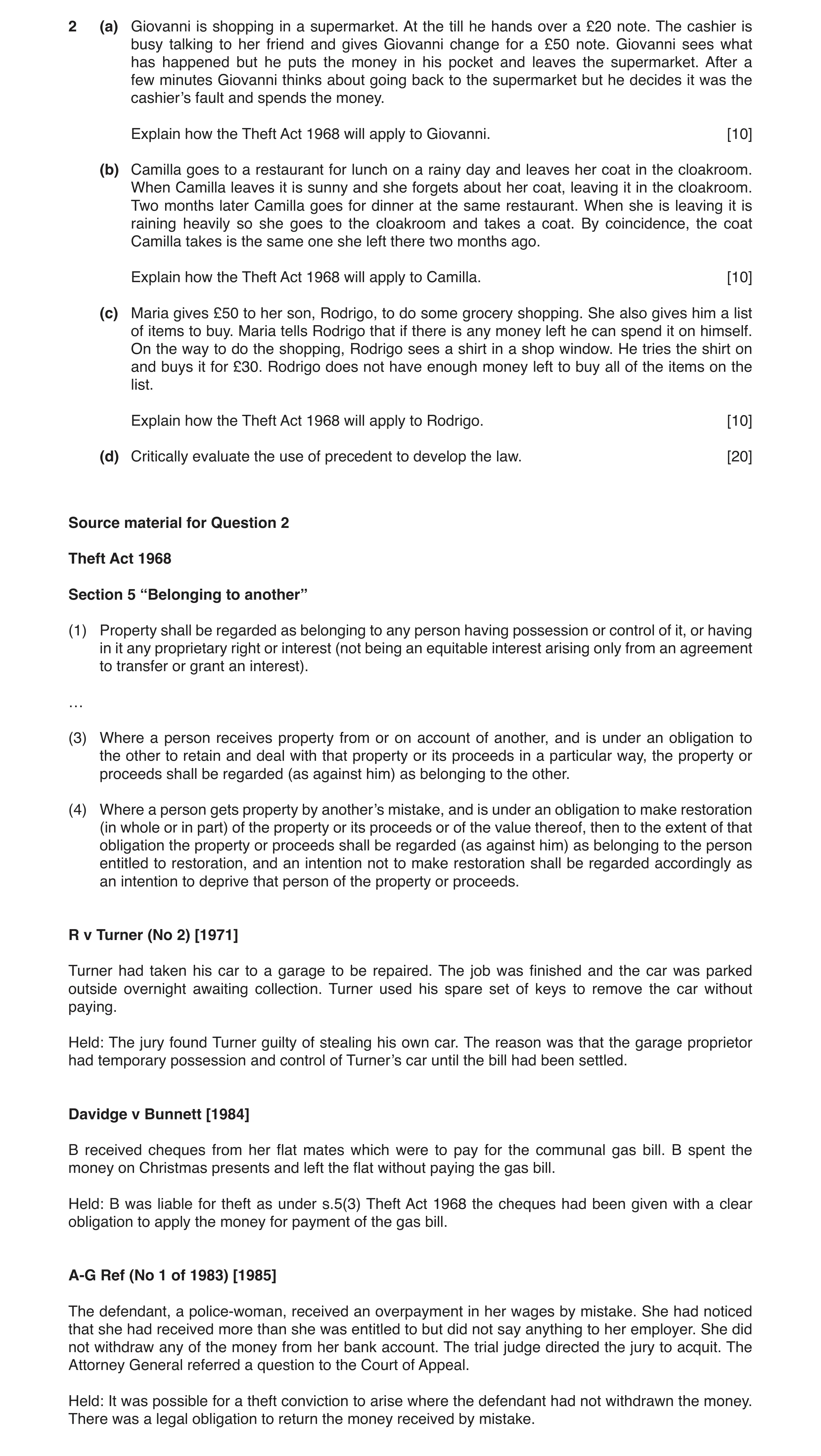
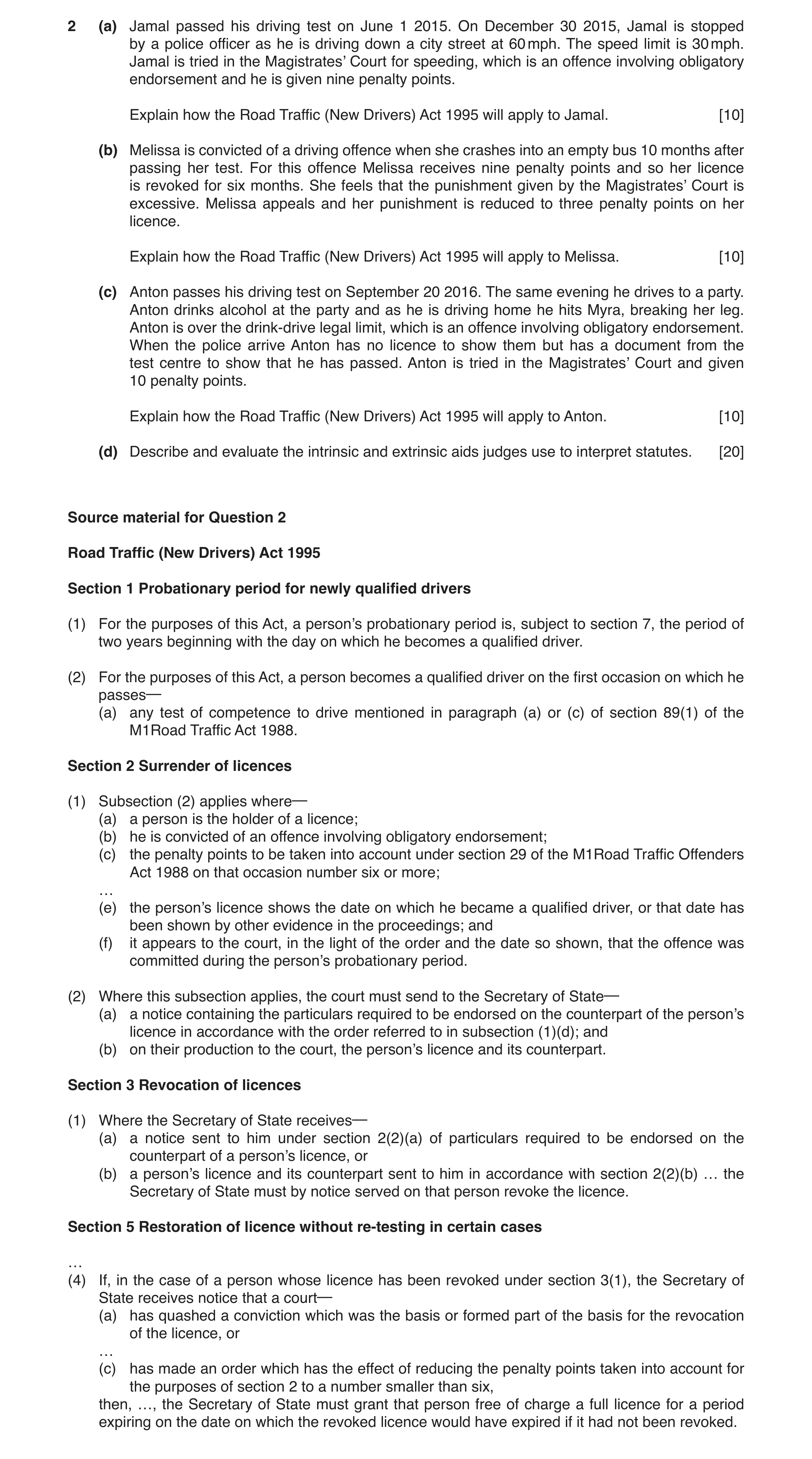
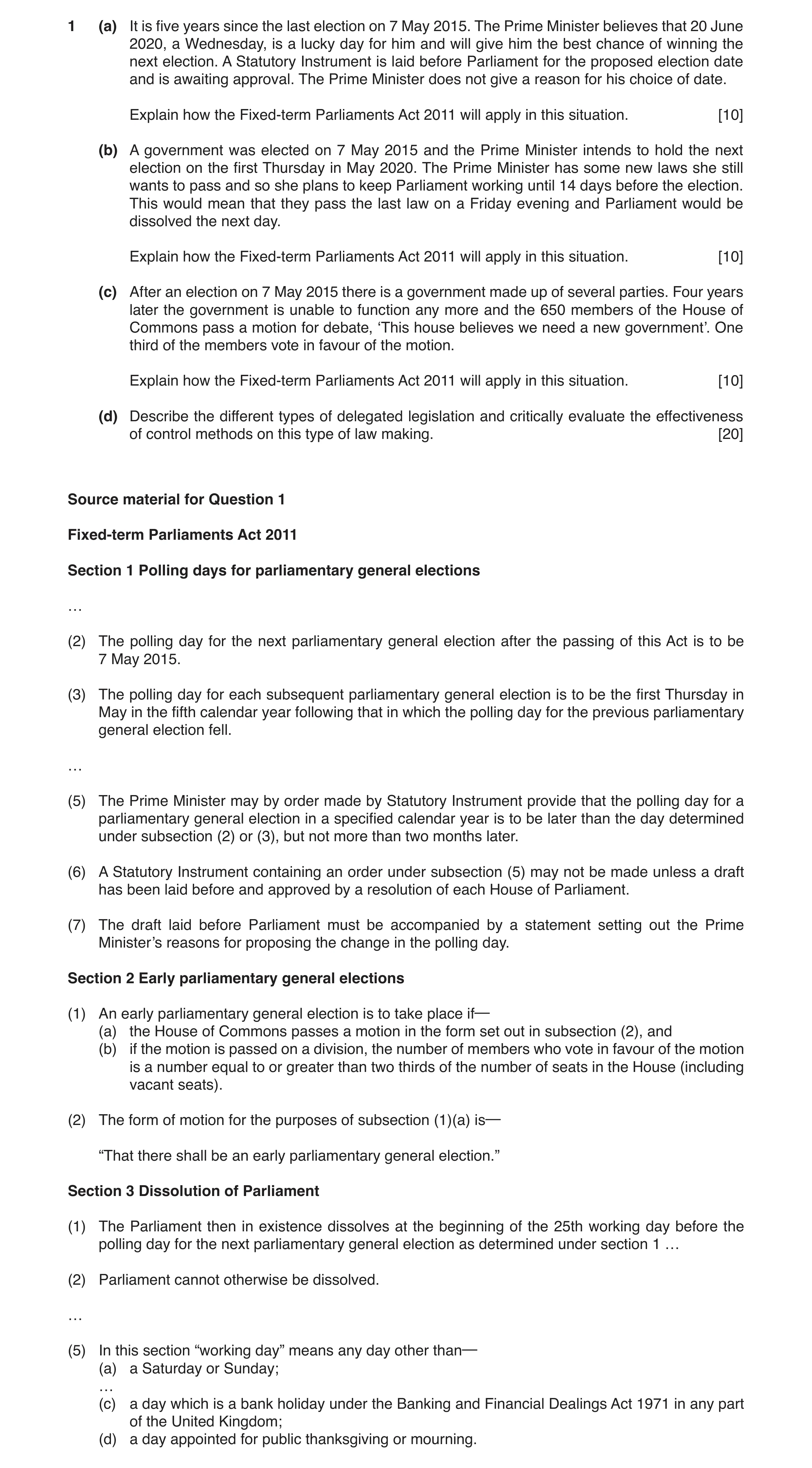
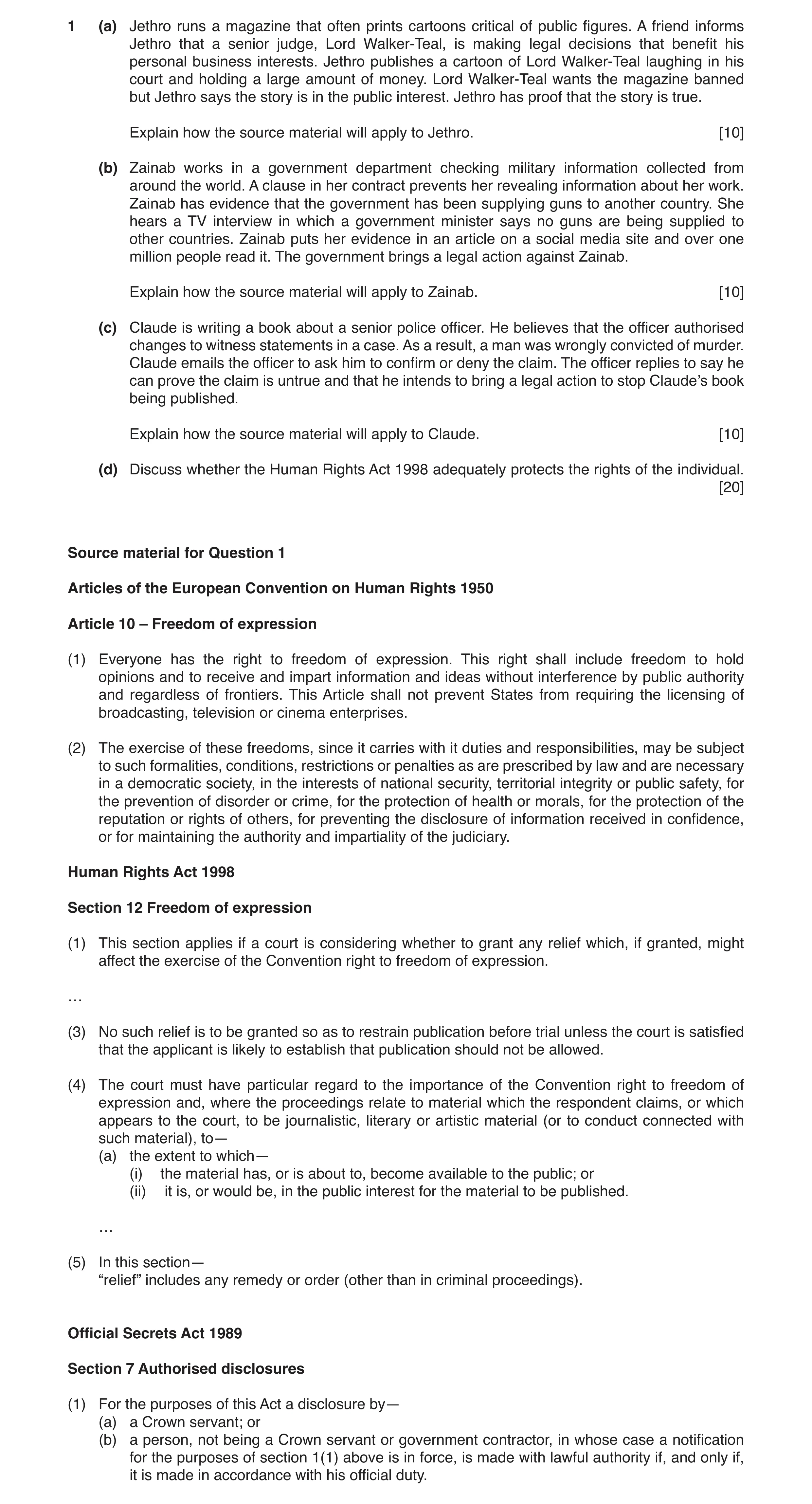
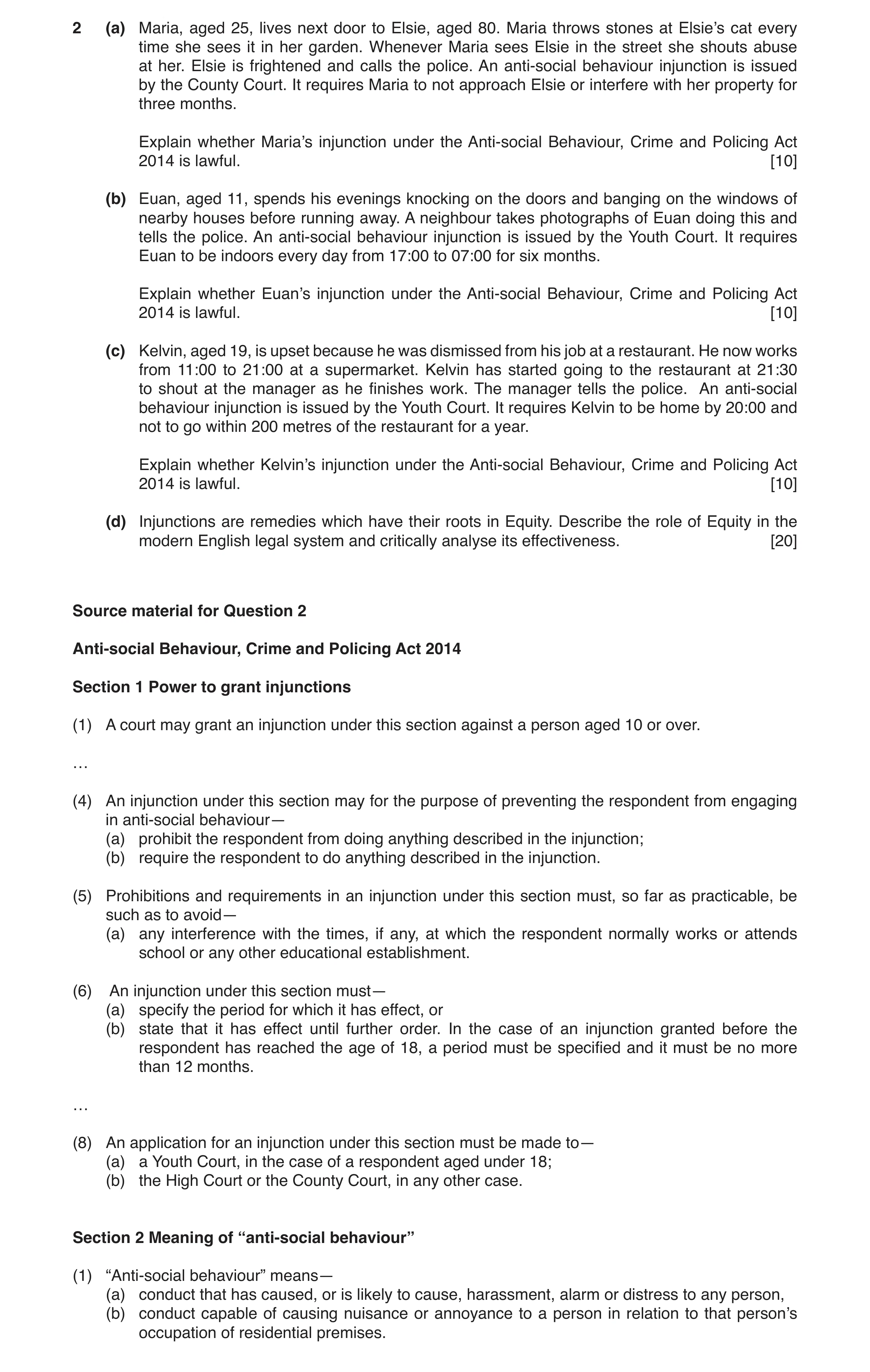
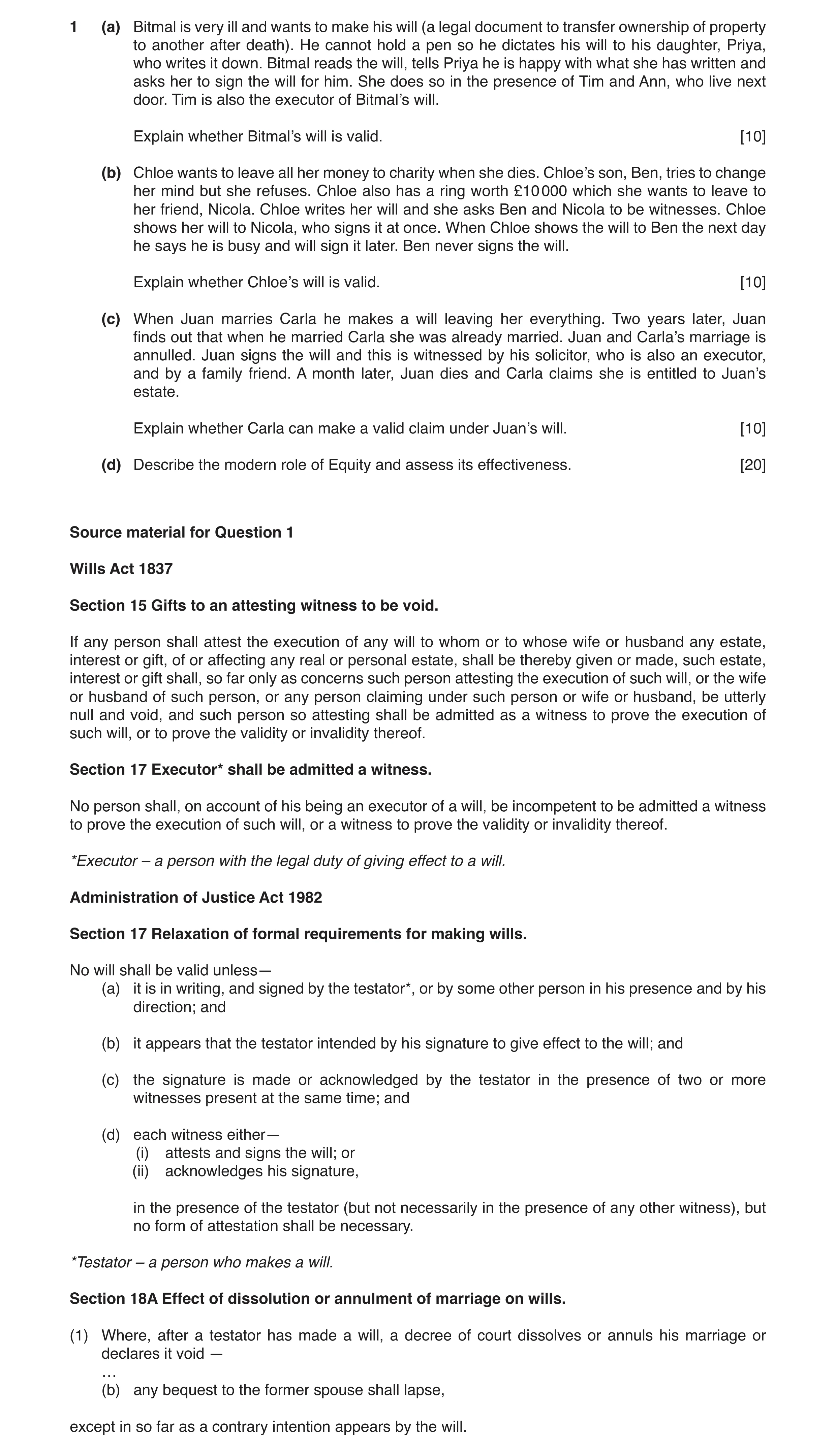
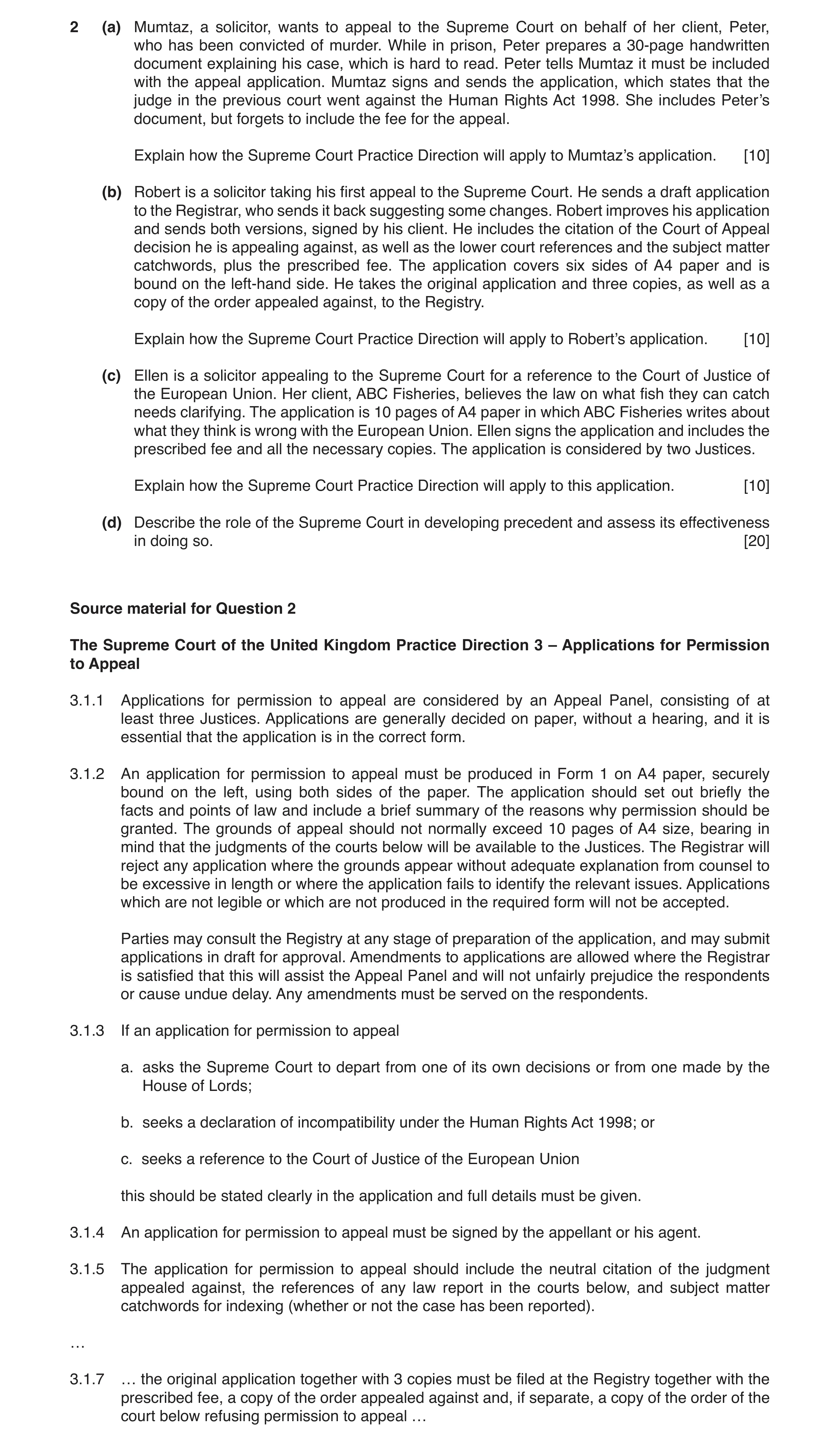
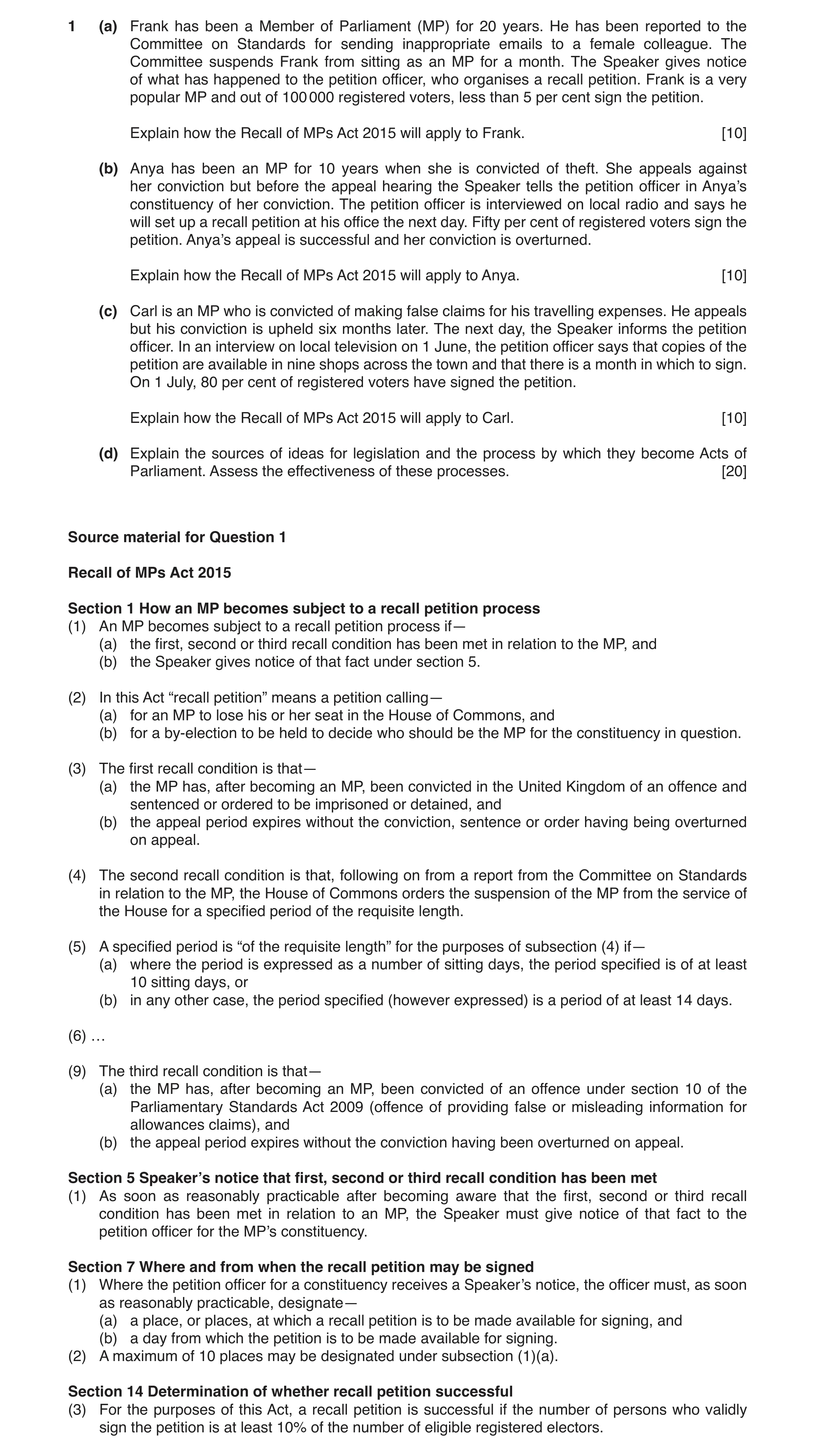
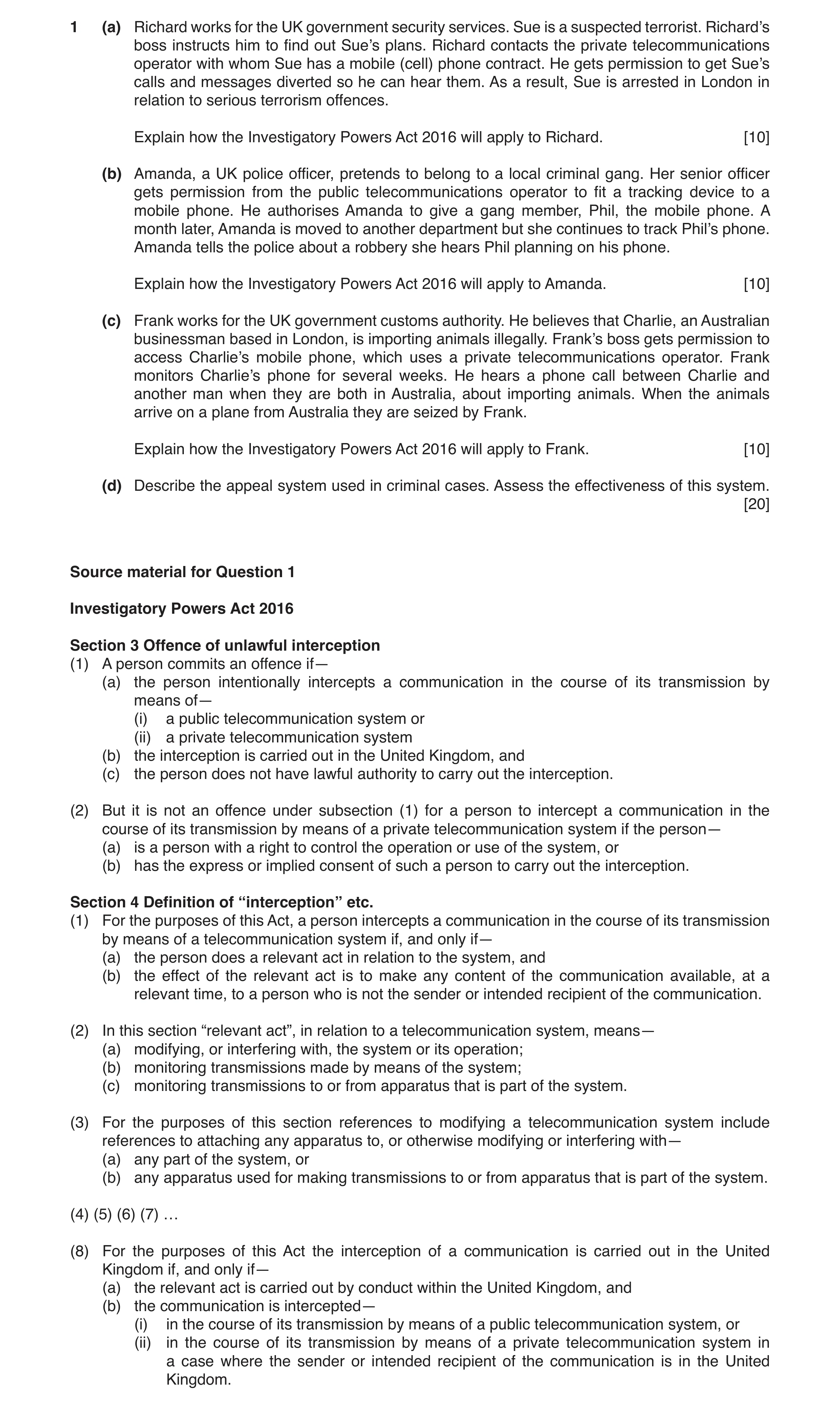
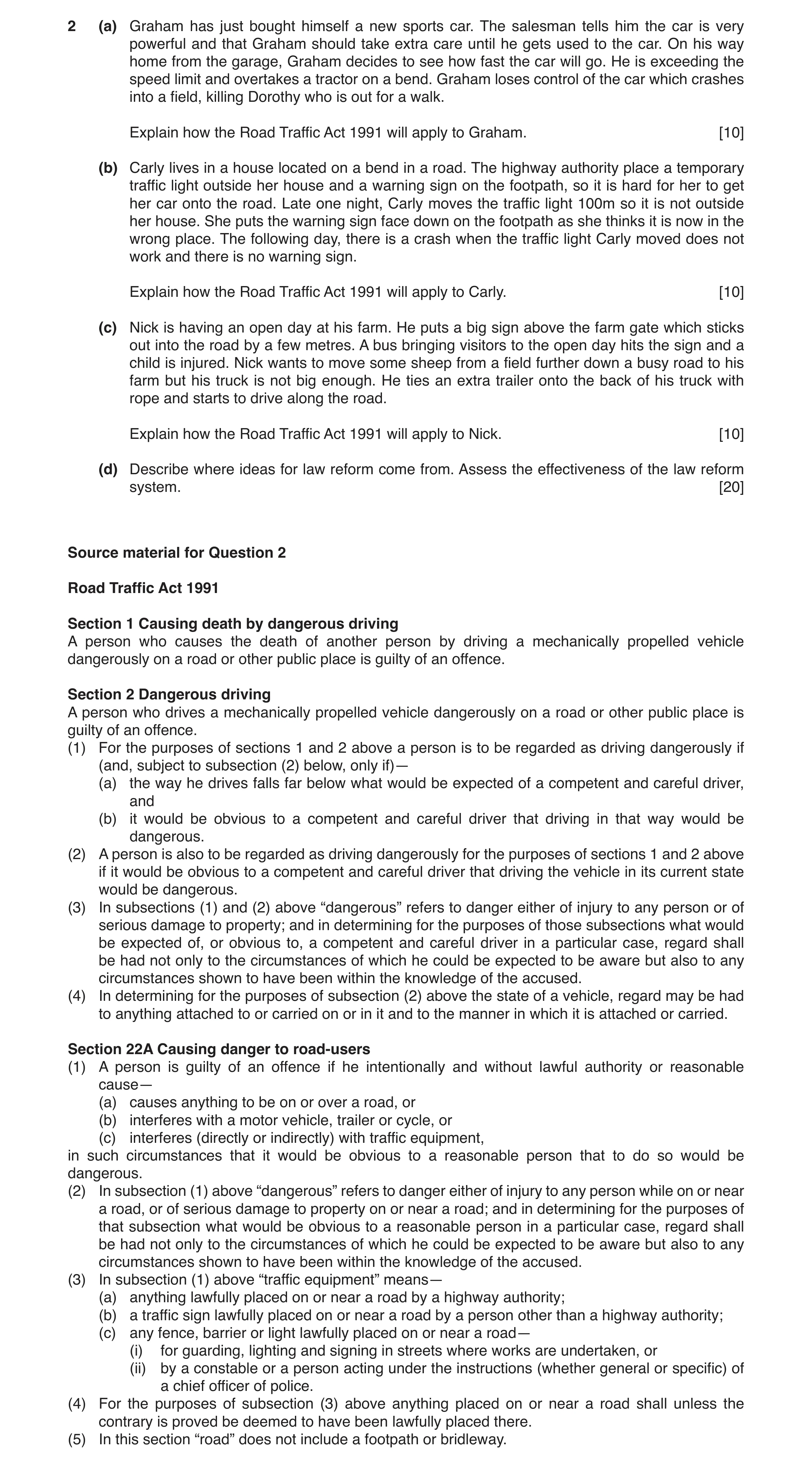
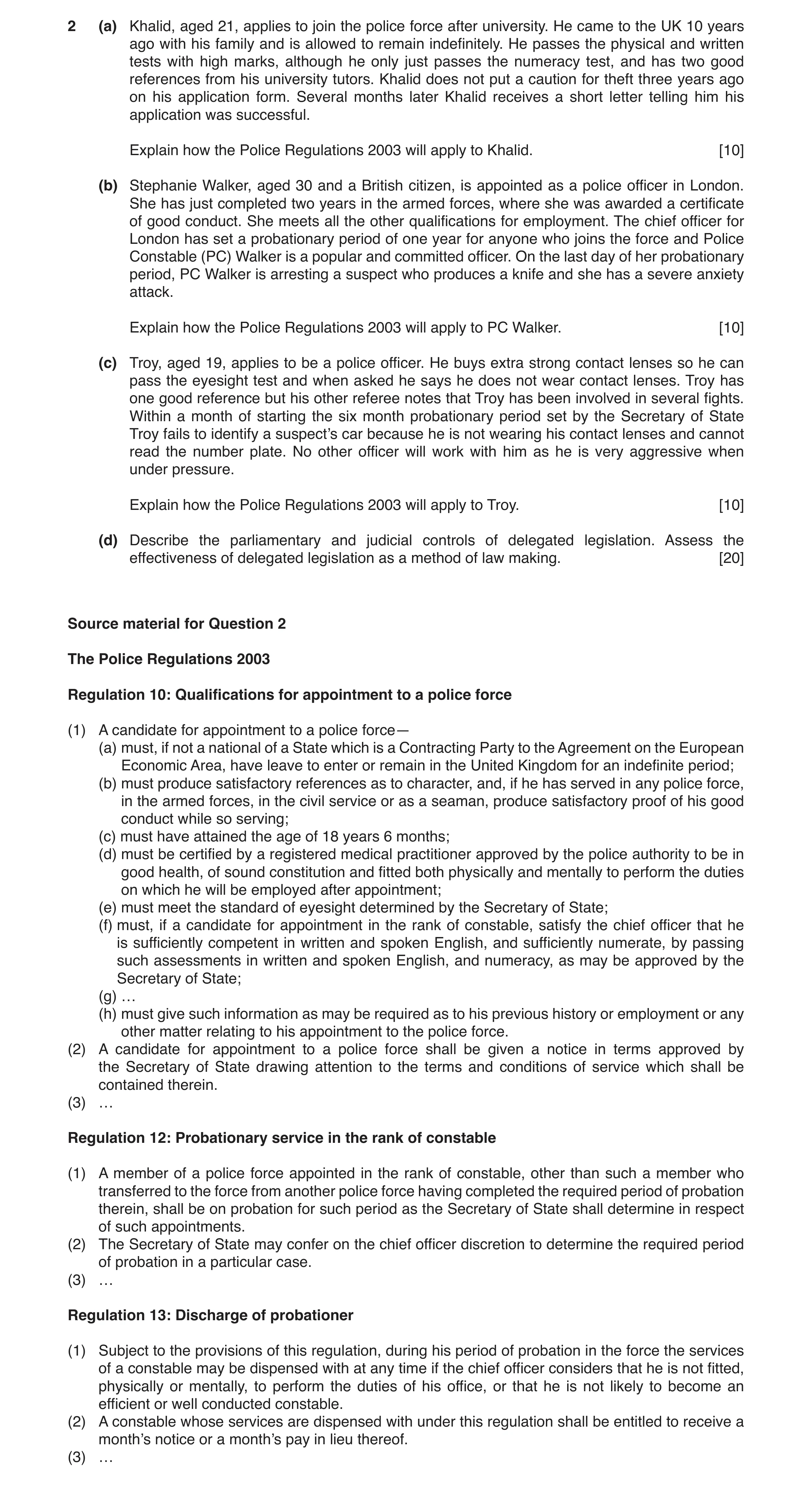
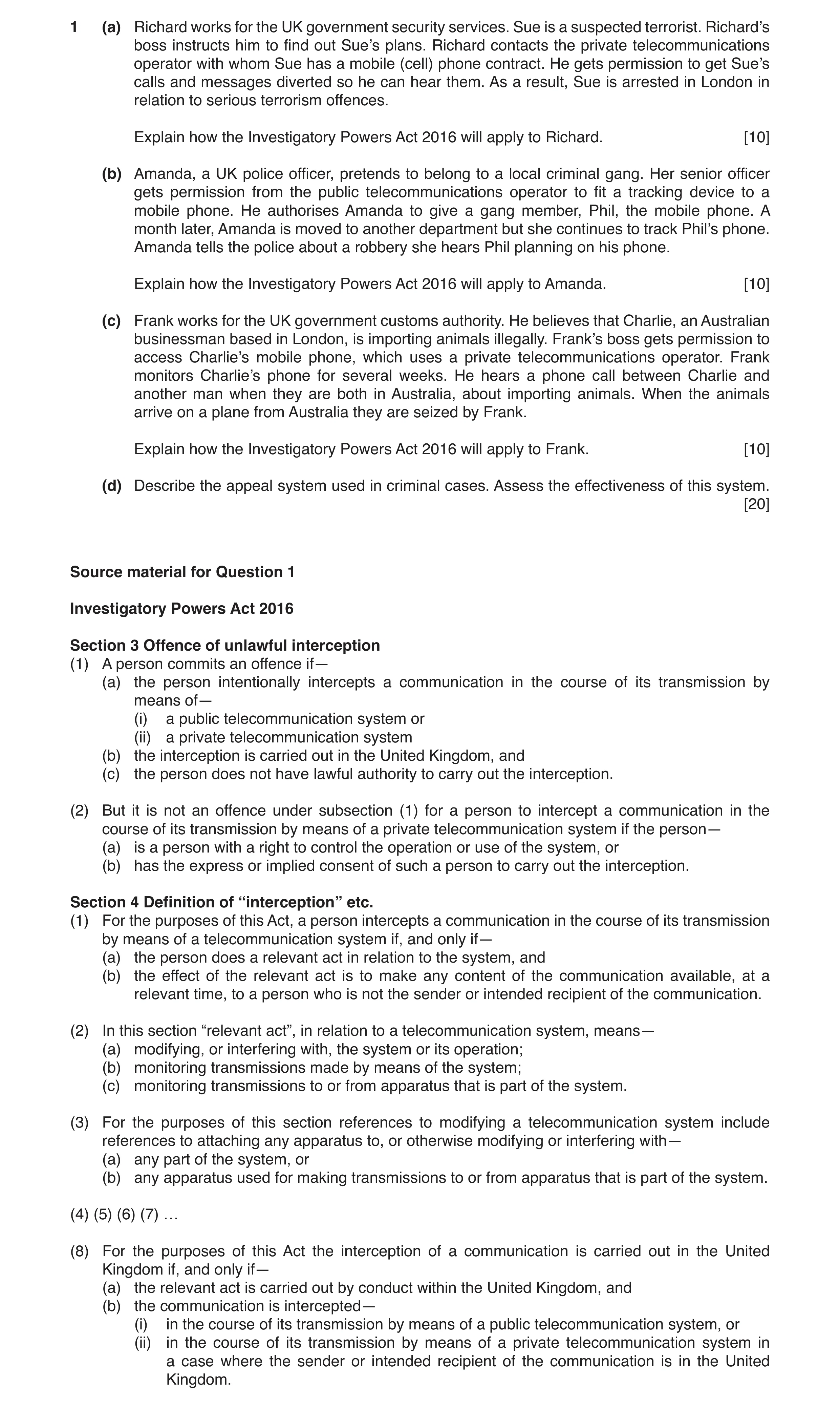
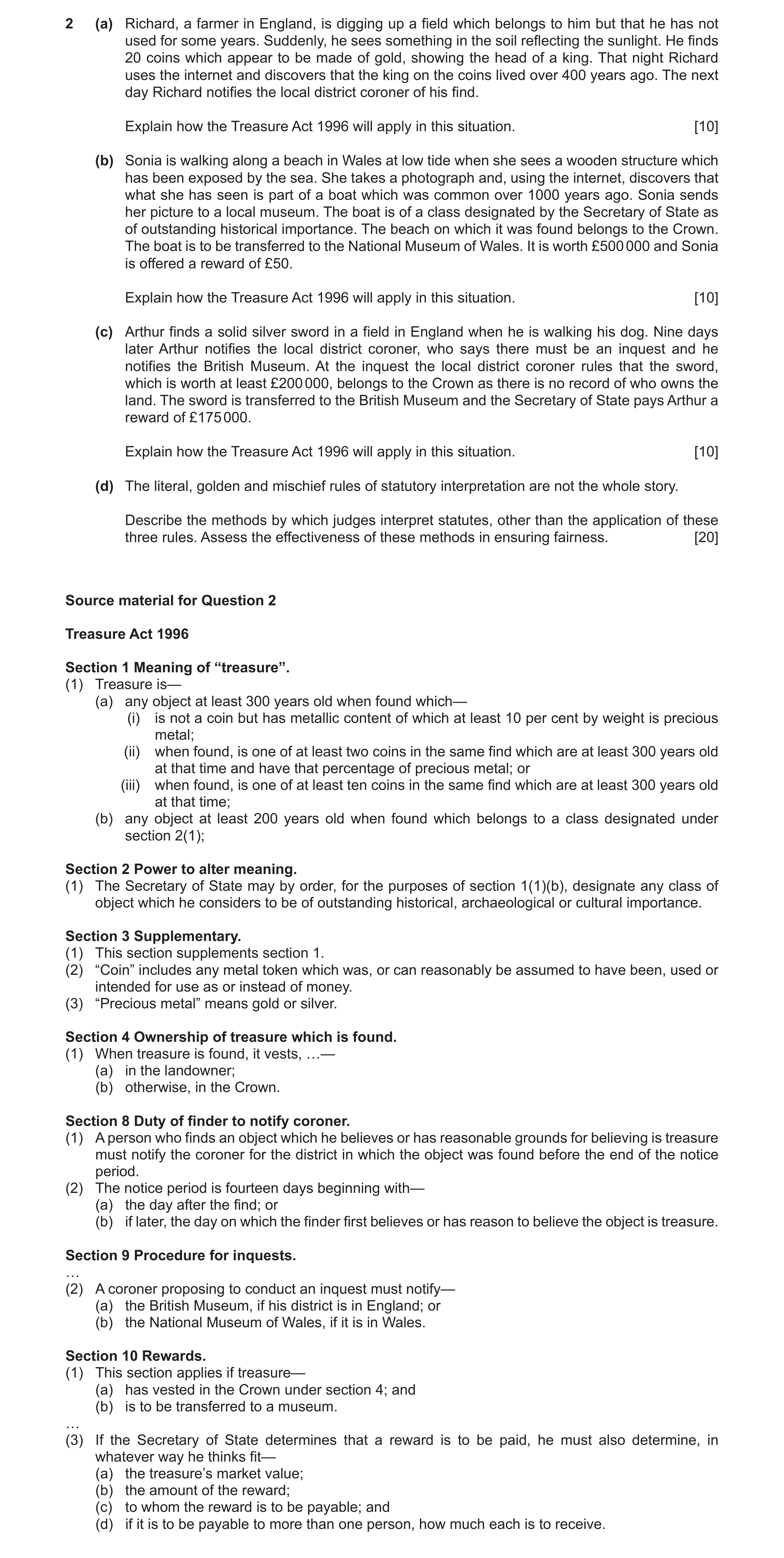
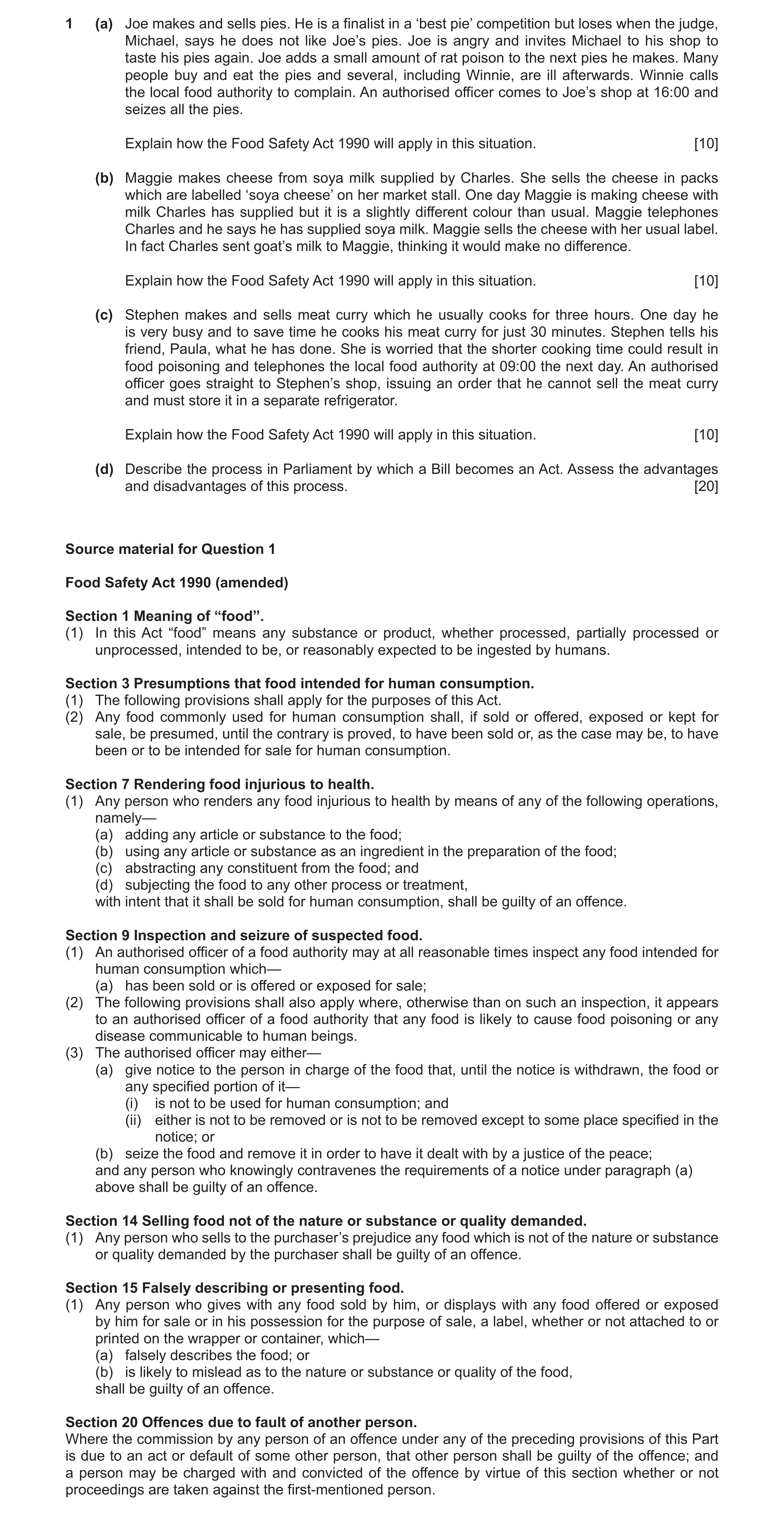
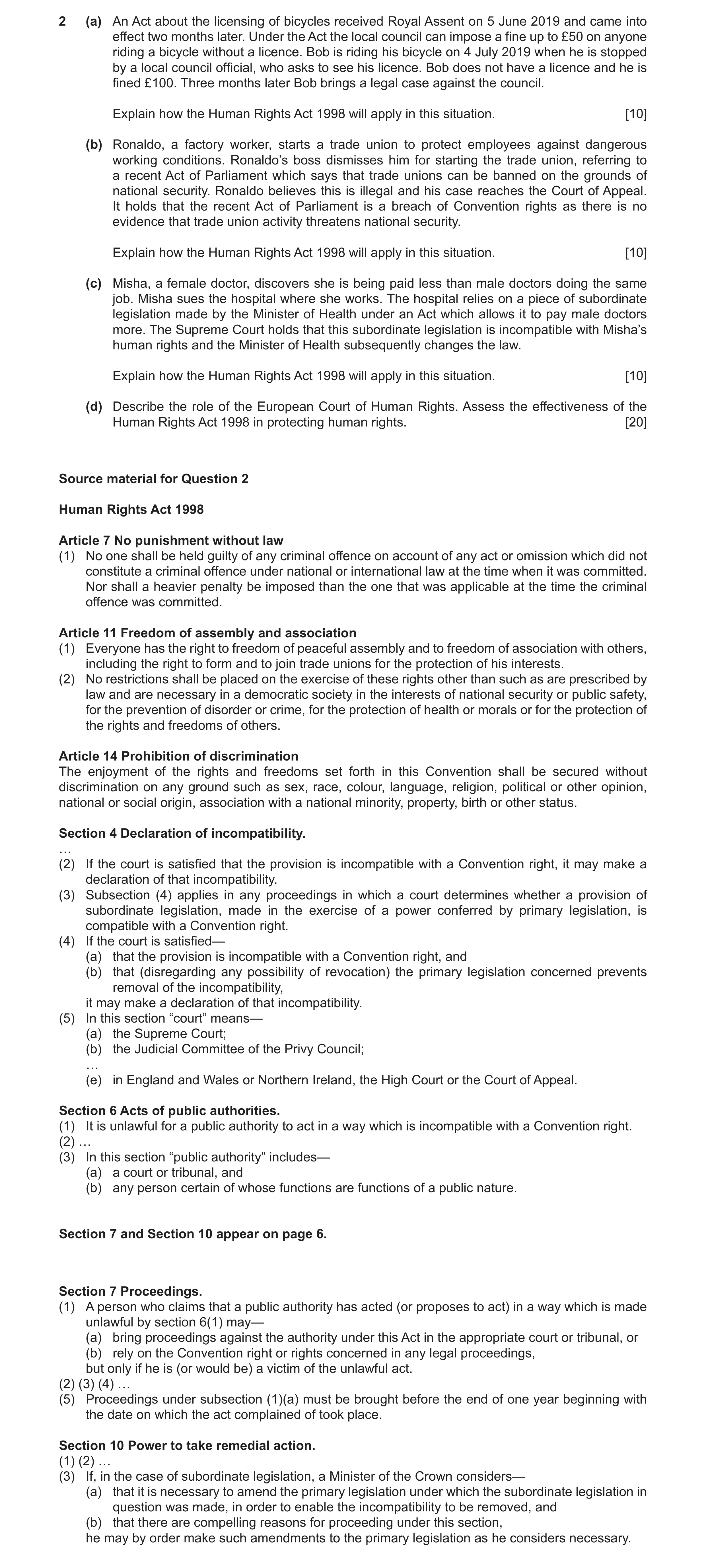
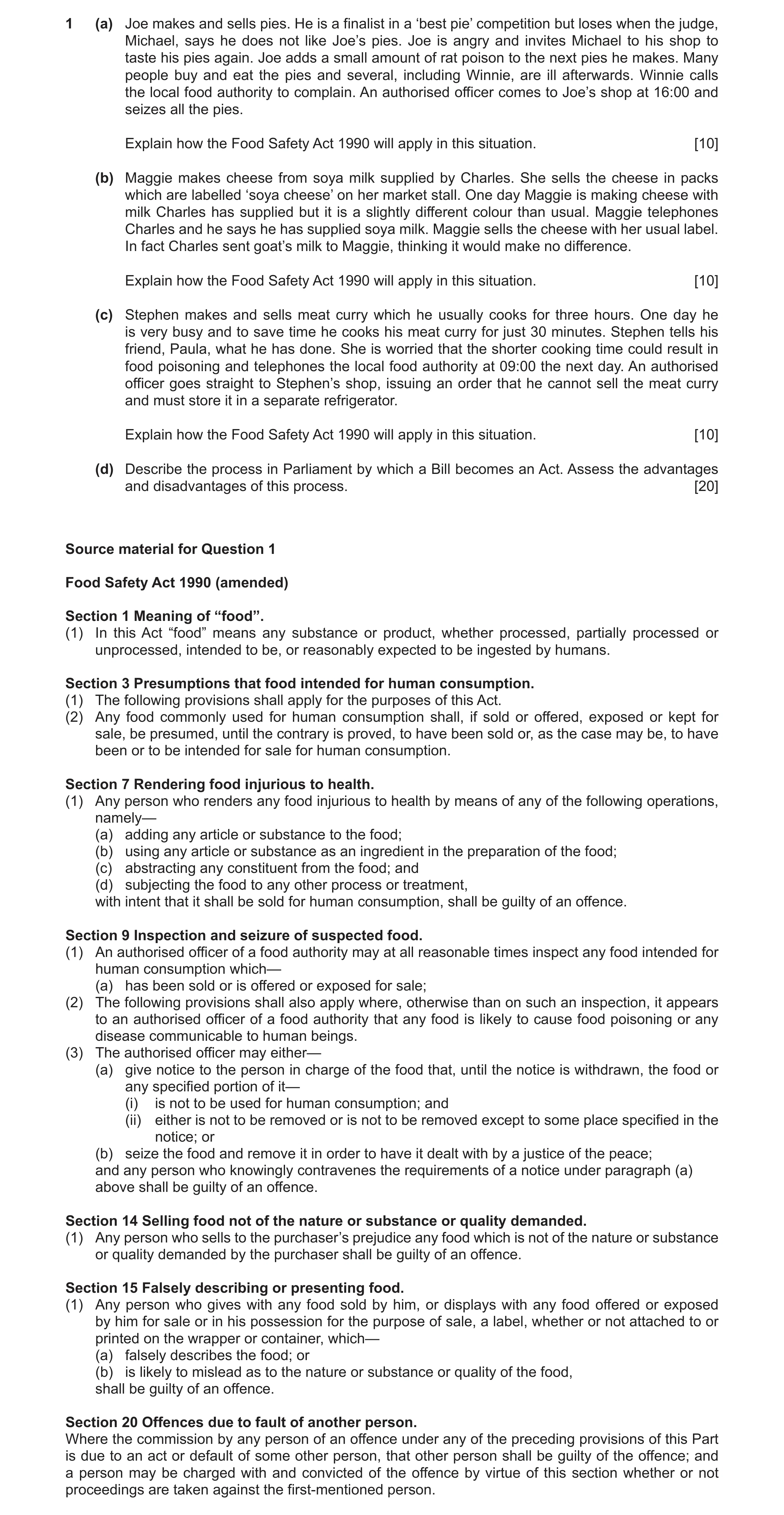
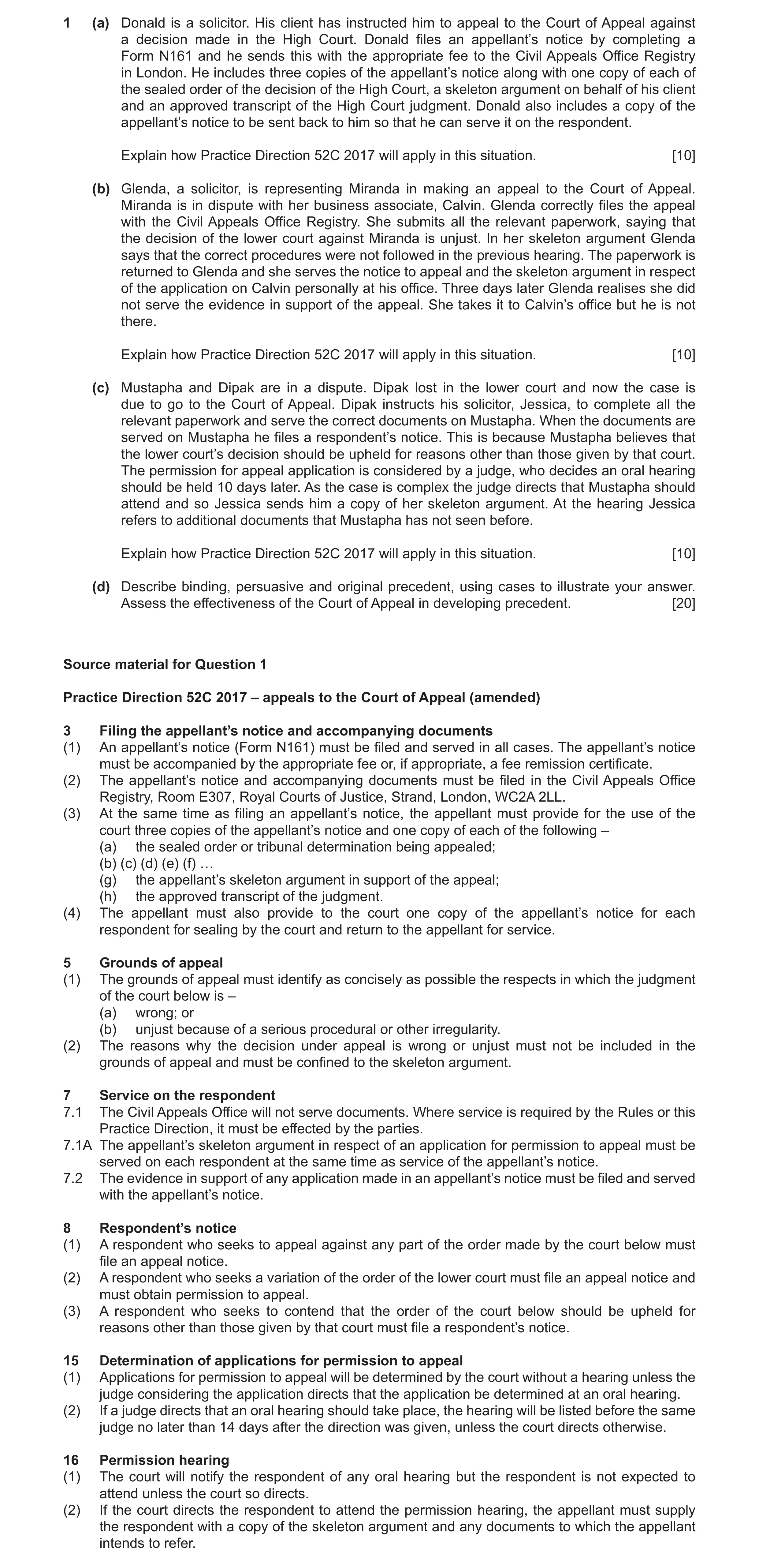
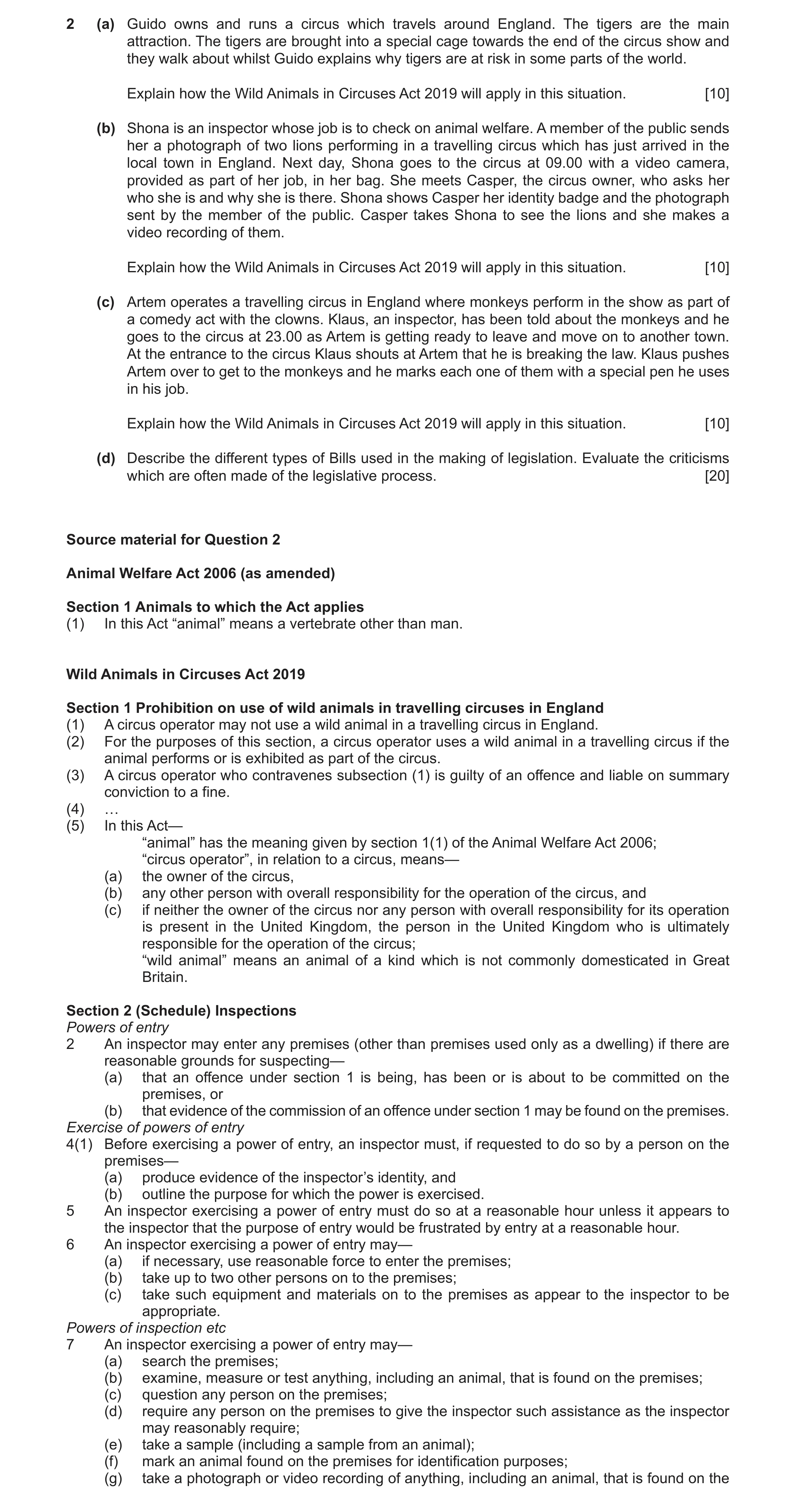
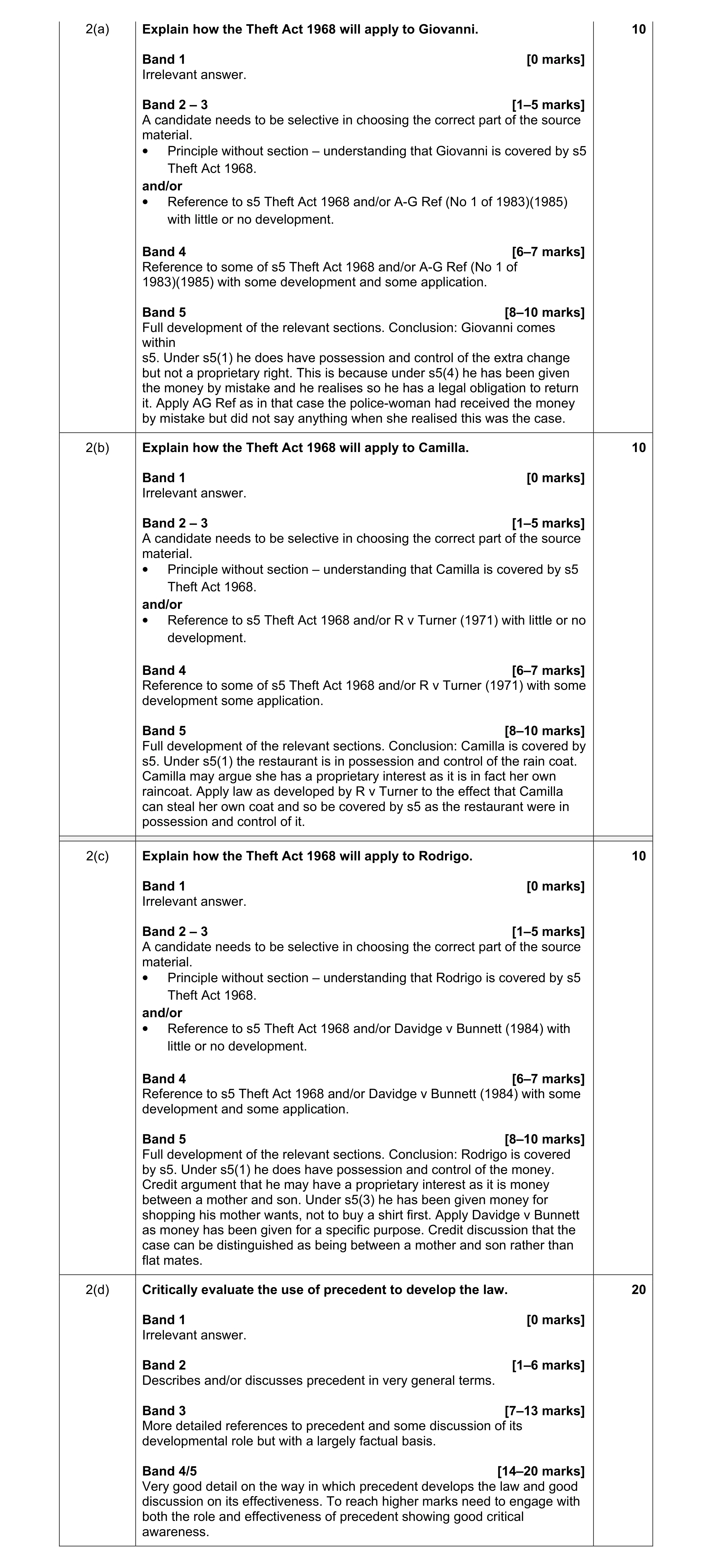 50
50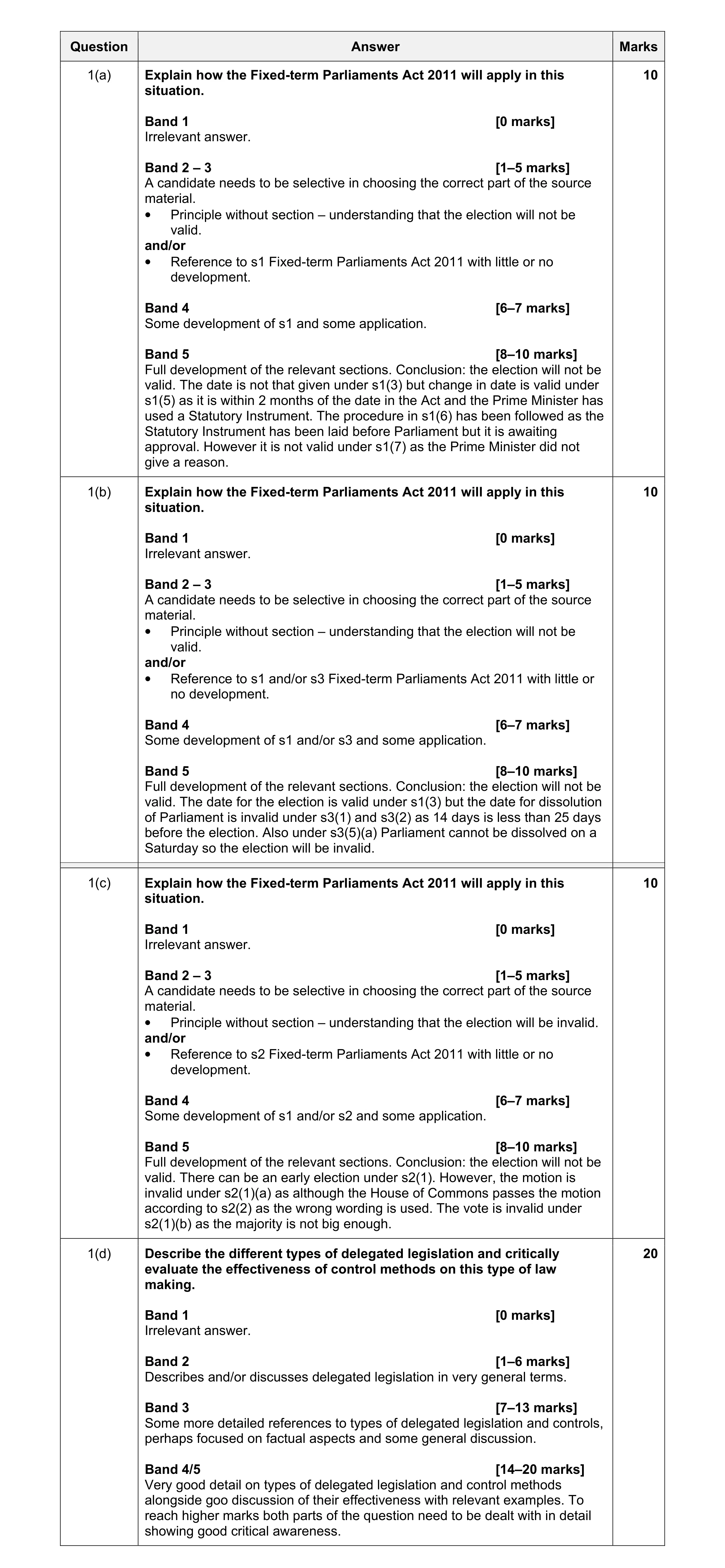 50
50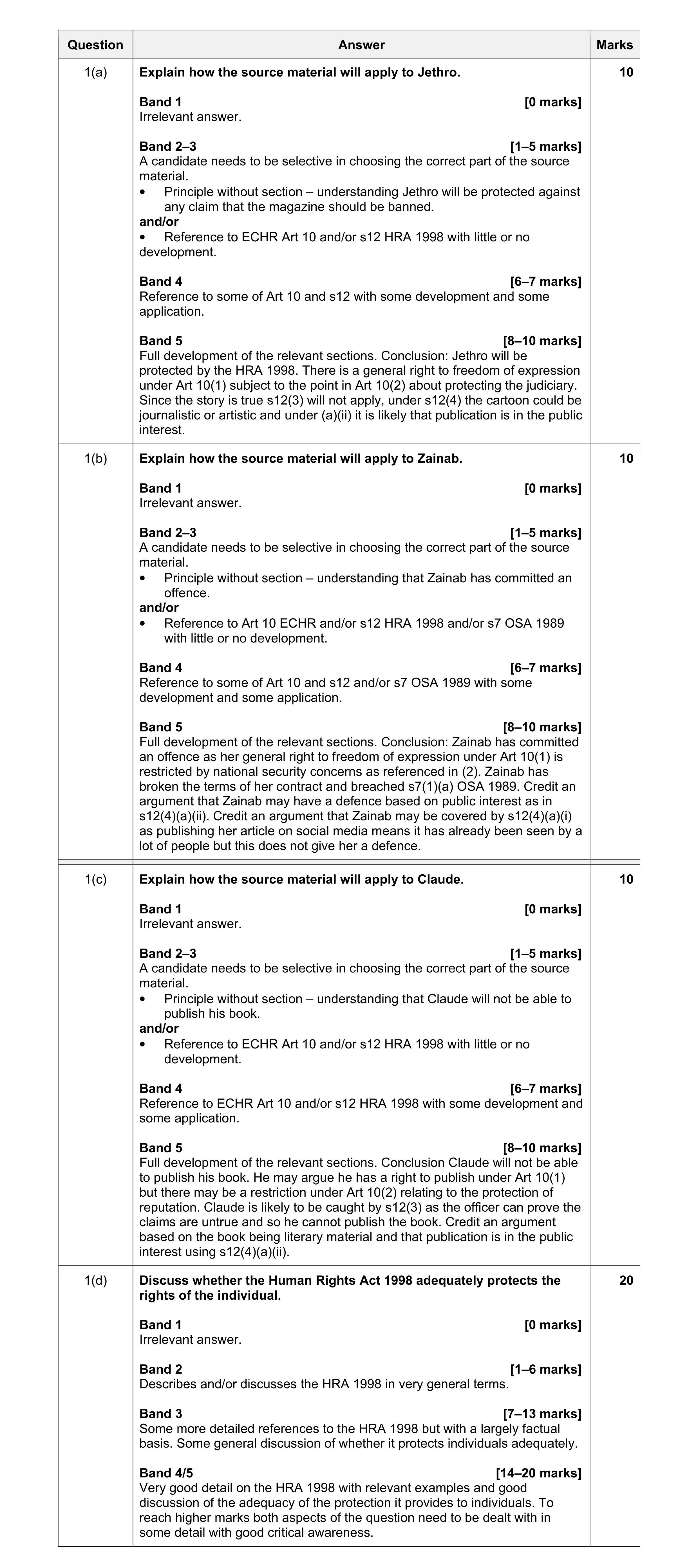 50
50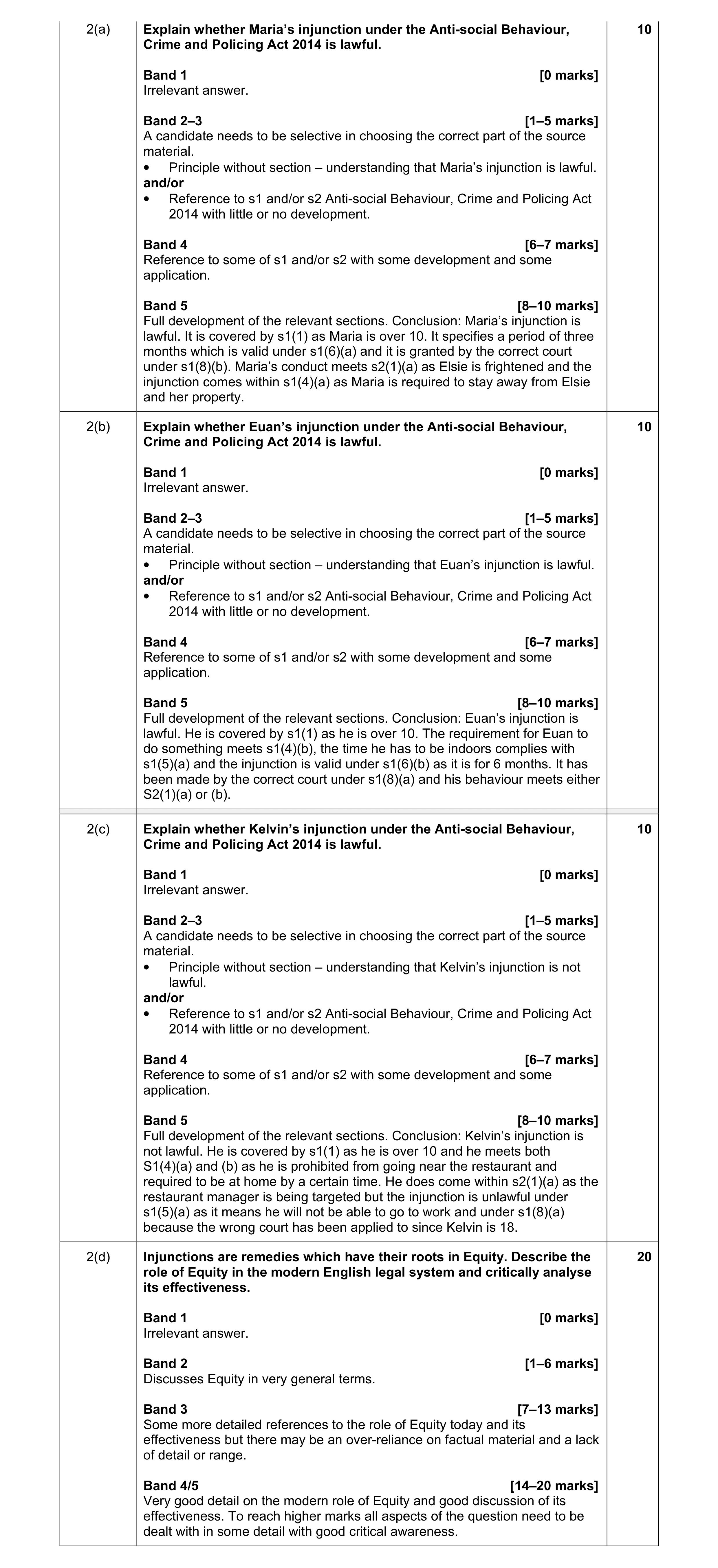 50
50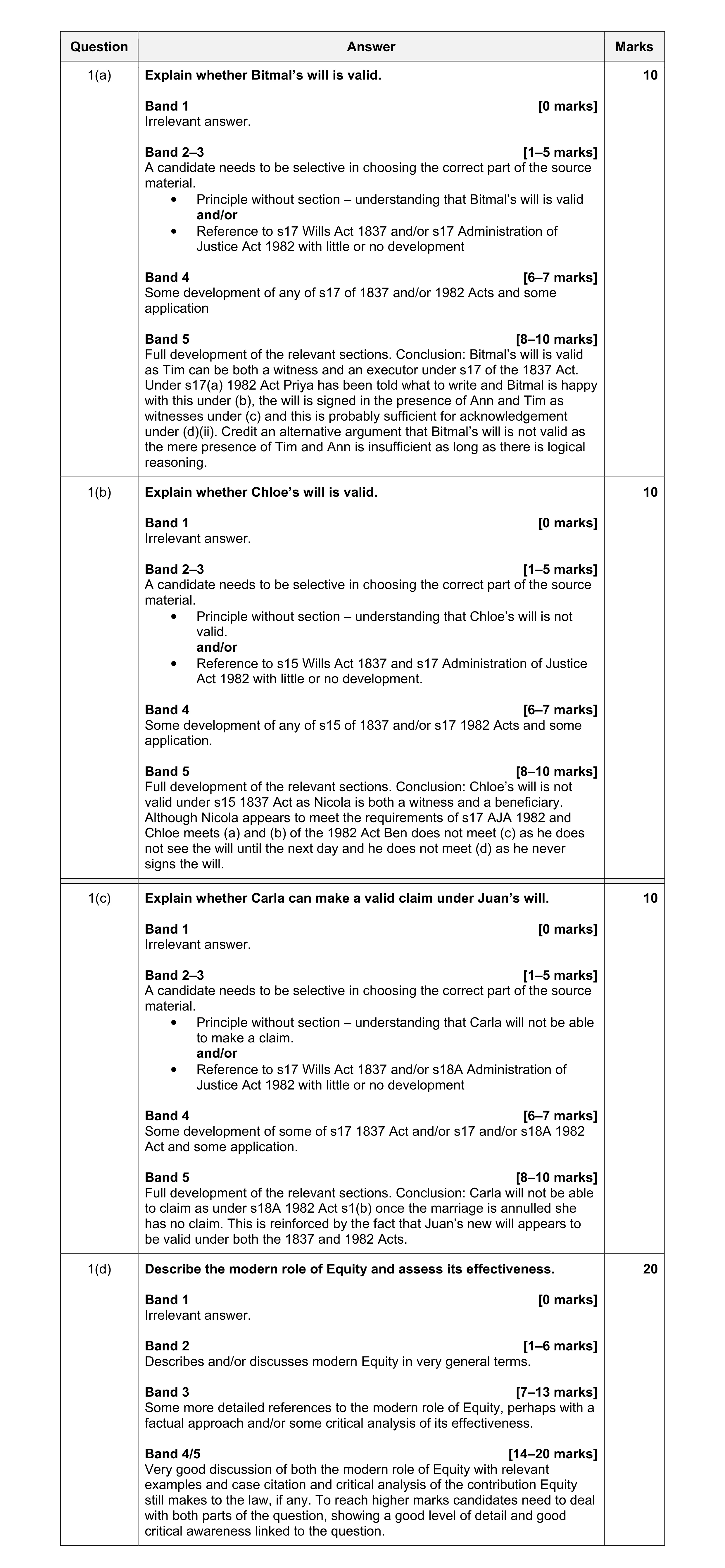 50
50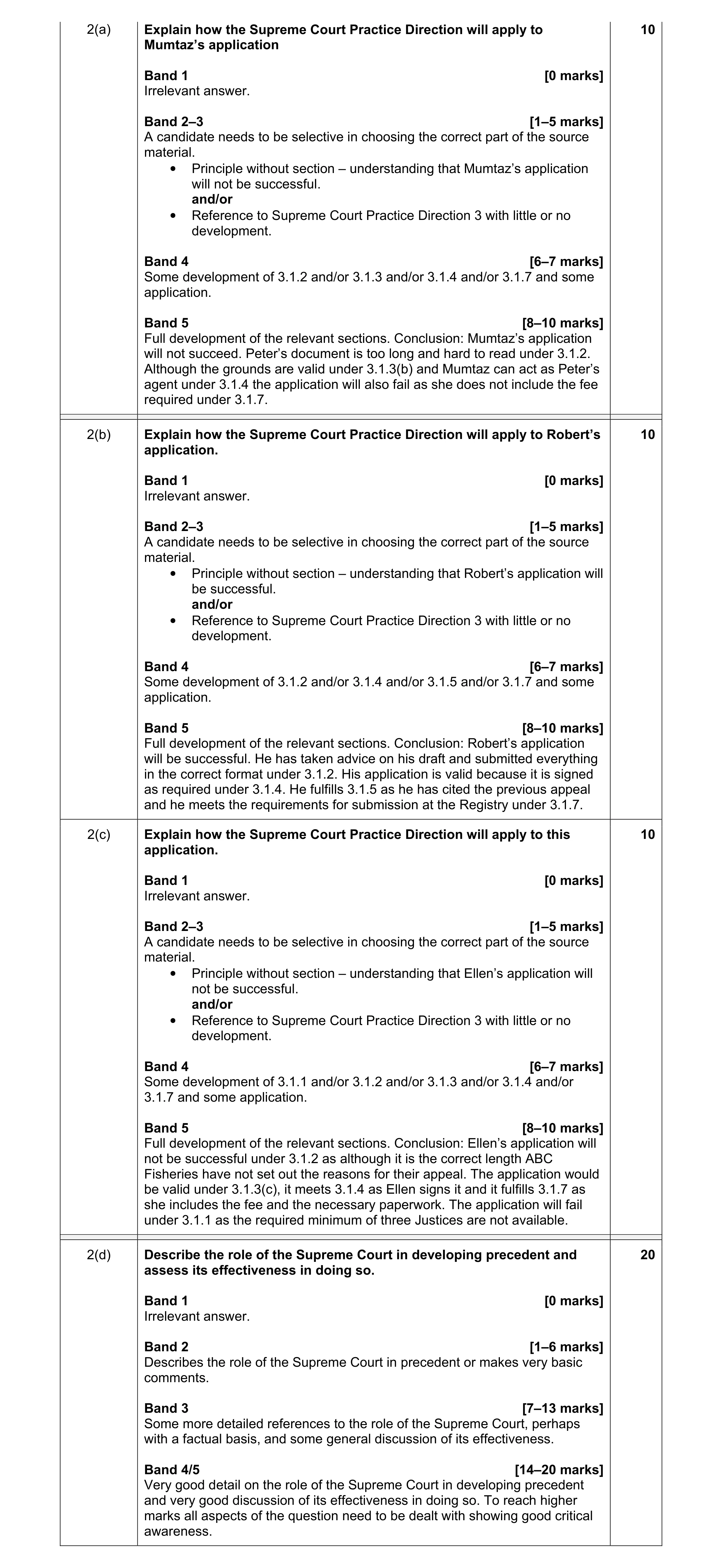 50
50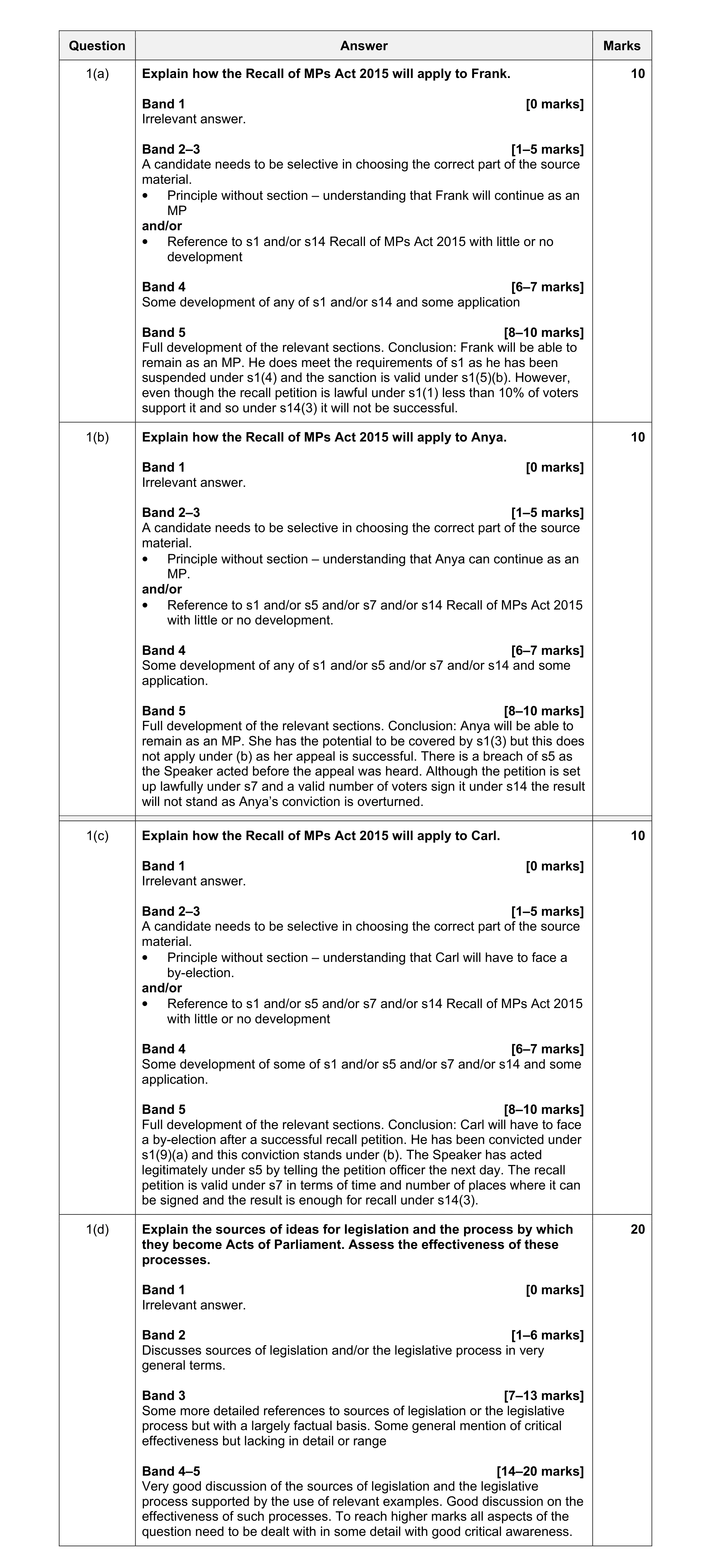 50
50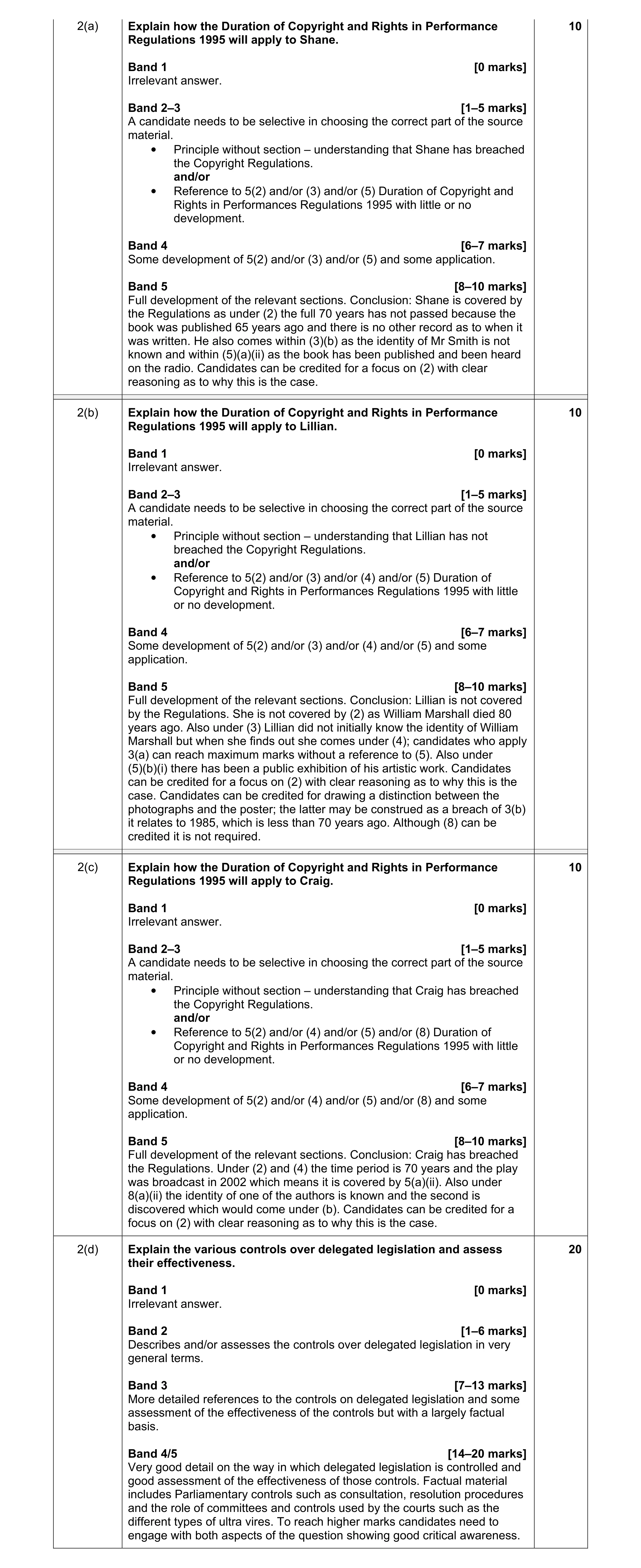 50
50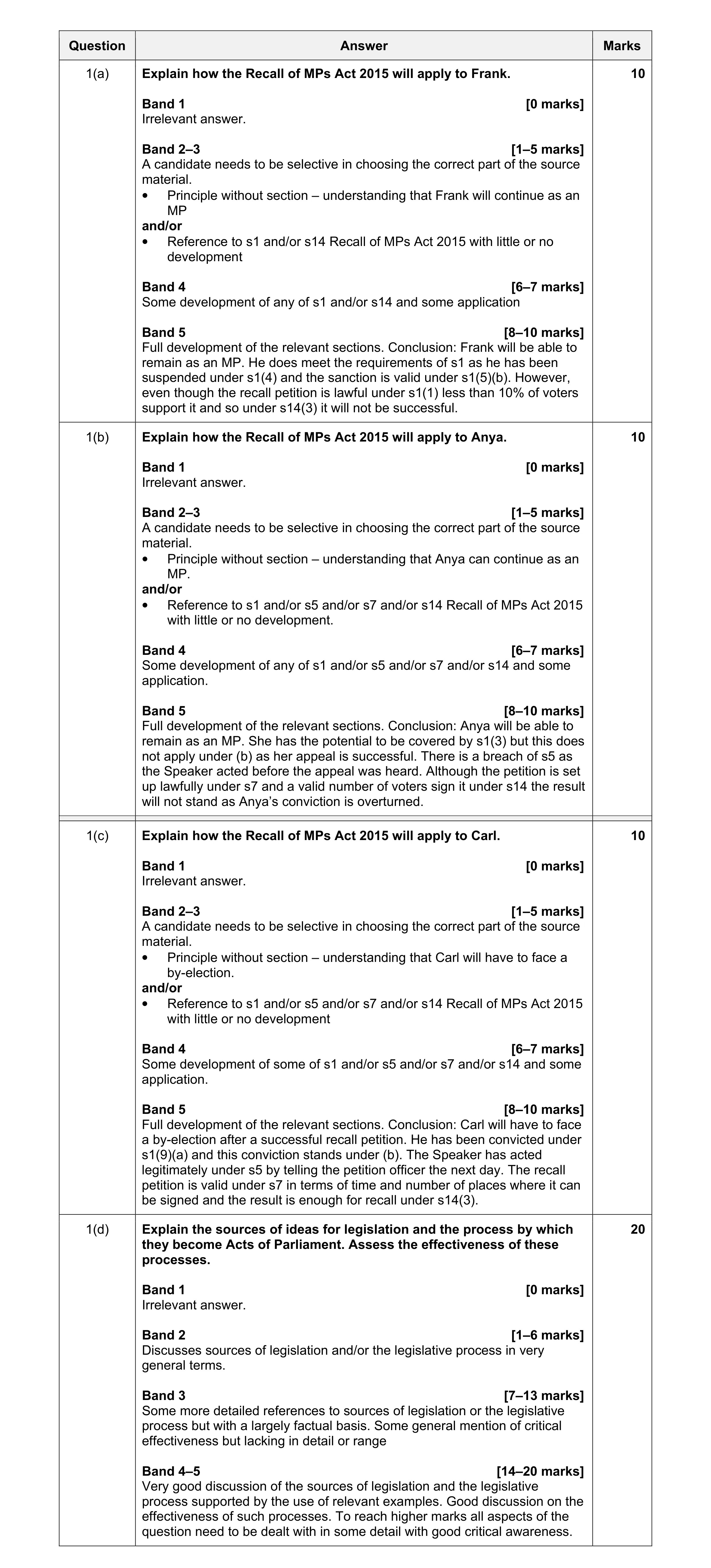 50
50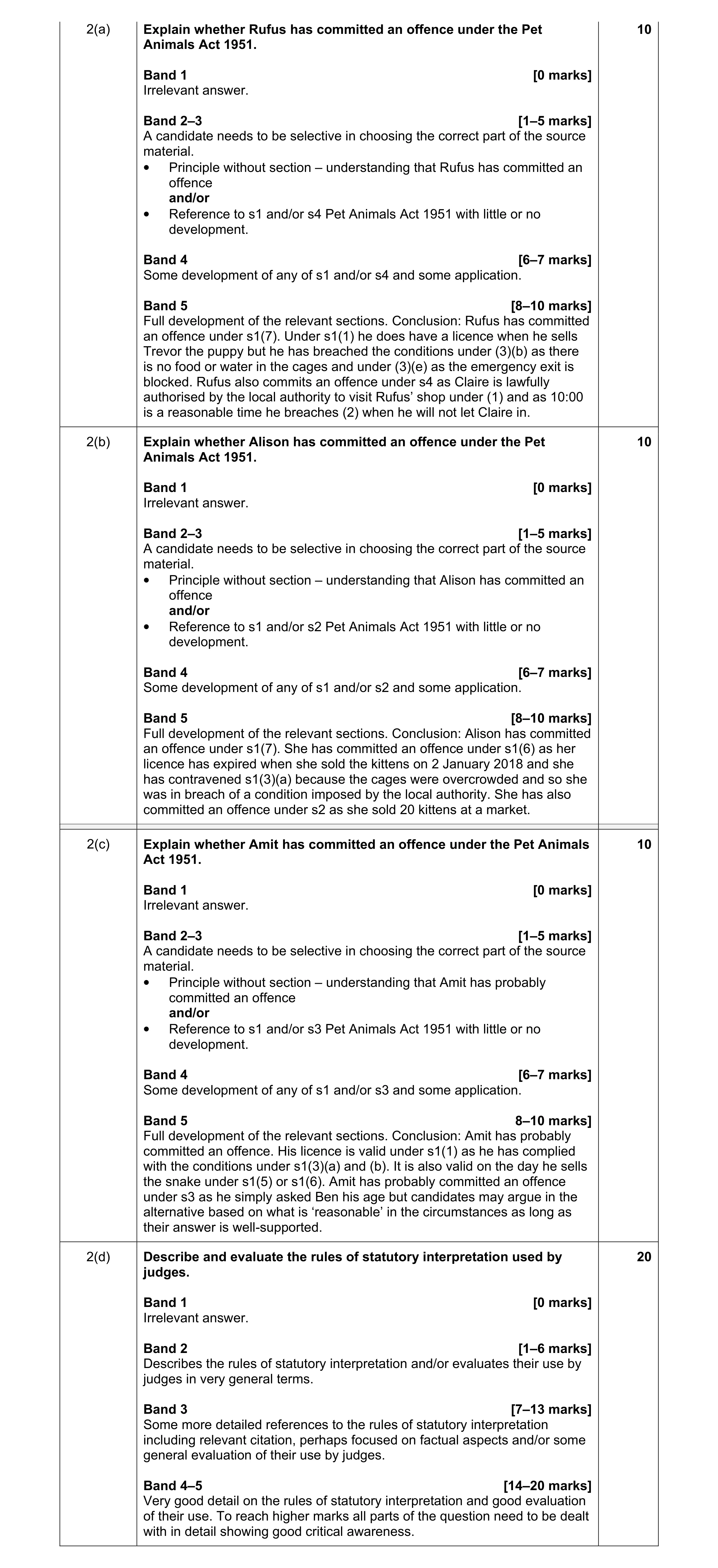 50
50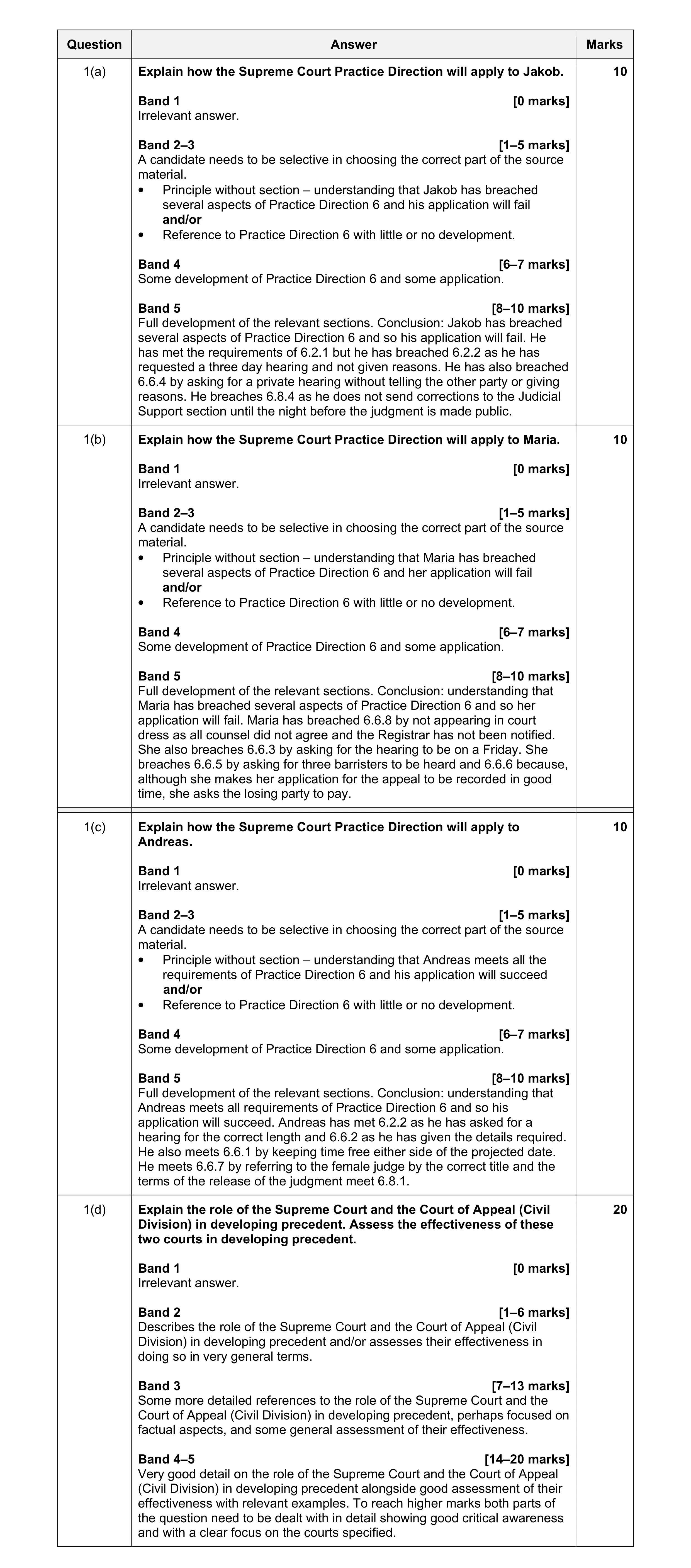 50
50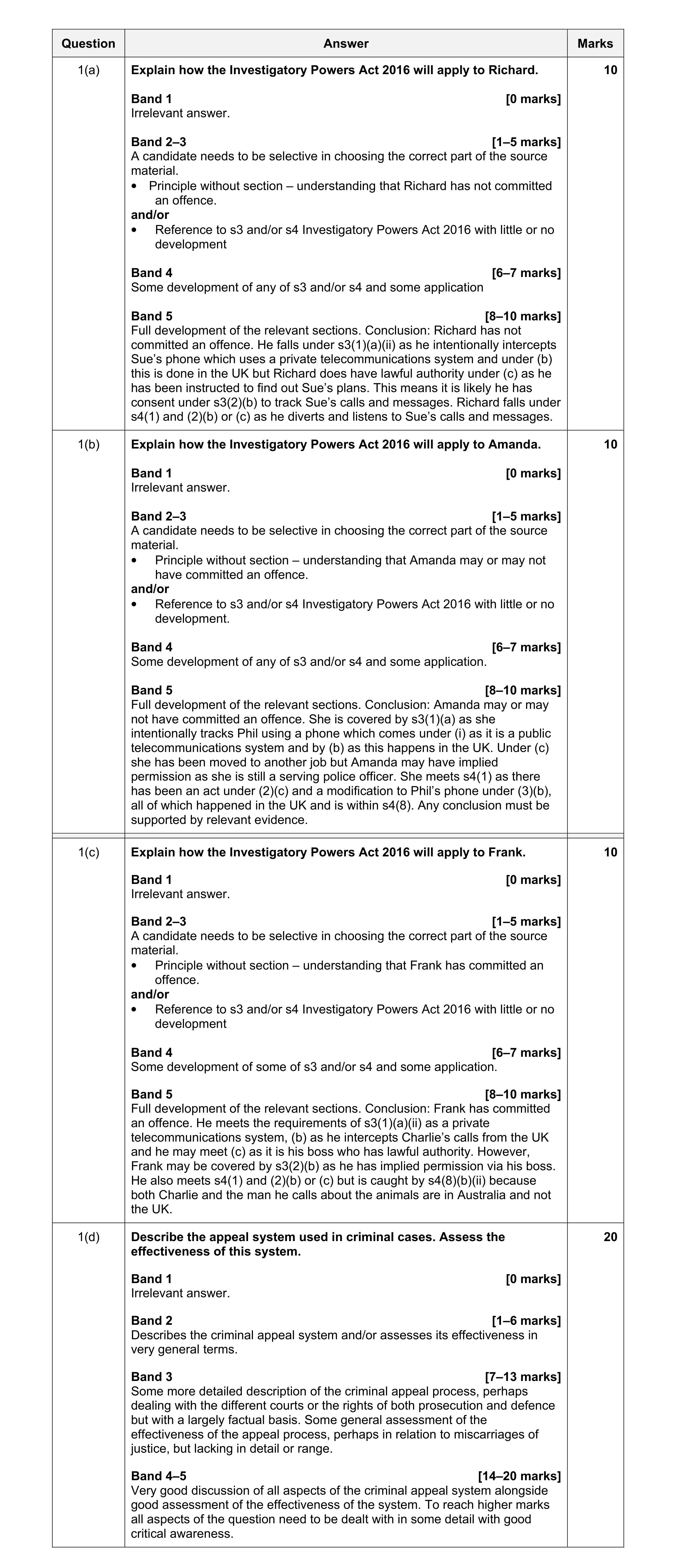 50
50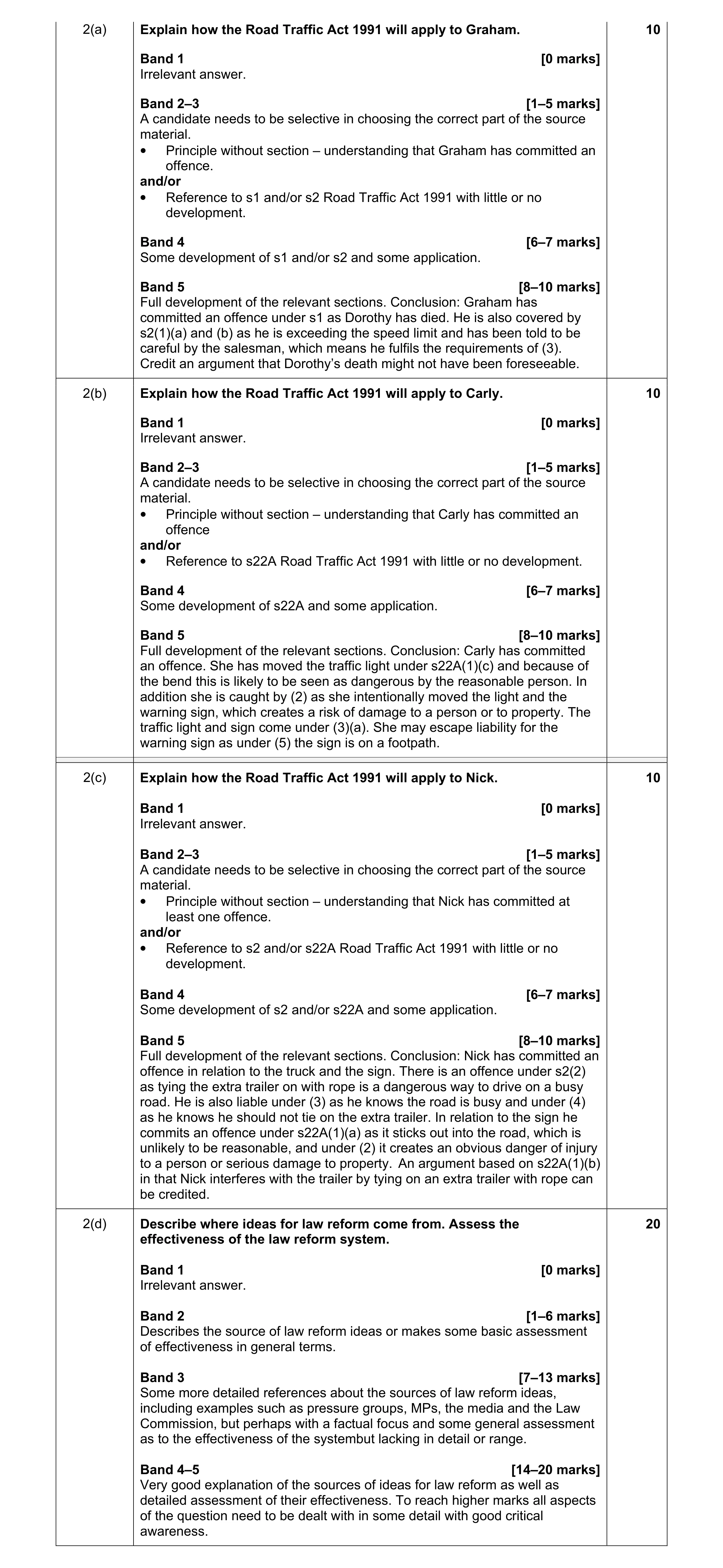 50
50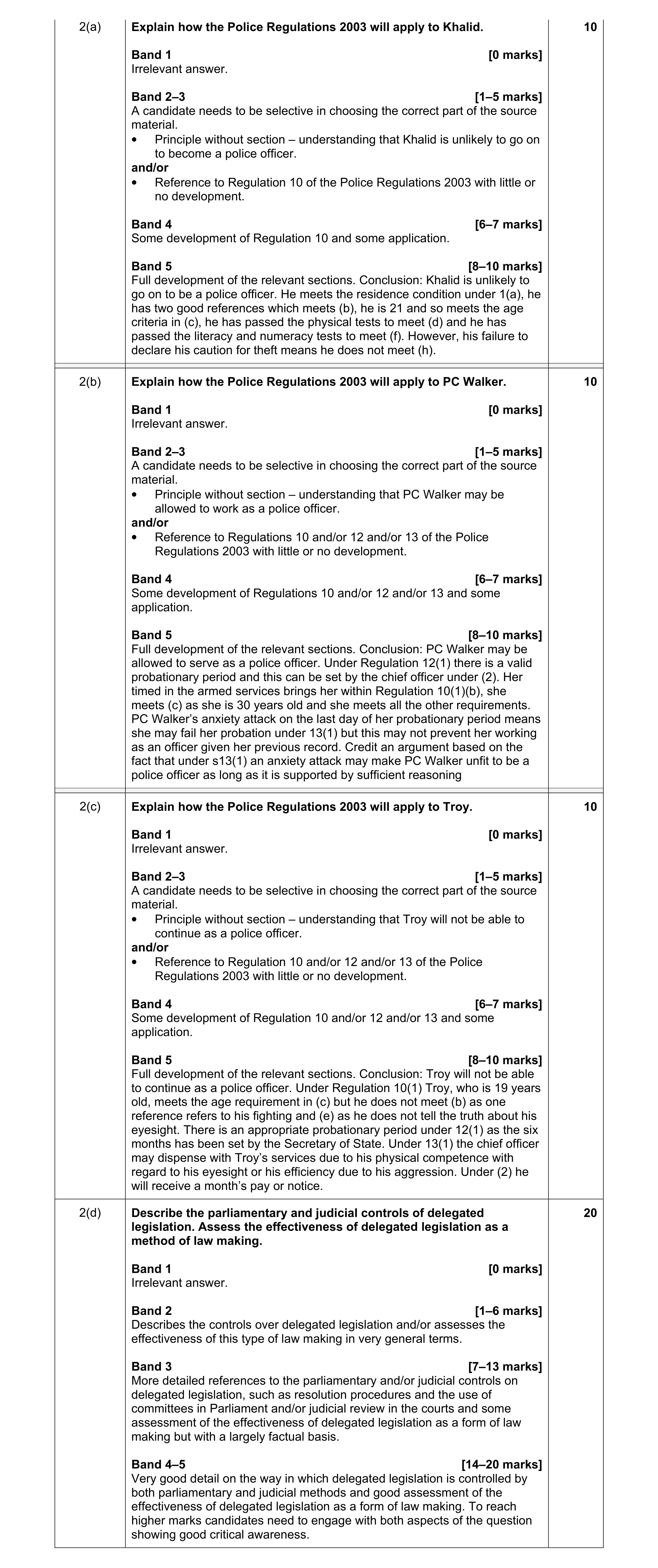 50
50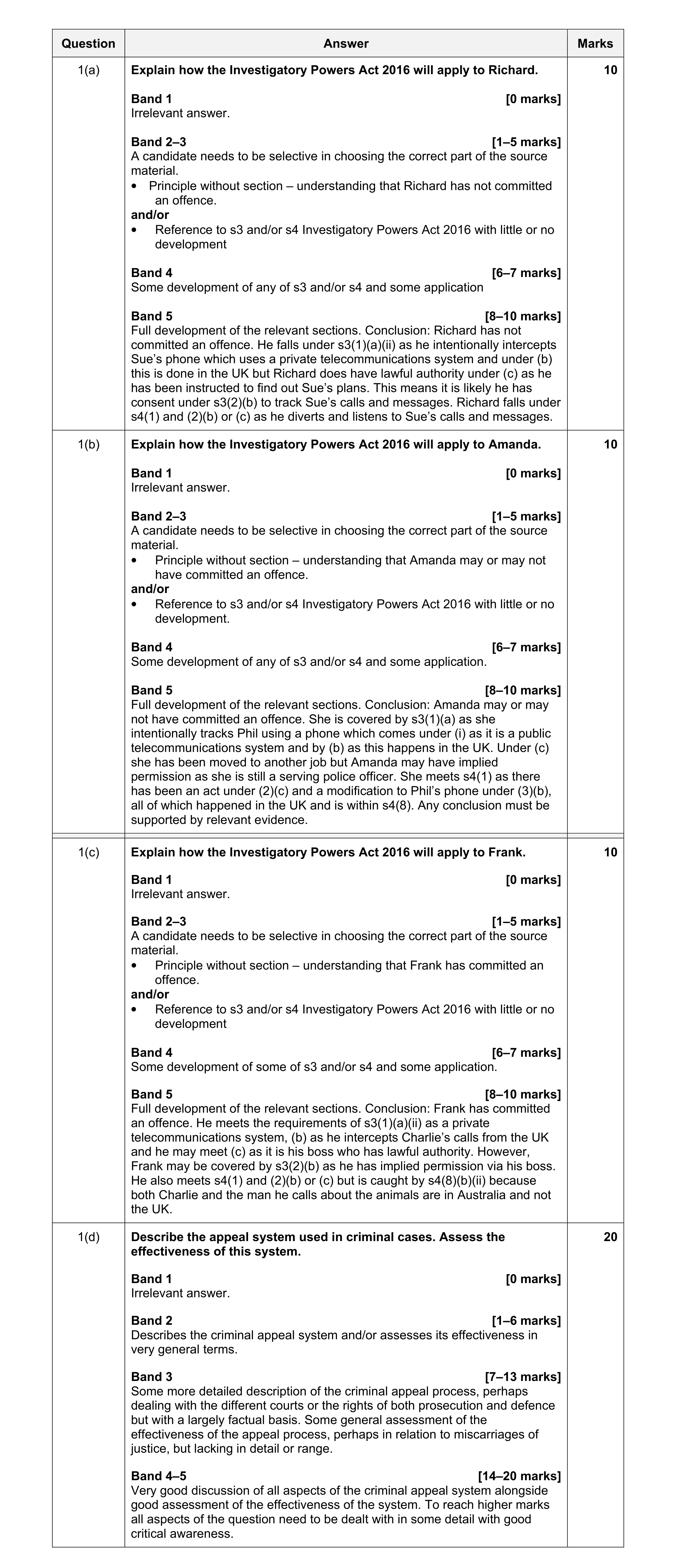 50
50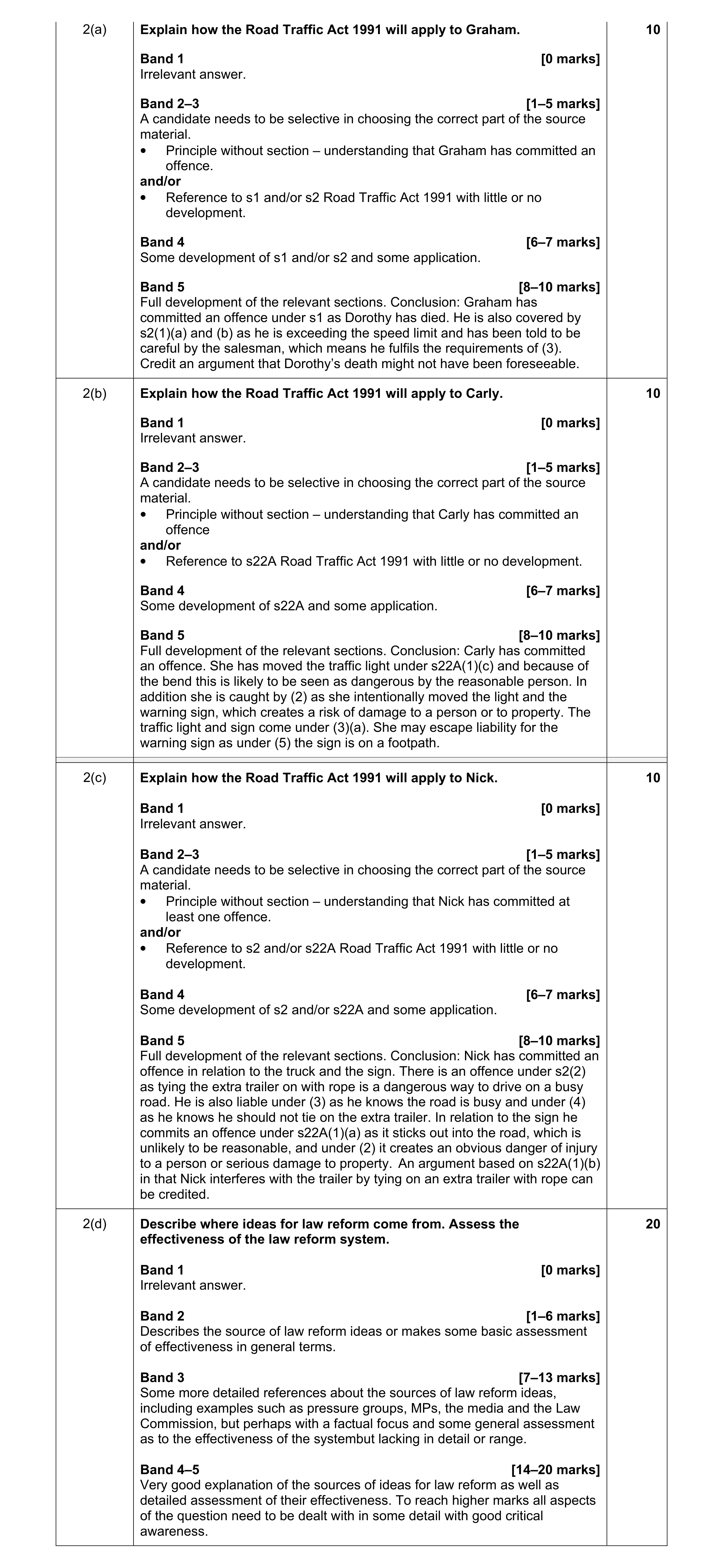 50
50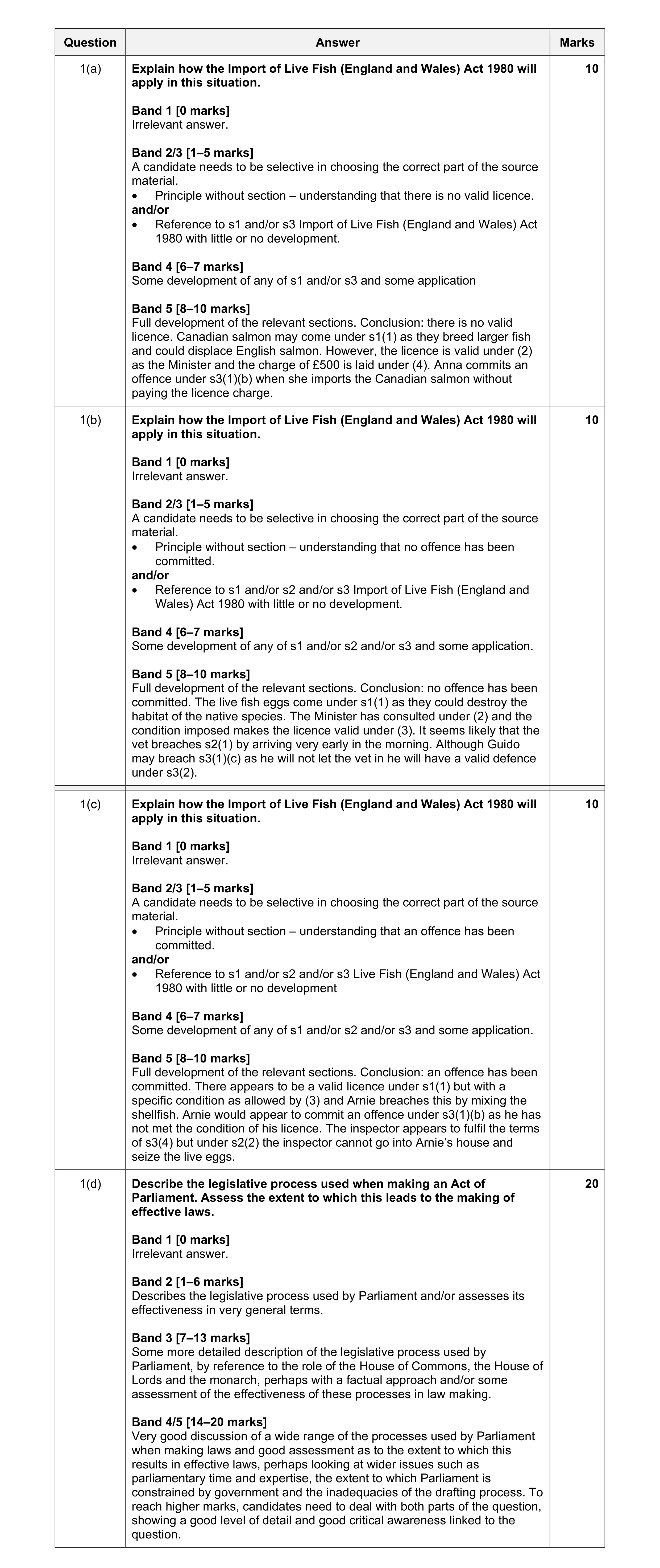 50
50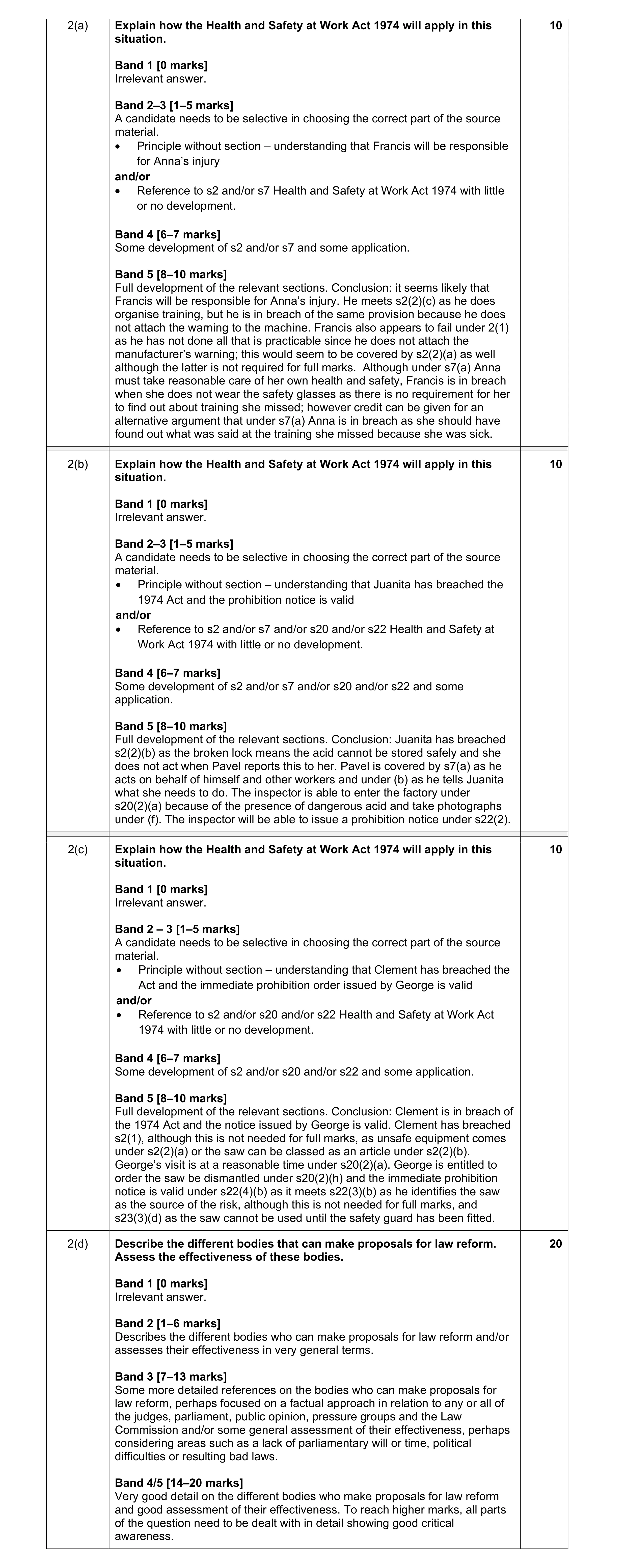 50
50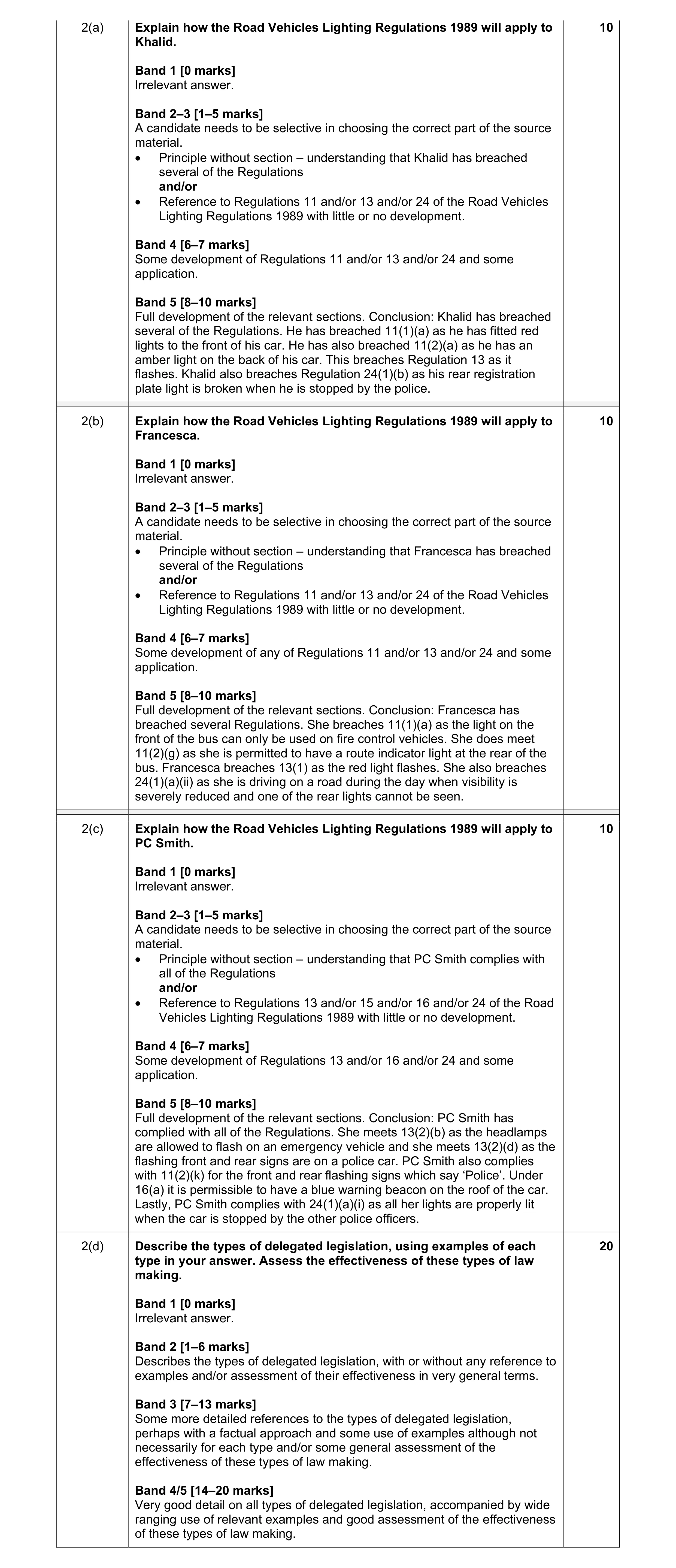 50
50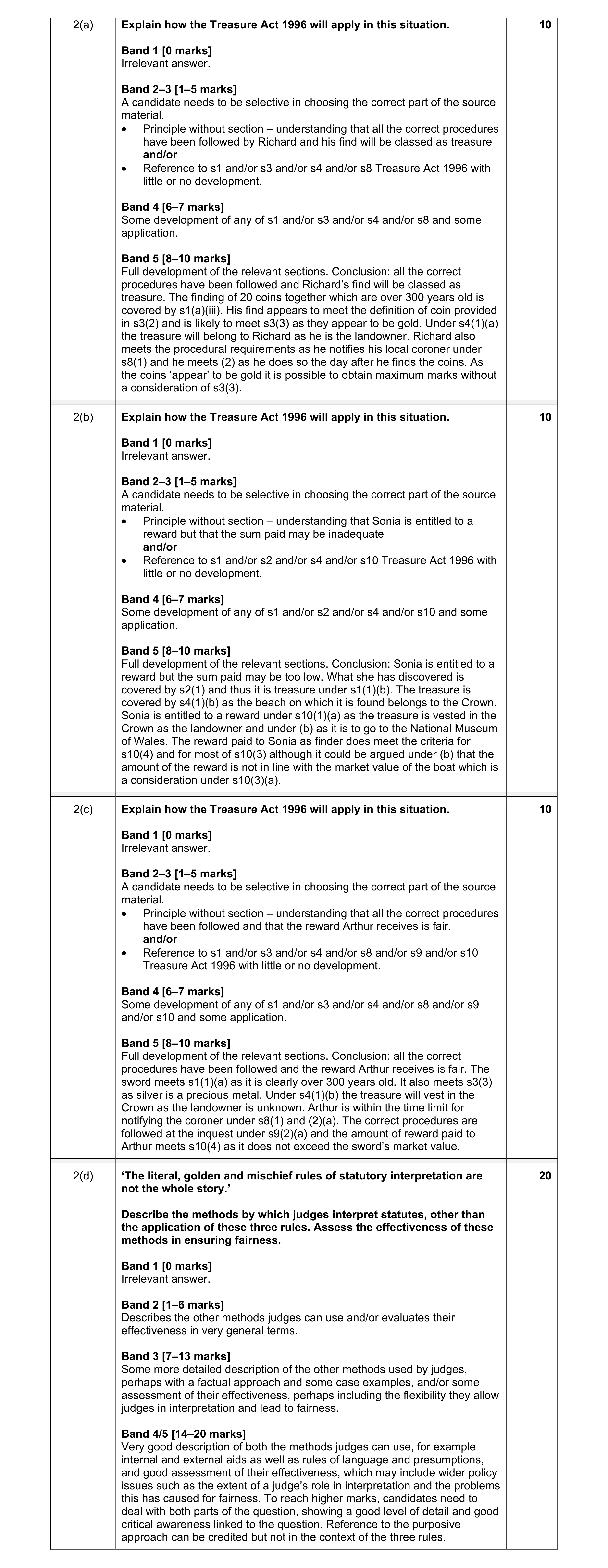 50
50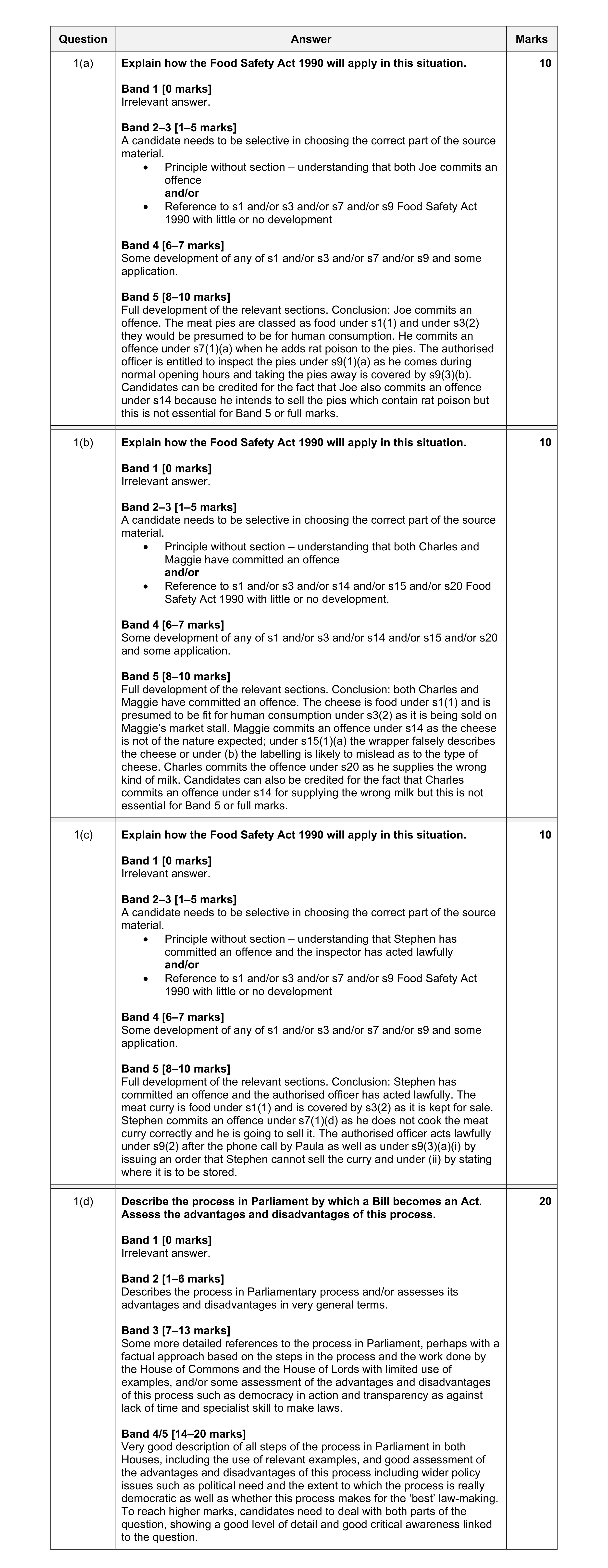 50
50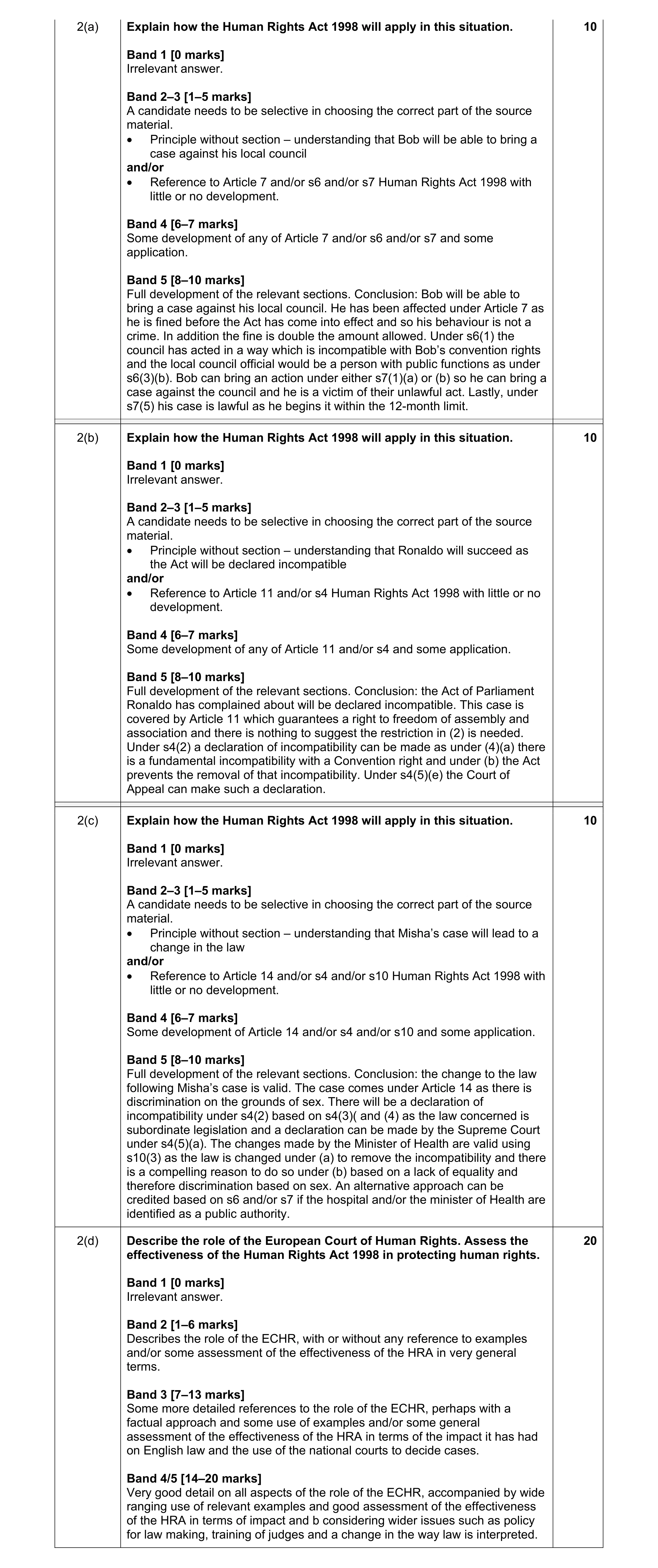 50
50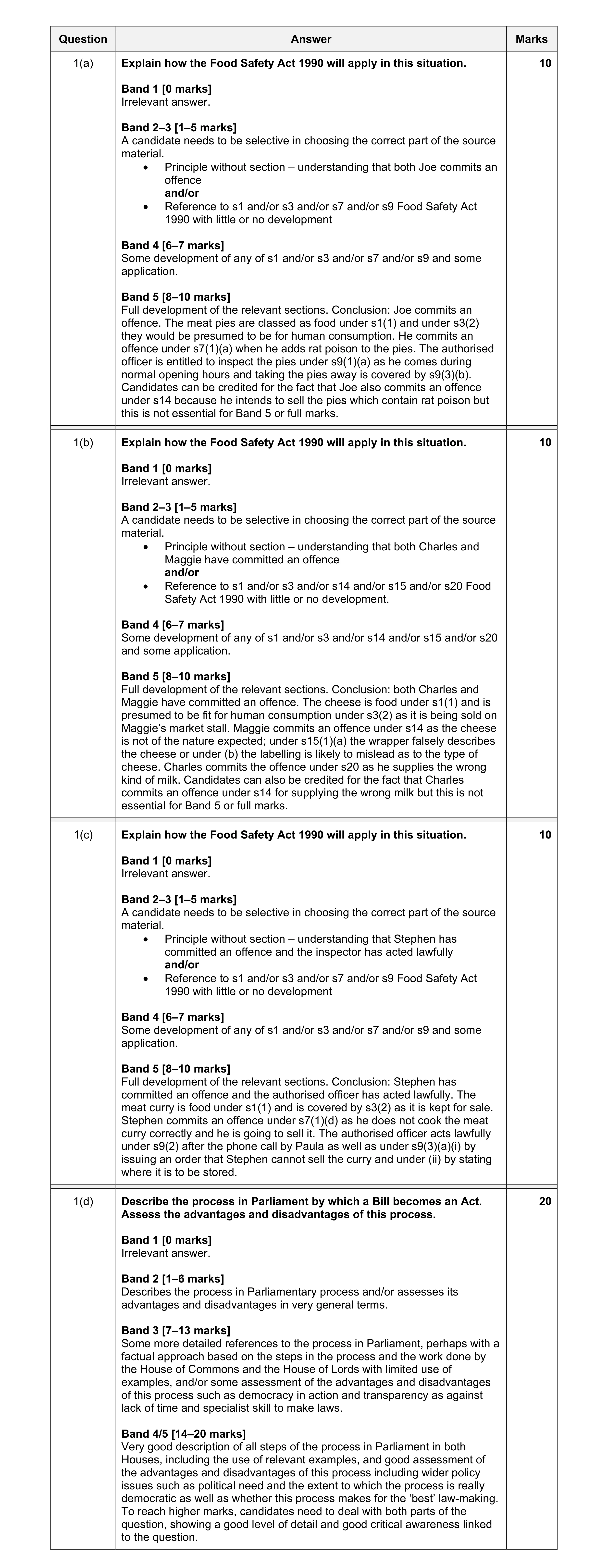 50
50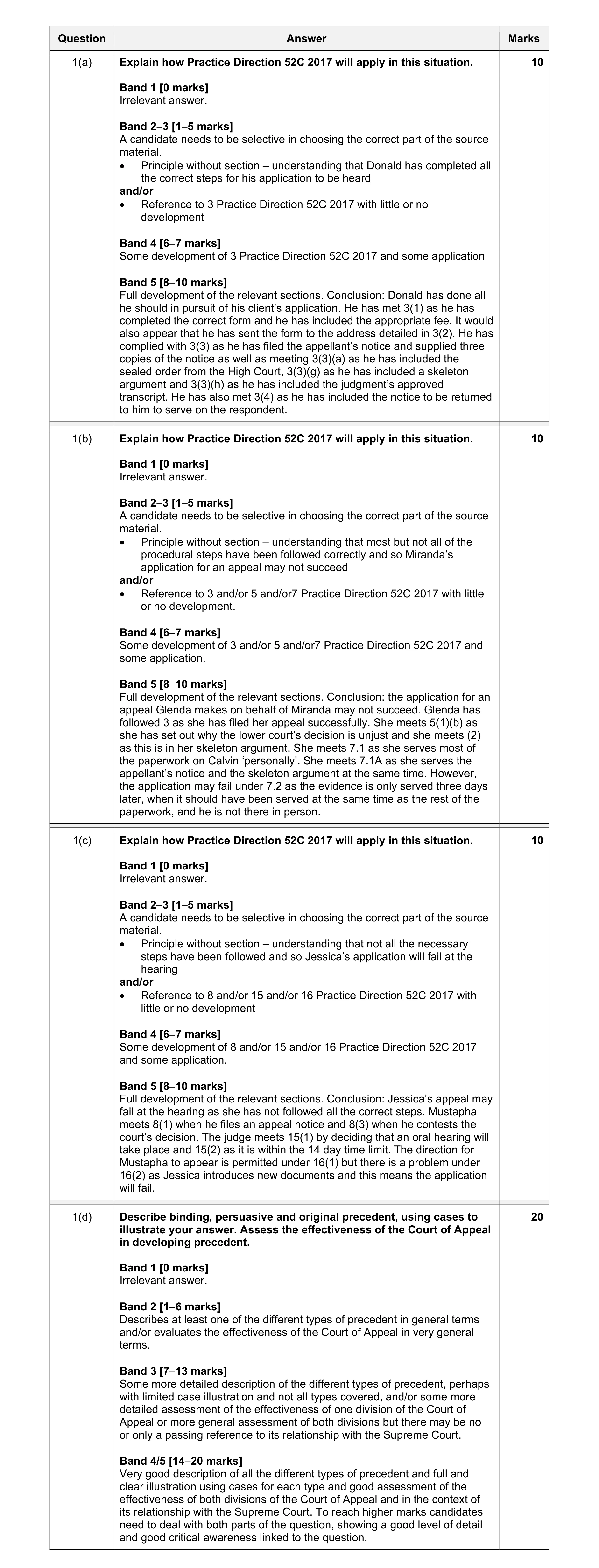 50
50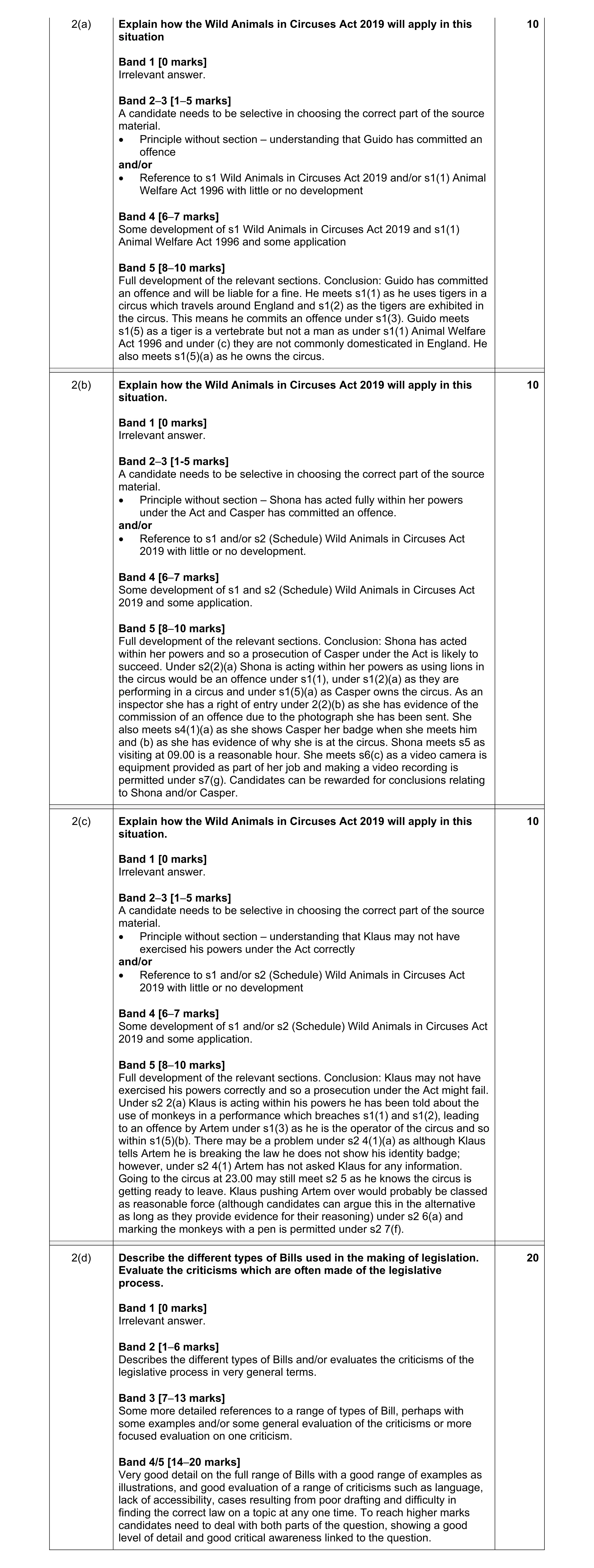 50
50