Cambridge A Level Law 9084 — 2021 Oct/Nov Paper 2 · Variant 2
9084/22/O/N/21 · 2 questions · 50 marks · ≈56 min
The question paper and its mark scheme, free to read here and free to download. This is Cambridge’s own paper, exactly as it was sat.
Question paper8 pages
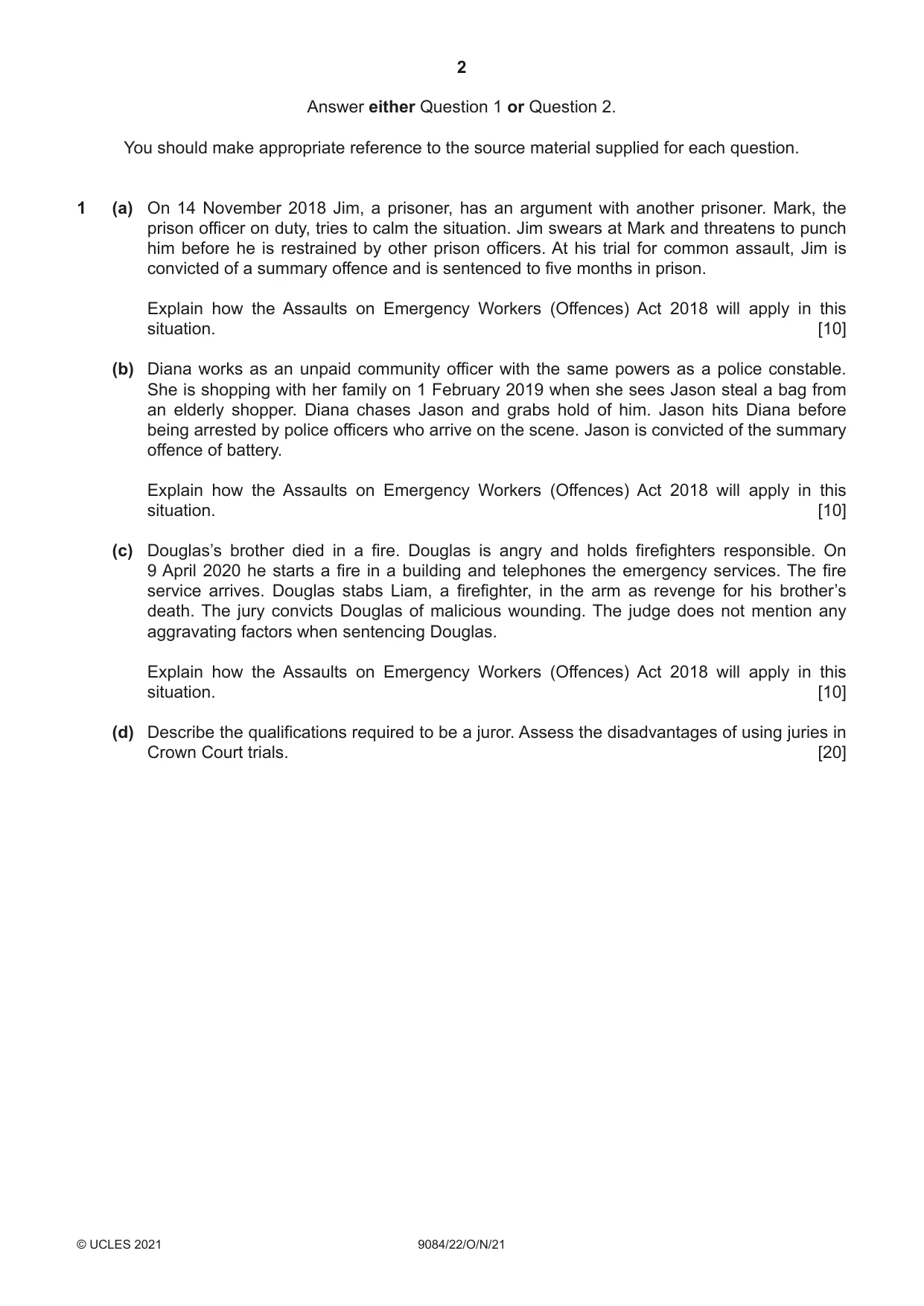
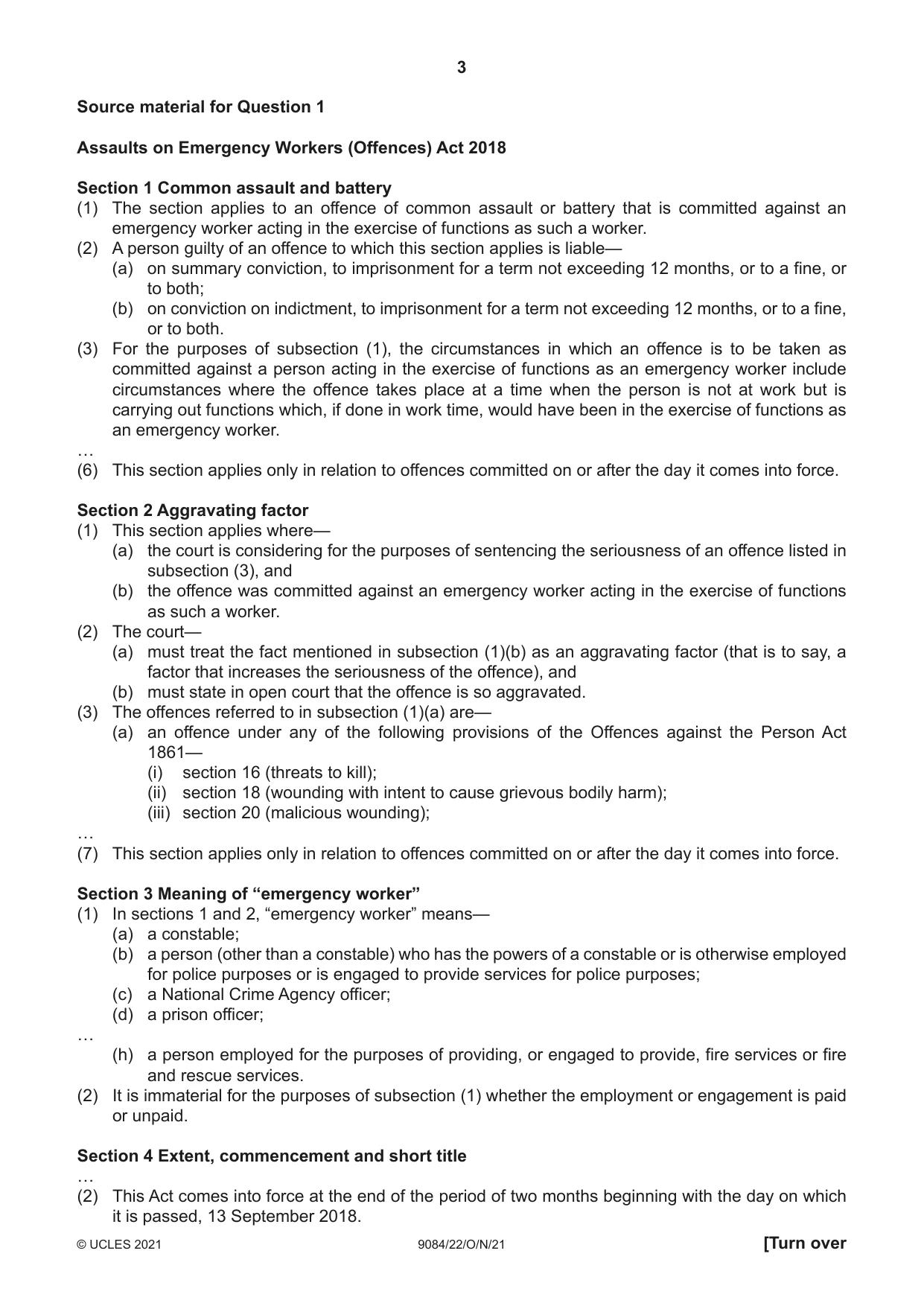
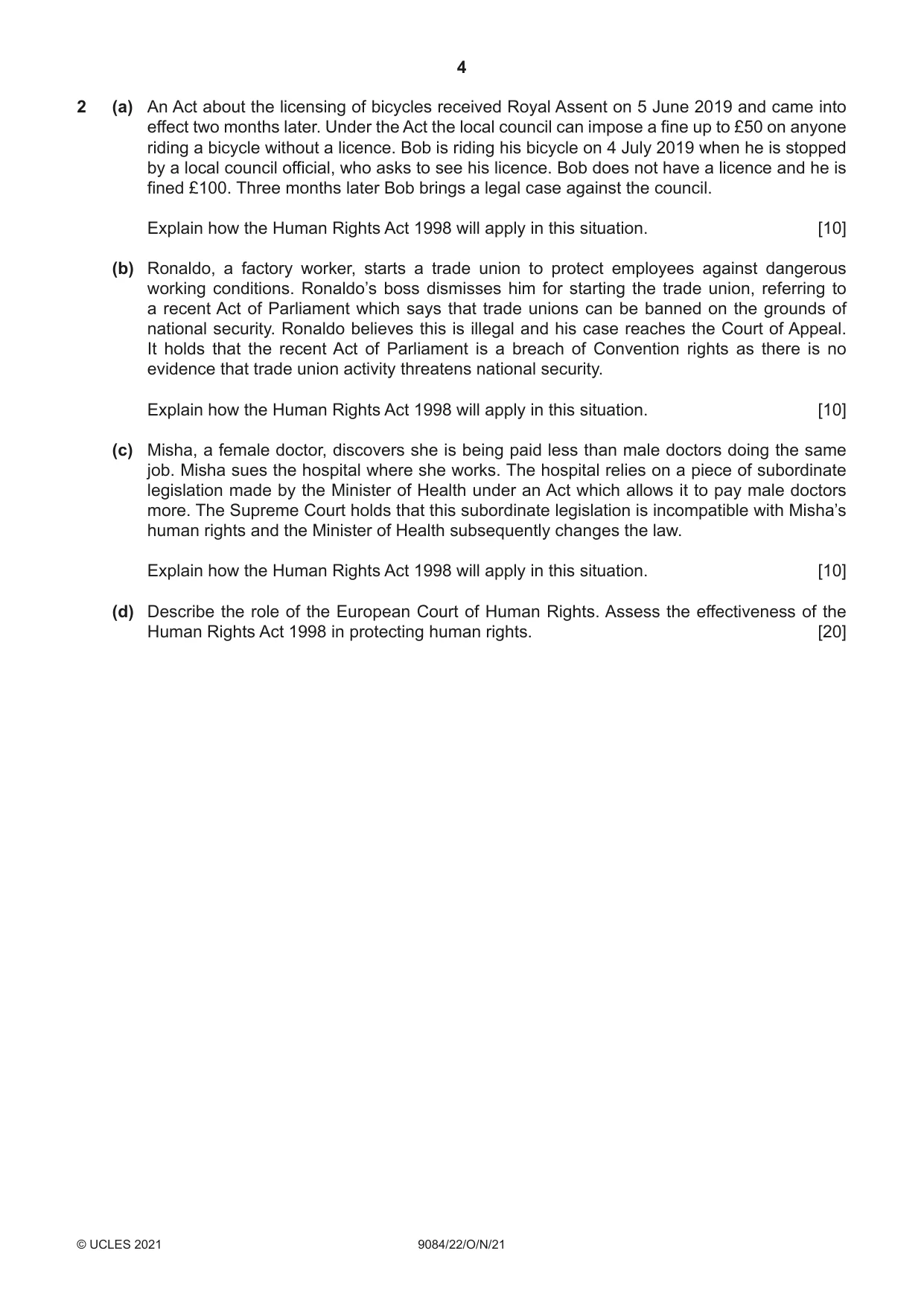


Mark scheme9 pages
Answers below. Sit the paper first if you are practising.
Questions as text
Q1 · On 14 November 2018 Jim, a prisoner, has an argument with another prisoner
1 (a) On 14 November 2018 Jim, a prisoner, has an argument with another prisoner. Mark, the prison officer on duty, tries to calm the situation. Jim swears at Mark and threatens to punch him before he is restrained by other prison officers. At his trial for common assault, Jim is convicted of a summary offence and is sentenced to five months in prison. Explain how the Assaults on Emergency Workers (Offences) Act 2018 will apply in this situation. [10] (b) Diana works as an unpaid community officer with the same powers as a police constable. She is shopping with her family on 1 February 2019 when she sees Jason steal a bag from an elderly shopper. Diana chases Jason and grabs hold of him. Jason hits Diana before being arrested by police officers who arrive on the scene. Jason is convicted of the summary offence of battery. Explain how the Assaults on Emergency Workers (Offences) Act 2018 will apply in this situation. [10] (c) Douglas’s brother died in a fire. Douglas is angry and holds firefighters responsible. On 9 April 2020 he starts a fire in a building and telephones the emergency services. The fire service arrives. Douglas stabs Liam, a firefighter, in the arm as revenge for his brother’s death. The jury convicts Douglas of malicious wounding. The judge does not mention any aggravating factors when sentencing Douglas. Explain how the Assaults on Emergency Workers (Offences) Act 2018 will apply in this situation. [10] (d) Describe the qualifications required to be a juror. Assess the disadvantages of using juries in Crown Court trials. [20] Source material for Question 1 Assaults on Emergency Workers (Offences) Act 2018 Section 1 Common assault and battery (1) The section applies to an offence of common assault or battery that is committed against an emergency worker acting in the exercise of functions as such a worker. (2) A person guilty of an offence to which this section applies is liable— (a) on summary conviction, to imprisonment for a term not exceeding 12 months, or to a fine, or to both; (b) on conviction on indictment, to imprisonment for a term not exceeding 12 months, or to a fine, or to both. (3) For the purposes of subsection (1), the circumstances in which an offence is to be taken as committed against a person acting in the exercise of functions as an emergency worker include circumstances where the offence takes place at a time when the person is not at work but is carrying out functions which, if done in work time, would have been in the exercise of functions as an emergency worker. … (6) This section applies only in relation to offences committed on or after the day it comes into force. Section 2 Aggravating factor (1) This section applies where— (a) the court is considering for the purposes of sentencing the seriousness of an offence listed in subsection (3), and (b) the offence was committed against an emergency worker acting in the exercise of functions as such a worker. (2) The court— (a) must treat the fact mentioned in subsection (1)(b) as an aggravating factor (that is to say, a factor that increases the seriousness of the offence), and (b) must state in open court that the offence is so aggravated. (3) The offences referred to in subsection (1)(a) are— (a) an offence under any of the following provisions of the Offences against the Person Act 1861— (i) section 16 (threats to kill); (ii) section 18 (wounding with intent to cause grievous bodily harm); (iii) section 20 (malicious wounding); … (7) This section applies only in relation to offences committed on or after the day it comes into force. Section 3 Meaning of “emergency worker” (1) In sections 1 and 2, “emergency worker” means— (a) a constable; (b) a person (other than a constable) who has the powers of a constable or is otherwise employed for police purposes or is engaged to provide services for police purposes; (c) a National Crime Agency officer; (d) a prison officer; … (h) a person employed for the purposes of providing, or engaged to provide, fire services or fire and rescue services. (2) It is immaterial for the purposes of subsection (1) whether the employment or engagement is paid or unpaid. Section 4 Extent, commencement and short title … (2) This Act comes into force at the end of the period of two months beginning with the day on which it is passed, 13 September 2018.
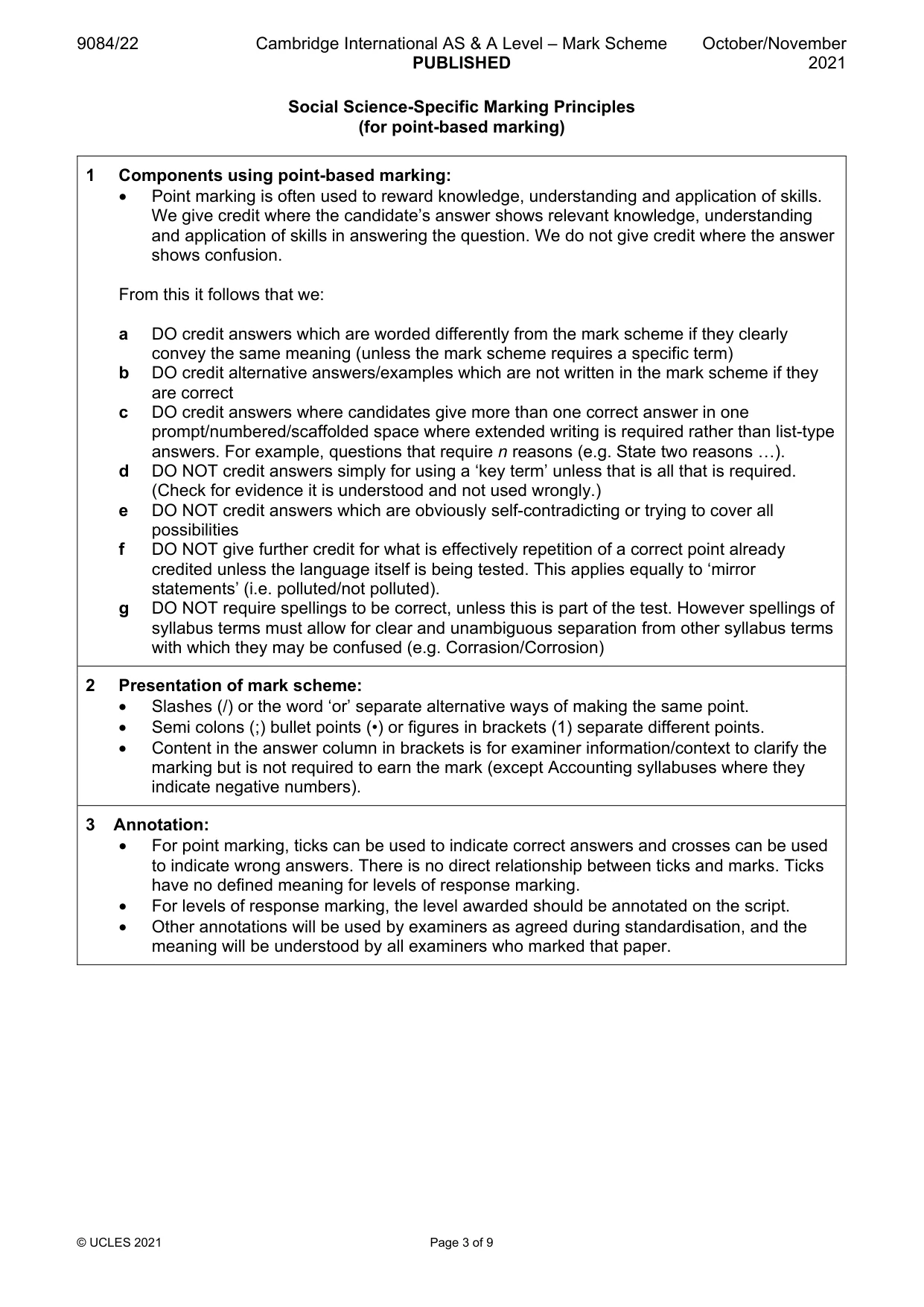
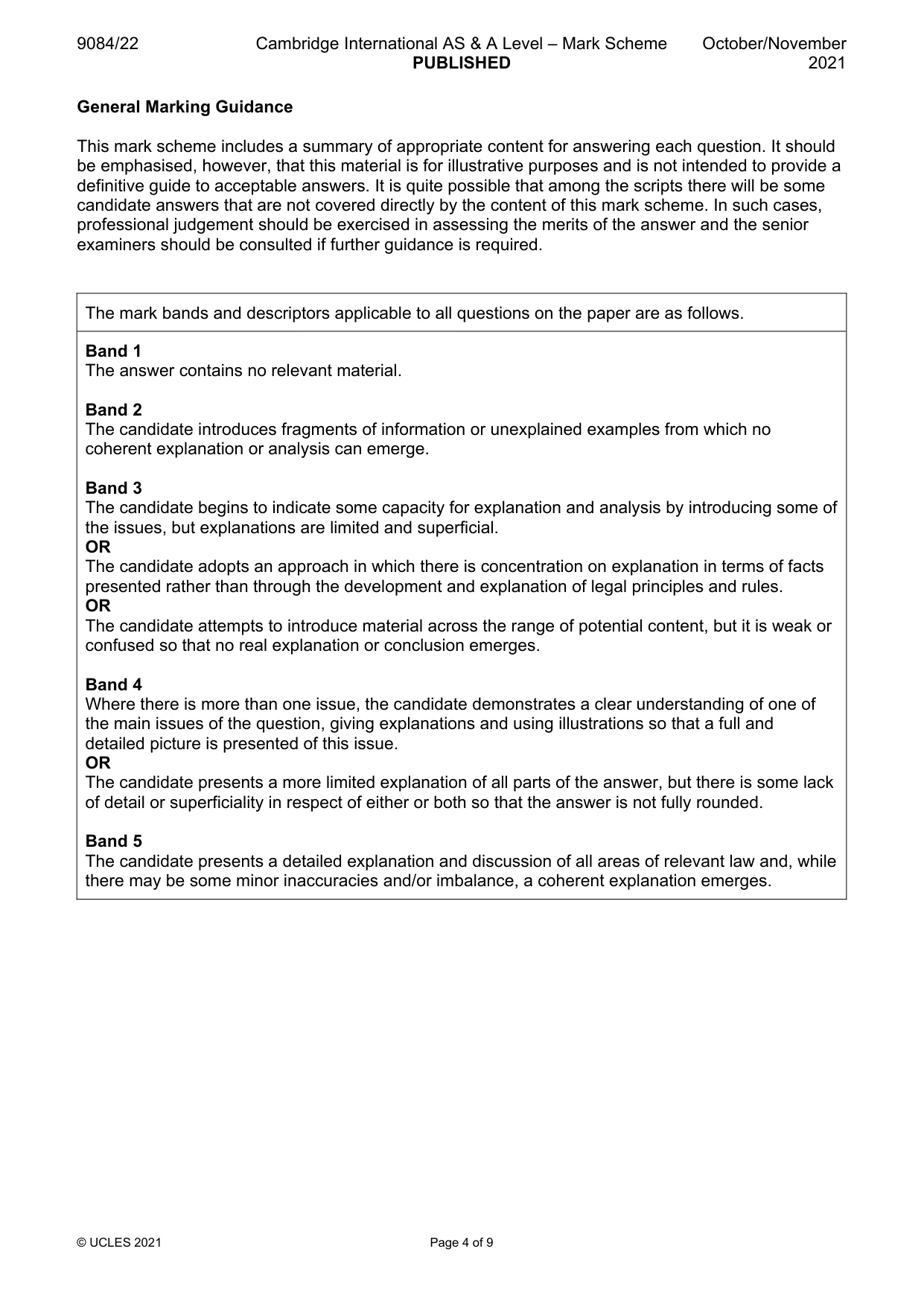
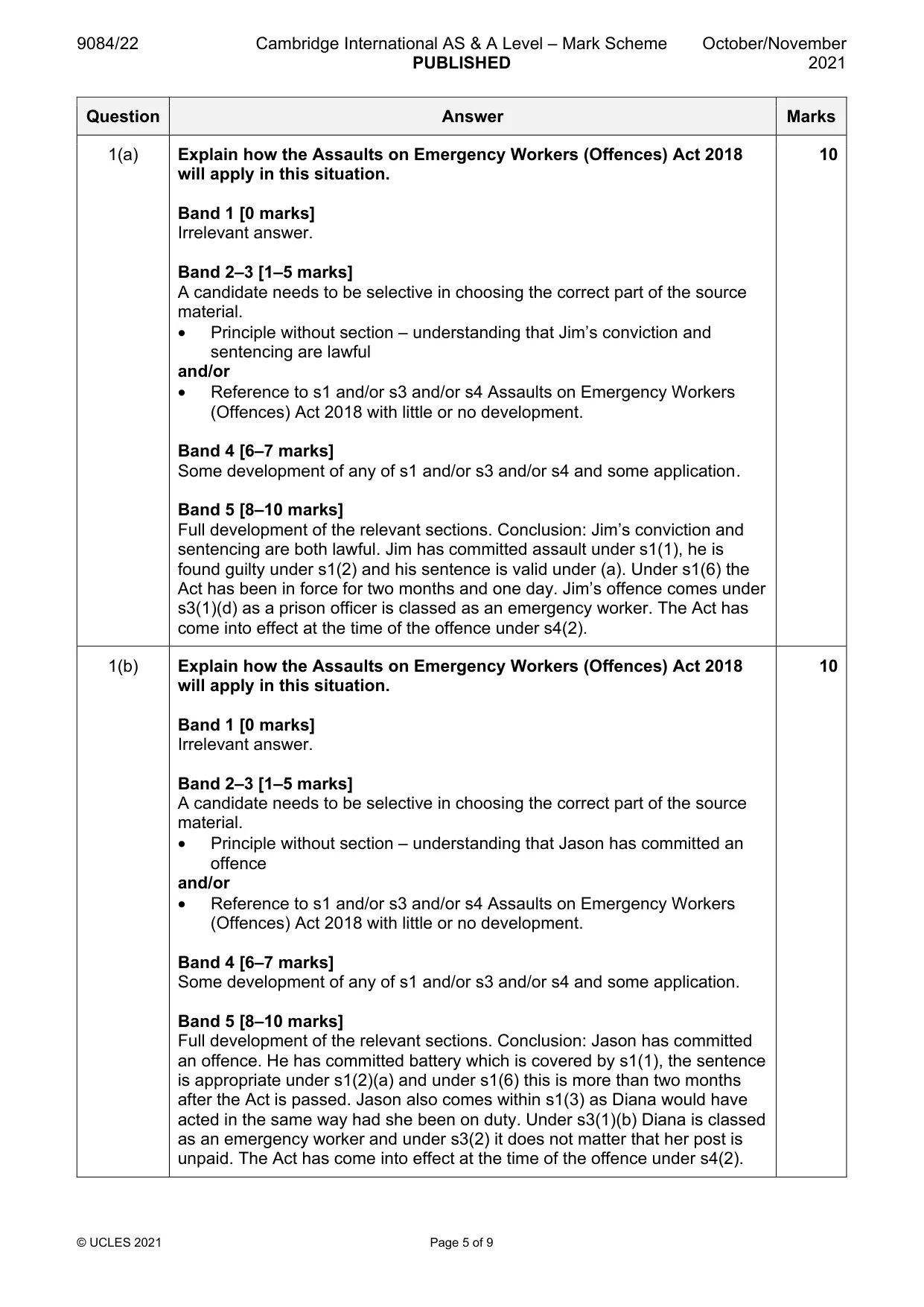
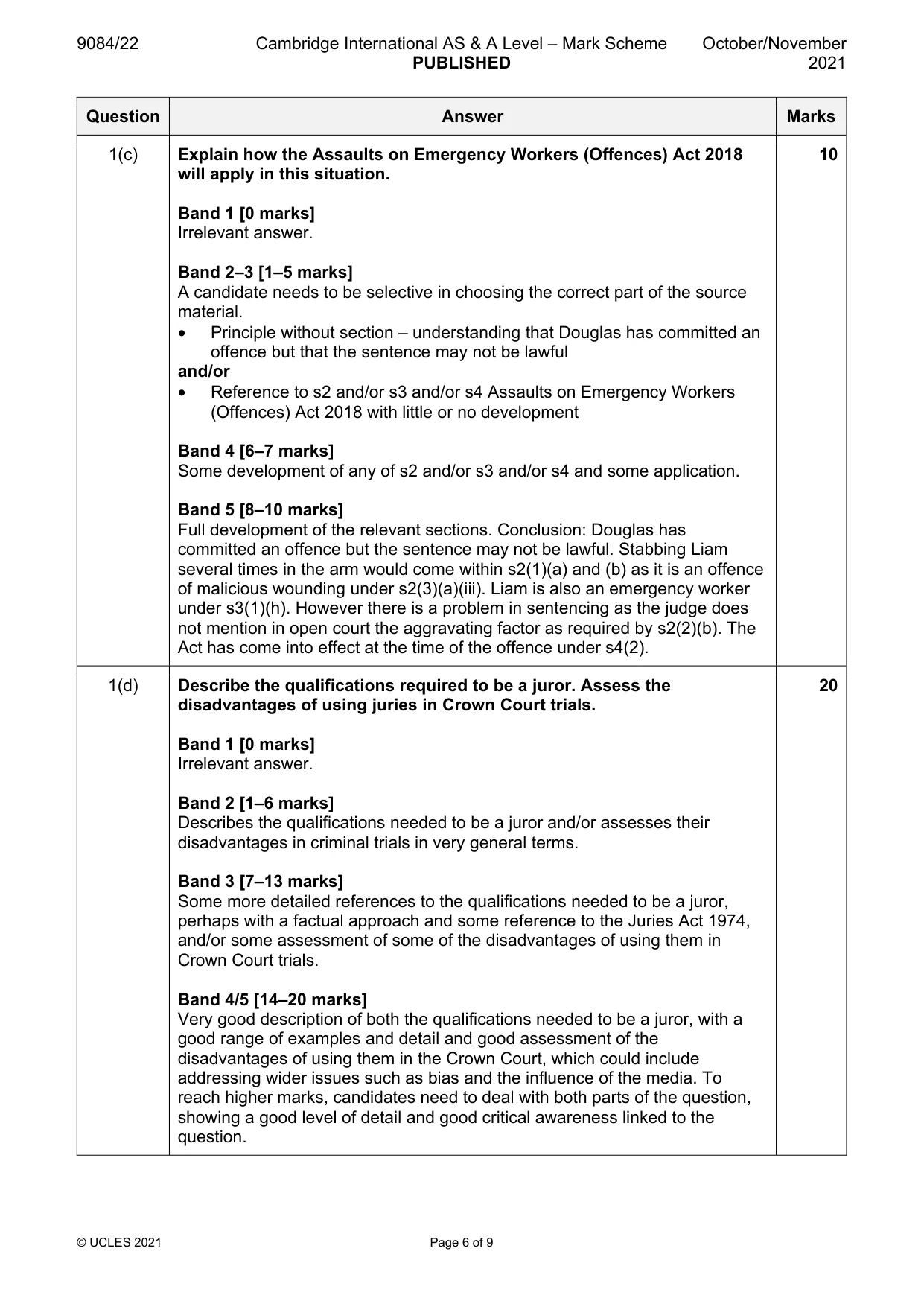
Mark scheme: Question Answer Marks 1(a) Explain how the Assaults on Emergency Workers (Offences) Act 2018 10 will apply in this situation. Band 1 [0 marks] Irrelevant answer. Band 2–3 [1–5 marks] A candidate needs to be selective in choosing the correct part of the source material. • Principle without section – understanding that Jim’s conviction and sentencing are lawful and/or • Reference to s1 and/or s3 and/or s4 Assaults on Emergency Workers (Offences) Act 2018 with little or no development. Band 4 [6–7 marks] Some development of any of s1 and/or s3 and/or s4 and some application . Band 5 [8–10 marks] Full development of the relevant sections. Conclusion: Jim’s conviction and sentencing are both lawful. Jim has committed assault under s1(1), he is found guilty under s1(2) and his sentence is valid under (a). Under s1(6) the Act has been in force for two months and one day. Jim’s offence comes under s3(1)(d) as a prison officer is classed as an emergency worker. The Act has come into effect at the time of the offence under s4(2). 1(b) Explain how the Assaults on Emergency Workers (Offences) Act 2018 10 will apply in this situation. Band 1 [0 marks] Irrelevant answer. Band 2–3 [1–5 marks] A candidate needs to be selective in choosing the correct part of the source material. • Principle without section – understanding that Jason has committed an offence and/or • Reference to s1 and/or s3 and/or s4 Assaults on Emergency Workers (Offences) Act 2018 with little or no development. Band 4 [6–7 marks] Some development of any of s1 and/or s3 and/or s4 and some application. Band 5 [8–10 marks] Full development of the relevant sections. Conclusion: Jason has committed an offence. He has committed battery which is covered by s1(1), the sentence is appropriate under s1(2)(a) and under s1(6) this is more than two months after the Act is passed. Jason also comes within s1(3) as Diana would have acted in the same way had she been on duty. Under s3(1)(b) Diana is classed as an emergency worker and under s3(2) it does not matter that her post is unpaid. The Act has come into effect at the time of the offence under s4(2). 1(c) Explain how the Assaults on Emergency Workers (Offences) Act 2018 10 will apply in this situation. Band 1 [0 marks] Irrelevant answer. Band 2–3 [1–5 marks] A candidate needs to be selective in choosing the correct part of the source material. • Principle without section – understanding that Douglas has committed an offence but that the sentence may not be lawful and/or • Reference to s2 and/or s3 and/or s4 Assaults on Emergency Workers (Offences) Act 2018 with little or no development Band 4 [6–7 marks] Some development of any of s2 and/or s3 and/or s4 and some application. Band 5 [8–10 marks] Full development of the relevant sections. Conclusion: Douglas has committed an offence but the sentence may not be lawful. Stabbing Liam several times in the arm would come within s2(1)(a) and (b) as it is an offence of malicious wounding under s2(3)(a)(iii). Liam is also an emergency worker under s3(1)(h). However there is a problem in sentencing as the judge does not mention in open court the aggravating factor as required by s2(2)(b). The Act has come into effect at the time of the offence under s4(2). 1(d) Describe the qualifications required to be a juror. Assess the 20 disadvantages of using juries in Crown Court trials. Band 1 [0 marks] Irrelevant answer. Band 2 [1–6 marks] Describes the qualifications needed to be a juror and/or assesses their disadvantages in criminal trials in very general terms. Band 3 [7–13 marks] Some more detailed references to the qualifications needed to be a juror, perhaps with a factual approach and some reference to the Juries Act 1974, and/or some assessment of some of the disadvantages of using them in Crown Court trials. Band 4/5 [14–20 marks] Very good description of both the qualifications needed to be a juror, with a good range of examples and detail and good assessment of the disadvantages of using them in the Crown Court, which could include addressing wider issues such as bias and the influence of the media. To reach higher marks, candidates need to deal with both parts of the question, showing a good level of detail and good critical awareness linked to the question.
Q2 · An Act about the licensing of bicycles received Royal Assent on 5 June 2019 and came into…
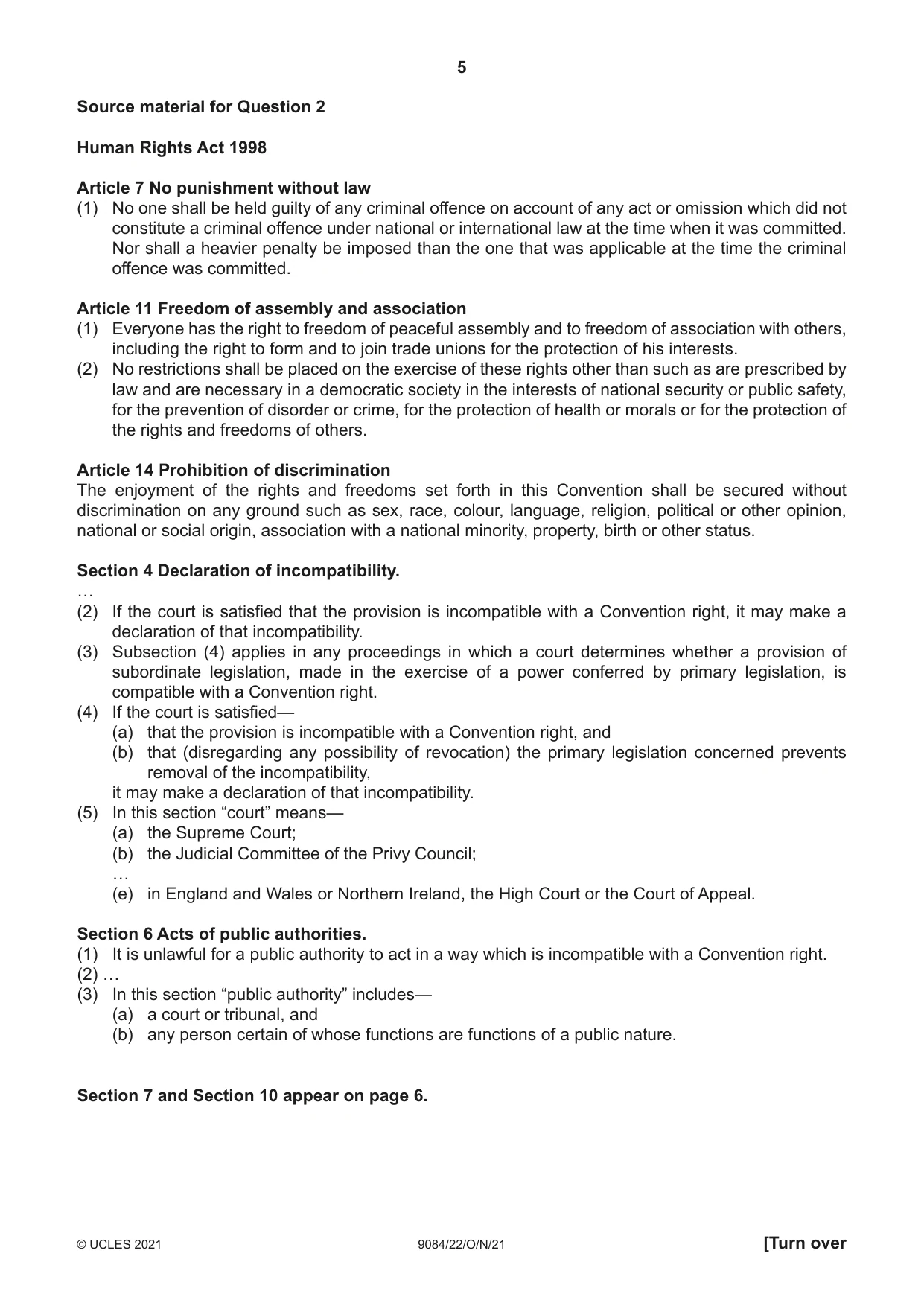
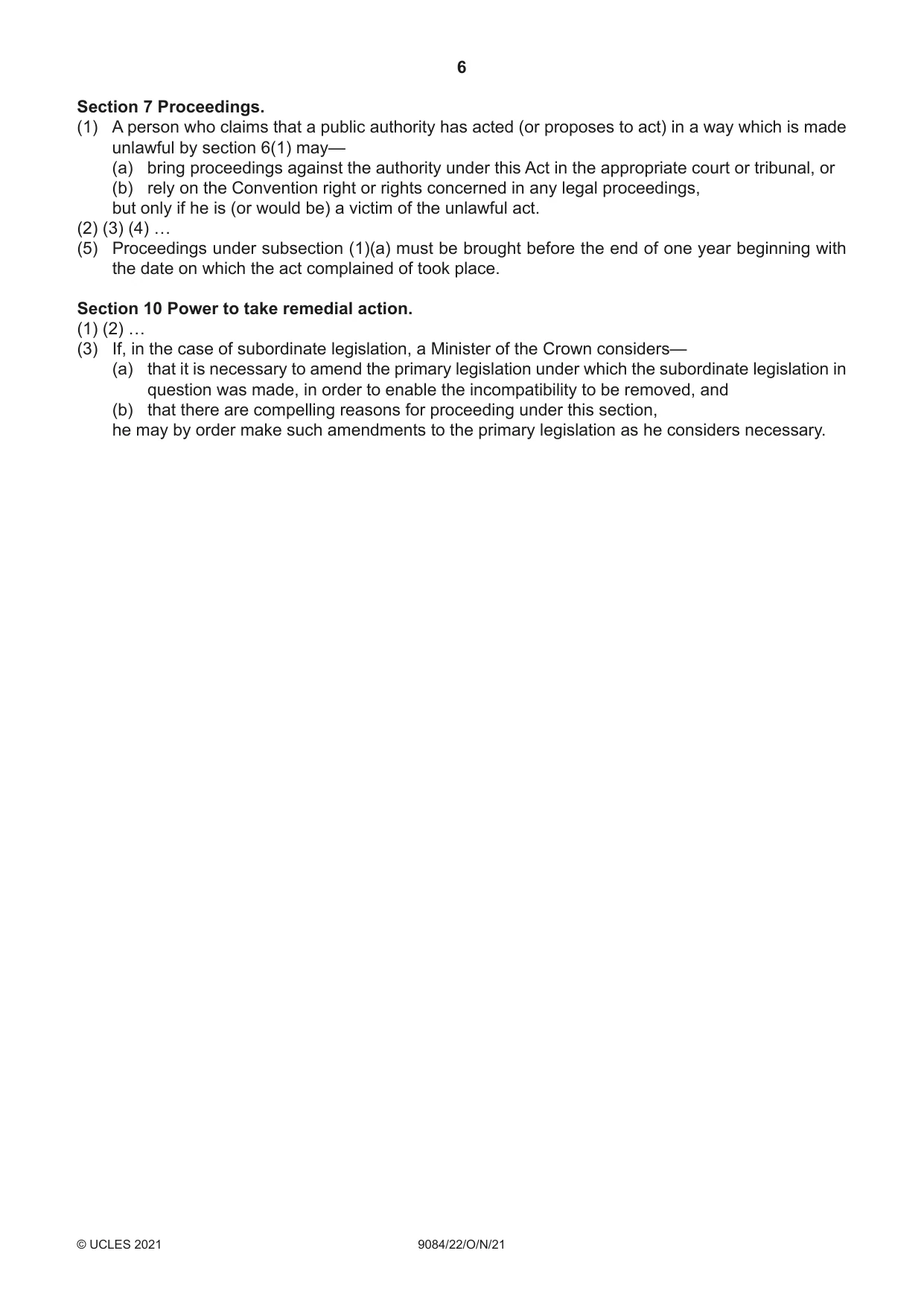
2 (a) An Act about the licensing of bicycles received Royal Assent on 5 June 2019 and came into effect two months later. Under the Act the local council can impose a fine up to £50 on anyone riding a bicycle without a licence. Bob is riding his bicycle on 4 July 2019 when he is stopped by a local council official, who asks to see his licence. Bob does not have a licence and he is fined £100. Three months later Bob brings a legal case against the council. Explain how the Human Rights Act 1998 will apply in this situation. [10] (b) Ronaldo, a factory worker, starts a trade union to protect employees against dangerous working conditions. Ronaldo’s boss dismisses him for starting the trade union, referring to a recent Act of Parliament which says that trade unions can be banned on the grounds of national security. Ronaldo believes this is illegal and his case reaches the Court of Appeal. It holds that the recent Act of Parliament is a breach of Convention rights as there is no evidence that trade union activity threatens national security. Explain how the Human Rights Act 1998 will apply in this situation. [10] (c) Misha, a female doctor, discovers she is being paid less than male doctors doing the same job. Misha sues the hospital where she works. The hospital relies on a piece of subordinate legislation made by the Minister of Health under an Act which allows it to pay male doctors more. The Supreme Court holds that this subordinate legislation is incompatible with Misha’s human rights and the Minister of Health subsequently changes the law. Explain how the Human Rights Act 1998 will apply in this situation. [10] (d) Describe the role of the European Court of Human Rights. Assess the effectiveness of the Human Rights Act 1998 in protecting human rights. [20] Source material for Question 2 Human Rights Act 1998 Article 7 No punishment without law (1) No one shall be held guilty of any criminal offence on account of any act or omission which did not constitute a criminal offence under national or international law at the time when it was committed. Nor shall a heavier penalty be imposed than the one that was applicable at the time the criminal offence was committed. Article 11 Freedom of assembly and association (1) Everyone has the right to freedom of peaceful assembly and to freedom of association with others, including the right to form and to join trade unions for the protection of his interests. (2) No restrictions shall be placed on the exercise of these rights other than such as are prescribed by law and are necessary in a democratic society in the interests of national security or public safety, for the prevention of disorder or crime, for the protection of health or morals or for the protection of the rights and freedoms of others. Article 14 Prohibition of discrimination The enjoyment of the rights and freedoms set forth in this Convention shall be secured without discrimination on any ground such as sex, race, colour, language, religion, political or other opinion, national or social origin, association with a national minority, property, birth or other status. Section 4 Declaration of incompatibility. … (2) If the court is satisfied that the provision is incompatible with a Convention right, it may make a declaration of that incompatibility. (3) Subsection (4) applies in any proceedings in which a court determines whether a provision of subordinate legislation, made in the exercise of a power conferred by primary legislation, is compatible with a Convention right. (4) If the court is satisfied— (a) that the provision is incompatible with a Convention right, and (b) that (disregarding any possibility of revocation) the primary legislation concerned prevents removal of the incompatibility, it may make a declaration of that incompatibility. (5) In this section “court” means— (a) the Supreme Court; (b) the Judicial Committee of the Privy Council; … (e) in England and Wales or Northern Ireland, the High Court or the Court of Appeal. Section 6 Acts of public authorities. (1) It is unlawful for a public authority to act in a way which is incompatible with a Convention right. (2) … (3) In this section “public authority” includes— (a) a court or tribunal, and (b) any person certain of whose functions are functions of a public nature. Section 7 and Section 10 appear on page 6. Section 7 Proceedings. (1) A person who claims that a public authority has acted (or proposes to act) in a way which is made unlawful by section 6(1) may— (a) bring proceedings against the authority under this Act in the appropriate court or tribunal, or (b) rely on the Convention right or rights concerned in any legal proceedings, but only if he is (or would be) a victim of the unlawful act. (2) (3) (4) … (5) Proceedings under subsection (1)(a) must be brought before the end of one year beginning with the date on which the act complained of took place. Section 10 Power to take remedial action. (1) (2) … (3) If, in the case of subordinate legislation, a Minister of the Crown considers— (a) that it is necessary to amend the primary legislation under which the subordinate legislation in question was made, in order to enable the incompatibility to be removed, and (b) that there are compelling reasons for proceeding under this section, he may by order make such amendments to the primary legislation as he considers necessary.
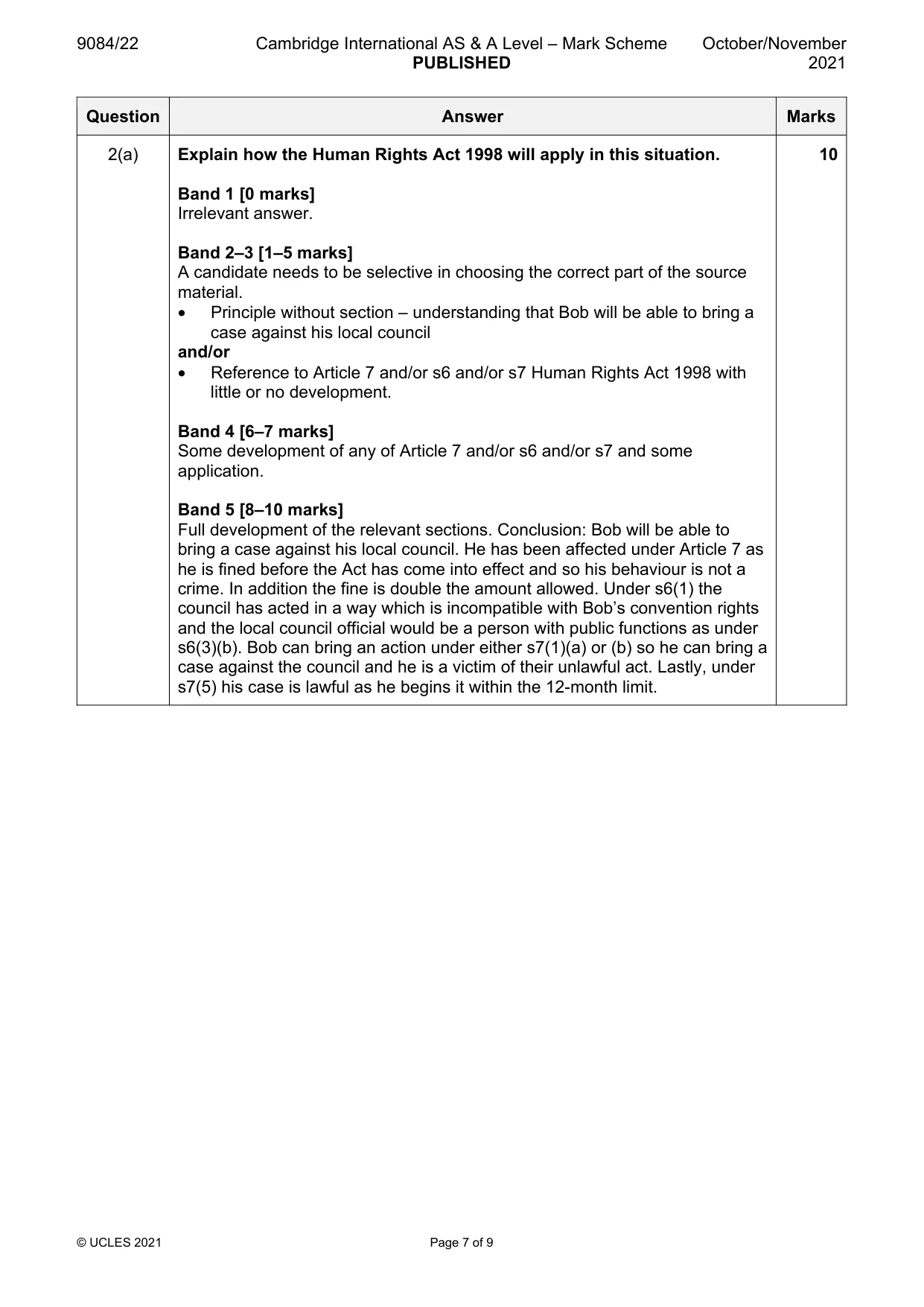
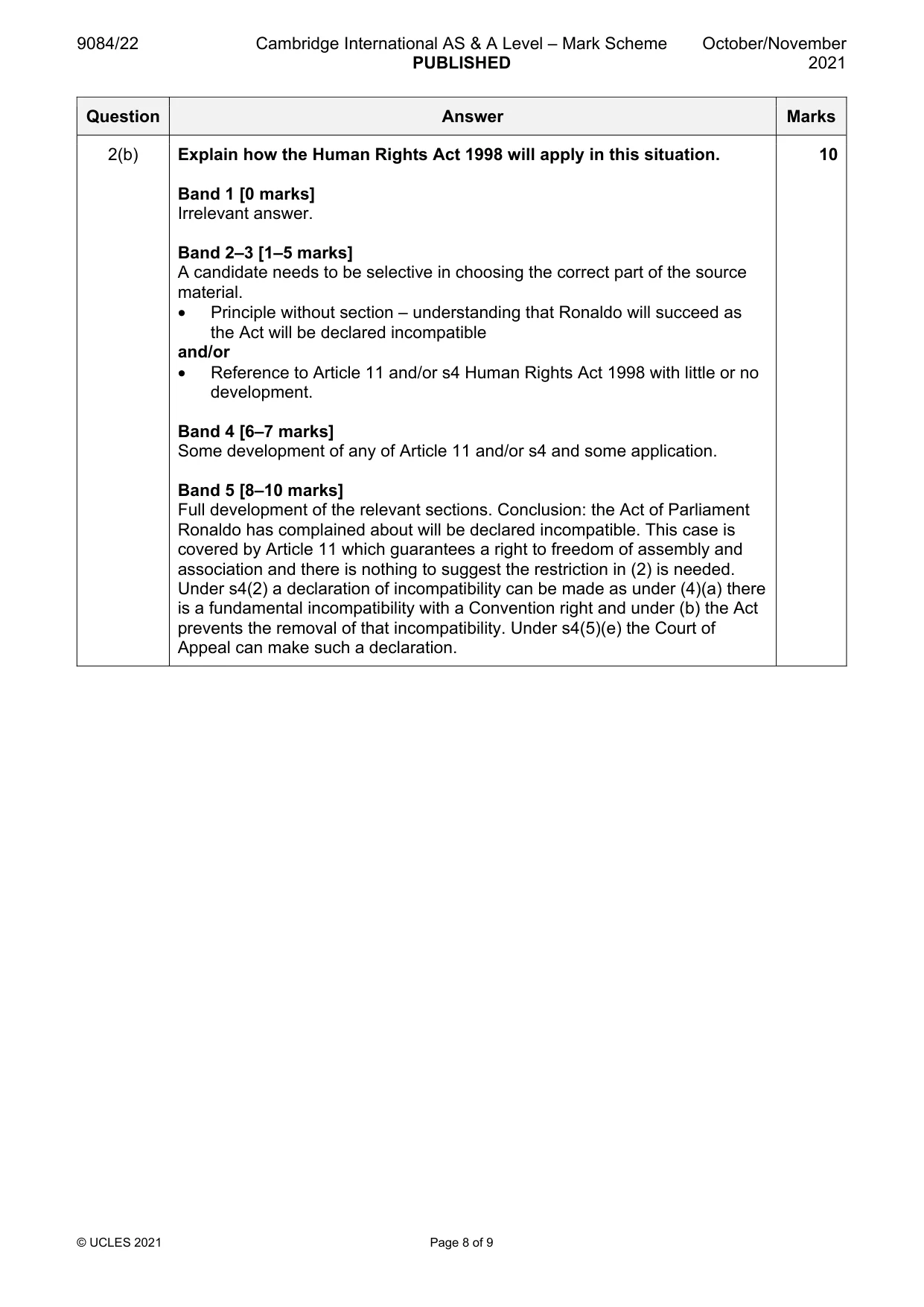
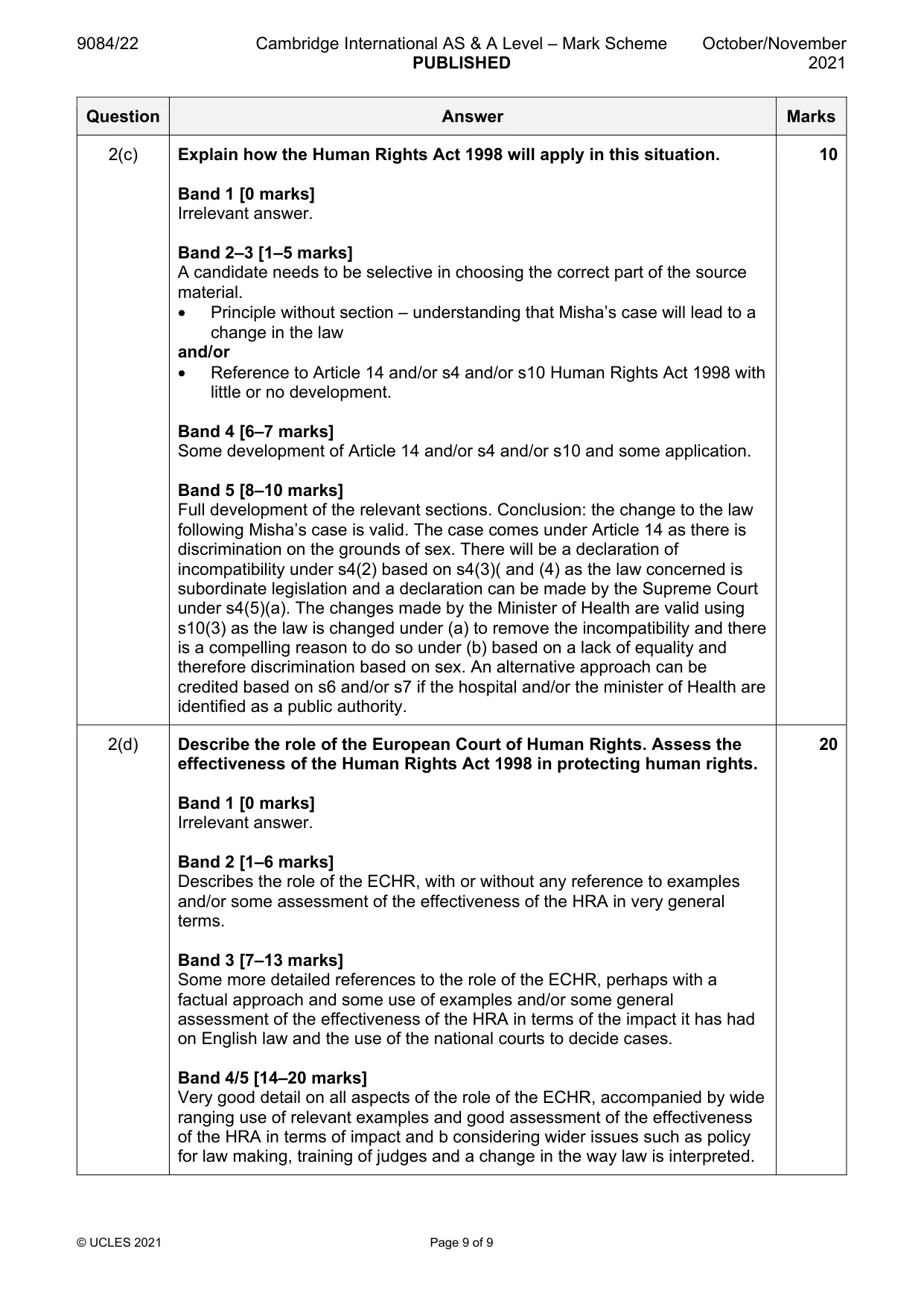
Mark scheme: 2(a) Explain how the Human Rights Act 1998 will apply in this situation. 10 Band 1 [0 marks] Irrelevant answer. Band 2–3 [1–5 marks] A candidate needs to be selective in choosing the correct part of the source material. • Principle without section – understanding that Bob will be able to bring a case against his local council and/or • Reference to Article 7 and/or s6 and/or s7 Human Rights Act 1998 with little or no development. Band 4 [6–7 marks] Some development of any of Article 7 and/or s6 and/or s7 and some application. Band 5 [8–10 marks] Full development of the relevant sections. Conclusion: Bob will be able to bring a case against his local council. He has been affected under Article 7 as he is fined before the Act has come into effect and so his behaviour is not a crime. In addition the fine is double the amount allowed. Under s6(1) the council has acted in a way which is incompatible with Bob’s convention rights and the local council official would be a person with public functions as under s6(3)(b). Bob can bring an action under either s7(1)(a) or (b) so he can bring a case against the council and he is a victim of their unlawful act. Lastly, under s7(5) his case is lawful as he begins it within the 12-month limit. 2(b) Explain how the Human Rights Act 1998 will apply in this situation. 10 Band 1 [0 marks] Irrelevant answer. Band 2–3 [1–5 marks] A candidate needs to be selective in choosing the correct part of the source material. • Principle without section – understanding that Ronaldo will succeed as the Act will be declared incompatible and/or • Reference to Article 11 and/or s4 Human Rights Act 1998 with little or no development. Band 4 [6–7 marks] Some development of any of Article 11 and/or s4 and some application. Band 5 [8–10 marks] Full development of the relevant sections. Conclusion: the Act of Parliament Ronaldo has complained about will be declared incompatible. This case is covered by Article 11 which guarantees a right to freedom of assembly and association and there is nothing to suggest the restriction in (2) is needed. Under s4(2) a declaration of incompatibility can be made as under (4)(a) there is a fundamental incompatibility with a Convention right and under (b) the Act prevents the removal of that incompatibility. Under s4(5)(e) the Court of Appeal can make such a declaration. 2(c) Explain how the Human Rights Act 1998 will apply in this situation. 10 Band 1 [0 marks] Irrelevant answer. Band 2–3 [1–5 marks] A candidate needs to be selective in choosing the correct part of the source material. • Principle without section – understanding that Misha’s case will lead to a change in the law and/or • Reference to Article 14 and/or s4 and/or s10 Human Rights Act 1998 with little or no development. Band 4 [6–7 marks] Some development of Article 14 and/or s4 and/or s10 and some application. Band 5 [8–10 marks] Full development of the relevant sections. Conclusion: the change to the law following Misha’s case is valid. The case comes under Article 14 as there is discrimination on the grounds of sex. There will be a declaration of incompatibility under s4(2) based on s4(3)( and (4) as the law concerned is subordinate legislation and a declaration can be made by the Supreme Court under s4(5)(a). The changes made by the Minister of Health are valid using s10(3) as the law is changed under (a) to remove the incompatibility and there is a compelling reason to do so under (b) based on a lack of equality and therefore discrimination based on sex. An alternative approach can be credited based on s6 and/or s7 if the hospital and/or the minister of Health are identified as a public authority. 2(d) Describe the role of the European Court of Human Rights. Assess the 20 effectiveness of the Human Rights Act 1998 in protecting human rights. Band 1 [0 marks] Irrelevant answer. Band 2 [1–6 marks] Describes the role of the ECHR, with or without any reference to examples and/or some assessment of the effectiveness of the HRA in very general terms. Band 3 [7–13 marks] Some more detailed references to the role of the ECHR, perhaps with a factual approach and some use of examples and/or some general assessment of the effectiveness of the HRA in terms of the impact it has had on English law and the use of the national courts to decide cases. Band 4/5 [14–20 marks] Very good detail on all aspects of the role of the ECHR, accompanied by wide ranging use of relevant examples and good assessment of the effectiveness of the HRA in terms of impact and b considering wider issues such as policy for law making, training of judges and a change in the way law is interpreted.
What was in this paper
The subtopics covered by these 2 questions, and how many questions each got. Open one in a new tab to see every Cambridge question on it.
1Sentencing in England and Wales This topic is about the sentences that can be handed down to both adult and young offenders who have been convicted of offences. This topic is an opportunity to reflect on the key concepts of liability, justice, fairness, power and its limits, and effectiveness1What you needed in this session
Cambridge’s own grade thresholds for 2021 Oct/Nov, Paper 2 · Variant 2. A higher threshold means an easier paper — the bar moves with how the cohort did.