Cambridge A Level Law 9084 — 2019 May/June Paper 2 · Variant 1
9084/21/M/J/19 · 2 questions · 50 marks · ≈56 min
The question paper and its mark scheme, free to read here and free to download. This is Cambridge’s own paper, exactly as it was sat.
Question paper8 pages


Mark scheme7 pages
Answers below. Sit the paper first if you are practising.
Questions as text
Q1 · Mrs Justice Teal is hearing a case in which a high profile celebrity is being tried for…
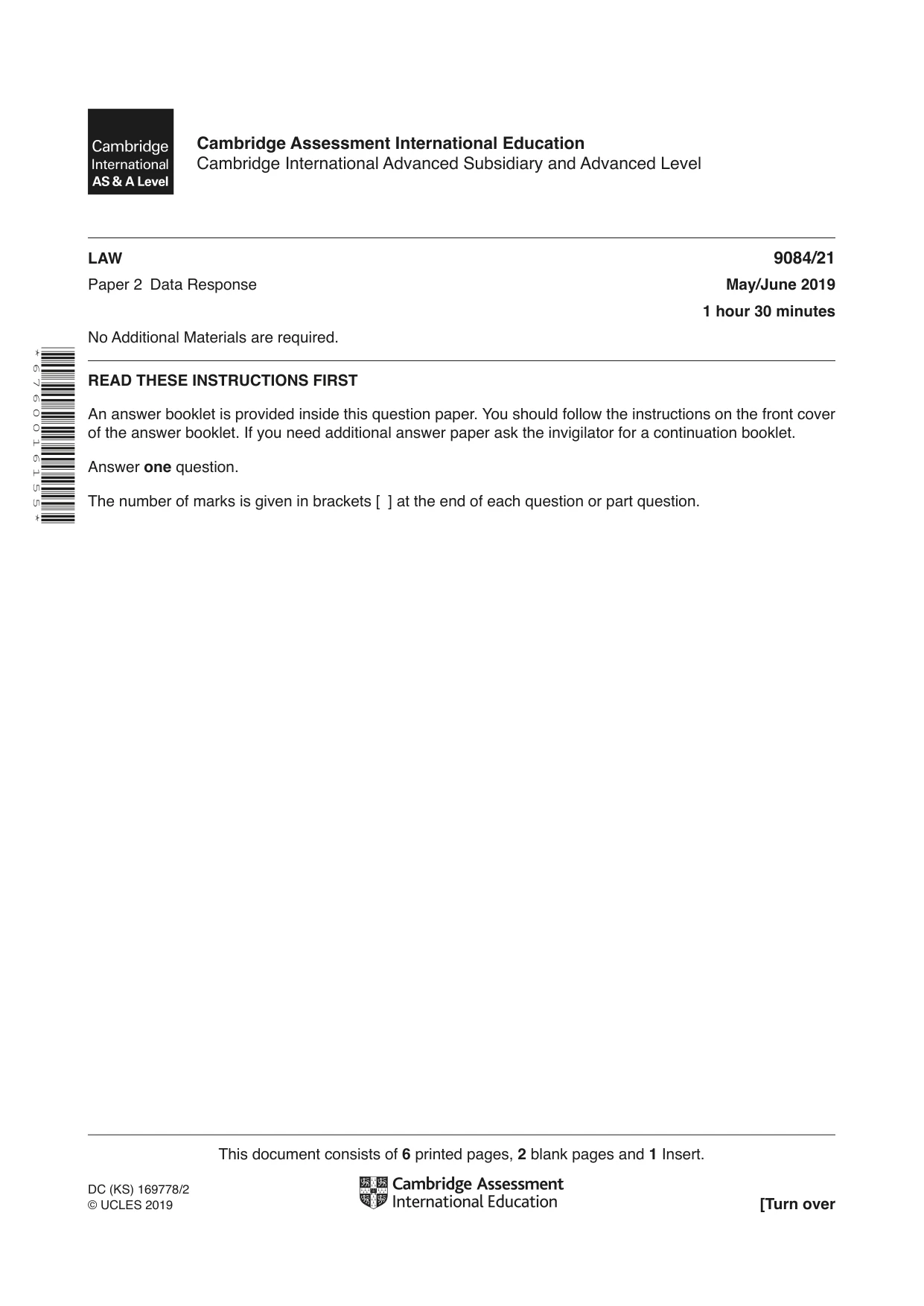
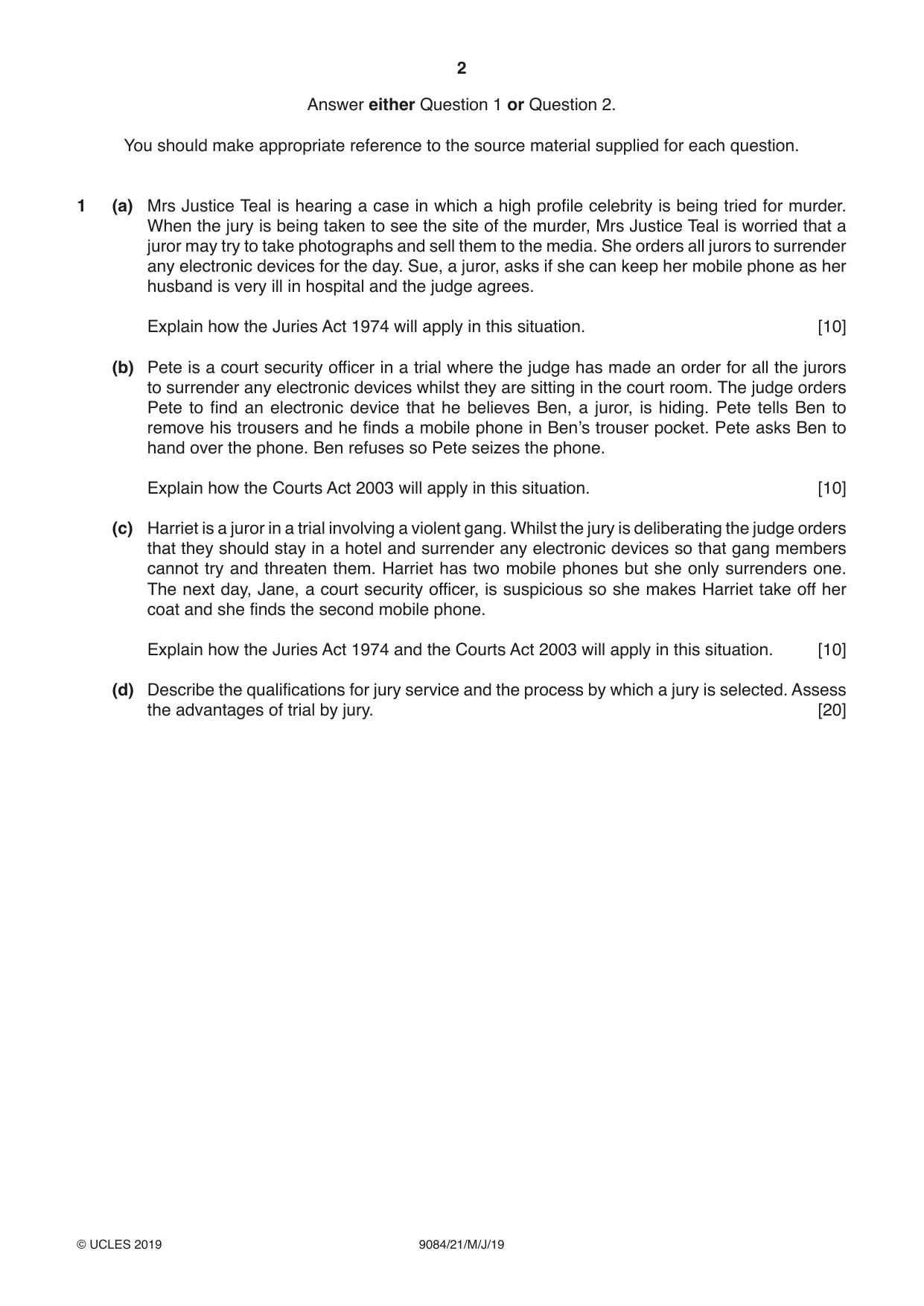
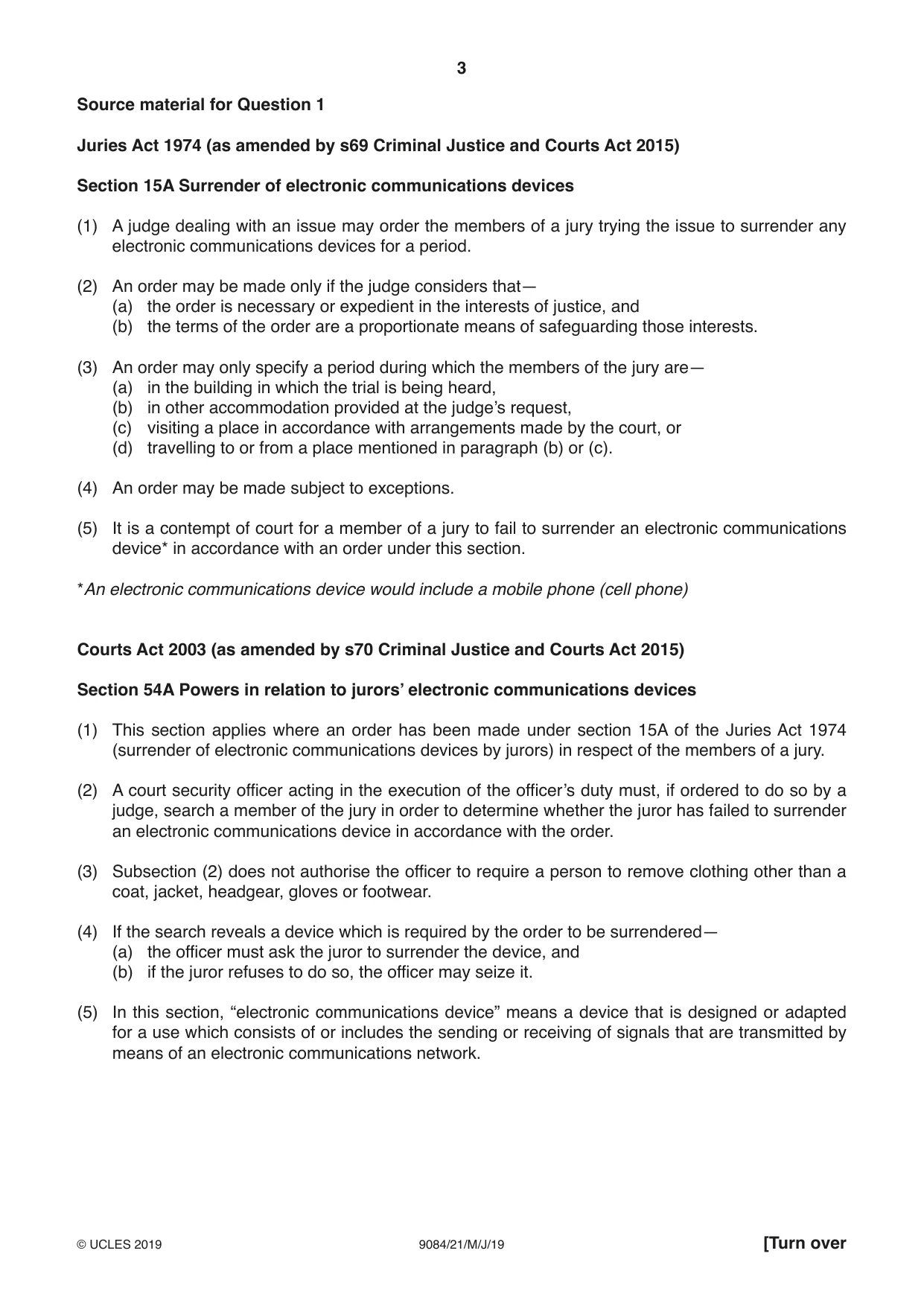
1 (a) Mrs Justice Teal is hearing a case in which a high profile celebrity is being tried for murder. When the jury is being taken to see the site of the murder, Mrs Justice Teal is worried that a juror may try to take photographs and sell them to the media. She orders all jurors to surrender any electronic devices for the day. Sue, a juror, asks if she can keep her mobile phone as her husband is very ill in hospital and the judge agrees. Explain how the Juries Act 1974 will apply in this situation. [10] (b) Pete is a court security officer in a trial where the judge has made an order for all the jurors to surrender any electronic devices whilst they are sitting in the court room. The judge orders Pete to find an electronic device that he believes Ben, a juror, is hiding. Pete tells Ben to remove his trousers and he finds a mobile phone in Ben’s trouser pocket. Pete asks Ben to hand over the phone. Ben refuses so Pete seizes the phone. Explain how the Courts Act 2003 will apply in this situation. [10] (c) Harriet is a juror in a trial involving a violent gang. Whilst the jury is deliberating the judge orders that they should stay in a hotel and surrender any electronic devices so that gang members cannot try and threaten them. Harriet has two mobile phones but she only surrenders one. The next day, Jane, a court security officer, is suspicious so she makes Harriet take off her coat and she finds the second mobile phone. Explain how the Juries Act 1974 and the Courts Act 2003 will apply in this situation. [10] (d) Describe the qualifications for jury service and the process by which a jury is selected. Assess the advantages of trial by jury. [20] Source material for Question 1 Juries Act 1974 (as amended by s69 Criminal Justice and Courts Act 2015) Section 15A Surrender of electronic communications devices (1) A judge dealing with an issue may order the members of a jury trying the issue to surrender any electronic communications devices for a period. (2) An order may be made only if the judge considers that— (a) the order is necessary or expedient in the interests of justice, and (b) the terms of the order are a proportionate means of safeguarding those interests. (3) An order may only specify a period during which the members of the jury are— (a) in the building in which the trial is being heard, (b) in other accommodation provided at the judge’s request, (c) visiting a place in accordance with arrangements made by the court, or (d) travelling to or from a place mentioned in paragraph (b) or (c). (4) An order may be made subject to exceptions. (5) It is a contempt of court for a member of a jury to fail to surrender an electronic communications device* in accordance with an order under this section. *An electronic communications device would include a mobile phone (cell phone) Courts Act 2003 (as amended by s70 Criminal Justice and Courts Act 2015) Section 54A Powers in relation to jurors’ electronic communications devices (1) This section applies where an order has been made under section 15A of the Juries Act 1974 (surrender of electronic communications devices by jurors) in respect of the members of a jury. (2) A court security officer acting in the execution of the officer’s duty must, if ordered to do so by a judge, search a member of the jury in order to determine whether the juror has failed to surrender an electronic communications device in accordance with the order. (3) Subsection (2) does not authorise the officer to require a person to remove clothing other than a coat, jacket, headgear, gloves or footwear. (4) If the search reveals a device which is required by the order to be surrendered— (a) the officer must ask the juror to surrender the device, and (b) if the juror refuses to do so, the officer may seize it. (5) In this section, “electronic communications device” means a device that is designed or adapted for a use which consists of or includes the sending or receiving of signals that are transmitted by means of an electronic communications network.
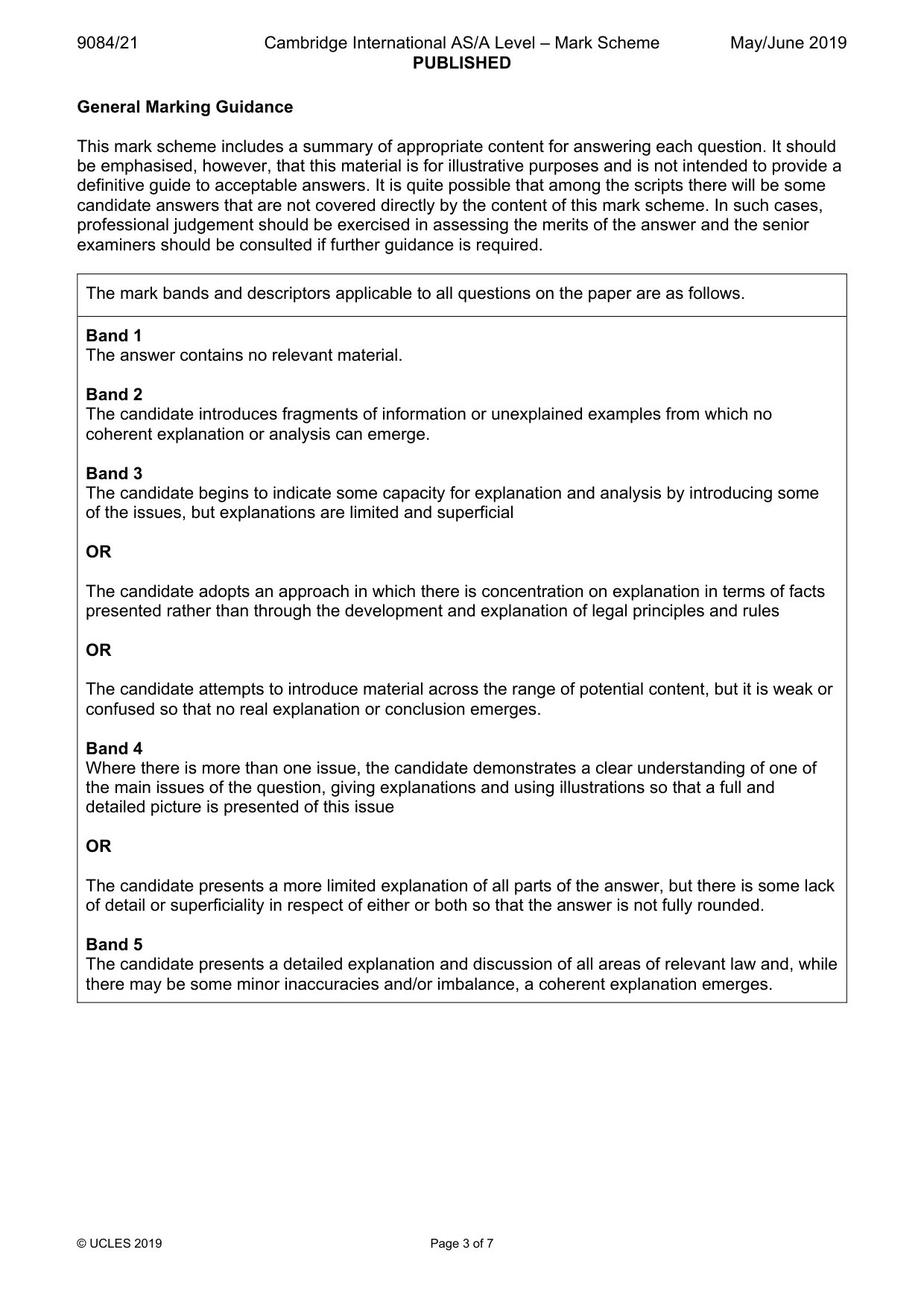
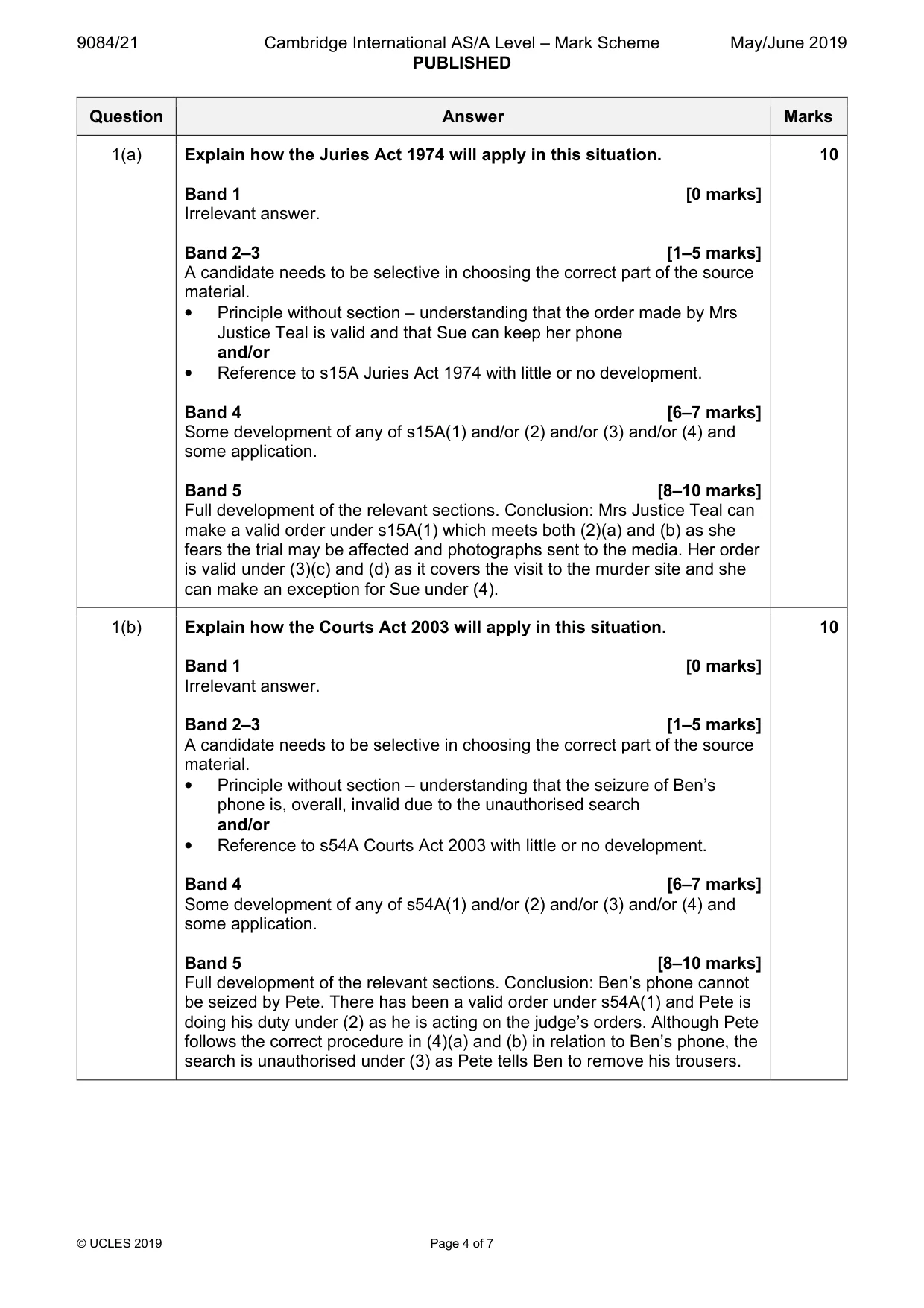
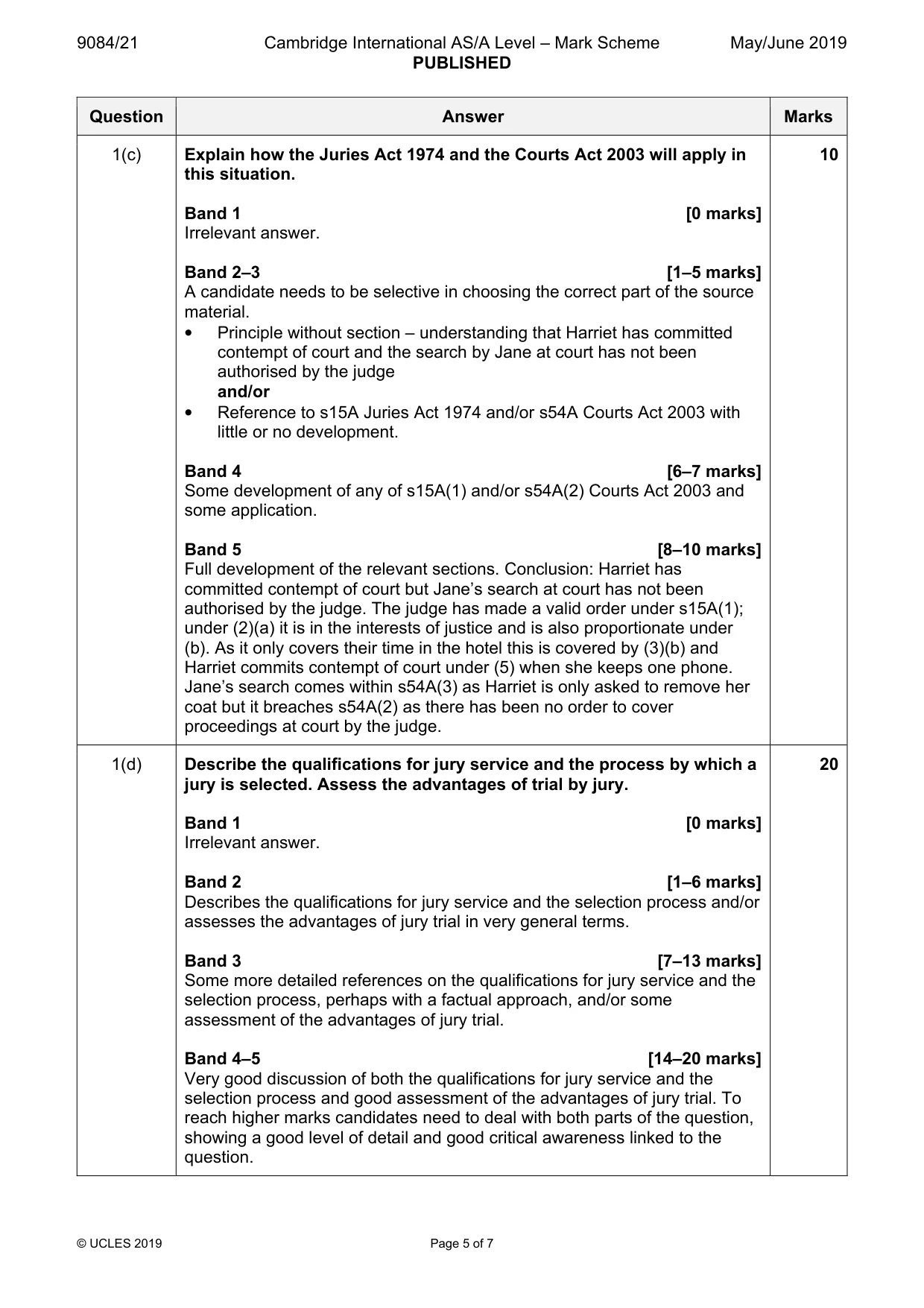
Mark scheme: Question Answer Marks 1(a) Explain how the Juries Act 1974 will apply in this situation. 10 Band 1 [0 marks] Irrelevant answer. Band 2–3 [1–5 marks] A candidate needs to be selective in choosing the correct part of the source material. • Principle without section – understanding that the order made by Mrs Justice Teal is valid and that Sue can keep her phone and/or • Reference to s15A Juries Act 1974 with little or no development. Band 4 [6–7 marks] Some development of any of s15A(1) and/or (2) and/or (3) and/or (4) and some application. Band 5 [8–10 marks] Full development of the relevant sections. Conclusion: Mrs Justice Teal can make a valid order under s15A(1) which meets both (2)(a) and (b) as she fears the trial may be affected and photographs sent to the media. Her order is valid under (3)(c) and (d) as it covers the visit to the murder site and she can make an exception for Sue under (4). 1(b) Explain how the Courts Act 2003 will apply in this situation. 10 Band 1 [0 marks] Irrelevant answer. Band 2–3 [1–5 marks] A candidate needs to be selective in choosing the correct part of the source material. • Principle without section – understanding that the seizure of Ben’s phone is, overall, invalid due to the unauthorised search and/or • Reference to s54A Courts Act 2003 with little or no development. Band 4 [6–7 marks] Some development of any of s54A(1) and/or (2) and/or (3) and/or (4) and some application. Band 5 [8–10 marks] Full development of the relevant sections. Conclusion: Ben’s phone cannot be seized by Pete. There has been a valid order under s54A(1) and Pete is doing his duty under (2) as he is acting on the judge’s orders. Although Pete follows the correct procedure in (4)(a) and (b) in relation to Ben’s phone, the search is unauthorised under (3) as Pete tells Ben to remove his trousers. 1(c) Explain how the Juries Act 1974 and the Courts Act 2003 will apply in 10 this situation. Band 1 [0 marks] Irrelevant answer. Band 2–3 [1–5 marks] A candidate needs to be selective in choosing the correct part of the source material. • Principle without section – understanding that Harriet has committed contempt of court and the search by Jane at court has not been authorised by the judge and/or • Reference to s15A Juries Act 1974 and/or s54A Courts Act 2003 with little or no development. Band 4 [6–7 marks] Some development of any of s15A(1) and/or s54A(2) Courts Act 2003 and some application. Band 5 [8–10 marks] Full development of the relevant sections. Conclusion: Harriet has committed contempt of court but Jane’s search at court has not been authorised by the judge. The judge has made a valid order under s15A(1); under (2)(a) it is in the interests of justice and is also proportionate under (b). As it only covers their time in the hotel this is covered by (3)(b) and Harriet commits contempt of court under (5) when she keeps one phone. Jane’s search comes within s54A(3) as Harriet is only asked to remove her coat but it breaches s54A(2) as there has been no order to cover proceedings at court by the judge. 1(d) Describe the qualifications for jury service and the process by which a 20 jury is selected. Assess the advantages of trial by jury. Band 1 [0 marks] Irrelevant answer. Band 2 [1–6 marks] Describes the qualifications for jury service and the selection process and/or assesses the advantages of jury trial in very general terms. Band 3 [7–13 marks] Some more detailed references on the qualifications for jury service and the selection process, perhaps with a factual approach, and/or some assessment of the advantages of jury trial. Band 4–5 [14–20 marks] Very good discussion of both the qualifications for jury service and the selection process and good assessment of the advantages of jury trial. To reach higher marks candidates need to deal with both parts of the question, showing a good level of detail and good critical awareness linked to the question.
Q2 · Rufus is granted a pet shop licence on 1 January 2017
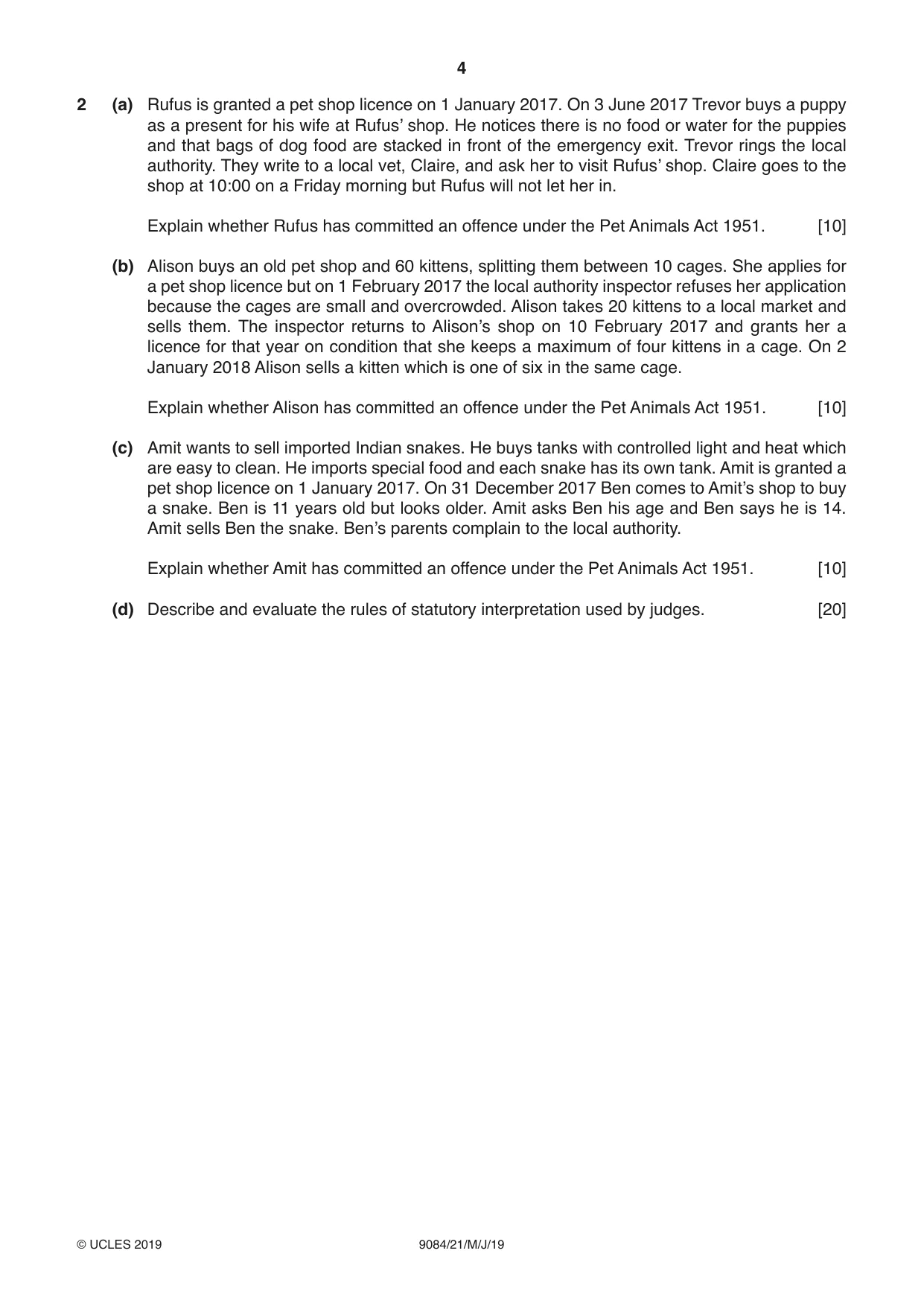
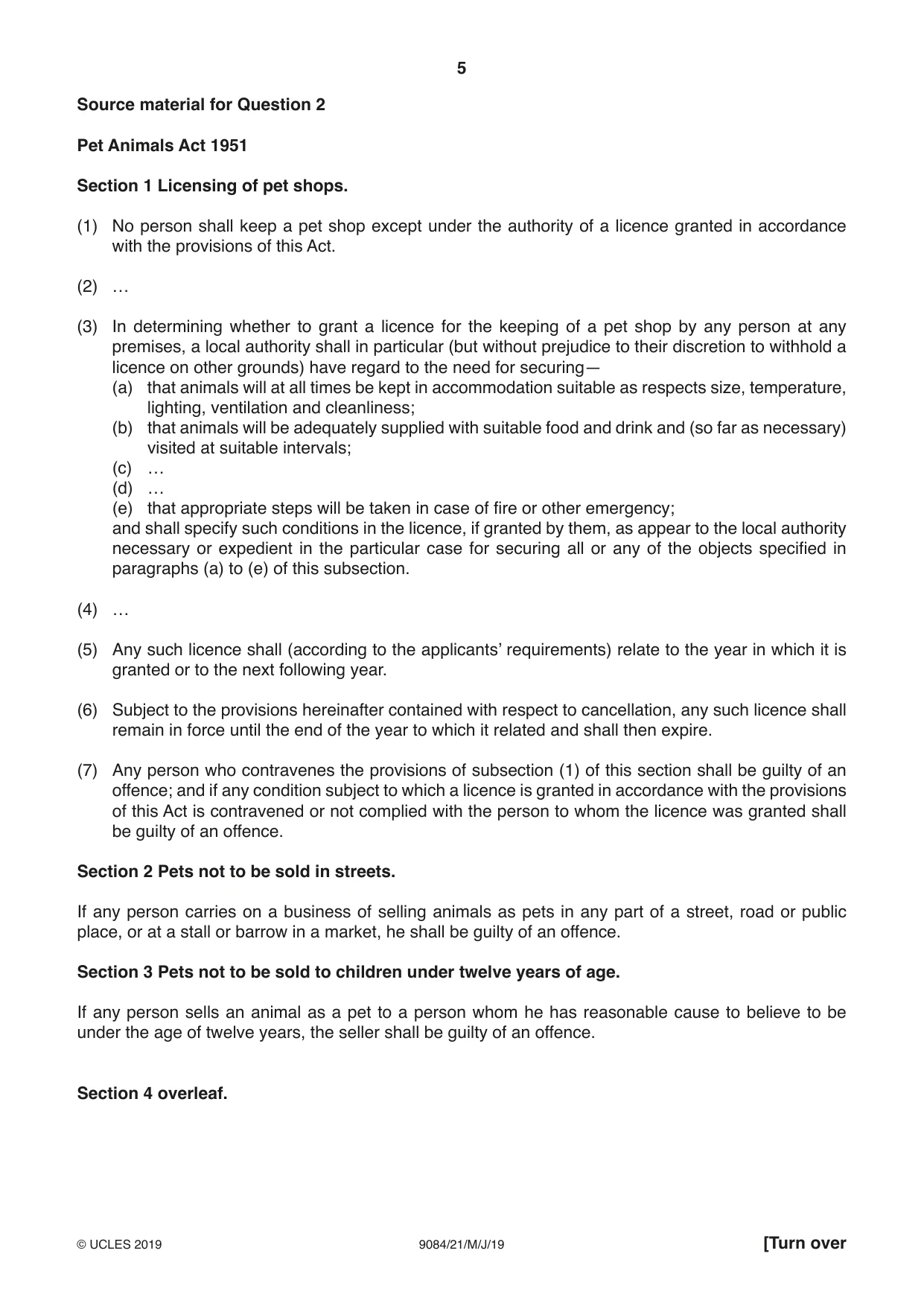
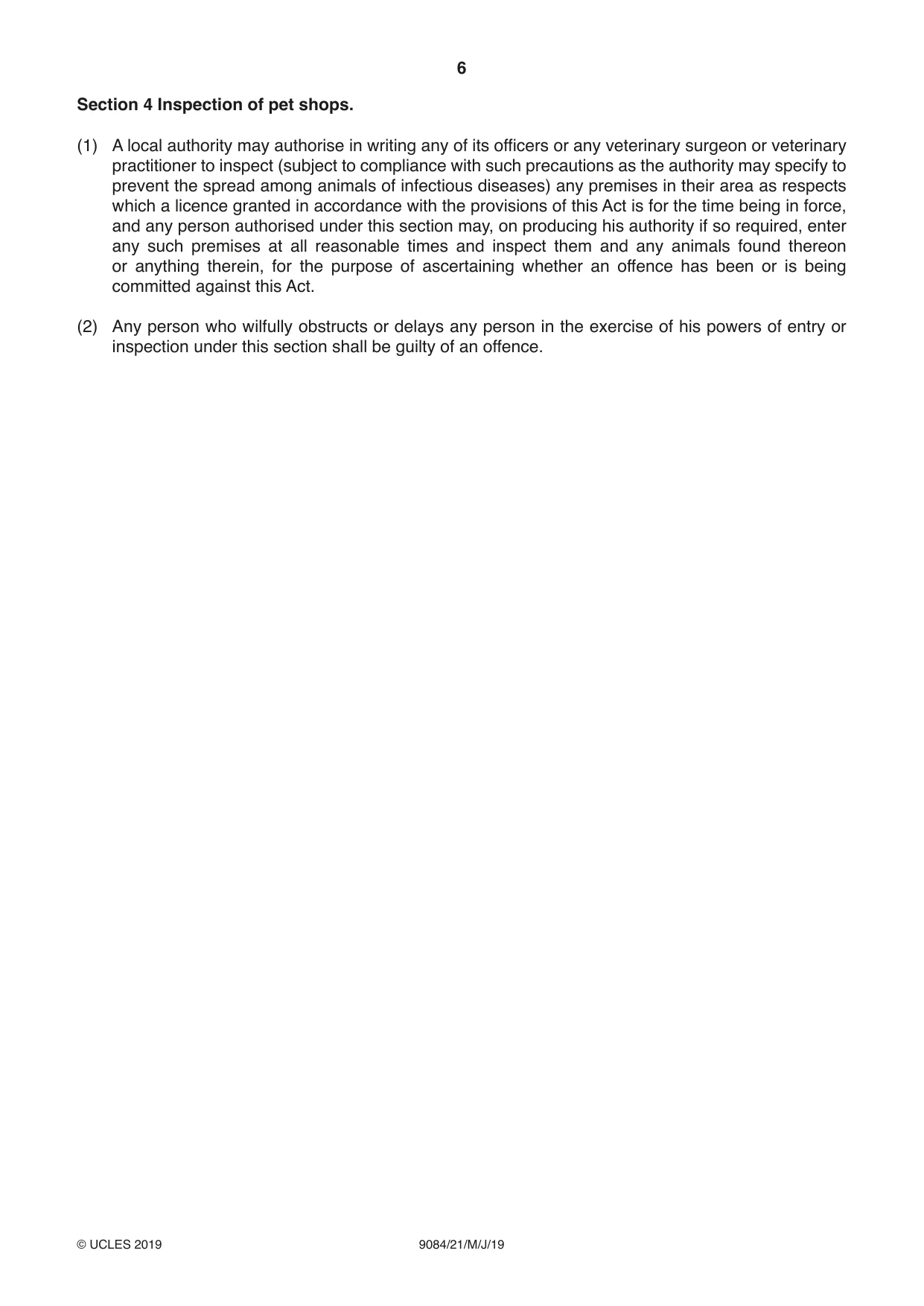
2 (a) Rufus is granted a pet shop licence on 1 January 2017. On 3 June 2017 Trevor buys a puppy as a present for his wife at Rufus’ shop. He notices there is no food or water for the puppies and that bags of dog food are stacked in front of the emergency exit. Trevor rings the local authority. They write to a local vet, Claire, and ask her to visit Rufus’ shop. Claire goes to the shop at 10:00 on a Friday morning but Rufus will not let her in. Explain whether Rufus has committed an offence under the Pet Animals Act 1951. [10] (b) Alison buys an old pet shop and 60 kittens, splitting them between 10 cages. She applies for a pet shop licence but on 1 February 2017 the local authority inspector refuses her application because the cages are small and overcrowded. Alison takes 20 kittens to a local market and sells them. The inspector returns to Alison’s shop on 10 February 2017 and grants her a licence for that year on condition that she keeps a maximum of four kittens in a cage. On 2 January 2018 Alison sells a kitten which is one of six in the same cage. Explain whether Alison has committed an offence under the Pet Animals Act 1951. [10] (c) Amit wants to sell imported Indian snakes. He buys tanks with controlled light and heat which are easy to clean. He imports special food and each snake has its own tank. Amit is granted a pet shop licence on 1 January 2017. On 31 December 2017 Ben comes to Amit’s shop to buy a snake. Ben is 11 years old but looks older. Amit asks Ben his age and Ben says he is 14. Amit sells Ben the snake. Ben’s parents complain to the local authority. Explain whether Amit has committed an offence under the Pet Animals Act 1951. [10] (d) Describe and evaluate the rules of statutory interpretation used by judges. [20] Source material for Question 2 Pet Animals Act 1951 Section 1 Licensing of pet shops. (1) No person shall keep a pet shop except under the authority of a licence granted in accordance with the provisions of this Act. (2) … (3) In determining whether to grant a licence for the keeping of a pet shop by any person at any premises, a local authority shall in particular (but without prejudice to their discretion to withhold a licence on other grounds) have regard to the need for securing— (a) that animals will at all times be kept in accommodation suitable as respects size, temperature, lighting, ventilation and cleanliness; (b) that animals will be adequately supplied with suitable food and drink and (so far as necessary) visited at suitable intervals; (c) … (d) … (e) that appropriate steps will be taken in case of fire or other emergency; and shall specify such conditions in the licence, if granted by them, as appear to the local authority necessary or expedient in the particular case for securing all or any of the objects specified in paragraphs (a) to (e) of this subsection. (4) … (5) Any such licence shall (according to the applicants’ requirements) relate to the year in which it is granted or to the next following year. (6) Subject to the provisions hereinafter contained with respect to cancellation, any such licence shall remain in force until the end of the year to which it related and shall then expire. (7) Any person who contravenes the provisions of subsection (1) of this section shall be guilty of an offence; and if any condition subject to which a licence is granted in accordance with the provisions of this Act is contravened or not complied with the person to whom the licence was granted shall be guilty of an offence. Section 2 Pets not to be sold in streets. If any person carries on a business of selling animals as pets in any part of a street, road or public place, or at a stall or barrow in a market, he shall be guilty of an offence. Section 3 Pets not to be sold to children under twelve years of age. If any person sells an animal as a pet to a person whom he has reasonable cause to believe to be under the age of twelve years, the seller shall be guilty of an offence. Section 4 overleaf. Section 4 Inspection of pet shops. (1) A local authority may authorise in writing any of its officers or any veterinary surgeon or veterinary practitioner to inspect (subject to compliance with such precautions as the authority may specify to prevent the spread among animals of infectious diseases) any premises in their area as respects which a licence granted in accordance with the provisions of this Act is for the time being in force, and any person authorised under this section may, on producing his authority if so required, enter any such premises at all reasonable times and inspect them and any animals found thereon or anything therein, for the purpose of ascertaining whether an offence has been or is being committed against this Act. (2) Any person who wilfully obstructs or delays any person in the exercise of his powers of entry or inspection under this section shall be guilty of an offence.
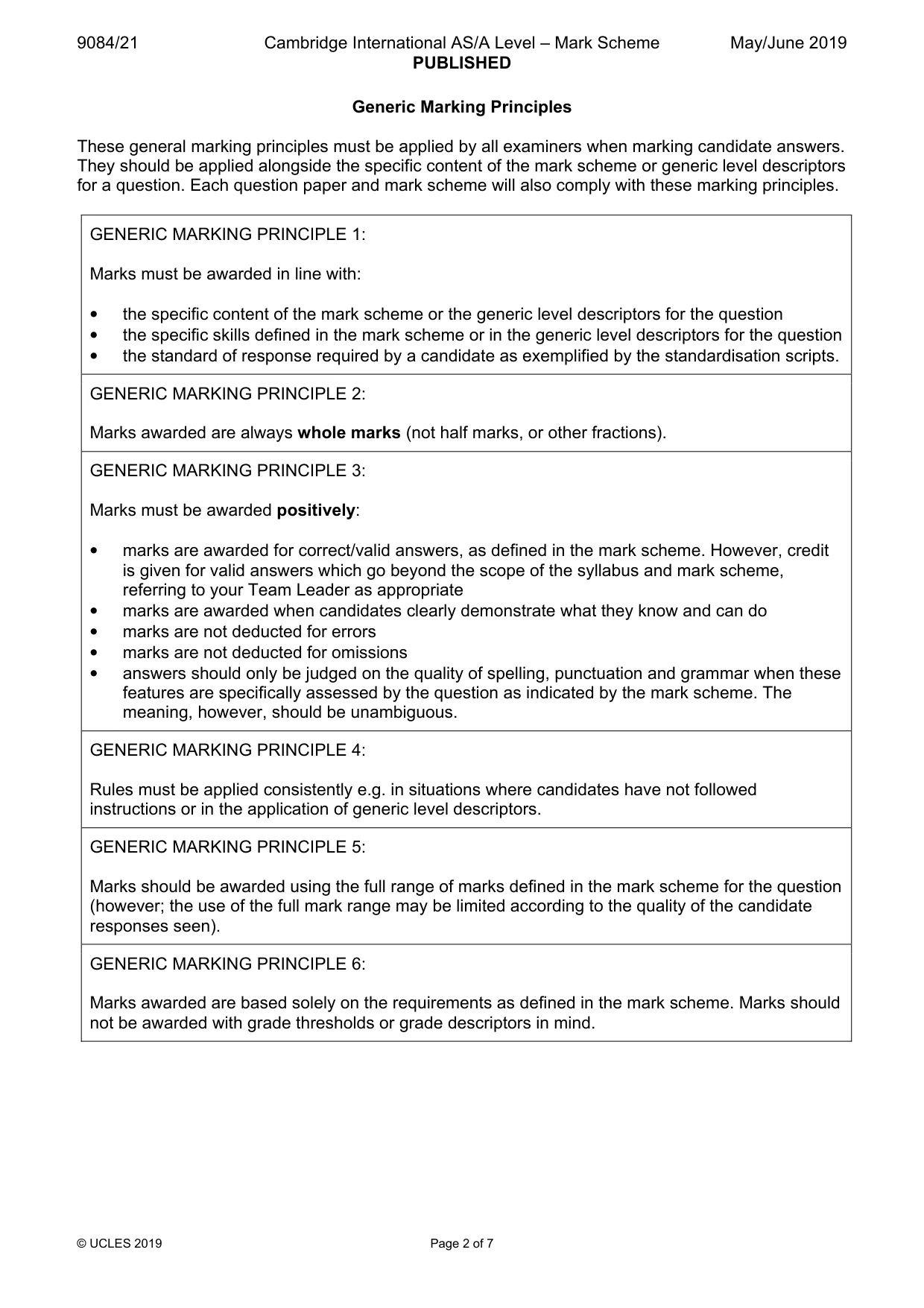
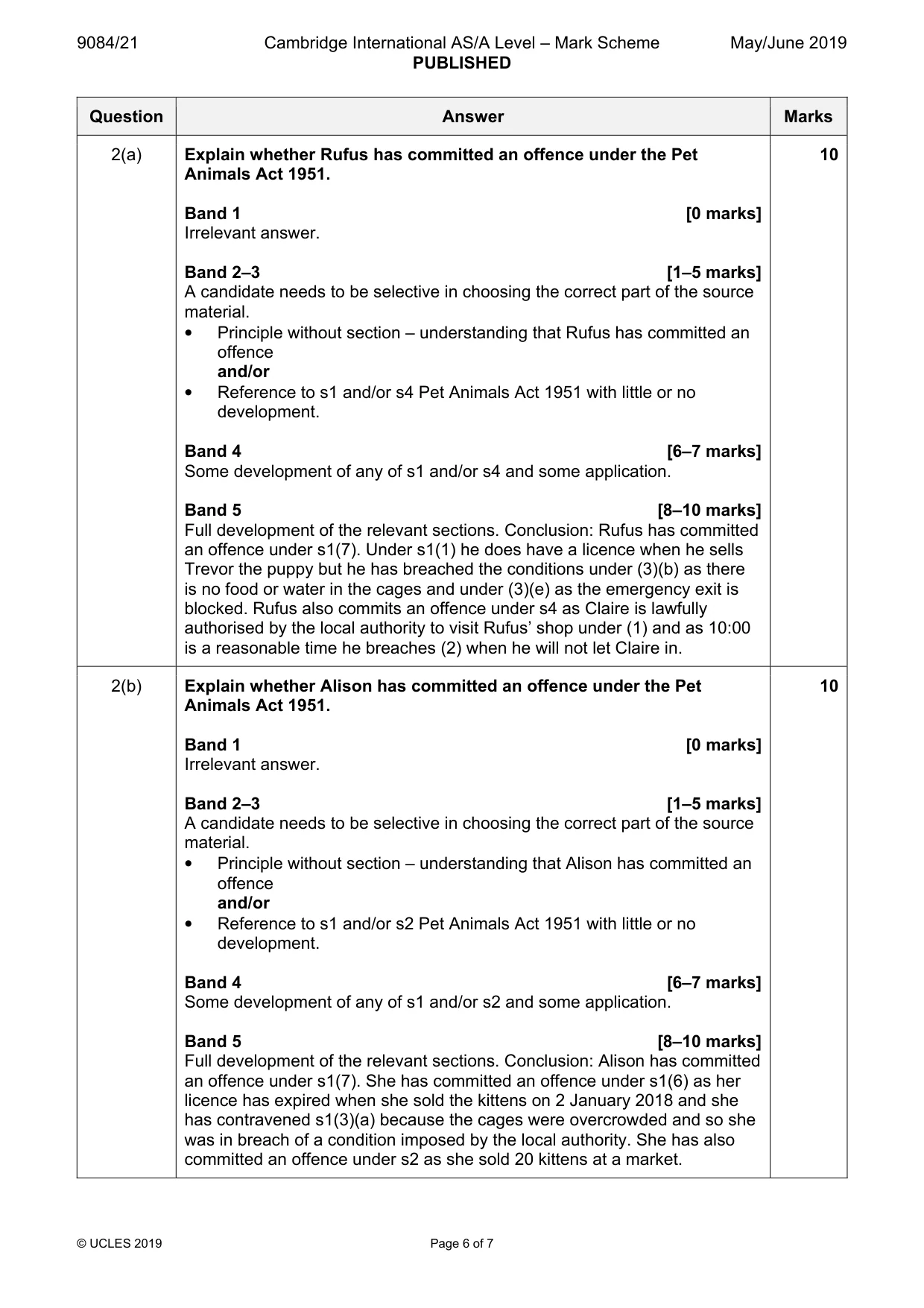
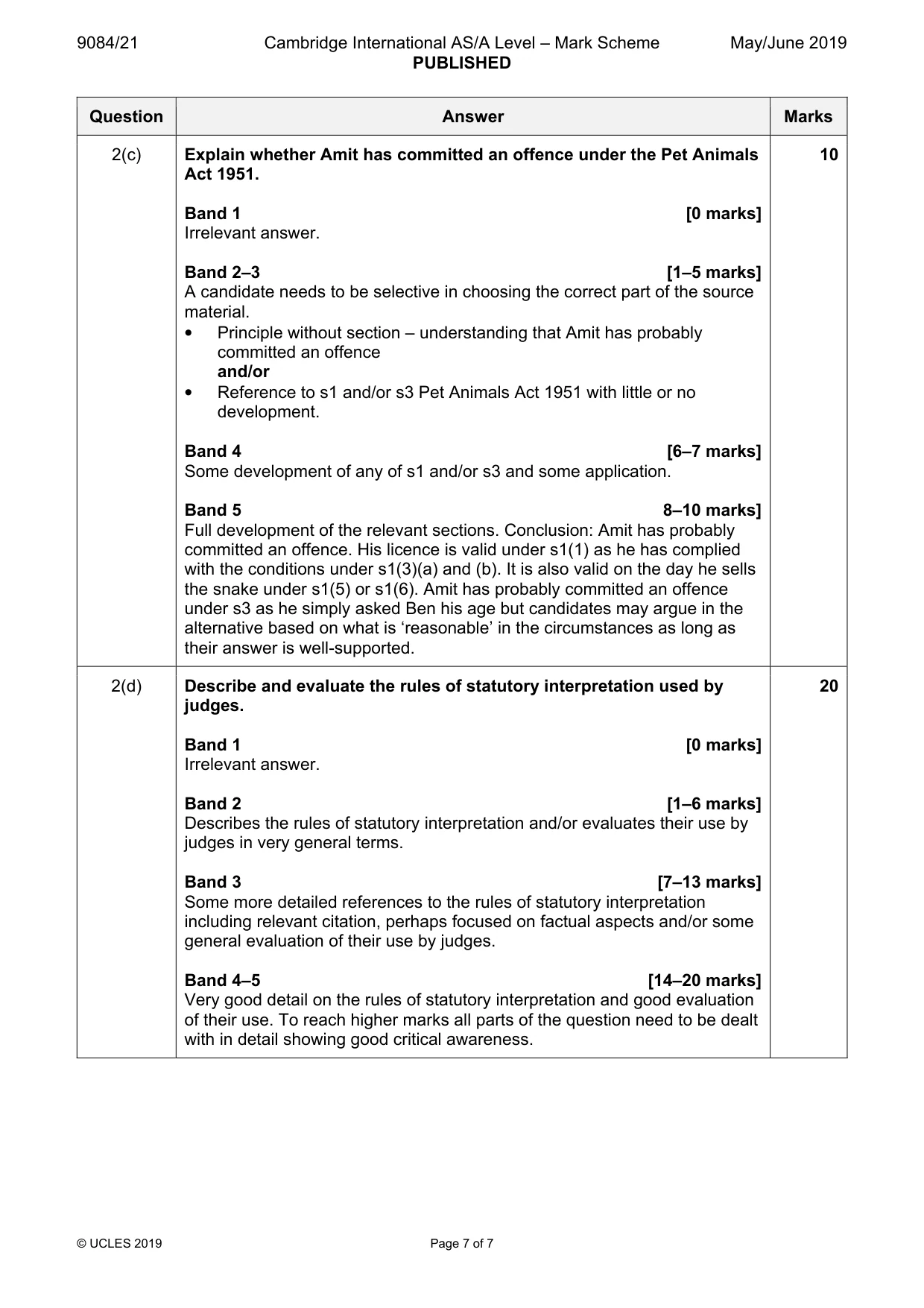
Mark scheme: 2(a) Explain whether Rufus has committed an offence under the Pet 10 Animals Act 1951. Band 1 [0 marks] Irrelevant answer. Band 2–3 [1–5 marks] A candidate needs to be selective in choosing the correct part of the source material. • Principle without section – understanding that Rufus has committed an offence and/or • Reference to s1 and/or s4 Pet Animals Act 1951 with little or no development. Band 4 [6–7 marks] Some development of any of s1 and/or s4 and some application. Band 5 [8–10 marks] Full development of the relevant sections. Conclusion: Rufus has committed an offence under s1(7). Under s1(1) he does have a licence when he sells Trevor the puppy but he has breached the conditions under (3)(b) as there is no food or water in the cages and under (3)(e) as the emergency exit is blocked. Rufus also commits an offence under s4 as Claire is lawfully authorised by the local authority to visit Rufus’ shop under (1) and as 10:00 is a reasonable time he breaches (2) when he will not let Claire in. 2(b) Explain whether Alison has committed an offence under the Pet 10 Animals Act 1951. Band 1 [0 marks] Irrelevant answer. Band 2–3 [1–5 marks] A candidate needs to be selective in choosing the correct part of the source material. • Principle without section – understanding that Alison has committed an offence and/or • Reference to s1 and/or s2 Pet Animals Act 1951 with little or no development. Band 4 [6–7 marks] Some development of any of s1 and/or s2 and some application. Band 5 [8–10 marks] Full development of the relevant sections. Conclusion: Alison has committed an offence under s1(7). She has committed an offence under s1(6) as her licence has expired when she sold the kittens on 2 January 2018 and she has contravened s1(3)(a) because the cages were overcrowded and so she was in breach of a condition imposed by the local authority. She has also committed an offence under s2 as she sold 20 kittens at a market. 2(c) Explain whether Amit has committed an offence under the Pet Animals 10 Act 1951. Band 1 [0 marks] Irrelevant answer. Band 2–3 [1–5 marks] A candidate needs to be selective in choosing the correct part of the source material. • Principle without section – understanding that Amit has probably committed an offence and/or • Reference to s1 and/or s3 Pet Animals Act 1951 with little or no development. Band 4 [6–7 marks] Some development of any of s1 and/or s3 and some application. Band 5 8–10 marks] Full development of the relevant sections. Conclusion: Amit has probably committed an offence. His licence is valid under s1(1) as he has complied with the conditions under s1(3)(a) and (b). It is also valid on the day he sells the snake under s1(5) or s1(6). Amit has probably committed an offence under s3 as he simply asked Ben his age but candidates may argue in the alternative based on what is ‘reasonable’ in the circumstances as long as their answer is well-supported. 2(d) Describe and evaluate the rules of statutory interpretation used by 20 judges. Band 1 [0 marks] Irrelevant answer. Band 2 [1–6 marks] Describes the rules of statutory interpretation and/or evaluates their use by judges in very general terms. Band 3 [7–13 marks] Some more detailed references to the rules of statutory interpretation including relevant citation, perhaps focused on factual aspects and/or some general evaluation of their use by judges. Band 4–5 [14–20 marks] Very good detail on the rules of statutory interpretation and good evaluation of their use. To reach higher marks all parts of the question need to be dealt with in detail showing good critical awareness.
What was in this paper
The subtopics covered by these 2 questions, and how many questions each got. Open one in a new tab to see every Cambridge question on it.
1Offences against property This topic is about the components of substantive offences against property. This topic is an opportunity to reflect on the key concepts of liability, justice, fairness, effectiveness and certainty1What you needed in this session
Cambridge’s own grade thresholds for 2019 May/June, Paper 2 · Variant 1. A higher threshold means an easier paper — the bar moves with how the cohort did.