Cambridge A Level Law 9084 — 2019 Oct/Nov Paper 2 · Variant 2
9084/22/O/N/19 · 2 questions · 50 marks · ≈56 min
The question paper and its mark scheme, free to read here and free to download. This is Cambridge’s own paper, exactly as it was sat.
Question paper8 pages



Mark scheme8 pages
Answers below. Sit the paper first if you are practising.
Questions as text
Q1 · Anwar is in a lot of debt and he asks his wealthy employer, Karinna, for a loan but she…
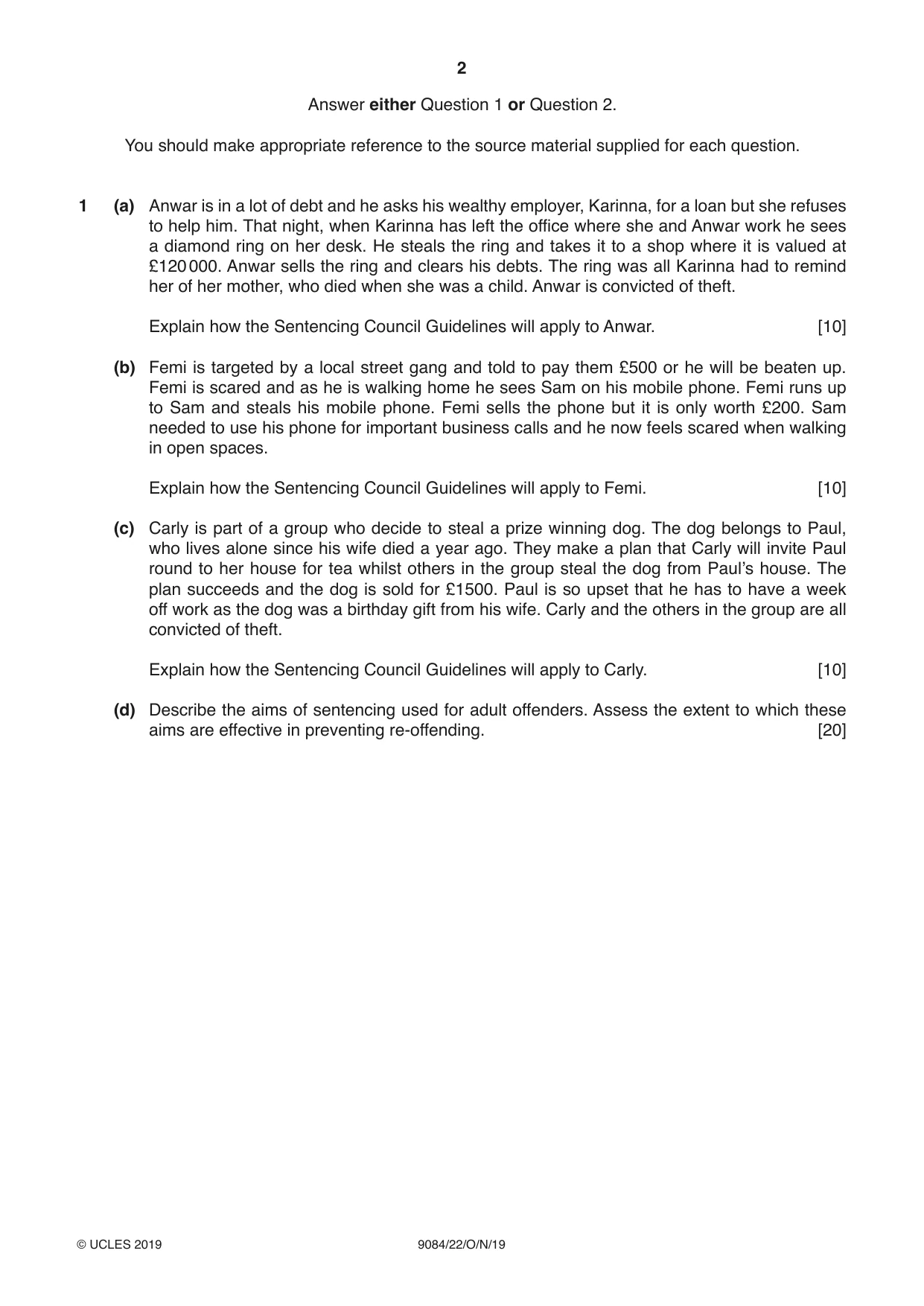
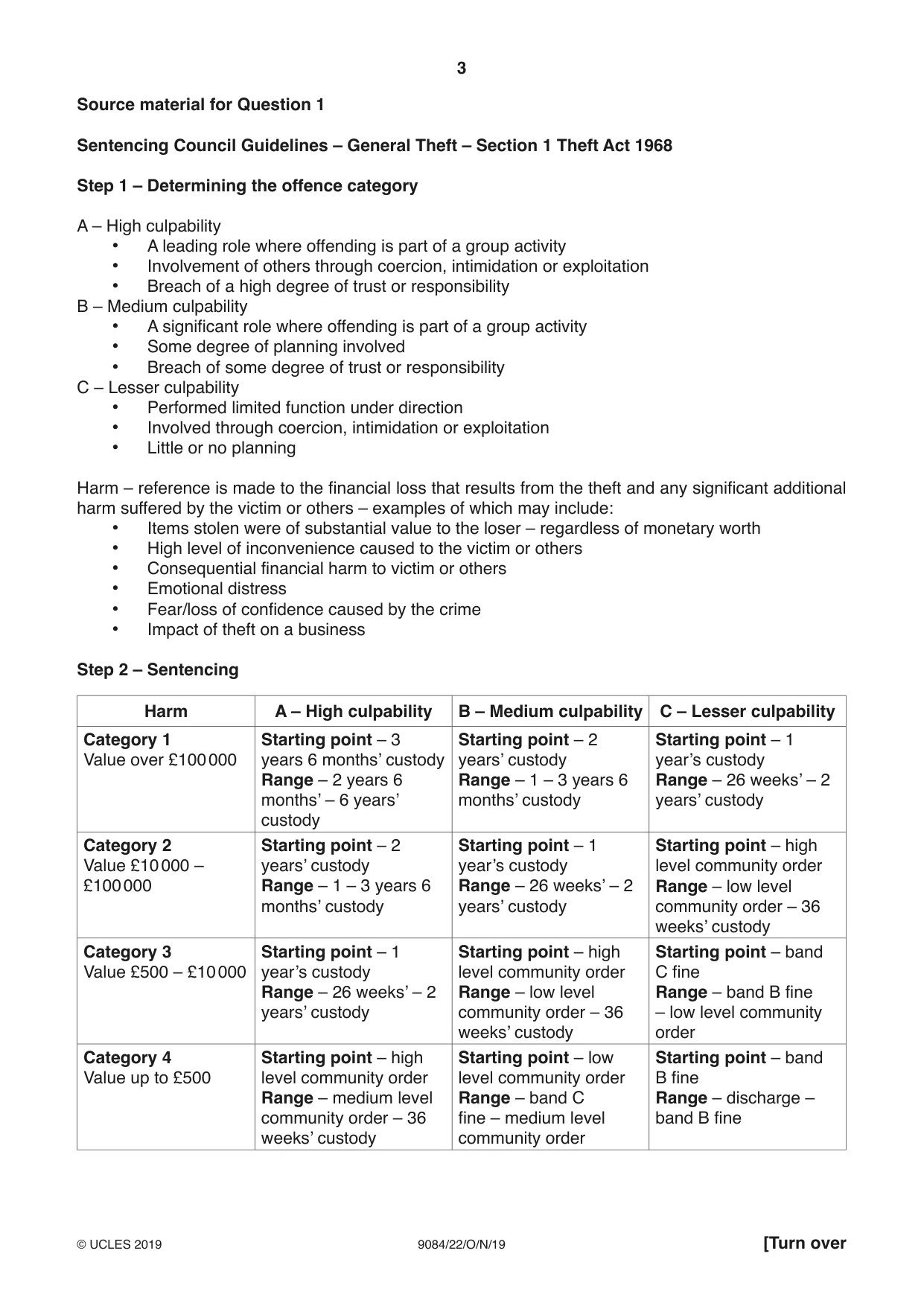
1 (a) Anwar is in a lot of debt and he asks his wealthy employer, Karinna, for a loan but she refuses to help him. That night, when Karinna has left the office where she and Anwar work he sees a diamond ring on her desk. He steals the ring and takes it to a shop where it is valued at £120 000. Anwar sells the ring and clears his debts. The ring was all Karinna had to remind her of her mother, who died when she was a child. Anwar is convicted of theft. Explain how the Sentencing Council Guidelines will apply to Anwar. [10] (b) Femi is targeted by a local street gang and told to pay them £500 or he will be beaten up. Femi is scared and as he is walking home he sees Sam on his mobile phone. Femi runs up to Sam and steals his mobile phone. Femi sells the phone but it is only worth £200. Sam needed to use his phone for important business calls and he now feels scared when walking in open spaces. Explain how the Sentencing Council Guidelines will apply to Femi. [10] (c) Carly is part of a group who decide to steal a prize winning dog. The dog belongs to Paul, who lives alone since his wife died a year ago. They make a plan that Carly will invite Paul round to her house for tea whilst others in the group steal the dog from Paul’s house. The plan succeeds and the dog is sold for £1500. Paul is so upset that he has to have a week off work as the dog was a birthday gift from his wife. Carly and the others in the group are all convicted of theft. Explain how the Sentencing Council Guidelines will apply to Carly. [10] (d) Describe the aims of sentencing used for adult offenders. Assess the extent to which these aims are effective in preventing re-offending. [20] Source material for Question 1 Sentencing Council Guidelines – General Theft – Section 1 Theft Act 1968 Step 1 – Determining the offence category A – High culpability • A leading role where offending is part of a group activity • Involvement of others through coercion, intimidation or exploitation • Breach of a high degree of trust or responsibility B – Medium culpability • A significant role where offending is part of a group activity • Some degree of planning involved • Breach of some degree of trust or responsibility C – Lesser culpability • Performed limited function under direction • Involved through coercion, intimidation or exploitation • Little or no planning Harm – reference is made to the financial loss that results from the theft and any significant additional harm suffered by the victim or others – examples of which may include: • Items stolen were of substantial value to the loser – regardless of monetary worth • High level of inconvenience caused to the victim or others • Consequential financial harm to victim or others • Emotional distress • Fear/loss of confidence caused by the crime • Impact of theft on a business Step 2 – Sentencing Harm A – High culpability B – Medium culpability C – Lesser culpability Category 1 Starting point – 3 Starting point – 2 Starting point – 1 Value over £100 000 years 6 months’ custody years’ custody year’s custody Range – 2 years 6 Range – 1 – 3 years 6 Range – 26 weeks’ – 2 months’ – 6 years’ months’ custody years’ custody custody Category 2 Starting point – 2 Starting point – 1 Starting point – high Value £10 000 – years’ custody year’s custody level community order £100 000 Range – 1 – 3 years 6 Range – 26 weeks’ – 2 Range – low level months’ custody years’ custody community order – 36 weeks’ custody Category 3 Starting point – 1 Starting point – high Starting point – band Value £500 – £10 000 year’s custody level community order C fine Range – 26 weeks’ – 2 Range – low level Range – band B fine years’ custody community order – 36 – low level community weeks’ custody order Category 4 Starting point – high Starting point – low Starting point – band Value up to £500 level community order level community order B fine Range – medium level Range – band C Range – discharge – community order – 36 fine – medium level band B fine weeks’ custody community order
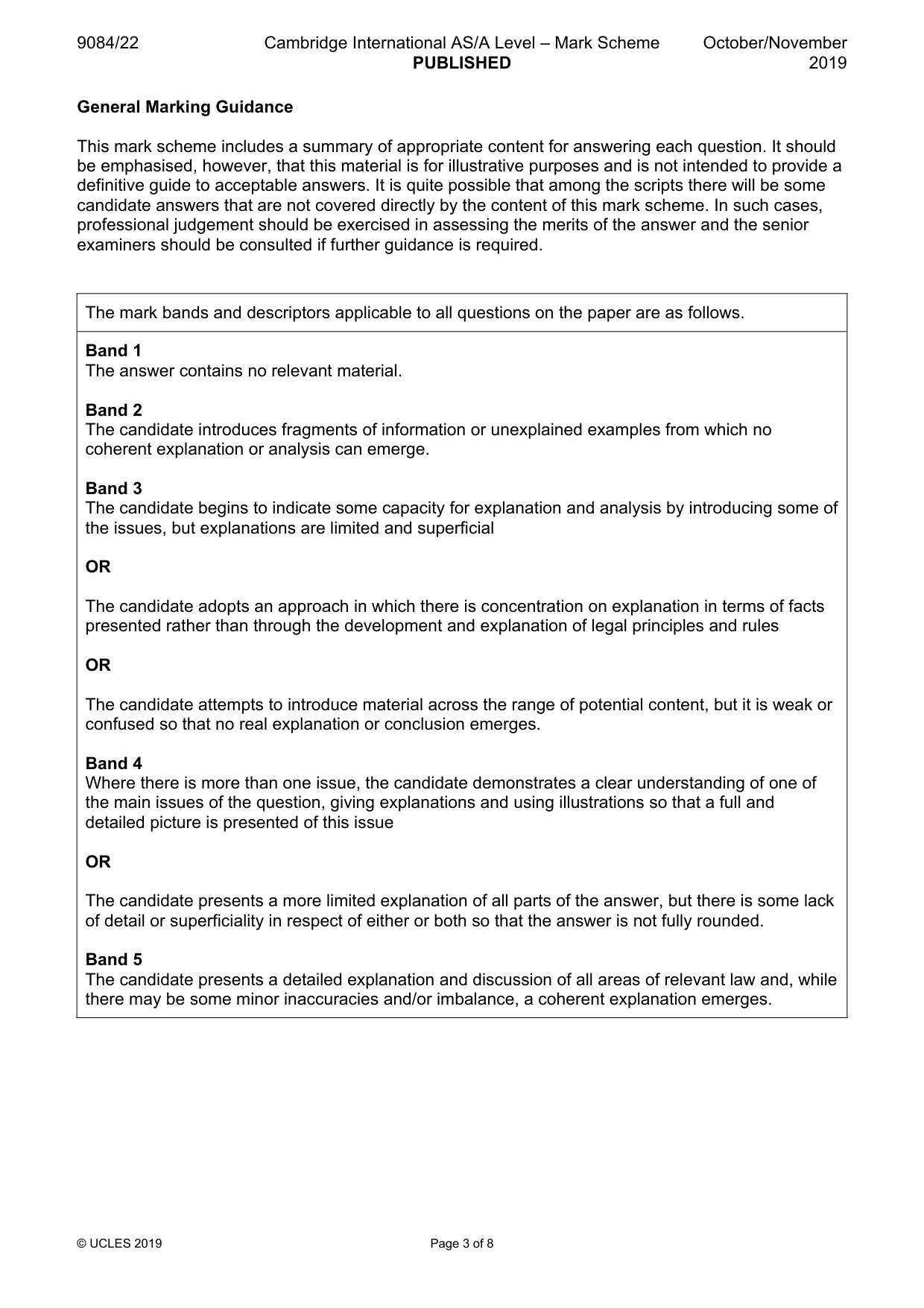
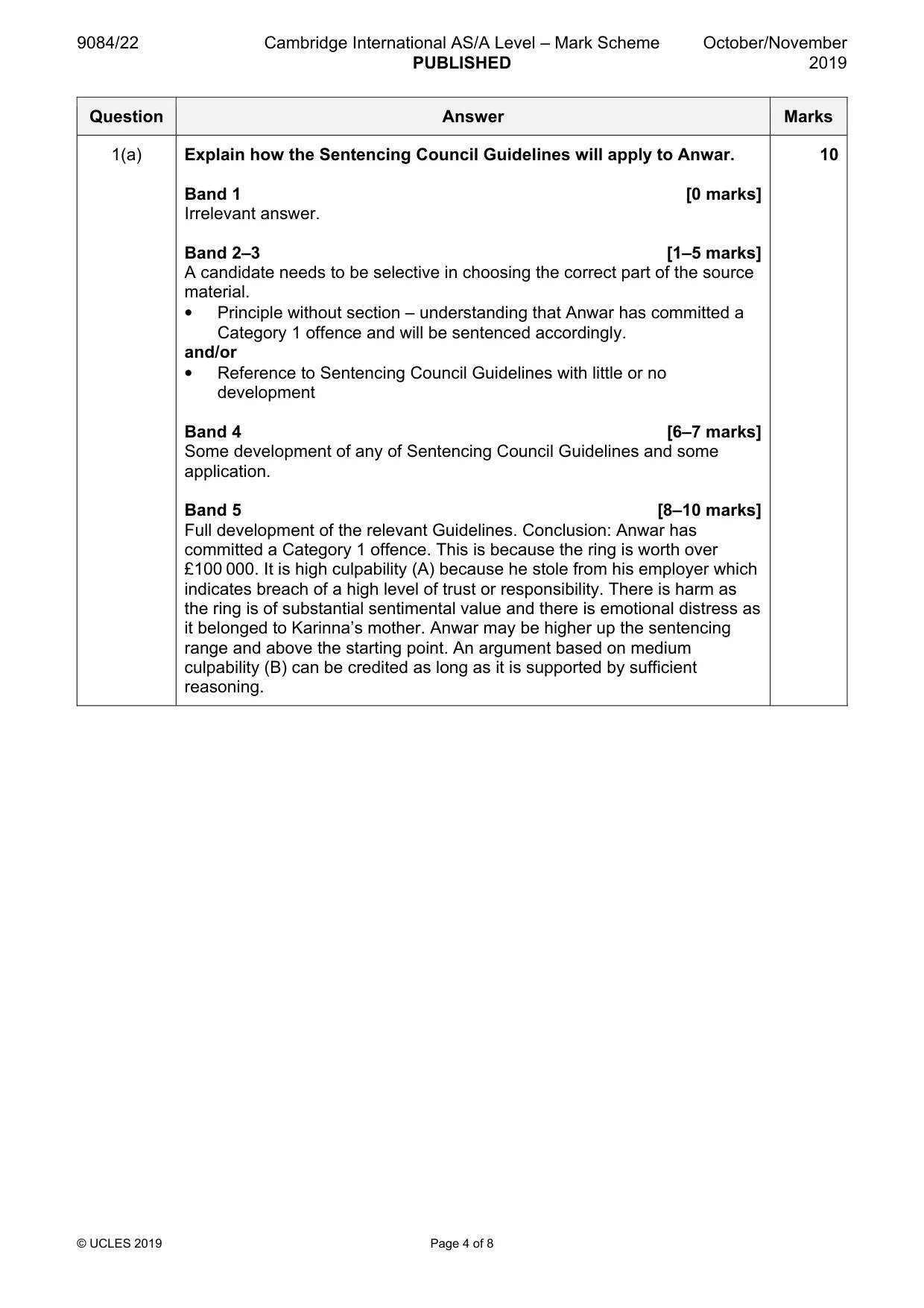
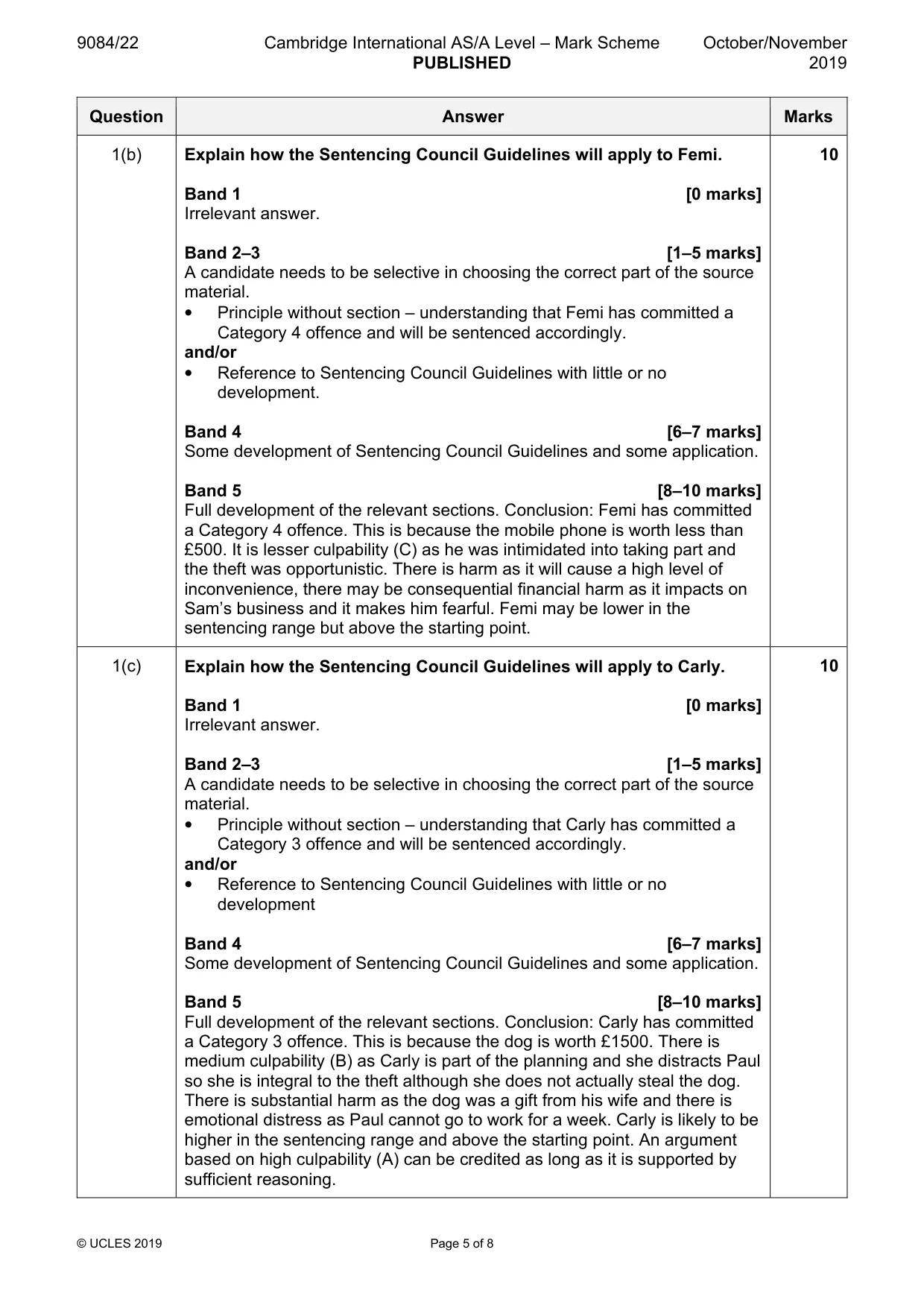
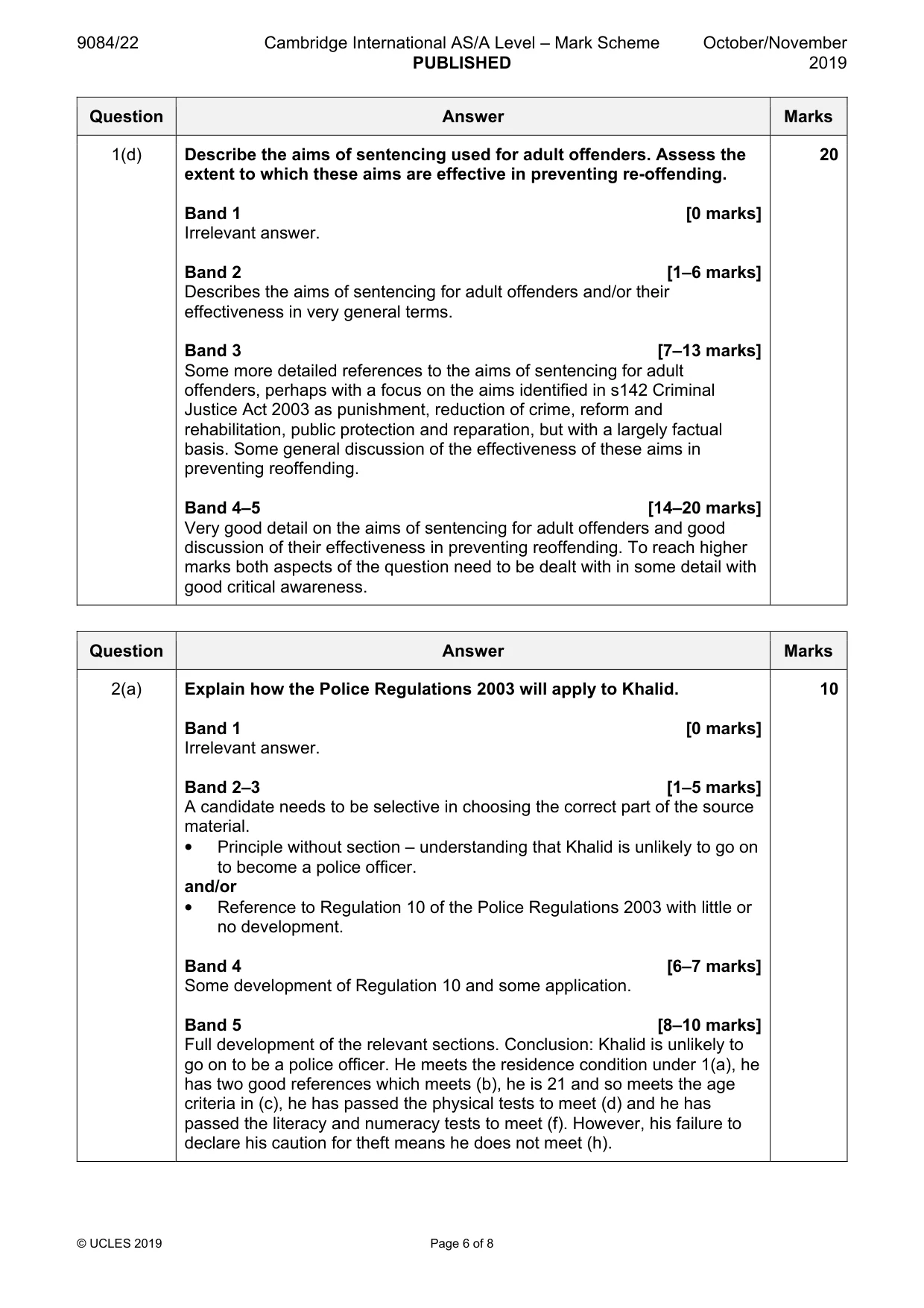
Mark scheme: Question Answer Marks 1(a) Explain how the Sentencing Council Guidelines will apply to Anwar. 10 Band 1 [0 marks] Irrelevant answer. Band 2–3 [1–5 marks] A candidate needs to be selective in choosing the correct part of the source material. • Principle without section – understanding that Anwar has committed a Category 1 offence and will be sentenced accordingly. and/or • Reference to Sentencing Council Guidelines with little or no development Band 4 [6–7 marks] Some development of any of Sentencing Council Guidelines and some application. Band 5 [8–10 marks] Full development of the relevant Guidelines. Conclusion: Anwar has committed a Category 1 offence. This is because the ring is worth over £100 000. It is high culpability (A) because he stole from his employer which indicates breach of a high level of trust or responsibility. There is harm as the ring is of substantial sentimental value and there is emotional distress as it belonged to Karinna’s mother. Anwar may be higher up the sentencing range and above the starting point. An argument based on medium culpability (B) can be credited as long as it is supported by sufficient reasoning. 1(b) Explain how the Sentencing Council Guidelines will apply to Femi. 10 Band 1 [0 marks] Irrelevant answer. Band 2–3 [1–5 marks] A candidate needs to be selective in choosing the correct part of the source material. • Principle without section – understanding that Femi has committed a Category 4 offence and will be sentenced accordingly. and/or • Reference to Sentencing Council Guidelines with little or no development. Band 4 [6–7 marks] Some development of Sentencing Council Guidelines and some application. Band 5 [8–10 marks] Full development of the relevant sections. Conclusion: Femi has committed a Category 4 offence. This is because the mobile phone is worth less than £500. It is lesser culpability (C) as he was intimidated into taking part and the theft was opportunistic. There is harm as it will cause a high level of inconvenience, there may be consequential financial harm as it impacts on Sam’s business and it makes him fearful. Femi may be lower in the sentencing range but above the starting point. 1(c) Explain how the Sentencing Council Guidelines will apply to Carly. 10 Band 1 [0 marks] Irrelevant answer. Band 2–3 [1–5 marks] A candidate needs to be selective in choosing the correct part of the source material. • Principle without section – understanding that Carly has committed a Category 3 offence and will be sentenced accordingly. and/or • Reference to Sentencing Council Guidelines with little or no development Band 4 [6–7 marks] Some development of Sentencing Council Guidelines and some application. Band 5 [8–10 marks] Full development of the relevant sections. Conclusion: Carly has committed a Category 3 offence. This is because the dog is worth £1500. There is medium culpability (B) as Carly is part of the planning and she distracts Paul so she is integral to the theft although she does not actually steal the dog. There is substantial harm as the dog was a gift from his wife and there is emotional distress as Paul cannot go to work for a week. Carly is likely to be higher in the sentencing range and above the starting point. An argument based on high culpability (A) can be credited as long as it is supported by sufficient reasoning. 1(d) Describe the aims of sentencing used for adult offenders. Assess the 20 extent to which these aims are effective in preventing re-offending. Band 1 [0 marks] Irrelevant answer. Band 2 [1–6 marks] Describes the aims of sentencing for adult offenders and/or their effectiveness in very general terms. Band 3 [7–13 marks] Some more detailed references to the aims of sentencing for adult offenders, perhaps with a focus on the aims identified in s142 Criminal Justice Act 2003 as punishment, reduction of crime, reform and rehabilitation, public protection and reparation, but with a largely factual basis. Some general discussion of the effectiveness of these aims in preventing reoffending. Band 4–5 [14–20 marks] Very good detail on the aims of sentencing for adult offenders and good discussion of their effectiveness in preventing reoffending. To reach higher marks both aspects of the question need to be dealt with in some detail with good critical awareness.
Q2 · Khalid, aged 21, applies to join the police force after university
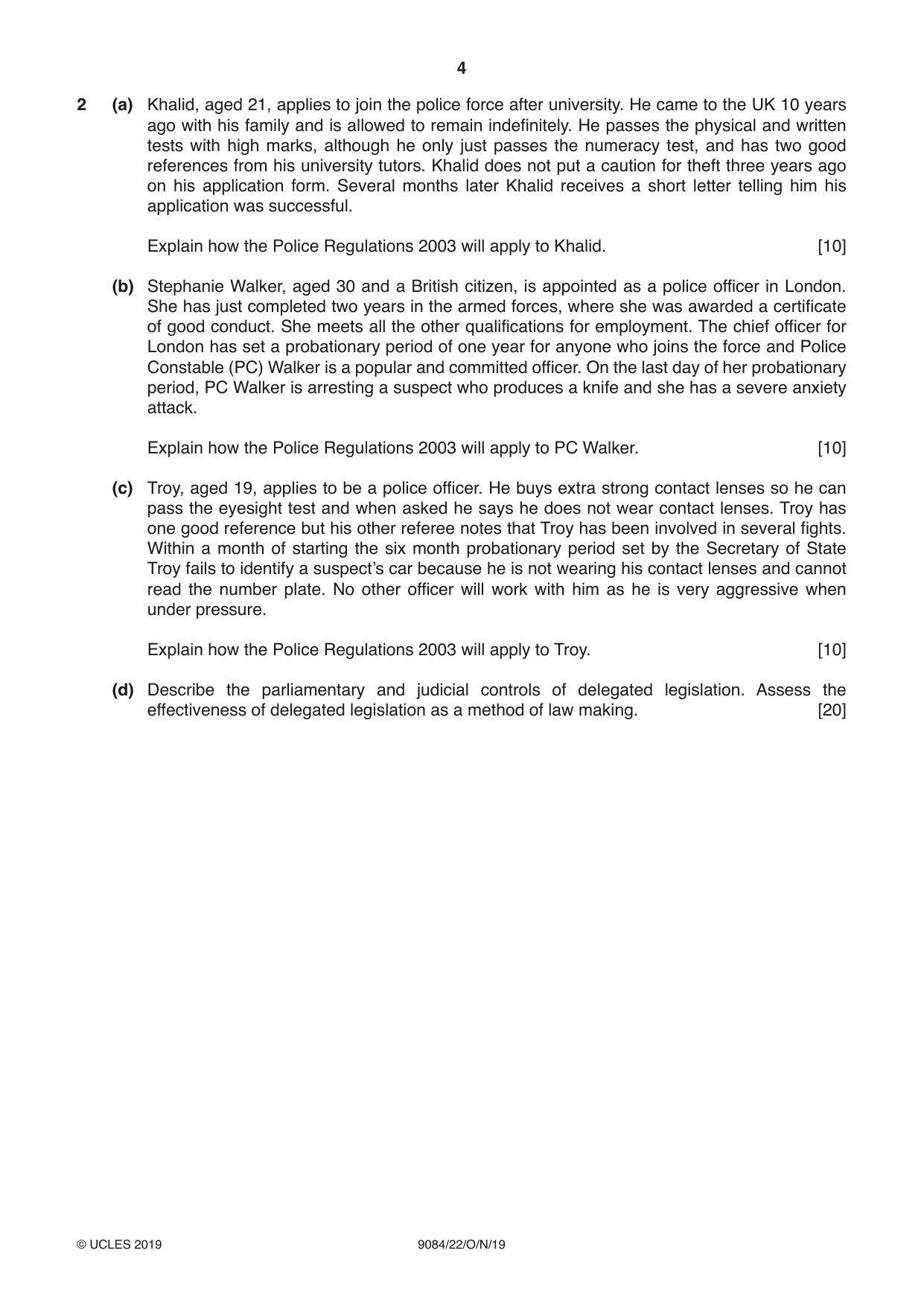
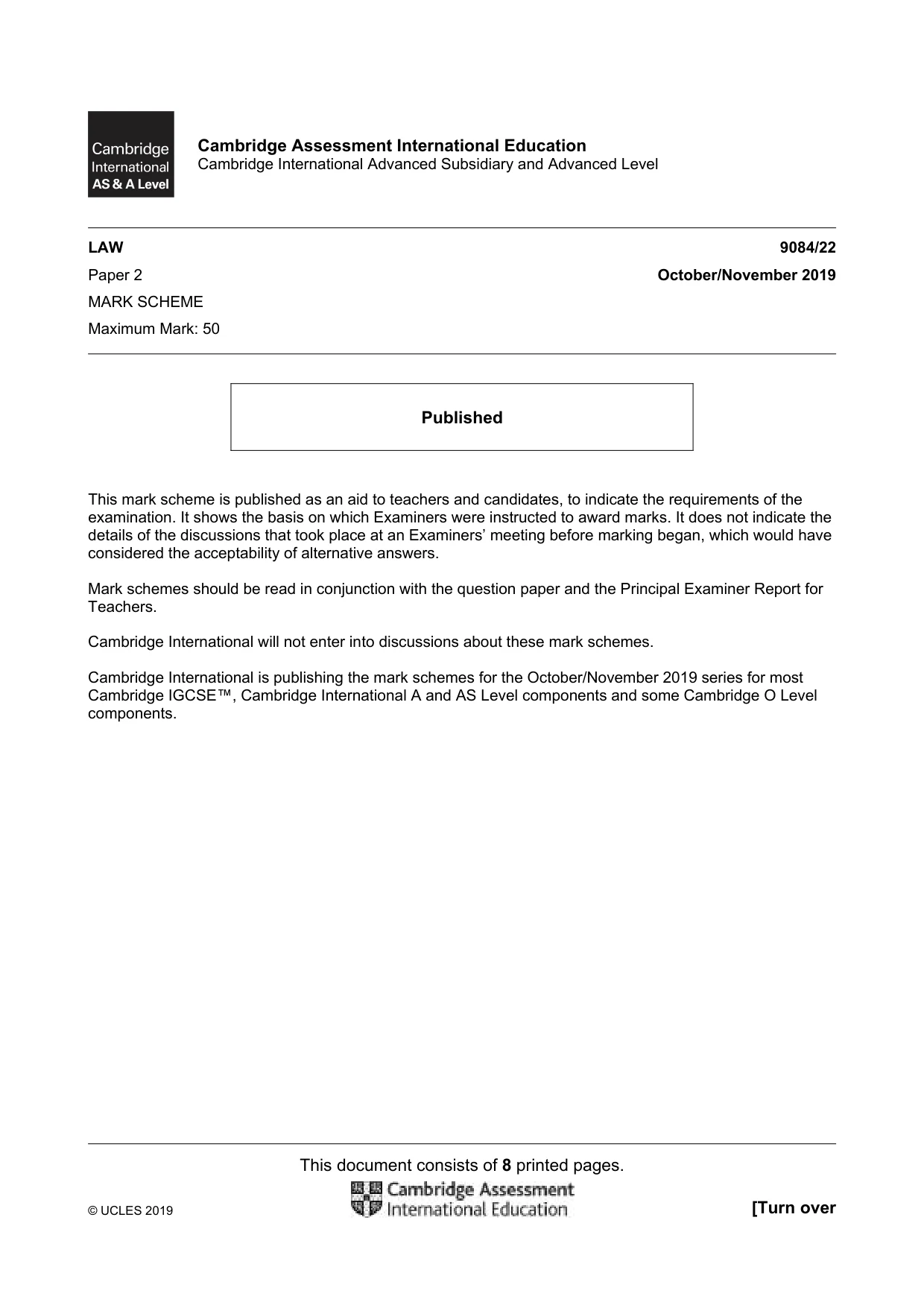
2 (a) Khalid, aged 21, applies to join the police force after university. He came to the UK 10 years ago with his family and is allowed to remain indefinitely. He passes the physical and written tests with high marks, although he only just passes the numeracy test, and has two good references from his university tutors. Khalid does not put a caution for theft three years ago on his application form. Several months later Khalid receives a short letter telling him his application was successful. Explain how the Police Regulations 2003 will apply to Khalid. [10] (b) Stephanie Walker, aged 30 and a British citizen, is appointed as a police officer in London. She has just completed two years in the armed forces, where she was awarded a certificate of good conduct. She meets all the other qualifications for employment. The chief officer for London has set a probationary period of one year for anyone who joins the force and Police Constable (PC) Walker is a popular and committed officer. On the last day of her probationary period, PC Walker is arresting a suspect who produces a knife and she has a severe anxiety attack. Explain how the Police Regulations 2003 will apply to PC Walker. [10] (c) Troy, aged 19, applies to be a police officer. He buys extra strong contact lenses so he can pass the eyesight test and when asked he says he does not wear contact lenses. Troy has one good reference but his other referee notes that Troy has been involved in several fights. Within a month of starting the six month probationary period set by the Secretary of State Troy fails to identify a suspect’s car because he is not wearing his contact lenses and cannot read the number plate. No other officer will work with him as he is very aggressive when under pressure. Explain how the Police Regulations 2003 will apply to Troy. [10] (d) Describe the parliamentary and judicial controls of delegated legislation. Assess the effectiveness of delegated legislation as a method of law making. [20] Source material for Question 2 The Police Regulations 2003 Regulation 10: Qualifications for appointment to a police force (1) A candidate for appointment to a police force— (a) must, if not a national of a State which is a Contracting Party to the Agreement on the European Economic Area, have leave to enter or remain in the United Kingdom for an indefinite period; (b) must produce satisfactory references as to character, and, if he has served in any police force, in the armed forces, in the civil service or as a seaman, produce satisfactory proof of his good conduct while so serving; (c) must have attained the age of 18 years 6 months; (d) must be certified by a registered medical practitioner approved by the police authority to be in good health, of sound constitution and fitted both physically and mentally to perform the duties on which he will be employed after appointment; (e) must meet the standard of eyesight determined by the Secretary of State; (f) must, if a candidate for appointment in the rank of constable, satisfy the chief officer that he is sufficiently competent in written and spoken English, and sufficiently numerate, by passing such assessments in written and spoken English, and numeracy, as may be approved by the Secretary of State; (g) … (h) must give such information as may be required as to his previous history or employment or any other matter relating to his appointment to the police force. (2) A candidate for appointment to a police force shall be given a notice in terms approved by the Secretary of State drawing attention to the terms and conditions of service which shall be contained therein. (3) … Regulation 12: Probationary service in the rank of constable (1) A member of a police force appointed in the rank of constable, other than such a member who transferred to the force from another police force having completed the required period of probation therein, shall be on probation for such period as the Secretary of State shall determine in respect of such appointments. (2) The Secretary of State may confer on the chief officer discretion to determine the required period of probation in a particular case. (3) … Regulation 13: Discharge of probationer (1) Subject to the provisions of this regulation, during his period of probation in the force the services of a constable may be dispensed with at any time if the chief officer considers that he is not fitted, physically or mentally, to perform the duties of his office, or that he is not likely to become an efficient or well conducted constable. (2) A constable whose services are dispensed with under this regulation shall be entitled to receive a month’s notice or a month’s pay in lieu thereof. (3) …
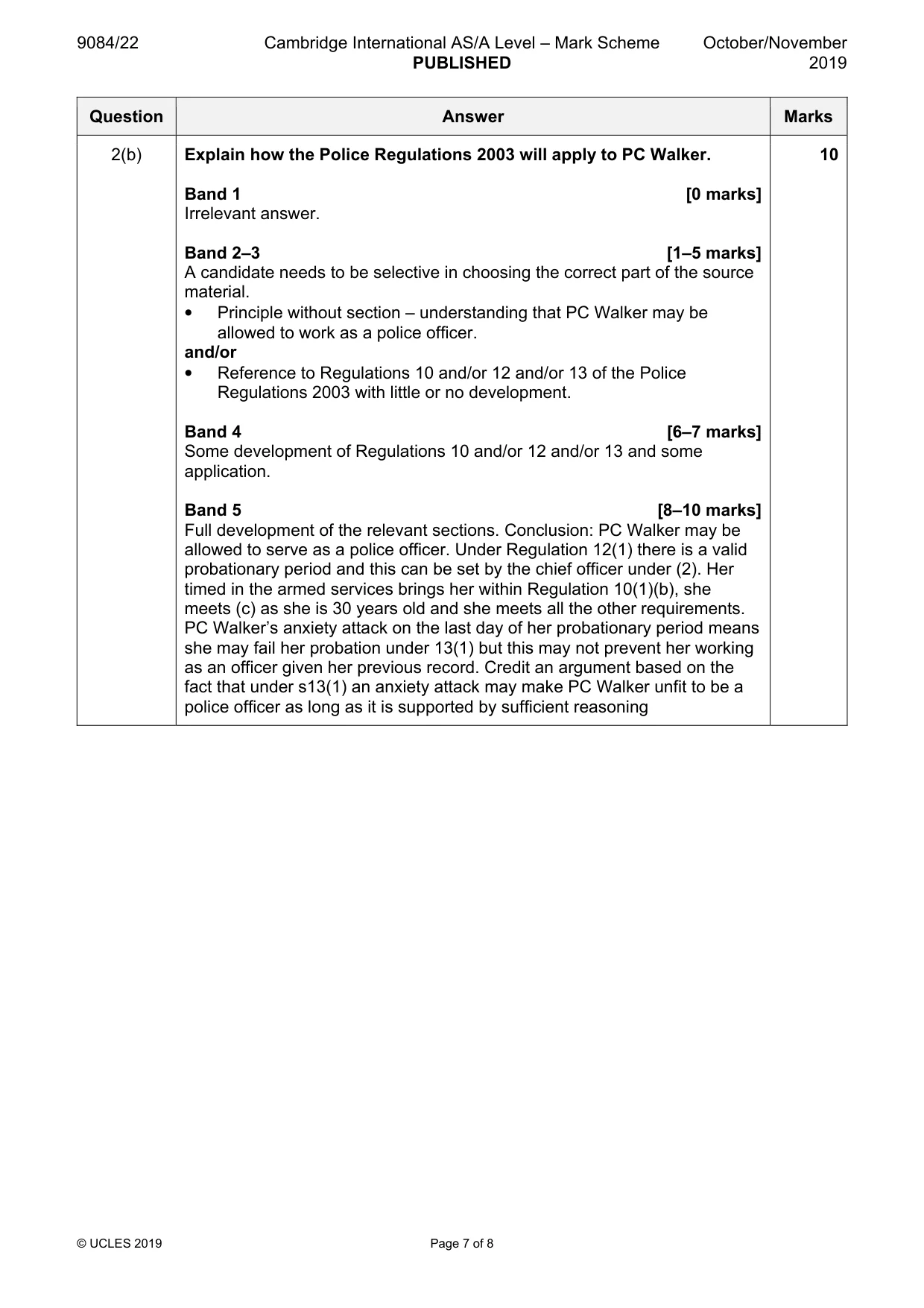
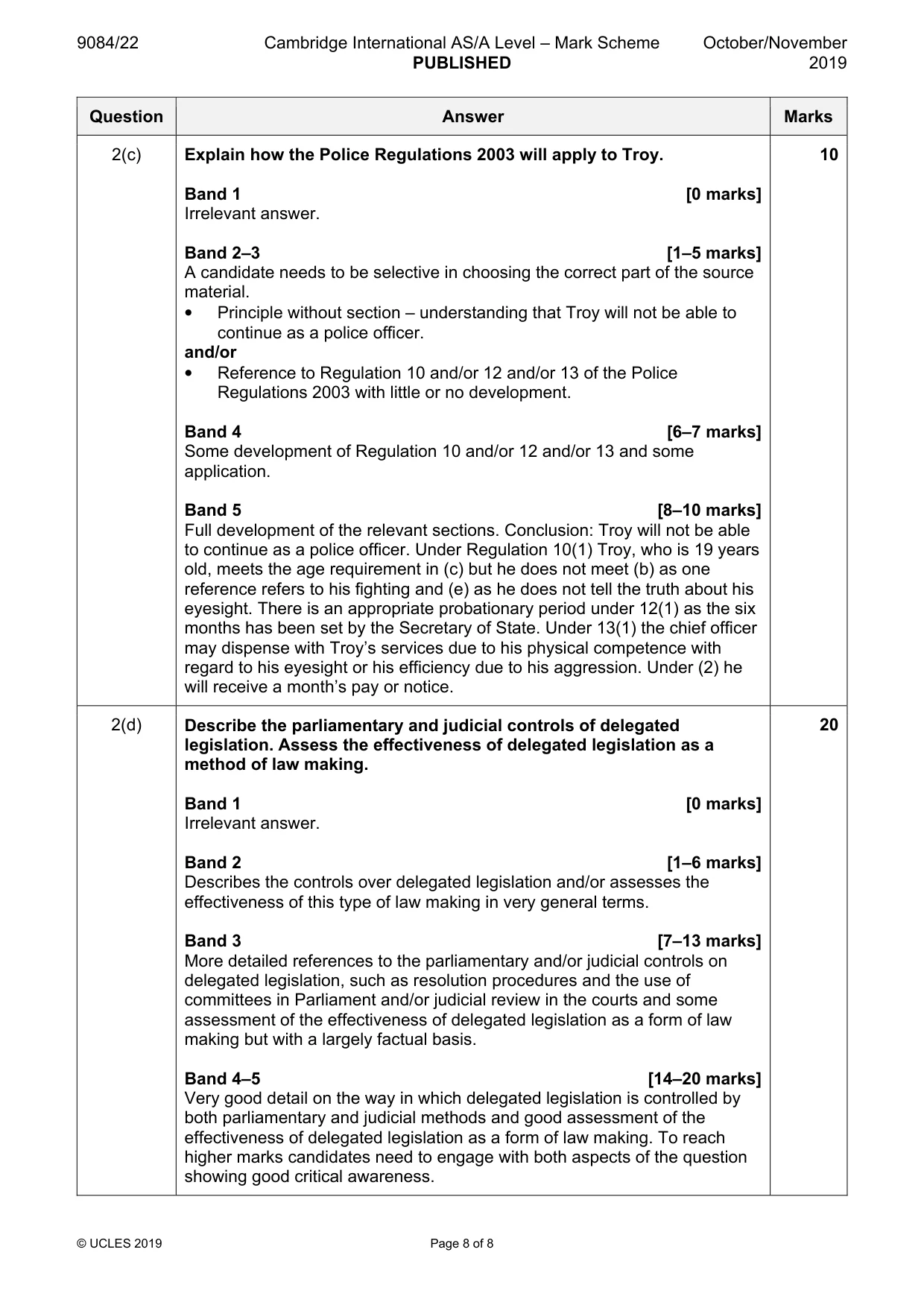
Mark scheme: 2(a) Explain how the Police Regulations 2003 will apply to Khalid. 10 Band 1 [0 marks] Irrelevant answer. Band 2–3 [1–5 marks] A candidate needs to be selective in choosing the correct part of the source material. • Principle without section – understanding that Khalid is unlikely to go on to become a police officer. and/or • Reference to Regulation 10 of the Police Regulations 2003 with little or no development. Band 4 [6–7 marks] Some development of Regulation 10 and some application. Band 5 [8–10 marks] Full development of the relevant sections. Conclusion: Khalid is unlikely to go on to be a police officer. He meets the residence condition under 1(a), he has two good references which meets (b), he is 21 and so meets the age criteria in (c), he has passed the physical tests to meet (d) and he has passed the literacy and numeracy tests to meet (f). However, his failure to declare his caution for theft means he does not meet (h). 2(b) Explain how the Police Regulations 2003 will apply to PC Walker. 10 Band 1 [0 marks] Irrelevant answer. Band 2–3 [1–5 marks] A candidate needs to be selective in choosing the correct part of the source material. • Principle without section – understanding that PC Walker may be allowed to work as a police officer. and/or • Reference to Regulations 10 and/or 12 and/or 13 of the Police Regulations 2003 with little or no development. Band 4 [6–7 marks] Some development of Regulations 10 and/or 12 and/or 13 and some application. Band 5 [8–10 marks] Full development of the relevant sections. Conclusion: PC Walker may be allowed to serve as a police officer. Under Regulation 12(1) there is a valid probationary period and this can be set by the chief officer under (2). Her timed in the armed services brings her within Regulation 10(1)(b), she meets (c) as she is 30 years old and she meets all the other requirements. PC Walker’s anxiety attack on the last day of her probationary period means she may fail her probation under 13(1) but this may not prevent her working as an officer given her previous record. Credit an argument based on the fact that under s13(1) an anxiety attack may make PC Walker unfit to be a police officer as long as it is supported by sufficient reasoning 2(c) Explain how the Police Regulations 2003 will apply to Troy. 10 Band 1 [0 marks] Irrelevant answer. Band 2–3 [1–5 marks] A candidate needs to be selective in choosing the correct part of the source material. • Principle without section – understanding that Troy will not be able to continue as a police officer. and/or • Reference to Regulation 10 and/or 12 and/or 13 of the Police Regulations 2003 with little or no development. Band 4 [6–7 marks] Some development of Regulation 10 and/or 12 and/or 13 and some application. Band 5 [8–10 marks] Full development of the relevant sections. Conclusion: Troy will not be able to continue as a police officer. Under Regulation 10(1) Troy, who is 19 years old, meets the age requirement in (c) but he does not meet (b) as one reference refers to his fighting and (e) as he does not tell the truth about his eyesight. There is an appropriate probationary period under 12(1) as the six months has been set by the Secretary of State. Under 13(1) the chief officer may dispense with Troy’s services due to his physical competence with regard to his eyesight or his efficiency due to his aggression. Under (2) he will receive a month’s pay or notice. 2(d) Describe the parliamentary and judicial controls of delegated 20 legislation. Assess the effectiveness of delegated legislation as a method of law making. Band 1 [0 marks] Irrelevant answer. Band 2 [1–6 marks] Describes the controls over delegated legislation and/or assesses the effectiveness of this type of law making in very general terms. Band 3 [7–13 marks] More detailed references to the parliamentary and/or judicial controls on delegated legislation, such as resolution procedures and the use of committees in Parliament and/or judicial review in the courts and some assessment of the effectiveness of delegated legislation as a form of law making but with a largely factual basis. Band 4–5 [14–20 marks] Very good detail on the way in which delegated legislation is controlled by both parliamentary and judicial methods and good assessment of the effectiveness of delegated legislation as a form of law making. To reach higher marks candidates need to engage with both aspects of the question showing good critical awareness.
What was in this paper
The subtopics covered by these 2 questions, and how many questions each got. Open one in a new tab to see every Cambridge question on it.
1Sentencing in England and Wales This topic is about the sentences that can be handed down to both adult and young offenders who have been convicted of offences. This topic is an opportunity to reflect on the key concepts of liability, justice, fairness, power and its limits, and effectiveness1What you needed in this session
Cambridge’s own grade thresholds for 2019 Oct/Nov, Paper 2 · Variant 2. A higher threshold means an easier paper — the bar moves with how the cohort did.