Cambridge A Level Law 9084 — 2021 Oct/Nov Paper 2 · Variant 3
9084/23/O/N/21 · 2 questions · 50 marks · ≈56 min
The question paper and its mark scheme, free to read here and free to download. This is Cambridge’s own paper, exactly as it was sat.
Question paper8 pages



Mark scheme11 pages
Answers below. Sit the paper first if you are practising.
Questions as text
Q1 · Joe makes and sells pies
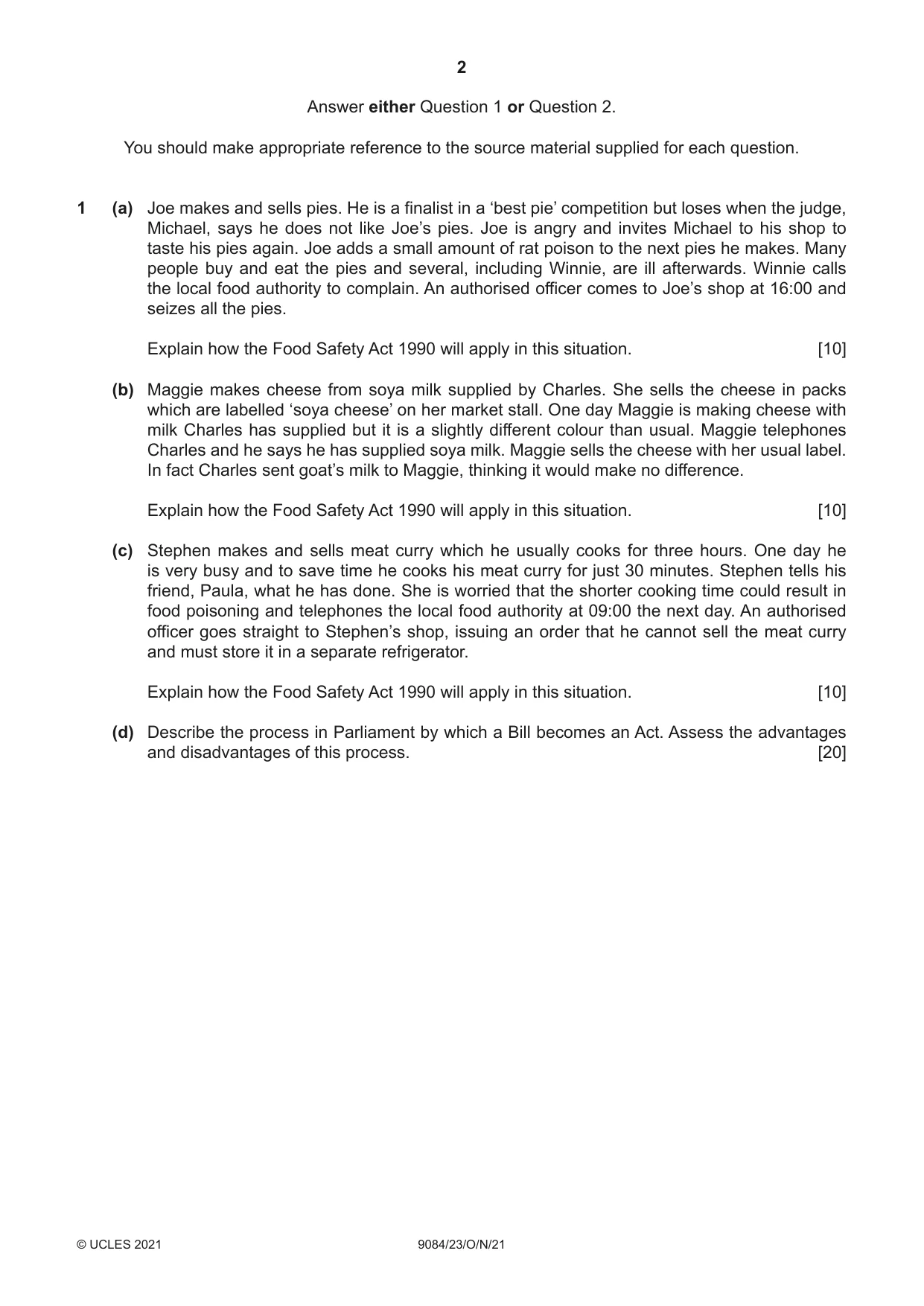
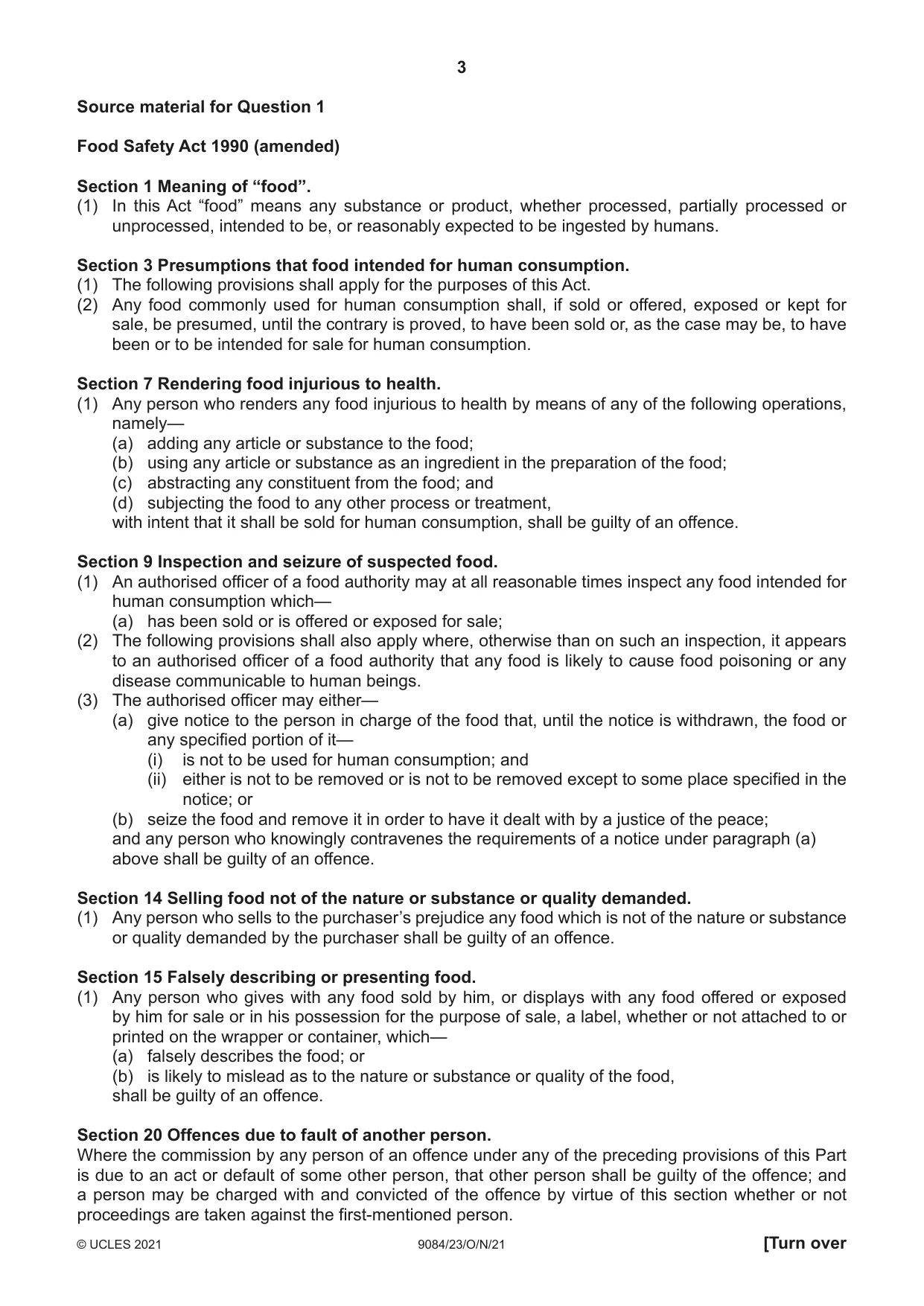
1 (a) Joe makes and sells pies. He is a finalist in a ‘best pie’ competition but loses when the judge, Michael, says he does not like Joe’s pies. Joe is angry and invites Michael to his shop to taste his pies again. Joe adds a small amount of rat poison to the next pies he makes. Many people buy and eat the pies and several, including Winnie, are ill afterwards. Winnie calls the local food authority to complain. An authorised officer comes to Joe’s shop at 16:00 and seizes all the pies. Explain how the Food Safety Act 1990 will apply in this situation. [10] (b) Maggie makes cheese from soya milk supplied by Charles. She sells the cheese in packs which are labelled ‘soya cheese’ on her market stall. One day Maggie is making cheese with milk Charles has supplied but it is a slightly different colour than usual. Maggie telephones Charles and he says he has supplied soya milk. Maggie sells the cheese with her usual label. In fact Charles sent goat’s milk to Maggie, thinking it would make no difference. Explain how the Food Safety Act 1990 will apply in this situation. [10] (c) Stephen makes and sells meat curry which he usually cooks for three hours. One day he is very busy and to save time he cooks his meat curry for just 30 minutes. Stephen tells his friend, Paula, what he has done. She is worried that the shorter cooking time could result in food poisoning and telephones the local food authority at 09:00 the next day. An authorised officer goes straight to Stephen’s shop, issuing an order that he cannot sell the meat curry and must store it in a separate refrigerator. Explain how the Food Safety Act 1990 will apply in this situation. [10] (d) Describe the process in Parliament by which a Bill becomes an Act. Assess the advantages and disadvantages of this process. [20] Source material for Question 1 Food Safety Act 1990 (amended) Section 1 Meaning of “food”. (1) In this Act “food” means any substance or product, whether processed, partially processed or unprocessed, intended to be, or reasonably expected to be ingested by humans. Section 3 Presumptions that food intended for human consumption. (1) The following provisions shall apply for the purposes of this Act. (2) Any food commonly used for human consumption shall, if sold or offered, exposed or kept for sale, be presumed, until the contrary is proved, to have been sold or, as the case may be, to have been or to be intended for sale for human consumption. Section 7 Rendering food injurious to health. (1) Any person who renders any food injurious to health by means of any of the following operations, namely— (a) adding any article or substance to the food; (b) using any article or substance as an ingredient in the preparation of the food; (c) abstracting any constituent from the food; and (d) subjecting the food to any other process or treatment, with intent that it shall be sold for human consumption, shall be guilty of an offence. Section 9 Inspection and seizure of suspected food. (1) An authorised officer of a food authority may at all reasonable times inspect any food intended for human consumption which— (a) has been sold or is offered or exposed for sale; (2) The following provisions shall also apply where, otherwise than on such an inspection, it appears to an authorised officer of a food authority that any food is likely to cause food poisoning or any disease communicable to human beings. (3) The authorised officer may either— (a) give notice to the person in charge of the food that, until the notice is withdrawn, the food or any specified portion of it— (i) is not to be used for human consumption; and (ii) either is not to be removed or is not to be removed except to some place specified in the notice; or (b) seize the food and remove it in order to have it dealt with by a justice of the peace; and any person who knowingly contravenes the requirements of a notice under paragraph (a) above shall be guilty of an offence. Section 14 Selling food not of the nature or substance or quality demanded. (1) Any person who sells to the purchaser’s prejudice any food which is not of the nature or substance or quality demanded by the purchaser shall be guilty of an offence. Section 15 Falsely describing or presenting food. (1) Any person who gives with any food sold by him, or displays with any food offered or exposed by him for sale or in his possession for the purpose of sale, a label, whether or not attached to or printed on the wrapper or container, which— (a) falsely describes the food; or (b) is likely to mislead as to the nature or substance or quality of the food, shall be guilty of an offence. Section 20 Offences due to fault of another person. Where the commission by any person of an offence under any of the preceding provisions of this Part is due to an act or default of some other person, that other person shall be guilty of the offence; and a person may be charged with and convicted of the offence by virtue of this section whether or not proceedings are taken against the first-mentioned person.
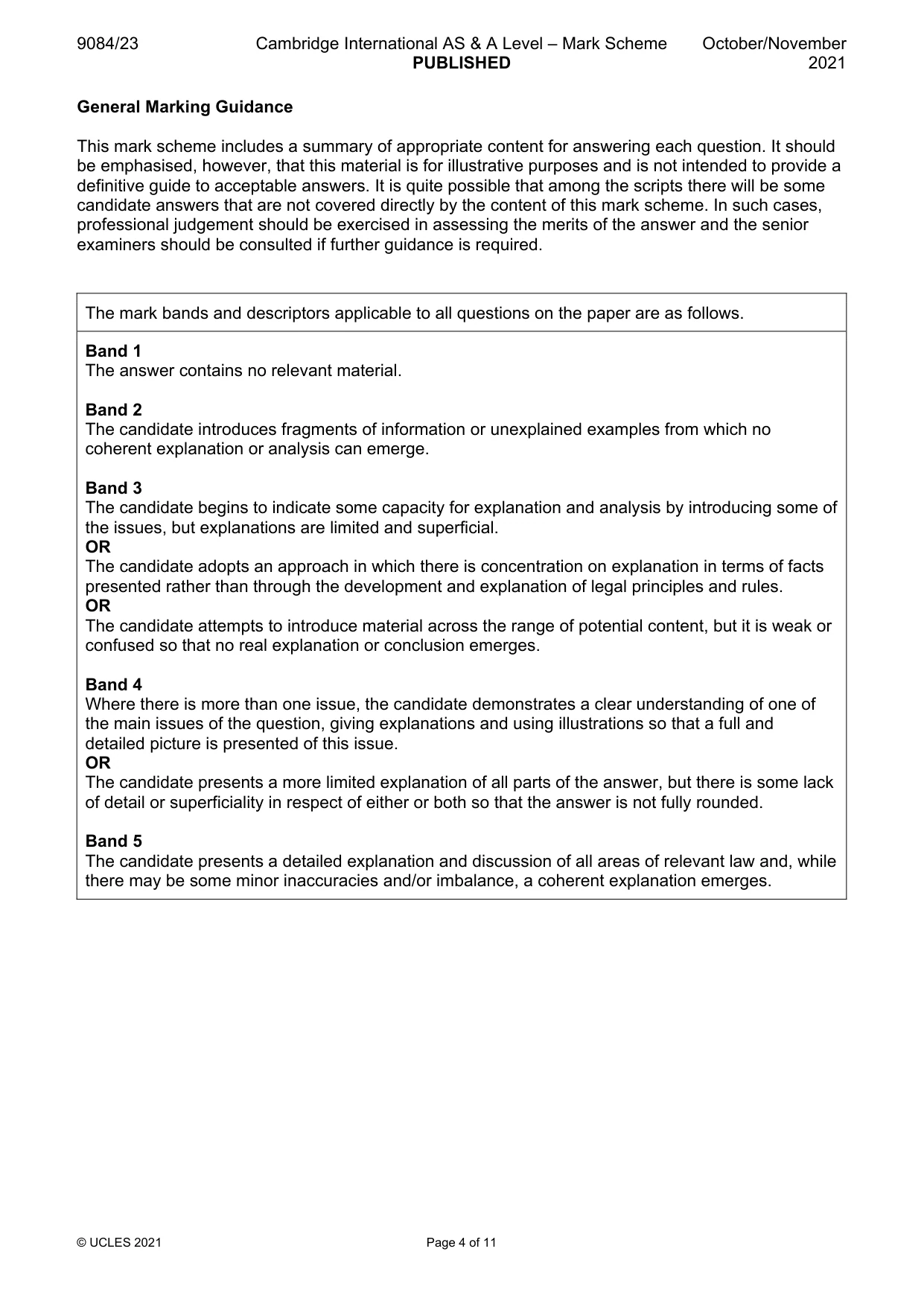
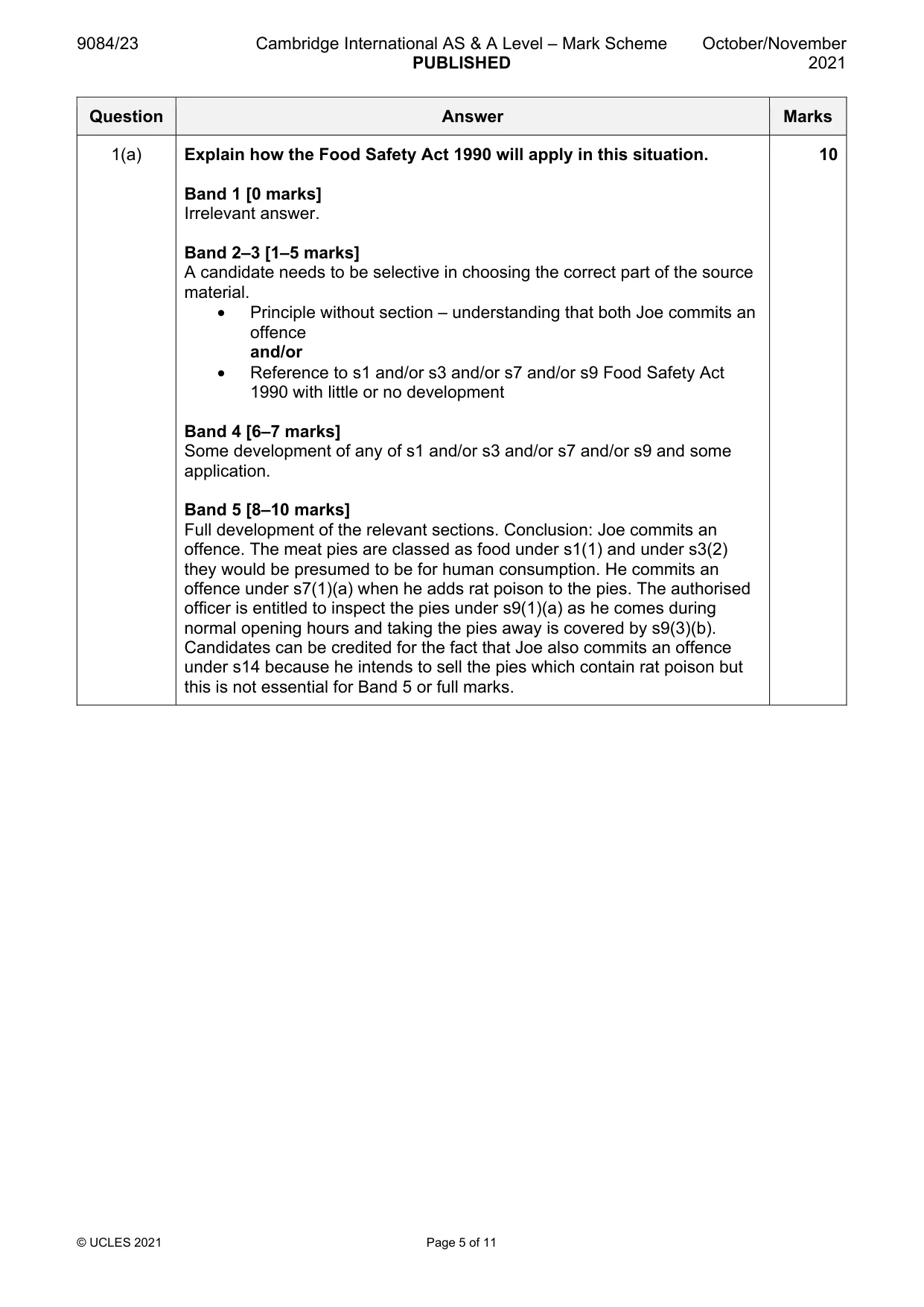
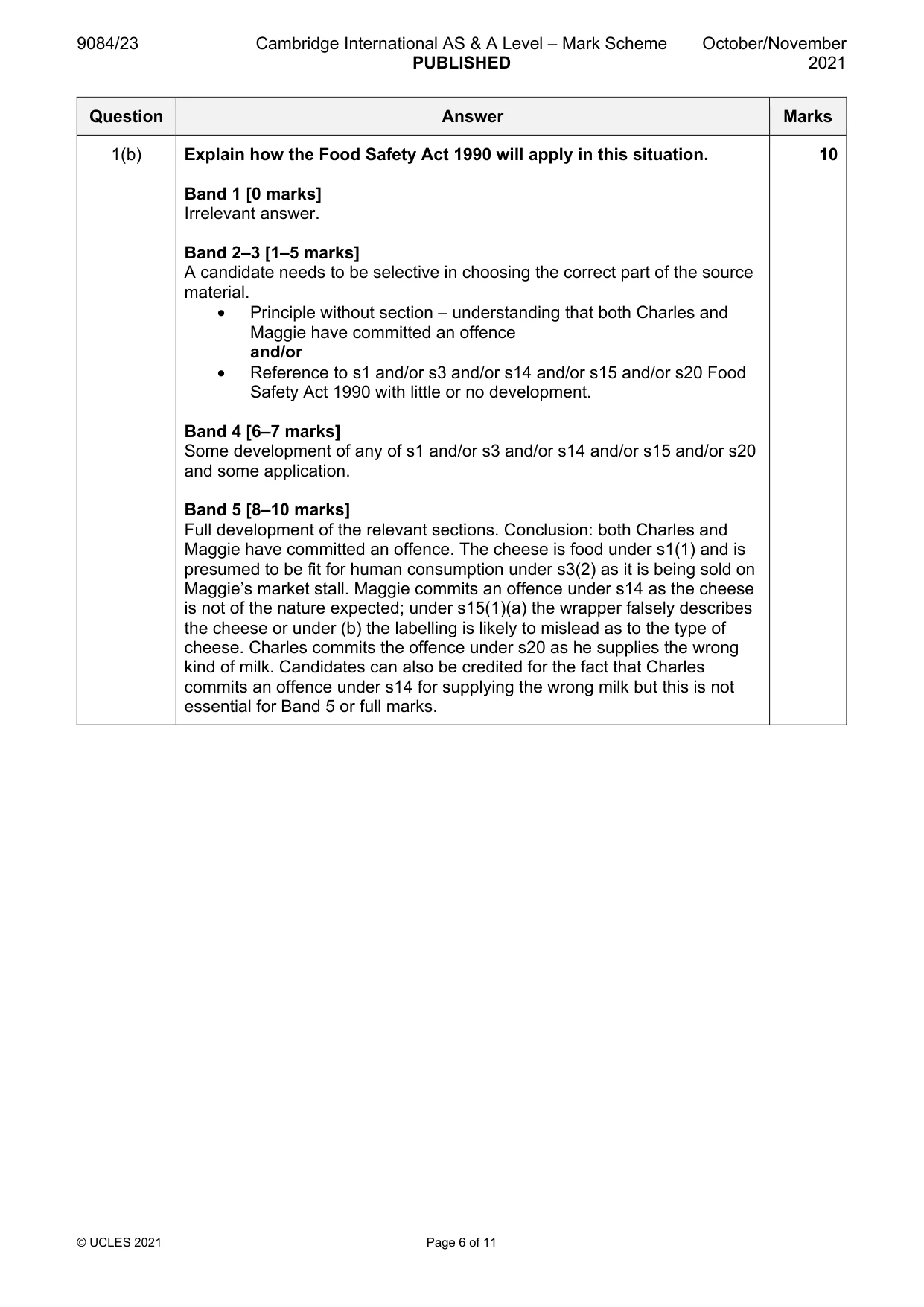
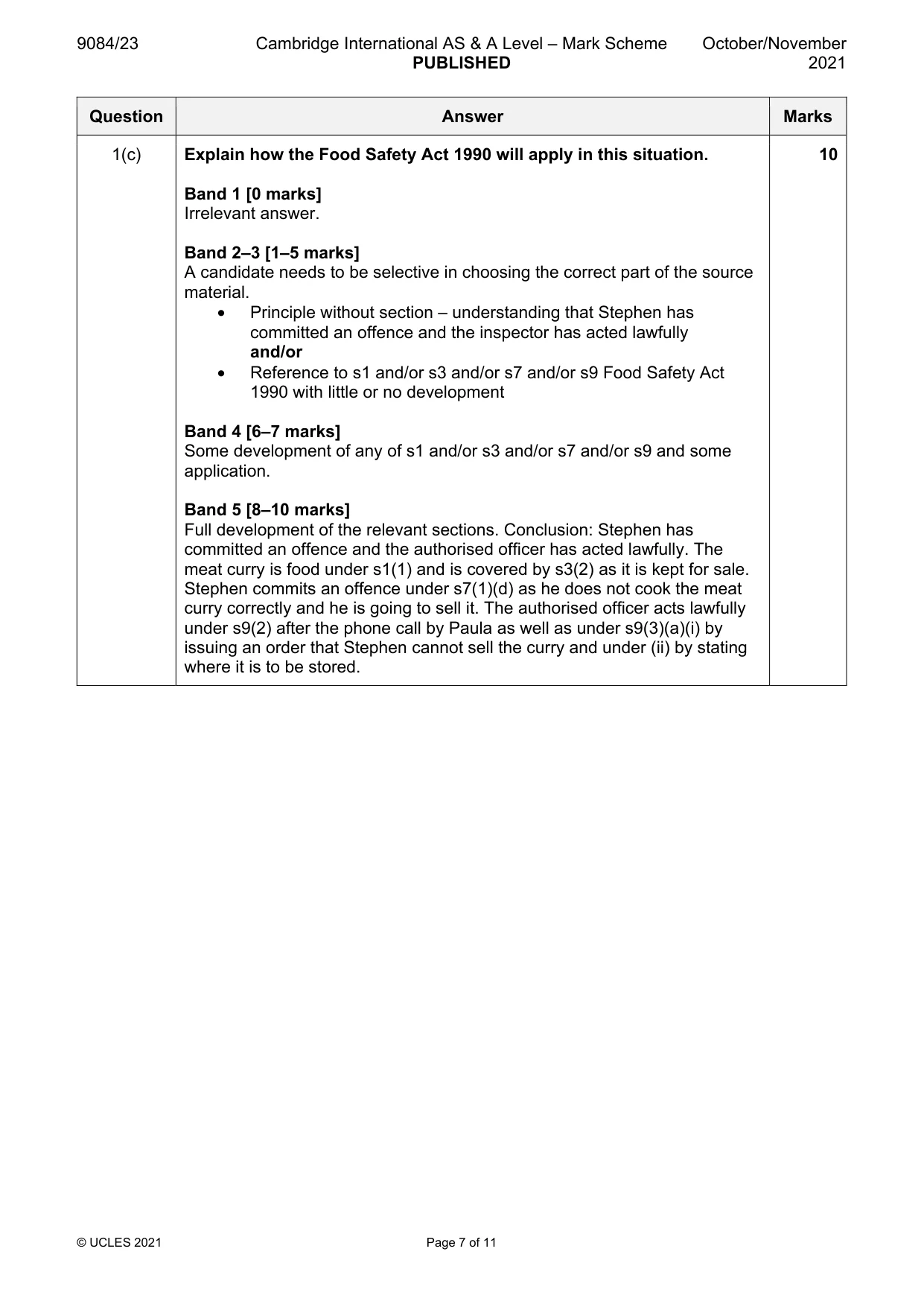
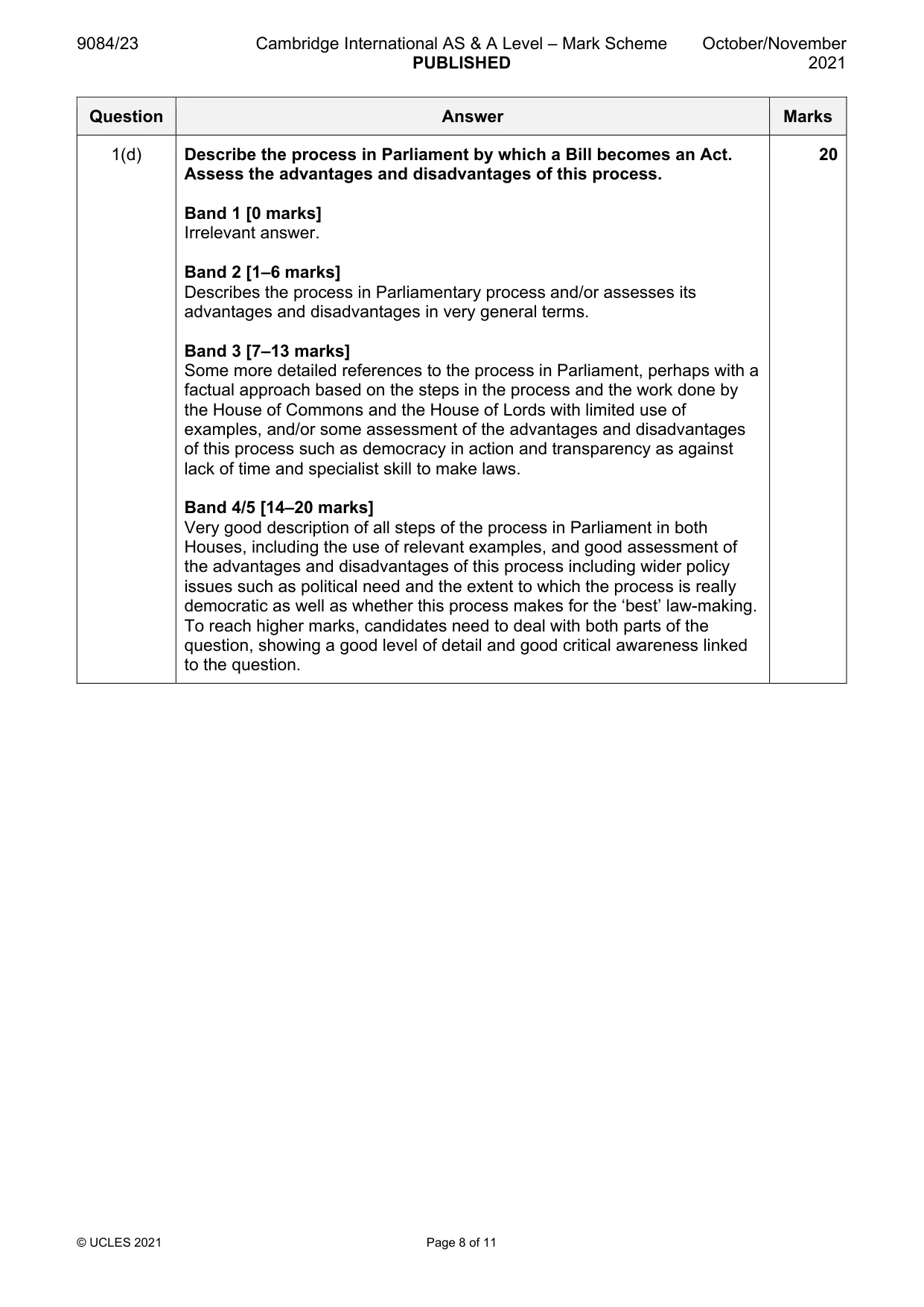
Mark scheme: Question Answer Marks 1(a) Explain how the Food Safety Act 1990 will apply in this situation. 10 Band 1 [0 marks] Irrelevant answer. Band 2–3 [1–5 marks] A candidate needs to be selective in choosing the correct part of the source material. • Principle without section – understanding that both Joe commits an offence and/or • Reference to s1 and/or s3 and/or s7 and/or s9 Food Safety Act 1990 with little or no development Band 4 [6–7 marks] Some development of any of s1 and/or s3 and/or s7 and/or s9 and some application. Band 5 [8–10 marks] Full development of the relevant sections. Conclusion: Joe commits an offence. The meat pies are classed as food under s1(1) and under s3(2) they would be presumed to be for human consumption. He commits an offence under s7(1)(a) when he adds rat poison to the pies. The authorised officer is entitled to inspect the pies under s9(1)(a) as he comes during normal opening hours and taking the pies away is covered by s9(3)(b). Candidates can be credited for the fact that Joe also commits an offence under s14 because he intends to sell the pies which contain rat poison but this is not essential for Band 5 or full marks. 1(b) Explain how the Food Safety Act 1990 will apply in this situation. 10 Band 1 [0 marks] Irrelevant answer. Band 2–3 [1–5 marks] A candidate needs to be selective in choosing the correct part of the source material. • Principle without section – understanding that both Charles and Maggie have committed an offence and/or • Reference to s1 and/or s3 and/or s14 and/or s15 and/or s20 Food Safety Act 1990 with little or no development. Band 4 [6–7 marks] Some development of any of s1 and/or s3 and/or s14 and/or s15 and/or s20 and some application. Band 5 [8–10 marks] Full development of the relevant sections. Conclusion: both Charles and Maggie have committed an offence. The cheese is food under s1(1) and is presumed to be fit for human consumption under s3(2) as it is being sold on Maggie’s market stall. Maggie commits an offence under s14 as the cheese is not of the nature expected; under s15(1)(a) the wrapper falsely describes the cheese or under (b) the labelling is likely to mislead as to the type of cheese. Charles commits the offence under s20 as he supplies the wrong kind of milk. Candidates can also be credited for the fact that Charles commits an offence under s14 for supplying the wrong milk but this is not essential for Band 5 or full marks. 1(c) Explain how the Food Safety Act 1990 will apply in this situation. 10 Band 1 [0 marks] Irrelevant answer. Band 2–3 [1–5 marks] A candidate needs to be selective in choosing the correct part of the source material. • Principle without section – understanding that Stephen has committed an offence and the inspector has acted lawfully and/or • Reference to s1 and/or s3 and/or s7 and/or s9 Food Safety Act 1990 with little or no development Band 4 [6–7 marks] Some development of any of s1 and/or s3 and/or s7 and/or s9 and some application. Band 5 [8–10 marks] Full development of the relevant sections. Conclusion: Stephen has committed an offence and the authorised officer has acted lawfully. The meat curry is food under s1(1) and is covered by s3(2) as it is kept for sale. Stephen commits an offence under s7(1)(d) as he does not cook the meat curry correctly and he is going to sell it. The authorised officer acts lawfully under s9(2) after the phone call by Paula as well as under s9(3)(a)(i) by issuing an order that Stephen cannot sell the curry and under (ii) by stating where it is to be stored. 1(d) Describe the process in Parliament by which a Bill becomes an Act. 20 Assess the advantages and disadvantages of this process. Band 1 [0 marks] Irrelevant answer. Band 2 [1–6 marks] Describes the process in Parliamentary process and/or assesses its advantages and disadvantages in very general terms. Band 3 [7–13 marks] Some more detailed references to the process in Parliament, perhaps with a factual approach based on the steps in the process and the work done by the House of Commons and the House of Lords with limited use of examples, and/or some assessment of the advantages and disadvantages of this process such as democracy in action and transparency as against lack of time and specialist skill to make laws. Band 4/5 [14–20 marks] Very good description of all steps of the process in Parliament in both Houses, including the use of relevant examples, and good assessment of the advantages and disadvantages of this process including wider policy issues such as political need and the extent to which the process is really democratic as well as whether this process makes for the ‘best’ law-making. To reach higher marks, candidates need to deal with both parts of the question, showing a good level of detail and good critical awareness linked to the question.
Q2 · Helen was the Minister for Justice
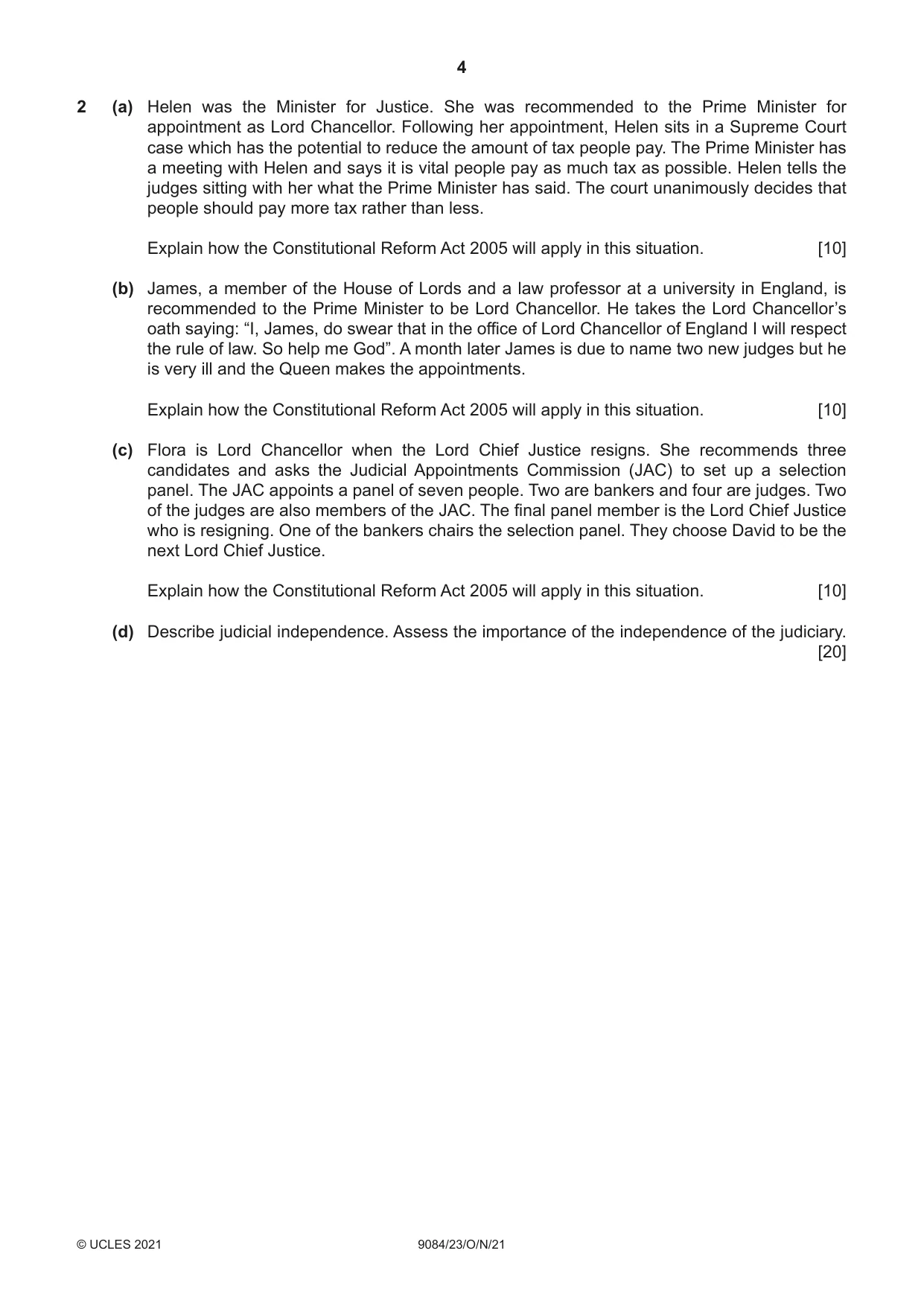
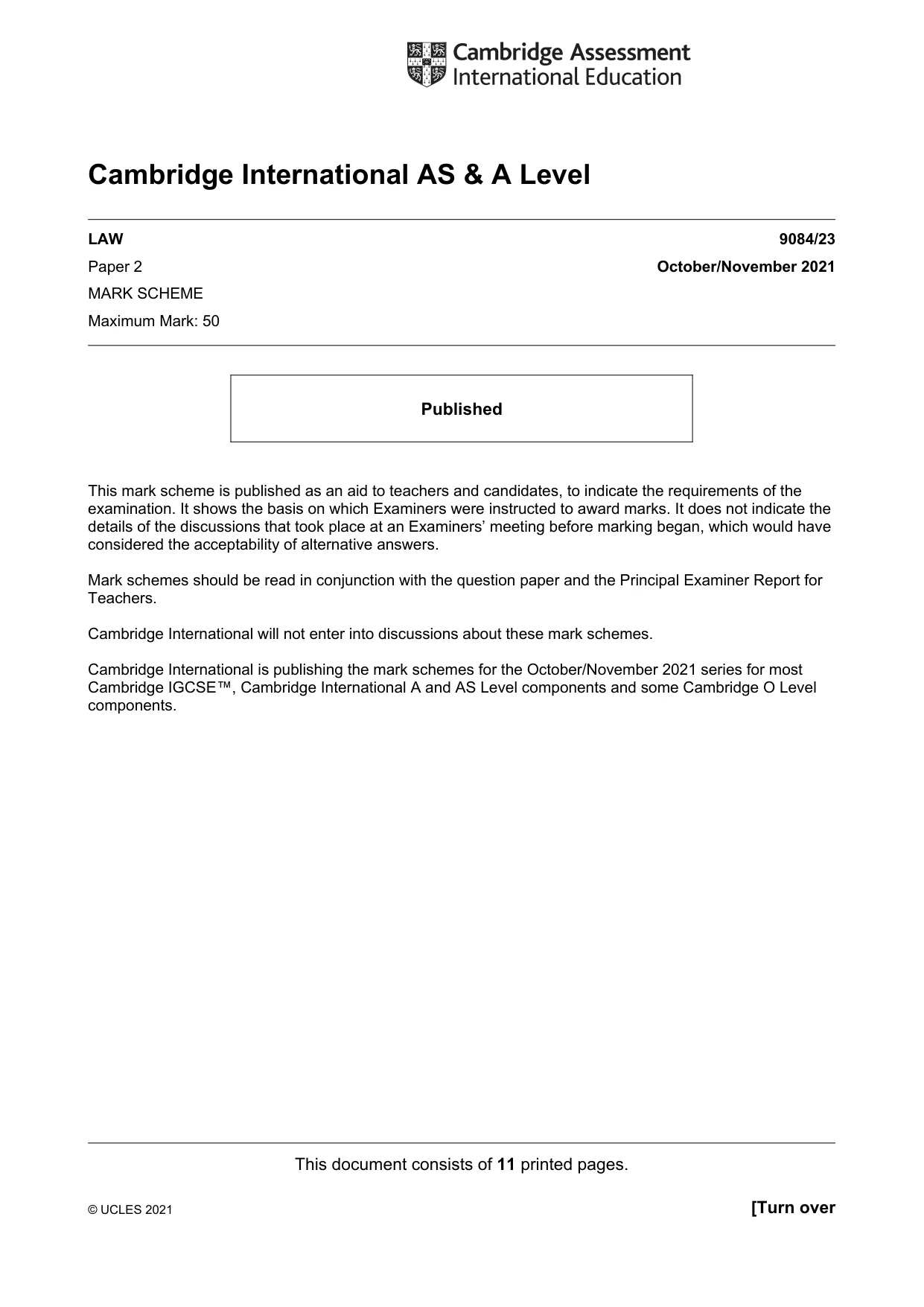
2 (a) Helen was the Minister for Justice. She was recommended to the Prime Minister for appointment as Lord Chancellor. Following her appointment, Helen sits in a Supreme Court case which has the potential to reduce the amount of tax people pay. The Prime Minister has a meeting with Helen and says it is vital people pay as much tax as possible. Helen tells the judges sitting with her what the Prime Minister has said. The court unanimously decides that people should pay more tax rather than less. Explain how the Constitutional Reform Act 2005 will apply in this situation. [10] (b) James, a member of the House of Lords and a law professor at a university in England, is recommended to the Prime Minister to be Lord Chancellor. He takes the Lord Chancellor’s oath saying: “I, James, do swear that in the office of Lord Chancellor of England I will respect the rule of law. So help me God”. A month later James is due to name two new judges but he is very ill and the Queen makes the appointments. Explain how the Constitutional Reform Act 2005 will apply in this situation. [10] (c) Flora is Lord Chancellor when the Lord Chief Justice resigns. She recommends three candidates and asks the Judicial Appointments Commission (JAC) to set up a selection panel. The JAC appoints a panel of seven people. Two are bankers and four are judges. Two of the judges are also members of the JAC. The final panel member is the Lord Chief Justice who is resigning. One of the bankers chairs the selection panel. They choose David to be the next Lord Chief Justice. Explain how the Constitutional Reform Act 2005 will apply in this situation. [10] (d) Describe judicial independence. Assess the importance of the independence of the judiciary. [20] Source material for Question 2 Constitutional Reform Act 2005 Section 2 Lord Chancellor to be qualified by experience (1) A person may not be recommended for appointment as Lord Chancellor unless he appears to the Prime Minister to be qualified by experience. (2) The Prime Minister may take into account any of these— (a) experience as a Minister of the Crown; (b) experience as a member of either House of Parliament; (c) experience as a qualifying practitioner; (d) experience as a teacher of law in a university. Section 3 Guarantee of continued judicial independence (1) The Lord Chancellor, other Ministers of the Crown and all with responsibility for matters relating to the judiciary or otherwise to the administration of justice must uphold the continued independence of the judiciary. … (5) The Lord Chancellor and other Ministers of the Crown must not seek to influence particular judicial decisions through any special access to the judiciary. … (7) In this section “the judiciary” includes the judiciary of any of the following— (a) the Supreme Court; (b) any other court established under the law of any part of the United Kingdom. Section 14 Transfer of appointment functions to Her Majesty Schedule 3 provides for— (a) Her Majesty instead of the Lord Chancellor to make appointments to certain offices, and (b) the modification of enactments relating to those offices. Section 17 Lord Chancellor’s oath (1) The oath set out in subsection (2) shall be tendered to and taken by the Lord Chancellor, after and in the same manner as the official oath, as soon as may be after his acceptance of office. (2) The oath is— “I, , do swear that in the office of Lord High Chancellor of Great Britain I will respect the rule of law, defend the independence of the judiciary and discharge my duty to ensure the provision of resources for the efficient and effective support of the courts for which I am responsible. So help me God.” Section 68 Duty to fill vacancies (1) The Lord Chancellor must make a recommendation to fill any vacancy in the office of Lord Chief Justice. Section 70 Selection process (1) On receiving a request the Judicial Appointments Commission must appoint a selection panel. (1A) The panel must have an odd number of members not less than five. (1B) The members of the panel must include— (a) at least two who are non-legally-qualified, (b) at least two judicial members, and (c) at least two members of the Commission, and contributions to meeting more than one of the requirements may be made by the same person’s membership of the panel. (1C) The members of the panel may not include the current holder of the office for which a selection is to be made. (1D) If the panel is convened for the selection of a person to be recommended for appointment as Lord
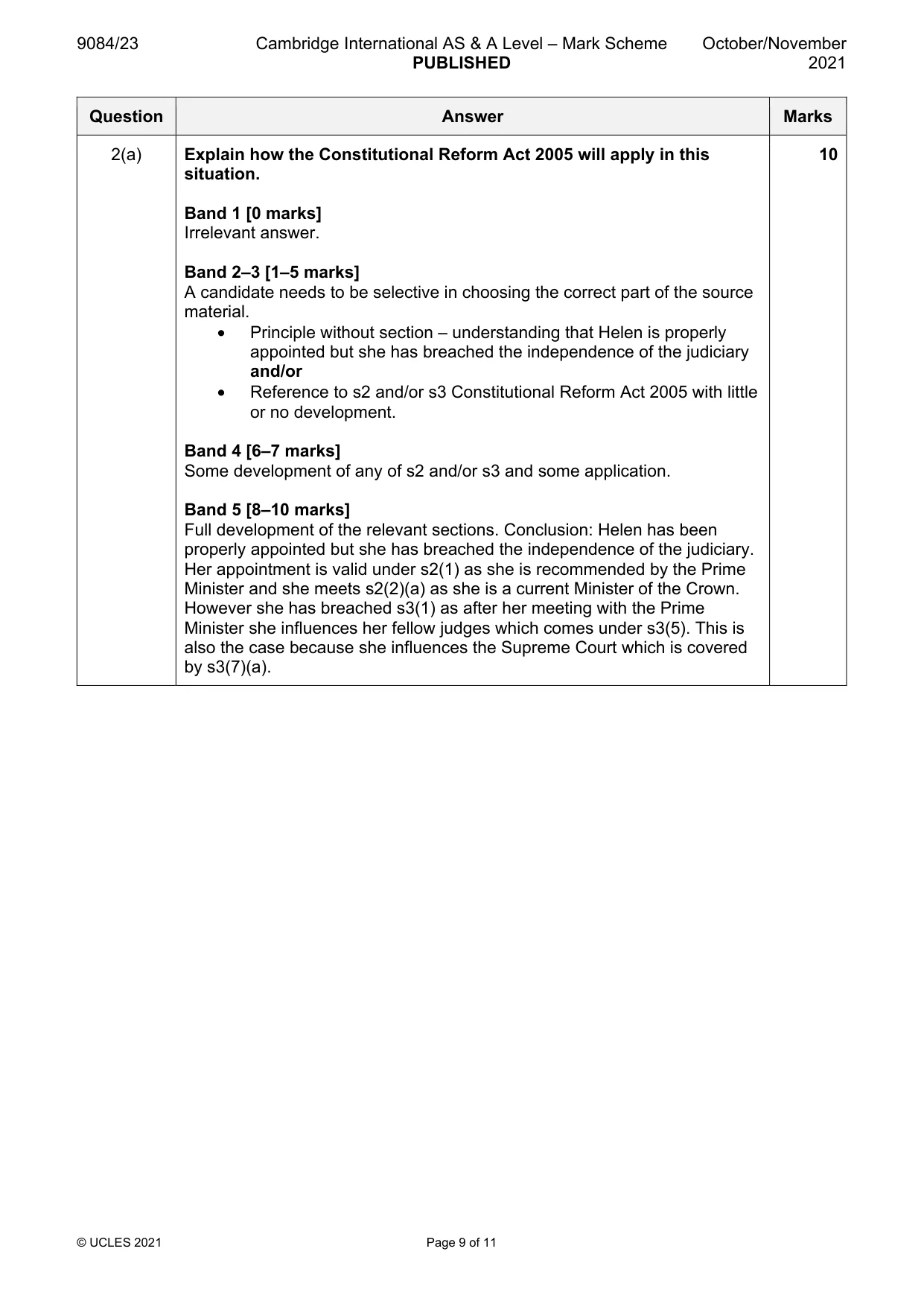
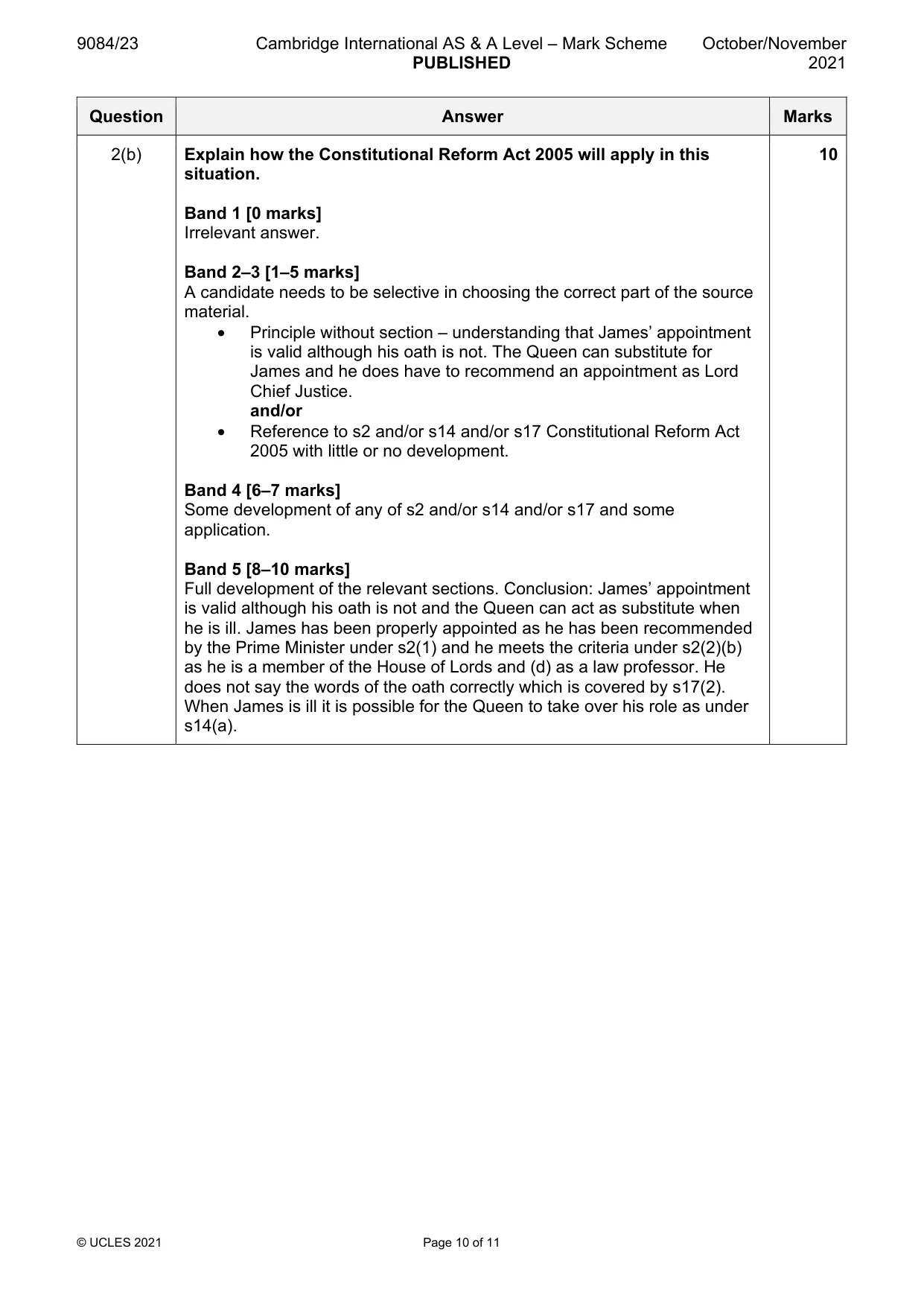
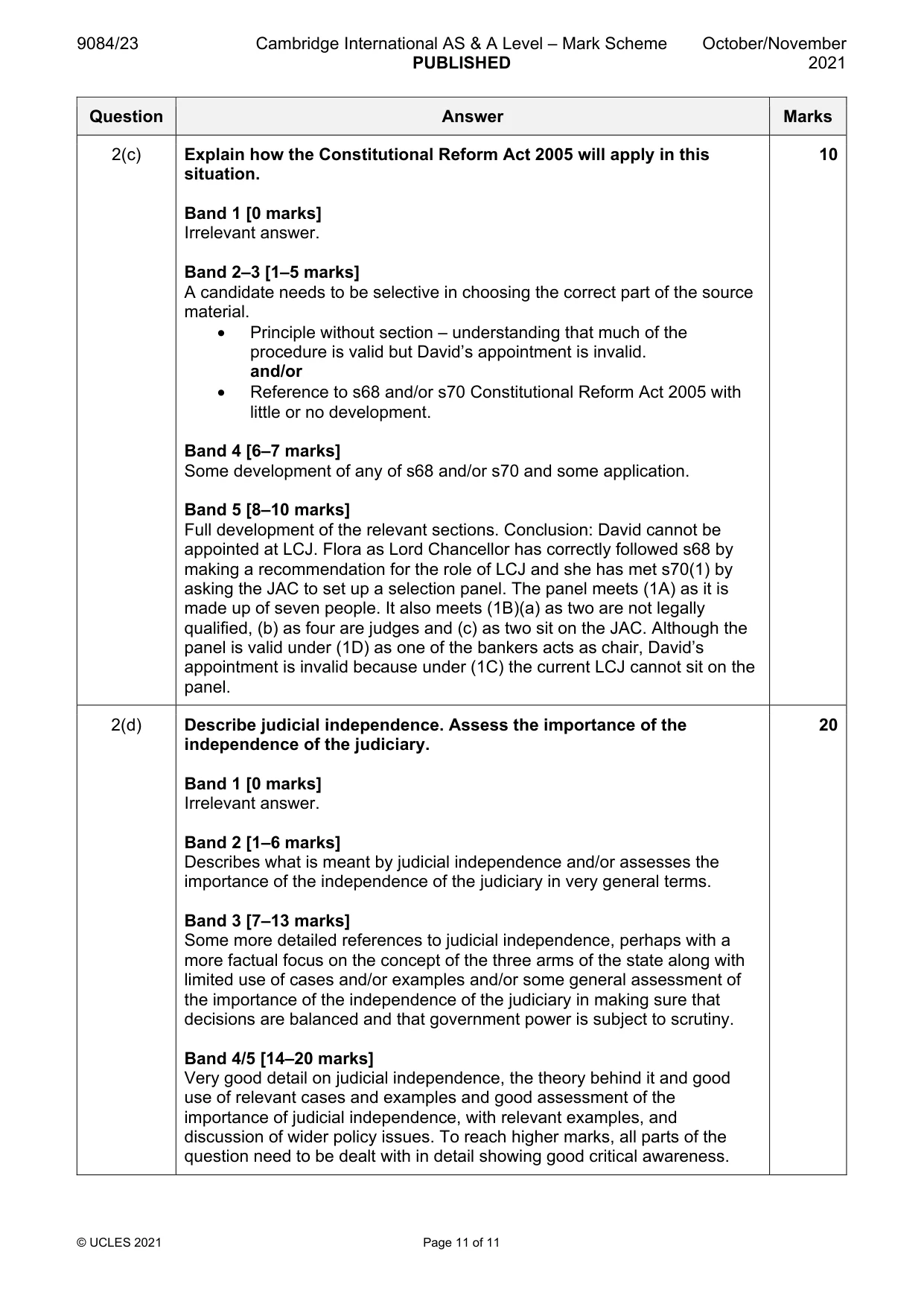
Mark scheme: 2(a) Explain how the Constitutional Reform Act 2005 will apply in this 10 situation. Band 1 [0 marks] Irrelevant answer. Band 2–3 [1–5 marks] A candidate needs to be selective in choosing the correct part of the source material. • Principle without section – understanding that Helen is properly appointed but she has breached the independence of the judiciary and/or • Reference to s2 and/or s3 Constitutional Reform Act 2005 with little or no development. Band 4 [6–7 marks] Some development of any of s2 and/or s3 and some application. Band 5 [8–10 marks] Full development of the relevant sections. Conclusion: Helen has been properly appointed but she has breached the independence of the judiciary. Her appointment is valid under s2(1) as she is recommended by the Prime Minister and she meets s2(2)(a) as she is a current Minister of the Crown. However she has breached s3(1) as after her meeting with the Prime Minister she influences her fellow judges which comes under s3(5). This is also the case because she influences the Supreme Court which is covered by s3(7)(a). 2(b) Explain how the Constitutional Reform Act 2005 will apply in this 10 situation. Band 1 [0 marks] Irrelevant answer. Band 2–3 [1–5 marks] A candidate needs to be selective in choosing the correct part of the source material. • Principle without section – understanding that James’ appointment is valid although his oath is not. The Queen can substitute for James and he does have to recommend an appointment as Lord Chief Justice. and/or • Reference to s2 and/or s14 and/or s17 Constitutional Reform Act 2005 with little or no development. Band 4 [6–7 marks] Some development of any of s2 and/or s14 and/or s17 and some application. Band 5 [8–10 marks] Full development of the relevant sections. Conclusion: James’ appointment is valid although his oath is not and the Queen can act as substitute when he is ill. James has been properly appointed as he has been recommended by the Prime Minister under s2(1) and he meets the criteria under s2(2)(b) as he is a member of the House of Lords and (d) as a law professor. He does not say the words of the oath correctly which is covered by s17(2). When James is ill it is possible for the Queen to take over his role as under s14(a). 2(c) Explain how the Constitutional Reform Act 2005 will apply in this 10 situation. Band 1 [0 marks] Irrelevant answer. Band 2–3 [1–5 marks] A candidate needs to be selective in choosing the correct part of the source material. • Principle without section – understanding that much of the procedure is valid but David’s appointment is invalid. and/or • Reference to s68 and/or s70 Constitutional Reform Act 2005 with little or no development. Band 4 [6–7 marks] Some development of any of s68 and/or s70 and some application. Band 5 [8–10 marks] Full development of the relevant sections. Conclusion: David cannot be appointed at LCJ. Flora as Lord Chancellor has correctly followed s68 by making a recommendation for the role of LCJ and she has met s70(1) by asking the JAC to set up a selection panel. The panel meets (1A) as it is made up of seven people. It also meets (1B)(a) as two are not legally qualified, (b) as four are judges and (c) as two sit on the JAC. Although the panel is valid under (1D) as one of the bankers acts as chair, David’s appointment is invalid because under (1C) the current LCJ cannot sit on the panel. 2(d) Describe judicial independence. Assess the importance of the 20 independence of the judiciary. Band 1 [0 marks] Irrelevant answer. Band 2 [1–6 marks] Describes what is meant by judicial independence and/or assesses the importance of the independence of the judiciary in very general terms. Band 3 [7–13 marks] Some more detailed references to judicial independence, perhaps with a more factual focus on the concept of the three arms of the state along with limited use of cases and/or examples and/or some general assessment of the importance of the independence of the judiciary in making sure that decisions are balanced and that government power is subject to scrutiny. Band 4/5 [14–20 marks] Very good detail on judicial independence, the theory behind it and good use of relevant cases and examples and good assessment of the importance of judicial independence, with relevant examples, and discussion of wider policy issues. To reach higher marks, all parts of the question need to be dealt with in detail showing good critical awareness.
What was in this paper
The subtopics covered by these 2 questions, and how many questions each got. Open one in a new tab to see every Cambridge question on it.
1Offences against property This topic is about the components of substantive offences against property. This topic is an opportunity to reflect on the key concepts of liability, justice, fairness, effectiveness and certainty1What you needed in this session
Cambridge’s own grade thresholds for 2021 Oct/Nov, Paper 2 · Variant 3. A higher threshold means an easier paper — the bar moves with how the cohort did.