Questions as text
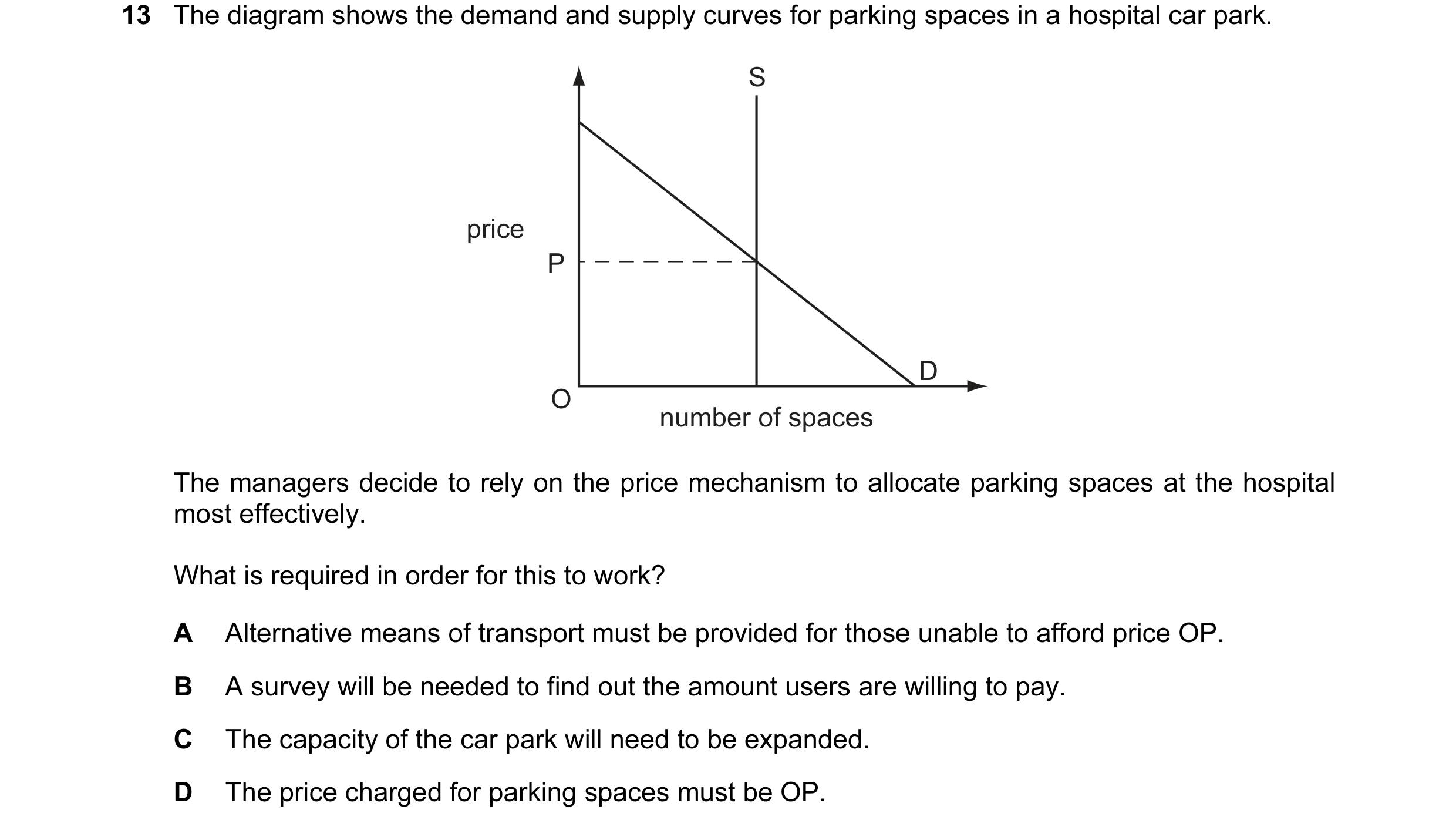
Q1 · The diagram shows the demand and supply curves for parking spaces in a hospital car park 9708/11 May/June 2006
13 The diagram shows the demand and supply curves for parking spaces in a hospital car park. S price P D O number of spaces The managers decide to rely on the price mechanism to allocate parking spaces at the hospital most effectively. What is required in order for this to work? A Alternative means of transport must be provided for those unable to afford price OP. B A survey will be needed to find out the amount users are willing to pay. C The capacity of the car park will need to be expanded. D The price charged for parking spaces must be OP.
1 marks
Answer: D
This question in 9708/11 May/June 2006
Q2 · What would cause a failure of the market mechanism’s rationing function? 9708/11 Oct/Nov 2009
13 What would cause a failure of the market mechanism’s rationing function? A falling prices B price controls C rising profits D self interest
1 marks
Answer: B
This question in 9708/11 Oct/Nov 2009
Q3 · Despite much opposition, the local government in a popular tourist resort built a leisure… 9708/11 Oct/Nov 2009
15 Despite much opposition, the local government in a popular tourist resort built a leisure centre and swimming pool which is open to everyone. Many tourists visit the centre. Local residents are charged a reduced entry fee. How would economists classify this service? A It is a demerit good because some people objected to the development. B It is a merit good because the entry fee is reduced for local residents. C It is a private good because there is an entry fee for all users. D It is a public good because it is open to everyone and provided by the local government.
1 marks
Answer: C
This question in 9708/11 Oct/Nov 2009
Q4 · What is a merit good? 9708/11 Oct/Nov 2011
16 What is a merit good? A a good that is made available to consumers according to merit B a good that the government believes consumers will buy too little of if it is provided by private enterprise at market prices C a good where any benefit obtained by one consumer is extended to all consumers D a good where the private benefits of consuming the good exceed its social benefits
1 marks
Answer: B
This question in 9708/11 Oct/Nov 2011
Q5 · What is a merit good? 9708/13 Oct/Nov 2011
14 What is a merit good? A a good that is made available to consumers according to merit B a good that the government believes consumers will buy too little of if it is provided by private enterprise at market prices C a good where any benefit obtained by one consumer is extended to all consumers D a good where the private benefits of consuming the good exceed its social benefits
1 marks
Answer: B
This question in 9708/13 Oct/Nov 2011
Q6 · Why does the production of public goods have to be financed by the government? 9708/12 May/June 2012
16 Why does the production of public goods have to be financed by the government? A One person’s consumption of a public good means it is not available for anyone else. B People are able to consume public goods without paying for them. C Private sector firms will charge a price significantly above cost for public goods. D The cost of producing public goods is higher in the private sector.
1 marks
Answer: B
This question in 9708/12 May/June 2012
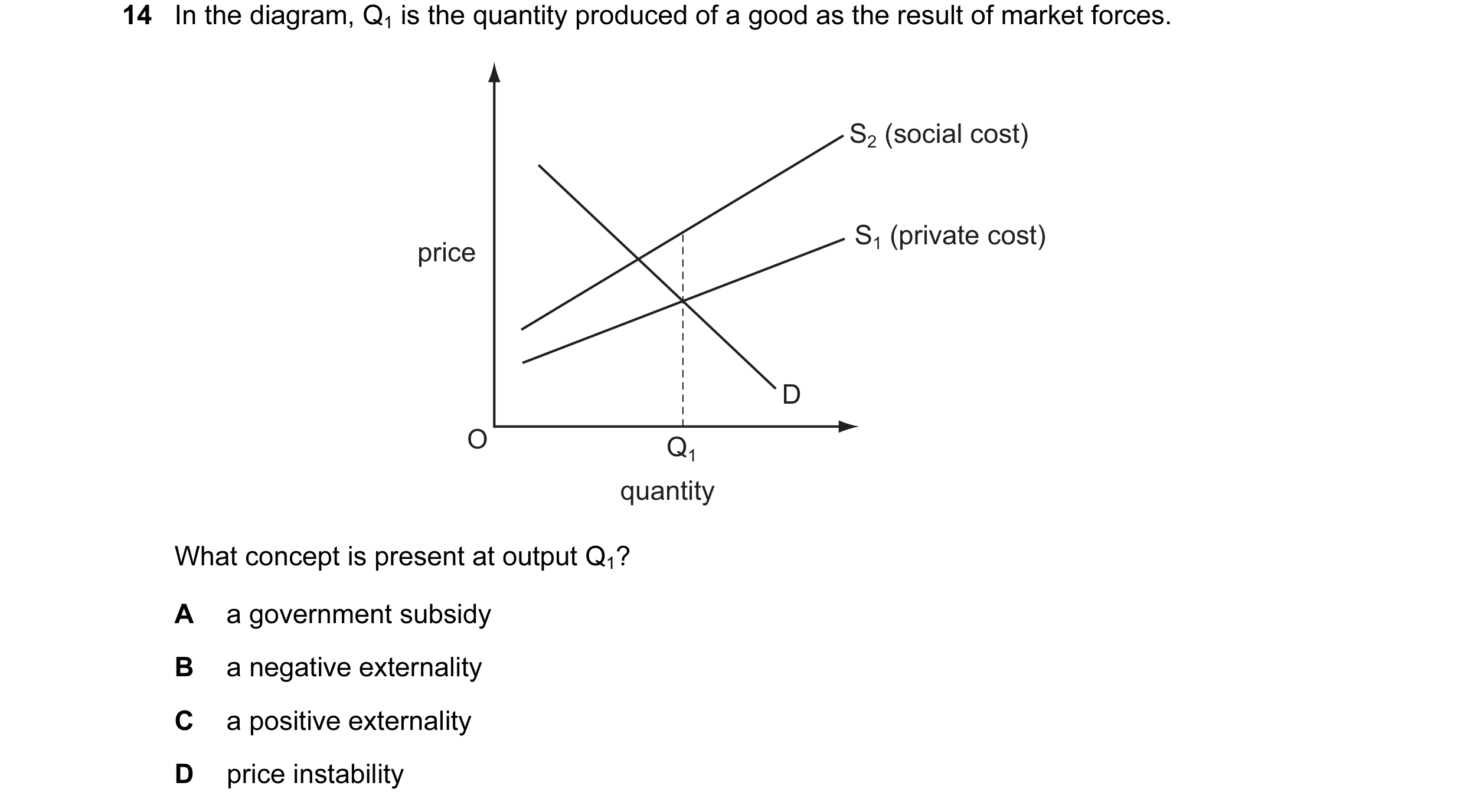
Q7 · In the diagram, Q1 is the quantity produced of a good as the result of market forces 9708/11 Oct/Nov 2012
14 In the diagram, Q1 is the quantity produced of a good as the result of market forces. S2 (social cost) S1 (private cost) price D O Q1 quantity What concept is present at output Q1? A a government subsidy B a negative externality C a positive externality D price instability
1 marks
Answer: B
This question in 9708/11 Oct/Nov 2012
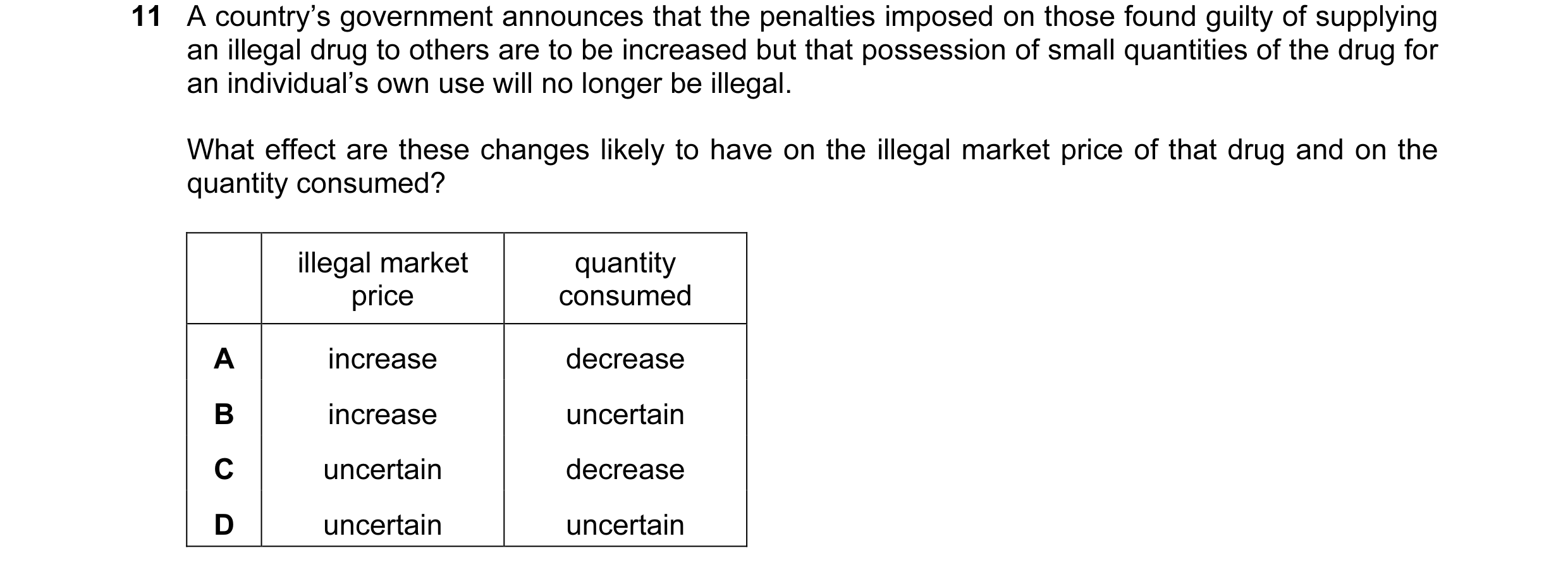
Q8 · A country’s government announces that the penalties imposed on those found guilty of… 9708/12 May/June 2013
11 A country’s government announces that the penalties imposed on those found guilty of supplying an illegal drug to others are to be increased but that possession of small quantities of the drug for an individual’s own use will no longer be illegal. What effect are these changes likely to have on the illegal market price of that drug and on the quantity consumed? illegal market quantity price consumed A increase decrease B increase uncertain C uncertain decrease D uncertain uncertain
1 marks
Answer: B
This question in 9708/12 May/June 2013
Q9 · Which statement about the provision of goods is correct? 9708/13 Oct/Nov 2014
15 Which statement about the provision of goods is correct? A Governments and private producers supply merit goods. B Governments and private producers supply public goods. C Governments are unable to supply private goods. D Governments subsidise the production of demerit goods.
1 marks
Answer: A
This question in 9708/13 Oct/Nov 2014
Q10 · What is an economic reason why hospitals are often built and funded by the government? 9708/11 May/June 2015
13 What is an economic reason why hospitals are often built and funded by the government? A Hospitals are a public good. B Hospitals are very expensive to build and run. C Hospitals cannot use price to allocate demand. D Hospital treatments may benefit many apart from those who use them.
1 marks
Answer: D
This question in 9708/11 May/June 2015
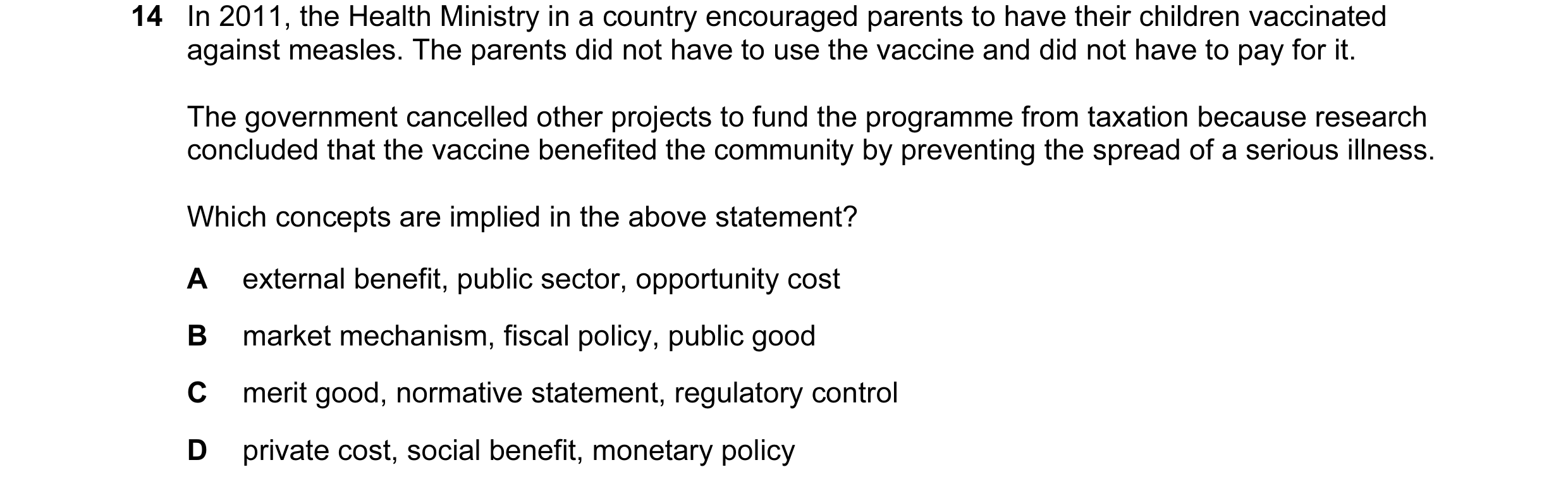
Q11 · In 2011, the Health Ministry in a country encouraged parents to have their children… 9708/12 Oct/Nov 2015
14 In 2011, the Health Ministry in a country encouraged parents to have their children vaccinated against measles. The parents did not have to use the vaccine and did not have to pay for it. The government cancelled other projects to fund the programme from taxation because research concluded that the vaccine benefited the community by preventing the spread of a serious illness. Which concepts are implied in the above statement? A external benefit, public sector, opportunity cost B market mechanism, fiscal policy, public good C merit good, normative statement, regulatory control D private cost, social benefit, monetary policy
1 marks
Answer: A
This question in 9708/12 Oct/Nov 2015
Q12 · Which statement is correct? 9708/13 Oct/Nov 2015
17 Which statement is correct? A A demerit good is overconsumed. B A demerit good produces zero consumer surplus. C A merit good is defined by its non-excludability and non-rivalry. D A merit good is provided free of charge.
1 marks
Answer: A
This question in 9708/13 Oct/Nov 2015
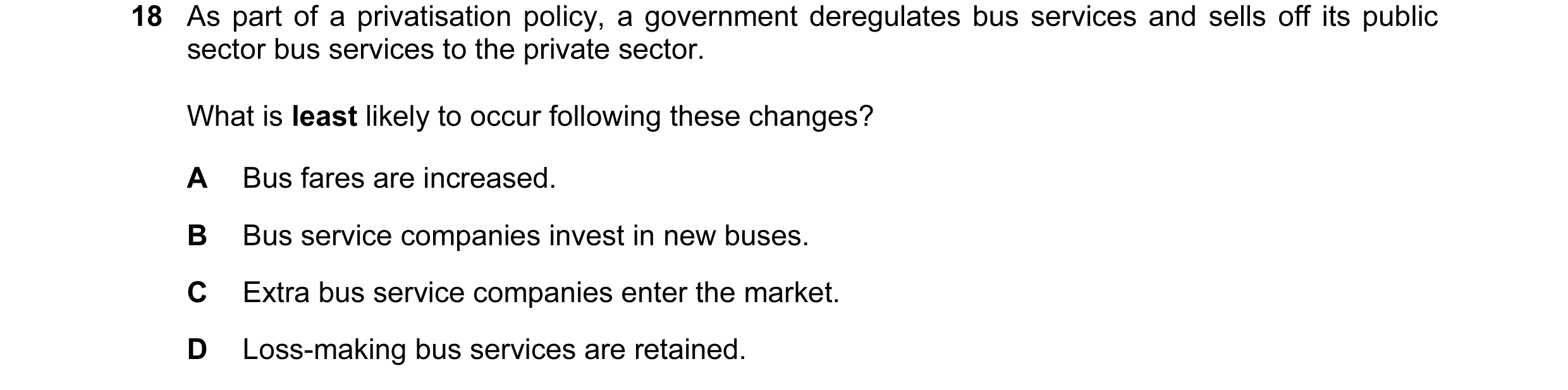
Q13 · As part of a privatisation policy, a government deregulates bus services and sells off… 9708/12 Feb/March 2016
18 As part of a privatisation policy, a government deregulates bus services and sells off its public sector bus services to the private sector. What is least likely to occur following these changes? A Bus fares are increased. B Bus service companies invest in new buses. C Extra bus service companies enter the market. D Loss-making bus services are retained.
1 marks
Answer: D
This question in 9708/12 Feb/March 2016
Q14 · Which statement is the most valid reason for government intervention in a free market… 9708/13 May/June 2016
2 Which statement is the most valid reason for government intervention in a free market economy? A Consumers are well informed, making it difficult for producers to make profits. B Health and education are not available in sufficient quantities. C Producers are motivated by profit maximisation. D There are many competitive firms and not enough sole suppliers.
1 marks
Answer: B
This question in 9708/13 May/June 2016
Q15 · Which goods will be provided only by the government? 9708/13 Oct/Nov 2016
17 Which goods will be provided only by the government? A capital goods B inferior goods C merit goods D public goods
1 marks
Answer: D
This question in 9708/13 Oct/Nov 2016
Q16 · Which circumstance is not likely to represent a strong case for an industry to be… 9708/12 Feb/March 2017
18 Which circumstance is not likely to represent a strong case for an industry to be nationalised? A In the private sector, the industry would cause significant inequalities of supply between different areas of the country. B The industry would allow firms outside of the industry to enter easily. C The industry would be unprofitable as a private enterprise but generates large benefits for the rest of society. D The industry would experience such economies of scale that it can support only one firm.
1 marks
Answer: B
This question in 9708/12 Feb/March 2017
Q17 · What would prevent the operation of the market mechanism’s rationing function? 9708/12 May/June 2017
12 What would prevent the operation of the market mechanism’s rationing function? A falling prices B price controls C rising profits D self interest
1 marks
Answer: B
This question in 9708/12 May/June 2017
Q18 · Health services in an economy are provided by private clinics that charge high fees 9708/12 Oct/Nov 2017
18 Health services in an economy are provided by private clinics that charge high fees. The government decides health services should be provided for everyone, not based on ability to pay. Which direct action should it take? A Build government clinics to compete in the market. B Close private clinics where provision by the market is inadequate. C Increase the taxes on profits made by private clinics. D Nationalise private clinics and remove charging.
1 marks
Answer: D
This question in 9708/12 Oct/Nov 2017
Q19 · Many governments are concerned that the high sugar content in fizzy drinks might lead to… 9708/13 Oct/Nov 2017
4 Many governments are concerned that the high sugar content in fizzy drinks might lead to health problems such as obesity. These governments are also concerned about the lack of public awareness of the dangers. What can be concluded from this? A Consumers of fizzy drinks have information failures. B Consumers under-consume fizzy drinks. C Fizzy drinks are merit goods. D Fizzy drinks are non-excludable.
1 marks
Answer: A
This question in 9708/13 Oct/Nov 2017
Q20 · The Bureau of Alcohol, Tobacco, Firearms and Explosives is a branch of the United States… 9708/12 Feb/March 2018
4 The Bureau of Alcohol, Tobacco, Firearms and Explosives is a branch of the United States Government which regulates markets. What does its name imply is most likely to be its main responsibility? A to prevent harm from demerit goods B to provide subsidies for essential goods C to raise revenue from goods in elastic demand D to safeguard employment in manufacturing industry
1 marks
Answer: A
This question in 9708/12 Feb/March 2018
Q21 · What is the major problem associated with a government directly providing the correct… 9708/12 Feb/March 2018
18 What is the major problem associated with a government directly providing the correct amount of a public good? A competition from private producers B estimation of demand C increased trade diversion D rivalry in consumption
1 marks
Answer: B
This question in 9708/12 Feb/March 2018
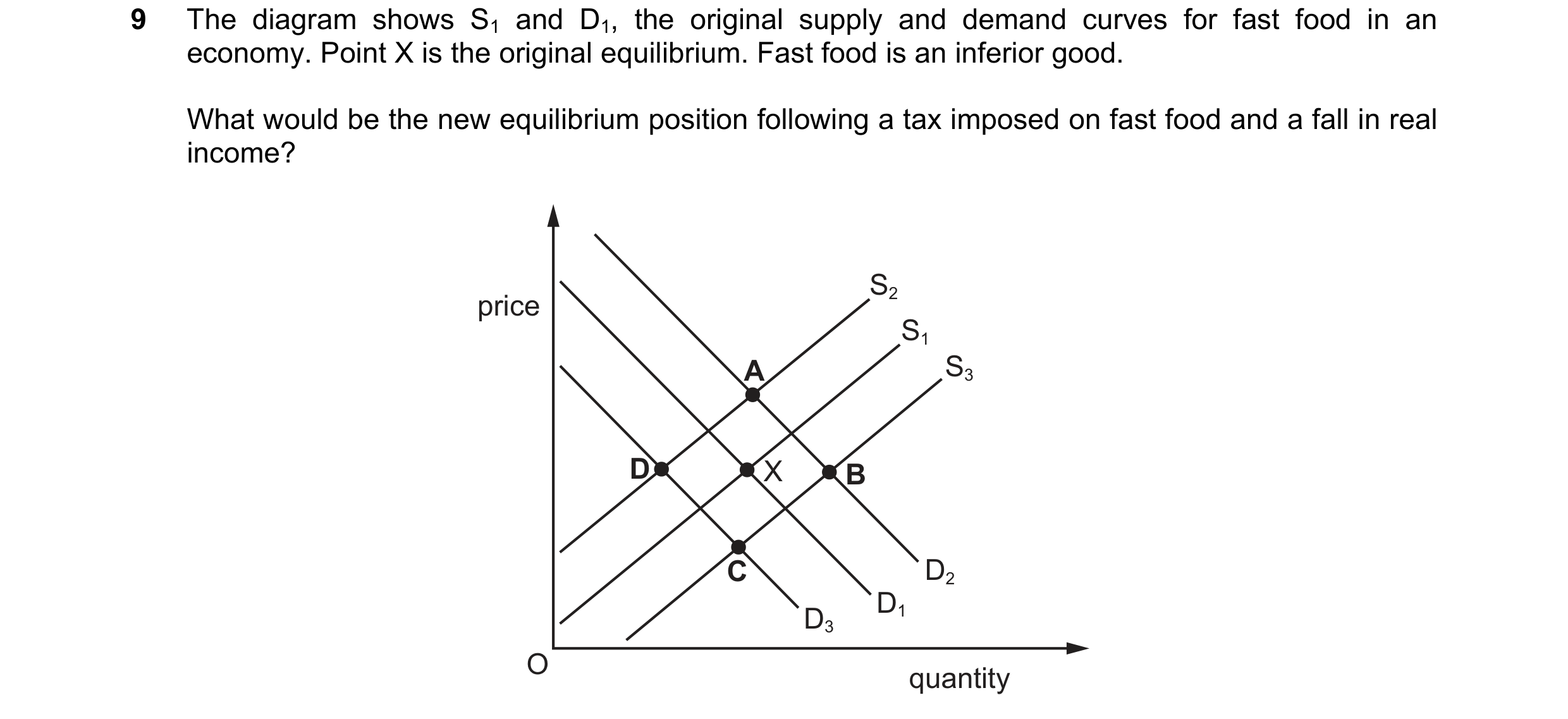
Q22 · The diagram shows S1 and D1, the original supply and demand curves for fast food in an… 9708/12 May/June 2018
9 The diagram shows S1 and D1, the original supply and demand curves for fast food in an economy. Point X is the original equilibrium. Fast food is an inferior good. What would be the new equilibrium position following a tax imposed on fast food and a fall in real income? S2 price S1 A S3 D X B C D2 D1 D3 O quantity
1 marks
Answer: A
This question in 9708/12 May/June 2018
Q23 · In 2016–2017 a government spent $135 billion on the health service 9708/12 May/June 2018
17 In 2016–2017 a government spent $135 billion on the health service. The diagram shows the provision of healthcare in that country. S price ($) P D O Q quantity What can we deduce about healthcare provision in the country if it were provided at zero price? A At price P the benefits to society are maximised. B It is non-rival in consumption. C It is unlimited in supply due to government funding. D It will need rationing as it will be overconsumed.
1 marks
Answer: D
This question in 9708/12 May/June 2018
Q24 · A flood-control dam is an example of a good provided directly by a government 9708/13 Oct/Nov 2018
17 A flood-control dam is an example of a good provided directly by a government. Which statement relating to the direct provision of a flood-control dam is not correct? A Direct provision of a flood-control dam allows the government to tackle the failure to provide public goods. B Direct provision of a flood-control dam forces the government to incur an opportunity cost. C Direct provision of a flood-control dam involves the supply of a merit good. D Direct provision of a flood-control dam is an example of government allocation of resources.
1 marks
Answer: C
This question in 9708/13 Oct/Nov 2018
Q25 · What justifies government intervention in the provision of a merit good such as education? 9708/12 May/June 2019
4 What justifies government intervention in the provision of a merit good such as education? A People who pay for education value it more than those who cannot pay. B Private schools have more merit than state schools. C Social costs of providing education outweigh social benefits of education. D Some consumers do not fully recognise the value of education.
1 marks
Answer: D
This question in 9708/12 May/June 2019
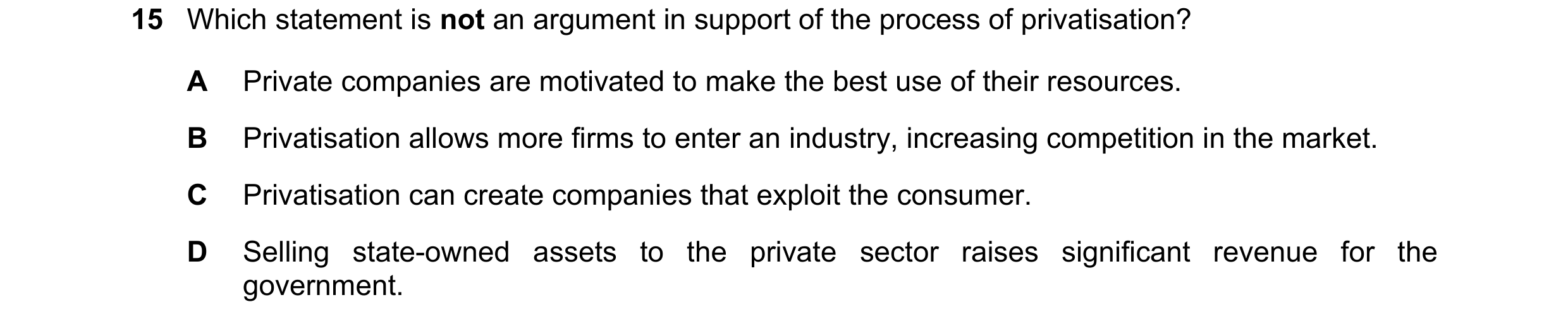
Q26 · Which statement is not an argument in support of the process of privatisation? 9708/13 May/June 2019
15 Which statement is not an argument in support of the process of privatisation? A Private companies are motivated to make the best use of their resources. B Privatisation allows more firms to enter an industry, increasing competition in the market. C Privatisation can create companies that exploit the consumer. D Selling state-owned assets to the private sector raises significant revenue for the government.
1 marks
Answer: C
This question in 9708/13 May/June 2019
Q27 · Which product is most likely to be provided only by the government? 9708/11 Oct/Nov 2019
14 Which product is most likely to be provided only by the government? A national defence B national health C national museums D national theatres
1 marks
Answer: A
This question in 9708/11 Oct/Nov 2019
Q28 · Why might governments provide free education for children aged 4 to 16 years old? 9708/12 Oct/Nov 2019
14 Why might governments provide free education for children aged 4 to 16 years old? A Consumers are not fully aware of the benefits of education. B Education in a free market system would be over consumed. C Education is a public good and there would be many free riders. D The private costs of education exceed the private benefits in a free market.
1 marks
Answer: A
This question in 9708/12 Oct/Nov 2019
Q29 · Which statement is the most valid reason for government intervention in a free market… 9708/12 May/June 2020
1 Which statement is the most valid reason for government intervention in a free market economy? A Consumers are well informed, making it difficult for producers to make profits. B Health and education are not available in sufficient quantities. C Producers are motivated only by profit. D There are many competitive firms and not enough sole suppliers.
1 marks
Answer: B
This question in 9708/12 May/June 2020
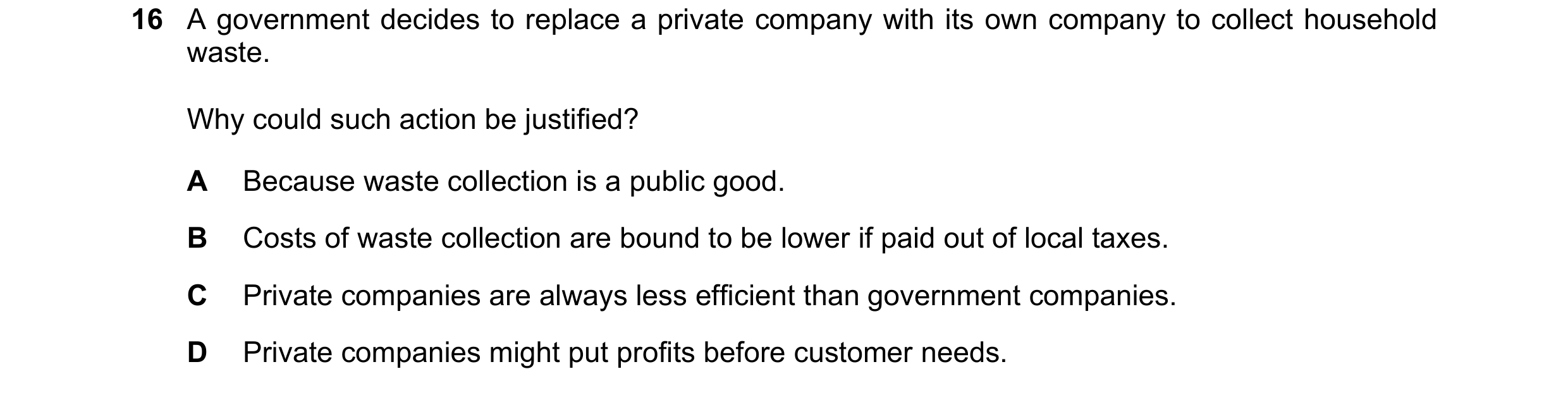
Q30 · A government decides to replace a private company with its own company to collect… 9708/12 May/June 2020
16 A government decides to replace a private company with its own company to collect household waste. Why could such action be justified? A Because waste collection is a public good. B Costs of waste collection are bound to be lower if paid out of local taxes. C Private companies are always less efficient than government companies. D Private companies might put profits before customer needs.
1 marks
Answer: D
This question in 9708/12 May/June 2020
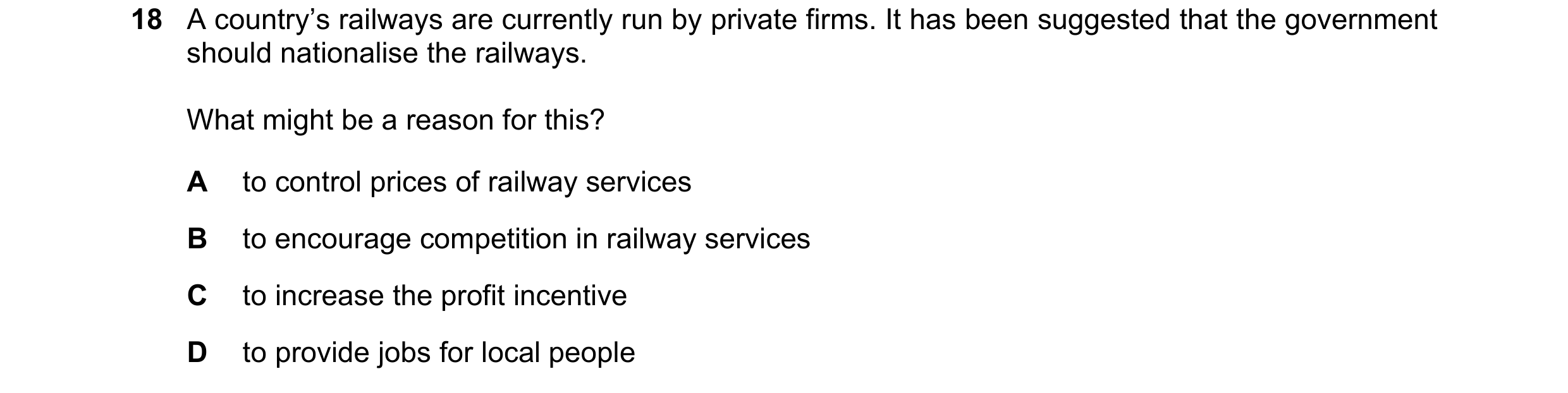
Q31 · A country’s railways are currently run by private firms 9708/12 May/June 2020
18 A country’s railways are currently run by private firms. It has been suggested that the government should nationalise the railways. What might be a reason for this? A to control prices of railway services B to encourage competition in railway services C to increase the profit incentive D to provide jobs for local people
1 marks
Answer: A
This question in 9708/12 May/June 2020
Q32 · In November 2017, the Scottish government introduced a minimum price for alcohol because… 9708/13 May/June 2020
17 In November 2017, the Scottish government introduced a minimum price for alcohol because of the detrimental health effects of alcohol consumption. Which combination of actions is most likely to lead to a failure with respect to reducing the detrimental effects of the consumption of alcohol? action 1 action 2 A minimum price is set too high effective information provision regarding the health effects of consuming alcohol B minimum price is set too high effective subsidisation of non-alcoholic beverages C minimum price is set too low health benefits of reduced alcohol consumption have been overestimated D minimum price is set too low stricter enforcement of the regulations relating to the sale of alcohol
1 marks
Answer: C
This question in 9708/13 May/June 2020
Q33 · A government decides to privatise a state-owned company 9708/12 Oct/Nov 2020
14 A government decides to privatise a state-owned company. What should the government do to try to ensure that this will result in an improvement in efficiency? A allocate vouchers to all citizens entitling them to a share in the ownership of the company B encourage competition C impose a maximum profit margin D increase business tax rates
1 marks
Answer: B
This question in 9708/12 Oct/Nov 2020
Q34 · A government wants to prevent the spread of an infectious disease by vaccinating all… 9708/13 Oct/Nov 2020
4 A government wants to prevent the spread of an infectious disease by vaccinating all children. Why might vaccination be classified as a merit good? A The benefit to society is equal to the benefit received by the individual. B The good is excludable. C The good is not vital. D The good would otherwise be under-consumed.
1 marks
Answer: D
This question in 9708/13 Oct/Nov 2020
Q35 · Why might a government privatise the railway industry in a country? 9708/13 Oct/Nov 2020
16 Why might a government privatise the railway industry in a country? A Economists classify railway journeys as a public good. B Privatisation would provide funds for investment from a wider range of sources. C Privatised railways would be run to maximise producer surplus. D Railway fares can be taxed to raise money for the government only if railways are privatised.
1 marks
Answer: B
This question in 9708/13 Oct/Nov 2020
Q36 · Education from 4 to 16 years of age in most developed economies is provided at zero… 9708/12 May/June 2021
18 Education from 4 to 16 years of age in most developed economies is provided at zero price, financed from taxation. Why should the government do this? A In a free market, consumers have imperfect information so do not realise the full personal benefit of education. B In a free market, education is not considered to be a private good. C In a free market, consumers will be unwilling to pay for education. D In a free market, education is non-rival and non-excludable in consumption so zero output would be produced.
1 marks
Answer: A
This question in 9708/12 May/June 2021
Q37 · What is an example of privatisation? 9708/11 Oct/Nov 2021
14 What is an example of privatisation? A the sale on the market of a French state-owned power-generation company B the sale of a privately-owned water company to a German firm C the takeover of a French car manufacturer by the French government D the purchase of a Swedish pharmaceutical producer by a larger American pharmaceutical producer
1 marks
Answer: A
This question in 9708/11 Oct/Nov 2021
Q38 · What did Adam Smith mean by ‘economy’ when describing his canons of taxation? 9708/11 Oct/Nov 2021
15 What did Adam Smith mean by ‘economy’ when describing his canons of taxation? A The cost of collecting the tax should be low. B The tax should be easy to pay. C The tax should have a neutral effect on the use of resources. D The tax should have a positive effect on aggregate supply.
1 marks
Answer: A
This question in 9708/11 Oct/Nov 2021
Q39 · Why might a government nationalise a private firm? 9708/12 Oct/Nov 2021
16 Why might a government nationalise a private firm? A to gain greater efficiency due to more competition B to increase merit good provision C to increase choice for the consumer D to raise more tax revenue
1 marks
Answer: B
This question in 9708/12 Oct/Nov 2021
Q40 · Why does the production of public goods have to be financed by the government? 9708/13 Oct/Nov 2021
15 Why does the production of public goods have to be financed by the government? A One person’s consumption of a public good means it is not available for anyone else. B People are able to consume public goods without paying for them. C Private sector firms will charge a price significantly above cost for public goods. D The cost of producing public goods is higher in the private sector.
1 marks
Answer: B
This question in 9708/13 Oct/Nov 2021
Q41 · The National Library Board of Singapore is a public sector organisation that finances and… 9708/12 Feb/March 2022
16 The National Library Board of Singapore is a public sector organisation that finances and manages the state libraries. What is the most likely reason for this? A Libraries are public goods. B Libraries are merit goods. C The cost of providing library services would be greater in the private sector. D The opportunity cost to the public sector of providing library services is zero.
1 marks
Answer: B
This question in 9708/12 Feb/March 2022
Q42 · What would be a valid objection to the government provision of goods and services? 9708/14 May/June 2022
15 What would be a valid objection to the government provision of goods and services? A There will be an increase in consumer sovereignty. B Only the private sector can provide merit goods. C Tax rates and tax income are likely to fall. D Investment in the private sector might be reduced.
1 marks
Answer: D
This question in 9708/14 May/June 2022
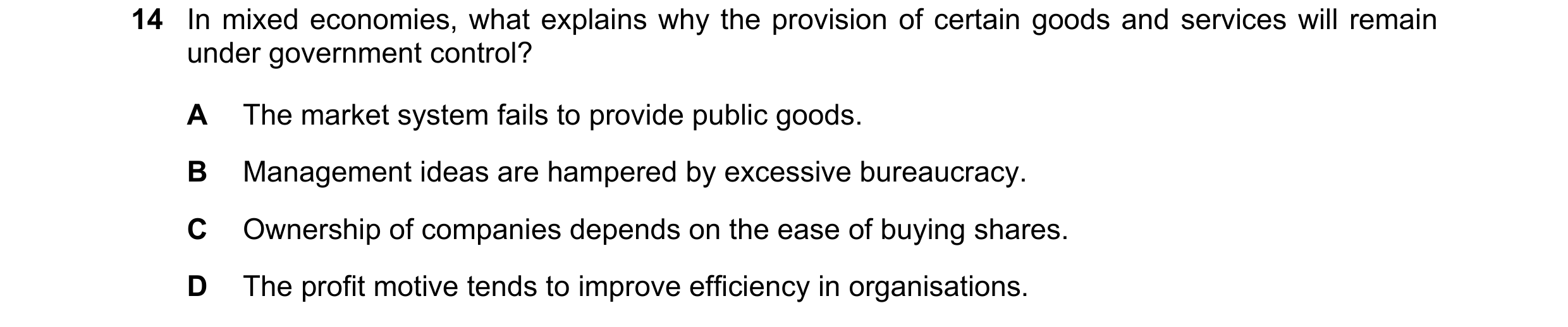
Q43 · In mixed economies, what explains why the provision of certain goods and services will… 9708/11 Oct/Nov 2022
14 In mixed economies, what explains why the provision of certain goods and services will remain under government control? A The market system fails to provide public goods. B Management ideas are hampered by excessive bureaucracy. C Ownership of companies depends on the ease of buying shares. D The profit motive tends to improve efficiency in organisations.
1 marks
Answer: A
This question in 9708/11 Oct/Nov 2022
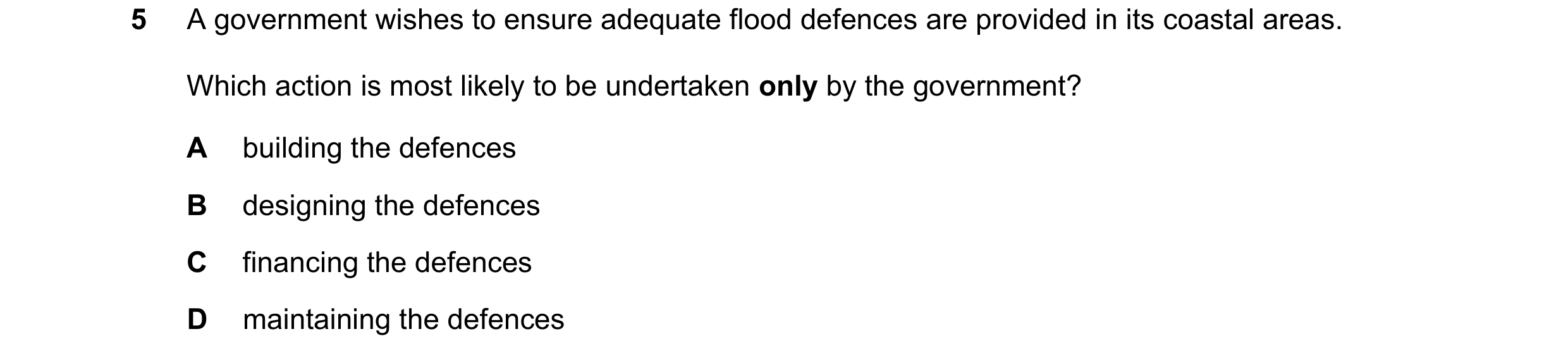
Q44 · A government wishes to ensure adequate flood defences are provided in its coastal areas 9708/13 Oct/Nov 2022
5 A government wishes to ensure adequate flood defences are provided in its coastal areas. Which action is most likely to be undertaken only by the government? A building the defences B designing the defences C financing the defences D maintaining the defences
1 marks
Answer: C
This question in 9708/13 Oct/Nov 2022
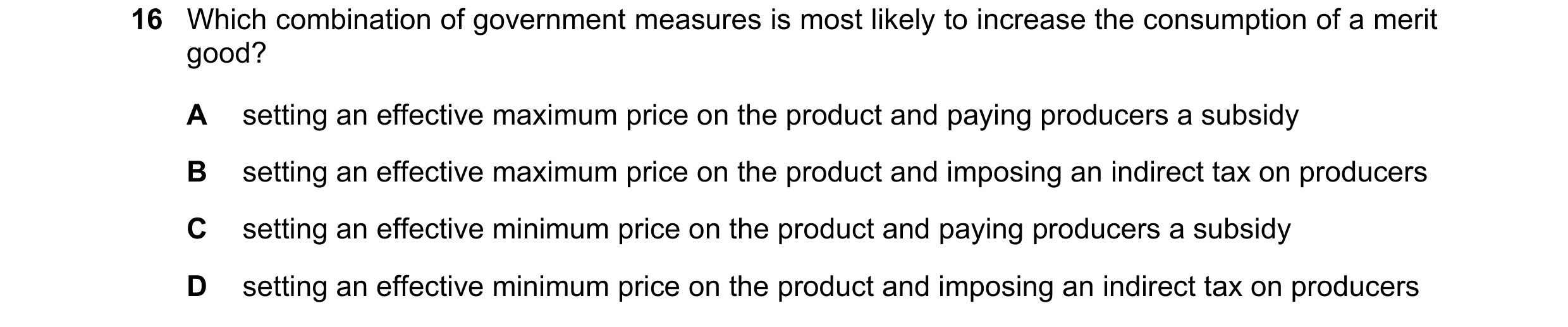
Q45 · Which combination of government measures is most likely to increase the consumption of a… 9708/12 May/June 2023
16 Which combination of government measures is most likely to increase the consumption of a merit good? A setting an effective maximum price on the product and paying producers a subsidy B setting an effective maximum price on the product and imposing an indirect tax on producers C setting an effective minimum price on the product and paying producers a subsidy D setting an effective minimum price on the product and imposing an indirect tax on producers
1 marks
Answer: A
This question in 9708/12 May/June 2023
Q46 · A government introduces charges for vehicles using the roads in its capital city 9708/11 Oct/Nov 2023
14 A government introduces charges for vehicles using the roads in its capital city. Which characteristic must the roads have for this to be successful in reducing congestion? A The roads must be excludable. B The roads must be merit goods. C The roads must be non-rivalrous. D The roads must be public goods.
1 marks
Answer: A
This question in 9708/11 Oct/Nov 2023
Q47 · What explains the underconsumption of merit goods? 9708/12 Feb/March 2024
13 What explains the underconsumption of merit goods? A Their value is not fully understood by consumers. B They are unproductive goods and services. C They can only be provided by the government. D They are only provided by private sector businesses.
1 marks
Answer: A
This question in 9708/12 Feb/March 2024
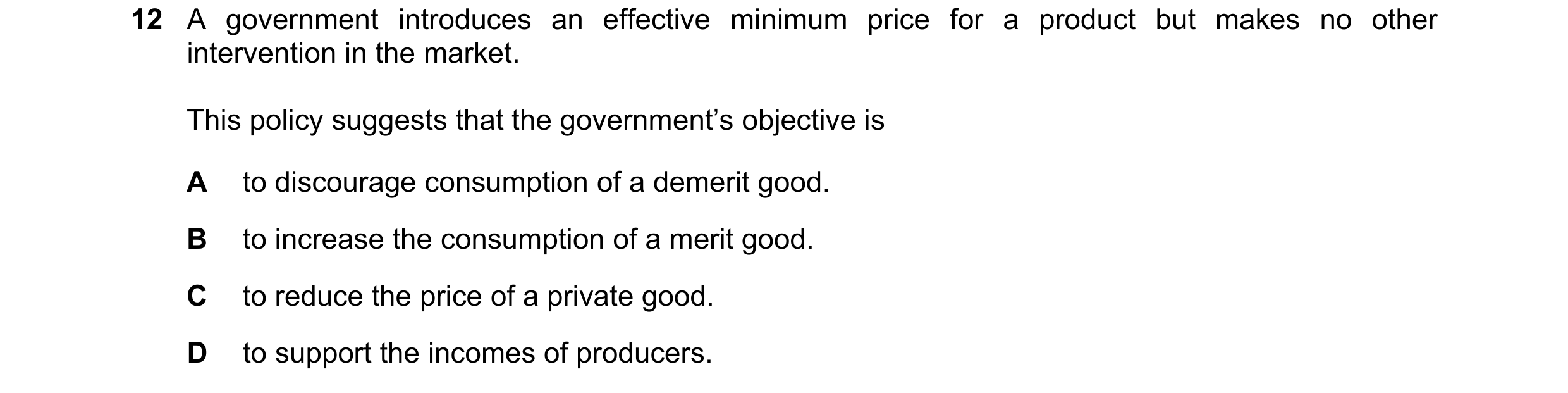
Q48 · A government introduces an effective minimum price for a product but makes no other… 9708/13 May/June 2024
12 A government introduces an effective minimum price for a product but makes no other intervention in the market. This policy suggests that the government’s objective is A to discourage consumption of a demerit good. B to increase the consumption of a merit good. C to reduce the price of a private good. D to support the incomes of producers.
1 marks
Answer: A
This question in 9708/13 May/June 2024
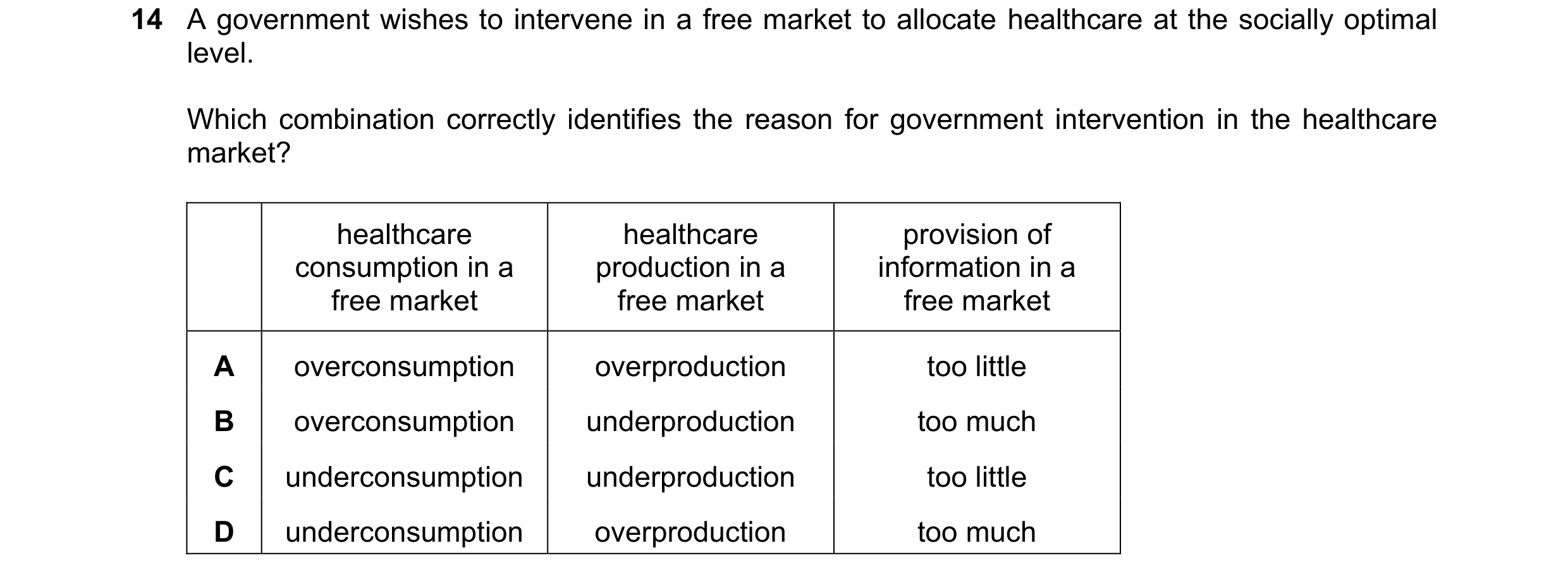
Q49 · A government wishes to intervene in a free market to allocate healthcare at the socially… 9708/11 Oct/Nov 2024
14 A government wishes to intervene in a free market to allocate healthcare at the socially optimal level. Which combination correctly identifies the reason for government intervention in the healthcare market? healthcare healthcare provision of consumption in a production in a information in a free market free market free market A overconsumption overproduction too little B overconsumption underproduction too much C underconsumption underproduction too little D underconsumption overproduction too much
1 marks
Answer: C
This question in 9708/11 Oct/Nov 2024
Q50 · Which policy is most likely to solve the free rider problem caused by public goods? 9708/13 Oct/Nov 2024
12 Which policy is most likely to solve the free rider problem caused by public goods? A an advertising campaign B a direct provision by the government C a minimum price D a tax on a substitute good
1 marks
Answer: B
This question in 9708/13 Oct/Nov 2024
Q51 · Why might governments provide free education for children aged 4 to 16 years old? 9708/12 May/June 2025
13 Why might governments provide free education for children aged 4 to 16 years old? A Consumers are not fully aware of the benefits of education. B Education in a free market system would be over consumed. C Education is a public good and there would be many free riders. D The private costs of education exceed the private benefits in a free market.
1 marks
Answer: A
This question in 9708/12 May/June 2025
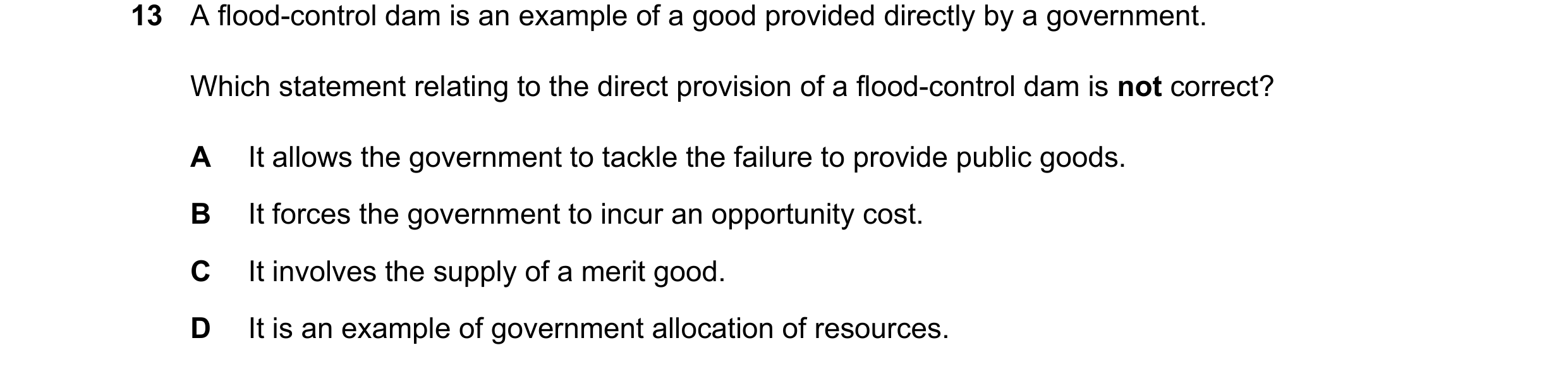
Q52 · A flood-control dam is an example of a good provided directly by a government 9708/13 May/June 2025
13 A flood-control dam is an example of a good provided directly by a government. Which statement relating to the direct provision of a flood-control dam is not correct? A It allows the government to tackle the failure to provide public goods. B It forces the government to incur an opportunity cost. C It involves the supply of a merit good. D It is an example of government allocation of resources.
1 marks
Answer: C
This question in 9708/13 May/June 2025
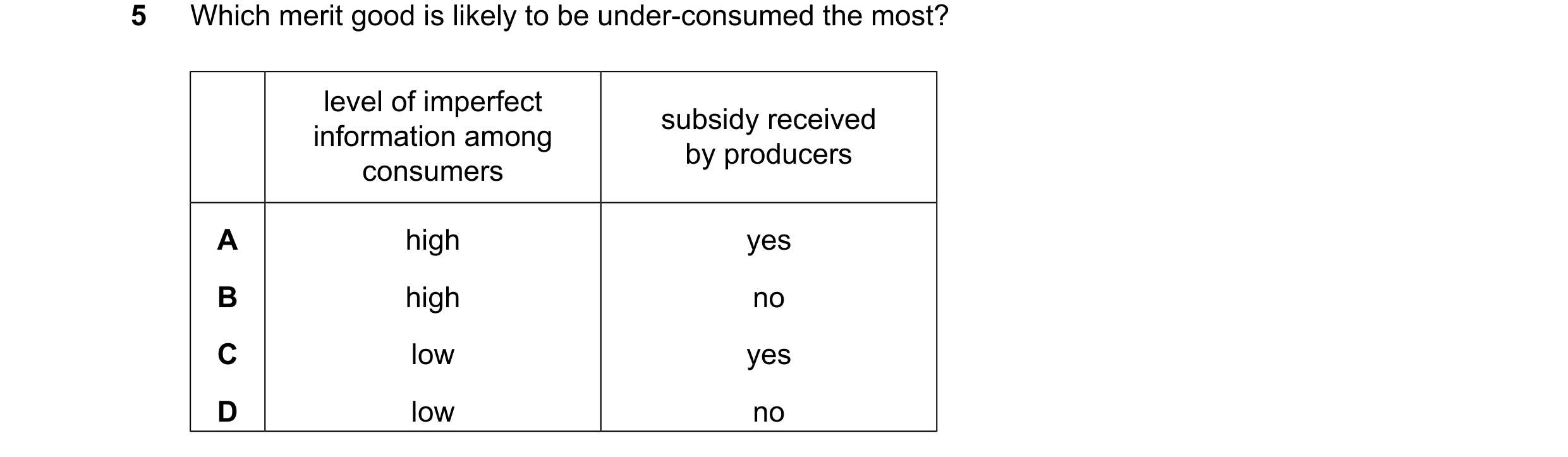
Q53 · Which merit good is likely to be under-consumed the most? 9708/11 Oct/Nov 2025
5 Which merit good is likely to be under-consumed the most? level of imperfect subsidy received information among by producers consumers A high yes B high no C low yes D low no
1 marks
Answer: B
This question in 9708/11 Oct/Nov 2025
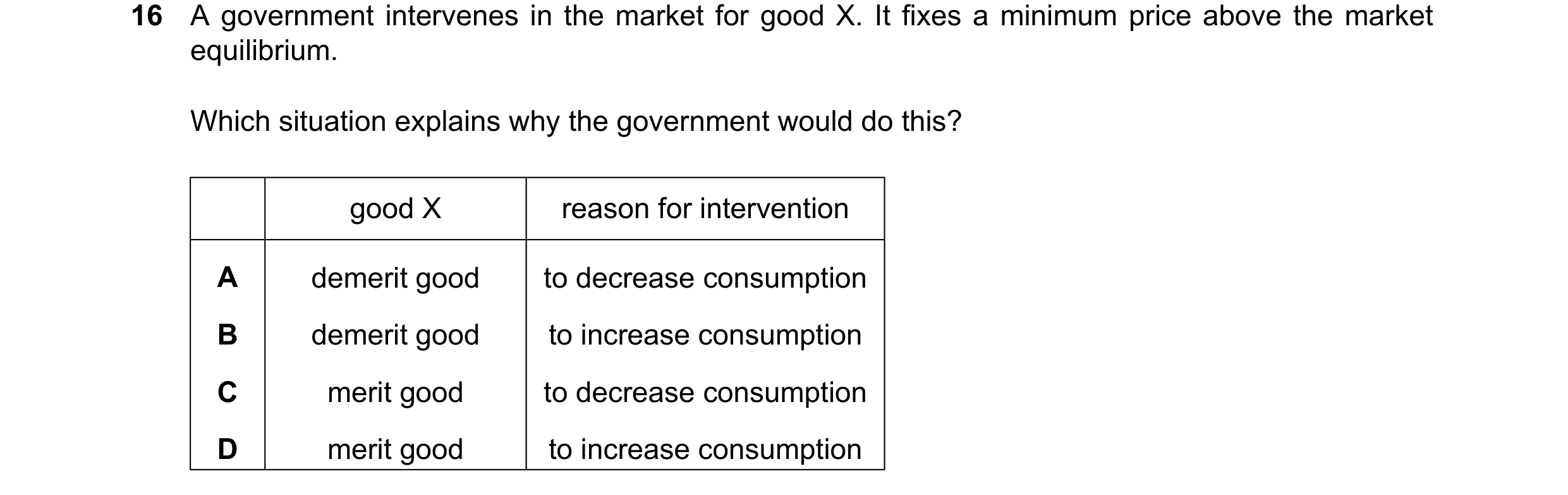
Q54 · A government intervenes in the market for good X 9708/13 Oct/Nov 2025
16 A government intervenes in the market for good X. It fixes a minimum price above the market equilibrium. Which situation explains why the government would do this? good X reason for intervention A demerit good to decrease consumption B demerit good to increase consumption C merit good to decrease consumption D merit good to increase consumption
1 marks
Answer: A
This question in 9708/13 Oct/Nov 2025

 1 / 12

 2 / 12


 3 / 12


 4 / 12
 5 / 12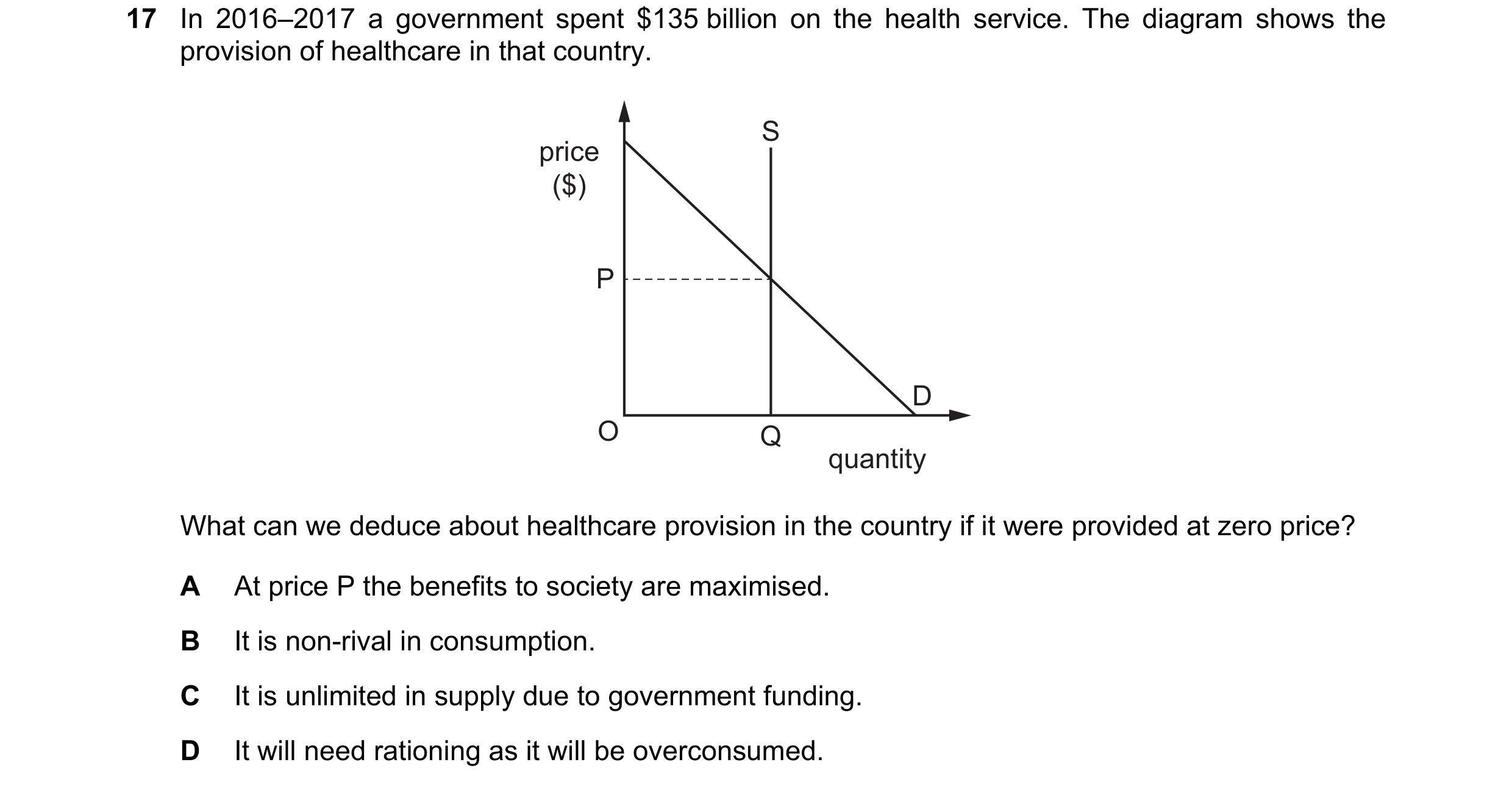

 6 / 12


 7 / 12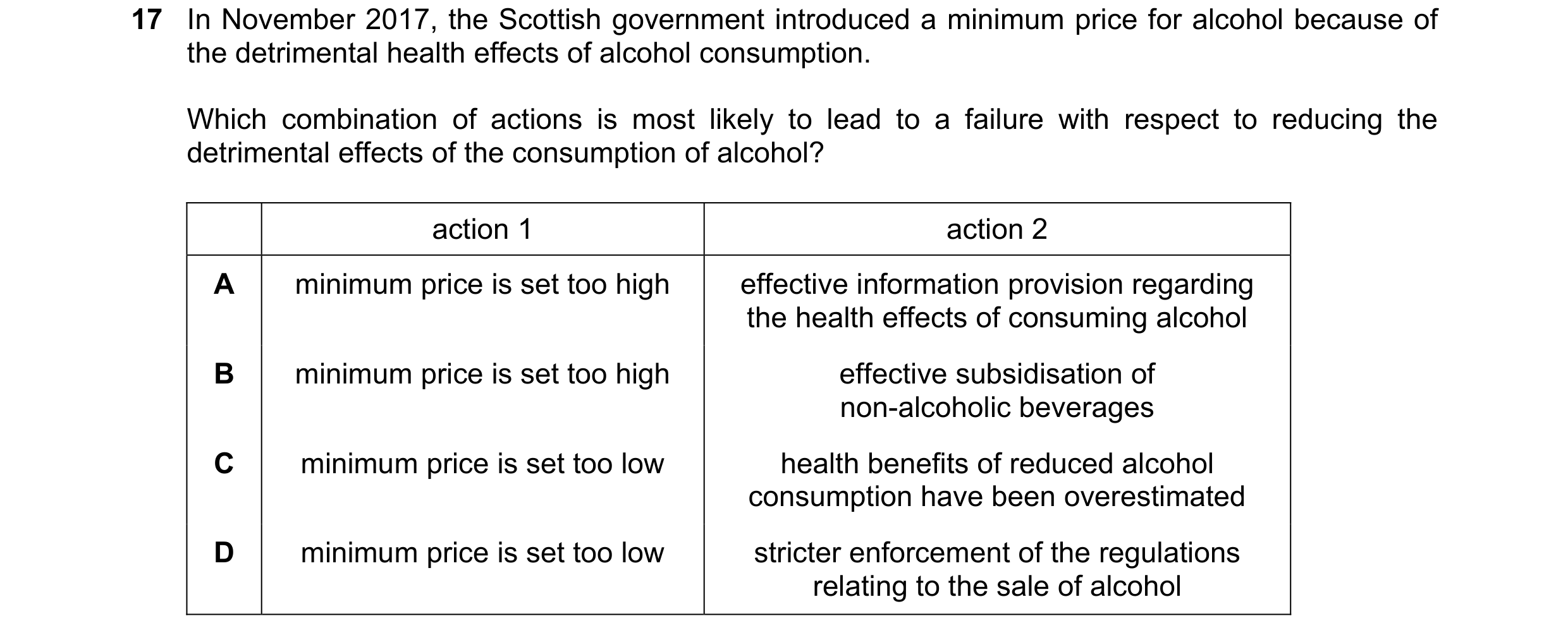
 8 / 12


 9 / 12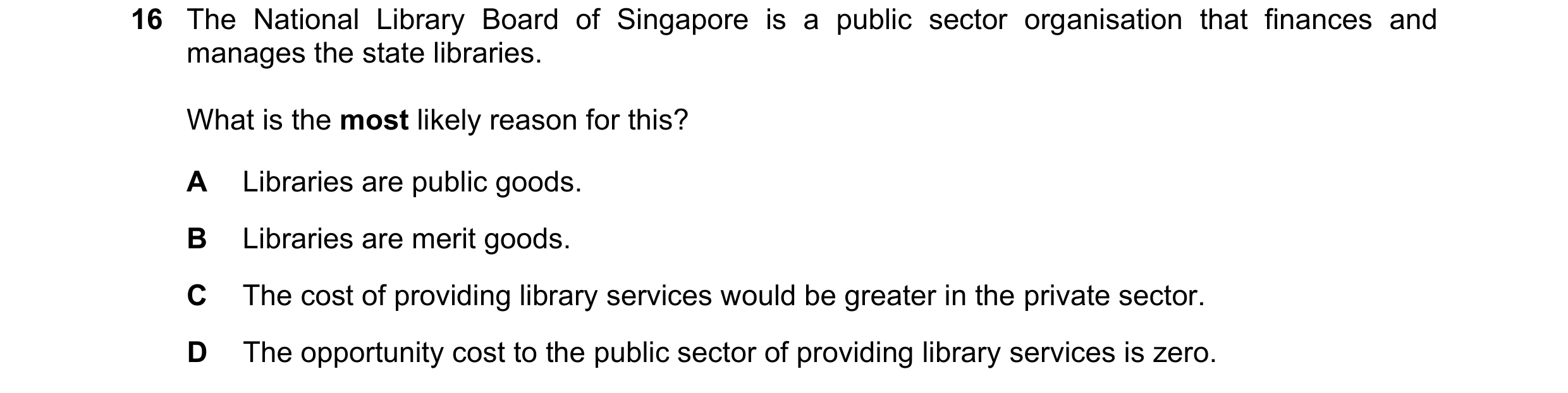

 10 / 12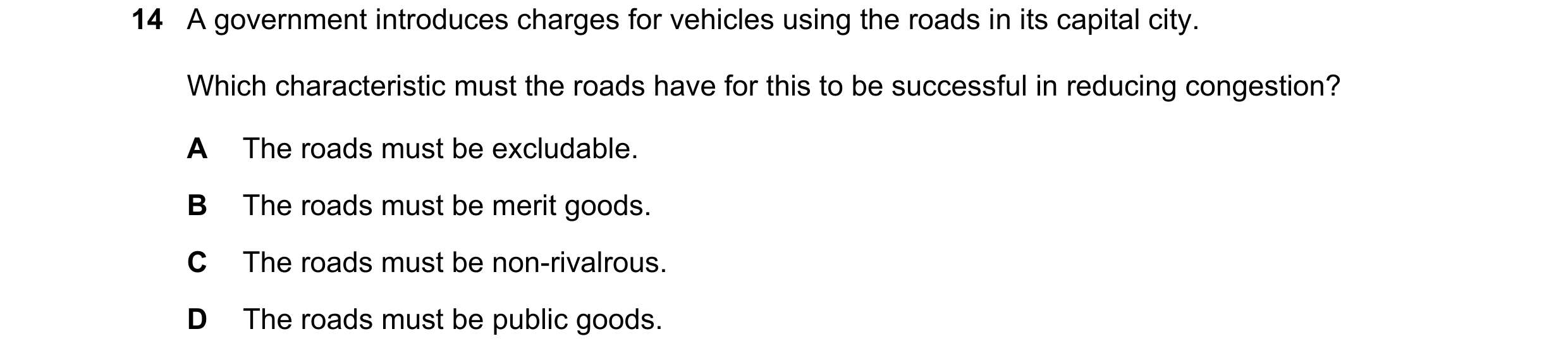

 11 / 12
 12 / 12