Questions as text
Q1 · Firm X is considering using various methods of investment appraisal 9706/31 Oct/Nov 2009
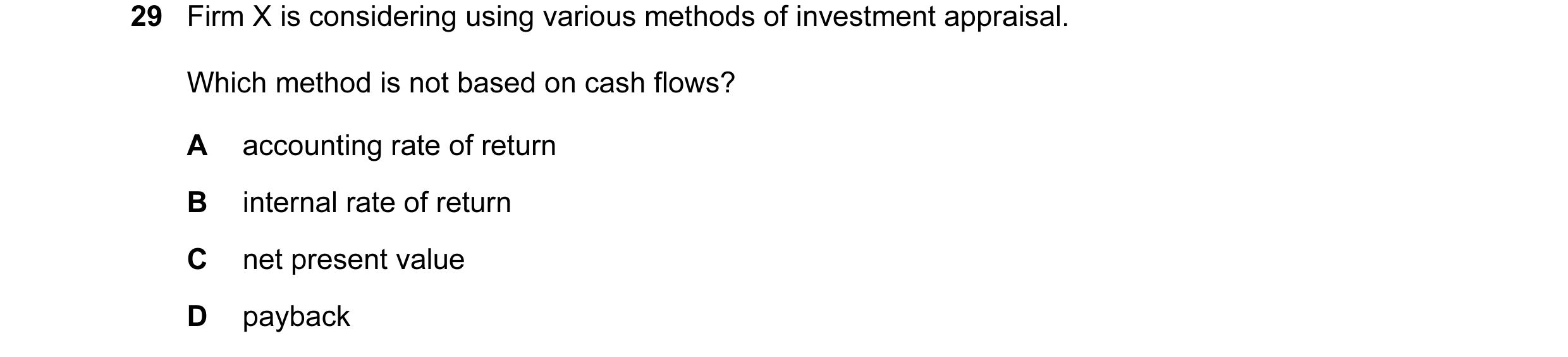
29 Firm X is considering using various methods of investment appraisal. Which method is not based on cash flows? A accounting rate of return B internal rate of return C net present value D payback
1 marks
Answer: A
This question in 9706/31 Oct/Nov 2009
Q2 · The net present values of a capital project are as follows 9706/31 Oct/Nov 2009
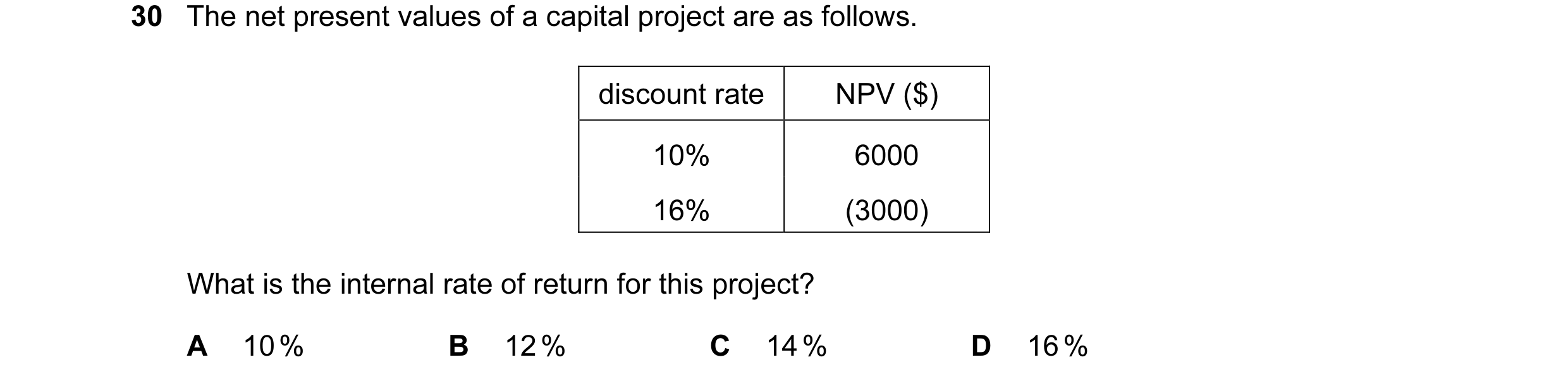
30 The net present values of a capital project are as follows. discount rate NPV ($) 10% 6000 16% (3000) What is the internal rate of return for this project? A 10 % B 12 % C 14 % D 16 %
1 marks
Answer: C
This question in 9706/31 Oct/Nov 2009
Q3 · Firm X is considering using various methods of investment appraisal 9706/32 Oct/Nov 2009
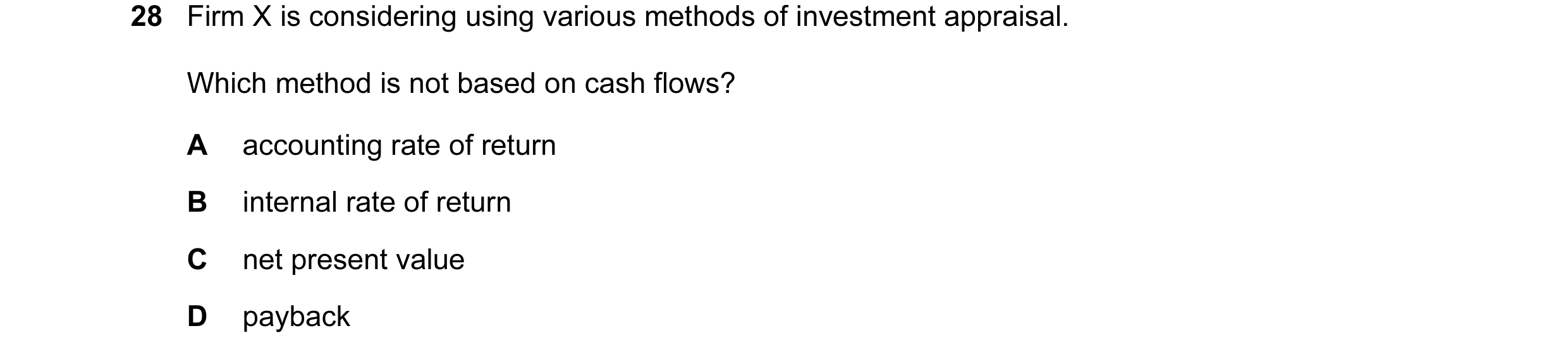
28 Firm X is considering using various methods of investment appraisal. Which method is not based on cash flows? A accounting rate of return B internal rate of return C net present value D payback
1 marks
Answer: A
This question in 9706/32 Oct/Nov 2009
Q4 · The net present values of a capital project are as follows 9706/32 Oct/Nov 2009
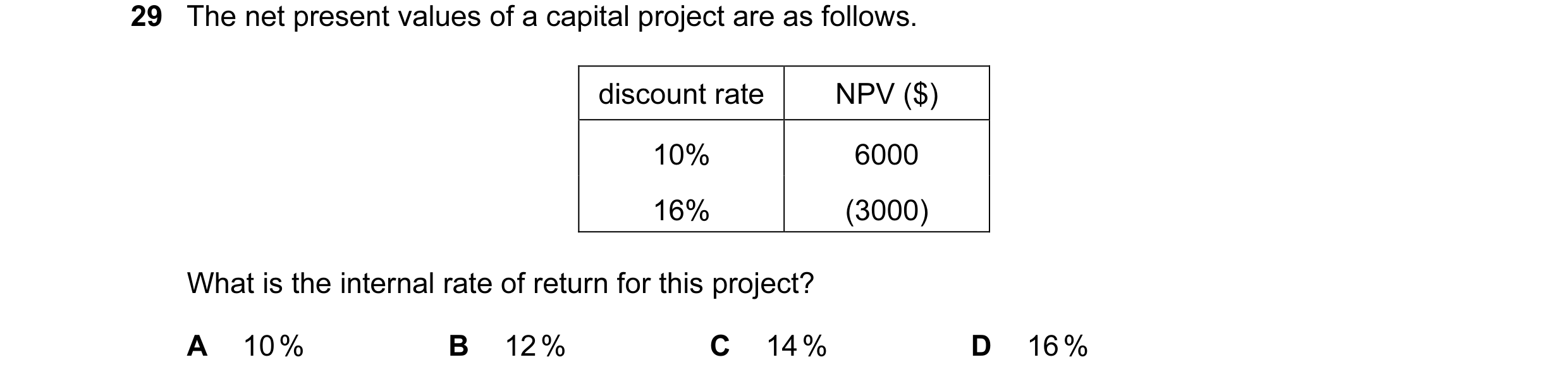
29 The net present values of a capital project are as follows. discount rate NPV ($) 10% 6000 16% (3000) What is the internal rate of return for this project? A 10 % B 12 % C 14 % D 16 %
1 marks
Answer: C
This question in 9706/32 Oct/Nov 2009
Q5 · A machine costs $160 000 with an estimated residual value of $20 000 after four years 9706/31 May/June 2010
28 A machine costs $160 000 with an estimated residual value of $20 000 after four years. During each of the four years of its life the machine will earn cash inflows of $64 000 and incur cash outflows of $14 000. The machine is to be depreciated on a straight-line basis over its useful life. What is the accounting rate of return for this machine based upon the average investment? A 11.11 % B 14.29 % C 16.67 % D 21.43 %
1 marks
Answer: C
This question in 9706/31 May/June 2010
Q6 · A three year capital investment project costing $80 000 generates the following net cash… 9706/31 May/June 2010
29 A three year capital investment project costing $80 000 generates the following net cash flows at the end of each year. year $ 1 50 000 2 40 000 3 40 000 The company’s cost of capital is 20 %. Discount factors for 20 % are as follows. discount year factor 1 0.833 2 0.694 3 0.578 What is the discounted payback period? A 1.63 years B 1.75 years C 2.46 years D 2.75 years
1 marks
Answer: C
This question in 9706/31 May/June 2010
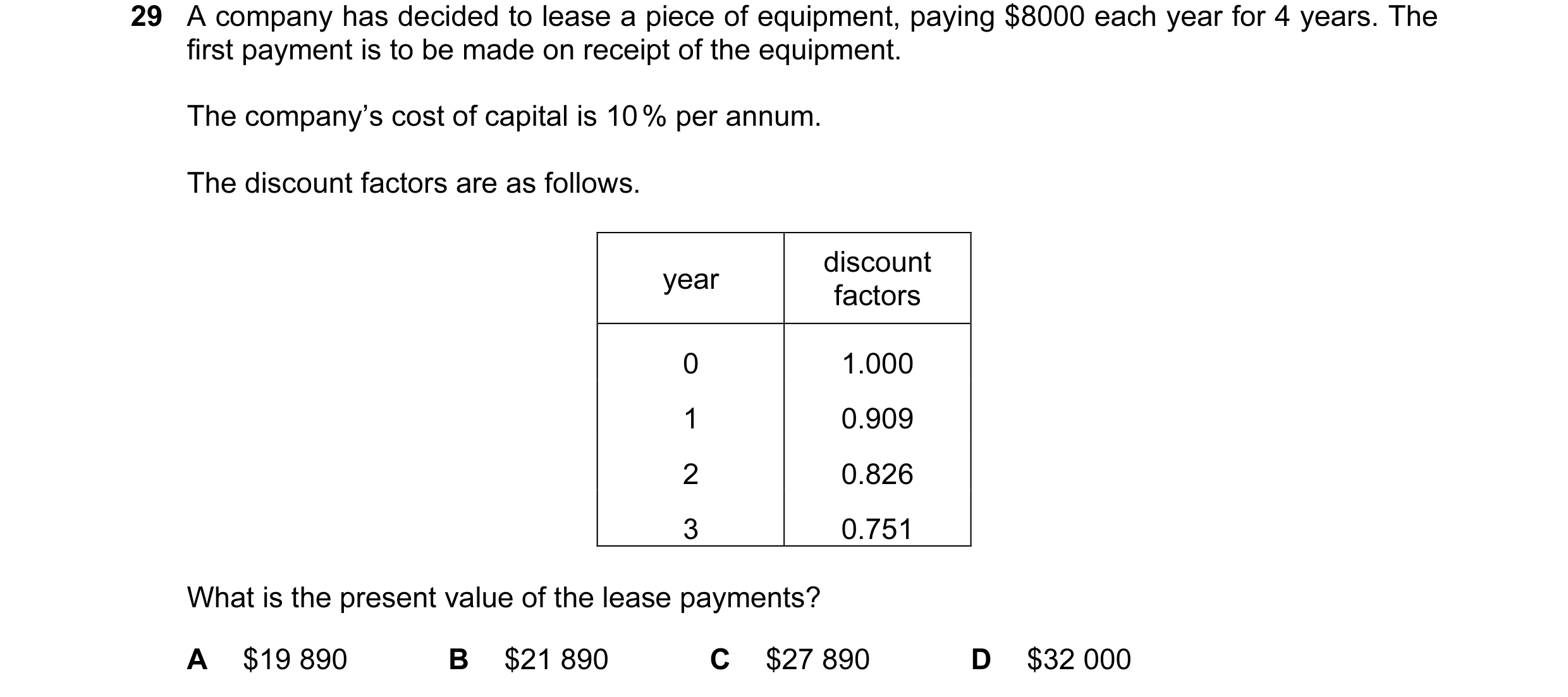
Q7 · A company has decided to lease a piece of equipment, paying $8000 each year for 4 years 9706/31 May/June 2010
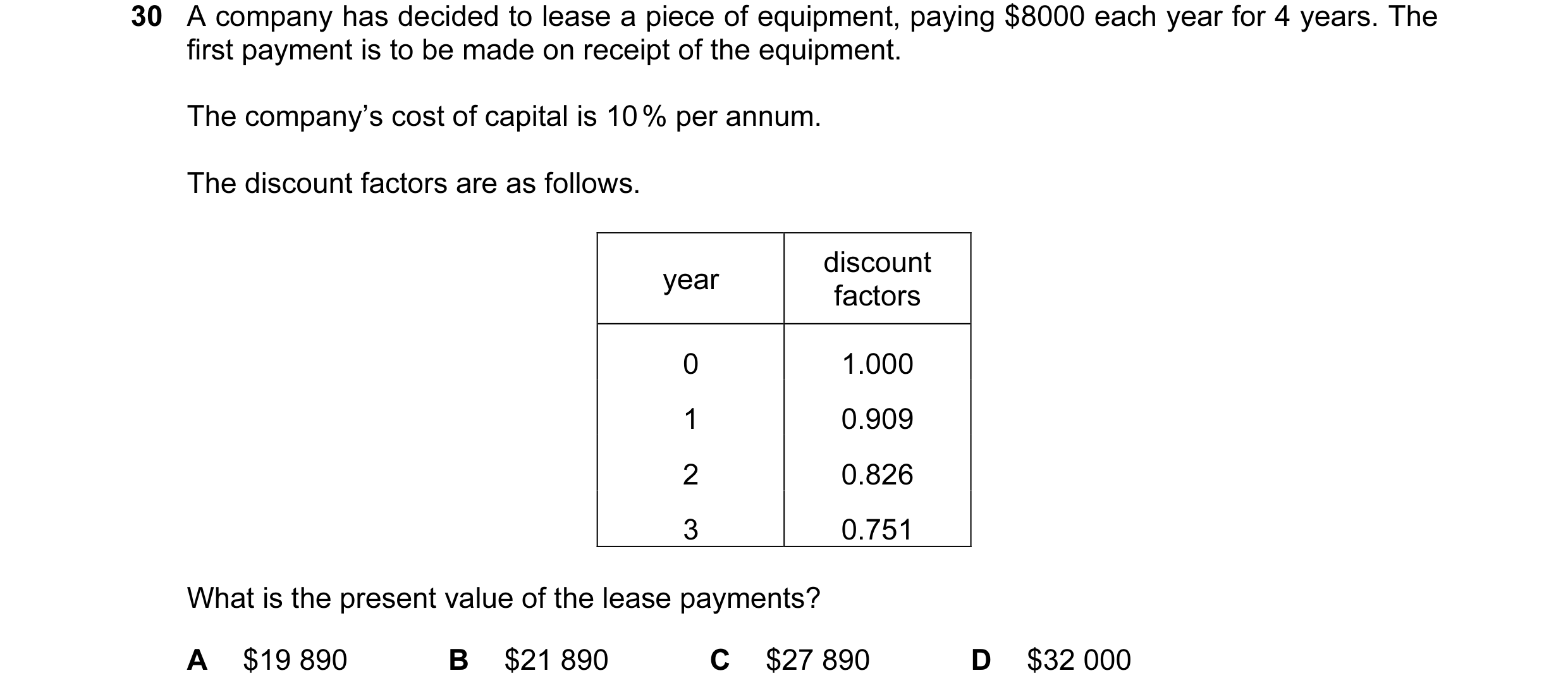
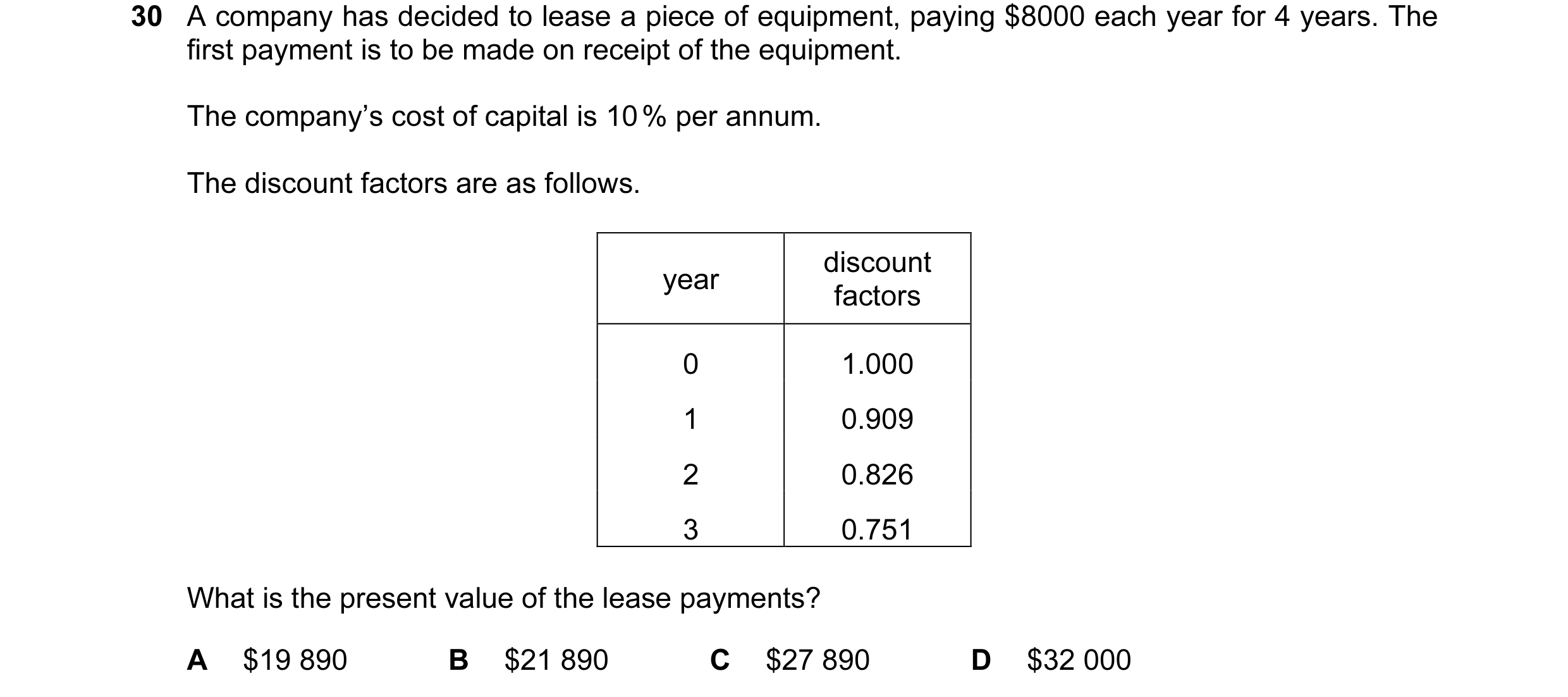
30 A company has decided to lease a piece of equipment, paying $8000 each year for 4 years. The first payment is to be made on receipt of the equipment. The company’s cost of capital is 10 % per annum. The discount factors are as follows. discount year factors 0 1.000 1 0.909 2 0.826 3 0.751 What is the present value of the lease payments? A $19 890 B $21 890 C $27 890 D $32 000
1 marks
Answer: C
This question in 9706/31 May/June 2010
Q8 · A machine costs $160 000 with an estimated residual value of $20 000 after four years 9706/32 May/June 2010
28 A machine costs $160 000 with an estimated residual value of $20 000 after four years. During each of the four years of its life the machine will earn cash inflows of $64 000 and incur cash outflows of $14 000. The machine is to be depreciated on a straight-line basis over its useful life. What is the accounting rate of return for this machine based upon the average investment? A 11.11 % B 14.29 % C 16.67 % D 21.43 %
1 marks
Answer: C
This question in 9706/32 May/June 2010
Q9 · A three year capital investment project costing $80 000 generates the following net cash… 9706/32 May/June 2010
29 A three year capital investment project costing $80 000 generates the following net cash flows at the end of each year. year $ 1 50 000 2 40 000 3 40 000 The company’s cost of capital is 20 %. Discount factors for 20 % are as follows. discount year factor 1 0.833 2 0.694 3 0.578 What is the discounted payback period? A 1.63 years B 1.75 years C 2.46 years D 2.75 years
1 marks
Answer: C
This question in 9706/32 May/June 2010
Q10 · A company has decided to lease a piece of equipment, paying $8000 each year for 4 years 9706/32 May/June 2010
30 A company has decided to lease a piece of equipment, paying $8000 each year for 4 years. The first payment is to be made on receipt of the equipment. The company’s cost of capital is 10 % per annum. The discount factors are as follows. discount year factors 0 1.000 1 0.909 2 0.826 3 0.751 What is the present value of the lease payments? A $19 890 B $21 890 C $27 890 D $32 000
1 marks
Answer: C
This question in 9706/32 May/June 2010
Q11 · A machine costs $160 000 with an estimated residual value of $20 000 after four years 9706/33 May/June 2010
27 A machine costs $160 000 with an estimated residual value of $20 000 after four years. During each of the four years of its life the machine will earn cash inflows of $64 000 and incur cash outflows of $14 000. The machine is to be depreciated on a straight-line basis over its useful life. What is the accounting rate of return for this machine based upon the average investment? A 11.11 % B 14.29 % C 16.67 % D 21.43 %
1 marks
Answer: C
This question in 9706/33 May/June 2010
Q12 · A three year capital investment project costing $80 000 generates the following net cash… 9706/33 May/June 2010
28 A three year capital investment project costing $80 000 generates the following net cash flows at the end of each year. year $ 1 50 000 2 40 000 3 40 000 The company’s cost of capital is 20 %. Discount factors for 20 % are as follows. discount year factor 1 0.833 2 0.694 3 0.578 What is the discounted payback period? A 1.63 years B 1.75 years C 2.46 years D 2.75 years
1 marks
Answer: C
This question in 9706/33 May/June 2010
Q13 · A company has decided to lease a piece of equipment, paying $8000 each year for 4 years 9706/33 May/June 2010
29 A company has decided to lease a piece of equipment, paying $8000 each year for 4 years. The first payment is to be made on receipt of the equipment. The company’s cost of capital is 10 % per annum. The discount factors are as follows. discount year factors 0 1.000 1 0.909 2 0.826 3 0.751 What is the present value of the lease payments? A $19 890 B $21 890 C $27 890 D $32 000
1 marks
Answer: C
This question in 9706/33 May/June 2010
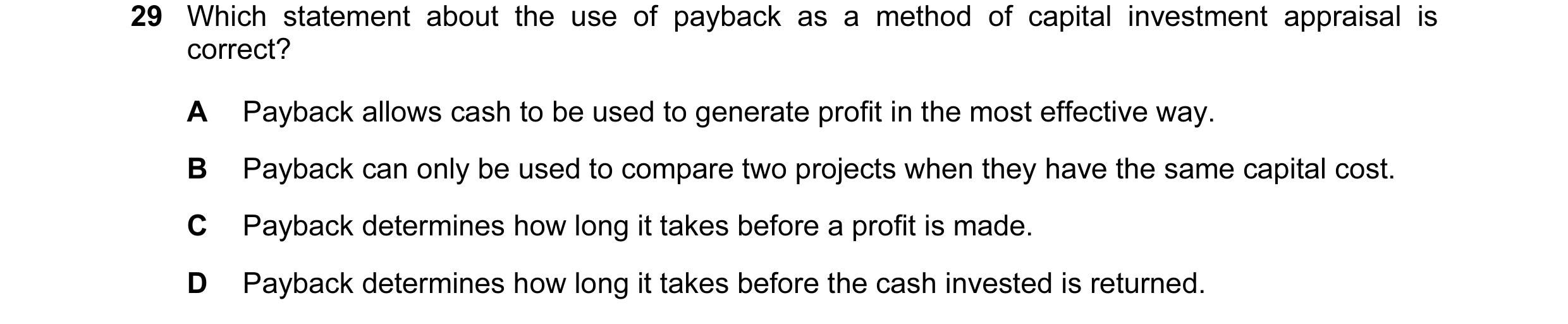
Q14 · Which statement about the use of payback as a method of capital investment appraisal is… 9706/31 Oct/Nov 2010
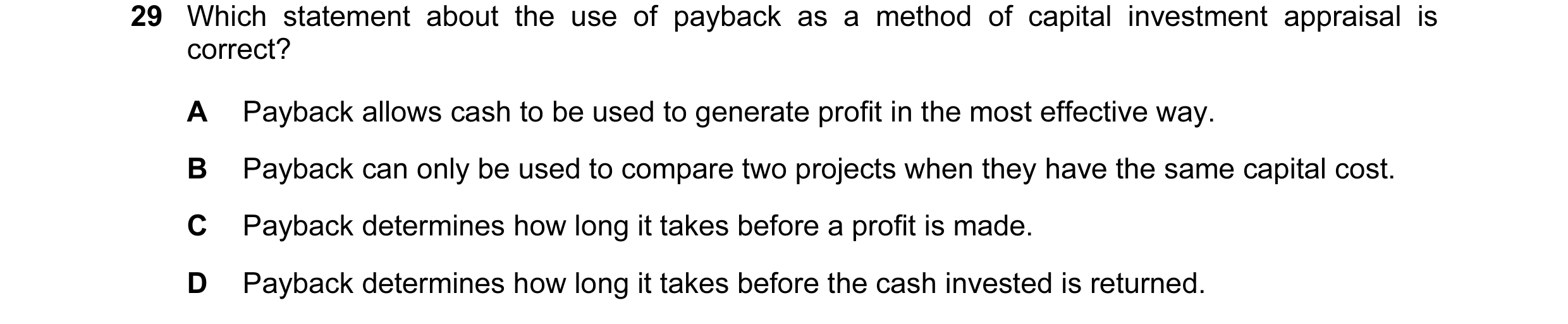
29 Which statement about the use of payback as a method of capital investment appraisal is correct? A Payback allows cash to be used to generate profit in the most effective way. B Payback can only be used to compare two projects when they have the same capital cost. C Payback determines how long it takes before a profit is made. D Payback determines how long it takes before the cash invested is returned.
1 marks
Answer: D
This question in 9706/31 Oct/Nov 2010
Q15 · A company has evaluated the net present value of a project based on two separate discount… 9706/31 Oct/Nov 2010
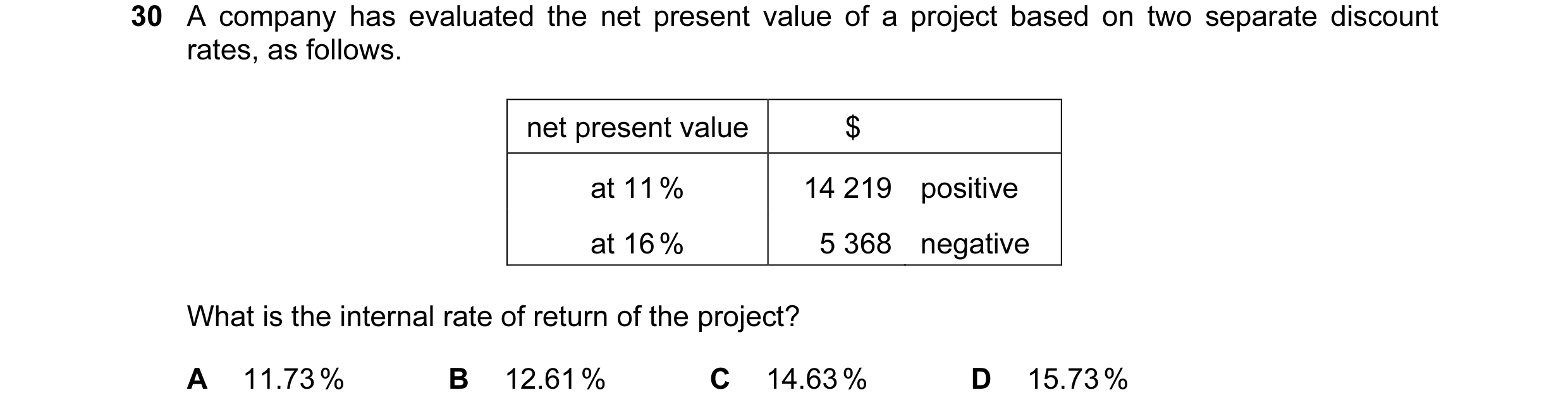
30 A company has evaluated the net present value of a project based on two separate discount rates, as follows. net present value $ at 11 % 14 219 positive at 16 % 5 368 negative What is the internal rate of return of the project? A 11.73 % B 12.61 % C 14.63 % D 15.73 %
1 marks
Answer: C
This question in 9706/31 Oct/Nov 2010
Q16 · Which statement about the use of payback as a method of capital investment appraisal is… 9706/32 Oct/Nov 2010
29 Which statement about the use of payback as a method of capital investment appraisal is correct? A Payback allows cash to be used to generate profit in the most effective way. B Payback can only be used to compare two projects when they have the same capital cost. C Payback determines how long it takes before a profit is made. D Payback determines how long it takes before the cash invested is returned.
1 marks
Answer: D
This question in 9706/32 Oct/Nov 2010
Q17 · A company has evaluated the net present value of a project based on two separate discount… 9706/32 Oct/Nov 2010
30 A company has evaluated the net present value of a project based on two separate discount rates, as follows. net present value $ at 11 % 14 219 positive at 16 % 5 368 negative What is the internal rate of return of the project? A 11.73 % B 12.61 % C 14.63 % D 15.73 %
1 marks
Answer: C
This question in 9706/32 Oct/Nov 2010
Q18 · Which statement about the use of payback as a method of capital investment appraisal is… 9706/33 Oct/Nov 2010
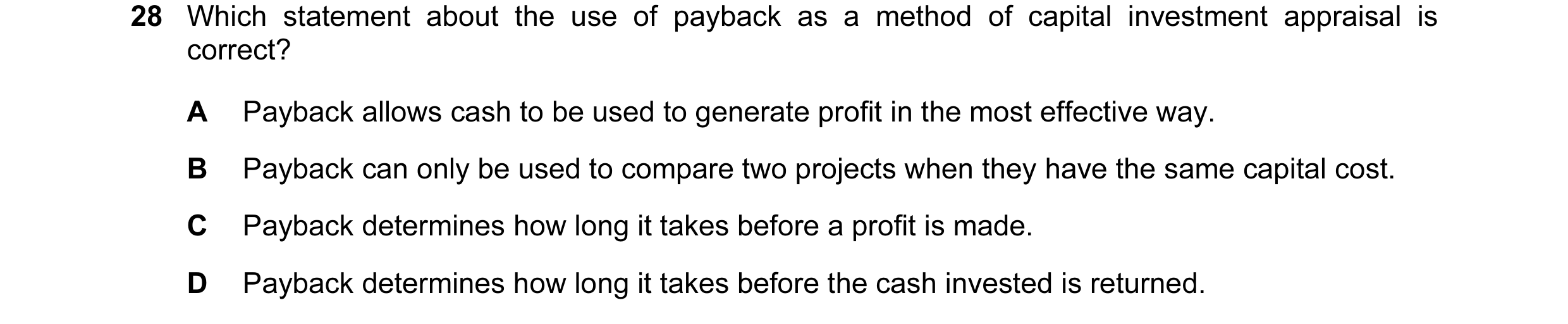
28 Which statement about the use of payback as a method of capital investment appraisal is correct? A Payback allows cash to be used to generate profit in the most effective way. B Payback can only be used to compare two projects when they have the same capital cost. C Payback determines how long it takes before a profit is made. D Payback determines how long it takes before the cash invested is returned.
1 marks
Answer: D
This question in 9706/33 Oct/Nov 2010
Q19 · A company has evaluated the net present value of a project based on two separate discount… 9706/33 Oct/Nov 2010
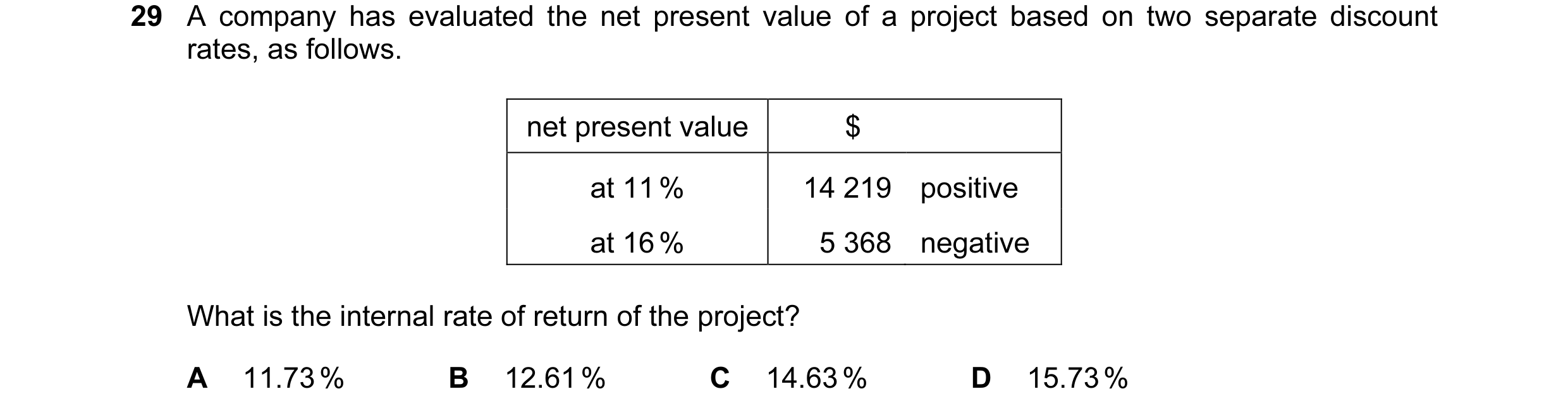
29 A company has evaluated the net present value of a project based on two separate discount rates, as follows. net present value $ at 11 % 14 219 positive at 16 % 5 368 negative What is the internal rate of return of the project? A 11.73 % B 12.61 % C 14.63 % D 15.73 %
1 marks
Answer: C
This question in 9706/33 Oct/Nov 2010
Q20 · How is working capital treated in a discounted cash flow statement? 9706/31 May/June 2011
29 How is working capital treated in a discounted cash flow statement? A as an inflow at the start of the project and an inflow at the end B as an inflow at the start of the project and an outflow at the end C as an outflow at the start of the project and an inflow at the end D as an outflow at the start of the project and an outflow at the end
1 marks
Answer: C
This question in 9706/31 May/June 2011
Q21 · A company is considering buying equipment at a cost of $80 000 9706/31 May/June 2011
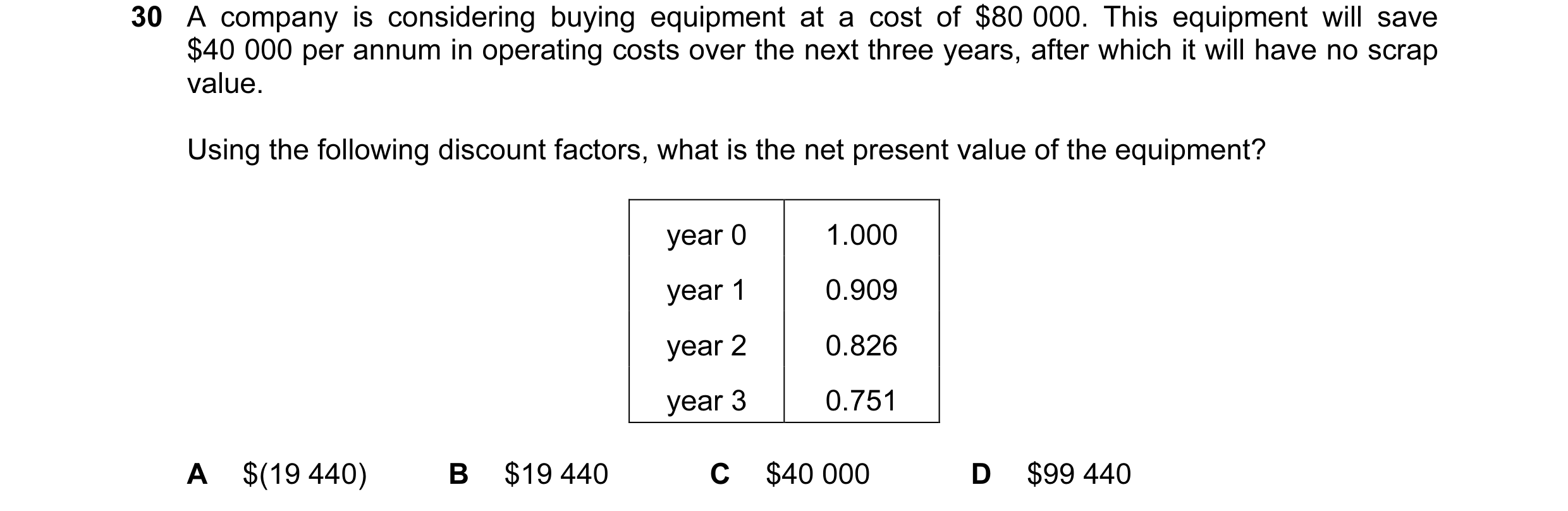
30 A company is considering buying equipment at a cost of $80 000. This equipment will save $40 000 per annum in operating costs over the next three years, after which it will have no scrap value. Using the following discount factors, what is the net present value of the equipment? year 0 1.000 year 1 0.909 year 2 0.826 year 3 0.751 A $(19 440) B $19 440 C $40 000 D $99 440
1 marks
Answer: B
This question in 9706/31 May/June 2011
Q22 · A company is considering buying equipment at a cost of $80 000 9706/32 May/June 2011
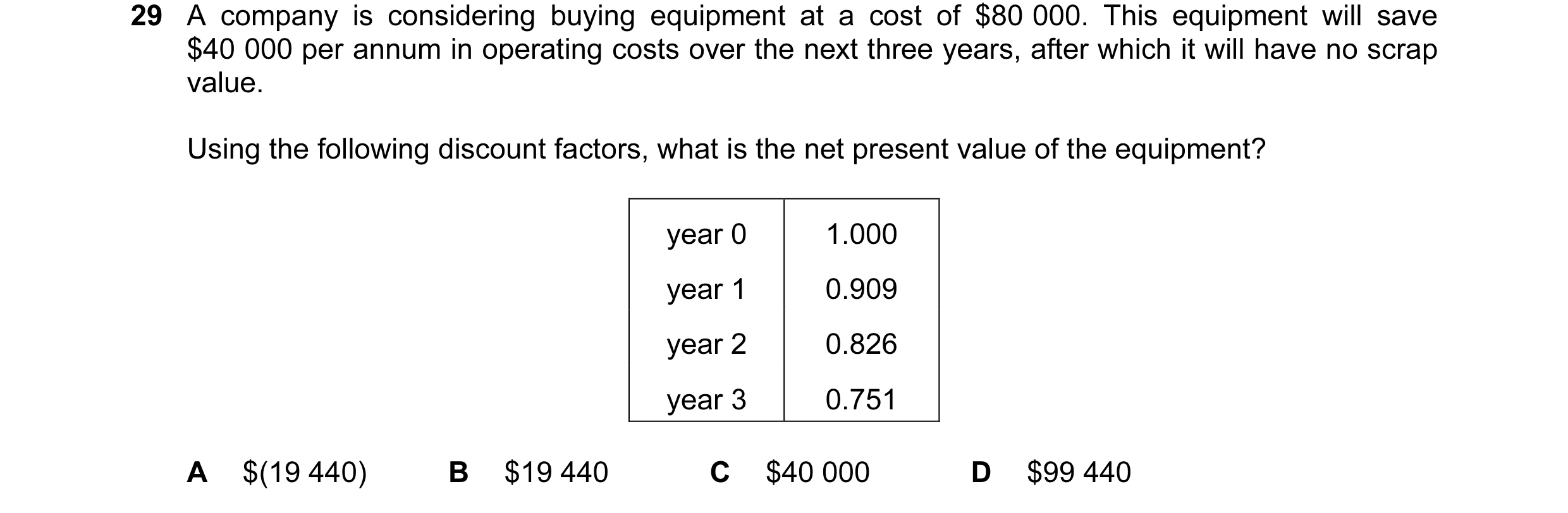
29 A company is considering buying equipment at a cost of $80 000. This equipment will save $40 000 per annum in operating costs over the next three years, after which it will have no scrap value. Using the following discount factors, what is the net present value of the equipment? year 0 1.000 year 1 0.909 year 2 0.826 year 3 0.751 A $(19 440) B $19 440 C $40 000 D $99 440
1 marks
Answer: B
This question in 9706/32 May/June 2011
Q23 · How is working capital treated in a discounted cash flow statement? 9706/32 May/June 2011
30 How is working capital treated in a discounted cash flow statement? A as an inflow at the start of the project and an inflow at the end B as an inflow at the start of the project and an outflow at the end C as an outflow at the start of the project and an inflow at the end D as an outflow at the start of the project and an outflow at the end
1 marks
Answer: C
This question in 9706/32 May/June 2011
Q24 · How is working capital treated in a discounted cash flow statement? 9706/33 May/June 2011
28 How is working capital treated in a discounted cash flow statement? A as an inflow at the start of the project and an inflow at the end B as an inflow at the start of the project and an outflow at the end C as an outflow at the start of the project and an inflow at the end D as an outflow at the start of the project and an outflow at the end
1 marks
Answer: C
This question in 9706/33 May/June 2011
Q25 · A company is considering buying equipment at a cost of $80 000 9706/33 May/June 2011
29 A company is considering buying equipment at a cost of $80 000. This equipment will save $40 000 per annum in operating costs over the next three years, after which it will have no scrap value. Using the following discount factors, what is the net present value of the equipment? year 0 1.000 year 1 0.909 year 2 0.826 year 3 0.751 A $(19 440) B $19 440 C $40 000 D $99 440
1 marks
Answer: B
This question in 9706/33 May/June 2011
Q26 · Two projects have the same capital cost 9706/31 Oct/Nov 2011
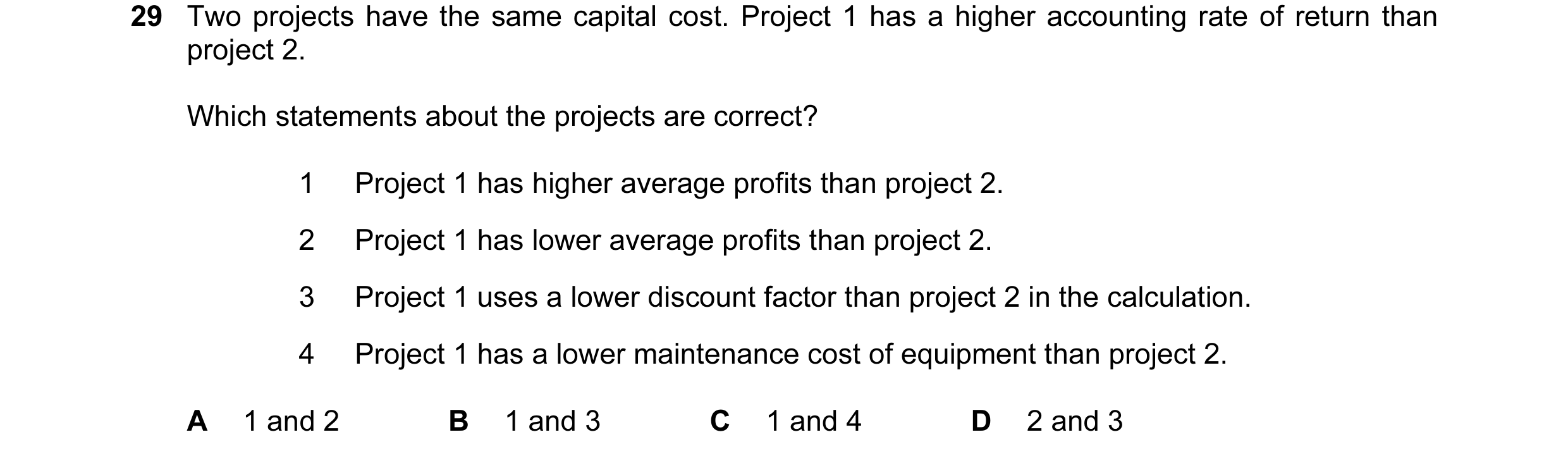
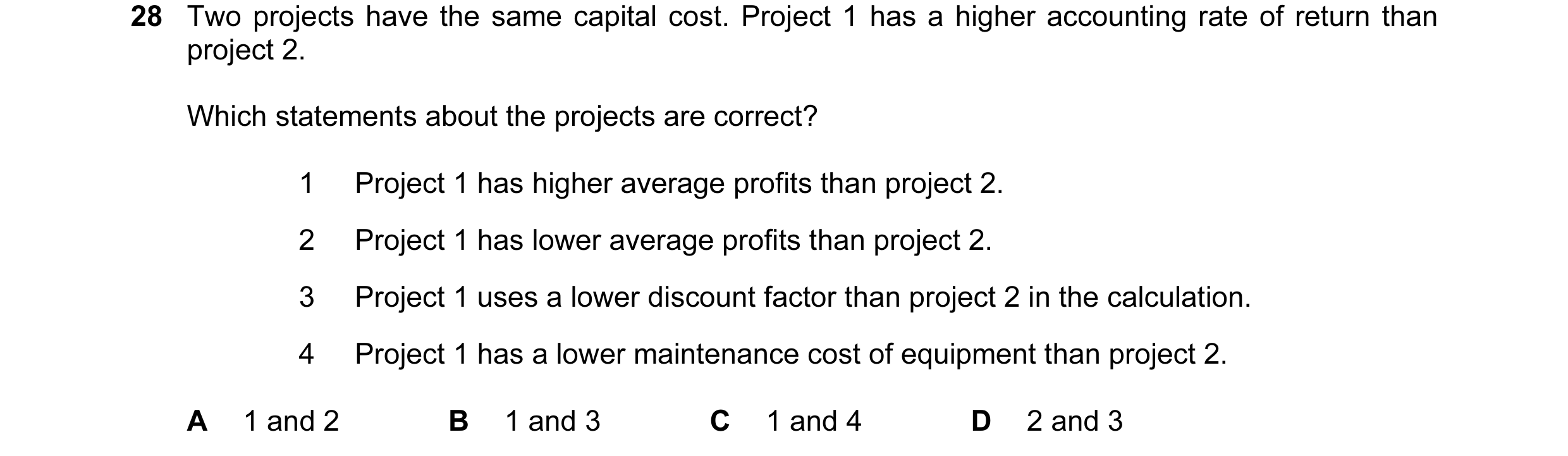
29 Two projects have the same capital cost. Project 1 has a higher accounting rate of return than project 2. Which statements about the projects are correct? 1 Project 1 has higher average profits than project 2. 2 Project 1 has lower average profits than project 2. 3 Project 1 uses a lower discount factor than project 2 in the calculation. 4 Project 1 has a lower maintenance cost of equipment than project 2. A 1 and 2 B 1 and 3 C 1 and 4 D 2 and 3
1 marks
Answer: C
This question in 9706/31 Oct/Nov 2011
Q27 · A company is operating under a capital rationing constraint 9706/31 Oct/Nov 2011
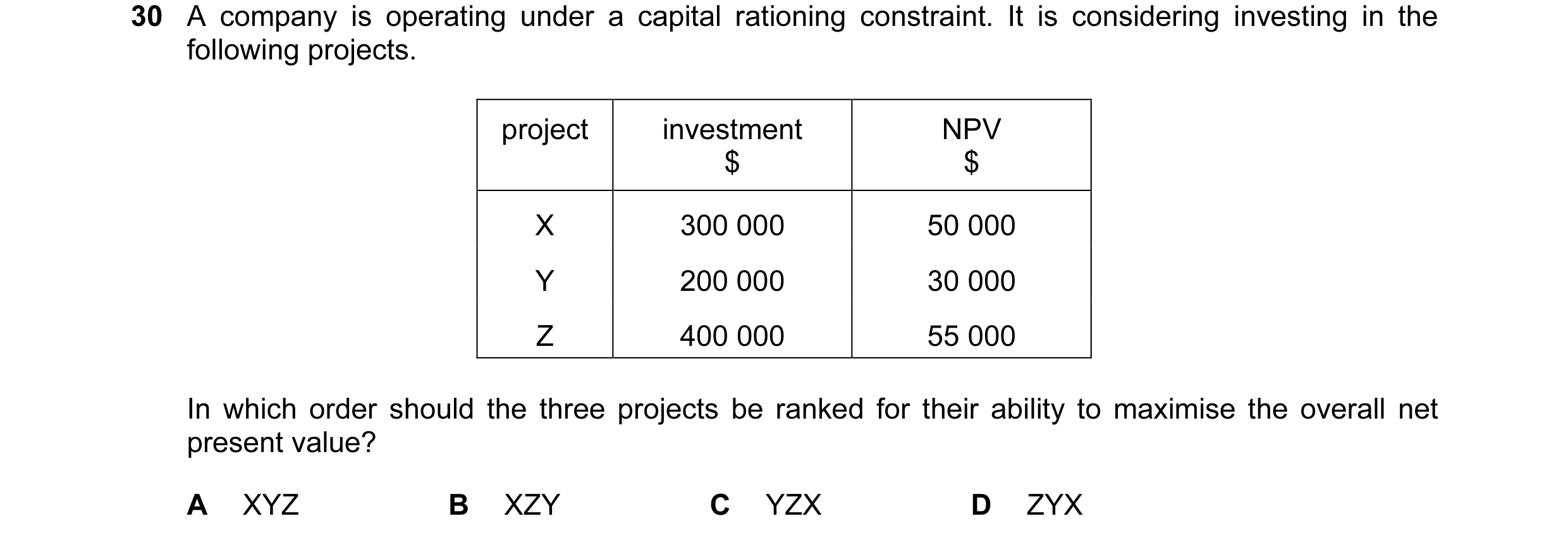
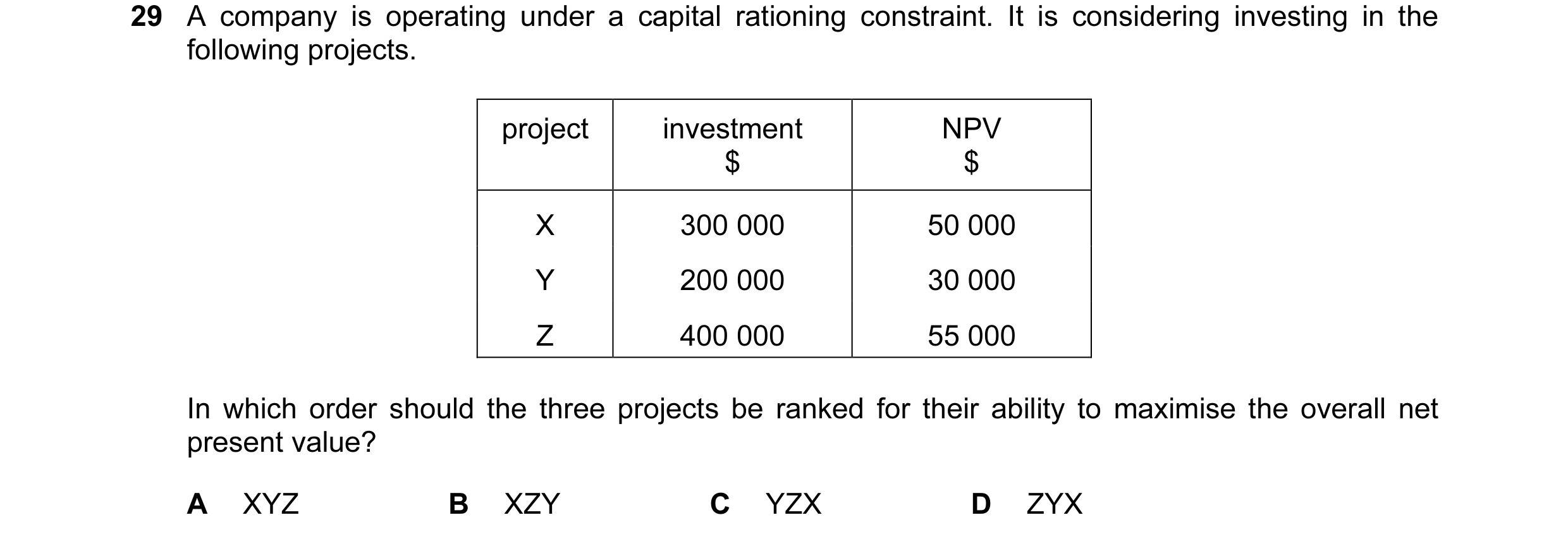
30 A company is operating under a capital rationing constraint. It is considering investing in the following projects. project investment NPV $ $ X 300 000 50 000 Y 200 000 30 000 Z 400 000 55 000 In which order should the three projects be ranked for their ability to maximise the overall net present value? A XYZ B XZY C YZX D ZYX
1 marks
Answer: A
This question in 9706/31 Oct/Nov 2011
Q28 · A company is considering investing in a project costing $300 000 9706/32 Oct/Nov 2011
29 A company is considering investing in a project costing $300 000. Estimates show the project will earn a cash surplus of $120 000 over a five-year period. As a result of the investment depreciation will increase by $6000 per annum. What is the accounting rate of return? A 6 % B 8 % C 12 % D 16 %
1 marks
Answer: C
This question in 9706/32 Oct/Nov 2011
Q29 · A company is operating under a capital rationing constraint 9706/32 Oct/Nov 2011
30 A company is operating under a capital rationing constraint. How should it rank possible investments in order to achieve the highest possible overall net present value? A by their internal rates of return B by their investment costs C by their net present values D by their profitability indexes
1 marks
Answer: D
This question in 9706/32 Oct/Nov 2011
Q30 · Two projects have the same capital cost 9706/33 Oct/Nov 2011
28 Two projects have the same capital cost. Project 1 has a higher accounting rate of return than project 2. Which statements about the projects are correct? 1 Project 1 has higher average profits than project 2. 2 Project 1 has lower average profits than project 2. 3 Project 1 uses a lower discount factor than project 2 in the calculation. 4 Project 1 has a lower maintenance cost of equipment than project 2. A 1 and 2 B 1 and 3 C 1 and 4 D 2 and 3
1 marks
Answer: C
This question in 9706/33 Oct/Nov 2011
Q31 · A company is operating under a capital rationing constraint 9706/33 Oct/Nov 2011
29 A company is operating under a capital rationing constraint. It is considering investing in the following projects. project investment NPV $ $ X 300 000 50 000 Y 200 000 30 000 Z 400 000 55 000 In which order should the three projects be ranked for their ability to maximise the overall net present value? A XYZ B XZY C YZX D ZYX
1 marks
Answer: A
This question in 9706/33 Oct/Nov 2011
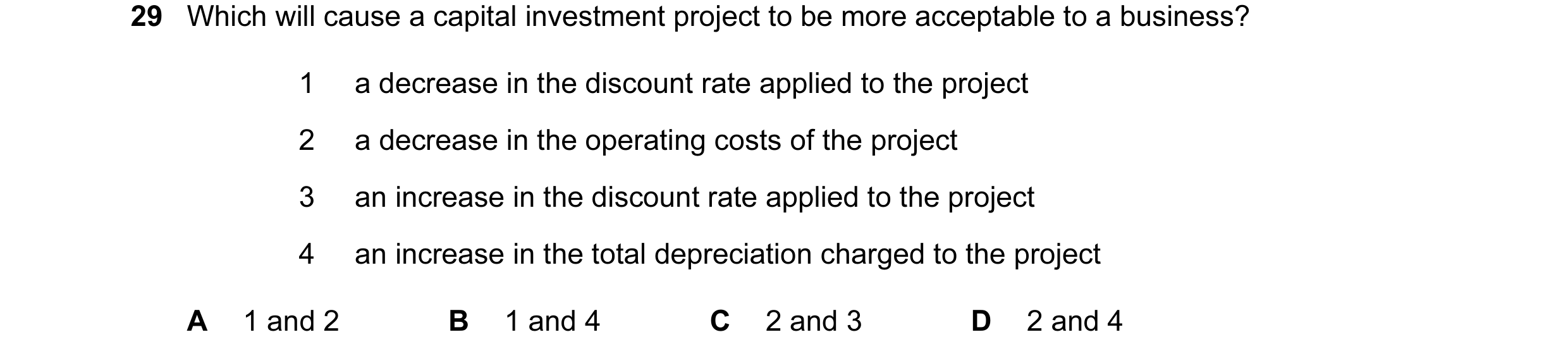
Q32 · Which will cause a capital investment project to be more acceptable to a business? 9706/32 May/June 2012
29 Which will cause a capital investment project to be more acceptable to a business? 1 a decrease in the discount rate applied to the project 2 a decrease in the operating costs of the project 3 an increase in the discount rate applied to the project 4 an increase in the total depreciation charged to the project A 1 and 2 B 1 and 4 C 2 and 3 D 2 and 4
1 marks
Answer: A
This question in 9706/32 May/June 2012
Q33 · A business is operating under conditions of capital rationing and is considering… 9706/32 May/June 2012
30 A business is operating under conditions of capital rationing and is considering investing in the following projects. investment NPV project $ $ X 500 000 80 000 Y 400 000 72 000 Z 450 000 67 500 In order to maximise the overall value of the business how should these three projects be ranked? A XYZ B XZY C YXZ D ZYX
1 marks
Answer: C
This question in 9706/32 May/June 2012
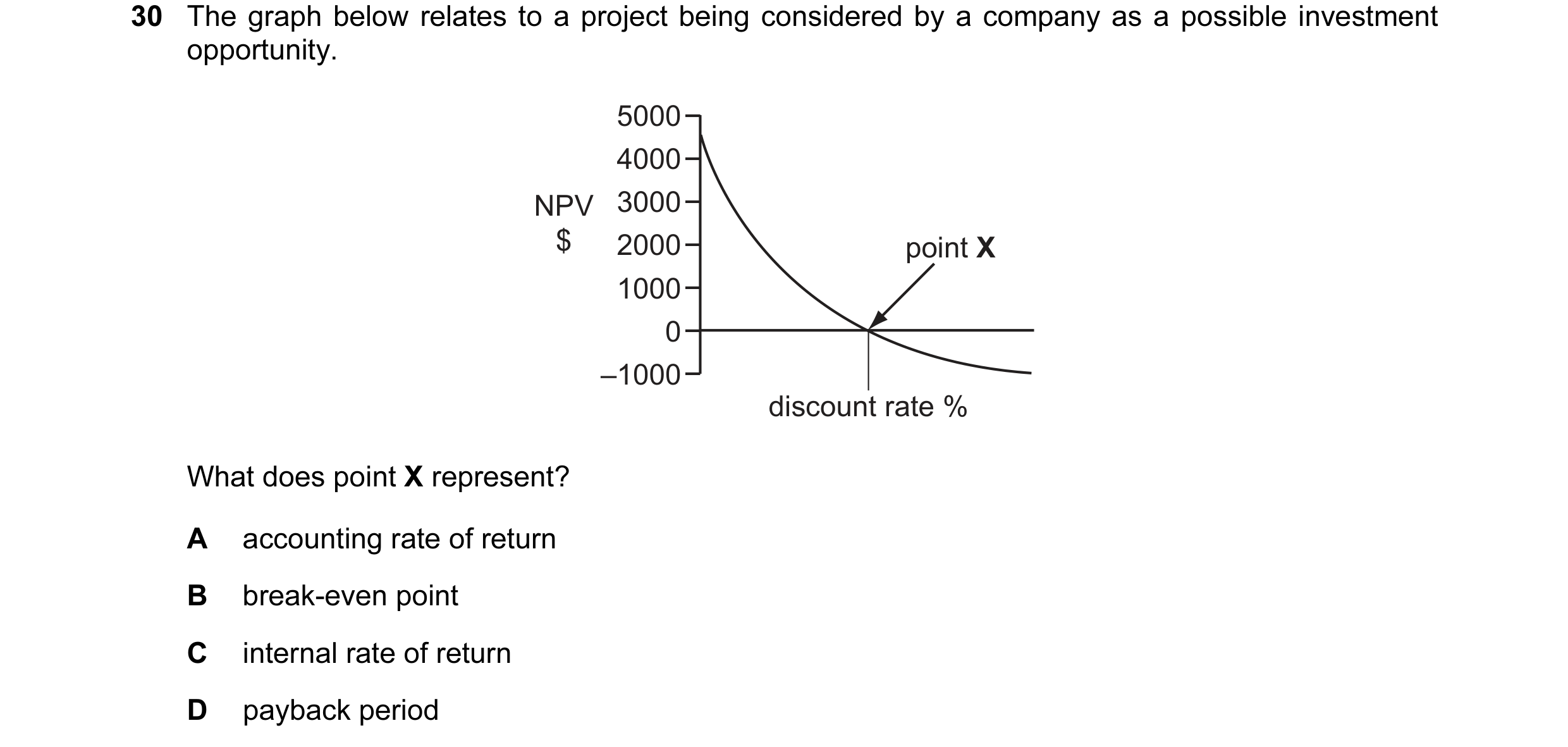
Q34 · The graph below relates to a project being considered by a company as a possible… 9706/33 May/June 2012
30 The graph below relates to a project being considered by a company as a possible investment opportunity. 5000 4000 NPV 3000 $ 2000 point X 1000 0 –1000 discount rate % What does point X represent? A accounting rate of return B break-even point C internal rate of return D payback period
1 marks
Answer: C
This question in 9706/33 May/June 2012
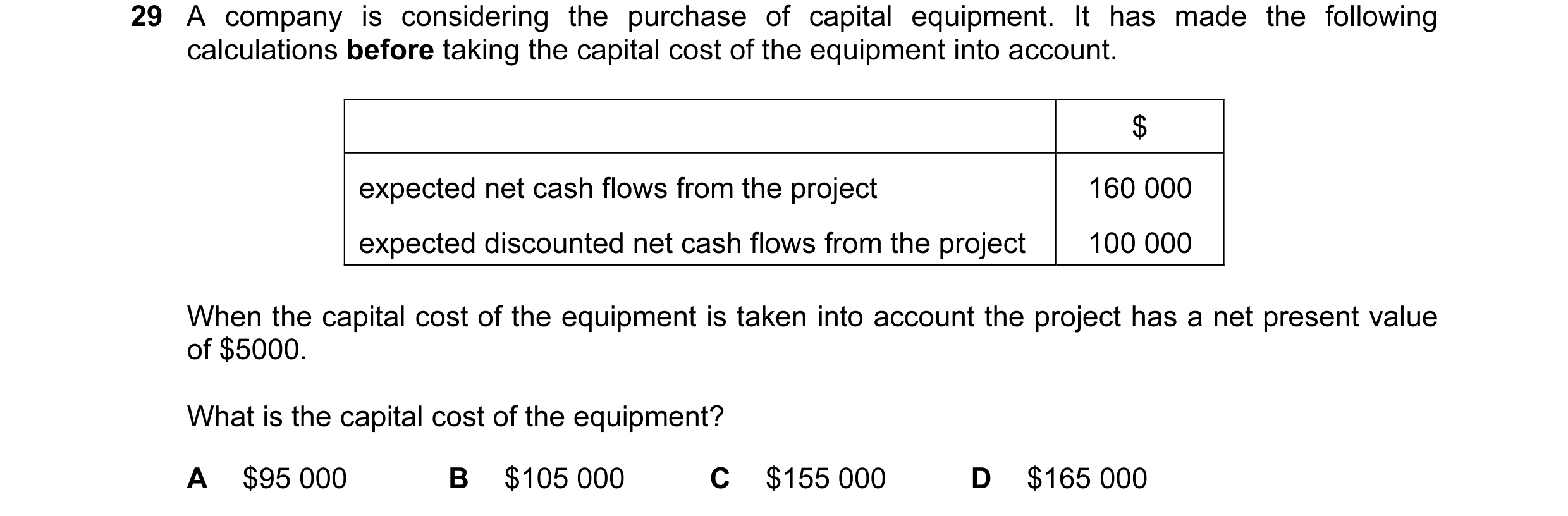
Q35 · A company is considering the purchase of capital equipment 9706/31 Oct/Nov 2012
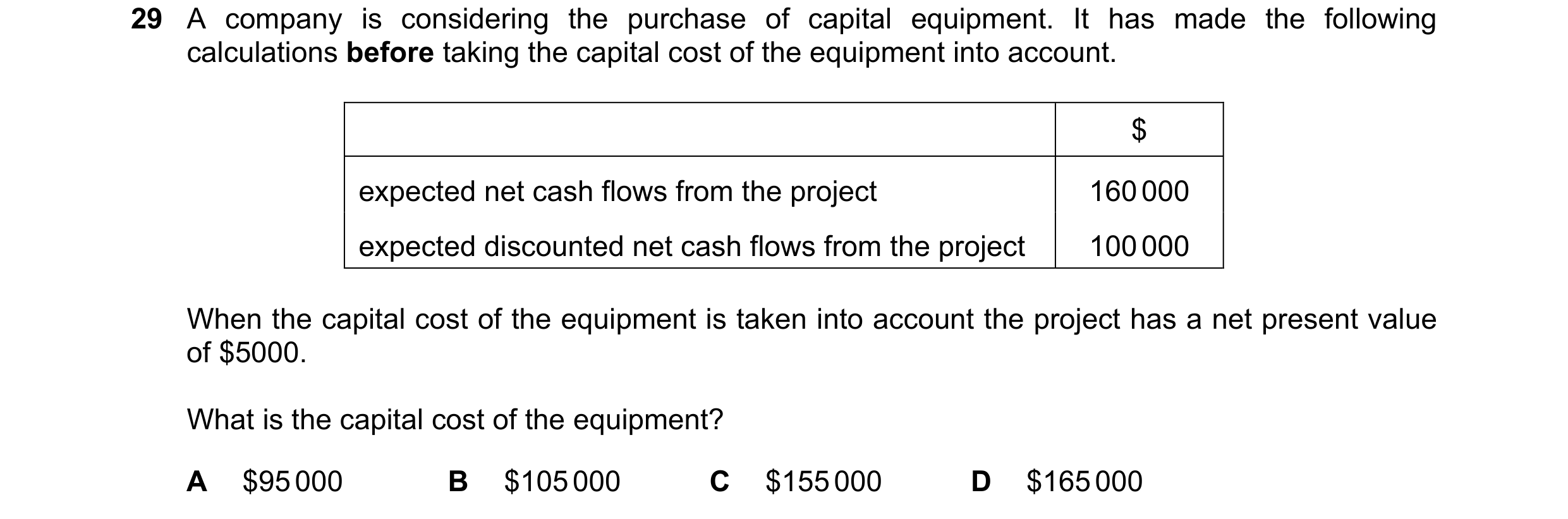
29 A company is considering the purchase of capital equipment. It has made the following calculations before taking the capital cost of the equipment into account. $ expected net cash flows from the project 160 000 expected discounted net cash flows from the project 100 000 When the capital cost of the equipment is taken into account the project has a net present value of $5000. What is the capital cost of the equipment? A $95 000 B $105 000 C $155 000 D $165 000
1 marks
Answer: A
This question in 9706/31 Oct/Nov 2012
Q36 · Which investment appraisal method discounts cash flows at the company’s cost of capital? 9706/31 Oct/Nov 2012
30 Which investment appraisal method discounts cash flows at the company’s cost of capital? A accounting rate of return B internal rate of return C net present value D payback
1 marks
Answer: C
This question in 9706/31 Oct/Nov 2012
Q37 · A company is negotiating a price for some capital equipment to modernise its production… 9706/32 Oct/Nov 2012
29 A company is negotiating a price for some capital equipment to modernise its production process. It has evaluated the impact the equipment will have on its future manufacturing costs. The details are shown. $ expected cash flows without the (180 000) purchase of the new equipment expected discounted cash flows without (132 000) the purchase of the new equipment expected cash flows when the equipment (100 000) is purchased expected discounted cash flows when the (65 000) equipment is purchased What is the maximum price the company should pay for the equipment? A $35 000 B $58 000 C $67 000 D $80 000
1 marks
Answer: C
This question in 9706/32 Oct/Nov 2012
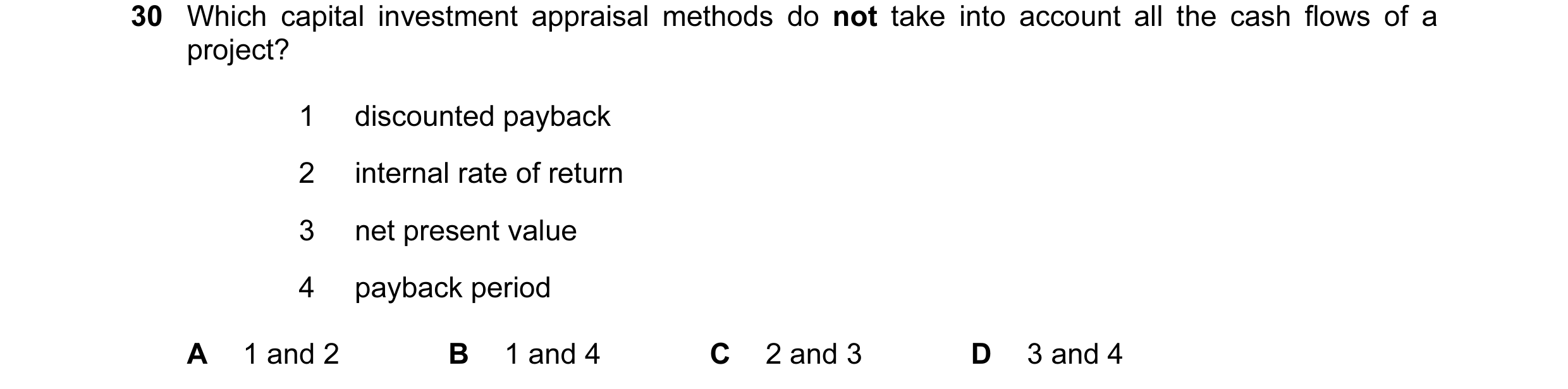
Q38 · Which capital investment appraisal methods do not take into account all the cash flows of… 9706/32 Oct/Nov 2012
30 Which capital investment appraisal methods do not take into account all the cash flows of a project? 1 discounted payback 2 internal rate of return 3 net present value 4 payback period A 1 and 2 B 1 and 4 C 2 and 3 D 3 and 4
1 marks
Answer: B
This question in 9706/32 Oct/Nov 2012
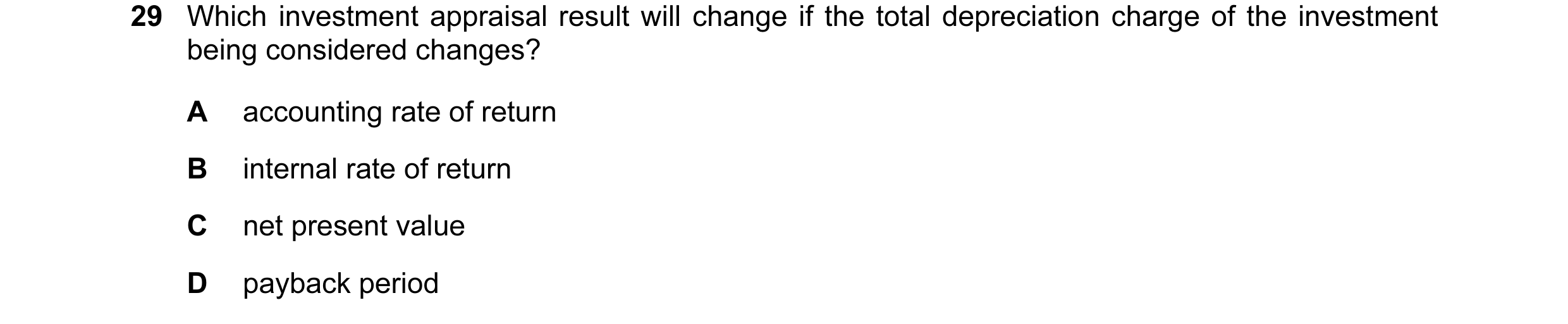
Q39 · Which investment appraisal result will change if the total depreciation charge of the… 9706/33 Oct/Nov 2012
29 Which investment appraisal result will change if the total depreciation charge of the investment being considered changes? A accounting rate of return B internal rate of return C net present value D payback period
1 marks
Answer: A
This question in 9706/33 Oct/Nov 2012
Q40 · A company invests in a project which costs $300 000 9706/33 Oct/Nov 2012
30 A company invests in a project which costs $300 000. The project will return annual profits of $120 000 for the next 3 years, after allowing for annual depreciation of $15 000. What is the payback period, assuming profits arise at the year end? A 2 years B 2.22 years C 2.5 years D 3 years
1 marks
Answer: B
This question in 9706/33 Oct/Nov 2012
Q41 · Details of a capital investment project with a life of four years are as follows 9706/31 May/June 2013
28 Details of a capital investment project with a life of four years are as follows. $ cost of project (50 000) net cash flow year 1 15 000 net cash flow year 2 20 000 net cash flow year 3 25 000 net cash flow year 4 10 000 What is the accounting rate of return of the project? A 10% B 20% C 35% D 70%
1 marks
Answer: B
This question in 9706/31 May/June 2013
Q42 · A company, operating under conditions of capital rationing, is considering investing in… 9706/31 May/June 2013
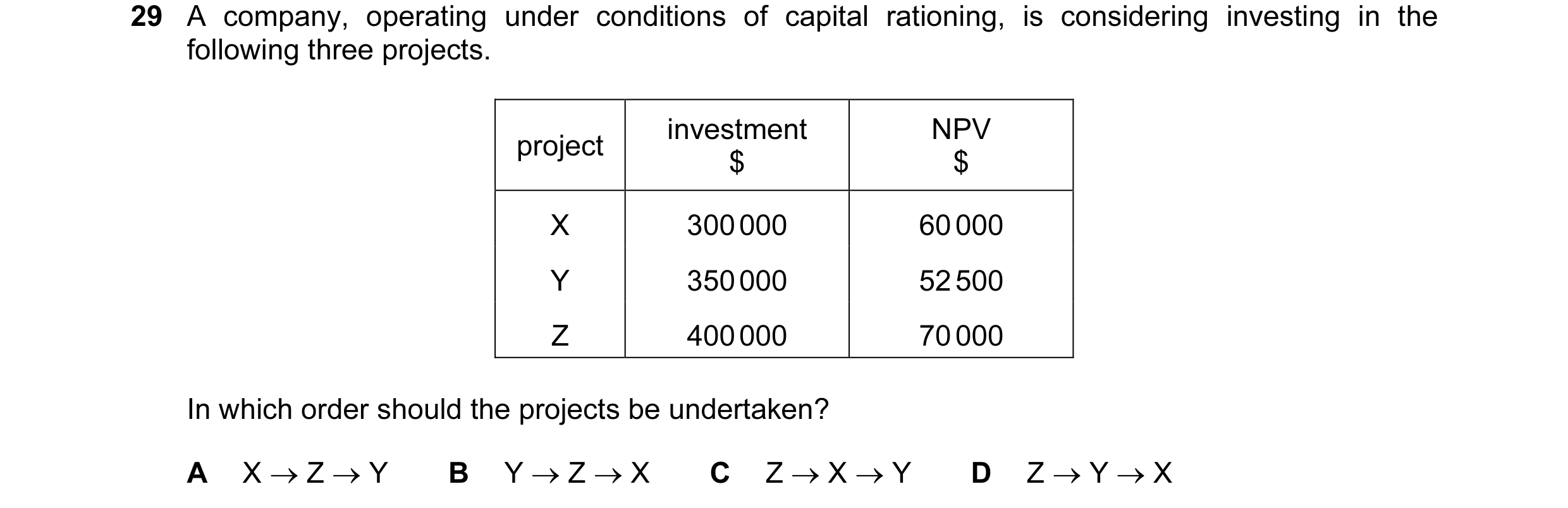
29 A company, operating under conditions of capital rationing, is considering investing in the following three projects. investment NPV project $ $ X 300 000 60 000 Y 350 000 52 500 Z 400 000 70 000 In which order should the projects be undertaken? A X → Z → Y B Y → Z → X C Z → X → Y D Z → Y → X
1 marks
Answer: A
This question in 9706/31 May/June 2013
Q43 · Which statement regarding the use of the payback method is correct? 9706/32 May/June 2013
29 Which statement regarding the use of the payback method is correct? A Cash flows after the payback point has been reached are ignored. B Cash flows during the entire life of a project are considered. C Profits over the life of the project are considered. D The project with the highest return on capital employed is selected.
1 marks
Answer: A
This question in 9706/32 May/June 2013
Q44 · A company is considering an investment of $50 000 which will yield the following annual… 9706/32 May/June 2013
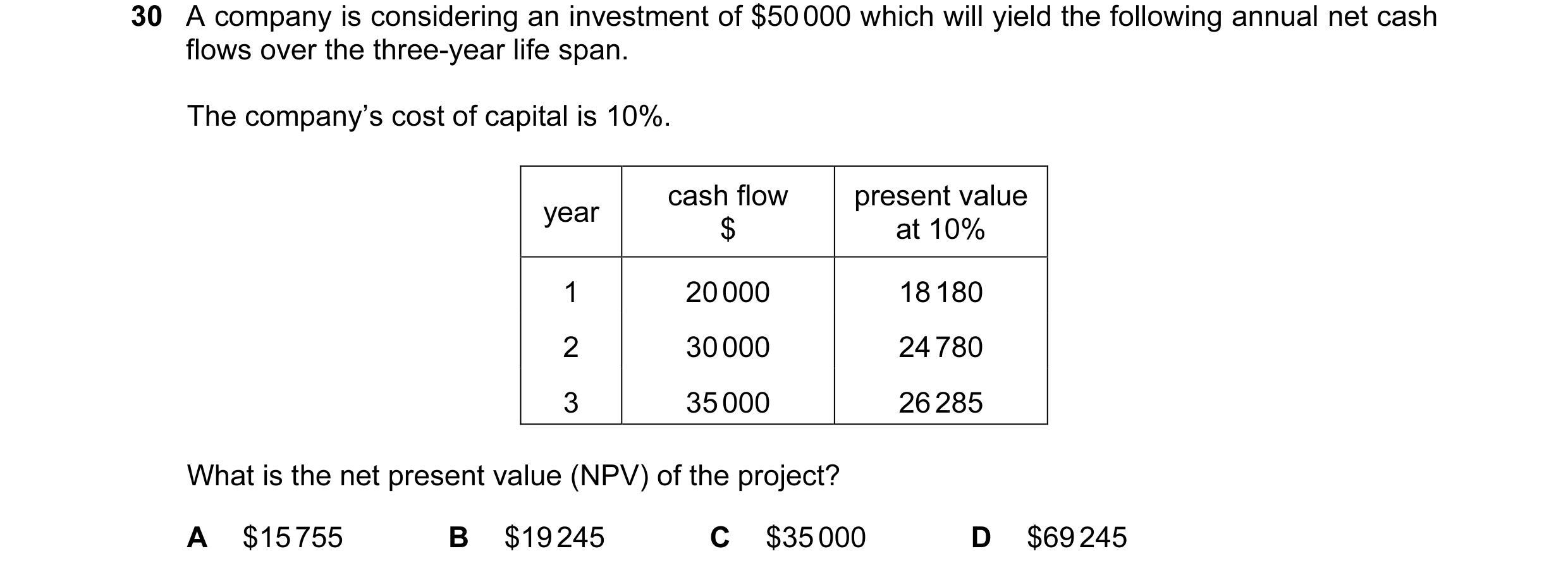
30 A company is considering an investment of $50 000 which will yield the following annual net cash flows over the three-year life span. The company’s cost of capital is 10%. cash flow present value year $ at 10% 1 20 000 18 180 2 30 000 24 780 3 35 000 26 285 What is the net present value (NPV) of the project? A $15 755 B $19 245 C $35 000 D $69 245
1 marks
Answer: B
This question in 9706/32 May/June 2013
Q45 · A company can only invest $1 million in the current period 9706/33 May/June 2013
29 A company can only invest $1 million in the current period. The table shows five projects. capital requirement NPV project (current period) $m $m 1 1.2 5.0 2 1.0 2.5 3 0.6 1.5 4 0.4 1.2 5 0.4 1.0 Which projects should the company undertake to maximise its shareholders’ wealth? A 1 only B 2 only C 3 and 4 D 3 and 5
1 marks
Answer: C
This question in 9706/33 May/June 2013
Q46 · A company is considering replacing its fleet of vehicles 9706/33 May/June 2013
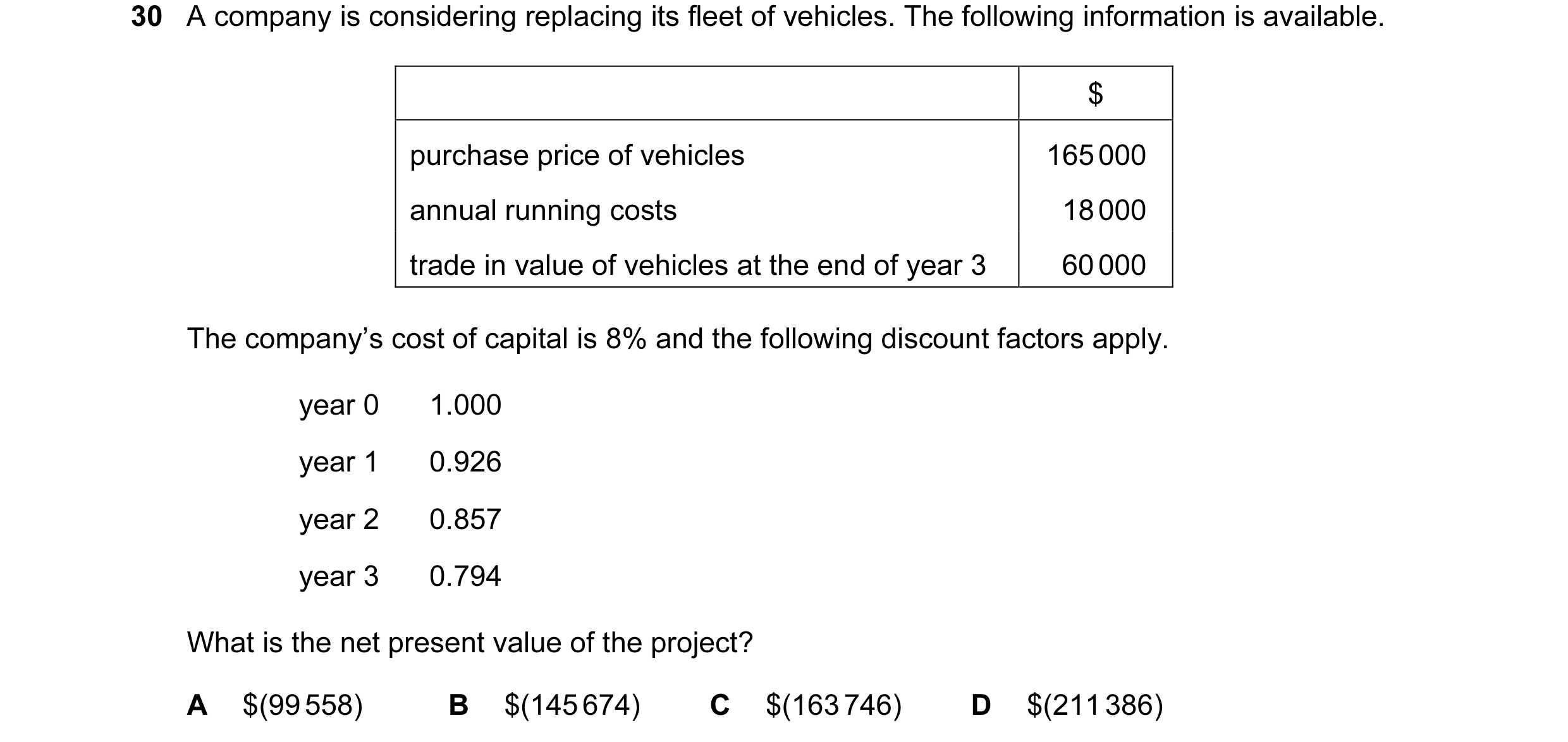
30 A company is considering replacing its fleet of vehicles. The following information is available. $ purchase price of vehicles 165 000 annual running costs 18 000 trade in value of vehicles at the end of year 3 60 000 The company’s cost of capital is 8% and the following discount factors apply. year 0 1.000 year 1 0.926 year 2 0.857 year 3 0.794 What is the net present value of the project? A $(99 558) B $(145 674) C $(163 746) D $(211 386)
1 marks
Answer: C
This question in 9706/33 May/June 2013
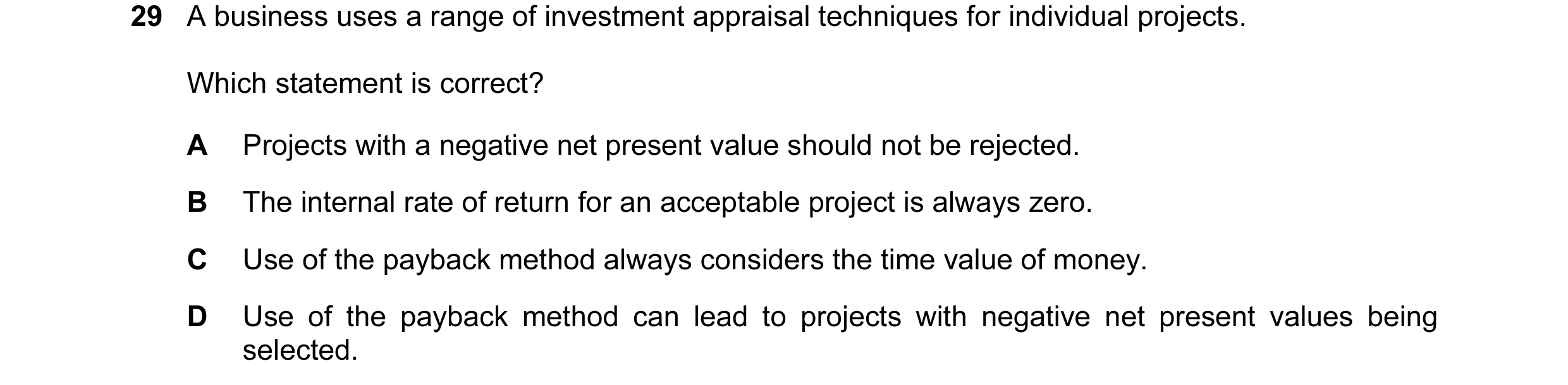
Q47 · A business uses a range of investment appraisal techniques for individual projects 9706/31 Oct/Nov 2013
29 A business uses a range of investment appraisal techniques for individual projects. Which statement is correct? A Projects with a negative net present value should not be rejected. B The internal rate of return for an acceptable project is always zero. C Use of the payback method always considers the time value of money. D Use of the payback method can lead to projects with negative net present values being selected.
1 marks
Answer: D
This question in 9706/31 Oct/Nov 2013
Q48 · The following information relates to a capital investment, costing $900 000 9706/31 Oct/Nov 2013
30 The following information relates to a capital investment, costing $900 000. discounted cash discounted cash cash flow year flow at 6% flow at 8% $ $ $ 0 (900) (900) (900) 1 400 377 370 2 600 534 514 100 11 (16) The company has a cost of capital of 8%. Which statements about the project are correct? 1 The project has an internal rate of return greater than the cost of the capital. 2 The project has an internal rate of return less than the cost of capital. 3 An increase in the cost of capital will make the project viable. 4 A decrease in the cost of capital will make the project viable. A 1 and 3 B 1 and 4 C 2 and 3 D 2 and 4
1 marks
Answer: D
This question in 9706/31 Oct/Nov 2013
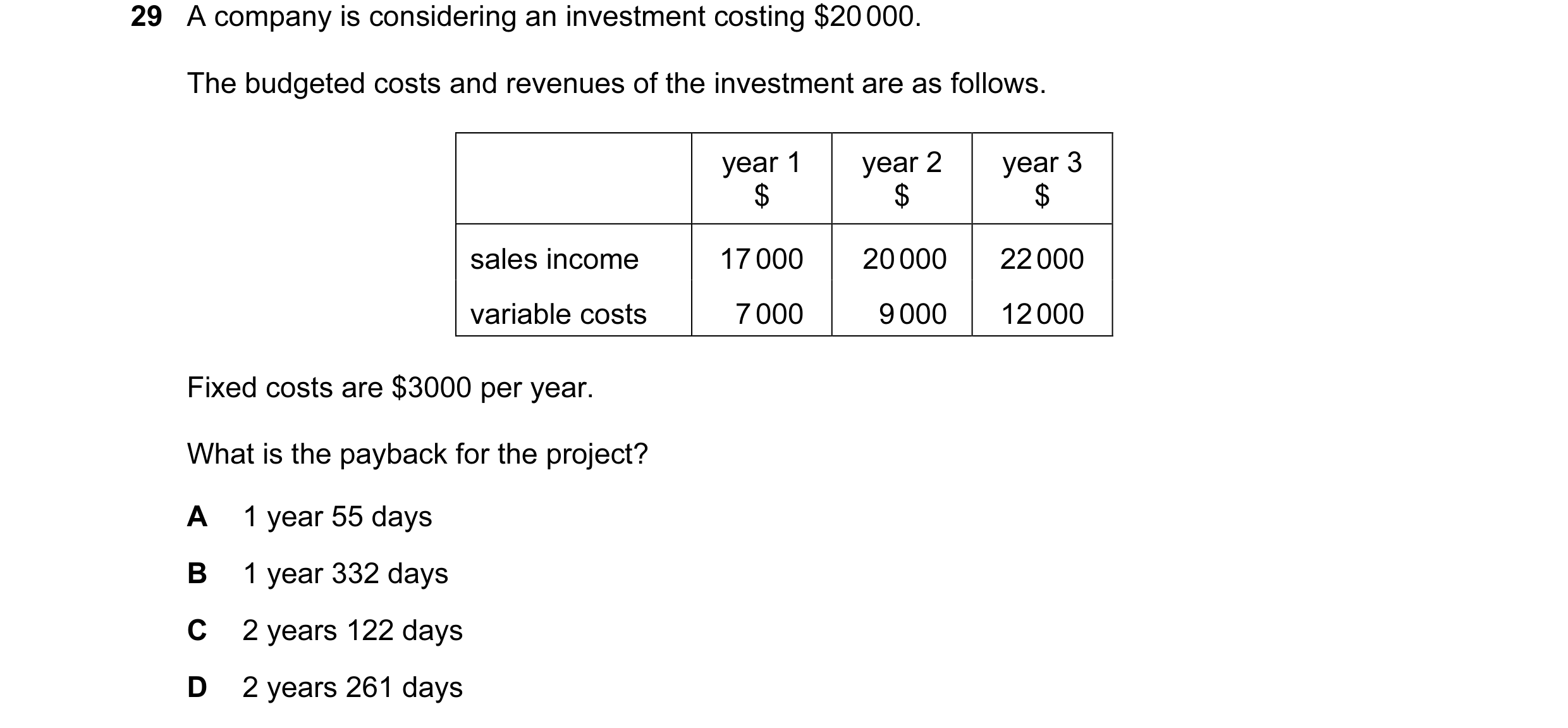
Q49 · A company is considering an investment costing $20 000 9706/32 Oct/Nov 2013
29 A company is considering an investment costing $20 000. The budgeted costs and revenues of the investment are as follows. year 1 year 2 year 3 $ $ $ sales income 17 000 20 000 22 000 variable costs 7 000 9 000 12 000 Fixed costs are $3000 per year. What is the payback for the project? A 1 year 55 days B 1 year 332 days C 2 years 122 days D 2 years 261 days
1 marks
Answer: D
This question in 9706/32 Oct/Nov 2013
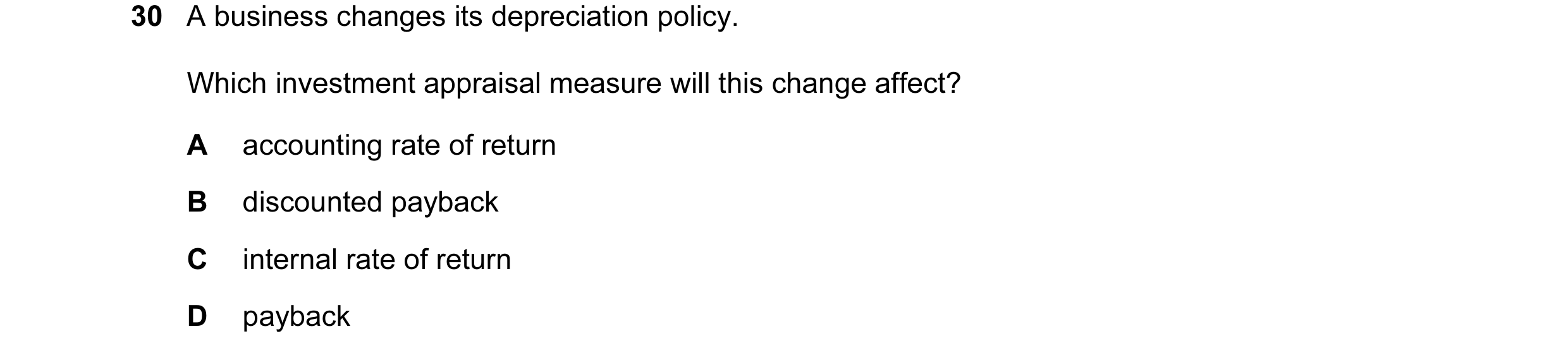
Q50 · A business changes its depreciation policy 9706/32 Oct/Nov 2013
30 A business changes its depreciation policy. Which investment appraisal measure will this change affect? A accounting rate of return B discounted payback C internal rate of return D payback
1 marks
Answer: A
This question in 9706/32 Oct/Nov 2013
Q51 · $100 000 is available for investment 9706/33 Oct/Nov 2013
7 $100 000 is available for investment. The table shows details of three businesses available for purchase. estimated purchase price business future profits $ $ 1 50 000 8 500 2 70 000 10 500 3 90 000 12 600 Funds not used in the purchase of a business are invested at an interest rate of 13% per annum. Which course of action will give the highest annual return? A investing $100 000 B purchasing business 1 C purchasing business 2 D purchasing business 3
1 marks
Answer: B
This question in 9706/33 Oct/Nov 2013
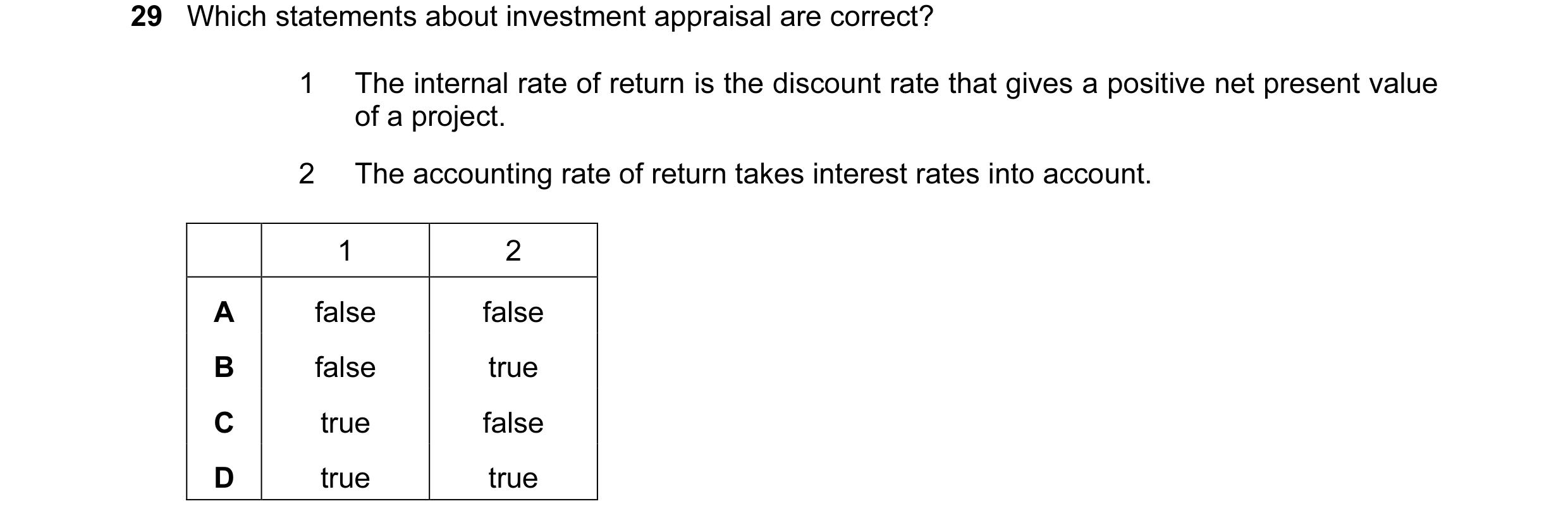
Q52 · Which statements about investment appraisal are correct? 9706/33 Oct/Nov 2013
29 Which statements about investment appraisal are correct? 1 The internal rate of return is the discount rate that gives a positive net present value of a project. 2 The accounting rate of return takes interest rates into account. 1 2 A false false B false true C true false D true true
1 marks
Answer: A
This question in 9706/33 Oct/Nov 2013
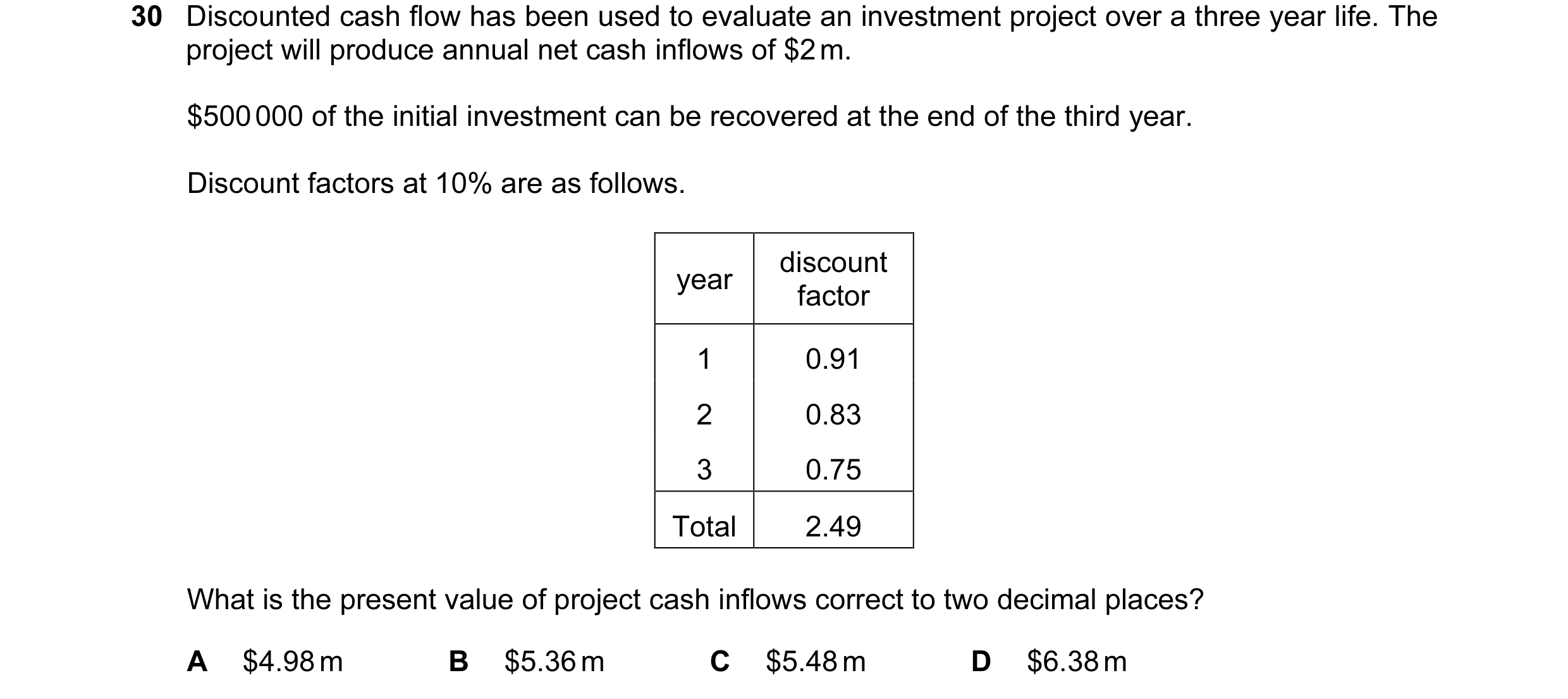
Q53 · Discounted cash flow has been used to evaluate an investment project over a three year… 9706/33 Oct/Nov 2013
30 Discounted cash flow has been used to evaluate an investment project over a three year life. The project will produce annual net cash inflows of $2 m. $500 000 of the initial investment can be recovered at the end of the third year. Discount factors at 10% are as follows. discount year factor 1 0.91 2 0.83 3 0.75 Total 2.49 What is the present value of project cash inflows correct to two decimal places? A $4.98 m B $5.36 m C $5.48 m D $6.38 m
1 marks
Answer: B
This question in 9706/33 Oct/Nov 2013
Q54 · The table shows the calculation of the net present value of a potential project 9706/31 May/June 2014
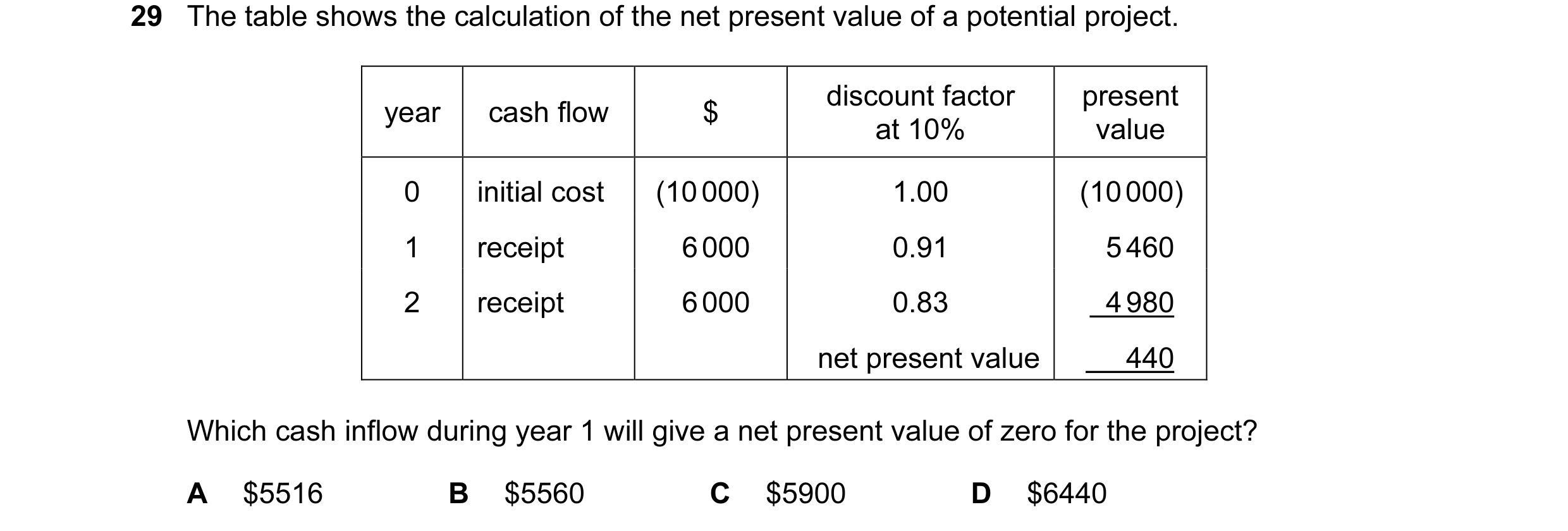
29 The table shows the calculation of the net present value of a potential project. discount factor present year cash flow $ at 10% value 0 initial cost (10 000) 1.00 (10 000) 1 receipt 6 000 0.91 5 460 2 receipt 6 000 0.83 4 980 net present value 440 Which cash inflow during year 1 will give a net present value of zero for the project? A $5516 B $5560 C $5900 D $6440
1 marks
Answer: A
This question in 9706/31 May/June 2014
Q55 · A company has evaluated a capital project 9706/31 May/June 2014
30 A company has evaluated a capital project. The calculation shows an accounting rate of return of 10%. The capital cost of the project is $400 000. The life of the project is five years. What was the total cash flow generated by the project? A $40 000 B $200 000 C $500 000 D $600 000
1 marks
Answer: C
This question in 9706/31 May/June 2014
Q56 · The table shows the calculation of the net present value of a potential project 9706/32 May/June 2014
29 The table shows the calculation of the net present value of a potential project. discount factor present year cash flow $ at 10% value 0 initial cost (10 000) 1.00 (10 000) 1 receipt 6 000 0.91 5 460 2 receipt 6 000 0.83 4 980 net present value 440 Which cash inflow during year 1 will give a net present value of zero for the project? A $5516 B $5560 C $5900 D $6440
1 marks
Answer: A
This question in 9706/32 May/June 2014
Q57 · A company has evaluated a capital project 9706/32 May/June 2014
30 A company has evaluated a capital project. The calculation shows an accounting rate of return of 10%. The capital cost of the project is $400 000. The life of the project is five years. What was the total cash flow generated by the project? A $40 000 B $200 000 C $500 000 D $600 000
1 marks
Answer: C
This question in 9706/32 May/June 2014
Q58 · A firm has an obsolete machine with a net book value of $20 000 which has no scrap value 9706/33 May/June 2014
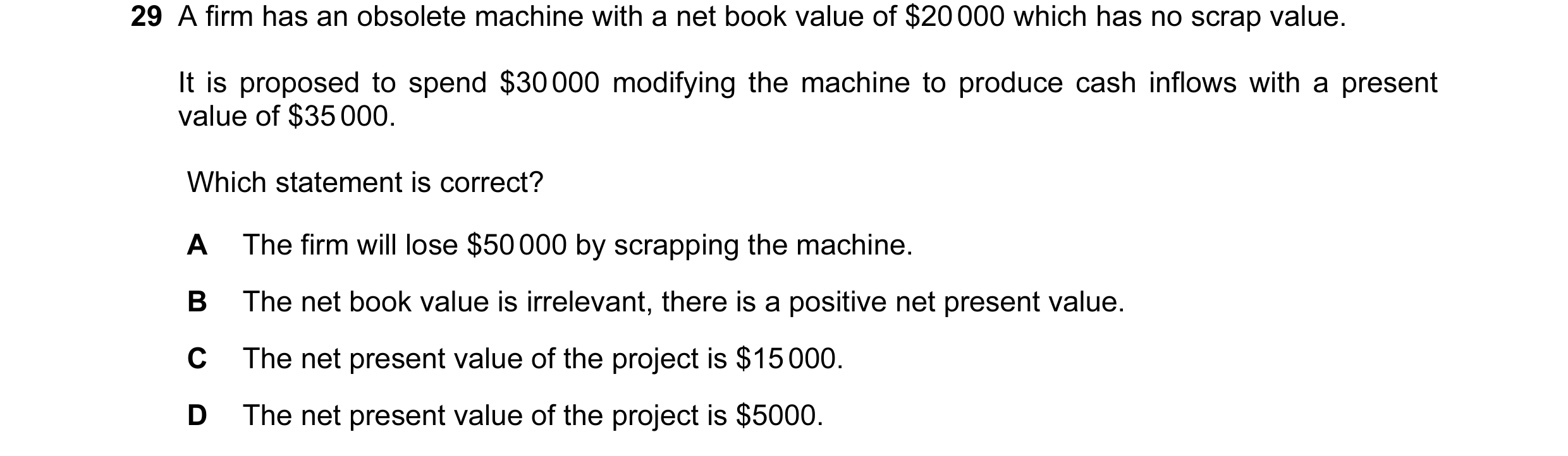
29 A firm has an obsolete machine with a net book value of $20 000 which has no scrap value. It is proposed to spend $30 000 modifying the machine to produce cash inflows with a present value of $35 000. Which statement is correct? A The firm will lose $50 000 by scrapping the machine. B The net book value is irrelevant, there is a positive net present value. C The net present value of the project is $15 000. D The net present value of the project is $5000.
1 marks
Answer: B
This question in 9706/33 May/June 2014
Q59 · Which advantage arises when the average rate of return is used to evaluate a capital… 9706/33 May/June 2014
30 Which advantage arises when the average rate of return is used to evaluate a capital project? A The actual cash surplus each year of the project life is calculated. B The life of the project will determine if it is accepted or rejected. C The profitability of the project can be compared with current profitability. D The time value of money is taken into account.
1 marks
Answer: C
This question in 9706/33 May/June 2014
Q60 · Which investment appraisal method has a calculation that involves depreciation? 9706/31 Oct/Nov 2015
29 Which investment appraisal method has a calculation that involves depreciation? A accounting rate of return B internal rate of return C net present value D payback
1 marks
Answer: A
This question in 9706/31 Oct/Nov 2015
Q61 · A company is considering investing in a project costing $300 000 9706/31 Oct/Nov 2015
30 A company is considering investing in a project costing $300 000. Estimates show the project will earn a cash surplus of $120 000 over a five-year period. As a result of the investment depreciation will increase by $6000 per annum. What is the accounting rate of return? A 6% B 8% C 12% D 16%
1 marks
Answer: C
This question in 9706/31 Oct/Nov 2015
Q62 · A company is considering the purchase of capital equipment 9706/32 Oct/Nov 2015
29 A company is considering the purchase of capital equipment. It has made the following calculations before taking the capital cost of the equipment into account. $ expected net cash flows from the project 160 000 expected discounted net cash flows from the project 100 000 When the capital cost of the equipment is taken into account the project has a net present value of $5000. What is the capital cost of the equipment? A $95 000 B $105 000 C $155 000 D $165 000
1 marks
Answer: A
This question in 9706/32 Oct/Nov 2015
 1 / 16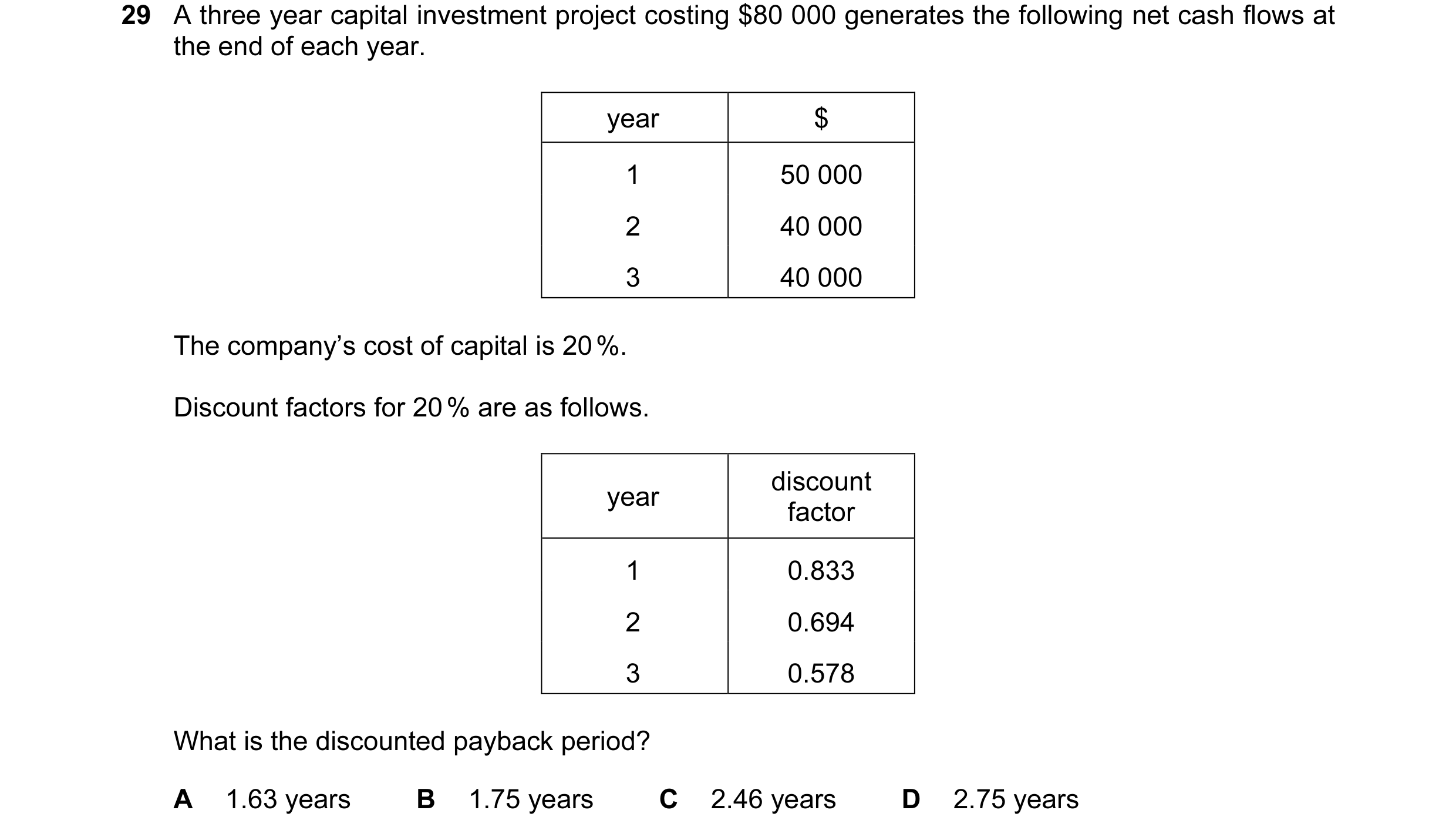
 2 / 16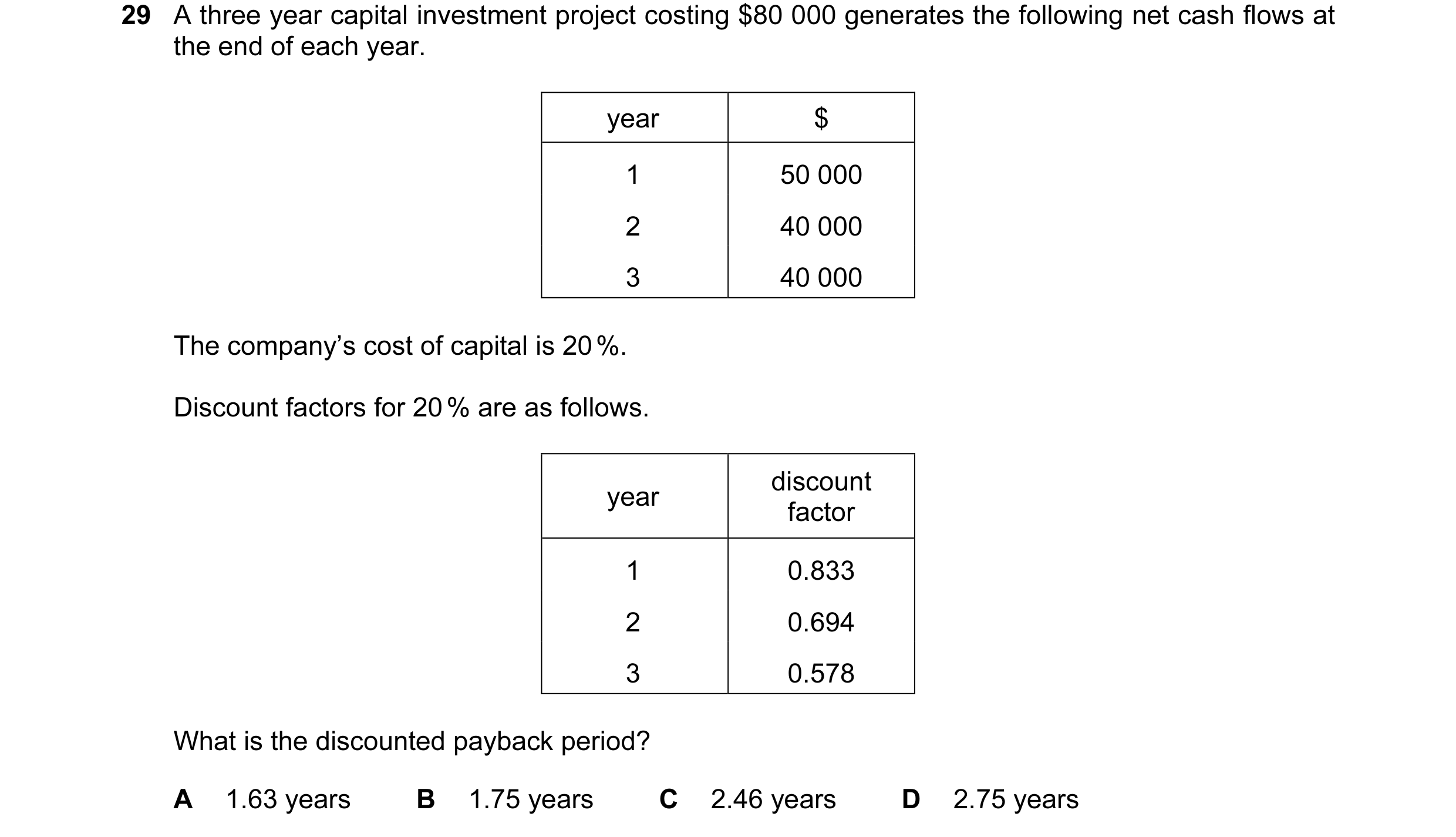
 3 / 16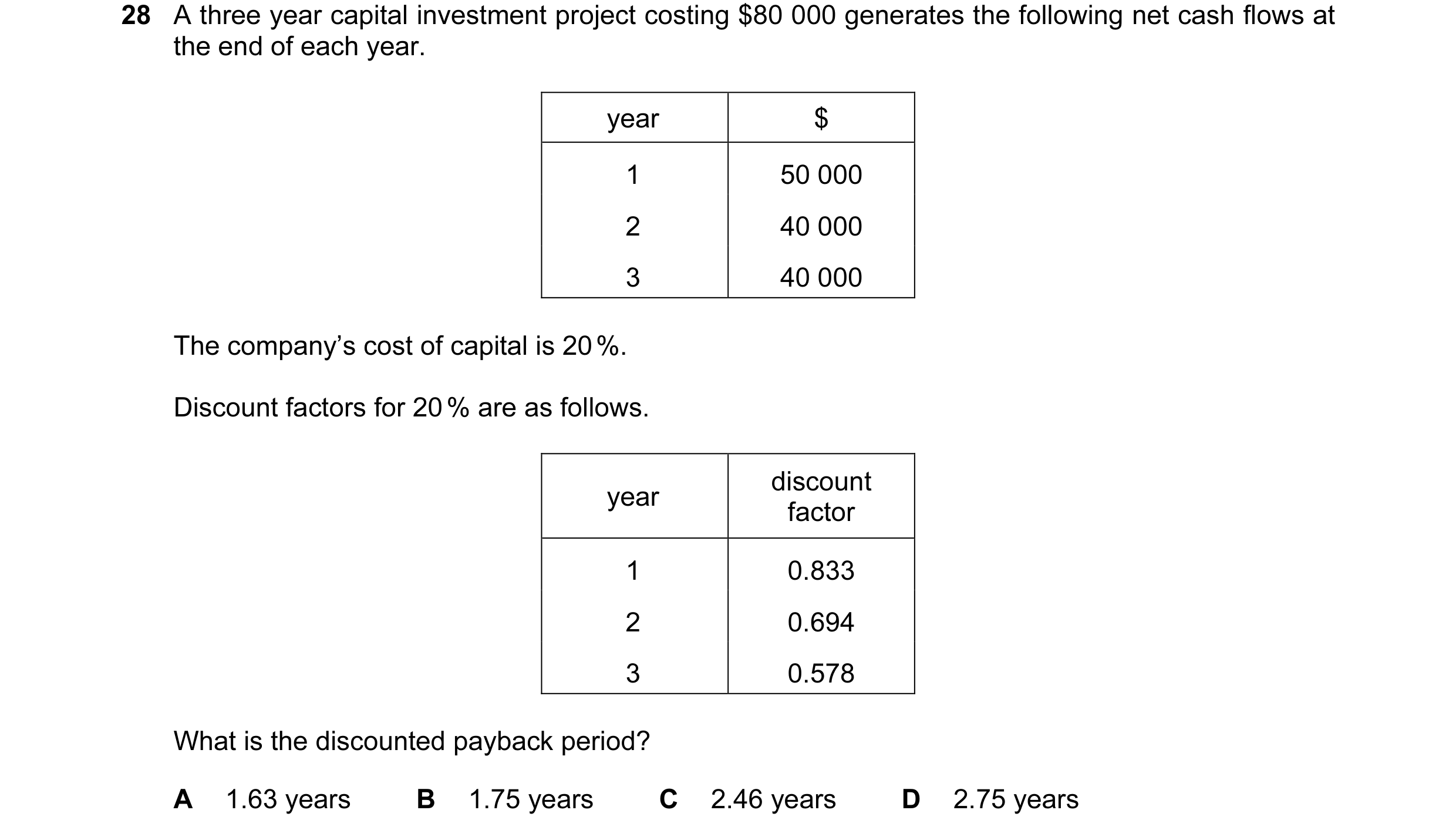
 4 / 16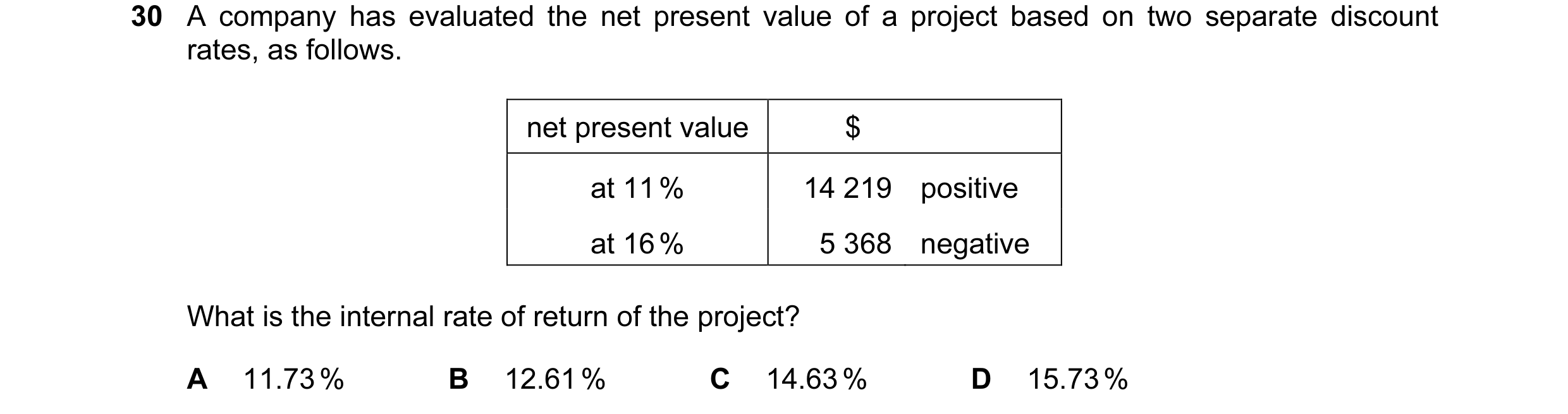
 5 / 16

 6 / 16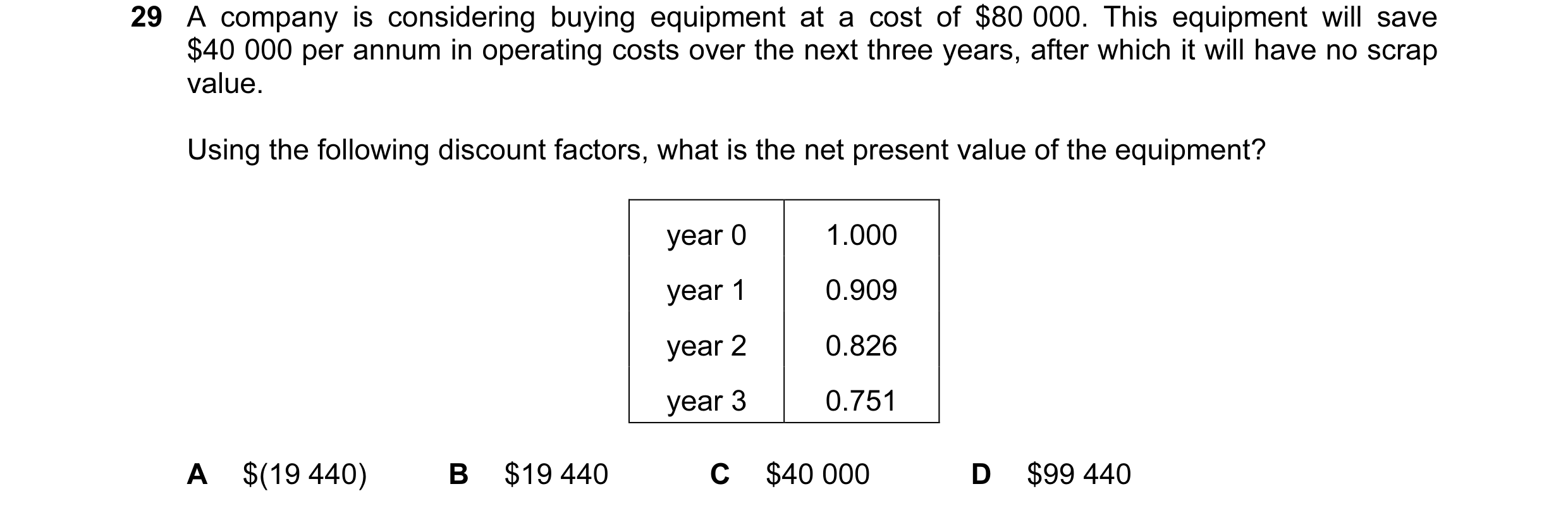
 7 / 16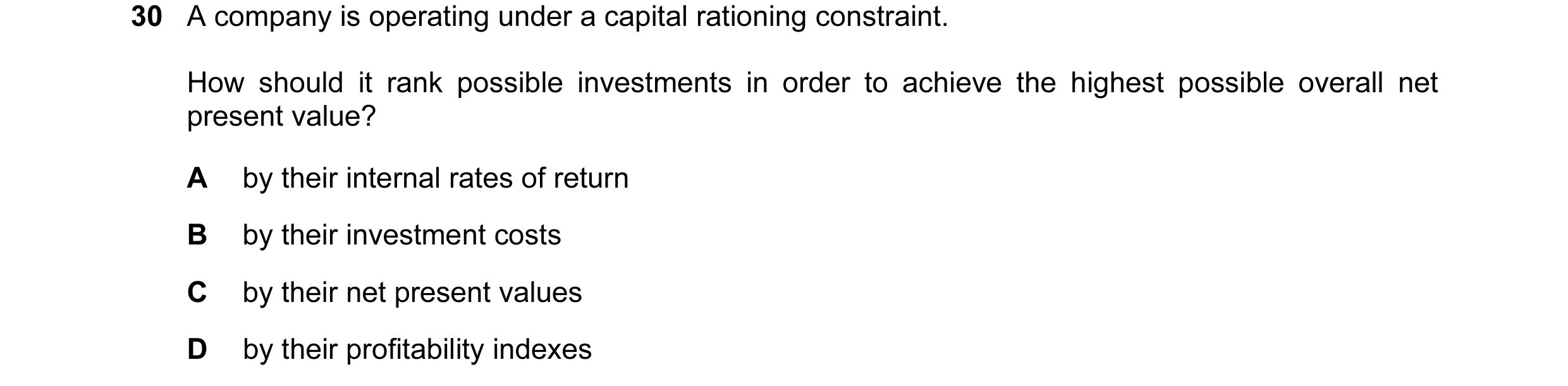
 8 / 16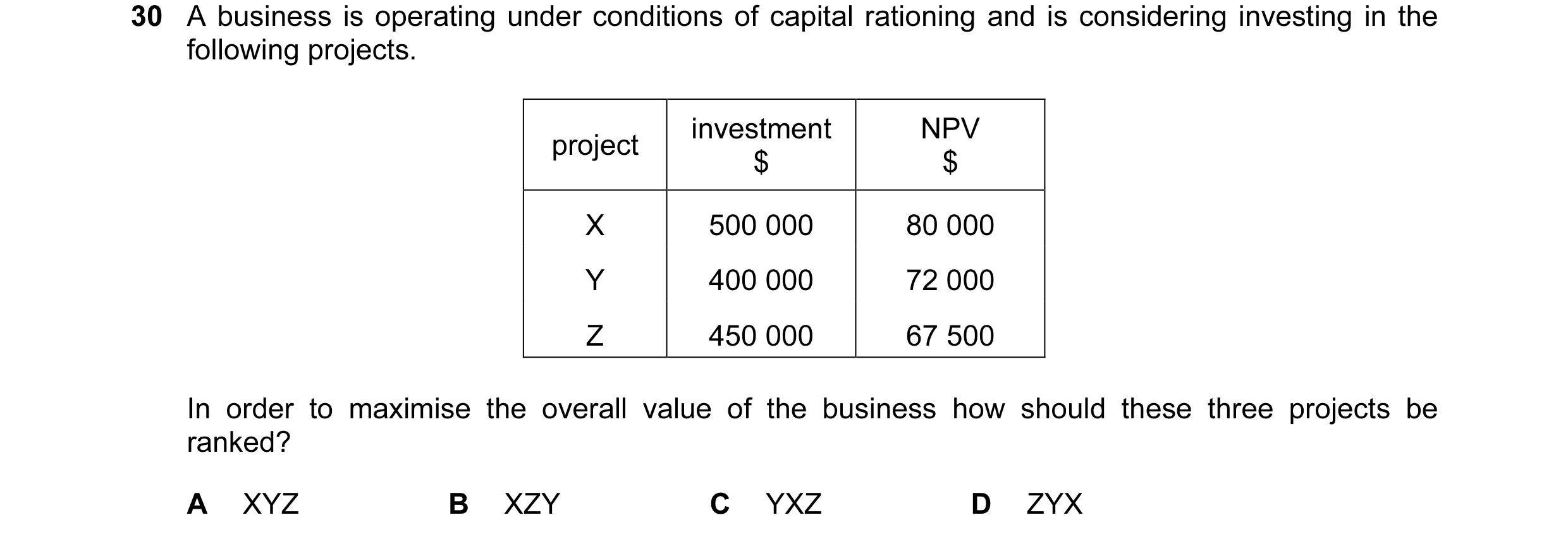
 9 / 16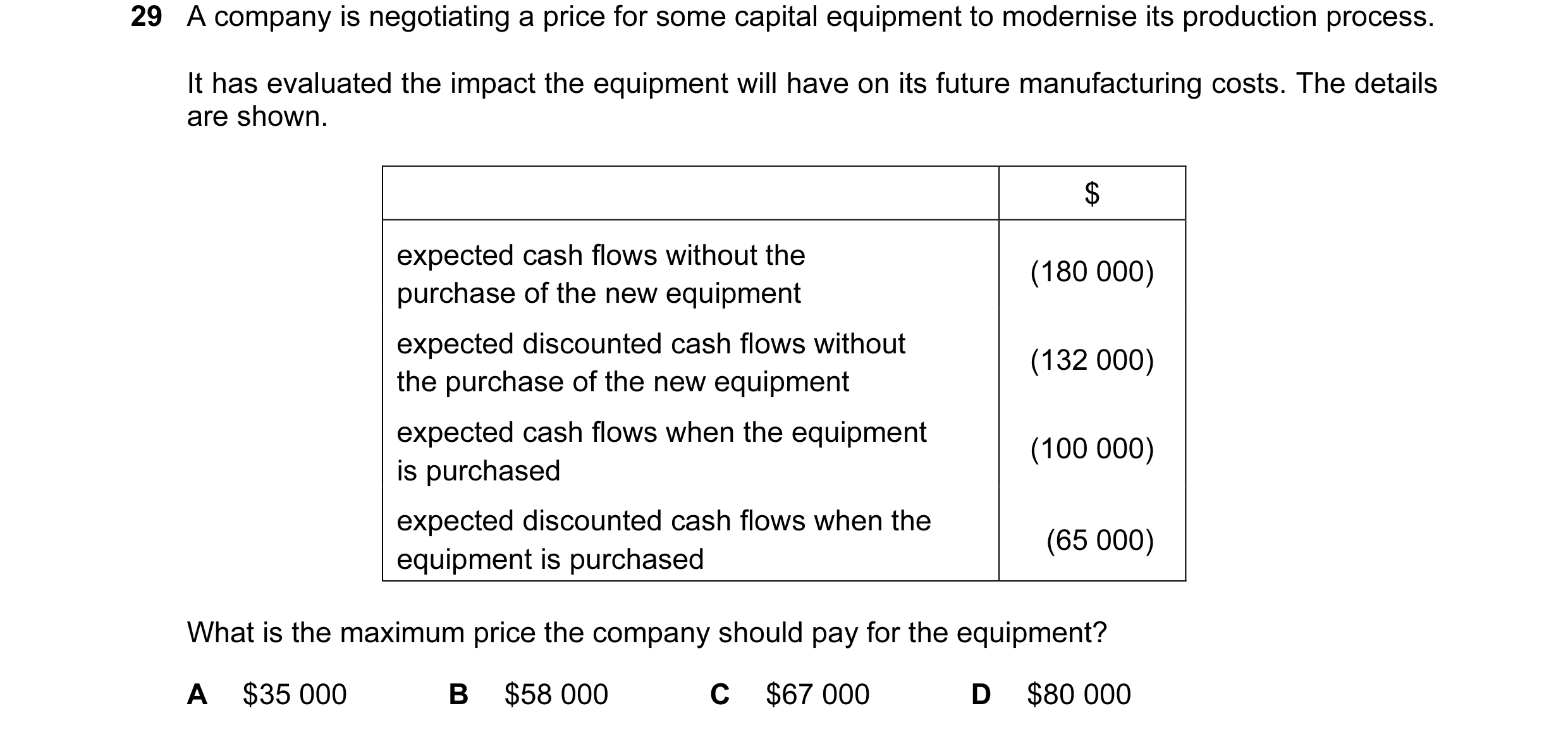
 10 / 16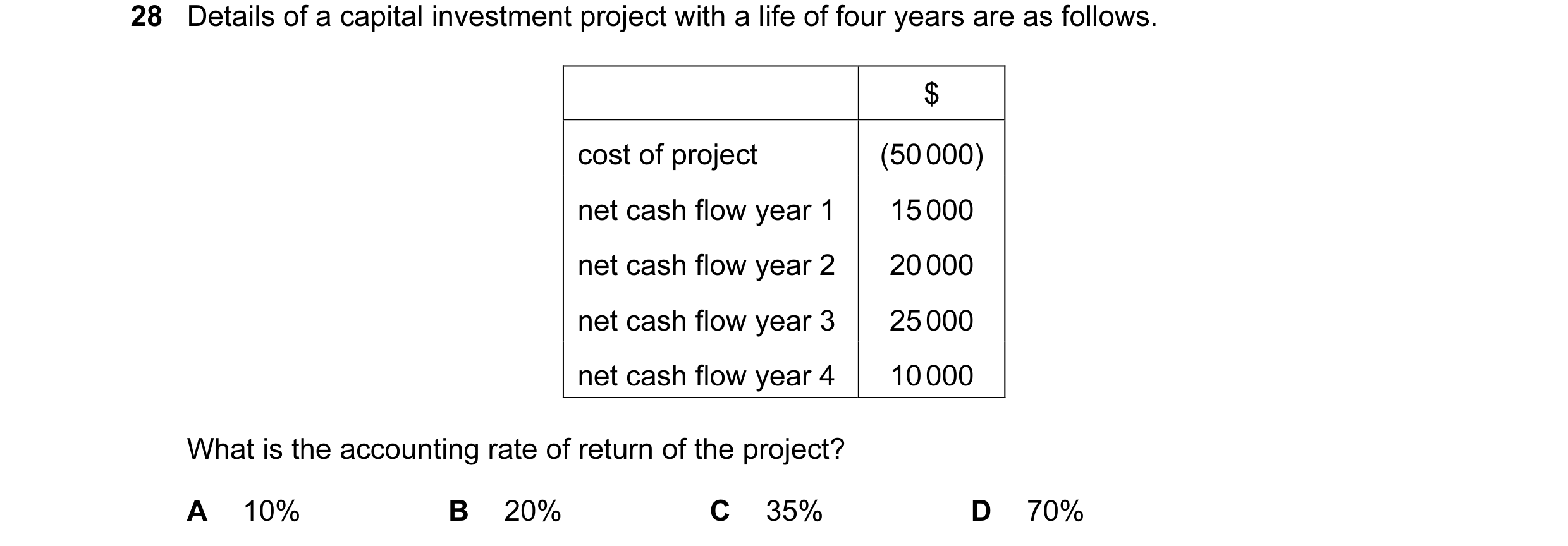

 11 / 16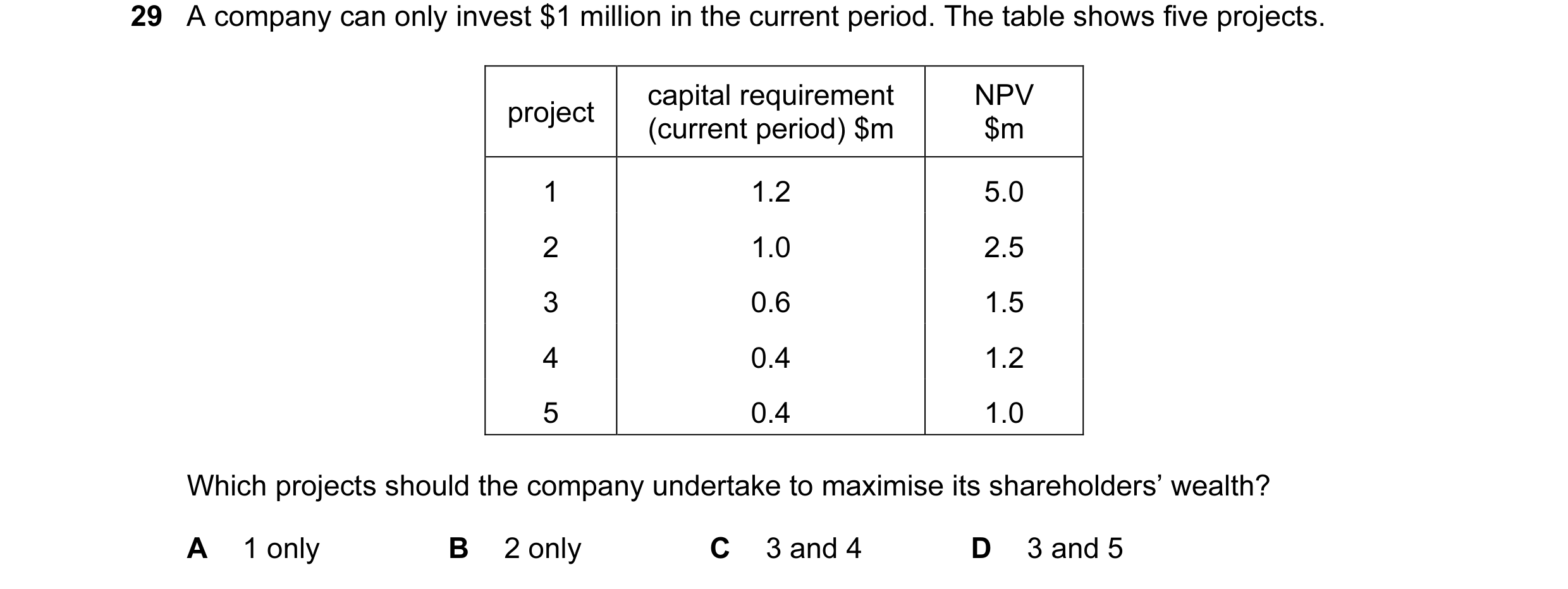
 12 / 16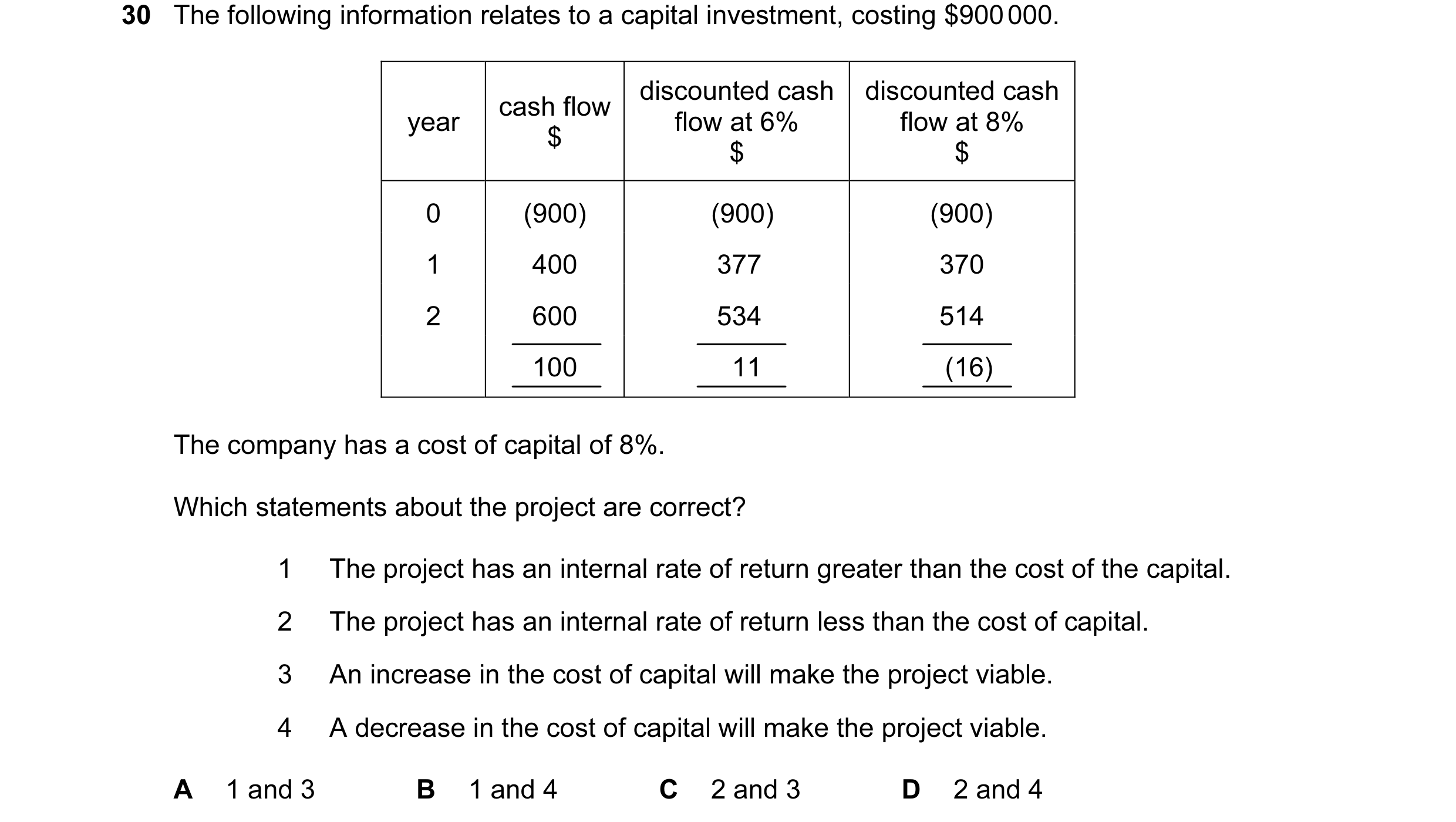
 13 / 16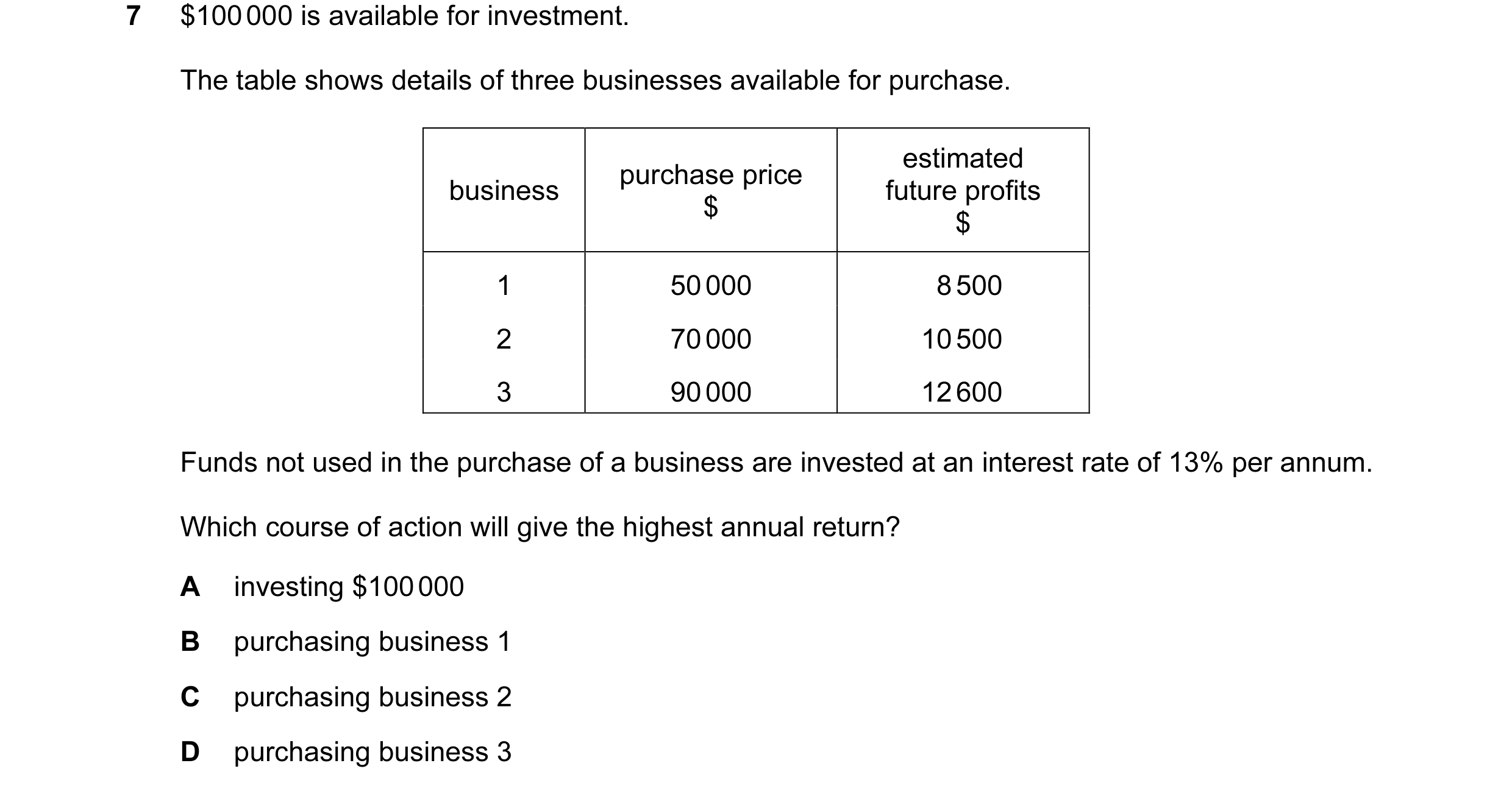
 14 / 16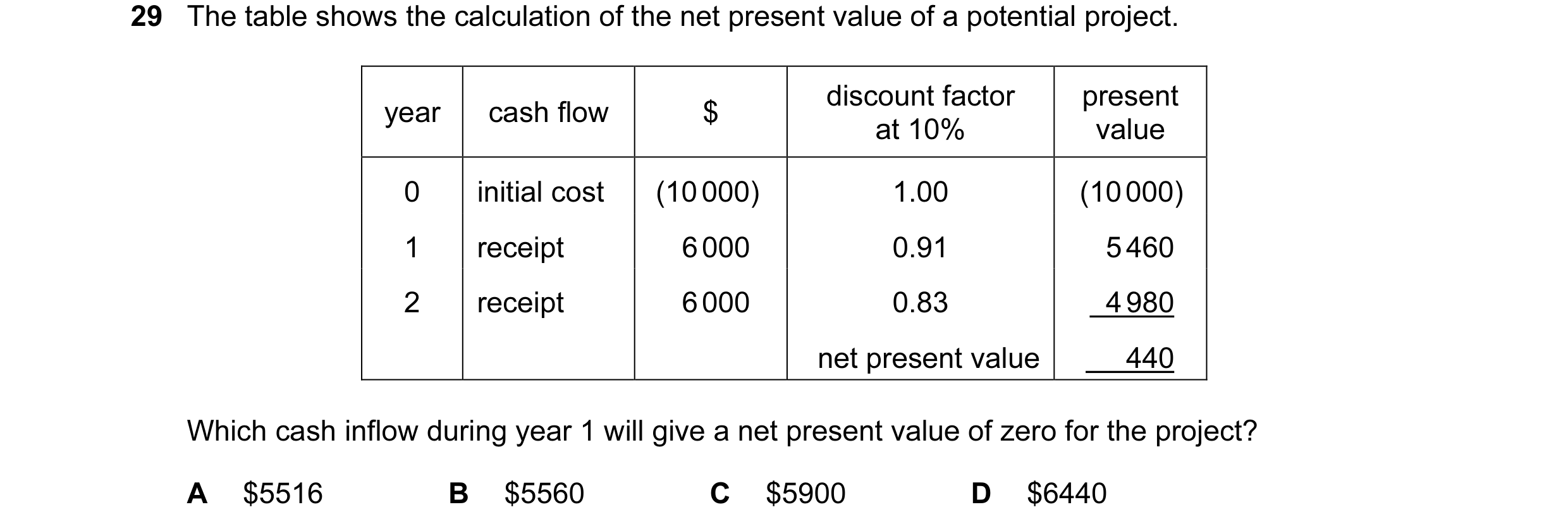


 15 / 16


 16 / 16