Questions as text
Q1 · The pupil reflex to light is an example of a reflex action 0654/41 May/June 2017
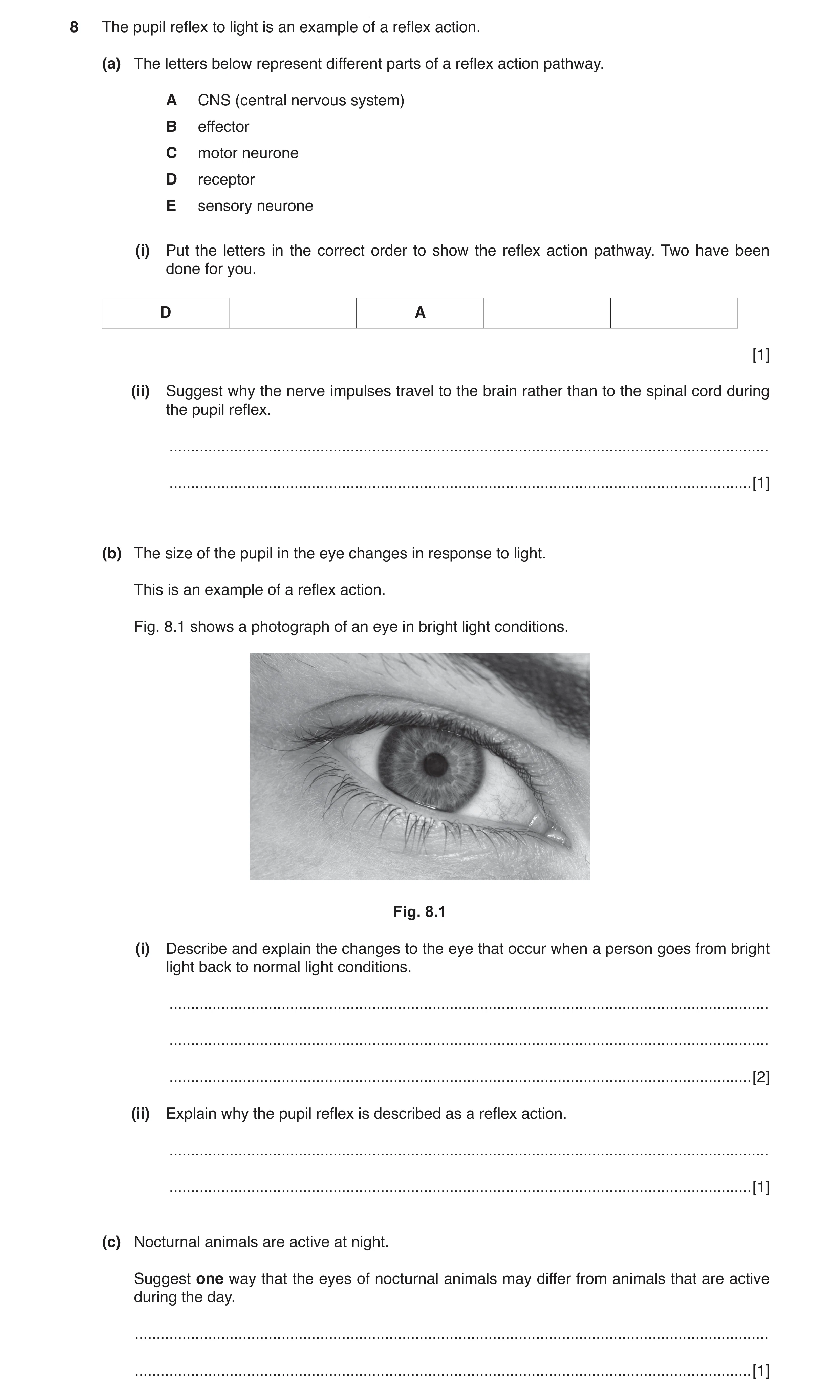
8 The pupil reflex to light is an example of a reflex action. (a) The letters below represent different parts of a reflex action pathway. A CNS (central nervous system) B effector C motor neurone D receptor E sensory neurone (i) Put the letters in the correct order to show the reflex action pathway. Two have been done for you. D A [1] (ii) Suggest why the nerve impulses travel to the brain rather than to the spinal cord during the pupil reflex. … … [1] (b) The size of the pupil in the eye changes in response to light. This is an example of a reflex action. Fig. 8.1 shows a photograph of an eye in bright light conditions. Fig. 8.1 (i) Describe and explain the changes to the eye that occur when a person goes from bright light back to normal light conditions. … … … [2] (ii) Explain why the pupil reflex is described as a reflex action. … … [1] (c) Nocturnal animals are active at night. Suggest one way that the eyes of nocturnal animals may differ from animals that are active during the day. … … [1]
6 marks
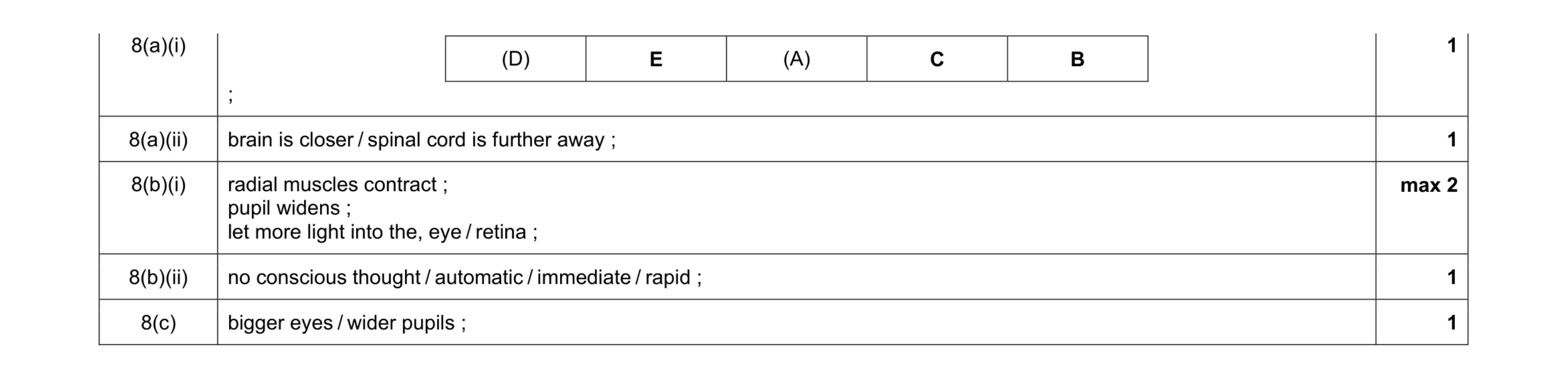
Mark scheme: 8(a)(i) (D) E (A) C B ; 1 8(a)(ii) brain is closer / spinal cord is further away ; 1 8(b)(i) radial muscles contract ; pupil widens ; let more light into the, eye / retina ; max 2 8(b)(ii) no conscious thought / automatic / immediate / rapid ; 1 8(c) bigger eyes / wider pupils ; 1
This question in 0654/41 May/June 2017
Q2 · A student carries out an investigation of the growth of a plant shoot by auxins 0654/42 May/June 2017
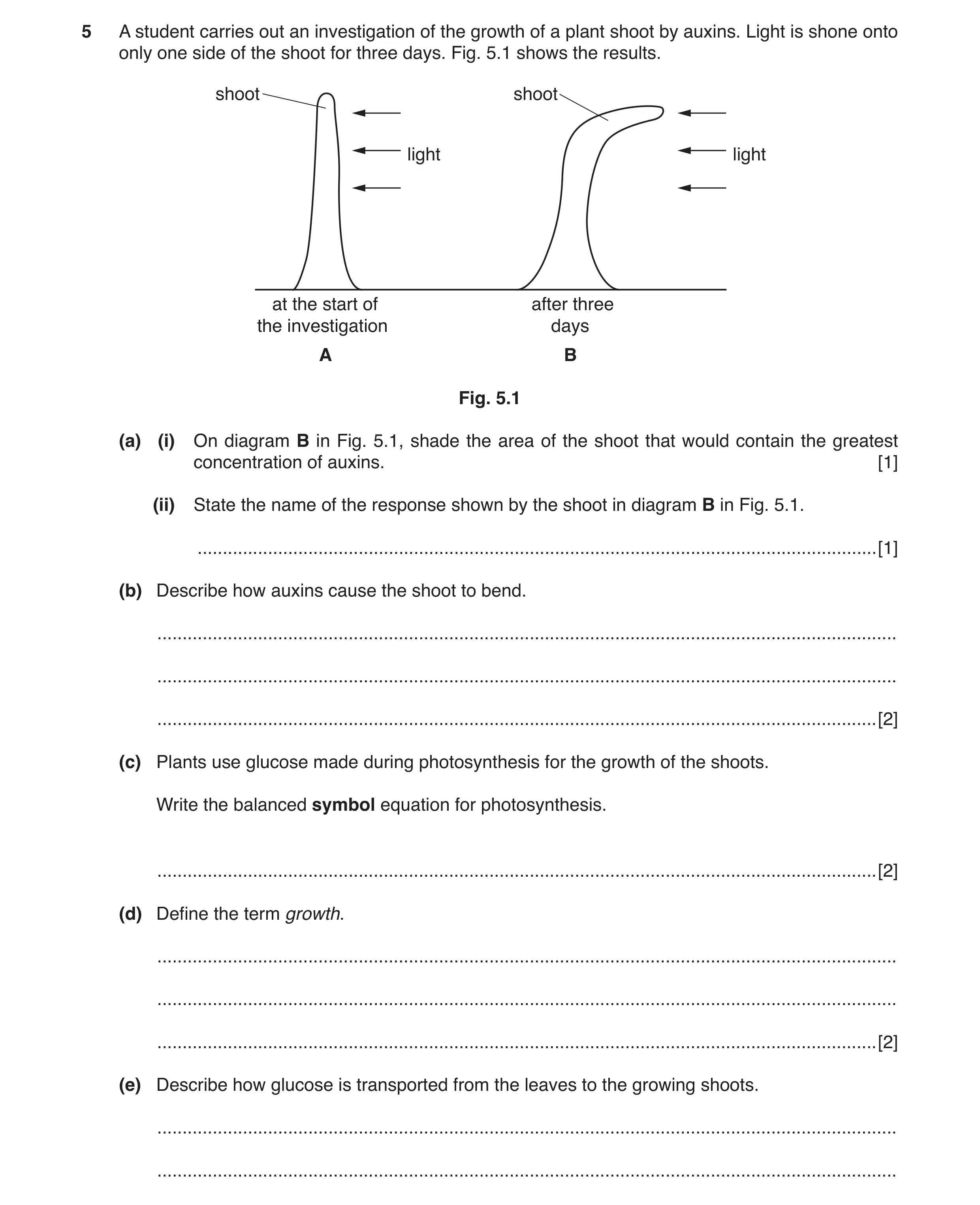
5 A student carries out an investigation of the growth of a plant shoot by auxins. Light is shone onto only one side of the shoot for three days. Fig. 5.1 shows the results. shoot shoot light light at the start of after three the investigation days A B Fig. 5.1 (a) (i) On diagram B in Fig. 5.1, shade the area of the shoot that would contain the greatest concentration of auxins. [1] (ii) State the name of the response shown by the shoot in diagram B in Fig. 5.1. … [1] (b) Describe how auxins cause the shoot to bend. … … … [2] (c) Plants use glucose made during photosynthesis for the growth of the shoots. Write the balanced symbol equation for photosynthesis. … [2] (d) Define the term growth. … … … [2] (e) Describe how glucose is transported from the leaves to the growing shoots. … …
10 marks
Mark scheme: 5(a)(i) shaded area on the left hand side of the shoot after three days ; 1 5(a)(ii) positive phototropism ; 1 5(b) auxins cause cells to increase in, size / elongate / grow ; auxins, move / diffuse, away from light ; ref to uneven growth ; max 2 5(c) light 6CO2 + 6H2O → C6H12O6 + 6O2 ;; chlorophyll 2 5(d) increase in, size – no mark increase in dry mass ; increase in cell, number / size ; ref to permanent ; max 2 5(e) glucose converted to sucrose ; ref to translocation ; in phloem ; max 2
This question in 0654/42 May/June 2017
Q3 · A diagram of a human eye 0654/42 Oct/Nov 2017
10 Fig. 10.1 is a diagram of a human eye. retina X optic nerve Fig. 10.1 (a) (i) Name the part labelled X on Fig. 10.1. … [1] (ii) Draw a label line to identify the iris on Fig. 10.1. Label this C. [1] (b) The pupil response to light is an example of a reflex action. (i) Describe the changes that happen in the eye when a person goes from dark to light conditions. … … … [2] (ii) Explain why the pupil response is described as a reflex action. … … [1] (iii) Identify the following parts which are involved during the pupil reflex of the eye. receptor … coordinator … [2] (c) The pupil reflex is an example of nervous control. Table 10.1 compares hormonal and nervous control systems in the body. Complete Table 10.1 to show the differences between hormonal control and nervous control. Table 10.1 feature hormonal control nervous control method of transmission along neurones around the body … speed of transmission around the body … … length of effect … … [3]
10 marks
Mark scheme: 10(a)(i) cornea ; 1 10(a)(ii) label pointing to iris ; 1 10(b)(i) circular muscle in iris contracts / radial muscles in iris relax ; pupil size decreases / iris size increases ; 2 10(b)(ii) automatic / requires no conscious thought ; 1 10(b)(iii) retina ; (unconscious part of) brain ; 2 Question Answer Marks 10(c) feature hormonal control nervous control method of transmission via blood along neurones speed of transmission slow fast length of effects long-lasting short-term 1 row correct ; 2 rows correct ; 3 rows correct ; 3
This question in 0654/42 Oct/Nov 2017
Question 4 0654/43 Oct/Nov 2018
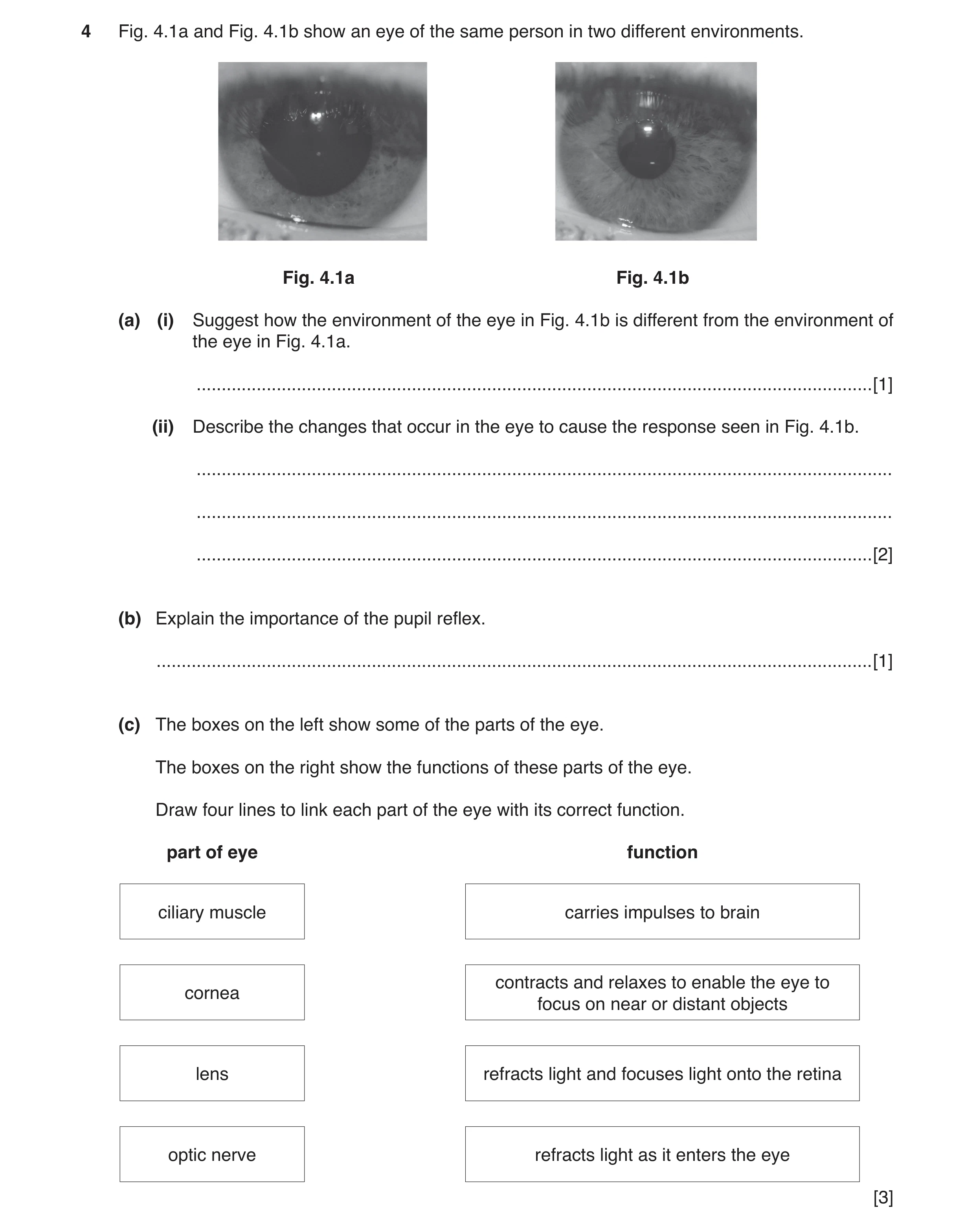
4 Fig. 4.1a and Fig. 4.1b show an eye of the same person in two different environments. Fig. 4.1a Fig. 4.1b (a) (i) Suggest how the environment of the eye in Fig. 4.1b is different from the environment of the eye in Fig. 4.1a. … [1] (ii) Describe the changes that occur in the eye to cause the response seen in Fig. 4.1b. … … … [2] (b) Explain the importance of the pupil reflex. … [1] (c) The boxes on the left show some of the parts of the eye. The boxes on the right show the functions of these parts of the eye. Draw four lines to link each part of the eye with its correct function. part of eye function ciliary muscle carries impulses to brain contracts and relaxes to enable the eye to cornea focus on near or distant objects lens refracts light and focuses light onto the retina optic nerve refracts light as it enters the eye [3]
7 marks
Mark scheme: 4(a)(i) increase in light intensity ; 1 4(a)(ii) circular muscles contract ; pupil constricts / gets smaller, OR iris expands / gets bigger ; 2 4(b) prevents damage (to retina) in bright conditions OR allows enough light to enter the eye in dull conditions ; 1 4(c) ciliary muscle carries impulses to brain cornea contracts and relaxes to focus on near or distant objects lens refracts light and focuses light onto the retina optic nerve refracts light as it enters the eye 1 correct ; 2 or 3 correct ; 4 correct ; 3
This question in 0654/43 Oct/Nov 2018
Q5 · A section through the eye 0654/41 Oct/Nov 2019
4 Fig. 4.1 shows a section through the eye. B C A D H E F G Fig. 4.1 (a) Draw an X on Fig. 4.1 to show the position of the blind spot. [1] (b) Table 4.1 shows some of the parts of the eye, the letters of the parts in Fig. 4.1 and their functions. Table 4.1 part of the eye letter in Fig. 4.1 function cornea D refracts light entering the eye C lens carries impulse to brain contains light receptor cells Complete Table 4.1. One row has been done for you. [4] (c) A person changes their focus from a near object to a distant object. Describe the changes that take place in the following parts of the eye. ciliary muscle … suspensory ligaments … lens … [3] [Total: 8]
8 marks
Mark scheme: 4(a) centre of the letter X drawn in correct position ; 1 4(b) ;;;; part of the eye letter on Fig. 4.1 function cornea D refracts light entering the eye iris C controls how much light enters, the eye / pupil lens B focuses light (on retina) optic nerve H carries impulse to brain retina A contains light receptor cells 4 4(c) ciliary muscle relaxes ; suspensory ligaments tighten / stretch ; lens becomes thinner / is stretched / AW ; 3
This question in 0654/41 Oct/Nov 2019
Q6 · Plant shoots respond to stimuli such as light 0654/41 May/June 2020
10 (a) Plant shoots respond to stimuli such as light. Fig. 10.1 shows the growth response of a shoot to light. direction of light shoot Fig. 10.1 (i) Name the response shown in Fig. 10.1. … [1] (ii) Draw an X on Fig. 10.1 to show the area with the greatest cell elongation. [1] (iii) Name the hormone that controls cell elongation. … [1] (b) Fig. 10.2 shows a plant shoot with the tip removed. direction of light shoot Fig. 10.2 State why the shoot in Fig. 10.2 did not bend. … … [1] (c) Explain why plants need magnesium ions for photosynthesis and healthy growth. Use ideas about energy in your answer. … … … … … … [3] (d) Growth is one of the characteristics of living things. (i) Complete the definition of the term growth. Growth is a … increase in size and dry … by an increase in cell number or cell size or both. [2] (ii) State the name of two other characteristics of living things. 1 … 2 … [2] [Total: 11]
11 marks
Mark scheme: 10(a)(i) phototropism ; 1 10(a)(ii) X drawn on the upper side of the shoot bend ; 1 10(a)(iii) auxin ; 1 10(b) auxin / hormone / chemical, produced at the shoot tip ; 1 10(c) magnesium ions required to make chlorophyll ; chlorophyll absorbs light energy (and converts this to chemical energy) ; (chemical) energy used to synthesise, carbohydrates or glucose / carbohydrates or glucose are used to make proteins (for growth) ; 3 10(d)(i) permanent ; mass ; 2 10(d)(ii) any two from: movement reproduction sensitivity excretion nutrition respiration ;; 2
This question in 0654/41 May/June 2020
Q7 · A diagram of the human eye 0654/41 May/June 2021
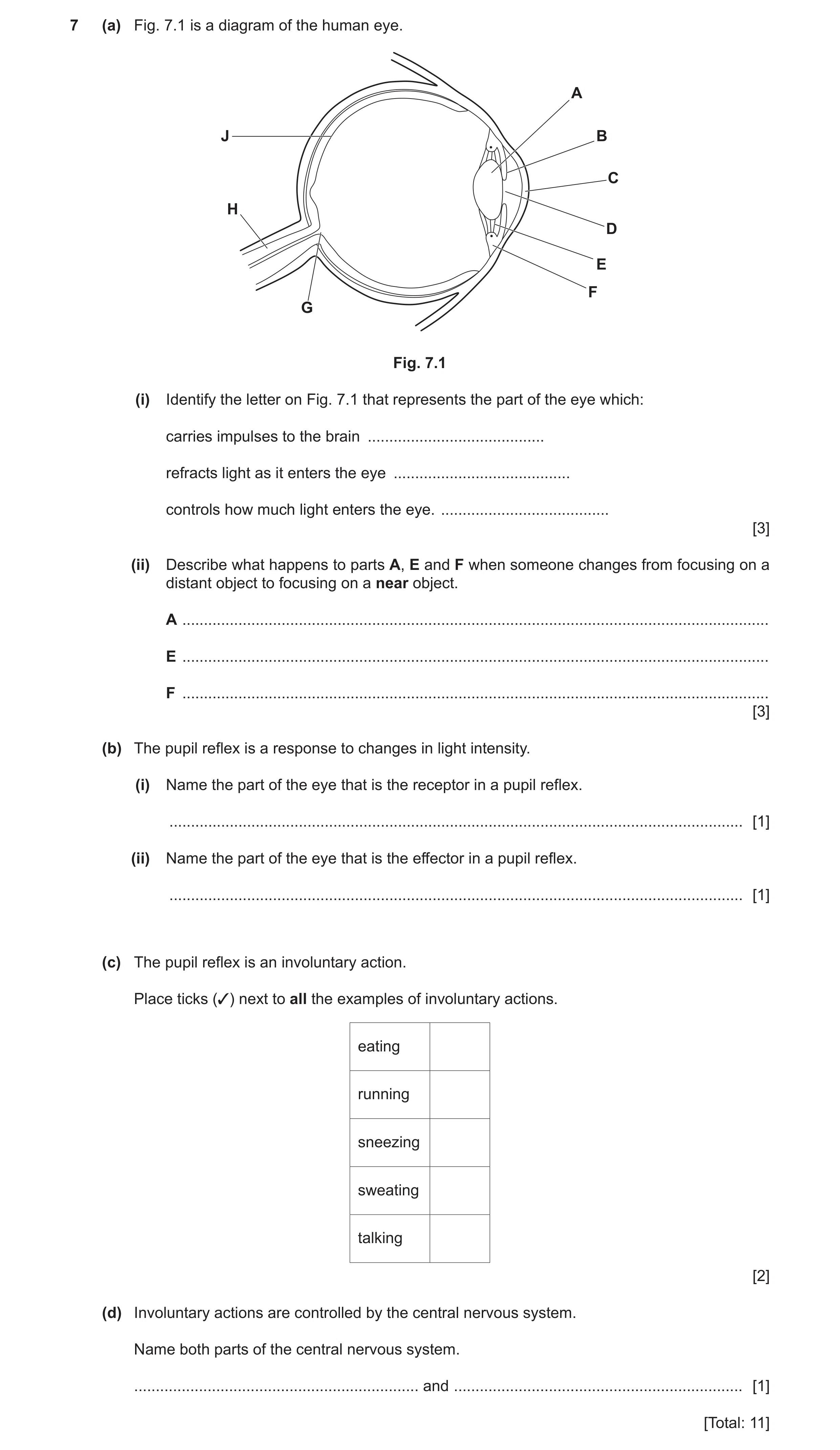
7 (a) Fig. 7.1 is a diagram of the human eye. A J B C H D E F G Fig. 7.1 (i) Identify the letter on Fig. 7.1 that represents the part of the eye which: carries impulses to the brain … refracts light as it enters the eye … controls how much light enters the eye. … [3] (ii) Describe what happens to parts A, E and F when someone changes from focusing on a distant object to focusing on a near object. A … E … F … [3] (b) The pupil reflex is a response to changes in light intensity. (i) Name the part of the eye that is the receptor in a pupil reflex. … [1] (ii) Name the part of the eye that is the effector in a pupil reflex. … [1] (c) The pupil reflex is an involuntary action. Place ticks (3) next to all the examples of involuntary actions. eating running sneezing sweating talking [2] (d) Involuntary actions are controlled by the central nervous system. Name both parts of the central nervous system. … and … [1] [Total: 11]
11 marks
Mark scheme: 7(a)(i) H ; C ; B ; 3 7(a)(ii) A thickens / gets wider / AW ; E slackens / loosens / AW ; F contracts ; 3 7(b)(i) retina ; 1 7(b)(ii) circular / radial, muscles ; 1 7(c) sneezing ticked ; sweating ticked ; 2 7(d) brain and spinal cord ; 1
This question in 0654/41 May/June 2021
Q8 · A plant’s response to light 0654/42 May/June 2021
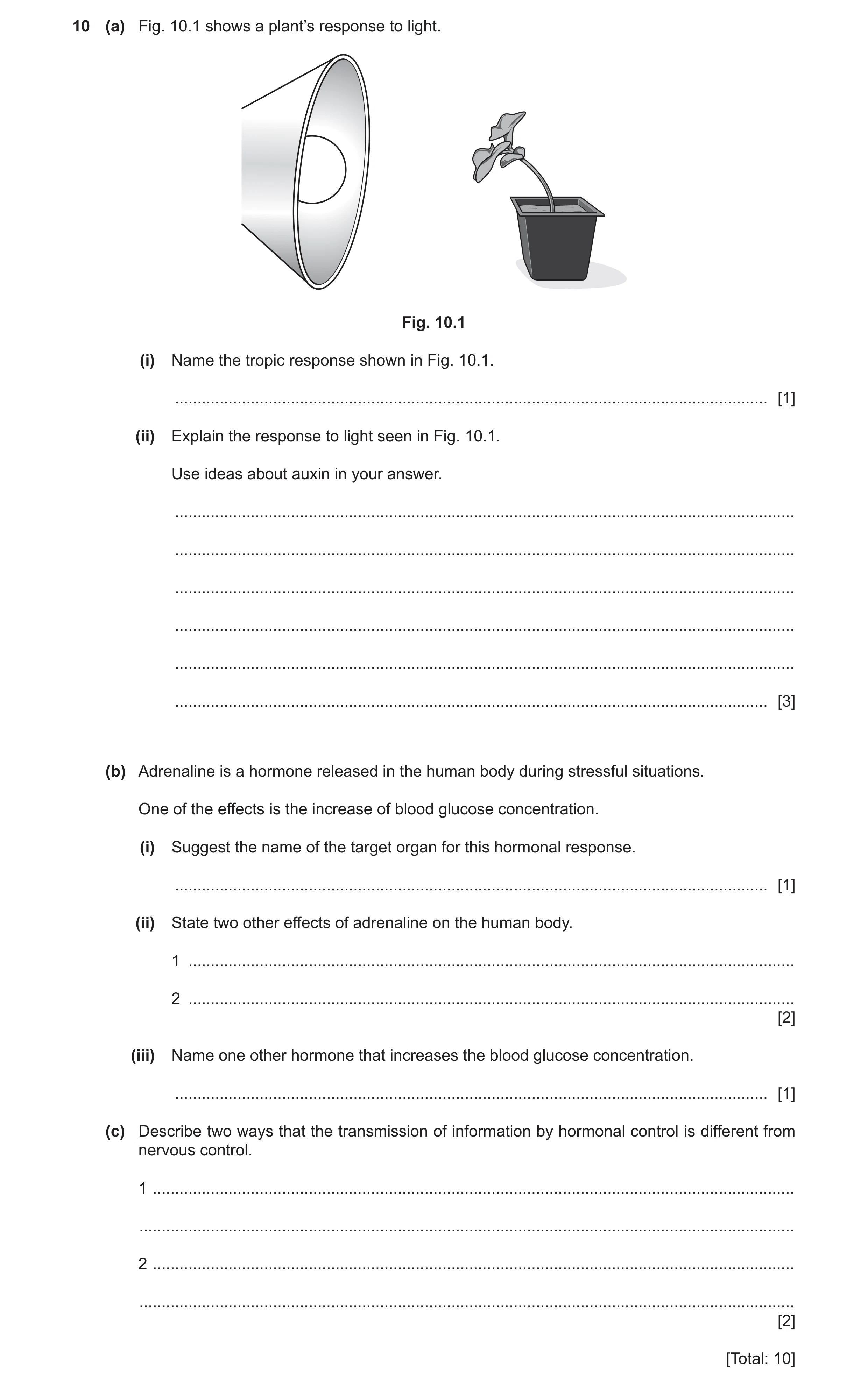
10 (a) Fig. 10.1 shows a plant’s response to light. Fig. 10.1 (i) Name the tropic response shown in Fig. 10.1. … [1] (ii) Explain the response to light seen in Fig. 10.1. Use ideas about auxin in your answer. … … … … … … [3] (b) Adrenaline is a hormone released in the human body during stressful situations. One of the effects is the increase of blood glucose concentration. (i) Suggest the name of the target organ for this hormonal response. … [1] (ii) State two other effects of adrenaline on the human body. 1 … 2 … [2] (iii) Name one other hormone that increases the blood glucose concentration. … [1] (c) Describe two ways that the transmission of information by hormonal control is different from nervous control. 1 … … 2 … … [2] [Total: 10]
10 marks
Mark scheme: 10(a)(i) phototropism ; 1 10(a)(ii) any three from: auxin, made in the tip (moves down stem) ; auxin collects on shaded side ; auxin promotes cell elongation ; reference to unequal growth on side of, stem / plant ; 3 10(b)(i) liver ; 1 10(b)(ii) any two from: increase in pulse rate ; widened pupils ; increase in breathing rate ; avp ;; 2 10(b)(iii) glucagon ; 1 10(c) any two from: takes longer time ; via chemical substances ; transmission is via the blood ; 2
This question in 0654/42 May/June 2021
Q9 · The forest area in two different continents, A and B, in 1990 and 2010 0654/43 May/June 2021
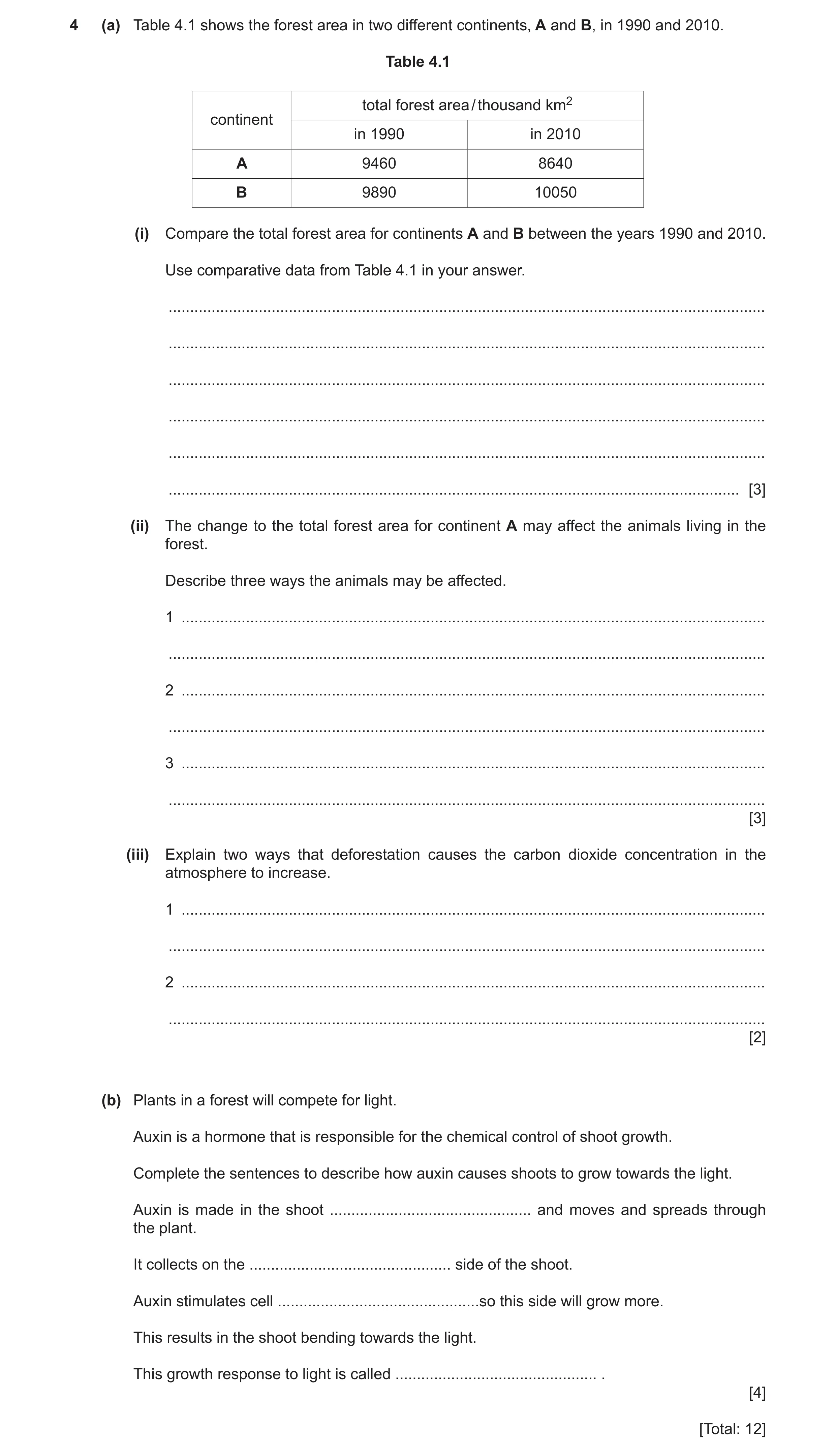
4 (a) Table 4.1 shows the forest area in two different continents, A and B, in 1990 and 2010. Table 4.1 total forest area / thousand km2 continent in 1990 in 2010 A 9460 8640 B 9890 10050 (i) Compare the total forest area for continents A and B between the years 1990 and 2010. Use comparative data from Table 4.1 in your answer. … … … … … … [3] (ii) The change to the total forest area for continent A may affect the animals living in the forest. Describe three ways the animals may be affected. 1 … … 2 … … 3 … … [3] (iii) Explain two ways that deforestation causes the carbon dioxide concentration in the atmosphere to increase. 1 … … 2 … … [2] (b) Plants in a forest will compete for light. Auxin is a hormone that is responsible for the chemical control of shoot growth. Complete the sentences to describe how auxin causes shoots to grow towards the light. Auxin is made in the shoot … and moves and spreads through the plant. It collects on the … side of the shoot. Auxin stimulates cell … so this side will grow more. This results in the shoot bending towards the light. This growth response to light is called … . [4] [Total: 12]
12 marks
Mark scheme: 4(a)(i) Any two from: forest cover decreases in continent A ; forest cover increases in continent B ; B always has more forest cover than A ; and data manipulation with correct units ; 4(a)(ii) loss of food / disruption to food chain / web ; loss of habitat ; extinction ; migration ; 2 4(a)(iii) less photosynthesis so less carbon dioxide removed ; (more) combustion (of trees) so (more) carbon dioxide produced; 2 4(b) tip(s) ; shaded ; elongation ; phototropism ; 4
This question in 0654/43 May/June 2021
Q10 · Hormones control blood glucose concentration 0654/41 Oct/Nov 2021
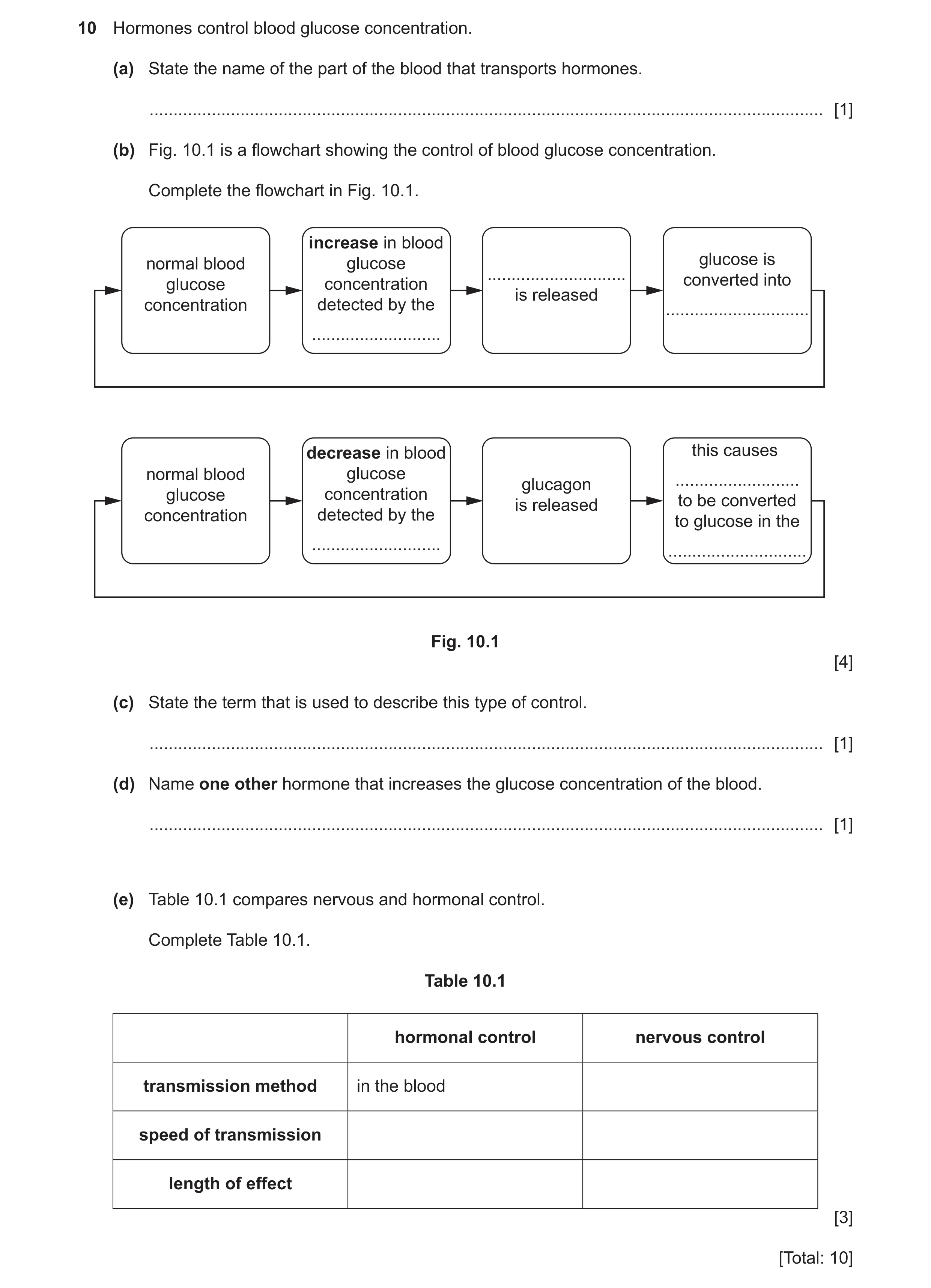
10 Hormones control blood glucose concentration. (a) State the name of the part of the blood that transports hormones. … [1] (b) Fig. 10.1 is a flowchart showing the control of blood glucose concentration. Complete the flowchart in Fig. 10.1. increase in blood normal blood glucose glucose is … glucose concentration converted into is released concentration detected by the … … decrease in blood this causes normal blood glucose glucagon … glucose concentration is released to be converted concentration detected by the to glucose in the … … Fig. 10.1 [4] (c) State the term that is used to describe this type of control. … [1] (d) Name one other hormone that increases the glucose concentration of the blood. … [1] (e) Table 10.1 compares nervous and hormonal control. Complete Table 10.1. Table 10.1 hormonal control nervous control transmission method in the blood speed of transmission length of effect [3] [Total: 10]
10 marks
Mark scheme: 10(a) plasma ; 1 10(b) pancreas in boxes 2 and 6 ; insulin in box 3 ; glycogen in box 4 and 8 ; liver in box 8 ; 4 10(c) negative feedback ; 1 10(d) adrenaline ; 1 10(e) hormonal control nervous control transmission method in the blood by neurones / electrical impulses ; relative speed of transmission slow fast ; relative length of effect long lasting short-lived ; 3
This question in 0654/41 Oct/Nov 2021
Q11 · A diagram of a human eye 0654/42 Oct/Nov 2021
7 (a) Fig. 7.1 is a diagram of a human eye. B A C G D E F Fig. 7.1 (i) Table 7.1 shows some of the letters, the names and functions of the parts in Fig. 7.1. Complete Table 7.1. Table 7.1 name of part letter in Fig. 7.1 function adjusts the amount of light entering the eye G retina D refracts light entering the eye [4] (ii) State the letters in Fig. 7.1 of the two parts of the eye responsible for changing the shape of the lens during accommodation. … [1] (iii) Name the two muscles in the iris responsible for the pupil reflex. 1 … 2 … [2] (b) The pupil reflex is an involuntary action. Place ticks (3) in the boxes to show two voluntary actions. blinking when dust gets in your eye eating a burger reading a book removing your hand from a very hot object sweating when you get hot [2] [Total: 9]
9 marks
Mark scheme: 7(a)(i) name of part letter in Fig. 3.1 function iris C adjust the amount of light entering the eye ; optic nerve G transfer impulses to brain ; retina A contains light receptors / detects light ; cornea D refracts light entering the eye ; 4 7(a)(ii) E and F ; 1 7(a)(iii) circular ; radial ; 2 7(b) eating a burger ; reading a book ; 2
This question in 0654/42 Oct/Nov 2021
Q12 · Sensitivity is one of the characteristics of living organisms 0654/42 Feb/March 2022
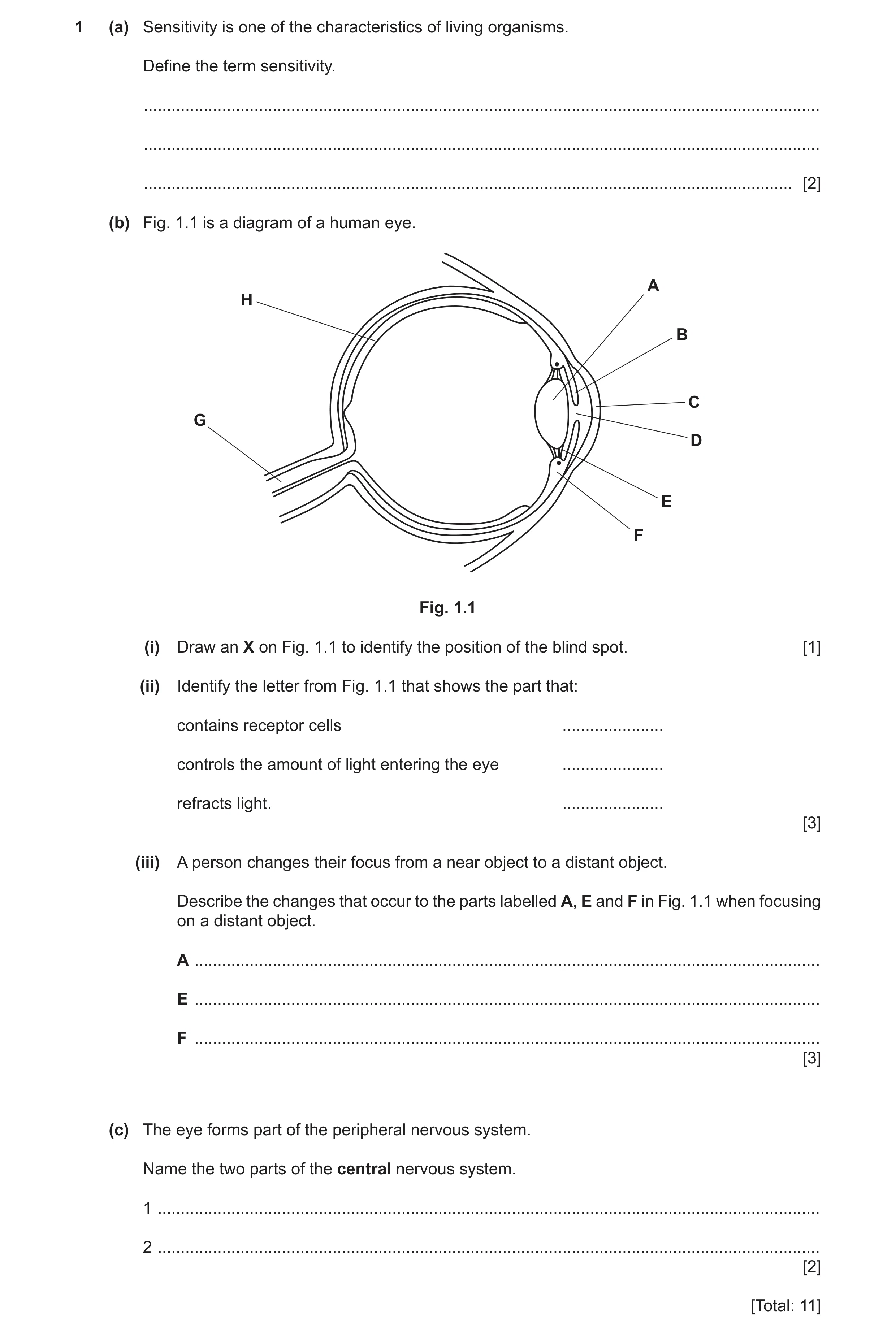
1 (a) Sensitivity is one of the characteristics of living organisms. Define the term sensitivity. … … … [2] (b) Fig. 1.1 is a diagram of a human eye. A H B C G D E F Fig. 1.1 (i) Draw an X on Fig. 1.1 to identify the position of the blind spot. [1] (ii) Identify the letter from Fig. 1.1 that shows the part that: contains receptor cells … controls the amount of light entering the eye … refracts light. … [3] (iii) A person changes their focus from a near object to a distant object. Describe the changes that occur to the parts labelled A, E and F in Fig. 1.1 when focusing on a distant object. A … E … F … [3] (c) The eye forms part of the peripheral nervous system. Name the two parts of the central nervous system. 1 … 2 … [2] [Total: 11]
11 marks
Mark scheme: 1(a) sensitivity is the ability to detect ; and respond to changes in the environment ; 2 1(b)(i) X drawn on blind spot ; 1 1(b)(ii) H ; B ; C ; 3 1(b)(iii) A becomes thin(ner) / AW ; E tighten / stretch / AW ; F relax ; 3 1(c) brain ; spinal cord ; 2
This question in 0654/42 Feb/March 2022
Q13 · The effect of an injection of adrenaline on pulse rate is recorded 0654/43 May/June 2022
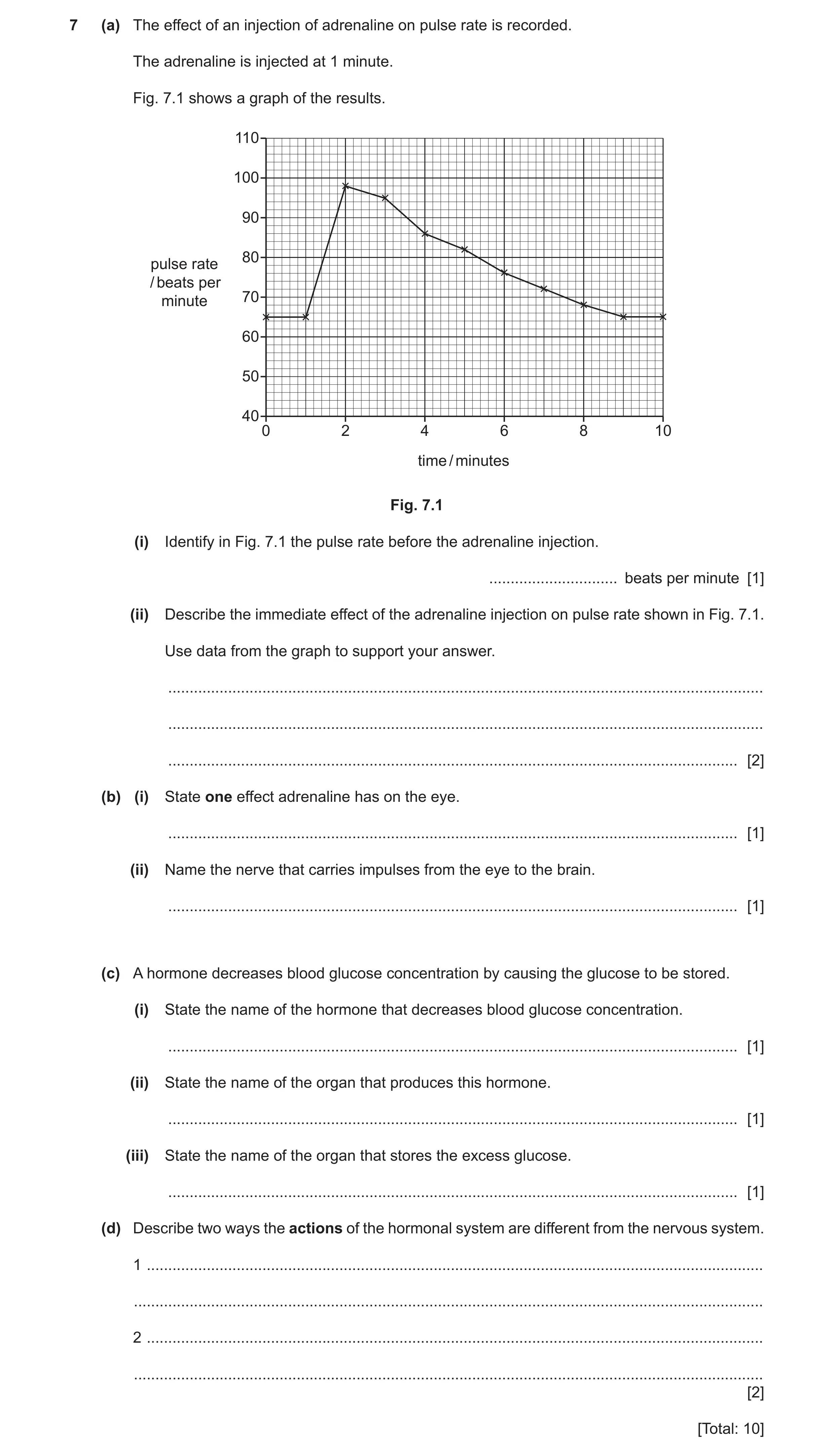
7 (a) The effect of an injection of adrenaline on pulse rate is recorded. The adrenaline is injected at 1 minute. Fig. 7.1 shows a graph of the results. 110 100 90 80 pulse rate / beats per minute 70 60 50 40 0 2 4 6 8 10 time / minutes Fig. 7.1 (i) Identify in Fig. 7.1 the pulse rate before the adrenaline injection. … beats per minute [1] (ii) Describe the immediate effect of the adrenaline injection on pulse rate shown in Fig. 7.1. Use data from the graph to support your answer. … … … [2] (b) (i) State one effect adrenaline has on the eye. … [1] (ii) Name the nerve that carries impulses from the eye to the brain. … [1] (c) A hormone decreases blood glucose concentration by causing the glucose to be stored. (i) State the name of the hormone that decreases blood glucose concentration. … [1] (ii) State the name of the organ that produces this hormone. … [1] (iii) State the name of the organ that stores the excess glucose. … [1] (d) Describe two ways the actions of the hormonal system are different from the nervous system. 1 … … 2 … … [2] [Total: 10]
10 marks
Mark scheme: 7(a)(i) 65 (beats per minute) ; 1 7(a)(ii) (steep) increase ; to 98 beats per minute / by 33 beats per minute ; 2 7(b)(i) pupils widen ; 1 7(b)(ii) optic (nerve) ; 1 7(c)(i) insulin ; 1 7(c)(ii) pancreas ; 1 7(c)(iii) liver ; 1 7(d) hormonal actions are slower to act ; hormonal actions last longer ; 2
This question in 0654/43 May/June 2022
Question 14 0654/41 Oct/Nov 2022
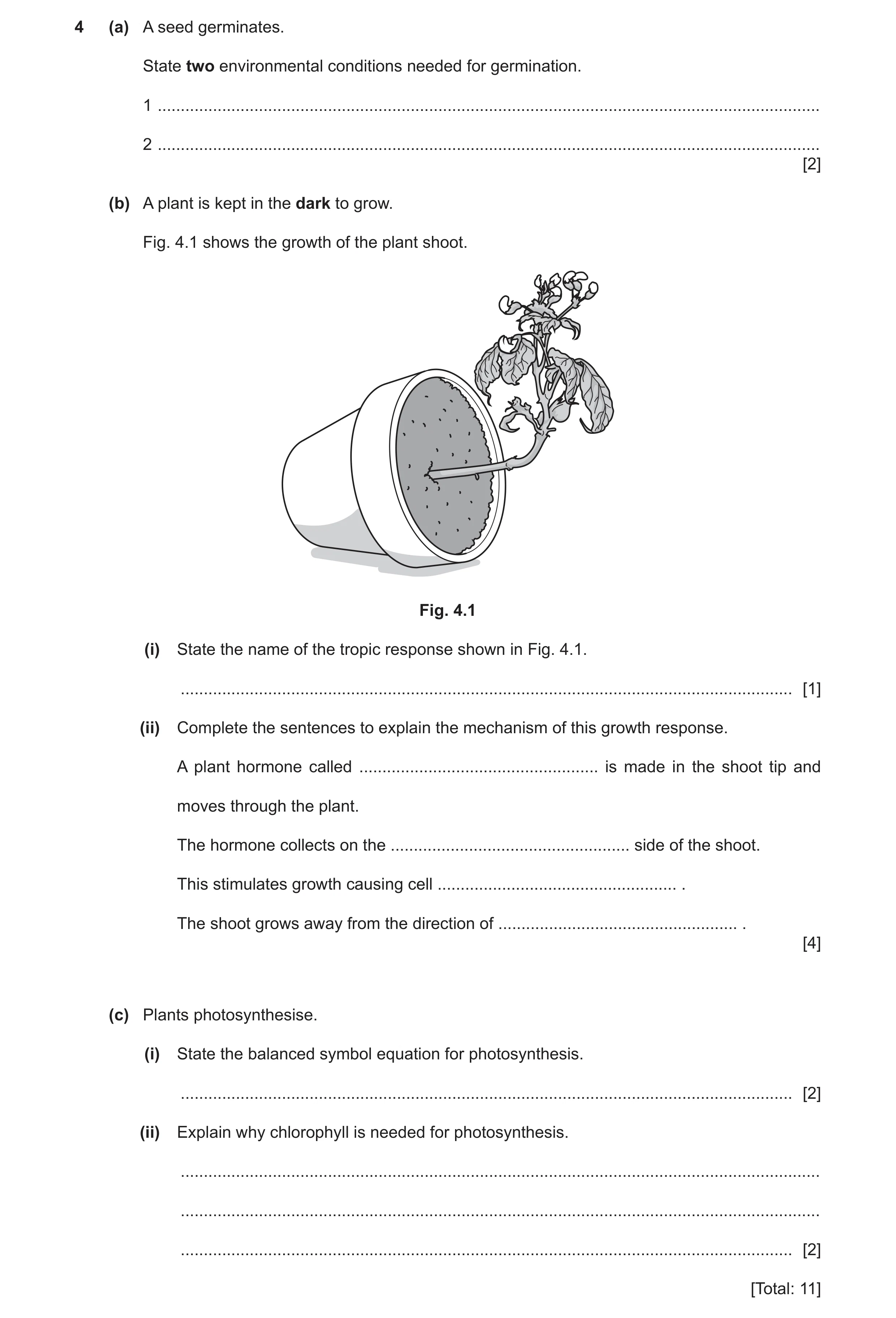
4 (a) A seed germinates. State two environmental conditions needed for germination. 1 … 2 … [2] (b) A plant is kept in the dark to grow. Fig. 4.1 shows the growth of the plant shoot. Fig. 4.1 (i) State the name of the tropic response shown in Fig. 4.1. … [1] (ii) Complete the sentences to explain the mechanism of this growth response. A plant hormone called … is made in the shoot tip and moves through the plant. The hormone collects on the … side of the shoot. This stimulates growth causing cell … . The shoot grows away from the direction of … . [4] (c) Plants photosynthesise. (i) State the balanced symbol equation for photosynthesis. … [2] (ii) Explain why chlorophyll is needed for photosynthesis. … … … [2] [Total: 11]
11 marks
Mark scheme: 4(a) any two from: 2 oxygen ; water / moisture ; warm / suitable temperature ; 4(b)(i) gravitropism ; 1 4(b)(ii) auxin ; 4 lower / owtte ; elongation ; gravity ; 4(c)(i) 6CO2+6H2O →C6H12O6 + 6O2 2 LHS ; RHS ; 4(c)(ii) transfers light energy to chemical energy ; 2 for synthesis of, carbohydrates / glucose ;
This question in 0654/41 Oct/Nov 2022
Q15 · One cause of the pupil reflex is a change in light intensity 0654/42 Feb/March 2023
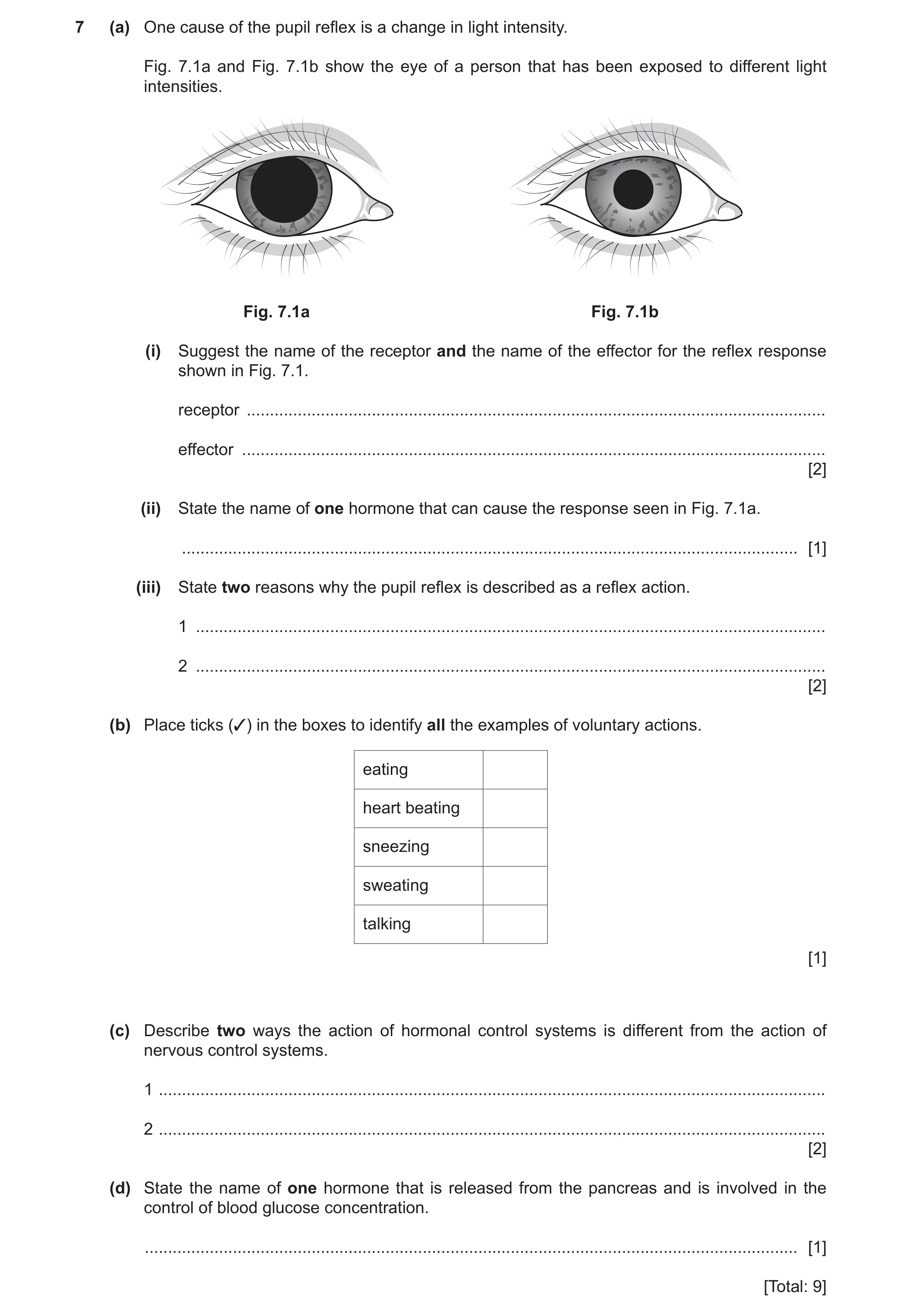
7 (a) One cause of the pupil reflex is a change in light intensity. Fig. 7.1a and Fig. 7.1b show the eye of a person that has been exposed to different light intensities. Fig. 7.1a Fig. 7.1b (i) Suggest the name of the receptor and the name of the effector for the reflex response shown in Fig. 7.1. receptor … effector … [2] (ii) State the name of one hormone that can cause the response seen in Fig. 7.1a. … [1] (iii) State two reasons why the pupil reflex is described as a reflex action. 1 … 2 … [2] (b) Place ticks (3) in the boxes to identify all the examples of voluntary actions. eating heart beating sneezing sweating talking [1] (c) Describe two ways the action of hormonal control systems is different from the action of nervous control systems. 1 … 2 … [2] (d) State the name of one hormone that is released from the pancreas and is involved in the control of blood glucose concentration. … [1] [Total: 9]
9 marks
Mark scheme: 7(a)(i) receptor – retina ; 2 effector – circular or radial muscles in the iris ; 7(a)(ii) adrenaline ; 1 7(a)(iii) it is automatic / requires no conscious thought ; 2 it is rapid ; 7(b) eating ticked and talking ticked only ; 1 7(c) longer lasting ; 2 slower ; 7(d) insulin / glucagon ; 1
This question in 0654/42 Feb/March 2023
Q16 · A diagram of parts of the eye 0654/42 May/June 2023
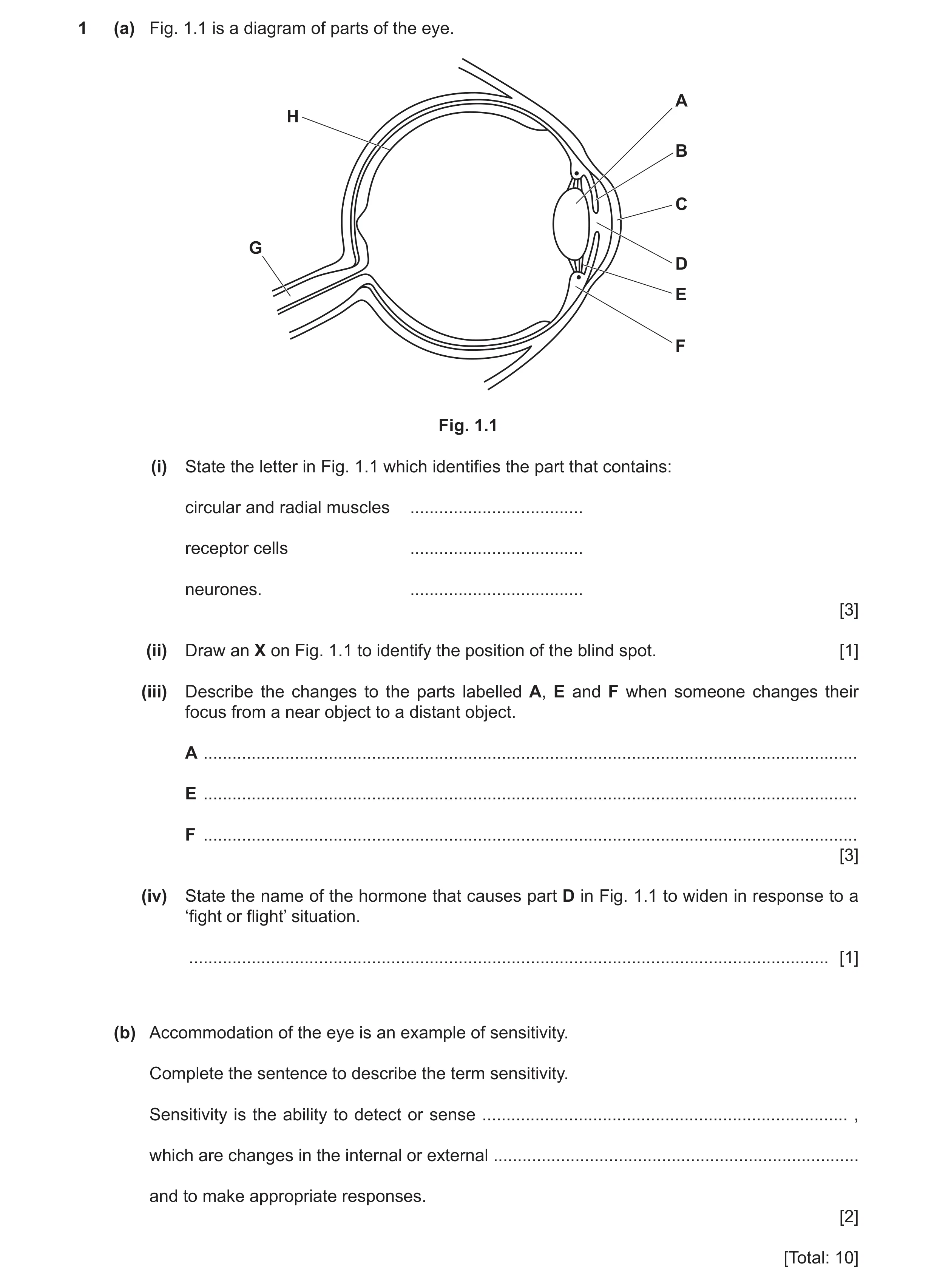
1 (a) Fig. 1.1 is a diagram of parts of the eye. A H B C G D E F Fig. 1.1 (i) State the letter in Fig. 1.1 which identifies the part that contains: circular and radial muscles … receptor cells … neurones. … [3] (ii) Draw an X on Fig. 1.1 to identify the position of the blind spot. [1] (iii) Describe the changes to the parts labelled A, E and F when someone changes their focus from a near object to a distant object. A … E … F … [3] (iv) State the name of the hormone that causes part D in Fig. 1.1 to widen in response to a ‘fight or flight’ situation. … [1] (b) Accommodation of the eye is an example of sensitivity. Complete the sentence to describe the term sensitivity. Sensitivity is the ability to detect or sense … , which are changes in the internal or external … and to make appropriate responses. [2] [Total: 10]
10 marks
Mark scheme: 1(a)(i) B ; H ; G / H ; 3 1(a)(ii) X drawn on blind spot ; 1 1(a)(iii) A – narrows / gets thinner / less convex ; E – tightens ; F – relaxes ; 3 1(a)(iv) adrenaline ; 1 1(b) stimuli ; environment ; 2
This question in 0654/42 May/June 2023
Q17 · The effect of adrenaline on blood glucose concentration 0654/42 Oct/Nov 2023
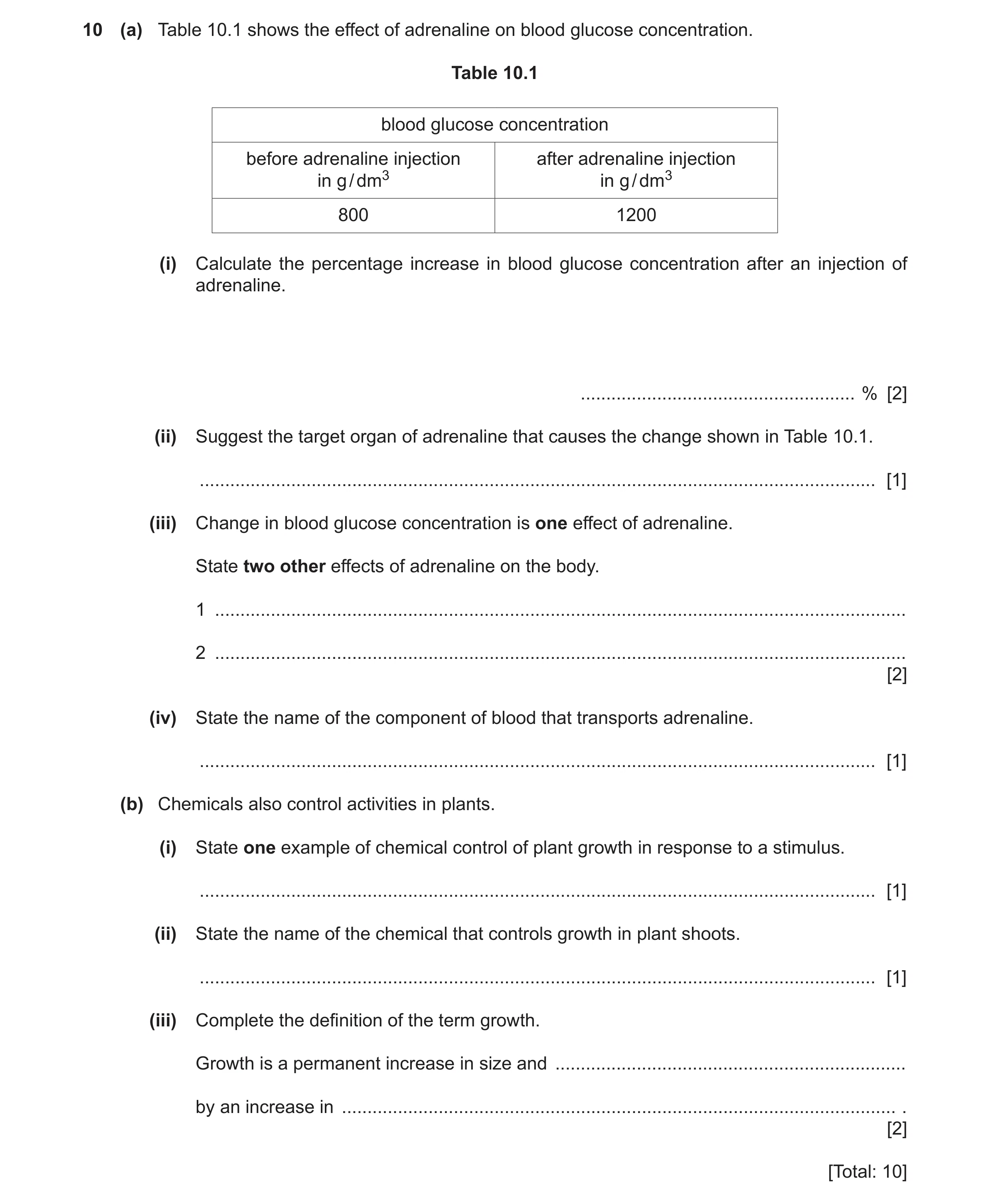
10 (a) Table 10.1 shows the effect of adrenaline on blood glucose concentration. Table 10.1 blood glucose concentration before adrenaline injection after adrenaline injection in g / dm3 in g / dm3 800 1200 (i) Calculate the percentage increase in blood glucose concentration after an injection of adrenaline. … % [2] (ii) Suggest the target organ of adrenaline that causes the change shown in Table 10.1. … [1] (iii) Change in blood glucose concentration is one effect of adrenaline. State two other effects of adrenaline on the body. 1 … 2 … [2] (iv) State the name of the component of blood that transports adrenaline. … [1] (b) Chemicals also control activities in plants. (i) State one example of chemical control of plant growth in response to a stimulus. … [1] (ii) State the name of the chemical that controls growth in plant shoots. … [1] (iii) Complete the definition of the term growth. Growth is a permanent increase in size and … by an increase in … . [2] [Total: 10]
10 marks
Mark scheme: 10(a)(i) (1200 – 800) = 400 ; 2 ((400/800) 100) = 50 (%) ; 10(a)(ii) liver ; 1 10(a)(iii) any two from: 2 widen pupils / pupils dilate ; increases pulse rate / increases heart rate ; AVP ;; 10(a)(iv) plasma ; 1 10(b)(i) phototropism / gravitropism ; 1 10(b)(ii) auxin ; 1 10(b)(iii) dry mass ; 2 cell size / cell number ;
This question in 0654/42 Oct/Nov 2023
Q18 · Blood glucose concentration is controlled so that it remains within set limits 0654/42 May/June 2024
4 (a) Blood glucose concentration is controlled so that it remains within set limits. State the name given to this type of control. … [1] (b) Fig. 4.1 shows the blood glucose concentration of a person after they have eaten a meal. 9 8 7 blood glucose concentration 6 mmol / dm3 5 4 3 0 10 20 30 40 50 60 70 80 90 100 time / minutes Fig. 4.1 Complete the sentences to describe and explain the changes seen in Fig. 4.1. Carbohydrates such as starch are broken down by the enzyme … to form simpler sugars. These simpler sugars are absorbed into the blood. After 30 minutes, the blood glucose concentration reaches a maximum of … mmol / dm3. The increase in blood glucose concentration is detected and the hormone insulin is released from the … . Insulin causes glucose to be converted to … . This is then stored in the … reducing the blood glucose concentration to its previous level. [5] (c) State the names of two hormones that increase blood glucose concentration. 1 … 2 … [2] (d) State the name of the component of blood that transports hormones. … [1] (e) Table 4.1 compares nervous and hormonal control. Complete Table 4.1. Table 4.1 nervous control hormonal control form of transmission chemical hormones relative speed of action relative longevity of action [3] [Total: 12]
12 marks
Mark scheme: 4(a) homeostasis ; 1 4(b) amylase ; 8.0 (mmol per dm3) ; pancreas ; glycogen ; liver / muscles ; 5 4(c) adrenaline ; glucagon ; 2 4(d) plasma ; 1 4(e) nervous control hormonal control form of transmission electrical impulse chemical hormones relative speed of action fast slow relative longevity of action short-lived / AW long-lasting / AW ;;; 3
This question in 0654/42 May/June 2024
Q19 · A diagram of the structure of the human eye 0654/43 May/June 2024
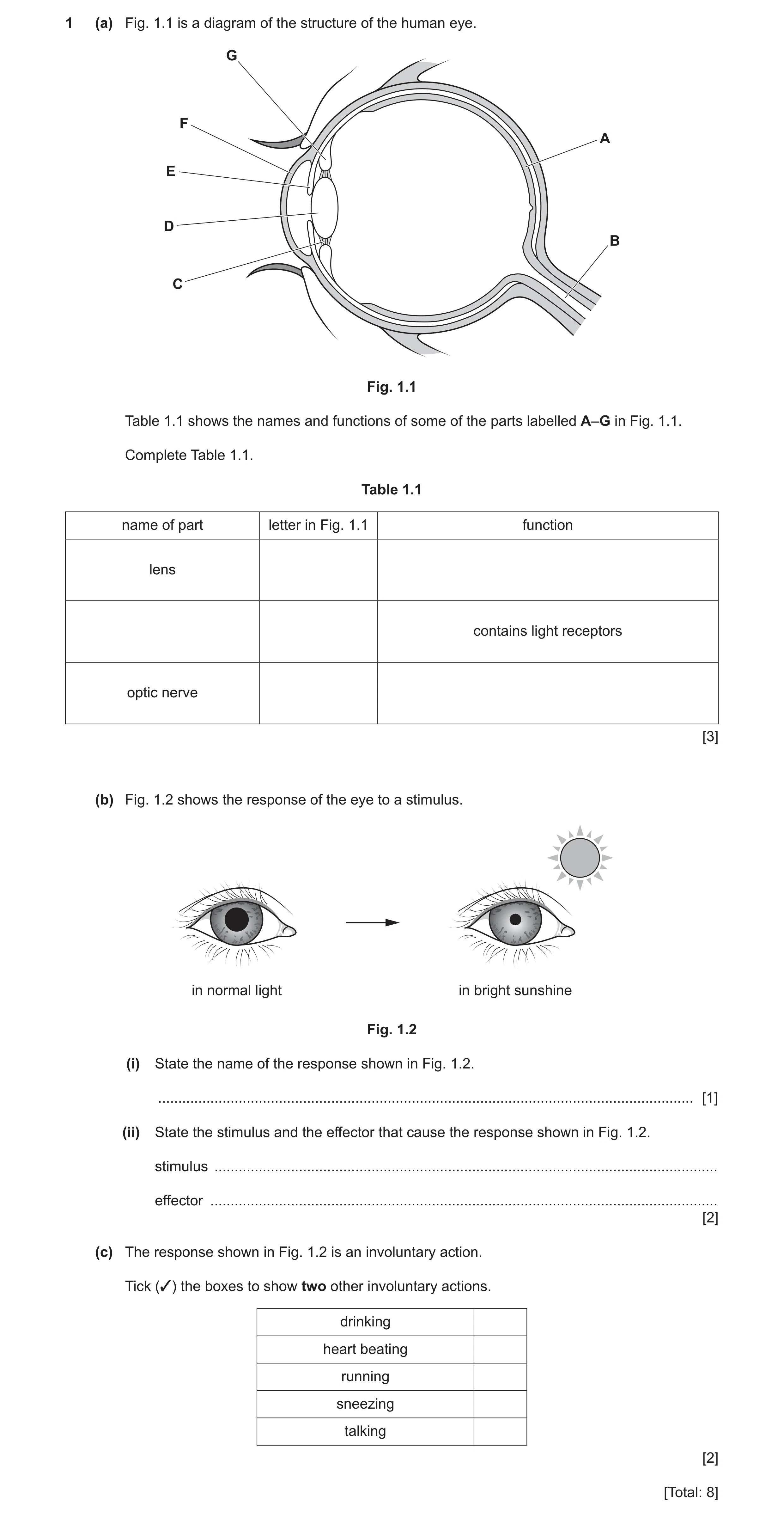
1 (a) Fig. 1.1 is a diagram of the structure of the human eye. G F A E D B C Fig. 1.1 Table 1.1 shows the names and functions of some of the parts labelled A–G in Fig. 1.1. Complete Table 1.1. Table 1.1 name of part letter in Fig. 1.1 function lens contains light receptors optic nerve [3] (b) Fig. 1.2 shows the response of the eye to a stimulus. in normal light in bright sunshine Fig. 1.2 (i) State the name of the response shown in Fig. 1.2. … [1] (ii) State the stimulus and the effector that cause the response shown in Fig. 1.2. stimulus … effector … [2] (c) The response shown in Fig. 1.2 is an involuntary action. Tick (✓) the boxes to show two other involuntary actions. drinking heart beating running sneezing talking [2] [Total: 8]
8 marks
Mark scheme: 1(a) name of part letter in Fig. 1.1 function lens D focuses light retina A contains light receptors optic nerve B carries impulses (to brain) ;;; 3 1(b)(i) pupil reflex ; 1 1(b)(ii) stimulus (change in) light (intensity) ; effector circular muscles ; 2 1(c) drinking heart beating running sneezing talking ;; 2
This question in 0654/43 May/June 2024
Q20 · A farmer planted some seeds 0654/43 Oct/Nov 2024
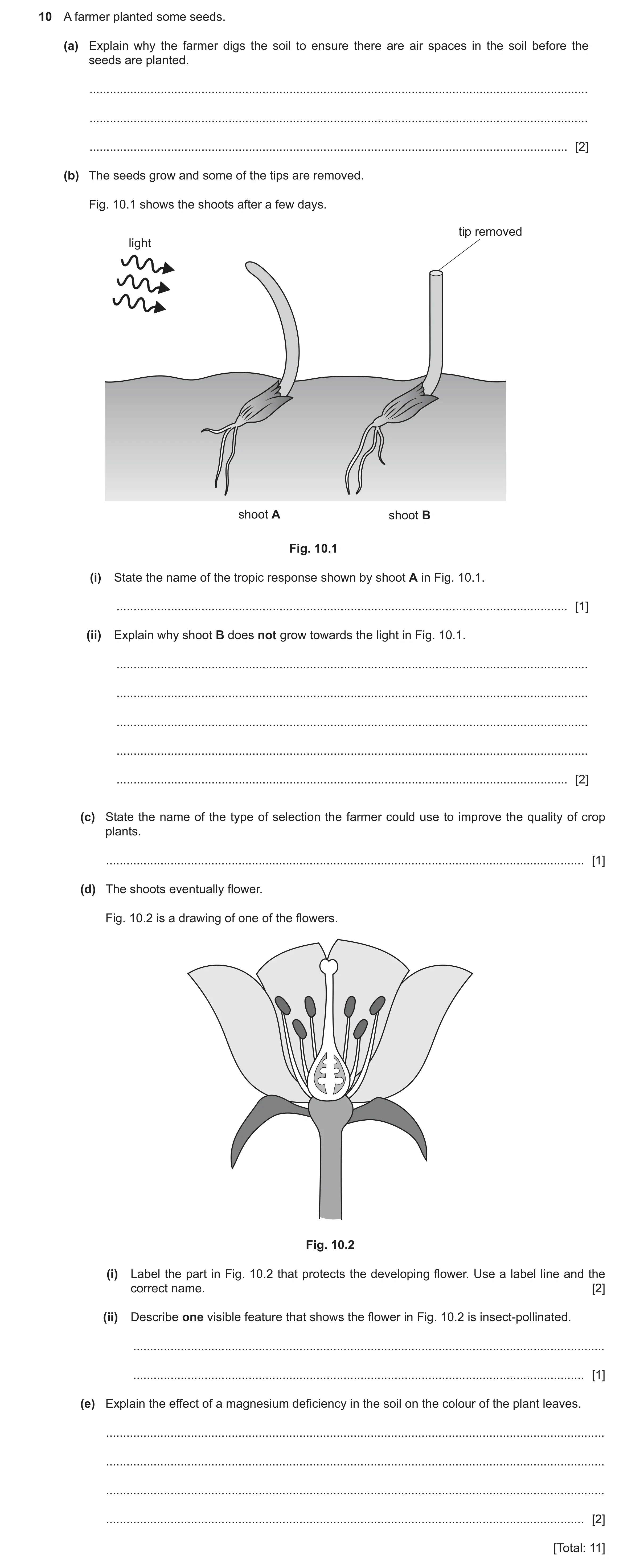
10 A farmer planted some seeds. (a) Explain why the farmer digs the soil to ensure there are air spaces in the soil before the seeds are planted. … … … [2] (b) The seeds grow and some of the tips are removed. Fig. 10.1 shows the shoots after a few days. tip removed light shoot A shoot B Fig. 10.1 (i) State the name of the tropic response shown by shoot A in Fig. 10.1. … [1] (ii) Explain why shoot B does not grow towards the light in Fig. 10.1. … … … … … [2] (c) State the name of the type of selection the farmer could use to improve the quality of crop plants. … [1] (d) The shoots eventually flower. Fig. 10.2 is a drawing of one of the flowers. Fig. 10.2 (i) Label the part in Fig. 10.2 that protects the developing flower. Use a label line and the correct name. [2] (ii) Describe one visible feature that shows the flower in Fig. 10.2 is insect-pollinated. … … [1] (e) Explain the effect of a magnesium deficiency in the soil on the colour of the plant leaves. … … … … [2] [Total: 11]
11 marks
Mark scheme: 10(a) provide oxygen ; 2 for germination ; 10(b)(i) phototropism ; 1 10(b)(ii) auxin is made in the tip only ; 2 so no cell elongation (stimulated) ; 10(c) artificial ; 1 10(d)(i) sepal labelled ;; 2 1 mark for correct part labelled 1 mark for correct name 10(d)(ii) any one from: 1 large petals ; anther / stamen / filament, inside flower ; stigma / style inside flower ; Idea that anther is below the stigma ; 10(e) Less / no, synthesis / making of chlorophyll ; 2 yellow leaves ;
This question in 0654/43 Oct/Nov 2024
 3 / 26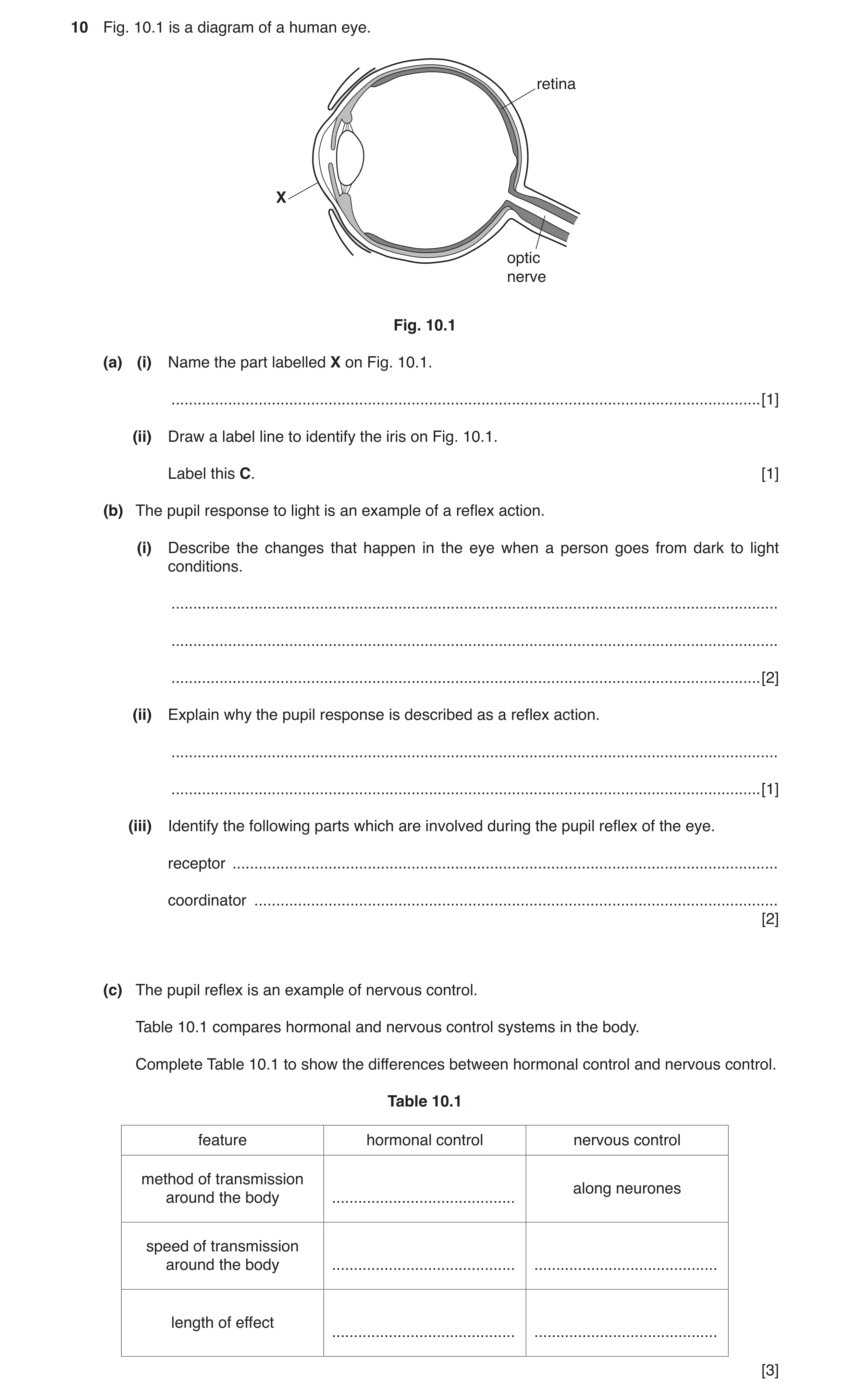
 6 / 26
![Question 5: Fig. 4.1 shows a section through the eye. B C A D H E F G Fig. 4.1 (a) Draw an X on Fig. 4.1 to show the position of the blind spot. [1] (b…](https://img.pastlit.com/crops/11eaa0fa-fa79-4058-9508-78910ea6862b/q4.webp) 7 / 26
7 / 26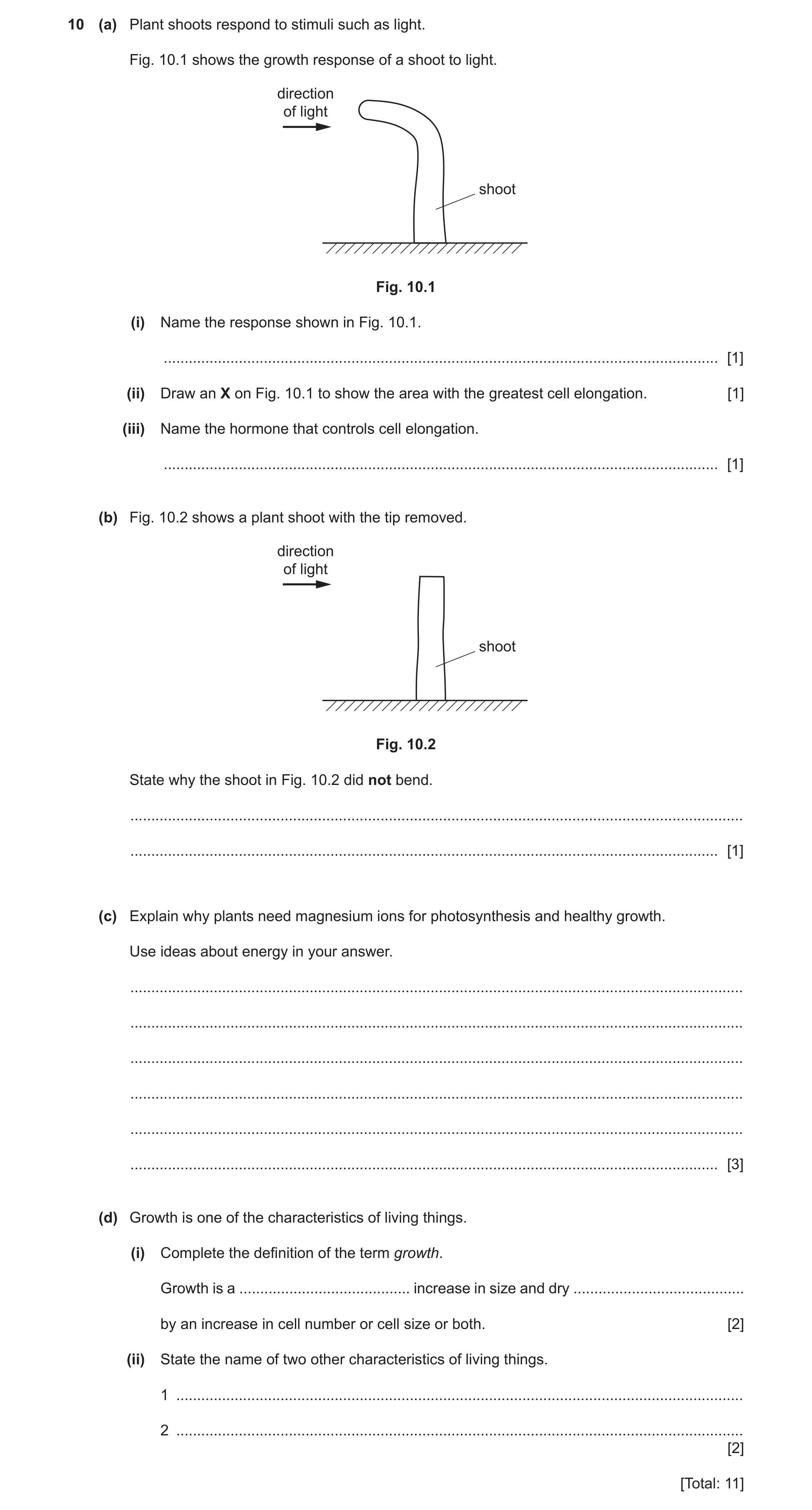
 13 / 26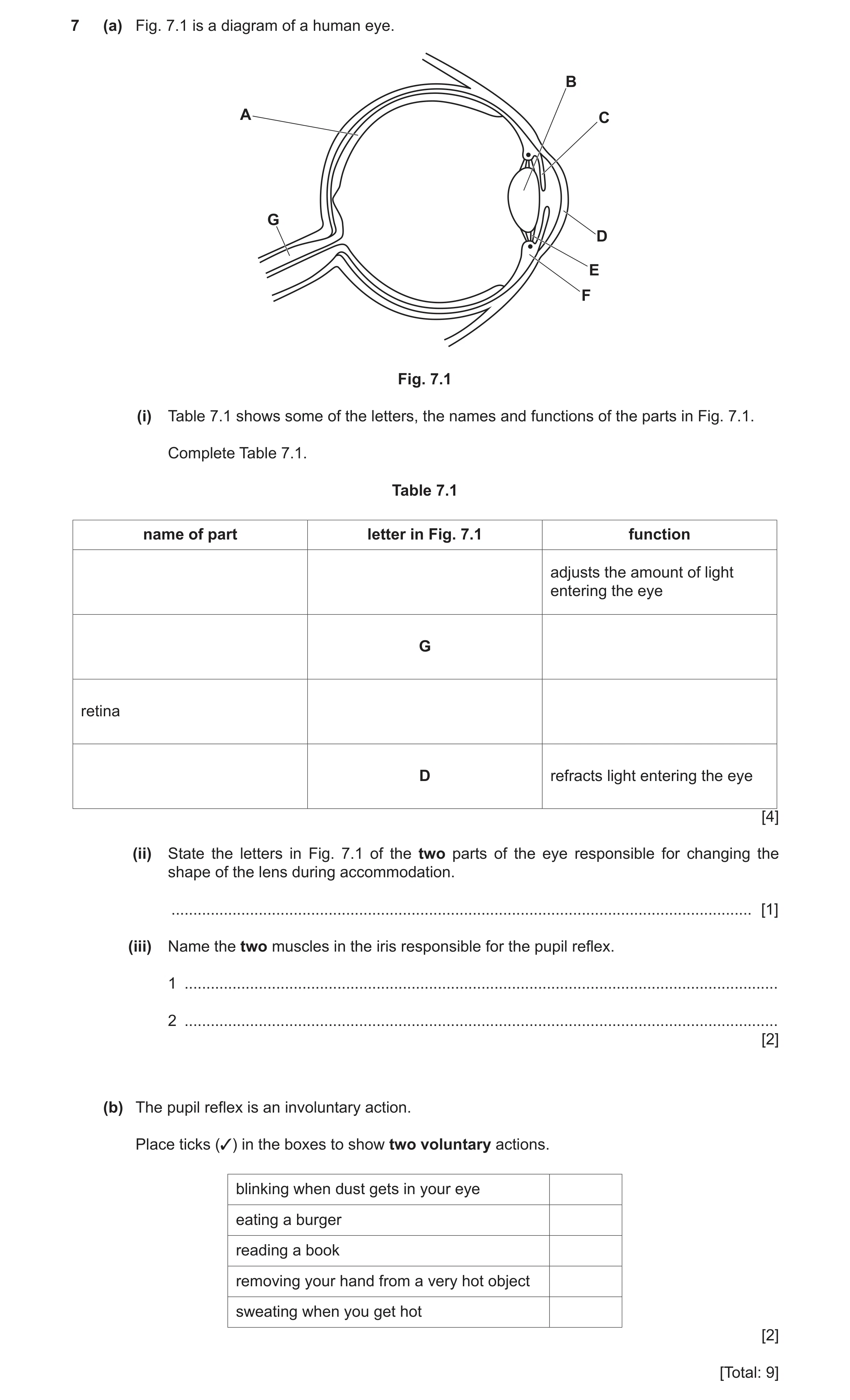
 20 / 26
 21 / 26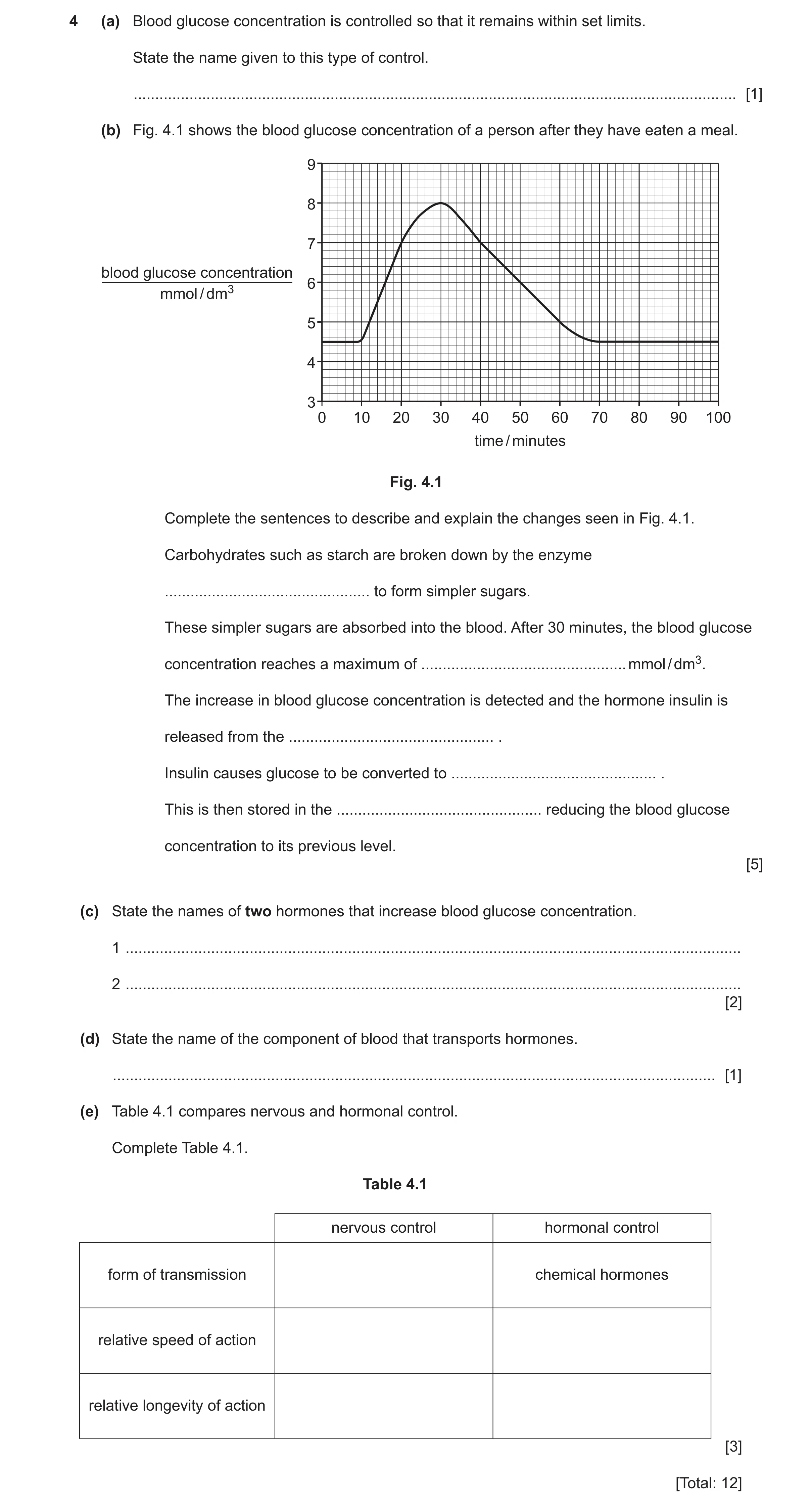
 6
6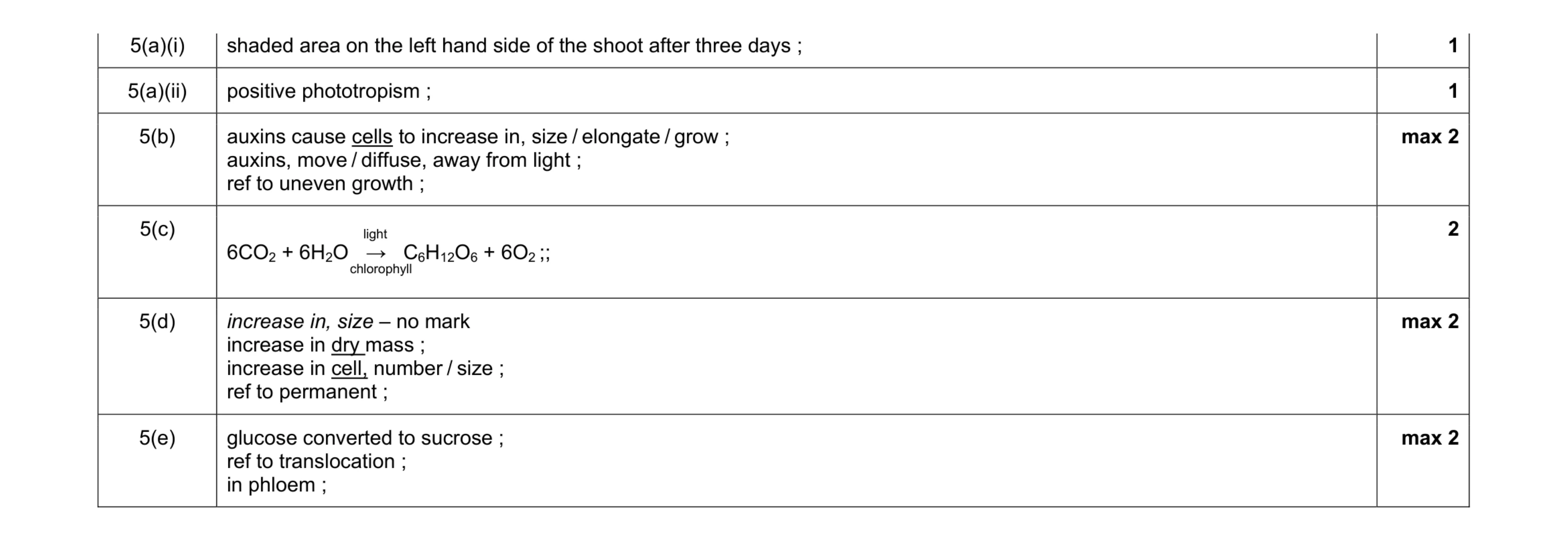 10
10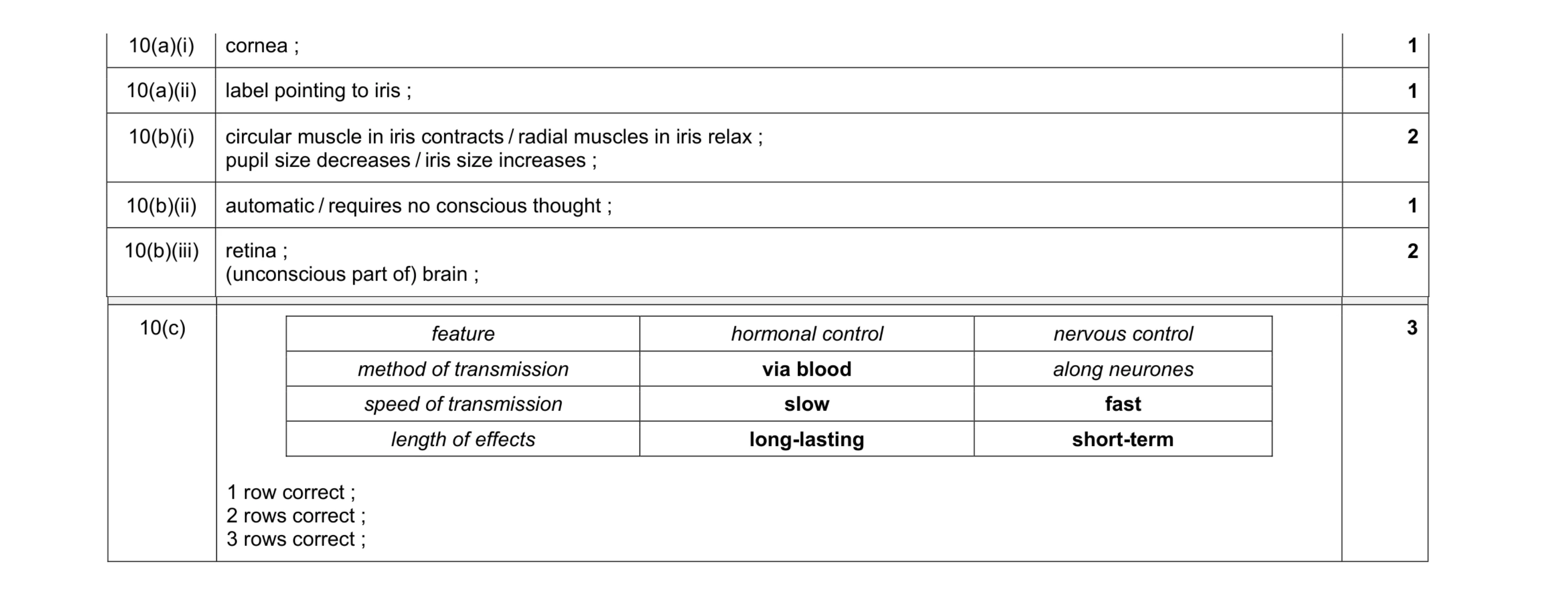 10
10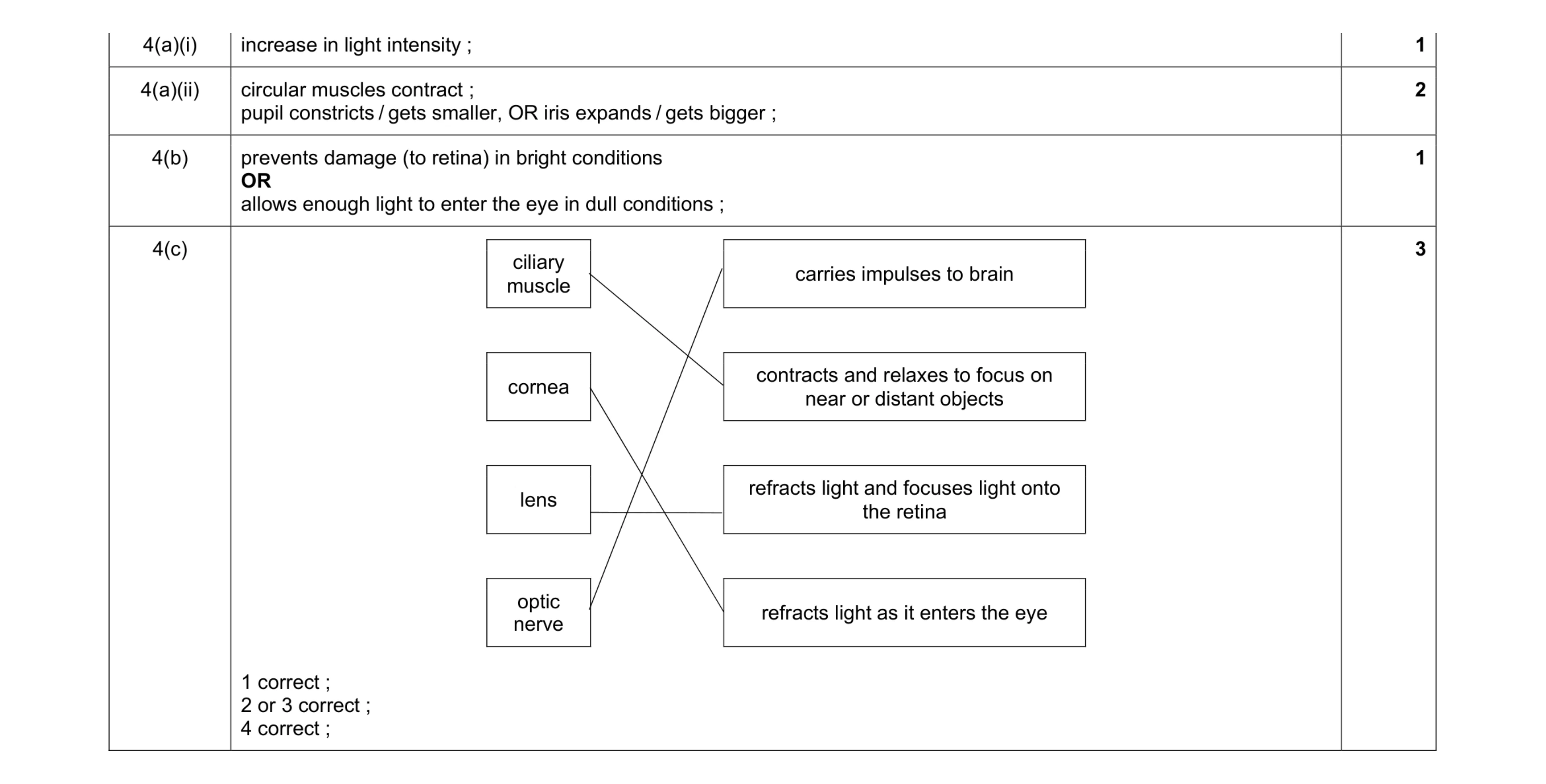 7
7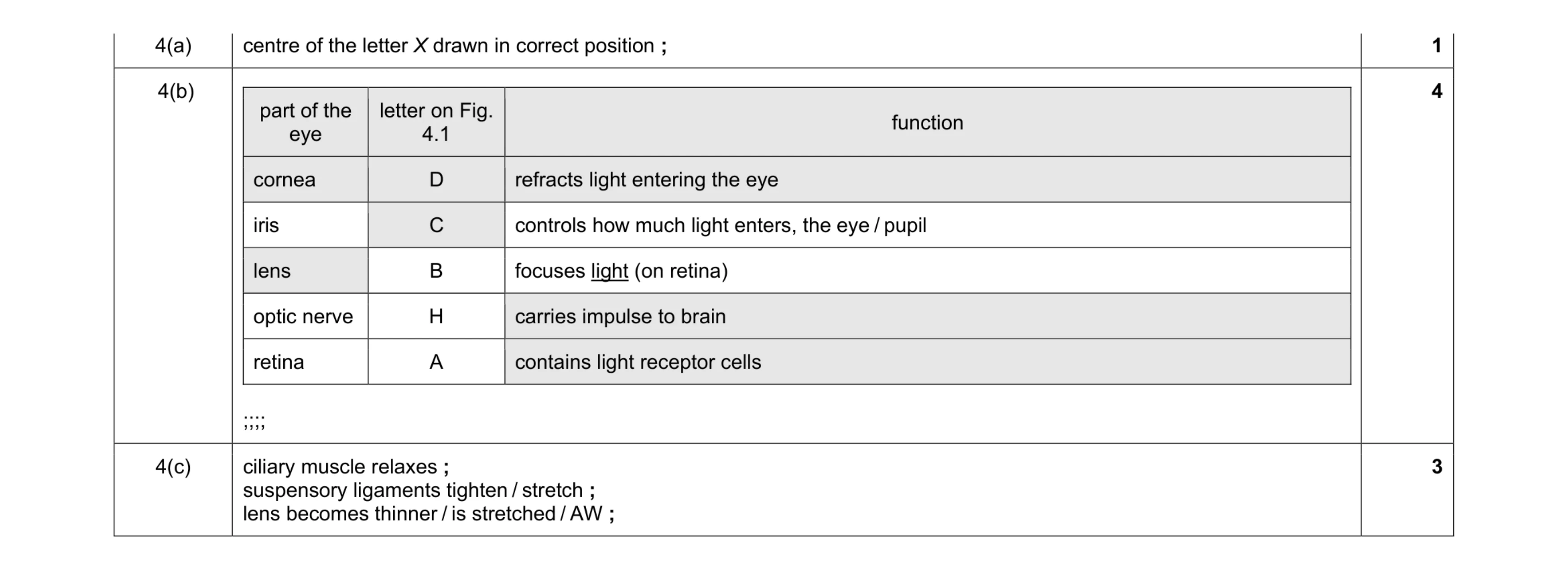 8
8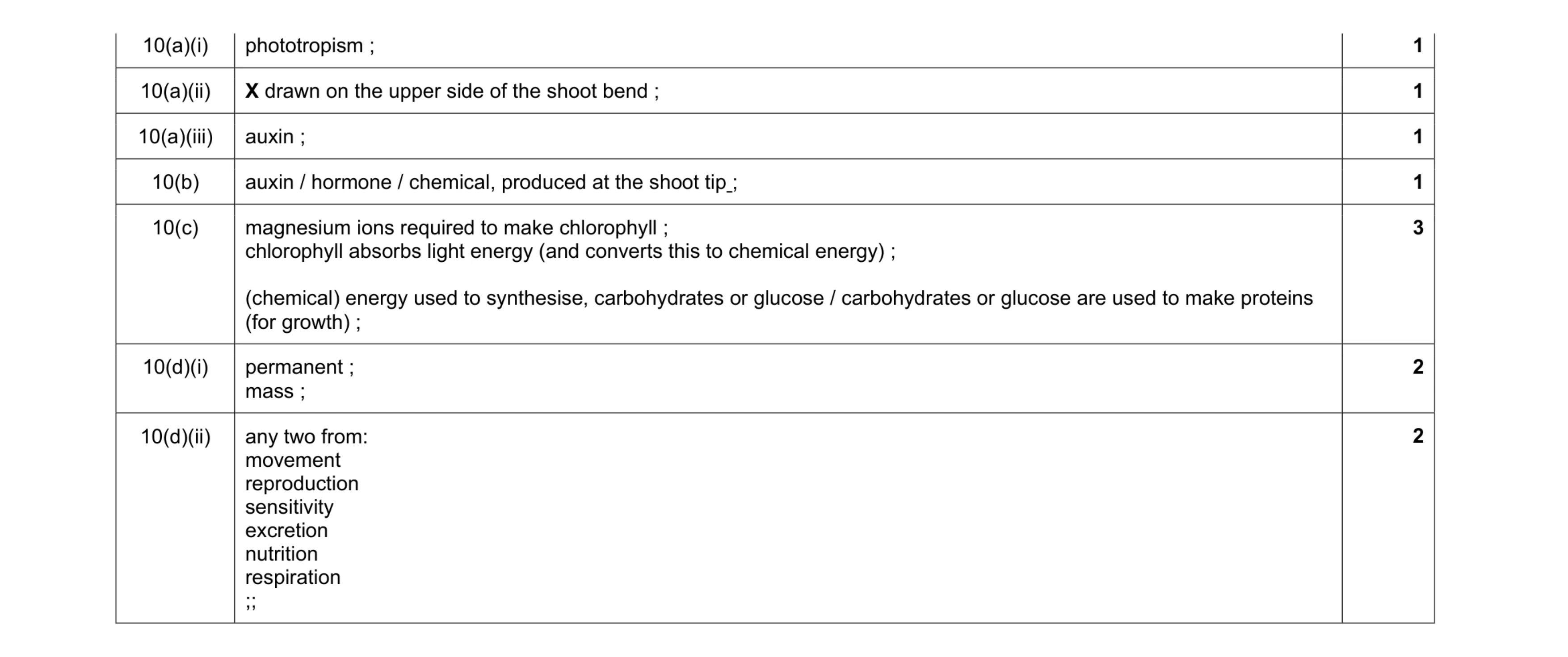 11
11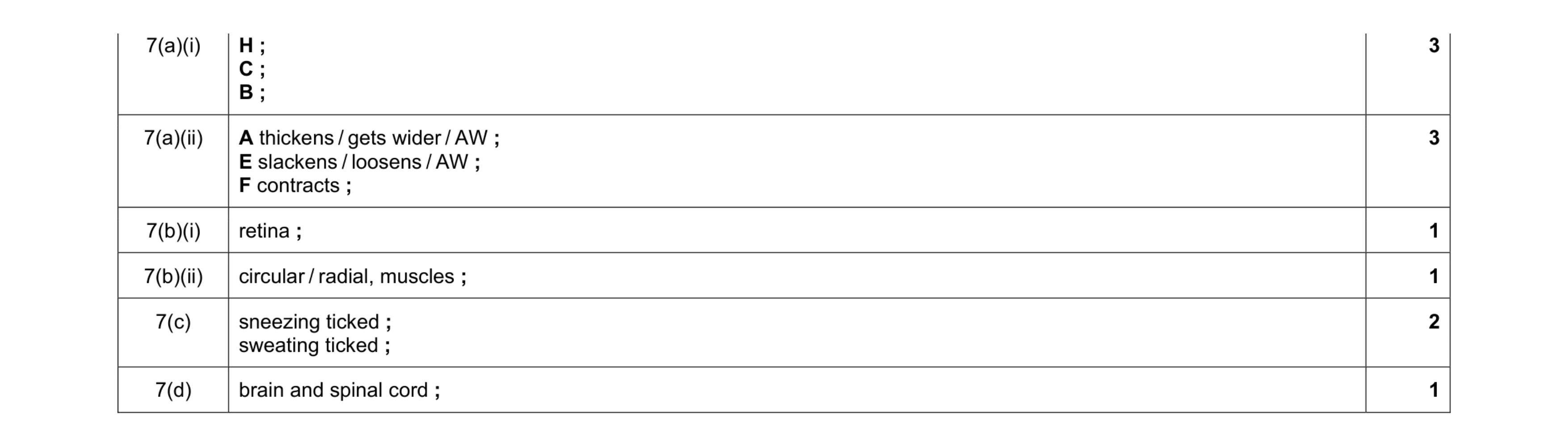 11
11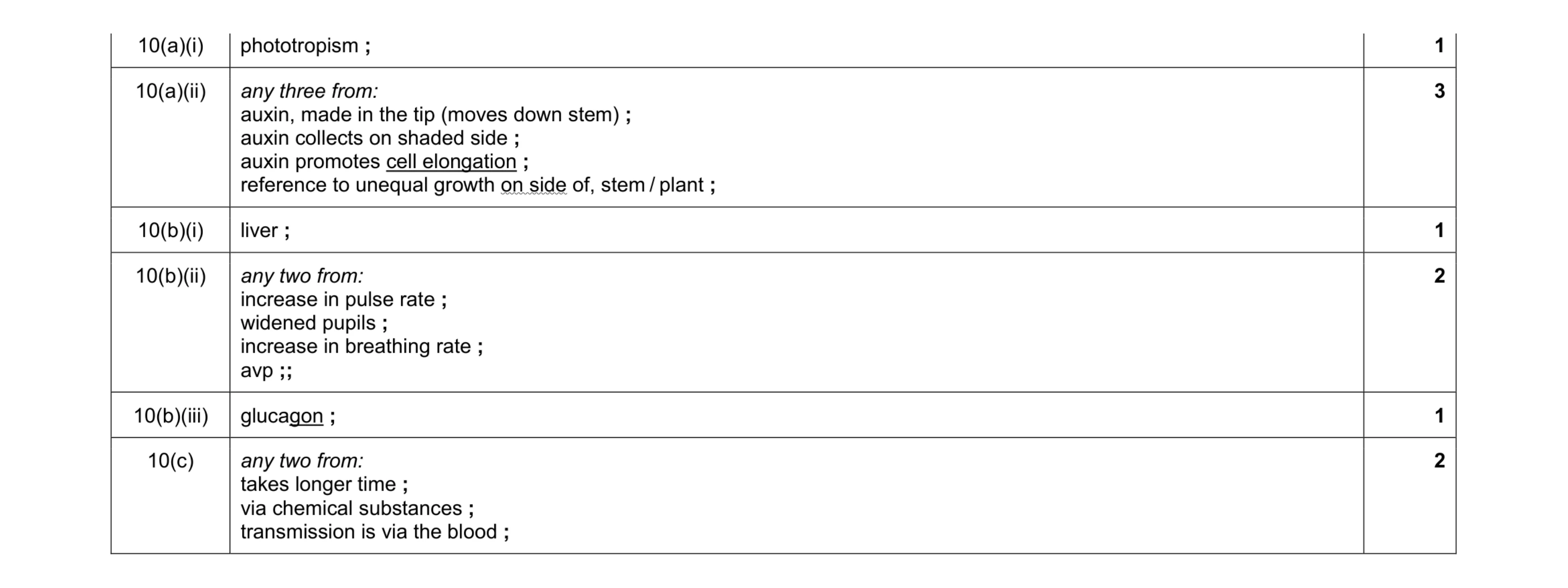 10
10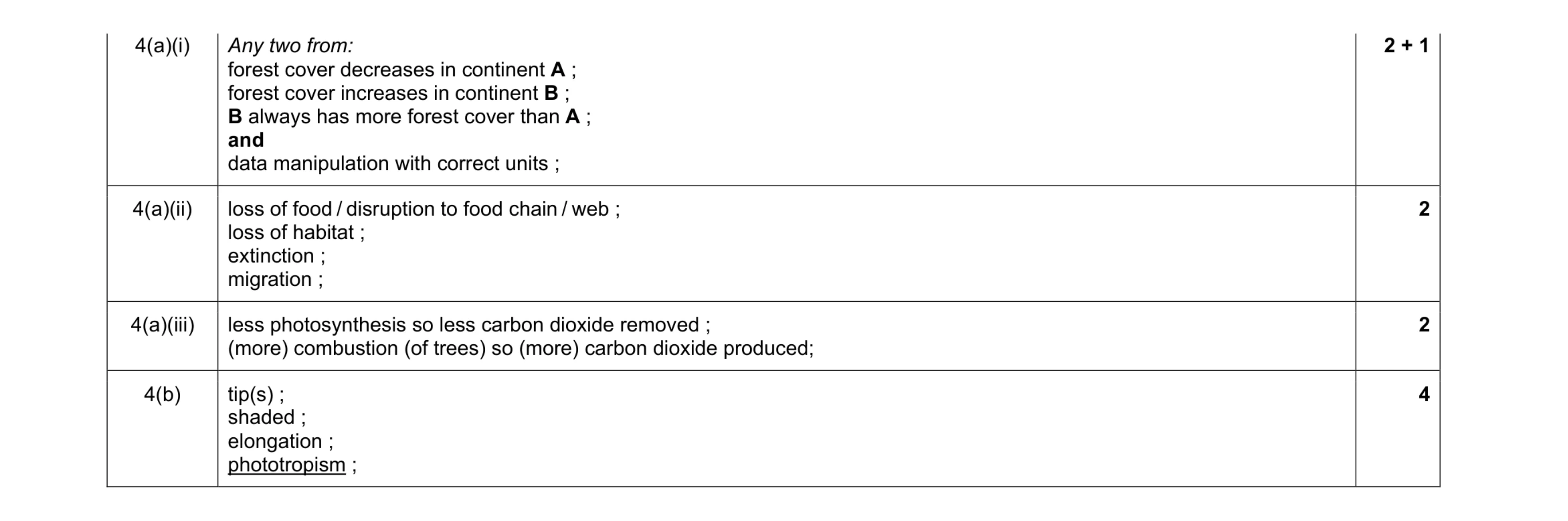 12
12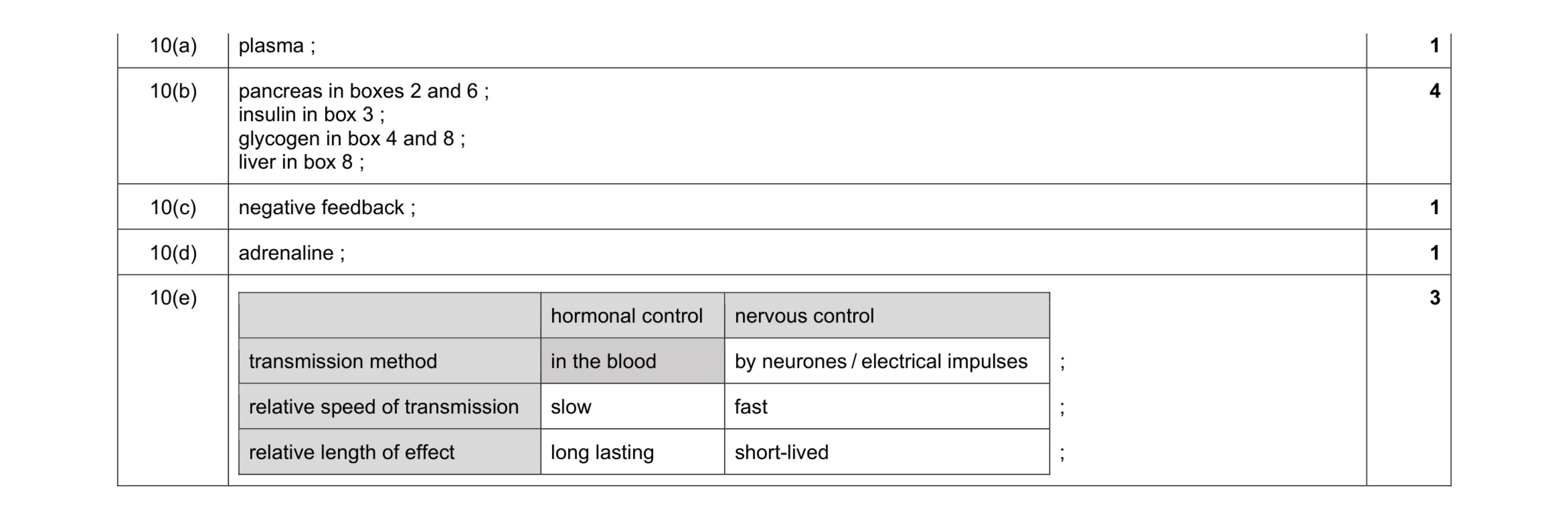 10
10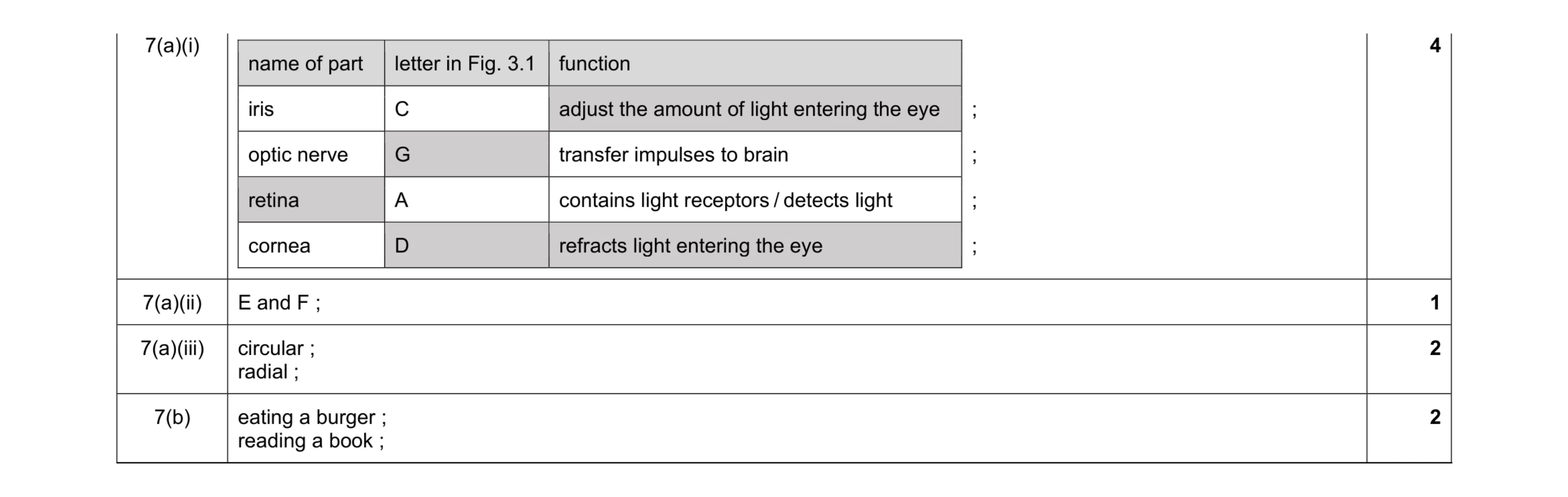 9
9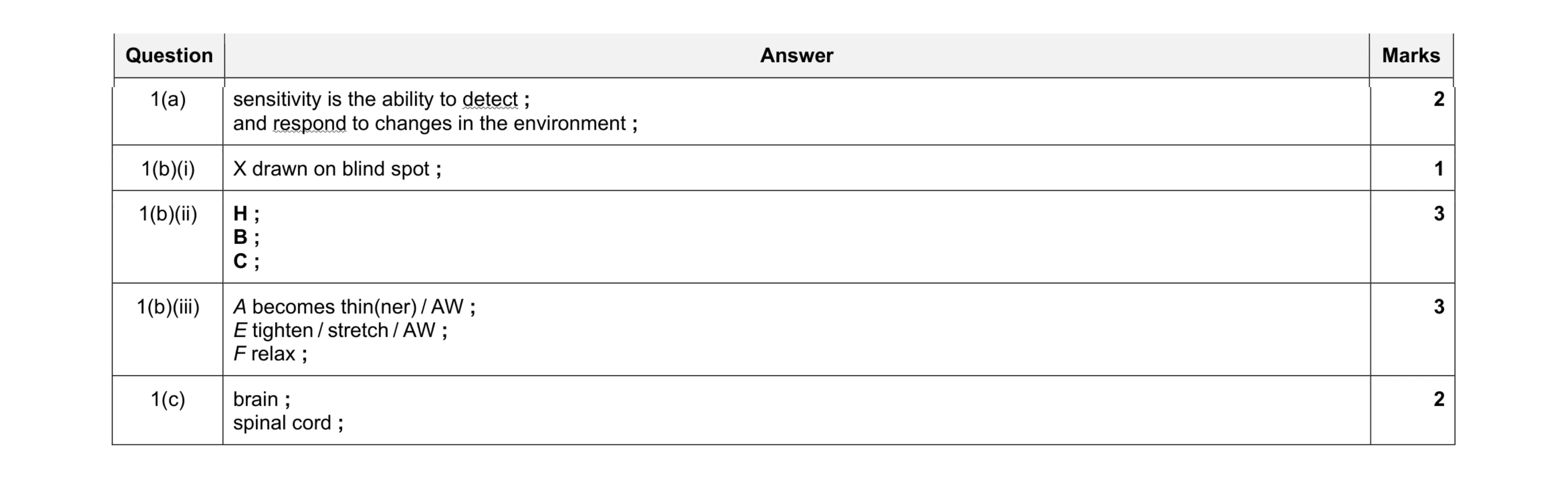 11
11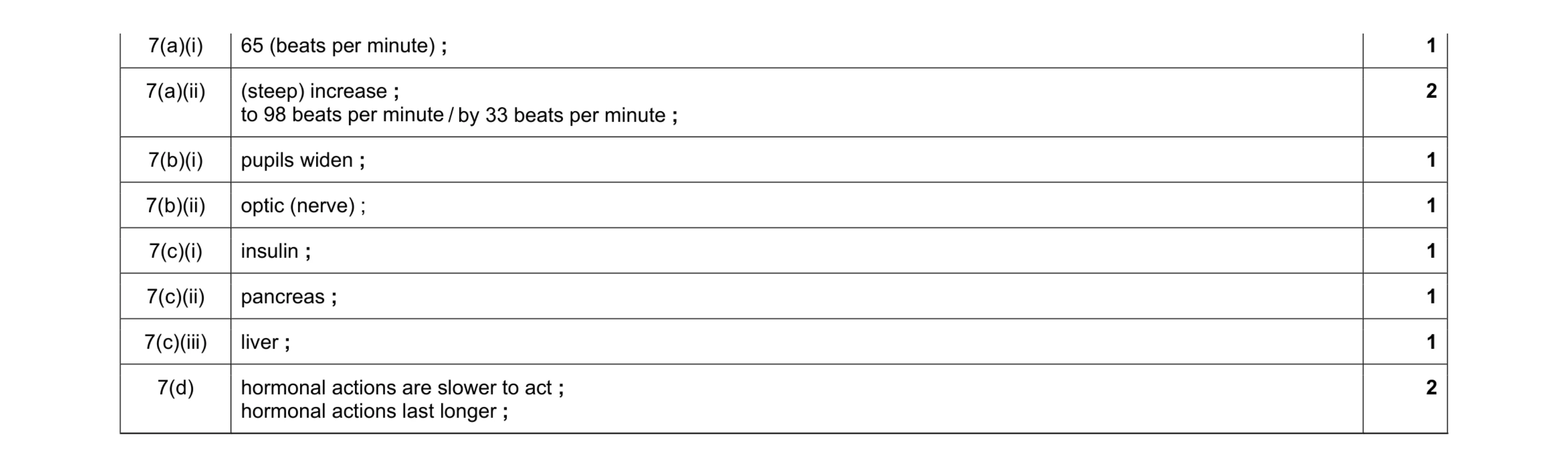 10
10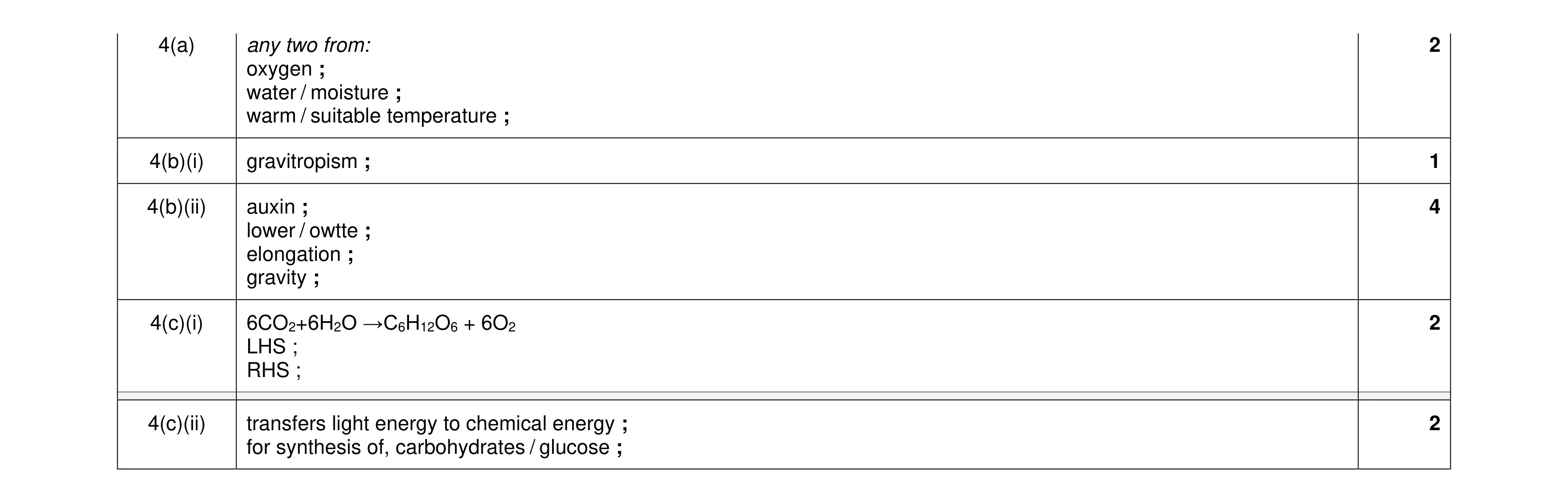 11
11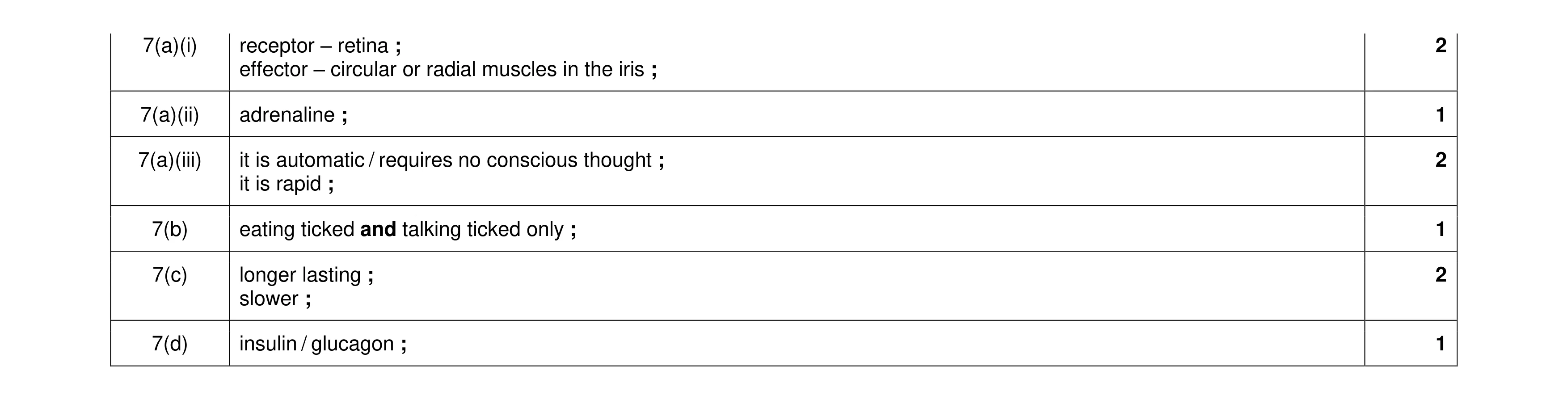 9
9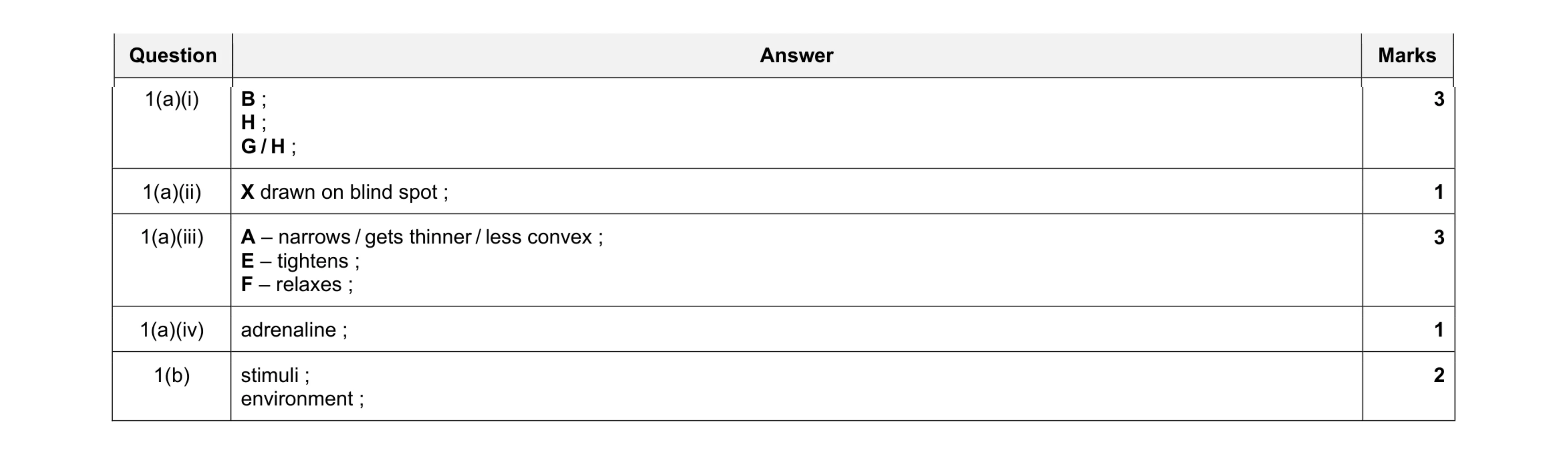 10
10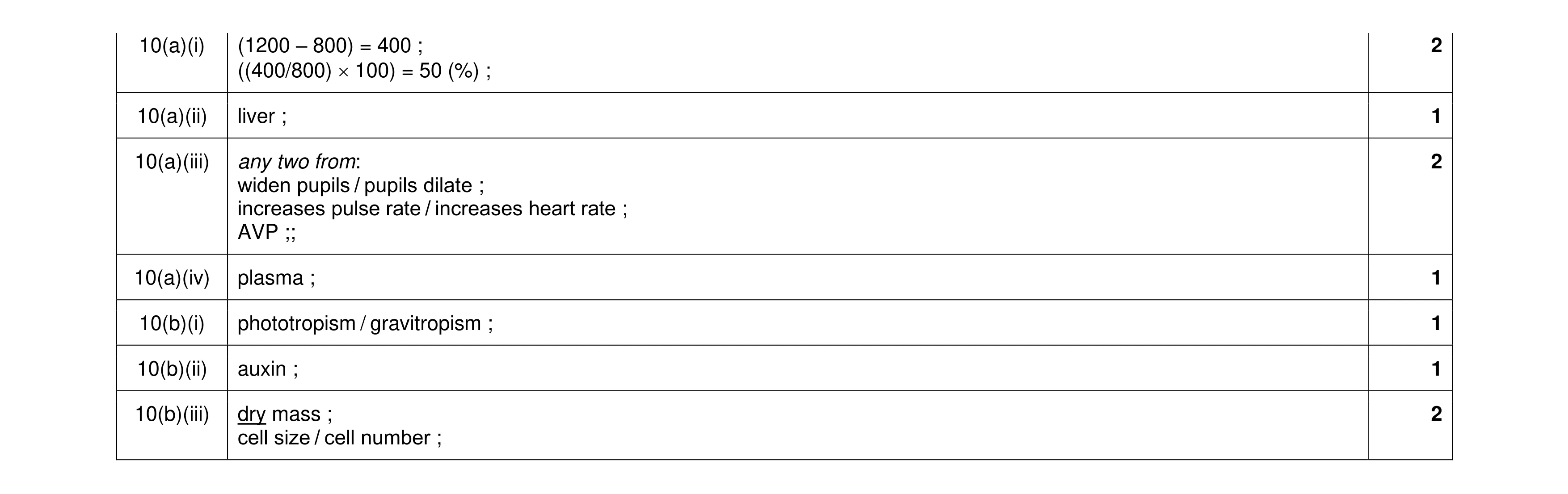 10
10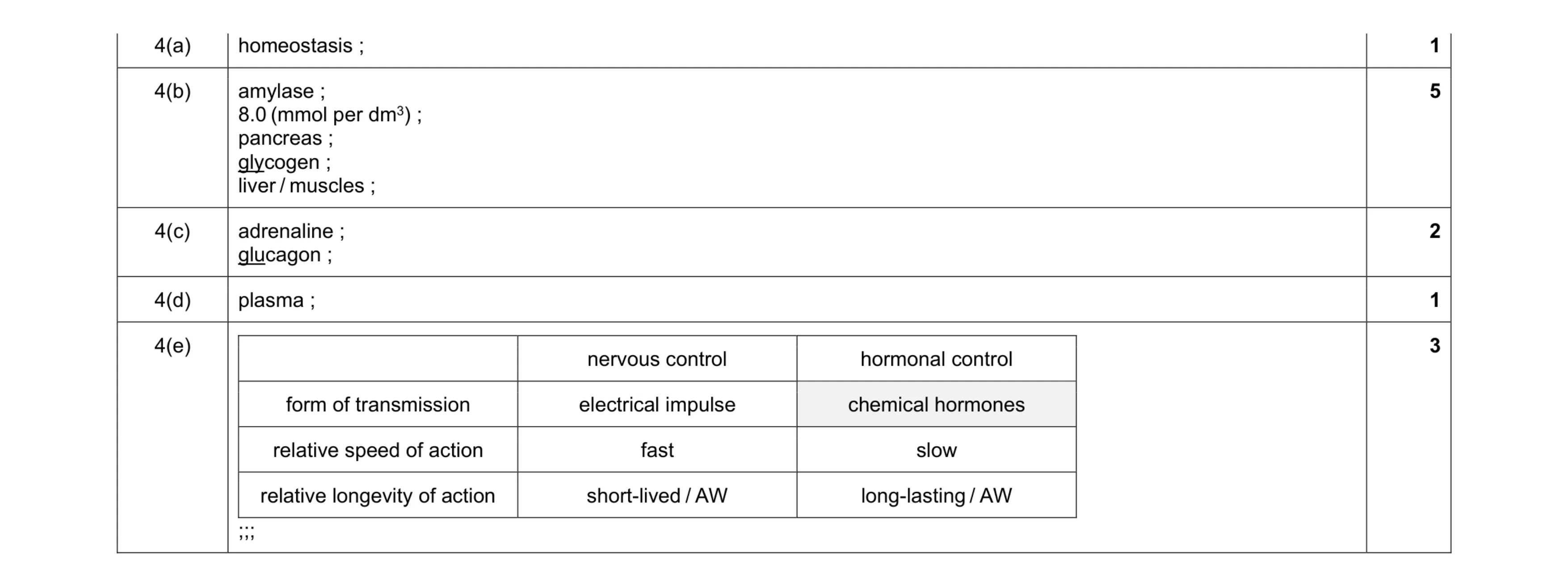 12
12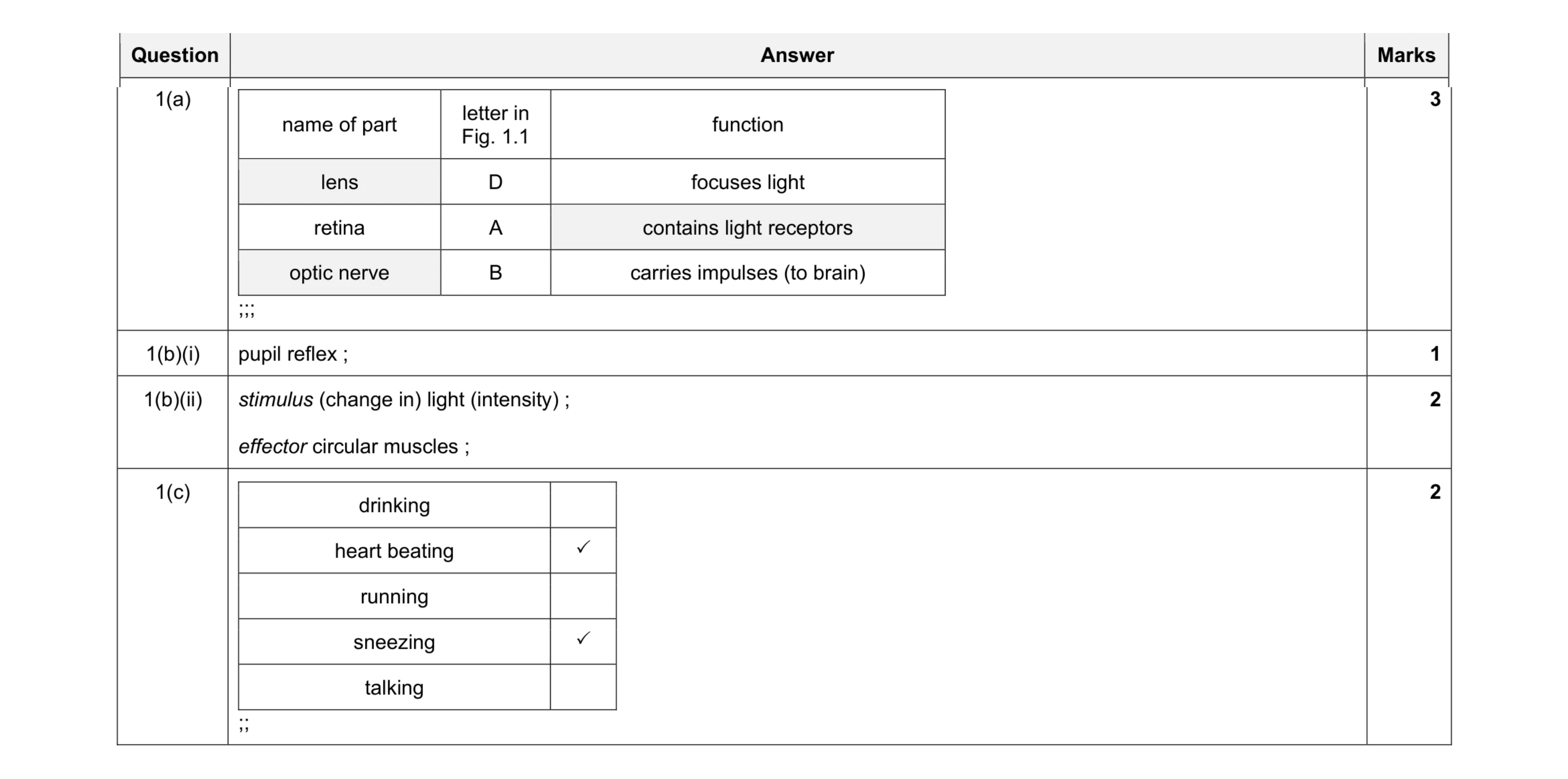 8
8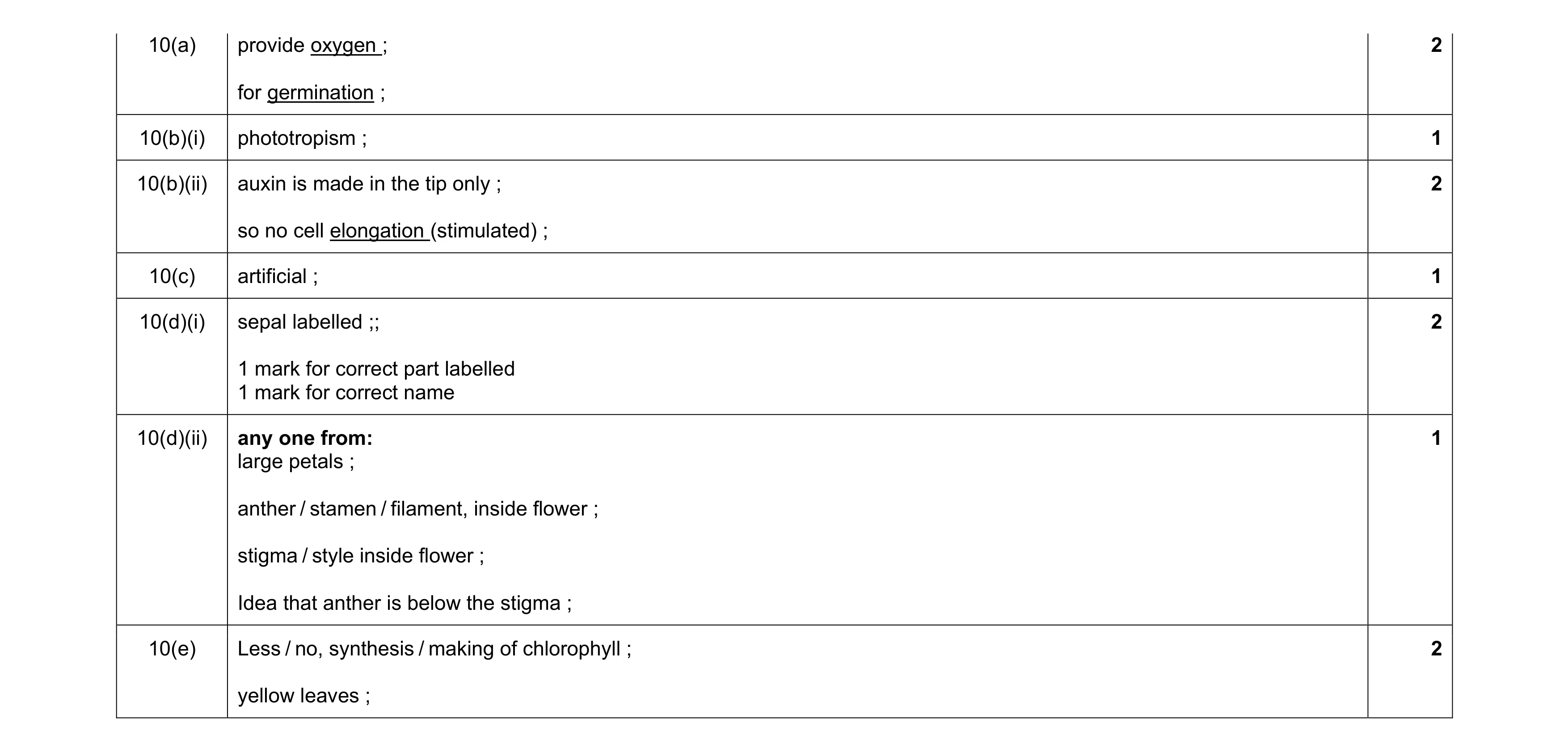 11
11