Questions as text
Q1 · A person touches a hot saucepan and immediately removes their hand 0654/31 Oct/Nov 2017
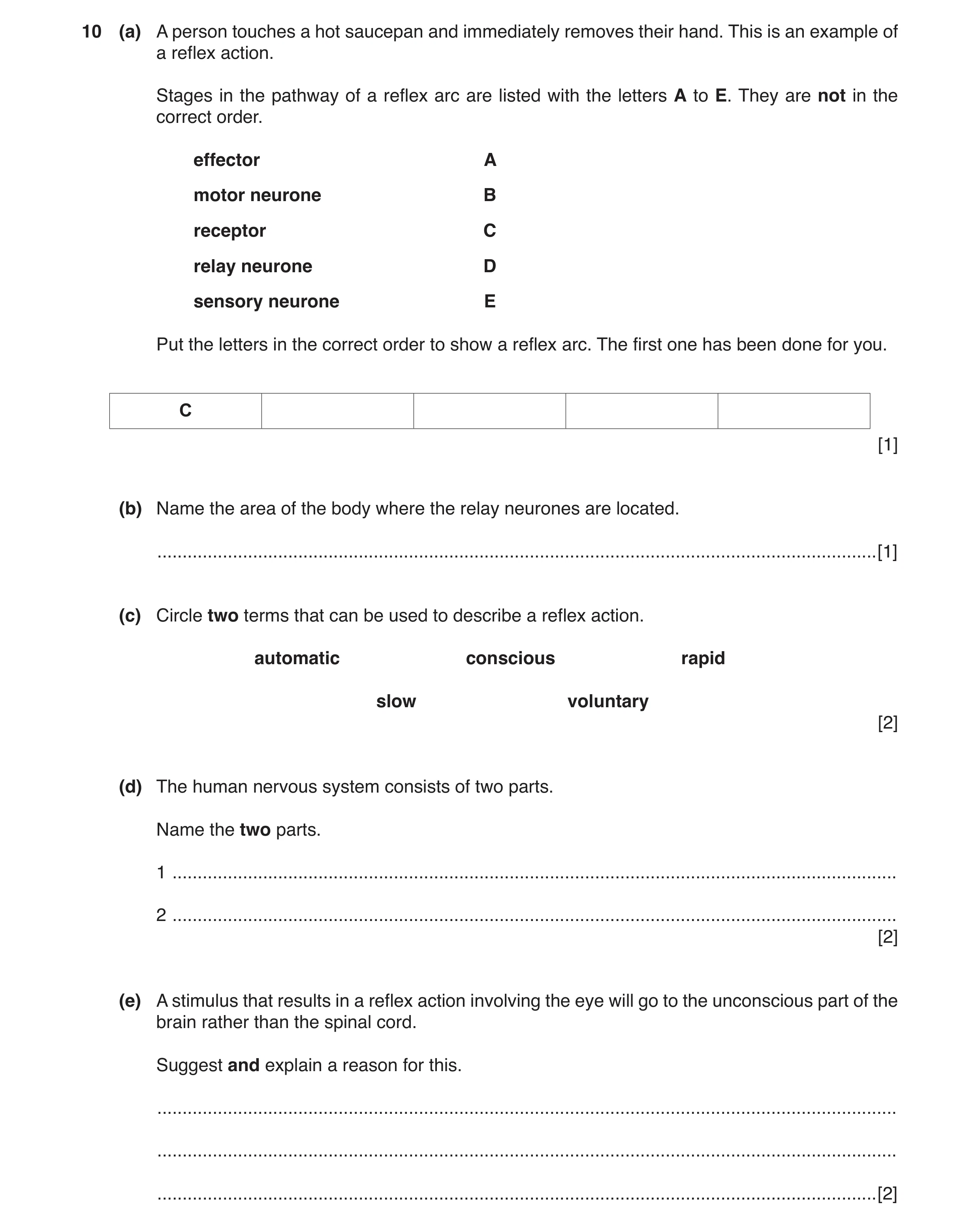
10 (a) A person touches a hot saucepan and immediately removes their hand. This is an example of a reflex action. Stages in the pathway of a reflex arc are listed with the letters A to E. They are not in the correct order. effector A motor neurone B receptor C relay neurone D sensory neurone E Put the letters in the correct order to show a reflex arc. The first one has been done for you. C [1] (b) Name the area of the body where the relay neurones are located. … [1] (c) Circle two terms that can be used to describe a reflex action. automatic conscious rapid slow voluntary [2] (d) The human nervous system consists of two parts. Name the two parts. 1 … 2 … [2] (e) A stimulus that results in a reflex action involving the eye will go to the unconscious part of the brain rather than the spinal cord. Suggest and explain a reason for this. … … … [2]
8 marks
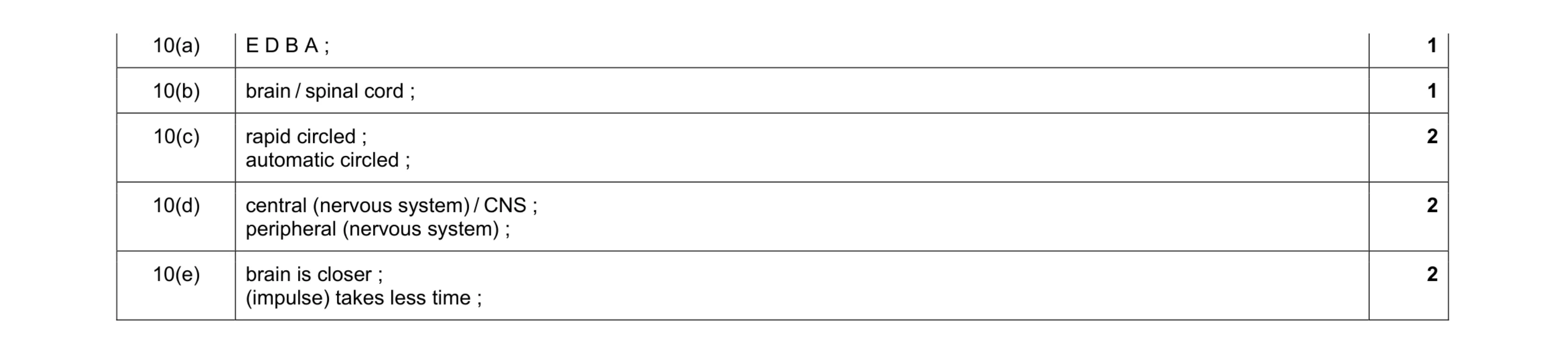
Mark scheme: 10(a) E D B A ; 1 10(b) brain / spinal cord ; 1 10(c) rapid circled ; automatic circled ; 2 10(d) central (nervous system) / CNS ; peripheral (nervous system) ; 2 10(e) brain is closer ; (impulse) takes less time ; 2
This question in 0654/31 Oct/Nov 2017
Q2 · A photograph of a germinating pea seed 0654/32 Oct/Nov 2017
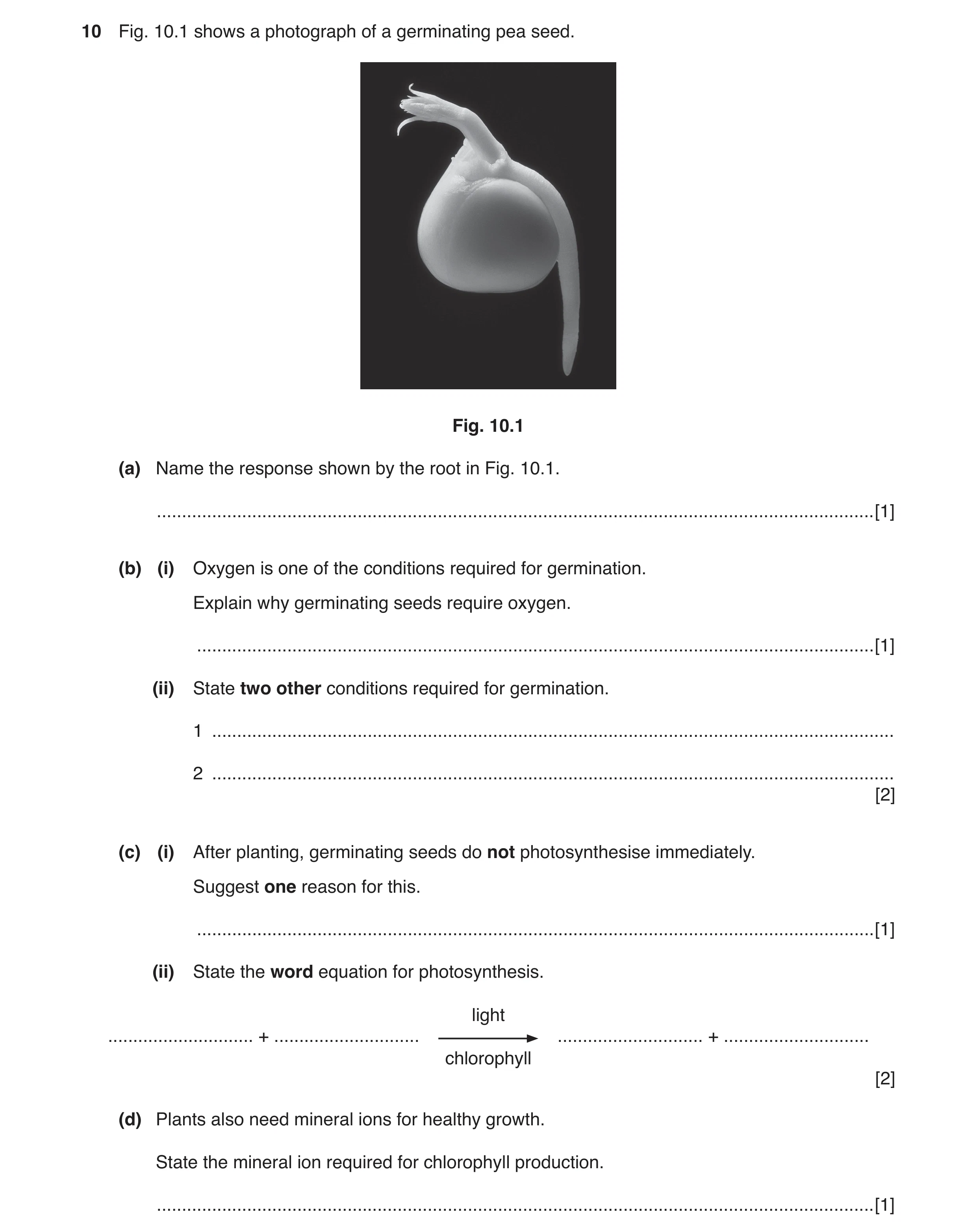
10 Fig. 10.1 shows a photograph of a germinating pea seed. Fig. 10.1 (a) Name the response shown by the root in Fig. 10.1. … [1] (b) (i) Oxygen is one of the conditions required for germination. Explain why germinating seeds require oxygen. … [1] (ii) State two other conditions required for germination. 1 … 2 … [2] (c) (i) After planting, germinating seeds do not photosynthesise immediately. Suggest one reason for this. … [1] (ii) State the word equation for photosynthesis. light … + … … + … chlorophyll [2] (d) Plants also need mineral ions for healthy growth. State the mineral ion required for chlorophyll production. … [1]
8 marks
Mark scheme: 10(a) geotropism ; 1 10(b)(i) respiration ; 1 10(b)(ii) moisture / water ; warm (temperature) / suitable temperature ; 2 10(c)(i) (seedling is) underground / no light ; 1 10(c)(ii) LHS carbon dioxide + water ; RHS glucose + oxygen ; 2 10(d) magnesium ; 1
This question in 0654/32 Oct/Nov 2017
Q3 · A diagram of a cross‑section of the skin 0654/32 Oct/Nov 2018
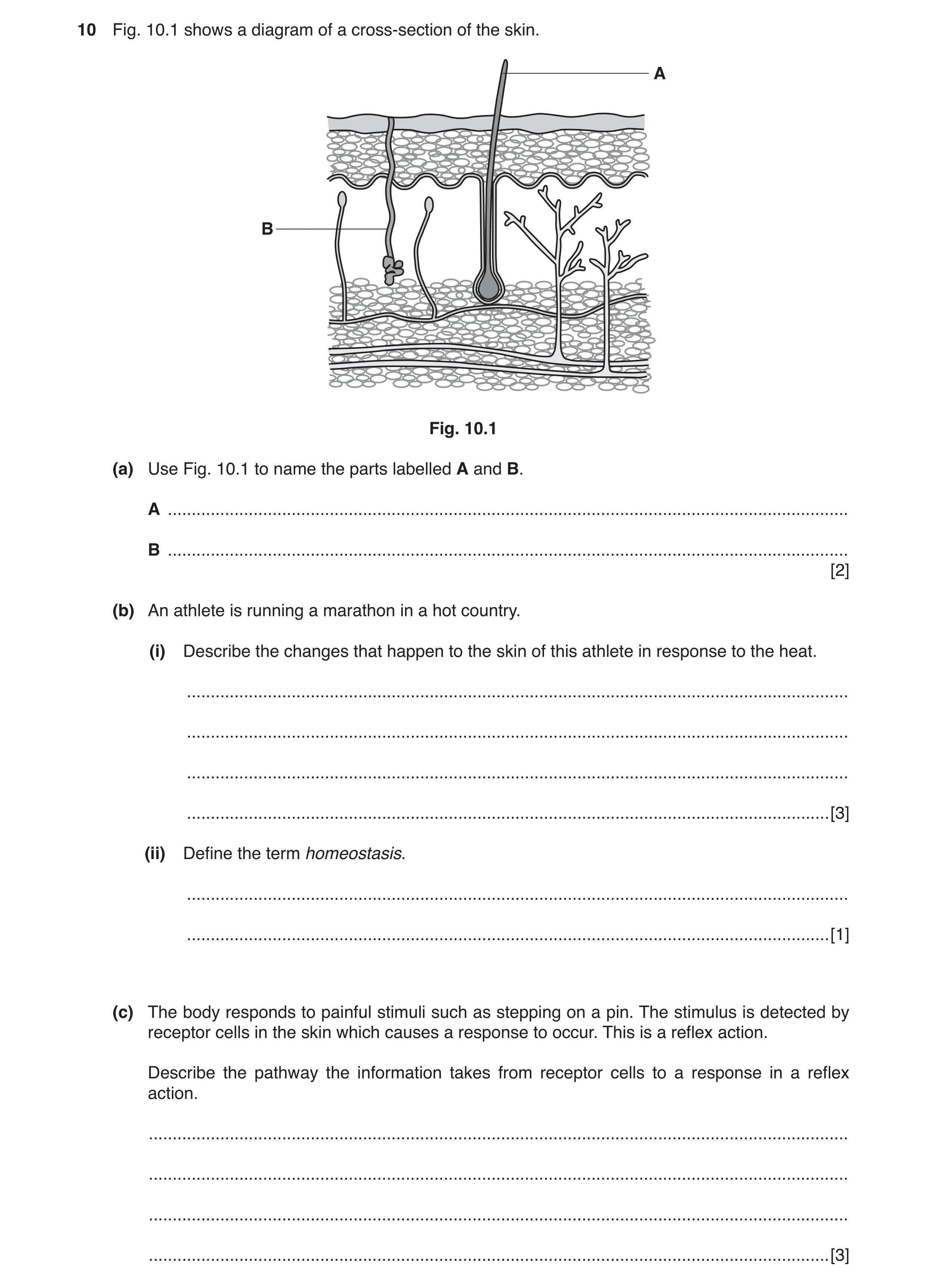
10 Fig. 10.1 shows a diagram of a cross‑section of the skin. A B Fig. 10.1 (a) Use Fig. 10.1 to name the parts labelled A and B. A … B … [2] (b) An athlete is running a marathon in a hot country. (i) Describe the changes that happen to the skin of this athlete in response to the heat. … … … … [3] (ii) Define the term homeostasis. … … [1] (c) The body responds to painful stimuli such as stepping on a pin. The stimulus is detected by receptor cells in the skin which causes a response to occur. This is a reflex action. Describe the pathway the information takes from receptor cells to a response in a reflex action. … … … … [3]
9 marks
Mark scheme: 10(a) A hair; B sweat gland; 2 10(b)(i) sweating; vasodilation / more blood goes to surface of the skin; goes red / gets hot; hair lies flat; max 3 10(b)(ii) maintenance of constant internal environment; 1 10(c) ref to central nervous system (CNS); sensory → relay → motor; ref to effector / muscle / gland; 3
This question in 0654/32 Oct/Nov 2018
Q4 · A diagram showing a simple reflex arc 0654/32 Oct/Nov 2019
10 (a) Fig. 10.1 is a diagram showing a simple reflex arc. central nervous system (CNS) receptor sensory neurone relay neurone effector motor neurone Fig. 10.1 (i) If a neurone is cut, impulses cannot pass along the neurone. Place only two ticks (3) in Table 10.1 to show the correct effect of cutting each neurone in the reflex arc shown in Fig. 10.1. Table 10.1 sensory neurone motor neurone cut cut CNS does not receive impulses from the receptor and effector does not receive impulses from CNS. CNS receives impulses from the receptor and effector receives impulses from CNS. CNS receives impulses from the receptor but effector does not receive impulses from CNS. [2] (ii) Circle all the words that can be used to describe a reflex action. automatic chemical conscious rapid slow [2] (b) State how impulses are passed along a neurone. … … [1] (c) Name the two parts of the central nervous system. 1 … 2 … [2] (d) Muscles are one example of an effector. Name another example of an effector. … [1] [Total: 8]
8 marks
Mark scheme: 10(a)(i) sensory neurone cut motor neurone cut ✓ ✓ ;; 2 10(a)(ii) automatic circled ; rapid circled ; 2 10(b) in the form of an electrical signal ; 1 10(c) brain ; spinal cord ; 2 10(d) gland ; 1
This question in 0654/32 Oct/Nov 2019
Q5 · A student investigates the conditions that affect germination of seeds 0654/32 May/June 2020
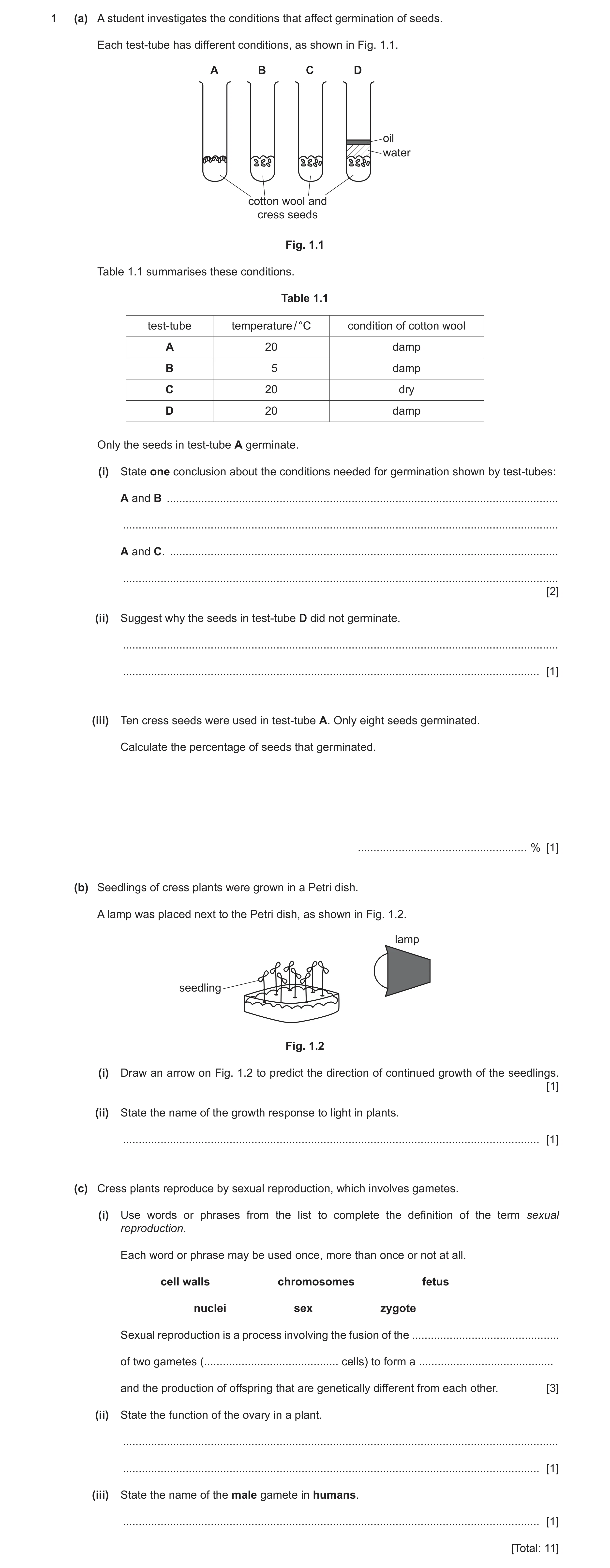
1 (a) A student investigates the conditions that affect germination of seeds. Each test-tube has different conditions, as shown in Fig. 1.1. A B C D oil water cotton wool and cress seeds Fig. 1.1 Table 1.1 summarises these conditions. Table 1.1 test-tube temperature / °C condition of cotton wool A 20 damp B 5 damp C 20 dry D 20 damp Only the seeds in test-tube A germinate. (i) State one conclusion about the conditions needed for germination shown by test-tubes: A and B … … A and C. … … [2] (ii) Suggest why the seeds in test-tube D did not germinate. … … [1] (iii) Ten cress seeds were used in test-tube A. Only eight seeds germinated. Calculate the percentage of seeds that germinated. … % [1] (b) Seedlings of cress plants were grown in a Petri dish. A lamp was placed next to the Petri dish, as shown in Fig. 1.2. lamp seedling Fig. 1.2 (i) Draw an arrow on Fig. 1.2 to predict the direction of continued growth of the seedlings. [1] (ii) State the name of the growth response to light in plants. … [1] (c) Cress plants reproduce by sexual reproduction, which involves gametes. (i) Use words or phrases from the list to complete the definition of the term sexual reproduction. Each word or phrase may be used once, more than once or not at all. cell walls chromosomes fetus nuclei sex zygote Sexual reproduction is a process involving the fusion of the … of two gametes ( … cells) to form a … and the production of offspring that are genetically different from each other. [3] (ii) State the function of the ovary in a plant. … … [1] (iii) State the name of the male gamete in humans. … [1] [Total: 11]
11 marks
Mark scheme: 1(a)(i) warmth / suitable temperature required for germination ; moisture / water required for germination ; 2 1(a)(ii) no oxygen ; 1 1(a)(iii) ( ) 8 100 80 % ; 10 × = 1 1(b)(i) draw an arrow going from left to right ; 1 1(b)(ii) phototropism ; 1 1(c)(i) nuclei ; sex ; zygote ; 3 1(c)(ii) contains ovules / site of fertilisation / produces ovules ; 1 1(c)(iii) sperm ; 1
This question in 0654/32 May/June 2020
Q6 · A student investigates the conditions that affect germination of seeds 0654/33 May/June 2020
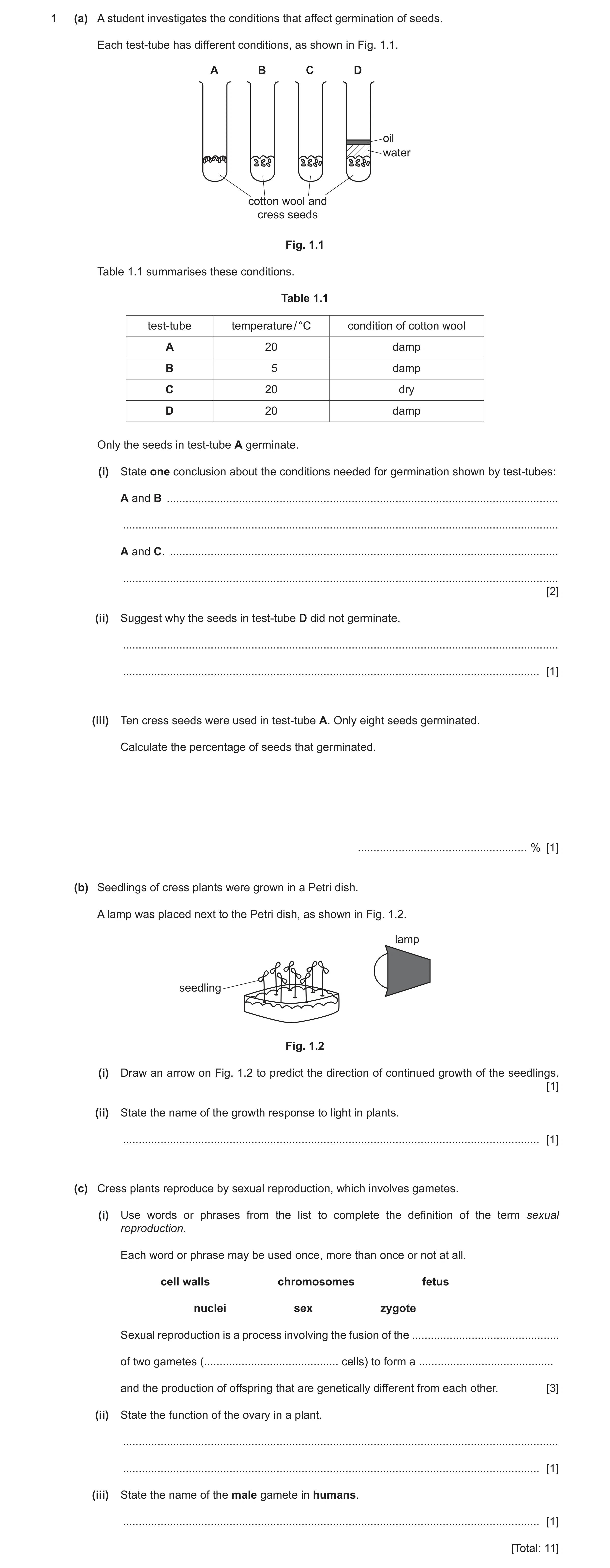
1 (a) A student investigates the conditions that affect germination of seeds. Each test-tube has different conditions, as shown in Fig. 1.1. A B C D oil water cotton wool and cress seeds Fig. 1.1 Table 1.1 summarises these conditions. Table 1.1 test-tube temperature / °C condition of cotton wool A 20 damp B 5 damp C 20 dry D 20 damp Only the seeds in test-tube A germinate. (i) State one conclusion about the conditions needed for germination shown by test-tubes: A and B … … A and C. … … [2] (ii) Suggest why the seeds in test-tube D did not germinate. … … [1] (iii) Ten cress seeds were used in test-tube A. Only eight seeds germinated. Calculate the percentage of seeds that germinated. … % [1] (b) Seedlings of cress plants were grown in a Petri dish. A lamp was placed next to the Petri dish, as shown in Fig. 1.2. lamp seedling Fig. 1.2 (i) Draw an arrow on Fig. 1.2 to predict the direction of continued growth of the seedlings. [1] (ii) State the name of the growth response to light in plants. … [1] (c) Cress plants reproduce by sexual reproduction, which involves gametes. (i) Use words or phrases from the list to complete the definition of the term sexual reproduction. Each word or phrase may be used once, more than once or not at all. cell walls chromosomes fetus nuclei sex zygote Sexual reproduction is a process involving the fusion of the … of two gametes ( … cells) to form a … and the production of offspring that are genetically different from each other. [3] (ii) State the function of the ovary in a plant. … … [1] (iii) State the name of the male gamete in humans. … [1] [Total: 11]
11 marks
Mark scheme: 1(a)(i) warmth / suitable temperature required for germination ; moisture / water required for germination ; 2 1(a)(ii) no oxygen ; 1 1(a)(iii) ( ) 8 100 80 % ; 10 × = 1 1(b)(i) draw an arrow going from left to right ; 1 1(b)(ii) phototropism ; 1 1(c)(i) nuclei ; sex ; zygote ; 3 1(c)(ii) contains ovules / site of fertilisation / produces ovules ; 1 1(c)(iii) sperm ; 1
This question in 0654/33 May/June 2020
Q7 · Complete the sentences about the nervous system using words from the list 0654/31 Oct/Nov 2020
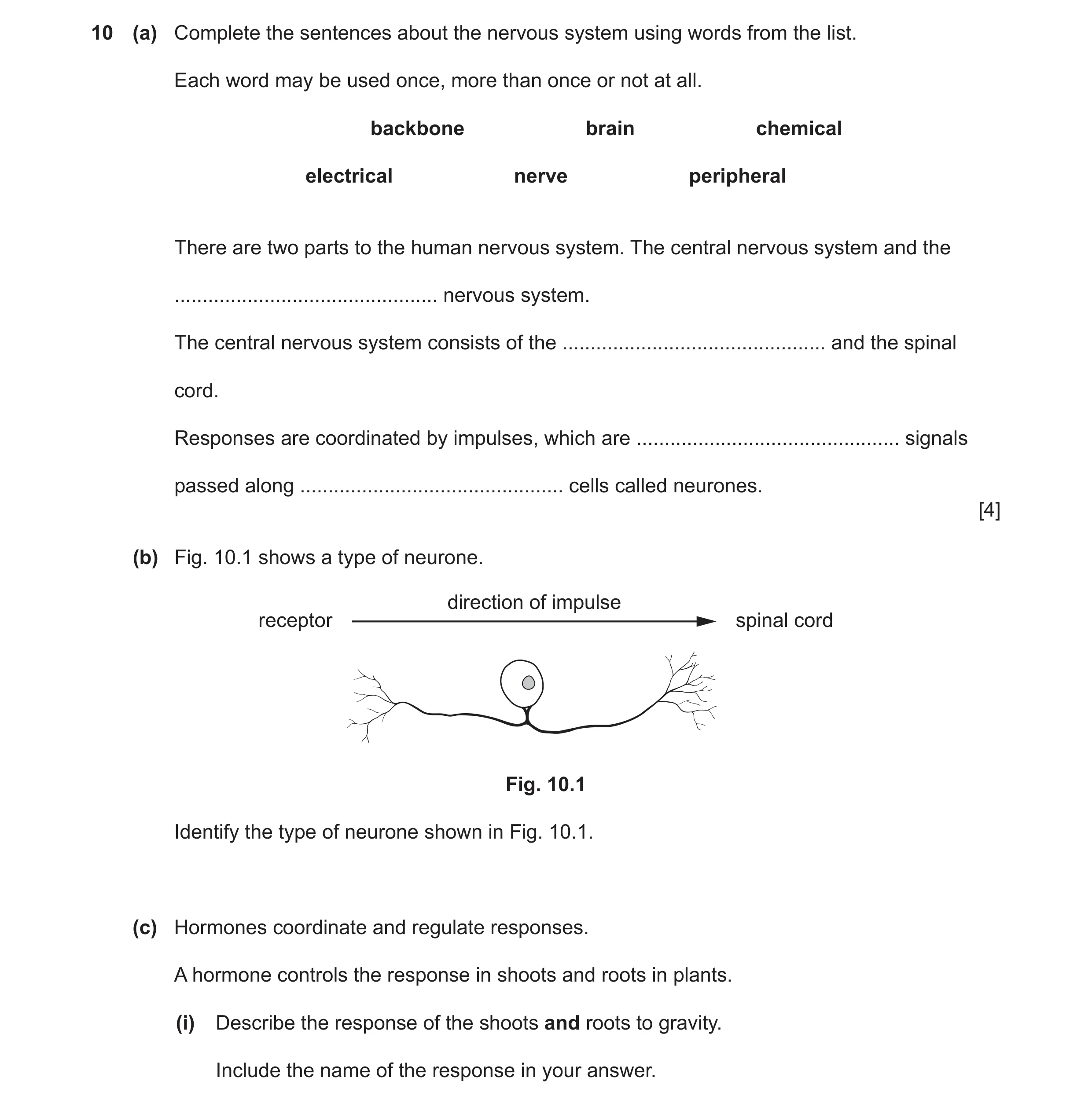
10 (a) Complete the sentences about the nervous system using words from the list. Each word may be used once, more than once or not at all. backbone brain chemical electrical nerve peripheral There are two parts to the human nervous system. The central nervous system and the … nervous system. The central nervous system consists of the … and the spinal cord. Responses are coordinated by impulses, which are … signals passed along … cells called neurones. [4] (b) Fig. 10.1 shows a type of neurone. direction of impulse receptor spinal cord Fig. 10.1 Identify the type of neurone shown in Fig. 10.1. (c) Hormones coordinate and regulate responses. A hormone controls the response in shoots and roots in plants. (i) Describe the response of the shoots and roots to gravity. Include the name of the response in your answer.
9 marks
Mark scheme: 10(a) peripheral ; brain ; electrical ; nerve ; 4 10(b) sensory (neurone) ; 1 10(c)(i) ref to gravitropism ; roots grow in the direction of gravity ; shoots grow in opposite direction to gravity ; 3 10(c)(ii) light / AVP ; 1
This question in 0654/31 Oct/Nov 2020
Q8 · Complete the sentences about the nervous system using words from the list 0654/33 Oct/Nov 2020
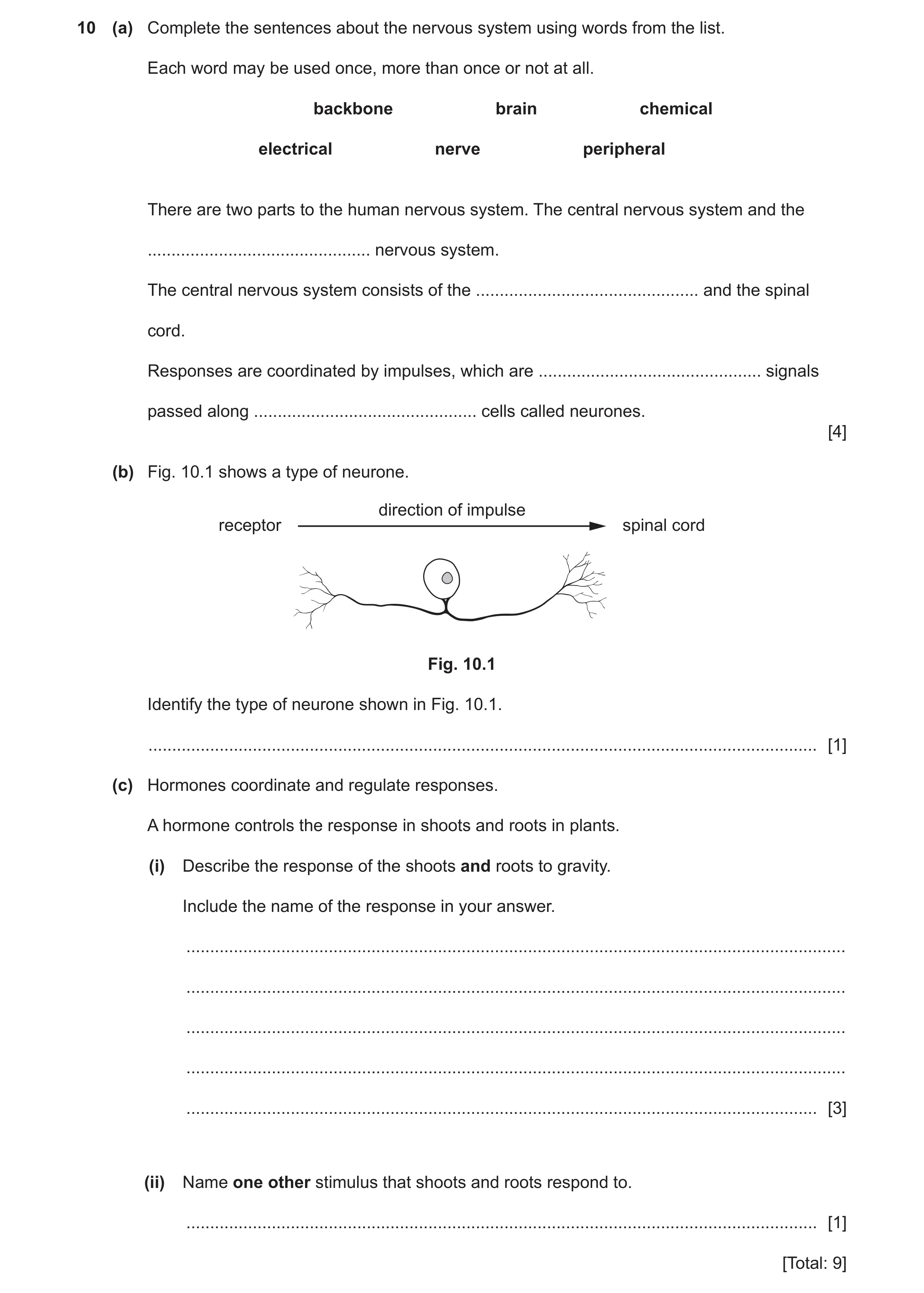
10 (a) Complete the sentences about the nervous system using words from the list. Each word may be used once, more than once or not at all. backbone brain chemical electrical nerve peripheral There are two parts to the human nervous system. The central nervous system and the … nervous system. The central nervous system consists of the … and the spinal cord. Responses are coordinated by impulses, which are … signals passed along … cells called neurones. [4] (b) Fig. 10.1 shows a type of neurone. direction of impulse receptor spinal cord Fig. 10.1 Identify the type of neurone shown in Fig. 10.1. … [1] (c) Hormones coordinate and regulate responses. A hormone controls the response in shoots and roots in plants. (i) Describe the response of the shoots and roots to gravity. Include the name of the response in your answer. … … … … … [3] (ii) Name one other stimulus that shoots and roots respond to. … [1] [Total: 9]
9 marks
Mark scheme: 10(a) peripheral ; brain ; electrical ; nerve ; 4 10(b) sensory (neurone) ; 1 10(c)(i) ref to gravitropism ; roots grow in the direction of gravity ; shoots grow in opposite direction to gravity ; 3 10(c)(ii) light / AVP ; 1
This question in 0654/33 Oct/Nov 2020
Q9 · A photomicrograph of a cross-section of a root 0654/32 Feb/March 2021
7 Fig. 7.1 is a photomicrograph of a cross-section of a root. A B C Fig. 7.1 (a) Identify the parts of the root labelled A and B in Fig. 7.1. A … B … [2] (b) The cell labelled C absorbs mineral ions from the soil. (i) Name this cell. … [1] (ii) Name one other substance absorbed by the cell labelled C in Fig. 7.1. … [1] (c) Chlorophyll is needed for photosynthesis. (i) Name the mineral ion needed to make chlorophyll. … [1] (ii) State the word equation for photosynthesis. … [2] (d) Fig. 7.2 is a diagram of a seed germinating underground. soil root shoot Fig. 7.2 (i) Draw two arrows on Fig. 7.2 to show the direction the root and shoot will grow. [1] (ii) There is no light reaching the seed underground. Name the stimulus the root would be responding to in Fig. 7.2. … [1] (iii) State two environmental conditions seeds need to germinate. 1 … 2 … [2] [Total: 11]
11 marks
Mark scheme: 7(a) A xylem ; B phloem ; 2 7(b)(i) root hair (cell) ; 1 7(b)(ii) water ; 1 7(c)(i) magnesium ; 1 7(c)(ii) carbon dioxide + water → glucose + oxygen ;; 2 7(d)(i) shoot arrow pointing upwards and root arrow pointing downwards ; 1 7(d)(ii) gravity ; 1 7(d)(iii) any two from warm / suitable temperature ; oxygen ; moisture / water ; 2
This question in 0654/32 Feb/March 2021
Q10 · A diagram of a single‑celled organism called a euglena 0654/32 Oct/Nov 2021
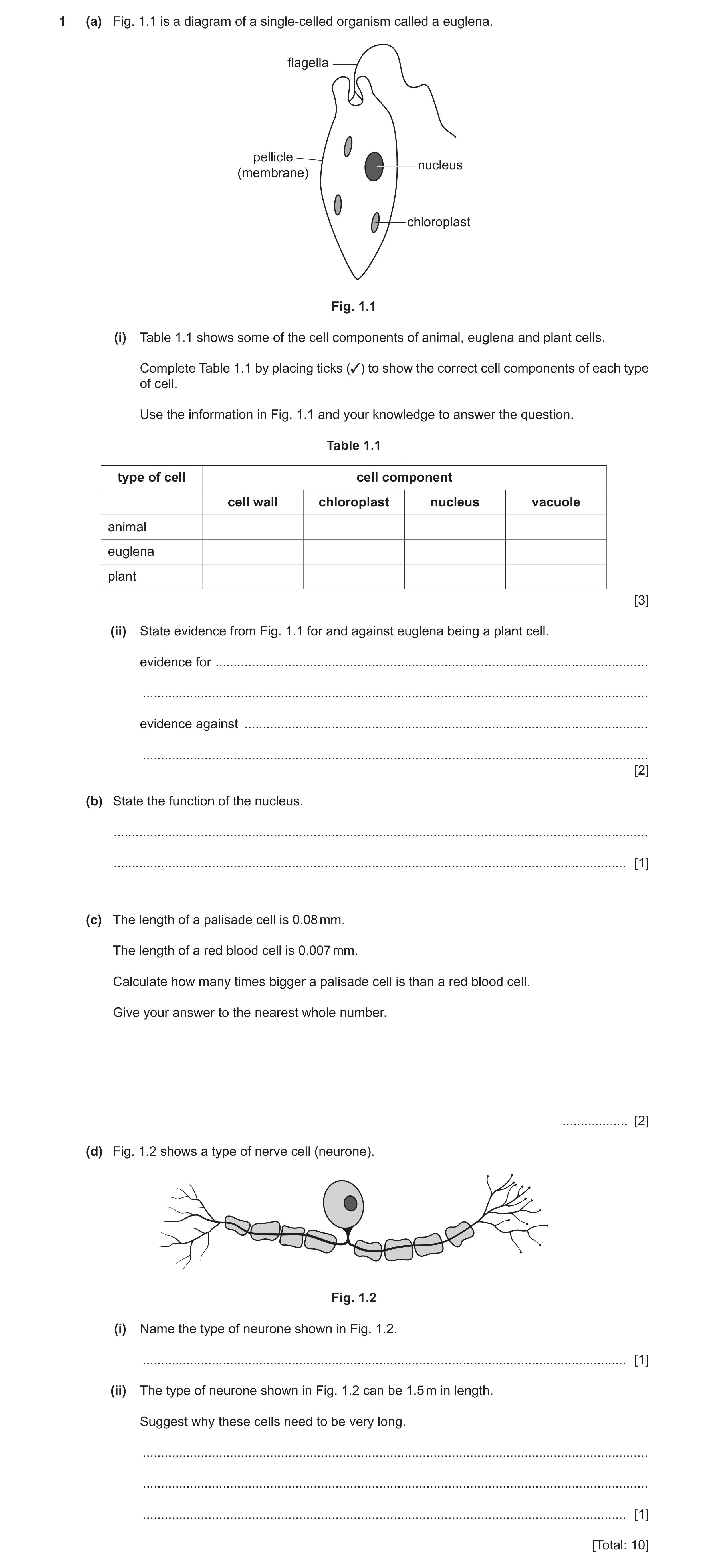
1 (a) Fig. 1.1 is a diagram of a single‑celled organism called a euglena. flagella pellicle nucleus (membrane) chloroplast Fig. 1.1 (i) Table 1.1 shows some of the cell components of animal, euglena and plant cells. Complete Table 1.1 by placing ticks (3) to show the correct cell components of each type of cell. Use the information in Fig. 1.1 and your knowledge to answer the question. Table 1.1 type of cell cell component cell wall chloroplast nucleus vacuole animal euglena plant [3] (ii) State evidence from Fig. 1.1 for and against euglena being a plant cell. evidence for … … evidence against … … [2] (b) State the function of the nucleus. … … [1] (c) The length of a palisade cell is 0.08 mm. The length of a red blood cell is 0.007 mm. Calculate how many times bigger a palisade cell is than a red blood cell. Give your answer to the nearest whole number. … [2] (d) Fig. 1.2 shows a type of nerve cell (neurone). Fig. 1.2 (i) Name the type of neurone shown in Fig. 1.2. … [1] (ii) The type of neurone shown in Fig. 1.2 can be 1.5 m in length. Suggest why these cells need to be very long. … … … [1] [Total: 10]
10 marks
Mark scheme: 1(a)(i) type of cell cell wall chloroplast nucleus vacuole animal euglena plant ;;; 1(a)(ii) for: euglena has chloroplasts ; against: euglena does not have, cell wall / vacuole ; 2 1(b) controls cells activities or contains, genetic material / DNA ; 1 1(c) 0.08÷ 0.007 or 11.428 ; 11 ; 2 1(d)(i) sensory (neurone) ; 1 1(d)(ii) transmit impulses, over large, areas / distances / AW ; 1
This question in 0654/32 Oct/Nov 2021
Q11 · Use words from the list to complete the sentences about adrenaline 0654/33 Oct/Nov 2021
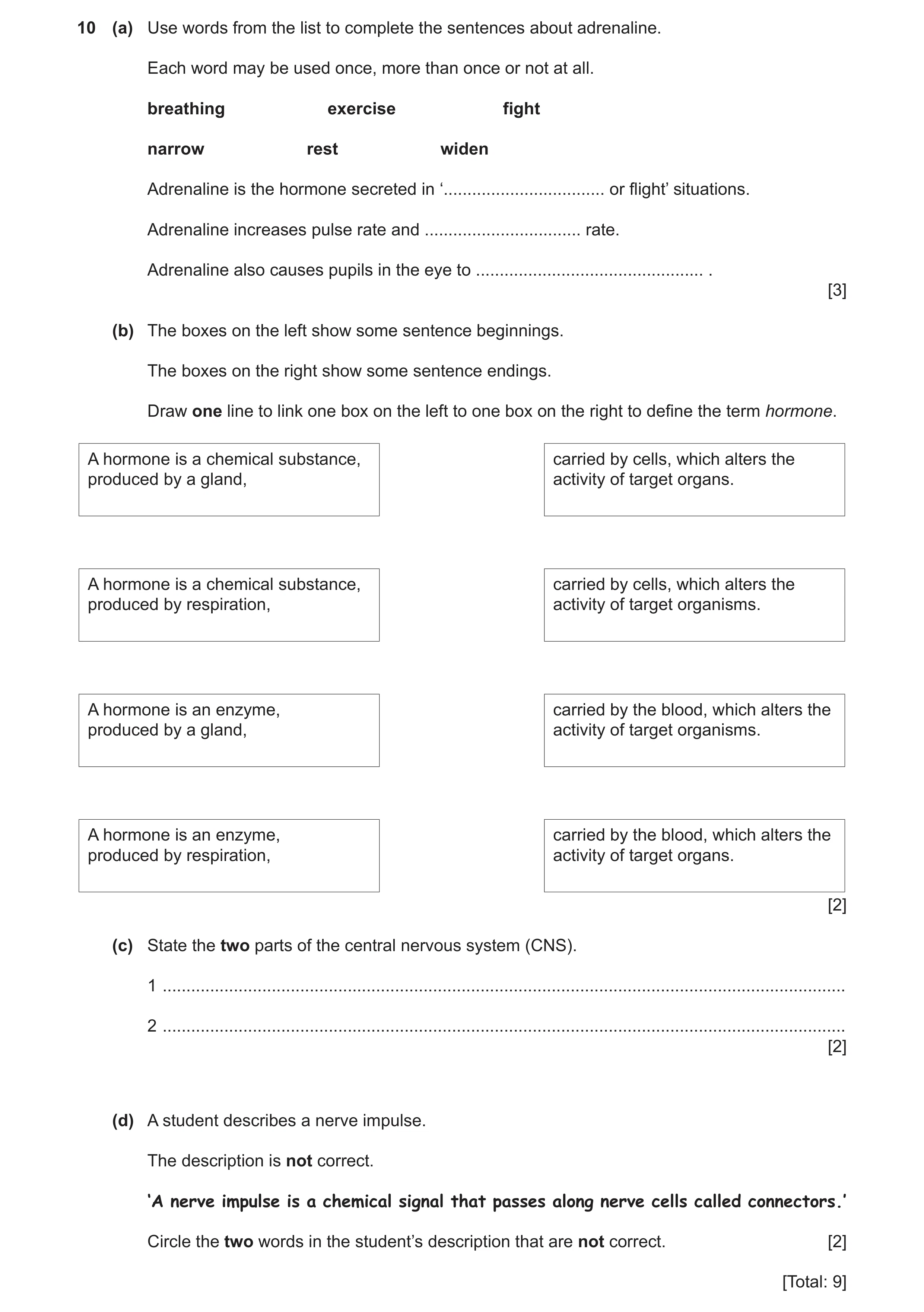
10 (a) Use words from the list to complete the sentences about adrenaline. Each word may be used once, more than once or not at all. breathing exercise fight narrow rest widen Adrenaline is the hormone secreted in ‘ … or flight’ situations. Adrenaline increases pulse rate and … rate. Adrenaline also causes pupils in the eye to … . [3] (b) The boxes on the left show some sentence beginnings. The boxes on the right show some sentence endings. Draw one line to link one box on the left to one box on the right to define the term hormone. A hormone is a chemical substance, carried by cells, which alters the produced by a gland, activity of target organs. A hormone is a chemical substance, carried by cells, which alters the produced by respiration, activity of target organisms. A hormone is an enzyme, carried by the blood, which alters the produced by a gland, activity of target organisms. A hormone is an enzyme, carried by the blood, which alters the produced by respiration, activity of target organs. [2] (c) State the two parts of the central nervous system (CNS). 1 … 2 … [2] (d) A student describes a nerve impulse. The description is not correct. ‘A nerve impulse is a chemical signal that passes along nerve cells called connectors.’ Circle the two words in the student’s description that are not correct. [2] [Total: 9]
9 marks
Mark scheme: 10(a) fight ; breathing ; widen ; 3 10(b) left hand box ; right hand box ; 2 10(c) brain ; spinal cord ; 2 10(d) chemical ; connectors ; 2
This question in 0654/33 Oct/Nov 2021
Q12 · Three different types of neurones 0654/32 May/June 2022
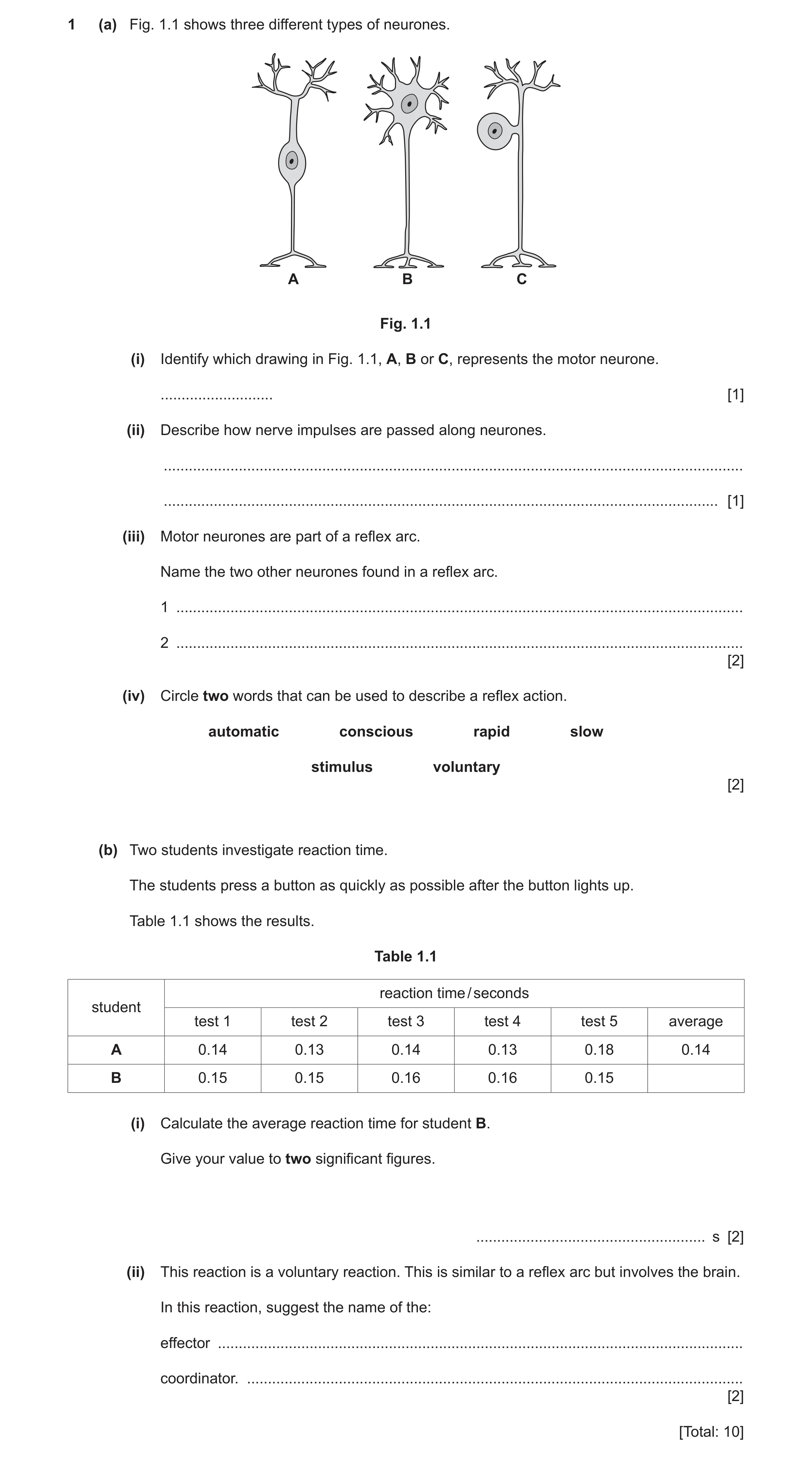
1 (a) Fig. 1.1 shows three different types of neurones. A B C Fig. 1.1 (i) Identify which drawing in Fig. 1.1, A, B or C, represents the motor neurone. … [1] (ii) Describe how nerve impulses are passed along neurones. … … [1] (iii) Motor neurones are part of a reflex arc. Name the two other neurones found in a reflex arc. 1 … 2 … [2] (iv) Circle two words that can be used to describe a reflex action. automatic conscious rapid slow stimulus voluntary [2] (b) Two students investigate reaction time. The students press a button as quickly as possible after the button lights up. Table 1.1 shows the results. Table 1.1 reaction time / seconds student test 1 test 2 test 3 test 4 test 5 average A 0.14 0.13 0.14 0.13 0.18 0.14 B 0.15 0.15 0.16 0.16 0.15 (i) Calculate the average reaction time for student B. Give your value to two significant figures. … s [2] (ii) This reaction is a voluntary reaction. This is similar to a reflex arc but involves the brain. In this reaction, suggest the name of the: effector … coordinator. … [2] [Total: 10]
10 marks
Mark scheme: 1(a)(i) B ; 1 1(a)(ii) as electrical signals ; 1 1(a)(iii) sensory neurone ; relay neurone ; 2 1(a)(iv) automatic circled ; rapid circled ; 2 1(b)(i) ((0.15 + 0.15 + 0.16 + 0.16 + 0.15) / 5) = 0.154 ; 0.15 ; 2 1(b)(ii) effector muscles (in hand / finger) ; coordinator brain / CNS ; 2
This question in 0654/32 May/June 2022
Q13 · Three different types of neurones 0654/33 May/June 2022
1 (a) Fig. 1.1 shows three different types of neurones. A B C Fig. 1.1 (i) Identify which drawing in Fig. 1.1, A, B or C, represents the motor neurone. … [1] (ii) Describe how nerve impulses are passed along neurones. … … [1] (iii) Motor neurones are part of a reflex arc. Name the two other neurones found in a reflex arc. 1 … 2 … [2] (iv) Circle two words that can be used to describe a reflex action. automatic conscious rapid slow stimulus voluntary [2] (b) Two students investigate reaction time. The students press a button as quickly as possible after the button lights up. Table 1.1 shows the results. Table 1.1 reaction time / seconds student test 1 test 2 test 3 test 4 test 5 average A 0.14 0.13 0.14 0.13 0.18 0.14 B 0.15 0.15 0.16 0.16 0.15 (i) Calculate the average reaction time for student B. Give your value to two significant figures. … s [2] (ii) This reaction is a voluntary reaction. This is similar to a reflex arc but involves the brain. In this reaction, suggest the name of the: effector … coordinator. … [2] [Total: 10]
10 marks
Mark scheme: 1(a)(i) B ; 1 1(a)(ii) as electrical signals ; 1 1(a)(iii) sensory neurone ; relay neurone ; 2 1(a)(iv) automatic circled ; rapid circled ; 2 1(b)(i) ((0.15 + 0.15 + 0.16 + 0.16 + 0.15) / 5) = 0.154 ; 0.15 ; 2 1(b)(ii) effector muscles (in hand / finger) ; coordinator brain / CNS ; 2
This question in 0654/33 May/June 2022
Q14 · Complete the definition of the term hormone 0654/31 Oct/Nov 2022
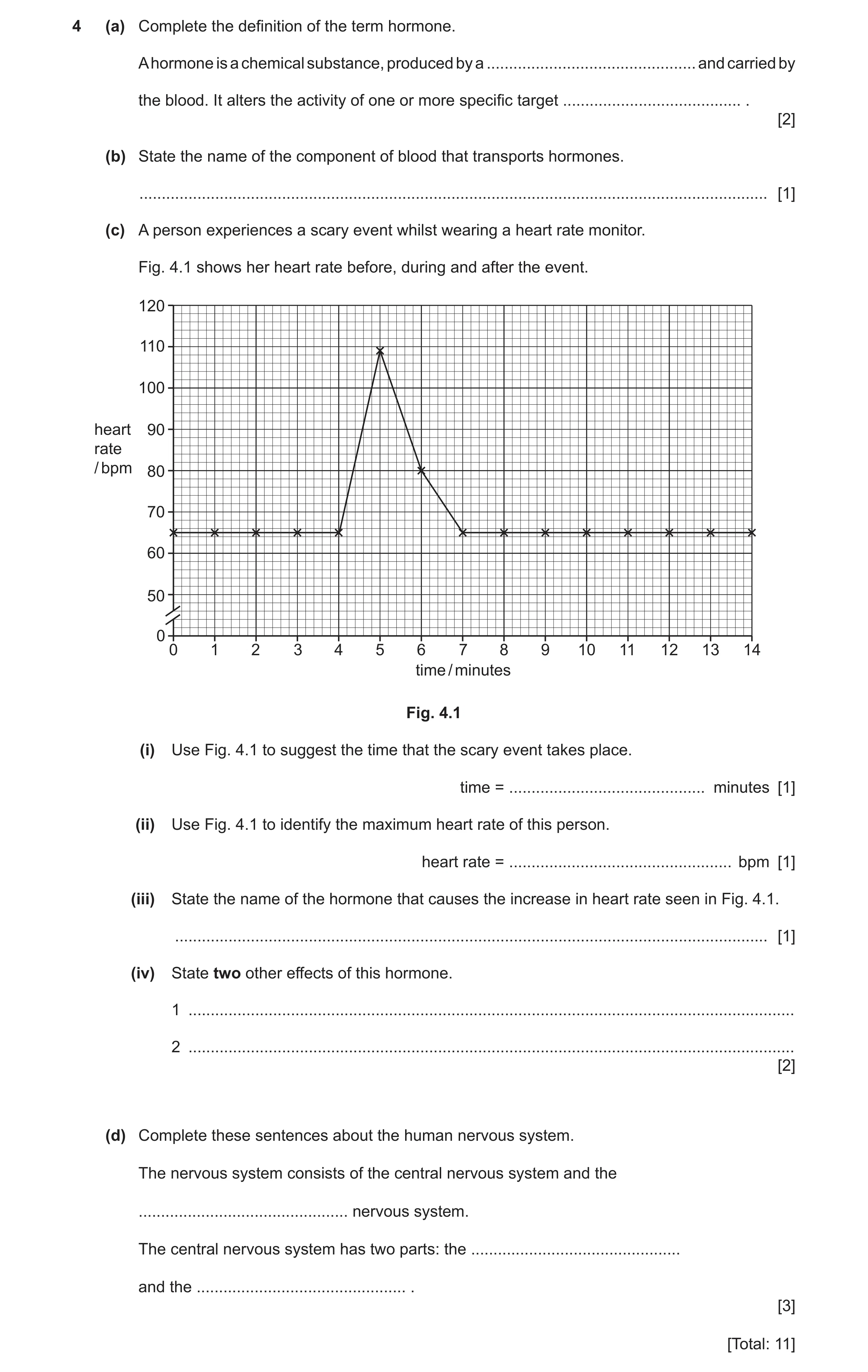
4 (a) Complete the definition of the term hormone. A hormone is a chemical substance, produced by a … and carried by the blood. It alters the activity of one or more specific target … . [2] (b) State the name of the component of blood that transports hormones. … [1] (c) A person experiences a scary event whilst wearing a heart rate monitor. Fig. 4.1 shows her heart rate before, during and after the event. 120 110 100 heart 90 rate / bpm 80 70 60 50 0 0 1 2 3 4 5 6 7 8 9 10 11 12 13 14 time / minutes Fig. 4.1 (i) Use Fig. 4.1 to suggest the time that the scary event takes place. time = … minutes [1] (ii) Use Fig. 4.1 to identify the maximum heart rate of this person. heart rate = … bpm [1] (iii) State the name of the hormone that causes the increase in heart rate seen in Fig. 4.1. … [1] (iv) State two other effects of this hormone. 1 … 2 … [2] (d) Complete these sentences about the human nervous system. The nervous system consists of the central nervous system and the … nervous system. The central nervous system has two parts: the … and the … . [3] [Total: 11]
11 marks
Mark scheme: 4(a) gland ; 2 organs ; 4(b) plasma ; 1 4(c)(i) 4 (minutes) ; 1 4(c)(ii) 109 (bpm) ; 1 4(c)(iii) adrenaline ; 1 4(c)(iv) widened pupils ; 2 increased breathing rate ; any valid point ;; 4(d) peripheral ; 3 brain ; spinal cord ;
This question in 0654/31 Oct/Nov 2022
Q15 · A student investigates the conditions required for the germination of seeds 0654/31 Oct/Nov 2023
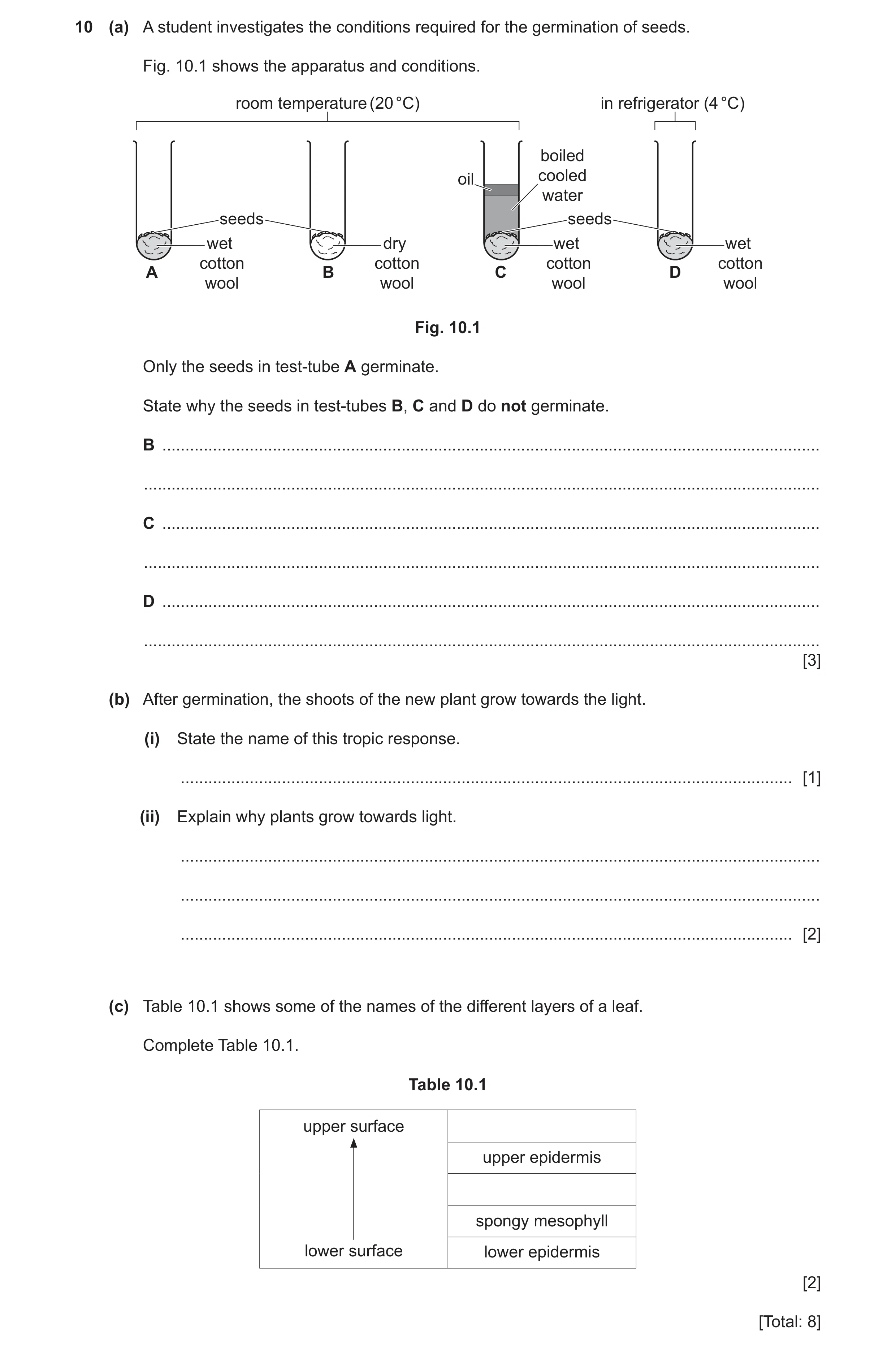
10 (a) A student investigates the conditions required for the germination of seeds. Fig. 10.1 shows the apparatus and conditions. room temperature (20 °C) in refrigerator (4 °C) boiled oil cooled water seeds seeds wet dry wet wet cotton cotton cotton cotton A B C D wool wool wool wool Fig. 10.1 Only the seeds in test-tube A germinate. State why the seeds in test-tubes B, C and D do not germinate. B … … C … … D … … [3] (b) After germination, the shoots of the new plant grow towards the light. (i) State the name of this tropic response. … [1] (ii) Explain why plants grow towards light. … … … [2] (c) Table 10.1 shows some of the names of the different layers of a leaf. Complete Table 10.1. Table 10.1 upper surface upper epidermis spongy mesophyll lower surface lower epidermis [2] [Total: 8]
8 marks
Mark scheme: 10(a) B – seeds did not have, water / moisture ; 3 C – seeds did not have oxygen ; D – seeds did not have, a suitable temperature / warmth ; 10(b)(i) phototropism ; 1 10(b)(ii) maximise exposure to light / increase light intensity / ref to requiring light → energy ; 2 for photosynthesis ; 10(c) cuticle ; 2 palisade (mesophyll) ;
This question in 0654/31 Oct/Nov 2023
Q16 · The pathway and the structures involved in a reflex action when you touch a hot object 0654/32 Feb/March 2024
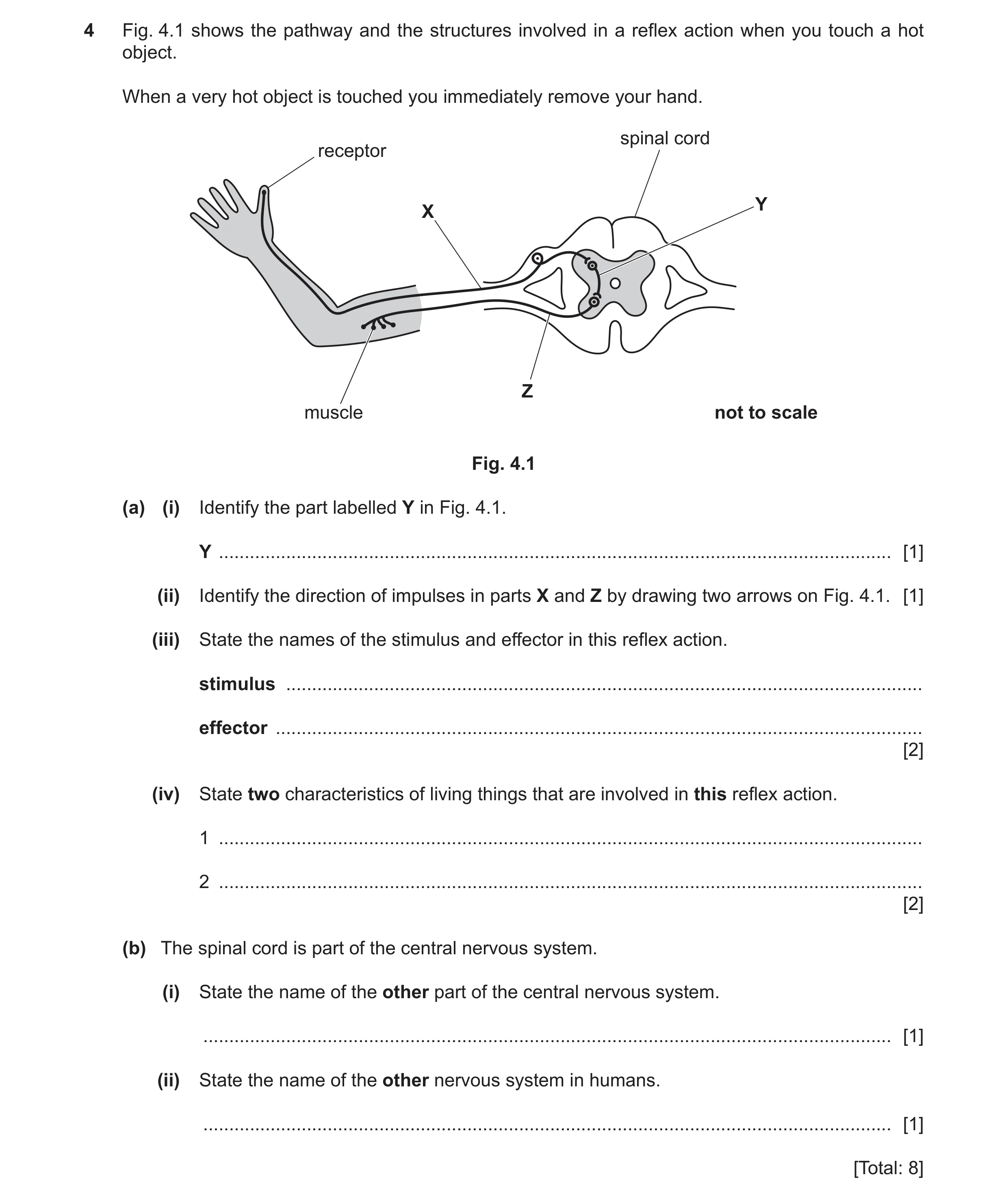
4 Fig. 4.1 shows the pathway and the structures involved in a reflex action when you touch a hot object. When a very hot object is touched you immediately remove your hand. spinal cord receptor Y X Z muscle not to scale Fig. 4.1 (a) (i) Identify the part labelled Y in Fig. 4.1. Y … [1] (ii) Identify the direction of impulses in parts X and Z by drawing two arrows on Fig. 4.1. [1] (iii) State the names of the stimulus and effector in this reflex action. stimulus … effector … [2] (iv) State two characteristics of living things that are involved in this reflex action. 1 … 2 … [2] (b) The spinal cord is part of the central nervous system. (i) State the name of the other part of the central nervous system. … [1] (ii) State the name of the other nervous system in humans. … [1] [Total: 8]
8 marks
Mark scheme: 4(a)(i) relay neurone ; 1 4(a)(ii) arrow drawn towards the spinal cord at X and one towards the muscle at Z ; 1 4(a)(iii) stimulus – (change in) temperature ; 2 effector – muscle / named arm muscle ; 4(a)(iv) sensitivity ; 2 movement ; 4(b)(i) brain ; 1 4(b)(ii) peripheral (nervous system) ; 1
This question in 0654/32 Feb/March 2024
Q17 · A student investigates responses in seeds 0654/31 Oct/Nov 2024
10 (a) A student investigates responses in seeds. They place germinating seeds in a Petri dish. The Petri dish is left on its side in a dark room. After two days the student observes the direction of root growth. Fig. 10.1 shows the investigation. moist cotton wool Petri dish root seed at start after 2 days Fig. 10.1 (i) Complete the sentences to describe and explain the results in Fig. 10.1. After 2 days the roots have grown downwards. This is a tropic response called … . The roots are growing downwards towards … to receive more water from the soil. [2] (ii) State two uses of water in a plant. 1 … 2 … [2] (iii) State the name of the plant cell that absorbs water from the soil. … [1] (iv) State the name of the vessels that transport water from the roots to the leaves in a plant. … [1] (b) Mineral ions are also absorbed by plants. Circle the main mineral ion required for the synthesis of chlorophyll. calcium iron magnesium phosphate [1] (c) The boxes show some statements about plants. Tick (3) three correct statements. Plants are producers in a food chain. Plants can be selectively bred. Plants do not respire. Plants form the main part of a carnivore’s diet. Plants manufacture carbohydrates. Plants only reproduce asexually. [3] [Total: 10]
10 marks
Mark scheme: 10(a)(i) gravitropism ; 2 gravity ; 10(a)(ii) any two from: 2 photosynthesis ; support ; solvent ; germination ; AVP ; 10(a)(iii) root hair cell ; 1 10(a)(iv) xylem ; 1 10(b) magnesium circled ; 1 10(c) 3 Plants are producers in a food chain. Plants can be selectively bred. Plants do not respire. Plants form the main part of a carnivore’s diet. Plants manufacture carbohydrates. Plants only reproduce asexually. ;;;
This question in 0654/31 Oct/Nov 2024
Q18 · Part of a food web on a remote island 0654/31 May/June 2025
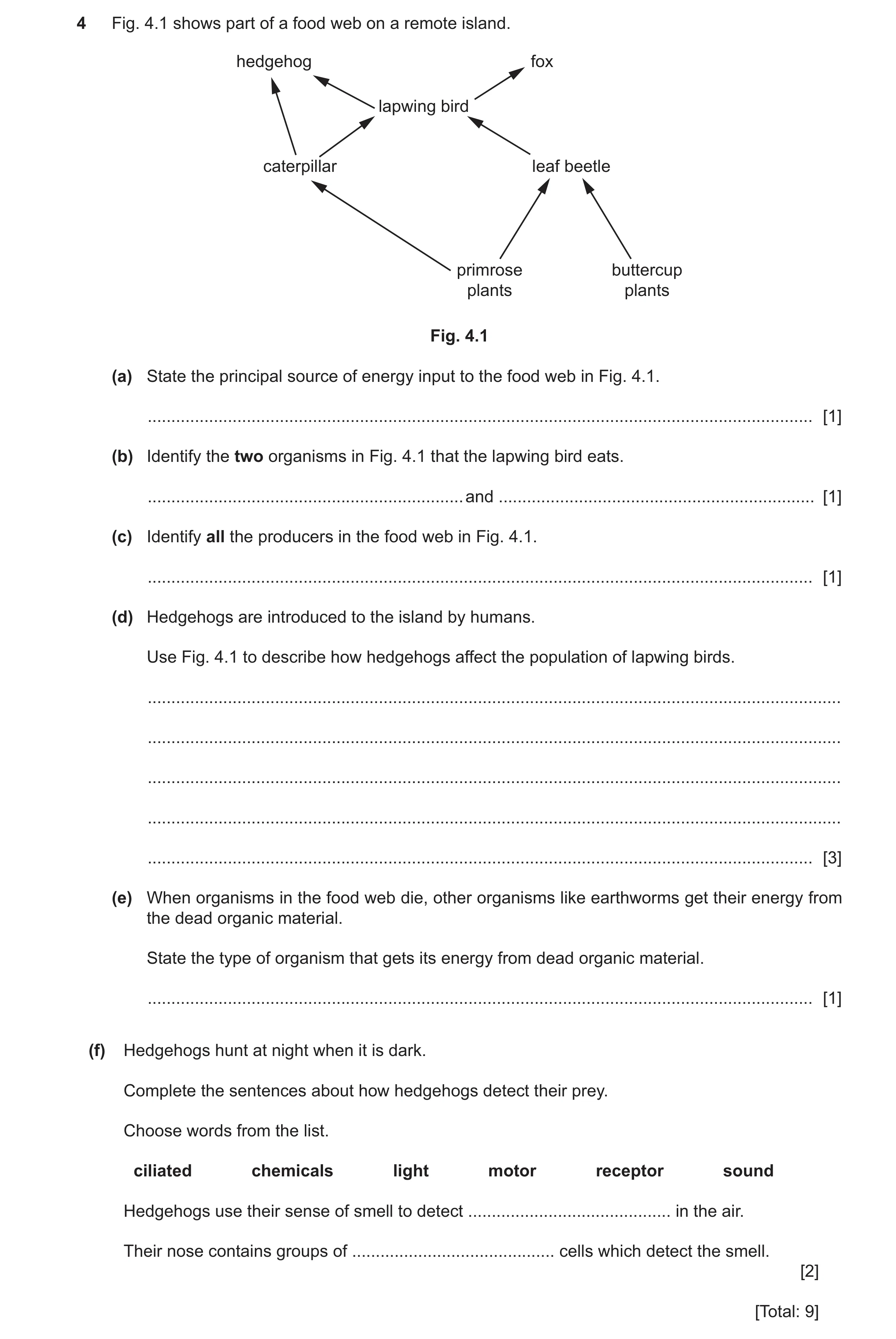
4 Fig. 4.1 shows part of a food web on a remote island. hedgehog fox lapwing bird caterpillar leaf beetle primrose buttercup plants plants Fig. 4.1 (a) State the principal source of energy input to the food web in Fig. 4.1. … [1] (b) Identify the two organisms in Fig. 4.1 that the lapwing bird eats. … and … [1] (c) Identify all the producers in the food web in Fig. 4.1. … [1] (d) Hedgehogs are introduced to the island by humans. Use Fig. 4.1 to describe how hedgehogs affect the population of lapwing birds. … … … … … [3] (e) When organisms in the food web die, other organisms like earthworms get their energy from the dead organic material. State the type of organism that gets its energy from dead organic material. … [1] (f) Hedgehogs hunt at night when it is dark. Complete the sentences about how hedgehogs detect their prey. Choose words from the list. ciliated chemicals light motor receptor sound Hedgehogs use their sense of smell to detect … in the air. Their nose contains groups of … cells which detect the smell. [2] [Total: 9]
9 marks
Mark scheme: 4(a) Sun ; 1 4(b) caterpillar and (leaf) beetle ; 1 4(c) Primrose (plants) and buttercup (plants) ; 1 4(d) decrease (the population size of lapwings) ; 3 idea that (hedgehogs) predate / eat, lapwings (so reduce numbers) ; idea that (hedgehogs) eat caterpillars which are also food for lapwings ; 4(e) decomposer ; 1 4(f) chemicals ; 2 receptor ;
This question in 0654/31 May/June 2025
 1 / 24
 2 / 24
 3 / 24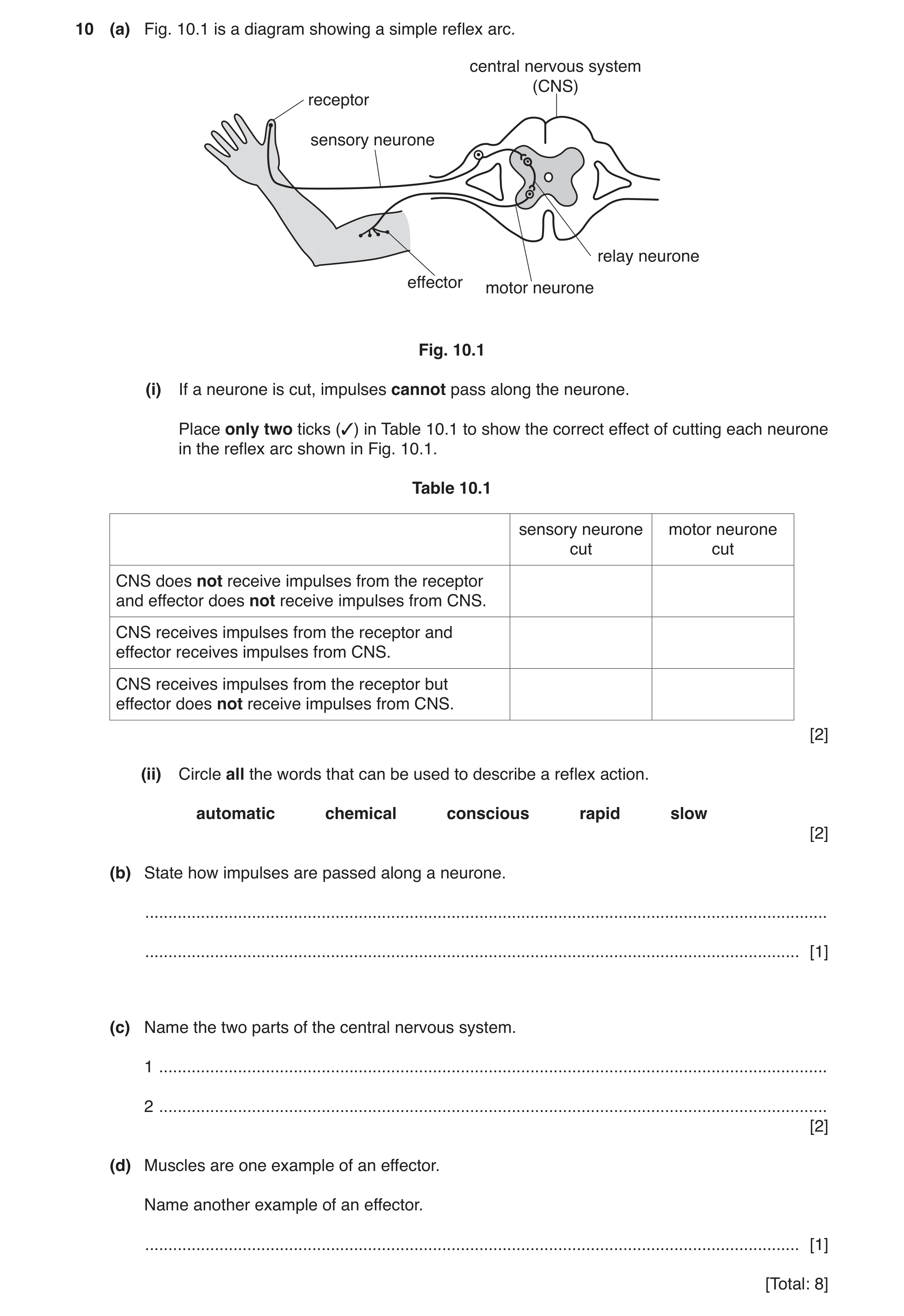
 9 / 24
 10 / 24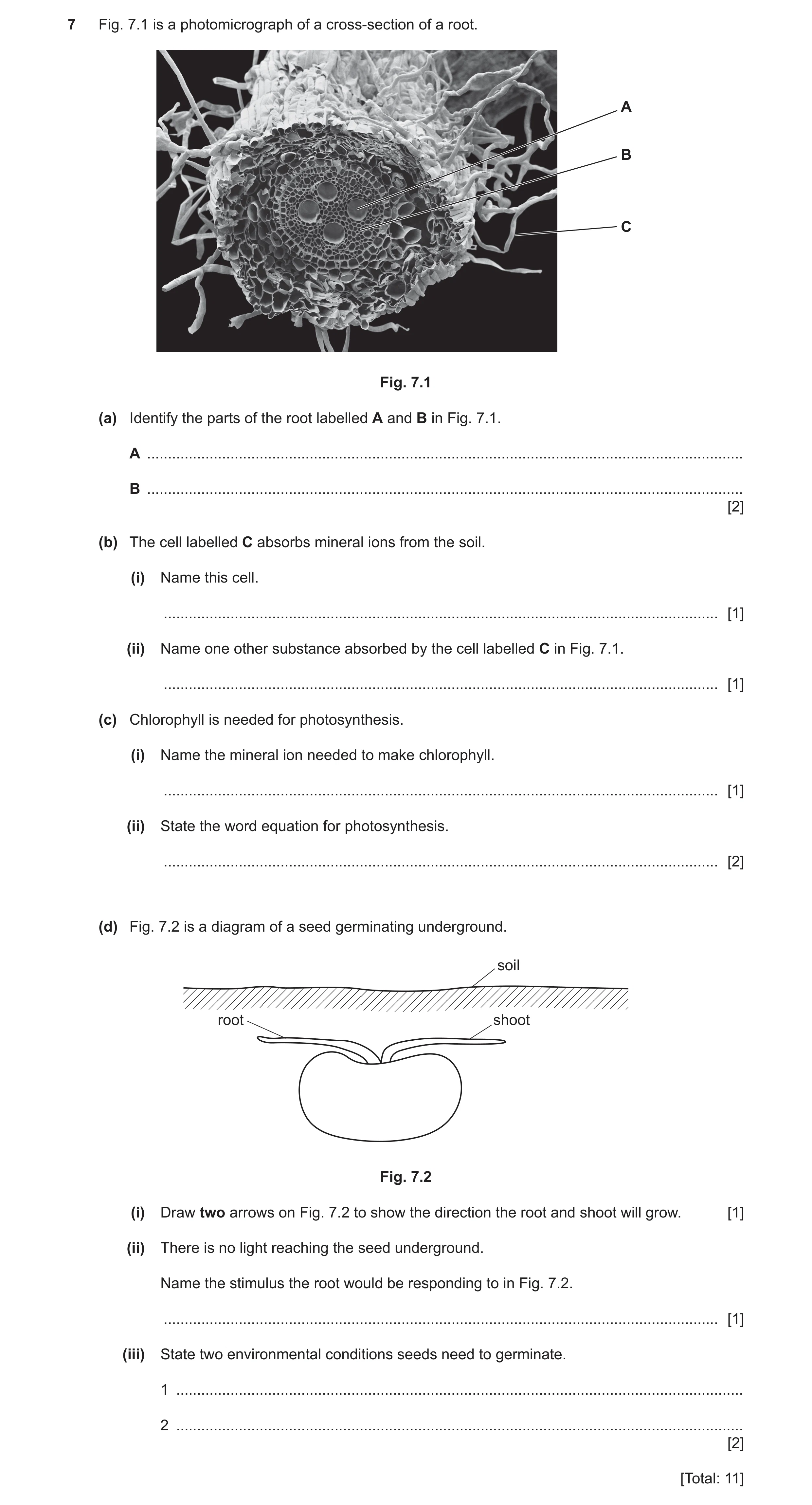
 14 / 24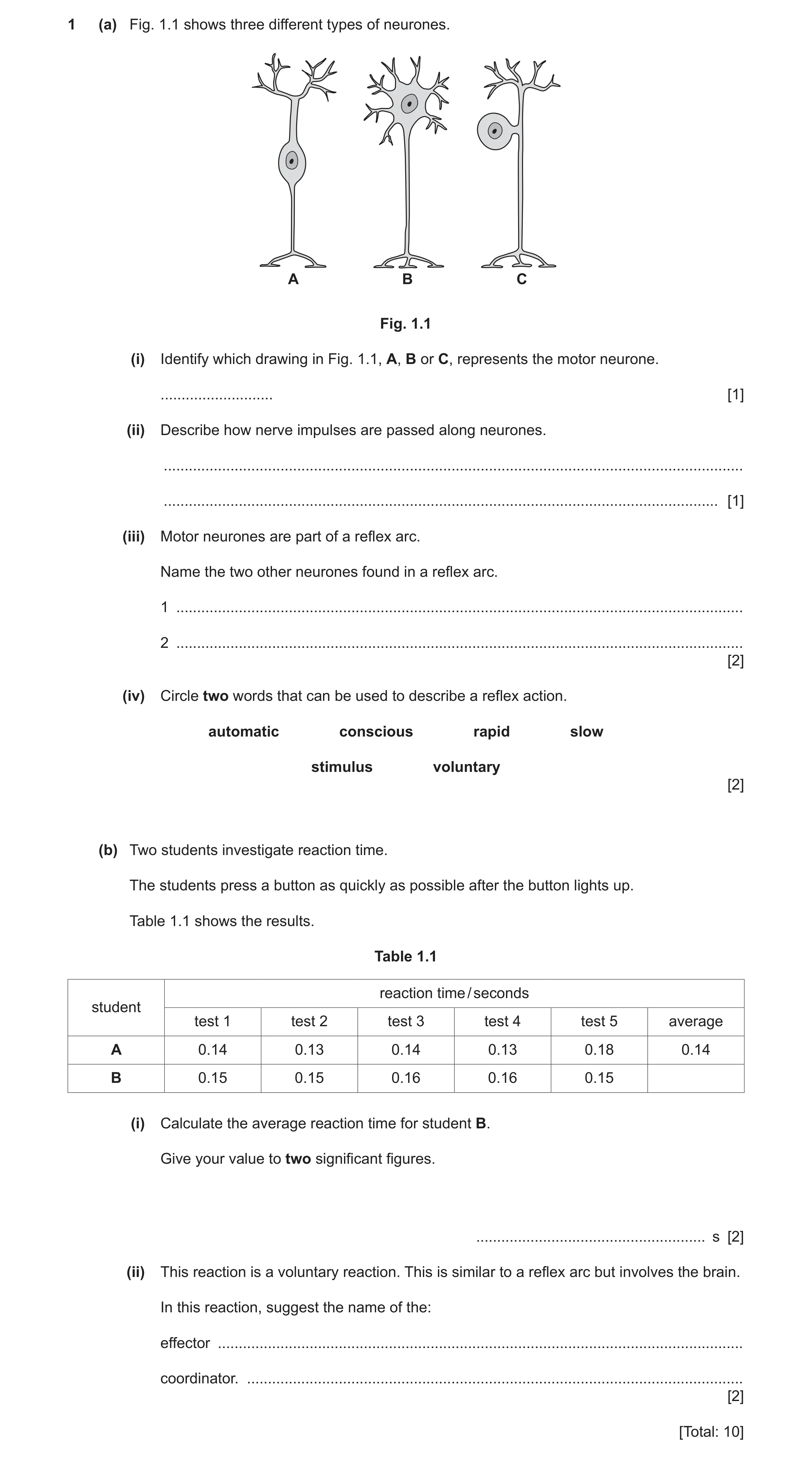
 21 / 24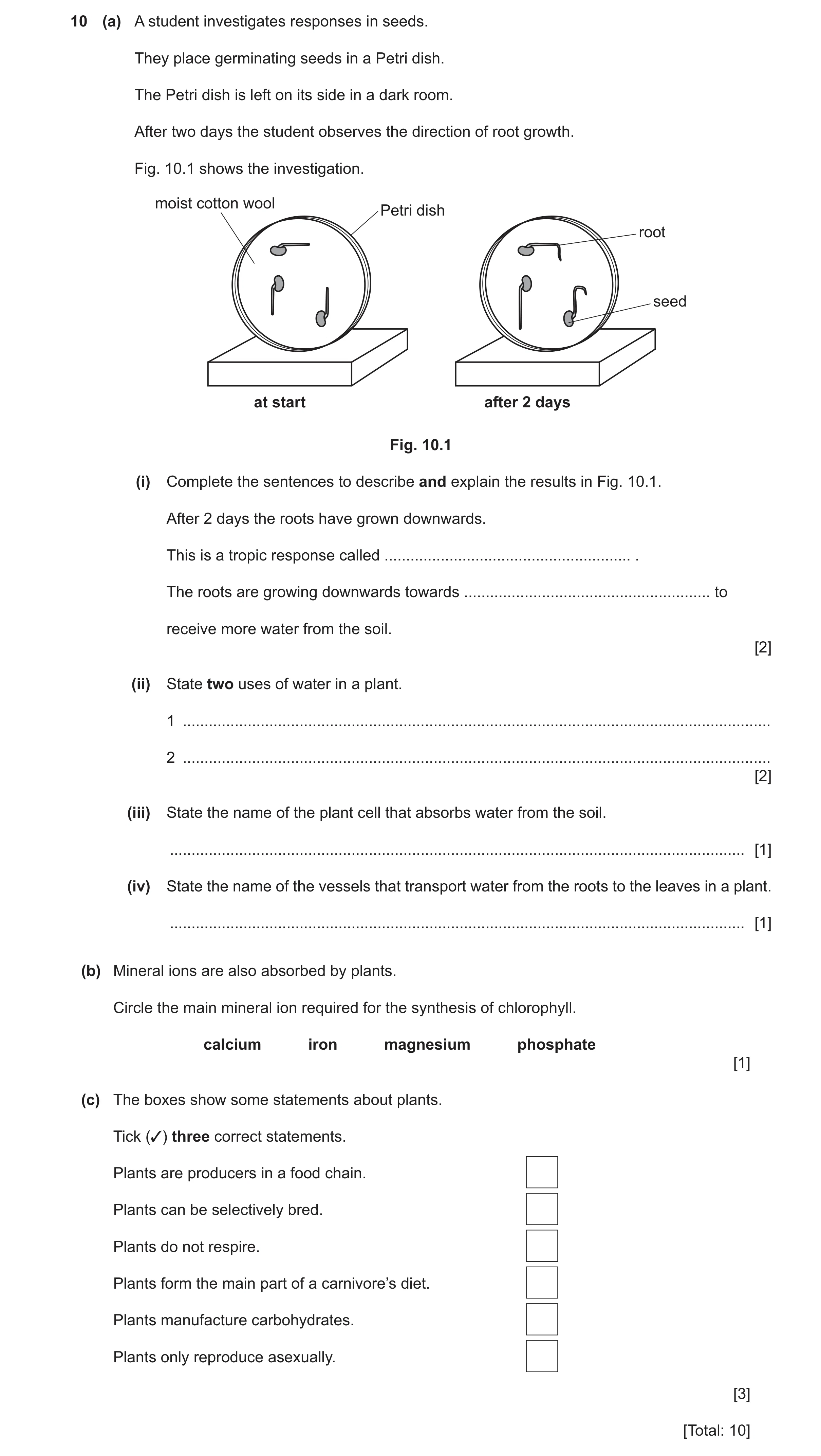
 8
8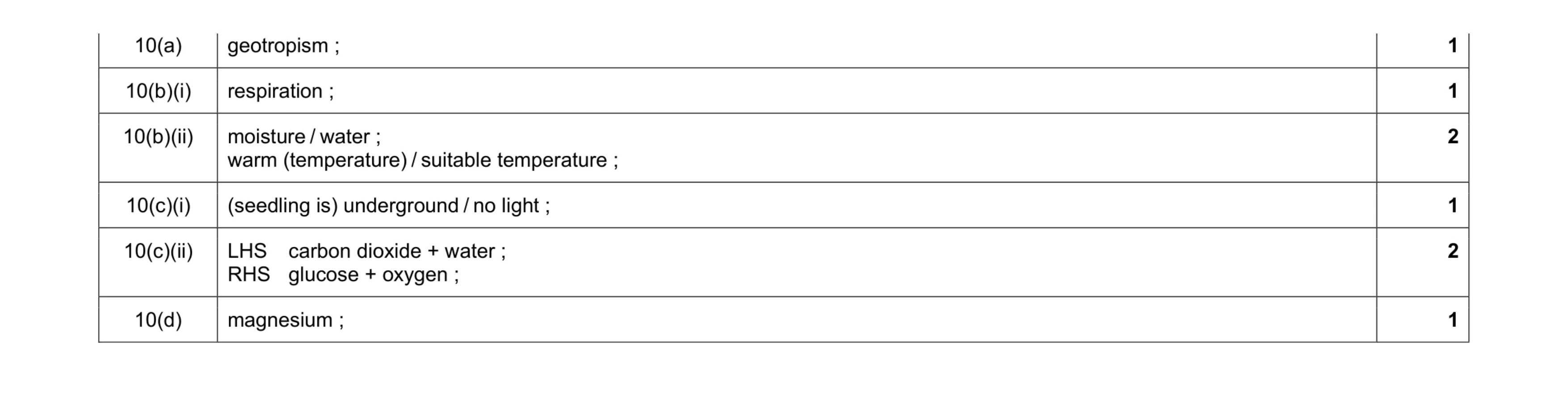 8
8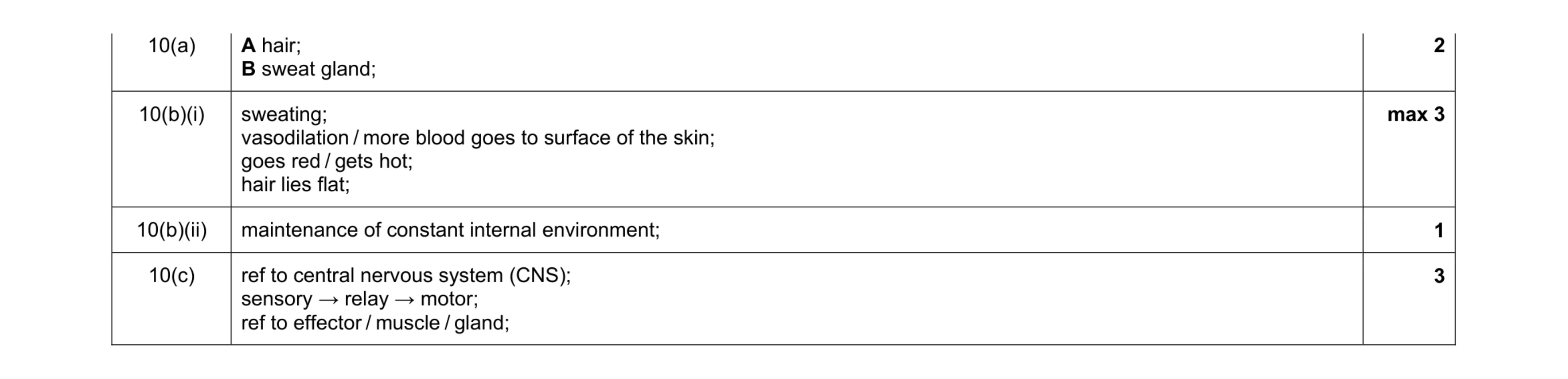 9
9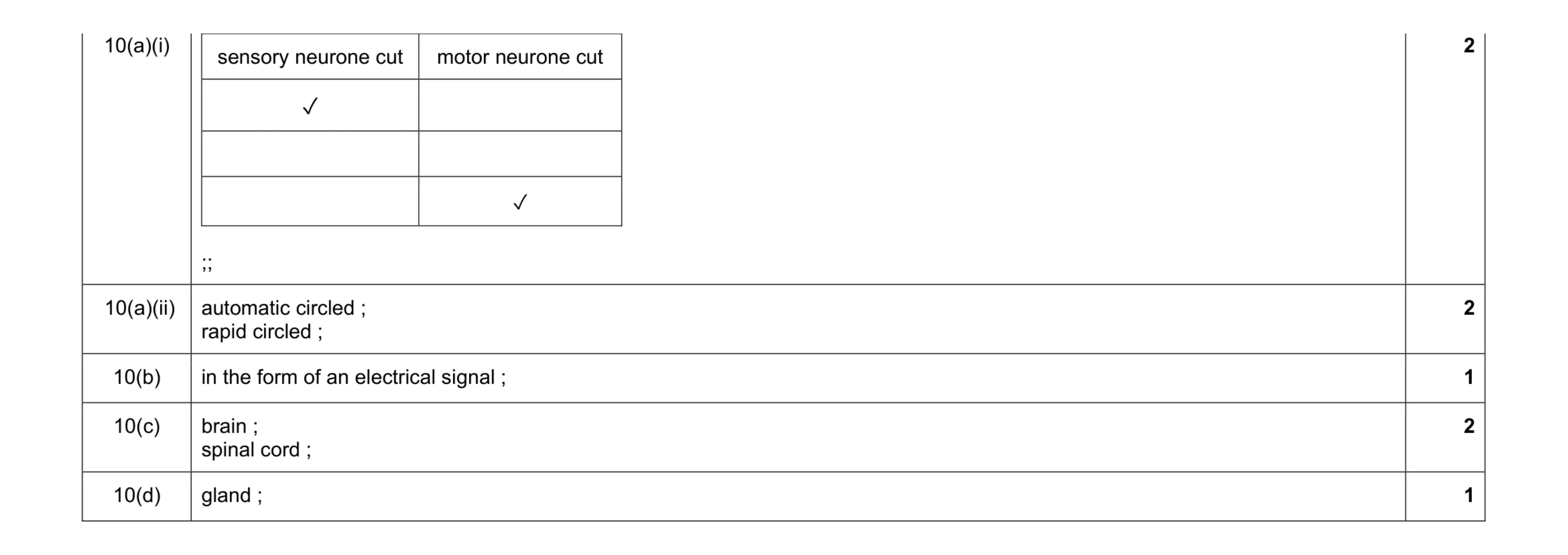 8
8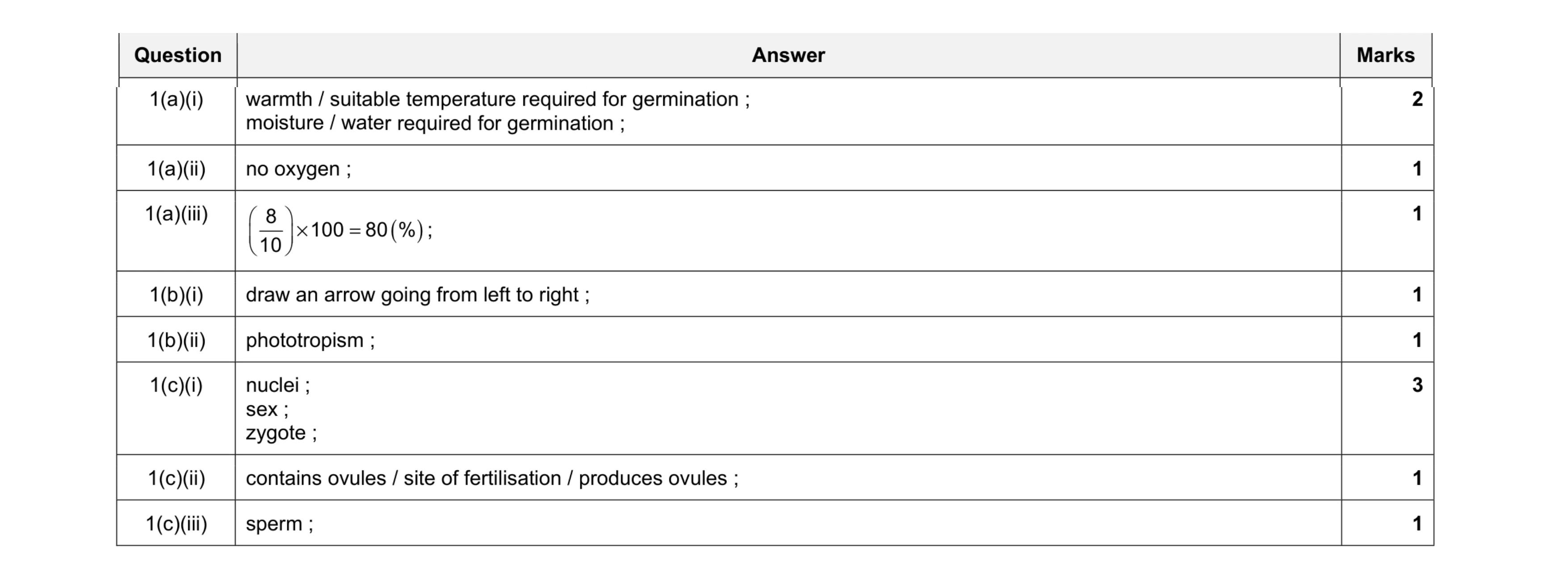 11
11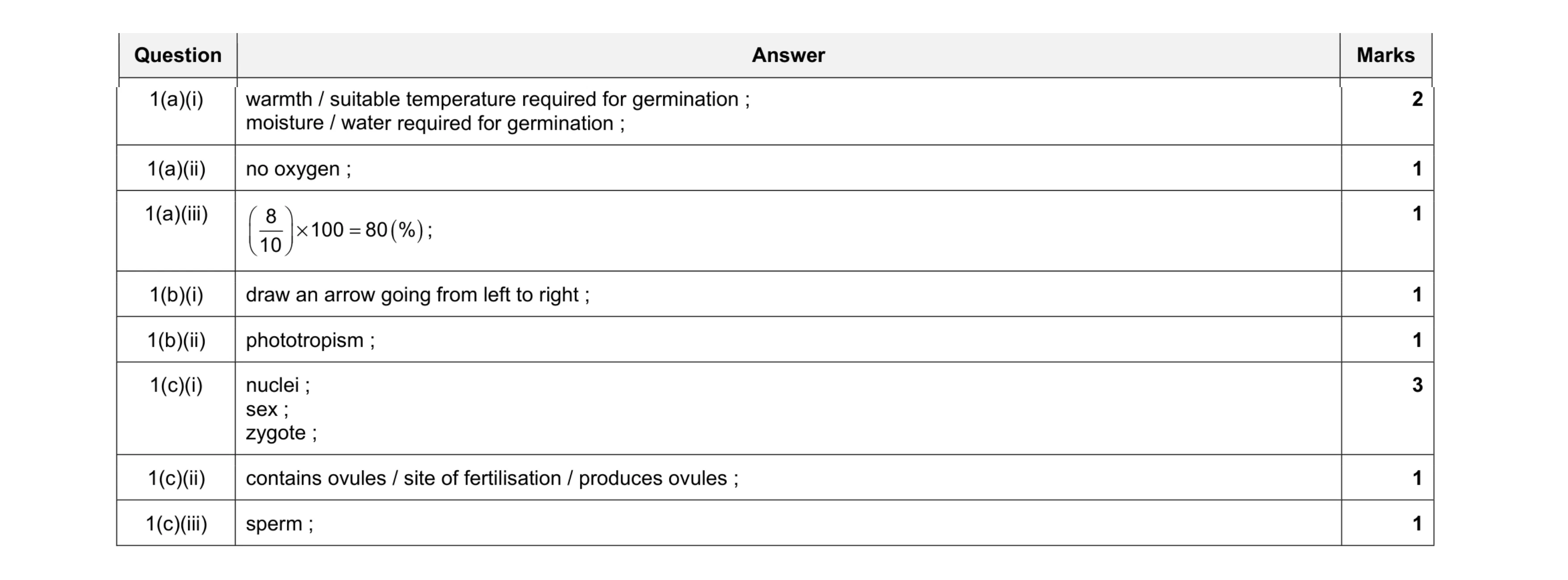 11
11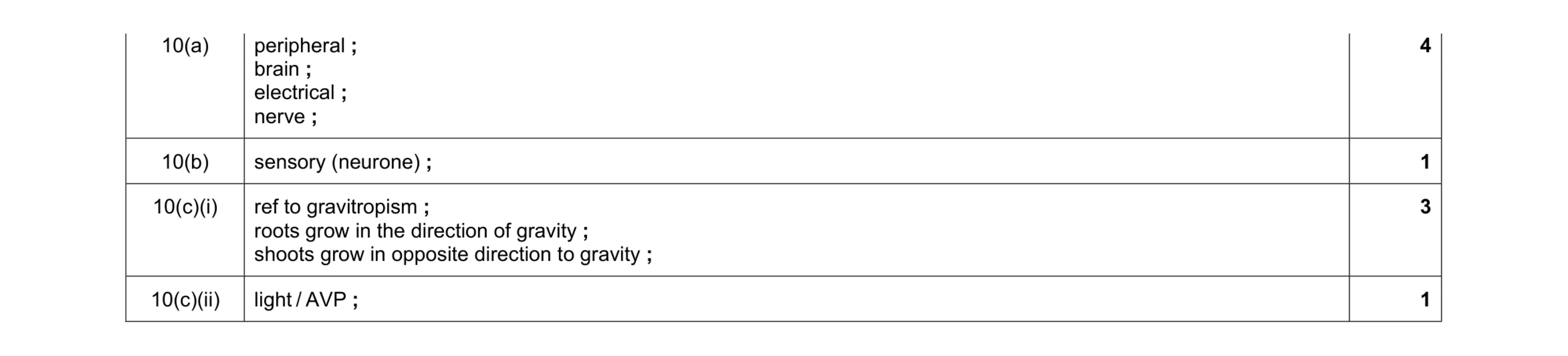 9
9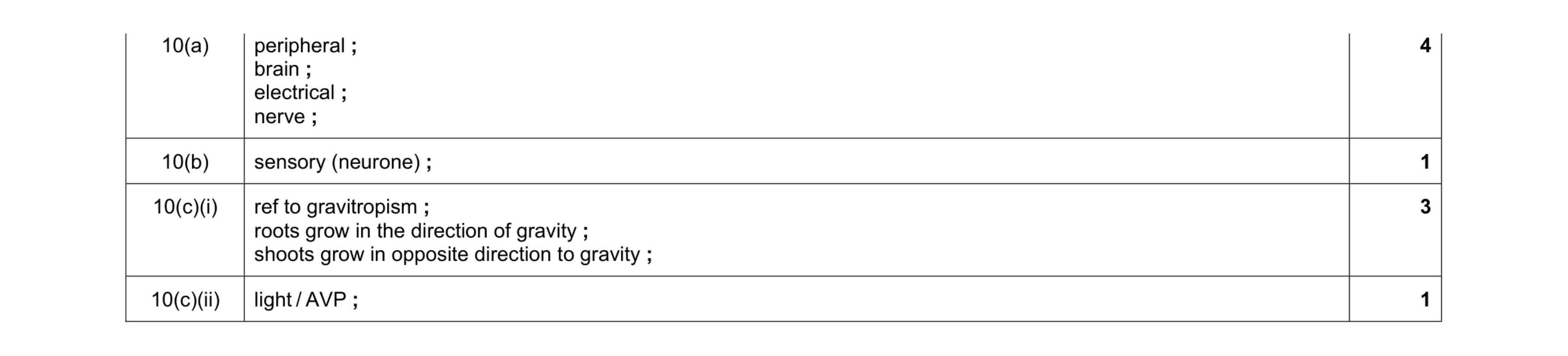 9
9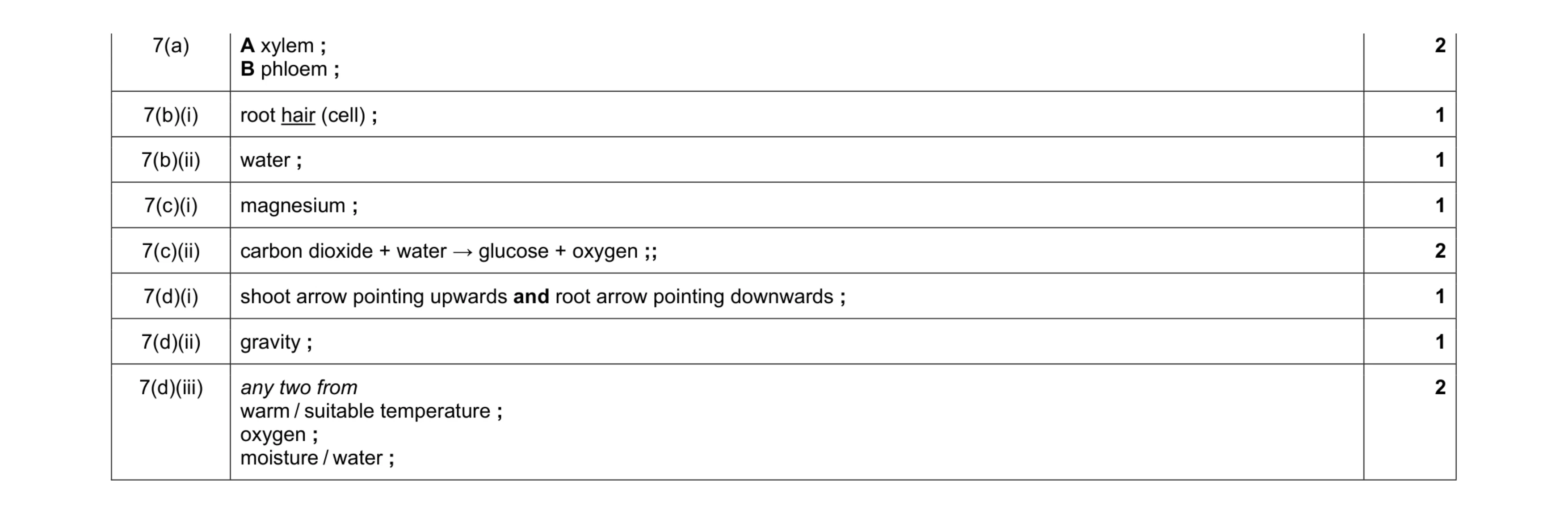 11
11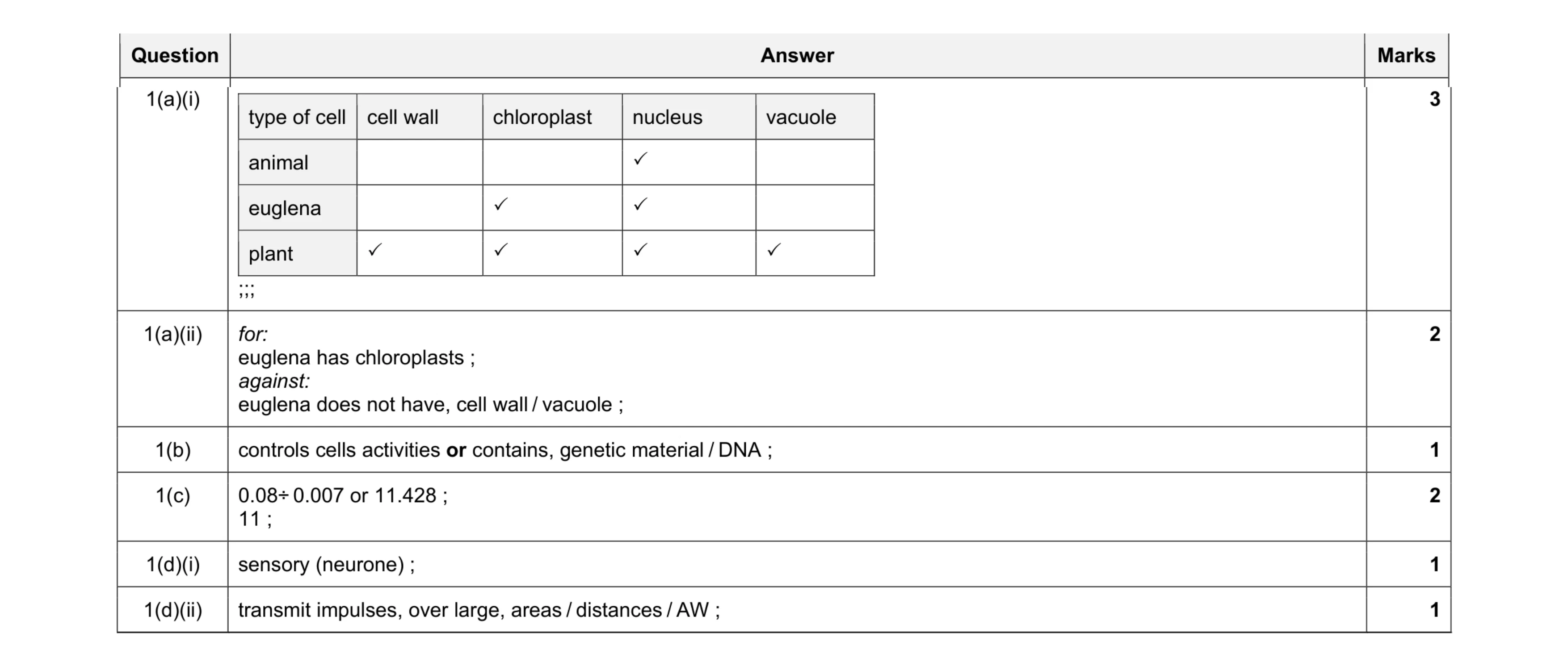 10
10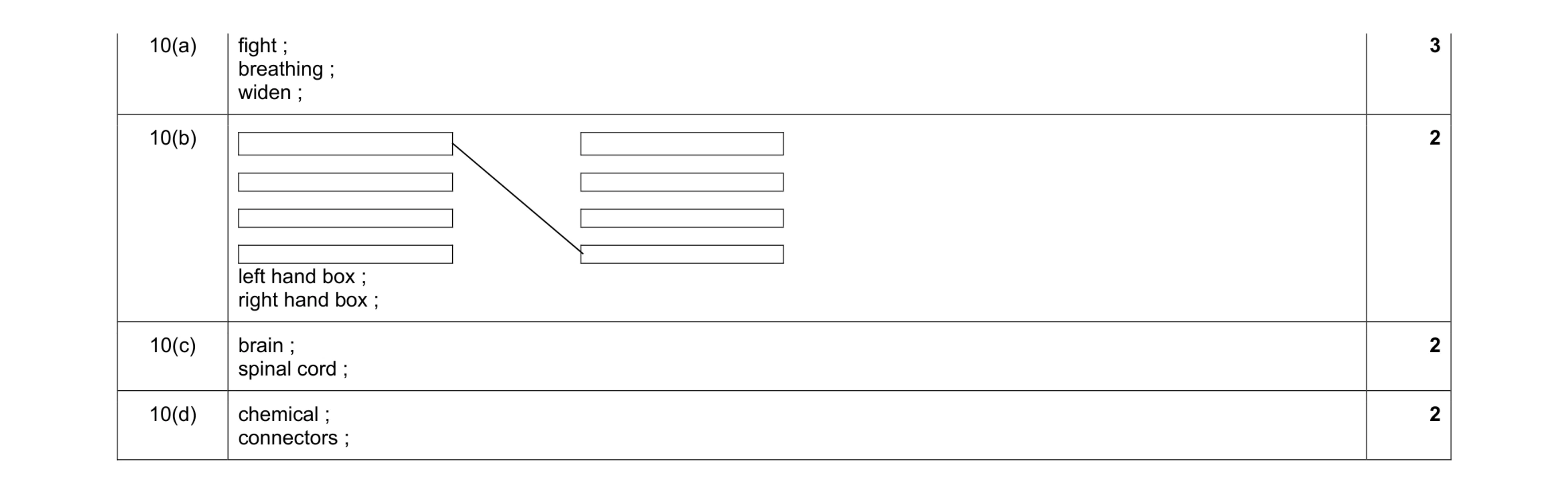 9
9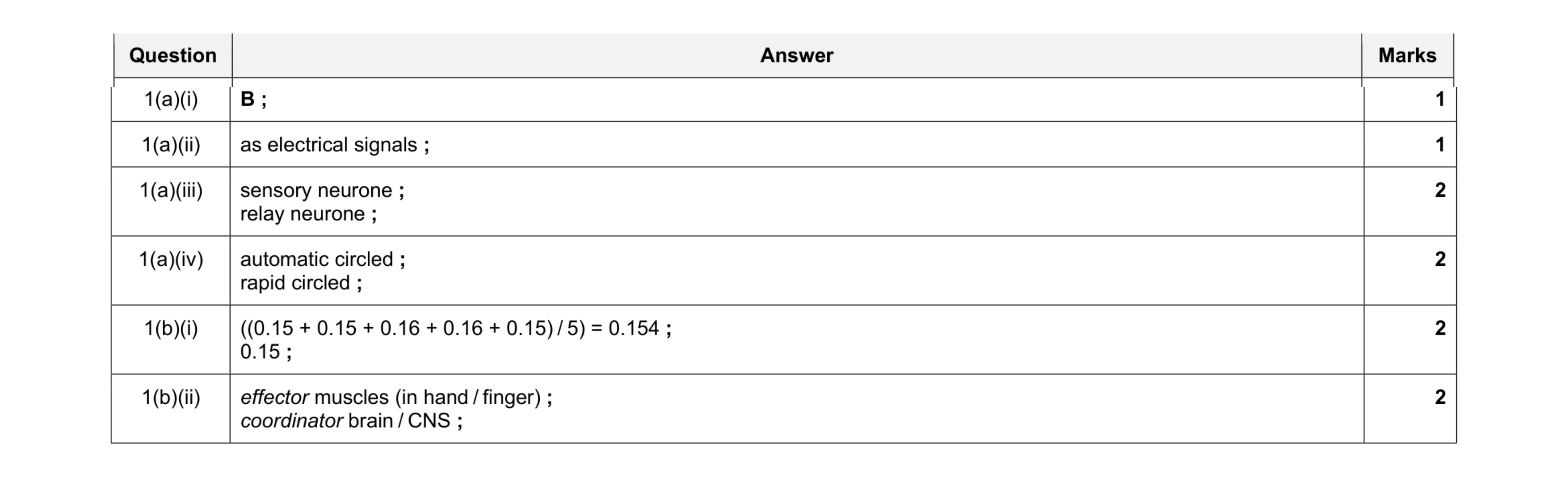 10
10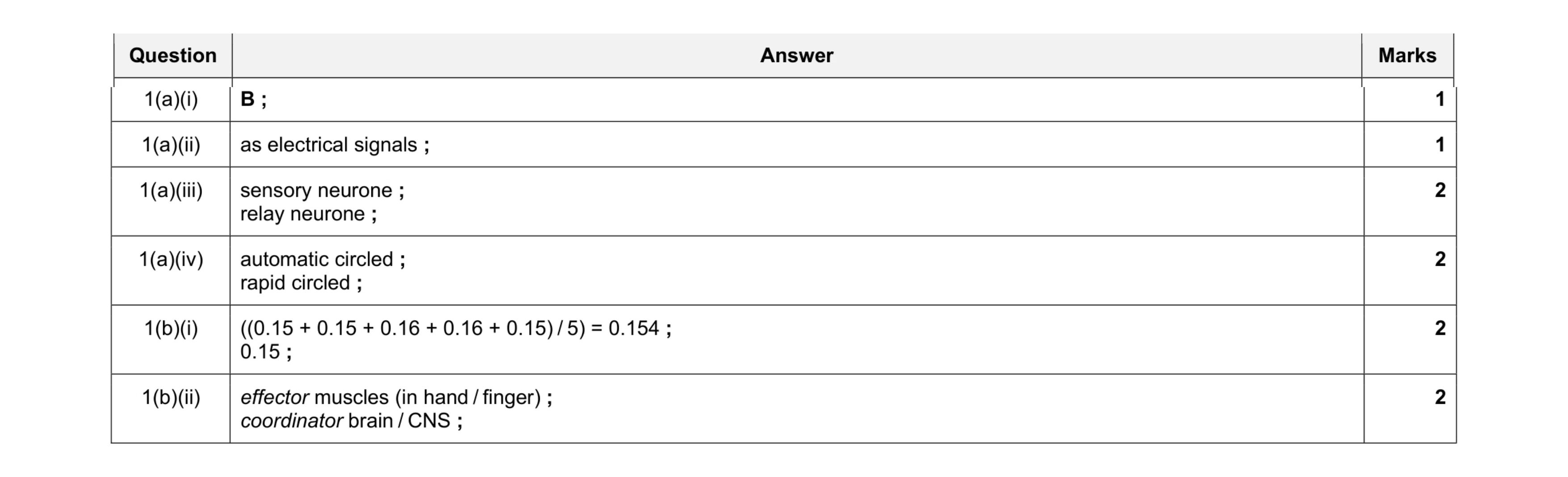 10
10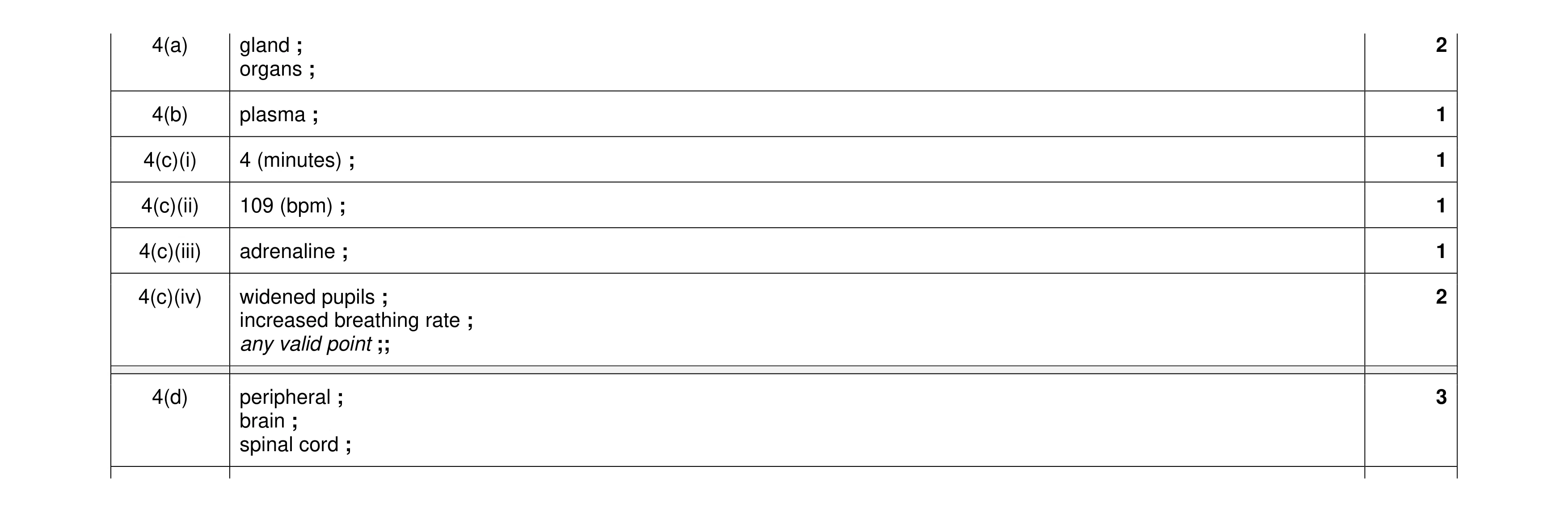 11
11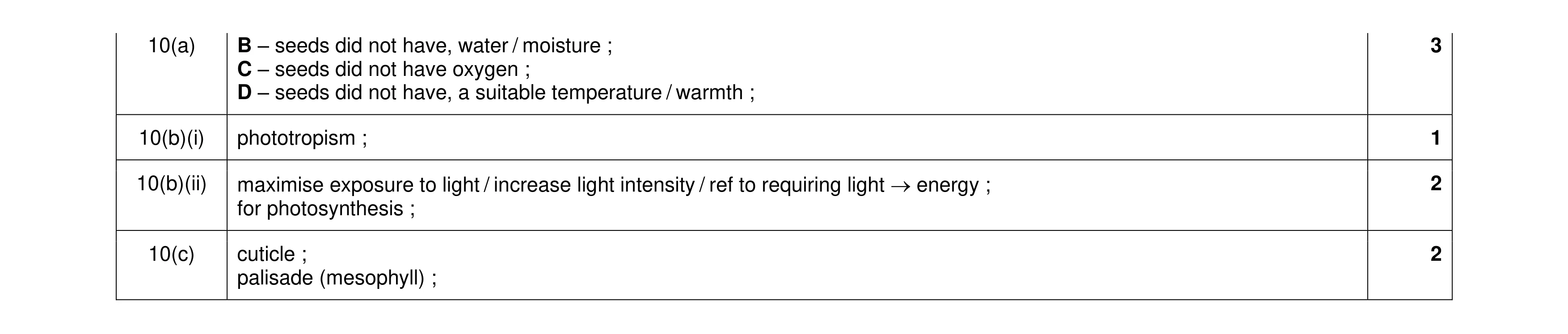 8
8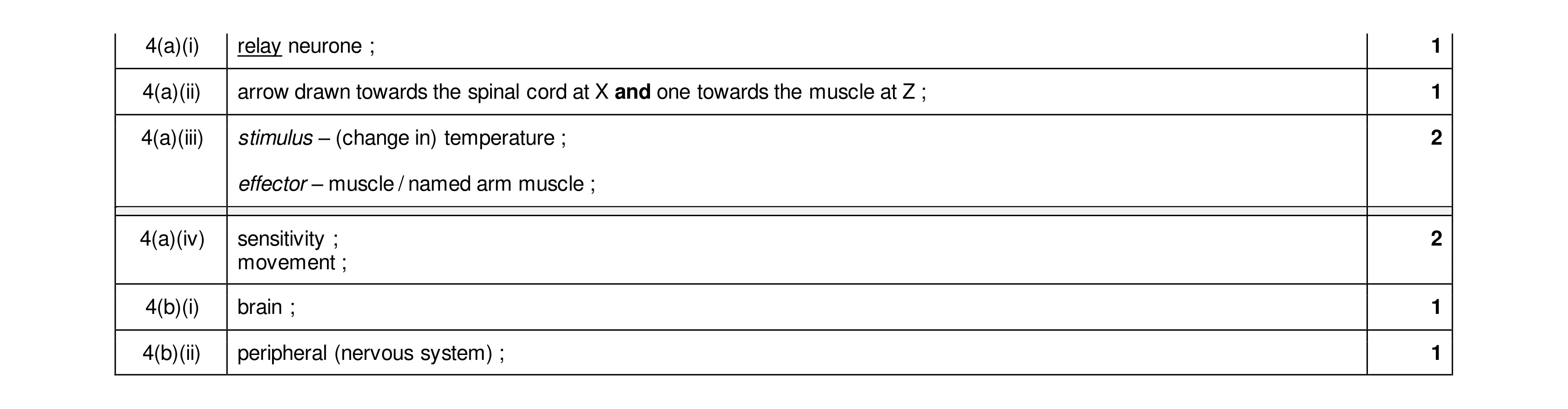 8
8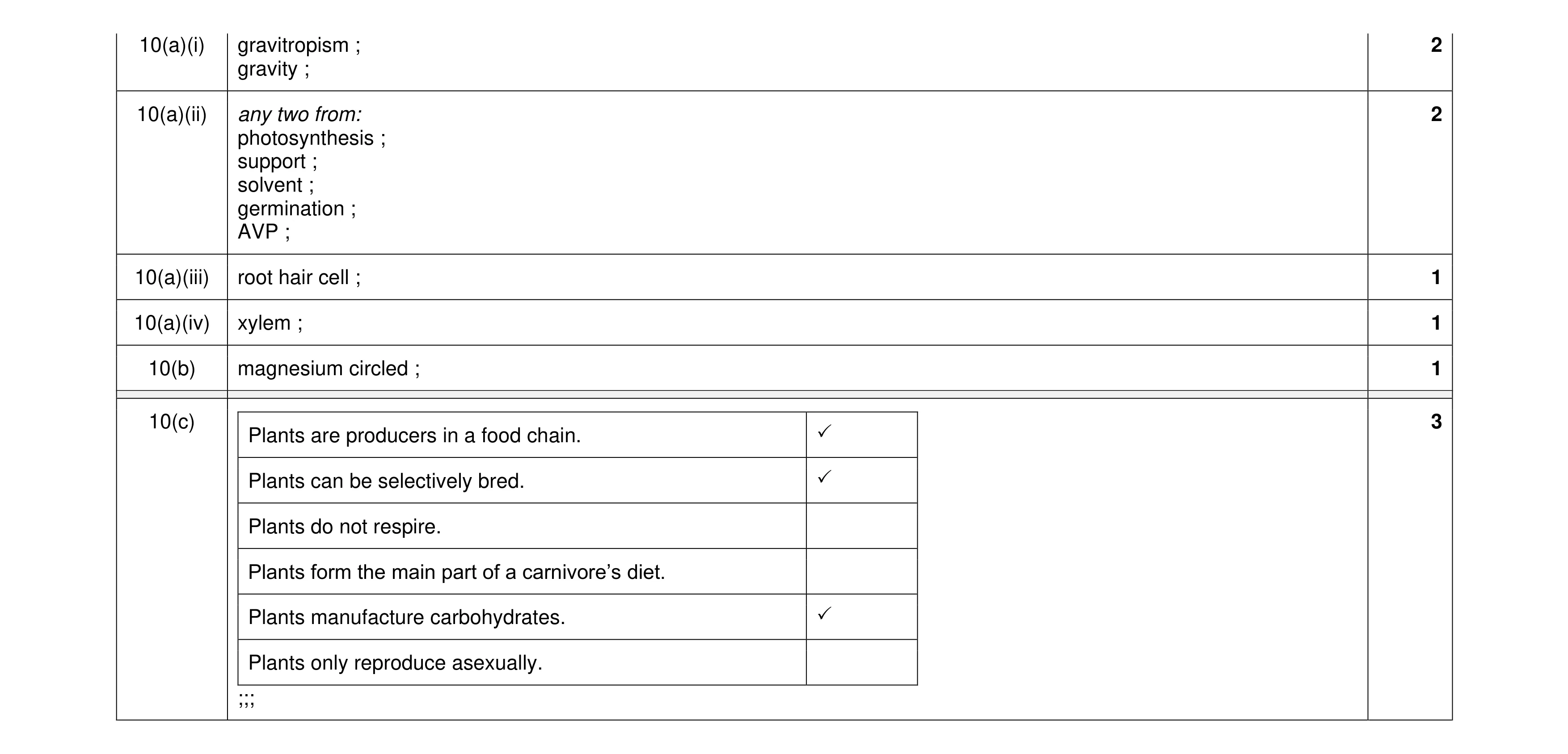 10
10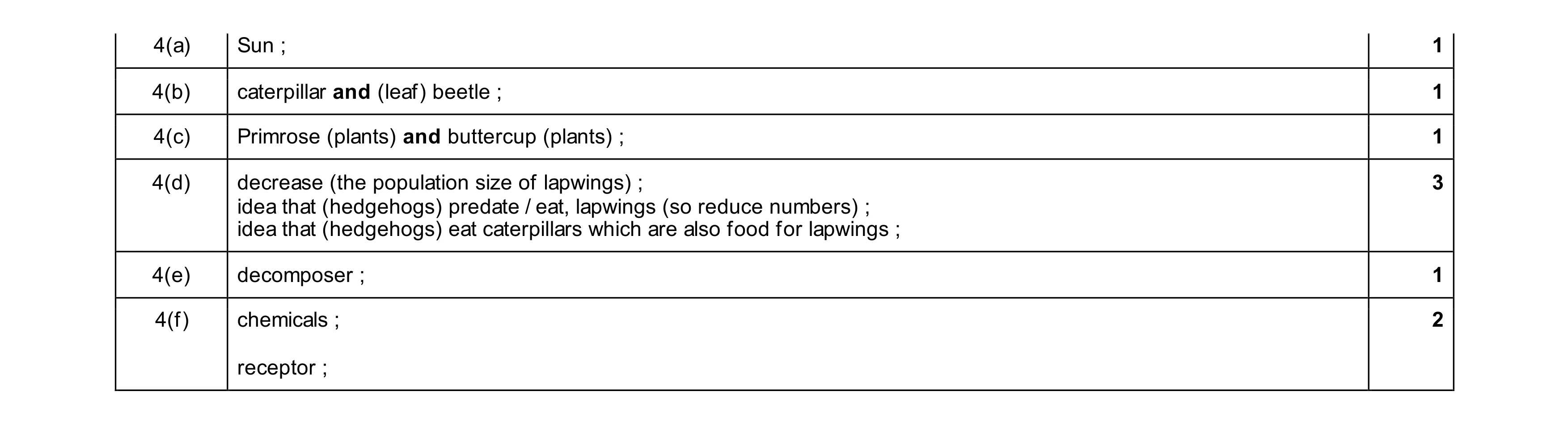 9
9