Questions as text
Q1 · The breathing rate of a student at rest is measured by measuring the volume of air in the… 0654/42 Oct/Nov 2017
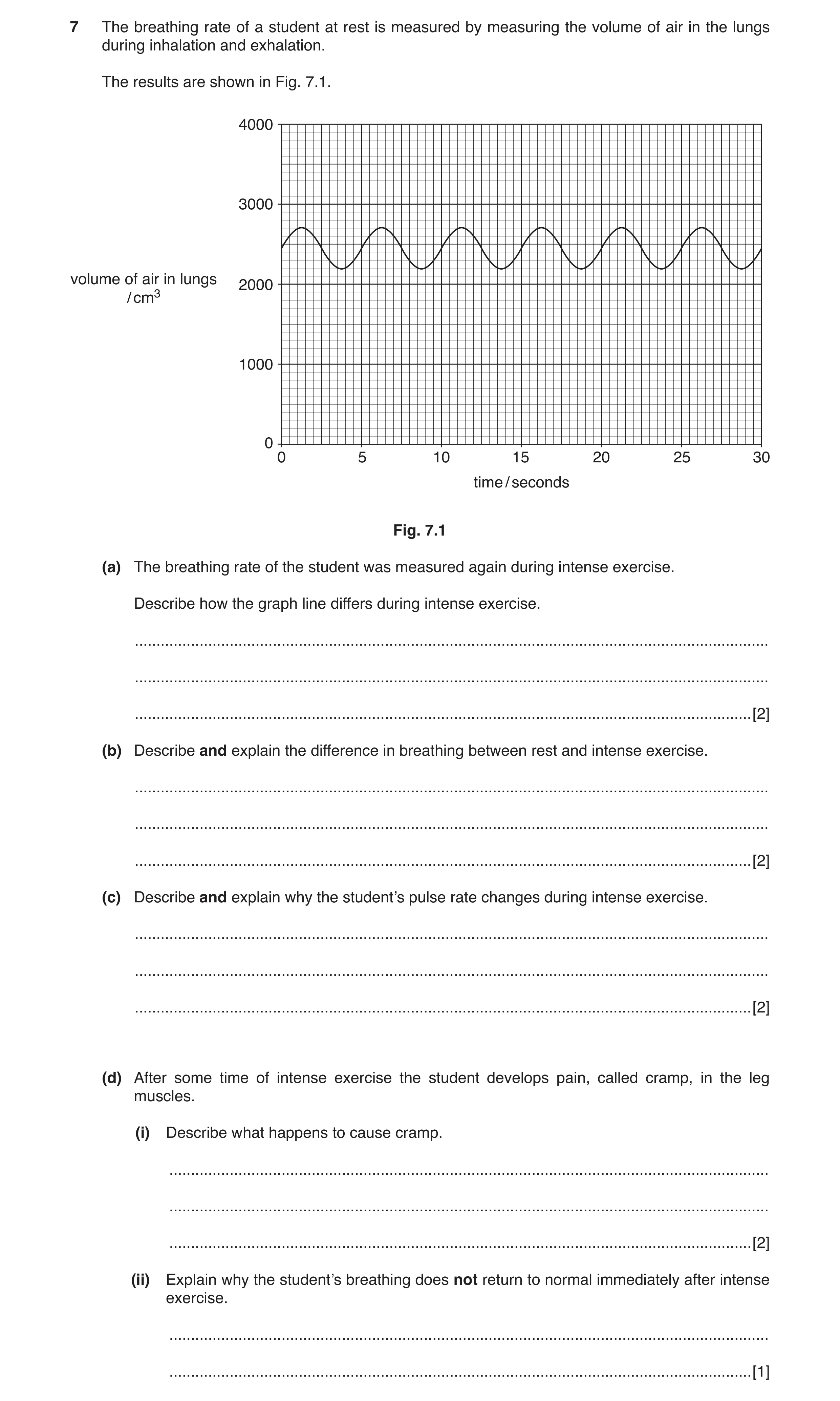
7 The breathing rate of a student at rest is measured by measuring the volume of air in the lungs during inhalation and exhalation. The results are shown in Fig. 7.1. 4000 3000 volume of air in lungs 2000 / cm3 1000 0 0 5 10 15 20 25 30 time / seconds Fig. 7.1 (a) The breathing rate of the student was measured again during intense exercise. Describe how the graph line differs during intense exercise. … … … [2] (b) Describe and explain the difference in breathing between rest and intense exercise. … … … [2] (c) Describe and explain why the student’s pulse rate changes during intense exercise. … … … [2] (d) After some time of intense exercise the student develops pain, called cramp, in the leg muscles. (i) Describe what happens to cause cramp. … … … [2] (ii) Explain why the student’s breathing does not return to normal immediately after intense exercise. … … [1]
9 marks
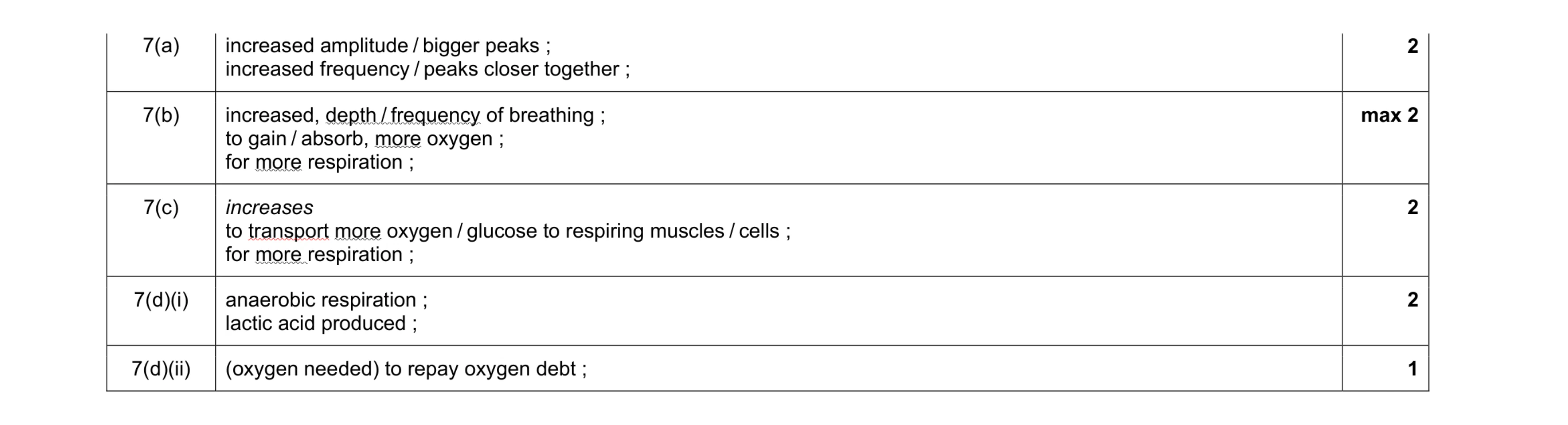
Mark scheme: 7(a) increased amplitude / bigger peaks ; increased frequency / peaks closer together ; 2 7(b) increased, depth / frequency of breathing ; to gain / absorb, more oxygen ; for more respiration ; max 2 7(c) increases to transport more oxygen / glucose to respiring muscles / cells ; for more respiration ; 2 7(d)(i) anaerobic respiration ; lactic acid produced ; 2 7(d)(ii) (oxygen needed) to repay oxygen debt ; 1
This question in 0654/42 Oct/Nov 2017
Q2 · A diagram of an alveolus with its blood capillary 0654/41 Oct/Nov 2018
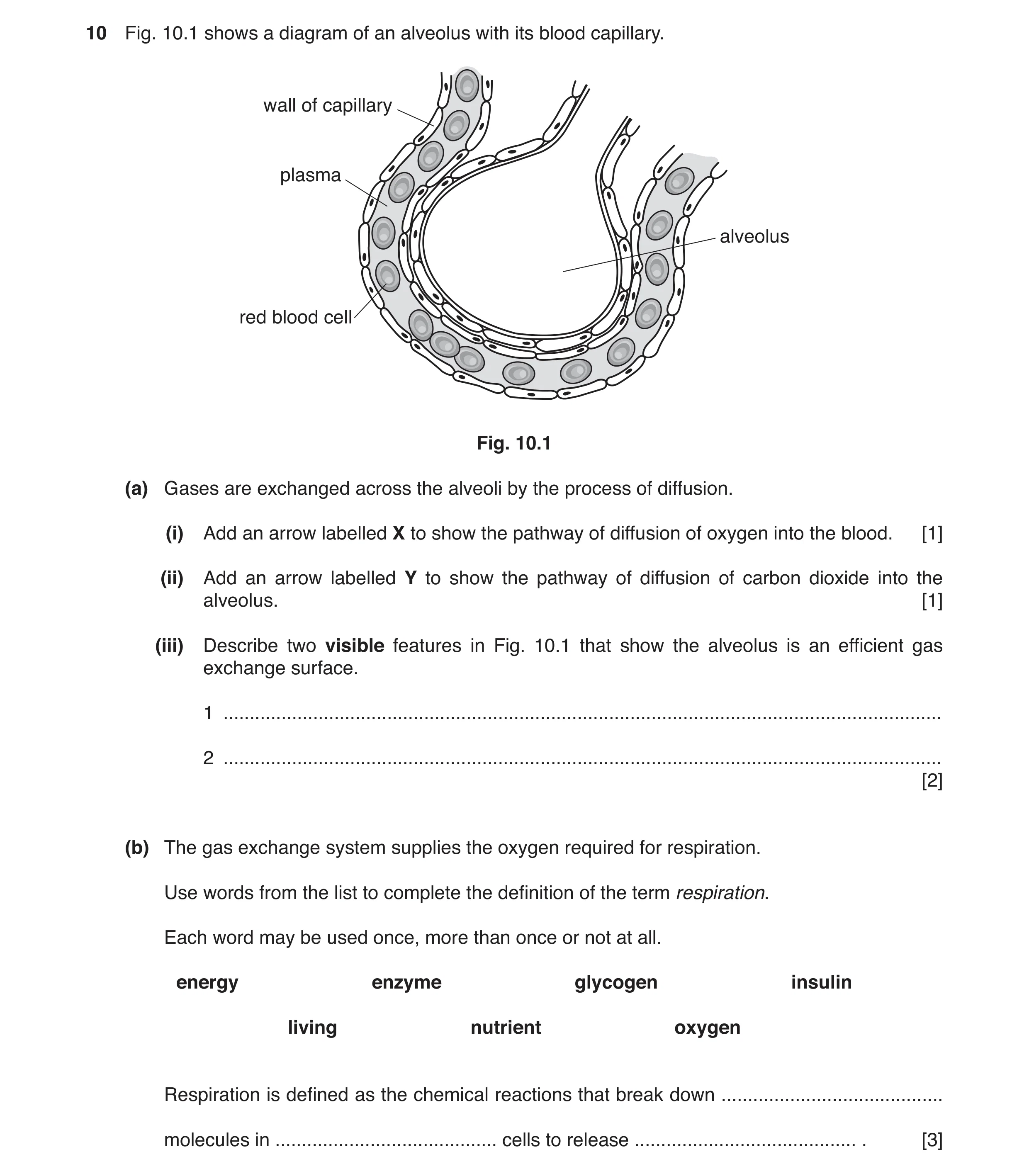
10 Fig. 10.1 shows a diagram of an alveolus with its blood capillary. wall of capillary plasma alveolus red blood cell Fig. 10.1 (a) Gases are exchanged across the alveoli by the process of diffusion. (i) Add an arrow labelled X to show the pathway of diffusion of oxygen into the blood. [1] (ii) Add an arrow labelled Y to show the pathway of diffusion of carbon dioxide into the alveolus. [1] (iii) Describe two visible features in Fig. 10.1 that show the alveolus is an efficient gas exchange surface. 1 … 2 … [2] (b) The gas exchange system supplies the oxygen required for respiration. Use words from the list to complete the definition of the term respiration. Each word may be used once, more than once or not at all. energy enzyme glycogen insulin living nutrient oxygen Respiration is defined as the chemical reactions that break down … molecules in … cells to release … . [3]
7 marks
Mark scheme: 10(a)(i) arrow drawn from alveolus to inside the red blood cell labelled X ; 1 10(a)(ii) arrow drawn from the blood plasma to inside the alveolus labelled Y ; 1 10(a)(iii) thin wall ; (good) blood supply ; large surface area ; max 2 10(b) nutrient ; living ; energy ; 3
This question in 0654/41 Oct/Nov 2018
Q3 · The percentage of the population of different age groups that smoke in a country 0654/43 Oct/Nov 2018
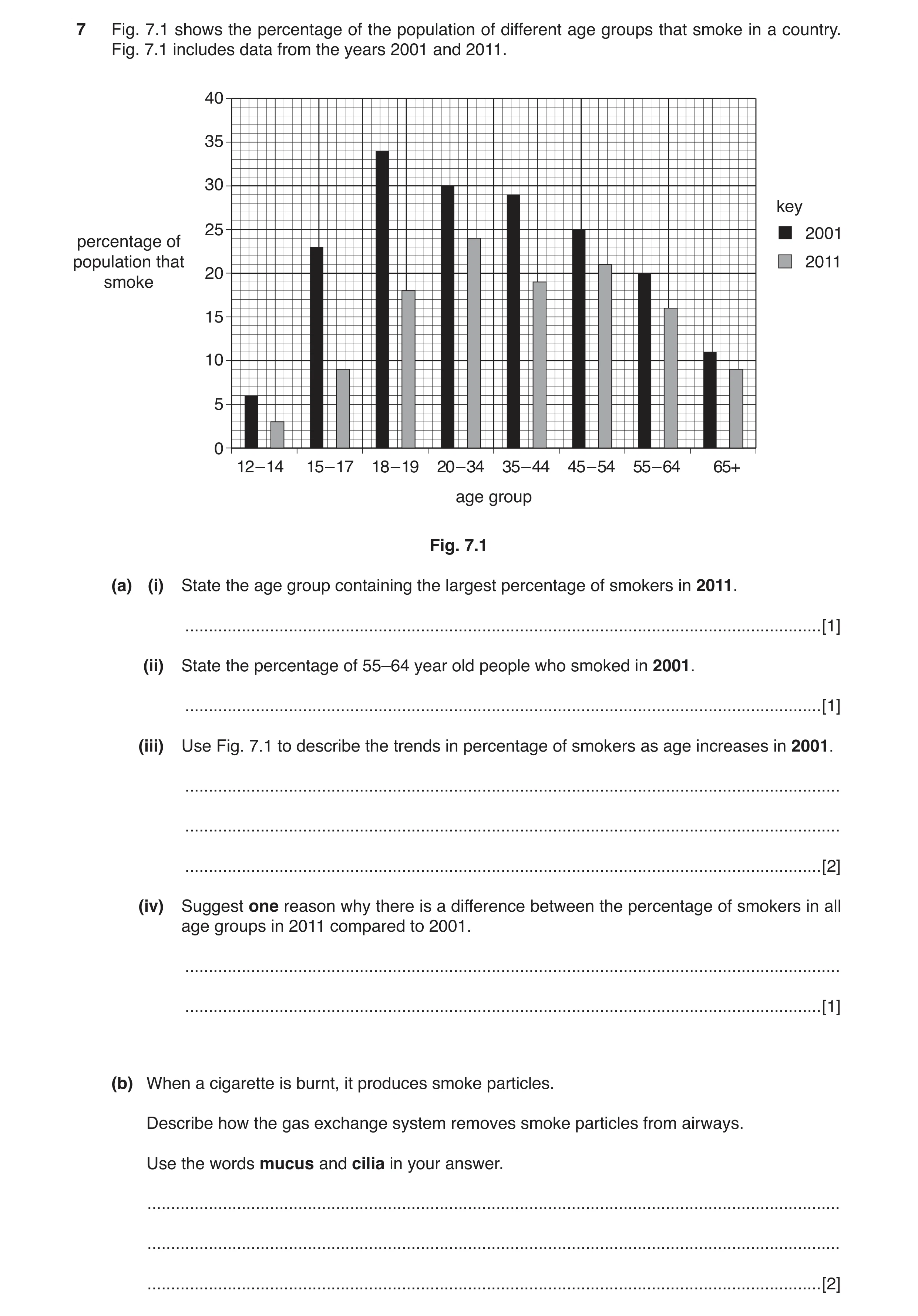
7 Fig. 7.1 shows the percentage of the population of different age groups that smoke in a country. Fig. 7.1 includes data from the years 2001 and 2011. 40 35 30 key 25 2001percentage of population that 2011 20 smoke 15 10 5 0 12 – 14 15 – 17 18 – 19 20 – 34 35 – 44 45 – 54 55 – 64 65+ age group Fig. 7.1 (a) (i) State the age group containing the largest percentage of smokers in 2011. … [1] (ii) State the percentage of 55–64 year old people who smoked in 2001. … [1] (iii) Use Fig. 7.1 to describe the trends in percentage of smokers as age increases in 2001. … … … [2] (iv) Suggest one reason why there is a difference between the percentage of smokers in all age groups in 2011 compared to 2001. … … [1] (b) When a cigarette is burnt, it produces smoke particles. Describe how the gas exchange system removes smoke particles from airways. Use the words mucus and cilia in your answer. … … … [2]
7 marks
Mark scheme: 7(a)(i) 20–34 year olds ; 1 7(a)(ii) 20 (%) ; 1 7(a)(iii) (percentage of smokers) increase then decrease ; maximum is in 18–19 year old age group / at 34% ; 2 7(a)(iv) (increased,) legislation / education / medical intervention / less advertising (of cigarettes) ; 1 7(b) mucus traps smoke particles / particulates ; cilia move mucus (containing smoke particles) (out of airway) ; 2
This question in 0654/43 Oct/Nov 2018
Q4 · The diagrams in Fig 0654/42 May/June 2019
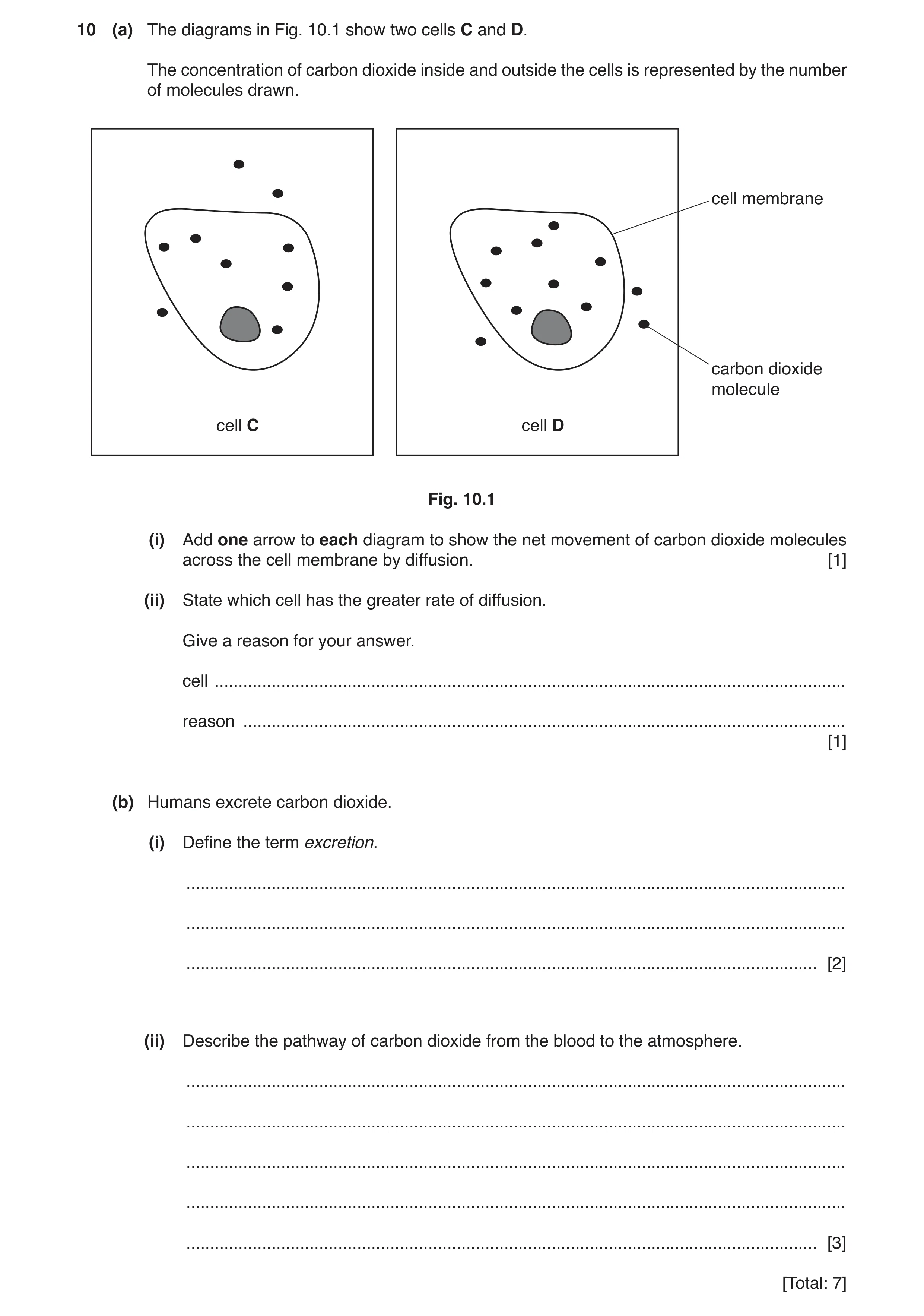
10 (a) The diagrams in Fig. 10.1 show two cells C and D. The concentration of carbon dioxide inside and outside the cells is represented by the number of molecules drawn. cell membrane carbon dioxide molecule cell C cell D Fig. 10.1 (i) Add one arrow to each diagram to show the net movement of carbon dioxide molecules across the cell membrane by diffusion. [1] (ii) State which cell has the greater rate of diffusion. Give a reason for your answer. cell … reason … [1] (b) Humans excrete carbon dioxide. (i) Define the term excretion. … … … [2] (ii) Describe the pathway of carbon dioxide from the blood to the atmosphere. … … … … … [3] [Total: 7]
7 marks
Mark scheme: 10(a)(i) two arrows pointing from the cells to outside the cells ; 1 10(a)(ii) cell D (no mark) the concentration gradient is larger ; 1 10(b)(i) removal from, organism / body ; of, (waste) products of metabolism / toxic materials / substances in excess of requirements ; 2 10(b)(ii) across the (blood) capillary wall ; into the, alveoli / lungs ; through the, bronchioles / bronchus / trachea ; (breathed) out of, nose / mouth ; max 3
This question in 0654/42 May/June 2019
Q5 · The circulatory system of a fish and a human 0654/43 May/June 2019
10 (a) Fig. 10.1 shows the circulatory system of a fish and a human. lung capillaries gill capillaries 1 ventricle 2 heart atria 1 atrium heart 2 ventricles body capillaries body capillaries fish circulatory system human circulatory system Fig. 10.1 (i) Use Fig. 10.1 to describe three ways the circulatory system of a human is different from the circulatory system of a fish. 1 … … 2 … … 3 … … [3] (ii) State the name of the structure in the human heart that separates the left ventricle from the right ventricle. … [1] (b) Gills are the gas exchange surface in fish. Suggest two features that gills have that allow efficient gas exchange. 1 … 2 … [2] (c) The human circulatory system contains arterioles. Arterioles are used in the regulation of body temperature. Describe the role of arterioles in reducing body temperature. … … … … … [3] [Total: 9]
9 marks
Mark scheme: 10(a)(i) in humans: blood travels through the heart twice in one circuit of the body / double circulation / circulation to the lungs and to the body ; heart has two atria / ventricles ; oxygenated and deoxygenated blood in the heart / (only) deoxygenated in fish heart ; lungs instead of gills ; max 3 10(a)(ii) septum ; 1 10(b) large surface area ; thin surface ; good blood supply ; max 2 10(c) correct ref to vasodilation / arterioles widen ; arterioles supply more blood to the capillaries in the skin surface ; (vasodilation) increases rate of thermal energy / heat loss from the skin; ; 3
This question in 0654/43 May/June 2019
Q6 · Cystic fibrosis is an inherited disease 0654/41 May/June 2020
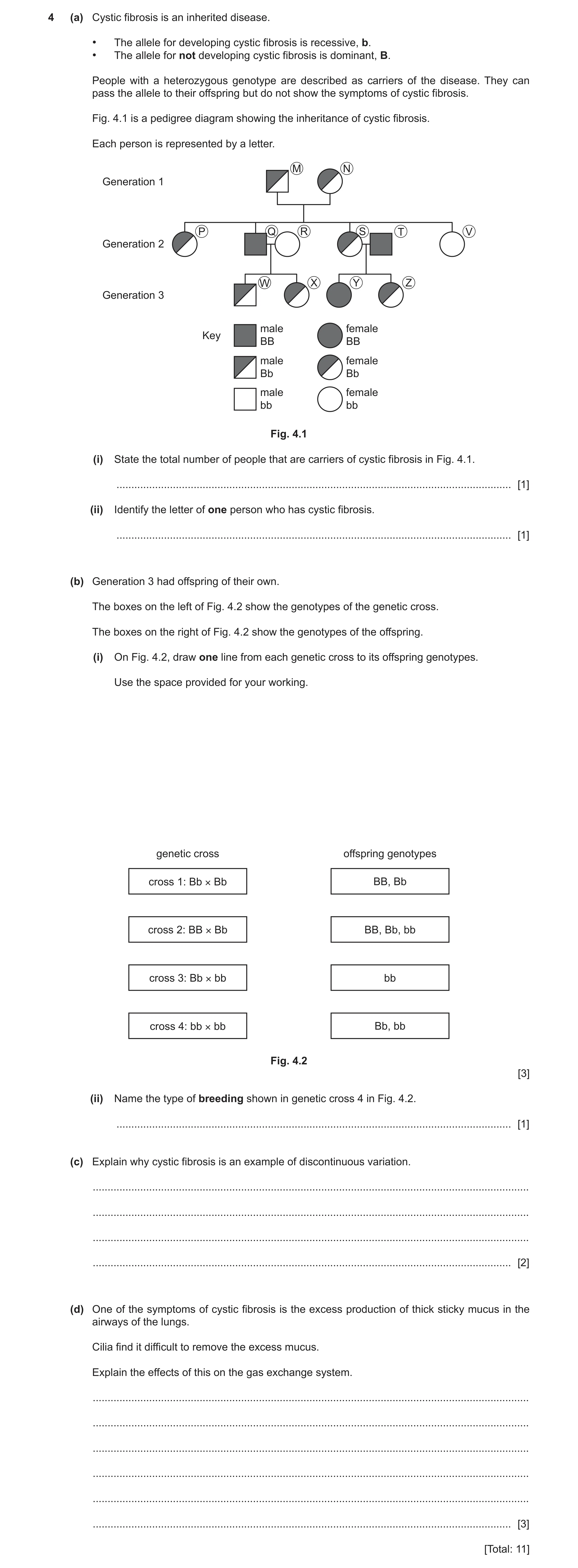
4 (a) Cystic fibrosis is an inherited disease. • The allele for developing cystic fibrosis is recessive, b. • The allele for not developing cystic fibrosis is dominant, B. People with a heterozygous genotype are described as carriers of the disease. They can pass the allele to their offspring but do not show the symptoms of cystic fibrosis. Fig. 4.1 is a pedigree diagram showing the inheritance of cystic fibrosis. Each person is represented by a letter. M N Generation 1 P Q R S T V Generation 2 W X Y Z Generation 3 male female Key BB BB male female Bb Bb male female bb bb Fig. 4.1 (i) State the total number of people that are carriers of cystic fibrosis in Fig. 4.1. … [1] (ii) Identify the letter of one person who has cystic fibrosis. … [1] (b) Generation 3 had offspring of their own. The boxes on the left of Fig. 4.2 show the genotypes of the genetic cross. The boxes on the right of Fig. 4.2 show the genotypes of the offspring. (i) On Fig. 4.2, draw one line from each genetic cross to its offspring genotypes. Use the space provided for your working. genetic cross offspring genotypes cross 1: Bb × Bb BB, Bb cross 2: BB × Bb BB, Bb, bb cross 3: Bb × bb bb cross 4: bb × bb Bb, bb Fig. 4.2 [3] (ii) Name the type of breeding shown in genetic cross 4 in Fig. 4.2. … [1] (c) Explain why cystic fibrosis is an example of discontinuous variation. … … … … [2] (d) One of the symptoms of cystic fibrosis is the excess production of thick sticky mucus in the airways of the lungs. Cilia find it difficult to remove the excess mucus. Explain the effects of this on the gas exchange system. … … … … … … [3] [Total: 11]
11 marks
Mark scheme: 4(a)(i) 7 ; 1 4(a)(ii) R / V ; 1 4(b)(i) Cross 1: Bb × Bb BB, Bb Cross 2: BB × Bb BB, Bb, bb Cross 3: Bb × bb bb Cross 4: bb × bb Bb, bb ;;; 1 correct for 1 mark 2-3 correct for 2 marks all correct for 3 marks 3 4(b)(ii) pure ; 1 4(c) limited number of phenotypes ; cystic fibrosis caused by genes alone ; 2 Question Answer Marks 4(d) alveoli get blocked ; reduces area for gas exchange ; pathogens / bacteria / dust, not removed ; breathing difficulties / coughing / wheezing ; (increased risk of) infection ; max 3
This question in 0654/41 May/June 2020
Q7 · A student measures his breathing rate at rest and during exercise 0654/42 May/June 2020
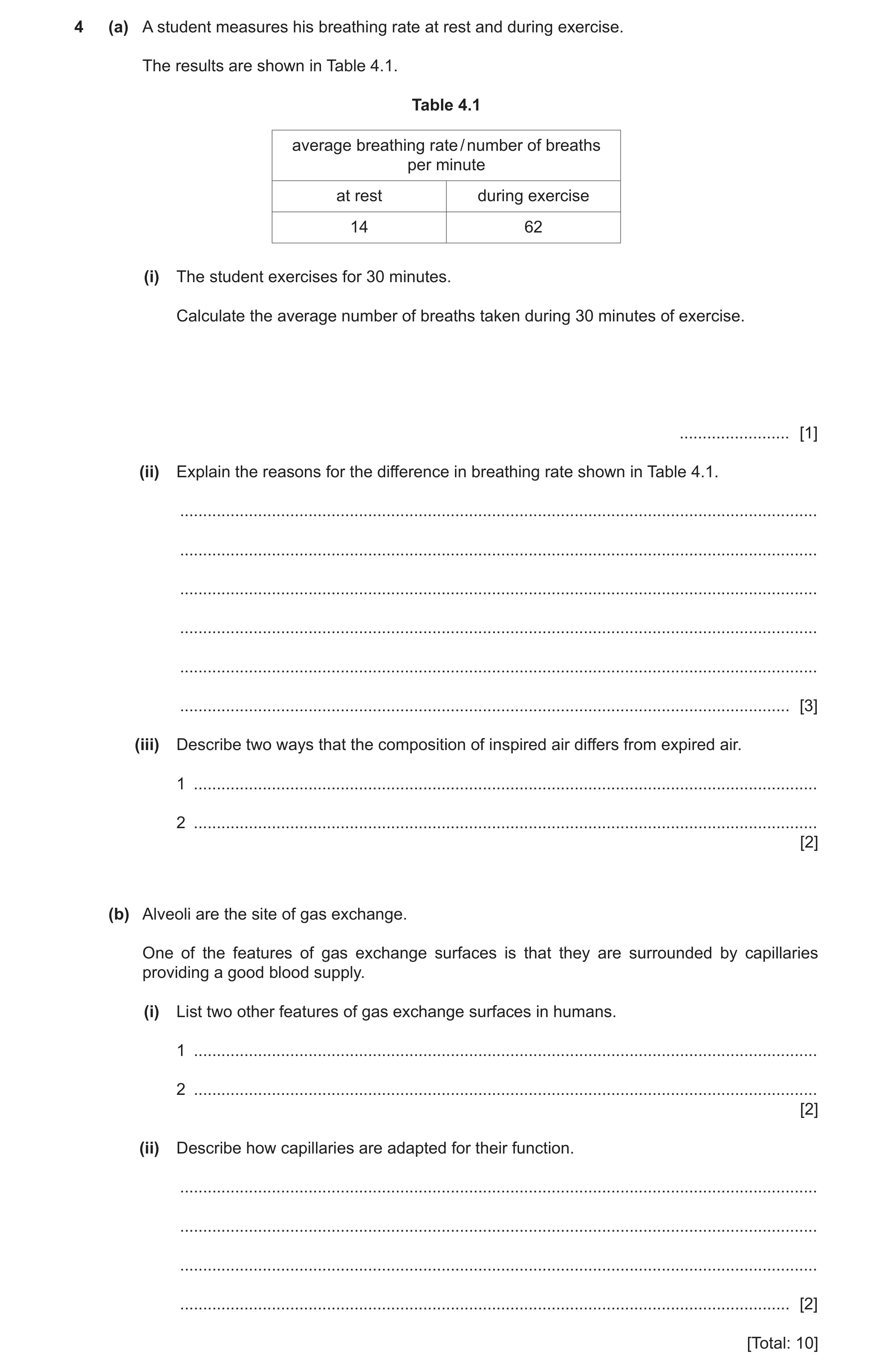
4 (a) A student measures his breathing rate at rest and during exercise. The results are shown in Table 4.1. Table 4.1 average breathing rate / number of breaths per minute at rest during exercise 14 62 (i) The student exercises for 30 minutes. Calculate the average number of breaths taken during 30 minutes of exercise. … [1] (ii) Explain the reasons for the difference in breathing rate shown in Table 4.1. … … … … … … [3] (iii) Describe two ways that the composition of inspired air differs from expired air. 1 … 2 … [2] (b) Alveoli are the site of gas exchange. One of the features of gas exchange surfaces is that they are surrounded by capillaries providing a good blood supply. (i) List two other features of gas exchange surfaces in humans. 1 … 2 … [2] (ii) Describe how capillaries are adapted for their function. … … … … [2] [Total: 10]
10 marks
Mark scheme: 4(a)(i) (62 × 30) = 1860 ; 1 4(a)(ii) (increase in physical activity) increases need for energy (for muscle contraction) ; increase in respiration ; increase in requirement for oxygen ; increase on concentration of carbon dioxide in blood ; max 3 4(a)(iii) more oxygen ; less carbon dioxide ; less water vapour ; max 2 4(b)(i) any two from: thin ; ventilated ; large surface area ; 2 4(b)(ii) thin (wall) / (wall) only one cell thick ; reduces diffusion distance ; 2
This question in 0654/42 May/June 2020
Q8 · Researchers estimated the percentage of people that smoke tobacco in a country 0654/42 Oct/Nov 2020
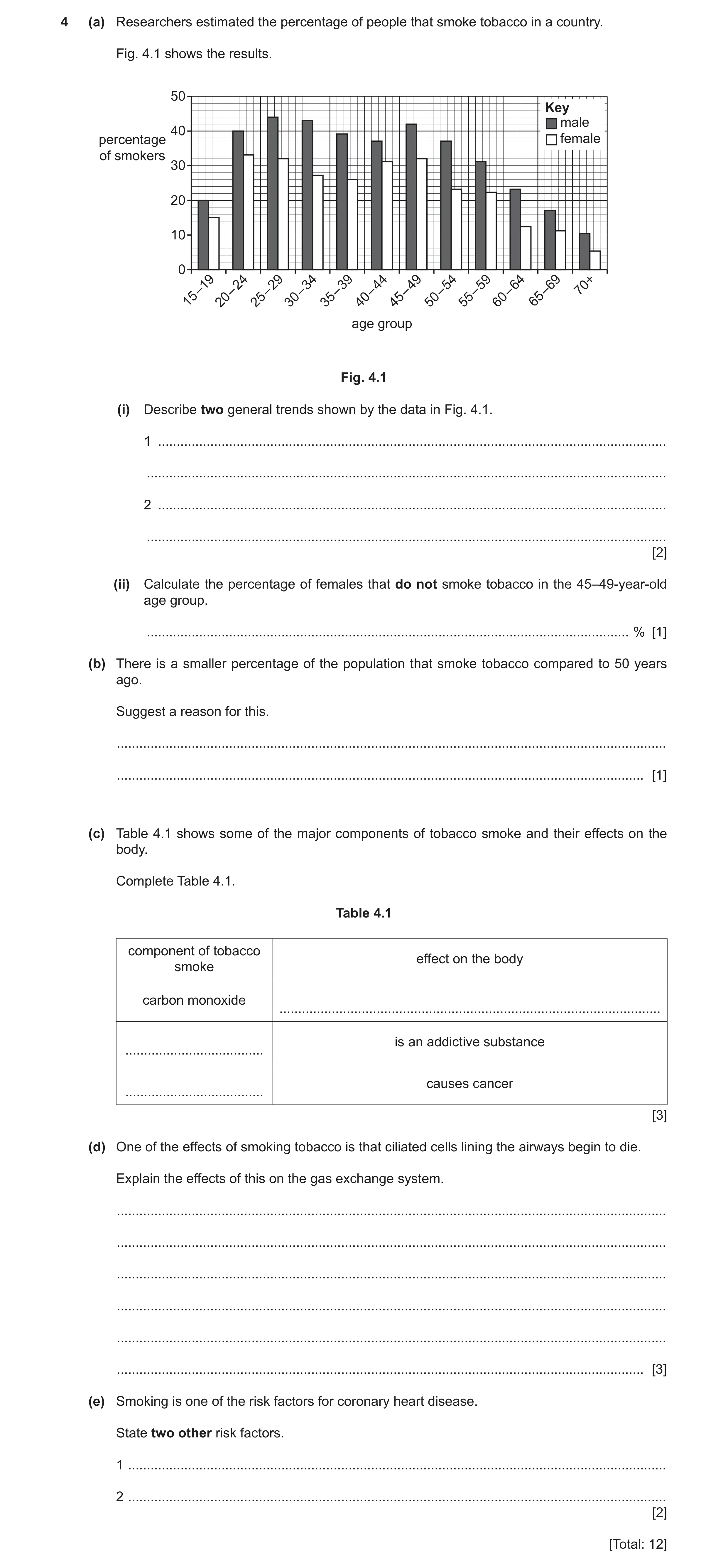
4 (a) Researchers estimated the percentage of people that smoke tobacco in a country. Fig. 4.1 shows the results. 50 Key male 40 percentage female of smokers 30 20 10 0 –19 –24 –29 –34 –39 –44 –49 –54 –59 –64 –69 70+ 15 20 25 30 35 40 45 50 55 60 65 age group Fig. 4.1 (i) Describe two general trends shown by the data in Fig. 4.1. 1 … … 2 … … [2] (ii) Calculate the percentage of females that do not smoke tobacco in the 45–49-year-old age group. … % [1] (b) There is a smaller percentage of the population that smoke tobacco compared to 50 years ago. Suggest a reason for this. … … [1] (c) Table 4.1 shows some of the major components of tobacco smoke and their effects on the body. Complete Table 4.1. Table 4.1 component of tobacco effect on the body smoke carbon monoxide … is an addictive substance … causes cancer … [3] (d) One of the effects of smoking tobacco is that ciliated cells lining the airways begin to die. Explain the effects of this on the gas exchange system. … … … … … … [3] (e) Smoking is one of the risk factors for coronary heart disease. State two other risk factors. 1 … 2 … [2] [Total: 12]
12 marks
Mark scheme: 4(a)(i) Between 15–29, the percentage increases ; Between 45–70+, the percentage decreases ; AVP ;; max 2 4(a)(ii) 68(%) ; 1 4(b) education / legislation / link with lung cancer proved / ban / AVP ; 1 4(c) component of cigarette smoke effect on the body carbon monoxide toxic / binds to haemoglobin (in place of oxygen) ; nicotine ; is an addictive substance tar ; causes cancer 3 4(d) mucus traps, pathogens / particulates ; cilia unable to remove mucus ; decreases surface area of, gas exchange surface / alveoli ; bacteria multiply ; causing, infection / coughing / irritation ; max 3 3 Question Answer Marks 4(e) any two from: stress ; age ; gender ; diet ; genetic predisposition ; AVP ;; 2
This question in 0654/42 Oct/Nov 2020
Q9 · The percentage of oxygen in inspired air, in expired air when resting and in expired air… 0654/43 May/June 2021
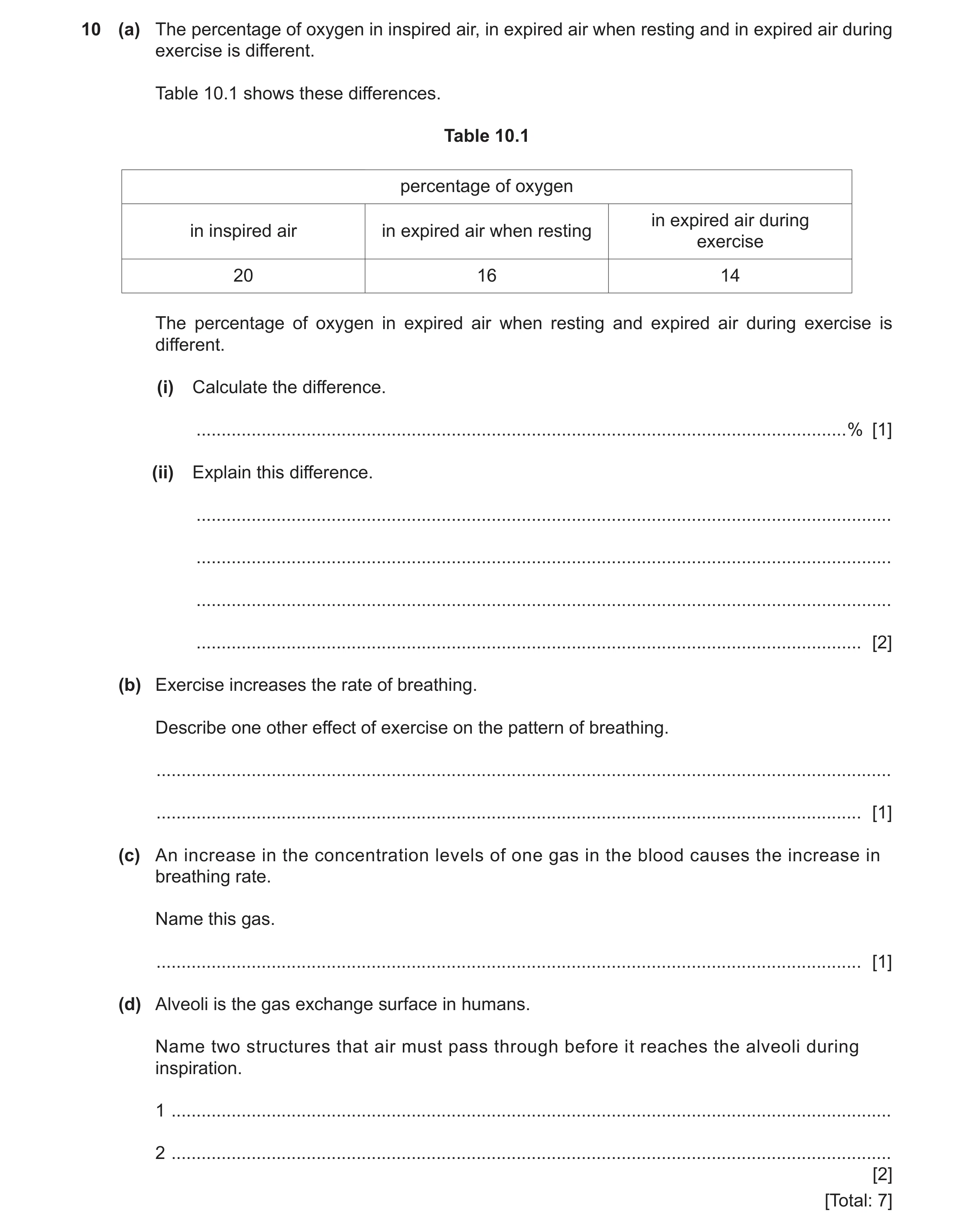
10 (a) The percentage of oxygen in inspired air, in expired air when resting and in expired air during exercise is different. Table 10.1 shows these differences. Table 10.1 percentage of oxygen in expired air during in inspired air in expired air when resting exercise 20 16 14 The percentage of oxygen in expired air when resting and expired air during exercise is different. (i) Calculate the difference. … % [1] (ii) Explain this difference. … … … … [2] (b) Exercise increases the rate of breathing. Describe one other effect of exercise on the pattern of breathing. … … [1] (c) An increase in the concentration levels of one gas in the blood causes the increase in breathing rate. Name this gas. … [1] (d) Alveoli is the gas exchange surface in humans. Name two structures that air must pass through before it reaches the alveoli during inspiration. 1 … 2 … [2] [Total: 7]
7 marks
Mark scheme: 10(a)(i) 2(%) ; 1 10(a)(ii) (more) oxygen used in respiration ; to release energy (for exercise) ; 2 10(b) increased depth of breathing ; 1 10(c) carbon dioxide ; 1 10(d) mouth / nose ; larynx ; trachea ; bronchus ; bronchioles ; max 2 2
This question in 0654/43 May/June 2021
Q10 · A diagram of the gas exchange system in humans 0654/41 Oct/Nov 2021
1 (a) Fig. 1.1 is a diagram of the gas exchange system in humans. A B C alveoli Fig. 1.1 (i) Identify the parts labelled A, B and C in Fig. 1.1. A … B … C … [3] (ii) The alveoli are the gas exchange surface in humans. State two features of alveoli that make them efficient gas exchange surfaces. 1 … 2 … [2] (b) Two similar sized groups of people are monitored. One group smoke tobacco (smokers) and the other group do not (non-smokers). The number of smokers and non-smokers of different ages with chronic obstructive pulmonary disease (COPD) are recorded. Fig. 1.2 shows the results. 2500 2000 1500 number of people with COPD 1000 500 0 under 45 45–54 55–64 65–74 age group Key smokers non-smokers Fig. 1.2 Describe the results shown in Fig. 1.2. … … … … … … [3] (c) The tar in tobacco smoke stops the ciliated cells in the gas exchange system from working efficiently. (i) Explain how this would increase the likelihood of infection in the lungs. Include ideas about goblet cells in your answer. … … … … … … [3] (ii) Name the substance in tobacco smoke that is addictive. … [1] [Total: 12]
12 marks
Mark scheme: 1(a)(i) A trachea ; B intercostal muscle ; C diaphragm ; 3 1(a)(ii) any two from: good blood supply ; thin ; large surface area ; ventilated ; AVP ; 2 1(b) any two from: COPD increases with age ; more smokers have COPD than non-smokers ; more rapid increase of COPD with age in smokers ; comparative data quote ; 3 1(c)(i) goblet cells produce mucus ; and any two from: mucus traps, pathogens / particles / bacteria ; cilia unable to remove, mucus / pathogens / bacteria ; bacteria, reproduce / multiply (causing infection) ; 3 1(c)(ii) nicotine ; 1
This question in 0654/41 Oct/Nov 2021
Q11 · A student investigates the effect of temperature on the rate of transpiration 0654/42 May/June 2022
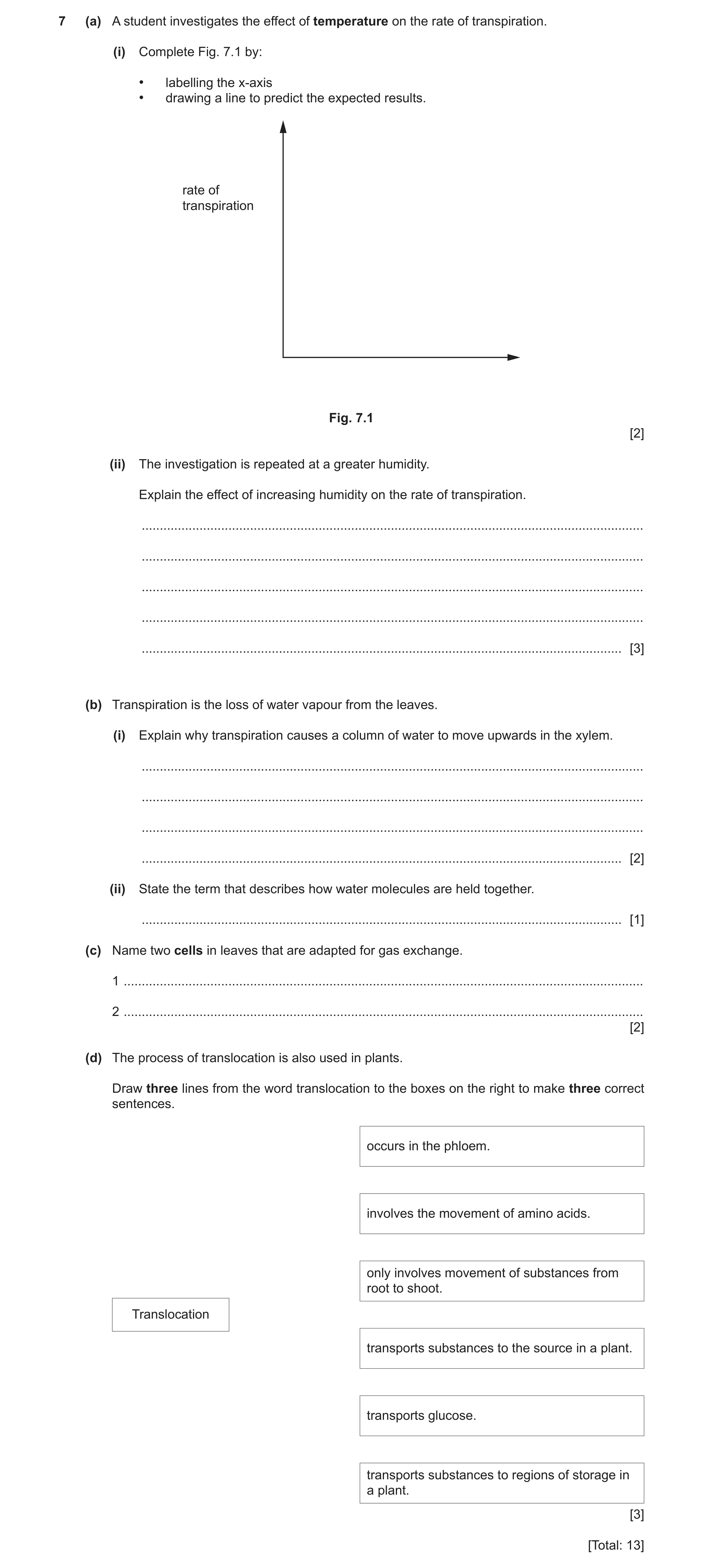
7 (a) A student investigates the effect of temperature on the rate of transpiration. (i) Complete Fig. 7.1 by: • labelling the x‑axis • drawing a line to predict the expected results. rate of transpiration Fig. 7.1 [2] (ii) The investigation is repeated at a greater humidity. Explain the effect of increasing humidity on the rate of transpiration. … … … … … [3] (b) Transpiration is the loss of water vapour from the leaves. (i) Explain why transpiration causes a column of water to move upwards in the xylem. … … … … [2] (ii) State the term that describes how water molecules are held together. … [1] (c) Name two cells in leaves that are adapted for gas exchange. 1 … 2 … [2] (d) The process of translocation is also used in plants. Draw three lines from the word translocation to the boxes on the right to make three correct sentences. occurs in the phloem. involves the movement of amino acids. only involves movement of substances from root to shoot. Translocation transports substances to the source in a plant. transports glucose. transports substances to regions of storage in a plant. [3] [Total: 13]
13 marks
Mark scheme: 7(a)(i) temperature on x-axis ; line showing an increase (and levelling off) ; 2 7(a)(ii) any three from: transpiration rate decreases ; increase in water (vapour) in the, atmosphere / air ; idea of decreases the, water potential / concentration, gradient ; (so) less, evaporation / diffusion ; 3 7(b)(i) transpiration pull ; causes, a water potential gradient / a difference in water potential ; 2 7(b)(ii) cohesion ; 1 7(c) spongy mesophyll (cells) ; guard (cells) ; 2 7(d) translocation linked to: occurs in the phloem ; involves the movement of amino acids ; transport substances to regions of storage in a plant ; 3
This question in 0654/42 May/June 2022
Q12 · The percentage of the population of males and females in different age groups with… 0654/42 May/June 2022
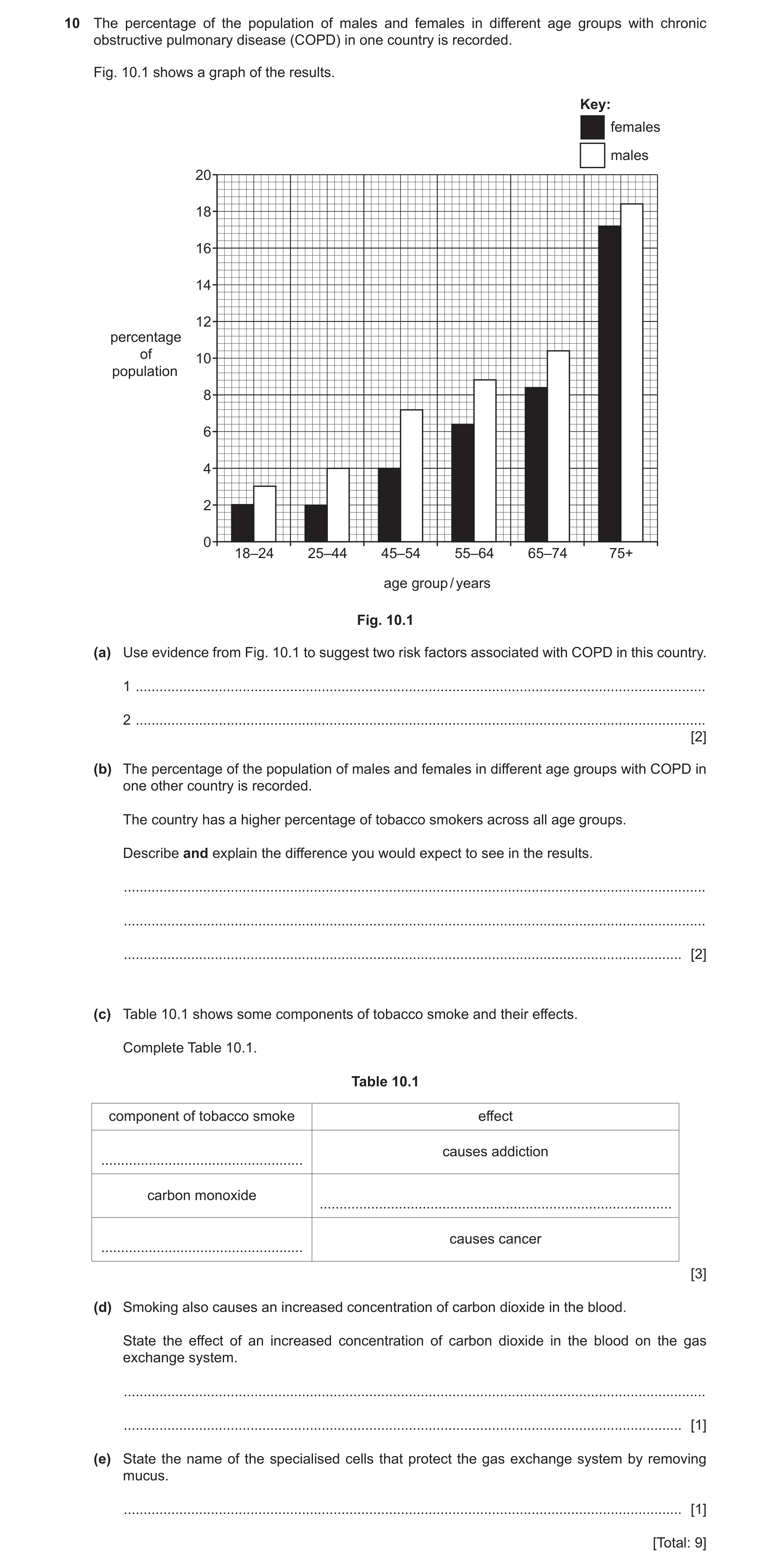
10 The percentage of the population of males and females in different age groups with chronic obstructive pulmonary disease (COPD) in one country is recorded. Fig. 10.1 shows a graph of the results. Key: females males 20 18 16 14 12 percentage of 10 population 8 6 4 2 0 18–24 25–44 45–54 55–64 65–74 75+ age group / years Fig. 10.1 (a) Use evidence from Fig. 10.1 to suggest two risk factors associated with COPD in this country. 1 … 2 … [2] (b) The percentage of the population of males and females in different age groups with COPD in one other country is recorded. The country has a higher percentage of tobacco smokers across all age groups. Describe and explain the difference you would expect to see in the results. … … … [2] (c) Table 10.1 shows some components of tobacco smoke and their effects. Complete Table 10.1. Table 10.1 component of tobacco smoke effect causes addiction … carbon monoxide … causes cancer … [3] (d) Smoking also causes an increased concentration of carbon dioxide in the blood. State the effect of an increased concentration of carbon dioxide in the blood on the gas exchange system. … … [1] (e) State the name of the specialised cells that protect the gas exchange system by removing mucus. … [1] [Total: 9]
9 marks
Mark scheme: 10(a) age ; sex ; 2 10(b) increased percentage of COPD (across all age groups) ; because smoking causes COPD ; 2 10(c) component of tobacco smoke effect nicotine ; causes addiction carbon monoxide causes, blood / red blood cells, to carry less oxygen ; tar ; causes cancer 3 10(d) increased rate of breathing ; 1 10(e) ciliated epithelial cells ; 1
This question in 0654/42 May/June 2022
Q13 · A diagram of a cross-section through a leaf 0654/42 Oct/Nov 2022
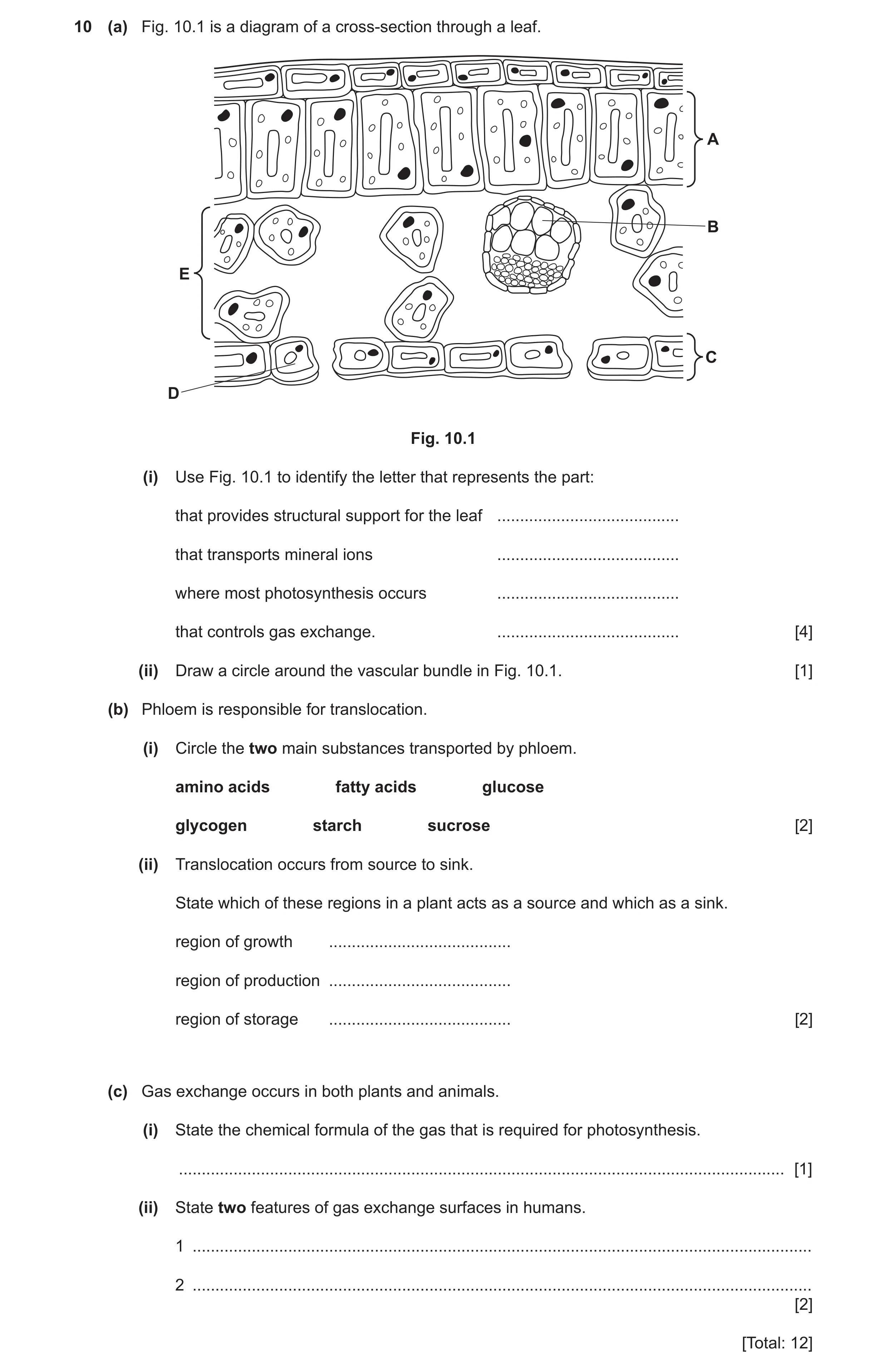
10 (a) Fig. 10.1 is a diagram of a cross-section through a leaf. A B E C D Fig. 10.1 (i) Use Fig. 10.1 to identify the letter that represents the part: that provides structural support for the leaf … that transports mineral ions … where most photosynthesis occurs … that controls gas exchange. … [4] (ii) Draw a circle around the vascular bundle in Fig. 10.1. [1] (b) Phloem is responsible for translocation. (i) Circle the two main substances transported by phloem. amino acids fatty acids glucose glycogen starch sucrose [2] (ii) Translocation occurs from source to sink. State which of these regions in a plant acts as a source and which as a sink. region of growth … region of production … region of storage … [2] (c) Gas exchange occurs in both plants and animals. (i) State the chemical formula of the gas that is required for photosynthesis. … [1] (ii) State two features of gas exchange surfaces in humans. 1 … 2 … [2] [Total: 12]
12 marks
Mark scheme: 10(a)(i) B ; 4 B ; A ; D ; 10(a)(ii) circle drawn round the vascular bundle ; 1 10(b)(i) amino acids ; 2 sucrose ; 10(b)(ii) sink 2 source sink ;; 1 correct = 0 2 correct = 1 3 correct = 2 10(c)(i) CO2 ; 1 10(c)(ii) any two from: 2 large surface area ; thin (surface) ; good blood supply ; good ventilation with air ;
This question in 0654/42 Oct/Nov 2022
Q14 · Gills are the gas exchange surface in fish 0654/43 Oct/Nov 2022
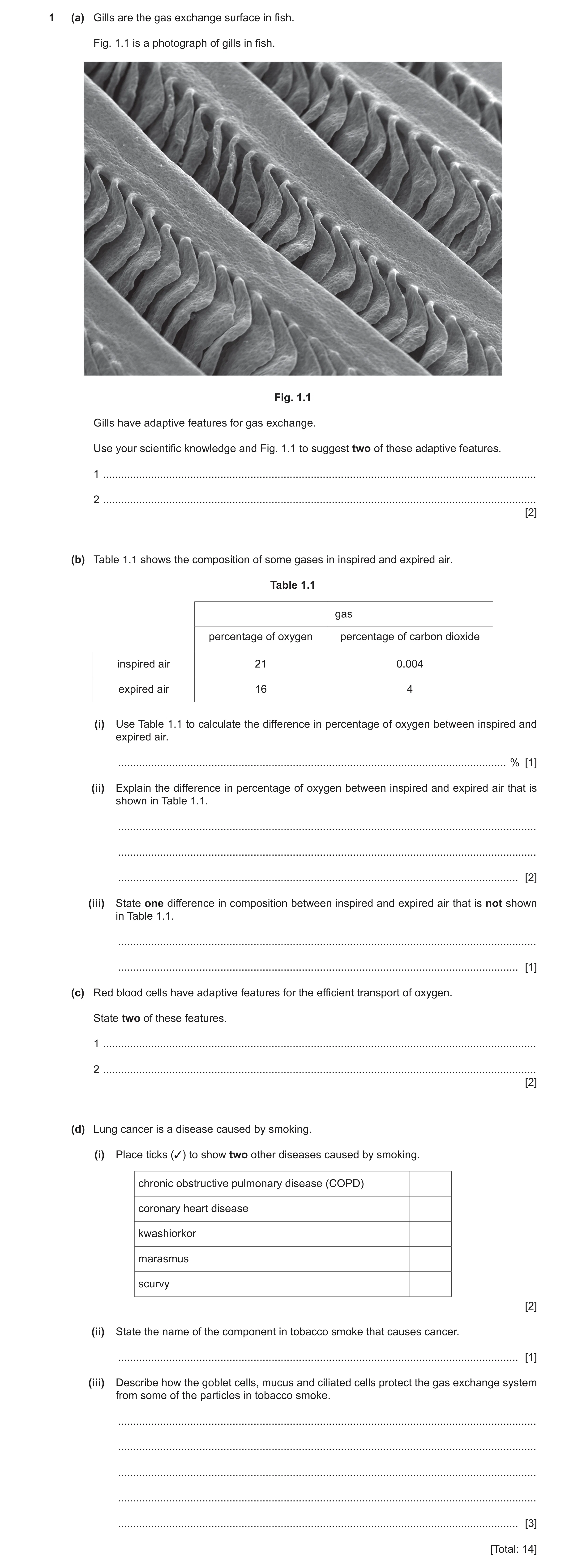
1 (a) Gills are the gas exchange surface in fish. Fig. 1.1 is a photograph of gills in fish. Fig. 1.1 Gills have adaptive features for gas exchange. Use your scientific knowledge and Fig. 1.1 to suggest two of these adaptive features. 1 … 2 … [2] (b) Table 1.1 shows the composition of some gases in inspired and expired air. Table 1.1 gas percentage of oxygen percentage of carbon dioxide inspired air 21 0.004 expired air 16 4 (i) Use Table 1.1 to calculate the difference in percentage of oxygen between inspired and expired air. … % [1] (ii) Explain the difference in percentage of oxygen between inspired and expired air that is shown in Table 1.1. … … … [2] (iii) State one difference in composition between inspired and expired air that is not shown in Table 1.1. … … [1] (c) Red blood cells have adaptive features for the efficient transport of oxygen. State two of these features. 1 … 2 … [2] (d) Lung cancer is a disease caused by smoking. (i) Place ticks (3) to show two other diseases caused by smoking. chronic obstructive pulmonary disease (COPD) coronary heart disease kwashiorkor marasmus scurvy [2] (ii) State the name of the component in tobacco smoke that causes cancer. … [1] (iii) Describe how the goblet cells, mucus and ciliated cells protect the gas exchange system from some of the particles in tobacco smoke. … … … … … [3] [Total: 14]
14 marks
Mark scheme: Question Answer Marks 1(a) any two from: 2 large surface area ; thin (surface) ; good blood supply ; any valid point ; 1(b)(i) 5 (%) ; 1 1(b)(ii) oxygen is required for (aerobic) respiration ; 2 to release energy (for metabolic processes) ; 1(b)(iii) greater percentage of water (vapour) in expired air ; 1 1(c) any two from: 2 large surface area / biconcave shape ; contain haemoglobin ; no nucleus ; 1(d)(i) COPD ticked ; 2 CHD ticked ; 1(d)(ii) tar ; 1 1(d)(iii) goblet cells produce mucus ; 3 mucus traps particles/pathogens ; cilia move mucus/particles/pathogens (away from gas exchange surface) ;
This question in 0654/43 Oct/Nov 2022
Q15 · A student measures their breathing rate at rest and during exercise 0654/42 Feb/March 2023
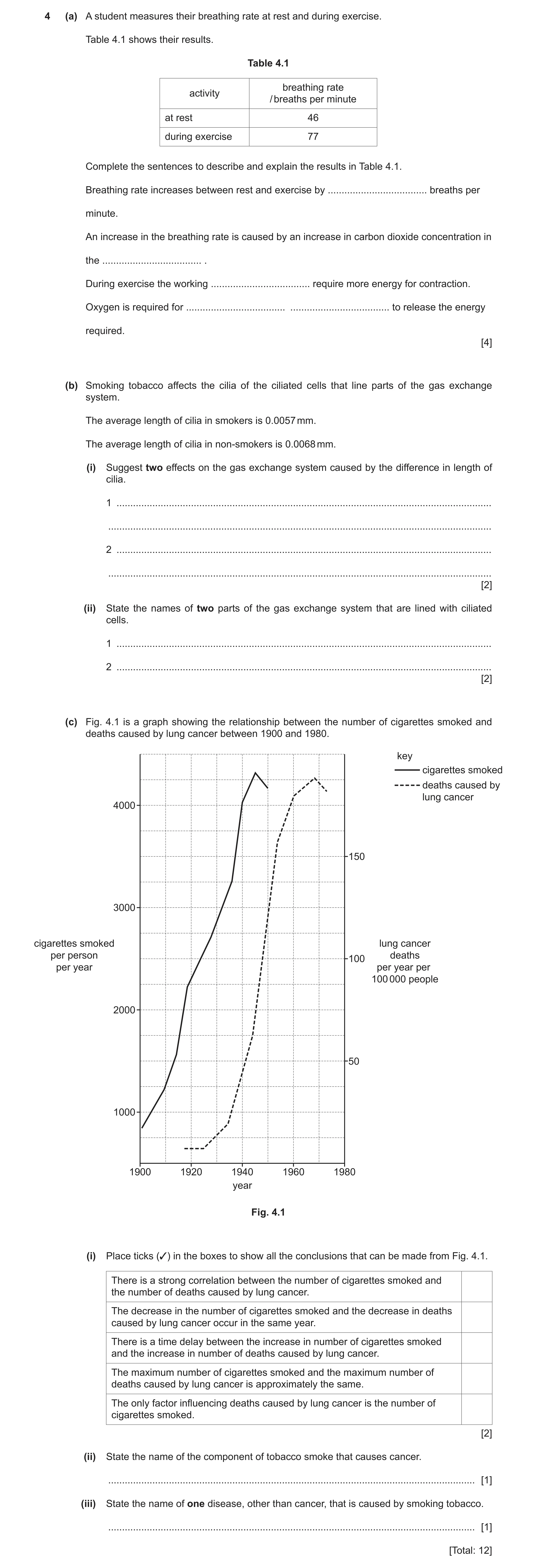
4 (a) A student measures their breathing rate at rest and during exercise. Table 4.1 shows their results. Table 4.1 breathing rate activity / breaths per minute at rest 46 during exercise 77 Complete the sentences to describe and explain the results in Table 4.1. Breathing rate increases between rest and exercise by … breaths per minute. An increase in the breathing rate is caused by an increase in carbon dioxide concentration in the … . During exercise the working … require more energy for contraction. Oxygen is required for … … to release the energy required. [4] (b) Smoking tobacco affects the cilia of the ciliated cells that line parts of the gas exchange system. The average length of cilia in smokers is 0.0057 mm. The average length of cilia in non‑smokers is 0.0068 mm. (i) Suggest two effects on the gas exchange system caused by the difference in length of cilia. 1 … … 2 … … [2] (ii) State the names of two parts of the gas exchange system that are lined with ciliated cells. 1 … 2 … [2] (c) Fig. 4.1 is a graph showing the relationship between the number of cigarettes smoked and deaths caused by lung cancer between 1900 and 1980. key cigarettes smoked deaths caused by lung cancer 4000 150 3000 cigarettes smoked lung cancer per person deaths 100 per year per year per 100 000 people 2000 50 1000 1900 1920 1940 1960 1980 year Fig. 4.1 (i) Place ticks (3) in the boxes to show all the conclusions that can be made from Fig. 4.1. There is a strong correlation between the number of cigarettes smoked and the number of deaths caused by lung cancer. The decrease in the number of cigarettes smoked and the decrease in deaths caused by lung cancer occur in the same year. There is a time delay between the increase in number of cigarettes smoked and the increase in number of deaths caused by lung cancer. The maximum number of cigarettes smoked and the maximum number of deaths caused by lung cancer is approximately the same. The only factor influencing deaths caused by lung cancer is the number of cigarettes smoked. [2] (ii) State the name of the component of tobacco smoke that causes cancer. … [1] (iii) State the name of one disease, other than cancer, that is caused by smoking tobacco. … [1] [Total: 12]
12 marks
Mark scheme: 4(a) 31 ; 4 blood ; muscles ; aerobic respiration ; 4(b)(i) any two from: 2 shorter cilia less effective at moving mucus ; increased risk of, (bacterial) infection / breathing difficulties / coughing ; less efficient gas exchange ; 4(b)(ii) any two from: 2 trachea ; bronchi / bronchus ; bronchioles ; 4(c)(i) 2 There is a strong correlation between the number of cigarettes smoked and the number of deaths ✓ caused by lung cancer. The decrease in the number of cigarettes smoked and the decrease in deaths caused by lung cancer occur in the same year There is a time delay between the increase in the number of cigarettes smoked and the increase in the ✓ number of deaths caused by lung cancer. The maximum number of cigarettes smoked and the maximum number of deaths caused by lung cancer is approximately the same. The only factor influencing deaths caused by lung cancer is the number of cigarettes smoked. ;; 4(c)(ii) tar ; 1 4(c)(iii) COPD / coronary heart disease / CHD / AVP ; 1
This question in 0654/42 Feb/March 2023
Q16 · A pedigree diagram for the inheritance of a genetic condition called cystic fibrosis 0654/41 Oct/Nov 2023
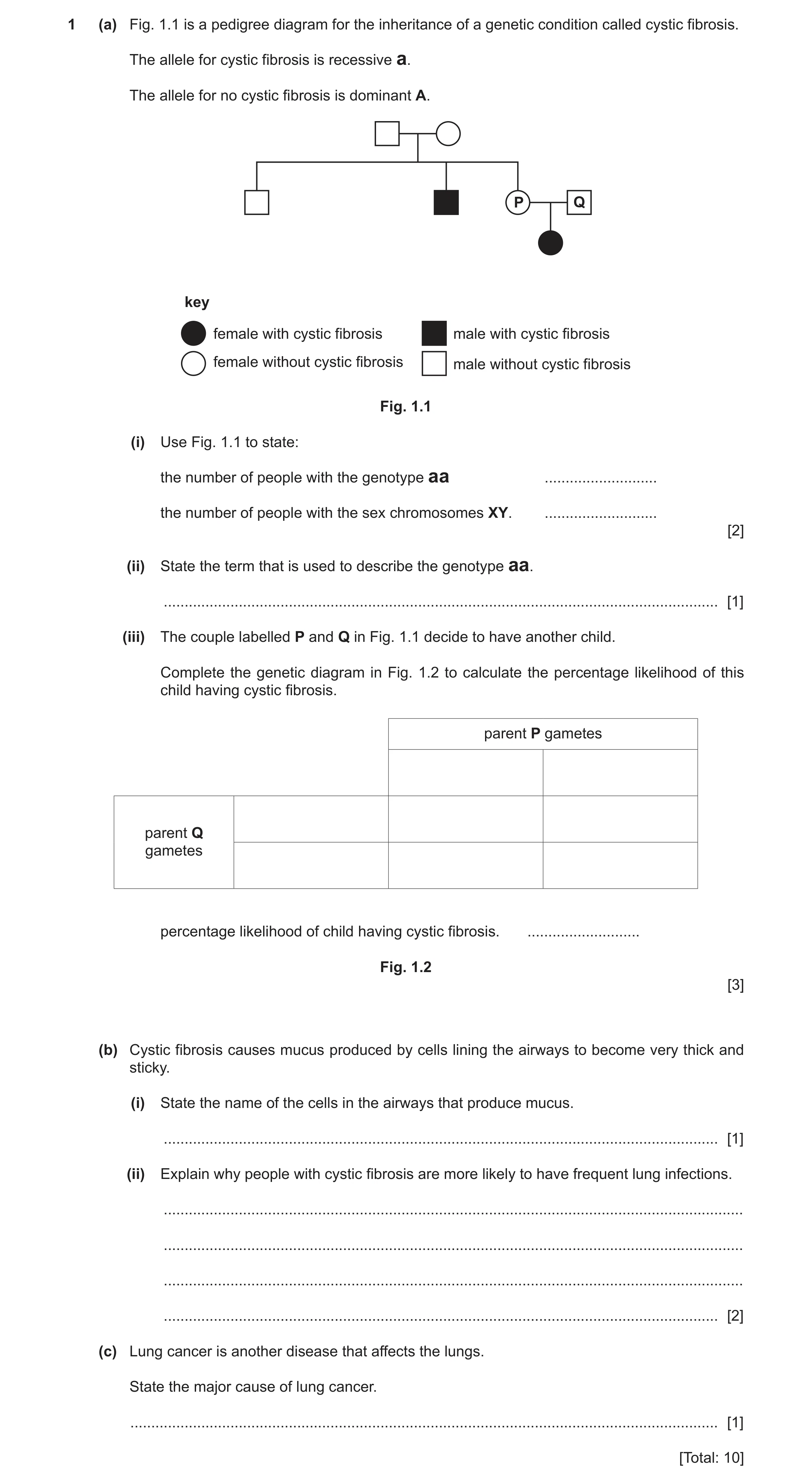
1 (a) Fig. 1.1 is a pedigree diagram for the inheritance of a genetic condition called cystic fibrosis. The allele for cystic fibrosis is recessive a. The allele for no cystic fibrosis is dominant A. P Q key female with cystic fibrosis male with cystic fibrosis female without cystic fibrosis male without cystic fibrosis Fig. 1.1 (i) Use Fig. 1.1 to state: the number of people with the genotype aa … the number of people with the sex chromosomes XY. … [2] (ii) State the term that is used to describe the genotype aa. … [1] (iii) The couple labelled P and Q in Fig. 1.1 decide to have another child. Complete the genetic diagram in Fig. 1.2 to calculate the percentage likelihood of this child having cystic fibrosis. parent P gametes parent Q gametes percentage likelihood of child having cystic fibrosis. … Fig. 1.2 [3] (b) Cystic fibrosis causes mucus produced by cells lining the airways to become very thick and sticky. (i) State the name of the cells in the airways that produce mucus. … [1] (ii) Explain why people with cystic fibrosis are more likely to have frequent lung infections. … … … … [2] (c) Lung cancer is another disease that affects the lungs. State the major cause of lung cancer. … [1] [Total: 10]
10 marks
Mark scheme: Question Answer Marks 1(a)(i) 2 ; 2 4 ; 1(a)(ii) homozygous recessive ; 1 1(a)(iii) 3 A a A AA Aa a Aa aa parent genotype correct ; offspring genotype correct ; 25 (%) ; 1(b)(i) goblet (cells) ; 1 1(b)(ii) mucus traps, pathogens / bacteria ; 2 cilia unable to remove (thick) mucus ; 1(c) (tobacco) smoking ; 1
This question in 0654/41 Oct/Nov 2023
Q17 · A diagram of the gas exchange system 0654/43 Oct/Nov 2024
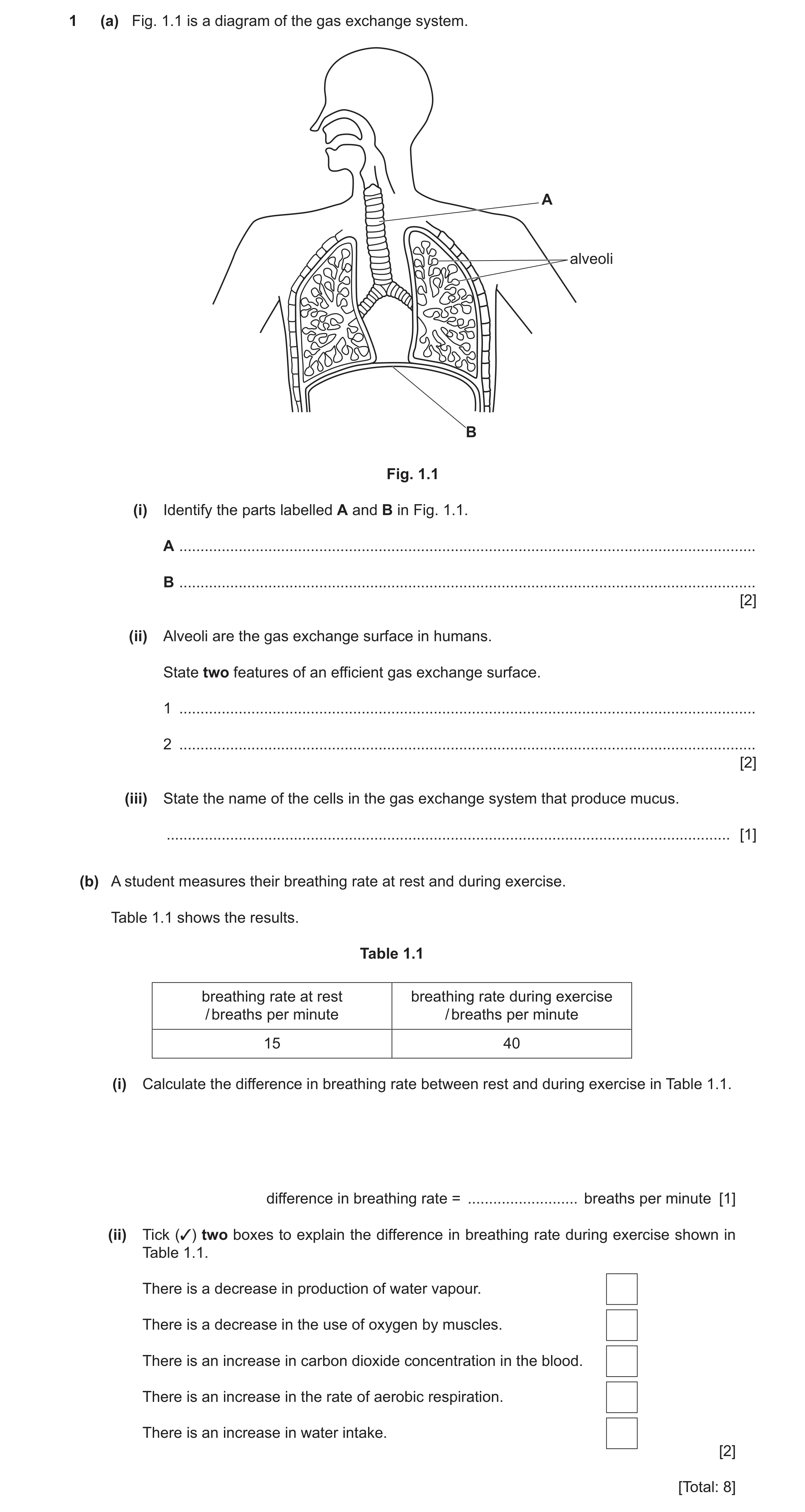
1 (a) Fig. 1.1 is a diagram of the gas exchange system. A alveoli B Fig. 1.1 (i) Identify the parts labelled A and B in Fig. 1.1. A … B … [2] (ii) Alveoli are the gas exchange surface in humans. State two features of an efficient gas exchange surface. 1 … 2 … [2] (iii) State the name of the cells in the gas exchange system that produce mucus. … [1] (b) A student measures their breathing rate at rest and during exercise. Table 1.1 shows the results. Table 1.1 breathing rate at rest breathing rate during exercise / breaths per minute / breaths per minute 15 40 (i) Calculate the difference in breathing rate between rest and during exercise in Table 1.1. difference in breathing rate = … breaths per minute [1] (ii) Tick (3) two boxes to explain the difference in breathing rate during exercise shown in Table 1.1. There is a decrease in production of water vapour. There is a decrease in the use of oxygen by muscles. There is an increase in carbon dioxide concentration in the blood. There is an increase in the rate of aerobic respiration. There is an increase in water intake. [2] [Total: 8]
8 marks
Mark scheme: Question Answer Marks 1(a)(i) A trachea ; 2 B diaphragm ; 1(a)(ii) any two from: 2 large surface area ; thin (surface) (walls) ; good blood supply ; ventilation (with air) ; 1(a)(iii) goblet (cells) ; 1 1(b)(i) 25 (breaths per minute) ; 1 1(b)(ii) 2 There is a decrease in production of water vapour. There is a decrease in the use of oxygen by muscles. There is an increase in carbon dioxide concentration in blood. ; There is an increase in the rate of aerobic respiration. ; There is an increase in water intake.
This question in 0654/43 Oct/Nov 2024
Q18 · Water moves into plant cells by osmosis 0654/42 Feb/March 2025
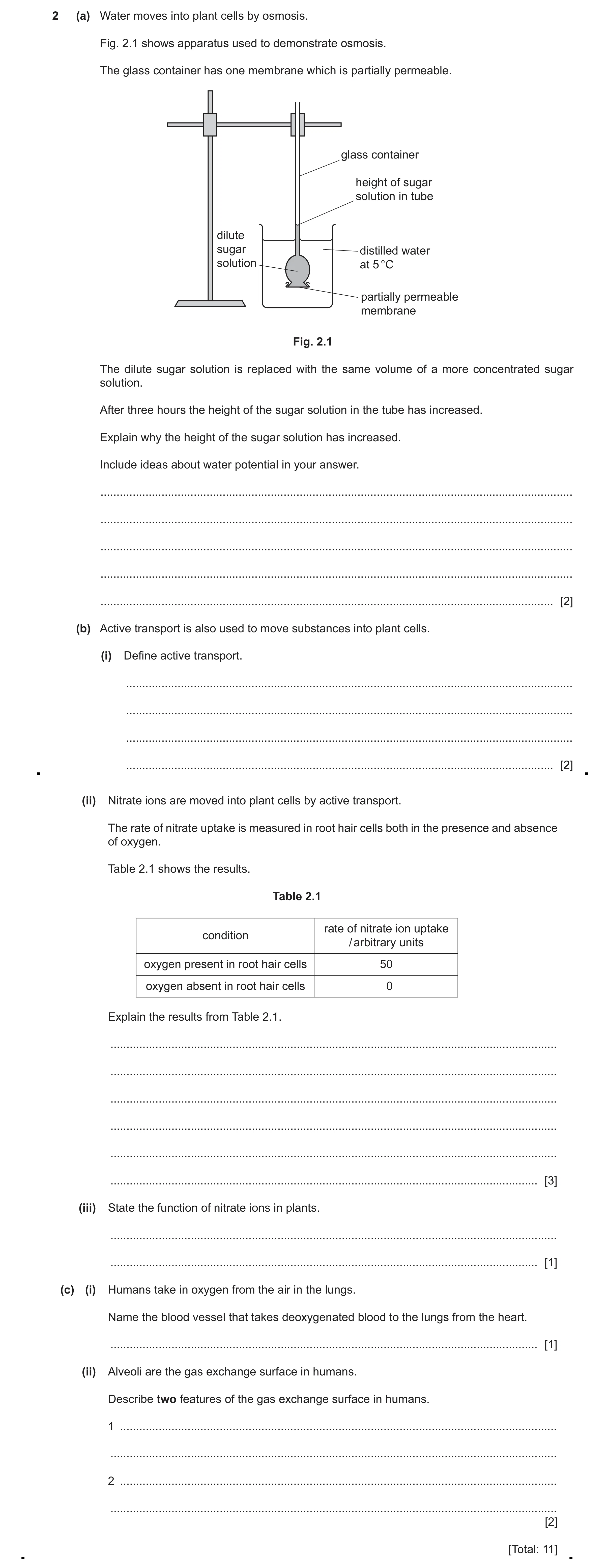
2 (a) Water moves into plant cells by osmosis. Fig. 2.1 shows apparatus used to demonstrate osmosis. The glass container has one membrane which is partially permeable. glass container height of sugar solution in tube dilute sugar distilled water solution at 5 °C partially permeable membrane Fig. 2.1 The dilute sugar solution is replaced with the same volume of a more concentrated sugar solution. After three hours the height of the sugar solution in the tube has increased. Explain why the height of the sugar solution has increased. Include ideas about water potential in your answer. … … … … … [2] (b) Active transport is also used to move substances into plant cells. (i) Define active transport. … … … … [2] (ii) Nitrate ions are moved into plant cells by active transport. The rate of nitrate uptake is measured in root hair cells both in the presence and absence of oxygen. Table 2.1 shows the results. Table 2.1 rate of nitrate ion uptake condition / arbitrary units oxygen present in root hair cells 50 oxygen absent in root hair cells 0 Explain the results from Table 2.1. … … … … … … [3] (iii) State the function of nitrate ions in plants. … … [1] (c) (i) Humans take in oxygen from the air in the lungs. Name the blood vessel that takes deoxygenated blood to the lungs from the heart. … [1] (ii) Alveoli are the gas exchange surface in humans. Describe two features of the gas exchange surface in humans. 1 … … 2 … … [2] [Total: 11]
11 marks
Mark scheme: 2(a) concentrated sugar solution has lower water potential than the surroundings) / ORA ; 2 water moves from a region of higher water potential to a region of lower water potential ; 2(b)(i) movement of particles, from a region of lower concentration to a region of higher concentration / against a concentration 2 gradient ; using energy from respiration ; 2(b)(ii) oxygen required for aerobic respiration ; 3 respiration releases energy ; idea of energy required to move ions, against concentration gradient / idea of energy required for active transport ; 2(b)(iii) synthesis of amino acids / protein / DNA ; 1 2(c)(i) pulmonary artery ; 1 2(c)(ii) any two from: 2 large surface area many capillaries / good blood supply thin surface good ventilation AVP ; ;
This question in 0654/42 Feb/March 2025
Q19 · A diagram of the breathing system in humans 0654/41 Oct/Nov 2025
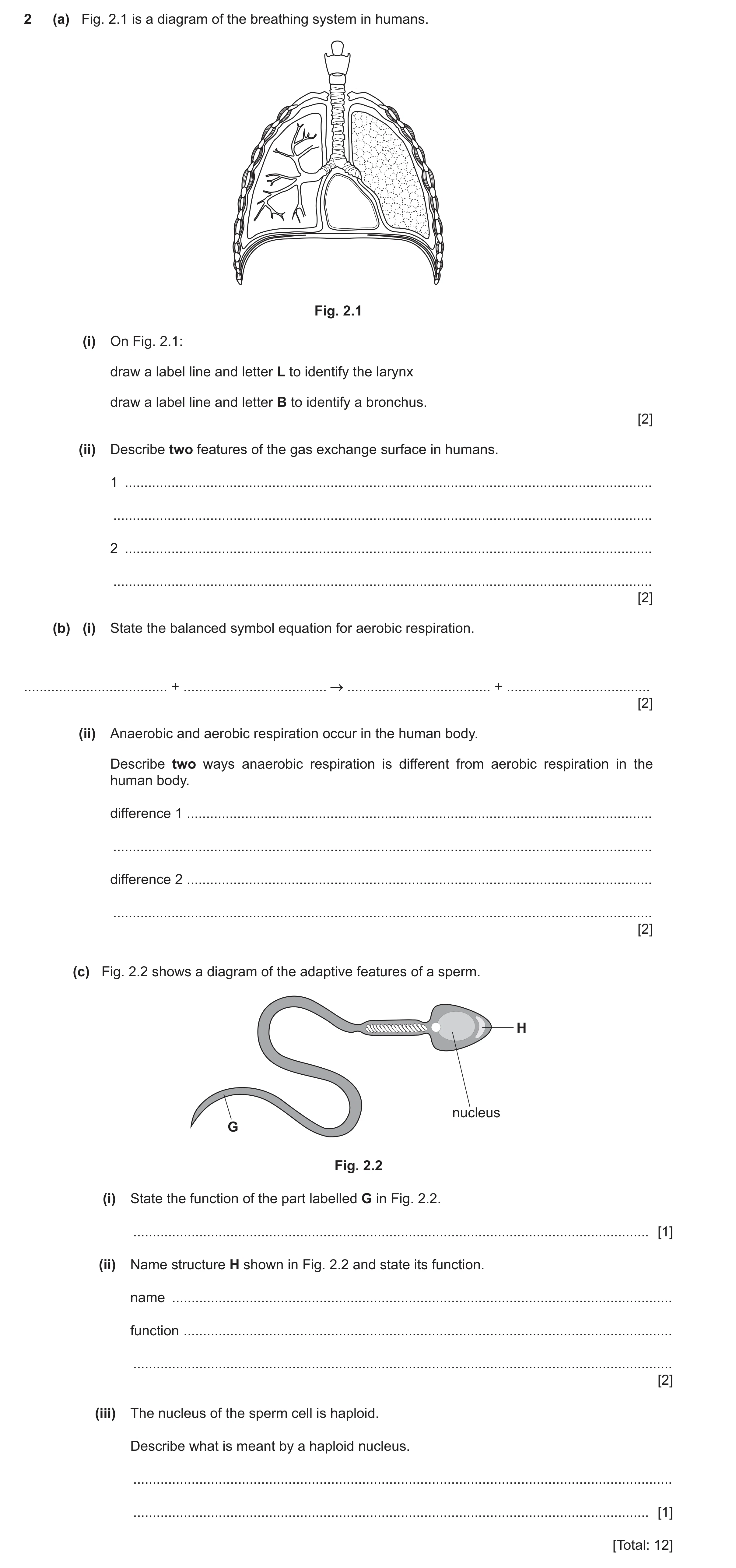
2 (a) Fig. 2.1 is a diagram of the breathing system in humans. Fig. 2.1 (i) On Fig. 2.1: draw a label line and letter L to identify the larynx draw a label line and letter B to identify a bronchus. [2] (ii) Describe two features of the gas exchange surface in humans. 1 … … 2 … … [2] (b) (i) State the balanced symbol equation for aerobic respiration. … + … … + … [2] (ii) Anaerobic and aerobic respiration occur in the human body. Describe two ways anaerobic respiration is different from aerobic respiration in the human body. difference 1 … … difference 2 … … [2] (c) Fig. 2.2 shows a diagram of the adaptive features of a sperm. H nucleus G Fig. 2.2 (i) State the function of the part labelled G in Fig. 2.2. … [1] (ii) Name structure H shown in Fig. 2.2 and state its function. name … function … … [2] (iii) The nucleus of the sperm cell is haploid. Describe what is meant by a haploid nucleus. … … [1] [Total: 12]
12 marks
Mark scheme: 2(a)(i) larynx labelled L or larynx ; 2 bronchus labelled B or bronchus ; 2(a)(ii) any two from: 2 • large (surface) area ; • thin (surface) / thin wall ; • good blood supply ; • good ventilation (with air) ; • AVP ; 2(b)(i) C6H12O6 + 6O2 → 6CO2 + 6H2O 2 LHS correct either order = 1 mark RHS correct either order = 1 mark 2(b)(ii) any two from: 2 • anaerobic does not require oxygen / ORA ; • anaerobic produces lactic acid / anaerobic releases lactic acid / ORA ; • anaerobic releases less energy / anaerobic releases less ATP / ORA ; • anaerobic does not produce water / anaerobic does not produce carbon dioxide / ORA ; 2(c)(i) motility / move(ment) / swim(ming) ; 1 2(c)(ii) acrosome ; 2 (contains digestive) enzyme(s) to penetrate egg ; 2(c)(iii) contains a single set of chromosomes / AW ; 1
This question in 0654/41 Oct/Nov 2025
 2 / 29
 3 / 29
 4 / 29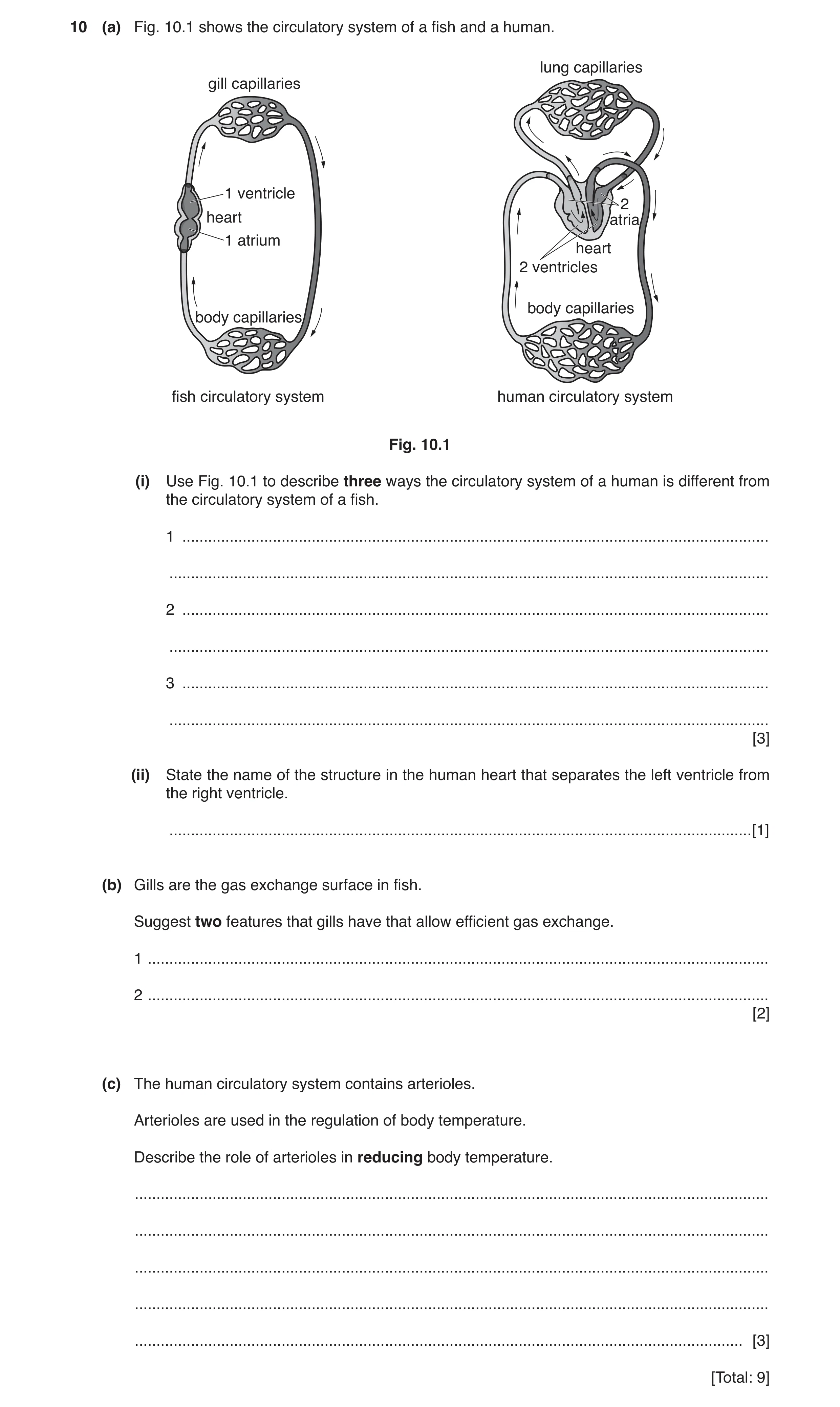
 11 / 29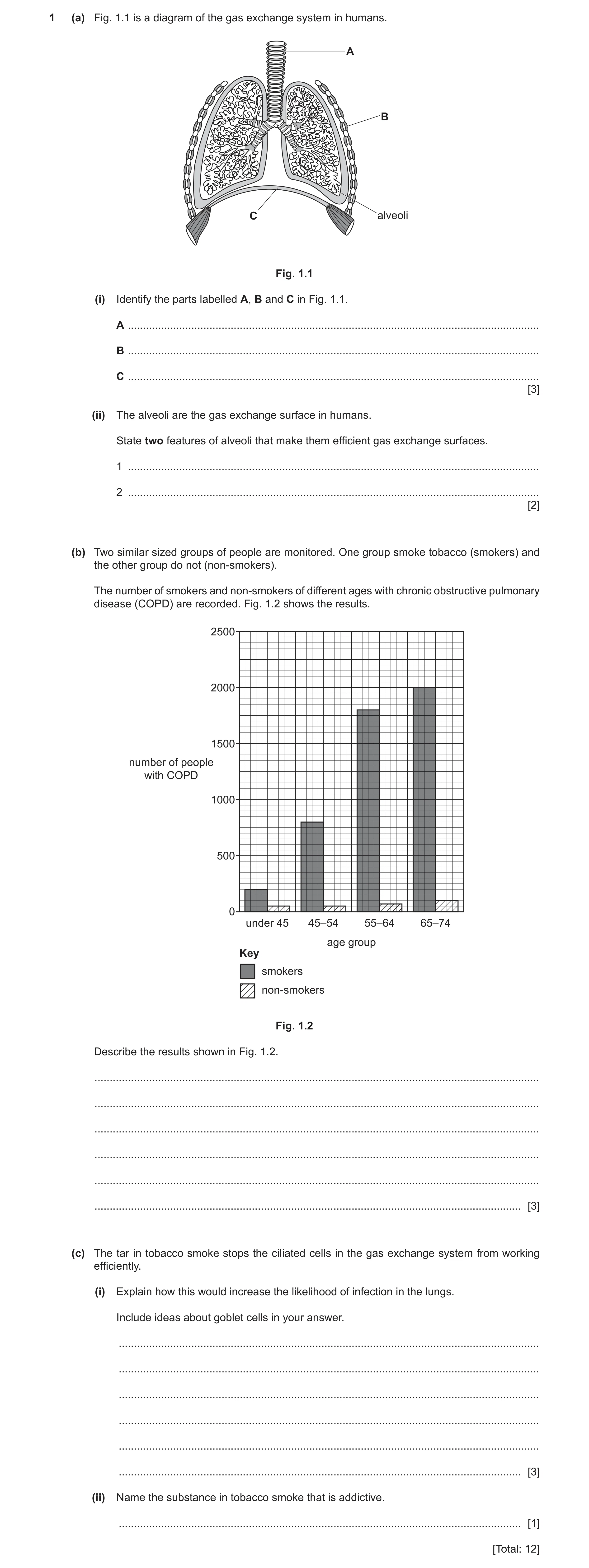
 9
9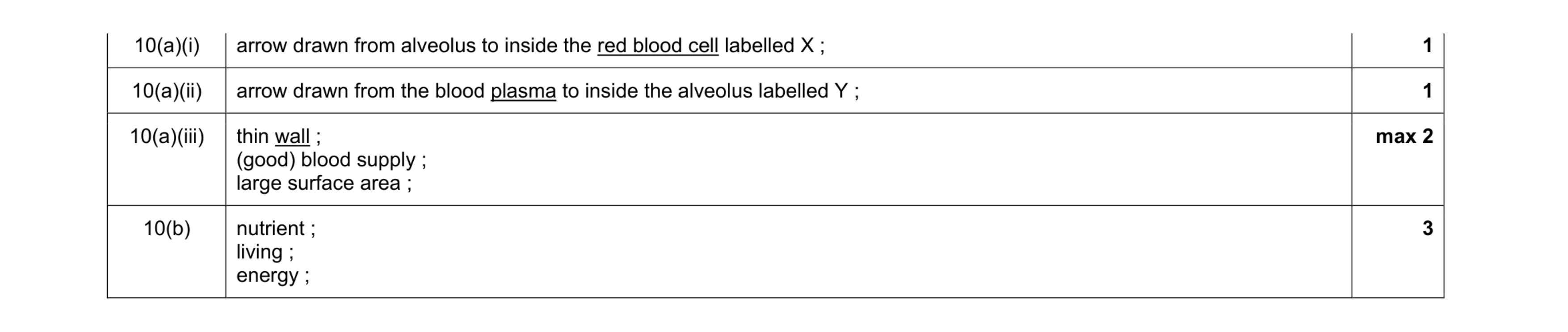 7
7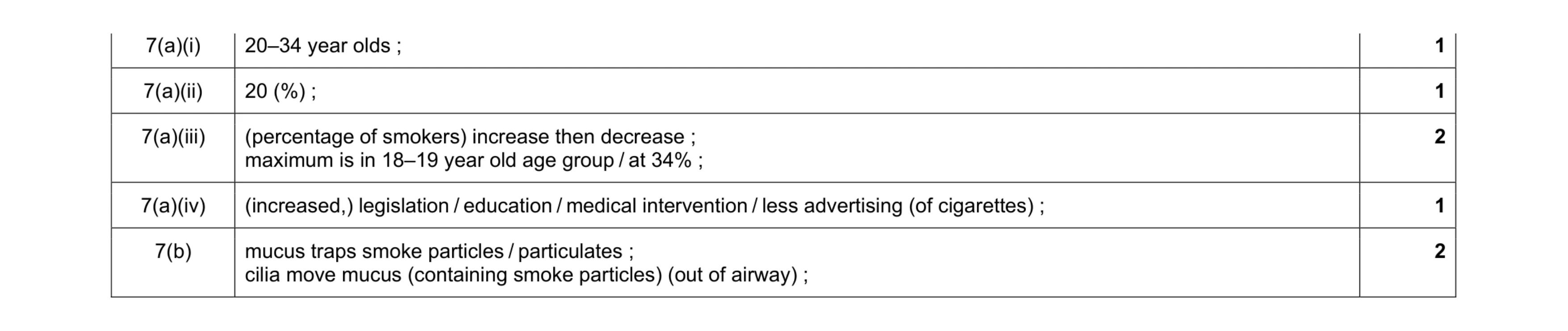 7
7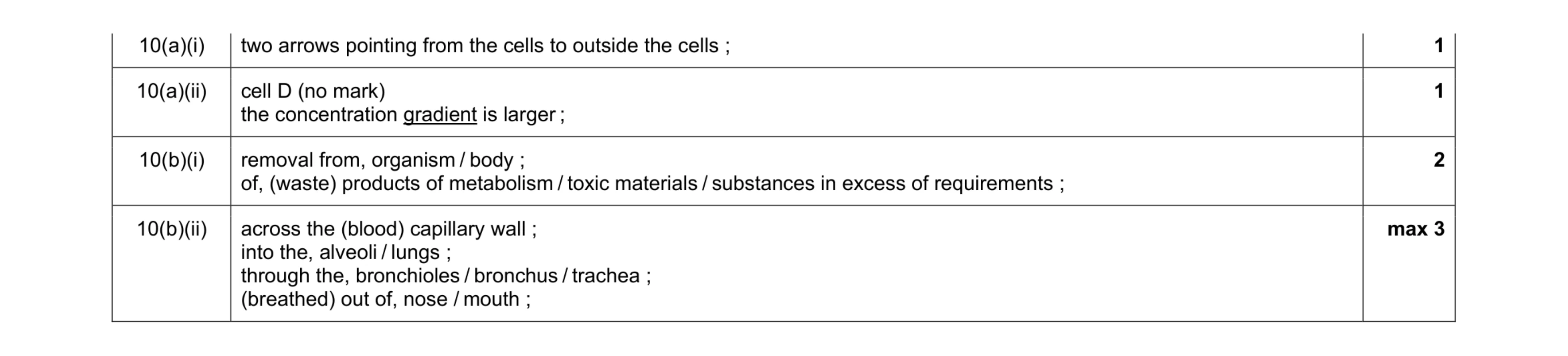 7
7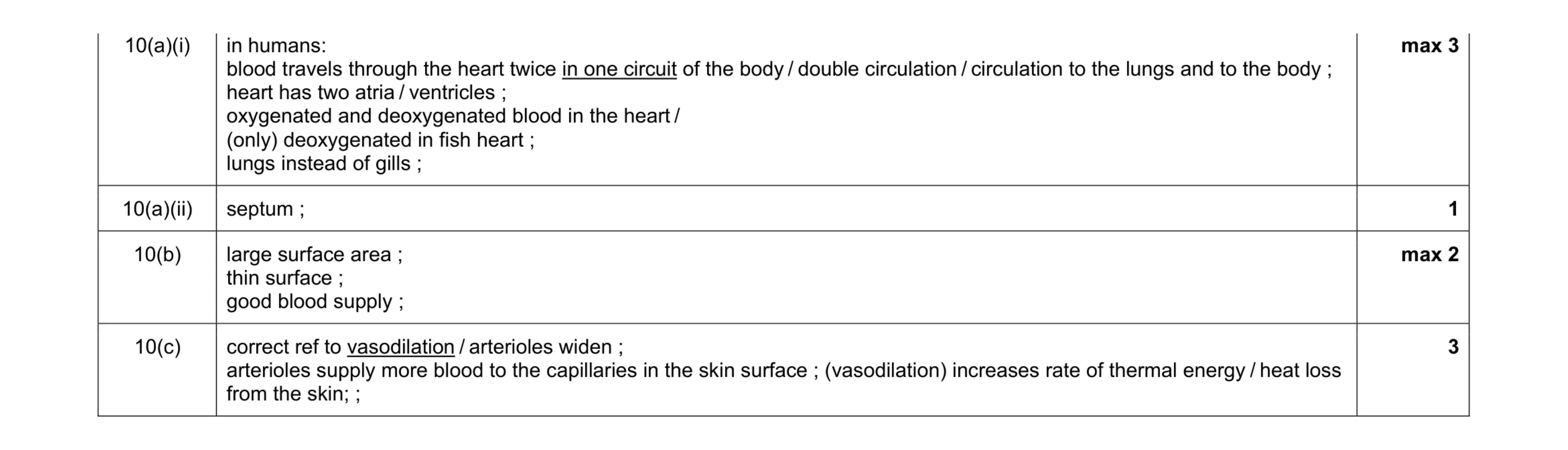 9
9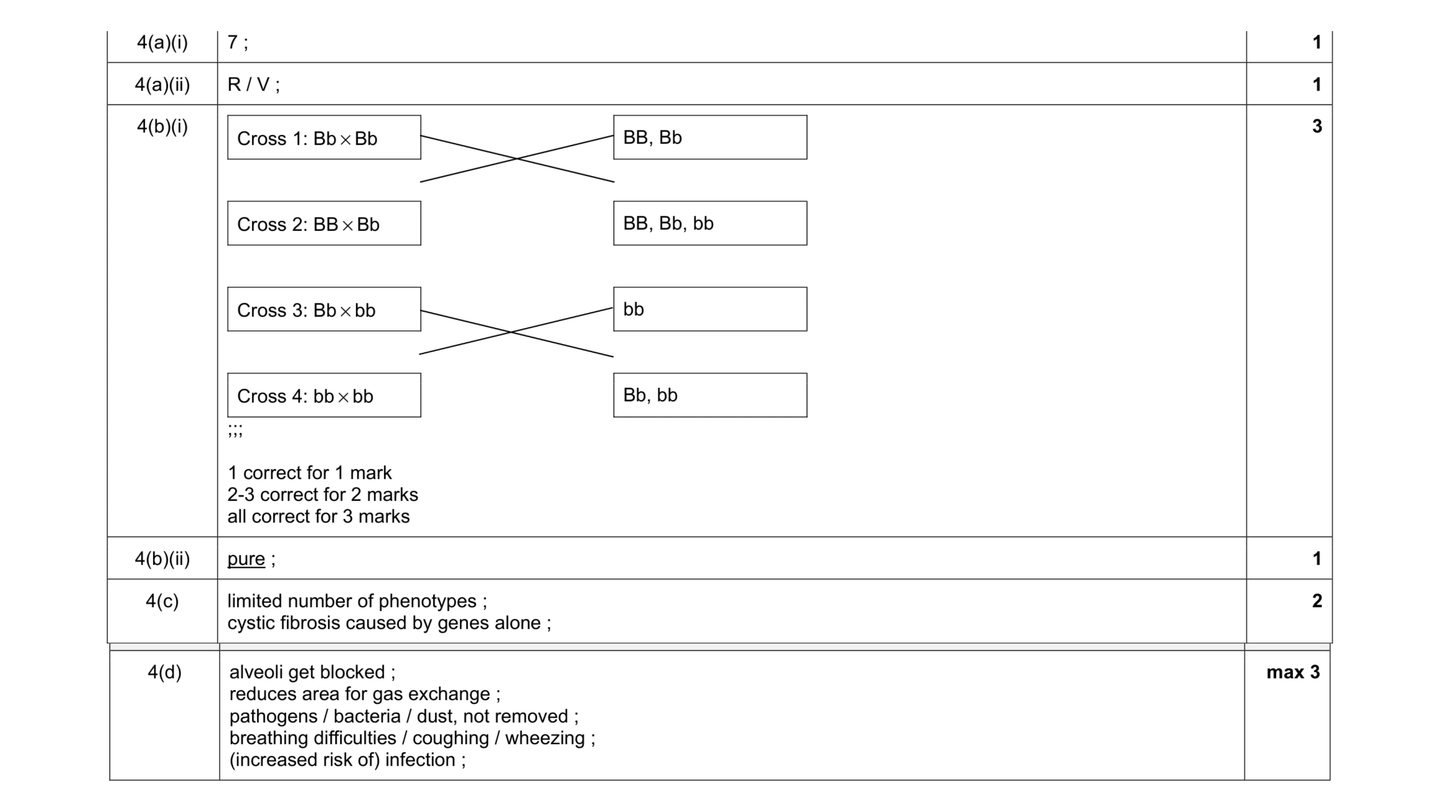 11
11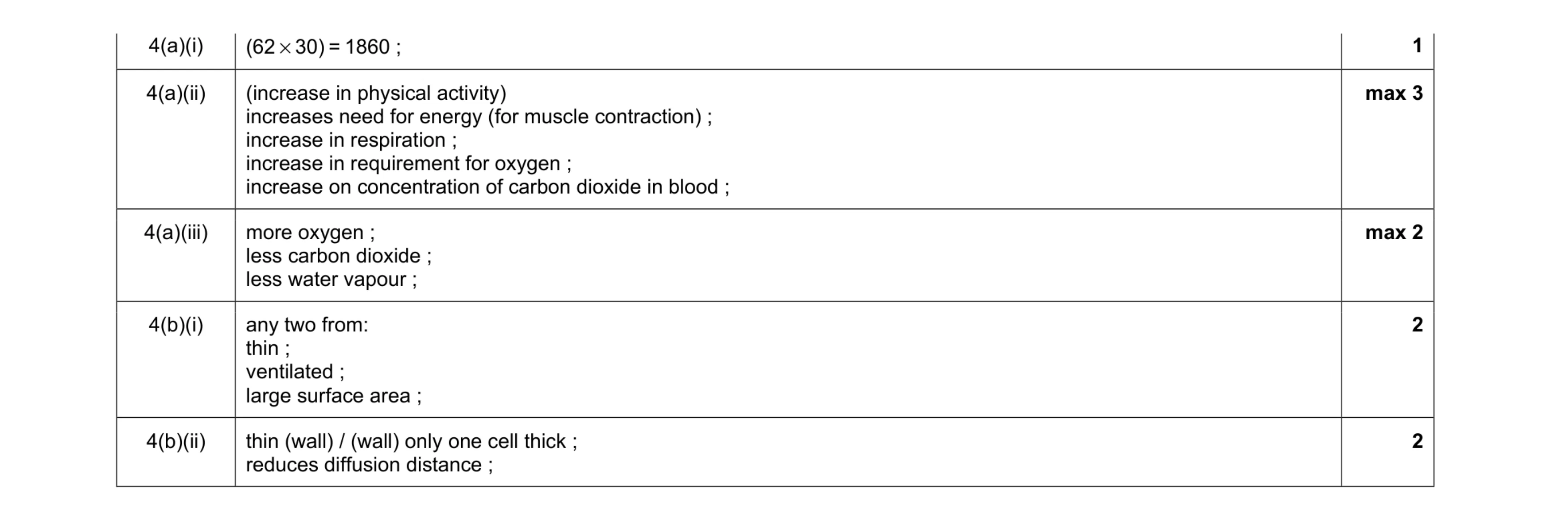 10
10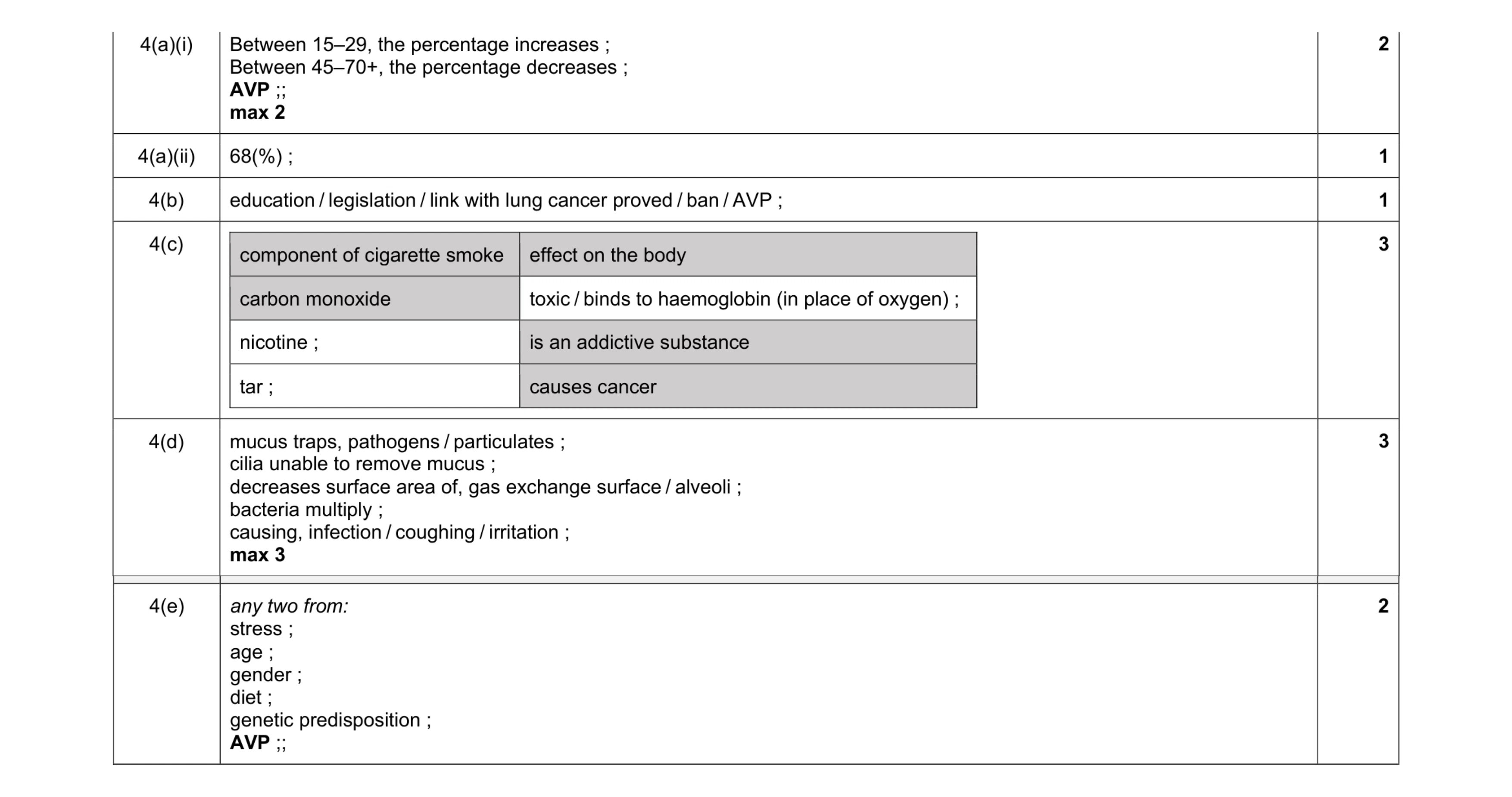 12
12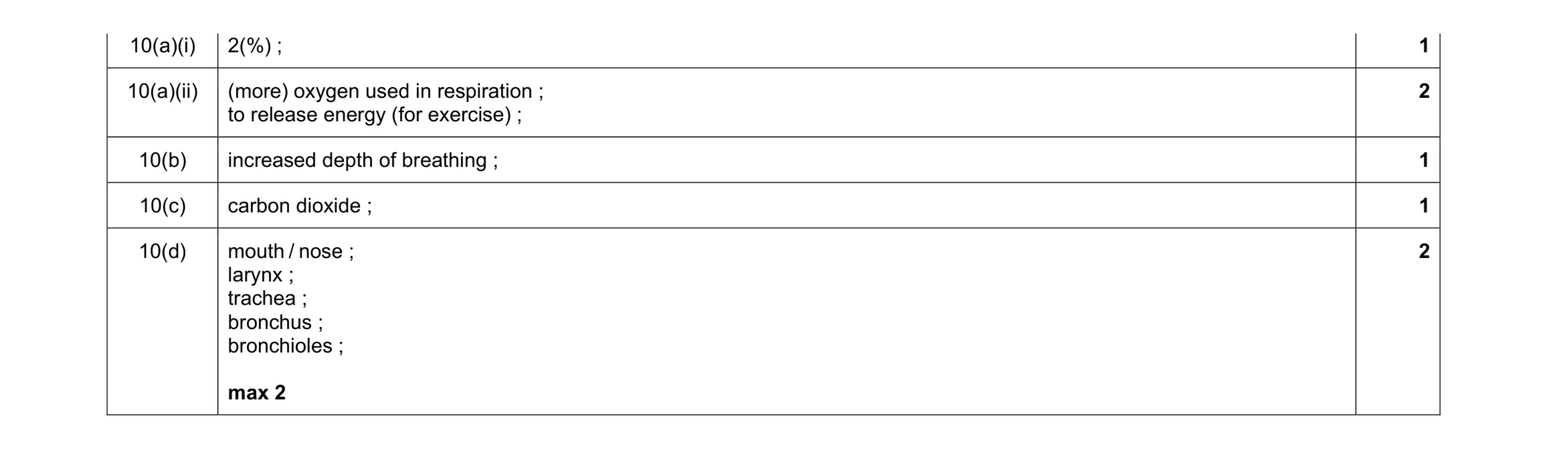 7
7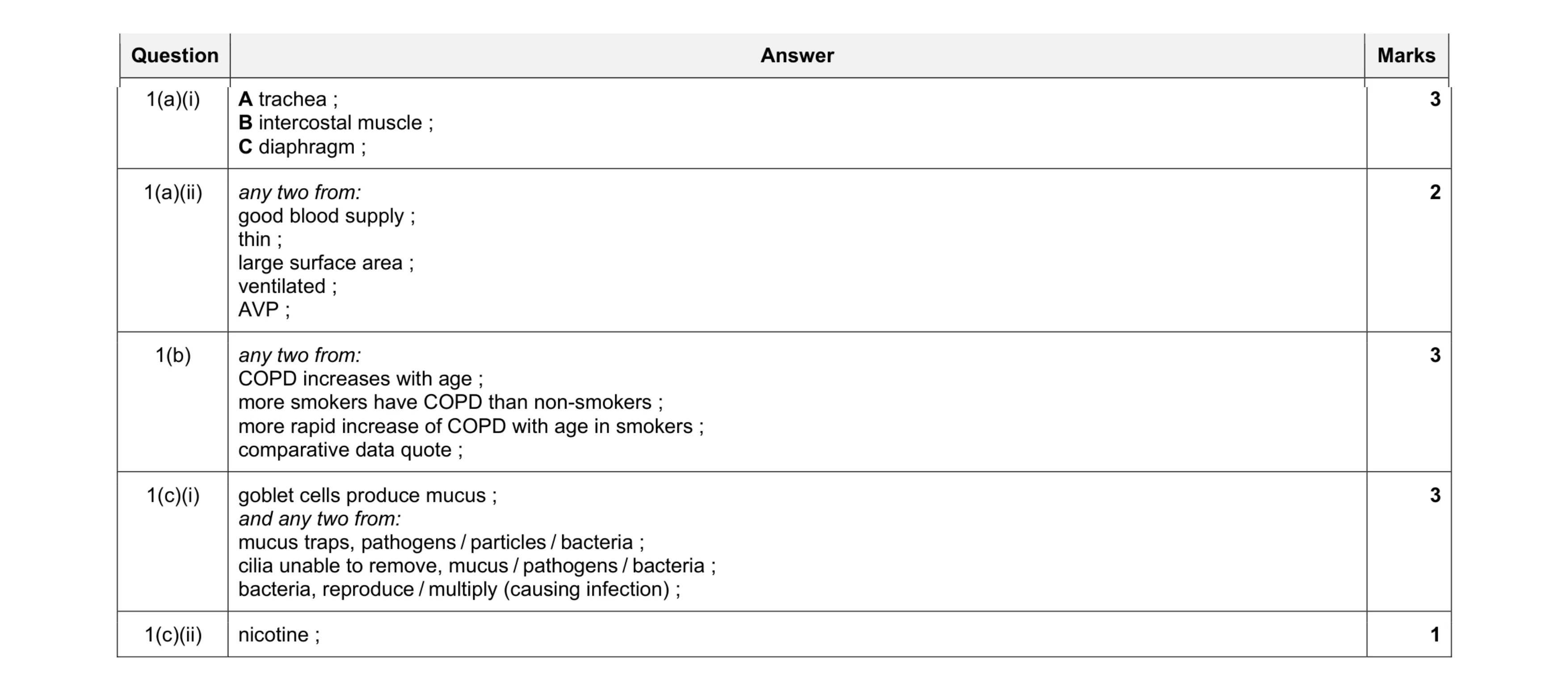 12
12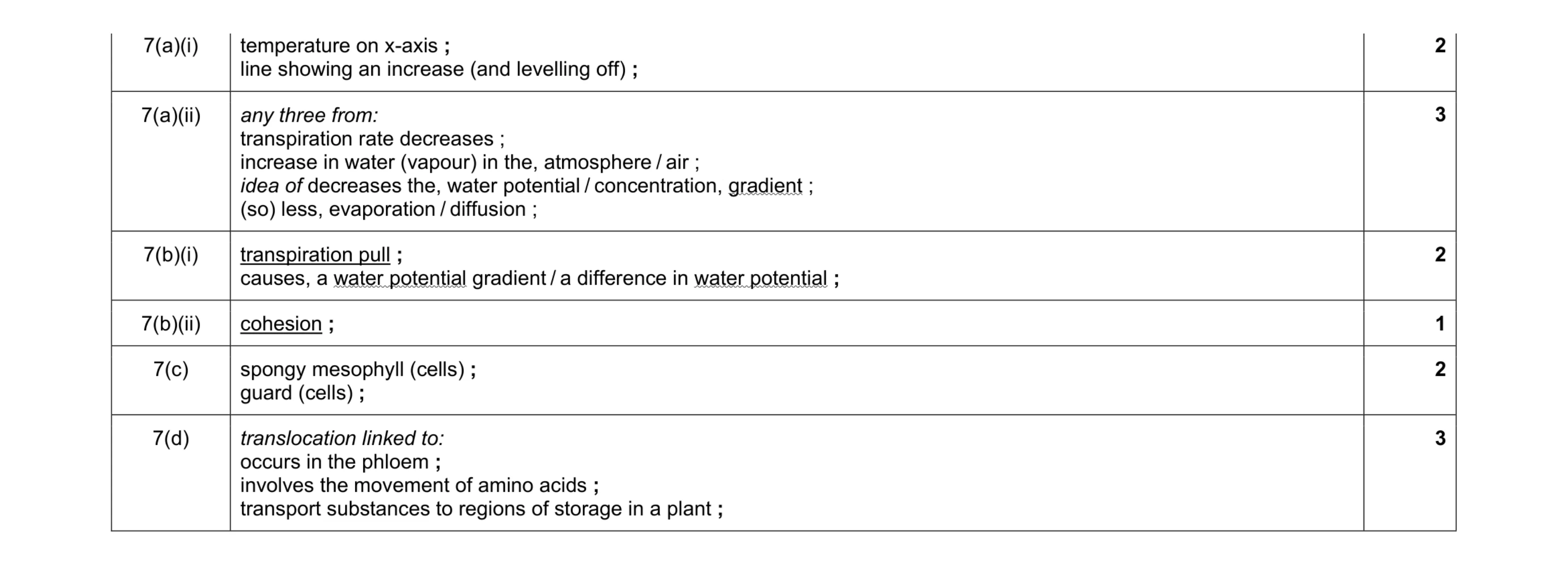 13
13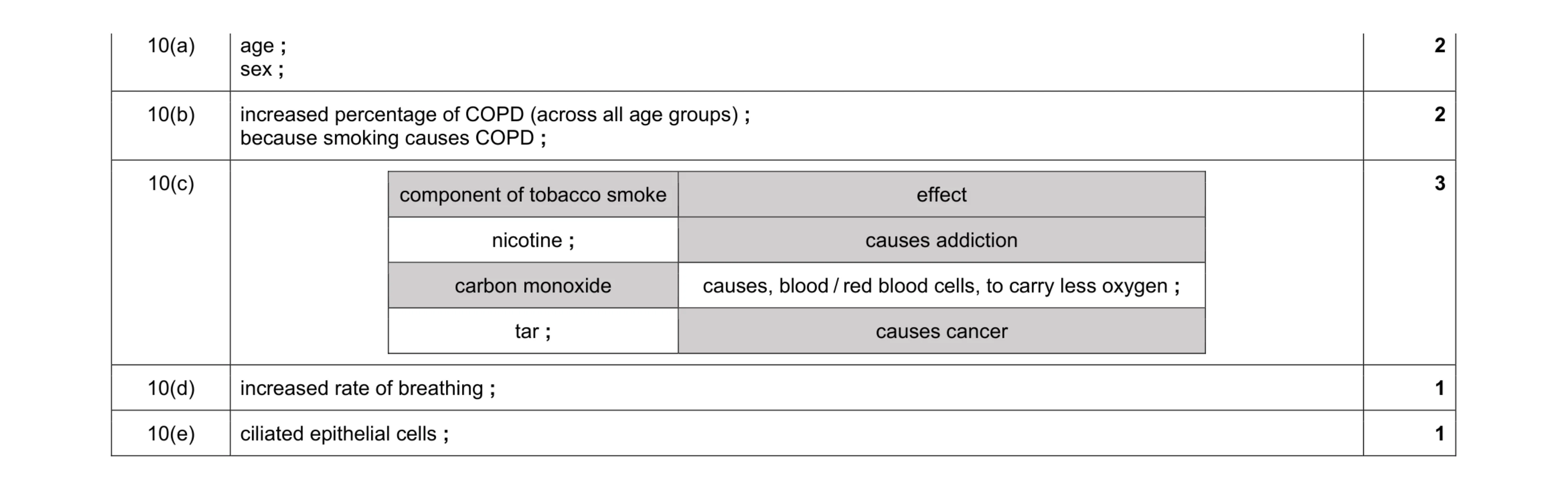 9
9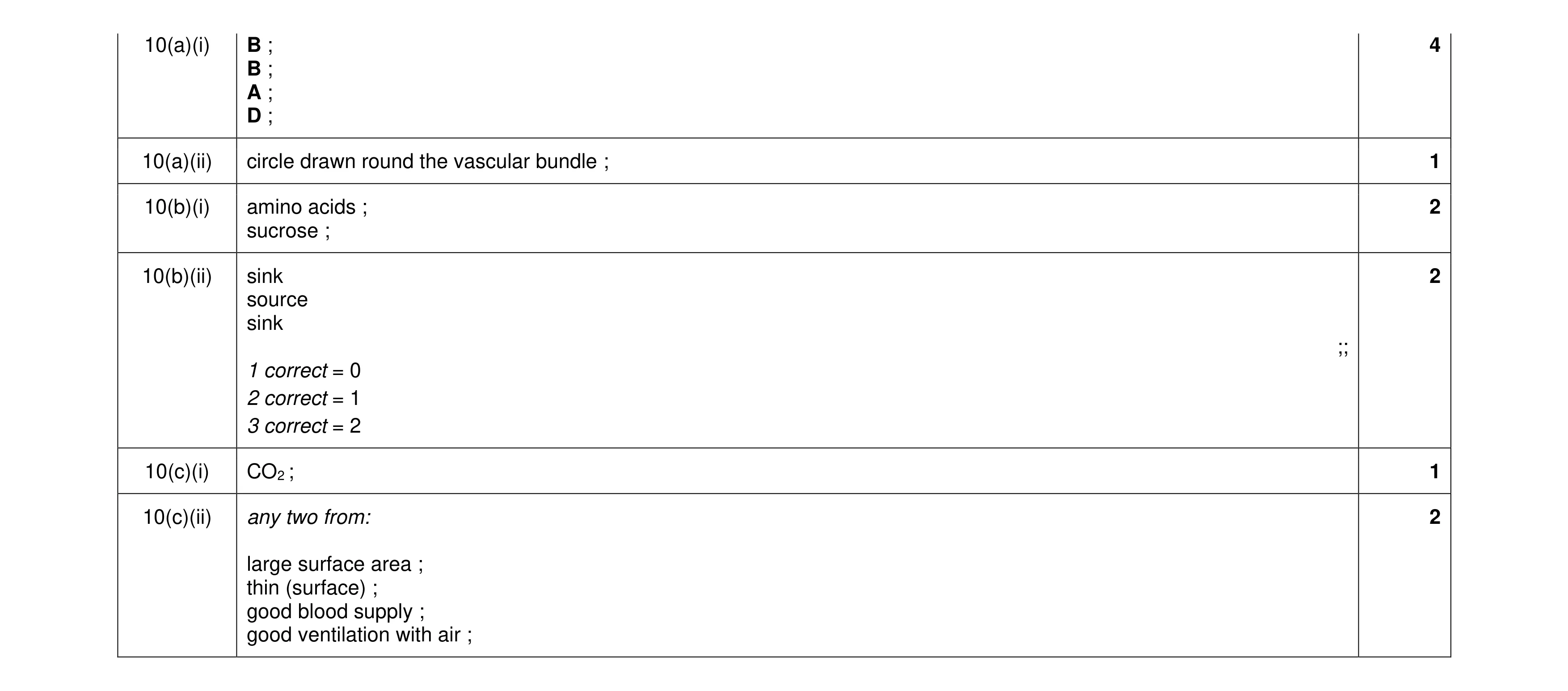 12
12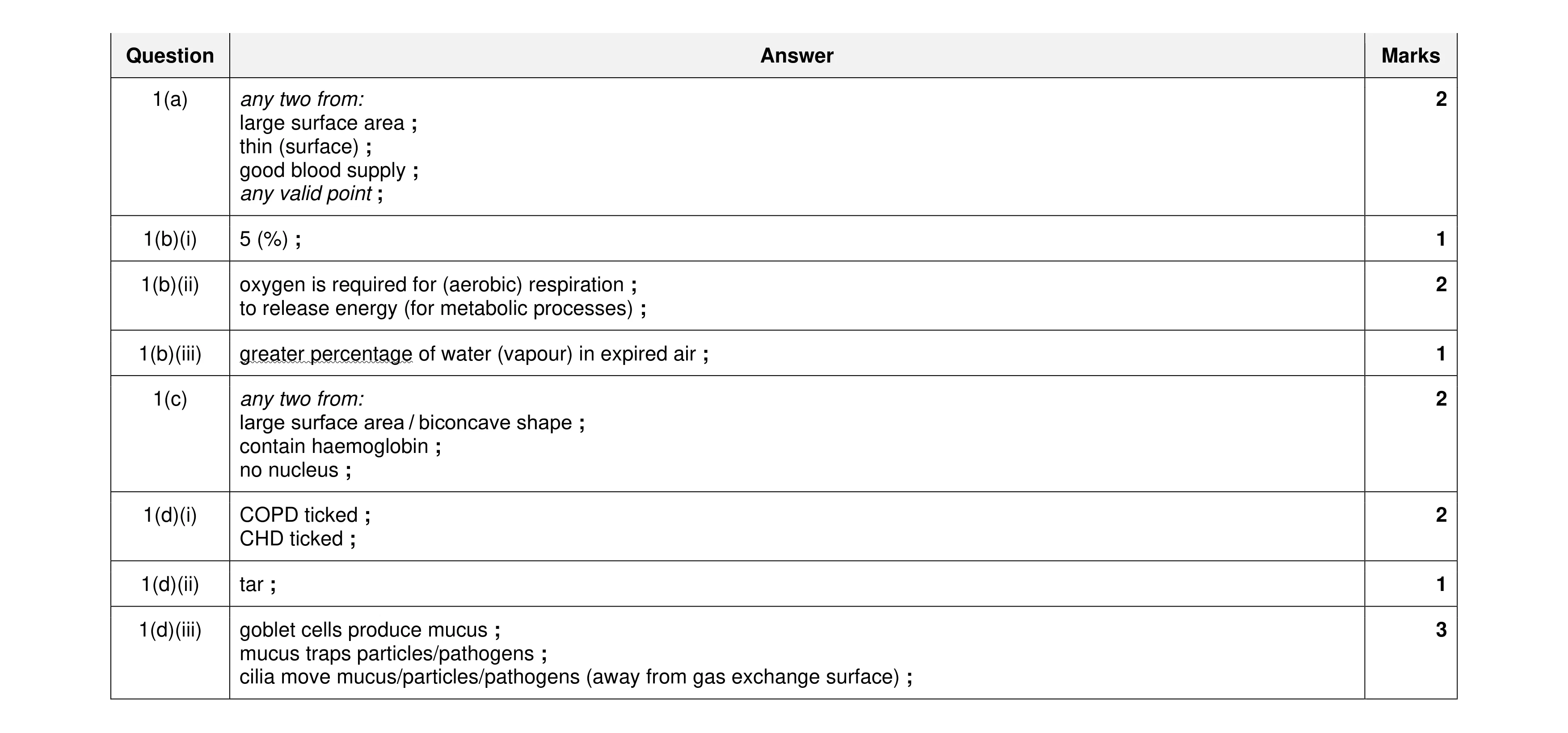 14
14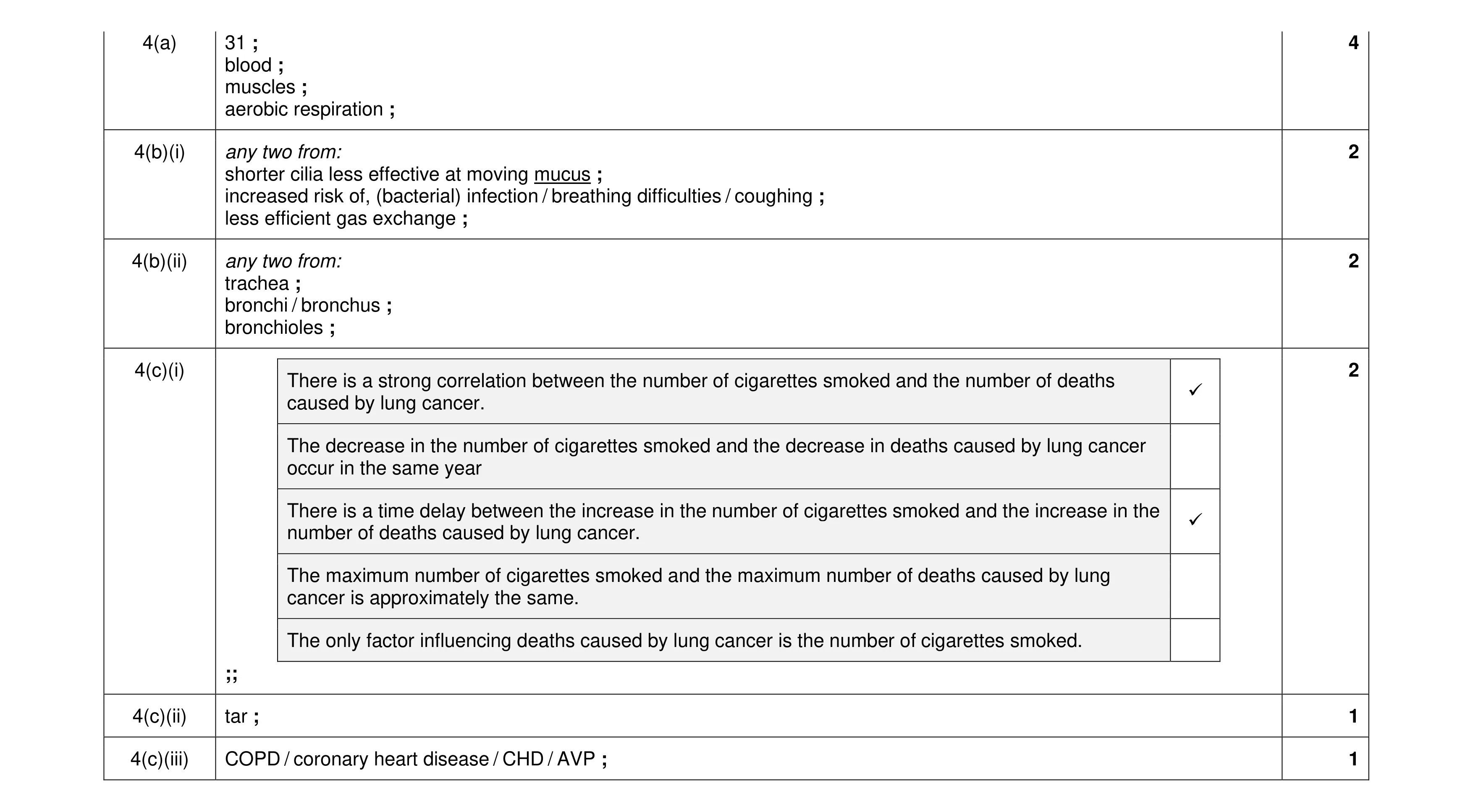 12
12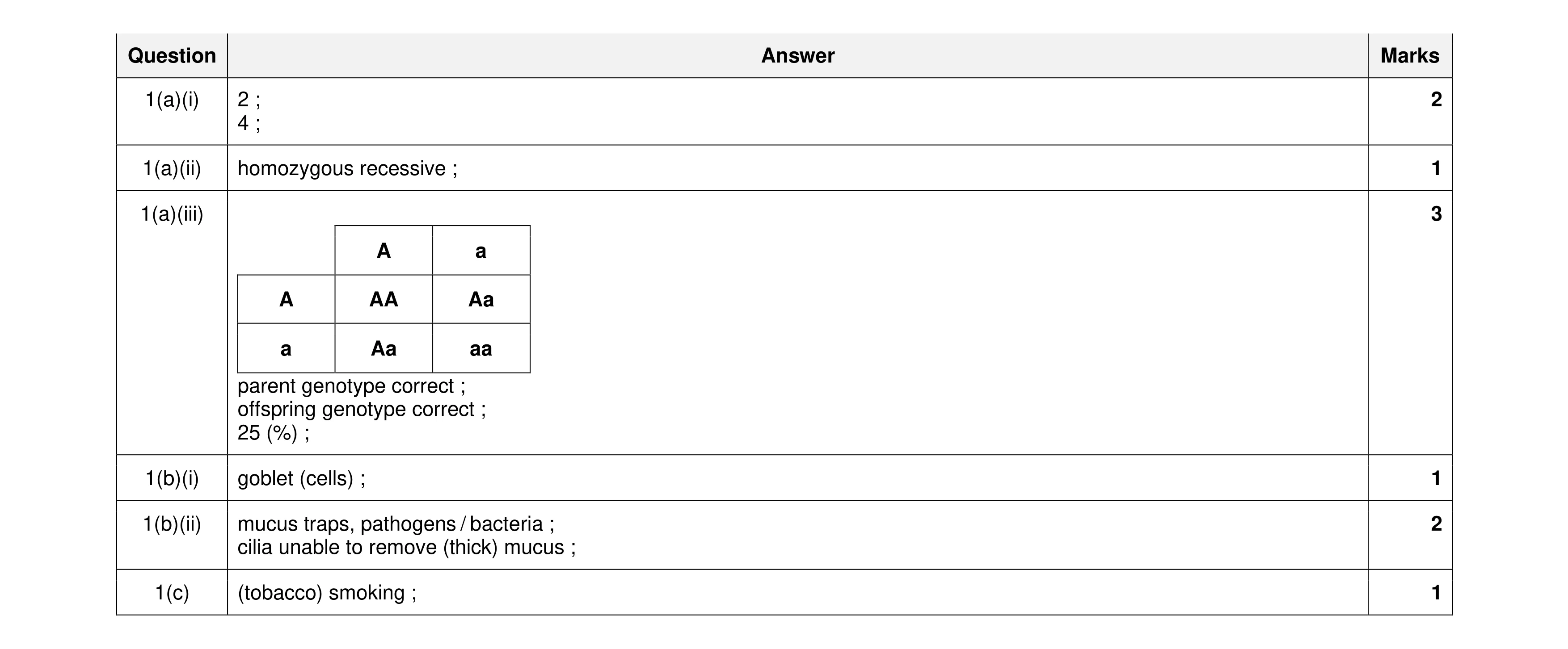 10
10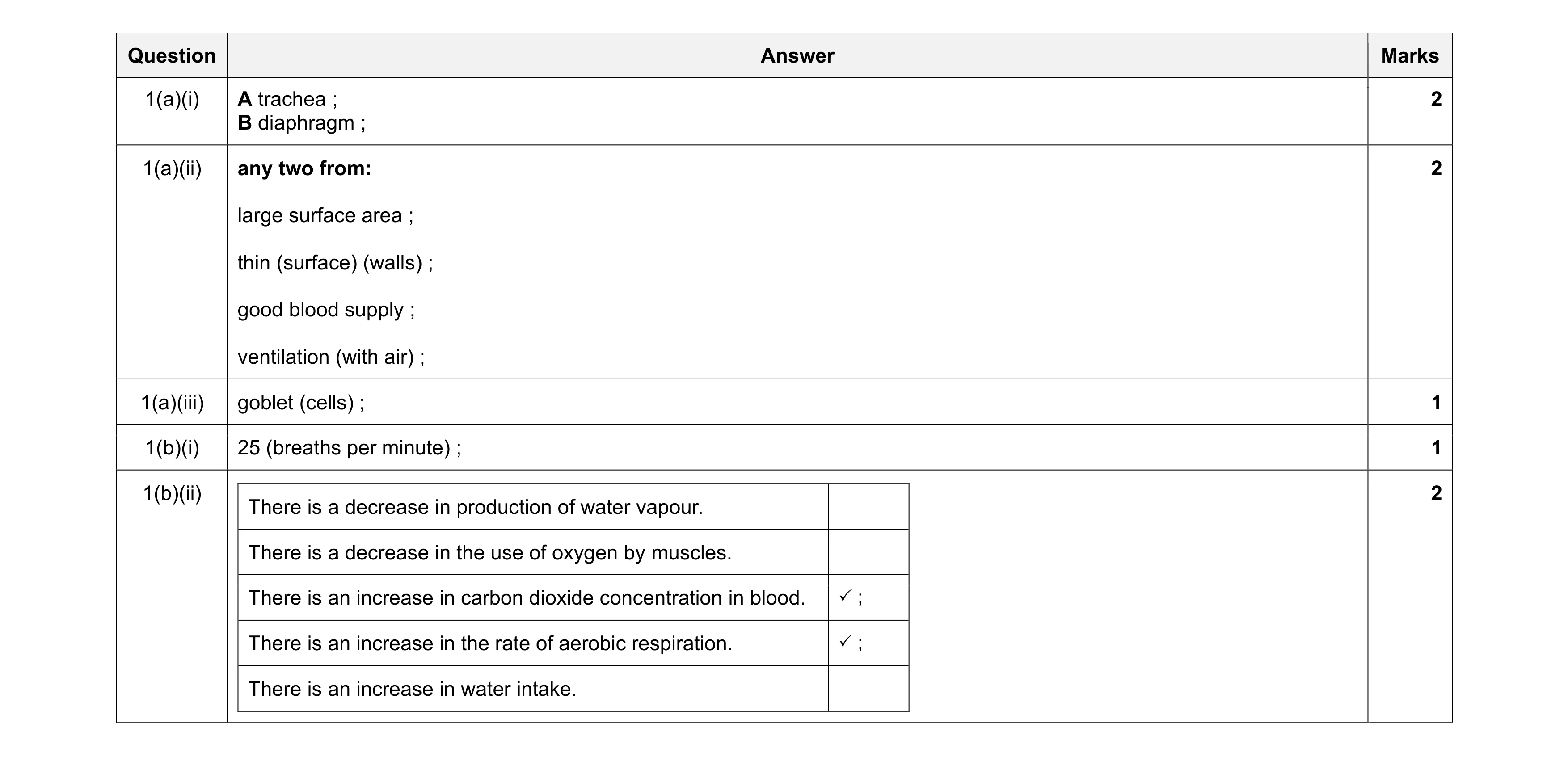 8
8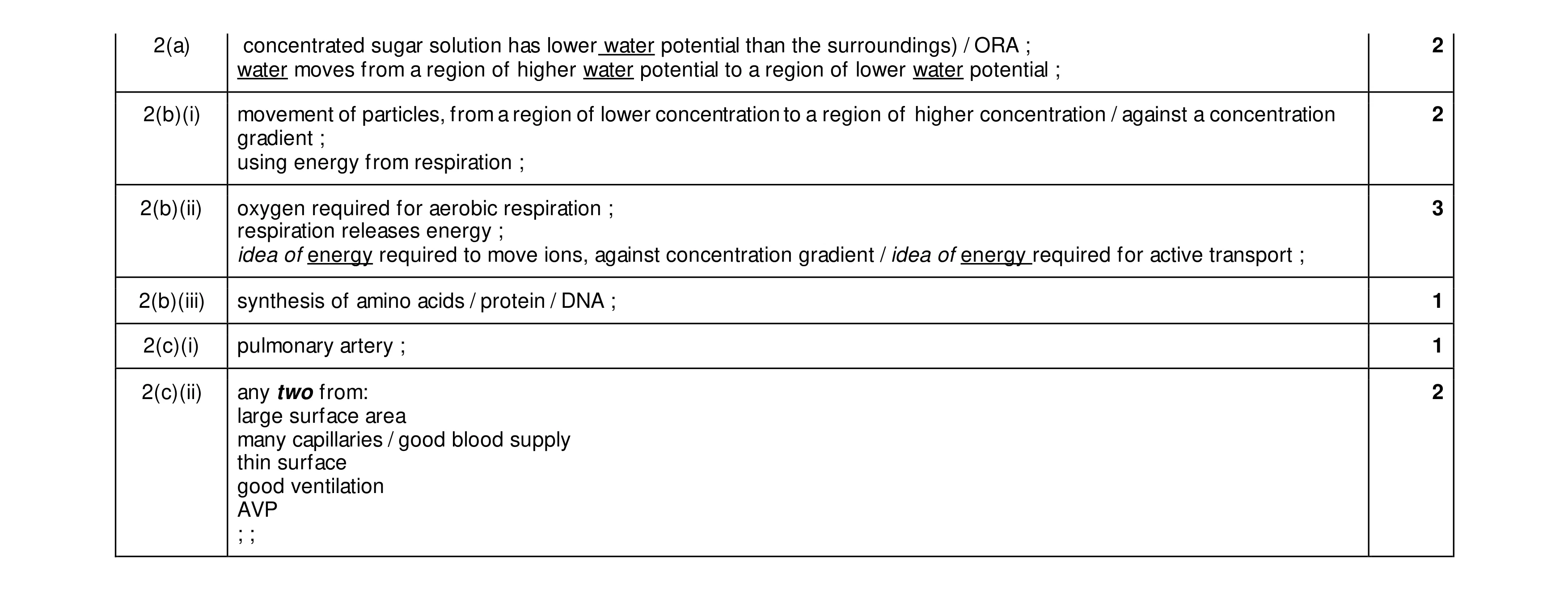 11
11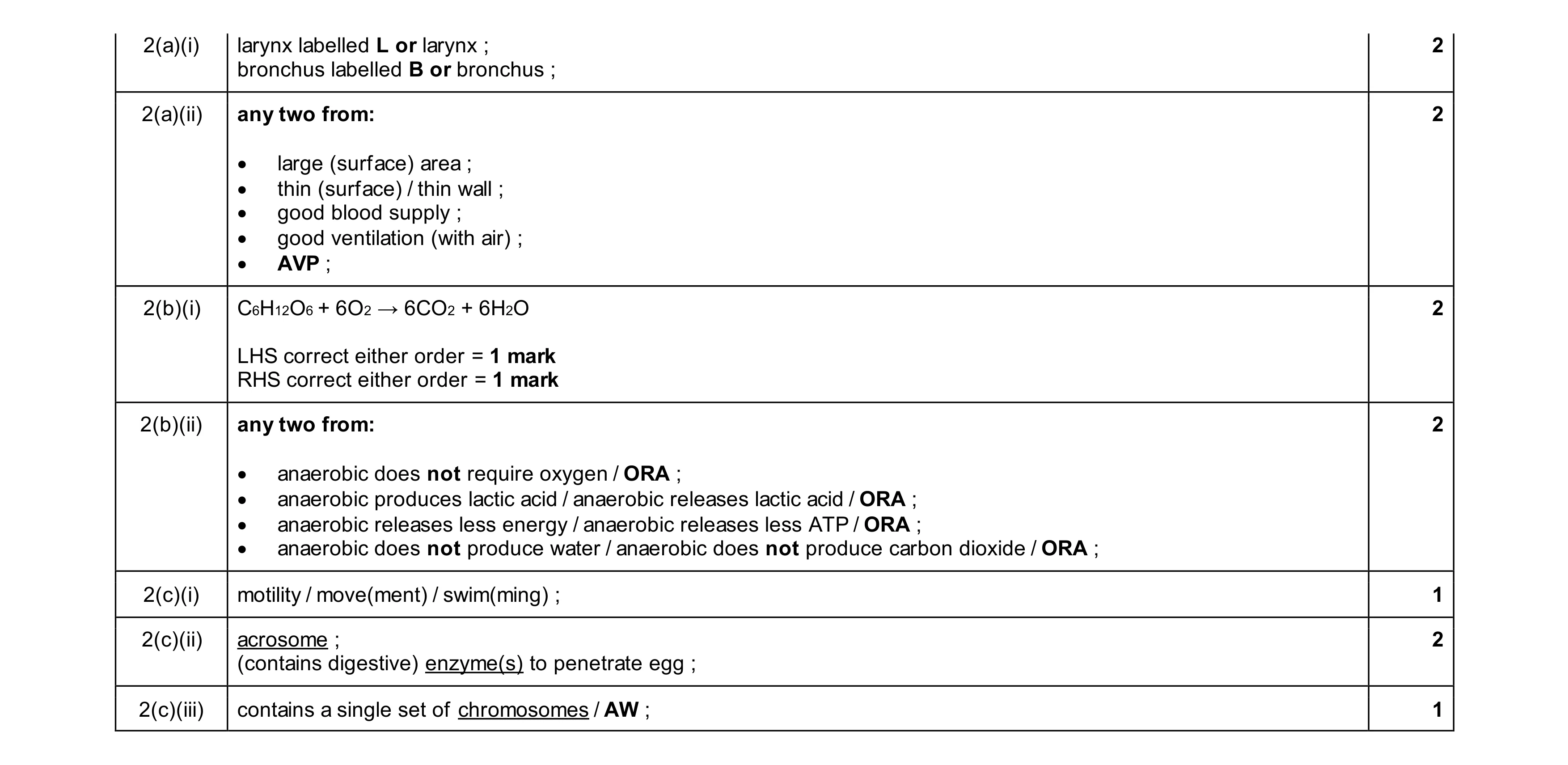 12
12