Questions as text
Q1 · The human gas exchange system 0654/33 May/June 2017
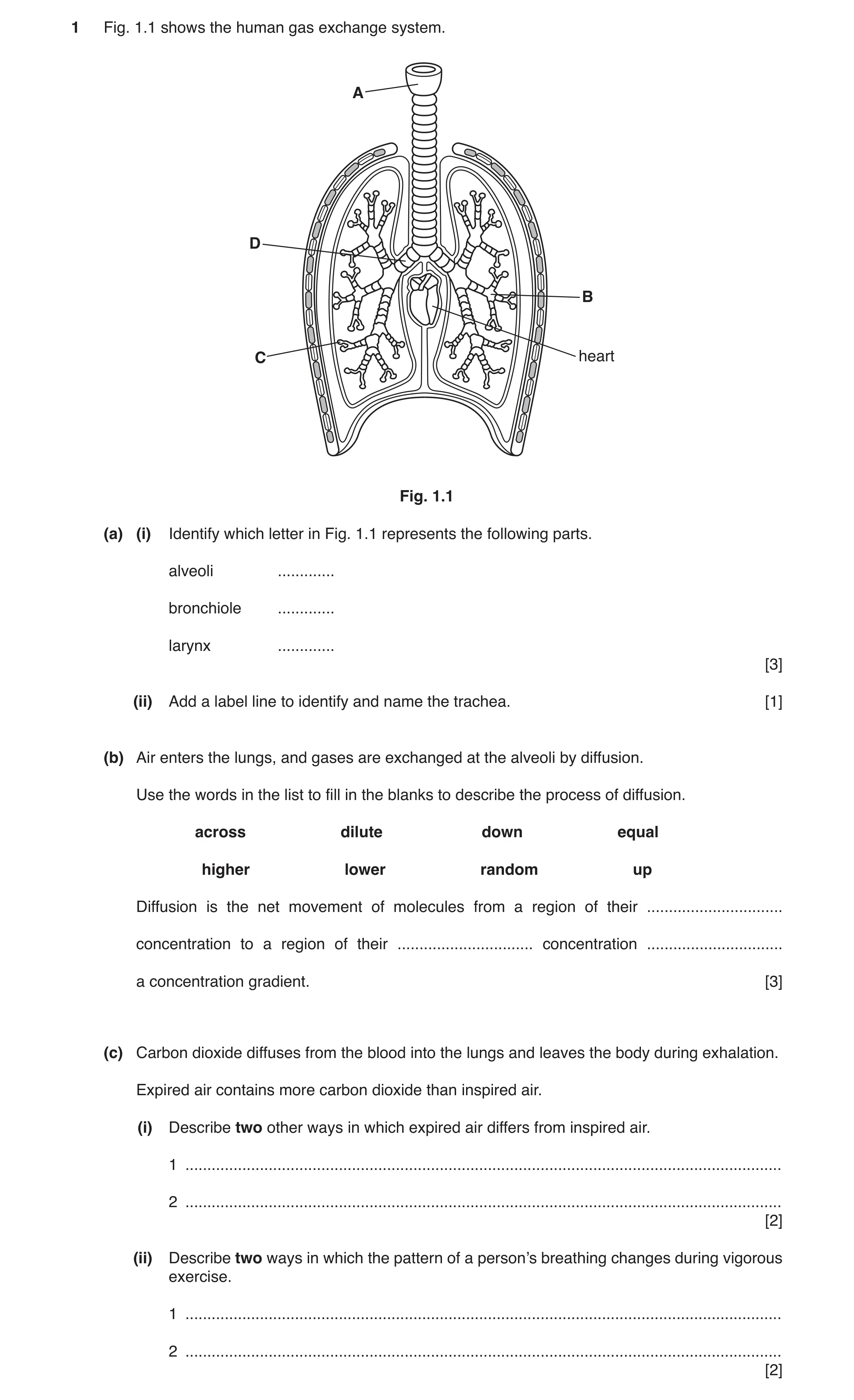
1 Fig. 1.1 shows the human gas exchange system. A D B C heart Fig. 1.1 (a) (i) Identify which letter in Fig. 1.1 represents the following parts. alveoli … bronchiole … larynx … [3] (ii) Add a label line to identify and name the trachea. [1] (b) Air enters the lungs, and gases are exchanged at the alveoli by diffusion. Use the words in the list to fill in the blanks to describe the process of diffusion. across dilute down equal higher lower random up Diffusion is the net movement of molecules from a region of their … concentration to a region of their … concentration … a concentration gradient. [3] (c) Carbon dioxide diffuses from the blood into the lungs and leaves the body during exhalation. Expired air contains more carbon dioxide than inspired air. (i) Describe two other ways in which expired air differs from inspired air. 1 … 2 … [2] (ii) Describe two ways in which the pattern of a person’s breathing changes during vigorous exercise. 1 … 2 … [2]
11 marks
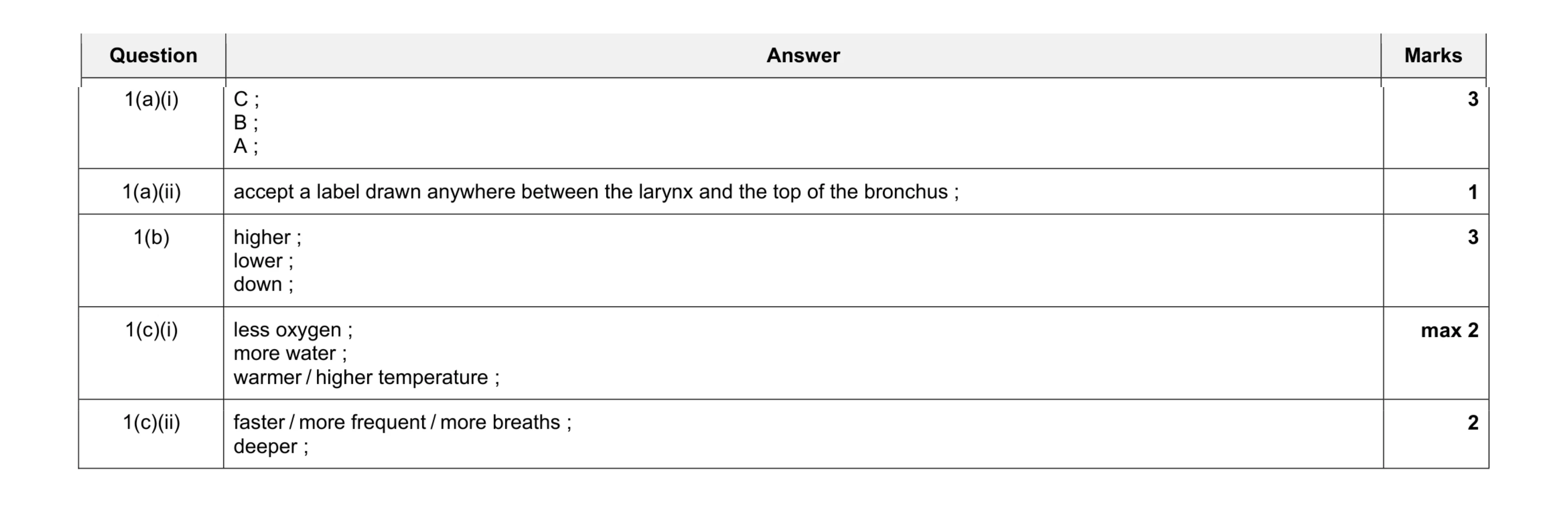
Mark scheme: 1(a)(i) C ; B ; A ; 3 1(a)(ii) accept a label drawn anywhere between the larynx and the top of the bronchus ; 1 1(b) higher ; lower ; down ; 3 1(c)(i) less oxygen ; more water ; warmer / higher temperature ; max 2 1(c)(ii) faster / more frequent / more breaths ; deeper ; 2
This question in 0654/33 May/June 2017
Q2 · A diagram of the gas exchange system 0654/31 Oct/Nov 2018
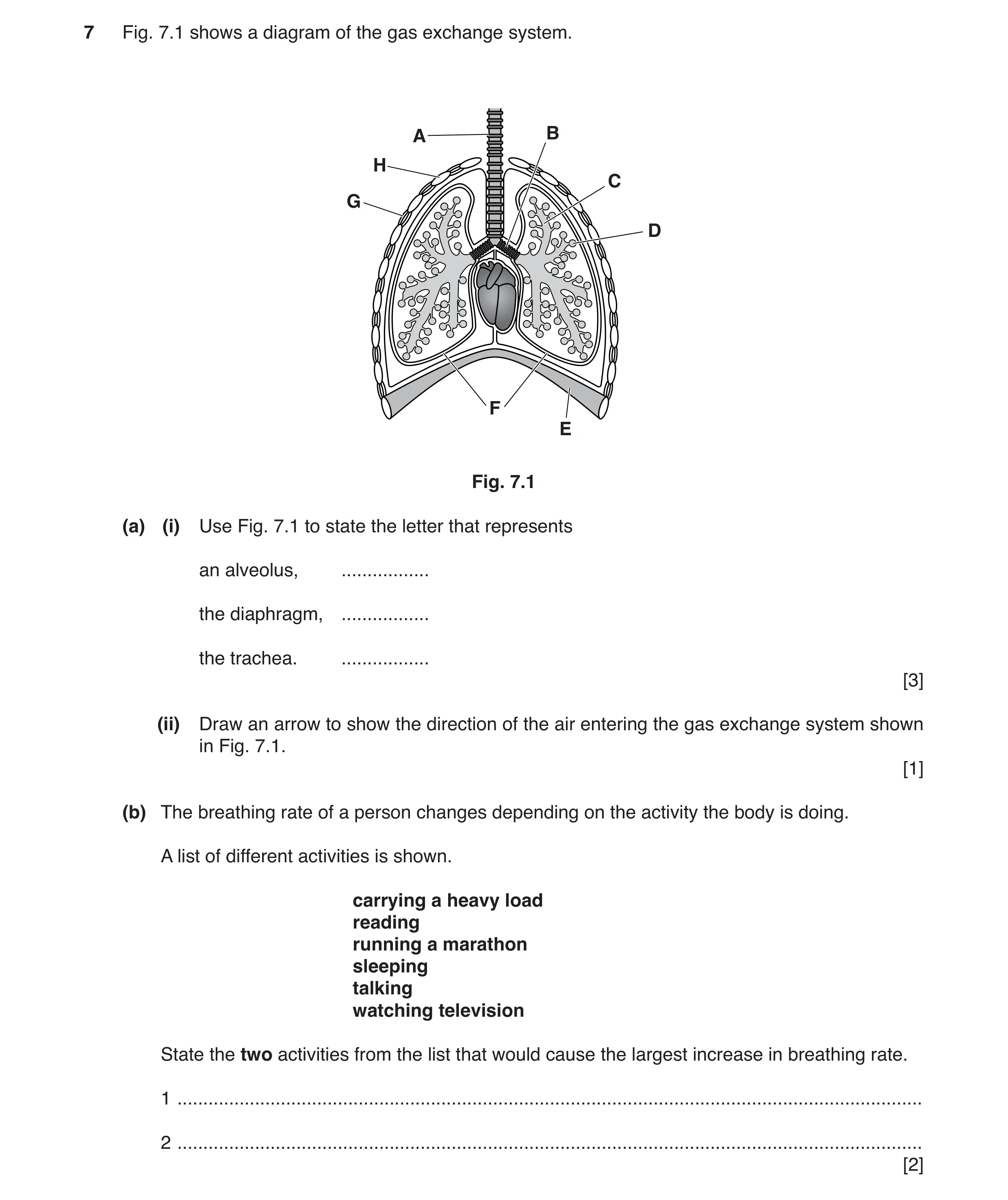
7 Fig. 7.1 shows a diagram of the gas exchange system. A B H C G D F E Fig. 7.1 (a) (i) Use Fig. 7.1 to state the letter that represents an alveolus, … the diaphragm, … the trachea. … [3] (ii) Draw an arrow to show the direction of the air entering the gas exchange system shown in Fig. 7.1. [1] (b) The breathing rate of a person changes depending on the activity the body is doing. A list of different activities is shown. carrying a heavy load reading running a marathon sleeping talking watching television State the two activities from the list that would cause the largest increase in breathing rate. 1 … 2 … [2]
6 marks
Mark scheme: 7(a)(i) D ; E ; A ; 3 7(a)(ii) arrow drawn, entering the trachea / pointing into the trachea ; 1 7(b) carrying a heavy load ; running a marathon ; 2
This question in 0654/31 Oct/Nov 2018
Q3 · A diagram of the human gas exchange system 0654/32 Oct/Nov 2020
7 (a) Fig. 7.1 is a diagram of the human gas exchange system. A B G F E D C Fig. 7.1 (i) State the letters in Fig. 7.1 that identify the: • bronchus … • diaphragm … • ribs … • trachea. … [4] (ii) Table 7.1 contains some statements. Place ticks (3) next to the statements that correctly describe diffusion. Table 7.1 Diffusion occurs due to random movement of particles. Particles move up a concentration gradient. Substances move into cells by diffusion. The net movement of particles is from low to high concentration. Water does not diffuse into cells. [2] (b) Inspired air contains more oxygen than expired air. Oxygen is used in the process of respiration. (i) State two other ways that inspired air is different from expired air. 1 … 2 … [2] (ii) State why respiration enables protein synthesis to take place. … … [1] (iii) State the substance that reacts with oxygen in aerobic respiration. … [1] [Total: 10]
10 marks
Mark scheme: 7(a)(i) F ; C ; G ; B ; 4 7(a)(ii) diffusion occurs due to random movement of particles ticked ; substances move into cells by diffusion ticked ; 2 7(b)(i) (inspired air) contains less carbon dioxide ; (inspired air) contains less water (vapour) ; AVP ; (inspired air) is cooler 2 7(b)(ii) respiration releases energy (for protein synthesis) ; 1 7(b (iii) glucose ; 1
This question in 0654/32 Oct/Nov 2020
Q4 · A diagram of the human gas exchange system 0654/31 May/June 2021
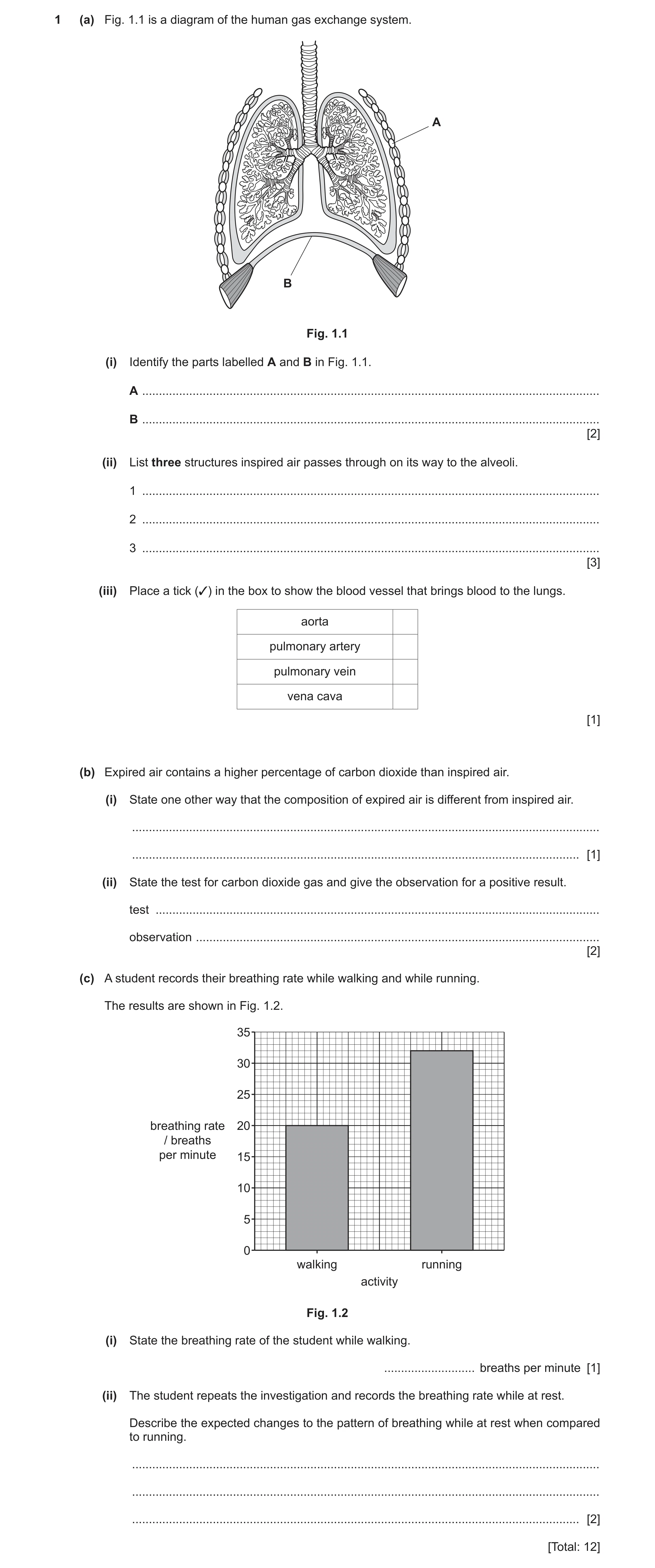
1 (a) Fig. 1.1 is a diagram of the human gas exchange system. A B Fig. 1.1 (i) Identify the parts labelled A and B in Fig. 1.1. A … B … [2] (ii) List three structures inspired air passes through on its way to the alveoli. 1 … 2 … 3 … [3] (iii) Place a tick (3) in the box to show the blood vessel that brings blood to the lungs. aorta pulmonary artery pulmonary vein vena cava [1] (b) Expired air contains a higher percentage of carbon dioxide than inspired air. (i) State one other way that the composition of expired air is different from inspired air. … … [1] (ii) State the test for carbon dioxide gas and give the observation for a positive result. test … observation … [2] (c) A student records their breathing rate while walking and while running. The results are shown in Fig. 1.2. 35 30 25 breathing rate 20 / breaths per minute 15 10 5 0 walking running activity Fig. 1.2 (i) State the breathing rate of the student while walking. … breaths per minute [1] (ii) The student repeats the investigation and records the breathing rate while at rest. Describe the expected changes to the pattern of breathing while at rest when compared to running. … … … [2] [Total: 12]
12 marks
Mark scheme: 1(a)(i) A rib ; B diaphragm ; 2 1(a)(ii) any three from nose / mouth ; larynx ; trachea ; bronchus ; bronchioles ; 3 1(a)(iii) pulmonary artery ; 1 1(b)(i) less oxygen / more water (vapour) ; 1 1(b)(ii) substance limewater ; positive result cloudy ; 2 1(c)(i) 20 (breaths / minute) ; 1 1(c)(ii) decrease in breathing rate ; decrease in depth of breathing ; 2
This question in 0654/31 May/June 2021
Q5 · A diagram of the gas exchange system in humans 0654/32 May/June 2022
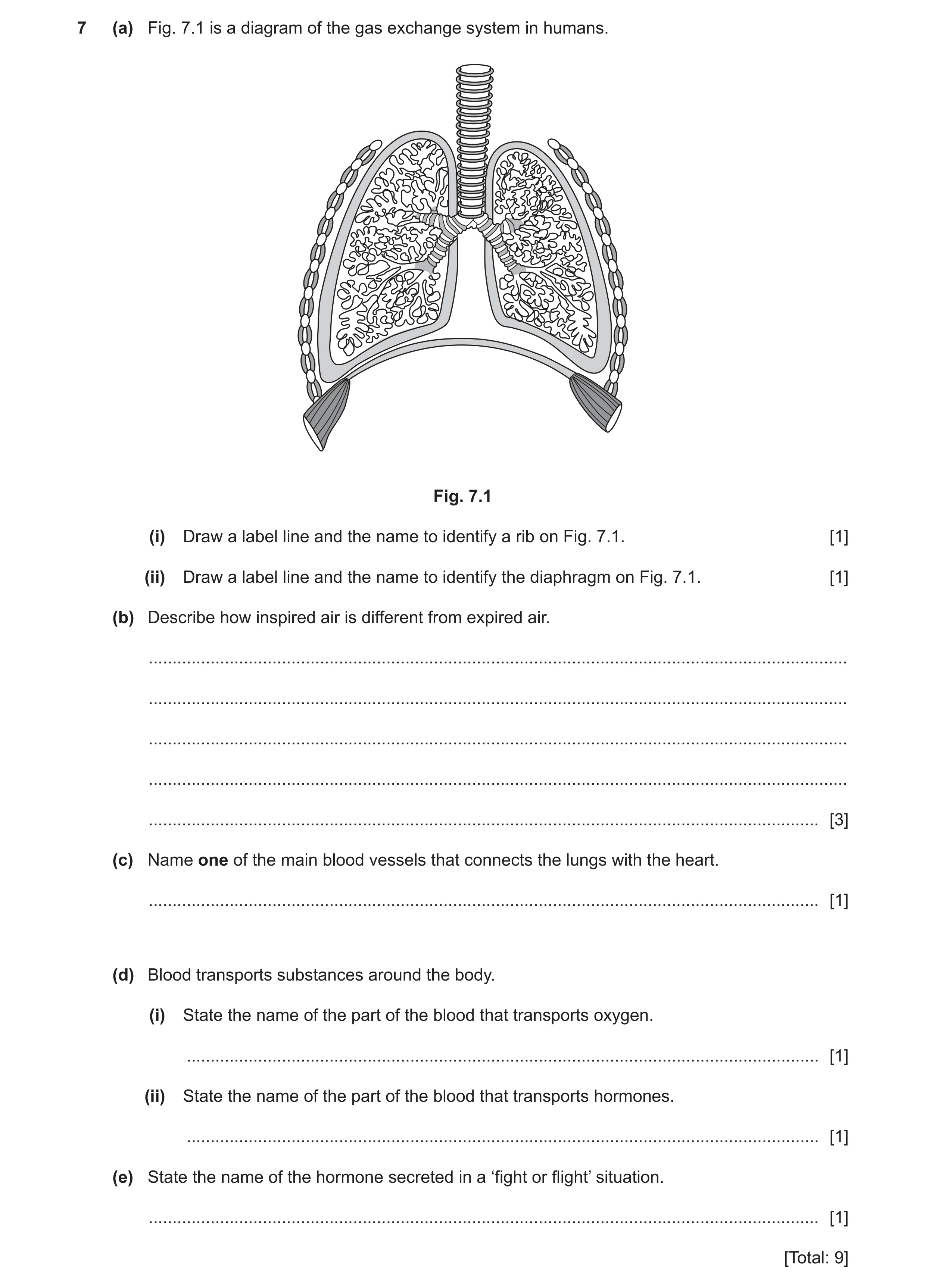
7 (a) Fig. 7.1 is a diagram of the gas exchange system in humans. Fig. 7.1 (i) Draw a label line and the name to identify a rib on Fig. 7.1. [1] (ii) Draw a label line and the name to identify the diaphragm on Fig. 7.1. [1] (b) Describe how inspired air is different from expired air. … … … … … [3] (c) Name one of the main blood vessels that connects the lungs with the heart. … [1] (d) Blood transports substances around the body. (i) State the name of the part of the blood that transports oxygen. … [1] (ii) State the name of the part of the blood that transports hormones. … [1] (e) State the name of the hormone secreted in a ‘fight or flight’ situation. … [1] [Total: 9]
9 marks
Mark scheme: 7(a)(i) rib labelled correctly ; 1 7(a)(ii) diaphragm labelled correctly ; 1 7(b) contains more oxygen ; contains less water vapour ; contains less carbon dioxide ; AVP ; Max 3 marks 3 7(c) pulmonary vein / pulmonary artery ; 1 7(d)(i) red blood cell ; 1 Question Answer Marks 7(d)(ii) plasma ; 1 7(e) adrenaline ; 1
This question in 0654/32 May/June 2022
Q6 · A diagram of the gas exchange system in humans 0654/33 May/June 2022
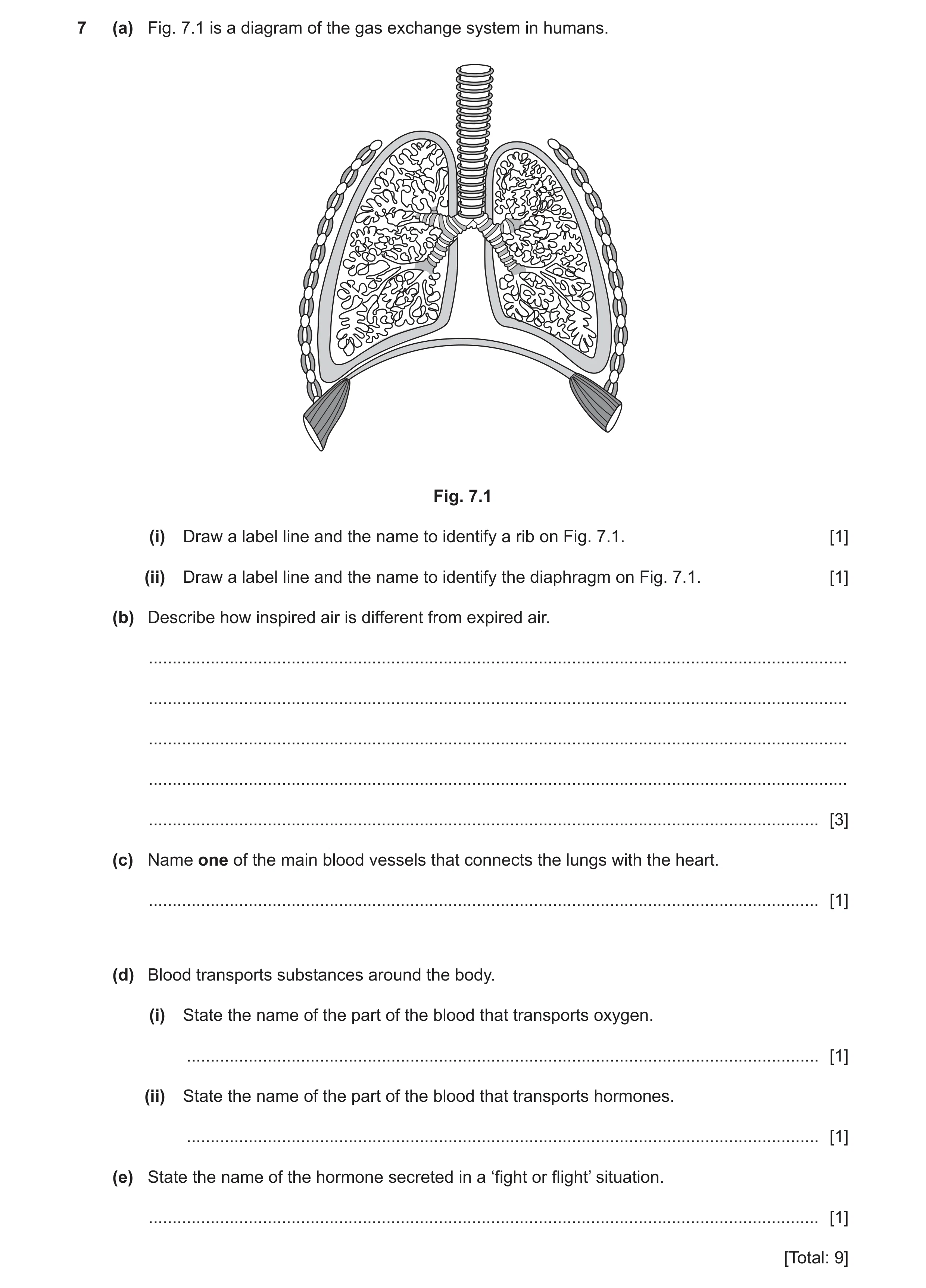
7 (a) Fig. 7.1 is a diagram of the gas exchange system in humans. Fig. 7.1 (i) Draw a label line and the name to identify a rib on Fig. 7.1. [1] (ii) Draw a label line and the name to identify the diaphragm on Fig. 7.1. [1] (b) Describe how inspired air is different from expired air. … … … … … [3] (c) Name one of the main blood vessels that connects the lungs with the heart. … [1] (d) Blood transports substances around the body. (i) State the name of the part of the blood that transports oxygen. … [1] (ii) State the name of the part of the blood that transports hormones. … [1] (e) State the name of the hormone secreted in a ‘fight or flight’ situation. … [1] [Total: 9]
9 marks
Mark scheme: 7(a)(i) rib labelled correctly ; 1 7(a)(ii) diaphragm labelled correctly ; 1 7(b) contains more oxygen ; contains less water vapour ; contains less carbon dioxide ; AVP ; Max 3 marks 3 7(c) pulmonary vein / pulmonary artery ; 1 7(d)(i) red blood cell ; 1 Question Answer Marks 7(d)(ii) plasma ; 1 7(e) adrenaline ; 1
This question in 0654/33 May/June 2022
Q7 · A diagram of the gas exchange system in humans 0654/32 Oct/Nov 2023
10 (a) Fig. 10.1 is a diagram of the gas exchange system in humans. A B C Fig. 10.1 State the names of the parts labelled A, B and C in Fig. 10.1. A … B … C … [3] (b) Describe three ways the composition of expired air is different from inspired air. 1 … … 2 … … 3 … … [3] (c) Gases move across the gas exchange surface by diffusion. Place ticks (✓) next to all the statements that correctly describe diffusion. Diffusion is due to the random movement of particles. Diffusion is the movement of only water molecules. Diffusion occurs across a cell membrane. Diffusion requires energy from aerobic respiration. Diffusion occurs against a concentration gradient. [2] (d) Gas exchange also occurs in plants. (i) State the name of the part of the leaf where water vapour exits. … [1] (ii) State the term used to describe when water evaporates and then diffuses out of a leaf. … [1] (iii) State two factors that increase the rate of water loss from a leaf. 1 … 2 … [2] [Total: 12]
12 marks
Mark scheme: 10(a) A – trachea ; 3 B – bronchus ; C – alveoli ; 10(b) (expired air) 3 contains more carbon dioxide ; contains less oxygen ; contains more water vapour ; 10(c) 2 Diffusion is due to the random movement of particles. Diffusion is the movement of only water molecules. Diffusion occurs across a cell membrane. Diffusion requires energy from aerobic respiration. Diffusion occurs against a concentration gradient. ;; all correct = 2 marks three ticks and two correct = 1 mark otherwise = 0 marks 10(d)(i) stoma / stomata ; 1 10(d)(ii) transpiration ; 1 10(d)(iii) any two from: 2 increase in temperature ; decrease in humidity ; AVP ;
This question in 0654/32 Oct/Nov 2023
Q8 · A diagram of the gas exchange system in humans 0654/32 Feb/March 2024
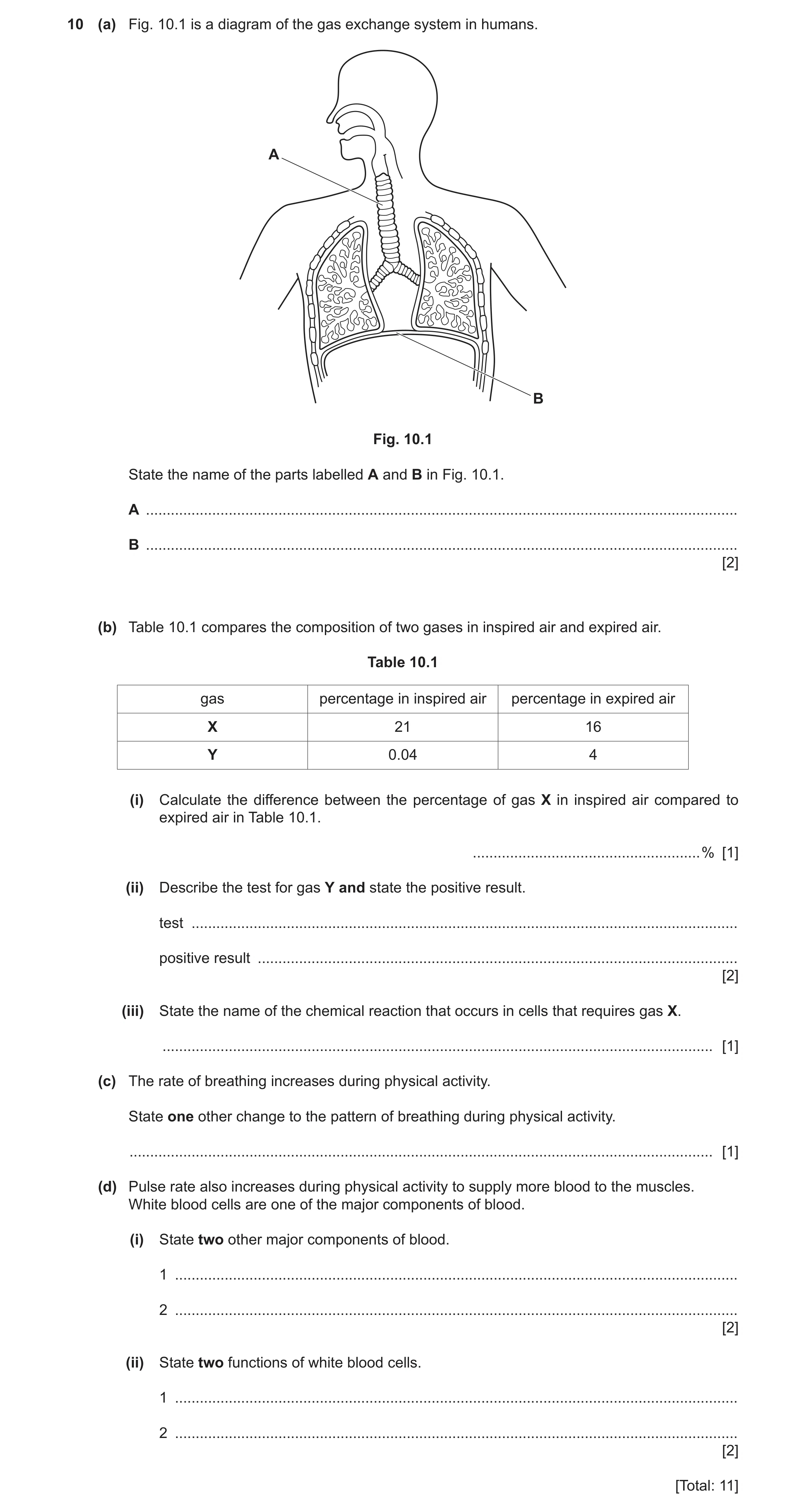
10 (a) Fig. 10.1 is a diagram of the gas exchange system in humans. A B Fig. 10.1 State the name of the parts labelled A and B in Fig. 10.1. A … B … [2] (b) Table 10.1 compares the composition of two gases in inspired air and expired air. Table 10.1 gas percentage in inspired air percentage in expired air X 21 16 Y 0.04 4 (i) Calculate the difference between the percentage of gas X in inspired air compared to expired air in Table 10.1. … % [1] (ii) Describe the test for gas Y and state the positive result. test … positive result … [2] (iii) State the name of the chemical reaction that occurs in cells that requires gas X. … [1] (c) The rate of breathing increases during physical activity. State one other change to the pattern of breathing during physical activity. … [1] (d) Pulse rate also increases during physical activity to supply more blood to the muscles. White blood cells are one of the major components of blood. (i) State two other major components of blood. 1 … 2 … [2] (ii) State two functions of white blood cells. 1 … 2 … [2] [Total: 11]
11 marks
Mark scheme: 10(a) A – trachea ; 2 B – diaphragm ; 10(b)(i) 5 (%) ; 1 10(b)(ii) limewater ; 2 cloudy ; 10(b)(iii) (aerobic) respiration ; 1 10(c) increased depth of breathing ; 1 10(d)(i) any two from: 2 red blood cells ; platelets ; plasma ; 10(d)(ii) phagocytosis ; 2 antibody production ;
This question in 0654/32 Feb/March 2024
Q9 · A diagram of the human breathing system 0654/32 Oct/Nov 2025
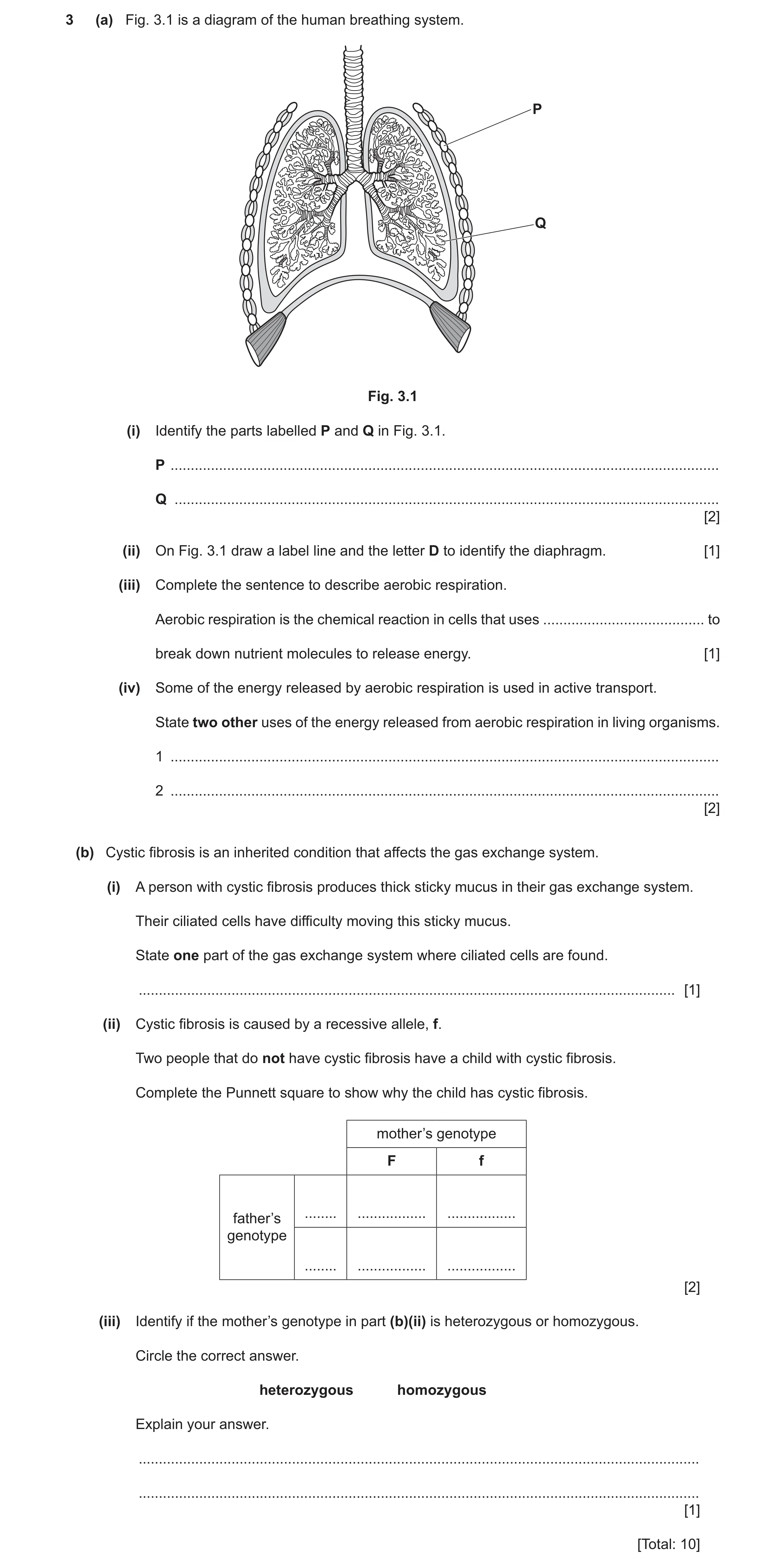
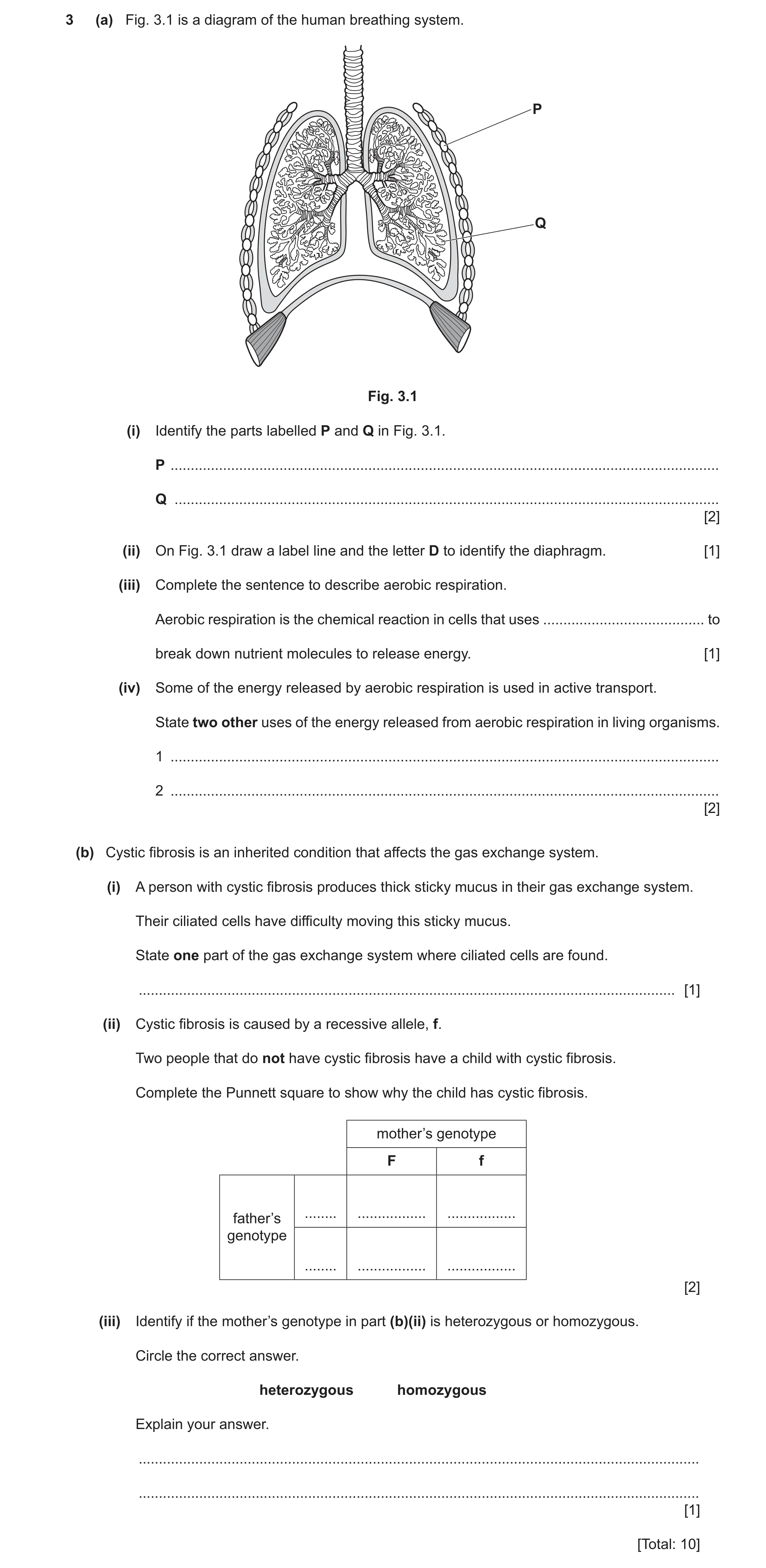
3 (a) Fig. 3.1 is a diagram of the human breathing system. P Q Fig. 3.1 (i) Identify the parts labelled P and Q in Fig. 3.1. P … Q … [2] (ii) On Fig. 3.1 draw a label line and the letter D to identify the diaphragm. [1] (iii) Complete the sentence to describe aerobic respiration. Aerobic respiration is the chemical reaction in cells that uses … to break down nutrient molecules to release energy. [1] (iv) Some of the energy released by aerobic respiration is used in active transport. State two other uses of the energy released from aerobic respiration in living organisms. 1 … 2 … [2] (b) Cystic fibrosis is an inherited condition that affects the gas exchange system. (i) A person with cystic fibrosis produces thick sticky mucus in their gas exchange system. Their ciliated cells have difficulty moving this sticky mucus. State one part of the gas exchange system where ciliated cells are found. … [1] (ii) Cystic fibrosis is caused by a recessive allele, f. Two people that do not have cystic fibrosis have a child with cystic fibrosis. Complete the Punnett square to show why the child has cystic fibrosis. mother’s genotype F f … … … father’s genotype … … … [2] (iii) Identify if the mother’s genotype in part (b)(ii) is heterozygous or homozygous. Circle the correct answer. heterozygous homozygous Explain your answer. … … [1] [Total: 10]
10 marks
Mark scheme: 3(a)(i) P – rib ; 2 Q – alveolus / alveoli ; 3(a)(ii) diaphragm labelled D ; 1 3(a)(iii) oxygen ; 1 3(a)(iv) any two from: 2 • muscle contraction ; • protein synthesis ; • cell division ; • growth ; • the passage of nerve impulses ; • the maintenance of a constant body temperature ; 3(b)(i) trachea / bronchi ; 1 3(b)(ii) 2 father’s genotype correct ; offsprings’ genotype correct ; 3(b)(iii) heterozygous and has two different alleles ; 1
This question in 0654/32 Oct/Nov 2025
Q10 · A diagram of the human breathing system 0654/33 Oct/Nov 2025
3 (a) Fig. 3.1 is a diagram of the human breathing system. P Q Fig. 3.1 (i) Identify the parts labelled P and Q in Fig. 3.1. P … Q … [2] (ii) On Fig. 3.1 draw a label line and the letter D to identify the diaphragm. [1] (iii) Complete the sentence to describe aerobic respiration. Aerobic respiration is the chemical reaction in cells that uses … to break down nutrient molecules to release energy. [1] (iv) Some of the energy released by aerobic respiration is used in active transport. State two other uses of the energy released from aerobic respiration in living organisms. 1 … 2 … [2] (b) Cystic fibrosis is an inherited condition that affects the gas exchange system. (i) A person with cystic fibrosis produces thick sticky mucus in their gas exchange system. Their ciliated cells have difficulty moving this sticky mucus. State one part of the gas exchange system where ciliated cells are found. … [1] (ii) Cystic fibrosis is caused by a recessive allele, f. Two people that do not have cystic fibrosis have a child with cystic fibrosis. Complete the Punnett square to show why the child has cystic fibrosis. mother’s genotype F f … … … father’s genotype … … … [2] (iii) Identify if the mother’s genotype in part (b)(ii) is heterozygous or homozygous. Circle the correct answer. heterozygous homozygous Explain your answer. … … [1] [Total: 10]
10 marks
Mark scheme: 3(a)(i) P – rib ; 2 Q – alveolus / alveoli ; 3(a)(ii) diaphragm labelled D ; 1 3(a)(iii) oxygen ; 1 3(a)(iv) any two from: 2 • muscle contraction ; • protein synthesis ; • cell division ; • growth ; • the passage of nerve impulses ; • the maintenance of a constant body temperature ; 3(b)(i) trachea / bronchi ; 1 3(b)(ii) 2 father’s genotype correct ; offsprings’ genotype correct ; 3(b)(iii) heterozygous and has two different alleles ; 1
This question in 0654/33 Oct/Nov 2025
 3 / 15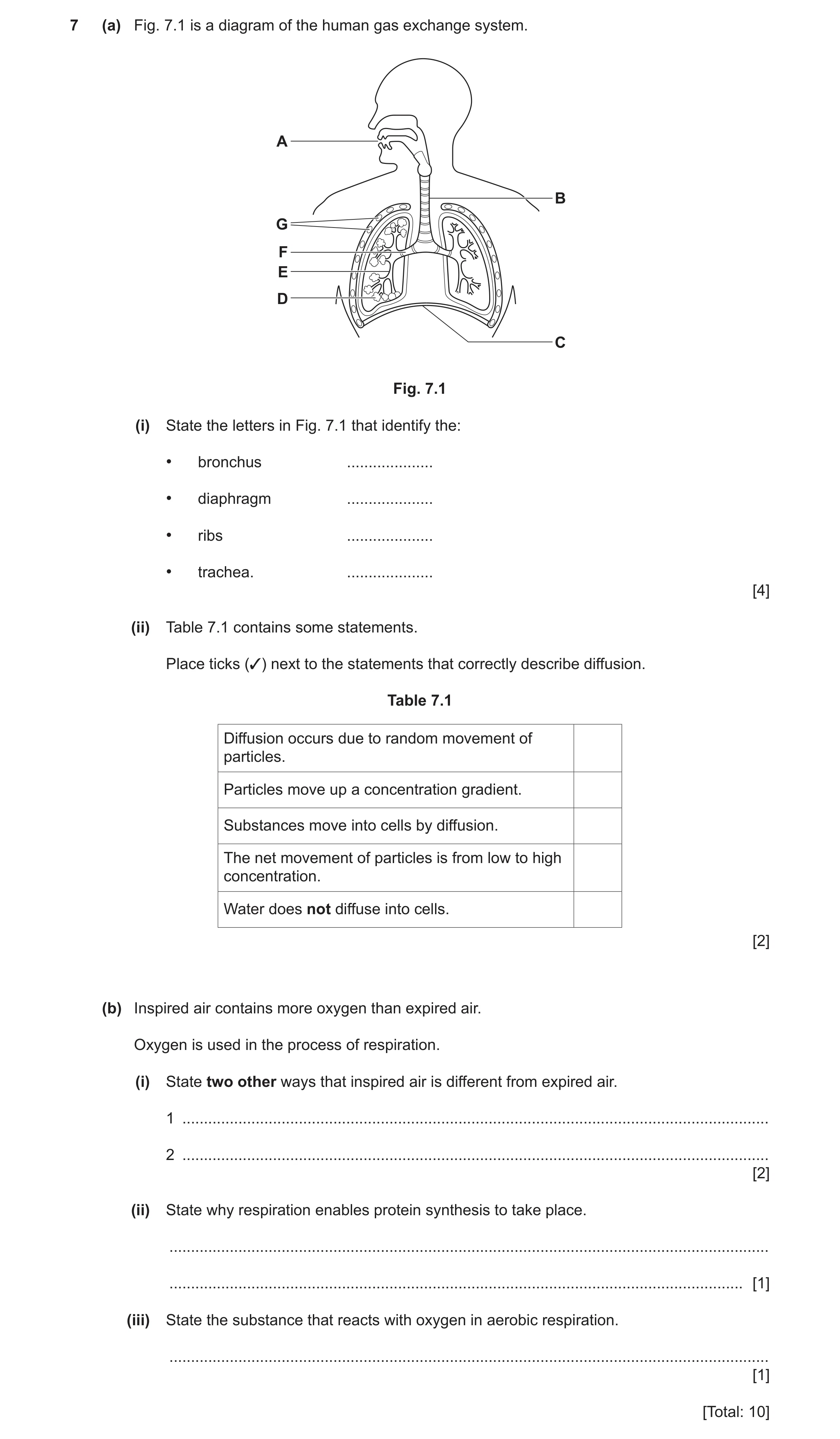
 8 / 15
 9 / 15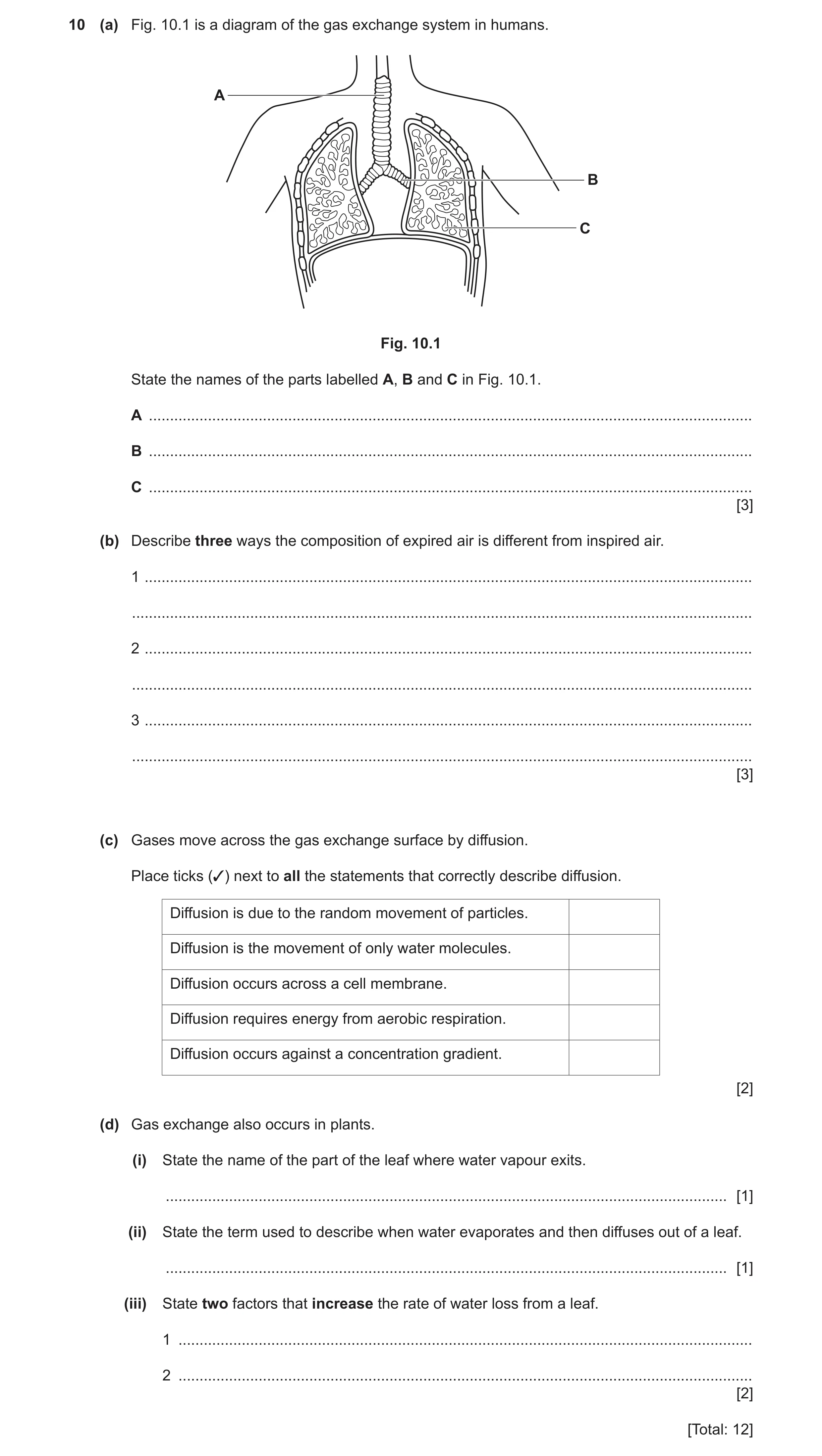
 11
11 6
6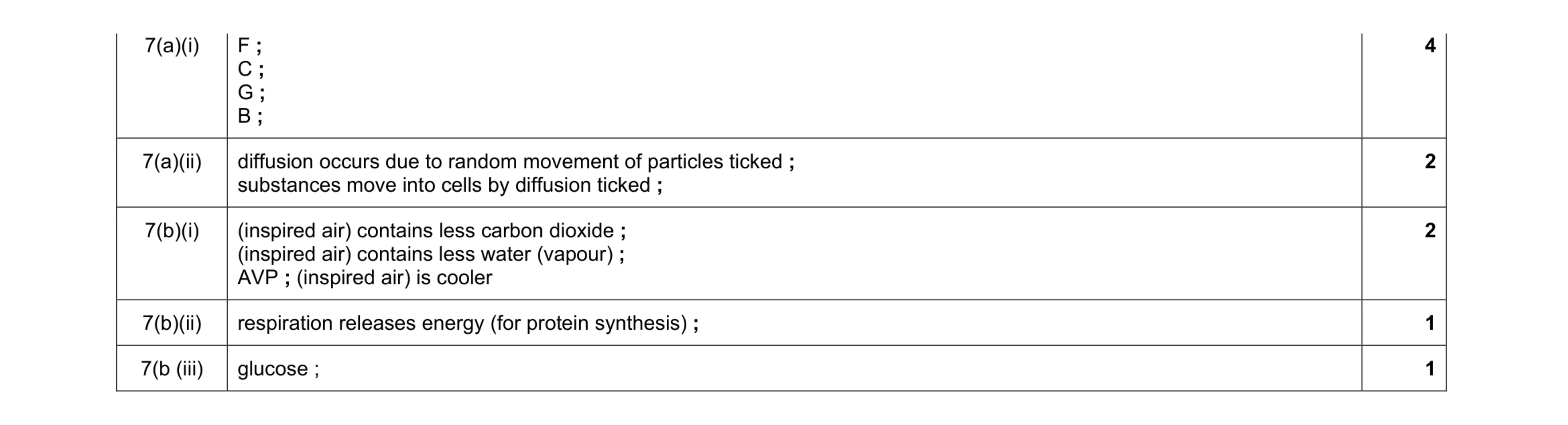 10
10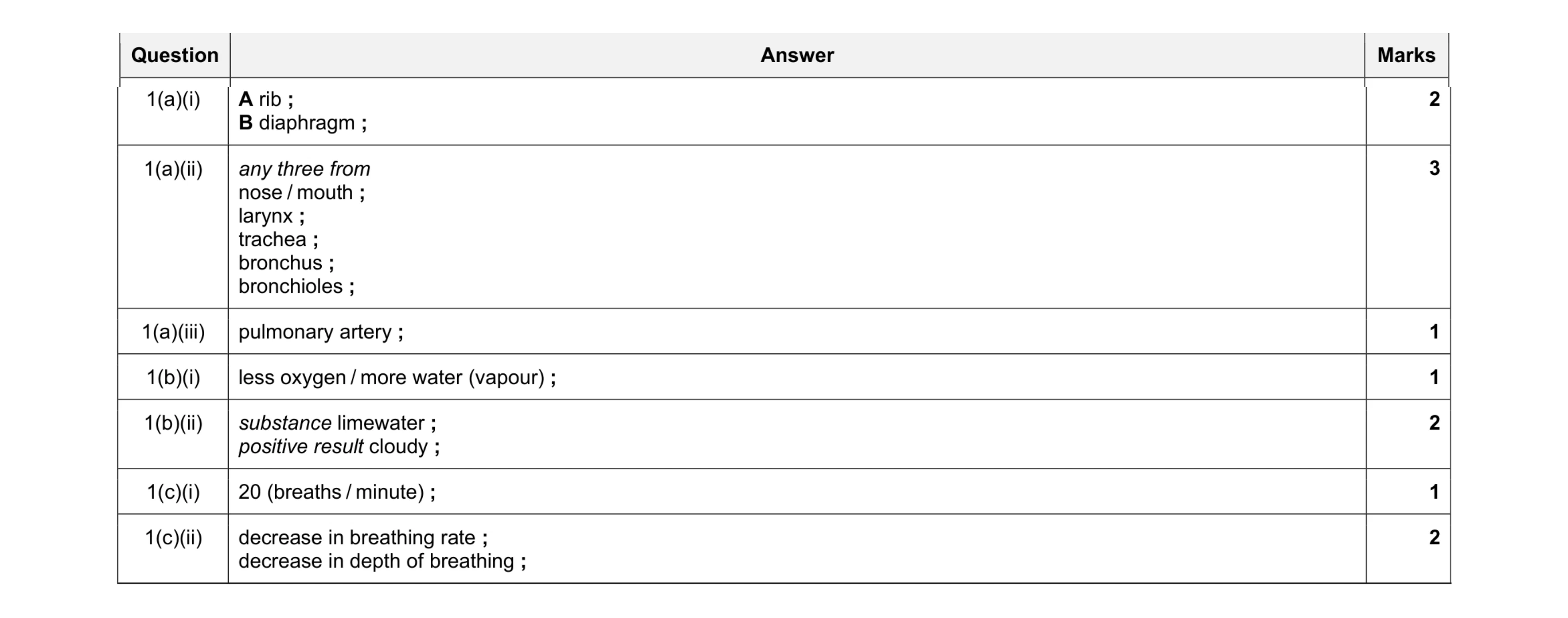 12
12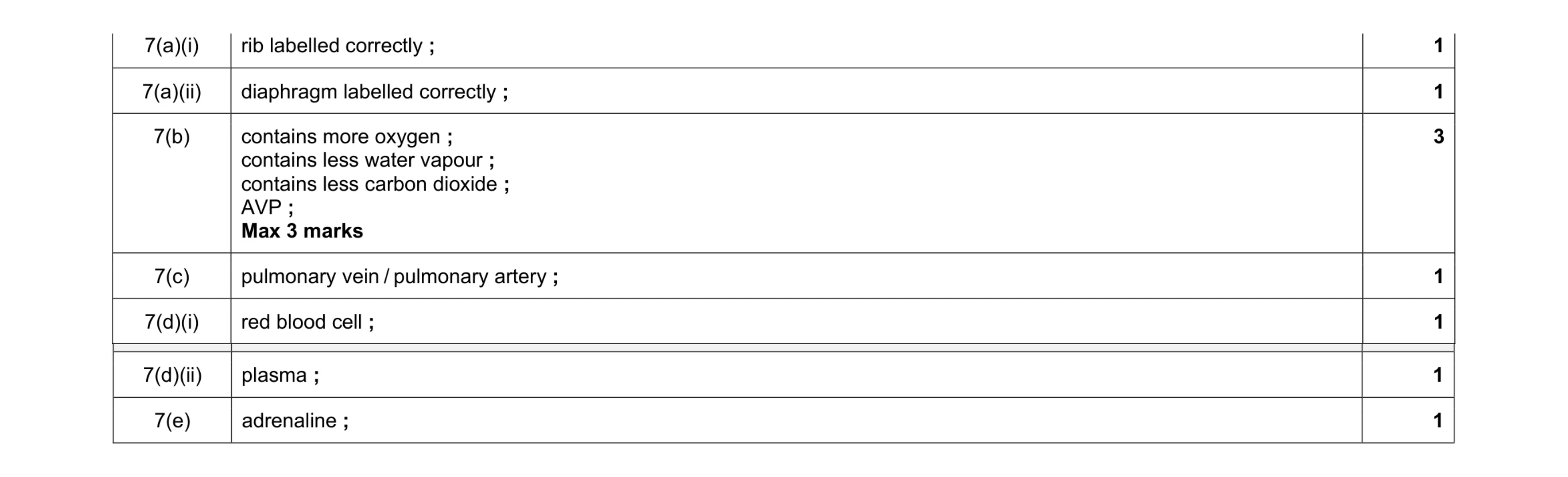 9
9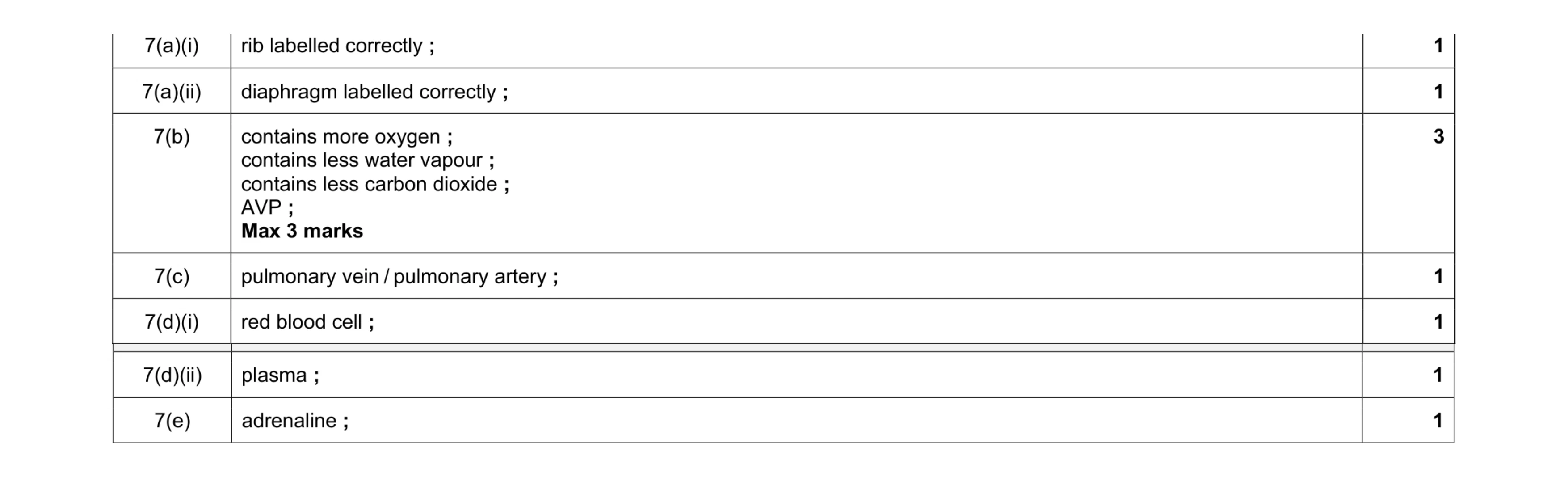 9
9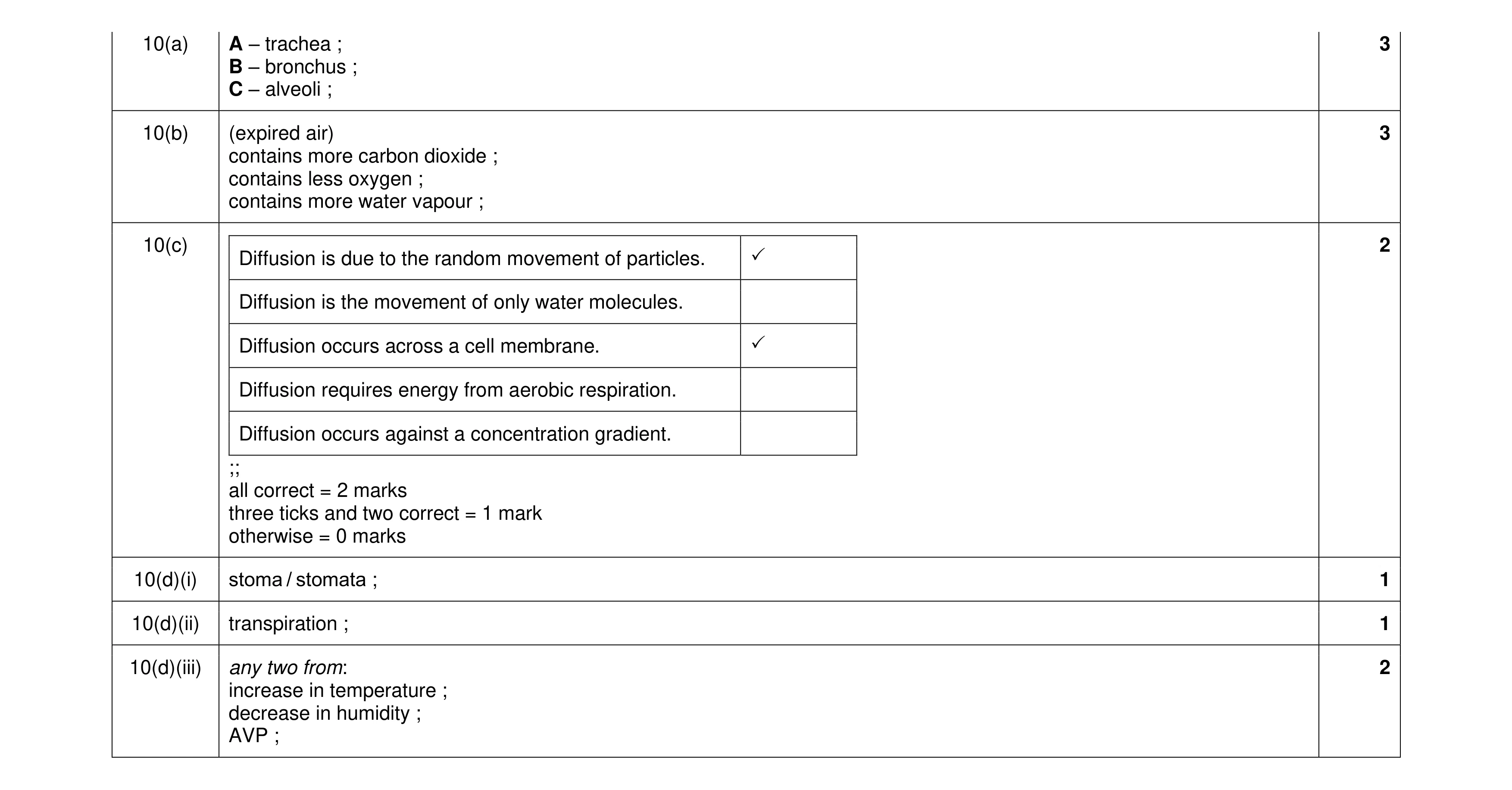 12
12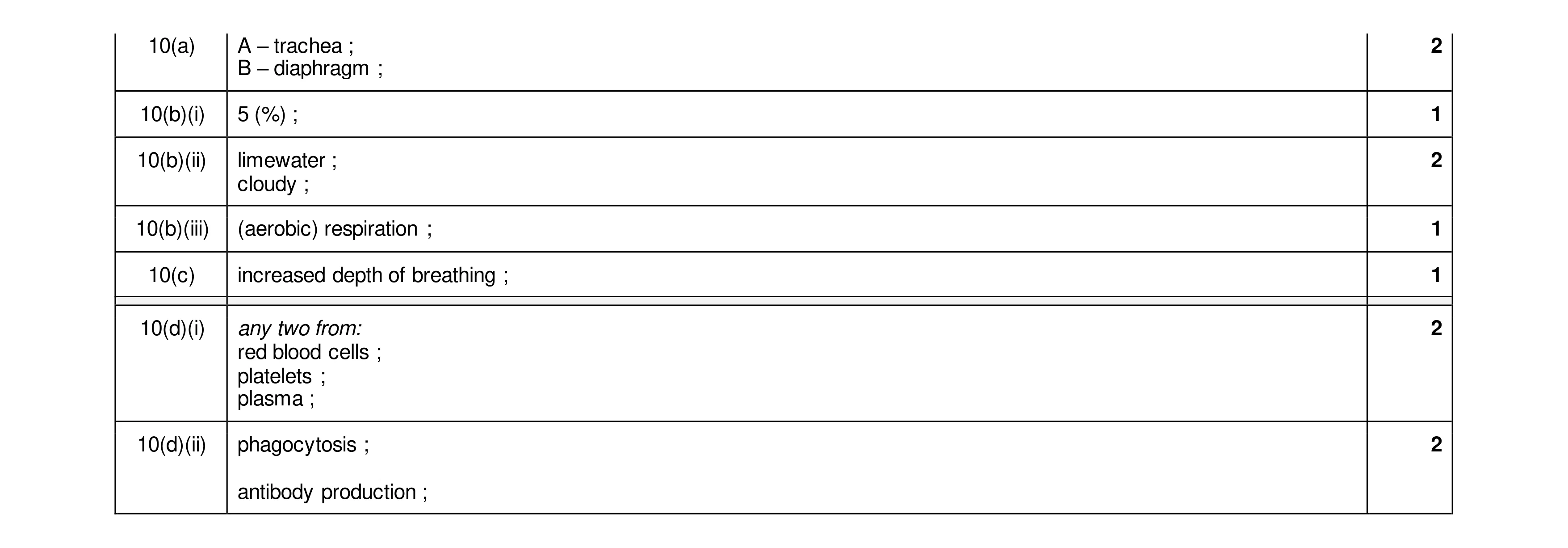 11
11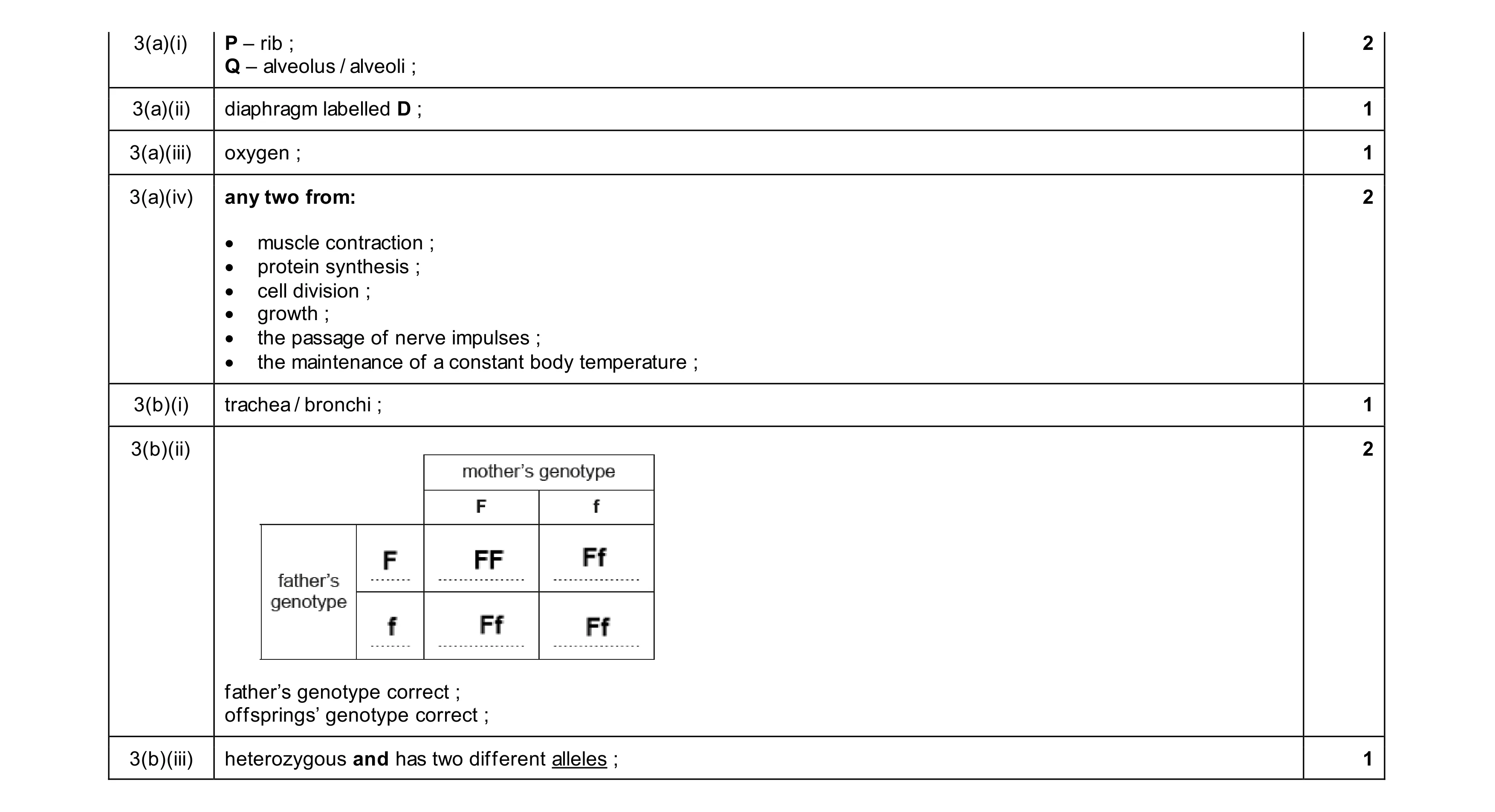 10
10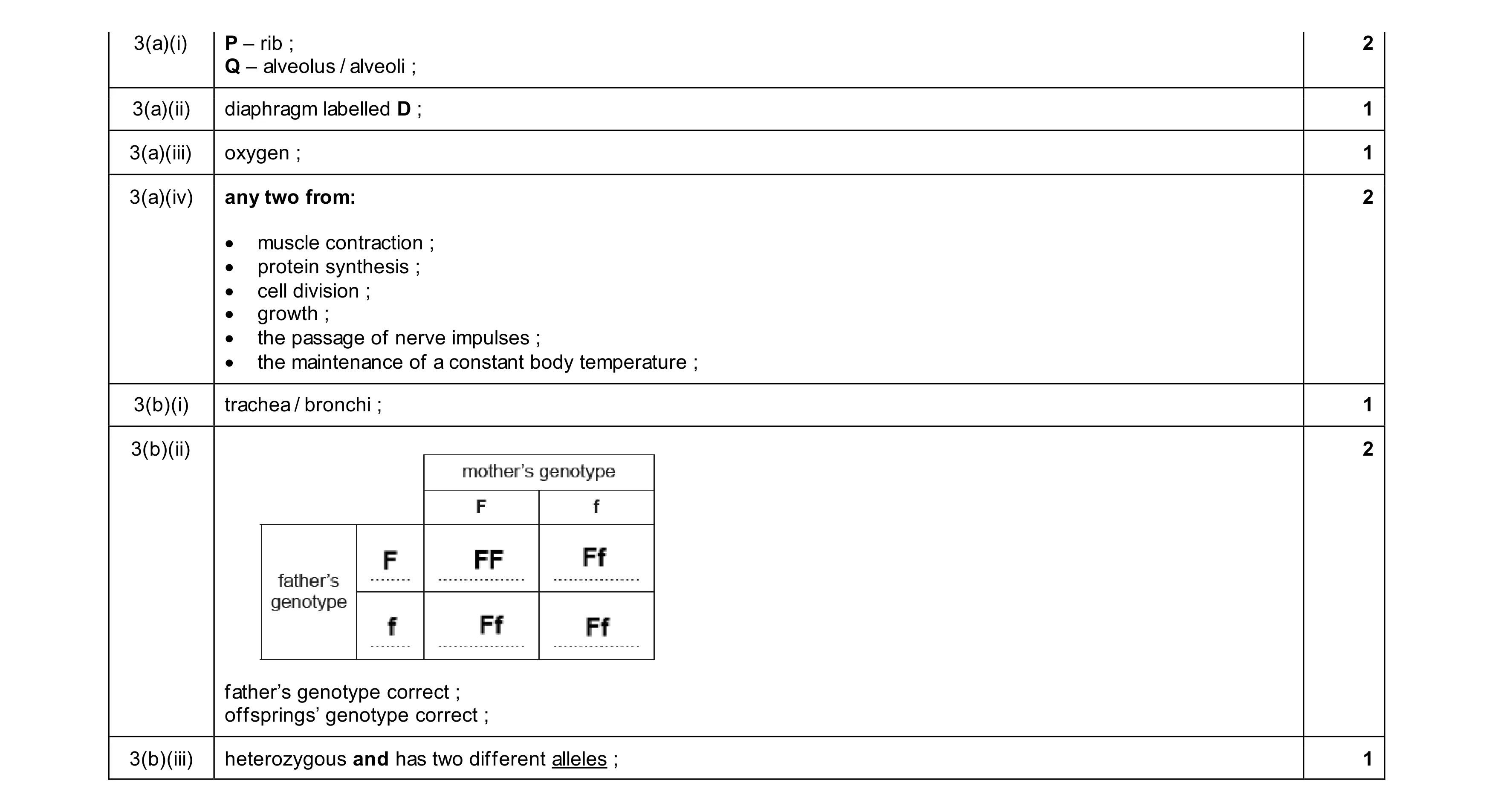 10
10