Questions as text
Q1 · State, in order, the names of the three planets closest to the Sun 0625/32 Feb/March 2023
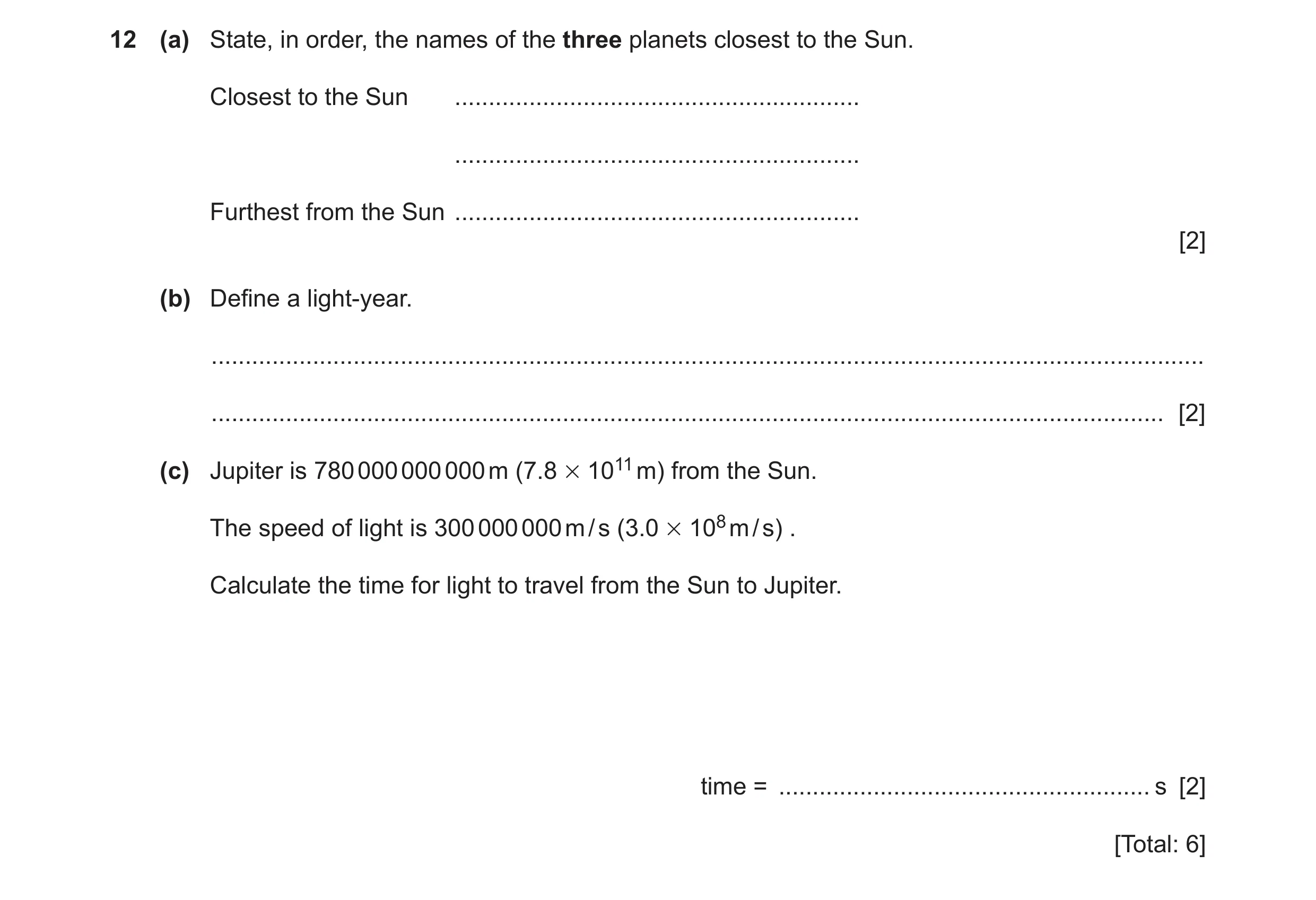
12 (a) State, in order, the names of the three planets closest to the Sun. Closest to the Sun … … Furthest from the Sun … [2] (b) Define a light-year. … … [2] (c) Jupiter is 780 000 000 000 m (7.8 # 1011 m) from the Sun. The speed of light is 300 000 000 m / s (3.0 # 108 m / s) . Calculate the time for light to travel from the Sun to Jupiter. time = … s [2] [Total: 6]
6 marks
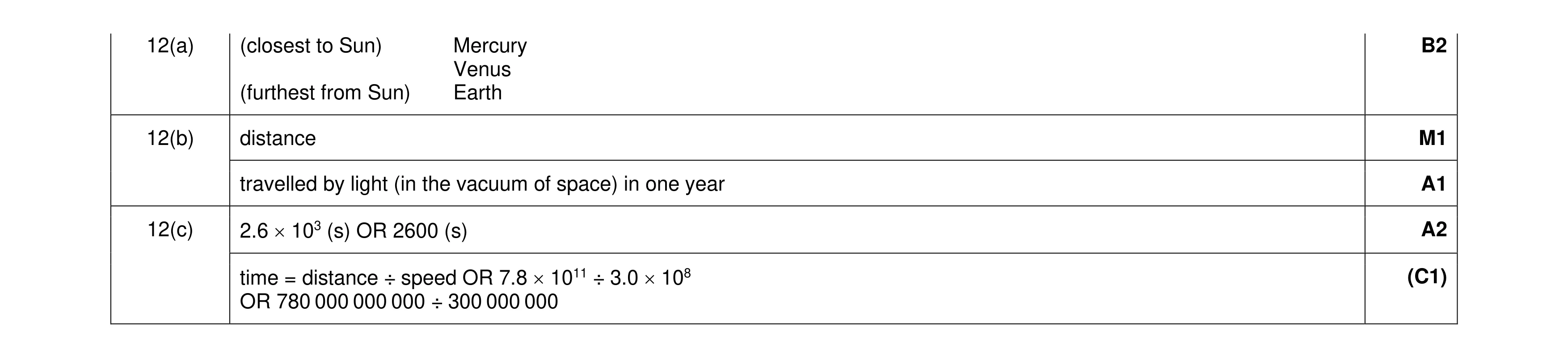
Mark scheme: 12(a) (closest to Sun) Mercury B2 Venus (furthest from Sun) Earth 12(b) distance M1 travelled by light (in the vacuum of space) in one year A1 12(c) 2.6 103 (s) OR 2600 (s) A2 time = distance ÷ speed OR 7.8 1011 ÷ 3.0 108 (C1) OR 780 000 000 000 ÷ 300 000 000
This question in 0625/32 Feb/March 2023
Q2 · The Earth and the Sun at one point in the Earth’s orbit of the Sun 0625/31 May/June 2023
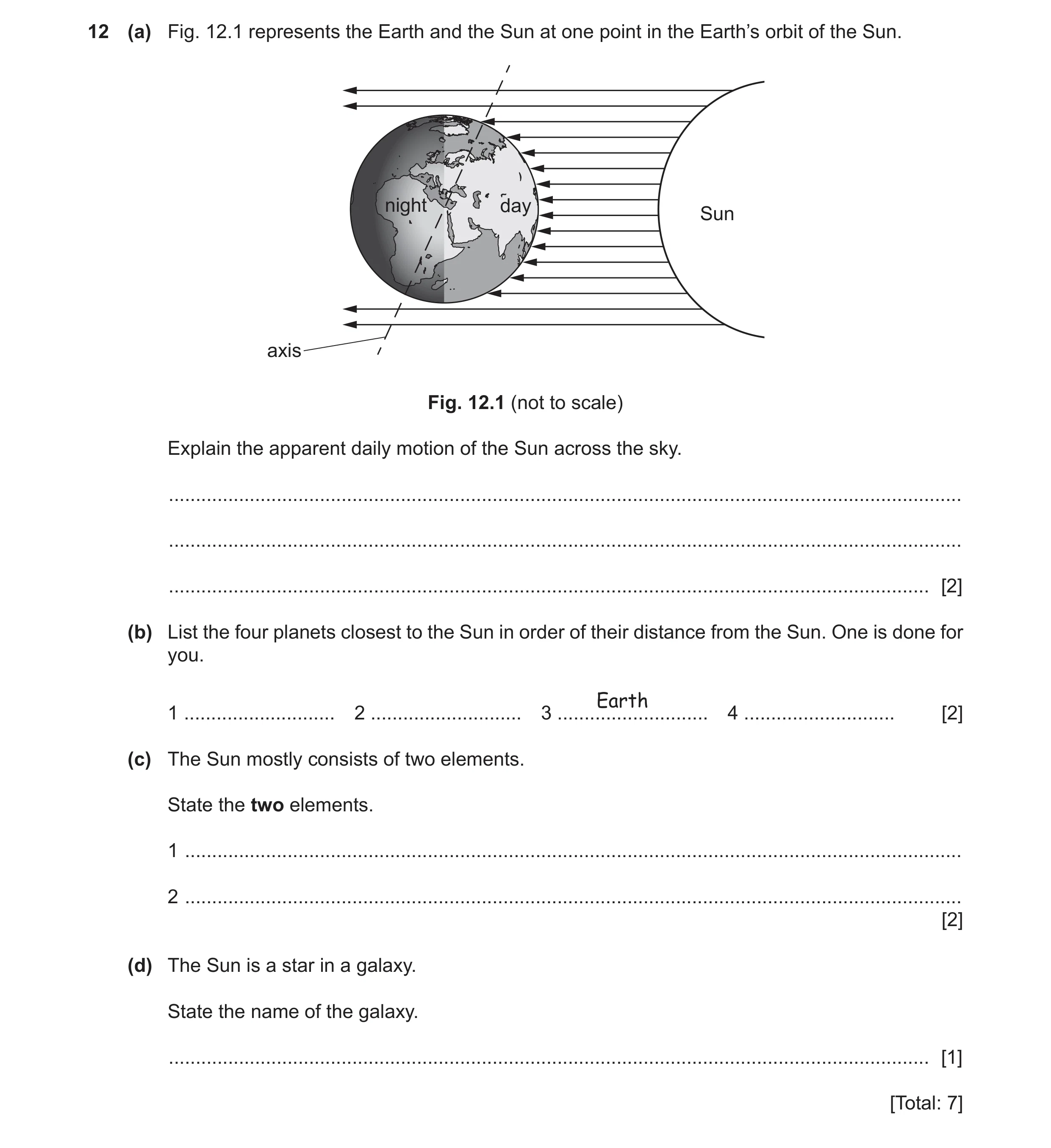
12 (a) Fig. 12.1 represents the Earth and the Sun at one point in the Earth’s orbit of the Sun. night day Sun axis Fig. 12.1 (not to scale) Explain the apparent daily motion of the Sun across the sky. … … … [2] (b) List the four planets closest to the Sun in order of their distance from the Sun. One is done for you. Earth 1 … 2 … 3 … 4 … [2] (c) The Sun mostly consists of two elements. State the two elements. 1 … 2 … [2] (d) The Sun is a star in a galaxy. State the name of the galaxy. … [1] [Total: 7]
7 marks
Mark scheme: 12(a) Earth rotates / spins (on its axis) M1 (once) every 24 hours / day OR daily A1 12(b) Mercury Venus Earth Mars 3 correct planets M1 in correct order A1 12(c) hydrogen B1 helium B1 12(d) Milky Way B1
This question in 0625/31 May/June 2023
Q3 · The Sun and the four innermost planets, A, B, C, and D, of the Solar System 0625/32 May/June 2023
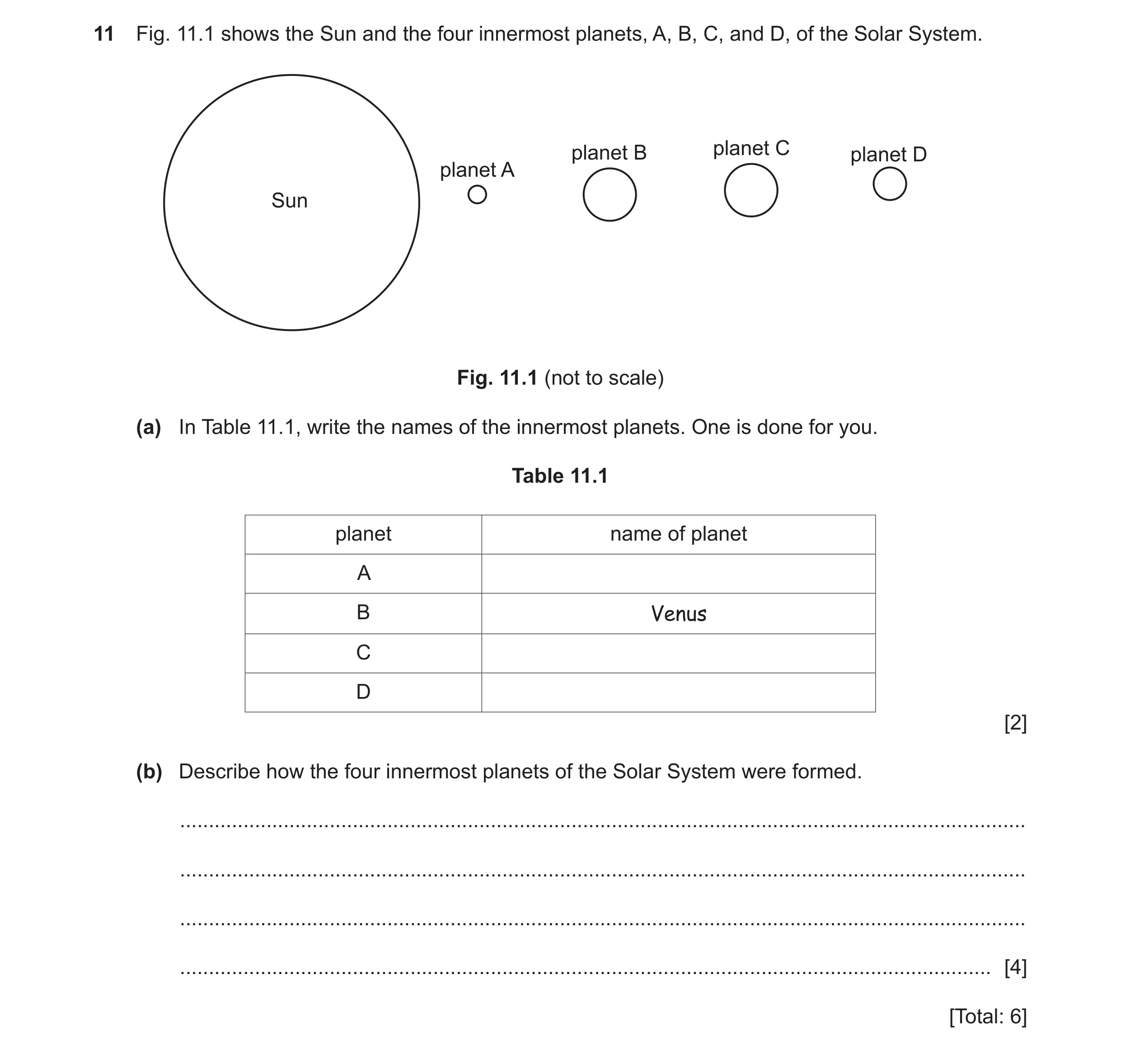
11 Fig. 11.1 shows the Sun and the four innermost planets, A, B, C, and D, of the Solar System. planet B planet C planet D planet A Sun Fig. 11.1 (not to scale) (a) In Table 11.1, write the names of the innermost planets. One is done for you. Table 11.1 planet name of planet A B Venus C D [2] (b) Describe how the four innermost planets of the Solar System were formed. … … … … [4] [Total: 6]
6 marks
Mark scheme: 11(a) Mercury Venus Earth Mars 3 correct planets M1 in correct order A1 11(b) any four from: dust and gas (clouds orbit the Sun) contain many different elements rotation of material (around Sun) (leads to) particles accrete / combine / join (subsequently) forming larger rocks / boulders (because of) gravitational attraction material moves to form (protoplanetary) disks (orbiting Sun) (continued collisions lead to) formation of planetary core B4
This question in 0625/32 May/June 2023
Q4 · Part of the Solar System 0625/33 May/June 2023
10 Fig. 10.1 represents part of the Solar System. Neptune Earth Jupiter Sun Uranus planet A planet B Venus Saturn Fig. 10.1 (not to scale) (a) (i) State the name of planet A and the name of planet B. planet A … planet B … [2] (ii) On Fig. 10.1, draw an X to represent a moon of Jupiter. Draw a line to show how this moon moves. [1] (iii) State two ways in which the four planets nearest to the Sun are different from the four planets furthest away from the Sun. 1 … 2 … [2] (iv) Complete the following sentences: The galaxy that includes the Solar System is called the … . The … includes billions of galaxies. [2] (b) The distance between the Sun and the Earth is 1.5 × 10¹¹ m. The speed of an electromagnetic wave is 3.0 × 10⁸ m / s. Calculate the time taken for an electromagnetic wave to travel from the Sun to the Earth. time taken = … s [3] [Total: 10]
10 marks
Mark scheme: 10(a)(i) Mercury (nearest to Sun) B1 Mars (between Earth and Jupiter) B1 10(a)(ii) (circular / oval) path round Jupiter B1 10(a)(iii) rocky OR furthest planets are gaseous owtte B1 small(er) OR furthest planets large(r) B1 10(a)(iv) (the) Milky Way B1 (the) Universe B1 10(b) (time =) distance ÷ speed in any form C1 1.5 1011 ÷ 3.0 108 C1 500 (s) A1
This question in 0625/33 May/June 2023
Q5 · The Sun and part of the Solar System 0625/31 Oct/Nov 2023
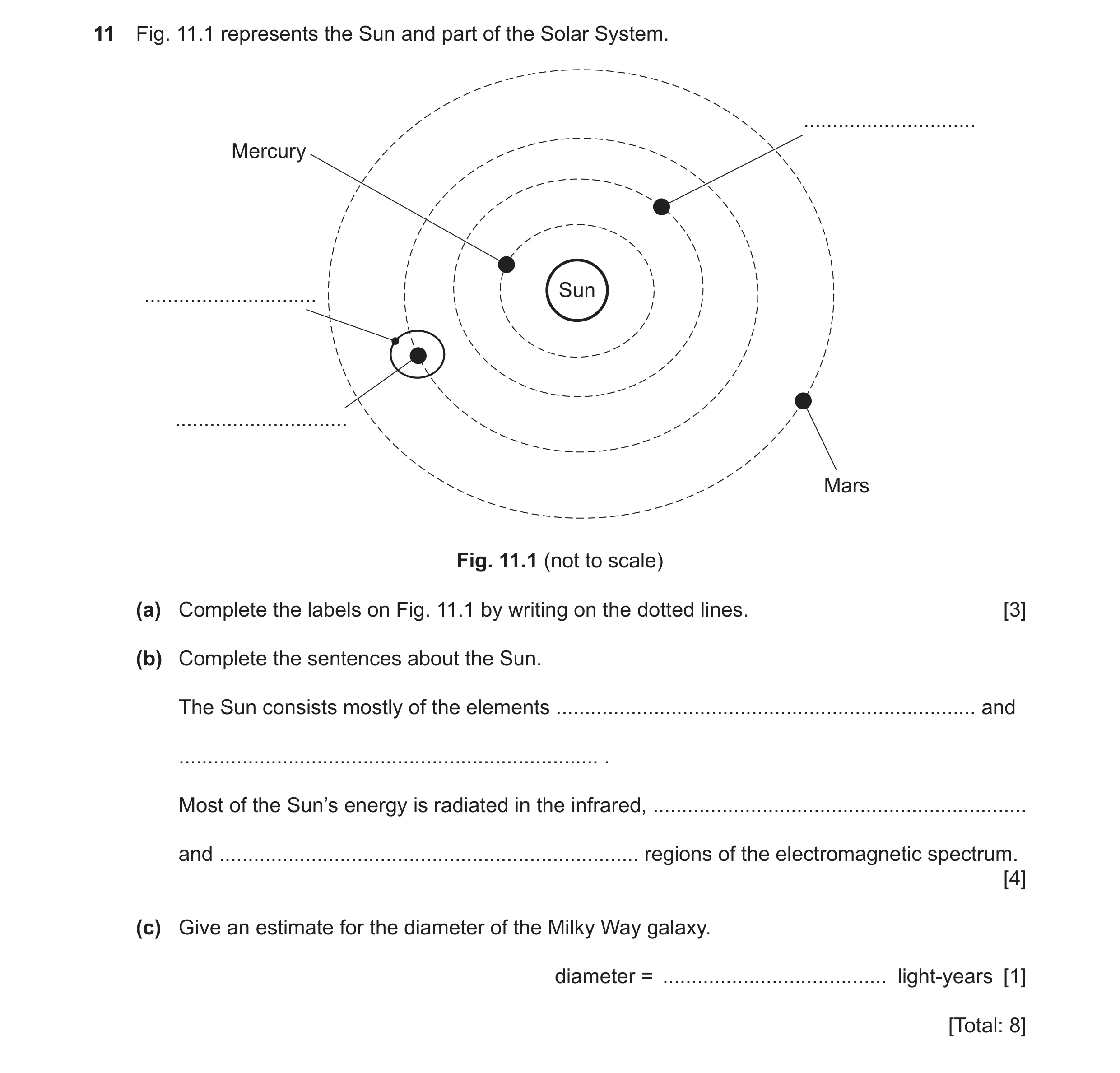
11 Fig. 11.1 represents the Sun and part of the Solar System. … Mercury … Sun … Mars Fig. 11.1 (not to scale) (a) Complete the labels on Fig. 11.1 by writing on the dotted lines. [3] (b) Complete the sentences about the Sun. The Sun consists mostly of the elements … and … . Most of the Sun’s energy is radiated in the infrared, … and … regions of the electromagnetic spectrum. [4] (c) Give an estimate for the diameter of the Milky Way galaxy. diameter = … light-years [1] [Total: 8]
8 marks
Mark scheme: 11(a) B1 …Venus……. B1 B1 Mercury ……Moon………. Sun ………Earth……… Mars 11(b) Hydrogen and B1 Helium (answers maybe in either order) B1 visible (light) and B1 Ultraviolet (answers maybe in either order) B1 11(c) 100 000 (light-years) B1
This question in 0625/31 Oct/Nov 2023
Q6 · There are eight planets in our Solar System 0625/32 Oct/Nov 2023
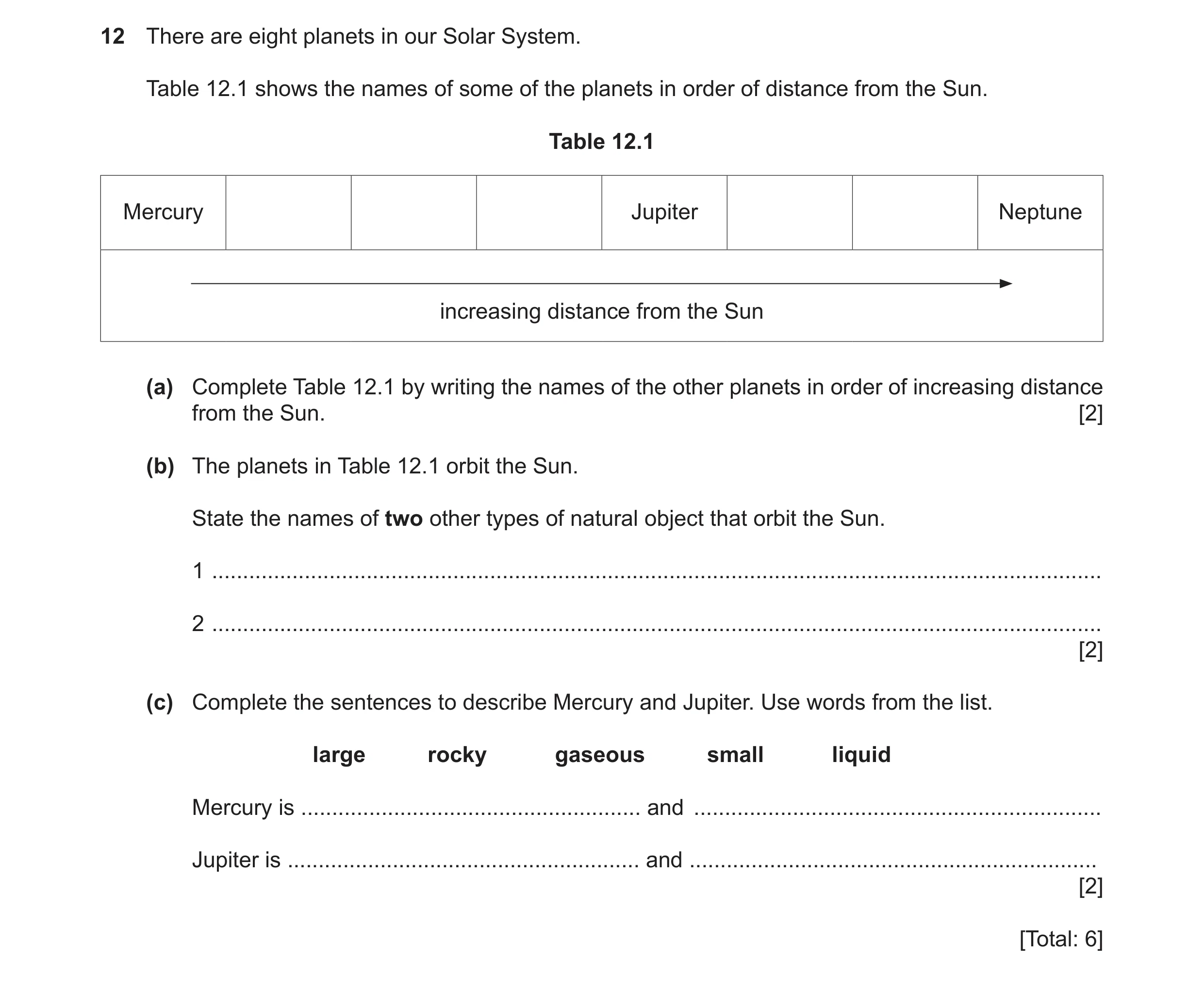
12 There are eight planets in our Solar System. Table 12.1 shows the names of some of the planets in order of distance from the Sun. Table 12.1 Mercury Jupiter Neptune increasing distance from the Sun (a) Complete Table 12.1 by writing the names of the other planets in order of increasing distance from the Sun. [2] (b) The planets in Table 12.1 orbit the Sun. State the names of two other types of natural object that orbit the Sun. 1 … 2 … [2] (c) Complete the sentences to describe Mercury and Jupiter. Use words from the list. large rocky gaseous small liquid Mercury is … and … Jupiter is … and … [2] [Total: 6]
6 marks
Mark scheme: 12(a) at least 4 named M1 all 5 in correct order A1 12(b) any two from: B2 minor / dwarf planets / Pluto asteroids comets moons / natural satellites 12(c) Mercury is rocky AND small. (answers maybe in either order) B1 Jupiter is gaseous AND large. (answers maybe in either order) B1
This question in 0625/32 Oct/Nov 2023
Q7 · The Earth in orbit around the Sun 0625/33 Oct/Nov 2023
11 Fig. 11.1 represents the Earth in orbit around the Sun. the Earth the Sun 1.5 × 10¹¹ m Fig. 11.1 (not to scale) (a) (i) State the name of the force that keeps the Earth in orbit around the Sun. … [1] (ii) State the time taken by the Earth to complete one orbit of the Sun. Include the unit. time for one orbit = … [1] (iii) State the time taken by the Earth to rotate once on its axis. Include the unit. time for one rotation = … [1] (iv) The Sun consists mainly of two gases. State the names of the two gases. … and … [2] Question continued on next side (b) (i) Most of the radiation from the Sun consists of visible light and two other regions of the electromagnetic spectrum. State the name of one of the other two regions. … [1] (ii) The speed of visible light is 3.0 × 10⁸ m / s. Calculate the time taken for visible light to travel from the Sun to the Earth when the Earth is in the position shown in Fig. 11.1. time taken = … s [3] [Total: 9]
9 marks
Mark scheme: 11(a)(i) gravitational (attraction) B1 11(a)(ii) 365 (¼) days B1 11(a)(iii) 24 hours B1 11(a)(iv) helium B1 hydrogen B1 11(b)(i) infrared OR ultraviolet B1 11(b)(ii) 500 (s) A3 1.5 1011 / 3.0 108 (C2) (time =) distance / speed (C1)
This question in 0625/33 Oct/Nov 2023
Q8 · The four planets nearest to the Sun 0625/32 Feb/March 2024
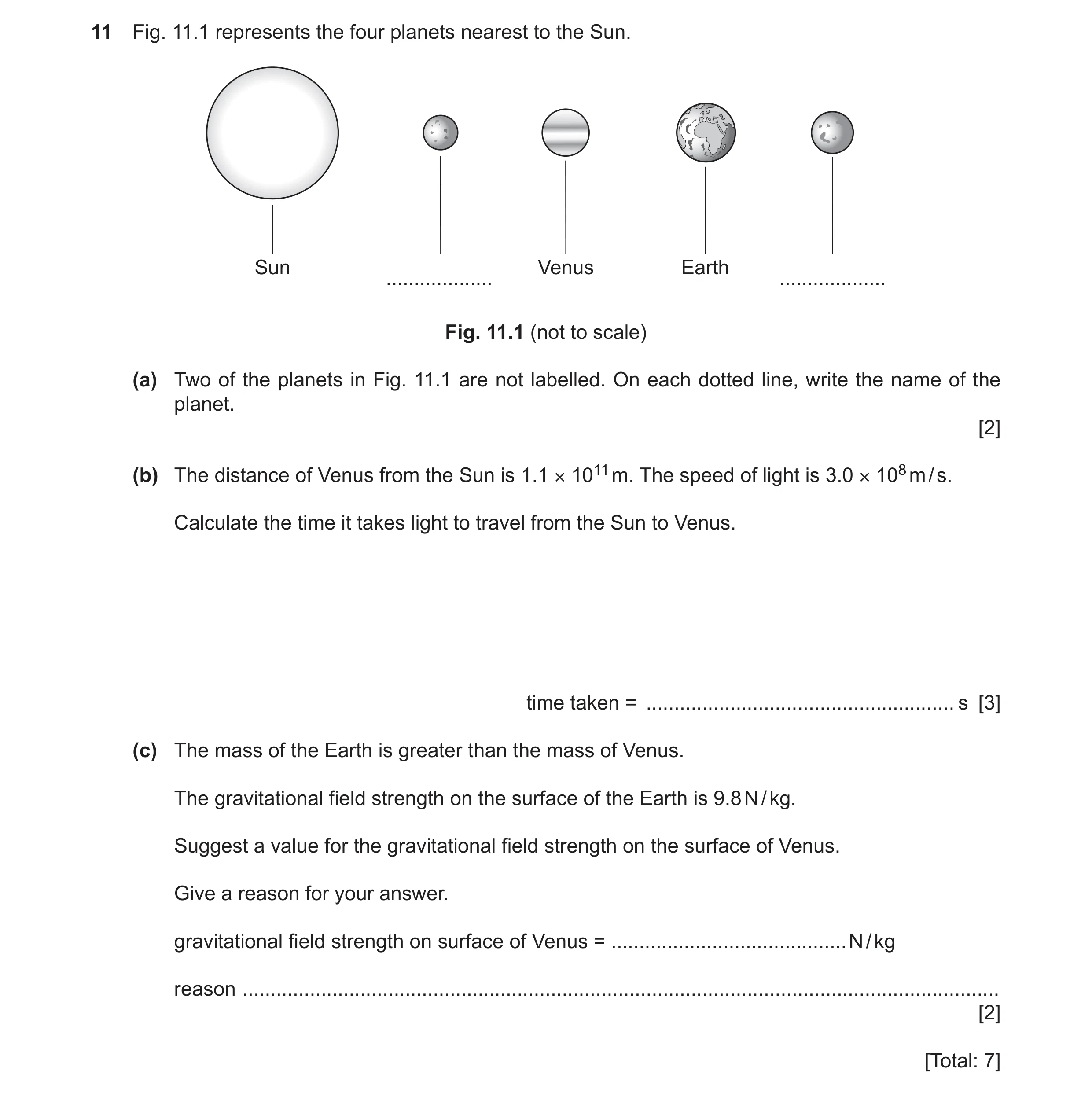
11 Fig. 11.1 represents the four planets nearest to the Sun. Sun Venus Earth … … Fig. 11.1 (not to scale) (a) Two of the planets in Fig. 11.1 are not labelled. On each dotted line, write the name of the planet. [2] (b) The distance of Venus from the Sun is 1.1 × 10¹¹ m. The speed of light is 3.0 × 10⁸ m / s. Calculate the time it takes light to travel from the Sun to Venus. time taken = … s [3] (c) The mass of the Earth is greater than the mass of Venus. The gravitational field strength on the surface of the Earth is 9.8 N / kg. Suggest a value for the gravitational field strength on the surface of Venus. Give a reason for your answer. gravitational field strength on surface of Venus = … N / kg reason … [2] [Total: 7]
7 marks
Mark scheme: 11(a) Mercury B1 Mars B1 11(b) 370 (s) A3 1.1 1011 ÷ 3.0 108 (C2) speed = distance ÷ time OR (t = ) d ÷ s (C1) 11(c) value smaller than 9.8 (N / kg) B1 Venus has smaller mass ORA OR B1 gravitational field strength depends on / proportional to mass
This question in 0625/32 Feb/March 2024
Q9 · The Sun is the star in our Solar System 0625/31 May/June 2024
11 (a) The Sun is the star in our Solar System. Eight planets orbit the Sun. State the names of two other categories of bodies in the Solar System. 1 … 2 … [2] (b) State the name of the galaxy that includes our Solar System. … [1] (c) Describe how the light from distant galaxies gives evidence to support the Big Bang Theory. … … … … … [3] [Total: 6]
6 marks
Mark scheme: 11(a) any two from: minor / dwarf planet(s) asteroid(s) OR asteroid belt comet(s) (planetary) moon(s) B2 11(b) Milky Way (galaxy) B1 11(c) any three from: (light from distant galaxies or it) is redshifted compared to light on Earth (redshift is an) increase in (the observed) wavelength (of light) (because) galaxies are moving away / receding (from Earth) OR moving apart (Big Bang theory predicts / has) an expanding Universe B3
This question in 0625/31 May/June 2024
Q10 · The Solar System contains a number of objects 0625/33 May/June 2024
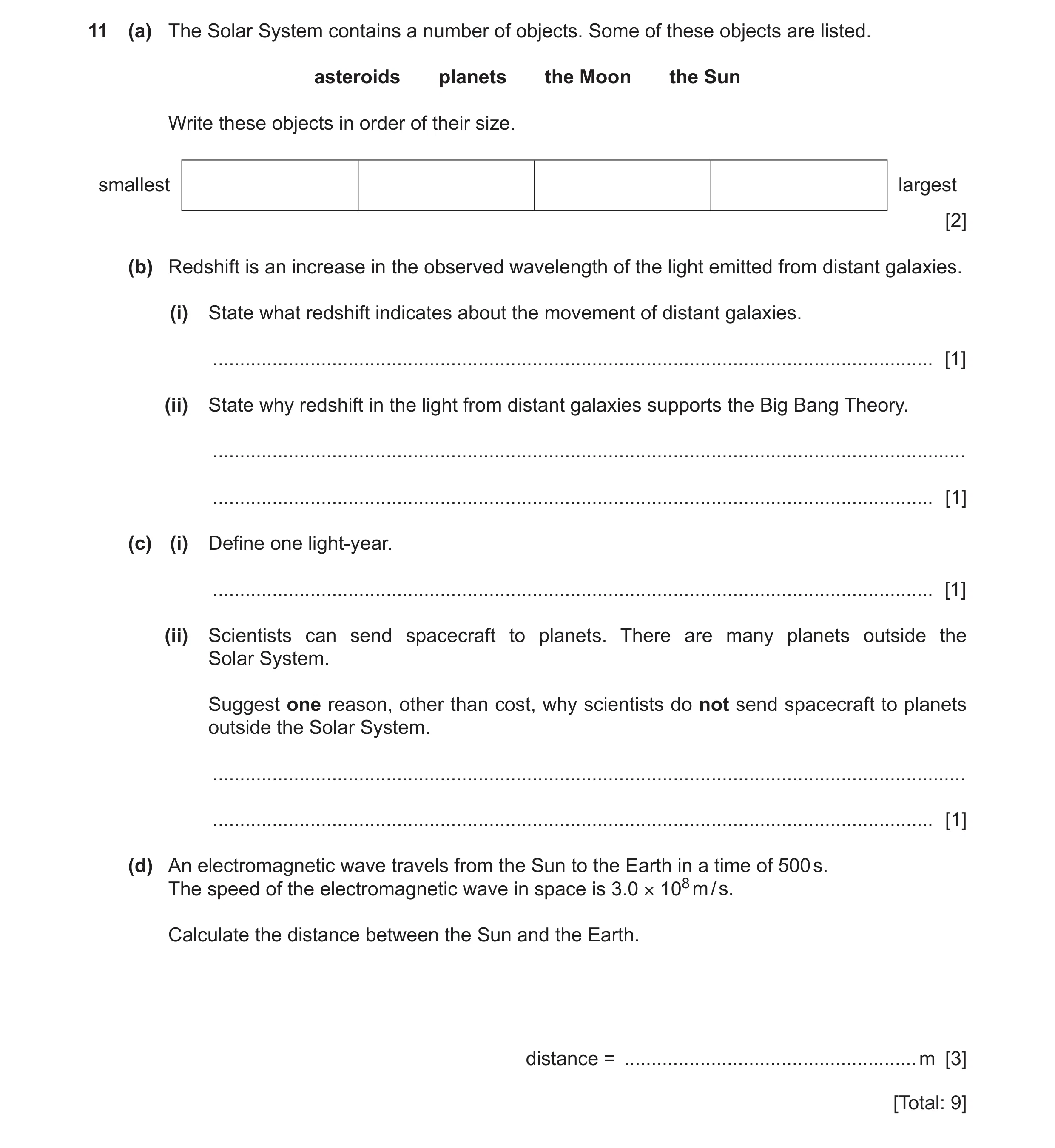
11 (a) The Solar System contains a number of objects. Some of these objects are listed. asteroids planets the Moon the Sun Write these objects in order of their size. smallest largest [2] (b) Redshift is an increase in the observed wavelength of the light emitted from distant galaxies. (i) State what redshift indicates about the movement of distant galaxies. … [1] (ii) State why redshift in the light from distant galaxies supports the Big Bang Theory. … … [1] (c) (i) Define one light‑year. … [1] (ii) Scientists can send spacecraft to planets. There are many planets outside the Solar System. Suggest one reason, other than cost, why scientists do not send spacecraft to planets outside the Solar System. … … [1] (d) An electromagnetic wave travels from the Sun to the Earth in a time of 500 s. The speed of the electromagnetic wave in space is 3.0 × 10⁸ m / s. Calculate the distance between the Sun and the Earth. distance = … m [3] [Total: 9]
9 marks
Mark scheme: 11(a) asteroids the Moon planets the Sun all 4 correct – 2 marks 2 adjacent OR first AND last boxes correct – 1 mark B2 11(b)(i) receding / moving away B1 11(b)(ii) (Universe) expanding B1 11(c)(i) distance travelled by light (in space) in one year B1 11(c)(ii) distances vast OR (planets) too far away / owtte B1 11(d) 1.5 1011 (m) A3 3.0 108 500 (C2) speed = distance time OR (distance =) speed time (C1)
This question in 0625/33 May/June 2024
Q11 · The planets in the Solar System 0625/31 Oct/Nov 2024
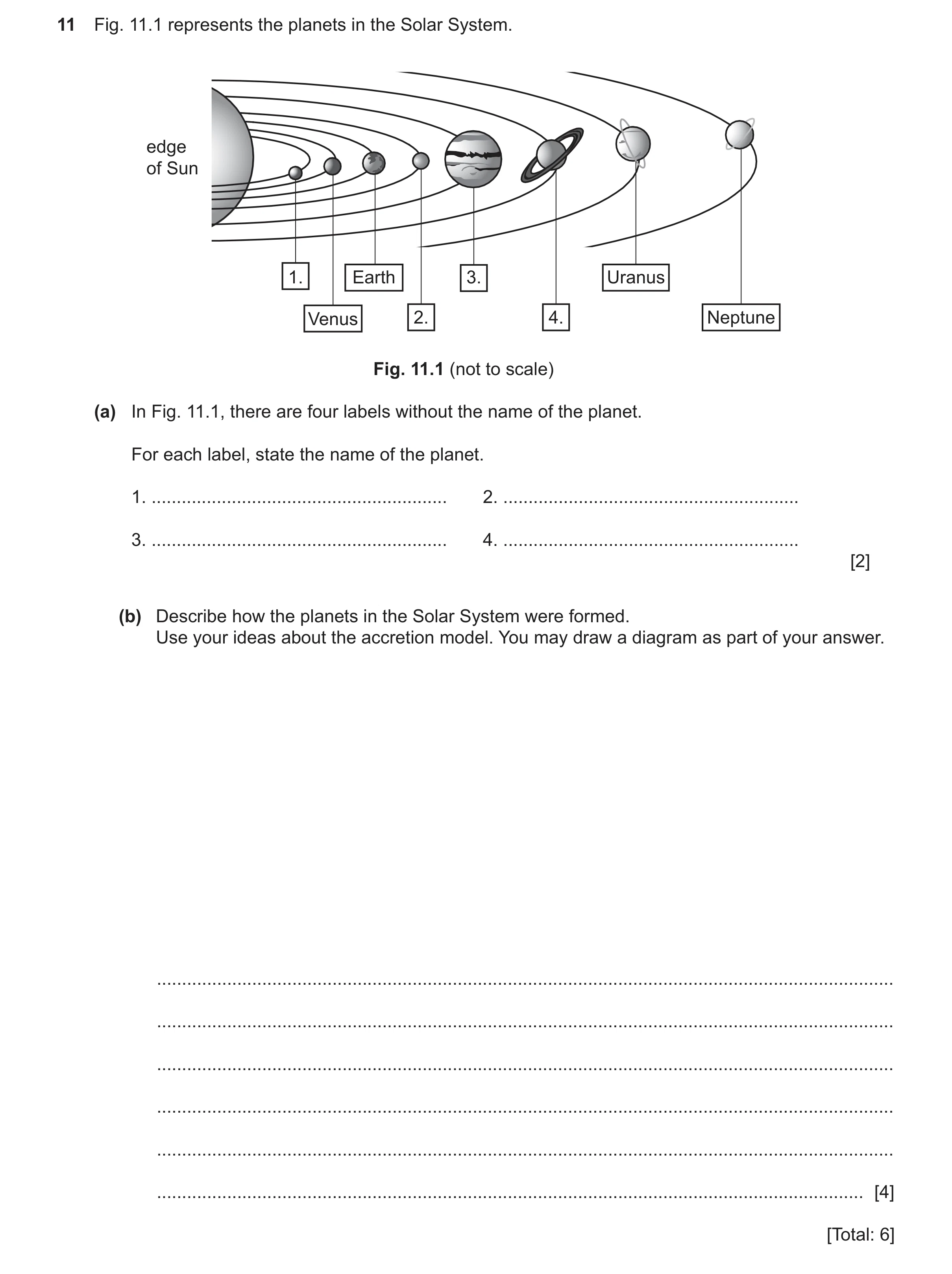
11 Fig. 11.1 represents the planets in the Solar System. edge of Sun 1. Earth 3. Uranus Venus 2. 4. Neptune Fig. 11.1 (not to scale) (a) In Fig. 11.1, there are four labels without the name of the planet. For each label, state the name of the planet. 1. … 2. … 3. … 4. … [2] (b) Describe how the planets in the Solar System were formed. Use your ideas about the accretion model. You may draw a diagram as part of your answer. … … … … … … [4] [Total: 6]
6 marks
Mark scheme: 11(a) 1 Mercury 2 Mars 3 Jupiter 4 Saturn B2 11(b) any four from: B4 • (particles of) dust OR gas • (gas / dust / rocks) orbiting Sun / protostar / star • (idea of forming) a disc of material • material (in the disc) colliding • (and) smaller objects join to make larger objects owtte • (accretion / combining due to) force of gravity • (small) rocky planets formed near the Sun • (large) gaseous planets formed furthest from Sun
This question in 0625/31 Oct/Nov 2024
Q12 · Part of the Solar System 0625/32 Oct/Nov 2024
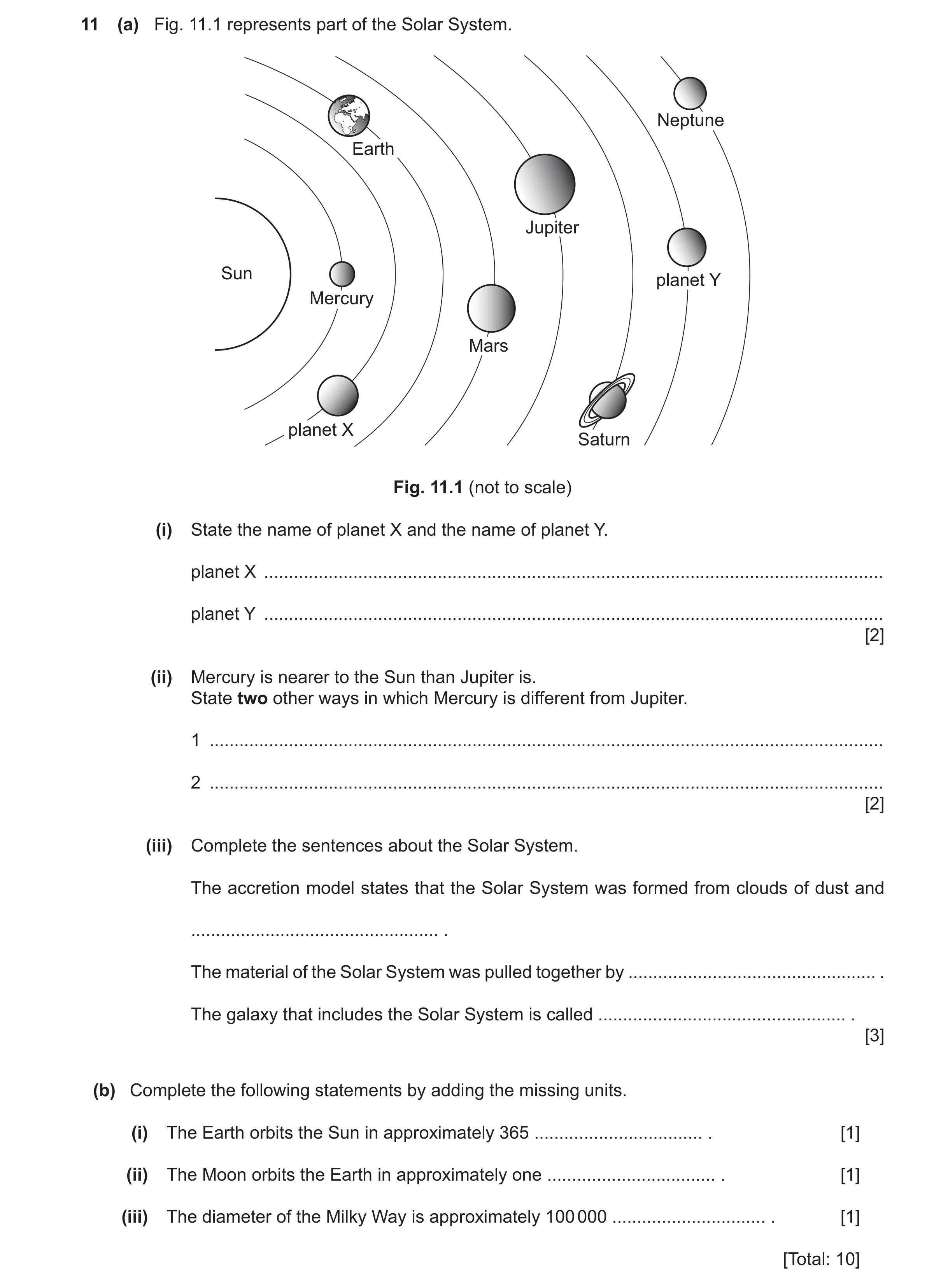
11 (a) Fig. 11.1 represents part of the Solar System. Neptune Earth Jupiter Sun planet Y Mercury Mars planet X Saturn Fig. 11.1 (not to scale) (i) State the name of planet X and the name of planet Y. planet X … planet Y … [2] (ii) Mercury is nearer to the Sun than Jupiter is. State two other ways in which Mercury is different from Jupiter. 1 … 2 … [2] (iii) Complete the sentences about the Solar System. The accretion model states that the Solar System was formed from clouds of dust and … . The material of the Solar System was pulled together by … . The galaxy that includes the Solar System is called … . [3] (b) Complete the following statements by adding the missing units. (i) The Earth orbits the Sun in approximately 365 … . [1] (ii) The Moon orbits the Earth in approximately one … . [1] (iii) The diameter of the Milky Way is approximately 100 000 … . [1] [Total: 10]
10 marks
Mark scheme: 11(a)(i) planet X: Venus B1 planet Y: Uranus B1 11(a)(ii) 1. Mercury rocky or Jupiter gaseous B1 2. Mercury small or Jupiter large B1 11(a)(iii) gases B1 (force of) gravity B1 the Milky Way B1 11(b)(i) days B1 11(b)(ii) month B1 11(b)(iii) light-years B1
This question in 0625/32 Oct/Nov 2024
Q13 · Table 7.1 lists three uses of electromagnetic (e.m.) waves 0625/33 Oct/Nov 2024
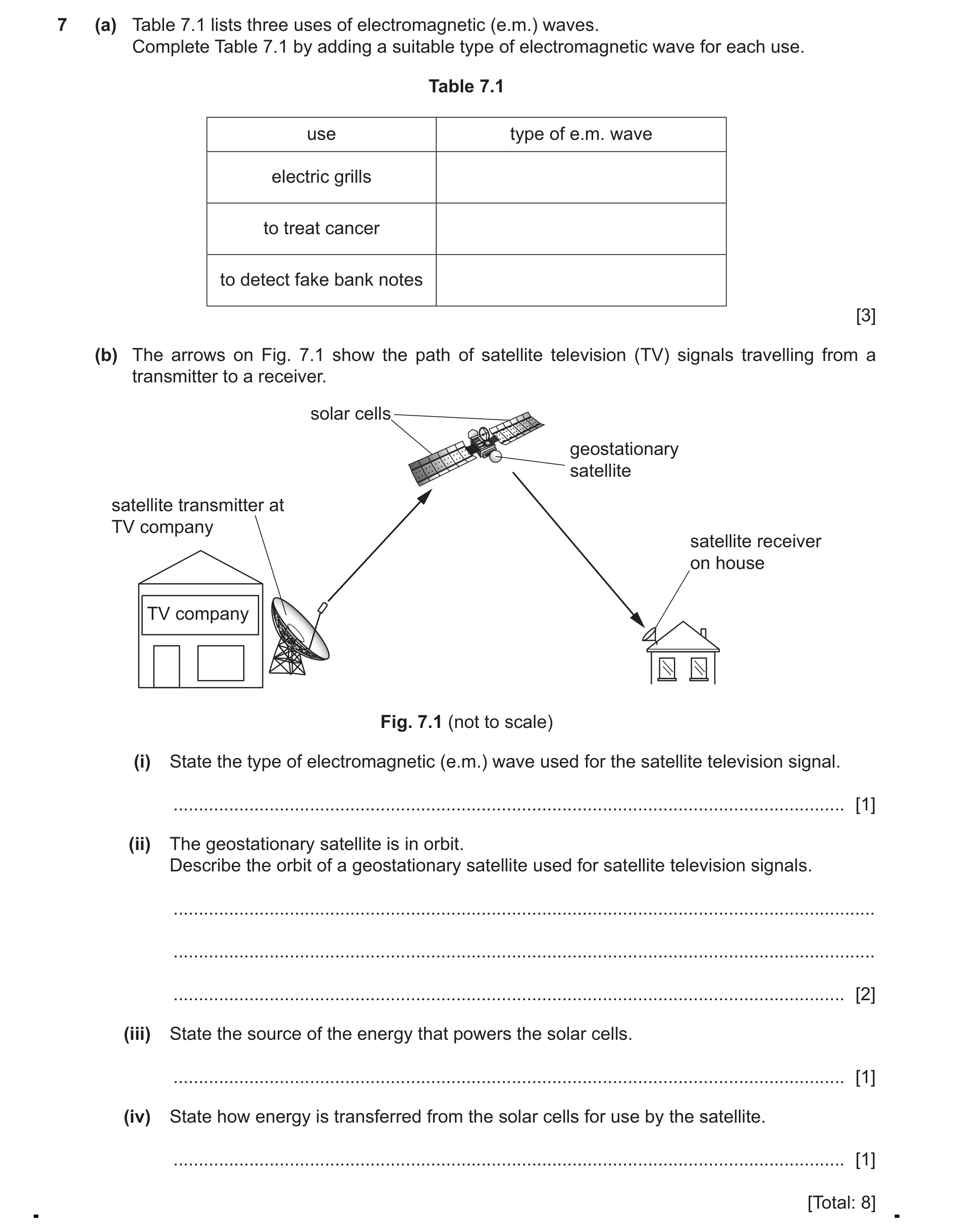
7 (a) Table 7.1 lists three uses of electromagnetic (e.m.) waves. Complete Table 7.1 by adding a suitable type of electromagnetic wave for each use. Table 7.1 use type of e.m. wave electric grills to treat cancer to detect fake bank notes [3] (b) The arrows on Fig. 7.1 show the path of satellite television (TV) signals travelling from a transmitter to a receiver. solar cells geostationary satellite satellite transmitter at TV company satellite receiver on house TV company Fig. 7.1 (not to scale) (i) State the type of electromagnetic (e.m.) wave used for the satellite television signal. … [1] (ii) The geostationary satellite is in orbit. Describe the orbit of a geostationary satellite used for satellite television signals. … … … [2] (iii) State the source of the energy that powers the solar cells. … [1] (iv) State how energy is transferred from the solar cells for use by the satellite. … [1] [Total: 8]
8 marks
Mark scheme: 7(a) use type of e.m. wave B1 used in electric grills infrared B1 used to kill cancerous cells also cause cancer gamma / (rays) OR X–rays used to detect fake bank notes ultraviolet B1 7(b)(i) microwaves B1 7(b)(ii) orbits the earth B1 appears to remain in the same place above the earth B1 7(b)(iii) light or Sun B1 7(b)(iv) electrical current B1
This question in 0625/33 Oct/Nov 2024
Q14 · The Earth’s orbit of the Sun 0625/32 Feb/March 2025
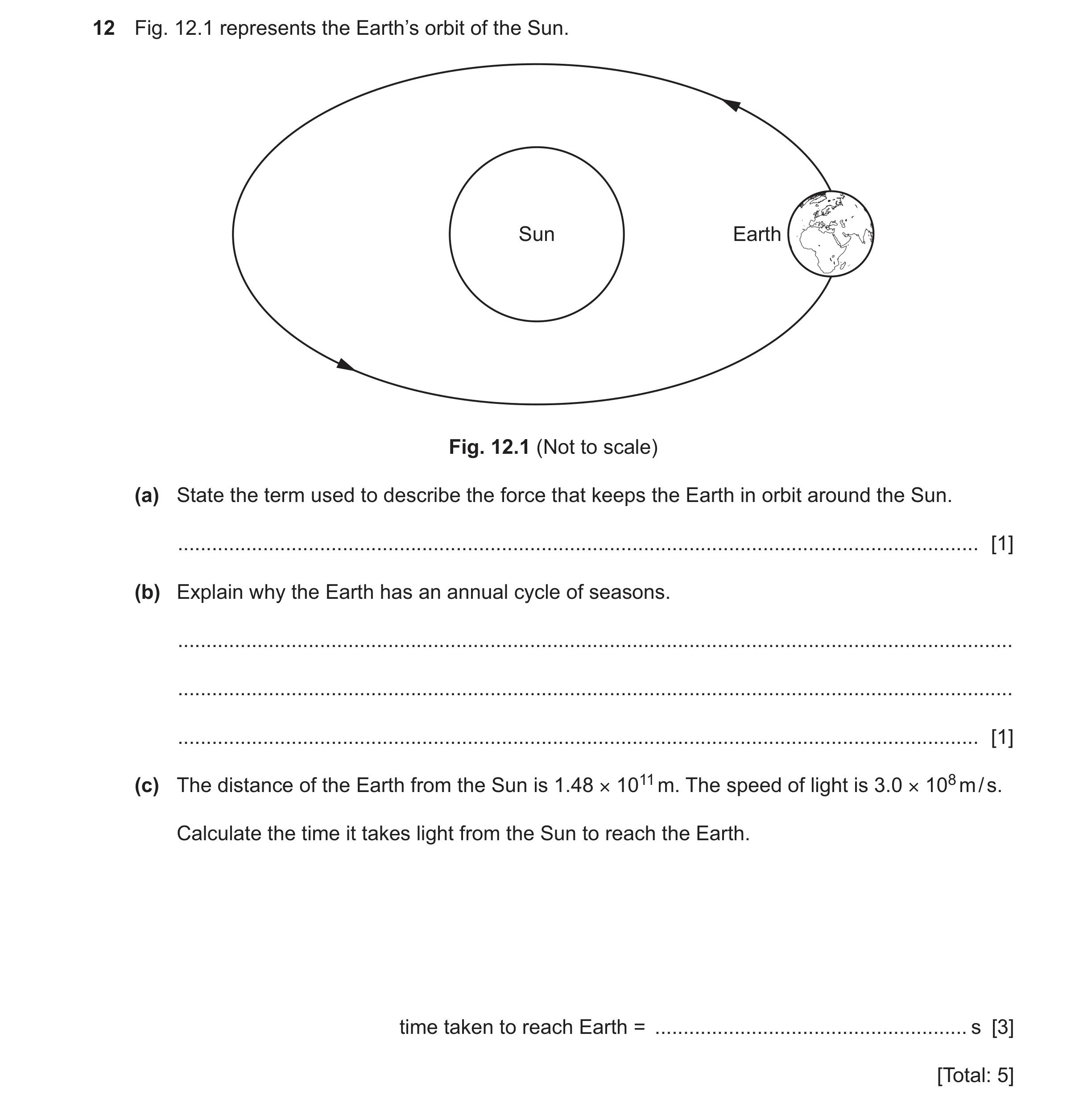
12 Fig. 12.1 represents the Earth’s orbit of the Sun. Sun Earth Fig. 12.1 (Not to scale) (a) State the term used to describe the force that keeps the Earth in orbit around the Sun. … [1] (b) Explain why the Earth has an annual cycle of seasons. … … … [1] (c) The distance of the Earth from the Sun is 1.48 × 10¹¹ m. The speed of light is 3.0 × 10⁸ m / s. Calculate the time it takes light from the Sun to reach the Earth. time taken to reach Earth = … s [3] [Total: 5]
5 marks
Mark scheme: 12(a) gravitational (attraction) B1 12(b) Earth’s axis is tilted (relative to its orbital plane) B1 OR idea that in part of orbit, N or S pole points towards/away from Sun 12(c) 490 (s) A3 1.48 1011 ÷ 3(.0) 108 (C2) speed = distance ÷ time OR (t =) d ÷ s (C1)
This question in 0625/32 Feb/March 2025
Q15 · The Solar System includes the Sun and eight planets 0625/31 May/June 2025
11 (a) The Solar System includes the Sun and eight planets. (i) State the name of the force that keeps the planets in orbit around the Sun. … [1] (ii) State the name of the galaxy that includes the Solar System. … [1] (b) State the meaning of the term light-year. … … [1] (c) Describe the evidence for an expanding Universe. … … … … … [3] [Total: 6]
6 marks
Mark scheme: 11(a)(i) gravitational (force / attraction) B1 11(a)(ii) Milky Way B1 11(b) distance travelled (in the vacuum of space) by light in one year B1 11(c) any three from: B3 • redshift of light / redshift of (em) radiation (from distant / receding galaxies compared to light emitted on Earth) • an increase in the (observed) wavelength of light / em radiation (emitted from distant / receding galaxies) • the most / more distant galaxies have greater redshift than closer galaxies • more distant galaxies are moving away faster than closer galaxies
This question in 0625/31 May/June 2025
Question 16 0625/32 May/June 2025
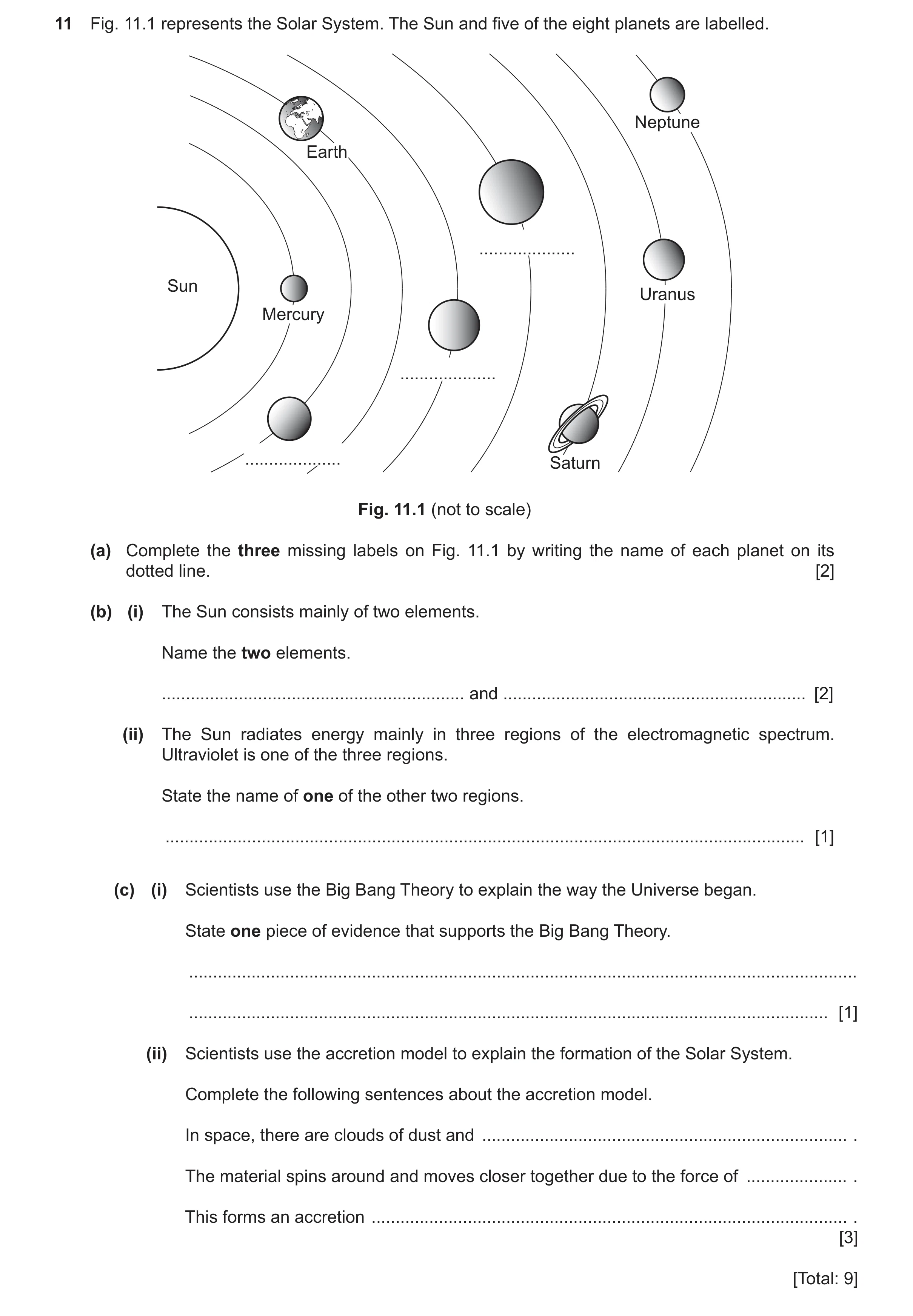
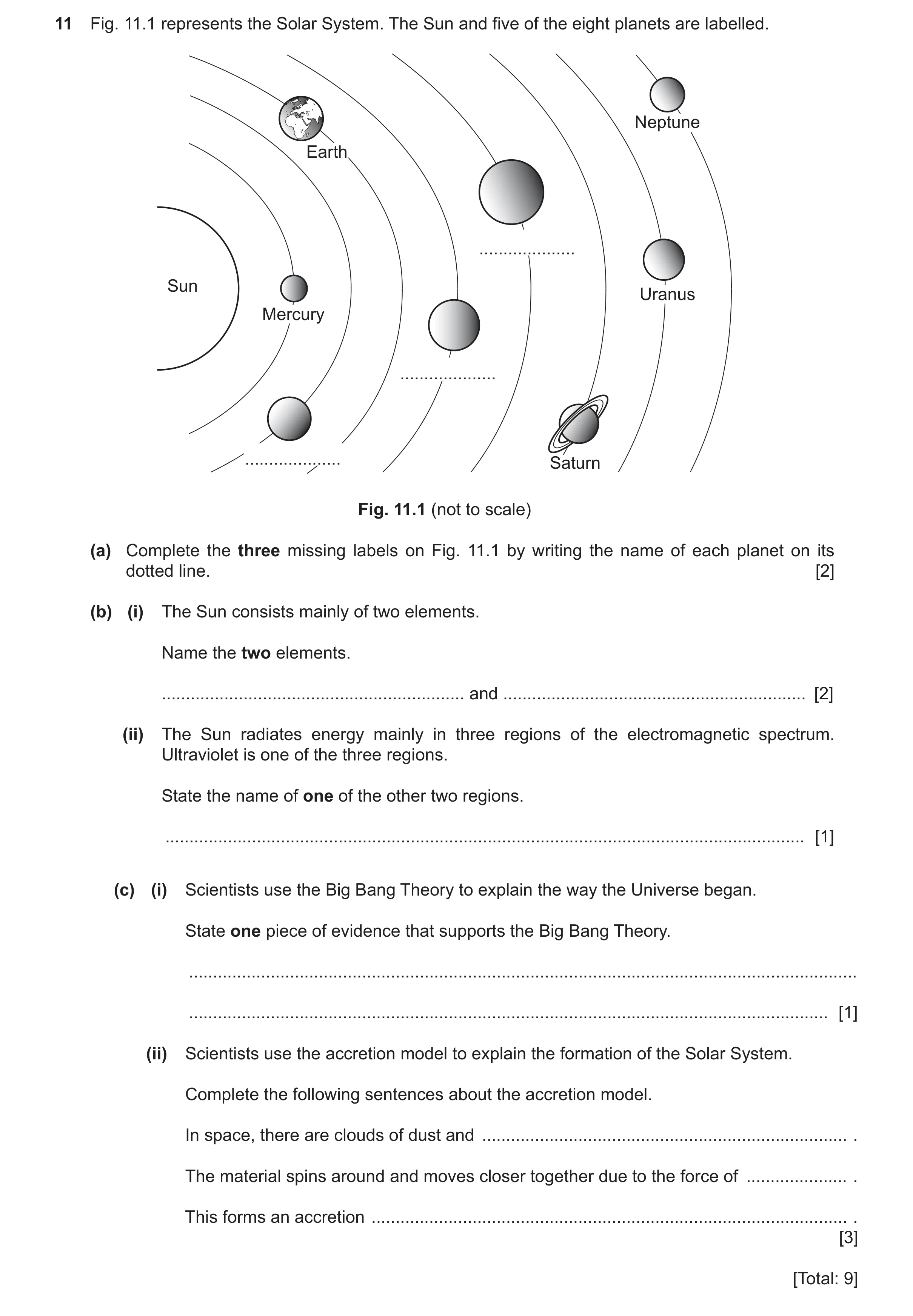
11 Fig. 11.1 represents the Solar System. The Sun and five of the eight planets are labelled. Neptune Earth … Sun Uranus Mercury … … Saturn Fig. 11.1 (not to scale) (a) Complete the three missing labels on Fig. 11.1 by writing the name of each planet on its dotted line. [2] (b) (i) The Sun consists mainly of two elements. Name the two elements. … and … [2] (ii) The Sun radiates energy mainly in three regions of the electromagnetic spectrum. Ultraviolet is one of the three regions. State the name of one of the other two regions. … [1] (c) (i) Scientists use the Big Bang Theory to explain the way the Universe began. State one piece of evidence that supports the Big Bang Theory. … … [1] (ii) Scientists use the accretion model to explain the formation of the Solar System. Complete the following sentences about the accretion model. In space, there are clouds of dust and … . The material spins around and moves closer together due to the force of … . This forms an accretion … . [3] [Total: 9]
9 marks
Mark scheme: 11(a) Venus B2 Mars Jupiter all 3 in correct position – 2 marks 1 or 2 in correct position OR all 3 named – 1 mark 11(b)(i) hydrogen B1 helium B1 11(b)(ii) visible light OR infrared B1 11(c)(i) redshift B1 11(c)(ii) gas(es) B1 gravity B1 disc B1
This question in 0625/32 May/June 2025
Question 17 0625/33 May/June 2025
11 Fig. 11.1 represents the Solar System. The Sun and five of the eight planets are labelled. Neptune Earth … Sun Uranus Mercury … … Saturn Fig. 11.1 (not to scale) (a) Complete the three missing labels on Fig. 11.1 by writing the name of each planet on its dotted line. [2] (b) (i) The Sun consists mainly of two elements. Name the two elements. … and … [2] (ii) The Sun radiates energy mainly in three regions of the electromagnetic spectrum. Ultraviolet is one of the three regions. State the name of one of the other two regions. … [1] (c) (i) Scientists use the Big Bang Theory to explain the way the Universe began. State one piece of evidence that supports the Big Bang Theory. … … [1] (ii) Scientists use the accretion model to explain the formation of the Solar System. Complete the following sentences about the accretion model. In space, there are clouds of dust and … . The material spins around and moves closer together due to the force of … . This forms an accretion … . [3] [Total: 9]
9 marks
Mark scheme: 11(a) Venus B2 Mars Jupiter all 3 in correct position – 2 marks 1 or 2 in correct position OR all 3 named – 1 mark 11(b)(i) hydrogen B1 helium B1 11(b)(ii) visible light OR infrared B1 11(c)(i) redshift B1 11(c)(ii) gas(es) B1 gravity B1 disc B1
This question in 0625/33 May/June 2025
Q18 · Mars is one of the four rocky planets nearest the Sun 0625/31 Oct/Nov 2025
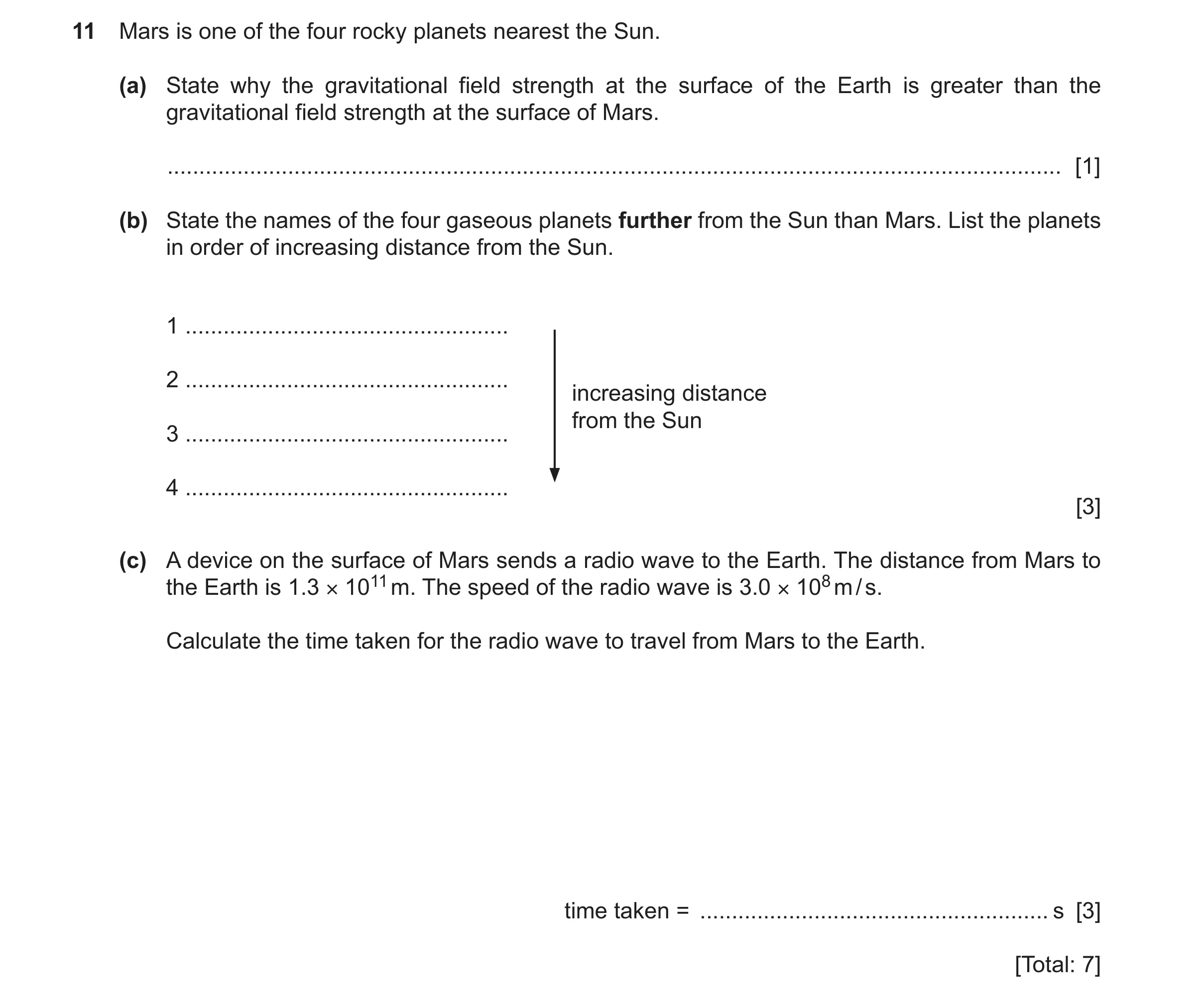
11 Mars is one of the four rocky planets nearest the Sun. (a) State why the gravitational field strength at the surface of the Earth is greater than the gravitational field strength at the surface of Mars. … [1] (b) State the names of the four gaseous planets further from the Sun than Mars. List the planets in order of increasing distance from the Sun. 1 … 2 … increasing distance from the Sun 3 … 4 … [3] (c) A device on the surface of Mars sends a radio wave to the Earth. The distance from Mars to the Earth is 1.3 × 10¹¹ m. The speed of the radio wave is 3.0 × 10⁸ m / s. Calculate the time taken for the radio wave to travel from Mars to the Earth. time taken = … s [3] [Total: 7]
7 marks
Mark scheme: 11(a) Earth has greater mass ORA B1 11(b) (1) Jupiter B3 (2) Saturn (3) Uranus (4) Neptune 11(c) 430 (s) A3 1.3 (1011) ÷ 3(.0) (108) (C2) speed = distance ÷ time OR (t = ) d ÷ s (C1)
This question in 0625/31 Oct/Nov 2025
Q19 · Complete these sentences about the formation of the Solar System 0625/32 Oct/Nov 2025
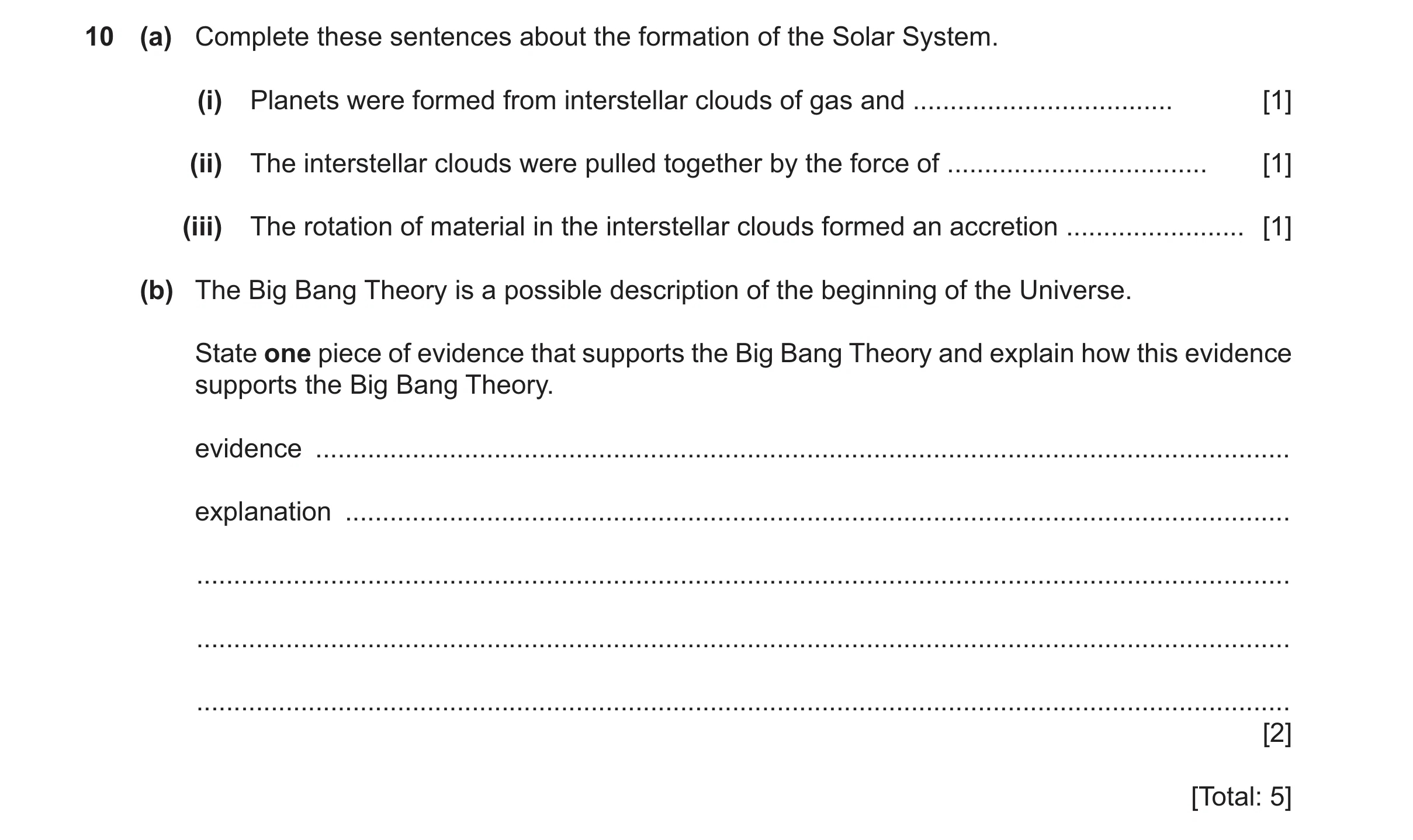
10 (a) Complete these sentences about the formation of the Solar System. (i) Planets were formed from interstellar clouds of gas and … [1] (ii) The interstellar clouds were pulled together by the force of … [1] (iii) The rotation of material in the interstellar clouds formed an accretion … [1] (b) The Big Bang Theory is a possible description of the beginning of the Universe. State one piece of evidence that supports the Big Bang Theory and explain how this evidence supports the Big Bang Theory. evidence … explanation … … … … [2] [Total: 5]
5 marks
Mark scheme: 10(a) dust B1 gravity B1 disc B1 10(b) evidence B1 red shift seen or increase in the (observed) wavelength (of electromagnetic radiation) or light appears to be shifted towards the red end of the spectrum explanation B1 • (the red shift shows) galaxies / stars / objects are moving away from each other • the Universe is expanding • all matter in the Universe once started from a single point. • more distant galaxies show a bigger red shift • more distant galaxies are moving away faster
This question in 0625/32 Oct/Nov 2025
Q20 · Each box in the left column shows a description of a unit of time 0625/33 Oct/Nov 2025
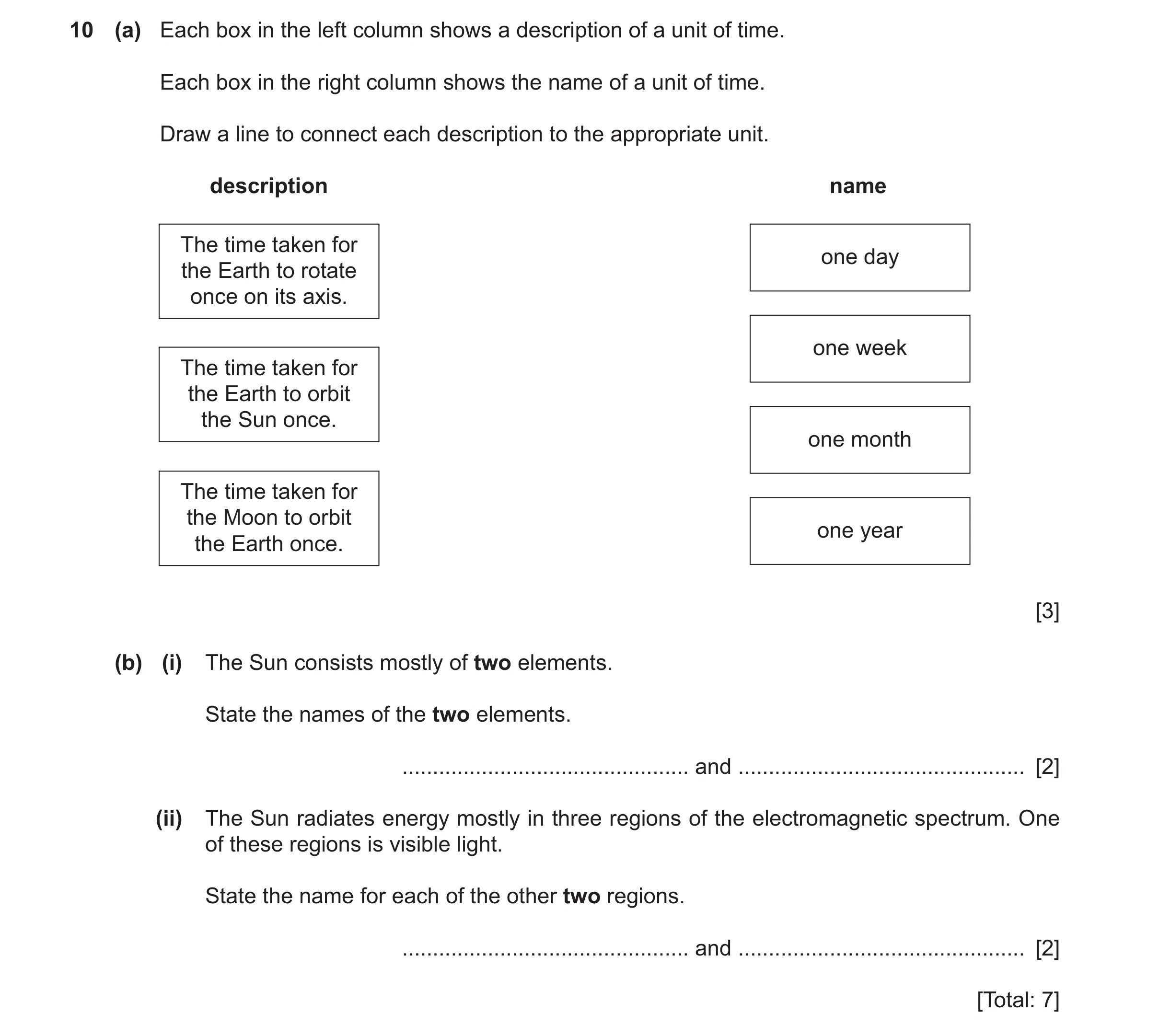
10 (a) Each box in the left column shows a description of a unit of time. Each box in the right column shows the name of a unit of time. Draw a line to connect each description to the appropriate unit. description name The time taken for one day the Earth to rotate once on its axis. one week The time taken for the Earth to orbit the Sun once. one month The time taken for the Moon to orbit one year the Earth once. [3] (b) (i) The Sun consists mostly of two elements. State the names of the two elements. … and … [2] (ii) The Sun radiates energy mostly in three regions of the electromagnetic spectrum. One of these regions is visible light. State the name for each of the other two regions. … and … [2] [Total: 7]
7 marks
Mark scheme: 10(a) B1 B1 B1 10(b)(i) hydrogen B1 helium B1 10(b)(ii) ultraviolet B1 infrared B1
This question in 0625/33 Oct/Nov 2025
 1 / 20
 2 / 20
 3 / 20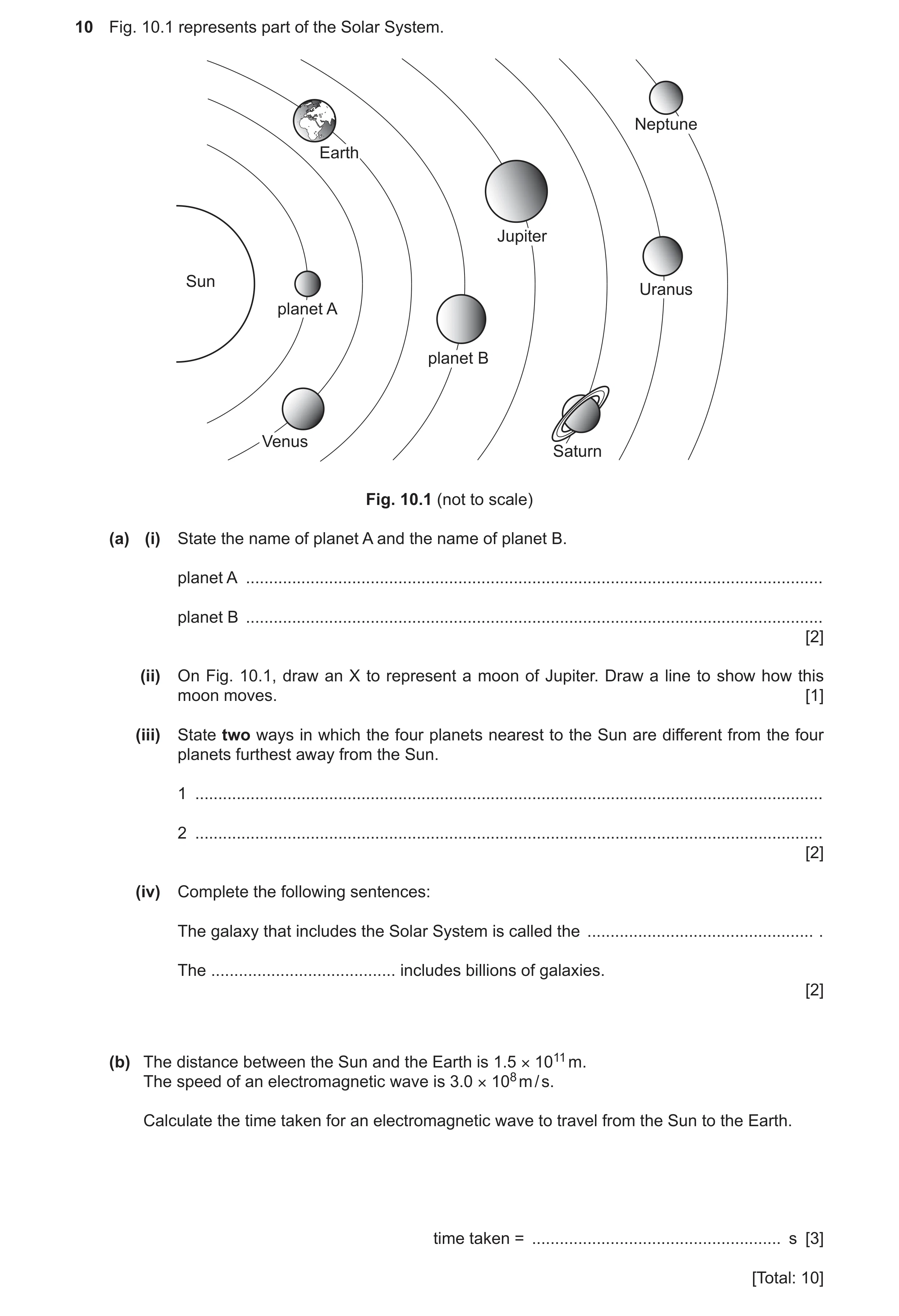
 5 / 20
 6 / 20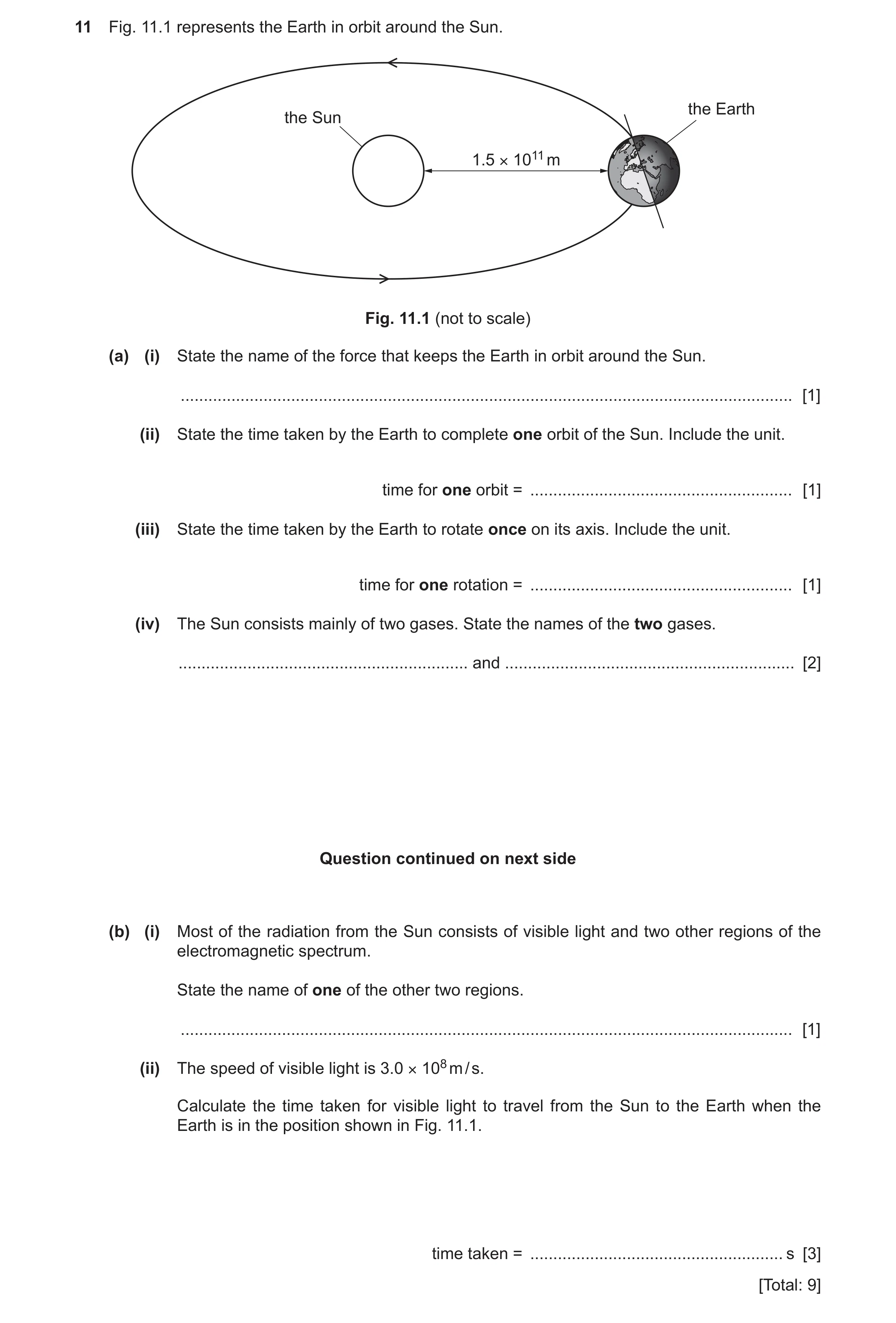
 8 / 20
 9 / 20
 10 / 20
 11 / 20
 12 / 20
 13 / 20
 14 / 20
 15 / 20
 16 / 20
 17 / 20
 18 / 20
 19 / 20
 20 / 20
 6
6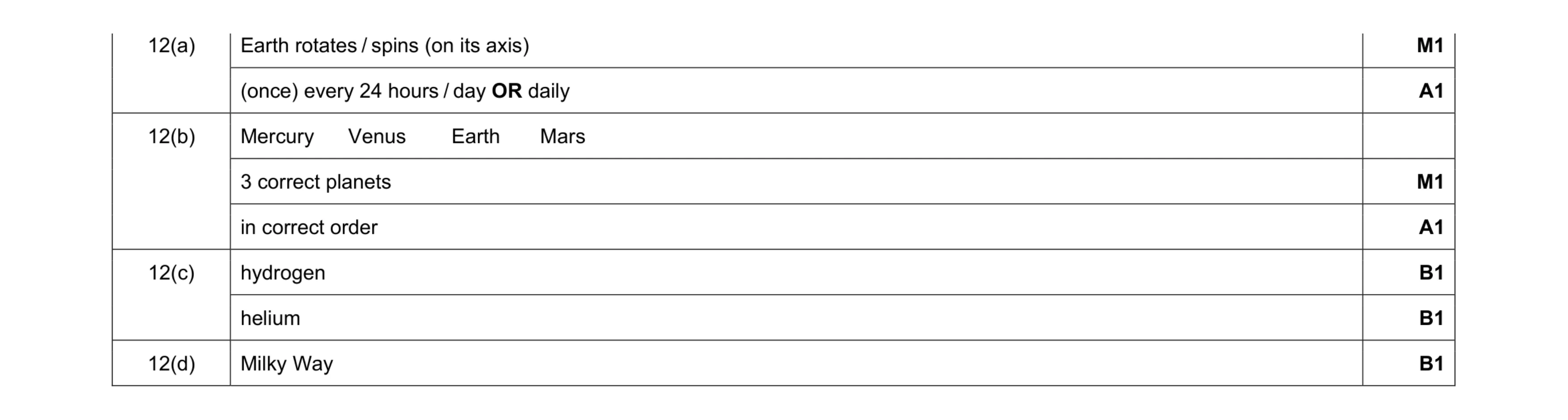 7
7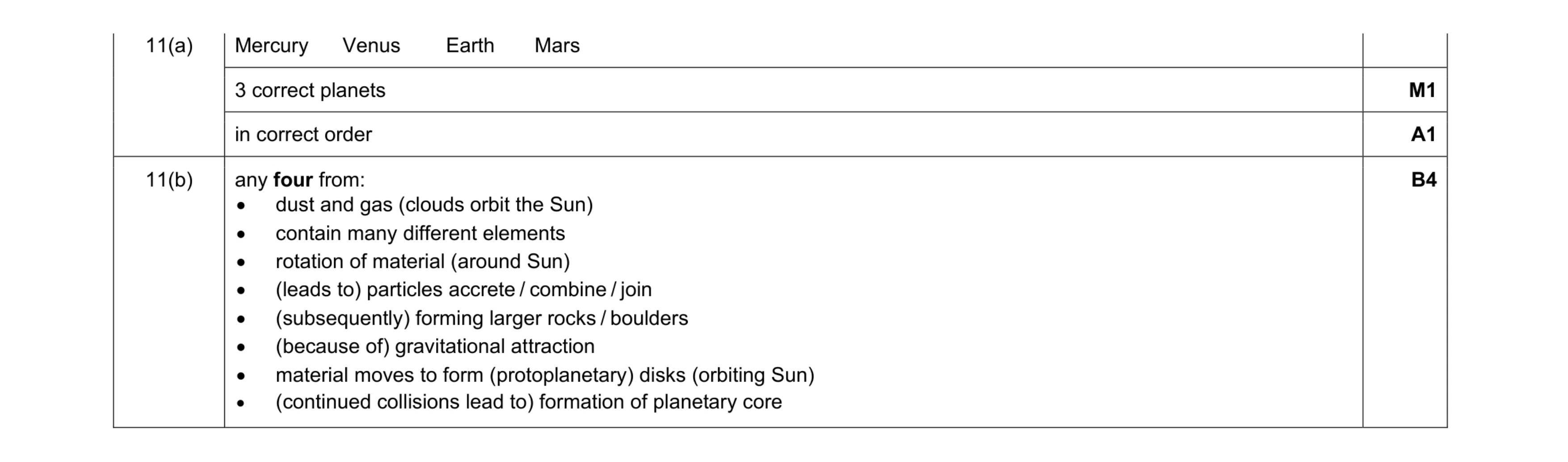 6
6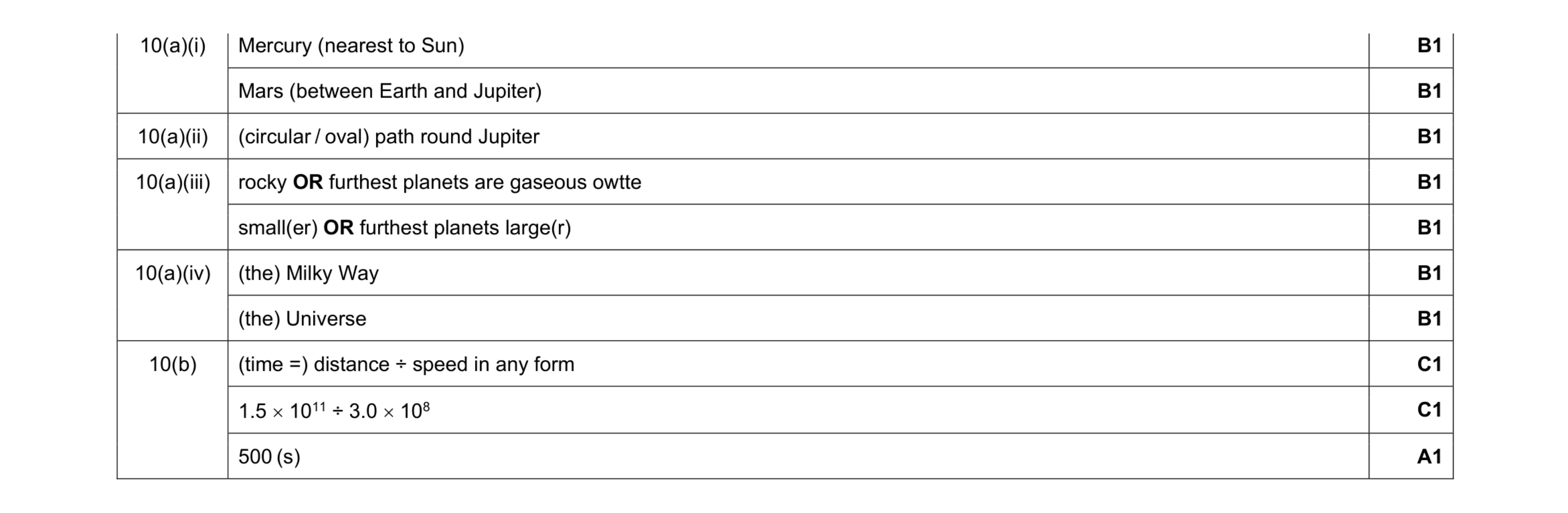 10
10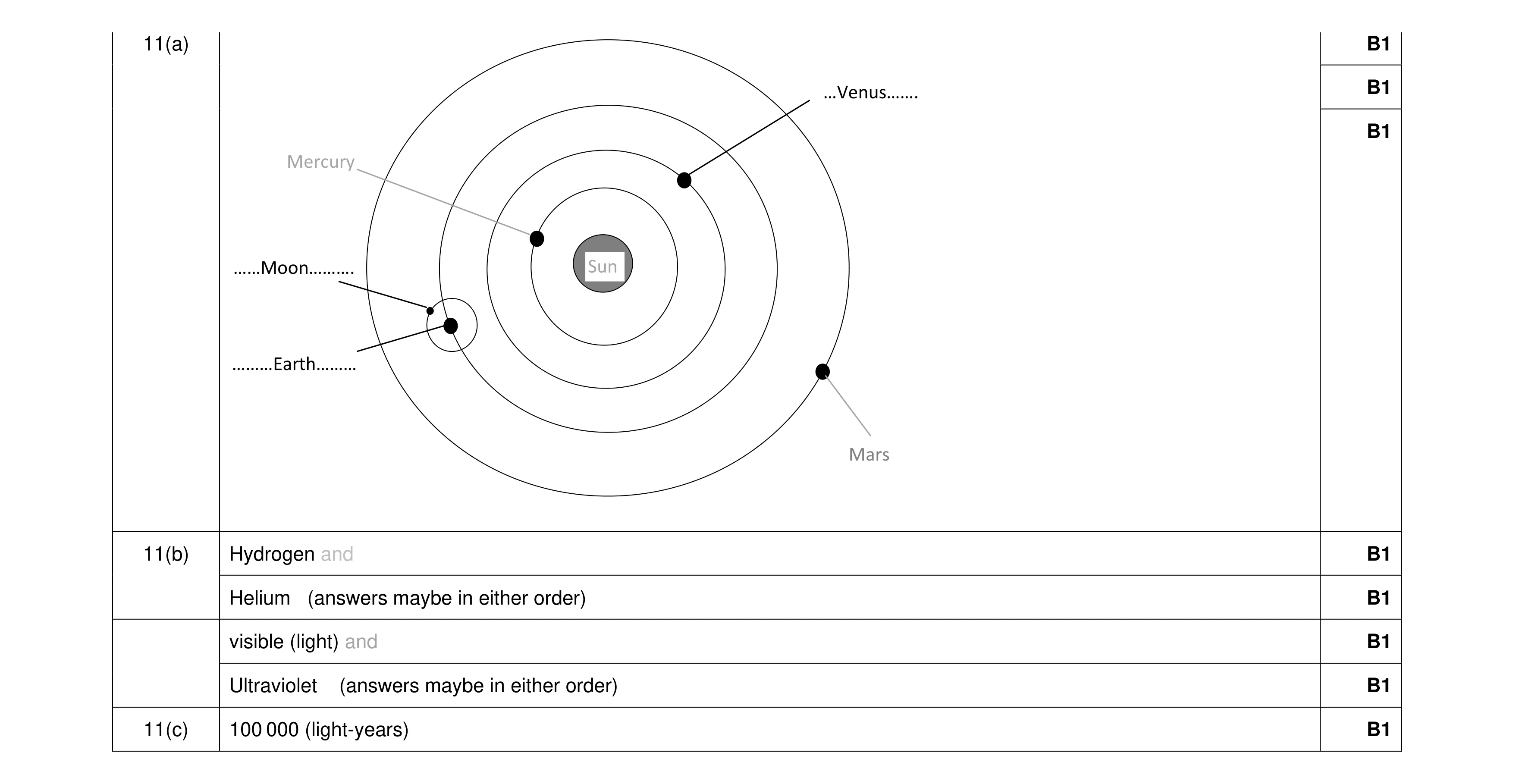 8
8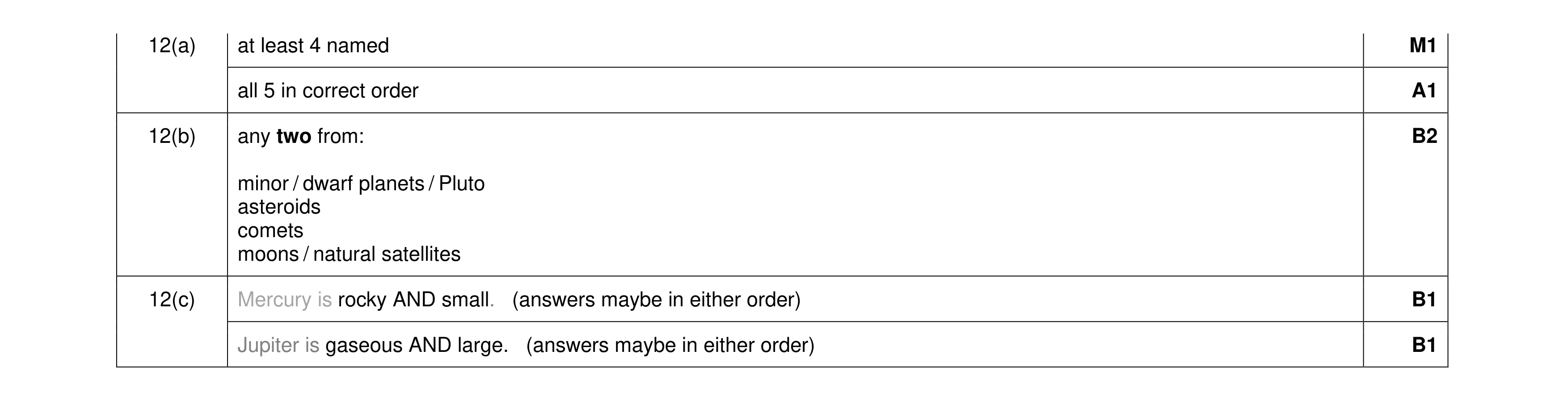 6
6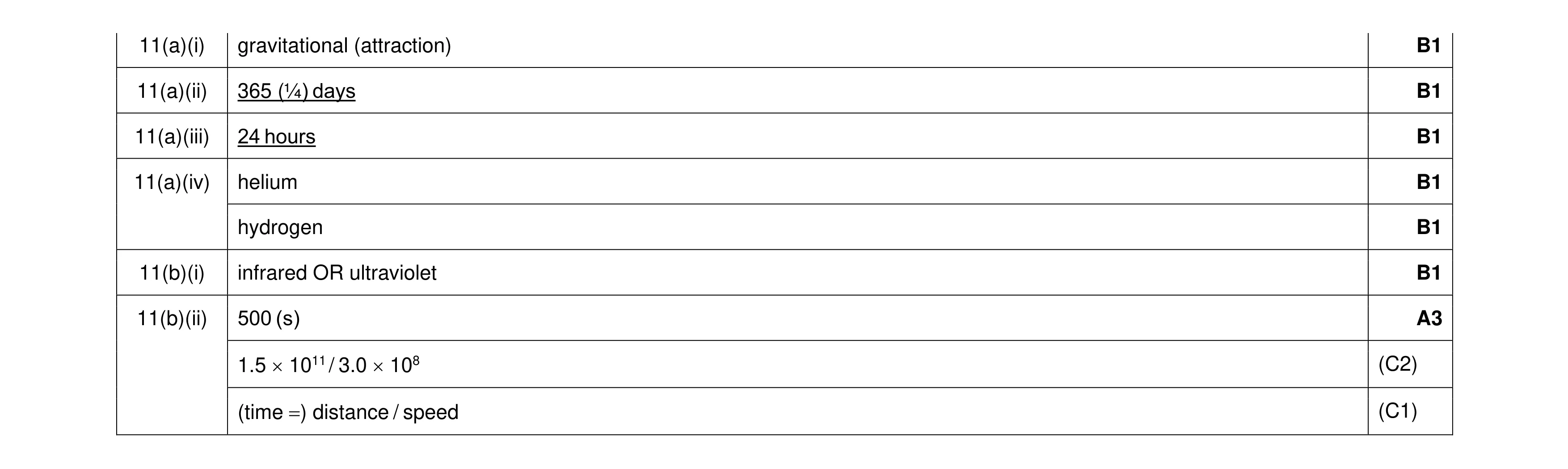 9
9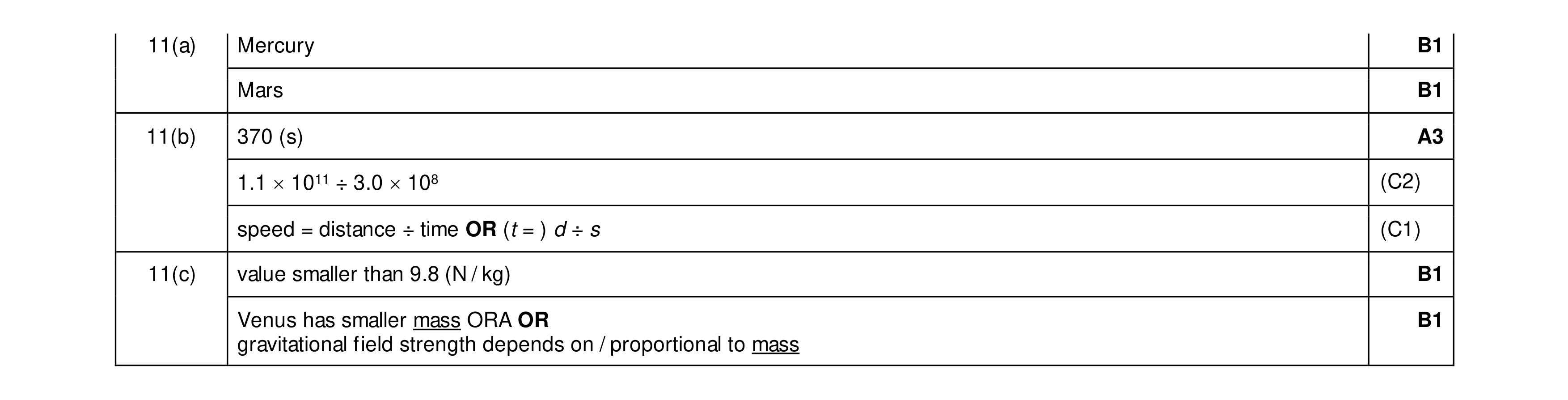 7
7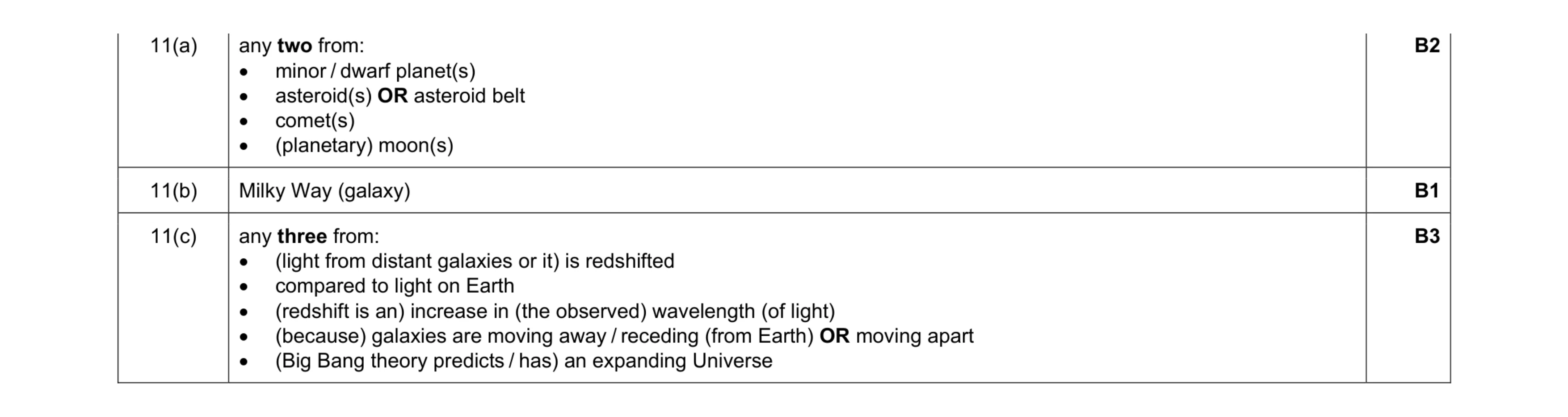 6
6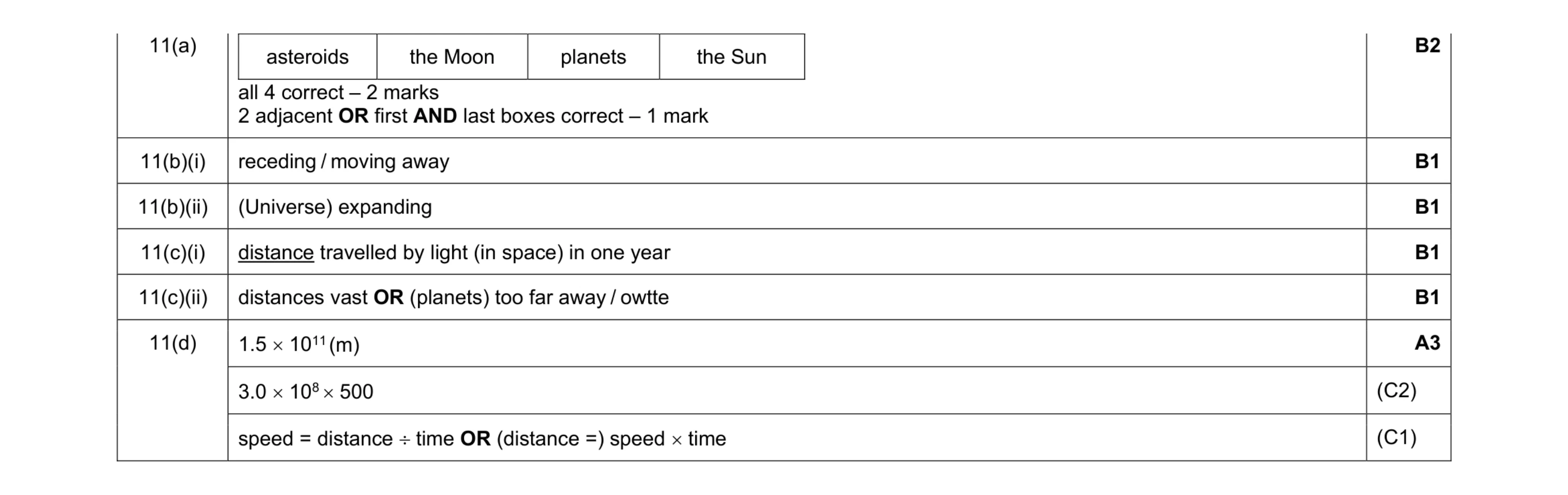 9
9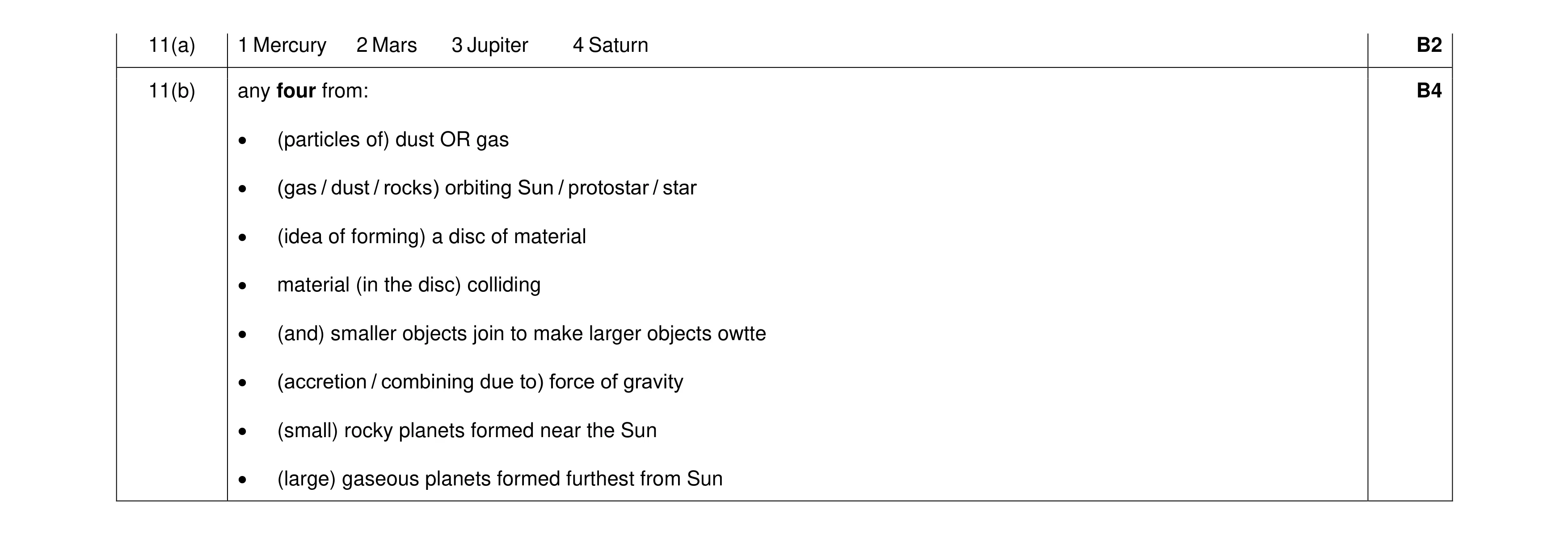 6
6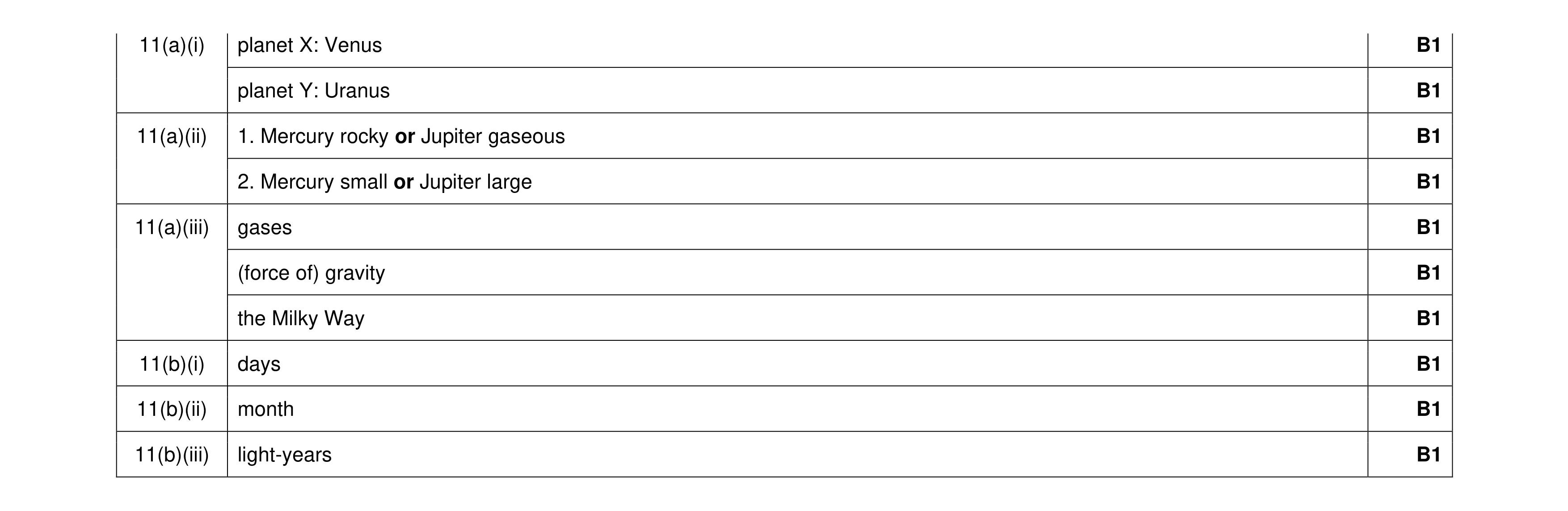 10
10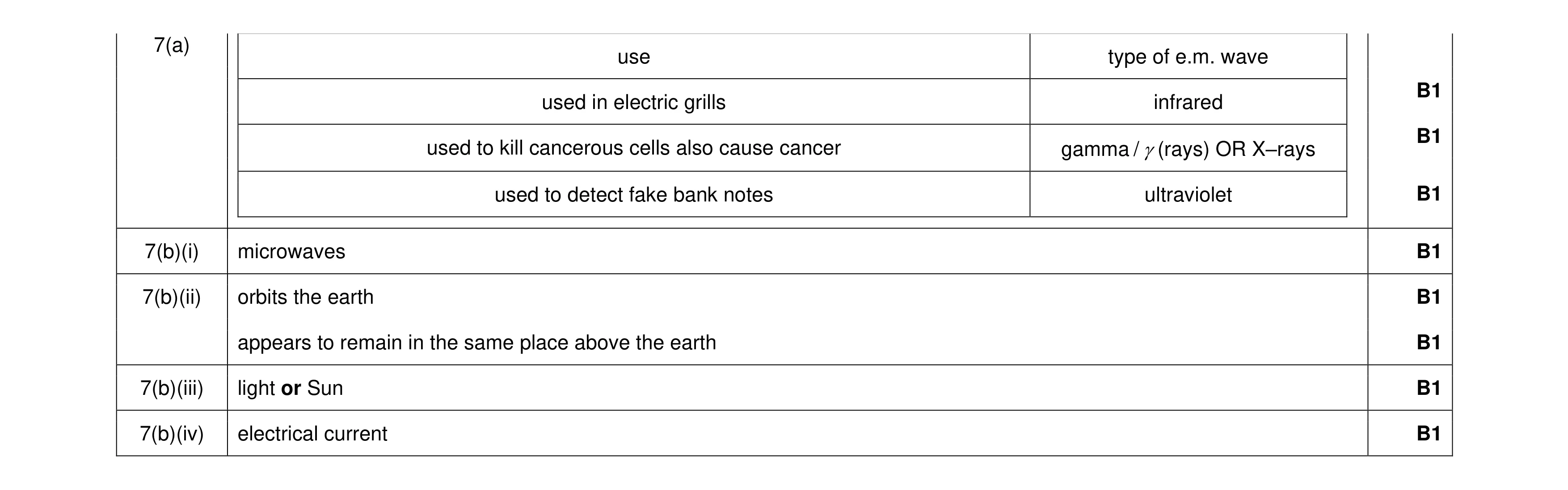 8
8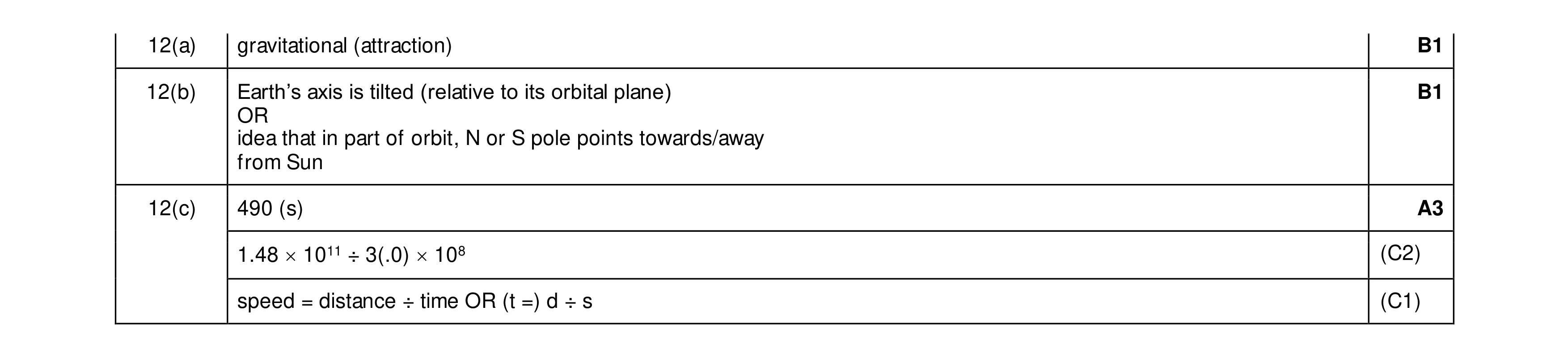 5
5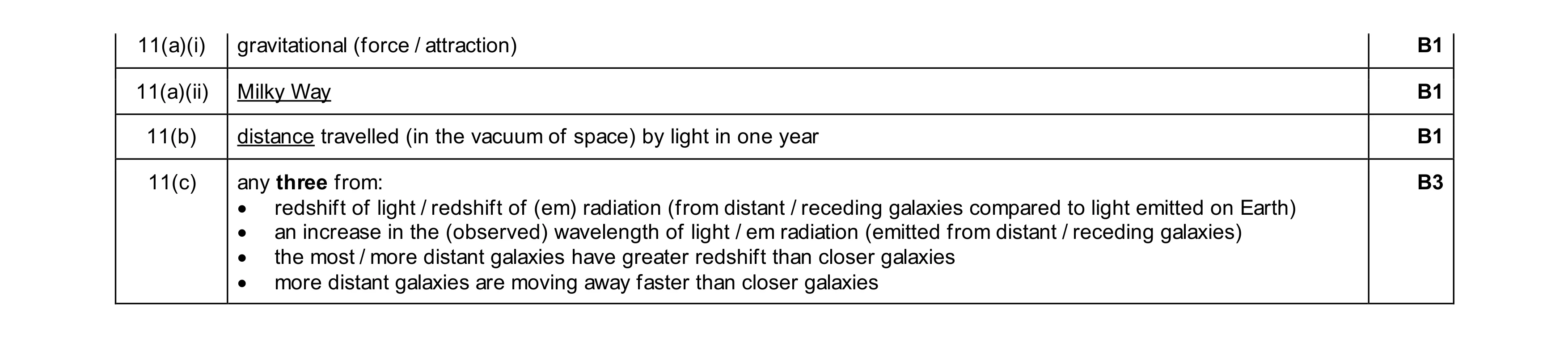 6
6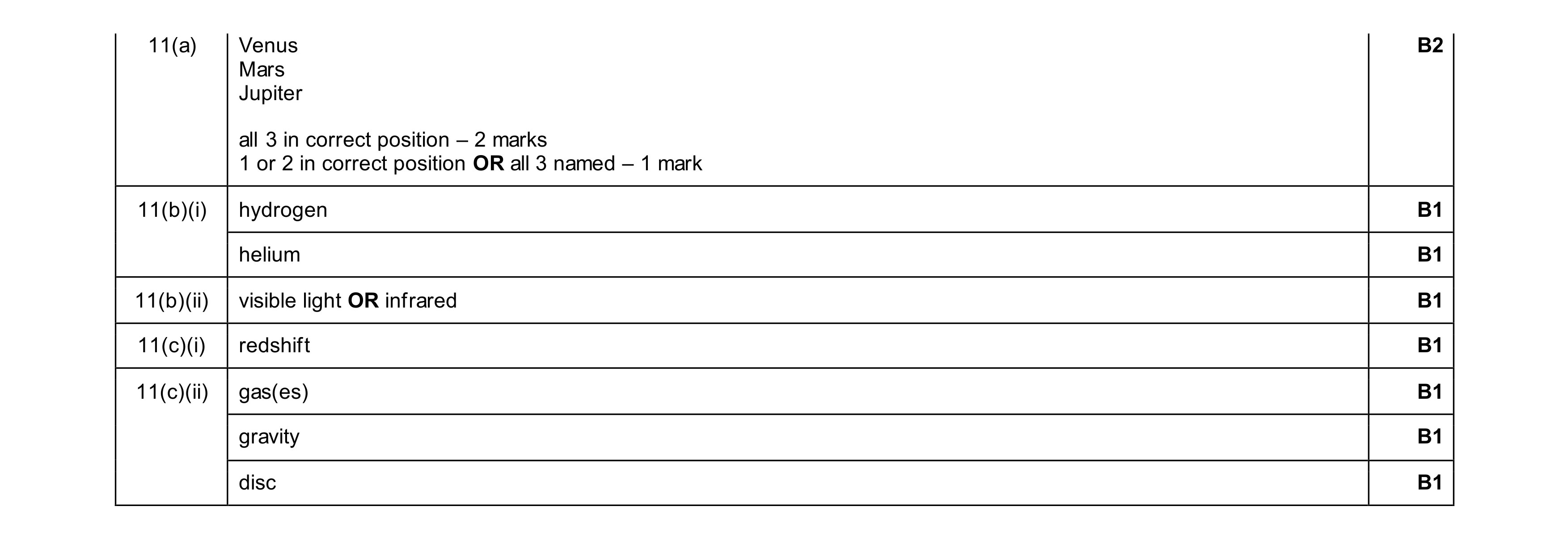 9
9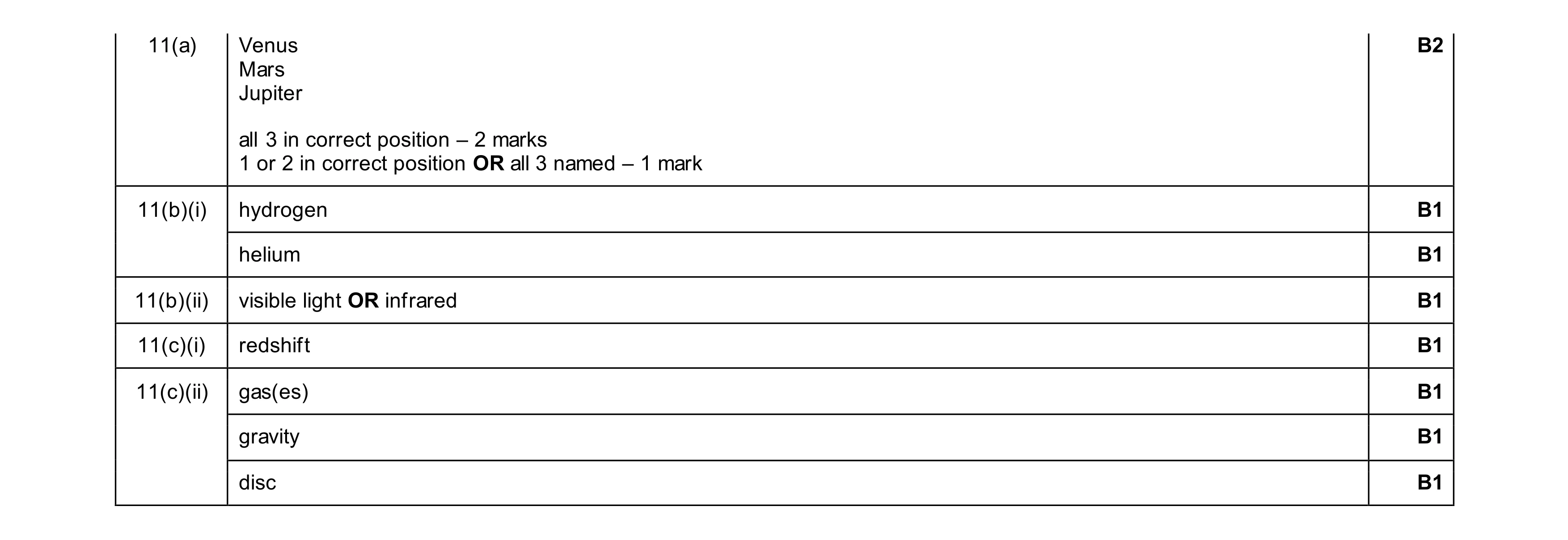 9
9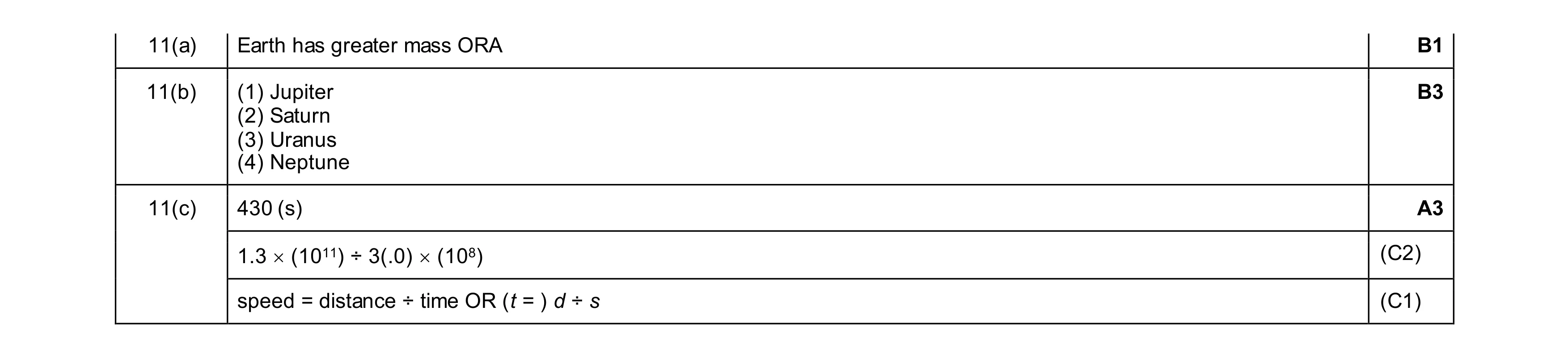 7
7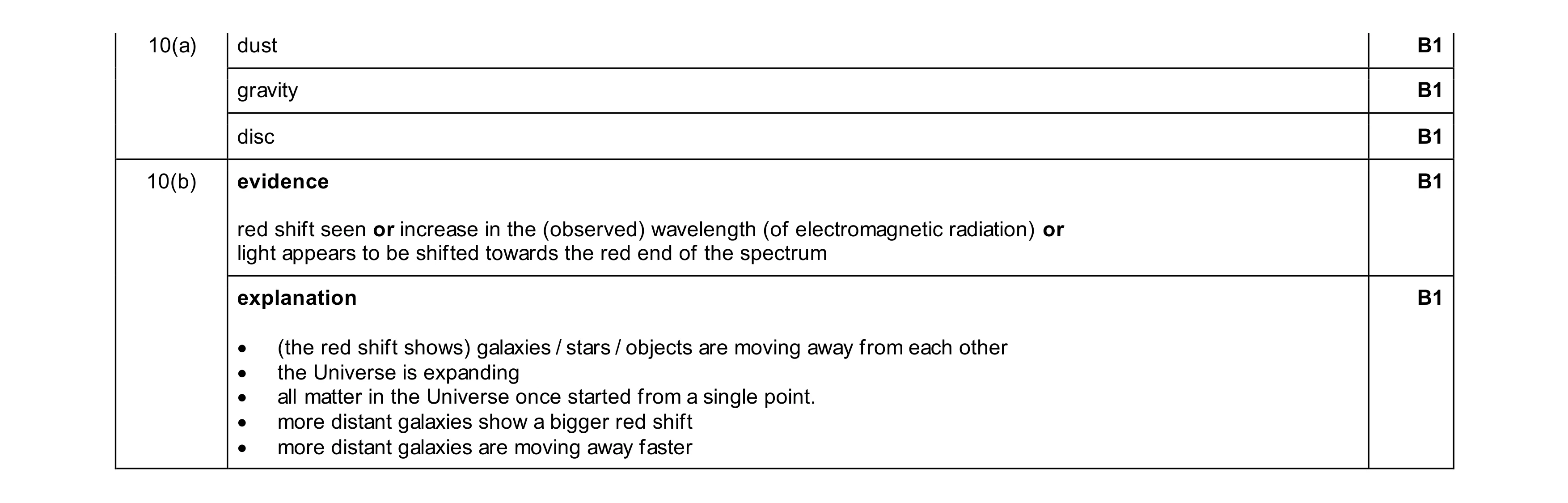 5
5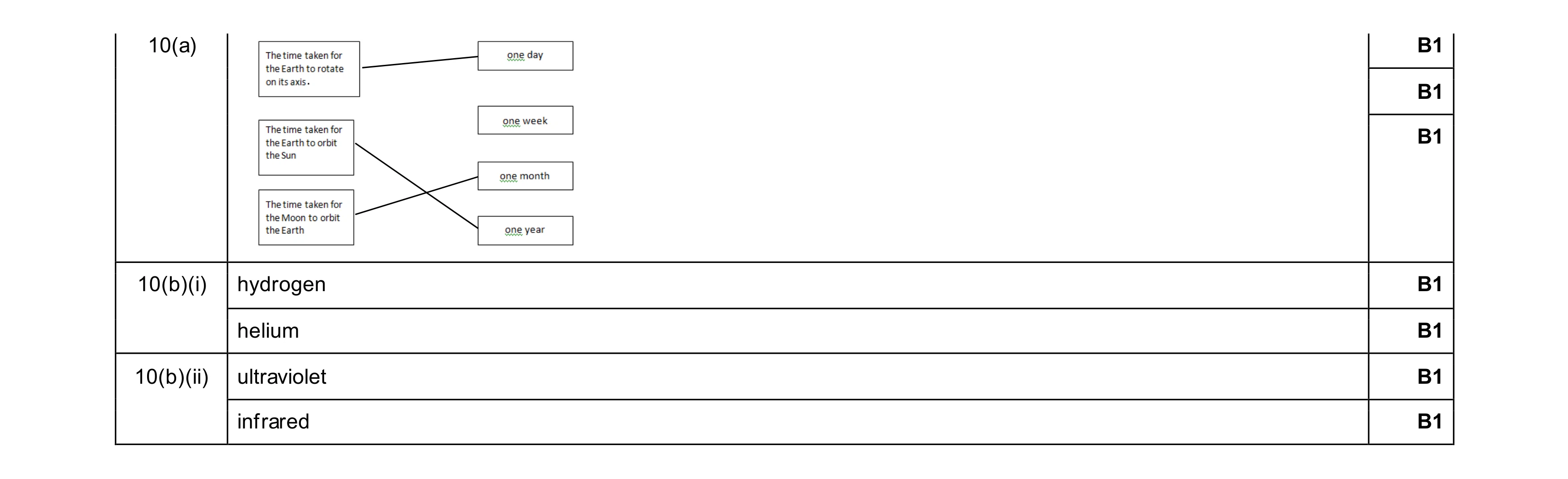 7
7