Questions as text
Q1 · The cross-section of a barrage built across a tidal bay 0625/43 Oct/Nov 2022
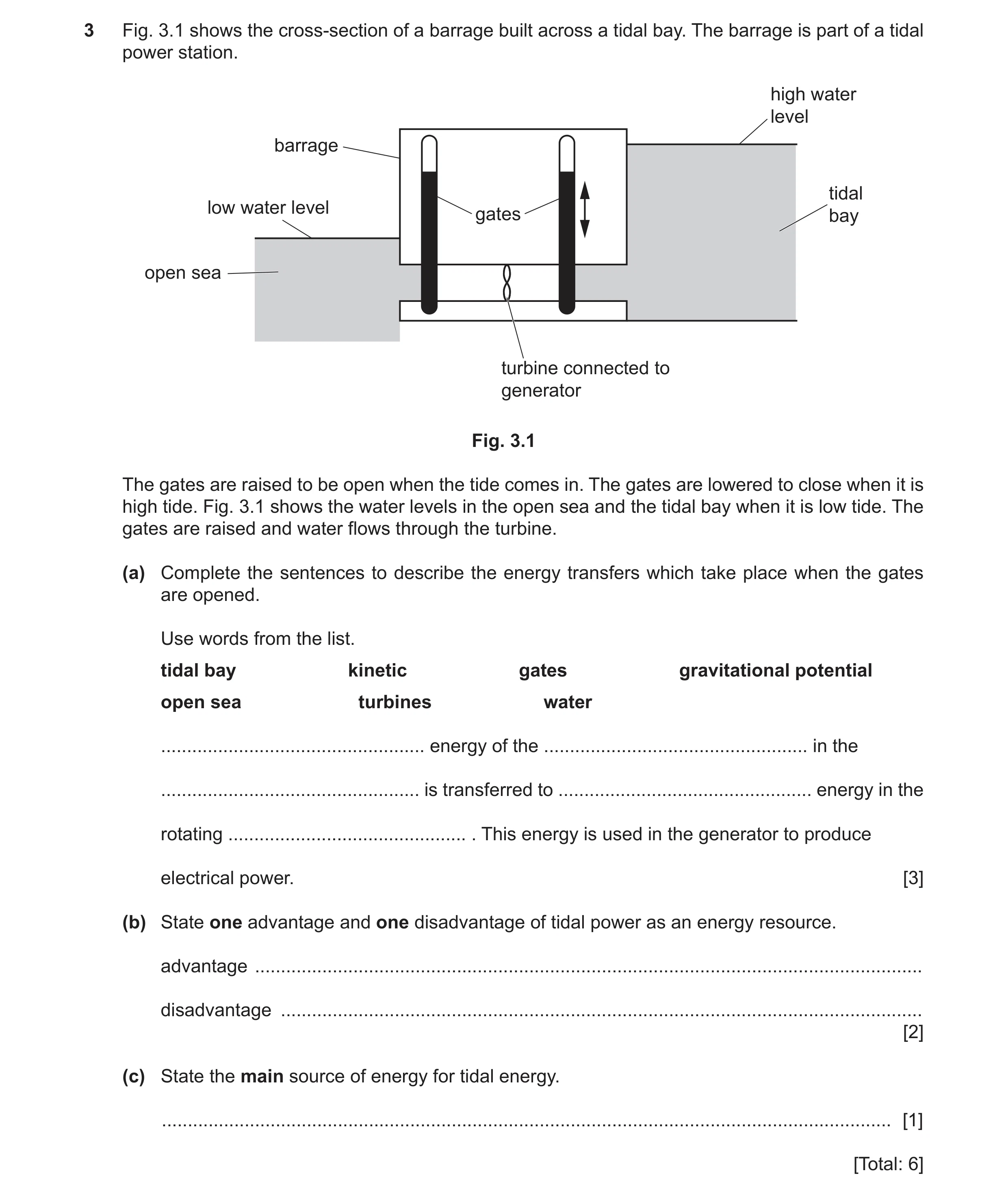
3 Fig. 3.1 shows the cross-section of a barrage built across a tidal bay. The barrage is part of a tidal power station. high water level barrage tidal low water level gates bay open sea turbine connected to generator Fig. 3.1 The gates are raised to be open when the tide comes in. The gates are lowered to close when it is high tide. Fig. 3.1 shows the water levels in the open sea and the tidal bay when it is low tide. The gates are raised and water flows through the turbine. (a) Complete the sentences to describe the energy transfers which take place when the gates are opened. Use words from the list. tidal bay kinetic gates gravitational potential open sea turbines water … energy of the … in the … is transferred to … energy in the rotating … . This energy is used in the generator to produce electrical power. [3] (b) State one advantage and one disadvantage of tidal power as an energy resource. advantage … disadvantage … [2] (c) State the main source of energy for tidal energy. … [1] [Total: 6]
6 marks
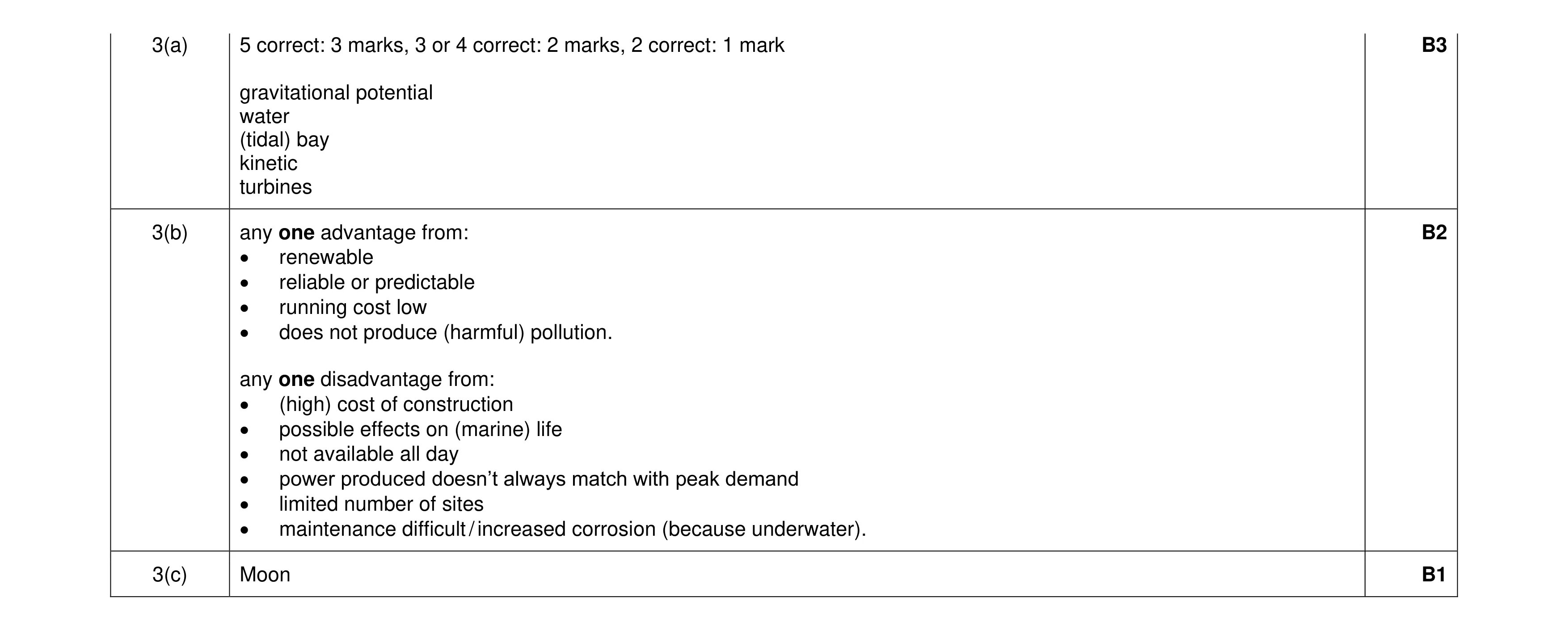
Mark scheme: 3(a) 5 correct: 3 marks, 3 or 4 correct: 2 marks, 2 correct: 1 mark B3 gravitational potential water (tidal) bay kinetic turbines 3(b) any one advantage from: B2 • renewable • reliable or predictable • running cost low • does not produce (harmful) pollution. any one disadvantage from: • (high) cost of construction • possible effects on (marine) life • not available all day • power produced doesn’t always match with peak demand • limited number of sites • maintenance difficult / increased corrosion (because underwater). 3(c) Moon B1
This question in 0625/43 Oct/Nov 2022
Q2 · The time taken for Mars to orbit the Sun is 690 Earth days 0625/42 Feb/March 2023
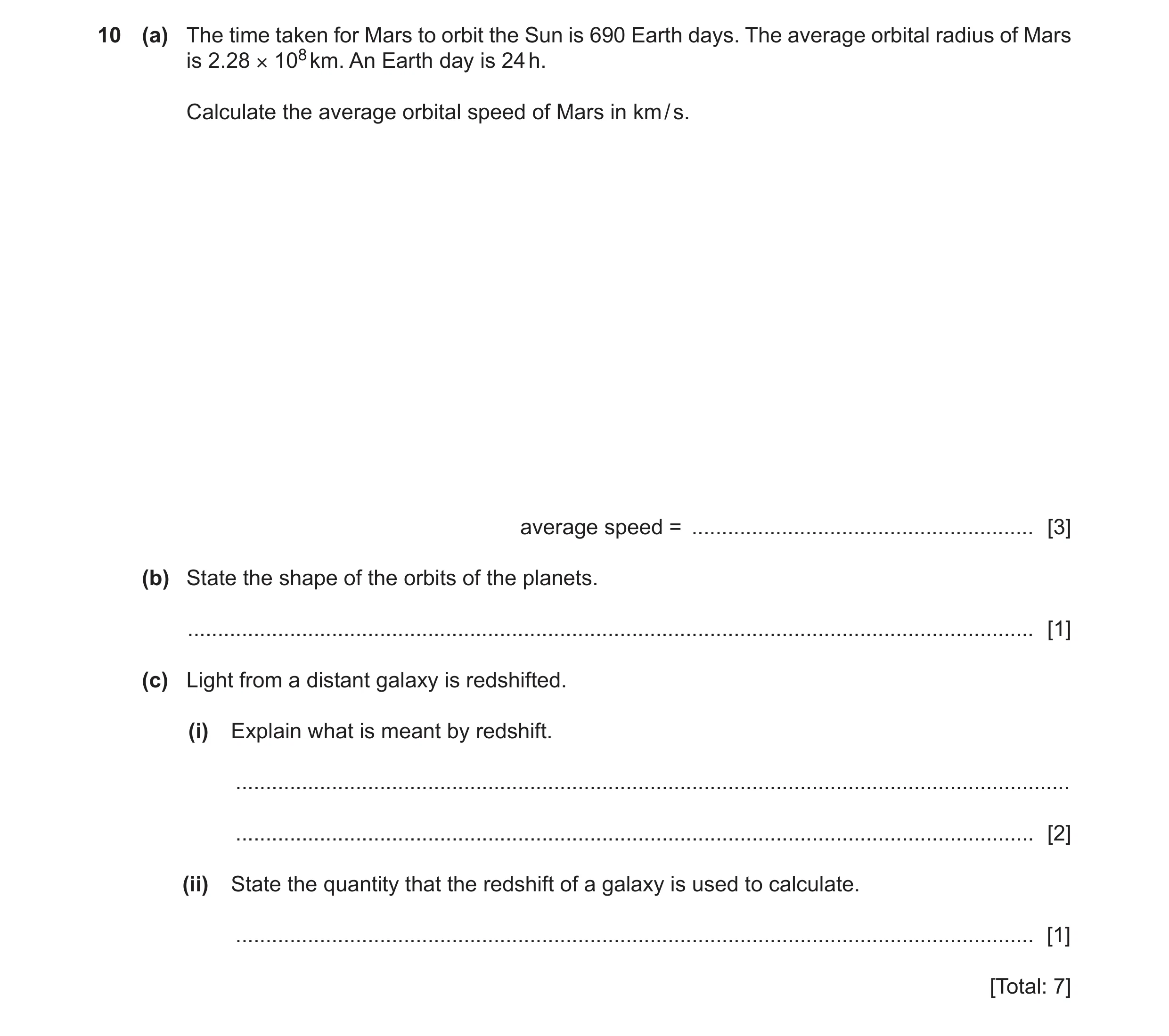
10 (a) The time taken for Mars to orbit the Sun is 690 Earth days. The average orbital radius of Mars is 2.28 × 10⁸ km. An Earth day is 24 h. Calculate the average orbital speed of Mars in km / s. average speed = … [3] (b) State the shape of the orbits of the planets. … [1] (c) Light from a distant galaxy is redshifted. (i) Explain what is meant by redshift. … … [2] (ii) State the quantity that the redshift of a galaxy is used to calculate. … [1] [Total: 7]
7 marks
Mark scheme: 10(a) 24 km / s A3 v = 2r / T OR (v =) 2r / T OR (2 2.28 108) / (690 24 60 60) (C1) (2 2.28 108) / (690 24 60 60) OR (T =) 690 24 60 60 OR (T=) 59 616 000 (s) (C1) 10(b) elliptical / ellipse B1 10(c)(i) wavelength (of light from distant galaxies) increases B1 occurs when galaxies are moving away (from Earth) B1 10(c)(ii) speed / velocity (that galaxy is moving away from Earth) B1
This question in 0625/42 Feb/March 2023
Q3 · Pluto is a dwarf planet 0625/41 May/June 2023
10 Pluto is a dwarf planet. Fig. 10.1 shows the direction of motion of Pluto as it follows its elliptical orbit around the Sun. Pluto X Sun Y orbit direction of motion Fig. 10.1 (not to scale) (a) Point X is the point in the orbit closest to the Sun and point Y is the point furthest away. The orbital speed of Pluto varies as it orbits the Sun. (i) Describe how the speed of Pluto varies as it moves from X to Y and then back to X. … … [1] (ii) Explain, in terms of energy transfers, why the speed of Pluto varies in this way. … … … … [3] (b) The average temperature on the surface of Pluto is 43 K. (i) Convert this temperature to a value in degrees Celsius (°C). temperature = … °C [1] (ii) Pluto has a white surface, as shown in Fig. 10.2. As Pluto rotates, the white surface alternately faces towards and away from the Sun. white surface Fig. 10.2 Explain how this affects the temperature of Pluto as it rotates on its own axis. … … … … [2] [Total: 7]
7 marks
Mark scheme: 10(a)(i) (speed) decreases (from X to Y) and then increases (from Y to X) B1 Question Answer Marks 10(a)(ii) any three from: gravitational (potential) energy (GPE) transfers to kinetic energy (KE) or vice versa KE transfers to GPE from X to Y AND GPE transfers to KE from Y to X speed decreases as KE decreases / ORA most GPE at Y OR least GPE at X total (of GPE + KE) energy is constant B3 10(b)(i) –230 (°C) B1 10(b)(ii) (white surface) is a poor absorber / good reflector / poor emitter of IR / radiation OR black / other surface is a good absorber / poor reflector / good emitter of IR / radiation B1 any one from: (the white surface) increases in temperature less when facing the Sun (the white surface) decreases in temperature less when facing away (from Sun) the black / other surfaces increases in temperature more when facing the Sun the black / other surface decreases in temperature more when facing away (from Sun) less variation in temperature on white surface (during one whole rotation) B1
This question in 0625/41 May/June 2023
Q4 · State the equation that defines the average orbital speed v of a planet 0625/42 May/June 2023
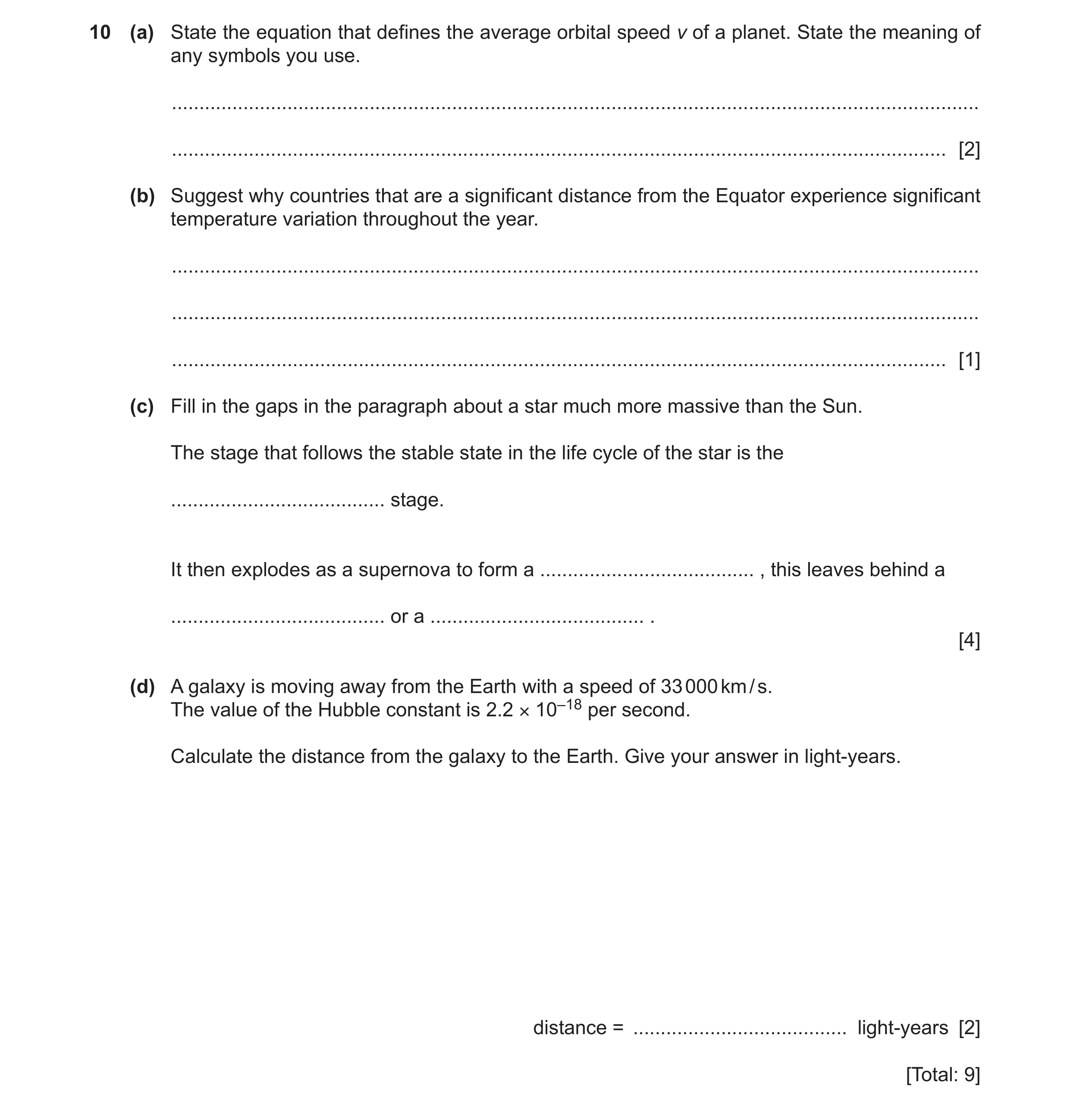
10 (a) State the equation that defines the average orbital speed v of a planet. State the meaning of any symbols you use. … … [2] (b) Suggest why countries that are a significant distance from the Equator experience significant temperature variation throughout the year. … … … [1] (c) Fill in the gaps in the paragraph about a star much more massive than the Sun. The stage that follows the stable state in the life cycle of the star is the … stage. It then explodes as a supernova to form a … , this leaves behind a … or a … . [4] (d) A galaxy is moving away from the Earth with a speed of 33 000 km / s. The value of the Hubble constant is 2.2 × 10⁻¹⁸ per second. Calculate the distance from the galaxy to the Earth. Give your answer in light-years. distance = … light-years [2] [Total: 9]
9 marks
Mark scheme: 10(a) B1 r = (average) radius of the orbit AND T = (orbital) period B1 10(b) rays from Sun strike the country at different angles through the year OR rays from Sun strike the country for different number of hours per day through the year B1 10(c) (first space:) red supergiant B1 (second space:) nebula B1 (3rd and 4th spaces:) neutron star B1 black hole B1 10(d) 1.6 109 (light-years) A2 H0 = v / d OR (d =) v / H0 OR (d =) [33 000 103] / [ 2.2 10–18 9.5 1015] C1
This question in 0625/42 May/June 2023
Q5 · Information about three planets in the Solar System 0625/42 Oct/Nov 2023
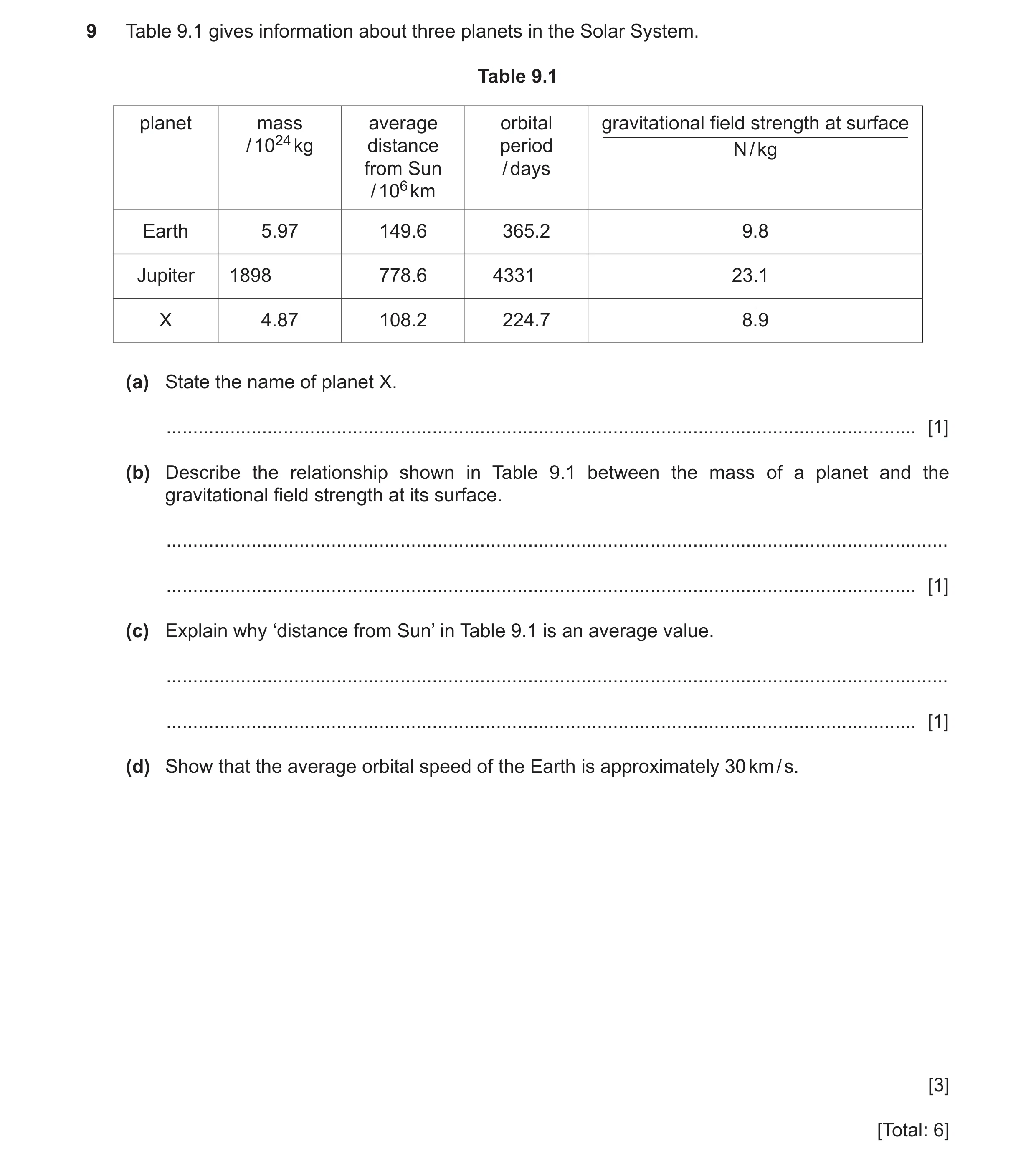
9 Table 9.1 gives information about three planets in the Solar System. Table 9.1 planet mass average orbital gravitational field strength at surface / 1024 kg distance period N / kg from Sun / days / 106 km Earth 5.97 149.6 365.2 9.8 Jupiter 1898 778.6 4331 23.1 X 4.87 108.2 224.7 8.9 (a) State the name of planet X. … [1] (b) Describe the relationship shown in Table 9.1 between the mass of a planet and the gravitational field strength at its surface. … … [1] (c) Explain why ‘distance from Sun’ in Table 9.1 is an average value. … … [1] (d) Show that the average orbital speed of the Earth is approximately 30 km / s. [3] [Total: 6]
6 marks
Mark scheme: 9(a) Venus B1 9(b) The larger the mass (of the planet), the larger the gravitational field strength (at the surface) B1 9(c) orbit of planets is elliptical / is not circular owtte B1 9(d) correct conversion of T into seconds i.e. 365.2 (24 60 60) OR 3.2 107 B1 (v =) {2r} / T B1 2 149.6 106 / 365.2 24 60 60 B1
This question in 0625/42 Oct/Nov 2023
Q6 · Different positions A–H of the Moon as it rotates around the Earth 0625/42 Feb/March 2024
10 (a) Fig. 10.1 represents different positions A–H of the Moon as it rotates around the Earth. A H B light from G Earth C the Sun F D E Fig. 10.1 (i) State a position of the Moon where an observer on Earth sees: 1. there is a quarter Moon … 2. there is a full Moon … [2] (ii) State the approximate time taken for the Moon to orbit the Earth. time = … [1] (b) The average distance of the Earth from the Sun is 1.5 × 10⁸ km. (i) Calculate the average orbital speed of the Earth in km / h. average orbital speed = … km / h [3] (ii) The speed of light in a vacuum is 3.0 × 10⁸ m / s. Calculate the time taken for light from the Sun to reach the Earth. time = … [2] [Total: 8]
8 marks
Mark scheme: 10(a)(i) position A and / or E B1 position G B1 10(a)(ii) 1 month B1 10(b)(i) 110 000 (km / h) A3 (v = )2r / T (C1) T = 365 24h OR 2 1.5 108 / 365 24 (C1) 10(b)(ii) 500 s A2 v = s / t OR (t =) s / v OR 1.5 1011 / 3.0 108 (C1)
This question in 0625/42 Feb/March 2024
Q7 · The Solar System includes the Sun and planets 0625/42 May/June 2024
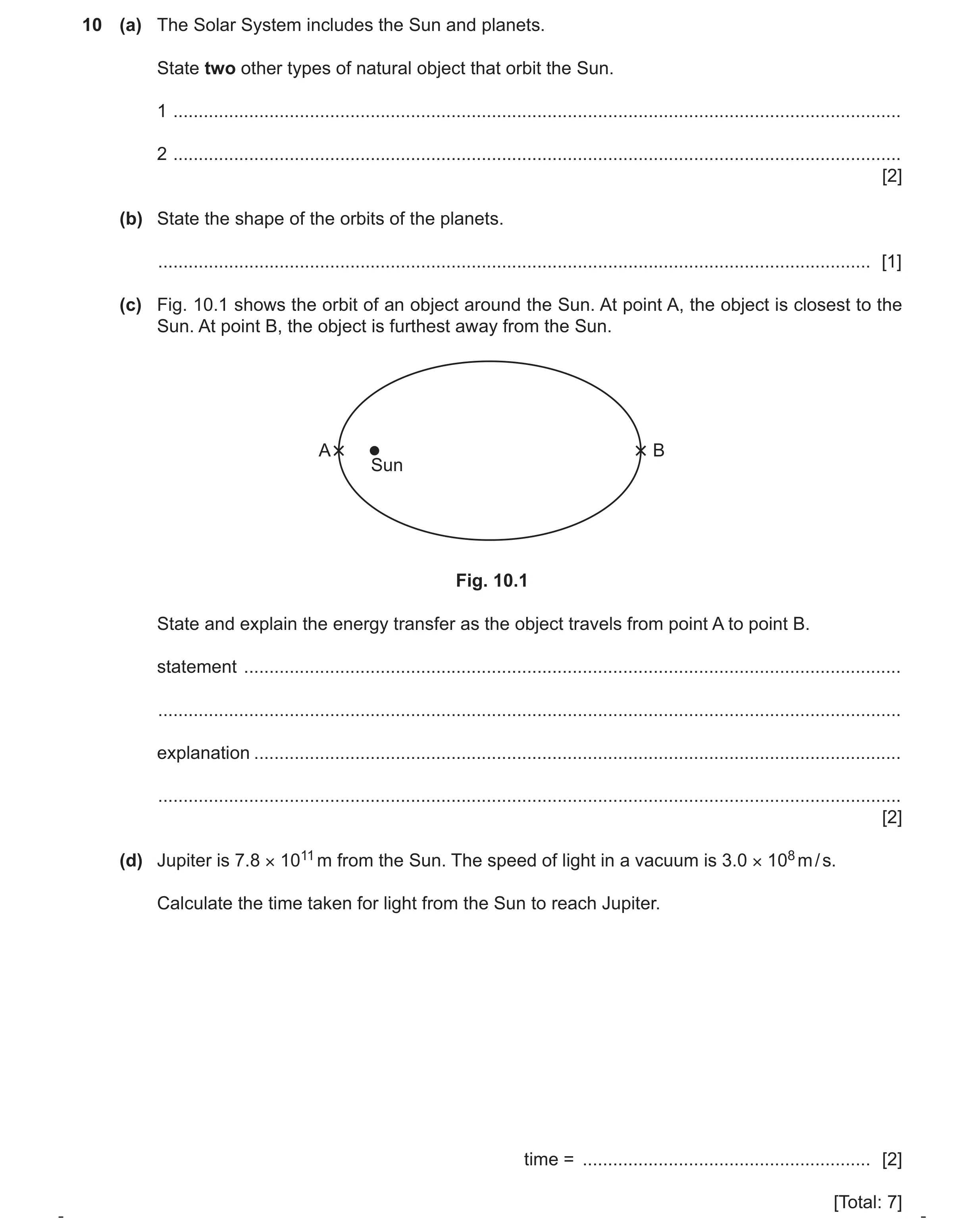
10 (a) The Solar System includes the Sun and planets. State two other types of natural object that orbit the Sun. 1 … 2 … [2] (b) State the shape of the orbits of the planets. … [1] (c) Fig. 10.1 shows the orbit of an object around the Sun. At point A, the object is closest to the Sun. At point B, the object is furthest away from the Sun. A B Sun Fig. 10.1 State and explain the energy transfer as the object travels from point A to point B. statement … … explanation … … [2] (d) Jupiter is 7.8 × 10¹¹ m from the Sun. The speed of light in a vacuum is 3.0 × 10⁸ m / s. Calculate the time taken for light from the Sun to reach Jupiter. time = … [2] [Total: 7]
7 marks
Mark scheme: 10(a) any two from: minor planets OR dwarf planets comets asteroids B2 10(b) elliptical B1 10(c) kinetic energy (store) decreases AND potential energy (store) increases (as object moves from A to B) B1 energy is conserved B1 10(d) 2.6 103 s A2 v = s / t OR (t =) s / v OR 7.8 1011 / 3.0 108 C1
This question in 0625/42 May/June 2024
Q8 · The path of the Earth as it orbits the Sun 0625/42 Feb/March 2025
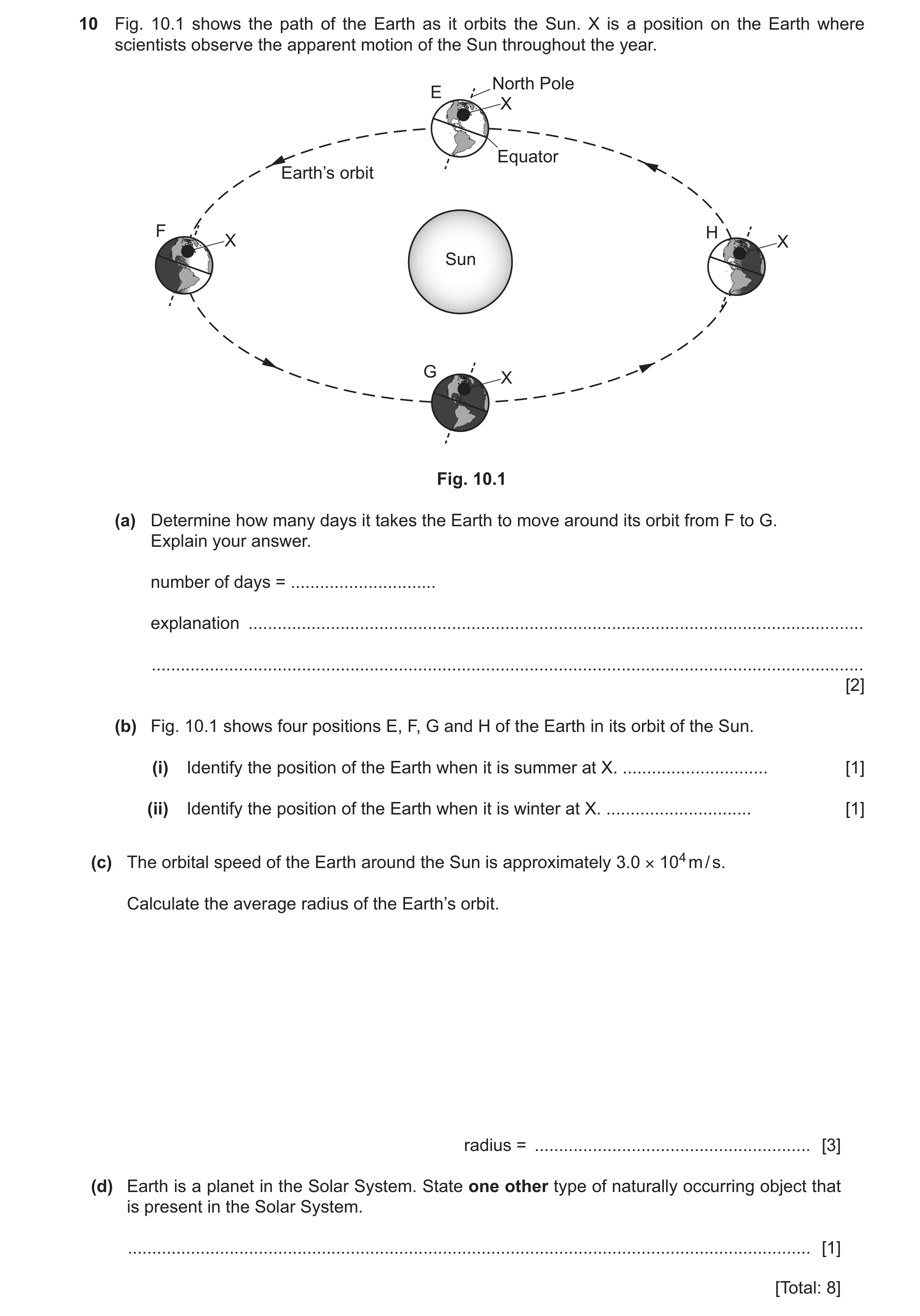
10 Fig. 10.1 shows the path of the Earth as it orbits the Sun. X is a position on the Earth where scientists observe the apparent motion of the Sun throughout the year. North Pole E X Equator Earth’s orbit F H X X Sun G X Fig. 10.1 (a) Determine how many days it takes the Earth to move around its orbit from F to G. Explain your answer. number of days = … explanation … … [2] (b) Fig. 10.1 shows four positions E, F, G and H of the Earth in its orbit of the Sun. (i) Identify the position of the Earth when it is summer at X. … [1] (ii) Identify the position of the Earth when it is winter at X. … [1] (c) The orbital speed of the Earth around the Sun is approximately 3.0 × 10⁴ m / s. Calculate the average radius of the Earth’s orbit. radius = … [3] (d) Earth is a planet in the Solar System. State one other type of naturally occurring object that is present in the Solar System. … [1] [Total: 8]
8 marks
Mark scheme: 10(a) (number of days =) 91 B1 (statement F to G) is ¼ of (a complete) orbit OR a whole year is 365 days B1 10(b)(i) F B1 10(b)(ii) H B1 10(c) 1.5 1011 m A3 v = 2r/T OR (r =) vT/(2) OR ( r = ) 3.0 104 365 24 60 60 / 2 C1 (T =) 365 24 60 60 OR (T =) 31 536 000 OR (r =) 3.0 104 T / (2) OR C1 correct rearrangement of and substitution into formula using candidate’s value of T 10(d) Any one from: B1 • minor planets • asteroids OR meteoroids • moons (that orbit planets) • comets • natural satellites
This question in 0625/42 Feb/March 2025
Q9 · Jupiter and the Earth are planets in our Solar System 0625/41 May/June 2025
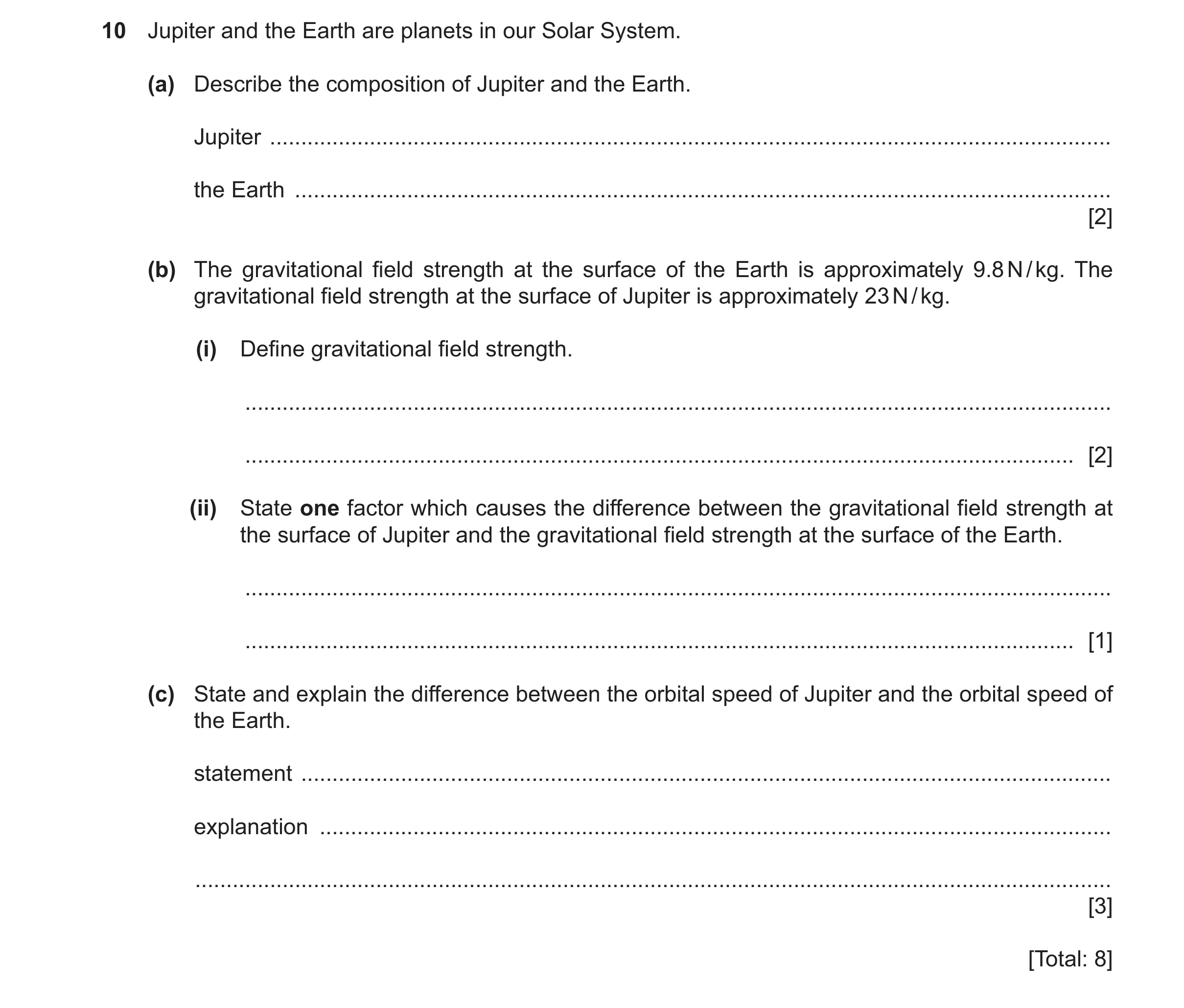
10 Jupiter and the Earth are planets in our Solar System. (a) Describe the composition of Jupiter and the Earth. Jupiter … the Earth … [2] (b) The gravitational field strength at the surface of the Earth is approximately 9.8 N / kg. The gravitational field strength at the surface of Jupiter is approximately 23 N / kg. (i) Define gravitational field strength. … … [2] (ii) State one factor which causes the difference between the gravitational field strength at the surface of Jupiter and the gravitational field strength at the surface of the Earth. … … [1] (c) State and explain the difference between the orbital speed of Jupiter and the orbital speed of the Earth. statement … explanation … … [3] [Total: 8]
8 marks
Mark scheme: 10(a) Jupiter is gaseous B1 Earth is rocky B1 10(b)(i) weight A2 (gravitational) force per unit mass OR (g =) in this form mass (gravitational) force on a mass OR W = mg C1 10(b)(ii) mass B1 10(c) (orbital speed of) Jupiter is slower ORA B1 Jupiter is further from the Sun ORA OR orbital speeds of planets decrease as distance from the Sun increases ORA B1 gravitational field (strength) of Sun decreases with distance (from Sun) ORA B1
This question in 0625/41 May/June 2025
Q10 · Data for planets A, B, C and D 0625/42 May/June 2025
10 (a) Table 10.1 shows data for planets A, B, C and D. Table 10.1 surface temperature diameter gravitational field strength planet / K / km N / kg A 153 143 000 23.0 B 623 4 800 3.7 C 53 50 000 11.0 D 93 120 000 9.0 (i) State and explain which one of these planets is closest to the Sun. … … [2] (ii) Calculate the surface temperature of planet D in °C. surface temperature = … °C [1] (iii) An object falls through a height of 2 m on each of the planets in Table 10.1. State and explain on which planet the object falls 2 m in the shortest time. Ignore any effect due to the atmosphere. … … [2] (b) Fig. 10.1 shows some of the stages in the life cycle of a massive star. massive star expands … supernova nebula which contains … leaves behind … or … Fig. 10.1 (i) Complete Fig. 10.1 by adding the correct terms. [4] (ii) State the quantity that the brightness of a supernova in a galaxy can be used to determine. … [1] [Total: 10]
10 marks
Mark scheme: 10(a)(i) planet B B1 high(est) (surface) temperature B1 10(a)(ii) –180 (°C) B1 10(a)(iii) planet A B1 gravitational field strength is highest so acceleration (due to gravity) is greater B1 OR gravitational field strength is highest so greater (downward) force on the object 10(b)(i) red supergiant B1 (new) heavier elements OR hydrogen B1 any two from: B2 • neutron star • black hole • new stars (with orbiting planets) 10(b)(ii) distance (from Earth) to galaxy B1
This question in 0625/42 May/June 2025
Q11 · The orbit of the Earth and the orbit of a comet around the Sun 0625/41 Oct/Nov 2025
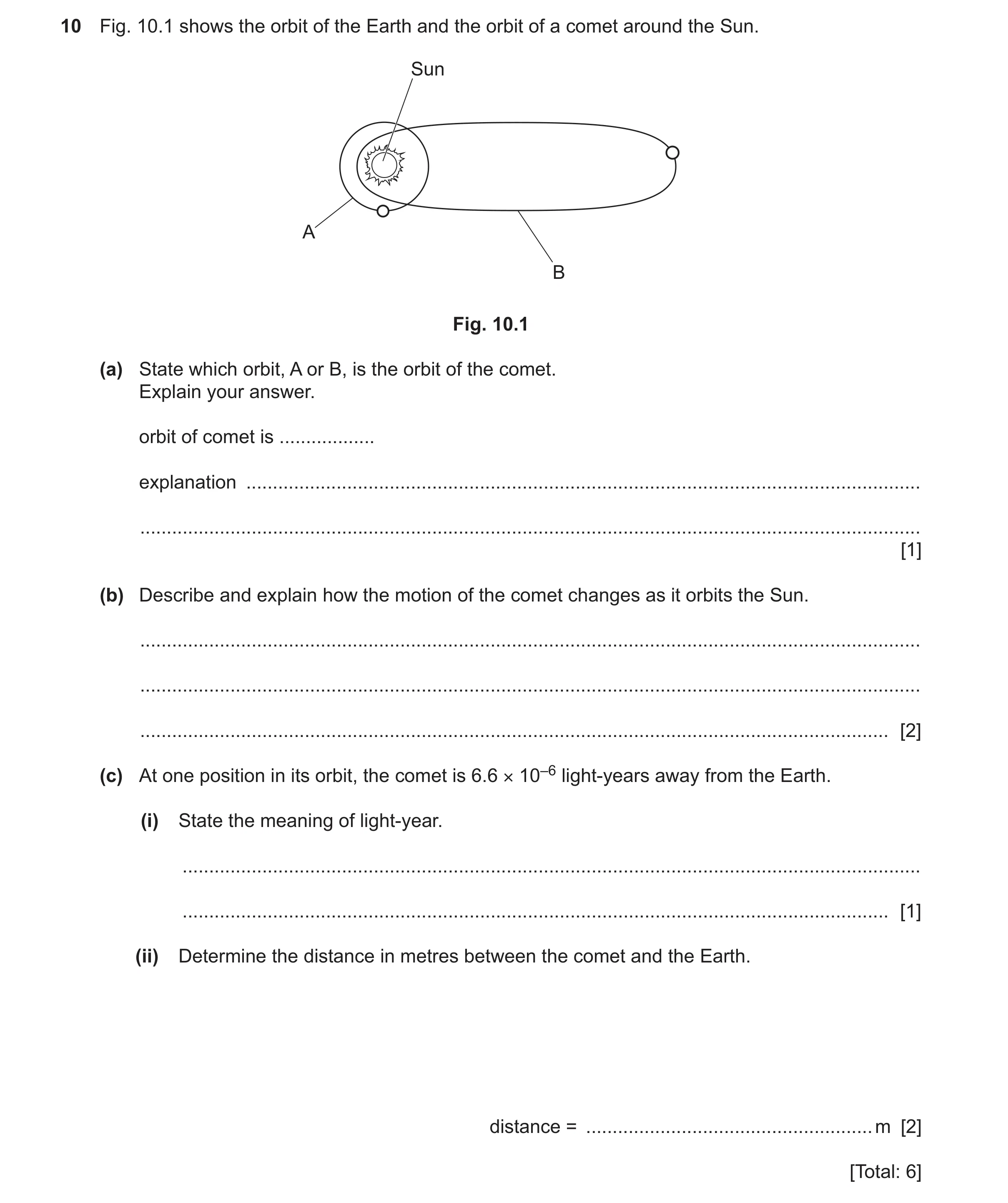
10 Fig. 10.1 shows the orbit of the Earth and the orbit of a comet around the Sun. Sun A B Fig. 10.1 (a) State which orbit, A or B, is the orbit of the comet. Explain your answer. orbit of comet is … explanation … … [1] (b) Describe and explain how the motion of the comet changes as it orbits the Sun. … … … [2] (c) At one position in its orbit, the comet is 6.6 × 10⁻⁶ light-years away from the Earth. (i) State the meaning of light-year. … … [1] (ii) Determine the distance in metres between the comet and the Earth. distance = … m [2] [Total: 6]
6 marks
Mark scheme: 10(a) B B1 AND Sun is not at the centre of the orbit OR comets have an elliptical orbit 10(b) Comet travels faster when it is closer to the Sun ORA B1 GPE decreases AND KE increases as comet gets closer to the Sun ORA B1 10(c)(i) distance travelled (in the vacuum of space) by light in one year. B1 10(c)(ii) 6.3 1010 (m) OR 63 000 000 000 (m) A2 (1 light-year =) 9.5 1015 (m) OR (1 light-year =) 9.5 1012 (km) OR SEEN (distance =) 6.6 10–6 9.5 10N C1
This question in 0625/41 Oct/Nov 2025
Q12 · Fill in the gaps in the description of how an accretion model explains the formation of… 0625/42 Oct/Nov 2025
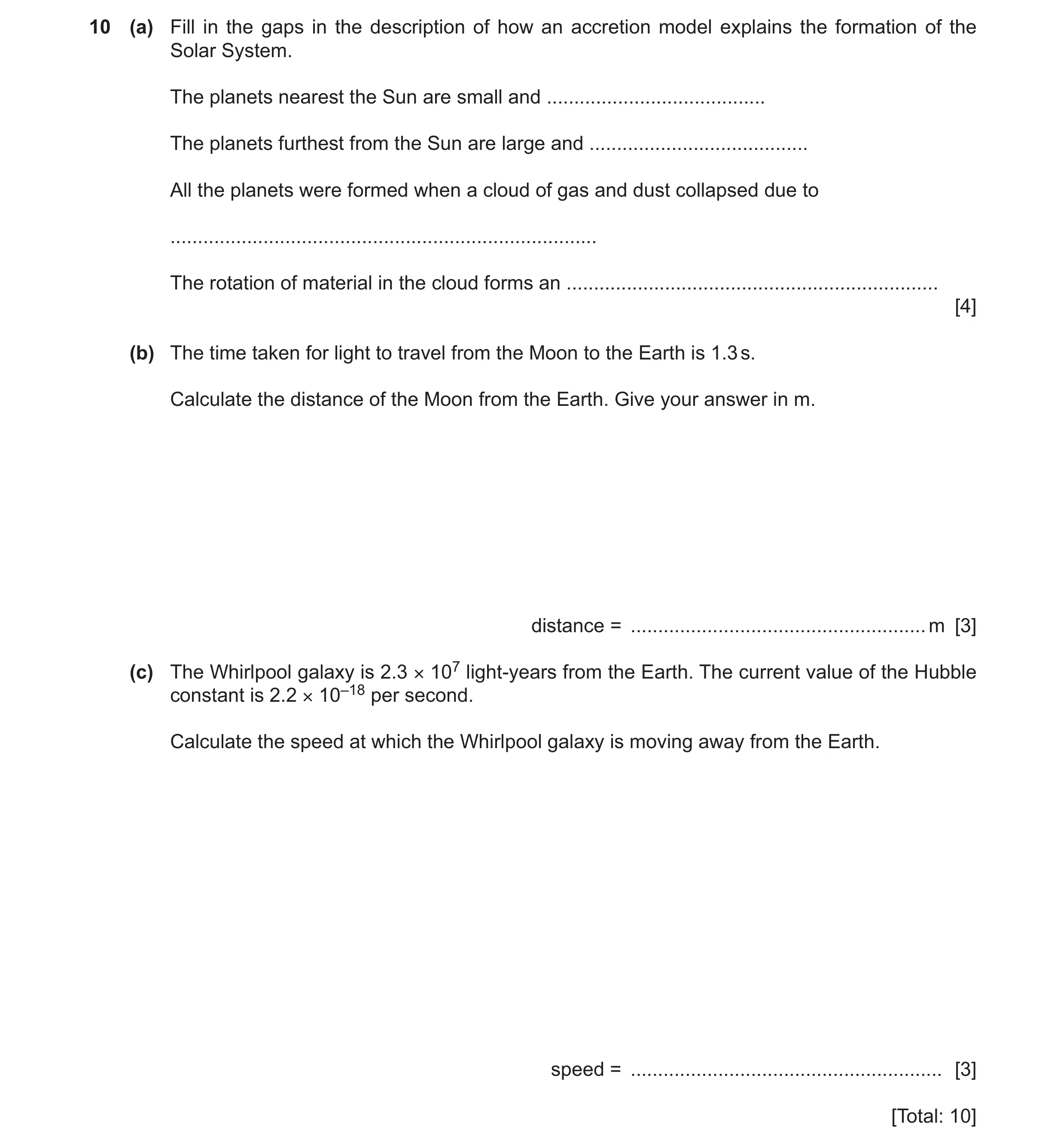
10 (a) Fill in the gaps in the description of how an accretion model explains the formation of the Solar System. The planets nearest the Sun are small and … The planets furthest from the Sun are large and … All the planets were formed when a cloud of gas and dust collapsed due to … The rotation of material in the cloud forms an … [4] (b) The time taken for light to travel from the Moon to the Earth is 1.3 s. Calculate the distance of the Moon from the Earth. Give your answer in m. distance = … m [3] (c) The Whirlpool galaxy is 2.3 × 10⁷ light‑years from the Earth. The current value of the Hubble constant is 2.2 × 10⁻¹⁸ per second. Calculate the speed at which the Whirlpool galaxy is moving away from the Earth. speed = … [3] [Total: 10]
10 marks
Mark scheme: 10(a) rocky B1 gaseous B1 gravitational force B1 accretion disc B1 10(b) 3.9 108 (m) A3 (speed of light =) 3.0 108 C1 (s =) vt OR (s =) 3.0 108 1.3 C1 10(c) 4.8 105 m / s OR 4.8 102 km / s A3 (1 light-year =) 9.5 1015 (m) OR 9.5 1012 (km) OR 4.8 10N C1 (v =) H0 d OR (v =) 2.2 10-18 2.3 107 9.5 1015 C1
This question in 0625/42 Oct/Nov 2025
 1 / 13
 2 / 13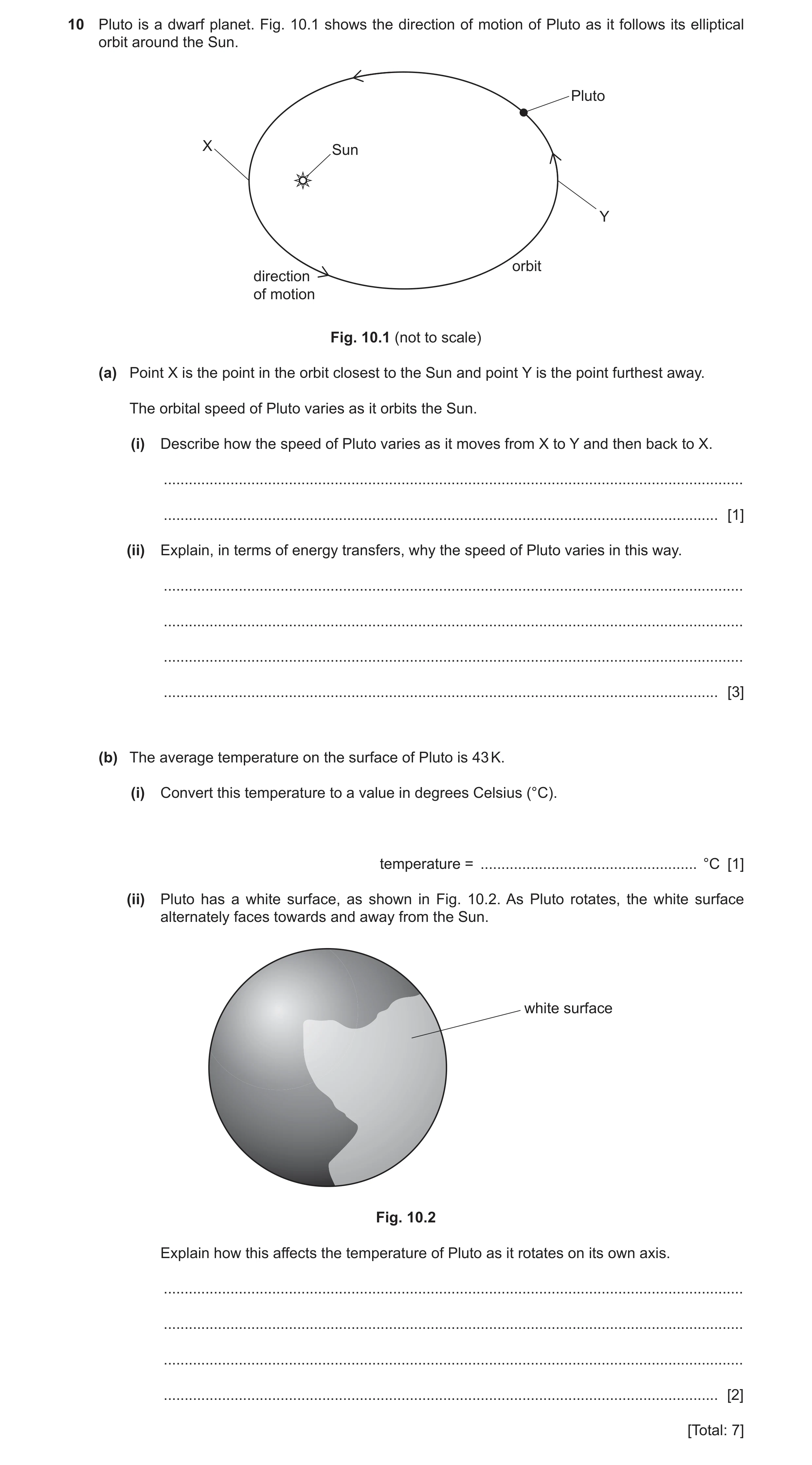
 4 / 13
 5 / 13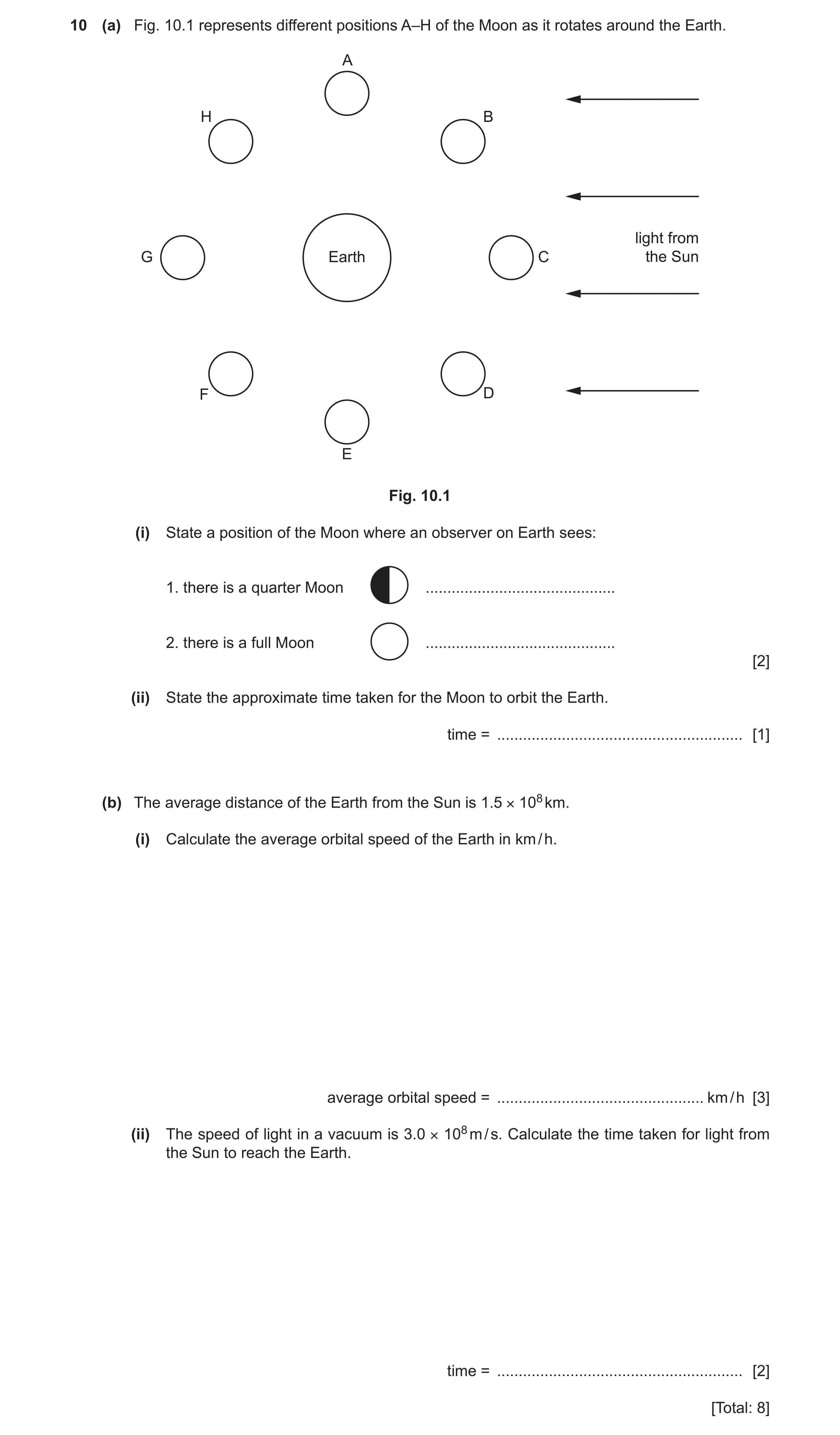
 8 / 13
 9 / 13
 10 / 13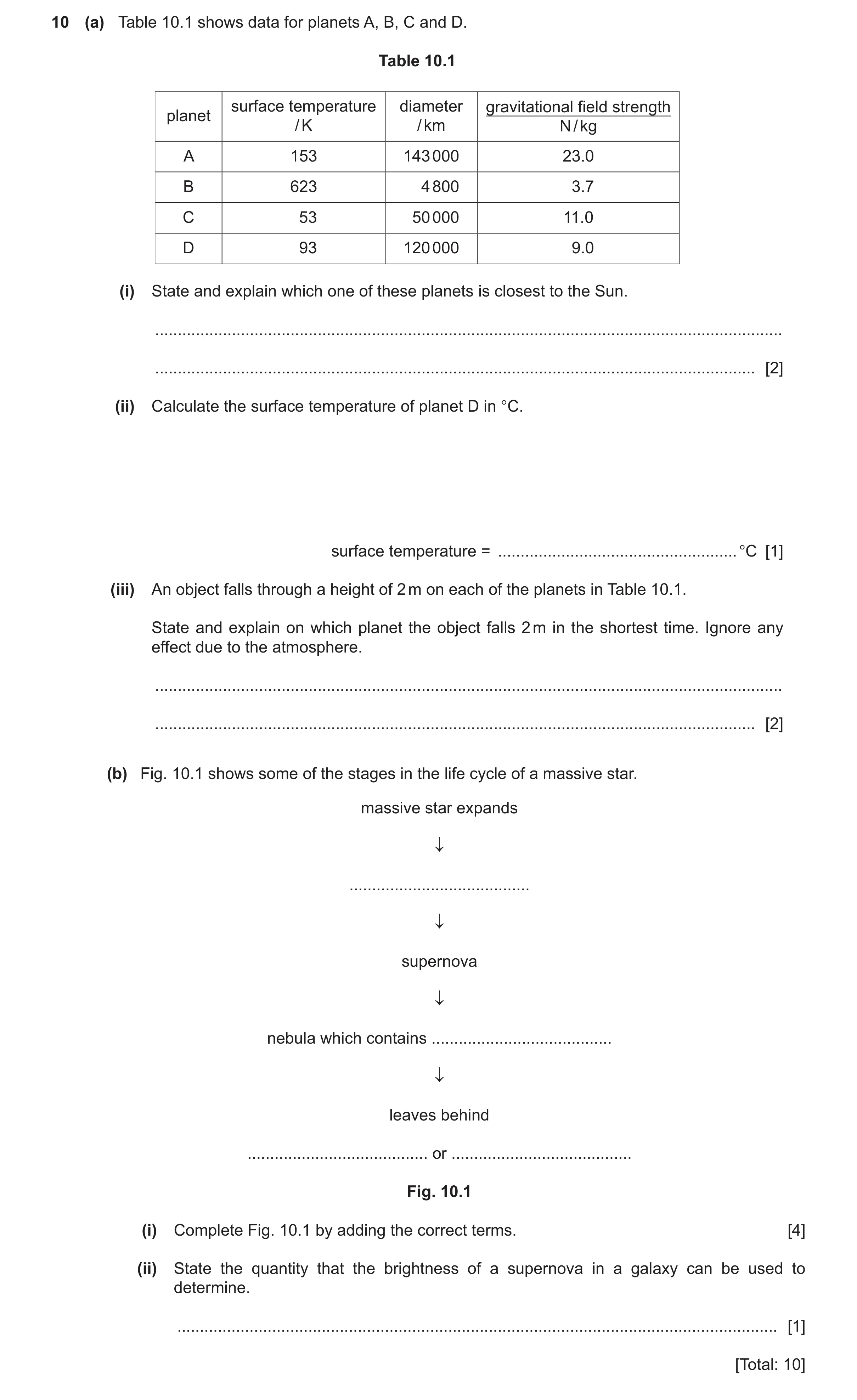
 12 / 13
 13 / 13
 6
6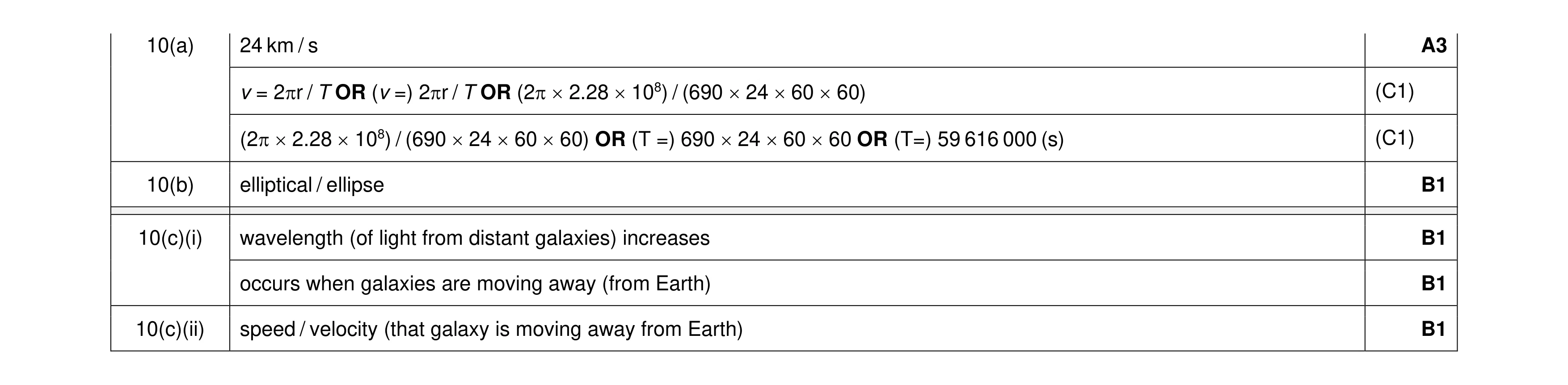 7
7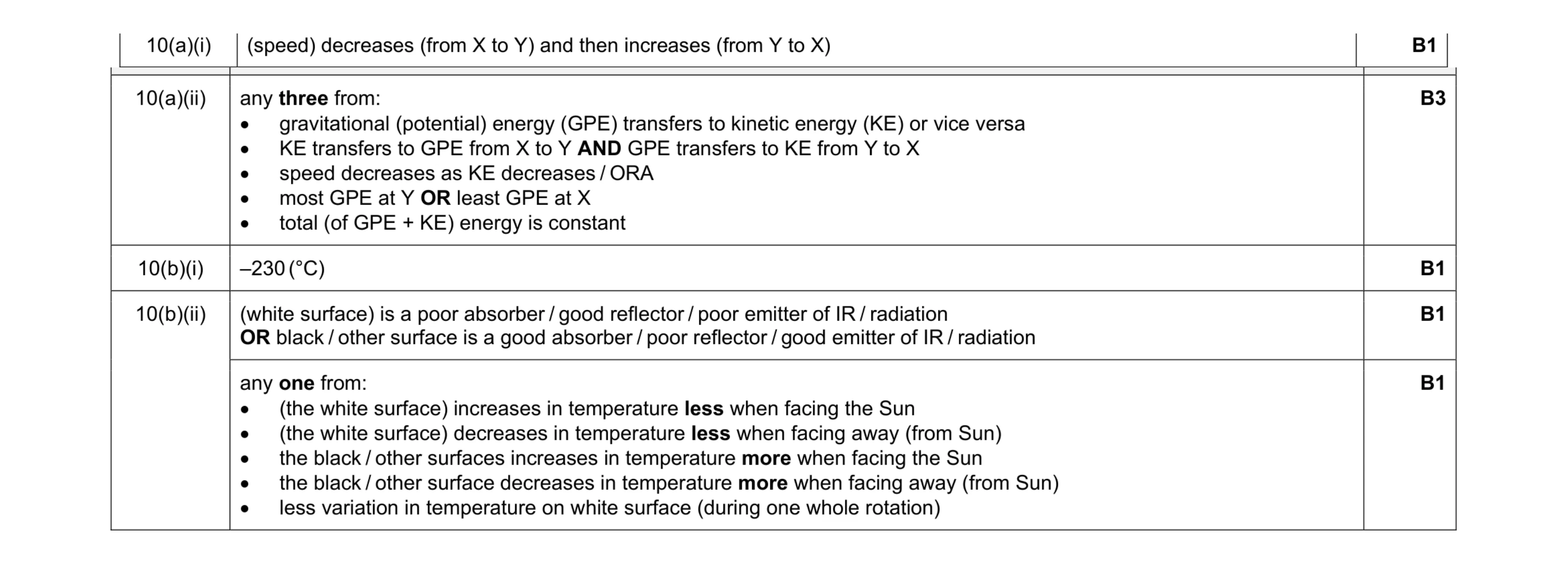 7
7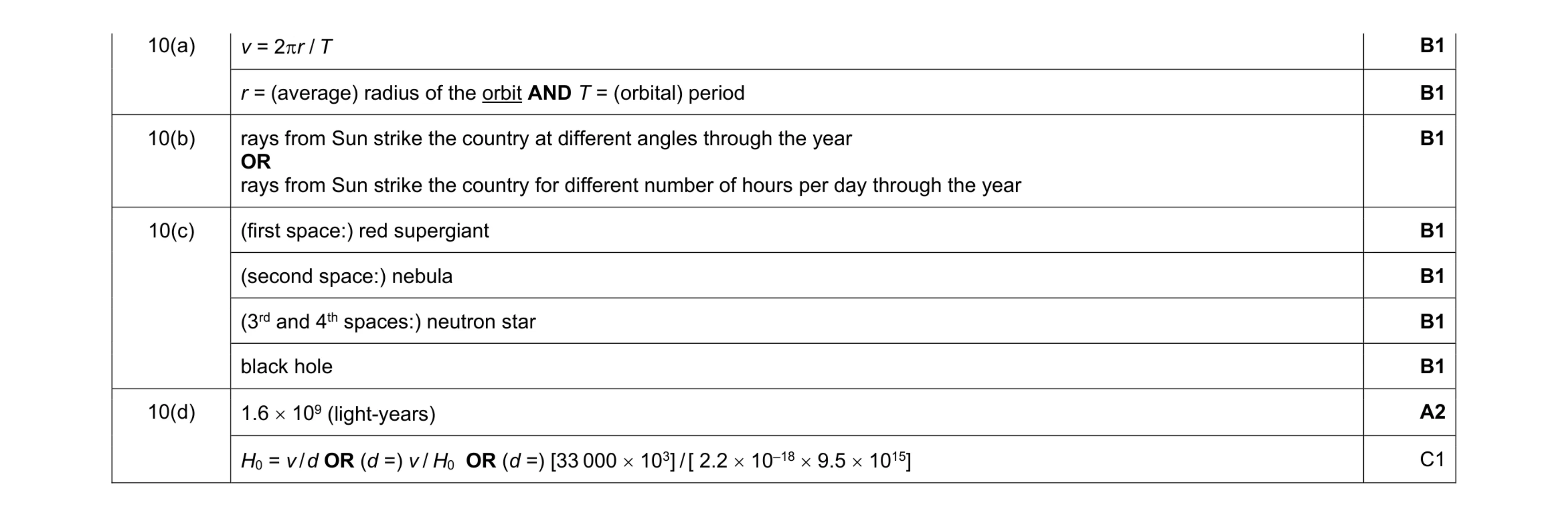 9
9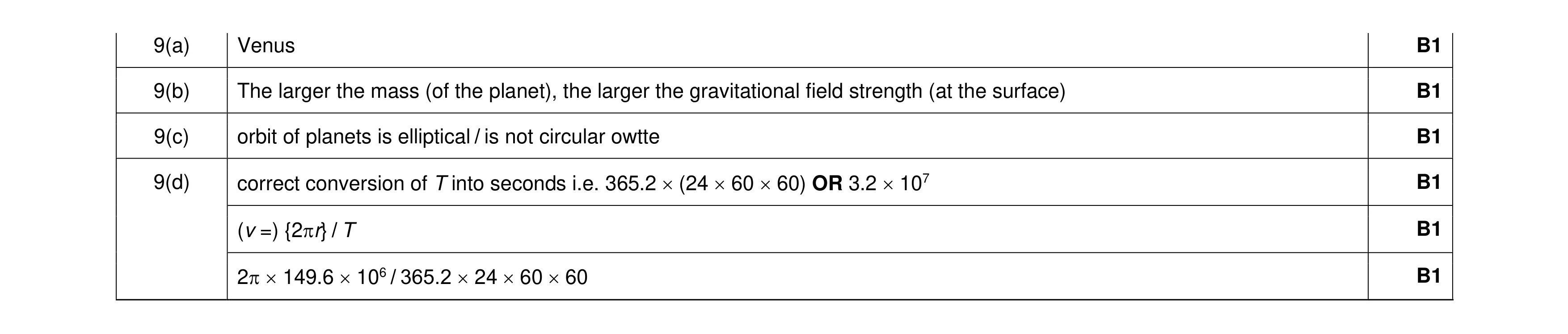 6
6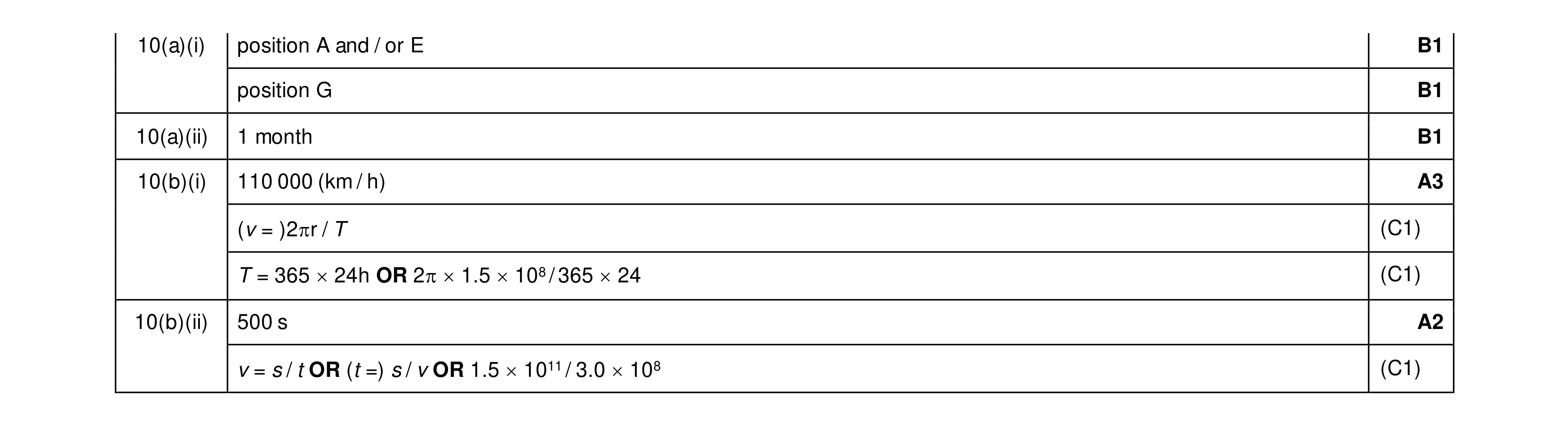 8
8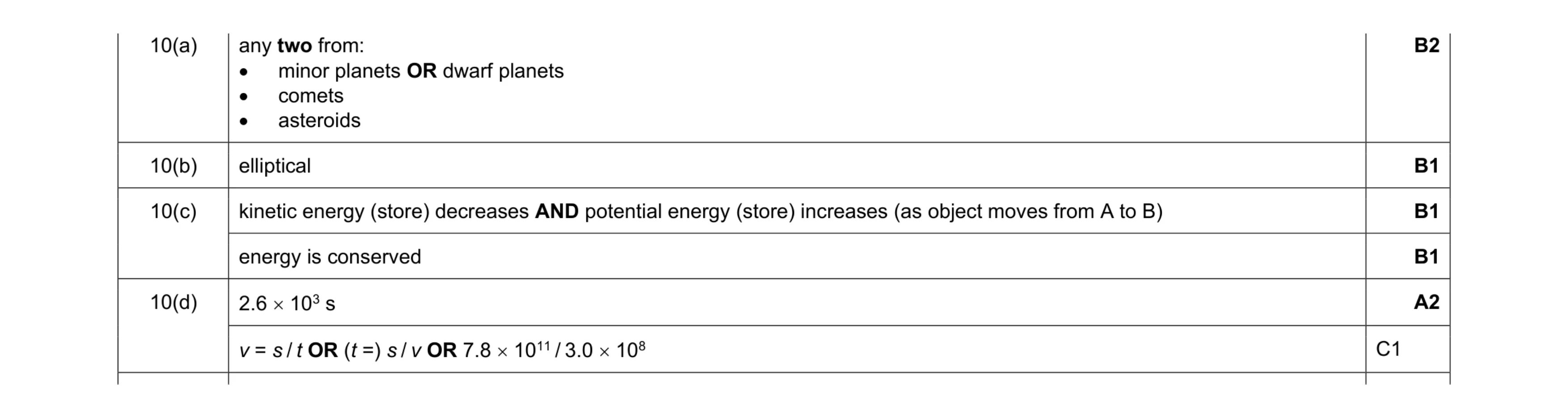 7
7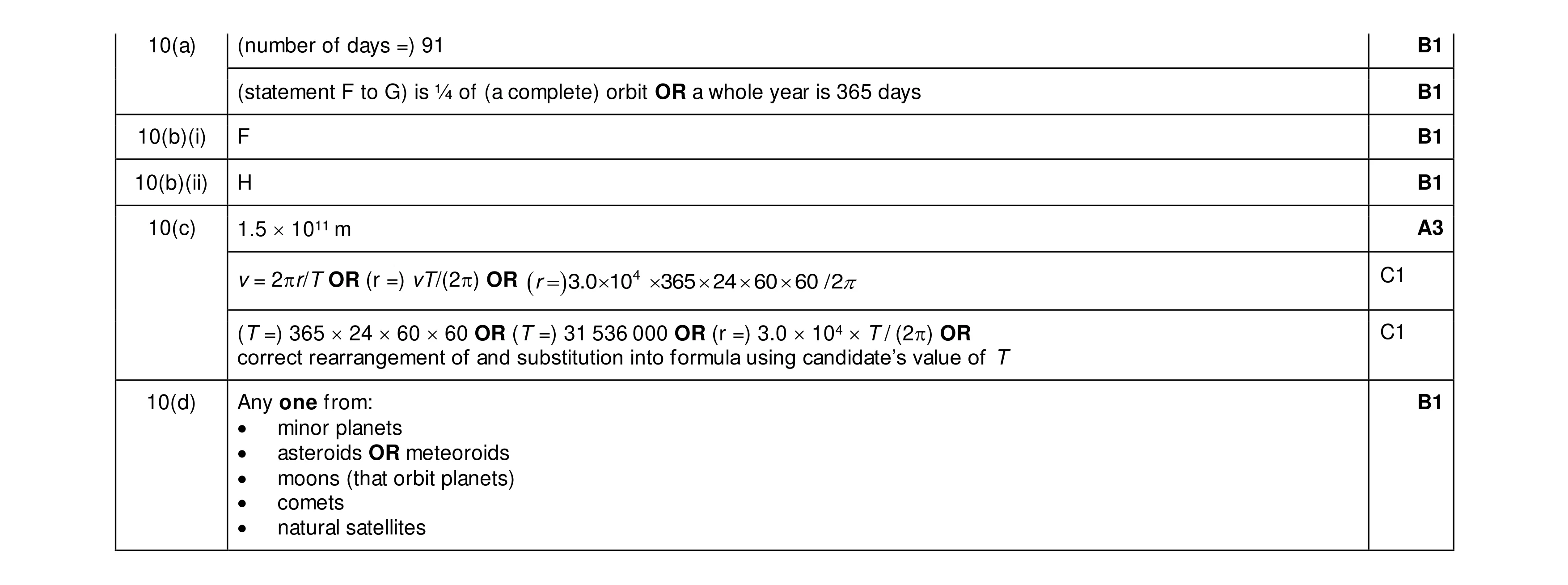 8
8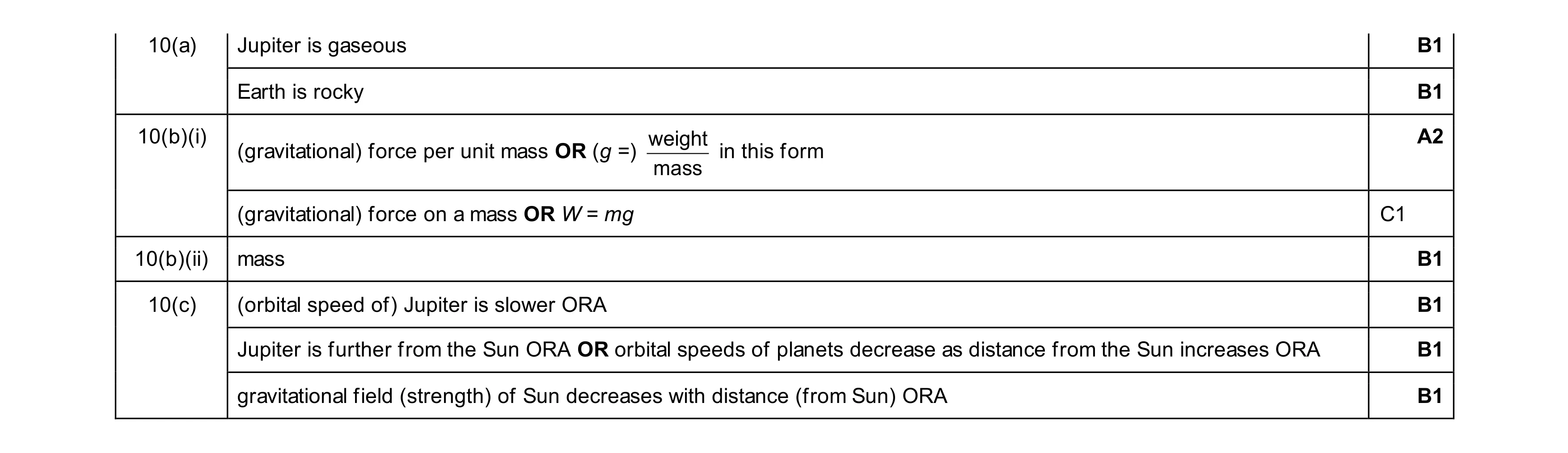 8
8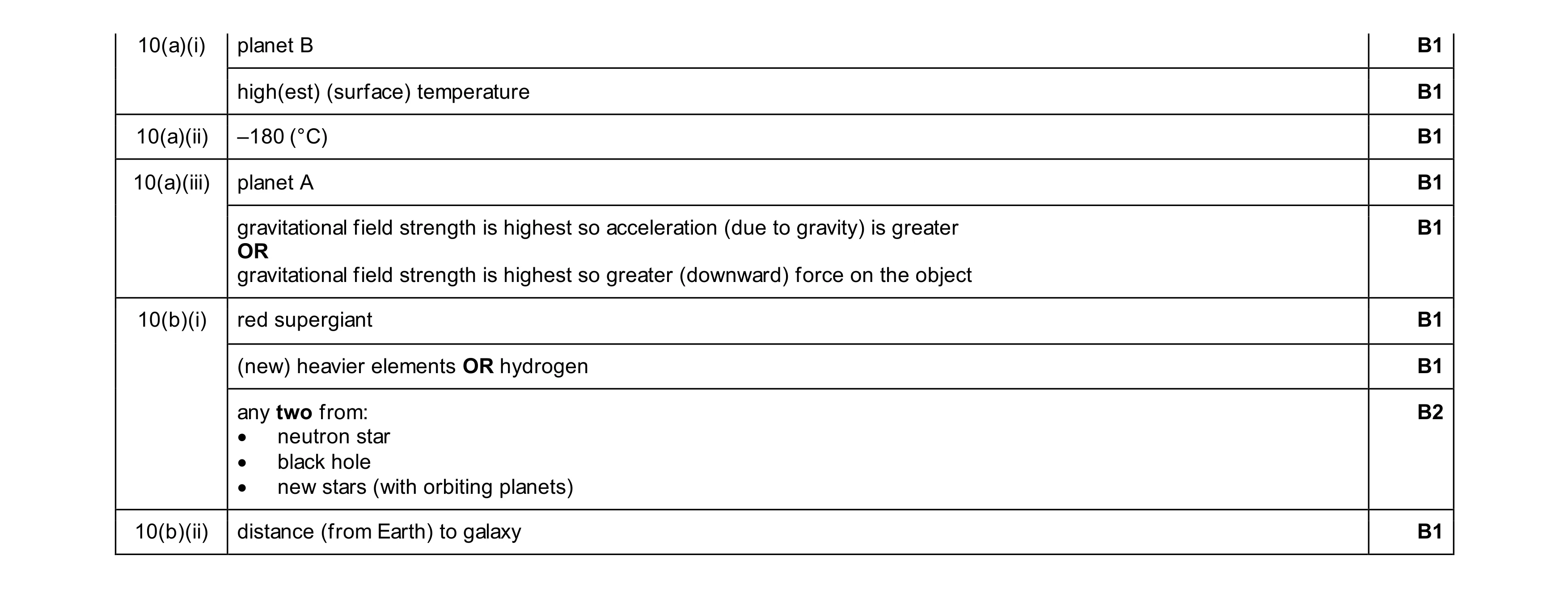 10
10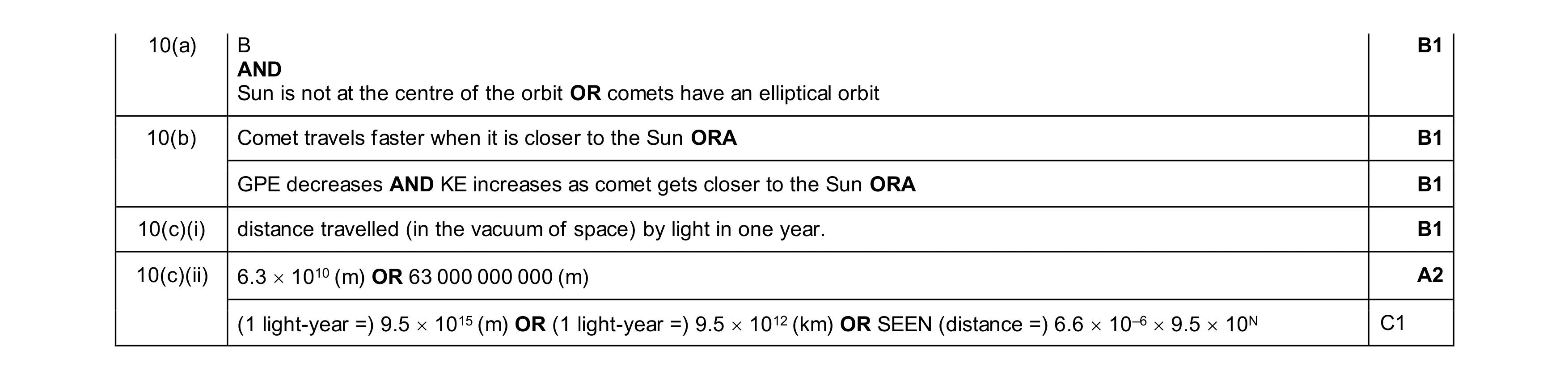 6
6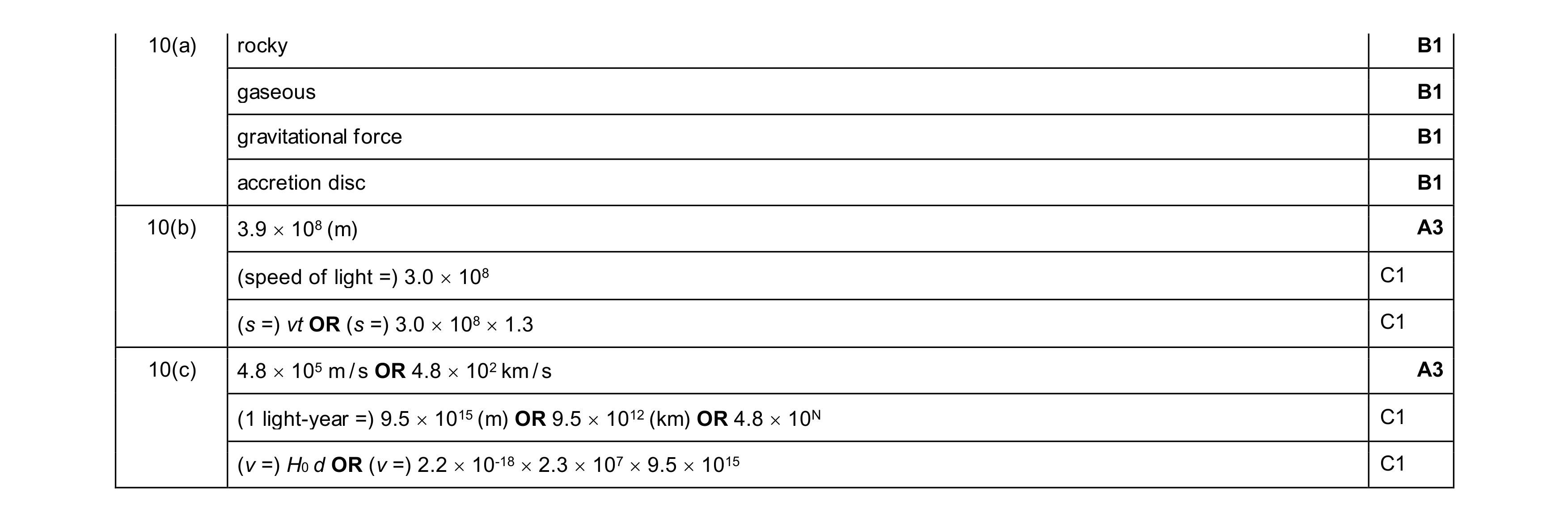 10
10