Questions as text
Q1 · A radioactive source emits radiation which can pass through a sheet of paper but not… 0652/11 Oct/Nov 2005
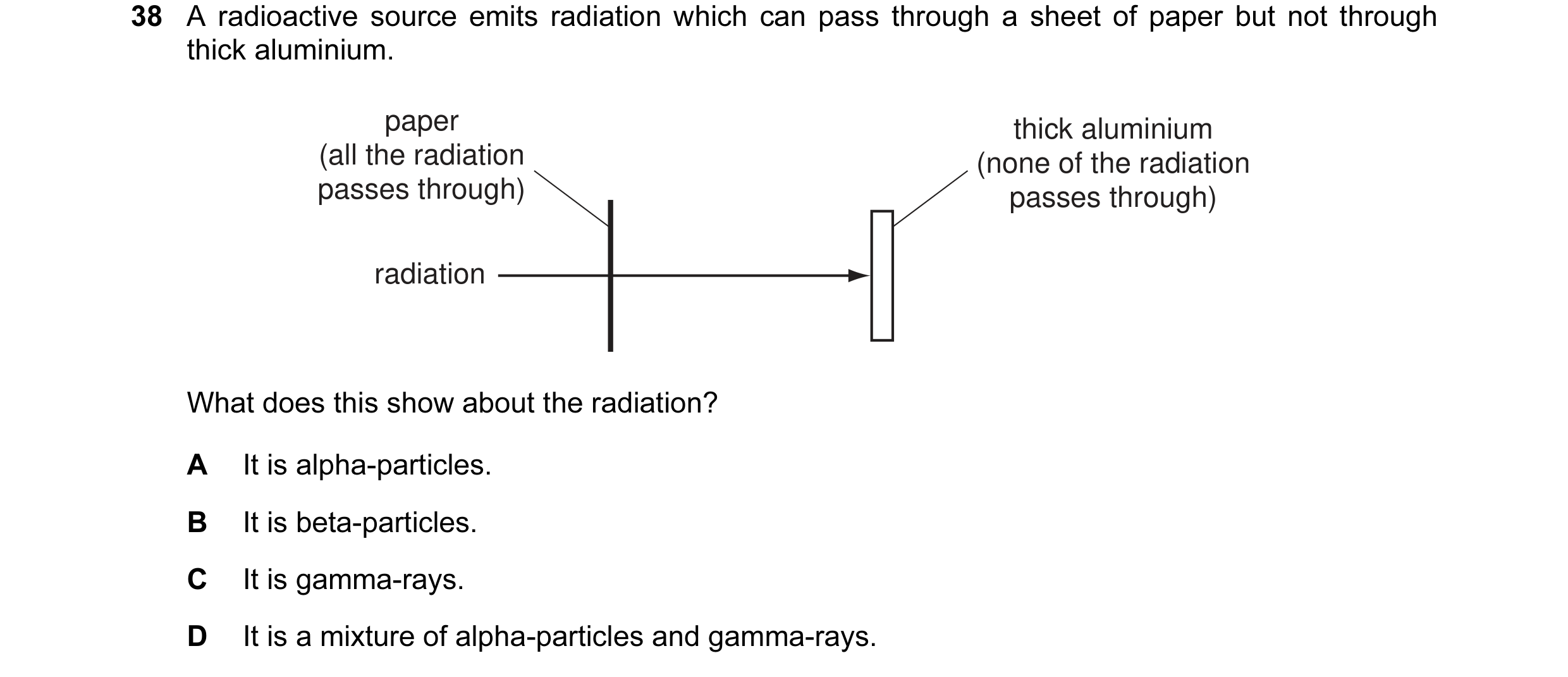
38 A radioactive source emits radiation which can pass through a sheet of paper but not through thick aluminium. paper thick aluminium (all the radiation (none of the radiation passes through) passes through) radiation What does this show about the radiation? A It is alpha-particles. B It is beta-particles. C It is gamma-rays. D It is a mixture of alpha-particles and gamma-rays.
1 marks
Answer: B
This question in 0652/11 Oct/Nov 2005
Q2 · An unstable nucleus has 145 neutrons and 92 protons 0652/11 Oct/Nov 2005
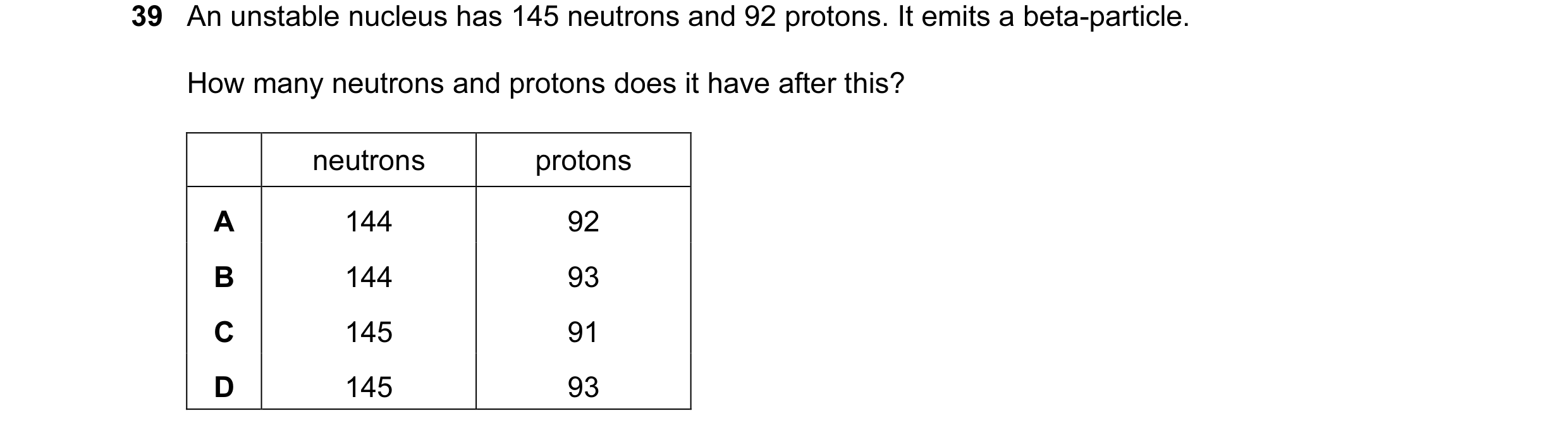
39 An unstable nucleus has 145 neutrons and 92 protons. It emits a beta-particle. How many neutrons and protons does it have after this? neutrons protons A 144 92 B 144 93 C 145 91 D 145 93
1 marks
Answer: B
This question in 0652/11 Oct/Nov 2005
Q3 · Which line in the table describes the nature of an alpha-particle and of a gamma-ray? 0652/11 Oct/Nov 2006
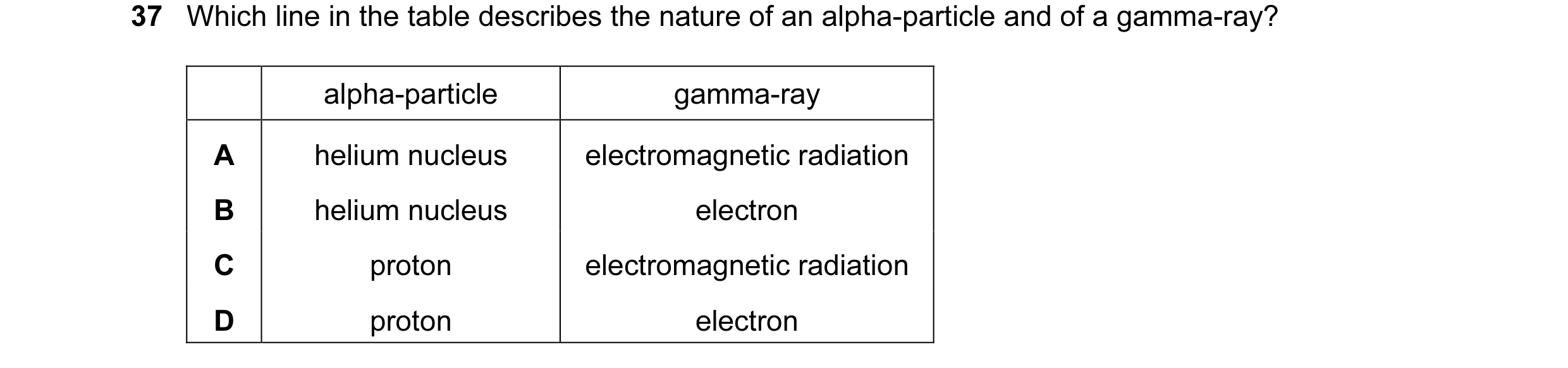
37 Which line in the table describes the nature of an alpha-particle and of a gamma-ray? alpha-particle gamma-ray A helium nucleus electromagnetic radiation B helium nucleus electron C proton electromagnetic radiation D proton electron
1 marks
Answer: A
This question in 0652/11 Oct/Nov 2006
Q4 · The count rates of four radioactive sources were measured at the same time on three… 0652/11 Oct/Nov 2006
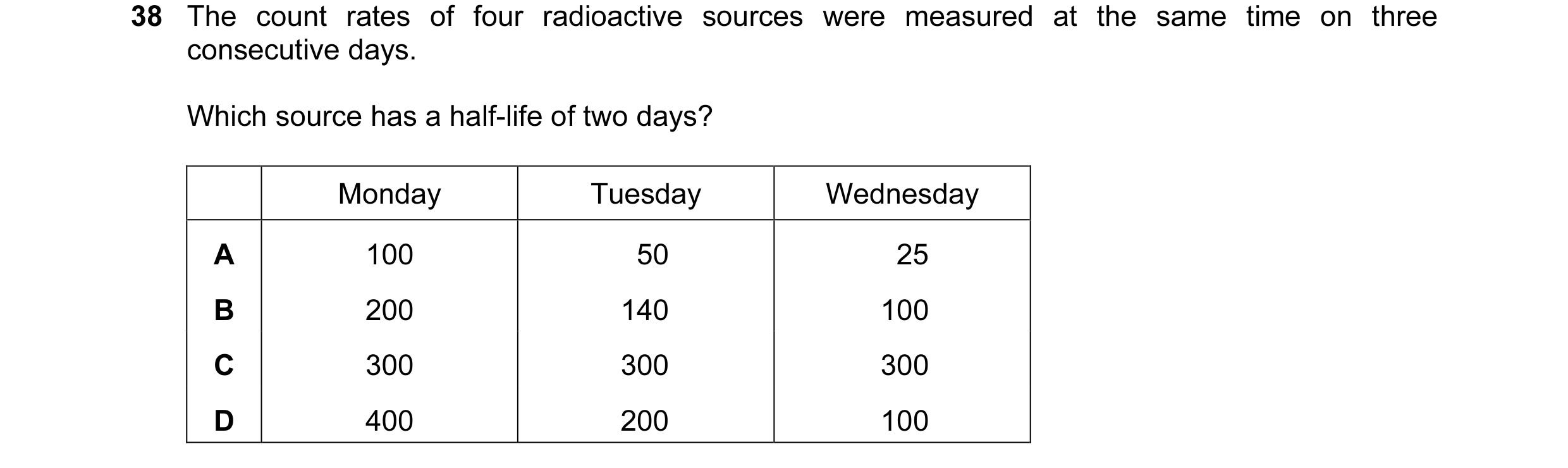
38 The count rates of four radioactive sources were measured at the same time on three consecutive days. Which source has a half-life of two days? Monday Tuesday Wednesday A 100 50 25 B 200 140 100 C 300 300 300 D 400 200 100
1 marks
Answer: B
This question in 0652/11 Oct/Nov 2006
Q5 · A sheet of paper is placed between a radioactive source and a detector 0652/11 Oct/Nov 2007
38 A sheet of paper is placed between a radioactive source and a detector. radioactive detector source sheet of paper Which types of radiation can pass through the paper? A alpha-particles and beta-particles only B alpha-particles and gamma-rays only C beta-particles and gamma-rays only D alpha-particles, beta-particles and gamma-rays
1 marks
Answer: C
This question in 0652/11 Oct/Nov 2007
Q6 · A sample of radioactive isotope is decaying 0652/11 Oct/Nov 2007
39 A sample of radioactive isotope is decaying. The nuclei of which atoms will decay first? A impossible to know, because radioactive decay is random B impossible to know, unless the age of the material is known C atoms near the centre, because they are surrounded by more atoms D atoms near the surface, because the radiation can escape more easily
1 marks
Answer: A
This question in 0652/11 Oct/Nov 2007
Q7 · Which material is commonly used as a lining for a box for storing radioactive samples? 0652/11 Oct/Nov 2008
38 Which material is commonly used as a lining for a box for storing radioactive samples? A aluminium B copper C lead D uranium
1 marks
Answer: C
This question in 0652/11 Oct/Nov 2008
Q8 · The diagram shows an experiment to monitor the radiation from a radioactive gas 0652/11 Oct/Nov 2008
39 The diagram shows an experiment to monitor the radiation from a radioactive gas. The counter readings are corrected for background radiation. counter 000.0 radioactive gas The table shows how the counter reading varies with time. time / seconds 0 20 40 60 80 100 120 140 160 180 counter reading / 140 105 82 61 44 36 27 20 15 10 counts per minute What is the half-life of the gas? A between 20 and 40 seconds B between 40 and 60 seconds C between 60 and 140 seconds D between 140 and 180 seconds
1 marks
Answer: B
This question in 0652/11 Oct/Nov 2008
Q9 · A uranium nuclide 238 U emits an α-particle 0652/11 Oct/Nov 2008
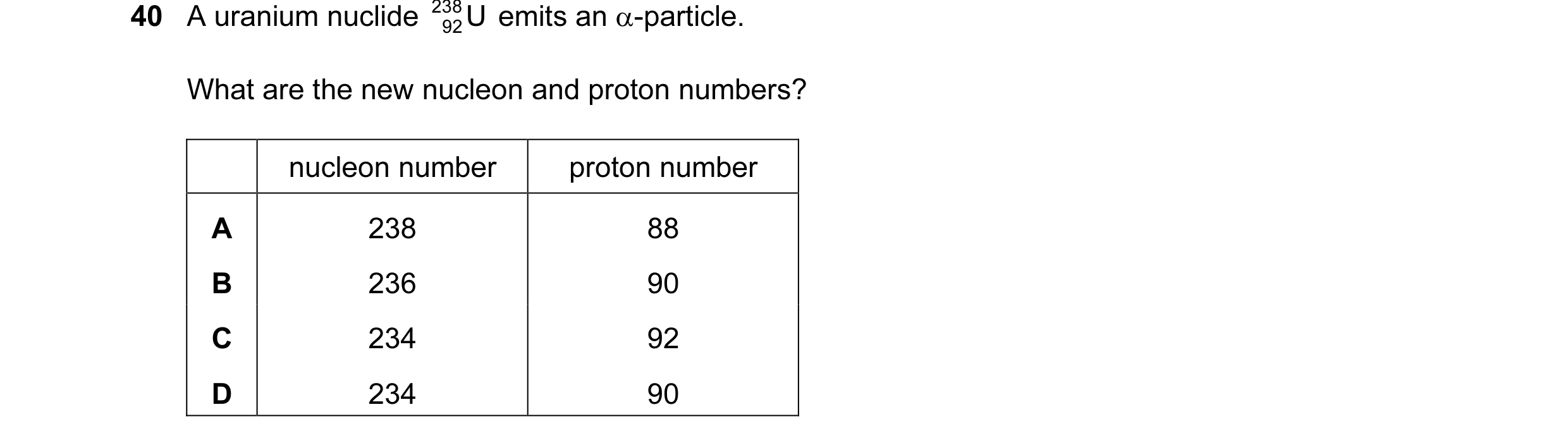
40 A uranium nuclide 238 U emits an α-particle. 92 What are the new nucleon and proton numbers? nucleon number proton number A 238 88 B 236 90 C 234 92 D 234 90
1 marks
Answer: D
This question in 0652/11 Oct/Nov 2008
Q10 · Which statement explains the meaning of the half-life of a radioactive substance? 0652/11 Oct/Nov 2009
38 Which statement explains the meaning of the half-life of a radioactive substance? A half the time taken for half the substance to decay B half the time taken for the substance to decay completely C the time taken for half the substance to decay D the time taken for the substance to decay completely
1 marks
Answer: C
This question in 0652/11 Oct/Nov 2009
Q11 · The diagram shows the paths of three different types of radiation, X, Y and Z 0652/11 Oct/Nov 2009
39 The diagram shows the paths of three different types of radiation, X, Y and Z. X Y Z 2 mm of 10 mm lead plastic of aluminium Which row in the table correctly identifies X, Y and Z? X Y Z A alpha-particles beta-particles gamma-rays B beta-particles alpha-particles gamma-rays C beta-particles gamma-rays alpha-particles D gamma-rays alpha-particles beta-particles
1 marks
Answer: B
This question in 0652/11 Oct/Nov 2009
Q12 · The half-life of the radioactive isotope caesium 137 Cs is 30 years 0652/11 Oct/Nov 2010
39 The half-life of the radioactive isotope caesium 137 Cs is 30 years. 55 Starting with 30 grams of the isotope, what mass of the isotope remains after 90 years? A 10.0 grams B 7.50 grams C 3.75 grams D 1.25 grams
1 marks
Answer: C
This question in 0652/11 Oct/Nov 2010
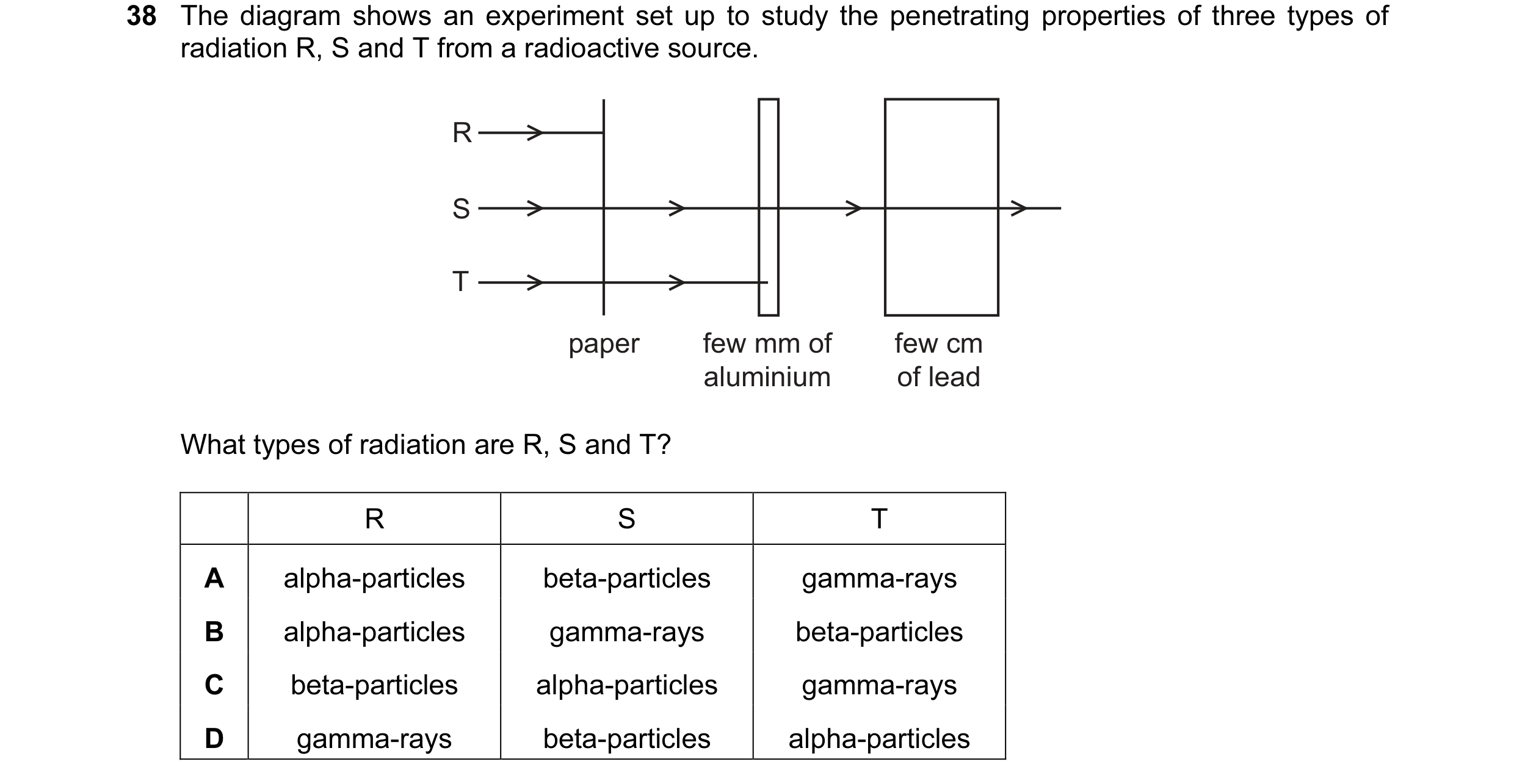
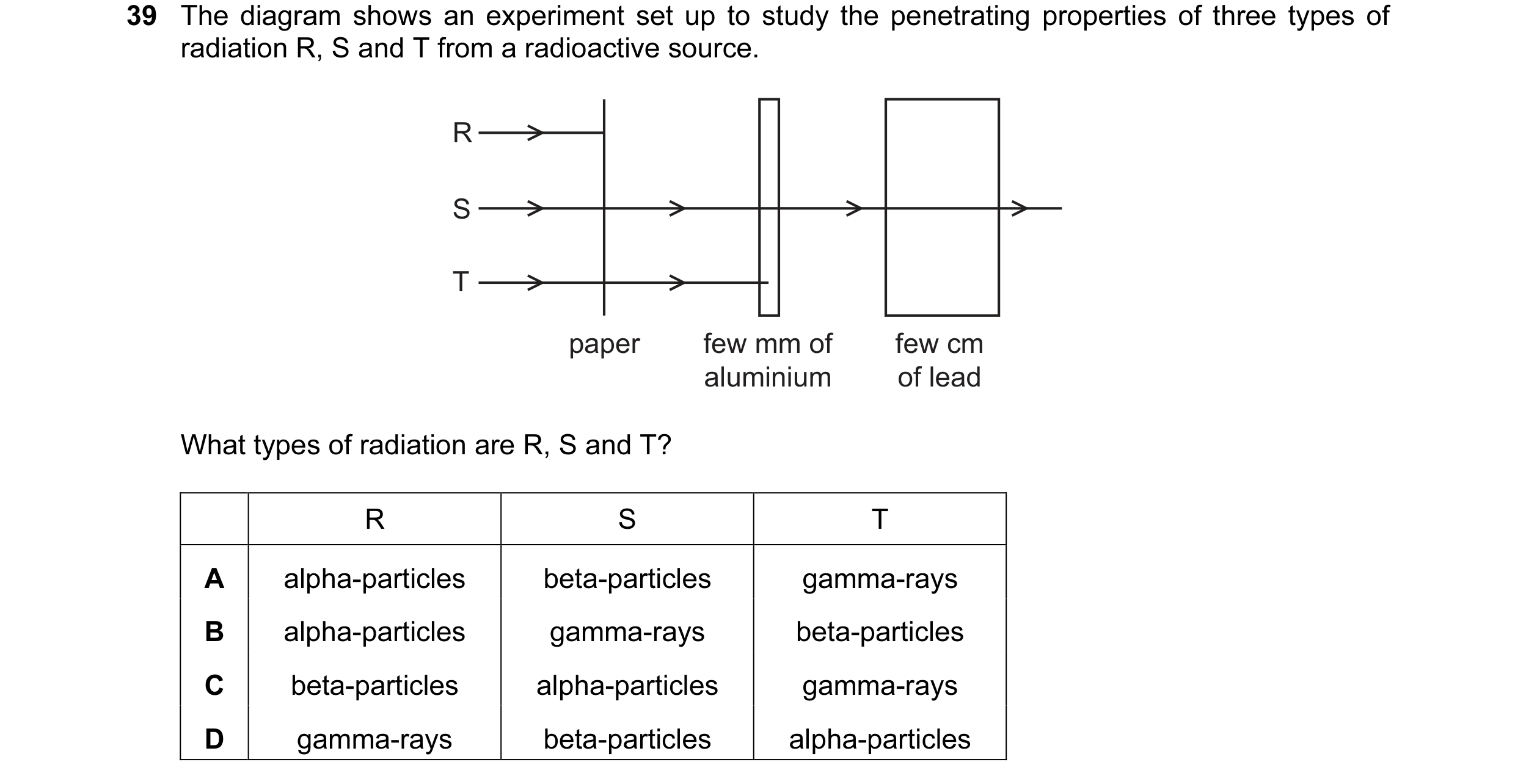
Q13 · The diagram shows an experiment set up to study the penetrating properties of three types… 0652/11 Oct/Nov 2011
38 The diagram shows an experiment set up to study the penetrating properties of three types of radiation R, S and T from a radioactive source. R S T paper few mm of few cm aluminium of lead What types of radiation are R, S and T? R S T A alpha-particles beta-particles gamma-rays B alpha-particles gamma-rays beta-particles C beta-particles alpha-particles gamma-rays D gamma-rays beta-particles alpha-particles
1 marks
Answer: B
This question in 0652/11 Oct/Nov 2011
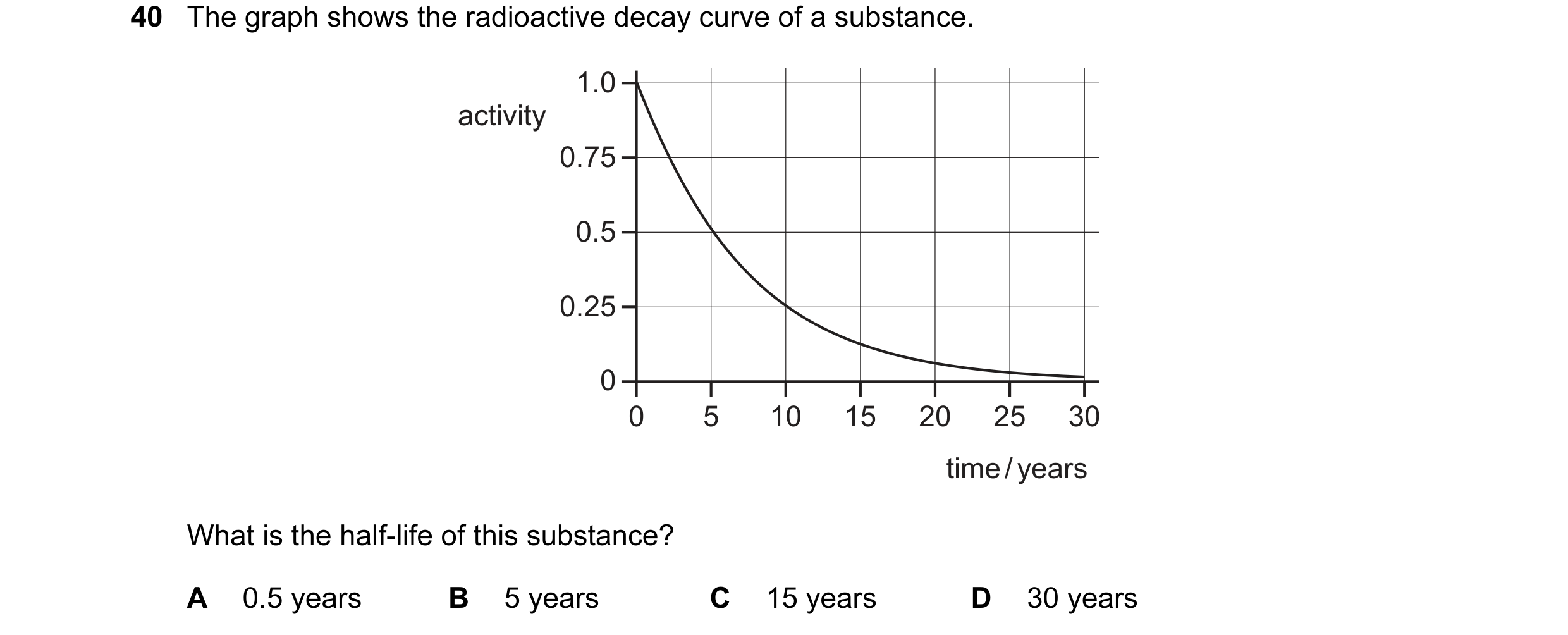
Q14 · The graph shows the radioactive decay curve of a substance 0652/11 Oct/Nov 2011
39 The graph shows the radioactive decay curve of a substance. 1.0 activity 0.75 0.5 0.25 0 0 5 10 15 20 25 30 time / years What is the half-life of this substance? A 0.5 years B 5 years C 15 years D 30 years
1 marks
Answer: B
This question in 0652/11 Oct/Nov 2011
Q15 · The diagram shows an experiment set up to study the penetrating properties of three types… 0652/12 Oct/Nov 2011
39 The diagram shows an experiment set up to study the penetrating properties of three types of radiation R, S and T from a radioactive source. R S T paper few mm of few cm aluminium of lead What types of radiation are R, S and T? R S T A alpha-particles beta-particles gamma-rays B alpha-particles gamma-rays beta-particles C beta-particles alpha-particles gamma-rays D gamma-rays beta-particles alpha-particles
1 marks
Answer: B
This question in 0652/12 Oct/Nov 2011
Q16 · The graph shows the radioactive decay curve of a substance 0652/12 Oct/Nov 2011
40 The graph shows the radioactive decay curve of a substance. 1.0 activity 0.75 0.5 0.25 0 0 5 10 15 20 25 30 time / years What is the half-life of this substance? A 0.5 years B 5 years C 15 years D 30 years
1 marks
Answer: B
This question in 0652/12 Oct/Nov 2011
Q17 · A radioactive nucleus emits a beta-particle 0652/11 Oct/Nov 2013
39 A radioactive nucleus emits a beta-particle. What happens to the nucleus? A Its nucleon number decreases. B Its nucleon number stays the same. C Its proton number decreases. D Its proton number stays the same.
1 marks
Answer: B
This question in 0652/11 Oct/Nov 2013
Q18 · A radioactive nucleus emits a beta-particle 0652/12 Oct/Nov 2013
39 A radioactive nucleus emits a beta-particle. What happens to the nucleus? A Its nucleon number decreases. B Its nucleon number stays the same. C Its proton number decreases. D Its proton number stays the same.
1 marks
Answer: B
This question in 0652/12 Oct/Nov 2013
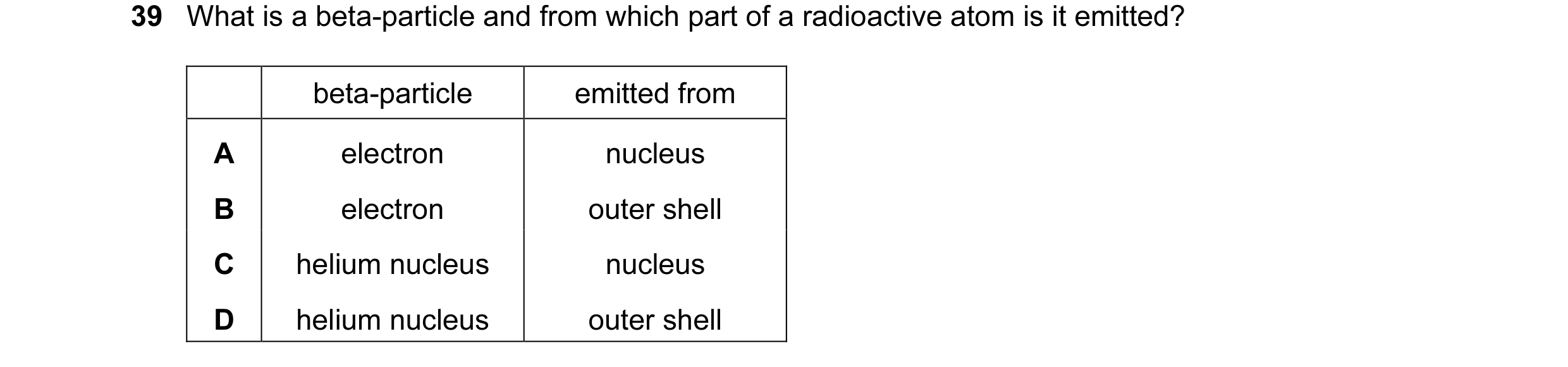
Q19 · What is a beta-particle and from which part of a radioactive atom is it emitted? 0652/11 Oct/Nov 2014
39 What is a beta-particle and from which part of a radioactive atom is it emitted? beta-particle emitted from A electron nucleus B electron outer shell C helium nucleus nucleus D helium nucleus outer shell
1 marks
Answer: A
This question in 0652/11 Oct/Nov 2014
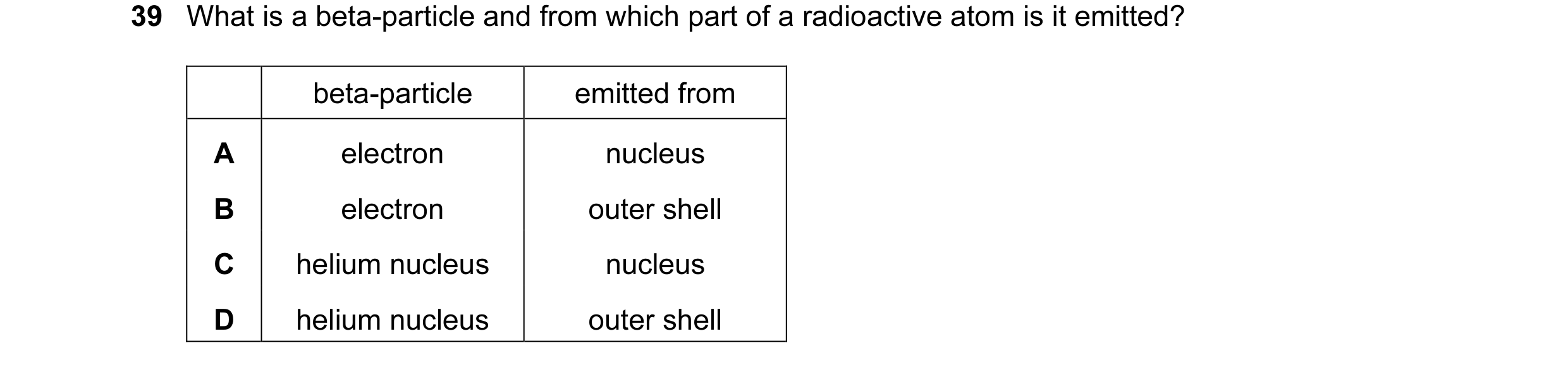
Q20 · What is a beta-particle and from which part of a radioactive atom is it emitted? 0652/12 Oct/Nov 2014
39 What is a beta-particle and from which part of a radioactive atom is it emitted? beta-particle emitted from A electron nucleus B electron outer shell C helium nucleus nucleus D helium nucleus outer shell
1 marks
Answer: A
This question in 0652/12 Oct/Nov 2014
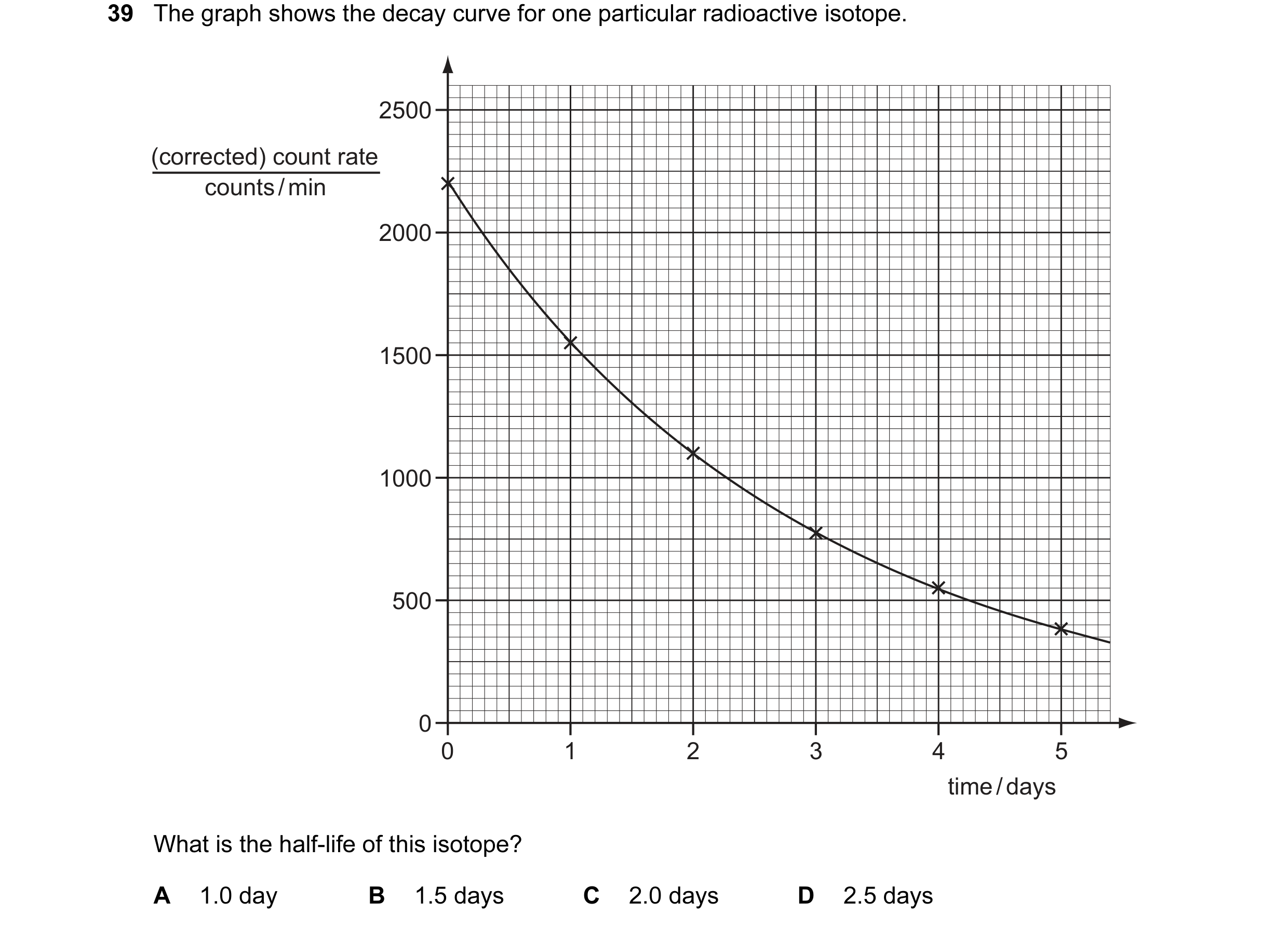
Q21 · The graph shows the decay curve for one particular radioactive isotope 0652/11 Oct/Nov 2015
39 The graph shows the decay curve for one particular radioactive isotope. 2500 (corrected) count rate counts / min 2000 1500 1000 500 0 0 1 2 3 4 5 time / days What is the half-life of this isotope? A 1.0 day B 1.5 days C 2.0 days D 2.5 days
1 marks
Answer: C
This question in 0652/11 Oct/Nov 2015
Q22 · The graph shows the decay curve for one particular radioactive isotope 0652/12 Oct/Nov 2015
39 The graph shows the decay curve for one particular radioactive isotope. 2500 (corrected) count rate counts / min 2000 1500 1000 500 0 0 1 2 3 4 5 time / days What is the half-life of this isotope? A 1.0 day B 1.5 days C 2.0 days D 2.5 days
1 marks
Answer: C
This question in 0652/12 Oct/Nov 2015
Q23 · Radiation from a radioactive source passes through thick paper into a magnetic field 0652/11 Oct/Nov 2016
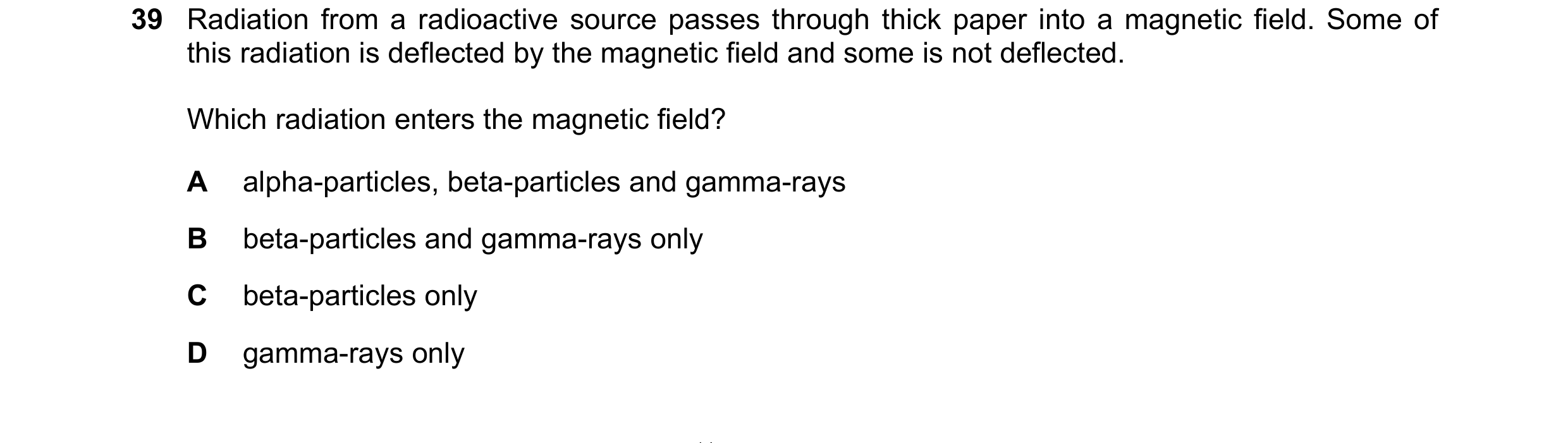
39 Radiation from a radioactive source passes through thick paper into a magnetic field. Some of this radiation is deflected by the magnetic field and some is not deflected. Which radiation enters the magnetic field? A alpha-particles, beta-particles and gamma-rays B beta-particles and gamma-rays only C beta-particles only D gamma-rays only
1 marks
Answer: B
This question in 0652/11 Oct/Nov 2016
Q24 · Radiation from a radioactive source passes through thick paper into a magnetic field 0652/12 Oct/Nov 2016
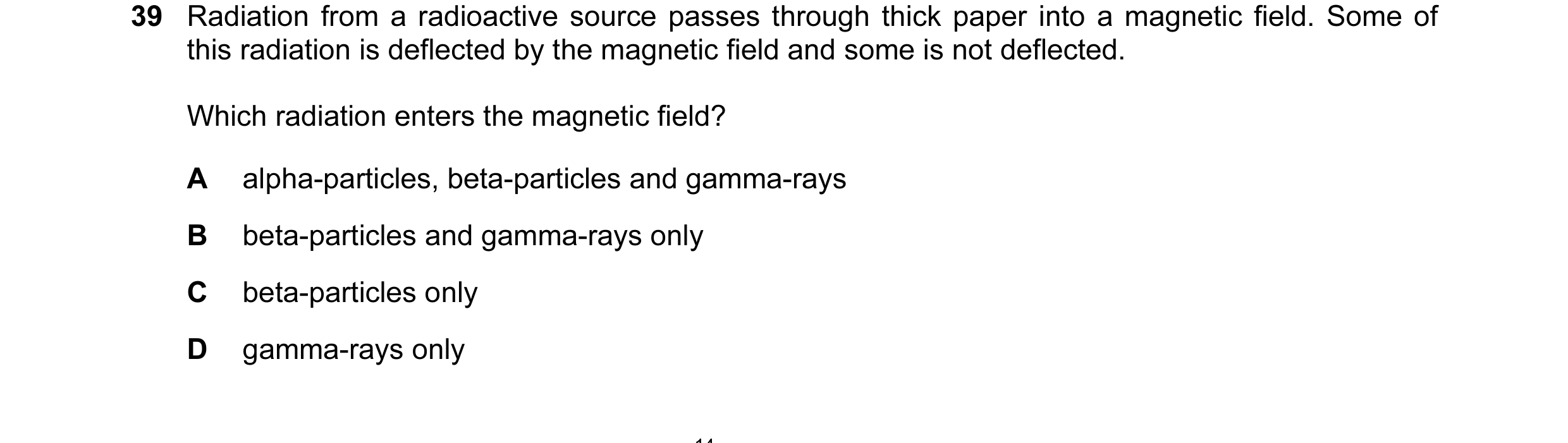
39 Radiation from a radioactive source passes through thick paper into a magnetic field. Some of this radiation is deflected by the magnetic field and some is not deflected. Which radiation enters the magnetic field? A alpha-particles, beta-particles and gamma-rays B beta-particles and gamma-rays only C beta-particles only D gamma-rays only
1 marks
Answer: B
This question in 0652/12 Oct/Nov 2016
Q25 · A power station uses nuclear fission to obtain energy 0652/11 Oct/Nov 2017
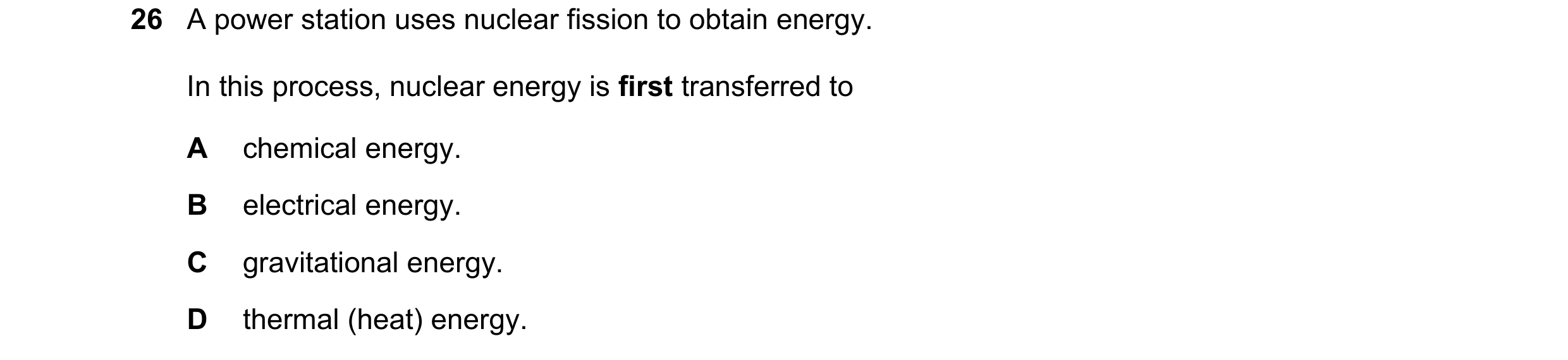
26 A power station uses nuclear fission to obtain energy. In this process, nuclear energy is first transferred to A chemical energy. B electrical energy. C gravitational energy. D thermal (heat) energy.
1 marks
Answer: D
This question in 0652/11 Oct/Nov 2017
Q26 · The emissions from a radioactive source pass through a sheet of lead, 10 mm thick 0652/11 Oct/Nov 2017
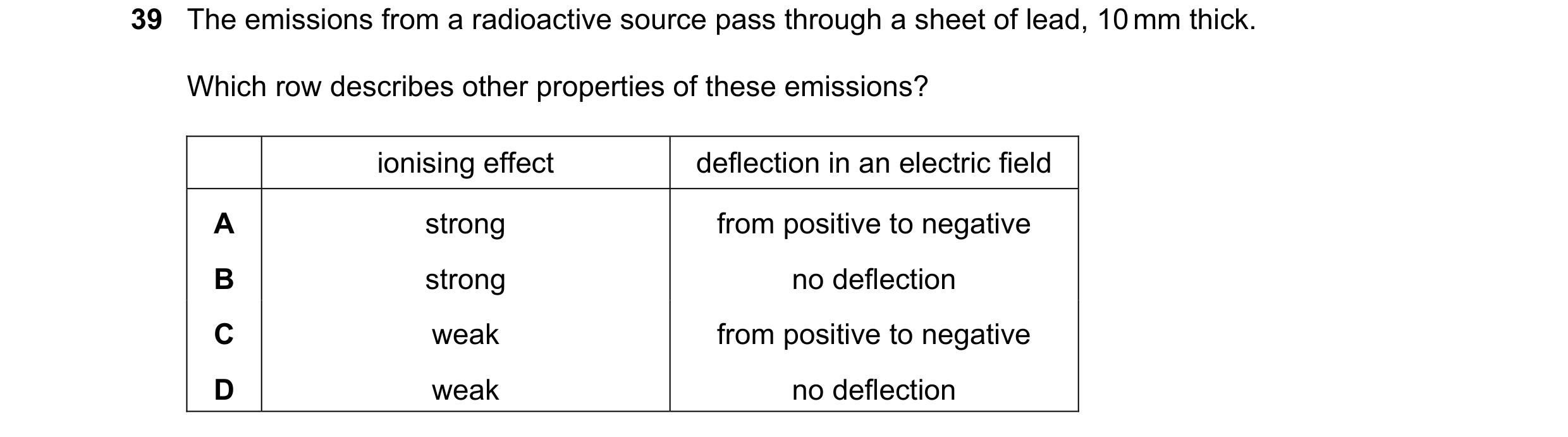
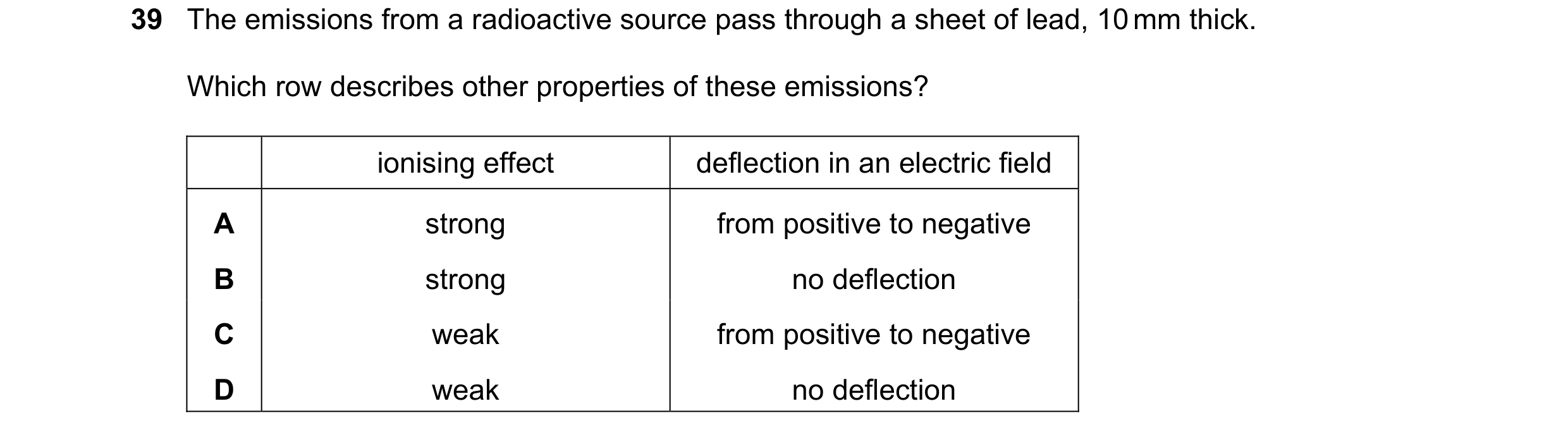
39 The emissions from a radioactive source pass through a sheet of lead, 10 mm thick. Which row describes other properties of these emissions? ionising effect deflection in an electric field A strong from positive to negative B strong no deflection C weak from positive to negative D weak no deflection
1 marks
Answer: D
This question in 0652/11 Oct/Nov 2017
Q27 · A power station uses nuclear fission to obtain energy 0652/12 Oct/Nov 2017
26 A power station uses nuclear fission to obtain energy. In this process, nuclear energy is first transferred to A chemical energy. B electrical energy. C gravitational energy. D thermal (heat) energy.
1 marks
Answer: D
This question in 0652/12 Oct/Nov 2017
Q28 · The emissions from a radioactive source pass through a sheet of lead, 10 mm thick 0652/12 Oct/Nov 2017
39 The emissions from a radioactive source pass through a sheet of lead, 10 mm thick. Which row describes other properties of these emissions? ionising effect deflection in an electric field A strong from positive to negative B strong no deflection C weak from positive to negative D weak no deflection
1 marks
Answer: D
This question in 0652/12 Oct/Nov 2017
Q29 · A chemical process causes energy to be released 0652/11 Oct/Nov 2018
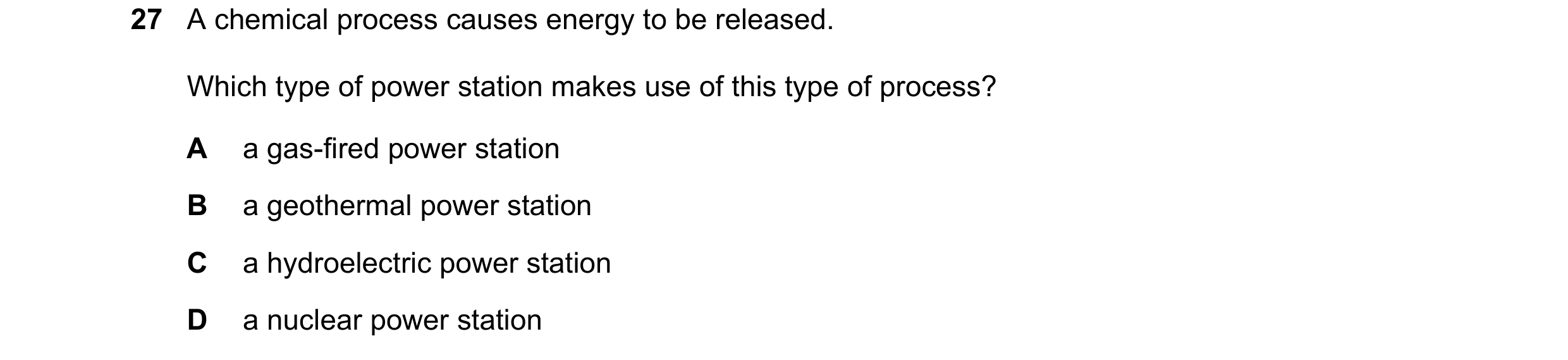
27 A chemical process causes energy to be released. Which type of power station makes use of this type of process? A a gas-fired power station B a geothermal power station C a hydroelectric power station D a nuclear power station
1 marks
Answer: A
This question in 0652/11 Oct/Nov 2018
Q30 · A radioactive source is placed very close to a detector that is connected to a counter 0652/11 Oct/Nov 2018
39 A radioactive source is placed very close to a detector that is connected to a counter. counter detector 350 source The reading on the counter shows how much radiation is reaching the detector. The table shows the original reading and the readings when the radiation is travelling perpendicular to an electric field or a magnetic field. reading with reading with a original reading an electric field magnetic field detector reading 350 350 350 / counts per minute Which types of radiation are emitted by the source? A alpha-particles and beta-particles B alpha-particles only C beta-particles only D gamma-rays only
1 marks
Answer: D
This question in 0652/11 Oct/Nov 2018
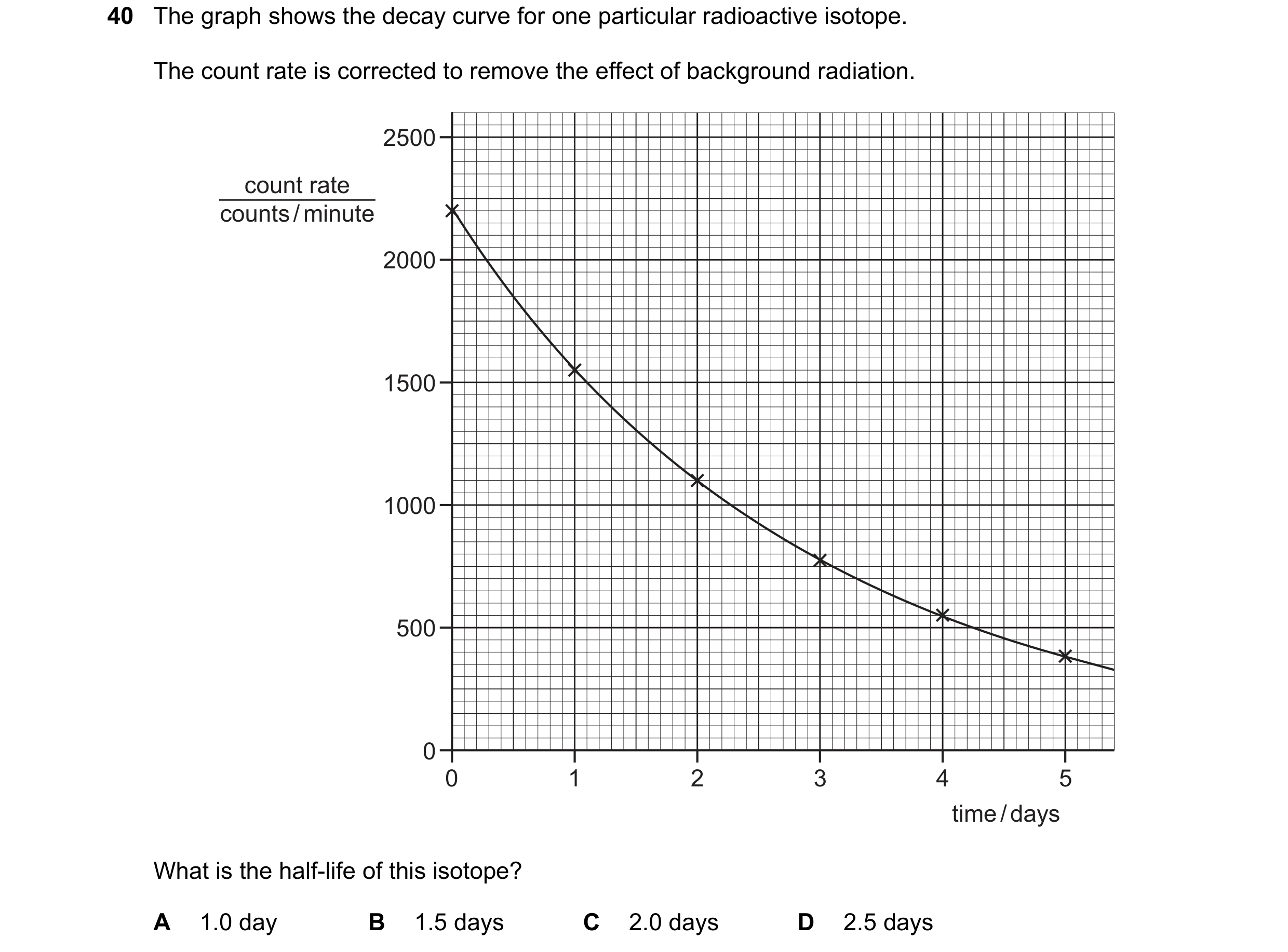
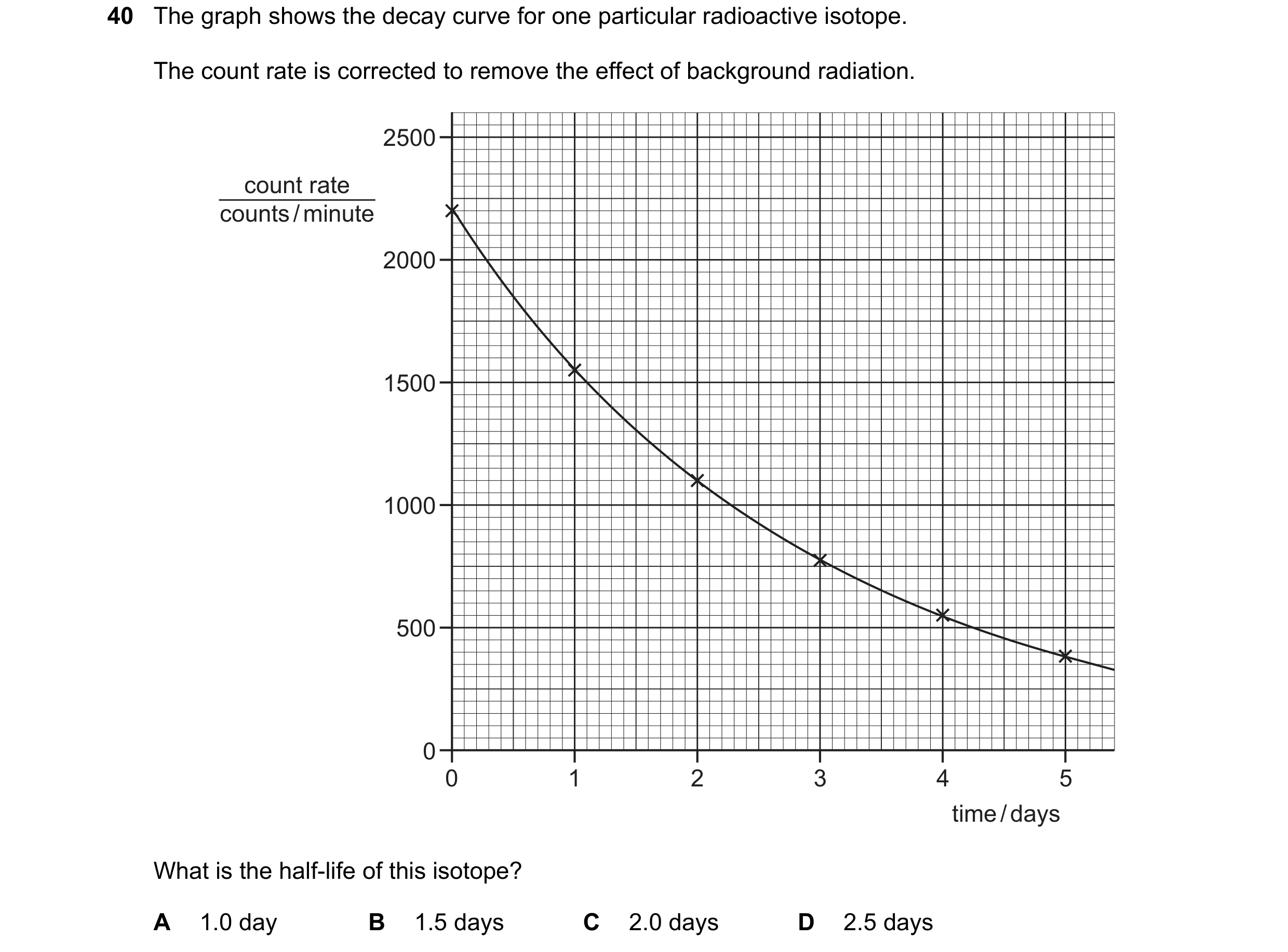
Q31 · The graph shows the decay curve for one particular radioactive isotope 0652/11 Oct/Nov 2018
40 The graph shows the decay curve for one particular radioactive isotope. The count rate is corrected to remove the effect of background radiation. 2500 count rate counts / minute 2000 1500 1000 500 0 0 1 2 3 4 5 time / days What is the half-life of this isotope? A 1.0 day B 1.5 days C 2.0 days D 2.5 days
1 marks
Answer: C
This question in 0652/11 Oct/Nov 2018
Q32 · A radioactive source is placed very close to a detector that is connected to a counter 0652/12 Oct/Nov 2018
39 A radioactive source is placed very close to a detector that is connected to a counter. counter detector 350 source The reading on the counter shows how much radiation is reaching the detector. The table shows the original reading and the readings when the radiation is travelling perpendicular to an electric field or a magnetic field. reading with reading with a original reading an electric field magnetic field detector reading 350 350 350 / counts per minute Which types of radiation are emitted by the source? A alpha-particles and beta-particles B alpha-particles only C beta-particles only D gamma-rays only
1 marks
Answer: D
This question in 0652/12 Oct/Nov 2018
Q33 · The graph shows the decay curve for one particular radioactive isotope 0652/12 Oct/Nov 2018
40 The graph shows the decay curve for one particular radioactive isotope. The count rate is corrected to remove the effect of background radiation. 2500 count rate counts / minute 2000 1500 1000 500 0 0 1 2 3 4 5 time / days What is the half-life of this isotope? A 1.0 day B 1.5 days C 2.0 days D 2.5 days
1 marks
Answer: C
This question in 0652/12 Oct/Nov 2018
Q34 · A sample initially contains 2400 atoms of a radioactive isotope 0652/11 Oct/Nov 2019
40 A sample initially contains 2400 atoms of a radioactive isotope. After 96 hours, 300 of the radioactive isotope atoms remain. What is the half-life of the isotope? A 24 hours B 32 hours C 48 hours D 96 hours
1 marks
Answer: B
This question in 0652/11 Oct/Nov 2019
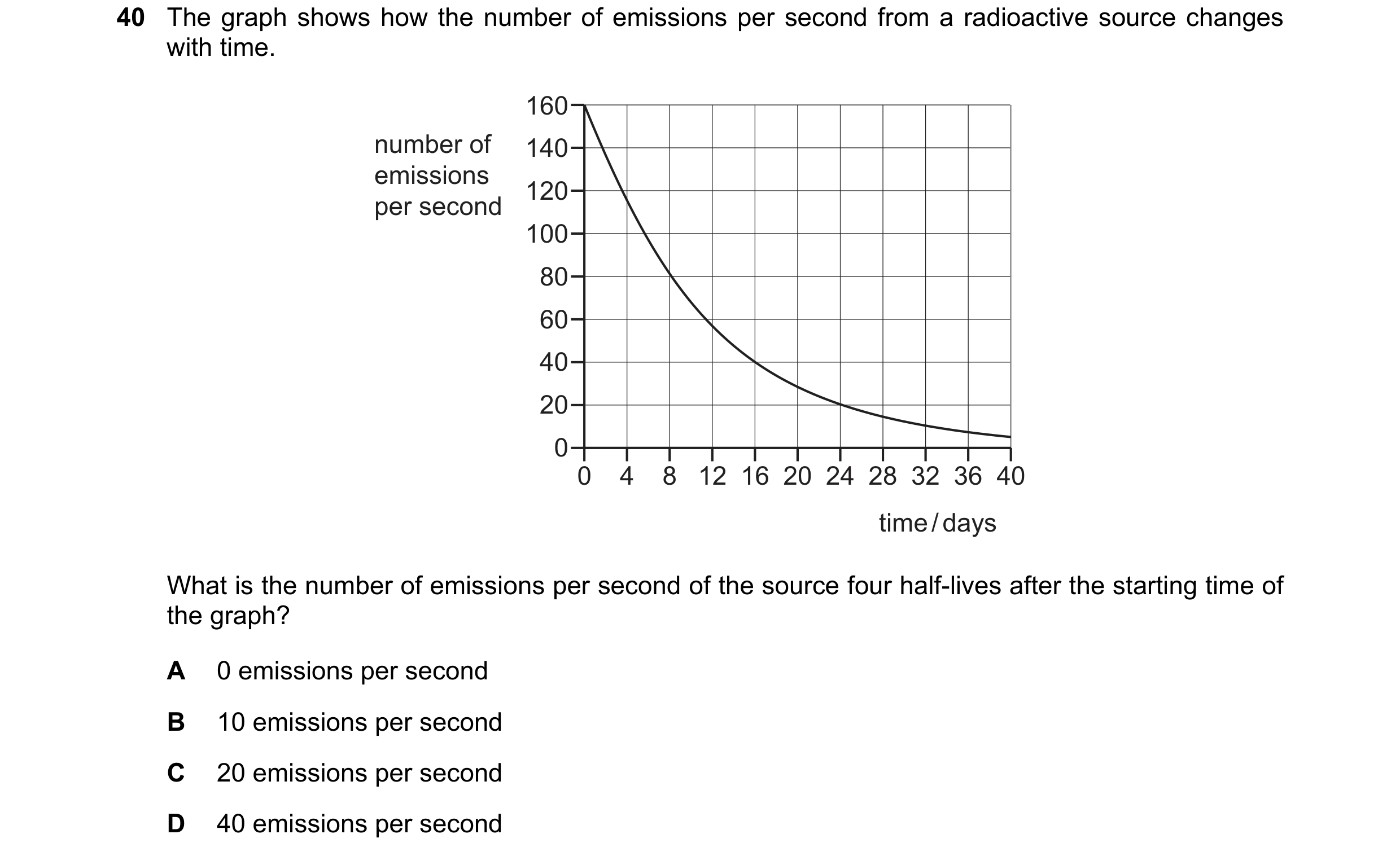
Q35 · The graph shows how the number of emissions per second from a radioactive source changes… 0652/12 Oct/Nov 2019
40 The graph shows how the number of emissions per second from a radioactive source changes with time. 160 number of 140 emissions 120 per second 100 80 60 40 20 0 0 4 8 12 16 20 24 28 32 36 40 time / days What is the number of emissions per second of the source four half-lives after the starting time of the graph? A 0 emissions per second B 10 emissions per second C 20 emissions per second D 40 emissions per second
1 marks
Answer: B
This question in 0652/12 Oct/Nov 2019
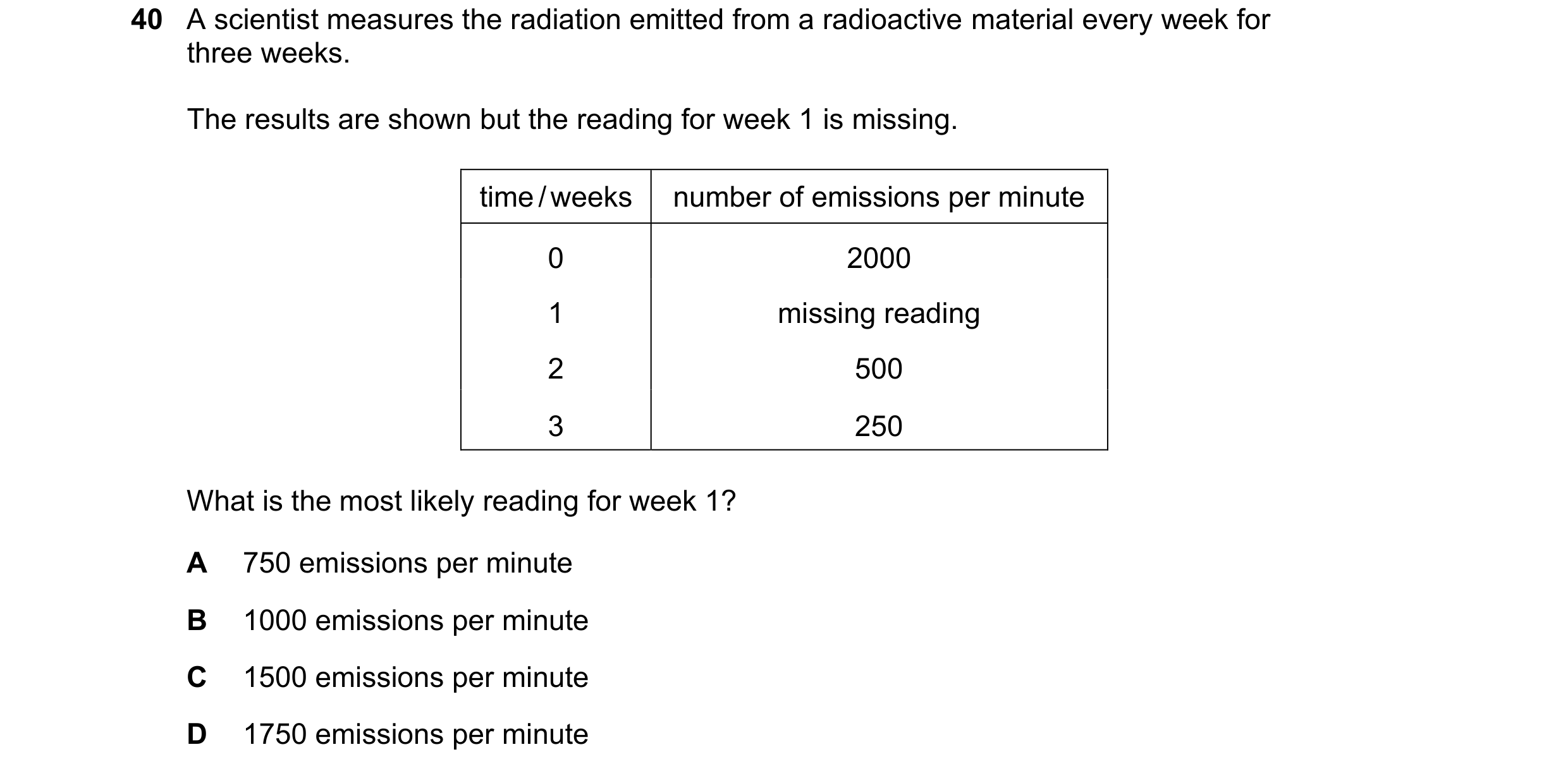
Q36 · A scientist measures the radiation emitted from a radioactive material every week for… 0652/11 Oct/Nov 2020
40 A scientist measures the radiation emitted from a radioactive material every week for three weeks. The results are shown but the reading for week 1 is missing. time / weeks number of emissions per minute 0 2000 1 missing reading 2 500 3 250 What is the most likely reading for week 1? A 750 emissions per minute B 1000 emissions per minute C 1500 emissions per minute D 1750 emissions per minute
1 marks
Answer: B
This question in 0652/11 Oct/Nov 2020
Q37 · The emissions from a radioactive source are stopped by a thin sheet of paper 0652/11 Oct/Nov 2021
39 The emissions from a radioactive source are stopped by a thin sheet of paper. Which type of radiation is emitted from the source and what is the charge of the radiation? type of radiation charge of radiation A negative B positive C negative D positive
1 marks
Answer: B
This question in 0652/11 Oct/Nov 2021
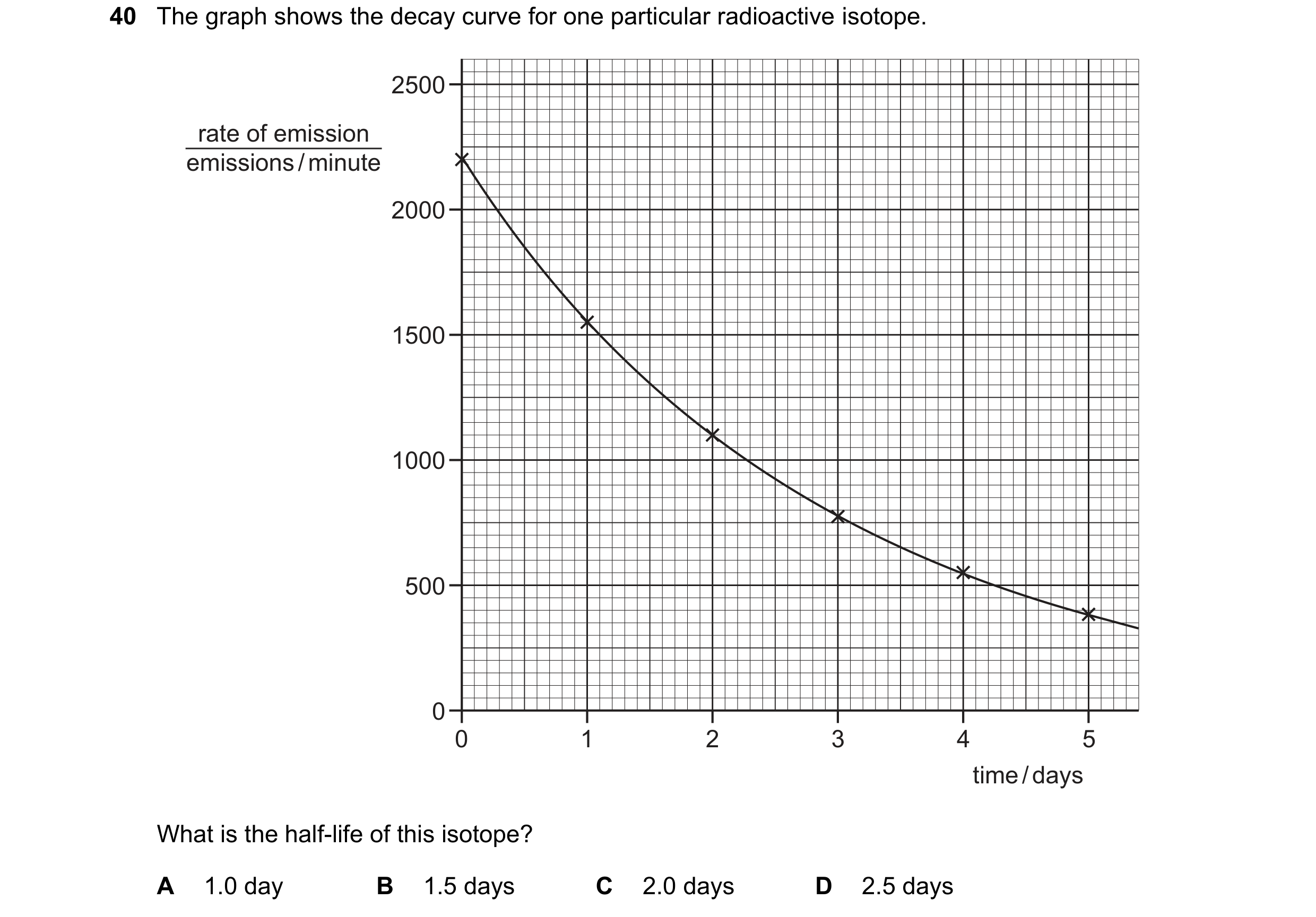
Q38 · The graph shows the decay curve for one particular radioactive isotope 0652/11 Oct/Nov 2021
40 The graph shows the decay curve for one particular radioactive isotope. 2500 rate of emission emissions / minute 2000 1500 1000 500 0 0 1 2 3 4 5 time / days What is the half-life of this isotope? A 1.0 day B 1.5 days C 2.0 days D 2.5 days
1 marks
Answer: C
This question in 0652/11 Oct/Nov 2021
Q39 · What is an alpha-particle? 0652/11 Oct/Nov 2022
39 What is an alpha-particle? A an electron B electromagnetic radiation C four protons D two protons and two neutrons
1 marks
Answer: D
This question in 0652/11 Oct/Nov 2022
Q40 · A sample of an isotope of bromine contains 9.6 × 1024 atoms 0652/11 Oct/Nov 2022
40 A sample of an isotope of bromine contains 9.6 × 1024 atoms. The half-life of this isotope is 2.4 hours. How many atoms of the isotope are present in the sample after 7.2 hours? A 1.2 × 10³ B 3.2 × 10⁸ C 1.2 × 1024 D 3.2 × 1024
1 marks
Answer: C
This question in 0652/11 Oct/Nov 2022
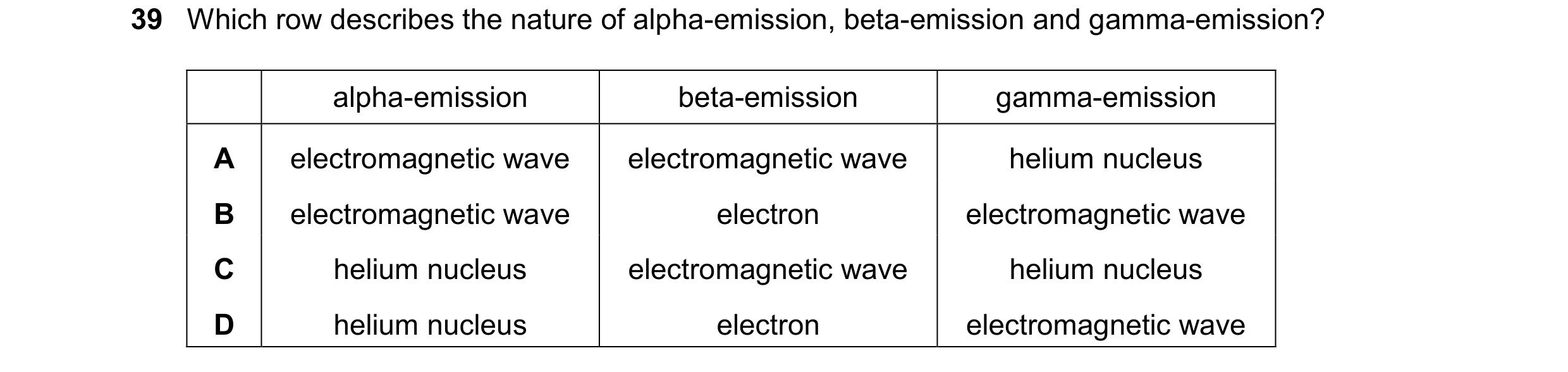
Q41 · Which row describes the nature of alpha-emission, beta-emission and gamma-emission? 0652/11 Oct/Nov 2023
39 Which row describes the nature of alpha-emission, beta-emission and gamma-emission? alpha-emission beta-emission gamma-emission A electromagnetic wave electromagnetic wave helium nucleus B electromagnetic wave electron electromagnetic wave C helium nucleus electromagnetic wave helium nucleus D helium nucleus electron electromagnetic wave
1 marks
Answer: D
This question in 0652/11 Oct/Nov 2023
Q42 · A sample contains 240 mg of a radioactive isotope 0652/11 Oct/Nov 2023
40 A sample contains 240 mg of a radioactive isotope. Which mass of the isotope remains when three half-lives have passed? A 30 mg B 40 mg C 60 mg D 80 mg
1 marks
Answer: A
This question in 0652/11 Oct/Nov 2023
Q43 · Which row describes the nature of alpha-emission, beta-emission and gamma-emission? 0652/12 Oct/Nov 2023
39 Which row describes the nature of alpha-emission, beta-emission and gamma-emission? alpha-emission beta-emission gamma-emission A electromagnetic wave electromagnetic wave helium nucleus B electromagnetic wave electron electromagnetic wave C helium nucleus electromagnetic wave helium nucleus D helium nucleus electron electromagnetic wave
1 marks
Answer: D
This question in 0652/12 Oct/Nov 2023
Q44 · A sample contains 240 mg of a radioactive isotope 0652/12 Oct/Nov 2023
40 A sample contains 240 mg of a radioactive isotope. Which mass of the isotope remains when three half-lives have passed? A 30 mg B 40 mg C 60 mg D 80 mg
1 marks
Answer: A
This question in 0652/12 Oct/Nov 2023
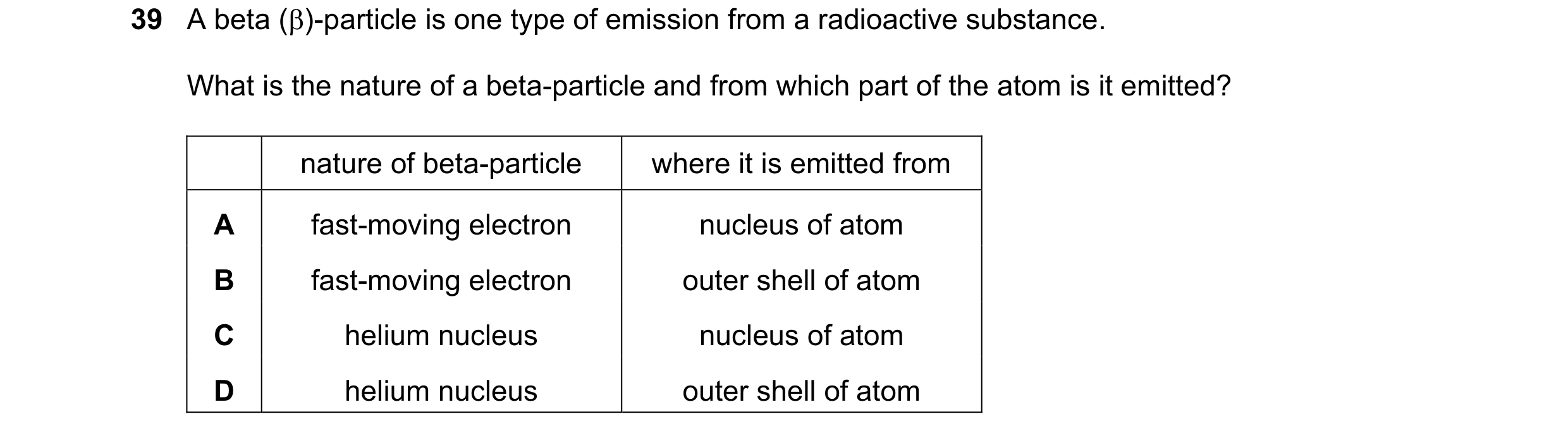
Q45 · A beta ()-particle is one type of emission from a radioactive substance 0652/11 Oct/Nov 2024
39 A beta ()-particle is one type of emission from a radioactive substance. What is the nature of a beta-particle and from which part of the atom is it emitted? nature of beta-particle where it is emitted from A fast-moving electron nucleus of atom B fast-moving electron outer shell of atom C helium nucleus nucleus of atom D helium nucleus outer shell of atom
1 marks
Answer: A
This question in 0652/11 Oct/Nov 2024
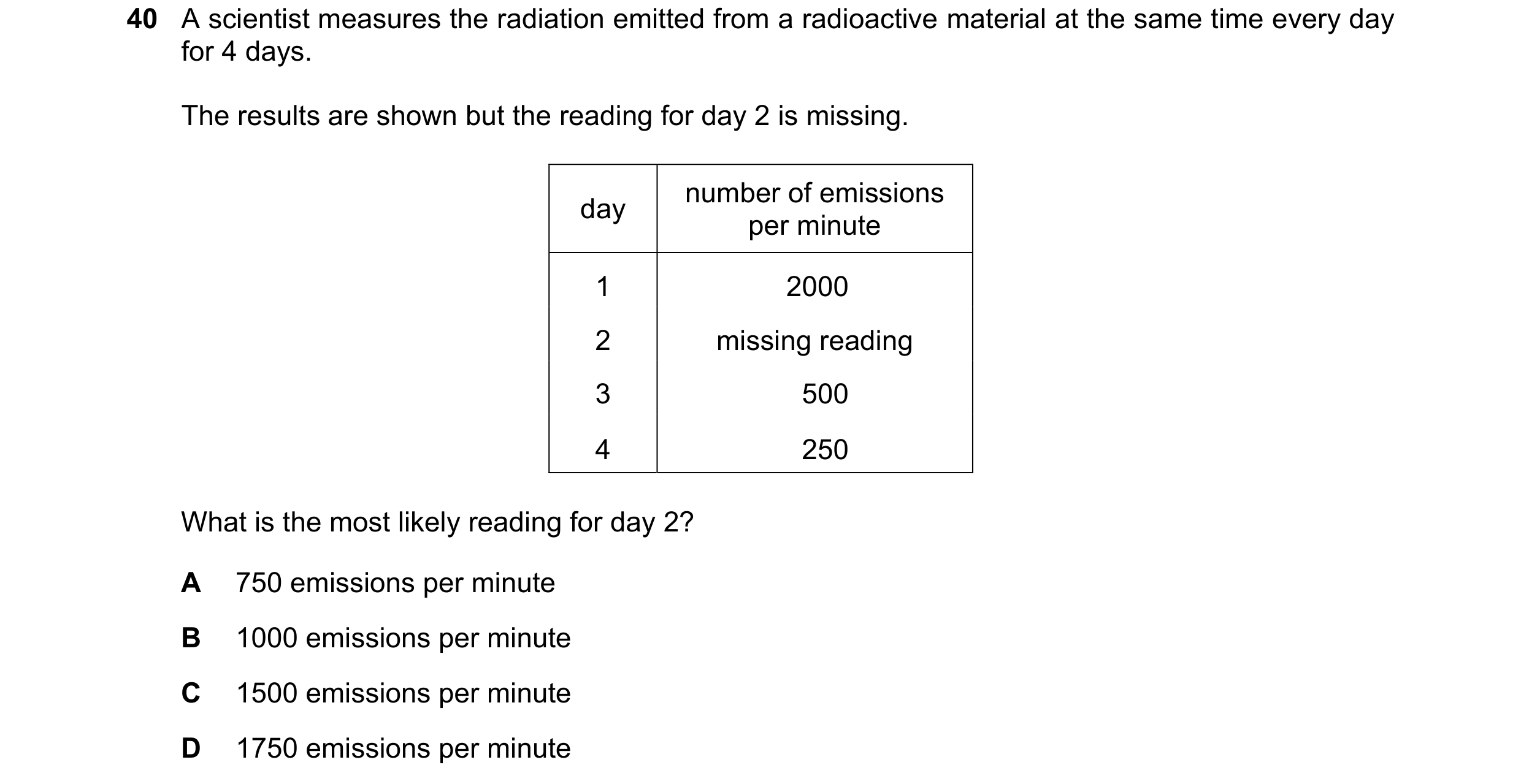
Q46 · A scientist measures the radiation emitted from a radioactive material at the same time… 0652/11 Oct/Nov 2024
40 A scientist measures the radiation emitted from a radioactive material at the same time every day for 4 days. The results are shown but the reading for day 2 is missing. number of emissions day per minute 1 2000 2 missing reading 3 500 4 250 What is the most likely reading for day 2? A 750 emissions per minute B 1000 emissions per minute C 1500 emissions per minute D 1750 emissions per minute
1 marks
Answer: B
This question in 0652/11 Oct/Nov 2024
 1 / 15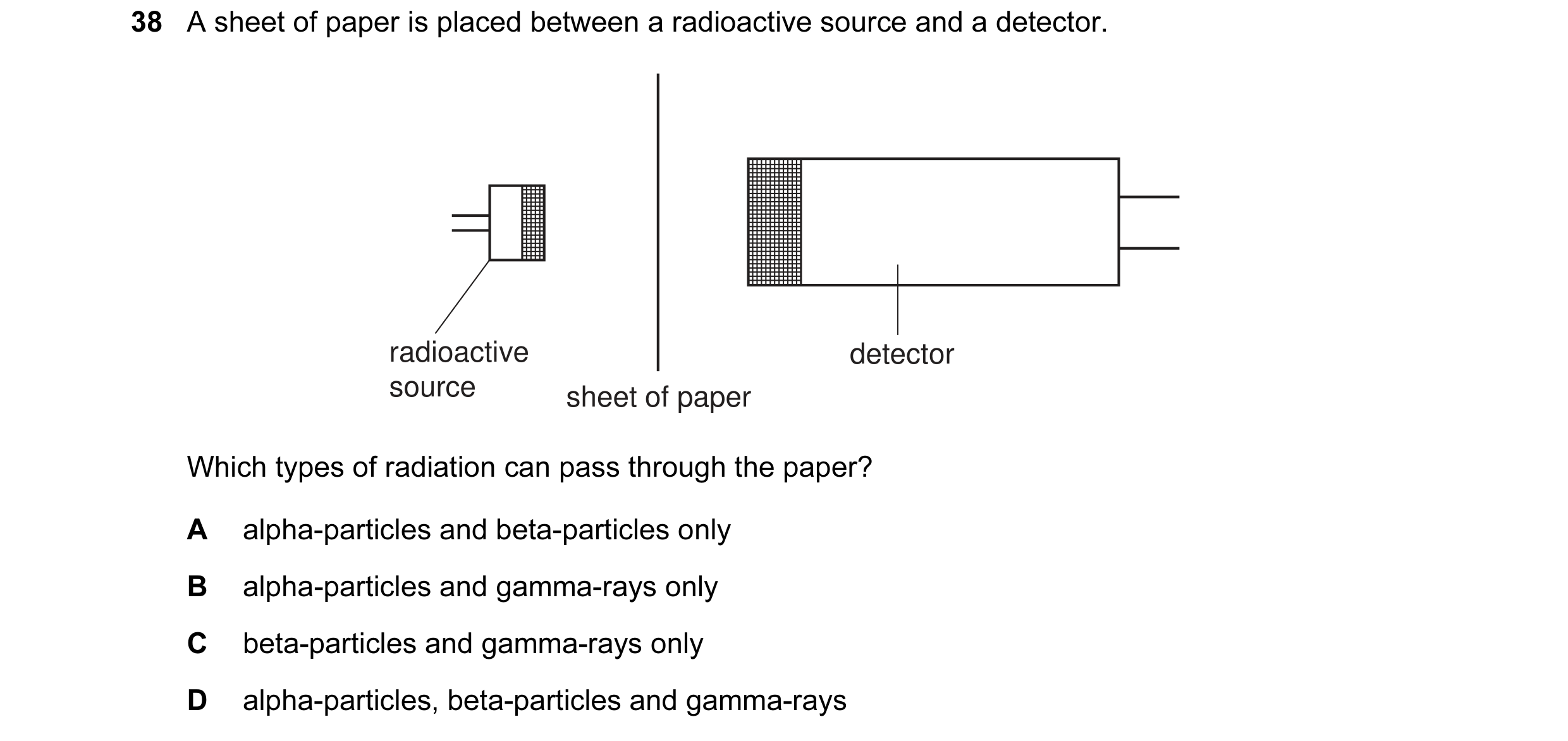
 2 / 15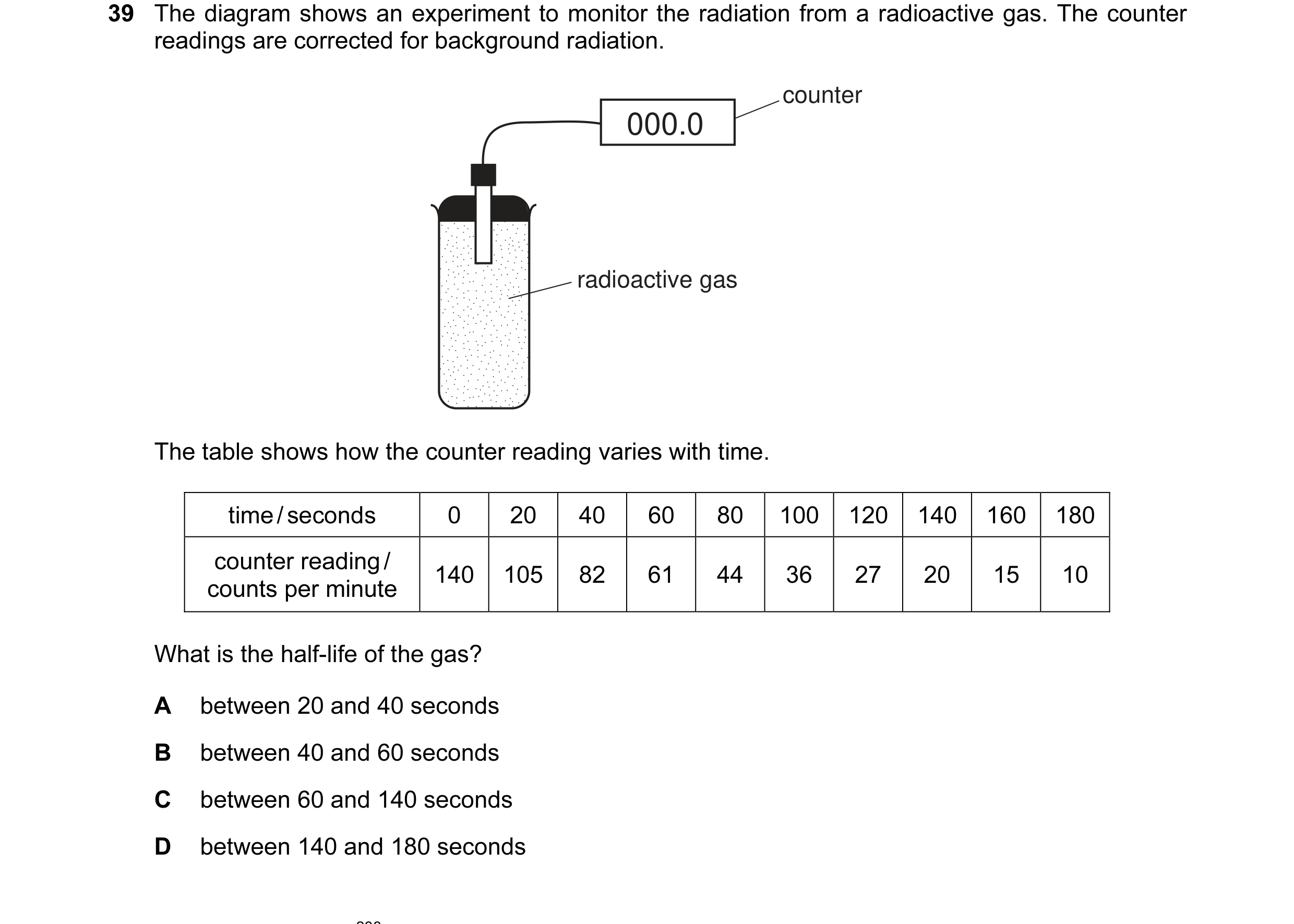
 3 / 15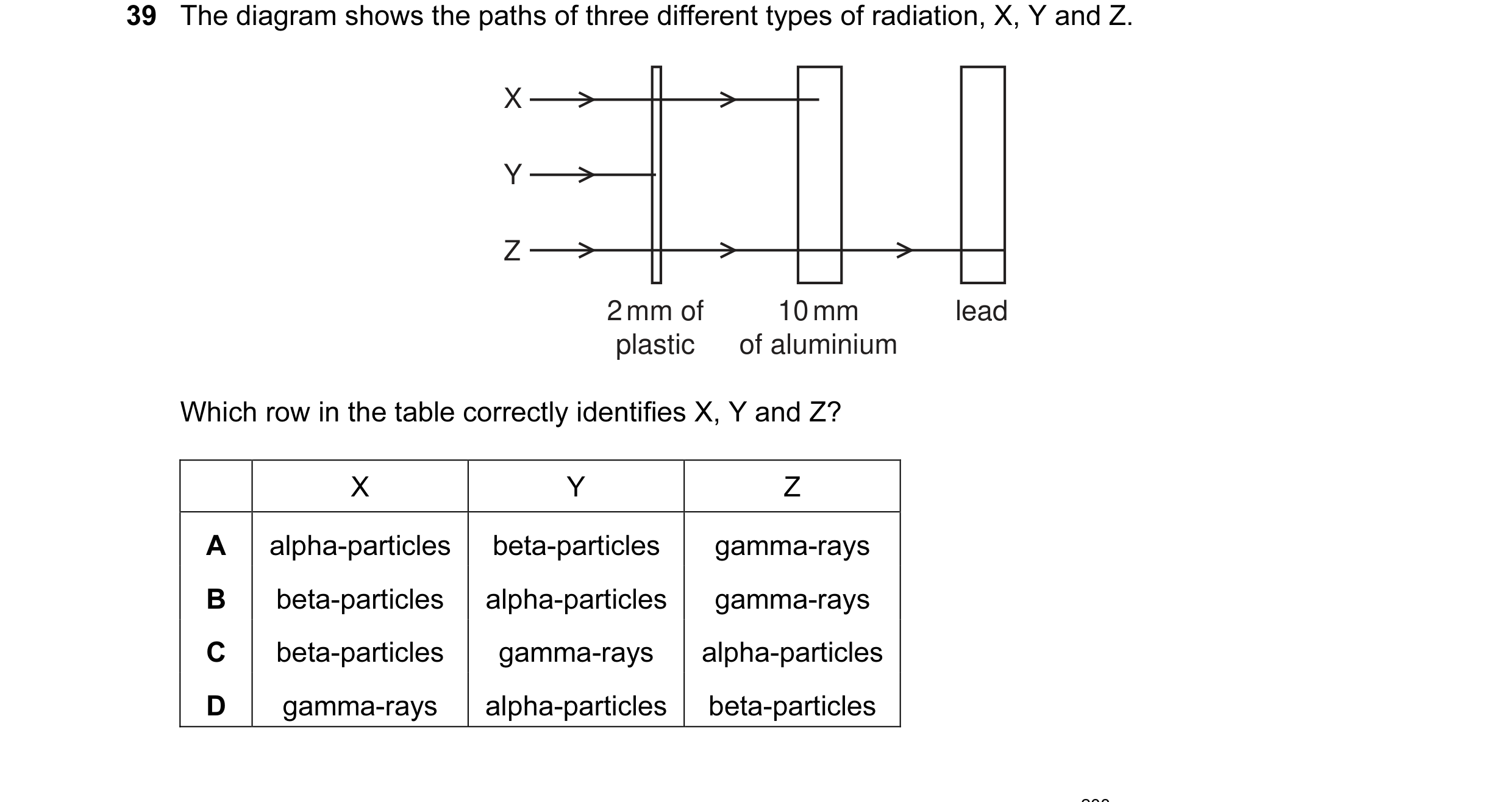
 4 / 15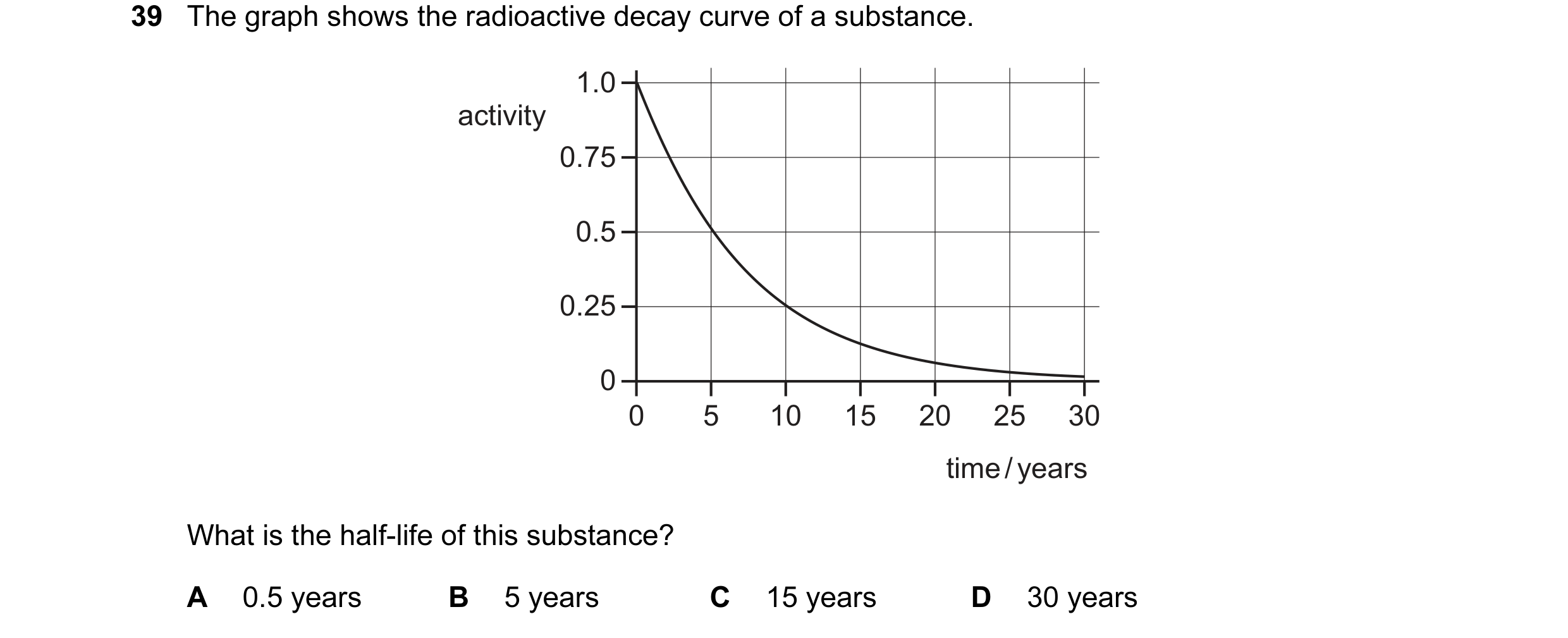
 5 / 15
 6 / 15
 7 / 15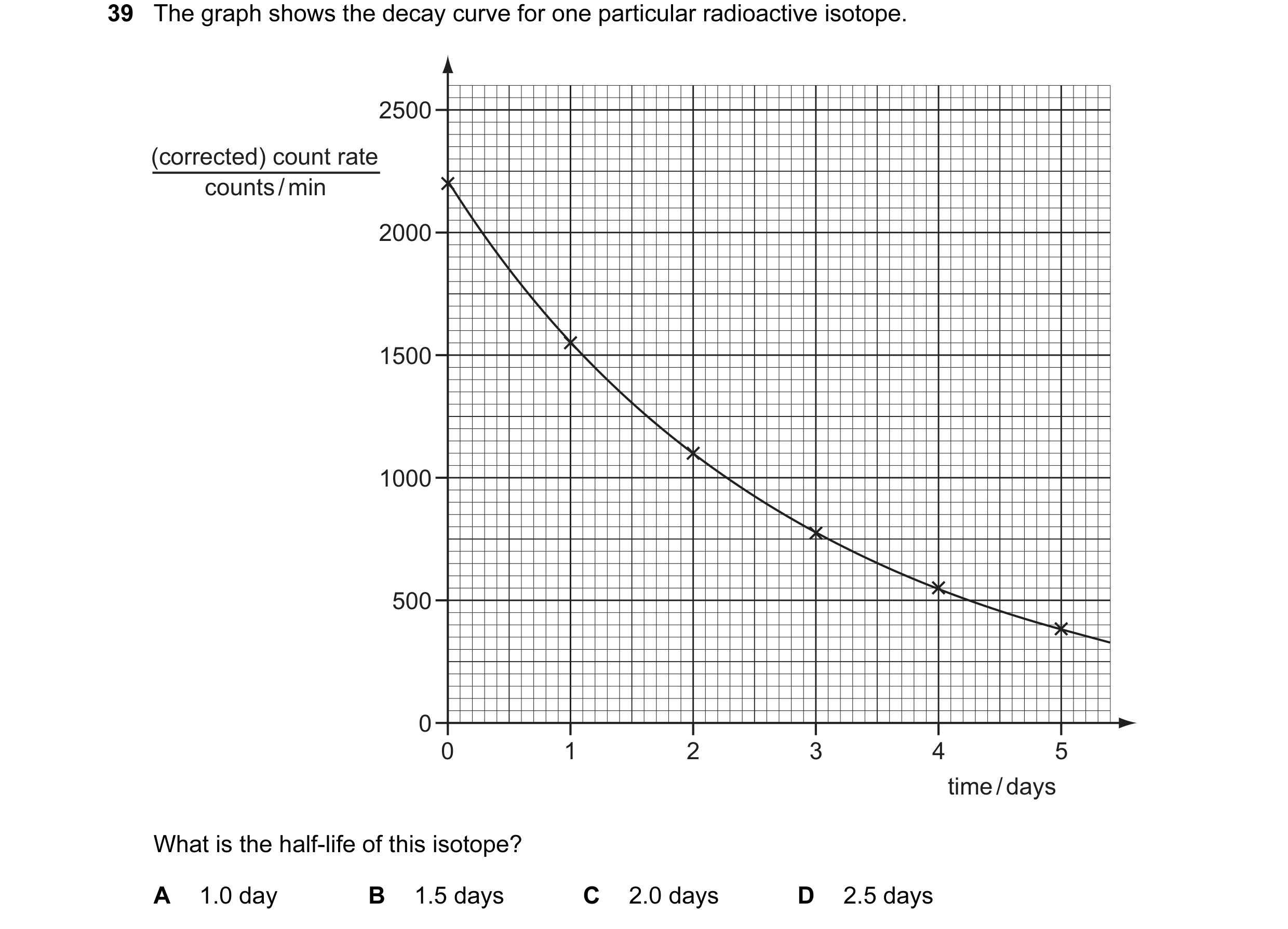
 8 / 15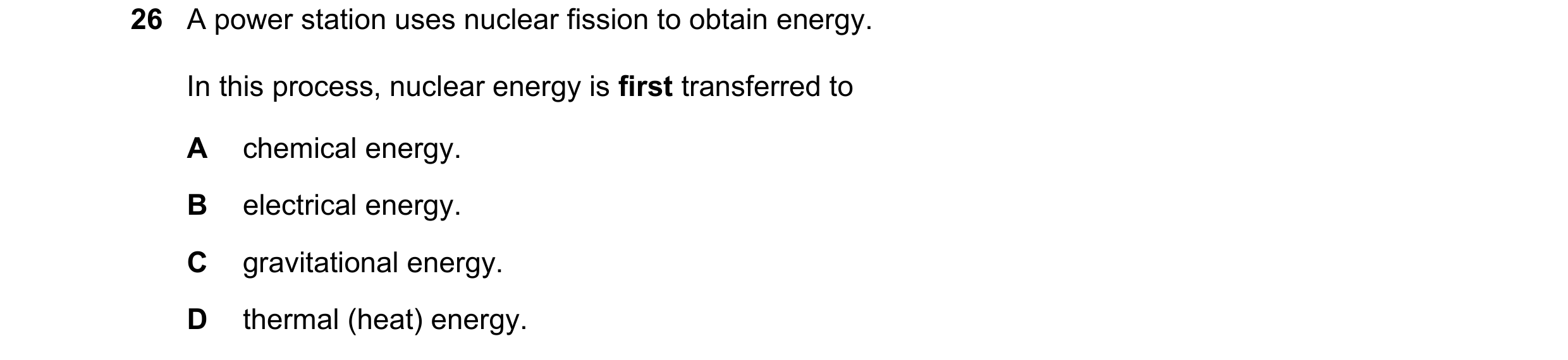
 9 / 15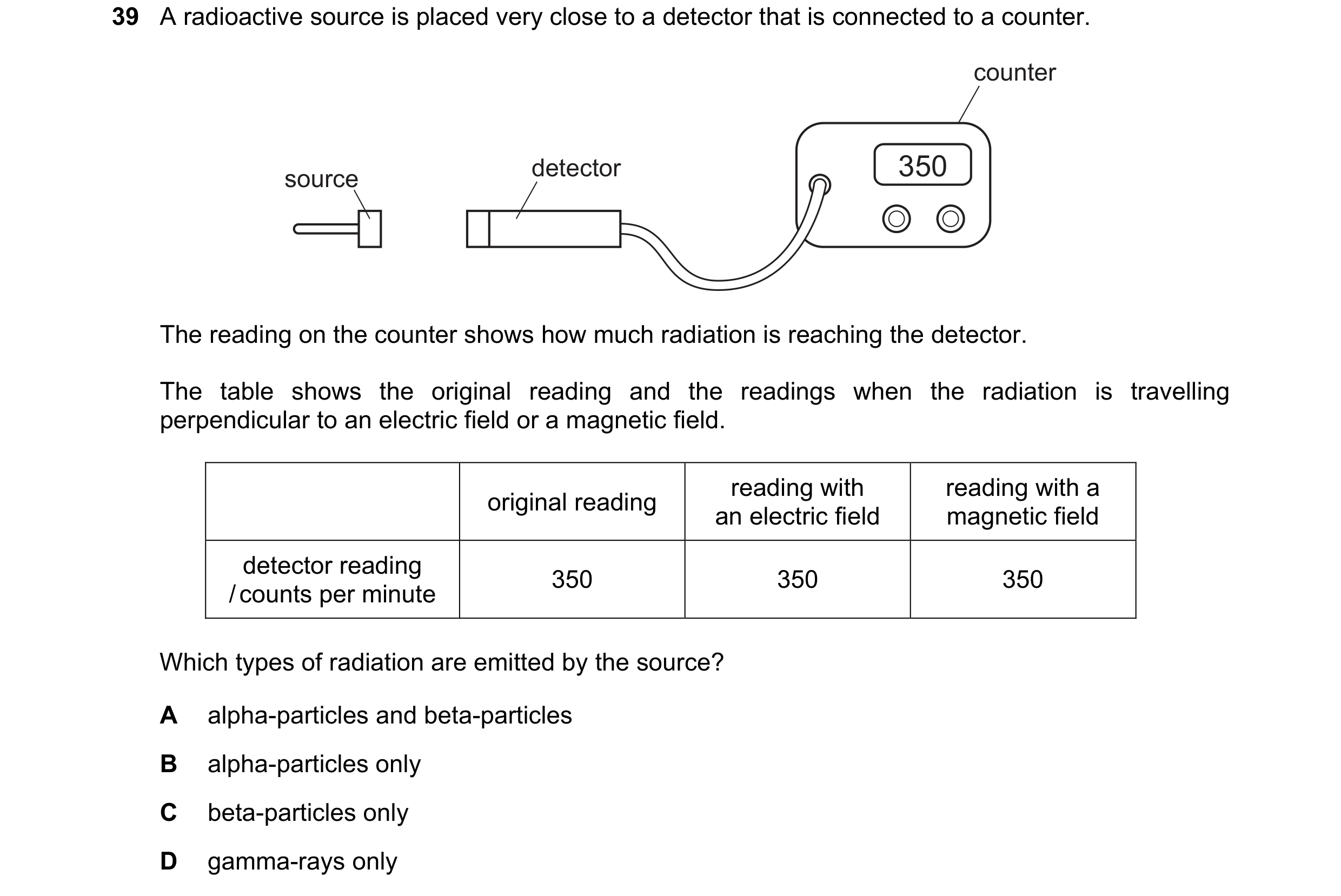
 10 / 15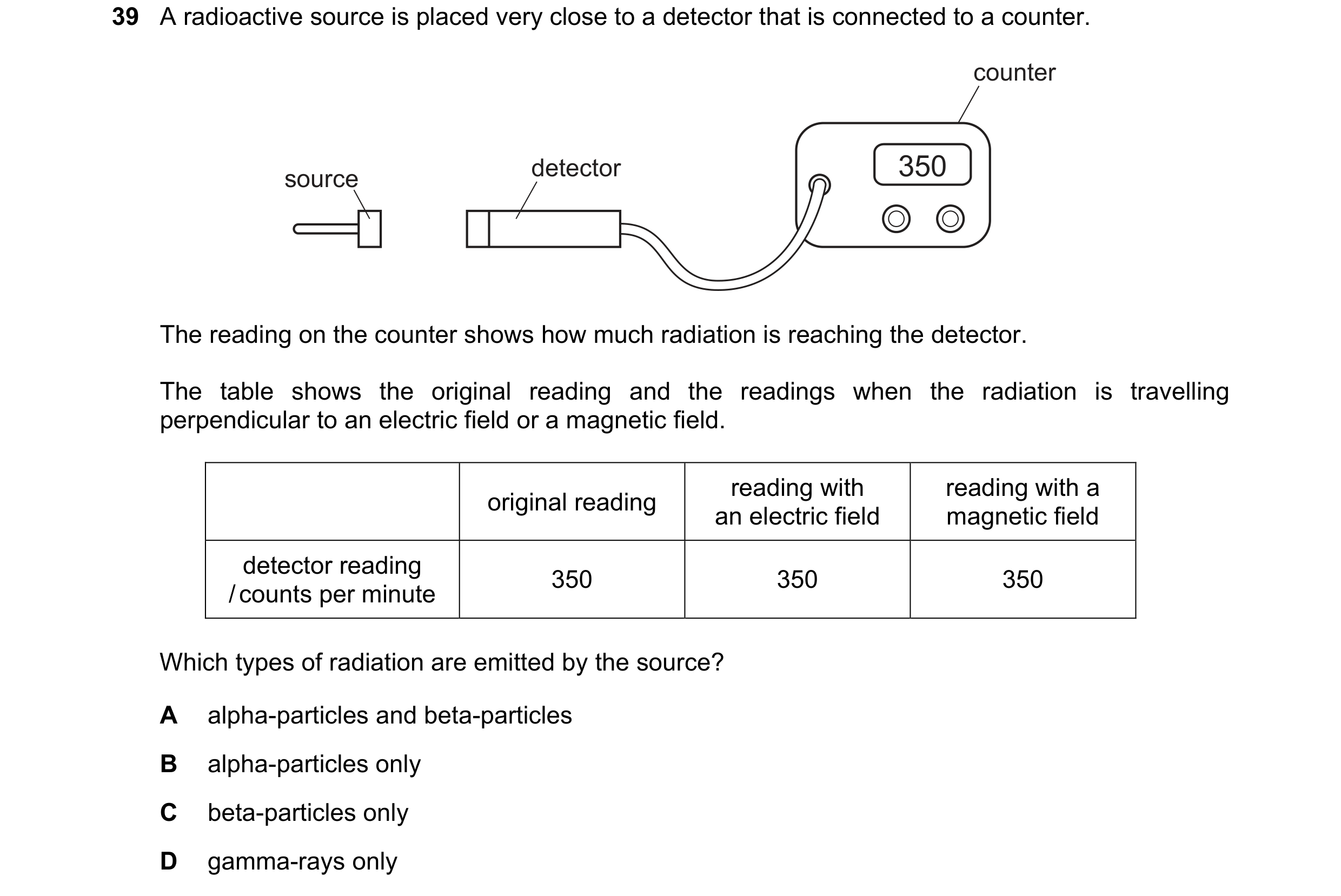
 11 / 15
 12 / 15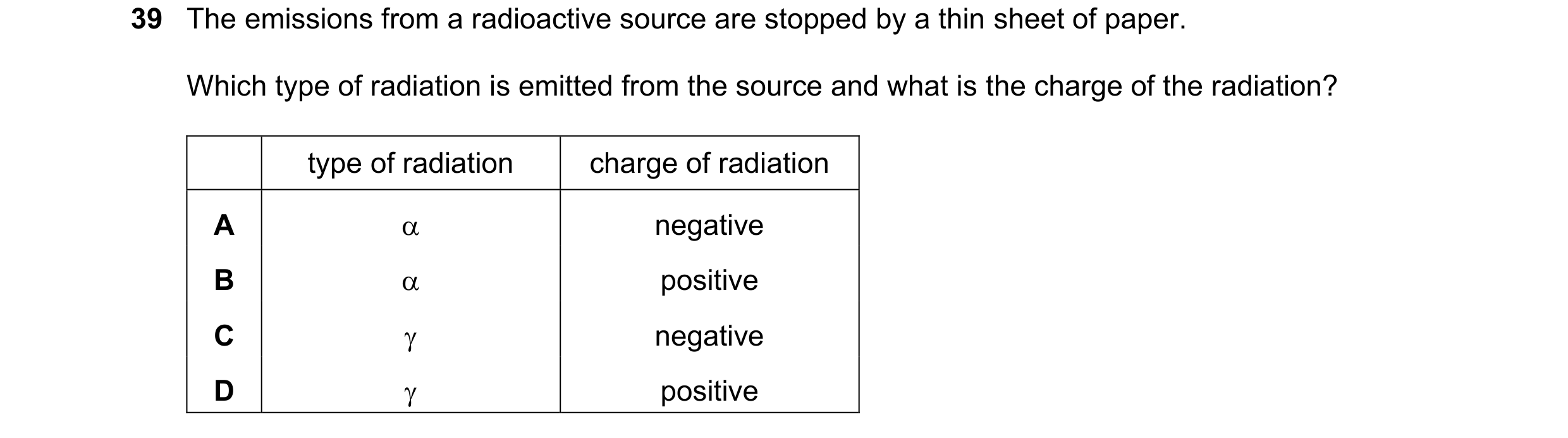

 13 / 15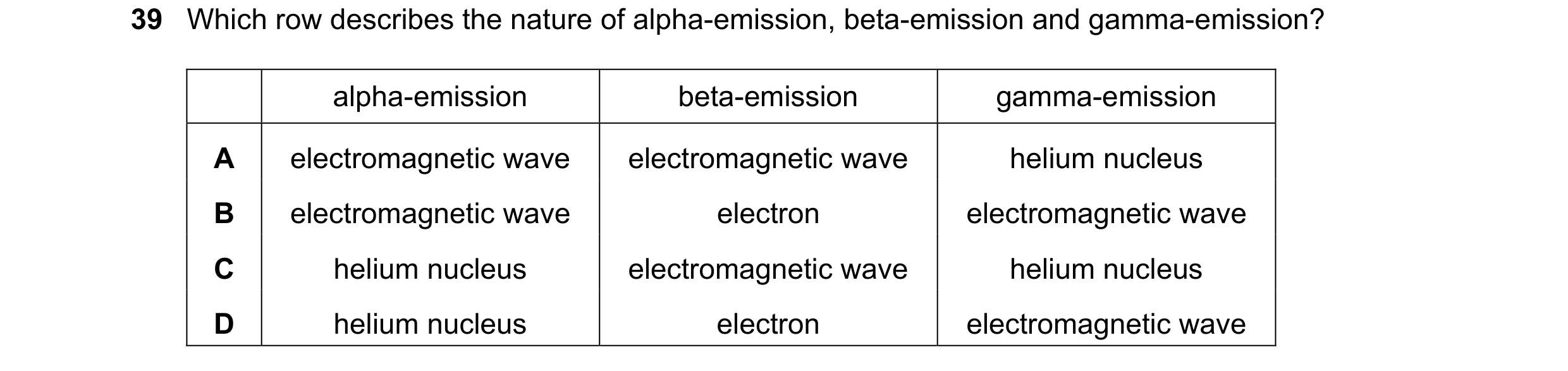


 14 / 15
 15 / 15