Cambridge IGCSE Physical Science 0652 — 2007 Oct/Nov Paper 1 · Variant 1
0652/11/O/N/07 · 40 questions · 40 marks · ≈45 min
The question paper and its mark scheme, free to read here and free to download. This is Cambridge’s own paper, exactly as it was sat.
Question paper20 pages


Mark scheme2 pages
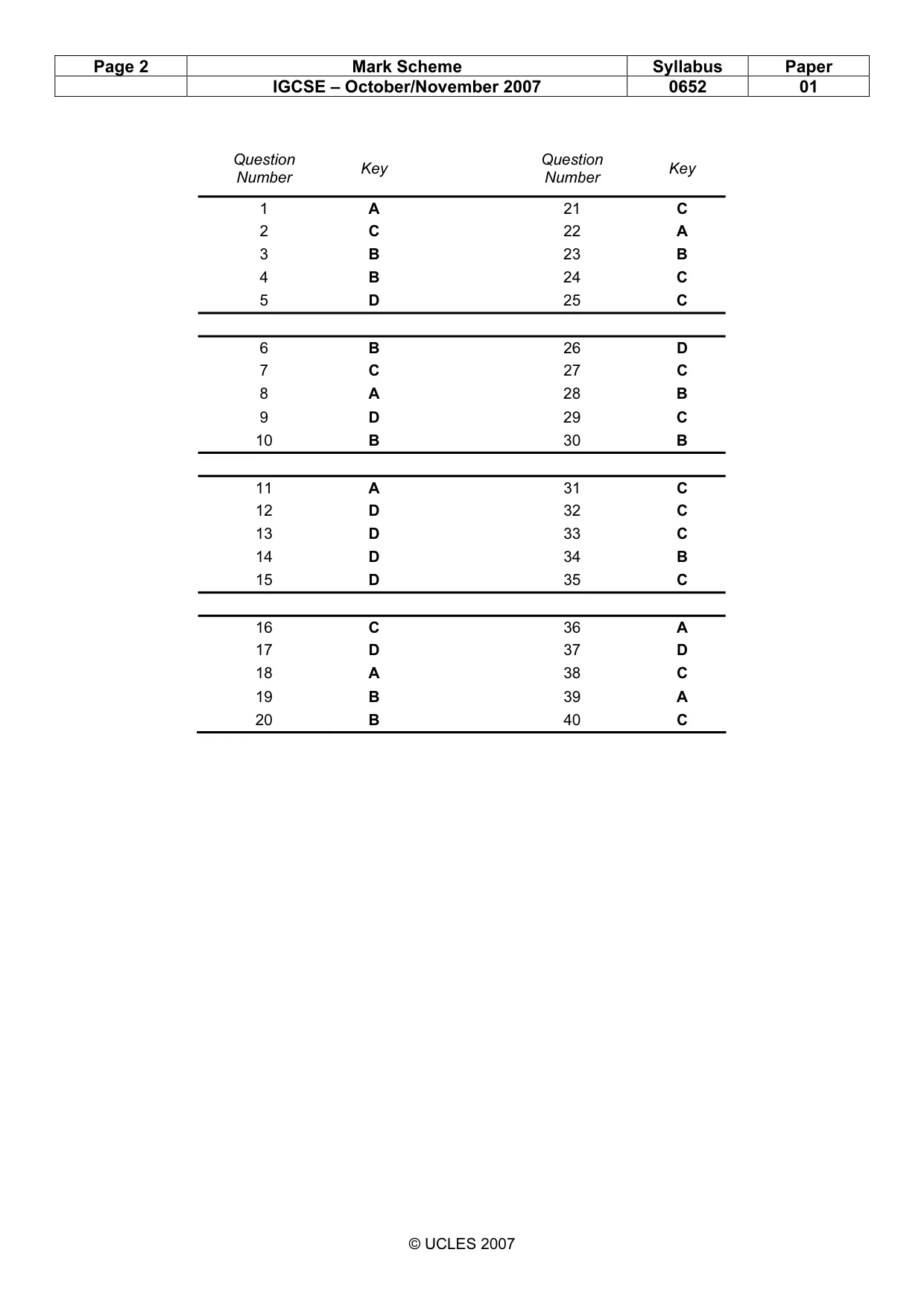
Answers below. Sit the paper first if you are practising.
Questions as text
Q1 · Diffusion involves the movement of particles
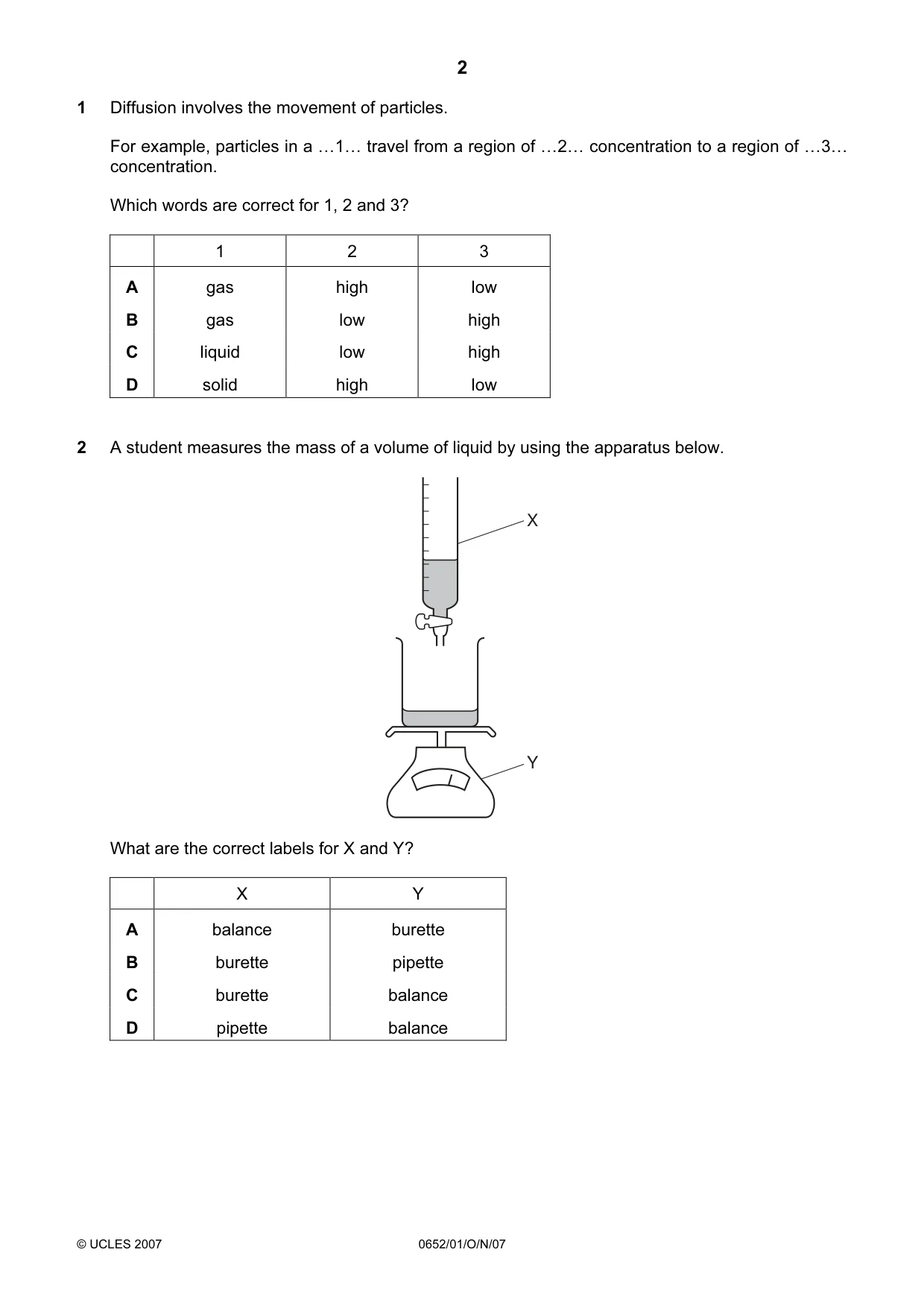
1 Diffusion involves the movement of particles. For example, particles in a …1… travel from a region of …2… concentration to a region of …3… concentration. Which words are correct for 1, 2 and 3? 1 2 3 A gas high low B gas low high C liquid low high D solid high low
Mark scheme: A
Q2 · A student measures the mass of a volume of liquid by using the apparatus below
2 A student measures the mass of a volume of liquid by using the apparatus below. X Y What are the correct labels for X and Y? X Y A balance burette B burette pipette C burette balance D pipette balance
Mark scheme: C
Q3 · Element Z conducts electricity and forms a basic oxide
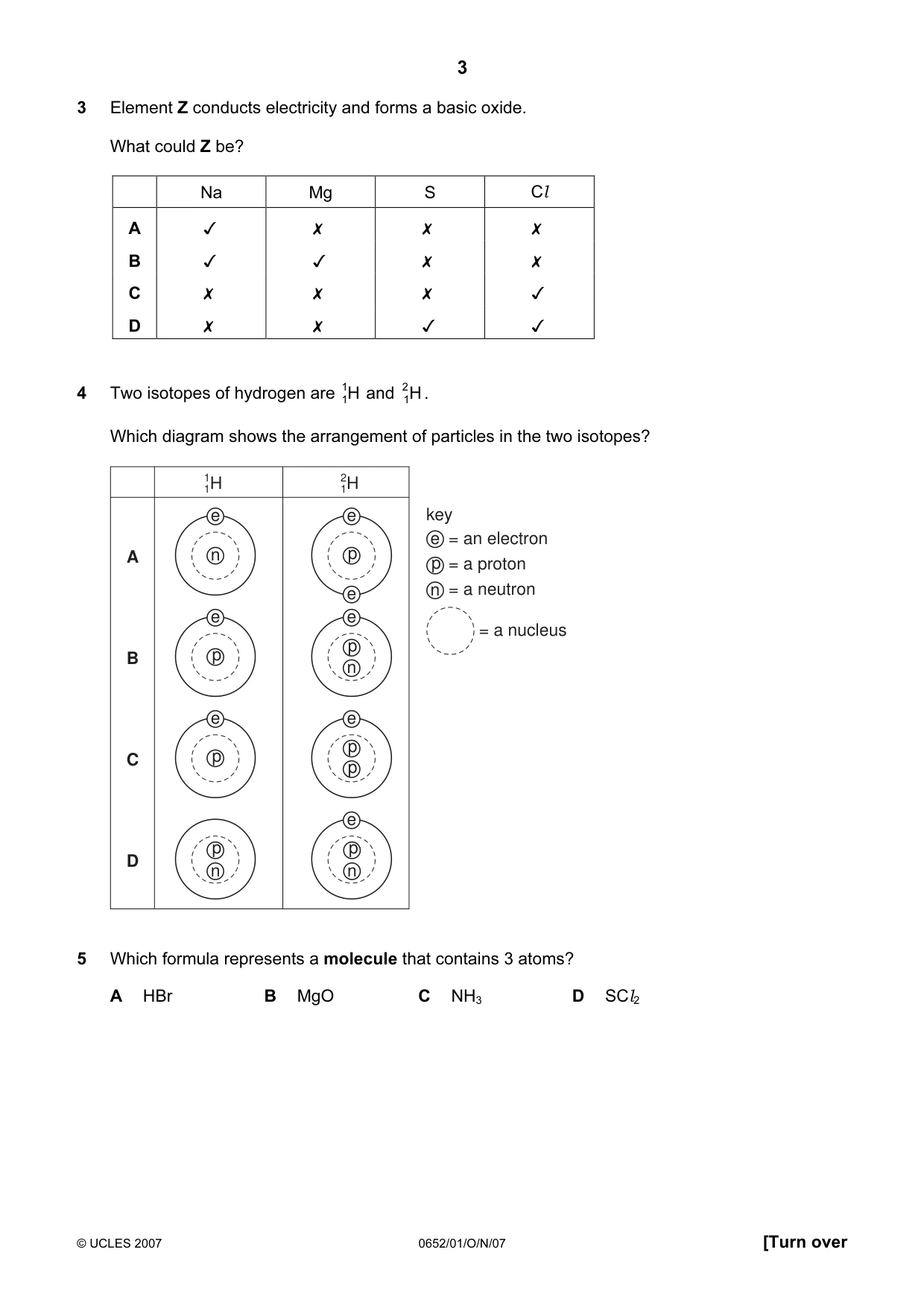
3 Element Z conducts electricity and forms a basic oxide. What could Z be? Na Mg S) Cl A v x x x B v v x x Cc x x x v D x x v v
Mark scheme: B
Q4 · Two isotopes of hydrogen are H 1 1 and H 2
4 Two isotopes of hydrogen are H 1 1 and H 2 . 1 Which diagram shows the arrangement of particles in the two isotopes? 1H 2H 1 1 e e key e = an electron A n p p = a proton e n = a neutron e e = a nucleus p B p n e e p C p p e p p D n n
Mark scheme: B
Q5 · Which formula represents a molecule that contains 3 atoms?
5 Which formula represents a molecule that contains 3 atoms? A HBr B MgO C NH3 D SCl2
Mark scheme: D
Q6 · The production of energy is important
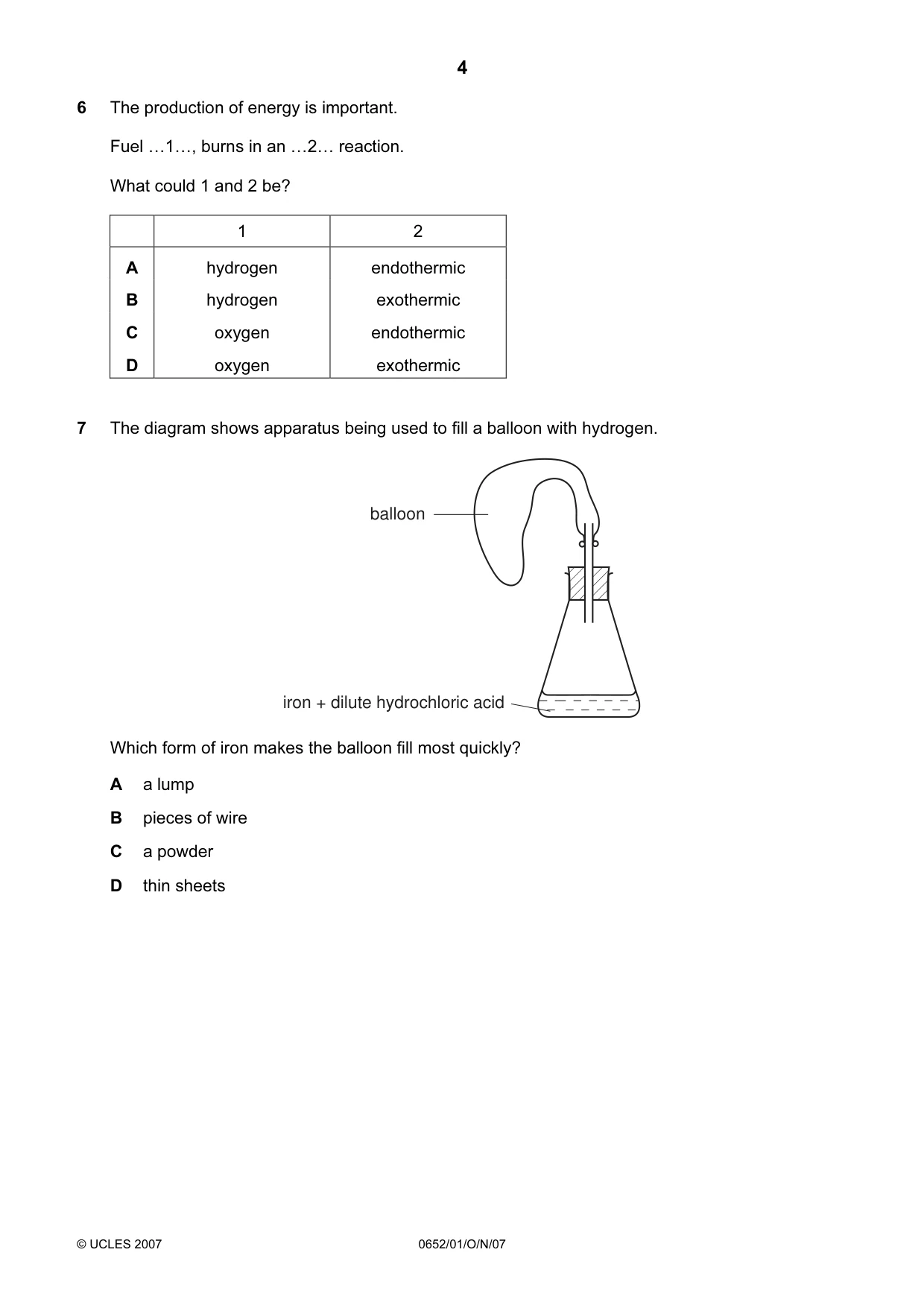
6 The production of energy is important. Fuel …1…, burns in an …2… reaction. What could 1 and 2 be? 1 2 A hydrogen endothermic B hydrogen exothermic C oxygen endothermic D oxygen exothermic
Mark scheme: B
Q7 · The diagram shows apparatus being used to fill a balloon with hydrogen
7 The diagram shows apparatus being used to fill a balloon with hydrogen. balloon iron + dilute hydrochloric acid Which form of iron makes the balloon fill most quickly? A a lump B pieces of wire C a powder D thin sheets
Mark scheme: C
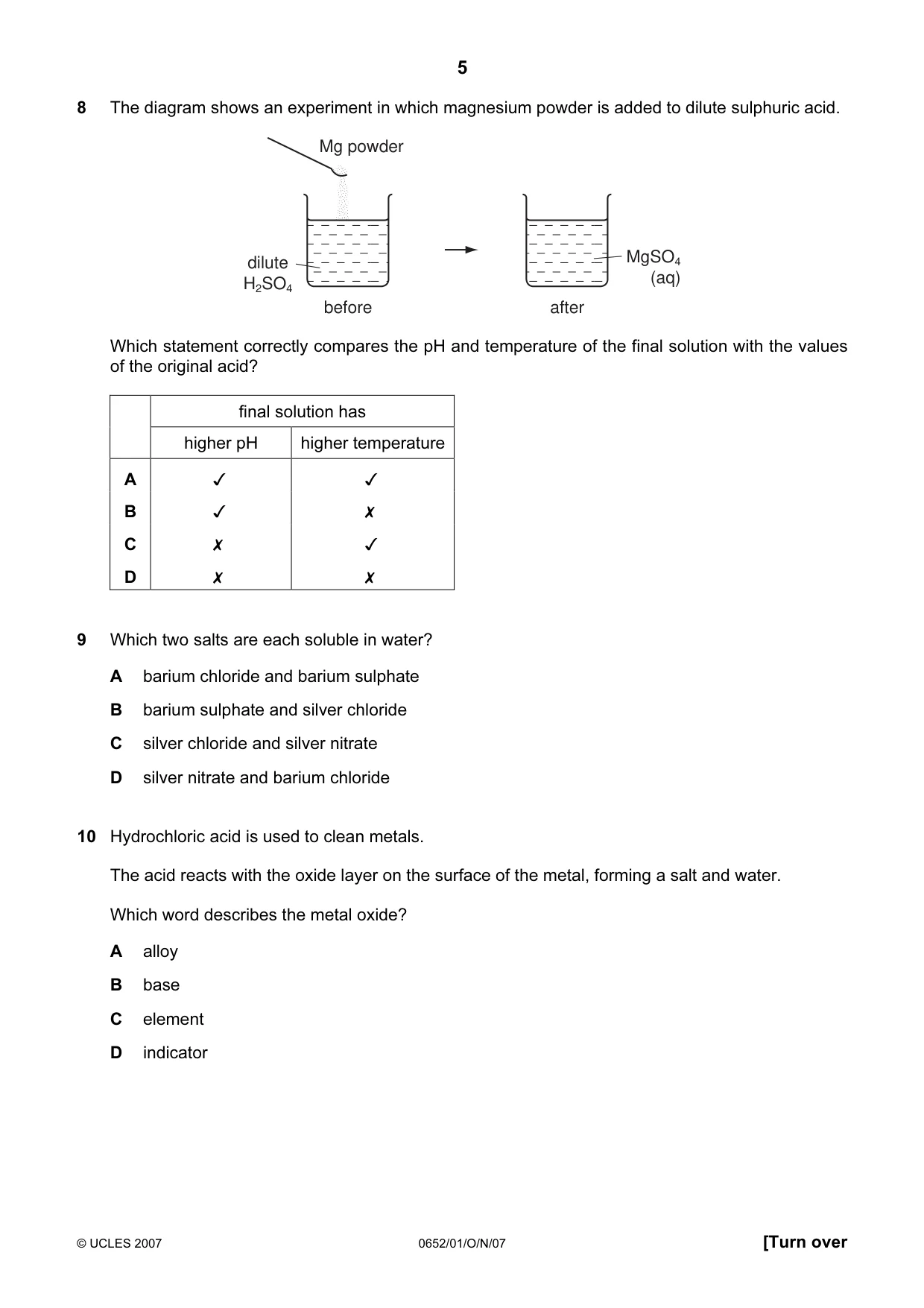
Q8 · The diagram shows an experiment in which magnesium powder is added to dilute sulphuric…
8 The diagram shows an experiment in which magnesium powder is added to dilute sulphuric acid. ig Powaer , MgSO, dilute (aq) H»SO, before after Which statement correctly compares the pH and temperature of the final solution with the values of the original acid? final solution has higher pH higher temperature v v 0 0O WwW > v x x v x x
Mark scheme: A
Q9 · Which two salts are each soluble in water?
9 Which two salts are each soluble in water? A barium chloride and barium sulphate B barium sulphate and silver chloride C silver chloride and silver nitrate D silver nitrate and barium chloride
Mark scheme: D
Q10 · Hydrochloric acid is used to clean metals
10 Hydrochloric acid is used to clean metals. The acid reacts with the oxide layer on the surface of the metal, forming a salt and water. Which word describes the metal oxide? A alloy B base C element D indicator
Mark scheme: B
Q11 · In the Periodic Table, how does the metallic character of the elements vary from left to…
11 In the Periodic Table, how does the metallic character of the elements vary from left to right across a period? A It decreases. B It increases. C It increases then decreases. D It stays the same.
Mark scheme: A
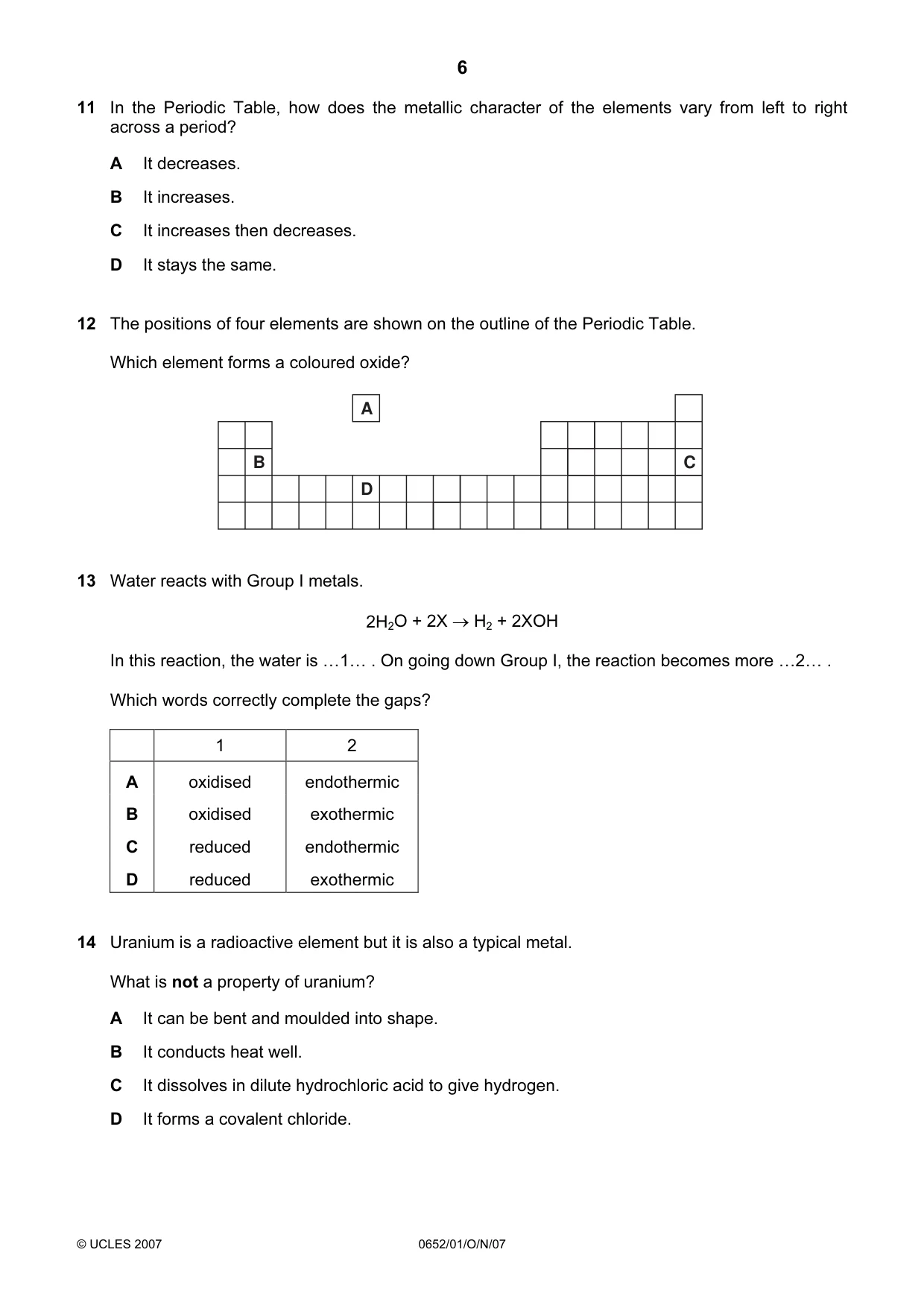
Q12 · The positions of four elements are shown on the outline of the Periodic Table
12 The positions of four elements are shown on the outline of the Periodic Table. Which element forms a coloured oxide? A B C D
Mark scheme: D
Q13 · Water reacts with Group I metals
13 Water reacts with Group I metals. 2H2O + 2X → H2 + 2XOH In this reaction, the water is …1… . On going down Group I, the reaction becomes more …2… . Which words correctly complete the gaps? 1 2 A oxidised endothermic B oxidised exothermic C reduced endothermic D reduced exothermic
Mark scheme: D
Q14 · Uranium is a radioactive element but it is also a typical metal
14 Uranium is a radioactive element but it is also a typical metal. What is not a property of uranium? A It can be bent and moulded into shape. B It conducts heat well. C It dissolves in dilute hydrochloric acid to give hydrogen. D It forms a covalent chloride.
Mark scheme: D
Q15 · Why is mild steel used instead of iron to make car bodies?
15 Why is mild steel used instead of iron to make car bodies? A Iron cannot be painted. B Mild steel does not rust. C Mild steel is more brittle than iron. D Mild steel is stronger than iron.
Mark scheme: D
Q16 · Urea, CO(NH2)2, is used as a fertiliser
16 Urea, CO(NH2)2, is used as a fertiliser. Which element that plants need is provided by the urea? A carbon B hydrogen C nitrogen D oxygen
Mark scheme: C
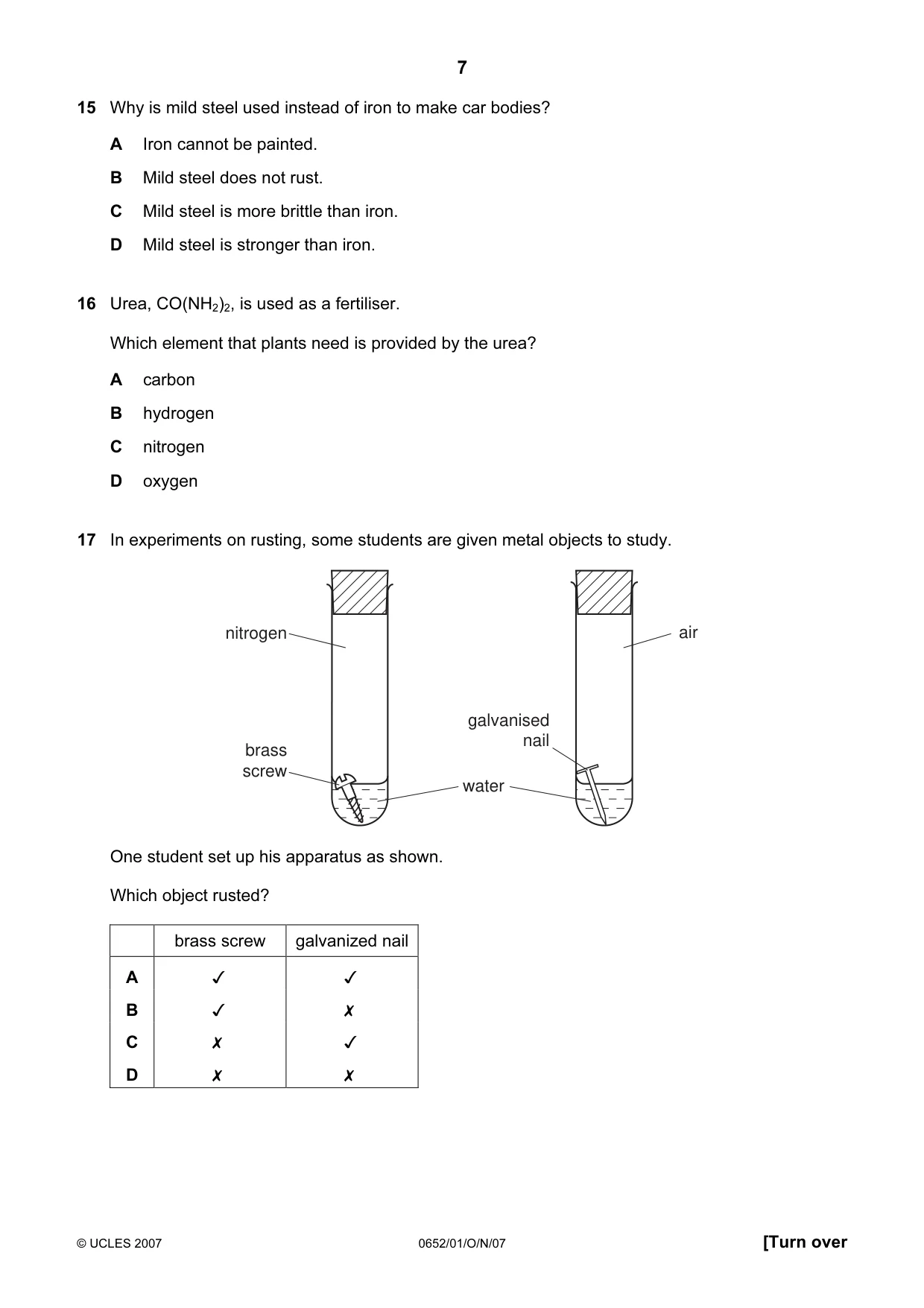
Q17 · In experiments on rusting, some students are given metal objects to study
17 In experiments on rusting, some students are given metal objects to study. nitrogen air galvanised water One student set up his apparatus as shown. Which object rusted? brass screw | galvanized nail A v v B v x Cc x v D x x
Mark scheme: D
Q18 · Butane, ethanol and hydrogen are fuels
18 Butane, ethanol and hydrogen are fuels. Which substances produce both carbon dioxide and water when used as a fuel? butane ethanol hydrogen v v x 0 0O DW > v x v x v x v v v
Mark scheme: A
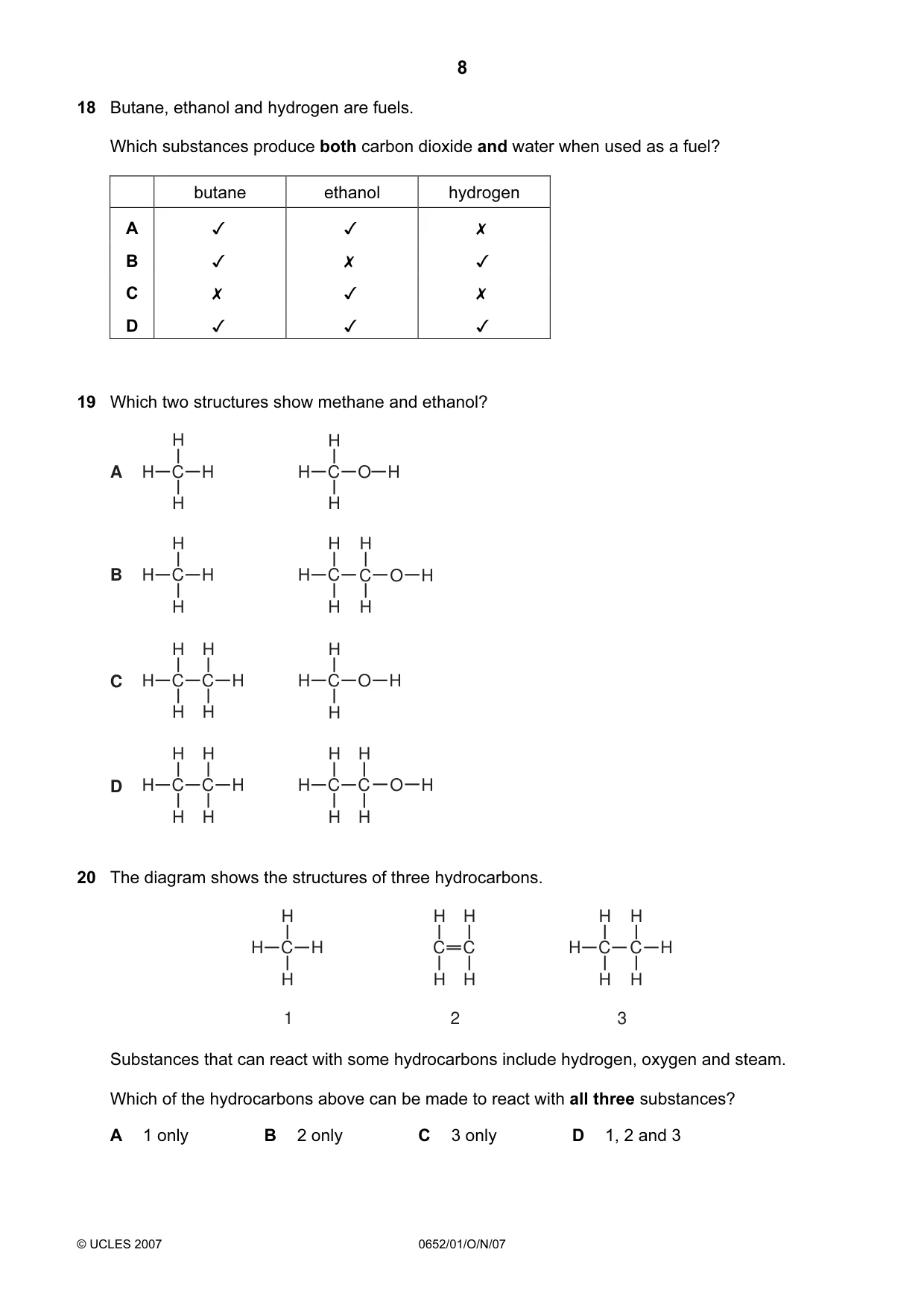
Q19 · Which two structures show methane and ethanol?
19 Which two structures show methane and ethanol? H H A H C H H C O H H H H H H B H C H H C C O H H H H H H H C H C C H H C O H H H H H H H H D H C C H H C C O H H H H H
Mark scheme: B
Q20 · The diagram shows the structures of three hydrocarbons
20 The diagram shows the structures of three hydrocarbons. H H H H H H C H C C H C C H H H H H H 1 2 3 Substances that can react with some hydrocarbons include hydrogen, oxygen and steam. Which of the hydrocarbons above can be made to react with all three substances? A 1 only B 2 only C 3 only D 1, 2 and 3
Mark scheme: B
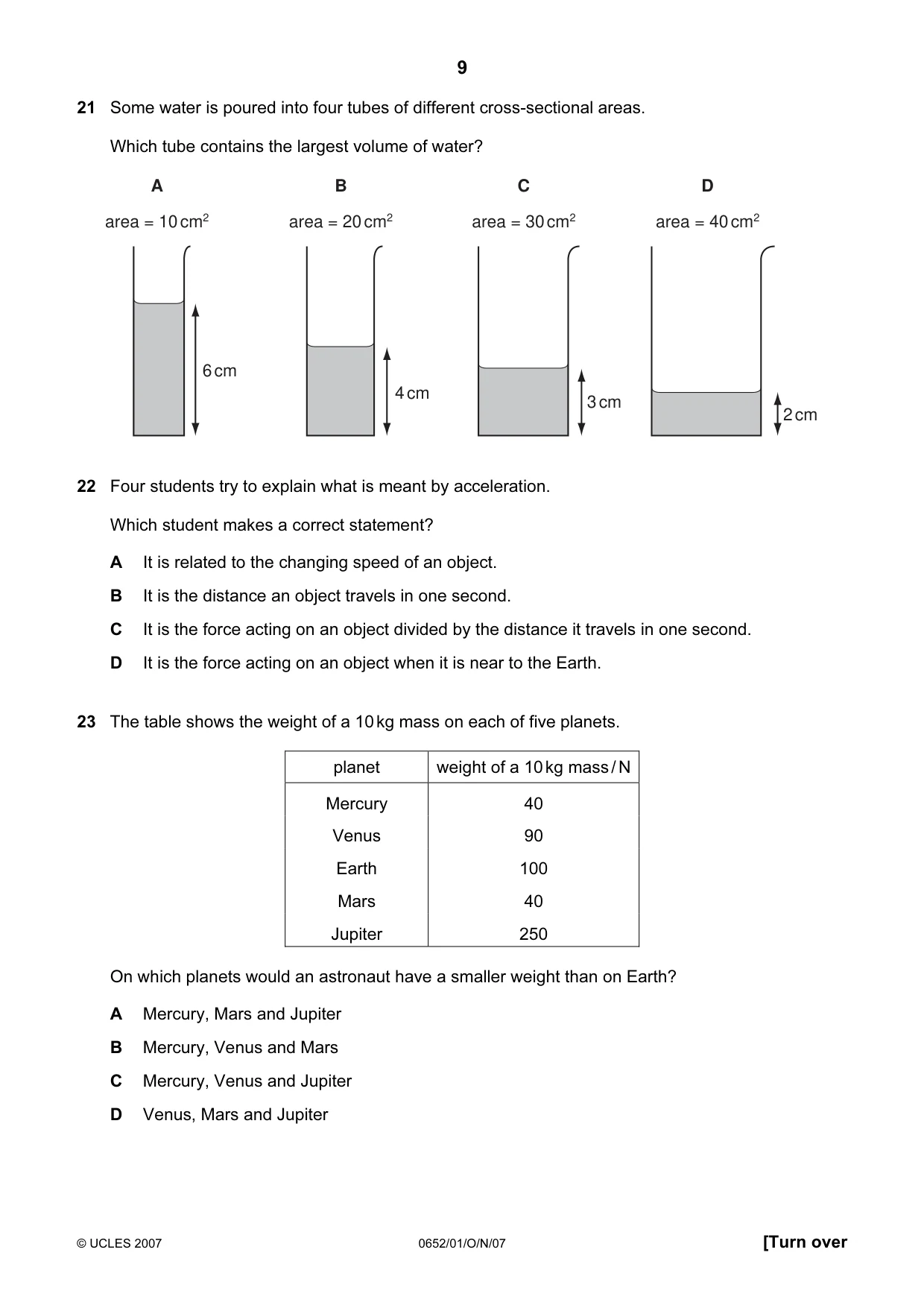
Q21 · Some water is poured into four tubes of different cross-sectional areas
21 Some water is poured into four tubes of different cross-sectional areas. Which tube contains the largest volume of water? A B C D area = 10 cm2 area = 20 cm2 area = 30 cm2 area = 40 cm2 6 cm 4 cm 3 cm 2 cm
Mark scheme: C
Q22 · Four students try to explain what is meant by acceleration
22 Four students try to explain what is meant by acceleration. Which student makes a correct statement? A It is related to the changing speed of an object. B It is the distance an object travels in one second. C It is the force acting on an object divided by the distance it travels in one second. D It is the force acting on an object when it is near to the Earth.
Mark scheme: A
Q23 · The table shows the weight of a 10 kg mass on each of five planets
23 The table shows the weight of a 10 kg mass on each of five planets. planet weight of a 10 kg mass / N Mercury 40 Venus 90 Earth 100 Mars 40 Jupiter 250 On which planets would an astronaut have a smaller weight than on Earth? A Mercury, Mars and Jupiter B Mercury, Venus and Mars C Mercury, Venus and Jupiter D Venus, Mars and Jupiter
Mark scheme: B
Q24 · A metal drum has a mass of 200 kg when empty and 1000 kg when filled with 1.0 m3 of…
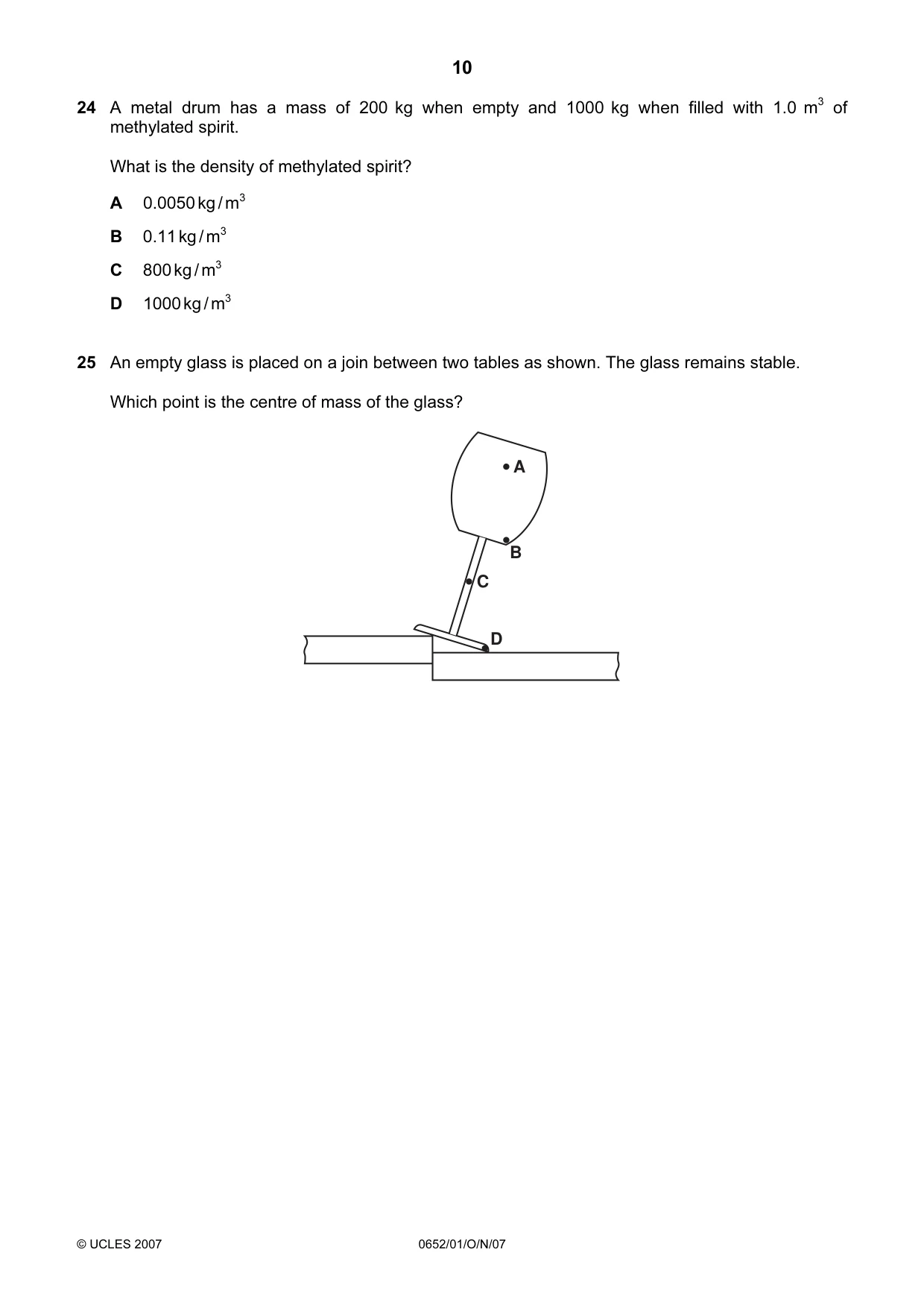
24 A metal drum has a mass of 200 kg when empty and 1000 kg when filled with 1.0 m3 of methylated spirit. What is the density of methylated spirit? A 0.0050 kg / m3 B 0.11 kg / m3 C 800 kg / m3 D 1000 kg / m3
Mark scheme: C
Q25 · An empty glass is placed on a join between two tables as shown
25 An empty glass is placed on a join between two tables as shown. The glass remains stable. Which point is the centre of mass of the glass? A B C D
Mark scheme: C
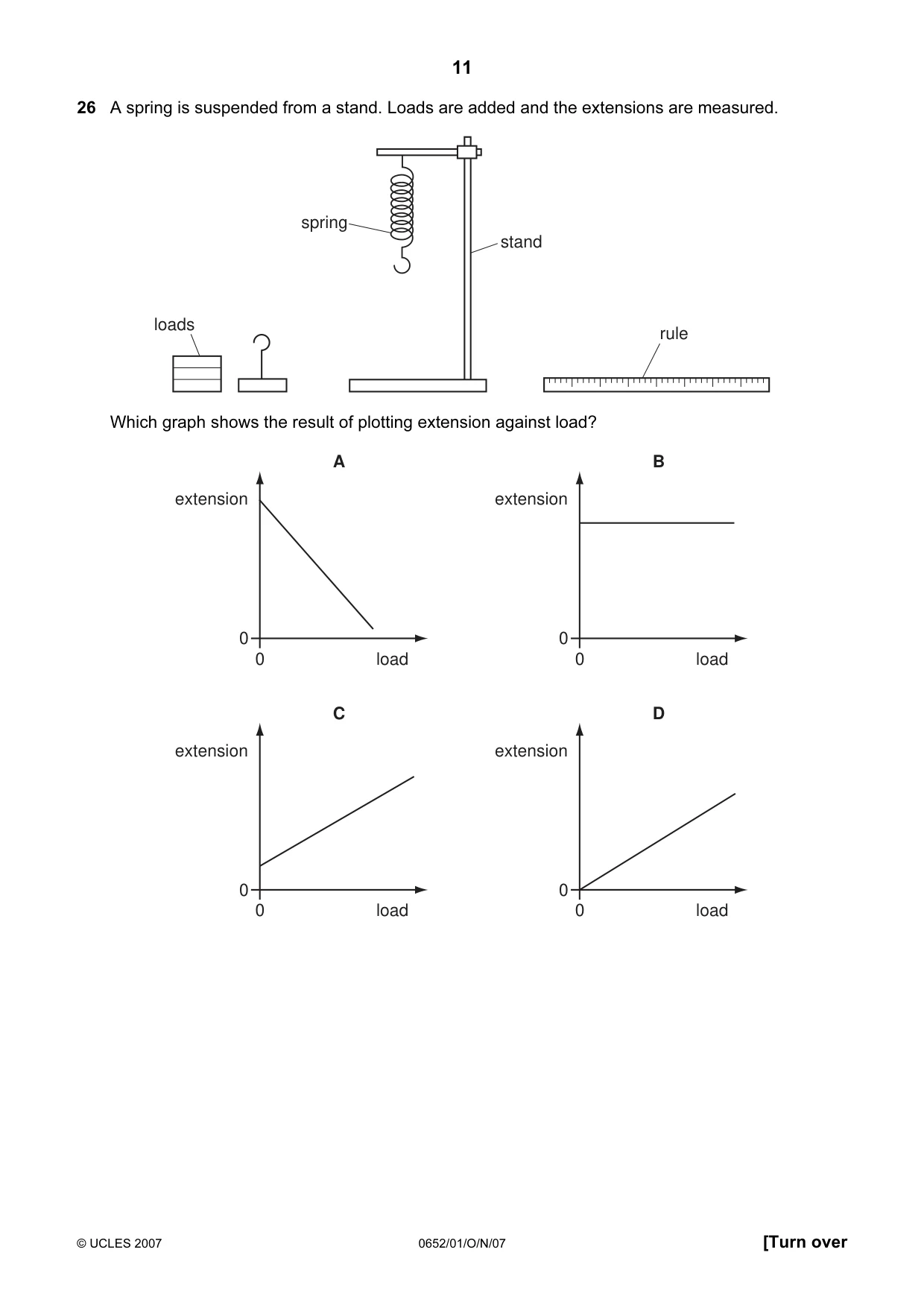
Q26 · A spring is suspended from a stand
26 A spring is suspended from a stand. Loads are added and the extensions are measured. spring stand loads rule Which graph shows the result of plotting extension against load? A B extension extension 0 0 0 load 0 load C D extension extension 0 0 0 load 0 load
Mark scheme: D
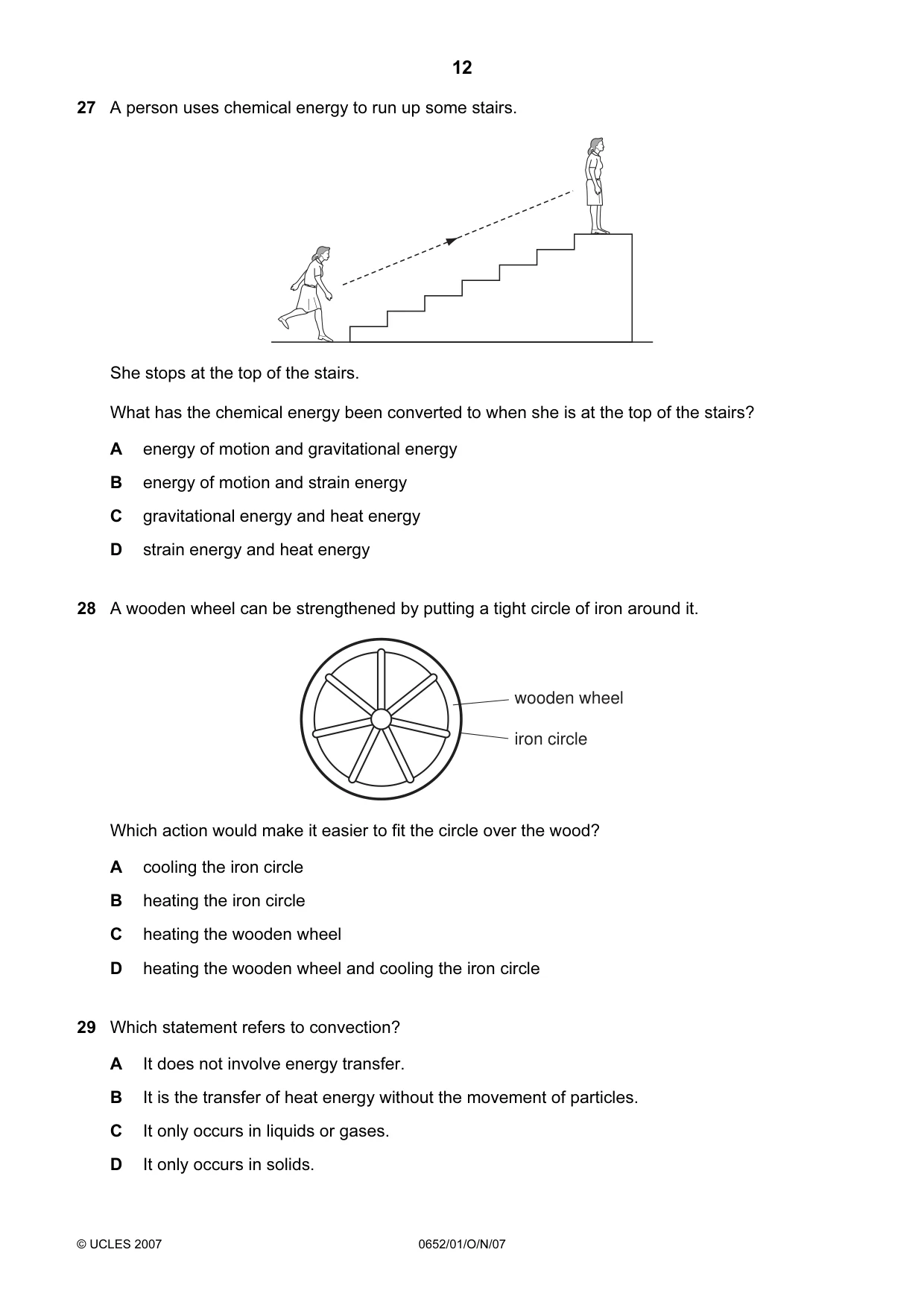
Q27 · A person uses chemical energy to run up some stairs
27 A person uses chemical energy to run up some stairs. She stops at the top of the stairs. What has the chemical energy been converted to when she is at the top of the stairs? A energy of motion and gravitational energy B energy of motion and strain energy C gravitational energy and heat energy D strain energy and heat energy
Mark scheme: C
Q28 · A wooden wheel can be strengthened by putting a tight circle of iron around it
28 A wooden wheel can be strengthened by putting a tight circle of iron around it. wooden wheel iron circle Which action would make it easier to fit the circle over the wood? A cooling the iron circle B heating the iron circle C heating the wooden wheel D heating the wooden wheel and cooling the iron circle
Mark scheme: B
Q29 · Which statement refers to convection?
29 Which statement refers to convection? A It does not involve energy transfer. B It is the transfer of heat energy without the movement of particles. C It only occurs in liquids or gases. D It only occurs in solids.
Mark scheme: C
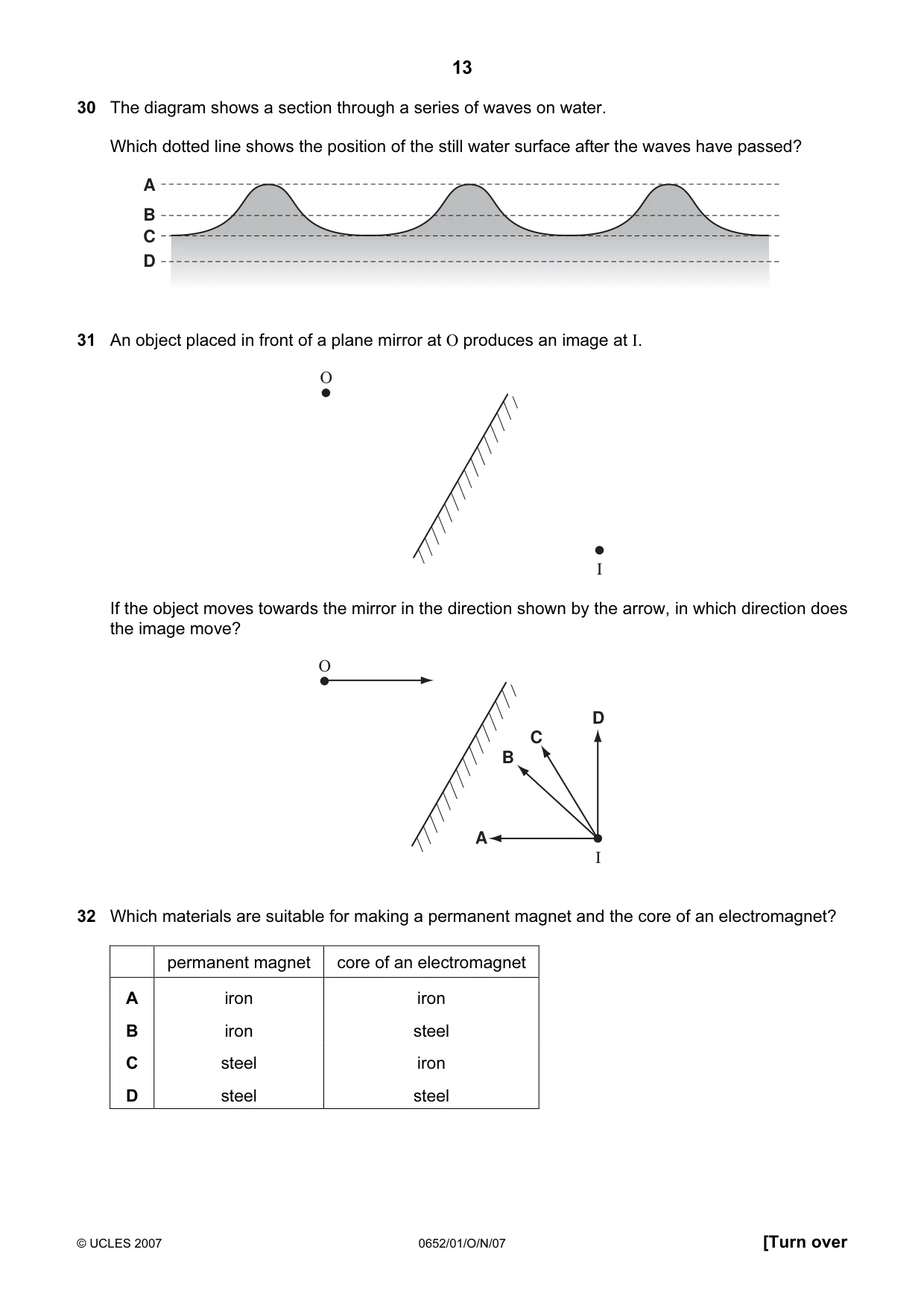
Q30 · The diagram shows a section through a series of waves on water
30 The diagram shows a section through a series of waves on water. Which dotted line shows the position of the still water surface after the waves have passed? A B C D
Mark scheme: B
Q31 · An object placed in front of a plane mirror at O produces an image at I
31 An object placed in front of a plane mirror at O produces an image at I. O I If the object moves towards the mirror in the direction shown by the arrow, in which direction does the image move? O D C B A I
Mark scheme: C
Q32 · Which materials are suitable for making a permanent magnet and the core of an…
32 Which materials are suitable for making a permanent magnet and the core of an electromagnet? permanent magnet core of an electromagnet A iron iron B iron steel C steel iron D steel steel
Mark scheme: C
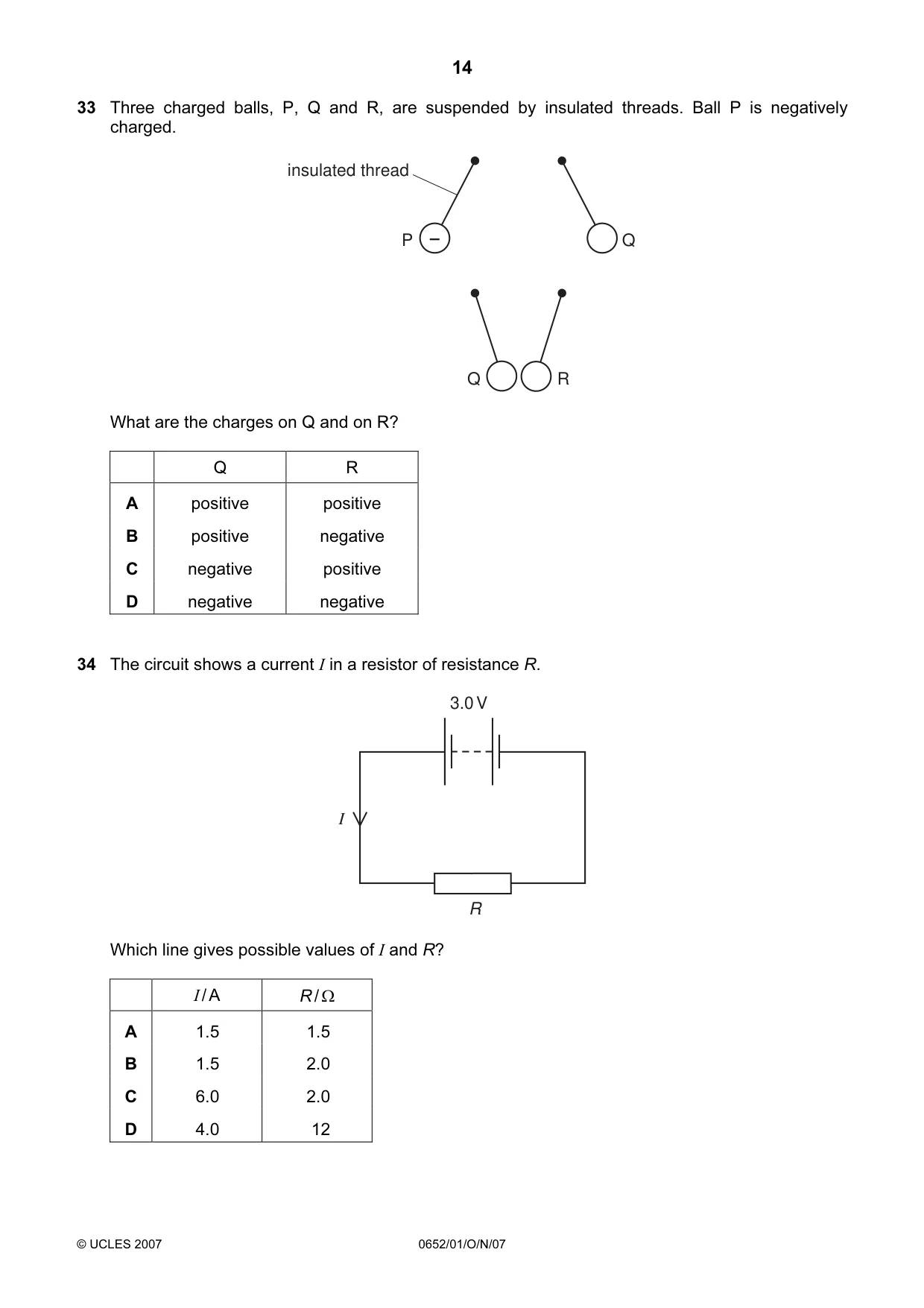
Q33 · Three charged balls, P, Q and R, are suspended by insulated threads
33 Three charged balls, P, Q and R, are suspended by insulated threads. Ball P is negatively charged. insulated thread P – Q Q R What are the charges on Q and on R? Q R A positive positive B positive negative C negative positive D negative negative
Mark scheme: C
Q34 · The circuit shows a current I in a resistor of resistance R
34 The circuit shows a current I in a resistor of resistance R. 3.0 V I R Which line gives possible values of I and R? I / A R / Ω A 1.5 1.5 B 1.5 2.0 C 6.0 2.0 D 4.0 12
Mark scheme: B
Q35 · Four lamps are connected in a circuit as shown in the diagram
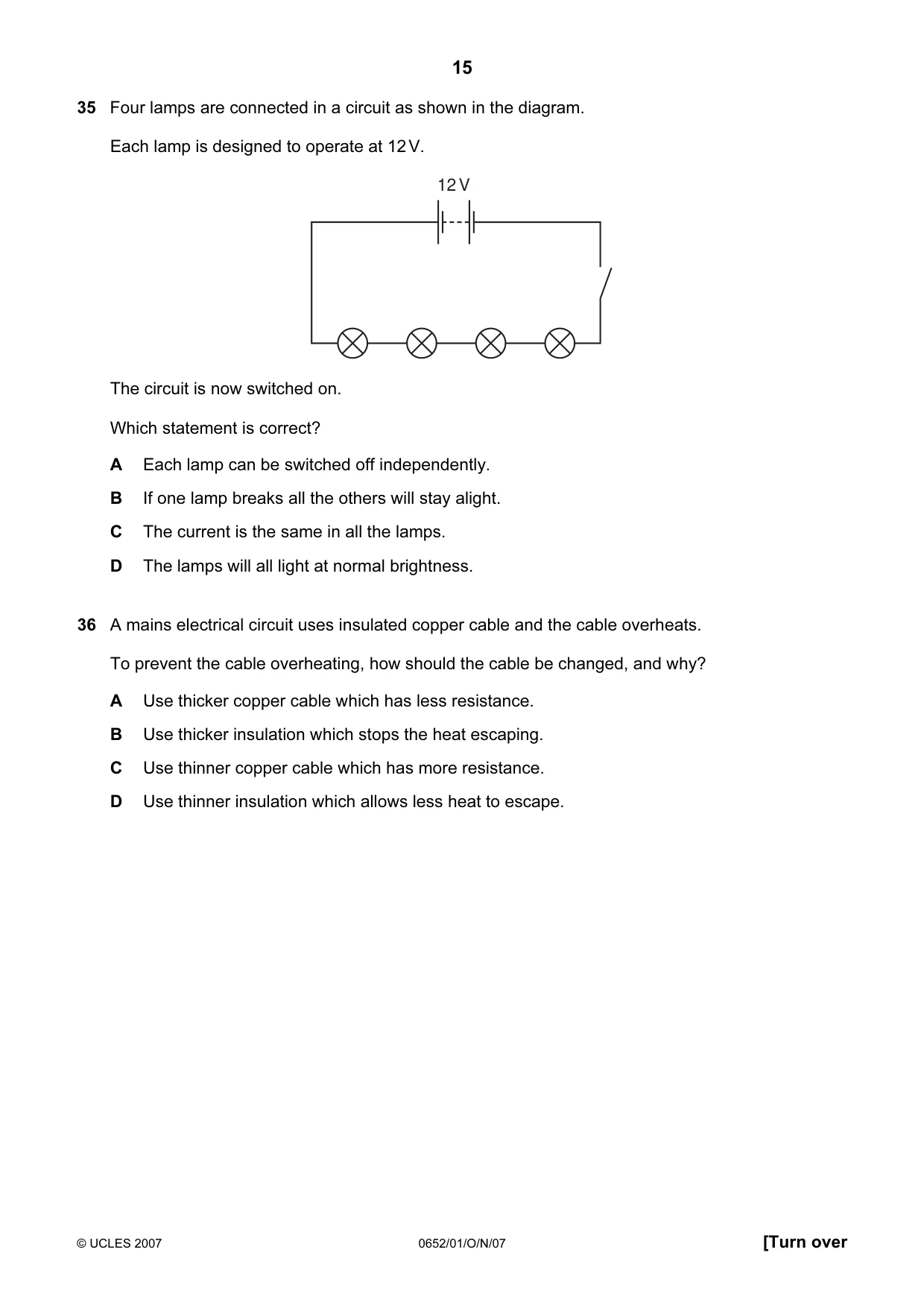
35 Four lamps are connected in a circuit as shown in the diagram. Each lamp is designed to operate at 12 V. 12 V The circuit is now switched on. Which statement is correct? A Each lamp can be switched off independently. B If one lamp breaks all the others will stay alight. C The current is the same in all the lamps. D The lamps will all light at normal brightness.
Mark scheme: C
Q36 · A mains electrical circuit uses insulated copper cable and the cable overheats
36 A mains electrical circuit uses insulated copper cable and the cable overheats. To prevent the cable overheating, how should the cable be changed, and why? A Use thicker copper cable which has less resistance. B Use thicker insulation which stops the heat escaping. C Use thinner copper cable which has more resistance. D Use thinner insulation which allows less heat to escape.
Mark scheme: A
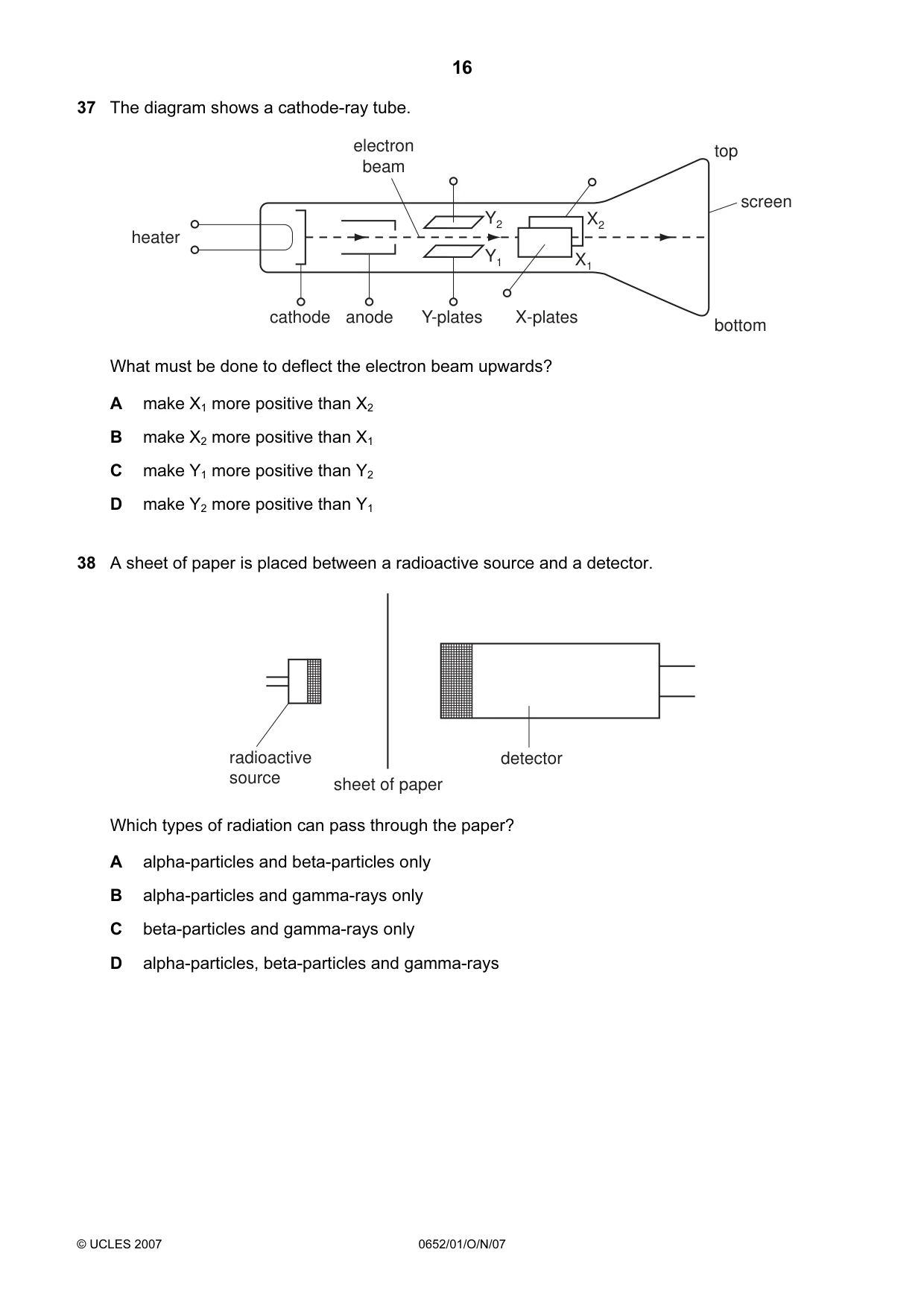
Q37 · The diagram shows a cathode-ray tube
37 The diagram shows a cathode-ray tube. electron top beam screen Y2 X2 heater Y1 X1 cathode anode Y-plates X-plates bottom What must be done to deflect the electron beam upwards? A make X1 more positive than X2 B make X2 more positive than X1 C make Y1 more positive than Y2 D make Y2 more positive than Y1
Mark scheme: D
Q38 · A sheet of paper is placed between a radioactive source and a detector
38 A sheet of paper is placed between a radioactive source and a detector. radioactive detector source sheet of paper Which types of radiation can pass through the paper? A alpha-particles and beta-particles only B alpha-particles and gamma-rays only C beta-particles and gamma-rays only D alpha-particles, beta-particles and gamma-rays
Mark scheme: C
Q39 · A sample of radioactive isotope is decaying
39 A sample of radioactive isotope is decaying. The nuclei of which atoms will decay first? A impossible to know, because radioactive decay is random B impossible to know, unless the age of the material is known C atoms near the centre, because they are surrounded by more atoms D atoms near the surface, because the radiation can escape more easily
Mark scheme: A
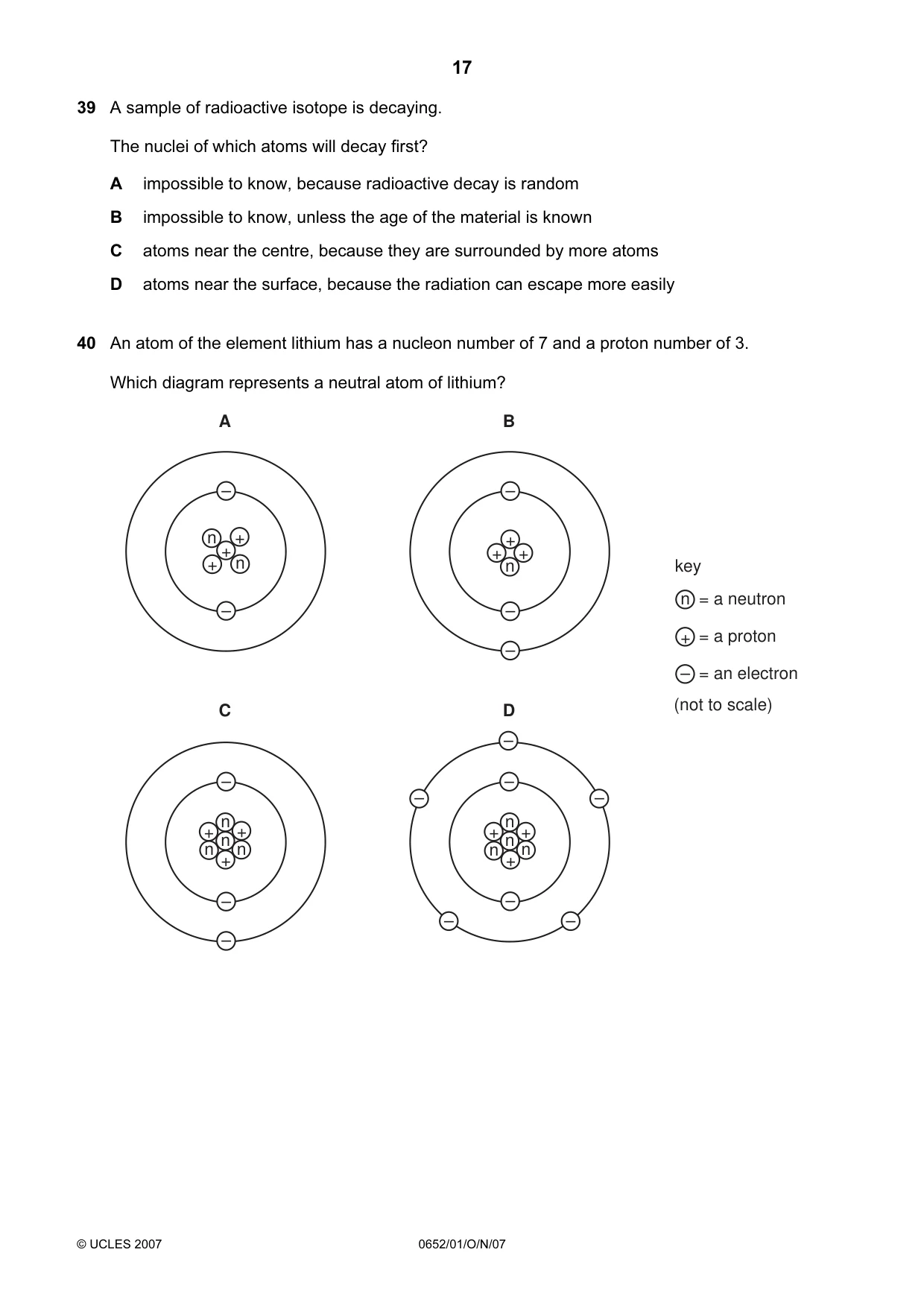
Q40 · An atom of the element lithium has a nucleon number of 7 and a proton number of 3
40 An atom of the element lithium has a nucleon number of 7 and a proton number of 3. Which diagram represents a neutral atom of lithium? A B – – n + + + + + + n n key n = a neutron – – + = a proton – – = an electron C D (not to scale) – – – – – n n + + + + n n n n n n + + – – – – –
Mark scheme: C
What was in this paper
The subtopics covered by these 40 questions, and how many questions each got. Open one in a new tab to see every Cambridge question on it.
2Energetics of a reaction2Forces2Periodic Trends2Radioactivity2Simple phenomena of magnetism2Alkenes1Atomic structure and the Periodic Table1Carbonates1Electric circuits1Electrical energy1Electrical quantities1Electromagnetic effects1Fuels1General wave properties1Group properties1Homologous series1Light1Mass and weight1Measurement1Molecules and covalent bonds1Motion1Preparation of salts1Properties of metals1Rate (speed) of reaction1Reactivity series1The nuclear atom1The particulate nature of matter1Thermal processes1Thermal properties and temperature1Transition elements1Types of oxides1Uses of metals1Work, energy and power1What you needed in this session
Cambridge’s own grade thresholds for 2007 Oct/Nov, Paper 1 · Variant 1. A higher threshold means an easier paper — the bar moves with how the cohort did.