Cambridge IGCSE Physical Science 0652 — 2022 Oct/Nov Paper 1 · Variant 1
0652/11/O/N/22 · 40 questions · 40 marks · ≈45 min
The question paper and its mark scheme, free to read here and free to download. This is Cambridge’s own paper, exactly as it was sat.
Question paper16 pages
Mark scheme3 pages
Answers below. Sit the paper first if you are practising.
Questions as text
Q1 · The chromatogram of a black ink and three coloured dyes, X, Y and Z, is shown
1 The chromatogram of a black ink and three coloured dyes, X, Y and Z, is shown. black X Y Z ink Which colours make up the black ink? A X and Y only B X and Z only C X, Y and Z D Z only
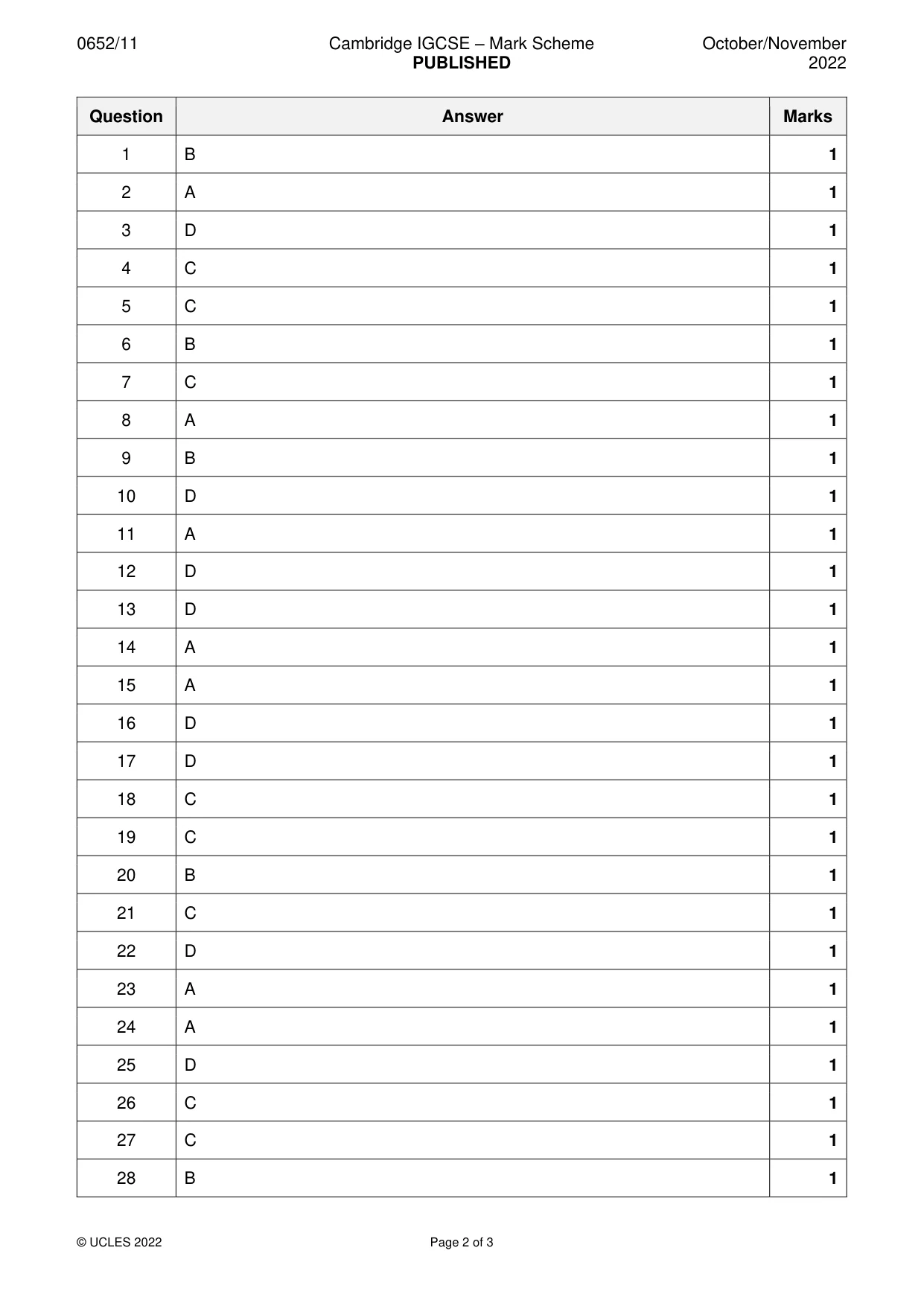
Mark scheme: B
Q2 · Which statement about elements, mixtures and compounds is correct?
2 Which statement about elements, mixtures and compounds is correct? A A compound is made into different substances by chemical changes. B All mixtures contain three or more substances. C All mixtures contain atoms of different elements chemically joined together. D Every element contains more than one type of atom.
Mark scheme: A
Q3 · Which statement about a proton is correct?
3 Which statement about a proton is correct? A It has the same relative charge as an electron. B It has approximately the same relative mass as an electron. C It has the same relative charge as a neutron. D It has approximately the same relative mass as a neutron.
Mark scheme: D
Q4 · When atoms of sodium combine with atoms of chlorine, sodium chloride is formed
4 When atoms of sodium combine with atoms of chlorine, sodium chloride is formed. How are the bonds between sodium and chlorine formed? A Chlorine gives electrons to sodium. B Sodium and chlorine lose electrons. C Sodium gives electrons to chlorine. D Sodium shares electrons with chlorine.
Mark scheme: C
Q5 · Pentane, C5H12, burns in oxygen
5 Pentane, C5H12, burns in oxygen. C5H12 + xO2 → 5CO2 + yH2O Which values of x and y balance the equation? x y A 4 6 B 4 12 C 8 6 D 8 12
Mark scheme: C
Q6 · Which process occurs when an ionic compound is broken down by the passage of electricity?
6 Which process occurs when an ionic compound is broken down by the passage of electricity? A electrode B electrolysis C electrolyte D electron
Mark scheme: B
Q7 · Anhydrous copper(II) sulfate is placed in a test-tube
7 Anhydrous copper(II) sulfate is placed in a test-tube. When water is added to the test-tube, the temperature changes from 17 °C to 27 °C. Which type of reaction takes place? A addition B endothermic C exothermic D oxidation
Mark scheme: C
Q8 · Calcium carbonate reacts with hydrochloric acid
8 Calcium carbonate reacts with hydrochloric acid. CaCO3 + 2HCl → CaCl 2 + CO2 + H2O Which row describes how the rate of reaction and the concentration of hydrochloric acid change as the reaction occurs? concentration of rate of reaction hydrochloric acid A decreases decreases B decreases increases C increases increases D increases decreases
Mark scheme: A
Q9 · The chart shows the colour of universal indicator at different pH values
9 The chart shows the colour of universal indicator at different pH values. colour red orange green blue violet pH 1 2 3 4 5 6 7 8 9 10 11 12 13 14 A solution of lemon juice is only slightly acidic. Which colour does universal indicator give with this solution? A blue B orange C red D violet
Mark scheme: B
More questions on The characteristic properties of acids and bases
Q10 · Which test is used to show that a gas is ammonia?
10 Which test is used to show that a gas is ammonia? A B C D flame glowing splint splint limewater damp litmus paper
Mark scheme: D
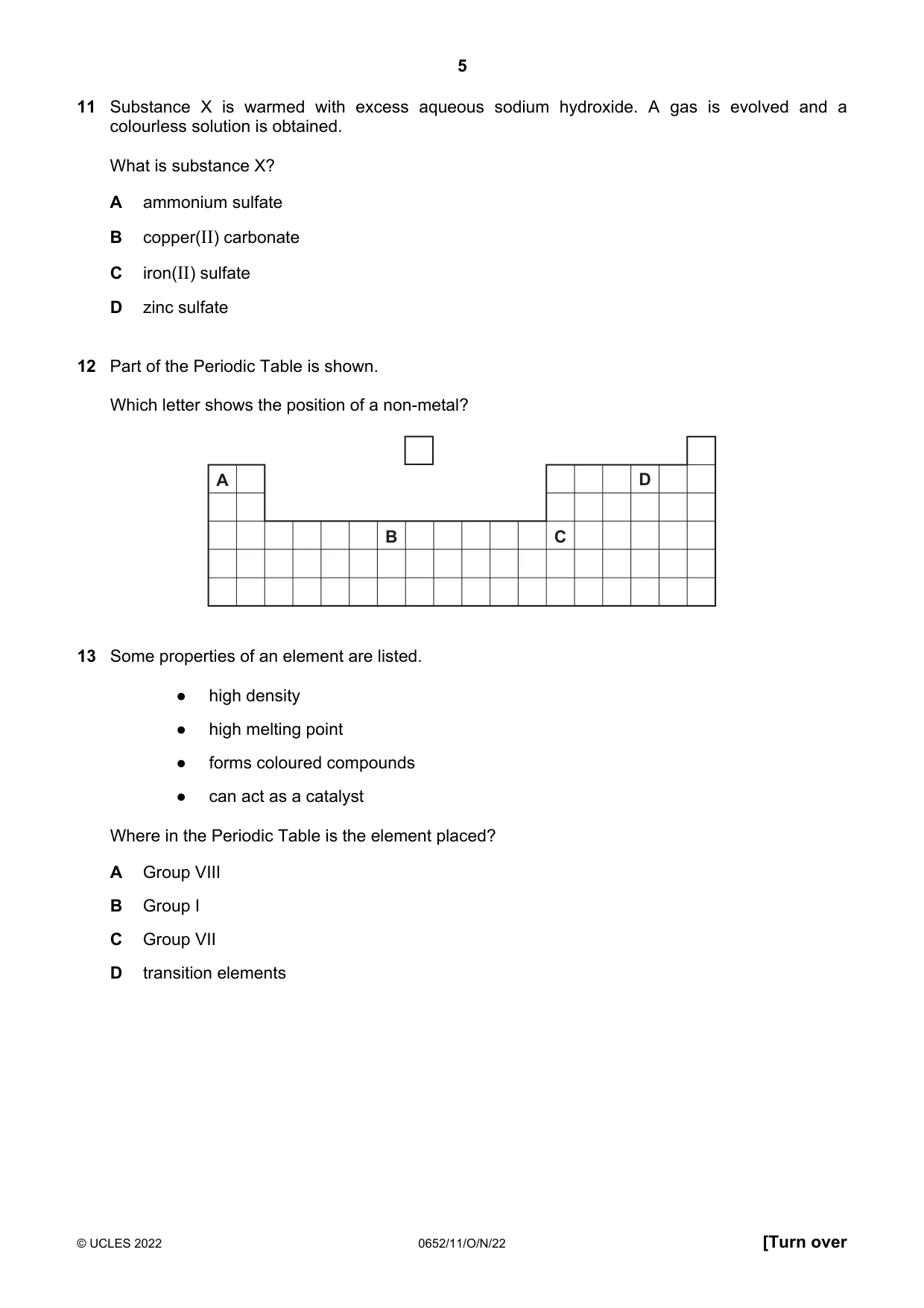
Q11 · Substance X is warmed with excess aqueous sodium hydroxide
11 Substance X is warmed with excess aqueous sodium hydroxide. A gas is evolved and a colourless solution is obtained. What is substance X? A ammonium sulfate B copper(II) carbonate C iron(II) sulfate D zinc sulfate
Mark scheme: A
Q12 · Part of the Periodic Table is shown
12 Part of the Periodic Table is shown. Which letter shows the position of a non-metal? A D B C
Mark scheme: D
Q13 · Some properties of an element are listed
13 Some properties of an element are listed. ● high density ● high melting point ● forms coloured compounds ● can act as a catalyst Where in the Periodic Table is the element placed? A Group VIII B Group I C Group VII D transition elements
Mark scheme: D
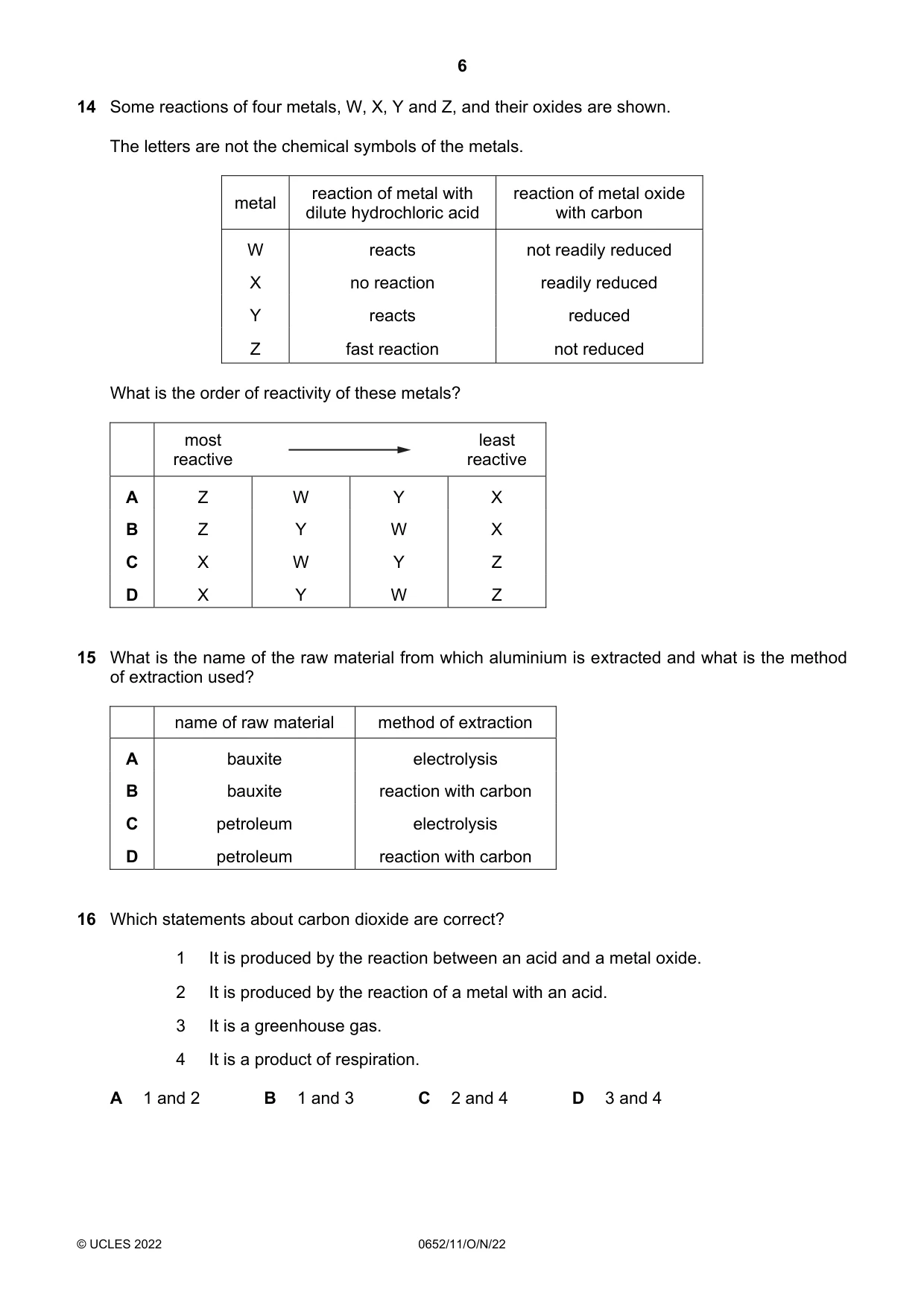
Q14 · Some reactions of four metals, W, X, Y and Z, and their oxides are shown
14 Some reactions of four metals, W, X, Y and Z, and their oxides are shown. The letters are not the chemical symbols of the metals. reaction of metal with reaction of metal oxide metal dilute hydrochloric acid with carbon W reacts not readily reduced X no reaction readily reduced Y reacts reduced Z fast reaction not reduced What is the order of reactivity of these metals? most least reactive reactive A Z W Y X B Z Y W X C X W Y Z D X Y W Z
Mark scheme: A
Q15 · What is the name of the raw material from which aluminium is extracted and what is the…
15 What is the name of the raw material from which aluminium is extracted and what is the method of extraction used? name of raw material method of extraction A bauxite electrolysis B bauxite reaction with carbon C petroleum electrolysis D petroleum reaction with carbon
Mark scheme: A
Q16 · Which statements about carbon dioxide are correct?
16 Which statements about carbon dioxide are correct? 1 It is produced by the reaction between an acid and a metal oxide. 2 It is produced by the reaction of a metal with an acid. 3 It is a greenhouse gas. 4 It is a product of respiration. A 1 and 2 B 1 and 3 C 2 and 4 D 3 and 4
Mark scheme: D
Q17 · Which type of reaction occurs when calcium carbonate is converted into calcium oxide?
17 Which type of reaction occurs when calcium carbonate is converted into calcium oxide? A cracking B displacement C neutralisation D thermal decomposition
Mark scheme: D
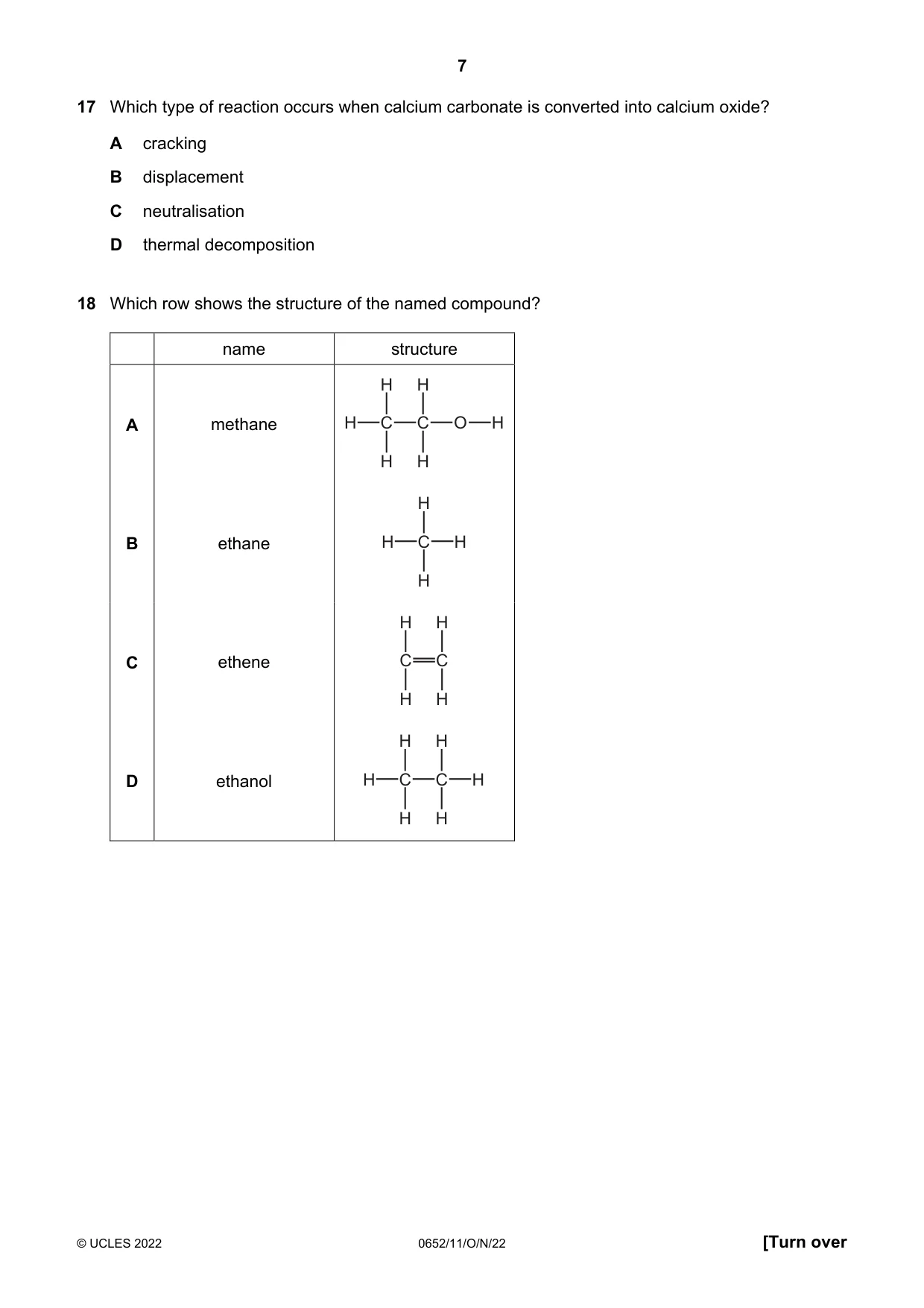
Q18 · Which row shows the structure of the named compound?
18 Which row shows the structure of the named compound? name structure H H A methane H C C O H H H H B ethane H C H H H H C ethene C C H H H H D ethanol H C C H H H
Mark scheme: C
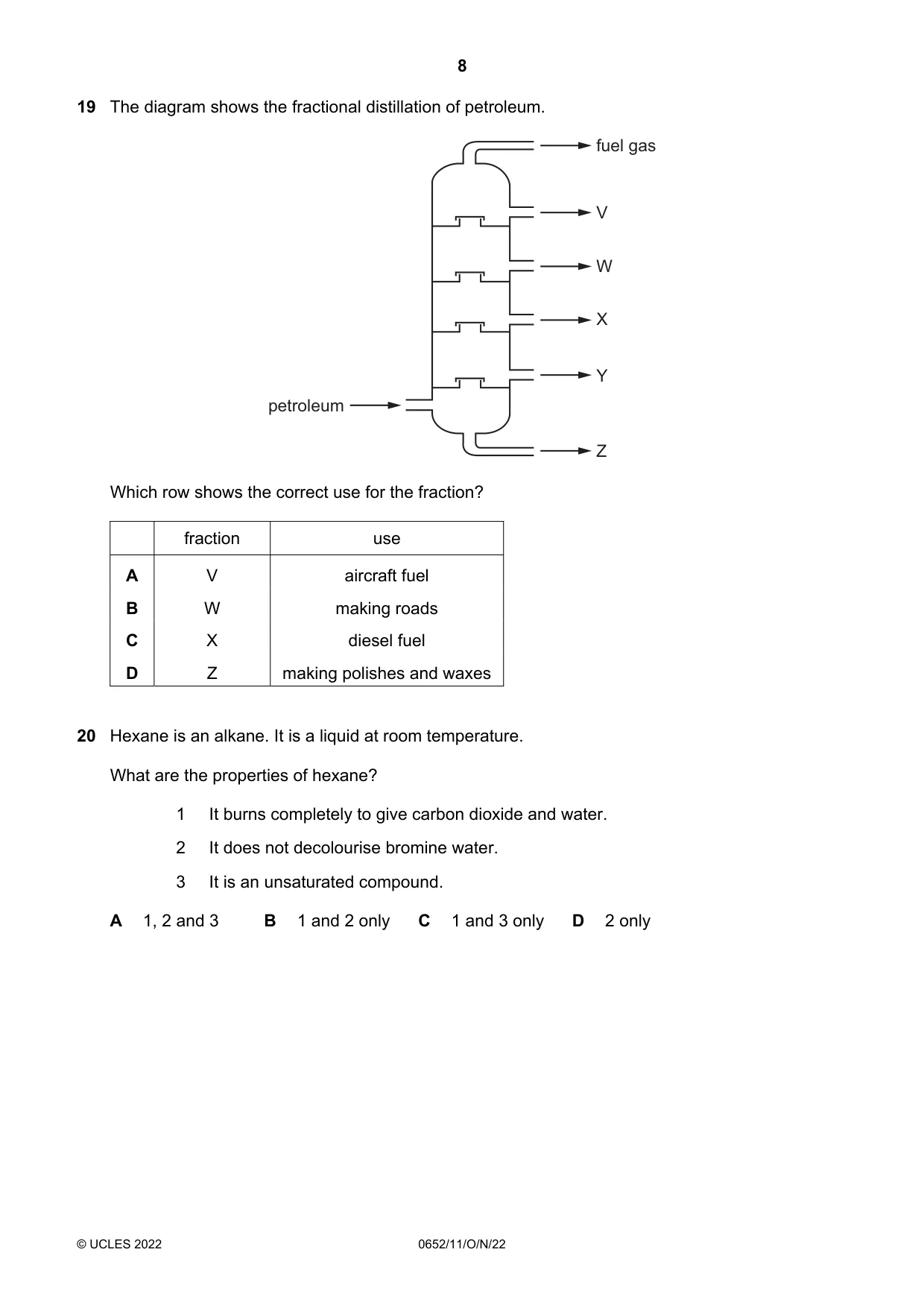
Q19 · The diagram shows the fractional distillation of petroleum
19 The diagram shows the fractional distillation of petroleum. fuel gas V W X Y petroleum Z Which row shows the correct use for the fraction? fraction use A V aircraft fuel B W making roads C X diesel fuel D Z making polishes and waxes
Mark scheme: C
Q20 · Hexane is an alkane
20 Hexane is an alkane. It is a liquid at room temperature. What are the properties of hexane? 1 It burns completely to give carbon dioxide and water. 2 It does not decolourise bromine water. 3 It is an unsaturated compound. A 1, 2 and 3 B 1 and 2 only C 1 and 3 only D 2 only
Mark scheme: B
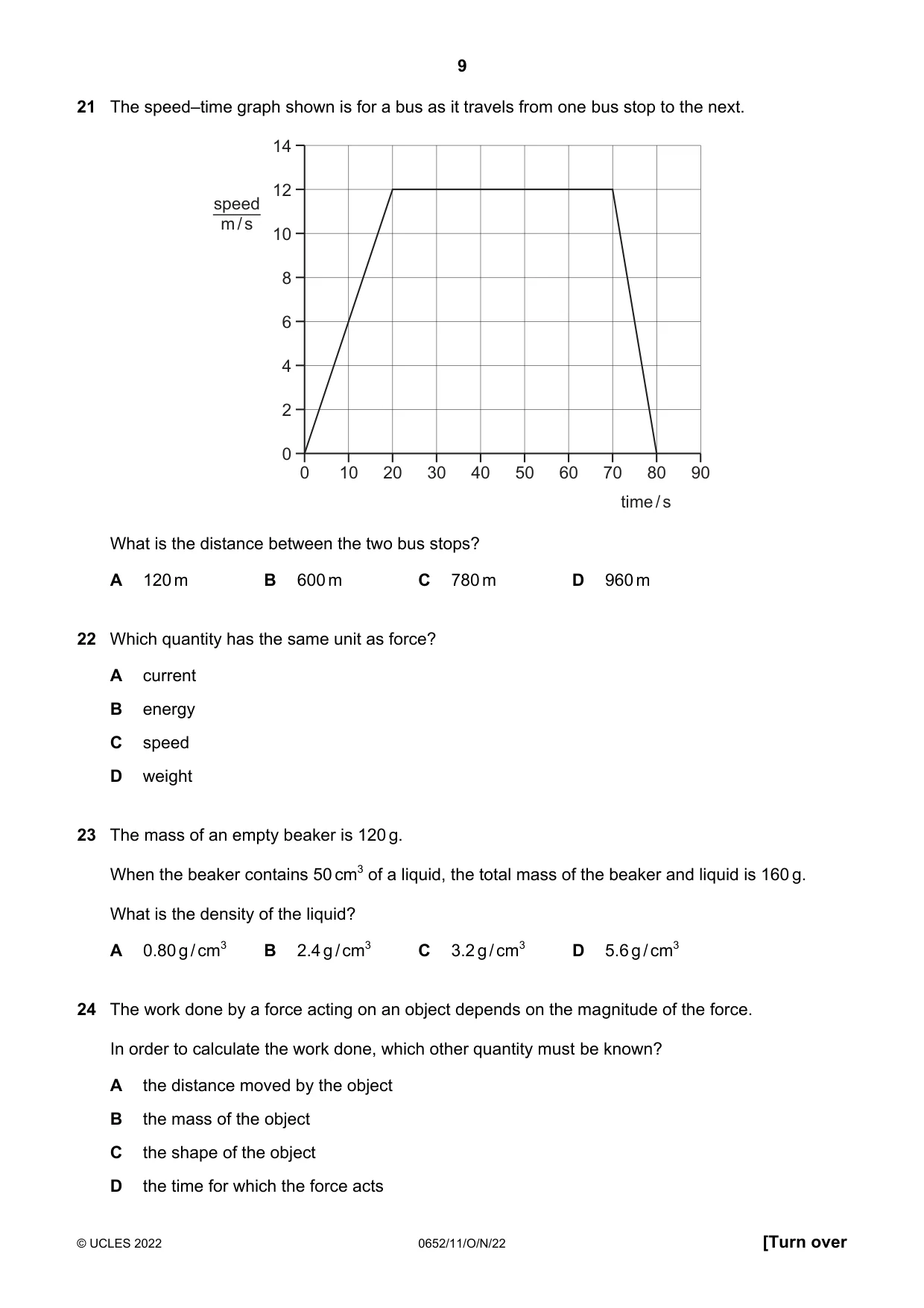
Q21 · The speed–time graph shown is for a bus as it travels from one bus stop to the next
21 The speed–time graph shown is for a bus as it travels from one bus stop to the next. 14 12 speed m / s 10 8 6 4 2 0 0 10 20 30 40 50 60 70 80 90 time / s What is the distance between the two bus stops? A 120 m B 600 m C 780 m D 960 m
Mark scheme: C
Q22 · Which quantity has the same unit as force?
22 Which quantity has the same unit as force? A current B energy C speed D weight
Mark scheme: D
Q23 · The mass of an empty beaker is 120 g
23 The mass of an empty beaker is 120 g. When the beaker contains 50 cm3 of a liquid, the total mass of the beaker and liquid is 160 g. What is the density of the liquid? A 0.80 g / cm3 B 2.4 g / cm3 C 3.2 g / cm3 D 5.6 g / cm3
Mark scheme: A
Q24 · The work done by a force acting on an object depends on the magnitude of the force
24 The work done by a force acting on an object depends on the magnitude of the force. In order to calculate the work done, which other quantity must be known? A the distance moved by the object B the mass of the object C the shape of the object D the time for which the force acts
Mark scheme: A
Q25 · Different energy resources are used to produce electricity
25 Different energy resources are used to produce electricity. Which resource is the least reliable? A geothermal B hydroelectric C nuclear D wind
Mark scheme: D
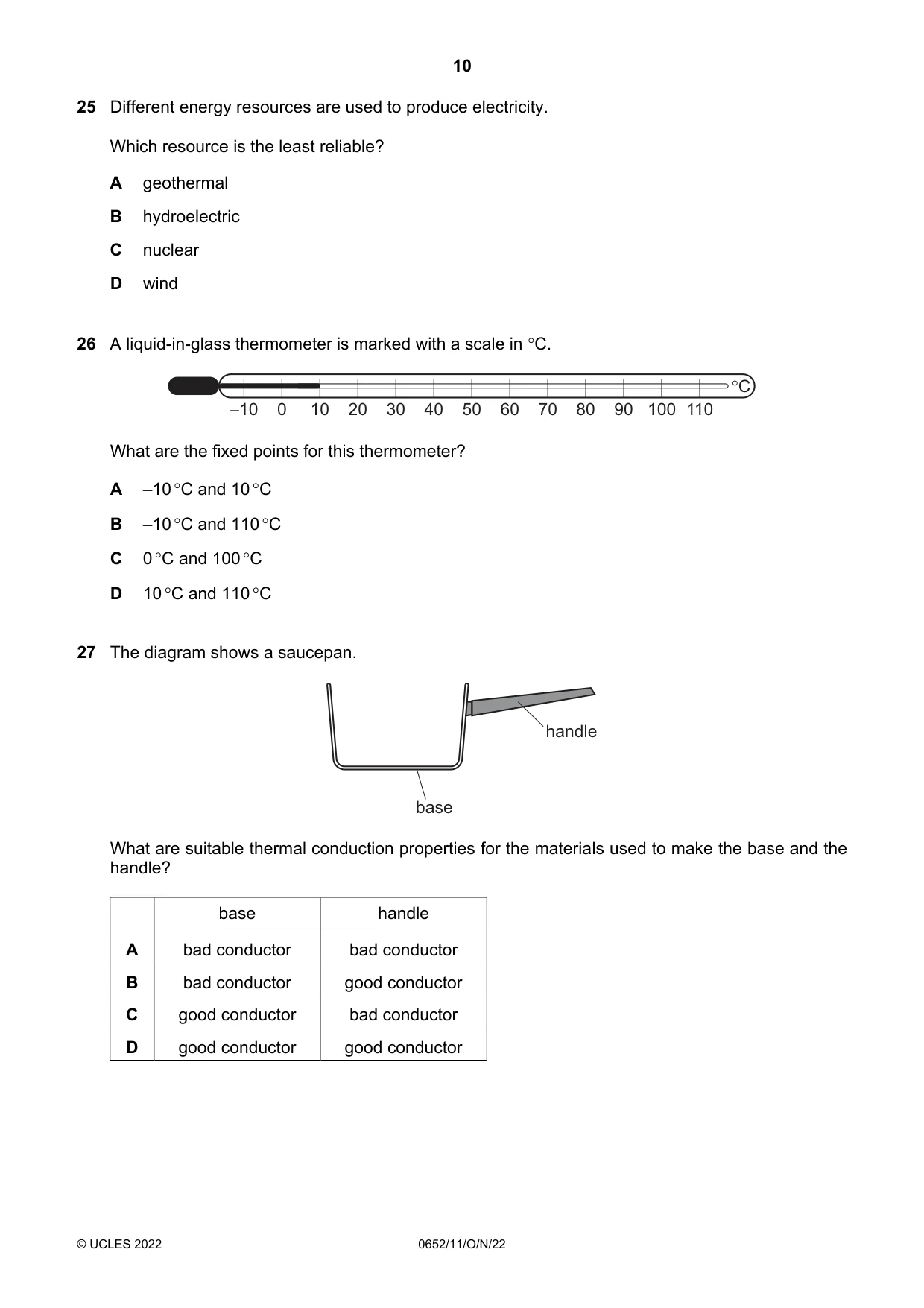
Q26 · A liquid-in-glass thermometer is marked with a scale in °C
26 A liquid-in-glass thermometer is marked with a scale in °C. -10 0 10 20 30 40 50 60 70 80 90 100 110 What are the fixed points for this thermometer? A -10°C and 10°C B -10°C and 110°C C 0°C and 100°C D 10°C and 110°C
Mark scheme: C
Q27 · The diagram shows a saucepan
27 The diagram shows a saucepan. handle base What are suitable thermal conduction properties for the materials used to make the base and the handle? base handle A bad conductor bad conductor B bad conductor good conductor C good conductor bad conductor D good conductor good conductor
Mark scheme: C
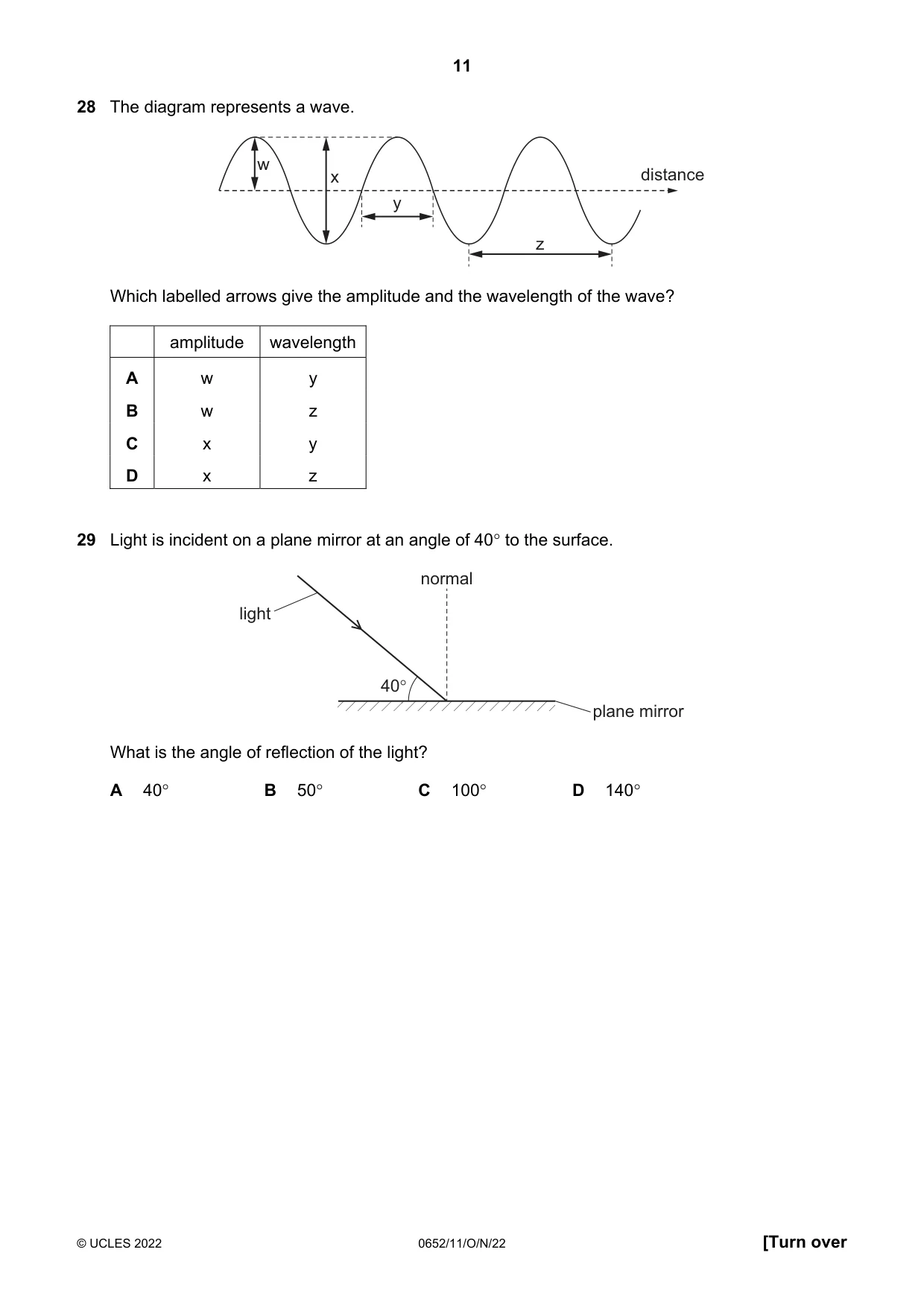
Q28 · The diagram represents a wave
28 The diagram represents a wave. w x distance y z Which labelled arrows give the amplitude and the wavelength of the wave? amplitude wavelength A w y B w z C x y D x z
Mark scheme: B
Q29 · Light is incident on a plane mirror at an angle of 40° to the surface
29 Light is incident on a plane mirror at an angle of 40° to the surface. normal light plane mirror What is the angle of reflection of the light? A 40° B 50° C 100° D 140°
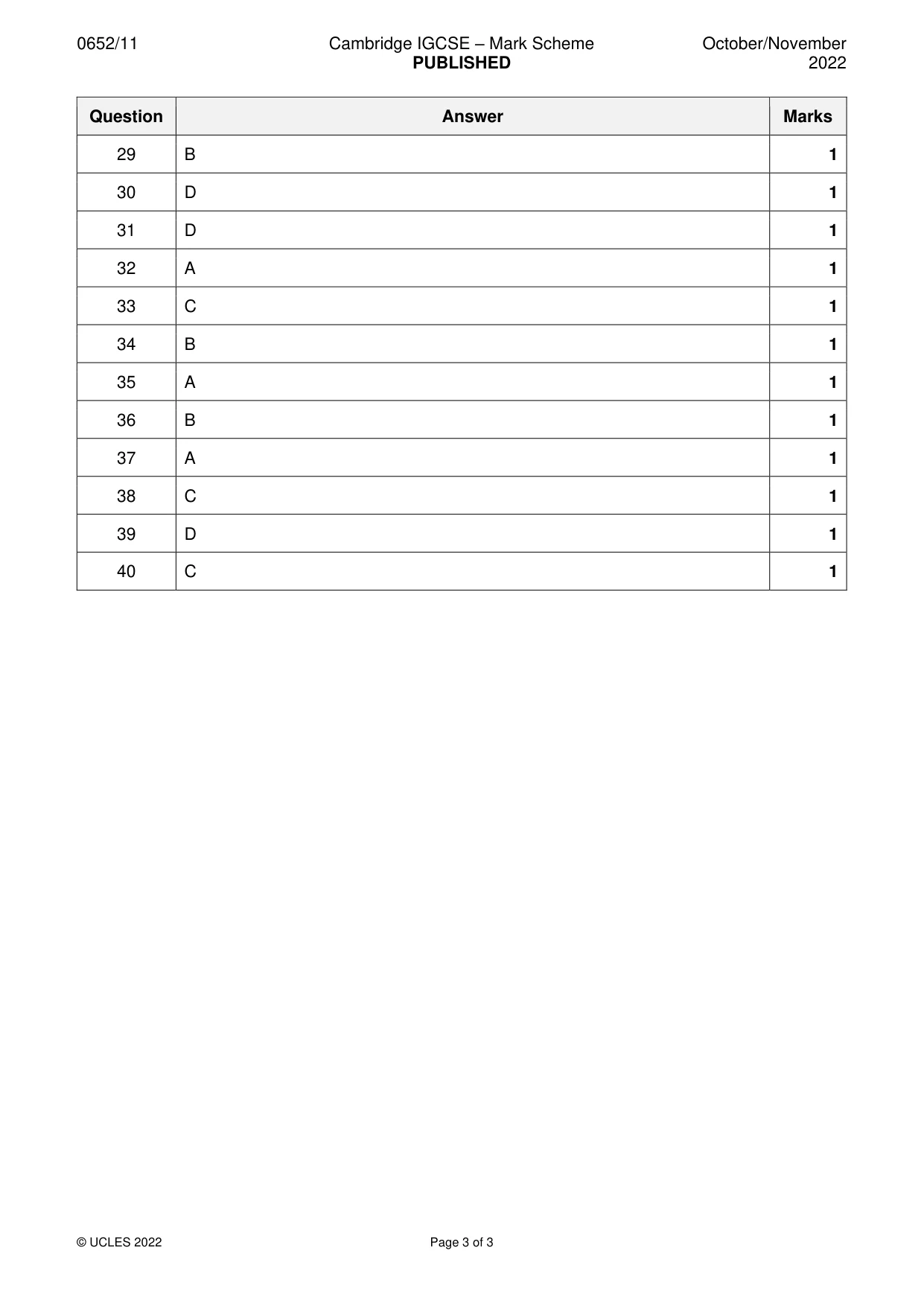
Mark scheme: B
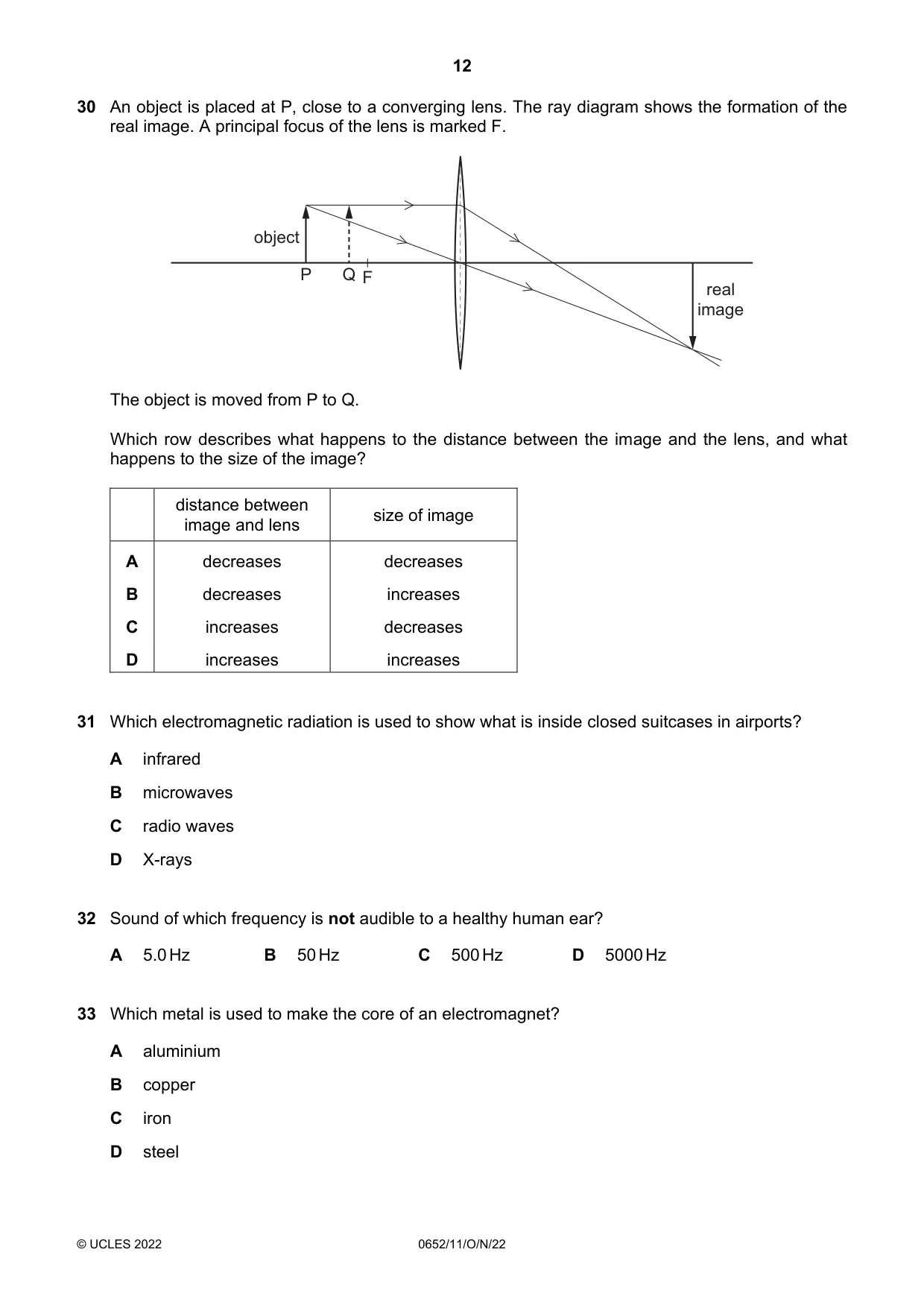
Q30 · An object is placed at P, close to a converging lens
30 An object is placed at P, close to a converging lens. The ray diagram shows the formation of the real image. A principal focus of the lens is marked F. object P Q F real image The object is moved from P to Q. Which row describes what happens to the distance between the image and the lens, and what happens to the size of the image? distance between size of image image and lens A decreases decreases B decreases increases C increases decreases D increases increases
Mark scheme: D
Q31 · Which electromagnetic radiation is used to show what is inside closed suitcases in…
31 Which electromagnetic radiation is used to show what is inside closed suitcases in airports? A infrared B microwaves C radio waves D X-rays
Mark scheme: D
Q32 · Sound of which frequency is not audible to a healthy human ear?
32 Sound of which frequency is not audible to a healthy human ear? A 5.0 Hz B 50 Hz C 500 Hz D 5000 Hz
Mark scheme: A
Q33 · Which metal is used to make the core of an electromagnet?
33 Which metal is used to make the core of an electromagnet? A aluminium B copper C iron D steel
Mark scheme: C
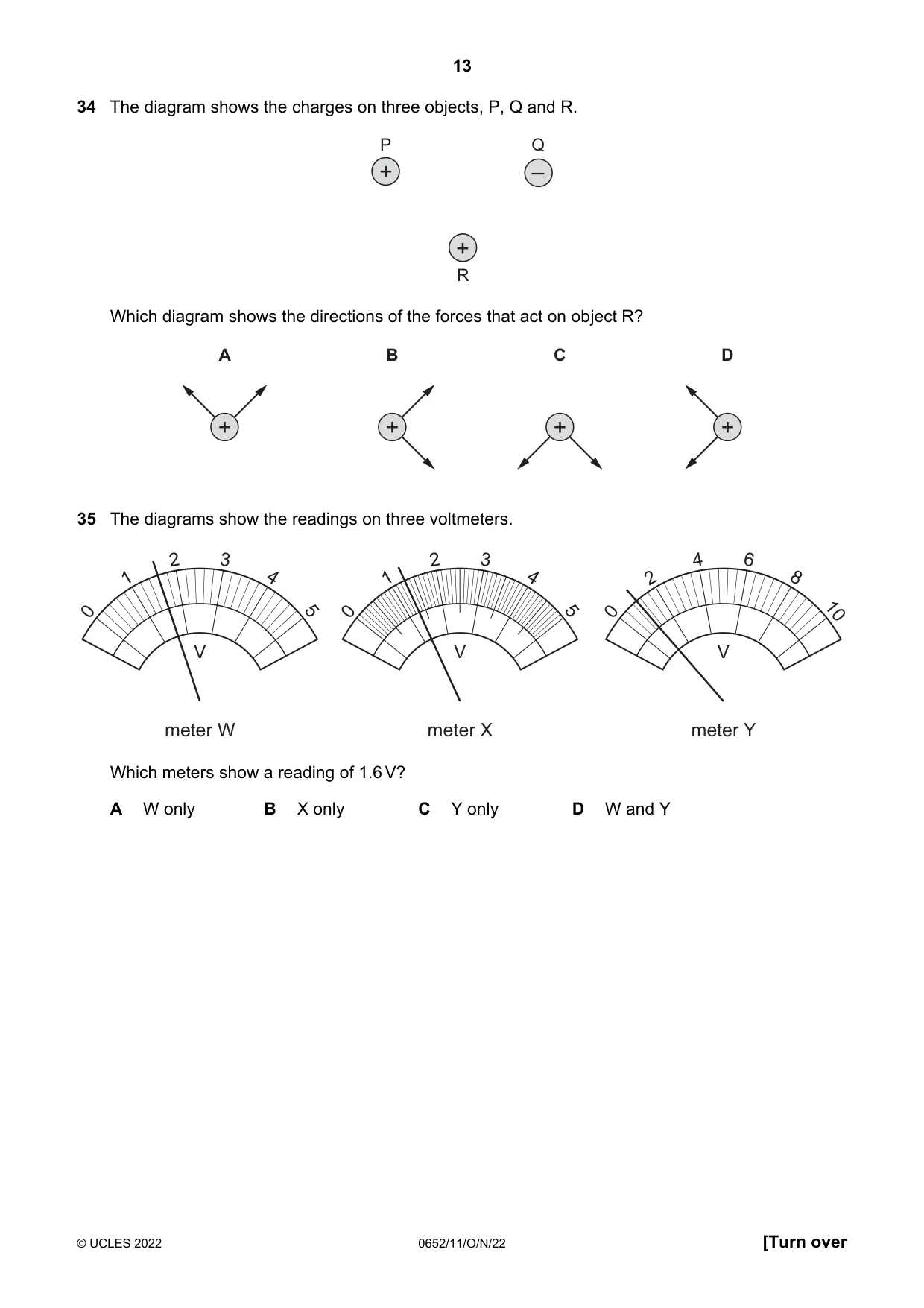
Q34 · The diagram shows the charges on three objects, P, Q and R
34 The diagram shows the charges on three objects, P, Q and R. P Q + – + R Which diagram shows the directions of the forces that act on object R? A B C D + + + +
Mark scheme: B
Q35 · The diagrams show the readings on three voltmeters
35 The diagrams show the readings on three voltmeters. 2 3 2 3 4 6 1 4 1 4 2 8 0 5 0 5 0 10 V V V meter W meter X meter Y Which meters show a reading of 1.6 V? A W only B X only C Y only D W and Y
Mark scheme: A
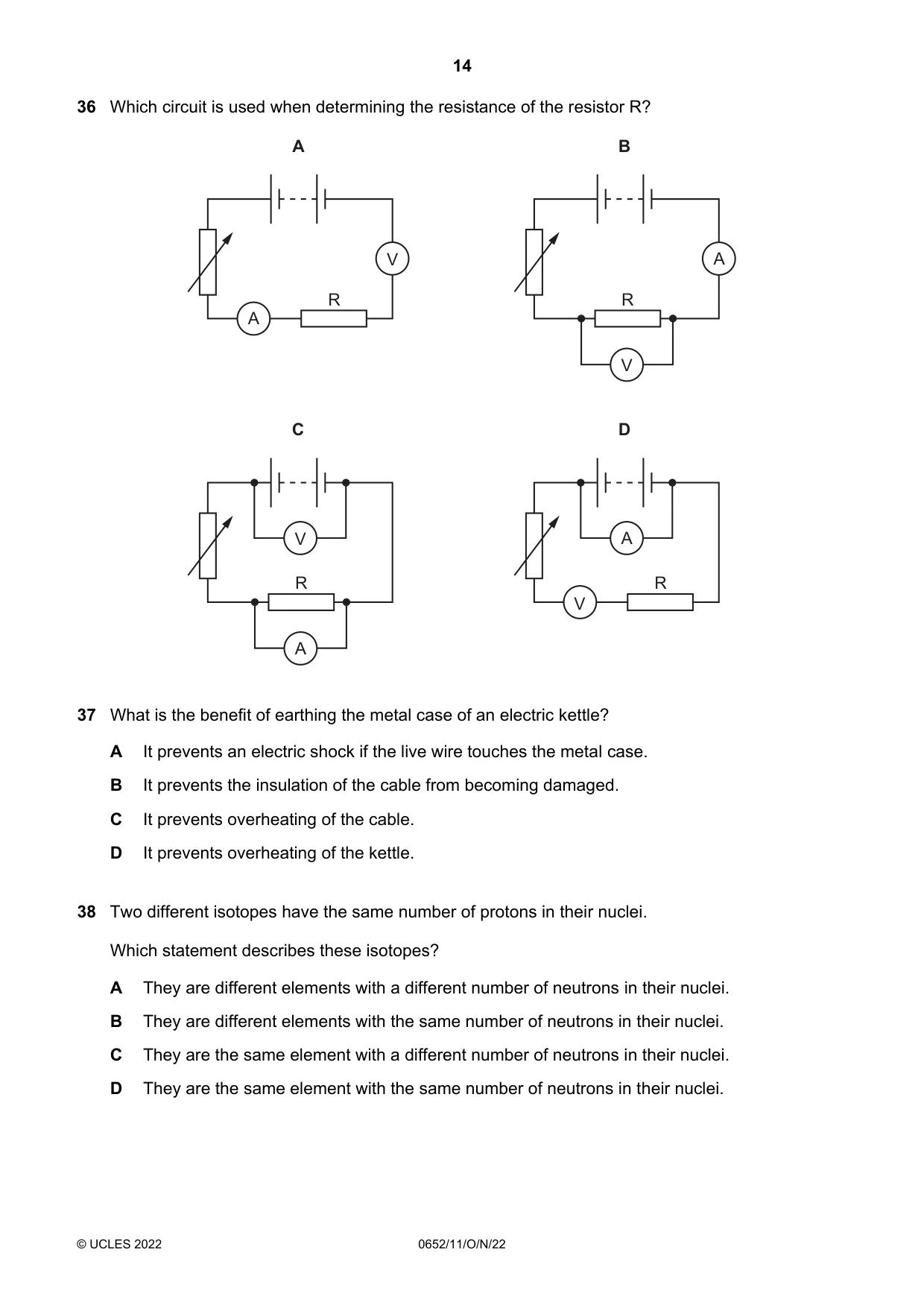
Q36 · Which circuit is used when determining the resistance of the resistor R?
36 Which circuit is used when determining the resistance of the resistor R? A B V A R R A V C D V A R R V A
Mark scheme: B
Q37 · What is the benefit of earthing the metal case of an electric kettle?
37 What is the benefit of earthing the metal case of an electric kettle? A It prevents an electric shock if the live wire touches the metal case. B It prevents the insulation of the cable from becoming damaged. C It prevents overheating of the cable. D It prevents overheating of the kettle.
Mark scheme: A
Q38 · Two different isotopes have the same number of protons in their nuclei
38 Two different isotopes have the same number of protons in their nuclei. Which statement describes these isotopes? A They are different elements with a different number of neutrons in their nuclei. B They are different elements with the same number of neutrons in their nuclei. C They are the same element with a different number of neutrons in their nuclei. D They are the same element with the same number of neutrons in their nuclei.
Mark scheme: C
Q39 · What is an alpha-particle?
39 What is an alpha-particle? A an electron B electromagnetic radiation C four protons D two protons and two neutrons
Mark scheme: D
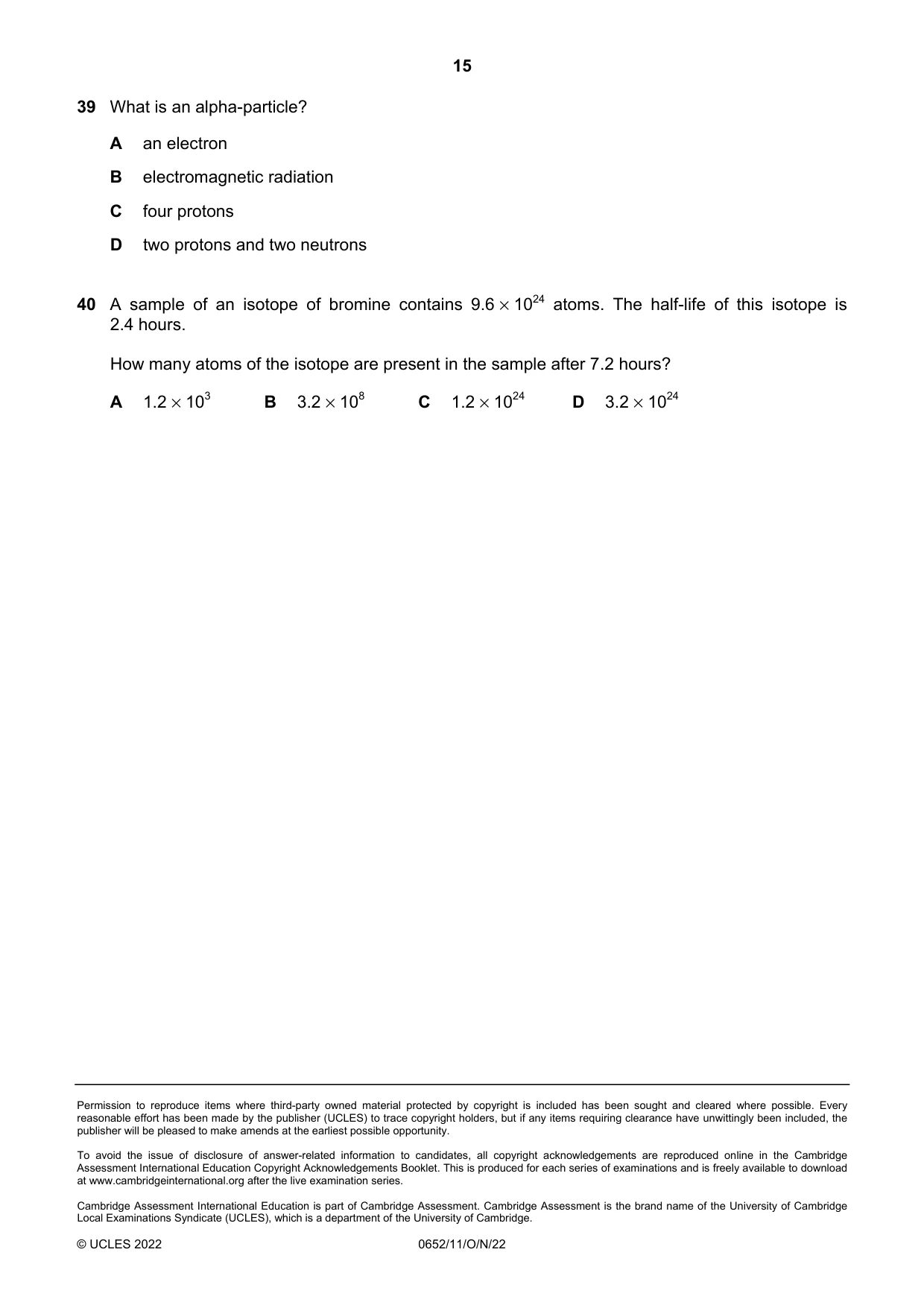
Q40 · A sample of an isotope of bromine contains 9.6 × 1024 atoms
40 A sample of an isotope of bromine contains 9.6 × 1024 atoms. The half-life of this isotope is 2.4 hours. How many atoms of the isotope are present in the sample after 7.2 hours? A 1.2 × 10³ B 3.2 × 10⁸ C 1.2 × 1024 D 3.2 × 1024
Mark scheme: C
What was in this paper
The subtopics covered by these 40 questions, and how many questions each got. Open one in a new tab to see every Cambridge question on it.
2Identification of ions and gases2Light2Radioactivity2Simple phenomena of magnetism2Work, energy and power2Alkanes1Atomic structure and the Periodic Table1Carbon dioxide and methane1Carbonates1Dangers of electricity1Density1Electric circuits1Electrical quantities1Electricity and chemistry1Elements, compounds and mixtures1Energy transfer1Extraction of metals1Forces1Fuels1Ions and ionic bonds1Methods of purification1Motion1Names of compounds1Rate (speed) of reaction1Reactivity series1Sound1Stoichiometry1The characteristic properties of acids and bases1The nuclear atom1The Periodic Table1Thermal processes1Thermal properties and temperature1Transition elements1What you needed in this session
Cambridge’s own grade thresholds for 2022 Oct/Nov, Paper 1 · Variant 1. A higher threshold means an easier paper — the bar moves with how the cohort did.