Cambridge IGCSE Physical Science 0652 — 2016 Oct/Nov Paper 1 · Variant 1
0652/11/O/N/16 · 40 questions · 40 marks · ≈45 min
The question paper and its mark scheme, free to read here and free to download. This is Cambridge’s own paper, exactly as it was sat.
Question paper16 pages
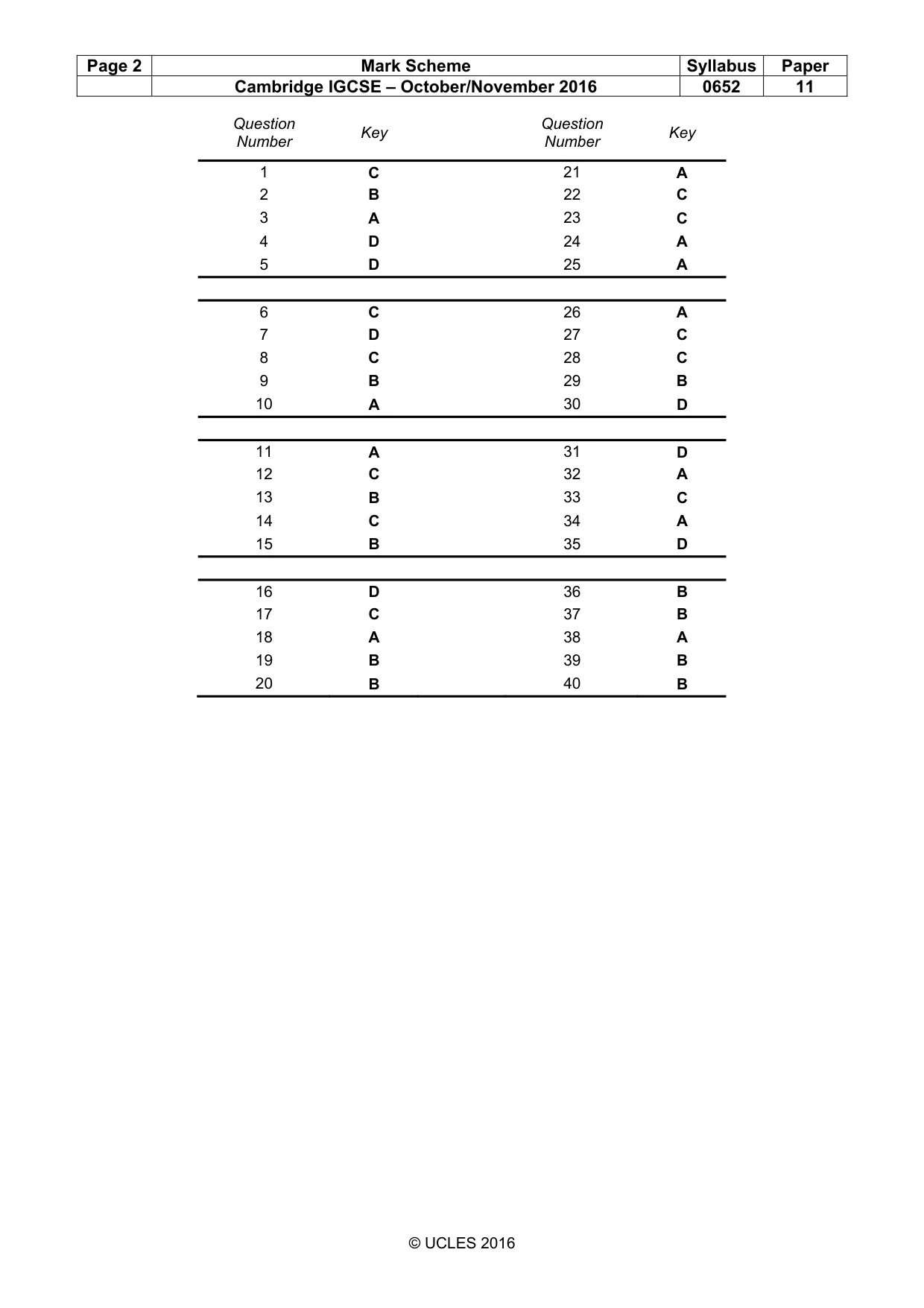
Mark scheme2 pages
Answers below. Sit the paper first if you are practising.
Questions as text
Q1 · In which process is heat energy neither given out nor taken in?
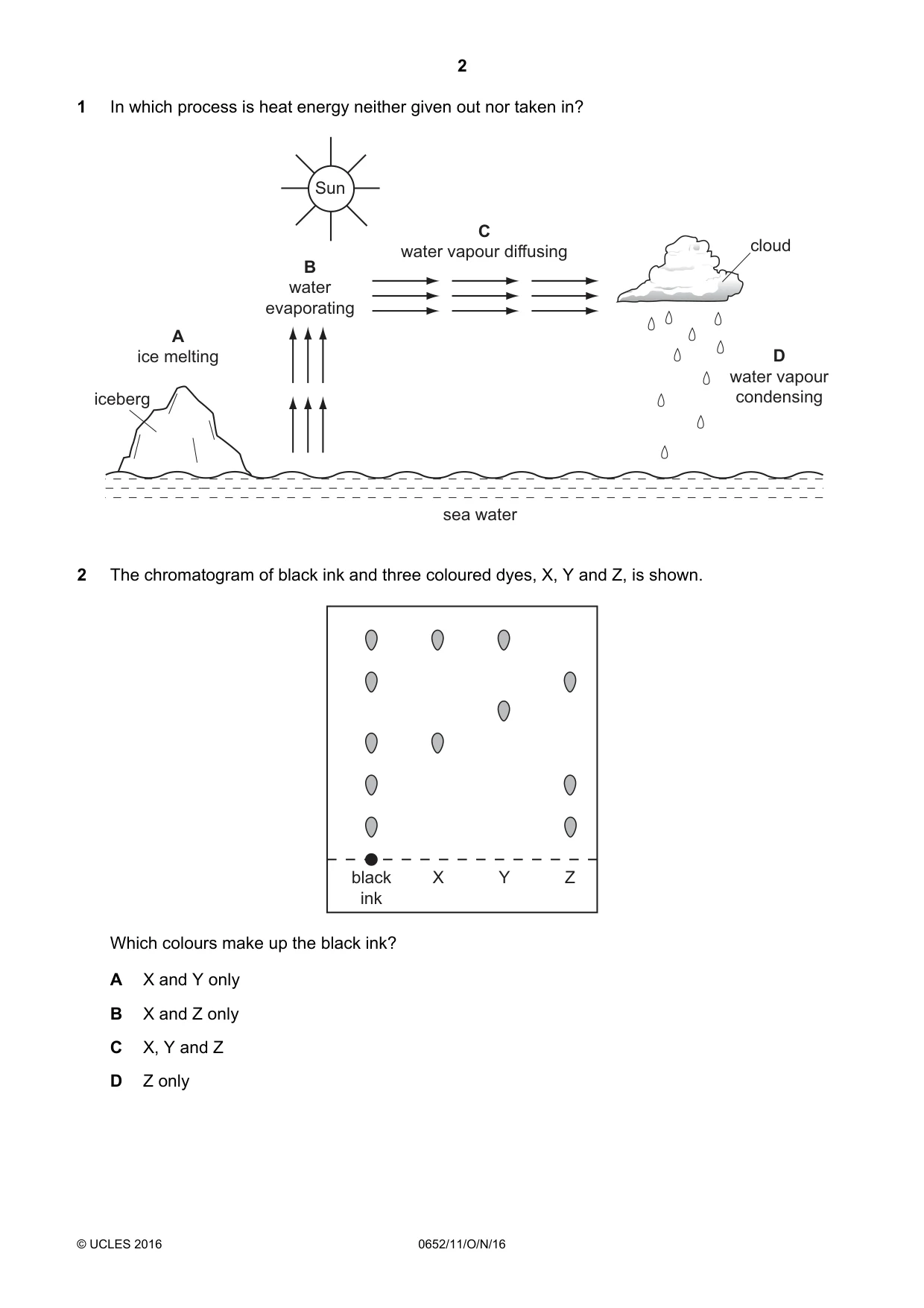
1 In which process is heat energy neither given out nor taken in? Sun C water vapour di f fusin g cloud B water evaporating A ice melting D water vapour iceberg condensing sea water
Mark scheme: C
Q2 · The chromatogram of black ink and three coloured dyes, X, Y and Z, is shown
2 The chromatogram of black ink and three coloured dyes, X, Y and Z, is shown. black X Y Z ink Which colours make up the black ink? A X and Y only B X and Z only C X, Y and Z D Z only
Mark scheme: B
Q3 · A bottle of a solid is labelled as shown
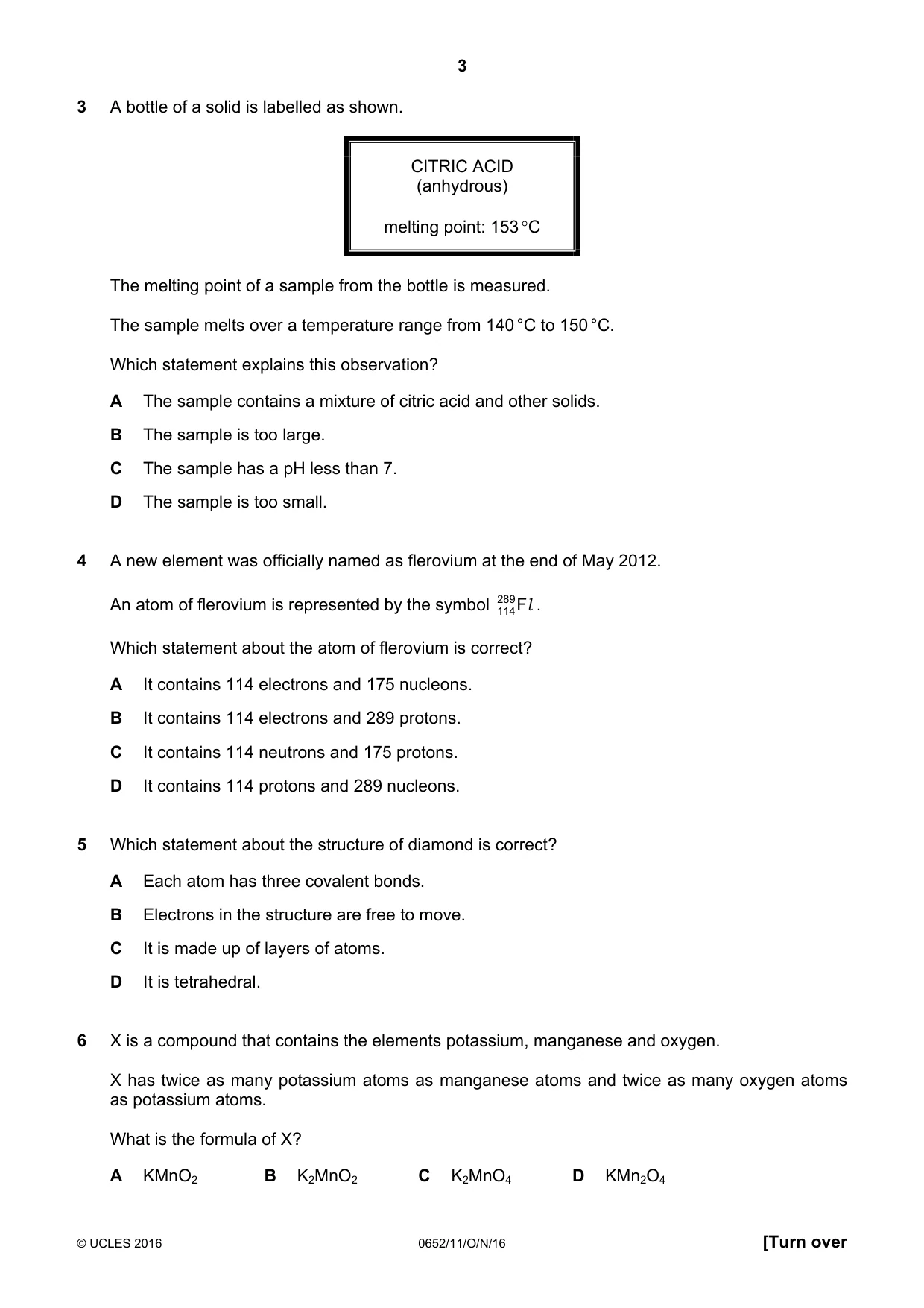
3 A bottle of a solid is labelled as shown. CITRIC ACID (anhydrous) melting point: 153 °C The melting point of a sample from the bottle is measured. The sample melts over a temperature range from 140 °C to 150 °C. Which statement explains this observation? A The sample contains a mixture of citric acid and other solids. B The sample is too large. C The sample has a pH less than 7. D The sample is too small.
Mark scheme: A
Q4 · A new element was officially named as flerovium at the end of May 2012
4 A new element was officially named as flerovium at the end of May 2012. An atom of flerovium is represented by the symbol 289 F l . 114 Which statement about the atom of flerovium is correct? A It contains 114 electrons and 175 nucleons. B It contains 114 electrons and 289 protons. C It contains 114 neutrons and 175 protons. D It contains 114 protons and 289 nucleons.
Mark scheme: D
Q5 · Which statement about the structure of diamond is correct?
5 Which statement about the structure of diamond is correct? A Each atom has three covalent bonds. B Electrons in the structure are free to move. C It is made up of layers of atoms. D It is tetrahedral.
Mark scheme: D
Q6 · X is a compound that contains the elements potassium, manganese and oxygen
6 X is a compound that contains the elements potassium, manganese and oxygen. X has twice as many potassium atoms as manganese atoms and twice as many oxygen atoms as potassium atoms. What is the formula of X? A KMnO2 B K2MnO2 C K2MnO4 D KMn2O4
Mark scheme: C
Q7 · What is the relative formula mass, Mr, of lead nitrate, Pb(NO3)2?
7 What is the relative formula mass, Mr, of lead nitrate, Pb(NO3)2? A 237 B 269 C 317 D 331
Mark scheme: D
Q8 · Which statement about all exothermic reactions is correct?
8 Which statement about all exothermic reactions is correct? A They absorb heat energy. B They produce flames. C They release heat energy. D They require oxygen gas.
Mark scheme: C
Q9 · Hydrogen is passed over a heated metal oxide as shown
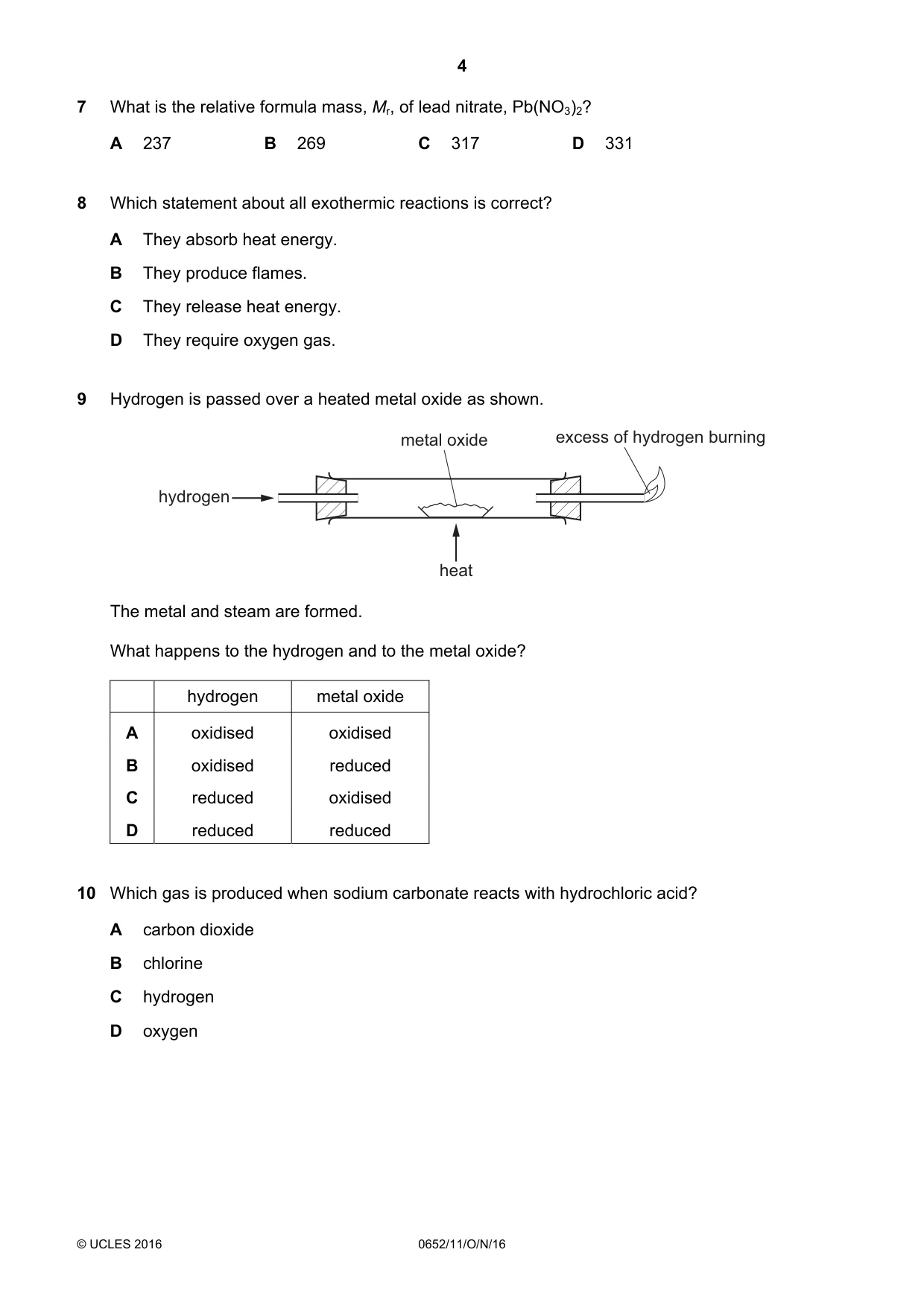
9 Hydrogen is passed over a heated metal oxide as shown. metal oxide excess of hydrogen burning hydrogen heat The metal and steam are formed. What happens to the hydrogen and to the metal oxide? hydrogen metal oxide A oxidised oxidised B oxidised reduced C reduced oxidised D reduced reduced
Mark scheme: B
Q10 · Which gas is produced when sodium carbonate reacts with hydrochloric acid?
10 Which gas is produced when sodium carbonate reacts with hydrochloric acid? A carbon dioxide B chlorine C hydrogen D oxygen
Mark scheme: A
Q11 · A gas was tested as shown
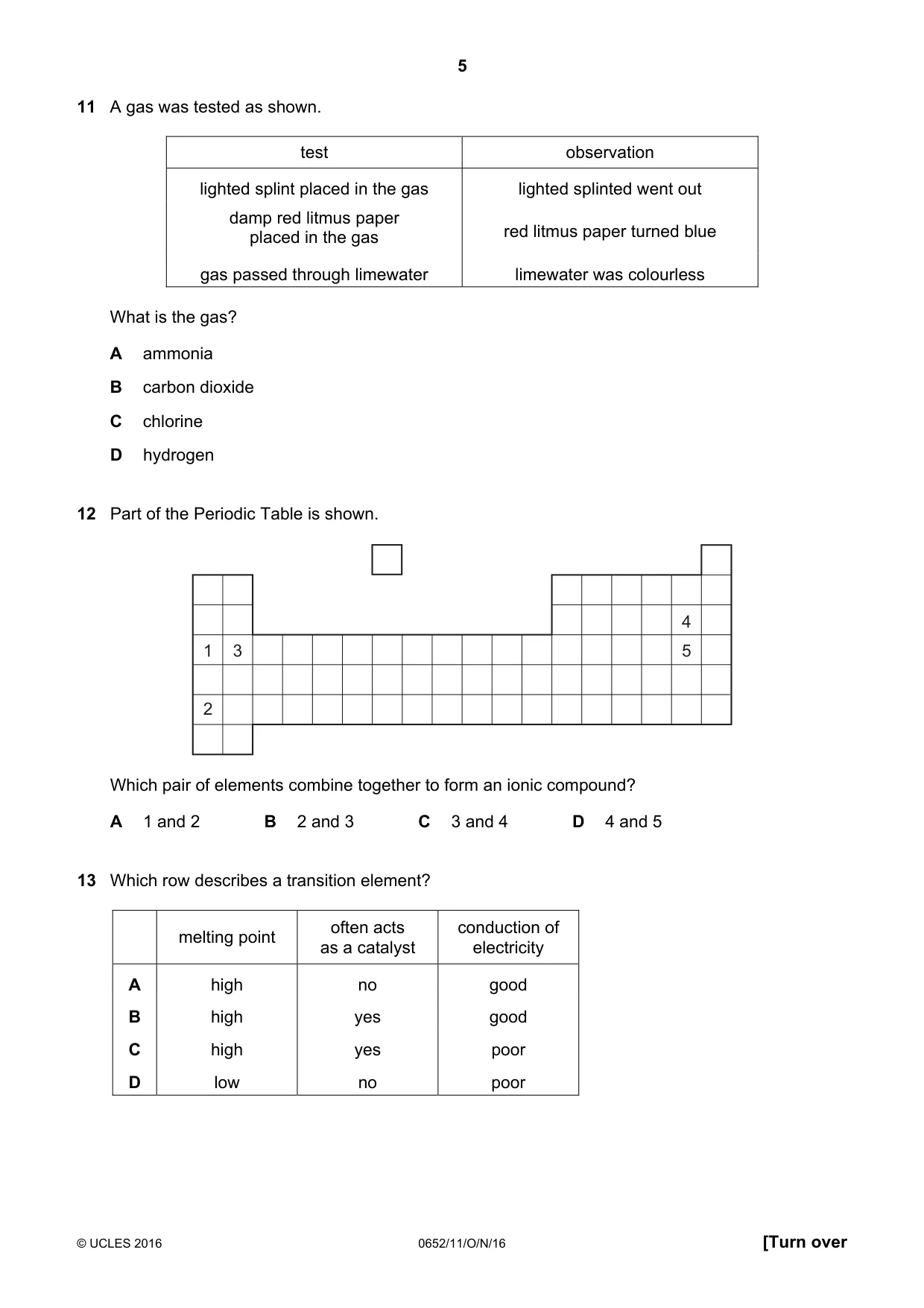
11 A gas was tested as shown. test observation lighted splint placed in the gas lighted splinted went out damp red litmus paper placed in the gas red litmus paper turned blue gas passed through limewater limewater was colourless What is the gas? A ammonia B carbon dioxide C chlorine D hydrogen
Mark scheme: A
Q12 · Part of the Periodic Table is shown
12 Part of the Periodic Table is shown. 4 1 3 5 2 Which pair of elements combine together to form an ionic compound? A 1 and 2 B 2 and 3 C 3 and 4 D 4 and 5
Mark scheme: C
Q13 · Which row describes a transition element?
13 Which row describes a transition element? often acts conduction of melting point as a catalyst electricity A high no good B high yes good C high yes poor D low no poor
Mark scheme: B
Q14 · Which statement about metals or non-metals is correct?
14 Which statement about metals or non-metals is correct? A Metals are poor conductors of heat. B Most metals have low melting points. C Most non-metals are poor conductors of electricity. D Non-metals are malleable.
Mark scheme: C
Q15 · Zinc is a metal which has many uses
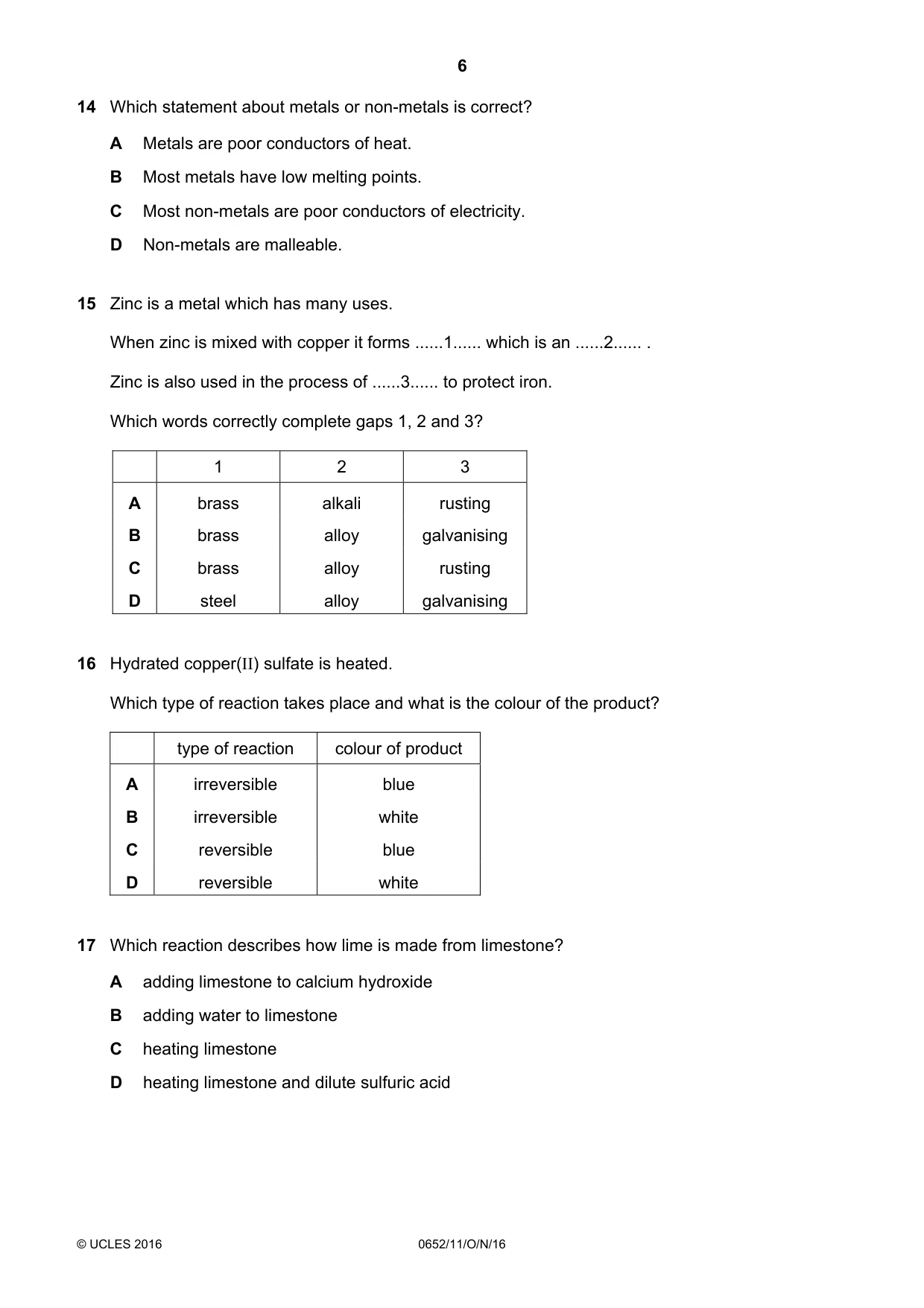
15 Zinc is a metal which has many uses. When zinc is mixed with copper it forms ......1...... which is an ......2...... . Zinc is also used in the process of ......3...... to protect iron. Which words correctly complete gaps 1, 2 and 3? 1 2 3 A brass alkali rusting B brass alloy galvanising C brass alloy rusting D steel alloy galvanising
Mark scheme: B
Q16 · Hydrated copper(II) sulfate is heated
16 Hydrated copper(II) sulfate is heated. Which type of reaction takes place and what is the colour of the product? type of reaction colour of product A irreversible blue B irreversible white C reversible blue D reversible white
Mark scheme: D
Q17 · Which reaction describes how lime is made from limestone?
17 Which reaction describes how lime is made from limestone? A adding limestone to calcium hydroxide B adding water to limestone C heating limestone D heating limestone and dilute sulfuric acid
Mark scheme: C
Q18 · Which statement explains why the members of a homologous series have similar chemical…
18 Which statement explains why the members of a homologous series have similar chemical properties? A They have the same functional group. B They have the same number of carbon atoms. C They have the same number of electrons. D They have the same types of atom.
Mark scheme: A
Q19 · Which statements about the alkanes are correct?
19 Which statements about the alkanes are correct? 1 Their boiling point increases as the number of carbon atoms increases. 2 They burn in air to produce carbon dioxide and water. 3 They contain carbon to carbon double bonds. 4 They decolourise bromine water. A 1, 2 and 3 B 1 and 2 C 1, 3 and 4 D 2 and 4
Mark scheme: B
Q20 · What is not a use of ethanol?
20 What is not a use of ethanol? A as a solvent B making ethane C making alcoholic drinks D producing heat energy
Mark scheme: B
Q21 · The diagram shows two identical spheres placed beside a scale
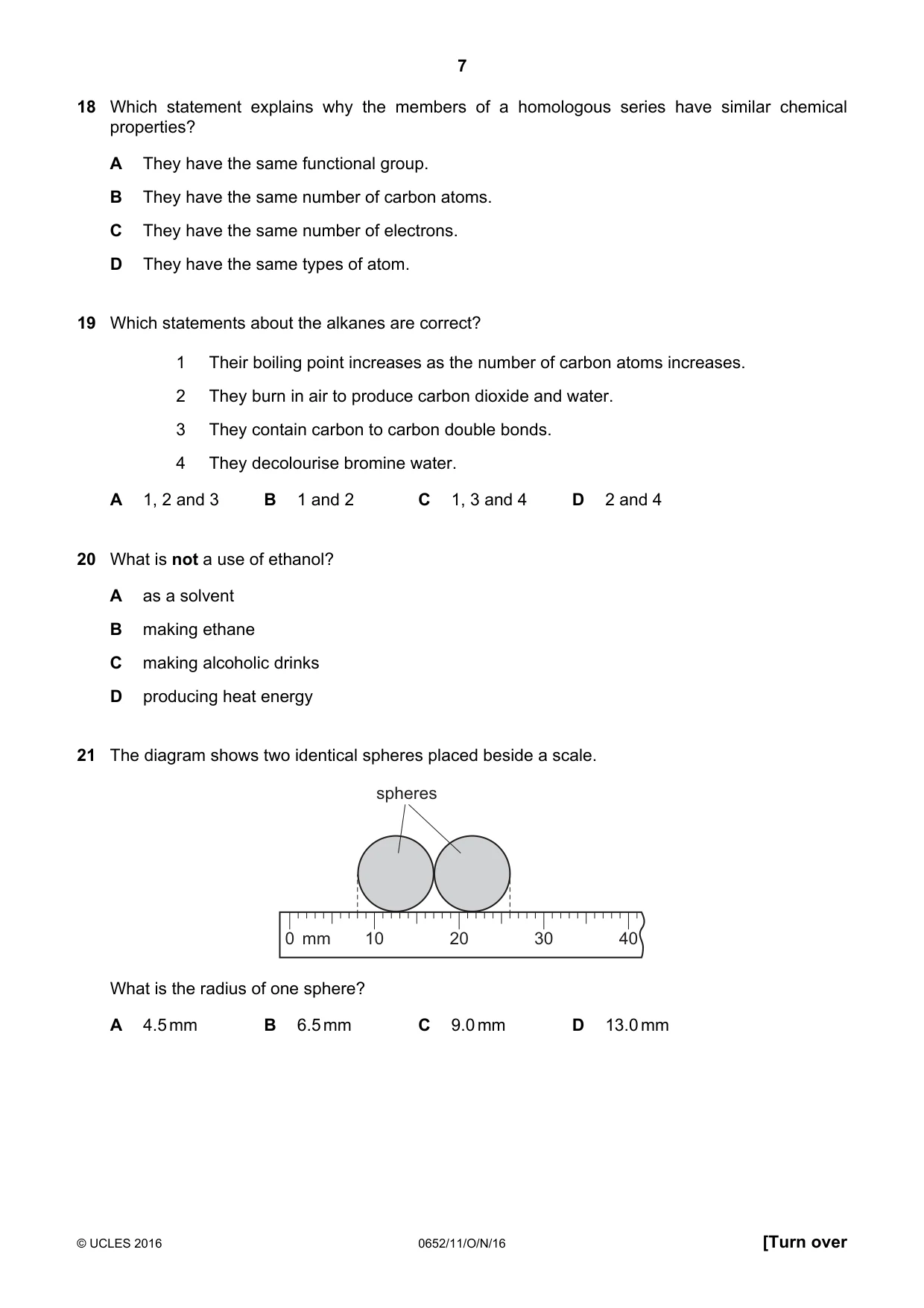
21 The diagram shows two identical spheres placed beside a scale. spheres 0 mm 10 20 30 40 What is the radius of one sphere? A 4.5 mm B 6.5 mm C 9.0 mm D 13.0 mm
Mark scheme: A
Q22 · A stone is dropped from the top of a building
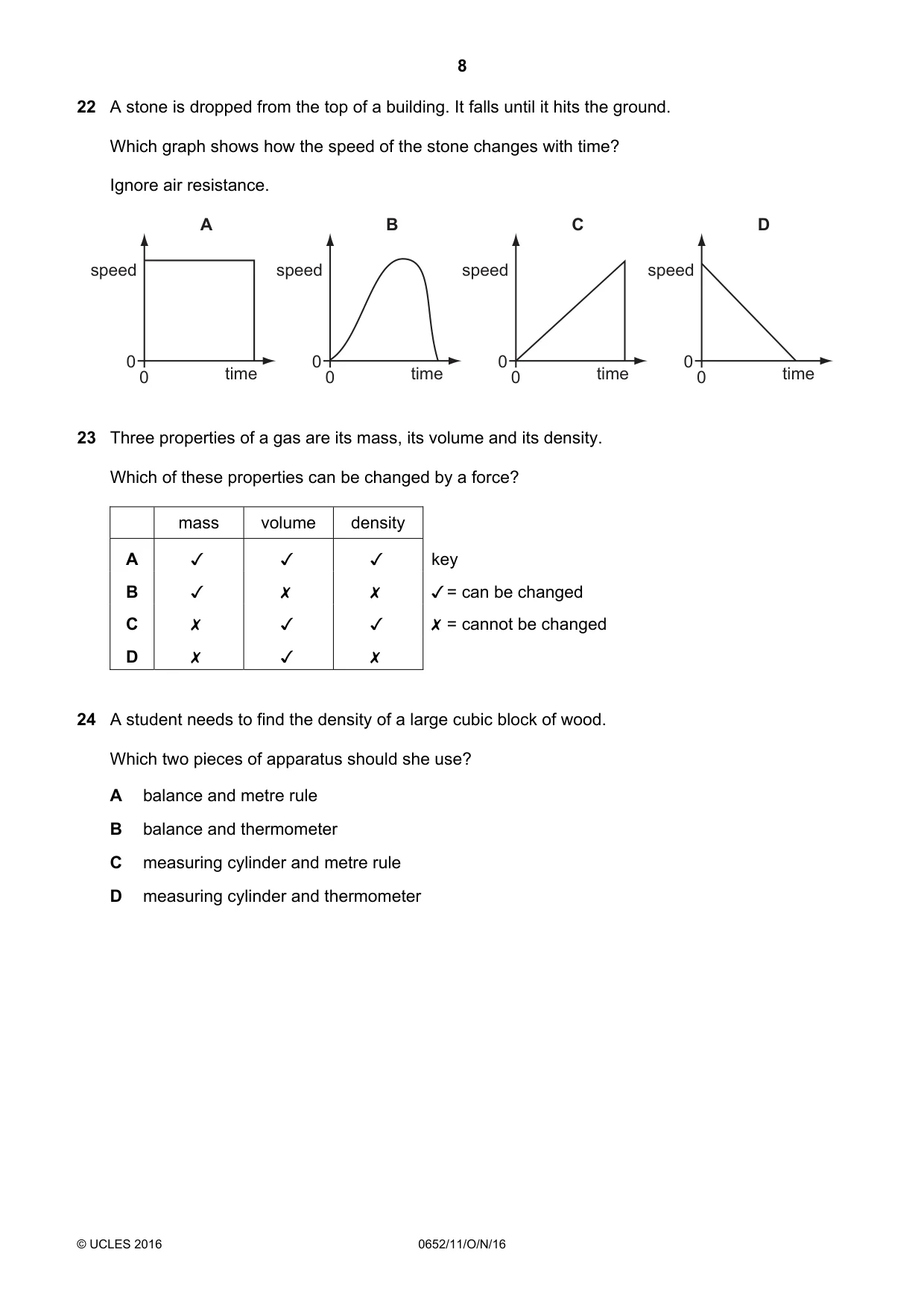
22 A stone is dropped from the top of a building. It falls until it hits the ground. Which graph shows how the speed of the stone changes with time? Ignore air resistance. A B C D speed speed speed speed 0 0 0 0 0 time 0 time 0 time 0 time
Mark scheme: C
Q23 · Three properties of a gas are its mass, its volume and its density
23 Three properties of a gas are its mass, its volume and its density. Which of these properties can be changed by a force? mass volume density A Jv v v key B Jv x x ¥ = can be changed Cc x Jv v X = cannot be changed D x Jv x
Mark scheme: C
Q24 · A student needs to find the density of a large cubic block of wood
24 A student needs to find the density of a large cubic block of wood. Which two pieces of apparatus should she use? A balance and metre rule B balance and thermometer C measuring cylinder and metre rule D measuring cylinder and thermometer
Mark scheme: A
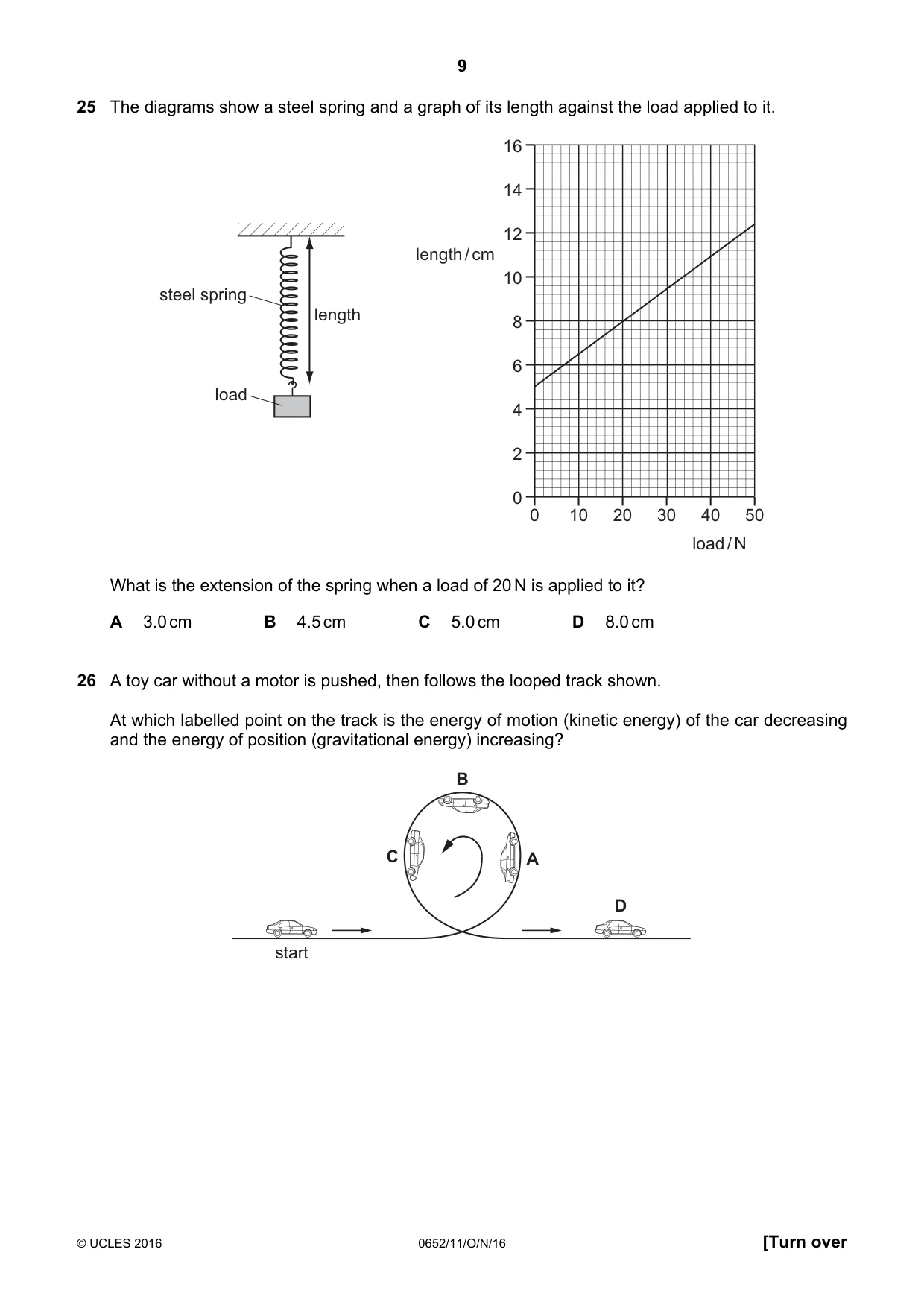
Q25 · The diagrams show a steel spring and a graph of its length against the load applied to it
25 The diagrams show a steel spring and a graph of its length against the load applied to it. 16 14 12 length / cm 10 steel spring length 8 6 load 4 2 0 0 10 20 30 40 50 load / N What is the extension of the spring when a load of 20 N is applied to it? A 3.0 cm B 4.5 cm C 5.0 cm D 8.0 cm
Mark scheme: A
Q26 · A toy car without a motor is pushed, then follows the looped track shown
26 A toy car without a motor is pushed, then follows the looped track shown. At which labelled point on the track is the energy of motion (kinetic energy) of the car decreasing and the energy of position (gravitational energy) increasing? B C A D start
Mark scheme: A
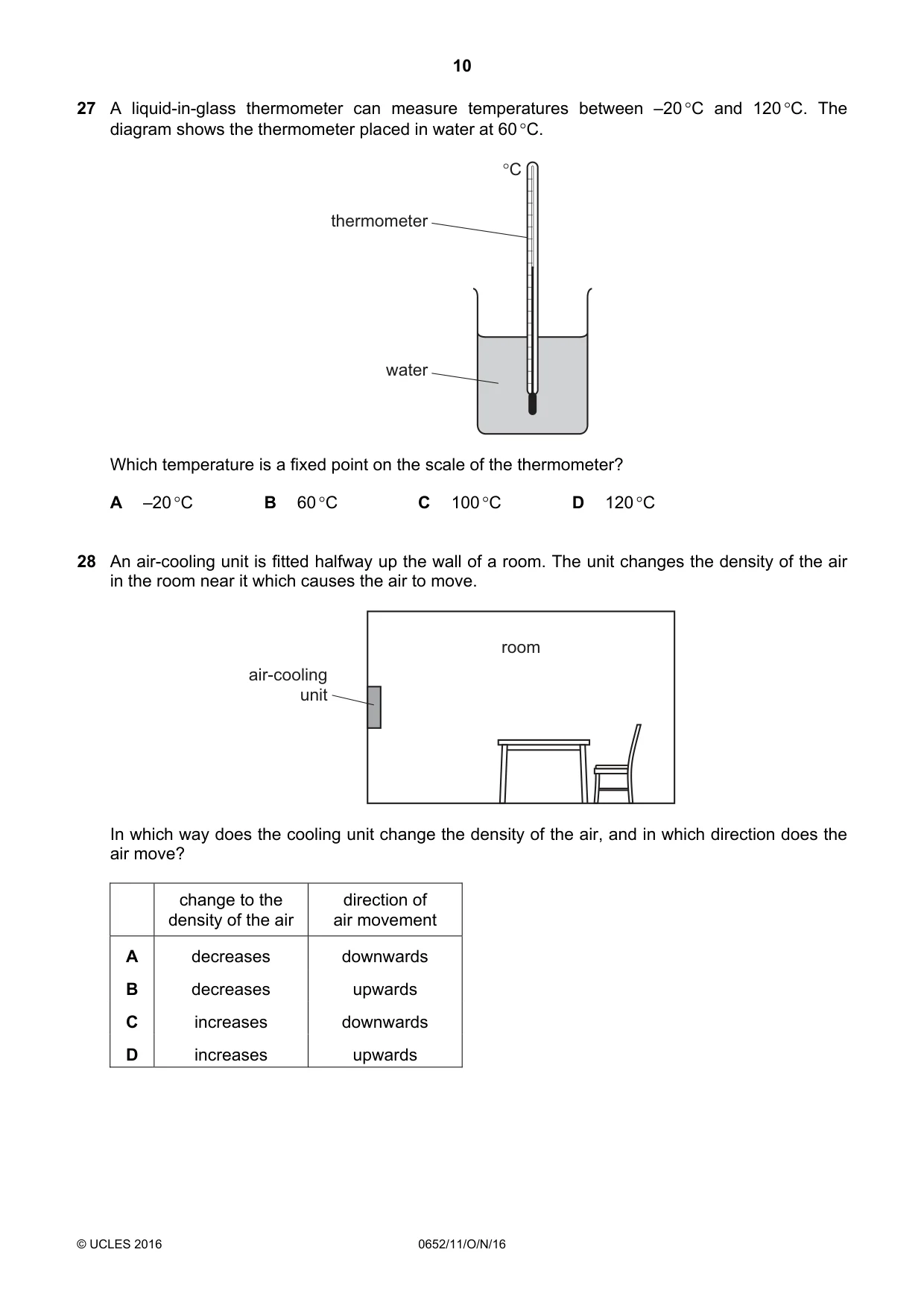
Q27 · A liquid-in-glass thermometer can measure temperatures between –20 °C and 120 °C
27 A liquid-in-glass thermometer can measure temperatures between –20 °C and 120 °C. The diagram shows the thermometer placed in water at 60 °C. °C thermometer water Which temperature is a fixed point on the scale of the thermometer? A –20 °C B 60 °C C 100 °C D 120 °C
Mark scheme: C
Q28 · An air-cooling unit is fitted halfway up the wall of a room
28 An air-cooling unit is fitted halfway up the wall of a room. The unit changes the density of the air in the room near it which causes the air to move. room air-cooling unit In which way does the cooling unit change the density of the air, and in which direction does the air move? change to the direction of density of the air air movement A decreases downwards B decreases upwards C increases downwards D increases upwards
Mark scheme: C
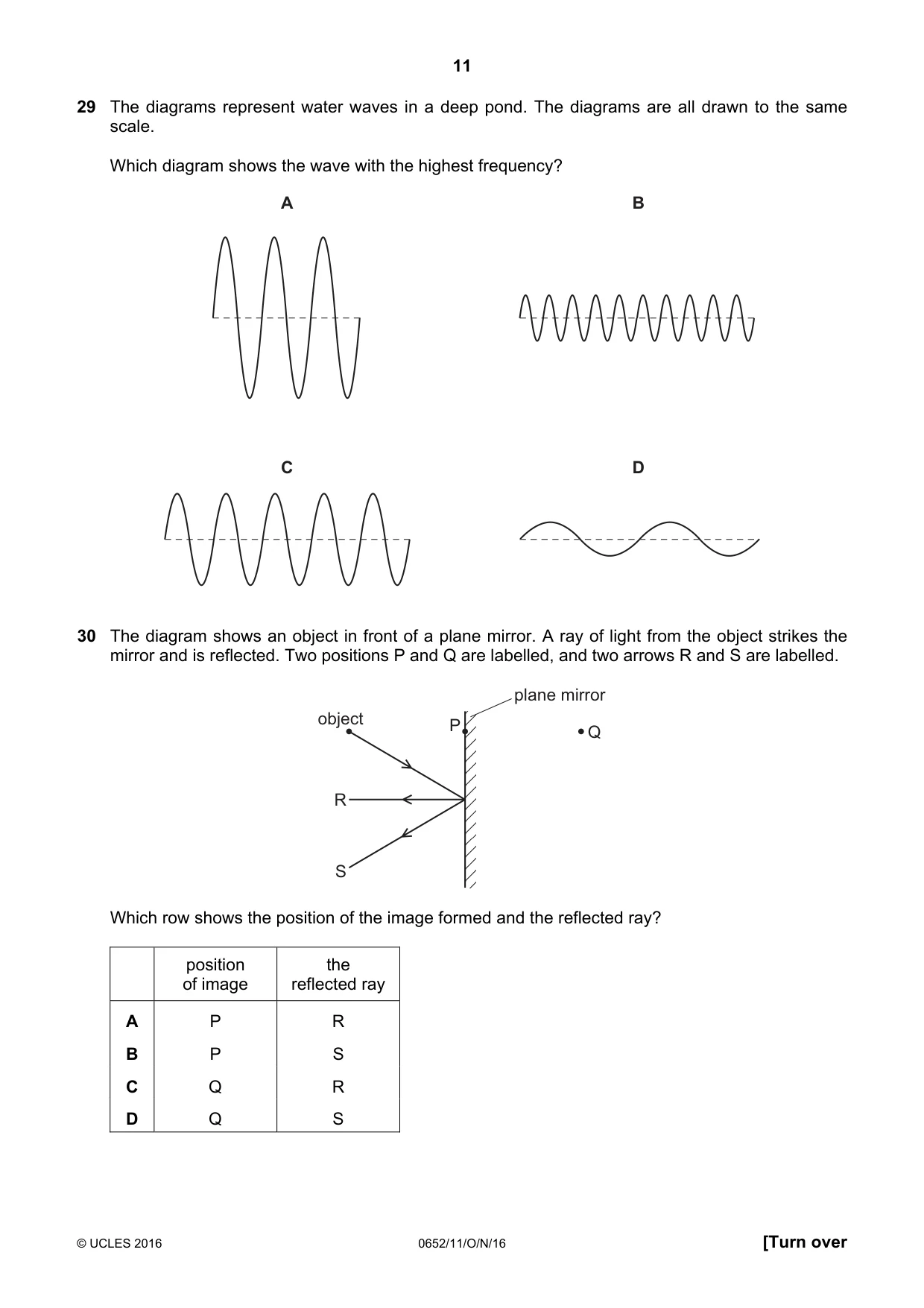
Q29 · The diagrams represent water waves in a deep pond
29 The diagrams represent water waves in a deep pond. The diagrams are all drawn to the same scale. Which diagram shows the wave with the highest frequency? A B C D
Mark scheme: B
Q30 · The diagram shows an object in front of a plane mirror
30 The diagram shows an object in front of a plane mirror. A ray of light from the object strikes the mirror and is reflected. Two positions P and Q are labelled, and two arrows R and S are labelled. plane mirror object P Q R S Which row shows the position of the image formed and the reflected ray? position the of image reflected ray A P R B P S C Q R D Q S
Mark scheme: D
Q31 · Radio waves and light waves travel in vacuo (in a vacuum)
31 Radio waves and light waves travel in vacuo (in a vacuum). How do the frequency and the speed of the radio waves compare with the frequency and speed of the light waves? frequency of radio waves speed of radio waves A greater than light greater than light B greater than light the same as light C less than light greater than light D less than light the same as light
Mark scheme: D
Q32 · Three loudspeakers vibrate at different frequencies of 5 hertz, 25 kilohertz and 50…
32 Three loudspeakers vibrate at different frequencies of 5 hertz, 25 kilohertz and 50 kilohertz. Which row shows whether the vibrations from each loudspeaker can be heard by a human? 5 hertz 25 kilohertz 50 kilohertz A no no no B no yes no C yes no yes D yes yes yes
Mark scheme: A
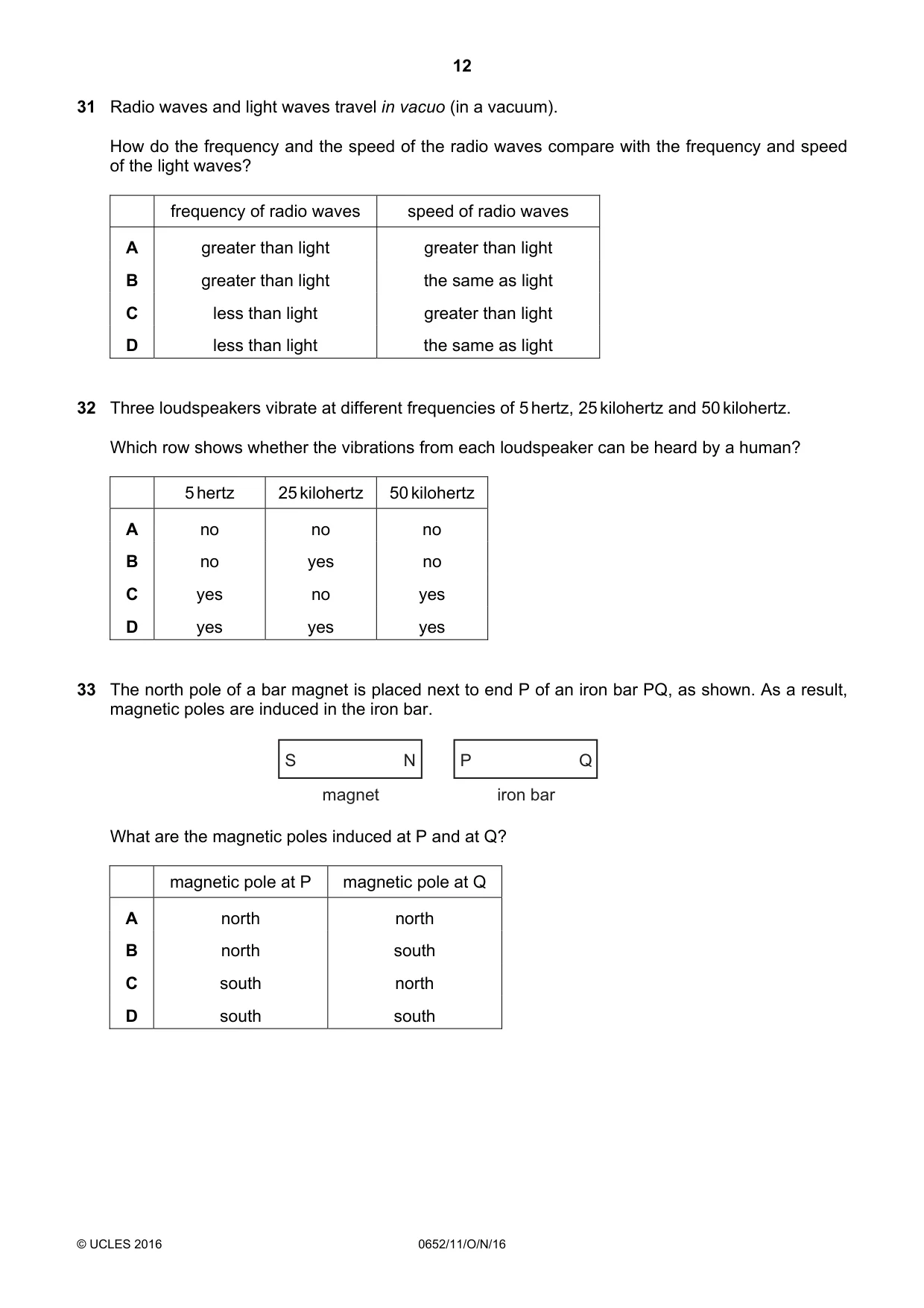
Q33 · The north pole of a bar magnet is placed next to end P of an iron bar PQ, as shown
33 The north pole of a bar magnet is placed next to end P of an iron bar PQ, as shown. As a result, magnetic poles are induced in the iron bar. S N P Q magnet iron bar What are the magnetic poles induced at P and at Q? magnetic pole at P magnetic pole at Q A north north B north south C south north D south south
Mark scheme: C
Q34 · Three charged plastic balls, P, Q and R are suspended by insulating threads
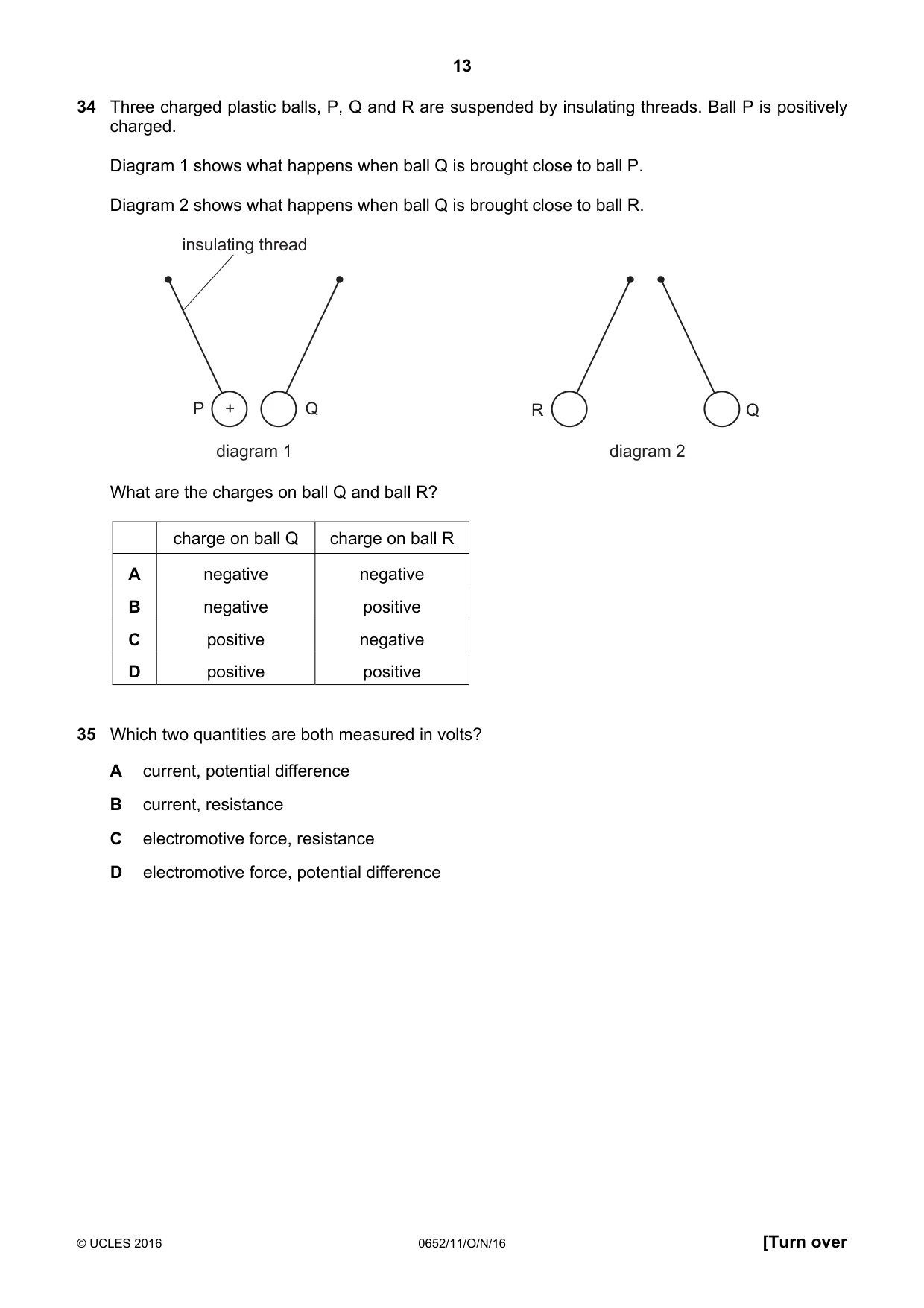
34 Three charged plastic balls, P, Q and R are suspended by insulating threads. Ball P is positively charged. Diagram 1 shows what happens when ball Q is brought close to ball P. Diagram 2 shows what happens when ball Q is brought close to ball R. insulating thread P + Q R Q diagram 1 diagram 2 What are the charges on ball Q and ball R? charge on ball Q charge on ball R A negative negative B negative positive C positive negative D positive positive
Mark scheme: A
Q35 · Which two quantities are both measured in volts?
35 Which two quantities are both measured in volts? A current, potential difference B current, resistance C electromotive force, resistance D electromotive force, potential difference
Mark scheme: D
Q36 · A student investigates how the current in a resistor R varies with the voltage across it
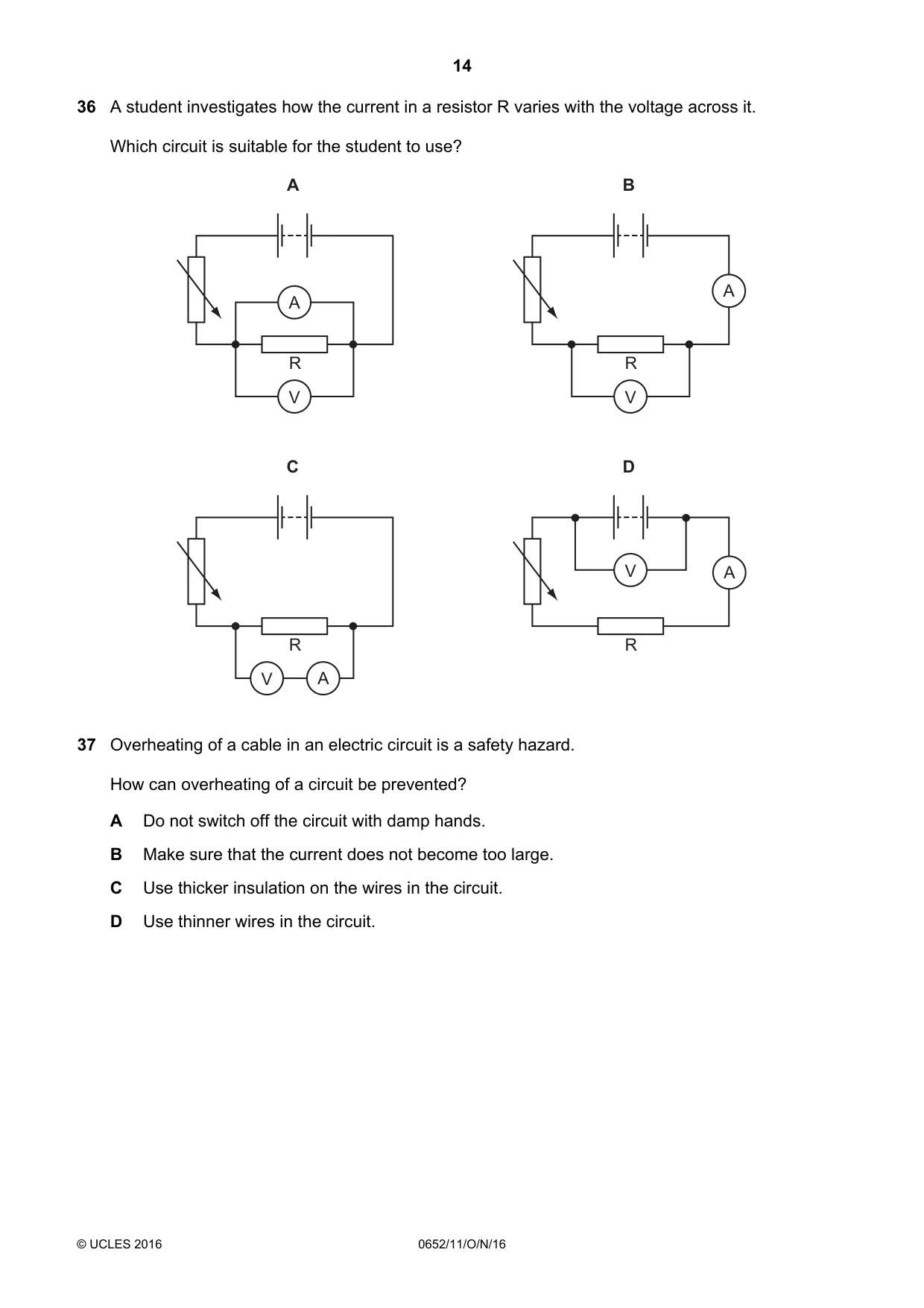
36 A student investigates how the current in a resistor R varies with the voltage across it. Which circuit is suitable for the student to use? A B A A R R V V C D V A R R V A
Mark scheme: B
Q37 · Overheating of a cable in an electric circuit is a safety hazard
37 Overheating of a cable in an electric circuit is a safety hazard. How can overheating of a circuit be prevented? A Do not switch off the circuit with damp hands. B Make sure that the current does not become too large. C Use thicker insulation on the wires in the circuit. D Use thinner wires in the circuit.
Mark scheme: B
Q38 · The diagram shows a cathode-ray tube
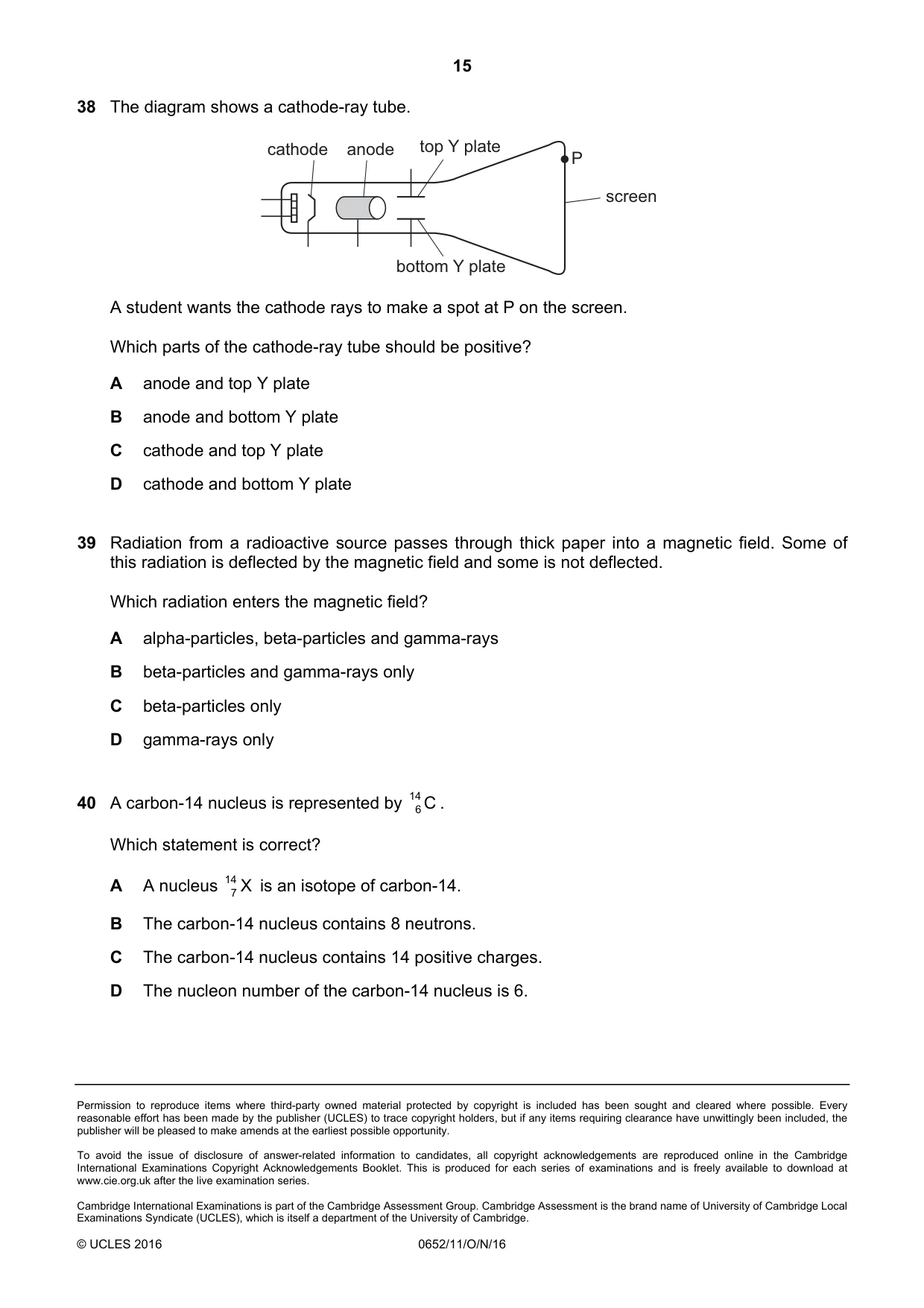
38 The diagram shows a cathode-ray tube. cathode anode top Y plate P screen bottom Y plate A student wants the cathode rays to make a spot at P on the screen. Which parts of the cathode-ray tube should be positive? A anode and top Y plate B anode and bottom Y plate C cathode and top Y plate D cathode and bottom Y plate
Mark scheme: A
Q39 · Radiation from a radioactive source passes through thick paper into a magnetic field
39 Radiation from a radioactive source passes through thick paper into a magnetic field. Some of this radiation is deflected by the magnetic field and some is not deflected. Which radiation enters the magnetic field? A alpha-particles, beta-particles and gamma-rays B beta-particles and gamma-rays only C beta-particles only D gamma-rays only
Mark scheme: B
Q40 · A carbon-14 nucleus is represented by 14 C
40 A carbon-14 nucleus is represented by 14 C . 6 Which statement is correct? A A nucleus 14 X is an isotope of carbon-14. 7 B The carbon-14 nucleus contains 8 neutrons. C The carbon-14 nucleus contains 14 positive charges. D The nucleon number of the carbon-14 nucleus is 6.
Mark scheme: B
What was in this paper
The subtopics covered by these 40 questions, and how many questions each got. Open one in a new tab to see every Cambridge question on it.
2General wave properties2Identification of ions and gases2Simple phenomena of magnetism2Stoichiometry2Alcohols1Alkanes1Atomic structure and the Periodic Table1Carbonates1Criteria of purity1Dangers of electricity1Electric circuits1Electrical quantities1Electromagnetic effects1Energetics of a reaction1Energy transfer1Forces1Homologous series1Ions and ionic bonds1Length and time1Light1Macromolecules1Methods of purification1Motion1Physical and chemical changes1Properties of metals1Radioactivity1Redox1Sound1The nuclear atom1Thermal processes1Thermal properties and temperature1Transition elements1Uses of metals1Work, energy and power1What you needed in this session
Cambridge’s own grade thresholds for 2016 Oct/Nov, Paper 1 · Variant 1. A higher threshold means an easier paper — the bar moves with how the cohort did.