Cambridge IGCSE Physical Science 0652 — 2006 Oct/Nov Paper 1 · Variant 1
0652/11/O/N/06 · 40 questions · 40 marks · ≈45 min
The question paper and its mark scheme, free to read here and free to download. This is Cambridge’s own paper, exactly as it was sat.
Question paper20 pages



Mark scheme2 pages
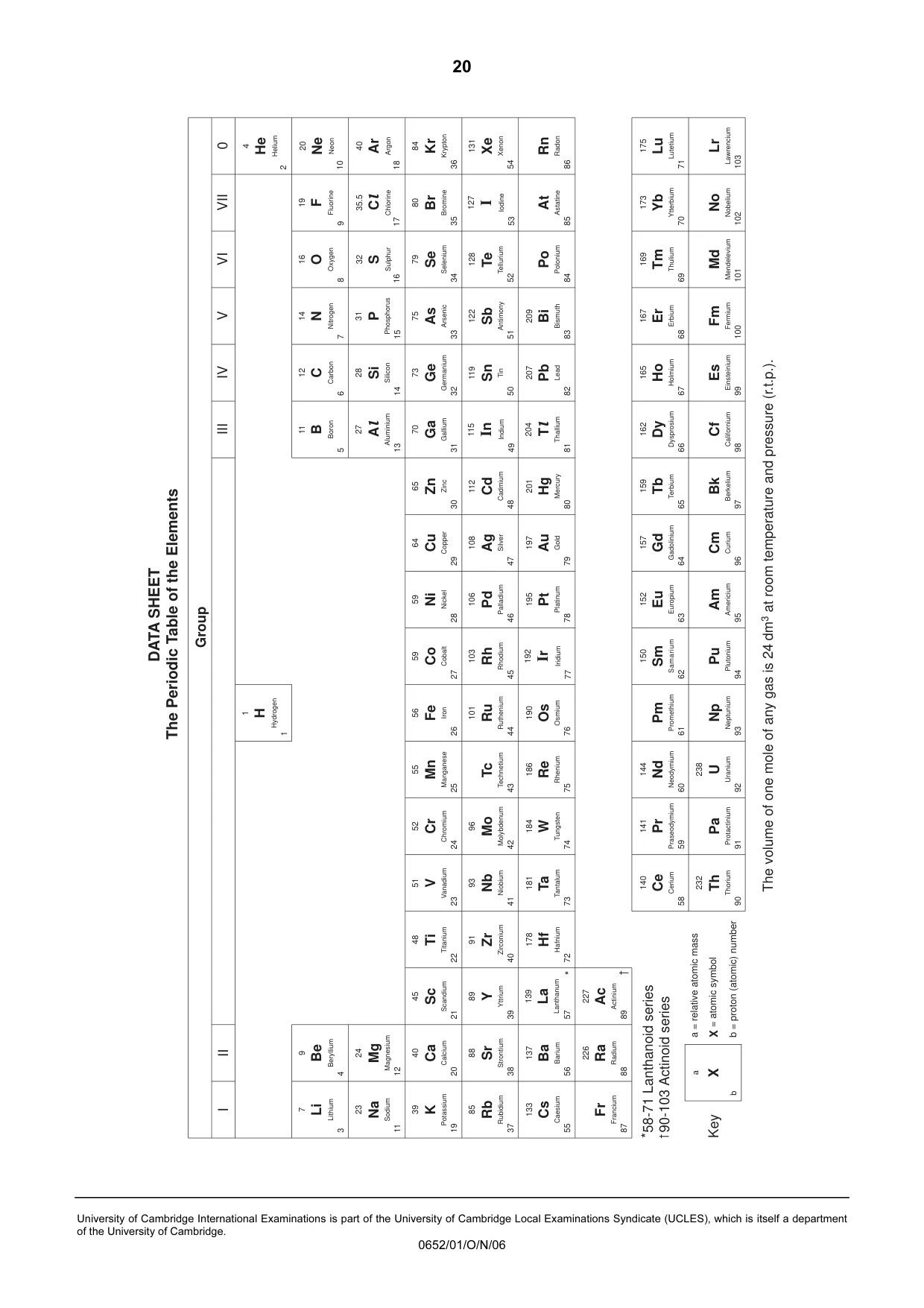
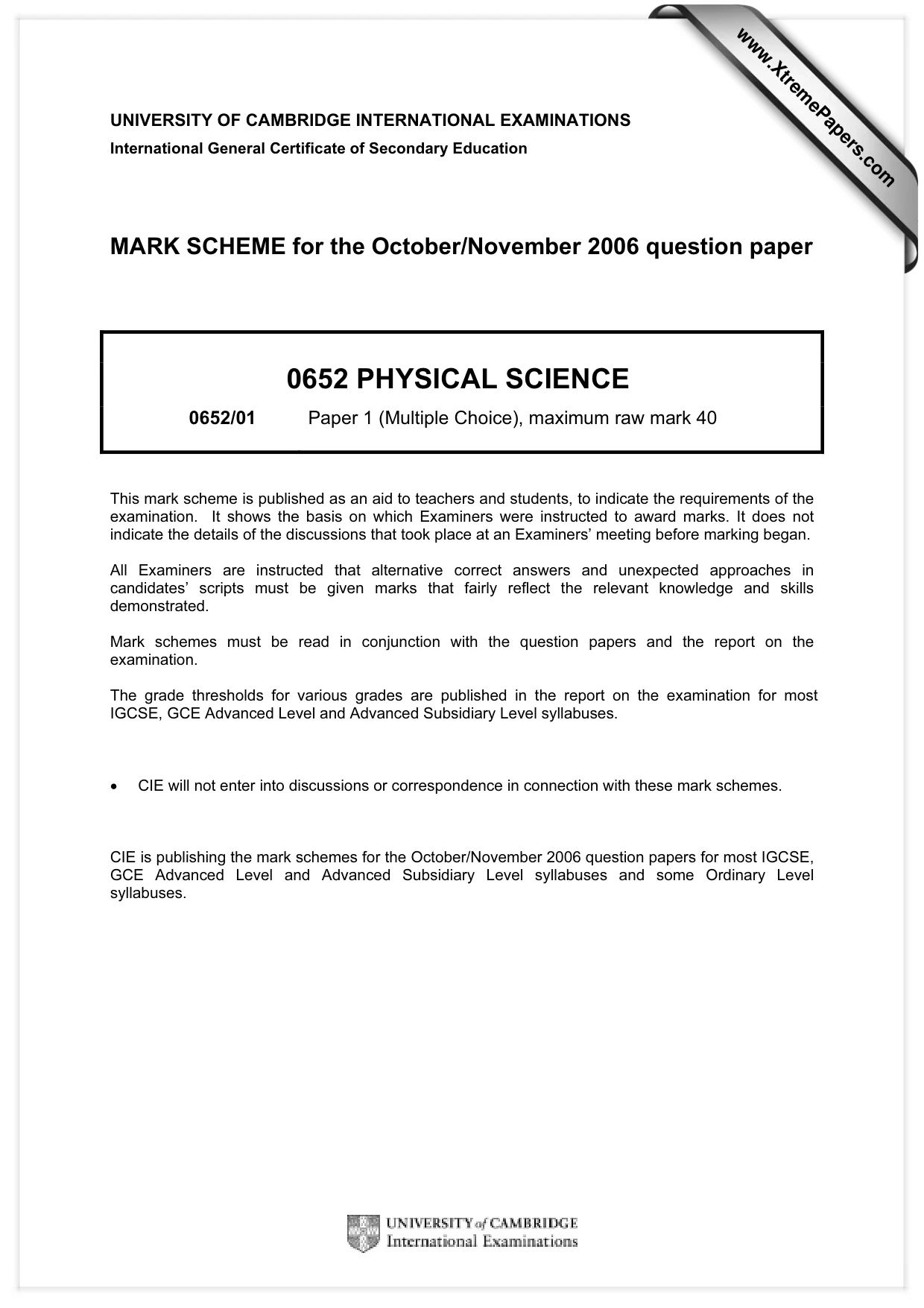
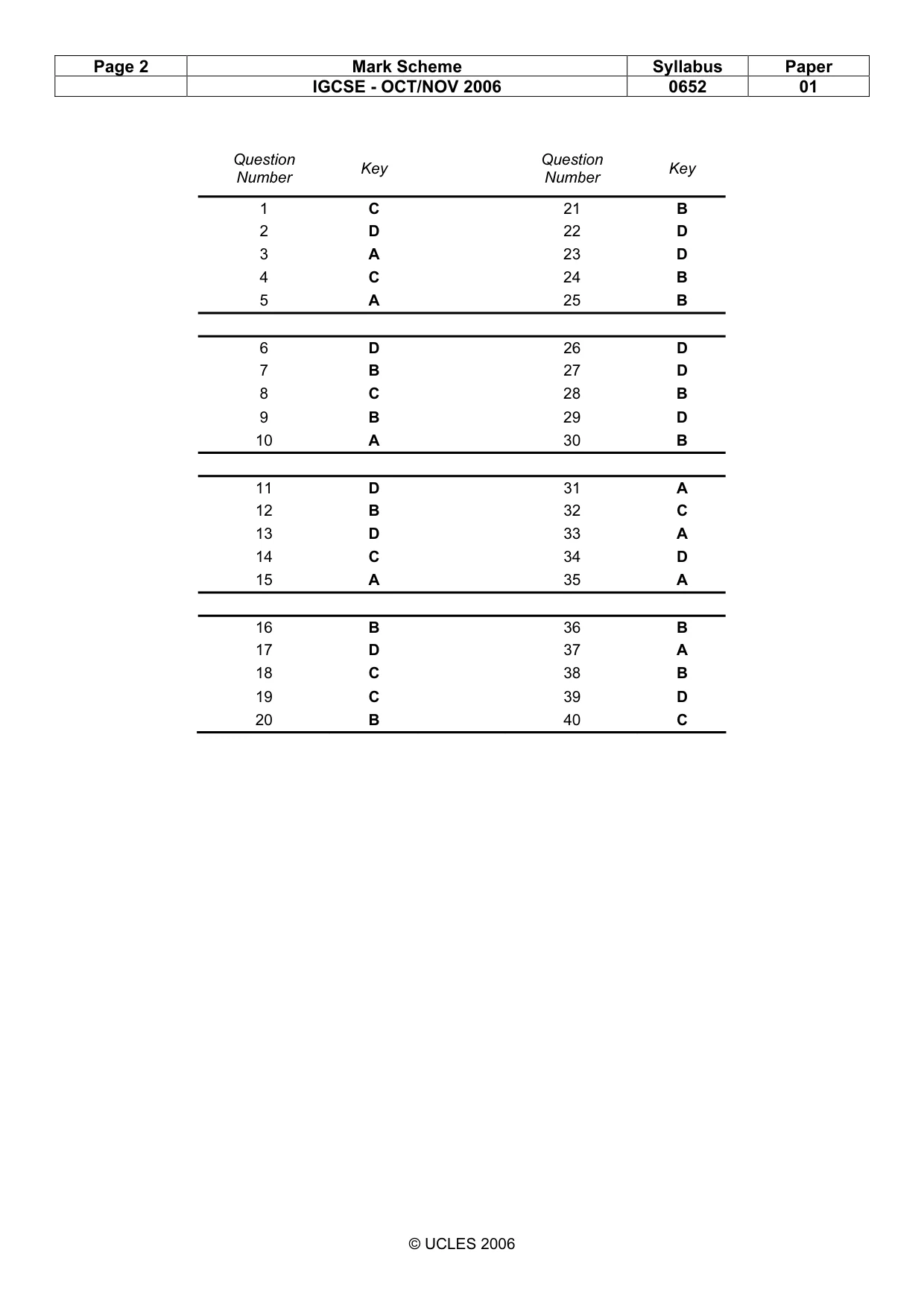
Answers below. Sit the paper first if you are practising.
Questions as text
Q1 · Which diagram shows how the particles in a mixture of two gases are arranged?
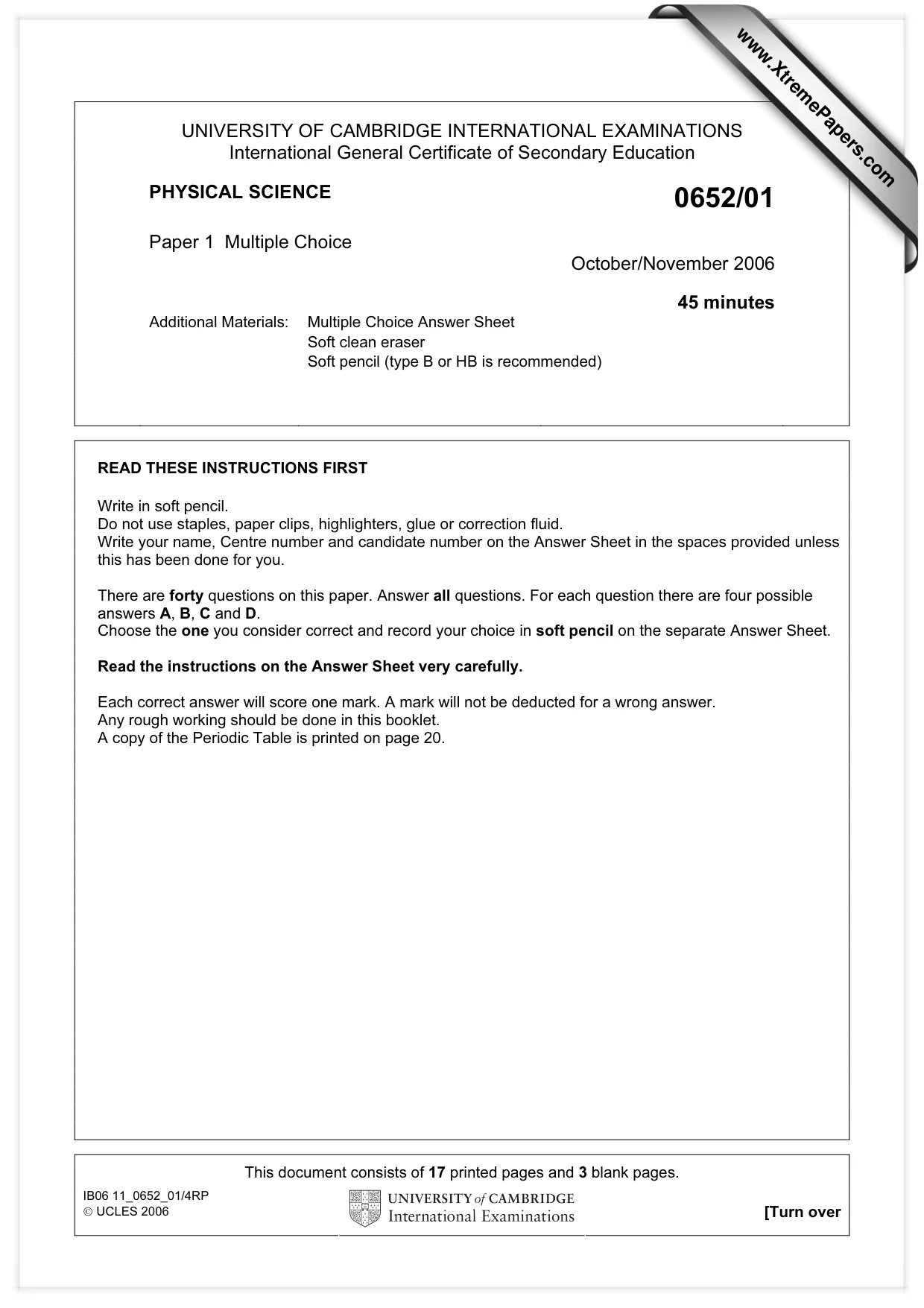
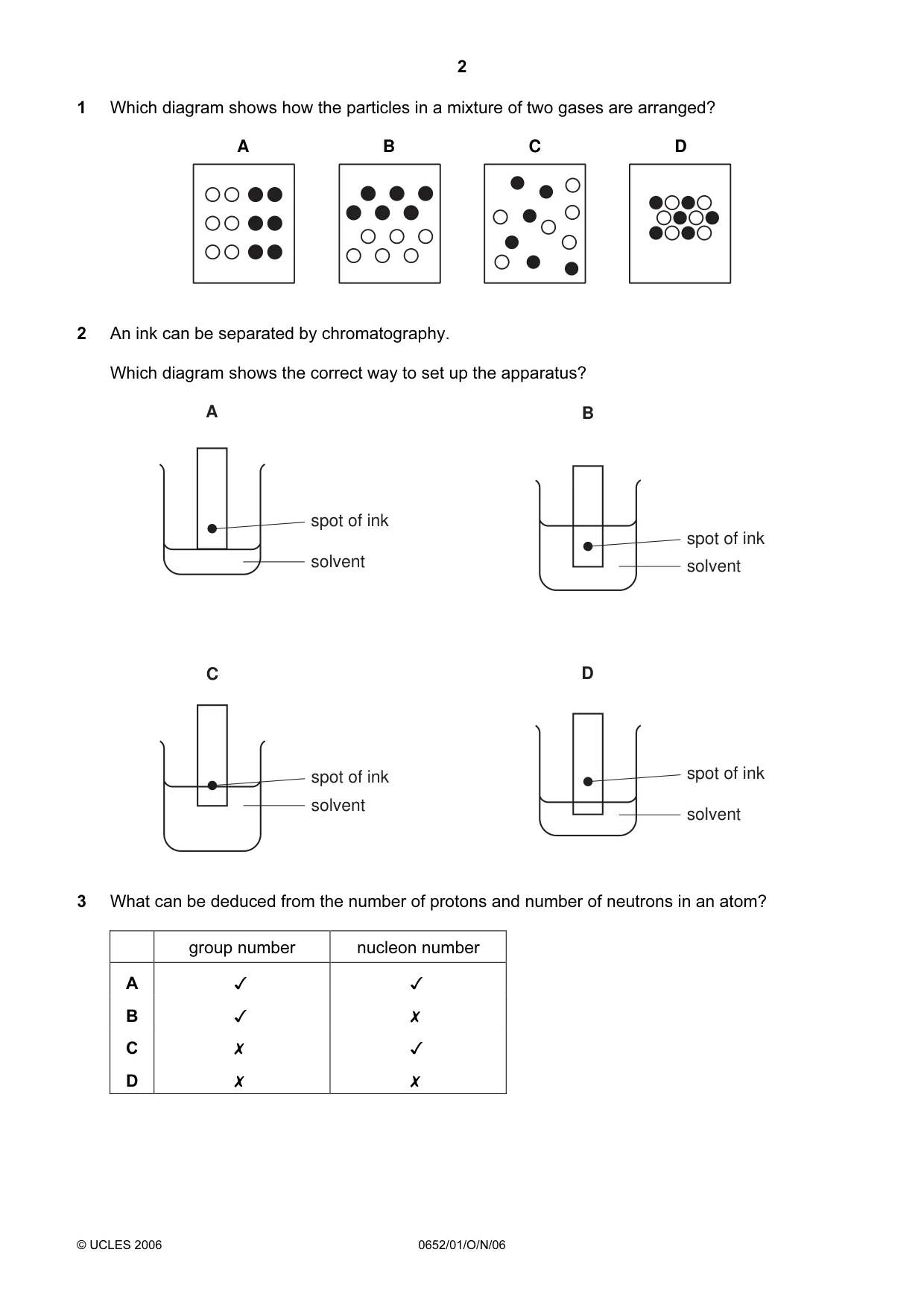
1 Which diagram shows how the particles in a mixture of two gases are arranged? A B C D
Mark scheme: C
Q2 · An ink can be separated by chromatography
2 An ink can be separated by chromatography. Which diagram shows the correct way to set up the apparatus? A B spot of ink spot of ink solvent solvent C D spot of ink spot of ink solvent solvent
Mark scheme: D
Q3 · What can be deduced from the number of protons and number of neutrons in an atom?
3. What can be deduced from the number of protons and number of neutrons in an atom? group number nucleon number A v v B v x Cc x v D x x
Mark scheme: A
Q4 · The dot-and-cross diagram shows the outer shell electrons in a molecule with a single…
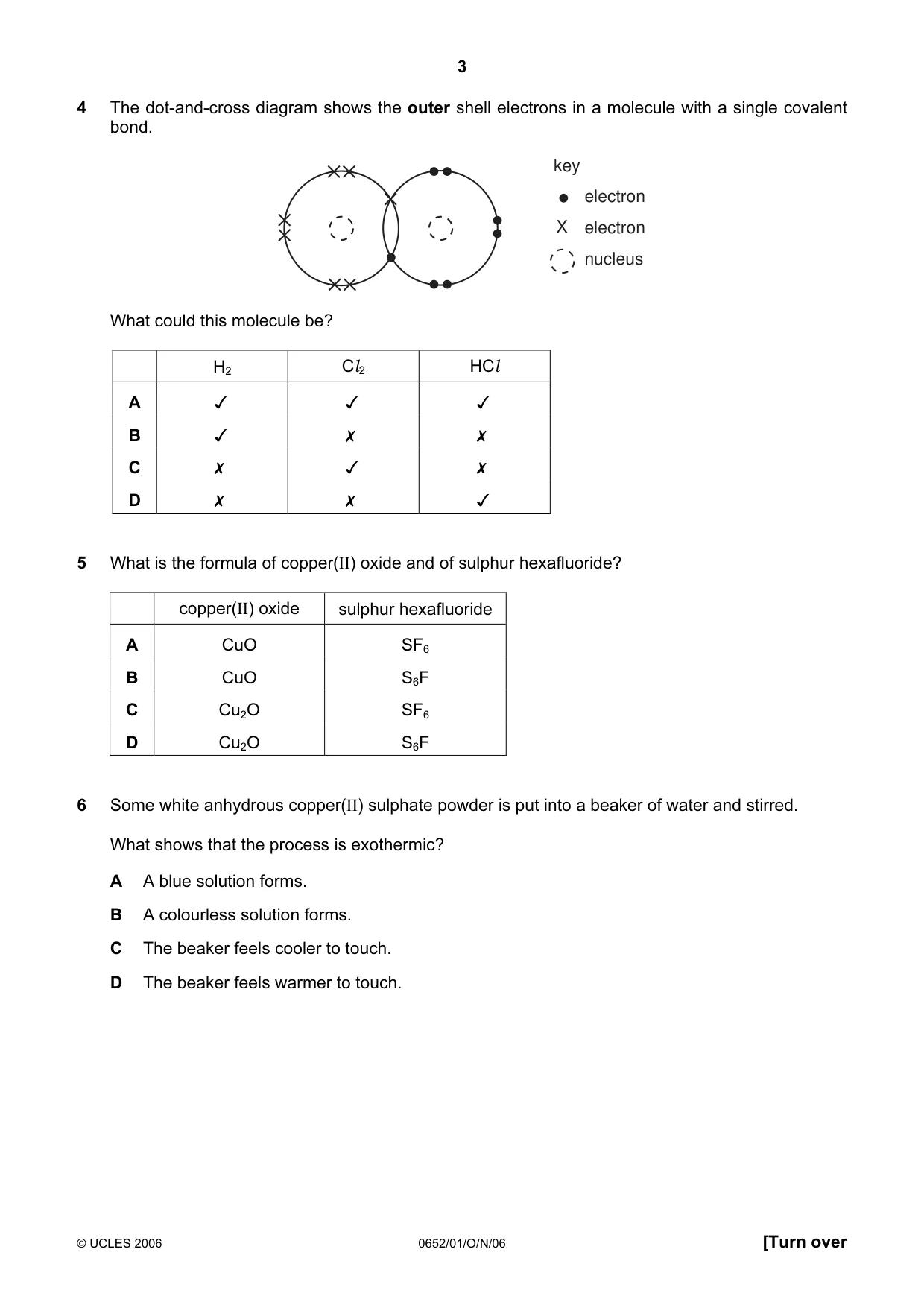
4 The dot-and-cross diagram shows the outer shell electrons in a molecule with a single covalent bond. key e electron } X_ electron ‘ * nucleus No What could this molecule be? H Ch HCl 0 ONO DW > ~ eK ~*~ {Kw K& Ke OM
Mark scheme: C
Q5 · What is the formula of copper(II) oxide and of sulphur hexafluoride?
5 What is the formula of copper(II) oxide and of sulphur hexafluoride? copper(II) oxide sulphur hexafluoride A CuO SF6 B CuO S6F C Cu2O SF6 D Cu2O S6F
Mark scheme: A
Q6 · Some white anhydrous copper(II) sulphate powder is put into a beaker of water and stirred
6 Some white anhydrous copper(II) sulphate powder is put into a beaker of water and stirred. What shows that the process is exothermic? A A blue solution forms. B A colourless solution forms. C The beaker feels cooler to touch. D The beaker feels warmer to touch.
Mark scheme: D
Q7 · Substance X does not react with dilute acid but substance Y does, forming a gaseous…
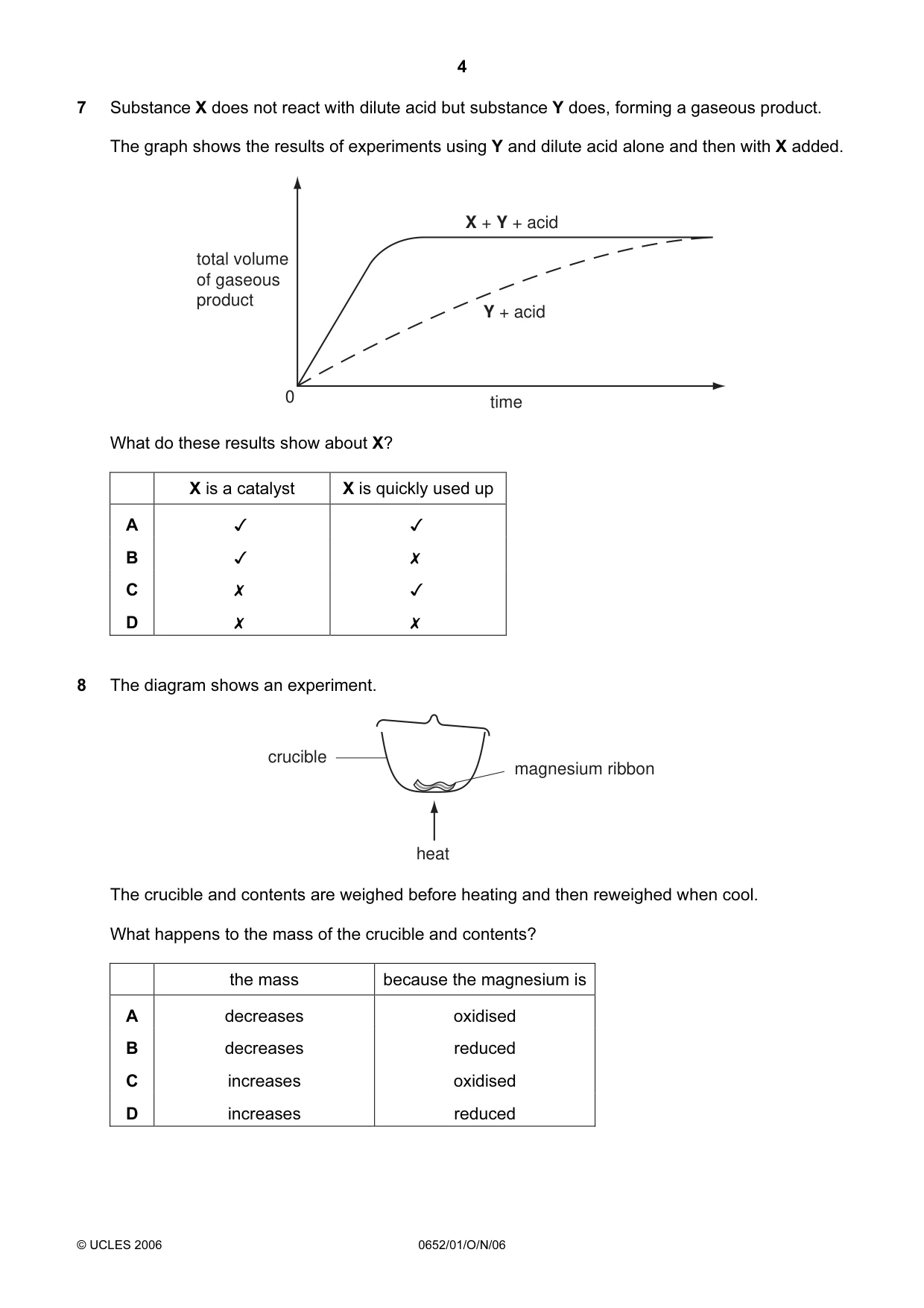
7 Substance X does not react with dilute acid but substance Y does, forming a gaseous product. The graph shows the results of experiments using Y and dilute acid alone and then with X added. X+ Y + acid total volume of gaseous product 0 time What do these results show about X? X is a catalyst X is quickly used up A v v B v x Cc x v D x x
Mark scheme: B
Q8 · The diagram shows an experiment
8 The diagram shows an experiment. crucible magnesium ribbon heat The crucible and contents are weighed before heating and then reweighed when cool. What happens to the mass of the crucible and contents? the mass because the magnesium is A decreases oxidised B decreases reduced C increases oxidised D increases reduced
Mark scheme: C
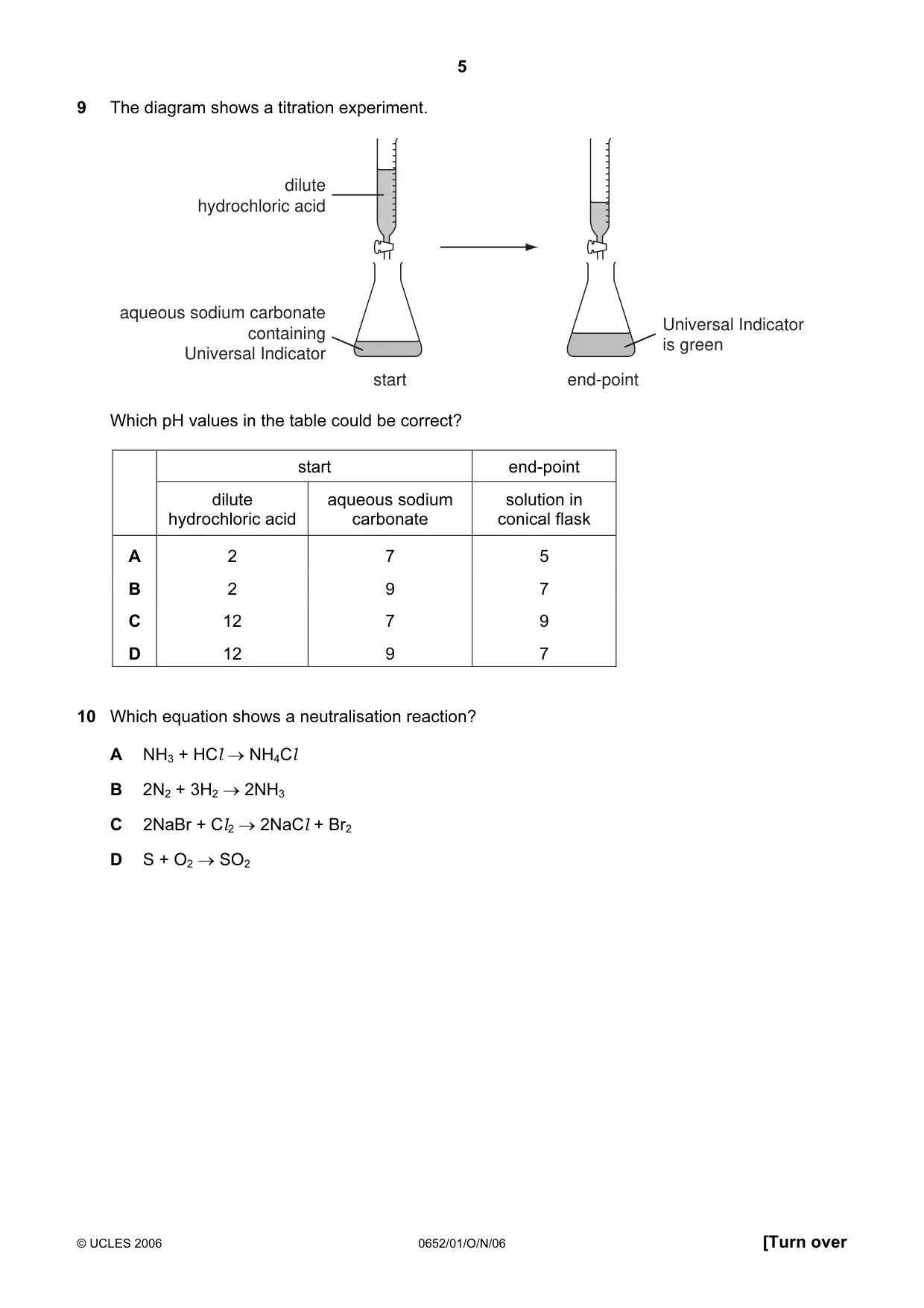
Q9 · The diagram shows a titration experiment
9 The diagram shows a titration experiment. dilute hydrochloric acid aqueous sodium carbonate Universal Indicator containing is green Universal Indicator start end-point Which pH values in the table could be correct? start end-point dilute aqueous sodium solution in hydrochloric acid carbonate conical flask A 2 7 5 B 2 9 7 C 12 7 9 D 12 9 7
Mark scheme: B
More questions on The characteristic properties of acids and bases
Q10 · Which equation shows a neutralisation reaction?
10 Which equation shows a neutralisation reaction? A NH3 + HCl → NH4Cl B 2N2 + 3H2 → 2NH3 C 2NaBr + Cl2 → 2NaCl + Br2 D S + O2 → SO2
Mark scheme: A
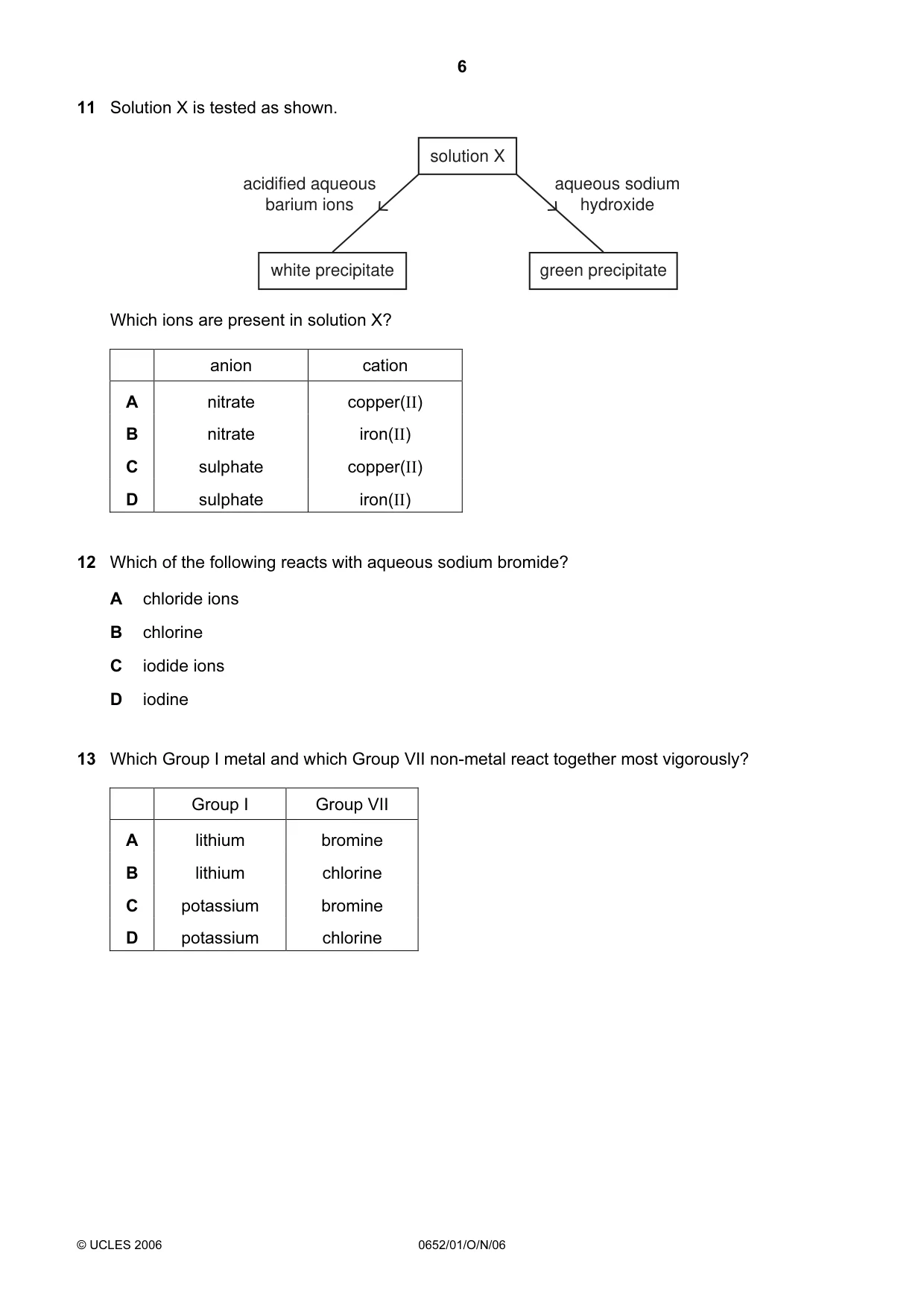
Q11 · Solution X is tested as shown
11 Solution X is tested as shown. solution X acidified aqueous aqueous sodium barium ions hydroxide white precipitate green precipitate Which ions are present in solution X? anion cation A nitrate copper(II) B nitrate iron(II) C sulphate copper(II) D sulphate iron(II)
Mark scheme: D
Q12 · Which of the following reacts with aqueous sodium bromide?
12 Which of the following reacts with aqueous sodium bromide? A chloride ions B chlorine C iodide ions D iodine
Mark scheme: B
Q13 · Which Group I metal and which Group VII non-metal react together most vigorously?
13 Which Group I metal and which Group VII non-metal react together most vigorously? Group I Group VII A lithium bromine B lithium chlorine C potassium bromine D potassium chlorine
Mark scheme: D
Q14 · Students are asked to complete the following sentence about the elements helium, neon and…
14 Students are asked to complete the following sentence about the elements helium, neon and argon. They form …1… bonds because all of their atoms have outer shells that ……2……. Which student is correct? student gap 1 gap 2 A covalent are full of electrons B covalent have 8 electrons C no are full of electrons D no have 8 electrons
Mark scheme: C
Q15 · What is made from aluminium because of its low density?
15 What is made from aluminium because of its low density? A aircraft frames B food cans C pencil sharpeners D window frames
Mark scheme: A
Q16 · A container is to be used to store either water or dilute sulphuric acid
16 A container is to be used to store either water or dilute sulphuric acid. Which material can be used for making the container? A glass and magnesium B glass and poly(ethene) C magnesium and poly(ethene) D glass, magnesium and poly(ethene)
Mark scheme: B
Q17 · Which three elements should a balanced fertiliser contain?
17 Which three elements should a balanced fertiliser contain? A Na, C, P B Na, P, K C K, C, N D K, P, N
Mark scheme: D
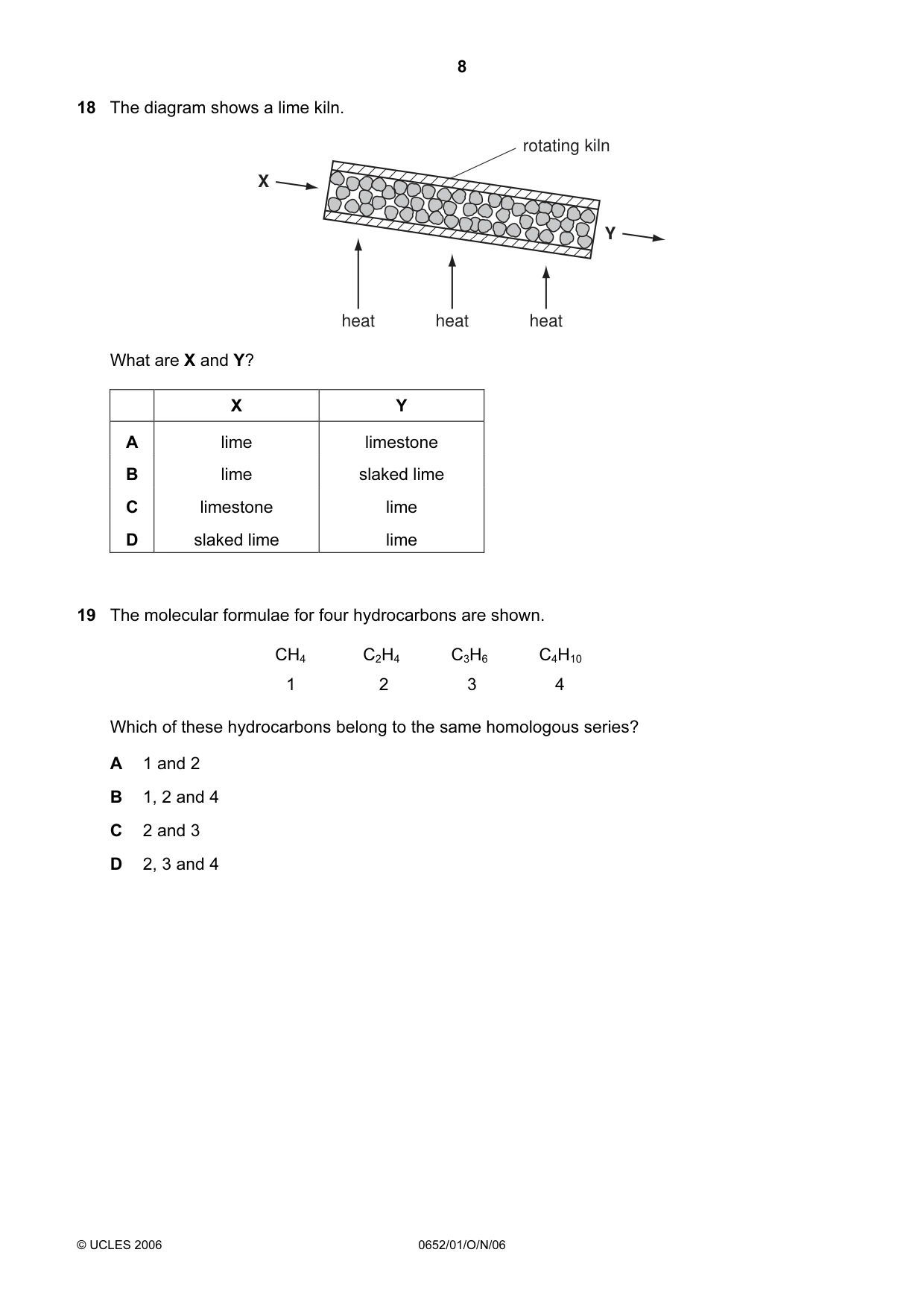
Q18 · The diagram shows a lime kiln
18 The diagram shows a lime kiln. rotating kiln X Y heat heat heat What are X and Y? X Y A lime limestone B lime slaked lime C limestone lime D slaked lime lime
Mark scheme: C
Q19 · The molecular formulae for four hydrocarbons are shown
19 The molecular formulae for four hydrocarbons are shown. CH4 C2H4 C3H6 C4H10 1 2 3 4 Which of these hydrocarbons belong to the same homologous series? A 1 and 2 B 1, 2 and 4 C 2 and 3 D 2, 3 and 4
Mark scheme: C
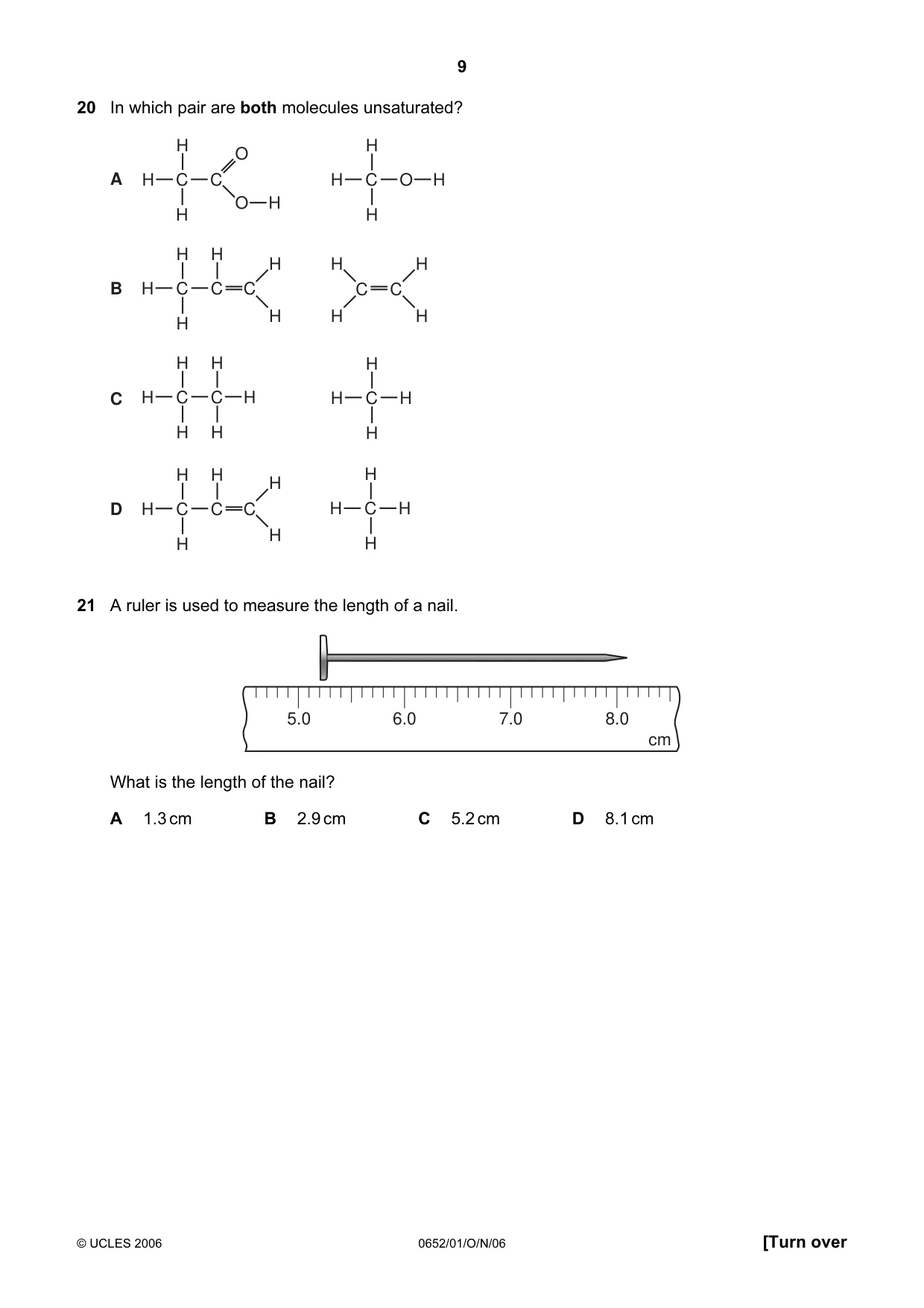
Q20 · In which pair are both molecules unsaturated?
20 In which pair are both molecules unsaturated? H H O A H C C H C O H O H H H H H H H H B H C C C C C H H H H H H H C H C C H H C H H H H H H H H D H C C C H C H H H H
Mark scheme: B
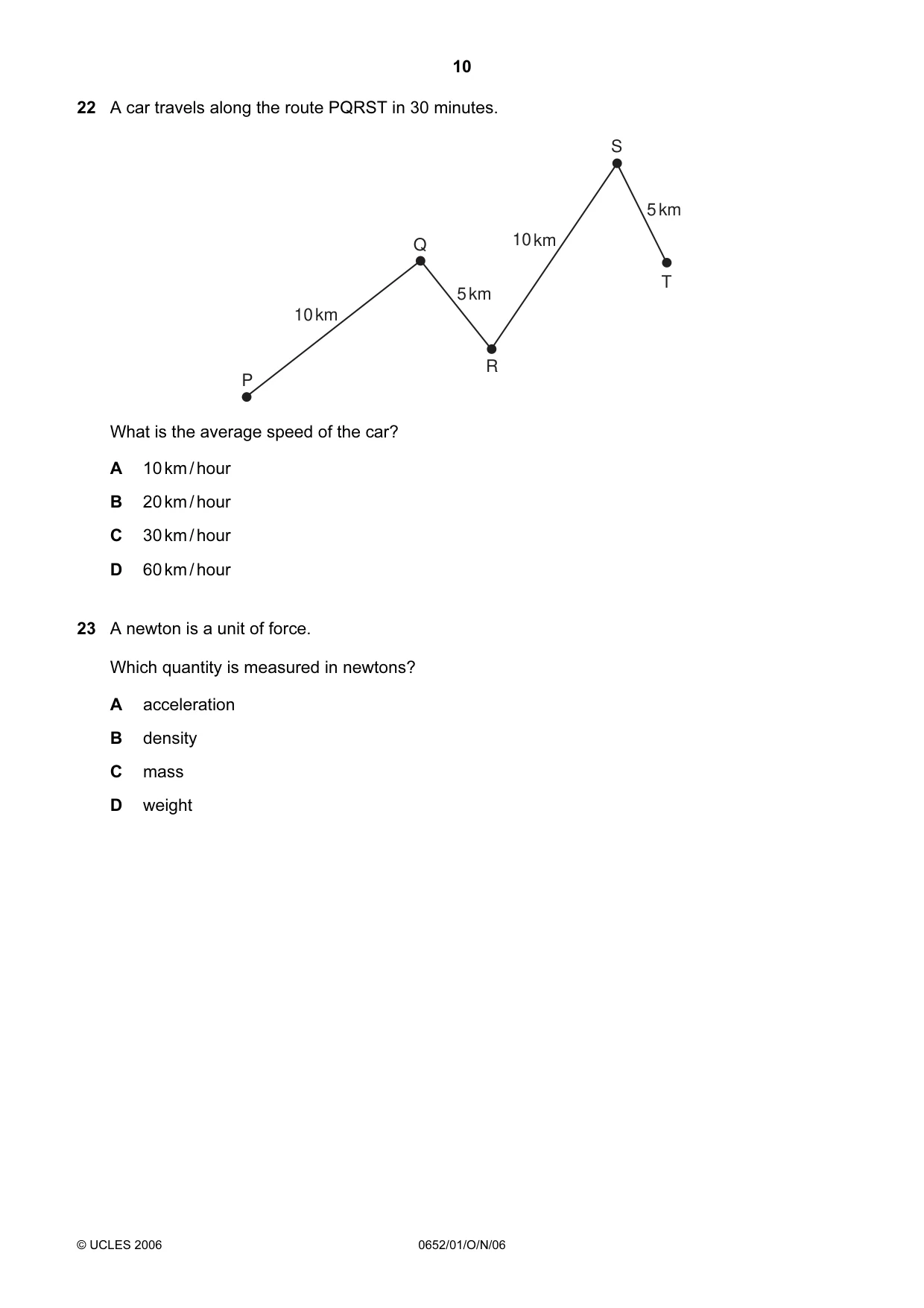
Q21 · A ruler is used to measure the length of a nail
21 A ruler is used to measure the length of a nail. 5.0 6.0 7.0 8.0 cm What is the length of the nail? A 1.3 cm B 2.9 cm C 5.2 cm D 8.1 cm
Mark scheme: B
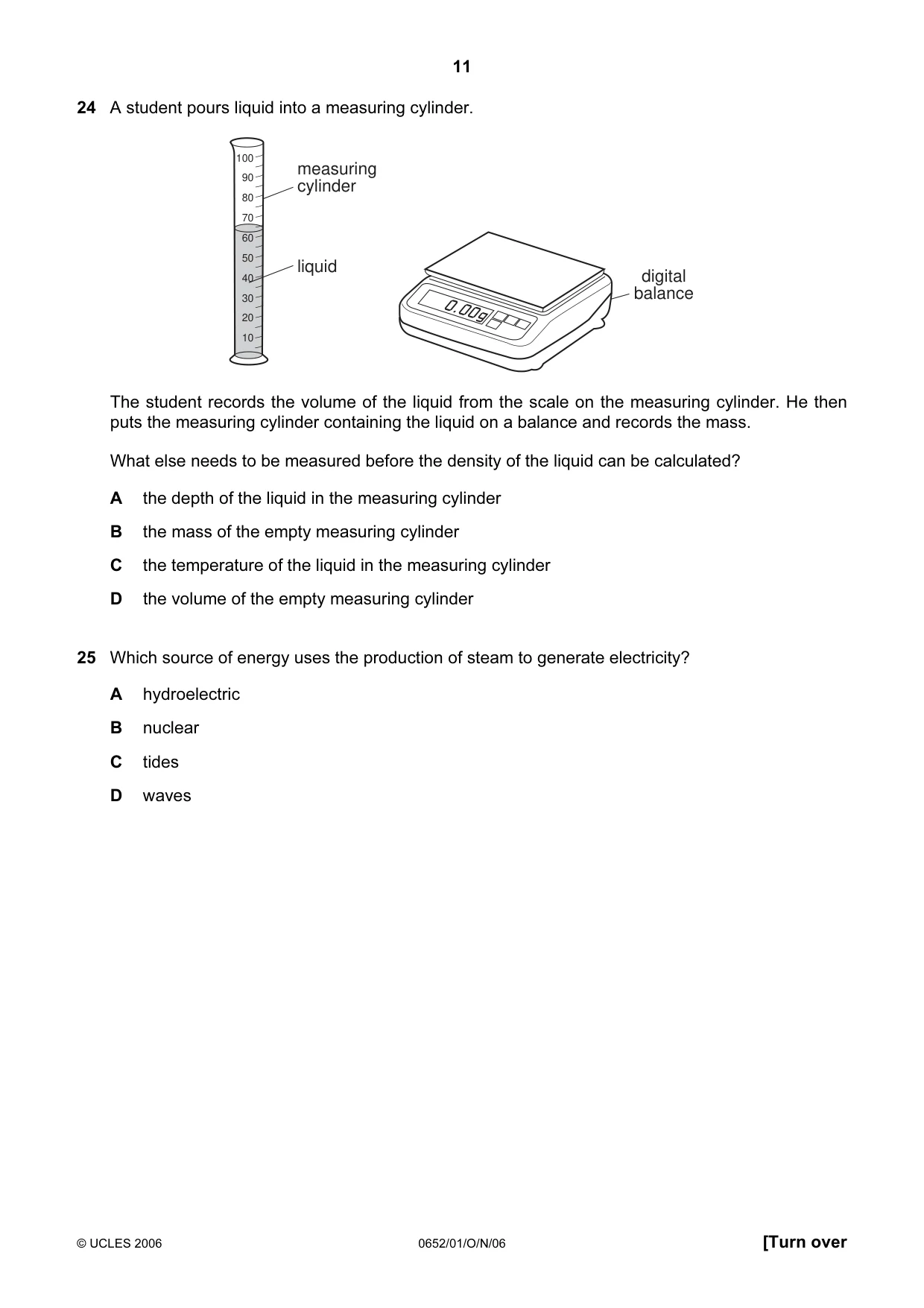
Q22 · A car travels along the route PQRST in 30 minutes
22 A car travels along the route PQRST in 30 minutes. S 5 km Q 10 km T 5 km 10 km R P What is the average speed of the car? A 10 km / hour B 20 km / hour C 30 km / hour D 60 km / hour
Mark scheme: D
Q23 · A newton is a unit of force
23 A newton is a unit of force. Which quantity is measured in newtons? A acceleration B density C mass D weight
Mark scheme: D
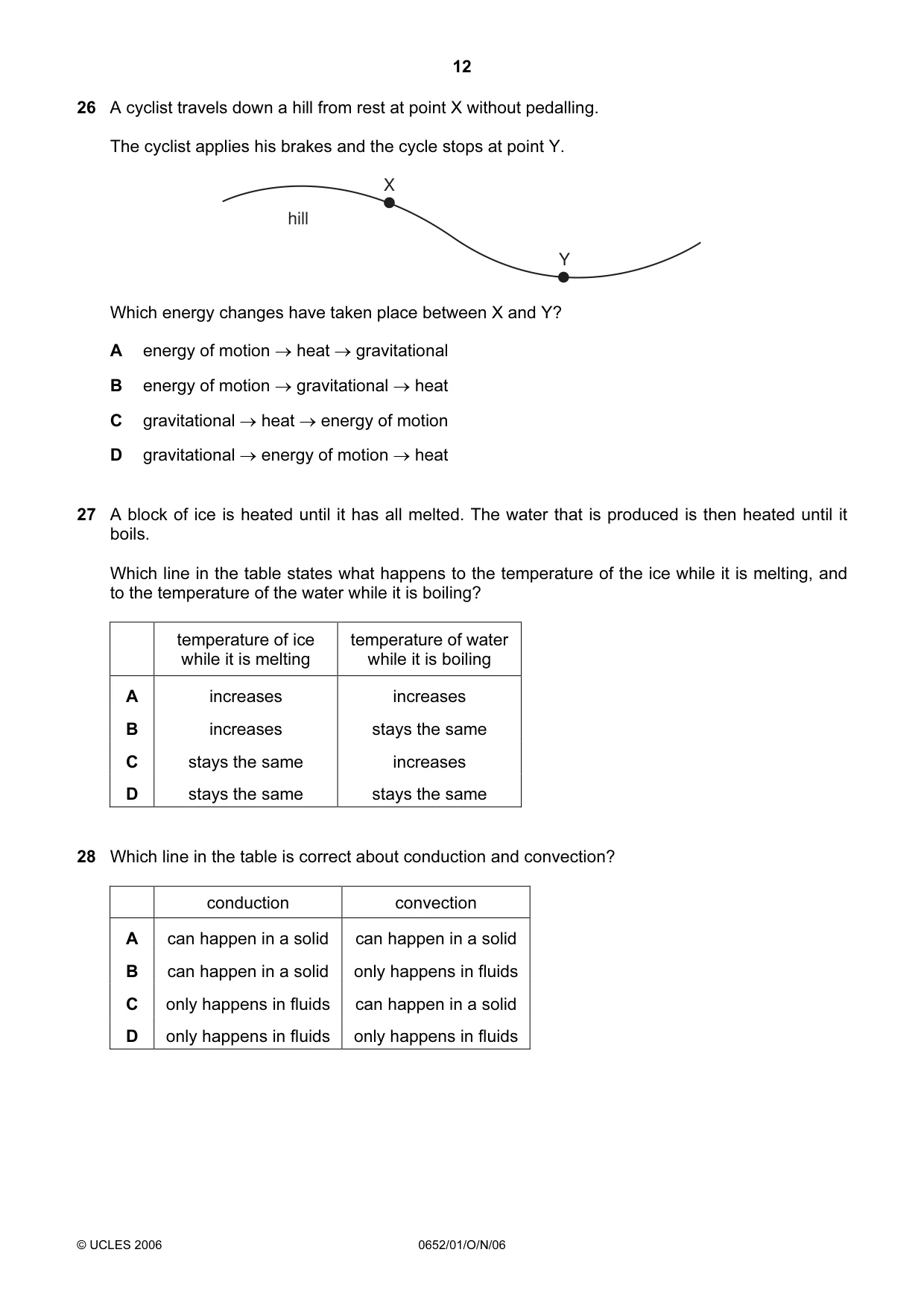
Q24 · A student pours liquid into a measuring cylinder
24 A student pours liquid into a measuring cylinder. 100 measuring 90 cylinder 80 70 60 50 liquid 40 digital balance 30 20 10 The student records the volume of the liquid from the scale on the measuring cylinder. He then puts the measuring cylinder containing the liquid on a balance and records the mass. What else needs to be measured before the density of the liquid can be calculated? A the depth of the liquid in the measuring cylinder B the mass of the empty measuring cylinder C the temperature of the liquid in the measuring cylinder D the volume of the empty measuring cylinder
Mark scheme: B
Q25 · Which source of energy uses the production of steam to generate electricity?
25 Which source of energy uses the production of steam to generate electricity? A hydroelectric B nuclear C tides D waves
Mark scheme: B
Q26 · A cyclist travels down a hill from rest at point X without pedalling
26 A cyclist travels down a hill from rest at point X without pedalling. The cyclist applies his brakes and the cycle stops at point Y. X hill Y Which energy changes have taken place between X and Y? A energy of motion → heat → gravitational B energy of motion → gravitational → heat C gravitational → heat → energy of motion D gravitational → energy of motion → heat
Mark scheme: D
Q27 · A block of ice is heated until it has all melted
27 A block of ice is heated until it has all melted. The water that is produced is then heated until it boils. Which line in the table states what happens to the temperature of the ice while it is melting, and to the temperature of the water while it is boiling? temperature of ice temperature of water while it is melting while it is boiling A increases increases B increases stays the same C stays the same increases D stays the same stays the same
Mark scheme: D
Q28 · Which line in the table is correct about conduction and convection?
28 Which line in the table is correct about conduction and convection? conduction convection A can happen in a solid can happen in a solid B can happen in a solid only happens in fluids C only happens in fluids can happen in a solid D only happens in fluids only happens in fluids
Mark scheme: B
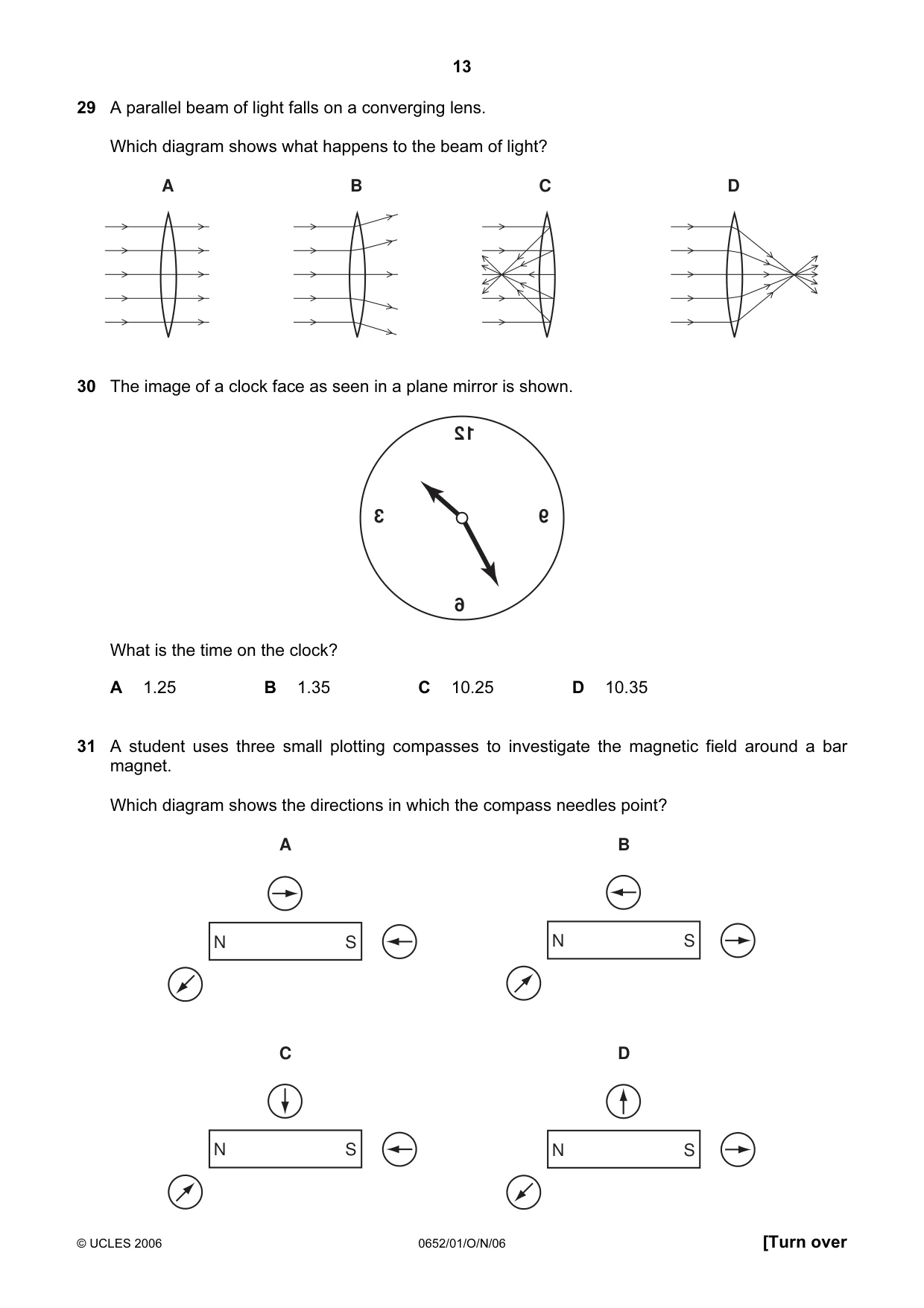
Q29 · A parallel beam of light falls on a converging lens
29 A parallel beam of light falls on a converging lens. Which diagram shows what happens to the beam of light? A B C D
Mark scheme: D
Q30 · The image of a clock face as seen in a plane mirror is shown
30 The image of a clock face as seen in a plane mirror is shown. 12 3 9 6 What is the time on the clock? A 1.25 B 1.35 C 10.25 D 10.35
Mark scheme: B
Q31 · A student uses three small plotting compasses to investigate the magnetic field around a…
31 A student uses three small plotting compasses to investigate the magnetic field around a bar magnet. Which diagram shows the directions in which the compass needles point? A B N S N S C D N S N S
Mark scheme: A
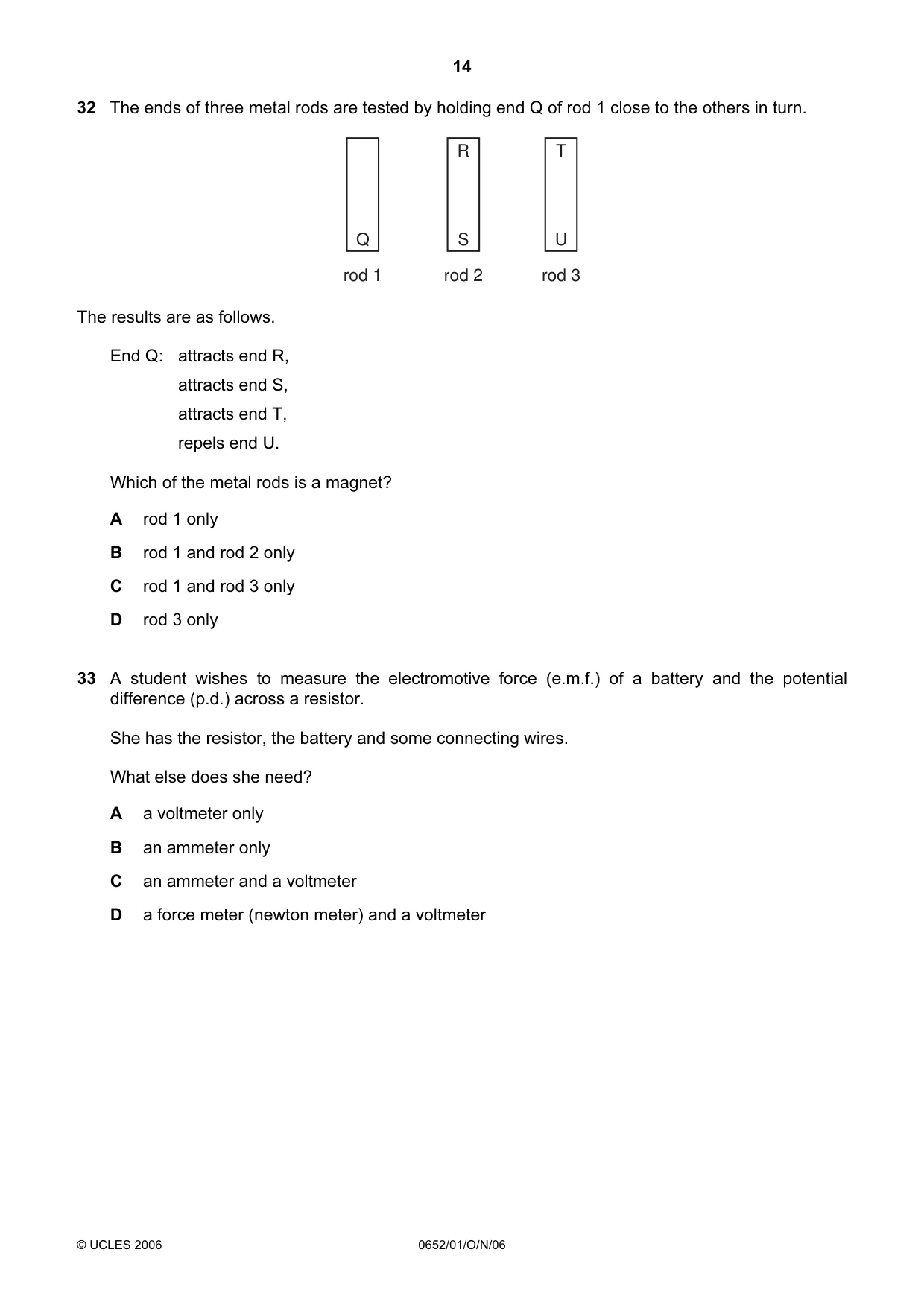
Q32 · The ends of three metal rods are tested by holding end Q of rod 1 close to the others in…
32 The ends of three metal rods are tested by holding end Q of rod 1 close to the others in turn. R T Q S U rod 1 rod 2 rod 3 The results are as follows. End Q: attracts end R, attracts end S, attracts end T, repels end U. Which of the metal rods is a magnet? A rod 1 only B rod 1 and rod 2 only C rod 1 and rod 3 only D rod 3 only
Mark scheme: C
Q33 · A student wishes to measure the electromotive force (e.m.f.) of a battery and the…
33 A student wishes to measure the electromotive force (e.m.f.) of a battery and the potential difference (p.d.) across a resistor. She has the resistor, the battery and some connecting wires. What else does she need? A a voltmeter only B an ammeter only C an ammeter and a voltmeter D a force meter (newton meter) and a voltmeter
Mark scheme: A
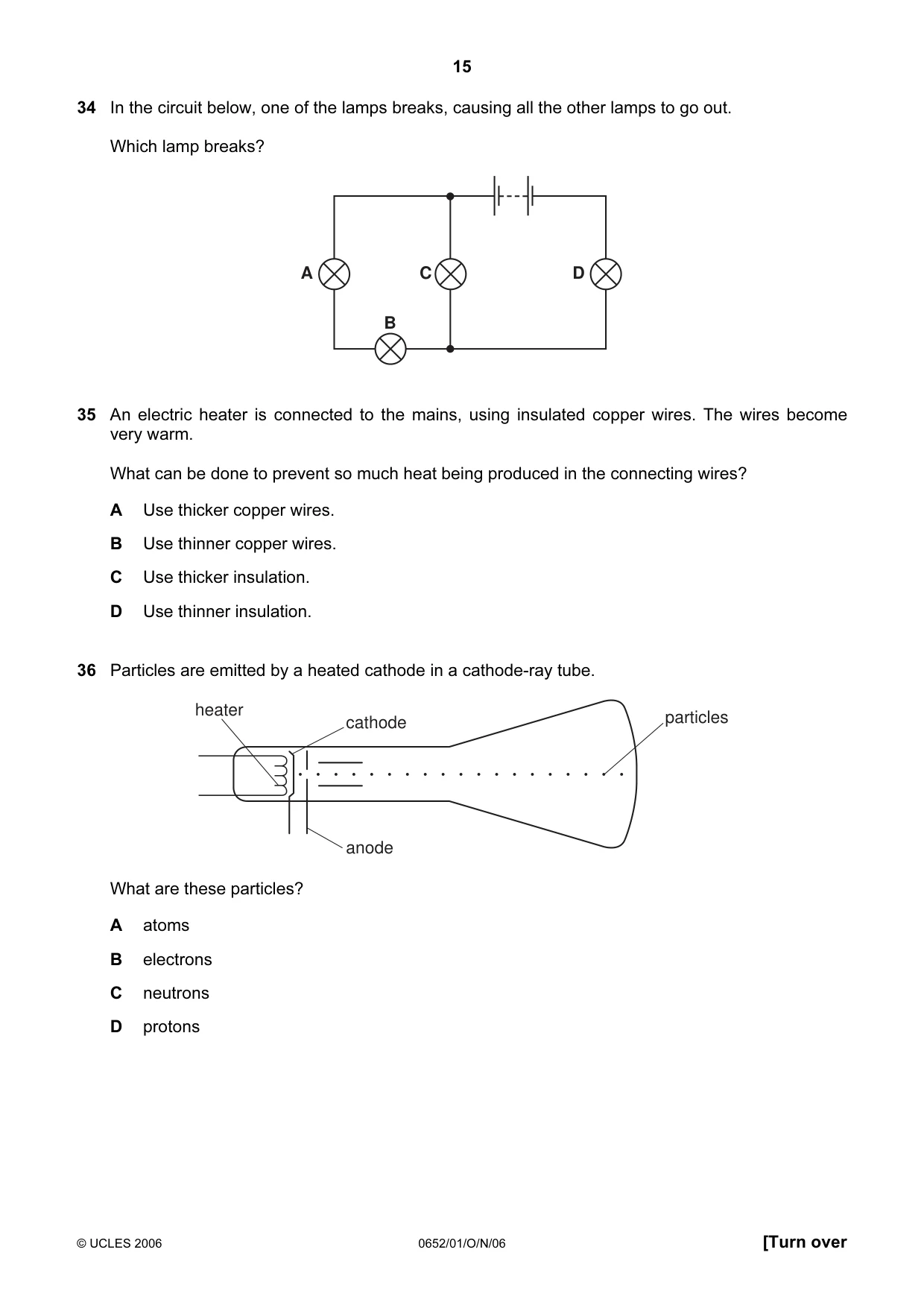
Q34 · In the circuit below, one of the lamps breaks, causing all the other lamps to go out
34 In the circuit below, one of the lamps breaks, causing all the other lamps to go out. Which lamp breaks? A C D B
Mark scheme: D
Q35 · An electric heater is connected to the mains, using insulated copper wires
35 An electric heater is connected to the mains, using insulated copper wires. The wires become very warm. What can be done to prevent so much heat being produced in the connecting wires? A Use thicker copper wires. B Use thinner copper wires. C Use thicker insulation. D Use thinner insulation.
Mark scheme: A
Q36 · Particles are emitted by a heated cathode in a cathode-ray tube
36 Particles are emitted by a heated cathode in a cathode-ray tube. heater particles cathode anode What are these particles? A atoms B electrons C neutrons D protons
Mark scheme: B
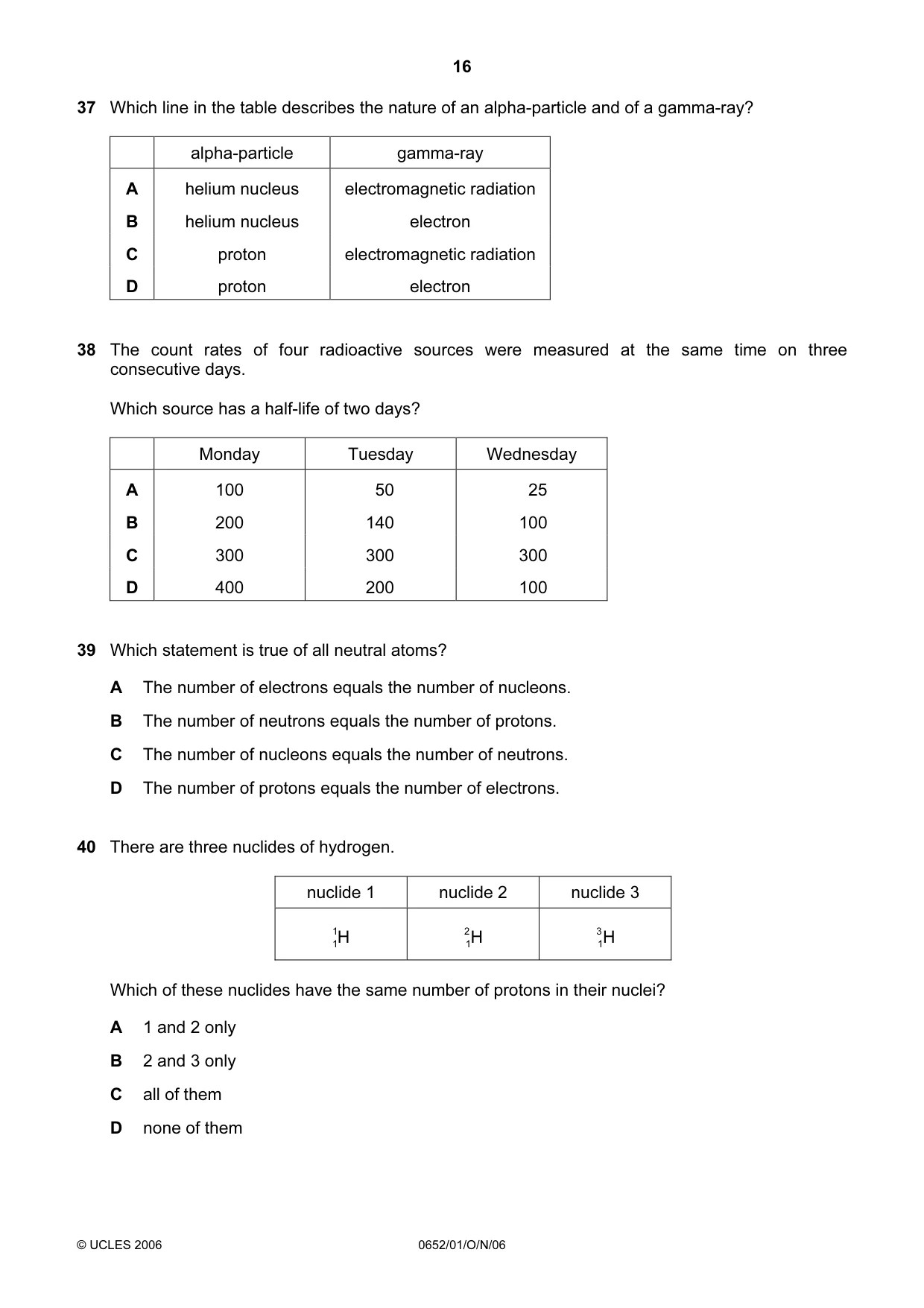
Q37 · Which line in the table describes the nature of an alpha-particle and of a gamma-ray?
37 Which line in the table describes the nature of an alpha-particle and of a gamma-ray? alpha-particle gamma-ray A helium nucleus electromagnetic radiation B helium nucleus electron C proton electromagnetic radiation D proton electron
Mark scheme: A
Q38 · The count rates of four radioactive sources were measured at the same time on three…
38 The count rates of four radioactive sources were measured at the same time on three consecutive days. Which source has a half-life of two days? Monday Tuesday Wednesday A 100 50 25 B 200 140 100 C 300 300 300 D 400 200 100
Mark scheme: B
Q39 · Which statement is true of all neutral atoms?
39 Which statement is true of all neutral atoms? A The number of electrons equals the number of nucleons. B The number of neutrons equals the number of protons. C The number of nucleons equals the number of neutrons. D The number of protons equals the number of electrons.
Mark scheme: D
Q40 · There are three nuclides of hydrogen
40 There are three nuclides of hydrogen. nuclide 1 nuclide 2 nuclide 3 1 1H 2 1H 3 1H Which of these nuclides have the same number of protons in their nuclei? A 1 and 2 only B 2 and 3 only C all of them D none of them
Mark scheme: C
What was in this paper
The subtopics covered by these 40 questions, and how many questions each got. Open one in a new tab to see every Cambridge question on it.
3Group properties2Light2Radioactivity2Simple phenomena of magnetism2Work, energy and power2Alkenes1Carbonates1Density1Electric circuits1Electrical energy1Electrical quantities1Energy transfer1Homologous series1Identification of ions and gases1Length and time1Mass and weight1Methods of purification1Molecules and covalent bonds1Motion1Names of compounds1Noble gases1Preparation of salts1Properties of metals1Rate (speed) of reaction1Redox1The characteristic properties of acids and bases1The nuclear atom1The particulate nature of matter1Thermal processes1Thermal properties and temperature1Uses of metals1Water1What you needed in this session
Cambridge’s own grade thresholds for 2006 Oct/Nov, Paper 1 · Variant 1. A higher threshold means an easier paper — the bar moves with how the cohort did.