Cambridge IGCSE Physical Science 0652 — 2020 Oct/Nov Paper 1 · Variant 1
0652/11/O/N/20 · 40 questions · 40 marks · ≈45 min
The question paper and its mark scheme, free to read here and free to download. This is Cambridge’s own paper, exactly as it was sat.
Question paper16 pages
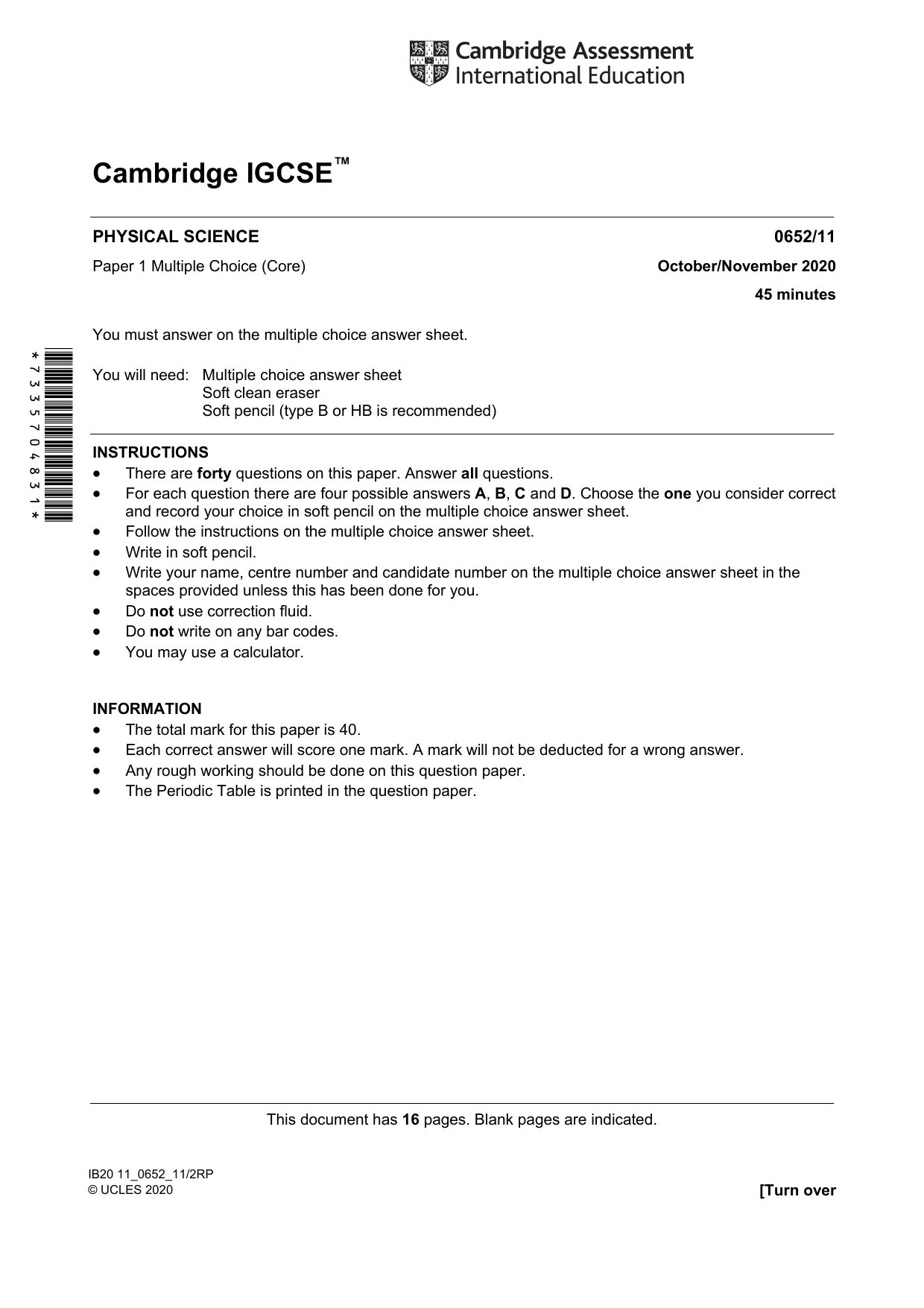
Mark scheme3 pages
Answers below. Sit the paper first if you are practising.
Questions as text
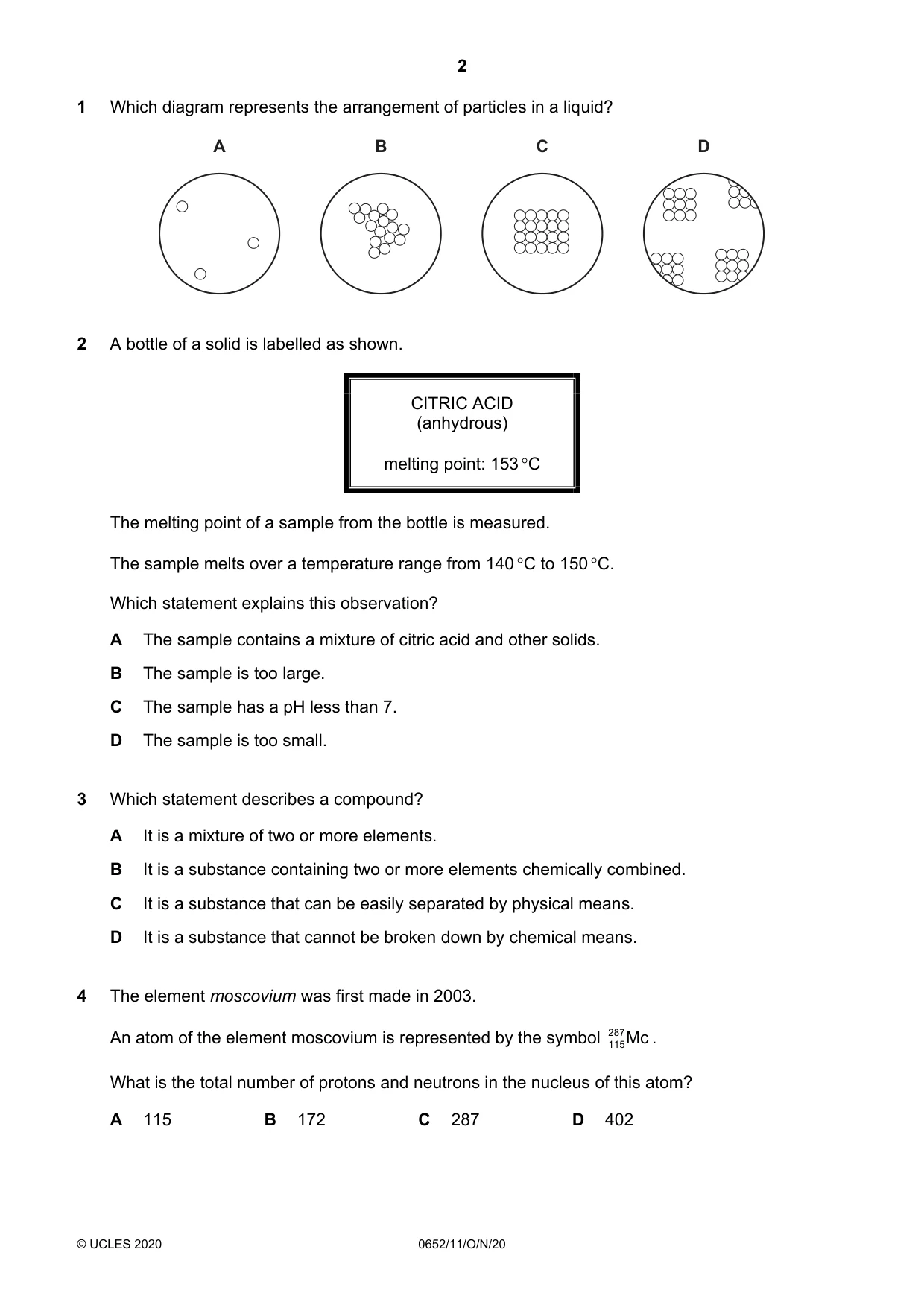
Q1 · Which diagram represents the arrangement of particles in a liquid?
1 Which diagram represents the arrangement of particles in a liquid? A B C D
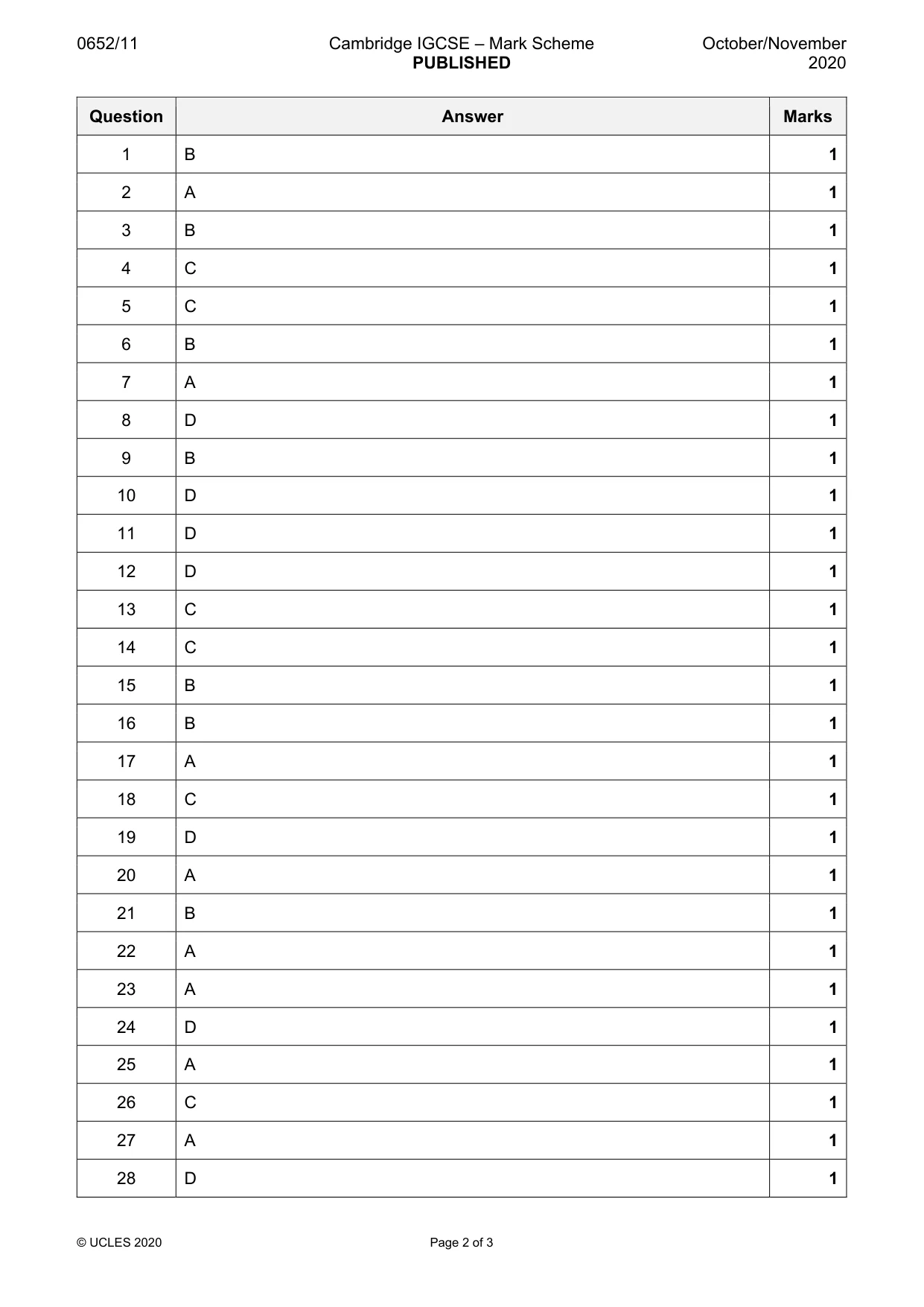
Mark scheme: B
Q2 · A bottle of a solid is labelled as shown
2 A bottle of a solid is labelled as shown. CITRIC ACID (anhydrous) melting point: 153 C The melting point of a sample from the bottle is measured. The sample melts over a temperature range from 140 C to 150 C. Which statement explains this observation? A The sample contains a mixture of citric acid and other solids. B The sample is too large. C The sample has a pH less than 7. D The sample is too small.
Mark scheme: A
Q3 · Which statement describes a compound?
3 Which statement describes a compound? A It is a mixture of two or more elements. B It is a substance containing two or more elements chemically combined. C It is a substance that can be easily separated by physical means. D It is a substance that cannot be broken down by chemical means.
Mark scheme: B
Q4 · The element moscovium was first made in 2003
4 The element moscovium was first made in 2003. An atom of the element moscovium is represented by the symbol 287 115Mc . What is the total number of protons and neutrons in the nucleus of this atom? A 115 B 172 C 287 D 402
Mark scheme: C
Q5 · Rubidium iodide is an ionic compound
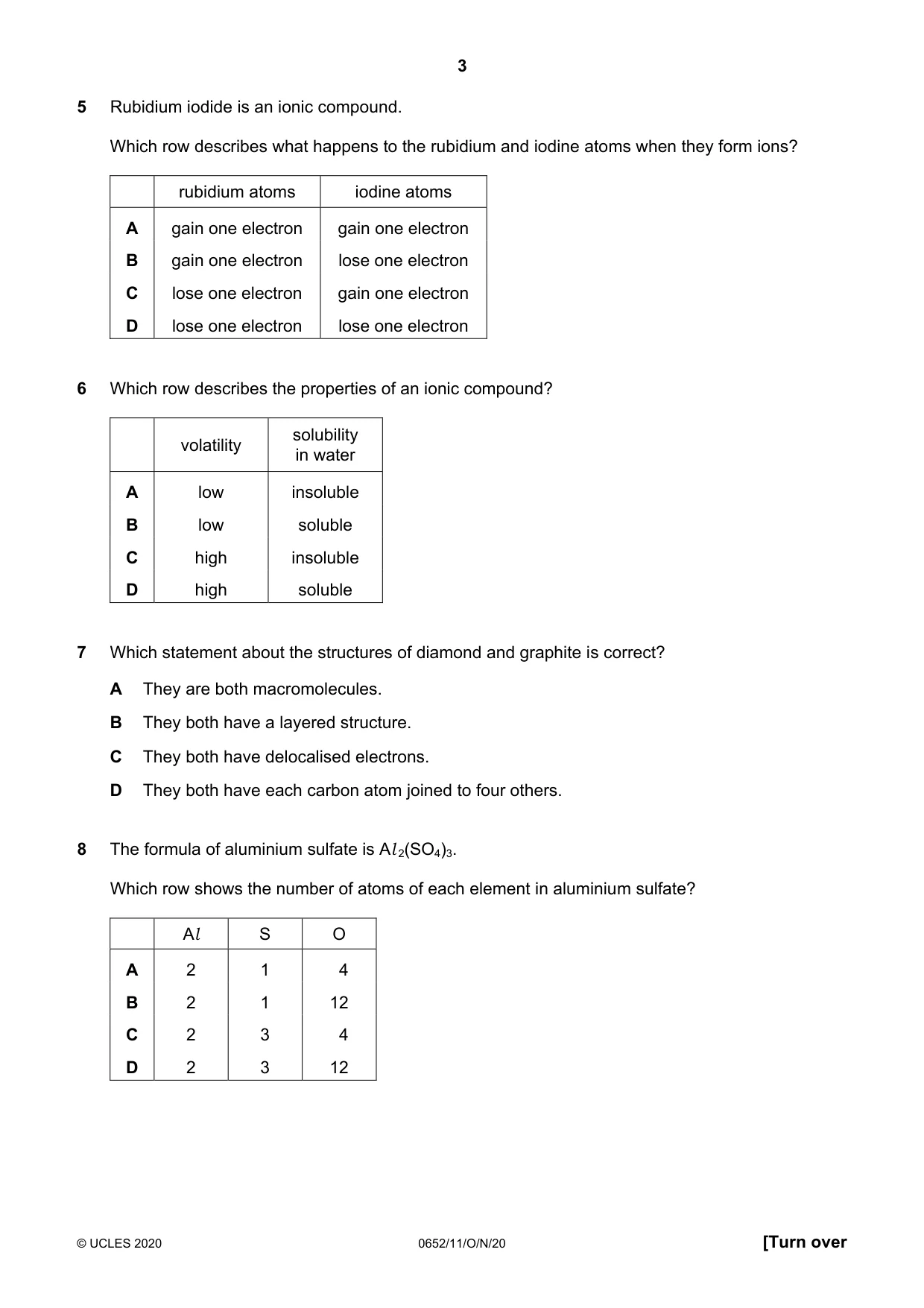
5 Rubidium iodide is an ionic compound. Which row describes what happens to the rubidium and iodine atoms when they form ions? rubidium atoms iodine atoms A gain one electron gain one electron B gain one electron lose one electron C lose one electron gain one electron D lose one electron lose one electron
Mark scheme: C
Q6 · Which row describes the properties of an ionic compound?
6 Which row describes the properties of an ionic compound? solubility volatility in water A low insoluble B low soluble C high insoluble D high soluble
Mark scheme: B
Q7 · Which statement about the structures of diamond and graphite is correct?
7 Which statement about the structures of diamond and graphite is correct? A They are both macromolecules. B They both have a layered structure. C They both have delocalised electrons. D They both have each carbon atom joined to four others.
Mark scheme: A
Q8 · The formula of aluminium sulfate is Al 2(SO4)3
8 The formula of aluminium sulfate is Al 2(SO4)3. Which row shows the number of atoms of each element in aluminium sulfate? Al S O A 2 1 4 B 2 1 12 C 2 3 4 D 2 3 12
Mark scheme: D
Q9 · Magnesium reacts with acids to produce hydrogen gas
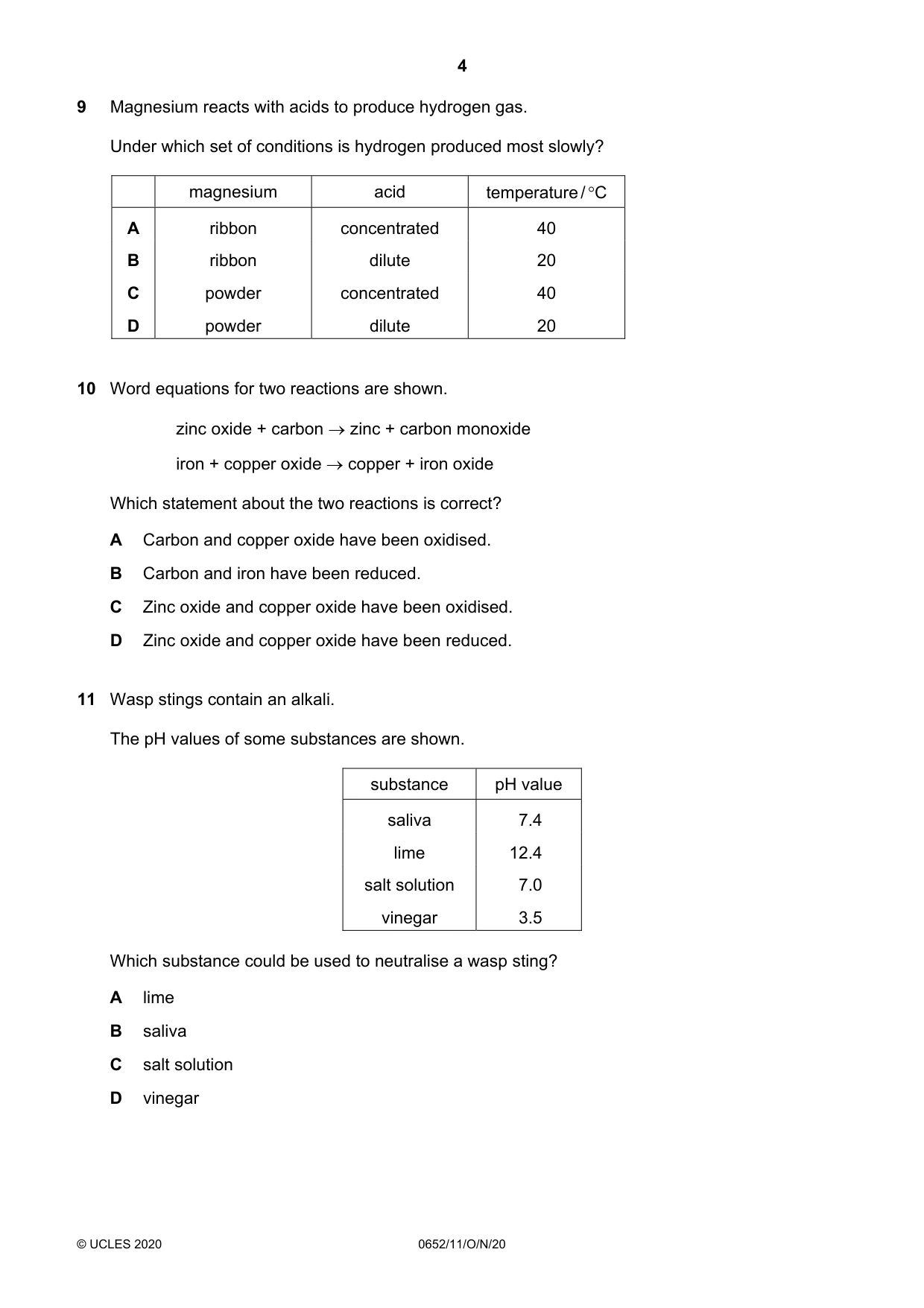
9 Magnesium reacts with acids to produce hydrogen gas. Under which set of conditions is hydrogen produced most slowly? magnesium acid temperature / C A ribbon concentrated 40 B ribbon dilute 20 C powder concentrated 40 D powder dilute 20
Mark scheme: B
Q10 · Word equations for two reactions are shown
10 Word equations for two reactions are shown. zinc oxide + carbon zinc + carbon monoxide iron + copper oxide copper + iron oxide Which statement about the two reactions is correct? A Carbon and copper oxide have been oxidised. B Carbon and iron have been reduced. C Zinc oxide and copper oxide have been oxidised. D Zinc oxide and copper oxide have been reduced.
Mark scheme: D
Q11 · Wasp stings contain an alkali
11 Wasp stings contain an alkali. The pH values of some substances are shown. substance pH value saliva 7.4 lime 12.4 salt solution 7.0 vinegar 3.5 Which substance could be used to neutralise a wasp sting? A lime B saliva C salt solution D vinegar
Mark scheme: D
More questions on The characteristic properties of acids and bases
Q12 · A colourless solution of X is tested with aqueous sodium hydroxide and with acidified…
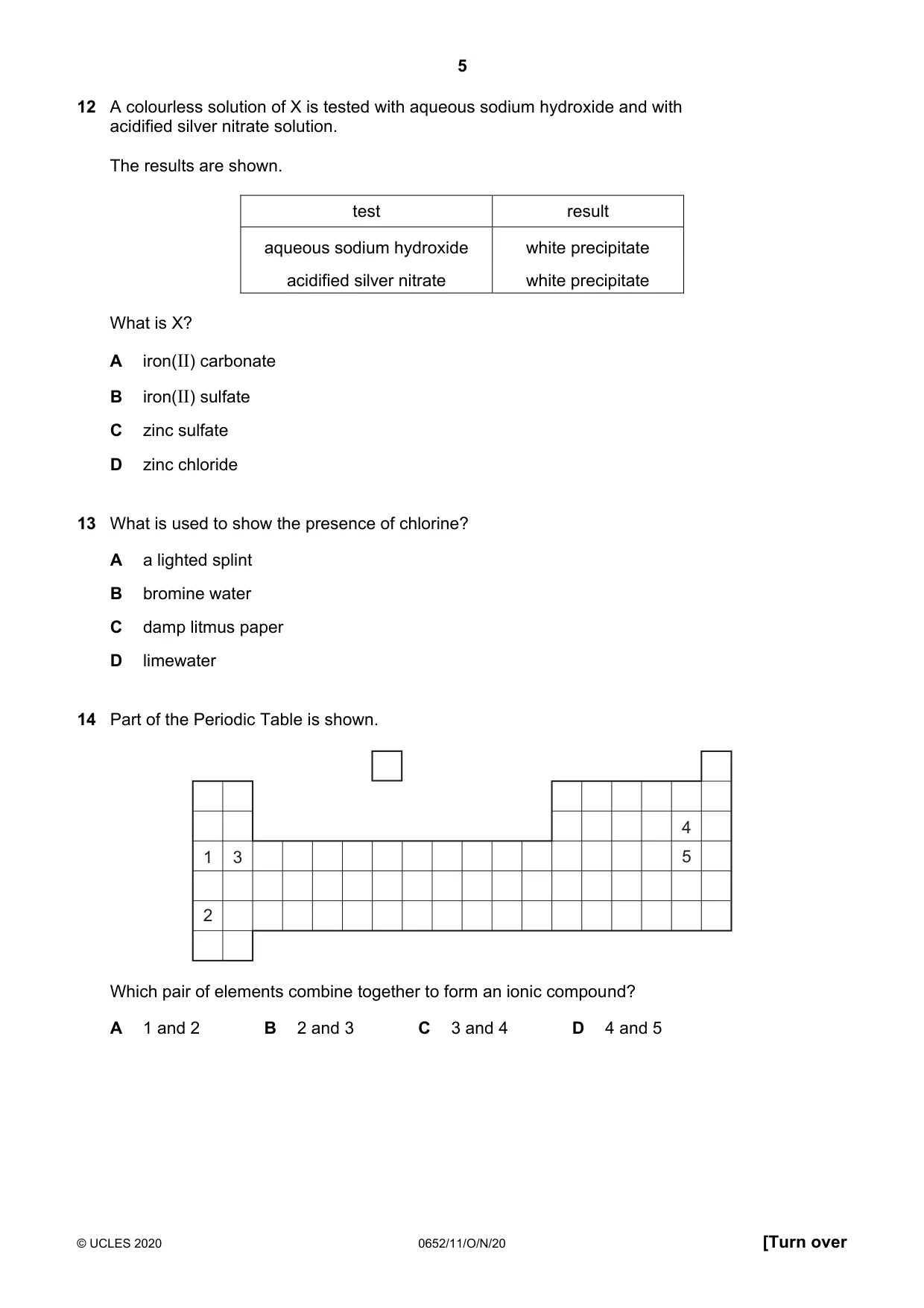
12 A colourless solution of X is tested with aqueous sodium hydroxide and with acidified silver nitrate solution. The results are shown. test result aqueous sodium hydroxide white precipitate acidified silver nitrate white precipitate What is X? A iron(II) carbonate B iron(II) sulfate C zinc sulfate D zinc chloride
Mark scheme: D
Q13 · What is used to show the presence of chlorine?
13 What is used to show the presence of chlorine? A a lighted splint B bromine water C damp litmus paper D limewater
Mark scheme: C
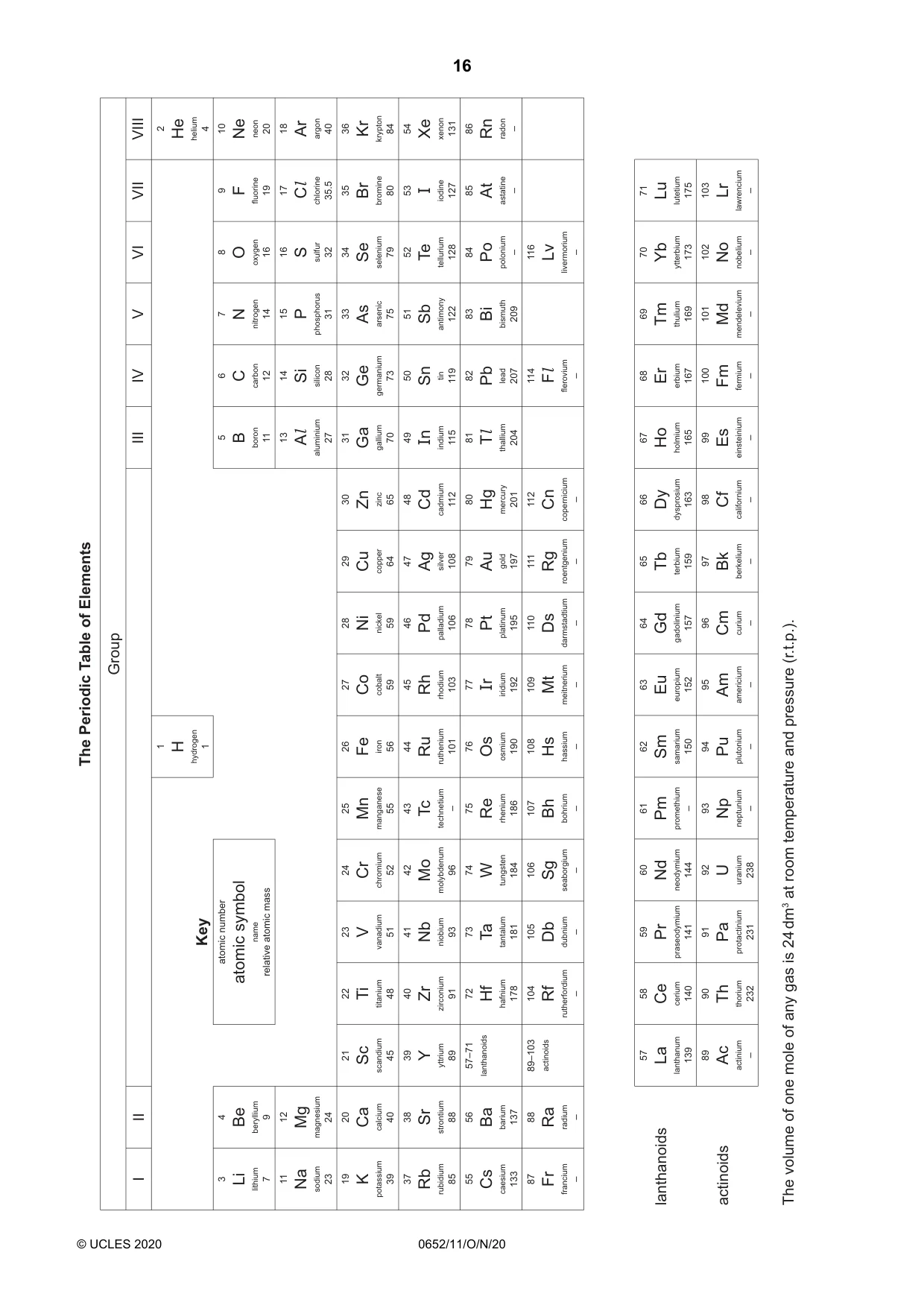
Q14 · Part of the Periodic Table is shown
14 Part of the Periodic Table is shown. 4 1 3 5 2 Which pair of elements combine together to form an ionic compound? A 1 and 2 B 2 and 3 C 3 and 4 D 4 and 5
Mark scheme: C
Q15 · Some properties of aluminium are listed
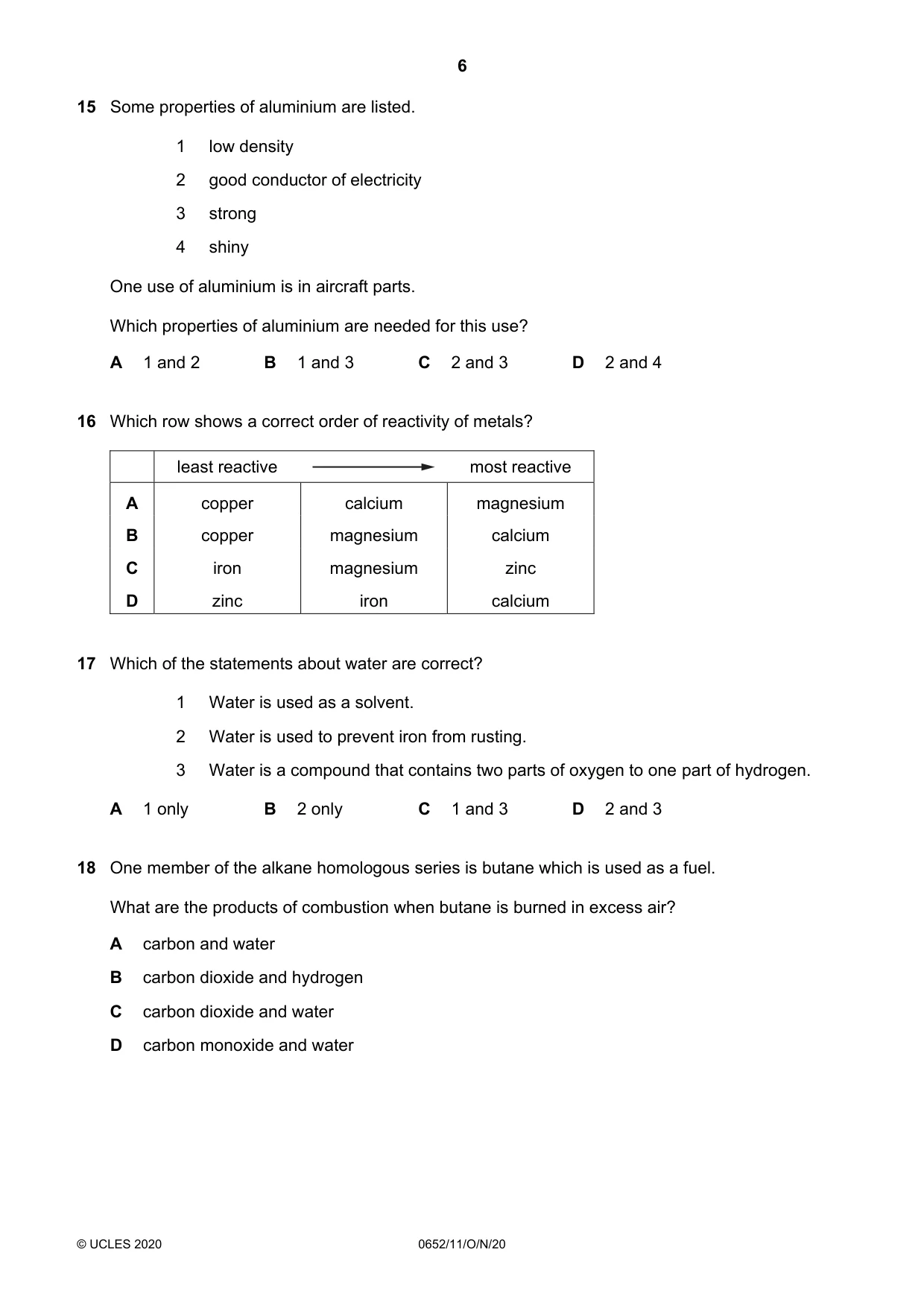
15 Some properties of aluminium are listed. 1 low density 2 good conductor of electricity 3 strong 4 shiny One use of aluminium is in aircraft parts. Which properties of aluminium are needed for this use? A 1 and 2 B 1 and 3 C 2 and 3 D 2 and 4
Mark scheme: B
Q16 · Which row shows a correct order of reactivity of metals?
16 Which row shows a correct order of reactivity of metals? least reactive most reactive A copper calcium magnesium B copper magnesium calcium C iron magnesium zinc D zinc iron calcium
Mark scheme: B
Q17 · Which of the statements about water are correct?
17 Which of the statements about water are correct? 1 Water is used as a solvent. 2 Water is used to prevent iron from rusting. 3 Water is a compound that contains two parts of oxygen to one part of hydrogen. A 1 only B 2 only C 1 and 3 D 2 and 3
Mark scheme: A
Q18 · One member of the alkane homologous series is butane which is used as a fuel
18 One member of the alkane homologous series is butane which is used as a fuel. What are the products of combustion when butane is burned in excess air? A carbon and water B carbon dioxide and hydrogen C carbon dioxide and water D carbon monoxide and water
Mark scheme: C
Q19 · The structures of three hydrocarbons are shown
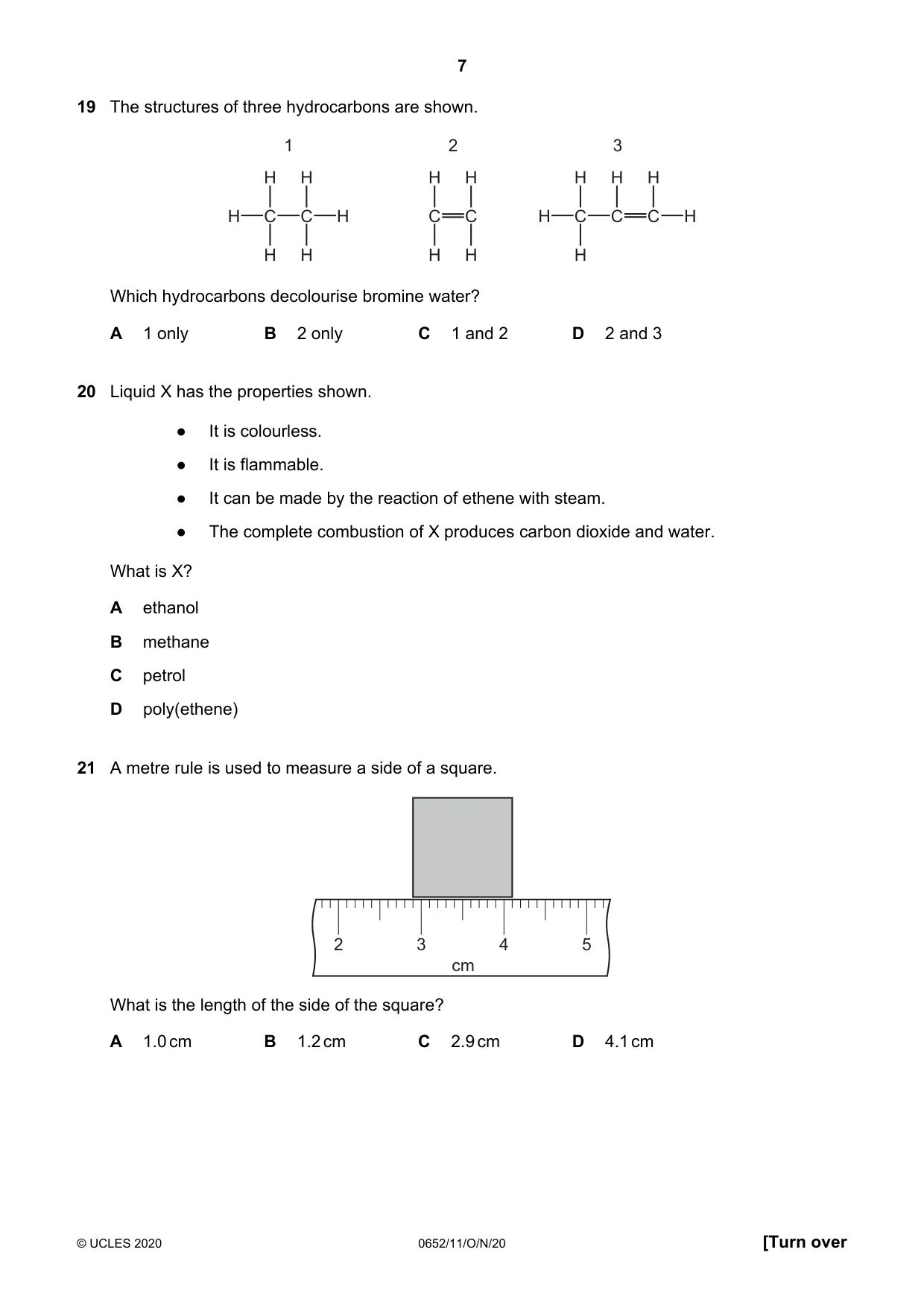
19 The structures of three hydrocarbons are shown. 1 2 3 H H H H H H H H C C H C C H C C C H H H H H H Which hydrocarbons decolourise bromine water? A 1 only B 2 only C 1 and 2 D 2 and 3
Mark scheme: D
Q20 · Liquid X has the properties shown
20 Liquid X has the properties shown. ● It is colourless. ● It is flammable. ● It can be made by the reaction of ethene with steam. ● The complete combustion of X produces carbon dioxide and water. What is X? A ethanol B methane C petrol D poly(ethene)
Mark scheme: A
Q21 · A metre rule is used to measure a side of a square
21 A metre rule is used to measure a side of a square. 2 3 4 5 cm What is the length of the side of the square? A 1.0 cm B 1.2 cm C 2.9 cm D 4.1 cm
Mark scheme: B
Q22 · What does the gradient of a speed–time graph show?
22 What does the gradient of a speed–time graph show? A acceleration B average speed C final speed D distance travelled
Mark scheme: A
Q23 · The diagram shows a solid cube of metal
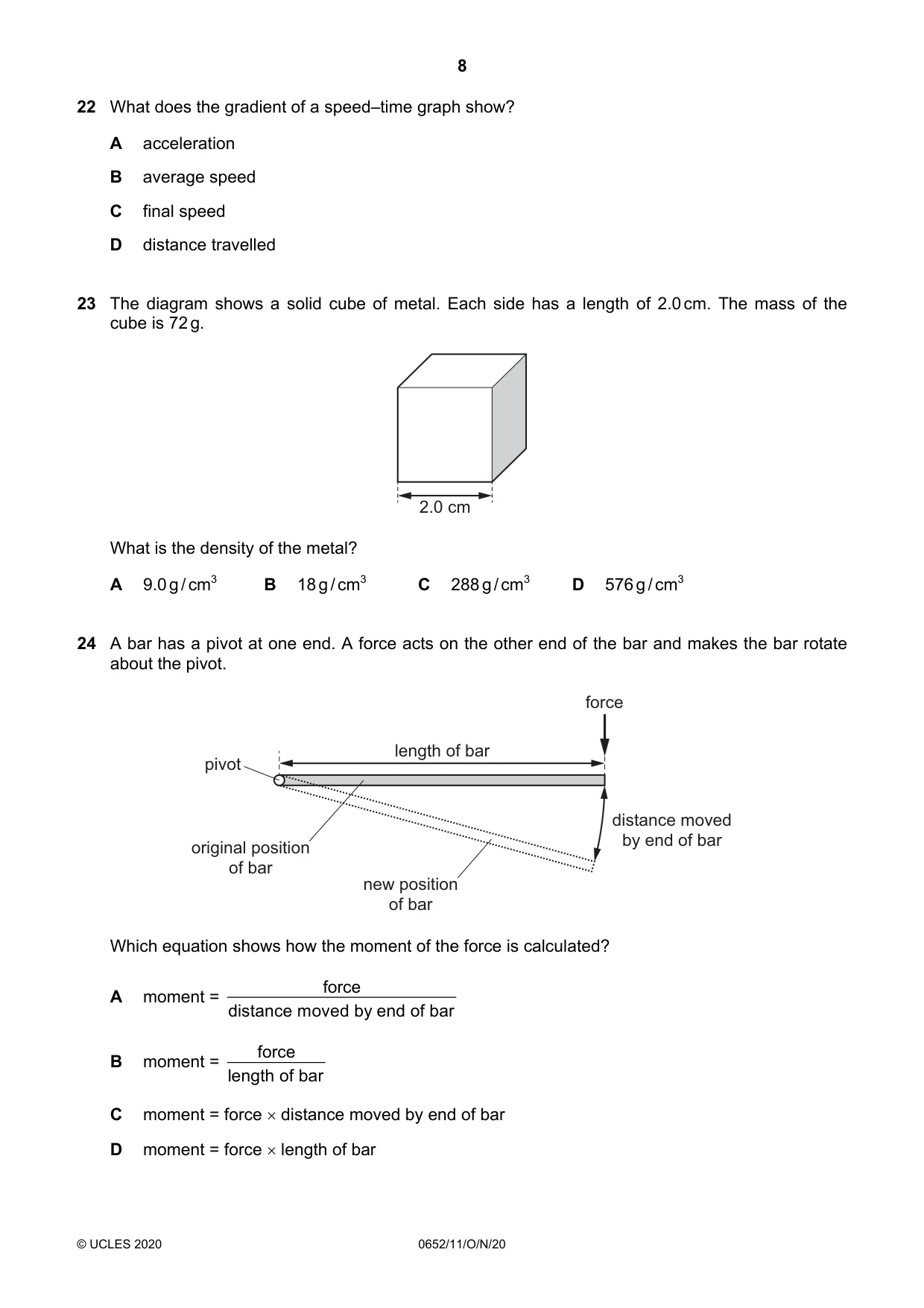
23 The diagram shows a solid cube of metal. Each side has a length of 2.0 cm. The mass of the cube is 72 g. 2.0 cm What is the density of the metal? A 9.0 g / cm3 B 18 g / cm3 C 288 g / cm3 D 576 g / cm3
Mark scheme: A
Q24 · A bar has a pivot at one end
24 A bar has a pivot at one end. A force acts on the other end of the bar and makes the bar rotate about the pivot. force length of bar pivot distance moved original position by end of bar of bar new position of bar Which equation shows how the moment of the force is calculated? force A moment = distance moved by end of bar force B moment = length of bar C moment = force distance moved by end of bar D moment = force length of bar
Mark scheme: D
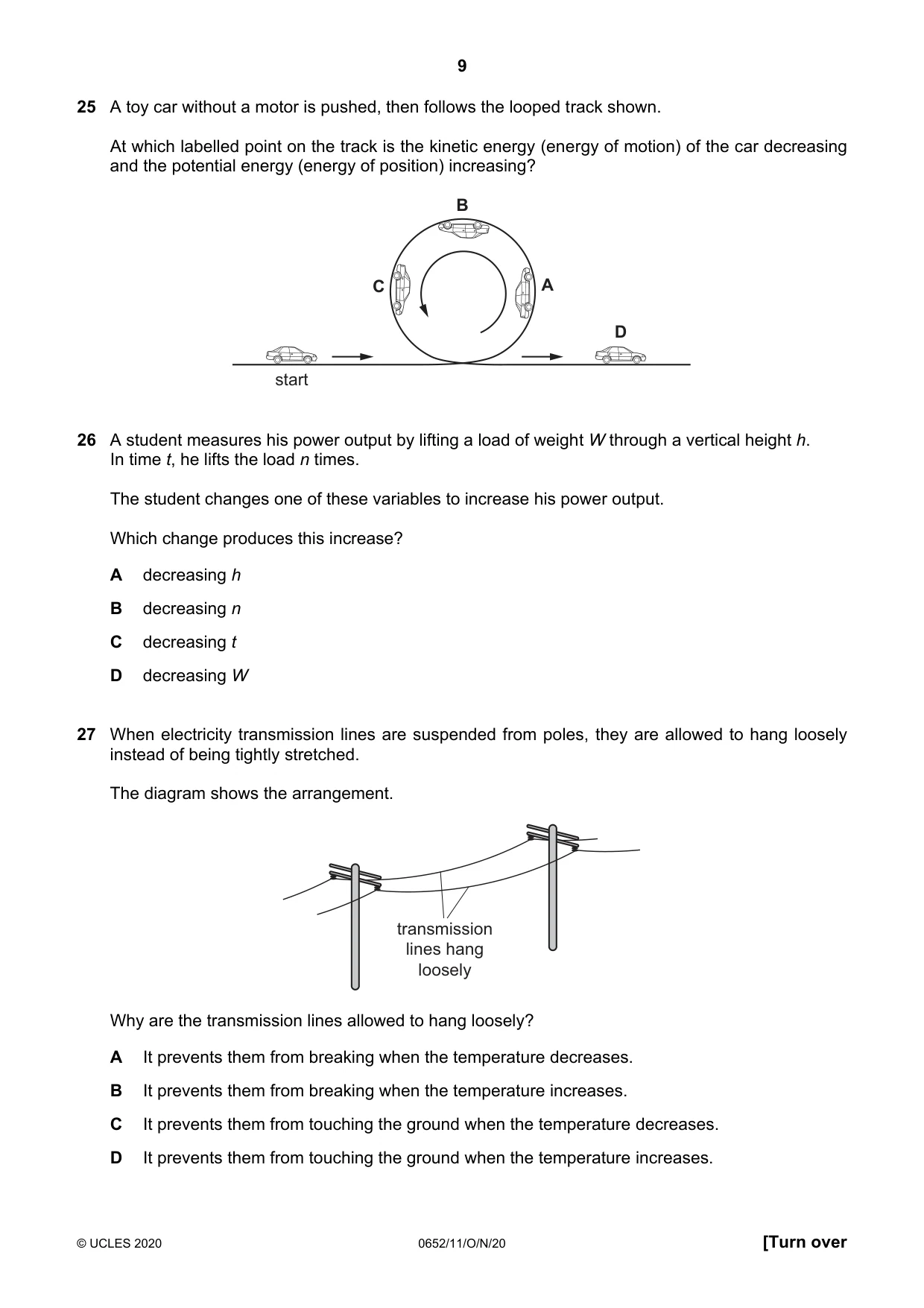
Q25 · A toy car without a motor is pushed, then follows the looped track shown
25 A toy car without a motor is pushed, then follows the looped track shown. At which labelled point on the track is the kinetic energy (energy of motion) of the car decreasing and the potential energy (energy of position) increasing? B C A D start
Mark scheme: A
Q26 · A student measures his power output by lifting a load of weight W through a vertical…
26 A student measures his power output by lifting a load of weight W through a vertical height h. In time t, he lifts the load n times. The student changes one of these variables to increase his power output. Which change produces this increase? A decreasing h B decreasing n C decreasing t D decreasing W
Mark scheme: C
Q27 · When electricity transmission lines are suspended from poles, they are allowed to hang…
27 When electricity transmission lines are suspended from poles, they are allowed to hang loosely instead of being tightly stretched. The diagram shows the arrangement. transmission lines hang loosely Why are the transmission lines allowed to hang loosely? A It prevents them from breaking when the temperature decreases. B It prevents them from breaking when the temperature increases. C It prevents them from touching the ground when the temperature decreases. D It prevents them from touching the ground when the temperature increases.
Mark scheme: A
Q28 · Which row shows what happens to the temperature of a solid as it melts, and to the…
28 Which row shows what happens to the temperature of a solid as it melts, and to the temperature of a liquid as it boils? temperature of a temperature of a solid as it melts liquid as it boils A increases increases B no change increases C increases no change D no change no change
Mark scheme: D
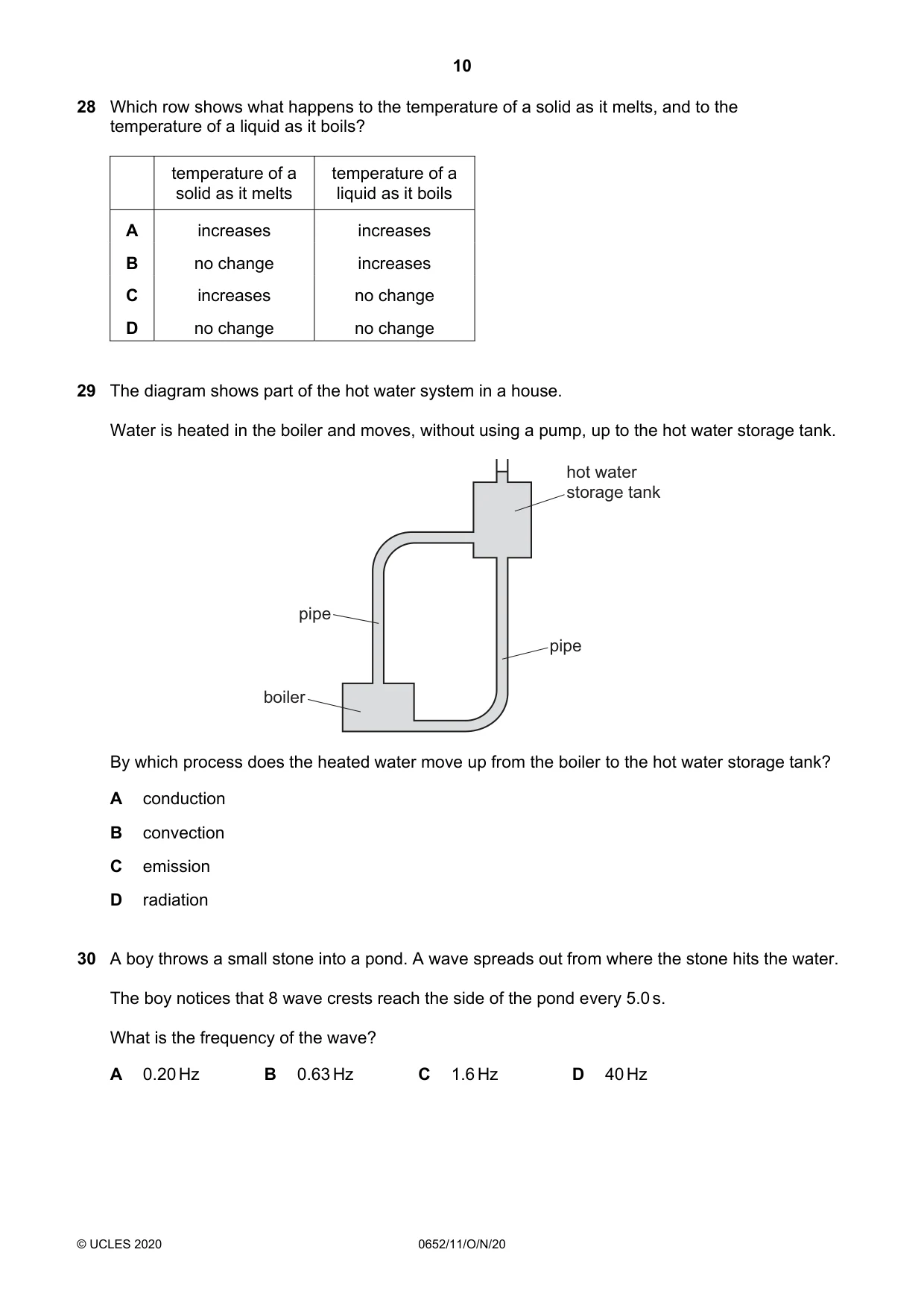
Q29 · The diagram shows part of the hot water system in a house
29 The diagram shows part of the hot water system in a house. Water is heated in the boiler and moves, without using a pump, up to the hot water storage tank. hot water storage tank pipe pipe boiler By which process does the heated water move up from the boiler to the hot water storage tank? A conduction B convection C emission D radiation
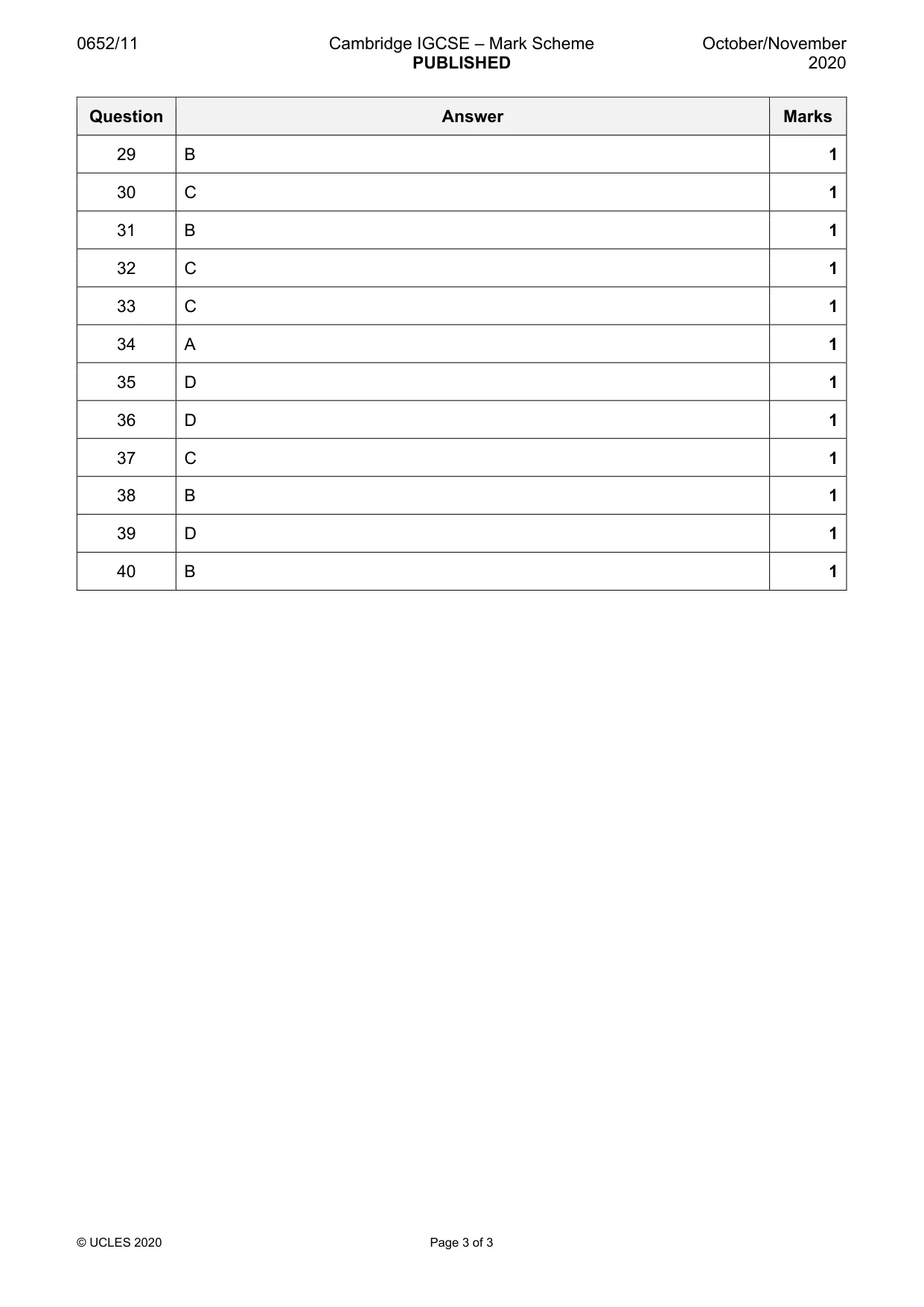
Mark scheme: B
Q30 · A boy throws a small stone into a pond
30 A boy throws a small stone into a pond. A wave spreads out from where the stone hits the water. The boy notices that 8 wave crests reach the side of the pond every 5.0 s. What is the frequency of the wave? A 0.20 Hz B 0.63 Hz C 1.6 Hz D 40 Hz
Mark scheme: C
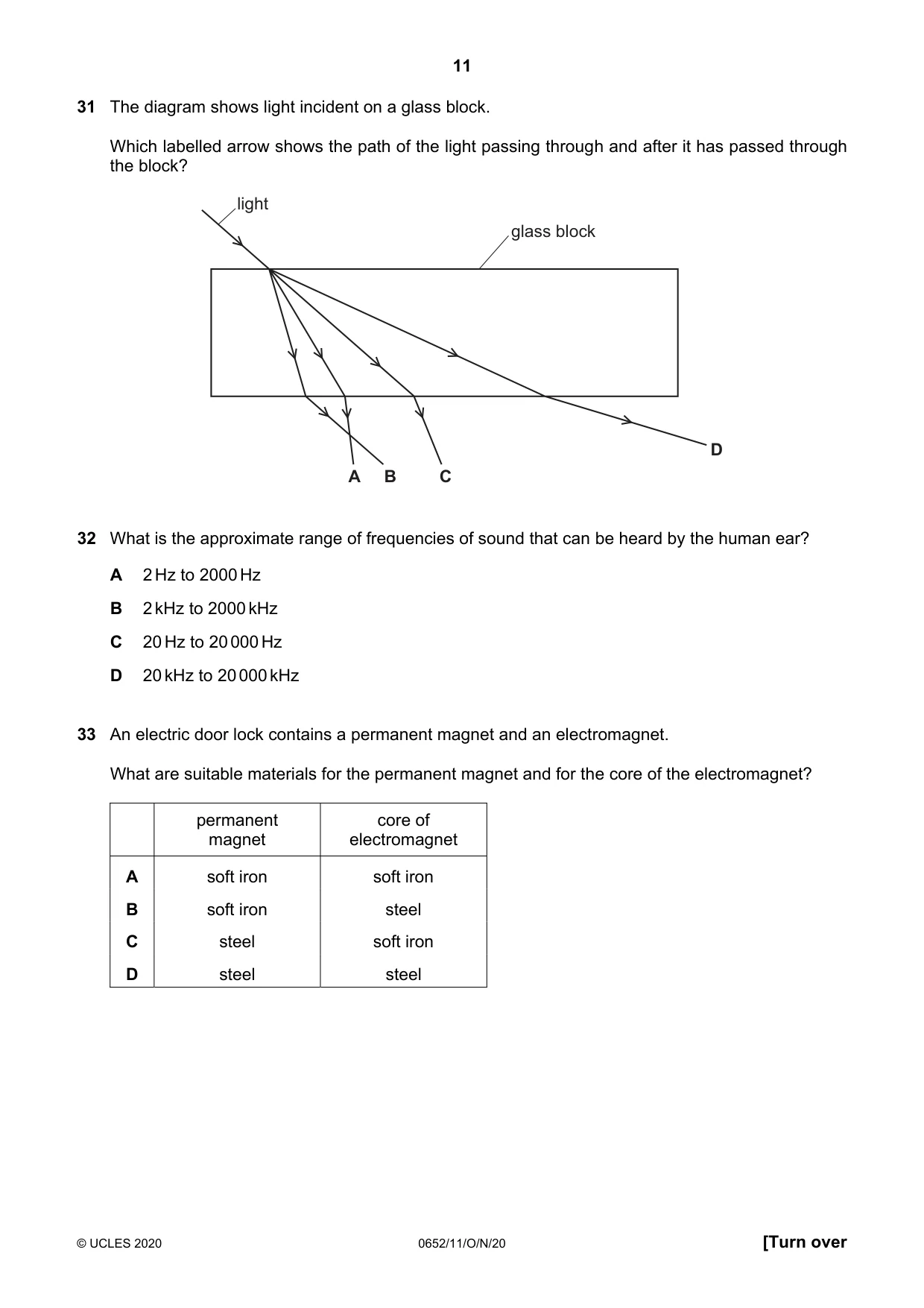
Q31 · The diagram shows light incident on a glass block
31 The diagram shows light incident on a glass block. Which labelled arrow shows the path of the light passing through and after it has passed through the block? light glass block D A B C
Mark scheme: B
Q32 · What is the approximate range of frequencies of sound that can be heard by the human ear?
32 What is the approximate range of frequencies of sound that can be heard by the human ear? A 2 Hz to 2000 Hz B 2 kHz to 2000 kHz C 20 Hz to 20 000 Hz D 20 kHz to 20 000 kHz
Mark scheme: C
Q33 · An electric door lock contains a permanent magnet and an electromagnet
33 An electric door lock contains a permanent magnet and an electromagnet. What are suitable materials for the permanent magnet and for the core of the electromagnet? permanent core of magnet electromagnet A soft iron soft iron B soft iron steel C steel soft iron D steel steel
Mark scheme: C
Q34 · Two plastic rods are each rubbed with a cloth
34 Two plastic rods are each rubbed with a cloth. The rods are brought close to each other and they move apart. Which statement explains this? A Like charges repel. B Like poles repel. C Unlike charges repel. D Unlike poles repel.
Mark scheme: A
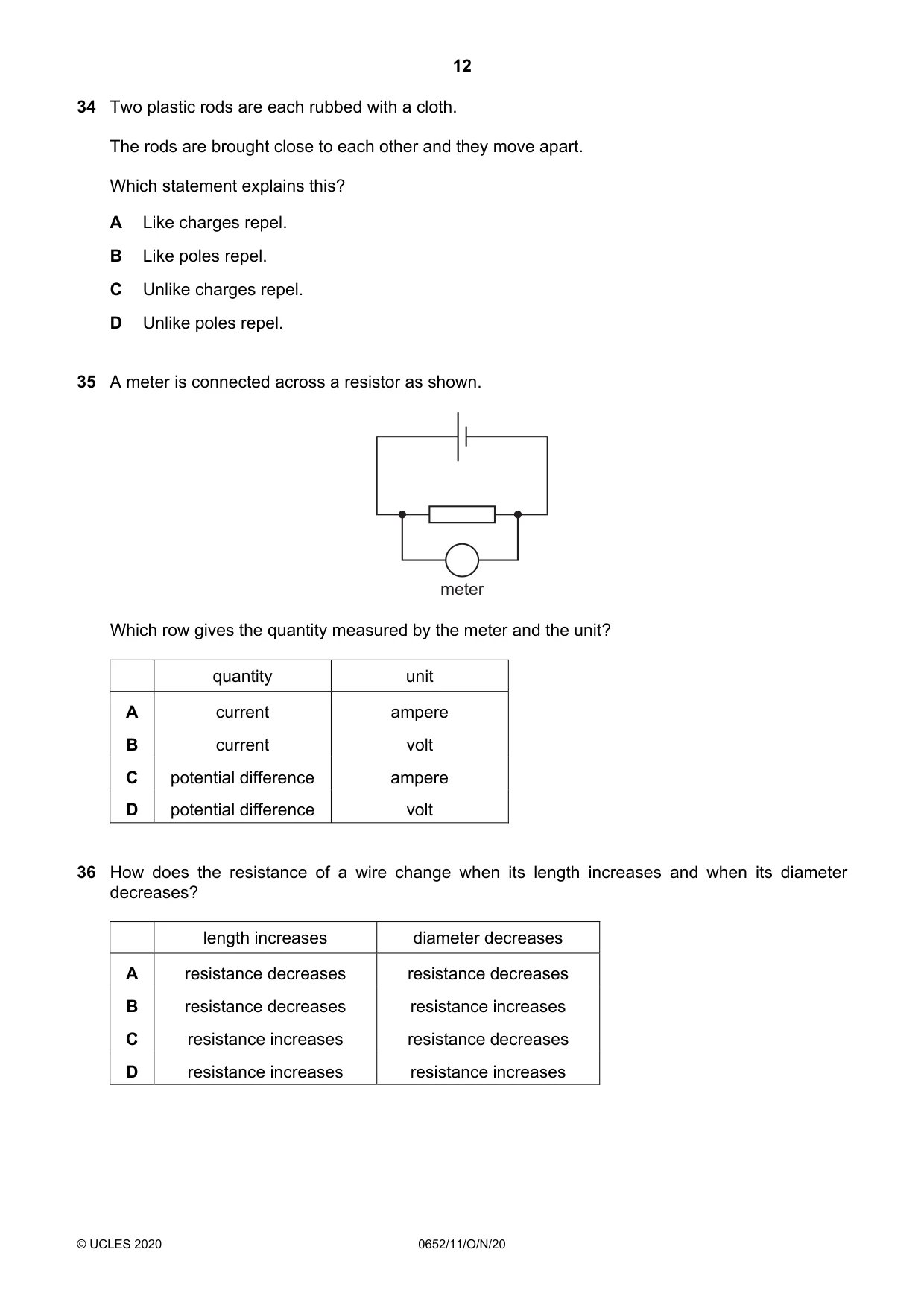
Q35 · A meter is connected across a resistor as shown
35 A meter is connected across a resistor as shown. meter Which row gives the quantity measured by the meter and the unit? quantity unit A current ampere B current volt C potential difference ampere D potential difference volt
Mark scheme: D
Q36 · How does the resistance of a wire change when its length increases and when its diameter…
36 How does the resistance of a wire change when its length increases and when its diameter decreases? length increases diameter decreases A resistance decreases resistance decreases B resistance decreases resistance increases C resistance increases resistance decreases D resistance increases resistance increases
Mark scheme: D
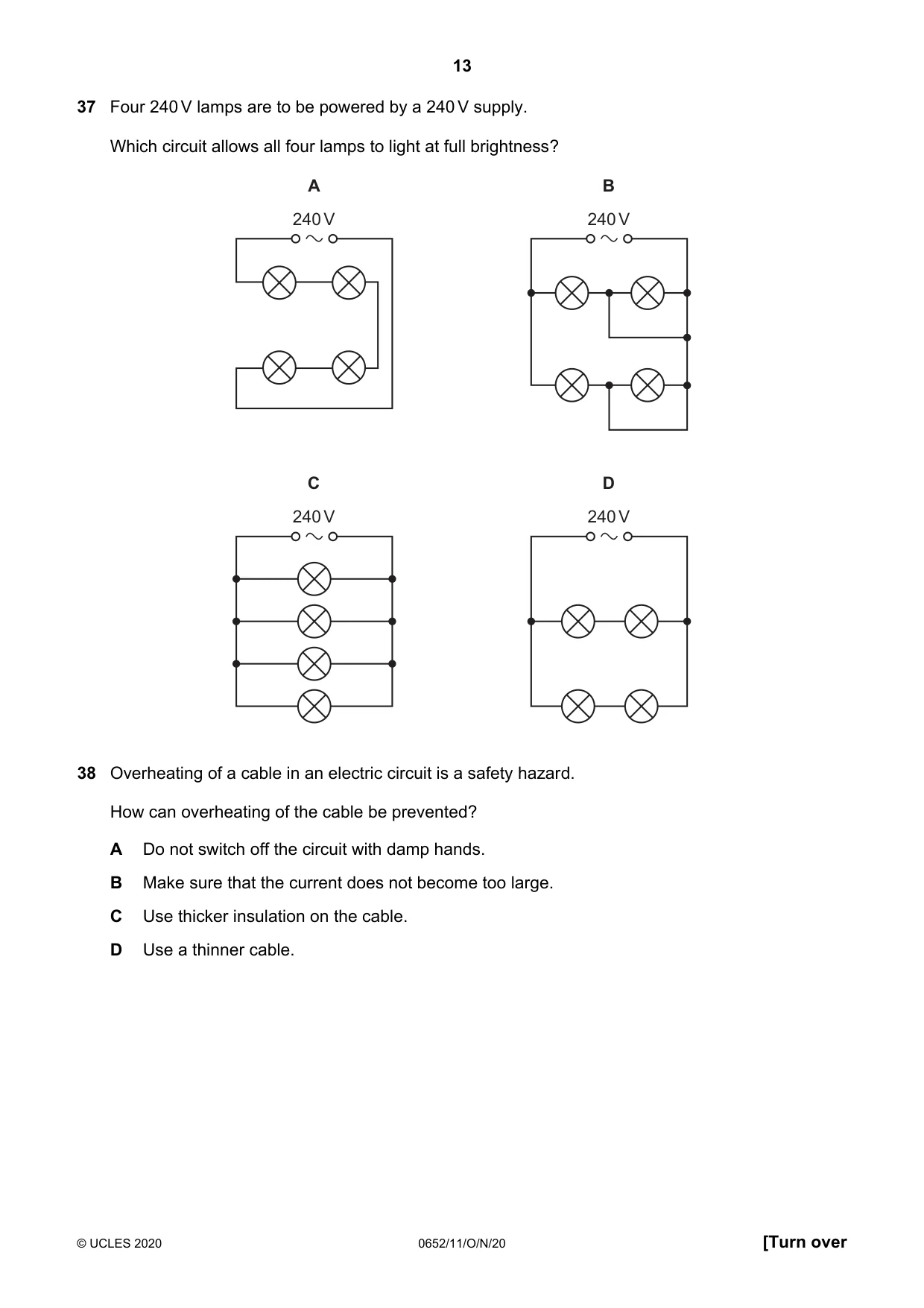
Q37 · Four 240 V lamps are to be powered by a 240 V supply
37 Four 240 V lamps are to be powered by a 240 V supply. Which circuit allows all four lamps to light at full brightness? A B 240 V 240 V C D 240 V 240 V
Mark scheme: C
Q38 · Overheating of a cable in an electric circuit is a safety hazard
38 Overheating of a cable in an electric circuit is a safety hazard. How can overheating of the cable be prevented? A Do not switch off the circuit with damp hands. B Make sure that the current does not become too large. C Use thicker insulation on the cable. D Use a thinner cable.
Mark scheme: B
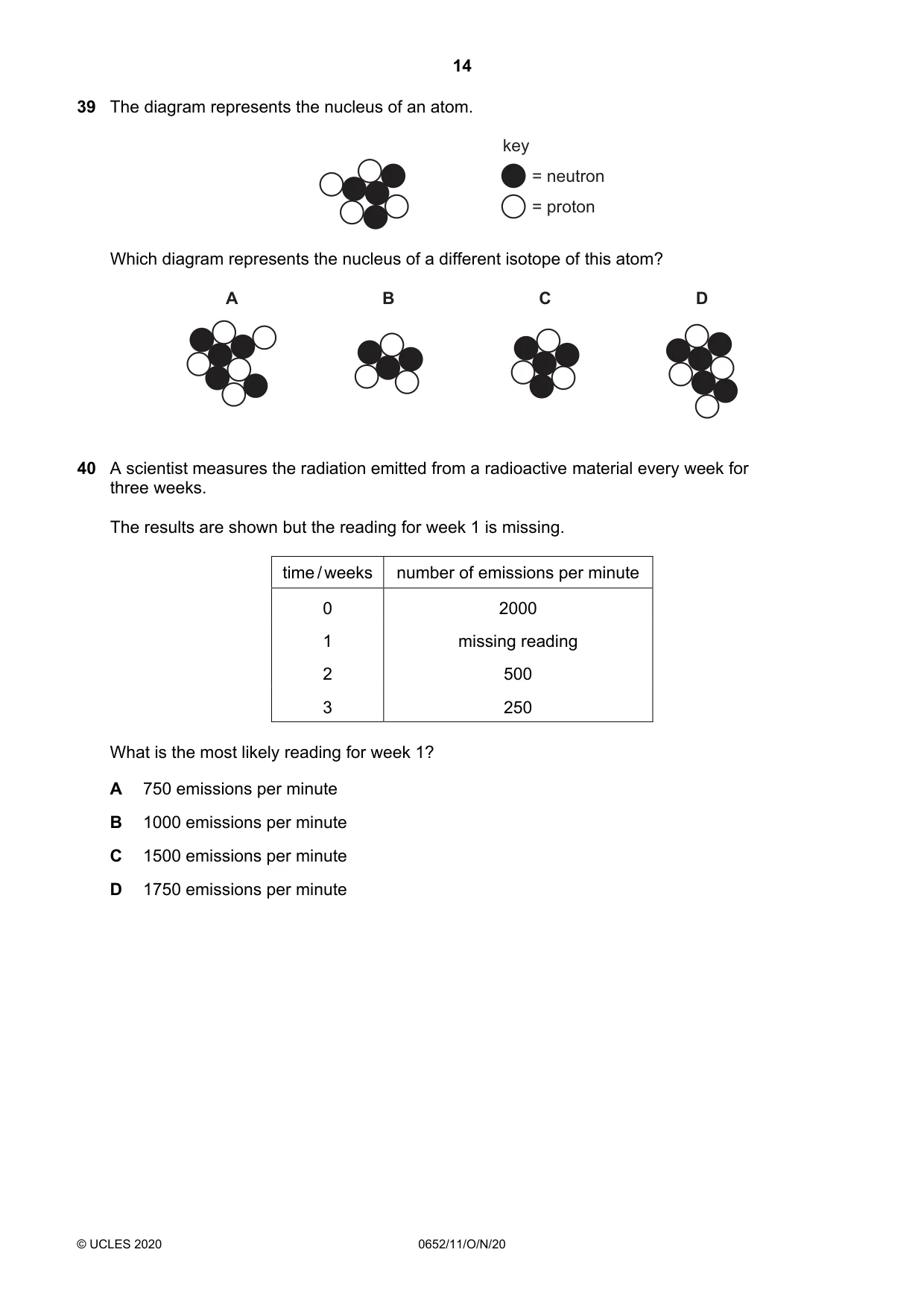
Q39 · The diagram represents the nucleus of an atom
39 The diagram represents the nucleus of an atom. key = neutron = proton Which diagram represents the nucleus of a different isotope of this atom? A B C D
Mark scheme: D
Q40 · A scientist measures the radiation emitted from a radioactive material every week for…
40 A scientist measures the radiation emitted from a radioactive material every week for three weeks. The results are shown but the reading for week 1 is missing. time / weeks number of emissions per minute 0 2000 1 missing reading 2 500 3 250 What is the most likely reading for week 1? A 750 emissions per minute B 1000 emissions per minute C 1500 emissions per minute D 1750 emissions per minute
Mark scheme: B
What was in this paper
The subtopics covered by these 40 questions, and how many questions each got. Open one in a new tab to see every Cambridge question on it.
2Identification of ions and gases2Ions and ionic bonds2Simple phenomena of magnetism2Thermal properties and temperature2Work, energy and power2Alcohols1Alkenes1Atomic structure and the Periodic Table1Criteria of purity1Dangers of electricity1Density1Electrical quantities1Elements, compounds and mixtures1Forces1Fuels1General wave properties1Group properties1Length and time1Light1Macromolecules1Motion1Radioactivity1Rate (speed) of reaction1Reactivity series1Redox1Sound1Stoichiometry1The characteristic properties of acids and bases1The nuclear atom1The particulate nature of matter1Thermal processes1Uses of metals1Water1What you needed in this session
Cambridge’s own grade thresholds for 2020 Oct/Nov, Paper 1 · Variant 1. A higher threshold means an easier paper — the bar moves with how the cohort did.