Cambridge IGCSE Physical Science 0652 — 2021 Oct/Nov Paper 1 · Variant 1
0652/11/O/N/21 · 40 questions · 40 marks · ≈45 min
The question paper and its mark scheme, free to read here and free to download. This is Cambridge’s own paper, exactly as it was sat.
Question paper16 pages
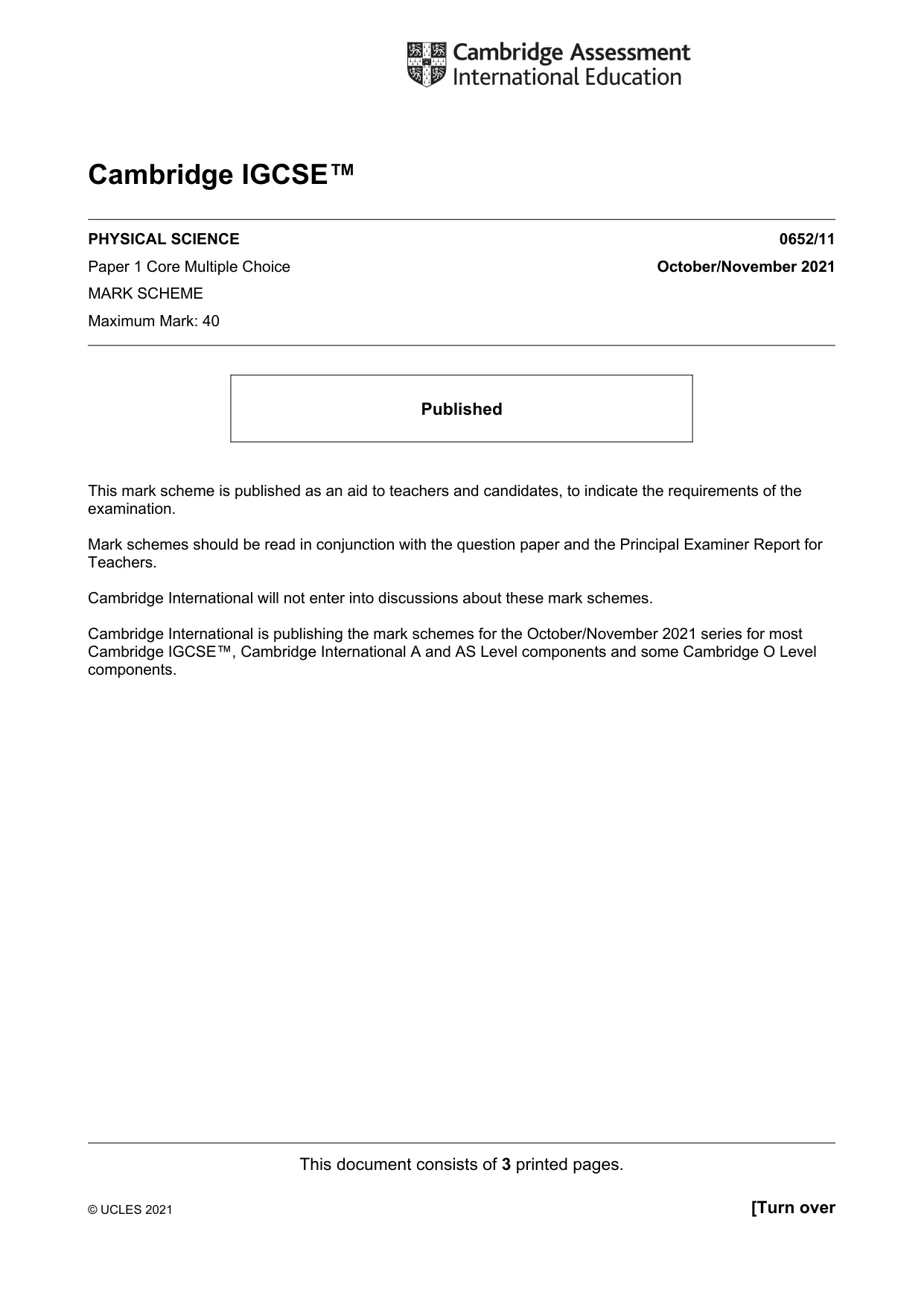
Mark scheme3 pages
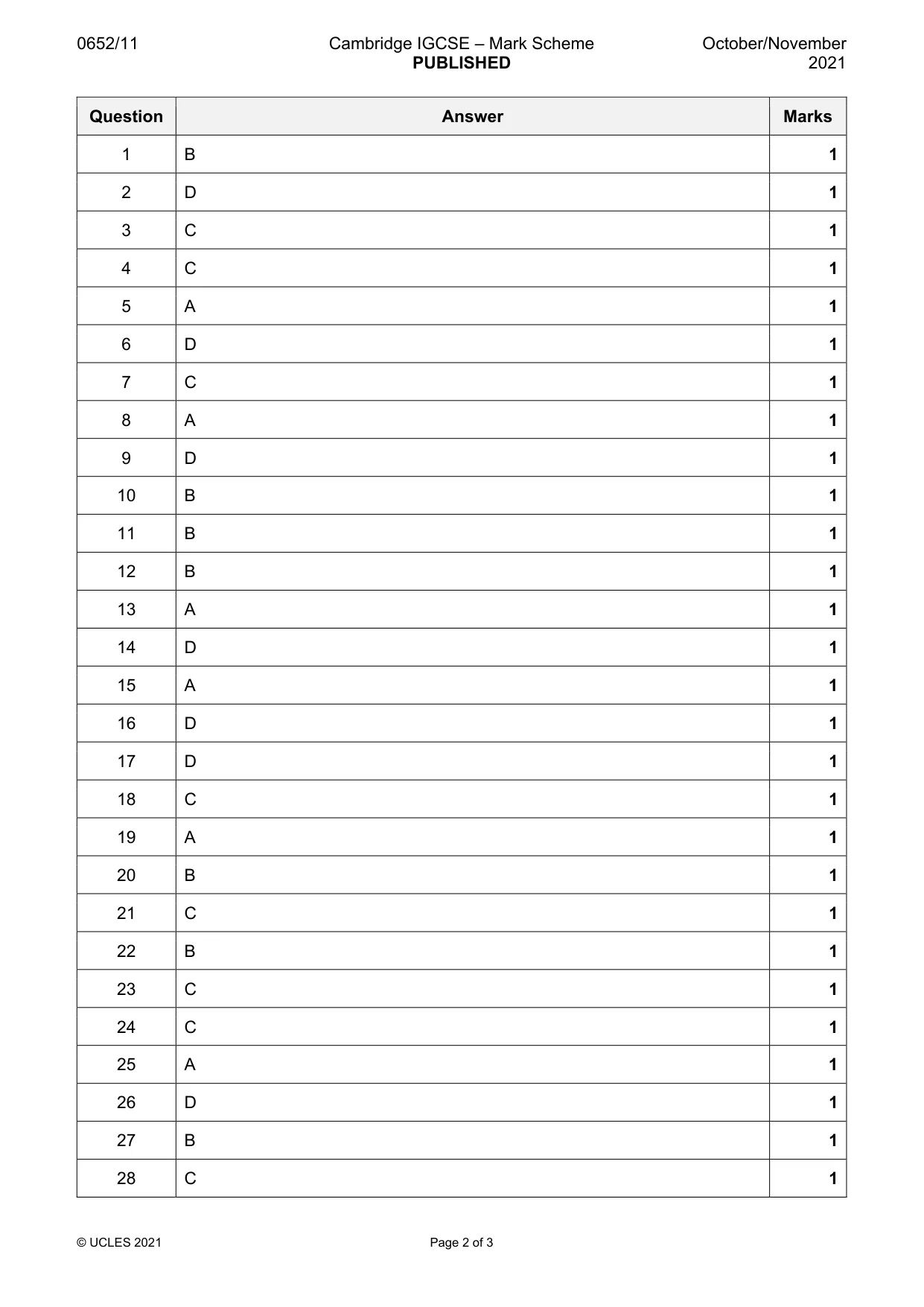
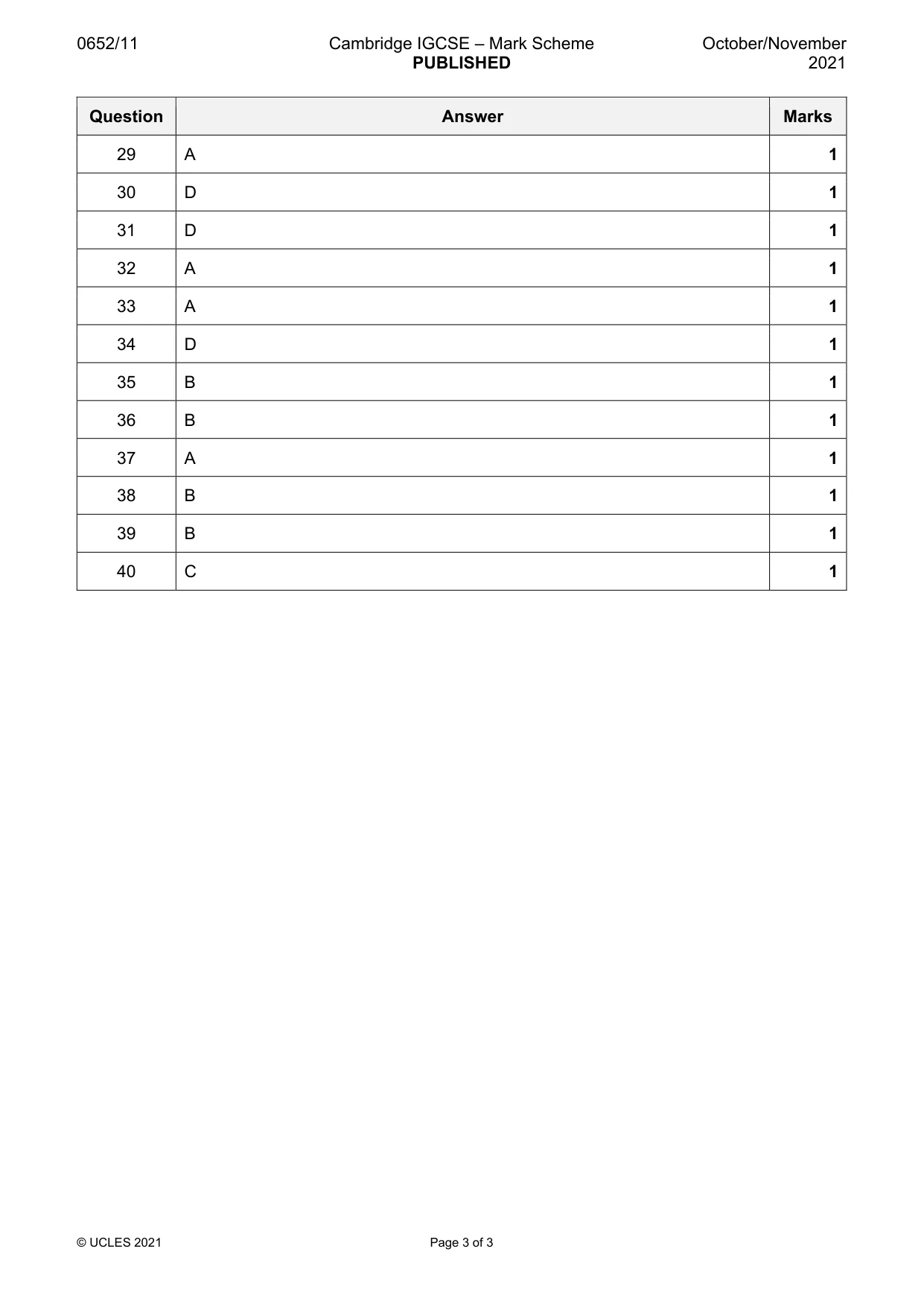
Answers below. Sit the paper first if you are practising.
Questions as text
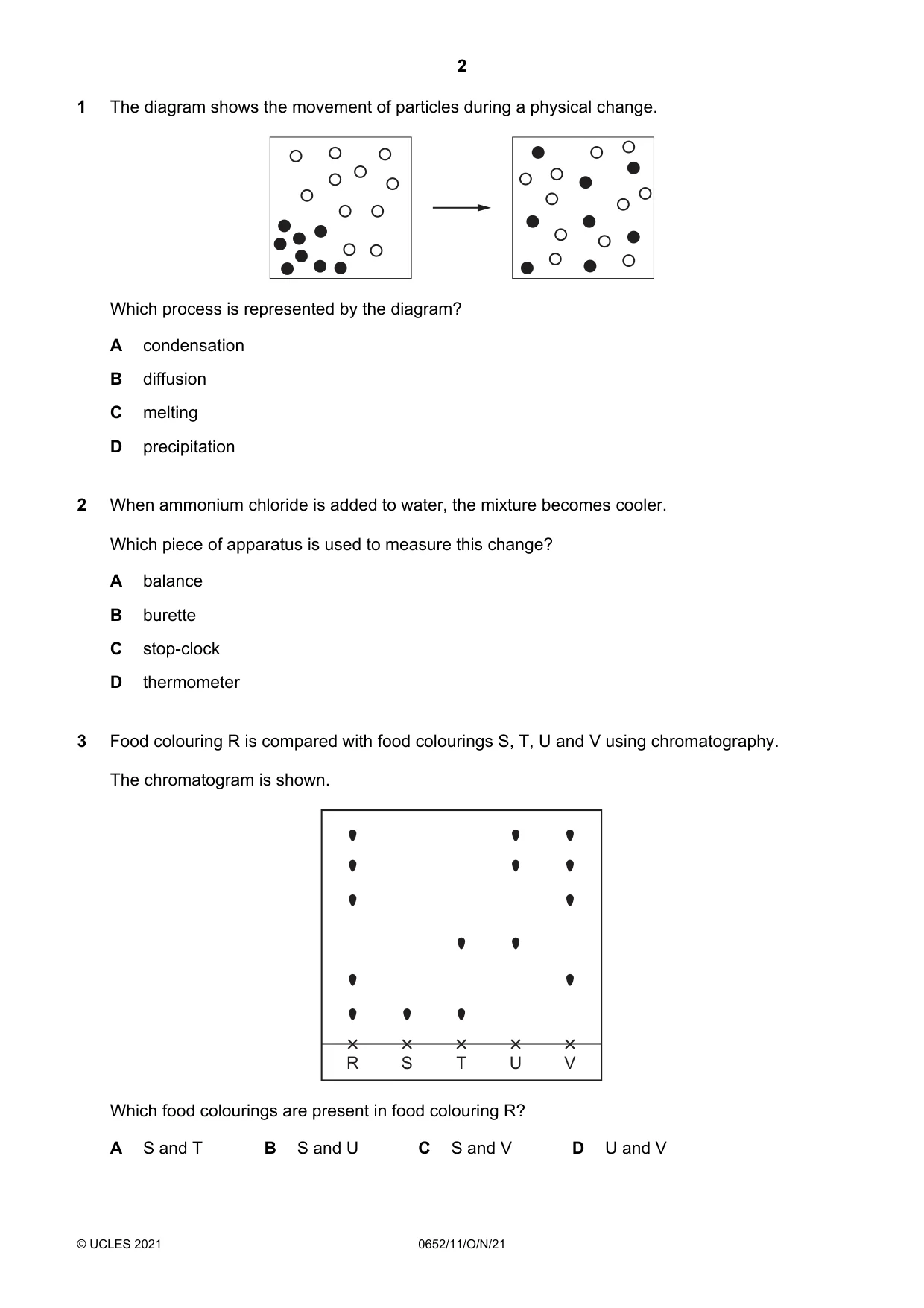
Q1 · The diagram shows the movement of particles during a physical change
1 The diagram shows the movement of particles during a physical change. Which process is represented by the diagram? A condensation B diffusion C melting D precipitation
Mark scheme: B
Q2 · When ammonium chloride is added to water, the mixture becomes cooler
2 When ammonium chloride is added to water, the mixture becomes cooler. Which piece of apparatus is used to measure this change? A balance B burette C stop-clock D thermometer
Mark scheme: D
Q3 · Food colouring R is compared with food colourings S, T, U and V using chromatography
3 Food colouring R is compared with food colourings S, T, U and V using chromatography. The chromatogram is shown. R S T U V Which food colourings are present in food colouring R? A S and T B S and U C S and V D U and V
Mark scheme: C
Q4 · The number of protons, neutrons and electrons in some particles is shown
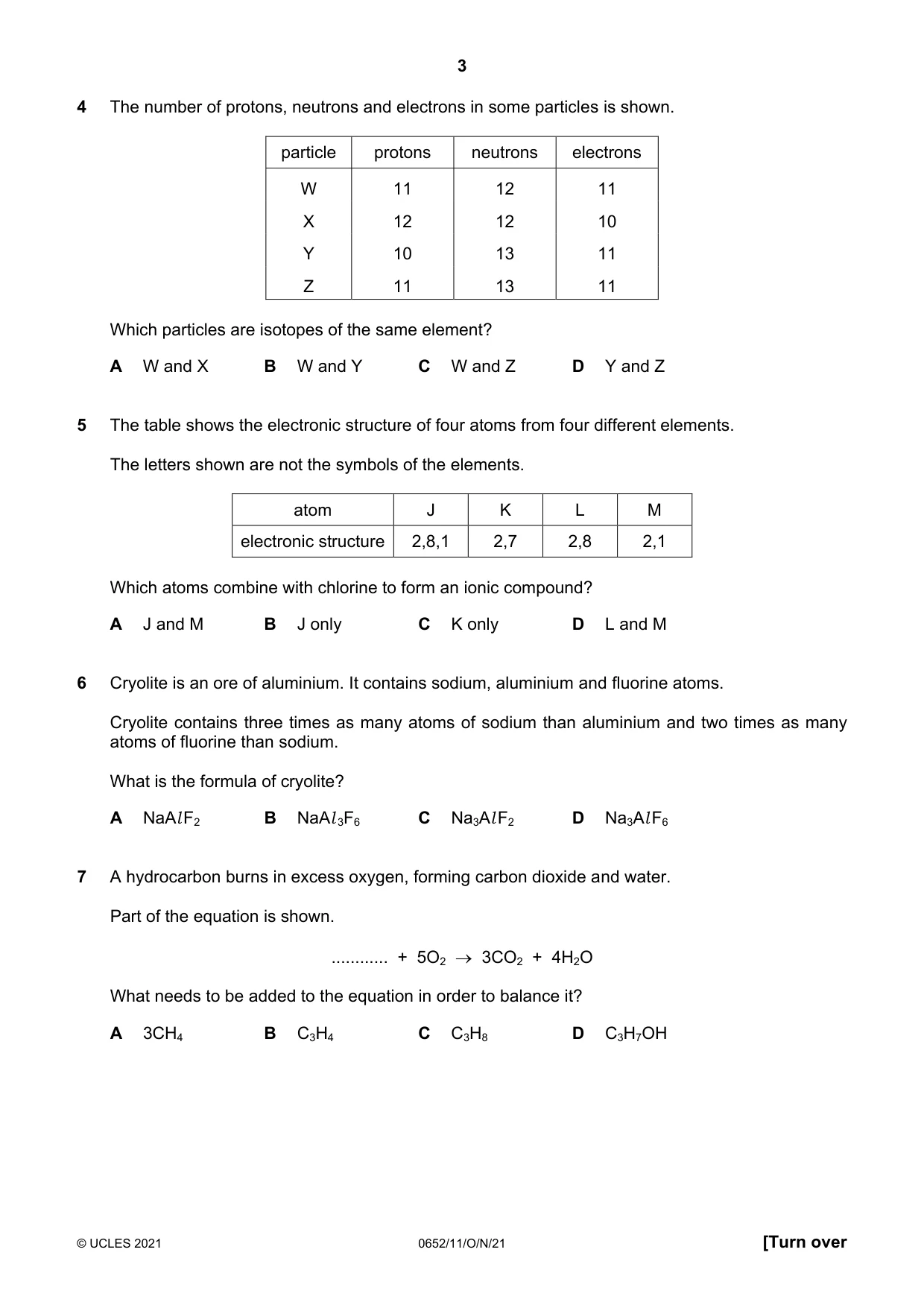
4 The number of protons, neutrons and electrons in some particles is shown. particle protons neutrons electrons W 11 12 11 X 12 12 10 Y 10 13 11 Z 11 13 11 Which particles are isotopes of the same element? A W and X B W and Y C W and Z D Y and Z
Mark scheme: C
Q5 · The table shows the electronic structure of four atoms from four different elements
5 The table shows the electronic structure of four atoms from four different elements. The letters shown are not the symbols of the elements. atom J K L M electronic structure 2,8,1 2,7 2,8 2,1 Which atoms combine with chlorine to form an ionic compound? A J and M B J only C K only D L and M
Mark scheme: A
Q6 · Cryolite is an ore of aluminium
6 Cryolite is an ore of aluminium. It contains sodium, aluminium and fluorine atoms. Cryolite contains three times as many atoms of sodium than aluminium and two times as many atoms of fluorine than sodium. What is the formula of cryolite? A NaAl F2 B NaAl 3F6 C Na3Al F2 D Na3Al F6
Mark scheme: D
Q7 · A hydrocarbon burns in excess oxygen, forming carbon dioxide and water
7 A hydrocarbon burns in excess oxygen, forming carbon dioxide and water. Part of the equation is shown. ............ + 5O2 3CO2 + 4H2O What needs to be added to the equation in order to balance it? A 3CH4 B C3H4 C C3H8 D C3H7OH
Mark scheme: C
Q8 · Which row shows the electrode products for the electrolysis of concentrated aqueous…
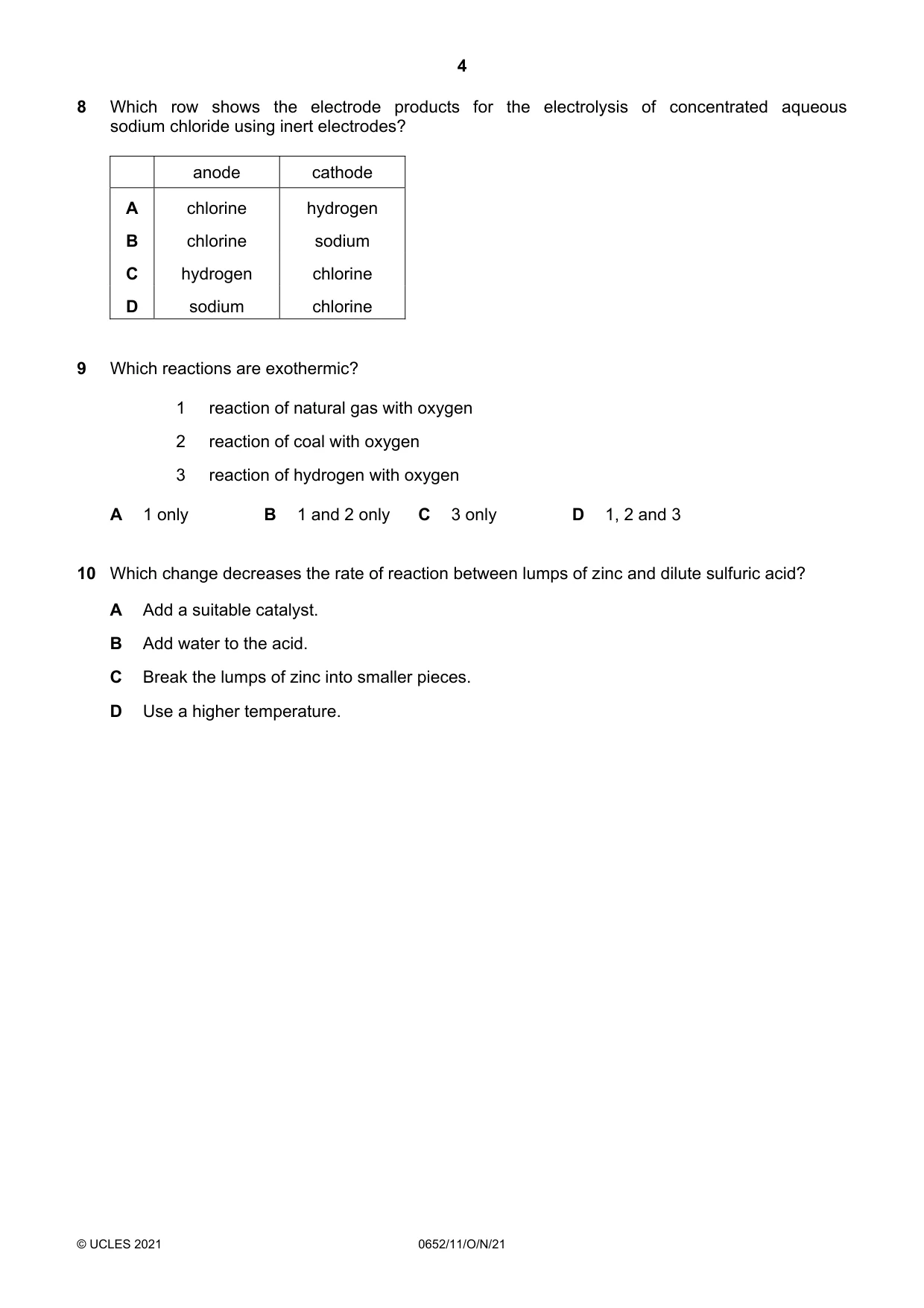
8 Which row shows the electrode products for the electrolysis of concentrated aqueous sodium chloride using inert electrodes? anode cathode A chlorine hydrogen B chlorine sodium C hydrogen chlorine D sodium chlorine
Mark scheme: A
Q9 · Which reactions are exothermic?
9 Which reactions are exothermic? 1 reaction of natural gas with oxygen 2 reaction of coal with oxygen 3 reaction of hydrogen with oxygen A 1 only B 1 and 2 only C 3 only D 1, 2 and 3
Mark scheme: D
Q10 · Which change decreases the rate of reaction between lumps of zinc and dilute sulfuric…
10 Which change decreases the rate of reaction between lumps of zinc and dilute sulfuric acid? A Add a suitable catalyst. B Add water to the acid. C Break the lumps of zinc into smaller pieces. D Use a higher temperature.
Mark scheme: B
Q11 · Hydrogen is passed over a heated metal oxide as shown
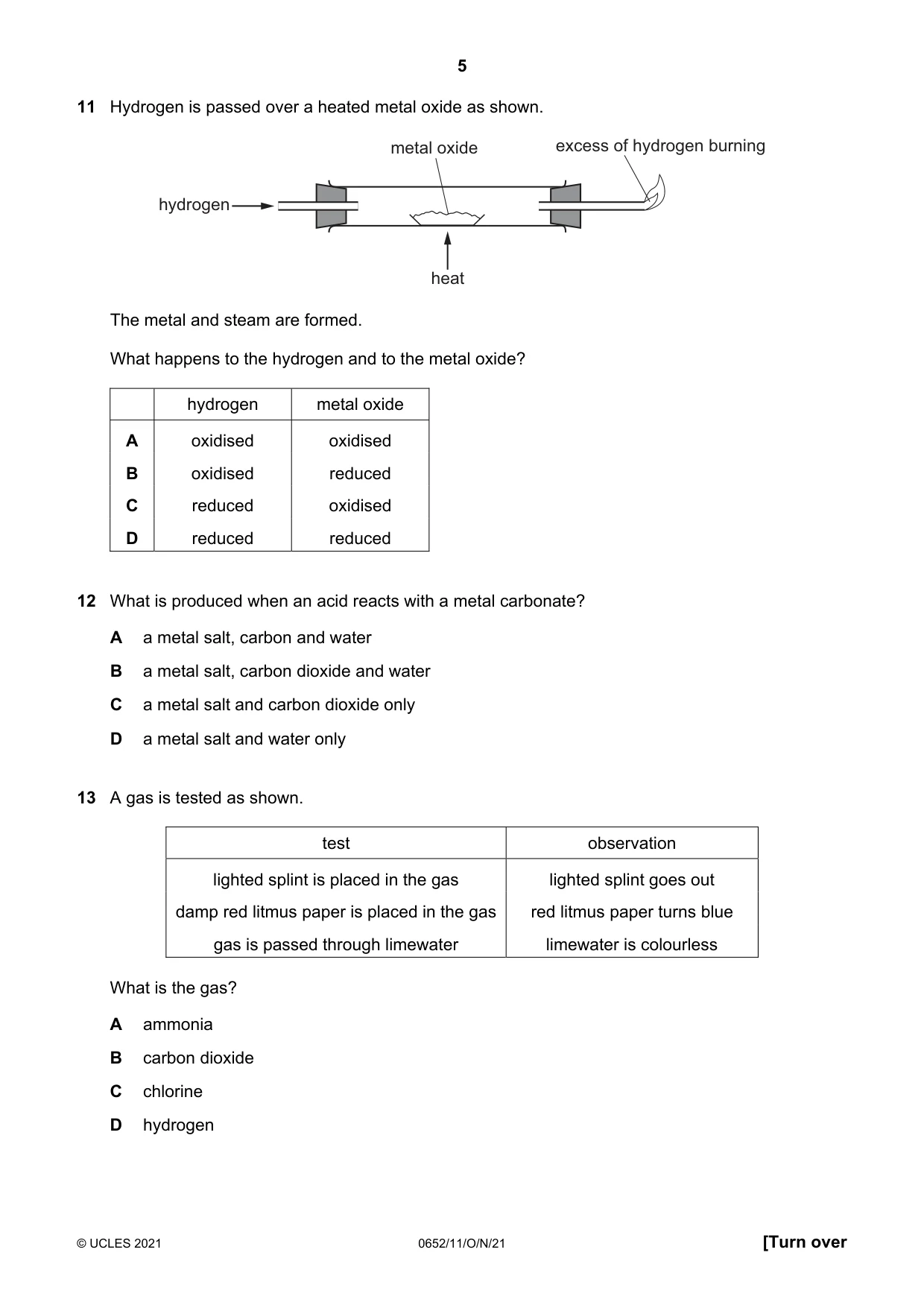
11 Hydrogen is passed over a heated metal oxide as shown. metal oxide excess of hydrogen burning hydrogen heat The metal and steam are formed. What happens to the hydrogen and to the metal oxide? hydrogen metal oxide A oxidised oxidised B oxidised reduced C reduced oxidised D reduced reduced
Mark scheme: B
Q12 · What is produced when an acid reacts with a metal carbonate?
12 What is produced when an acid reacts with a metal carbonate? A a metal salt, carbon and water B a metal salt, carbon dioxide and water C a metal salt and carbon dioxide only D a metal salt and water only
Mark scheme: B
More questions on The characteristic properties of acids and bases
Q13 · A gas is tested as shown
13 A gas is tested as shown. test observation lighted splint is placed in the gas lighted splint goes out damp red litmus paper is placed in the gas red litmus paper turns blue gas is passed through limewater limewater is colourless What is the gas? A ammonia B carbon dioxide C chlorine D hydrogen
Mark scheme: A
Q14 · Which row describes the properties of a transition element?
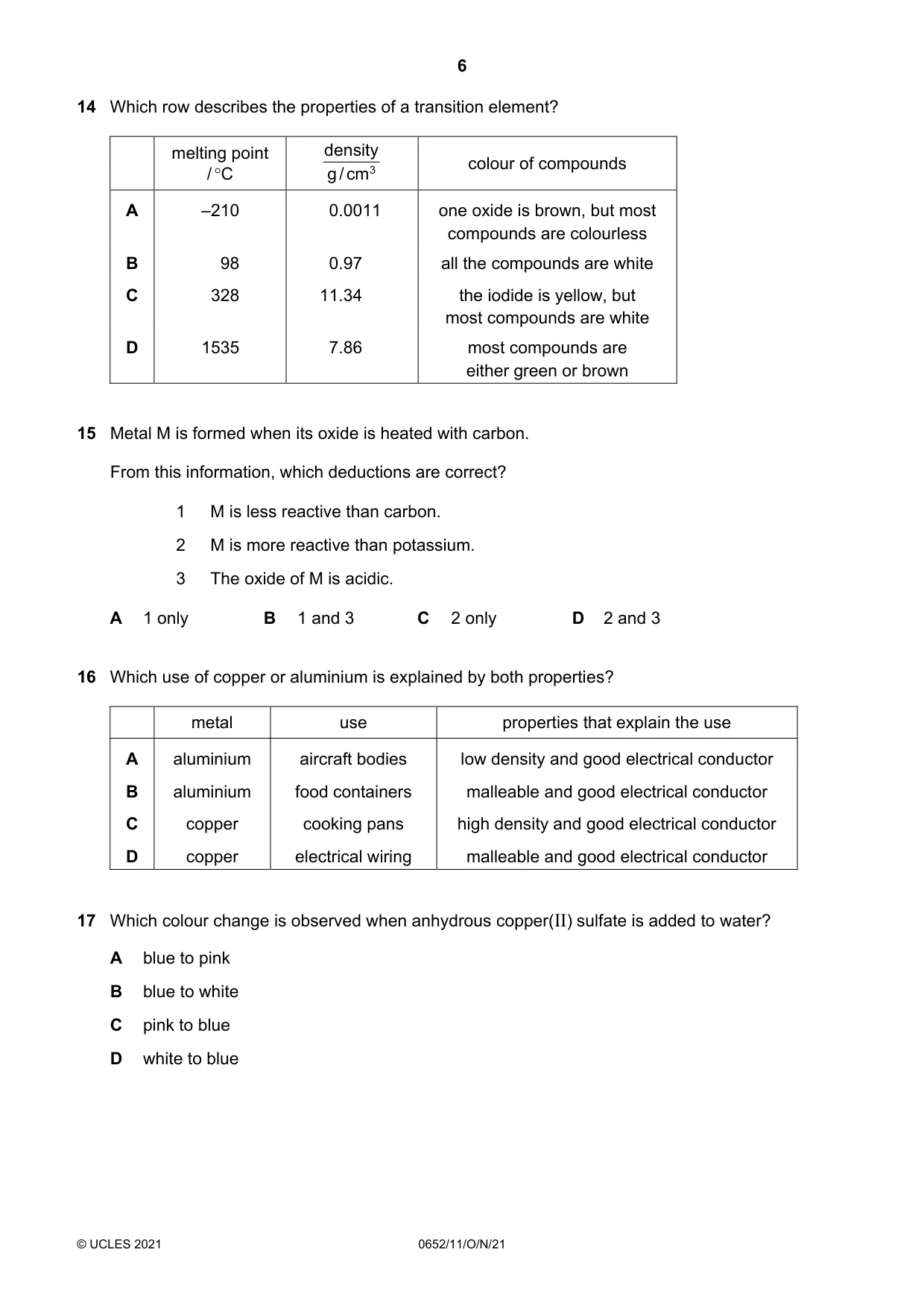
14 Which row describes the properties of a transition element? melting point density colour of compounds / C g/cm 3 A –210 0.0011 one oxide is brown, but most compounds are colourless B 98 0.97 all the compounds are white C 328 11.34 the iodide is yellow, but most compounds are white D 1535 7.86 most compounds are either green or brown
Mark scheme: D
Q15 · Metal M is formed when its oxide is heated with carbon
15 Metal M is formed when its oxide is heated with carbon. From this information, which deductions are correct? 1 M is less reactive than carbon. 2 M is more reactive than potassium. 3 The oxide of M is acidic. A 1 only B 1 and 3 C 2 only D 2 and 3
Mark scheme: A
Q16 · Which use of copper or aluminium is explained by both properties?
16 Which use of copper or aluminium is explained by both properties? metal use properties that explain the use A aluminium aircraft bodies low density and good electrical conductor B aluminium food containers malleable and good electrical conductor C copper cooking pans high density and good electrical conductor D copper electrical wiring malleable and good electrical conductor
Mark scheme: D
Q17 · Which colour change is observed when anhydrous copper(II) sulfate is added to water?
17 Which colour change is observed when anhydrous copper(II) sulfate is added to water? A blue to pink B blue to white C pink to blue D white to blue
Mark scheme: D
Q18 · Which process does not produce carbon dioxide?
18 Which process does not produce carbon dioxide? A an acid reacting with a carbonate B burning coal C burning hydrogen D respiration
Mark scheme: C
Q19 · The fractional distillation of petroleum is shown
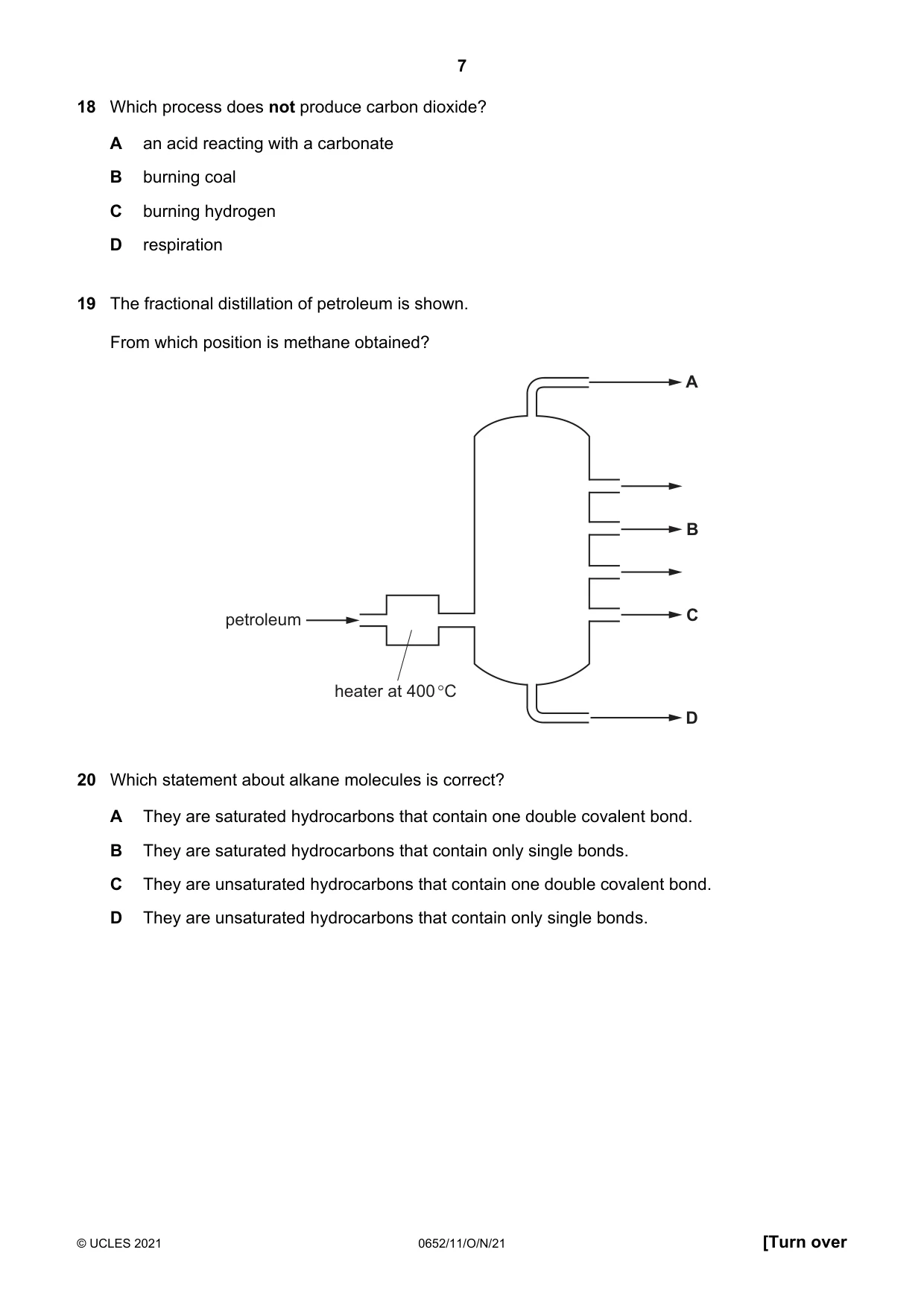
19 The fractional distillation of petroleum is shown. From which position is methane obtained? A B C petroleum heater at 400 °C D
Mark scheme: A
Q20 · Which statement about alkane molecules is correct?
20 Which statement about alkane molecules is correct? A They are saturated hydrocarbons that contain one double covalent bond. B They are saturated hydrocarbons that contain only single bonds. C They are unsaturated hydrocarbons that contain one double covalent bond. D They are unsaturated hydrocarbons that contain only single bonds.
Mark scheme: B
Q21 · The diagrams show two distance–time graphs and two speed–time graphs
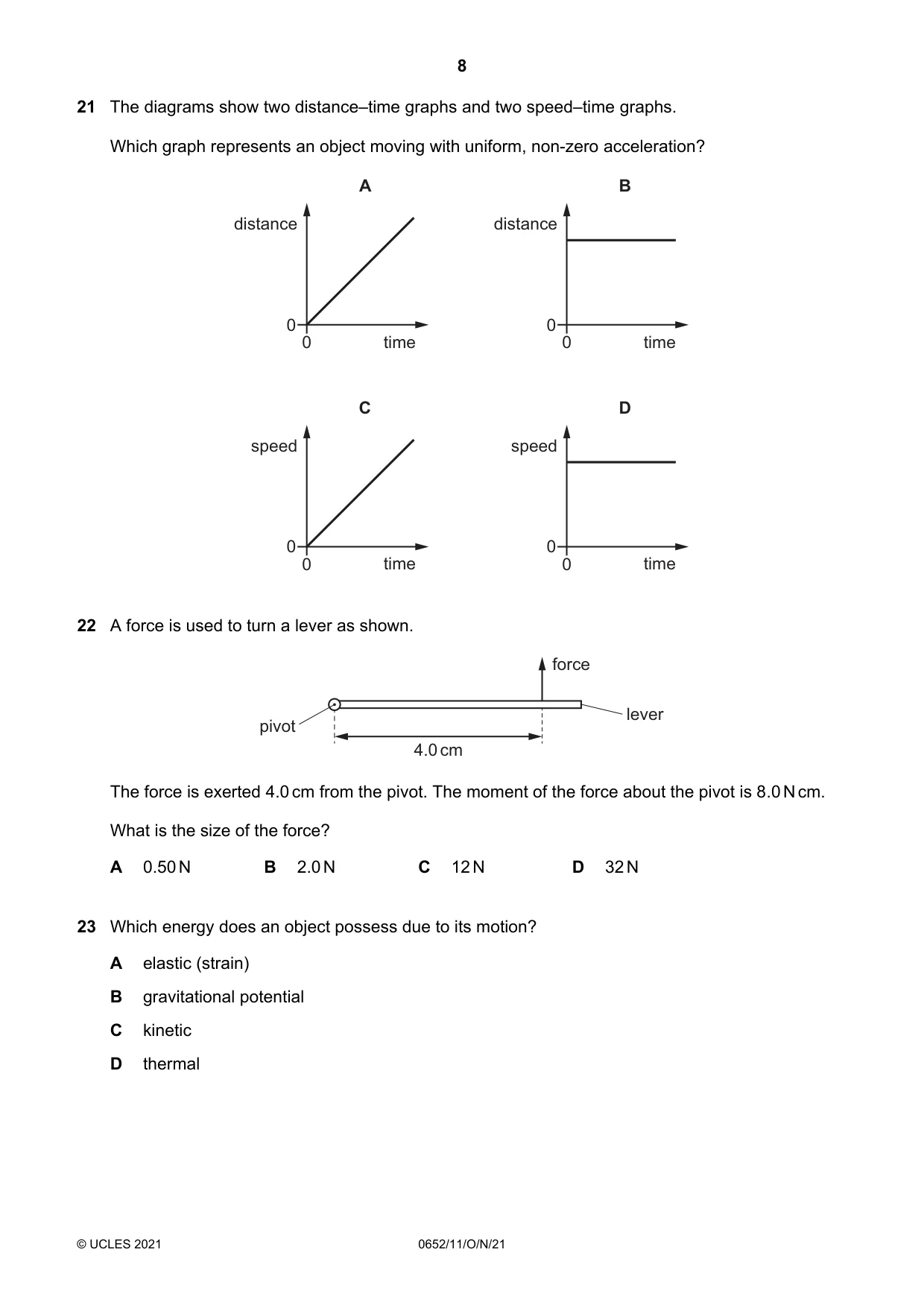
21 The diagrams show two distance–time graphs and two speed–time graphs. Which graph represents an object moving with uniform, non-zero acceleration? A B distance distance 0 0 0 time 0 time C D speed speed 0 0 0 time 0 time
Mark scheme: C
Q22 · A force is used to turn a lever as shown
22 A force is used to turn a lever as shown. force lever pivot 4.0 cm The force is exerted 4.0 cm from the pivot. The moment of the force about the pivot is 8.0 N cm. What is the size of the force? A 0.50 N B 2.0 N C 12 N D 32 N
Mark scheme: B
Q23 · Which energy does an object possess due to its motion?
23 Which energy does an object possess due to its motion? A elastic (strain) B gravitational potential C kinetic D thermal
Mark scheme: C
Q24 · Which energy source is non-renewable?
24 Which energy source is non-renewable? A geothermal B hydroelectric C oil D wind
Mark scheme: C
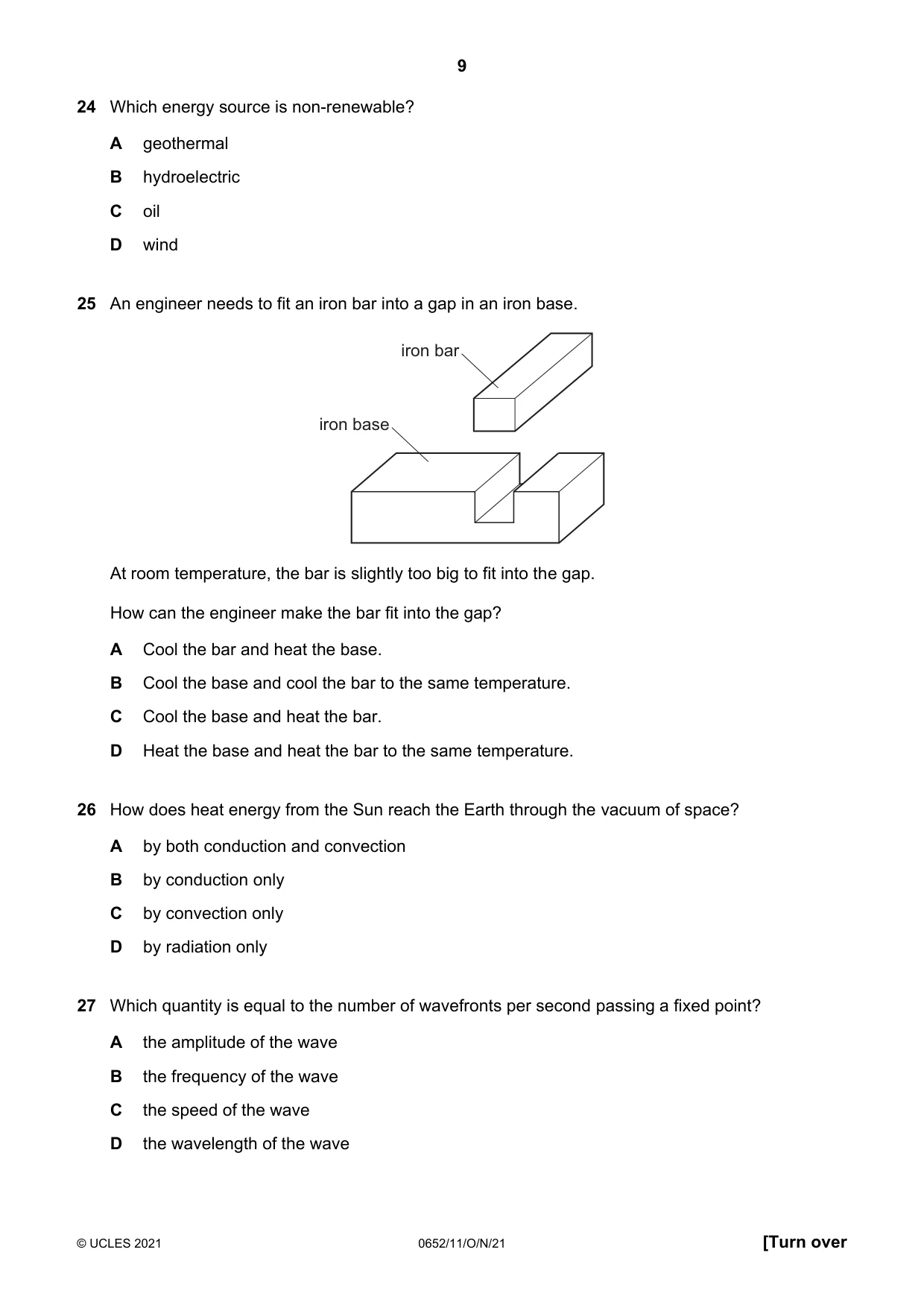
Q25 · An engineer needs to fit an iron bar into a gap in an iron base
25 An engineer needs to fit an iron bar into a gap in an iron base. iron bar iron base At room temperature, the bar is slightly too big to fit into the gap. How can the engineer make the bar fit into the gap? A Cool the bar and heat the base. B Cool the base and cool the bar to the same temperature. C Cool the base and heat the bar. D Heat the base and heat the bar to the same temperature.
Mark scheme: A
Q26 · How does heat energy from the Sun reach the Earth through the vacuum of space?
26 How does heat energy from the Sun reach the Earth through the vacuum of space? A by both conduction and convection B by conduction only C by convection only D by radiation only
Mark scheme: D
Q27 · Which quantity is equal to the number of wavefronts per second passing a fixed point?
27 Which quantity is equal to the number of wavefronts per second passing a fixed point? A the amplitude of the wave B the frequency of the wave C the speed of the wave D the wavelength of the wave
Mark scheme: B
Q28 · A plane mirror is fixed to a vertical wall
28 A plane mirror is fixed to a vertical wall. An image of the person looking into the mirror is formed by the mirror. What are two characteristics of the image? A real and laterally inverted (left to right) B real and vertically inverted (upside down) C virtual and laterally inverted (left to right) D virtual and vertically inverted (upside down)
Mark scheme: C
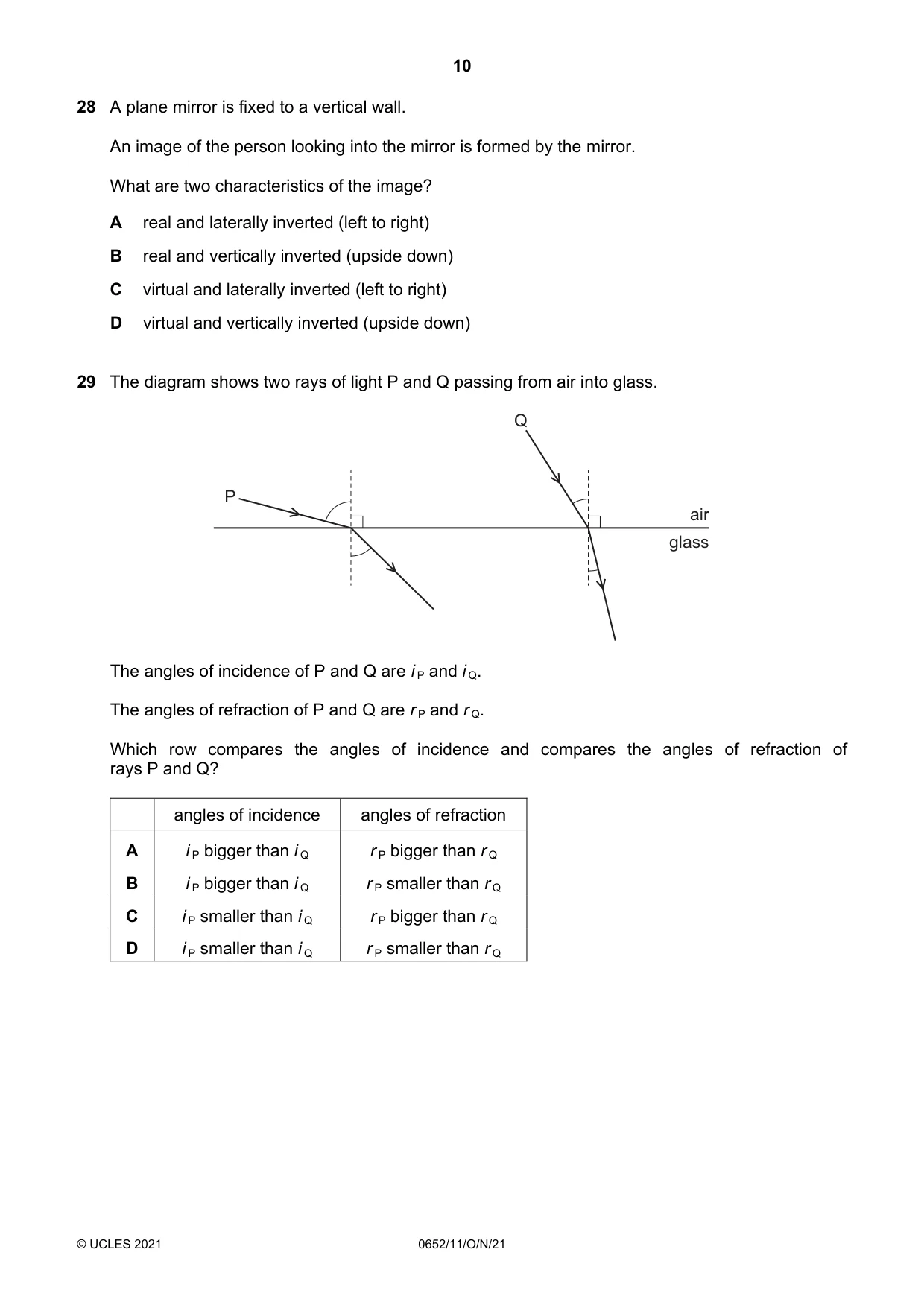
Q29 · The diagram shows two rays of light P and Q passing from air into glass
29 The diagram shows two rays of light P and Q passing from air into glass. Q P air glass The angles of incidence of P and Q are i P and i Q. The angles of refraction of P and Q are r P and r Q. Which row compares the angles of incidence and compares the angles of refraction of rays P and Q? angles of incidence angles of refraction A i P bigger than i Q r P bigger than r Q B i P bigger than i Q r P smaller than r Q C i P smaller than i Q r P bigger than r Q D i P smaller than i Q r P smaller than r Q
Mark scheme: A
Q30 · Which row shows how, in a vacuum, the speed of radio waves and the speed of X-rays…
30 Which row shows how, in a vacuum, the speed of radio waves and the speed of X-rays compare with the speed of light? speed of radio waves speed of X-rays A greater than light less than light B the same as light greater than light C less than light greater than light D the same as light the same as light
Mark scheme: D
Q31 · Which frequency is outside the range of audible frequencies for a healthy human ear?
31 Which frequency is outside the range of audible frequencies for a healthy human ear? A 30 Hz B 300 Hz C 3000 Hz D 30 000 Hz
Mark scheme: D
Q32 · Which row shows two methods for magnetising a piece of steel?
32 Which row shows two methods for magnetising a piece of steel? method 1 method 2 A hammer it in a stroke it with a magnetic field permanent magnet B hammer it in a stroke it with a magnetic field piece of iron C heat it stroke it with a permanent magnet D heat it stroke it with a piece of iron
Mark scheme: A
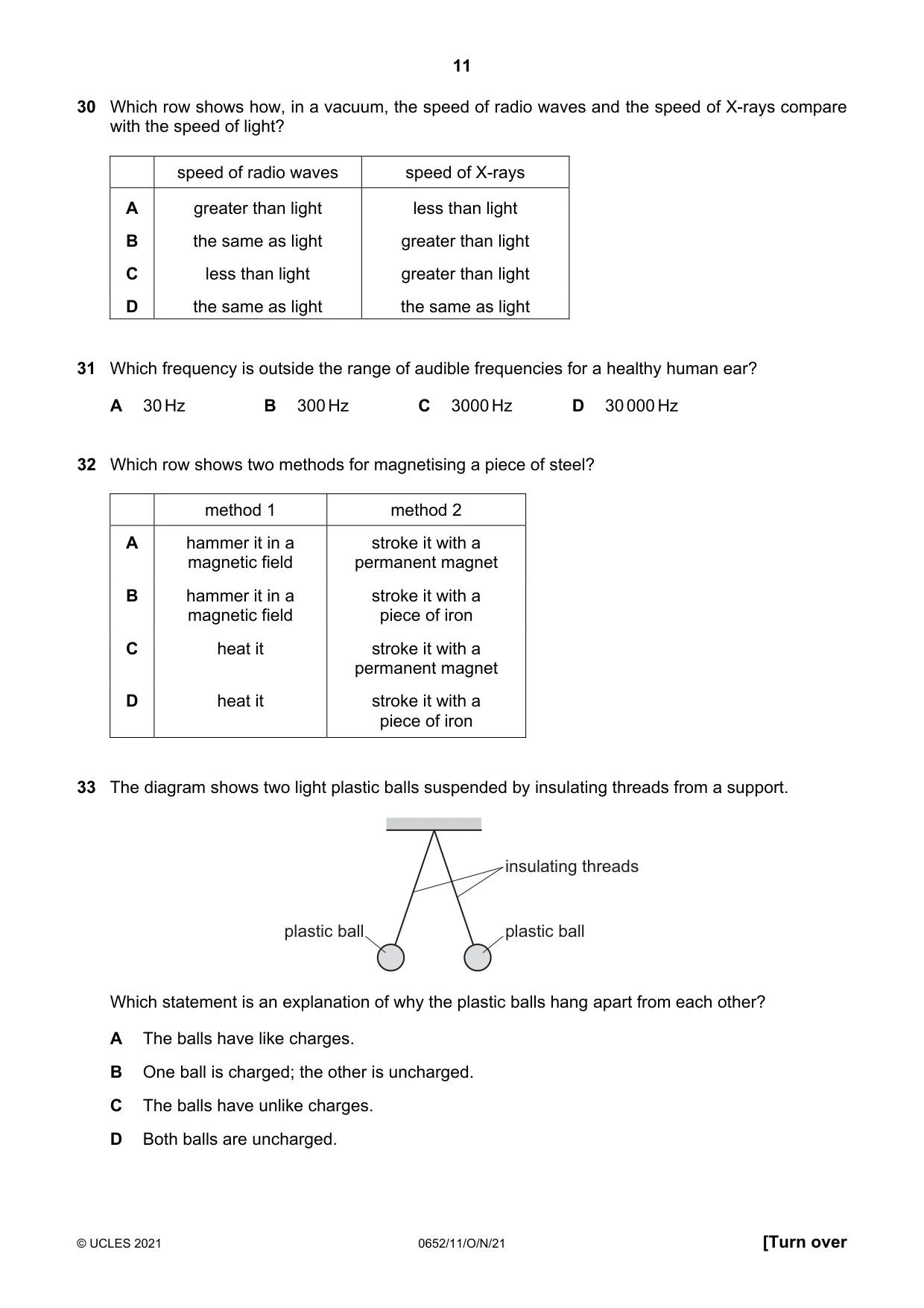
Q33 · The diagram shows two light plastic balls suspended by insulating threads from a support
33 The diagram shows two light plastic balls suspended by insulating threads from a support. insulating threads plastic ball plastic ball Which statement is an explanation of why the plastic balls hang apart from each other? A The balls have like charges. B One ball is charged; the other is uncharged. C The balls have unlike charges. D Both balls are uncharged.
Mark scheme: A
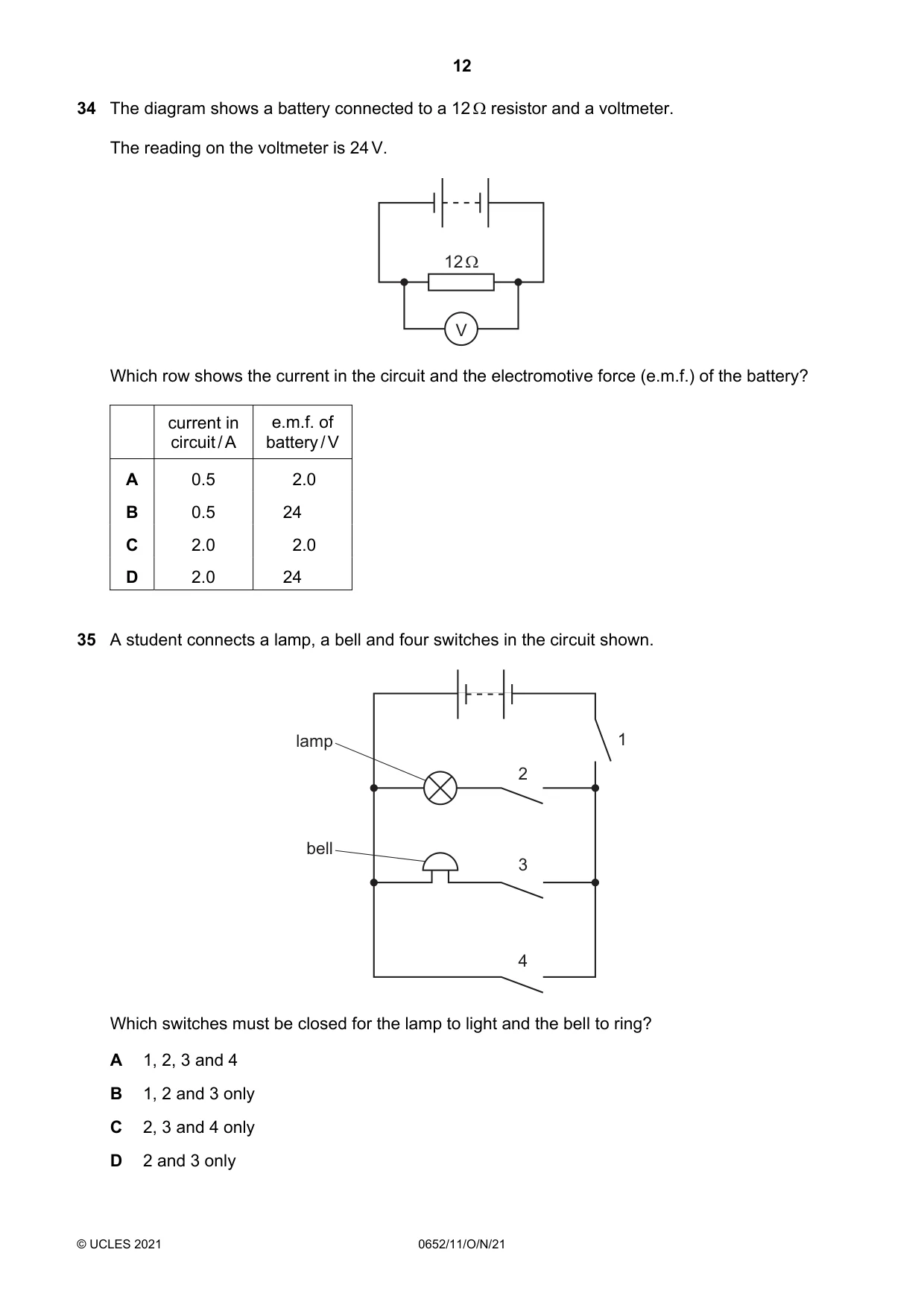
Q34 · The diagram shows a battery connected to a 12 resistor and a voltmeter
34 The diagram shows a battery connected to a 12 resistor and a voltmeter. The reading on the voltmeter is 24 V. 12 Ω V Which row shows the current in the circuit and the electromotive force (e.m.f.) of the battery? current in e.m.f. of circuit / A battery / V A 0.5 2.0 B 0.5 24 C 2.0 2.0 D 2.0 24
Mark scheme: D
Q35 · A student connects a lamp, a bell and four switches in the circuit shown
35 A student connects a lamp, a bell and four switches in the circuit shown. lamp 1 2 bell 3 4 Which switches must be closed for the lamp to light and the bell to ring? A 1, 2, 3 and 4 B 1, 2 and 3 only C 2, 3 and 4 only D 2 and 3 only
Mark scheme: B
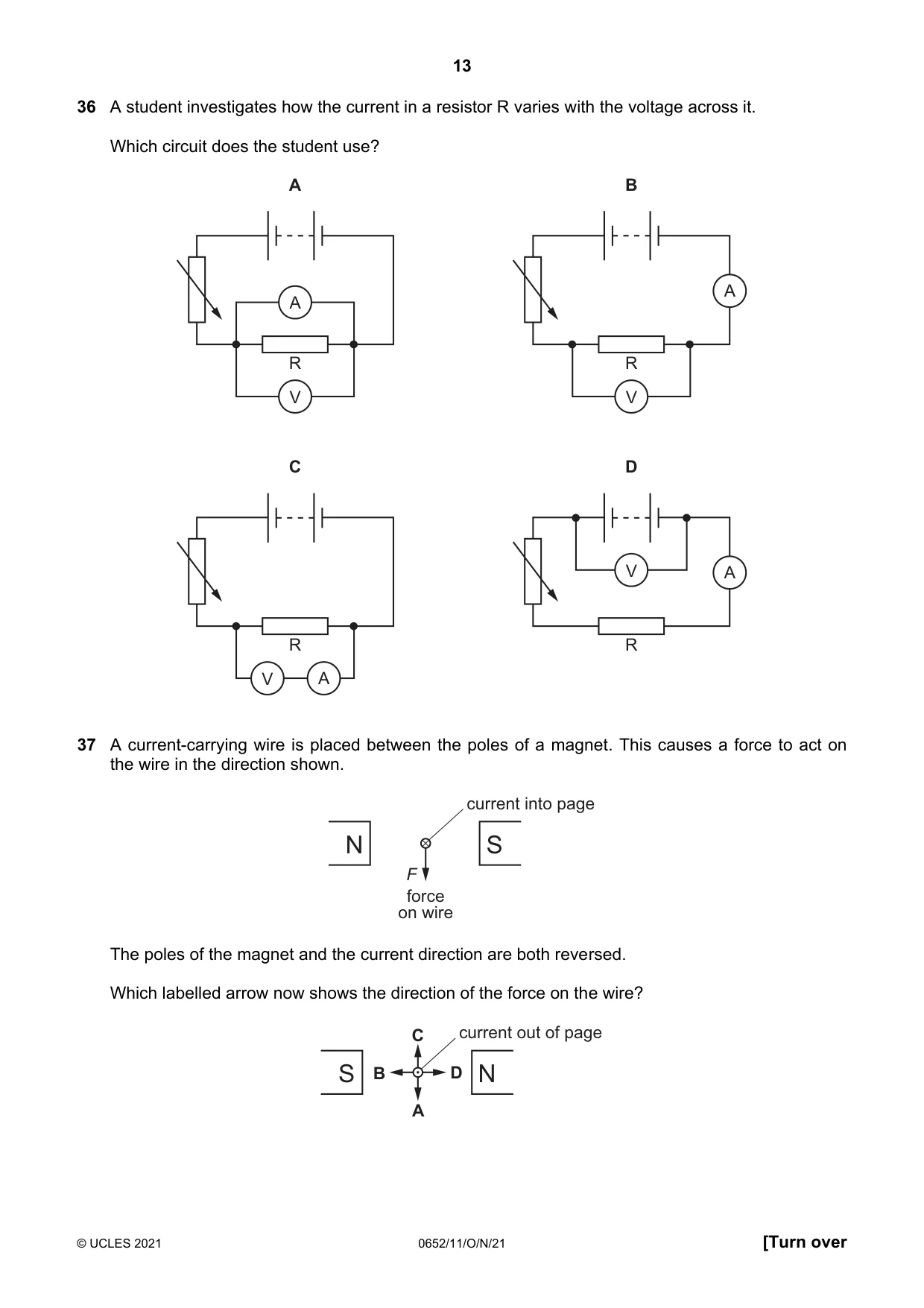
Q36 · A student investigates how the current in a resistor R varies with the voltage across it
36 A student investigates how the current in a resistor R varies with the voltage across it. Which circuit does the student use? A B A A R R V V C D V A R R V A
Mark scheme: B
Q37 · A current-carrying wire is placed between the poles of a magnet
37 A current-carrying wire is placed between the poles of a magnet. This causes a force to act on the wire in the direction shown. current into page N S F force on wire The poles of the magnet and the current direction are both reversed. Which labelled arrow now shows the direction of the force on the wire? C current out of page S B D N A
Mark scheme: A
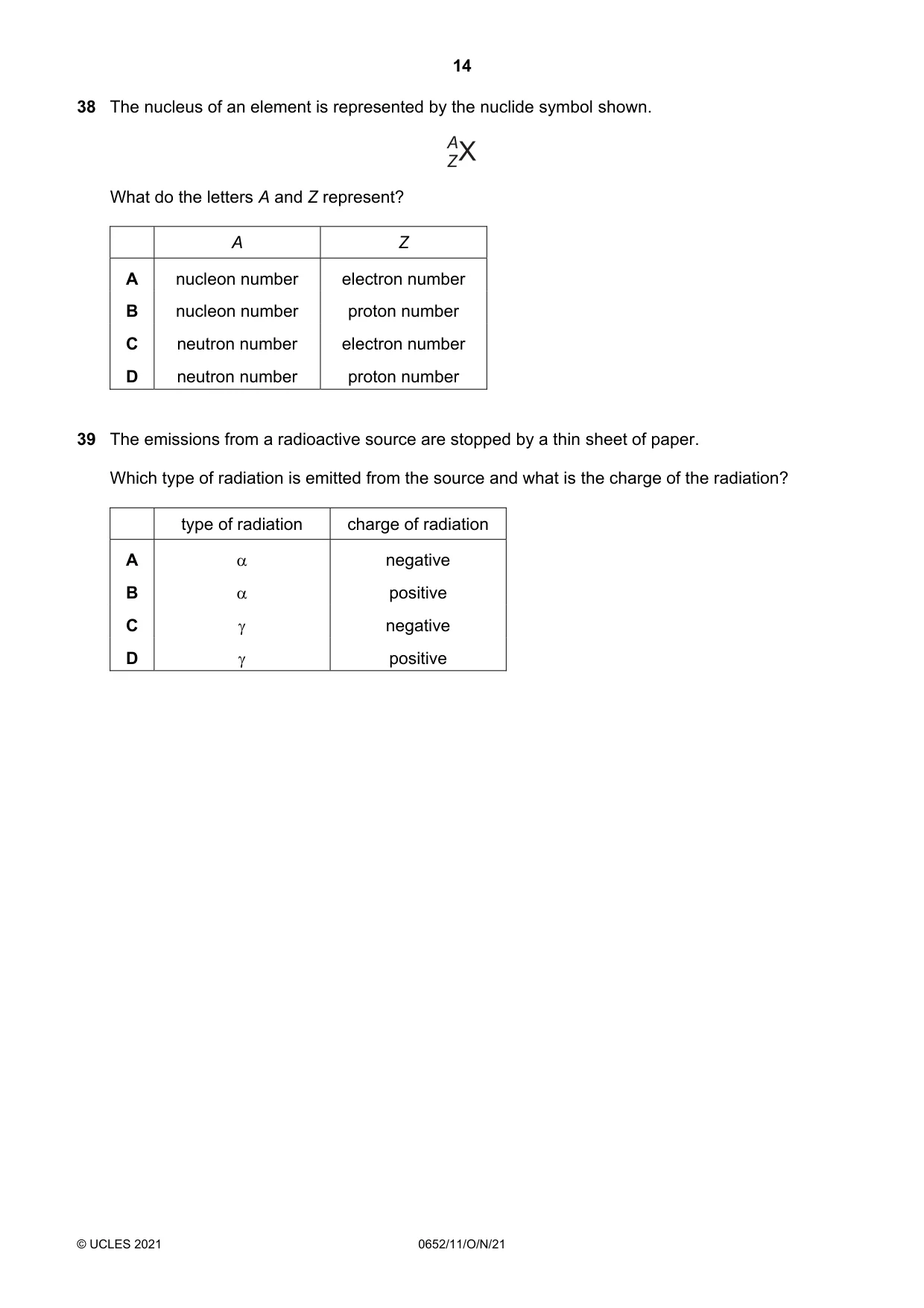
Q38 · The nucleus of an element is represented by the nuclide symbol shown
38 The nucleus of an element is represented by the nuclide symbol shown. What do the letters A and Z represent? A Z A nucleon number electron number B nucleon number proton number C neutron number electron number D neutron number proton number
Mark scheme: B
Q39 · The emissions from a radioactive source are stopped by a thin sheet of paper
39 The emissions from a radioactive source are stopped by a thin sheet of paper. Which type of radiation is emitted from the source and what is the charge of the radiation? type of radiation charge of radiation A negative B positive C negative D positive
Mark scheme: B
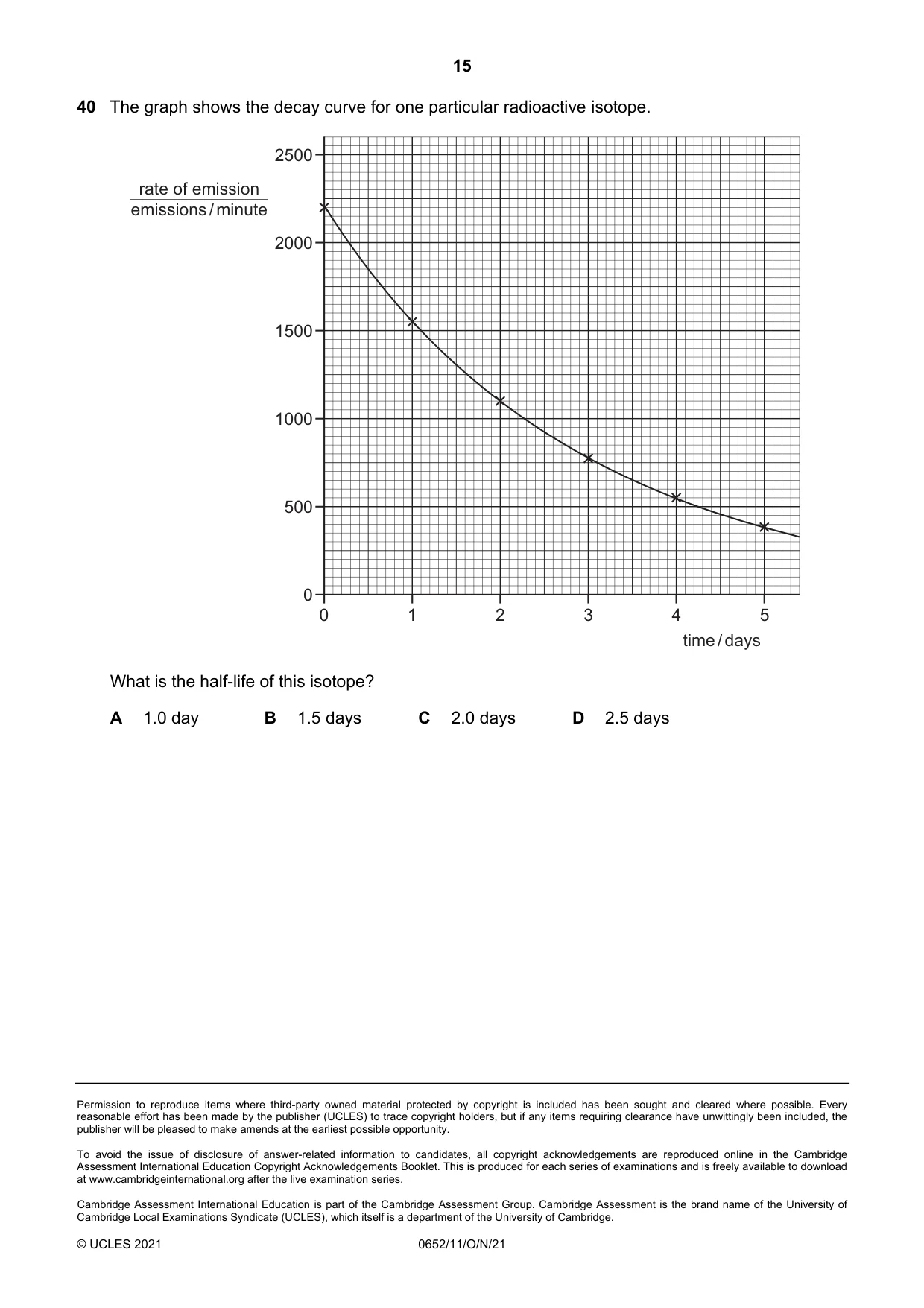
Q40 · The graph shows the decay curve for one particular radioactive isotope
40 The graph shows the decay curve for one particular radioactive isotope. 2500 rate of emission emissions / minute 2000 1500 1000 500 0 0 1 2 3 4 5 time / days What is the half-life of this isotope? A 1.0 day B 1.5 days C 2.0 days D 2.5 days
Mark scheme: C
What was in this paper
The subtopics covered by these 40 questions, and how many questions each got. Open one in a new tab to see every Cambridge question on it.
2General wave properties2Light2Radioactivity2Simple phenomena of magnetism2Stoichiometry2Thermal properties and temperature2Work, energy and power2Alkanes1Atomic structure and the Periodic Table1Carbon dioxide and methane1Electrical quantities1Electricity and chemistry1Electromagnetic effects1Energetics of a reaction1Forces1Fuels1Identification of ions and gases1Ions and ionic bonds1Methods of purification1Motion1Physical and chemical changes1Rate (speed) of reaction1Reactivity series1Redox1Sound1The characteristic properties of acids and bases1The nuclear atom1Thermal processes1Transition elements1Uses of metals1Water1What you needed in this session
Cambridge’s own grade thresholds for 2021 Oct/Nov, Paper 1 · Variant 1. A higher threshold means an easier paper — the bar moves with how the cohort did.