Cambridge IGCSE Physical Science 0652 — 2019 Oct/Nov Paper 1 · Variant 2
0652/12/O/N/19 · 40 questions · 40 marks · ≈45 min
The question paper and its mark scheme, free to read here and free to download. This is Cambridge’s own paper, exactly as it was sat.
Question paper16 pages
Mark scheme3 pages
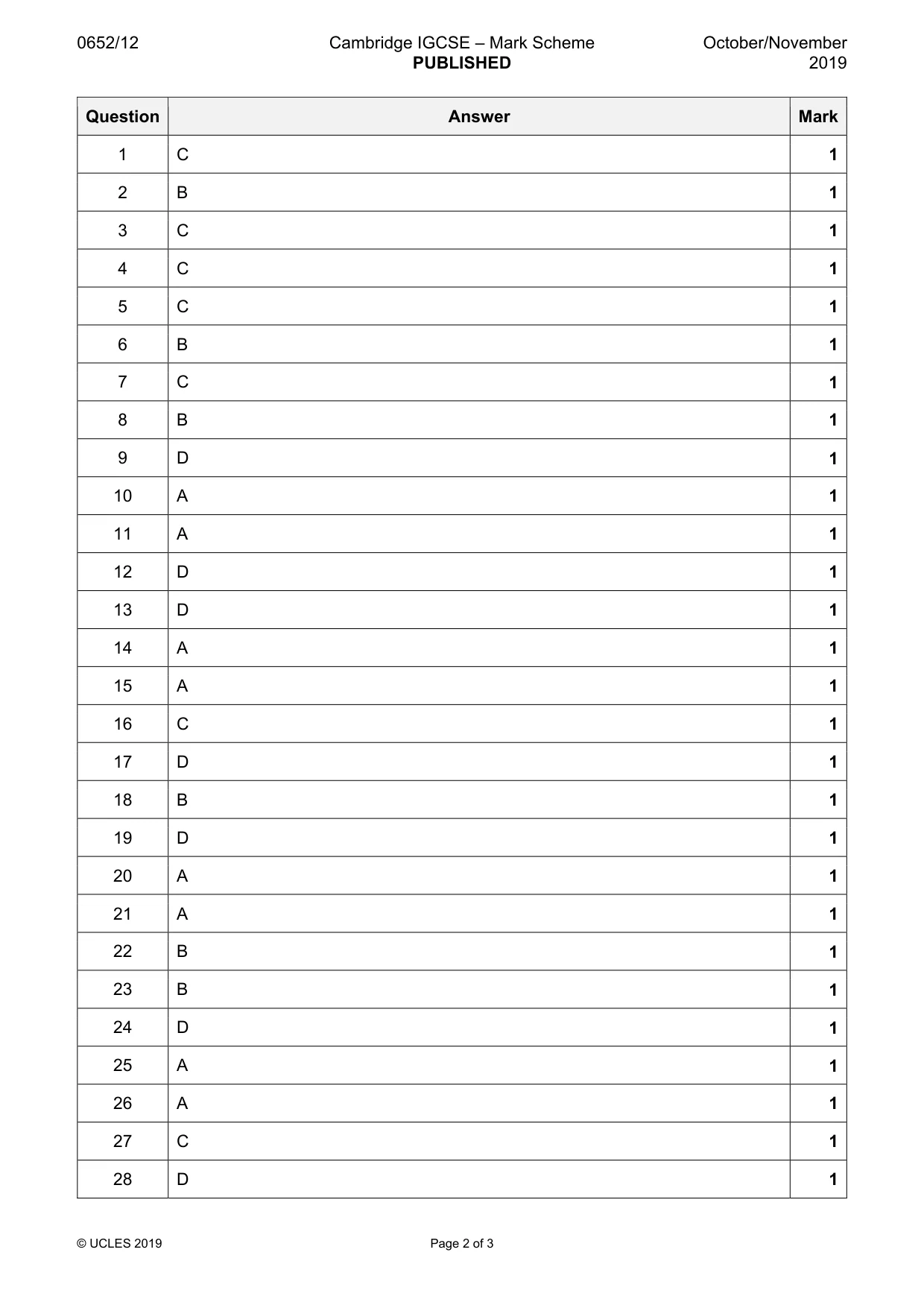
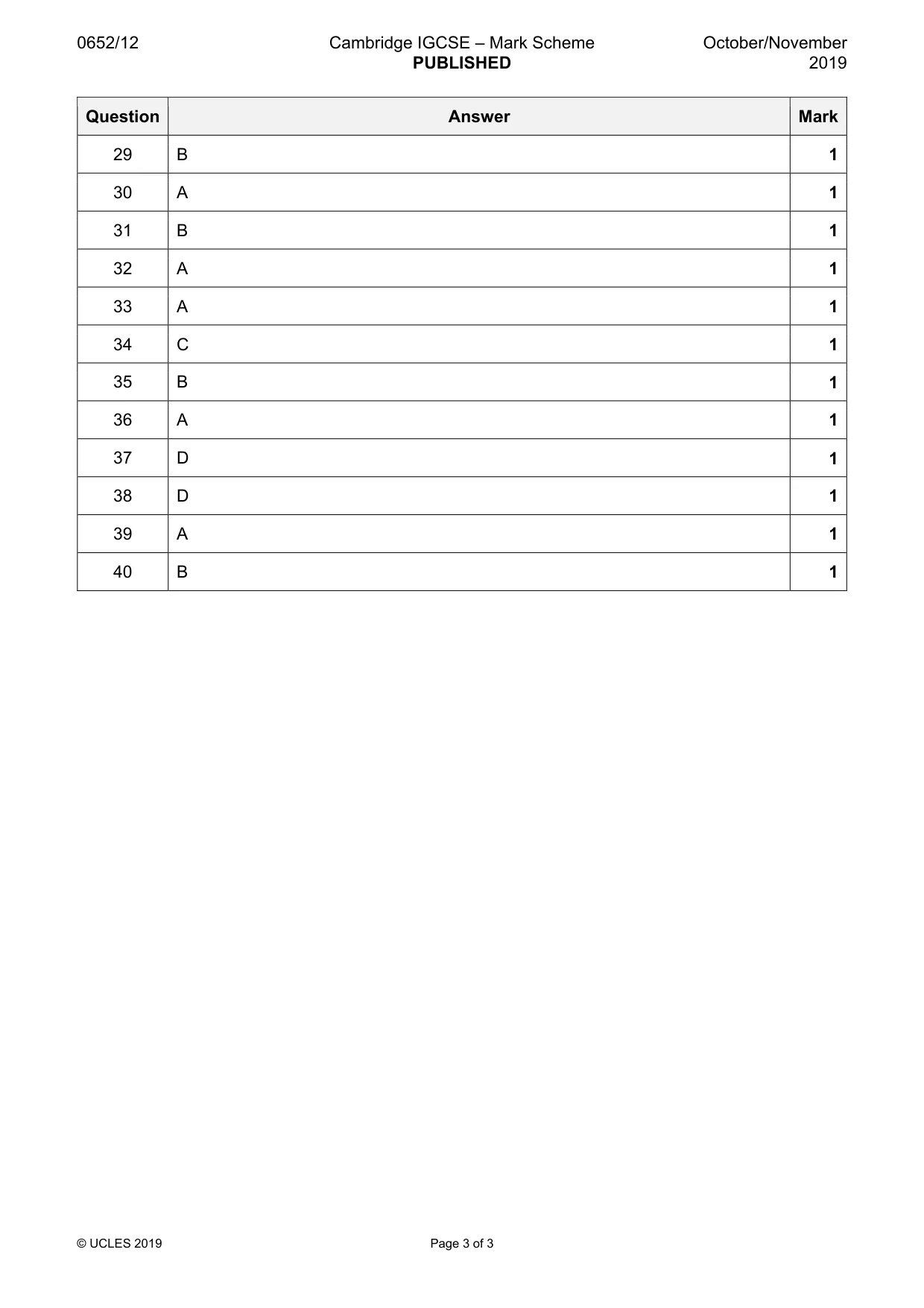
Answers below. Sit the paper first if you are practising.
Questions as text
Q1 · Which statement about a liquid at 60 °C is not correct?
1 Which statement about a liquid at 60 °C is not correct? A It has a fixed volume. B It takes the shape of the container. C Its particles are far apart. D Its particles have enough energy to move around.
Mark scheme: C
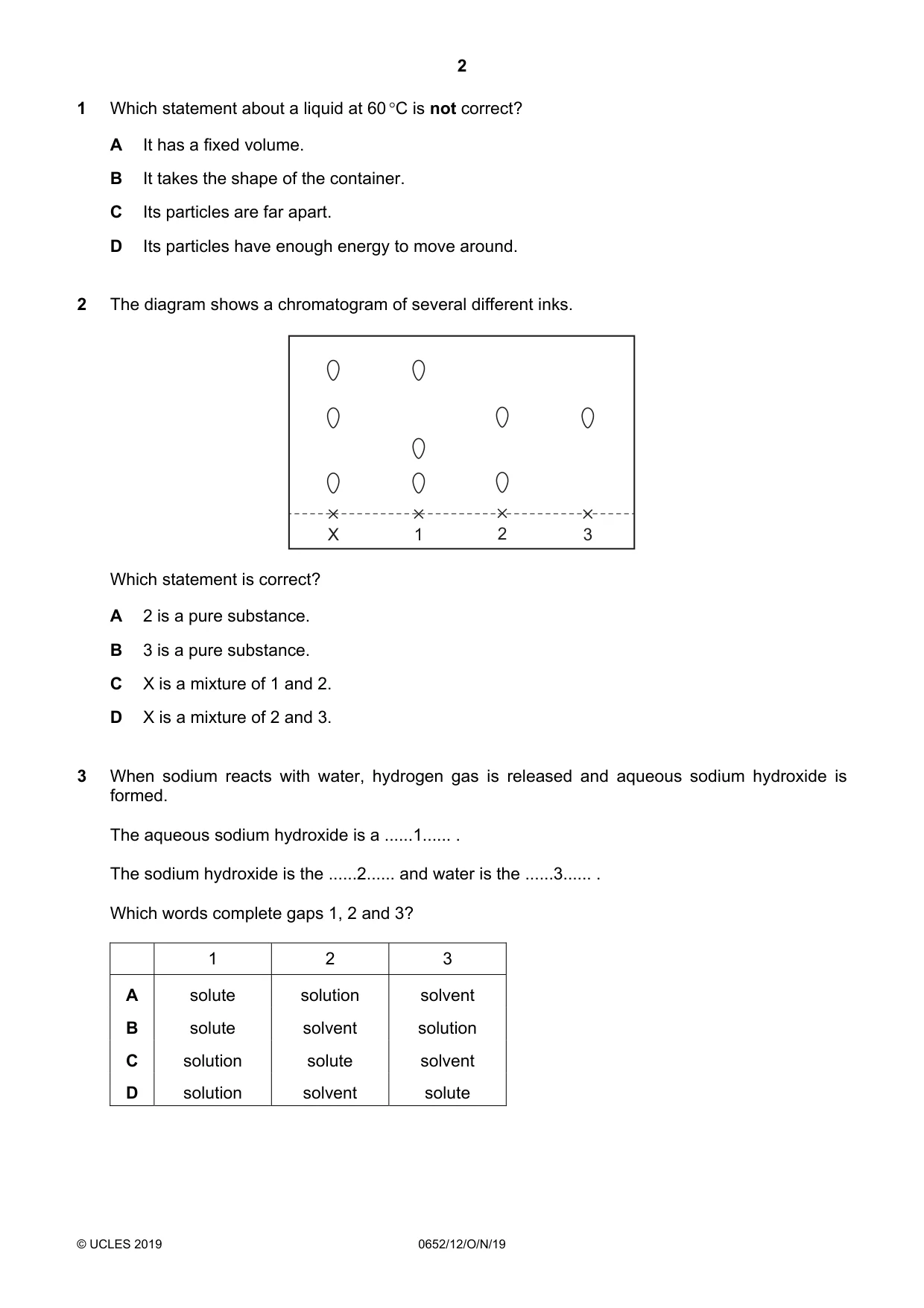
Q2 · The diagram shows a chromatogram of several different inks
2 The diagram shows a chromatogram of several different inks. X 1 2 3 Which statement is correct? A 2 is a pure substance. B 3 is a pure substance. C X is a mixture of 1 and 2. D X is a mixture of 2 and 3.
Mark scheme: B
Q3 · When sodium reacts with water, hydrogen gas is released and aqueous sodium hydroxide is…
3 When sodium reacts with water, hydrogen gas is released and aqueous sodium hydroxide is formed. The aqueous sodium hydroxide is a ......1...... . The sodium hydroxide is the ......2...... and water is the ......3...... . Which words complete gaps 1, 2 and 3? 1 2 3 A solute solution solvent B solute solvent solution C solution solute solvent D solution solvent solute
Mark scheme: C
Q4 · Some properties of X and Y are shown
4 Some properties of X and Y are shown. property X Y volatility non-volatile highly volatile solubility in water soluble insoluble electrical conductivity when molten good poor Which row describes the bonding in X and Y? X Y A covalent covalent B covalent ionic C ionic covalent D ionic ionic
Mark scheme: C
Q5 · X is a compound that contains the elements potassium, manganese and oxygen
5 X is a compound that contains the elements potassium, manganese and oxygen. X has twice as many potassium atoms as manganese atoms, and twice as many oxygen atoms as potassium atoms. What is the formula of X? A KMnO2 B K2MnO2 C K2MnO4 D KMn2O4
Mark scheme: C
Q6 · A student dissolves a sample of ammonium nitrate in water
6 A student dissolves a sample of ammonium nitrate in water. The student measures the temperature of the mixture before and after the reaction. The results are shown. °C temperature before 21 temperature after 17 Which process describes the reaction? A combustion B endothermic C exothermic D reduction
Mark scheme: B
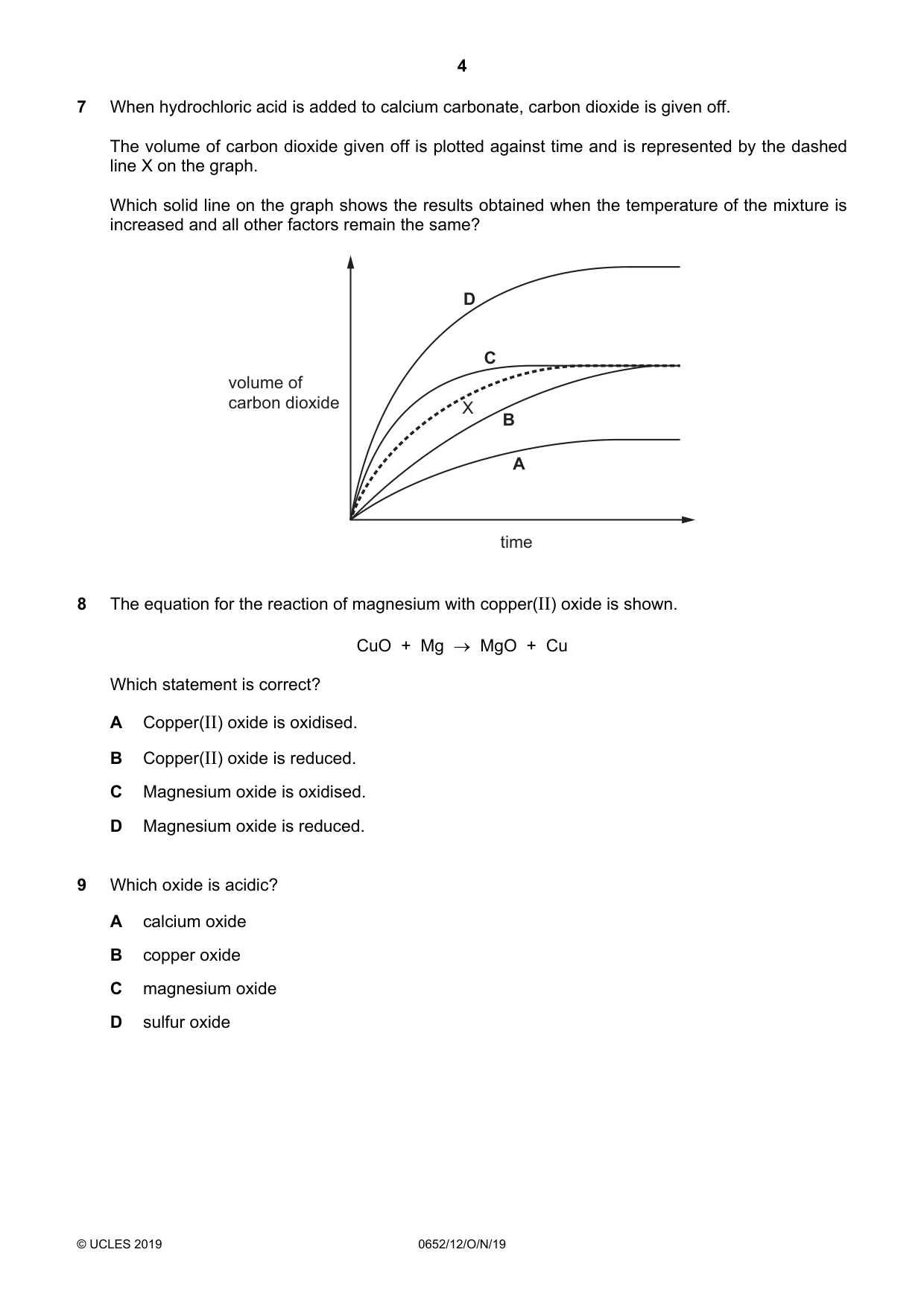
Q7 · When hydrochloric acid is added to calcium carbonate, carbon dioxide is given off
7 When hydrochloric acid is added to calcium carbonate, carbon dioxide is given off. The volume of carbon dioxide given off is plotted against time and is represented by the dashed line X on the graph. Which solid line on the graph shows the results obtained when the temperature of the mixture is increased and all other factors remain the same? D C volume of carbon dioxide X B A time
Mark scheme: C
Q8 · The equation for the reaction of magnesium with copper(II) oxide is shown
8 The equation for the reaction of magnesium with copper(II) oxide is shown. CuO + Mg → MgO + Cu Which statement is correct? A Copper(II) oxide is oxidised. B Copper(II) oxide is reduced. C Magnesium oxide is oxidised. D Magnesium oxide is reduced.
Mark scheme: B
Q9 · Which oxide is acidic?
9 Which oxide is acidic? A calcium oxide B copper oxide C magnesium oxide D sulfur oxide
Mark scheme: D
Q10 · Which gas turns damp red litmus paper blue?
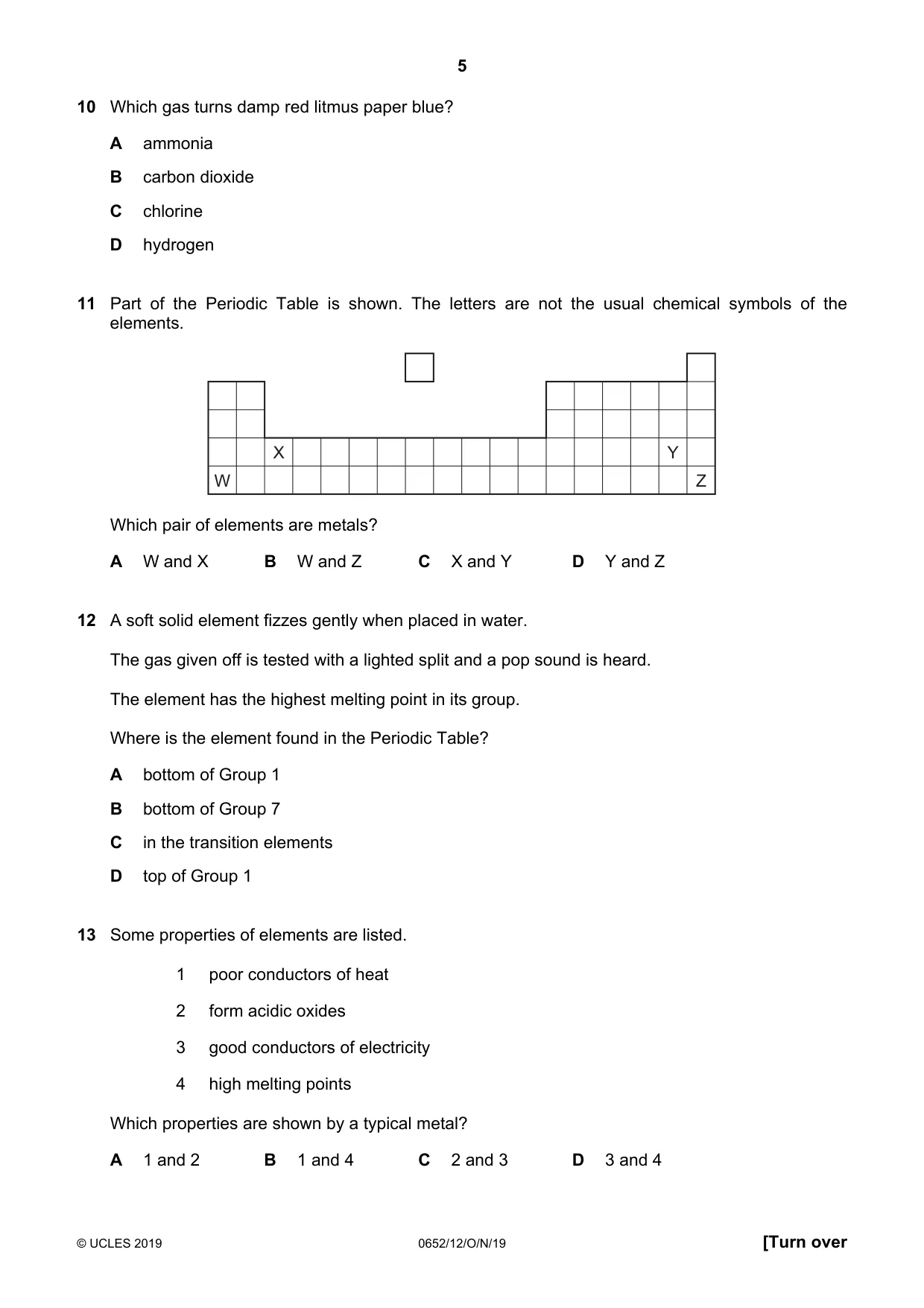
10 Which gas turns damp red litmus paper blue? A ammonia B carbon dioxide C chlorine D hydrogen
Mark scheme: A
Q11 · Part of the Periodic Table is shown
11 Part of the Periodic Table is shown. The letters are not the usual chemical symbols of the elements. X Y W Z Which pair of elements are metals? A W and X B W and Z C X and Y D Y and Z
Mark scheme: A
Q12 · A soft solid element fizzes gently when placed in water
12 A soft solid element fizzes gently when placed in water. The gas given off is tested with a lighted split and a pop sound is heard. The element has the highest melting point in its group. Where is the element found in the Periodic Table? A bottom of Group 1 B bottom of Group 7 C in the transition elements D top of Group 1
Mark scheme: D
Q13 · Some properties of elements are listed
13 Some properties of elements are listed. 1 poor conductors of heat 2 form acidic oxides 3 good conductors of electricity 4 high melting points Which properties are shown by a typical metal? A 1 and 2 B 1 and 4 C 2 and 3 D 3 and 4
Mark scheme: D
Q14 · Some reactions of four metals W, X, Y and Z and their oxides are shown
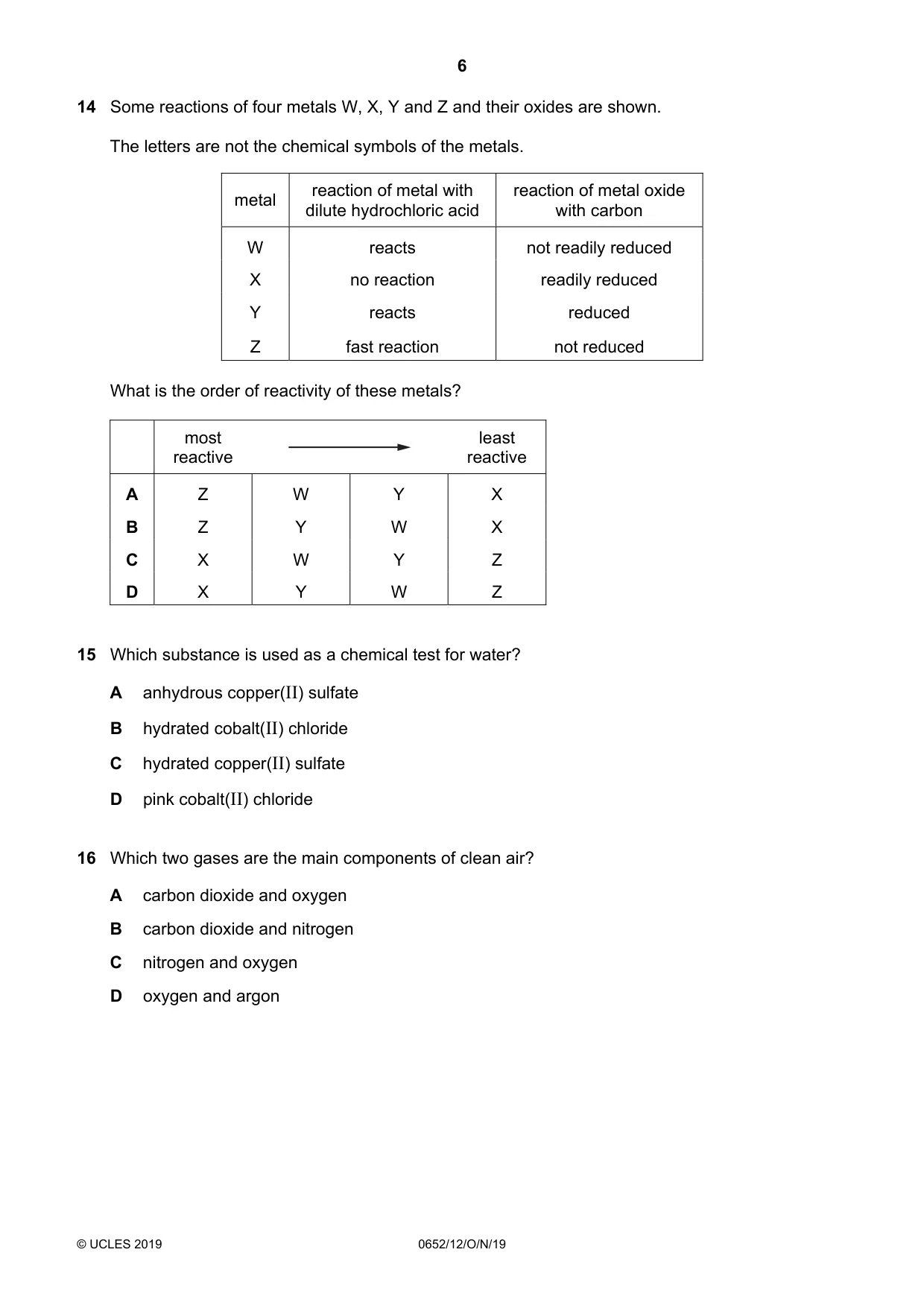
14 Some reactions of four metals W, X, Y and Z and their oxides are shown. The letters are not the chemical symbols of the metals. reaction of metal with reaction of metal oxide metal dilute hydrochloric acid with carbon W reacts not readily reduced X no reaction readily reduced Y reacts reduced Z fast reaction not reduced What is the order of reactivity of these metals? most least reactive reactive A Z W Y X B Z Y W X C X W Y Z D X Y W Z
Mark scheme: A
Q15 · Which substance is used as a chemical test for water?
15 Which substance is used as a chemical test for water? A anhydrous copper(II) sulfate B hydrated cobalt(II) chloride C hydrated copper(II) sulfate D pink cobalt(II) chloride
Mark scheme: A
Q16 · Which two gases are the main components of clean air?
16 Which two gases are the main components of clean air? A carbon dioxide and oxygen B carbon dioxide and nitrogen C nitrogen and oxygen D oxygen and argon
Mark scheme: C
Q17 · Limestone is heated to make ‘lime’ (calcium oxide)
17 Limestone is heated to make ‘lime’ (calcium oxide). The equation is shown. CaCO3 → CaO + CO2 Which type of reaction takes place? A combustion B fractional distillation C reduction D thermal decomposition
Mark scheme: D
Q18 · Which statements about the alkanes are correct?
18 Which statements about the alkanes are correct? 1 They are generally unreactive except in terms of burning. 2 They burn in air to produce carbon dioxide and water. 3 They contain carbon to carbon double bonds. 4 They decolourise bromine water. A 1, 2 and 3 only B 1 and 2 only C 1, 3 and 4 only D 2 and 4 only
Mark scheme: B
Q19 · Which structure represents an unsaturated hydrocarbon?
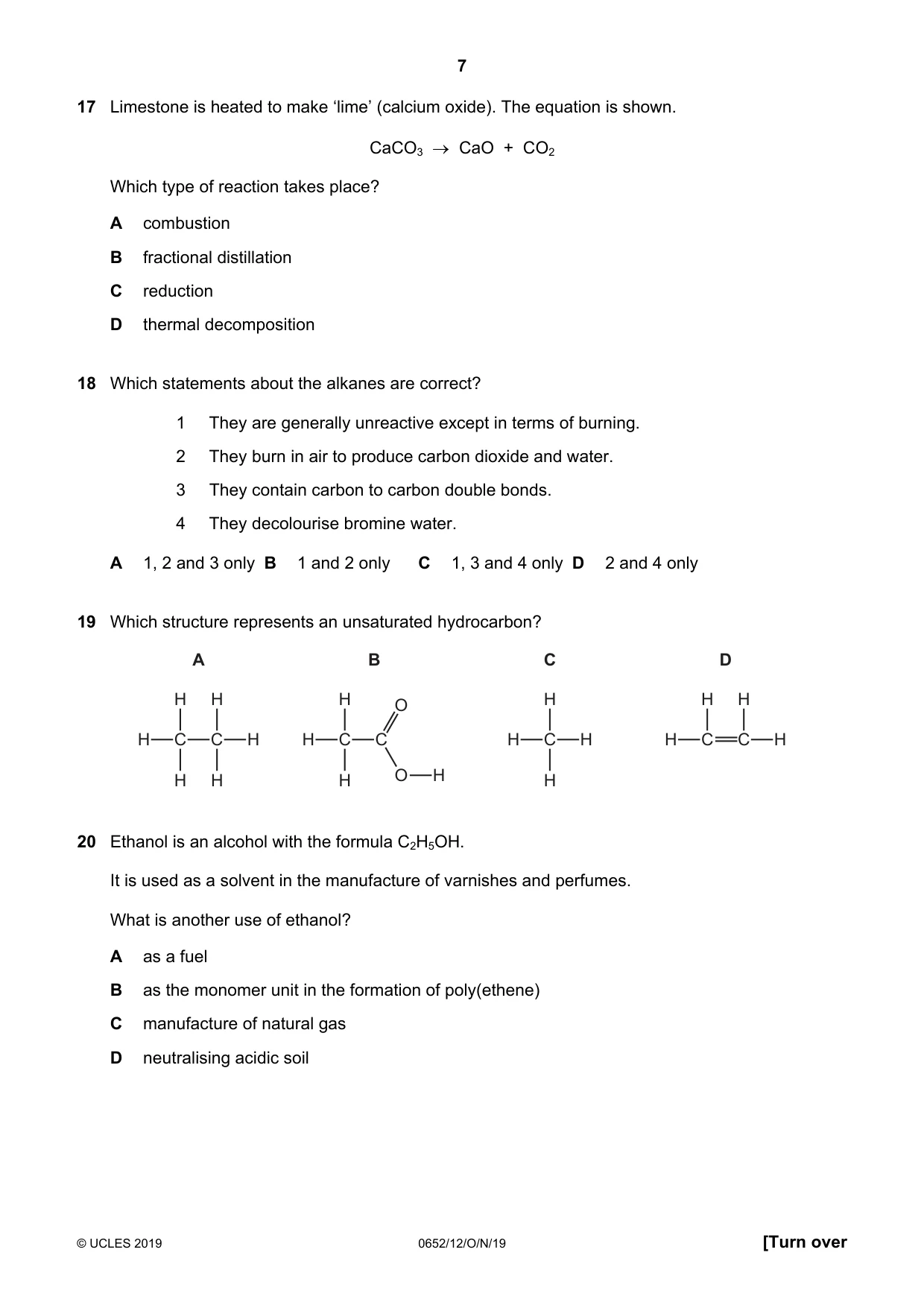
19 Which structure represents an unsaturated hydrocarbon? A B C D H H H O H H H H C C H H C C H C H H C C H H H H O H H
Mark scheme: D
Q20 · Ethanol is an alcohol with the formula C2H5OH
20 Ethanol is an alcohol with the formula C2H5OH. It is used as a solvent in the manufacture of varnishes and perfumes. What is another use of ethanol? A as a fuel B as the monomer unit in the formation of poly(ethene) C manufacture of natural gas D neutralising acidic soil
Mark scheme: A
Q21 · The diagram shows a stopwatch after it has been used to time 20 swings of a pendulum
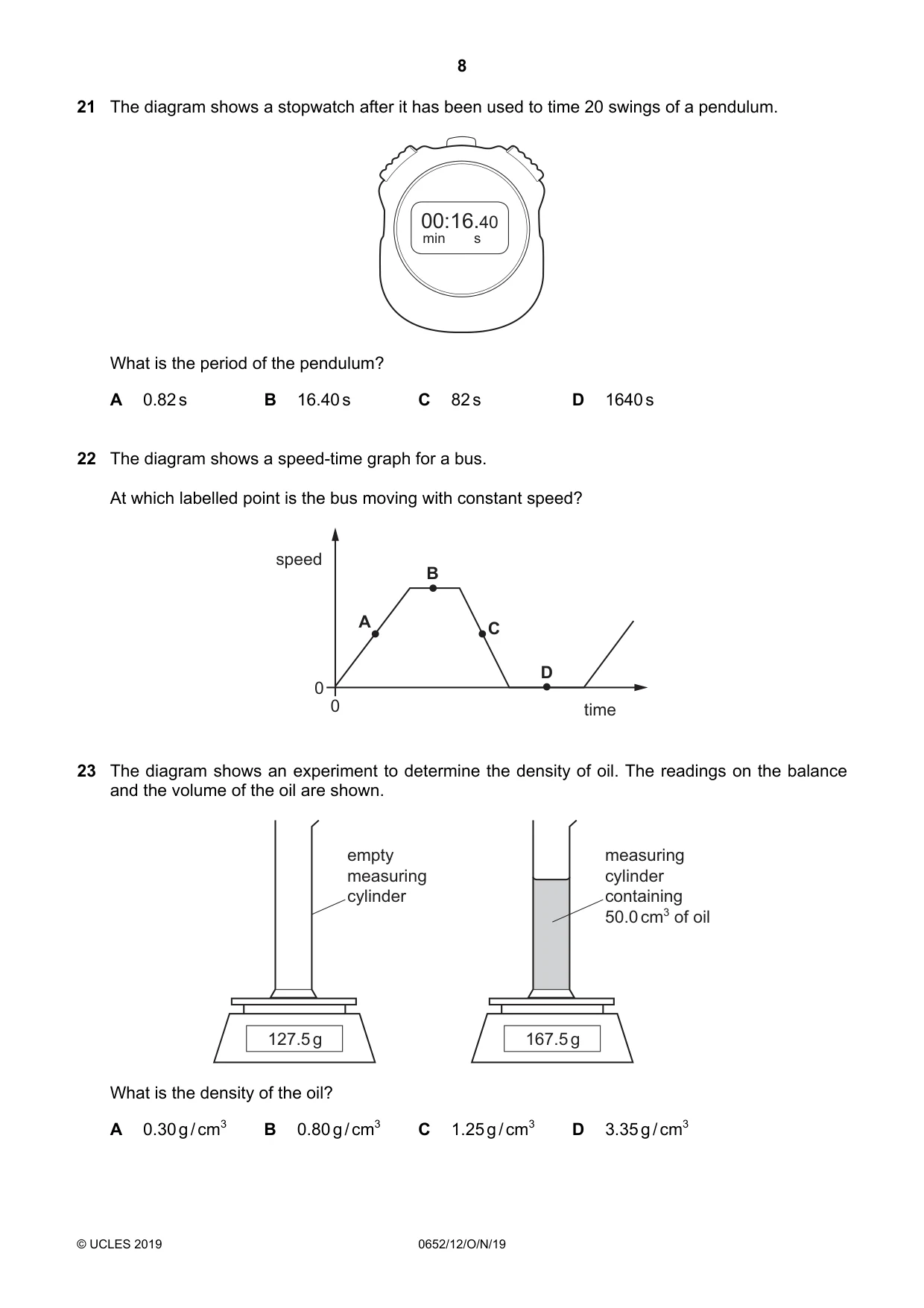
21 The diagram shows a stopwatch after it has been used to time 20 swings of a pendulum. 00:16.40 min s What is the period of the pendulum? A 0.82 s B 16.40 s C 82 s D 1640 s
Mark scheme: A
Q22 · The diagram shows a speed-time graph for a bus
22 The diagram shows a speed-time graph for a bus. At which labelled point is the bus moving with constant speed? speed B A C D 0 0 time
Mark scheme: B
Q23 · The diagram shows an experiment to determine the density of oil
23 The diagram shows an experiment to determine the density of oil. The readings on the balance and the volume of the oil are shown. empty measuring measuring cylinder cylinder containing 50.0 cm3 of oil 127.5 g 167.5 g What is the density of the oil? A 0.30 g / cm3 B 0.80 g / cm3 C 1.25 g / cm3 D 3.35 g / cm3
Mark scheme: B
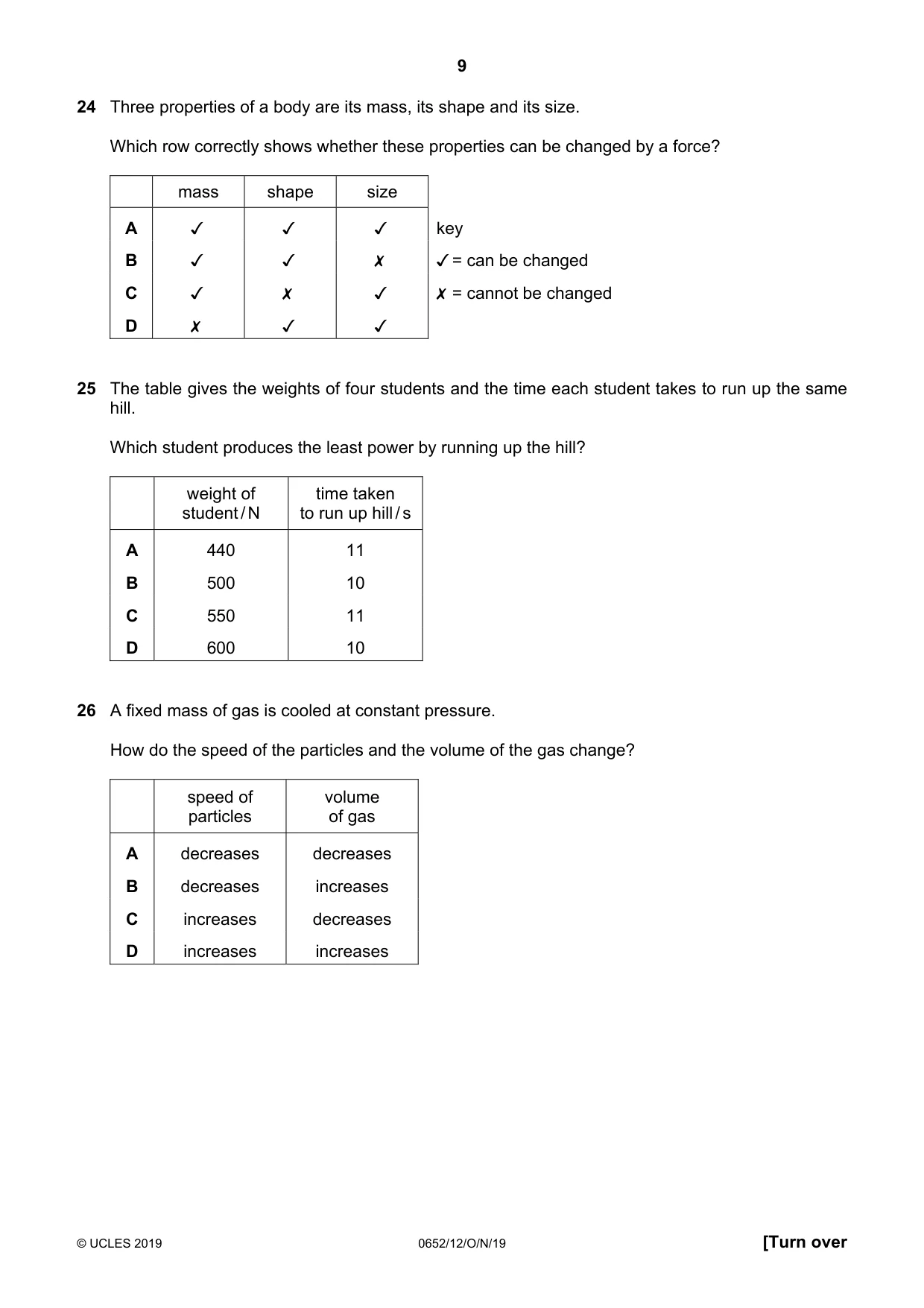
Q24 · Three properties of a body are its mass, its shape and its size
24 Three properties of a body are its mass, its shape and its size. Which row correctly shows whether these properties can be changed by a force? v key / = can be changed x v X = cannot be changed v
Mark scheme: D
Q25 · The table gives the weights of four students and the time each student takes to run up…
25 The table gives the weights of four students and the time each student takes to run up the same hill. Which student produces the least power by running up the hill? weight of time taken student / N to run up hill / s A 440 11 B 500 10 C 550 11 D 600 10
Mark scheme: A
Q26 · A fixed mass of gas is cooled at constant pressure
26 A fixed mass of gas is cooled at constant pressure. How do the speed of the particles and the volume of the gas change? speed of volume particles of gas A decreases decreases B decreases increases C increases decreases D increases increases
Mark scheme: A
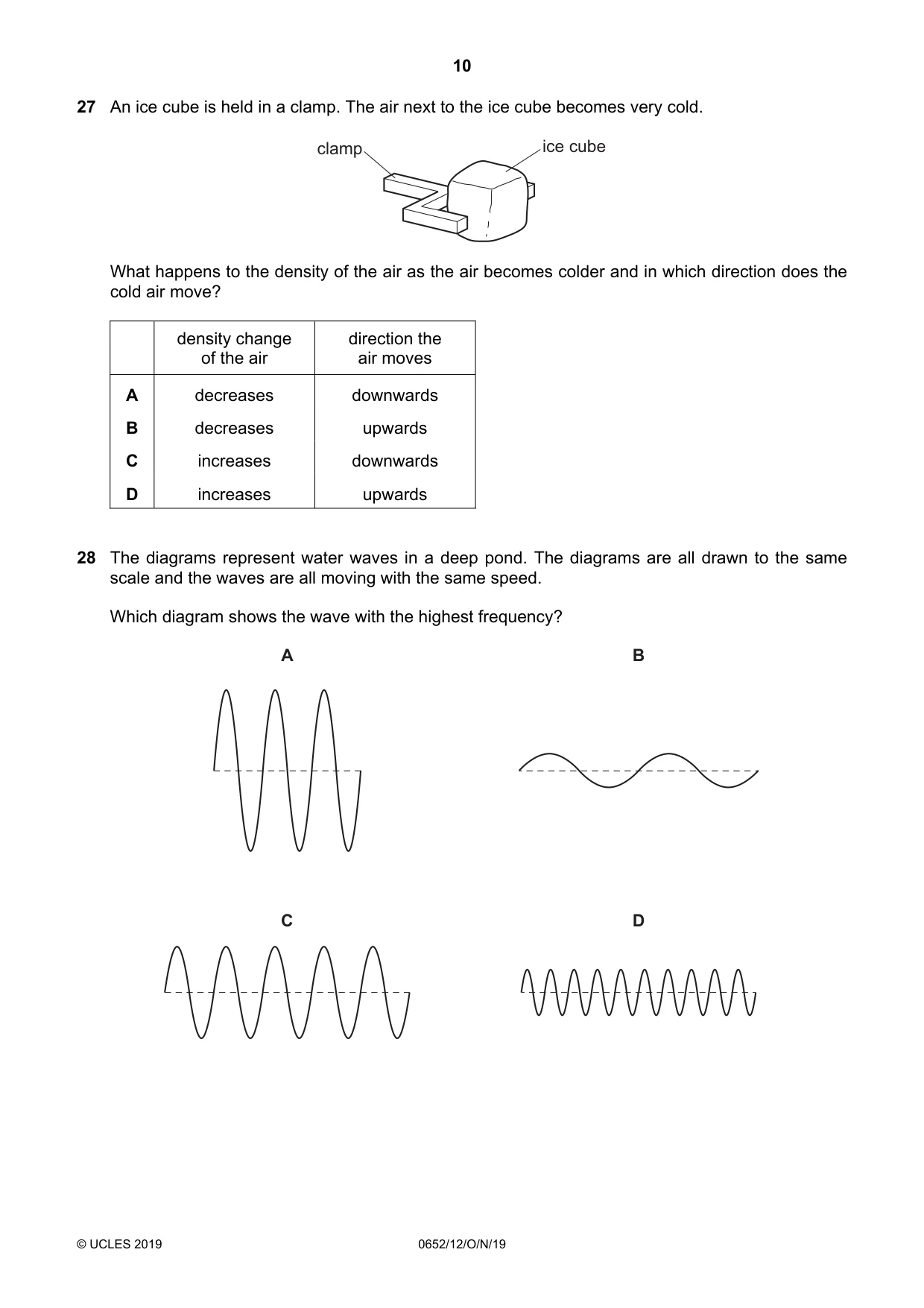
Q27 · An ice cube is held in a clamp
27 An ice cube is held in a clamp. The air next to the ice cube becomes very cold. clamp ice cube What happens to the density of the air as the air becomes colder and in which direction does the cold air move? density change direction the of the air air moves A decreases downwards B decreases upwards C increases downwards D increases upwards
Mark scheme: C
Q28 · The diagrams represent water waves in a deep pond
28 The diagrams represent water waves in a deep pond. The diagrams are all drawn to the same scale and the waves are all moving with the same speed. Which diagram shows the wave with the highest frequency? A B C D
Mark scheme: D
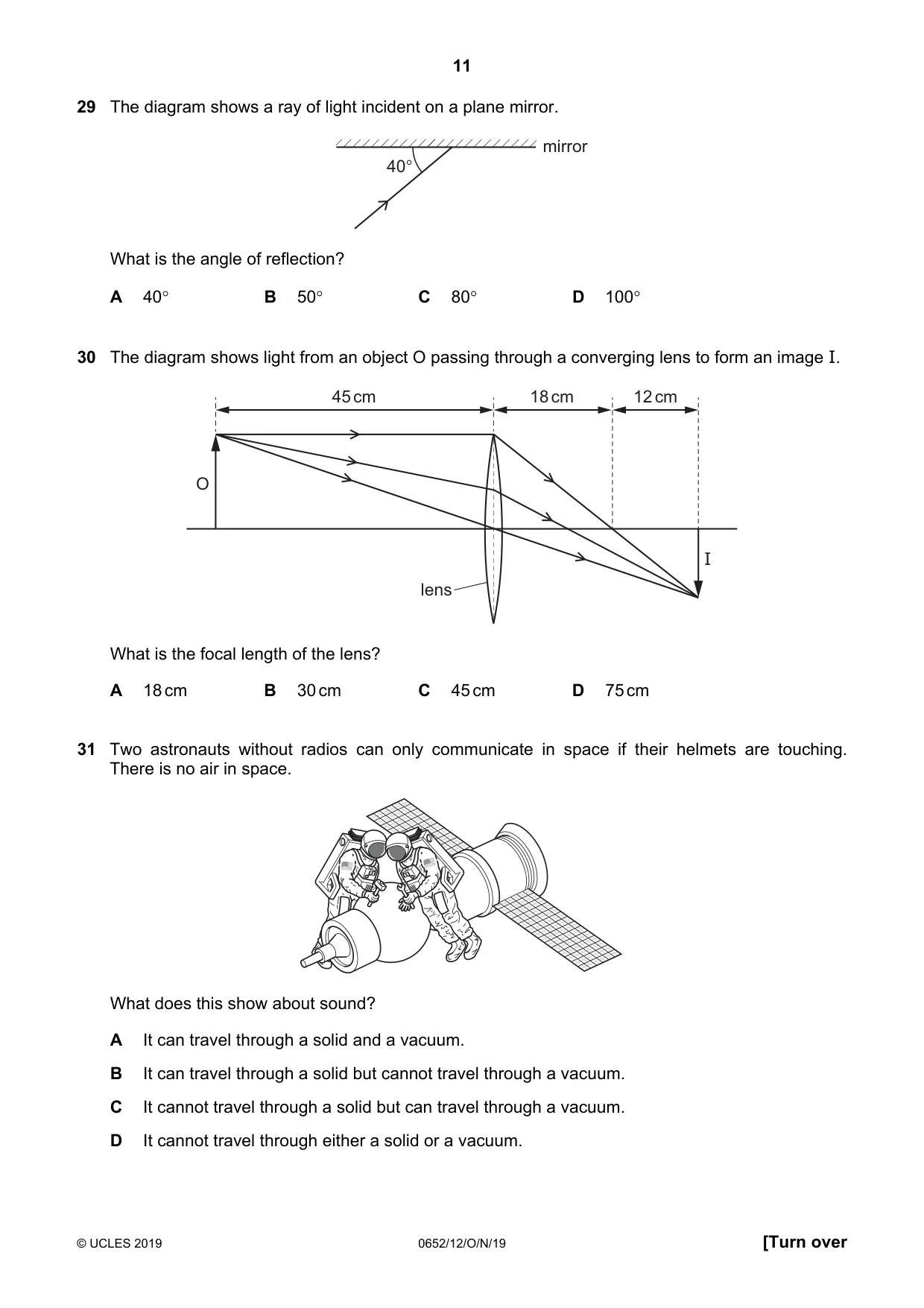
Q29 · The diagram shows a ray of light incident on a plane mirror
29 The diagram shows a ray of light incident on a plane mirror. mirror 40° What is the angle of reflection? A 40° B 50° C 80° D 100°
Mark scheme: B
Q30 · The diagram shows light from an object O passing through a converging lens to form an…
30 The diagram shows light from an object O passing through a converging lens to form an image I. 45 cm 18 cm 12 cm O I lens What is the focal length of the lens? A 18 cm B 30 cm C 45 cm D 75 cm
Mark scheme: A
Q31 · Two astronauts without radios can only communicate in space if their helmets are touching
31 Two astronauts without radios can only communicate in space if their helmets are touching. There is no air in space. What does this show about sound? A It can travel through a solid and a vacuum. B It can travel through a solid but cannot travel through a vacuum. C It cannot travel through a solid but can travel through a vacuum. D It cannot travel through either a solid or a vacuum.
Mark scheme: B
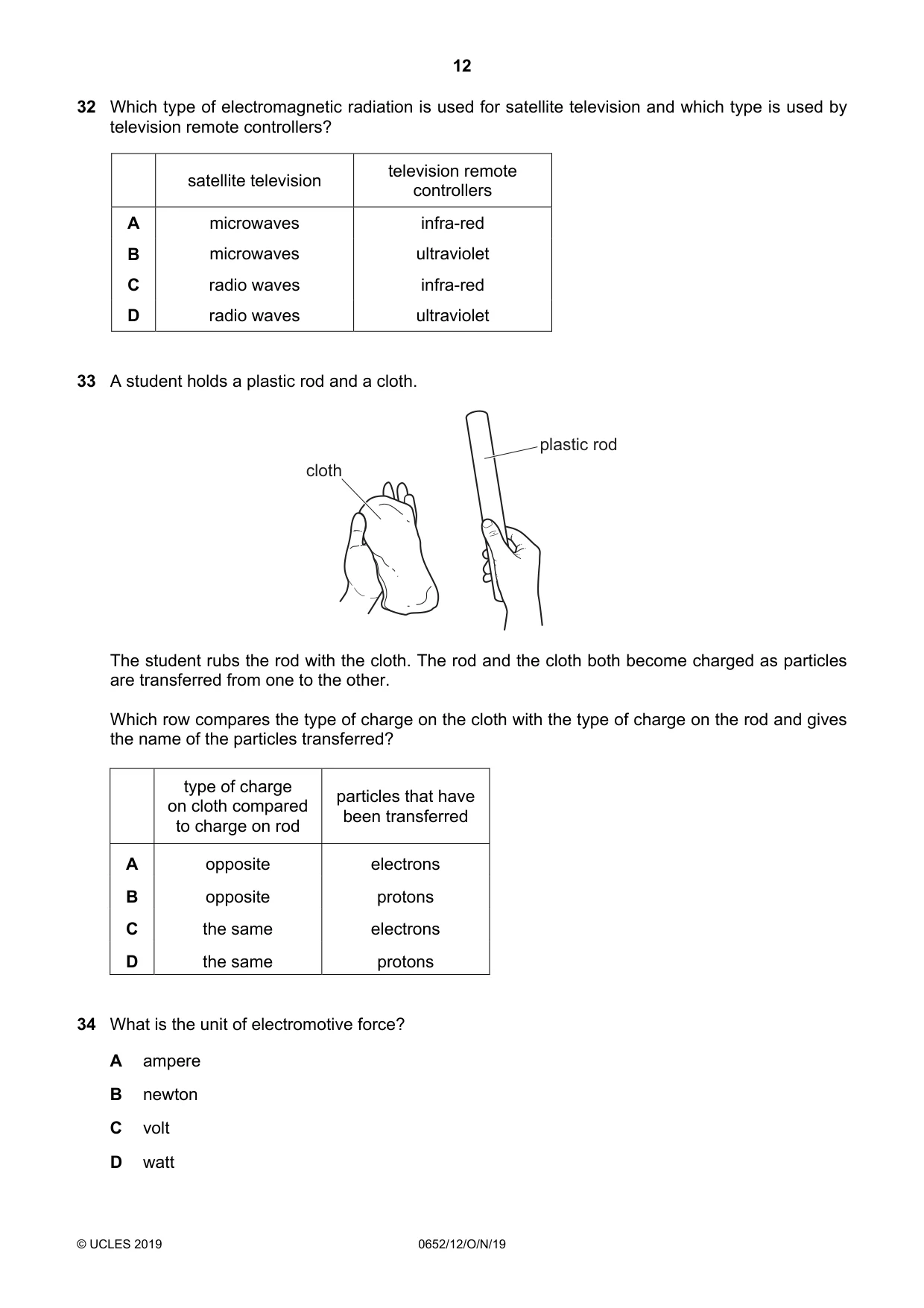
Q32 · Which type of electromagnetic radiation is used for satellite television and which type…
32 Which type of electromagnetic radiation is used for satellite television and which type is used by television remote controllers? television remote satellite television controllers A microwaves infra-red B microwaves ultraviolet C radio waves infra-red D radio waves ultraviolet
Mark scheme: A
Q33 · A student holds a plastic rod and a cloth
33 A student holds a plastic rod and a cloth. plastic rod cloth The student rubs the rod with the cloth. The rod and the cloth both become charged as particles are transferred from one to the other. Which row compares the type of charge on the cloth with the type of charge on the rod and gives the name of the particles transferred? type of charge particles that have on cloth compared been transferred to charge on rod A opposite electrons B opposite protons C the same electrons D the same protons
Mark scheme: A
Q34 · What is the unit of electromotive force?
34 What is the unit of electromotive force? A ampere B newton C volt D watt
Mark scheme: C
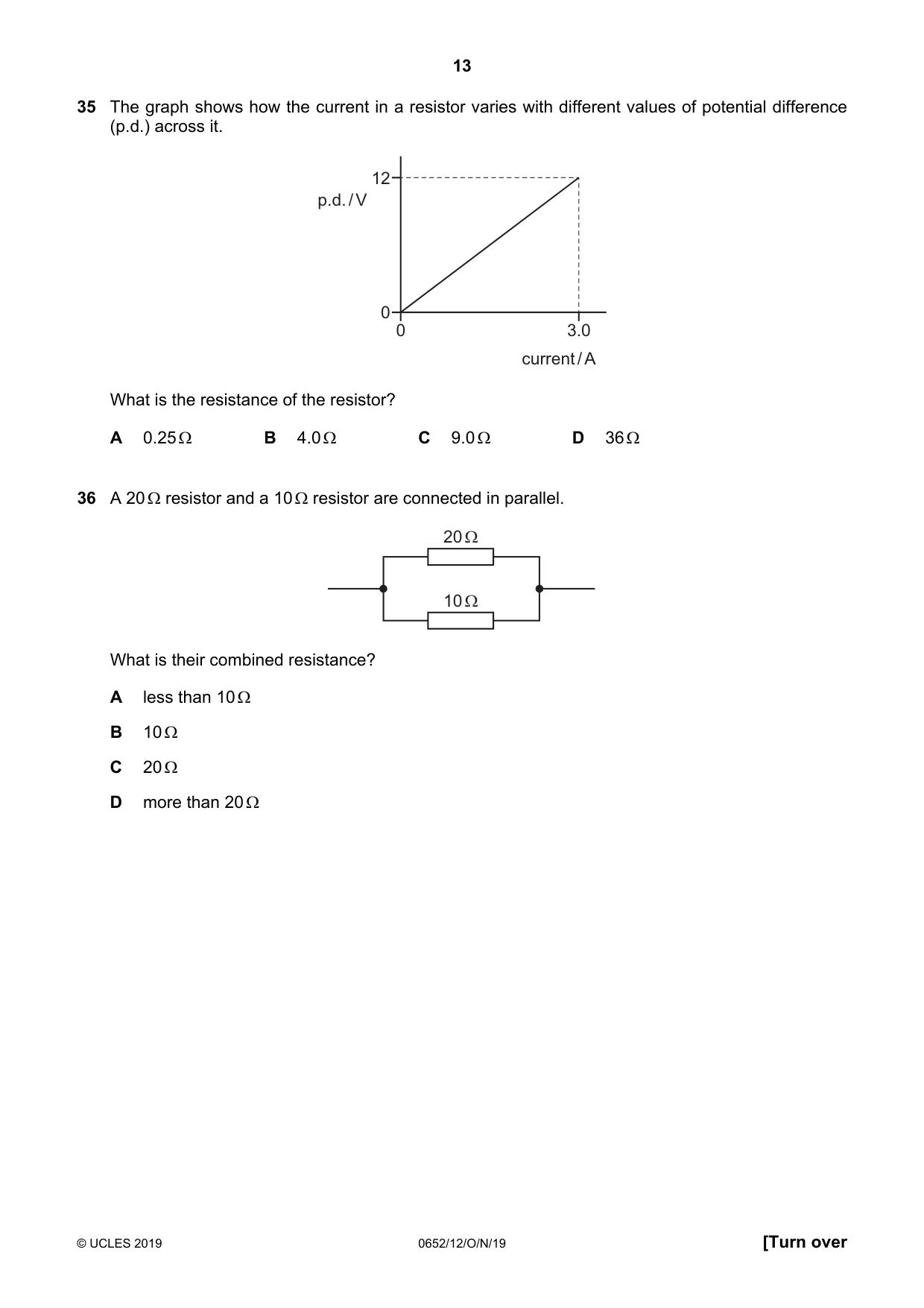
Q35 · The graph shows how the current in a resistor varies with different values of potential…
35 The graph shows how the current in a resistor varies with different values of potential difference (p.d.) across it. 12 p.d. / V 0 0 3.0 current / A What is the resistance of the resistor? A 0.25 Ω B 4.0 Ω C 9.0 Ω D 36 Ω
Mark scheme: B
Q36 · A 20 Ω resistor and a 10 Ω resistor are connected in parallel
36 A 20 Ω resistor and a 10 Ω resistor are connected in parallel. 20 Ω 10 Ω What is their combined resistance? A less than 10 Ω B 10 Ω C 20 Ω D more than 20 Ω
Mark scheme: A
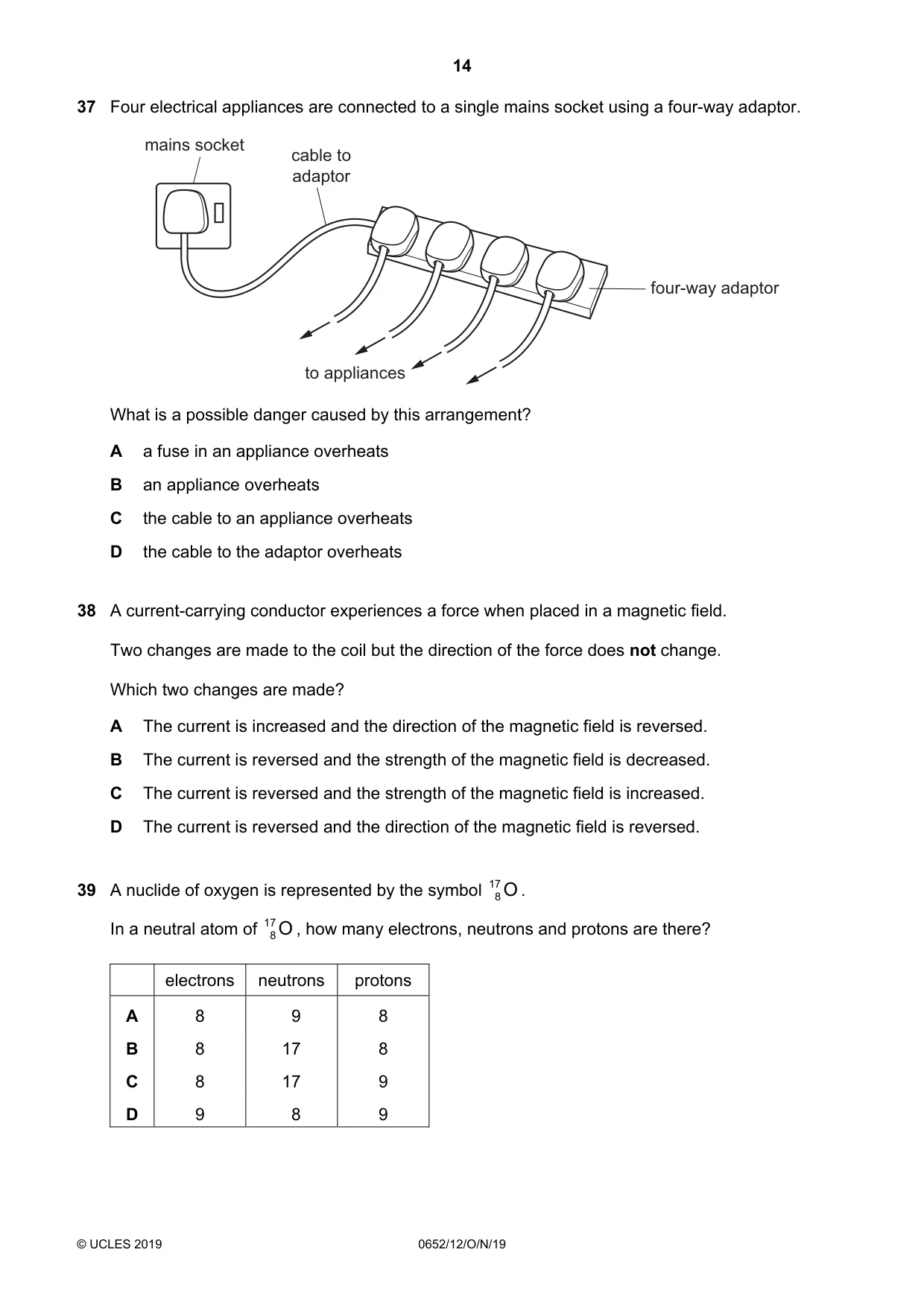
Q37 · Four electrical appliances are connected to a single mains socket using a four-way adaptor
37 Four electrical appliances are connected to a single mains socket using a four-way adaptor. mains socket cable to adaptor four-way adaptor to appliances What is a possible danger caused by this arrangement? A a fuse in an appliance overheats B an appliance overheats C the cable to an appliance overheats D the cable to the adaptor overheats
Mark scheme: D
Q38 · A current-carrying conductor experiences a force when placed in a magnetic field
38 A current-carrying conductor experiences a force when placed in a magnetic field. Two changes are made to the coil but the direction of the force does not change. Which two changes are made? A The current is increased and the direction of the magnetic field is reversed. B The current is reversed and the strength of the magnetic field is decreased. C The current is reversed and the strength of the magnetic field is increased. D The current is reversed and the direction of the magnetic field is reversed.
Mark scheme: D
Q39 · A nuclide of oxygen is represented by the symbol 17 O
39 A nuclide of oxygen is represented by the symbol 17 O . 8 In a neutral atom of 17 O , how many electrons, neutrons and protons are there? 8 electrons neutrons protons A 8 9 8 B 8 17 8 C 8 17 9 D 9 8 9
Mark scheme: A
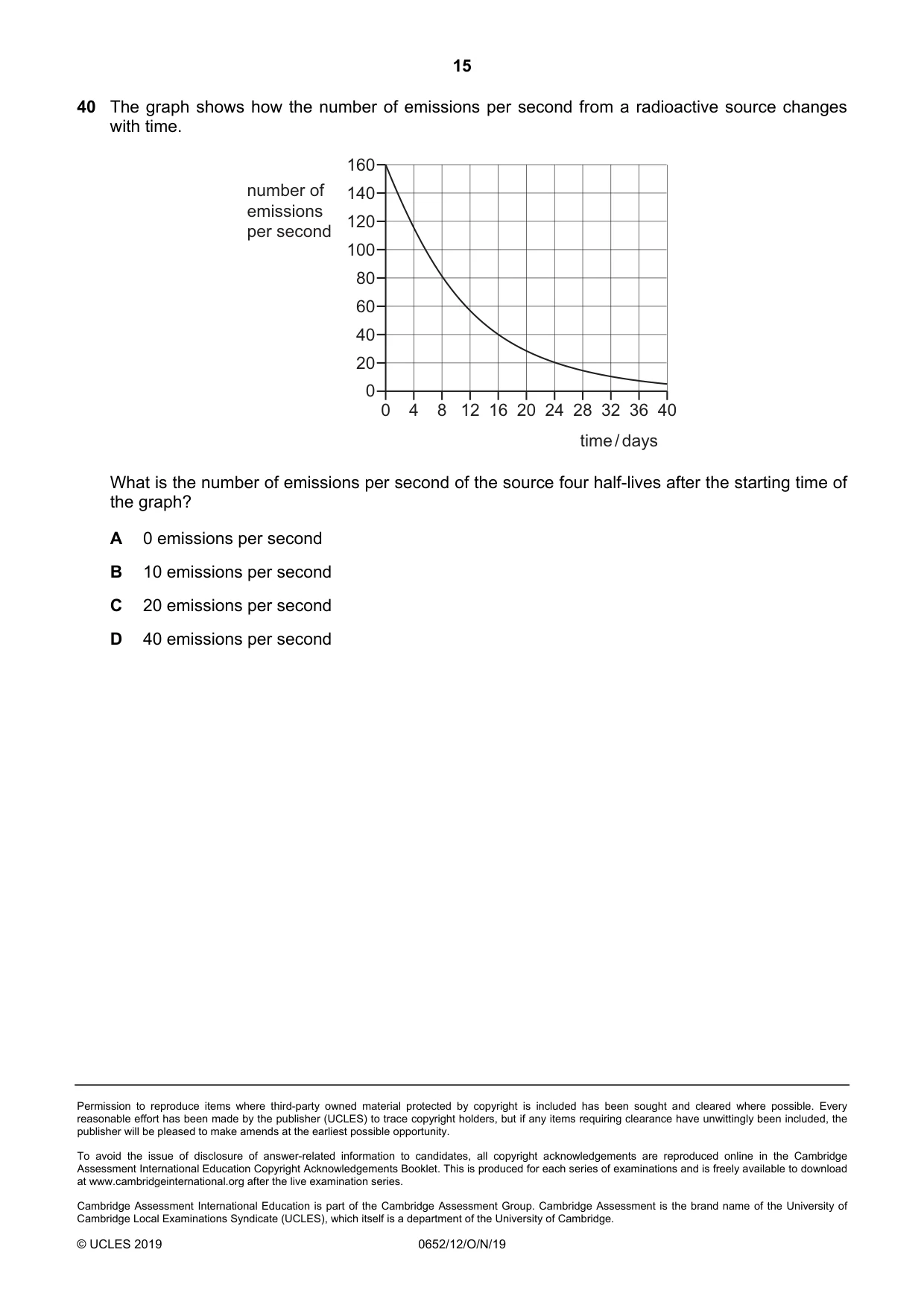
Q40 · The graph shows how the number of emissions per second from a radioactive source changes…
40 The graph shows how the number of emissions per second from a radioactive source changes with time. 160 number of 140 emissions 120 per second 100 80 60 40 20 0 0 4 8 12 16 20 24 28 32 36 40 time / days What is the number of emissions per second of the source four half-lives after the starting time of the graph? A 0 emissions per second B 10 emissions per second C 20 emissions per second D 40 emissions per second
Mark scheme: B
What was in this paper
The subtopics covered by these 40 questions, and how many questions each got. Open one in a new tab to see every Cambridge question on it.
2General wave properties2Light2Air1Alcohols1Alkanes1Alkenes1Carbonates1Criteria of purity1Dangers of electricity1Density1Electric circuits1Electromagnetic effects1Elements, compounds and mixtures1Energy transfer1Forces1Group properties1Identification of ions and gases1Ions and ionic bonds1Length and time1Motion1Properties of metals1Radioactivity1Rate (speed) of reaction1Reactivity series1Redox1Simple phenomena of magnetism1Sound1Stoichiometry1The nuclear atom1The particulate nature of matter1The Periodic Table1Thermal processes1Thermal properties and temperature1Types of oxides1Water1Work, energy and power1What you needed in this session
Cambridge’s own grade thresholds for 2019 Oct/Nov, Paper 1 · Variant 2. A higher threshold means an easier paper — the bar moves with how the cohort did.