Cambridge IGCSE Physical Science 0652 — 2008 Oct/Nov Paper 1 · Variant 1
0652/11/O/N/08 · 40 questions · 40 marks · ≈45 min
The question paper and its mark scheme, free to read here and free to download. This is Cambridge’s own paper, exactly as it was sat.
Question paper20 pages


Mark scheme2 pages
Answers below. Sit the paper first if you are practising.
Questions as text
Q1 · The paper chromatogram of substance X
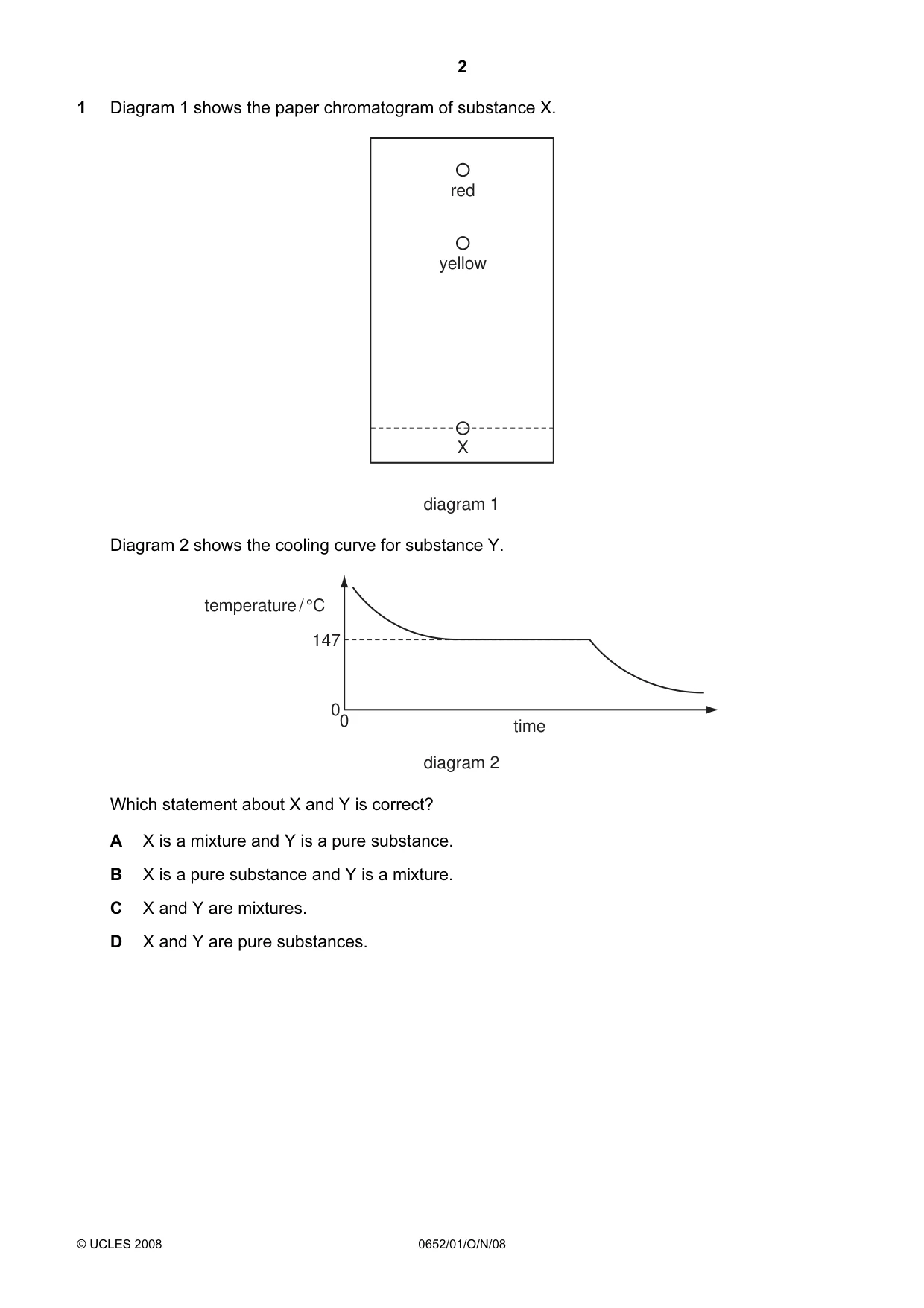
1 Diagram 1 shows the paper chromatogram of substance X. red yellow X diagram 1 Diagram 2 shows the cooling curve for substance Y. temperature / °C 147 0 0 time diagram 2 Which statement about X and Y is correct? A X is a mixture and Y is a pure substance. B X is a pure substance and Y is a mixture. C X and Y are mixtures. D X and Y are pure substances.
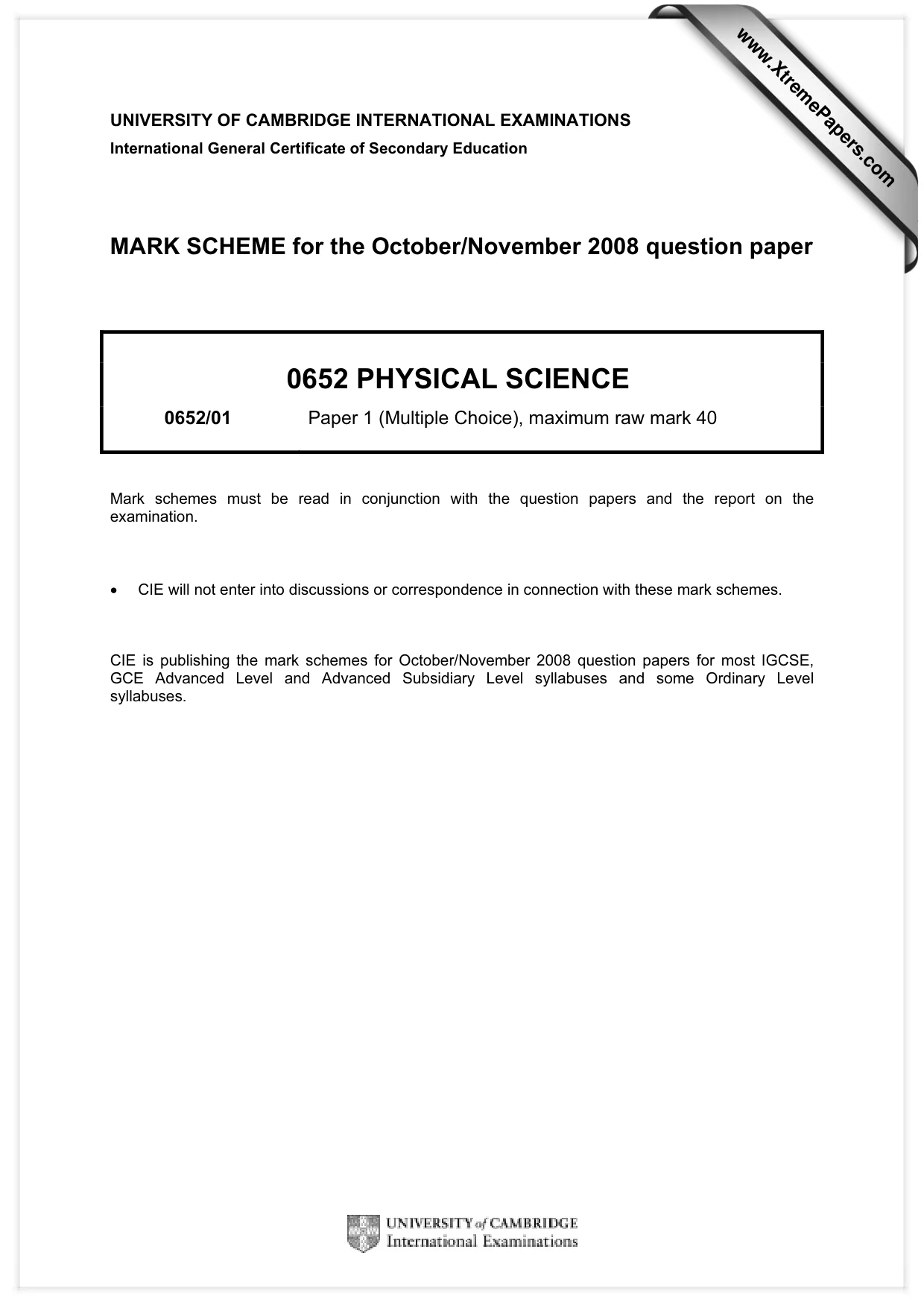
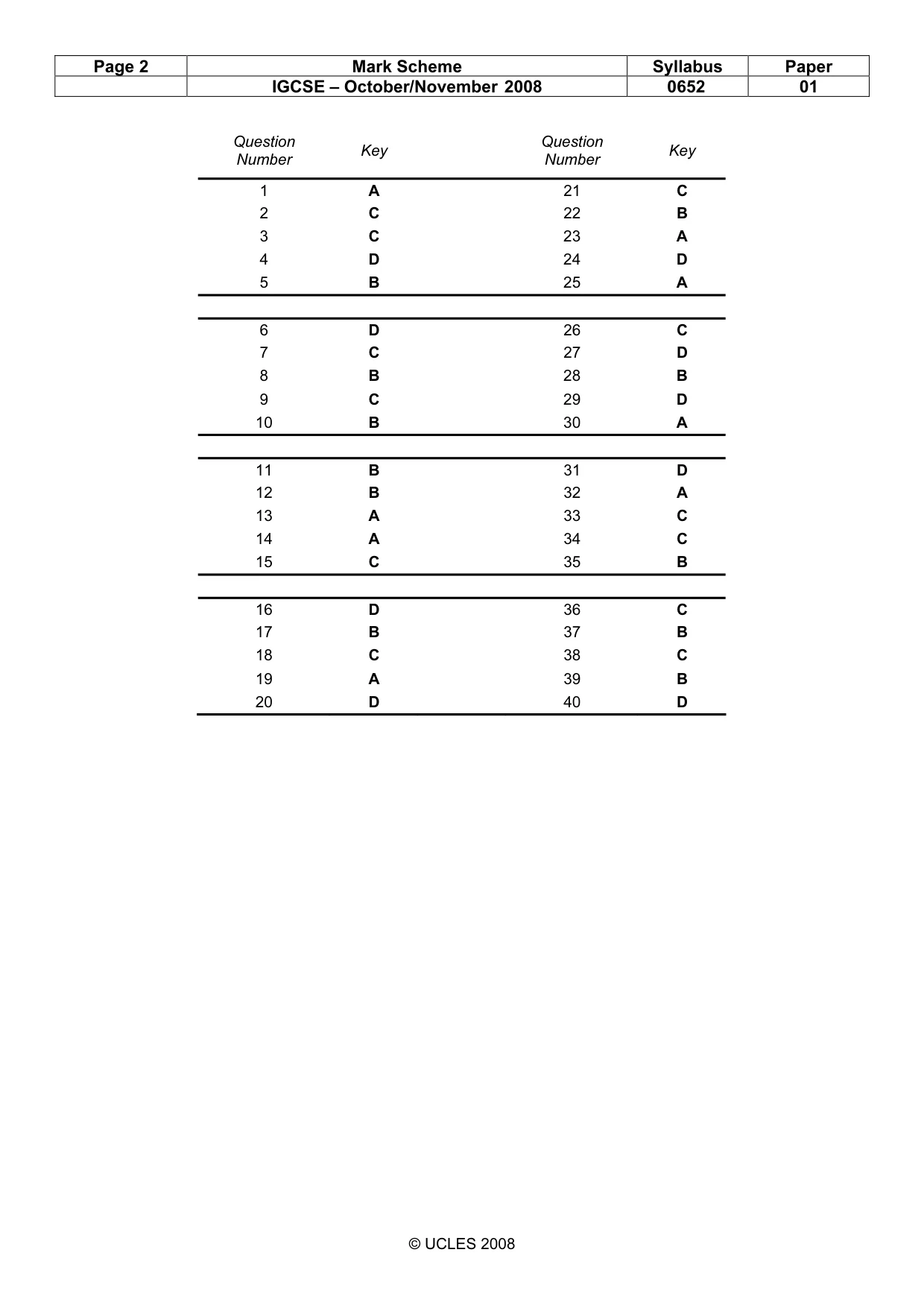
Mark scheme: A
Q2 · An ice cube melts
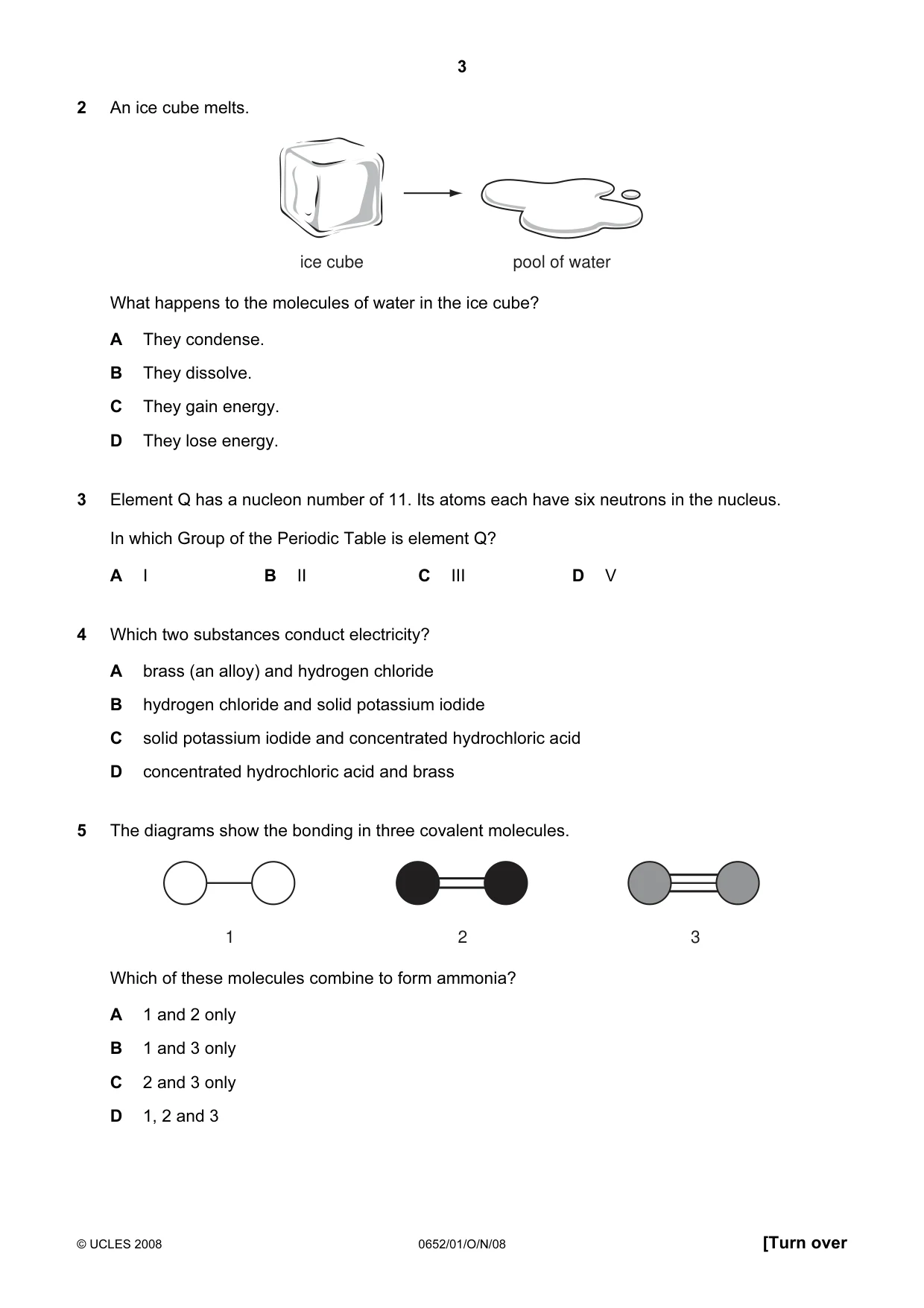
2 An ice cube melts. ice cube pool of water What happens to the molecules of water in the ice cube? A They condense. B They dissolve. C They gain energy. D They lose energy.
Mark scheme: C
Q3 · Element Q has a nucleon number of 11
3 Element Q has a nucleon number of 11. Its atoms each have six neutrons in the nucleus. In which Group of the Periodic Table is element Q? A I B II C III D V
Mark scheme: C
Q4 · Which two substances conduct electricity?
4 Which two substances conduct electricity? A brass (an alloy) and hydrogen chloride B hydrogen chloride and solid potassium iodide C solid potassium iodide and concentrated hydrochloric acid D concentrated hydrochloric acid and brass
Mark scheme: D
Q5 · The diagrams show the bonding in three covalent molecules
5 The diagrams show the bonding in three covalent molecules. 1 2 3 Which of these molecules combine to form ammonia? A 1 and 2 only B 1 and 3 only C 2 and 3 only D 1, 2 and 3
Mark scheme: B
Q6 · Which substance does not require oxygen in order to produce energy?
6 Which substance does not require oxygen in order to produce energy? A coal B hydrogen C natural gas D 235U
Mark scheme: D
Q7 · The diagram shows an experiment
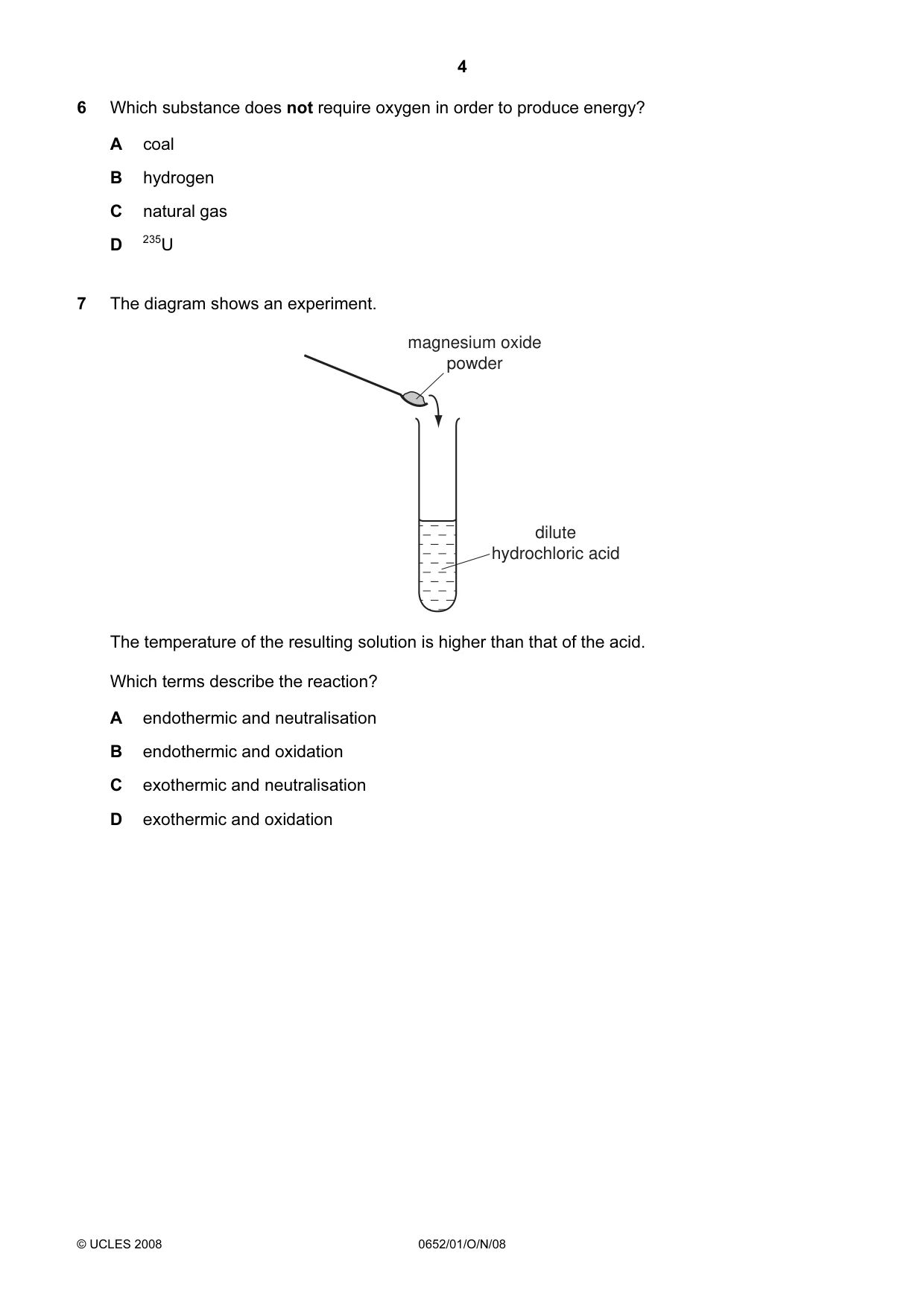
7 The diagram shows an experiment. magnesium oxide powder dilute hydrochloric acid The temperature of the resulting solution is higher than that of the acid. Which terms describe the reaction? A endothermic and neutralisation B endothermic and oxidation C exothermic and neutralisation D exothermic and oxidation
Mark scheme: C
Q8 · The oxides of two elements, X and Y, are separately dissolved in water and the pH of each…
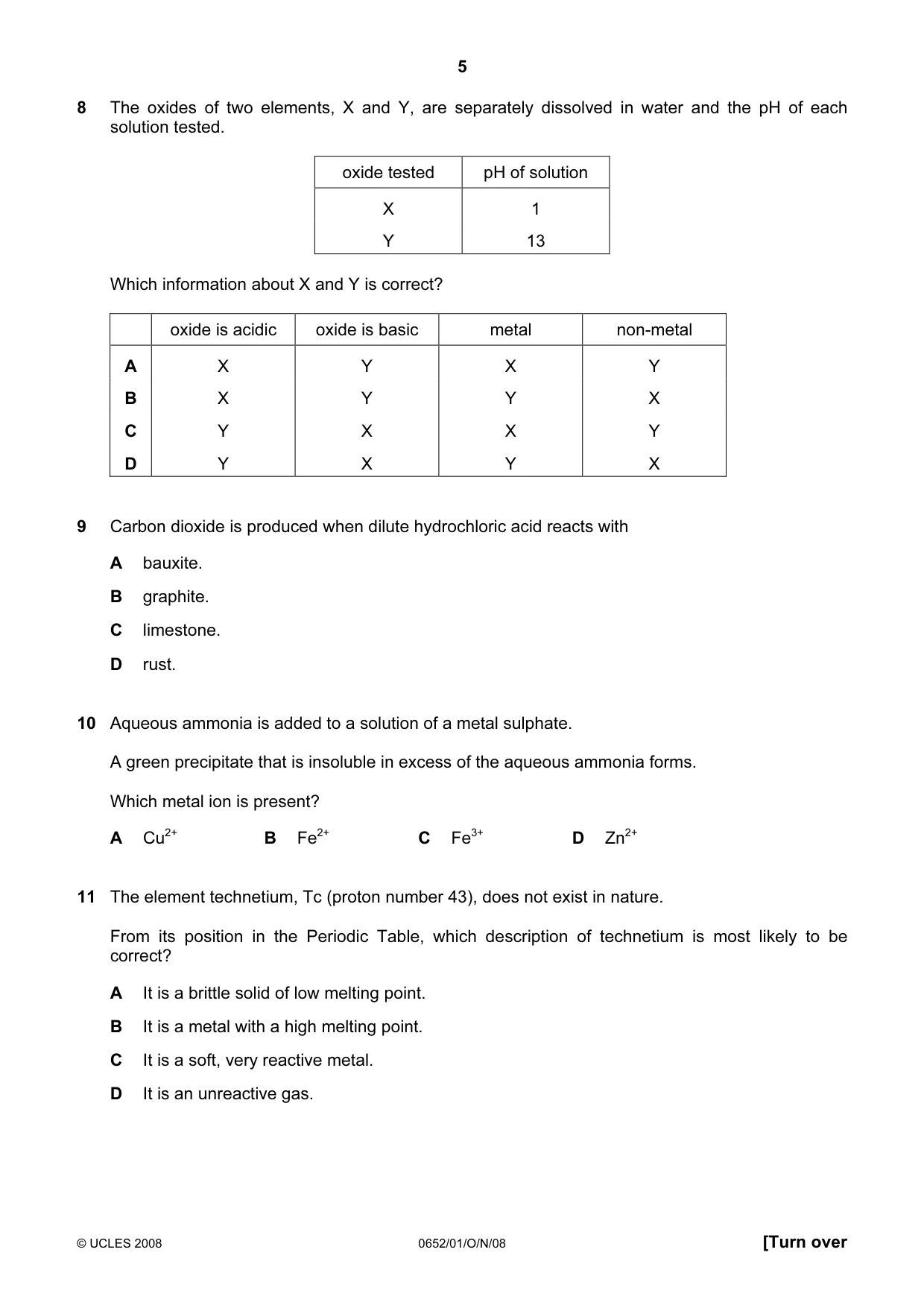
8 The oxides of two elements, X and Y, are separately dissolved in water and the pH of each solution tested. oxide tested pH of solution X 1 Y 13 Which information about X and Y is correct? oxide is acidic oxide is basic metal non-metal A X Y X Y B X Y Y X C Y X X Y D Y X Y X
Mark scheme: B
Q9 · Carbon dioxide is produced when dilute hydrochloric acid reacts with A bauxite
9 Carbon dioxide is produced when dilute hydrochloric acid reacts with A bauxite. B graphite. C limestone. D rust.
Mark scheme: C
Q10 · Aqueous ammonia is added to a solution of a metal sulphate
10 Aqueous ammonia is added to a solution of a metal sulphate. A green precipitate that is insoluble in excess of the aqueous ammonia forms. Which metal ion is present? A Cu2+ B Fe2+ C Fe3+ D Zn2+
Mark scheme: B
Q11 · The element technetium, Tc (proton number 43), does not exist in nature
11 The element technetium, Tc (proton number 43), does not exist in nature. From its position in the Periodic Table, which description of technetium is most likely to be correct? A It is a brittle solid of low melting point. B It is a metal with a high melting point. C It is a soft, very reactive metal. D It is an unreactive gas.
Mark scheme: B
Q12 · The diagrams show apparatus used to test the reaction of chlorine with different liquids
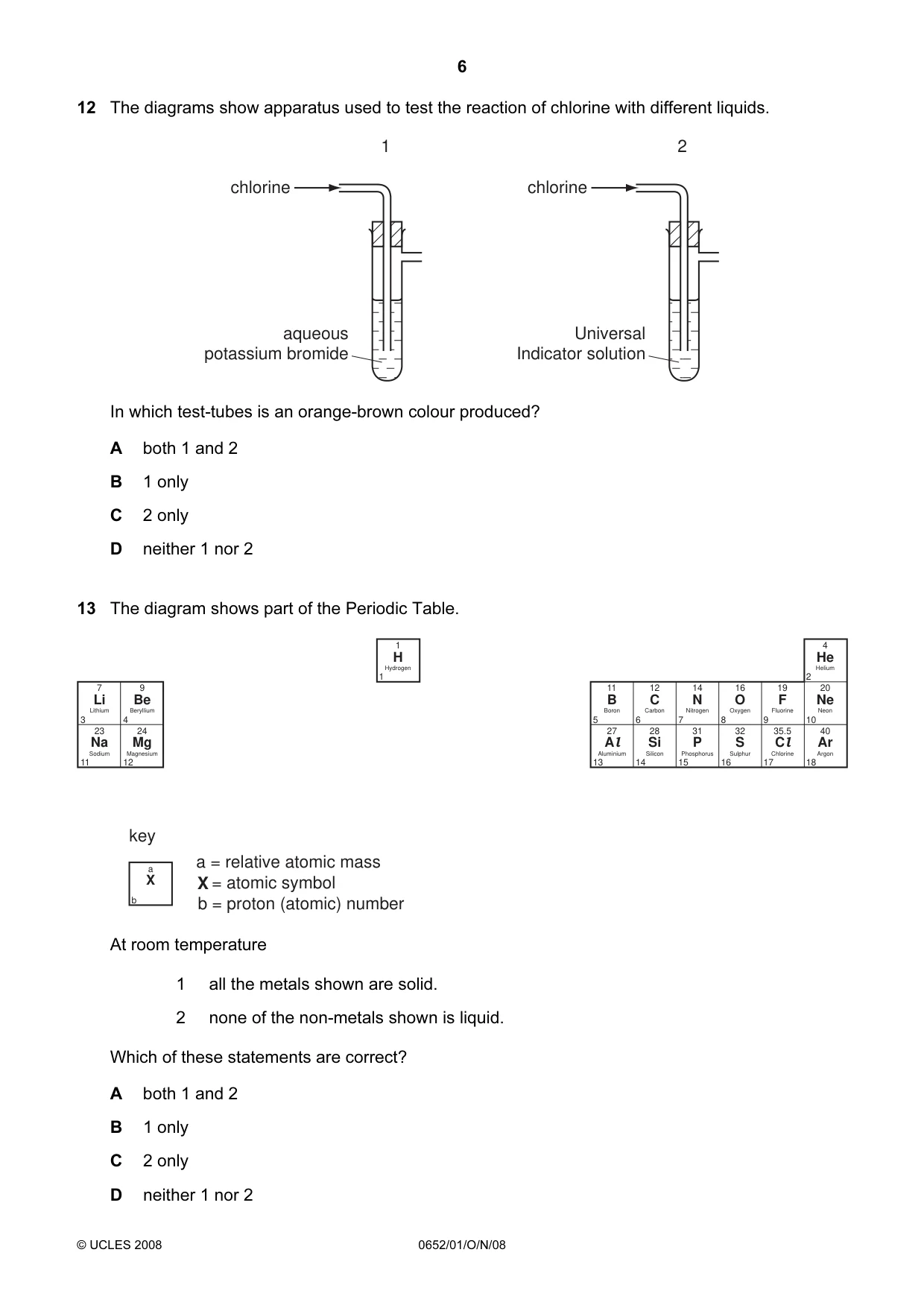
12 The diagrams show apparatus used to test the reaction of chlorine with different liquids. 1 2 chlorine chlorine aqueous Universal potassium bromide Indicator solution In which test-tubes is an orange-brown colour produced? A both 1 and 2 B 1 only C 2 only D neither 1 nor 2
Mark scheme: B
Q13 · The diagram shows part of the Periodic Table
13 The diagram shows part of the Periodic Table. 1 4 H He 1 Hydrogen 2 Helium 7 9 11 12 14 16 19 20 Li Be B C N O F Ne 3 Lithium 4 Beryllium 5 Boron 6 Carbon 7 Nitrogen 8 Oxygen 9 Fluorine 10 Neon 23 24 27 28 31 32 35.5 40 Na Mg Al Si P S Cl Ar 11 Sodium 12 Magnesium 13 Aluminium 14 Silicon 15 Phosphorus 16 Sulphur 17 Chlorine 18 Argon key a = relative atomic mass a X X = atomic symbol b b = proton (atomic) number At room temperature 1 all the metals shown are solid. 2 none of the non-metals shown is liquid. Which of these statements are correct? A both 1 and 2 B 1 only C 2 only D neither 1 nor 2
Mark scheme: A
Q14 · Which of the oxides CuO, MgO and Na2O can be reduced by heating with carbon?
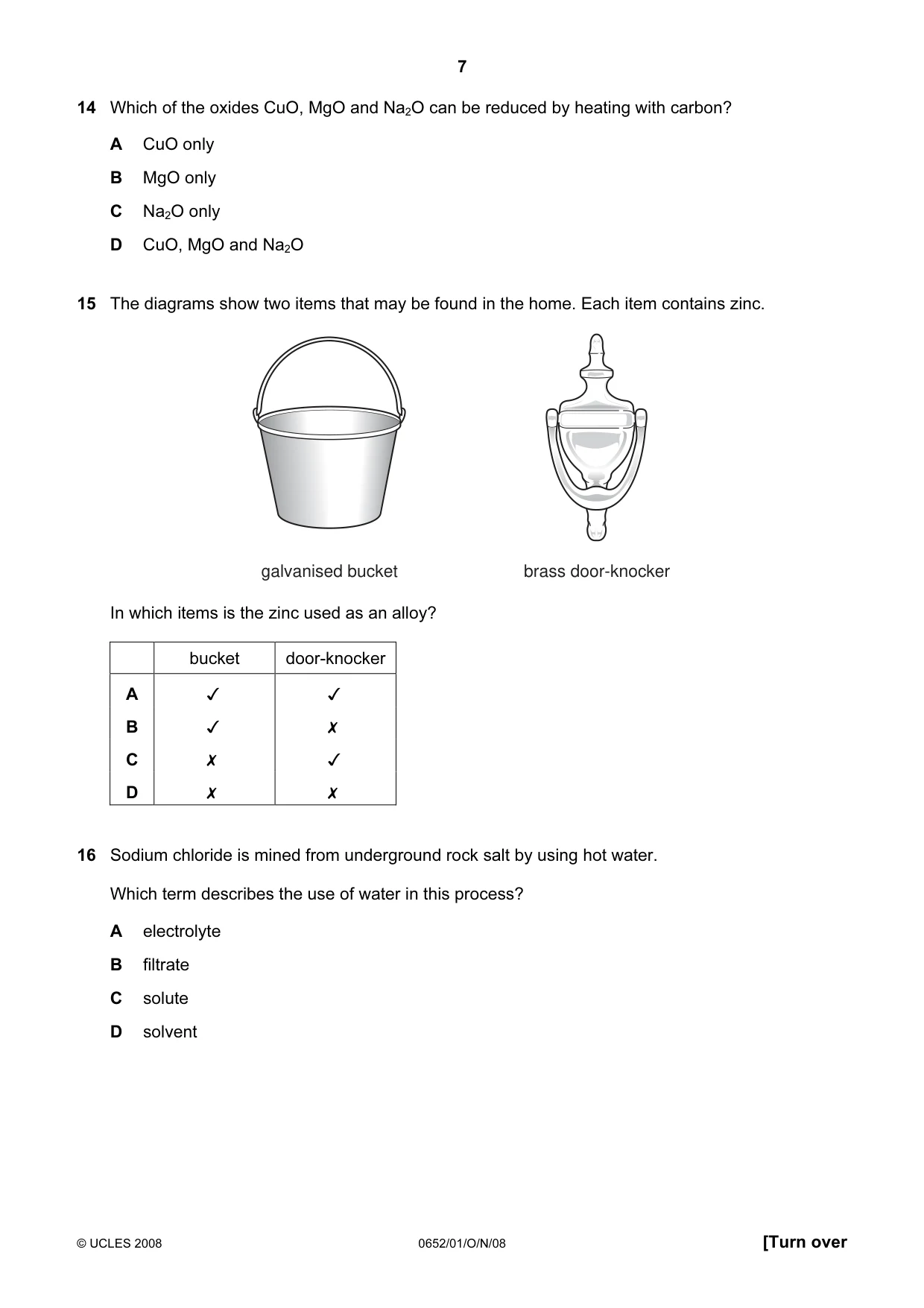
14 Which of the oxides CuO, MgO and Na2O can be reduced by heating with carbon? A CuO only B MgO only C Na2O only D CuO, MgO and Na2O
Mark scheme: A
Q15 · The diagrams show two items that may be found in the home
15 The diagrams show two items that may be found in the home. Each item contains zinc. galvanised bucket brass door-knocker In which items is the zinc used as an alloy? bucket door-knocker A v v B v x Cc x v D x x
Mark scheme: C
Q16 · Sodium chloride is mined from underground rock salt by using hot water
16 Sodium chloride is mined from underground rock salt by using hot water. Which term describes the use of water in this process? A electrolyte B filtrate C solute D solvent
Mark scheme: D
Q17 · What is acetylene used for?
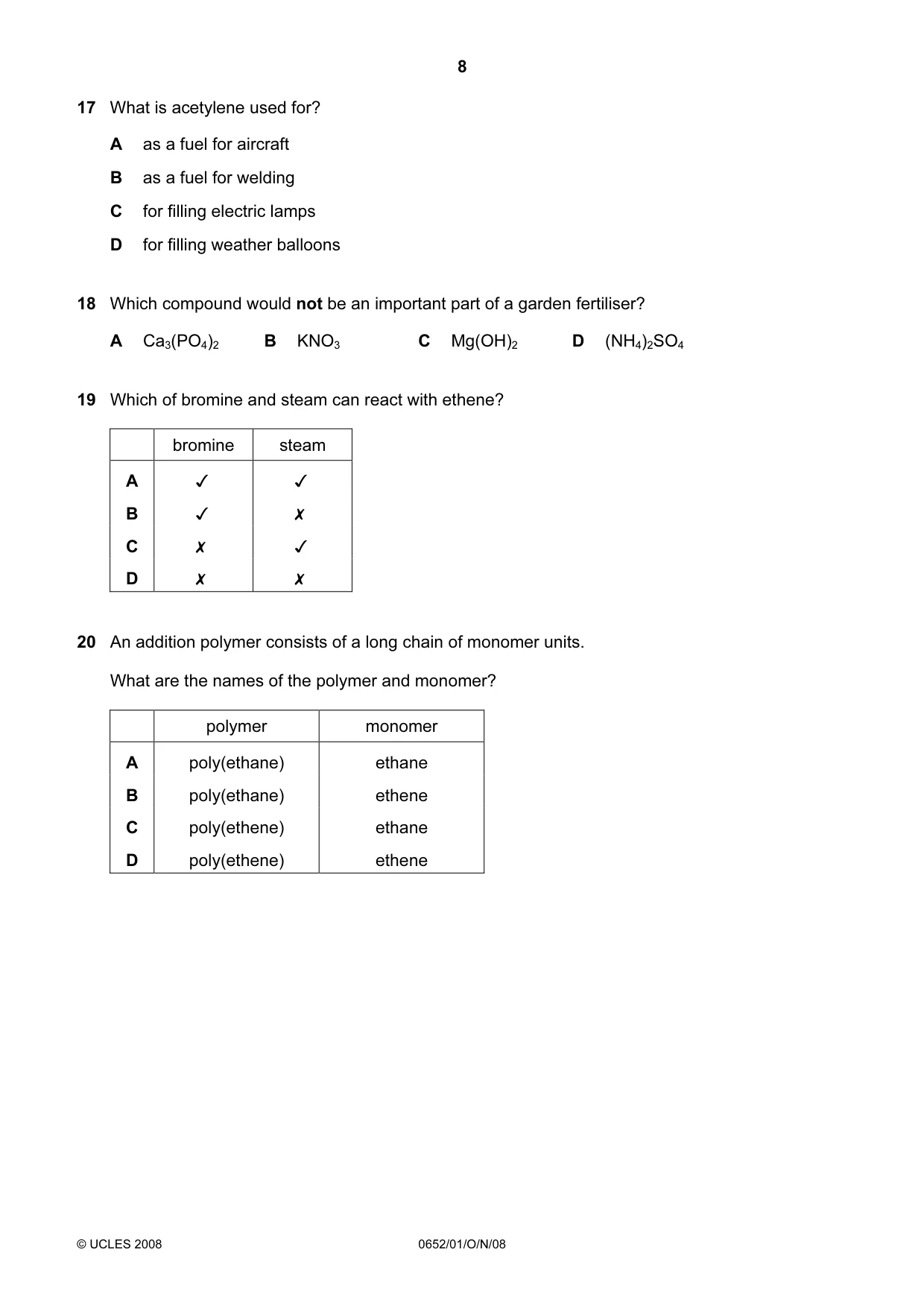
17 What is acetylene used for? A as a fuel for aircraft B as a fuel for welding C for filling electric lamps D for filling weather balloons
Mark scheme: B
Q18 · Which compound would not be an important part of a garden fertiliser?
18 Which compound would not be an important part of a garden fertiliser? A Ca3(PO4)2 B KNO3 C Mg(OH)2 D (NH4)2SO4
Mark scheme: C
Q19 · Which of bromine and steam can react with ethene?
19 Which of bromine and steam can react with ethene? bromine steam v v 0 0O WwW D> v x x v x x
Mark scheme: A
Q20 · An addition polymer consists of a long chain of monomer units
20 An addition polymer consists of a long chain of monomer units. What are the names of the polymer and monomer? polymer monomer A poly(ethane) ethane B poly(ethane) ethene C poly(ethene) ethane D poly(ethene) ethene
Mark scheme: D
Q21 · Two digital stopwatches X and Y, which record in minutes and seconds, are used to time a…
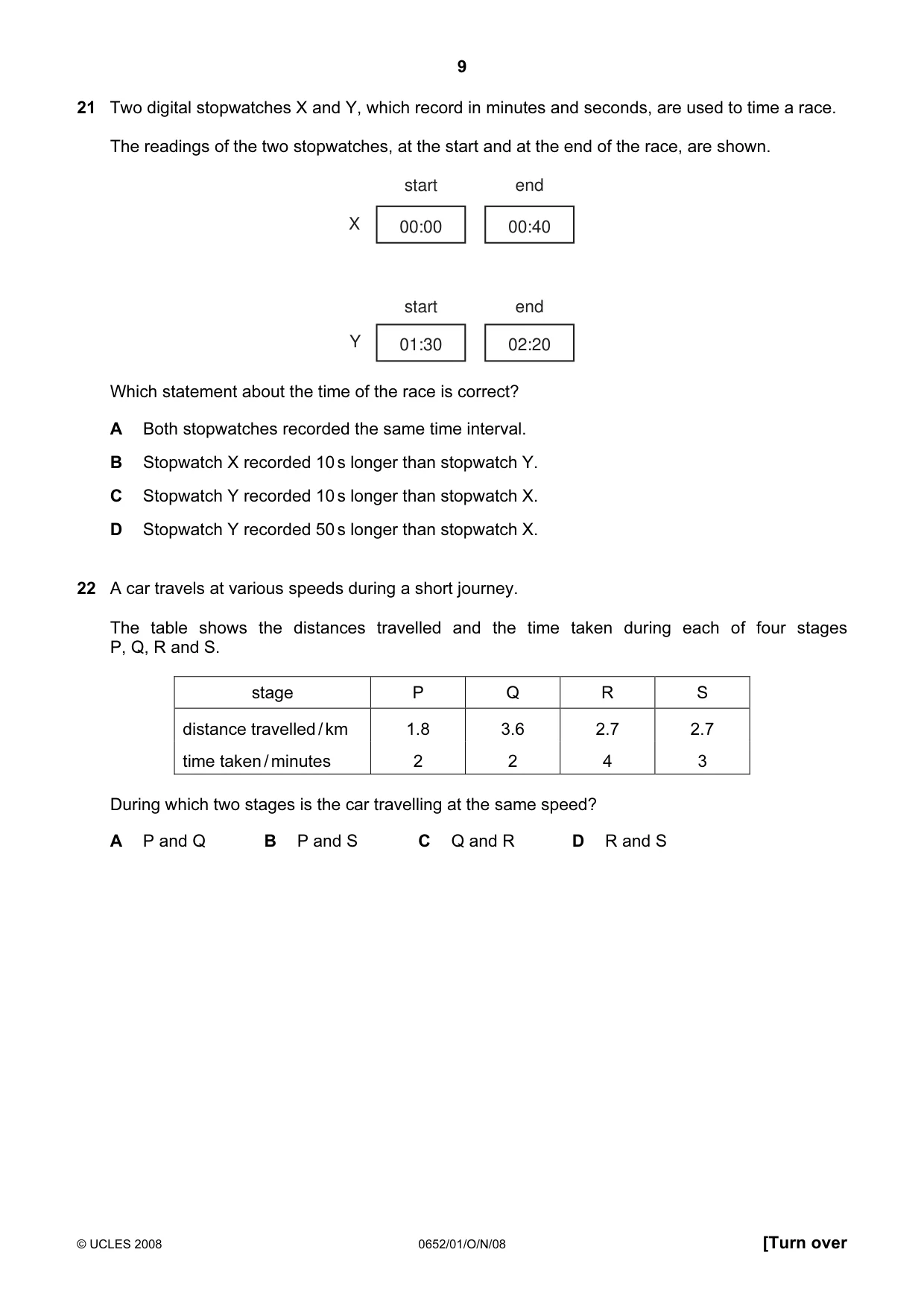
21 Two digital stopwatches X and Y, which record in minutes and seconds, are used to time a race. The readings of the two stopwatches, at the start and at the end of the race, are shown. start end X 00:00 00:40 start end Y 01:30 02:20 Which statement about the time of the race is correct? A Both stopwatches recorded the same time interval. B Stopwatch X recorded 10 s longer than stopwatch Y. C Stopwatch Y recorded 10 s longer than stopwatch X. D Stopwatch Y recorded 50 s longer than stopwatch X.
Mark scheme: C
Q22 · A car travels at various speeds during a short journey
22 A car travels at various speeds during a short journey. The table shows the distances travelled and the time taken during each of four stages P, Q, R and S. stage P Q R S distance travelled / km 1.8 3.6 2.7 2.7 time taken / minutes 2 2 4 3 During which two stages is the car travelling at the same speed? A P and Q B P and S C Q and R D R and S
Mark scheme: B
Q23 · Two identical measuring cylinders containing different liquids are placed on a simple…
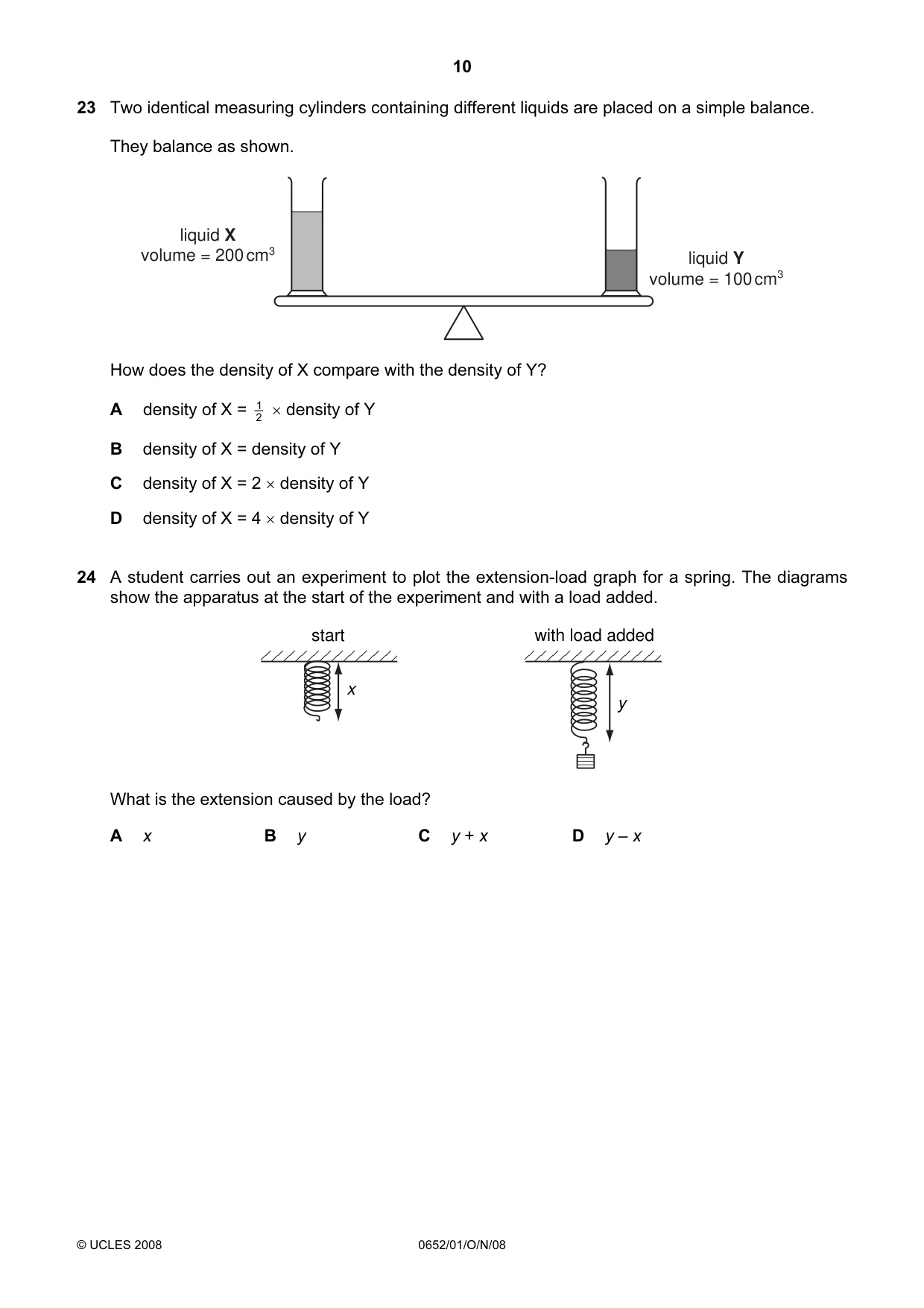
23 Two identical measuring cylinders containing different liquids are placed on a simple balance. They balance as shown. liquid X volume = 200 cm3 liquid Y volume = 100 cm3 How does the density of X compare with the density of Y? A density of X = 2 1 × density of Y B density of X = density of Y C density of X = 2 × density of Y D density of X = 4 × density of Y
Mark scheme: A
Q24 · A student carries out an experiment to plot the extension-load graph for a spring
24 A student carries out an experiment to plot the extension-load graph for a spring. The diagrams show the apparatus at the start of the experiment and with a load added. start with load added x y What is the extension caused by the load? A x B y C y + x D y – x
Mark scheme: D
Q25 · A train is travelling along a horizontal track at constant speed
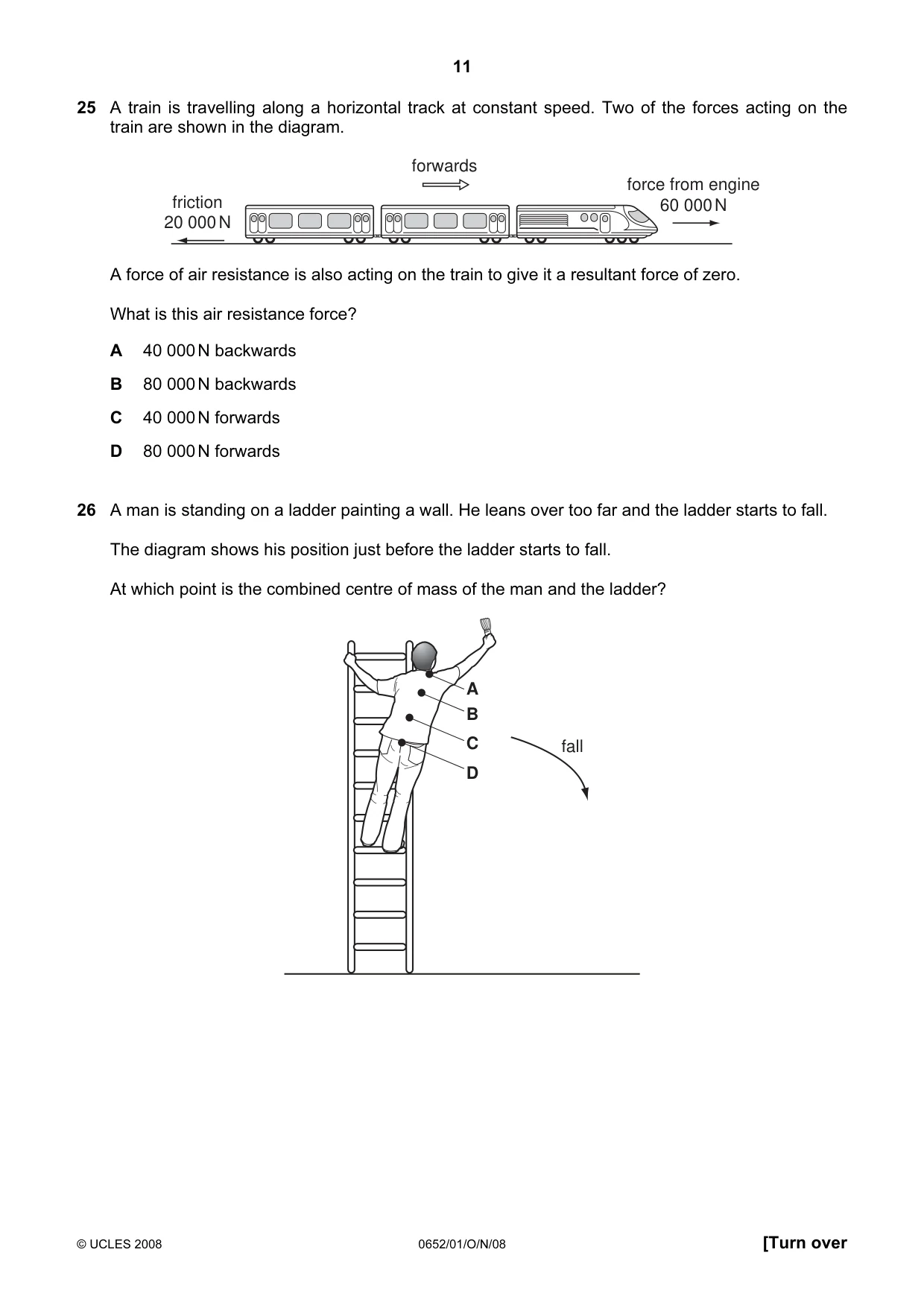
25 A train is travelling along a horizontal track at constant speed. Two of the forces acting on the train are shown in the diagram. forwards force from engine friction 60 000 N 20 000 N A force of air resistance is also acting on the train to give it a resultant force of zero. What is this air resistance force? A 40 000 N backwards B 80 000 N backwards C 40 000 N forwards D 80 000 N forwards
Mark scheme: A
Q26 · A man is standing on a ladder painting a wall
26 A man is standing on a ladder painting a wall. He leans over too far and the ladder starts to fall. The diagram shows his position just before the ladder starts to fall. At which point is the combined centre of mass of the man and the ladder? A B C fall D
Mark scheme: C
Q27 · A rubber ball is dropped from a height of 2 metres onto a table
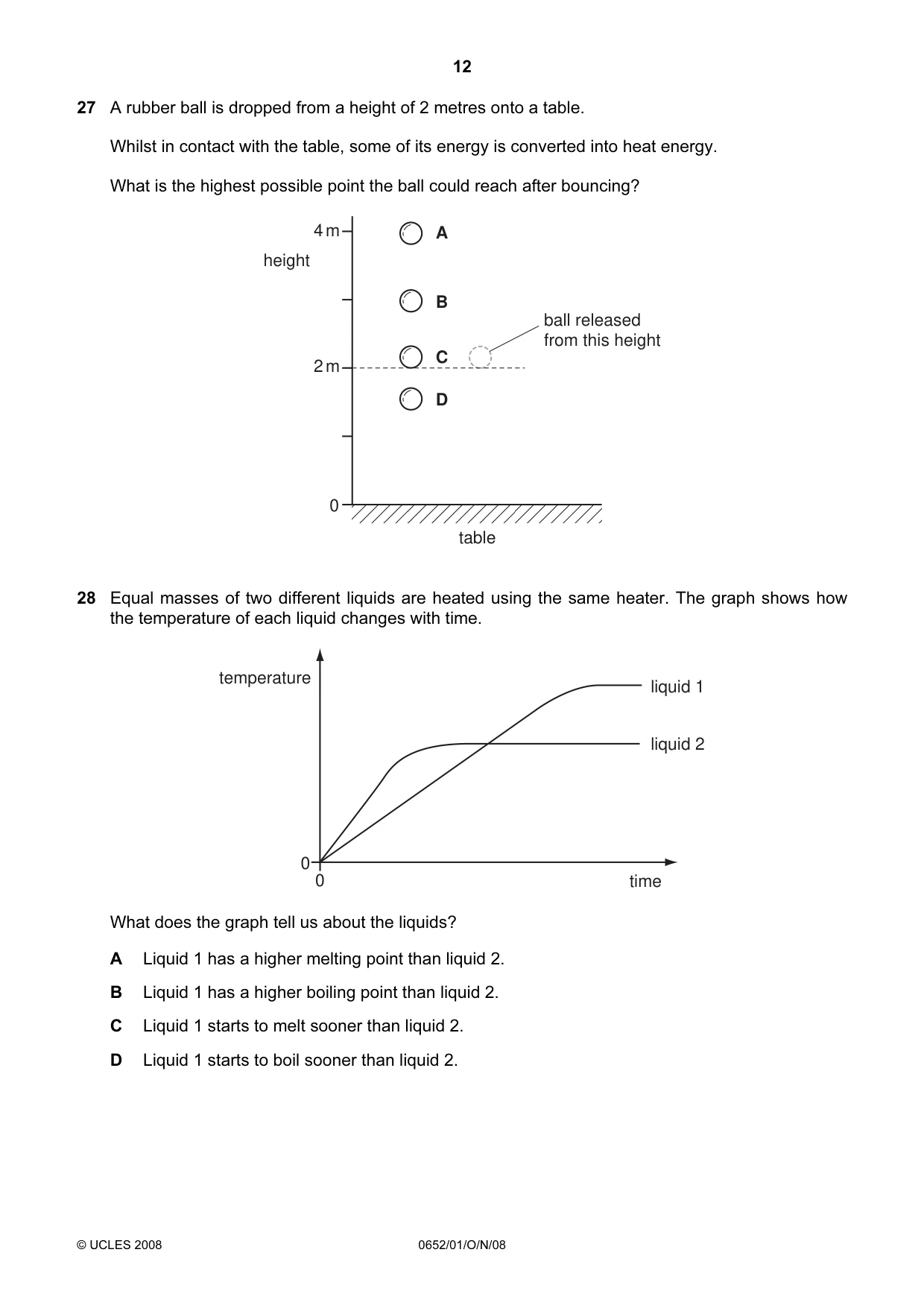
27 A rubber ball is dropped from a height of 2 metres onto a table. Whilst in contact with the table, some of its energy is converted into heat energy. What is the highest possible point the ball could reach after bouncing? 4 m A height B ball released from this height C 2 m D 0 table
Mark scheme: D
Q28 · Equal masses of two different liquids are heated using the same heater
28 Equal masses of two different liquids are heated using the same heater. The graph shows how the temperature of each liquid changes with time. temperature liquid 1 liquid 2 0 0 time What does the graph tell us about the liquids? A Liquid 1 has a higher melting point than liquid 2. B Liquid 1 has a higher boiling point than liquid 2. C Liquid 1 starts to melt sooner than liquid 2. D Liquid 1 starts to boil sooner than liquid 2.
Mark scheme: B
Q29 · An engineer wants to fix a steel washer on to a steel rod
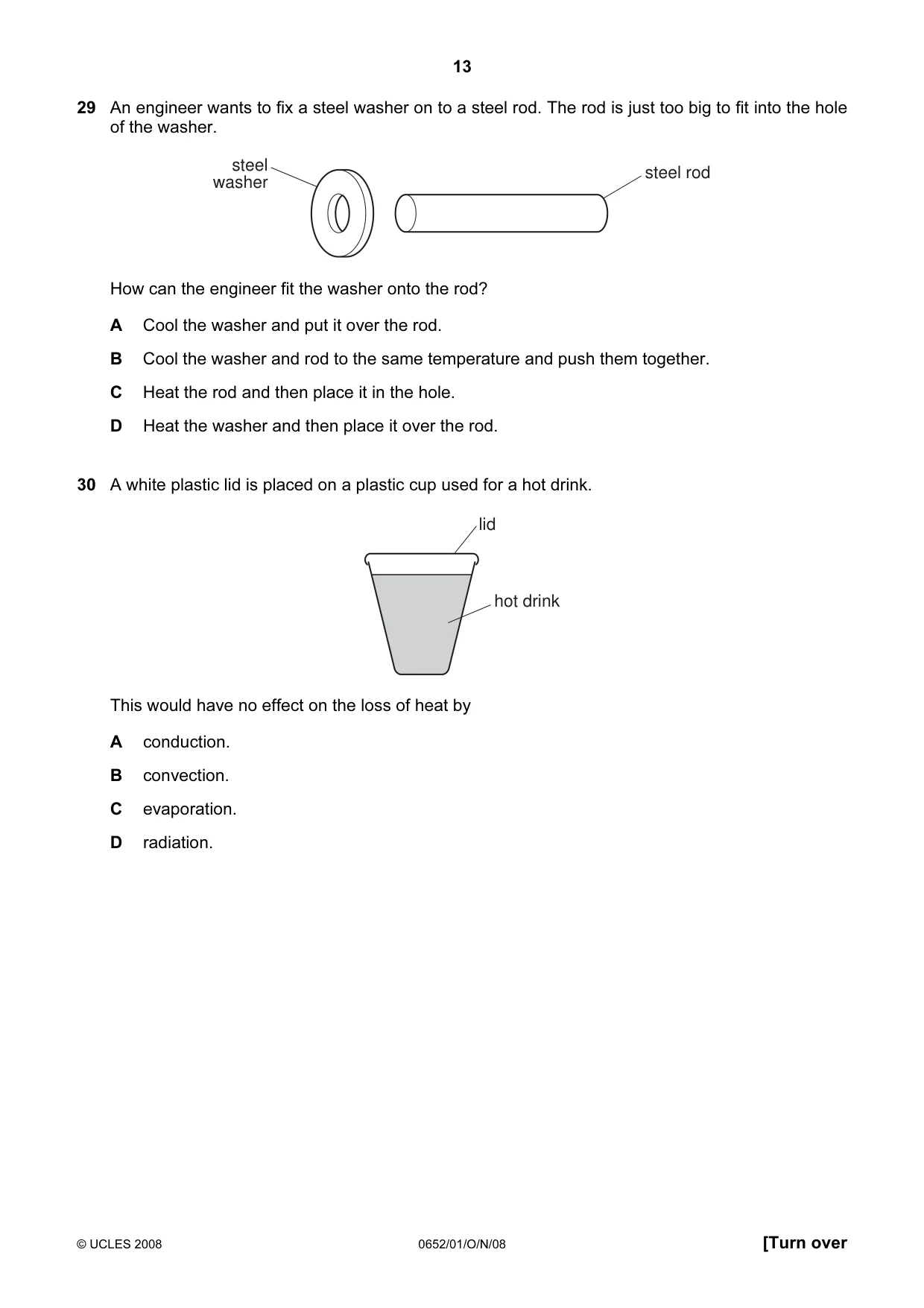
29 An engineer wants to fix a steel washer on to a steel rod. The rod is just too big to fit into the hole of the washer. steel steel rod washer How can the engineer fit the washer onto the rod? A Cool the washer and put it over the rod. B Cool the washer and rod to the same temperature and push them together. C Heat the rod and then place it in the hole. D Heat the washer and then place it over the rod.
Mark scheme: D
Q30 · A white plastic lid is placed on a plastic cup used for a hot drink
30 A white plastic lid is placed on a plastic cup used for a hot drink. lid hot drink This would have no effect on the loss of heat by A conduction. B convection. C evaporation. D radiation.
Mark scheme: A
Q31 · Waves in a tank pass from shallow to deep water
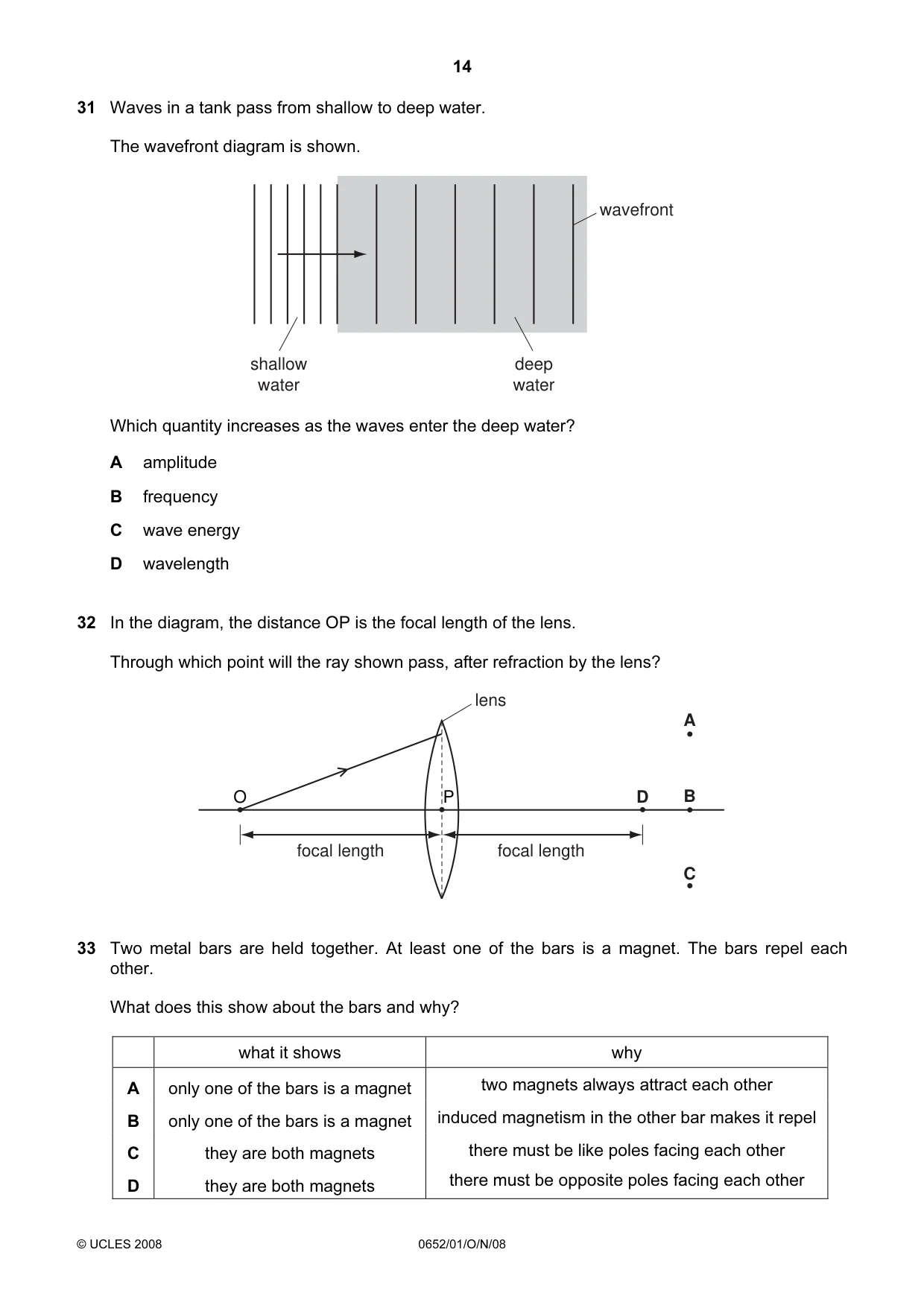
31 Waves in a tank pass from shallow to deep water. The wavefront diagram is shown. wavefront shallow deep water water Which quantity increases as the waves enter the deep water? A amplitude B frequency C wave energy D wavelength
Mark scheme: D
Q32 · In the diagram, the distance OP is the focal length of the lens
32 In the diagram, the distance OP is the focal length of the lens. Through which point will the ray shown pass, after refraction by the lens? lens A O P D B focal length focal length C
Mark scheme: A
Q33 · Two metal bars are held together
33 Two metal bars are held together. At least one of the bars is a magnet. The bars repel each other. What does this show about the bars and why? what it shows why A only one of the bars is a magnet two magnets always attract each other B only one of the bars is a magnet induced magnetism in the other bar makes it repel C they are both magnets there must be like poles facing each other D they are both magnets there must be opposite poles facing each other
Mark scheme: C
Q34 · Two charged balls P and Q are hung, one above the other, from nylon threads
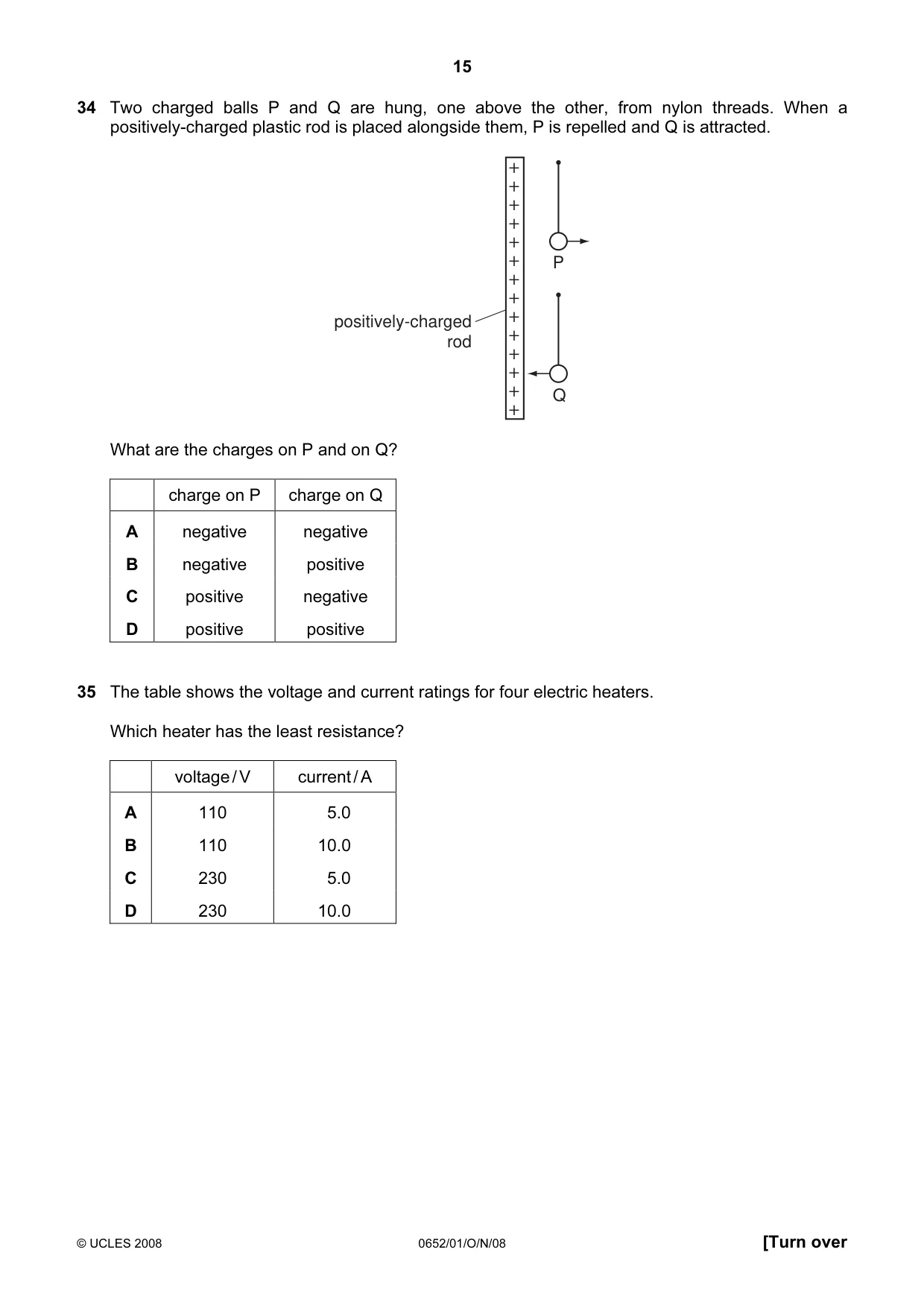
34 Two charged balls P and Q are hung, one above the other, from nylon threads. When a positively-charged plastic rod is placed alongside them, P is repelled and Q is attracted. + + + + + + P + + positively-charged + + rod + + + Q + What are the charges on P and on Q? charge on P charge on Q A negative negative B negative positive C positive negative D positive positive
Mark scheme: C
Q35 · The table shows the voltage and current ratings for four electric heaters
35 The table shows the voltage and current ratings for four electric heaters. Which heater has the least resistance? voltage / V current / A A 110 5.0 B 110 10.0 C 230 5.0 D 230 10.0
Mark scheme: B
Q36 · In the circuit below, X and Y are identical 6 V lamps
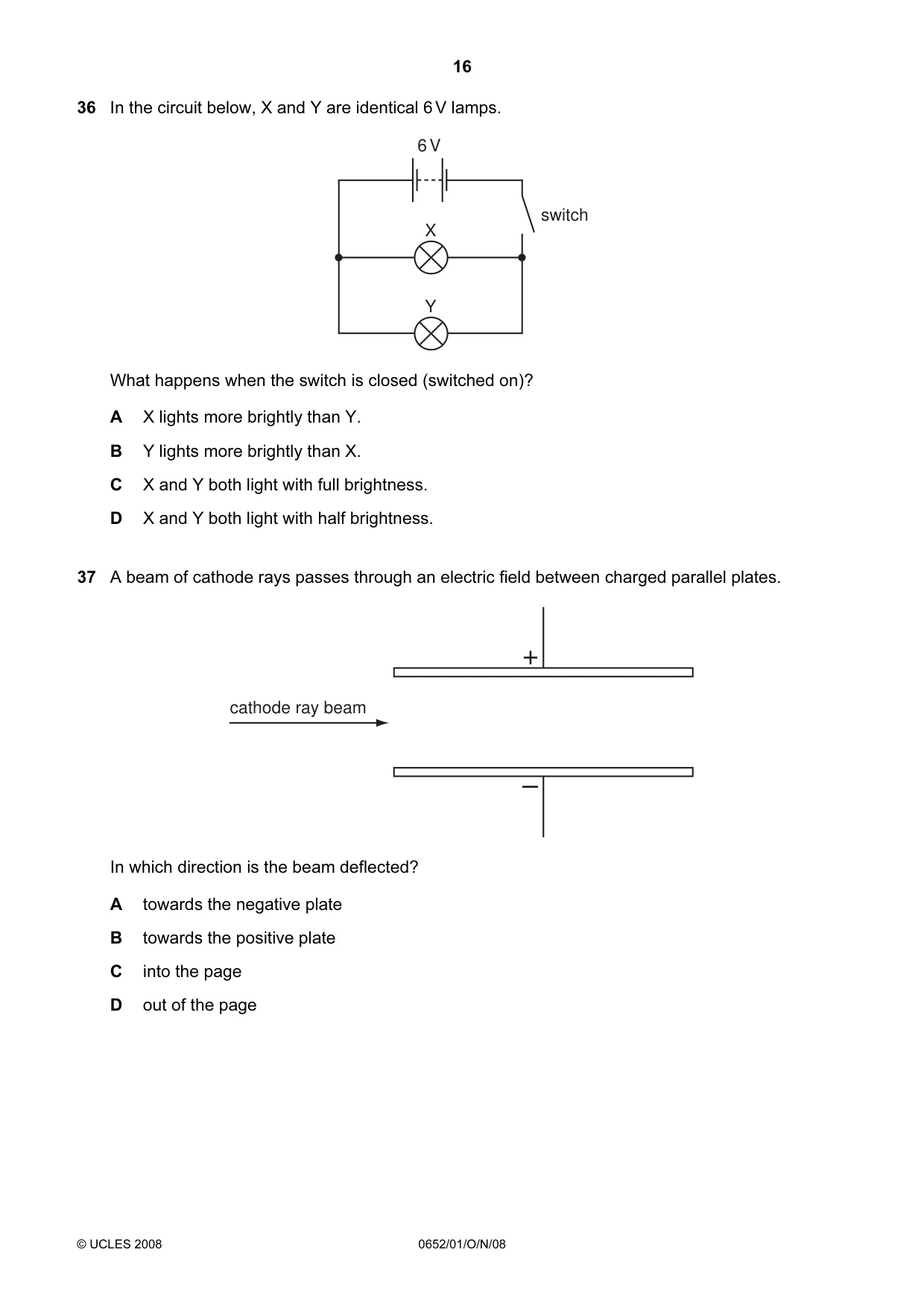
36 In the circuit below, X and Y are identical 6 V lamps. 6 V switch X Y What happens when the switch is closed (switched on)? A X lights more brightly than Y. B Y lights more brightly than X. C X and Y both light with full brightness. D X and Y both light with half brightness.
Mark scheme: C
Q37 · A beam of cathode rays passes through an electric field between charged parallel plates
37 A beam of cathode rays passes through an electric field between charged parallel plates. + cathode ray beam – In which direction is the beam deflected? A towards the negative plate B towards the positive plate C into the page D out of the page
Mark scheme: B
Q38 · Which material is commonly used as a lining for a box for storing radioactive samples?
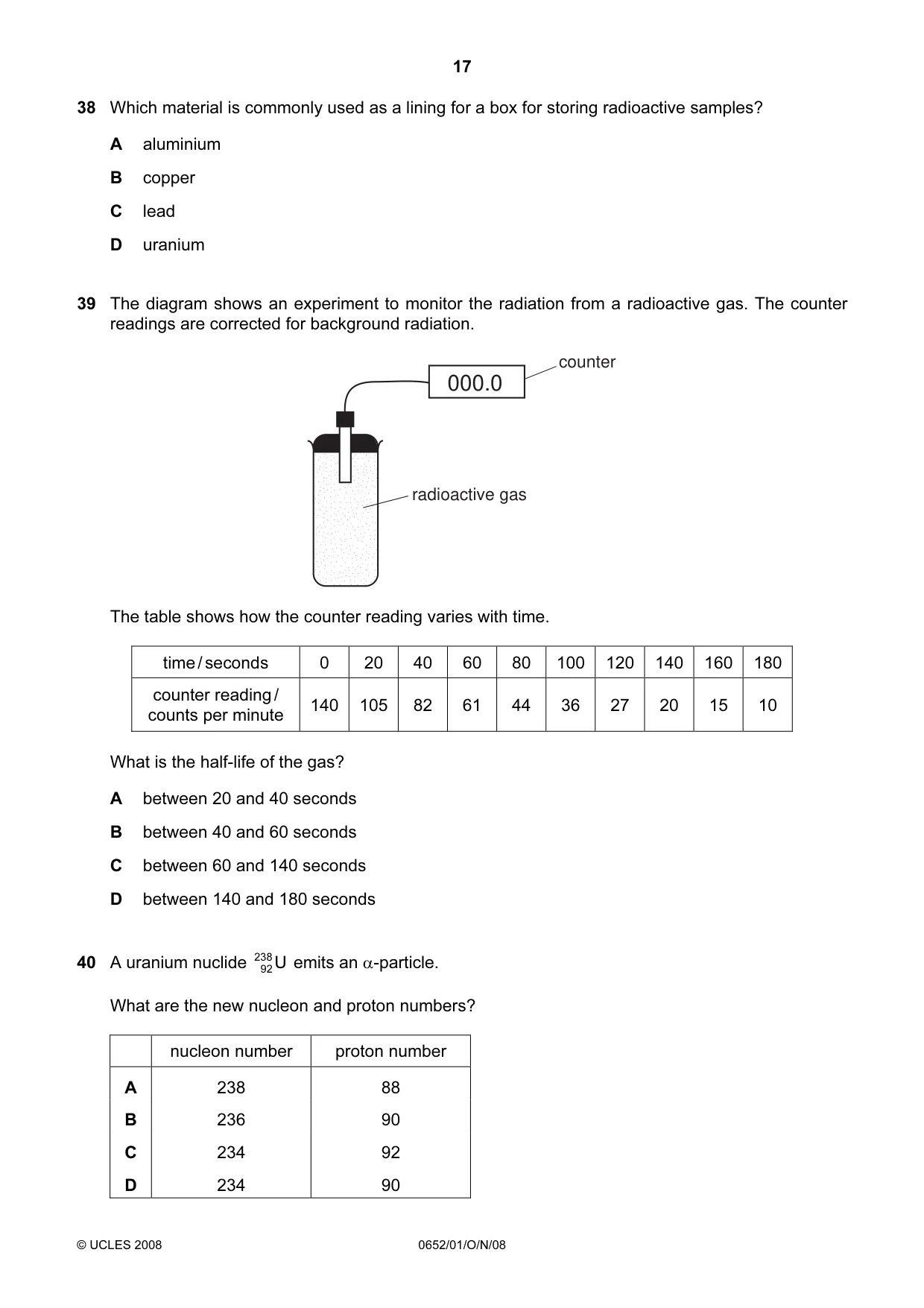
38 Which material is commonly used as a lining for a box for storing radioactive samples? A aluminium B copper C lead D uranium
Mark scheme: C
Q39 · The diagram shows an experiment to monitor the radiation from a radioactive gas
39 The diagram shows an experiment to monitor the radiation from a radioactive gas. The counter readings are corrected for background radiation. counter 000.0 radioactive gas The table shows how the counter reading varies with time. time / seconds 0 20 40 60 80 100 120 140 160 180 counter reading / 140 105 82 61 44 36 27 20 15 10 counts per minute What is the half-life of the gas? A between 20 and 40 seconds B between 40 and 60 seconds C between 60 and 140 seconds D between 140 and 180 seconds
Mark scheme: B
Q40 · A uranium nuclide 238 U emits an α-particle
40 A uranium nuclide 238 U emits an α-particle. 92 What are the new nucleon and proton numbers? nucleon number proton number A 238 88 B 236 90 C 234 92 D 234 90
Mark scheme: D
What was in this paper
The subtopics covered by these 40 questions, and how many questions each got. Open one in a new tab to see every Cambridge question on it.
3Radioactivity3Alkenes2Carbonates2Fuels2Simple phenomena of magnetism2Thermal properties and temperature2Atomic structure and the Periodic Table1Criteria of purity1Density1Electric circuits1Electrical quantities1Electricity and chemistry1Electromagnetic effects1Energetics of a reaction1Extraction of metals1General wave properties1Identification of ions and gases1Length and time1Light1Molecules and covalent bonds1Motion1Periodic Trends1Reactivity series1The particulate nature of matter1The Periodic Table1Thermal processes1Types of oxides1Uses of metals1Water1Work, energy and power1What you needed in this session
Cambridge’s own grade thresholds for 2008 Oct/Nov, Paper 1 · Variant 1. A higher threshold means an easier paper — the bar moves with how the cohort did.