Cambridge IGCSE Physical Science 0652 — 2017 Oct/Nov Paper 1 · Variant 2
0652/12/O/N/17 · 40 questions · 40 marks · ≈45 min
The question paper and its mark scheme, free to read here and free to download. This is Cambridge’s own paper, exactly as it was sat.
Question paper20 pages


Mark scheme3 pages
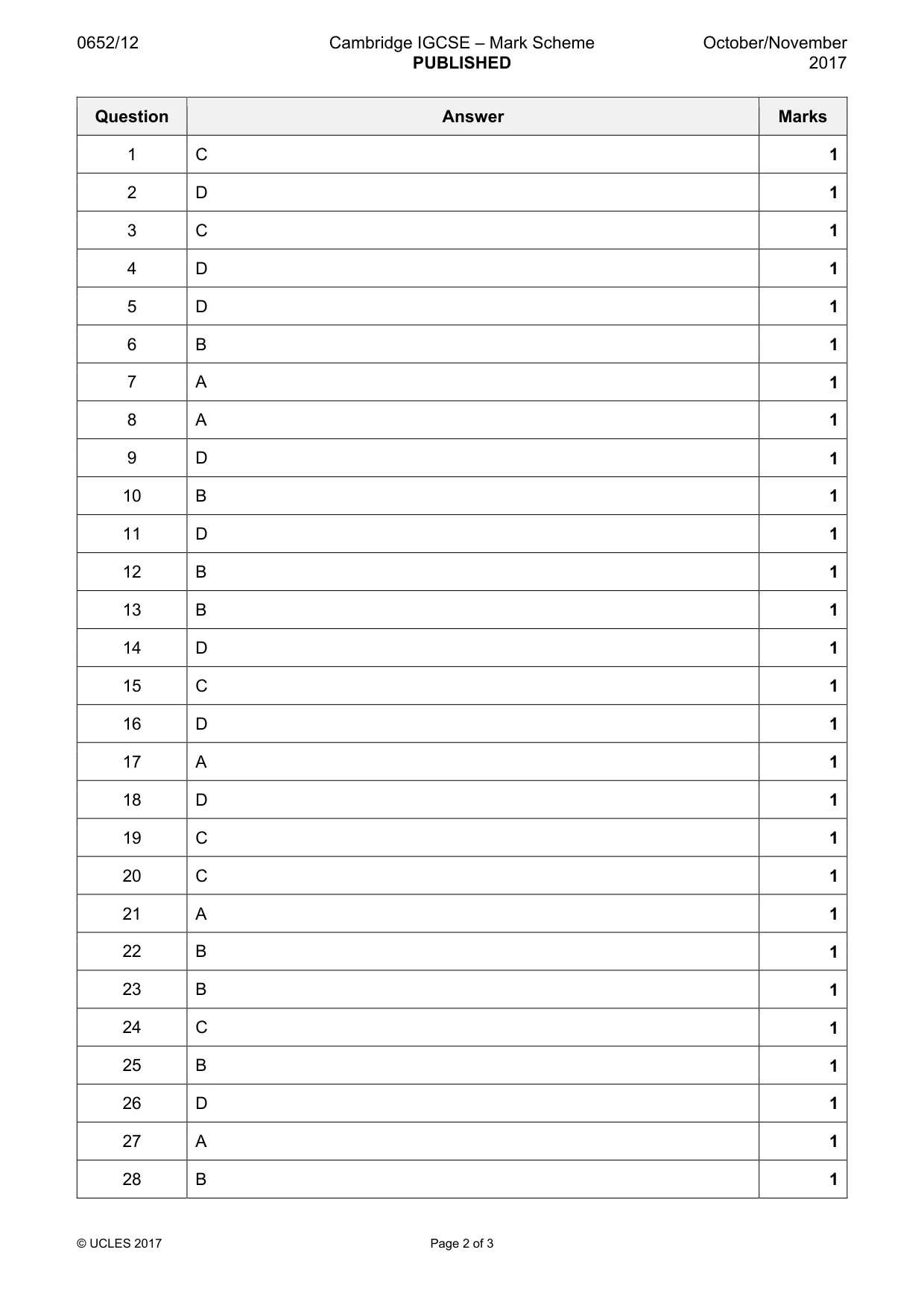
Answers below. Sit the paper first if you are practising.
Questions as text
Q1 · What is the name of the process by which gas particles move to occupy all the available…
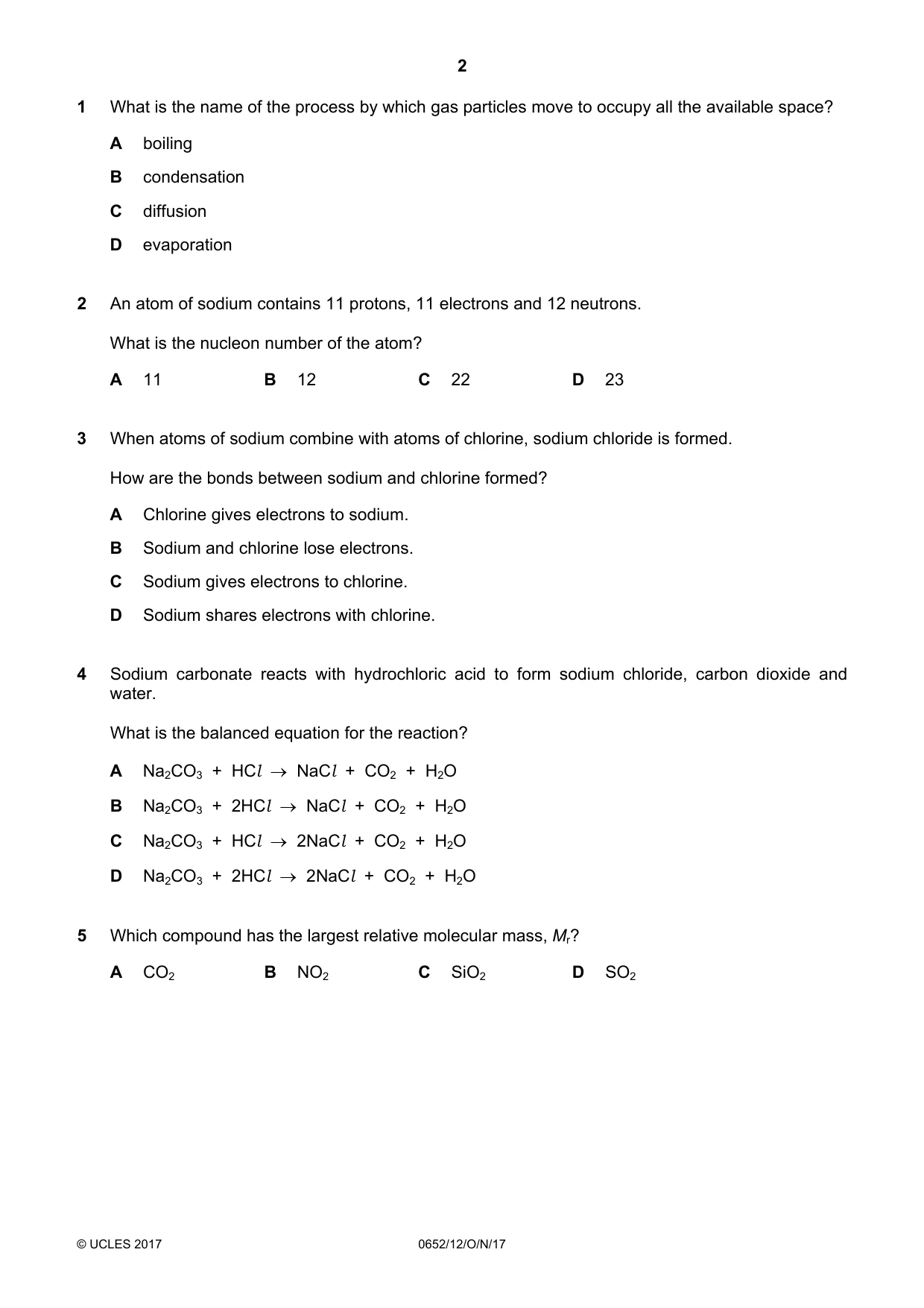
1 What is the name of the process by which gas particles move to occupy all the available space? A boiling B condensation C diffusion D evaporation
Mark scheme: C
Q2 · An atom of sodium contains 11 protons, 11 electrons and 12 neutrons
2 An atom of sodium contains 11 protons, 11 electrons and 12 neutrons. What is the nucleon number of the atom? A 11 B 12 C 22 D 23
Mark scheme: D
Q3 · When atoms of sodium combine with atoms of chlorine, sodium chloride is formed
3 When atoms of sodium combine with atoms of chlorine, sodium chloride is formed. How are the bonds between sodium and chlorine formed? A Chlorine gives electrons to sodium. B Sodium and chlorine lose electrons. C Sodium gives electrons to chlorine. D Sodium shares electrons with chlorine.
Mark scheme: C
Q4 · Sodium carbonate reacts with hydrochloric acid to form sodium chloride, carbon dioxide…
4 Sodium carbonate reacts with hydrochloric acid to form sodium chloride, carbon dioxide and water. What is the balanced equation for the reaction? A Na2CO3 + HCl → NaCl + CO2 + H2O B Na2CO3 + 2HCl → NaCl + CO2 + H2O C Na2CO3 + HCl → 2NaCl + CO2 + H2O D Na2CO3 + 2HCl → 2NaCl + CO2 + H2O
Mark scheme: D
Q5 · Which compound has the largest relative molecular mass, Mr?
5 Which compound has the largest relative molecular mass, Mr? A CO2 B NO2 C SiO2 D SO2
Mark scheme: D
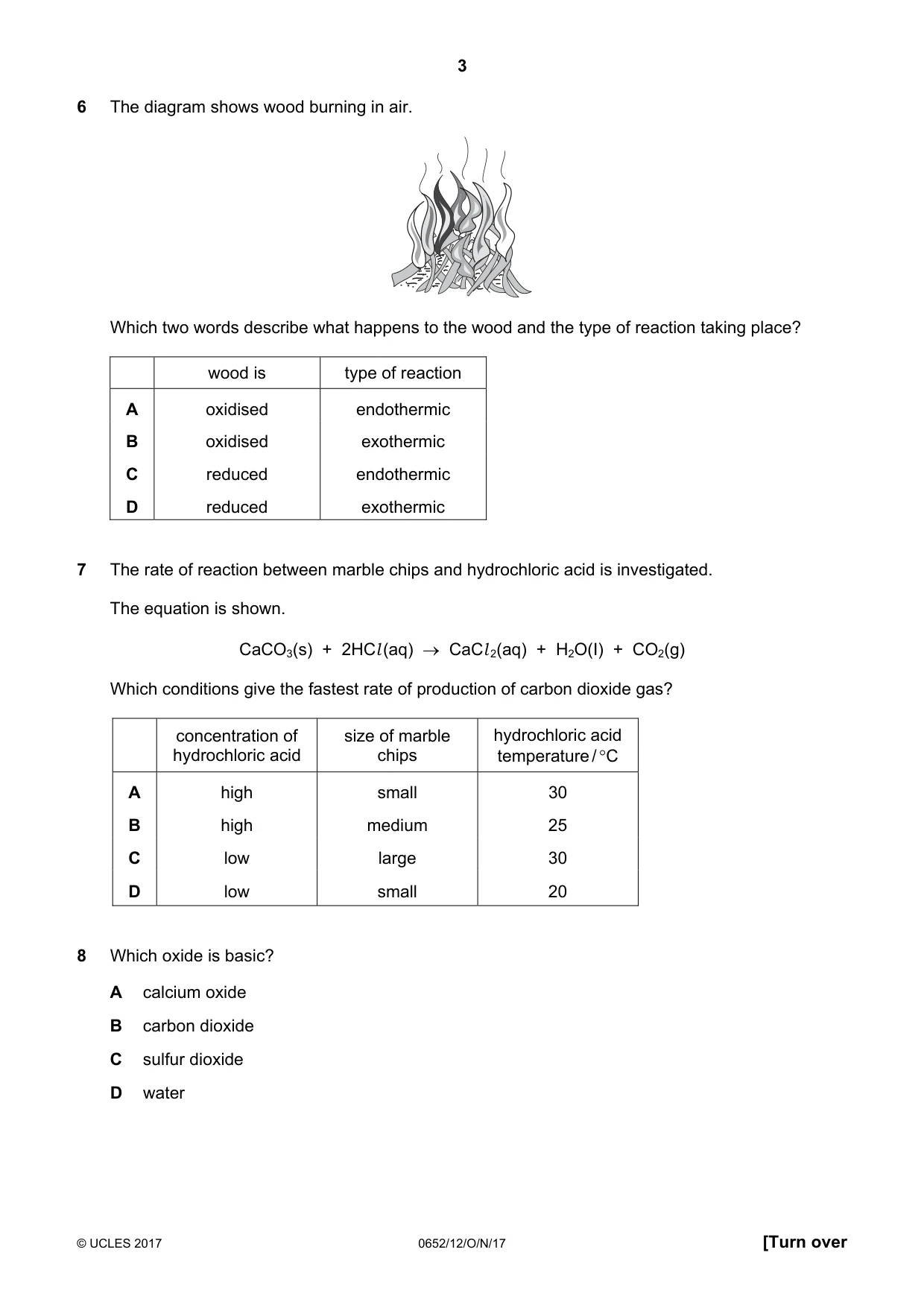
Q6 · The diagram shows wood burning in air
6 The diagram shows wood burning in air. Which two words describe what happens to the wood and the type of reaction taking place? wood is type of reaction A oxidised endothermic B oxidised exothermic C reduced endothermic D reduced exothermic
Mark scheme: B
Q7 · The rate of reaction between marble chips and hydrochloric acid is investigated
7 The rate of reaction between marble chips and hydrochloric acid is investigated. The equation is shown. CaCO3(s) + 2HCl (aq) → CaCl 2(aq) + H2O(I) + CO2(g) Which conditions give the fastest rate of production of carbon dioxide gas? concentration of size of marble hydrochloric acid hydrochloric acid chips temperature / °C A high small 30 B high medium 25 C low large 30 D low small 20
Mark scheme: A
Q8 · Which oxide is basic?
8 Which oxide is basic? A calcium oxide B carbon dioxide C sulfur dioxide D water
Mark scheme: A
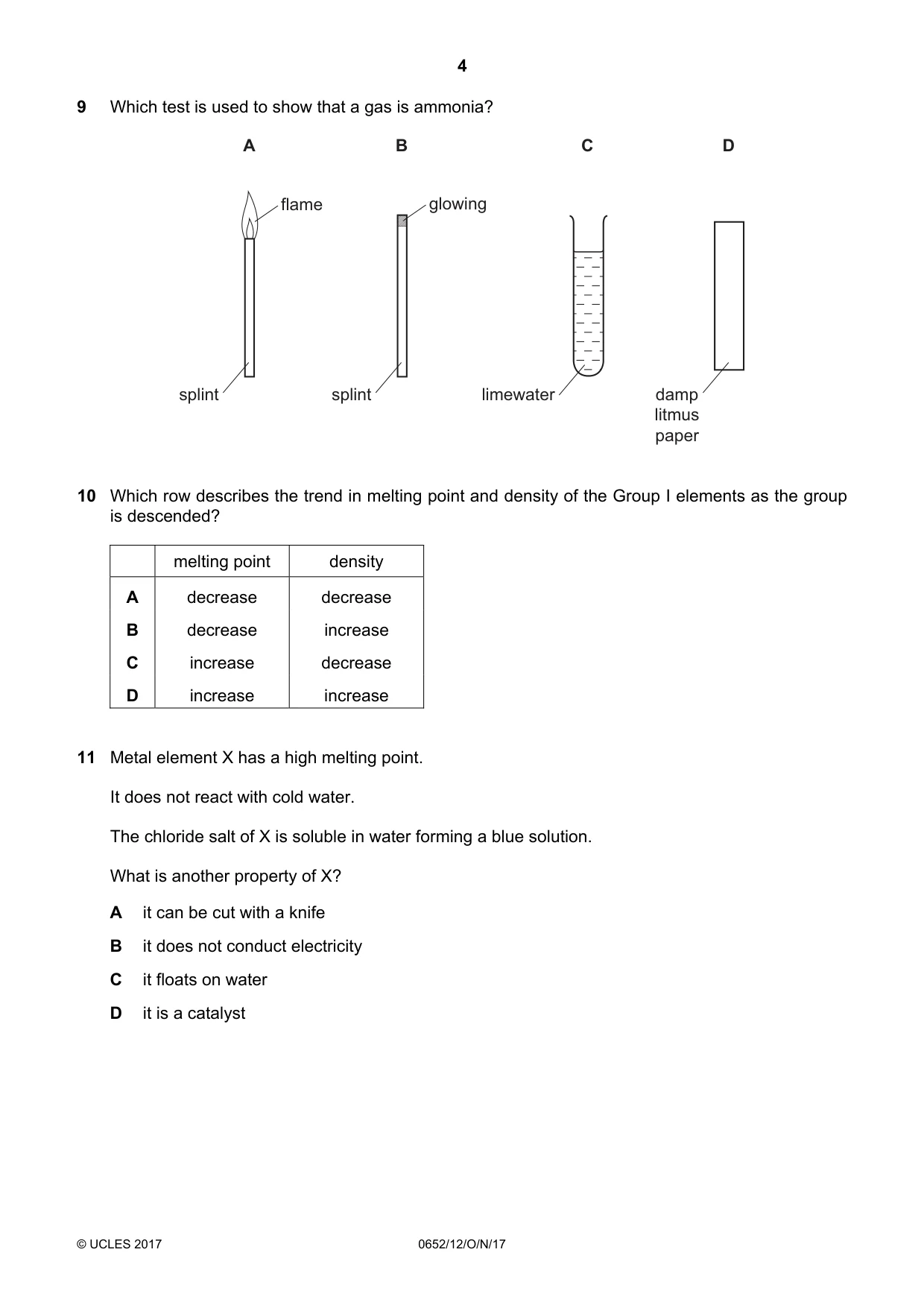
Q9 · Which test is used to show that a gas is ammonia?
9 Which test is used to show that a gas is ammonia? A B C D flame glowing splint splint limewater damp litmus paper
Mark scheme: D
Q10 · Which row describes the trend in melting point and density of the Group I elements as the…
10 Which row describes the trend in melting point and density of the Group I elements as the group is descended? melting point density A decrease decrease B decrease increase C increase decrease D increase increase
Mark scheme: B
Q11 · Metal element X has a high melting point
11 Metal element X has a high melting point. It does not react with cold water. The chloride salt of X is soluble in water forming a blue solution. What is another property of X? A it can be cut with a knife B it does not conduct electricity C it floats on water D it is a catalyst
Mark scheme: D
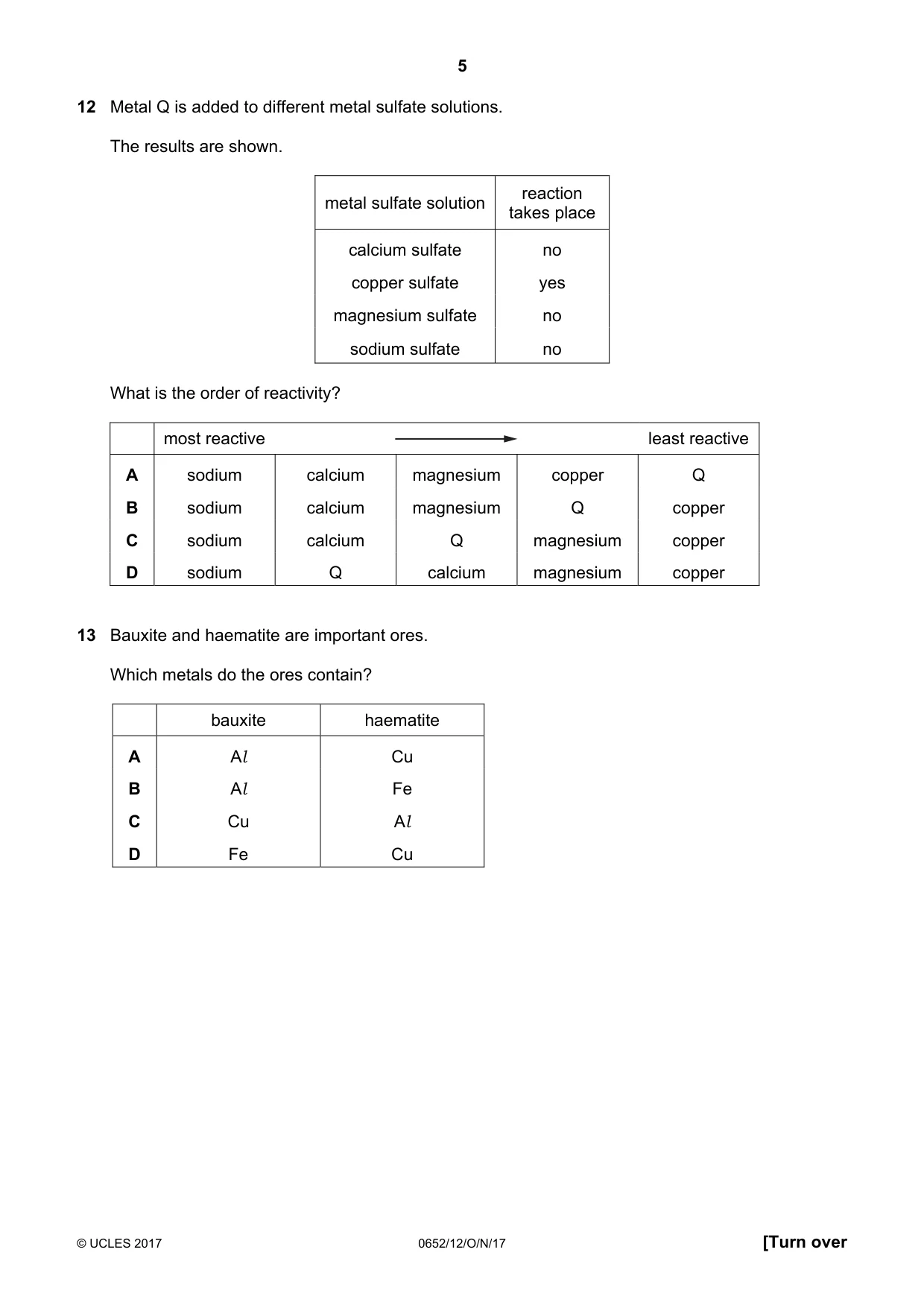
Q12 · Metal Q is added to different metal sulfate solutions
12 Metal Q is added to different metal sulfate solutions. The results are shown. reaction metal sulfate solution takes place calcium sulfate no copper sulfate yes magnesium sulfate no sodium sulfate no What is the order of reactivity? most reactive least reactive A sodium calcium magnesium copper Q B sodium calcium magnesium Q copper C sodium calcium Q magnesium copper D sodium Q calcium magnesium copper
Mark scheme: B
Q13 · Bauxite and haematite are important ores
13 Bauxite and haematite are important ores. Which metals do the ores contain? bauxite haematite A Al Cu B Al Fe C Cu Al D Fe Cu
Mark scheme: B
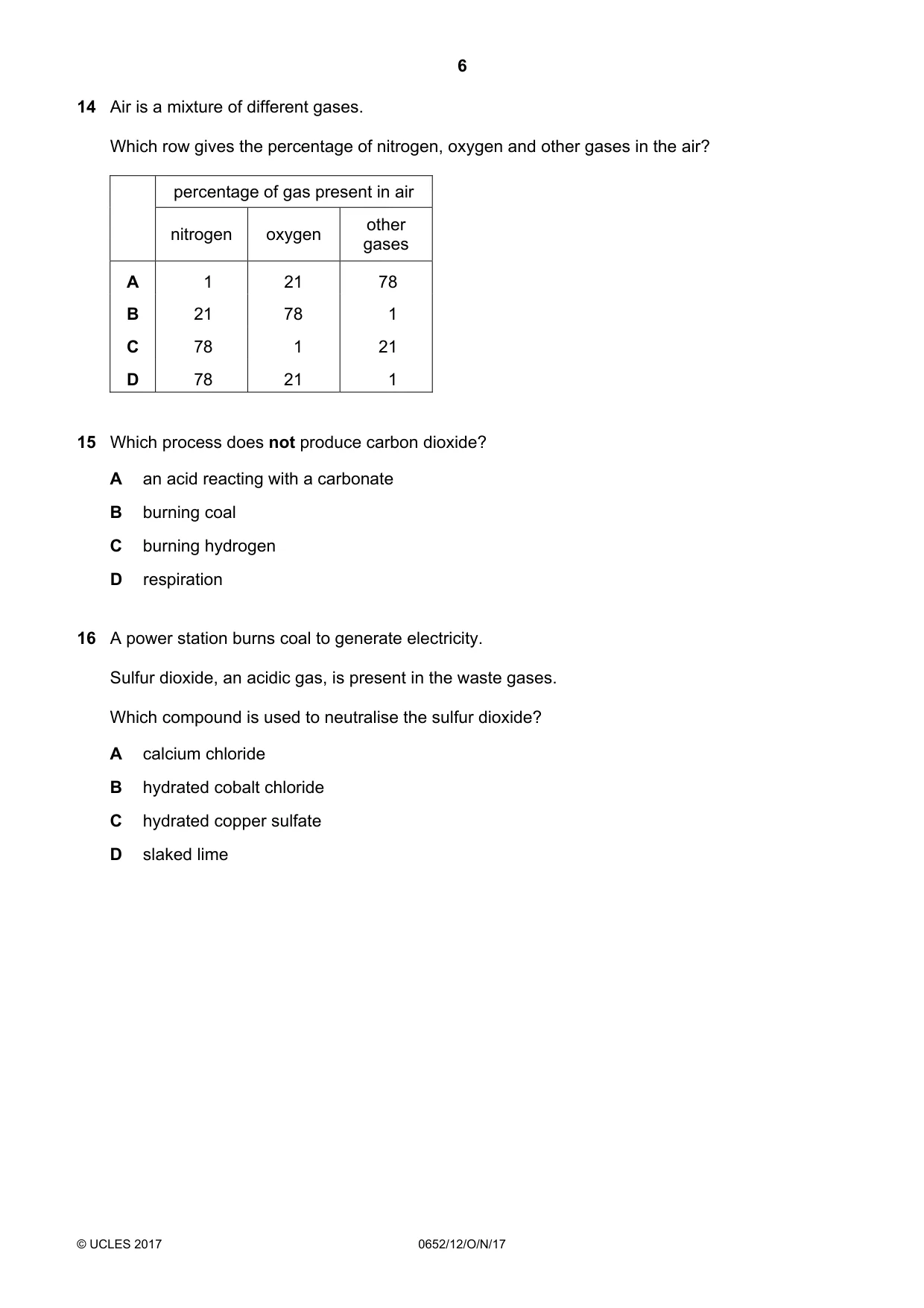
Q14 · Air is a mixture of different gases
14 Air is a mixture of different gases. Which row gives the percentage of nitrogen, oxygen and other gases in the air? percentage of gas present in air other nitrogen oxygen gases A 1 21 78 B 21 78 1 C 78 1 21 D 78 21 1
Mark scheme: D
Q15 · Which process does not produce carbon dioxide?
15 Which process does not produce carbon dioxide? A an acid reacting with a carbonate B burning coal C burning hydrogen D respiration
Mark scheme: C
Q16 · A power station burns coal to generate electricity
16 A power station burns coal to generate electricity. Sulfur dioxide, an acidic gas, is present in the waste gases. Which compound is used to neutralise the sulfur dioxide? A calcium chloride B hydrated cobalt chloride C hydrated copper sulfate D slaked lime
Mark scheme: D
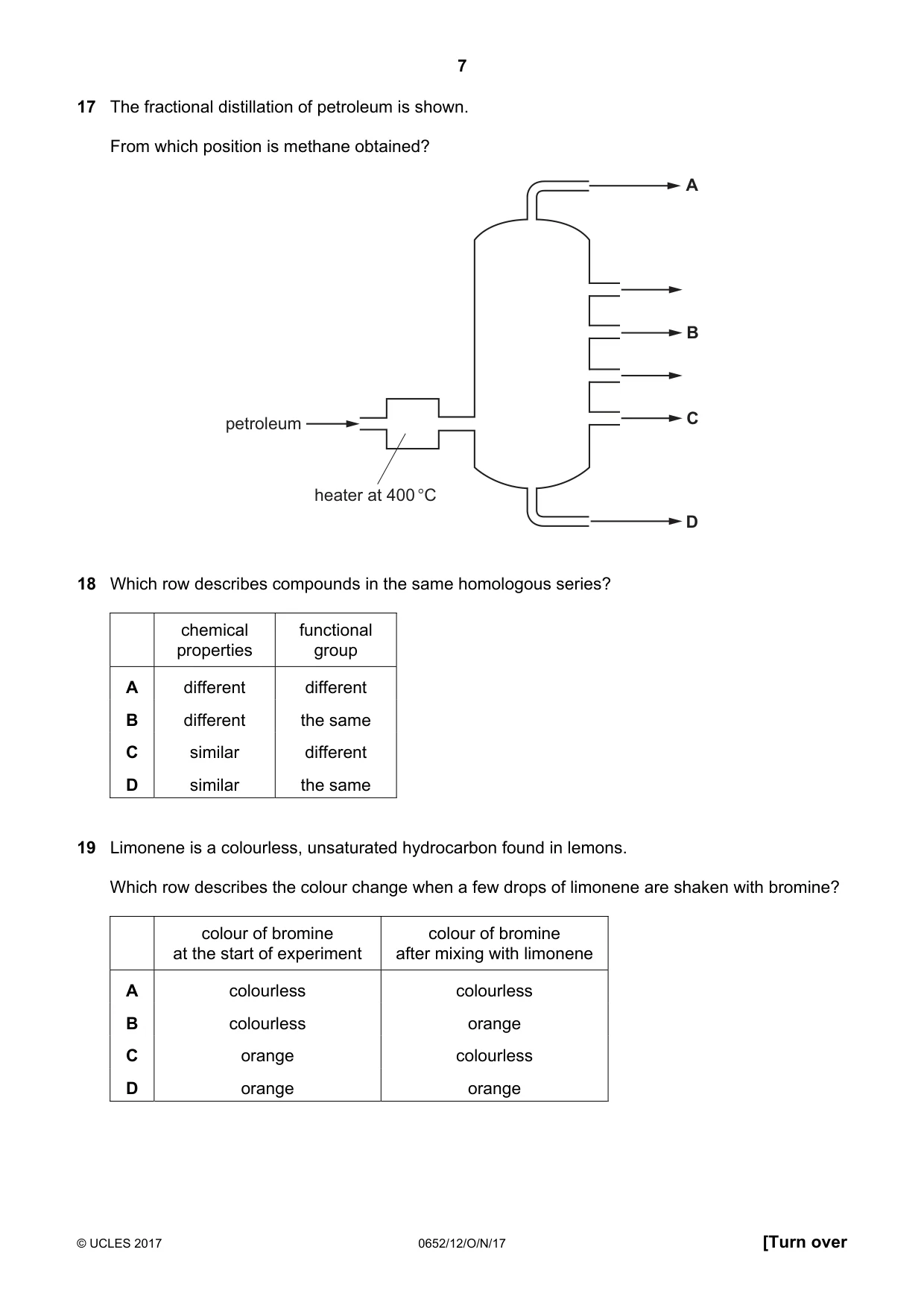
Q17 · The fractional distillation of petroleum is shown
17 The fractional distillation of petroleum is shown. From which position is methane obtained? A B C petroleum heater at 400 °C D
Mark scheme: A
Q18 · Which row describes compounds in the same homologous series?
18 Which row describes compounds in the same homologous series? chemical functional properties group A different different B different the same C similar different D similar the same
Mark scheme: D
Q19 · Limonene is a colourless, unsaturated hydrocarbon found in lemons
19 Limonene is a colourless, unsaturated hydrocarbon found in lemons. Which row describes the colour change when a few drops of limonene are shaken with bromine? colour of bromine colour of bromine at the start of experiment after mixing with limonene A colourless colourless B colourless orange C orange colourless D orange orange
Mark scheme: C
Q20 · Ethanol is an alcohol used in antibacterial wipes
20 Ethanol is an alcohol used in antibacterial wipes. What is the formula for ethanol? A C2H5O B CH3CO2H C C2H5OH D C2H4OH
Mark scheme: C
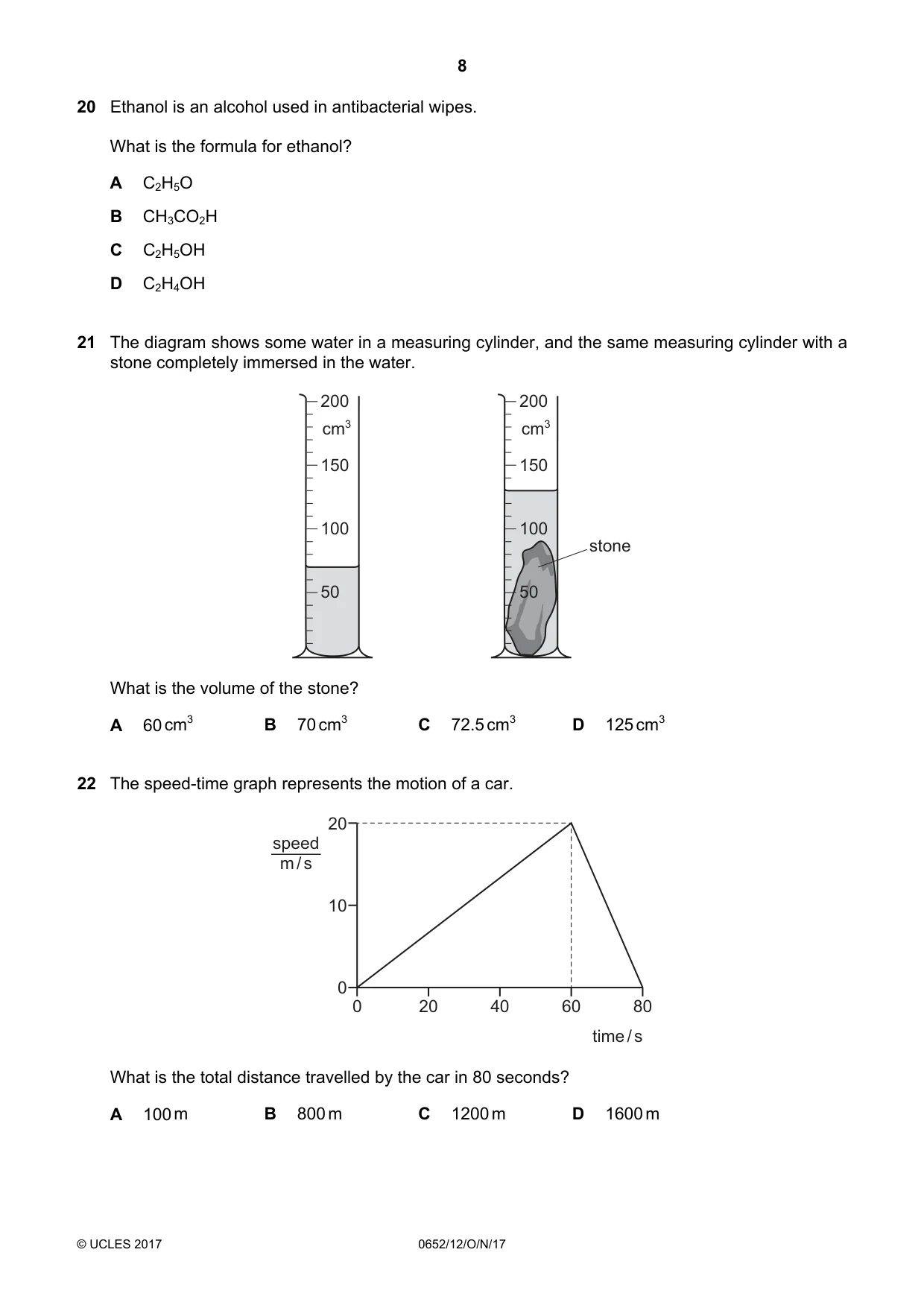
Q21 · The diagram shows some water in a measuring cylinder, and the same measuring cylinder…
21 The diagram shows some water in a measuring cylinder, and the same measuring cylinder with a stone completely immersed in the water. 200 200 cm3 cm3 150 150 100 100 stone 50 50 What is the volume of the stone? A 60 cm3 B 70 cm3 C 72.5 cm3 D 125 cm3
Mark scheme: A
Q22 · The speed-time graph represents the motion of a car
22 The speed-time graph represents the motion of a car. 20 speed m / s 10 0 0 20 40 60 80 time / s What is the total distance travelled by the car in 80 seconds? A 100 m B 800 m C 1200 m D 1600 m
Mark scheme: B
Q23 · Which statement about the weight of an object is correct?
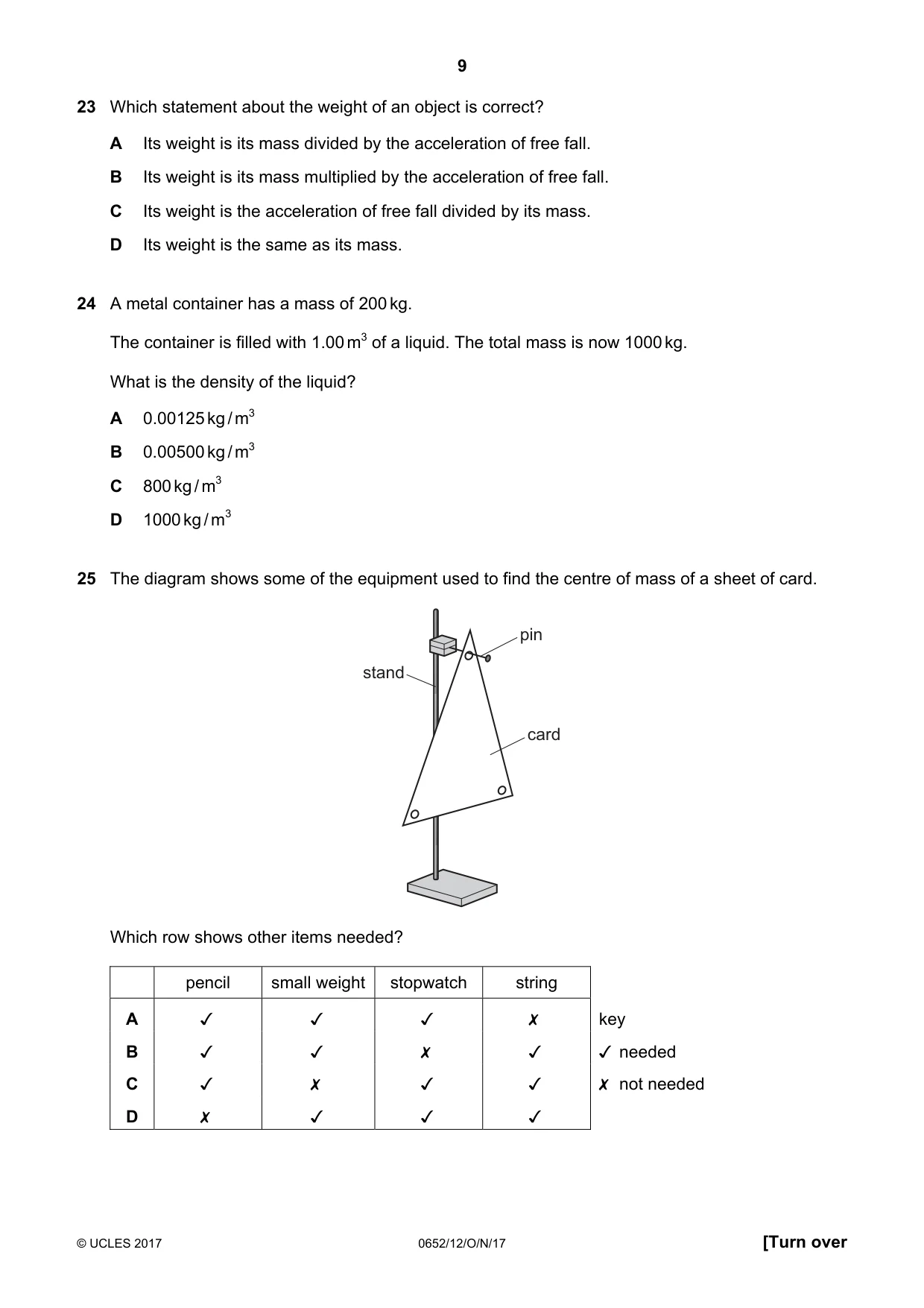
23 Which statement about the weight of an object is correct? A Its weight is its mass divided by the acceleration of free fall. B Its weight is its mass multiplied by the acceleration of free fall. C Its weight is the acceleration of free fall divided by its mass. D Its weight is the same as its mass.
Mark scheme: B
Q24 · A metal container has a mass of 200 kg
24 A metal container has a mass of 200 kg. The container is filled with 1.00 m3 of a liquid. The total mass is now 1000 kg. What is the density of the liquid? A 0.00125 kg / m3 B 0.00500 kg / m3 C 800 kg / m3 D 1000 kg / m3
Mark scheme: C
Q25 · The diagram shows some of the equipment used to find the centre of mass of a sheet of card
25 The diagram shows some of the equipment used to find the centre of mass of a sheet of card. 0 0O WwW > pencil ~~ KOM small weight Kk 4 << x key ¥ needed X not needed
Mark scheme: B
Q26 · A power station uses nuclear fission to obtain energy
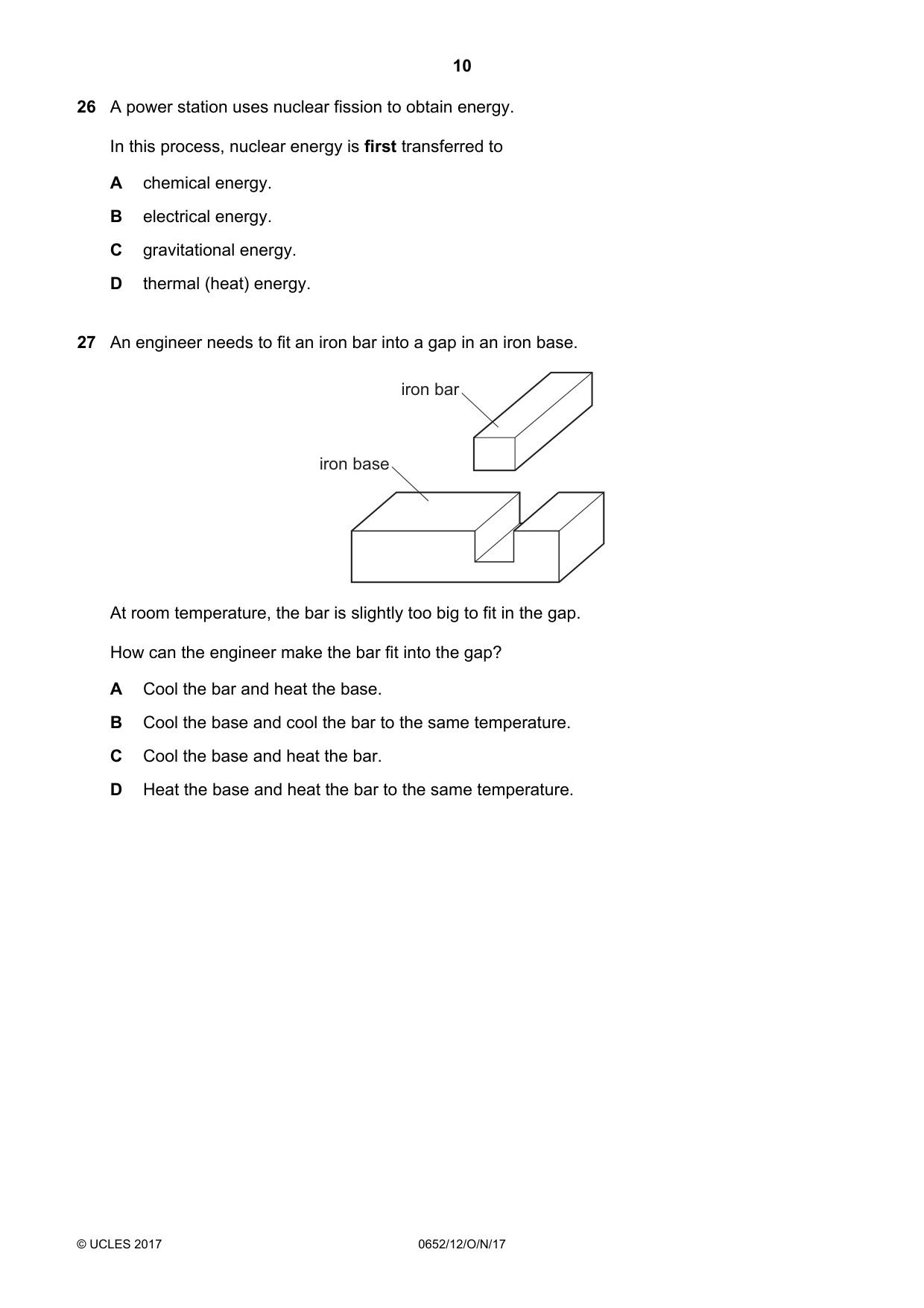
26 A power station uses nuclear fission to obtain energy. In this process, nuclear energy is first transferred to A chemical energy. B electrical energy. C gravitational energy. D thermal (heat) energy.
Mark scheme: D
Q27 · An engineer needs to fit an iron bar into a gap in an iron base
27 An engineer needs to fit an iron bar into a gap in an iron base. iron bar iron base At room temperature, the bar is slightly too big to fit in the gap. How can the engineer make the bar fit into the gap? A Cool the bar and heat the base. B Cool the base and cool the bar to the same temperature. C Cool the base and heat the bar. D Heat the base and heat the bar to the same temperature.
Mark scheme: A
Q28 · An engineer is designing a laboratory to be built on the Moon
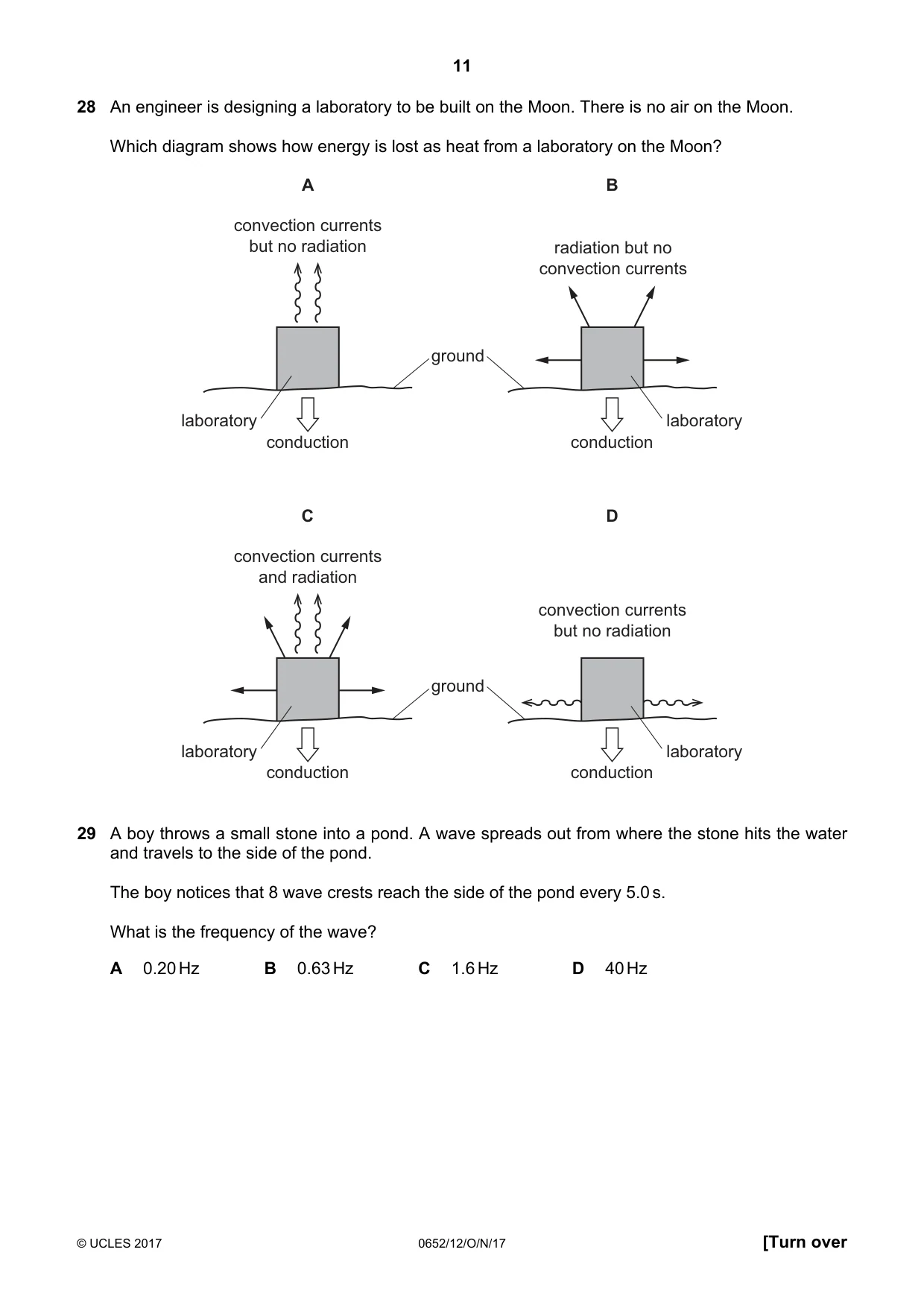
28 An engineer is designing a laboratory to be built on the Moon. There is no air on the Moon. Which diagram shows how energy is lost as heat from a laboratory on the Moon? A B convection currents but no radiation radiation but no convection currents ground laboratory laboratory conduction conduction C D convection currents and radiation convection currents but no radiation ground laboratory laboratory conduction conduction
Mark scheme: B
Q29 · A boy throws a small stone into a pond
29 A boy throws a small stone into a pond. A wave spreads out from where the stone hits the water and travels to the side of the pond. The boy notices that 8 wave crests reach the side of the pond every 5.0 s. What is the frequency of the wave? A 0.20 Hz B 0.63 Hz C 1.6 Hz D 40 Hz
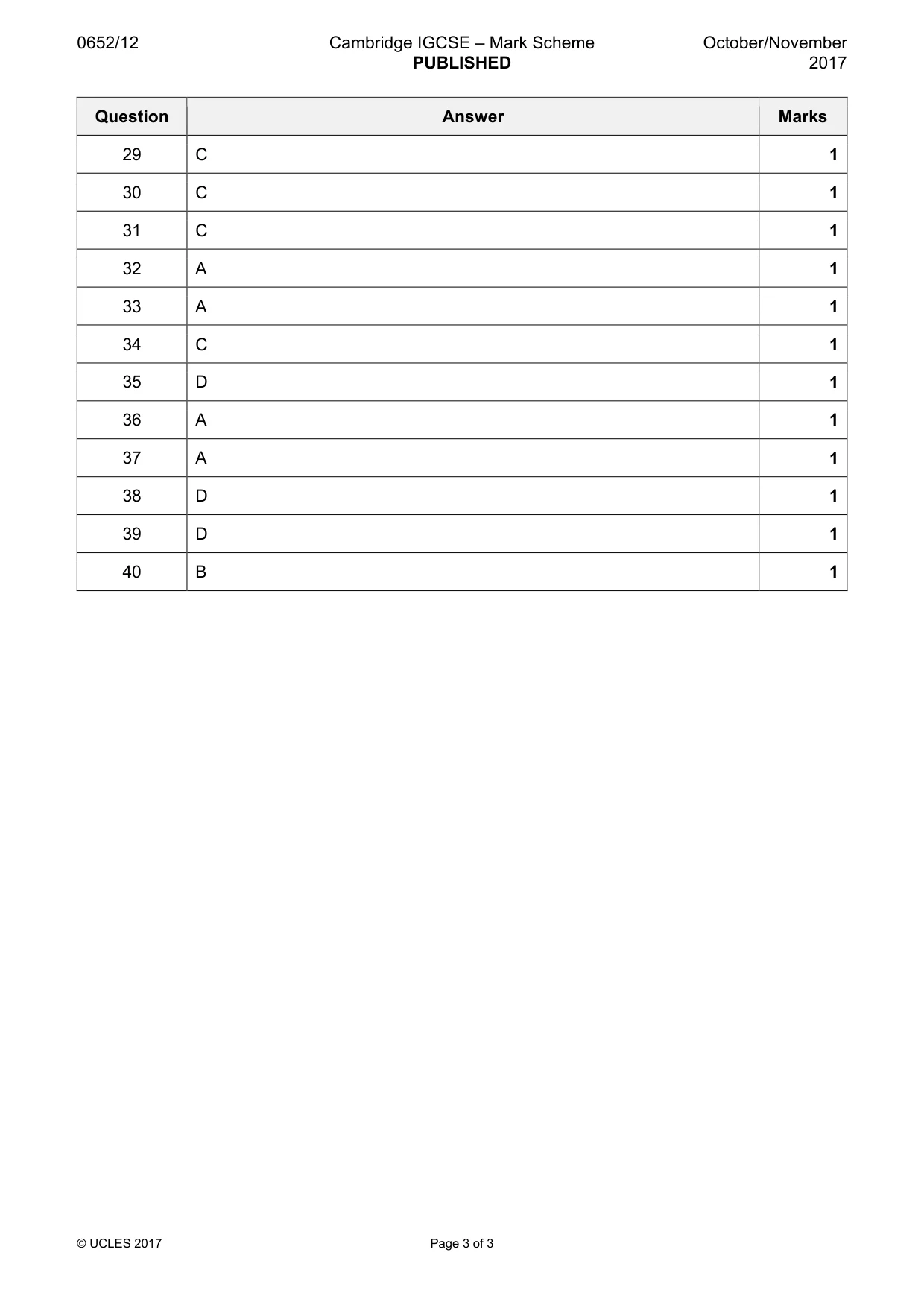
Mark scheme: C
Q30 · A ray of light in a glass block strikes the edge of the block
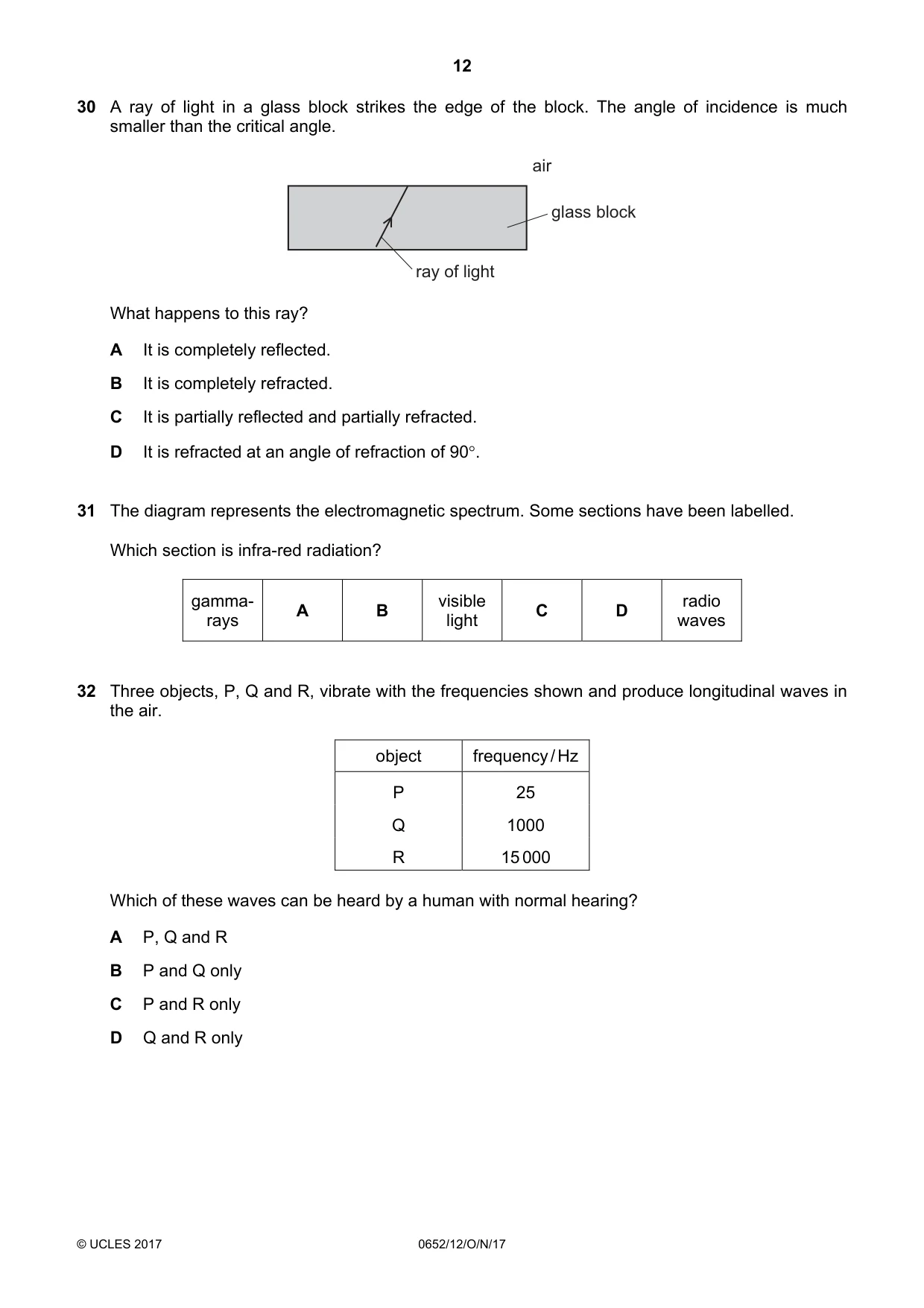
30 A ray of light in a glass block strikes the edge of the block. The angle of incidence is much smaller than the critical angle. air glass block ray of light What happens to this ray? A It is completely reflected. B It is completely refracted. C It is partially reflected and partially refracted. D It is refracted at an angle of refraction of 90°.
Mark scheme: C
Q31 · The diagram represents the electromagnetic spectrum
31 The diagram represents the electromagnetic spectrum. Some sections have been labelled. Which section is infra-red radiation? gamma- visible radio A B C D rays light waves
Mark scheme: C
Q32 · Three objects, P, Q and R, vibrate with the frequencies shown and produce longitudinal…
32 Three objects, P, Q and R, vibrate with the frequencies shown and produce longitudinal waves in the air. object frequency / Hz P 25 Q 1000 R 15 000 Which of these waves can be heard by a human with normal hearing? A P, Q and R B P and Q only C P and R only D Q and R only
Mark scheme: A
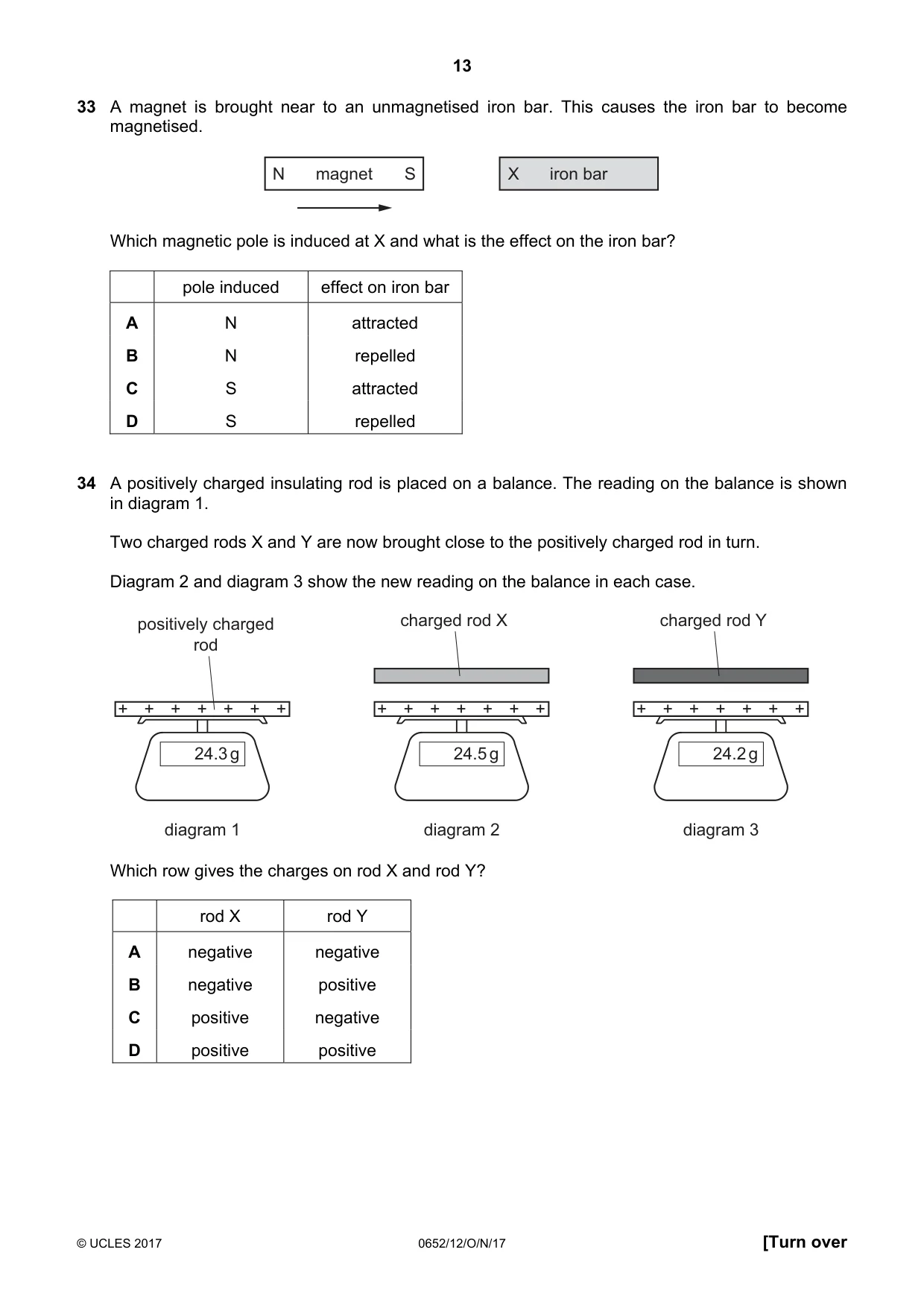
Q33 · A magnet is brought near to an unmagnetised iron bar
33 A magnet is brought near to an unmagnetised iron bar. This causes the iron bar to become magnetised. N magnet S X iron bar Which magnetic pole is induced at X and what is the effect on the iron bar? pole induced effect on iron bar A N attracted B N repelled C S attracted D S repelled
Mark scheme: A
Q34 · A positively charged insulating rod is placed on a balance
34 A positively charged insulating rod is placed on a balance. The reading on the balance is shown in diagram 1. Two charged rods X and Y are now brought close to the positively charged rod in turn. Diagram 2 and diagram 3 show the new reading on the balance in each case. positively charged charged rod X charged rod Y rod + + + + + + + + + + + + + + + + + + + + + 24.3 g 24.5 g 24.2 g diagram 1 diagram 2 diagram 3 Which row gives the charges on rod X and rod Y? rod X rod Y A negative negative B negative positive C positive negative D positive positive
Mark scheme: C
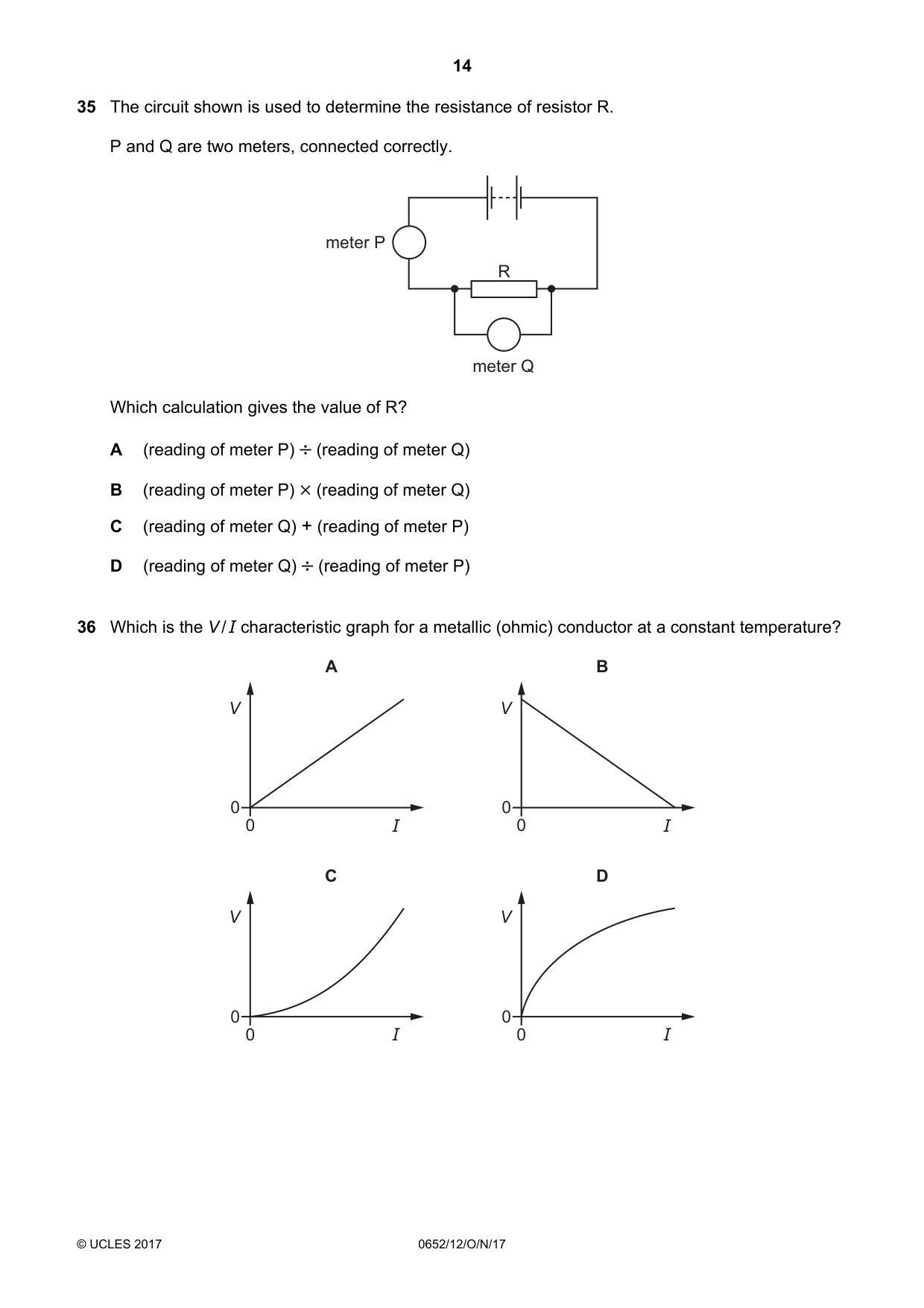
Q35 · The circuit shown is used to determine the resistance of resistor R
35 The circuit shown is used to determine the resistance of resistor R. P and Q are two meters, connected correctly. meter P R meter Q Which calculation gives the value of R? A (reading of meter P) ÷ (reading of meter Q) B (reading of meter P) × (reading of meter Q) C (reading of meter Q) + (reading of meter P) D (reading of meter Q) ÷ (reading of meter P)
Mark scheme: D
Q36 · Which is the V / I characteristic graph for a metallic (ohmic) conductor at a constant…
36 Which is the V / I characteristic graph for a metallic (ohmic) conductor at a constant temperature? A B V V 0 0 0 I 0 I C D V V 0 0 0 I 0 I
Mark scheme: A
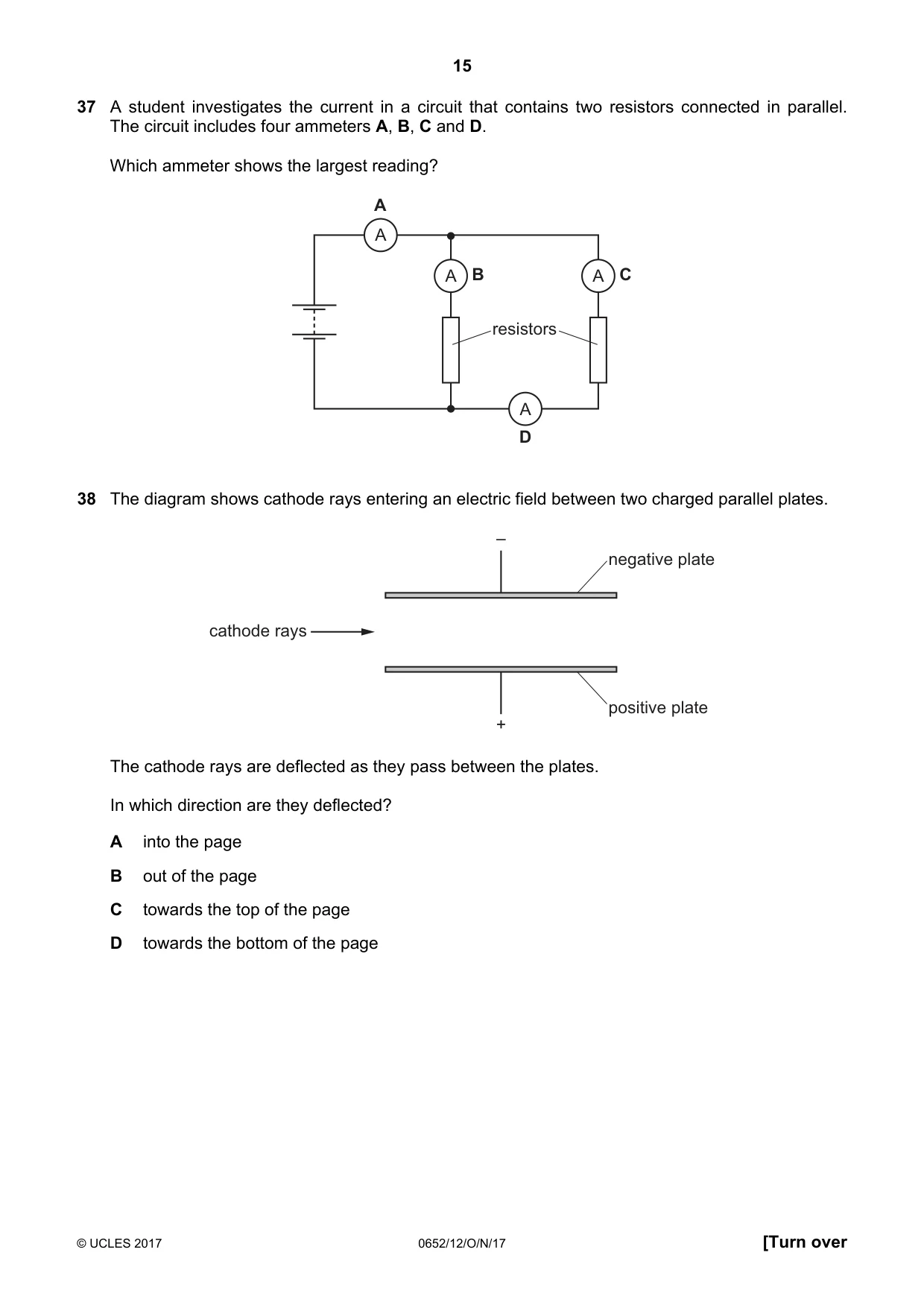
Q37 · A student investigates the current in a circuit that contains two resistors connected in…
37 A student investigates the current in a circuit that contains two resistors connected in parallel. The circuit includes four ammeters A, B, C and D. Which ammeter shows the largest reading? A A A B A C resistors A D
Mark scheme: A
Q38 · The diagram shows cathode rays entering an electric field between two charged parallel…
38 The diagram shows cathode rays entering an electric field between two charged parallel plates. – negative plate cathode rays positive plate + The cathode rays are deflected as they pass between the plates. In which direction are they deflected? A into the page B out of the page C towards the top of the page D towards the bottom of the page
Mark scheme: D
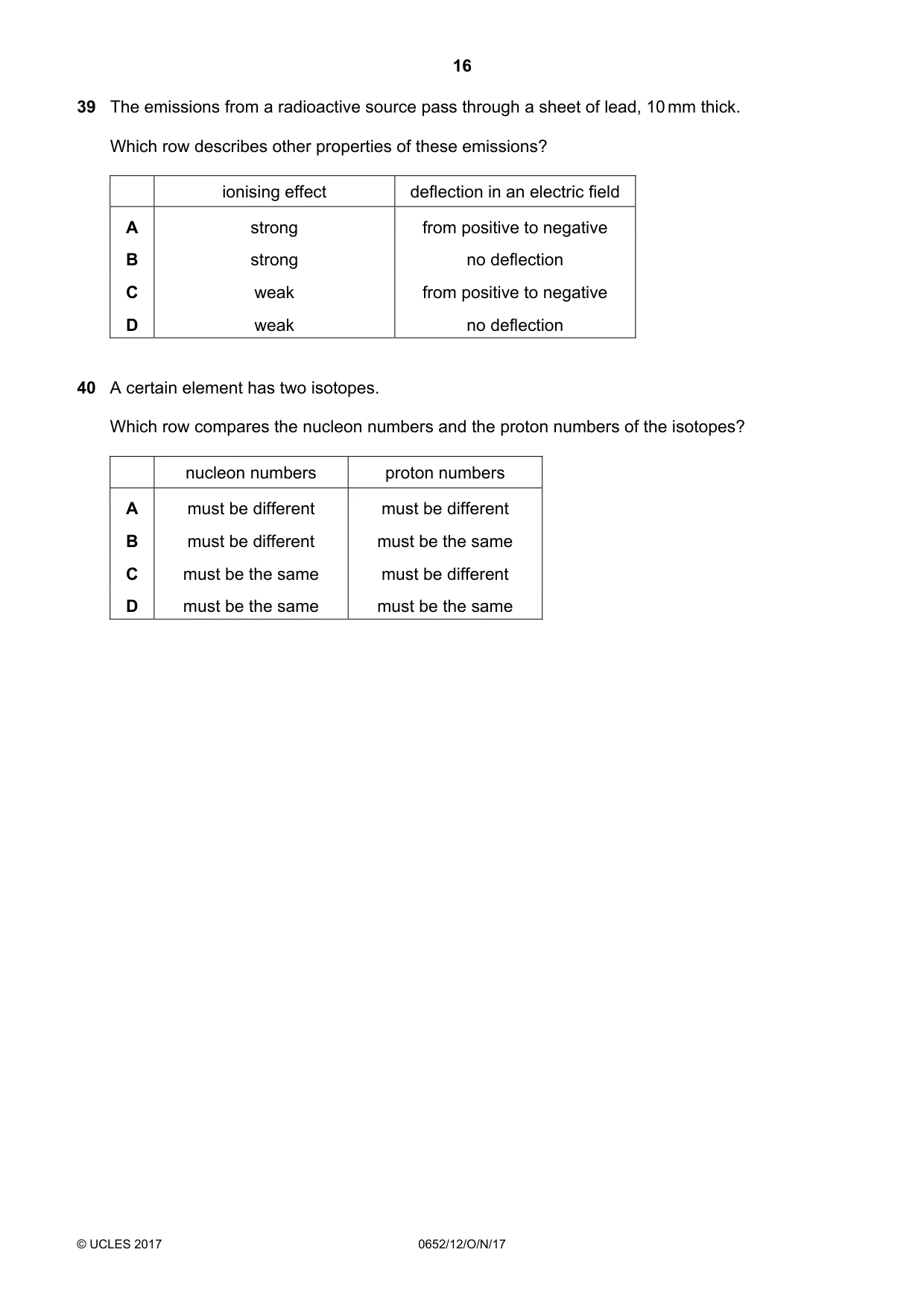
Q39 · The emissions from a radioactive source pass through a sheet of lead, 10 mm thick
39 The emissions from a radioactive source pass through a sheet of lead, 10 mm thick. Which row describes other properties of these emissions? ionising effect deflection in an electric field A strong from positive to negative B strong no deflection C weak from positive to negative D weak no deflection
Mark scheme: D
Q40 · A certain element has two isotopes
40 A certain element has two isotopes. Which row compares the nucleon numbers and the proton numbers of the isotopes? nucleon numbers proton numbers A must be different must be different B must be different must be the same C must be the same must be different D must be the same must be the same
Mark scheme: B
What was in this paper
The subtopics covered by these 40 questions, and how many questions each got. Open one in a new tab to see every Cambridge question on it.
2Atomic structure and the Periodic Table2Electric circuits2Electrical quantities2Light2Stoichiometry2Alcohols1Alkenes1Carbon dioxide and methane1Density1Energetics of a reaction1Extraction of metals1Forces1Fuels1General wave properties1Group properties1Homologous series1Identification of ions and gases1Ions and ionic bonds1Length and time1Mass and weight1Motion1Radioactivity1Rate (speed) of reaction1Reactivity series1Simple phenomena of magnetism1Sound1The nuclear atom1The particulate nature of matter1Thermal processes1Thermal properties and temperature1Transition elements1Types of oxides1Work, energy and power1What you needed in this session
Cambridge’s own grade thresholds for 2017 Oct/Nov, Paper 1 · Variant 2. A higher threshold means an easier paper — the bar moves with how the cohort did.