Cambridge IGCSE Physical Science 0652 — 2024 Oct/Nov Paper 1 · Variant 1
0652/11/O/N/24 · 40 questions · 40 marks · ≈45 min
The question paper and its mark scheme, free to read here and free to download. This is Cambridge’s own paper, exactly as it was sat.
Question paper16 pages
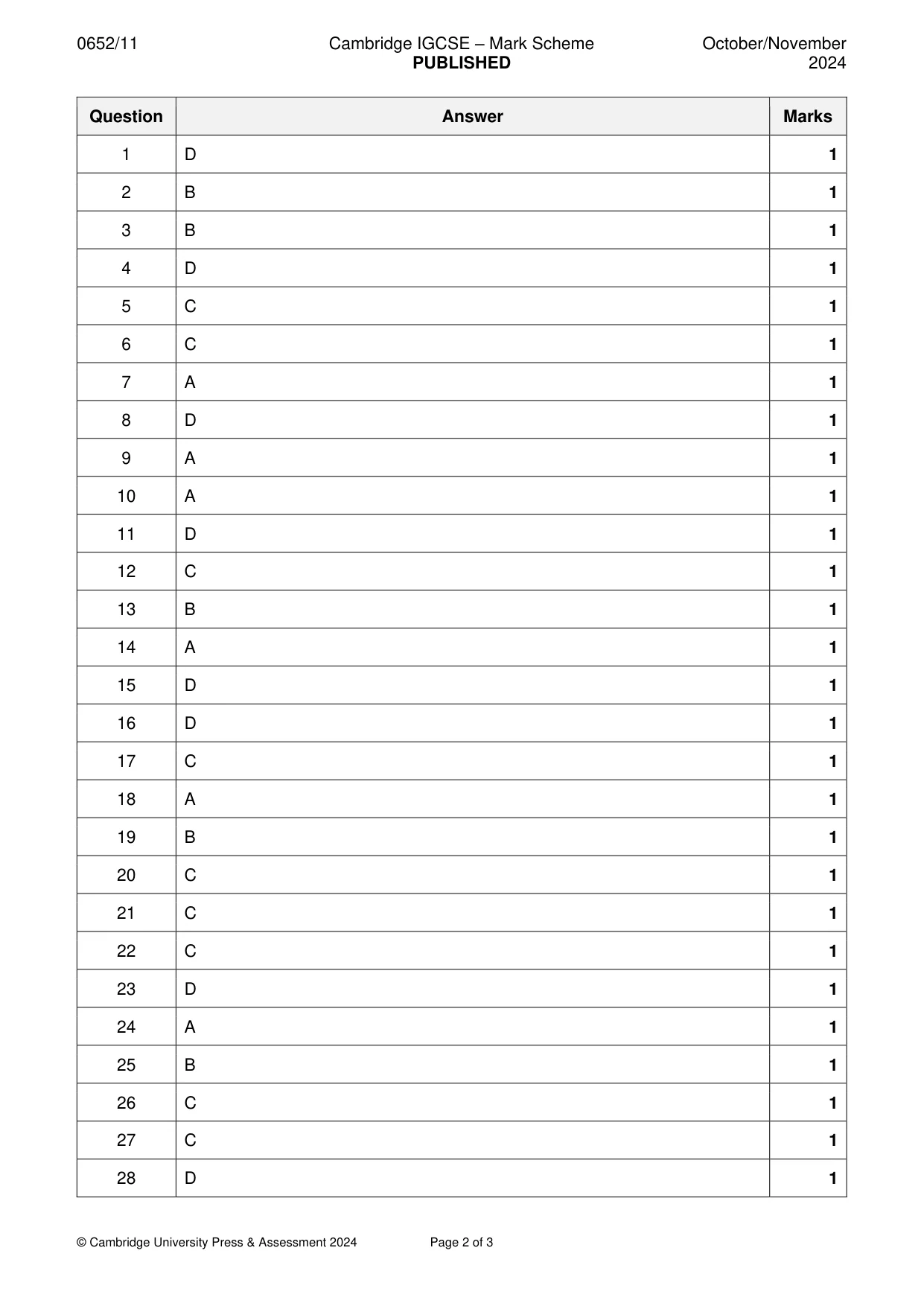
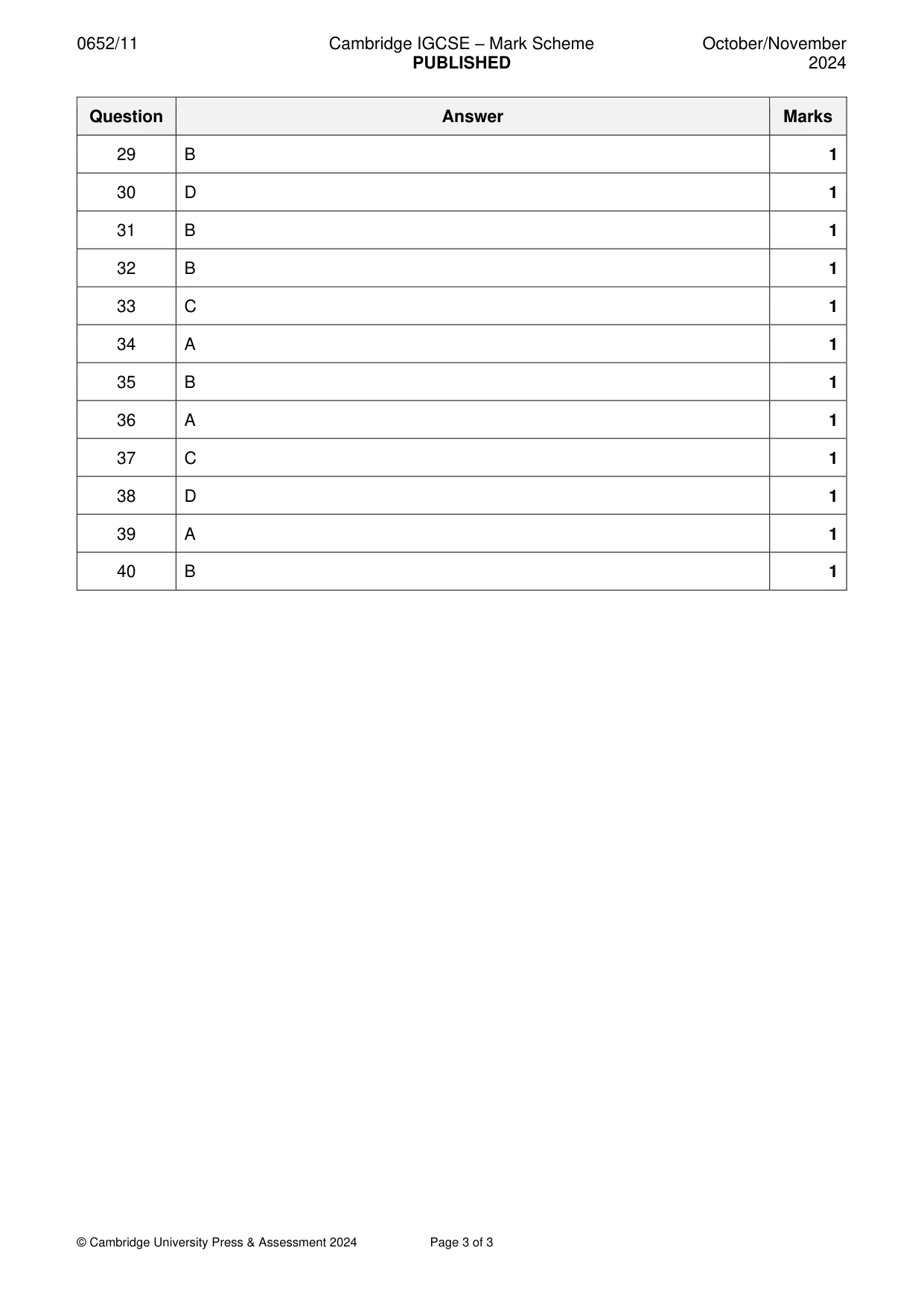
Mark scheme3 pages
Answers below. Sit the paper first if you are practising.
Questions as text
Q1 · Ammonia gas has a strong smell
1 Ammonia gas has a strong smell. A gas jar of ammonia with its lid on is placed in the corner of a room. The lid is removed and after 30 minutes the smell of ammonia is detected all around the room. Which statements about this process are correct? 1 The particles of ammonia are breaking away from their fixed positions in the gas jar. 2 The particles of ammonia are diffusing through the air. 3 The particles of ammonia are moving randomly. A 1, 2 and 3 B 1 and 2 only C 1 and 3 only D 2 and 3 only
Mark scheme: D
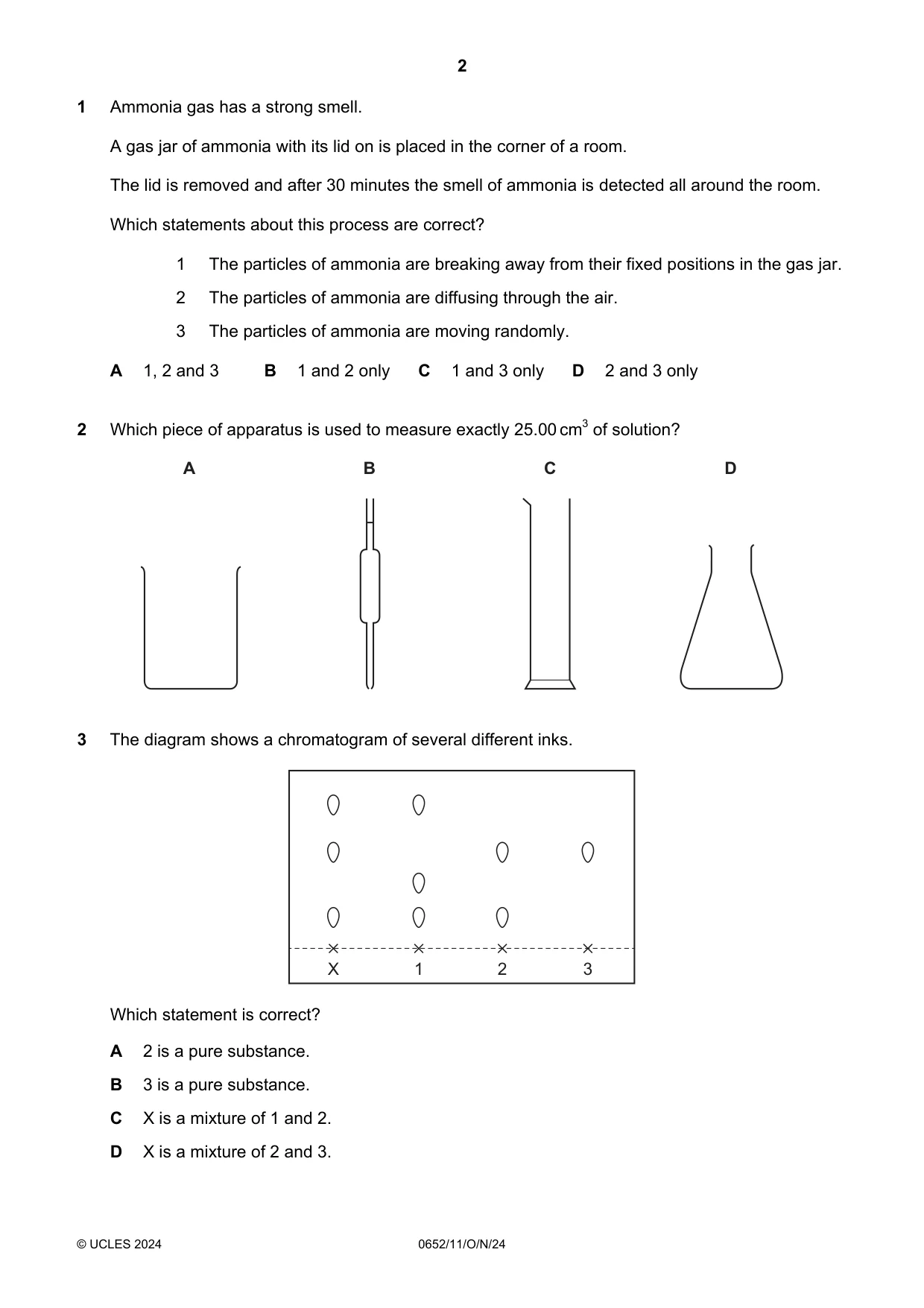
Q2 · Which piece of apparatus is used to measure exactly 25.00 cm3 of solution?
2 Which piece of apparatus is used to measure exactly 25.00 cm3 of solution? A B C D
Mark scheme: B
Q3 · The diagram shows a chromatogram of several different inks
3 The diagram shows a chromatogram of several different inks. X 1 2 3 Which statement is correct? A 2 is a pure substance. B 3 is a pure substance. C X is a mixture of 1 and 2. D X is a mixture of 2 and 3.
Mark scheme: B
Q4 · A new element was officially named as flerovium at the end of May 2012
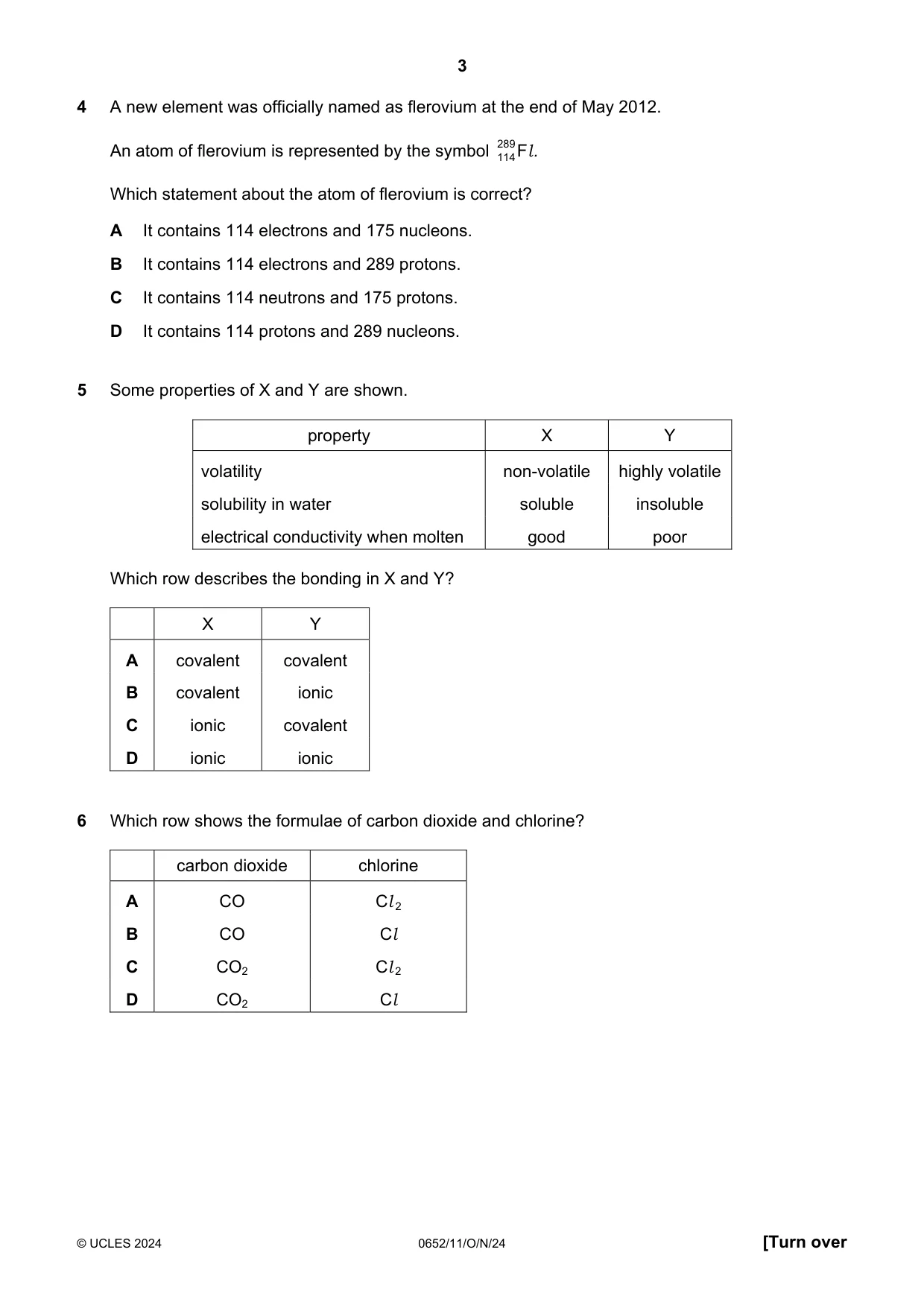
4 A new element was officially named as flerovium at the end of May 2012. An atom of flerovium is represented by the symbol 289 F .l 114 Which statement about the atom of flerovium is correct? A It contains 114 electrons and 175 nucleons. B It contains 114 electrons and 289 protons. C It contains 114 neutrons and 175 protons. D It contains 114 protons and 289 nucleons.
Mark scheme: D
Q5 · Some properties of X and Y are shown
5 Some properties of X and Y are shown. property X Y volatility non-volatile highly volatile solubility in water soluble insoluble electrical conductivity when molten good poor Which row describes the bonding in X and Y? X Y A covalent covalent B covalent ionic C ionic covalent D ionic ionic
Mark scheme: C
Q6 · Which row shows the formulae of carbon dioxide and chlorine?
6 Which row shows the formulae of carbon dioxide and chlorine? carbon dioxide chlorine A CO Cl 2 B CO Cl C CO2 Cl 2 D CO2 Cl
Mark scheme: C
Q7 · A hydrocarbon burns in excess oxygen
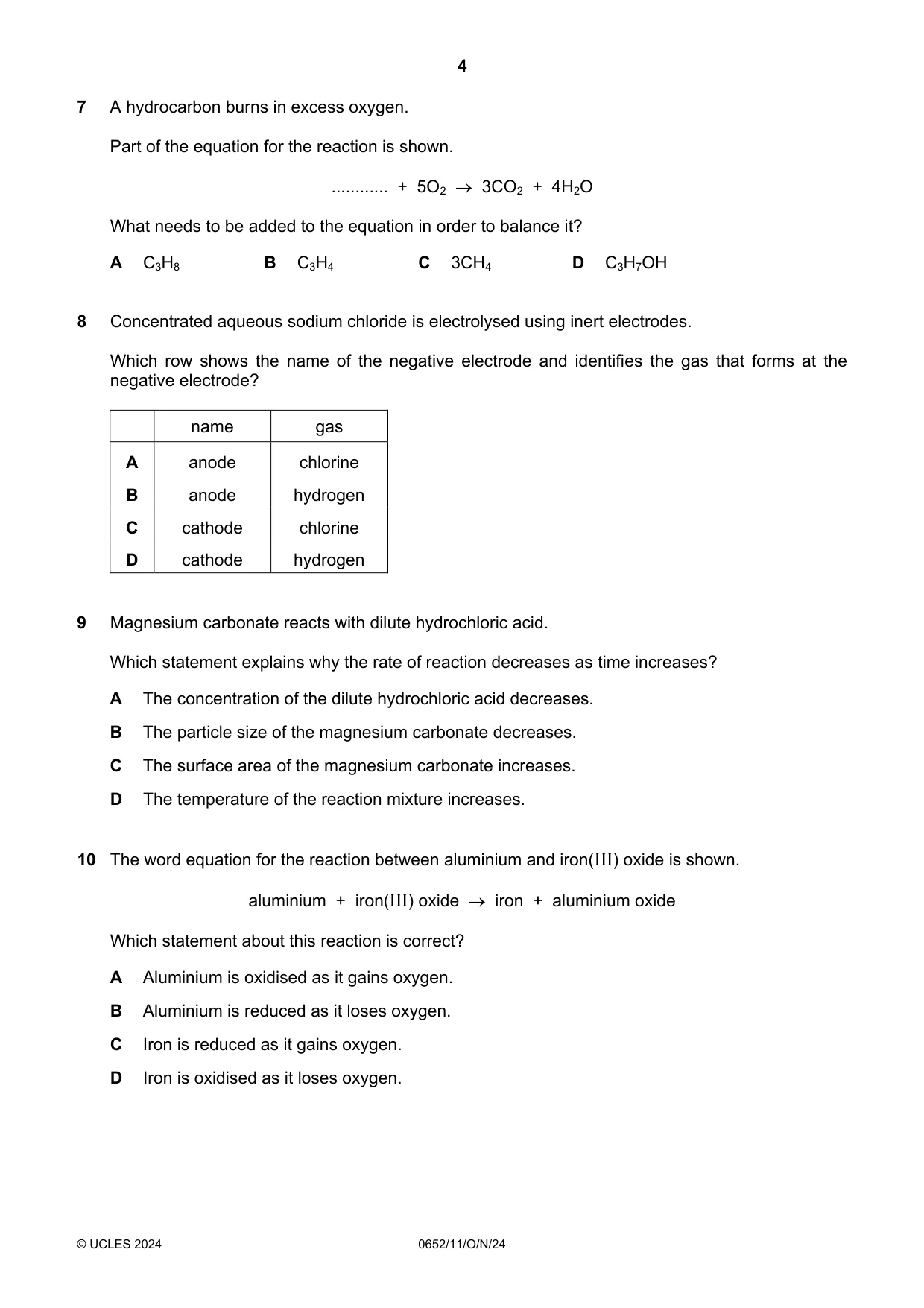
7 A hydrocarbon burns in excess oxygen. Part of the equation for the reaction is shown. ............ + 5O2 3CO2 + 4H2O What needs to be added to the equation in order to balance it? A C3H8 B C3H4 C 3CH4 D C3H7OH
Mark scheme: A
Q8 · Concentrated aqueous sodium chloride is electrolysed using inert electrodes
8 Concentrated aqueous sodium chloride is electrolysed using inert electrodes. Which row shows the name of the negative electrode and identifies the gas that forms at the negative electrode? name gas A anode chlorine B anode hydrogen C cathode chlorine D cathode hydrogen
Mark scheme: D
Q9 · Magnesium carbonate reacts with dilute hydrochloric acid
9 Magnesium carbonate reacts with dilute hydrochloric acid. Which statement explains why the rate of reaction decreases as time increases? A The concentration of the dilute hydrochloric acid decreases. B The particle size of the magnesium carbonate decreases. C The surface area of the magnesium carbonate increases. D The temperature of the reaction mixture increases.
Mark scheme: A
Q10 · The word equation for the reaction between aluminium and iron(III) oxide is shown
10 The word equation for the reaction between aluminium and iron(III) oxide is shown. aluminium + iron(III) oxide iron + aluminium oxide Which statement about this reaction is correct? A Aluminium is oxidised as it gains oxygen. B Aluminium is reduced as it loses oxygen. C Iron is reduced as it gains oxygen. D Iron is oxidised as it loses oxygen.
Mark scheme: A
Q11 · Which row about the named oxides is correct?
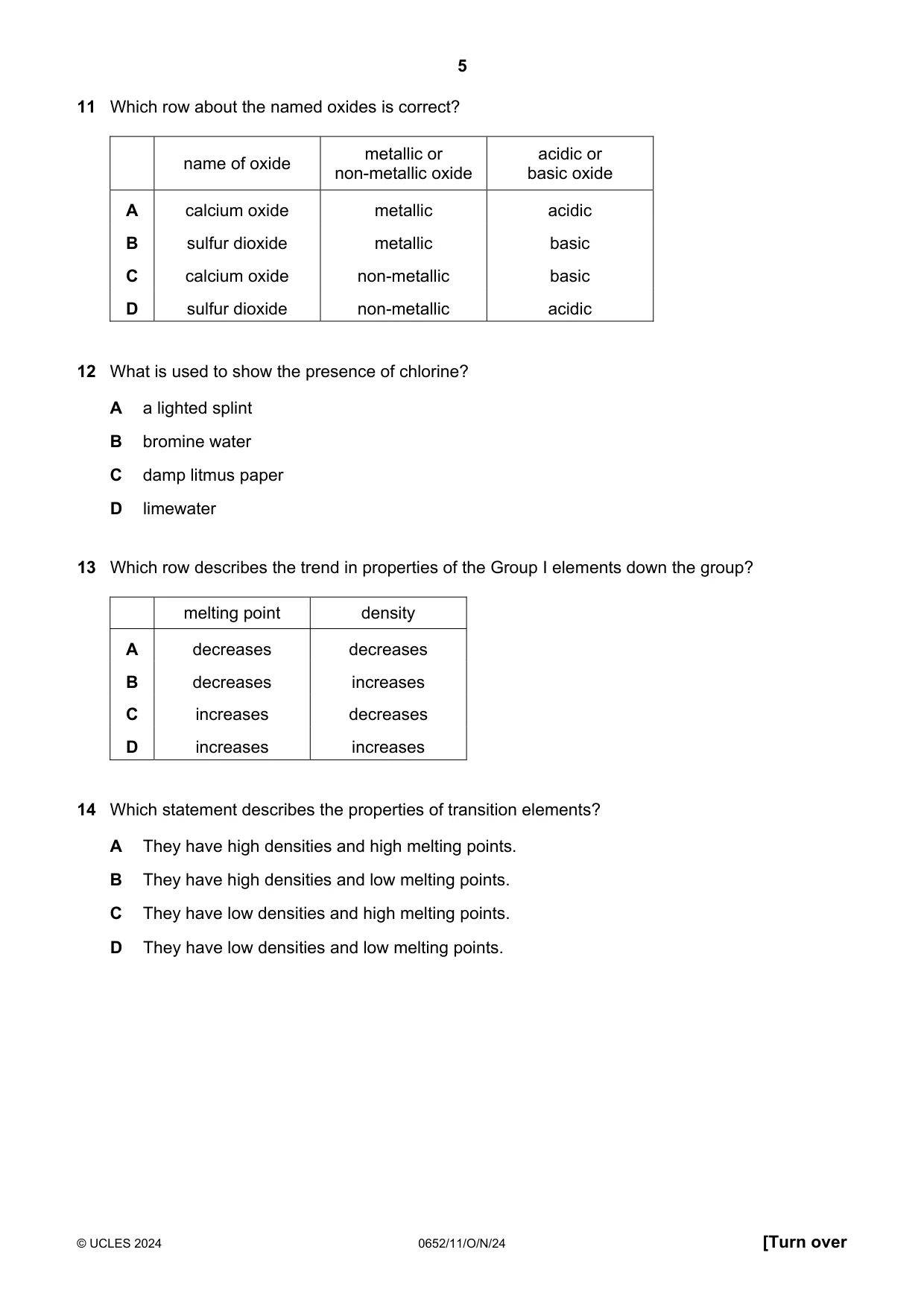
11 Which row about the named oxides is correct? metallic or acidic or name of oxide non-metallic oxide basic oxide A calcium oxide metallic acidic B sulfur dioxide metallic basic C calcium oxide non-metallic basic D sulfur dioxide non-metallic acidic
Mark scheme: D
Q12 · What is used to show the presence of chlorine?
12 What is used to show the presence of chlorine? A a lighted splint B bromine water C damp litmus paper D limewater
Mark scheme: C
Q13 · Which row describes the trend in properties of the Group I elements down the group?
13 Which row describes the trend in properties of the Group I elements down the group? melting point density A decreases decreases B decreases increases C increases decreases D increases increases
Mark scheme: B
Q14 · Which statement describes the properties of transition elements?
14 Which statement describes the properties of transition elements? A They have high densities and high melting points. B They have high densities and low melting points. C They have low densities and high melting points. D They have low densities and low melting points.
Mark scheme: A
Q15 · The reactivity series for five metals, P, Q, R, S and T, and hydrogen is shown
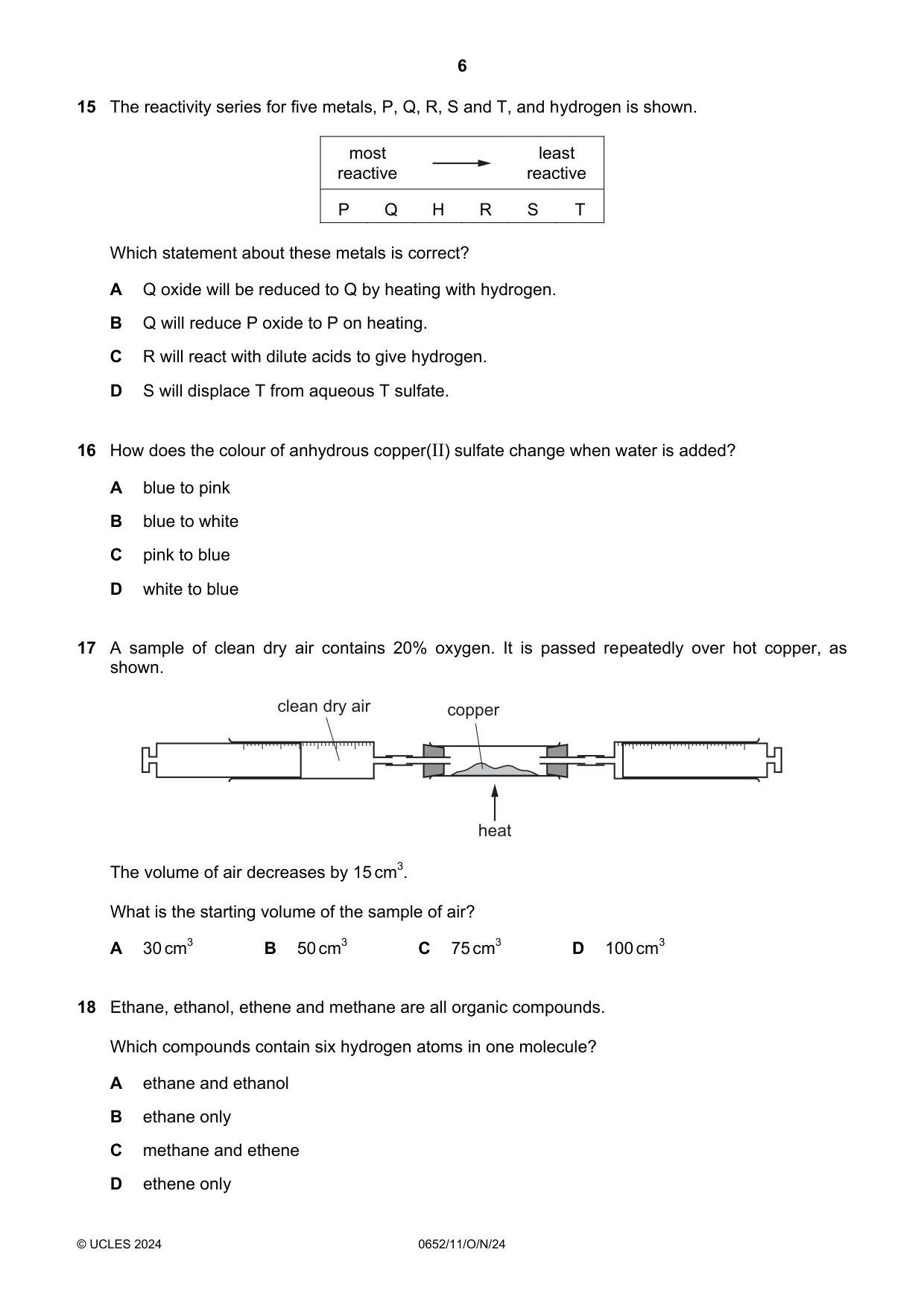
15 The reactivity series for five metals, P, Q, R, S and T, and hydrogen is shown. most least reactive reactive P Q H R S T Which statement about these metals is correct? A Q oxide will be reduced to Q by heating with hydrogen. B Q will reduce P oxide to P on heating. C R will react with dilute acids to give hydrogen. D S will displace T from aqueous T sulfate.
Mark scheme: D
Q16 · How does the colour of anhydrous copper(II) sulfate change when water is added?
16 How does the colour of anhydrous copper(II) sulfate change when water is added? A blue to pink B blue to white C pink to blue D white to blue
Mark scheme: D
Q17 · A sample of clean dry air contains 20% oxygen
17 A sample of clean dry air contains 20% oxygen. It is passed repeatedly over hot copper, as shown. clean dry air copper heat The volume of air decreases by 15 cm3. What is the starting volume of the sample of air? A 30 cm3 B 50 cm3 C 75 cm3 D 100 cm3
Mark scheme: C
Q18 · Ethane, ethanol, ethene and methane are all organic compounds
18 Ethane, ethanol, ethene and methane are all organic compounds. Which compounds contain six hydrogen atoms in one molecule? A ethane and ethanol B ethane only C methane and ethene D ethene only
Mark scheme: A
Q19 · Hydrocarbon X decolourises aqueous bromine
19 Hydrocarbon X decolourises aqueous bromine. Which statement about X is correct? A Complete combustion of X gives carbon monoxide and water. B It can form an addition polymer. C It contains only C–C single bonds. D It contains three different elements.
Mark scheme: B
Q20 · A cycle of reactions involving carbon compounds is shown
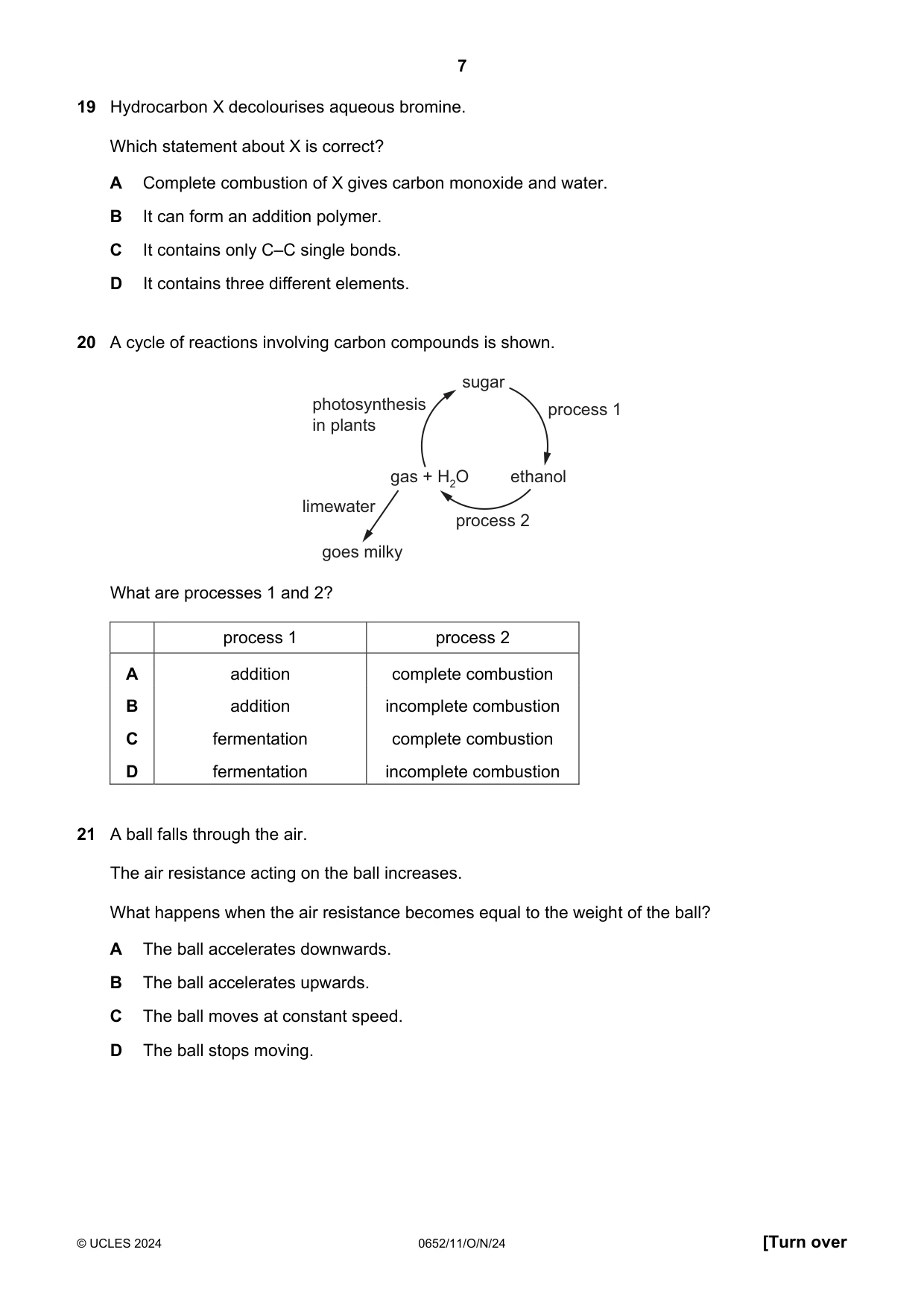
20 A cycle of reactions involving carbon compounds is shown. sugar photosynthesis process 1 in plants gas + H2O ethanol limewater process 2 goes milky What are processes 1 and 2? process 1 process 2 A addition complete combustion B addition incomplete combustion C fermentation complete combustion D fermentation incomplete combustion
Mark scheme: C
Q21 · A ball falls through the air
21 A ball falls through the air. The air resistance acting on the ball increases. What happens when the air resistance becomes equal to the weight of the ball? A The ball accelerates downwards. B The ball accelerates upwards. C The ball moves at constant speed. D The ball stops moving.
Mark scheme: C
Q22 · Each diagram shows an example of a force causing a moment about a pivot
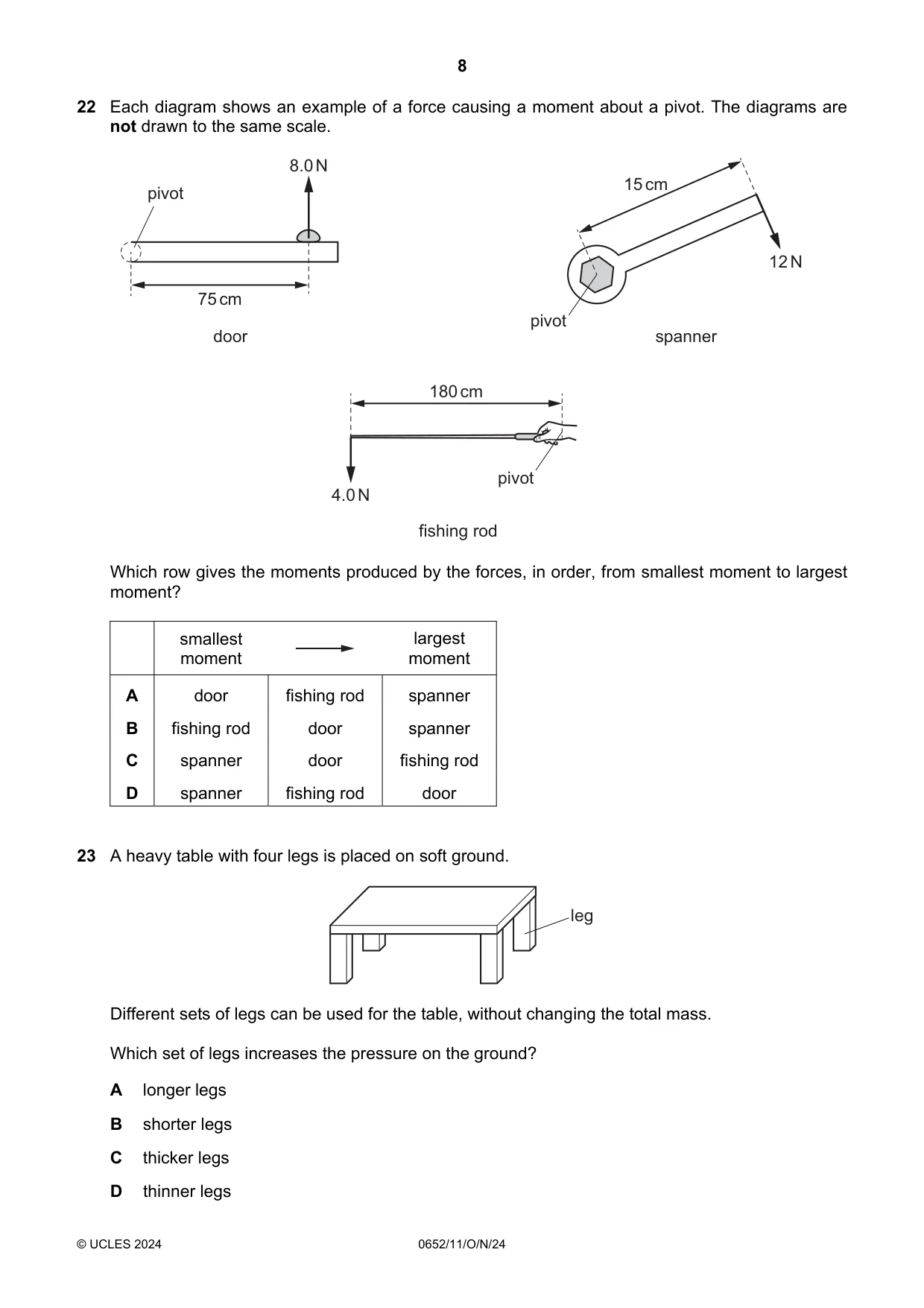
22 Each diagram shows an example of a force causing a moment about a pivot. The diagrams are not drawn to the same scale. 8.0 N 15 cm pivot 12 N 75 cm pivot door spanner 180 cm pivot 4.0 N fishing rod Which row gives the moments produced by the forces, in order, from smallest moment to largest moment? smallest largest moment moment A door fishing rod spanner B fishing rod door spanner C spanner door fishing rod D spanner fishing rod door
Mark scheme: C
Q23 · A heavy table with four legs is placed on soft ground
23 A heavy table with four legs is placed on soft ground. leg Different sets of legs can be used for the table, without changing the total mass. Which set of legs increases the pressure on the ground? A longer legs B shorter legs C thicker legs D thinner legs
Mark scheme: D
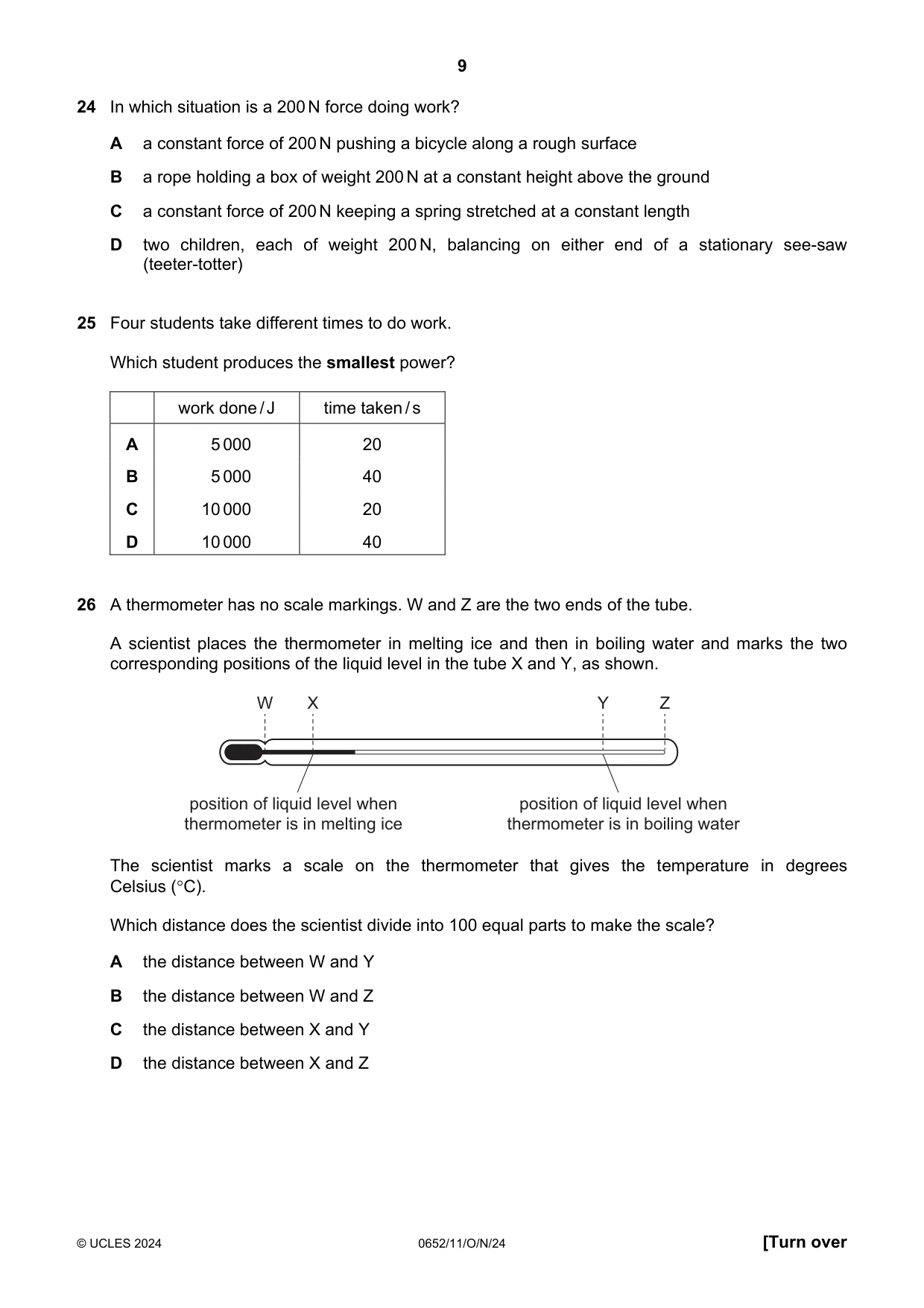
Q24 · In which situation is a 200 N force doing work?
24 In which situation is a 200 N force doing work? A a constant force of 200 N pushing a bicycle along a rough surface B a rope holding a box of weight 200 N at a constant height above the ground C a constant force of 200 N keeping a spring stretched at a constant length D two children, each of weight 200 N, balancing on either end of a stationary see-saw (teeter-totter)
Mark scheme: A
Q25 · Four students take different times to do work
25 Four students take different times to do work. Which student produces the smallest power? work done / J time taken / s A 5 000 20 B 5 000 40 C 10 000 20 D 10 000 40
Mark scheme: B
Q26 · A thermometer has no scale markings
26 A thermometer has no scale markings. W and Z are the two ends of the tube. A scientist places the thermometer in melting ice and then in boiling water and marks the two corresponding positions of the liquid level in the tube X and Y, as shown. W X Y Z position of liquid level when position of liquid level when thermometer is in melting ice thermometer is in boiling water The scientist marks a scale on the thermometer that gives the temperature in degrees Celsius (C). Which distance does the scientist divide into 100 equal parts to make the scale? A the distance between W and Y B the distance between W and Z C the distance between X and Y D the distance between X and Z
Mark scheme: C
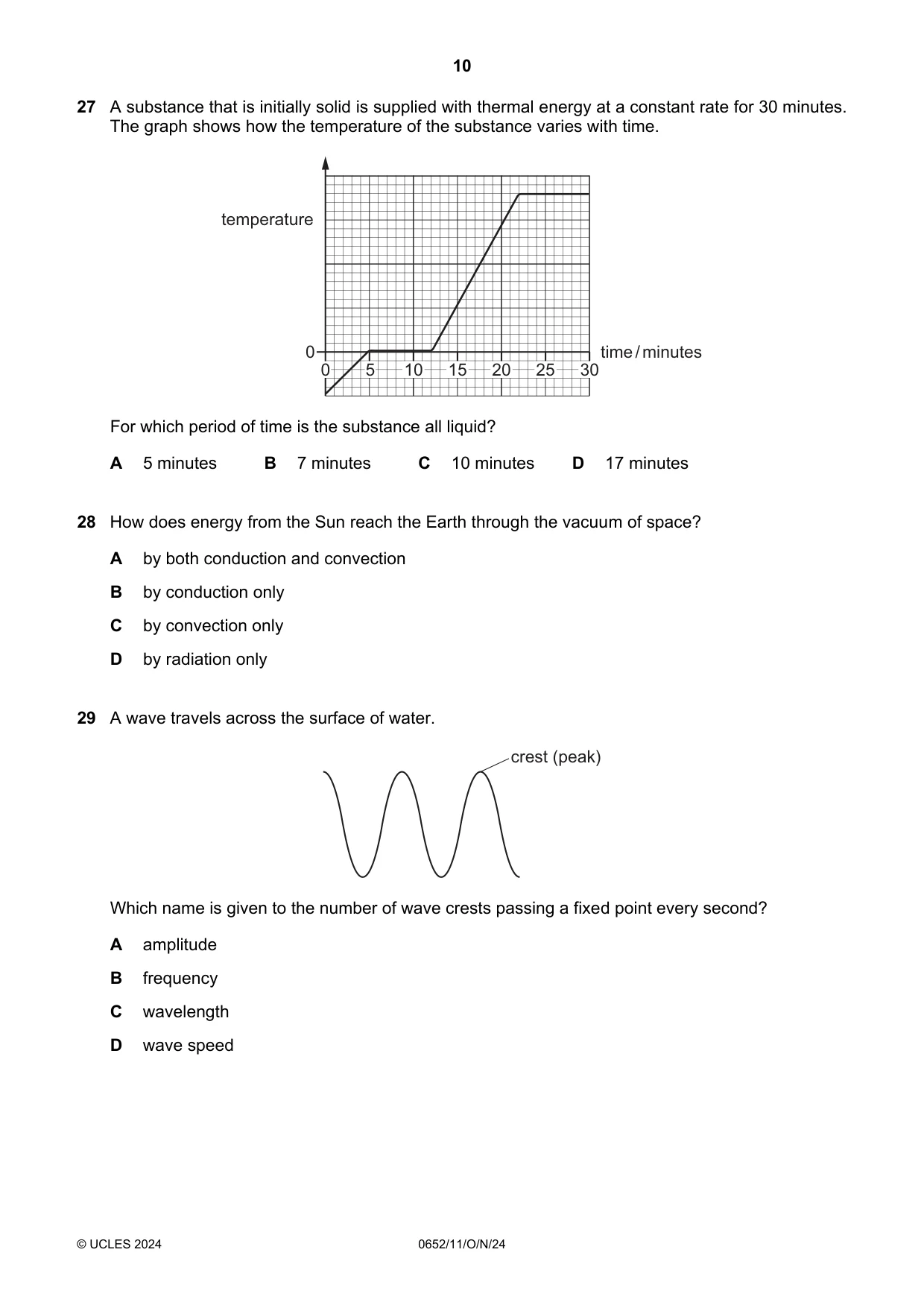
Q27 · A substance that is initially solid is supplied with thermal energy at a constant rate…
27 A substance that is initially solid is supplied with thermal energy at a constant rate for 30 minutes. The graph shows how the temperature of the substance varies with time. temperature 0 time / minutes 0 5 10 15 20 25 30 For which period of time is the substance all liquid? A 5 minutes B 7 minutes C 10 minutes D 17 minutes
Mark scheme: C
Q28 · How does energy from the Sun reach the Earth through the vacuum of space?
28 How does energy from the Sun reach the Earth through the vacuum of space? A by both conduction and convection B by conduction only C by convection only D by radiation only
Mark scheme: D
Q29 · A wave travels across the surface of water
29 A wave travels across the surface of water. crest (peak) Which name is given to the number of wave crests passing a fixed point every second? A amplitude B frequency C wavelength D wave speed
Mark scheme: B
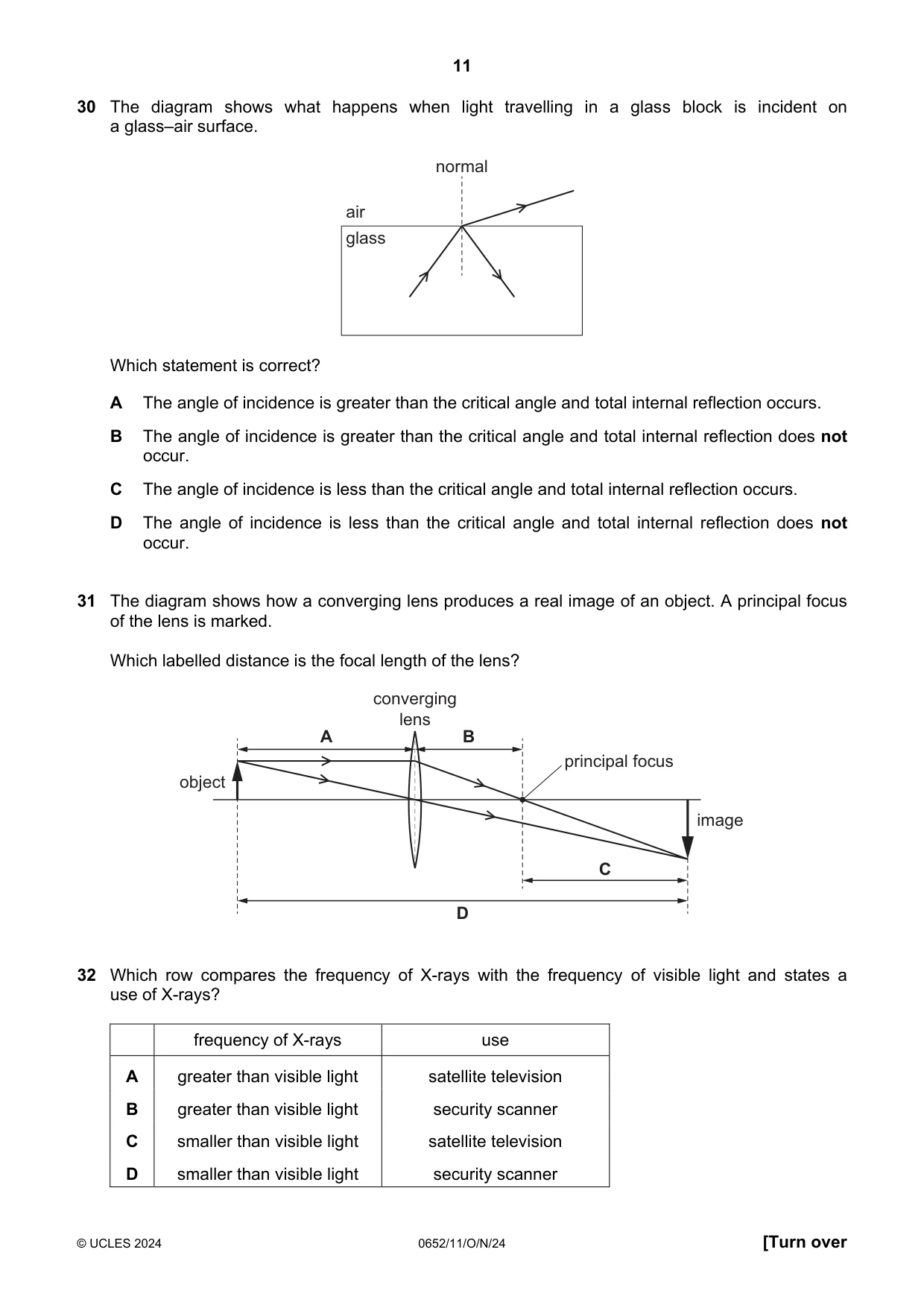
Q30 · The diagram shows what happens when light travelling in a glass block is incident on a…
30 The diagram shows what happens when light travelling in a glass block is incident on a glass–air surface. normal air glass Which statement is correct? A The angle of incidence is greater than the critical angle and total internal reflection occurs. B The angle of incidence is greater than the critical angle and total internal reflection does not occur. C The angle of incidence is less than the critical angle and total internal reflection occurs. D The angle of incidence is less than the critical angle and total internal reflection does not occur.
Mark scheme: D
Q31 · The diagram shows how a converging lens produces a real image of an object
31 The diagram shows how a converging lens produces a real image of an object. A principal focus of the lens is marked. Which labelled distance is the focal length of the lens? converging lens A B principal focus object image C D
Mark scheme: B
Q32 · Which row compares the frequency of X-rays with the frequency of visible light and states…
32 Which row compares the frequency of X-rays with the frequency of visible light and states a use of X-rays? frequency of X-rays use A greater than visible light satellite television B greater than visible light security scanner C smaller than visible light satellite television D smaller than visible light security scanner
Mark scheme: B
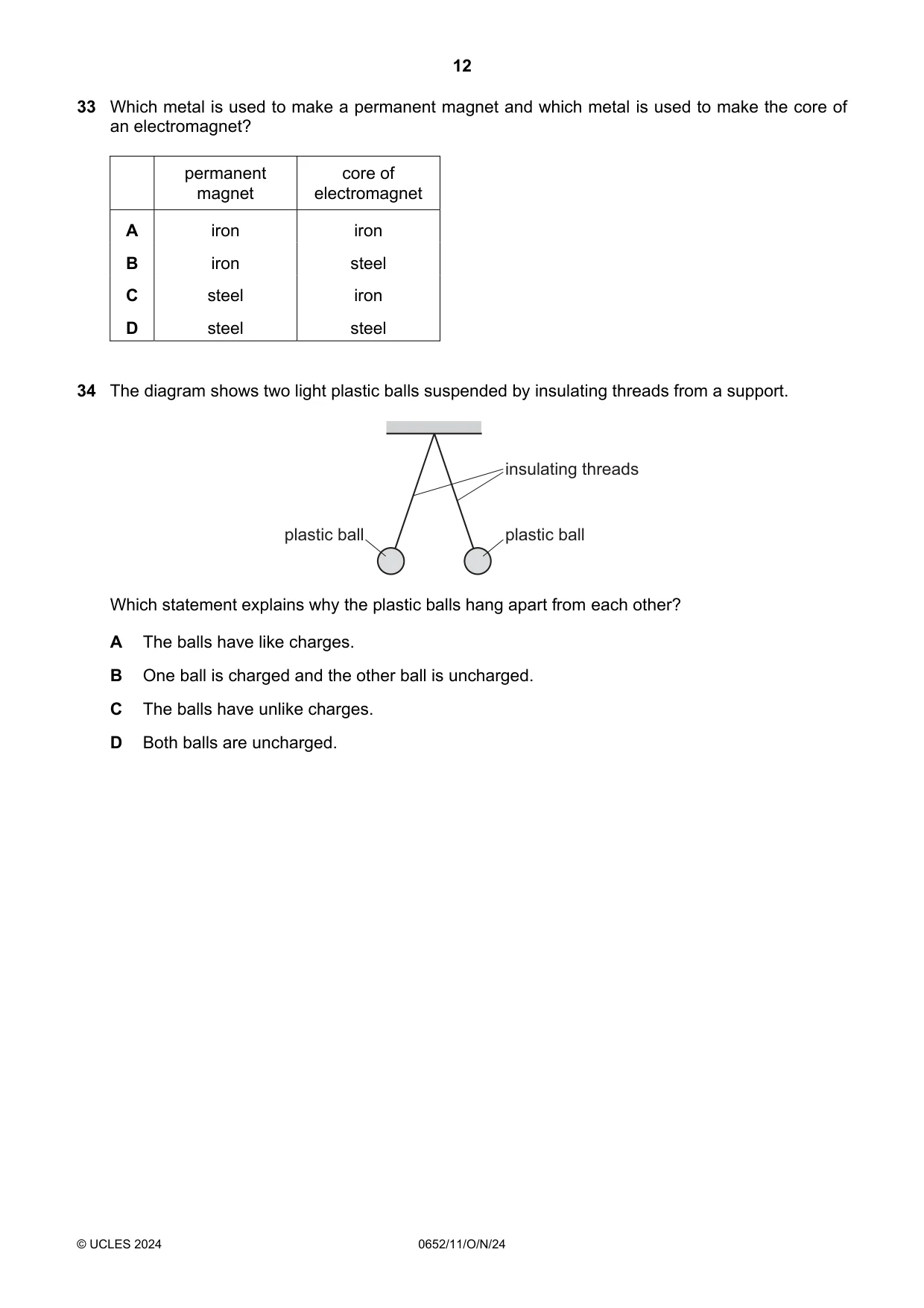
Q33 · Which metal is used to make a permanent magnet and which metal is used to make the core…
33 Which metal is used to make a permanent magnet and which metal is used to make the core of an electromagnet? permanent core of magnet electromagnet A iron iron B iron steel C steel iron D steel steel
Mark scheme: C
Q34 · The diagram shows two light plastic balls suspended by insulating threads from a support
34 The diagram shows two light plastic balls suspended by insulating threads from a support. insulating threads plastic ball plastic ball Which statement explains why the plastic balls hang apart from each other? A The balls have like charges. B One ball is charged and the other ball is uncharged. C The balls have unlike charges. D Both balls are uncharged.
Mark scheme: A
Q35 · The diagram shows a circuit used to find how the resistance of lamp L varies with current
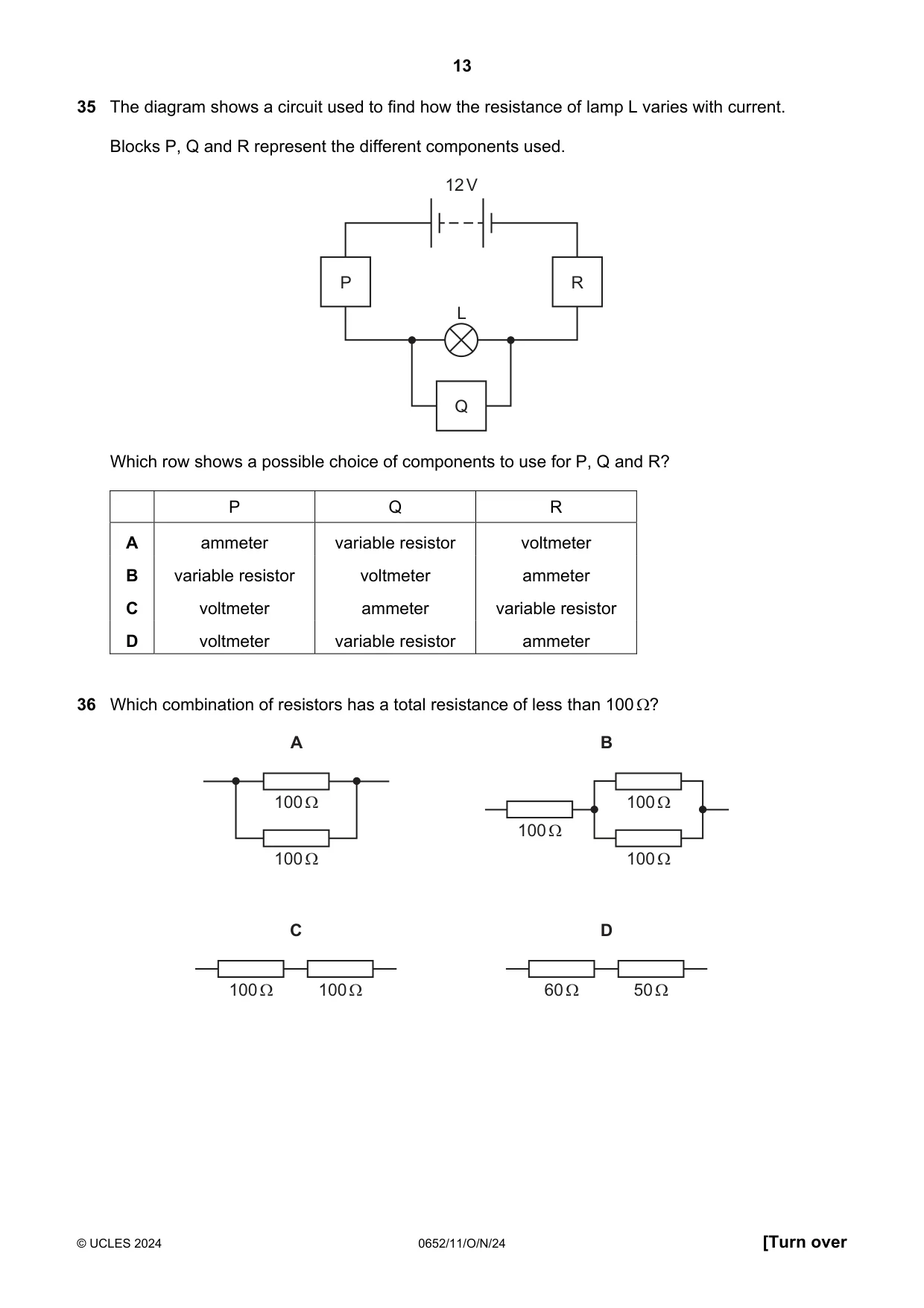
35 The diagram shows a circuit used to find how the resistance of lamp L varies with current. Blocks P, Q and R represent the different components used. 12 V P R L Q Which row shows a possible choice of components to use for P, Q and R? P Q R A ammeter variable resistor voltmeter B variable resistor voltmeter ammeter C voltmeter ammeter variable resistor D voltmeter variable resistor ammeter
Mark scheme: B
Q36 · Which combination of resistors has a total resistance of less than 100 Q?
36 Which combination of resistors has a total resistance of less than 100 Q? A B a | 1002 Cc D —L___ | -L___} — —L___}|-L___} — 1009 1000 602 502
Mark scheme: A
Q37 · An electrical appliance has a metal case
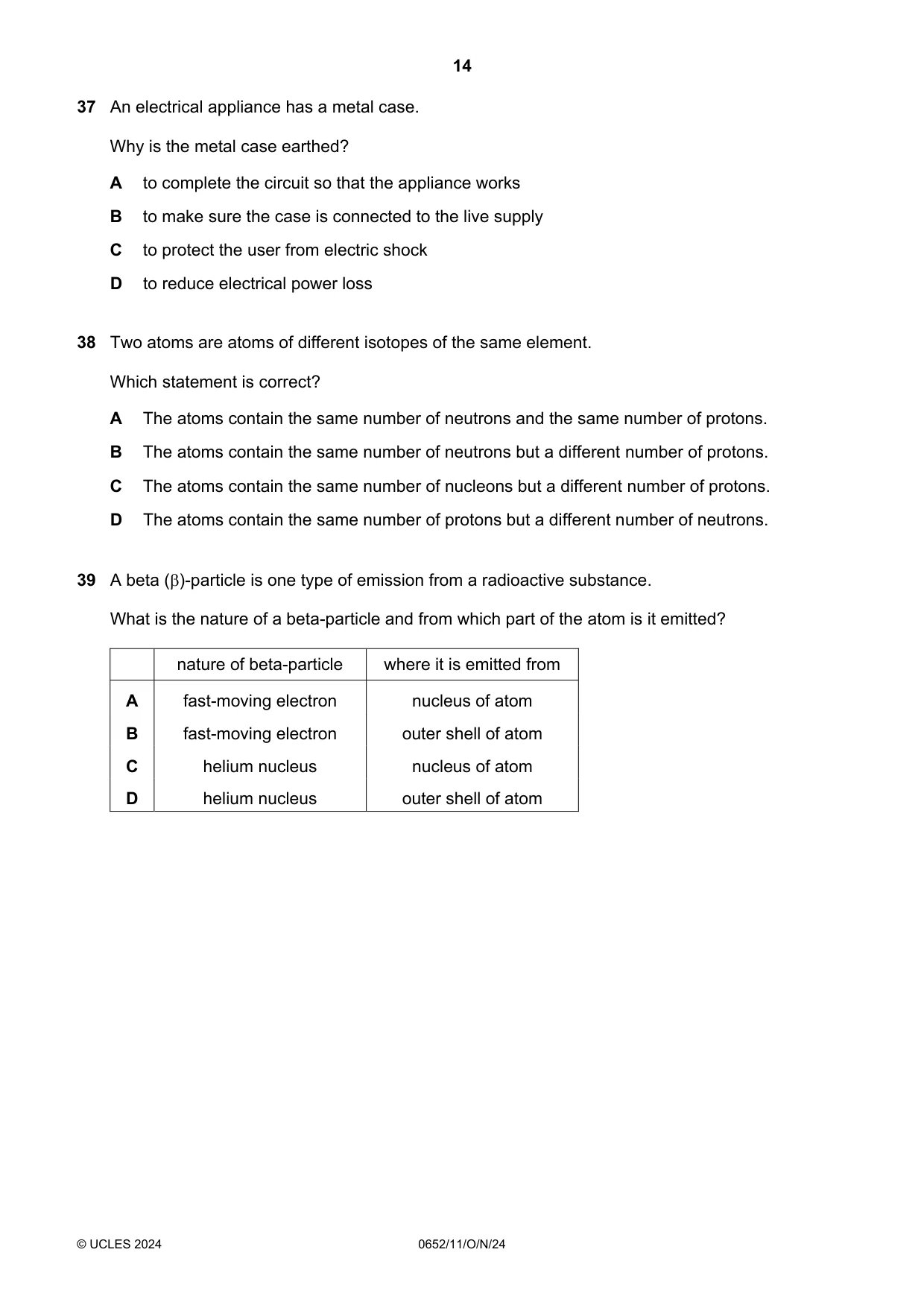
37 An electrical appliance has a metal case. Why is the metal case earthed? A to complete the circuit so that the appliance works B to make sure the case is connected to the live supply C to protect the user from electric shock D to reduce electrical power loss
Mark scheme: C
Q38 · Two atoms are atoms of different isotopes of the same element
38 Two atoms are atoms of different isotopes of the same element. Which statement is correct? A The atoms contain the same number of neutrons and the same number of protons. B The atoms contain the same number of neutrons but a different number of protons. C The atoms contain the same number of nucleons but a different number of protons. D The atoms contain the same number of protons but a different number of neutrons.
Mark scheme: D
Q39 · A beta ()-particle is one type of emission from a radioactive substance
39 A beta ()-particle is one type of emission from a radioactive substance. What is the nature of a beta-particle and from which part of the atom is it emitted? nature of beta-particle where it is emitted from A fast-moving electron nucleus of atom B fast-moving electron outer shell of atom C helium nucleus nucleus of atom D helium nucleus outer shell of atom
Mark scheme: A
Q40 · A scientist measures the radiation emitted from a radioactive material at the same time…
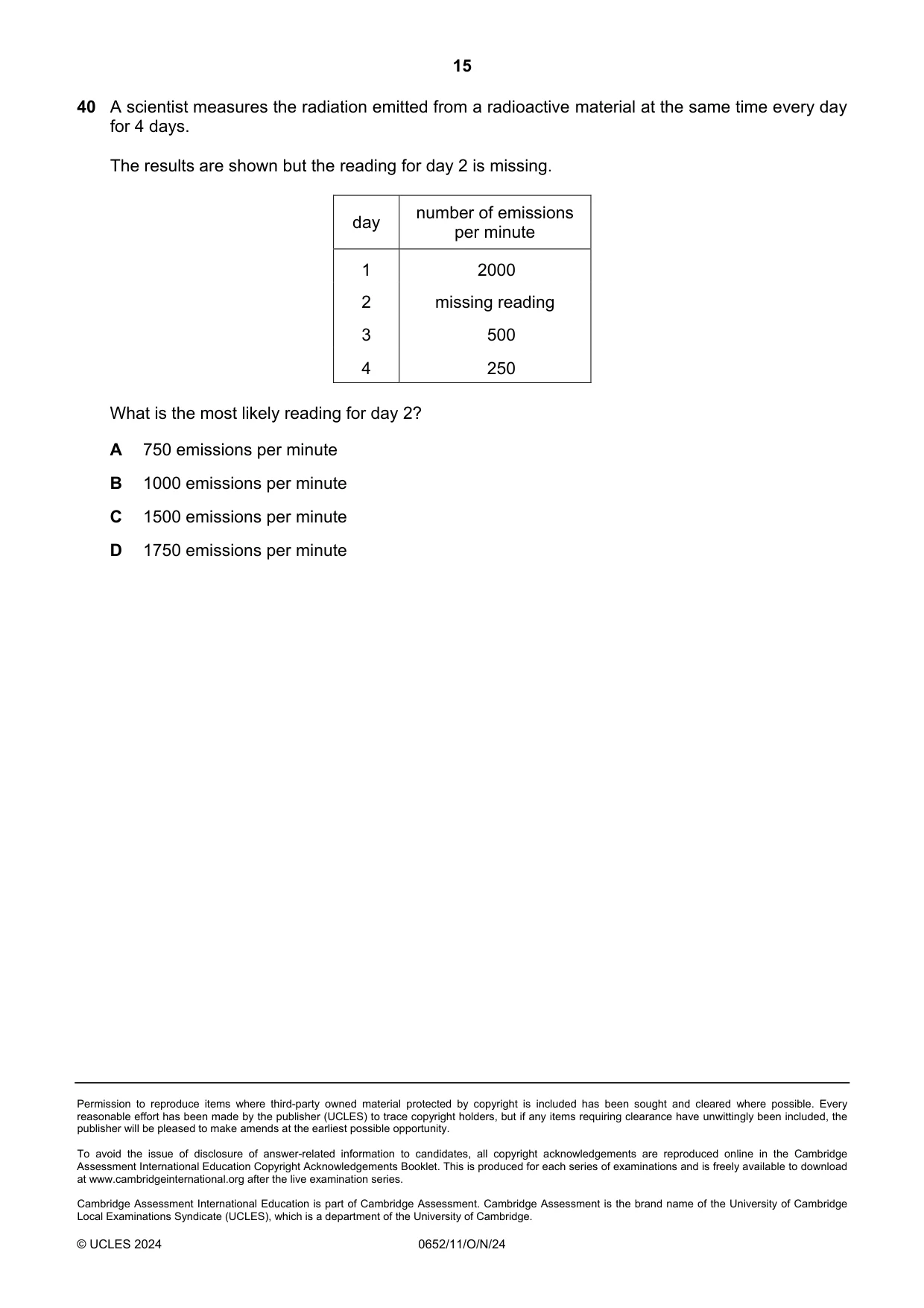
40 A scientist measures the radiation emitted from a radioactive material at the same time every day for 4 days. The results are shown but the reading for day 2 is missing. number of emissions day per minute 1 2000 2 missing reading 3 500 4 250 What is the most likely reading for day 2? A 750 emissions per minute B 1000 emissions per minute C 1500 emissions per minute D 1750 emissions per minute
Mark scheme: B
What was in this paper
The subtopics covered by these 40 questions, and how many questions each got. Open one in a new tab to see every Cambridge question on it.
2General wave properties2Light2Radioactivity2Simple phenomena of magnetism2Thermal properties and temperature2Work, energy and power2Air1Alcohols1Alkenes1Atomic structure and the Periodic Table1Dangers of electricity1Density1Electricity and chemistry1Forces1Group properties1Homologous series1Identification of ions and gases1Ions and ionic bonds1Measurement1Methods of purification1Motion1Names of compounds1Rate (speed) of reaction1Reactivity series1Redox1Stoichiometry1The nuclear atom1The particulate nature of matter1Thermal processes1Transition elements1Types of oxides1Water1What you needed in this session
Cambridge’s own grade thresholds for 2024 Oct/Nov, Paper 1 · Variant 1. A higher threshold means an easier paper — the bar moves with how the cohort did.