Cambridge IGCSE Physical Science 0652 — 2010 Oct/Nov Paper 1 · Variant 1
0652/11/O/N/10 · 40 questions · 40 marks · ≈45 min
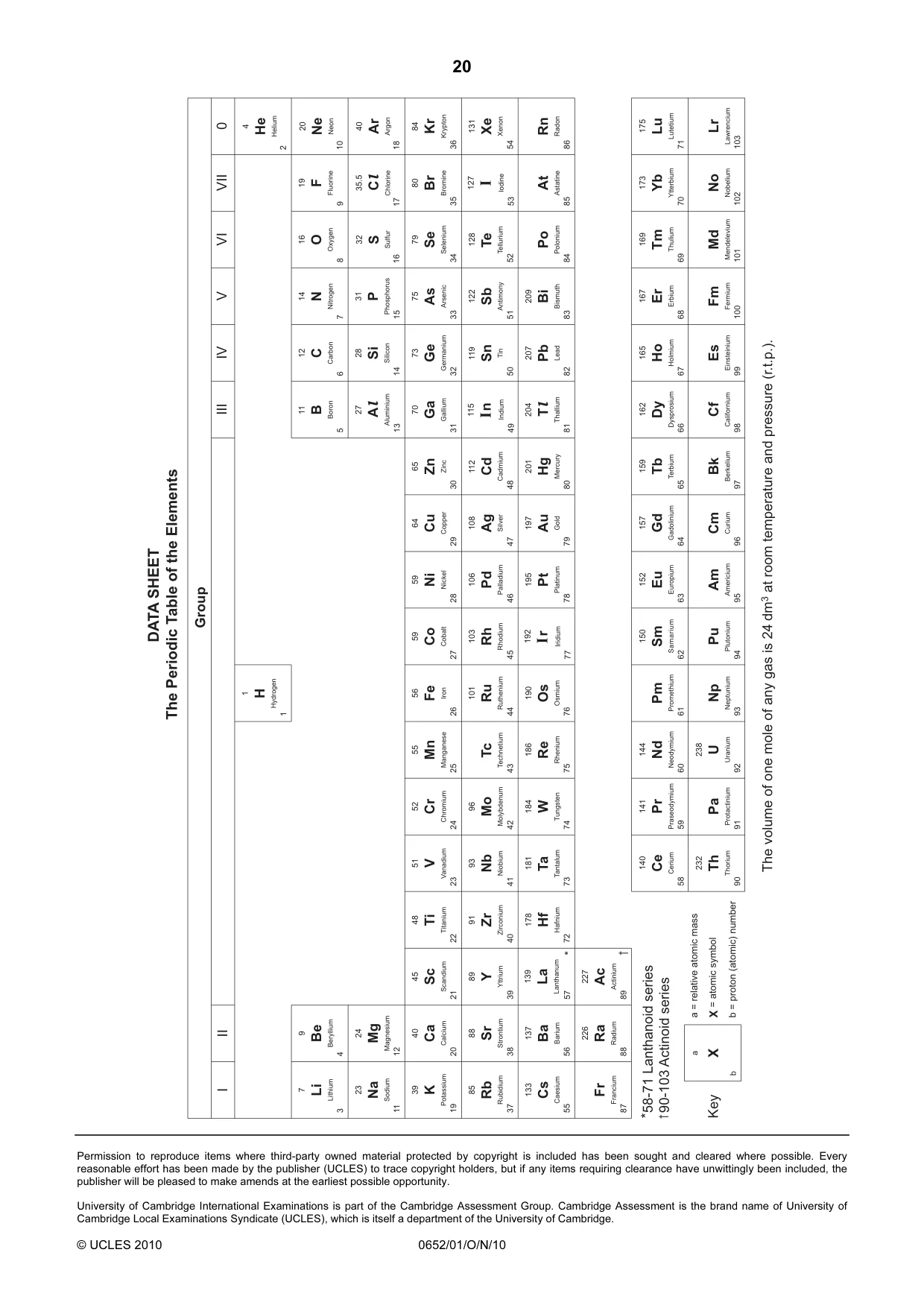
The question paper and its mark scheme, free to read here and free to download. This is Cambridge’s own paper, exactly as it was sat.
Question paper20 pages



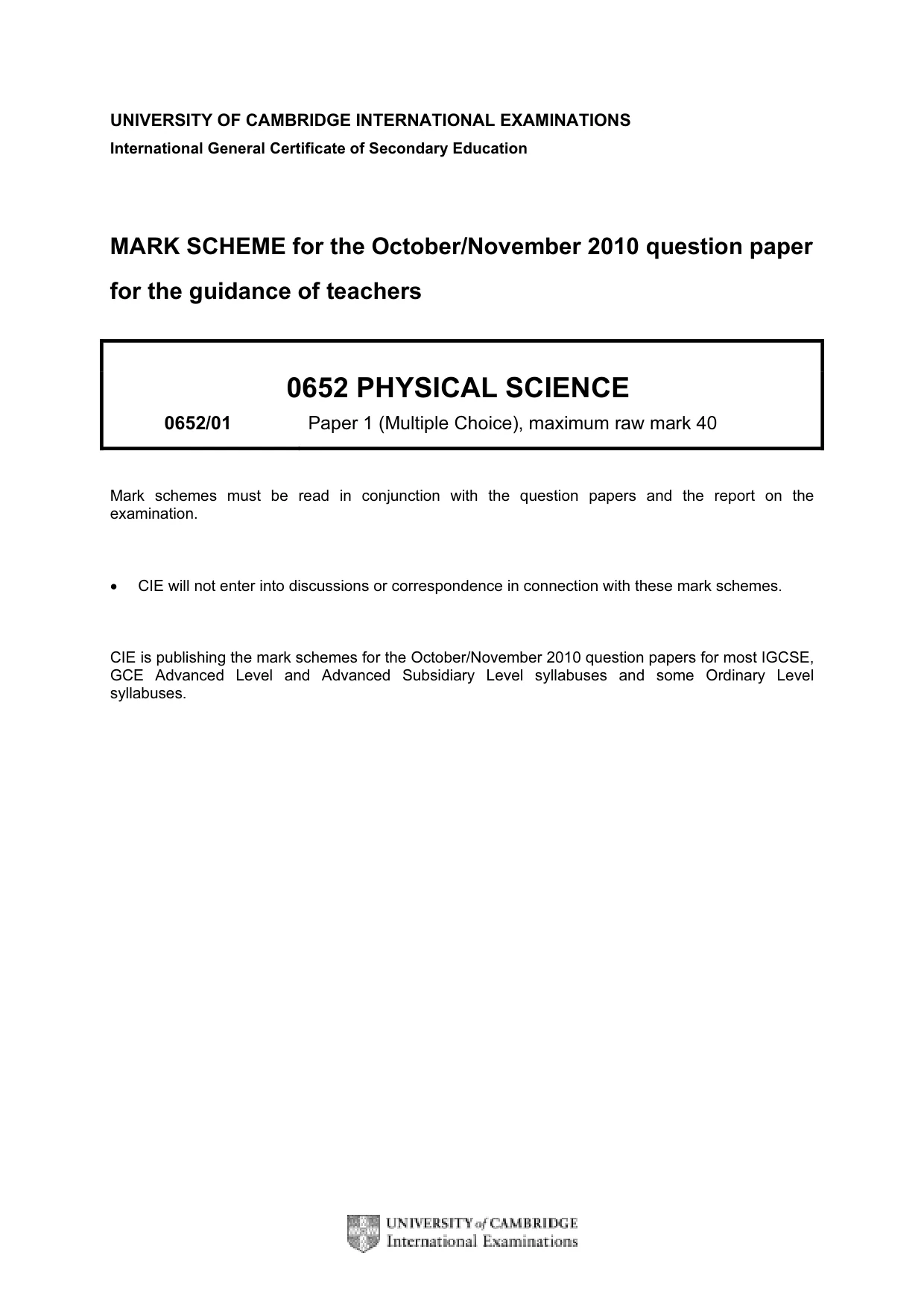
Mark scheme2 pages
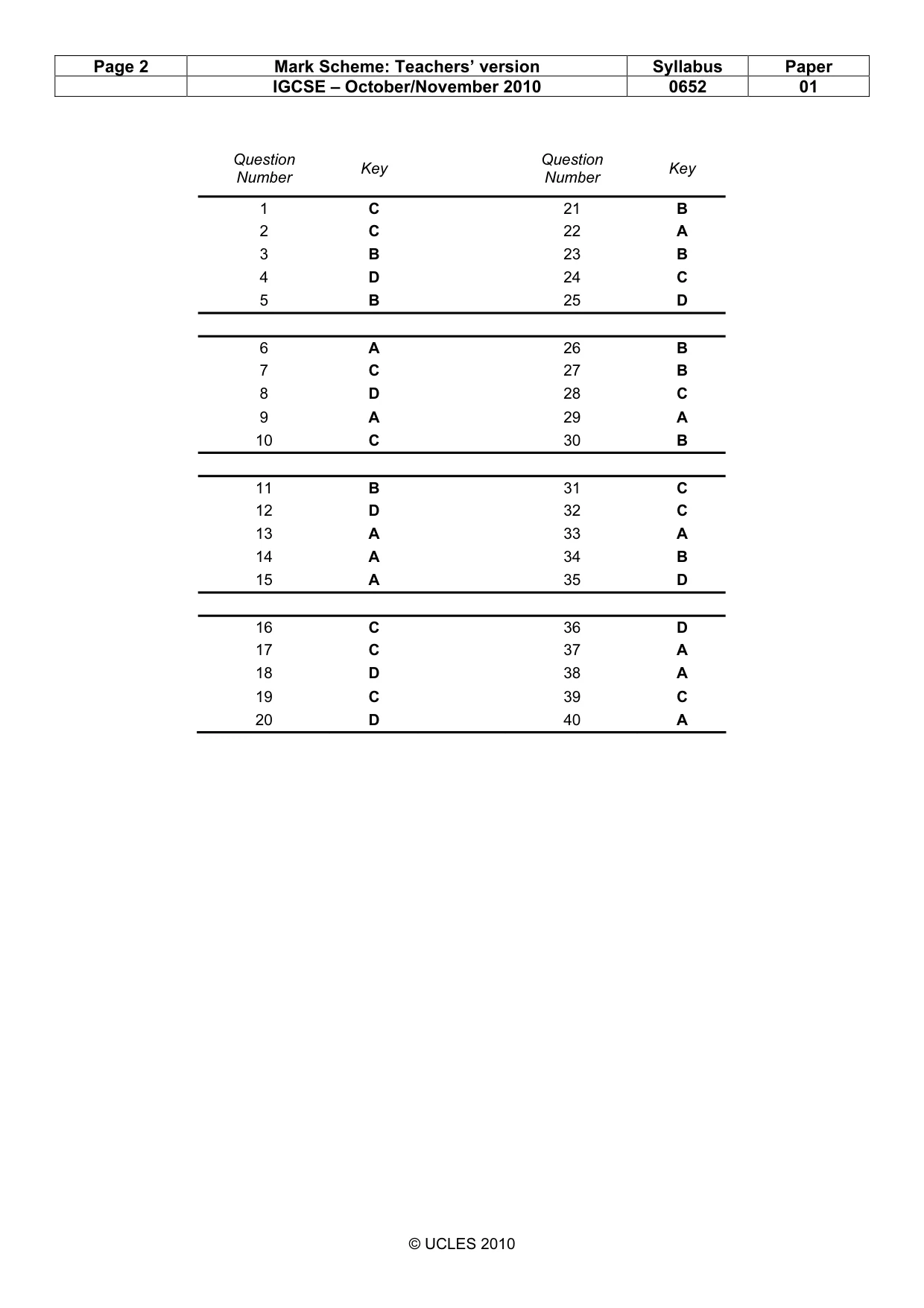
Answers below. Sit the paper first if you are practising.
Questions as text
Q1 · Some students are asked to explain why gases diffuse more readily than liquids
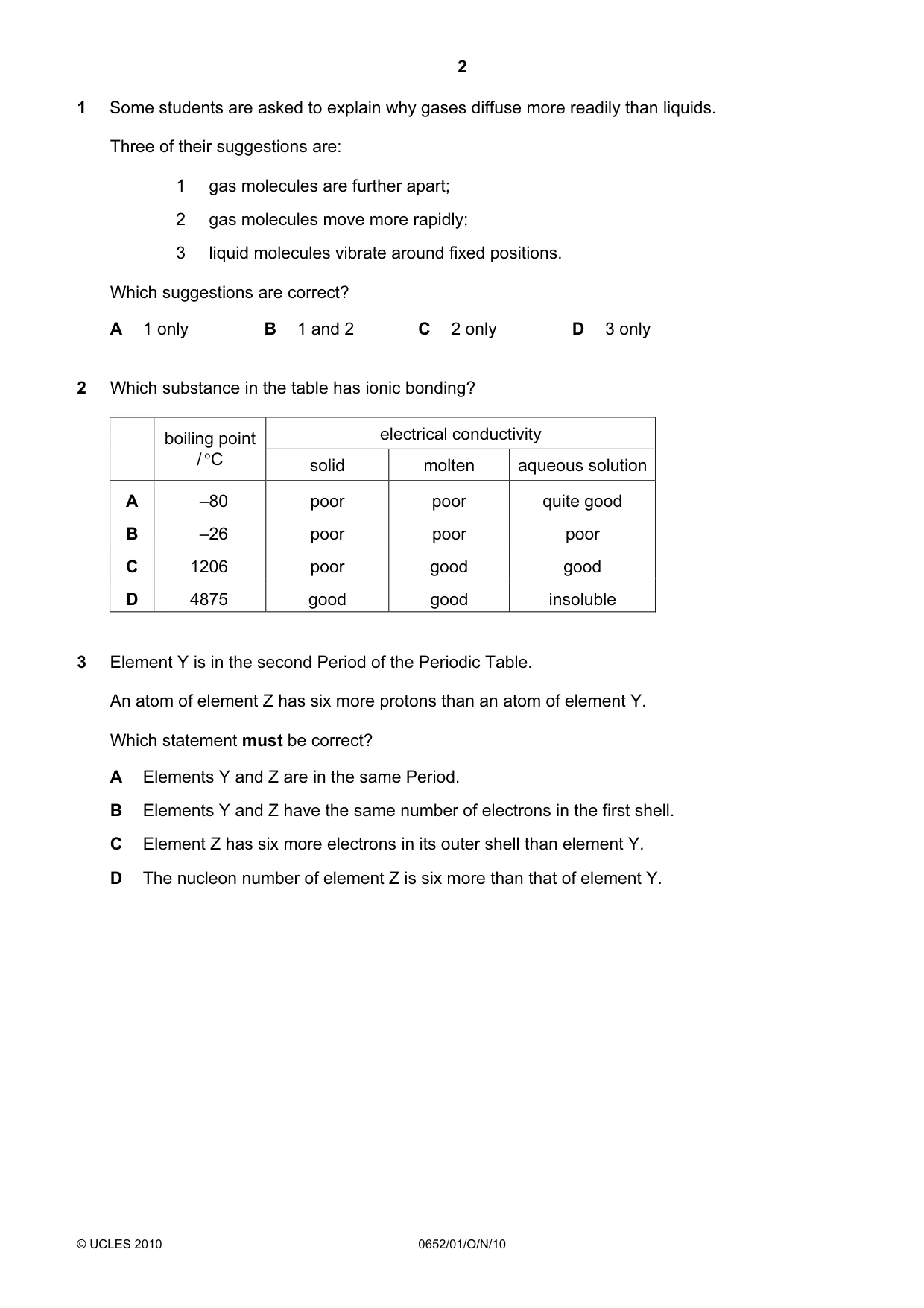
1 Some students are asked to explain why gases diffuse more readily than liquids. Three of their suggestions are: 1 gas molecules are further apart; 2 gas molecules move more rapidly; 3 liquid molecules vibrate around fixed positions. Which suggestions are correct? A 1 only B 1 and 2 C 2 only D 3 only
Mark scheme: C
Q2 · Which substance in the table has ionic bonding?
2 Which substance in the table has ionic bonding? boiling point electrical conductivity / °C solid molten aqueous solution A –80 poor poor quite good B –26 poor poor poor C 1206 poor good good D 4875 good good insoluble
Mark scheme: C
Q3 · Element Y is in the second Period of the Periodic Table
3 Element Y is in the second Period of the Periodic Table. An atom of element Z has six more protons than an atom of element Y. Which statement must be correct? A Elements Y and Z are in the same Period. B Elements Y and Z have the same number of electrons in the first shell. C Element Z has six more electrons in its outer shell than element Y. D The nucleon number of element Z is six more than that of element Y.
Mark scheme: B
Q4 · Some reactions of sulfuric acid are shown
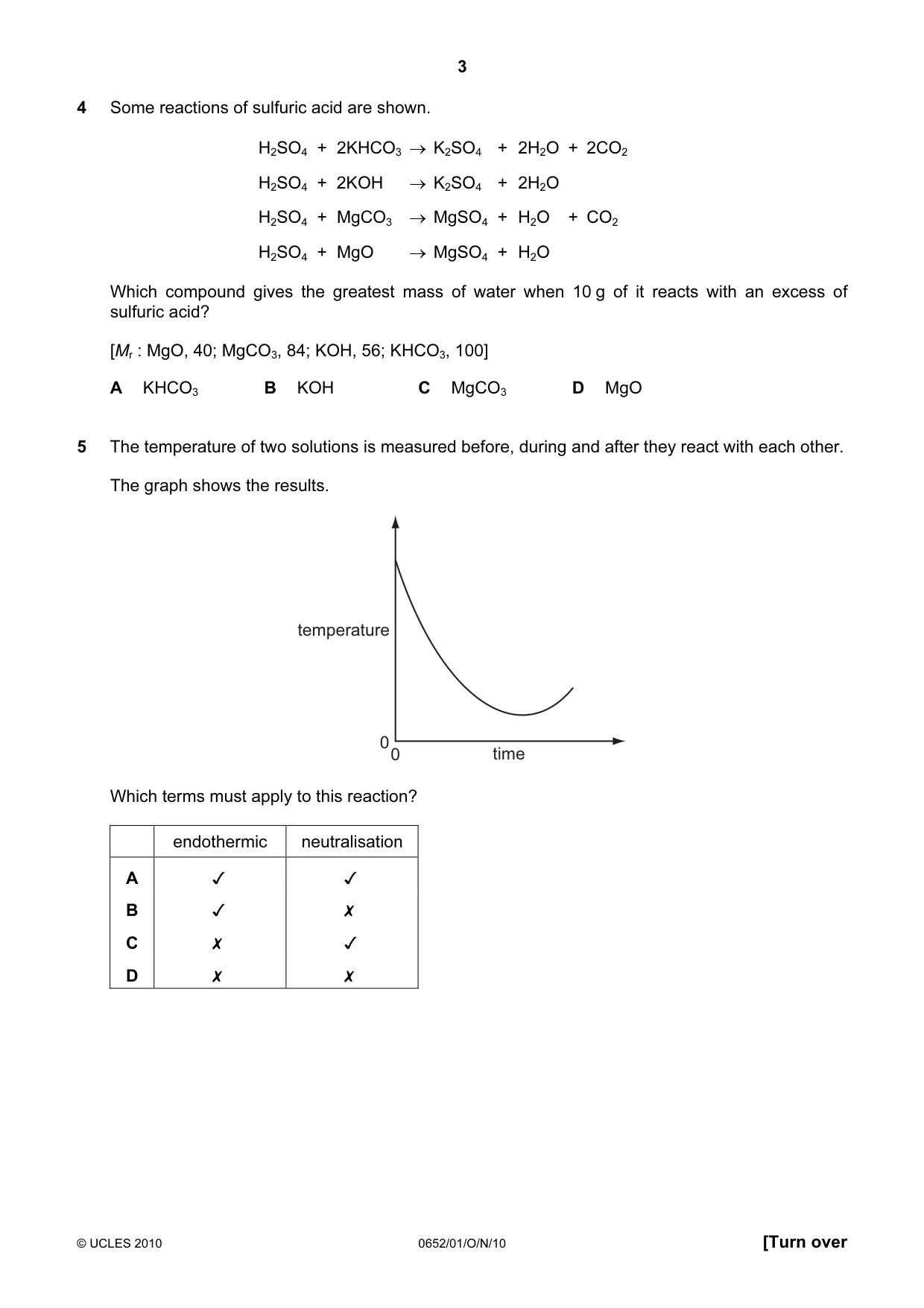
4 Some reactions of sulfuric acid are shown. H2SO4 + 2KHCO3 → K2SO4 + 2H2O + 2CO2 H2SO4 + 2KOH → K2SO4 + 2H2O H2SO4 + MgCO3 → MgSO4 + H2O + CO2 H2SO4 + MgO → MgSO4 + H2O Which compound gives the greatest mass of water when 10 g of it reacts with an excess of sulfuric acid? [Mr : MgO, 40; MgCO3, 84; KOH, 56; KHCO3, 100] A KHCO3 B KOH C MgCO3 D MgO
Mark scheme: D
Q5 · The temperature of two solutions is measured before, during and after they react with…
5 The temperature of two solutions is measured before, during and after they react with each other. The graph shows the results. temperature °9 time Which terms must apply to this reaction? endothermic neutralisation A v v B v x Cc x v D x x
Mark scheme: B
Q6 · The diagram shows a cup of tea with a spoon in it
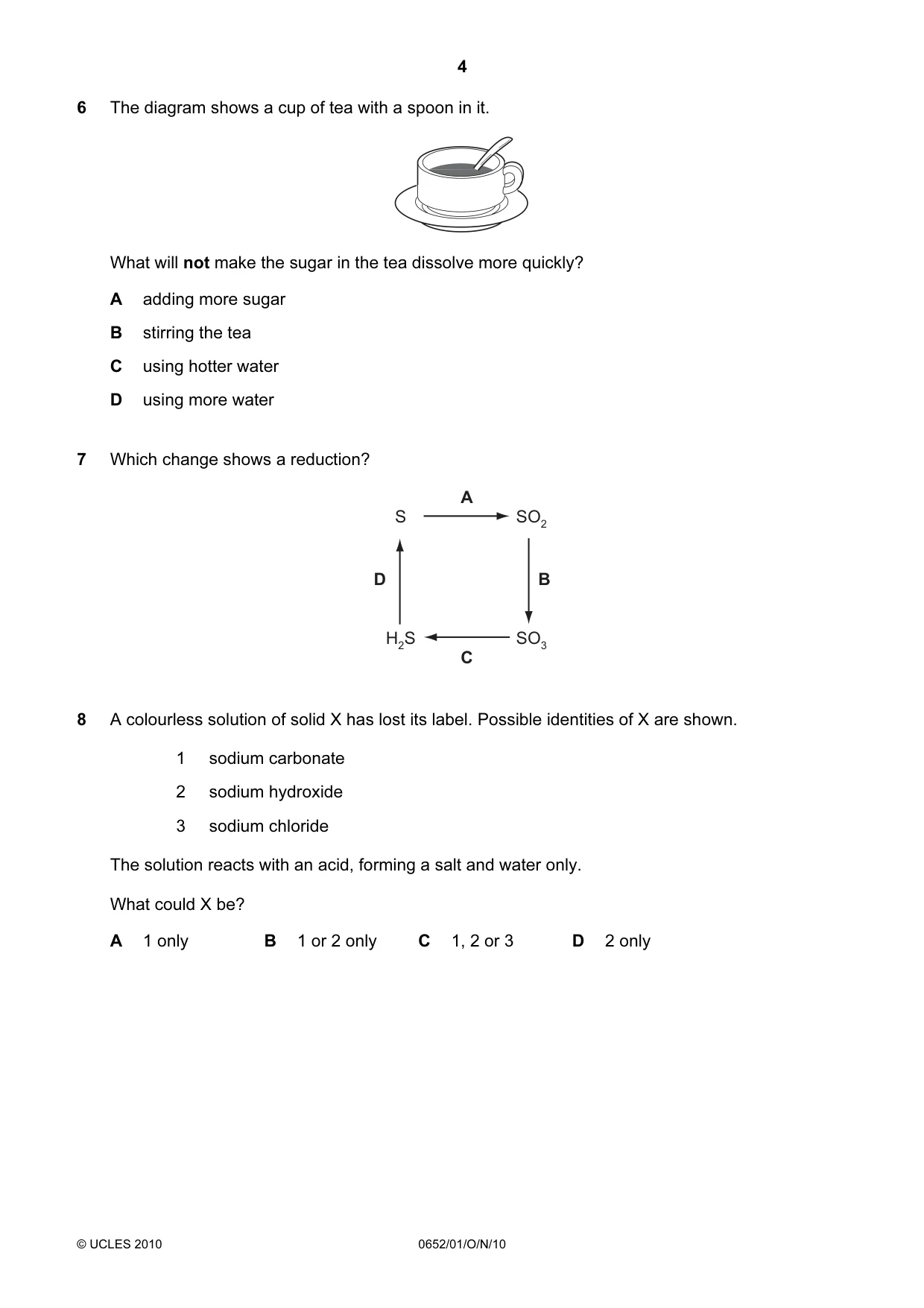
6 The diagram shows a cup of tea with a spoon in it. What will not make the sugar in the tea dissolve more quickly? A adding more sugar B stirring the tea C using hotter water D using more water
Mark scheme: A
Q7 · Which change shows a reduction?
7 Which change shows a reduction? A S SO2 D B H2S SO3 C
Mark scheme: C
Q8 · A colourless solution of solid X has lost its label
8 A colourless solution of solid X has lost its label. Possible identities of X are shown. 1 sodium carbonate 2 sodium hydroxide 3 sodium chloride The solution reacts with an acid, forming a salt and water only. What could X be? A 1 only B 1 or 2 only C 1, 2 or 3 D 2 only
Mark scheme: D
More questions on The characteristic properties of acids and bases
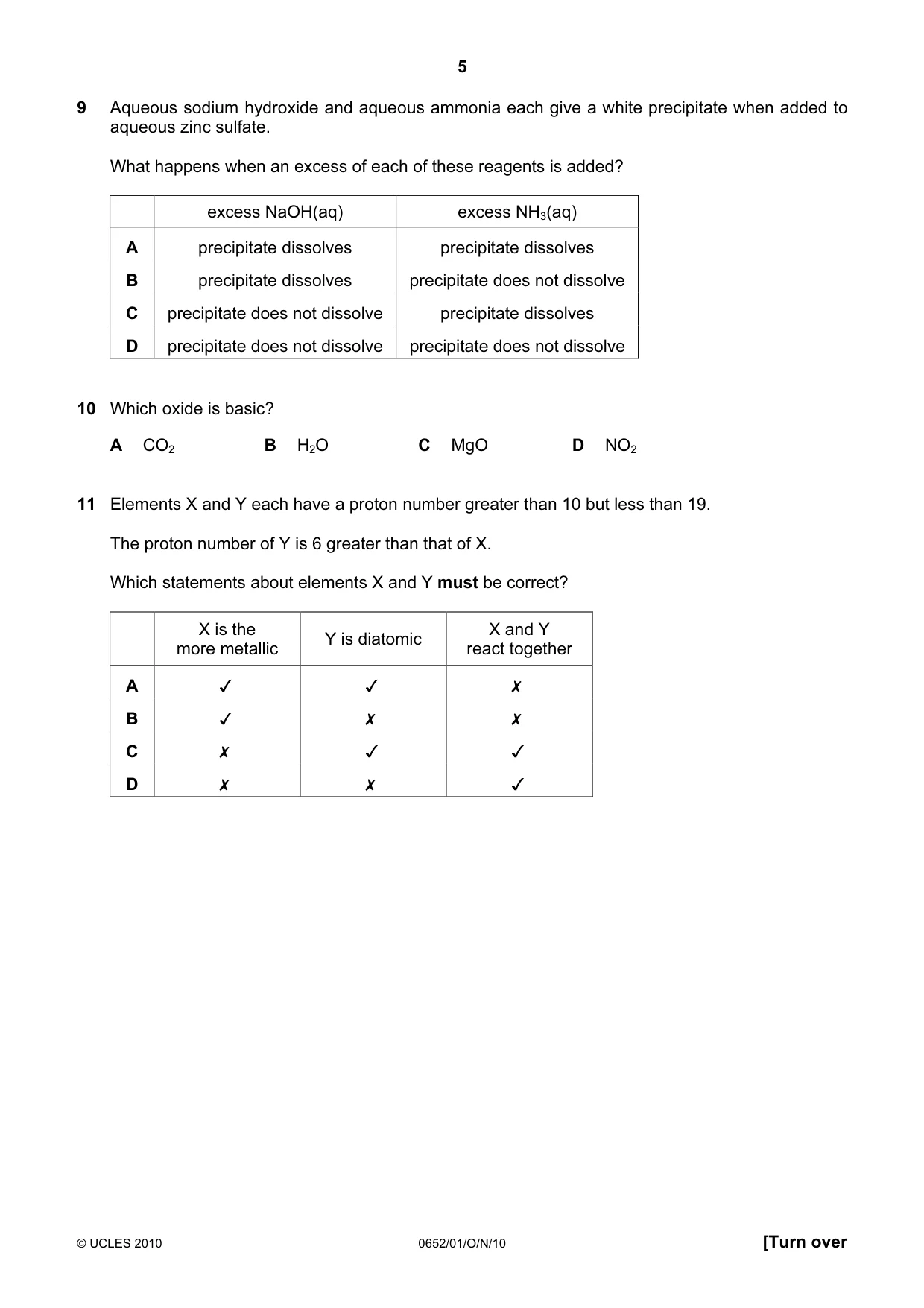
Q9 · Aqueous sodium hydroxide and aqueous ammonia each give a white precipitate when added to…
9 Aqueous sodium hydroxide and aqueous ammonia each give a white precipitate when added to aqueous zinc sulfate. What happens when an excess of each of these reagents is added? excess NaOH(aq) excess NH3(aq) A precipitate dissolves precipitate dissolves B precipitate dissolves precipitate does not dissolve C precipitate does not dissolve precipitate dissolves D precipitate does not dissolve precipitate does not dissolve
Mark scheme: A
Q10 · Which oxide is basic?
10 Which oxide is basic? A CO2 B H2O C MgO D NO2
Mark scheme: C
Q11 · Elements X and Y each have a proton number greater than 10 but less than 19
11 Elements X and Y each have a proton number greater than 10 but less than 19. The proton number of Y is 6 greater than that of X. Which statements about elements X and Y must be correct? X is the oon . X and Y . Y is diatomic more metallic react together A Jv Jv x B Jv x x Cc x Jv Jv D x x Jv
Mark scheme: B
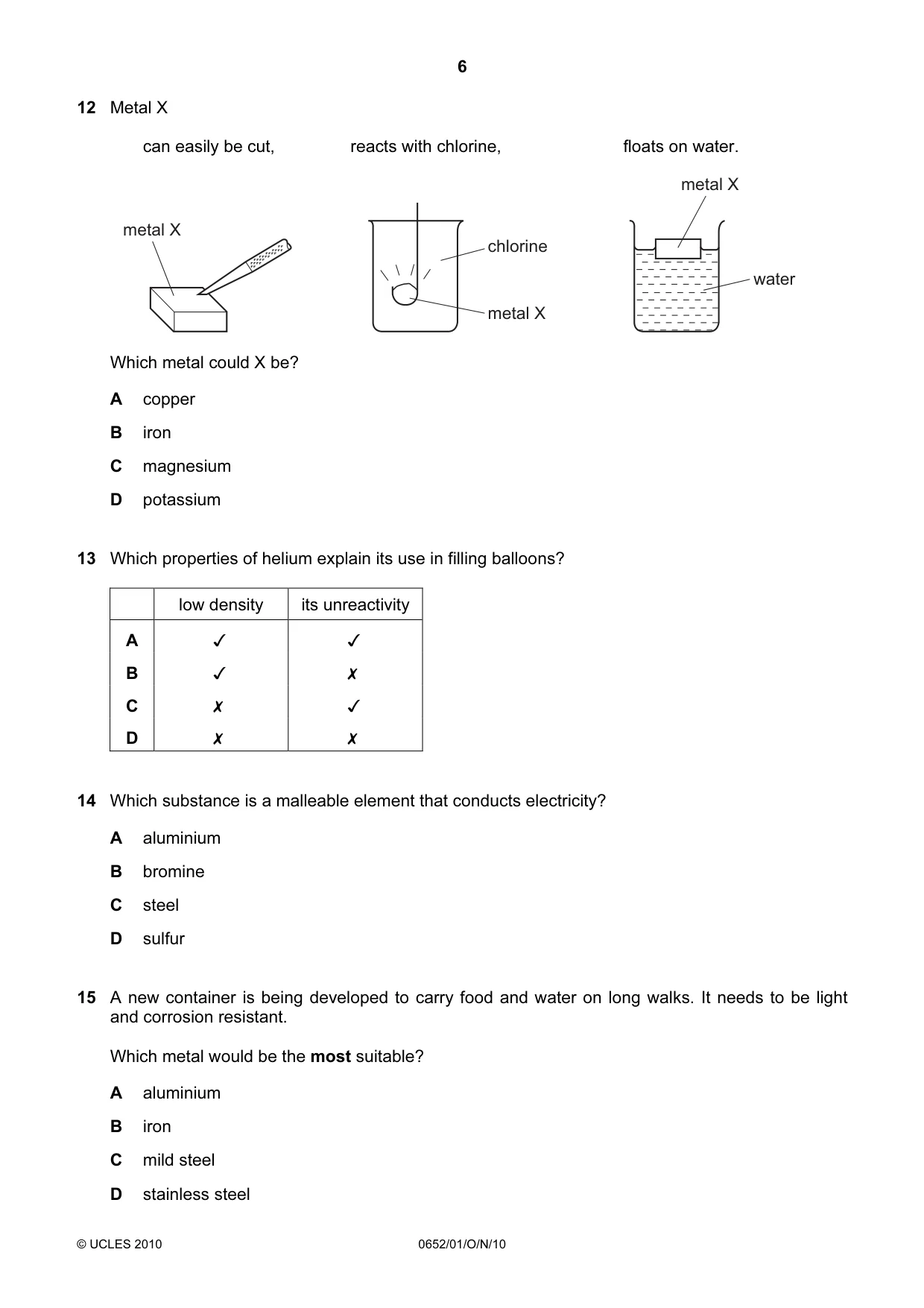
Q12 · Metal X can easily be cut, reacts with chlorine, floats on water
12 Metal X can easily be cut, reacts with chlorine, floats on water. metal X metal X chlorine water metal X Which metal could X be? A copper B iron C magnesium D potassium
Mark scheme: D
Q13 · Which properties of helium explain its use in filling balloons?
13 Which properties of helium explain its use in filling balloons? low density its unreactivity A v v B v x Cc x v D x x
Mark scheme: A
Q14 · Which substance is a malleable element that conducts electricity?
14 Which substance is a malleable element that conducts electricity? A aluminium B bromine C steel D sulfur
Mark scheme: A
Q15 · A new container is being developed to carry food and water on long walks
15 A new container is being developed to carry food and water on long walks. It needs to be light and corrosion resistant. Which metal would be the most suitable? A aluminium B iron C mild steel D stainless steel
Mark scheme: A
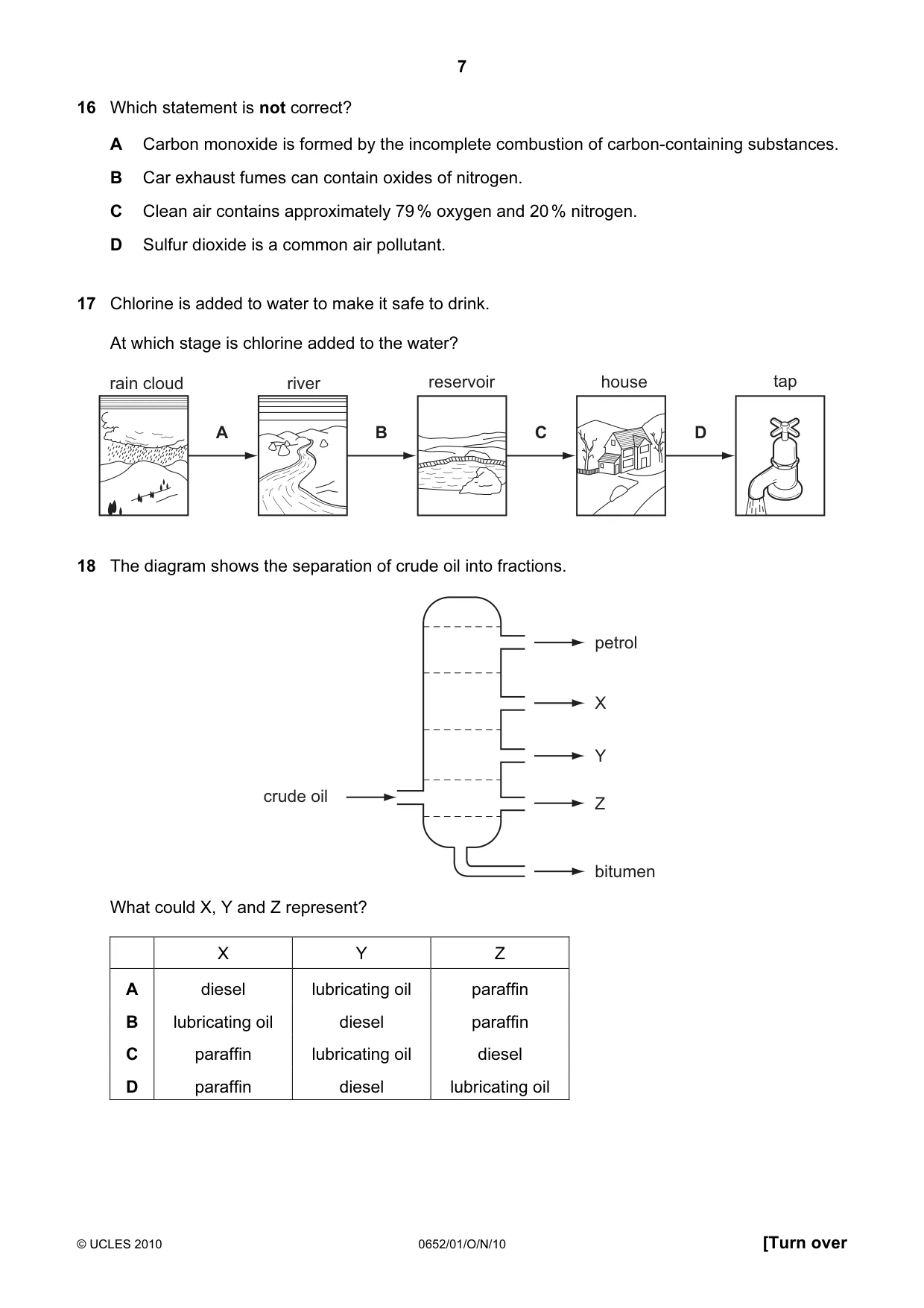
Q16 · Which statement is not correct?
16 Which statement is not correct? A Carbon monoxide is formed by the incomplete combustion of carbon-containing substances. B Car exhaust fumes can contain oxides of nitrogen. C Clean air contains approximately 79 % oxygen and 20 % nitrogen. D Sulfur dioxide is a common air pollutant.
Mark scheme: C
Q17 · Chlorine is added to water to make it safe to drink
17 Chlorine is added to water to make it safe to drink. At which stage is chlorine added to the water? rain cloud river reservoir house tap A B C D
Mark scheme: C
Q18 · The diagram shows the separation of crude oil into fractions
18 The diagram shows the separation of crude oil into fractions. petrol X Y crude oil Z bitumen What could X, Y and Z represent? X Y Z A diesel lubricating oil paraffin B lubricating oil diesel paraffin C paraffin lubricating oil diesel D paraffin diesel lubricating oil
Mark scheme: D
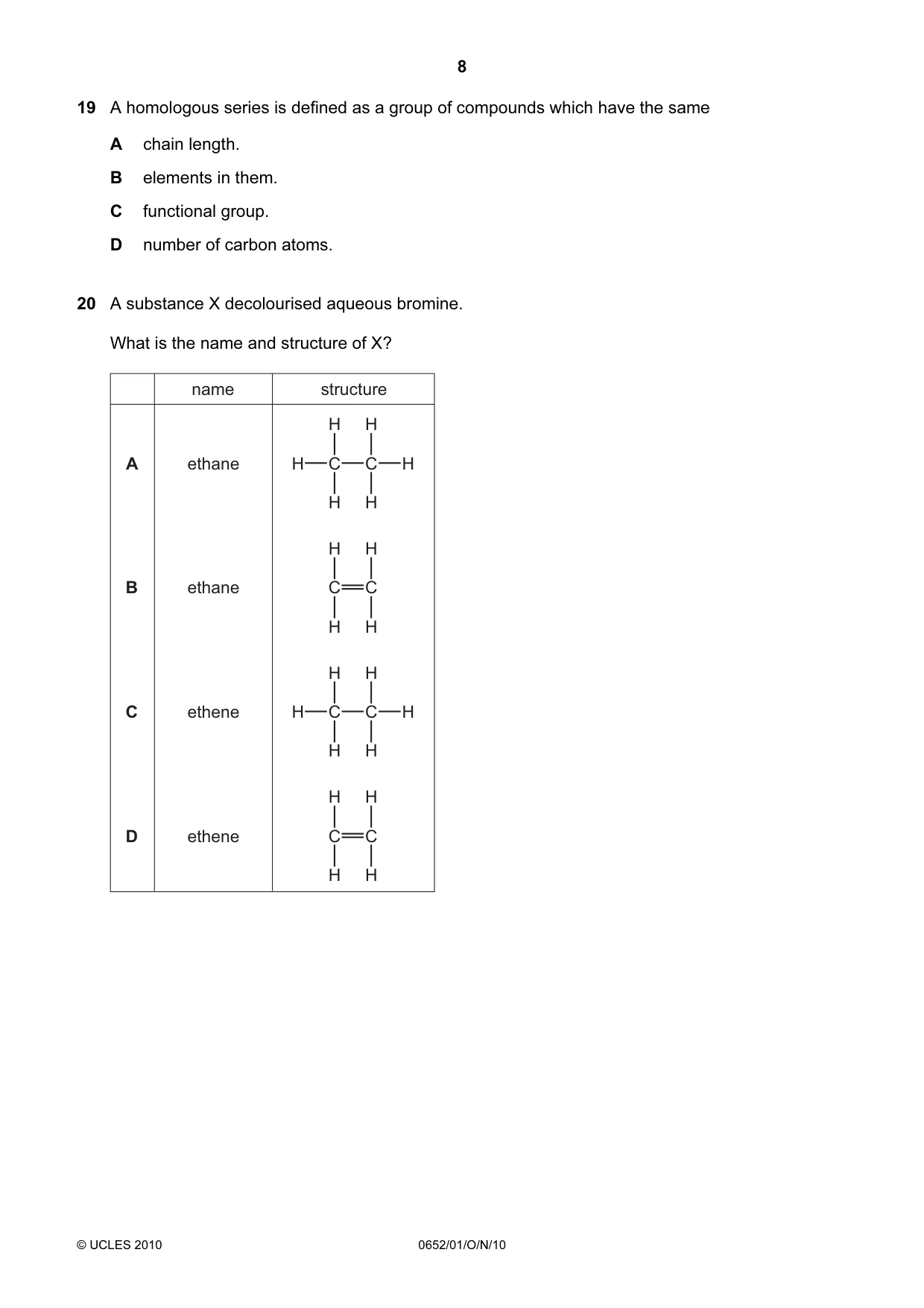
Q19 · A homologous series is defined as a group of compounds which have the same A chain length
19 A homologous series is defined as a group of compounds which have the same A chain length. B elements in them. C functional group. D number of carbon atoms.
Mark scheme: C
Q20 · A substance X decolourised aqueous bromine
20 A substance X decolourised aqueous bromine. What is the name and structure of X? name structure H H A ethane H C C H H H H H B ethane C C H H H H C ethene H C C H H H H H D ethene C C H H
Mark scheme: D
Q21 · The diagram shows a child’s building block
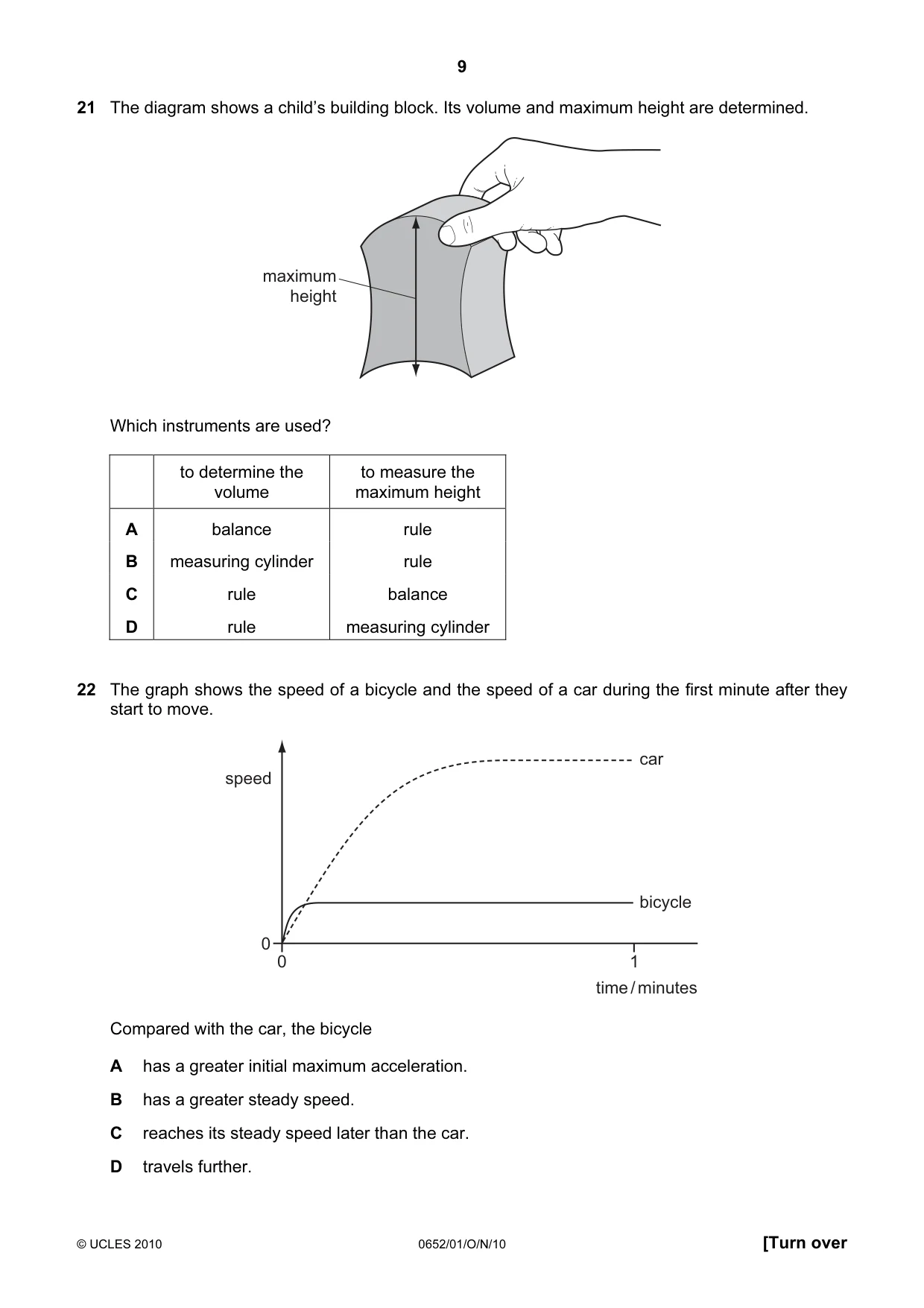
21 The diagram shows a child’s building block. Its volume and maximum height are determined. maximum height Which instruments are used? to determine the to measure the volume maximum height A balance rule B measuring cylinder rule C rule balance D rule measuring cylinder
Mark scheme: B
Q22 · The graph shows the speed of a bicycle and the speed of a car during the first minute…
22 The graph shows the speed of a bicycle and the speed of a car during the first minute after they start to move. car speed bicycle 0 0 1 time / minutes Compared with the car, the bicycle A has a greater initial maximum acceleration. B has a greater steady speed. C reaches its steady speed later than the car. D travels further.
Mark scheme: A
Q23 · The mass of a full bottle of cooking oil is 1.30 kg
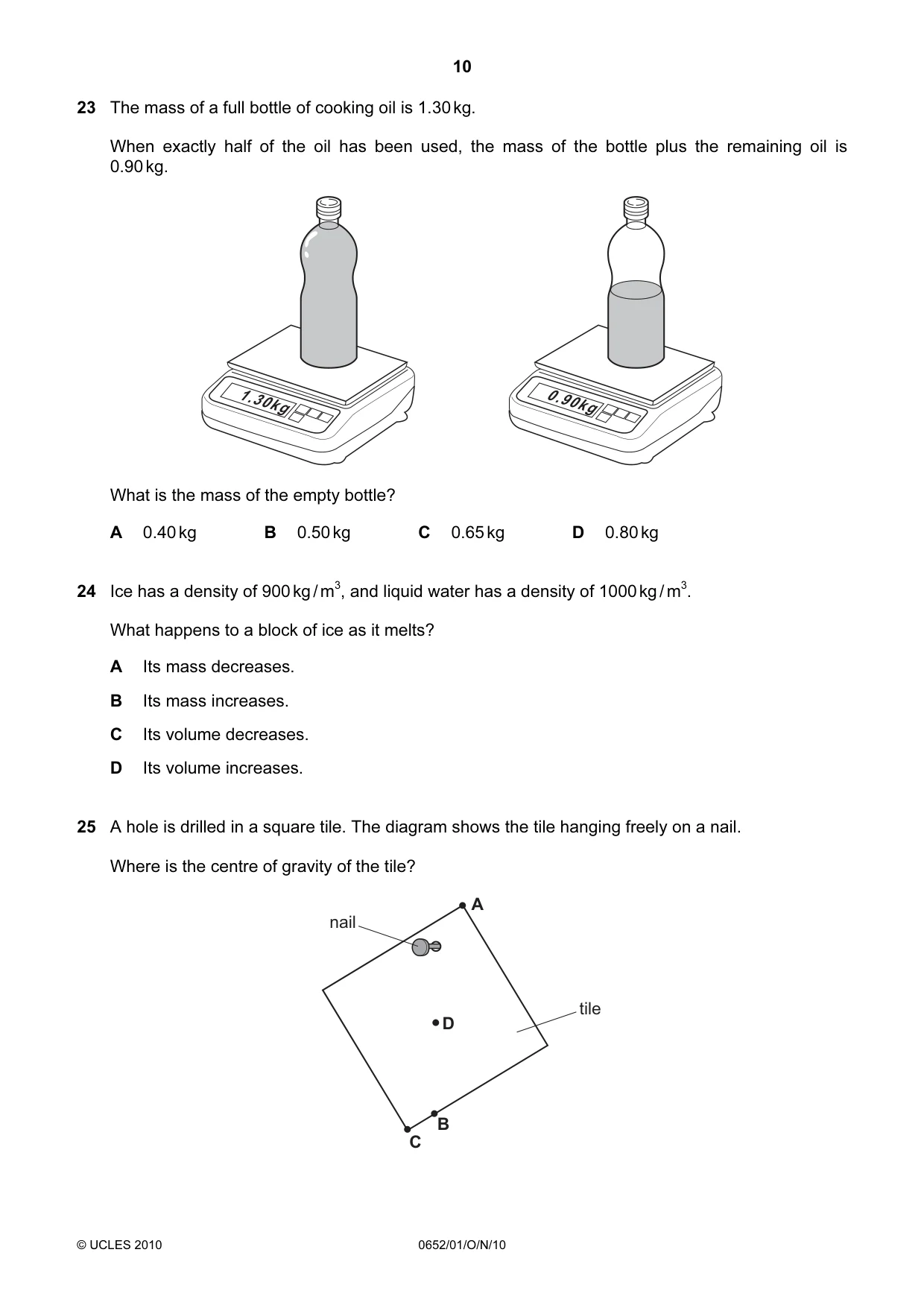
23 The mass of a full bottle of cooking oil is 1.30 kg. When exactly half of the oil has been used, the mass of the bottle plus the remaining oil is 0.90 kg. 1.30kg 0.90kg What is the mass of the empty bottle? A 0.40 kg B 0.50 kg C 0.65 kg D 0.80 kg
Mark scheme: B
Q24 · Ice has a density of 900 kg / m3, and liquid water has a density of 1000 kg / m3
24 Ice has a density of 900 kg / m3, and liquid water has a density of 1000 kg / m3. What happens to a block of ice as it melts? A Its mass decreases. B Its mass increases. C Its volume decreases. D Its volume increases.
Mark scheme: C
Q25 · A hole is drilled in a square tile
25 A hole is drilled in a square tile. The diagram shows the tile hanging freely on a nail. Where is the centre of gravity of the tile? A nail tile D B C
Mark scheme: D
Q26 · A cyclist travels down a hill from rest at point X without pedalling
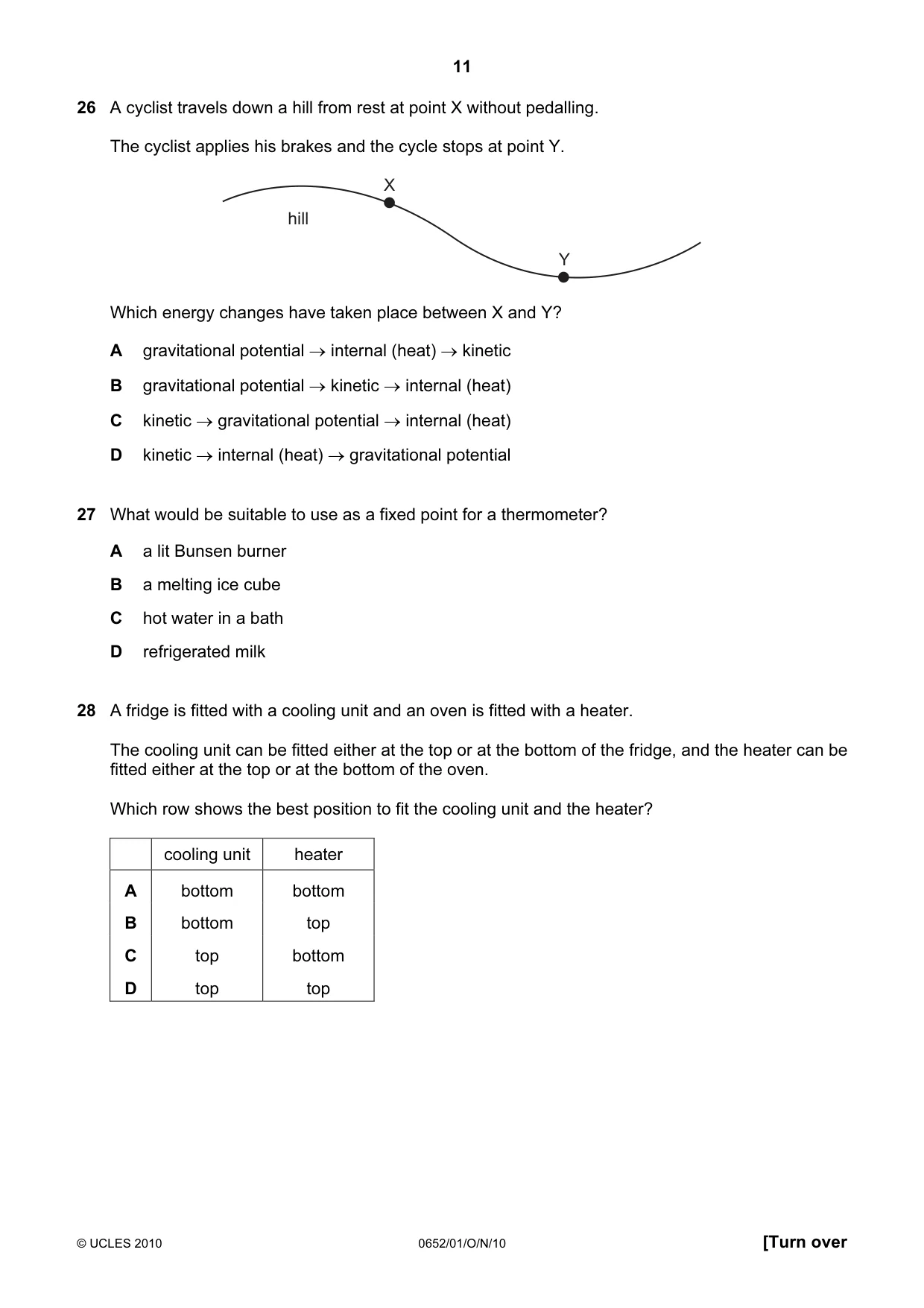
26 A cyclist travels down a hill from rest at point X without pedalling. The cyclist applies his brakes and the cycle stops at point Y. X hill Y Which energy changes have taken place between X and Y? A gravitational potential → internal (heat) → kinetic B gravitational potential → kinetic → internal (heat) C kinetic → gravitational potential → internal (heat) D kinetic → internal (heat) → gravitational potential
Mark scheme: B
Q27 · What would be suitable to use as a fixed point for a thermometer?
27 What would be suitable to use as a fixed point for a thermometer? A a lit Bunsen burner B a melting ice cube C hot water in a bath D refrigerated milk
Mark scheme: B
Q28 · A fridge is fitted with a cooling unit and an oven is fitted with a heater
28 A fridge is fitted with a cooling unit and an oven is fitted with a heater. The cooling unit can be fitted either at the top or at the bottom of the fridge, and the heater can be fitted either at the top or at the bottom of the oven. Which row shows the best position to fit the cooling unit and the heater? cooling unit heater A bottom bottom B bottom top C top bottom D top top
Mark scheme: C
Q29 · The diagram represents a water wave
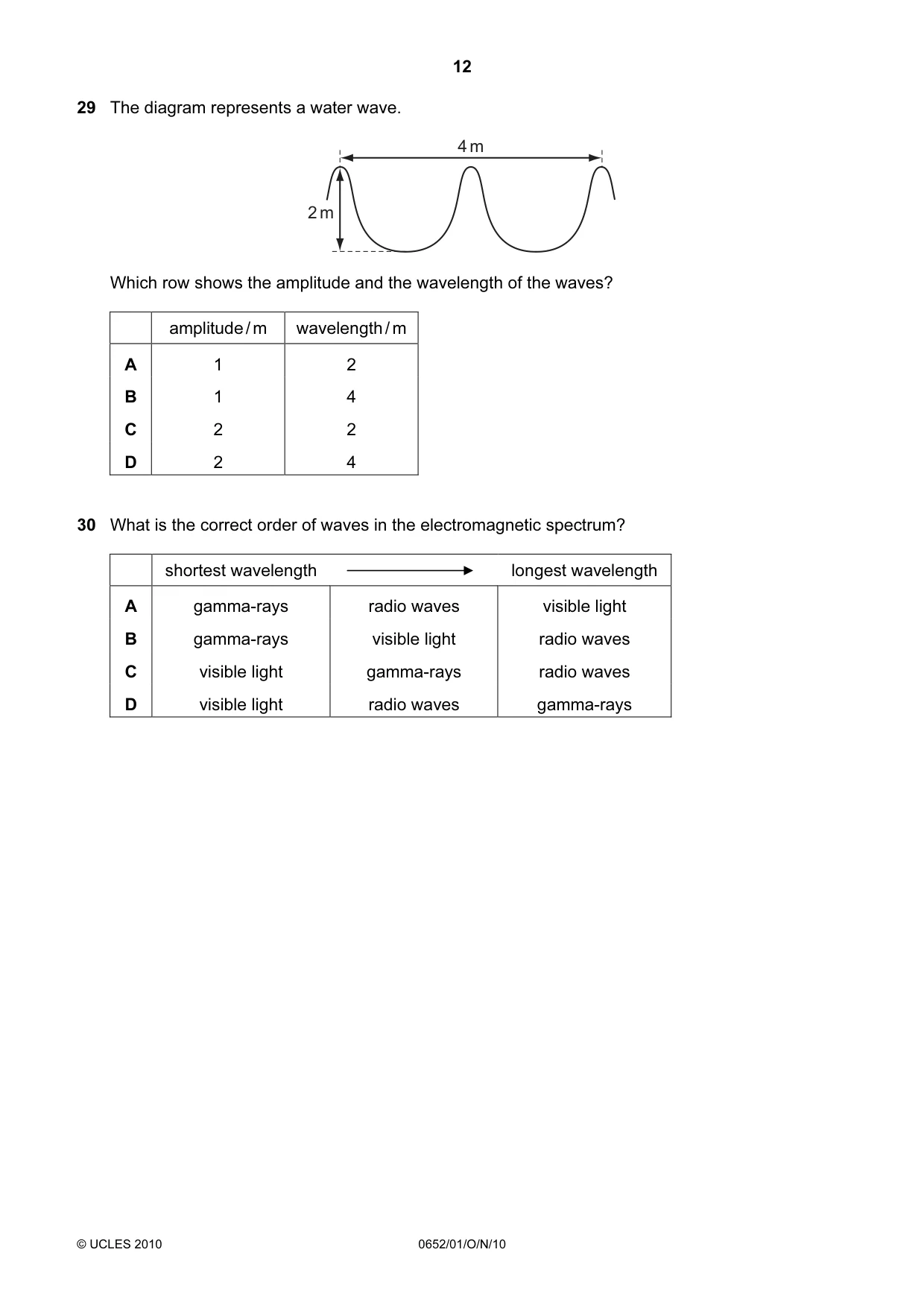
29 The diagram represents a water wave. 4 m 2 m Which row shows the amplitude and the wavelength of the waves? amplitude / m wavelength / m A 1 2 B 1 4 C 2 2 D 2 4
Mark scheme: A
Q30 · What is the correct order of waves in the electromagnetic spectrum?
30 What is the correct order of waves in the electromagnetic spectrum? shortest wavelength longest wavelength A gamma-rays radio waves visible light B gamma-rays visible light radio waves C visible light gamma-rays radio waves D visible light radio waves gamma-rays
Mark scheme: B
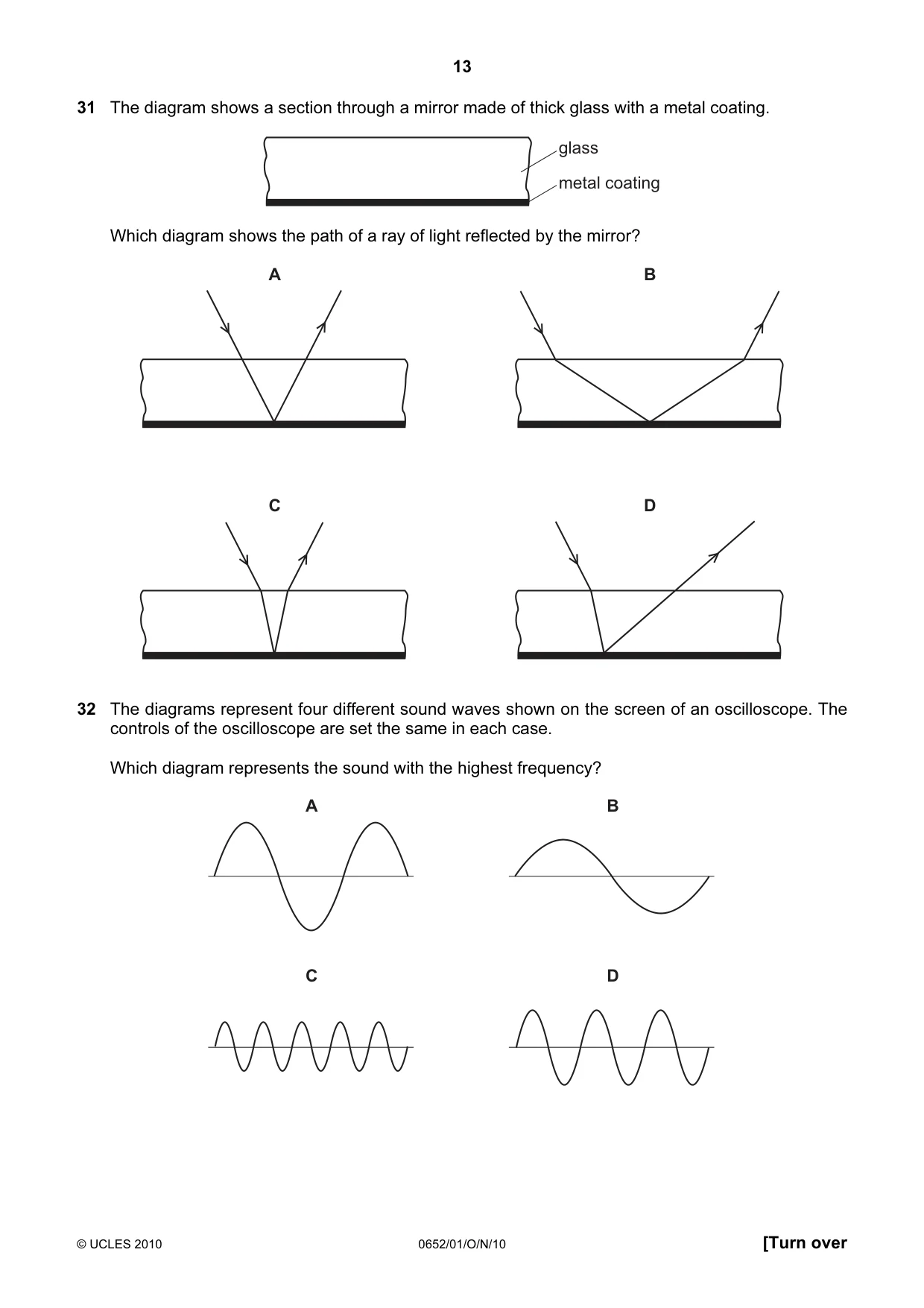
Q31 · The diagram shows a section through a mirror made of thick glass with a metal coating
31 The diagram shows a section through a mirror made of thick glass with a metal coating. glass metal coating Which diagram shows the path of a ray of light reflected by the mirror? A B C D
Mark scheme: C
Q32 · The diagrams represent four different sound waves shown on the screen of an oscilloscope
32 The diagrams represent four different sound waves shown on the screen of an oscilloscope. The controls of the oscilloscope are set the same in each case. Which diagram represents the sound with the highest frequency? A B C D
Mark scheme: C
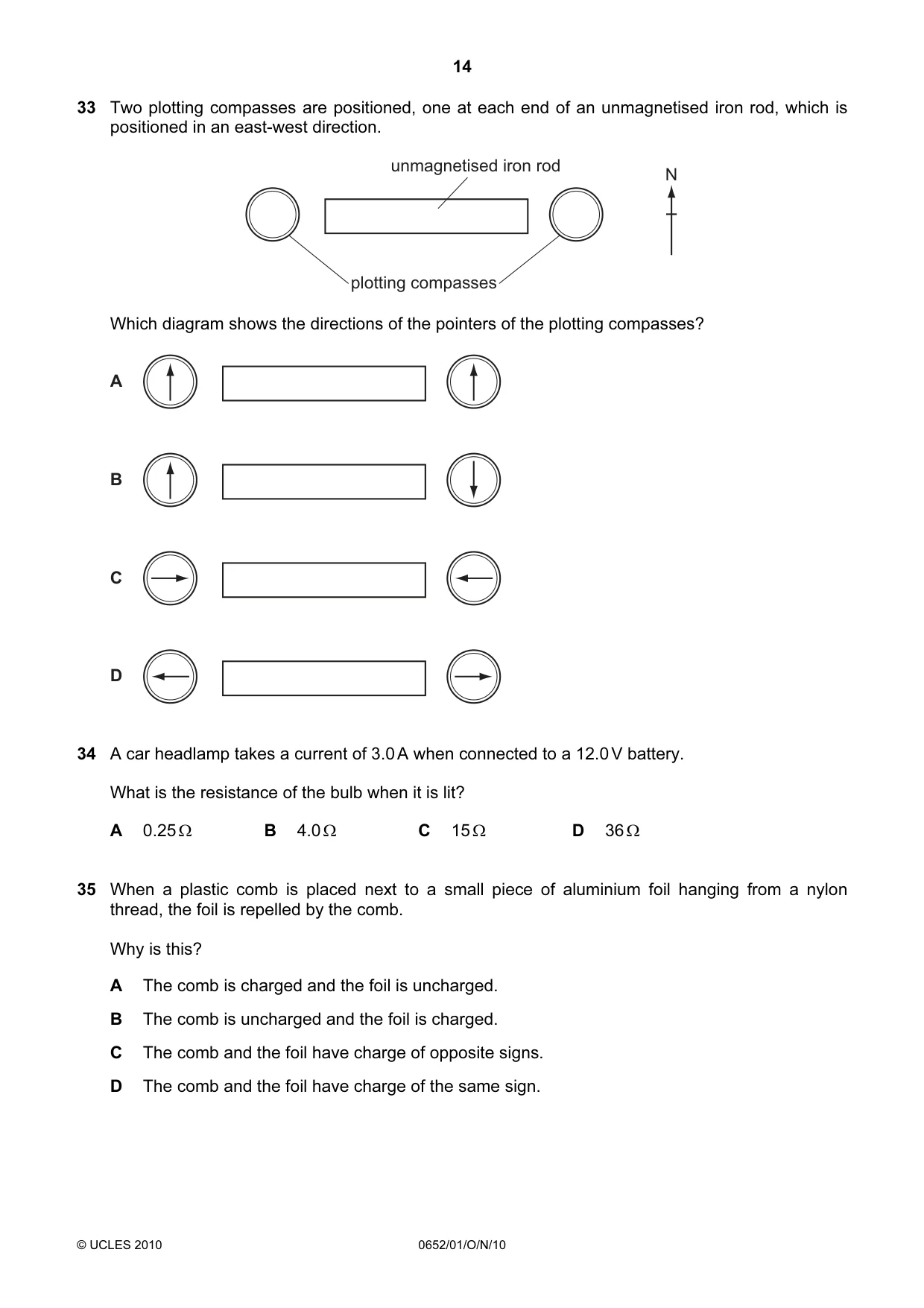
Q33 · Two plotting compasses are positioned, one at each end of an unmagnetised iron rod, which…
33 Two plotting compasses are positioned, one at each end of an unmagnetised iron rod, which is positioned in an east-west direction. unmagnetised iron rod N plotting compasses Which diagram shows the directions of the pointers of the plotting compasses? A B C D
Mark scheme: A
Q34 · A car headlamp takes a current of 3.0 A when connected to a 12.0 V battery
34 A car headlamp takes a current of 3.0 A when connected to a 12.0 V battery. What is the resistance of the bulb when it is lit? A 0.25 Ω B 4.0 Ω C 15 Ω D 36 Ω
Mark scheme: B
Q35 · When a plastic comb is placed next to a small piece of aluminium foil hanging from a…
35 When a plastic comb is placed next to a small piece of aluminium foil hanging from a nylon thread, the foil is repelled by the comb. Why is this? A The comb is charged and the foil is uncharged. B The comb is uncharged and the foil is charged. C The comb and the foil have charge of opposite signs. D The comb and the foil have charge of the same sign.
Mark scheme: D
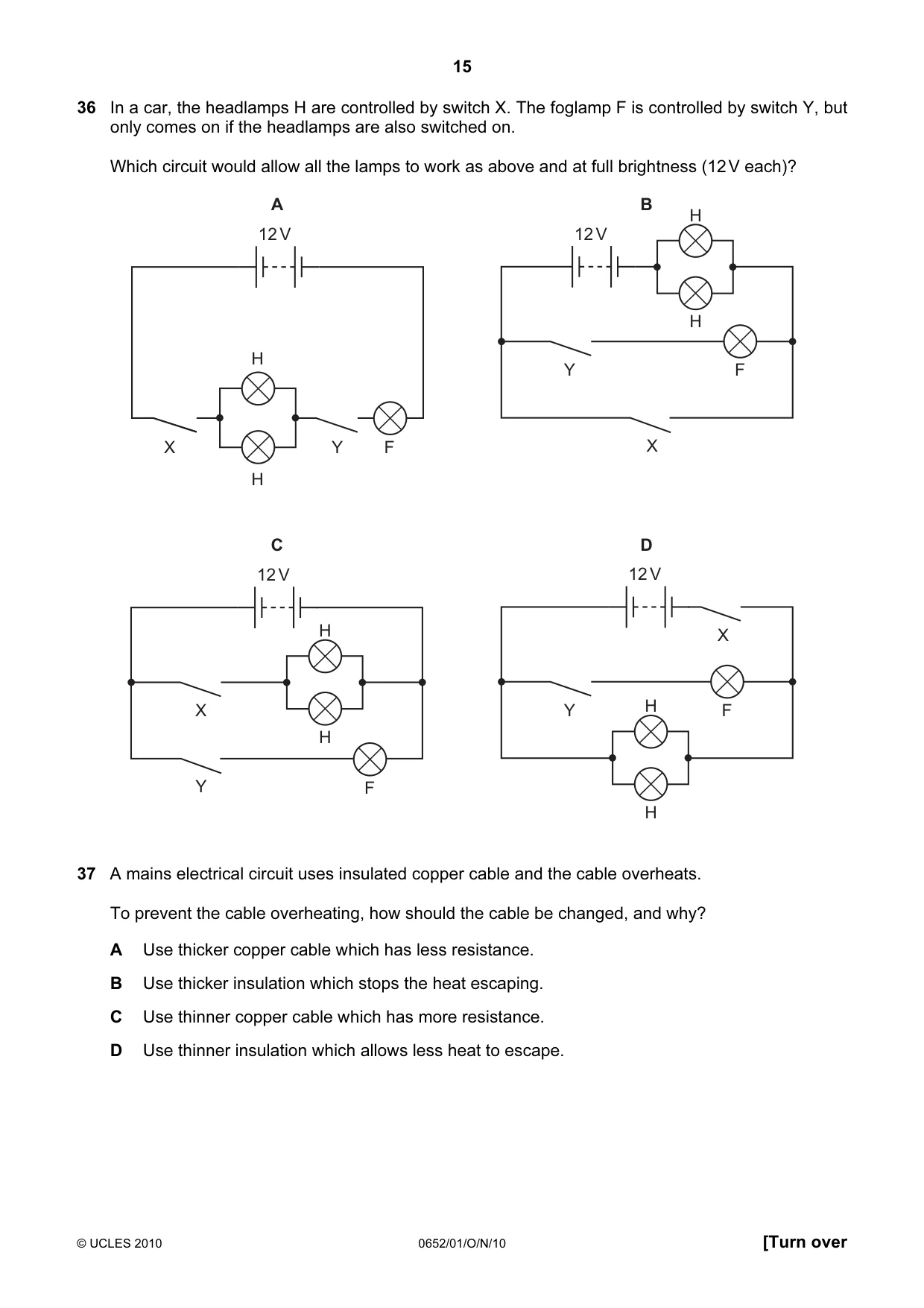
Q36 · In a car, the headlamps H are controlled by switch X
36 In a car, the headlamps H are controlled by switch X. The foglamp F is controlled by switch Y, but only comes on if the headlamps are also switched on. Which circuit would allow all the lamps to work as above and at full brightness (12 V each)? A B H 12 V 12 V H H Y F X Y F X H C D 12 V 12 V H X X Y H F H Y F H
Mark scheme: D
Q37 · A mains electrical circuit uses insulated copper cable and the cable overheats
37 A mains electrical circuit uses insulated copper cable and the cable overheats. To prevent the cable overheating, how should the cable be changed, and why? A Use thicker copper cable which has less resistance. B Use thicker insulation which stops the heat escaping. C Use thinner copper cable which has more resistance. D Use thinner insulation which allows less heat to escape.
Mark scheme: A
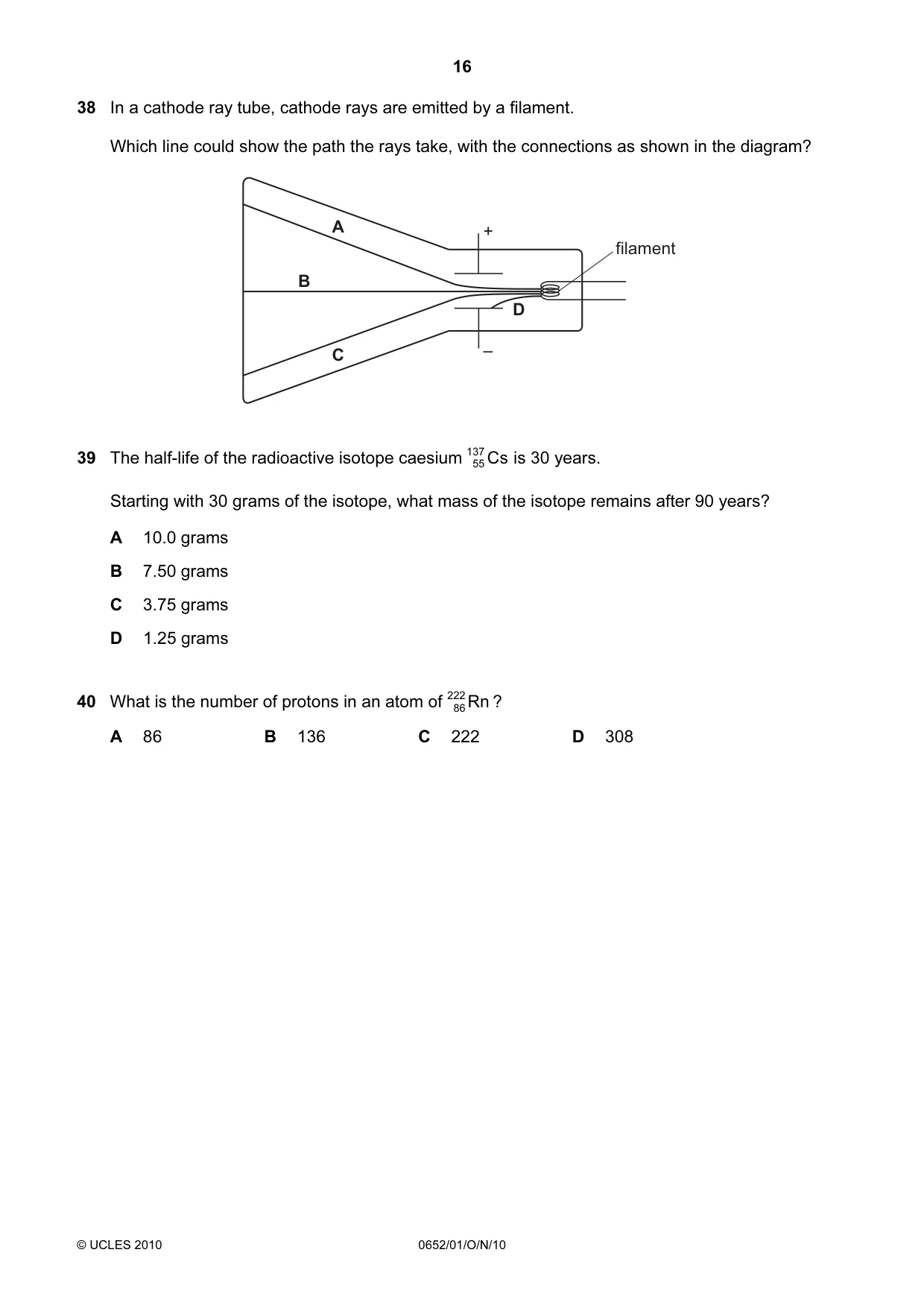
Q38 · In a cathode ray tube, cathode rays are emitted by a filament
38 In a cathode ray tube, cathode rays are emitted by a filament. Which line could show the path the rays take, with the connections as shown in the diagram? A + filament B D C –
Mark scheme: A
Q39 · The half-life of the radioactive isotope caesium 137 Cs is 30 years
39 The half-life of the radioactive isotope caesium 137 Cs is 30 years. 55 Starting with 30 grams of the isotope, what mass of the isotope remains after 90 years? A 10.0 grams B 7.50 grams C 3.75 grams D 1.25 grams
Mark scheme: C
Q40 · What is the number of protons in an atom of 222 Rn ?
40 What is the number of protons in an atom of 222 Rn ? 86 A 86 B 136 C 222 D 308
Mark scheme: A
What was in this paper
The subtopics covered by these 40 questions, and how many questions each got. Open one in a new tab to see every Cambridge question on it.
2Simple phenomena of magnetism2The nuclear atom2Air1Alkenes1Atomic structure and the Periodic Table1Density1Electric circuits1Electrical energy1Electrical quantities1Energetics of a reaction1Forces1Fuels1General wave properties1Group properties1Homologous series1Identification of ions and gases1Ions and ionic bonds1Length and time1Mass and weight1Motion1Noble gases1Periodic Trends1Properties of metals1Radioactivity1Rate (speed) of reaction1Redox1Sound1Stoichiometry1The characteristic properties of acids and bases1The particulate nature of matter1Thermal processes1Thermal properties and temperature1Types of oxides1Uses of metals1Water1Work, energy and power1What you needed in this session
Cambridge’s own grade thresholds for 2010 Oct/Nov, Paper 1 · Variant 1. A higher threshold means an easier paper — the bar moves with how the cohort did.