Cambridge IGCSE Physical Science 0652 — 2014 Oct/Nov Paper 1 · Variant 1
0652/11/O/N/14 · 40 questions · 40 marks · ≈45 min
The question paper and its mark scheme, free to read here and free to download. This is Cambridge’s own paper, exactly as it was sat.
Question paper16 pages

Mark scheme2 pages
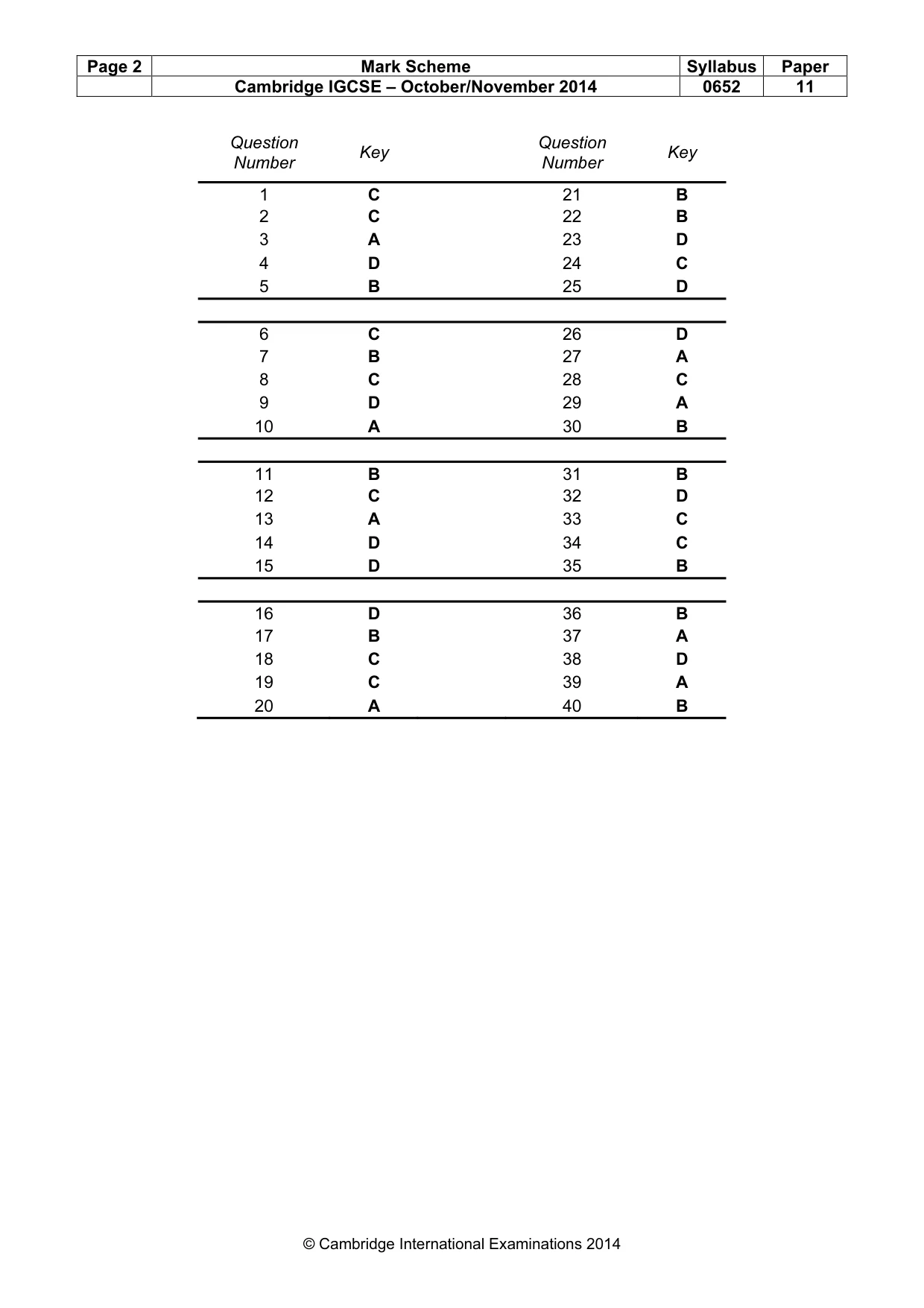
Answers below. Sit the paper first if you are practising.
Questions as text
Q1 · A substance was heated until it completely melted
1 A substance was heated until it completely melted. The substance began melting when the temperature reached 120 °C and continued melting until the temperature reached 123 °C. What is the substance? A a compound B a metal C a mixture D an element
Mark scheme: C
Q2 · The diagram shows the structure of an atom
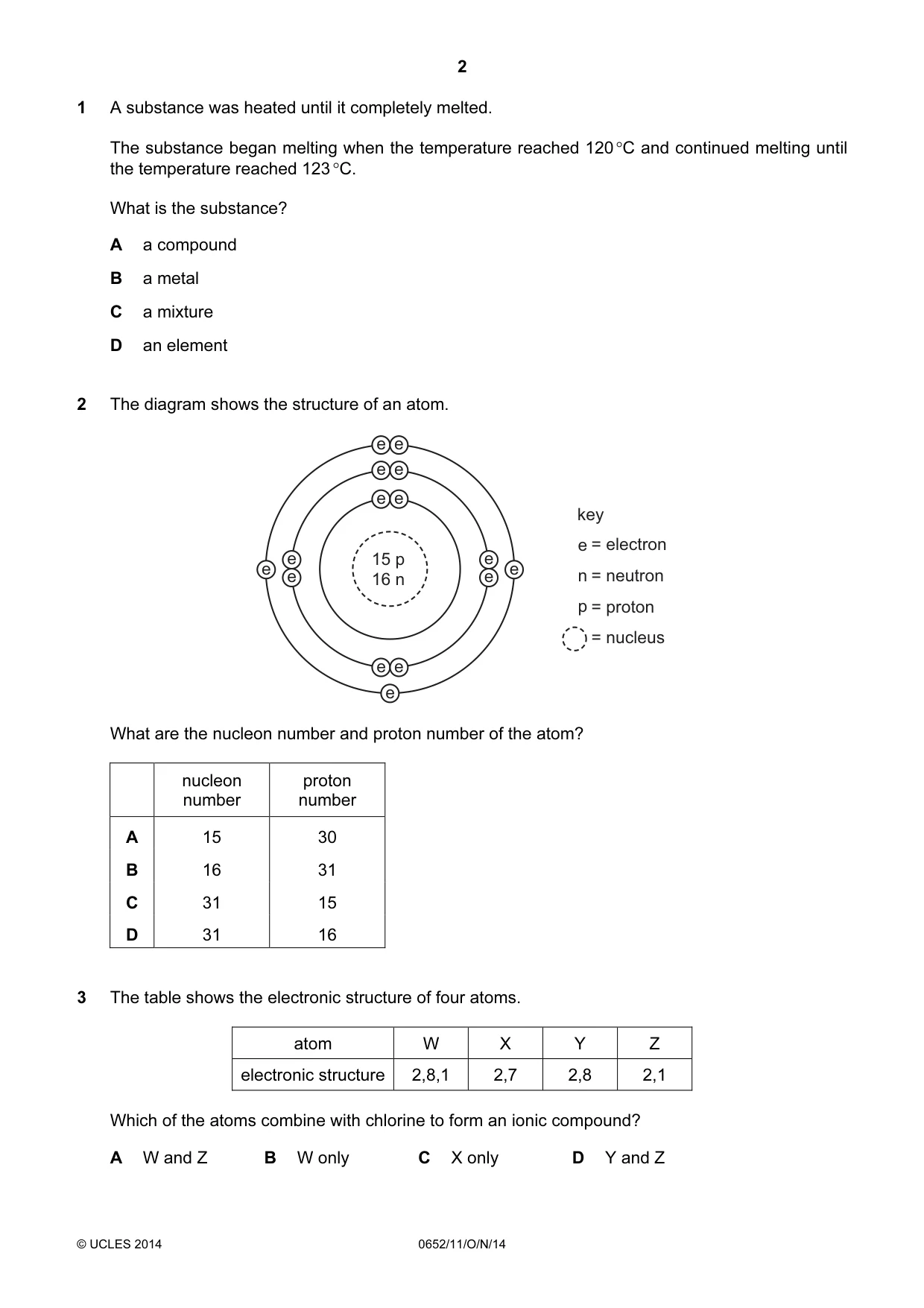
2 The diagram shows the structure of an atom. e e e e e e key e = electron e 15 p e e e n = neutron e 16 n e p = proton = nucleus e e e What are the nucleon number and proton number of the atom? nucleon proton number number A 15 30 B 16 31 C 31 15 D 31 16
Mark scheme: C
Q3 · The table shows the electronic structure of four atoms
3 The table shows the electronic structure of four atoms. atom W X Y Z electronic structure 2,8,1 2,7 2,8 2,1 Which of the atoms combine with chlorine to form an ionic compound? A W and Z B W only C X only D Y and Z
Mark scheme: A
Q4 · What is the relative formula mass of CuSO4.5H2O?
4 What is the relative formula mass of CuSO4.5H2O? A 178 B 186 C 212 D 250
Mark scheme: D
Q5 · Which statement about exothermic reactions is correct?
5 Which statement about exothermic reactions is correct? A Energy is always absorbed during the reaction. B Energy is always released during the reaction. C Only the breaking of chemical bonds occurs in the reaction. D The temperature of the surroundings drops during the reaction.
Mark scheme: B
Q6 · When hydrochloric acid is added to calcium carbonate, carbon dioxide gas is given off
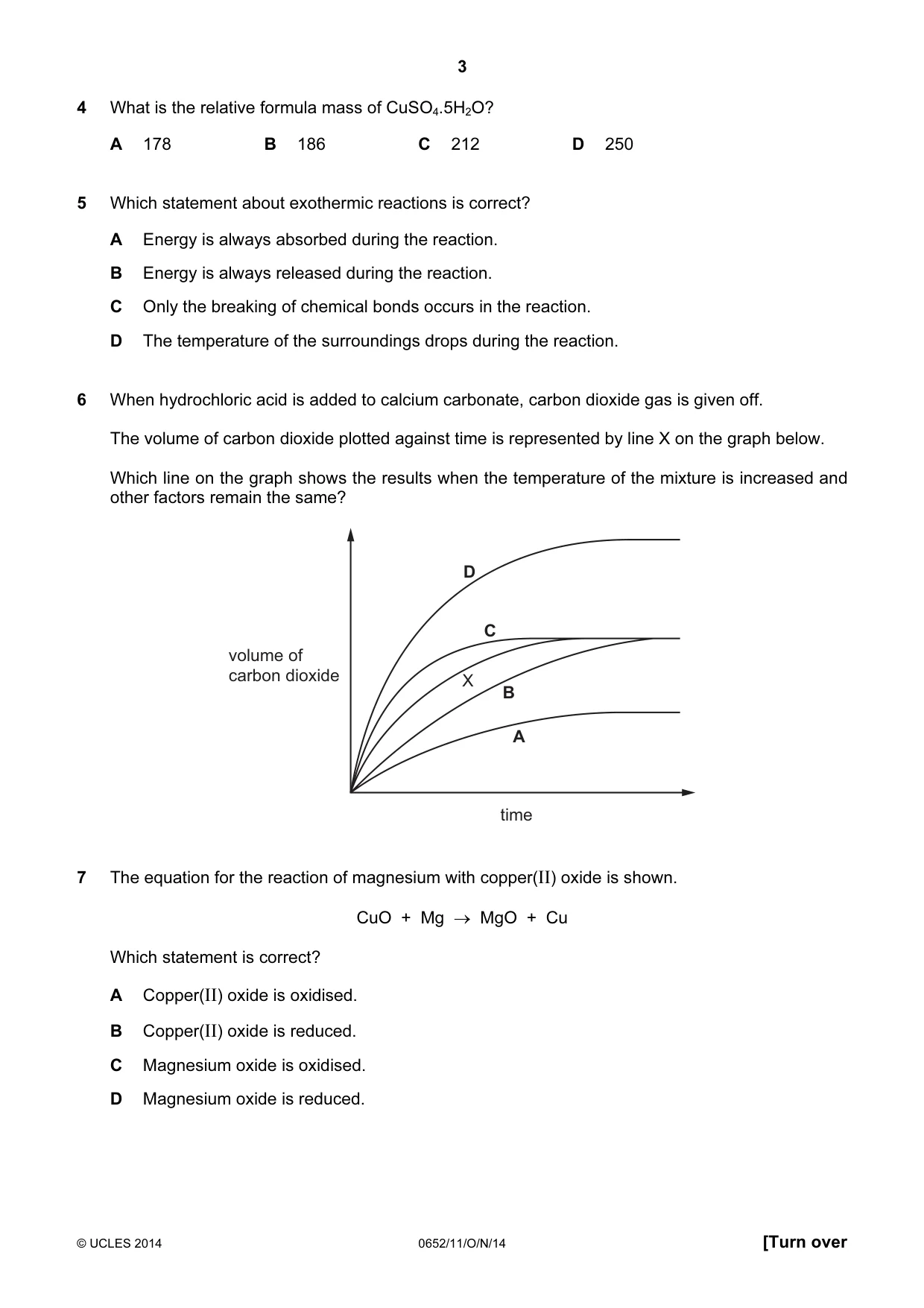
6 When hydrochloric acid is added to calcium carbonate, carbon dioxide gas is given off. The volume of carbon dioxide plotted against time is represented by line X on the graph below. Which line on the graph shows the results when the temperature of the mixture is increased and other factors remain the same? D C volume of carbon dioxide X B A time
Mark scheme: C
Q7 · The equation for the reaction of magnesium with copper(II) oxide is shown
7 The equation for the reaction of magnesium with copper(II) oxide is shown. CuO + Mg → MgO + Cu Which statement is correct? A Copper(II) oxide is oxidised. B Copper(II) oxide is reduced. C Magnesium oxide is oxidised. D Magnesium oxide is reduced.
Mark scheme: B
Q8 · An element X is burnt in oxygen
8 An element X is burnt in oxygen. A solid oxide is produced which dissolves in water to form a solution of pH 13. What is X? A carbon B phosphorus C sodium D sulfur
Mark scheme: C
Q9 · A sample of copper(II) chloride is mixed with ammonia solution until the ammonia is in…
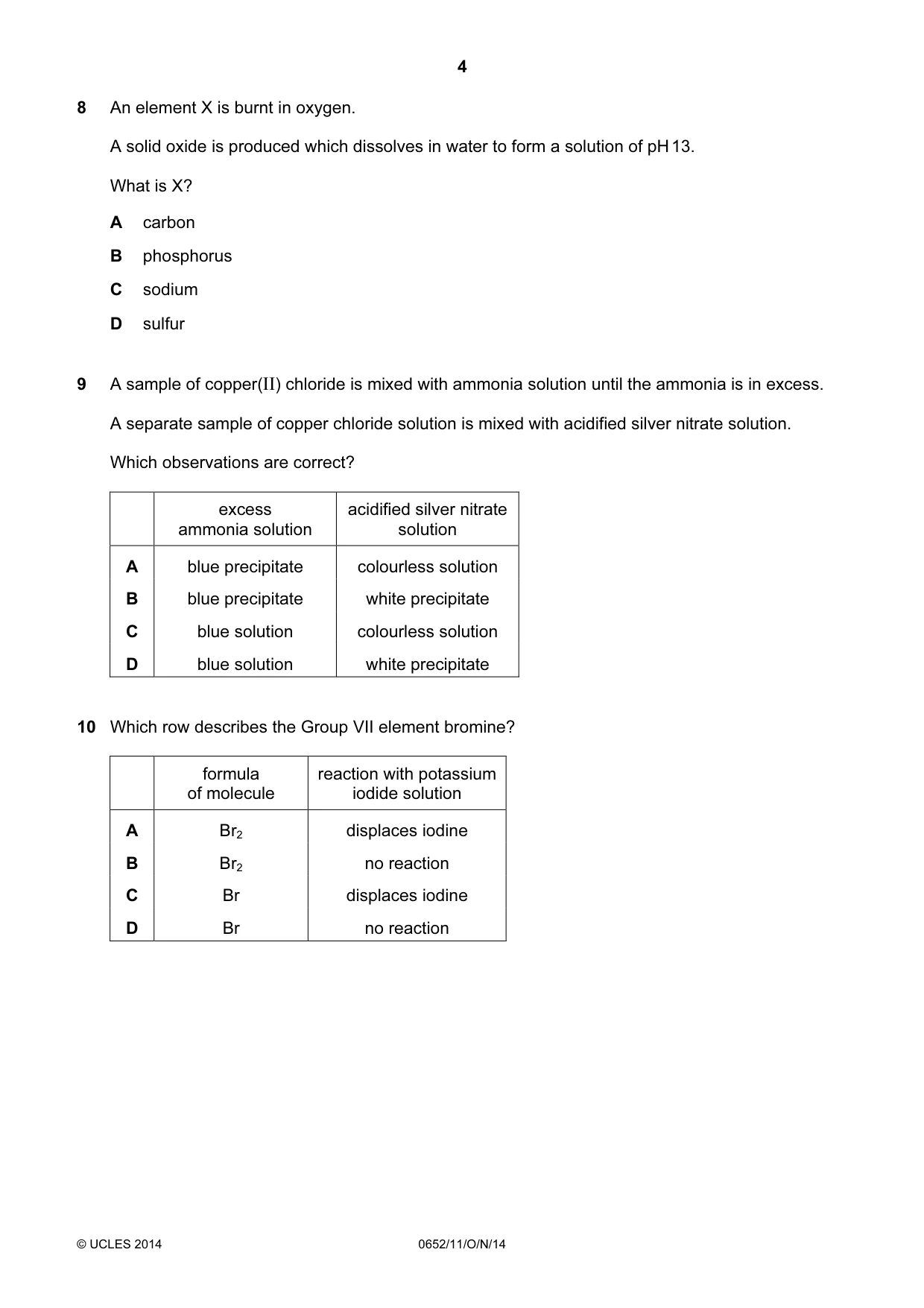
9 A sample of copper(II) chloride is mixed with ammonia solution until the ammonia is in excess. A separate sample of copper chloride solution is mixed with acidified silver nitrate solution. Which observations are correct? excess acidified silver nitrate ammonia solution solution A blue precipitate colourless solution B blue precipitate white precipitate C blue solution colourless solution D blue solution white precipitate
Mark scheme: D
Q10 · Which row describes the Group VII element bromine?
10 Which row describes the Group VII element bromine? formula reaction with potassium of molecule iodide solution A Br2 displaces iodine B Br2 no reaction C Br displaces iodine D Br no reaction
Mark scheme: A
Q11 · Copper is a metal and has the following properties
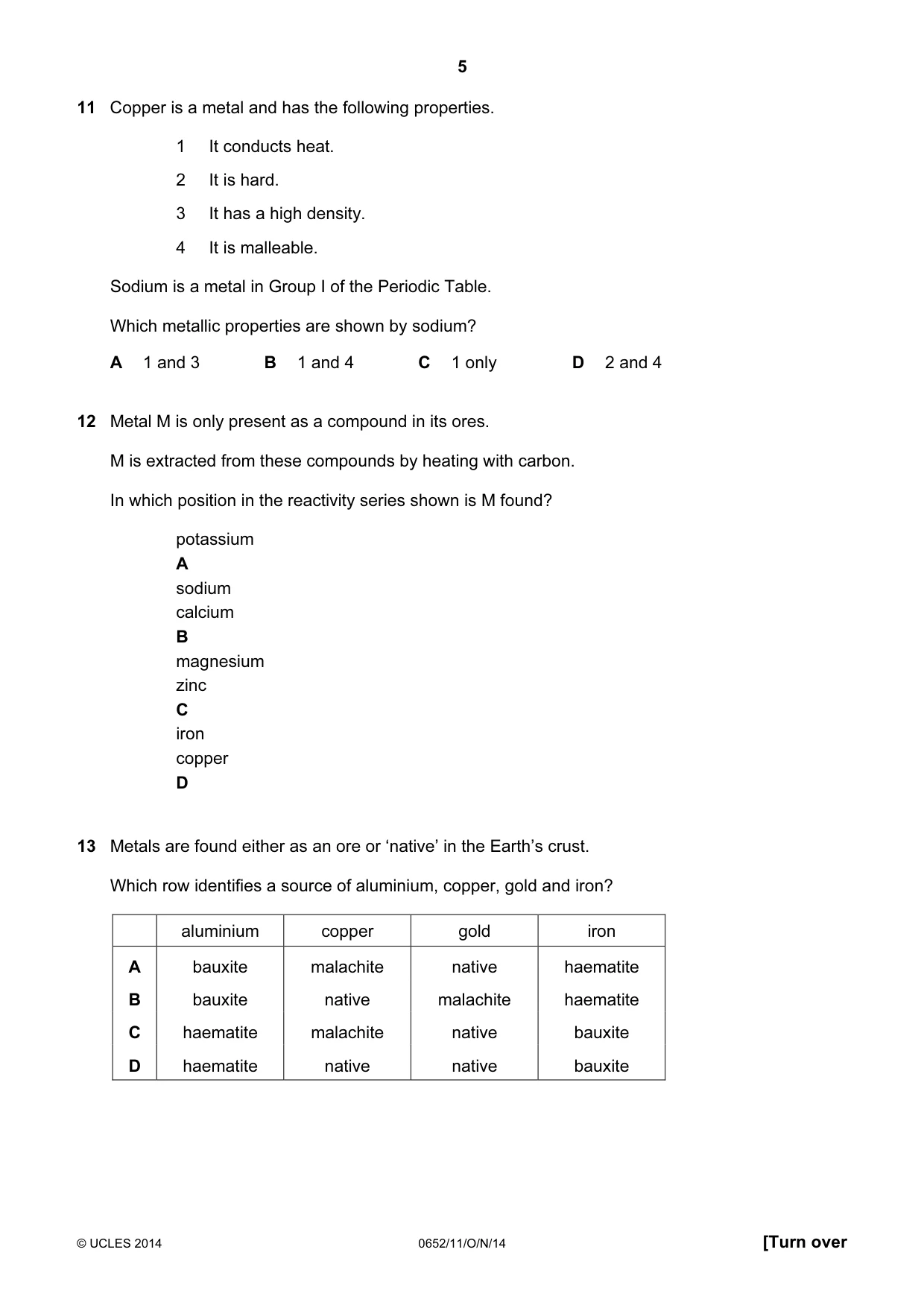
11 Copper is a metal and has the following properties. 1 It conducts heat. 2 It is hard. 3 It has a high density. 4 It is malleable. Sodium is a metal in Group I of the Periodic Table. Which metallic properties are shown by sodium? A 1 and 3 B 1 and 4 C 1 only D 2 and 4
Mark scheme: B
Q12 · Metal M is only present as a compound in its ores
12 Metal M is only present as a compound in its ores. M is extracted from these compounds by heating with carbon. In which position in the reactivity series shown is M found? potassium A sodium calcium B magnesium zinc C iron copper D
Mark scheme: C
Q13 · Metals are found either as an ore or ‘native’ in the Earth’s crust
13 Metals are found either as an ore or ‘native’ in the Earth’s crust. Which row identifies a source of aluminium, copper, gold and iron? aluminium copper gold iron A bauxite malachite native haematite B bauxite native malachite haematite C haematite malachite native bauxite D haematite native native bauxite
Mark scheme: A
Q14 · Which colour change is observed when water is added to anhydrous copper(II) sulfate?
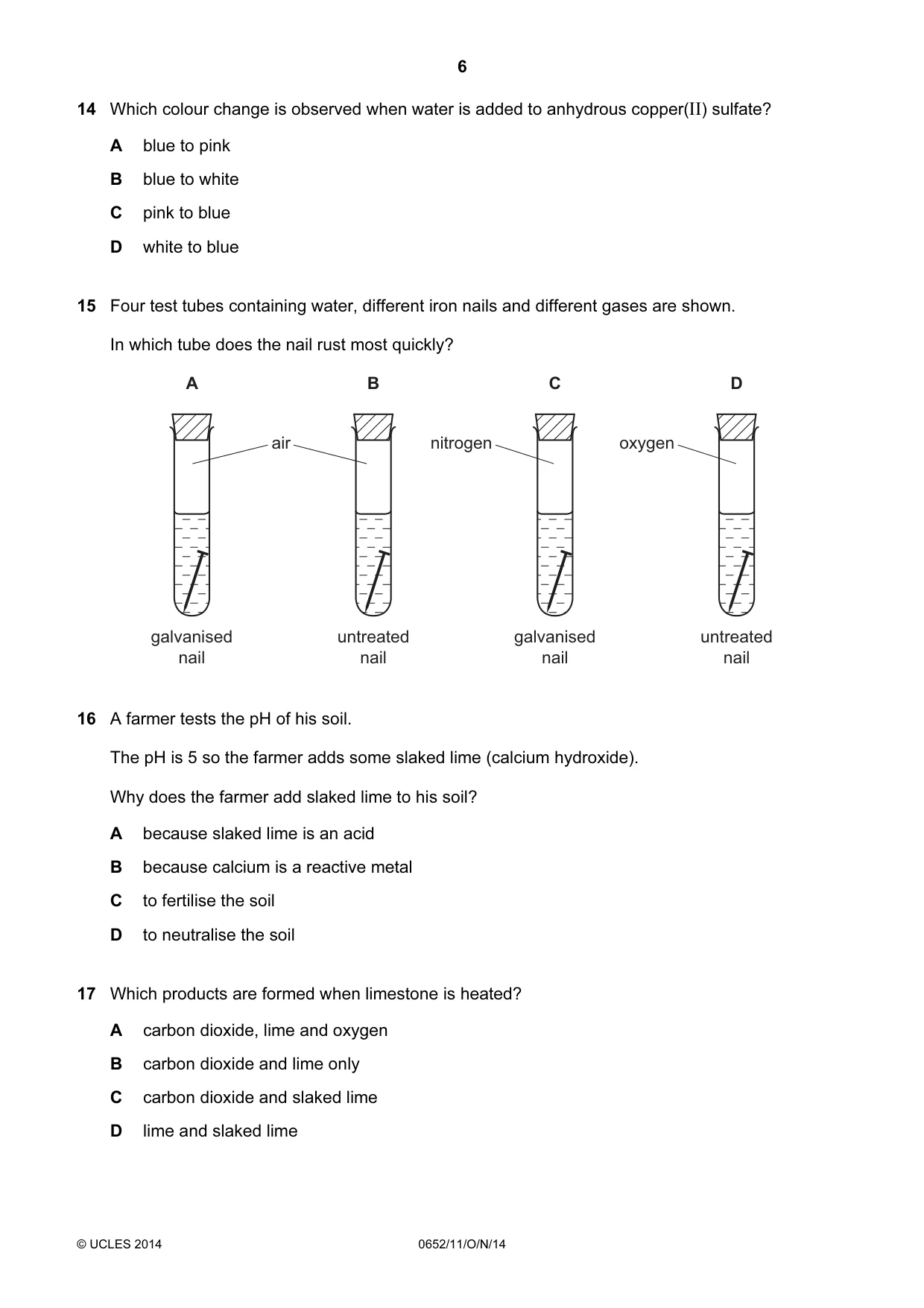
14 Which colour change is observed when water is added to anhydrous copper(II) sulfate? A blue to pink B blue to white C pink to blue D white to blue
Mark scheme: D
Q15 · Four test tubes containing water, different iron nails and different gases are shown
15 Four test tubes containing water, different iron nails and different gases are shown. In which tube does the nail rust most quickly? A B C D air nitrogen oxygen galvanised untreated galvanised untreated nail nail nail nail
Mark scheme: D
Q16 · A farmer tests the pH of his soil
16 A farmer tests the pH of his soil. The pH is 5 so the farmer adds some slaked lime (calcium hydroxide). Why does the farmer add slaked lime to his soil? A because slaked lime is an acid B because calcium is a reactive metal C to fertilise the soil D to neutralise the soil
Mark scheme: D
More questions on The characteristic properties of acids and bases
Q17 · Which products are formed when limestone is heated?
17 Which products are formed when limestone is heated? A carbon dioxide, lime and oxygen B carbon dioxide and lime only C carbon dioxide and slaked lime D lime and slaked lime
Mark scheme: B
Q18 · The diagram shows the fractional distillation of petroleum
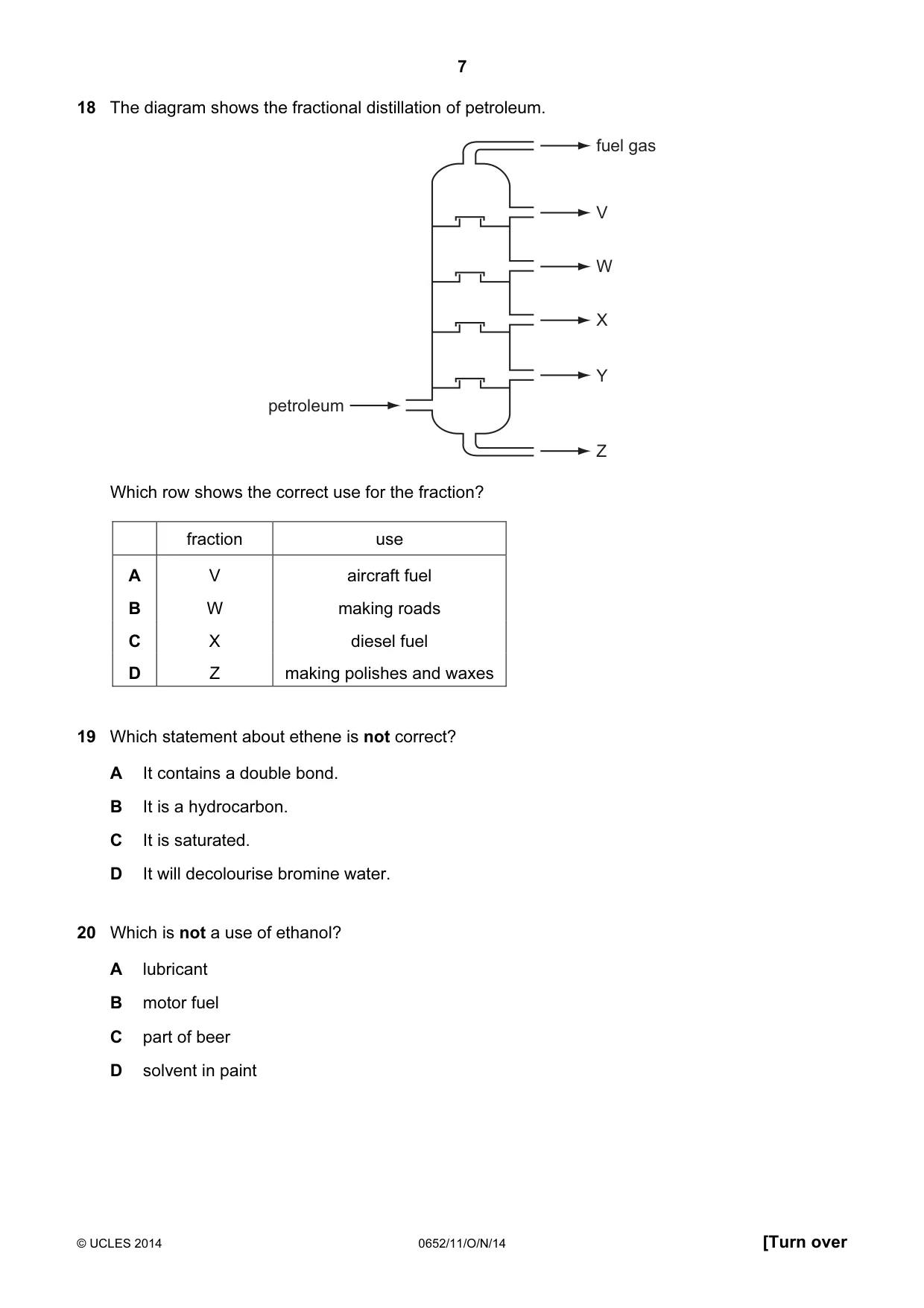
18 The diagram shows the fractional distillation of petroleum. fuel gas V W X Y petroleum Z Which row shows the correct use for the fraction? fraction use A V aircraft fuel B W making roads C X diesel fuel D Z making polishes and waxes
Mark scheme: C
Q19 · Which statement about ethene is not correct?
19 Which statement about ethene is not correct? A It contains a double bond. B It is a hydrocarbon. C It is saturated. D It will decolourise bromine water.
Mark scheme: C
Q20 · Which is not a use of ethanol?
20 Which is not a use of ethanol? A lubricant B motor fuel C part of beer D solvent in paint
Mark scheme: A
Q21 · A girl uses a rule to measure the length of a metal rod
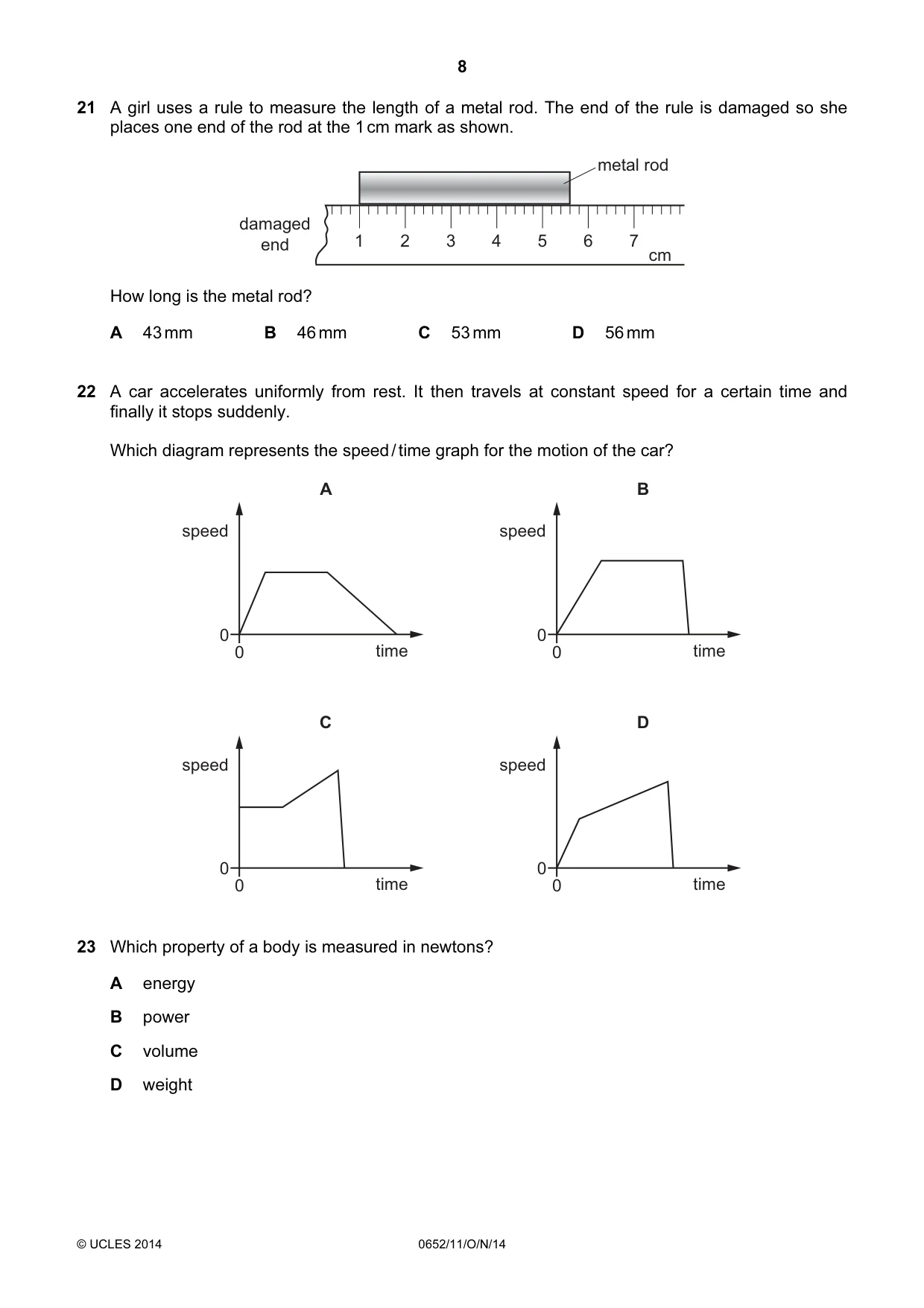
21 A girl uses a rule to measure the length of a metal rod. The end of the rule is damaged so she places one end of the rod at the 1 cm mark as shown. metal rod damaged end 1 2 3 4 5 6 7 cm How long is the metal rod? A 43 mm B 46 mm C 53 mm D 56 mm
Mark scheme: B
Q22 · A car accelerates uniformly from rest
22 A car accelerates uniformly from rest. It then travels at constant speed for a certain time and finally it stops suddenly. Which diagram represents the speed / time graph for the motion of the car? A B speed speed 0 0 0 time 0 time C D speed speed 0 0 0 time 0 time
Mark scheme: B
Q23 · Which property of a body is measured in newtons?
23 Which property of a body is measured in newtons? A energy B power C volume D weight
Mark scheme: D
Q24 · A metal container has a mass of 200 kg
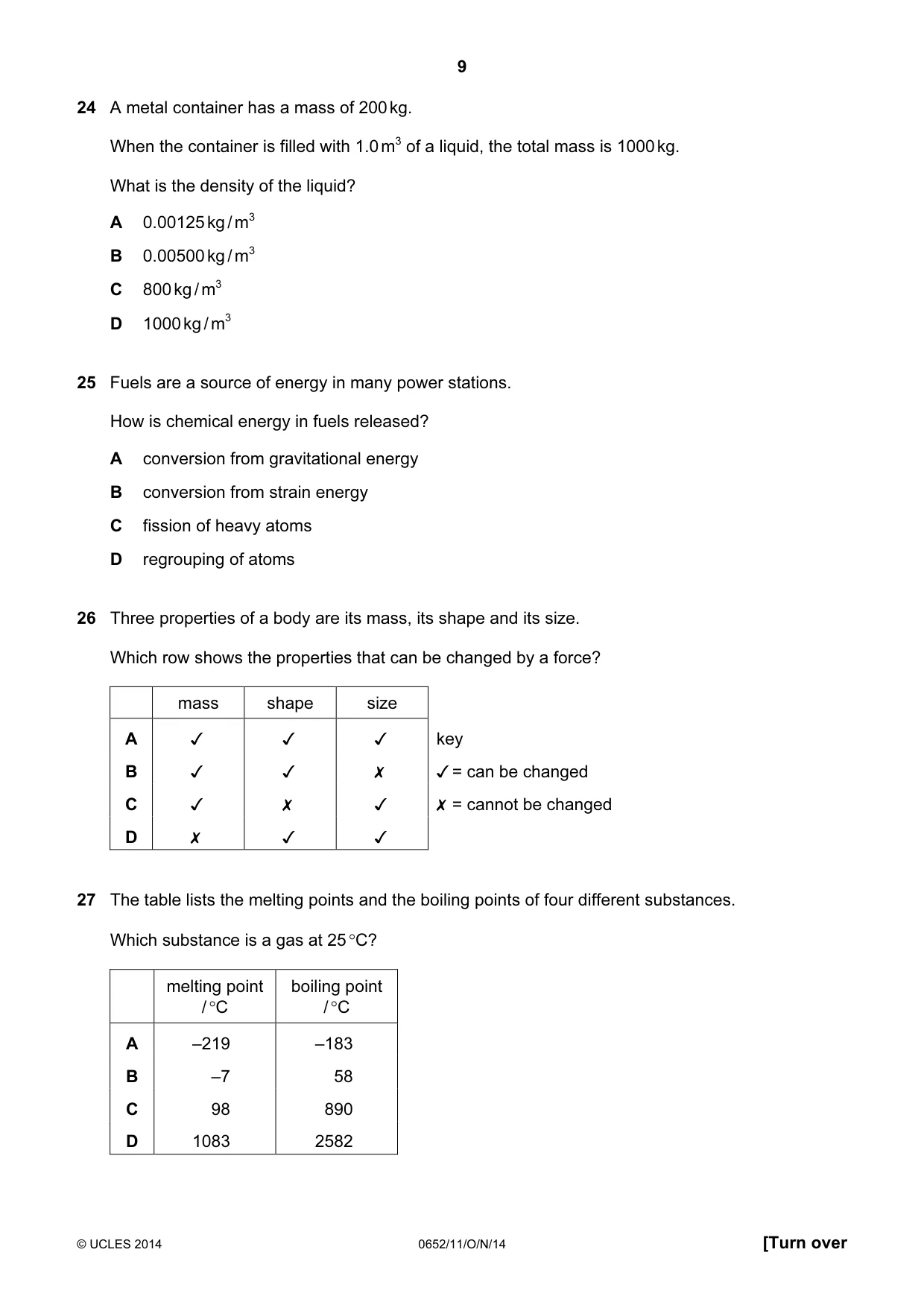
24 A metal container has a mass of 200 kg. When the container is filled with 1.0 m3 of a liquid, the total mass is 1000 kg. What is the density of the liquid? A 0.00125 kg / m3 B 0.00500 kg / m3 C 800 kg / m3 D 1000 kg / m3
Mark scheme: C
Q25 · Fuels are a source of energy in many power stations
25 Fuels are a source of energy in many power stations. How is chemical energy in fuels released? A conversion from gravitational energy B conversion from strain energy C fission of heavy atoms D regrouping of atoms
Mark scheme: D
Q26 · Three properties of a body are its mass, its shape and its size
26 Three properties of a body are its mass, its shape and its size. Which row shows the properties that can be changed by a force? mass shape size A v v v B v v x Cc v x v D x v v key ¥ = can be changed X = cannot be changed
Mark scheme: D
Q27 · The table lists the melting points and the boiling points of four different substances
27 The table lists the melting points and the boiling points of four different substances. Which substance is a gas at 25 °C? melting point boiling point / °C / °C A –219 –183 B –7 58 C 98 890 D 1083 2582
Mark scheme: A
Q28 · An ice cube is held in a clamp
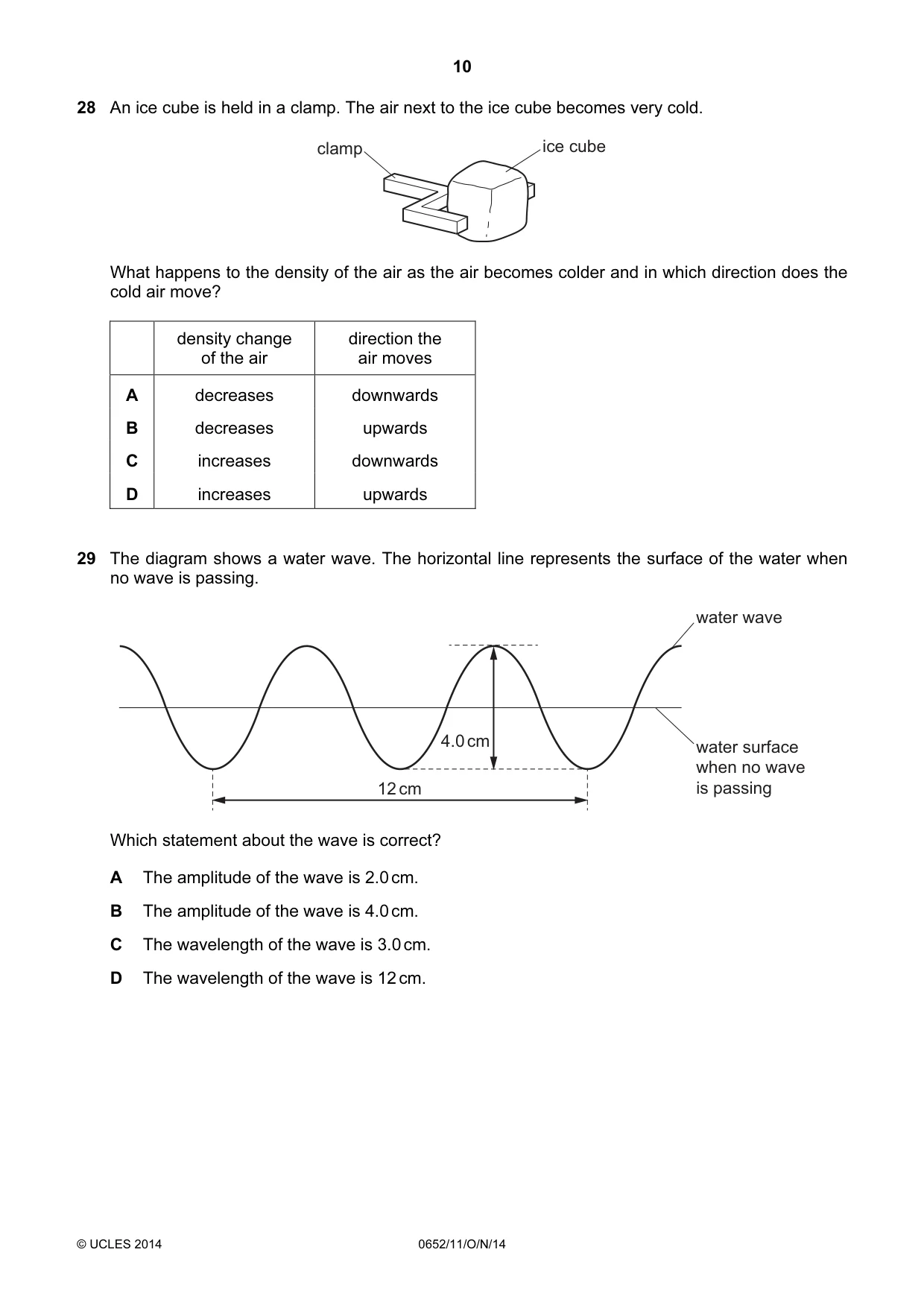
28 An ice cube is held in a clamp. The air next to the ice cube becomes very cold. clamp ice cube What happens to the density of the air as the air becomes colder and in which direction does the cold air move? density change direction the of the air air moves A decreases downwards B decreases upwards C increases downwards D increases upwards
Mark scheme: C
Q29 · The diagram shows a water wave
29 The diagram shows a water wave. The horizontal line represents the surface of the water when no wave is passing. water wave 4.0 cm water surface when no wave 12 cm is passing Which statement about the wave is correct? A The amplitude of the wave is 2.0 cm. B The amplitude of the wave is 4.0 cm. C The wavelength of the wave is 3.0 cm. D The wavelength of the wave is 12 cm.
Mark scheme: A
Q30 · The diagram shows a ray of light incident on a glass block
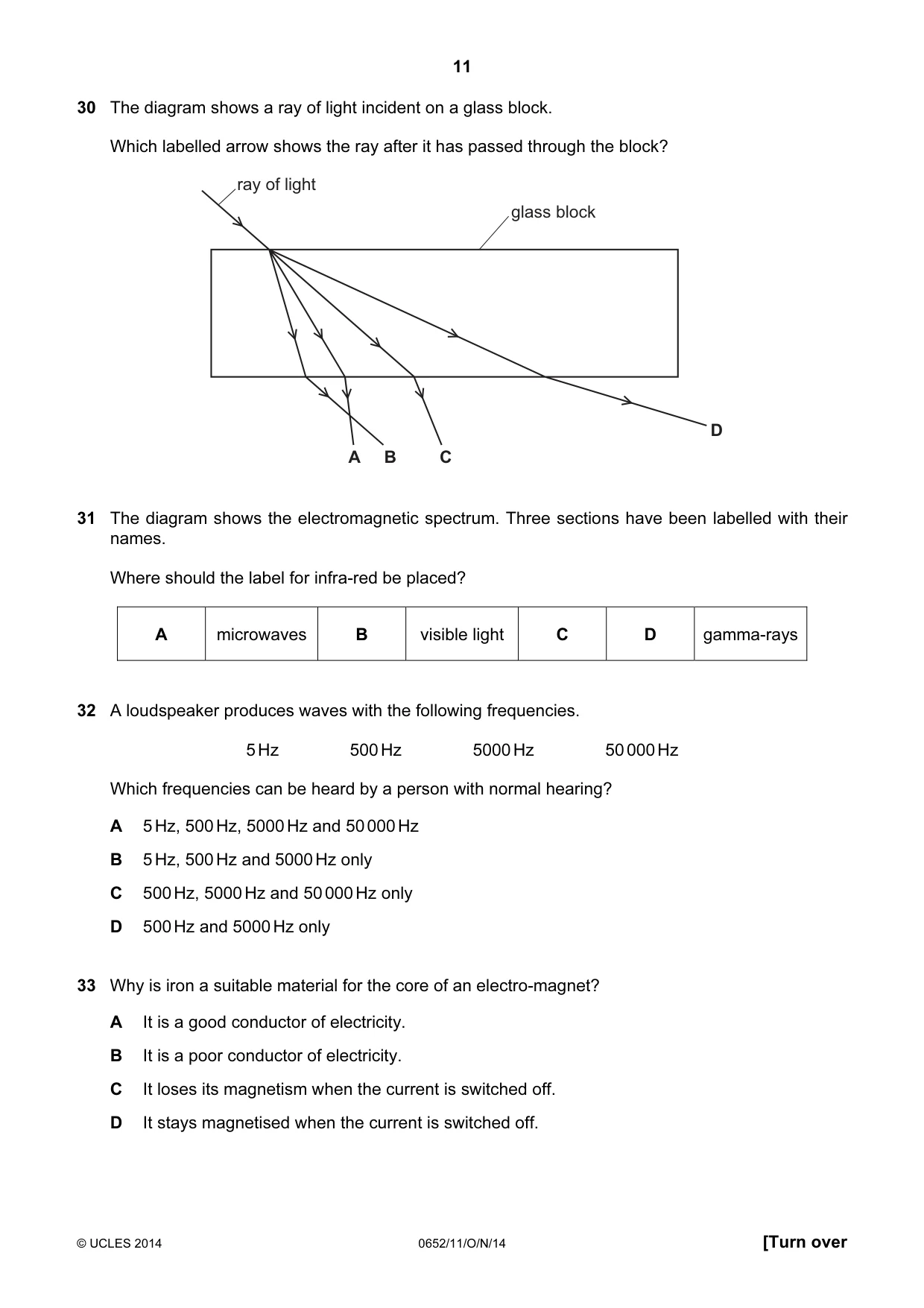
30 The diagram shows a ray of light incident on a glass block. Which labelled arrow shows the ray after it has passed through the block? ray of light glass block D A B C
Mark scheme: B
Q31 · The diagram shows the electromagnetic spectrum
31 The diagram shows the electromagnetic spectrum. Three sections have been labelled with their names. Where should the label for infra-red be placed? A microwaves B visible light C D gamma-rays
Mark scheme: B
Q32 · A loudspeaker produces waves with the following frequencies
32 A loudspeaker produces waves with the following frequencies. 5 Hz 500 Hz 5000 Hz 50 000 Hz Which frequencies can be heard by a person with normal hearing? A 5 Hz, 500 Hz, 5000 Hz and 50 000 Hz B 5 Hz, 500 Hz and 5000 Hz only C 500 Hz, 5000 Hz and 50 000 Hz only D 500 Hz and 5000 Hz only
Mark scheme: D
Q33 · Why is iron a suitable material for the core of an electro-magnet?
33 Why is iron a suitable material for the core of an electro-magnet? A It is a good conductor of electricity. B It is a poor conductor of electricity. C It loses its magnetism when the current is switched off. D It stays magnetised when the current is switched off.
Mark scheme: C
Q34 · A student holds a rod in her hand
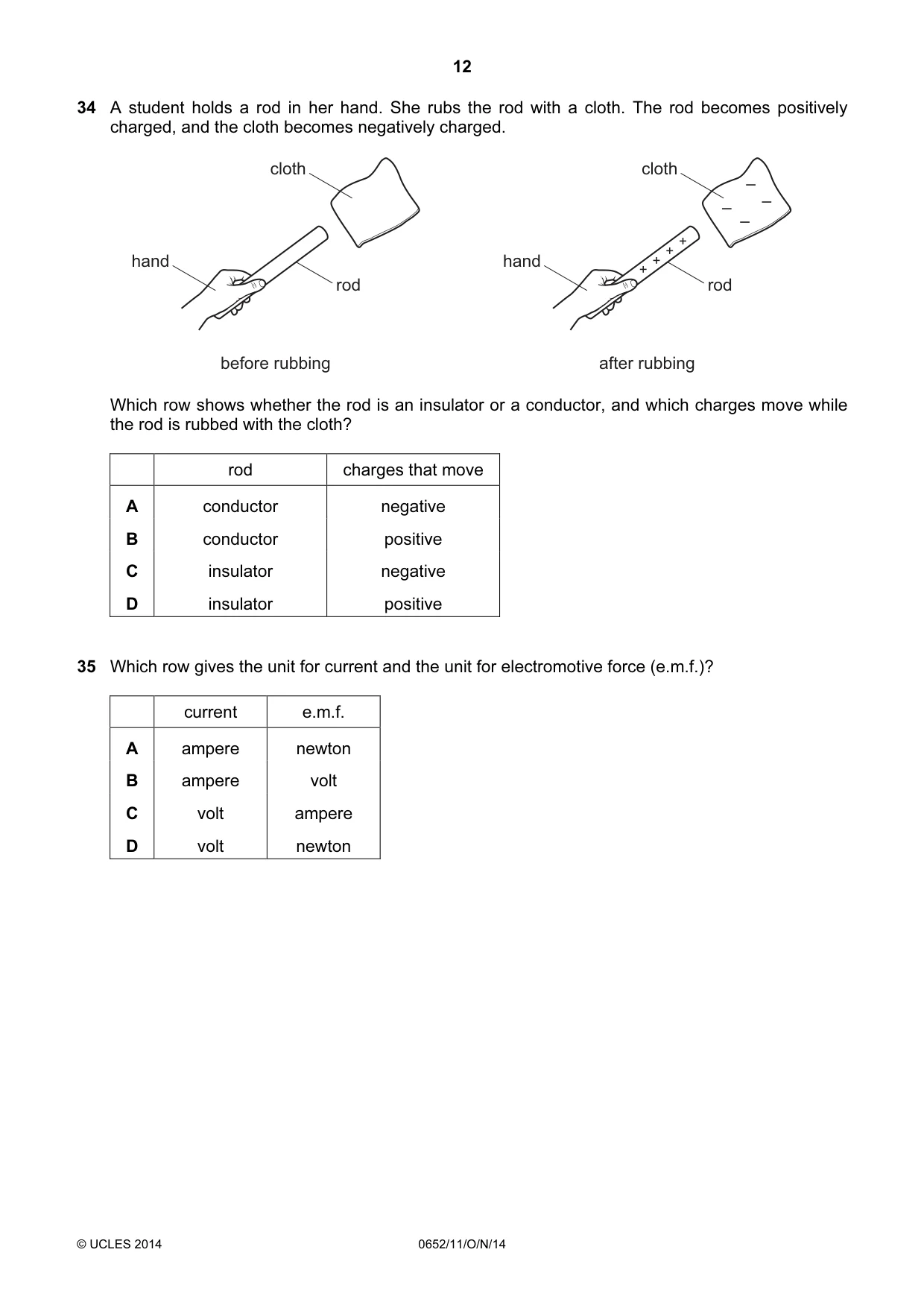
34 A student holds a rod in her hand. She rubs the rod with a cloth. The rod becomes positively charged, and the cloth becomes negatively charged. cloth cloth – – – – + + + + hand hand rod rod before rubbing after rubbing Which row shows whether the rod is an insulator or a conductor, and which charges move while the rod is rubbed with the cloth? rod charges that move A conductor negative B conductor positive C insulator negative D insulator positive
Mark scheme: C
Q35 · Which row gives the unit for current and the unit for electromotive force (e.m.f.)?
35 Which row gives the unit for current and the unit for electromotive force (e.m.f.)? current e.m.f. A ampere newton B ampere volt C volt ampere D volt newton
Mark scheme: B
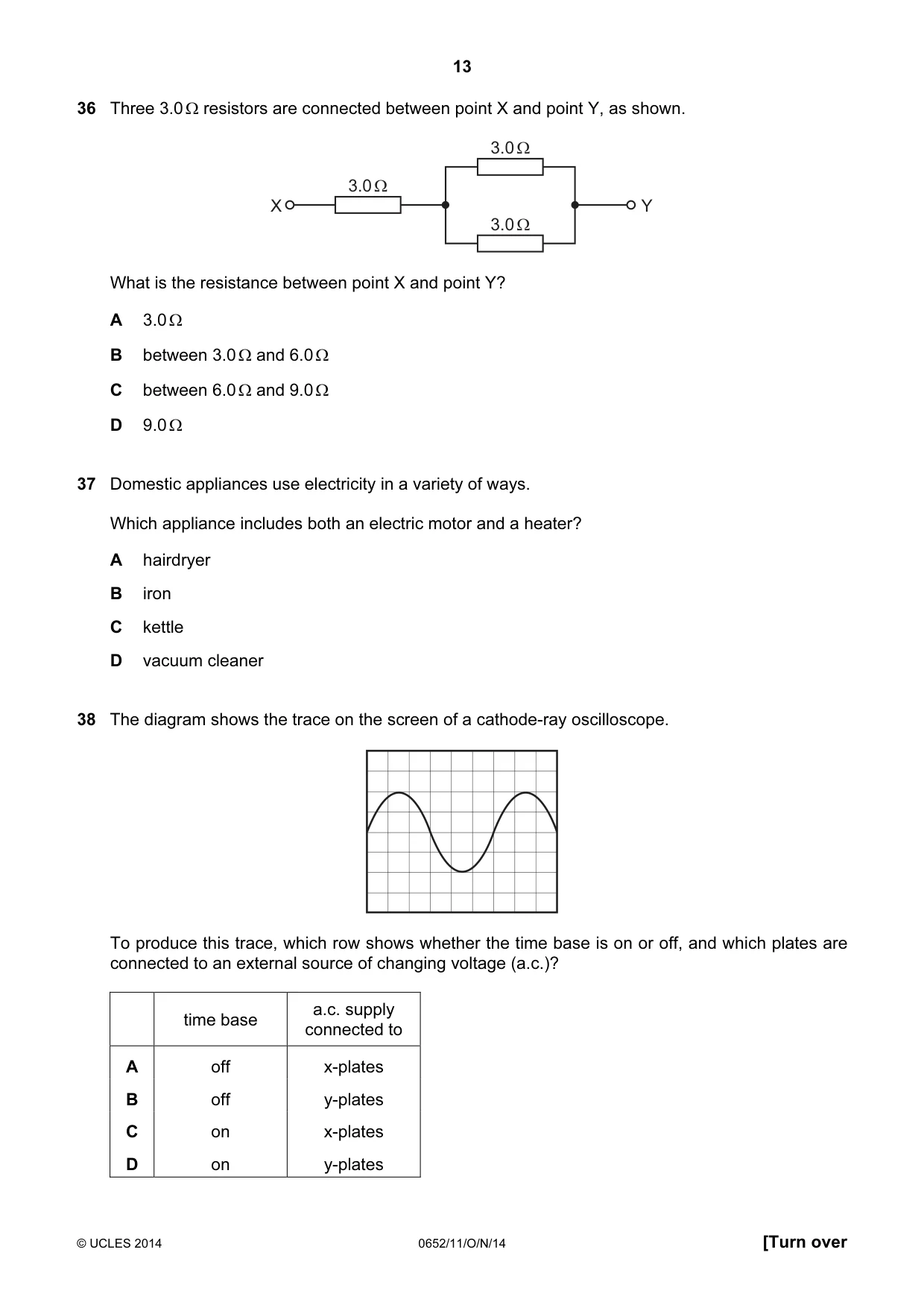
Q36 · Three 3.0 Ω resistors are connected between point X and point Y, as shown
36 Three 3.0 Ω resistors are connected between point X and point Y, as shown. 3.0 Ω 3.0 Ω X Y 3.0 Ω What is the resistance between point X and point Y? A 3.0 Ω B between 3.0 Ω and 6.0 Ω C between 6.0 Ω and 9.0 Ω D 9.0 Ω
Mark scheme: B
Q37 · Domestic appliances use electricity in a variety of ways
37 Domestic appliances use electricity in a variety of ways. Which appliance includes both an electric motor and a heater? A hairdryer B iron C kettle D vacuum cleaner
Mark scheme: A
Q38 · The diagram shows the trace on the screen of a cathode-ray oscilloscope
38 The diagram shows the trace on the screen of a cathode-ray oscilloscope. To produce this trace, which row shows whether the time base is on or off, and which plates are connected to an external source of changing voltage (a.c.)? a.c. supply time base connected to A off x-plates B off y-plates C on x-plates D on y-plates
Mark scheme: D
Q39 · What is a beta-particle and from which part of a radioactive atom is it emitted?
39 What is a beta-particle and from which part of a radioactive atom is it emitted? beta-particle emitted from A electron nucleus B electron outer shell C helium nucleus nucleus D helium nucleus outer shell
Mark scheme: A
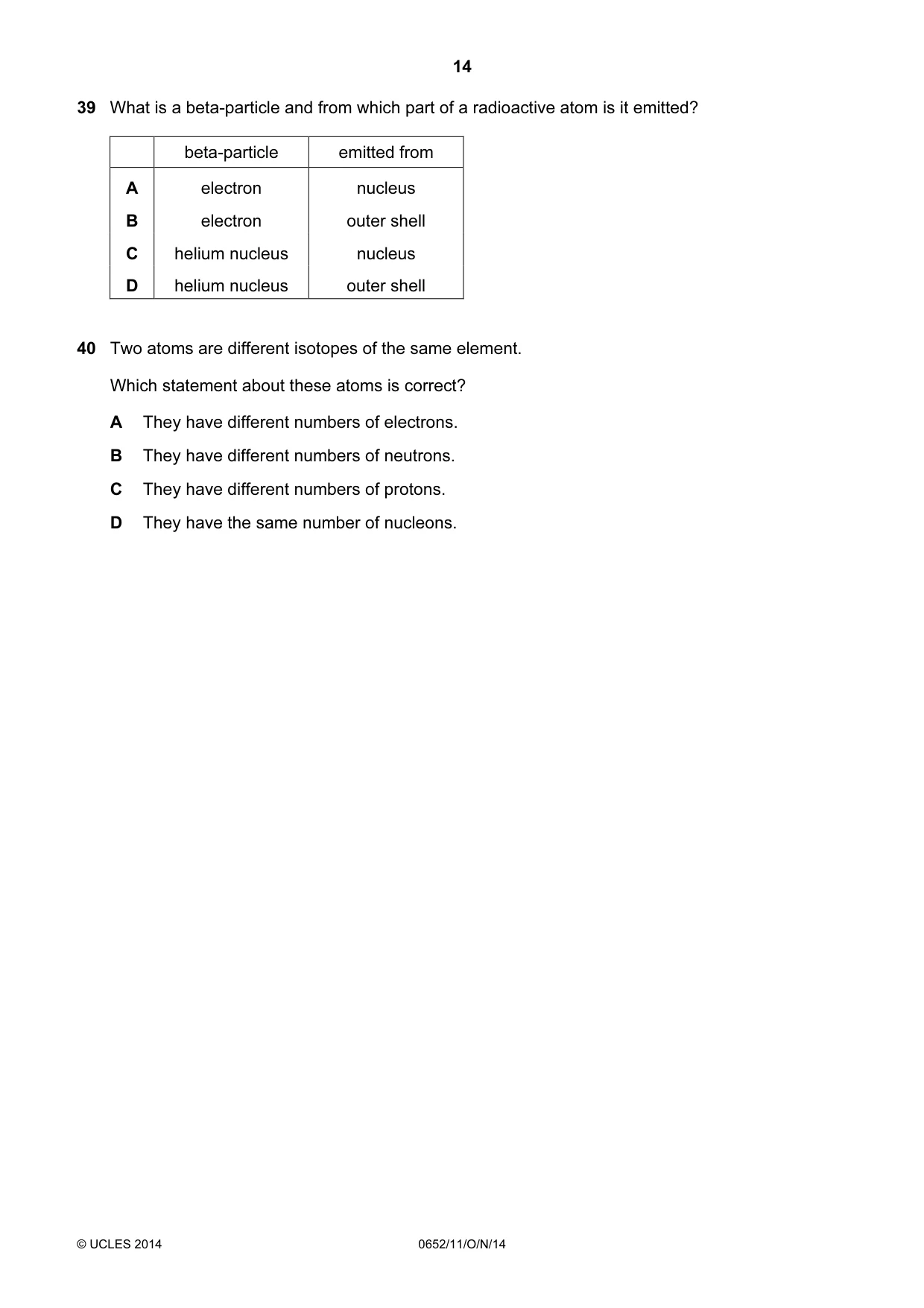
Q40 · Two atoms are different isotopes of the same element
40 Two atoms are different isotopes of the same element. Which statement about these atoms is correct? A They have different numbers of electrons. B They have different numbers of neutrons. C They have different numbers of protons. D They have the same number of nucleons.
Mark scheme: B
What was in this paper
The subtopics covered by these 40 questions, and how many questions each got. Open one in a new tab to see every Cambridge question on it.
2General wave properties2Reactivity series2Alcohols1Alkenes1Atomic structure and the Periodic Table1Carbonates1Criteria of purity1Density1Electric circuits1Electrical energy1Electromagnetic effects1Energetics of a reaction1Extraction of metals1Forces1Fuels1Group properties1Identification of ions and gases1Ions and ionic bonds1Length and time1Light1Mass and weight1Motion1Properties of metals1Radioactivity1Rate (speed) of reaction1Redox1Simple phenomena of magnetism1Sound1Stoichiometry1The characteristic properties of acids and bases1The nuclear atom1The particulate nature of matter1Thermal processes1Types of oxides1Water1Work, energy and power1What you needed in this session
Cambridge’s own grade thresholds for 2014 Oct/Nov, Paper 1 · Variant 1. A higher threshold means an easier paper — the bar moves with how the cohort did.