Cambridge IGCSE Physical Science 0652 — 2011 Oct/Nov Paper 1 · Variant 1
0652/11/O/N/11 · 40 questions · 40 marks · ≈45 min
The question paper and its mark scheme, free to read here and free to download. This is Cambridge’s own paper, exactly as it was sat.
Question paper20 pages

Mark scheme2 pages
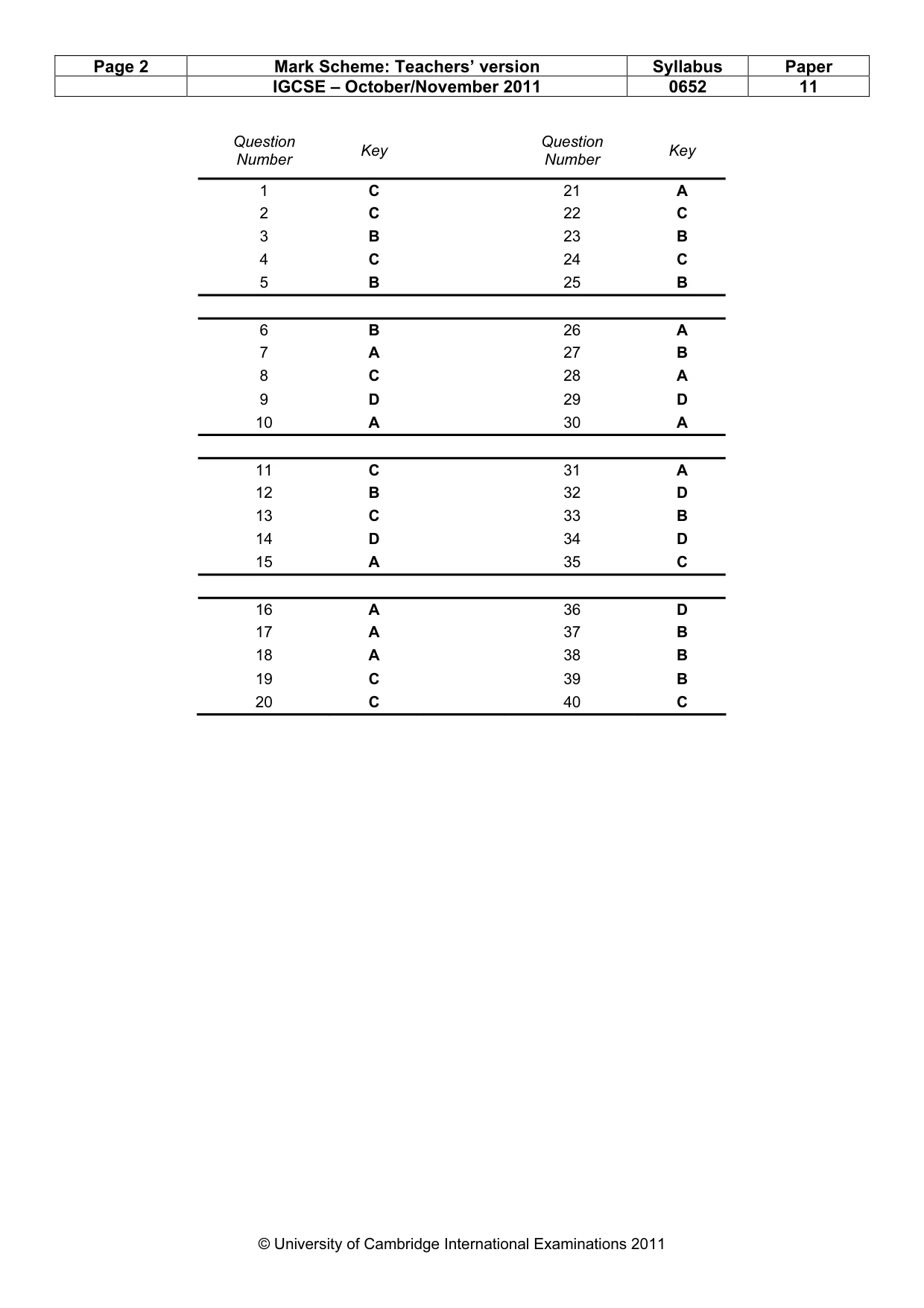
Answers below. Sit the paper first if you are practising.
Questions as text
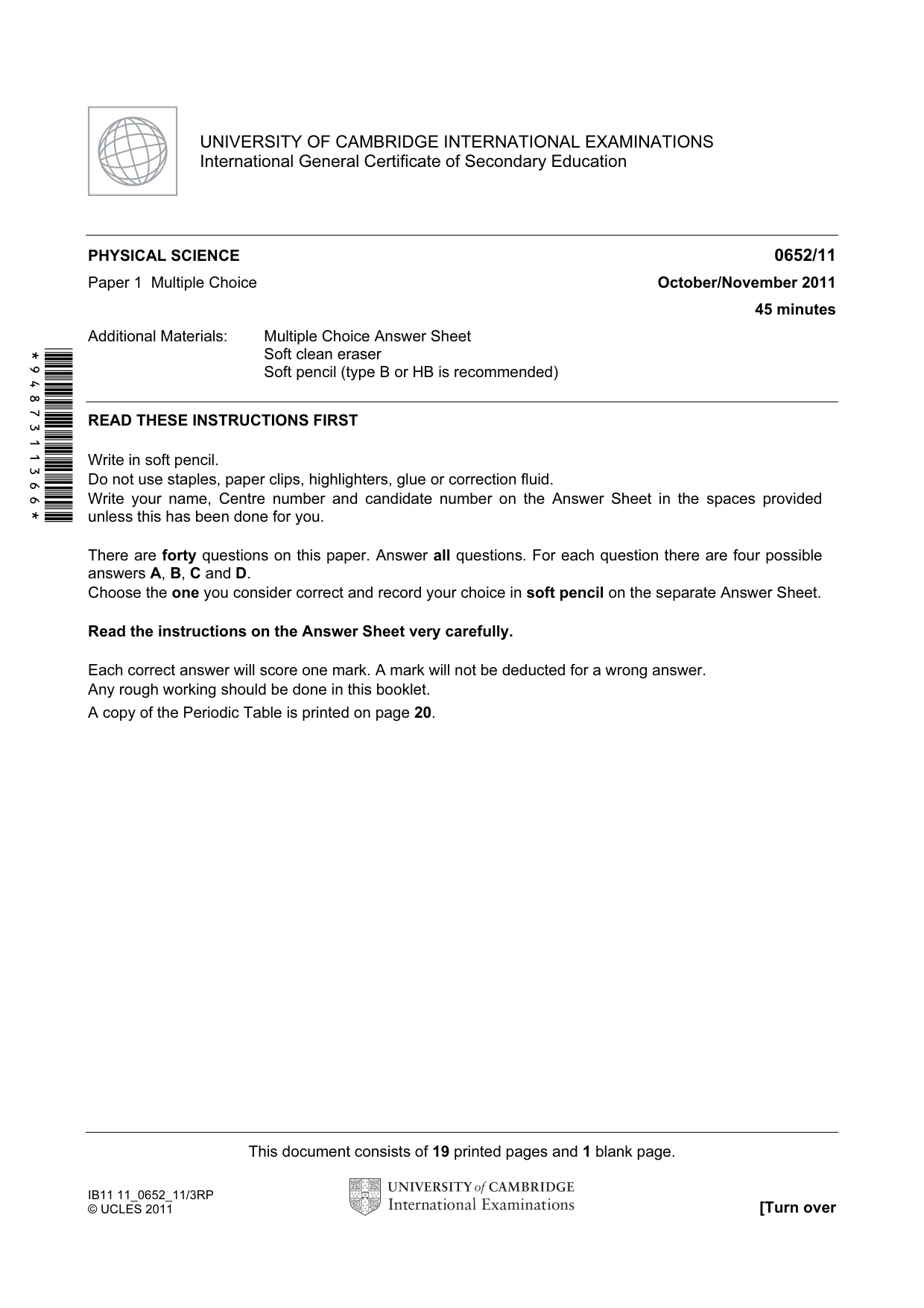
Q1 · In which process is heat energy neither given out nor taken in?
1 In which process is heat energy neither given out nor taken in? Sun C water vapour di f fusin g cloud B water evaporating A ice melting D water vapour iceberg condensing sea water
Mark scheme: C
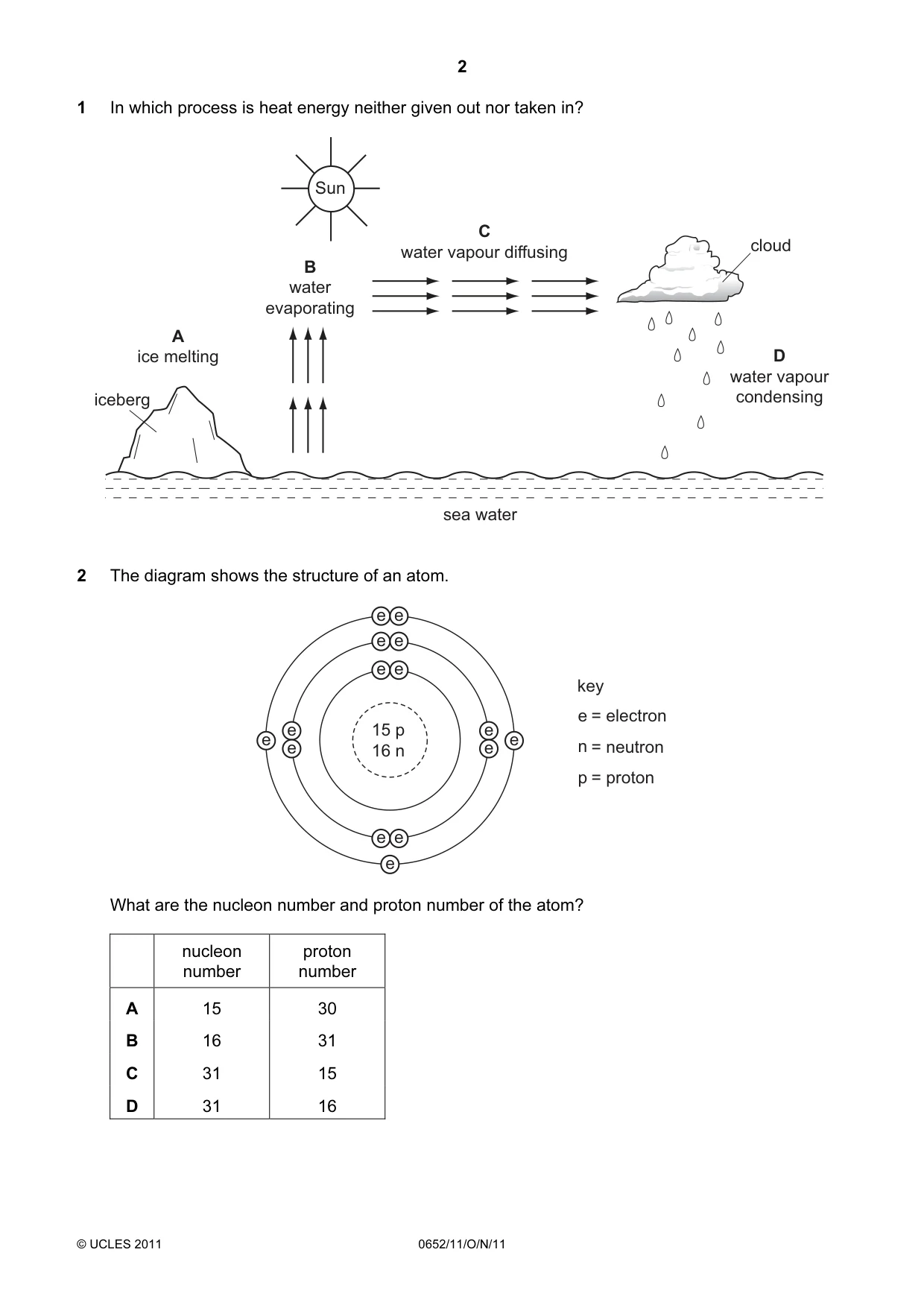
Q2 · The diagram shows the structure of an atom
2 The diagram shows the structure of an atom. e e e e e e key e = electron e 15 p e e e n = neutron e 16 n e p = proton e e e What are the nucleon number and proton number of the atom? nucleon proton number number A 15 30 B 16 31 C 31 15 D 31 16
Mark scheme: C
Q3 · The following statements are about covalent bonding
3 The following statements are about covalent bonding. Covalent bonds are formed by the ……1…… of electrons. Covalent substances have ……2…… electrical conductivity. Which words correctly complete gaps 1 and 2? 1 2 A sharing high B sharing low C transfer high D transfer low
Mark scheme: B
Q4 · Ethyl ethanoate has the formula CH3CO2C2H5
4 Ethyl ethanoate has the formula CH3CO2C2H5. What is the relative molecular mass Mr of this compound? A 48 B 72 C 88 D 124
Mark scheme: C
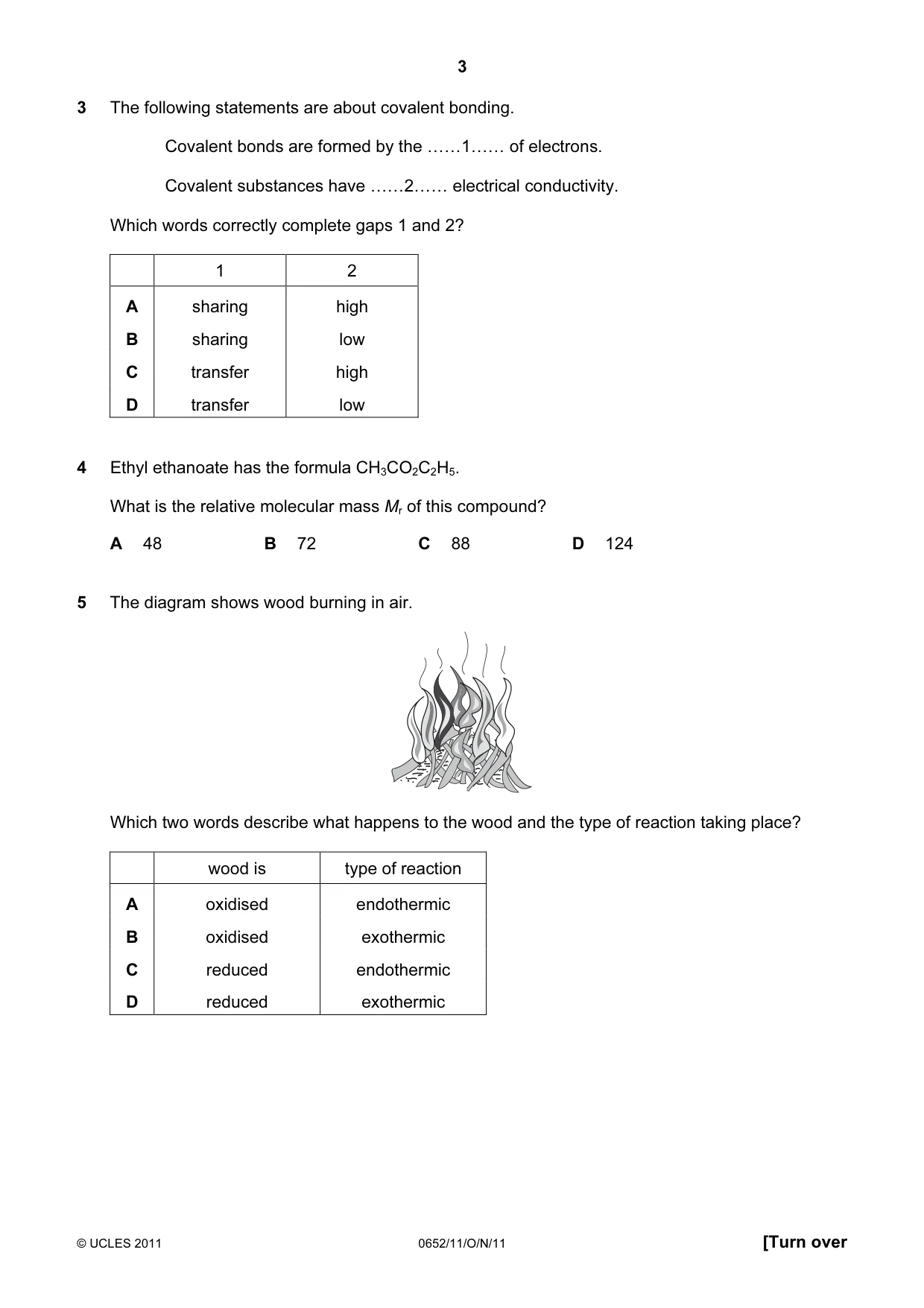
Q5 · The diagram shows wood burning in air
5 The diagram shows wood burning in air. Which two words describe what happens to the wood and the type of reaction taking place? wood is type of reaction A oxidised endothermic B oxidised exothermic C reduced endothermic D reduced exothermic
Mark scheme: B
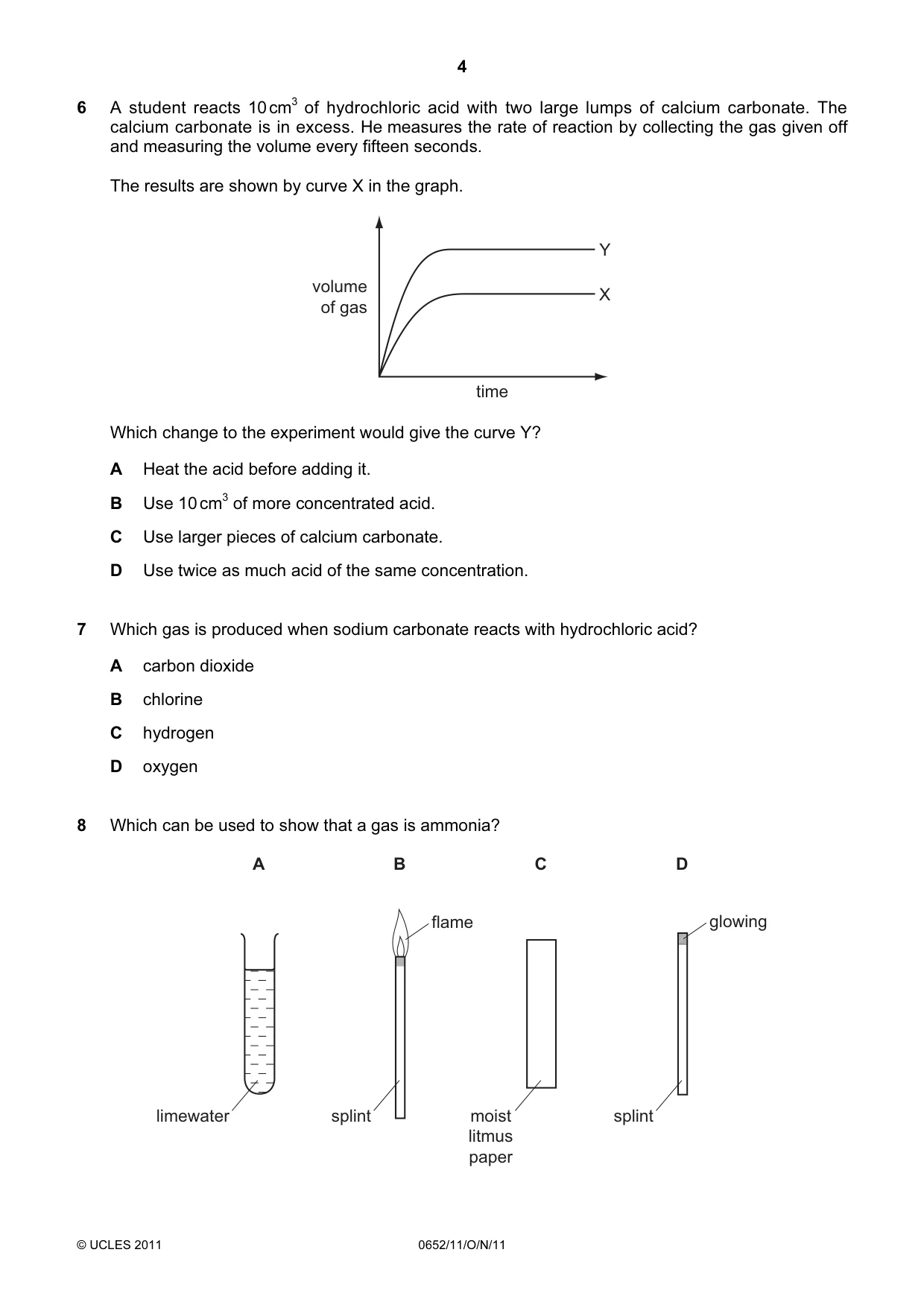
Q6 · A student reacts 10 cm3 of hydrochloric acid with two large lumps of calcium carbonate
6 A student reacts 10 cm3 of hydrochloric acid with two large lumps of calcium carbonate. The calcium carbonate is in excess. He measures the rate of reaction by collecting the gas given off and measuring the volume every fifteen seconds. The results are shown by curve X in the graph. Y volume X of gas time Which change to the experiment would give the curve Y? A Heat the acid before adding it. B Use 10 cm3 of more concentrated acid. C Use larger pieces of calcium carbonate. D Use twice as much acid of the same concentration.
Mark scheme: B
Q7 · Which gas is produced when sodium carbonate reacts with hydrochloric acid?
7 Which gas is produced when sodium carbonate reacts with hydrochloric acid? A carbon dioxide B chlorine C hydrogen D oxygen
Mark scheme: A
Q8 · Which can be used to show that a gas is ammonia?
8 Which can be used to show that a gas is ammonia? A B C D flame glowing limewater splint moist splint litmus paper
Mark scheme: C
Q9 · What must be formed when an acid reacts with a base?
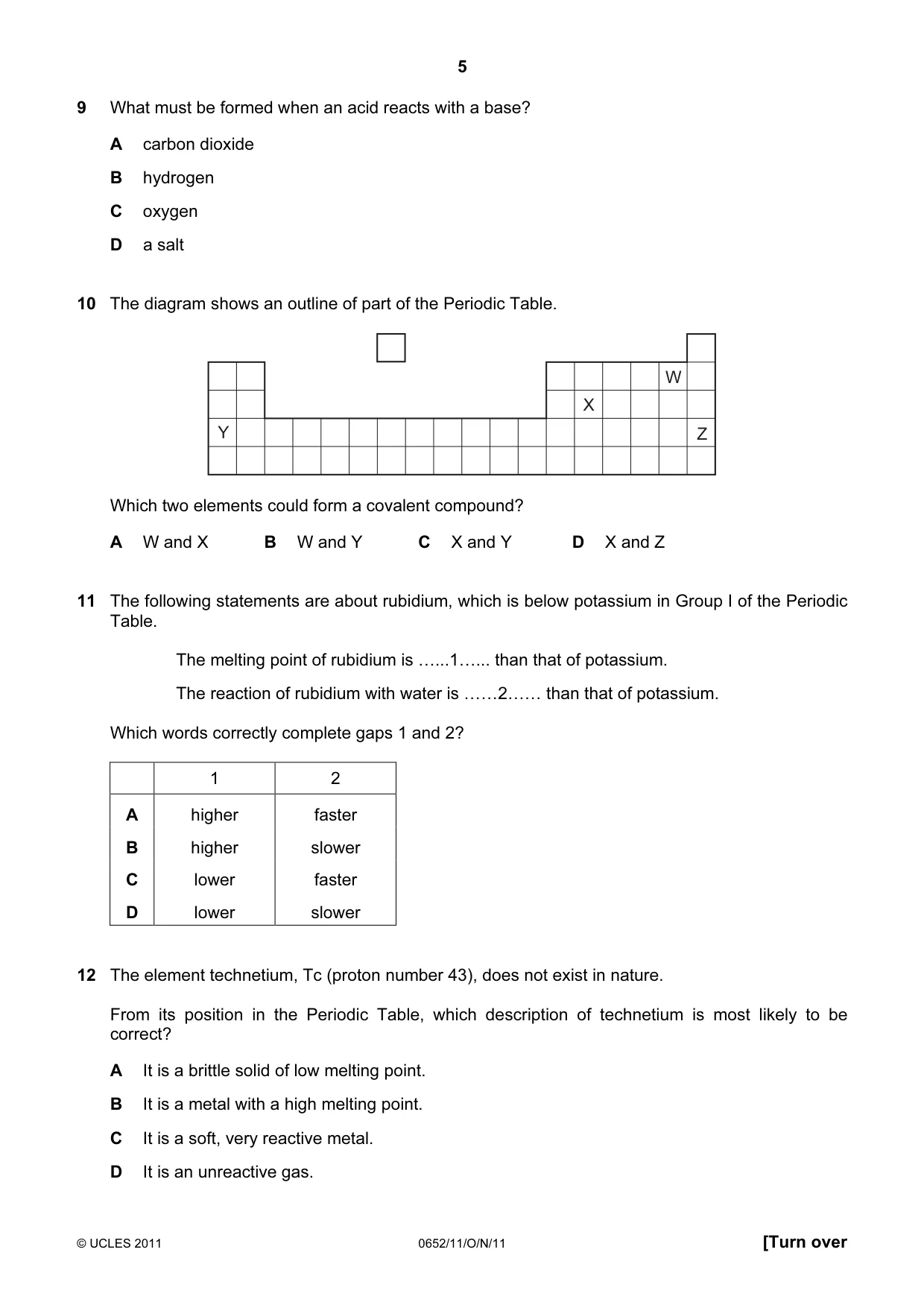
9 What must be formed when an acid reacts with a base? A carbon dioxide B hydrogen C oxygen D a salt
Mark scheme: D
Q10 · The diagram shows an outline of part of the Periodic Table
10 The diagram shows an outline of part of the Periodic Table. W X Y Z Which two elements could form a covalent compound? A W and X B W and Y C X and Y D X and Z
Mark scheme: A
Q11 · The following statements are about rubidium, which is below potassium in Group I of the…
11 The following statements are about rubidium, which is below potassium in Group I of the Periodic Table. The melting point of rubidium is …...1…... than that of potassium. The reaction of rubidium with water is ……2…… than that of potassium. Which words correctly complete gaps 1 and 2? 1 2 A higher faster B higher slower C lower faster D lower slower
Mark scheme: C
Q12 · The element technetium, Tc (proton number 43), does not exist in nature
12 The element technetium, Tc (proton number 43), does not exist in nature. From its position in the Periodic Table, which description of technetium is most likely to be correct? A It is a brittle solid of low melting point. B It is a metal with a high melting point. C It is a soft, very reactive metal. D It is an unreactive gas.
Mark scheme: B
Q13 · Metal M is only present in its ores as a compound
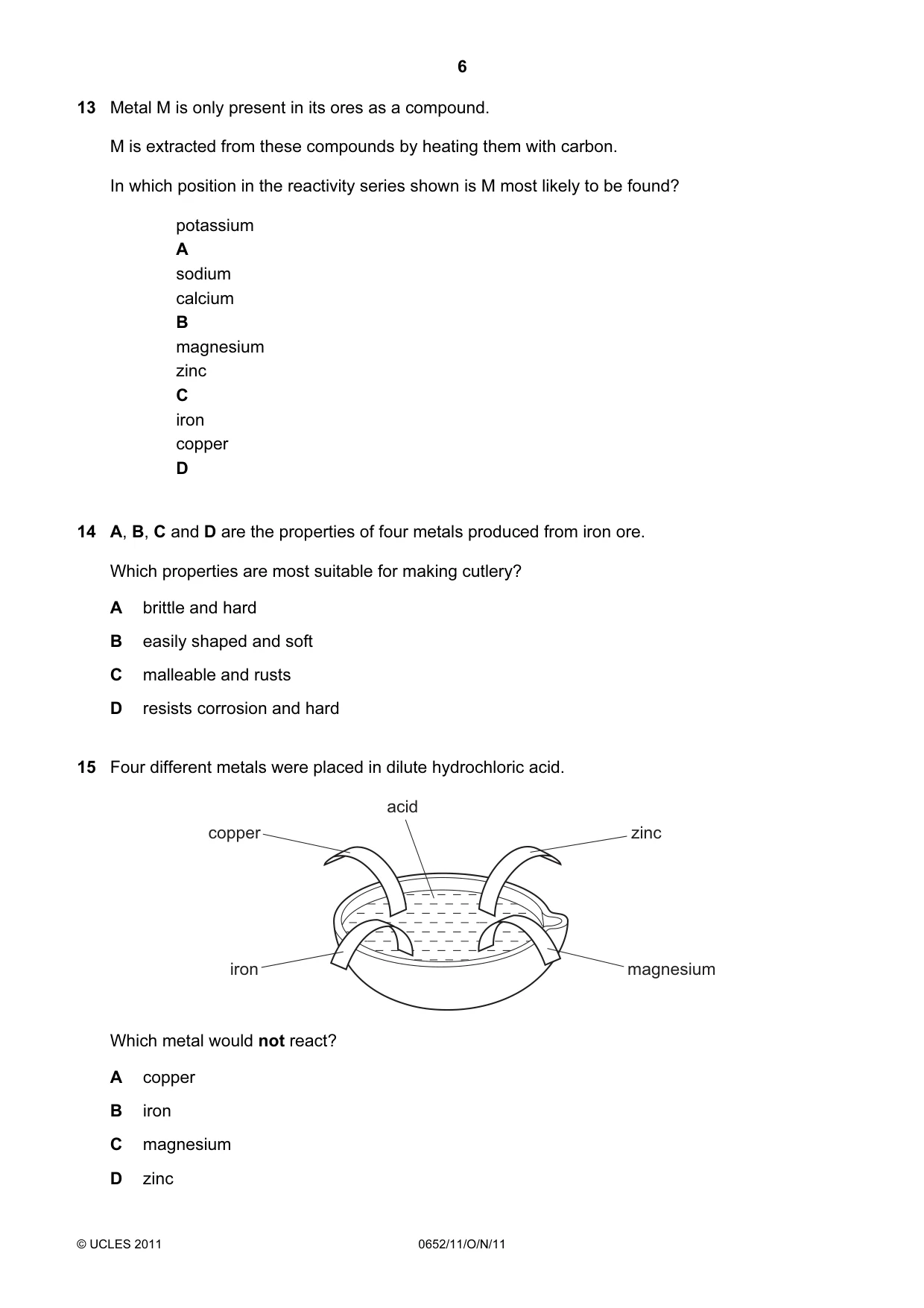
13 Metal M is only present in its ores as a compound. M is extracted from these compounds by heating them with carbon. In which position in the reactivity series shown is M most likely to be found? potassium A sodium calcium B magnesium zinc C iron copper D
Mark scheme: C
Q14 · A, B, C and D are the properties of four metals produced from iron ore
14 A, B, C and D are the properties of four metals produced from iron ore. Which properties are most suitable for making cutlery? A brittle and hard B easily shaped and soft C malleable and rusts D resists corrosion and hard
Mark scheme: D
Q15 · Four different metals were placed in dilute hydrochloric acid
15 Four different metals were placed in dilute hydrochloric acid. acid copper zinc iron magnesium Which metal would not react? A copper B iron C magnesium D zinc
Mark scheme: A
Q16 · Which statements about water are correct?
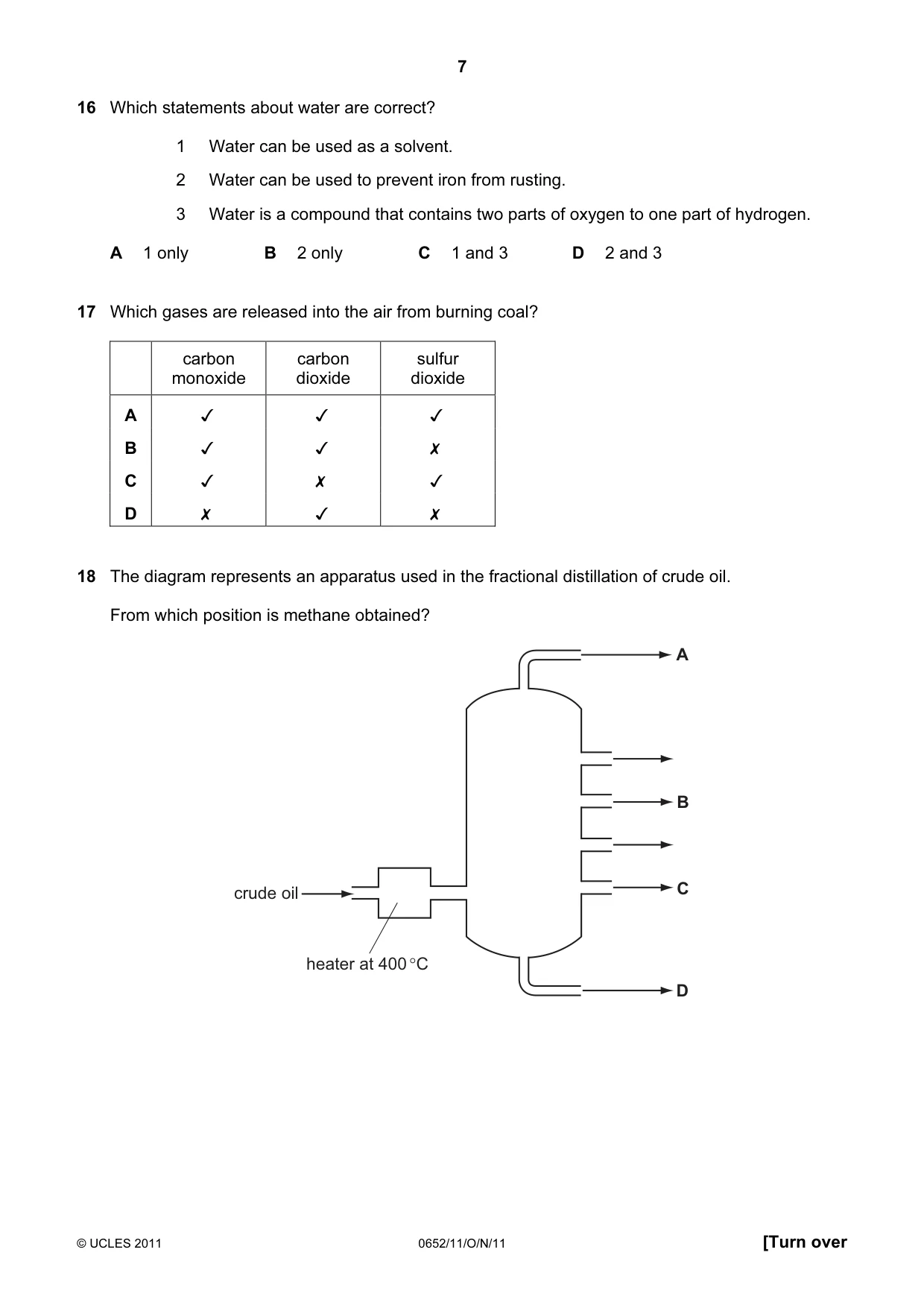
16 Which statements about water are correct? 1 Water can be used as a solvent. 2 Water can be used to prevent iron from rusting. 3 Water is a compound that contains two parts of oxygen to one part of hydrogen. A 1 only B 2 only C 1 and 3 D 2 and 3
Mark scheme: A
Q17 · Which gases are released into the air from burning coal?
17 Which gases are released into the air from burning coal? carbon carbon sulfur monoxide dioxide dioxide Jv Jv Jv 0 Oo WwW > v v x v x v x v x
Mark scheme: A
Q18 · The diagram represents an apparatus used in the fractional distillation of crude oil
18 The diagram represents an apparatus used in the fractional distillation of crude oil. From which position is methane obtained? A B crude oil C heater at 400 °C D
Mark scheme: A
Q19 · Which structure represents an unsaturated hydrocarbon?
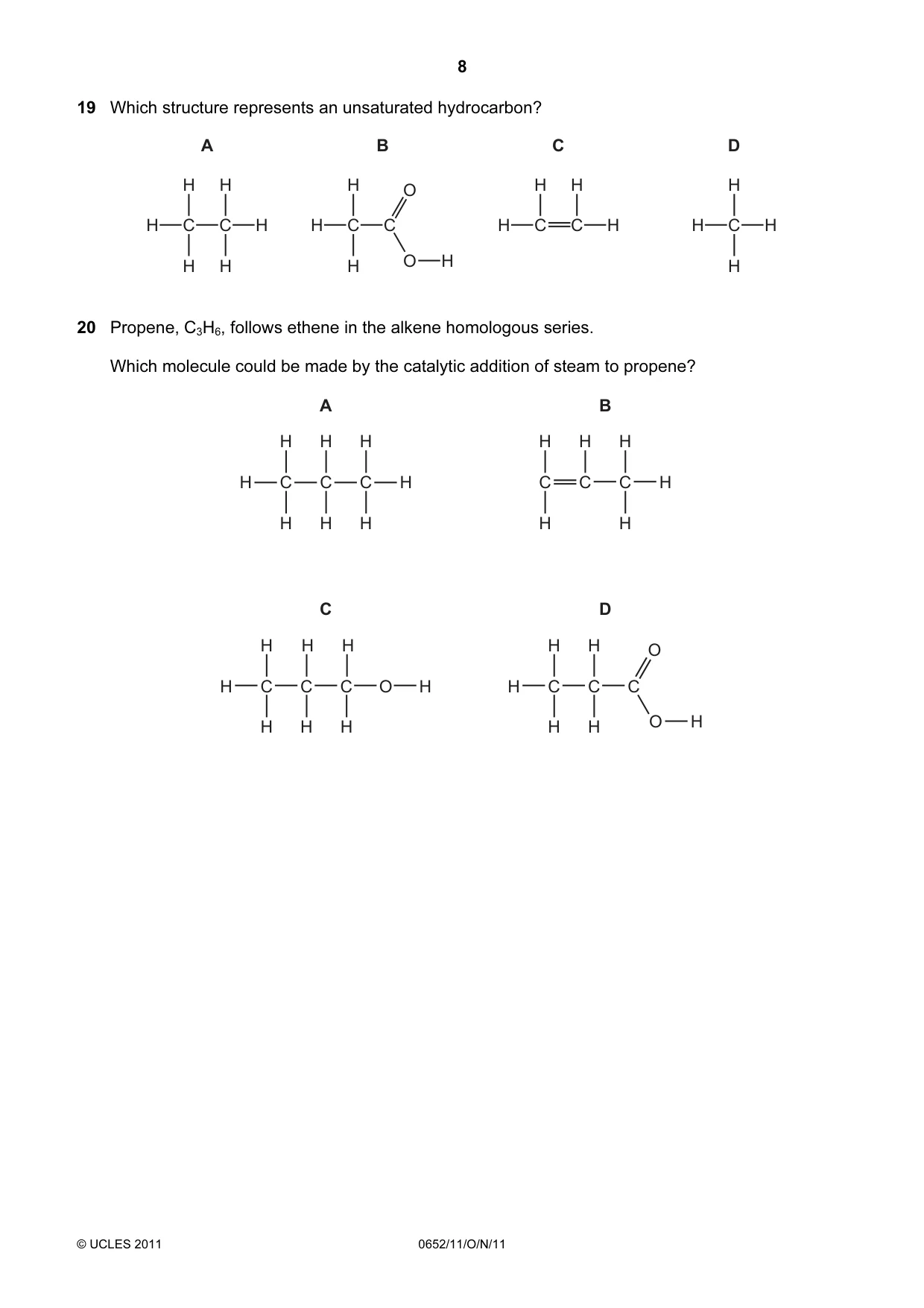
19 Which structure represents an unsaturated hydrocarbon? A B C D H H H O H H H H C C H H C C H C C H H C H H H H O H H
Mark scheme: C
Q20 · Propene, C3H6, follows ethene in the alkene homologous series
20 Propene, C3H6, follows ethene in the alkene homologous series. Which molecule could be made by the catalytic addition of steam to propene? A B H H H H H H H C C C H C C C H H H H H H C D H H H H H O H C C C O H H C C C H H H H H O H
Mark scheme: C
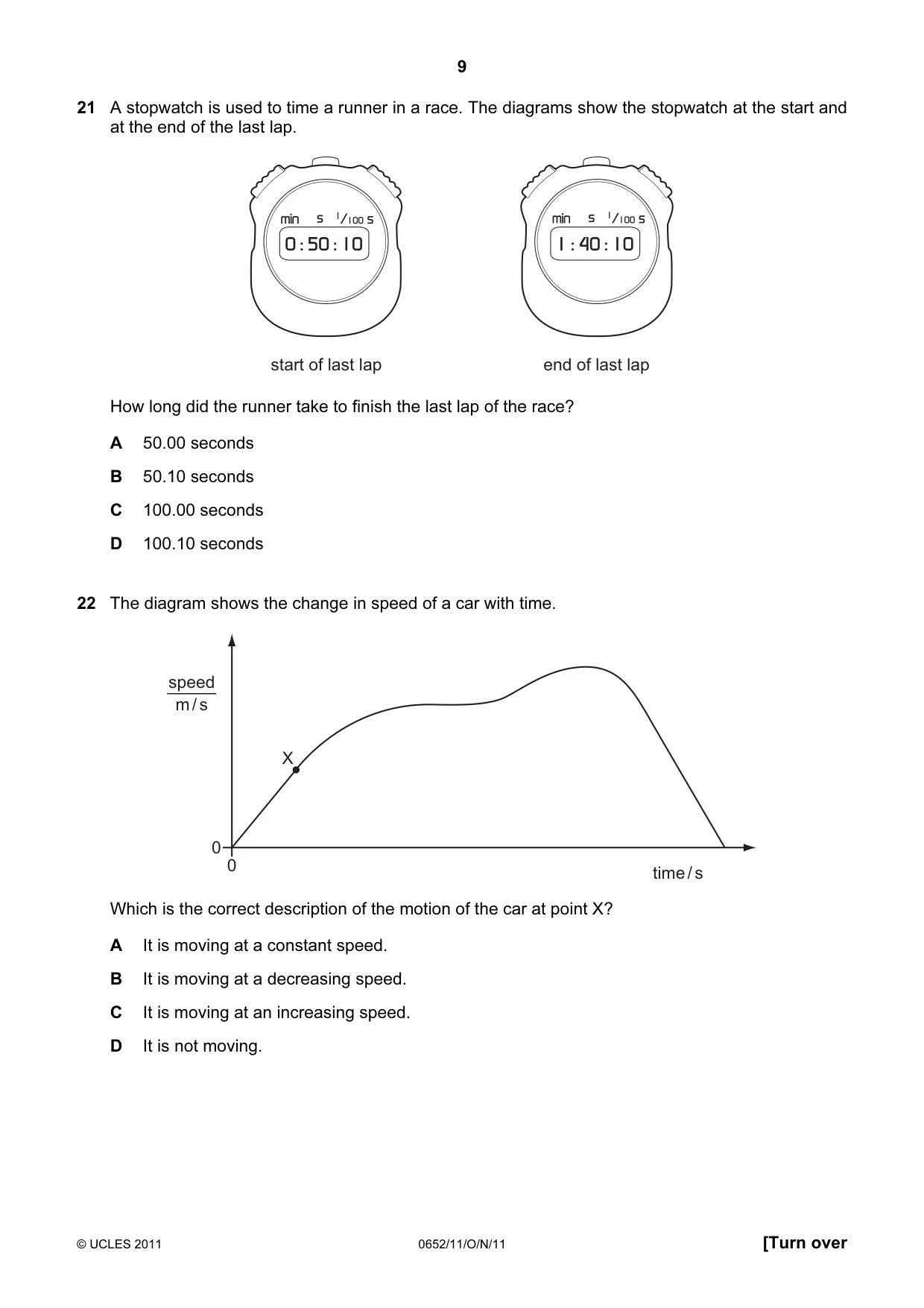
Q21 · A stopwatch is used to time a runner in a race
21 A stopwatch is used to time a runner in a race. The diagrams show the stopwatch at the start and at the end of the last lap. start of last lap end of last lap How long did the runner take to finish the last lap of the race? A 50.00 seconds B 50.10 seconds C 100.00 seconds D 100.10 seconds
Mark scheme: A
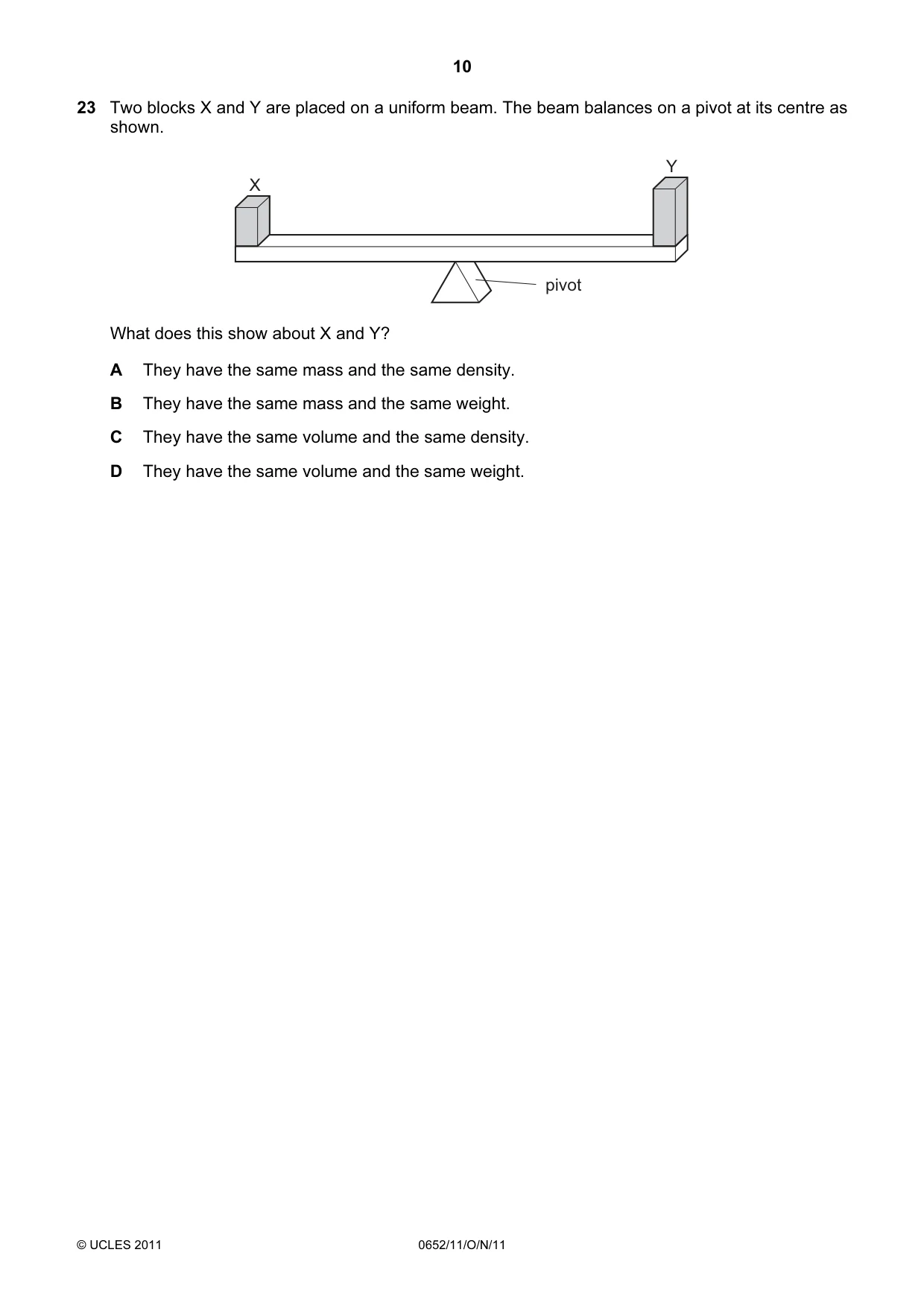
Q22 · The diagram shows the change in speed of a car with time
22 The diagram shows the change in speed of a car with time. speed m / s X 0 0 time / s Which is the correct description of the motion of the car at point X? A It is moving at a constant speed. B It is moving at a decreasing speed. C It is moving at an increasing speed. D It is not moving.
Mark scheme: C
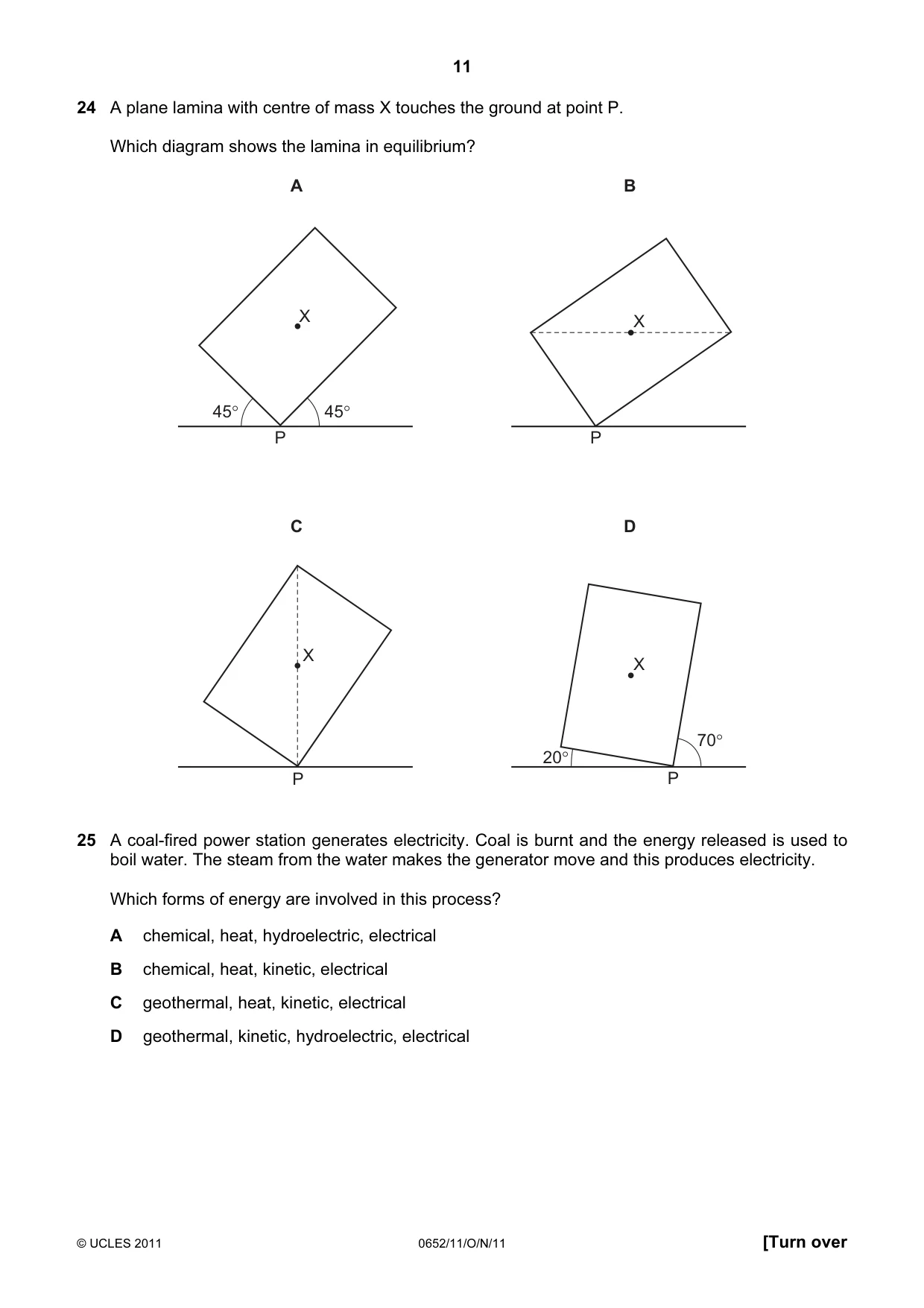
Q23 · Two blocks X and Y are placed on a uniform beam
23 Two blocks X and Y are placed on a uniform beam. The beam balances on a pivot at its centre as shown. Y X pivot What does this show about X and Y? A They have the same mass and the same density. B They have the same mass and the same weight. C They have the same volume and the same density. D They have the same volume and the same weight.
Mark scheme: B
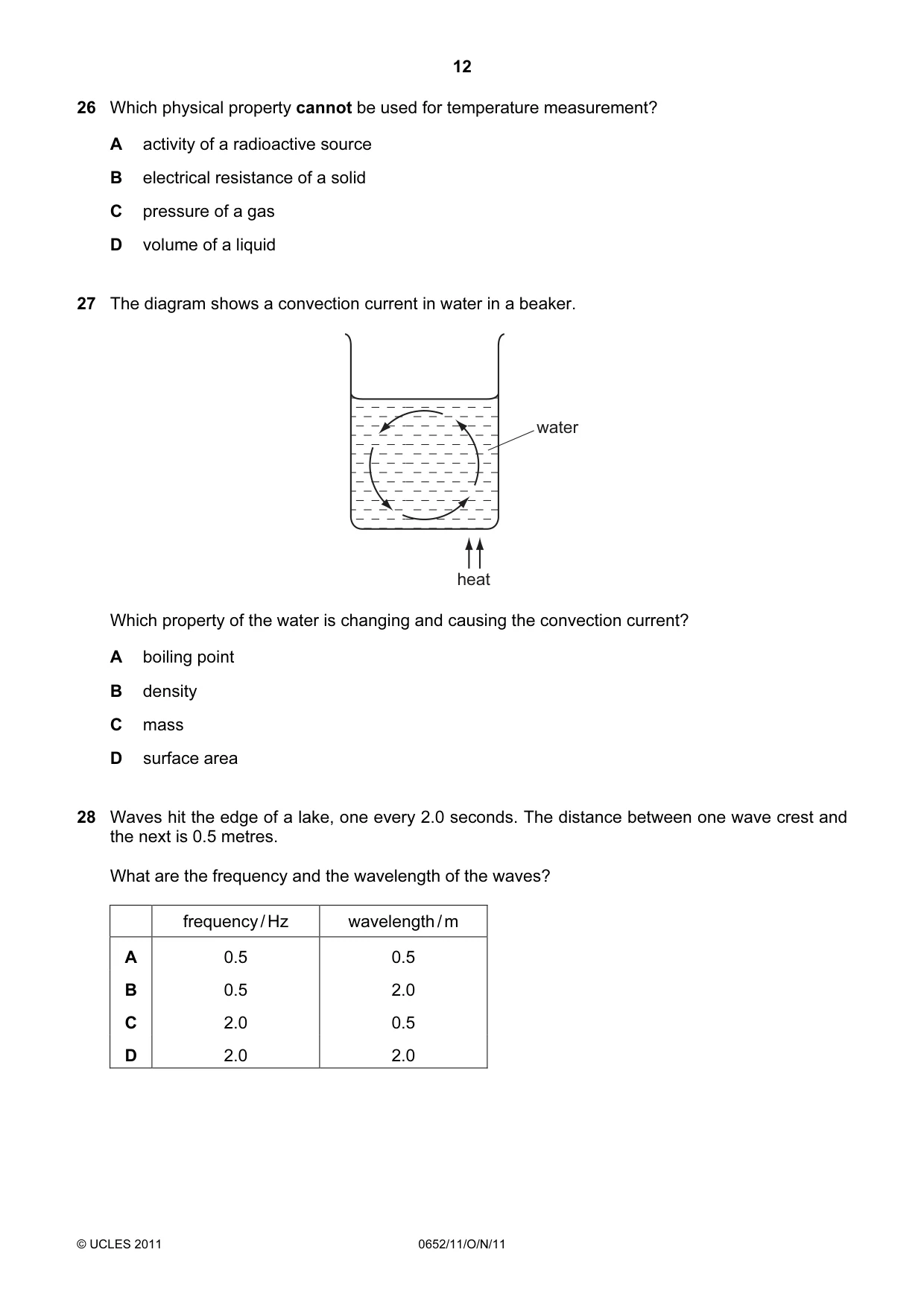
Q24 · A plane lamina with centre of mass X touches the ground at point P
24 A plane lamina with centre of mass X touches the ground at point P. Which diagram shows the lamina in equilibrium? A B X X 45° 45° P P C D X X 70° 20° P P
Mark scheme: C
Q25 · A coal-fired power station generates electricity
25 A coal-fired power station generates electricity. Coal is burnt and the energy released is used to boil water. The steam from the water makes the generator move and this produces electricity. Which forms of energy are involved in this process? A chemical, heat, hydroelectric, electrical B chemical, heat, kinetic, electrical C geothermal, heat, kinetic, electrical D geothermal, kinetic, hydroelectric, electrical
Mark scheme: B
Q26 · Which physical property cannot be used for temperature measurement?
26 Which physical property cannot be used for temperature measurement? A activity of a radioactive source B electrical resistance of a solid C pressure of a gas D volume of a liquid
Mark scheme: A
Q27 · The diagram shows a convection current in water in a beaker
27 The diagram shows a convection current in water in a beaker. water heat Which property of the water is changing and causing the convection current? A boiling point B density C mass D surface area
Mark scheme: B
Q28 · Waves hit the edge of a lake, one every 2.0 seconds
28 Waves hit the edge of a lake, one every 2.0 seconds. The distance between one wave crest and the next is 0.5 metres. What are the frequency and the wavelength of the waves? frequency / Hz wavelength / m A 0.5 0.5 B 0.5 2.0 C 2.0 0.5 D 2.0 2.0
Mark scheme: A
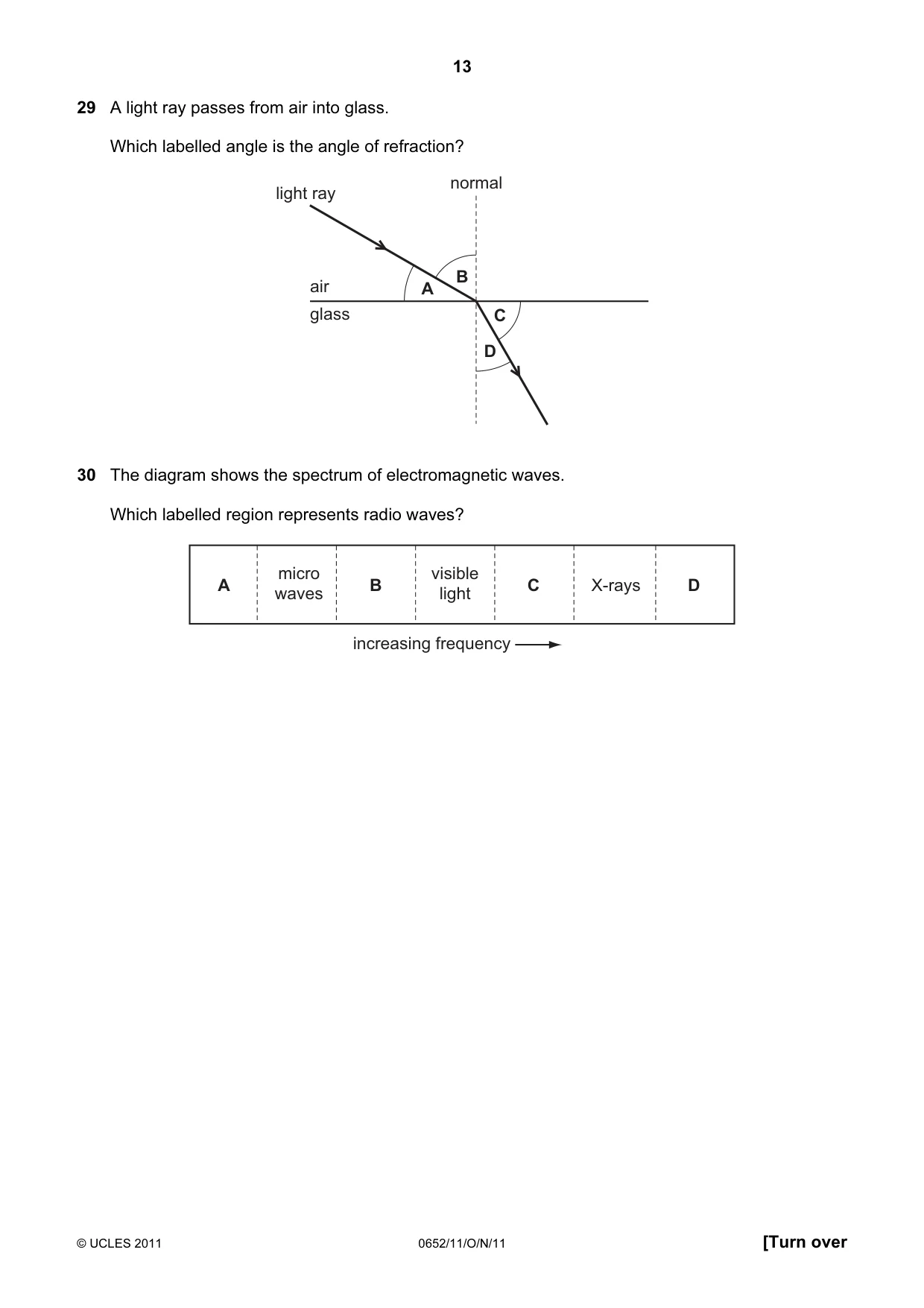
Q29 · A light ray passes from air into glass
29 A light ray passes from air into glass. Which labelled angle is the angle of refraction? normal light ray B air A glass C D
Mark scheme: D
Q30 · The diagram shows the spectrum of electromagnetic waves
30 The diagram shows the spectrum of electromagnetic waves. Which labelled region represents radio waves? micro visible A B C X-rays D waves light increasing frequency
Mark scheme: A
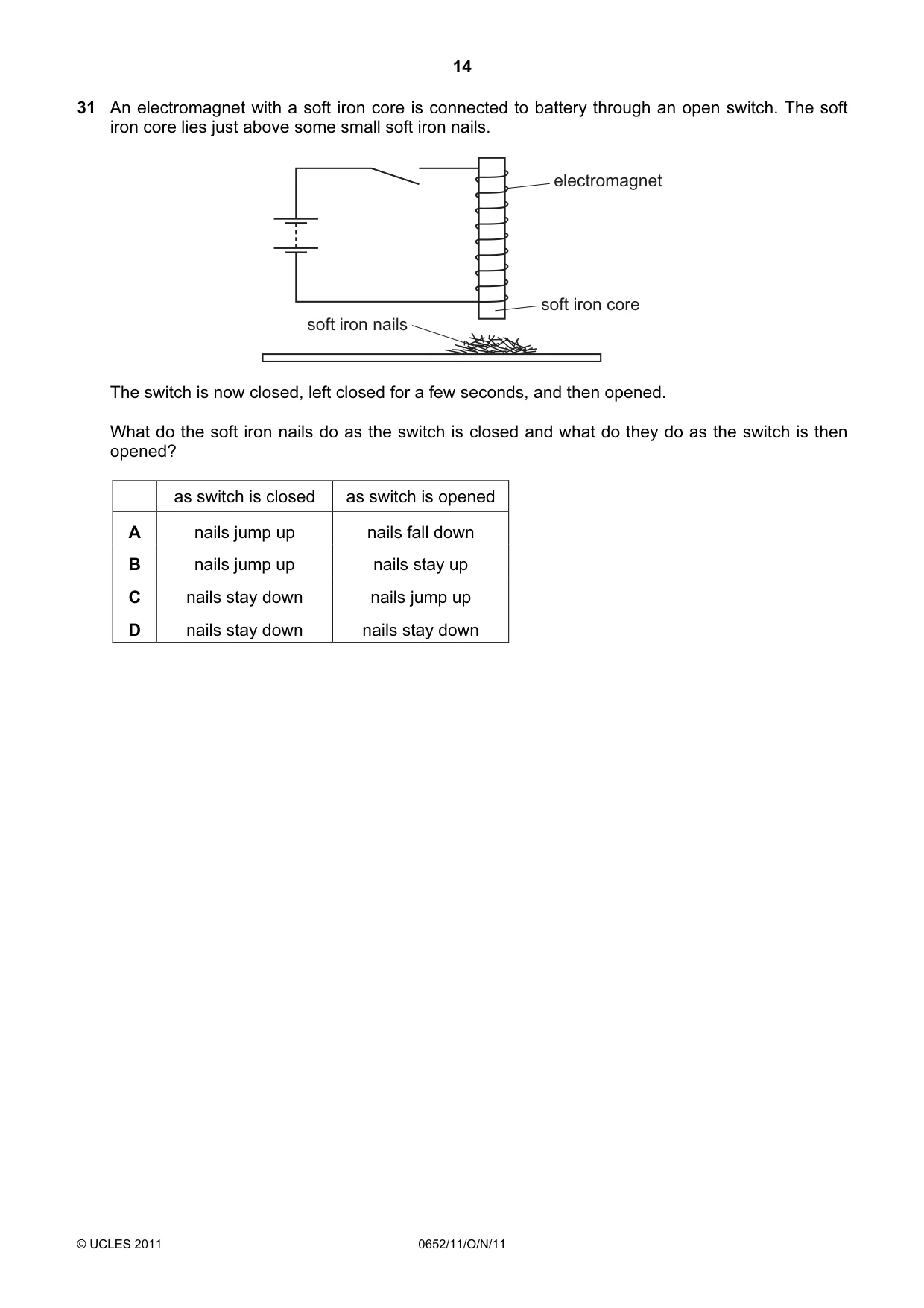
Q31 · An electromagnet with a soft iron core is connected to battery through an open switch
31 An electromagnet with a soft iron core is connected to battery through an open switch. The soft iron core lies just above some small soft iron nails. electromagnet soft iron core soft iron nails The switch is now closed, left closed for a few seconds, and then opened. What do the soft iron nails do as the switch is closed and what do they do as the switch is then opened? as switch is closed as switch is opened A nails jump up nails fall down B nails jump up nails stay up C nails stay down nails jump up D nails stay down nails stay down
Mark scheme: A
Q32 · Two plastic rods, 1 and 2, are negatively charged
32 Two plastic rods, 1 and 2, are negatively charged. Rod 1 hangs freely. Y X rod 1 rod 2 Rod 2 is brought near to end X of rod 1 and then near to end Y of rod 1. What happens to the rods in each position? near end X near end Y A they attract they attract B they attract they repel C they repel they attract D they repel they repel
Mark scheme: D
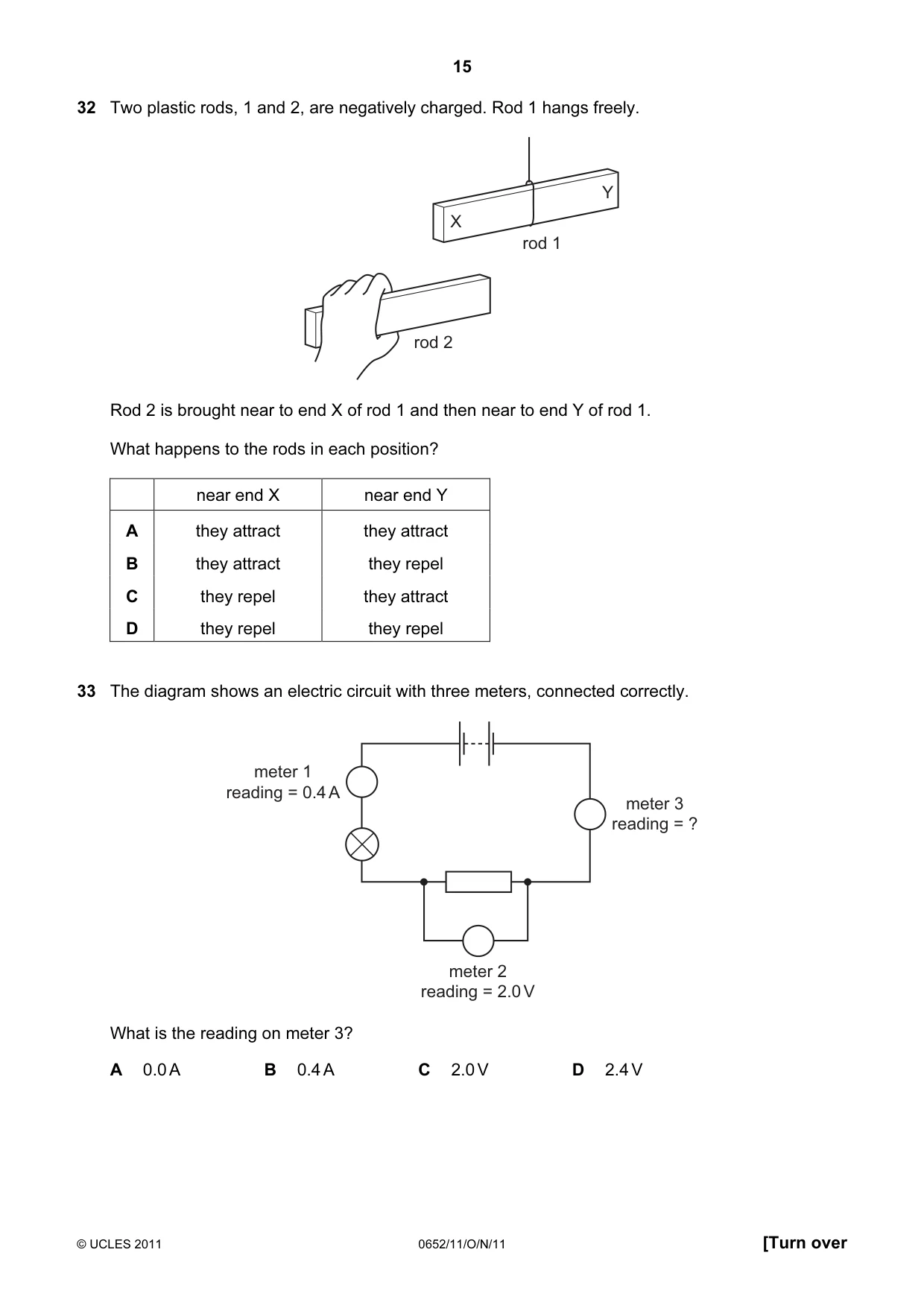
Q33 · The diagram shows an electric circuit with three meters, connected correctly
33 The diagram shows an electric circuit with three meters, connected correctly. meter 1 reading = 0.4 A meter 3 reading = ? meter 2 reading = 2.0 V What is the reading on meter 3? A 0.0 A B 0.4 A C 2.0 V D 2.4 V
Mark scheme: B
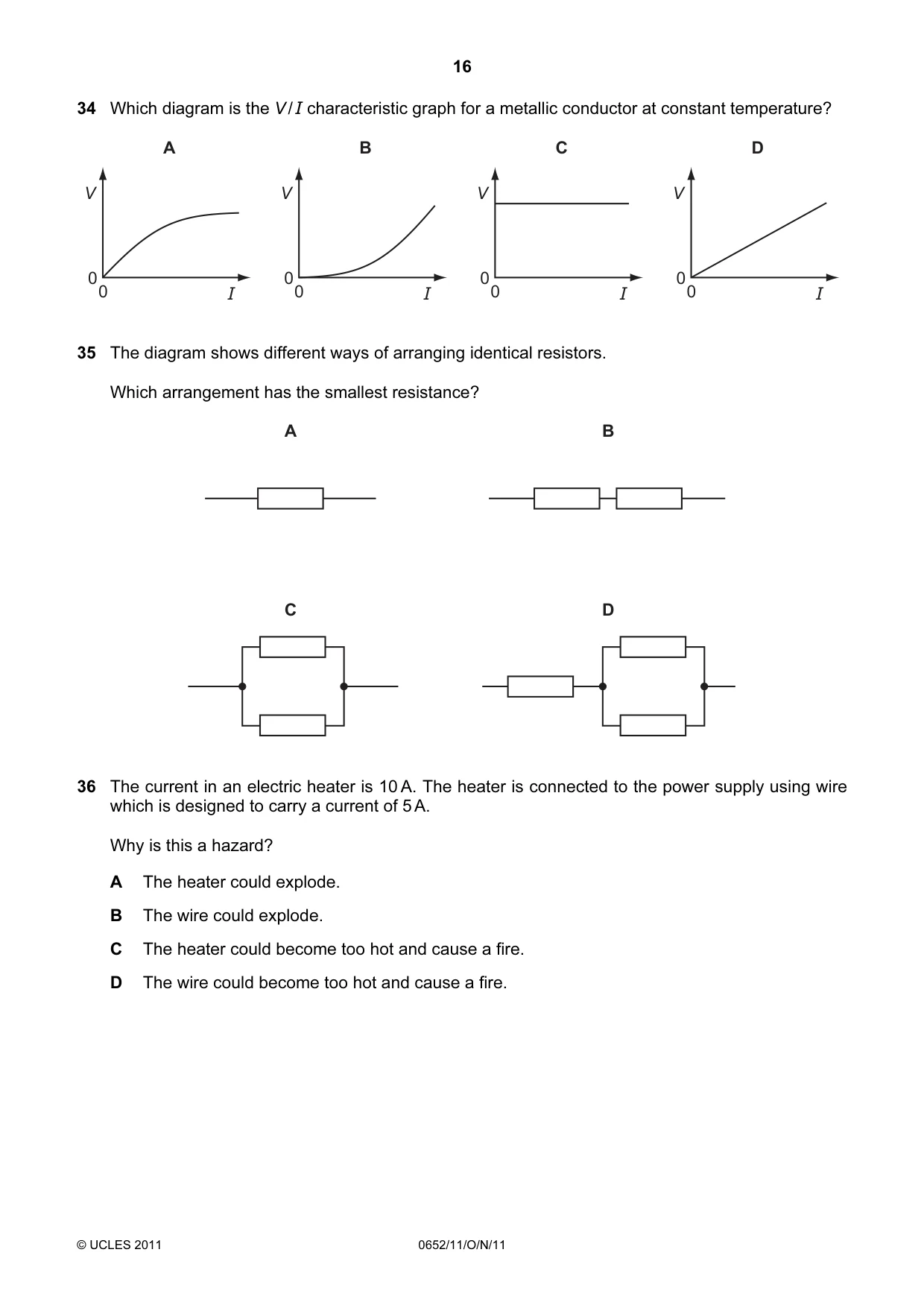
Q34 · Which diagram is the V / I characteristic graph for a metallic conductor at constant…
34 Which diagram is the V / I characteristic graph for a metallic conductor at constant temperature? A B C D V V V V 0 0 00 00 00 I I I I
Mark scheme: D
Q35 · The diagram shows different ways of arranging identical resistors
35 The diagram shows different ways of arranging identical resistors. Which arrangement has the smallest resistance? A B C D
Mark scheme: C
Q36 · The current in an electric heater is 10 A
36 The current in an electric heater is 10 A. The heater is connected to the power supply using wire which is designed to carry a current of 5 A. Why is this a hazard? A The heater could explode. B The wire could explode. C The heater could become too hot and cause a fire. D The wire could become too hot and cause a fire.
Mark scheme: D
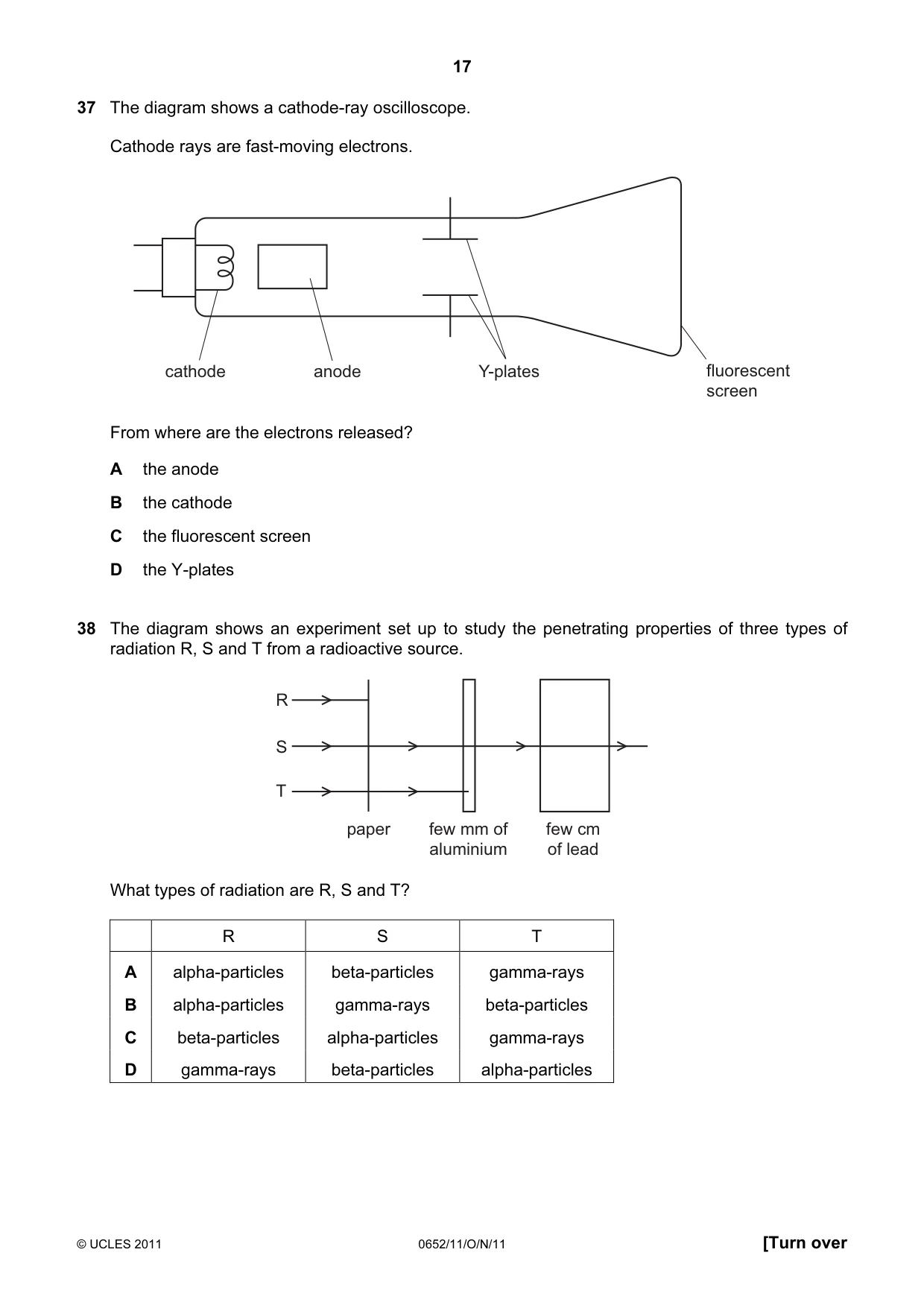
Q37 · The diagram shows a cathode-ray oscilloscope
37 The diagram shows a cathode-ray oscilloscope. Cathode rays are fast-moving electrons. cathode anode Y-plates fluorescent screen From where are the electrons released? A the anode B the cathode C the fluorescent screen D the Y-plates
Mark scheme: B
Q38 · The diagram shows an experiment set up to study the penetrating properties of three types…
38 The diagram shows an experiment set up to study the penetrating properties of three types of radiation R, S and T from a radioactive source. R S T paper few mm of few cm aluminium of lead What types of radiation are R, S and T? R S T A alpha-particles beta-particles gamma-rays B alpha-particles gamma-rays beta-particles C beta-particles alpha-particles gamma-rays D gamma-rays beta-particles alpha-particles
Mark scheme: B
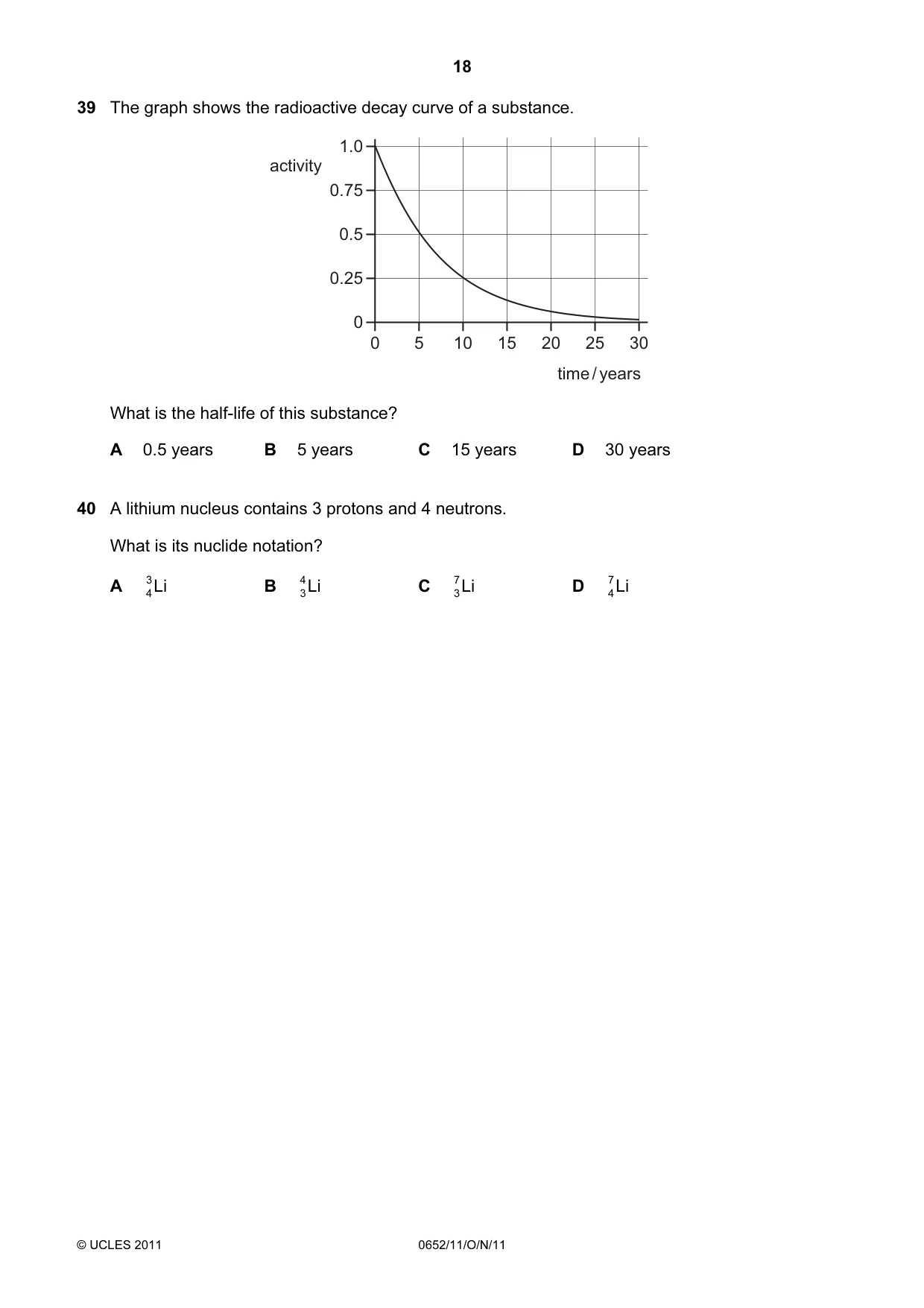
Q39 · The graph shows the radioactive decay curve of a substance
39 The graph shows the radioactive decay curve of a substance. 1.0 activity 0.75 0.5 0.25 0 0 5 10 15 20 25 30 time / years What is the half-life of this substance? A 0.5 years B 5 years C 15 years D 30 years
Mark scheme: B
Q40 · A lithium nucleus contains 3 protons and 4 neutrons
40 A lithium nucleus contains 3 protons and 4 neutrons. What is its nuclide notation? A 3 Li B 4 Li C 7 Li D 7 Li 4 3 3 4
Mark scheme: C
What was in this paper
The subtopics covered by these 40 questions, and how many questions each got. Open one in a new tab to see every Cambridge question on it.
2Forces2General wave properties2Identification of ions and gases2Molecules and covalent bonds2Radioactivity2Reactivity series2Simple phenomena of magnetism2The nuclear atom2Air1Alcohols1Alkenes1Atomic structure and the Periodic Table1Dangers of electricity1Electrical quantities1Energy transfer1Fuels1Group properties1Length and time1Light1Motion1Periodic Trends1Preparation of salts1Rate (speed) of reaction1Stoichiometry1The particulate nature of matter1Thermal processes1Thermal properties and temperature1Uses of metals1Water1Work, energy and power1What you needed in this session
Cambridge’s own grade thresholds for 2011 Oct/Nov, Paper 1 · Variant 1. A higher threshold means an easier paper — the bar moves with how the cohort did.