Questions as text
Q1 · The emissions from a radioactive source pass through a sheet of lead, 10 mm thick 0652/21 Oct/Nov 2017
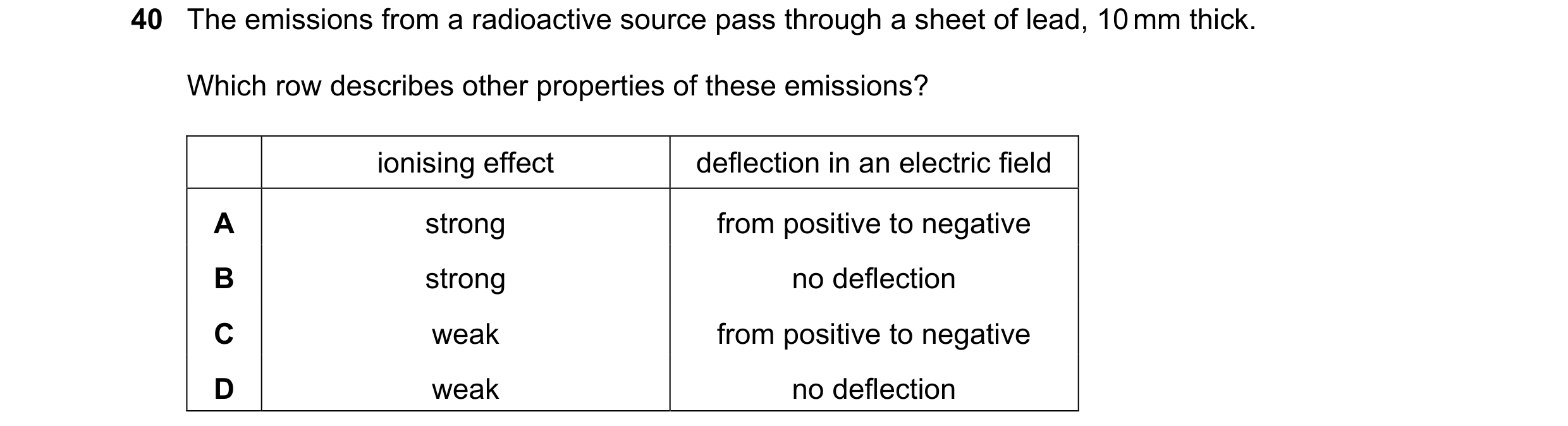
40 The emissions from a radioactive source pass through a sheet of lead, 10 mm thick. Which row describes other properties of these emissions? ionising effect deflection in an electric field A strong from positive to negative B strong no deflection C weak from positive to negative D weak no deflection
1 marks
Answer: D
This question in 0652/21 Oct/Nov 2017
Q2 · The emissions from a radioactive source pass through a sheet of lead, 10 mm thick 0652/22 Oct/Nov 2017
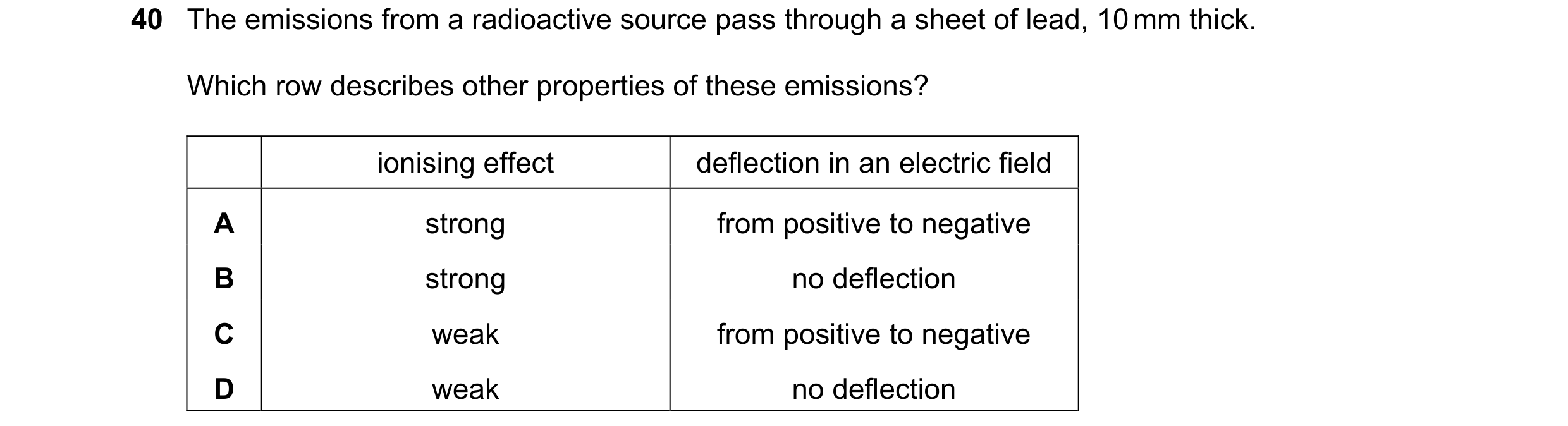
40 The emissions from a radioactive source pass through a sheet of lead, 10 mm thick. Which row describes other properties of these emissions? ionising effect deflection in an electric field A strong from positive to negative B strong no deflection C weak from positive to negative D weak no deflection
1 marks
Answer: D
This question in 0652/22 Oct/Nov 2017
Q3 · A chemical process causes energy to be released 0652/21 Oct/Nov 2018
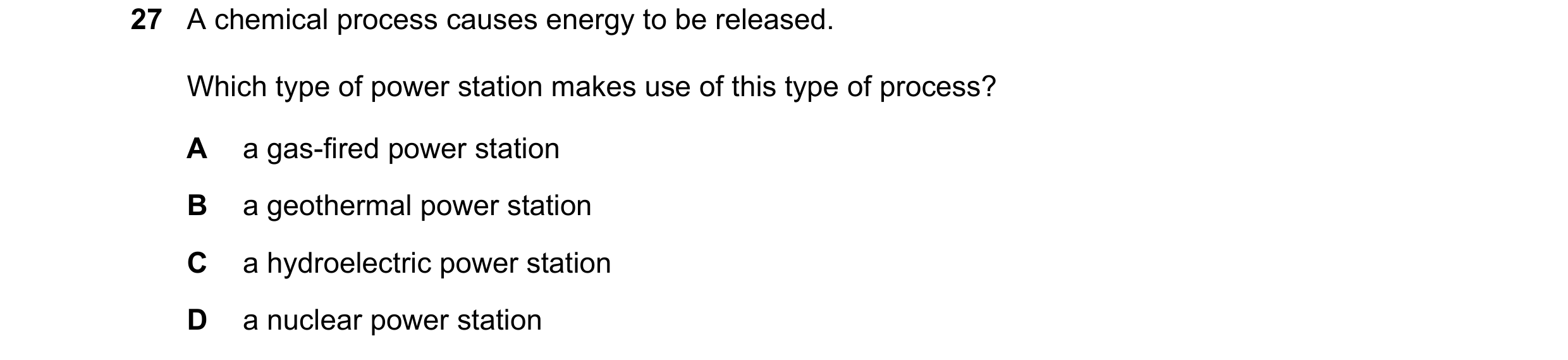
27 A chemical process causes energy to be released. Which type of power station makes use of this type of process? A a gas-fired power station B a geothermal power station C a hydroelectric power station D a nuclear power station
1 marks
Answer: A
This question in 0652/21 Oct/Nov 2018
Q4 · The graph shows the decay curve for one particular radioactive isotope 0652/21 Oct/Nov 2018
40 The graph shows the decay curve for one particular radioactive isotope. The count rate is corrected to remove the effect of background radiation. 2500 count rate counts / minute 2000 1500 1000 500 0 0 1 2 3 4 5 time / days What is the half-life of this isotope? A 1.0 day B 1.5 days C 2.0 days D 2.5 days
1 marks
Answer: C
This question in 0652/21 Oct/Nov 2018
Q5 · A chemical process causes energy to be released 0652/22 Oct/Nov 2018
27 A chemical process causes energy to be released. Which type of power station makes use of this type of process? A a gas-fired power station B a geothermal power station C a hydroelectric power station D a nuclear power station
1 marks
Answer: A
This question in 0652/22 Oct/Nov 2018
Q6 · The graph shows the decay curve for one particular radioactive isotope 0652/22 Oct/Nov 2018
40 The graph shows the decay curve for one particular radioactive isotope. The count rate is corrected to remove the effect of background radiation. 2500 count rate counts / minute 2000 1500 1000 500 0 0 1 2 3 4 5 time / days What is the half-life of this isotope? A 1.0 day B 1.5 days C 2.0 days D 2.5 days
1 marks
Answer: C
This question in 0652/22 Oct/Nov 2018
Q7 · Americium-241 ( 241 95Am ) decays to neptunium-237 ( 237 93Np ) 0652/21 Oct/Nov 2019
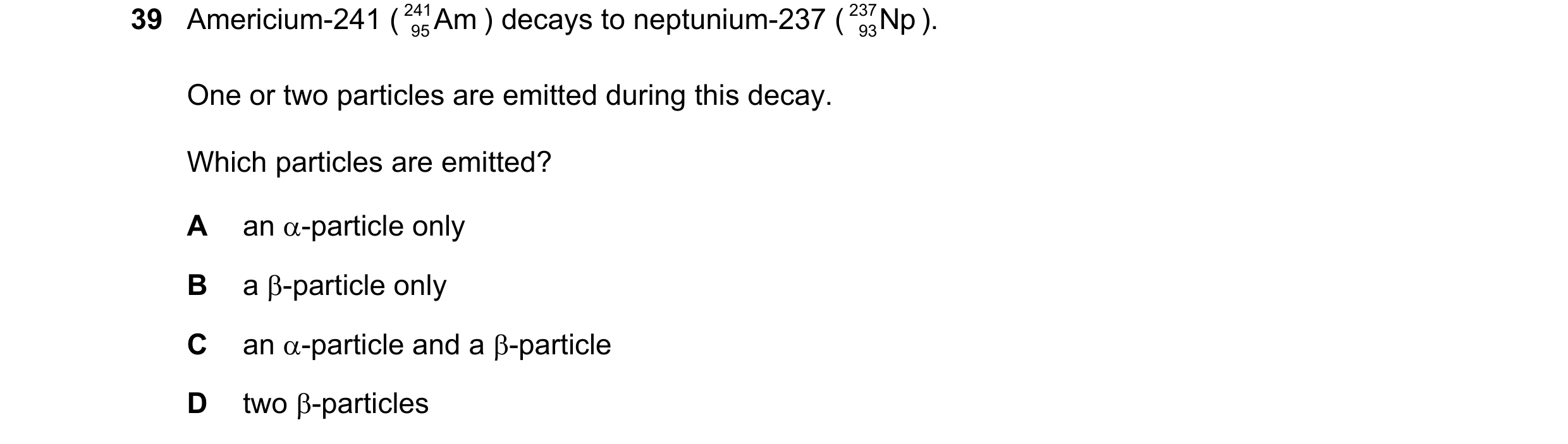
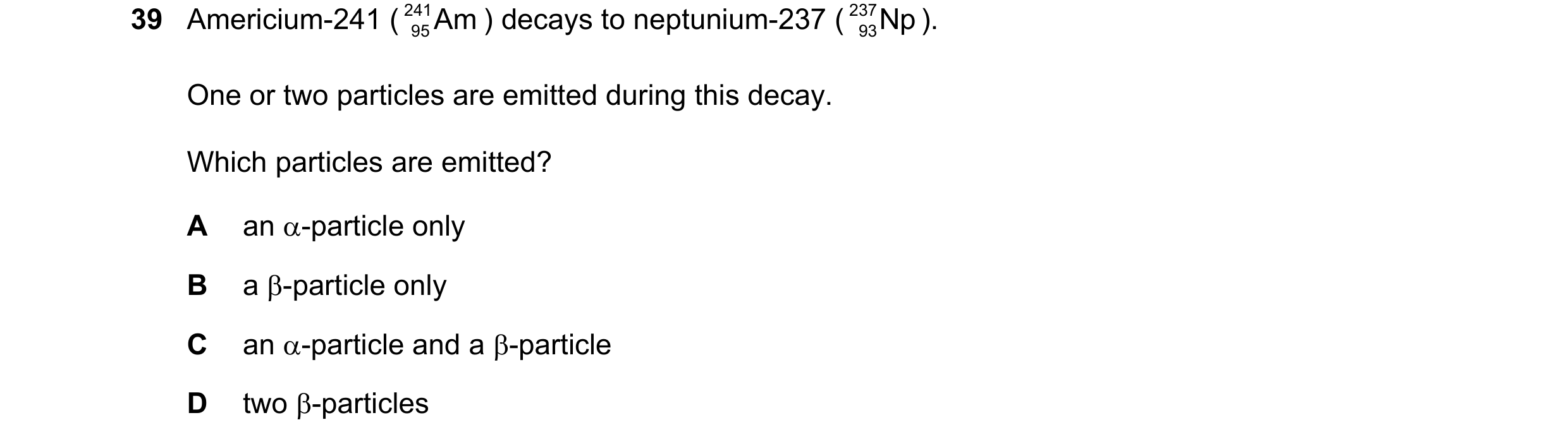
39 Americium-241 ( 241 95Am ) decays to neptunium-237 ( 237 93Np ). One or two particles are emitted during this decay. Which particles are emitted? A an α-particle only B a β-particle only C an α-particle and a β-particle D two β-particles
1 marks
Answer: A
This question in 0652/21 Oct/Nov 2019
Q8 · A teacher investigates the radiation emitted by a radioactive source 0652/21 Oct/Nov 2019
40 A teacher investigates the radiation emitted by a radioactive source. She places a detector near the source and records how the count rate changes with time. The results are shown on the graph. 30 count rate 25 counts per min 20 15 10 5 0 0 20 40 60 80 100 time / s Which row gives the count rate due to the source at the start of the experiment, and the count rate due to background radiation? count rate due to count rate due to the source at start background radiation / counts per minute / counts per minute A 20 5 B 20 20 C 25 5 D 25 20
1 marks
Answer: A
This question in 0652/21 Oct/Nov 2019
Q9 · Americium-241 ( 241 95Am ) decays to neptunium-237 ( 237 93Np ) 0652/22 Oct/Nov 2019
39 Americium-241 ( 241 95Am ) decays to neptunium-237 ( 237 93Np ). One or two particles are emitted during this decay. Which particles are emitted? A an α-particle only B a β-particle only C an α-particle and a β-particle D two β-particles
1 marks
Answer: A
This question in 0652/22 Oct/Nov 2019
Q10 · A teacher investigates the radiation emitted by a radioactive source 0652/22 Oct/Nov 2019
40 A teacher investigates the radiation emitted by a radioactive source. She places a detector near the source and records how the count rate changes with time. The results are shown on the graph. 30 count rate 25 counts per min 20 15 10 5 0 0 20 40 60 80 100 time / s Which row gives the count rate due to the source at the start of the experiment, and the count rate due to background radiation? count rate due to count rate due to the source at start background radiation / counts per minute / counts per minute A 20 5 B 20 20 C 25 5 D 25 20
1 marks
Answer: A
This question in 0652/22 Oct/Nov 2019
Q11 · The emissions from a radioactive source pass through a sheet of lead that is 10 mm thick 0652/21 Oct/Nov 2020
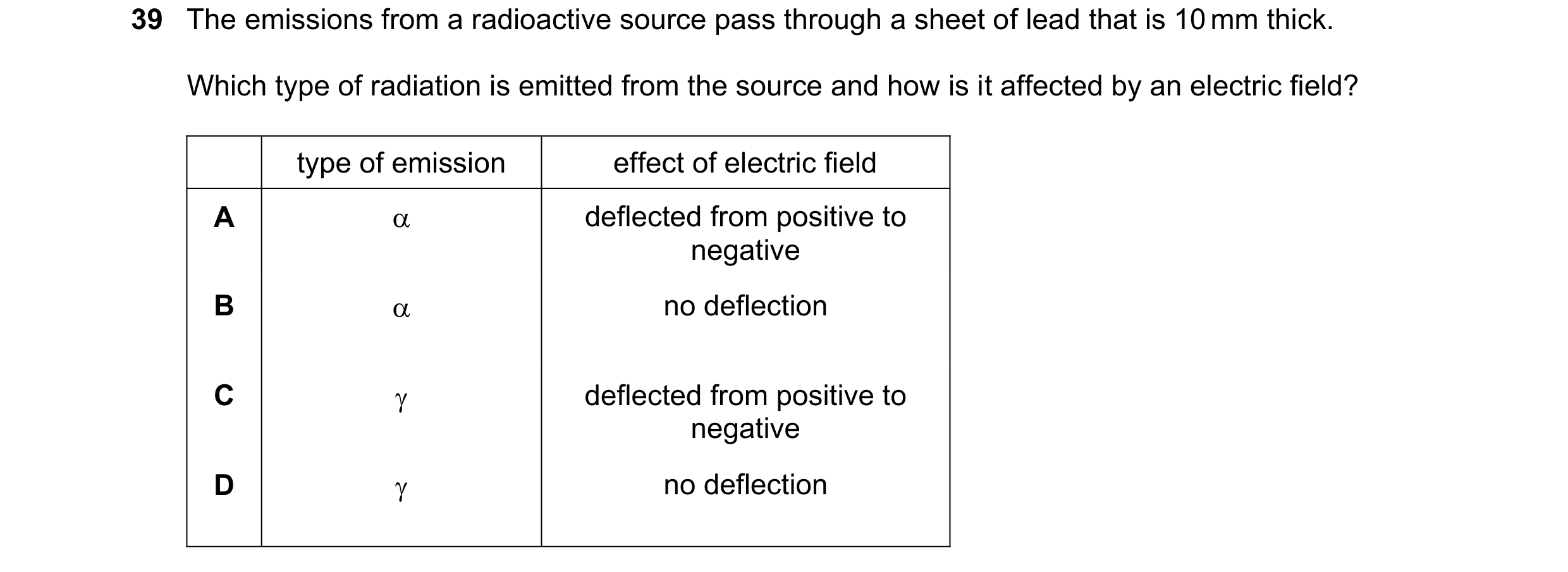
39 The emissions from a radioactive source pass through a sheet of lead that is 10 mm thick. Which type of radiation is emitted from the source and how is it affected by an electric field? type of emission effect of electric field A deflected from positive to negative B no deflection C deflected from positive to negative D no deflection
1 marks
Answer: D
This question in 0652/21 Oct/Nov 2020
Q12 · A radioactive nucleus emits a -particle 0652/21 Oct/Nov 2020
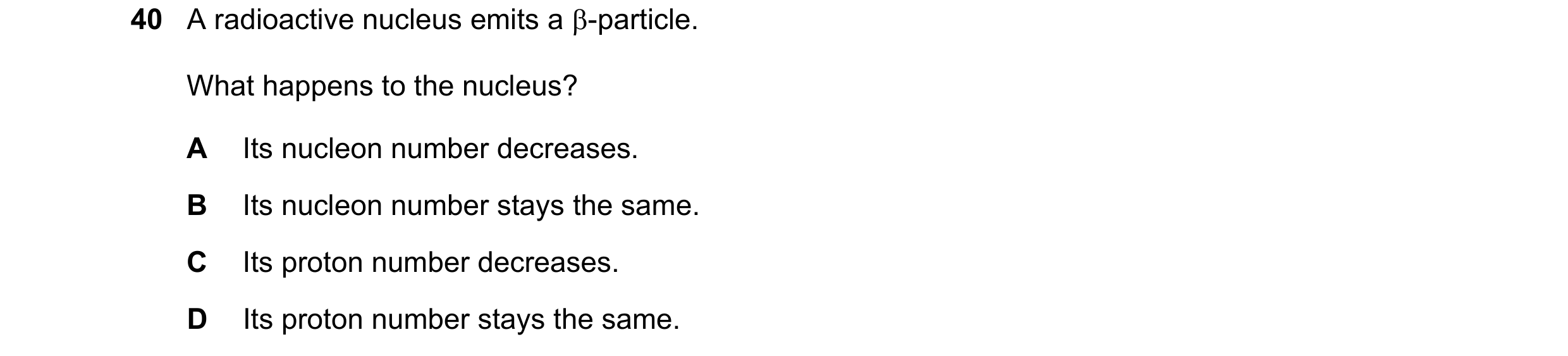
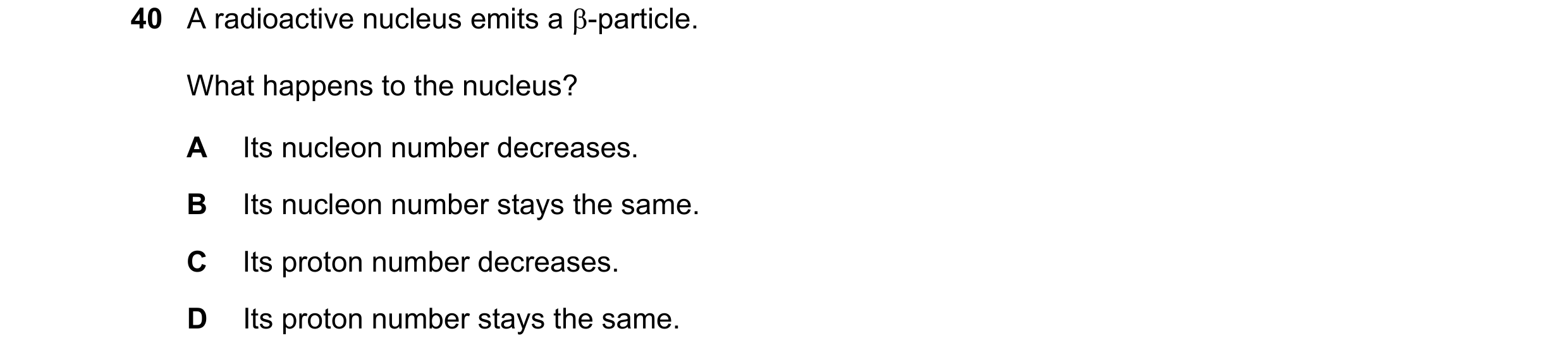
40 A radioactive nucleus emits a -particle. What happens to the nucleus? A Its nucleon number decreases. B Its nucleon number stays the same. C Its proton number decreases. D Its proton number stays the same.
1 marks
Answer: B
This question in 0652/21 Oct/Nov 2020
Q13 · The emissions from a radioactive source pass through a sheet of lead that is 10 mm thick 0652/22 Oct/Nov 2020
39 The emissions from a radioactive source pass through a sheet of lead that is 10 mm thick. Which type of radiation is emitted and how is it affected by an electric field? type of emission effect of electric field A deflected from positive to negative B no deflection C deflected from positive to negative D no deflection
1 marks
Answer: D
This question in 0652/22 Oct/Nov 2020
Q14 · A radioactive nucleus emits a -particle 0652/22 Oct/Nov 2020
40 A radioactive nucleus emits a -particle. What happens to the nucleus? A Its nucleon number decreases. B Its nucleon number stays the same. C Its proton number decreases. D Its proton number stays the same.
1 marks
Answer: B
This question in 0652/22 Oct/Nov 2020
Q15 · The graph shows the decay curve for one particular radioactive isotope 0652/21 Oct/Nov 2021
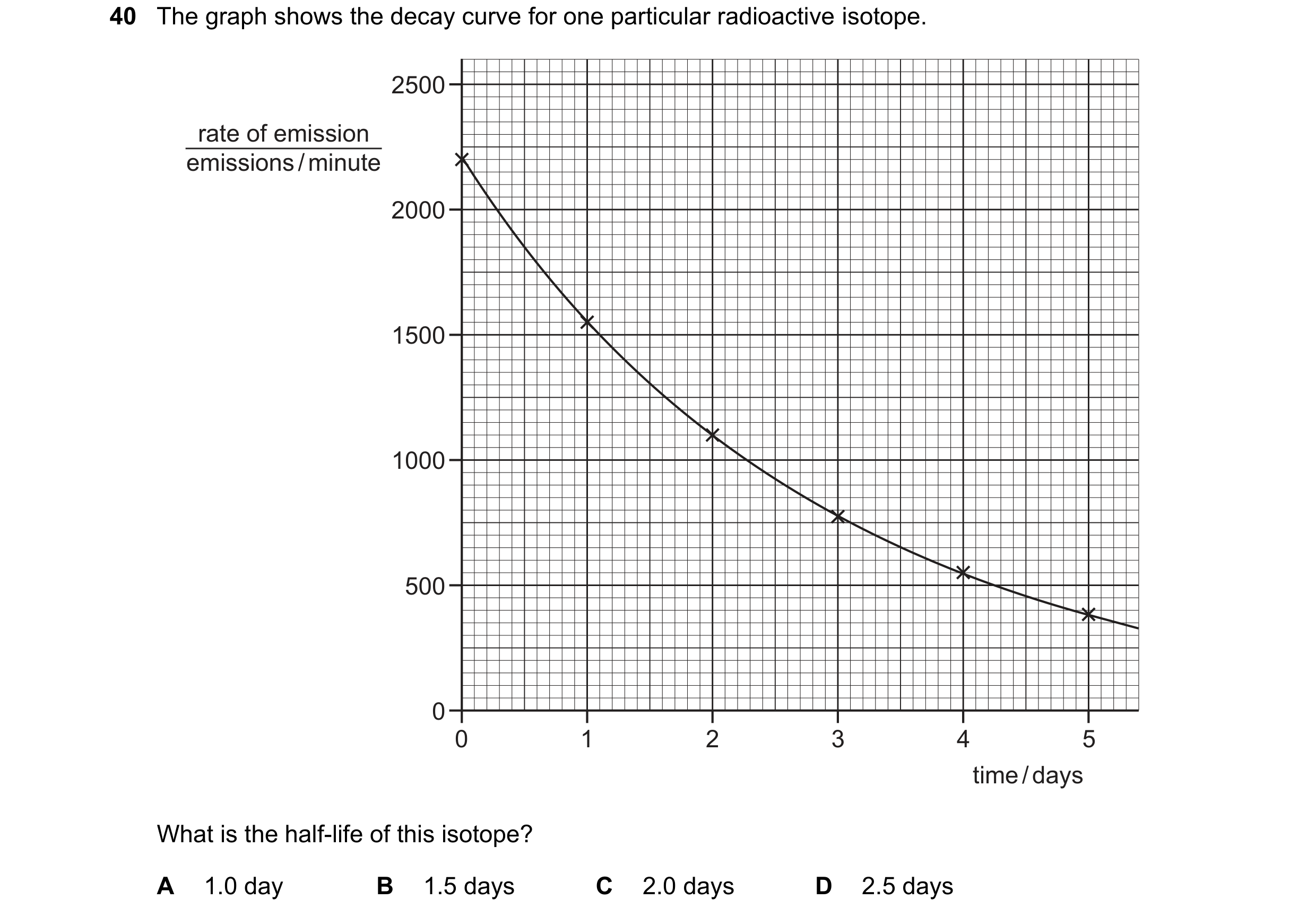
40 The graph shows the decay curve for one particular radioactive isotope. 2500 rate of emission emissions / minute 2000 1500 1000 500 0 0 1 2 3 4 5 time / days What is the half-life of this isotope? A 1.0 day B 1.5 days C 2.0 days D 2.5 days
1 marks
Answer: C
This question in 0652/21 Oct/Nov 2021
Q16 · Which radioactive emissions are not deflected by electric fields and are also not… 0652/21 Oct/Nov 2022
39 Which radioactive emissions are not deflected by electric fields and are also not deflected by magnetic fields? A alpha and beta B alpha only C beta only D gamma only
1 marks
Answer: D
This question in 0652/21 Oct/Nov 2022
Q17 · A teacher investigates the radiation emitted by a radioactive source 0652/21 Oct/Nov 2022
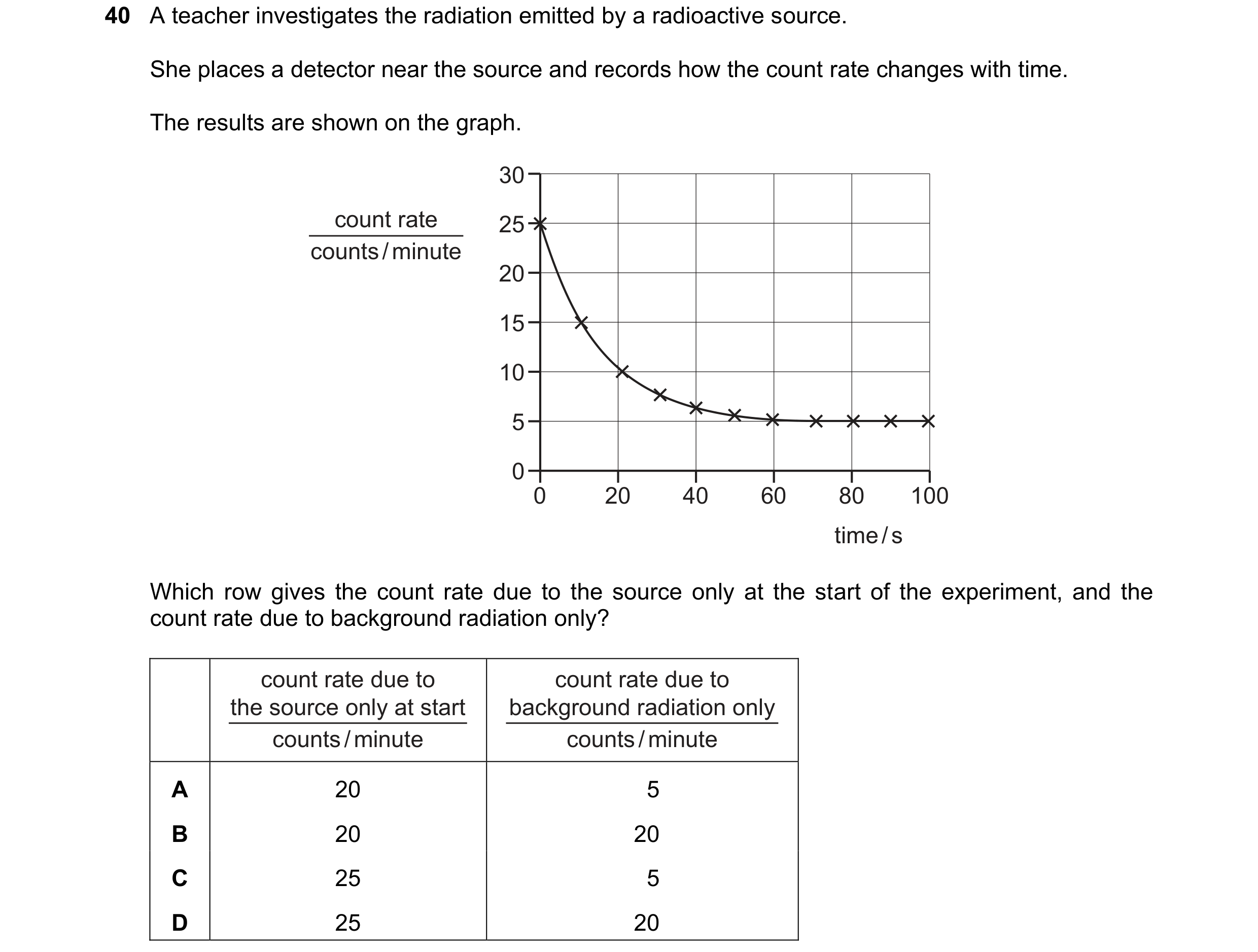
40 A teacher investigates the radiation emitted by a radioactive source. She places a detector near the source and records how the count rate changes with time. The results are shown on the graph. 30 count rate 25 counts / minute 20 15 10 5 0 0 20 40 60 80 100 time / s Which row gives the count rate due to the source only at the start of the experiment, and the count rate due to background radiation only? count rate due to count rate due to the source only at start background radiation only counts / minute counts / minute A 20 5 B 20 20 C 25 5 D 25 20
1 marks
Answer: A
This question in 0652/21 Oct/Nov 2022
Q18 · Which radioactive emissions are not deflected by electric fields and are also not… 0652/22 Oct/Nov 2022
39 Which radioactive emissions are not deflected by electric fields and are also not deflected by magnetic fields? A alpha and beta B alpha only C beta only D gamma only
1 marks
Answer: D
This question in 0652/22 Oct/Nov 2022
Q19 · A teacher investigates the radiation emitted by a radioactive source 0652/22 Oct/Nov 2022
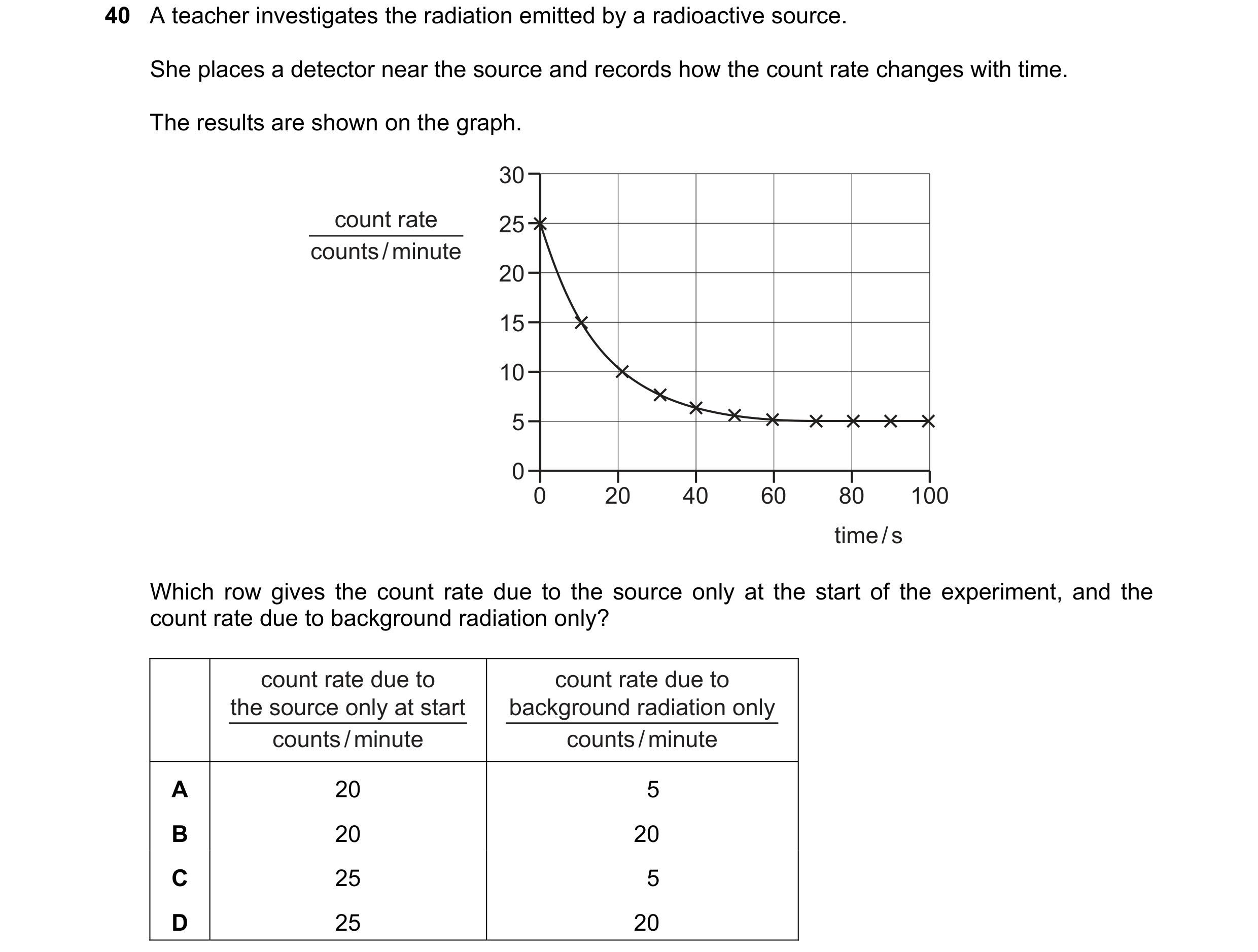
40 A teacher investigates the radiation emitted by a radioactive source. She places a detector near the source and records how the count rate changes with time. The results are shown on the graph. 30 count rate 25 counts / minute 20 15 10 5 0 0 20 40 60 80 100 time / s Which row gives the count rate due to the source only at the start of the experiment, and the count rate due to background radiation only? count rate due to count rate due to the source only at start background radiation only counts / minute counts / minute A 20 5 B 20 20 C 25 5 D 25 20
1 marks
Answer: A
This question in 0652/22 Oct/Nov 2022
Q20 · The first diagram shows a beam of alpha-particles entering an electric field 0652/21 Oct/Nov 2023
39 The first diagram shows a beam of alpha-particles entering an electric field. The second diagram shows a beam of alpha-particles entering a magnetic field. + + + + + + alpha-particles – – – – – – N alpha-particles S In which direction is the beam deflected in each of the fields? electric field magnetic field A towards the negative plate into the page B towards the negative plate out of the page C towards the positive plate into the page D towards the positive plate out of the page
1 marks
Answer: A
This question in 0652/21 Oct/Nov 2023
Q21 · The background count recorded by a detector in a laboratory is 40 counts per minute 0652/21 Oct/Nov 2023
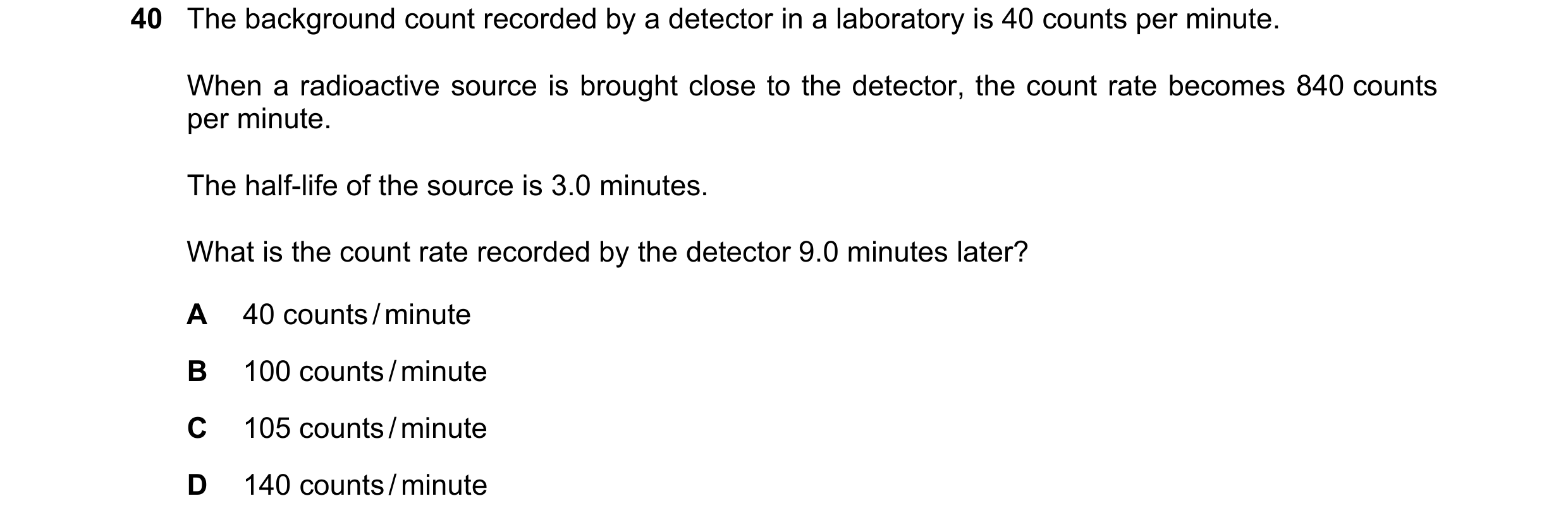
40 The background count recorded by a detector in a laboratory is 40 counts per minute. When a radioactive source is brought close to the detector, the count rate becomes 840 counts per minute. The half-life of the source is 3.0 minutes. What is the count rate recorded by the detector 9.0 minutes later? A 40 counts / minute B 100 counts / minute C 105 counts / minute D 140 counts / minute
1 marks
Answer: D
This question in 0652/21 Oct/Nov 2023
Q22 · The first diagram shows a beam of alpha-particles entering an electric field 0652/22 Oct/Nov 2023
39 The first diagram shows a beam of alpha-particles entering an electric field. The second diagram shows a beam of alpha-particles entering a magnetic field. + + + + + + alpha-particles – – – – – – N alpha-particles S In which direction is the beam deflected in each of the fields? electric field magnetic field A towards the negative plate into the page B towards the negative plate out of the page C towards the positive plate into the page D towards the positive plate out of the page
1 marks
Answer: A
This question in 0652/22 Oct/Nov 2023
Q23 · The background count recorded by a detector in a laboratory is 40 counts per minute 0652/22 Oct/Nov 2023
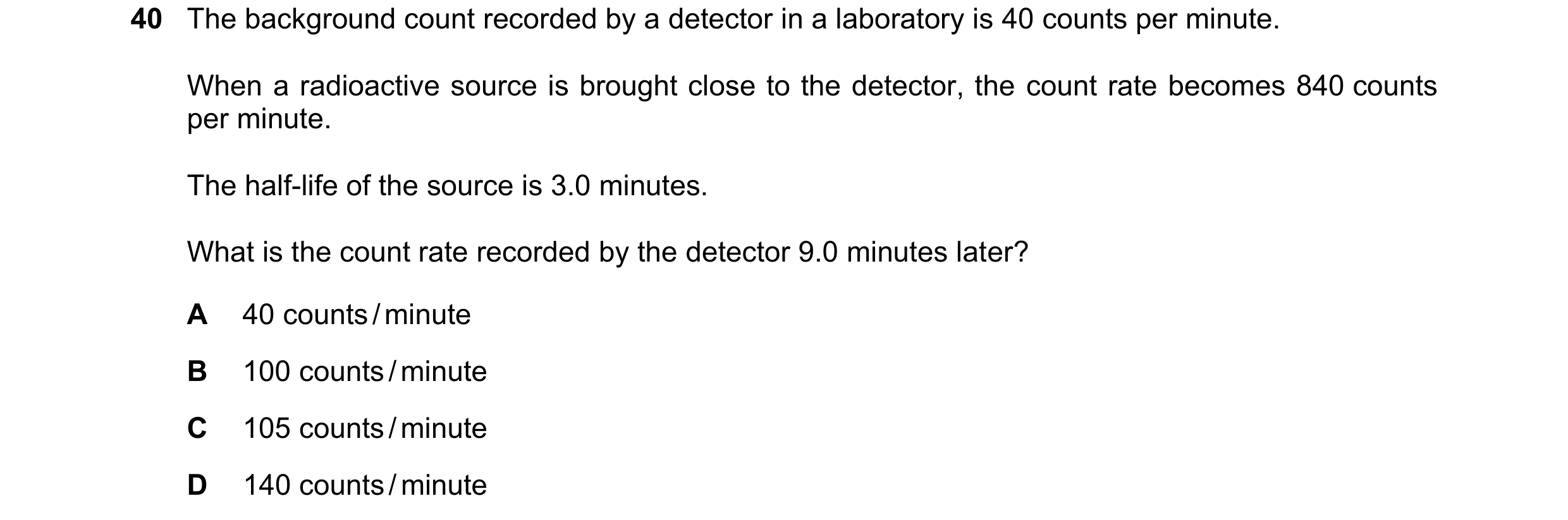
40 The background count recorded by a detector in a laboratory is 40 counts per minute. When a radioactive source is brought close to the detector, the count rate becomes 840 counts per minute. The half-life of the source is 3.0 minutes. What is the count rate recorded by the detector 9.0 minutes later? A 40 counts / minute B 100 counts / minute C 105 counts / minute D 140 counts / minute
1 marks
Answer: D
This question in 0652/22 Oct/Nov 2023
Q24 · The diagram shows two types of emission from a radioactive source 0652/21 Oct/Nov 2024
38 The diagram shows two types of emission from a radioactive source. The emissions pass through a uniform magnetic field directed into the page. One type of emission follows path P and the other type of emission follows path Q. P radioactive source Q uniform magnetic field What are the emissions that follow paths P and Q? P Q A B C D
1 marks
Answer: B
This question in 0652/21 Oct/Nov 2024
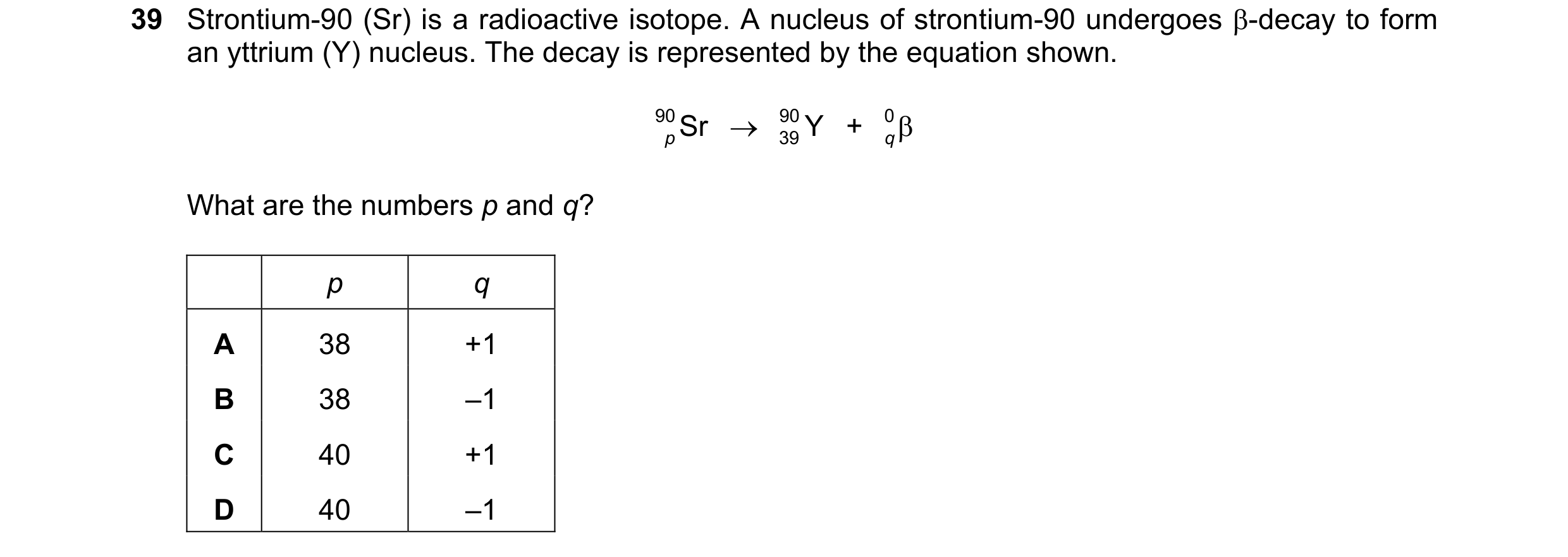
Q25 · Strontium-90 (Sr) is a radioactive isotope 0652/21 Oct/Nov 2024
39 Strontium-90 (Sr) is a radioactive isotope. A nucleus of strontium-90 undergoes -decay to form an yttrium (Y) nucleus. The decay is represented by the equation shown. 90 Sr 90 Y + 0 p 39 q What are the numbers p and q? p q A 38 +1 B 38 –1 C 40 +1 D 40 –1
1 marks
Answer: B
This question in 0652/21 Oct/Nov 2024
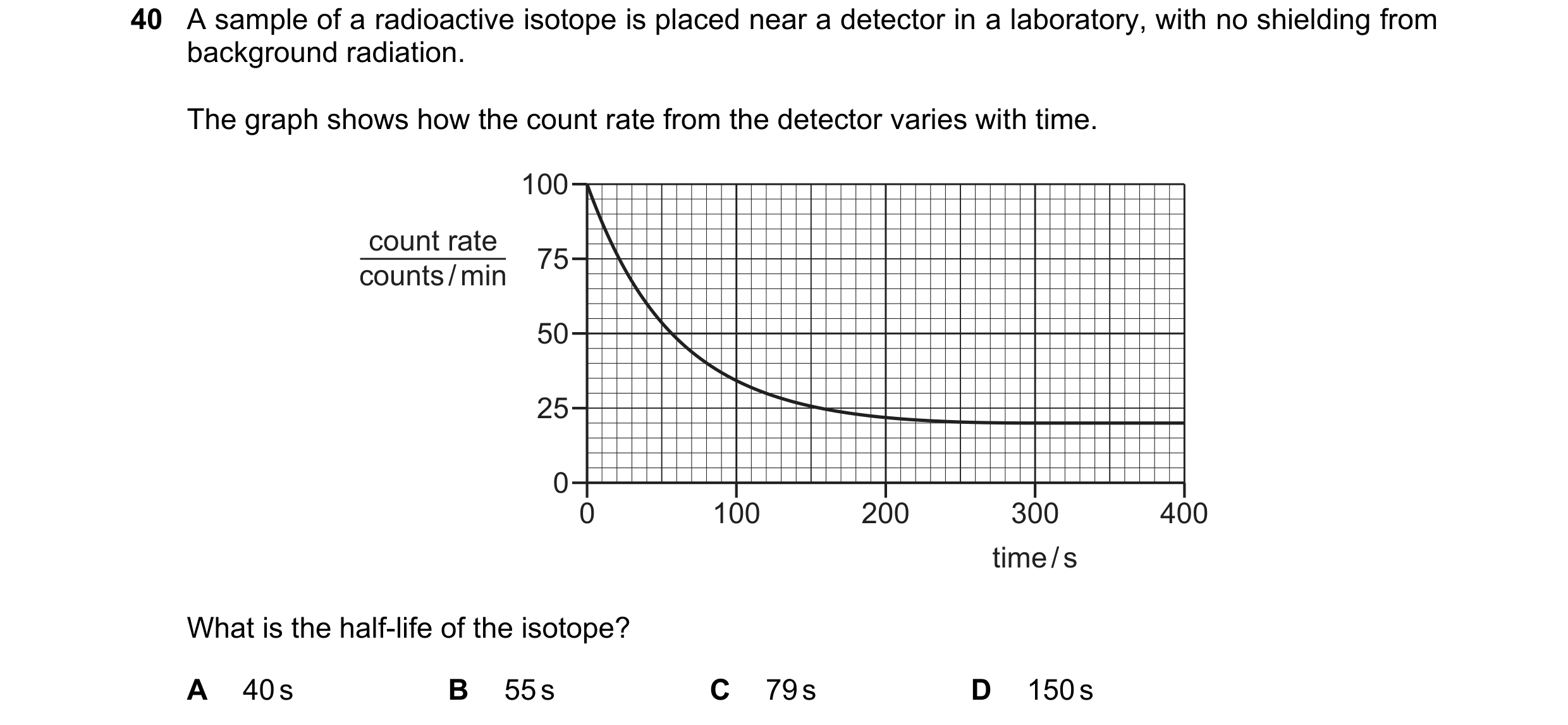
Q26 · A sample of a radioactive isotope is placed near a detector in a laboratory, with no… 0652/21 Oct/Nov 2024
40 A sample of a radioactive isotope is placed near a detector in a laboratory, with no shielding from background radiation. The graph shows how the count rate from the detector varies with time. 100 count rate 75 counts / min 50 25 0 0 100 200 300 400 time / s What is the half-life of the isotope? A 40 s B 55 s C 79 s D 150 s
1 marks
Answer: A
This question in 0652/21 Oct/Nov 2024
 1 / 11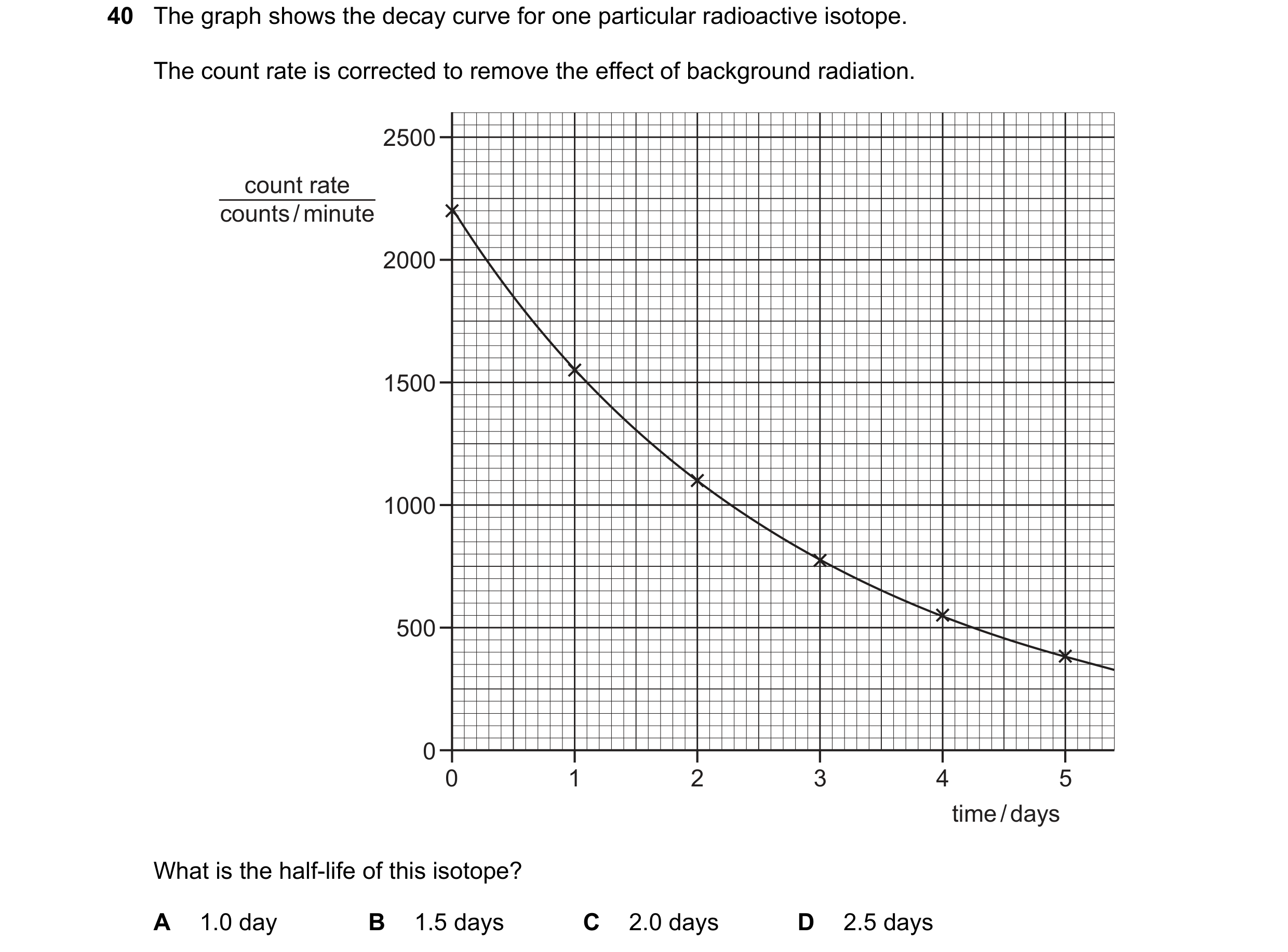
 2 / 11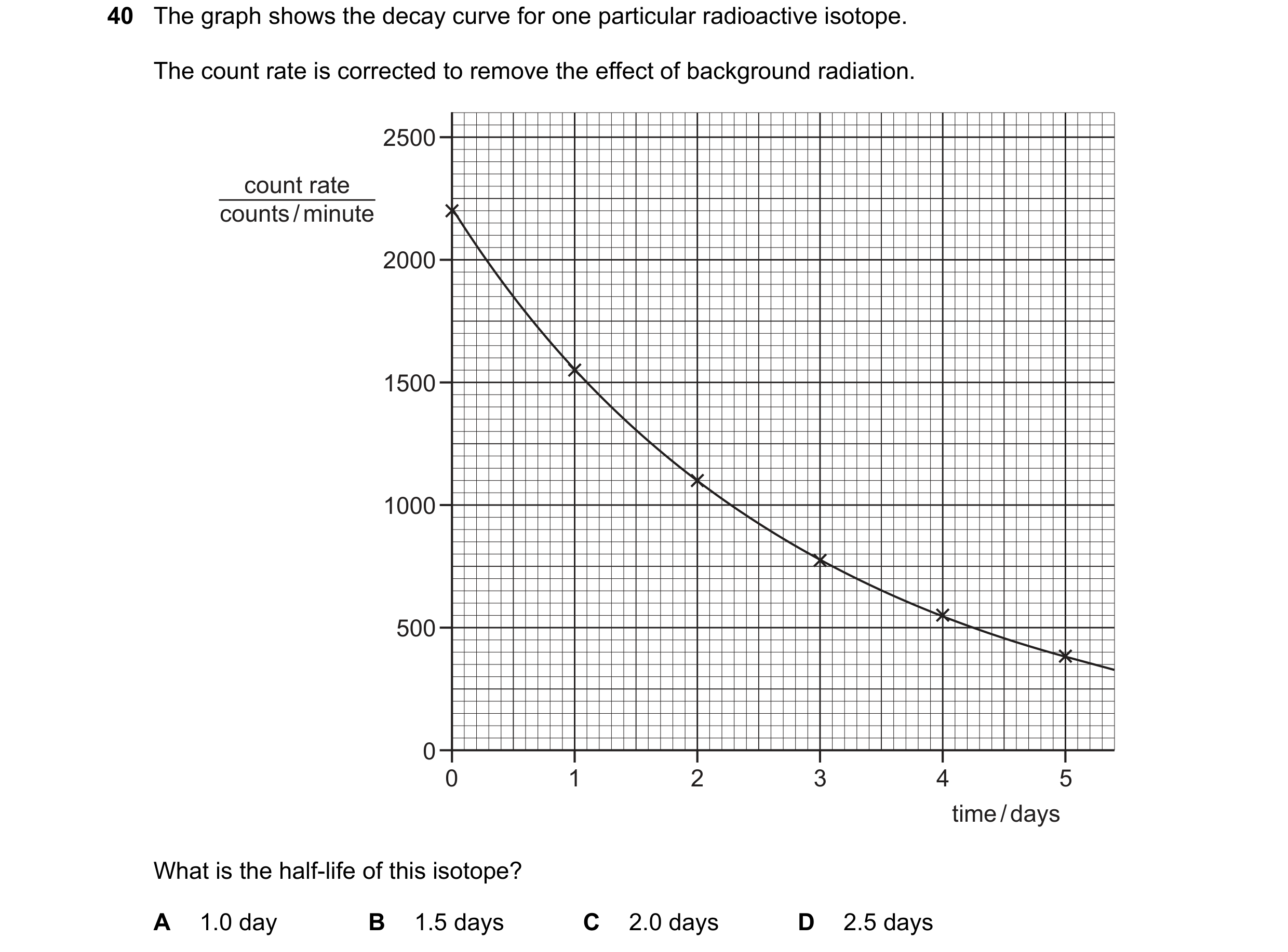
 3 / 11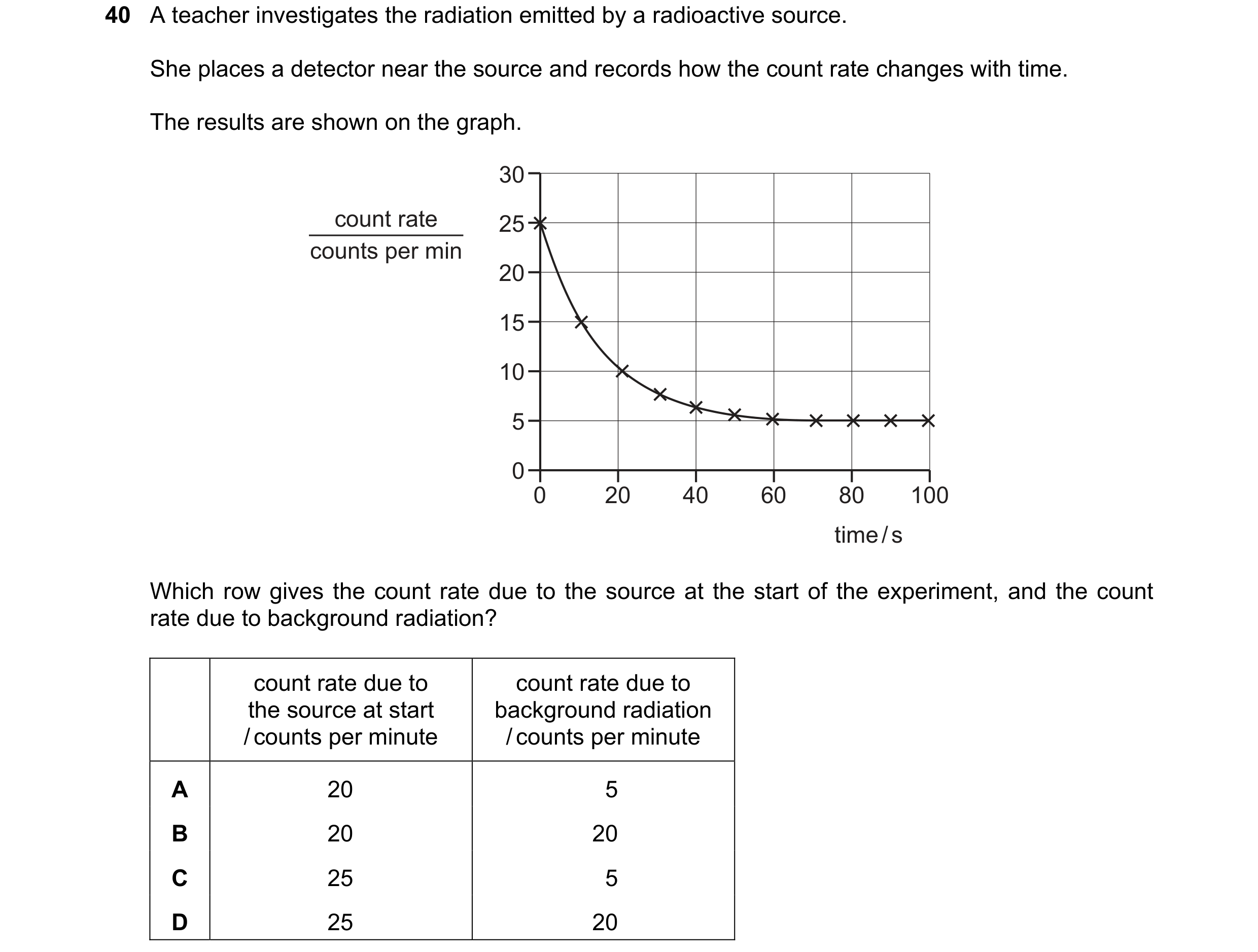
 4 / 11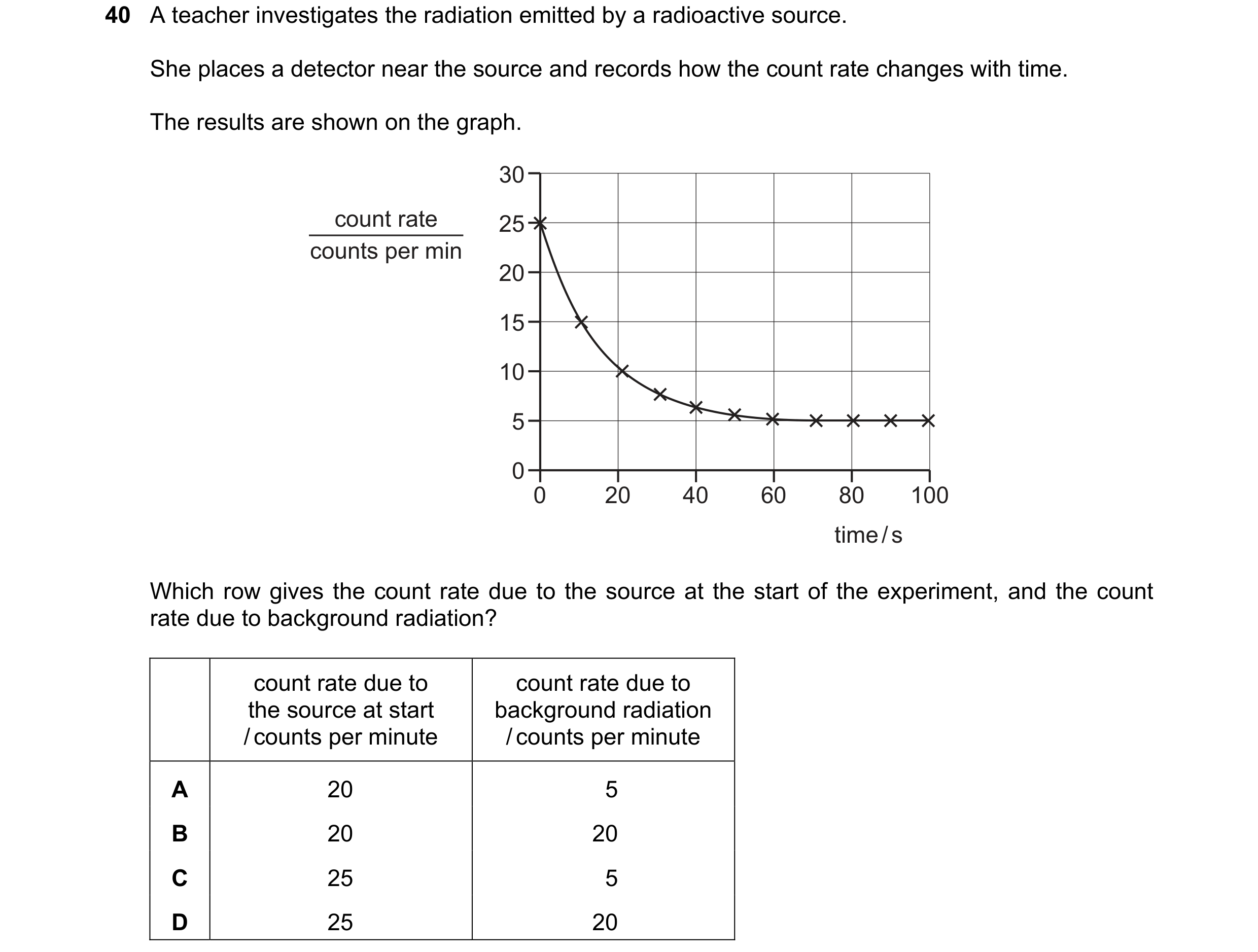
 5 / 11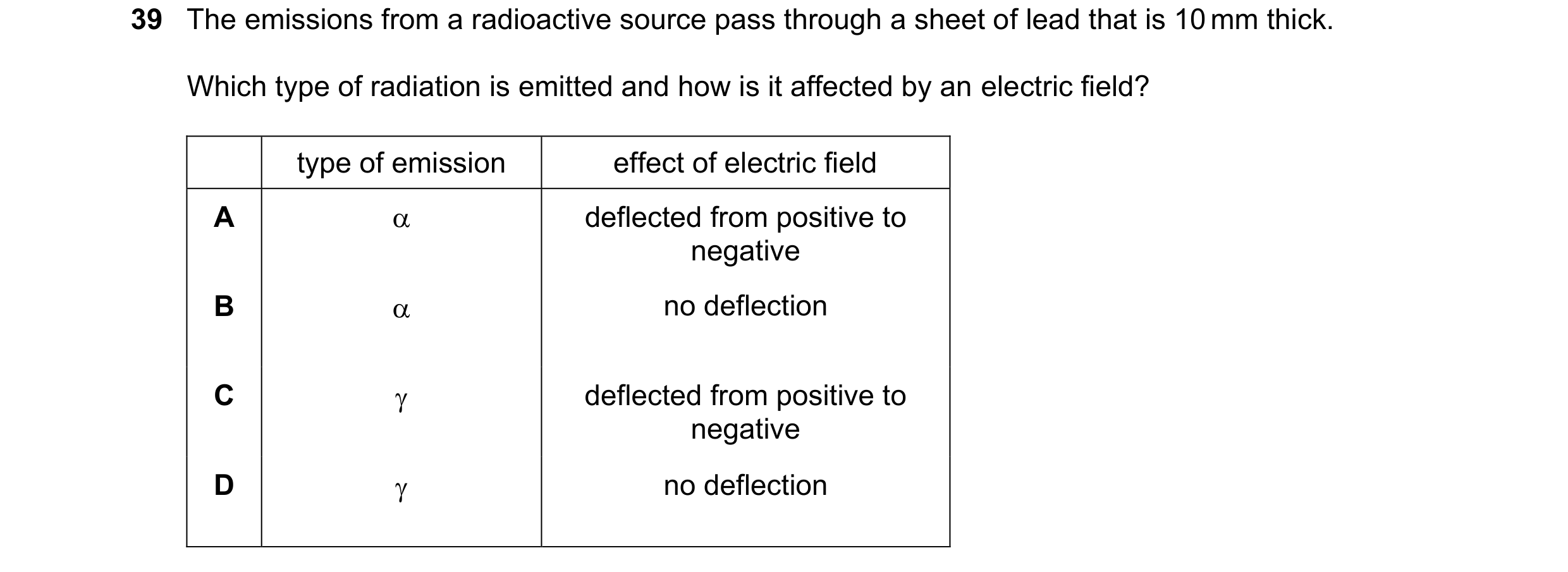
 6 / 11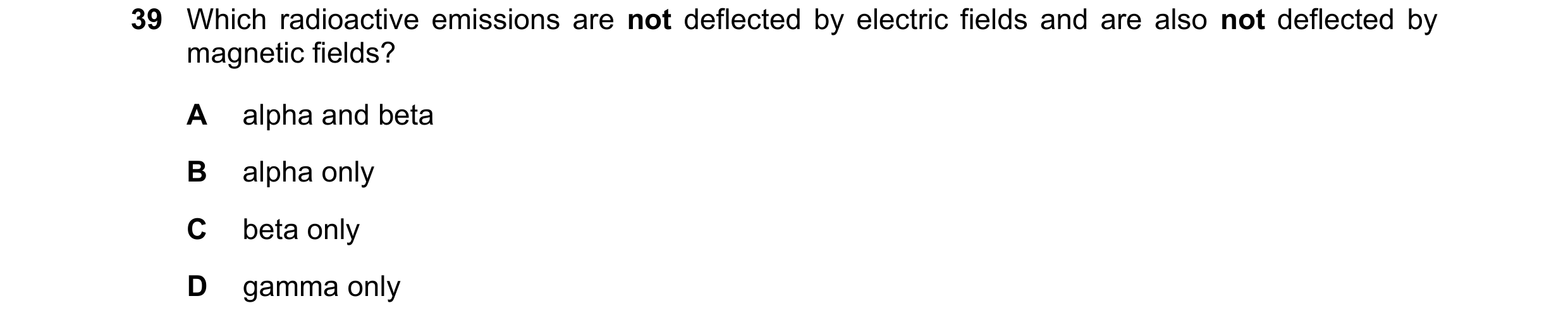
 7 / 11
 8 / 11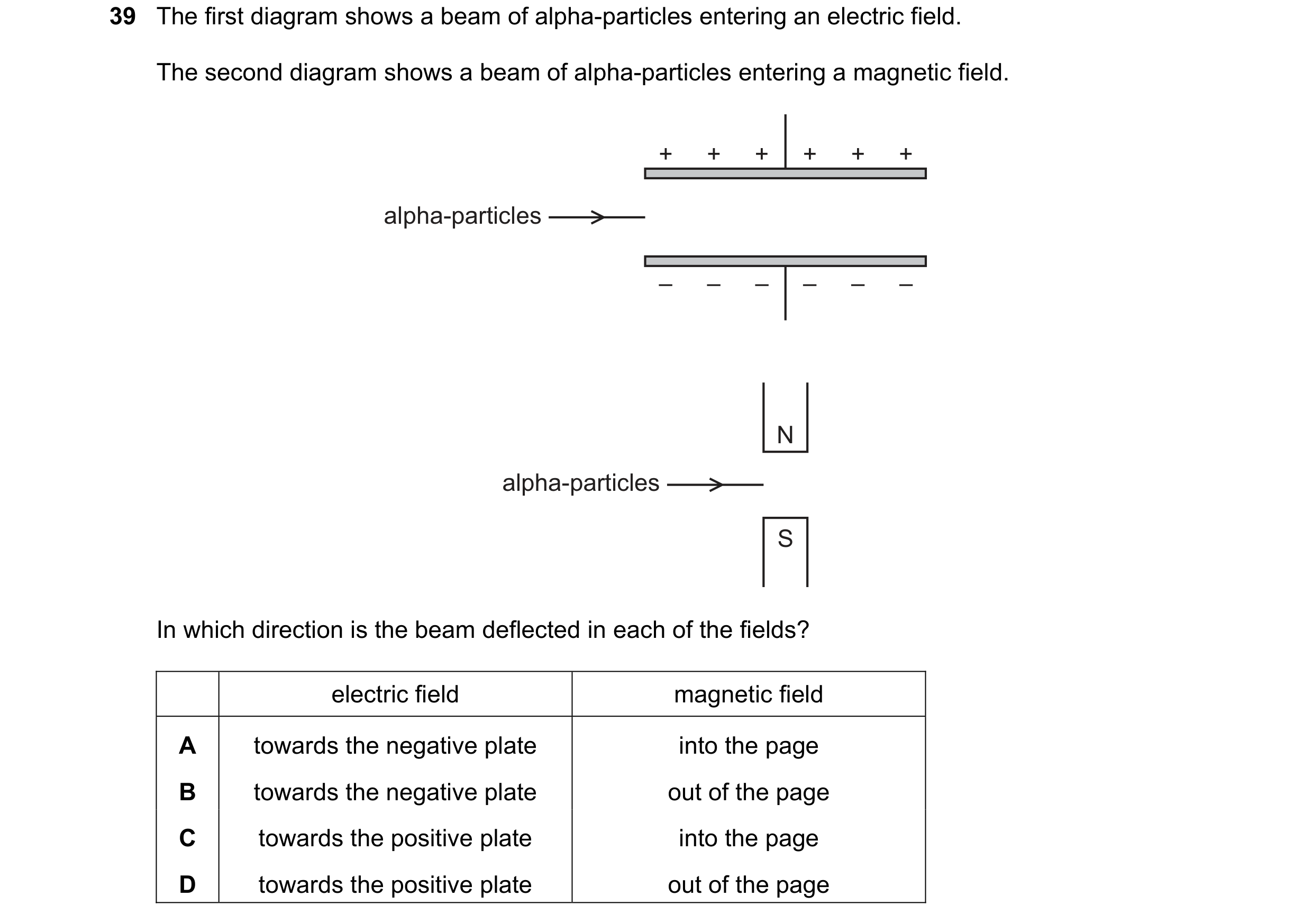
 9 / 11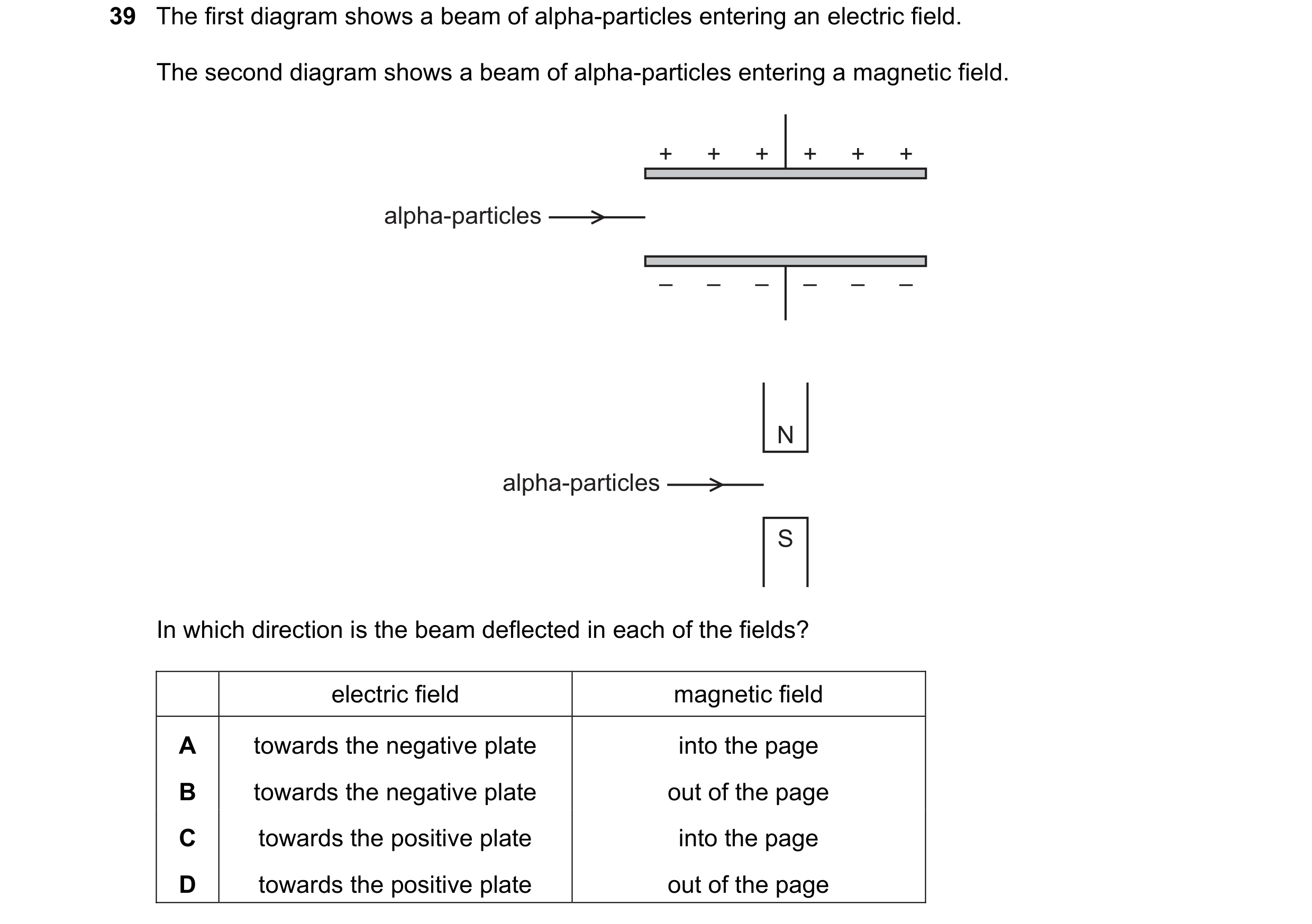
 10 / 11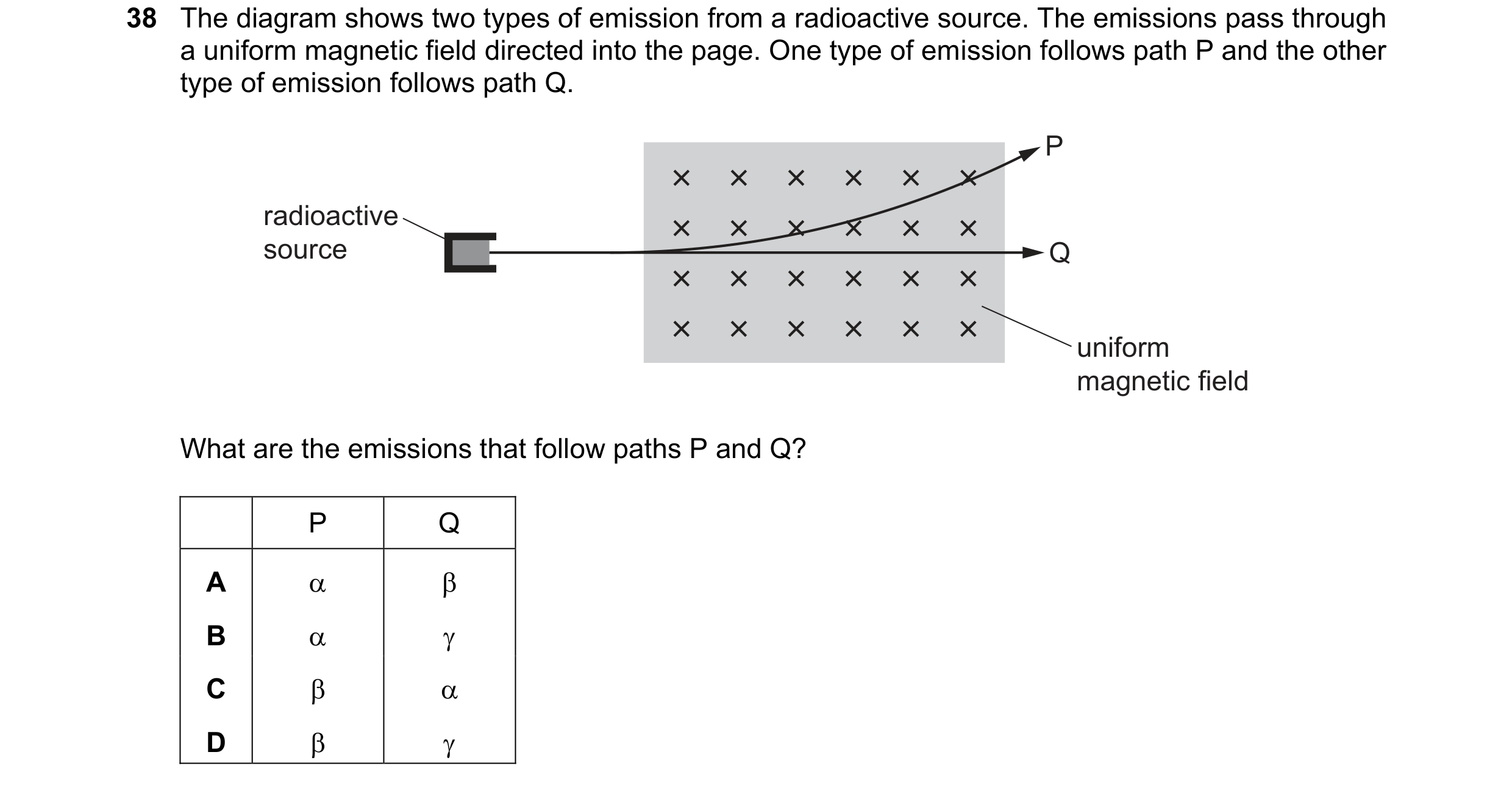
 11 / 11