Cambridge IGCSE Physical Science 0652 — 2009 Oct/Nov Paper 1 · Variant 1
0652/11/O/N/09 · 40 questions · 40 marks · ≈45 min
The question paper and its mark scheme, free to read here and free to download. This is Cambridge’s own paper, exactly as it was sat.
Question paper20 pages



Mark scheme2 pages
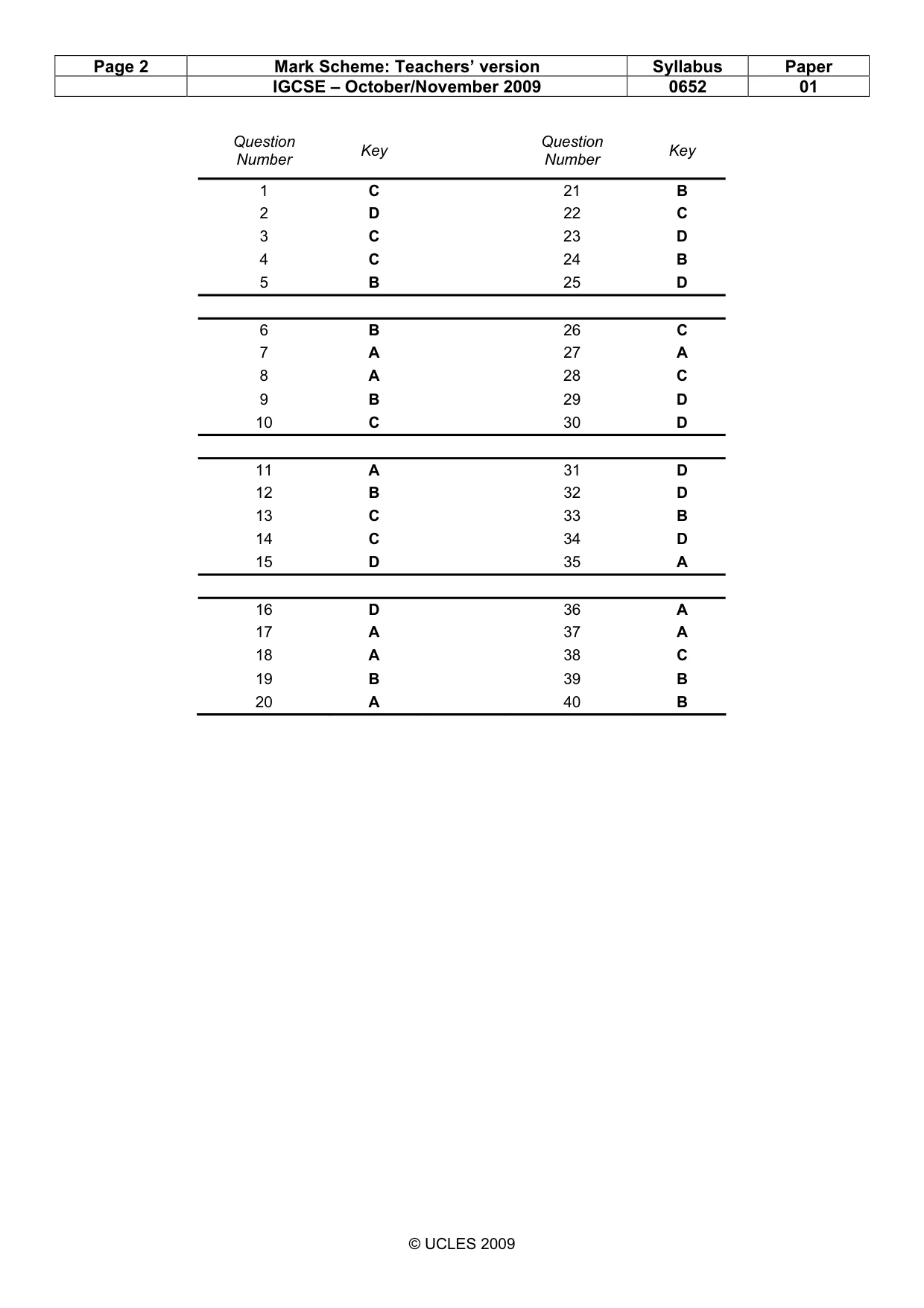
Answers below. Sit the paper first if you are practising.
Questions as text
Q1 · Which statement explains why toffee can move and change its shape while it is a liquid…
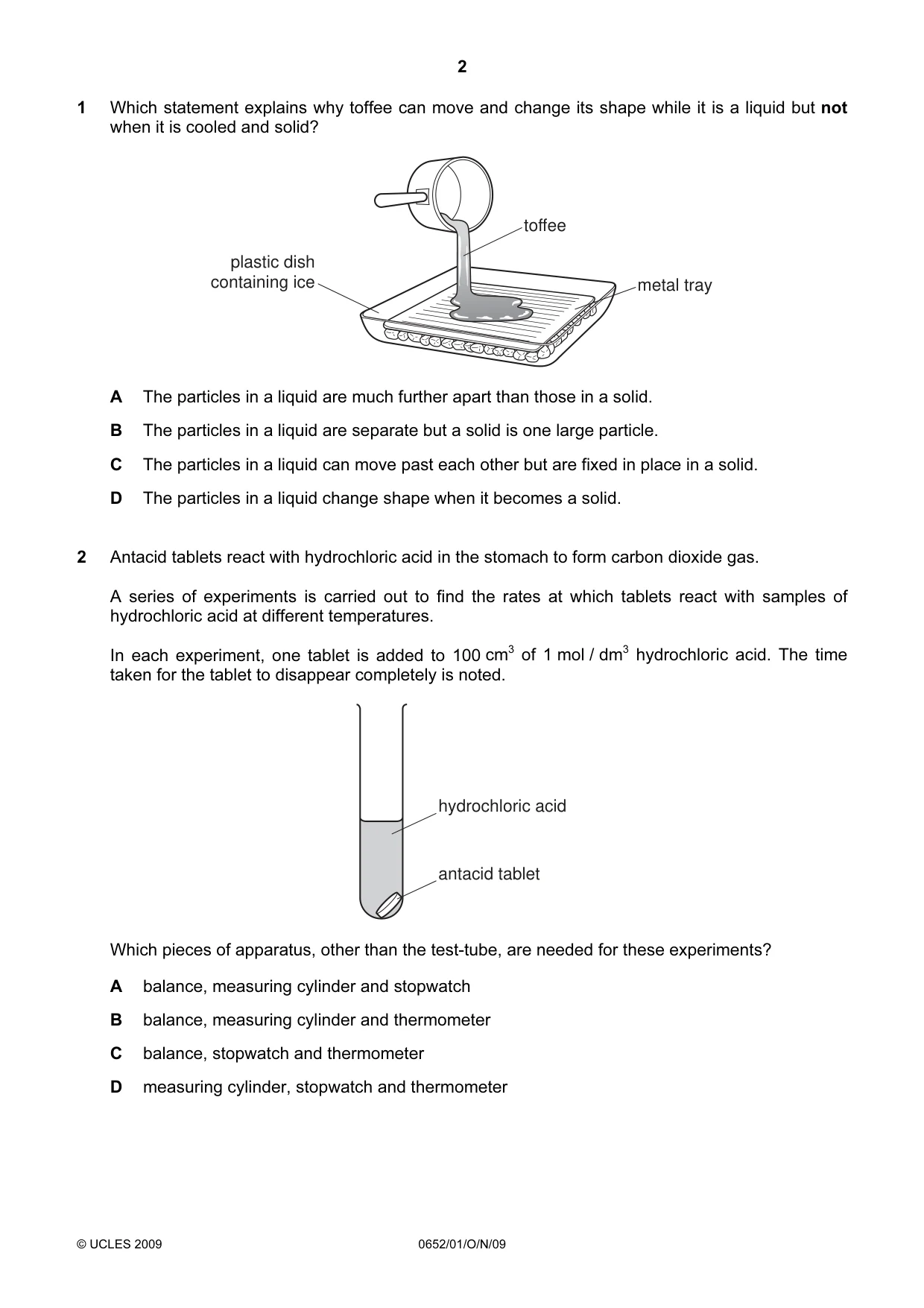
1 Which statement explains why toffee can move and change its shape while it is a liquid but not when it is cooled and solid? toffee plastic dish containing ice metal tray A The particles in a liquid are much further apart than those in a solid. B The particles in a liquid are separate but a solid is one large particle. C The particles in a liquid can move past each other but are fixed in place in a solid. D The particles in a liquid change shape when it becomes a solid.
Mark scheme: C
Q2 · Antacid tablets react with hydrochloric acid in the stomach to form carbon dioxide gas
2 Antacid tablets react with hydrochloric acid in the stomach to form carbon dioxide gas. A series of experiments is carried out to find the rates at which tablets react with samples of hydrochloric acid at different temperatures. In each experiment, one tablet is added to 100 cm3 of 1 mol / dm3 hydrochloric acid. The time taken for the tablet to disappear completely is noted. hydrochloric acid antacid tablet Which pieces of apparatus, other than the test-tube, are needed for these experiments? A balance, measuring cylinder and stopwatch B balance, measuring cylinder and thermometer C balance, stopwatch and thermometer D measuring cylinder, stopwatch and thermometer
Mark scheme: D
Q3 · The table shows the nucleon numbers and proton numbers of some atoms
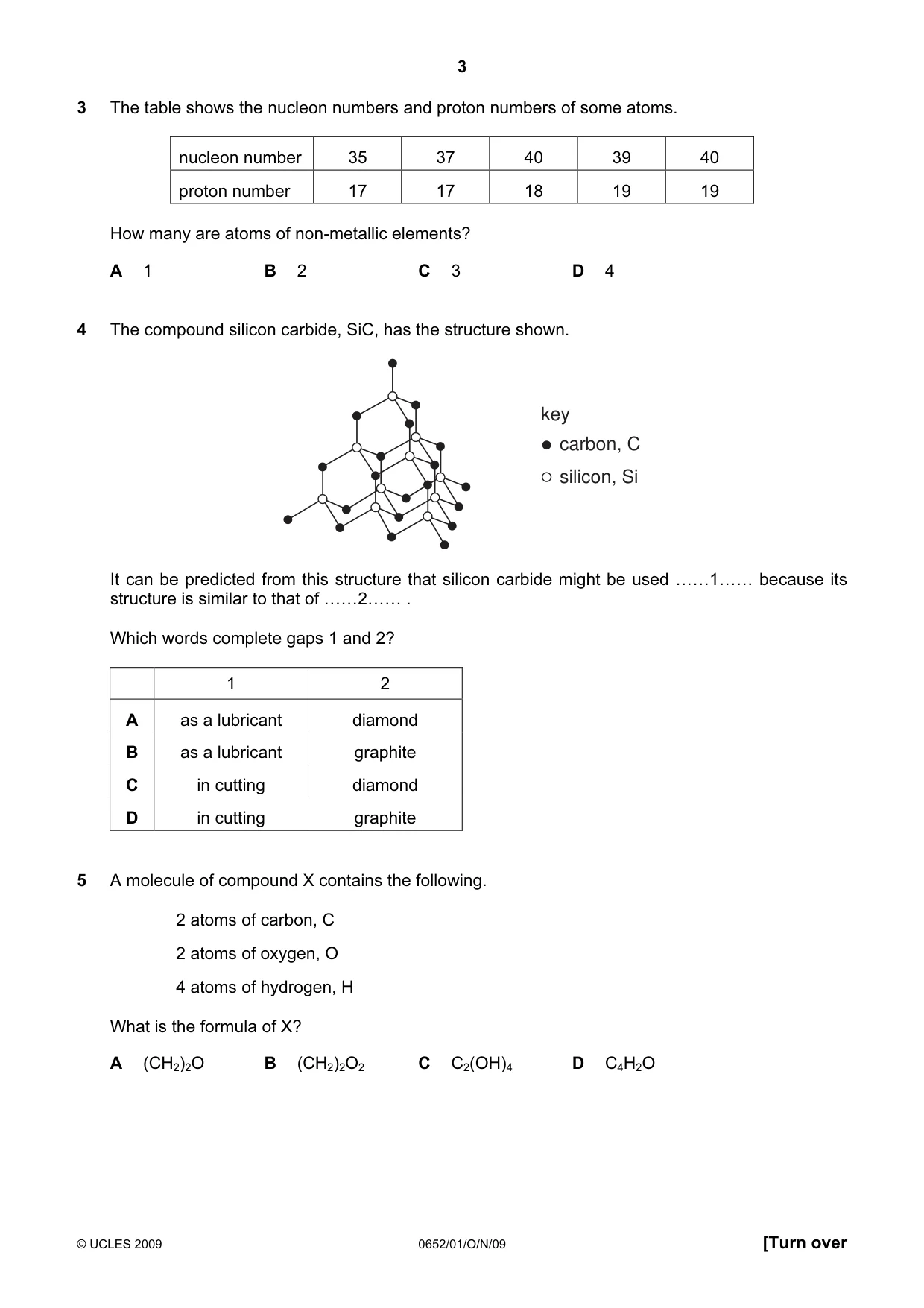
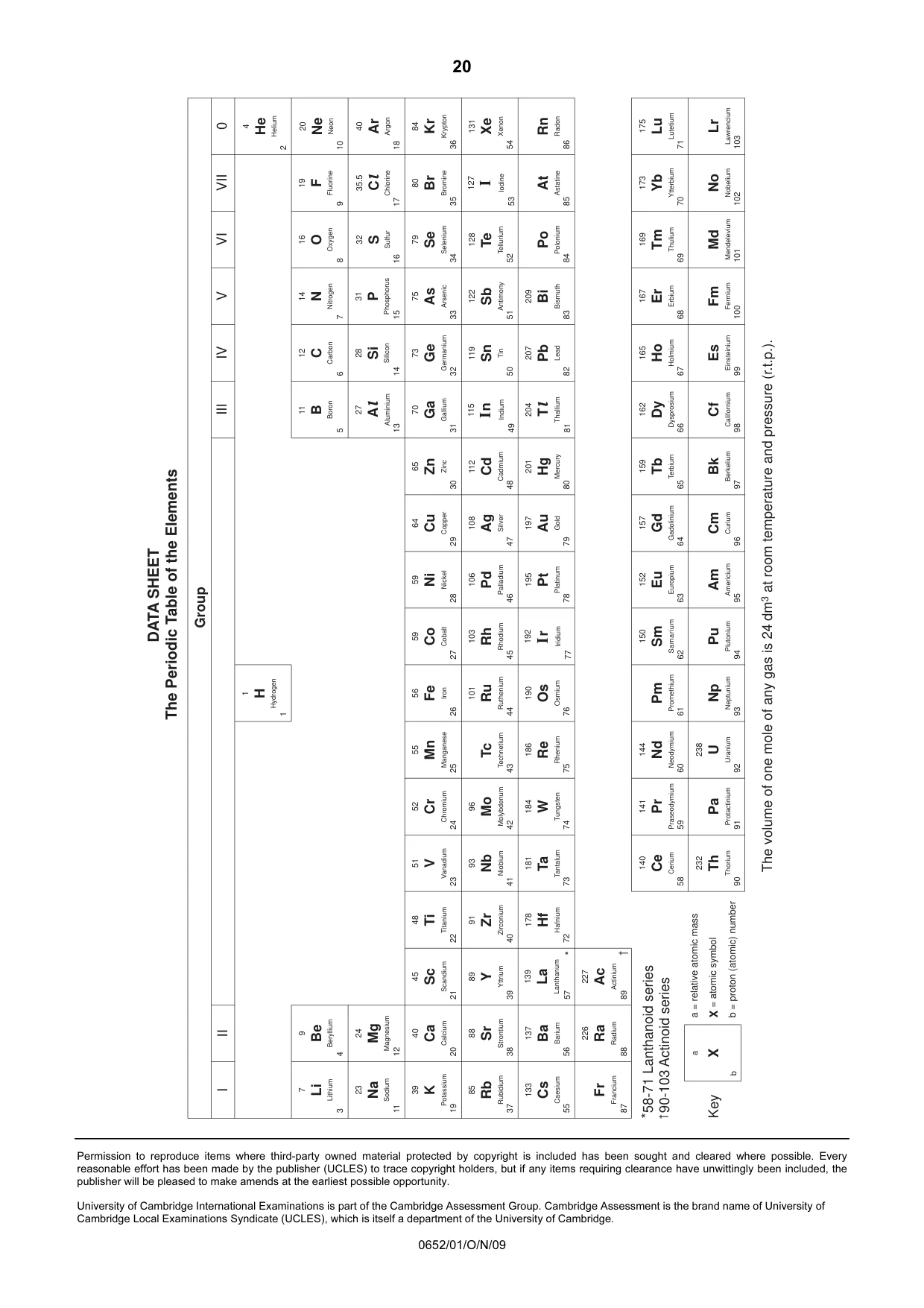
3 The table shows the nucleon numbers and proton numbers of some atoms. nucleon number 35 37 40 39 40 proton number 17 17 18 19 19 How many are atoms of non-metallic elements? A 1 B 2 C 3 D 4
Mark scheme: C
Q4 · The compound silicon carbide, SiC, has the structure shown
4 The compound silicon carbide, SiC, has the structure shown. key carbon, C silicon, Si It can be predicted from this structure that silicon carbide might be used ……1…… because its structure is similar to that of ……2…… . Which words complete gaps 1 and 2? 1 2 A as a lubricant diamond B as a lubricant graphite C in cutting diamond D in cutting graphite
Mark scheme: C
Q5 · A molecule of compound X contains the following
5 A molecule of compound X contains the following. 2 atoms of carbon, C 2 atoms of oxygen, O 4 atoms of hydrogen, H What is the formula of X? A (CH2)2O B (CH2)2O2 C C2(OH)4 D C4H2O
Mark scheme: B
Q6 · Hydrogen is used as a fuel
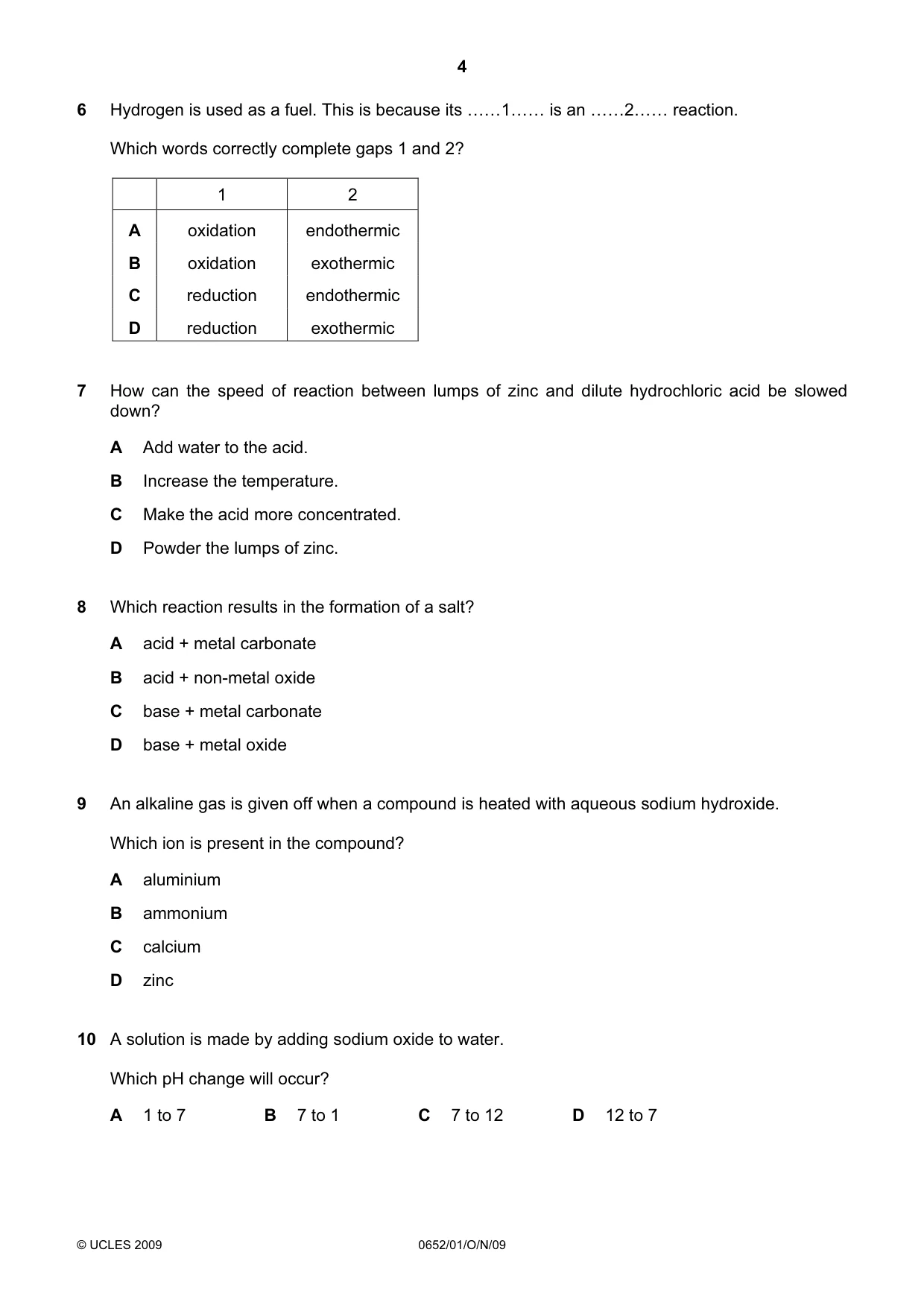
6 Hydrogen is used as a fuel. This is because its ……1…… is an ……2…… reaction. Which words correctly complete gaps 1 and 2? 1 2 A oxidation endothermic B oxidation exothermic C reduction endothermic D reduction exothermic
Mark scheme: B
Q7 · How can the speed of reaction between lumps of zinc and dilute hydrochloric acid be…
7 How can the speed of reaction between lumps of zinc and dilute hydrochloric acid be slowed down? A Add water to the acid. B Increase the temperature. C Make the acid more concentrated. D Powder the lumps of zinc.
Mark scheme: A
Q8 · Which reaction results in the formation of a salt?
8 Which reaction results in the formation of a salt? A acid + metal carbonate B acid + non-metal oxide C base + metal carbonate D base + metal oxide
Mark scheme: A
Q9 · An alkaline gas is given off when a compound is heated with aqueous sodium hydroxide
9 An alkaline gas is given off when a compound is heated with aqueous sodium hydroxide. Which ion is present in the compound? A aluminium B ammonium C calcium D zinc
Mark scheme: B
Q10 · A solution is made by adding sodium oxide to water
10 A solution is made by adding sodium oxide to water. Which pH change will occur? A 1 to 7 B 7 to 1 C 7 to 12 D 12 to 7
Mark scheme: C
More questions on The characteristic properties of acids and bases
Q11 · The table shows some properties of elements P and Q
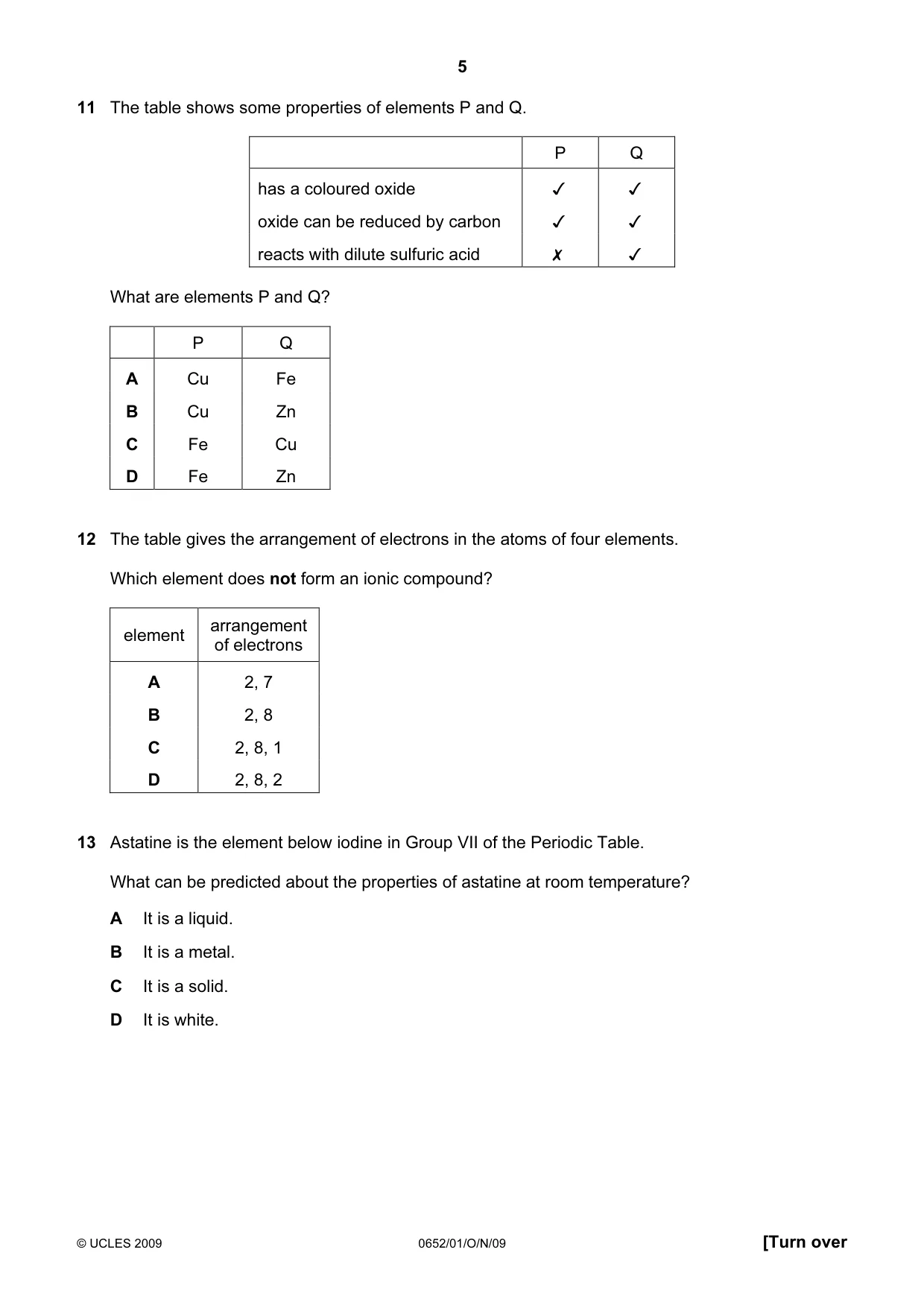
11 The table shows some properties of elements P and Q. has a coloured oxide oxide can be reduced by carbon reacts with dilute sulfuric acid x \ \ {90 << s/o What are elements P and Q? P Q A Cu Fe B Cu Zn Cc Fe Cu D Fe Zn
Mark scheme: A
Q12 · The table gives the arrangement of electrons in the atoms of four elements
12 The table gives the arrangement of electrons in the atoms of four elements. Which element does not form an ionic compound? arrangement element of electrons A 2, 7 B 2, 8 C 2, 8, 1 D 2, 8, 2
Mark scheme: B
Q13 · Astatine is the element below iodine in Group VII of the Periodic Table
13 Astatine is the element below iodine in Group VII of the Periodic Table. What can be predicted about the properties of astatine at room temperature? A It is a liquid. B It is a metal. C It is a solid. D It is white.
Mark scheme: C
Q14 · Metal X is below hydrogen in the reactivity series
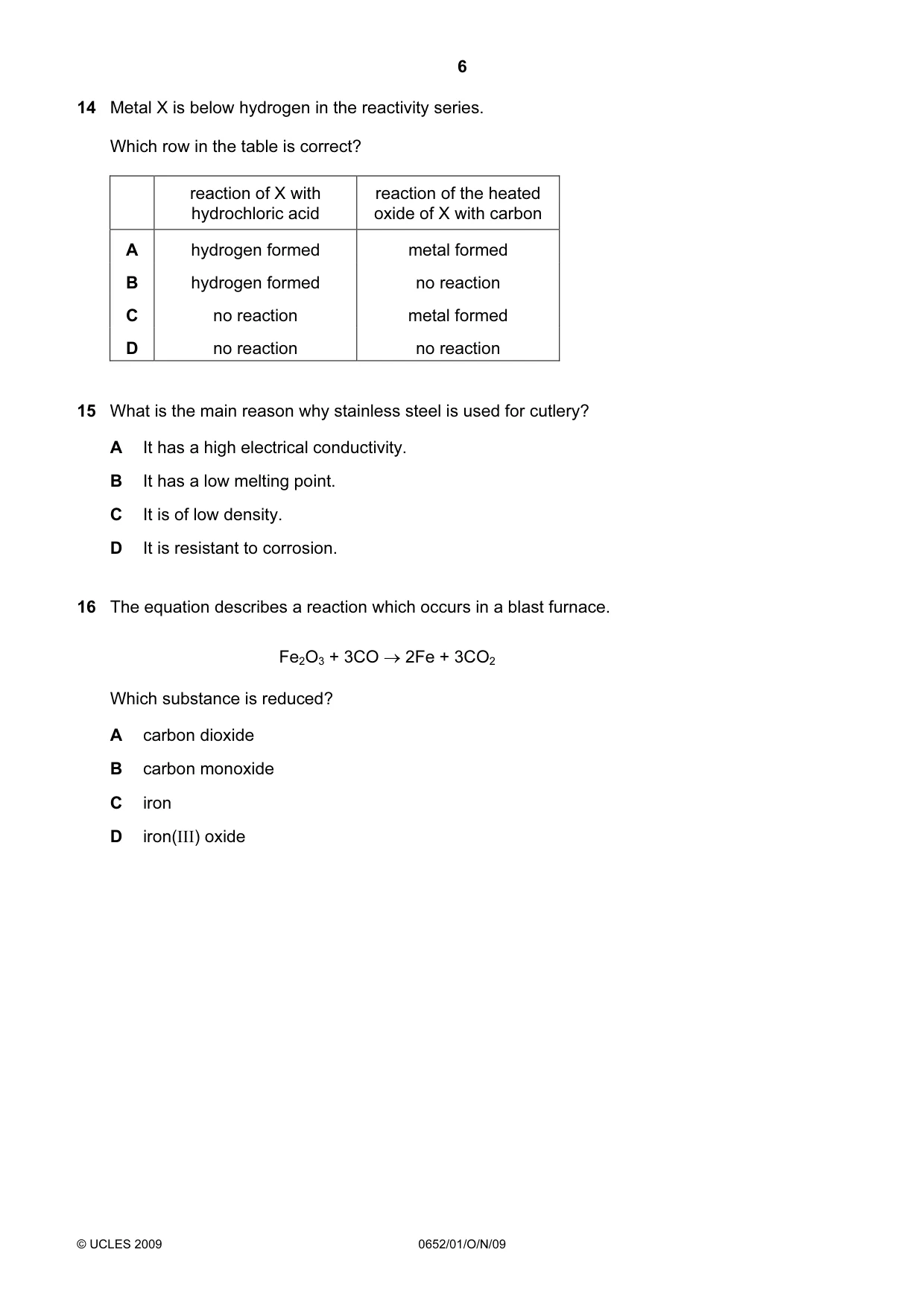
14 Metal X is below hydrogen in the reactivity series. Which row in the table is correct? reaction of X with reaction of the heated hydrochloric acid oxide of X with carbon A hydrogen formed metal formed B hydrogen formed no reaction C no reaction metal formed D no reaction no reaction
Mark scheme: C
Q15 · What is the main reason why stainless steel is used for cutlery?
15 What is the main reason why stainless steel is used for cutlery? A It has a high electrical conductivity. B It has a low melting point. C It is of low density. D It is resistant to corrosion.
Mark scheme: D
Q16 · The equation describes a reaction which occurs in a blast furnace
16 The equation describes a reaction which occurs in a blast furnace. Fe2O3 + 3CO → 2Fe + 3CO2 Which substance is reduced? A carbon dioxide B carbon monoxide C iron D iron(III) oxide
Mark scheme: D
Q17 · Exhaust gases contain the pollutants CO, NO2 and SO2
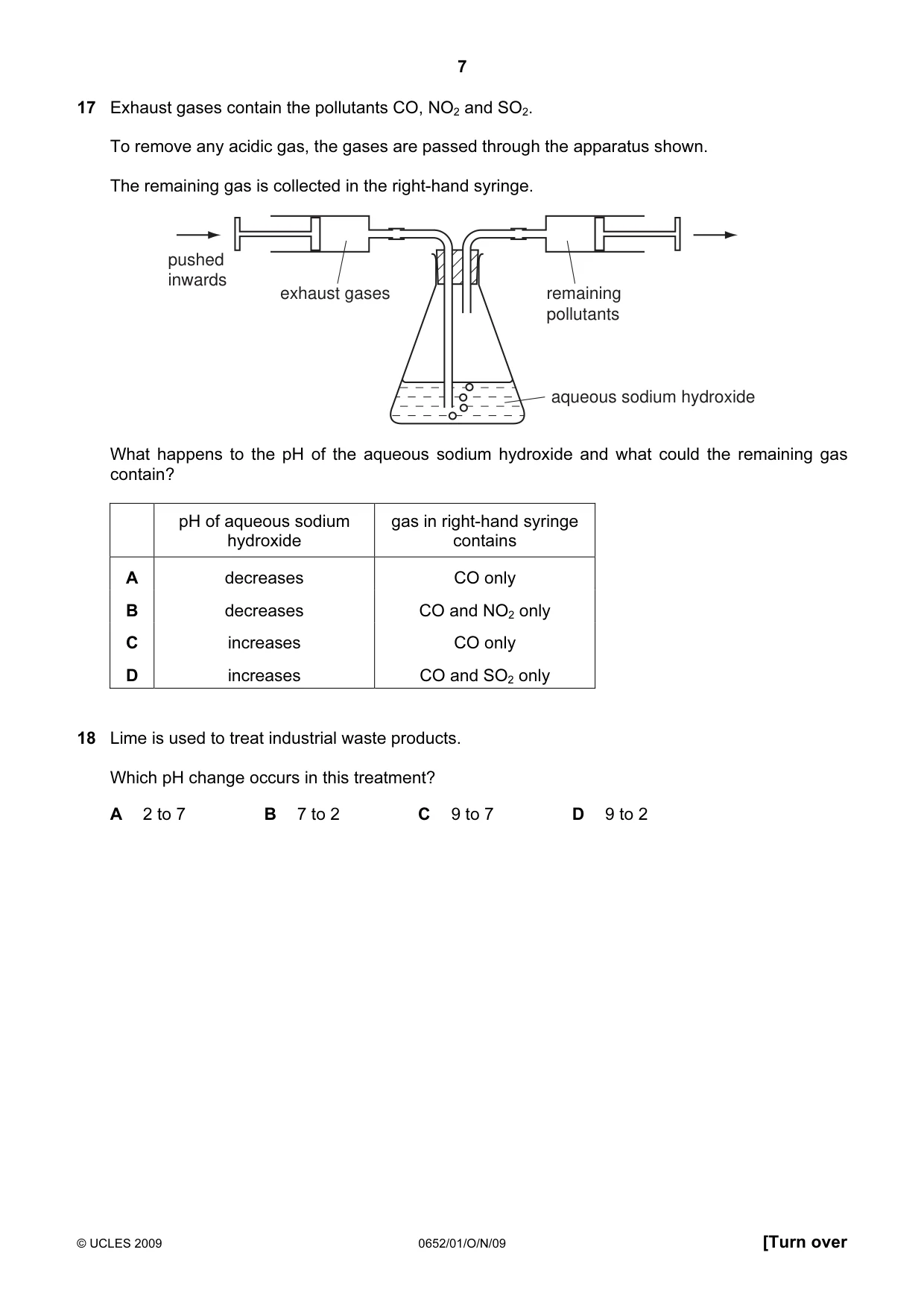
17 Exhaust gases contain the pollutants CO, NO2 and SO2. To remove any acidic gas, the gases are passed through the apparatus shown. The remaining gas is collected in the right-hand syringe. pushed inwards exhaust gases remaining pollutants aqueous sodium hydroxide What happens to the pH of the aqueous sodium hydroxide and what could the remaining gas contain? pH of aqueous sodium gas in right-hand syringe hydroxide contains A decreases CO only B decreases CO and NO2 only C increases CO only D increases CO and SO2 only
Mark scheme: A
Q18 · Lime is used to treat industrial waste products
18 Lime is used to treat industrial waste products. Which pH change occurs in this treatment? A 2 to 7 B 7 to 2 C 9 to 7 D 9 to 2
Mark scheme: A
More questions on The characteristic properties of acids and bases
Q19 · Which of the compounds shown is not an alkane?
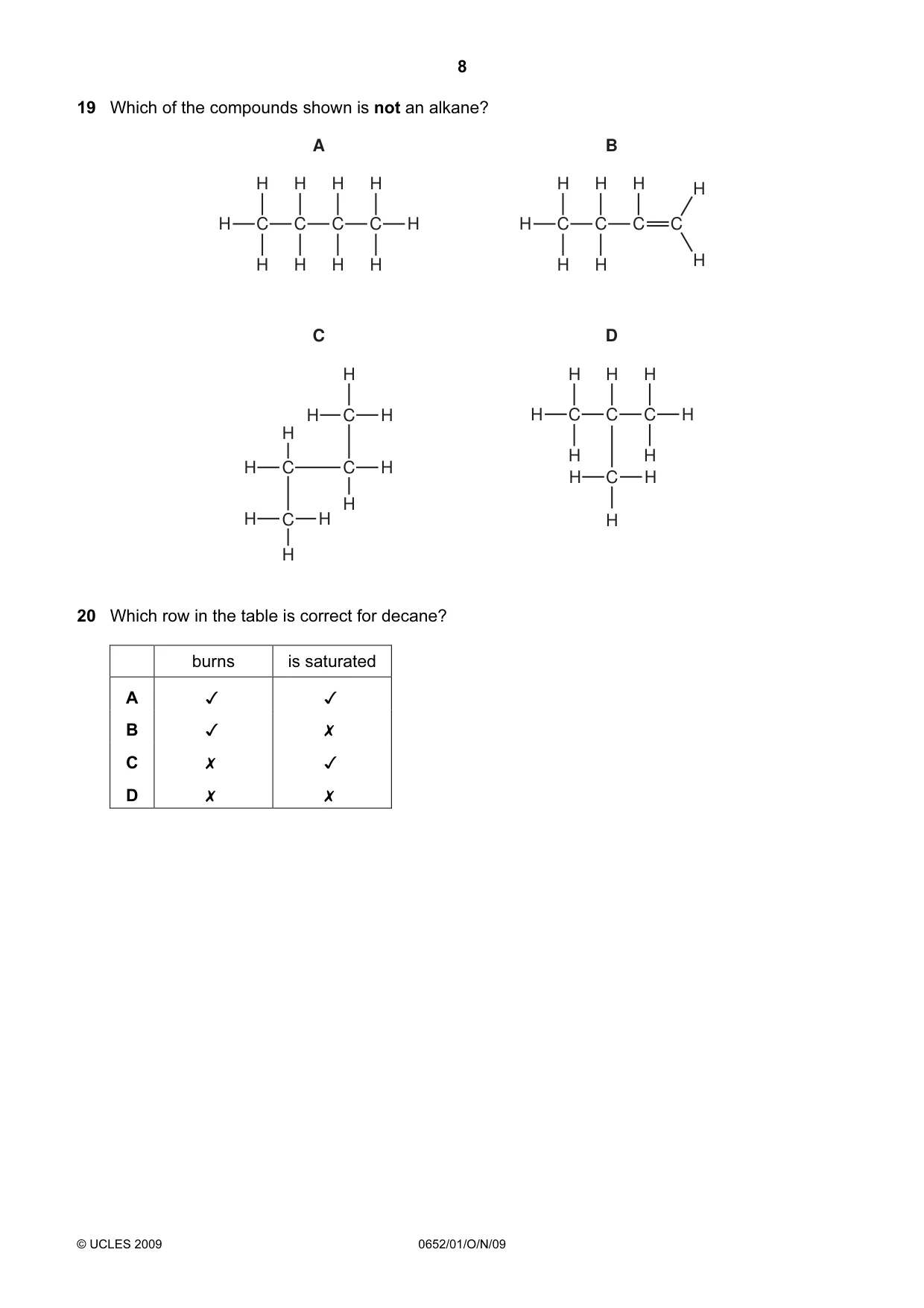
19 Which of the compounds shown is not an alkane? A B H H H H H H H H H C C C C H H C C C C H H H H H H H C D H H H H H C H H C C C H H H H H C C H H C H H H C H H H
Mark scheme: B
Q20 · Which row in the table is correct for decane?
20 Which row in the table is correct for decane? burns is saturated v v 0 0O WwW > v x x v x x
Mark scheme: A
Q21 · A stopwatch is used to time an athlete running 100 m
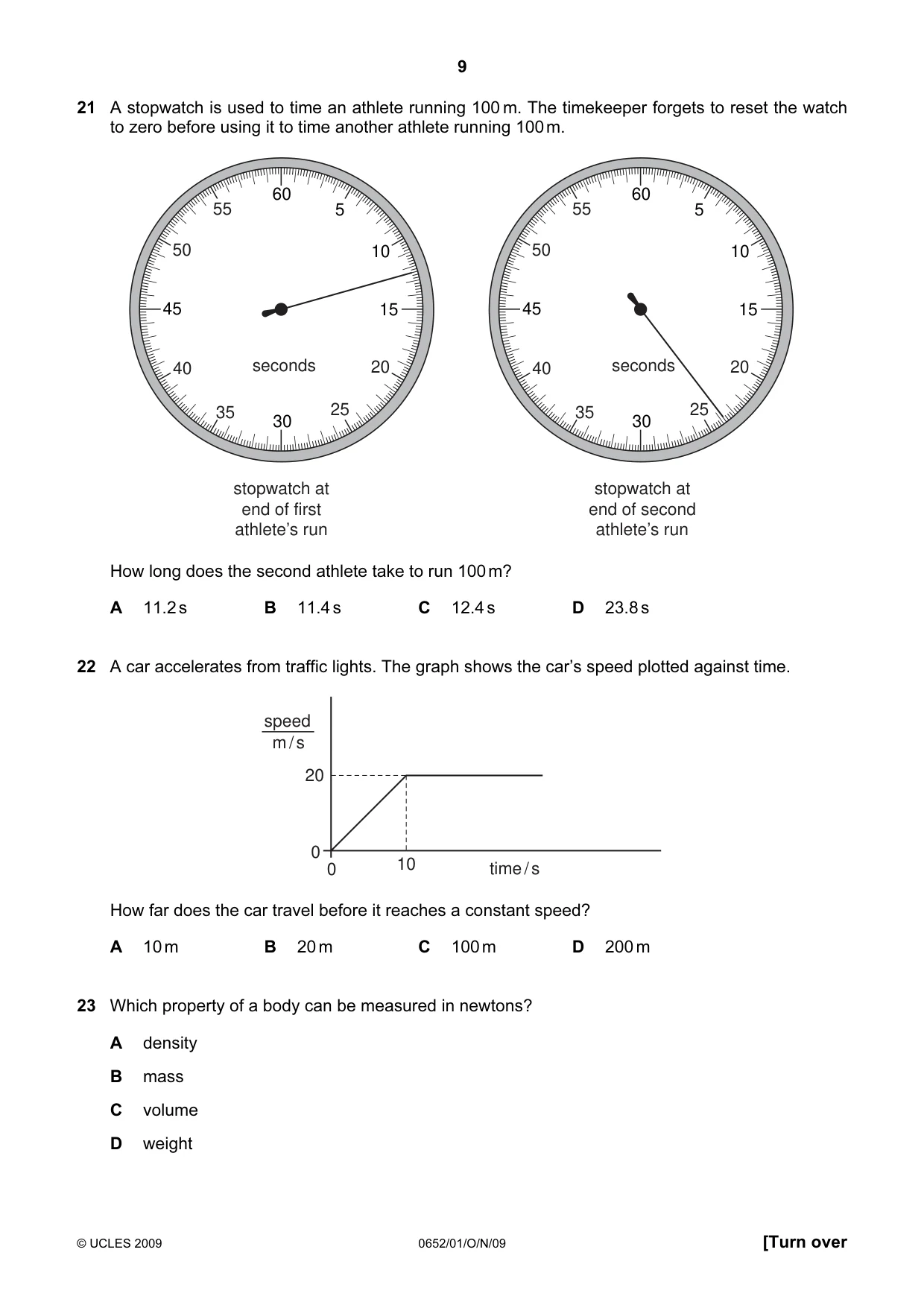
21 A stopwatch is used to time an athlete running 100 m. The timekeeper forgets to reset the watch to zero before using it to time another athlete running 100 m. 60 60 55 5 55 5 50 10 50 10 45 15 45 15 40 seconds 20 40 seconds 20 35 25 35 25 30 30 stopwatch at stopwatch at end of first end of second athlete’s run athlete’s run How long does the second athlete take to run 100 m? A 11.2 s B 11.4 s C 12.4 s D 23.8 s
Mark scheme: B
Q22 · A car accelerates from traffic lights
22 A car accelerates from traffic lights. The graph shows the car’s speed plotted against time. speed m / s 20 0 0 10 time / s How far does the car travel before it reaches a constant speed? A 10 m B 20 m C 100 m D 200 m
Mark scheme: C
Q23 · Which property of a body can be measured in newtons?
23 Which property of a body can be measured in newtons? A density B mass C volume D weight
Mark scheme: D
Q24 · The diagrams show a rectangular box with inside measurements of 5 cm × 6 cm × 4 cm
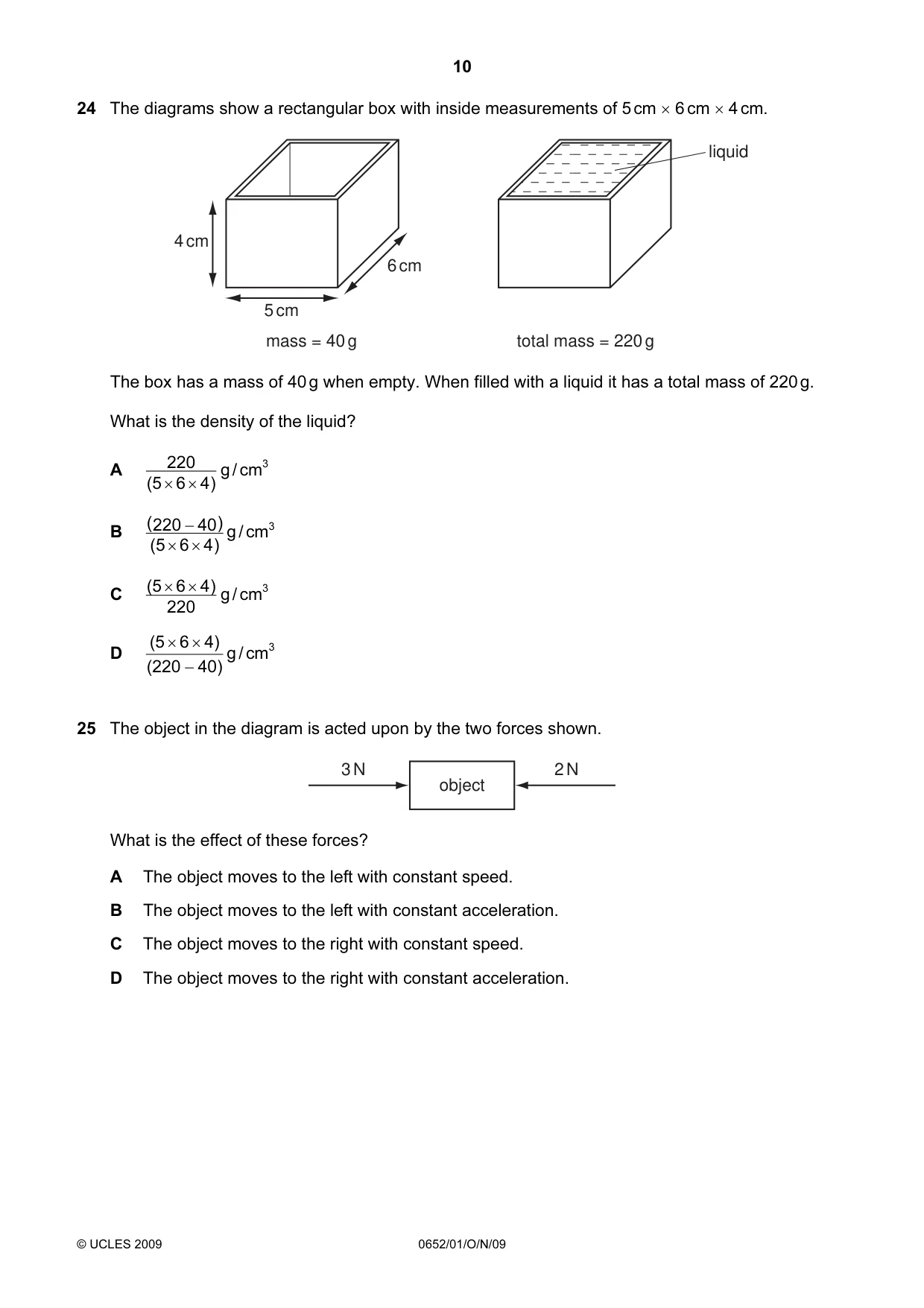
24 The diagrams show a rectangular box with inside measurements of 5 cm × 6 cm × 4 cm. liquid 4 cm 6 cm 5 cm mass = 40 g total mass = 220 g The box has a mass of 40 g when empty. When filled with a liquid it has a total mass of 220 g. What is the density of the liquid? A 220 g / cm3 (5 × 6 × 4 ) ( 220 − 40 ) g / cm3 B (5 × 6 × 4 ) (5 × 6 × 4 ) g / cm3 C 220 (5 × 6 × 4) D g / cm3 (220 − 40)
Mark scheme: B
Q25 · The object in the diagram is acted upon by the two forces shown
25 The object in the diagram is acted upon by the two forces shown. 3 N 2 N object What is the effect of these forces? A The object moves to the left with constant speed. B The object moves to the left with constant acceleration. C The object moves to the right with constant speed. D The object moves to the right with constant acceleration.
Mark scheme: D
Q26 · To mark a temperature scale on a thermometer, standard temperatures known as fixed points…
26 To mark a temperature scale on a thermometer, standard temperatures known as fixed points are needed. Which of these is a fixed point? A room temperature B the temperature inside a freezer C the temperature of pure melting ice D the temperature of pure warm water
Mark scheme: C
Q27 · A beaker contains water at room temperature
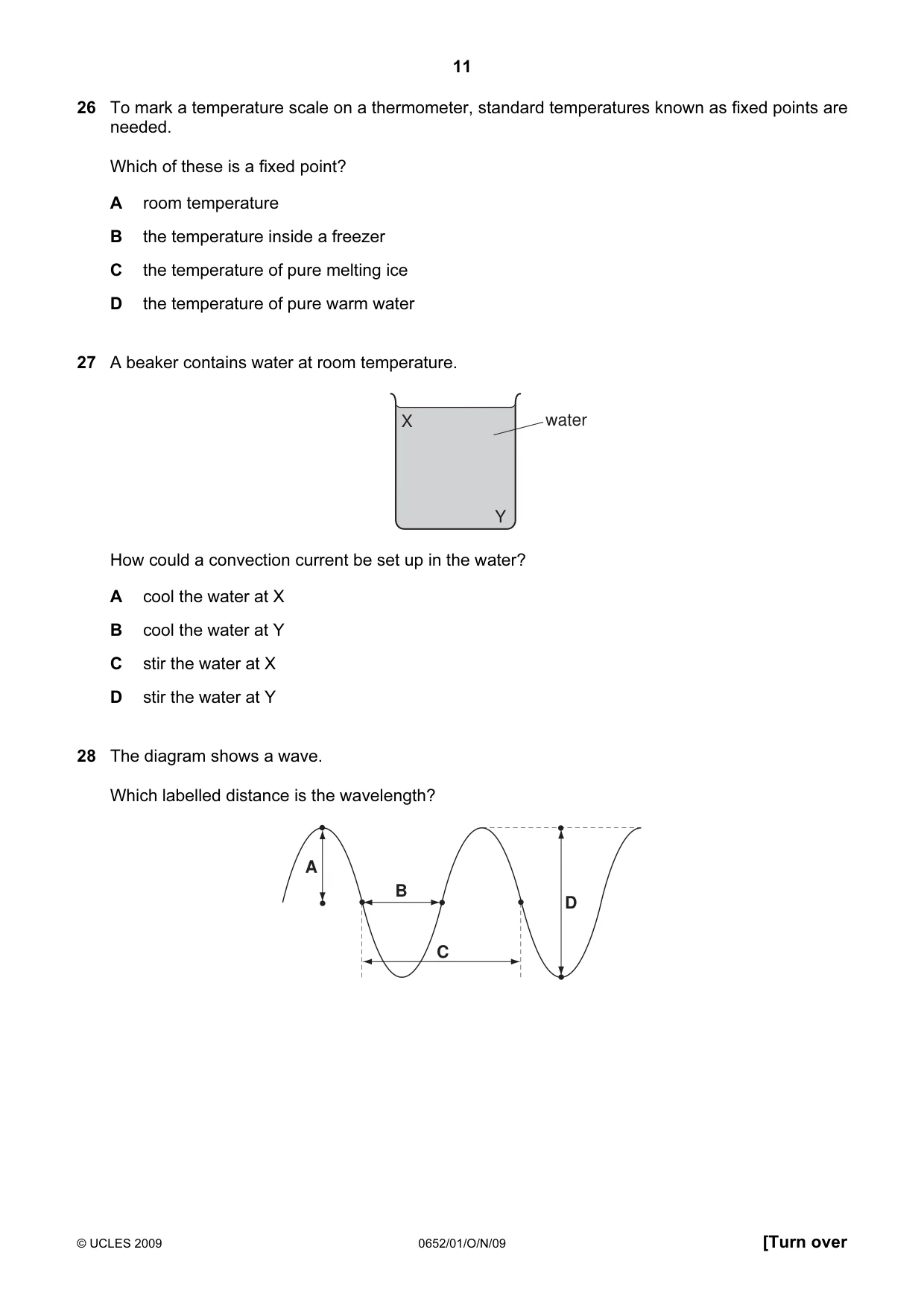
27 A beaker contains water at room temperature. X water Y How could a convection current be set up in the water? A cool the water at X B cool the water at Y C stir the water at X D stir the water at Y
Mark scheme: A
Q28 · The diagram shows a wave
28 The diagram shows a wave. Which labelled distance is the wavelength? A B D C
Mark scheme: C
Q29 · Which diagram shows the effect of a thin converging lens on a beam of light?
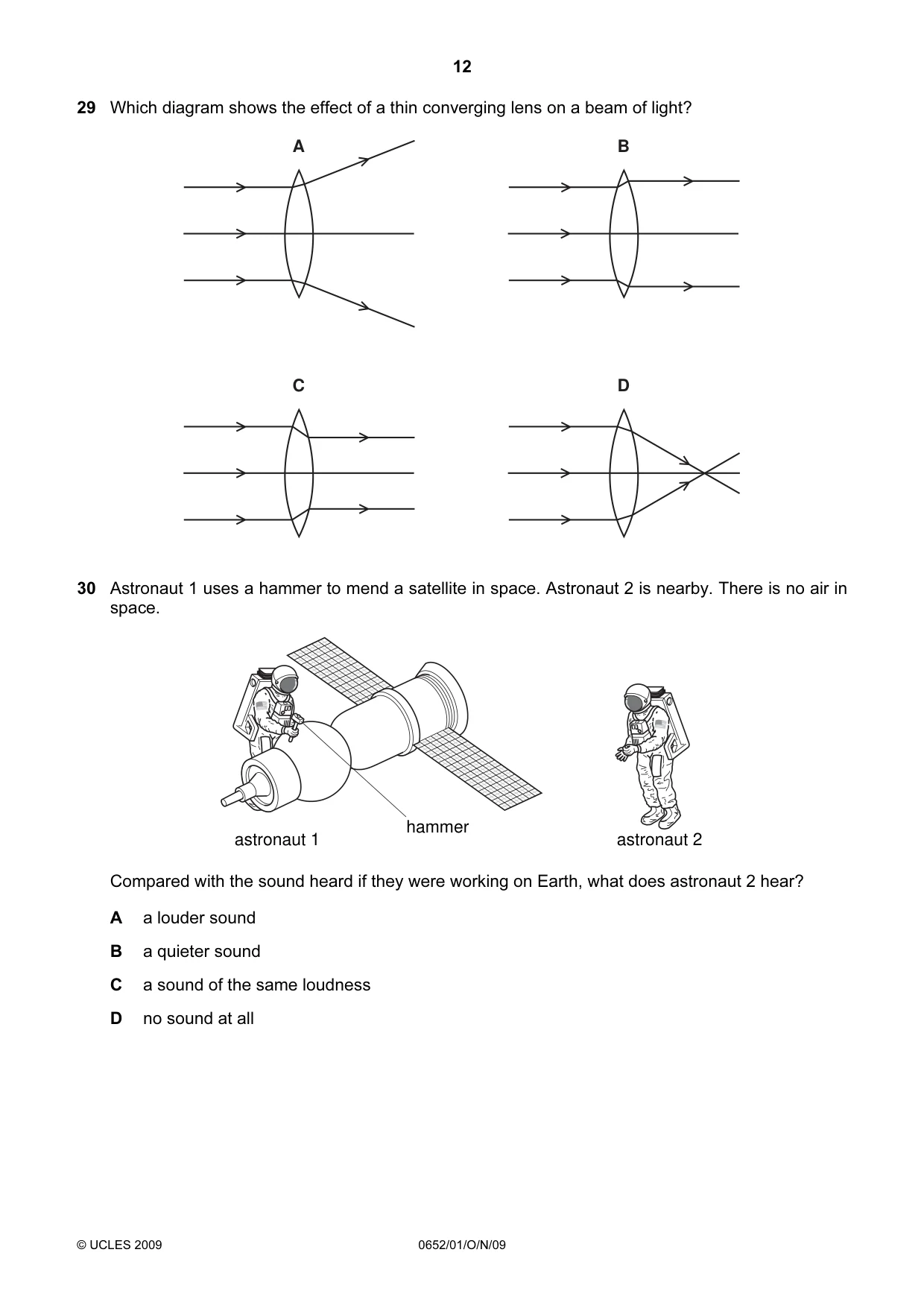
29 Which diagram shows the effect of a thin converging lens on a beam of light? A B C D
Mark scheme: D
Q30 · Astronaut 1 uses a hammer to mend a satellite in space
30 Astronaut 1 uses a hammer to mend a satellite in space. Astronaut 2 is nearby. There is no air in space. hammer astronaut 1 astronaut 2 Compared with the sound heard if they were working on Earth, what does astronaut 2 hear? A a louder sound B a quieter sound C a sound of the same loudness D no sound at all
Mark scheme: D
Q31 · A permanent magnet is brought near to a piece of copper
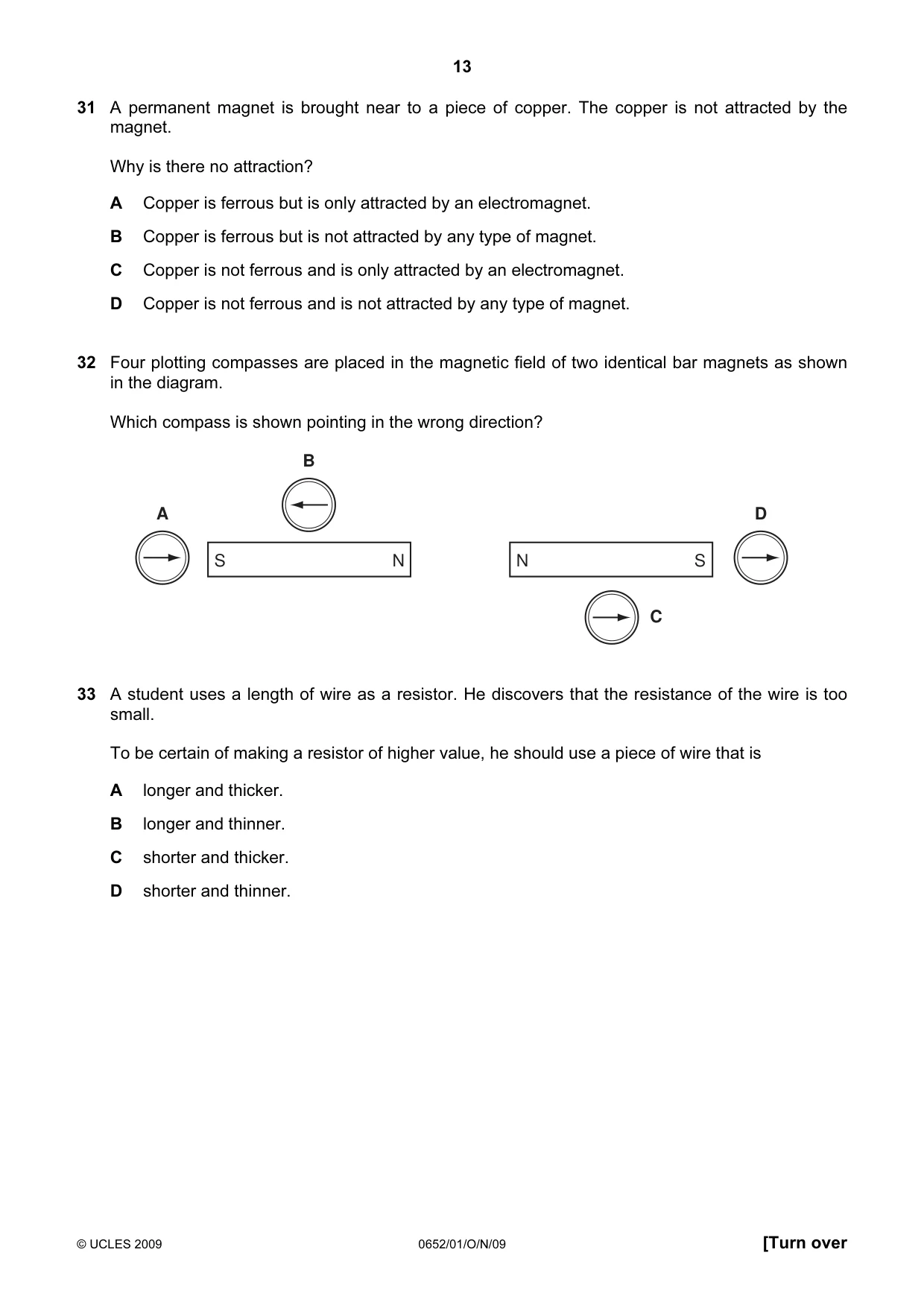
31 A permanent magnet is brought near to a piece of copper. The copper is not attracted by the magnet. Why is there no attraction? A Copper is ferrous but is only attracted by an electromagnet. B Copper is ferrous but is not attracted by any type of magnet. C Copper is not ferrous and is only attracted by an electromagnet. D Copper is not ferrous and is not attracted by any type of magnet.
Mark scheme: D
Q32 · Four plotting compasses are placed in the magnetic field of two identical bar magnets as…
32 Four plotting compasses are placed in the magnetic field of two identical bar magnets as shown in the diagram. Which compass is shown pointing in the wrong direction? B A D S N N S C
Mark scheme: D
Q33 · A student uses a length of wire as a resistor
33 A student uses a length of wire as a resistor. He discovers that the resistance of the wire is too small. To be certain of making a resistor of higher value, he should use a piece of wire that is A longer and thicker. B longer and thinner. C shorter and thicker. D shorter and thinner.
Mark scheme: B
Q34 · The diagram shows a battery connected to two identical resistors
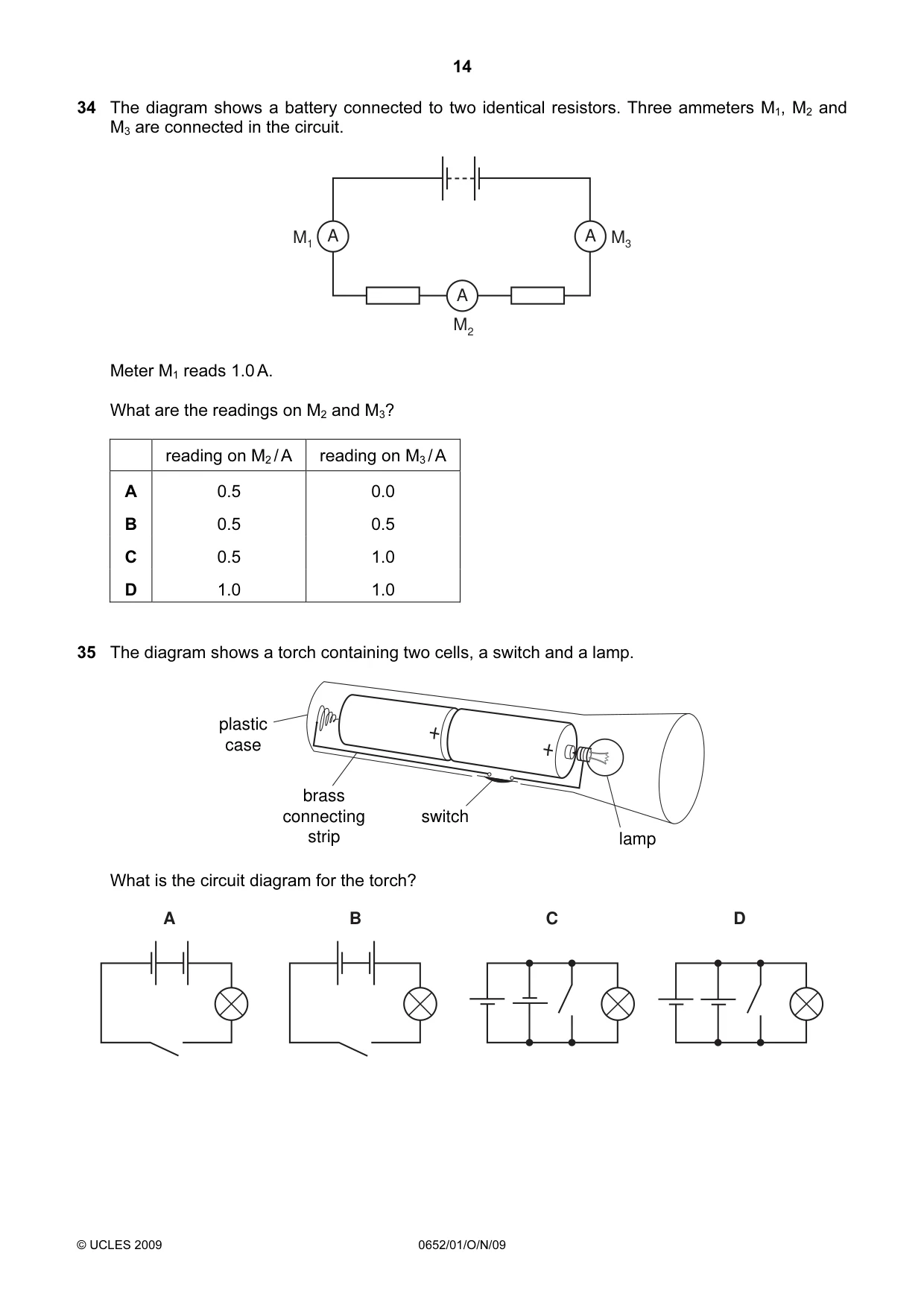
34 The diagram shows a battery connected to two identical resistors. Three ammeters M1, M2 and M3 are connected in the circuit. M1 A A M3 A M2 Meter M1 reads 1.0 A. What are the readings on M2 and M3? reading on M2 / A reading on M3 / A A 0.5 0.0 B 0.5 0.5 C 0.5 1.0 D 1.0 1.0
Mark scheme: D
Q35 · The diagram shows a torch containing two cells, a switch and a lamp
35 The diagram shows a torch containing two cells, a switch and a lamp. plastic case brass connecting switch strip lamp What is the circuit diagram for the torch? A B C D
Mark scheme: A
Q36 · On a building site, the metal scaffolding is firmly embedded in the damp ground
36 On a building site, the metal scaffolding is firmly embedded in the damp ground. A builder holds a mains-operated electric drill in one hand, and with his other hand holds on to the scaffolding. The power cable of the drill is damaged where it enters the metal casing of the drill. What danger does this present to the builder? A A current could flow through the builder and electrocute him. B A current in the scaffolding could heat it up and burn him. C The large current could blow the fuse and damage the drill. D The large current could make the motor spin too quickly.
Mark scheme: A
Q37 · The diagram shows a beam of cathode rays entering an electric field
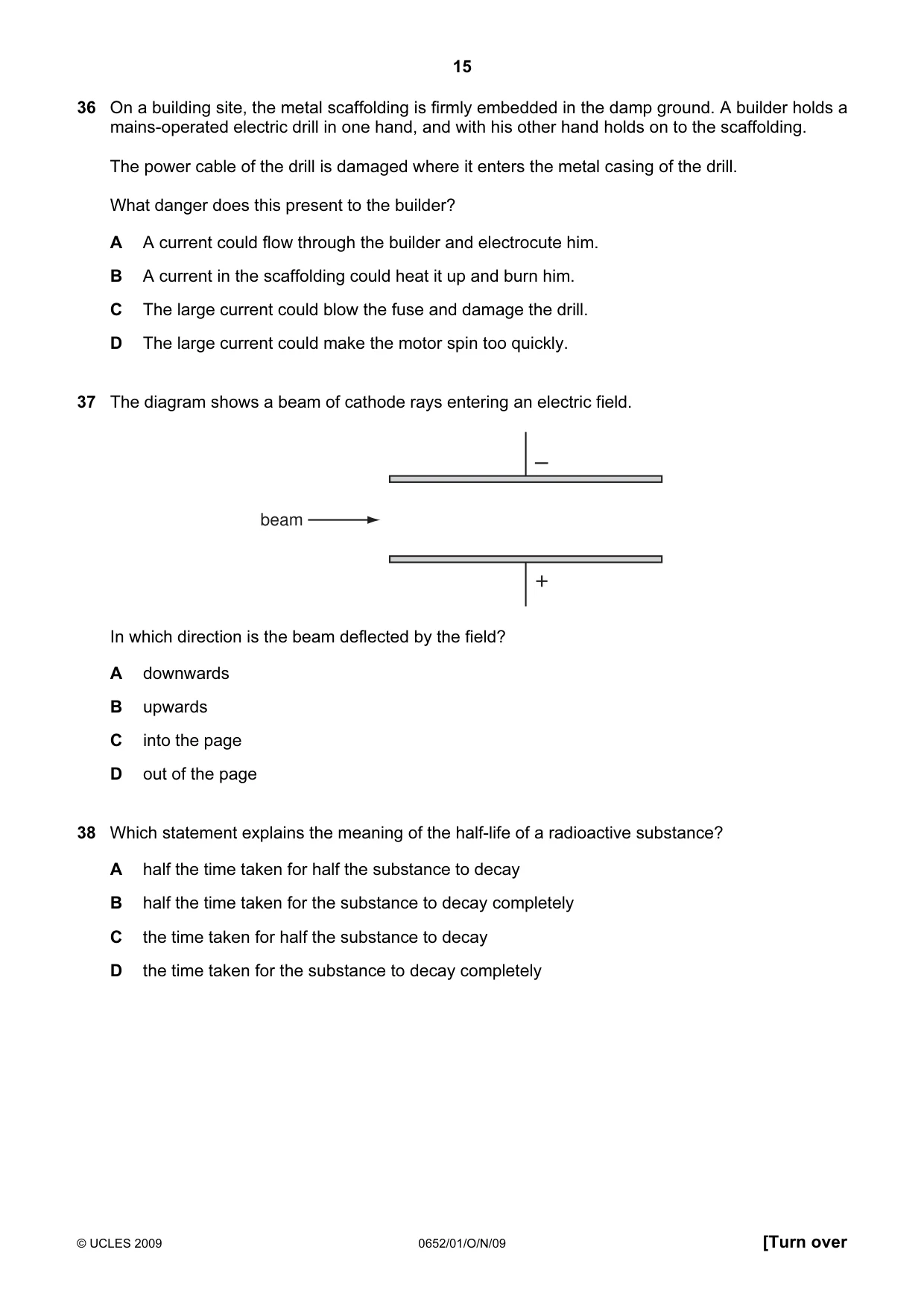
37 The diagram shows a beam of cathode rays entering an electric field. – beam + In which direction is the beam deflected by the field? A downwards B upwards C into the page D out of the page
Mark scheme: A
Q38 · Which statement explains the meaning of the half-life of a radioactive substance?
38 Which statement explains the meaning of the half-life of a radioactive substance? A half the time taken for half the substance to decay B half the time taken for the substance to decay completely C the time taken for half the substance to decay D the time taken for the substance to decay completely
Mark scheme: C
Q39 · The diagram shows the paths of three different types of radiation, X, Y and Z
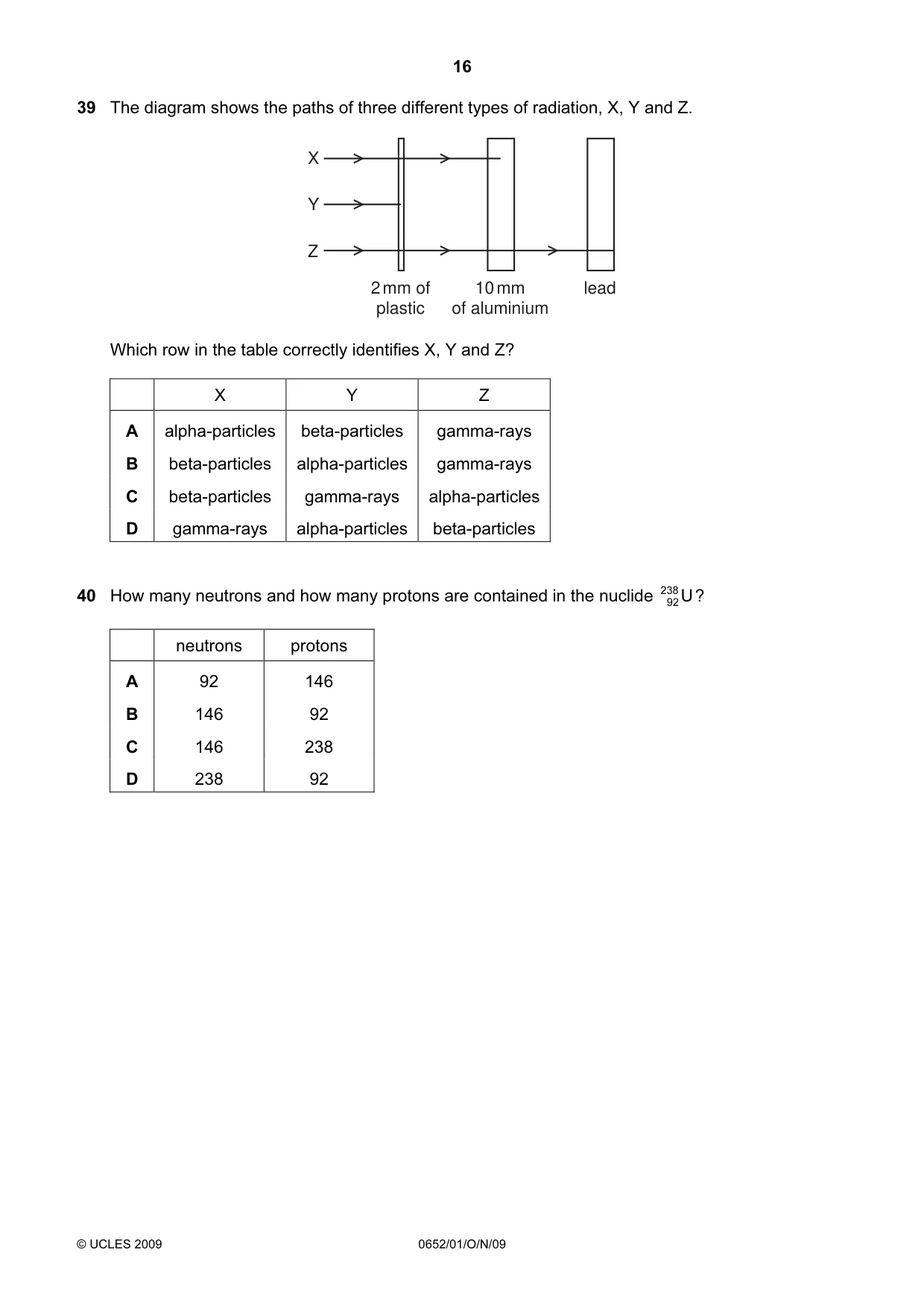
39 The diagram shows the paths of three different types of radiation, X, Y and Z. X Y Z 2 mm of 10 mm lead plastic of aluminium Which row in the table correctly identifies X, Y and Z? X Y Z A alpha-particles beta-particles gamma-rays B beta-particles alpha-particles gamma-rays C beta-particles gamma-rays alpha-particles D gamma-rays alpha-particles beta-particles
Mark scheme: B
Q40 · How many neutrons and how many protons are contained in the nuclide 238 U ?
40 How many neutrons and how many protons are contained in the nuclide 238 U ? 92 neutrons protons A 92 146 B 146 92 C 146 238 D 238 92
Mark scheme: B
What was in this paper
The subtopics covered by these 40 questions, and how many questions each got. Open one in a new tab to see every Cambridge question on it.
2Electric circuits2Radioactivity2Rate (speed) of reaction2Reactivity series2Simple phenomena of magnetism2The characteristic properties of acids and bases2The nuclear atom2Air1Atomic structure and the Periodic Table1Dangers of electricity1Density1Electrical quantities1Energy transfer1Forces1General wave properties1Group properties1Identification of ions and gases1Ions and ionic bonds1Length and time1Light1Macromolecules1Mass and weight1Motion1Preparation of salts1Redox1Sound1Stoichiometry1The particulate nature of matter1Thermal processes1Thermal properties and temperature1Uses of metals1What you needed in this session
Cambridge’s own grade thresholds for 2009 Oct/Nov, Paper 1 · Variant 1. A higher threshold means an easier paper — the bar moves with how the cohort did.