Cambridge IGCSE Physical Science 0652 — 2018 Oct/Nov Paper 1 · Variant 2
0652/12/O/N/18 · 40 questions · 40 marks · ≈45 min
The question paper and its mark scheme, free to read here and free to download. This is Cambridge’s own paper, exactly as it was sat.
Question paper20 pages



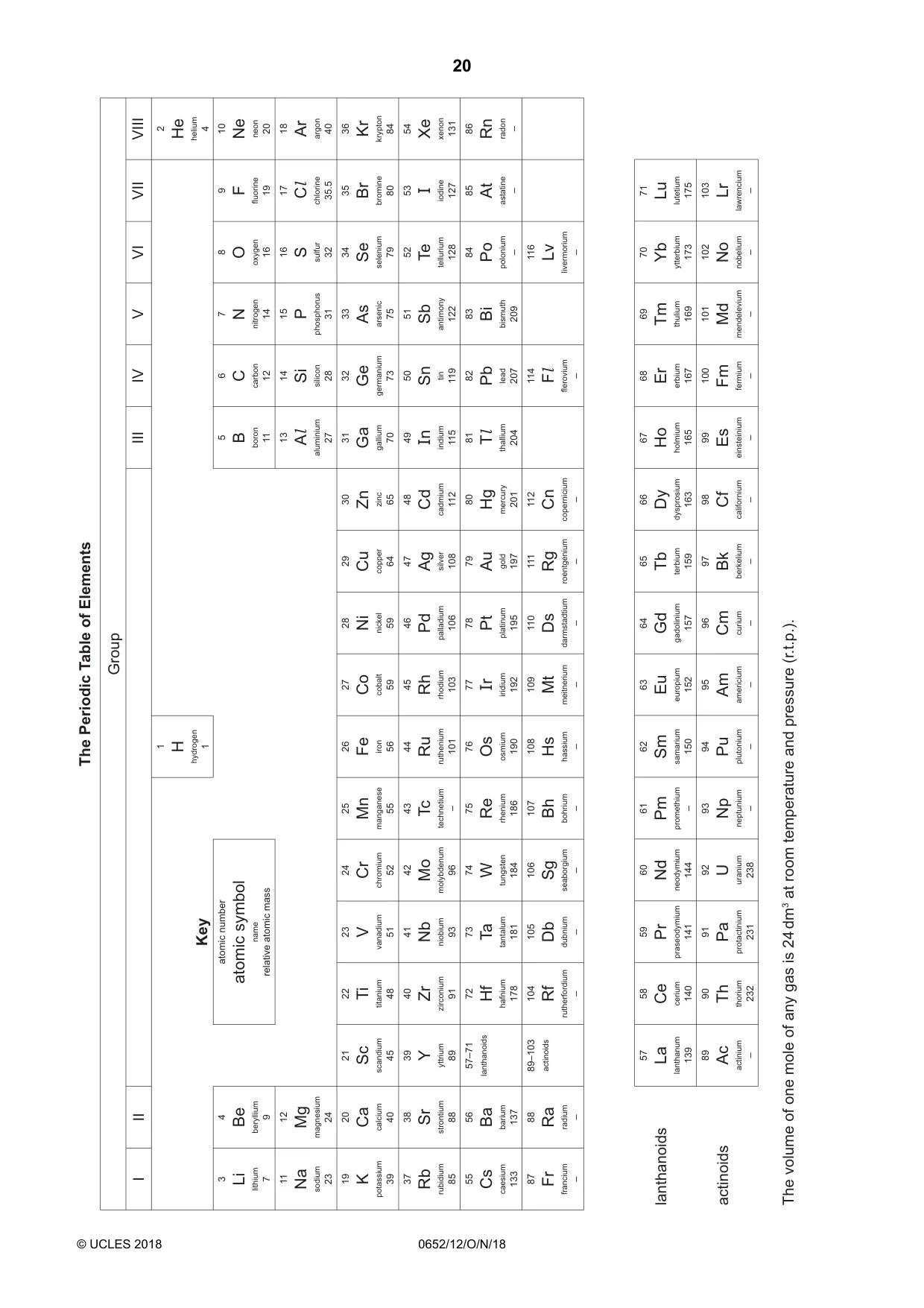
Mark scheme3 pages
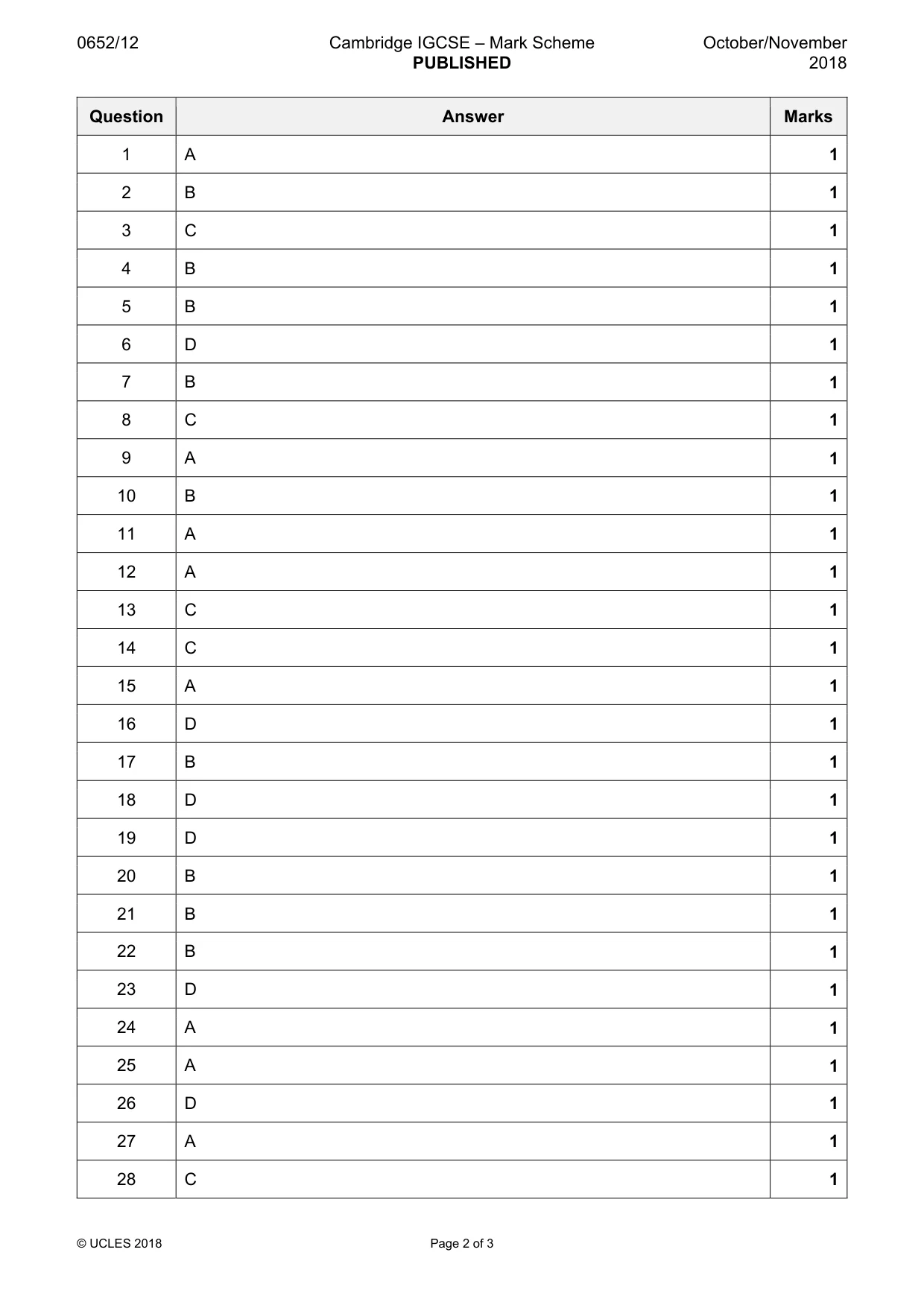
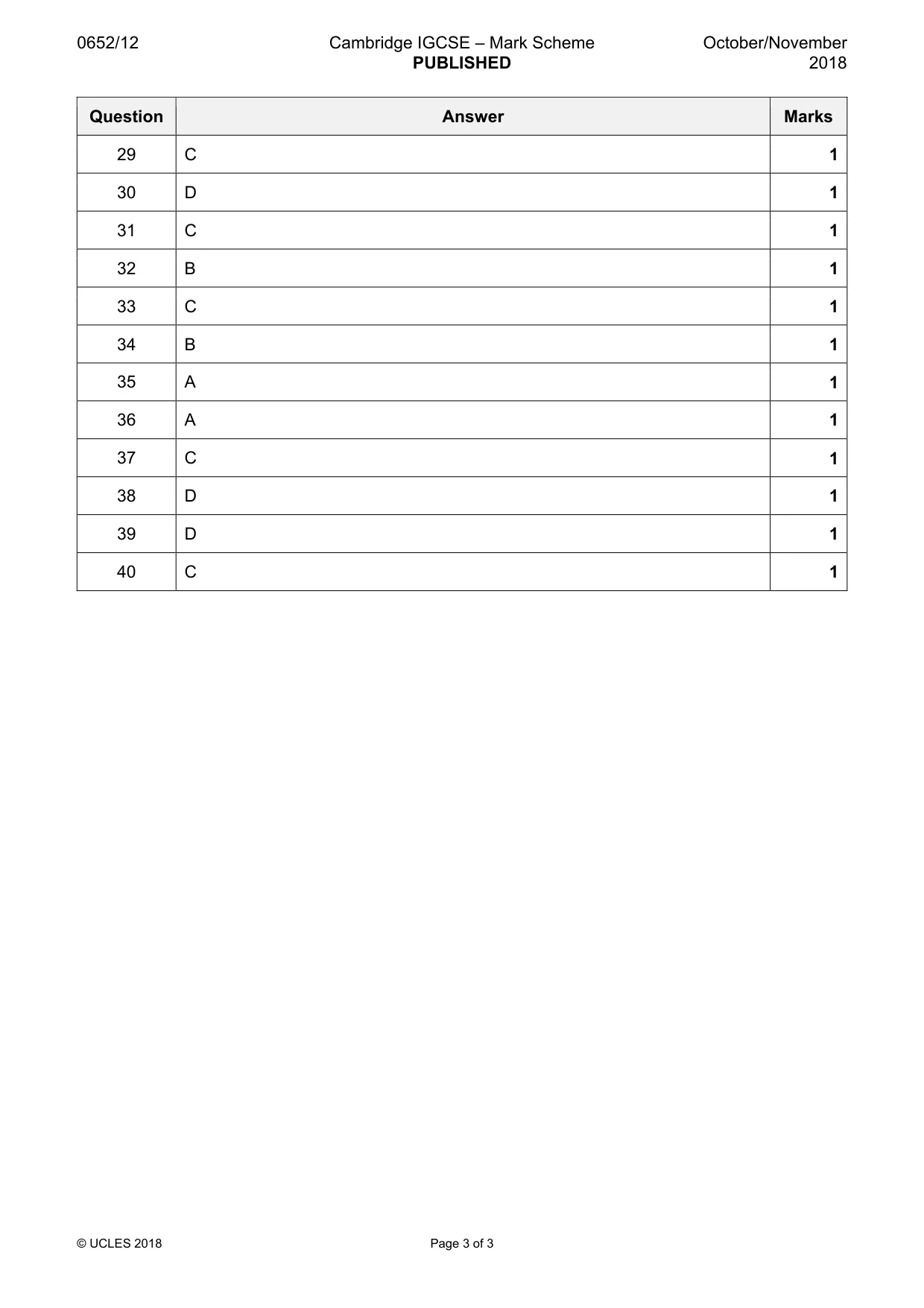
Answers below. Sit the paper first if you are practising.
Questions as text
Q1 · When smoke particles collide with molecules in the air, the smoke particles move randomly
1 When smoke particles collide with molecules in the air, the smoke particles move randomly. How is the movement of the smoke particles described? A Brownian motion B condensation C diffusion D evaporation
Mark scheme: A
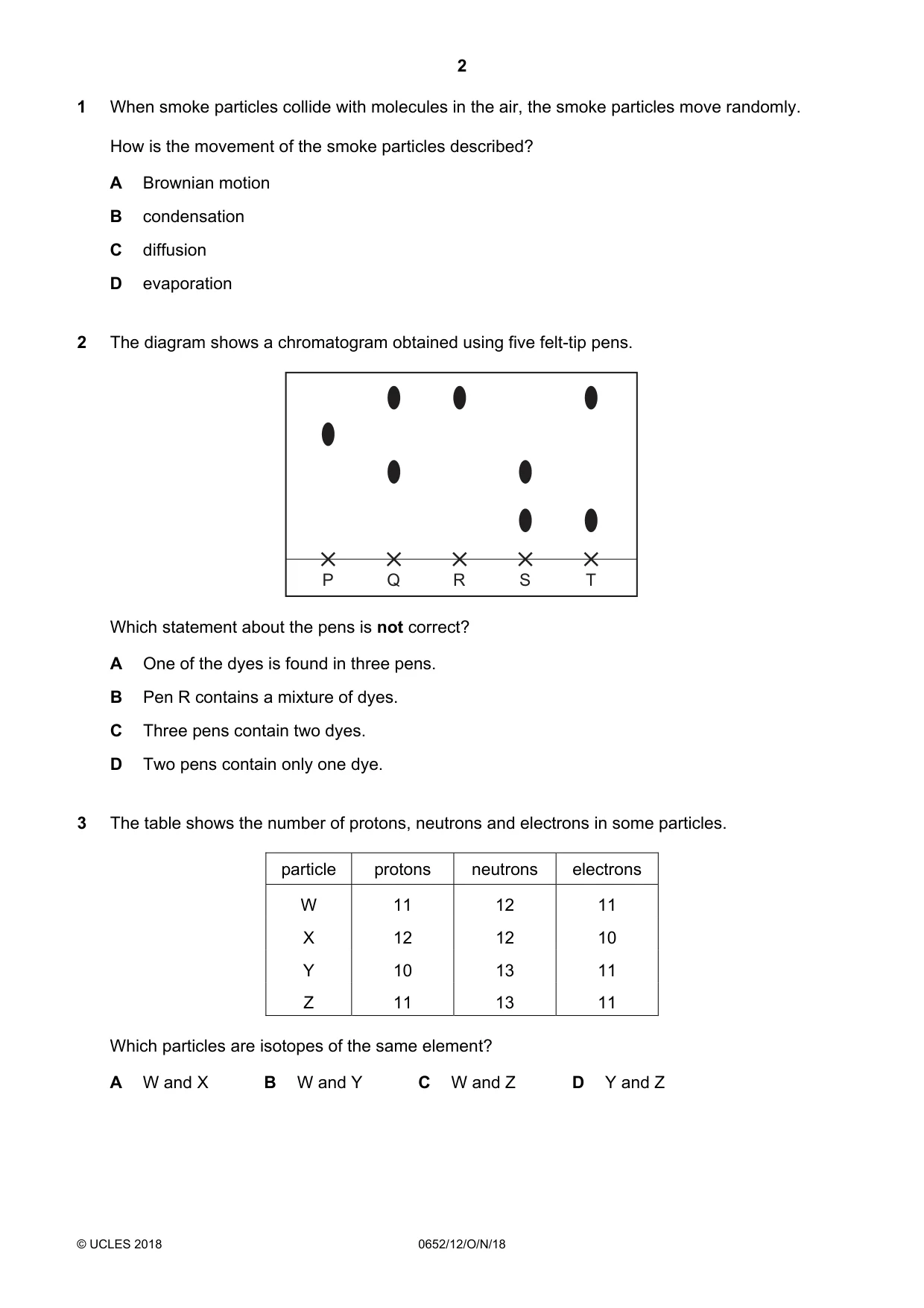
Q2 · The diagram shows a chromatogram obtained using five felt-tip pens
2 The diagram shows a chromatogram obtained using five felt-tip pens. P Q R S T Which statement about the pens is not correct? A One of the dyes is found in three pens. B Pen R contains a mixture of dyes. C Three pens contain two dyes. D Two pens contain only one dye.
Mark scheme: B
Q3 · The table shows the number of protons, neutrons and electrons in some particles
3 The table shows the number of protons, neutrons and electrons in some particles. particle protons neutrons electrons W 11 12 11 X 12 12 10 Y 10 13 11 Z 11 13 11 Which particles are isotopes of the same element? A W and X B W and Y C W and Z D Y and Z
Mark scheme: C
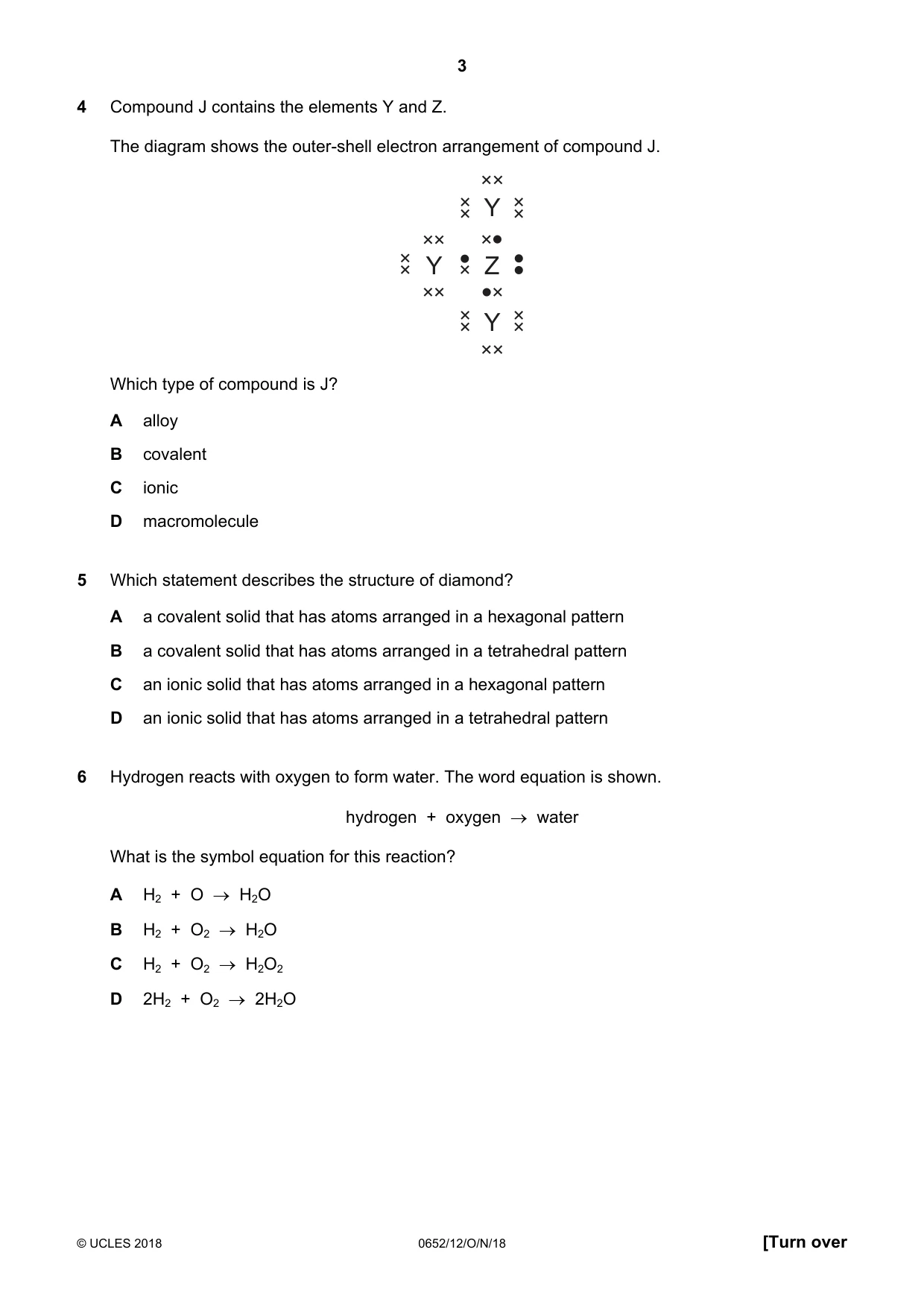
Q4 · Compound J contains the elements Y and Z
4 Compound J contains the elements Y and Z. The diagram shows the outer-shell electron arrangement of compound J. Y Y Z Y Which type of compound is J? A alloy B covalent C ionic D macromolecule
Mark scheme: B
Q5 · Which statement describes the structure of diamond?
5 Which statement describes the structure of diamond? A a covalent solid that has atoms arranged in a hexagonal pattern B a covalent solid that has atoms arranged in a tetrahedral pattern C an ionic solid that has atoms arranged in a hexagonal pattern D an ionic solid that has atoms arranged in a tetrahedral pattern
Mark scheme: B
Q6 · Hydrogen reacts with oxygen to form water
6 Hydrogen reacts with oxygen to form water. The word equation is shown. hydrogen + oxygen → water What is the symbol equation for this reaction? A H2 + O → H2O B H2 + O2 → H2O C H2 + O2 → H2O2 D 2H2 + O2 → 2H2O
Mark scheme: D
Q7 · The formulae of three substances are shown
7 The formulae of three substances are shown. 1 NO2 2 C2H5OH 3 C3H8 Which substances have a relative molecular mass of 46? A 1, 2 and 3 B 1 and 2 only C 1 only D 2 only
Mark scheme: B
Q8 · Anhydrous copper(II) sulfate is placed in a test-tube
8 Anhydrous copper(II) sulfate is placed in a test-tube. When water is added to the test-tube, the temperature changes from 17 °C to 27 °C. Which type of reaction takes place? A addition B endothermic C exothermic D oxidation
Mark scheme: C
Q9 · Which reaction is an oxidation?
9 Which reaction is an oxidation? A 2SO2 + O2 → 2SO3 B NaOH + HCl → NaCl + H2O C CaCO3 → CaO + CO2 D NH3 + HCl → NH4Cl
Mark scheme: A
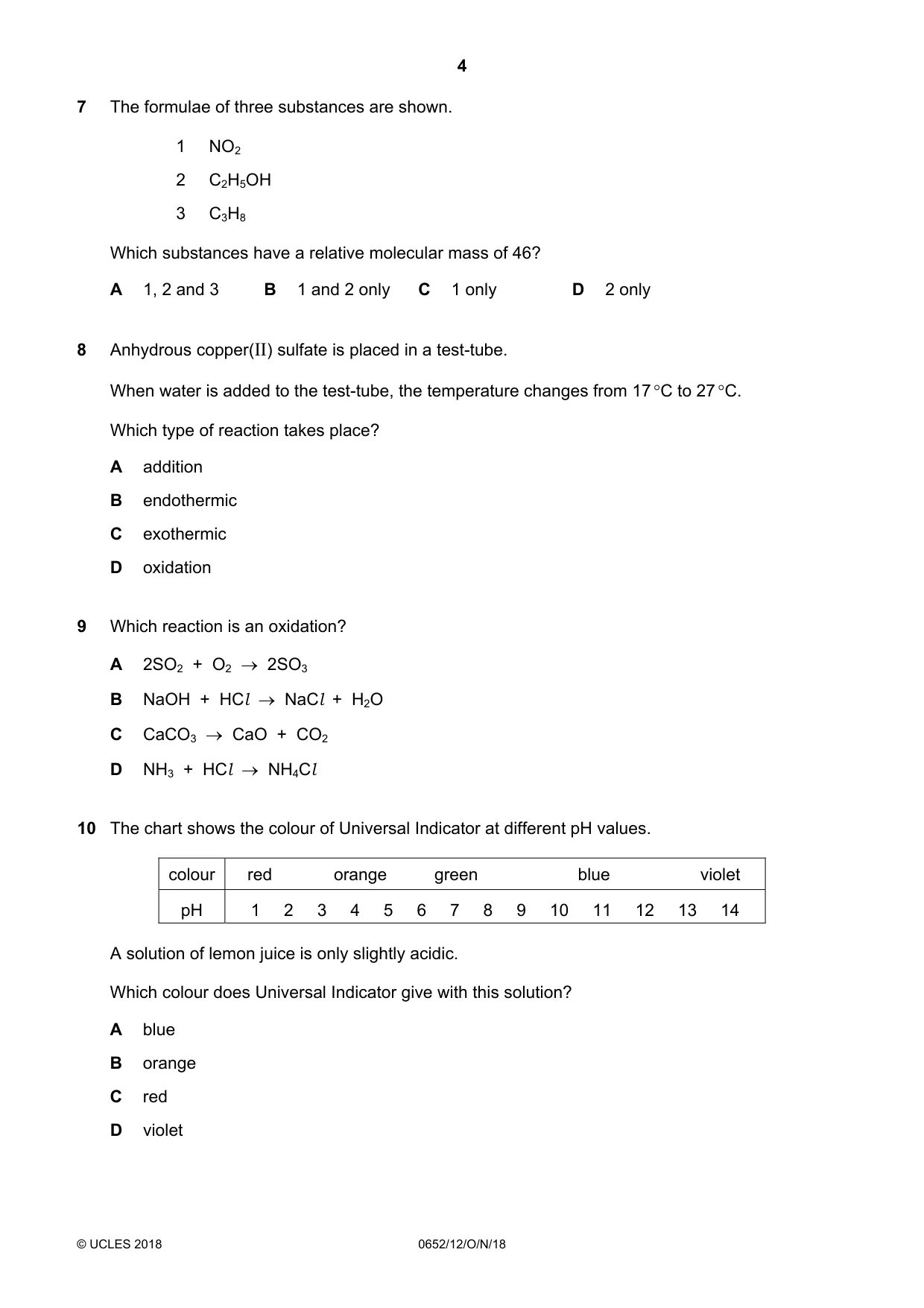
Q10 · The chart shows the colour of Universal Indicator at different pH values
10 The chart shows the colour of Universal Indicator at different pH values. colour red orange green blue violet pH 1 2 3 4 5 6 7 8 9 10 11 12 13 14 A solution of lemon juice is only slightly acidic. Which colour does Universal Indicator give with this solution? A blue B orange C red D violet
Mark scheme: B
More questions on The characteristic properties of acids and bases
Q11 · The statements are about non-metals and their oxides
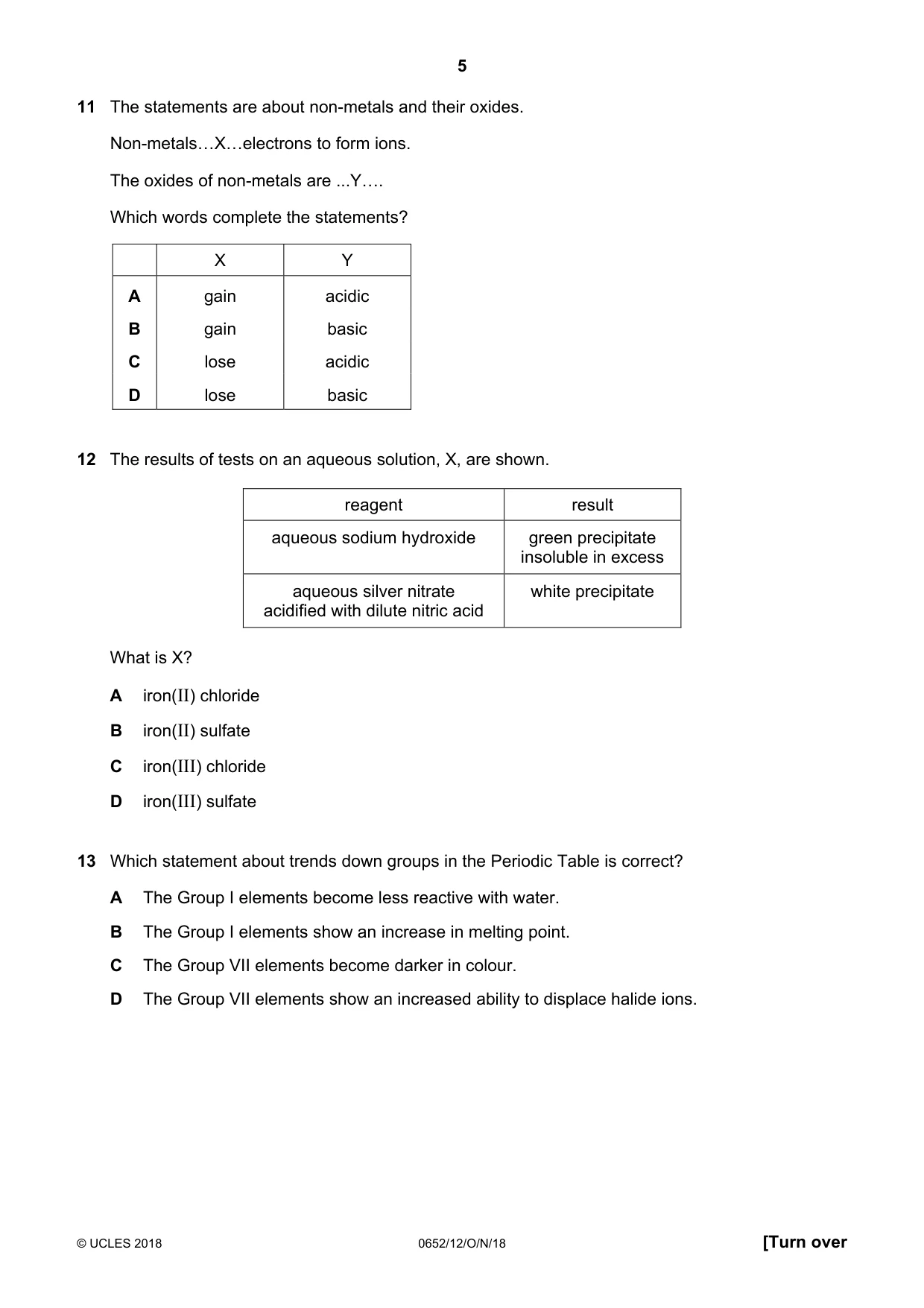
11 The statements are about non-metals and their oxides. Non-metals«X«electrons to form ions. The oxides of non-metals are ...Y«. Which words complete the statements? X Y A gain acidic B gain basic C lose acidic D lose basic
Mark scheme: A
Q12 · The results of tests on an aqueous solution, X, are shown
12 The results of tests on an aqueous solution, X, are shown. reagent result aqueous sodium hydroxide green precipitate insoluble in excess aqueous silver nitrate white precipitate acidified with dilute nitric acid What is X? A iron(II) chloride B iron(II) sulfate C iron(III) chloride D iron(III) sulfate
Mark scheme: A
Q13 · Which statement about trends down groups in the Periodic Table is correct?
13 Which statement about trends down groups in the Periodic Table is correct? A The Group I elements become less reactive with water. B The Group I elements show an increase in melting point. C The Group VII elements become darker in colour. D The Group VII elements show an increased ability to displace halide ions.
Mark scheme: C
Q14 · The noble gases make up a group in the Periodic Table
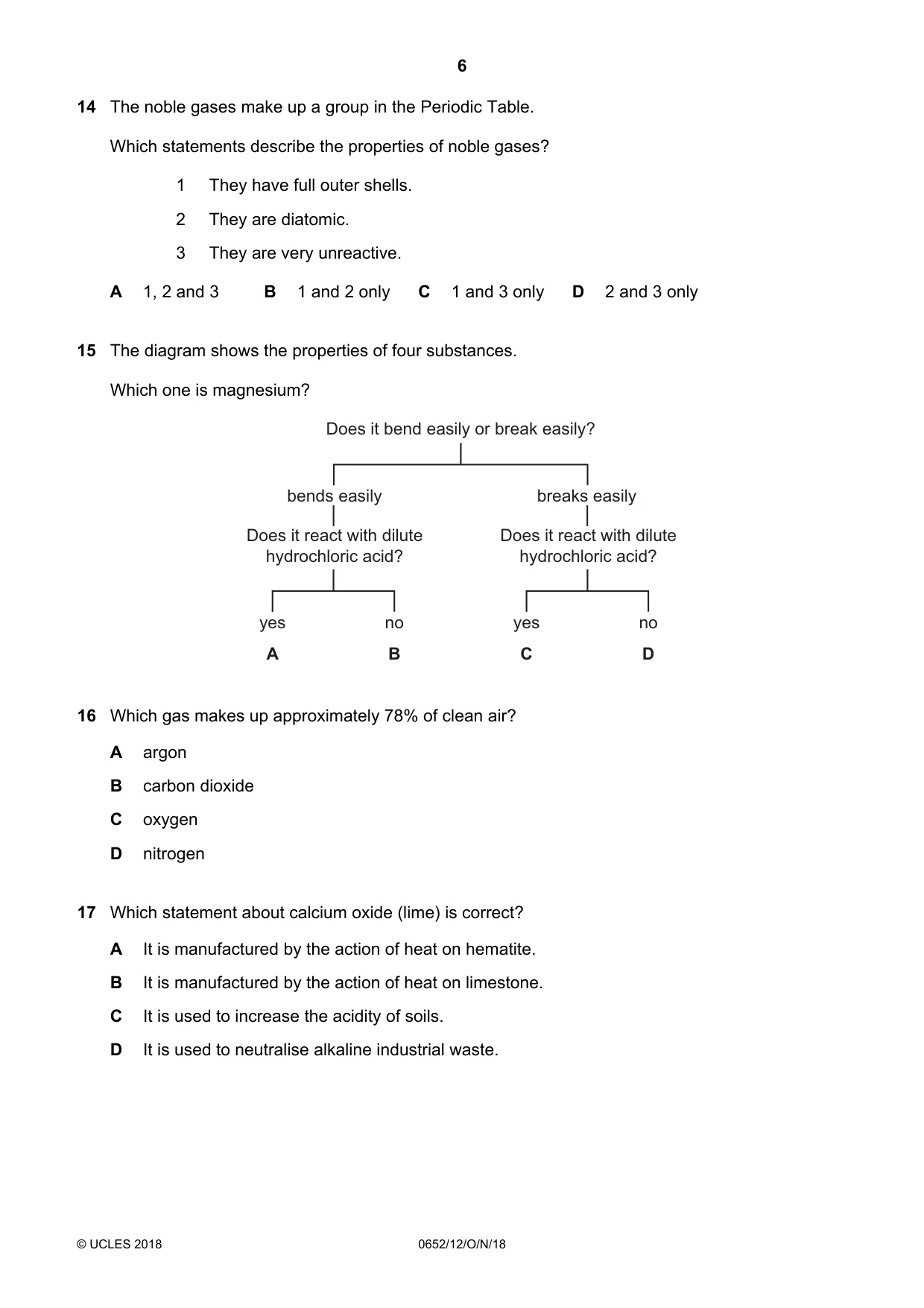
14 The noble gases make up a group in the Periodic Table. Which statements describe the properties of noble gases? 1 They have full outer shells. 2 They are diatomic. 3 They are very unreactive. A 1, 2 and 3 B 1 and 2 only C 1 and 3 only D 2 and 3 only
Mark scheme: C
Q15 · The diagram shows the properties of four substances
15 The diagram shows the properties of four substances. Which one is magnesium? Does it bend easily or break easily? bends easily breaks easily Does it react with dilute Does it react with dilute hydrochloric acid? hydrochloric acid? yes no yes no A B C D
Mark scheme: A
Q16 · Which gas makes up approximately 78% of clean air?
16 Which gas makes up approximately 78% of clean air? A argon B carbon dioxide C oxygen D nitrogen
Mark scheme: D
Q17 · Which statement about calcium oxide (lime) is correct?
17 Which statement about calcium oxide (lime) is correct? A It is manufactured by the action of heat on hematite. B It is manufactured by the action of heat on limestone. C It is used to increase the acidity of soils. D It is used to neutralise alkaline industrial waste.
Mark scheme: B
Q18 · Which row describes the correct use for a fraction obtained from petroleum by fractional…
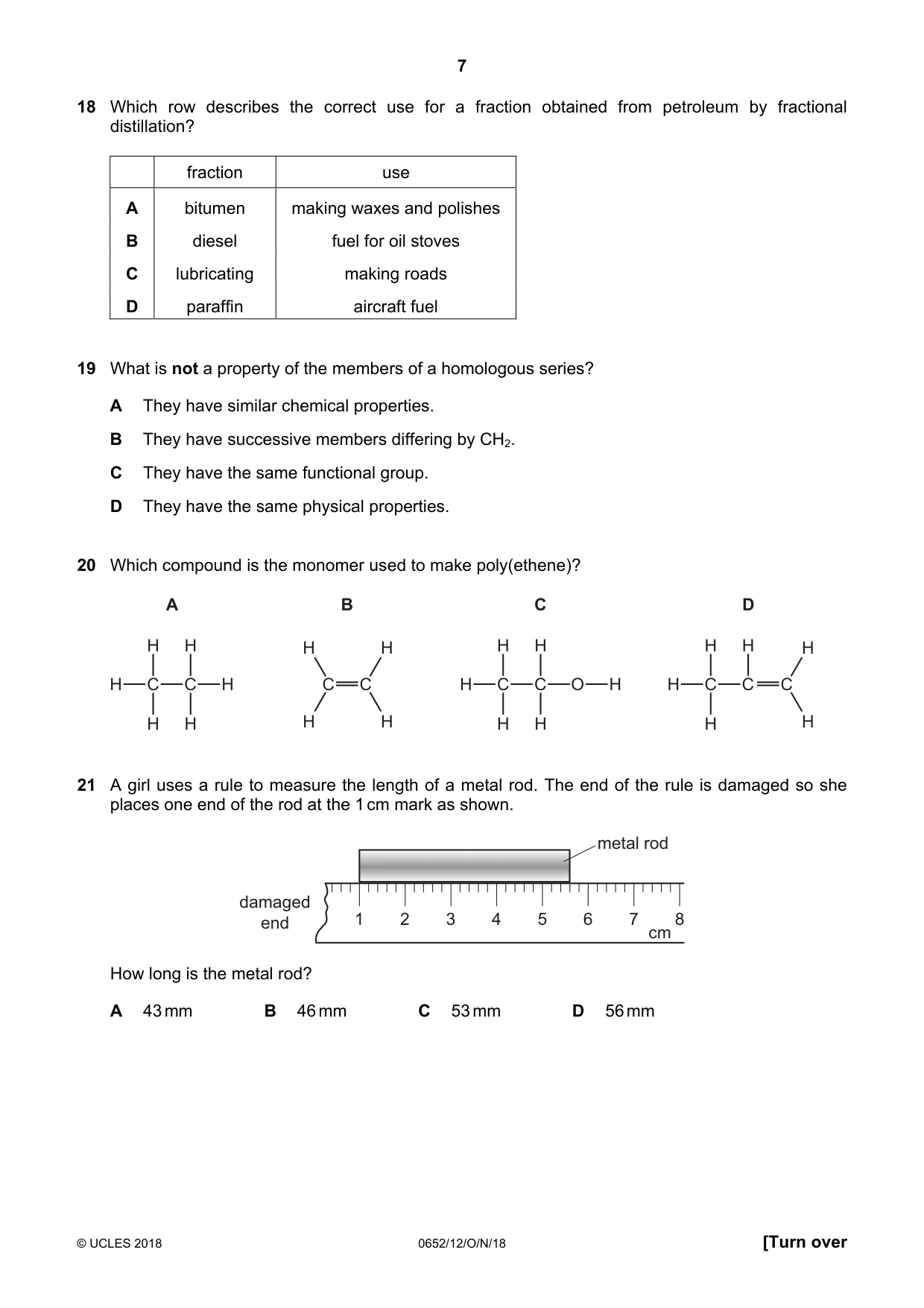
18 Which row describes the correct use for a fraction obtained from petroleum by fractional distillation? fraction use A bitumen making waxes and polishes B diesel fuel for oil stoves C lubricating making roads D paraffin aircraft fuel
Mark scheme: D
Q19 · What is not a property of the members of a homologous series?
19 What is not a property of the members of a homologous series? A They have similar chemical properties. B They have successive members differing by CH2. C They have the same functional group. D They have the same physical properties.
Mark scheme: D
Q20 · Which compound is the monomer used to make poly(ethene)?
20 Which compound is the monomer used to make poly(ethene)? A B C D H H H H H H H H H H C C H C C H C C O H H C C C H H H H H H H H
Mark scheme: B
Q21 · A girl uses a rule to measure the length of a metal rod
21 A girl uses a rule to measure the length of a metal rod. The end of the rule is damaged so she places one end of the rod at the 1 cm mark as shown. metal rod damaged end 1 2 3 4 5 6 7 8 cm How long is the metal rod? A 43 mm B 46 mm C 53 mm D 56 mm
Mark scheme: B
Q22 · The diagram shows the speed-time graph for a vehicle
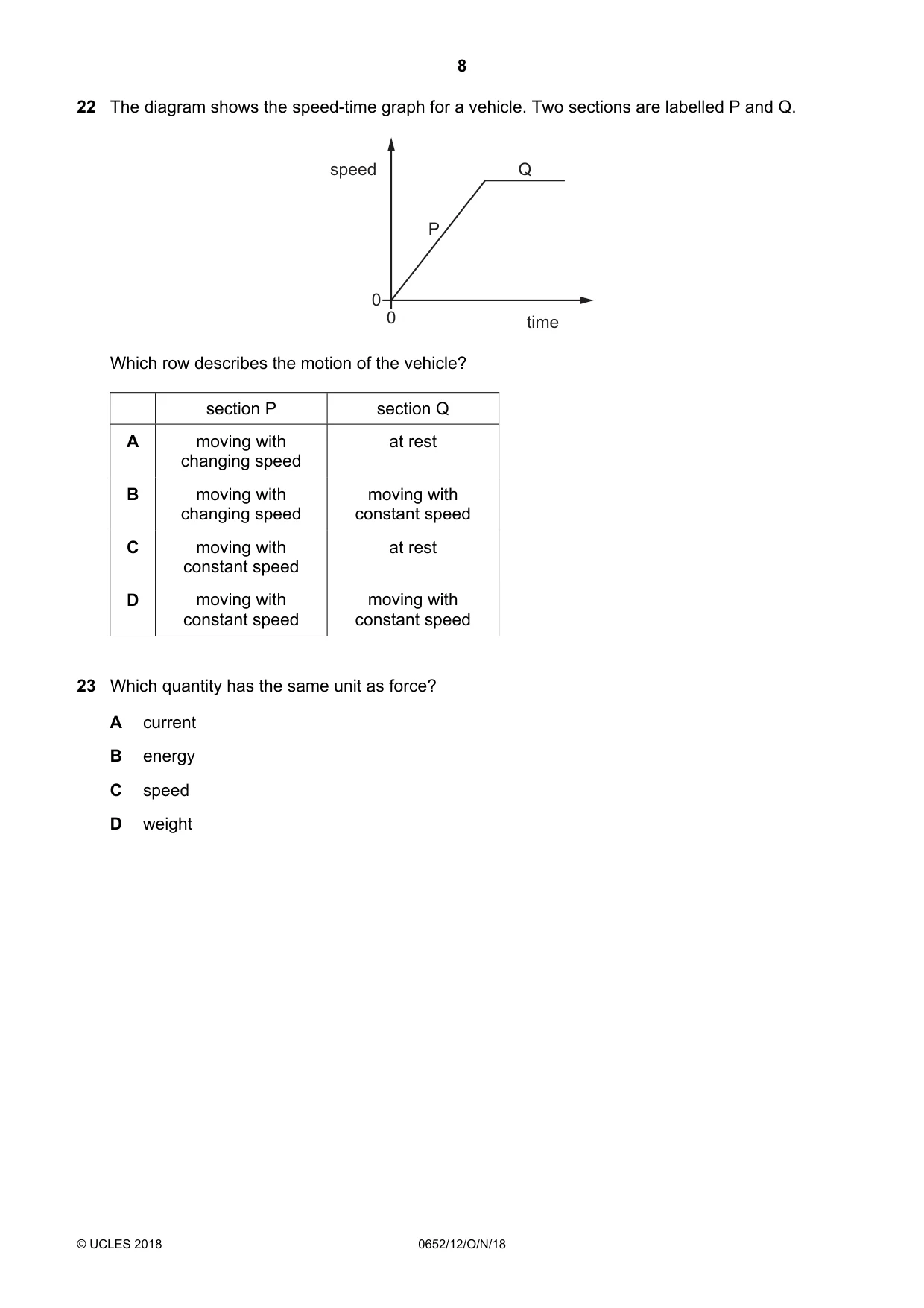
22 The diagram shows the speed-time graph for a vehicle. Two sections are labelled P and Q. speed Q P 0 0 time Which row describes the motion of the vehicle? section P section Q A moving with at rest changing speed B moving with moving with changing speed constant speed C moving with at rest constant speed D moving with moving with constant speed constant speed
Mark scheme: B
Q23 · Which quantity has the same unit as force?
23 Which quantity has the same unit as force? A current B energy C speed D weight
Mark scheme: D
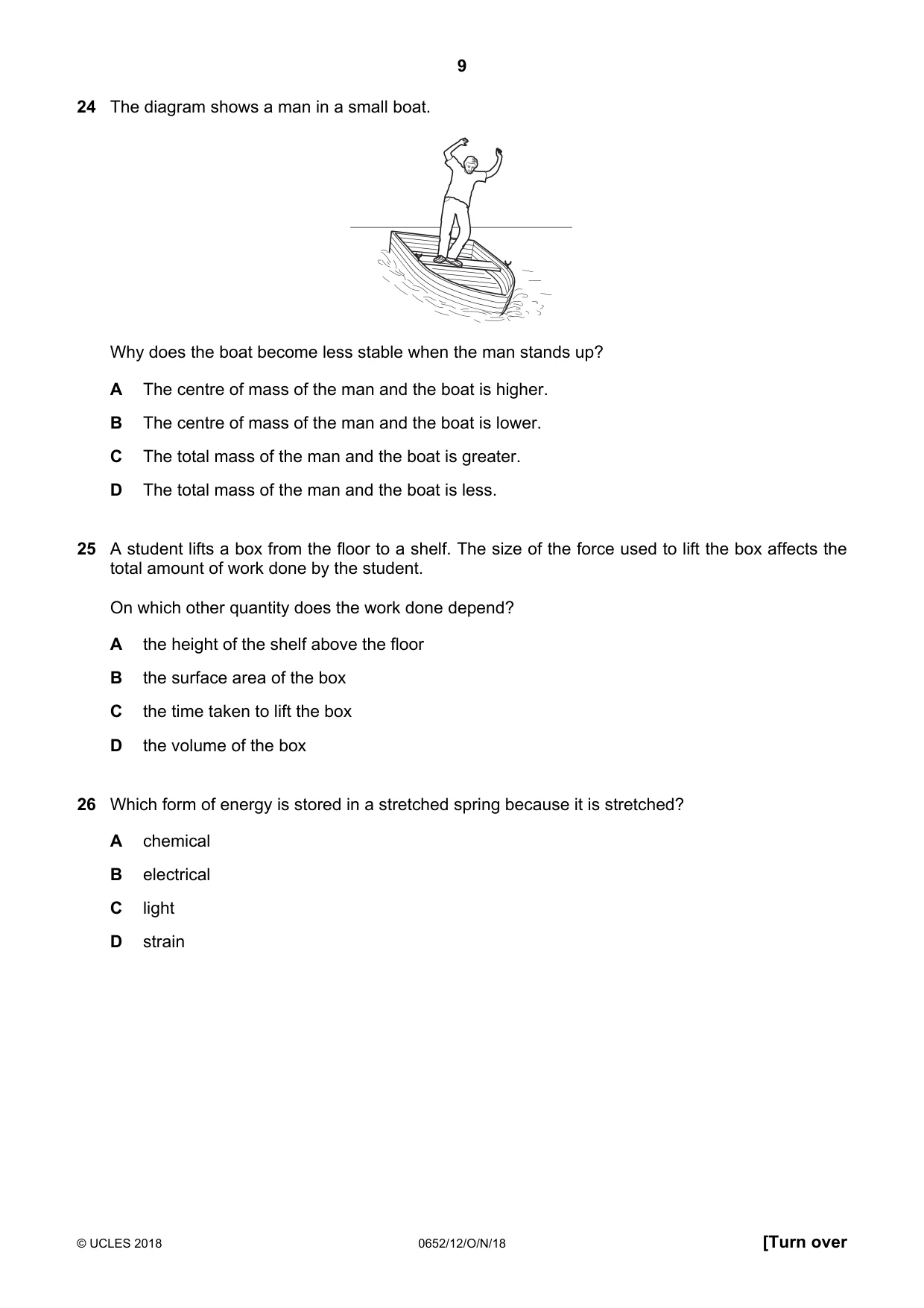
Q24 · The diagram shows a man in a small boat
24 The diagram shows a man in a small boat. Why does the boat become less stable when the man stands up? A The centre of mass of the man and the boat is higher. B The centre of mass of the man and the boat is lower. C The total mass of the man and the boat is greater. D The total mass of the man and the boat is less.
Mark scheme: A
Q25 · A student lifts a box from the floor to a shelf
25 A student lifts a box from the floor to a shelf. The size of the force used to lift the box affects the total amount of work done by the student. On which other quantity does the work done depend? A the height of the shelf above the floor B the surface area of the box C the time taken to lift the box D the volume of the box
Mark scheme: A
Q26 · Which form of energy is stored in a stretched spring because it is stretched?
26 Which form of energy is stored in a stretched spring because it is stretched? A chemical B electrical C light D strain
Mark scheme: D
Q27 · A chemical process causes energy to be released
27 A chemical process causes energy to be released. Which type of power station makes use of this type of process? A a gas-fired power station B a geothermal power station C a hydroelectric power station D a nuclear power station
Mark scheme: A
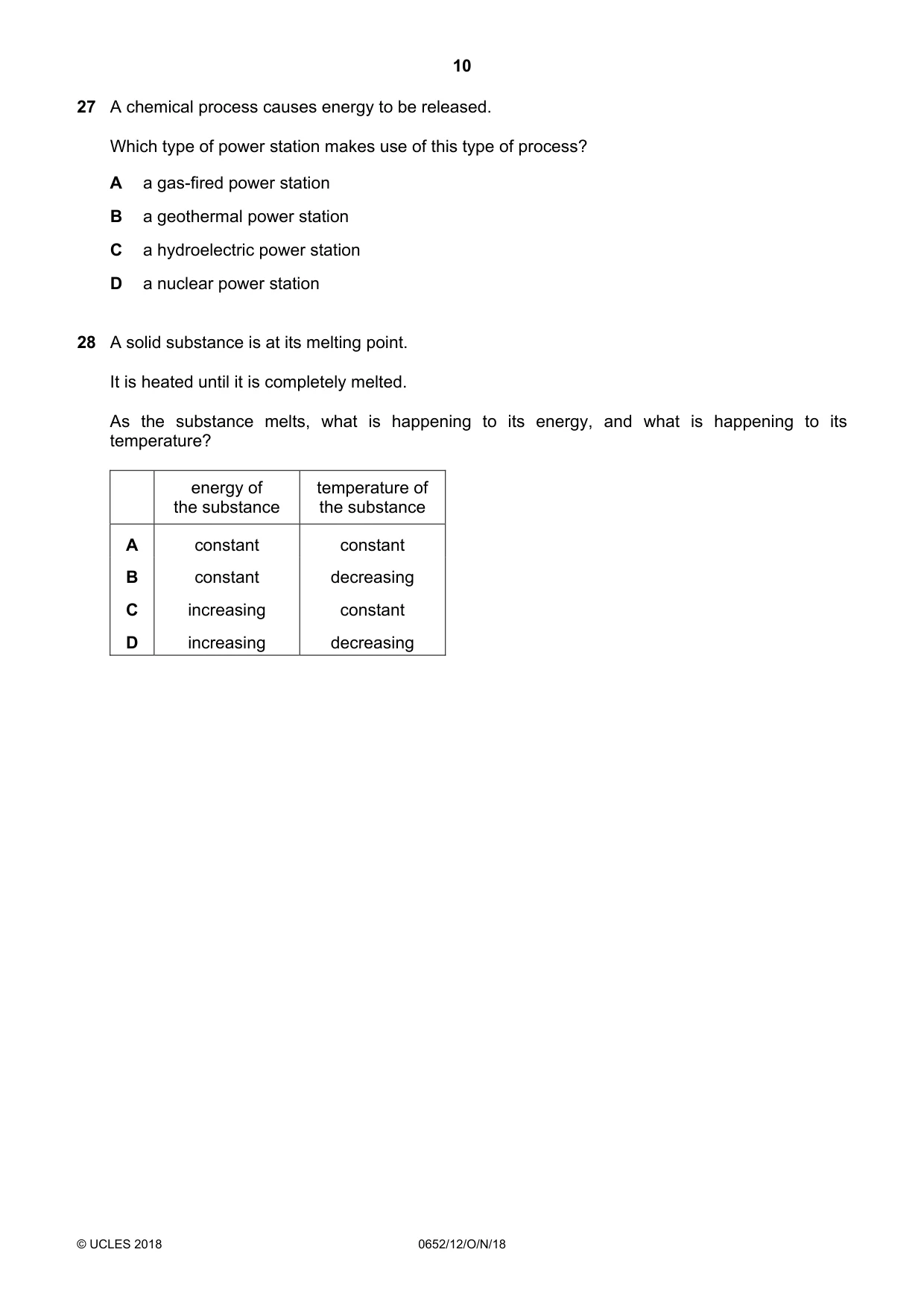
Q28 · A solid substance is at its melting point
28 A solid substance is at its melting point. It is heated until it is completely melted. As the substance melts, what is happening to its energy, and what is happening to its temperature? energy of temperature of the substance the substance A constant constant B constant decreasing C increasing constant D increasing decreasing
Mark scheme: C
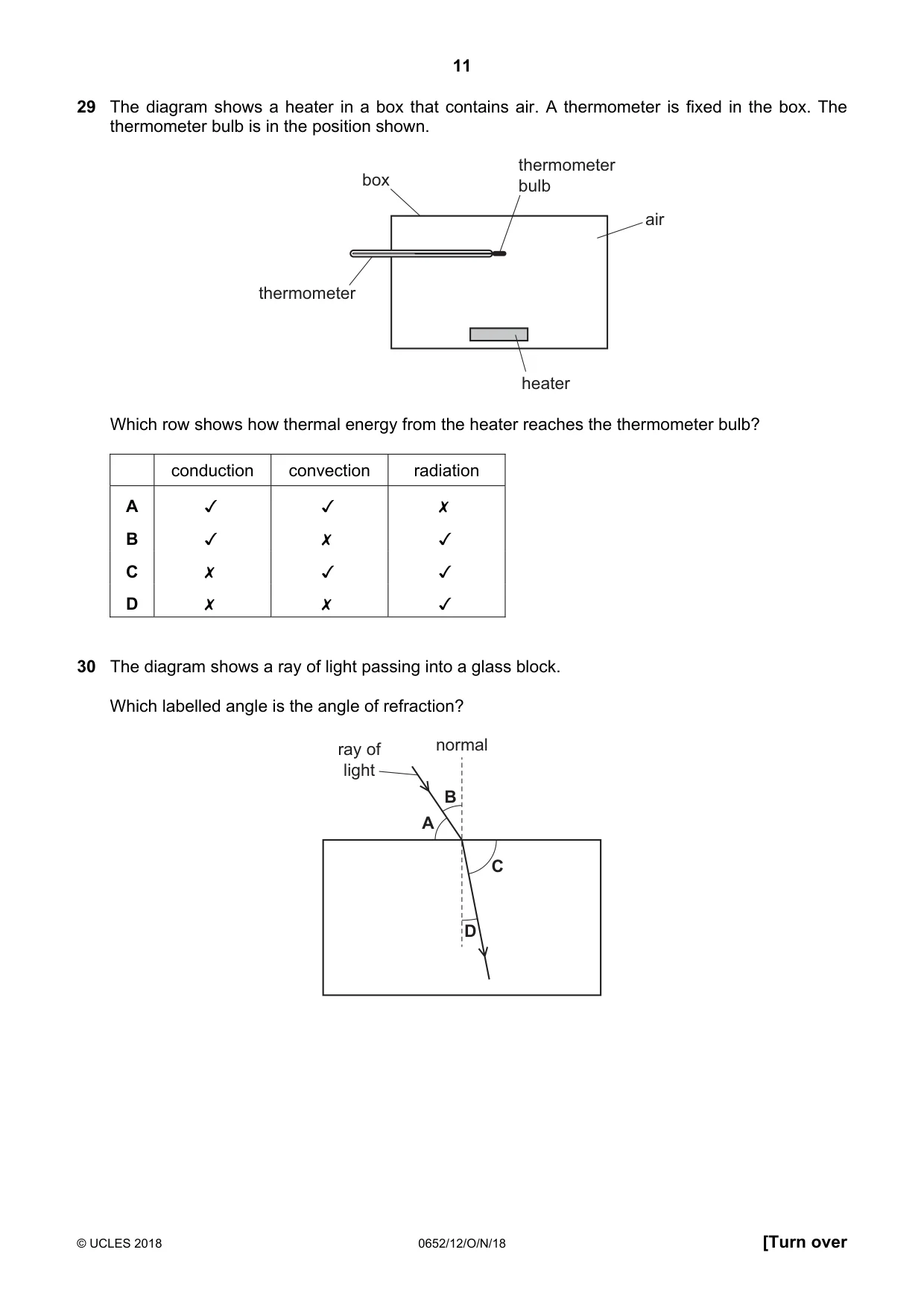
Q29 · The diagram shows a heater in a box that contains air
29 The diagram shows a heater in a box that contains air. A thermometer is fixed in the box. The thermometer bulb is in the position shown. thermometer box bulb air thermometer heater Which row shows how thermal energy from the heater reaches the thermometer bulb? conduction convection radiation 0 OD > ~ Kw & x < x SS 4
Mark scheme: C
Q30 · The diagram shows a ray of light passing into a glass block
30 The diagram shows a ray of light passing into a glass block. Which labelled angle is the angle of refraction? ray of normal light B A C D
Mark scheme: D
Q31 · Which of these is part of the electromagnetic spectrum?
31 Which of these is part of the electromagnetic spectrum? A alpha radiation from a radioactive source B cathode rays in an oscilloscope C infra-red radiation from a candle flame D sound waves from a bell
Mark scheme: C
Q32 · A vibrating object produces waves of different frequencies in air
32 A vibrating object produces waves of different frequencies in air. Which frequency is a sound wave that someone with normal hearing is able to hear? A 2.5 Hz B 1000 Hz C 25 000 Hz D 100 000 Hz
Mark scheme: B
Q33 · Why is iron a suitable material for the core of an electromagnet?
33 Why is iron a suitable material for the core of an electromagnet? A It is a good conductor of electricity. B It is a poor conductor of electricity. C It loses its magnetism when the current is switched off. D It stays magnetised when the current is switched off.
Mark scheme: C
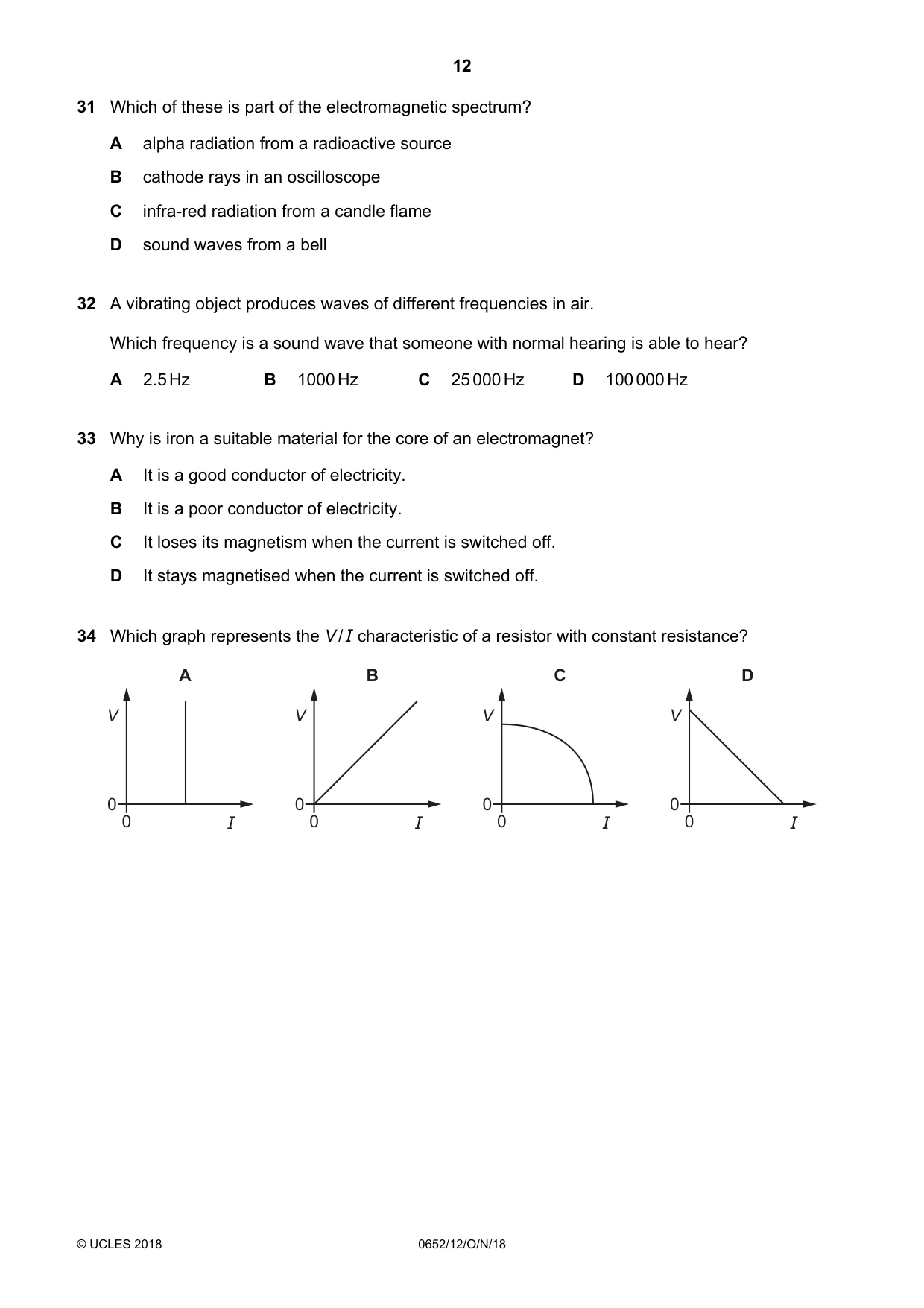
Q34 · Which graph represents the V / I characteristic of a resistor with constant resistance?
34 Which graph represents the V / I characteristic of a resistor with constant resistance? A B C D V V V V 0 0 0 0 0 I 0 I 0 I 0 I
Mark scheme: B
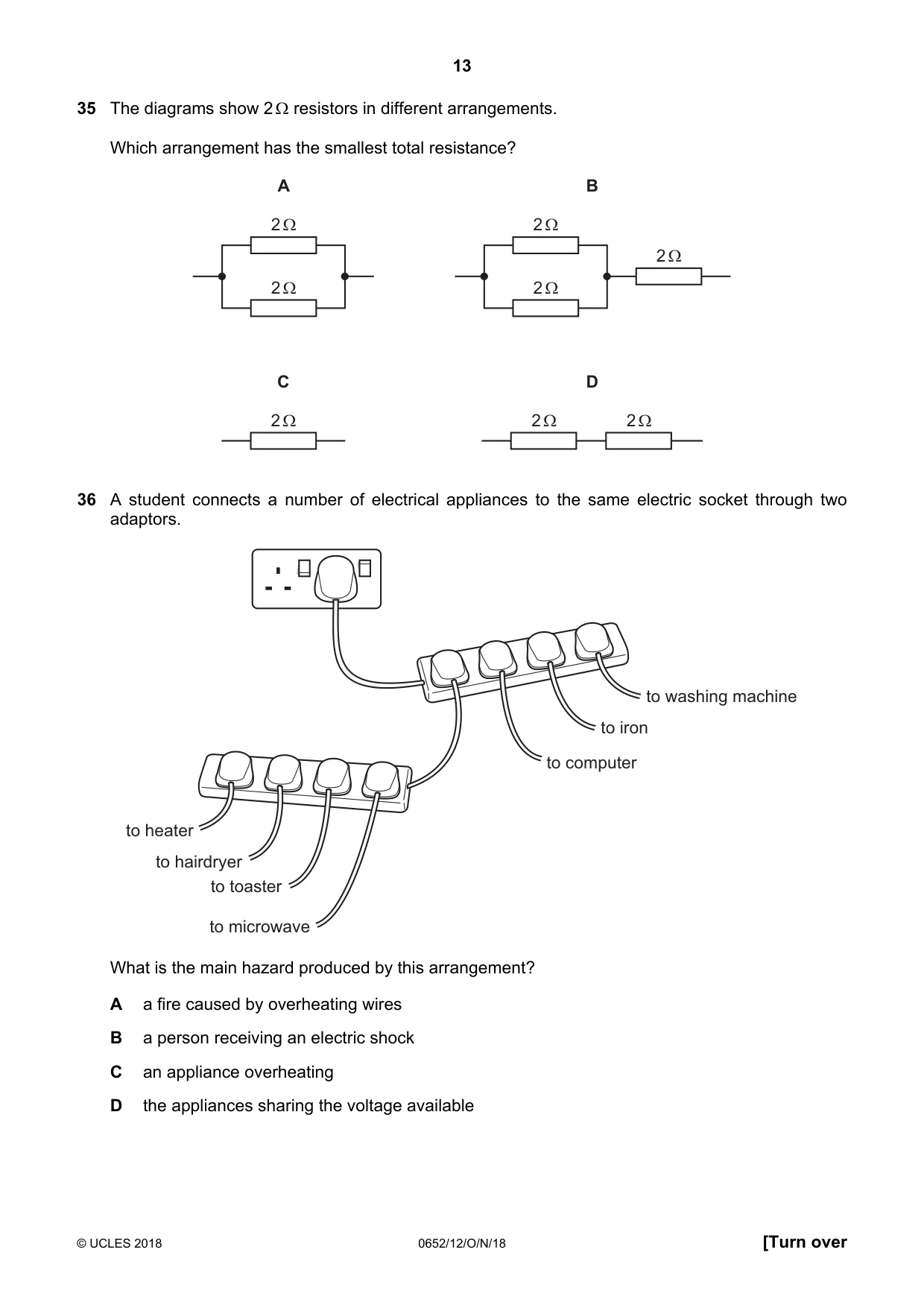
Q35 · The diagrams show 2 Ω resistors in different arrangements
35 The diagrams show 2 Ω resistors in different arrangements. Which arrangement has the smallest total resistance? A B 2 Ω 2 Ω 2 Ω 2 Ω 2 Ω C D 2 Ω 2 Ω 2 Ω
Mark scheme: A
Q36 · A student connects a number of electrical appliances to the same electric socket through…
36 A student connects a number of electrical appliances to the same electric socket through two adaptors. to washing machine to iron to computer to heater to hairdryer to toaster to microwave What is the main hazard produced by this arrangement? A a fire caused by overheating wires B a person receiving an electric shock C an appliance overheating D the appliances sharing the voltage available
Mark scheme: A
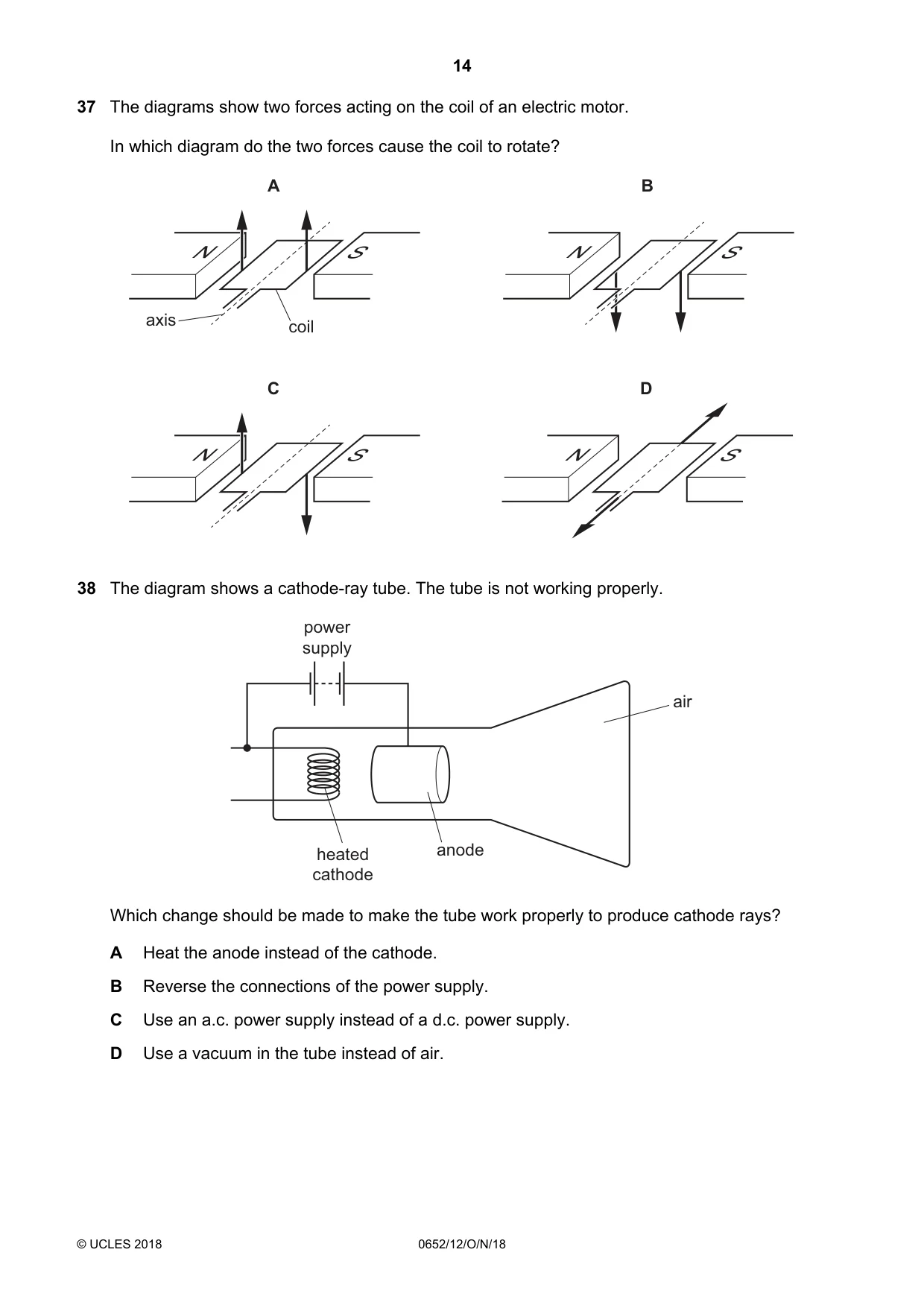
Q37 · The diagrams show two forces acting on the coil of an electric motor
37 The diagrams show two forces acting on the coil of an electric motor. In which diagram do the two forces cause the coil to rotate? A B N S N S axis coil C D N S N S
Mark scheme: C
Q38 · The diagram shows a cathode-ray tube
38 The diagram shows a cathode-ray tube. The tube is not working properly. power supply air heated anode cathode Which change should be made to make the tube work properly to produce cathode rays? A Heat the anode instead of the cathode. B Reverse the connections of the power supply. C Use an a.c. power supply instead of a d.c. power supply. D Use a vacuum in the tube instead of air.
Mark scheme: D
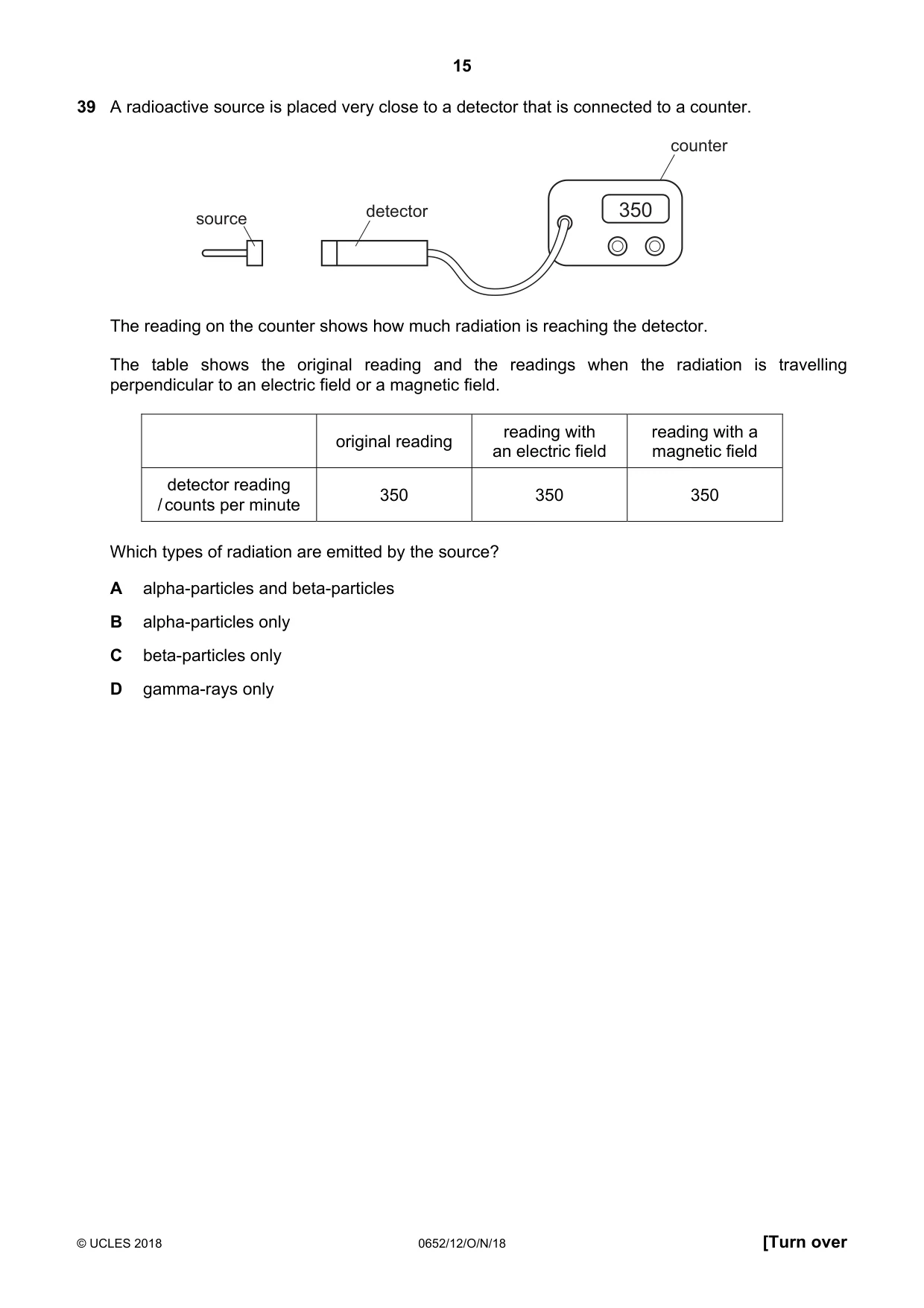
Q39 · A radioactive source is placed very close to a detector that is connected to a counter
39 A radioactive source is placed very close to a detector that is connected to a counter. counter detector 350 source The reading on the counter shows how much radiation is reaching the detector. The table shows the original reading and the readings when the radiation is travelling perpendicular to an electric field or a magnetic field. reading with reading with a original reading an electric field magnetic field detector reading 350 350 350 / counts per minute Which types of radiation are emitted by the source? A alpha-particles and beta-particles B alpha-particles only C beta-particles only D gamma-rays only
Mark scheme: D
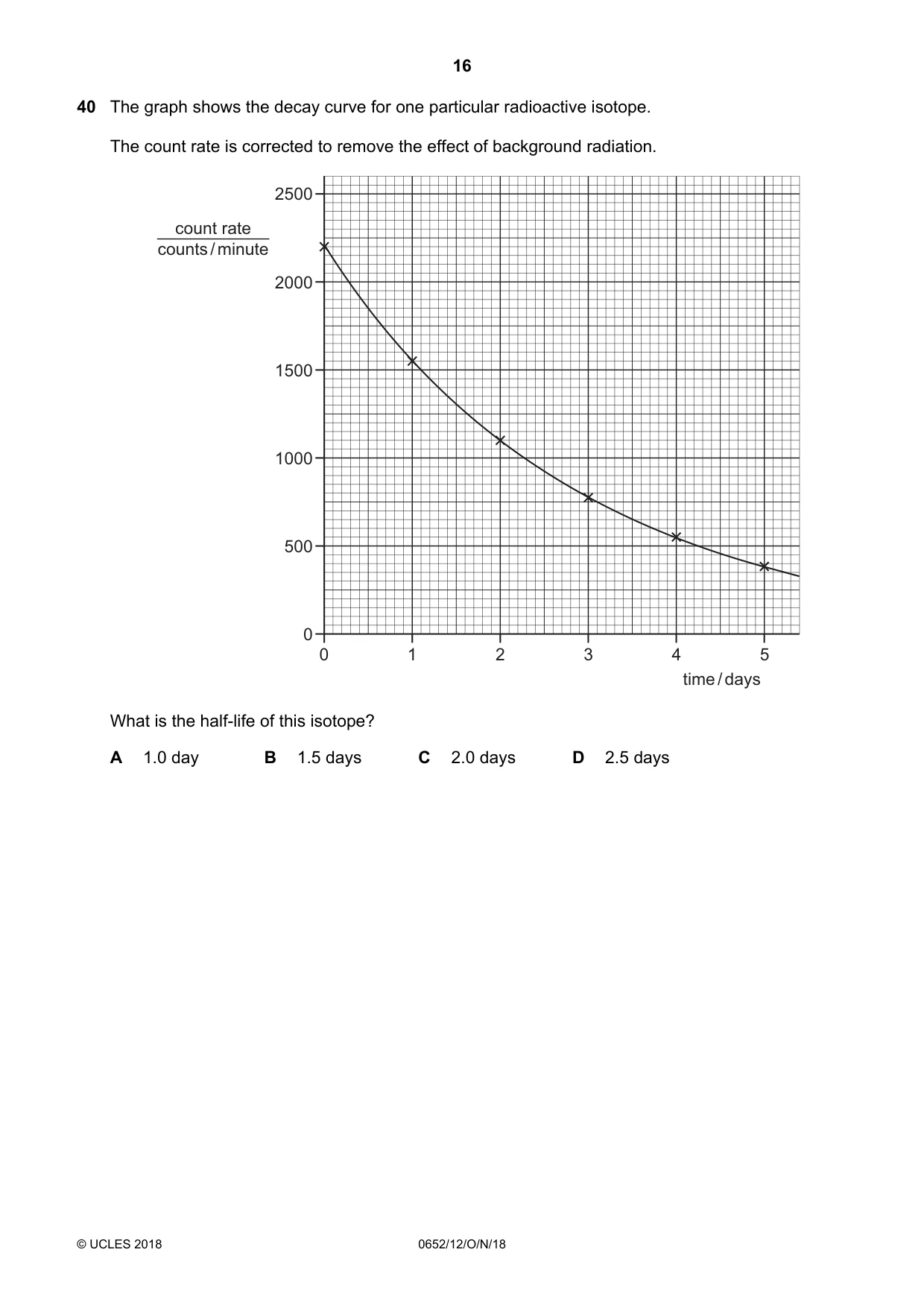
Q40 · The graph shows the decay curve for one particular radioactive isotope
40 The graph shows the decay curve for one particular radioactive isotope. The count rate is corrected to remove the effect of background radiation. 2500 count rate counts / minute 2000 1500 1000 500 0 0 1 2 3 4 5 time / days What is the half-life of this isotope? A 1.0 day B 1.5 days C 2.0 days D 2.5 days
Mark scheme: C
What was in this paper
The subtopics covered by these 40 questions, and how many questions each got. Open one in a new tab to see every Cambridge question on it.
3Radioactivity2Stoichiometry2Air1Alkenes1Atomic structure and the Periodic Table1Dangers of electricity1Electric circuits1Electrical quantities1Electromagnetic effects1Energy transfer1Forces1Fuels1General wave properties1Group properties1Homologous series1Identification of ions and gases1Length and time1Light1Macromolecules1Mass and weight1Methods of purification1Molecules and covalent bonds1Motion1Noble gases1Properties of metals1Redox1Simple phenomena of magnetism1Sound1The characteristic properties of acids and bases1The nuclear atom1The particulate nature of matter1Thermal processes1Thermal properties and temperature1Types of oxides1Water1What you needed in this session
Cambridge’s own grade thresholds for 2018 Oct/Nov, Paper 1 · Variant 2. A higher threshold means an easier paper — the bar moves with how the cohort did.